Personal Narrative
We’ve Inherited a History of Solidarity and Grief
My girlfriend saw me entering my 20s without a care in the world; at my age she was watching her friends die
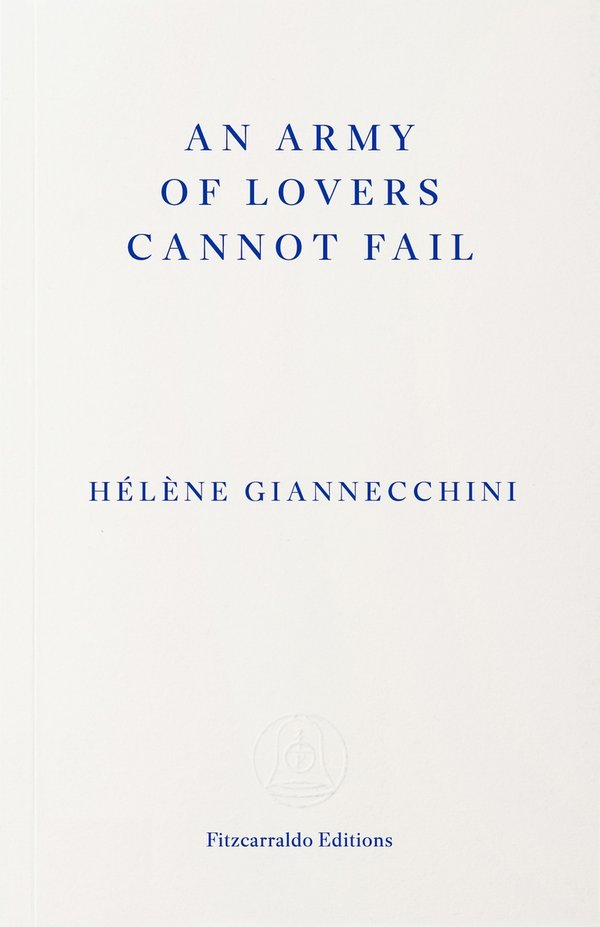
“Our Inheritance Was Left to Us by No Testament,” an excerpt from An Army of Lovers Cannot Fail by Helene Giannecchini, translated by Anna Moschovakis
I meet her online. She is named Myriam. I am 24, she is 40, which is unusual for me: I usually date people my age. I come across her profile and it intrigues me; I send the first message. She sends a response that I read when I wake. We go through the awkward stage of introductions; our exchange is lively, she has a sharp mind. I also sense a certain anger. We start communicating regularly, before 8:00 AM, when our schedules coincide: She is home from work, I’m getting ready to start my day. Eventually, our conversations spill beyond these confines. I see her more and more frequently on my screen, I wait for a notification to appear, for the name Myriam to glow, and I hasten to respond, wherever I might be. At work, I hide my phone beneath my desk. Our conversations carve a furrow that at first runs parallel to my days, then the furrow grows, begins to compromise everything else; I am now living alongside my regular life, tilting constantly towards my phone. When I can no longer tolerate this splitting, we decide to meet. Our first date is in a Greek restaurant in the 10th arrondissement; she’s already there when I arrive, and I recognize her even though I have never seen her in person. She has her back to me, I see her neck, her short grey hair; I allow myself a few seconds to catch my breath before approaching. Judging from our online exchanges, I need to prepare to be alert, responsive. I enter the dining room and sit directly in front of her. She doesn’t flinch, raises her eyes towards me: “Bonsoir.” “Bonsoir.”
It’s a memorable night, among the best one might hope for from an encounter launched in virtual space. We have a lot to talk about, Myriam makes me laugh, surprises me. We decide to extend the evening by going to a bar, and for some reason when she orders a scotch I follow suit. We are a little drunk, we end up making out against the facade of a building, and I go home with her. In her lightless bedroom she takes off her T-shirt and tells me to get undressed.
I see her again two days later in a café. She arrives by bicycle, perfectly on time. I am flushed as I wait for her, embarrassed to know her so little while the intensity of our sex won’t stop returning to me in waves. I wonder what one is to tell oneself in cases like this, whether I should pretend that our night together didn’t happen. She orders a beer, smiling—so much more relaxed than I am—and helps me conquer my malaise. I find her attentive, amusing, and yet I continue to detect a steeliness in her too; behind the levity of the encounter I sense an arid horizon, mineral, a landscape covered with sharp edges on which I could hurt myself. I am seduced and frightened at the same time, I remain on my guard, but when she orders a second drink I join her. We talk for a long time. I can feel our age difference, in an anecdote, or a reference that escapes me, but I don’t dislike it.
I can feel our age difference, in an anecdote, or a reference that escapes me, but I don’t dislike it.
We start to see each other regularly, and my doubts fade over time. I’ll often meet her at her place, she’ll feed me and we’ll go straight to her bedroom and make love, all without saying a word. The sex is raw and direct; it gives me a feeling of power. Her apartment is almost empty, there are just a table and two chairs in her living room, her books are stacked all along the walls and her clothes are in boxes under the bed. You would think she had just moved in, though she has lived here for at least 10 years. I feel good in this ascetic space. In the morning, I wake up alone in her bed. She hardly sleeps, is already occupied when I get up. She has put on her glasses, serves me coffee in a metal cup. I let her finish her tasks; I have understood that I’m to take an indirect approach, so I wait for her to speak first. Sometimes she shares bits of her life with me, women she has loved; or she’ll read an article from the paper out loud. Her analyses are astute; I can tell she views things around her through a political lens. On some nights, she wants to go out. She’ll dress with more care than usual, putting on chinos, Converse high-tops, a button-up shirt. I like to watch her do her hair in the bathroom mirror. I don’t want to go out with her, I would rather return to the calm solitude of my apartment while she stays out for half the night. I don’t know exactly what she does and I don’t want to know. I like for there to be some opacity to a person; it’s what makes them desirable.
A few months after we meet, I develop a case of shingles for the first time. I experience a new kind of fatigue, I can barely walk, read, or think, so she moves me into her bedroom. When I wake up in a sweat, stricken with vertigo, she is there. We still do not know each other well, but she chooses to stay, and, crucially, she doesn’t make it feel like a favor. She takes care of me in a way that I find unfamiliar, tending to me without undue solicitousness. Her way of helping is so perfect it makes me want to love her; I am struck by this curt generosity, grateful for her lack of effusiveness. On one morning that is more difficult than the others, as a way to distract me from my pain she pulls a book from her library and reads it to me while sitting by my side. Together we read Koltès’ In the Solitude of Cotton Fields. Her voice is very beautiful and changes in tone, becomes low, almost muffled; I have to strain my ears for the text to reach me, and from my place of fatigue I still want her to know how much my attention has been aroused, how it glides perfectly through these words by someone else. “Memories are the secret weapons a man still has when he is stripped bare, a frankness that obliges frankness in return; the ultimate nakedness.”1 When she has finished, I ask her why she chose this book. She does not reply right away:
“You know that Koltès died of AIDS?”
“I do.”
“That means something to me.”
I want to tell her it means something to me too. A lot. But I keep quiet. People who are gay, lesbian, bi, or transgender and were born in the 1980s never know how to situate ourselves in relation to the HIV/AIDS epidemic. We did not live it directly, we were born into it. We grew up with the fear of dying by making love. When we were adolescents, we hid in our rooms to ask the night (by way of Skyrock FM) if we could catch AIDS by kissing or sucking off a boy, by feeling up a girl. We were incapable of distinguishing between situations that carried risk and those that didn’t, so sex in general became synonymous with danger. In high school, we asked our girlfriends if they had “done the test” and those who said yes assumed the instant aura of cool “dirty” girls; when our turn came to have our blood drawn, we were so nervous we could hardly sleep until the results came back. Convinced we had done something bad that would be found out, we were incapable of knowing whether the shameful thing was the failure to use a condom or the sexual act itself. We began our sexual lives in a state of anxiety; but we were not going to die. Therapeutic advances ushered in a new era, so much so that AIDS began to seem remote, a familiar word but an abstract reality. As I entered my 20s, I wasn’t conscious of the fact that antiretroviral therapies were only 10 years old. This woman who is reading In the Solitude of Cotton Fields to me was 24 by the time these treatments were released.
One afternoon as we’re walking in Paris she shows me a building. “That’s where Nils lived,” she says, pointing to a window on the second floor. I don’t know who Nils is; I ask, and she quickly outlines the story of this friend she met one night at a party, “a faggot like me,” she says, who died from AIDS in 1992. I don’t dare ask why a lesbian would call herself a “faggot”; I act like I understand. She tells me how wonderful Nils was, and about his brutal death. “By the end, he was completely blind,” she exhales. I tell her I’m sorry, and she glares. “To be sorry doesn’t help, it’s what people say when they don’t have anything else to say.” I was instantly ashamed of my reflexive response. I have nothing to do with all of this, I don’t have anything to be sorry for, her story is not about me. I apologize, and we finish our walk in silence. She lets nothing go. I recognize this sadness that has mutated into anger; I have sensed it before, among older acquaintances. Now, I’m seeing it up close.
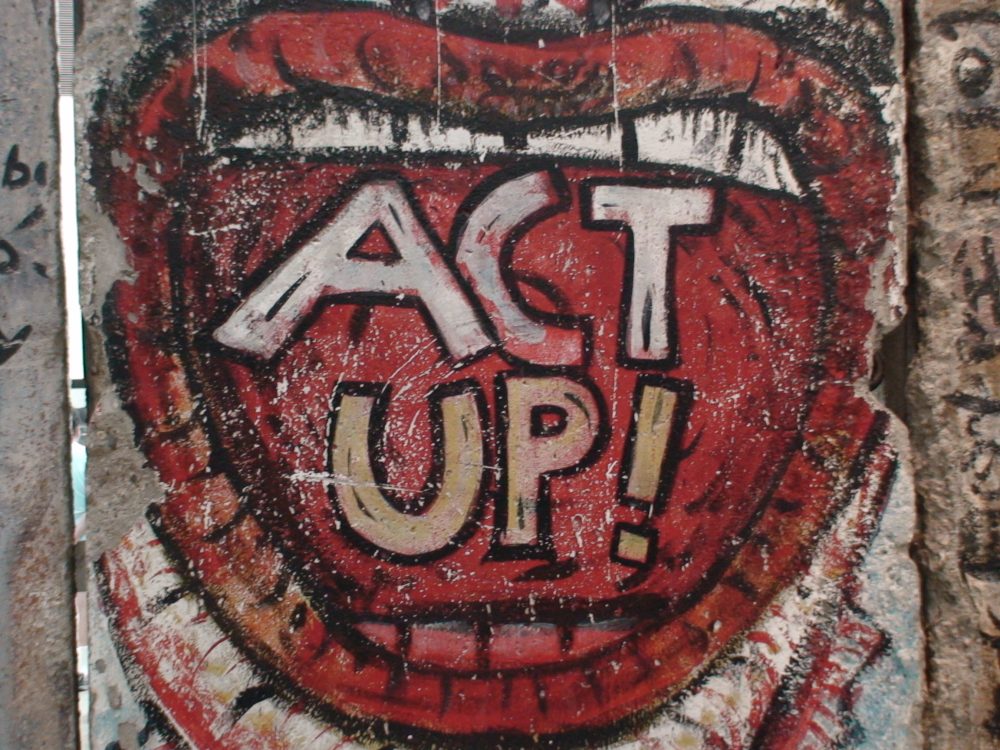
Despite this snag, our passage by Nils’ building has created an opening for new intimacies. She tells me of her first years in Paris, her arrival from a town in the Vienne region at eighteen and her impulse to go straight away to an ACT UP meeting, where she finds friendships that will prove consequential. She decides to leave her university studies and instead build her life inside this emergency: to take advantage of the time with those she loves, to become politically active, to care for those who become sick, to live in a present tense bounded by joy and rage. She is the first person who speaks to me in detail about the 1990s, about AIDS in France, the reaction of the gay community, and above all about ACT UP, its understanding of militantism, the actions it termed zaps, everything one does not see in the documentaries: meals of couscous shared after every action, arguments with bar owners in the Marais who found ACT UP’s methods unacceptable, tensions within the group itself. She recalls the death of a friend, the catastrophic state of his empty flat in the days before his parents arrived, how his friends howled with laughter despite their grief while throwing out his collection of gay porn magazines so his mother wouldn’t find them. At times, she is so absorbed by her own story that she bursts into laughter remembering the gesture of one friend or the witty comeback of another. Or conversely, I see her withdraw into herself; sadness alters her face.
She is the first person who speaks to me in detail about the 1990s, about AIDS in France.
In those moments, I wonder if she is still talking to me at all, if I haven’t dissolved into this exercise of commemoration. What does it matter? I adore listening to stories. I am moved, filled with admiration, I have the feeling that she’s offering me her trust and, above all, that she is teaching me my own history. It is with her that I become a lesbian, and that counts for something. Increasingly, I dare to ask questions; she seems touched by my interest, but something holds her back. She often references mourning her friends, but she doesn’t tell me everything; some intimate details are unrelatable, impossible to share.
I want her to keep telling me these stories, but I don’t want to ask too much of her. So when I return home, I research: I watch videos on the INA website of actions in which she participated, I try to identify her in archival photos, I read whatever ACT UP materials I can find online. I want to be able to comprehend what she went through, and the least I can do is not be ignorant. The more she talks to me about her youth, the closer to her I feel. But at the same time, our relationship is marred by incidents that start to accumulate: She criticizes my shortcomings, slams a door, raises her voice. She rejects me harshly before asking me to stay for dinner; lashes out in anger, then immediately pulls me into her arms. We make love all night and in the morning she won’t speak to me. She suggests coming with me on a trip for work, we spend a few marvelous days together in a village and afterwards she stops returning my calls. Our world is reduced to two settings: idyll or absence, desire or aggression. It is not a gentle affair, she even becomes abusive. I oscillate too: I adore her, and the next instant I want to leave her. I recognize that we are divided not so much by our age difference as by our experience. She sees me entering my 20s without a care in the world, and can’t stop recalling that at my age she was watching her friends die. She knows I’m not to blame, but she resents me nonetheless. The injustice is unbearable; everything else becomes a blur. I remind her of the tragedy she lived through, and from which I was spared.
But I’m stubborn, I want to please her. After she introduces me to Koltès, I decide to read every book by a writer who died of AIDS. I buy Guibert, Dustan, Lagarce, Copi. I talk to her about these discoveries, but my literary forays are insufficient, even irritating: I speak of plays and novels, I entertain myself with what for her had been reality. Because it arouses her anger without fail, I start to share less and less about my reading, my words peter out, I stop asking her things. Mornings, I drink my coffee and read in isolation; some nights I lie and go out with friends while she thinks I’m staying home alone.
Six months after we meet, Myriam joins me in a café in the centre of Paris. I’m with a group of friends from university, drinking beer and talking. There are about 10 of us around two tables, our chairs pressed tightly together. She asks at the bar for another, and settles in next to me.
Her face is tight and her mere presence dims my mood. One of our friends has brought his new boyfriend to introduce to us. We are welcoming of the newcomer, a tall guy with brown hair, at ease with himself, who likes attention. He rolls out one hilarious anecdote after another, makes broad gestures to bring the scenes alive, and I notice my friend stroking his thigh, proud of his presence, his beauty. At one point, we start to talk about what we’re reading and I mention a book by Guibert that I have just finished: My Parents. 2 It begins with a dedication that stunned me when I first read it: “To nobody.” My group comments on the cruelty of this epigraph, laughing. I say a few words about Guibert, and the new boyfriend intercepts my sentence before I’m done: “Oh yes, Guibert, I know him! I read a book of his once. He is actually one of the first sidaïques who had the courage to say, and to show, that he was sick.” My stomach turns. I can feel my face fall. I already know what this word will provoke in the woman at my right, who has just turned rigid in her chair. I don’t respond, the guy adds:
“That’s him, right?”
“Yes, yes.”
I want to go somewhere, anywhere, I am ready to say absolutely anything to make this conversation end, then teleport home to my flat. Myriam straightens up next to me.
“No, that’s not him.”
“Oh really, are you sure?”
“Yes, I am sure.”
“ . . . ”
“Do you know why?” (He has no idea what’s about to be unleashed.) “Because we never, never say ‘sidaïque.’ Unless you vote for the Front National. That is Jean Marie Le Pen’s word—do you understand what you’re saying, you asshole?”
The insult stops us all. Her voice is ice. She stands up suddenly, her chair topples over and the boyfriend lowers his eyes, burning red. I turn red too, I too am ashamed, ashamed of her reaction as much as of my friends, ashamed of having ruined the evening and of exposing her to this violence. I gather my things and excuse myself, she has already left the bar and is walking at a furious pace. I run after her; I detest her and I also want to beg her forgiveness, I hear myself stupidly calling out her name as I chase. When I reach her I touch her arm; she pulls away sharply and spins around. And then she yells at me. Really yells, her voice no longer deep and warm like when she reads aloud to me, but broken and harsh.
She says that she is ashamed too: ashamed of him, of me, of my generation of ignoramuses, of these young stupid gays who know nothing of their dead. When her voice calms I pull away, her violence is unbearable. I decide to turn and leave. Definitively.
Years later, in discovering The Gentrification of the Mind 3 by writer and ACT UP activist Sarah Schulman, I think of Myriam again. At the beginning of the book Schulman writes about the loss of memory, and derides the young queer people she encounters who have no interest in AIDS, who don’t know their own history, its consequences, the people who played crucial roles.
It is with her that I become a lesbian, and that counts for something.
I think Myriam wouldn’t disagree. I can even imagine them drinking in a café together, sharing their disappointment. They would be right. It’s true, we have been slow to comprehend what they were up against: death itself, but also the indifference of those in power; the greed of insurers, real estate brokers, laboratories; the contempt of politicians. Sarah Schulman won’t allow her gay friends to have died for nothing, she wants us to remember that they committed themselves to the struggle, that they refused to disappear in silence. My generation is in the crosshairs of multiple critiques: we are accused either of indifference, or of a tendency to appropriate a history we did not live through. “You couldn’t know, you weren’t there,” my former partner would say, and I couldn’t disagree. It’s true, I wasn’t there, and I was forced to occupy a difficult position: one of refusing to prolong the silence, while also shutting up and letting the real witnesses speak. I ask myself what my place really is, and that of other queer people my age, cornered at the intersection of these contrary complaints: at times ungrateful children, at times intruders, at times opportunists guilty of extraction. Sarah Schulman recounts the story of a young queer artist who comes to interview her at her home, and how their meeting had been a ruse: He’d had nothing to offer her. “He just wanted me to give him the interview. Recite my stories. I realized that he was looking for something to care about. He was looking for a hook.” This young man wanted her to provide the name of an artist who had died of AIDS for him to study; he was prying into the memory of survivors in order to carve out a path for himself. Schulman does not spare him, but also acknowledges her own failures: “We had been focused on conveying the heroism of ACT UP. But we had not succeeded at conveying the suffering. We had not conveyed how profoundly oppressed we had been.” Reading her, even though I share some of her analysis, I feel as if Schulman is scolding me too, when I only want to understand how the AIDS crisis politicizes my identity.
We are the inheritors of a history of struggle and suffering, of solidarity and of grief, of action and of pain, of engagement. How can all of this be told? Sometimes, something is lost in the transmission. “Our inheritance was left to us by no testament.”4 I ask myself what has been lost of the memory of the epidemic and to what extent the witnesses and players, like Sarah Schulman and Myriam, have run up against this incommunicable part. It isn’t only that a part of the story fails to reach us; it is, I believe, that they have trouble sharing it. The trauma of those years can’t be communicated in words. And transmission can also feel like a betrayal; it is a fact that we can’t preserve the past unaltered and that in some cases, omissions feel like treason.
Though I left Myriam, I remain changed by our relationship, by what she gave me, by the history she carried within herself, even though it was sometimes relayed through negation, in her silences and her bursts of anger. Now, in retrospect, I can better measure what she passed on to me. At the heart of this inheritance is the question of friendship. She became an activist because men whom she loved, with whom she lived, were getting sick, and it was because of this feeling, the sheer force of it, that she joined the struggle, first accompanying them to ACT UP meetings as a way to support them, and then finding her own place among them, inventing ways to fight side by side. And still, she retains joyful memories of these awful years, stories about her group of friends that highlight the adrenaline rush of particular actions, or the solidarity between people, moments of laughter, parties she’ll never forget. It was as a friend that she cared for, listened to, accompanied, wept. The first deaths in her life were of friends. As I listened to her during the few months we spent together, she became by turns my friend, comrade, sister, lover. She revealed to me an entire lexicon of friendship.
Excerpted from An Army of Lovers Cannot Fail by Hélène Giannecchini, translated by Anna Moschovakis, published by Fitzcarraldo Editions September 2026.
- Bernard-Marie Koltès, In the Solitude of Cotton Fields (1985; tr. Jeffrey Wainwright, 2001) ↩︎
- Hervé Guibert, My Parents (1986; tr. Liz Heron, 1993) ↩︎
- Sarah Schulman, The Gentrification of the Mind (2012) ↩︎
- René Char, Feuillets d’Hypnos (1946; tr. Hannah Arendt) ↩︎