Interviews
A Novel That Reinvents the Modern American Abroad Story
In "No God but Us," two queer Afghan men navigate empire, desire, and the fault lines of shared identity
Bobuq Sayed’s début, No God but Us, reinvents the modern American Abroad novel––the story, now over a century old, of Americans departing the US and crossing an ocean to find freedom and growth that they could not access at home. From Langston Hughes to Ernest Hemingway, James Baldwin to Garth Greenwell, the American Abroad novel follows the solo expatriate moving through a foreign land, usually a European city, seeking reinvention while reckoning with the racial inequality, sexual prohibitions, or moral repressions of American culture. In none of the canonical examples, however, is the protagonist both queer and racialized. Baldwin famously conceded that he was unable to create a character who was both Black and queer in Giovanni’s Room.
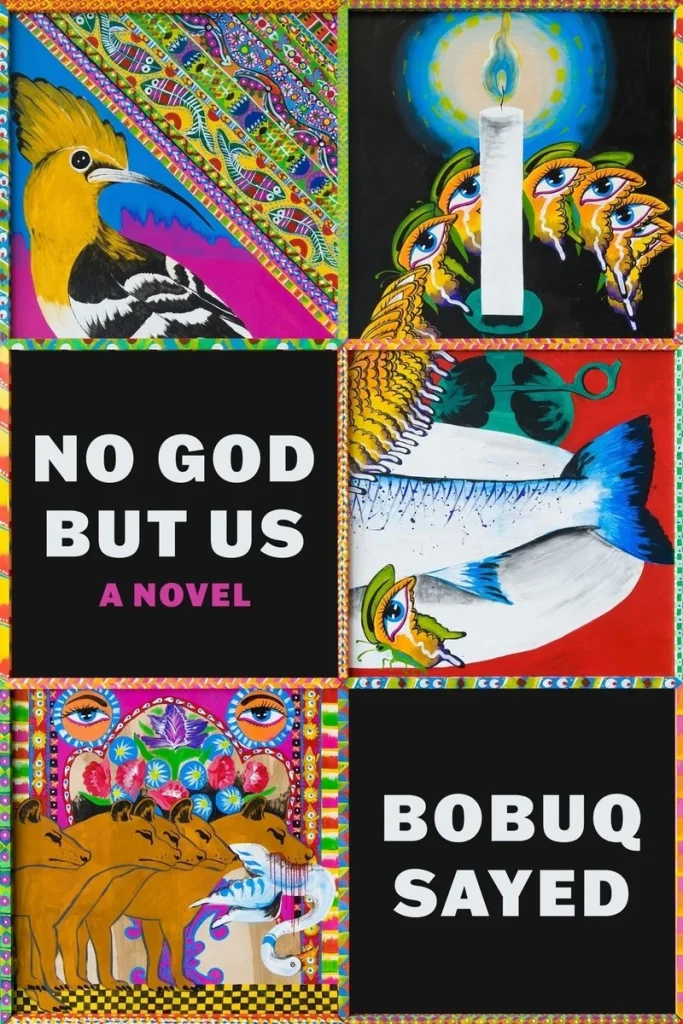
In No God but Us, the voyager, Delbar, is an American by birth but also the child of Afghan refugees, making his belonging in the US more contested than his literary predecessors. And he journeys eastward not to escape America but to run away from the fallout of being outed to his DC-area diaspora. He lands in a different kind of European city, Istanbul, just as the city’s regressive forces are turning against dissident communities. There, he meets Mansur, an Afghan refugee who has fled Tehran, a character who Sayed gives his own first-person narration, further subverting the Americans Abroad frame. The narratives of these two queer, displaced Afghan men intertwine, as does their desire for each other. Delbar’s narration is a story of love and self-becoming. Mansur’s is a story of the search for security and a path out of statelessness. Through their interweaving, the American Abroad novel is reimagined as a story in which characters displaced by imperial war confront the limits of a seemingly shared identity and contend with their differing relationships to love, desire, and relative privilege or devastation within the diaspora. No God but Us is a necessary and powerful intervention in American literary history––a novel that challenges tradition with new narrative form to show how the US’s imperial wars are carried within us wherever we go, shaping our loves and imaginations on the most intimate and psychic levels.
Sayed is a Steinbeck Fellow, Lambda Literary scholar, and award-winning MFA graduate of the University of Miami. We spoke over Zoom in April, less than half a year before the 25th anniversary of the US’s invasion of Afghanistan on October 7, 2001.
Leila C. Nadir: Let’s start with how your novel participates in but ultimately disrupts the literary tradition of Americans abroad, and also conventions of immigrant literature. Delbar and Mansur are neither contending with their lack of belonging in the US nor questioning their place in their ancestral homeland. So why Turkey? Why this third space for their stories?
Bobuq Sayed: I guess there was a sense of fatigue with this way that a lot of immigrant literature has been stalled by rudimentary questions of belonging. “Woe is me, I feel left out.” Boohoo, you know? We do the complexity of our experience a disservice when we fetishize trauma and permit narratives that overly self-victimize. We fail to account for the vastness of our power and, in many cases, our complicity in empire.
I didn’t want to write a domestic story about a gay child of immigrants questioning his belonging. This third space you’re mentioning, Turkey, was a sort of undressing of the strictures of identity and language, because Turkey is neither origin nor destination. In Turkey you have this cosmopolitan community of refugees and asylum seekers who make huge sacrifices to reach Istanbul since the borders from West Asia and North Africa up until Europe are more porous. They’re sometimes waiting years for their new homes and permanent stability to materialize.
I wanted the third space to present other identity formations and relationship types. When we rid ourselves of this language of who am I and where do I belong, when we begin from the premise that none of us belong here, what other indexes of power emerge? What are the subterranean tensions and motivations that are hidden until that undressing takes place?
LCN: Delbar imagines the identity he shares with Mansur grants him some great vault of access to Mansur’s life experience. Over the course of the book, we see the evolution of that hubristic assumption. In Turkey, Delbar’s American-ness becomes painfully obvious, and it becomes a barrier to genuinely understanding Mansur.
BS: Totally. The first chapter begins with Delbar presenting himself as an educated authority on the Middle East and on representations of the SWANA diaspora. And maybe in the American context he is, or he has some discernment, he gets away with the woe-is-me thing.
Unlike Mansur, who reaches Istanbul via smugglers, on foot, and in the hulls of passenger buses, Delbar is accessing the city via frequent flyer points, airplanes, and his expat aunt. We see the flattening effect of language and identity. These two people are, in fact, worlds apart. What do love and family look like in this context? Where are the fault lines of power?
At the social support dinner for queer and trans refugees and asylum seekers in Turkey, Delbar displays an acute understanding of his lack of authority, right? No one has to tell him that his Afghanness is not the same as Mansur’s. Delbar’s supposed cultural authority is also a chronic delusion about the integrity of his point of view, which the reader comes to learn.
This book would’ve been much easier to write as an exclusively single-subjectivity, diaspora story, but then it wouldn’t be taking any swings. There would be no risk involved.
We get to see the ugliness of the American subjectivity, how much it excuses, and how much it gets away with.
LCN: Did this inform how you structured the book? The novel alternates between Delbar and Mansur’s first-person narration, yet their timelines are not synchronous. Delbar’s begins with meeting Mansur shortly after his arrival in Turkey while Mansur’s is longer, and begins earlier, showing his struggle to get on his feet while awaiting review of his case in Turkey. The stories don’t link up until the last third of the novel.
BS: I wanted to trap the reader in identification with Delbar, who’s this edgy, urban, queer snarky, counter-cultural beatnik figure that you want to go to bat for. And with those single subjectivity, autofiction storylines, you do. You start with the Gary Indiana and you end with the Gary Indiana. Wherein, he’s not necessarily good, he’s not necessarily likable the whole time, he’s certainly not making fantastic decisions, but beginning to end he remains your guy.
I was interested in what happens if he starts as your guy and then, by the end, it’s not that this guy sucks necessarily, but that in the grand context of history, and interspersed with this other point of view, we get to see the ugliness of the American subjectivity, how much it excuses, and how much it gets away with. Who are the casualties of that subjectivity? Who is obfuscated?
This also relates to the writer abroad thing, all these American and British authors across history who’ve written these authoritative accounts of the cultures they transplant into.
LCN: I feel that––how Delbar’s narrative implicates the reader. They’ve become emotionally invested in his self-becoming, in his search for self-expression and identity partly through his pursuit of drag performance. We get a lot of Delbar’s romantic pursuit of Mansur, the play by play, while Mansur’s narration is focused on seeking material security and negotiating with power to find some kind of base line of freedom.
BS: Delbar is having this profound, heated, romantic love story. And it is a love story from Delbar’s perspective. But from Mansur’s perspective, that love story looks very different. A central tension here is between love and security in a queer contemporary migrant context.
Like, arranged marriage is frowned upon, certainly among queer people. This idea that you could match people because they’re from a good family or they have a good job. We’re fed this idea that “all you need is love.” But, for someone like Mansur, pursuing a relationship for love destroyed his whole life in Iran. He never had the luxury of choosing love. What is the class context, and what are the historical conditions, of who gets to choose a partner based on the whimsy of the human heart?
Delbar isn’t yet burnt by the sharp edges of love; he has the privileges of native fluency in English, American citizenship, and ultimately a family that will not abandon him. His family is complicated but there is no abandonment. His mother crosses the ocean to reiterate that refusal. And it’s not that Mansur’s family abandoned him, but the book is concerned with how nationality, class, and visa status inform things like love and family estrangement that we don’t often associate with border violence.
LCN: While writing about two queer Afghan men, how did you carry the legacy of the ways Afghan genders have been represented across history? Noble and fierce warriors of the British and Reagan periods, terrorists in the Bush era, cowards in the Biden era. And Afghan women always in need of saving. What kind of responsibility, burden, or freedom did you feel in writing against this legacy?
BS: I was definitely really careful about perpetuating stereotypes of Afghan women, refugees, and queer people as docile or in need of saving. I wanted to show how matriarchy looks in the American context and also in the Afghan-Iranian context, where Mansur’s mother has to secure her daughter’s future when there is a fear of deportation. In the end, everyone is making the best decisions they can based on their material circumstances and their worldview.
When Mansur’s little sister starts to veil, our tendency is to associate that with backwardness. She snaps back that it’s my body, don’t I have a right to choose? And indeed, isn’t it more misogynist to assume that Afghan women and girls have no free will? For eight years, Laura Bush made Afghan women her First Lady project. Eight of the first 26 years of the 21st century, American political consciousness revolved around the plight of Afghan women. Today, they are worse off than ever before.
These conversations we’re finally having now about where our tax dollars are going, what murderous wars they’re funding and to what end, are great questions. Susan Sontag was widely rebuked for making this same argument in 2001, even among liberal commentators. SNL threw Rage Against the Machine out onto the street for performing “Bulls on Parade.”
There has always been tremendous opposition to criticizing the American military and it still remains sort of taboo. But like, where did the $2 trillion spent on the war in Afghanistan go? Because, you know, in Afghanistan, it’s hard to find receipts for where that money was spent. A lot of it was used to line the pockets of defense contractors and weapons manufacturers in the DMV.
What is the class context, and what are the historical conditions, of who gets to choose a partner based on the whimsy of the human heart?
LCN: Mansur and Delbar navigate shifting operations of power across empire, state authoritarianism, anti-queerness, anti-transness, anti-immigration, and also the ways Islam is weaponized as a tool to control people on the state level or justify war. Trying to read this barometer of where queer immigrants fleeing imperial violence might be safe is a constant negotiation. As Mansur says, “Every promise of safety had come at a price.” I’m amazed at how this novel holds all these shifting borders, which are even more relentless in 2026.
BS: Part of Orientalism’s suffusion into our representations of the Middle East is that we have an enormous and compelling set of stereotypes for the Muslim world. I embarked on this novel to articulate something different. We’re writers, cultural workers, narrative shapers. That’s our role. We push back on dominant, hegemonic, harmful narratives. Novelists have the profound opportunity to showcase an alternative way the world might be, or already is today.
I felt it was important to register my dissent at the narratives we’ve inherited, both named and unnamed, at the explicit level of women taking charge of their lives, the passports and privileges that certain characters have and others don’t, but also at the level of what they’re afraid to say, the very subtle moments of protest and refusal.
The aid organization that several characters work for, Peacemeals, is led by this German guy, Leif, and it’s funded to build bridges by breaking bread, or whatever the slogan is. The reader is cringing a little bit at the out-of-touch nature of this organization, but they’re only doing that because of how we’re being told the story, and who’s telling it. In another accounting, Leif could easily be portrayed as a savior here, helping to evacuate queer and trans people from the Middle East. And in fact, that’s the person who has told this story across history. It’s Leif. I really wanted to shut him up because he’s also the mouthpiece of empire. He’s the one we’re primed to accept as the spokesman of this community.
The number of books written by white people about Afghanistan is astounding, and the sheer magnitude shows us that it’s not just an individual problem. We’re really dealing with a system of dehumanization here that indicts publishing, the aid sector, and the global image economy.
LCN: It’s like that time The New York Times assigned the review of Jamil Jan Kochai’s short story collection to a white military vet.
BS: Oh god, yeah. The review was tiny and the reviewer spent a good portion honing in on some minor irrelevant detail of how the book had inaccurately specified the rank of the airman who’d be flying a certain kind of warplane. These fuckers really have some nerve to reprimand Afghan writers for not expertly skilling themselves in the language of our own annihilation.
LCN: Let’s dwell with that a moment––how Afghan writers establish our authenticity for those audiences only if we submit to the West’s militarized representation of our culture and history. You blow right past that racism with this novel. I’d love to hear about literary inspirations you turned to in constructing Delbar and Mansur’s stories, which are counter-narratives to each other but also to that Orientalist militarized frame.
BS: A Burning by Megha Majumdar was a major inspiration in demanding that I bifurcate this narrative; the structural restraint of just Delbar’s perspective made it impossible to showcase his character. There are some things that could only be done via another character looking in and seeing this guy’s delusions, you know? Fatima Bhutto’s The Runaways was another inspiration.
There’s this common conceit of a main character obsessing over another person in their life who represents some shortcoming or perceived insecurity. I’m ugly, look at how beautiful she is. I’m unpopular, and I’m fixated on the cheerleader everyone loves. It’s a whole thing. By letting the subject of that obsession write back against the grain, we turn that conceit on its head. Suddenly, whole new tensions emerge. It’s part of why Delbar gets a three month timeline and Mansur’s is more like six years. I really wanted to complicate this idea of who receives more nuance, because the predominant tendency in books is for us to never get Mansur’s point of view at all.
Despite these conservative and queerphobic religious authorities, Islam belongs to us too.
LCN: Let’s close with your title. No God But Us reworks the shahada, the Islamic declaration of faith. There is no God but Allah and Mohammed is his Messenger. Neither Delbar nor Mansur are vehemently religious, yet they share that background. How does the title capture Delbar and Mansur’s relationships to Islam, gender, and sexuality?
BS: The idea was to suffuse this centerpiece of Islamic prayer with Attar’s Conference of Birds, which is central to Sufism. The Simorgh is this Sufi folktale of a huge trove of birds who go in search of the famed God of the birds. On their journey, they encounter various obstacles and endure mass casualties and, by the end, there are only 30 birds left.
They come across a reflective surface and the 30 birds who remain realize that they are the Simorgh they went in search of. Si-morgh translates to “30 birds” in Farsi. I interpolate that Sufi text to champion our people as divine.
In the Bible, Jesus loved the poor and a sex worker washed his feet. A foundational tenet of Islam is the anti-capitalist repudiation of collecting interest on loans. Even today, the Pope condemns conquest and deportations. Organized religion used to rail against the elite.
Part of the racialization of Islam is that you can never fully disavow it because the state, police, border guards, and case workers see you and read your name and see your thick facial hair and act accordingly. How you identify doesn’t materially inform how you’re treated. They look at you and they see a Muslim. So, despite these conservative and queerphobic religious authorities who would like to deny our claim to Islam, whether they like it or not, Islam belongs to us too.
When those 30 birds see their reflection, among them are queer and trans people, sex workers, drug users, immigrants, divorcees, feminists, criminals. That’s what the title gestures to.