Interviews
Nana Kwame Adjei-Brenyah Turns to Music
The author of “Chain Gang All-Stars” on writing across disciplines and releasing his debut album, “The Pisces Sciatica”
Two years ago, I decided to end my career as a teacher to pursue an MFA in Creative Writing full-time. I was suddenly thirty-five in a kindergartner’s shoes again, fearful in anticipation of the first day of school. I sharpened my pencils, prepped my new notebook, and nervously registered for classes. Then, just before the semester began, students received an email that a new professor would be joining the staff to lead a workshop: Nana Kwame Adjei-Brenyah.
When I read Nana’s name, I skidded cartoonishly across the floor to tell my husband and then responded to the email as quickly and coherently as possible that I needed to switch into his class. I had a deep admiration for his words and how he chose to bare them to the world. My gut is always loud and demanding, but I had just started to try this new thing called “listening to it.” It was the right choice. During the semester, Nana and I found common ground over our very millennial memories and growing up in New York. We were both also dissed for having Android phones and being born in the 1900s. But most importantly, I discovered that we were united by the belief that genre is a prison.
Nana Kwame Adjei-Brenyah has defied conventions his whole career. His writing blends surrealism with radical portraiture and horror with hope, often providing social commentary on the world around him. His short story collection, Friday Black, and debut novel, Chain Gang All-Stars, both received awards and critical acclaim. Nana’s also hell-bent on pursuing new creative challenges. So, when I learned that he was releasing a debut album,The Pisces Sciatica, I was curious about how music as a medium would evolve his work. I couldn’t wait to hear how installing new wings allowed him to fly again.
Ashley Leone: What about music liberates you to write more autobiographically?
Nana Kwame Adjei-Brenyah: People consider me a prose artist. But The Pisces Sciatica was gonna be a look at my life, and I didn’t want to do that in the same medium. In some ways, the things that I fear about music made it very attractive to me. I’m so craft-focused as a writer, but there’s a rawness in my naivete as a rapper. And I’m not saying that craft makes you a liar, but I can curate the truth into oblivion if I really want to. There was something powerful to speaking about these last couple years of my life with my actual lived-in voice, which is a less finely tuned instrument. It just felt more honest.
AL: What is meaningful to you about rap as a genre for storytelling?
NKAB: I’m from a place called Spring Valley, Rockland County, and even before I ever wrote for real, people were sitting in cars and freestyling. Music is the medium I take in most, probably, because it’s so easily embedded into your day. The artists whose work is closest to my heart are musicians.
For me, making music has a lot to do with needing something for my mind to do when I’m stressed or scared. I think on a loop. So, I listen to instrumentals and write raps to them. I have some obsessive tendencies, anyone with anxiety can connect to that. But with music, it feels natural and kind of fun to be in these repetitive loops.
AL: Is there a specific track on the album that felt most vulnerable for you to write?
NKAB: “The Pisces Sciatica” is a song about my father and his passing, and me working with him through his cancer. The end of that first verse is “I hate it half the time, because I’m the one who signed Do Not Resuscitate.” Even saying it right now, it’s hard. It’s not something I really talk about, but for me, that was one of those moments that justified the entire project. It’s almost like I have to scream the truth in a forest where no one’s there before I go on with writing it. The music felt like this kind of empty forest for me. I’m slowly getting myself ready to write about those things in some way, shape, or form. But I am scared of it. I have so much admiration for memoirists.
AL: Have you written any fiction that’s felt just as raw and intimate to write?
NKAB: In my first book, there’s a story called “Things My Mother Said.” I think if you’re an artist, you feel this often: I just gotta say this thing. Then “The Hospital Where” is my first version of meta-analysis about writing. You could see I was already getting critical about the pursuit of an artistic existence. Those stories are like the prequel to The Pisces Sciatica.
AL: On this album, there are various references to arts, artists, and culture, like Icarus, Smokey Robinson, Emperor’s New Groove,“making weight” in sports . . . What are the mediums that influenced this album but maybe didn’t make it in as a reference? What are the artforms this album couldn’t exist without?
NKAB: Some of the important ones are the ones you named. I like big, mythic, well-known stories that have a universal lesson, that you can interpret differently if you want to. Like Icarus—the album pretty much starts on that idea, which is kind of dark.
AL: But Icarus gets off the ground. He’s figured out how!
NKAB: Exactly. My best friend messaged me, “People forget he can fly.”
I’m so craft-focused as a writer, but there’s a rawness in my naivete as a rapper.
The album wouldn’t exist if I didn’t have exposure to rap artists like J. Cole or Kendrick, especially their deep-cut, soul-sampling songs. I couldn’t make this without a project like The Water[s] by Mick Jenkins. And I would never in another context name my own stuff, but I just know that I couldn’t make this without writing “Things My Mother Said” or “The Hospital Where” first. They helped me feel brave enough that I could.
AL: Something that I love about hybrid art is that it can only exist because of the artist who makes it. Because you’re coming from your own context, all your positionalities and intersectionalities, whatever makes you you, including your artforms. How do you feel this album specifically contextualizes you in the world? What are you representing of yourself? I heard that Goku reference, and I was like, 12-year-old Nana is so pumped that he could put this in a song.
NKAB: I actually got chills when you said that because I just did therapy before this, and we were talking about that kind of stuff. Doing inner child work has been a big breakthrough for me in general.
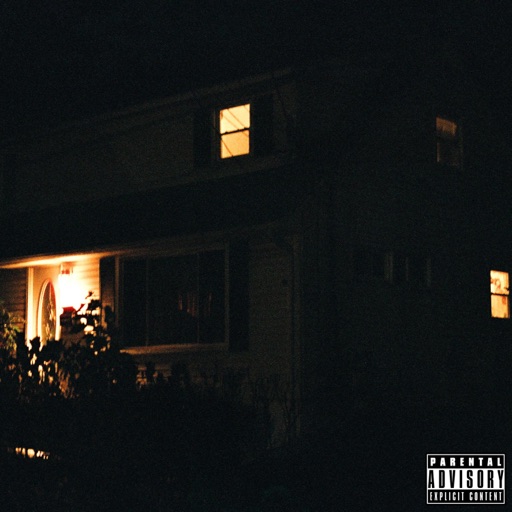
The front cover of The Pisces Sciatica is a place I lived in when I was young, and the back cover is of the place I lived in when I was even younger than that. So, it’s absolutely teen/adolescent Nana who’s been trapped in this context because he’s decided he has to fix this thing, and he’s been killing himself trying to become an author.
I wouldn’t say I’m a super happy person, but the people pleaser in me, with the people I’m codependent with, that part of me really likes presenting in a certain kind of heroic way. It’s savior complex stuff. My professional life also really likes that part of me, too. I’m not the most zodiac-y person, but my rising sign is Leo, and I think that part of me is the part that people see.
There’s [a] little bit of hype and cool on the album, but the inner sad boy is powering everything else.
AL: In fiction, some of the most compelling characters are the ones that live in their contradictions. “Best Right Now,” which is a more vulnerable, “sad boy” track, is juxtaposed with “And The Miracles,” which is a confident, boastful song. That tension is a good example of how to build a character. So, I wondered how your experience writing fiction informed how you compiled your album. How did you order your track list? How does that compare to assembling a short story collection?
NKAB: I feel like a huge part of being a writer is being able to oscillate between a macro and micro attention to whatever it is you’re doing. I would say macro is more like the structure of a song or a story, and then mega macro is the order. In [ordering] the short story collection, I was imagining it like it was a playlist.
Revision is even more of a discovery in rap.
Now I’m actually making a playlist. The album intro is “Faith and the King.” The vibe is melancholic, the BPM is less, it’s serious. Then “Best Right Now” right after that is a really sad song. In terms of vibes, I can’t just depress everybody. So, then, “And The Miracles” is a fun moment. I do rapper shade. It’s braggadocious. I’m trying to be cool, like, “I’ve been catching bodies” but in the alley of work. You gotta keep some playfulness. I’m always thinking about that.
The micro-level is the thing I pay most attention to. In this project, I am interested in how I can tell the truth but still be vigilant. Like, being aware of syllables, keeping the rhyme, double entendres. I am thinking with that same level of acuity. I hope.
AL: Revision is an important part of your practice as a prose writer. I know a bit about how that works for you on the page, but how does it work for you when making music? You’re considering many layers—writing lyrics, making beats, working on tone and BPM—lots of elements to be revised.
NKAB: For me, the first stage of revision is somewhere written down, and I just keep doing it until it feels perfect. It’s not that dissimilar to [prose] writing on some level. I have to be able to say it in my head without tripping once. If I trip, it means some syllable’s off, something’s a little weird.
Then, I get to the stage where I start singing out loud to myself, and it changes again. I start moving this word or that word, I look for additional meanings, see if I can get some double, triple entendres. Revision is even more of a discovery in rap.
In “Ellison,” I said something about medaling, but I was like, wait, medaling sounds like meddling, like meddling kids. So, “Mystery Machine or Team USA, we meddling/medaling.”
Then, one of my favorite bars in this whole album: “In this life, you could be Vince or Frédéric Weis.” Frédéric Weis is the guy Vince Carter jumped over on the USA basketball team, that famous dunk. “And if I’m offered the choice, always gonna write/right,” like right-handed dunk over him. Then I said, “going straight over your head, black boy flying, they prefer if he was dead.” Black Boy, Richard Wright. Wright like “write/right” from before.
You start digging, you find a little gold, and then you keep going. I wrote that in a hotel when I was working on Chain Gang on a four-day staycation, and I remember being like, wait, am I the best? Revision in rap is crazy because you find explosive gems, which is maybe as, or more, satisfying than revision in fiction.
AL: This goes back to being a hybrid artist and having your hybrid interests inform all your work. Because every reference you make and all the wordplay is so specific that it could only be from you.
NKAB: Yeah, what you reference creates a portrait of who you are. I don’t know how many NBA fans also know Richard Wright, but you could tell I wasn’t worried about other people getting it.
AL: You’re just bringing every part of you, and then when someone understands it or recognizes it—
NKAB: That’s a cool feeling. I feel very grateful for a moment where someone’s caring and they’re being attentive. But even with book stuff, it’s somewhat rare. There’s not enough specificity in general. Maybe it’s just inherently easier with music.
AL: How has collaborating in music inspired you to shift your fiction writing practices, if at all?
NKAB: I think I’m less afraid of collaboration in general now. I just wrote and directed a short film that we shot a little bit ago, and it’s one of the most gratifying artistic experiences I’ve ever had, actually. And that’s all collaboration. With writing, it’s just us.
Maybe what music has helped me remember is that I trust my vision enough that a wayward eye won’t destroy the project.
Getting edited is a very intimate experience, you know? I’ve obviously read your work. You can tell when someone cares and puts effort and thinks about it deeply in a serious way. And it’s a special kind of thing. Getting engineered is almost more intimate than that.
My experience was particular because Mike Mitch is a rapper’s-rapper and the engineer on the entire project. I look up to him. He’s one of my best friends and I’m getting his mentorship. It took us several years to do this, and over the course of the project, his dad was alive and then he wasn’t. So, to your point previously, he understands The Pisces Sciatica more now.
And talk about being obsessive, engineers have to listen to the thing a million times.
My regular writing process is still very solitary. I need to be a little bit alone sometimes. But you know what? I’ve sent some stuff to my agent earlier than I ever have, and maybe that’s influenced by the music. I’m trying to get a little less precious about everything. Sometimes I take a really long time. I’ve had stories for 10 or 12 years that no one has seen. And I like them!
But conversely, I finished a story yesterday that I started probably three months ago that I’ll send her. I’m trying to be more open to the idea that collaboration is not a thing that taints something, but that grows something. Whereas music is different for me—I share unmixed demos with people. Maybe what music has helped me remember is that I trust my vision enough that a wayward eye won’t destroy the project.
AL: To quote S.A.A.M: “What’s the point of dropping gems just to leave it in the vault?” The novel you wrote in college—will it ever see the light of day?
NKAB: No, no, no. That’s not a gem. I’m gonna try . . . you know what? I’m gonna completely redo it.
AL: Well, there’s something that inspired you to make it, and whatever kernel of truth exists in that is worth holding onto.
NKAB: There is a cool kernel. Everything else is not good. I just didn’t have the craft. I didn’t have the ability.
AL: Are there any other modes of artistic expression that you feel drawn to do or that you want to venture into next?
NKAB: I’ve been into photography and film, but I’ve stepped into the short film stuff right now, and it’s really sickening. It’s my whole personality. I’m sorry to my students because we screened like four short films in our last class.
AL: Any last thoughts to share?
NKAB: I’m really grateful for every single person that listens to this. I’m really grateful that you listened to it. Even one person enjoying [it] is really nice for me.
I also want to highlight the mix. Mike Mitch did so much cool shit in the mix. It’s just very impressive. That’s another thing about collaboration. You feel better about saying how good your shit is, because it’s not just you.