I’m in Love with My Ex’s Absence

The Space

I loved you, and when you left, you left a Space. And I fell in love with that Space. Not right away, I mean, but over time. At first I hated the Space. It was just always there! But then I somehow got used to the Space. Then I started to appreciate it, and then I missed it when it was gone. 

Before I knew it, the Space and I had become friends. I started really enjoying hanging out with the Space; I liked talking to it, and listening to it too—to its opinions, hopes, doubts and worst fears. This might sound strange, but the Space and I even sort of had our own secret language.

One night, the Space and I ran into some old friends of mine, David and Iris—I don’t think you know them—walking out of the movie theater. “David!” I said. “Iris!” I hugged them both. “I want you to meet someone.” I gestured to the Space. “This is the Space.” 

David and Iris looked at me, and then at each other, and then at the Space. 

“And this,” I said to the Space, “is David and Iris.” 

The Space smiled. 

“I’m sorry,” said Iris. “What?”  

“Iris,” said David. 

“This is the Space,” I said.

The Space waved.

We went our separate ways, but a few hours later I texted David: So what did you think?

Of the movie? he responded. Yeah good.

No of the Space! I wrote. We’re just friends now but I think there might be a real connection here?

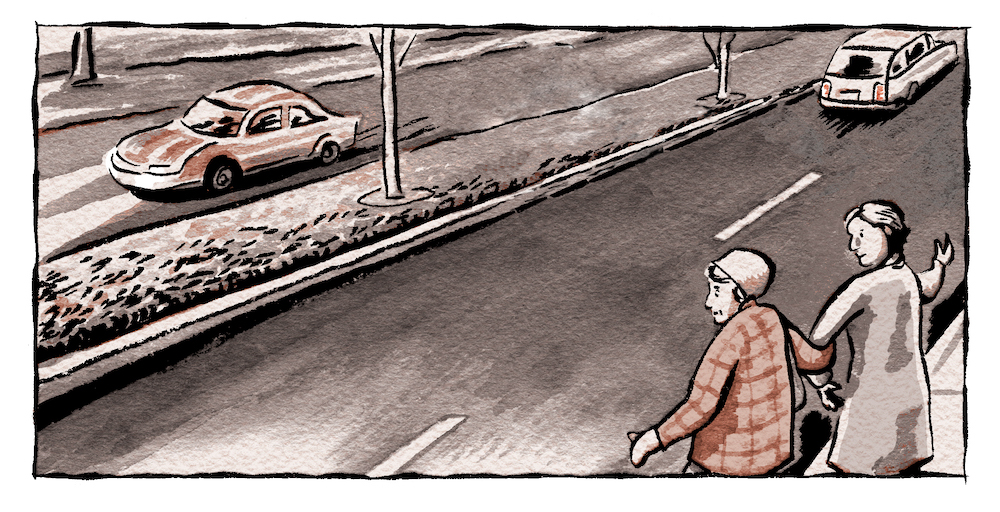
And I was right about that. The following week, the Space and I went for a walk behind the college when it started to downpour. I took the Space’s hand and we ran for cover under a nearby tree, where I stopped abruptly against the trunk and the Space sort of stumbled into me. Before I knew it, the Space was looking into my eyes and I was looking into the Space’s eyes. Then the Space put its arms around me and kissed me, and I kissed back. 

The weeks that followed might have been the best weeks of my life. Some nights the Space and I went on proper dates—skating hand-in-hand at the university ice rink; hiking up Mt. Geryk—and other nights we just spent hours on my couch talking to each other and kissing. It really didn’t matter what we did as long as we were together. One night that summer, I told the Space I was falling in love with it, and the Space said it loved me too. That was our first night together; I fell asleep in the Space’s warm embrace.

Soon the Space and I were basically living together; it kept its own place, but it was at my apartment all the time. We got used to each other’s daily rhythms and habits; we ate our meals together, exercised together, watched TV or read together every night. I grew accustomed to falling asleep next to the Space, and waking up to find the Space still there beside me.

Admittedly, sometimes the Space would get quiet—distant. At times I felt like the Space was right there with me, focused and present, but at others it seemed vacant and removed. In those moments, as strange as it sounds, I almost felt lonely—despite the presence of the Space.

One night that fall, the Space and I were watching a science fiction movie when my phone rang. It was you. I was taken aback; I hadn’t talked to you in months. “Hold on a second, will you?” I said to the Space, and I took the phone into the other room. 

You asked if we could meet and talk. “Yeah, sure we can,” I said. “But I should tell you that I’m seeing someone.” 

“Oh,” you said. “You are?” 

“Do you remember the Space that you left when we broke up?” 

“The—what?” 

“There was a Space—a really significant one,” I said. “And while we didn’t get along at first, we eventually became friends, and—” 

“You and—who now?” 

“But the relationship, you know, evolved,” I said. “And now things with the Space are going really well.” 

“Oh-kay,” you said. “Well, I—OK.” 

“But listen—how are you?” I said. “Is everything OK?”  

“Yeah,” you said. “I’m fine.” 

“Good—I’m really glad to hear that,” I said. “It’s really nice to talk to you,” I added, because it was. I’d missed you—maybe even more than I’d realized.

When I got off the phone, though, the Space sat me down and said it needed some time apart. I was flabbergasted. “I don’t understand,” I told it. “I thought things were going great.”

But the Space said it needed space. I asked the Space how long it had felt this way, but the Space wouldn’t elaborate; it just sat there silently, an empty expression on its face.

“We’ve built a life together,” I told the Space.

The Space didn’t even reply.

“How can you not have anything to say to that?” I said. 

The Space left my place that very night. I was so bereft I couldn’t sleep. I called you early the next morning and you came right over to console me. “I just miss the Space so much,” I sobbed into your shoulder. 

“I know,” you said. 

“I honestly don’t know how I’m going to live without it.”

“I know it seems impossible,” you told me. “But tomorrow, you’re going to realize that you don’t need the Space as much as you thought. And there’ll be less of the Space in your mind the day after that, and the day after that. Until one day you realize you’ve forgotten the Space completely.”

I nodded as if I understood, but inside I knew I’d never get over the Space. I vowed right then and there to keep its memory close, and to hold a place for the Space in my heart.

An Undocumented Farmworker’s Quest for Happiness in Europe 

Celina Baljeet Basra’s debut novel, Happy, at once fulfills and tragically subverts the promise of its title. Happy Singh Soni, the titular protagonist, struggles to hold on to his optimism and imagination while laboring under appalling conditions as an undocumented migrant worker in Europe.

Young, upbeat Happy—an ebullient admirer of new wave French cinema from rural Punjab—goes to Europe in pursuit of riches that are artistic as well as material: he hopes to become an actor in European cinema (he is compared in looks to Sami Frey, the actor in Bande à part, Jean Luc-Godard’s 1964 film, who makes constant reappearances in the novel). Accordingly, Happy saves his wages as an amusement park worker, and pays mysterious “coordinators” to travel to Europe. Once in Europe, however, he is placed in a series of menial, low-paying jobs, in the futile attempt to repay immense debts to the “coordinators”—initially as a restaurant worker in Rome, and then as a laborer on a radish farm—even as his cinematic dream recedes out of reach.

Throughout the novel, Happy’s life attests to the sundering and coming together of nations—from the Partition of India in 1947 (during which his parents had to flee from newly created Pakistan to India) to the current migration crisis and the far-right reactions across Europe and the U.S. Yet the novel’s ambitious form—fragmented into many voices, which nevertheless knit together into a kaleidoscopic view of consciousness—at once records and seeks to mend the sundering it describes.

Celina Basra brings to the novel the intense care and attention to arrangement that has characterised her work as an art curator. Based in Berlin, she has worked with Berlin Biennale, Academy of the Arts Berlin, Arts Night London, and Nature Morte Delhi, among other institutions, and is a co-founder of the curatorial collective The Department of Love, which explores love as a mode of resistance and collaboration, and which has held exhibitions in China and the U.K.

I spoke with Celina Basra on Zoom about fragmented forms and narratives, the complicated and ambiguous trajectories of 21st-century immigration and labor, and recognizing the inner lives of marginalized characters as well as inanimate objects. 


Pritika Pradhan: Happy, the name of the novel’s titular protagonist, is loaded with significance—at once indicative of his upbeat nature and at the core of the novel’s tragic irony, where he struggles to maintain his cheerful narration amid terrible events. Could you tell us what inspired you to choose this name, and how did it influence your envisioning of the novel’s narrative and protagonist?

Celina Baljeet Basra: There is this dissonance and this allusion to humankind’s eternal search for happiness and Paradise, which becomes more pronounced if it involves emigrating. But at the same time, it is not an uncommon nickname and abbreviation for Harpreet, in my extended family, or at least in Punjab. So Happy is a name I was familiar with, and I realized that there’s something there to work with. This is how the character came to me. While the character is entirely fictional, the underlying facts and experiences are very real. And it evolved organically from there: the name played a role in building the character in his world.

PP: The form of the novel is fascinating, consisting of segments narrated from different points of view. Could you please tell us more about your choice of this specific, fragmented form for this novel?

CBB: The basic story had been percolating for a long time before I could finally sit down and move beyond, as Happy called them, the hopeful beginnings that I had stored away in my old hard drive over many years. When I found the voice of Happy, it was through the prologue—the cover letter, or letter of application—which he writes to an employee in Italy, while working on a farm. From then on, the structure of the novel, with its many different fragments, its short chapters, its different voices, and its polyphonic nature, sort of came together and it really then poured and was written fast and furious. It was the only way I knew how to write the novel. 

After struggling for some time to find this voice, I also grappled with the question of how to write this story, which is not my own. There are touching points in my family history maybe, and of course a lot of research and interest over many years. But still, this was the way I knew how to write it, because I feel some stories—especially those of flight or migration—can best be told in a scattered way. To me, at least,  the idea of a novel that is written in one sitting, with a big chunk of time, and in a linear way—that’s not how I feel about the novel. When you have to take care of people—your kid or your family—or when you have to work other jobs, life is not linear. It is a bit like opening Happy’s bag of documents and stories, half-written and unfinished, and of objects that were close to him, the objects he touched that formed his life and that he used to build his world.

PP: In the segment “The Accidental Library,” Happy describes a miscellaneous and indiscriminate collection of objects: “The Library doesn’t hierarchize, nor does it discriminate.” While reading this novel, I felt this anti-hierarchical vision is realized in the proliferation of voices in the novel, which ranges from the titular protagonist to a necklace from Mohenjo-daro, or a pigment from a Pietà. What is the significance of giving voice to persons, animals as well as inanimate objects?

CBB: What I found interesting in relation to Happy’s obsession with the films of Jean-Luc Godard, or the stuff he finds in The Accidental Library, is how accidental these obsessions are when you were a teenager. The time when I first sort of thought of this novel [was in terms of] books falling in your lap. For me, it was like the process of going to my German grandmother’s attic, where there was a big box of Françoise Sagan’s work. So I read all of Sagan—Bonjour Tristesse and so on, but without really a deep understanding. I was only thinking, Oh, this is a cool character. I want to be like her. But Happy couldn’t have been more different from this cool French girl. So I went back to that time of building imaginaries or ideas of what is desirable, and how accidental these influences can be if you don’t have everything at your fingertips—all the museums and the libraries. 

I am an art historian, and I did work, and still do work in the art world. Right now [in the Talking Objects Lab] I am part of a team that works on the idea of the retribution of colonial objects from former colonial contexts, and with African philosophy and artistic interventions that engage with the idea of what to do with these objects that should be given back, [and] how and when and why––the decolonization of memory and knowledge. As a curator, I work with objects and space, amongst others, and this also played into the novel.

PP: So much of Happy’s world is composed of imaginary voices only he can hear: the seductive, and slippery voice of “Europe,” the outsiders of Bande à Part whom he hopes to follow. What role does the imagination play in his story? How does Happy’s imagination inspire him to identify with Europe initially, and support him through his ordeals there?

CBB: The border or the difference between imaginary and real becomes increasingly blurred as the novel continues. And definitely it is always a question with Happy, whether what he hears is reliable, or does he occasionally tell himself those stories and lies in order to cope? I think that’s definitely a thing for him. 

Being born and raised in Europe, living in Europe, I often thought about the idea of Europe and what is it really? Following events like Brexit, we have the idea of Europe as something that wants to close off against whatever comes from outside, as is happening in the Mediterranean Sea. And I also read about Europe in literature and plays, as well as mythological paintings, such as of the abduction of Europe. A lot of the Europe chapters had to be cut in the end, because it was too much. And Europe is important in the novel, and I envisioned her as an HR manager for Europe in a way. I was playing around with a bureaucracy, and how opaque and discriminatory it can be when you want to move, but do not have a passport that  enables you to do so. The experience of trying to get a visa differs wildly, depending on your passport, and is impossible in some cases—which is why other paths are being taken. So there is this humorous aspect, and a dark aspect to Europe.

At the same time, Europe has aspects that are quite human. Sometimes you can feel that Europe is quite insecure—she isn’t really sure of what her image is, or what her role is anymore. She can’t really change the rules like Happy expects her to and is really quite powerless in the end. She is, as you say, this slippery, seductive voice of Europe, who urges Happy to sign the agreement. For me, Europe in the novel is an imaginary character, who is quite vivid, although she might not really exist. However, I would also encourage other readings, if the readers are pleased to do so, such as reading Europe as a real character.

PP: Happy’s only romantic relationships are also lived in the imagination – an unexpressed desire for his male friend and nemesis, Kiran, and later for his fellow farm worker, Zhivago. Could you comment more on this unspoken yet haunting same-sex desire?

We all know that some ideas, desires, and romances that are entirely imaginary can be so intense—especially when you’re young or lonely.

CBB: It was clear to me from the beginning that Happy’s feeling of being different might be rooted in his sexuality, which needs to be repressed for obvious personal and political reasons related to the context he grows up in at that time. And that [repression] becomes so automatic that he doesn’t even question it anymore. He outsources it into his imagination, instead of sort of thinking of it as something that can be acted upon, that could be real, that could be fulfilled. And we all know that some ideas, desires, and romances that are entirely imaginary can be so intense—sometimes even more intense than the real ones, especially when you’re young or someone who is very lonely or does not have a lot of touching points with the real world, where he can do real things and act in a way that other people find impressive. Instead, he has to be impressive in his own little world. And so [the imagined relationship with] Kiran, is this classic case of wanting to be with someone with certain aspects that you find dangerous or you are the total opposite of, and someone you want to be like but could never be. 

 With Zhivago, I think that idea is much more real and actually beautiful, but it’s still not reciprocated. Happy is also at that point setting out to realize his dream [of being an actor in European cinema], only to be increasingly disappointed on encountering this big reality check, where things are very different from what he imagined them to be. He doesn’t even open that door [with Zhivago]. However, it doesn’t mean that there isn’t a lot [happening]. There is this eroticism or desire that is expressed through other routes he finds, such as through voices from objects like the bag of flour. And not everything is spoken about; there might be even things that I’m not aware of. Even in a diary, there are things you won’t write down. As a child and a teenager, I tried to tell a good story, but I couldn’t even write about it because there were things happening that were very dark. So you try to tell a story to yourself in a way that you can process. And I think that’s what Happy does a lot of the time. At the same time, there is an increasing divide between reality and imagination, as the novel proceeds.

PP: Once in Italy, Happy is mysteriously but irrevocably affected by powerful, unnamed forces: moved from one job to another, and put down when he tries to agitate for better conditions. What is the reason for keeping these forces unnamed? What do they reveal about the world Happy inhabits?

CBB: When Happy enters Italy, he is moved around like an object and he doesn’t know the faces of the people who are moving him around. And that’s what it is. If you are in that situation, where you are migrating to Europe—not by the books, but without the documents, then you use travel agents who then are linked to other travel agents who then are linked to agents or smugglers, whatever you might call it, because they have many different names. If you research this, you will find a million different ways to do this [migrate], and a million different stories. Some may be half-legal, others entirely illegal, so a lot of power structures come in. If you look into the food industry, or the vegetable farming industry in Italy, or southern Europe,  a lot of these migration trajectories end up pointing to the mafia. When I was researching [the novel], talking to activists and researchers, particularly in Italy, I realized that they had to be very careful due to personal security reasons. 

That’s why it’s so hard to really uncover all the threads. And it’s impossible if you are Happy, if you don’t have a lot of resources and power on your side. If you are in that situation, this is how it feels—you really don’t know [who is moving you around]. There is this entity, this big, unnamed global corportation. I played around with the idea of bureaucracy and HR, so the [movers] are called the “coordinators.” For me, this was a kind of twist because in addition to being a curator, I often worked in situations where I was a project coordinator for cultural events—project coordinators can be many things in many different contexts. So I applied that idea to this context [of migration], because in the end it’s coordination. There is this basic bureaucracy involved, no matter how violent the external context might be.

PP: Some of the novel’s most heartening (and ultimately heartbreaking) scenes ensure from Happy’s relationships with fellow workers and migrants from different countries – the servers at the restaurant where he works, and his fellow radish pickers at the farm. Could you tell us more about the solidarity and togetherness among the migrant workers in the novel across national and ethnic lines, which co-exists with their intense loneliness and enforced isolation due to their immigration and class status?

CBB: I had this question in my mind [about] how certain areas and lines of work are entirely in some nationalities’ hands, and others not at all. In the U.K., who picks your strawberries? Who picks the asparagus in Germany? And then there are Malinese orange pickers in the south of Italy. So you look into it, and then you find that you have these communities that are also sometimes quite apart from each other. At the radish farm, it becomes apparent that the Sikh workers do some work and the Eastern European workers do other work, and then there’s talk of what happens with the Malinese in the south. Zhivago links these worlds because he is moving around, or has moved around quite a bit, but none of the others do or can.

First we idealize the place we want to move to. But then sometimes it doesn’t turn out as great, so you idealize the place you’ve left.

So for me, the novel was always about imagining what if? Because of course these relationships do exist, but they’re so private and so unique to each context that I just wanted to imagine: what would it feel like if Happy strikes up a friendship with a Polish and a Tibetan dishwasher in the Roman restaurant? The back of a restaurant kitchen is stressful, of course, as a working environment, and can be so ultimately unfriendly and hard to endure for any workforce, which is portrayed in popular series like The Bear. But for Happy it’s a little utopia. He will get this moment where he has friends, and becomes popular and strikes up relationships. And we know he practices his Italian because once you work with other workers from other nationalities, you will practice their language, which is quite fun to do. This is just to imagine what are the relationships like, what is the talk at the back of the back door, who shares a cigarette with whom? 

I have traveled to Italy often, and have been interested in places affected by tourism and migration. I’ve always been interested in people who work in providing other people’s pleasure. Once you have worked in a service position or industry yourself, you realize that you could just as well be an umbrella—some guests or customers don’t really see you. So it’s more important what your colleagues mean to you, and how that can empower you. Happy always tries to strike up relationships, always tries to connect to people, to please people and entertain them. And that to me was a way to make the picture of the world richer.

PP: It is significant that the voices of Happy’s family in India (in particular his mother Gul and sister Ambika) continue even after Happy has left for Italy. How does the inclusion of the homeland and family change the depiction of immigration in the novel? 

CBB: To me, this continuity was quite important, to let them speak and let us hear their voices making his absence felt. The family unit is scattered now. But it is also important to show that life at home goes on—it’s not an unmoving ideal. First we idealize the place we want to move to, even if it’s just moving to another town to study or find a new job. But then sometimes it doesn’t turn out as great, so you idealize the place you’ve left, and say, wow, that’s actually how we need to return. And then it becomes this idea where, okay, I will go abroad and I’ll make my luck and find prosperity, and then I’ll return. But then it’s not the same place that I left. You might not be able to return in that way because you’re not the same, the people you’ve left are not the same. And you can never recreate the past, because you might then in retrospect realize, oh, that was happiness. You might think, I will go back to that tree, that house, that meal, and then happiness will come. And it might, but it will always be fleeting because things are moving. To me, that was important in the depiction of places like India, which to so many people growing up here in Germany is this far off place of another imagination. A lot of people will just tell you their India story when you meet them and always the same clichés, you know? So it was important to just and try and attempt to make it complex. It is a place Happy has to leave, in order to try to realize himself. But it isn’t a place that’s entirely bleak. Though there are no prospects for him to evolve in that place in that village, there’s love.

This idea of a mother—Gul, and also [Happy’s sister] Ambika, who is also a mother—is very close to my heart. Shortly after the novel found a publisher, I gave birth to my first daughter. Then in the editing process, which was wonderful and intense and necessary for this very scattered book, a lot of these ideas [about motherhood] found their way in, and made the novel richer. We have the voices of Ambika and Gul in particular, but also the father, Babu, and Fatehpal [Happy’s elder brother] who emigrated as well, but is living his own life and is not very close to Happy, because he left when Happy was still young. They’re all scattered around now, and that’s something that I felt I could identify with. In my own family, everyone is never in one place, but there are always many. So I’m fond of these voices and how they evolve, allowing a space for absences and grief, but also hope and love.

7 Books on the Dark Side of True Crime

I am not immune to the appeal of true crime. I’ve read In Cold Blood, Helter Skelter, and I’ll Be Gone in the Dark. I’ve listened to The Staircase, Serial, and Dr. Death. I have watched The Jinx, Making a Murder, and Unsolved Mysteries. In fact, because I am a novelist, I have thought a lot about the way these narratives work. The ones I’ve listed all share a few elements: colorful characters, evocative settings, heroes and villains. But most importantly, they are molded. What do I mean by this? Like memoir, they are of life but they do not necessarily resemble life. They are shaped, aesthetic objects.

Memoirs, unlike, say, biographies, do not plod along at the pace of daily life. Their authors distill events, excising superfluous details and controlling the flow of information to create structure. True crime works in a similar way, except that its authors are mining the lived experience of others for material. (Notable exceptions are beautiful true crime memoirs like The Fact of a Body or Memorial Drive.) 

True crime—in its modern iteration anyway—is entertainment predicated on the suffering of others. Despite its name, it is interested in story over truth. It cannot afford to get bogged down in messiness, frustration, and randomness. Fine. Fair enough. I enjoy a tight and twisty narrative as much as the next person. But what are the implications of this kind of storytelling on the survivors of these events? On their communities? On the allocation of material resources (police, media attention, money)? What are the implications for those who consume violence and fear?

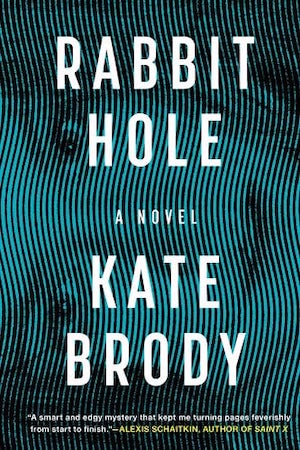
My novel, Rabbit Hole, follows a young woman named Teddy whose long-missing sister, Angie, has developed a true crime “fandom.” After their father, who was suspected—on the internet—of involvement in Angie’s disappearance dies by suicide, Teddy starts to engage in the online communities obsessed with her family. Even as Teddy fears the menacing internet rubberneckers who see her as a character in their conspiracy theories, she can’t resist their seductive pull.

The seven novels in this list are interested in various “dark sides” of true crime. Some of them offer correctives to famous true crime narratives, while others investigate the effect of the public’s attention on families, journalists, and victims themselves.

The Comfort of Monsters by Willa Richards

When Dee McBride goes missing in Milwaukee during the “Dahmer summer” of 1991, her disappearance is largely ignored. Media and police resources are instead devoted to obsessing over the details the man Richards refers to only as “the serial killer.” The Comfort of Monsters is a pitch-black book about familial loss, grief, and lurid public interest in grizzly tragedies. Richards explores the way that families and even entire communities can become victimized by tabloid interest in sensational crimes. If you love true crime, you may actually hate this book. The brilliance of Richards’s novel is her refusal to allow the narrative to mimic the fake and tidy structure of a true crime story. Instead, it hems closely to real life and honestly depicts the festering wounds that come with not knowing.  

Penance by Eliza Clark

In a small coastal town, a sixteen-year-old girl is immolated by three of her classmates. Ten years later, the definitive account of the event is penned by a journalist who has spoken to everyone involved and heavily researched the crime. Still a critical question remains: how much of the story is true? Eliza Clark, more than anyone on this list, is explicitly interested in the impulses that drive true crime consumption and the ethics of the genre.

Saint X by Alexis Schaitkin

When Claire’s sister Alison goes missing on a Caribbean vacation and turns up dead in a nearby cay, two resort employees are arrested. They are quickly released, but by then the story has already exploded into a tabloid obsession that will haunt Claire for years to come. When she runs into one of the accused men years later, as an adult, Claire must reckon with the unsolved questions at the heart of her sister’s case and the way the crime (and its surrounding hoopla) affected so many others. Schaitkin riffs on a Natalee Holloway-esque disappearance in this novel, which interrogates true crime’s perennial interest in missing white women and the implications that such interest can have on multiple communities.

True Story by Kate Reed Petty

This book is one of my favorite reads of the last few years. A wildly inventive, formally playful look at the fallout from a high school sexual assault, True Story is interested in the role of memory and the way a single, monolithic story can become the dominant narrative around a crime. Alex, the victim at the center of the story, must ultimately defend herself not only against her possible assailants (and the community that rallied to protect the young athletes) but against her friend, Haley, an aspiring filmmaker keen on flattening and commodifying her story.

More Than You’ll Ever Know by Katie Gutierrez

We’ve all heard of men with multiple families, but what about a woman leading such a double life? For true crime blogger Cassie Bowman, the story of Lore Rivera—and the dramatic way her marriages ended in the arrest of one husband for the murder of another—is too good to pass up. But as Bowman digs into Rivera’s life, often at the expense of her own personal relationships, she uncovers a story more complex and more human than she bargained for.

Bright Young Women by Jessica Knoll

The title of Jessica Knoll’s latest comes from something a judge said to Ted Bundy during a sentencing: “you’re a bright young man.” In this novel, Knoll seeks to correct the true crime narrative that has warped Ted Bundy, transforming him from an arrogant, not-actually-all-that-bright murderer into a mythical, larger-than-life charisma machine. By focusing on the sorority sisters who would become Bundy’s final victims, Knoll offers a corrective and perhaps a new focus for avid true crime fans: the bright young women who suffered at Bundy’s hands.

Missing White Woman by Kellye Garrett

I’m showing off a little by including this book, since I was lucky enough to read an advanced copy. It doesn’t come out until April, but you can pre-order it now, and you should. The title comes from the late journalist Gwen Ifill, who is quoted in the epigraph: “I call it missing white woman search syndrome. If there is a missing white woman, you’re going to cover that every day.” Garrett cleverly explores this phenomenon in a book that is itself a twisty page-turner. When Bree wakes up on the final day of a romantic getaway to discover a dead woman in the foyer of the Airbnb her boyfriend rented, she knows she is in trouble. Add that to the fact that her boyfriend is nowhere to be found, and the dead woman is a Gabby Petito-type—someone the entire internet has been looking for. A tense, smart thriller that captures the madness of social media and addresses the intersection of true crime and race.

In “The Storm We Made,” A Malayan Housewife Becomes a Spy During WWII

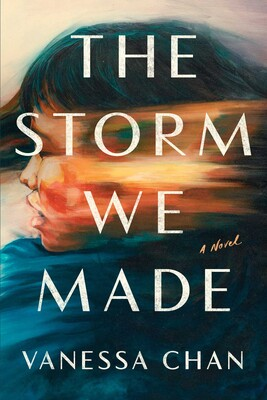
Set in World War II, Vanessa Chan’s utterly gripping debut novel The Storm We Made is the story of an unlikely spy and the consequences of her actions. When Cecily, a bored Malayan housewife in British-colonized Malaya, encounters the charismatic General Fujiwara, she is seduced not only by the force of his personality, but also his dreams of an “Asia for Asians.” Stifled by the narrow confines of her existence as the wife of a low-level bureaucrat, Cecily agrees to act as a spy for the general, unwittingly ushering in the most brutal occupation her people have ever known.

Ten years later, Cecily finds her nation and family on the precipice of destruction, and is determined to do anything she can to save them. Told from the perspectives of Cecily and her three children—eldest daughter, Jujube, who serves tea to Japanese soldiers and develops an unexpected bond with one of them; fifteen-year-old Abel, who has disappeared; and the youngest, Jasmin, who spends her days locked in the basement to avoid being sent to a comfort station—The Storm We Made moves effortlessly through time, building to a thrilling crescendo. Filled with unforgettable characters and beautiful, vivid language, this is a novel of family, secrets, survival, and resilience during the darkest of times. 

Vanessa Chan is one of my closest friends and all-time favorite writers. I was lucky enough to be one of The Storm We Made’s first readers. We spoke over Zoom in the fall of 2023 about the journey of The Storm We Made, how to approach research as a historical fiction writer, illuminating a deeply underexplored time in history, the fraught intimacies that can happen between colonizers and the colonized, and the power of charisma.


Gina Chung: The Storm We Made takes place across a span of several years. You weave a very tight, propulsive plot while also grounding us in historical context. For many writers of color, I think there’s this idea that we somehow need to “explain ourselves” to a more mainstream audience when we’re writing about places that we come from. Was this something you considered? 

Vanessa Chan: When I was writing it, I thought about how I would explain it to someone like me. It is true that the history of this time period in Malaysia is woefully underwritten—it’s almost not written. Southeast Asian history is really not covered by novelists or historians. I would explain things the way that the research I did through my family was told to me—where there were important explanations about dates, places, what life was like during that time. But I also balanced that with not overexplaining things that you could get in context.

I do think that history, if it’s not written, does need to be explicated, because you cannot assume that people know things that they have never had access to. And it is the responsibility, I think, of the novelist and especially of the historical fiction novelist to explain what happened during that time, if no one else has any context. But at the same time, I think things like names of food or small phrases can just be gotten in context. So I wasn’t purposely obfuscating in order to make a statement about the colonization of literature, but at the same time, I was also not trying to explain too much. I just talked about it the way that I would hear a story like this.  

GC: You give us a wide cast of characters in this novel, while also anchoring the story in the perspectives of Cecily, a mother, and her three children. Can you talk about how you created these characters? 

VC: When this book was first being written, it was initially a book about three sad children living through the war. And we need to have space to tell stories that are inherently sad, but for me personally at the time, I was going through a series of personal griefs, and it was also the pandemic. We couldn’t go anywhere, and I, a person who felt like I had no agency at the time, was writing about three children who had no agency at the time. I needed to bring myself some joy and infuse some of that into the book, so I wrote about their mother, who, as happens during the book process in ways that you don’t expect, became the main character. She’s this flawed woman who is a spy, and gets to run around and do things, both good and bad. I think that brought both myself and hopefully the book a bit more movement and joy. 

GC: What role do whiteness, white supremacy, and colonialism play in the dynamics of the novel and in Cecily’s fateful decision to become a spy for the Japanese?  

VC: This novel is set in two timelines across British colonialism and Japanese colonialism. Obviously, because the British colonized Malaysia for over 150 years, that infused everything to do with the book. But less directly, the characters in the novel are a race called Eurasian, which means a different thing in Malaysia and in Southeast Asia than it does in the U.S. Here, it means people who are mixed—European and Asian. But in Southeast Asia, it means a specific race of people who were born out of colonial intermixing—mostly Portuguese intermixing, but also some others like Dutch, the English, and the French. And because these people are born out of colonial intermixing with white people, white supremacy is inherent in that culture—the idea that the fairer you are, the closer to white you are, the better your English is, the more educated you are, the higher you are in the totem pole, the closer you are to the colonial masters and to the ideal. And all of these dynamics play a part in The Storm We Made and in Cecily’s psyche, and also her rebellion against these structures that she’s told are the way that things should be. 

GC: A recurring theme in the novel is obsession, particularly Cecily’s obsession with the charismatic General Fujiwara. She’s really drawn to the general, but she also hates that she is in thrall to him. What, if anything, did you want to say or explore about obsession and its consequences with this novel? 

VC: I think I want to reframe that a little bit. The reason that I wrote the character that way is because I am extremely preoccupied with the idea of charisma, and whether it is inherent or it can be taught, as well as the effect charisma has on people. Obsession is often the byproduct of someone’s charisma. This is a feature across a lot of my work and definitely in this novel. I think Cecily is taken in by the charisma of this general and his ideas. She’s smart enough to know that something is wrong, and she doesn’t understand why she’s so drawn and feels so compelled to do these things, but she does it anyway. I also sometimes wonder if the impact that charisma has on people is situational, which is the case with this book. Fujiwara and his charisma hit Cecily exactly at the right time in her life, because she was feeling particularly dissatisfied. I sometimes wonder if different charismatic people in history—both good and bad—had hit at different times in history, would their impact have been the same? 

GC: The world of The Storm We Made—particularly the impact of the war and competing colonial interests on the Malayan people—is powerfully and vividly portrayed. What did your research process for this novel look like? 

It is true that the history of this time period [the Japanese Occupation] in Malaysia is woefully underwritten—it’s almost not written.

VC: It’s really interesting, because I think there’s this idea—almost a rule—where writing historical fiction is like, method. A lot of historical fiction writers are known to immerse themselves in a very deep way in their characters before they write them. But I started this novel in a burst of surprise, in response to a prompt, and kept writing the majority of it during the pandemic, when the archives were closed, and there was no ability to do a ton of primary research. People sometimes ask me, “Did you interview thousands of survivors?” And sadly, there are not thousands of survivors to interview. A lot of what I wrote was based on things that had followed and infused my family’s lore and storytelling over the years. I just put those on paper and realized that it was a more significant amount than I thought it was, enough to build a book, and then I went to check all of this later. I did talk to my grandmother—she was the fount of most of these stories that I had heard over the years. My father also helped me fact-check the novel, because he’s a big history buff. My uncle sent me an old book of photographs from Malaysia over the years, when he heard I was writing this book. In a way, it sort of became a family affair.

GC: Speaking of family, what role does family, whether it’s your own or just themes of familial love and connection, play in your writing? 

VC: Family is very important to me, and because this is a book about a family based on some of my family, I don’t think I could have done it without the relationships that I have with my family. Someone asked me once, “Why did you write in four POVs?” I think I wrote in multiple POVs over multiple timelines because I come from a very noisy, dramatic family that’s used to talking all at the same time—that is how I’m used to receiving information. So my family didn’t just inspire the plot, they also inspired the form. My mother also passed early on, when I was writing the novel. I had just started to write it, and I used to shamefully post, on Instagram Stories, bits that I’d written of this novel and of other stories. I would delete them quickly after, but she learned how to screenshot and expand them so she could read them, and towards the end, when she was quite ill, she couldn’t really talk that much, and we didn’t have much to talk about, because it was the pandemic, she’d make me read these bits to her, because her eyes were going. 

GC: You wrote this novel during an extremely dark period in our own history, and you’ve also spoken about the devastating losses that you experienced during this time. How did the times in which you were writing impact these times that you were writing about? 

VC: I think when I first sent this book out, agents could tell that the novel was perhaps written at two different times, because the first part moved a bit more slowly, and was angrier and sadder. And then the next part moved quickly, and people moved through time with speed. I think that is almost a direct impact of the circumstances we found ourselves in. The first parts of this novel I wrote in 2020, during lockdown. And then the world grew a little bit, when we were allowed to step outside—that’s when I wrote the part of the novel with more agency. 

I was preoccupied with the idea of what we do when we are faced with circumstances beyond our control and still have the minutiae of our lives to live.

I was also, at the time, preoccupied with the idea of what we do when we are faced with circumstances beyond our control and still have the minutiae of our lives to live. When I talked to my grandmother, I’d ask her, “What did you do during the war?” She’d be like, “We went dancing at the neighbors’ house. Do you think we just sat at home and cried every day?” There were some days where they cried, and other days where they would squeeze through the hole in the fence to go to the neighbors’ house and have little dance parties after curfew. I always think that if our descendants ask us down the line, “What was it like during the pandemic? What did you do?” We’d be like, “We were quite sad, but everything went on. We went to school on Zoom. We had our little petty grievances, and our lives continued. It was just overhung with a shadow of a larger world event.” I wanted to write a similar idea—that there’s a big war going on, but also you have petty nonsense going on in your life. You have family arguments, little loves, crushes, and things like that. 

GC: Your book is going to be published in more than twenty languages and regions worldwide! How does it feel to know that your book is going to be read by so many readers around the world? Can you tell us what the process of going out on submission was like? 

VC: It’s really thrilling to know that Malaysia, which is a small country, is going to have a place on bookshelves all over the world, in all these different languages. The process of selling this book was fairly chaotic. My agents sent this book out, and I had already had a trip planned to go back to Malaysia for the Lunar New Year. The manuscript went on submission, I hopped on a plane a day and a half later, and then I got back online, and I had all these messages, and they were like, “There’s been a lot of interest in your book, and you have to do phone calls with these editors.” I was on calls with NYC editors from 10 pm to 12 am and 4 am to 6 am local time. I did a number of these on my dad’s not-great Wifi in the middle of the night, while my dad tried to cook dinner and eavesdrop behind me. So it was wonderful and chaotic. The book also sold in a number of other countries at that time. The most touching, for me, was learning that the book would also have a publisher in Japan. I received a long letter from a publisher in Japan who wanted to publish the book that basically said, “It’s time for us to show Japanese people’s stories that aren’t just about Japanese soldiers going to the front and the women that they left behind, but also about the people that they impacted during this time.” I’m not a very teary person, and I was quite emotional when I got that request. 

Announcing the Best Book Cover of 2023

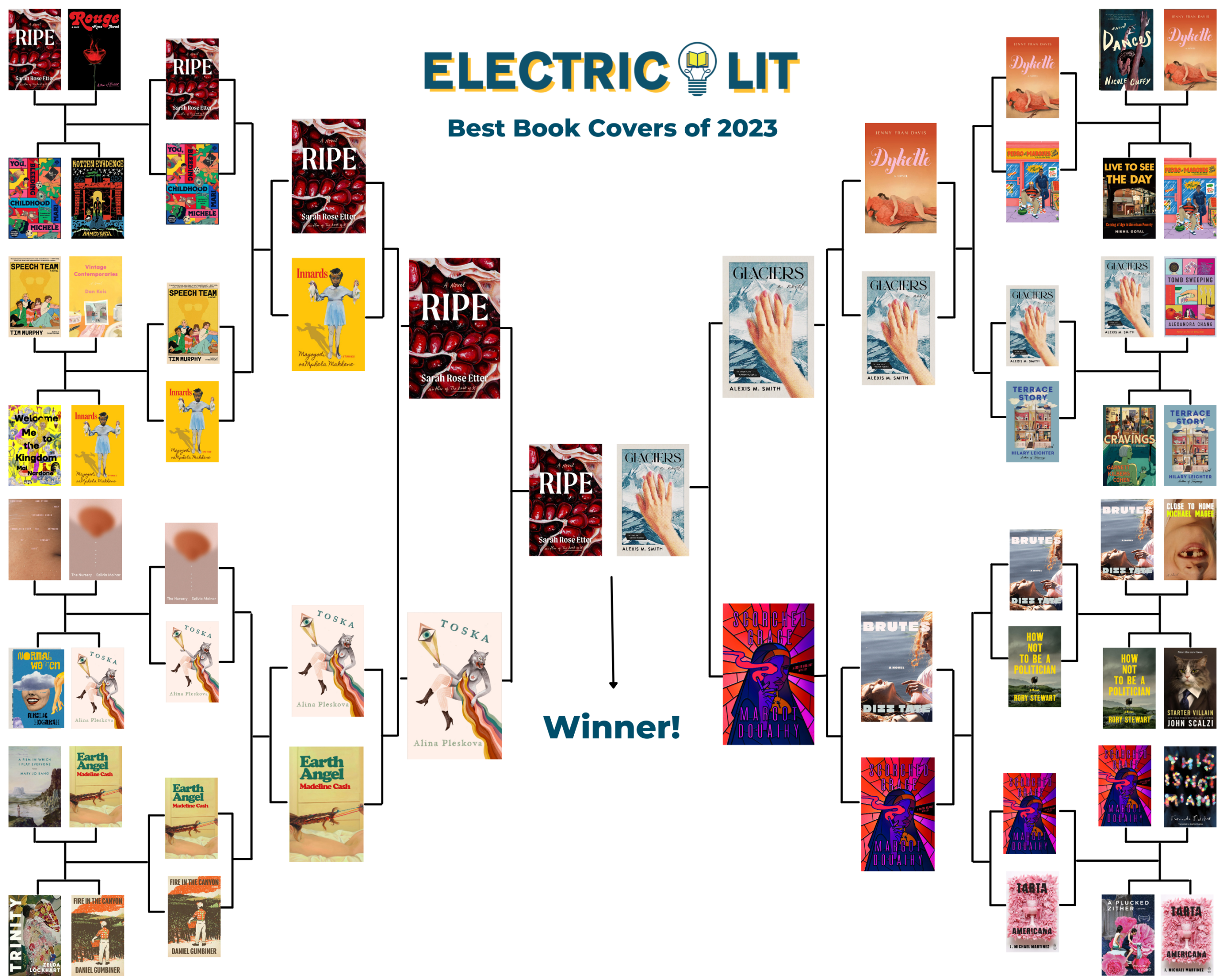
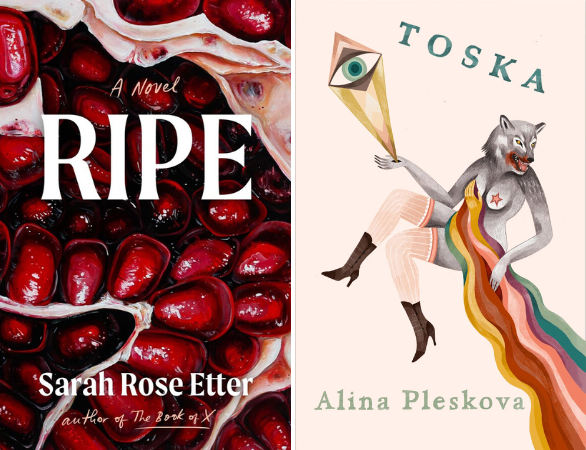
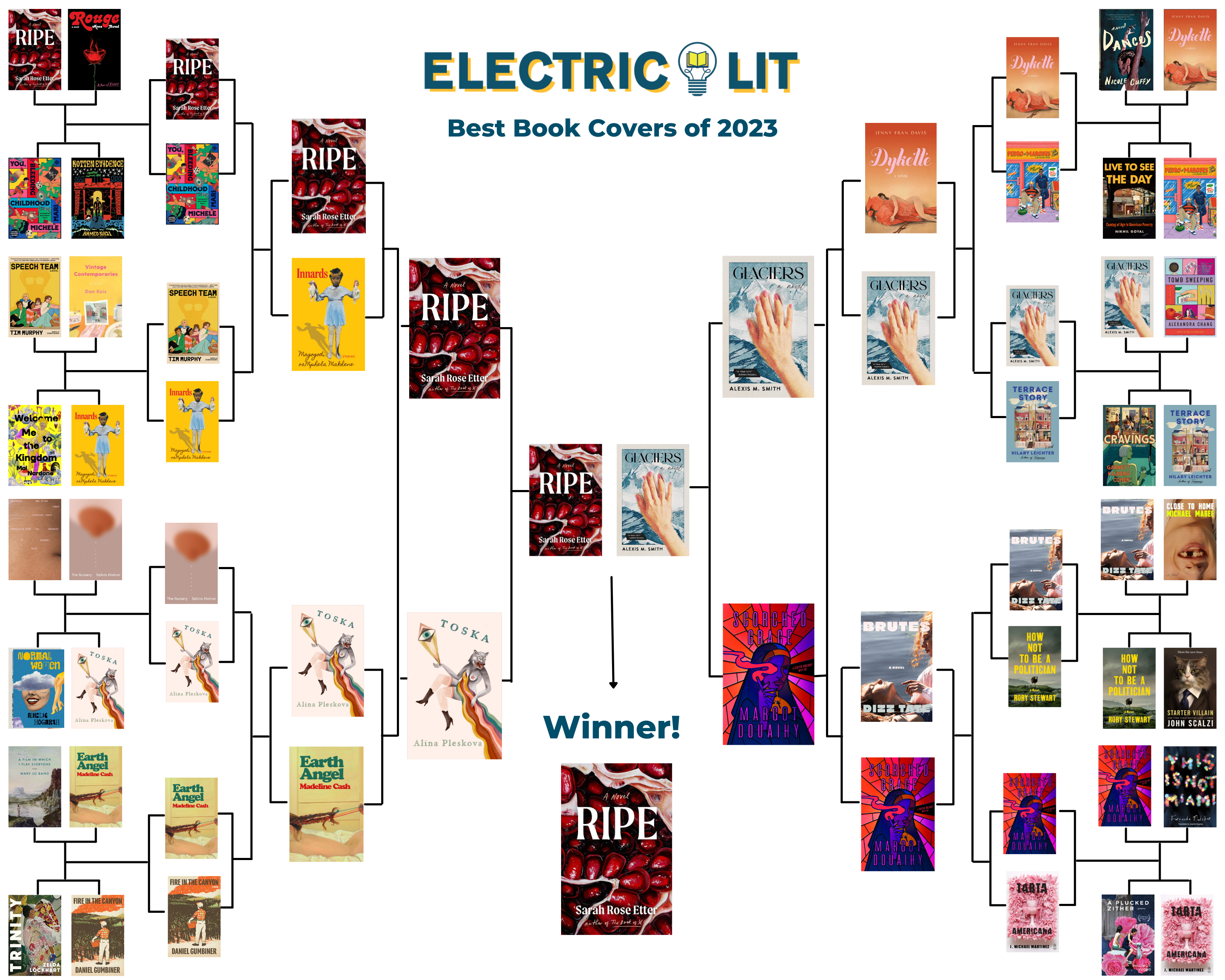
Last week, we asked our social media followers to vote for the cover of year from the best 32 designs of the year. This year’s tournament was fierce, with surprise twists and crowd favorites that bowed out early. The winner edged out the competition by a mere 6 votes.

From 32 cover designs, here are the semi-finalists:

Ripe by Sarah Rose Etter, illustration by Angela Faustina, design by Natalia Olbinski Heringa, vs. Toska by Alina Pleskova, art by Katy Horan

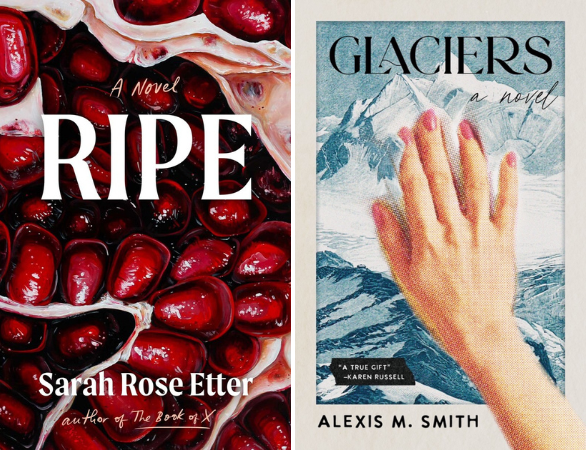
Scorched Grace by Margot Douaihy, design by Will Staehle, art direction by Evan Gaffney, vs. Glaciers by Alexis M. Smith, design by Beth Steidle


From the Final Four, now we’re down to two crowd favorites:

We spoke to the author of Ripe and the designers of Ripe and Glaciers about creating their book covers:

Electric Literature: Tell us about your design process for this book cover and what you wanted to convey through the artwork?

Beth Steidle: The first edition of Glaciers, by Alexis M. Smith, was published in 2012. It was very well received, and the cover was well loved. Tin House wanted to celebrate this book and introduce it to a new audience with a reissue approximately 10 years later. The biggest challenge was to come up with a new package that still retained many of the successful elements of the first package (left): a vintage sentiment, elements of collage, a lightness, and femininity. However, for the new edition, we also wanted to visually highlight the overarching environmental concern and shifting landscapes that factor into the book, an element of the narrative that is so critical to our current national conversation. The most beautiful moment in this book, for me, is when the protagonist reaches out to touch a glacier, so that is the moment I focused on for this design.

EL: Did you have any interesting false starts or rejected drafts you can share with us or tell us about?

BS: This cover was not the cover that was originally approved. The first cover featured a vintage illustration of a woman wearing a green cardigan and sheath dress. The mountains and glaciers were superimposed over the woman’s dress. We loved that cover but there were concerns that the green cardigan could be construed as too old fashioned, so we opted for the more surreal design. It felt smarter and timeless.

EL: What’s your favorite book cover of 2023, besides your own?

BS: 2023 was a fantastic year for book covers. Ripe and Tomb Sweeping are both favorites of mine but, ultimately, Paul Sahre’s cover design for the paperback edition of The Employees by Olga Ravn, wins my vote for best cover of 2023. It’s such a creepy, compelling image, perfectly paired with that minimalist white background and off-kilter type. It tells you everything you need to know and also not nearly enough, which is what the best book covers should endeavor to do.


Electric Literature: Tell us about your design process for this book cover and what you wanted to convey through the artwork?

Designer Natalia Olbinski: The pomegranate, a symbol that structures the novel (each section is named for a part of the fruit), was a natural choice for the cover direction, and a preference of the author’s. The initial set of designs included the pomegranate fruit or seeds, depicted in a variety of ways: photographic and illustrative, some realistic and some very abstract, with some reference to a void or black hole. After that first round and a title change, I believe it was Sarah (or Jaya Miceli, art director) who had proposed the artwork of Angela Faustina, whose evocative oil paintings of close-ups of glistening pomegranate seeds and membranes are striking and even grotesque. We tried another round of covers using paintings from Angela’s series with different type treatments, and voilà! This composition was just right.

EL: Did you have any interesting false starts or rejected drafts you can share with us or tell us about?

NO: I typically need to try out all of my bad ideas to get to someplace interesting so I have a ton of sketches for this cover. Plus there was an abundance of visual references in the novel—of the tech industry, black holes—which were so interesting to play around with.  There’s one concept I never developed past a sketch which I liked, a floating pomegranate with a black hole shadow—flat and bold, just the shapes. But I think we got to the strongest solution with the current cover.

EL: What’s your favorite book cover of 2023, besides your own?

NO: The cover for Mister Mister by Guy Gunaratne designed by Jack Smyth reminds me of old school poster art in how dynamic and punchy the art is. I’d hang it on my wall. The cover for Happy by Celina Baljeet Basra, designed by Alex Merto, also puts a big smile on my face.

Sarah Rose Etter, author of Ripe:

Electric Literature: As an author, what was the book cover process like for you? 

Sarah Rose Etter: With any book, at least for me, we have a few rounds of cover ideas because I’m picky about a cover. I always tell the publisher that up front—I just love visual art so much that it matters to me a lot. 

During the pandemic, while I was writing Ripe, I was just deep in my pomegranate research—I was searching films, art archives, anything I could get my hands on. Angela Faustina’s art popped up and became something I returned to over and over again while I was drafting the book. At one point, I was recreating her paintings myself in between drafts, mimicking her style. 

Scribner asked me to send over a bunch of art that had inspired me while drafting—and of course, Angela’s work was at the top of the list. When the cover options were sent over, this cover jumped out and I was floored—it hadn’t occurred to me that Angela’s work would end up on the cover. But now it feels like kismet in a way—I got incredibly lucky with this cover. 

EL: What are your thoughts on the cover and how the artwork ties in with your book? 

SRE: Angela’s work is so visceral and unexpected. Her pomegranates make you look twice—the painting feels like it could be part of the human body or the brain, but it’s still beautiful. Since the last section of the book specifically is about seeds and the interior of the body, her work just fit perfectly as almost a foreshadowing of what is to come,

I think, too, sometimes you need a great title for a perfect cover—we were going back and forth with title options for the book, and once we hit on Ripe as a title, we really needed a juicy, glistening cover and Angela’s work was a perfect fit for that, too. The title and the font both work so well with the art—it just all came together. When Jaya [Miceli] and Natalia [Olbinski] sent this cover over, everyone got really excited—you felt that buzz of “Oh yes, that’s it!” The team at Scribner worked really hard to nail this cover so I’m really grateful to them. 

EL: What’s your favorite book cover of 2023, besides your own?

SRE: I honestly really love the cover for Glaciers—it’s bold, unexpected, always makes me look twice so that’s tough competition! I also love the new McNally editions covers. But this is an impossible question for me, especially with the number of art books I buy. Every Sophie Calle cover is incredible. I also saw there was a crazy galley going around in the UK where the entire book was hardcover and holographic with no title on the front—it was beautiful, but now I can’t remember the title of the book so I guess those wild artistic choices can backfire. It’s still a gorgeous book. 


The winner of Electric Lit’s 2023 Book Cover Tournament: Ripe by Sarah Rose Etter, illustration by Angela Faustina, design by Natalia Olbinski Heringa.

75 Books By Women of Color to Read in 2024

Eight years ago, I pulled together a list of upcoming books of interest by women of color because, as a novelist, reader, and intermittent critic, I had trouble finding as many as I’d hoped. I published that list in Electric Literature, thinking it might be useful to others as well; the piece spread widely, and I heard it helped inform other publications’ books coverage, syllabi, and book-prize considerations. 

Since then, I’ve compiled a list along these lines each year, and though books by us have become more available and visible, it’s still true that, for instance, a disproportionately large majority of books published by the Big Five—the publishers that dominate the book market—are by white writers. This is also a time when a lot of U.S. schools and public libraries, under severe pressure from right-wing extremists, are banning and censoring books by people of color, and by queer and trans writers. The number of proscribed books is growing at a shocking rate. Dissenters are losing jobs. Here and there, my first novel and an anthology I coedited have been banned; in 2024, I’ll publish my queer, sexually celebratory second novel, Exhibit, and am already bracing myself for impending bans.

I maintain the hope that, one day, American letters will be so inclusive that a piece like this will no longer be useful. But for now, here are some 2024 books I’m excited to read. This is one person’s list, skewed by, in part, an incomplete knowledge of forthcoming titles. Without a doubt, I’m missing excellent books. If you’re looking forward to a book not mentioned here and wish to support it, please consider preordering it from your local bookstore, requesting it from the library, talking about it, or all of the above. Any of this can be enormously helpful to books and their writers.

Some brief notes on methodology: this piece is necessarily front-loaded toward the earlier part of the year, as there isn’t as much information yet about later titles. Much as I love poetry, I’m less up to date on what’s forthcoming in poetry, so I’ve focused on prose. The term “of color” is flawed and ever-shifting. In the past, a couple of versions of this list included nonbinary writers; Electric Literature and I then heard from a number of nonbinary writers that it can be preferable to avoid grouping nonbinary people with women. I’ve since kept this list to women: cis women and trans women, along with nonbinary women who assented to having their books included in this space. The vast majority of nonbinary writers and readers we’ve heard from have continued to find this preferable. Electric Literature will soon publish a piece about anticipated books by LGBTQIA+ writers.

I’m so glad about the novels, memoirs, essay collections, and other marvels coming our way; please join me in celebrating these books.

January

The Fetishist by Katherine Min

I met Katherine Min a decade ago at a gathering of Korean American writers, and was deeply sorry to hear, in 2019, that she’d died much too early. She left behind an unfinished novel that her daughter, Kayla Min Andrews, has completed. The resulting collaboration, The Fetishist, about an ill-conceived kidnapping, is astonishing. I’m thankful this book exists. 

A Short History of Trans Misogyny by Jules Gill-Peterson

I’ve followed historian Jules Gill-Peterson’s remarkable writing for a while, and in this book, Gill-Peterson ranges from New Orleans to Paris to the Philippines “in search of the emergence of modern trans misogyny.” “This is a sharply argued work by a brilliant thinker,” Shon Faye says.

Behind You Is the Sea by Susan Darraj

From the winner of the AWP Grace Paley Prize for Short Fiction comes a debut novel depicting a Palestinian American community in Baltimore. According to Etaf Rum, Behind You is the Sea “fearlessly confronts stereotypes about Palestinian culture, weaving a remarkable portrait of life’s intricate moments, from joyous weddings to heart-wrenching funerals, from shattered hearts to hidden truths.”

Praisesong for the Kitchen Ghosts by Crystal Wilkinson

“With Praisesong for the Kitchen Ghosts, Crystal Wilkinson cements herself as one of the most dynamic book makers in our generation and a literary giant. Utter genius tastes like this,” says Kiese Laymon. Wilkinson brings together kitchen ghosts, family photos, and stories of Black Appalachians in this part memoir, part cookbook.

The Storm We Made by Vanessa Chan

For months, I’ve heard about and looked forward to this debut novel featuring a Malay spy who collaborates with invading occupiers during World War II, and it’s almost here. Dawnie Walton applauds The Storm We Made as a “fearless, gripping, morally complex story” imbued with “an indelible spirit of resistance that never lets you forget the light.”

Come and Get It by Kiley Reid

Come and Get It is an engrossing novel full of intimately portrayed characters and the seemingly innocuous choices that lead to life-altering mistakes,” says Elizabeth Acevedo. Booker Prize-listed Kiley Reid’s second novel follows Millie Cousins, a senior at the University of Arkansas, offered an opportunity that ends up imperiling her hopes.

Your Utopia by Bora Chung, translated by Anton Hur

Bora Chung’s previous story collection, Cursed Bunny, a finalist for a National Book Award translated by the celebrated Anton Hur, is one of the more unforgettable and surprising books I’ve read in recent years. Chung and Hur are back with more stories.

Dead in Long Beach, California by Venita Blackburn

Dead in Long Beach, California, from Young Lions finalist Venita Blackburn, is centered on a woman who discovers her dead brother’s body then begins replying to texts as him. “You can try bracing yourself for the ride this story takes you on, but it’s best to just surrender. Your wig is going to fall off no matter what you do,” says Saeed Jones. 

Broughtupsy by Christina Cooke

In this novel, estranged sisters reconnect in Kingston to spread their younger brother’s ashes. “A luminous tale of a latter-day Antigone who navigates grief, love, death, sex, violence, language, queerness, race, and three countries with courage, joy, and a tender heart,” says Stacey D’Erasmo.

River East, River West by Aube Rey Lescure

Called a “reversal of the east-to-west immigrant narrative,” this debut is set in 1985 Qingdao and 2007 Shanghai. Garth Greenwell says it’s “a moving portrait of the love between a mother and daughter” in which “familiar narratives of adolescence are scrambled across lines of class, race, and national difference.”

February

Code Noir by Canisia Lubrin

Canisia Lubrin, a recipient of the Windham-Campbell Prize for Poetry, has written a first book of fiction that “departs from the infamous real-life ‘Code Noir,’ a set of historical decrees originally passed in 1685 by King Louis XIV of France defining the conditions of slavery in the French colonial empire.” The 1686 Code had 59 articles, and Lubrin’s book includes 59 braided stories that Christina Sharpe praises for their “formal inventiveness and sheer audaciousness.”

Whiskey Tender by Deborah Jackson Taffa 

Whiskey Tender is unexpected and propulsive, indeed tender, but also bold, and beautifully told, like a drink you didn’t know you were thirsty for. This book, never anything less than mesmerizing, is full of family stories and vital Native history,” says Tommy Orange. A debut memoir from the director of the Institute of American Indian Arts MFA program.

I Love You So Much It’s Killing Us Both by Mariah Stovall

The profound—and, I’d argue, fictionally underexplored—pain of a friendship breakup is at the core of this novel from Mariah Stovall: after a decade of estrangement, a former friend invites Khaki Oliver to a party for her child. According to Vauhini Vara, “Mariah Stovall’s prose sounds like driving in a car with your best friend, volume up high on your favorite song.”

Almost Surely Dead by Amina Akhtar

Amina Akhtar, founding editor of The Cut, has written a novel about a woman who, having gone missing for a year, becomes the subject of a true-crime podcast. “Part thriller, part family saga, part supernatural horror, Almost Surely Dead will surprise you in the best way possible and leave you thinking about this magnificent book for a long time after you’re done,” says Alex Segura.

Praiseworthy by Alexis Wright

This epic novel from publisher New Directions begins with a cloud heralding an ecological crisis in Australia. Praiseworthy is lauded by Australia’s The Monthly as “an astonishing and monumental masterpiece.”

Acts of Forgiveness by Maura Cheeks 

In Maura Cheeks’s debut novel, America is waiting to see if the country’s first woman president will pass a bill authorizing Black families to claim up to $175,000 if they can prove they’re the descendants of slaves. “Maura Cheeks extends humanity, depth, hope, and complexity to a part of the American experience that too often gets flattened into talking points. This book is a testament to the power of great fiction to lead us to a better understanding of the truth,” says R. Eric Thomas.

Greta & Valdin by Rebecca K Reilly

A bestseller in New Zealand, Rebecca K Reilly’s novel about queer siblings in a Maaori-Russian-Catalonian family is praised by Grant Ginder as a “wholly original, laugh-until-you-ugly-cry-on-the-subway debut.”

March

Where Rivers Part by Kao Kalia Yang

Kao Kalia Yang gives an account of her Hmong mother’s journey from a Laotian village to a refugee camp, then to the United States. Where Rivers Part, according to Vanessa Chan, is “an immense and important addition to the world’s literature.”

You Get What You Pay For by Morgan Parker

I’ll read anything the virtuosic Morgan Parker writes, and this National Book Critics Circle Award-winning poet, essayist, and novelist is back with a memoir-in-essays combining criticism and personal anecdotes, and described as being “as intimate as being in the room with Parker and her therapist.” The essays explore topics including racist beauty standards, loneliness, and mischaracterizations of Serena Williams. 

Disability Intimacy by Alice Wong

The bestselling activist and writer Alice Wong has edited an anthology of first-person writing on disability, sex, and joy, a follow-up to the powerful Disability Visibility. In her new book, writers delve into “caregiving, community, access, and friendship,” offering “alternative ways of thinking about the connections we form with others.”

Say Hello to My Little Friend by Jennine Capó Crucet

Since reading her story collection How to Leave Hialeah, I’ve relished Jennine Capó Crucet’s wise, incisive, frequently hilarious writing. Say Hello to My Little Friend features a failed Pitbull impersonator who crosses paths with an orca at the Miami Seaquarium. “Crucet can make you cry before you’ve even realized you’ve become invested and make you laugh even through the hurt,” Nana Kwame Adjei-Brenyah says.

Memory Piece by Lisa Ko

“A group portrait of three women who wrest meaning from a world that is closing down around them, Memory Piece is bright with defiance, intelligence, and stubborn love,” says C Pam Zhang. I’ve thought often of the National Book Award-listed Ko’s first and admirable novel, The Leavers, and have been waiting for her second book. 

The Translator’s Daughter by Grace Loh Prasad

“Grace Loh Prasad interrogates the distance between the homes we have and the homes we long for with the compassion and precision of one who has spent her entire life attuned to language. ‘We were always half a world apart,’ she writes; her essays bridge that gap in innovative ways, using family photos, mythical women, and Taiwanese films,” says Jami Nakamura Lin. The Translator’s Daughter is a memoir relating Prasad’s journey as an immigrant whose family was driven out of Taiwan under the threat of political persecution. 

These Letters End in Tears by Musih Tedji Xaviere

In Cameroon, where being queer is legally punishable, a Christian girl and a Muslim girl fall in love. Soon Wiley calls this debut novel “an urgent and devastating story about the cost of living in a place that refuses to recognize your humanity.”

The Manicurist’s Daughter by Susan Lieu

Susan Lieu’s mother, a Vietnamese refugee who set up nail salons in California, died from a botched abdominoplasty. After the funeral, Lieu wasn’t allowed to talk about her mother nor what happened. Searching for answers, Lieu turns to depositions, the surgeon’s family, and spirit channelers.

Thunder Song by Sasha taqʷšəblu LaPointe

Thunder Song, a collection of essays drawing on family archives and an ancestor’s anthropological work, chronicles Sasha taqʷšəblu LaPointe’s experiences as a queer indigenous woman. “None of Sasha’s examinations fail to find truth: page after page, the intersections of family, heritage, history, and music build to countless transcendental moments for the reader, which is not only the magic of this book but a clear testament to Sasha’s immense storytelling power,” says Morgan Talty.

Invisible Hotel by Yeji Y. Ham

According to Kim Fu, “The Invisible Hotel wrestles artfully with big, vital questions: How do we honor and care for our elders without reinforcing a cycle of generational trauma? How do we forge new, joyful paths without indulging in mass cultural amnesia or closing our eyes to a world on fire? That it does so in a surreal, riveting, keep-the-lights-on masterwork of horror is all the more extraordinary.” The novel follows a South Korean woman in a small village who drives a North Korean refugee to visit a sibling in prison.

Parasol Against the Axe by Helen Oyeyemi

Helen Oyeyemi’s many fans will surely be thrilled by this new addition to her inventive oeuvre. Parasol Against the Axe is described as a joyful novel about “competitive friendship, the elastic boundaries of storytelling, and the meddling influence of a city called Prague.”

Anita De Monte Laughs Last by Xochitl Gonzalez

In this widely anticipated sophomore book, the bestselling novelist Xochitl Gonzalez tells the story of a first-generation Ivy League student who comes upon the work of a gifted artist decades after her suspicious death. Robert Jones, Jr. calls the novel “rollicking, melodic, tender, and true” and “oh so very wise.”

But the Girl by Jessica Zhan Mei Yu

But the Girl, already published to acclaim in the U.K. and Australia, features a Malaysian Australian artist traveling to Scotland intending to write a Ph.D. on Sylvia Plath, plus a novel. Brandon Taylor, the book’s acquiring editor in the U.S., says But the Girl is a “vivid novel of consciousness with a delightful sense of play.”

Starry Field by Margaret Juhae Lee

Margaret Juhae Lee combines interviews with her grandmother, investigative journalism, and archival research to learn more about her grandfather, a student revolutionary who died after protesting the Japanese government’s occupation of Korea.

The Tree Doctor by Marie Mutsuki Mockett

“This is a gorgeous and completely unique novel, bristling with life like the garden it describes. It is melancholy, erotic, hopeful, meditative, frightening, and even funny―a book about solitude that is never lonely, a book that is both timeless and utterly contemporary,” says Lydia Kiesling. Marie Mockett’s intriguing new novel brings together caretaking, ardor, a cherry tree, an arborist, and The Tale of Genji

The Great Divide by Cristina Henríquez

“Cristina Henríquez gives us cause to celebrate with this sweeping novel. It speeds us into a wild world of adventure and danger, epic visions of the creation of the Panama Canal,” according to Luis Alberto Urrea. A third novel from the writer of the striking The Book of Unknown Americans.

Green Frog by Gina Chung

I rejoiced in Gina Chung’s first novel, Sea Change, and its tender story of a woman and a giant octopus. Chung’s new book is a magic-imbued collection of fiction that Kali Fajardo-Anstine says is “pulsating with heart and profound emotional intelligence.”

Lessons for Survival by Emily Raboteau

Lessons for Survival, which mingles reportage, autobiography, and photography, is introduced as a “series of pilgrimages from the perspective of a mother struggling to raise her children to thrive without coming undone in an era of turbulent intersecting crises.” Imani Perry says the American Book Award-winning Emily Raboteau “traverses generations and geographies, all the while caring for her children, and in so doing, teaches us that to ‘mother’ is to tend, to study, to nurture, and to hand over our most precious inheritances.”

dear elia by Mimi Khúc

I grew up in a part of Los Angeles that was mostly Asian American, and didn’t know anyone who so much as spoke about thinking of seeing a therapist until I went to college. Things have changed since then, but not close to enough; I’m excited for Mimi Khúc’s book, a series of letters described as work that “bears witness to Asian American unwellness up close and invites readers to recognize in it the shapes and sources of their own unwellness.” 

Like Happiness by Ursula Villarreal-Moura

I’ve anticipated Ursula Villarreal-Moura’s debut novel since I first heard her read in 2018, and, at last, the book is almost here. Like Happiness follows a woman living in the aftermath of a consuming, destructive relationship she once had with a legendary writer in New York.

April 

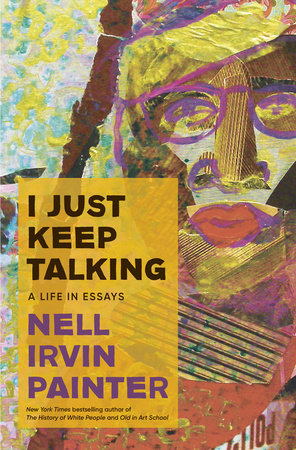
I Just Keep Talking by Nell Irvin Painter

I Just Keep Talking is comprised of the bestselling Nell Irvin Painter’s essays on art, politics, and racism. “Consistently brilliant, restlessly curious and profoundly empathetic, Nell Irvin Painter’s voice is simply indispensable. This decades-spanning collection pulls together some of her most elegant, engaged and urgent work,” Jelani Cobb says.

Women! In! Peril! by Jessie Ren Marshall

Playwright Jessie Ren Marshall’s debut collection of stories is said to be “ferociously feminist” and “hilarious, heartbreaking, and defiantly optimistic.” Vanessa Hua applauds the book’s “thrilling range of characters—an android, space traveler, former ballerina, jilted wives and more—in stories that examine race, gender, sexuality and other elements of identity with confidence and grace.”

Real Americans by Rachel Khong

I had the deep pleasure of reading an early draft of Real Americans, a shape-shifting, expansive wonder that, in its large-hearted investigations into fortune, luck, class, and trauma, spans countries, decades, and altered realities. It’s an epic and splendid achievement from a writer whose work I’ve loved for years. 

I’ll Give You a Reason by Annell López

According to Nancy Jooyoun Kim, “I’ll Give You a Reason is a rare page-turner of a collection: startlingly sensitive, oozing with compassion, and full of both gentle and explosive revelations about human nature, forgiveness, and the grace we sometimes fail to offer ourselves.” These stories, about Dominican immigrants in Newark, New Jersey, have won the Feminist Press’s Louise Meriwether First Book Prize.

The Stone Home by Crystal Hana Kim

I read the entirety of The Stone Home during a recent flight to Seoul, unable to put it down, often crying. It’s set in a South Korea of the 1980s, largely taking place in a “reformatory center” for marginalized citizens, a state-sanctioned hell of terror and violence. The novel’s portrayals of caretaking, mothering, and tenderness inside and despite the reformatory’s walls are richly layered and intensely moving. 

The Lantern and the Night Moths by Yilin Wang

Poet and translator Yilin Wang translates poems by five modernist Chinese writers, then accompanies the translations with her own essays on “the key themes and stylistic features of modern Sinophone poetry and on the art and craft of poetry translation.” I’ve admired Wang’s translations of poetry, and look forward to reading their hybrid book as well. 

May

Magical/Realism by Vanessa Angélica Villarreal

I’ve loved Vanessa Angélica Villarreal’s poems, and, since I first heard about it, have eagerly awaited her debut book of prose. The collection, which with each essay attempts to “reimagine and re-world what has been lost,” explores the healing potentials of fantasy in the midst of grief. 

Bite by Bite by Aimee Nezhukumatathil

It might be evident by now that I tend to be drawn to the prose of poets, and the bestselling poet-essayist Aimee Nezhukumatathil is back with a follow-up book of essays, this time centered on food and flavors including shaved ice, lumpia, mangoes, and vanilla. The collection also incorporates illustrations by Fumi Nakamura. 

But What Will People Say? by Sahaj Kaur Kohli

Sahaj Kaur Kohli is a Washington Post advice columnist and the founder of Brown Girl Therapy, a mental health community organization for the children of immigrants. She “rethinks traditional therapy and self-care models, creating much-needed space for those left out of the narrative” with a debut that combines personal narrative, analysis, and research.

I’m a Fool to Want You by Camila Sosa Villada, translated by Kit Maude

A bestseller in Argentina, I’m a Fool to Want You is the second book by the Premio Sor Juana Inés de la Cruz- and Grand Prix de l’Héroïne Madame Figaro-winning Camila Sosa Villada to be translated into English. Hailed by Torrey Peters as “a wise, uncommon, and bewitching storyteller,” Sosa Villada’s story collection promises to be formally original and imaginatively wide-ranging. 

Oye by Melissa Mogollon

“An emotional roller coaster of multigenerational chisme, Oye jump-starts your heart in the same way the expletive piques your ear,” according to Xochitl Gonzalez. A first novel including a familial crisis, the revelation of long-held secrets, and an approaching hurricane.

The Ministry of Time by Kaliane Bradley

In this speculative, genre-mixing debut novel taking place in the near future, time travel is run by a bureaucracy. Max Porter calls it “exciting, surprising, intellectually provocative, weird, radical, tender, and moving.” 

Wait by Gabriella Burnham

Wait simultaneously illuminates the precariousness of young womanhood and existing as an immigrant in the U.S., while showing the resourcefulness and strength needed to survive,” says Daphne Palasi Andreades. A novel about a mother who’s vanished and the sisters trying to bring her back.

How to Make Your Mother Cry by Sejal Shah

Short stories join imagined letters to a valued English teacher in this collection from interdisciplinary writer and artist Sejal Shah. “How to Make Your Mother Cry is an incredible cross-cultural manifesto of word and body: What is home. What is mother. What is family. What is self. What is woman, and how do we story her,” says Lidia Yuknavitch.

See: Loss. See Also: Love. by Yukiko Tominaga

I have an abiding belief that punctuation marks, commas aside, are tragically underused in book titles—colons aside, too, you might say, but those are usually only used before subtitles—and am already delighted by the proliferation thereof in Yukiko Tominaga’s novel. Tominaga’s debut features Kyoko, a Japanese widow, raising her son Alex in San Francisco with the help of her Jewish mother-in-law, and is described as being “tender, slyly comical, and shamelessly honest.”

June

Bird Milk & Mosquito Bones by Priyanka Mattoo

Born in the Himalayas, writer-filmmaker Priyanka Mattoo and her family fled the region as a result of rising violence. Mattoo ended up residing at 32 subsequent addresses, an odyssey she chronicles in Bird Milk & Mosquito Bones. “Priyanka Mattoo has recreated the beloved, intoxicating Kashmir of her childhood in this beautiful memoir, and in doing so, renders the place immortal. I would follow Mattoo to the ends of the earth, because she would know what to eat there, and how to make a friend, and then sit me down and tell me a story,” says Emma Straub. 

Tehrangeles by Porochista Khakpour

Porochista Khakpour began Tehrangeles in 2011, and this long-gestated novel is described as a “tragicomic saga about high-functioning family dysfunction and the ever-present struggle to accept one’s true self.” The Milanis are fast-food heiresses in Los Angeles; the prospect of having their own reality television show, and the attendant potential fame, evoke the possibility that perhaps too many secrets will be exposed. 

Craft by Ananda Lima

Poet Ananda Lima’s first book of prose, a story collection, starts with a writer who has sex with the devil, then proceeds to write stories for him. I’m already enchanted by this idea, and Gwen Kirby calls the book “a beautiful work of alchemy: strange and familiar, experimental and narrative, topical and timeless, heart-wrenching and wickedly funny.” 

Malas by Marcela Fuentes

A family living on the Texas-Mexico border contends with what might be a forty-year-old curse in this novel said to be “rich with cinematic details—from dusty rodeos to the excitement of a Selena concert and the comfort of conjunto ballads played at family gatherings.” According to Erika Sánchez, “Fuentes has achieved something rare and indelible with this story of complex women.”

July

The Lucky Ones by Zara Chowdhary

The Lucky Ones is a memoir by a survivor of 2002 anti-Muslim violence in Ahmedabad, an Indian metropolis whose chief minister at the time, Narendra Modi, is now the prime minister of the country. “A warning, thrown to the world, and a stunning debut—Chowdhary is a much-needed new voice,” says Alexander Chee.

Colored Television by Danzy Senna

This comedic novel follows a novelist braving an ill-fated foray into Hollywood. I’m a longtime fan of Danzy Senna’s writing, and Rumaan Alam calls Colored Television “a riveting and exhilarating novel about making art and selling out, about being middle aged and precariously middle class.”

Midnight Rooms by Donyae Coles

In 1840s England, a man whisks his outsider bride, Orabella, to a family estate. Not permitted to leave the house unattended, and waking up in the morning covered in mysterious bruises, Orabella begins to realize the house is filled with dangers both human and ghostly.

The Coin by Yasmin Zaher

A Palestinian woman becomes a teacher at a New York school for underprivileged boys, and gets involved in a pyramid scheme reselling Birkin bags. “Like Jean Rhys, Yasmin Zaher captures the outrageous loneliness of contemporary life, the gradual and total displacement of the human heart. This is a novel of wealth, filth, beauty, and grief told in clarion prose and with unbearable suspense,” Hilary Leichter says. 

A Thousand Times Before by Asha Thanki

Asha Thanki’s A Thousand Times Before is a saga relating the stories of three generations of women who inherit a magical tapestry “through which each generation can experience the memories of those who came before her,” along with an ability to reshape the world. With this novel, their debut, Thanki depicts decades of loss and power in Karachi, Gujarat, and Brooklyn. 

Docile by Hyeseung Song

A coming-of-age memoir and account of living with mental illness, Docile is said to be for readers of Michelle Zauner’s Crying in H Mart and Cathy Park Hong’s Minor Feelings. The book is extolled by Kat Chow as “a story of loneliness and searching that brims with radiant empathy.”

Lion Women of Tehran by Marjan Kamali

Lion Women of Tehran is a novel about a consequential childhood friendship and eventual, terrible betrayal. Whitney Scharer calls Marjan Kamali’s prose “evocative, devastating, and hauntingly beautiful.”

August

Silken Gazelles by Jokha Alharthi, translated by Marilyn Booth

As a Jokha Alharthi enthusiast, I’m glad we’ll have a new novel from this formidable, International Booker Prize-winning writer and academic. Silken Gazelles circles around two girls in Oman, and the book is being compared to Elena Ferrante’s Neapolitan Novels.

The Hypocrite by Jo Hamya

I’ve admired Jo Hamya’s writing, and will surely rush to read this novel featuring a young playwright on the verge of finding out what her novelist father will think of her new play, which is informed by a vacation they took years ago in Sicily. Katie Kitamura lauds Hamya’s previous novel, Three Rooms, as being “precisely and beautifully rendered.”

The Volcano Daughters by Gina María Balibrera

Sisters in El Salvador flee violence, and are chased by ghosts of their murdered friends, a “chorus of furies” bent on telling their stories. Peter Ho Davies says The Volcano Daughters is a “marvel of a book, at once lush and stark, mythic and earthy.”

Black and Asian Feminist Solidarities edited by Rachel Kuo, Jaimee Swift, and Tiffany Tso

This collaborative project between Black Women Radicals and the Asian American Feminist Collective gathers organizers, artists, and writers to reflect on contemporary feminism. I can’t wait to read this Haymarket publication of their work.

The Rich People Have Gone Away by Regina Porter

In this second novel from the PEN/Hemingway Award finalist Regina Porter, a group of New Yorkers are brought together by the search for a missing pregnant woman. “A lush study of relationships, keen on the particulars of vast human catastrophes,” says Raven Leilani. 

The Palace of Eros by Caro de Robertis

I delighted in Caro de Robertis’s previous novels, and their newest book is a feminist, queer retelling of the Psyche-Eros myth. Madeline Miller calls de Robertis’s writing “brilliant and luminous.”

The Fallen Fruit by Shawntelle Madison

History professor Cecily Bridge-Davis moves through time to try to free her family from a family curse. During these dangerous temporal travels, she encounters a circle of ancestors.

September & later

Blue Light Hours by Bruna Dantas Lobato

National Book Award-listed translator Bruna Dantas Lobato has written a novel depicting a Brazilian college student’s first year in America. She forges a changing relationship with her mother over long-distance video calls. 

Tiny Threads by Lilliam Rivera

Lilliam Rivera is a force in young-adult fiction, and in Tiny Threads, her adult debut, a fashion-loving woman is overjoyed to get a job working with a legendary designer hero. But as a fashion show approaches, so does what might be supernatural menace.

Ruined a Little When We Were Born by Tara Isabel Zambrano

Memorably billed as “Jhumpa Lahiri on LSD,” this collection includes stories having to do with motherhood, mythology, and women’s desires.

First in the Family by Jessica Hoppe

Jessica Hoppe, a mental health advocate and former editor of Stylecaster, has written a memoir about being the first in her family to recover from addiction.

The Water Remembers by Amy Bowers Cordalis

Amy Bowers Cordalis, along with her family and the Yurok Tribe, fought government agencies a long time over the damming of irrigation waters. In 2022, Congress ordered that the dam be removed from the Klamath River, and Cordalis tells the story of this fight and triumph.

The Commuter’s Most Popular Flash Fiction, Poetry, and Graphic Narratives of 2023

The day Sinead O’Connor died, I was at the Virginia Center for the Creative Arts, in the swimming pool, gossiping with poet Erika Meitner about our favorite writers. The next evening, Erika read her brand-new poem “The Shape of Progress” to a small group of us. It was a beautiful tribute to the Irish singer, songwriter, and activist, which she had written the previous night. 

2023 was the year things were supposed to go “back to normal.” Instead, it was the year we realized this was the new normal. 2023, the year ​​ “the ocean off the coast of Florida / reached 100 degrees Fahrenheit— / a toddler running a low fever, / the temperature of an average hot tub.” 2023 was the year the future became now. 

As soon as Erika finished reading, I asked her if I could have the poem for The Commuter. This isn’t usually how poetry comes to the magazine—we reviewed over 3,000 unsolicited submissions this year, and 92% of the issues we published came from those open and free submissions. But this situation was unique.

Not only did “The Shape of Progress” go on to be The Commuter’s most-read issue of the year, at 60,000 reads, it was one of the most-read posts across Electric Literature’s entire site. 

The editorial ethos of The Commuter embraces the strange, the absurd, the darkly comic. Hybrid forms, experiments, flow charts—if we love something, we do our best to find a way to overcome technical hurdles and make it work on the site. We are the home for work whose answer to “Is this too much?” is “It’s just enough.” We published 51 issues this year, including our 300th, featuring established writers like Lydia Davis, Mat Johnson, and Sam Sax—alongside not one, but four poetry and fiction debuts.

All 303 issues are available for free, and we pay all of our contributors. We’re skipping this week’s issue because of the holiday, but ask that you please consider making a donation before New Year’s to support The Commuter’s 2024 season, our sixth year of publication. 

Thank you for reading, and happy holidays!

Kelly Luce

Editor, The Commuter

Sinéad O’Connor Was Right All Along” by Erika Meitner

This elegy by Erika Meitner was written shortly after the news of Sinéad O’Connor’s passing and is full of the pure emotion, resonance, and gratefulness many were feeling for the life and work of Sinéad O’Connor, combined with her music’s prescience in our modern time. It is the most popular piece on Electric Literature this year!

My Mother Wrote Her Own Ending” by Arwen Donahue

In this graphic narrative, a daughter connects with her mother posthumously after finding an unpublished autobiography of her life in a cabinet of “tax records.”

God Has Definitely Forsaken Us by Madeline Cash

Madeline Cash’s short fiction is a satirical, hilariously brilliant, examination of a hopeless world and what happens in the aftermath of a society forgotten by God.

Literally Squeezed Out of the Market by Kim Samek

In this piece of flash fiction by Kim Samek, a list writer named Ant is squeezed out of the housing market—literally. After purchasing a skinny house in the city, he struggles to make room for himself in more ways than one. This humorous short story is a surreal and sardonic commentary on the struggles the property market poses to a new generation searching for housing security.

The Bluest Crab at Grandpa’s Funeral by Matthew Ryan Frankel

Chosen by Anthony Doerr as the winner of the 2023 Stella Kupferberg Memorial Short Story Prize, the flash fiction piece “Carapace” by Matthew Ryan Frankel dives into an intriguing event (and dinner plan) at a family funeral.

Free or Low-Cost Residency Programs from Around the World to Apply to in 2024

Residency programs provide a myriad of benefits to writers and artists: the chance to escape  the pressing obligations of everyday life, to have a quiet space to work, to find inspiration in a new environment, and to draw on the cultural milieu of being surrounded by fellow artists. It’s an opportunity to turn inwards and reflect on the work in progress, a chance to grow personally and artistically. 

These international programs have different criteria, costs, and application processes, listed below. Some require residents to take part in shared dinners, present talks, engage in events with the local community, or participate in a literary festival; while others emphasize solitude and productivity. 

Here are 17 free or low-cost writing residencies from around the world: 

Latin America

Pocoapoco in Oaxaca, Mexico

Pocoapoco is a non-profit organization dedicated to experimentation, education and relation through artistic & social practices. With a focus on intercultural and interdisciplinary exchange, the program aims to generate, strengthen & connect initiatives & practices that further collective reflection, knowledge & change. Pocoapoco (Spanish for little by little) is both a name and an approach, representing the organization’s guidance from its home in Oaxaca and the global south. From September to April, Pocoapoco hosts 5-week residencies made up of international and local residents who come together to think, work, discuss and collaborate. With a focus on shared practice & dialogue, the residency works to support and connect individuals, ideas and practices catalyzing social discourse, understanding and change. 
Artists and non-artists across all fields are welcome. Pocoapoco considers active observation, dialogue and reflection as essential to building new ways of coming together and creating together across locations, disciplines and practices.

Housing, studio space, and all meals are provided to residents. Sliding scale fees are offered to all accepted residents: the actual cost of each residency is $500 per week but sliding scale fees beginning at $200 week are offered for each resident. Residency fees cover minimal program costs and support for local artists and public programs. Residents are asked to pay what they are able. Sliding scale fees are offered in lieu of partial scholarships to select residents. 

  • Cost: Sliding scale fees beginning at $200 to $500 a week
  • Application Fee: None
  • Deadline: TBD

Under the Volcano in Tepoztlán, Mexico

Founded in 2003 to identify talented writers from across the English- and Spanish-speaking worlds, Under the Volcano is a 2-week international residency that convenes every January in Tepoztlán, Mexico, an hour from Mexico City in the foothills of the great volcanoes. A third optional week is available to those able to stay on in the village to write. The residency program’s master classes are open to emerging and accomplished fiction writers, poets, essayists and journalists, and offer high-level feedback and mentorship from master writers. A roster of distinguished guests joins the residency’s core faculty in a program designed to take each participant’s voice to the next level. The program’s diverse, carefully curated community is recreated each year on the principles of mutual support and respect for differences of nationality, character, opinion, identity, age and life choices. The program is priced in three different currencies based on where you earn and work, and payment plans are available on request. Full Named Fellowships are also available, and cover tuition for the program, accommodation in the village, and roundtrip transportation to Mexico City from a single point of origin in either Mexico or the U.S. Fellows are responsible for their transportation to Tepoztlán and should expect to pay for their own meals except for breakfast. If needed, a modest stipend is available to fellowship recipients to cover daily expenses during the program. Limited financial aid is also offered based on applicants’ proof of their past three months of monthly income and expenses.

  • Cost: Several pricing plans available, as well as full-named fellowships and limited financial aid
  • Application Fee: None
  • Deadline: Applications open yearly on July 1, and regular acceptances are made until all slots are filled.

Instituto Sacatar in Itaparica, Brazil

The non-profit Instituto Sacatar provides artists from around the world with 7- to 9-week residencies at the beachside estate on the island, to create new works within an international community of artists, many of whom explore the unique cultural heritage of Bahia, Brazil. Sacatar Foundation places creative individuals in immersive intercultural experiences at its international artist residency program. According to its website, “While we sometimes use the word ‘artist,’ we interpret ‘creativity’ in the broadest possible sense. We seek creative individuals of all disciplines and backgrounds, without regard to race, creed, national origin, sex, age, sexual orientation, marital status, ancestry, disability or HIV status.” Housing, studio space, and food are provided, at no cost. 

  • Cost: Free
  • Application Fee: $25
  • Deadline: TBD

Europe

Bogliasco Foundation in Bogliasco, Italy

Located in the fishing village of Bogliasco near Genoa, the Bogliasco Foundation offers one-month residencies to individuals who can demonstrate notable achievement in the Arts and Humanities. Taking inspiration from the ancient port of Genoa, which has brought global travelers together throughout the ages, the Foundation strives to foster productive exchange by composing intimate groups of 8-10 residents who represent a diversity of disciplines, ages, and nationalities. During their month long stay at the Center, Bogliasco Fellows are provided with living quarters (bedroom with private bath), full board, and a workspace or separate studio, depending on the discipline. All meals are shared, and every evening, Fellows come together for a served dinner featuring typical local cuisine from the region of Liguria. Special Fellowships are also offered, some of which offer a stipend and/or travel support. 

  • Cost: Free
  • Application Fee: $30 up to one week before each final deadline, then $45 from that date onward
  • Deadline: December 1st, 2023 for Fall 2024, and March 14th, 2024 for Spring 2025. 

The Bellagio Center Residency Program in Bellagio, Italy

Located in Lake Como, the Rockefeller Foundation Bellagio Center Residency Program offers academics, artists, policymakers, and practitioners with the opportunity to unlock their creativity and advance groundbreaking work through the completion of a specific project in a residential group setting during 4 weeks of focused time. Rather than a retreat for private reflection, the Bellagio Center Residency offers an opportunity to advance a specific breakthrough project and a stimulating environment to forge cross-disciplinary and cross-cultural connections with other residents that can strengthen their work, shift their perspectives, and spur new ideas. Those invited to apply include artists and writers, including but not limited to composers, fiction and non-fiction writers, playwrights, poets, video/filmmakers, dancers, musicians, and visual artists who share in the Foundation’s mission of promoting the well-being of humankind, and produce work that enhances our shared understanding of pressing global or social issues. Residents are provided with room and board, studio space, the opportunity to bring a partner/significant other to join the residency for all or a portion of their stay, travel funding (based on financial need), and “future participation in an international network of Bellagio Center leaders, united in the shared purpose of creating a better world.”

  • Cost: Free
  • Application Fee: TBD
  • Deadline: February

Jan Michalski Foundation in Montricher, Switzerland

At the foot of the Swiss Jura Mountains, approximately 30 minutes from Lausanne and one hour from Geneva, the Jan Michalski Foundation’s residency for writers features a group of seven cabins that hang from an openwork “canopy” running above the foundation’s campus. Offering ideal conditions for writers and translators, six of these cabins provide stunning views of Lake Geneva and the Alps, while a seventh is oriented towards the forested slopes of the Jura. Residencies vary in length, from 2 weeks to 3 months, and include housing, studio space, breakfast and lunch, and a weekly stipend. Residents are also given access to the residency library and are welcome to participate in cultural activities organized by the Foundation. Writer-pairs working on a collaborative project are also welcome to apply.  

  • Cost: Free
  • Application Fee: None
  • Deadline: TBD

Nancy B. Negley Artists Residency Program in Ménerbes, France

Based at the Dora Maar House, the Nancy B. Negley Artists Residency Program offers residencies of one to two months to mid-career arts and humanities professionals. After serving as the summer home of the surrealist artist and photographer Dora Maar, who was once a companion and muse to Picasso, the Dora Maar House was purchased in 1997 by Nancy Brown Negley, an American arts patron who renovated the house to create a residency for writers, academics, and artists. Most of its fellows have completed and published at least one work, or have had at least one solo exhibition, or have completed a full-length film, and are professionals established in their field of expertise. The residency is free to attend and includes private bedroom and bath, private studio, roundtrip travel to and from the Dora Maar House, and a grant based on one’s length of stay. 

  • Cost: Free
  • Application Fee: $25 
  • Deadline: Applications open in February, ending in October

Camargo Foundation in Cassis, France

Founded by American artist and philanthropist Jerome Hill, the Camargo Foundation fosters creativity, research, and experimentation through its international residency program for artists, scholars, and thinkers. Located on the edge of the Mediterranean Sea, the Foundation offers time and space in a contemplative and supportive environment, giving residents the freedom to think, create, and connect. The residencies are programmed either by the Foundation, as in the case of the Camargo Core Program, or in partnership. The Camargo Core Program consists of a 10-week fellowship for scholars, thinkers, and artists’ in all disciplines, and provides housing, studio space, a weekly stipend, and transportation to and from Cassis (for air travel, basic coach class booked in advance is provided). Spouses/adult partners and dependent minor children (at least six years old) are welcome to accompany fellows for short stays or for the duration of the residency. Regular project discussions give fellows the opportunity to share their work, and all Fellows are required to be present at these discussions. These project discussions serve as an opportunity for interdisciplinary exchange.

  • Cost: Free
  • Application Fee: None
  • Deadline: TBD

Hawthornden Castle in Midlothian, Scotland

Established by Drue Heinz, the noted philanthropist and patron of the arts, the Foundation is named after Hawthornden Castle where an international residency program provides month-long retreats for creative writers from all disciplines and languages to work in peaceful surroundings. Located 7 miles from Edinburgh, Hawthornden Castle stands on an isolated rock above the gorge of the river North Esk, and is entirely surrounded by woods. As guests of the retreat, residents receive full bed and board, and have use of communal facilities including an extensive library as well as the castle garden and grounds. Though Hawthornden Castle will be closed for the entire year in 2024 to undergo extensive repairs and renovation, applications will reopen the same year for residencies in 2025. 

  • Cost: Free
  • Application Fee: None
  • Deadline: TBD

Africa

Nawat Fes in Fes, Morocco

Nawat Fes offers funded residencies of roughly two months in duration to U.S. and international creators in multiple disciplines. Hosted by the American Language Center Fes / Arabic Language Institute in Fez, a member of the American Cultural Association, this residency strives to employ artmaking as a means to cultivate understanding across cultures. Nawat Fes offers residencies in multiple disciplines, including Literature (Poetry, Fiction, Non-Fiction, Playwriting, Screenwriting, and Literary Translation); Visual and Performance Art; and Music Composition and Performance. The program also accepts artist collaboratives of up to three people. Two Nawat Fes artist residents at a time live and work in the ancient medina of Fes, which is considered one of the most extensive and best conserved historic cities of the Arab-Muslim world. Designated a UNESCO World Heritage Site, the Fes medina is one of the world’s largest pedestrian zones, containing narrow alleyways leading to ancient architectural treasures, traditional houses, artisan workshops and open-air markets. The residency provides housing and a stipend. In exchange, residents will be expected to offer two opportunities for the community to engage with their work. These could be public programs such as a talk, performance, reading, lecture, workshop or concert, or an exhibition of their work during the residency. These programs are intended for local students of English and/or international students of Arabic, as well as the local community. Artists should be prepared to engage with our community in English or Arabic.

  • Cost: Free
  • Application Fee: $25
  • Deadline: Feb 15

Stellenbosch Institute for Advanced Study in Stellenbosch, South Africa

Situated in a university town in the Western Cape province, about 31 miles east of Cape Town, the STIAS Individual Fellowships aim to provide and maintain an independent “creative space for the mind” to advance the cause of science and scholarship across all disciplines. It is global in its reach and local in its African roots, and values original thinking and innovation in this context. No restriction is placed on the country of origin, discipline, or academic affiliation when STIAS considers a fellowship invitation. It encourages the cross-pollination of ideas and hence gives preference to projects that will tap into, and benefit from, a multi-disciplinary discourse while also contributing unique perspectives to such a discourse. This interaction is fostered by inviting individual fellows or project teams where each team member is evaluated individually. Under its artists-in-residence program, creative writers are welcome to apply for these semester-long fellowships. Residents receive full funding and are housed, at no cost, at the Wallenberg Research Centre, a state-of-the-art conference and research facility overlooking vineyards, gardens, and mountains. 

  • Cost: Free
  • Application Fee: None
  • Deadline: April 30th

Asia

Sangam House in Bangalore, India

Located at The Jamun, a spacious bungalow on a quiet, green lane, Sangam House provides 4- and 2-week residencies for writers from India and around the world who have published to some acclaim but have not yet enjoyed substantial commercial success. Sangam House seeks to give writers a chance to build a solid and influential network of personal and professional relationships that can deepen their own work. The word sangam in Sanskrit literally means “going together.” In most Indian languages, sangam has come to mean such confluences as the “flowing together of rivers” and “coincidence.” The intention of Sangam House is to bring together writers from around the world to live and work in a safe, peaceful setting, a space made necessary on many levels by the world we now live in. Residents are provided with large private bedrooms in shared living quarters, studio space, and all meals. There is no cost to attend. 

  • Cost: Free
  • Application Fee: None
  • Deadline: Applications open in March

Swatch Art Peace Hotel in Shanghai, China

Located in a converted luxury hotel along the Bund in Shanghai’s former financial district, the Swatch Art Peace Hotel artist residency invites artists from across the globe to immerse themselves in the city’s unique cultural environment while creating new work. Dancers, musicians, photographers, filmmakers, writers, painters, conceptual artists, and many more creative individuals from around the world live and work in this historic landmark once known as the Palace Hotel from a period of three to six months. Accepted fellows are provided with assistance towards applying for a Chinese Business Visa (up to 300 Swiss Francs), a roundtrip economy ticket to Shanghai, accommodation, studio space, housekeeping service, and breakfast. 

  • Cost: Free
  • Application Fee: 30 Swiss Francs (to be donated in full to Doctors Without Borders)
  • Deadline: Currently accepting applications

International Writers’ Workshop at Hong Kong Baptist University in Hong Kong

IWW is a self-funded, non-profit program supported solely by donations. Its goal is to invite writers from around the world to visit HKBU and engage in creativity-inspiring activities with local students, writers, and the Hong Kong community in general, providing opportunities for cultural exchange within and outside the university campus. Writers in residence stay on campus and interact with university students and staff, as well as with Hong Kong writers and the public. For its Writers-in-Residence Programme, a group of international writers are selected from a competitive pool of applicants each spring and invited to stay on campus for 4 weeks. Applicants must have at least one published book; currently reside outside Hong Kong; and have a functional command of English or Chinese (Mandarin or Cantonese). Accommodation on the HKBU campus, roundtrip economy airfare, and a pier diem are provided. 

  • Cost: Free
  • Application Fee: None
  • Deadline: TBD

Oceania

Patricia Kailis International Writing Fellowship, Centre for Stories in Perth, Australia

Offered by the Centre for Stories in Perth, Western Australia, the Patricia Kailis International Writing Fellowship is a 9-week fellowship that is open to writers living outside Australia. It aims to support the work of talented individuals who have demonstrated a commitment to ideas and practices that foster belonging and better cross-cultural understanding. The Fellowship is open to fiction, non-fiction, poetry and short story writers who work in English and whose work is available in Australia. Applicants must have at least two full-length publications published by a trade publisher. Applicants currently enrolled in an undergraduate or postgraduate (including higher degree by research) university course are not eligible. The fellowship will take place over any nine-week period between March 2024 and July 2024. 

The value of the fellowship is AUD $35,000 which will cover the following expenses: Living allowance of $15,000, accommodation will be provided for 8 weeks in Perth, return economy airfare, travel expenses and accommodation for a week in Western Australia’s Kimberley region. 

  • Cost: Free
  • Application Fee: None
  • Deadline: January 9th

NZ Pacific Studio in Wairarapa, New Zealand

Located in the beautiful Wairarapa region of New Zealand’s North Island, the New Zealand Pacific Studio is an award-winning residency program that hosts creative practitioners from Aotearoa/New Zealand and abroad. It currently operates through a network of hosts, most of whom are artists themselves, who accommodate artists-in-residence on their properties. Through the generosity of individuals and institutions in the local community, several supported residencies are offered each year—for writers, there is RAK Mason Residency, and the Ema Saiko Poetry Fellowship. 

Usually 2 to 3 weeks long, these opportunities vary according to funding periods and may not be offered annually. They cover accommodation, a stipend, access to the residency library, and local transportation. Residents provide for their own meals—though there are often shared meals with hosts—and arrange for their own transportation to and from Wairarapa. Most come with the request to offer a community activity, for which the residency organizers can assist with logistics. 

  • Cost: Free
  • Application Fee: None
  • Deadline: TBD

Caselberg Trust Margaret Egan Cities of Literature Writers Residency in Caselberg, New Zealand

Run jointly by the Caselberg Trust and Dunedin UNESCO City of Literature, the Caselberg Trust Margaret Egan Cities of Literature Writers Residency aims to provide international and New Zealander writers with the opportunity to work on a substantial piece of creative writing and to foster connections among creative writers in Aotearoa/New Zealand and internationally. There are no limits in terms of genre, language, or length of writing, and completion of the project during the Residency is not a requirement. This residency is offered annually for a period of 6 weeks to writers from other UNESCO Cities of Literature and to New Zealand writers in alternating years. All residents receive a stipend of NZ$4,000, and international residents also receive up to NZ$3,000 towards travel costs. Accommodation is provided rent-free at the Caselberg House for the six-week duration of the Residency, and power and heating costs are to be met by the resident. The resident may be expected to attend Residency-related events conducted in English during the Residency period such as a welcoming evening, sponsor events, interviews, and community events related to Residency project/theme.

  • Cost: Free
  • Application Fee: None
  • Deadline: TBD

Recommended Reading’s Most Popular Stories of 2023

When compiling Recommended Reading’s most popular stories of the year, we noticed a trend. You like to read about sex—though not good sex, necessarily. The sex might be awkward or misguided, as in our most-read story by Michelle Lyn King, about a high-schooler preoccupied with the expectations of others.

Or it might be really misguided, as in A.M. Homes’s iconic story from 1986 about a sexually obsessive teenage boy who masturbates all over his sister’s Barbie doll. 

Another top read by Elisa Faison actually does contain good sex—until it gets emotionally complicated, as foursomes are wont to do. Or, if you’re interested in a (sexless) take on non-monogamous relationships, consider Marne Litfin’s story about a deteriorating throuple, aka a “murder.”

I would say that sex sells, except Recommended Reading is free. We published 52 issues this year—including our 600th—on topics as wide-ranging as repressed memories, existential dread, class privilege, stalkers, lost friendships, influencers, first loves, and acid trips. Our contributors included Paul Yoon, Ann Beattie, Alexanda Chang, Yiyun Lee, Azareen van der Vliet Oloomi, and Rebecca Makkai; and our recommenders included Deesha Philyaw, Elizabeth McKracken, Fransciso Goldman, and Lauren Groff. 

All. For. Free. 

You can find all 606 issues of Recommended Reading on our website, representing the largest free resource for literary short fiction outside of a library system. But publishing Recommended Reading isn’t free. Please consider making a donation to our year-end fundraising campaign. We need your support as we embark on Recommended Reading’s 2024 season, its 13th year of publication.

– Halimah Marcus
Editor, Recommended Reading


Here are our 10 most popular stories of the year, starting with the most read.    

“One-Hundred Percent Humidity” by Michelle Lyn King, recommended by Wynter K. Miller

Michelle Lyn King’s “One-Hundred Percent Humidity” follows a teenage girl, Faith, who is trying her best to be “the kind of person who says yes to things.” Faith’s mother has recently died of breast cancer, her father is dating someone new, and her friend Callie dictates the terms of their entire friendship. She is also beginning to understand that whether people think you did something matters more than whether you actually did. King’s writing is candid and emotionally unflinching. As Wynter K. Miller writes in her introduction, “She understands that markers of maturity, like sexual experience, matter—and she is aware that the noteworthiness of her virginity depends on the behavior of others. If she hasn’t had sex yet, it matters; if she’s the only one who hasn’t had sex, it matters more.”

“A Real Doll” by A.M. Homes, recommended and revisited by A.M. Homes

In 1986, A.M. Homes wrote “A Real Doll,” a story about a teenage boy who develops an intense psychosexual relationship with his sister’s Barbie. Homes remembers when she workshopped the story at NYU, her classmates thought it was “‘psychotic’ and that it was impossible to date Barbie ‘because she didn’t have a vagina.’” The story was eventually published in Christopher Street magazine along with two other stories from her collection The Safety of Objects, and it also spawned the anthology Mondo Barbie. In honor of the release of the Barbie movie, Homes revisits her iconic short story thirty-five years later.

“Group Sex” by Elisa Faison, recommended by Wynter K. Miller

“Group Sex” opens five years into Frances and Ben’s happy marriage as they contemplate opening it up for the first time. Their entanglement with another couple, Adam and Celeste, raises unforeseen questions about queerness, nonmonogamy, and the institution of marriage. Articulating the rich interiority of its characters, “Group Sex” gives voice to the messy joys of a foursome. Rather than just sex, as Wynter K. Miller writes, this story shines a light on “loyalty and betrayal, desire and grief, obsession and love. The story asks important questions about marriage and monogamy, and somehow, it makes the asking fun.”

“Connie” by Catherine Lacey, recommended by Lauren Groff

This excerpt from Catherine Lacey’s Biography of X forms part of a biographical detective story in which X’s widow C. M. Lucca, a former journalist, attempts to uncover the true story of her wife’s life. Lauren Groff describes X as the shifty and elusive “magnetic center” of the novel: “X is a writer of fiction, a visual artist, a filmmaker, and a songwriter and producer for David Bowie; in short, a Zelig of high art.” Lucca discovers that X employed different names, identities and personalities in a dizzying spiral of deception; despite her desperate attempts to discover X’s true identity, Lucca never quite comes close, and her search only illuminates the depths of her absence. 

“Live Today Always” by Jade Jones, recommended by Halimah Marcus

In “Live Today Always,” Lee is a copywriter for a PR firm that represents a problematic social media influencer. The only Black person at her company, Lee is tasked with writing the influencer’s apology for saying a racial slur, forcing her to contend with the fact that she has been compromising her own values. Fluent in the language of the Internet, Jones’s voice is at once compelling and natural. As Halimah Marcus writes in her introduction, “Life online is at once ephemeral and permanent: there’s a record of what you said, but it can also be deleted.”

“Julia” by Ada Zhang, recommended by Sarah Thankam Mathews

In “Julia,” a story from Ada Zhang’s debut collection The Sorrows of Others, a thirty-two-year-old woman named Esther prepares to leave New York after ten years. She is reminded of the intense, transformative friendship she once had with a woman named Julia as well as its eventual rupture. Sarah Thankam Matthews describes Zhang’s writing as “careful, faceted, gleaming in its insight and meticulous observation, its beautiful sentences. But it is also radiant, softly glowing as if lit from within.” The Sorrows of Others is a “pristine and lovingly carved jewel box of a collection,” filled with wisdom, insight and profundity.

“Wedding Party” by Christine Sneed, recommended by Elizabeth McKenzie

Sneed’s panoramic story “Wedding Party” explores the psyches of the disparate members of a wedding: “the scars of the wife-to-be, the secret yearnings of the groom, the screw-ups of the uncle, the fury of the groom’s brother, and the gnawing voids in the lives of those attending, including a kleptomaniac sister,” as Elizabeth McKenzie writes in her introduction. “Everyone is hungry, everyone is wounded, and, as custom demands, everyone must be merry nonetheless.” Sneed’s elegant, lucid and virtuosic prose expertly navigates individual consciousness in a masterful examination of the short story form.

“Communicable” by Daphne Kalotay, recommended by Rebecca Makkai

In “Communicable,” a short story from her collection The Archivists, Daphne Kalotay uses the backdrop of the pandemic and the technology of Zoom to navigate the minefield of human relationships. She accomplishes what Rebecca Makkai describes as a remarkable feat: She uses the pandemic as an organic plot device, writing a story that could only happen in lockdown—COVID is at the very center of the story—and yet it’s all simply scaffolding to the real story, which is about people who are both pushed together and falling apart.” Like the rest of the collection, “Communicable” is witty, transcendent, uncanny and unfailingly prescient.

“The Catholics” by Chaitali Sen, recommended by Danielle Evans

In the aftermath of the 2016 election, Laurie and Sharmila feel betrayed by their country and react by making uncharitable assumptions about their new neighbors. In doing so, they push back against a culture that insists they don’t belong, but risk compromising their own values in the process. This story from A New Race of Men From Heaven is atmospheric and unnerving, capturing what Danielle Evans describes as “Sen’s gift for being forthright—for finding the precise language to capture even a fleeting feeling” as well as “her gift for restraint, her willingness to leave silence on the page, to let language be the best tool we have for forging connection or understanding and still, frequently, not enough.”

Daisies” by Marne Litfin, recommended by Halimah Marcus

On a bright sunny summer day, the narrator and their friend Miller is on a road trip from upstate New York to Philly to visit the beach. On their drive, the two friends have both heartfelt and light-hearted discussions about their gender identity, changing bodies, and failing romantic situationships. In her introduction, Halimah Marcus describes reading the story as being “invited inside that friendship, and reminded that the greatest gift in any relationship, romantic or otherwise, is the freedom of being loved while also being yourself.”

Naomi Alderman Imagines a Dystopian Future Controlled by Technology

In many ways, the world Naomi Alderman portrays in her newest novel, The Future, is not so different from our own: a few tech CEOs have possession of much of the world’s wealth; headlines in the news chronicle a litany of natural disasters incited by the climate crisis; the polarizing forces of social media are very much in play; and people try to find meaning or forms of escape in different places, some of them turning to the remaining beauty of the natural world, others to survivalist message boards where they swap strategies for how to survive any apocalypse and ruminate on religious parables that carry meaning into present day.

The difference between our reality and the fictional one Alderman creates? In The Future, the world ends. And the tech billionaires, through their use of an AI survival program and their unimaginable amount of wealth, leave everyone to suffer while they take refuge in a series of secret bunkers. 

Alderman brings the same propulsive prose and razor-sharp critique of our contemporary landscape that she did in her best-selling novel The Power to The Future, in which she skewers ills propagated by extreme wealth inequality. I had the opportunity to speak with Alderman over Zoom about the importance of community, the value of re-interpreting religious texts in present day, and what it looks like to maintain hope in times of deep crisis.


Jacqueline Alnes: The future, not to borrow your title, is such a rich premise for a novel. On one hand, some characters find hope and identity in the future: they spend their time imagining what’s ahead for them and work or scheme to reach those goals. For others, the future is foreboding, rife with natural disasters, pandemics, and other dangers. What was it like exploring these different perceptions?

Naomi Alderman: I have worked in technology for many years and I make games, so I often have to think about the future. In order to make an app, for example, you have to not be targeting whatever the phones are today, you have to think about what’s going to be happening four or five years from now and then try to hit that moving target. Also, I’m a fairly anxious person. Some of that conversation in the book about the future comes out of my own thinking and saying to myself, okay, maybe things are not going to be terrible. Maybe there’s a chance that things are going to be alright. It’s kind of working some hope out on the page.

I have a tendency to think it’s all going to be bad, but at the same time, working in technology, I think it’s probably going to be both good and bad, just like every other historical period. I see people talking about the book now online which is extremely exciting and fun, and I see people saying, Oh, it’s a terrifyingly real possibility and it’s a reality that just feels normal to me now.

JA: I felt like reading the book made some of what tech companies do—in terms of data or privacy—feel more real. Maybe working in tech means you have more of an ongoing awareness?

NA: On Friday, the genetic data company 23andMe announced that they had been hacked and that the hackers have released the information of all Ashkenazi Jews. I registered with that company about ten years ago. I’m an Ashkenazi Jew. God knows how that’s going to play out for me over the rest of my life. I can change everything about myself, but I can’t change my DNA. 

JA: That’s horrifying.

NA: It’s a science fiction thing, except it’s really happened. 

JA: Your book made me think about the capabilities of technology. Like the example of the CEOs controlling the weather so that we have no more floods or famine—what a great idea. But then, there’s this underbelly: if the wrong people have access to that power or if the wrong people co-opt it, it becomes a weapon. 

NA: It’s all a tool. Every single thing that we’ve made is a tool. We could decide to use it for the benefit of all other humans and instead what we’re mostly doing is making a few dudes rich and powerful in a way that is going to send them crazy.

In my previous work I’ve thought a lot about power, and it continues to be interesting to me. My conclusion is not a novel conclusion, but I think it needs to be heard every single time: It’s not about the individual person. If you make people that powerful, they will go crazy. You look at Elon Musk and Mark Zuckerberg challenging each other to a cage fight, you must say to yourself that they have experienced power toxicity. It is affecting their brain functioning and the kindest thing to do would be to take quite a bit of power away from them so they can return to sanity. I guess either we do that in some sort of humane way, or at some point there’s a revolution, which I don’t think will be fun for any of us to live through. 

JA: The book reveals how a fervent belief in capitalism has allowed select characters to hoard a baffling amount of wealth, power, and resources, which they hope to use to protect themselves as the world as we know it comes to an end. 

NA: Did you see Sam Bankman-Fried’s brother was trying to buy an island to set up some sort of crypto-utopia? I mean, I made the stuff in my book up, but…

JA: But it’s not entirely fiction! Maybe that’s why readers are saying it’s terrifying, because it is an echo of our reality. 

The kindest thing to do would be to take quite a bit of power away from [Elon Musk and Mark Zuckerberg] so they can return to sanity.

NA: I think we’re getting toward the end of the part when we can all be in denial about it. I have a strawberry plant on my patio here. It’s mid-October now in the UK and the strawberry plant is flowering, and that’s not normal. I think we are getting to some kind of point where people are going, What? What’s happened? on a lot of different things at once. That makes me feel quite hopeful. As long as we are awake and aware of what’s happening, we can really work to change it. 

JA: In the novel, there are people who can survive because they have money—they can buy anything, but then they lack any sort of capability that would help them in the real, physical world. There’s a detachment from the reality they want to keep living in, which I thought was fascinating. What interests you about the ideas of survival?

NA: A long time ago, probably the germ of the book, was a New Yorker article about billionaires having survival bunkers, which hadn’t occurred to me until I read it. One of the things that made me stumble backwards was not that it’s just so revolting, but that I recognize it from science fiction novels that I’ve read. I thought, Oh God, it’s us. I suppose what is interesting about this particular group of extremely powerful people is that they have read a lot of science fiction and they are trying to make it happen. They’ve convinced themselves, for example, that bad AI is inevitable so they’ve got to make good AI. None of that is true, but it’s a science fiction premise and they’ve convinced themselves that the future of humanity is on other planets so instead of trying to look after this one they’re going to Mars. That’s sort of interesting.

If you think about the robber barrons of the 19th and early 20th century, they had been raised on Christianity for the most part. There was a movement to get them to use their wealth for good Christian values. Not all of that succeeded and not all of that was appropriate, but some of it involved Andrew Carnegie building public buildings. What I’m saying is the science fiction community needs to come together and give these guys some exciting sci-fi ideas about what they could do with their money, because they’re not going to be moved by religious pleas. 

JA: I loved the biblical tales on the message boards in this novel, like reading about Lot as if he were a modern day man. When you read these stories in the Bible it’s always like sure, this happened, but when you re-contextualize it in the book, it made me do a double-take, like what happened?

NA: I grew up reading the Bible in Hebrew and my Aramaic is okay. Those stories are great stories. I don’t know whether you have a religious background, but I would heartily recommend the experience of telling Bible stories to people who have never heard those stories before. They come alive when they’re retold. They’re dead on the page, but when you tell somebody…I mean, if you really want a good time, tell someone the story of David, Saul, and Jonathan because that is incredibly gripping. Ages ago, I remember telling the story of Jacob and Esau to someone who had no familiarity with the Bible, and the moment I was telling it, he was like, What? What? It’s the most, in plain sight, brilliant piece of literature, but because it’s still a living part of religion it’s not taught as literature. 

JA: I grew up reading the Bible but I just glossed over so much of it. It’s so condensed that I didn’t take the time to make it come alive or ask, What does that mean, actually? 

NA: A lot of the translations out there gloss over it. You have to really have a good translation or be paying really close attention to figure out what’s going on. I was mentored by Margaret Atwood and one of our first conversations was swapping weird bits of the Bible. There’s a lot of weird stuff in there. There’s a bit, for example, where Moses is on his way back from the desert, where he’s seen the burning bush, and he’s coming back to Egypt. At a certain point in the story, and I swear to you this is there, he and his wife, Zipporah, are traveling overnight and their son becomes extremely ill. Zipporah takes a stone or a knife and removes the baby’s foreskin and then hurls it at Moses’s feet and shouts at him, “Behold, you are a bloody bridegroom to me.” 

JA: That’s good stuff.

NA: It feels like something that had a meaning five thousand years ago, that we cannot quite winkle out of it anymore because there’s some beliefs in there that we don’t have or a reference to another story that we’ve never been told, but just looking at that on its face, you go, Okay, I get it. The baby was ill, Moses had not circumcised the baby, and she just went and did it and threw the foreskin at him, almost like, You dick. You knew that your god wanted the baby circumcised, you didn’t do it, and our baby nearly died. That’s a reading of it. There are other readings. But there’s so much in there that’s mysterious. I feel like it gets taught in a way where it’s an allegory or it’s about the relationship between God and the people, but no, it’s literature. 

Respond to these stories with the part of you that knows how to respond to great writing. Reach out with your emotions, your empathy. Find what you find in it, and whatever you find in it is true for you. That’s where I am now. I have a lot of good language skills given to me by my religious upbringing and I guess I feel like I’m doing something that I would recommend to other people, which is to go back to the text, forget anything that any preacher ever taught you about it, and just have a look and see what’s there. It’s often very surprising.

JA: They are so deeply human and we are so deeply human. The context is different –– we don’t have burning bushes, necessarily –– but we do have floods and Facebook and these things that if someone read about us thousands of years from now, they might ask, What did these people do? Why did they react that way? Why aren’t people taking care of each other or the planet? 

NA: Fundamentally, having worked in tech for like twenty years now, there are a lot of people who have really good values and want to do something that makes a difference. Typically, a technology company will say about itself: We’re changing the world; we’re making the world a better place. There’s a lot of disillusionment when you start working for a company like Google, whose slogan was “Don’t be evil” and then, twenty-five years later, you’re scraping people’s data and selling it to advertising companies. I think there are a lot of people working there who really do want to be doing something that makes the world better for everyone, and I hope we still have a chance to do that. 

JA: It feels like we have the power and the resources and the minds.

NA: We do. There is enough food on this planet to feed everybody. We just don’t distribute it. That is a question that the logistical infrastructure of Amazon could be amazing at figuring out. Not in a crass way, working with a lot of NGOs who know how to do this, but it feels like there are a lot of brilliant people and good ideas. Capitalism isn’t necessarily doing a great job at getting the people who want to do some good stuff into the places with resources to do good stuff. 

JA: I was going to say that capitalism makes us feel like we have to be out for ourselves, and does not encourage a community of care.

Part of writing this book was figuring out for myself the absolute necessity of letting other people in and making myself ask for help.

NA: I love that phrase. I grew up an Orthodox Jew. I’m not particularly religious any more, but certainly that is a world in which being a part of a community is incredibly important. I don’t hate capitalism—I think capitalism has given us some incredible things. But I really believe in a mixed system. We don’t want unfettered capitalism. Believing that will sort out all your problems is a kind of religious impulse. When people say, Oh we just have to set the market free, that’s a belief system. That’s not science. The evidence says that capitalism works for some things, communities of care work for other things, and government intervention works for some things, and NGOs work for some things. Actually, as with most other things on this planet, diversity is great. You just have to look at what a healthy, functioning ecosystem is, and it’s teeming with different things going on. 

JA: There’s an interesting thread in survivalism about trust. If you open up to someone, it can be a form of connection, but the flip side is that they can betray you. How did you negotiate thinking about choosing hope while knowing that there’s betrayal possible? 

NA: Secretly, that’s the theme of the book. When I was writing the book on my computer, the name of the file was “Trust.” Of course, someone else has won a Pulitzer Prize recently for a novel called Trust, so we couldn’t do that, but that is the theme: How can you possibly trust anybody? How can we do that knowing all of the terrible things that can happen and all of the bad people out there? And yet, if we don’t trust, we shrivel and die. Fundamentally, that is the Achilles heel of all of those billionaires in my novel. Becoming extremely wealthy means that you need to trust people less and less because you can get so many more of your needs met without having to ask anyone else. In the archetypical friendly street in a city, maybe you didn’t have sugar for your cake, so you went next door and asked to borrow a cup of sugar. People don’t necessarily do that very much any more because we’re wealthier than we were. The wealthier you are, the less you have to ask people things and the less you ask people for things, the less you have to discover that you can trust and rely on them. Eventually, that erodes your ability to trust. Then, you’re sunk.

I guess I’m arguing for using laundromats more and riding the bus and asking for help. I am terrible at asking for help. I think a lot of people who left a fundamentalist religion end up fiercely independent. There’s a sort of rugged individualism, certainly, in American or Western thinking. The opposite of self-branding is community. Part of writing this book was figuring out for myself the absolute necessity of letting other people in and making myself ask for help and not telling myself that I could go it all alone and do it all myself. It’s better to develop the ability to trust people. Otherwise, in the end, you have lost yourself.

JA: From exploring these ideas of the future, what would you hope readers take away? Or what did you take away? Whatever feels most true to you.

NA: Number one, I want to show my reader a good time, take them out on the town. I also hope that people who read the book come away with the feeling of: It is not too late to sort any of this out. It is not impossible to sort out the weird powers of this strange global elite that we have now. We don’t have to do it in an inhuman way, we just have to have the will to change it. It is not too late to keep so much that is really worth saving on this beautiful planet. All we need to do is want to do it. 

There are a lot of ideas in the book, but one is that we are deliberately distracting ourselves because we don’t want to think about the red notices piling up in the hallway. I would like to gently say, this is your life, this is your planet, this is what your children are going to inherit, so come on now.