I was married once, at least
we thought about it, it was in
b&w, we were tiny, walking
in a forest, the trees dwarfed
us—the trees had been married
forever, moss hung from their
fallen branches, we had to
step over them. We put on
the costumes—groom, bride—
these are jobs, I realized, that
only last a couple hours. Why
not try it, what could we lose,
we were already deep inside
the forest, we were already lost,
marriage was just where the path
was headed—I thought it would
make us more like the trees,
growing closer every year. I
wanted you to put your hand
out, to pull me closer, I wanted
all the way in. A child would be
the glue. Was it wrong to think of
a child as glue? Too late, we were
already in our costumes, we’d already
had a shower, maybe someone
would give us a red toaster. It was
just another day to get through,
even if it felt like everyone was
talking through long cardboard
tubes. In the distance, the Empire
State Building, no matter where
we were we could find a window
or a roof & it would be lit up red
or blue or green & that would
tell us what month we were in.
We could even climb it (it’s not
impossible) & then look back
at all the windows we had looked
at it through, all over the city,
waking up in strange rooms,
& there it was, waiting. It was
the tallest for a while & then
it wasn’t & then it was again.
Anemones
My daughter puts her face
beside a photo of her infant

self, tries to make the same
face. All of this is a simulacrum,

she whispers. The anemones
on the white table need

water, even though

they are, technically, dead. I
tell her the story of the guillotine, how

the head, as it rolls away,
looks back at its own body,

how the heart keeps beating
ten minutes after it is

pulled from the chest. How
if you sit before anything

long enough, it will
become something else—

that maple, say, bare
when you find it, then it brightens

to that green shimmer,
which becomes a deeper green,

& even that turns yellow, then
orange, then red.
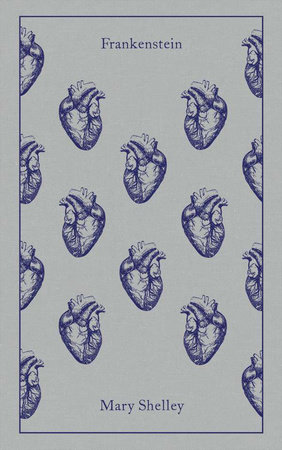
“The world to me was a secret, which I desired to discover”—Mary Shelley
I skipped the day we discussed Frankenstein in my Romantics Literature seminar in my sophomore year of college. It was the late 90s, a time when email existed but was only used for the most urgent and timely emergencies, text messaging was charged per send, and a professor could still reasonably request that you make up for a missed class by visiting them during office hours.
I wish I could remember what I believed Frankensteinto be before that lecture, but those impressions escape me. Like Frankenstein itself, and what would continue to be true throughout my many love affairs with the indelible text, Frankenstein brought joyous and affirming worlds into my life, just as it brought troubling ones. I suppose it wouldn’t be Frankenstein without it.
I sat in my professor’s cramped office as he gestured dramatically in his oversized blazer—TBH he was the exact image one might have of the absent-minded professor—and I tried to make myself as small as possible, something I did often in those days. To give myself credit, I was at least self-actualized enough to have arranged for my twin and me to escape the house of my father—my first Frankenstein—the year before, knowing I needed more than to fight for crumbs, to be bigger than a crumb under his foot.
I tried to stay present to the lecture my professor was giving as he held some worn crinkly yellow legal sheets with blue handwritten notes in one hand, and almost hit my face with his interlocution in the other. This professor would become a disconcerting presence in my life. I was looking for a father to love me with tenderness anywhere I could find.
I couldn’t tell you how we suddenly found ourselves having four-hour breakfasts monthly for many years, but I had to ultimately divorce myself from him when he kept mentioning all the ways he’d taken note of my appearance over the years we’d known one another, which eerily coincided with my friend telling me about a student he’d had a long-running affair with, who also happened to be biracial and Asian. I never saw him again.
But, before that would take place (Frankensteins, Frankensteins everywhere, and not a drop to drink), he would utter one sentence theorizing about Mary Shelley and her Creature I couldn’t let go of.
Like I said, this was the 90s, before we archived every moment we experienced. I kept a tiny audio cassette recorder in my backpack, but my friends and I tended to use those for serious interviews or getting drunk and bolting silly songs or conversations just so we could play them back and laugh at the versions of each other we loved. So, needless to say, I didn’t record this lecture, so I could never know for sure whose version stands.
But what I remember is that he said that Mary Shelley refers to the Creature as Creature until the world shuns him for his hideousness, at which point Shelley refers to him as the Ogre, the Daemon, the Wretch, etc. It was the moment I realized I needed to offer Frankenstein more of my time and focus. Years after the fact, that professor would insist he’d never said that, although he found the idea intriguing. He would not be the first person to tell me I’d internalized something that wasn’t quite accurate, but I’ll keep this revisionist history. In fact, we will return to this behavior of mine—of remembering something that was never quite there—in due time.
I returned home and decided to reread the novel less as a means of finishing it in order to messily make it through a college class, and more for what it had to offer me. I was 19, the same age Shelley was herself when she first penned the novel, and I wonder what it is about that age that can tether a person to the ideas of creation and narcissistic (ir)responsibility.
I was looking for a father to love me with tenderness anywhere I could find.
How can I describe my sensations on beholding it? I’ll say it again. This was the 90s. Filled to the brim with white, neurotypical, well-adjusted teens proliferating in young adult novels. White cis people on television. Don’t get me started on the ways The Joy Luck Club didn’t represent my experience (nor would I want it to). I adored Crouching Tiger, Hidden Dragon, but what could it say about my biracial hybridized American life? About living as a mixed-race identical twin? About being incubated by my violent father who immersed us in a language we were never given access to? What stories could you find about the Asian children being left by wild, unreachable sparkling white mothers?
And yet, here was this very white, assumedly cis, 19th-century novel that seemed to connect to so many of my anomalies I had never been able to voice before. When Frankenstein and his Creation began to circle one another, using the same language to describe their plight which acted as a kind of mirror, it felt like Shelley was speaking to the complicated relationship I held (and continue to hold) with my mirror twin, compelled towards and repelled from one another in equal measure. When the Creature was relegated to eavesdropping and surreptitiously borrowing books from the De Laceys in order to learn language, it reminded me of my childhood during which I spent so many hours in a corner in an abandoned police station or various Chinese restaurants while my father rehearsed and performed Chinese plays, or spent time with his friends. I would read the facial expressions and gestures that accompanied the phrases and exclamations in Mandarin I had never been taught, never been welcomed to learn. When the Creature began to learn of the monstrosity of mankind, and how they viewed their fellow man, how they viewed the ugliness in human life, I thought about what life had been as a half-breed, a mongrel, a slant-eyed ogre, a chink, or a banana.
I thought about the time my mother called me Oriental, just a couple of years before, on the telephone, and when I asked her not to call me that anymore, scoffed: I had three of them. I’ll call them whatever I want. When the Creature begged to their mother who had long since banished them, to be left with someone, anyone, I wondered, what would it take for my mother to want me? When my father hurled insults while striking us with his hands and told us it hurt him more than it hurt us, I felt the disgusting beast lurking inside me.
Shortly after I received my MFA in Poetry, during which I wrote these small, very controlled narrative and imagist poems about the complicated familial relationships I navigated—largely with my twin and my father—I found myself returning to Frankenstein. The Frankenstein poems ribboned out of my early days in therapy, and so did the space I began to take up on the page. I initially came to poetry to make sense of my chaotic emotional life, my clinical depression. But once I started the healing process, those rigid lineated structures now made me feel boxed in. These early prose poems were the earliest measure of reclaiming space that had been taken from me for so long. It was also through therapy I had finally acknowledged what I’d hidden from myself my entire life, but in plain sight. That my mother had abandoned me over the course of my life, in insidious, subtle, dramatic, ways throughout my entire childhood. I began to write prose poems, largely dramatic monologues, that helped me come to terms with all the parts of myself that resonated as I read and reread the novel again and again—as an abandoned and unwanted child, as a biracial person of color, as a twin at odds with their sibling. It was the first time I’d actively made work around Frankenstein in order to come to terms with my own wounds, but it wouldn’t be the last.
But, as they say, it takes a hundred times to learn the same lesson.
A Frank Love Affair
I first met the Frankenstein who would take the longest recovery, a painter I’ll call D, at a launch for a literary magazine housed at my alma mater, for whom I’d been the first official intern in the late 90s. I met him at the same time I’d begun taking up more space for myself, but was, for all intents and purposes, very new in the healing process around childhood trauma and the hold narcissism had on my emotional life.
I thought about the time my mother called me Oriental, just a couple of years before, on the telephone.
I’d seen his work three years before, at an exhibit that had a profound effect on me, centering Black conceptual artists. It was where I first encountered W.E.B. Dubois’s notion of double consciousness, which led me, in one way or another, to so many artists who remain hugely influential: Adrian Piper, James Baldwin, Ralph Ellison, Zora Neale Hurston, Richard Wright, and so many others. His work was interesting but impressed me the least. A writer I knew well in the community and the managing editor introduced us. Within a few minutes of meeting, he expressed an interest in collaborating with me on a project centering Don Quixote. We traded phone numbers.
He called three times. I wish I had understood why I’d refused to take his calls, that there was an intuition within me that knew to keep myself from the danger of his machinations.
Even though it was I who asked to be introduced, there was something about him that frightened me. I wanted what he possessed, something I also recognized in my father. It was around this time I told my therapist, “I know I need to be with a narcissist, since I imagine only an artist could handle what I come with, I just need to find a nice one.” Of course, I had no true idea what I meant by that, what it could mean.
A short while after the initial ignored calls, I took my students to see a talk of his given at the university, which happened to be his alma mater.
Again, he called three times. Again, I didn’t answer. On the fourth call, he promised he wasn’t a serial rapist. I called him back, although now I can see his call for the warning that it was.
He wanted to work on a project about love. He was interested in Derek Walcott’s Love After Love, and he wanted to include writing, perhaps poems I would write, alongside the paintings. The more he spoke, the more he reminded me of Frankenstein. In a therapy session, my therapist asked me how I was Frankenstein. I redirected: “I’m Shelley.” She retorted, “That’s too obvious. We have to talk about the ways you’re Victor. The ways you, too, might be the narcissist.” Isn’t the most insufferable quality of Victor is that he never addresses what’s right in front of him?
There was something about him that frightened me.
The more we spoke, in cafes and wine bars, and the more he spouted off all his random ideas around love he wanted to include—the more Frankenstein whispered its name into my ear. Just like the number of times he ignored me, so, too, did he ignore the idea that we should consider Frankenstein, until I let him read my poems.
He was interested in the recurring title I used, taken from my favorite sentence in the text, from when the scientist first looks upon his hideous creation: The beauty of the dream vanished, and in its place—. Only, when I returned to the text to find it, I only found that first phrase, and the one that was my favorite, “and in its place,” nowhere to be found.
I had desired it with an ardour that far exceeded moderation; but now that I had finished, the beauty of the dream vanished, and breathless horror and disgust filled my heart.
Remember what I said about revisionist history?
We began to work on a show together about Frankenstein. As collaborators, and, shortly thereafter, as lovers.
I became his muse. I taught him the psychic underpinnings of this painting or that one. I stood patiently as he pontificated about his work, or about our developing show on Frankenstein, taking notes in my little black notebook with a blue pen. He stared at me with fondness—or something else I have no word for—as I took bubble baths on the second floor of his studio. We had tenderless sex. We talked about the future, but did we ever speak of love? The memory escapes me.
Before I knew it, I had entered into a pattern of narcissist and narcissist object. I would be brought up and up and up until I had been elevated to the ceiling, and then I would express a frustration, I would challenge one of his thoughtless assumptions, or I would get upset if he brazenly sexualized another woman in front of me, and I would be kicked out of his studio and perhaps his life, until he called and needed me again.
The first moment I knew I needed to free myself of this Frankenstein was the moment of the dress. We were going to see Bill T. Jones, who he’d met before, and who he hoped to convince to collaborate with us. I stepped into a red dress with silk floral cut-outs, a Spanish-inspired frill up the leg in a diagonal. As I walked towards his car, I saw the look on his face: patronizing, disapproving, infantilizing. He demanded I change my dress. “Don’t you understand that you represent me?” he screamed, even though I hadn’t been unwilling to acquiesce. It was that sentence I couldn’t overcome, and neither could group therapy when I told them what had happened. I felt like I was drowning, and I didn’t know how to find my own air.
I would be kicked out of his studio and perhaps his life, until he called and needed me again.
The second moment I knew I needed to free myself of this Frankenstein was the moment of the baked potato. He’d been painting all day, and called me to come over for a break, for us to have dinner. We were going to order takeout, from a barbecue place down the street. I said, “Oh, I’ll have a chopped beef potato,” not thinking anything of it, but feeling increasingly unsafe for reasons I couldn’t discern, as he looked over me with a strange, creeping glare. “No, you won’t,” he said, still staring. “You’ll eat what I tell you to eat!” I didn’t know if he was joking or serious, but I’d learned not to rock the boat. Besides, I’d become a pro at holding steady with a father with an unpredictable raging temper, an emotionally wild mother. I turned my face to the side, and I released the anger out of my mouth in a slow exhale. I turned back. “Can’t you take a fucking joke!” he screamed. I ran out of the studio. His apology came as it always did—“Can you tell me why I did that?”—but I was growing disinterested in expending emotional labor to explain to the Maker what made him.
The final moment was the moment of the painting. I’d allowed him to photograph me for a painting in the show that was intending to “subvert” the idea of “the beautiful woman as monster.” He would call it killer’s kiss. I posed nude, hip cocked, chopsticks holding up my then-long dark hair (vomit) and my feet in strappy bright blue heels. Next to my body rested a sculpture of his, a pregnant African figure—a goddess of fertility. I was nearing the end of my period, but I’d later learn I was already pregnant.
I didn’t remember what I tried to embody when I posed for the photographs that he would use to make the painting. That I had attempted to embody what it was I saw in my twin sister. D told me that seeing the painting would be intense for me. That he would wait to show it to anyone until I felt comfortable. When he showed me the painting, I didn’t know what to say. I didn’t know how I was feeling. I saw the person I wanted never to become. Before I could even come to terms with all that I had witnessed, all that mirrored within me, he had kicked me out of the studio and stopped speaking to me.
The next day, I went to my favorite breakfast place with a friend, hoping I was having cramps. It was my favorite, my Friday morning ritual: breakfast tacos, fried potatoes, organic coffee. I could barely stomach it, because my belly was wrecked with nausea. I complained about periods, and my friend said, well, that’s better than being pregnant. It was the first moment the possibility occurred to me.
I bought two home pregnancy tests. They turned positive so fast I didn’t have time to wonder.
I didn’t have the kind of mother I could call for this. My therapist was out of town. I called his mother. By the time he got on the phone, he wasn’t happy. “This is not good news. I will send you checks in the mail. We will no longer have a relationship. If you keep this child. Don’t think you’ll automatically be a Mary Poppins.”
The Maker tried to convince me to have an abortion. He used every means imaginable. In the end, I chose to terminate the pregnancy because I could see living beneath the skin the dark heart of my father, who I had tried so hard to run from.
“Your mother abandoned you. I’m your mother, and she abandoned you,” my therapist said when I first told her in session that I was pregnant, when I curled into her soft white chair where so many of my tears remained embedded in the fibers, so many Frankensteins, so many of my monsters.
When I want to remember a time in which I was integrated, felt truly loved, I think of my therapist. I went to group therapy, but I was scared to fall apart. I didn’t know if I could tell them that I would have an abortion the next day. I hadn’t had a chance to tell them I was pregnant. One woman in Group had a newborn, the other eight months pregnant after a long journey. She shined. My therapist was connected to my pain then, her eyes quivering as mine did, while I wore D’s oversized shirt he told me to wear to conceal myself. My therapist and I both began to cry. It was a sign of tenderness I’d never witnessed before. I thought to myself, this what it must be like to have a mother not abandon you, to hold you in your pain.
D had already insisted he wouldn’t come with me to the abortion. He didn’t want anyone to recognize him. My therapist and my entire Group offered to come. It was this fact I used to guilt him into coming. His mother also came. I delivered messages to him through her as the proxy.
The nurse asked me if I wanted to know if I was having twins. I knew that I wouldn’t be able to proceed if I would have the opportunity to be there for a birth experience that I’d had. I answered yes. They weren’t twins. While the doctor suctioned out the pregnancy, I talked to him about Frankenstein.
I tried to recover at his mother’s house. He called with every possible thought or projection, believing we would return from this. I knew better, but I had my own healing to do first. When he learned I’d sought out another friend for comfort, he withdrew the privilege of staying at his mother’s house. His mother, refusing to endure the aspect of the being he created, blamed me for letting him “browbeat me into an abortion.” I rushed out of the room.
While the doctor suctioned out the pregnancy, I talked to him about Frankenstein.
A few days after the abortion, he left a check for his half. Under the memo, he wrote: ART. Shortly after he called letting me know he had made the decision to exhibit the painting in the largest collection in Houston. I decided to write a piece about what it had meant to be a muse, a partner, a collaborator, a monster, an object. I typed ten pages without stopping. I placed my hands on the desk. Another call: he decided not to put the painting in the show.
One year after the abortion, D sent me an email with an image of a painting called Frank, a rip-off of Louise Bourgeois’s Nature Study. The painting included a young girl’s crying eyes streaking mascara, and just above them, a dead-end sign in the snow. The amoebic sculpture is golden, and D’s interpretation holds a shovel in one of its gooey holes, a face on the backside of it.
Four years after the abortion, D exhibited a series of paintings, including the painting I posed for, but also one involving a trampled bridal bouquet, the same African goddess of fertility holding a shotgun in her arm, called Puzzle for Pregnant Girls.
The last email D sent me:
still working on the paintings
please forgive me
Somewhere along the healing process from the abortion, from my loss of innocence, I decided I needed to learn what caused me to enmesh so deeply with narcissists. I initially sheltered myself from the world, with baths and tears, counting down the hours until therapy, who generously saw me twice a week in the early days after. Eventually, I was ready to uncover what led me to this monster, this maker. I returned to the text that continued to open out for me, Frankenstein, which I began to read as a self-help text. I woke at 6 every morning and drove to my favorite café and read and read and read. I began to uncover the thematic underpinnings of male hysteria in the text. It was then I started reading everything I could get my hands on: about Mary Shelley, her marriage with Percy Shelley and how it related to her father, the ideas of her mother Mary Wollstonecraft. If I could come to terms with how I had gotten here, then maybe I would never return again.
I wanted to turn this pain into art, and I felt this story would make a compelling dance theater work. I wasn’t a choreographer, but had loved dance since I was a child, and I pitched the idea of a dance theater adaptation to a queer contemporary ballet choreographer whose work I admired. I’d already seen him produce dance theater adaptations of Titus Andronicus, Romeo & Juliet, and on Mozart, so I knew he was interested in how dance could offer a new embodiment for a literary text. I’d seen him choreograph complicated, psychologically-driven male-male duets, which seemed befitting for a story of this magnitude. It took a year of regurgitating everything I’d studied about Frankenstein monthly in cafes, but soon the choreographer said yes. I gave all the feelings that whirled in me to this production.
I naively assumed the life I had dreamed for was finally within reach.
I brought in ideas around the score, costumes, lighting, staging. All of those days I’d spent early in my youth watching my father produce Chinese plays, all of that watching where I couldn’t understand the language being spoken around me, came out of me into this new work. The choreographer and I came together to create this work outside of my own relationship with narcissism. I’d begun to understand my own queerness, and I’d finally started to detox from the role I’d taken on as a narcissistic support. I started writing a play about all the women within the Frankenstein universe, The Shelley Monologues, bringing them back to life, and I suppose, also me.
What I learned when the curtain rose on our Frankenstein: I would never leave behind what I created, and nothing I created would become monstrous in my own eyes.
I would continue to make work featuring Frankenstein. So many Frankensteins! I wouldn’t finish The Shelley Monologues, but I would write a nonfiction manuscript, titled the same as my unpublished poetry manuscript where the Frankenstein poems lived, after the phrase I believed had been written into the creation scene, but that only existed in my own imagination: and in its place—. In the memoir, I merged Shelley’s story, the stories of Frankenstein, and the text of Frankenstein itself with other texts regarding Shelley into the lines of my own story.
I read from this memoir in 2018, and was asked about the role of whiteness, twinning, being a biracial Asian, and a queer person factored into my understanding of Frankenstein. Although I clearly knew how those aspects of my subjecthood brought Frankenstein to me, I found myself at a loss of how to answer, having spent so much of my time investigating Frankenstein from the lens of my relationships with cis white men. I put this ambivalence in my pocket.
In 2019, retellings cast from the bodies of queer and underrepresented experiences were rising. Georgia was starting to ban early term abortions. I was in love and believed I would start creating a new life of my own, using IVF technologies. As I began to do more research into reproductive technologies, and as more organizing began to develop to advocate for birthing bodies, I returned, yet again, to Frankenstein, realizing I could bring new life to this text, once again. I foolishly believed I’d finally met someone who wasn’t a narcissist. I naively assumed the life I had dreamed for was finally within reach.
I started Unwieldy Creatures, my queer biracial Asian nonbinary Frankenstein, in the heart of the redwoods outside of Santa Cruz, at a residency called Mary Shelley Month: A Laboratory of Fiction. I wanted to see what would happen if I cast Frankenstein as a queer woman of color intent on creating the perfect specimen for herself and other queer people, Elizabeth as a man, Ezra, who left behind the softer parts of himself when his white abusive father silenced them. I wanted to see how IVF would portend darker futures. I wanted to cast white masculinity as the villain.
I wanted to use this new and terrifying political and technological landscape—that in which reproductive technologies were building in ways that brought about a whole new world of ethical implications while at the same time fighting against restriction of bodies—to set a modern story of a creation gone wrong.
Unwieldy Creatures was both of its own fictional experiment and also deeply personal, as I wrote it preparing and testing my body for my own creation that was never to become. By the time I came home, Caroline, Ezra’s wife, had been hanged, innocently framed for the death of her child, caused by the Creature Ezra was responsible for creating, with sabotage. My own love would also sabotage our unborn, bailing on our first appointment the night before, and blaming it on my writing career, on the masterpiece I was created with this new Frankenstein.
A few days later, I would learn everything he had told me was a lie. I’d spent so much time exorcizing the monster within my own body, from the narcissists that I was born from, that raised me. I’d never seen the true wretch all along, right in front of me.
I wanted to see how IVF would portend darker futures. I wanted to cast white masculinity as the villain.
When I left my marriage, the Frankenstein I was making remained unfinished. I didn’t know if I could ever return to it. A few months later, still in despair, COVID blew through the planet. What did this Frankenstein matter when we would all be eradicated from the earth? How could I write through such darkness when even getting through the day felt an ominous miracle? Somehow, somewhere, within me, I barreled through it.
Dr. Frank, a queer biracial Indonesian scientist, determined to find a way to create life without the need for cis men, uses in vitro gametogenesis, a process that uses stem cell technology to create both egg and sperm, and implants the embryo in her first love, a Spanish Japanese woman. When Ezra tampers with her experiment, Dr. Frank makes the most Frankensteinian choice, to withhold the information from the partner who willingly offers her body to carry her life’s ambition. In trying to evade men’s presence in her life, she becomes more like the toxic white father who had caused her so much damage. By the time they learn that the fetus is growing with a genetic condition, one that could be dangerous for both the child and Hana, it’s too late to acquire an abortion, as late-term abortions are illegal in the part of the South where they live. Unwieldy Creatures was informed by and exploring abortion bans in Georgia in 2019. In June 2022, Roe v. Wade would overturn. Six weeks later, what is now the only time period one can easily attain an abortion in many states, and the length of the pregnancy I terminated, Unwieldy Creatures would come to life.
I’m 44 now. And Frankenstein has carried me through every major upheaval in my childhood and adult life for over twenty years. I won’t ask what will come next, but I know when and if it does, that Shelley’s Frankenstein will carry me through, and Shelley, just like she did when I created poems, monologues, memoir, dance theater, and fiction, will be there to guide me, to help me find my own self, to cradle the creatures within me, and let the monsters be damned.
For me, it all started with Poe’s “The Tell-Tale Heart.” Then came the tales of Flannery O’Connor, Shirley Jackson, Ursula LeGuin. Storytelling that takes vivid imagination combined with some devastating reality to add up to something that is unsettling and disturbing.
You can get your socks spooked off by the supernatural, the ghostly, the otherworldly. But a story can also be really freaky even by just nudging at the thin veil between reality and fantasy. As stories like “The Lottery,” “The Ones Who Walk Away from Omelas,” and “A Good Man Is Hard to Find” show, sometimes the most alarming threat is coming from inside the house (like, literally in “The Tell-Tale Heart”). Sometimes, human nature is the creepiest thing imaginable. It’s us, hi, we’re the problem, it’s us.
The Latina writers on this list represent a range of cultures and creative sensibilities. Five are contemporary, but two are classics that are still worth reading today. As Silvia Moreno-Garcia, author of the new novel Silver Nitrate, described in “Saying Goodbye to Magical Realism,” they and other writers are pushing the boundaries of genre beyond the default descriptions for Latinx writers. Is it magical realism? Is it horror? Is it fantasy? Yes, and then some.
The books on this list are all collections of short stories. As short stories, each one has a fraction of the word count to pull the reader in, give them goosebumps, and leave them checking under their beds at night or sleeping with the light on. Or both.
Some of these tales are about ghouls and creatures. Some of them blur the line between reality and magic. Others find their creepiness in exploring the logical conclusions of some of humanity’s worst qualities: the tendency to fear the other, the desperate need to preserve the self at all costs, or the ability to be cruel at random. The horror!
The chilling stories of Things We Lost in the Fire by Argentinean author Enriquez tell of a bleak and sinister world where everything is imbued with a sense of isolation and loneliness. Add to this a menacing backdrop of the danger of living in an uncertain political climate. Otherworldly terrors walk among people, as in “Adela’s House,” in which the narrator recalls the grim circumstances that led to the death of her friend and her brother, and the macabre house at the center of all that transpires.
Enriquez deftly blends bizarre reality with even more bizarre unreality, such as the ghostly encounter that terrifies two girls (“The Inn”). Stories like “End of Term,” in which a girl’s strange behavior freaks out her classmates, further blur the lines between this world and an unearthly one.
The sharp details of these carefully crafted stories linger in the mind long after reading the final pages. Peynado drops readers into tensely realistic worlds where individuals and communities grapple with all-too-familiar uncomfortable issues coupled with strange happenings, as in “Thoughts and Prayers,” in which a community struggles with the aftermath of violence, while strange, mute angels reside on the rooftops of their homes, seemingly oblivious to the chaos that they cause.
But into the middle of these already fraught dynamics enters an unexpected element, often with dramatic results: kite-flying aliens, a girl with translucently pale skin, expats who can fly. In “The Stones of Sorrow Lake,” a woman visits her fiance’s hometown, where residents’ sorrows grow from their bodies as literal stones, which they pile up by a local lake. In “True Love Game,” while tensions mount at school with the white kids who bully them, the characters also contend with the strange ghosts who live in the basement.
The stories of Maria, Maria inhabit a world that is firmly rooted in magic. These are not characters who wonder if something otherworldly is happening, they know it is. And in some cases, they are making it happen, such as the lonely young girl who unearths and resurrects the skeleton of a saber-toothed tiger (“The Burial”). “His roar is the song I didn’t know I could sing,” she says. Rubio’s stories are vivid renderings of the ebb and flow of the tension and harmony as humanity, the natural world, and the supernatural realm intersect. For characters who are stuck in place, colliding with this intersection gives them the momentum they need to move forward. In “Tijuca,” a woman travels to the jungle to fulfill her promise to her deceased husband that she will return his body to the earth and bury his head there. In “Carlos Across Space and Time,” two women take advantage of a mirror’s ability to show them alternate timelines to try and make sense of their friend’s death—and perhaps give him a better ending.
Before she wrote In the Dream House, in which she dissected the chronology of an abusive relationship in painful detail, Machado awed with this collection of stories that provoke cringes, gasps, outrage, grief—rinse and repeat. The characters navigate the ravaging impact relationships can have—on themselves, on their partners, as in one story that explores a long marriage marred the husband inability to accept that he can never know the meaning of the mysterious green ribbon around his wife’s neck (“The Husband Stitch”).
The stories play out in settings as quiet as the space between two married people or as large as a nation swept by a mysterious pandemic. But the results are often bleak. In “Real Women Have Bodies,” the narrator embarks on a new relationship while a mysterious illness is making women fade away until they are practically invisible. “Inventory” isn’t at all what it seems at first—the listing off of the narrator’s lovers turns out to be a way to tell a grimmer story that is happening at a much larger scale.
Images of dolls appear in several stories in this collection by Puerto Rican author Ferré, and it’s an apt metaphor for characters who chafe powerlessly against the gilded cages they live in, desperate to find meaning and purpose in their lives. There’s the title story, about a woman who makes strange, lifelike dolls for her nieces, which sets the tone for the collection, at turns both mournful and menacing. Then there’s “Marina and the Lion” starts with the main character Marina appearing at a party set in a box covered in cellphone as though she’s a doll—a 20th-century Puerto Rican Barbie. The stories are set against a backdrop of Puerto Rican politics, as the characters face the inescapable realities of their island’s occupation by the United States.
In the foreword to Forgotten Journey, there is a quote from Argentinian author Ocampo talking about why she wrote short stories: “I think the short story is music,” she said. And in fact, each of the 28 stories in this collection are like songs, capturing in brief, poetic flashes disturbing glimpses into tragic moments. Ocampo writes matter-of-factly about death and dying, as in “Skylight,” when a bedtime battle between a girl and her caregiver quickly takes a tragic turn. Or as in “The Two Houses of Olivos,” when two girls exchange places and go to stay at the other’s home, but they forget to swap guardian angels. Reading these slight snapshots are like watching a car crash, as in “The Poorly Made Portrait,” in which a mother who has ignored her son’s attempts to distract her from her fashion magazine finds when she finally goes to search for him that she may have missed her last chance.
This collection, which was published before Moreno-Garcia’s creeptastic novel Mexican Gothic, plays on many of the same themes: mysterious things that go bump in the night, fearsome folklore, and strange people with sinister motives. Whether it’s the vampire a journalist runs into at a late-night diner (“Stories With Happy Endings”—a very different twist to Interview with a Vampire) or the man who hires people to spend time with him and his boss, an octopus-like alien (“Driving With Aliens in Tijuana”), it’s often the people who cannot be trusted more than the strange creatures.
Nature and fantasy are braided together in ways that are weird and wonderful, none more so than “Scales as Pale as Moonlight,” in which the narrator, grieving the loss of her unborn child, finds escape in a supernatural encounter. But for the characters in these stories, drawn an underworld of mystery and magic from which there is often no escape.
Parker stares at his niece Zaria’s stomach, covered by a stretched-out white tank top. Her belly is a dingy full moon creeping on the horizon of the kitchen table. She carries a whole new person, a whole new world. Zaria, sixteen, sits with Parker’s daughter, JayLynn, who is fifteen and wears a new hickey on her neck. It’s smaller than the last one, which was actually two, neighboring islands that were fading by the time Parker saw them. The new one is the size and shape of a fingerprint. It glows red like the legs of the woman in the champagne glass on the sign for that strip joint on Seventh Street when you pass it at night. Parker can’t remember the club’s name. It’s next door to a liquor store that’s next to another strip joint. And there’s another one a little ways down. They go on and on down Seventh Street, heading away from Churchill Downs. The legs of the woman in the sign spill over the glass’s rim. One stretches out, kicking the dark.
The hickey demands Parker’s eyes when they’re not on Zaria’s belly or the sad dinner and dessert he packs in saved, doubled-up plastic bags from Kroger. He’s eager to streak out of the house and get to his job at Louisville Gas & Electric, someplace where he can make things work. He’s a stationary engineer and runs the boilers that create the steam that turn the generators and bring light and warmth to people’s homes. On his lunch break this evening, he will eat the canned beans and franks, the package of bright orange cheese crackers with pasty peanut butter, and a roll of lemon crème cookies while he jokes and complains about wives along with Jim and Terry like he’s still got one.
Claudia called him last month after seeing the first hickey(s), like it was his fault, asking him what the hell he was doing over there. Over there, like the house and life she’d lived with him was far, far away. He hates this and his understanding of that sense of distance from places and people once known, hates that his wedding ring is coupled with dropped pennies, a fallen button, and other junk stored in the top drawer of his nightstand for unlikely repairs and reuse. Once Claudia finished yelling, Parker told her he’d never let any boys come over and hadn’t seen any hickeys, but he figured JayLynn’s boyfriend was who had marked her up. He’s never met him, but he knows his name. Michael is always popping up in JayLynn’s conversations with Zaria. She swirls his name in pink and purple ink on notebook paper. Parker didn’t tell Claudia that as much as she sleeps, the boy could have walked right into her apartment. He and JayLynn could have snuggled up in her bed and watched a whole movie before they started kissing and Parker doesn’t want to know what else. Part of him itched to say this, but the much bigger part didn’t want to fight or hurt Claudia and suggested dinner as a solution. She’d come over, he’d cook, and they’d sit down together to eat and talk to JayLynn.
“She’s already having sex, Parker.” Claudia sighed. “I’m taking her to the doctor next week to put her on birth control.” After that, Parker said nothing he remembers, nothing coherent or helpful before Claudia hung up. He appeared as dumb and naive as she believes him to be, someone who couldn’t save anyone from anything.
The girls are talking about ways to induce labor. Zaria’s due date was July 17, nine days ago.
JayLynn runs her finger down a page of the library copy of What to Expect When You’re Expecting spread open on the table. “We can take a walk,” she suggests before crunching into a slice of her frozen pizza.
Parker cracks ice from a tray and drops the cubes into his extra-large thermos. He doesn’t jump in to ask if the girls intend to take this walk soon or what they plan to do if their efforts are successful since he’s about to leave and there’s no telling what street Zaria’s mother, Dee, has lost herself on chasing today’s highs. Dee and Claudia, sisters, spend their days disappearing, each in their own spectacularly common ways. If Claudia is home from work when Zaria’s contractions begin, she will most likely be buried in her bed covers and won’t answer the phone. She might even have the ringer off. Parker doesn’t know much about the baby’s father, Travis, but from listening to the girls’ conversations, he’s learned that the boy has pretty hair that Zaria wants for the baby, but no car.
Zaria groans and slumps in her chair. “I’m tired and it’s hot. I just walked from the bus stop to get here. Does the book say anything about taking a nap to induce labor?”
“You know it doesn’t, but the way you snore could probably get him out of there. I’m surprised he hasn’t already pushed his way out. The last time you slept over I swear I wanted to punch you. Matter fact, I hit you on the arm and you still didn’t wake up.”
“Leave me alone, I’m pregnant.” Zaria rises to reach for the family-size bag of Cool Ranch Doritos she brought with her. Half of her arm is lost as she digs for a chip.
The girls’ hunger is relentless. They are always eating— fat dill pickles that smell up whole rooms, bags of barbecue Grippo’s potato chips, fish platters with lots of fried batter crunchies from Long John Silver’s (where Travis works), and frozen pizza. Parker is forever buying frozen pizza. Sometimes it seems he’s spent his whole life carting the flat red boxes from his truck to the house, as if Claudia and her fried pork chops and greens were only a vivid, delicious mirage. When he looks at the girls, he feels like he’s stepped into a carnival of mirrors. Claudia and Dee ghost on their daughters’ faces. They roam in their eyes and mouths, in the tiny moles marking their cheekbones. Crack has hollowed Dee, snatched her few meaty parts. If Parker didn’t know about the baby and how the world works, he could believe that Zaria’s rounder cheeks and chin, her swollen breasts, and all that belly are the stolen pieces of Dee. He can imagine Zaria picking up the trashed chunks and patting her mother onto herself like makeup, rubbing her in like lotion.
He is thankful JayLynn doesn’t have her mother’s body. Claudia in a pair of red shorts—the cocoa-butter sheen of her coffee skin stretched tight over the just right muscle- to-fat ratio of her thighs—led him out of his booth at Blue’s restaurant and away from his plate of the best fried chicken he’s ever eaten. JayLynn is skinny, a straight line with no brake-smashing bumps, but today it seems she’s doing her best to show what she’s got in lace-trimmed, blue-jean shorts so short he’s grateful for the strip of extra material the lace provides even though it reminds him of nighties and bedroom whispers. Her hair is pulled up in a bun on top of her head, as if she’s showcasing the hickey right along with the tiny gold-plated Nike earrings she begged him for last Christmas. He regrets buying them and supporting the company’s slogan to Just do it.
JayLynn is skinny, a straight line with no brake-smashing bumps, but today it seems she’s doing her best to show what she’s got.
The Wednesday before last, JayLynn left her new birth control pills on the bathroom counter. Parker thought she’d be back the next day to get them, but every morning he’s been brushing his teeth glaring at the butter-colored plastic compact. He thought that when JayLynn came over yesterday afternoon that would be the end of that, but this morning he scrubbed his mouth into a slobbery white foam and spat staring at the compact. He imagined its pale yellow spread on nursery walls and crib bedding. He opened the compact to find the “THU” pill still nestled in its slot.
“It is Fri-day!” the DJ on the radio announces as Parker fills his thermos with tap water. Some of the cubes snap and split clear bolts of lightning on the inside when the water hits them. “TGIF am I right, y’all?” JayLynn’s boombox, perched on the kitchen counter, is always playing some song about sex or love or both, reminding Parker of all he’s lost. When the girls sing Mary J. Blige’s “Not Gonna Cry,” they begin quietly, but by the time they reach the song’s climax about no guarantees in love and not getting the part about being left, the words are rising from their guts, their eyes are shut tight, and they belt that song like women who have been married to lying sons-of-bitches for years and years. JayLynn can carry a tune, but Zaria has the worst voice Parker has ever heard. He thinks she must be tone deaf. It’s painful to hear her cracking love songs into pieces.
When the DJ fades into the music, Parker recognizes the intro of Bone Thugs-N-Harmony’s “Tha Crossroads.” He’s no more relieved to hear this than whatever song would have the girls singing about shaking butts or broken hearts. When the synthesizer zigzags the intro, the girls don’t gasp and jump to turn up the volume. “Tha Crossroads” is the only video that plays when they watch The Box. Over and over, the Bone Thugs walk down streets with friends who vanish before their eyes, lost to another world. The song plays on B96.5 (the only radio station JayLynn and Zaria will listen to) at least once an hour, making every day funereal. The girls are getting over the hype, but they sing along. Even half-heartedly and without knowing most of the words, they get the haunting sentiment of loss and vulnerability just right.
Claudia moved out in November, two months after she left rehab. Clean of the Vicodin, she said to Parker, “This isn’t working,” and Parker thought it was just the depression talking. The words weren’t backed with the passion he thought someone would have if they were really planning to get a divorce. Yet, she got a job at the plasma center downtown, packed, left, and Parker thought it could be a good thing, that more physical space could help Claudia work out whatever was going on in her head. He now knows that was stupid. As if she actually needed to wrestle her demons, launch into a tornado of fists, elbows, and feet rumbling through room after room. As if she had a better chance of winning without him jumping in and helping her fight.
He stayed in the house, in the Shively suburbs, surrounded by homes decorated with leftover Halloween pumpkins whose carved smiles melted to rot. For Christmas, he bought a real tree like he always did, and he and JayLynn filled it with the ornaments he pulled from the basement. When he came home from work, he vacuumed the fallen needles and watched his neighbors’ candy-colored lights blinking out of synch in the cold black.
Claudia and JayLynn moved to an apartment in the Highlands, just off Bardstown Road with its stretch of cafés, bookstores, and vintage boutiques roamed by punk rock white boys who look like whips of black licorice, white girls with pink hair, black girls wearing blue lipstick. The shops sell “Keep Louisville Weird” bumper stickers to remind the outsiders and outcasts to stand proud and firm.
Claudia hired a divorce attorney in February and Parker followed suit. He signed the papers without a fight, as if he’d never loved her, because he loves her so much. He wants her to be happy, but when he asks JayLynn for updates, he finds that nothing’s getting better. He knows Claudia’s embarrassed about stealing pills from the hospital and regrets losing her nursing license. He likes to imagine she misses him.
When he came home from the grocery store yesterday to find JayLynn on the couch, she reported, “She’s still depressed,” in a bored monotone before he could even greet her or ask about Claudia. JayLynn used What to Expect When You’re Expecting, resting on her lap, as a makeshift table as she painted her fingernails in steady black stripes.
“Somebody drop you off?”
“No. TARC.”
“I told you I don’t like you catching the bus. I could have picked you up. I was just out.” He walked to the kitchen, set the bags on the table, and began putting the frozen pizza, milk, and eggs into the refrigerator.
“I can ride the TARC, Daddy, it’s fine,” JayLynn called to him. “I’m not a baby. Plus, I told you I don’t want you coming to get me anymore because you can’t ever just honk the horn and wait. You always gotta knock and come in and peek around and knock again at Mama’s door and beg her to talk or get coffee, and it only makes things worse. Plus, asking her to get coffee is lame anyway because neither one of y’all drink it, and the whole thing is just sad.”
Parker left the rest of the groceries on the table and went back into the living room so JayLynn could see him when he said, “It’s not sad; it’s love. I love your mother,” but she was wiping a black smudge from her pinky with a neatly folded pad of toilet paper.
She spoke while looking down at her hands. “I know, but she don’t want all that. Plus, it ain’t helping her and you’re playing yourself, doing all this loving for somebody who ain’t trying to love you back.”
Parker has heard JayLynn throwing her two cents to Zaria about running back to Travis after he’s spent days ignoring her calls and pages. She says, “Wouldn’t be me. You a good one.” All this tough love disappears when they’re talking about Dee. “She’ll be back,” JayLynn says when Zaria tells her how many nights Dee has been gone. “It’s the drugs, it’s not her,” she said when Zaria told her Dee found the money Travis gave her to buy baby stuff. She forgives their mothers for all trespasses. When she visits Parker, she never stays longer than two nights before returning to the apartment to check on her mother. Parker is sure JayLynn likes Michael and wears all that greasy-looking, strawberry-scented lip gloss for him. She probably thinks she loves him, but she doesn’t love him enough to go running across town just to be there while he sleeps, not enough to do things she said she would never do.
The word “sex” from JayLynn’s mouth sends a tremor through Parker’s hand. Some of the water in the ice trays he’s refilled splashes onto the floor.
“Shit,” he curses so softly the girls don’t notice.
“It’s too hot to do it,” Zaria whines.
Parker sets the trays in the freezer and goes to grab a paper towel.
“Look, it’s summer, it’s hot, get over it. I’m sure they got air conditioning at Travis’s house. I don’t think you have to do it for that long,” JayLynn says.
“The book says you’re supposed to have an orgasm to get your muscles contracting and stuff and that would probably take a looong time. You know Travis be like . . .” Zaria rata-tat-tats on the table with her fist, and the girls burst into laughter. Parker winces at the knowing tinkling in the notes that float from JayLynn. “The doctor said the man’s thing doesn’t hit the baby’s head, but I don’t see how it doesn’t, especially now. The baby’s probably, like, right down there, all ready, and I don’t want him traumatized with Travis beating on his head, denting it all up. Plus, I ain’t even feeling Travis like that right now. I told you, Cindy said she saw him walking down Broadway with some light-skinned girl the other day.”
Parker wipes the floor and wonders when the idea of his daughter having sex won’t startle him so much, though he’s already grown more accustomed to it than he’d like. The girls’ conversations around him have gotten increasingly frank. With Zaria’s pregnancy and JayLynn’s birth control pills, he guesses they figure there’s nothing left to hide; they’ve laid their cards flat. Bluntness has risen in JayLynn like a fever.
Last night, she was curled on the couch with her knees nearly tucked under her chin, gazing at the TV in a blank way that made Parker’s stomach turn. When he asked her if something was wrong, she told him, “Cramps. I’m bleeding in clumps,” without taking her eyes off the TV.
“Jay,” he’d groaned before he could stop himself.
She laughed. “I know. It’s gross.”
He feels bad about that groan, the chastisement. He acted like a boy. He should have handled the situation better, been comforting like she was when she looked up at him, said, “I took some Pamprin. I’ll be alright,” and gave him a quick, close-mouthed smile before turning back to the TV. She drops this token of reassurance that she’s not her mother and only gets a normal kind of sad when he catches her contemplating things he can’t see in the tumble of boiling water as she prods a block of Ramen noodles with a fork or lying on her bed staring into a book. Claudia used to lock their bedroom door, and Parker had to open it with a bent bobby pin, but JayLynn always keeps her door wide open. He can walk right in. He knows he should be happy about this. She wants to talk the darkness away so it won’t catch them too. She wants to know that they’re okay, but they’re not, and he doesn’t know what to say about that.
Now, he drops the paper towel in the garbage and watches JayLynn’s black fingernails flash as they flip through the book’s pages. She’s the one who checked the book out from the library. She reminds Zaria to take her prenatal vitamins. She wouldn’t just forget to take her birth control pills, not with Zaria big and pregnant, the baby any minute away. The abandoned pills are another card face up, plans being announced.
The baby JayLynn’s trying to have is for Claudia. It’s a lastditch-effort baby, a poked-hole-in-the-condom-when-heleft-the-room baby, what Parker and his friends used to call a Jesus baby—a baby that will fix all the problems, save the world. This phrase was coined before any of them had kids, when they could laugh at somebody else who had gotten the wrong girl pregnant, when losing a woman didn’t turn them into piles of shards. Parker has only seen one successful Jesus baby.
When his friend Buggie’s girlfriend, Theresa, came up pregnant, everybody but Buggie knew what that was all about. They humored him when he bragged about his super sperm busting through the fortress built by years of birth control pills. Theresa was a decent girl, so nobody said anything. She was good for Buggie, too good for him really. No one knew why she’d want to stick around with him, but she gave him a son that straightened his wandering eye and made it see all her magic. They’re still married, both happily, it seems.
Sometimes Parker thinks if he could do it all again, he would flush Claudia’s pain pills down the toilet, get in her face and yell instead of convincing himself she knows what she’s doing. He wishes he hadn’t loved Claudia like a puppy, all pant and rollover. Sometimes when he can’t stand the open space in his bed and spreads himself wide to fill it, he feels all his regrets buzzing neon yellow.
But he keeps doing stupid shit. Keeps walking past those birth control pills and not saying anything. He could live with the discomfort of knowing he’s still the same coward, but he knows he’s worse than that.
He has imagined the child JayLynn could have. Claudia will blame him. Even if he doesn’t tell her about the pills on the sink (and he never will), she will make the baby his fault. He will deny, defend, and take all her insults like bullets. He will accept their lodge deep inside of his white meat. Claudia’s anger will fade like a headache when she sees the girl with JayLynn’s baby face—big, glossy eyes and dimples poked into cheeks.
JayLynn had a grown woman’s belly laugh at eight months. She would laugh so hard at Claudia peek-a-booing at her that she would sigh, slumping back sideways into her swing with a crooked grin on her face, catching her breath after the surprise of her mama returning to her world. Claudia loved this, couldn’t get enough of it. She would always call him to watch, and he never got tired of hearing her and JayLynn’s laughter jumbled up and spilling out.
Parker has dreamt about him and Claudia together as grandparents, showing JayLynn how to change a diaper, helping her bathe the baby in the sink. He’s seen Claudia rocking from side-to-side, gathering calm from the warm, milky smell of the baby’s crown. He’s given the baby JayLynn’s laugh. He’s heard Claudia calling to him, seen her playing peek-a-boo and laughing so hard she’s unable to steady herself for another disappearance.
“Come out, come out, little one!” JayLynn is bent down speaking into Zaria’s stomach. Her mouth nearly touches the small knob of Zaria’s belly button. “You’re gonna be so cute and fat and squishy, and I’m gonna eat you all up.”
Zaria puts two fingers to JayLynn’s forehead and pushes softly, slowly, nudging her backward. “That’s probably why he’s staying in there. Back up, weirdo.”
JayLynn turns back to her plate and takes another bite of pizza. “But he’s gonna be so cute!” she squeals through her mouthful.
“Alright, girls. I’m gone.” Parker grabs his lunch and thermos. “Call me if you need me.” He plants a kiss on each girl’s forehead. When JayLynn raises her head for him, he gets a closer look at that damn hickey.
“I just wish you were having a girl,” Parker hears her tell Zaria as he walks to the front door.
“I know. Me, too.”
“I’m having a girl.”
“You get what you get,” Zaria says.
“Well, I’m getting a girl.”
“Alright.”
“I’m serious. You have to do it in the missionary position right after your period every day until four days before you ovulate and eat a lot of—”
Parker closes the door. He will talk to JayLynn as soon as Zaria leaves. He will figure out what to say.
JayLynn calls Parker at ten, an hour before his shift ends, to tell him Zaria’s having contractions, they called Dee, and now they’re at the hospital. He’s surprised that Dee was at home and more surprised to see her at the hospital when he arrives. She looks worse than he remembers. He saw her just a couple weeks ago when she dropped Zaria off, but her deterioration is like a stunning beauty that slaps like new every time. Even her hair—brushed into a stiff, dry ponytail—is skinny.
Dee cocks an eyebrow. “What you doing here? They said it’s okay for Jay to go to the delivery room when it’s time, though I don’t know why she wants to. Ain’t nothing pretty gonna happen in there.”
Parker doesn’t tell her he’s come to see how things play out because the baby already seems to be working miracles. “Support.” He shrugs. “I was up anyway. Just got off work.”
Dee smiles, showing her rotting teeth. “That’s real nice.”
Parker wants her to close her mouth. It’s hard to look at her.
“The doctor said she’s got a while to go. She’s still dilating and worrying my nerves, about to drive me crazy. Travis ain’t even up here. We been calling and calling. His mama said he ain’t home, and she don’t know where he is. Ain’t that something?”
Parker wags his head in a that’s-a-shame shake.
“Come on down here with me. I told this girl I was gonna get her a Popsicle.” Dee starts scooting down the hall and Parker walks beside her. “You’re a good man,” she says, smiling again. “Claudia’s stupid.”
After they reach the nurse’s station, Dee asks one of the three nurses for a Popsicle and turns to Parker. “She just did this because she hates me.”
“Claudia?”
“No, Zaria.”
For a second Parker thought Dee had answers about his marriage that he didn’t. He manages to climb out of that disappointment to offer her reassurance. “That’s not true,” he says.
“She thinks it’s gonna be easy. Like it’s a doll.”
“Naw.” Parker shakes his head and chuckles. “It ain’t easy.” “That’s what I try to tell her. She thinks I don’t know nothing. Nothing. All that kid stuff is out the window.”
“Sure is.”
The nurse returns with a Popsicle and hands it to Dee, who holds it out to Parker. “Give this to her. I need to go get something to eat. The chips from the vending machine ain’t cutting it.”
Parker doesn’t move. “I can pick you up something to eat.” He stares into her eyes and sees the itch crawling all over her.
“Naw, I got it. I’ma be back.”
“Dee . . .” He’s never spoken to her about the drugs before; it’s never been his business.
“I’m coming right back. She ain’t even ready yet.” She sets the Popsicle on the counter and turns to leave.
Parker grabs her wrist and speaks quietly, “Stay.” This word is a plea, and he hates the way it sounds, the way he always sounds—nice, understanding. But he doesn’t understand. Nothing makes sense. “You are killing yourself.” As he says the word “killing,” he feels the tight scrunch of his face, the rise of his top lip and nose. The face has to contort into a snarl, teeth have to be bared, to speak it clearly, to emphasize it. He needs her to get it. “Killing yourself,” he repeats, “and that shit’s not worth it.” His eyes are locked with hers, but she breaks the connection to flash squinted eyes down to his hand wrapped around her as if trying to make sure what she’s seeing is real.
The face has to contort into a snarl, teeth have to be bared, to speak it clearly, to emphasize it.
“Nigga, you crazy? Get the fuck off me.”
“Don’t—”
“Get the fuck off me!” Dee’s raised voice gets the nurses’ attention.
“Is there a problem?” The redheaded nurse reluctantly rises from her chair. She looks young and afraid but prepared to handle the situation.
Embarrassed, Parker releases Dee. He watches as she stomps away in her beat-up shower shoes, cursing to herself, and disappears through the double doors. The nurse’s chair creaks as she sits back down.
JayLynn pokes her head out of Zaria’s room. When she sees Parker and no Dee, she looks confused and hurries down the hall. “What happened? Where’s Dee?” “She left,” Parker says.
“Just now?” Her eyes dart in the direction of the double doors.
“She’s not going to stay,” Parker says to keep her from bolting down the hall.
“What’d you say?”
“I asked her to stay.”
“But is that what you said? ‘Stay’? Was she just about to leave and that’s when you came?”
“I said she’s not going to stay. Let her go.”
“Don’t get mad. I’m just saying, you’re not the best person for persuading people.” She sighs. “You’re right, though. She was probably gonna go anyway. Zaria’s gonna be so hurt.”
“That baby wasn’t ever going to make her stay.”
“But you would think she’d be thinking about being there for Zaria and seeing her first grandbaby being born.”
“Dee needs help.”
JayLynn nods slowly and looks grave. “Yeah.”
“A baby’s not going to help your mama, either.”
JayLynn’s eyes flash to the nurses before she whispers, “Dee’s a crackhead. Mama’s not taking those pills anymore; she’s just depressed. It’s different.”
Parker’s not surprised that JayLynn doesn’t deny her plan, she’s hidden nothing, but he’s startled by her conviction that the plan is reasonable.
“Your mama’s an addict, just like Dee.” He hates admitting this, but knows he needs to speak the words for himself as much as for JayLynn. “Just because she went to rehab doesn’t mean her problems with drugs are all over. It’s not that simple. And depression is a serious illness. It’s more than being sad, Jay.”
JayLynn rolls her eyes. “I know that.”
“Well, act like you know the next time you want to jump in bed with your boyfriend without taking your birth control.” The words come out harsher than Parker intends, but he adds nothing soothing.
JayLynn swipes the Popsicle off the counter. “I gotta take this to Zaria.”
“Do you hear what I’m saying?” Parker asks.
“Yeah,” JayLynn mumbles and glares at the floor.
“Do you hear me?” Parker leans forward and bends down so her gaze falls on his eyes staring up at her.
She wipes the tear sliding down her cheek with the heel of her hand not holding the Popsicle. “Yes, god.” She rolls her eyes again. “This is melting.” She raises the Popsicle.
He feels the jarring smack of déjà vu as he watches her walk away.
Zaria snores loudly over the juicer infomercial playing at whisper volume on the TV mounted in the corner of the room. Parker watches JayLynn staring down at Malik in his hospital bassinet. Parker’s so tired, his eyes are burning like the room is full of smoke. He appreciates the way this helps to nearly blur JayLynn’s hickey into nonexistence, but he wants to go home and sleep. Before sleep, he wants a shower. He needs the clean slate, the fresh start. He wants to wash last night. All his hope has gone foul and embarrassing, like his breath.
He called Claudia last night.
He was relieved when Zaria turned down his offer to stay in the delivery room because it would be too weird, but he thought she should have somebody other than JayLynn, who wouldn’t be prepared for the shit, the blood, and all those other intimate and uncomfortable smells. More than this, he was lonely and missed Claudia, and it was dark and he wanted to follow the day’s opportunity to the end of its unraveling. The phone rang and rang. Claudia must have heard it. He told himself that was it, the last time, but watching the sun rise, dousing the city with light, made him itch. Every day spins a new world of possibility; that spool of thin thread seems to have no end. There is always another day, another hour, another minute when he thinks, Maybe now. Maybe today.
But right now, he sits in a new day stinking with yesterday, and JayLynn doesn’t want to leave while Zaria is asleep. He is tired of everything being his problem. He doesn’t want this for JayLynn even though she seems intent on this fate.
“Was I that little?” JayLynn looks at him.
“Smaller,” he answers. She already knows this. She was a preemie, born nearly a month early.
“Were you scared?”
He smiles as he remembers. “Terrified.”
“Was Mama?”
“Oh yeah. You know how your mama worries.”
JayLynn’s mouth twitches in a quick frown before her attention returns to the bassinet.
The baby manages to find rest in Zaria’s noise until he doesn’t.
“I’ll get him,” JayLynn says when Malik starts mewing.
“Alright, now. Be careful.” Parker rises from his chair to stand beside her. “Hold his back and neck.”
JayLynn’s movements are stiff and slow as she takes Malik in her arms. The baby manages to work his fists out of his blanket’s loose swaddling. One wrist is wrapped in the mate to Zaria’s hospital bracelet. Parker thinks about this link— the thick, inescapable knot of mother and child. He thinks the sunrise must scream to JayLynn. Go! Go! Go!Now!
Now! Now!Save her! He imagines this is the call of every mirror when she only wants to brush her hair or wash her own face and sees her mother’s staring.
Parker warns, “No book can prepare you for this,” though this is weak, hardly a deterrent against a baby, and certainly not convincing proof against JayLynn’s undying faith in their magic. Learning how to hold a baby is easy, and JayLynn demonstrates this by gathering Malik securely in her arms and cradling him to her chest. When she softly kisses the top of Malik’s head through his thin beanie and breathes his warm, baby scent, Parker can see how much she already loves him and how so much of that love is tied to her wants and wishes. She can’t fathom him not being just as irresistible to Dee who hasn’t seen, smelled, or held him yet. To JayLynn, he is a bundle full of firsts and cuteness that could keep his grandmother amused, proud, home, happy, and Parker is grateful that he hasn’t stopped fussing.
“Hey, little man. It’s okay,” JayLynn whispers, but Malik’s whimpers turn to tiny, sputtering coughs. She bounces slowly, bending at the knees, and taps his back. “Hey, hey, hey,” she coos while Malik tries to shake his head from her palm. He finally finds the air he needs to grow his coughs into wails. JayLynn looks to Parker for help. This is another opportunity to teach a lesson. He will take every one he gets. He will not and does not step in to take the baby.
He only offers, “He’s probably hungry,” and he and JayLynn turn to Zaria, who doesn’t stir. Her breaths fall heavy and undisturbed.
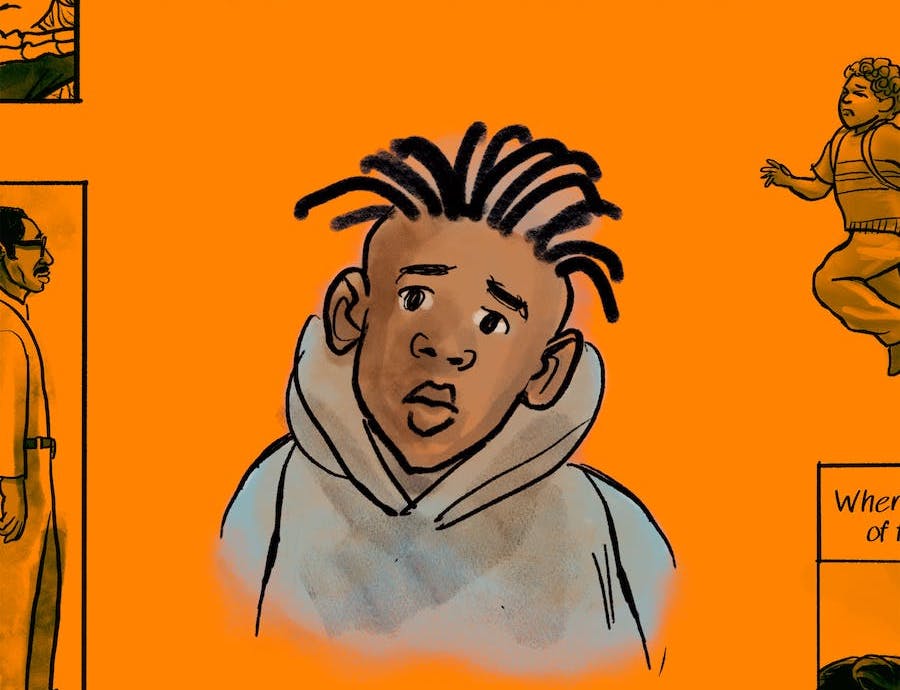
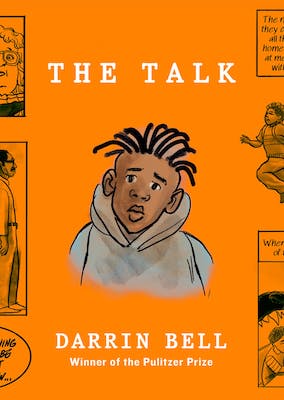
Darrin Bell didn’t set out to write his much anticipated graphic memoir, The Talk. He’d initially sold another project delving into the lives of three generations of men in his family, all descendants of an enslaved man named Addison Bell, in a two book deal to Henry Holt and Co. But as he was working on the original project, George Floyd was murdered and the Black Lives Matter protests began. “My editor Retha called me,” Bell explained, “And she apologized and said, ‘I think maybe we should put this book on the backburner and do another book that deals with what’s happening right now with George Floyd.’” We talked for about an hour and over the course of that conversation, she asked me for incidents in my life that could have gone a bad way, incidents where I experienced racism. Toward the end of the conversation, I told her, “You know, it’s funny, I was six when my mom gave me the talk, and just now my six-year-old son asked me ‘who’s George Floyd?’ and I don’t know if he’s ready to have the talk.” My editor said, “That’s the book.”
Bell took all the memories of growing up half-Black and half-Jewish in California that came up in that conversation, which he viewed as puzzle pieces, “Because I knew there was a reason why I brought all these things up in that conversation. I just had to figure out what that reason was along the way.” The Talk explores key events in Bell’s life where he experienced racism personally or witnessed what was happening nationally, tracing his journey from when he received the talk from his own mother, to experiences in school and college, to becoming the first African American creator to have comic strips syndicated nationally, to when he received the Pulitzer prize, making sure to recount incidents when he too felt complicit in contributing to the racial status quo. “It was almost like a two and a half year therapy session,” Bell told me. “I think that’s why the book feels so honest. Because I was actually going through it while I was writing it.”
Deirdre Sugiuchi:It was really interesting to read The Talk and watch your evolution regarding racism, and learning different messages that you’ve gotten from the different sides of your family regarding race and processing it and developing this awareness. A lot of your references are integral to the Gen X experience. We’re a smaller generation but our perspective is integral to understanding America today. Can you discuss why, as Gen X writers, it’s important to share our perspectives and experiences?
Darrin Bell: At this point in history, we are the children of the generation that’s starting to die out right now. We are the parents of the generation that’s coming of age. We are the middle link in a chain, the link that people are not paying attention to. We’re like the hub of a wheel. We grew up observing our parents congratulating themselves for being part of the civil rights generation and the counterculture, Woodstock. But we also saw their hypocrisy. We can also see the narcissism of our children’s generation, the one that’s raised with the technologies that we created, that we were dumb enough to create, social media, especially.
DS: I thought your book did a great job of explaining the importance of the protests that arose in response to the police beating Rodney King. You traced the initial undoing of affirmative action in California via Prop 209. You revisited how thousands of Black voters were expunged in 2000 in Florida, making us think about that impact. You talked about the prejudice your parents experienced just to date. You laid it out—this is how we got here.
DB: Like any younger generation, they think the world is the way it is because that’s just the way it’s supposed to be. I was hoping with that stolen election chapter to remind them that ‘No, the world is the way it is because people made a choice.’ People make choices all along the way to let bad stuff happen.
DS: In this book, you’re delving into this dichotomy between how your Black father and grandfather addressed racism, versus the way your Jewish mother advocated for you. Can you discuss how being biracial contributes to your understanding of how whiteness and power operates in America?
DB: Well, first of all, I got to see how both sides of my family censored themselves for different reasons. The Black side of my family would say things around each other that they would never say if a white person was around, not for fear of offending white person, but for fear of the white person doing something to them. White people inherently have power. If they said something offensive, a white person could somehow figure out how to ruin their career, how to get them fired, how to get the police to come over. They could lie. They could twist their words and it would have real, concrete effects on their lives.
The white side of my family, I think sometimes they would forget that I was there. As part of the family, I would see casual racism. They’re Jewish—I’m sure it’s worse with people whose family are white and aren’t Jewish. I’ve heard from a lot of those people directly in the form of hate mail. I know what kind of things they say. But Jews are a little different, because they’ve been discriminated against too. They’ve had atrocious things happen to them, barbaric things. So, they know that what they’re saying is wrong, but they sometimes say it anyway. But whenever my grandmother would seem to realize or remember that I was in the room, she censored herself, but I could tell it was only to preserve my feelings. It wasn’t because she was afraid I would ever do anything to her. She knew I didn’t have any power over her.
Other white friends I’ve had, I’ve seen them walk on eggshells sometimes, like whenever racial issues come up. I can tell they’re trying to say the right things and I appreciate that. But I also know that it’s again only to protect my feelings. I think it doesn’t even occur to them that there’s ever anything I could do to sabotage their lives because of what they said. So that’s a fundamental difference.
DS: One theme of your work has been linking the fight for marriage equality and LGBTQ rights with the Black Lives Matter movement. Can you discuss the importance of this especially right now?
DB: I think social justice is social justice and when you get people in the habit of expecting justice to happen, like when one group achieves justice, it can galvanize the fight for everybody else. Jewish people for instance were a big part of the civil rights movement for Black people. They were still being persecuted at the time and knew justice for one was justice for all. I’m thrilled whenever I see anyone of any group achieve justice. When I saw reparations for justice paid to survivors of the Japanese internment— that was thrilling. The whole struggle for gay marriage—I was very outspoken about that in my work from day one. I always knew in the back of my head that this isn’t just about gay people being allowed to get married, if people start to see what justice is, they’ll become accustomed to it, that maybe this will spread to Black people, to Native Americans. I thought it could change the world.
I don’t think I took into account the backlash that would come from it. Intellectually I knew that there might be one, but I didn’t think it would move the whole country until I saw Donald Trump get elected, and I realized there are more of these people who are part of the backlash then I thought there was going to be. There are tens of millions who lost their damn minds when gay people were allowed to get married and when a Black person was elected President.
DS: I was raised Christian nationalist and it’s baked in (the prejudice). I went to a Christian reform school. I should have known. But even with all the knowledge, I didn’t. I put all I knew into this messed up box of bad things that only happen in Mississippi.
DB: I think it’s because we all, people who are not regressive and not bigoted, tend to buy into what Martin Luther King Jr. said, about the arc of the moral universe being long but it bends towards justice. We tend to think of things getting better, but the years tick by inevitably. Maybe that’s not the case. There’s no guarantee that things will get better. They didn’t get better for Germany. They thought that tolerance was increasing in Germany. They thought they were cosmopolitan. They valued academics and the arts and their liberalism— and then came the Nazis. Things don’t always get better.
DS: Nope. My son’s girlfriend is Jewish and I was with her parents recently, and we were talking about how my father-in-law was in an internment camp, and they both had stories of their grandparents in the old country seeing close friends and family being murdered, and my great-grandmother— don’t get me wrong, I’m descended from enslavers, and I suspect one of my great-great-grandfathers took part in the Leflore County Massacre— but the other was murdered for trying to stop a lynching.
We tend to think of things getting better, but the years tick by inevitably. Maybe that’s not the case.
DB: Wow.
DS: My great-grandmother would reenact it when I was a little kid, still traumatized. She would talk about the horses’ hooves coming up and landing on his chest after he was shot…but this is essentially the conversation we had, about all of us being related to people who had experienced extreme trauma due to racialized violence, but yes, we want to believe the world is going to get better. We want to believe there is an arc of justice.
But you have kids, four of them. Obviously, you have some hope in the future.
DB: Yea. I’ll be 49 in January. I’ve gotten more cynical. I was very hopeful before all of this, in the ’90s and the early 2000s. Now I’ve placed all my hopes in the kids, in their generation. I think maybe every generation does that. Maybe every generation gets so disillusioned by their generation and their parents’ generations, that all they have left is a Hail Mary into the younger generation. They throw all their hopes over there and maybe it will pay off.
The only thing I have abandoned hope in is the certainty that I will be alive to see things change for the better, because the last time there was such a huge backlash to social progress it lasted a hundred years as Jim Crow, and that was just a few years after Reconstruction. We’ve had a generation of progress on voting rights, on electing Black people to office, on Black people becoming wealthy—there’s still a huge disparity of incomes but there are more Black people becoming wealthy than ever before.
DS: And Black creators.
DB: There’s me. There are hundreds of authors and poets. This has been a generation of progress, not just a decade, and if a decade of progress has led to a century of backlash, I am scared of what a generation of progress is going to lead to.
DS: I like what you said to your son when you explained you won a Pulitzer for pointing out what’s broken. There’s hope in that. When you have the talk with your son, you point out that the way forward is for people in America, many of whom identify as white, to no longer lie about the past. You are publishing this truth at a time of rampant book banning of materials which reflect the lives and experiences of people of color and LGBTQ people. What do you see as being the responsibility of socially engaged creators at this moment?
DB: I think back to the chapter where I showed myself in college, where we were discussing slavery, and all those people were telling me you can’t judge people in the past by our standards. I think the responsibility of socially conscious creators is to recognize that we might not change things tomorrow, we might not change things in our lifetimes, but we are leaving a hard, concrete record that we did know better. No one a hundred years from now is going to be able to look back and say we can’t judge them by our standards.
We’re celebrating peak fall with this interactive choose-your-own-journey which will let you decide where the story goes, with book recommendations for each chapter! Apple picking or pumpkin picking? Haunted house or Halloween party? Make up or break up? The choice is yours and every answer leads to a different story.
The full list of books and stories is linked below.
From trees and mortality to colonialism and FaceTime sex, Charif Shanahan’s Trace Evidenceinvestigates a restless range of subjects with a truth-finding precision that would be breathtaking for a single poem but is present here across an entire collection.
What unites this book is the question of how to speak when one’s personhood or subjectivity is assumed to be nothing and nowhere—when one can’t be plotted on the neat graph of normative racial categories. Further, how does one provide an account of oneself when both account and self are either supposed blank spaces or forever in flux? These concerns are as much about the events of a life as they are about the language that one can use to describe life, which includes a passionately searching inner life. As Shanahan puts it in the book’s centerpiece, a long poem about surviving a bus crash in his mother’s birth country of Morocco:
“Where does the inquiry begin Does it begin in my particular body
In my particular mind Does it begin centuries before me
Does it begin in my mother Does it begin in all these places At once”
Trace Evidence is an inquiry-driven book, unafraid to sit with ambivalences, uncertainties, unknowns. Truth here is not a set of answers but a field of openings. It felt very fitting that my journey with this book continued in the form of asking its author some of the questions that reading and rereading sparked for me.
Charif Shanahan and I corresponded over email, discussing the collection’s themes, forms, surprises. Oh, and love. There’s a lot of love in this book, by which I mean a recurring subject across poems and also the depth of care in the crafting of each line.
Chen Chen: As someone who also writes a good (obsessive!) deal about his mother—or his perpetually complicated relationship with his mother—I’m curious about your approach to writing about this particular figure, this central dynamic, and how that approach has evolved over time. What keeps you going back to the maternal (and by extension, “the motherland”) and how do you keep pushing in terms of your craft and inquiry?
Charif Shanahan: As a subject, what makes my maternal lineage (and “the motherland”) of interest to me are the complex questions of identity that I have inherited through that line of my family. The layered imperial histories of North Africa mean that race maps onto my family in ways that challenge and/or disrupt the system, which makes it a fertile subject for poems. The instability of my family’s racial experience, not only in terms of mixed-race embodiment, but across national and cultural boundaries, is constitutive of my self-concept and interpersonal possibility; however, what has kept me going back to the subject is my belief that work that would appear to be about a particular relationship is, in fact, about something larger and relevant to all of us.
An easy (and finally wrong) argument about the treatment of the mother figure in my work is that she is objectified. That argument is wrong to me because simplistic: if the mother is objectified, it is not by the speaker, but by the systems of the world in which these individuals live. And, ironically, I find that individuals who have argued (as some have to me) that I am objectifying my mother are, in a way, objectifying me: that I be an accommodating little mixed-race child, quiet about the issues of central import to his life. Of course, in offering this advice (and it is often offered as “advice”), the person must believe that these issues I explore in my work aren’t relevant to them, too—or that I’m only writing these poems for myself.
There is unavoidable overlap in a mother’s and her child’s stories; as I say in one poem—“As though my story is not inside / her story, as though when she hides, / she does not hide my face with hers.” The point at which the mother’s story ends and the speaker’s begins is in agency, in choice, in deciding that what the shared materials of their inheritance meant to her need not mean the same thing to him. The overlap of their stories, put another way, doesn’t foreclose agency and choice for the speaker, even as the system of race (white supremacy) might suggest otherwise.
To that point of systems—and certain readers nod vigorously and say of course, in response to what I am about to offer, while others are skeptical—I genuinely do not think of myself as “writing poems about my mother.” I am writing poems about systems, about the structures in which we live that would generate, in the first place, such an interpersonal possibility as the one that exists between the speaker and the mother figure in this book. It’s less about them, and more about how they could come to exist in this world at all and what that means for all of us.
All that said, I do think with Trace Evidence something for me has closed thematically. I remain interested in human divisiveness, the unnameable or unnamed dimensions of human existence, and am continuing to write about those subjects, but through different thematic vehicles.
CC: I’m struck by all the times therapy and therapists show up in these poems. I’m thinking, for instance, about “Countertransference,” “Psychotherapy,” and that part of “On the Overnight from Agadir” where two therapists are “fired” by the speaker. While I agree with poets who argue that poetry is not the same as therapy, I do find some aspects of the reading and writing of it to be therapeutic, and I appreciate therapy as a layered subject in poems. What are your thoughts on poetry’s relationship to therapy and why was it important to you to write from or through experiences with therapists?
CS: I’ll take the second part of that question first, since my answer is shorter: in this book, I wanted to show that there was no space—no matter how intimate or sacred—that was untouched by race, racialization, and racism, that even in the therapy a speaker might seek for race-based trauma, a speaker might face further race-based trauma (as in “Countertransference”). Relatedly, the pursuit of therapy is, for the speaker, actually a disempowerment, a relinquishing of control, an opening himself up to further violence or erasure, when he had already possessed the clarity he needed.
For the rest, I’m with you in the belief that writing and reading poetry can have therapeutic value. I also think it’s obvious—and, respectfully, an argument barely worth making—that poetry and therapy are not the same thing. Of course, they aren’t!
A more interesting question to me is why we assume that a poetics of emotional transparency is being written as therapy, rather than as art—and why that assumption is almost always made when arguing against the value of a certain kind of poem. Emotional transparency is an aesthetic quality, not a personal compulsion. We choose it, as makers, even if unconsciously at first, in the way we choose line length and figuration, this word over that one. I also personally see no aesthetic distinction between an emotional transparency of boredom, or even joy, and one of pain or grief. It’s not the emotion itself that dictates the aesthetic, but the means by which the poem treats the emotion.
To me, it’s an interpretive and imaginative failure—and wholly ungenerous—to assume that someone’s poem about [insert traumatic subject] is motivated by a misguided effort to pursue their therapy on the page. Maybe the poem is an offering. Maybe the narrative events of the poem emerged from the poet’s imagination, not their lived experiences. Maybe it’s because they’ve done their therapy in therapy that they can write the poem at all.
Also, do folks not experience or pursue joy in therapy? I do. I celebrate my beloveds, my gifts, my victories, my dreams. It isn’t all pain all the time: that doesn’t sound very therapeutic to me! For me, therapy, like poetry, must hold space for the full spectrum of human emotion. The difference between the art forms—and I do believe that therapy is an art form—is in their function, their objective, and while those objectives are different, the acts themselves can still be mutually beneficial. If writing poetry can have therapeutic value, I think it follows that being in therapy can have poetic value. In my own life, that value has been expressed as an elevation in consciousness that gave me access to new subject matter and material, and as an empowerment that, ironically, made writing poems about traumatic subjects possible in the first place.
CC: “Inner Children” is one of my favorite poems in this collection—I’m so moved and surprised by how you’ve braided together this narrative of walking in Asilah, Morocco with ruminations on the mother’s past in that country and also “FaceTime sex” with a former boyfriend. How did these threads come together as one poem? What does it mean for you to situate land, family, and race alongside queerness and contemporary forms of communication?
CS: Well, this poem, like so many of mine, began as a chunk of language that I threw down into a word document after that trip to Morocco. (Chronologically, it was after the accident, though it appears before it in the book.) When I sat with the language, it struck me that the eventual poem’s questions orbited around three figures—the speaker, the boyfriend and the mother—in three places—contemporary Morocco, the Morocco of the mother’s early life, and the elsewhere of the boyfriend—and that kind of triangulation gave life to the tercet form, as I began shaping the language into a poem. The language, as it first emerged from me, was mostly about the adult-child speaker and his quest in Morocco, which naturally gave way to the portions of the poem that are of memory and about the mother’s early life. The boyfriend was present only tangentially in the initial gesture. However, in considering the shape and texture of that trip, I came to understand that the speaker’s relationship was a necessary portion of the poem, almost as a mirror or an expression of the “out of reach” content of the other thread. So—land, family, race, and queerness were already merged, in the speaker’s consciousness, in a way that it took me some time to see and eventually tease out of the conscious material.
As for the contemporary forms of communication—Facebook and FaceTime—a younger Charif might have resisted including them in a poem, but one process of maturation I’ve experienced as a poet is letting more of the world—the actual world—into the poems, in liberation not only of myself as their maker, but of the poems themselves.
CC: I love “Little Red Lighthouse,” a longer poem that comes later in the collection. I love the recurring images of rooms (domestic spaces), forests, and the breath—how these images allow you to examine time as both a human construct (a “fiction’) and a social reality the speaker must navigate. In this way, time shares qualities with race, and indeed, at the end of the poem, there’s a scene in which the speaker asks a teacher, “If at the onset of this nation / Race and class were merged… // Does it follow then / You have time if you can breathe?” Could you talk about why the poem ends with this scene? And why it ends abruptly, seemingly mid-sentence, after “You try your hand at speaking / About it all and it goes well for a while / Until it doesn’t and it ends suddenly and you”? I’m wondering, as well, about the poem’s form—this crown of sonnets in which last lines become first lines—and what that may have to do with writing about time in relation to racialization?
CS: Your questions are gorgeous, Chen! Thank you for your brilliance and for your thoughtfulness.
It’s an interpretive and imaginative failure to assume that someone’s poem is motivated by a misguided effort to pursue their therapy on the page.
I turned to the crown form somewhere in the drafting of this poem, because it provided a propulsive energy to the making and also would link each step in the meditation in a way that felt germane to the poem’s subjects, as the hinge lines performed a repetition of time marked by a continuity and a modification at once. However, because the speaker in the poem struggles with asserting his being—with being in the first place, even before asserting it—it began to feel untrue, thematically and spiritually, to dismount and execute a formally perfect landing. So, even as I had drafted so many lines and stanzas for the crown that “completing” it was a formal possibility, somewhere along the way, I knew that the crown would do more work by being broken. I also knew that not completing the crown, conventionally, could invite a cynical reading of the poem—that I couldn’t finish it, rather than choosing to break the form–but what was best for the poem itself won out, as it should have. (Additionally, there are stand-alone sonnets elsewhere in the third section of the book that are also “broken,” though differently than the crown, which became a nearly thematized formal gesture underpinning the ars poetica.)
The question remained, though, of where and how to exit the crown. The specter of race is all over the poem, given its placement in the book, but race and systemic classification are not mentioned until the final section. When they are mentioned, it comes in the form of a question that no one can answer, which felt like an ideal non-closure on which to end the poem.
CC: At the end of “Thirty-Fifth Year,” the speaker recalls a “dear older friend” reminding him, “You are actually very good at joy.” This recollection comes after a series of existential dreads, daily anxieties, and mundane distractions. I was startled by this ending, the way I’m sometimes startled, completely taken aback, by the appearance of true joy. Was that the effect you were going for? Where does joy come from, according to this poem or to your writing more generally?
CS: For me, grappling with extremely difficult subjects, emotionally, socially, philosophically, I experience joy in the act of finding the language that articulates and enacts the questions that have occasioned the poems in the first place. Even when the poems are at their heaviest, my spirit—truly—is at its lightest. For me, writing a painful line is a joy, if it’s a true line.
Joy comes from lots of places that have nothing to do with poetry, too, of course. Deep, abiding friendship, travel, food, music, kinship, love, my boo.
Since Walt Whitman, the American sentence has shape-shifted in and out of forms, from race-car lyrical lines that drive off the page, to fields of hailstorm words floating in white space in a way that resembles visual art, and back to semi-formal stanzas that lilt and groove around a pentameter-like beat.
I’ve designed my poetry collection Tiny Extravaganzas around experiments that push against the boundaries of the American sentence. There’s a quiet thrill in being part of a tradition that turns away from the English iambic pentameter line and tries to define the characteristics of a sentence that is uniquely American. We’re at a time when the sentence has virtually no limits. I can build an entire stanza around one transitive verb, so the verb is fixed and the stanza is free. I can use pauses to force the breath to shorten over three monosyllable words, and then speed up or get talkative to create the drama of conversation—and interrupt or end it abruptly after the first word following a line break, just when you feel the line is getting started. There’s a way to gently push white space around words, stretch a melody out. Manipulating pacing across syntax, and hearing the tiny explosions that result, is a puzzle and a thrill.
My sentences focus on identity, dialect, and cadence—often indirectly, but in a radically democratizing vernacular that pulls toward and away from the lyric. I’m interested in chasing rhythm and chopping it up, and generally finding new ways to shatter the traditional American sentence with style and verse. I veer from talkative to incantatory, with tone shifts from jazz to lament. I work on a presumption that the sentence is political and a woman must move the sentence in new directions.
Here are collections by women working the American sentence relentlessly, applying power through acoustics and rhythm while documenting harsh histories. Some poems are elliptical or visually fragmented, and others seem orderly on the page but the sentences are boiling inside. Some pretend to be prose, but they are not. Like me, all of these poets are working in a style that is closer to music and chant than to conversation.
Chakraborty language is so cosmological and expressive that you can’t help but wonder if her larger project is to about language fails to express. “Some bright and sun-kissed, some dark and pulp-dashed, / your and our blood across the burnt orange schist,” she oozes. Her tone is effusive, her diction lush. But below her sweepingly lyrical lines and her conversational intimacy is linguistic play and argument. The heart of Chakraborty’s collection, and a showcase for her radiant talent, is her eleven-page poem lament for her sister, “Dear, Beloved,” and possibly the most poignant and skillful short epic in contemporary poetry. Her book exists in the liminal space of grief, but it is grief that gives shape to the book. Her high emotional pitch is bracketed by poems in conversation with other writers—grief does not sideline her intellectually, and she is determined to make something of it. O Spirit extracts and remixes words from Melville’s Moby-Dick; another poem refracts Rilke’s Les Fenêtres. Her riffs create a feeling of improvisation but she is the middle of an intellectual conversation. Language outside of time is the argument she hinges the book on. Chakraborty makes her case through Michel Foucault: “The original title of The Order of Things is Les mots et les choses, or Words and Things. The substitution of Order for Words speaks to one of our most pervasive myths, that words have a clear order.” As she weaves a myth of her sister into an epic dirge that includes a Greek creation myth, Chakraborty is telling us that language is meaningful, even if time is disorderly. She is working out what pain is. “Please leave the window unlatched,” she says.
Rekdal’s project is a hybrid multivocal poem documenting two histories: the transcontinental railroad and Chinese migrants detained at the Angel Island Immigration Station during the Chinese Exclusion Act. The book is part oral history, part “translation” in which she turns the American sentence into a document of witness. The poems often locomote down the page, without stanzas, as in Soil: “General, / we worked your grading to Monument Point, in thousands / drilled and blasted, rent the very foundations / of the earth until these hills swarmed with our fresh / encampments.” She takes different approaches to educate us. One poem is a list of questions to show us what it feels like to be Chinese and suspected: “How many water buffalo / does your uncle own? Do you love him?” She is graceful about filtering the voices of migrants through her own. In Lament, on the invention that is the train, she recreates the American sentence: “the buckskin ties tamped tight / to their irons, / shadowing his canvas margin.” The snap and lyricism is her precision style; she inclines to lyricism naturally but defers to journalism for this book. She works in dialogue, correspondence, photographs, illustrations of torn maps or torn notes, and miniature essays or elegies. The prose sections reveal how the railroad enabled industrial expansion, political rallies, the transfer of munitions, and human settlement. At every step, she complicates the narrative by connecting immigrant stories to ways the railroad creates conditions of power or powerlessness. In Close Eye: “Between 1854 and 1929, over 250,000 children were sent by train from New York City to the West to be adopted.” After children arrived in the “orphan trains” were they protected or harmed? “Perhaps, like me, you are afraid to find out,” she says.
Every variety of mood appears into Sharma’s sentences, which are sometimes so interior that they are uniquely beyond the American line and sentence—yet still materially in it. Sharma’s sequence combines lament, letter, diary, conversation, and obituary. It is heart-shatteringly good and accessible. Sharma expands the tradition of lament in verse, as original an experiment in understanding and processing grief as anyone has written. The sequence mimics the cycles of grief itself, an intimate meta-journey into the riddle of sorting out what time is when your lover no longer exists. As she writes, and writes, trying to find the life in her, and the life of an expression in the form of a sentence, you cannot help but wonder what a sentence is, if not an act of duration. And when the sentence is over, what memory stays? Sharma brilliantly creates memory through her sentence, shattering any grief-cycle that has come before. She has created, artlessly, a theory of sentences. The senses blur and combine in Sequence 1: “Memories curved and then sounded: were sibilant and jest, and from not-his-mouth, and not-his-teeth, and the breath grew so sharp and he grew so thin and gaunt that he was buried in a slander his body made of him.” Because many of the poems are presented as lists or prose poems, within the framework of a chronology of dying and death, you can easily fooled that Sharma is writing prose sentences rather than verse—but she takes care with her sentences and is fiercely intellectual. She shines when she loses the encumberments of line breaks, which seem, in her deft hands, altogether unnecessary to the American sentence.
Spears Jones’ imagistic internationalist, docu-political sentences resemble conversation but stop you in your tracks. Her opener in Celia Cruz Snow Angels electrifies: “The Great Gatsby jazzed the sorrows of summers where the wealthy misspend their wealth.” In one sentence she sums up the tone and sweep of the novel, soused partiers, and the way they “misspend” their sad, rich, empty lives. She is deeply invested in the ability of American speech, both conversation and slang, to reveal the consequences of materialism: inequity, poverty, murder, violence, masculinity. In Poverty, she marries her diction and sentences to the spareness of the condition itself: “[Poverty] Is a broken tooth / No smile— // Is bone poorly reset / Weak limbs, medicos various.” The tooth remains broken, the shoddy medical care creates lifelong problems. She is expert at shaping the way a sentence sounds around its content, especially when pain of family secrets and histories come into play. In Cousins, the stanzas shorten from seven lines to four, as if narrowing in on a secret. From the first line (“What genes we carry this making of Americans”) to the last (“cousins many times removed”) is about discovering, or hiding, an uncomfortable ancestral truth. Chillingly, she demands to know: “Who grabbed the girl and made her pregnant? / Who walked away when her father was lynched? Who snatched / whose land?” And when Spears’ diction is easy, you know something else is coming. Adornment begins: “Red cap / Red scarf / Red balloon // phalanx of protesters / quarrel of militia—off camera.”
What syntactical tension electrifies Okpik’s poems! The poetic throughline is the metaphor of flight. Her sentences mimic it by moving forward while monosyllables pile up and slow you down, pull your attention back to earth, to a single syllable. It forces you to look, recite, listen. Her sentences are dense while the book has an emotional spaciousness about it. Some of this is pure technique: multiple beats on a line. Her pile-up of heavy beats and strong diction recalls Gerard Manley Hopkins’ amplified speech, measured by duration in what he called “sprung rhythm.” She is as close as anyone has come to approximating that technique with contemporary elan. Lovely and rare is the way her diction takes a multitude of sounds from the natural world, evidenced by the way a sentences forces your mouth to twist and your tongue to move around your mouth to get the sounds right: “pistils of bear grass, stamen of indian paints, / ovules of Mozart’s string quartet” in I want to believe. Birds and other winged creatures string the collection together expertly. Mosquitoes, hornets, geese, a woodpecker, bluejay, hawk, duck, raven, ptarmigan, magpie, flea, and grouse have cameos. Where there are no winged animals, there is wind and storm in motion. Over the sentences are an aerial view of imagistic land formations, and contemplations on the inheritance of land. And, as in any aerial view, sentences unwind in long expanses in one poem and abbreviate in short, abstracted views in another.
One thing to know about Nezhukumatathil’s poems, even when they resemble fragments on a visual plane, is that she is always writing clear sentences whose meanings turn back on themselves or which slowly reveal more of the narrative. The craft of storytelling with an unreliable narrator shows up continually. The way she turns her sentences turn into poetry is through the breath. It’s a lyrical device to breathlessly roll along your sentences, and it becomes a poem when the breath enters—in her case often breathlessly—and adds emotional color or reshapes how you hear and where you pause. Part of her technique is a jazzy stream of consciousness populated with words that jam up in your mouth: tar, asphalt, fistful, thistle. Her sentence jolt because they are simultaneously propulsive and balanced, a feat because to balance a line is to risk making it flat—but the diction engineers something unusual. In When Lucille Bogan Sings “Shave ‘Em Dry” she upshifts over a line break, and charges forward on the verb: “When I say flower I mean how her song // blooms in the electric Mississippi light.” And Nezhukumatathil has a flair for thickening sentences with meaty sounds such as “shushing tassels” and inserting consonant-connected phrases (“crystals of chalcopyrite”) in a poem packed with easygoing monosyllables. The Whitmanesque title poem Invitation should be read on repeat, for the sounds, but also as a lesson in how to intensify a sentence and refuse to let up: “Clouds of plankton hurricaning in open whale mouths will send you east and chewy urchins will slide you west.”
Shockley’s homophones and verbal play shred the sentence into its most basic units. The result is as charming and fun as it is political. Her book probes inheritance: what we inherit from history and from language. She undermines the value of language itself with slick technique. Her poem v is a pun in a square: starsarewh / atshinesinthe / spacesmadeb / etweenuswhe / nwegetcloser. How experimental she pretends to be! She wants us to look closer, read slow, insert spaces between words. The larger project of this tiny poem is getting closer figuratively; by the time this poem concludes, we understand Shockley better. She is an elaborately smart lyric poet. Her sounds are expert, and with lowercase letters and experiments as a distraction, she adores styling a proper line: “my pose proposes anticipation. i poise / in copper-colored tension, intent.” It’s a winning approach. When she writes about segregation, her sentences expand as a way of say that American can limit your body but not your mind. She plays with opposites and form in carolina, a beautiful poem with alternating quatrains and tercets: “I’m dark except where I’m / darker,” followed by a memory catalogue to show us how resilience works. It is a rare collection in which poetic forms vary this much from one page to the next. No sentence in this language, Shockley indicates, will ever be enough. Lines are captive in stanzas, spliced open, indented. She is not afraid to use and reuse words every which way: “the jitterbug got the jitters,” she says in Rose.
I have a set of cigarette burns zagging up my right arm. I don’t talk about them to friends—there are mainly two reasons you get burned in that particular way, and neither are good. They’re red and angry-looking, like wasps’ stings, and they’re right above my wrist which means I can’t hide them. The burns sit out in the open for everyone to see. I could say they’re beautiful, but there are some things that should never be recuperated. I will say the cigarette burns are stunning, though. As in: they stun. They stun others when they realize what they are, and they stunned me when I put the cigarette to my arm. They stunned the staff at the psych ward as they completed my intake paperwork. The anti-burn cream smeared onto my arm every morning stung when it touched me, and I’d wince as it was applied.
The Texas Chain Saw Massacre remake came out one day before the United Nations affirmed, for the third time, the importance of US troops in Iraq and the duty of the rest of the West to contribute to the war as well. On TV, commercials for the 2003 movie aired between those for dive-bombing jets, armed forces rappelling down a rock wall, desert fatigues. The film reflected all of that, MTV-style sheen slicked across the screen and dirty browns and tans running everywhere and gore filling every second. It opens with a hitchhiker who seems to have been sexually assaulted—blood running between her legs—blowing her brains out in the back of the main characters’ van. Then, the film escalates to a menacing sheriff licking his lips over her dead body with a necrophiliac longing. Watching the movie on Netflix years later with a friend I was fucking—a girl who whimpered during the scary parts, liked to be hit hard, and walked with me to get ice cream the first time we had sex—I shut it off after thirty minutes. I couldn’t bear any more.
I didn’t even think it was a unique misery: everyone hated their bodies, I thought.
Maybe I hated it so much because the original Texas Chain Saw Massacre, the one that came out almost exactly fifty years ago, is my most-loved movie. It’s not the one I often tell people is my most-loved: the title tends to turn people off. What they picture is something closer to the remake: a blunt object, a leering gaze, a body turned into an object to be fucked or cut up with nothing in-between. Instead, for the longest time, I’d tell people I loved art-house films most: the movies of Apitchatpong Weerasutakhul or Ingmar Bergman or Terrence Malick or any other director who specialized in long, winding, thoughtful shots and barely restrained emotions. And I do love those films. But of all the movies I’ve seen, I’ve seen Chain Saw the most—a revving engine of a film, sick and quick and all deep reds.
This is how it worked: first I loved it, and then I loved myself.
I first watched The Texas Chain Saw Massacre in high school during the brief window when full movies were first uploaded to YouTube, the image 240p and broken up into six parts to circumvent YouTube’s then-fifteen-minute video limit. I lived at a residential school then and started it in my dorm room between second and third period, finishing the movie after chemistry lab. I was miserable in school but it was a misery I couldn’t even name. I didn’t even think it was a unique misery: everyone hated their bodies, I thought. Everyone pictured themselves sliding into a lake and not coming out again. I watched the movie because it had been framed online as an endurance exercise; if I could endure The Texas Chain Saw Massacre, I thought, it would distract me from the life I was trying to endure too.
What I didn’t expect was how the film looked, shining bright even through digital grain. Fields of tall grasses rippled slowly in the breeze. A car rumbled down the highway, exhaust exhaling behind it like a ghost. And at the moment that Sally Hardesty, the movie’s beleaguered protagonist, is held captive at the cannibal family’s dinner table, grandfather preparing to hit her with a hammer, the film zooms in unexpectedly on one of her eyes flitting around in fear, and the iris was the most verdant green I’d ever seen.
I hated the South, feared being Southern myself even.
I had been in North Carolina for just over nine years at that point. I hated the state. I missed the icy sharpness of Pennsylvania, the way Lake Erie froze over completely every winter, waves still mid-crest. I missed the emerald jungles of St. Thomas in the Virgin Islands, where I spent the first four years of my life. North Carolina didn’t have the cold beauty of the Northeast and it didn’t have the shimmeringly blue seas and white beaches of the Caribbean. It just had swamps on the eastern part of the state where my parents lived and brush and loblolly pine in the middle where the school was. And worse than that, everywhere you looked there were hicks, drawls hanging off their words like a busted door hinge. I expected Texas Chain Saw Massacre, with its rural cannibals and grindhouse title, to just reaffirm my existing prejudices. The South was ugly, I thought; it looked ugly, and its people acted ugly, and I wanted a film that would reflect that. I watched to endure it, but also to confirm what I already knew: my new home sucked.
The Texas Chain Saw Massacre was short, straightforward, part of the reason I was able to finish the movie in just two chunks between classes. A group of hippies from the local college town set out to visit their grandfather’s old property. They pick up a hitchhiker, who sets a picture of them on fire and tries to slice at them with a knife; they kick the hitchhiker out of their van. They stop at a gas station to fill up and have a brief conversation with the proprietor, who’s also a barbeque cook; the man leers as they drive away. They visit their grandfather’s house, and then slowly everyone drifts to the house behind their grandfather’s, where a family of workers laid off from the local slaughterhouse live. The hitchhiker is there. A grandfather who looks centuries old is there. Leatherface, a six foot seven murderer in cowboy boots and a mask made out of human skin, is there. Eventually the gas station cook is there. Quickly, everyone but Sally dies, leaving her screaming and laughing alone, splattered in blood, in a flatbed truck speeding away from the house at dawn. It’s over in just eighty minutes.
At the residential school, we looked at slides of pond water through multi-chambered microscopes donated by Duke University up the road. We picked apart frozen cat bodies, peeling back the muscles on a leg one by one to reveal the femur, the tibia, the stiff ankle bones, the phalanges. It was a free school, built on the run-down grounds of a former hospital, and one that had been wiggled into the state university system: our student IDs, we were told, could get us into any library or science lab we wanted access to. We were the pride of the state, the best it had to offer. I’d wake every morning to birdsong.
I pictured the plains and thatchy backwoods of Texas, and a preemptive longing for where I already was crept over me.
Because of its low budget, much of The Texas Chain Saw Massacre was shot with natural lighting, which is part of what lends an eerie prettiness to the surroundings: their world, with its scrabble of brush and dust smeared everywhere and slowly setting sun, looks just like ours. A couple in their mid-twenties gently pushes the long amber grasses to the side to explore a neighbor’s house. House spiders weave webs, fibers shining in the afternoon light. At night things purple under dim moonlight, and in evening the film is heavy with sun, bright and sticky as a melting blood orange. Texas isn’t North Carolina, but at that moment I started to see both as not just ugly but gorgeous as well, decentering in their breadth. There, the trees and low shrubs have seen everything. There’s nothing that doesn’t promise to blossom, in one way or another, into an intimacy intractable in its depths.
I entered the movie wanting to be scared because I dealt with my problems at the time by being scared. Otherwise, I’d feel too needy, too vulnerable and exposed. But that which entrances us and frightens us is so often the same. I hated the South, feared being Southern myself even, but in Chain Saw, everyone talks with an accent—even the heroes. Everyone walks through the grasses, runs through hardscrabble Southern trees. It’s not whether you’re from the South or not that matters, the movie seemed to be saying: it’s what you do with it, and how you or others are hurt despite it. The South is like everywhere else: both fucked and beautiful, indefensible and resplendent at the same time.
I don’t know if these themes were intended. The Texas Chain Saw Massacre was a film notoriously shot on the fly; director Tobe Hooper stayed up all night shooting the last twenty minutes of the movie, and no one washed their clothes through the whole shoot because they couldn’t afford second outfits and were scared of them being stolen from the local laundromat. All the rotting animal parts in the film were real and by wrap day everyone was nauseous from the smell. The film couldn’t even afford stunt people, so in a scene where Sally Hardesty jumps out a second floor window, the script consultant pulled on a blonde wig and did the jump herself, twisting an ankle in the process. I don’t even know if the movie was intended to look as beautiful as it does; maybe its starkness just came from a budget constraint that aged especially well, the same way that the cheaply-recorded folk albums from the ’70s sound less dated than the studio schmaltz a big budget could get you. In filming, it seems, there was little thinking involved; the whole movie instead just existed as an experience. When the shoot was over, the rumor goes, the crew made shirts that said “I survived shooting Texas Chain Saw Massacre!”
But ultimately I’m not interested in intention. I felt things watching the movie, and those I showed it to also felt things. We talked about it afterwards, everyone offering their different interpretations as to what Chain Saw—loud, intimate—was about. With a girl from my MFA I would start dating just weeks after we watched the movie, Chain Saw became a film centering animal rights abuses. We had just shared a joint, wound up and electric with energy. “See?” I said, pointing to the shots of a slaughterhouse where the cannibal family used to work. “They’re treating the humans like cattle. Anyone who can’t keep up with the demands of an ableist society gets killed.” With an ex I fell back in love with over the pandemic, it was a film about feminized labor, and even transness. Leatherface, the person who ostensibly does the killing in the family, is also the softest member. He wears masks made of human skin but covers them in eyeshadow and lipstick and is viciously bullied by his siblings for not fitting into what they think a man should be. “He dressed up for you,” Leatherface’s brother cries mockingly to Sally as she’s held captive at the dinner table, and it’s hard to say who he’s making fun of more. My partner and I saw the film as being about disability and being different. There are two families in the movie, the killers and the killed, and both of them have disabled characters at their core. Franklin, Sally’s brother who rides in a van with the rest of the victims, uses a wheelchair and is constantly berated by his peers. Leatherface, who doesn’t even speak or show his face outside of a mask, appears to have some sort of developmental disability, and is kicked and hit and beat by his older brother as he whimpers in pain.
More than anything, though, I saw a movie about the South, and coming to love it despite everything fearful that happens there. Maybe this wasn’t the film’s doing, but something changed in me the first time after watching it. As I’d walk down the sun-dappled streets of Durham, where the residential school was—sometimes heading to my therapist’s office, sometimes just walking to get a lavender milkshake from the malt shop on West Broad Street—I pictured the plains and thatchy backwoods of Texas, and a preemptive longing for where I already was crept over me. Around me sprang tall reaching trees and bullfrogs. Cardinals and thrushes chirruped from telephone poles, sun-warmed cricks everywhere. From the instrument repair shop run out of a trailer off Broad, staticky country music drifted over the radio. My parents moved to North Carolina for work when I was in third grade, and it wasn’t until I saw the movie that I realized the South, not Pennsylvania, not St Thomas, was my home. Chain Saw felt like something emerging, fully formed, from a bog, and I was emerging too, albeit much more slowly. And who hasn’t fallen in love with the place where they realized who they were? Who hasn’t made a home out of fear without in some way loving that fear, too?
There are marks that are left on us, and there are marks we leave on ourselves, and I’m not sure there’s a significant difference between the two. The South shaped me, and the South hurt me, but I’m Southern nonetheless. Maybe there’s no difference at all. To know a place is to be hurt by that place and to grow up is to hurt that place in its own ways too. Until I turned sixteen, I treated the South with a smug superiority, one that cut me off from who I was. Because I grew up there, the South left its sticky summery marks on me, and then once I rejected it I left my marks on me too.
When I set out to watch the movie, I wanted it to hurt like I hurt me.
Texas Chain Saw Massacre also drew me in because of how unrelenting it is in its cruelty. Leatherface spends the film’s end in pain, accidentally chainsawing through his leg after his brother is killed by an 18-wheeler chasing Sally, blood splattering over everything. The twenty-something protagonists are menanced and turned into meat with alacrity. Even the heroes are cruel. Sally’s brother Franklin is brilliant, funny and anticipates everything that happens in the movie—but the other people in the van, the ones who die first, hate him. “Franklin’s no fun,” goes the refrain, even though our introduction to Franklin is him being blown out of his wheelchair from the backdraft of a semi and no one rushes to help him as he tumbles down a steep hill into a ditch. Even though Franklin is dragged around to ancestral mansions with steep steps he can’t get his wheelchair up and then left behind as his friends run off to go swimming; even though early in the movie he’s cut by the deranged hitchhiker; even though at the halfway point is sawed in half, the most violent death in the movie, by Leatherface. Even the audience hates him: I’ve read review after review about how insufferable and annoying Franklin is, although consistently he’s the only one doing everything right.
When I first watched Chain Saw, I’d creep into the shared dormitory bathrooms at 2 or 3 AM to hit myself until I started crying and then hit myself more until I stopped feeling anything after that. I’d practice cruelty against myself that crept into cruelty against others; a stiffened unapproachability, a studied distance intended to prevent anyone from getting too close. When I set out to watch the movie, I wanted it to hurt like I hurt me. And the movie is cruel, but it’s beautiful too. I found myself in that beauty, but at the time didn’t even know I wanted to be found.
Chain Saw was remade again—or remade-cum-sequel’d—in January 2022. In it, like in every other one of the 8 miserable sequels and remakes, splays of gore and pop nihilism replaced everything I loved in the original. A group of woke teens are massacred on a party bus. A woman’s life is saved due to the Second Amendment, firing away at Leatherface with the shotgun she scorned earlier in the film. It’s all reprehensible in a crypto-Republican way, but more than that it’s boring. It’s an old story at this point: Hollywood finds a film that’s striking and decides it’s striking for the wrong reason, and then capitalizes off that mistaken assumption. That was actually why my friend and I watched the 2003 film: we wanted to see if what we had just seen, the most recent one, was the nadir of the franchise. But there’s always a lower level one can sink to.
With each rewatch of Chain Saw, I got further away from the me in high school and closer to a me that was loved and safe.
But even despite this endless progression of worse and worse movies—and I don’t doubt there will be more, worse movies to come—it doesn’t take away from what I love about the original. This is because what I love about the original, at least in part, is the way it taught me to love. At the end of the film, Sally is escaping on a speeding flat-bed truck. Her brother is dead, chainsawed out of his wheelchair by the only other disabled character in the movie. Her boyfriend is dead. Her friends are dead. But the movie doesn’t end. As she’s laughing in fear and relief, the film cuts to Leatherface who, limping and illuminated in the rising sun, raises the chainsaw first to his side and then above his head and starts to pivot his body like a ballerina. Soon, he’s fully pirouetting, clearly hurt and angry and sad and confused himself. As the chainsaw brushes against the camera, the film cuts to black, and then finally it’s over—nothing left but his pain and her relief and what they made together from both. I am sixteen, staring at my laptop in between classes. Someday I will stop hurting myself, but not yet. Someday I will learn to love everything I find gorgeous, including myself.
I don’t believe that a film’s legacy can really be defined by what happens afterwards towards it—sequels or prequels or bad-acting fans or whatever. I think anything you love exists, at least partially, in the moment you first love it. Maybe that’s why I’d go on to watch the original Chain Saw with so many people I’d love. Beauty can stun too, and sometimes the only thing to do with that is to share it. There can be a thin line between enduring something and finding intimacy with it, after all. With each rewatch of Chain Saw, I got further away from the me in high school and closer to a me that was loved and safe and in the gleaming present, whole and uninjured.
I loved Texas Chain Saw, I think, before I loved myself. And maybe the two aren’t related, but one did follow the other.
Outside, a cuckoo warbles and the mid-day sun crescents through the dorm’s venetian blinds. Throwing on my heavy denim jacket, I vault down the stairs to class, arms bruised but not yet burned. As I leave the dorm building, I look at the state around me—greening leaves, rickety pines, kudzu creeping up the side of a building—and for the first time see it as something not just harsh but also irreducible, beautiful. I brush against a stairwell too abruptly, hit a bruise, wince, air sharp and cool as I inhale. It comes into me like birdsong, and eventually I will be free.The croak of leaf-roller crickets starts up, and from a distance they almost sound like a chainsaw’s hum. I’m starting to know what it means to care so much about something that you share it instead of holding it secret. I’m starting to realize that everything about my life will have to change. It’s bright and yellow outside and the air smells like pine. Soon the sun will set, and there will be nothing between me and what will come next. Already the scariest parts of Chain Saw are starting to flash across my eyes: a man pancaked by a semi truck, a body dripping on a meat hook. Soon, I will leave the state, hurt myself again in ways I can’t hide. My bruise aches as I breathe in, winding my way towards the dilapidated biology hall. There is no place I’d rather be, and that knowledge stings as it comes in. Soon I will rewatch the movie again and again. Soon, I realize, I will be beautiful too.
In Myriam Gurba’s latest essay collection Creep, the Mexican American author interrogates both those who deceive, exploit, and oppress others as well as the culture that enables them. “People who hurt other people can be charming,” Gurba notes in the title essay. “It works in their favor.”
In Creep, Gurba moves beyond the memoir she became known for with 2017’s critically acclaimed Mean “to writing family history, and in some senses also genealogy. I’m locating myself within literary genealogies and also pedagogical genealogies related to education,” she tells me. Creep’s eleven essays address, among other topics, femicide, the criminalization of survivors of sexual violence, the racial grammar of Joan Didion, and racism in public education. Speaking out against such bigotry led to Gurba, a former high school psychology instructor, exiting the profession a few years back. Gurba was passionate about her former career, but acknowledges that now “exiled from that world, it’s incredibly difficult to talk about it, because that wound is so profound.”
I spoke to Gurba about the importance of bearing witness, her activism, and tracing how an abusive relationship unfolds.
Deirdre Sugiuchi: When you were forced out of the classroom, I was following your Twitter thread. I’m sorry to say this, but as a former educator, it was helpful for me.
Myriam Gurba: No, I get it. I would receive messages from teachers or former teachers who had been in similar situations. There’s a measure of comfort that comes through the validation. This is not a unique experience. This is an experience that is shared by many of us who choose not to conform to the bullshit policies that we are expected to happily obey, not just obey, but with a smile. They want to protect the institution, and they think that the best way to protect the institution is to make its reputation unassailable.
So often when I talk to adults about this, especially parents, they want to believe that the problem that I’m describing is unique to the district that I worked in, and I’m like, “No, this is standard across the United States. I’m talking about a problem that exists in the school district where your children go to school.” This is not unique to me, but people really, really want to reject that truth.
DS: The thing I love about your writing and your activism is you’re saying things that people, particularly women, are conditioned out of saying, but does it ever wear you out to have to be a disruptor?
MG: Does it ever wear me out? Absolutely. Engaging in that kind of behavior and doing that sort of work is very tiresome, especially when that work is being done alone. One of the regrets that I do have about functioning as a whistleblower is that in some situations, I wish that I had chosen to work collectively with others because if you’re just an individual woman functioning as a whistleblower, it’s easy for you to be vilified. It can be tiring, but doing that sort of work is also something that I remain passionate about. The energy ebbs and flows.
DS: Your essay, “Itchy,” which addresses racism in public education, begins with an anecdote about your father, who was an educator and later an administrator. Your mom was also an educator. Can you discuss how your parents inspired you to be an activist?
MG: My father and mother both worked as bilingual school teachers in California, and then my father became an administrator. One of his administrative tasks was the management of a bilingual education program in the Santa Maria Valley. He also had a federal position as the director of the migrant education program. Some of my father’s work involved organizing parents of migrant school children. Through the example that he set, I came to understand my role as a teacher, as one that also doubled as an activist and an organizer. I also understood that my role as a teacher in California also required me to engage in anti-racism.
My father also often acted as my protector, as did my mother. When I would encounter bigotry in the classroom, I was very fortunate to have two parents who were both teachers who were both anti-racist who could advocate on my behalf. As an adult, I felt that it was my duty to pay that forward with my own students.
DS: In “Locas,” you write about your cousin, who, you write, is “one of many Latinas who lost more than a decade of her life to prison thanks to the War on Drugs.” Can you discuss the impact the War on Drugs had on your cousin?
MG: My cousin is a survivor of sexual violence. She’s an incest survivor, and that perpetration began when she was six years old. It carried on for a very long time, and it was very violent. When she turned to adult family members for help, she was met with denial that substantiated what her abuser told her, “You’re never going to be believed.”
What my cousin most longed for was safety. She found safety in a few places, and when she did locate safety, it existed through relationships. She also experienced what she believed to be safety through the numbing provided by drug use, and so she began to self-medicate. That continued for a very, very long time. The criminalization that she experienced was a result of that attempt to numb the pain and also the rage that she felt. When she was inside many of those jails and prisons, she was given more reasons to self-medicate, because, as she explained to me, she moved from one abuser to another. So while the abuse initially began in the context of the domestic sphere because it was perpetrated by family, the next abuser became the jailhouse, then the next abuser became the prison, because she faced sexual assault there too, and sexual coercion, so that criminalization is largely tied to drug use.
DS: You’re haunted by Sophia Castro Torres, the woman who was murdered by the same man who assaulted you. You had to access police reports to even learn about the facts of her life. Can you discuss the importance of bearing tribute to Sophia through your work?
If you’re just an individual woman functioning as a whistleblower, it’s easy for you to be vilified.
MG: I felt compelled to write about Sophia so that she will not be forgotten. Since learning about her death, I have been haunted by her presence. In her case, I wanted to restore some dignity that the perpetrator Tommy Martinez worked very hard to destroy, but that had also been tarnished by certain reporters in the way that they had characterized and also mischaracterized her. I think about Sofia’s death as a death that one person is not responsible for. There are many institutions that also bear some of the responsibility for her premature death. For example, all of the women who Martinez attacked survived except for Sophia, and the difference between her and the rest of us is that she was homeless, and we’re not. Had there been accessible public housing in the community where I grew up, that could have prevented her murder. She wouldn’t have been walking in a park after midnight, or it’s a lot less likely that she would have had that experience. I wanted to restore some dignity to her and at the same time I did describe what I imagined her death to be in this very graphic way because I wanted people to understand the brutality. I have been critiqued for the graphic description that I give of her death in Mean, but I wanted people to really understand how brutal it was. Those details and that sense of haunting has lessened over the passage of time, but I still have a sense of her being with me. I imagine that she’s going to be somebody who I return to over and over again because I’m incredibly committed to keeping her memory alive.
DS: In the title essay, you write about intimate partner violence. You were trapped in a relationship with a man who assaulted you. In the essay, you recount how people ask, “How does something like that happen to someone like you?”
MG: It’s just such a bizarre question. I very much do get the sense when I’m asked that question that the person who’s asking it is drawing a very firm line between me versus them, that’s the insinuation I hear, that there must be some character flaw that is drawing the abuser to me, and that is serving as some sort of obstacle that is preventing me from being able to resist these battles.
What I find so strange about that question is that battering is the most pervasive form of gender-based violence that exists on planet Earth, and gender-based violence happens because of misogyny. I’m a female person. That aspect of my existence is not something that is turned on and off. It doesn’t matter what kind of female person I am. Whether or not I’m a perky, combative female person or this acquiescent, obedient female person, perpetrators have all sorts of different tastes. Some perpetrators might be attracted to somebody who they perceive as being easier to dominate. Then you also have perpetrators who envision themselves as these sportsmen who want that big fish and seek out what they perceive to be a woman who’s more difficult to tame because she presents a challenge. I’ve actually heard abusive men talk that way.
DS: Yes. I feel as a society we’re constantly pretending that gender-based violence is not happening.
Seeing my experience reflected on the page gave me veritable permission to name what was happening to me as intimate partner violence.
MG: The more vulnerabilities that are heaped onto a woman’s shoulders, the more likely she’s going to be targeted for this type of mistreatment. You’ve got intersectional oppression and you’ve got intersectional domination. In my case, I’m this person who is female. I’m queer. I’m the daughter of an immigrant. I have Mexican heritage. I’m also a person of Indigenous ancestry. I have a slew of phenomena that create vulnerability, and that make me this prime target. I think that part of the insinuation—how could this happen to somebody like you?— is also motivated by a misinterpretation of the way that queerness functions in battering relationships. There are a lot of folks that imagine that queerness or feminine toughness insulates a person from battering, when in reality, it makes the person more vulnerable. Queer people are more vulnerable to all sorts of violence. When it comes to LGBTQ folks, bisexual women report a lifetime prevalence of stalking, rape, and battering at rates of 61%. For bisexual women, it’s not a matter of if you are going to be stalked, if you’re going to be raped, or if you’re going to be beaten by an intimate partner, it’s just a matter of when that’s going to happen. That’s the case in certain targeted communities. This is again, something that goes undiscussed, that there are targeted communities.
DS: Can you just discuss the importance of art for bearing witness and the ways it can empower not just the writer but the reader?
MG: I wrote the title essay, because seeing my experience reflected on the page gave me veritable permission to name what was happening to me as intimate partner violence, as coercive control. It was almost like I had to see it mirrored. Once I did that, it set into motion my escape. What I’m attempting to do through the title essay is to offer other survivors an account of captivity from start to finish. I wanted to trace how such a relationship unfolds, what sociological factors are marshaled in order for the entrapment to occur. I really wanted to give explicit and nearly granular descriptions of the violence, because I want to help in any way that I can to set other victims free. Sometimes we need other victims to hold the mirror so that we can see ourselves reflected and we can see our predicament accurately reflected.
When I was reading that forensic literature (on intimate partner violence) when I was trapped in that battering relationship, some of that literature made me doubt whether or not I was experiencing violence, but it was the literature that was very graphic that underscored for me and validated that I was experiencing intimate partner violence (IPV). I do think some representations of IPV become very euphemistic. I also think that the pendulum has sort of swung in the direction of emphasizing the sort of psychological abuse and psychological terrorism that is endemic to all battering relationships. But I think that that psychological violence then eclipses the very injurious bodily violence that so many of us are subjected to.
Again, when we compare and contrast various groups of survivors, our experiences with physical and sexual violence are very different. Heterosexual women report IPV at rates of 35%, lesbian women at 44%, and then bisexual women at 61%. When bisexual women report IPV, we tend to report extreme violence. I was experiencing extreme violence but not finding records of that in the literature. It’s ironic that it was the extreme violence that I was experiencing that made me wonder whether or not I was actually experiencing intimate partner violence. Because so frequently, there was an emphasis on psychological aggression, but my abuser also broke my tooth. I’m not reading about women having their heads pounded against tables and I’m having my head pounded on the table. I do think that, unfortunately, I had to see myself reflected in women who were experiencing similar injury to be able to name my plight, so I’m attempting to give that reflection to whoever needs it.
DON’T MISS OUT
Sign up for our newsletter to get submission announcements and stay on top of our best work.
YOUR INBOX IS LIT
Enjoy strange, diverting work from The Commuter on Mondays, absorbing fiction from Recommended Reading on Wednesdays, and a roundup of our best work of the week on Fridays. Personalize your subscription preferences here.