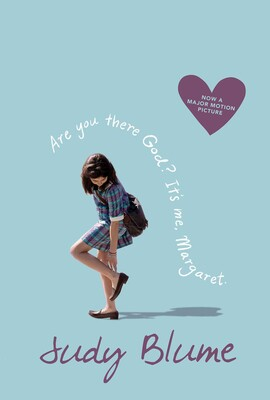
My neighbor (32F) is not speaking to me (44M) because I made some repairs to her home while she was out of town. These were mostly exterior and relatively minor (clearing debris, replacing deck boards, adding a utility sink, installing a rain cap), but I did climb onto her roof. She says I was out of line by not asking permission and that she no longer trusts my judgment.
We live two streets away from each other in a small neighborhood of old houses. We have been friends for a year and hooking up for about three months. I would like more, but she is a relatively new widow and single parent to a four-year-old boy and doesn’t have the capacity right now. She is seriously my ideal woman, though, and I am willing to wait. I am not the most attractive guy and never thought I’d interest a person of her caliber. We’ve gone out a few times when her mom was watching her son or if there was a “Parents’ Night Out” at his daycare, but mostly it’s a couple hours together after her son goes to sleep. She’s invited me along with a larger group to go hiking a couple times, and we get each other’s mail and water each other’s plants if the other person is out of town.
I bought a house in this neighborhood after my divorce because it was close to my job and to my ex-wife’s house (we share custody of two teenagers), but a lot of people move here because it is one of the few affordable city neighborhoods in a good school district. Then they realize that because the houses are all extremely old repairing them is a hassle. You think about yanking down the wallpaper somebody painted over only to discover lead paint or try to replace a door and realize you’ll have to get one custom made. I’m an engineer and can get into this kind of stuff, but a lot of people don’t. My neighbor told me on more than one occasion that her house stressed her out. She could handle the yard work and minor repairs and outsource the truly big projects, but then there were all of these things in between. Installing a utility sink felt impossible when you had a full-time job and a young child and no spouse, but were you really going to pay someone to do that? “You don’t have to pay me,” I’d tell her. “Get the sink, and I’ll put it in,” but she wouldn’t let me. I figured it was about her son and his father, about not wanting him to see anyone step into that kind of role, and so I dropped it.
The night before she went out of town, we were on her porch drinking beers and watching for the fox that lives in the overgrown lot across the street. Her son had gone to bed about thirty minutes before and was still sleeping lightly. We couldn’t go upstairs yet and so we got to talk. Work, TV shows, a book she almost loved whose ending felt contrived, my daughter’s failing grade in chemistry that brought me and my ex-wife to a moment of real collaboration. We had a fan going to ward off the mosquitos, and the sunset was just beginning to brighten the edges of the summer sky. When the dog walkers passed, we’d wave, and this gave me a good feeling, all of these people seeing me with her. It felt like being claimed.
“This is nice,” I said.
“What?”
“Being with you. I’m glad we don’t sneak around.”
She made a face. “Why would we do that?”
Her voice had a slight edge to it, and I knew I had to tread lightly. I couldn’t imply she was risking her reputation or trusting a person she barely knew to behave well if whatever it was we had ended.
“That first night you slept with me I was so happy,” I said. “I told myself, she has a kid and we’re neighbors. She isn’t going to hook up with me unless she thinks it could really be something.”
She took a long drink of her beer and seemed to consider her response. I was hoping she would say I was right, but she just shrugged. “We’re both adults. You never struck me as a lunatic.”
“Thank you.”
She laughed. “Sure.”
She tapped her phone and the light came on. “We can go in soon. Unless you want another beer.”
I shook my head. “I’m trying to say that I like you. I—”
She put a finger to her lips and shook her head. “Let’s not do this right now. Please?”
Then she led me upstairs, took off all our clothes, and pressed her warm body against my chest. The next morning, she and her son flew to Florida for a vacation at her parents’ timeshare.
I had a key because I was picking up her mail and watering her tomato plants, feeding her cat and sticking around long enough for him to get some attention. This, she had asked me to do. When a bad storm came through, shutting off the power in half the neighborhood, she asked if I would make sure her sump pump was working. I said, no problem. She has carpet in her basement and seemed real worried. I said, worst case scenario, I’d just install a battery-operated backup. This was over text, but she seemed so happy I almost hoped there would be an issue so I could fix it, but everything was fine. I bounced the toy mouse and let the cat whack it around for a while, and then I made a list of every old or broken thing in her house.
I was at her house every day for several days. I added a utility sink, replaced her dining room light, ripped out and replaced the flooring in her bathroom. I spent most of that Saturday in her backyard, cutting thorn bushes and removing rotten deck boards, and so I am not sure why her neighbors didn’t recognize me. I had waited until dusk to fix her chimney cap because it was hot during the day and I didn’t want to burn myself on her shingles and, apparently, the sight of a middle-aged man with a ladder climbing on top of an empty house at night was suspicious enough that someone called the police.
Three squad cars sped down the street with their lights flashing, and cops ran down the sidewalk with their guns drawn. From the roof, I sensed their urgency and fear and looked around for the criminal they seemed ready to shoot. “Raise your hands,” one of them shouted at least three times, but until he said, “You, on the roof,” I didn’t realize he meant me. They shone a spotlight on my body and instructed me to leave my drill on the roof and slowly climb down the ladder. On the ground, I explained the situation, but it was clear they still found me suspicious. If I belonged here, the neighbors should recognize me; if my neighbor wanted me on her roof, I should be able to call her and let her vouch for me.
“It was supposed to be a surprise,” I said. “I’m not her boyfriend yet, but I’d like to be.”
A bald cop with thick dark eyebrows shook his head. “We’re going to need you to leave. We’re going to stay here until we watch you go.”
His voice said I should be ashamed of myself, and I was starting to wonder if he was right—if I had totally misread the situation with my neighbor, if I was waiting for a time that was never going to come.
“Can I get my stuff?”
Alone with me, behind the house, a young cop with an overgrown crewcut told me he’d been where I was and he got it. He, too, had once been so into this girl that he’d missed the obvious signs that she didn’t really like him. But also I shouldn’t worry. There were a million lonely women out there, ready to meet a guy like me.
“Do you know Tinder?” he said. “Bumble? Hinge?”
His familiarity unnerved me. He looked about twenty. I jiggled the ladder to make sure it was steady and climbed back on the roof to retrieve my drill. From this height, I could see all of the yards between her house and mine, the raised beds of squash and tomatoes, lumber and cardboard shoved under porches, a kiddie pool propped up against a fence to dry, and something about this view made me feel close to my neighbor. I didn’t feel like an asshole yet or even a fool. I thought, “I’m in love with this woman, and she is still grieving. Fixing her house is the least I can do.”
In Delia Cai’s debut novel, family drama meets romcom meets small town politics. Central Places begins in New York and follows Audrey Zhou’s return to rural Illinois so her parents can meet her white fiancé, Ben, over the holidays. The Zhou family is one of the only non-white families in Hickory Grove, and Audrey’s return forces her to reflect on the awkwardness of her upbringing. She reconnects with old friends and an unresolved crush, Kyle, who she left behind. After speaking to Kyle as an adult, she begins to see her high school experience in a new light. Her relationship with her parents, especially her mother, comes to a head as Audrey, Ben, and Audrey’s parents are forced to spend the holiday week together and old feelings bubble to the surface again.
After reading Central Places, I couldn’t stop thinking about how Asian parents and children talk to each other, and the ways we can hurt each other in casual conversation. A relationship that is built on sacrifice and debt can, in many ways, be both unifying and straining, and can lead to a whole minefield of expectations and obligations.
I spoke to Delia Cai, a culture writer for Vanity Fair, about growing up “in the middle of nowhere”, the dynamics between immigrant parents and their American children, and where Asian American art will be in the next ten years.
Olivia Cheng: When did you first start writing this book and what served as the inspiration for the story?
Delia Cai: It’s pretty close to my experiences growing up in Central Illinois and then moving to New York and reconsidering my upbringing with a degree of distance. I’ve been living in New York for seven years now and there was this funny period of time where every time I would go home for the holidays, it felt more and more like entering another dimension. In my twenties, going back to Dunlap, Illinois felt increasingly strange and foreign.
OC: Among many things, your novel is a love story to this rural town in Illinois, and the racial experience of growing up there. The book bursts with emotion about a Walmart supercenter and the local bar, Sullivan’s, even as the rural area often rejects or teases the Zhou family. How did you think about and achieve this balance between having longing and the politics of the post-Trump era?
DC: Growing up, I never really felt like living in Central Illinois or going to places like Sullivan’s or the Super Walmart was romantic. I felt like I lived in a soulless middle-of-nowhere suburban-rural area and there was nothing to love about that. I couldn’t wait to move to the center of the world where things mattered and life felt like living on a television show.
But my experiences going home and revisiting these places that were so central to my upbringing and realizing how much of my life and memories, the experiences of growing up, were tied to these places, I felt a fondness for the random hours I spent at Walmart with my friends or all the hours I spent at the one bar in town that everyone goes to over Thanksgiving break, because nobody had anything else to do!
I wanted to document and create a love letter toward places that you might never see on a TV show.
Tracking how my feelings changed, I wanted to honor these places. Because now that I live in New York, you do feel like you’re on a movie set, but all these places are already claimed in a way. You can’t watch TV without seeing Washington Square Park a million times with millions of people. I wanted to document and create a love letter toward places that you might never see on a TV show or on HBO or in a movie. I just had this suspicion that most people have a really strong attachment and ties to places like these that could be described as forgettable but were also so formative.
OC: Who was the audience you had in mind when you were writing this book?
DC: This sounds cheesy, but you know how everyone says, “Oh, write the book for your younger self,” but I think that’s who it was for. Also I was picturing my friends. I’m not really close with friends from my Illinois life, except for maybe one or two people. All the close people in my life came in college or after. So it felt like my life before eighteen was this box that I haven’t shown a lot of people. Like I’ve never really opened it and shown it, even to my best friends and the people closest to me. I never really knew how to totally explain it. Or my friends weren’t from small towns like that or families like that.
The novel is also an explanation for who I am to people in my life who I care about. An explanation to that hilariously loaded, stereotypical question of “Where are you from?” I wanted my friends to read it and think “Oh, this explains a lot about you.”
OC: What were your inspirations in writing this book?
DC: Reading Jenny Zhang’s Sour Hearts was a story of specificity. Here’s a cohort of young girls who grew up in a not wealthy community in Flushing. I was so blown away, because in some ways, I thought about parts of the story I related to being Chinese American and then parts that felt totally foreign. I remember thinking that the specificity of her stories were inspiring. Those stories were visceral and painful, and it seared images and scenes in my mind.
I was also reading Meg Wolitzer’s novella, The Wife. I looked at that story for structure, because it was about how a woman and her husband go on this trip and shit falls apart on the trip. It also started on a plane and I remember thinking that I should write my book that way! Those were two pivotal works.
OC: I loved Audrey’s self-interrogation and honesty about how she has contributed in her own ways to the detriment of her relationships, which is somewhat of a subversive ending given endings like Everything Everywhere All At Once, where the burden is often on the parent. Did you always know this was the dynamic when you wrote this book?
DC: I’m really glad that comes across, because that was really important to me. Writing this dovetailed with my own growth and understanding of my parents in my twenties. For a long time when you’re a young adult, you can only see and relate to things from your point of view. But there is also a layer of when you’re the child of immigrants where you’re forced from a young age to have this perspective of your parents as people who sacrificed everything for you. You’re told, “we sacrificed everything for you,” “we did this for you.” You carry that perspective and you think about how you don’t want to carry it, because it’s so much! That dynamic was something I struggled with—am I allowed to feel ungrateful, am I allowed to feel resentful knowing that every point of discomfort I’ve had doesn’t even count compared to what my parents have been through? You always have that burden.
Am I allowed to feel ungrateful or resentful knowing that every discomfort I’ve had doesn’t even compare to what my parents have been through?
But the transformation came from understanding my parents as people, especially when I got to the age they were when they came to America. Then I was like, “Oh.” I just turned 30, but my mom had me when she was 29 and when I turned 29, a lot of things made sense. If I imagined having a baby in a country where I barely spoke the language… We had this chat about how during my first few years in New York in my early twenties, I was flailing—I didn’t like my job. She would ask, “do you want to go back to school,” “do you want to get an MBA,” “do you want to go to grad school?” I remember being so angry when she would say things like that, because that wasn’t what I meant. The way I interpreted that was, “See I told you that you weren’t able to do that. Now you need to go back to Plan A.”
It took me a long time to realize that my mom was saying those things because she thought she had failed me. She thought she had set me up for success and when I was flailing, she was saying there were so many things to do, that I had so many options. She was speaking from a place of fear where she was wondering what she did to have me be out in New York and feel so alone. It was this galaxy brain moment where I really thought she was judging me, but she was just freaking out in her way. We finally had a conversation about it a few years ago, and it was the best conversation we ever had. She admitted she was scared for me and wanted me to feel like I had options. I told her I thought she was judging me for doing something wrong.
Breaking past this childlike “me” point of view and breaking past this other barrier of gratefulness to parents and superseding that on a personal level, I saw that my parents had these fears. They came to America, because they wanted to move to America. A huge part of it was inhabiting the age they were when they started making these decisions. I can understand where their mind was, because that childhood narrative is neat, but doesn’t capture the complexity of why my parents picked up and moved their lives, how hard that must have been, and all the reasons they did it.
OC: There has been some discourse in the past five years about Asian American women dating white men. Can you walk me through your thinking of making Ben white and the absence of Asian men in the book?
DC: Because I grew up in this area where there was a very small Chinese community, I didn’t know Asian-white relationships were so fraught until I moved to New York and experienced the Internet in that way. It wasn’t just my family in rural Illinois, but I felt detached from it enough and there wasn’t Reddit or anything. It just never came up, because there were not enough of us in school! As high schoolers, we were not interrogating why the guys we had crushes on were white guys. I’m so fascinated about growing up now where you can have that vocabulary and framework where you can think critically and understand the white gaze. But I just had no idea, so I was writing a dynamic I knew about and that I experienced based on relationships I had.
I think in some ways, I’m writing what I know, and I would also never want to generalize Asian American women who have dated white men, but when I looked at those relationships critically and from the benefit of being informed, I realized that when you spend your whole upbringing in a white place, you start equating whiteness with desirability and superiority. I started to understand where the appeal came from. Assimilating is how you emotionally survive. It can feel like that’s your primary drive. I don’t mean to be dramatic, but you’re thinking, “I’m just here to blend in.”
I gave all those anxieties and fears to Audrey, so it made so much sense to me to make Ben white, because she’s grown up that way. She’s someone who even into her adulthood, and I think there is a degree of internalized racism, and she’s someone who’s thinking, “I’m trying to fit in, I’m trying to survive,” and the idea of American Dream in her eyes is creating and being part of a family that is the opposite of what she had and a family that is safe. A family that is successful and can blend in and feel secure. And a white family is the secure unit pictured in our society. So that made sense for her.
I’m not trying to make a statement of Asian female-white male relationships, but I think about it a lot personally of course.
OC: A lot of modern Asian American literature revolves around really elite, high-functioning women and their immigrant family drama like Everything I Never Told You by Celeste Ng and Chemistry by Weike Wang. How do you think this novel contributes to this modern canon? And how do you think it rebels against it?
DC: I think it’s really funny that there’s this archetype of an Asian American woman who has her stuff together and over the course of a novel can fall apart in different ways. And it’s interesting because it speaks to the type of person who writes a book. One way to look at it is that the Asian American authors who “make it” have probably benefited from a certain kind of personality and drive, where they are thinking “I can write a novel and I can sell it.” There are a lot of forces and biases that may select for that.
When you come from an immigrant or POC background, you’re not walking around like a white guy named Tyler at an MFA program saying “The world needs my voice.” You’re coming from the mentality and background of “until I feel like I’ve earned my place, I’m not contributing my voice.” I don’t want to put words into anyone else’s mouth, but that’s how I felt so it’s funny to me that there’s this clear set of second-gen Asian American woman who have all the privileges and benefits of being in a secure place to succeed professionally and write about our experiences and have the time and energy and wherewithal to reflect on our families. My mother did not have the time and energy and wherewithal to do that.
I’ve written about this in other places, but I see that Asian American art is so much about the origin story. It’s really art created by kids of immigrants who are in a place in life where they are in a place to be making art, to be creative professionals. Of course we’re seeing this story where we’re talking about, “Here’s what it’s like to grow up in an immigrant household,” “Here’s how uptight and successful and professional I am now,” but it’s a big unpacking of this trauma.
Asian American as a term has only been around for a few decades. It’s easy to say it’s the same old story of second-gen origins, but Asian American pop culture and art can be looked at in terms of generations. We’re still at the very beginning. Now that this millennial generation really has the tools and we’re capitalizing on this moment in culture where pop culture says they are receptive to new voices and new stories, this is like some form of a draft of the Asian American story. All of the people in power who can tell stories of this scale come from a similar background to be able to do that. I can’t wait for the next generation who will tell stories about being a third or fourth generation, where the immigrant narrative is no longer part of their story.
OC: Where do you feel like Asian American art will be in the next ten years and where do you want it to be?
DC: What excites me the most is now that we have blockbusters like Shang-chi and Everything Everywhere All At Once, these tentpoles of pop culture, these big pieces of art in the imagination, we can move into stories of incredible specificity. It’s interesting because so much of the criticism around these big moments is that Shang-chi doesn’t do it for everyone. Shang-chi does not represent everyone in the Asian American diaspora, for sure. But I think that these sort of big commercial stories are great, because next we move into stories of incredible specificity.
For example, Minari is an incredibly specific story about Asian America. It’s like this family living in Arkansas and they want to farm. That is based on Lee Isaac Chung’s childhood and I love that we have that. I cannot wait for the thousands of experiences and stories, even under the rural Korean American experiences in the ‘90s, all the tiny, little different degrees of that we can explore.
Asian America’s strength and also where we have the most conflict is that it’s such an umbrella term that ultimately means nothing. We’re all bunched in together, but our grandparents hated each other. It’s wild to think that we’re all in one unit. But on the flip side, we’ve barely begun to go into the infinite swath of stories that are available and I’m really excited for that. I hope Central Places can cover a tiny pixel of all of the possible Asian American stories to be told—Chinese American growing up in Central Illinois, in the Midwest-type of experience during the emo pop-punk days. That’s one experience that I would like to commit to in the capital P project of Asian American storytelling. I can’t wait to experience all the billions of other pixels in that picture.
Predicting the winner for the upcoming Prize, which will be announced on May 8th, is tough. You see, with the Pulitzer, there can be big surprises. For example, I think few people would’ve guessed recent wins by Paul Harding’s Tinkers or Andrew Sean Greer’s Less. Small press books and humorous novels aren’t necessarily the common choice for the Pulitzer Prize. Similarly, short story collections and debuts are rare winners, so the announcement of Jhumpa Lahiri’s Interpreter of Maladies was a double shock as the winner in 2000. The most difficult year in recent memory to offer a correct guess, though, was 2012. No book won. Honestly, who would’ve written “none” in a prediction contest?
No matter how difficult it might be to figure out the year’s winner ahead of time, it’s still fun. It’s a way to reflect back on the literary year that was—and to uncover those works of fiction that might’ve been missed when they were released.
In shaping my predictions, previous awards, critical acclaim, general buzz, and a little bit of plain intuition are the top factors that I focus on. I also try to keep my personal feelings about my favorite books of the year away from my predictions, which is why you don’t see Sequoia Nagamatsu’s How High We Go in the Dark, Holly Goddard Jones’ Antipodes, or Silas House’s Lark Ascendingincluded below.
I know that I’ve established that short story collections aren’t necessarily likely winners of the Pulitzer Prize for Fiction. In fact, only two have won since 2000—Lahiri’s Interpreter of Maladiesand Strout’s Olive Kitteridge. But another collection has to win at some point, and 2023 seems like it could be the year. Why not go with Chang’s magical and wonderfully weird Gods of Want? I mean, seriously, it’s hard to root against a book that features ice cream, ghosts, and a plastic shark. Chang’s previous book, Bestiary, was a huge success, and Gods of Want has received some pretty sweet critical acclaim. It was on “best” lists at The New York Times and at NPR, and it was also a finalist for a Lambda Award.
Another story collection that’s done well with critics is Nobody Gets Out Alive. Set in Alaska, Newman’s book turns to a group of affecting stories that focus on women and home. This one’s already been longlisted for the National Book Award and The Story Prize. It’s also appeared on many, many “best of” lists. I wouldn’t be surprised to hear its name come Pulitzer day.
Batuman’s The Idiot was a Pulitzer Prize for Fiction finalist in 2018, so this sequel, which continues to follow Selin Karadag’s collegiate journey at Harvard, is definitely on the radar when considering possible contenders. Appearing as one of The New York Times’ Notable Books of 2022 is another reason to watch for Either/Or.
Tomorrow, and Tomorrow, and Tomorrow has received numerous accolades. For example, Entertainment Weekly and Time both listed it as being among the best books of the year. It also doesn’t hurt that video games seem to really be having a moment–I’m thinking of the huge success of The Last of Us and The Super Mario Bros. Movie. While Zevin’s latest isn’t necessarily about video games, they do play a huge part in a book that navigates love, friendship, and failure.
Books about memory and grief are kind of my thing, and it seems like many critics feel this same way—at least when looking at Serpell’s The Furrows. Serpell’s latest is one of the most acclaimed books of the year. It was a finalist for the National Book Critics Circle Award. Kirkus Reviews and Publishers Weekly (and several other publications) picked it as one of the best books of the year. It seems like an obvious contender.
I can’t talk book awards without mentioning Talty’s debut collection, which explores Native American life. This book has been seemingly everywhere. Among other recognitions, Night of the Living Rez won the PEN/Robert W. Bingham Prize and the John Leonard Prize (from the National Book Critics Circle), and it was also a finalist for the Andrew Carnegie Medal for Fiction. I’m convinced that this book will be taught for many years to come, and a Pulitzer Prize would kind of help seal the deal.
Varela’s novel is about so many things, but community is one of the book’s central focuses. And what an exploration of community The Town of Babylon provides. The Town of Babylon feels like a book of our time, and it would be a worthy winner. It was a finalist for the National Book Award, and it’s been on more “best” lists than I can count. Watch for it—and read it, if you haven’t.
Kingsolver is one of our most celebrated writers, and she’s never won a Pulitzer. This in itself doesn’t make Demon Copperhead a frontrunner. What makes Demon Copperhead a frontrunner is how good it is—and how timely it is. I haven’t actually met a reader who doesn’t love this book. Seriously, too. In a way, this kind of love reminds me of Anthony Doerr’s recent winner, All the Light We Cannot See. With Demon Copperhead, Kingsolver takes us deep into Appalachia in this coming-of-age novel that looks at poverty and addiction, and it’s an unforgettable story. Critics and readers alike would likely celebrate a win for Barbara Kingsolver’s Demon Copperhead.
The Tournament of Books is basically the greatest invention of the 21st century for book lovers. For anyone not familiar with it, this March Madness-style event pits books against one another, with a judge deciding the victor in each round. The Book of Goose was this year’s winner, and it wasn’t really that close. On a critical level, too, this expansive story about friendship and loss and love has done very well. It won the PEN/Faulkner Award. It was longlisted for the Andrew Carnegie Medal. It made the “best” list at places such as TIME, Los Angeles Review of Books, San Francisco Chronicle, and LitHub. Yiyun Li is an incredibly respected writer. The Book of Goose would be my top choice if it weren’t for…
I know. I know. It’s a short story collection. So few of them have won over the years. But it’s time! Plus, this book is spectacularly good. I read it a few weeks back (I missed it somehow when it was released), and I can’t stop thinking about it. It captures who we are perfectly—reflecting that American life theme that the Pulitzer likes to honor. In Bliss Montage, Ma looks at issues of loneliness, home, motherhood, and love. Ma has already won two major awards for Bliss Montage: the National Book Critics Circle Award and The Story Prize. A third one could very well be on the way.
That’s it. I think it’s between Kingsolver, Li, and Ma, with one fantastic story collection claiming victory. I mean, another story collection has to win at some point, right?
No matter what book takes the Prize, I think literature is also a winner on Pulitzer day. The world will be talking about—and celebrating—the written word. That’s a pretty great thing.
I used to have a lot of misconceptions about what made for compelling literature. Of course, a novel peppered with references to critically acclaimed texts and high-brow films and classical music—or just things generally held in high regard—are commonplace. But as someone who enjoyed pop music, not as guilty pleasures but as something worthy of artistic merit, of analysis, I used to wonder if certain works would hold the same critical weight if, say, the Spice Girls were referenced in a totally unironic way.
Pop music has shaped my life to such a significant degree that I often preface stories about my childhood with: “I swear I’m not joking,” before proceeding to tell someone that I measure the timeline of my life in Mariah Carey albums—2005 isn’t simply 2005, it’s the year she released her tenth studio album The Emancipation of Mimi and literally changed my life—to bewildered faces of course. Before I think about my own life in, let’s say, 2007, I think about Britney Spears’ tribulations and the release of her album Blackout.
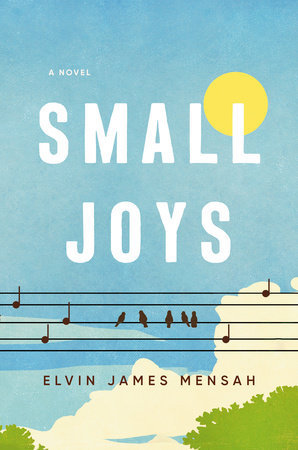
Pop is notoriously nebulous in definition. But the definition I’m going with here is music is a hybrid of pop and R&B. My debut novel, Small Joys, set in 2005, is filled with references to ‘90s and early 2000s pop songs. In earlier drafts, it was void of any such references; I felt a little embarrassed centering a protagonists interests on something that so often eluded respect. For whatever reason, I felt as if my novel and its characters wouldn’t be taken seriously, if it leant too much into this obsession of mine, that it lacked a certain intellectuality. So, to see pop music taken seriously in fiction, to have it celebrated and not mocked, always sets my heart alight.
These seven novels unashamedly celebrate the joys of contemporary pop music. Quite a few of them also inspired me in my own writing, and creating a world scored with music that felt authentically me.
Set in Queens, this novel is a striking story told in a chorus of voices, following a group of young women of colour as they navigate life. Brown Girls is an ode to so many things—to girlhood, to Black and Brownness, to joy—and threading all of this is a love for pop and R&B music: Spice Girls, Destiny’s Child, Aaliyah, and yes, Mariah Carey. We have characters who routinely sing “Heartbreaker” at the top of their lungs. It beautifully captures the nostalgia that many millennials feel when reflecting on the era of pop, where every hit seemed to be produced by Timbaland or Darkchild. It’s truly joyous.
I read this novel in the early stages of writing Small Joys. At the time, I was still struggling to find my voice and was desperate to see what kind of fiction other Black male writers were producing. Rainbow Milk came along at just the right time. The novel is a bold meditation on religion, class and sexuality, following a young Black gay man, Jesse, as he makes a new life for himself in London. I was utterly entranced by how deeply contemporary pop and R&B music was infused into the story—from cocaine being done off Mary J. Blige’s My Life album, to a Sugababes single being bought in the hopes that it might be number one on the charts.
Open Water is a gentle and complex debut, mapping the relationship between two young Black British artists, navigating love and race in Britain. Whilst no one would consider Frank Ocean or Kendrick Lamar guilty pleasures—or even pop by any stretch—it’s always a delight seeing contemporary musicians referenced and have it be a source of joy for the protagonist.
Daisy Jones and the Six is a novel charting the stratospheric rise and fall of a 70’s band and their tumultuous relationships with each other. In another life, I was a music-blogger. Things like anticipating the publication of music charts in the UK and US was always a highlight of my week, as well as knowing how much an album had sold in a particular week. So when I read this and saw things like chart positions and albums sales and this band’s drive to be commercially successful truly satisfied the music industry/chart geek in me.
Mayflies is one of those clutch and hold to your heart novels for me. It’s a coming-of-age story about a group of guys from Ayrshire, Scotland growing up in the ‘80s. Here, we focus on the friendship between James and Tully, which is built on the foundations of films and music. I love a novel with a sensitive male friendship at its centre, and the way the characters joyously go back and forth on their opinions on certain films and artists, reminded me a lot of my own relationships.
This novel speaks, quite deeply, to the pop music nerd in me. Like the tv show Girls5Eva that came after it, it captures 2000s pop culture so perfectly. Here, we’re following the rise and subsequent implosion of a fictional girl group, Gloss, who are directly inspired by the Spice Girls. As someone who used to make up their own popstars and pop-groups, this was boatloads of fun to read.
Perhaps this book shouldn’t be on this list because from the Beatles to Neil Young to Pink Floyd, our protagonist, heartbroken record store owner Rob, references music that is often widely critically acclaimed (aside from a stray mention of Madonna’s “Holiday” I suppose). But how could I not include a novel with music so rooted to its heart, and probably holds some sort of record for how many song references one single book has.
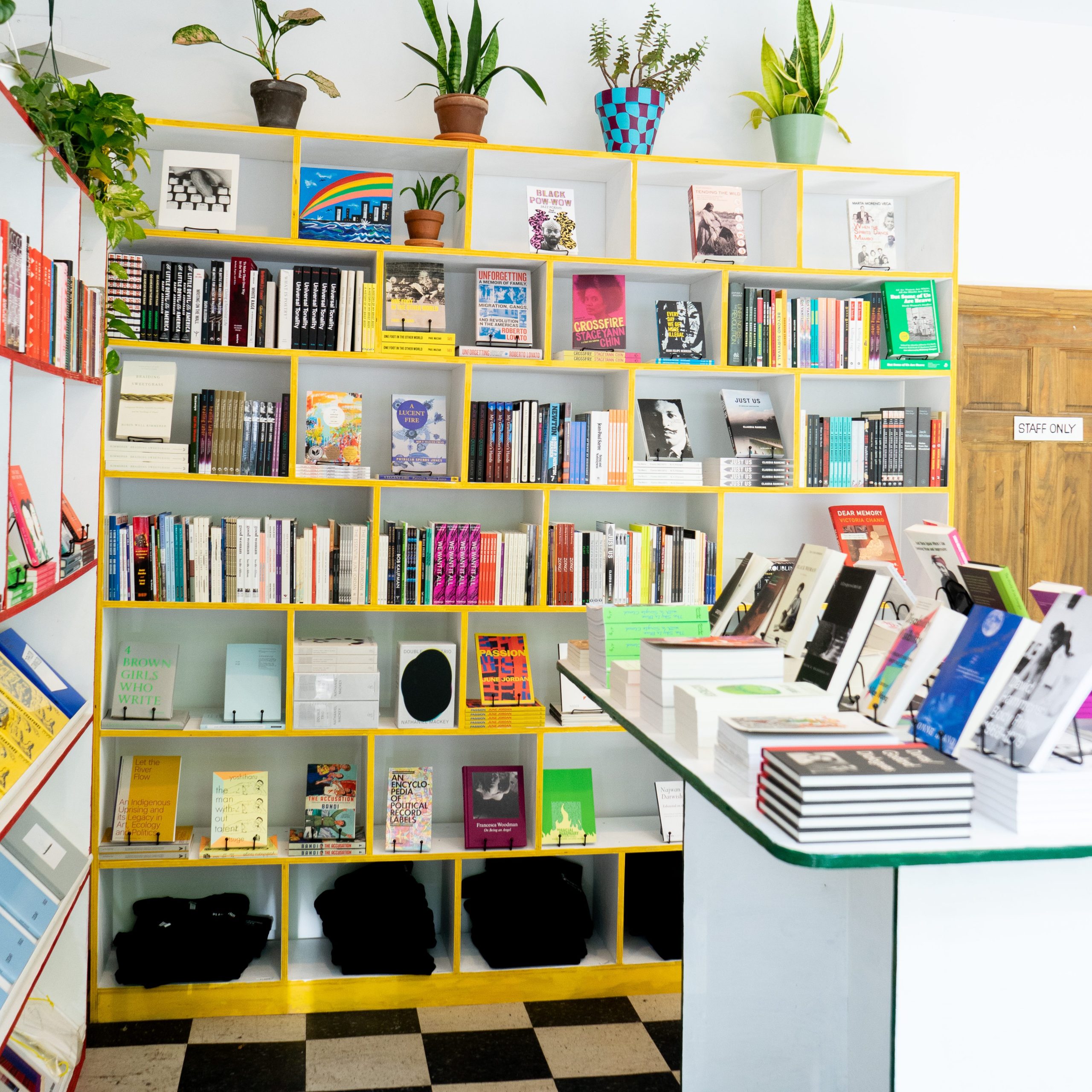
Bookstores are safe havens for readers. They offer quiet places to flip through novels, chances to meet your favorite authors, and opportunities to form community with people who might just love the same niche subject as you. I often find myself stopping by my favorite indie shop to splurge on new nonfiction or buy another set of notebooks. From readings to book clubs, and everything in between, independent bookstores are the heart of the literary world, and we are sharing our favorites.
“Rough Draft is located in Kingston’s uptown neighborhood on the oldest intersection in America; the buildings on all four corners were built before the revolutionary war. Behind its stone facade, you’ll find one of the busiest businesses in town. Good luck finding a place to sit and work, but you can always find the latest releases, and a coffee (it’s open from 8am-8pm everyday, which is rare and special in these parts). In the summertime, their outdoor picnic tables are a great place to grab a happy hour beer and talk books.”—Halimah Marcus, executive director
Photo via Black Spring Books Instagram
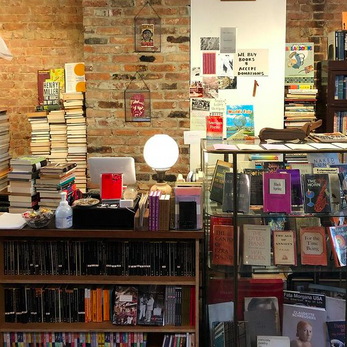
Black Spring Books in Brooklyn, New York
“Everything about a visit to Black Spring Books feels like a discovery. It’s innocuous, fenced-in, and easy to miss on a quiet side street in Williamsburg. But once you find it, and step over the threshold and inside, it feels oddly familiar. Every reader has dreamt of this bookstore that doubles as a literary social club—piled floor to ceiling with vintage hardcovers and modern first editions—the sort of small, quiet oasis where you can curl up with a book you’ve never heard of, and be transported into a different era, while the bookstore’s cat slinks into your lap. Black Spring, named for Henry Miller’s short story collection, feels like it might very well be haunted by the ghost of Henry Miller, who grew up in the house next door. Black Spring Books was founded in 2021 by Russian-American poet Simona Blat. Stop by for a glass of wine, good conversation, and an even better book.”—Denne Michele Norris, editor-in-chief
Photo via Addison’s Instagram
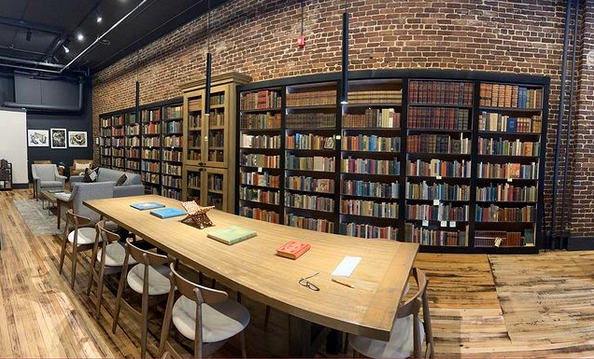
Addison’s in Knoxville, Tennessee
“Going to Addison’s, in Knoxville’s Old City, feels like stepping inside the parlor of a wealthy and magnanimous old merchant. On the first floor, sunlight pours in through huge windows and glows off the old wooden floors. A chess set awaits players in a bright corner nook. The brick walls hold endless shelves of rare, gorgeous, and sometimes strange antiquarian books that make for charming gifts. In the center of the room, the long library table is a sweet spot to hang out and work. There’s also a delicious tea bar in the back. Downstairs, you’ll find more books, comfy chairs, and tables. A visit to Addison’s reminds me that books are more than just information-holders; they’re also beautiful, and often curious, physical objects.”—Kelly Luce, The Commuter editor
“Yu & Me Booksis a jewel box of a bookstore/bar/cafe located in New York City’s Chinatown, specializing in literature by writers of color and immigrants. In addition to readings and a monthly book club, they host community events like open mic nights, clothing swaps, and potting classes. More than just a bookstore, Yu & Me is a community space for marginalized writers and readers in a working-class immigrant neighborhood that’s rapidly gentrifying.”—Jo Lou, books editor
Photo via Headhouse Books Instagram
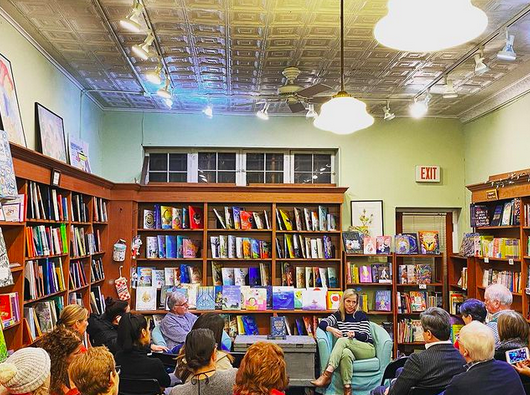
Headhouse Books in Philadelphia, Pennsylvania
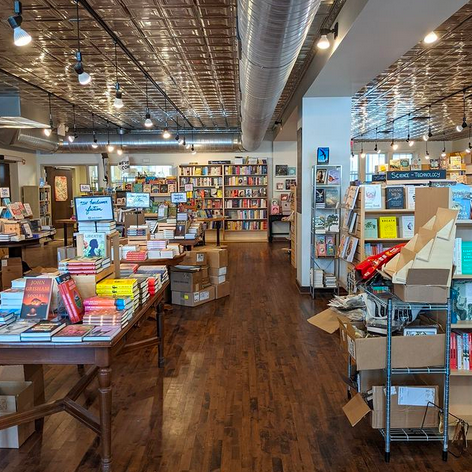
“A cozy and comfortable space tucked into Philly’s old Headhouse Square. The area is packed with bars and restaurants and hosts one of the largest farmers’ markets in the city, but you can catch a breath and a great new release at this store. Big Five Blockbusters sit next to eclectic indie books underneath a beautiful tin roof.”—Alyssa Songsiridej, managing editor
Photo via Bird & Beckett Facebook
Bird & Beckett in San Francisco, California
“Bird & Beckett is easy to miss—it’s not in a hip neighborhood and it’s competing with historical San Francisco heavyweights like City Lights Bookstore. But it’s worth venturing into Glen Park to check out this underappreciated gem (and it’s literally one block from a BART station). The quarters are cozy, the books are new and used, and, if you stop by on a Friday or Saturday evening, they dim the store lights ‘so you can focus on the work of the best jazz talent the Bay Area has to offer.'”—Wynter Miller, associate editor
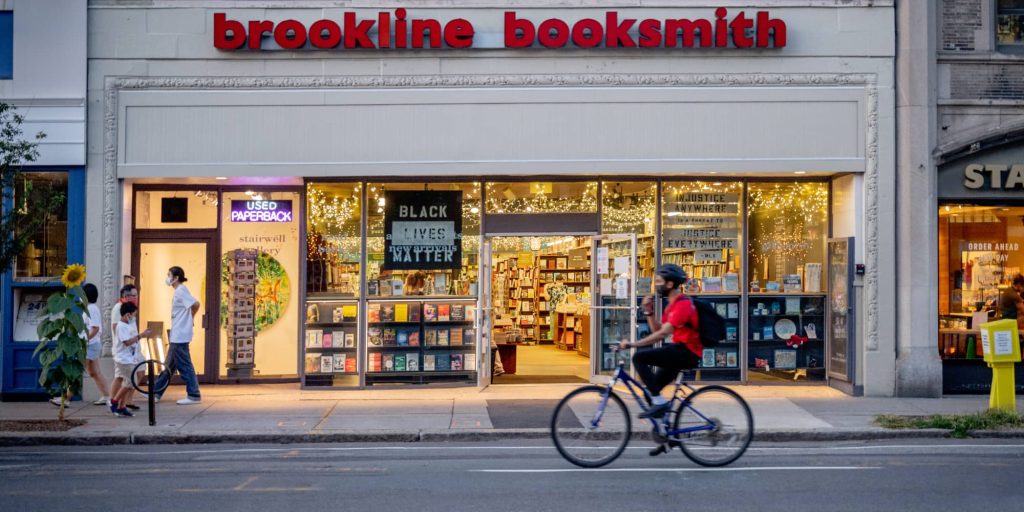
“Though I’ve lived in Boston for less than a year, I’ve been coming to Brookline Booksmith since I was a kid. I grew up in a suburban area where I had to travel roughly 30 minutes to my nearest bookstore, which was (what else but) a Barnes & Noble, and Brookline Booksmith was one of the first indies I’d ever encountered in my life. It was my first favorite bookstore, and was delighted to find myself living so close to it in my adult life. It’s adorable and well-curated, with tables full of a pretty amazing selection of new bargain books and a whole basement-level of used books too. Like all of the best bookstores, it’s the kind of space you can easily lose track of time in, collecting more and more books in your arms as you go.”—Katie Robinson, social media editor
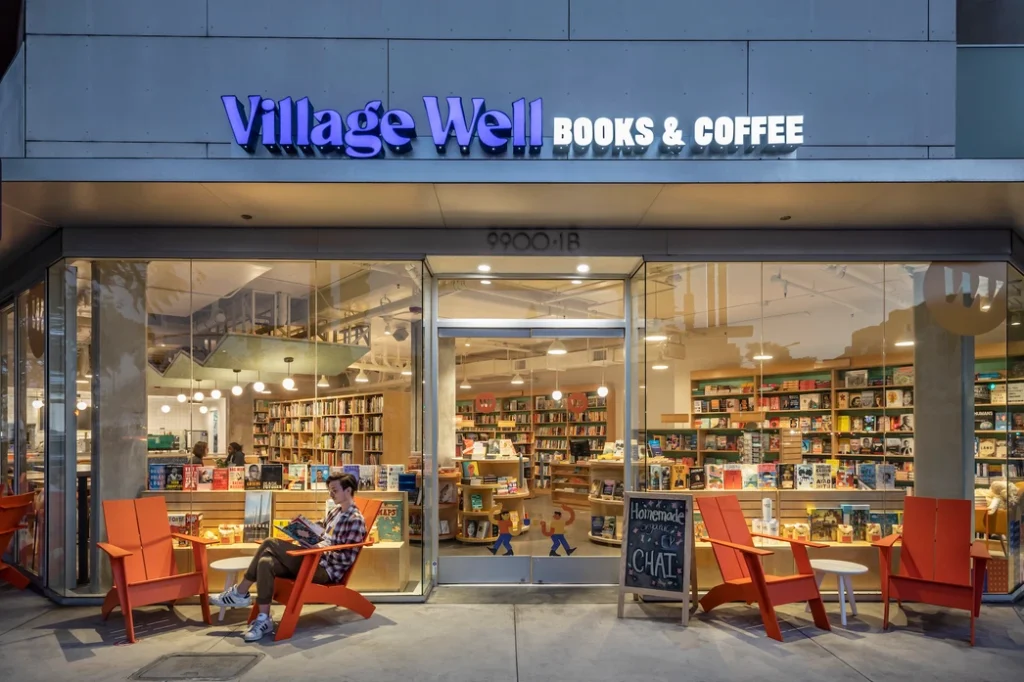
“On the corner of a bustling intersection in downtown Culver City, Village Well offers an escape and a tiny portal into a universe where lattes and literature take precedence. The bookstore-café is community-based and impact-driven—highlighting different political movements each season (currently: reproductive rights) along with an overall motto to feed both your mind and body. While students with laptops crowd around the community table or discuss the latest article in the LA Times, if you wander in at the right time, you may just stumble upon local author readings, activism educational panels, open mic nights, or an evening of board games.”—Kyla Walker, editorial intern
Photo via Yellow Dog Bookshop Instagram
Yellow Dog Bookshop in Columbia, Missouri
“Tucked along 9th street in downtown Columbia, Yellow Dog Bookshop is a cozy Mom n’ Pop bookstore that trades, sells, and buys used books. The selection is never exactly the same, so you can always expect to find something new and delightful. For the youngins, there is also a cozy kid’s nook in the back, complete with beautiful artwork along the walls. Take your selections to read at Peace Park, Alley A, or any of the nearby cafes. A true landmark among Columbia MO bookworms.”—Lisa Zhuang, editorial intern
Photo via Next Chapter Booksellers Instagram
Next Chapter Booksellers in Saint Paul, Minnesota
“Part of the draw towards moving to St Paul was the opportunity to venture to independent bookstores like Next Chapter Booksellers on Snelling Avenue. Located directly across from Macalester College, Next Chapter offers a unique amalgamation of manga, bestsellers, non-fiction, and sci-fi/fantasy, as well as plenty of stationary to scribble story ideas onto. It’s a small yet spacious place that hosts author events, book signings, poetry readings, and its manga and sci-fi/fantasy clubs. Last summer, I had the crazy idea to get married there (after hours!), and I’m still grateful to the gracious staff who helped my wife and I with the ceremony. In my post-wedding life, I often weave through stressed-out students and the multitude of people walking their dogs to dip into Next Chapter Booksellers to scour the shelves for books I’ve been meaning to read.”—Kristina Busch, editorial intern
Photo via Kew & Willow Books Instagram
Kew & Willow Books in Queens, New York and Word Up Bookstore & Community Bookshop in New York, New York
“The commonality between Kew & Willow and WordUp is the community-centered way both spaces operate. Kew & Willow is tucked into Lefferts Boulevard among many mom-and-pop longstanding spaces. Kew & Willow is few blocks from the local LIRR stop, and funny enough an area where the first Spider-man was filmed. As soon as you enter there’s a homey & cozy vibe that steers you through a clear pathway to tables with offerings from local writers to commemorative month/thematic recommendations, and some sweet tote bags towards the kids section where you can hear the happy squeals of kiddos picking their next favorite read. Word Up Bookstore has continually established itself as not just a bookstore but a community space (heck, it’s in the name), helping residents in the neighborhood gain access to literature and more awareness of what’s going on in the Washington Heights area, aiding patrons during the pandemic and in voting registration. The family atmosphere of Word Up gives off a Cheers vibe, where everyone knows your name. Staffed by volunteers and avid readers, the abundance of book offerings reveals not just the abundance of work by BIPOC, but also books that instill a love of learning more about how we can be better to one another and re-educate ourselves to rebuild a nation.” —Jennifer Baker, former contributing editor
Photo via The Lit. Bar Instagram
The Lit. Bar in Bronx, New York
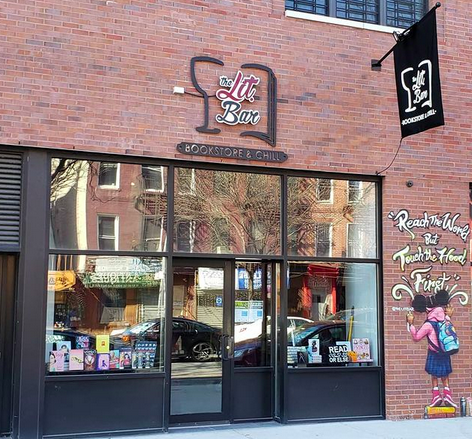
“The Lit Bar was born of a severe lack of independent bookstores in the Bronx borough, and once the last Barnes & Noble at the Bay Plaza Mall closed in 2016, it became the proud one and only brick and mortar in the Bronx. It was opened back in 2019 by Bronx native Noëlle Santos, and has since then survived the pandemic and become a local gem! It features a cozy wine bar, and hosts space for community literary events, and prioritizes offering a diverse set of stories that appeal to a wide audience. It’s the perfect spot to chat with other book people while sipping a glass of wine or to take advantage of comfy seating to get started on a fresh new book.”—Nzinga Temu, former intern
“Playground Annex in Bedford-Stuyvesant, Brooklyn prioritizes books by BIPOC and LGBTQ+ voices. They have a small but mighty curation, where you can find a new novel about queer love, a collection by one of your favorite poets, translated titles you haven’t heard of before, and everything in between! I’ve walked out of Playground with a sci-fi novel and a manga, and I always get merch when there’s a new drop since they make super cool and cozy apparel and often work with local, community-focused artists. In addition, they have a free library with a rotating collection. Also check out Playground Coffee Shop, which runs the Annex, to sit with your new book and a coffee!
*Note: I am a little biased, as Playground often hosts my reading series featuring writers of color called lactose intolerant—I would say that it’s the perfect space to have a reading!” -Ruth Minah Buchwald, former intern
Photo via Harvard Book Store Instagram
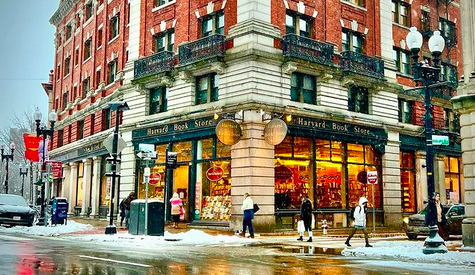
Harvard Book Store in Cambridge, Massachusetts
“When I first moved to the Cambridge area for graduate school, my favorite thing to do was go to Harvard Book Store and tuck myself into the back row at a reading—any reading, no matter if I knew the author or not. Their event series is still the best in town, but Harvard Book Store is my favorite for more than that, including a curbside pickup program that got me through the early days of COVID-19, a delightful used book section in the basement, and the most helpful booksellers I’ve ever met. It’s a Harvard Square landmark for a reason!”—Bekah Waalkes, former intern
Photo via The Bookshop Instagram
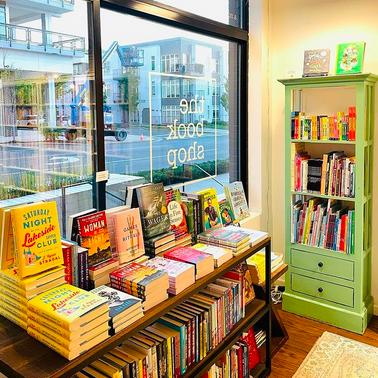
The Bookshop in Nashville, Tennessee
“Located in East Nashville, The Bookshop is a colorful and cozy 500-square-foot bookstore packed with books and connected to a local coffee shop. A true symbiotic relationship! The space is incredibly well curated with a wide selection of literary fiction, poetry, nonfiction, and bookish gifts. Every month, The Bookshop has a Blind Date With A Book and Lit Clique pick, which is often a title from an indie press. After years of being an out-of-state customer and visiting whenever I was in town, I permanently moved to Nashville in the summer of 2022 and started working at The Bookshop as a bookseller. It’s been such a treat to get an inside look at my favorite bookstore and contribute to staff picks, book clubs, and helping customers of all ages find the perfect read. If you are ever in Nashville, come say hi!”—Laura Schmitt, former intern
“Unabridged has been around since November 1980, and has long held a reputation as Chicago’s go-to bookstore for LGBTQIA+ literature. It was a fixture of my childhood, too—I grew up around the corner, and spent most weekends curled up in one corner or another of the store. As I grew, the incredible staff recommendations helped guide my taste and introduced me to some of my favorite works of literature.”—Sophie Stein, former intern
Photo via Old Firehouse Books Instagram
Old Firehouse Books in Fort Collins, Colorado
“Located in the heart of Old Town, Old Firehouse Books is housed inside of, well, an old Fort Collins firehouse (the very same, allegedly, that inspired the design of the firehouse exterior featured in Disneyland’s Main Street, USA). A community staple since 2009, this charming bookstore features regular author events, book clubs, community gatherings, and a truly stellar book trade program. A reliable meeting spot for an absurdly high number of first dates for Colorado State University students, Old Firehouse Books also happens to be the largest independent bookstore in Northern Colorado.”—Chris Vanjonack, former intern
Photo via The Bookplate Facebook
The Bookplate in Chestertown, Maryland
“Nestled along the colonial-era brick streets of my Chesapeake Bay hometown is The Bookplate, an indie used book store offering up “fine books, fine art, and a cat.” It’s a charming social hub in a small, arts-loving community. Owner Tom Martin curates a robust selection of used books, including rare and signed volumes, and there are rooms full of fiction, children’s books, world history, poetry, and much more. Iconic store cat Keke enjoys crouching behind stacks of books as she prepares to hunt her toy mice, or napping on the sales log until the booksellers have to push her off to record a sale. The store hosts regular author readings and an annual poetry festival, and features a stunning collection of Portuguese pottery that is also worth checking out.”—Preety Sidhu, former marketing manager
It had been four years since the air had hit me like this, heavy and warm. Coming out of the airport felt like stepping back in time, everything concrete, tinged with green. I was in Malaysia, a place that feels like home, although I’ve never lived there. I’d been deprived of my childhood tropics since early 2019. Now that I was back, escaped from Europe’s wintry entrails, I dedicated myself to plowing through every sensory culinary experience that I could: like an obsessive, covetous demon, I raked up guava pieces sprinkled with sour plum powder, fried king oyster mushrooms, brinjal stewed in thick red sauce.
But the durian—no condiments, no utensils, no plate even—trumped all these. I could smell it before I saw it, like a death or a thunderstorm on the horizon, a smell that leaves superstitions and pinched noses in its wake. Visually, the durian is spiky, large, hard, and green on the outside; creamy, sweet, buttery on the inside: back home they call it the king of fruit, partly because of its high price and addictive nature. During durian season, you can buy the fruit in white polystyrene boxes with the hard shell removed. You must eat it with your hands, tearing into the doughy yellow mounds that cover a hard seed. The flesh is a dense, heavenly concentration of pungent, fibrous honey. This is a very heaty fruit (energizing or stimulating, in traditional Chinese medicine), so you must never have it with alcohol. The flavor is sweet, solid, and electric, and lingers long after eating, like something warm on your breath—according to old lore, no soap brand can wash the smell off your hands, only water poured from the husk of the fruit itself.
The flavor is sweet, solid, and electric, and lingers long after eating, like something warm on your breath…
The durian is difficult to describe to those who have never encountered it, because the experience of durian—from its myths and quirks, to its many varieties and swinging prices—goes beyond the vocabulary of orthodox Western palates and newspapers. Traditional English-language food writing—a genre that rewards taxonomy, elevation, and reinvention—thrives on finding the perfect combination of words to capture the experience of a new flavor.
But sometimes, no word can depict an experience that is so totally foreign to the readers’ mind. Sometimes the word falls short of the thing entirely. My parents, for example, named me after a type of classic French plum. But the fruit I crave, the one I most deeply want to emulate, is the durian.
Before going home last December for the first time in years, I had spent my last few winters dreaming of durians. I moved from the US to France in the summer of 2020. It was the middle of the beginning of the pandemic, the second movement of worldwide protests against anti-blackness and police brutality, and the end of my five-year student visa. In short, I couldn’t return home, and my legal residence was now in France, a country I had visited but never lived in.
Bureaucracy hits like that sometimes, with no respect for narrative.
My first year in France, I didn’t go out much, due to a combination of remote work, Covid-19 restrictions, and a plain, lonely lack of places to go and people to see. I spent a lot of time filling out forms and calling various administrative departments, trying to lay the foundation for the rest of my life in a new nation-state—healthcare, taxes, housing.
To comfort myself as I lumbered through bureaucratic sludge, toward another winter away from home, I turned my thoughts to the food I missed. I stuck a postcard of tropical fruits to the wall. I wrote a durian manifesto. I found shriveled versions of herbs and leaves from back home and tried to approximate dishes whose flavors I only vaguely remembered. I saw my face in the mirror, and used an old trick to change its appearance, softening my gaze so that my reflection seemed blurry. In that fuzzy indistinction, I could imagine whatever I wanted. I could imagine that the weather was different, with sunshine outside my window instead of cold grey wind. I could imagine that I was home, and that I was myself.
I saw my face in the mirror, and used an old trick to change its appearance…
When I did leave the apartment, I walked anonymously, trying to locate the pace in my step that would allow me as invisible an existence as possible. I wandered into stores and mangled conversations in French, despite the fact that nobody who hears me speak thinks I grew up anywhere other than this France. But French wasn’t—isn’t—a language that fit me. My syntax is wobbly and simple. My vocabulary dates back to the francophone middle school I attended in Singapore in the 2000s, or to the Parisian seventies that my mother grew up in. Most of the time I manage fine. After four syllables—try intersectionnalité—my tongue stumbles. And beyond struggling with the words themselves, I struggle to identify the codes to go with them. Five years in a French middle school hadn’t taught me where to place my hands when ordering something from behind a counter, or whether I should sign off all my text messages with a first and last name, or whether it was too much to smile at a cashier from behind my mask. Now, somehow, every movement made me uncomfortable. It wasn’t just the language, it was everything about the world it operated, the way it made me shrink everything, from my words to my body. At some point, I knew I would have to make an adjustment.
I don’t remember when in my life I decided that, for practical reasons, it would not make sense to start questioning my own gender identity, because in the French language there is—according to most of its speakers and institutions—only “il” and “elle.” France is the country on my passport, and in some paperwork that I fill in. French is a language that I speak, sometimes with one half of my family and, for a time, in school. I don’t remember when I intuited that France would be the country I would have to live in once I had run through all the visas I’ve collected. Once I did, though, a question sometimes sifted front of mind when giving my pronouns in well-meaning settings on my US college campus: is this right, though? The response I gave myself each time: It doesn’t matter; it can’t matter.
Sharing pronouns became the norm while I was in college, but those parts of speech alone never seemed like the whole problem to me.
After all, in college, like everywhere else, I was always having to find shorthands to explain who I was and where I was from, some more or less satisfactory, and none of them entirely true on their own.
In introductory linguistics classes, I learned about symbols and referents. The symbol is the word, the phrase or language we use, and the referent is the thing itself in the real world. When we say “I am ___,” we are associating ourselves—the referent—to a name, so that others may know how to call out to us.
…for practical reasons, it would not make sense to start questioning my own gender identity…
I enjoyed those classes, the assignments to pick apart sentences and categorize each word by its function and type. I enjoyed rearranging words to see what meaning could come out. In English, I could be as complicated and long-winded as I wanted. But I lost that precision when I moved to France and found myself submerged in a flurry of administrative Madames that left me shockingly aware of something wrong in the way that I kept having to present myself through paperwork and in official phone calls. The bureaucratic demands were tiresome and endless. I had to draw on every last form and ID number attached to my existence and send it over and over to different email addresses. I was sick of form-filling, of follow-up calls, of being asked to send my visa, which I didn’t have since I was a French passport-holder: my technical existence seemed inscribed at a weird intersection of citizen and foreigner, unable to be processed by most humans in charge of untangling public administrative requests.
Administration is one of those tools, neutral in name and deadly in practice, that the capitalist state has historically wielded against minorities to exclude them from political and economic life. Immigrants, gay people, and—especially today—trans people are often trapped by the paperwork limbo operated by a state with vested interests in keeping certain people in extreme precariousness. Pointing to recent anti-trans legislation in the US, trans scholar Jules Gill-Peterson has argued that the state is trying to become cisgender: “The state has, at all levels from federal to local, attempted in different ways to exclude trans people not so much from citizenship as public life,” she writes. “If trans youth and adults lose access to public education, healthcare, restrooms, and legal recognition of their gender, there is essentially no way for them to participate in public life. They are not so much legally disenfranchised as in losing the right to vote or hold citizenship as they are expelled from the public sphere, exempt from care and support, as well as vulnerable to policing and violence.”
I was sick of form-filling, of follow-up calls, of being asked to send my visa…
Technically, when I moved to France, I wasn’t even an immigrant, I wasn’t even transitioning, and still the administrative work necessary to keep existing took a toll. There was a certain irony, I thought, in how I had been using logistics and practicality as an excuse to push back any thoughts about transition. I had worried that transitioning would make it more difficult for people to talk to me in this country, when the reality was that my very existence already seemed to be a glitch in the system, and that nobody was talking to me anyways. I would have to make myself known to the state, whether I wanted to or not.
In parallel, I could no longer deny or minimize the gap between my name and my self, the symbol and the referent. It was in my body, my words, everywhere. In this new country where so few people knew my name, I knew I would eventually have to respond to something, even if, back then, I would have rather refused any name at all.
Edouard Glissant of Martinique—philosopher and literary critic—once articulated that we should challenge the Western demand of “understanding” people, often framed in academic or journalistic contexts, and posed as a prerequisite for solidarity and compassion. While transparency and the search for knowledge are often presented as democratic, humanitarian projects, some of our differences are simply not knowable or definable to others. This shouldn’t mean we need to claim visibility as a political platform—our humanity shouldn’t need to be seen and understood in order to be respected. In Poetics of Relation, he named this “the right to opacity” and imagined a sharp ripost to his detractors: “As for my identity, I’ll take care of that myseIf.”
In this new country where so few people knew my name, I knew I would eventually have to respond to something…
The first time I read this, I imagined saying it myself to all the people, from bureaucrats and curious passers-by, who for whatever reason requested a play-by-play of my entire life trajectory in order to process me. It made me calm. I thought about my father, who loves durians. He’ll scoff disbelievingly at anyone who doesn’t, a bit of provocation. “What? What do you mean you don’t like durian?” It’s that performative sort of response to someone who doesn’t love something indisputably amazing. In his tone, I read a challenge: How can you claim to understand, when you’ve never known the first thing?
The durian’s reputation comes mostly from its smell. Everyone has a different way of describing it; to some, it’s like gasoline, to others like a rotting carcass. To me, the smell is of home. It’s a warm day with cups of room temperature tap water and hands curled slightly, resting over a plate, fingers golden from oil and good food.
Durian has long been a delicacy and prized fruit in the region, because it is significantly more expensive than other fruit. In his essay collection Durians Are Not The Only Fruit, Wong Yoon Wah, who grew up in rural Malaysia, explains that families often prized durian trees for this reason, as they could be an important source of income. Today, an entire transnational industry has evolved around the fruit. Demand has grown particularly in China, which imported US$4 billion worth of fruit from Southeast Asian countries last year (four times the volume in 2017), leading to competition and intranational squabbles over “durian diplomacy.” Certain variants are more expensive and sought after than others. No longer limited to polystyrene boxes sold by the road, durian can now be found in products from soap to chocolates. Thus, the durian has evolved into a veritable touristic weapon of choice in the region. At the same time, its undeniable pungency and tenacious grip in different local folklores is part of what makes it so unpalatableto a Western audience.
What does it mean today to be the king of fruit? The durian’s smell is too powerful for it to be co-opted like the jackfruit; too beloved to be eradicated or sanitized away like so much of nature has been in Singapore; every few years it causes the foreign correspondent industrial complex to show its ass when a Hong Kong-based Daniel attempts to describe it, compares the smell to death itself, and ends up getting roundly shamed on the internet. The durian has an extensive bibliography: oral, written, spiritual, extending far beyond the archives of the New York Times’ travel section. Its power comes from its polarity: either mesmerizing or repugnant to its beholders, the durian is incompatible with moderation and half-measures. It remains illegible outside its context.
When I finally managed to get myself into the national medical coverage system, I began the process of finding a doctor who would be able to prescribe hormones. This activated a whole other process of box-ticking, which required me to go from white-coat to white-coat explaining why I wanted to do this. At first, when they asked me what I wanted to get out of the treatment, I found myself spouting phrases that felt true but came out as nonsensically earnest as middle-school poetry: “I want to grow a shell,” I said. “I want to feel more solid.”
…its undeniable pungency and tenacious grip in different local folklores is part of what makes it so unpalatable…
Eventually I learned to recite the words and phrases that would unlock access to the treatment I wanted: “more masculine,” “less pronounced hips,” “facial hair.” Some of this was true, but I didn’t know how to explain—especially in French—that I wasn’t particularly able, or keen, to envision a certain version of my body that I was trying to achieve, but that there was definitely something I wanted to move toward. I wasn’t used to thinking about my own body so much, certainly as a mechanism of self-defense. I also don’t think my earnestness in this department would have helped me get the prized prescription.
At the same time, I kept thinking back to the durian—to how, no matter how much press and recipe development and glory and hate it receives, there is something about the fruit that people outside the region just don’t seem to understand. Durians became a defensive symbol for me then, an internal compass that I conjured to help keep my voice steady in medical appointments when I asked for what I wanted.
Durian takes us beyond the apples and oranges—the cisgenderism, the whiteness—toward the horizon of weirdness and extremity, to an unconditional solidarity with those whose existence is distant or different from our own. People from my home know: You don’t have to enjoy the taste of durian, or even understand why anyone else does. But it exists, and you certainly have to respect it.
In defending opacity, Glissant criticizes the Western demand for total transparency. He rejects that we should be explainable, and that this explainability should be linked to an essential, authentic, truth. I have been on hormone replacement therapy for over a year and when people ask me why, the answer I give often leaves them dissatisfied or confused, just like when they ask me where I am from.
I wasn’t used to thinking about my own body so much…
So often, the quest for authenticity turns into a hunt for purity, a hunt for immobility, for some truth about a culture that has somehow remained fixed in the chaos of history. Based on this metric, I feel like my identity is instantly fraudulent in almost any context, given how many of them I have moved through in my life. I am French, but I am not. I am home, but I am not. I am a man, but I am not. Sometimes this minutiae feels unfair: everything in this world is complicated if you ask questions. So many symbols we take as regional fixtures have complex origins. Why should their legitimacy need to be free from the movements of history and its humans?
Take rubber, for example, one of the primary exports from British-era Malaya in the early 20th century. Today, rubber plantations remain a local symbol in social and economic history. They are an iconic part of the landscape in Malaysia, lining highways and encasing past stories of migrants, coming mostly as low-paid laborers from colonial India to tap the smooth, grey-brown barks.
I am French, but I am not. I am home, but I am not. I am a man, but I am not.
But those trees aren’t native to the area: In 1876, a British plant collector smuggled rubber seeds out of Brazil (which had, until then, enjoyed a prosperous monopoly on rubber production) and sent them to Britain’s Kew Gardens. 1,900 germinated seeds were sent to the Peradeniya Gardens on Ceylon, which then sent twenty-two specimens to Singapore, where the first rubber plantation was developed in the Botanic Gardens. By 1920, Malaya (which then included Singapore) was producing half the world’s rubber. Wong Yoon Wah, the author of Durians Are Not The Only Fruit, grew up on a rubber plantation in Perak, Malaysia, which is also where he first encountered durians. In Wong’s essays, the sprawling diversity of plants, their legends and their origins all commingle, making for a collection that departs from clean, traditional botany and offers, instead, a portrait of life in rural mid-century Malaysia that brims with contradictions and unsolved mysteries.
I want to be truthful, which sometimes involves being complicated. But sometimes, I don’t want to explain. I don’t want my footnote to be longer than my main text. Sometimes, the explanations I could give only seem to hinder the truth more than anything.
Eventually, I started taking hormones. As I made the appointments and filled out the forms, I began to find the right cadence in my speech to ask questions, confirm dates, correct mistakes. The “honorific” box on the paper, the Madame I ticked, grew smaller as my world grew larger; I left my apartment more often. I met people, spoke to them, exchanged numbers. Ironically, once I was comfortably entered into the state’s system, I no longer felt so trapped by it.
Many trans people I know don’t trust the state. But depending on it, in many instances, is not really a matter of choice in our current capitalist system: you can’t choose to divorce yourself from the institutions that directly or indirectly provide you with the funds and care necessary to live.
…once I was comfortably entered into the state’s system, I no longer felt so trapped by it.
Gill-Peterson, who argues that the state is trying to become cisgender, posits that this is a recent narrative choice made to legitimize the states’ domination of social life. She compares this to the transformations that, in the 1940s–60s, made the US straight: “Rather than the state merely encountering gay and lesbians and then folding them into its political life (the liberal, progress narrative forwarded in mainstream LGBT activism), the state proclaimed itself straight in order to found its practices of administration and political domination on the exclusion and dispossession of homosexuality as uncivil.”
It’s not just the US. It’s not just France. I know I can’t be too sloppy with my metaphor and my angst against the West: Durians are banned in most public transit in Singapore. As I wrote this, politicians in Singapore were arguing about the constitutional definition of marriage. They, leaders of a state dependent on an extreme neoliberal free market, have been speaking for years now about the import of “cancel culture” and “Western values,” because apparently queerness is intrinsically related to those things.
In response to these attacks, one reaction is to cling on to historical truth, to show that state-sanctioned homophobia is in fact a colonial export: 377A, the code outlawing gay sex in Singapore and many other countries formerly under British rule, was instated under colonial rule. Gender remains a colonial construct, and many pre-colonial cultures, including the Indigenous Bugis people in Southeast Asia, have a recorded history of a wide diversity of genders.
But while these histories are precious, they remain understudied, and their contexts quite culturally specific in a region that is replete with differences and exchanges over time. More importantly, they should not mean that our present, breathing lives mean anything more or less. If we didn’t have an explanation, we would still be here. If we didn’t have a past, we would still be here. Shouldn’t that count for something?
If we didn’t have a past, we would still be here. Shouldn’t that count for something?
I know I may have to go back to some institutions and ask, again, for new corrections to be issued. For now, I’m able and content to live my life outside of forms. My body is changing like a new season. Maybe it is this, or maybe it is this burgeoning idea of the durian, like a charm or newfound spirituality, that has made it easier to know how to walk. You’re not a freak, I tell myself now in public spaces, listening to Prince and moving my hips and shoulders both. You’re just holding a durian. Logically, it is incumbent on the durian to be disliked, if what Westerners dislike is good food. That’s just what it is. A durian doesn’t come timidly through the door. A durian doesn’t feel shame. A durian is just a durian. Why get so mad about a fruit?
“The apple does not fall far from the tree,” is a saying in countries where many trees are limited by the feeble power of their temperate context to produce anything more interesting than apples. I prefer to think instead of rubber seeds, which can lie dormant for years after they have fallen, until one day in the future, they explode, with a sharp, riotous noise.
This essay, by M Jesuthasan, is the sixth in Electric Literature’s new series, Both/And, centering the voices of transgender and gender nonconforming writers of color. These essays publish every Thursday all the way through June for Pride Month. To learn more about the series and to read previous installments, click here.
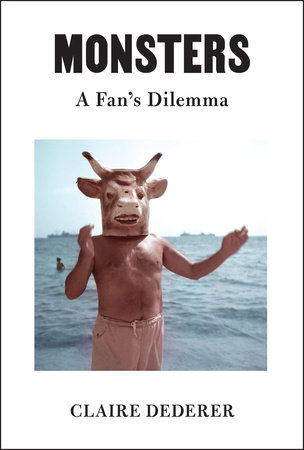
Claire Dederer’s Monsters: A Fan’s Dilemma offers no easy answers when considering the art of wrongdoers. Across thirteen chapters, Dederer unpacks the complex legacies of a variety of artists—Woody Allen, Roman Polanski, J.K. Rowling, Picasso, Michael Jackson, and many more—with unfailing wit and nuance. Threaded throughout this exploration of genius, creation, and monstrosity is her own history as a consumer, student, critic, mother, and writer in her own right. As Dederer openly wrestles with questions of fandom and morality, Monsters serves as an undeniable reminder that our biographies are inextricable from our experience of the art we love.
Monsters provides a roadmap for readers who are interested in thinking through the subtleties of Dederer’s questions and willing to sit with the resulting discomfort. “The way you consume art doesn’t make you a bad person, or a good one,” she writes. “You’ll have to find some other way to accomplish that.” As Dederer’s own biography shapes her considerations of capitalism, criticism, and time itself, Monsters offers a deeply personal testament of one fan’s multifaceted relationship to the art of imperfect people.
I spoke with Dederer over Zoom about her experience of going viral, fame’s relationship to art, and the thorny intersections of capitalism and love.
Abigail Oswald: How did the viral response to your Paris Review essay “What Do We Do with the Art of Monstrous Men?” feed into the way you crafted Monsters?
Claire Dederer: Every writer knows that having a viral piece is both a dream and a nightmare. Here’s the deal with that piece, I wrote this book called Love and Trouble about predation of young women—girls, really—in the 1970s, and a theme of the book was sort of “What is it like to be an adult who had that experience, and how did it affect my sexuality?” And in that book I really engaged with Roman Polanski. He’s used in the book as a kind of straw man, and also as kind of a person I’m in dialogue with. So by the time I’d finished that book, I really knew everything there was to know about Roman Polanski’s rape of the young girl, and yet I was still watching the films. So I started writing Monsters, I’m gonna say in 2016. And just really sitting with this question of what is happening when I consume this work. What do I feel like? What’s my experience of it? How does my idea of him alter me as an audience member?
So that essay was never conceived as an essay. It was always conceived as the first chapter of the book. I had really approached the subject with curiosity, without an axe to grind, without something I was trying to prove, but with this very exploratory mindset, and I think that’s why the essay did well. I think it was because it was nuanced, and the nuance didn’t come from me being some genius, the nuance came simply from the fact that it was something I’ve been working on for years. But it looked like it was in response to the moment, and so for me that was a really interesting experience—almost more as a citizen than as an artist myself—because it was really heartening, actually, to have something in the current information economy that was super nuanced and had a really strong positive response, right. I don’t mean to be Pollyanna-ish or like, bright side of miserable topic, but that made me feel both excited about my work, but also excited that there was a potential for a more complex dialogue. And so that was my initial response.
Then I had this experience of the ways in which there were feminists who had a problem with the essay. There was a response that was like, don’t totalize these kinds of offenses. And I was like, well, clearly I didn’t make that point clearly enough. So that was great, I could take that on board and think about it for the final book, which, as you’ve seen, I feel like I’ve wrestled with it. And there was just this constant barrage of Woody Allen defenders and men’s rights people and accounts being set up to attack me. Which speaks to my larger point, which is there’s something about our subjective emotional collapse with this work that is undeniable and profound, which I saw in all these accounts being set up to attack me.
So, as I proceeded working on the book, [I was guided by] the knowledge that nuance and a really deep exploration was going to be my watchword. It took me five years to write the book.
AO: Part of the modern rise in this conversation about the artist’s biography can be attributed to changes in media consumption and the sheer contemporary accessibility of said biography. How would you say the more widespread accessibility of biography has affected our sense of responsibility as consumers?
CD: One of the central ideas of the book is the idea that we don’t strive for biography, it happens to us. That biography is like an ongoing natural disaster—just befalls us, right? And that we don’t really get to choose that. So in terms of how I personally approach knowing things about the people whose art I consume, I feel like choice is not part of it. It just happens. The plight of the audience member, as I see it in this book and as I explore it in this book, is this person to whom the knowledge has already happened. So then, what do you do with it?
What effect do I think that has on our experience of art? I think that the answer to that is, first of all, taking a step back and saying it does have an effect on our experience of art. The initial question that sort of comes up over and over—or used to, I think it’s slightly more nuanced now—is “Can you separate the art from the artist?” And that’s one of the first principal questions this book asks. And because I believe that biography befalls us, and because I believe we can’t pull out our response to the biography, I think the decision to separate is a flawed decision. It’s a failure before it begins. I think my first response is that we respond with that biography on our minds, whether we want to or not. And then the question for the audience is what do you do with that knowledge? Do you acknowledge it and consume the work anyway? Do you not watch the work because it’s too painful? Do you not watch the work because you’re making an ethical stand? And I think there’s as many answers to that question as there are viewers, readers, listeners…
AO: You write at length about the difficulties women encounter in their efforts to make art, even touching on your own personal feelings: “When I do the writing that needs to be done, I sometimes feel like a terrible mother.” Monsters is primarily about men, but you do discuss a few women—Anne Sexton, for example, whose daughter detailed their fraught relationship in her memoir, Searching for Mercy Street. Can you talk more about how you considered women’s relationship to monsterhood while working on this book?
The idea of what is unforgivable in a woman isn’t a sin of commission—it isn’t an action—but it’s a sin of omission.
CD: So one of the early things I do in the book is start to interrogate this word “monsters.”…I sort of move through this idea of the monster and then explore the idea of “the stain,” which is this inevitable coloration of our experience of the work—which to me is more interesting, because I like how it suggests the inevitability, and I also like that it sort of has less name-calling to it. It’s just, this thing has happened. And so I was thinking about what the stain is for women. And when I explored it and really thought about it, it had to do with abandoning children.
So I explored this idea of abandoning children through the lens of several female artists, and what became so fascinating to me about it was the fact that the notion is a continuum, right. I write in the book about how I went away on a fellowship and I was thinking about like, well, how long do I stay at this fellowship before I’m abandoning my teenage child, right? I was gone for five weeks, which was a very long time for me. And so that experience of being away and living that distance really brought home to me this idea that there’s no set answer, right? And then that notion of abandonment gets refracted in several different ways, you know? It’s like, Sylvia Plath killing herself and locking the door against her children is a kind of abandonment as a mother. Would her story feel the same if she was not a mother? Or Doris Lessing leaving two of her children behind in Africa, or Joni Mitchell giving a child up for adoption. These are all life choices that don’t bear necessarily, don’t deserve the word monstrosity, but they color our view. And it just seemed like the idea of what is unforgivable in a woman isn’t a sin of commission—it isn’t an action—but it’s a sin of omission, where you fail to nurture. And as somebody who is a mother and feels like I’m never quite—my kids are grown, and it’s like, am I doing enough? I feel that to this day…
AO: In your writing on Hemingway, you explore the idea that he might have felt trapped, even tormented by his performance of masculinity. There’s this idea that some artists who reach a certain level of celebrity begin to feel hemmed in by their public persona, or otherwise responsible for maintaining a certain audience perception. Were some of the artists you discuss acting out in an attempt to fight that public image, while others’ bad behavior was an attempt to reinforce it?
CD: I think it’s less of a monstrous question than a problem of great fame and great success. Anytime you have such a successful image… What do you do with it? I think a really creative genius, a really great artist, will figure out a way to continue to make their work. But they’ll have to either decide not to engage with the persona, or bring the persona into play, right? And I think that’s part of, you know, Woody Allen at his greatest is engaging with his own persona, right? I mean, I think that in Stardust Memories he does that hilariously. I think that sense of play about it is really interesting. And I think someone like Hemingway, obviously he was trying to play with it in The Garden of Eden—I mean, maybe not even consciously—but he’s undermining some idea about his own masculinity. But maybe if you’re that masculine of a man in a culture that venerates masculinity so powerfully—maybe it’s a dead-end street, you know? Maybe it’s harder to get out. Whereas Woody Allen, you know, his persona was one that was other, right? He’s the weakling, the kid—there’s so much about that that was other as he was coming up. And then I think there’s also brilliant artists who just do everything in their power to not engage with their persona and stay out of it.
“Chicken-Flavored and Lemon-Scented” by Katherine Heiny
Colette has been a driving examiner for twelve years—she’s thirty-six—and yet it only occurs to her today that Ted Bundy had had a driver’s license. And that means that some driving examiner had taken him for a road test. Think about it: some driving examiner had willingly clambered into Ted’s VW bug and driven off with him. Maybe the driving examiner had even been a woman. A woman who never knew she had ridden next to Death, never knew she had docked Death points for improper clutch control.
Why has Colette never thought of that before? But she thinks of lots of things lately that she hasn’t thought about before.
It is early February in Maryland, the day as bleak as a pen-and-ink drawing done on old gray paper—bare trees, muddy snow, the road clear but scored with white salt stains like the scars from old injuries. Colette parks behind the DMV building and walks up the sidewalk to the employee entrance. She’s a little late and the other driving examiners are already there: Vic, Gregg, and Alejandro. Vic is a pointy-faced man of about forty with slicked-back dark hair who looks like a weaselly sort of hood, or maybe just a weasel, with his small eyes and vicious smile. Before landing here at the DMV, Vic worked as a bouncer, a roadie, a security guard, a fitness trainer, an auditor, and a head cook—name a job where you got to intimidate people and Vic has held it.
Gregg is an older man with bushy salt-and-pepper hair, a bushy salt-and-pepper beard, and horn-rimmed glasses. He looks like a retired history teacher and is, in fact, a retired history teacher. He likes to do cryptograms between examinations. No one knows why Gregg works as a driving examiner instead of enjoying his retirement and doing unlimited cryptograms at home in his underwear. Colette worries that Gregg has been unwise with his pension and is short of money but Vic says it’s undoubtedly that Gregg doesn’t want to stay home with his wife. Gregg’s wife packs him the most elaborate lunches Colette has ever seen, with all the food in undersized portions: tiny sandwiches, miniature quiches, itty-bitty salads in old baby food jars, cupcakes no bigger than a quarter. “Can you imagine living with the woman who packs those lunches?” Vic asked. “His choices are probably to come here or stay home and help her organize her toothpick collection.” Colette thinks he might be right.
Alejandro is a compactly built man in his late twenties with close-cropped black hair, bright brown eyes, an easy smile, and chiseled features. Not chiseled as in especially strong or sharp, but chiseled as in some sculptor had apparently chiseled them especially for Colette, had known what Colette would find handsome before she herself knew it.
Alejandro had started work here six months ago. Colette had been out on a road test when he arrived—she’d come back to the office and there he was. He rose to shake her hand and introduce himself and Colette dropped her clipboard. “Sorry I’m so distracted,” she said, leaning down to retrieve it. “My last road test drove the wrong way down a one-way street.”
That was true. Colette had never been so grateful to have an excuse for looking flushed and out of breath.
The driving examiners work at four metal desks in a room with cinder-block walls painted the color of curdled cream. The only window is one-way glass and the view is not of outside but of the four scuffed blue plastic chairs in the hall where test-takers wait to take their road tests. (The person who accompanies them—usually a parent—has to wait over in chairs on the other side of the building.)
A moment or two after the test-taker sits down, Trina or Gina from Written Tests pops open the door to the driving examiner’s office, tosses the test-taker’s folder into the tray on top of the filing cabinet, and retreats.
Vic always volunteers for the morning’s first test, and today it’s a burly guy in a maroon sweatsuit.
“Okay, I’m headed out for coffee,” Vic says. What he means is that he’s going to make the burly guy go through the McDonald’s drive-thru as part of the road test. He does it every single day, and no test-taker has ever thought to complain, not even the lady who chipped the Ronald McDonald statue and had to pay three hundred dollars in repairs.
“None for me,” Colette says.
Vic frowns. “Why the fuck not?”
“It gives me headaches.”
“What, after decades of drinking coffee, it suddenly gives you headaches?”
“It’s possible to develop an allergy at any time in your life,” Gregg says.
Vic looks at him, annoyed. “Now you don’t want one, either?”
“No, I want a premium blend, black with two sugars.”
“Alejandro?”
“Americano, with an extra shot of espresso. I’ll make up for Colette’s lack of caffeine.” He winks at Colette. The wink doesn’t cause her heart to leap with hope anymore. She thinks that must be a good sign.
The driving examiners are supposed to work in strict rotation, like a batting order lineup: the first available driving examiner taking the next test-taker. But Colette and Vic and Gregg have long ago developed their own system where they assess the test-taker through the one-way glass (and study the paperwork in the test-taker’s folder) and make their own assignments.
Rules apply, obviously. No one is allowed to strike every undesirable test-taker who comes their way because that would basically mean no one except pretty girls, men with kind faces, and librarians would ever get driver’s licenses. But they can pick and choose to some extent.
None of them liked to take old people. The problems with old people were endless: hearing loss, vision loss, memory loss, slowed reflexes, confusion. It broke Colette’s heart when she saw some elderly person shuffle out to take their test and knew that person had once been lithe and slender, brimming with intelligence and verve. And she knew that the old people still thought of themselves that way. They had no idea the younger, more capable versions of themselves had decamped decades ago. It was heartbreaking but it was also fucking scary. The old people led you out to their Lincolns and Buicks (they didn’t approve of foreign-made models) and the cars would be ringed with dents and scrapes, little souvenirs of the places the old person had driven. And off you went on a hair-raising road test with someone who could barely see past the hood. They straddled lanes, ignored stop signs, braked abruptly (without cause), accelerated suddenly (also without cause), pressed simultaneously on the brake and gas pedals, drove over curbs, nearly drove over people. All of them—every single one—remarked without irony about how more drivers honked their horns nowadays, how there’d been a mysterious uptick in honking recently. The old men said it was because young people are so entitled they couldn’t wait for anything; the old ladies said it just showed no one bothered to learn proper manners anymore.
No driving examiner liked to take teenagers, either. Teenagers were almost scarier than the old people. Teens had excellent vision and hearing, superb reaction times and hand-eye coordination, but their prefrontal cortexes were not fully developed. Teens were always speeding, running red lights, weaving in and out of traffic, tailgating, pulling out in front of oncoming vehicles—all this when they knew they were being tested. Shouldn’t teenagers be used to taking tests and know how to concentrate? Weren’t they beaten down by the educational system’s focus on standardized testing? Apparently not. Colette had had teenagers behave in ways she at first took to be pranks: checking their phones in the middle of the road test, answering their phones in the middle of the road test, taking their hands off the wheel to do a little victory car-dance after turns, reaching into the back seat while driving to root around for a water bottle. Nerves accounted for some of the behavior but Colette thought most of it was just plain old terrible teenage judgment.
But the test-takers weren’t all old people and teenagers. There were many other categories, and these were the ones the driving examiners were eager to volunteer for, depending on their own strengths and style.
Sometimes Colette thinks that Vic becoming a driving examiner had been like an artist picking up a paintbrush for the first time: that rush of exhilaration that comes from finding your calling. As a driving examiner, Vic can intimidate people full-time—and in the privacy of their cars. He breaks people down and enjoys doing it, like a professional torturer. He excels with aggressive test-takers: the impatient executives in power suits who carry briefcases to show how important they are, the medical professionals who wear scrubs or white coats to show how busy they are, the people who can’t stop tapping their shoes and checking their watches, the awful and angry types who shout at DMV employees. Vic meets these test-takers with a shine in his small eyes, his sharp crooked teeth bared in a predatory smile. He takes them on the most challenging routes, requests impossible accuracy in parallel parking, asks them to read road signs that have already blipped by, shakes his head and clucks his tongue just to unnerve them. Vic is a bully and a tyrant, but sometimes when Colette watches him swagger out to meet a suited, loud-voiced man who has just yelled at Trina or Gina in Written Tests, her heart swells with gladness. Justice will be meted out swiftly.
Sometimes Colette thinks that Vic becoming a driving examiner had been like an artist picking up a paintbrush for the first time: that rush of exhilaration that comes from finding your calling.
Gregg’s style is loose, casual, almost bumbling. He goes out to meet the test-takers still pulling on his coat, his clipboard fluttering with papers, a cup of coffee sloshing in one hand. He’s particularly good with people on a deadline: the young mothers who check their phones for messages from their babysitters, the housekeepers and domestic staff who have obviously called in sick to work and won’t be able to return if they fail, the anxious landscapers and construction workers whose livelihoods depend on them passing this test. They seem to understand that this cheerful, bearded man considers the test a quick disruption of ordinary life—the sooner it is over, the sooner they can get back to their jobs and he can get back to his cryptogram—and they adopt his efficient attitude.
Colette knows her own strength as a driving examiner is her ability to project calm. She’s like a kind of reverse microwave—molecules slow in her presence. She approaches test- takers with a gentle smile and a measured step, her fine blond hair smoothed into a low ponytail, her pale gray eyes free of makeup or judgment. She keeps her voice low, her gaze steady, her movements smooth. She volunteers for the extremely nervous test-takers (and all test-takers are nervous; it is just a matter of degree). She takes the teenagers whose hands shake so much they keep dropping their documents, the women who shred tissues compulsively and thin their lips into nonexistence, the men who grow unhealthily red cheeked and sweat huge amoeba-shaped stains on their shirts. And she takes the people who are not only nervous about the road test but seem nervous about life. People who come to the DMV wearing pajama pants and slippers, or cardigans with food dribbles and shoes without laces. Or—this is somehow worse—people who have dressed up. They wear clothing which has moldered unworn in their closets for years: shiny polyester blouses, corduroy blazers, mismatched suits, dresses bought on clearance with the price tag still attached. Men with crumbs in their beards, women with fearful white-ringed eyes, teenagers who swallow with loud clicks—all of them looking like they want to put their hands over their ears. Everyone hates going to the DMV but these people fear it. These people don’t function well in the world for whatever cause—anxiety, illness, trauma, abuse, or just a lifetime of having been bullied by assholes. But they still need to get places, so here they are to get their driver’s license, and Colette is here to guide them through the process as gently as possible.
“I know you’re nervous but this is no big deal,” she says to them softly. They look at her with mistrust—everything is a big deal to them. “I’m going to talk you through it. No surprises, okay? I’m not here to trick you. I’m here to help you. I want you to pass.”
She does want it. She wants them to have this triumph, this shining moment of success in a life that, for whatever unfair reason, has held precious few such moments. Some of them still fail—no amount of gentle encouragement and patient reassurance could calm them—but a lot of them pass, and Colette can share in their victories. Those victories are why she stays at the DMV.
In the beginning, Colette and Vic and Gregg had been nervous about how Alejandro would fit in. He seemed competent but lots of driving examiners are competent. But would he actually add anything to their lives, would he lighten their workloads in any way, would he find his own specialty? The answer to all of these questions was yes. Alejandro steps up to every test-taker with a welcoming smile and a very small and courtly bow. (Yes, an actual bow.) He takes the entitled people—the soccer moms and the private-school kids and the expats and the impeccably dressed rich people who disdain the blue chairs as too down-market to even sit in—and he defuses their entitlement with his apparent delight in their company. He flashes his dazzling smile at the cross, cranky older people who bristle with defensiveness and makes them goggle at him with unexpected pleasure. Alejandro also takes the “Mouths.” Mouths are people who talk so much in their professional and personal lives that they’ve forgotten how to be quiet even during a road test: hairstylists, bartenders, customer service reps, insurance salespeople, business recruiters, event planners, corporate fundraisers, backpackers who tell you how they’ve done Bangkok and it’s way too touristy and how they’re basically Buddhist now. No one likes Mouths because they talk all the way through the road test—usually they start talking before they even put the car in gear—and the test takes three times longer than normal. What’s more, Mouths usually fail the road test because they are too busy talking to hear instructions—and that means they’ll be back and the process will repeat itself. But not for Alejandro. He and the Mouth drive off and return precisely twenty minutes later, the Mouth having passed and Alejandro having somehow stayed sane. No one knows quite how he does it. He says it’s just a matter of really listening carefully to the first story, of making the Mouth feel heard and understood, but Colette knows it’s more than that. Alejandro genuinely wants to hear their stories (at least the first one) and this unfeigned interest makes the test-takers fall in love with him, just the way she had.
Vic returns, having failed the test-taker despite the drive-thru. “Sad sack didn’t use his turn signal once,” he says, setting a cardboard McCafé cup on Colette’s desk.
“Vic, I said—”
“It’s hot chocolate.”
“Oh,” she says, surprised. It’s so rare for Vic to be thoughtful. “Thank you.”
“You owe me two-eighty.”
Colette sighs.
Beyond this, the morning holds few surprises: Gregg completes a cryptogram in ninety-seven seconds, his personal best. A soccer mom impresses Vic by expertly parking her minivan and he reluctantly passes her. A Mouth tells Alejandro that dogs use eighteen muscles to control their ears. Colette takes an elderly man out on a test and then has to urinate so urgently that she forces him to do an unannounced and tricky left turn into a corner gas station so she can leap out and pee in the gas station’s horrible, sewer-smelling restroom.
Alejandro hadnot only lightened their workload, he had enriched their lives in a hundred ways. He was a saxophone player and he brought a portable speaker to work and played soft jazz for them from his iPod. He put up a whiteboard and wrote WE HAVE GONE _____ TESTS WITHOUT NEARLY DYING and they all changed the number after every test. (They never got higher than fourteen before going back to zero.) He printed out copies of a daily cryptogram and made all four of them solve it—the winner got whatever Gregg’s wife had packed him for dessert. He talked to Gregg about bird-watching (who knew Gregg watched birds?) and the Battle of the Somme. He talked to Vic about workout routines and how he, Alejandro, could build more muscle, and about the Hudson Hornet that Vic hoped to buy someday. Once Colette had glanced over while Alejandro and Vic were talking, and Vic’s pointy face had softened and his weaselly eyes had widened until he looked almost human, almost kind.
But Alejandro had changed Colette’s life more than anyone else’s. She realized that before he came, her life had been pedestrian—although could a driving examiner’s life accurately be called pedestrian? Maybe it was more like she had been puttering along in a school zone at twenty-five miles per hour. But after Alejandro’s arrival, her life—at least her work life—was full of excitement and adventure, great happiness and even-greater fear.
The fear came from knowing that Alejandro would move on, probably sooner rather than later—he was too smart, too ambitious, to work as a driving examiner forever—and also the constant worry that he would start dating someone. Colette learned from conversational crumbs that Alejandro had dropped (and she, mouselike, had assiduously collected) that he was single, straight, lived by himself, and spent most of his free time playing saxophone in a jazz quartet called the Jazz Merchants. (Sadly, the Jazz Merchants mostly played at private events; Colette could not just happen to show up.) He was single now but he could meet and start dating some lucky woman at any moment! He could meet someone at a jazz rehearsal or the supermarket or the gym or—this last one was terrible to consider—during a road test. What if Alejandro drove off with some beautiful girl and came back twenty minutes later in love? And so many beautiful girls came to the DMV. Vic even had a code for them: “Chicken-Flavored and Lemon-Scented.” Chicken-flavored and lemon-scented, a Chelsea, a pretty girl. Vic and Gregg had always volunteered to take the Chelseas, but last year, Gregg had been written up for asking a girl if she was on the pill—“It came up in conversation!” he’d told Colette. “It was perfectly innocent!”—and now he never takes one if he can help it. Pre-Alejandro, Colette had taken only the extremely nervous Chelseas and the ones who looked vulnerable enough that Vic might be able to bribe them into giving him a blow job, but now she takes those plus any Chelsea who she fears is Alejandro’s type. Sometimes she thinks it might actually be easier if Alejandro had a girlfriend; it’s horrible to feel you’re competing with the world.
The happiness came from knowing that every weekday would be spent in Alejandro’s presence. Forty hours of pure pleasure—although minus time spent actually doing their pesky jobs, of course. Colette prepped for conversations with Alejandro nightly alone in her apartment: she researched jazz music, she signed up for an online class about craft-beer brewing, she watched professional hockey. (That’s love for you.) But most of that was unnecessary because Alejandro was so easy to talk to.
“How are your neighbors?” he would ask. “Are they still watching Calliou every night at top volume?”
“Yes, but now I go salsa dancing most nights so it doesn’t bother me,” Colette said, although of course she didn’t—she just put on headphones like a normal person. But it wouldn’t hurt to have Alejandro think she was out dancing.
Or he’d say, “Tell me where you went hiking this weekend,” and she’d say, “Cascade Falls,” even though she’d really been hiking through Ikea, shopping for new sheets and throw pillows and framed prints to spruce up her apartment in case Alejandro ever came over.
And it seemed like he would come over; he would ask her out. He paid so much attention to her. “I watched 90 Day Fiancé,” he said once. “It surprises me that you like it—you’re so levelheaded, so smart about everything, especially relationships.”
“I’ve done my share of impulsive things,” she said quietly.
Alejandro looked at her steadily, not smiling but looking like he wanted to. A bright, hot look. “Good impulsive or bad impulsive?”
The moment stretched between them like strands of spun sugar.
“Guava!” Gregg cried abruptly, causing them both to jump. “That’s the word I couldn’t figure out.” He chuckled happily into his beard and Colette let out a long breath, trying not to sigh.
Lunch rolls around, and Colette realizes that salmon is just like the thought of Ted Bundy taking his road test: frightening and disturbing, and yet she’s never thought of it until now.
Lunch rolls around, and Colette realizes that salmon is just like the thought of Ted Bundy taking his road test: frightening and disturbing, and yet she’s never thought of it until now. Gregg’s wife has packed him a little Tupperware container of cold poached salmon and Colette can’t imagine why anyone would make this, let alone eat it. The thought of biting into it, biting into a cool wet wobbly fish, its flesh on your tongue like a cold quivering glob of mucus—she pushes her salad away, half eaten.
Alejandro comes in, unwrapping a sandwich. Before he sits down to eat, he wipes the “2” off the whiteboard.
“What happened?” Gregg asks.
“A girl took her sweatshirt off over her head in the middle of an in tersection,” Alejandro says, writing a zero in the blank.
Vic leers around a mouthful of hamburger. “How were her tits?”
“I thought I was going to be killed,” Alejandro says. “I wasn’t worried about her chest. And she had a T- shirt on underneath, anyway.”
“What are you staring at?” Vic asks Colette.
“You really are reprehensible,” Colette says to him.
“Don’t be insecure,” Vic says. “Your tits are great, and getting bigger all the time.”
Unexpectedly, Gregg comes to her rescue. “I want to keep my dessert.”
“Fair enough,” Alejandro says. “You got the best time on the cryptogram.”
“No, I mean I want to keep it every day.”
“Gregg, man.” Alejandro looks pained. “Have some decency.”
Gregg clutches his lunch bag defensively. “You guys can have some other dessert. You can go get doughnuts or buy cookies or something.”
“That’s not the same,” Vic says, and for once Colette agrees with him. She’ll miss the miniature éclairs, the cheesecake squares the size of postage stamps. But that’s February—all the joy leaks out of life.
Alejandro had hosted an office Christmas party at his apartment. He passed out the invitations, and Colette and Gregg and Vic had accepted. No one told Alejandro that their usual office Christmas celebration was ordering a party platter from Buffalo Wild Wings and having Vic bully his pre-lunch test-taker into picking it up—sometimes he even got the test-taker to pay for it. Instead they all said they’d be delighted.
Colette has a flat stomach and slender, shapely legs but square hips and no waist, which means that the khakis and green polo shirt the driving examiners are required to wear hide her body’s assets and emphasize its flaws. But for Alejandro’s party, she wore a short pale gold dress with bell sleeves and knee-high brown boots. She had wanted to wear makeup to work once Alejandro had started there, but she feared Vic’s sharp eyes and sharper comments. She wore makeup to the party, though, and styled her hair in loose waves.
Gregg had come without his wife (but with a Tupperware tray of miniature strawberry tartlets she’d made). Vic was there with a date—a woman named Shelley, who seemed nice and normal but maybe she hadn’t been dating Vic long enough to know how mean he was. Alejandro had invited Trina and Gina from Written Tests as well as people from Vehicle Registrations, Business Services, and Vision Testing. (Colette did not like the inclusion of Vision Testing, or at least not the inclusion of Lissa, with her platinum hair and low-cut blouse, but Lissa left early.)
Alejandro was as charming a host as he was a driving examiner. He circled among them with a wine bottle in his hand, topping up drinks, asking questions, loosening knotted conversations. When he got to where Colette stood listening to Bertha from Business Services talk about how she might update her phone’s data usage plan, he winked.
Twelve guests, eleven departures. Colette waited the others out by lingering in the bathroom and then letting Alejandro refill her glass while they waited for Gregg’s Uber to arrive. As soon as he was gone, Colette said, “I should call my own Uber,” and Alejandro said, as she had hoped he would, “Why not stay for another drink?”
They sat on the sofa and Alejandro said, “Okay, now that I have you alone, tell me about Bertha’s phone plan.” They laughed and sipped their wine. They laughed and sipped their wine. They laughed and sipped their wine until there was no wine left. And then Colette leaned forward and kissed Alejandro. He kissed her back and she felt an actual thump as they crossed the barrier from coworkers to more-than-coworkers, just like the thump when a speed bump took a test-taker by surprise. Thump, the front wheels go up; whack, the back wheels come down; and the whole car shakes. The room shook, or at least Colette shook, and then they were undressing and then Colette was straddling him naked.
Alejandro said, “Is this okay?”
She sensed that a pause would be fatal. So she’d whispered into his ear, “It’s perfect. Don’t stop.”
Colette is busy on her computer when Vic says, “Look up. Chicken-flavored and lemon-scented.”
Colette’s stomach lurches again—she imagines chicken soaked in cleaning spray—but it’s only Vic using the code. She looks out the window at the test-taker chairs.
The girl standing there uncertainly is definitely a Chelsea: very slender with tawny skin, light eyes in a small elfin face, and long light-brown hair that she has straightened and smoothed into shiny panels, like silk curtains. She’s wearing black leggings and a gray sweater topped by a raspberry-colored down jacket that matches the color of her lips. But even through the window, they can all see the nerves rippling over her in waves. Nervousness is actually distorting her expression—it’s like looking at someone on a television with faulty wiring.
“She’s yours, Colette,” Vic says regretfully.
“Yes, I guess she is.” Colette checks the folder. The girl’s name is Seraphina because of course it is. She turned sixteen in May and passed driver’s ed back in August, so why is she here on a school day in February?
Colette walks out to the chairs and shakes hands with Seraphina. The girl’s fingers tremble even when she’s grasping Colette’s hand.
“You look pretty nervous,” Colette says. It helps if you can get them to admit that. “Is that how you feel?”
Seraphina’s eyes are huge, like someone using the big-eyes filter on Instagram. “Yes,” she whispers.
“Everyone’s nervous when they do the road test,” Colette says. “It’s totally normal to feel that way. Let’s get started and you’ll see that it’s no big deal.”
On the day after Alejandro’s Christmas party, Colette got to work early, wearing khaki pants but with a green silk polo shirt instead of her usual cotton one, and dangly gold earrings. She sat at her desk and tried to busy herself with paperwork but every time she heard voices in the hall, her head lifted as though pulled upward by strings. And yet Alejandro didn’t show.
Finally, at ten, she said to Vic and Gregg, “Where do you think Alejandro is?”
“Took himself a personal day,” Gregg said. “Gina told me.”
“He’s probably in bed balls-deep with Lissa,” Vic said. Colette could not keep her gaze from flicking instantly to Vision Testing, but there was Lissa, working as usual.
“Made you look,” Vic sneered. “I don’t know where that bastard is. Aren’t you cold as fuck in that shirt?”
Colette was indeed cold as fuck, and not just from the shirt. She shivered at her desk or else huddled frozen on test-taker passenger seats, breathing on her fingers to warm them, giving instructions robotically, staring out the window when she should have been watching the road. That day, a Thursday, wore on interminably, like some horror-movie monster who won’t die. She replayed the moment of leaving Alejandro’s apartment over and over: She had dressed quietly and leaned over to kiss him. “I’m going now.” She was too hyped up to think about sleeping there.
Alejandro had stirred sleepily. “I should drive you home.” His voice was slurred.
“Just rest,” she’d whispered. “See you tomorrow.”
“Safe journey,” he said. He was asleep a moment later.
Should she have stayed? Should she have texted him when she got home? Should she have called him in the morning? Stopped by with coffee and doughnuts? Why didn’t Alejandro call or come by with doughnuts? Why was she left to sort through every exchange for meaning, like a seventh grader?
Alejandro was there on Friday, same as always, friendly and smiling. But by then Colette understood that the previous day had been a buffer, a cooling-off period, a time to let her hopes diminish. Perhaps it had been a kindness; Alejandro had not seen the silk shirt, or the dangly earrings, or her eager face. Her fever had broken; she no longer glowed like a coal. Friday was just a day indistinguishable from thousands of others that had come before it.
But as she trudged through the snowy parking lot after work, Alejandro called to her. “Colette, wait a second!”
She stopped, heart rising like a balloon, and he caught up to her, pulling a wool hat on and hopping from foot to foot in the cold. He told her that he really liked her and valued their friendship enormously, but she had failed to use the mirrors correctly when changing direction and she had not responded appropriately to traffic lights and she showed confusion at four-way stops and she had driven too fast for the conditions and he was so sorry not to have better news, but she had failed to pass.
Or something like that.
Seraphina leads Colette through the double glass doors to where a Subaru Forester SUV is parked. They get in and Seraphina grips the steering wheel so tightly that Colette thinks her hands might sink into it, that the steering wheel might puff up around her fingers like Play-Doh.
“You can relax a little, Seraphina.” She wishes the girl’s name was shorter. “We’re not going to drive just yet. I want you to turn the headlights on. Can you do that? Good job. Now the hazard lights. Excellent. Now turn them off. You’re doing really well. Now I want you to start the car and drive up to that stop sign and turn left.”
Seraphina turns the ignition on and puts the Forester in gear. They drive up to the stop sign and Seraphina stops properly—which is excellent. Many, many people do a rolling or improper stop at this first stop sign and fail their test less than ten seconds after it had started. This stop sign has caused more tears and anguish than the ending of Charlotte’s Web.
Seraphina turns left and Colette instructs her to follow the access road up to the intersection near the shopping plaza. Seraphina is doing well. She guides the Forester smoothly, following Colette’s directions, and she’s able to read the signs when asked. But she’s still holding on to the steering wheel like someone clinging to the wreckage of a sinking ship.
“Now, make a right turn here at the intersection,” Colette says.
Seraphina pulls to a stop at the red light, and looks to her left, where three lanes of traffic are coming toward them. The oncoming cars—two sedans and a pickup—are all red and Colette has just enough time to think the cars look bright and angry on the dull winter-gray road and then Seraphina pulls out into the intersection.
She doesn’t do it slowly or hesitantly but she’s not panicking or rushing, either. She just swings the Forester around the corner and into the right lane as though she has a green light and not a single care. The pickup truck is behind them in the right lane and the driver hits his horn and doesn’t let up—an endless, furious howl.
“Go!” Colette shouts to be heard over the horn. “Go! Go! Go!”
Obediently Seraphina presses the gas pedal. The Forester surges forward but not fast enough. The pickup truck is closing up on them faster than an adrenaline rush. The snarling metal mouth of its grille is almost filling up the rear window.
Colette grabs for the steering wheel and pulls to the right, trying to get the car over to the right shoulder. Seraphina steers with her and presses even harder on the gas pedal and the Forester shoots across the shoulder and up the grass embankment. Colette sees white sky through the windshield and then abruptly black asphalt as they head down the other side of the embankment and then—shake, rattle, and roll, just like the song—the Forester comes to a stop in the (thankfully empty) outer parking lot of a shopping plaza. The wail of the pickup’s horn peaks and then dies away as it races by on the other side of the embankment.
Colette yanks the emergency brake up, then she reaches over and slams the car into park and pulls the key out of the ignition. She leans back in the passenger seat, panting, her hand resting on her stomach. Not this. Please not this. She won’t be able to stand it. But maybe it will be okay—it’s not like they went on a roller-coaster ride. The impact was minimal. Their seat belts didn’t even lock.
Her head is shaking and her arms are shaking and her hands are shaking and her fingers are shaking, but all separately, all to an independent beat.
She opens her eyes and turns to Seraphina, who is trembling all over in a weirdly disjointed way—her head is shaking and her arms are shaking and her hands are shaking and her fingers are shaking, but all separately, all to an independent beat. She looks like she might jitter apart completely.
Her panic makes Colette calmer. She steadies her voice. “Are you hurt?”
Seraphina shakes her head. “I didn’t see the cars,” she says. “Just didn’t see them. I mean, I saw them but they didn’t seem real.”
“That happens sometimes,” Colette says. Amazingly, this is true. Sometimes test-takers get so nervous that they experience a sort of cognitive dissonance—they blow through very visible stop signs or make right turns from the left turn lane.
Seraphina moans. “I feel like I’m going to throw up.”
That made two of them. “If you need to, just open the door. I’ll check the car,” Colette says. She gets out and walks around the Forester, looking for damage, but it seems to have emerged unscathed, and even the embankment doesn’t look too chewed up.
She gets back in the car. Seraphina has stopped shaking and her color’s better, but her eyes are still enormous. She pushes back the panels of her hair and Colette sees how small Seraphina’s face is, how thin her neck. She’s a childlike sixteen, despite her prettiness.
“I know that was really scary,” Colette says gently. “But we’re okay. The car’s okay, I’m okay, you’re okay.”
Seraphina looks at her strangely, intensely, her eyes blazing, and shakes her head. “No, I’m not. I’m not okay. I’m pregnant.”
“Ohhhhhh,” Colette says slowly, making a number of mental adjustments. “I see. Are you sure?”
“Took three tests in the CVS bathroom last week,” Seraphina says. She talks in a strangely precipitous way, like she’s just filling in details of a story everyone already knows, and maybe she is. “I knew even before the first one but I kept taking them, hoping for, like, different results.”
“How far along are you?”
“Seven weeks.” Her tone is a little impatient, like Colette should know all this.
“And the father—”
“Brayden Shaw.”
“Does Brayden know?”
Seraphina makes an impatient gesture. “Yeah, like I’ll just call Brayden Shaw and say, ‘Remember your little sister’s caroling party? Well, I got some follow-up news for you.’”
“But isn’t he your boyfriend?”
“Nope.” Seraphina shakes her head at Colette’s ignorance. “Because, guess what? He has a girlfriend.”
“Oh, Seraphina, I’m sorry—”
Seraphina keeps talking, evidently warming to her story. “What happened was his mom hired my friend Tia to help her with her daughter’s caroling party and Tia couldn’t do it so she asked me. But when I get there—no mom, no kids, just Brayden. I didn’t really know him. He goes to private school, so it’s not like we’ve talked. Tells me the party’s canceled because, like, the neighborhood association is against caroling and his mom is having everyone meet at the ice rink instead. I say, ‘Okay, well, I’ll just go back home,’ and he’s like, ‘Aw, come in and have some cocoa first.’ He said it like if I didn’t do it, he would be so let down. He made it sound like he was lonely and wanted to have cocoa with someone, like cocoa doesn’t taste good if you’re having it alone, and that’s true. Plus, you know Brayden, who wouldn’t want to have cocoa with him?”
Colette doesn’t know Brayden but she realizes she doesn’t need to—she knows the type. Handsome, arrogant, charming when it suits them. The type who whistle at you and then give you a stupid who me? look. The type who cock an eyebrow sexily at the camera even for their driver’s license photo.
“So in I go and we really did have cocoa because his mom had bought all these supplies for the party,” Seraphina says. “Then we went down to the basement and played Dark Souls III on the PlayStation and then we had sex on this giant beanbag thing his dad bought when he had back trouble. Although, I mean, a lot of stuff happened between the PlayStation and the beanbag.”
“What kind of stuff?”
Seraphina shrugs as though the details don’t concern her. “Talking. Kissing. More talking. I mean, one thing we talked about was that I asked him if he wanted to have sex with me.”
“And you, um, didn’t use protection?” Colette asks gently. (So Gregg was right— this kind of conversation can happen organically!)
“Brayden said he didn’t have any condoms,” Seraphina says. “And I didn’t have any—who brings condoms to a kid’s caroling party? So then we heard his mom and little sister come home and we got dressed really quickly. His mom was super sorry about the mix-up and paid me for babysitting anyway. Brayden stood behind her and did this”—Seraphina holds a thumb-and-pinkie phone to her ear—“but he didn’t call me the next day or the next. Finally I sent him an emoji of a penguin waving hello and he texts right back and says he has a girlfriend and can’t be talking to me. Says ‘I’m sorry if that wasn’t made clear to you.’ Those were his exact words. Like, you know, someone else should have made it clear to me. Like ‘Oh, I thought the Department of Girlfriends had informed you.’ When were they gonna inform me? When we were on the beanbag?”
Colette tries to steer the conversation back on track. “What about your parents? Have you told them you’re pregnant?”
“Tell my parents?” Seraphina asks. “Tell my parents? Listen, I can only have thirty minutes of screen time a day. My mother has a boxed set of Touched by an Angel. I can never tell my parents. The only person who knows is Tia.”
Colette is getting cold but she doesn’t want to give the keys back to Seraphina or ask her to turn on the car. “Do you know what you’re going to do?”
“I’m going to get an abortion,” Seraphina says firmly. “That’s why I need to get my license, so I can drive there. I can’t take an Uber because my parents would see it on the credit card and none of my friends can drive me because they only just turned sixteen. I’m the only one old enough to get my license now.”
How strange—the course of your whole life could hinge on your birth date, or a neighborhood association, or staying late at an office party.
“Seraphina, it isn’t legal to get an abortion in Maryland without your parents’ consent.”
“It is in Connecticut,” Seraphina says. “I googled it. I’m going to drive there and Tia’s going to come with me. We’re going next Wednesday when there’s no school because of a professional day.”
The madness of this plan fills the car like static suddenly, crackling and hissing. Colette pitches her voice low, in hopes of reaching Seraphina through it. “You can’t do that, Seraphina. Even if you had a license, it’s an extremely bad idea to drive yourself. Your reaction times could be very slow after the procedure, or you could even black out. They probably won’t even let you leave if they know you’re driving yourself.”
“Tia’s coming with me and we’re going to say she’s driving me.”
“No.” Colette sighs. She rubs her forehead, thinking. “No, you’re not. Give me your phone and I’ll put my number in it and we’ll figure something out.”
“Will you drive me to Connecticut?”
“No. But I’ll find someone who can help you.”
“Help me get an abortion?”
“Yes, if that’s what you want.” Colette has a friend who used to work at Planned Parenthood. She’ll know where to refer Seraphina, and how to help her tell her parents.
“I want it.”
“Okay,” Colette says. “Give me your phone.” She’s never given her number to a test-taker before and supposes she might come to regret it, but what else can she do?
“Thank you,” Seraphina says. She closes her eyes and whispers, “Thank you, thank you, thank you.” She sounds like she’s thanking the universe more than she’s thanking Colette.
“You’re welcome,” says the universe in the form of Colette. (Because surely the universe arranged this particular road test.) “Okay, let’s trade places and I’ll drive you back to the office.”
“Wait.” Seraphina opens her eyes. “Did I pass or not?”
Back at the DMV building, Colette parks the Forester and hands the keys to Seraphina. “Just tell your mom you didn’t pass. Say you need to work on your left turns. Call me tonight.”
“Okay,” Seraphina says, reaching for the door handle.
“And don’t drive anywhere. It’s not safe.” It occurs to Colette that Seraphina is probably more dangerous than Ted Bundy right now, at least as far as road tests go. Okay, so that’s her new rule: no serial killers or insane teenagers, at least for the next few months. Vic and Gregg and Alejandro will have to take them.
They walk back into the building and Seraphina heads off to the waiting section. Colette goes into the driving examiner room where Alejandro and Vic are leaned back in their roller chairs, watching something on Vic’s phone.
Colette looks at Alejandro. “We need to talk.”
“About what?” Vic smiles like a velociraptor. “You pregnant or something?”
“It doesn’t concern you, Vic.” She keeps her eyes on Alejandro. “Are you free after work?”
He hesitates only a moment and then nods. “Sure. Let’s go get a drink.”
“Good.” Colette feels the speed-bump jolt again as she passes from one part of her life to another. Bump up, bump down, a little shake, and the world changes. But it’s no big deal, she tells herself.
People do it all the time. She’ll be a good mother. She just knows it.
My mother was born and raised in Istanbul, then moved to the U.S. alone when she was twenty-four years old. Turkish, like many Middle Eastern ethnicities, is not white, nor is it part of a large minority group in the United States. It is a hazy, ambiguous ethnicity that feels stuck between two continents and two eras, mostly because it is. It is a country that on one side borders Syria, Iraq, and Iran; and on the other, Greece and Bulgaria. As a second-generation Turkish American, I’ve witnessed and felt the fear, confusion, and discrimination that my mother experienced throughout her half-life in the United States, especially post 9/11. I’ve watched, countless times, the way people’s faces change in line at the supermarket or the shopping mall when they hear her accent—one often immediately profiled as “Muslim” or the vague, fictitious term “Middle Eastern.” I later learned that “the Middle East” was a distinction coined in 1901 by a US Naval Officer and popularized by more white men during the First World War. In reality, the label is an amorphous, imaginary line simply drawn around a war-torn region with precious oil reserves. Giving it a name gave English-speaking men control over yet another thing and place they couldn’t understand.
Today, calling someone “Middle Eastern” instantly lumps them into a group of religions and nationalities which are worlds apart, yet the people that come from a certain set of countries in Eastern Europe, Western Asia, and North Africa do seem to share something: their arduous experiences of immigration and their children’s feeling of displacement, alienation, and loneliness while growing up in America.
In a small attempt to reclaim that fictitious border as something more than the stereotype of pita bread, hijabs, hummus, and Friday prayers, this is a list of eight novels that accurately and beautifully portray the complicated perspectives of American-identifying children of “Middle Eastern” immigrants. (They also, serendipitously, all happen to be written by women.)
During the summer of 2017, 20-year-old Sibel temporarily moves to Turkey to take care of her grandmother (who has recently been diagnosed with Parkinson’s) and to spend three undisturbed months studying for the MCAT. Her American boyfriend, Cooper, accompanies her, but soon their relationship is tested by Sibel’s family secrets, her mind-numbing headaches, the country’s political trauma, and her obsession with the ancient medical practice known as humorism. Halfway through the summer, Sibel finds herself the one needing to be taken care of by her family rather than the one taking care of them.
In The Four Humors, Mina Seçkin eloquently conveys the feeling of being caught between two countries and believing that you don’t belong in either. Throughout this compelling novel, she philosophically questions the ideas of conservative nationalism, the various ways to express female independence, and how much börek one can eat from their grandmother’s kitchen until they can no longer move.
Told through a multitude of perspectives, The Other Americans revolves around the aftermath of the death of Driss Guerraoui—father, husband, and Moroccan immigrant. His daughter Nora pauses her career as a jazz composer to return to her hometown in Mojave, California where she’d hoped she’d left for good. On the other hand, her mother, Maryam, yearns to return to her hometown in Morocco and is shaken by the hostility they face in America. Other characters emerge to tell their story, including a man named Efraín—who was a witness to Driss’s death but is afraid to speak up due to his undocumented status; Jeremy, an old friend of Nora’s and a recent Iraqi War veteran; Coleman, a detective trailing secrets; and Anderson, a neighbor trying to save his disintegrating family.
The novel contains a tapestry of voices, perspectives, faiths, upbringings, and accents which all come together to make sense of one tragedy. In a country where belonging is as much a mystery as the book’s central murder, Lalami masterfully integrates a family saga and a love story within the harsh realities of existing inside a foreign home on American soil.
The past ruthlessly confronts and distorts the present in this mesmerizing novel about Arezu, an Iranian American woman, who returns to Spain for the first time since living there as a teenager. During a summer on the cusp of adulthood, Arezu had expected to reunite with her father in Marbella, but when he never showed up, she instead began a haunting affair with an older Lebanese man. The passionate, mercurial, and traumatic encounter between the two (and its rippling effects) remain unforgettable for her. Twenty years later, Arezu is back with her Israeli American best friend to excavate the apartment where the affair first occurred along with the ghosts that stole her innocence. Weaving themes of Edward Said’s Orientalism with a modern-day Lolita in a narration reminiscent of the voices of Rachel Cusk and Marguerite Duras, this book tears you apart—while keeping you just intact enough to continue turning the next page.
This powerful debut by Etaf Rum explores the experience of Deya—an 18-year-old Palestinian American woman—as she prepares to choose a husband for her undesired arranged marriage. Her conservative grandparents push this tradition, even though it is 2008 and they live in Brooklyn, and Deya finds this particular inherited fate unjust and insufferable. The narratives of Deya’s mother and grandmother are also intertwined throughout the novel. Deya notices the oppressive patterns that repeat for all the women in her family. Until one day, something changes. Believing that her parents died in a car accident when she was a girl, Deya’s world is turned upside down when a stranger drops a note on their Brooklyn doorstep, unveiling long-held family secrets that betray everything she thought she knew.
Zaina Arafat’s stunning debut follows a “love-addicted” Palestinian American protagonist navigating life in Brooklyn. When she comes out to her traditional mother, she is faced with shame and the response, “You exist too much.” The young woman’s yearnings contrast with her religious and cultural upbringing and spill over into her art—until her reckless obsessions get her admitted into a treatment center called The Ledge, where she is forced to reconcile with her past and her present desires. Collecting vignettes from New York to Jordan, Lebanon, and Palestine, Arafat writes this restless and relatable character’s story into one that becomes unforgettable and extremely profound.
Betty, a queer Palestinian American woman living in the Pacific Northwest, has always been a miracle in her family. On the same day that her family’s soap factory in Nablus exploded in an air strike, Betty was stillborn but came back to life with permanent cobalt blue skin. Decades later, as a young woman, she’s faced with a life-altering decision: should she stay in the U.S. or follow the woman she loves (but in doing so continue her family’s burden of exile)? When Betty discovers her great-aunt’s notebooks, she thinks she might have found the answer, along with a pandora’s box of hidden feelings and confessions that span generations as much as continents.
This list wouldn’t be complete without The Idiot. Perhaps one of the most popular works with a recognizable Middle Eastern American narrator, Elif Batuman’s novel records Selin’s first year at Harvard University. Told in a vulnerable, philosophical, political, and diaristic voice, The Idiot follows a young and naive Turkish American protagonist as she navigates the historic halls of her dorm, learns as much Russian as possible, pines for an older Hungarian student who studies mathematics, exchanges emails with him (their version of modern-day love letters), and follows him across the world with the hope that he’ll finally confess his secret love for her.
Batuman’s sequel to The Idiot traces the older (but still naive) Selin during her sophomore year as she meets Ivan’s ex-girlfriends, attends dorm parties, investigates the mystery of her virginity, and travels across Turkey in the summertime, contemplating and conspiring against the ethical implications of becoming an artist.
Growing up in the early 1980s with an obstetrician-gynecologist mother, one would imagine that I would be well informed when it came to issues like puberty, reproduction, sex, and sexuality. Instead, I was quite sheltered and restricted when it came to these topics. As the child of Indian immigrant doctors, we didn’t talk about any of these issues, and it was tacitly understood that they were taboo and off limits. What’s even stranger is that my parents would talk to each other and their doctor friends about bodily medical issues — often in our midst — but didn’t talk to us, their children, openly about our own bodies. Since they were strict disciplinarians, I didn’t dare broach these subjects with them, despite burning with questions, struggling to understand myself and my body.
Thankfully, as a curious kid living in Queens, New York City, I was exposed to children and families different from my own, so I was aware that there was a lot I didn’t know. Girls in school would talk on the playground and in the lunchroom about boys they liked and about what happens between boys and girls when they like each other. But I wasn’t sure whether to believe them — what was true, what was made up?
In 5th grade, one of my classmates brought in her copy of Judy Blume’s Are You There God? It’s Me, Margaret. Over lunch, we huddled around her as she read from pages of the book including a scene where Margaret, the eleven-year-old protagonist, and her friend Nancy talk about practicing kissing boys by kissing their pillows. We talked about which boys in our class were cute and which ones we had crushes on and wrote their names onto our paper fortuneteller games. Then she read from another scene where they talk about getting their period:
“What’s it feel like?”
“Mostly I don’t feel anything. Sometimes it feels like it’s dripping. It doesn’t hurt coming out – but I had some cramps last night.”
“Bad ones?” Janie asked.
“Not bad. Just different,” Gretchen said. “Lower down, and across my back.”
“Does it make you feel older?” I asked.
“Naturally,” Gretchen answered.
I was shocked and scared to learn that girls start bleeding once a month and wondered what it would be like but tried to act like I was in the know since the other girls seemed unphased except for scrunching up their noses exclaiming, “Eeewww!”
Unlike my older sister, I wasn’t much of a reader; most books that we were made to read in school were about people who were so unlike me, a brown girl, child of immigrants. Also, my parents were more interested in us reading “schoolbooks” — books we needed to study for school — rather than whiling away our time on “storybooks,” books we read for our own pleasure. Hearing the passages from Blume’s Are You There God? It’s Me, Margaret., I was amazed that there was a book written for kids that so openly portrayed topics like crushes and the changes that happen to girls’ bodies. And I knew I needed it. I asked my friend if I could borrow her copy of Are You There God? It’s Me, Margaret. for a few days, and she agreed. I smuggled the book home in my backpack, worried about what would happen to me if my parents ever discovered it. If they found it, I suppose I could tell them it was about a girl named Margaret who talks to God and is trying to understand religion (incidentally, this is true). My devoutly Hindu parents couldn’t fault me for reading about a girl seeking to be closer to God and religion.
Over the next few days, I read Are You There God? It’s Me, Margaret. surreptitiously in my bottom bunk bed before my parents came home from work. Through the story of Margaret and her friends, I came away with a better understanding of what to expect as I moved from being a child to a teenager. Although Margaret and I didn’t share an identity, as a ten-year-old short Indian American girl, I related to her bumpy journey from girlhood to womanhood and her quest to understand herself and her body. However, whereas Margaret’s parents were generally open and supportive of her as she transitioned to adolescence, I grew up in a house where I wasn’t empowered to broach topics that were crucial to my own personal development, like puberty and sex.
My devoutly Hindu parents couldn’t fault me for reading about a girl seeking to be closer to God and religion.
When I got to 6th grade, we were told that we would be covering reproduction the following week in science class; our teacher gave us a parental consent form that we had to get signed in order to attend. I heard boys around me saying, “Yeah! We’re going to learn about sex!” and girls giggling as we all stuffed the consent forms into our book bags. Meanwhile, I was panicking — how could I possibly ask my parents to sign a form that told them that I would be learning about sex? They would never let me. For the next week, I fretted about which would be more humiliating — having to ask my parents for permission to attend “sex class?” Or, being the only kid in my grade to have to spend “sex class” in the library? I decided the latter. For a moment, I considered forging their signature and even determined that my mother’s more straightforward signature would be easier. However, the possibility of getting in trouble for forging their signature scared me even more than asking them.
On the last possible day to submit my consent form, I shoved it in front of my father just as I was running out the door to catch the bus. He looked it over and yelled “You think you can give this to me at the last minute and I’ll sign it? I won’t!” Smarting from his scolding and dreading the humiliation of being the only kid spending “sex class” in the library, I grabbed my backpack and lunch and headed for the bus. Suddenly, my mother came to the door with the signed form in her hand. “Thank you,” I said. She didn’t respond but she had a bit of a smirk on her face.
“Sex class” turned out to be very sexless and much less captivating than Blume’s Are You There God? It’s Me, Margaret. Instead of learning about the impact of puberty on the lives of girls I could relate to, characters who felt like they were my own friends and frenemies, we got a lesson in reproduction with drawings of headless figures. But the upside was that I now understood the basics of puberty and the mechanics of reproduction. In contrast, when the girls in Margaret’s class watched a film about puberty, Margaret already knew the information because her mother had filled her in:
Nancy passed me a note. It said, Here we go — the big deal sex movie.
When I asked her about it she told me the PTA sponsors it and it’s called What Every Girl Should Know.
When I went home I told my mother, “We’re going to see a movie in school on Friday.”
“I know,” my mother said. “I got a letter in the mail. It’s about menstruation.”
“I already know all about that.”
“I know you know,” my mother said. “But it’s important for all the girls to see it in case their mothers haven’t told them the facts.”
“Oh.”
I couldn’t imagine having such a frank conversation with my own mother about menstruation despite the fact that she had these conversations with her patients every day. Blume’s book not only filled a void of crucial knowledge, it filled an even more crucial emotional void.
Just before 7th grade, we moved out of New York City and into the suburbs of Westchester andI found myself the new kid in a new school, much like Margaret at the beginning of the book. I remember my first day vividly. All I saw was a blur of green through the school bus window. More trees than I’d ever seen. The bus pulled up to the school and, instead of a single building, it was a sea of yet more green, dotted with several buildings connected by covered walkways. As a 7th grader — a very short one at that — I’d get to roam these halls alongside towering high school seniors. It was a huge change from the concrete schoolyards glittering with broken glass I was used to. Instead, this school seemed like it had leapt off the screen of Sixteen Candles, which I had finally watched in secret that past summer through the miracle of cable TV. Disoriented, I tried to decipher the campus map handed to me as I stepped into the main building.
I found myself the new kid in a new school, much like Margaret at the beginning of the book.
After some wrong turns, I made my way to my homeroom, which would also be my first period class, Health. At the end of a long hallway stood a beacon of shaggy blond curly hair hugging a broad, smiling face. “Seventh Grade Health with Mrs. Smith, right here!” Heaving a sigh of relief, I walked up to her and introduced myself. “Welcome,” she said, then looking at my cast, she asked, “how’d you do that?” “Monkey bars.” She gave me a sympathetic nod and told me to take any seat I liked.
After everyone arrived, Mrs. Smith re-shuffled us into alphabetical order, and once the buzzer for first period sounded, she seated herself on her desk. She beamed at us and told us how excited she was for us because we were taking such a big step, moving on from elementary school, being on the cusp of being teenagers, our bodies changing, forming crushes and falling in love for the first time. At the mention of our changing bodies and crushes, I stared at my desk and heard awkward giggles. “We’re going to get into all of that here in Health class because it’s important. It’s how you become who you’re meant to be.”
And with that, Mrs. Smith hopped off her desk telling us our first section would be about sex, because, as she explained, “Why leave the best stuff for last?” I remember feeling mortified but thankful that she didn’t make us get a signed permission slip for Sex Ed, like my 6th grade teacher had.
Mrs. Smith walked to the blackboard and in the center of it wrote down the word “urinate.” Our giggles grew louder but with a nervous edge. She turned to an unsuspecting boy and asked, “Do you urinate?” to which he awkwardly replied, “yes,” and she proceeded to ask a few more kids and once she gathered several concurring replies, most accompanied by eye rolls, she declared, “I urinate too. All of us do. And yet we’re so embarrassed to talk about it. It’s just a natural body function, an important one, like eating and sleeping. So why be embarrassed?” She had a point. I eased into my seat and allowed myself to look up from my desk.
Mrs. Smith returned to the blackboard and asked us to name all the different ways we use to say “urinate.” At first, we sat in silence. Then, a girl with a cool asymmetrical haircut, double ear piercings, and two Swatch watches on her wrist piped up with “pee pee.” “Good!” Mrs. Smith replied, and wrote it on the board. Some girls giggled as they chimed in with “tinkle,” “go number one,” and “powder my nose,” then some boys laughed as they offered up “piss,” “take a leak,” and “go to the john.”
The rare conversations in our home about bodily issues were often filled with medical jargon.
Mrs. Smith looked over at Tej, a quiet Sikh boy, who had remained calm even as the rest of us lost our composure, laughing and giggling. She asked Tej if there was a slang expression for urinating in his culture. I wondered what he’d say. I hadn’t raised my hand to volunteer any answers. The rare conversations in our home about bodily issues were often filled with medical jargon. And we certainly didn’t talk about sex or what goes on “down there,” unless there was a medical problem, and then talk turned to medication, surgery, and possible outcomes, which made me squeamish.
We referred to our bottoms as “boom booms;” we called going number one “hishi” and number two “kakoo.” My parents warned us to keep our “boom booms” clean, and to make sure to do “hishi” before we left the house. I realized I had no idea where any of these terms came from. Had they migrated with my parents from India, or were they a strange mashup of Indian and American cultures?
I waited for Tej’s response, determined to keep my own family’s terminology to myself. No need to invite a nickname as a new kid — Kavita “Kakoo” Das. He was pensive for a second, and then quietly replied, “su su.” As she added “su su” to the many other phrases that filled the blackboard, Mrs. Smith asked him where he thought this expression came from, to which Tej matter-of-factly replied, “I think it’s because of the sound it makes when it comes out.”
After a second’s hesitation, we all gave in to laughter — even Mrs. Smith, even Tej. We left our first class a little less uncomfortable talking about our bodies and the way they work. I cherished being in Mrs. Smith’s class and finally having an adult who would talk to my classmates and I openly and honestly about puberty and sex. Being in Mrs. Smith’s class was like having Judy Blume as a teacher and as if Are You There God? It’s Me, Margaret. had come to life and instead of reading about these issues, I was finally beginning to experience them.
A new job brought my father to suburban New Jersey, and my family ended up moving again, at the end of 7th grade. I was once again the new kid in a new school, and for the first time, I was one of the only nonwhite kids in my entire school. As a brown girl, I stood out from the sea of white girls carrying designer handbags and wearing brand name everything.
I’m determined to be the kind of mother who has open and honest conversations with my daughter.
I soon learned that the 8th grade boys loved to snap the bra straps of the 8th grade girls. They would take the seat behind us in class and pretend to pick something up off the floor and then reach out and snap the bra strap of the girl seated in front of them. I was terrified: I didn’t wear a bra yet. I would wager that I was the only girl in my 8th grade class who wasn’t yet wearing a bra. And, once again, it was because I couldn’t go to my mother to ask her to buy me one. I hadn’t developed much physically, but it was still high time, given that I was now thirteen and technically a teenager.
Desperate to not be found out and ridiculed by the 8th grade boys — and probably everyone else, given the way middle school rumors spread — I raided my sister’s underwear drawer and stole two of the smallest bras I could find. Every day I would leave the house wearing my undershirt under my clothes and then as soon as I got to school, I would run to the girls’ bathroom and change into one of the two bras I kept tucked in my schoolbag. And once home, I would change out of it and stash it away before my parents returned from work. Meanwhile, in Are You There God? It’s Me, Margaret., even though Margaret is a bit squeamish to ask her mother for a bra, she does and is met with support — both from her mother and her first training bra:
All through supper I thought about how I was going to tell my mother I wanted to wear a bra. I wondered why she hadn’t ever asked me if I wanted one, since she knew so much about being a girl.
When she came in to kiss me goodnight I said it. “I want to wear a bra.” Just like that — no beating around the bush.
My mother turned the bedroom light back on. “Margaret … how come?”
“I just do is all.” I hid under the covers so she couldn’t see my face
My mother took a deep breath. “Well, if you really want to we’ll have to go shopping on Saturday. Okay?”
“Okay.” I smiled.
A year later, when I was fourteen years old, I got my first period. Thanks to Judy Blume and Are You There God? It’s Me, Margaret., I was prepared and since I shared a bathroom with my older sister, I just helped myself to her sanitary pads. A few days later my mother mysteriously found out and decided to talk to me about it and show me how to use sanitary pads. Even as I listened, I felt embarrassed yet resentful. Her intervention was literally too little, too late.
Nearly forty years since I first read Judy Blume’s breakthrough Are You There God? It’s Me, Margaret., I’m now the forty-eight-year-old mom to a three-year-old daughter. I’m determined to be the kind of mother who has open and honest conversations with my daughter, the kind that says “ask me anything,” and actually means it. After growing up as a child who could count on two hands the books she read for pleasure, including Blume’s Are You There God? It’s Me, Margaret., I’m now an adult who loves books and has written two of them. My most recent book, Craft and Conscience: How to Write About Social Issues, is a writing guide on how to write about fraught social issues.
Re-reading Blume’s Are You There God? It’s Me, Margaret. now — first published almost fifty years ago — not only does the book hold up by today’s social standards, it strikes me as a masterclass on how to write honestly and compellingly about fraught and still-taboo subjects, like puberty and sex, for teens and tweens who are grappling with these issues as they transition from children to adolescents. It is a testament to Blume’s incredibly progressive view — decades ahead of its time — that young people deserve honest books written about their personal struggles with adolescence and identity, books that don’t pull punches when it comes to crushes, periods, training bras, first kisses, sex, generational conflict, and religion.
On April 21st, the documentary, Judy Blume Forever will be released; just a week later, the first adaptation of Are You There God? It’s Me, Margaret comes to the big screen on April 28th. Although criminally overdue by decades, perhaps there is no more perfect moment than now for spotlighting and celebrating the vast contributions of 85-year-old Judy Blume on young people’s literature and lives, especially given all that young people are facing today. For my part, I’m celebrating Blume’s pivotal role in creating a book that helped me, as a young girl with little access to crucial information, understand and navigate my way from childhood to adolescence, by stocking up and reading as many of her works as I can this year. As a young person of color who felt scared to read Blume’s books and had to read them in secret, I can speak to how crucial a book like Are You There God? It’s Me, Margaret. was to my personal development. And when she needs it I will make sure the book is tucked into my daughter’s bookshelves, waiting for her to discover it, and herself.
DON’T MISS OUT
Sign up for our newsletter to get submission announcements and stay on top of our best work.
YOUR INBOX IS LIT
Enjoy strange, diverting work from The Commuter on Mondays, absorbing fiction from Recommended Reading on Wednesdays, and a roundup of our best work of the week on Fridays. Personalize your subscription preferences here.