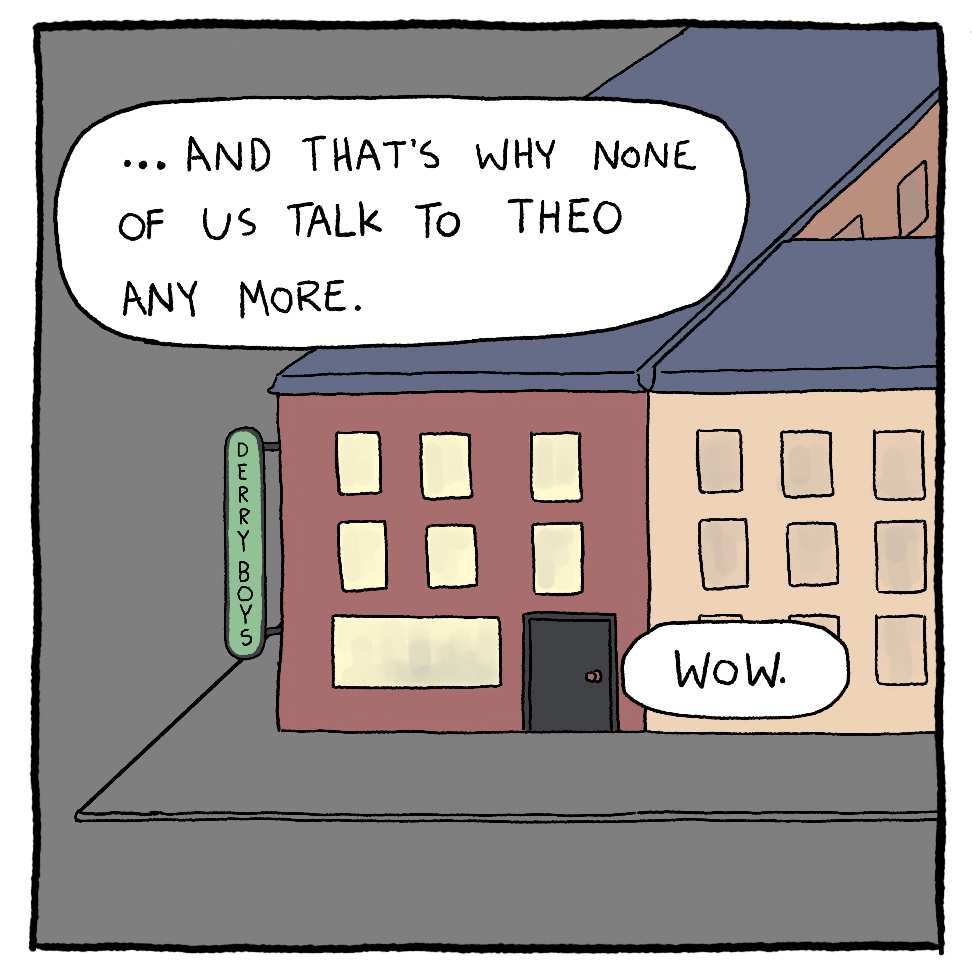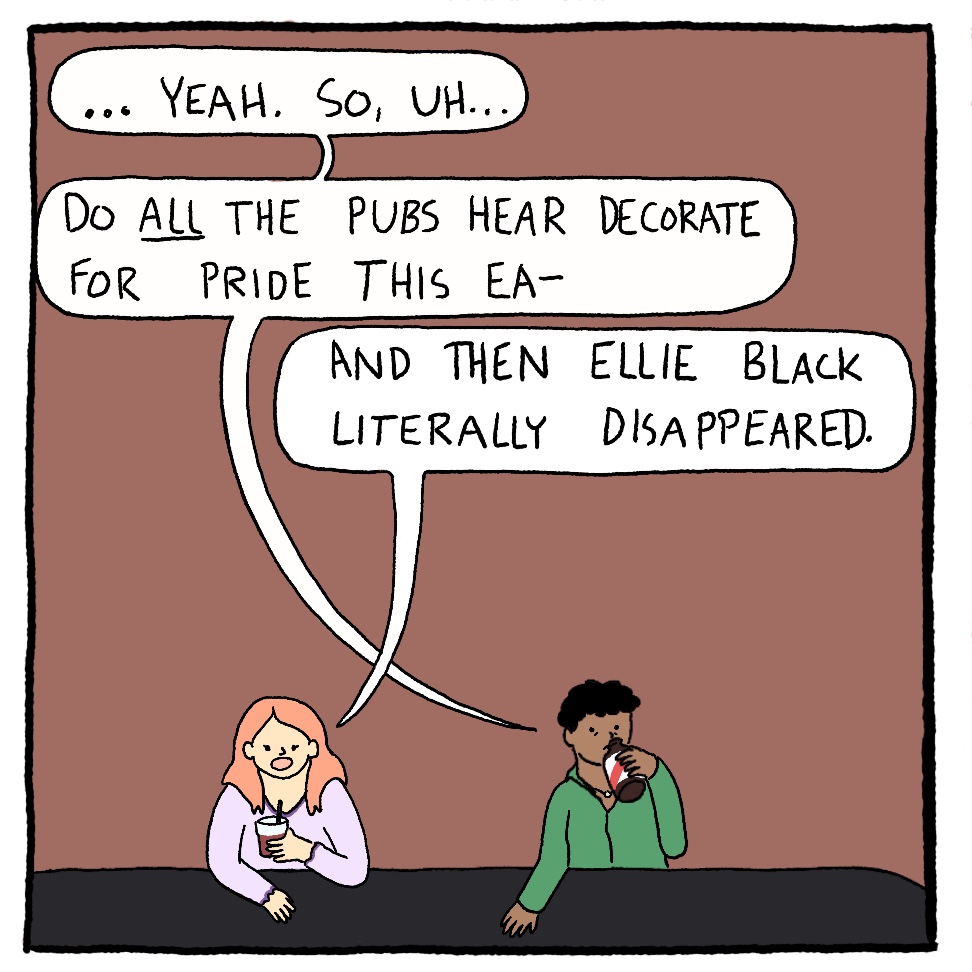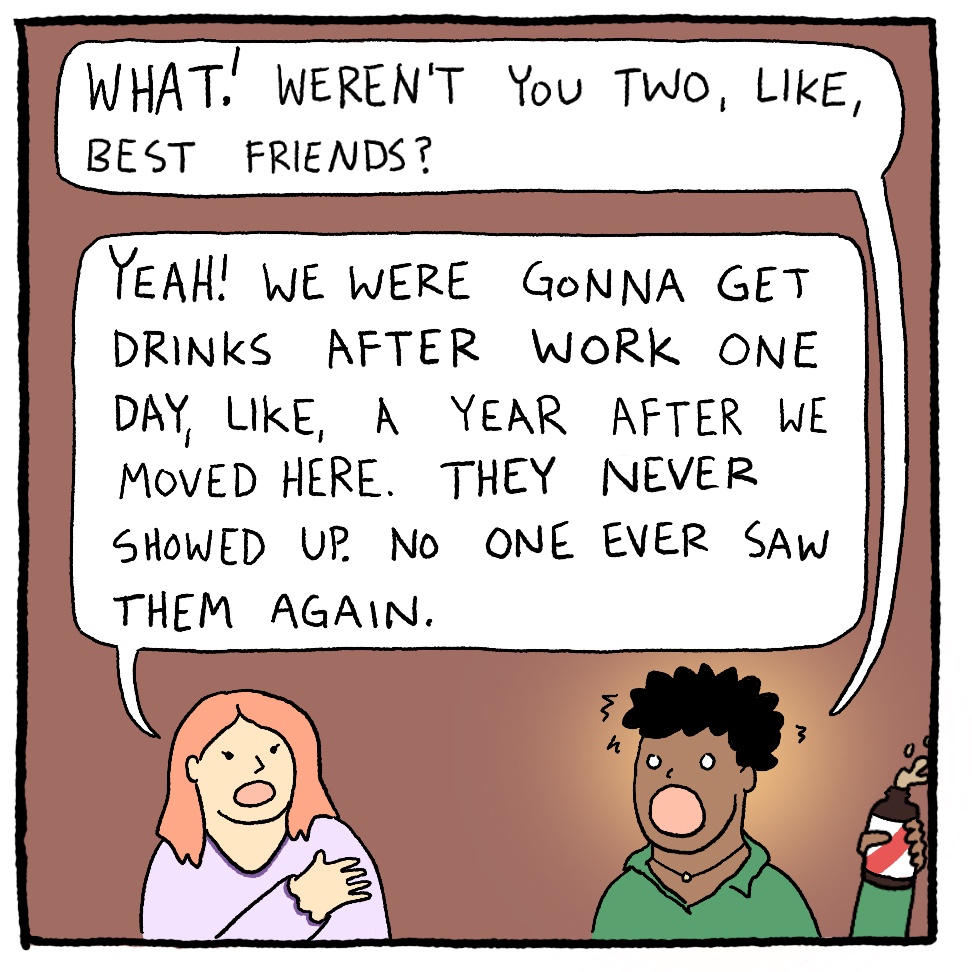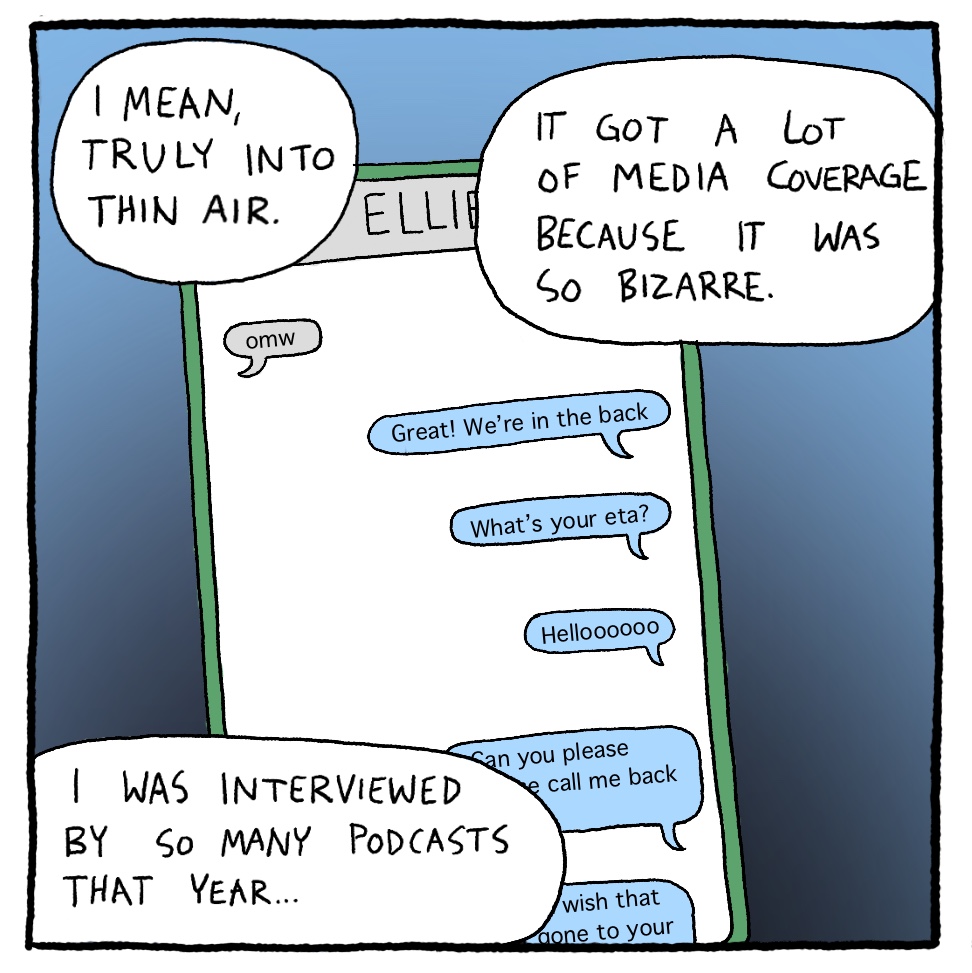
You Can’t Come Back If Your Memories Are Missing

“Accidental Girls” by Chloe N Clark

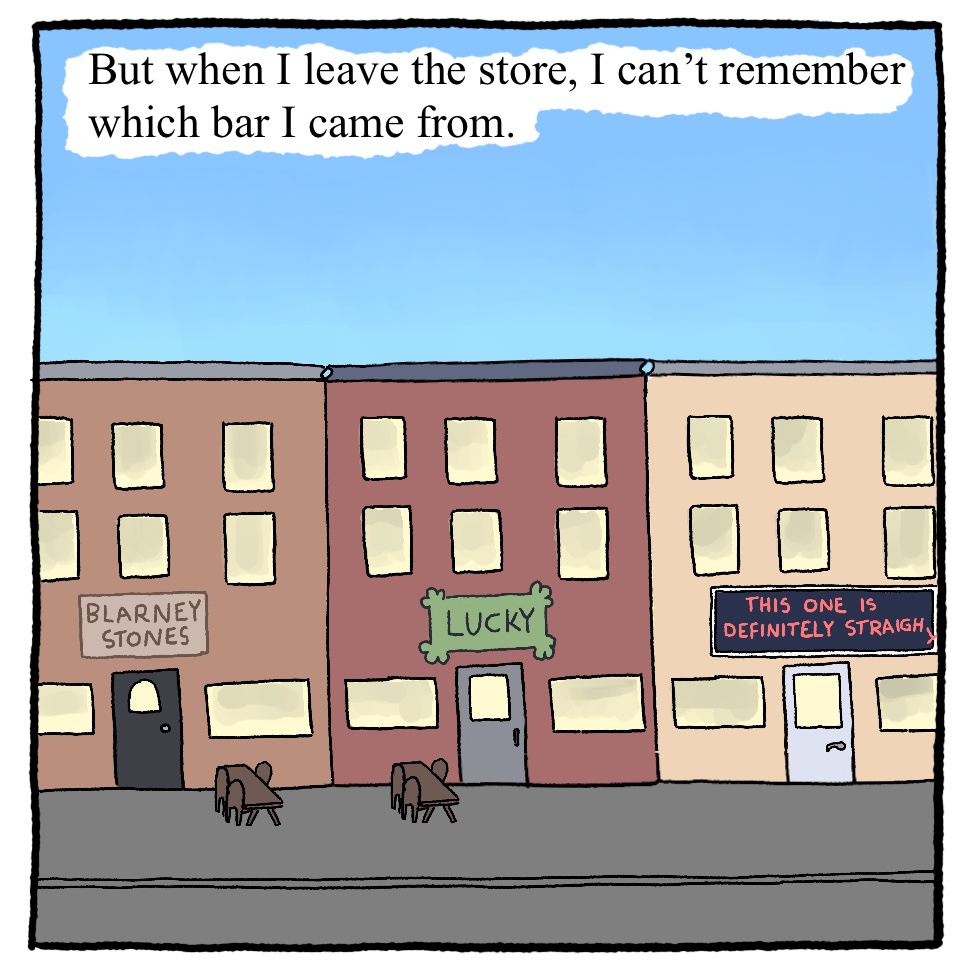
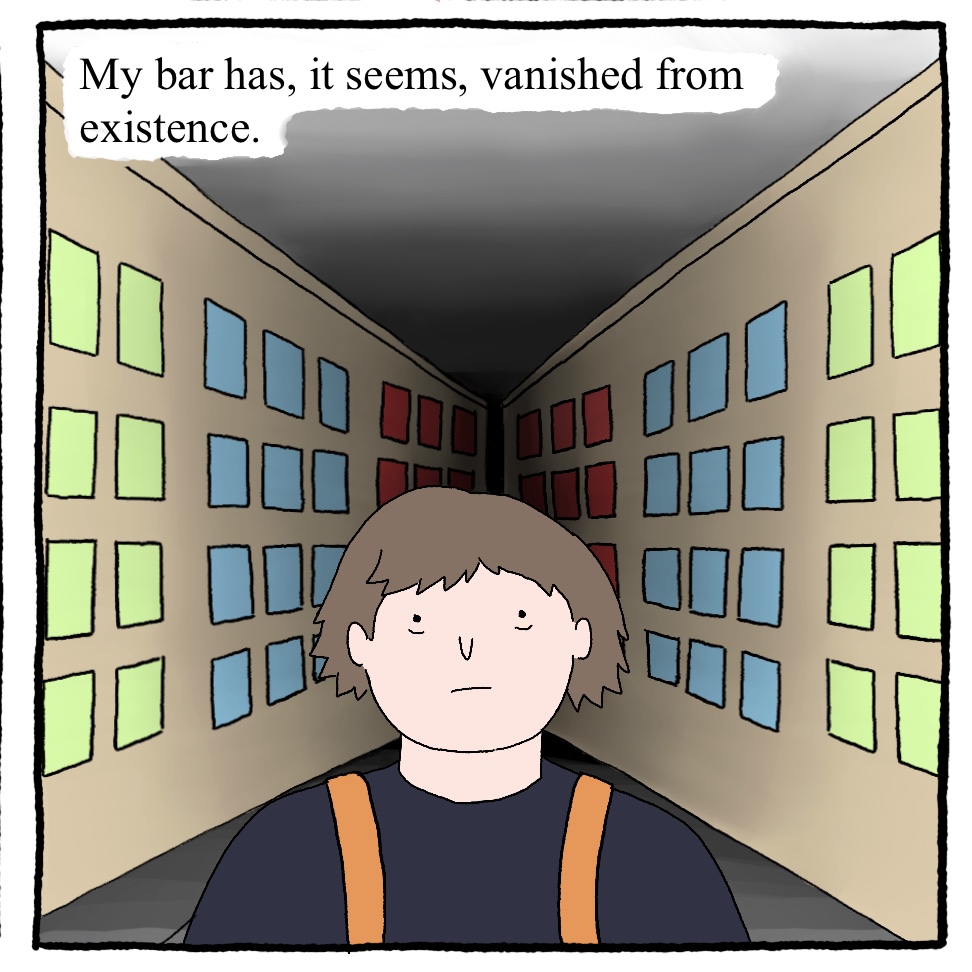
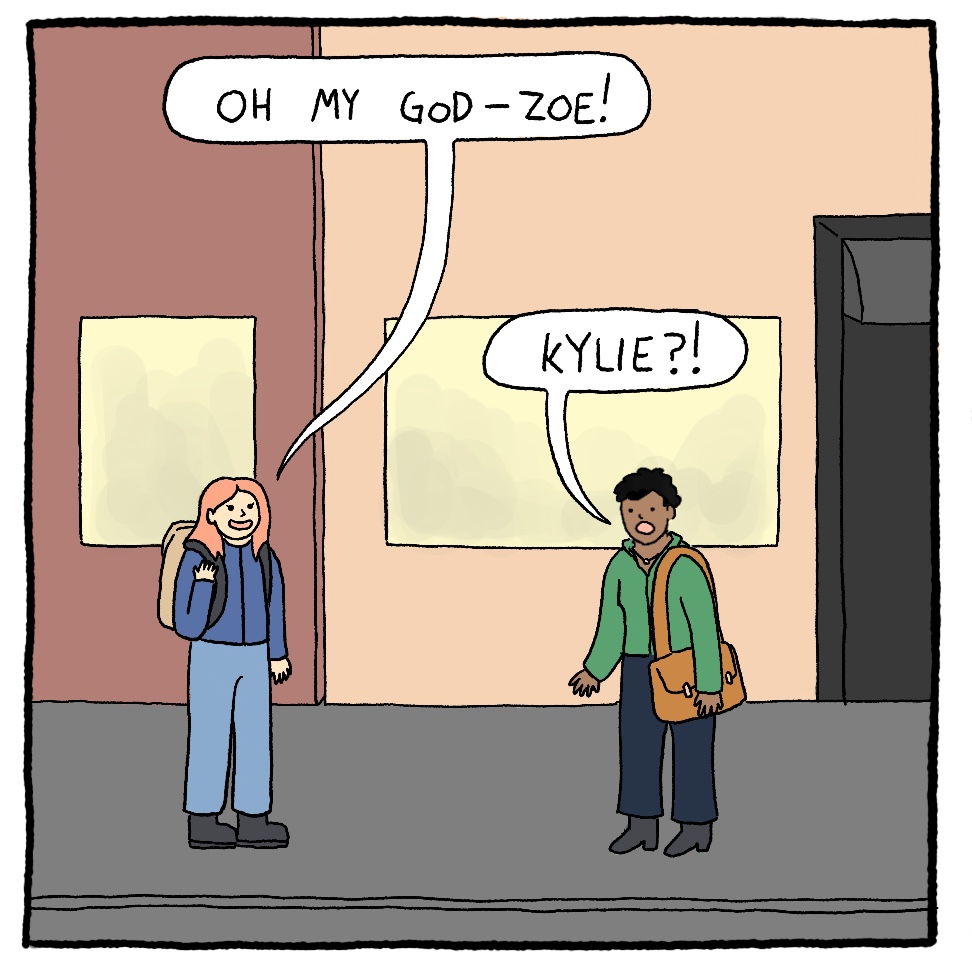
When I see Halley in a bar, years and years past when she disappeared, I know it’s her so quickly and completely that it makes me gasp. The Halley of her thirties is leaner than her teenage self, her hair dyed a blue so dark that in the shady bar I think it’s black, and she has a scar across one cheek. But she still has eyes the color of rainy days, a slight limp on her left side. I wonder if she also has a face etched with living, laugh lines around her eyes, a frown line permanently drawn across her forehead.

“Halley?” I half-shout across the bar. But she doesn’t even flinch or turn. I move through the other bar patrons as quickly as I can, trying not to lose her in the crowd. When I catch up to her she’s talking to a man in jeans and a band shirt of some musician I’ve never heard of. I reach out and tap her shoulder.

She flinches. The man stares at me and she turns. We haven’t been face-to-face since we were sixteen, sitting in my front yard, drinking lemonade in paper cups, talking about what senior year would be like. That was the day before she went missing. The day before everything slipped and crashed. “Do I know you?” she asks.

“It’s Abby?” For a second I feel like maybe I’m the one in the wrong. That she’s still Halley but I’m someone else.

She shakes her head. “I’m sorry? I don’t think I know you?” “From school? Lincoln. We were friends.” Friends feels incomplete.

She half-smiles. “I really don’t think I know you. I’m not sure what Lincoln is. I get confused for others all the time.”

“You’re not Halley Blackwell?”

She shakes her head. But her face is Halley’s face, and her head shake, always so confident and yet so disappointed to be saying no, is Halley’s head shake. “Sorry. I’m Faye.”

I take a step back. “Sorry. I’m so sorry.”

I retreat back to my corner of the bar. Occasionally, I glance over at her talking with the man. She sometimes laughs, but she never looks my way.

In the dark, at home, I count stars on the ceiling. In my childhood bedroom, I’d put up thousands of them. Every night, I’d find patterns in the way I’d arranged them. Count out in concentric circles until my eyes closed. Even years later, with a blank ceiling, I could still picture where they had all been. When I was young, I’d spent hours making up constellations with Halley during sleepovers. We’d use myths we knew or sometimes our own stories that we’d spool out like threads of our imagination. In Halley’s stories, girls were always lost, turned into lights, into flickers in the dark. I can still trace them all with my fingers.

We were sixteen when Halley disappeared. She was walking home from a football game. We were playing the Wildcats, our town’s rival. Everyone was at the game. If I hadn’t gone with my parents, if my little brother hadn’t been playing, if we hadn’t been waiting to take him out for ice cream after the game, if I’d asked her to join us and she’d said yes, if, if, if, I’d have been walking home with Halley. Her parents don’t call to check if she’s with me. No one reports her missing until well into the next day when I go over to her house to ask if she wants to come over for dinner. Her parents say she sometimes doesn’t come home at night. That it’s normal. They shrug at my insistence that she should be home. But my parents call the police when I tell them. They say it’s better to be safe.

No one finds Halley Blackwell. It’s like she stepped away from the stadium bleachers and right into another universe. There is no evidence. Just an Amber Alert with a picture of her that I took, because her parents don’t have any of her, and her school photo makes her look older than she is. A police officer tells me that a photo where she looks girlish would be best. People want to save girls, he says. I don’t say, Don’t people want to save everyone? I wish I had.

And years pass. And years pass. In college, I imagine that she went to another school and that’s why I never see her. I call her phone number sometimes, but no one ever picks up. And years pass. And years pass.

When I no longer think about Halley every day, when I no longer long to reach her, I still sometimes have nightmares that she is trapped underground. That some devil pulled her under the dirt. She calls out for me to help her, but in the dreams I’m always locked into my seat on the bleachers, I can’t hear her over everyone cheering. If I can find her in the dream, it will undo the past. If I wake up, she‘ll be fine. If I call her, she’ll pick up. If, if, if.

It’s a week before I see Faye again. I hadn’t thought about the interaction much. Usually, just before sleep, I’d see her face and try to find what I thought had been Halley’s features. But memory rearranges us, and I couldn’t be certain I was sure.

I’m grabbing a coffee before work and she’s in the café I always go to. I don’t notice her, but as I’m about to leave, she says, “You’re the woman who I thought I was someone else.”

I turn to her and it’s still Halley’s face. Her blue hair is pulled back into a bun, dressed professionally in tailored pants and a long-sleeved silk blouse draped so lightly on her it looks like the wind would turn it to shreds. I blush, feeling foolish. “Yeah, sorry about that. You really look like a friend I used to have.”

“Scientists say that everyone is likely to have at least one doppelganger,” she says.

I laugh, a little baffled. “Do scientists say that?”

She nods. “Something to do with a limited number of genes to compose humans. There are only so many facial characteristics to go around.”

“Huh. Well, you’re certainly my friend’s doppelganger then.” I move to leave.

“Would you like to get something to eat sometime?” she asks. “I’d love to know more about my lookalike.”

I’m about to say no, to leave, not wanting to carry my mistake forward. But she smiles fully and I can see that her lower canine is cracked off. When we were twelve and playing baseball, a ball hit Halley square in the face. She’d smiled over at me, said, “I’m okay!” but blood had pooled down her face as soon as she spoke. She’d broken her lower left canine clean in half. So, to Faye, I say, “That would be great!”

I write my number down for her and she says she’ll message me to set something up. When I get to my office, my hands are shaking. We’d met in first grade, the two girls in the back row of the classroom. She had a stuffed monkey with her. Benjamin was his name. I like monkeys too, I said, and she smiled. Back then, she was the shy one and I spoke too much. In our teens, we switched. I was all gangly limbs and awkwardness, and she was petite and precise and perfect.

At the office, my first client of the day is new. She runs a business consultation company. I wonder what a business consultation business does exactly, but I don’t ask because I’m supposed to know those things, to understand how businesses operate. I tell her how our services work. Why her business should use one of our training sessions.

The woman frowns more and more as I speak. Finally she asks, “How do you guarantee that what you do works?”

“The answer is we don’t, ma’am. We can’t. I could point out studies we’ve done and how we’ve seen employee charitable donations go up after a training session. I could show you surveys we’ve done several months after the training where employees have listed off positive things they’ve done since. I remember one man who started volunteering at a children’s foundation, and he talked about how much of a change he was bringing to those kids’ lives. I can’t tell you that our services made people more empathetic. No one can tell you that. Results for us are seeing positive changes, but . . . maybe that’s not what you would consider working.” I shrug. I’ve given this speech a thousand times, seen a thousand business owners have a moment’s mental struggle over how they could react. No one wants to say charity isn’t change.

She purses her lips, looks down at the floor, and then back up at me. “Positive results are certainly a huge thing. We would love to have your company come in and do a training if that is the impact.”

I smile my biggest smile. The one I used to practice in front of the mirror. Genuine without being too much, too happy. “You really are working to bring light to this world, ma’am. We’re so excited to partner with your company.”

She smiles at that. We go over the paperwork quickly. Once they’d heard the speech, most people didn’t have many questions. As she’s leaving, she turns back to me and says, “What got you into this line of work?”

The more like us an AI looked or sounded, the more we cared about it, the more we were willing to give it our information, let it into our lives.

I don’t know how to answer. My bosses had seen me give a presentation during college on how advancing robotics could be done not by advancing the technology but by advancing the amount of empathy people had for the robots themselves. The more like us an AI looked or sounded, the more we cared about it, the more we were willing to give it our information, let it into our lives. People would come up to me after and ask if I was looking for work after school. We train empathy, they’d said, and I’d laughed. I figured a friend was pranking me. But I’d looked up the company that night, and when I had graduated and was looking for work, I’d messaged them. I figured I’d be there for a year while I found something I actually cared about. And the years passed, until I couldn’t imagine sending out resumés, writing cover letters.

“I suppose I wanted to help,” I say to the woman. She nods, as if that is enough.

I call my brother at my lunch break. He’s at work but he picks up. “Slow day?”

“I literally watched paint dry earlier. They’re redoing one of the office wings,” he replies. “What about you? You sound like you, but not.”

I wonder what’s in a voice that he could tell. “I think I ran into Halley.”

There’s a pause. Silence. Maybe he doesn’t remember her, doesn’t know who I’m talking about. “Missing Halley?”

“Yeah. Halley who went missing.”

“You think you saw her?”

“This woman looks exactly like her, sounds like her, down to her broken tooth.”

“Okay, did you ask her?” I don’t need to see my brother to know that he has begun running a finger down the side of his desk, a thing he always did when he was thinking through something. After Halley went missing, he’d come to sit in my bedroom, crosslegged on the floor, and it always made me see him again like when he was a little, little kid. He’d never say much, just sit by me, as I stared out the window, trying to will Halley back home.

“She said her name was Faye.”

“Okay, so maybe she didn’t want to be remembered? I always kind of wondered if she’d run away.”

He’d mentioned that once before, had pointed out how we always saw bruises on her, how her parents looked through her when we saw them together anywhere. And I’d wanted it to be true. That she’d simply left, become someone else in a happier place. But I’d thought she’d have said something to me, she’d have reached out, she’d have let me know everything was going to be all right.

“I . . . had that thought. But she really looked like she didn’t know me. And she asked to get dinner, said she wanted to know more about her lookalike.”

A long pause. “I don’t like that. You shouldn’t meet up with her.”

I took in a breath about to explain why I needed to, why it was important, but he cut me off. “But I know you will. Just be on guard, Abs. Sometimes the people we remember should just be remembered.”

Later, when my phone goes off, I think about not looking. As if not giving into temptation is an option. As if I haven’t been scrolling through photos of Halley, looking for other clues I’ll be able to spot in Faye. “Late dinner? — Faye.”

I type back sure. A few moments later my phone lights up again. “I’m new to town. Suggest a place?”

I give the name of a restaurant that’s a ten-minute drive. Far enough to be away from my home, but not so far as to be unfamiliar. I want to be on my own turf. She wants to meet in a couple of hours.

It’s only as I’m changing, slipping out of business clothes into jeans and a t-shirt, that I realize the restaurant I picked is a Greek one. Halley’s favorite food had always been gyros. We’d get them at a local diner and she’d eat them as if she was starving, picking at the meat with her fingertips, grinning. I was never a voracious eater, picking at salads, sipping water, but her joy for food was infectious. She’d say, you have to enjoy things, you have to let them fill you up. When she went missing, I think about all the things she enjoys. All the things she won’t have. And then I push that away. She’s not dead. She has to be alive. She still can enjoy things. If she ran away, if she hopped on a bus out of town, if she’s living somewhere with a house and kids and a life that made her happy. If she never let me know, if she doesn’t trust me to tell me, if I’d never know, at least she was okay. If, if, if.

She’s already waiting for me when I arrive, sitting in a back booth, and staring out the window. It’s dark out, but the sidewalks are well lit and I wonder what she’s looking for. I sit down across from her and she jumps a little, pushed out of whatever thought she’d been in the middle of.

“Hey,” she says. “I was just thinking about how people walking past windows must never think about what they look like to the people inside. Like not knowing what stories we might be daydreaming them into.”

Halley had always known when I was wondering what she was thinking. She’d tell me before I even had the chance to ask.

“I think about people inside like that when I’m walking past. How I’m catching glimpses of them without knowing what they’re thinking, what they’re talking about.” We both turn to look at a couple walking past. They are holding hands but not talking to one another.

“What do you like here?” Faye asks. She picks up the menu and begins glancing at it.

“Oh, I’ve tried a lot of stuff. It’s all good.”

She laughs. “Sounds like you’re talking about life.”

The waiter approaches before I can respond. I see her waiting to see what I’d order.

“A Greek salad and water please.”

The waiter turns to her. “You, miss?”

She glances at the menu one more time. “I’ll do the same. But a Coke instead of water. Thanks.”

I want to say that she should try the gyro, but the moment is gone. She studies me and so I study her back. She’s wearing different clothesbut equally expensive-lookinga long-sleeved and cowl-necked dress also made of silk. A simple gold watch. She looks as if she’s come from a business dinner.

“What was your friend’s name again? The one I look like?”

“Halley. Halley Blackwell.” I say, but there’s no hint of change in her expression when she hears it. It’s someone else’s memory.

“It’s a nice name. Wish it were mine.” She chuckles. “You knew each other when you were teens?”

“Yeah.”

“But not since?”

“No.”

She smiles, just a little, just at the corners of her mouth. More wistful than happy. “It’s a shame that we lose the people we were friends with when we were young.” I nod.

“She must have been a good friend,” she continues. “You looked so startled, but happy, ecstatic really, when you touched my shoulder. I wanted to be your friend then. Wished I was her. So I could continue that happiness.”

“She was a very good friend,” I say. “The best I ever had.”

Our salads and drinks arrive, cutting the conversation. I want to thank the waiter profusely. The conversation felt like a trap, like standing at the edge of a chasm as someone tries to get you to walk closer to falling.

The conversation felt like a trap, like standing at the edge of a chasm as someone tries to get you to walk closer to falling.

We both begin to eat. I pick at my salad, lifting up a single leaf to nibble at. Across the table, she does the same. It’s like she is mirroring what I’m doing. I set my fork down and she does too.

“I noticed you broke your tooth. How did that happen?” I want to catch her off-guard, no time to make something up.

“Car accident,” she replies. “Those air bags are menaces. Did you know they can hit hard enough to take an eye out?”

“I didn’t know that. Wow.”

She nods and her face looks older for a moment. Layers of makeup. Maybe she’s much older than me. Older than Halley. Maybe this is all a mistake.

“What do you do?” I ask. Ready to just make conversation and be done with this.

She looks up from her food. “I’m a trauma specialist.”

“Like a surgeon?”

She laughs, and with it she changes completely. It’s a full-bodied laugh that shakes her shoulders. And I am seeing Halley laughing, almost falling off my bed because she’d remembered something stupid a boy had done in class. In the memory, I reach out to catch her. Do I catch her?

“Not a surgeon, no. Have you heard of Trauma Redemption Services?” she asks, the laugh leaving her body.

And I have. Of course. It’s all the rage for the wealthy. I’d talked to people who’d had it done. They often came to empathy trainings, ran businesses, would ask me if I thought the procedure would make them less empathetic or more.

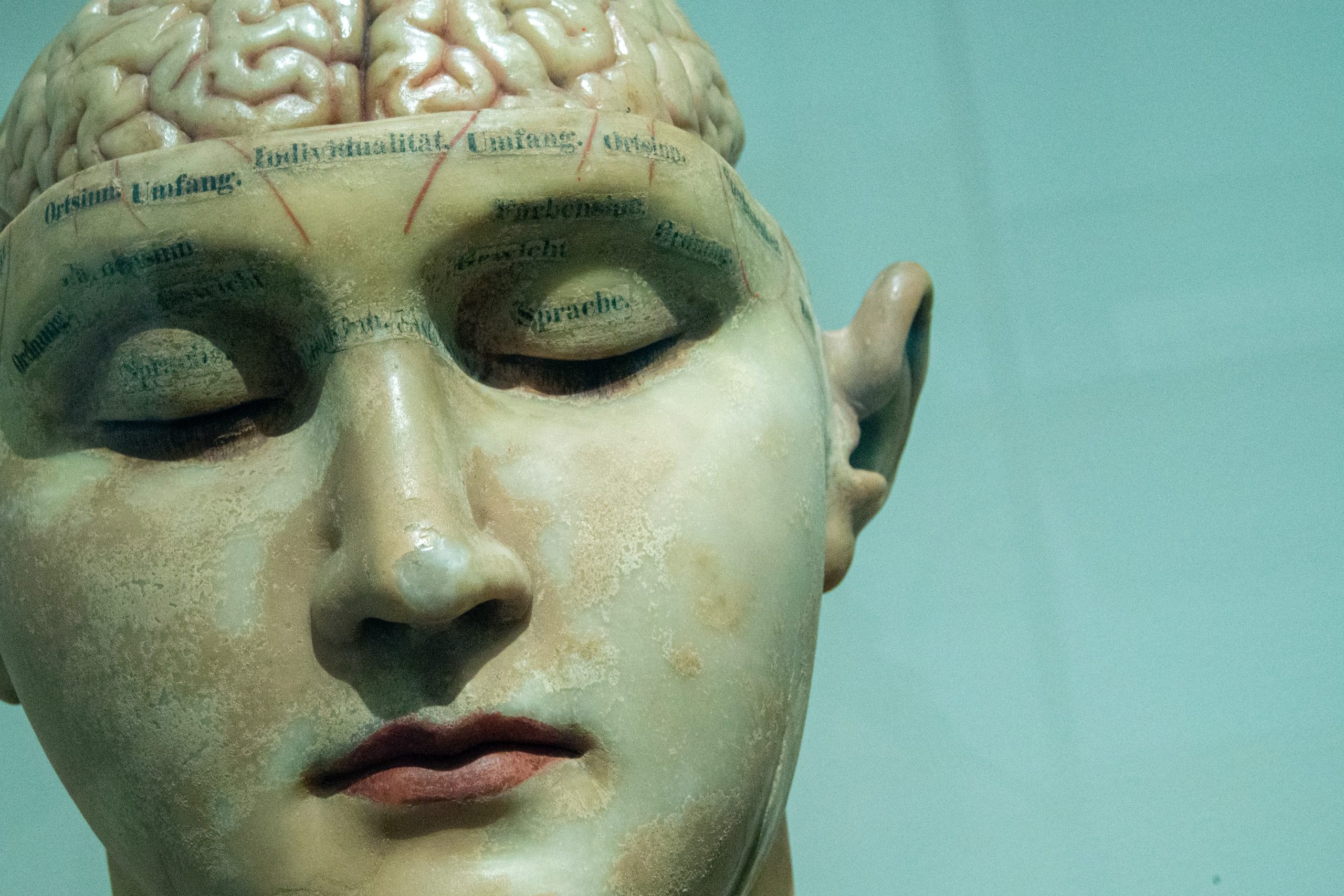
The theory behind Trauma Redemption was that if you had a traumatic memory erased, you’d lose something fundamental. So they gave it to someone else. It was taken from their mind and implanted into someone who would sit in front of them, letting the memory run through them, as the person watched. The person who had the memory now had to keep it. In case the giver ever wanted to recall it, wanted to talk through what had happened again, wanted to relive it on someone else’s face.

“I have. What do you do with them?” I want her to be someone in the office, someone who typed up reports or moved finances around.

She looks out the window again, and her reflection on the glass looks younger. “The first one I ever did was someone who had crashed his car. Crashed the car right into someone else. He said to me, ‘I never saw her.’ But in the memory, he did. I wondered if he wanted me to know. If he  wanted to forget, but wanted to know that someone else knew?”

I don’t say anything. And when she turns back to me, she still has Halley’s face. It’s older and sadder and lost in a moment of thought. But it’s Halley. She smiles at me. “I have a procedure tomorrow. It’s why I’m here actually. For some clients, we’ll travel. I’d like you to see the procedure.”

“Me?”

“Yes. I looked you up after we met in that café. Saw what you do for a living. It sounds like it might be an interesting thing for you to see, help your work.”

I don’t say, But I never gave you my last name. I don’t say, How did you find me? I just stare at her and remember when we were twelve and it was my birthday party. Halley was eating cake and she started crying. I ushered her into my room and asked what was the matter. She was sad because she had been eating my birthday cake and had looked up and realized that I was getting older and she said What if we keep getting older and we move away and we eventually start talking less and less and what if we aren’t friends in the future.

And I said, But we’re friends forever, Halley.

And she’d said, Promise?

“Okay, sure,” I say.

Faye smiles. And then she changes the subject, begins talking about a movie she saw recently. We make small talk for another thirty minutes or so. Then she writes down an address and time and slips me the piece of paper. Her handwriting is perfectly straight and neat, like someone trying to write in a way that wouldn’t be recognized.

“Oh, it’s not creepy by the way. I saw the building you walked into after you left with your coffee. The company name. Only one Abby works there. The miracles of modern search capabilities.” She picks up her purse carefully. “You can find anyone.” She leaves before I respond.

I count stars. Think about the constellation Halley had named after Persephone. She’d said, that one looks like it wants to run but she can’t. I said, isn’t that a myth about balance? Like we can’t always have spring and we can’t always have winter. Halley shook her head, it’s a story about trying to forgive. She didn’t explain. But every sleepover after, she’d trace the constellation with her fingers. On nights she isn’t there, I do it for her.

Halley in my bedroom, stretching over the bed, about to ask me a question.

“Please don’t forget tomorrow.” A text arrives and I don’t answer. But I think she must know I’ll be there.

My brother sends me a message, asking how it went. I want to tell him everything, but I don’t want him to worry. I don’t think it’s her, I type out. But I never hit Send.


Once, when we were in our twenties, we watched a movie in which a young girl is kidnapped. It’s violent, She screams and fights, but she’s still snatched up and forced into a van. I didn’t realize I was crying until my brother had placed a hand on one of my shoulders. So gentle I almost didn’t feel it. I’d turned to him and he’d had tears in his eyes too. I never asked him if he was thinking about Halley or if it was only because he was worried about me. She used to call him Bro, every time she came over. She was at our house so often, it felt true.

It might be her, I type out. I hit Send.

I call out from work. The first time I’ve used a sick day in years. In the morning, I pace the kitchen, sipping the same cup of tea for hours.

There are no messages from her. I wonder if she wants to see if I’ll really come, if she worries that pressure will make me stay away. I watch a video about monster movies, how creature effects evolved over time. It’s background noise, but I find myself listening when a makeup artist talks about how hybrids scare us. “If something is close to something we know already, but not quite it, it makes us nervous. It’s like the uncanny valley, you can be far away from being a human in looks and we’ll be fine with ita happy little robot, all beeps and boops, and square frame. But make it almost human, have fingernails, and teeth, and smile at us when we smile, but only then, never on its own, and suddenly we’re terrified.”

In university I designed a program that seemed like a simple game from the outside. You created an avatar based on a photograph of yourself, then you entered a little game sphere. You answered trivia questions, and a little robot on the screen would smile or frown depending on whether you got the answer right or wrong. But as you got deeper into the game, the robot began to look more and more like the game player. At first the changes were simplethe cartoony robot would get the player’s eye color. But the game became more elaborate the more you played, and the robot’s face shifted to the shape of the player’s face. At the end, the player was playing a cartoon version of himself. My professor gave me an A, but he said he didn’t understand the concept. I hadn’t really known myself. Only that when I played the game, I never used my own photo. I used photos of people I loved. In the end, my mom or dad or my brother would be smiling at me when I got answers right. I never used photos of Halley.

The building could be anything. Just a rented-out office in the middle of the city. The café next to it is bustling, another office suite is filled with an accountant’s office. I walk past to the elevator and go up to the seventh floor. A receptionist is dressed in a simple black dress. She smiles at me and asks my name. “Oh, you’re Faye’s guest, right?” I nod.

“Awesome! We don’t usually have viewers, but she said your company is thinking of working with us? That would be so cool. Trauma and empathy go hand in hand.”

“Not really,” I say. But the receptionist is already not looking at me, instead playing a game on her phone. Tiny birds fluttered across her screen, diving to get coins that were falling alongside them.

I take a seat and wait. If I had gone to work today, I’d be just about on my lunch break. If I’d never said yes, I’d send my brother a photo of a coffee that I got from the place where the barista always swirled the foam into flowers, into the night sky, into anything he could think of. If I’d never gone to the diner, I’d be somewhere else. If I’d never been at that bar and I’d never seen her, I’d point out Persephone every night until one night when I forgot. If, if, if. Halley would finish walking home and she’d be home and we’d talk the next day about the football game and she’d lean over and tousle my brother’s hair and say good job, Bro. And he’d let her. Only her.

“You can go back now,” the receptionist says. And I follow her to a room that looks like an office, except it’s been divided in two by a glass partition. A woman sits across from Faye. They both are on simple office chairs, and there’s nothing between them. They are close enough their knees almost touch. A man in a lab coat stands to Faye’s right. He holds something that looks like a cross between a needle and laser pointer.

The receptionist sits next to me. “Let me know if you need anything. These sessions can be hard to watch the first time.”

“Only the first time?”

She shrugs, “You can get used to anything.”

“What’s the trauma?” I’m not sure I want to know, but I have to.

“The woman was kidnapped when she was a child. She has nightmares about it still. I don’t know why she waited so long to have it removed.”

The man in the lab coat moved next to Faye, pushed her hair away from one side of her head and I see a small metal plate right behind her ear. He uses one side of the device to pop the plate open, but I can’t see if it’s skull behind it or what. And then he places the device against her head and presses a button.

I watch her face. At first it’s pain and then it’s fear, and she cries and she cries. The woman watches her blankly. But the more Faye cries and pleads, the woman shifts in her seat, until she finally reaches out and takes hold of Faye’s hands. She holds them gently as the rest of the memory floods through her. And then it’s over. Faye’s head droops, she stays sitting, and the man in the lab coat talks to the woman for a few minutes. They shake hands and another woman enters the room and escorts the client out. I can’t believe there’s not more. That she doesn’t stay to ask Faye questions. If the memory is gone, does the woman feel free?

“It’s over?” I ask the receptionist.

She nods, smiling. “So simple, right?”

I ask where the restroom is and once inside I brace myself against the sink. My hands shaking so hard I can barely grip. I look up and Faye is behind me. Her face watching mine in the reflection. And her face is Halley’s face. Older. I try to look for laugh lines but I can’t find them.

“How can you do that?”

She steps closer to me, until she’s standing at the adjacent sink. She turns on the water. She rolls up her sleeves a little, and I see scars on her forearms, so many scars. “They’re not my memories. I’m just holding them.” She splashes her face with cold water. Grabs a paper towel and begins drying herself.

“Halley?” I almost whisper it.

She shakes her head. “I’m not her.”

“I lost her.”

“I’m sorry,” she says. “Maybe our services could help you, too?”

She reaches out and touches my hand. Just for a second. As she takes her hand away, I see a tiny tattoo etched in the hollow of her wrist. A pomegranate. She sees me looking. “After Persephone.  Do you know that myth.”

I nod. “It’s about forgiveness.”

She smiles at me oddly, as if I’ve said something obtuse. “That’s a strange interpretation,” she says. And then she leaves. If she turned back, if she reached out again, if she whispered that promise, if she walked back to her office and back through her life until she was at the football game and she waited for me, she’d come with us, we’d eat ice cream, let it melt in our mouths, so sweet and cold. If, if, if she was Halley. If.

She doesn’t come back into the bathroom. It’s just me and the sink and the mirror. If I study my reflection in the mirror long enough, maybe I won’t know who I’ll recognize looking back at me.
8 Novels With Characters Who Go to Therapy

Let’s face it: half of our favorite stories wouldn’t exist if the characters just went to therapy. The Trojan War would’ve lasted nine years, and Bruce Wayne would own a normal basement with a ping pong table. 

Part of the reason so many stories resist therapy is that 1) mental illness has been unrecognized and stigmatized for a long time, therapy viewed as for the weak, but also 2) how do you build conflict if therapy is supposedly a cure-all?

Anybody who has been to therapy can tell you: therapy is not easy. Nor is it perfect. Take for instance the segment from Cathy Park Hong’s Minor Feelings in which she describes being ghosted by her therapist in a time of need. Or Emma Grove’s miscommunications with her therapist in her graphic memoir The Third Person. Therapy is far from a cure-all—in fact, it might just lead you deeper down the rabbit hole. 

From utilizing therapy as framework, conflict or simply including it as a facet of the character’s life, the following books showcase characters who receive some kind of mental health care.

Chemistry by Weike Wang

Chemistry follows a PhD student on the brink—her chemistry research is proving increasingly unsolvable, and she has no idea how to respond to her boyfriend Eric’s marriage proposal. When years of repressed trauma come to a head, the narrator spirals into an unhinged breakdown, quitting her research and spending her days hiding and drinking. In the bleak aftermath, she slowly turns toward healing with the help of her best friend, her dog, and a therapist.

You Exist Too Much by Zaina Arafat

When a queer, Palestinian American woman comes out to her mother, her mother responds: “You exist too much.” Thus kickstarts years of emotional repression, culminating in an explosion of reckless flings and unattainable romantic obsessions. Her destructive behavior leads her to The Ledge, a treatment center that diagnoses her as a “love addict.” There she begins contemplating the origins of her trauma and how she can move forward.

My Year of Rest and Relaxation by Ottessa Moshfegh

The year is 2000. The narrator is a young, white, pretty trust fund baby living alone in the Upper East Side of Manhattan. She should be happy, but low and behold, she is not. There is an emptiness inside her, possibly due to her dead parents, possibly due to her various problematic relationships, but rather than get to the root of the issue, she works with Dr. Tuttle—one of literature’s worst psychiatrists—to medicate herself into a year of unending sleep.

The Life of the Mind by Christine Smallwood

Dorothy is a thirty-something English adjunct professor in New York City who has lost all hope of gaining tenure. She has also just had a miscarriage—a secret she will not tell her two therapists nor any women in her life. As a researcher on the cultural representations of apocalypse, Dorothy can recognize an ending when she sees one. And yet, as her bleeding dissipates and the weeks pass, Dorothy must contend with the fact that life is not a story and must, for better or for worse, go on.

Queenie by Candice Carty-Williams

Queenie Jenkins’ no good, very bad year begins with a disastrous break-up with her white boyfriend Tom, followed soon by the realization that she was pregnant and just had a miscarriage. Things get worse when Queenie attempts to distract herself by sleeping with other men, one of whom turns out to be her close friend Cassandra’s boyfriend. As her personal life falls apart, her professional life grows stagnant, her editor refusing to take her pitches seriously and sending her off to write shallow fashion articles. Everything gets worse before it gets better, but eventually Queenie opts to visit a therapist, who slowly works with her to find value within herself.

Eleanor Oliphant is Completely Fine by Gail Honeyman

Eleanor Oliphant is a bit of a social misfit, but she’s fine with that. Really. She enjoys her life of solitude, routine and her weekly “chats” with Mummy. She even splurges on pizza and vodka over the weekends. Nothing is missing—until she sees Johnnie Lomond in concert and realizes he is the love of her life. What follows is one woman’s unhinged attempt to fill every empty vacuum of her life with her celebrity crush. When Eleanlor’s attempts predictably prove unsustainable, she subsequently crashes and burns.

Kim Jiyoung, Born 1982 by Cho Nam-Joo, translated by Jamie Chang

Jiyoung is a 33-year-old Korean woman who recently left her job to take care of her young daughter. Nothing is outwardly wrong with her life—though she rarely gets out anymore, she loves spending time at home with her daughter, and she has a loving husband whose job can support the three of them. But then Jiyoung wakes up one day acting like her mother, then later, inhabiting the character of a university friend who died in childbirth. Her husband sends her to a psychiatrist, who begins unraveling the mundane misogynies that have led Jiyoung to her current state.

The Bell Jar by Sylvia Plath

It’s 1953 and intelligent, beautiful Esther Greenwood is slowly but surely cracking. A college student who dreams of becoming a poet, Esther is selected for a prestigious summer internship as a guest editor for Ladies Day magazine, but her time in New York only leaves her at odds with her own femininity. Trapped in a web of impossible expectations, Esther falls into a deep depression and attempts multiple suicides, culminating in her hospitalization under the care of Dr. Nolan.

Queer Villains Are Vital to Understanding Queer History

Whether or not you’ve watched season 2 of The White Lotus, Mike White’s anthology series, you’ve witnessed Jennifer Coolidge’s frenzied intonations onboard a yacht: “These gays, they’re trying to murder me!”

Coolidge plays Tanya, a wealthy woman who finds herself at the center of a conspiracy to murder her for her money. The executors of this plot are a group of profligate European gay men, who she’s deduced plan to off her before they reach shore. She pleads with the captain, who speaks little-to-no English:

“Do you know these gays? … these gays, they take me off to Palermo, and then they set me up with this guy who’s in the mafia, and he’s coming here, I, I think to try to throw me off the boat. They’re going to do Greg’s dirty work for him because he’s gonna pay them with my money so they can decorate their houses or some shit.

The captain only understands the word “gay”. He smiles, and replies “tutti gay!” They’re all gay. Crestfallen, Tanya turns away and mutters “oh my god” with absolute resignation. She knows she’s about to be sacrificed at the altar of luxury decor. The gays, who drew Tanya into their circle with warmth and flattery, now embody a smiling, unsparing menace.


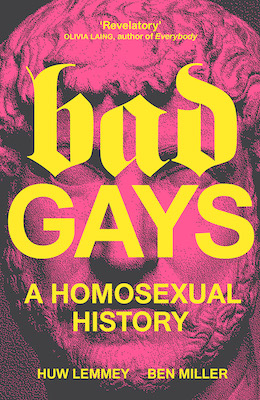
The evil gays of The White Lotus are fictitious and cartoonishly sinister, but they also evoke queer villains of the past. In the 2022 popular history book Bad Gays: A Homosexual History, Huw Lemmey and Ben Miller probe the lives of notorious queers to establish a counter-narrative of gay history. Rather than an unflaggingly virtuous and eventually victorious struggle for “rights,” Miller and Lemmey argue that queer history is tainted by the classist, racist, and colonialist ideals of the larger societies that birthed contemporary conceptions of queer identity. 

Miller and Lemmey subscribe to the idea, influenced by Michel Foucault and numerous queer theorists and historians, that sexuality is shaped by the time and place someone lives in, rather than being an innate, unchangeable identity. They identify the birthplace of the tie between sexuality and identity as Europe in the mid-to-late 19th century. Industrialization was well underway, which led to cities populated by throngs of wage laborers who were newly able to pursue their sexual interests. Simultaneously, colonial powers propagated the idea that colonized subjects were “backwards” for reasons including sodomy, which helped form the idea that homosexuality was an immoral characteristic rather than simply a behavior, and ultimately led to increased criminalization. 

As these two opposing social and political forces intertwined to create a burgeoning awareness of same-sex sexuality, many tried to definitively classify same-sex attraction and behavior, including doctors and sociologists working at a clinical remove and queer people who sought to understand themselves better. The theory of homosexuality as a fixed trait gained traction, and thus homosexuality was “medicalized”: rather than an aberrant behavior, homosexuality was innate and unchangeable, and should be understood as a mental condition. 

Miller and Lemmey argue against the medicalization of homosexuality: The idea that gay people are burdened with a condition that can’t be helped ignores that many gay people have chosen to live sexually and socially fulfilling lives. Yet the theory has stuck over time, and Lemmey and Miller argue that it led to the valorizing of gay historical heroes, a strategy that gained traction in the gay rights movement: By classifying people as diverse as Alexander the Great, Sappho, Alan Turing, and Langston Hughes as gay, activists could stake a claim on the eternal existence of queer identity, and argue that queer people have enriched human history.  

Not every historical figure we can call ‘gay’ left a positive legacy behind.

This point of view smooths over the wrinkles in gay history: sexuality has not been understood as a stable identity category, and not every historical figure we can call “gay” left a positive legacy behind. Miller and Lemmey argue that examining the “bad gays” of history is just as important to understanding queer history, not to mention contemporary queer life and queer futures, as is uplifting the “good gays” that came before us. 

A person who’s paid attention to recent representations of queer life in art and entertainment may have noticed an uptick in morally complex or ill-intentioned queer characters. Two key examples are The White Lotus and Terence Davies’s historical drama Benediction, both 2022 releases which feature groups of self-absorbed gay men who would be apt subjects of Bad Gays. The gay men seen in these narratives are exorbitantly privileged, socially exclusionary, inwardly miserable, and outwardly malicious; they live parasitic lives, extracting value from their hosts before moving onto new victims. 

Benediction is a biopic of British poet Siegfried Sassoon, who chronicled the brutality of World War I. Rather than simply telling the story of Sassoon’s life, Davies (who also wrote the film) uses Sassoon as a vessel through which to explore the accumulated injuries that can macerate a man’s soul. Throughout his life, memories of the war linger heavily over Sassoon’s mind (played as a young man by Jack Lowden, and as an old man by Peter Capaldi), but he’s also damaged by a circle of gay men he falls in with. All are based on actual people: the most prominent characters are star of stage and screen Ivor Novello (Jeremy Irvine), socialite Stephan Tennant (Calam Lynch), and theatre actor-director Glen Byam Shaw (Tom Blyth). 

This was also a circle that likely would have known several of Bad Gays’ subjects. 

For instance, Lord Alfred “Bosie” Douglas was Tennant’s uncle, and Siegfried and Ivor discuss him familiarly—”Bosie was always vindictive,” notes Ivor. Vindictive he was. Bosie engaged in an increasingly reckless love affair with Oscar Wilde that led to Bosie’s father accusing Wilde of sodomy. Egged on by Bosie, who wanted to hurt his father, Wilde sued. He lost the suit, and was subsequently tried for, and convicted of, gross indecency, with a sentence of hard labor that decimated his mental and physical health. Wilde died three years after his imprisonment, and Bosie—who, though typically attributed to Wilde, coined the phrase “the love that dare not speak its name”—went on to publish a virulently anti-Semitic magazine and serve time in jail for libeling Winston Churchill.

The secretive sexual and romantic bonds these men share, in Benediction, create the conditions for bitterness and betrayal.

Lemmey and Miller use the torrid affair and divergent paths of Wilde and Douglas as their opening anecdote: both because they serve as ideal “good gay”/”bad gay” archetypes, and because Wilde’s trial was perhaps the key event that solidified homosexual identity as a concept in the public imagination. That Bosie was a casually familiar figure to the characters in Benediction speaks to how crucial their milieu is to gay history: These men grew up in the shadows of the first steps toward codifying gayness as an identity, and Davies shows this era stage of gay life as turbulent and suffocating. The secretive sexual and romantic bonds these men share, in Benediction, create the conditions for bitterness and betrayal. The four central characters pair off and separate frequently and acrimoniously, and their lives are never fully transparent to one another. Ivor Novello is the most callow and manipulative of all, ditching Glen for Siegfried on first sight, and only revealing to Siegfried that he has a secret “life partner” after a drawn-out, hostile affair. Throughout Benediction, Davies subverts the commonly held idea that honestly expressing one’s queer desires is inherently liberatory: Art and moments of emotional intimacy occasionally allow Siegfried to transcend the traumas of his life, but the time he spends among other gay men depletes him nearly as much as trench warfare. 

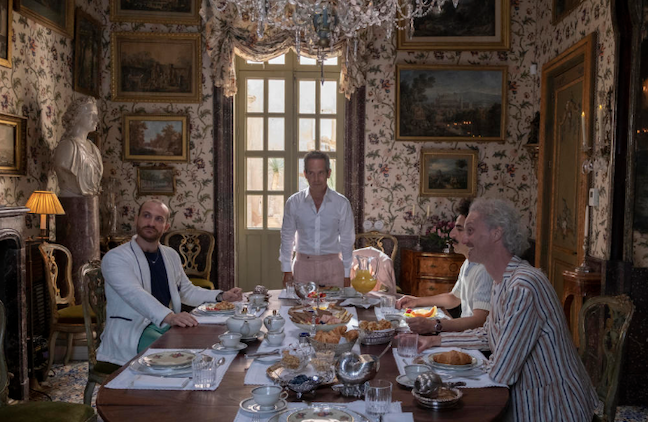
Season 2 of The White Lotus is set 100 years later and has a much looser relationship with reality, but many of its gay characters are cut from the same cloth. The gays that frequent the White Lotus luxury hotel—in Taormina, where Oscar Wilde lived after his imprisonment and a former gay tourist destination—are a cosmopolitan, indulgent bunch commanded by posh Quentin (Tom Hollander). Writer-director Mike White initially frames them as benevolent: they offer warm compliments and camaraderie toward attention-starved guest Tanya, who’s been left bereft after her husband leaves their vacation early. Because we see them through Tanya’s eyes, we’re led to share her opinion of them: “if you’re looking for a friend, gay guys are really the best.”

Maybe not. 

Quentin invites Tanya to his extravagant villa, and it becomes apparent during her stay that his intentions may not be friendly. Only when Tanya’s stuck on a yacht with Quentin and crew does she put the pieces together: her husband Greg has enlisted Quentin to kill her. The terms of their prenup mean that Greg will inherit all of Tanya’s money; he’ll split it with Quentin, who needs it to maintain possession of the villa without opening it to the public.

Quentin’s backstory is mysterious, but key hints are revealed in a late-night conversation he has with Tanya, where he tells the story of his first and only love. As a Kerouac-pilled young man, he followed a “cowboy” to Wyoming for love and to spite his father (shades of Bosie). The cowboy was straight, which only nurtured Quentin’s obsession, and Quentin would still “do anything for” him after 30 years. (The cowboy, of course, is Greg.) The point of the story is for Quentin to opine that he wouldn’t die for love, but that he would die for beauty—which he pointedly asks Tanya if she would do, in effect sizing up her subconscious willingness to die for Quentin’s villa. 

Buried in his story is a past filled with shame and isolation because of his sexuality; his father didn’t approve, and he concentrated all of his desire on an unavailable man. Quentin, then, is a suppressed character, and this suppression is sublimated by his devotion to aesthetics. In an earlier episode, he commented that his life has been “one long distraction,” and the implication is that the excesses and luxuries of his life distract him from his lack of emotional fulfillment. White takes this psychological makeup to its logical extension: Quentin shows himself to be completely willing to exploit and sacrifice human life for private property. 

Quentin is an outgrowth of unsatisfied homosexuality, shallow devotion to beauty, and capitalistic greed—all working in concert. This is a character profile that fits many a Bad Gay profiled by Lemmey and Miller like a glove, but the one that may be the closest analogue is Philip Johnson, the celebrity architect. Johnson, who grew up in a wealthy family, began his architectural career in earnest when he curated a popular exhibition on modernist architecture for the Museum of Modern Art. As curator, he prioritized aesthetics and de-emphasized the prominent role of social housing in this architectural movement. His career became one of prestige and extravagance, working for clients as rich and odious as Donald Trump and perpetually enacting the most significant philosophies of his life: class superiority and fascism  (Johnson was an avowed Nazi sympathizer from the 1930s until the early 1940s, and never fully disentangled himself from his fascist beliefs). By enacting an entirely aesthetic relationship to his profession, Johnson helped lurch architecture to the right through an abdication of social responsibility and the prioritization of wealth. 

In the midst of his architectural career, Johnson was also enmeshed in an upper-crust gay social scene. In his home—the Glass House, his most famous building—Johnson regularly hosted the gay cultural elite of the era, including Andy Warhol, Merce Cunningham, Robert Rauschenberg, and his own partner David Whitney. Miller and Lemmey describe the wealthy gay social lives of these men as being both restricted and uninhibited, bound by their sexuality but liberated by their money and cultural cachet. They “lived in closets of power in which their homosexuality could be an open secret, trapped in their privilege like bugs in amber.” 

Miller and Lemmey describe the wealthy gay social lives of these men as being both restricted and uninhibited.

Quentin, who is cash-poor but lives a life with an exclusive in-group characterized by excess and outward signifiers of wealth, is portrayed as holding values similar to Johnson. When he notes that he’s “willing to die for beauty,” he means a specific sort of beauty: gilded, rarefied, and European. His full-throttle devotion to aesthetics and his hedonistic social life create a fetish for ownership: the villa must be in his sole possession, anyone who visits must be invited, and the masses should not be granted access. While White does not imbue Quentin with a particular political identity, his embrace of merciless exploitation to serve his luxury lifestyle can be read as a microcosm of the exploitative capitalism that Lemmey and Miller see in Johnson.

What the self-involved and malicious gays of The White Lotus and Benediction point to is a key part of Lemmey and Miller’s argument: that gay activism throughout history has often prioritized the most privileged of queers. What Lemmey and Miller view as an insufficient and exclusionary conception of queerness has primarily stemmed from cisgender, white, middle class-to-wealthy gay men in affluent societies who danced on the knife edge of social and cultural acceptance. While queer sexuality imperiled many—particularly those who lived under criminalization, which disproportionately affected working-class people and colonized subjects—many also developed the ability to keep their stigmatized sexualities in a delicate balance with the otherwise-privileged lives they could lead. The politics that developed from this relationship with homosexuality have historically leaned toward exclusionary assimilation, and lives of gay men ensconced in privilege—such as are depicted in Benediction and The White Lotus—ultimately come at the expense of collective liberation. The cruelty, competitiveness, and exploitation evinced by the characters in each results from the narrowness of their positions: even 100 years apart, assimilation requires rigid self-interest to overtake care for others.

The counter-narrative presented in Bad Gays is as vital to understanding queer history as is elevating queer heroism. Nuanced analysis of how bad actors and exclusionary politics shaped modern concepts of gay identity helps us understand historical and contemporary queerness from all angles. Narrative art like Benediction and The White Lotus does the same, presenting thoughtful depictions of villainous or cruel gay people that can complicate a viewer’s understanding, creating more complete and complex portraits of gay life over the course of history. 

“Too Many Dolores & Not Enough Dollars”

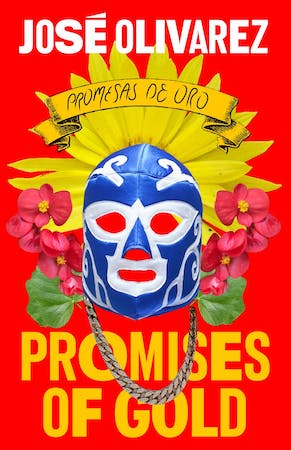
Family and place make us. Whether the relationship to where, and who, we come from is complicated or not, all poets must reckon with these two fundamental things that shape who we are, our worldviews, and how we learn to love. For Chicanx poet José Olivarez, Chicago and his Mexican family are his bedrocks and he delivers his second full-length collection, Promises of Gold/Promesas de Oro—with a Spanish translation by David Ruano—as a brilliant and moving homage to both:

“there’s two ways to be a Mexican writer, you can translate

from Spanish, or you can translate to Spanish.

or you can refuse to translate altogether.

there’s only one wound in the Mexican writer’s imagination

& it’s the wound of la chancla. it’s the wound of birria

being sold out of the taco truck. it’s the wound

of too many dolores & not enough dollars…”

Following ably in the giant footprints of Chicago poets past, who have produced some of the most important poets in our country’s history from Gwendolyn Brooks to Ana Castillo, Olivarez has been integral to this latest crop of Chicago poets. Side by side with heavy hitters like Nate Marshall and Eve Ewing and backed by leftist press Haymarket Books, which publishes the BreakBeat Poets series that has helped launch a number of young BIPOC poets’ careers, Olivarez’s debut collection Citizen Illegal came out to wide critical acclaim in 2018 and was then followed by a co-editor spot for The BreakBeat Poets Vol. 4: LatiNext in 2020. Needless to say, Olivarez has been on a lot of people’s radar, including mine, for a few years and he has successfully delivered one of the most anticipated poetry collections of 2023. 

I had the chance to catch up with Olivarez via email about Promises of Gold, writing a book of “failed love poems,” and which up-and-coming poets he thinks we should keep locked in our sights.


Angela María Spring: I’m always interested in the growth and process of a first collection to a second because in many ways it’s such a pivotal marker of a poet’s long-term career. How would you describe the experience of writing Promises of Gold versus Citizen Illegal, emotionally and technically?

José Olivarez: When I wrote Citizen Illegal, I was obsessed with questions of belonging. The book’s opening poem ends with the question: is the boy more Mexican or American? By the time I was done writing the book, I no longer felt compelled by whether I belonged here or there. I discovered that in-betweeness was where I felt most comfortable. De aquí y de allá. 

I had to write Citizen Illegal in order to write Promises of Gold. In Promises of Gold, I’m still thinking about belonging, but rather than questioning my place, I’m thinking about what it means to maintain and be in community with people you are committed to loving. What does love mean when we live in a country where violence is central to everything? 

Technically, there’s no comparison. I was only beginning to understand how to use line breaks in Citizen Illegal. Some of the breaks in those poems make me blush at how random they are. Promises of Gold is a confident book of poetry. I know what I am doing and I made every decision with purpose. 

AMS: Promises of Gold is laid out in a newer style of a the Spanish translation of your poems as it’s own book next to the original poems in English, rather than poem by poem translations throughout the book. I first saw this format with Raquel Salas Rivera’s new collection, antes que isla es volcan / before island is volcano. What does it mean to you to have your work presented in this way, as its own separate book, as well as what the process of having your writing translated to the language of your family especially as so often those of us who are first and second generation end up only knowing pieces of our parents’ language or can only speak but not necessarily read or write in that language. 

JO: Raquel’s collection inspired my decision to format Promises of Gold this way! Raquel is an incredible poet, and I always look to his writing for inspiration. I decided to go with this format because I wanted the reader to have a singular experience in either language. In other words, if you are reading the poems in Spanish, you will not be interrupted by pages written in English. 

I discovered that in-betweeness was where I felt most comfortable. De aquí y de allá. 

I can’t explain what it means to have my poems translated into my first language—the language of my parents and grandparents. My mom read the book and said it made her cry. I’ve never been able to share any of my work with my parents before, so this something else. Maybe in time I’ll be able to express how meaningful this is to me, but for now, I just want to thank David Ruano González— whose translations sing. 

AMS: In your author’s note, you describe Promises of Gold as an attempt to write a book of platonic love poems, but it didn’t end up being what you originally envisioned because “if [you] wrote that book, [you’d] be ignoring all the contradictions & messiness of the world we live in, all the ways in which love is complicated by the forces larger than our hearts.” For me, the poems that comprise this book are all love poems, you can feel the fierce beat of your heart in each, even when it’s anger at injustice like in “It’s Only Day Whatever of the Quarantine & I’m Already Daydreaming About Robbing Rich People”. Your love for your family, friends, your gente, your hometown, and the world, pulsates from each page like a living, breathing being. So it intrigues me that you found this book to be almost like a failed book of love poems and would like to hear more about whether you still hold that view or if it’s shifted into something else now that it’s out in the world in so many hands.

JO: That’s such a kind and generous reading. Thank you. I hope other readers will agree with you. Promises of Gold is a failed book of poems in the sense that the poems fail to materially change the world in the ways I want. For example, I can’t actually punch Jeff Bezos in the face— even though I would really like to. The point of the poems is to rehearse the impossible and in doing so maybe make a little more love possible. 

AMS: Sometimes Latinx poets can find themselves trapped into the stereotype that every diaspora in the U.S. is the same and, while we all have similar larger themes throughout our cultures, we are wildly different “Americans” based on where we grew up within the U.S. and where our family came from originally. One of the things in your book that is very powerful is how you seamlessly weave that uniqueness of Chicago in your Cal City and Ojalá poems, among others, with specific slang and references really root the reader there with the poet, on that specific sidewalk waiting for a bus or in a school or a factory where the community works. These are important details, vital language, revolutionary in a way; can you talk a bit more about how place has shaped your work over the years?

What does love mean when we live in a country where violence is central to everything?

JO: They are poems in of themselves. Where a book is located is important to me because it gives color and texture to the poems. It gives context to the narrative and lyrical element. One of the amusing things to me is that there are poems that people from certain neighborhoods in Chicago won’t understand because they are disconnected from  the particular part of Chicago (and Cal City) I’m writing from and towards. I like that it’s not just the Spanish bits that will obfuscate some of the poems. We can speak the same language and still talk past each other. How that happens reveals something about the reader and about myself. 

AMS: The emotional range that your poems embody in Promises of Gold is nothing short of astonishing. For example, the fierce, sad tenderness in “Fathers” or wry deprecation in “Between Us & Liberation”. And how you can affect the reader so deeply with so few words. I felt an arrows pierce my whole being when I read the tercet poem “Eviction Notice” and nearly fell off my seat laughing when I read another tercet poem, “Authenticity”. I’d love to hear more about how you play with emotional resonance in your poems, especially humor because I sense that humor is very important to your culture and work.

JO: Some people are from emotionally healthy families—I am from a hilarious family. 

I try to write poems that evoke the full range of human emotion. Why would I deny myself humor in making poems. Like a visual artist, I make use of all the tools at my disposal.

AMS: I loved the text message poems in your book and am always interested in the different contemporary forms poets are playing with; are there any forms you’ve been particularly drawn to work within lately?

JO: The text message poems were written by my brother Pedro and sent to me via text. He did not know he was writing poems, but he was. 

Lately, I’ve been obsessed with the sonnet. It’s a perfect form for where I’m at right now. 14 lines is all I have mental capacity for since my brain more quickly turns to mush these days. 

I also love Action Poems in the style of Yoko Ono. Practical and mystical. I teach the form to students all the time. 

AMS: What authors/books were you reading while writing Promises of Gold that you found influencing your writing or process? Did any of them surprise you to find their way into your book?

JO: I am always reading Natalie Diaz’s When My Brother Was An Aztec & Ada Limón’s Bright Dead Things. I’m sure those two books show up in everything I write. I carry those books everywhere and recommend them to everyone. Diane Seuss’s Frank: Sonnets is also hella important to me. Diane’s writing is so musical and sharp. I’m always drawn to it. 

AMS: Same question as above but this time music/musicians. Or does your book have a soundtrack?

JO: My book has a soundtrack! You can find it here. 

I will also say that the book has 11 sections because Common’s album Be has 11 tracks. There is some correlation between those songs and the material of the sections in Promises of Gold. This was Nate Marshall’s idea and for that I give him thanks.  

AMS: Who should we definitely be reading right now that we might not be?

JO: Janel Pineda and Vic Chávez. If I were a publisher interested in poetry, I would be emailing them regularly to ask them for a manuscript. I think Raych Jackson’s next book is going to be phenomenal. Her first book, Even The Saints Audition, is excellent and she’s getting better. Everyone should read her poems. I love Darius Simpson’s poems and will read anything he writes. Carina Del Valle Schorske writes the most beautiful sentences.

8 Novels Featuring Endearingly Messy Queer Characters

It’s not entirely right to say that literature is starved for complex, chaotic, endearing LGTBQIA+ characters. Starved in the mainstream, sure. We are just now emerging into a post-Love, Simon popular universe in which young queer people of today do just a little bit more than come out to their Oscar-Award-Winning-Actor-Portrayed parent and embark on an endearing journey of self-discovery that also includes dancing to a choice pride anthem of the ‘80s. 

We are lucky to have novels that portray the chaotic queer identity unhindered by palatable stereotype. These kinds of stories are not new; chaotic queerness has existed in print since the time of Wilde and before (perhaps even Homer? We can’t rule it out.) What’s new are said novels about chaotic queerness being picked up for review by major publications, included in book club picks and optioned for film and television, taught in classes, topping bestseller lists and greatly influencing the new generation of writers looking to tackle the same issues.

I’m speaking, of course, as one of these new writers. When I reflect on the process of writing my novel, Flux, the singular word that comes to mind is “stress.” I was writing from the point of view of a character that a) did not know who or what he was in any sense of the notion and b) did not have any particular insight into figuring it out. There is also time travel, and ‘80s television serials, and Silicon-Valley-esque fraud on the billion-dollar scale. But that’s another story. At the core of the book is something more dear to my heart: a gay boy without a clue, making one mistake after another.

I held these book about messy and endearing queer characters close to me at a very pivotal point in my life: while writing my own book, and becoming myself.

Mostly Dead Things by Kristen Arnett

In Kristen Arnett’s debut novel, Jessa-Lynn negotiates her family’s varying levels of grief after her father’s suicide while taking the reins over the family taxidermy business. Between razor-sharp imagery of the surgical processing of dead animals is an absolutely riveting portrayal of a young woman’s confused grief, complicated by Jessa-Lynn’s long-languishing love for her brother’s wife, Brynn. Passionate and messy, Mostly Dead Things is thrillingly alive.

Detransition, Baby by Torrey Peters

The reason for Detransition, Baby’s massive success thus far might be its wit, or its originality, but for me, it’s its heartfelt honesty. Reese, a trans woman, reels from the sudden “detransition” of her once-trans, once-partner Amy, now known as Ames, who is having doubts of his own about his life-altering decision. With dry humor, Torrey Peters navigates an immensely complicated terrain of conflicting identity with seeming ease. 

100 Boyfriends by Brontez Purnell

Brontez Purnell’s raucous, brutal, and hilarious novel follows a large cast of characters, all queer men, each one as delightfully complicated as the last as they are introduced in quick succession against a world that seems programmed against them. While it is Purnell’s humor that could draw anybody in with its deadpan authenticity, it is this novel’s unshakeable self-assuredness that brings its multi-prong identity into laser focus.

Love in the Big City by Sang Young Park, translated by Anton Hur

Sang Young Park’s breakaway bestseller is joyous, heartfelt, and so effortlessly real in its ability to jump cultures, making the unfamiliar familiar, underpinning the ultimate transmutability of human experience. Young, a gay student, encounters various pitfalls in his quest for self-expression: the departure of his best friend and roommate Jaehee, and the illness of his mother. Funny, honest, and profound, Love in the Big City is a treasure.

A Single Man by Christopher Isherwood

This 1964 novel (somewhat glamorized on film by Tom Ford in his directorial debut of 2009) is deceptively simple, brooding, and powerful. By far the oldest novel on this list, Christopher Isherwood’s take on existentialism is through the eyes of George, a gay teacher recovering from the death of his partner. Inhabiting a suddenly colorless world, devoid of hope, Isherwood draws a pitch-perfect portrait of grief.

The Thirty Names of Night by Zeyn Joukhadar

What I most admire about Zeyn Joukhadar’s writing is his ability to ground the fantastical. The Thirty Names of Night contains some of the most beautiful images I can remember ever reading in a book, unreal yet impeccably concrete. A Syrian American trans boy discards his birth name and, in looking for a new one, encounters the work of artist Laila Z. The book follows his journey to make peace with the tragic loss of his mother, an ornithologist who died searching for a rare bird. 

Solo Dance by Li Kotomi, translated by Arthur Reiji Morris

Solo Dance, translated from the Japanese, is a short and tense novel of becoming from the point of view of Cho Norie, a young woman attempting to keep her identity a secret against the oppressive backdrop of corporate Tokyo. The novel covers an intense period of trauma, yet the most astounding thing about it is the uncanny hope that prevails throughout. 

Paul Takes the Form of a Mortal Girl by Andrea Lawlor

There are certainly reasons for the words “Tight,” “Deep,” and “Hot” on the front cover of Andrea Lawlor’s novel about a shapeshifter, Paul, with the ability to transform his body and gender at will. There is of course the whipsmart metaphor for a nonbinary person’s natural fluidity within modern society’s norms. But there is also an endearing innocence to Paul that is, and remains, hard to forget. 

The Most Anticipated Irish Novels of 2023

Ireland. We’re having a moment. In the Banshees of Inisherin, Martin McDonagh translated our elliptical “chat” into silences and irrationalities that allowed the whole world to understand the melancholy in Hiberno-english symploce. With the blue-eyed boy Paul Mescal as an avatar of young Irish men, global audiences have come to see unflattering GAA shorts and emotional suppression as attractive. Mescal’s breakthrough was of course in the Rooney Toons (a title which, as far as I’m aware, was coined by EL’s Editor-at-large, Brandon Taylor), and who knows, maybe that show was the start of the most recent wave of Irish prominence in pop culture. But when it comes to literature, Ireland has always been a powerhouse. We’re masters of a language that isn’t our own.

I recently learned that one of the few words, if not the only one, that has crossed over from Gaelic to English is “smithereens.” Probably, I say “smithereens” and you hear the ante-phrase “blown to,” so let’s be clear: there is no correlation between this word’s crossover to English and the IRA’s use of explosives in Britain—the term is dated to 1810. Anyway, smithereens comes from smidiríní or smidirín, the diminutive of smiodar, meaning “fragment.” I like that it connotes shrapnel, breakage, the catapult and shower of sundry pieces. Irish writers have a history of exploding form and genre. Our books share a very small country of origin but Irish literature is a vast, myriad category. So with this list of novels from Ireland this year, I’m not going to do the thing where I point to elements that make them distinctly Irish. Let these works fly as they are and land as they may.—Lucie Shelly

Editor’s note: The following books were selected by former Electric Literature editor Lucie Shelly with descriptions written by Jo Lou, Chris Vanjonack, Denne Michele Norris, and Lucie Shelly.

Nothing Special by Nicole Flattery

A first novel but far from a literary debut—Flattery proved herself a young master with her story collection, Show Them a Good Time. Nothing Special follows two teenage women, typists working in Andy Warhol’s factory, as they explore questions of identity and ambition. With a healthy dash of dark humor, the novel showcases Flattery’s unflinching observations of human complexity.
Close to Home by Michael Magee

It’s 2013 and Sean was supposed to be the one in the family who “made it” by going to university in Liverpool, but now he’s back in Belfast with an English degree, but no job prospects. The novel follows his reflections—the struggles of his working-class upbringing and the lingering shadows that The Troubles casted on his family—in the aftermath of a drunken assault on a stranger that ends in a community service sentence. Close to Home is a lyrical examination of masculinity, class, and poverty. The prose of Magee, the editor of Belfast literary journal Tangerine, sings with the tenderness of a writer beyond his years. 
Kala by Colin Walsh

Galway native Colin Walsh decamped to Belgium several years ago and perhaps the ability to happily reside in two countries helped him to occupy a dual-modality while writing Kala. The novel is a “literary thriller,” forms of storytelling which are historically considered to be in opposition. Kala hits its mark: it’s a beautiful and taut work of prose.

In the summer of 2003, Helen, Joe, Mush, and Kala are teenagers in the small beach town of Kinlough. Their bond ruptures and their lives change overnight after the unexplained disappearance of Kala. Fast forward to 15 years later, more young girls have vanished and bones are discovered in the woods, the former friends are unwillingly reunited in Kinlough as they try to uncover who killed their friend and why.

How to Build a Boat by Elaine Feeney

Elaine Feeney’s writing, including her debut novel, As You Were, lights up with that brilliant combination of hilarity and tenderness. Her sophomore novel, How to Build a Boat, follows one boy on quest to find a connection with his late mother Noelle. Jamie attempts to build a “perpetual motion machine” changes his school and his community.

Perpetual Comedown by Declan Toohey

For Sally Rooney readers missing the moody environs of Trinity College, Declan Toohey might sate the craving with his debut, Perpetual Comedown, which follows literature doctoral student Darren Walton as he tries to untangle an elaborate conspiracy and loses his mind in the process. This acid trip of a novel defies genre in its exploration of neurodiversity, mental illness, and the absurdity of academia.

Dirty Laundry by Disha Bose

Bose’s debut novel dives fearlessly into some deceptively murky territories: suburbia and motherhood. There’s Ciara, the perfect mother, her best friend Mishti, dissatisfied by an arranged marriage, and Lauren Doyle, the hippie. When Ciara is found murdered in her home, the remaining friends are answerable to a crime much greater than the average neighborhood scandal. 

Hotel 21 by Senta Rich

“I have a first-day rule,” says Noelle early on in the book. “Any sign of trouble, even a whiff of a problem, and I walk.” It’s a system that she has had plenty of experience with, having relocated to twenty different hotels where she works as a cleaner addicted to pocketing little “souvenirs” as she cleans, mundane tokens of the lives led by hotel guests. At her 21st hotel, however, Noelle finds herself truly connecting with the joyful, heartbroken, complicated other women who work there, making her question her dedication to leaving at the first sign of turbulence.

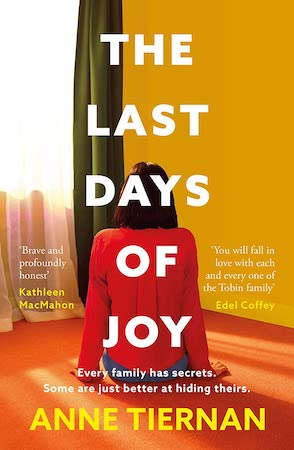
The Last Days of Joy by Anne Tiernan

Anne Tiernan’s latest novel, The Last Days of Joy, introduces the Tobin family, a clan of four which includes Joy and her three children: Connor (the public-facing CEO of a high profile company), Frances (a bored housewife on the precipice of blowing up her entire life), and Sinead (an acclaimed, best-selling author struggling to crank out her latest book). Upon learning that their mother only has a few days to live, Joy’s children rush to her hospital bedside, where they reckon with surprising truths about their mother, their siblings, and themselves.

Though the Bodies Fall by Noel O’Regan

This haunting debut by Noel O’ Regan follows Micheál, a man living alone in his childhood home in Ireland. While the cliffside the bungalow overlooks is beautiful, it has, for generations, been considered a “suicide black spot”, and we come to learn that Micheál’s mother considered “saving” these lost souls to be her primary duty. With his sisters urging him to sell the family land as soon as possible, he finds himself torn between trying to save the past or salvage the future.

Lazy City by Rachel Connolly

Part love letter to modern Belfast, and part reckoning with the protagonist’s complicated grief, Rachel Connolly’s debut novel, Lazy City, follows Erin as she abruptly leaves grad school and returns home following the accidental death of her friend. Suddenly back in a familiar city where everyone she knows feels like an acquaintance, Erin divides her attention between an American looking for adventure and an equal-parts comforting and perplexing local, learning a little more about herself in the process.

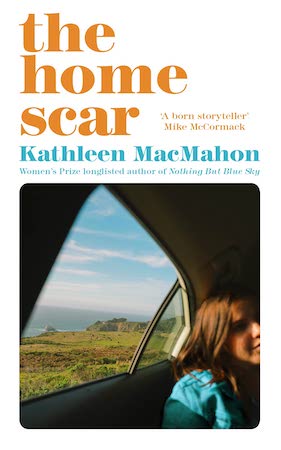
The Home Scar by Kathleen McMahon

The Home Scar, McMahon’s fourth novel, follows half-siblings Cassie and Christo. Living half a world apart, their lives are filled with work and painful memories they intend to forget. When tragedy draws them to revisit the last glorious summer before their mother died, unearthing the consequences of a less happy summer, Cassie and Christo must confront their past head-on, and finally make peace with the mother who neglected them.

The Woman on the Bridge by Sheila O’Flanagan

Inspired by the true story of O’Flanagan’s grandmother, The Woman on the Bridge is about a young woman’s commitment to the fight for Ireland’s freedom. Braiding love, loss, and the sheer drama of war, O’Flanagan’s novel is redemptive in the way it peers into women’s lives, turns them right side up, and refuses to be forgotten.

Soldier Sailor by Claire Kilroy

Soldier Sailor, Kilroy’s first novel in a decade, brings to light the tumultuous early days of motherhood. An old friend reappears just as a marriage strains, offering a peek at what might have been, and perhaps, at what still can be. Kilroy’s writing is visceral, filled with intimate feeling, and the strength to take your breath away.

The Happy Couple by Naoise Dolan

The Happy Couple charts the lives of Luke and Celine, to be married in a year’s time, and their small but tight-knit wedding party. There’s quietly ambitious Archie (the best man), Phoebe, (Celine’s sister, bridesmaid, and stealth detective), and Vivian, (a guest who observes her friends with stark emotional distance). A ferociously funny and clever ensemble novel, Dolan joyfully reimagines the modern marriage plot and makes it her own. 

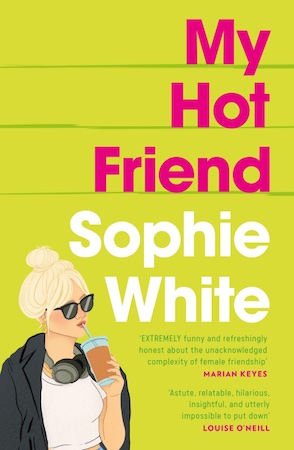
My Hot Friend by Sophie White

Making friends in your 30s is a feat almost as impossible as it is painfully awkward. For Lexi, the downside of making a living from a podcast that hinges on the chemistry between her and her co-host Amanda is becoming more and more obvious as their relationship starts to deteriorate. Claire’s hunt for a shiny new bestie started after her group chat with school friends became suspiciously silent. New mother Joanne can no longer keep up with her hard-partying friends and their booze-soaked social gatherings. The three women came together to form an unlikely bond as they figure out which friendships are seasonal and which ones are for life. A wickedly funny paean to female friendships of all forms.

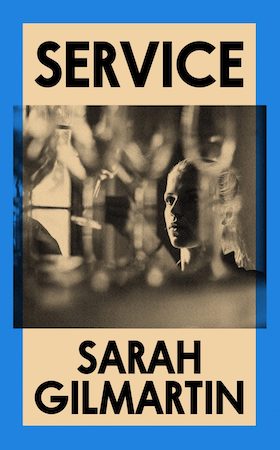
Service by Sarah Gilmartin

Service is told from the perspective of three characters: the waitress, the chef and the chef’s wife. Daniel Costello, an acclaimed chef of a fine-dining restaurant, has been publicly accused of sexual misconduct with his face and name brandished over the news. When Hannah hears that the restaurant has been shut down, she remembers her own uncomfortable summer as a waitress there, where mentorship turns out to have strings attached. Jules has been married to Daniel for more than two decades and with the glare of the media on them, she wonders what being a good wife and a good mom means. Their stories braid together into a messy and contradictory exploration of power dynamics, complicity, and toxic masculinity set in mid-aughts Dublin. 

The Bee Sting by Paul Murray

The Bee Sting follows the implosion of the Barnes family over several decades as their family business faces bankruptcy and they fall down the economic ladder. Imelda, the matriarch, is desperately trying to shore up funds by selling her jewelry online while her husband, Dickie, chooses to bury his head in the sand, literally, by building a doomsday fortress in the wilderness. Their children, the binge-drinking high-schooler Cass and the runaway preteen PJ, aren’t faring any better. An ambitious novel about an unhappy family floundering to keep it together as their world collapses.          

Ordinary Human Failings by Megan Nolan

Megan Dolan received critical acclaim for Acts of Desperation, her debut about a woman in an all-consuming, but one-sided, toxic love affair. She returns with a novel in a completely different vein, about a news-hungry tabloid reporter who digs into the disappearance of a three-year-old girl on a London council estate in the ‘90s. A young woman from a working-class Irish family is quickly implicated in the death and as the investigation unfolds, we see how the failings and past traumas of each member of the family has led to who and where they are today. 

The Rachel Incident by Caroline O’Donoghue

University students Rachel and James are inseparable—coworkers, roommates, and best friends. Rachel’s crush on her married professor, Dr. Fred Byrne, leads them both down a life-changing path of seduction, secrets, and lies. Set in the span of a year in Cork during the ‘80s financial crisis, The Rachel Incident is a beautifully written novel about the anxiety of entering adulthood during an uncertain time and finding your identity through your friendships. 

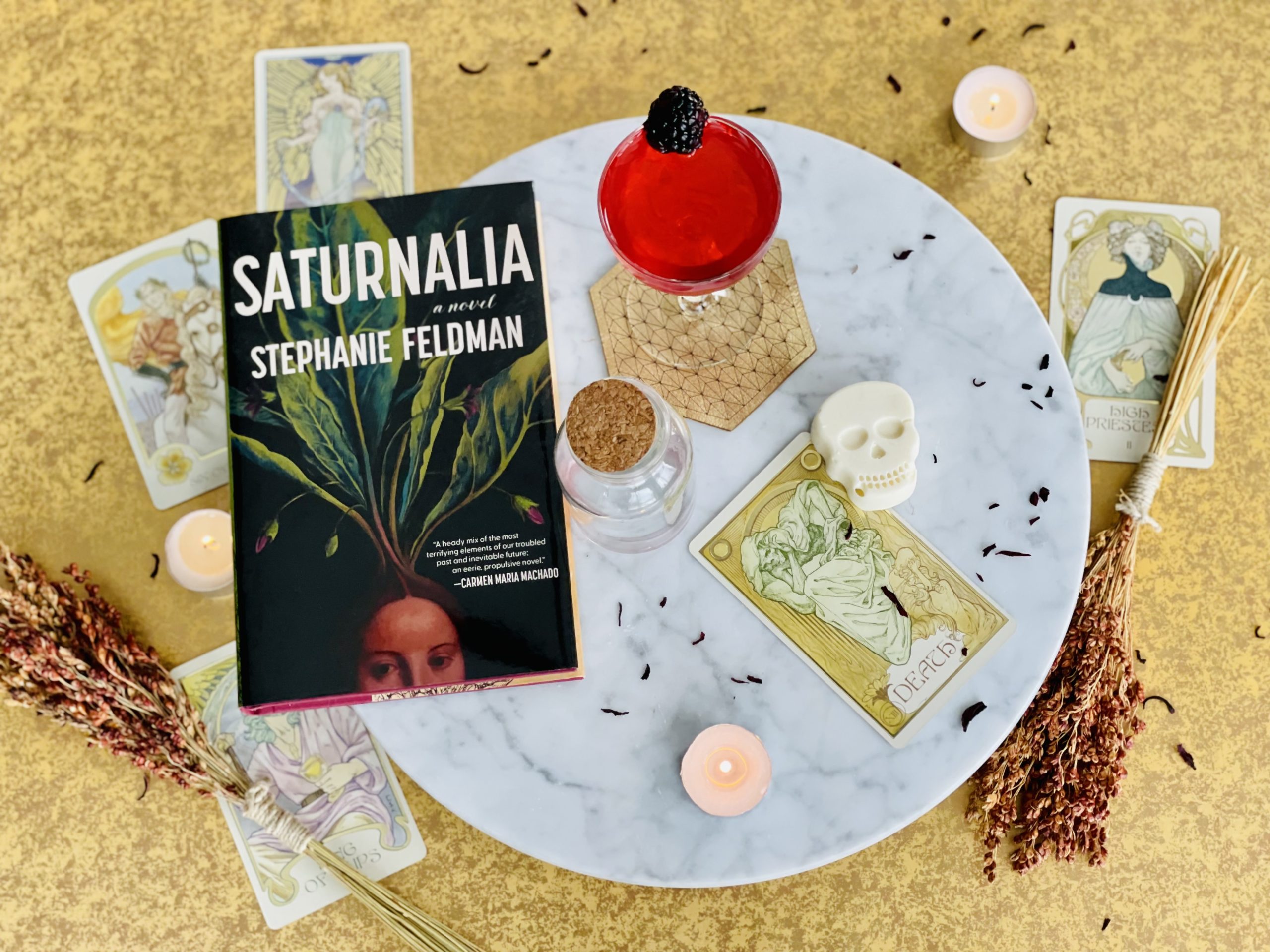
Booktails From the Potions Library, With Mixologist Lindsay Merbaum

In a not-too-distant future, the world is plagued by extreme weather, mosquito-borne fevers, and corresponding economic decline. Civilization seems on the verge of collapse. And if the world is ending, why not do what you want?

In Stephanie Feldman’s novel Saturnalia, this is the vibe in Philly on the eve of Saturnalia, a winter solstice carnival honoring Saturn, the ancient Titan, father of Zeus, who ate his own children to keep them from usurping his power. Anyone who’s anyone belongs to the Saturn Club, or another of its ilk, like Pan’s or Baldur’s clubs, where the rich and powerful party on Saturnalia in tuxes and masks, doling out coveted jobs and viable futures to friends and fellow members. If you’re not in the inner circle, then you’re out in the wilderness. And Nina and her college friends very much want to be in the inner circle. Though they all began as pledges together at Saturn three years ago, tonight Nina’s ex-friends are dressed in gold and running the show, while she’s scrounging for rent. When Max—her last, tenuous connection to the club—hires her to infiltrate the party and retrieve something precious, Nina’s errand quickly turns into a race against time. And death. Before the solstice is over, everyone and everything that matters to her will be called into question. Will she find herself alone? Is there anyone she can trust in this morally bankrupt world? 

Saturnalia is a fast-paced tale that’ll have you turning pages as fast as any good mystery. Plus there’s magic. 

This booktail’s recipe offers two paths: in honor of the trick-or-treat-ish Saturnalia chant of “give us whiskey, give us gin, open the door and let us in,” this booktail can be made with either whiskey or gin. The potions priestess prefers whiskey—rye specifically. Those with a sweeter palate may prefer gin. If desired, you can cut the sweetness by topping it off with champagne. Either liquor is combined with blackberry syrup for the strangely purple Draught of Oblivion served at Saturn. Both are likewise accompanied by vermouth, a fortified wine, for ceremonial and recreational wine-drinking, including the weak mulled wine served at Max’s Blue Christmas hangover party. Finally, chicory pecan bitters are a reminder of those rich little moments of joy, like sweetened chicory and spiked cider from street carts, and burned chicory coffee spiked with cheap rum, and shared with a good friend. 

The booktail and novel are presented as offerings atop a moon-like marble platter that’s set against a gold backdrop. An empty potion bottle, such as might contain the Divine Quintessence, rests beside an intoxicatingly bright elixir, the glass garnished with a plump blackberry. The draught and three candles form a sacred triangle. Representing the harvest, bunches of dried red flowers frame the offerings, set alongside stylized gold tarot cards for Nina’s own deck. One card alone appears next to the drink and book—the Death card, topped with a white chocolate skull for the token chocolate Saturns handed out during the festival. The scene is dotted with tiny dried red flowers that resemble flecks of blood. 

Saturnalia

Ingredients

Gin instructions

Prepare the syrup. Once cool, add it to a mixing glass filled halfway with ice, along with the gin, dry vermouth, and bitters. Stir until well-chilled. Strain and serve over fresh ice, if desired. Or top off with champagne. Garnish with a blackberry. 

Whiskey instructions

Prepare the syrup. Once cool, add it to a mixing glass filled halfway with ice, along with the whiskey of your choice (rye is recommended), sweet vermouth, and bitters. Stir until well-chilled. Strain and serve over fresh ice, if desired. Garnish with a blackberry. 

Blackberry Syrup ingredients

  • 1 c water
  • 1 c sugar
  • 6 oz container blackberries

Blackberry Syrup instructions

Mix all ingredients in a medium pot and bring to a boil, then simmer for 10 minutes, stirring occasionally. Once cool, strain and discard solids. Store in a glass bottle or jar and keep refrigerated.  

The Craft in Writing Characters with Messy Psychology

In the fall of 1973, just as the country finished watching the Watergate hearings, my mother enrolled in classes to become a psychologist. Watergate wasn’t why she decided to go to graduate school—my mother has always been interested in anxiety—but the national atmosphere it created certainly helped. At that time, we were living in Washington, DC, and she couldn’t run to the deli for a jar of pickles without getting caught in conversations about cover-ups and wiretapping and CIA conspiracies. 

As part of her studies, my mother sometimes used my younger sisters and me as practice subjects. She gave us batteries of IQ tests and asked us to interpret inkblots. We answered questions on the Myers Briggs Type Indicator to determine our personality types and whether we were introverts or extroverts. For our participation, we were rewarded with peanut M&Ms and, most meaningfully, her attention, which was hard to come by in a household with three children, three dogs, and my unhappy father, who was even more demanding than the rest of us.

That winter, a slim copy of the second edition of the Diagnostic and Statistical Manual of Mental Disorders (DSM) appeared on my mother’s desk in the little room by the front door she now used as a study. Leafing through it one afternoon, I found a list of ten personality disorders, which were “characterized by deeply ingrained maladaptive patterns of behavior,” and “often recognizable by the time of adolescence.” By then I was thirteen and moody: easily enraged by my sisters, easily mortified at school, tormented by guilt over small offenses and blunders, yet convinced I was destined for greatness (especially when alone in my room). I veered daily between bouts of despair and exultation that would exhaust me now but at the time seemed energizing. I also adored my mother and wanted her to myself. Consulting the DSM, I diagnosed myself with all ten personality disorders the way I once misted myself with her entire collection of perfumes.

Over the next several weeks, I presented my findings to my mother while washing dishes after dinner, one of the few dependable ways to catch her alone. “Possibly you have a tendency to be passive-aggressive,” she might allow, handing me a pot to dry. “We all have dysfunctional tendencies.” I would then offer evidence for why I really was obsessive-compulsive/paranoid/anti-social. If you wanted to edge out your barking, squabbling, brooding competition, the surest way to engage my mother was to be worried about something, especially something complicated. Yet unlike my problems at school or with my sisters, personality disorders failed to capture her attention. The more I insisted on my deeply ingrained maladaptive behaviors, the more blandly my mother reacted. These dishwashing sessions generally ended with a recommendation that I get outside more or invite a friend over, and the dogs, by the way, could use a walk.

It was a deflating response at the time, but I’ve come to believe my mother’s apparent disinterest did signal concern, quite a bit of it. Had she suggested dysfunction by subjecting her children to so much psychological testing? Created it by going to graduate school instead of staying home? (My father’s view.) I’m sure she also wanted to discourage me from embracing any of the conditions I was flirting with. A word is not just a word when it’s a diagnosis.

Whatever the case, confronted with a kitchen sink of disorders claimed by an adolescent reeking of Love’s Baby Soft with a spritz of Styx, my mother was clearly aware that explanations of human behavior are never trustworthy. Especially explanations of one’s own behavior, which are so often shaped as much by convenience, self-importance, and disingenuousness as by an effort to be understood. When it comes to people, my mother must have known, explanations hide as much as they reveal.

My mother went on to become an excellent psychologist, so this recognition ultimately served her well. It’s a recognition that serves novelists well, too. Characters always have problems at the beginning of a story, for example, but rarely do they have a firm understanding of those problems, or themselves, for the simple reason that misconceptions, ambiguities, and, above all, secrets, create drama. “What did the president know, and when did he know it?” Senator Howard Baker’s famous question during the Watergate hearings captured the power of uncertainty. If a character doesn’t know something or is hiding something, readers want that something discovered and explained. We want the facts. We need them in order to feel that the story has been told.

If a character doesn’t know something or is hiding something, readers want that something discovered and explained.

But has it? Have the effects of those misunderstandings and ambiguities—those secrets—been resolved? Or have new doubts moved in? Perhaps it’s our current hurricane of misinformation (which make the lies and dirty tricks of the Watergate scandal look like drizzle), but when it comes to thinking about human behavior these days, I find myself less interested in “the facts” than in how people become so convinced they know them.

While visiting my mother a few months ago, I found my father’s love letters, written to her during their courtship while he was getting divorced from his first wife. He believed he would love my mother forever—something he repeats passionately in those letters—and yet after twenty years of marriage, he divorced her, too. Was it because her attention was even harder to hold once she began seeing patients? Because he resented her success? Because he’d lost his own mother as a child and felt he was losing another? (The view of his third wife, a Jungian analyst.) What did he come to “know,” exactly, that altered how he felt—and when did he know it?

At the time, I was too young to ask my father questions like these, but even if I’d asked him later, I wonder how reliable his answers would have been. It’s hard to get to the truth about yourself, whether you’re a public figure, a teenager, or an elderly man with three failed marriages and many regrets. And if it’s that difficult to comprehend yourself, how on earth can you expect to fathom anyone else? This is not to critique psychotherapy, but rather to say that any analysis of human behavior is bound to leave so much out.

“The personal life of every individual is based on secrecy,” Chekhov writes in “The Lady with the Dog,” adding, “and perhaps it is partly for that reason that civilized man is so nervously anxious that personal privacy be respected.” By secrecy, I think Chekhov is referring not to whatever sins we might be hiding, but to the contradictions and incongruities that can’t be explained about us, that we can’t explain, even to ourselves. A secret inner life is our greatest privilege, but also often our greatest fear. (The current edition of the DSM lists almost three hundred mental disorders and runs over a thousand pages.)

Where you can go inside other people’s heads is, of course, the project of the novel, wherein secrets exist to be uncovered. As the critic Janet Malcom notes in Reading Chekhov, “If privacy is life’s most precious possession, it is fiction’s least considered one,” and goes on to refer, somewhat ruefully, to “the glaring exposure to which the souls of fictional characters are held up.” In other words, characters in a novel transform between the first and the last chapters, sometimes with enormous complexity, but everything there is to be known about them is on the page. If you miss something, you can reread a few chapters to figure out what happened. Characters may behave in puzzling ways, may be paranoid, anti-social, obsessed with their mothers or their political enemies, or pathological liars who couldn’t accept a fact if you gave it to them in a pickle jar—but eventually you find out why. More or less. As E. M. Forster puts it, “people in a novel can be understood completely, if the novelist wishes.”

And yet, explaining their behavior is not what makes characters relatable.

And yet, explaining their behavior is not what makes characters relatable. In fact, it’s when characters don’t understand themselves very well that readers worry most about them, identify with their difficulties and confusion, and keep reading—which is vital, because characters, unlike people, don’t exist when no one is paying attention to them. What makes the affair between Gurov and Anna in “The Lady with the Dog” so surprising and convincing, for instance, is that they can’t figure out why they have fallen in love with each other, or what to do about it. They truly don’t know their own minds and, as the story suggests by its famously irresolute ending, probably never will. Chekhov, of course, was a master at revealing how emotions we believe should be definite, like love and grief, are full of inconsistencies. He also understood that readers are more deeply intrigued by hesitating characters (see Hamlet) than by decisive ones (see Ivanhoe).

On the other hand, there are those characters who think they understand themselves perfectly and must discover, usually with reluctance, that they don’t—a problem I recently gave to one of my own characters, who is, incidentally, a therapist. In such stories, the reader is usually better informed than the characters, who believe their problems are simply resolvable obstacles and must be forced to see the real trouble they’re in. Frequently this trouble is of their own making, a result of misguided notions and projections. Jane Austen’s Emma thinks she’s shrewd about human nature, yet her assumptions about other people, and her motivations for interfering in their romantic lives, are completely wrong-headed. The reader’s own clear-sightedness becomes part of the drama: we see how Emma is misjudging herself and everyone else, so why can’t she? Anxiously, we hope she wises up before she ruins several futures, including her own. Once again, our engagement with the story is intensified by the character’s lack of self-knowledge, which reminds us, ideally, of our own blind spots. The longer characters can remain somewhat opaque to themselves, or at least have a few questions they keep asking, the more absorbing their predicaments, and the more their worlds feel like ours. 

In any case, fictional problems must reach a last page. The story has to end. The reader closes the book, and maybe, that same evening, picks up another and gets caught up in a new set of anxieties.

This past summer and fall, I spent hours following the January 6th Select Committee Hearings, which reminded me of watching the Watergate hearings with my parents, fifty years ago, down to the question of what the president knew and when he knew it. My mother’s current view of national politics is that it’s “one big mess,” which was also her opinion during the Watergate era. My mother is now in her late 80s; she still sometimes says she’s bewildered by what happened in her marriage to my father, who is no longer alive.  But she doesn’t like dwelling on past unhappiness any more than she likes talking about politics or her health. Anxiety, however, continues to interest her. During a recent phone call, I asked what she was reading. A novel, she told me. “Can’t remember the title,” she said cheerfully, “but the people in it certainly have a lot of problems.”

It’s a strange desire, in this world of trouble, to go seeking other people’s problems, and yet what a relief, for both readers and novelists, to feel that every so often a problem can be completely understood.

A Turkish Woman’s Dreams of Being a Writer in Berlin Faces An Expiration Date 

In her debut novel, The Applicant, Nazlı Koca takes the reader on Leyla’s identity crisis whirlwind  in Berlin, Germany. Recently failed from her masters thesis and at risk of losing her student visa, Leyla resorts to working as a cleaner at a youth hostel as she awaits an answer from her university appeal.

Leyla takes to keeping a diary as she attempts to make sense of the series of events that led her to this state. A once privileged upper-middle-class student in Istanbul, she is haunted by the reality of her family’s debt-ridden existence after the death of her alcoholic, abusive father and crash of the Turkish economy. What is the better option: fighting to stay as a non-citizen in Berlin to live the life of an artist or retreating home to clean up her father’s mess? 

To take her mind off of her family, she spends her days pocketing items left behind from hostel guests—half consumed liquor bottles, coins and snacks—clubbing in Berlin’s infamous nightlife with fellow immigrant artists, watching Turkish soap operas and attempting to work on her fiction writing. She even surprises herself by finding solace in a traditional leaning relationship with a right-wing Swedish Volvo salesman. 

With a biting sense of honesty, Leyla comments on the world around her, dissecting Western hypocrisies and double standards. Why are Europeans considered “ex-pats” while Turks are “immigrants”? Who has the privilege of living as an artist? 

As she slowly begins to reckon with her tangled past in Turkey and uncertain present as a writer in Berlin, we are left with glimmers of hope that Leyla has the resolve to figure it out. 


Amy Omar: Could you speak a bit on your journey as a writer? 

Nazlı Koca: I always wanted to be a writer, but I didn’t actually write anything until I was in my 20s.

I grew up in a city called Mersin on the Mediterranean coast and moved to Istanbul for college. I stayed in Istanbul for two years after graduation, working at advertising agencies as a copywriter. I tried working as an editorial assistant at a publishing house as well, but it was a horrible experience. I was so disappointed —I thought that publishing would be my way into writing and having a literary life. When I moved to Berlin I went back into copywriting but then also worked in social media policing and cleaning like Leyla. And I found unexpected writing communities at these jobs, cheap bars, zine stores. 

Then I moved to the US for a fellowship at Notre Dame, where I did my MFA. I lived in New York for a little bit too, working at a bookstore and writing The Applicant in a series of sublets across Brooklyn.

Now I’m in a PhD program in Denver. It’s been a long journey.

AO: As someone currently in academia, how does that impact Leyla’s perspective? Can you elaborate on that? 

NK: There’s nothing I could add to Leyla’s take on academia as someone who stayed in it. All universities run on the white-collar ethos of “We’re doing it all for the love of books.” No. This is not love. This is capitalism at its best, and you’re just a part of the system. A system that’s based on exploitation, manipulation, and hoarding power. And you’re holding on to dated rules and requirements for admission and success because you want to thrive in it. 

AO: So much of adulthood is learning the reality behind these institutions that, as children, we are taught to view as noble professions. But then, you get to the industry, and you’re like, wait, these are not noble at all.

NK: Yes! And I’m scared because I don’t want to turn into one of those novelists who fictionalize the emptiness of their safe academic jobs in a world where children are forced to marry 70 year olds or work in mines. But I do feel tempted to write about the not-noble-at-all position that I’m in. There’s something so ugly about the privilege of it—the respect that you get just being in academia. When I was working as a bookseller, I got less respect, both from my bosses and the customers, even though it paid more, and I already had a terminal degree in my field.

AO: Leyla believes that by moving away from Turkey, not speaking Turkish and “not thinking in Turkish, [her] past would not dictate her future”. She holds onto the hope that she can scrub her cultural trauma and start fresh. Is that a possible pursuit? 

NK: I don’t think it is. It hasn’t been possible for me at least. Up until a couple years ago, I still thought it was possible, if I found the right place. It was a kind of dark secret that I wouldn’t want to admit. But after reaching my 10th destination, my cultural trauma is inseparable from my lifelong attempt to escape it. I think there’s some value in the attempt though—as a viable coping mechanism.

When I left Turkey I was able to breathe for the first time. I told myself “I’m my own agent.” But then, I quickly realized, no, there’s no such thing as a free agent. In those first years away from Turkey, there was still an intense reckoning to realize that, in addition to having a cultural inferiority complex imposed upon me by the Western gaze, I also come from a problematic country, which made it almost easier to surrender to the worst perceptions of my cultural identity.

But if you’re anything like me, no matter how many poetry readings you conceal your name and home country at, sooner or later you end up in a place where you ask yourself, “Wait, should I forget about it? Or should I advocate for it?” Because you feel like you need to fight for it and make art on behalf of your people. But then, who exactly are your people? I’m still not sure.

AO: Could you speak to your experiences working as a cleaner? How did your cleaning experiences vary depending on the  city? 

You feel like you need to fight for [your home country] and make art on behalf of your people. But then, who exactly are your people? I’m still not sure.

NK: Actually, I was only a cleaner in Berlin. I was a dishwasher when I moved to South Bend because even though I had a fellowship, I still needed a little more money to get by. I worked at a huge dining hall that served Notre Dame’s infamously white and wealthy student body. And behind the dirty tray windows waited three dozen dishwashers, almost all people of color, including the student workers, because this was the best paying student job and international students are only allowed to work on campus. It was very different from working in a hostel in Berlin. Europeans are usually careful with their money and the environment. They don’t waste much. At Notre Dame, students would rarely finish or even empty the food on their trays. 

Even before I started working in the kitchen, during orientation week, I was shocked by how many plastic bottles were handed out. I think I have a draft of a short story somewhere that I wrote on my first week in the U.S., set in a dystopian religious society that wastes for worship.

AO: Leyla’s experience living in Berlin is atypical from the stereotypical image of Berlin as an artist haven. It seems like most of the foreign characters in the novel are disillusioned with the false promise of artistic freedom. Why is that? Are only certain people allowed to take part in artistic pursuits? 

NK: Immigrants are often erased from narratives of artistic pursuit in the city even though they’re the backbone of every major city that artists feed on. Berlin’s background is a mosaic of Turkish store signs, kebab cutters, bus drivers—how do you even erase it? 

Or the movie Paterson by Jim Jarmusch, which I loved. But later on, I heard that Paterson has the largest Turkish community in the Tri-State area. They have Turkish grocery stores and everything. But there is no hint of that in the film! 

AO: The thing about Paterson, it’s also just a normal suburb. So if you go to Paterson, you’re driving around and it just looks like a normal American city. There’s nothing special about it, but it is very, very Turkish. It’s very funny. 

NK: Yeah, so I guess I can’t expect everyone to make Turkish culture their background whenever there’s a large population of Turks. But also it’s funny that we don’t get to have any representation.

For me, it was important to reckon with my role in Berlin—as a gentrifier but also someone who shares an ethnicity with these people who are being gentrified and understands their language. I was like a spy, but I didn’t know who I was spying on and who I was spying for.

AO: In some ways, Leyla perpetuates her own self sabotage by getting sucked into the Berlin nightlife. Why do you think it is so easy for Leyla to lose control? And how much of this spiral is connected to her avoiding her family trauma? 

Immigrants are often erased from narratives of artistic pursuit in the city even though they’re the backbone of every major city that artists feed on.

NK: I often think Leyla has more control of her life and story than I do. She doesn’t have to answer to anyone because no one is listening to her. It’s easy to say that she’s avoiding her family trauma in a downward spiral—like she tells herself—but what if descending into the deepest corners of her subconsciousness on her own terms, at her own pace is the only way to confront it all? 

The family is the first social unit we know, and it’s based on control. Even in the least traumatic scenario, parents decide what their little human eats, says, and wears for years and years. Maybe it’s not so unwise to spiral until we’re far—and close—enough to the starting point, to all that we’ve learned under other people’s control.

AO: As someone who grew up in a privileged household in Turkey, what do you think is Leyla’s main takeaway after working as a cleaner? How does this “rock bottom” status contribute to her character arch? 

NK: I’m pretty sure Leyla knows that working as a cleaner is not rock bottom. But it’s a socially acceptable, honorable way for a woman to earn money with her body in a world where she’s often not allowed to exist outside of its oppression. Leyla’s mother was privileged in that she didn’t have to clean other people’s rooms for money, but isn’t Leyla more privileged as a single woman who doesn’t have to cook and clean for a violent man and can’t even write or speak about her life? Where does sex work fall within this triangle of financially, socially, and physically exploitative roles most women get cast in without a choice? Cleaning lets Leyla put these questions into words for the first time.

AO: This line stuck out to me: “I had been avoiding my own country’s art, as if I could separate myself from the pain, guilt, rage we’re all doomed to carry no matter where we go, rage we are not even allowed to scream about, make films about, write about, sing about.”  We have seen incredible political films come out of other countries, like Iran, why do you think this isn’t the case of Turkey? 

NK: We were at the center of an empire for hundreds of years. One that had mastered the art of oppression in mysterious ways, and coded it in our DNA. And oppression turns into self-censorship the moment a child asks a question their parents are too scared to answer. 

Our best political poets, writers, filmmakers have paid for their art with their lives. Each new government condemns the exiling of a political artist by their predecessors, then finds new ways to silence the artists of their time. Most contemporary artists stop making political art after they escape Turkey, if they can. And who can judge them after watching them get charged with speech crimes, antagonized in the media, and receive hundreds of death threats on social media?  

We all got scared and withdrew after a few people died at Gezi Park protests, but look at what’s happening in Iran. In Turkey, we still hold on to the illusion of being a free country and having more freedoms in comparison to other Middle Eastern countries, and that makes us not take risks. Whereas in places like Iran, people are revolting because they have nothing left to lose. But what is it that Turks have to lose? Our little bubbles made of debt and denial? 


Author’s Note: Thank you for letting me return to this conversation in the aftermath of the Turkey-Syria earthquake. To these three questions I asked myself, I think, even though I seem to have unconsciously but strategically planted them just outside of I, me, mine. 

But then, who exactly are your people? 

But what is it that Turks still have to lose? 

Our little bubbles made of debt and denial? 

My people are all the Turks who have been asked by their anxious mothers last week to delete the most political post they’ve shared on social media in years which simply said, “I can’t express my emotions in a way that won’t get me arrested.” They’re the Armenians who sent hundreds of tons of aid to Turkey. The Kurds, Turks, Arabs who have been left to die under the rubble because the government blocked access to Twitter where people shared their locations because officials didn’t want the world to see how angry the rest of us were that our little bubbles made of debt and denial had collapsed in on us.