Hollywood’s perpetual hunt for literary IP, or intellectual property, has given audiences an ever-expanding library of book-to-film adaptations—some exhibiting more intellect than others. Without the proper care and insight, a book undergoes a flattening effect when transferred from page to screen, as nuance and ambiguity are smoothed over into something that’s easier on the eyes, like a mousy heroine airbrushed into a sex symbol. The recent Netflix adaptation of Persuasion is a case study in howa cinematic retelling can fail to translate the subjectivity and psychological complexity of the written word. Directed by Carrie Cracknell from a screenplay by Ron Bass and Alice Victoria Winslow that has all the substance of a SparkNotes summary, the movie favors quotable quips over the potent emotional subtext of Jane Austen’s novel.
The novel follows the reunion of former lovers Anne Elliot and Frederick Wentworth more than seven years after Anne rejected his marriage proposal at the urging of her family and friends, who felt the naval officer was beneath her station. Now, he’s a successful captain; and everyone knows that a single man in possession of a good fortune must be in want of a wife. Though it features the author’s signature satire and social critique, the narrative is intensely internal—tinged with an aura of regret, of love lost and rediscovered. Also notable is the fact that Persuasion is the final novel Austen completed before her death. She did not live to see it published.
It’s probably for the best that she did not live to see the Netflix adaptation.
Though it features the author’s signature satire and social critique, the narrative is intensely internal—tinged with an aura of regret.
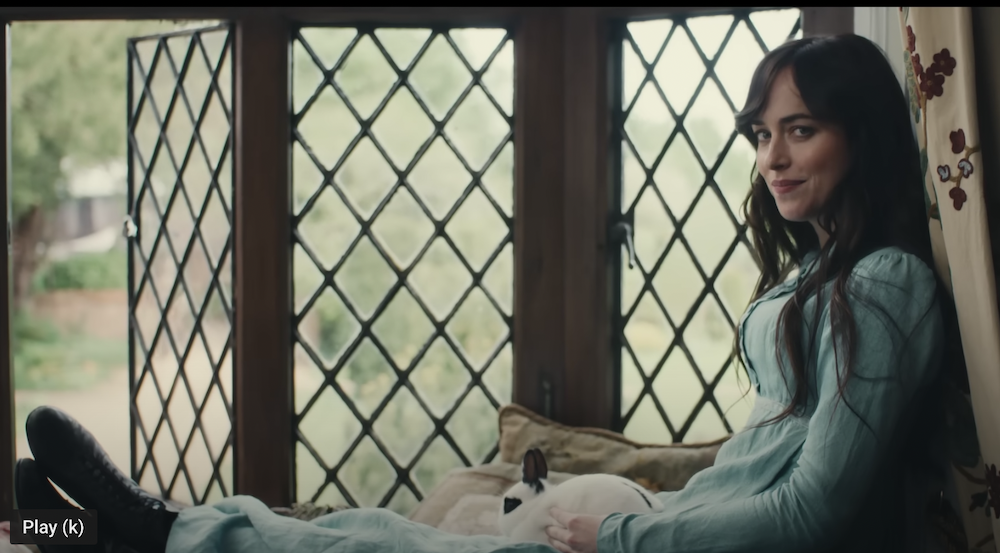
Soon after the trailer dropped, Janeites took to social media to lament the misreading and misguided Fleabag-ification of Austen, complete with a winking and wine drinking Dakota Johnson as Anne Elliot. Speaking directly to the camera, the unrecognizable heroine cracks wise about her awful relatives while cracking a hole in the fourth wall. Devoted readers of the novel also mourned the reduction of poignant passages into memes:
Austen: There could have never been two hearts so open, no tastes so similar, no feelings so in unison, no countenances so beloved. Now they were as strangers; nay, worse than strangers, for they could never become acquainted. It was a perpetual estrangement.
Netflix: Now, we’re worse than exes. We’re friends.
In her review in Harper’s Bazaar, Chelsey Sanchez poses the question: “When we lose the beauty of subtext—Austen’s greatest storytelling strength—what else exactly do we gain?” The answer is an adaptation that belittles not only the author’s work but the attention span and interpretive power of the viewer.
In each of her novels, and especially in Persuasion, Austen uses the device of free indirect discourse, a commingling of first and third-person narration that creates the impression we’re inside a character’s head as they’re taking in their surroundings. The central conflict between Anne and Wentworth stems from their attempt to decipher each other’s feelings after years of estrangement. They can’t speak frankly or privately, at the risk of breaching the rigid decorum prescribed by Regency society. So how else can each determine if the other still loves them? It’s only through a close-reading of minute glances and micro-expressions, and words left unsaid.
Viewed from the lens of modern cognitive science, they’re practicing Theory of Mind, also known as mind-reading: the process by which humans attempt to understand experiences and perspectives outside our own by reading and translating both verbal and nonverbal cues. In other words, empathy. The reader, too, is simultaneously involved in this act of interpretation and imagination, of reading character. Literary critics such as Lisa Zunshine draw on Theory of Mind to examine how fiction conjures the illusion of subjectivity. In her article “Why Jane Austen Was Different, And Why We May Need Cognitive Science to See It,” Zunshine describes the immense pleasure and social-emotional benefits of reading literature. It’s a risk-free trial run for IRL interaction and all its accompanying stresses and uncertainties:
It is as if we are made to feel that we are dealing with a genuinely complex, nay, almost intractable, social situation, but we are navigating it beautifully… an illusion, but a highly pleasing one, that we will be all right out there in the real world, where our social survival depends on attributing states of mind and constantly negotiating among those bewildering, approximate, self-serving, partially wrong or plainly wrong attributions[.] Is this lovely illusion of sociocognitive well-being one reason that some writers persist in constructing such scenes and some readers seek out texts containing them?
One good thing can be said of the Netflix Persuasion: it prompted me to revisit the original book and my first impressions of it. After all, so much of Austen is about reading and re-reading. Looking back at my margin notes, I had the somewhat mind-bending and metafictional experience of re-reading my younger self reading Anne reading Wentworth. The movie also inspired me to dig out a college paper I wrote in 2010, applying Theory of Mind to the novel. Austen describes Anne as “a most attentive listener,” with an “elegance of mind” and a propensity for “quiet observation.” Clearly, the creative forces behind the latest movie adaptation chose to elide these character traits. Reencountering Wentworth after an extended separation, Anne wonders, “Now, how were his sentiments to be read?” Her reflection reveals the mechanism behind Anne’s cognition: a figurative form of mind-reading. The heroine interprets a series of visual signs in the form of glances and gestures, translating them into the language of emotion and intention.
The association between reading looks and inferring a character’s inner state illuminates the principle of Theory of Mind at work in Austen’s sophisticated prose. Take the exquisite subtlety of this scene when Wentworth, recognizing Anne’s fatigue after a walk, insists that she ride in the carriage.
Captain Wentworth, without saying a word, turned to her, and quietly obliged her to be assisted into the carriage.
Yes—he had done it. She was in the carriage, and felt that he had placed her there, that his will and his hands had done it, that she owed it to his perception of her fatigue, and his resolution to give her rest. She was very much affected by the view of his disposition towards her which all these things made apparent. This little circumstance seemed the completion of all that had gone before. She understood him. He could not forgive her,—but he could not be unfeeling. Though condemning her for the past, and considering it with high and unjust resentment, though perfectly careless of her, and though becoming attached to another, still he could not see her suffer, without the desire of giving relief. It was a remainder of former sentiment … it was a proof of his own warm and amiable heart, which she could not contemplate without emotions so compounded of pleasure and pain …
The passage hints at the enduring intimacy between the two, as if they’re speaking a secret, silent language. But rather than translate the riveting inter-subjectivity of this nonverbal exchange—the mutual awareness and understanding that continues to pulse between the former lovers—the Netflix version has Anne limping after a pratfall while eavesdropping on Wentworth. Her need for a ride is obvious to everyone. The whole sequence is more cringe comedy than psychological portrait. Scene after scene, the adaptation chooses shallow dialogue over emotional depth and interiority. In a conversation invented wholly for the film that turns subtext into easy-to-digest text, Wentworth attempts to smooth things over with Anne. Instead, he makes her more uncomfortable. He concludes their stilted conversation with two words that smack of 21st-century irony: “Good … talk.” So much for Austen’s emotional commitment.
Scene after scene, the adaptation chooses shallow dialogue over emotional depth and interiority.
Kara L. Smith remarks in her 2017 article, “Cognitive Embodiment and Mind Reading in Jane Austen’s Persuasion,” that “Persuasion captures, and in a lot of ways precedes, the psychological advancements of [Austen’s] time.” Smith praises the author’s intuitive and “truly accurate representation of Theory of Mind as being the imperfect medium through which we interact with others in this complex social world we inhabit.” In contrast with the book’s psychological richness and realism, the film’s screenplay cuts corners, throwing around pop-psychology buzzwords like “narcissist” (Anne describing her selfish sister Mary) and “empath” (Mary un-ironically describing herself). At one point, Mary says she’s focusing on “self-care”—as if she ever thinks of anyone but herself. We’re meant to view Anne as a paragon of insight and understanding, a foil for her family of narcissists. But without passages like the one below, in which Anne replays frame-by-frame her interactions with Wentworth in order to puzzle out his true sentiments, we’re left with a shell of her character.
She was thinking only of the last half hour, and as they passed to their seats, her mind took a hasty range over it. His choice of subjects, his expressions, and still more his manner and look, had been such as she could see in only one light… Sentences begun which he could not finish—half averted eyes, and more than half expressive glance,—all, all declared that he had a heart returning to her at least… She could not contemplate the change as implying less.—He must love her.
Austen emphasizes Anne’s mental process, what today is known as Theory of Mind, through references to her “thinking” and “mind.” Anne assigns greater significance to Wentworth’s silent gestures and looks than to his “choice of subjects” and verbal “expressions.” She’s convinced that “all declared that he had a heart returning to her at least.” The word choice “declared” anticipates Wentworth’s final declaration of love in the form of a letter. But even before reading his confession, Anne is almost certain of her own powers of observation: “He must love her.” In the book’s final act, Austen literalizes the recurring metaphor of mind-reading through Wentworth’s letter to Anne. The sincerity and transparency of his words encourage the ultimate recognition and reconciliation of the two lovers.
I can listen no longer in silence. I must speak to you by such means as are within my reach. You pierce my soul … I have loved none but you. Unjust I may have been, weak and resentful I have been, but never inconstant. You alone have brought me to Bath. For you alone I think and plan.—Have you not seen this? Can you fail to have understood my wishes?—I had not waited even these ten days, could I have read your feelings, as I think you must have penetrated mine.
Wentworth figuratively “speak[s]” through his pen, “seizing a sheet of paper, and pouring out his feelings.” He admits that Anne’s power of perception is stronger than his own, referencing her ability to “pierce” his soul and “penetrate” his feelings. It’s an intimate, even sexually charged, confession of his unwavering love. No surprise, director Cracknell squanders this moment of Anne reading the letter, what could have been an opportunity to play with voiceover or other cinematic techniques to merge Anne and Frederick’s voices and underscore the fulfillment of their longstanding desire to read each other’s hearts and minds.
Like fiction, Theory of Mind relies on the interpretive act of recognizing another experience outside of one’s own.
The resolution of the novel, in the form of the couple’s reunion, suggests the importance of reading as a kind of social-emotional intelligence. Like fiction, Theory of Mind relies on the interpretive act of recognizing another experience outside of one’s own. Reading and translating, both texts and people, are valuable survival skills. Fluency in a symbolic language of looks, gestures, and facial expressions enables one to decode hidden thoughts and feelings. Austen exposes the capacity for reading to promote an alternative form of communication and communion. This is where the novel’s poignancy and poetry reside; and this is where the Netflix adaptation fails. Johnson’s eye rolls and direct address of the audience, in lieu of indirect discourse, are symptoms of Cracknell’s misdirection. Her choices remove any trace of ambiguity or tension. They also reveal the downright Austenian irony of a filmmaker misreading a heroine who is a paragon of close-reading. Austen’s prescient psychological exploration of the twinned processes of reading literature and reading character is lost in translation.
Bringing Elena Ferrante’s 2006 novel The Lost Daughterto the screen entailed multiple layers of translation. The first step on the journey was linguistic. Originally published in Italian, the book was rendered in English by Ann Goldstein, the translator of Ferrante’s other works—most notably her Neapolitan Quartet. Goldstein is an invaluableambassador for Ferrante. Even though I speak Italian, aside from a few excerpts, I’ve only read Ferrante in English, via Goldstein.
The Italian title La Figlia Oscura literally means “the obscure daughter.” Shrouded in a pseudonym, Ferrante the author is, herself, obscure. Austen likewise wrote anonymously, signing her books “by a lady.” Ferrante stated in a 2015 essay for the Guardian, “The fact that Jane Austen, in the course of her short life, published her books anonymously made a great impression on me as a girl of 15.” Both authors simultaneously shine a light on female interiority while asserting their own right to privacy and inaccessibility. How does one translate an enigma? First Goldstein and, in turn, writer-director Maggie Gyllenhaal take up this challenge. As with all translations, there is loss but also discovery.
The most obvious change in the 2021 film adaptation of The Lost Daughter is from Italian to English, and from the Southern Italian setting to the Greek Isles. Ferrante’s narrative voice is also transformed. The intimacy and immediacy of first-person narration is notoriously difficult to capture on screen, as the camera’s presence suggests an external point of view. Gyllenhaal makes the wise decision not to use voiceover, instead employing other film devices to immerse the viewer in protagonist Leda’s precarious mental state. Casting Olivia Colman as the heroine, a 48-year-old professor on her solo beach vacation, is another canny move. With an economy of gestures—a squint of the eye in the bright sun, a slight tilt of the head, a strained smile—Colman communicates a host of conflicting emotions while she observes and later becomes enmeshed with two strangers on the beach: Nina (played by none other than Dakota Johnson) and her young daughter, Elena. The filmmaker leaves space for the audience to note these behavioral shifts and try to intuit, and perhaps understand, Leda’s perspective. This is Theory of Mind or mind-reading in action, and it’s what makes the film so compelling to watch.
Leda’s interior comes into sharper focus as we learn, through a series of flashbacks and present-tense confessions, of her past, including the three-year period when she left her husband and two young daughters. The maternal transgression reverberates in Leda’s body and mind. We see its lingering impact when Colman as Leda literally loses her balance in key moments, physicalizing the unstable inner life that Ferrante/Goldstein telegraph with such force on the page. No doubt, Gyllenhaal’s experience as an actor enables her to elicit this degree of specificity in performance. The film presents Leda in all her messiness as a character worth examining from inside and out.
By training the camera on Colman’s eyes as she watches the mother and daughter playing and caressing on the beach, the director underlines the importance of the female gaze as a driving force in the plot.
By training the camera on Colman’s eyes as she watches the mother and daughter playing and caressing on the beach, the director underlines the importance of the female gaze as a driving force in the plot. Like Anne Elliot in Persuasion (the novel, that is), Leda surveys her environment to try to understand the people around her and their motivation. We too are voyeurs, watching Leda transition from passive observer to active interloper. A single act, taking and concealing the girl’s misplaced doll (a recurring and resonant object in Ferrante’s oeuvre), sets the psychological drama in motion. But as much as the close-up can convey, it can’t allow us to see through the character’s eyes or into her mind, to the “racing thoughts and whirling images” referenced on the page. The closest we can get is through the aforementioned episodes of Vertigo, as well as flashbacks to Leda’s days as a young mother (played by Jessie Buckley).
Ferrante simulates time travel and the cognitive process of remembering through prose alone. In a sort of internal tracking shot, we follow Leda’s thoughts and nostalgic associations as she’s walking through the pinewood to the beach on her first day of vacation:
I love the scent of resin: as a child, I spent summers on beaches not yet completely eaten away by the concrete of the Camorra—they began where the pinewood ended. That scent was the scent of vacation, of the summer games of childhood. The squeak or thud of a dry pinecone, the dark color of the pine nuts reminds me of my mother’s mouth: she laughs as she crushes the shells, takes out the yellow fruit, gives it to my sisters, noisy and demanding, or to me, waiting in silent expectation, or eats it herself, staining her lips with dark powder and saying, to teach me not to be so timid: go on, none for you, you’re worse than a green pinecone.
This single passage by Ferrante, translated by Goldstein, evokes an intricate network of emotionally tinged memories. Here, time collapses and the distinction between past and present blurs as Leda is catapulted back into scenes from her youth. See how her mother’s actions from years before are transposed to the present tense: “she laughs … she crushes …” It’s telling that Leda’s recollection starts with a scent—one of the strongest senses, and one that can’t be captured on film. Texture, too, is suggested through the reference to resin, which brings to mind a sticky residue of the past. Resin can encase things, like a memory preserved—or trapped—in time. Also worth noting is the omission of the Camorra and Leda’s Neapolitan roots in the film. (In the book, it’s implied that Nina’s in-laws have mafia ties, which adds a degree of menace to the proceedings.) “The summer games of childhood” will soon replay before Leda’s eyes through Nina and her daughter, but there’s conflict and crisis on the horizon.
In addition to pulling us into the heroine’s past through her first-person reflections, this scene in the pinewood foreshadows two pivotal points in the story: the first, when Leda is hit in the back by a pinecone—whether by happenstance or human hand is unclear—and the second, when she witnesses in the woods a clandestine kiss between Nina, who is married, and the beach attendant Will (played by Paul Mescal, known for his role in another literary adaptation, Normal People). The pinewood is a site of cognition, recognition, and even precognition. But due to the limitations of the film’s visual translation, the viewer can’t glean the full significance of the setting. We’re left with a hollow husk where the yellow fruit of the pine nut should be.
Through a number of metafictional touches, Gyllenhaal cleverly draws attention to her film’s status and limitations as a work in translation—both linguistic and cinematic. During a dinner with Will when she gets the lowdown on Nina and her family, Leda likens her earlier observations and inferences to watching a foreign film without subtitles. A version of the line occurs in the book, in Leda’s narration: “It was like discussing a film that one has watched without fully understanding the relationship between the characters, at times not even knowing their names, and when we said good night it seemed to me that I had a clearer idea.” The theme of translation is also foregrounded in a series of flashbacks. Gyllenhaal recasts Leda as a literary translator of poets Yeats and Auden into Italian. (In the book she’s a scholar of English literature, including E.M. Forster.) In a crucial sequence, she attends a conference on translation, subtitled “The Art of Failure.” That phrase reminds me of the Italian saying “tradurre è tradire” (“translation is betrayal”) and of the impossible standards facing translators such as Goldstein and Gyllenhaal. A translation is often either praised for being “faithful” or denigrated for being “unfaithful,” a flawed binary that doesn’t leave room for the creative work of interpretation. And what of an adaptation like Persuasion that remains faithful to the author’s plot while betraying the characters and spirit of her original work?
On a thematic level, questions of infidelity and betrayal are at the heart of Ferrante’s original story—a fact which Gyllenhaal highlights with sly precision. The translation conference marks the start of Leda’s affair with Professor Hardy and her eventual, and irrevocable, break from her family. The director delivers another meta in-joke by casting her real-life husband, Peter Saarsgard, in the role of Hardy. In spite of these and other self-aware nods from the director, Michael F. Moore notes the troubling erasure of translator Goldstein from the film, pointing to her name being omitted from the credits. Though Gyllenhaal has since acknowledged and thanked Goldstein publicly, it’s an unfortunate reminder of the translator’s relative obscurity—a “figlia oscura.”
Questions of infidelity and betrayal are at the heart of Ferrante’s original story—a fact which Gyllenhaal highlights with sly precision.
Translation—whether across language or format or both—may be “the art of failure,” but it’s a necessary and worthwhile art, opening our minds to perspectives and stories that we might not otherwise be able to access. But without close reading of the source text, and subtext, translation is futile. In this way, the practice of translation and adaptation parallels our daily, often frustrating, efforts to read and decipher our surroundings. There’s hope in the principle of Theory of Mind: the idea that, if we only try hard enough, we can make our chaotic and confounding world legible through cognition, imagination, and empathy. Filmmakers who take on the heady challenge of translating female interiority to the screen should do so with a sense of reverence for their heroines and a facility with the cinematic techniques at their disposal. They should regard film as an emotive language with a grammar all its own, capable of animating beloved literary works and characters. When directors get it right, they validate the importance of female subjectivity, liberating women from the reductive male gaze—if only for a few hours. Authentic, psychologically complex representation matters, especially in a world where men are preoccupied with judging women’s outsides and legislating their insides.
Being young is an embarrassing thing. I say this as a former young person myself. The worst of it is your teenage and early adult years when you’re trying to figure out who are you. The easiest way to do this is to find out who you’re not. I am not an athletic jock, so I am a book smart nerd; I am not an exuberant theatre kid, so I’ll be a gloomy goth.
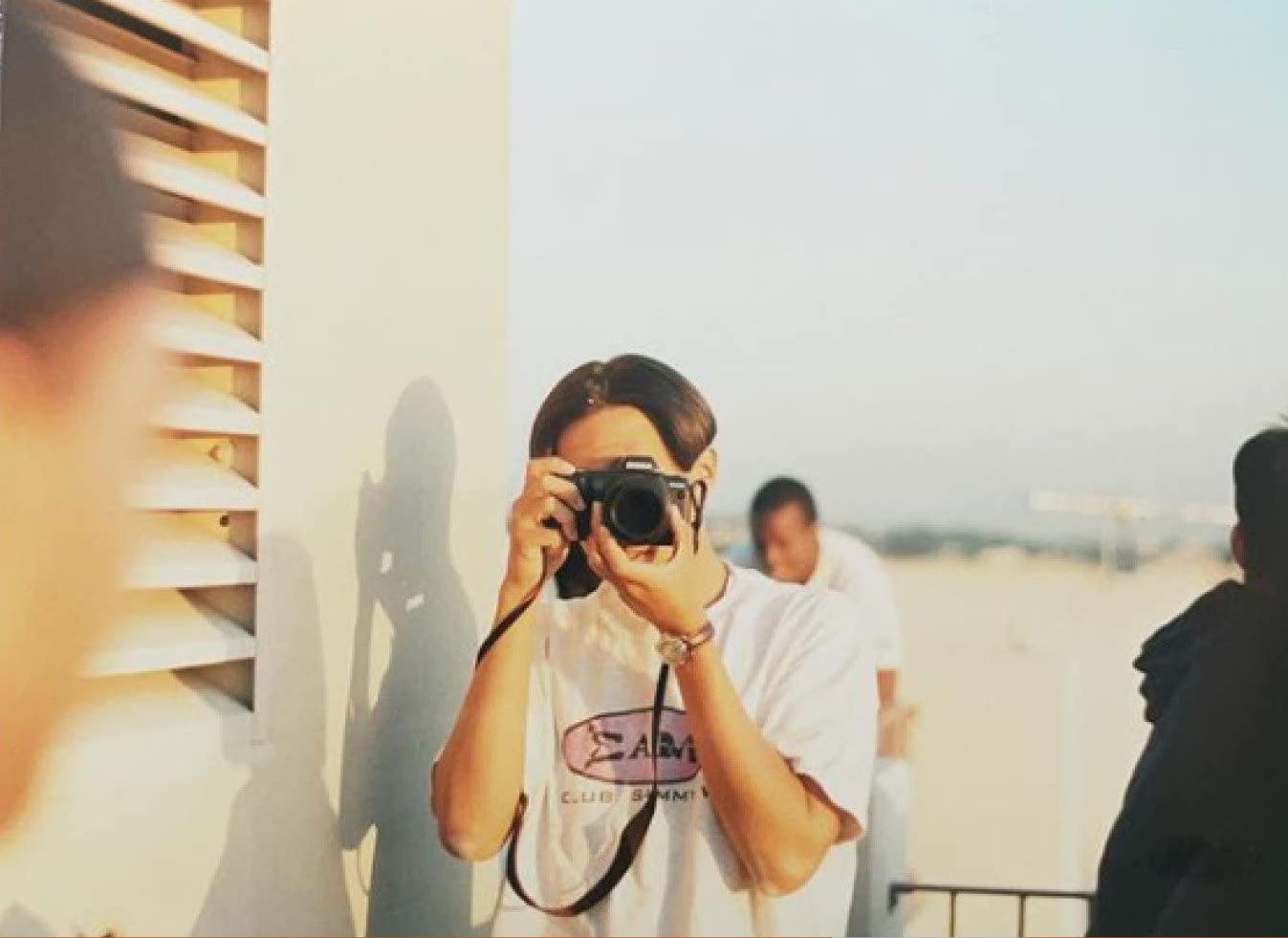
Like all of us, writer Hua Hsu is guilty of this. The early parts of his memoir Stay True are about figuring out who he actually is. He has a good idea of who he wants to be: the kind of person who collects records, makes zines. Then comes an Abercrombie and Finch-wearing frat bro, Ken. Despite inhabiting different ends of the social landscape, the two become close friends. When Ken is murdered, Hua is left adrift.
It turns out who you are is not only the identities you dream of and make, you’re your friends as well. At its core, Stay True is a memoir of a friendship—of any friendship: what we learn from others, what we give in exchange, and how it gives shape to the story we tell ourselves of ourselves.
The project of a memoir easily lends itself to nostalgia, so it makes sense to start my conversation with Hua Hsu there. We met via Zoom (as many of us do, nowadays) to talk about the politics of memory, Derrida, the shape of stories, and more.
Eric Nguyen: Stay True starts with memories of driving and listening to mixed tapes. That sets tone of the memoir, a genre that is naturally prone to nostalgia and looking back at the past. Reading about the music you listened, along with the current nostalgia moment with the resurgence of vinyl records and the popularity of ’80s- and ’90s-inspired shows like Stranger Things, it got me thinking about nostalgia, its meaning and its uses. Why are we drawn to nostalgia?
Hua Hsu: Generally, I’m nostalgic. I’m sentimental. I’m a hoarder. I’m an only child, so I just like hoarding things. I have a lot of remnants from the past, souvenirs from life. All that said, I didn’t want the book to feel nostalgic in the sense that I wanted anyone to actually care about my past. When things happen in nostalgia, like you mentioned Stranger Things, oftentimes it’s appealing to us to think that the past was simpler or that people back then didn’t know how bad the world would become. That’s true in an emotional sense in my book. I was writing about the past, trying to capture the granular quality of living in a different time.
It wasn’t better. I mean, I liked it because it was what I knew. But there were many aspects of it that were not better than the present, not more convenient than the present for certain. There was a quality of how we spent our free time, what it meant to feel bored, how our lives could partially be online, but very much not be online. The kinds of conversations and jokes and references we would have to come up with because there was so much time in the day to fill. That was the thing that I struggled to capture. We all are beholden to things that really appealed to us when we were teenagers, because that’s such a formative time in one’s life. Part of what I wanted to capture was that sense of excitement or that sense of how a teenager or someone in their early 20s experiences time, more so than I wanted to glorify the ’90s. But it’s inevitable, because it was a backdrop for so much of this.
I do think that, in general, nostalgia appeals to people, especially if it’s this vicarious nostalgia. I’m 45. I didn’t experience any of the realities in Stranger Things, I didn’t experience life the way these kids experience life. Culturally we’ve reached this point in time where the past is this text that can be manipulated and seems so malleable.
EN: Is there a danger in nostalgia? On the flip side, is nostalgia useful to have?
HH: We definitely live in a moment where the desire to cater to nostalgia feels very much like it’s having this tranquilizing effect. It’s the conversation people have in movies about fan service. The idea that people can’t bear for the universe of Star Wars to be more reflective of our world now, or for there to be a female Ghostbusters. That is the danger of nostalgia; one is just so in love with one’s own experience of the world.
For me personally, I don’t necessarily know. Svetlana Boym wrote this book about nostalgia and part of it is that she’s writing about Russian immigrants, and how Russian immigrants have this sense of nostalgia that’s very different from what a WASP American in the ’50s would feel, because they’re dislocated, so they’re projecting onto this now imagined homeland. And it’s something that then the children inherit as well.
I associate with that, and there’s a slightly painful aspect to it because you’re conscious of how there’s not this continuous lineage linking you to the past. I feel this yearning to know more about my parents or further back through my family lineage that feels like what people would describe as nostalgia, but it’s not necessarily something that could ever be satisfied. That’s probably why I turned to writing.
EN: There’s a scene is in your book, where your parents go back to Taiwan and they’re looking for the stuff that they enjoyed while they were younger. That spoke to the nostalgia that you mention and the dislocation for immigrants. Thinking about lineage and history, the children of immigrants inherit a nostalgia, but it is not their nostalgia.
Personally, if my parents talk about their time in Vietnam, the music they listened to, etc., it’s not a sense of nostalgia that I have, though for them it is. For me, it’s looking back and imagining what my parents would’ve been like. How does the nostalgia of one’s parents affect you as a child of immigrants who is mainly severed from their nostalgia?
HH: That’s so real what you’re describing. I always dread drawing any conclusions about “America,” even if they’re critical, because it bolsters this notion of exceptionalism. I do think that there’s something about the youth of America in the grand scheme of things. It’s such a young country that American culture is narcissistic about its own recent past. Growing up here, you’re inundated with this sense of how things once were. It’s not how things once were in terms of thousands of years of history and language; it’s about how things were in sort of a neighborhood that’s really only 20 to 30 years old. I’m sure this happens everywhere, but the country is obsessed with rebooting itself in order to get back to some imagined place that it once was; it really screws with our sense of the historical past.
It’s such a young country that American culture is narcissistic about its own recent past. Growing up here, you’re inundated with this sense of how things once were.
As someone who grew up here, it’s impossible not to internalize that in some way, the sense that there is something to return to. For immigrants, like my parents, they left something willingly and didn’t assume they would ever go back. Growing up, they would often remember things, but it wasn’t indulging in nostalgia the way young Americans indulges in nostalgia. It was really (I hesitate to say) recovering trauma. There were triggers for emotions or feelings or memories that they didn’t have the time to put language to. They were sensations that they had thought they had forgotten perhaps forever.
And I always appreciated and studied those moments when my parents would have them. They didn’t view themselves as part of “America” to the extent that they thought their stories mattered necessarily. I think that’s why I became interested in writing some of their stories or thinking about how their stories were passed on to me, not as life lessons or as pedagogy, but as a mode of being, a way of behaving.
EN: Your book is filtered through the idea of nostalgia, but the core of the book is centered around friendship, in particular your friendship with Ken, who’s your opposite.
You mentioned Derrida’s reflection on friendship, paraphrasing: “From that very first encounter, we are always preparing for the eventuality that we might outlive them, or they us. We are already imagining how we may someday remember them or pay tribute to them.” It’s as if to say that in friendships we’re always looking ahead to a life where they aren’t there and how we might look back.
The concept of friendship that you have in the book is that once you start a friendship, you’re looking forward to that day where you can remember them. So that’s a forward looking. But once a death happens, you’re impossibly going back to how things were, those good feelings. What’s interesting to me here is how that makes for a strange plot line. In a traditional narrative, it’s a movement from point A to point B to point C, and that’s a plot line.
What do you have to say about the timeline of friendship and what it means for the timeline of our internal narrative?
HH: It’s funny that you use the words “plot line,” because in my mind, nothing actually happens in my book. There’s no plot. I mean, obviously things happened, but what happened to me is internal and it’s not an epiphany. I didn’t have an epiphany, even though I feel like I lived one.
The need to impose a narrative meaning on anything or to look for clues as to what could have been, that impulse doesn’t descend until there’s a reason for it to descend.
The quote you’re talking about from Derrida about how he thinks that there is this element baked into friendship where we are always preparing ourselves for the day when you’ll no longer be friends, whether it’s because you’re no longer friends, or in his case because people die—that idea appeals to me. When we were talking about nostalgia before, I realized that it’s how even in high school I would say, “Ah, I’m sad this moment is almost over because then I’ll start thinking about it as something in the past.” Even though when you’re young, you have the license to never think about these things. You’re living in the moment. And at the time, even though I was this nostalgic, sentimental person, I was very much driven by my own impulses. No need to remember anything, because we’re always going to keep generating new memories, that’s what you’re allowed to do when you’re younger. And now that I teach at a college, I think about it a lot with my students, that the engine of friendship is just pleasure and understanding and fun.
The need to impose a narrative meaning on anything or to look for clues as to what could have been, that impulse doesn’t descend until there’s a reason for it to descend. Derrida thinks our way out of this is for us to look toward the future, even if it’s just one of us. That’s ultimately what I tried to do with the book, to be less beholden to looking to rooting around in the past and look for those lessons and for motifs when there are no motifs. It’s just life. You’re just young.
And that’s sort of a plot. I think that what happens in the book is that I become much less of a ridiculous person. I mean, I’m still a ridiculous person at the end of it. It’s now easier to imagine a future that’s multi-hued, a future that balances memories of great times with memories of sadness. That’s not something that had ever occurred to me back in the 90s, that it was possible to hold both those feelings at once.
EN: You wrote that “friendship is about the willingness to know rather than being known.” The first part of your book is you trying to make your identity, trying to know yourself and what type of person you are or want to be. But the memoir ends with you knowing someone else. There’s this moment in the book where Ken is tying a balloon for a kid and that is kind endearing to you. It’s something you didn’t expect from him. Through that moment, you come to see someone else, these aspects of themselves. It’s like a thesis about friendship. What does friendship mean, especially over a lifetime, even if a person is gone?
HH: It’s a question I think about a lot. Deep down, I always wanted to be known rather than to know, to use the Derrida framing. As you get older, you realize how the things people teach you, whether they’re intending it or not, they become the guideposts. It’s really in those modest acts of decency that we model for each other, that friendship carries on beyond that moment.
I don’t know how deeply I would’ve thought about any of these things had this not happened. Perhaps I would’ve gone on being, in my mind, a good friend but in reality, a very self-absorbed friend. Maybe I still am. I don’t know. But that’s something that I think about a lot, because in some ways I’m still very much living in the past because I teach at a college. I’m always around young people who are also on the precipice of any number of futures.
When I see my students and the ways in which they treat one another or tend to one another, it’s very moving to have that perspective of being older and knowing how weird things can get in your 20s, in that pivotal moment of life. I try not to guide them in those moments and let them treat each other and test out their relationships in ways that are fitting to them. It’s something that I’m always observing, and then referring back to my own life and my own friends. It’s very cheesy, but it goes back to that line from Bill & Ted’s Excellent Adventure that you should be excellent to one another. And the other thing I always tell my students is something that my friend Chris used to tell his interns, which was just, don’t be a dick.
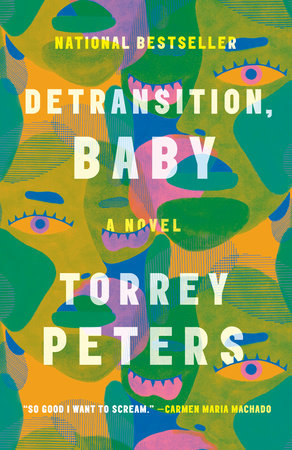
It’s difficult to say anything that hasn’t already been said about Torrey Peters’s debut novel, Detransition, Baby. It won the PEN/Hemingway Award, was a national bestseller, a NYT Notable Book, and named a Book of the Year by more publications than my word count limit will let me include. Not only is it an incredible novel, the success of Detransition, Baby created more space for other trans writers to publish. The novel proved to the publishing industry–deeply conservative and unimaginative in its taste–that writing by trans authors can have mass appeal.
After so much success, the question most readers have is, “What next?” It’s the same question authors ask themselves. Notably, in the obvious way: What the hell am I supposed to write now? But the question tends to arise more often in a writer’s day-to-day life. What do I write about? What do I do with my time? How do I replicate that success? Do I even want to? These questions served as the inspiration for this interview series, What Comes Next?. Every month, I’ll talk to an author outside of the publicity window–that stretch of time where the writing actually happens–about what they’re working on, what inspires them, their routines, and what keeps them returning to the page.
I couldn’t imagine a better first guest than Torrey Peters. In addition to Detransiton, Baby, Peters is the author of The Masker and Infect Your Friends and Loved Ones, both of which will be reissued in revised editions by Random House in 2022. Peters and I spoke in her apartment in Brooklyn shortly before she left to launch the German translation of Detransition, Baby. We talked about writing routines, her entry into writing, touching hot stoves, happiness, cruelty, and deciding what to publish when everyone wants to publish your work.
Isle McElroy: Can you talk a little bit about what got you into your writing career?
Torrey Peters: I was still a better reader than a writer. You read enough and you start to imbibe the rhythms of it. And when it came around to college, I was like, I’m good at this. I think I would have liked to spend my life reading. And being a writer is like—
IM: A close second.
TP: But of course, what it means to be a writer took a long time to figure out. The difference between ‘I want to be a writer’ and all the other different valences of that word is still ongoing.
IM : What do you mean by that? Like moving between being a fiction writer or a novelist?
TP: I mean, there’s how to write, there’s what writing is for, there’s writing as a career, there’s writing as communicating something urgent to other people. There’s writing as narrative, there’s writing as the tracks of thought on a page. There’s writing, which is like, whatever, letters, and then there’s so many different reasons why you might do it, never mind the forms in which the actual product in the end might take. I think that the hard part for me wasn’t “What’s the product gonna be?” The hard part for me was figuring out why I was doing it, who I was doing it for, and why it mattered.
IM: How has it changed over time? Or is it just like a refining towards the same direction?
TP: I think I had two distinct periods. One is where I thought about writing as a kind of craft. And when I thought of writing as a craft, I don’t think I knew what writing was for. I thought if you write something beautiful that is enough. Now, I feel that writing is largely about communicating something urgent to certain people. If you don’t have anything urgent to say, it’s a different thing than if you do. Sometimes I don’t have anything urgent to say, and I have to figure out what am I in those moments when I don’t have anything urgent to say?
IM: Are you still a writer at that time?
TP: In the past, I would have said yes. But I currently think no. I think I’m something else in those times. I don’t know what I am. I’m like a practitioner of something.
IM: Like a doctor who’s not operating or something.
TP: Or like, there’s a chess player who plays against other people. And then there’s a chess player who’s just at home, alone, moving the pieces around. And if you’re just at home moving the pieces alone on a board, occasionally thinking about it, are you a chess player? Or are you just kind of vaguely interested in chess?
IM: Yeah, I think that’s perfect.
TP: And I have periods in my life where I’m vaguely interested in chess. More than I’m interested in playing chess against people.
IM: Artists and writers are famously never in competition with each other.
TP: I’m happy to be in competition when it’s time to play. I wouldn’t shy away from competition. I think competition can bring out a lot. But sometimes I don’t have a plan. I don’t have a thing I’m writing for. I don’t think of it as an identity. So if it’s not an identity then it’s not something I always am. That’s really framed.
IM: I want to step back a second. You were talking about reading and feeling the rhythms of the writers you loved. Can you talk a little bit about what rhythms were guiding your work? Are they artistic rhythms or are they ethical—writers who had something to say when they wrote?
I think lots of things have bad ethics and can be really compelling.
TP: I didn’t used to think about it in terms of ethics. I had a change in how I thought of writing as it moved from a craft to a kind of communication. How ethics meshed with that changed. Now I think that things that are artistically good usually have some sort of resonance with things that are ethically good. And I don’t mean that they’re moralistically good. I think lots of things have bad ethics and can be really compelling. But there’s a coherence to the ethics that finds its mirror in an artistic coherence, and the two usually go together.
IM: So who are some of the authors who you feel like have that kind of ethics, or a philosophical viewpoint, right? Rather than is something ethical in terms of good or bad?
TP: That seems more like morality. [What writers have great ethics?] It changes all the time. I think that’s part of what’s fun. But someone for instance who I think whose ethics are great, but whose morals are not so clear is [Vladimir] Nabokov. There are these beautiful sentences and his ethics are kind of cruel. He has a kind of cruelty in his writing. There’s an inviting-ness and a cruelty to what he does. His writing and his stories are cruel. There’s an ethics and a worldview and a sort of cruel aestheticism to what he does. I don’t think that I do that. But that is somebody who I think of as being coherent in those two poles without necessarily being morally good or morally bad. I’m always looking for that tension in a lot of different writers. Absolutely. I go through real phases with writers where I get enamored of them. And I love them for a while, really deeply, and then I fall out of love and then sometimes come back to them. In the last couple of years, I really fell in love with [Elena] Ferrante. She has an ethics of ferocity that finds its mirror in the way that it’s written. Her characters are ferocious about making choices, constantly making choices and are constantly doing things and having agency. And I feel like that has to do with her thoughts about women’s writing but also it’s an aesthetic thing. That was fascinating to me to find somebody who could write this sweeping four volume epic that maintained a level of ferocity that you normally don’t find in 100 pages. People can’t keep it up for a hundred pages and here it is for thousands. Stuff like that is exciting to me.
IM: I’m really curious about cruelty. I was talking to a comedian the other day about the difference between cruelty and meanness. And we decided that meanness is a kind of love and that cruelty oversteps that and gets to a point of separation. But now hearing you talk about Nabokov, I’m thinking of cruelty as a kind of honesty, right? I wouldn’t use the word cruel to describe your work. Listening to other interviews with you, you talk a lot about the question of who the joke is on. And I think at times you are making jokes at your characters’ expense. That can be seen as, I wouldn’t say cruel, but there is a kind of meanness. So where do you situate the relationship between cruelty and honesty? Is there a kind of honest cruelty that comes through in writing?
TP: Explain to me why meanness could come from love, I don’t understand.
IM: Our divide was that meanness is a lesser form of cruelty, that meanness is almost like high school meanness, where there’s an in group of people brought together by the understanding of what mean things they can say. Whereas cruelty oversteps that into actually trying to harm and hurt someone.
I think of meanness as thoughtless, whereas I think of cruelty as full of malice and pleasure and sadism.
TP: I think of meanness as something that’s ungenerous. It doesn’t have enough. Meanness has a scarcity or narrowness to it. And I think of meanness as coming from a place without thought, that you’re just sort of mean, you’re a narrow person, you’re intolerant, you don’t have anything to give. I think of meanness as thoughtless, whereas I think of cruelty as full of malice and pleasure and sadism. Meanness to me is a lack of life. But cruelty, there’s a fullness to it.
IM: You can hear it in the sounds of the words, right? Like meanness is like a dime on the ground.
TP: I think that the etymology of meanness has to do with—I don’t remember exactly—but a mean lifestyle is a lifestyle without any extras. Whereas I picture Nabokov surrounded by fine things. Sticking pins in insects, watching their suffering. There’s something very alive in that to me and that’s what attracts me to a lot of writing is the fullness of life that a writer can pack into it. Cruelty and malice and sadism exist in the human experience, and what do you do with them? What do you do with the fact that sometimes they can feel good? I think Nabokov is someone who transubstantiates that into aesthetic pleasure. I would say Ferrante can be cruel, because there’ll be a thing where you’re like, Okay, I’ve seen enough of this. And she just is like, Okay, you the reader wants to look away and I’m ratcheting up the humiliation one notch, I’m making it go on another three pages. She’s putting both her characters and the readers through it. What’s great about her is that she will turn around and give you something for having been through it. It’s manipulative, like I acted sadistically to you. And now I’m gonna like—
IM: We get an Ischia page.
TP: I like a writer willing to do that. You know, whether I’m willing to do it I think depends. I think I was crueler than I used to be. The Masker is a cruel book. It’s a cruel story. I was doing something with our cruelty. Whereas now I don’t have the stomach for it.
IM: I relate to that. A lot of my early work strives for aesthetic cruelty. We can call cruelty a kind of attention, too. I’m thinking of that Nabokov story, “Symbols and Signs,” where someone’s pulling their dentures out and they look like tusks. That is a gross level of detail. It’s clear that he has looked so deeply at this thing, but it seems cruel to describe someone in that manner. Can you talk about that evolution of moving [away from cruelty]? Why do you think you’re not as invested now? Is it just where you were emotionally?
TP: I think it’s like—I’ve heard that older people are happier than young people. And that seems weird, because their bodies have more pains and have probably suffered more and stuff like that. But that generally older people are happier because they have learned over the years to mentally not touch the fire. They’re like, if I think about things that are horrible all the time, then I will feel horrible. After 50 years of touching the stove or whatever, eventually they just don’t touch the stove. For me, the excitement of touching the stove and watching the smoke rise at my own expense and watching other people look at me in a horrified way—that impulse has diminished. I’ve done this, I understand how it works. I don’t want to touch the stove anymore. And then there’s a part of me that occasionally will be like, “Well, have you gotten soft?” But like I’ll touch the stove when it’s necessary but I’m not going to touch the stove for fun.
IM: I’m thinking of “touch the stove” also as sort of an authorial drive, too. I could be extremely glib in my comparison but there’s a certain style of writing that is touch the stove writing, that is either confessional touch the stove and then also political touch the stove, where we need to engage with this political subject and that becomes a form of stove touching. And then there’s the personal, in which I am confessing this personal reality which is its own messy stove touch.
TP: And then there’s Nabokov who is aesthetically grotesque.
IM: He’s holding our hands to the stove. He’s not going to do it himself. To switch gears, but if you’re not [touching the stove], what drives you to write? When you were talking about having something to write or having something to say, where does the question of having like, a personal touch the stove [moment arise]? Where in the art does it need to happen? And do you think that it needs to sometimes happen in the art and does that drive your desire to write? Or does that drive one’s desire to have something to say?
If I can just say the shameful thing, in a strange way, we will have gone through this thing.
TP: I think that usually when I have something to say, it’s because something is unresolved. Usually, I feel that lots of things that are unresolved for me are unresolved for others. So in something like The Masker, there was a lot of shame, a lot of cross-dressing, it was about sex and gender. So I just wanted to speak about shame. Shame is so much about what is unsayable. If I can just say the shameful thing, in a strange way, we will have gone through this thing, and we will come out the other side and feel liberated from it. For a long time, I think the cruel things I was doing had a lot to do with shame. And I don’t feel as driven by shame anymore. I sort of wish I did because it was great material.
IM: Blame Brené Brown.
TP: You know, I get mad about stuff. Usually it’s when some way of thinking that I’m expected to partake in doesn’t feel good to me. And that way of thinking creates an internal tension in me. And that tension needs to be resolved somehow. And usually the way it’s resolved is through all sorts of feelings, like I walk around mad, or I walk around irritated, a lot of negative feelings. So sometimes I want to rant, there’s this desire to express myself, there’s an urgency. But then, of course, I’m just ranting at people. They don’t enjoy that. There’s no catharsis in it. So there’s this tension inside of me and the work is transmuting that tension into something that other people also relate to. I try to make them feel that tension and we feel it together. I’m alone when I write but the magic of reading and writing means we unravel a lot together. But if I don’t have anything to unravel, if I don’t have tension, if I’m just like, check out these words—that’s a valid way to write too, I guess—but I think writing is hard and if I don’t have that tension that moves me to do it, it’s maybe for a paycheck, maybe for validation. Generally, though, there are much better ways of getting both paychecks and validation than writing. That reminds me of a professor of mine who once said, upon reading something, it felt like it was easy for this person to write it and he didn’t like work that felt like that. And I’m constantly feeling that way. I was talking today about why everyone hates on Sally Rooney. And I think it’s that she makes it look easy. I actually think her work is filled with tension and she’s expressing a lot of it in a lovely way, but there’s the resentment that this is easy for you, you haven’t suffered.
IM: Connected to that, like, it’s about a year and a half since Detransition, Baby came out. How have you felt about the reception and conversation? Those tensions that [drove the book] are so ancient to you—when the book came out, they were already ancient, and now they’re even more ancient. At this point, do you feel you were successful in bringing those tensions to the surface for people to discuss?
TP: I don’t know. I think because I’ve just gotten every single possible reaction to it there’s not a consensus. Some people think it’s too radical, some people think it’s assimilationist, some people think it’s banal, some people think you need a PhD to read the gender theory. There are strong reactions but there’s no consensus. I can’t really know if people got that tension, except that they seem to have an emotional reaction to it. Whatever emotional tension I had seems to have been translated to a bunch of people who got all emotional when they read it. Oh, it must have worked. But how that particular emotional tension diffuses its energy inside of a person once it’s been transferred is much more unpredictable than I had expected. But I can’t be in the business of deciphering those reactions anymore. And that’s one of the things I liked about the Sally Rooney book is that she must have it so bad. Everyone in the world has an opinion about her. And that is what the third book is about, trying to resolve all that. I’m trying to imagine how much tension must have caused that book to be written and then the skill to make it look easy writing under that much tension? That’s not really answering your question, but just some thoughts.
IM: Evasive answers are the best. Can you talk a little bit about the difference in reception? I also had a chapbook come out before my novel came out. So there’s a sense of having a secret thing that you wrote when no one was looking. Your early books are going to be republished by Random House, so how are you feeling about that work now that you are known for this novel that came much later in your career?
TP: Those early books provoked really strong reactions in people. People were really upset by The Masker, they had strong reactions to those first two books. But they were on a scale that I could manage. Everybody who was mad about The Masker probably had my email. Yeah. And everybody who was inspired by Infect Your Friends and Loved Ones got a T4T tattoo. So I understood the reasons why people reacted in certain ways. And I think the difference is quantitative that has become qualitative. When water boils, you can’t put the steam back in the pot. And in those first two I could watch the water in the pot. And in [Detransition, Baby], the steam was everywhere.
IM: Is that shaping how you’re continuing to write?
I’ve had a hard time clearing the decks in terms of other people’s opinions to figure out what I have to say right now.
TP: I spent a lot of time trying to pretend I haven’t read the reactions to Detransiton, Baby. They can have a really chilling effect on me as a writer. They push me around in all these subtle ways, where if I write something very edgy, am I writing this in reaction to all these conservative things that I’ve read about myself? Or likewise, if I don’t write something edgy is it because the people got to me? And then meanwhile, is a question of edginess versus not edginess one that I picked up because of all that happened. I’ve had a hard time clearing the decks in terms of other people’s opinions to figure out what I have to say right now. What is the generative tension in my life right now? And how do I do it in a way that’s artistically worthwhile and not just because like, Oh, this is a moment I could capitalize on. Or any number of reasons that are fear based, like this is my moment, I got to do something with it or if I don’t do this right, I’ll be a one hit there. Those things are generally bad reasons for me to write. They make me feel bad.
IM: That’s the tension of an entire career though. How are you going to keep finding inspiration?
TP: I love the idea that one day I’ll quit. I probably won’t, but most of my daydreaming isn’t about writing. Most of my daydreaming is about lots of other things. And as I talked to somebody recently, it was really interesting. I was complaining about [Gabriel] Garcia Marquez. And I was saying, he wrote this perfect book when he was like forty, and then he seemed to be really cool. He hung out with Castro, he punched Vargas Llosa. And when he was in his 70s, he started hanging out in Martha’s Vineyard and wanted to be friends with Bill Clinton or he was friends with Clinton. And after the Monica Lewinsky scandal he wrote a public letter that was like, Why my friend Bill had to lie or do what he had to do. I don’t remember how it was actually written or translated. And I was like, that guy he totally lost what was cool. And this person I was talking to, who speaks much better Spanish than I do, is an expert in Latin American literature and she was like, No, I think he figured out that nothing really matters and he had gotten to a place where he had forgotten that stuff matters. He was like living in this thing where everything was kind of like a joke to [him]. And I don’t know if that’s true. I actually think she’s wrong. And that he actually just bought his own myth. But the idea that he transcended to a trickster god is much more appealing. That he’s a trickster god scampering around Bill Clinton is much more beautiful as opposed to the grumpy old man holding on to his legacy and selling out everything that was beautiful about him.
IM: The writers I love most are the tricksters. I’m thinking like César Aira or Robert Walser. Do you know the story of Walser? The apocryphal story of Walser is that he was a young Austrian writer, celebrated, writing 12 hours a day. And in his early 30s, he checked himself into an institution where he lived for the rest of his life. He was famously asked near the end of his life, “Did you come here to write?” And he was like, “No, I came here to be mad.” After his death, they found what they called the Microscripts, stories written in German on the backs of postage stamps and other materials. I remember like ten years ago, New Directions announced they were publishing a translation of the Microscripts, and I was so excited. I was like, Yes, I’m finally going to see what this guy was writing when no one was watching. And so many of them were about women’s feet. And it makes me think about what someone writes when they are only writing for themselves. For him, it was these weird things, for César Aira, it’s his automatic writing, doing his page a day and doing what he wants. Those are like fascinating figures for me because they’ve figured out a way to [create careers] by not taking themselves too seriously.
TP: But also that writing is horrible to read. The process is interesting. What’s interesting to me is that they transcended being a writer but the rest of us are still treating them like writers. If I ever transcended being a writer, then I actually want to transcend. I don’t want to transcend by writing shit that actually nobody wants to read. It’s cool that he wrote about feet.
IM: Yeah. It’s pretty bad.
TP: I don’t want to read postage size notes about feet. Feet are wonderful. To me, they actually don’t have anything to say. And that’s fine. But then don’t say anything.
IM: Walser is different from Aira, because Aira is still like publishing. And Aira seems like a roll of the dice. Every six books, something really great happens, but it never seems intentional.
Most of the game is like kicking around the ball and then you have like 20 seconds of brilliance but the most is kicking around the ball.
TP: [Karl Ove] Knausgård had a thing about that. Like kicking around—sports metaphor, trigger warning—it’s like kicking around the ball in soccer. Most of the game is like kicking around the ball and then you have like 20 seconds of brilliance but the most is kicking around the ball. I do think that but there’s a part of me that’s here for the 20 seconds of brilliance. I’m not here for kicking around the ball. But I guess kicking is working your way towards figuring out what to say.
IM: Yeah, another sports metaphor, I remember Terrance Hayes talking about practice—I think he played college basketball—so said practice was what he loved most rather than playing in games. That’s when you could try stuff, when you could do interesting things. And the game is a published book, where everything is stone.
TP: Yeah. That’s what I’m trying to figure out now. Because I have an opportunity to write stuff that doesn’t matter. It’s the first time in my life that people will publish crap [that I write]. And it’s tempting.
Pretend you had to sell it, this life
you’ve been given. Watch how
quickly the term thyroid goiter becomes
scenic esophageal overlook. Hypertension
becomes a live demonstration of the heart’s
amazing high-volume pumping capacities!
You must take up embroidering
the truth with the same fervor
eligible debutantes used to tackle
parlor needlework for bachelors:
if nothing else, at least you’ll possess
one marketable skill. Take me
for example. I could offer you
early morning anxiety attacks
or, if you prefer, passions
that unfailingly rouse you from sleepinto the horizon of opportunities cresting
each new dawn. Necessity makes
salesmen of us all. So your bathwater
phosphoresces? So your sky wraps
its smog fingers around the throats
of sparrows, pigeons, starlings
to drop them on the sidewalk?
Miracles by any other measure!
What changes when the year of unemployment
becomes the era of unlicensed afternoonsfrom which the very milk of freedom is harvested
for nourishment? Would you be more
interested in plantar warts or flesh-made
pearls? A friend’s betrayal or the dramatic
unmasking of a villain that restores
the currency of loyalty among companions?
You’ve got to practice. You’ve got to
sell it, again and again and again
and again. This is how you buy it back
every time. You buy it back.
Here I go, pitching again.
A man walks into a boatyard
and buys enough rusted chaff

to build himself an ark, constructed
board by board from blueprints

but with updates, you understand, narrow
enough to squeeze through culverts connecting

the Los Angeles River, with enough dystopian flare
to feel acceptably ironic in polite company, a little

Mad Max, a little Matrix, all the party guests wondering
whether he had the whole thing done by 3D printer until—

bam. Rapture. Bam. Floodwater. Bam. Everyone
with their champagne flutes begging

for entry. And here come headaches of a new
and different kind. Let’s say the man is me,

the ark is mine, my partner and I, suddenly,
bouncers to the most exclusive cruise

in the apocalypse. Just don’t ask her to guard
the door. Did you know she once wept

on a city street corner for the palm tree planted
alone in its plot? The one leaning, almost as though

it were lonely or excluded, toward the adjacent yard
overflowing with trees, the whole group of them

rubbing their leaves, just flaunting it—
that togetherness. This is why a retinal scan

will be required to board. Better to mechanize
entry to the ever-after. If that sounds cold

you’ve never run interference between
the person you love and the person they become

when overfilling the coffee filter with grounds,
clogging the garbage disposal with unfinished rice,

stuffing the trunk with clothes for donation,
their shirtsleeves dangling

dangerously close to the tire well.
Leave it to her, the ship would be straining

with freight. Some café barista caught
in the rain. A dozen stray cats. Every dog

in the pound. The guy next door
tuning his electric blue Gibson

at two in the morning. The Gibson. Rats
up from the sewer. A park full of pigeons.

Succulents saved from their waterlogged
window box. Perhaps I’ve been too stingy

with my list, too recalcitrant with my heart,
its porch light left dark after hours. Perhaps

she understands what I pretend not to know:
we’re sailing into an ending. When the time

finally arrives, we’ll trust the rickety seams
of our craft. I’ll open the doors. She’ll place

her hand on the wheel to steer.
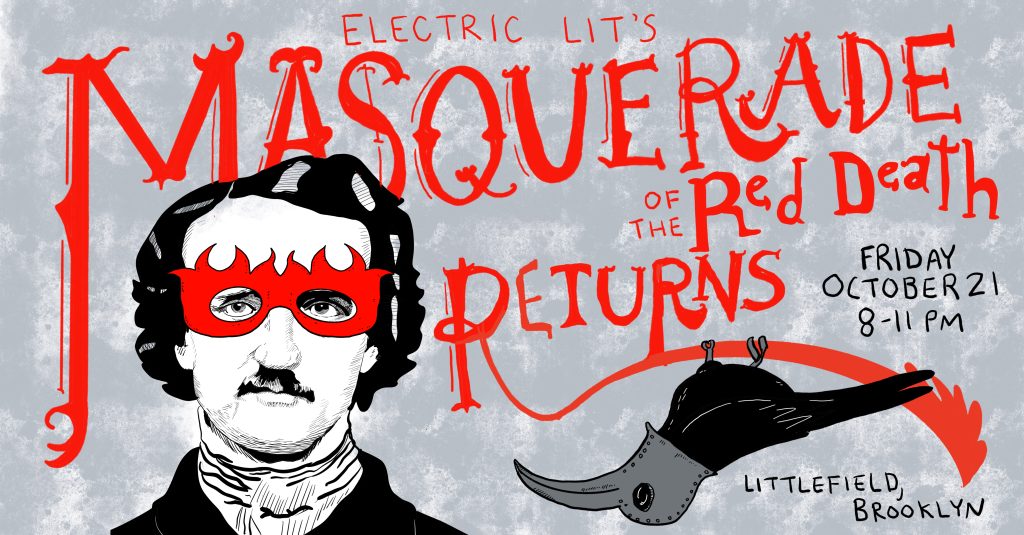
It’s been 3 years since our last masquerade, we’ve missed you all and we are so ready to party. Yes, it’s official: the Masquerade of the Red Death is returning. This year, it’s on October 21 at Littlefield in Brooklyn.
If you want to know how to come to the party, you can find out all the details here. (Snag that early bird price…tickets are only $50 until September 30, then $75 after that.) But if you’re wondering why you should come, well—say no more. Here are the top ten reasons to get your tickets now, and make your friends join you.
Pandemic fiction is having a moment.
And we’re here for it! At this year’s masquerade, we’re honoring excellence in pandemic fiction with all kinds of events, giveaways, and even special appearances.
Free books!
We’re stocking up on the best of pandemic books from our sponsors, just for you to take home. Or, you know, crack into in the middle of the dance floor, if that’s your thing. We won’t judge.
Mingle with writers, readers and other literary New Yorkers.
Drink, dance, and talk books with Brooklyn’s best readers and writers. At the party, you can expect to see some authors of amazing pandemic books, including Rebecca Makkai (The Great Believers), Jim Shepard (Phase Six), and Gary Shteyngart (Our Country Friends).
It’s spooky season.
It’s getting colder out, and our powers are growing. October is the spookiest season and we’re fully in favor. The dark, the gothic, the macabre: say no more. The Masquerade gives you a chance to embrace the spooky fall vibes, before Halloween even happens.
We’re over the sweatpants era.
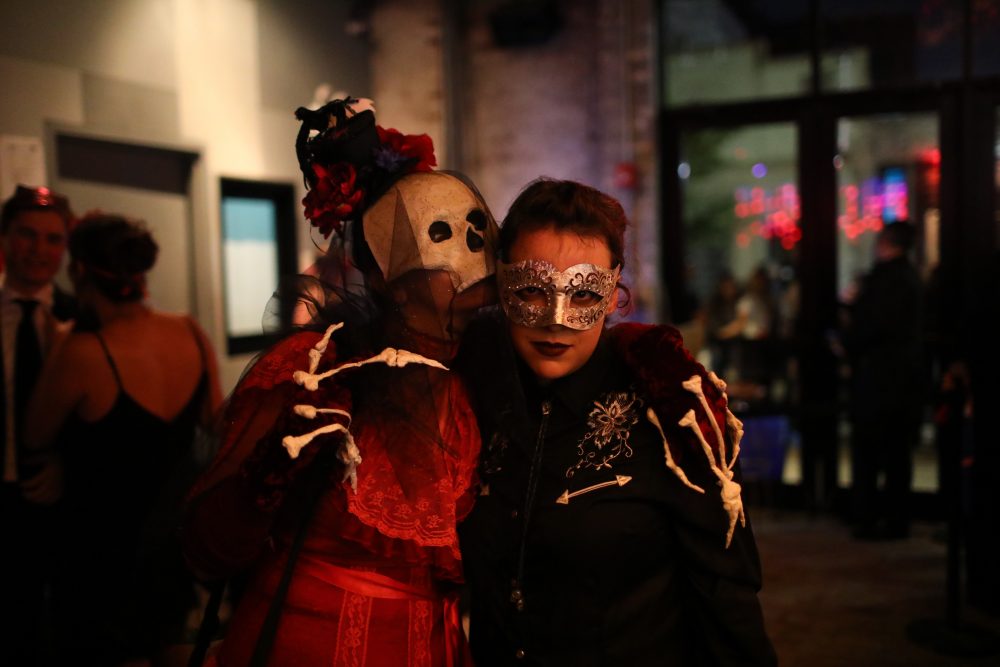
Okay, not really. We’re still loving our comfiest clothes BUT any reason to break out a new outfit is absolutely welcome. The dress code is red and black attire, so get your vintage gowns, your impractical shoes, and your campiest accessories out of storage and out on town. Even all black pajamas would fit right in! Get inspired with some outfit photos from 2019.
You get a mask! And you get a mask!
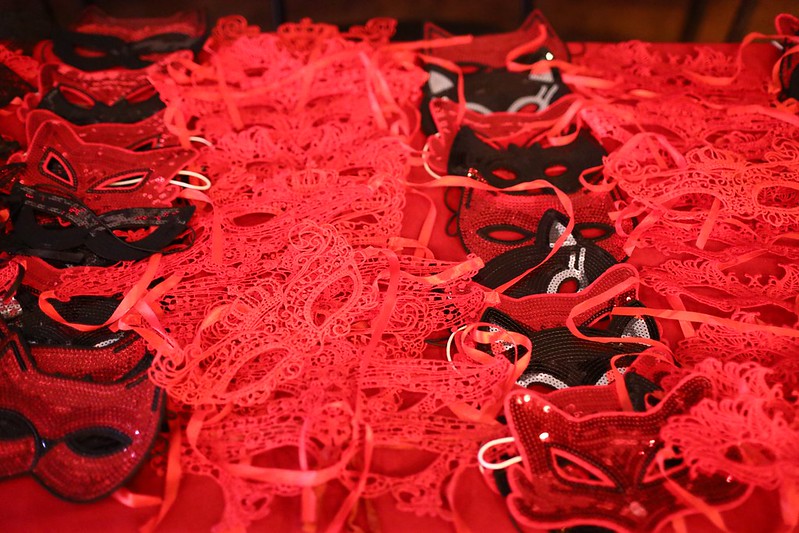
Included in your ticket price ($50 if you buy a ticket before September 30!) is one fancy mask for you to use (the kind you actually want to wear). That’s right, you don’t have to craft your own (although you totally can) for a night of anonymity. Plus, it’s really an investment in your future costumes if you repurpose your mask for Halloween weekend.
A photobooth!
We know the real reason to all get dressed up is to get a good pic for the ’gram and we’ve got you. That’s right…there’s a photobooth. Your IG followers aren’t ready for all the photobooth pics you’re going to be posting.
We know you wanna dance with somebody (us).
Whether you’re up on your trending TikTok dances or not, we promise the dance floor will be going strong all night. DJ “Nice Deal” (aka Ryan Chapman) will be spinning all evening, so get those dancing shoes ready. It’s like the most fun dance you went to in high school, but this time, everyone else is as book-obsessed as you.
You’ll get free access to our virtual salons.
Aside from the real, IRL masquerade, your ticket gets you into our virtual salons (which are otherwise $5 for EL members and $10 for everyone else), including one on “The Craft of COVID in Fiction.” You can hear renowned authors talk about the challenges and opportunities of writing about (and during) COVID. So dust off your pandemic novel draft and get inspired!
And last but not least, it supports an organization you love.
Aside from being the fall’s best literary party, the Masquerade is also EL’s annual fundraiser! We’re a very small non-profit—entirely women-led and women-staffed—operating on a shoestring budget and we rely on donations, memberships, and yes, this masquerade, to pay our writers and our staff. By buying a ticket and attending, you’re supporting our vision of making literature more exciting, relevant, and inclusive. In a year where so many literary magazines have shuttered, what could be better than getting dressed up (and partying hard) for a good cause?
As an editor and writer working in an industry that has historically failed to integrate (or even acknowledge) disability experiences, I was thrilled to receive an announcement that the Ford and Mellon Foundation had selected this year’s recipients of the only national fellowship devoted to supporting disabled artists.
The Disability Futures Fellowship supports twenty disabled creative practitioners whose work advances the cultural landscape. Each fellowship includes an unrestricted $50,000 grant, totaling $1 million for the cohort overall. Now in its second round, the initiative addresses field-wide problems in arts and culture, journalism, and documentary film, including: a dearth of disability visibility in the cultural sector, lack of professional development opportunities accessible to disabled practitioners, and the unique financial challenges facing disabled artists and creative professionals.
Of course, one initiative is far from enough in terms of addressing the serious inequities and access barriers that disabled artists face on a systemic level. That said, Disability Futures is a glorious example of one step in a promising direction. This year’s cohort of Disability Futures Fellows includes a number of talented writers, four of whom—Kenny Fries, Wendy Lu, Naomi Ortiz, and Khadijah Queen—generously agreed to answer my questions about their creative lives and work, and how both are influenced and augmented by disability.
Wynter K Miller: Can you describe your personal journey toward becoming an artist and how that journey was influenced by disability?
Kenny Fries: I started my journey as a playwright but always wrote poetry. In the late 1980s, I started writing poems directly about/from my disability experience. These poems, as well as my poem sequence about the early days of HIV/AIDS, The Healing Notebooks, became the foundation of my first full collection, Anesthesia. It was then that an editor who couldn’t publish poetry asked if I would be interested in writing a memoir. I did. A different editor acquired and published Body, Remember in a two-book deal with Staring Back: The Disability Experience from the Inside Out, the first US multi-genre anthology of disabled writers writing about disability, which I edited … I’ve been writing creative nonfiction ever since.
Wendy Lu: I can’t remember a moment in my life when I did not want to be a writer. I wrote a little bit about disability in college, but I was still figuring things out and had a lot to learn. For my graduate school project, I spent months developing a photo essay and writing an accompanying article about what navigating the dating world is like for women with muscular dystrophy. That project eventually got published in the New York Times in 2016. It was my first byline there, and one of my first major stories about disability. I’ll never forget the day that it appeared in print.
After graduate school, during a fellowship at Bustle.com, I started writing about disability more regularly. My editor knew that I had an interest in disability issues and asked (in a low-pressure kind of way) if I wanted to write about my own disability. I started writing essays and articles about the intersection of disability and a variety of topics—education, health care, entertainment, etc. I covered disability from many different angles based on what was going on in the news; in doing so, I carved out a disability beat for myself. The stories I wrote about disability often got some of the most traction, and I received responses from disabled readers who finally felt like their issues and experiences were being represented in the media. This showed me two things: one, disability is a vastly underreported area, and two, there is a significant audience for stories about disability (and how could there not be, given that around a quarter of the US population has a disability?). By failing to cover disability adequately, media outlets miss so many important stories and leave so many readers and viewers behind. I’m determined to help change that.
After my fellowship, and like many people with disabilities, I faced obstacles during the job-hunt process. Sometimes I would think, “So I’m good enough to speak at this huge national event about my journalism for free, but not good enough to hire for a full-time job?” Finally, I joined HuffPost as an editor in 2018. Aside from editing, I did a lot of disability reporting, I helped shape the newsroom’s style and standards (mostly on disability coverage, but on other topics, too), and I started giving trainings to different newsrooms and journalism organizations. I pursued more ambitious reporting projects, including a package on Disability Pride Month and a big story on the discrimination doctors with disabilities face in the world of medicine. I was really fortunate to work at a newsroom that saw my disability as an asset and with colleagues who embraced me for who I was—that should be the norm, but it’s not. And it’s true: Being disabled has only ever made me a strong reporter and editor.
Being disabled has only ever made me a strong reporter and editor.
Now I’m at the New York Times, and it really feels like things have come full circle. The Times is where I published my first story on disability in 2016, and I’ve learned so much since then. I continue to learn every day.
Naomi Ortiz: As a disabled child, my body was immobilized due to casting. I felt sometimes like an anchor in a chaotic sea of children running and playing around me. I spent my time observing ants crawling across the pavement, sun rays streaming through clouds, and how plants were thriving or dying on the playground. Staying in one spot made me more accessible to listen and talk with other kids. At a very early age I was learning about human nature—violence, pain, joy, kindness, and power dynamics—from these conversations. As soon as I had words, I began making up poetry to process what I was witnessing. I think the sensitivity I bring to my writing, poetry, and visual art was chiseled and shaped by the gift of being in one spot for long periods of time. Disability has offered me an opportunity to really develop relationships with particular physical places, and with people who share their inner lives.
WKM: On a systemic or industry level, what are the biggest challenges you face as a disabled artist working in the United States? Are there issues or areas that you see as critical to address in terms of improving the status quo?
KF: In order for disability to become de rigueur in publishing there need to be so-called “gatekeepers” who are disabled and who also have a stake in disability culture. Also, having intersectional identities, as I do, makes it more difficult for publishers to figure out how to market my kind of work. The disability experience often calls for new forms that don’t follow the predictable narrative of overcoming one’s disability. My work is hybrid, increasingly based on extensive research while not leaving behind my personal experiences.
NO: Anticipating and valuing difference would radically reshape the participation of disabled artists/writers in the arts. For the industry to anticipate that people move differently through spaces, require interpreters, or even need opportunities to take breaks from stimulation during events, would mean the construction of much more open and accessible performances, festivals, readings, etc. Announcing that an event, or that an opportunity, is open to anyone, doesn’t mean that it is. It takes learning about access, anticipating that a lot of folks in any given community need disability accommodations, and then valuing the contributions of disabled folks, in order to pull off a true community event.
In Arizona and the US/Mexico borderlands, arts are under-resourced overall, which ensures that most arts spaces are inaccessible. I wonder how many other disabled poets are unable to read at open mic events or show their work in local galleries because of access barriers? We need better exposure to art created by disabled people, especially those who are also undocumented, queer, young parents, etc., because the lens they are offering contributes to conversations the rest of the country needs to engage with.
It’s frustrating to note that the obvious barriers are still extremely problematic and segregate disabled artists. However, a more subtle barrier that I come across often is pacing. There’s a pace tied to professionalism that is extremely fast. Last week I got an invitation to be on public radio and because I responded six hours after the invitation came in, I missed out. Typing is an extremely laborious process for me due to the technology I use. It doesn’t mesh well with social media. There’s a very ableist assumption that if you care about your work, and sharing it with others, then you are constantly connected and available via email and social media. I produce deep and thoughtful work that is grown from a pace that is slower and intentional. I would love for that kind of professionalism to be respected.
There’s a very ableist assumption that if you care about your work, and sharing it with others, then you are constantly connected and available via email and social media.
Khadijah Queen: I think for neurodivergent folks, it can be difficult to do the kind of networking required of people in creative fields. Another challenge is applying for grants and other funding. The forms required are onerous, often inaccessible, and difficult to customize or tailor when it comes to communication about the work. Hard deadlines, while I realize they serve an important purpose, aren’t always compatible with certain disabilities.
WKM: Could you share more about current/upcoming projects you are particularly excited about, and/or your artistic goals for the future?
KF: My next book Stumbling over History: Disability and the Holocaust is about Aktion T4, the Nazi program that mass murdered disabled people. Excerpts from the book have appeared in the New York Times, the Believer, and Craft, and also serve as the foundation for my video series, What Happened Here in the Summer of 1940?
I’m currently curating Queering the Crip, Cripping the Queer, the first international exhibit on queer/disability history, activism, and culture, which opened at the Schwules Museum Berlin on September 1, 2022 and runs through the end of January 2023.
I’m finishing a three-year project, Disability Futures in the Arts, a series of fifteen essays I curated, edited, and introduced, published by Wordgathering. I’m in the midst of editing the third and final cohort (funding was part of a three-year multi-project grant). The fifteen essays span a diverse array of disabilities, media, and nationalities. The final cohort will be published in December.
And I’ll soon be collaborating with fellow Disability Futures fellow Alison O’Daniel on a film based on my poem sequence In the Gardens of Japan.
KQ: I’ve almost completed a longtime prose project, am in contract negotiations regarding a book of criticism, and am slowly fleshing out a collection of travel essays. I’m going to Kenya in December—it’ll be my first trip to Africa, and my excitement level is in the stratosphere.
NO: Over the past ten years especially, I’ve noticed a lot of changes within the ecosystem, and yet, when I’ve looked for art or writing that speaks to the experience of climate change or climate grief, I’m often confronted with extremely ableist analyses. The problem of climate change is often defined as sickness or disability, and the answer as restoration or cure. The solutions presented are uniform, like going zero waste, with an assumption that it can work for everyone. But, for example, I am a disabled person in need of plastic cups. I am also an environmentalist who is concerned about the overwhelming plastic in our ecosystems. In my new book, Rituals for Climate Change: A Crip Struggle for Ecojustice (forthcoming from Punctum Press in 2023), I explore how climate change impacts my relationship with place, expands on and complicates who is seen as an environmentalist, and reimagines what being in relationship with land can look like.
I researched my first book, Sustaining Spirit: Self-Care for Social Justice, because I was curious if self-care could be one tool for the activist communities I was part of (and also excluded from) to build creative capacity. Sustaining Spirit was the book I needed to address burnout when I was working within social justice movements. I feel the same way about Rituals for Climate Change. It’s the book I couldn’t find about the difficult and often unanswerable questions posed by climate change in the US/Mexico borderlands.
WKM: Who are the disabled artists you most admire or that most influence your own work?
KF: For me, Adrienne Rich was the most influential disabled writer. I ‘outed’ her as disabled by including her work in Staring Back, which led to a wonderful correspondence, which I wrote about when she died. Today, I look to my long time comrade Anne Finger, an inventive and important writer of both fiction and creative nonfiction. I will sorely miss Susan R Nussbaum, who died recently. Susan was one of the sharpest, and funniest, writers. Her plays, such as No One As Nasty, and her novel Good Kings Bad Kings, are must reads.
WL: There are so many great disabled journalists who are doing similar work and whom I admire. At HuffPost, I worked with Elyse Wanshel to train reporters and editors to cover disability issues with accuracy, respect, and sensitivity. Cara Reedy does a lot of disability reporting trainings as well. Sara Luterman has done significant reporting on disability and caregiving at the 19th (as well as many other places). Eric Garcia at the Independent knows so much about disability politics and policy. Read Keah Brown on anything related to pop culture and the intersection of disability and Black identity. Amanda Morris, who was the inaugural disability fellow at the Times and now works as a disability reporter at the Washington Post, has written so many fantastic stories across the disability beat. I also want to shout out journalists focusing on disability locally—people like Emyle Watkins, who leads the disability desk at WBFO, and Hannah Wise, who is a regional audience editor at McClatchy and who developed a toolkit for making news accessible. I’ve learned a lot from all of them. Following their careers and their work makes me feel less alone and motivates me to keep going.
NO: Finding other disabled poets and visual artists has taken a lot of work. A lot of big poetry or art databases don’t have search terms for “disabled” or “disability.” I came to disability culture more through nonfiction. Harriet McBryde Johnson’s book, Too Late to Die Young: Nearly True Tales from a Life and Beyond Ramps: Disability at the End of the Social Contract by Marta Russell were some of the first books I read from a disability perspective. Then there were artists I was reading that I didn’t know were disabled, like Audre Lord and Gloria Anzaldúa. Work by poets such as Meg Day, Laura Hershey, and Stacey Park Milbern is deeply moving and encouraging.
No one makes art truly alone. Most of the poets and visual artists who influence me have been my peers—people I found through political organizing who are also artists. My friend Rachel Scoggins is an amazing multimedia visual artist. After seeing her work, I’m inspired to dig deeper in the creation of my visual art. I met Marlin Thomas when I was eighteen and we spent years sharing our poetry with each other and co-writing pieces. When I came across a fellowship for disabled poets, Zoeglossia, I gained life-changing access to a community of disabled artists. I love work like Stephanie Heit’s new book, Psych Murders, which talks about living with psychiatric disability versus a forced narrative of overcoming or resolution wherein disability disappears. Contemporary disabled artists are claiming disability in a beautiful and powerful way.
Additionally, my cultural communities don’t often get a chance to hang out and be featured together. There’s an upcoming issue from Apogee that is a collection of Latinx disabled poets that I’m really excited about.
KQ: Alice Wong comes to mind; Lydia XZ Brown, whose blog post (about using more imagination in our language so that we can stop relying on cliché and ableist metaphors and phrases) I teach in all of my classes; Octavia E Butler; Morgan Parker; L Lamar Wilson; Douglas Kearney; Sheila Black; The Cyborg Jillian Weise was very generous in inviting me to spaces where disabled folks are the majority, and providing a model for being disabled out loud, unapologetic, doing the often-thankless work of demanding that public spaces provide access. Henry Winkler, with those Hank Zipzer books I read to my son when he was in elementary school.
There are also many poets and writers whose work influences me greatly, whose friendship means a great deal to me, and who do not feel comfortable identifying publicly as disabled. I want to acknowledge that the stigma still exists, persists, and causes stress and unnecessary harm.
I would be remiss if I didn’t mention Sir Lewis Hamilton, the world champion Formula One driver, who has gone on record saying he has dyslexia and ADHD. As I’ve struggled to adjust to my ADHD diagnosis, which came just last year, I’ve tried to incorporate his dynamic approach to social difficulty and professional challenges into my own toolkit. He responds with such grace, power, and refusal to surrender to bullying or despair, in fact surpassing himself in class, influence and achievement. Some might say he’s not an artist but I disagree; he’s a musician, protecting that part of himself for the most part, like I do with visual art. He’s collaborated with fashion designers, worked on films, and even started a special commission to help make Formula One more accessible behind the scenes for young people who’ve been historically underrepresented in the sport both in the car and behind the scenes in the factory. Definitely a creative person to admire and emulate.
WKM: What advice would you give to other disabled artists working in your medium?
Find your community, whether they be writers or not writers. Take risks. Scare yourself with your work.
KF: Know your literary and other creative ancestors. You don’t have to reinvent the wheel, so to say. You are part of a long lineage of disabled writers and artists, many of whom are still alive. Find your role models, whether from the past or present. Find your community, whether they be writers or not writers. Take risks. Scare yourself with your work.
WL:Find people in your workplace who care about the same things you do, who want to improve disability coverage and the overall news industry. Ask if your company has a disability ERG, or maybe even start one yourself. If you’re a freelancer or otherwise work solo, there are a lot of resources (National Center on Disability and Journalism, for instance) and ways to connect with other journalists online. (Don’t know any other disabled writers? Check out DisabledWriters.com.)
I tend to hear from a lot of disabled students who want to become journalists, including people who are switching careers later in life. I often tell them that even though there’s a lot of pressure and expectations around getting the perfect job right after school, so many people do not follow a linear path. (I worked in recruiting before I went to journalism school.) Take whatever time you need to prepare for your next step, and it’s OK to veer off if you need to help pay the bills, take care of family, take care of yourself, etc.
Recognize that there’s always room to learn and grow. Just because I am disabled doesn’t mean I know what it’s like to have every other disability. Be open to being surprised, and report and edit with empathy.
Believe in yourself! Don’t say no to yourself before someone else tells you no. There are already so many barriers for disabled people working in journalism; don’t let yourself be one of them. Set boundaries for yourself. Don’t be afraid to ask for what you need, whether it’s a higher fee for a freelance article or a mental health day at work. Learn to say no if you can. And if you’re not in a situation that’s ideal, start to take baby steps toward finding something better. And then, if and when you’re in a position to do so, pay it forward.
NO: We live in this fascinating reality where it often feels like something doesn’t exist unless it’s been documented online. Sharing art through social media and other online platforms can be an amazing way to share one’s work and to create connections with other artists. However, it can also draw us into a state of comparison. There are artists I follow who produce and post amazing work every few days. I love being able to engage in their art but sometimes it also can make me feel insecure about going so much slower.
Advice that I give other disabled artists is to really take time to engage with and value your own work. This may or may not mean taking some time away from the online worlds we’re part of. I swap work for feedback with several disabled and nondisabled artists/writers. One of the gifts from these kinds of relationships is having someone deeply engage with a poem, an essay, or visual art piece that I’m in the midst of. It’s an opportunity to talk through my process and where I’m struggling. I’m also offering them that same support. I think having a deeper relationship with my work, sharing in slow and meaningful ways with others, helps me to not be so attached to how many “likes” I get. It makes my work more meaningful to me.
I was fifteen when my mom announced that we’d be moving to the US because she had a new job there. My younger brother was not thrilled by the prospect of the move and tried to negotiate a way to stay in Nigeria, perhaps with relatives or friends. I, for my part, was ecstatic, my head filled with scenes from the American shows I’d seen on TV, like A Different World and The Cosby Show. I remember asking my mother what winter was like, since she’d lived in New York while she was in graduate school. The freezer, she said. On a humid, 85-degree day in Ibadan, I stuck my head into the freezer compartment of our standing fridge and smiled as the icy blast soothed my overheated face.
Months later, when our flight landed at Boston’s Logan Airport and a chill that I had never imagined could exist drilled into my bones, it was my turn to ask whether I could go stay with one of my uncles in Ibadan until my mom came to her senses. How on earth could anyone live in this kind of cold? It wasn’t just the icy weather I found myself navigating, it was the people who couldn’t understand my accent, the strange food, the high school gym teacher and track coach who took one look at me and said excitedly, you’re built like a gazelle.I did my best, but the gym teacher gave me a D, because no matter how hard I tried, I galumphed like a giant tortoise.
All of these experiences came rushing back when I started writing my linked story collection, Jollof Rice and Other Revolutions—the longing for the sights, sounds, tastes, and smells of home. The disappointment when, at last, I visited, and things weren’t quite as I remembered. The feeling of never quite fitting in, in either place. The four friends at the core of my book meet in an all-girls boarding school in Nigeria, much like the one I attended. Their lives take them to the US, where they finish college, work, marry, divorce, remarry, relocate to Nigeria, and return to the US, all the while holding on to that special connection forged when they were nine and ten years old.
I find that I gravitate toward books about migration, feel my insides clench when the writing fully captures that sense of dislocation, the nostalgia, need to adapt, to belong. I’m drawn to stories that embody the hope that people will see you as you truly are, as you wish to be seen, and not invent some caricature of you. Below are seven collections that do just that.
Meron Hadero’s A Down Home Meal for These Difficult Times is a brilliant and sometimes heartbreaking collection that goes back and forth between Ethiopia and different parts of the US. In fifteen stories, she examines the lives of refugees and immigrants: what it’s like to move from one country to another until you finally land in the US, to adjust as a child who must quickly learn about race/caste in America. The collection also examines how the next generation negotiates the duality of their Americanness and ancestral ties to the country that birthed their parents. In “The Wall,” a pre-teen Ethiopian refugee who relocates to the Midwest from Germany makes a connection with a retired professor who fled Berlin following Kristallnacht through their shared fluency in German. “Sinkholes” recounts a disastrous lesson in a 1970s Florida classroom in which a teacher rounds off teaching Ralph Ellison’s Invisible Man by asking a classroom with only one Black (immigrant) child what her students understand about race by writing slurs on the chalkboard. The final story, “Swearing In, January 20, 2009,” describes the narrator’s feelings of hope and possibility following the 2008 US presidential election, and then the despair stemming from the backlash that continues to the present day. Hadero also won the 2021 Caine Prize for African Writing for “The Street Sweep,” a story in this collection.
Unigwe’s collection is a compact, gut-wrenching set of linked stories that follows the lives of a small group of Nigerian immigrants in Turnhout, Belgium. We meet Prosperous, uncomfortable hostess of weekend Nigerian gatherings, who finally asks her husband, Agu, “How can you just sit there and watch your friend use a woman like that?” after more than one of his associates marries an unsuspecting European woman for papers. In “Cunny Man Die, Cunny Man Bury Am,” we see the tables turned. In other stories, we feel the grief of a young mother who suffers an unspeakable loss and the disbelief, terror, and unexpected shame that follow a woman’s violation on her train ride home. All of the stories capture the frustration and sense of defeat that sets in when immigrants who had college degrees and decent paying jobs (that afforded them cars, big houses, and maids in Nigeria) end up working dead-end menial jobs in Belgium because of the language barrier, their pride preventing them from returning home to Nigeria and admitting that leaving may have been a mistake.
The late Anthony Veasna So’s loosely connected stories feature Cambodian immigrants from Northern California’s San Joaquin Valley. The characters are complex, haunted by loss, reincarnation, genocide, and unacknowledged PTSD. The next generation grapples with different identities: Khmer, American, queer. In “The Monks,” Rithy spends a week at a temple to honor his dead (and deadbeat) father, all the while missing his girlfriend Maly and enduring the contempt of a monk who can’t understand why anyone whose family was devastated by genocide would sign up to join the US Army. In “Human Development,” the narrator, in his twenties, hooks up with Ben, a forty-something, previously closeted Cambodian man. He worries that much of Ben’s attraction comes from a sense of obligation or duty, saying “I can’t be with a Cambodian guy just to be with a Cambodian guy.” In “Generational Differences,” based on true events, a boy discovers that his mom survived a white supremacist school shooter who took the lives of five children and injured thirty more, “to defend his home, … against the threat of us, a horde of refugees, who had come here because we had no other dreams left.”
Arimah won the 2019 Caine Prize for African Writing. What It Means When a Man Falls from the Sky explores the contours and limits of power for young women of Nigerian descent. In “The Future Looks Good,” one sister is mistaken for another by a young man, a domestic abuser “… unused to hearing no ….” “Wild” is the story of a Nigerian American girl two months away from college, sent to Lagos to live with her aunt and cousin as punishment for “acting wild”—kissing boys; taking ecstasy; and getting high with her best friend, the only other person of color in her grade, among other offenses. In the final story, “Redemption,” the thirteen-year-old narrator is obsessed with thirteen-year-old Mayowa, her neighbor’s fiery new house help, who “the day after [they] met, … sent a missile of shit wrapped in newspaper like a gift.” Two of Arimah’s stories from this collection, “What it Means When a Man Falls from the Sky” and “Who Will Greet You at Home,” were shortlisted for the 2016 and 2017 Caine Prize for African Writing.
The fifteen short stories in Roxane Gay’s Ayiti swing between Haiti and the US, giving an unflinching portrait of Haitian immigrant life and the sometimes laugh-out-loud funny ways in which immigrants cope with othering. Several of the stories are flash fiction, a page or less. There’s Gerard, the defiant young man in “Motherfuckers,” who tells his non-French-speaking teacher “Je te deteste,” (I hate you) when she chirpily notes his accent and asks him to say something in French. In “Voodoo Child,” the Catholic narrator takes full advantage of the ignorance of a college roommate who, upon hearing that she’s from Haiti, assumes that she practices voodoo. “There is No ‘E’ in Zombi, Which Means There Can Be No You or We,” gives the story, set in Haiti, of Micheline, who wishes to hold on to Lionel, a man resistant to commitment. “Sweet on the Tongue” is a harrowing story that follows a young Haitian American woman whose honeymoon in Haiti with her new American husband ends in a kidnapping.
Winner of the 2000 Pulitzer Prize for Fiction, Jhumpa Lahiri’s Interpreter of Maladies is a powerful, yet subtle collection of nine stories that examines the lives of Indian Americans and Indians, as well as relationships with people from Pakistan following partition. “A Temporary Matter” chronicles the lives of a couple as they spiral apart in the aftermath of a stillbirth. In “Interpreter of Maladies,” an Indian American woman on vacation in India with her husband and three children unburdens herself to the chauffeur and part-time translator shuttling her family around. Bibi, a young woman prone to seizures, is the focus of the story “The Treatment of Bibi Haldar,” set in India. After her mother dies in childbirth, Bibi is raised by her father, and then taken in but mistreated by her cousin Haldar and his wife after her father’s death.
The Dew Breaker, from Edwidge Danticat, features nine stories that revolve around a member of the Tonton Macoute (torturer for Haiti’s Duvalier regimes) and the people whose lives have been impacted by his misdeeds. We come to understand the Dew Breaker’s life in New York as a US immigrant, as well as his past in Haiti through the effect he has on different members of the Haitian American community. We meet his daughter, learn the terrible secret that complicates his relationship with his wife, and learn about the lives of his victims and their descendants, some of whom recognize him, or think they recognize him, in New York.
On her first day at an American high school, the protagonist of my novel, Hira, faces a dilemma. She considers herself well-read, but as she rifles through a thick textbook in her English Literature class, she realizes that none of the American authors in there are familiar to her. It is 2010, and she has just arrived for a yearlong exchange program, swapping urban Pakistan for rural Oregon. Her literary world up till then has consisted of Dickens, the Brontës, and Austen, literary staples of the subcontinental bourgeoisie. Who are Poe and Thoreau, she wonders?
Hira is the protagonist of my debut novel,American Fever. Just like her, I too spent my childhood inhaling the Victorians at the expense of reading writers closer to home. In my 20s, I tried to remedy this by actively seeking out and reading more South Asian writers, both in English and Urdu. The mandate to create any sensible list of South Asian writings is too broad and intimidating, so I present here a more contained list of fiction set in Pakistan, books that I have been influenced by at various stages of my writing life. It is as arbitrary as any list claiming to represent an entire nation can be.
The Women’s Courtyard by Khadija Mastoor, translated by Daisy Rockwell
The Women’s Courtyard follows Aliya, a young Muslim woman who moves in with her uncle’s family after her father is sent to jail for anti-colonial activity during the Partition years. The central, brilliant constraint of the novel is that the narration happens from within the interior courtyard of the house. We hear of the outside world only through newspapers, the hawkers on the street, or through the men who move freely in and out of the house. The book is at once a coming-of-age story, a Partition narrative, and an indictment of the patriarchal structures of the time.
While Muhammad Hanif is most well-known for his crackling debut, A Case of Exploding Mangoes, his second book about a Catholic nurse at Karachi’s squalid Sacred Heart Hospital is just as riveting, written with dark humor and a knowledge of the city gained through his long career in journalism. Alice performs healing miracles and falls in love, all the while navigating the challenges of being both a woman and a religious minority in urban Pakistan. Hanif is one of the best English satirists Pakistan has produced, and this book is glorious proof of that.
Love in Chakiwara and Other Misadventures by Muhammad Khalid Akhtar, translated by Bilal Tanweer
This collection recounts the ups and downs of various characters living in a small Karachi neighborhood, told in the wry voice of Iqbal Hussain Changezi, a bakery owner. And yet, even in the preface it is made clear that the main character of the story is the neighborhood Chakiwara itself—on the precipice of tremendous change in a post-independence Pakistan, still trying to hold on to the old ways. The book came out in the 1960s and won an Adamjee Award, but a 2016 English translation by Bilal Tanweer brought it back to the limelight and made it available to a wider audience.
The eponymous Faraz Ali, a police officer, is sent to the mohalla, Lahore’s red-light district, to cover up the murder of a young girl. Faraz himself is a product of the mohalla, the result of his powerful father’s tryst with a courtesan, and his return to the neighborhood sets into motion a series of events that could have a devastating effect on all involved. Lahore’s red-light district has been the subject of much fictional curiosity and inquiry, some excellent and other decidedly not. The most famous documenter remains Saadat Hasan Manto, whose stories of prostitutes and pimps set in the immediate aftermath of Partition are a firm part of Lahore’s literary imagination. Aamina Ahmad herself has spoken of her debt to Manto, and through this riveting novel, she creates a story of the neighborhood that is her own.
This short story collection by Farah Ali takes on a variety of ordinary lives—a mother coping with her son’s death, a young couple trying to keep their complicated relationship alive, and more. All thirteen stories are a masterclass in human psychology, and often use loneliness as their touchstone.
While Mohsin Hamid is acclaimed for his books Exit West and The Reluctant Fundamentalist, his lesser-known debut novel is the story of a Lahori stoner. Daru loses his job at a bank, starts sleeping with his best friend’s wife, and turns to drugs and crime, all during a single summer. Hamid provides a critique of class and excess among the elite, while at the same time writing a steamy love story.
Mirages of the Mind by Mushtaq Ahmed Yousufi, translated by Matt Reeck and Aftab Ahmad
It is hard not to wax poetic about Yousufi’s masterpiece, just as it is hard to categorize it. You can’t quite call it a novel; in fact, in the book’s preface, Yousufi almost forbids the reader from using that label. Set during the Partition, the book details the journey of Basharat and his family as they leave India for Pakistan. Speaking to the pain of migration without directly confronting it, Yousufi describes the wry, melancholic dawn of a new country using character sketches and palavering anecdotes. Mirages of the Mind is a linguistic feat, one that has been valiantly translated by Matt Reeck and Aftab Ahmad.
“All worlds, fabricated or not, are equally real. And so they are equally unreal,” says Agnes, the narrator of The Book of Goose.
Yiyun Li’s newest novel is a propulsive and provoking exploration of what it means to create a world through words—not only that, but what it means to co-create. The Book of Gooseis set in a rural French town, struggling with poverty and lack of resources in the wake of World War II. It centers on the friendship between Agnes and Fabienne, two peasant girls on the cusp of adulthood; they define and complete one another, coming up with their own forms of communication, world-building, and philosophy. In their world, nonsense and reality take equal priority. Aided by the village postmaster, they come up with a plan to fool the world.
Li’s prose, as always, is luminous and cutting; despite the heavy topics, it’s also laden with a sly sense of humor (her wordplay game is exquisite, as are her metaphors!). The Book of Goose blurs the line between artistic exploitation and personal intimacy, as well as what it means to define—and seek out—happiness. To me, this novel offers its own system of philosophy and answers to the age-old questions: Who does a story belong to? How do we make sense of the world around us? How do we understand ourselves through other people?
Being a long-time fan, it was an honor to connect with Li over the phone, where we talked about the “sense-making” joy of fiction, passive narrators, and geese.
Jaeyeon Yoo: To start the conversation—how did this novel begin?
Yiyun Li: I was reading an old review that reviewed books about French prodigy children in the 1950s. One of the names was unfamiliar, Berthe Grimault. I started to look into this girl, who was a French peasant girl and nobody had heard of anything about her. She disappeared from history; I just liked that. I forgot how I found it, but someone donated personal papers to a library in upstate New York, from a woman who was the headmistress of an English finishing school. Her report was that this peasant girl was actually illiterate. She wrote really nasty words about this girl—said she was uncouth, did not read or write. I had a feeling [Berthe] might be a literary hoax, but I wasn’t as interested in the hoax. I found the whole thing was not quite making sense. Any time you write—if something doesn’t make sense, that makes you want to write.
JY: The friendship between the two girls, Agnes and Fabienne, was the heart of the novel for me; it reminded me of Elena Ferrante’s Neapolitan novels. What drew you to focus on friendship and two girls rather than one girl?
YL: I didn’t think of the Neapolitan novels until I finished the novel. My editor mentioned and said, “Wow, you know, this pair reminds me of Elena Ferrante’s.” I am interested in girls, especially girls in their early teenage years or not even teenagers yet. I find children that age very interesting—fascinating, in a way, more than older teenagers. Their life is on the cusp between children and adulthood. They feel a lot of things. They see a lot of things. Most children that age, I wouldn’t say they have developed an entire system of talking and articulating their feelings and thoughts.
This pair, because of their upbringing and the lack [of resources], along with who Fabienne is, they invented their own language. They invented their entire system, without knowing it. That is special for girls that age. Something that came before the entire novel, before the plot, was this idea of Fabienne and Agnes sitting together and asking one another, “How do you grow happiness?” “Can you grow happiness?” They’re making a kind of nonsense, but it’s also just very sensible. It makes total sense, who they are and why they are making that nonsense. That’s their entire sort of system; they talk to each other in that way. And then, layer upon layer, they build their world of words.
JY: I think that system comes across very clearly. In that vein, I was struck by Agnes’s take on reality versus fiction, of how she frames their make-believe as closer to the truth. What’s the relationship between sense, truth, and fiction for you?
YL: Can I ask you a question? Why did you choose the word “sense” instead of “facts”? I think people would usually say, “What’s the difference between facts and truth?”
JY: I was listening to you, talking about how they make their own sense and how they use language as a way to make sense of the world around them. That’s why I chose that word.
YL: One thing is, when I am writing, I am not as interested in truth—I’m more interested in what you call “sense,” which I think is a very good word. It’s not that I’m not interested in truth, but I don’t think that truth is something that serves me. You can present something as “true,” but that might very well be not true, right? So, truth is not a pursuit—truth is sort of a byproduct for me. I think making sense is the most important thing for me when I write fiction; I try to make sense. Agnes starts this novel as a way of making sense of her younger years, through writing. For her, whatever truth is about her friendship with Fabienne and swindling the whole world, that truth is less interesting to her than saying, “I’m going to go on record and say this is what happened. This is our story.” Human force is to make sense of something, and to revisit. In that sense, I would say maybe my interest and Agnes’s have aligned here. Because I am not interested in truth as something outside of us, something you want to capture. When we talk about truth, oftentimes it’s already there; you write to reveal or pin down the truth. There’s something with sense that is very hard to pin down, something not for revealing—something rather for poking.
JY: Is this kind of sense-making what fiction is for you? Perhaps a way to help process what happens in the world around us?
What I say to explain my writing to myself is just to make sense of things—and sometimes, also, to make nonsense of things.
YL: Yes. I like that phrase, “sense-making.” Usually, what I say to explain my writing to myself is just to make sense of things—and sometimes, also, to make nonsense of things. I think I do sometimes do a little bit of wordplay. It’s like the two sides of the coin, as cliché as that is: it makes sense but it also makes nonsense. I just love that, I think that give me joy—when I can try to make sense of something and, in the meantime, I can also make some nonsense. Fabienne is also an expert in doing that.
JY: What was the process of doing historical research for The Book of Goose?
YL: The funny thing is, I probably did less research than most people would do when they write about a historical time. There’s a reason for that. My entire thing about getting into the character’s head—Agnes and Fabienne would never think of themselves as living in the post-WWII French countryside. Someone asked me, “How do you make that post-WWII French countryside convincing?” But when you ask that question, you are assuming that you are not from France, you are not from that time. Agnes and Fabienne are not going to think of themselves in that way. In other words, I tried to really imagine that Agnes is telling the story. She has no obligation to convince the reader, “I am a peasant girl from the French countryside.” What she really wants to present is: this is my world, this is the world I created with Fabienne. What is so unique for Agnes are those moments talking about happiness, growing happiness as beets and potatoes. Once I figured that out, research didn’t help me. Does that make sense? Because when you’re researching, you get a lot of facts—about what they eat, do. I gathered all these historical facts, but they cluttered her life. I felt, if I am in her head, that these things didn’t matter. That’s how I approach writing a book. That said, I did do research and I did read history books. For instance, a history book about American occupation in post-WWII France. The good thing about the way I research is that I forget right away [laughs]. The forgetfulness is helpful, actually, because it points out what’s not important.
The only thing I remember from my entire research is what I read about oranges. One day, the American military came to Western France. The French peasants had never seen oranges before then. Not only had they never seen oranges, but they had never seen anything in that orange color. “Orange”—as fruit or color or word—was not in their lives. For the local French peasants, the coloring changed in their lives when the Americans came. What an astonishing thing, right? I was not a French peasant, but I can tell you a relatively connected story. I grew up in Beijing in the late ’70s, early ’80s. Neon green, like the color of a tennis ball, wasn’t in our lives. We had a lot of colleges around, where we grew up. One day, there was an American student going to college, and he was doing inline skating in the crowded streets of Beijing. His inline skates were neon green. I had never seen that color in my life. That realization is a kind of sharpness. So, I read this historical anecdote and that’s why I took the orange as being meaningful [in the novel] because, across culture and history, there’s always a moment when you first encounter something—and that something stays with you.
JY: Agnes and Fabienne’s intimacy really blurred a lot of lines between the intellectual, the emotional, the romantic.
There’s always something uneasy with intimacy between people.
YL: Anytime intimacy exists, it’s never that simple or easy to mine. There’s always something uneasy with intimacy between people. The relationship between Agnes and Fabienne is romantic, but it’s also pre-sexual, right? They’re not sexual girls yet. Their intimacy and Fabienne [as a character] surprised even me towards the end—I only then realized how much despair she has. I liked the intimacy between them; I liked that Fabienne had to introduce [a male alter ego] to get a romantic relationship with Agnes, and then “killed” the boy. But it’s all from the characters. It’s not me, as an author, deciding to put things into the story. It’s really Fabienne’s doing, and she is probably a very good writer.
JY: At one moment, Agnes reflects, “Am I passive? I’ve noticed that Americans are quick to call a person passive, which is never meant as a compliment.” What did this type of “passive” narrator allow you to do? I suppose another way of asking this is: why Agnes, and not Fabienne?
YL: Yes, why can’t I have Fabienne be the narrator? Fabienne is very sharp—her entire being is sharp, and she’s always just trying to get to the point, the essence of things. Agnes is less sharp than Fabienne and also less pure, in the way she is attuned to all different people. She observes, she absorbs, but I also feel like she doesn’t have that kind of commitment to anything that Fabienne does. In American culture, we tend to call people like her “passive.” But I like characters like her, who are a little smudgy—muddier. I like that, because not everything is clear and she has a lot of ambivalence. And I think that attitude narrates her reading, opening up an interesting space: less pointed, less driven. By nature, I like that kind of narrator. Maybe I myself am one of those.
JY: I like these types of narrators, too. And I love those terms, “smudgy” and “muddy”—I wonder how they might connect to the idea of idiocy, because Agnes is often described as an “idiot” or “imbecile.”
YL: For some reason, I’m so fond of those two words. If I talk to myself, I would say, “Yiyun, you idiot.” I know these words are considered to be not that good. But [to me] it encompasses the capacity for not acting. Agnes possesses that capacity of not taking any action, not committing to anything, of waiting to see what’s going on. She can just plant herself like a tree. She’s not stupid, but she is slow. From the outside, that looks passive or idiotic. That, to me, often reflects some sort of depth. Fabienne is so sharp, so fun, so interesting, but I wouldn’t say she is extremely deep. I have a feeling that even Fabienne knows, that this kind of depth is what she can rely on [Agnes for]. Speaking of the two characters forming into one, what Fabienne doesn’t have is exactly this capacity for muddiness. But that’s why Agnes is always called by Fabienne as an idiot.
JY: Is this focus on slowness and idiocy part of what inspired the title?
YL: It’s a very strange title, right? I don’t know why, but the title came very early on. I just wanted to write a book called “The Book of Goose.” I think the goose is a fascinating kind of animal. If you look at language, the goose is never reflected well in language (in Chinese or in English): silly goose, wild goose chase. The goose is never a smart animal. But they are smart! They’re complicated! I feel very fond of geese. I thought this complexity, this mixture of a little slow, a little funny—it reminded me of Agnes.
JY: Do you keep geese?
Happiness is not going to be the product that you grow; it’s always something that, while you’re growing something else, just comes in momentarily—not everlasting, not enduring.
YL: For years and years, I said every spring that maybe we should have a couple of goslings. No one in my family liked that idea [laughs]. I still think about it. Where my husband grew up in China, they kept geese as guards. They are very fierce birds, so I don’t know—I don’t think my dog would like it. My dog is very timid.
JY: Something that’s prominent in this book, as well as your other works, are these themes of hindsight and retrospection. Could you speak more about the role of memory in your writing?
YL: If one wants to be glib, I think one will say all fiction or all literature is about memory. But that’s a little glib. We do live simultaneously, in multiple times in life. When I teach, I always say to my students, “You’re sitting here, listening to me lecture. Part of you is also living in the moment when you were thirteen, and you and your best friend were out there in the river swimming, or you were on a holiday.” I think the moment we consciously feel, we are proceeding multiple moments in our lives. It may not be even articulated or continued memories, but the moments of something impressionable from the past. And that’s important for my writing. I don’t usually write from beginning to the end. Because whatever happens now becomes a patterning—something has had to happen in the past, to make this happening at this moment. When we’re thinking and writing, we’re going to make certain moments connect—that are not actually connectable. It’s more about exploring what can be connected, even though there’s no connection on the surface. That’s why I love fiction, how you can do that.
JY: I think this connects beautifully to what you were saying before, about how fiction also allows you to make sense out of nonsense. I have one last question, which does veer a bit on the nonsensical. As Fabienne asks in the beginning of the novel to Agnes, “How do you grow happiness?”
YL: I would not grow happiness! If you try to grow happiness, it surely will fail, right? Happiness is probably a byproduct. It’s not going to be the product that you grow; it’s always something that, while you’re growing something else, just comes in momentarily—not everlasting, not enduring.
Wren was leaving New Yorkto live in Wyoming with a white man named Riley. Yessenia and Junip, her friends and business partners, told her not to go. Not because Riley was white but because it was Wyoming.
“I mean, why Wyoming?” Yessenia asked in short.
“Why-yo-ming?” Junip stretched out into something resembling a caterwaul.
They grew up outside Tuba City, Arizona—second-generation Nahua transplants and non-tribal citizens—but four years in the city had turned them into New Yorkers, as Yessenia and Junip explained it. They did care that Riley was white but neither was quite willing to admit that to Wren.
“It’s where Riley keeps his fortune,” Wren said, and left.
She called Yessenia a month later to say Riley hadn’t been lying. The house was huge. Three stages of the last ice age visible from the front porch, a little bit of the epoch before that one. She and Riley had begun living together in a bowl surrounded by some of the youngest mountains in the world. The silver noise of bull elk, bugling for love, kept Wren up most of the night. Black-footed trumpeter swans roosted in trees draped over a nearby lake Riley promised to dive into buck naked the first day of spring. As much as Wren looked forward to watching her stoic millionaire mountain man freeze his ass off, she admitted the idea of Riley’s naked body slipping under the frigid glass of the waters, parting the steady reflection of those broken mountain peaks, turned her on. She said that Riley had his pilot’s license, too. He’d fly them over Idaho to his beach house on the Oregon coast, where they’d take after the little oystercatchers dotting the shoreline and spit any pearls they found right back into the sea—they didn’t need them, that’s how rich they were, rich as birds. He’d already hired a contractor to convert the property’s thousand-square-foot barn into a ceramics studio for her and was looking into buying a storefront in Jackson where she could sell her wares to tourists and collectors, just like in New York. Yessenia and Junip could come stay with them during the summers, hike and kayak through the Grand Teton National Park, attend intertribal powwows, if they wanted.
“That does sound nice,” Yessenia was finally able to say, the fuzzy hum of the apartment’s lousy phoneline tickling her inner ear in the little silence that followed. Maybe it was Wren’s mountain line producing so much interference.
Yessenia rubbed her ear and stared into her water glass. Catching the light of a lamp, the water looked the color of olive oil. She pictured Wren marching contentedly through forest snow, the animals watching her without stirring as she passed.
Truthfully, Yessenia couldn’t trust anyone with so much money, and Wren had broken their childhood promise never to go anywhere without each other. Now Wren was half a country away from the only two women who could keep her safe. Not that Yessenia thought she could say any of this to her friend. Wren insisted she’d been rescued from New York and the chokehold of the struggling artist, that she’d made the smartest choice she was ever going to make in her life. Instead, Yessenia tried to believe her. She tried very hard to be happy for her.
“We won’t be having a wedding,” Wren eventually clarified. “But you should visit, you really should. The two of you would make a killing in Jackson, I’m telling you.”
For the second time that evening, Yessenia considered the invitation. There was no money for travel. Not visiting could be a punishment, at least for as long as they all still meant something to each another.
“Maybe next year,” she said, and then, to get Wren off the phone, and because maybe it was true, “We’re happy for you.”
Four years straight, Yessenia made excuses for why she and Junip couldn’t visit; each year she would listen for the disappointment in Wren’s voice, the regret and hesitation in her own, and hang up.
Junip and Wrenwere ceramicists. Growing up, they took lessons from their mothers, Navajo women from Tuba City, and a white woman from Lake Tahoe who lived like a lizard person in the desert between Tuba and Bitter Springs. They blended principles, techniques, systems, and meanings. They could make anything out of clay; they only kept making cups and plates and bowls and pitchers because people liked having things that helped them hold on to other things. Taking one of their saucers or butter dishes or bolo pendants into your hands, however, you sensed something beyond the object’s purpose, some sort of indigenous Michelangelo genius, the way the items were as thin as bone tools, fell right into place anywhere, could double as body parts whenever you felt lonely.
Yessenia was a weaver and a loom artist, well versed in Nahua, Navajo, and modern techniques as well, and the three hid behind her shawls year-round. With every garment, she tried to make something to make a woman appear larger, the way a bird might when it feels threatened. It worked sometimes. Junip would come for Yessenia some nights, to yell at or hit her, and Yessenia would open her arms like a condor, her shawl dropping and spreading at her sides, and send Junip stumbling backward to the couch or bed to fall asleep. Afterward, Yessenia would search for something else she’d woven, a blanket or even a towel, to drape over Junip while she slept, to offer her the protection too. Sleep was to be at sea, her mother had told her, a person couldn’t be any more vulnerable. Once, wrapping Junip in a tzalape, Yessenia heard Junip begin to speak to her from her dreams, the sea.
“I hate you,” Junip said, over and over. “I hate you, I hate you.”
They could fight over anything, but those days Yessenia and Junip mostly fought over whose idea it had been to leave Arizona in the first place; whose fault it was Wren had left; how they were supposed to keep on living in New York now that they’d lost a third of their income and a fourth of the rent they shared with a Jamaican man named Steven. Though, Junip had been violent with Yessenia before Wren left and long before they’d ever made it to New York.
Standing over Junip’s furious, sleeping body that night, Yessenia thought of Arizona. A land of double-wides and LSD and long, droning hours belonging to the Navajo old-timers who’d tell them to shut up and listen to the world as it had been before the world they’d been born into. And not just the one the young girls had been born into, but the one everyone had, as far as memory could recall. Was it the same world her people remembered? The Otomí? The Mazahua?
Stepping away from Junip, Yessenia recalled the Kaibab National Forest. The time she, Junip, and Wren dragged a gas generator up a hill through knee-high cliffrose to watch a scary movie with a bunch of ponderosa pine. Looking over her shoulder as she climbed, Yessenia was dismayed by what she saw. Hummingbirds driving the clear-cut lane they’d left behind, butter-colored petals flying off in the wind. It stopped her where she stood, and Wren had to turn to her and say, “There’s plenty more where that came from. It’ll grow back,” to get her moving again. When they reached the trees, they set up camp, passed a joint around, and ate sandwiches they had packed while they waited for it to get dark. After nightfall, they fired up the gas generator and climbed into their canvas tent, where they’d also positioned a miniature TV and a VHS player, both borrowed from the high school. Seated atop their blankets and sleeping bags, the girls lit another joint and pushed play. The Amityville Horror. Within minutes, Wren was asleep, snoring and farting long before the fake blood started to ooze. Glancing at Wren’s sleeping figure, Junip asked Yessenia to please stay up with her.
“Are you scared?” Yessenia said.
“I just don’t want to be left alone,” Junip answered, and turned to look back at the tiny screen.
Like most of the movies they watched, The Amityville Horror made Junip laugh. People died horrible deaths in the movie and Junip laughed. Blood splattered and sprayed and Junip laughed.
Watching her friend watch the movie, Yessenia wondered how anyone could get so much pleasure out of violence. It wasn’t like people didn’t have violence in their own real lives. When the film ended, Junip caught Yessenia staring at her in confusion and said it was all the stuff about the Indian burial grounds that made her find the whole thing ridiculous.
“White people are so funny,” she whispered, careful now not to wake Wren, though she hadn’t seemed to care much at all while the movie was playing. “Losing their property is their biggest fear.”
“That’s what you got from the movie?” Yessenia said.
“Yessie, the whole movie is about a family trapped in a bad real estate investment. No harm would’ve come to them if they were just willing to cut their losses. And doesn’t the white man know they’re the ones haunting us?”
Yessenia kept staring at her friend, lit by the light of the credits, the soundtrack music warbling as they breathed, the generator roaring beside them through the tent’s canvas wall. Wren had already stolen all of the blankets. Junip was the smartest person Yessenia knew. She simplified the world to a complex state of insignificance.
“Sometimes I think you’re too smart to be hanging out with people like me and Wren,” Yessenia said, hurting so bad but also amazed by her friend’s insights and shaken still by the movie. Yessenia didn’t know if she was haunted. Wasn’t their little group just left all alone? Was it better to be haunted or alone?
Was it better to be haunted or alone?
“We’re all too smart for this place,” Junip said. “And someday we’re all going to get out. And not because of my smarts, but Wren’s looks.”
They stared at the sleeping Wren again. Her even skin, her endless hair. Her even brows and thin nose. Junip was intelligent. Wren was beautiful. Yessenia didn’t know what she was.
“And your talent,” Junip said, reaching to touch Yessenia’s hands. They’d worn her shawls up the hill, as the sun had set, and they were wearing them now. Wren got tangled in hers as she tossed and turned. Junip let go and instantly Yessenia felt brittle, incapable of moving her own fingers without losing them.
“It’s too stuffy in here. I need some air,” Junip said and unzipped the tent. “And I gotta turn off this damn generator. The squirrels are trying to sleep!”
Yessenia knew just the ones, with their tasseled ears and red spines and shocking, white tails. She followed Junip into the cold. For the squirrels, for Junip, for herself. The sky, an ice cave of gauzy constellations, beared down on them. Junip turned off the generator and, within seconds, took off all Yessenia’s clothes. She left on her own. Within seconds, Yessenia lay down her hardening body on the tilting Earth and spread herself like she was about to have a baby. Brilliant Junip moved her hands all around. Hypothermic from the waist up, fevered from the navel down, Yessenia stared straight into the sky, her breath casting obscuring clouds in even streams beneath the starlight. She did nothing with her own hands. The stars were hers; her body, Junip’s. She listened for the world as it had been but heard only the world as it was.
In the end, it was Wren’s beauty that delivered them, the beauty of the objects she created. A shelf of bowls in a restaurant gift shop and an impassioned directive from a woman from New York on an Artist’s Retreat.
“Move to Chelsea. Make some real money. I’ll help you.”
The girls rented two corners of a shop in Brooklyn that people rarely visited. Mainly, people came in looking for a bathroom. Twice, someone ODed on the toilet, and the staff had to put up a hand-painted sign. They subsisted on each other, living in a two-bedroom with Steven. Yessenia and Junip slept in one room, Steven the other, while Wren slept on the couch. The eighties crept on with glorious indifference toward them for forty-six months before Riley appeared in the shop.
Wren’s arms, dipped in plaster, from her fingers to her elbows, were the color of milk when he found her. Her black, black hair fell over her shoulders, so long now she could tuck the ends into her shoes. Yessenia and Junip watched her fall in love and disappear. It took two months.
“Wren did this to us,” Yessenia whispered to Junip. She knew Steven was already awake and listening. He’d want to talk in the morning. “This is all Wren’s fault,” she said again, louder this time.
Four grueling yearsafter Wren’s first phone call from Wyoming, Riley was dead. Wren had killed him. Again, she called to speak with Yessenia on the phone. Again, Yessenia listened without saying much at all. The murder was totally legal, Wren explained. Self-defense. She’d gone before a judge and jury and emerged triumphant, as a kind of Rosie the Riveter of battered wives, a Take No Shit Sheila, she said. Women everywhere believed they could do it too! Shotgun blast in the living room, a ruined rug. Buckshot collecting in the arm and knee pits of the room, between frills and door hinges.
“He was beating me, Yessenia. He was going to kill me someday. But it’s over now.”
“I’m so sorry,” Yessenia said.
Junip watched her from the other end of the apartment the night of the phone call, shifting, in her usual way, from curious to upset. She didn’t like Yessenia talking on the phone too long. She didn’t care to be left out of anything.
“I’m not,” Wren said. “I’m just glad I had a gun and knew how to use it. Might not hurt to have one in the apartment the next time Junip goes on a rampage.”
Yessenia didn’t say anything, stared at Junip as she began angrily moving their few things around the kitchen.
Wren said, “I’m just kidding, Junip’s not that bad.”
Yessenia gagged into the receiver. She’d had no idea. AIDS was crawling through the walls in New York; a team of crafty youths was extracting stereos from every car on the block. They didn’t own a car, but they could imagine the special kind of violation that must come from hearing your hi-fi play someone else’s favorite radio station as they drove past your window. Her friend had been abused, had lost her husband, was a murderer no matter what a judge or jury said. She shouldn’t have ignored her all these years, but when Yessenia tried to comfort her, Wren told her to give it a rest.
“All I need now is a hand moving my stuff out of the godforsaken state,” she said.
“What is it?” Junip hissed.
“Wren needs our help,” Yessenia said, cupping the receiver.
Three stages of the ice age. Part of another one. Wren could afford the movers but none of them would have the heart it’d take to really see it through properly. There were enough racks and points and antique Navajo rugs in it for Yessenia and Junip to pay their Brooklyn rent for a few years if they only came out and saw her, helped pack a U-Haul, and caravanned back to Arizona.
Off the phone, Yessenia told Junip everything.
“What’s the weather like this time of year?” was all Junip could think to ask, simplifying the situation into a complex state of insignificance.
Landing in theJackson airport on a blue October afternoon, they were only a few minutes on the ground when they saw Wren drive up in an old mustard-colored Jeep. Her hair was short. The truck had belonged to Riley’s father; like many things, it was Wren’s in the end. The man had named the truck Mister. Wren called it Mister, too. An Alaskan huskie named Cheer Up sat in the back with Junip while Yessenia rode up front, choking Mister’s dial for anything but country and bible babble, settling for Corinthians read in a twang before turning it off altogether.
The reunion didn’t feel four years in the making, and the drive along the Grand Teton National Park was too beautiful to take death seriously. Sprawling stiff yellow prairie and purple sage. An endless stand of evergreen. Quaking aspen, dropping their yellow leaves and flashing their witch eyes, kept watch over everything. You could wear the aspen chalk as sunblock, drink the earth in a tea. The mountain peaks shined with something called alpenglow.
“Riley called them the tits. Used to bother me, but I guess that’s what tetons means, in French. He’d say, ‘Hey, Wren, ain’t life the tits?’ He had a lot of fun getting me worked up.”
Yessenia listened for misery in her friend’s voice, an openness to regret. She needed regret, she decided. Wren had looked so happy, waving at them from her mustard-colored truck, her hair shorn like the girls’ in the punk clubs, a smiling dog by her side. Yessenia had been in rooms with men and women Junip had slept with, attended a birthday party and talked for twenty minutes with an uncle who used to feel her up when she was a kid, but being beside Wren contorted her, blurred her insides. She needed remorse.
“He wanted to put up a billboard,” Wren said, “to remind people that all of this was worth fighting for. He had guns against animals and guns against men.”
Yessenia imagined the billboard blocking the face of a mountain, a bullet hole tearing through the image or text the way bullet holes blew through the road signs back home in the desert.
“And you offed him with a shotgun like the beast he was,” Junip said, and leaned forward, husky hair dashing her eyebrows when Yessenia turned to cut her a look.
Over the stick shift, Wren said, “Well, I wanted to get my point across.”
“And you didn’t even need a billboard,” Junip said.
Silent, Yessenia stared at the back of her friend’s ear. She’d never seen this part of Wren’s body. What was it for? What could it help you hold? Michelangelo genius still throbbed inside, she tried to remember.
Yessenia saw the house and what a beautiful life it could’ve been, may have been for a little while. A massive cabin of blond, flaying timber with long windows encasing the sky like tall glasses of water. A house large enough for parties and guests but mostly to be alone. “Why Wyoming? Why so far?” she’d asked Wren. “Because Riley wants me for himself,” Wren had said. “Wyoming is somewhere to belong to no one else.” Yessenia was glad no children were involved, but her mother had said a woman without a heart for children was like a canteen filled with sand. In every home Yessenia had ever occupied—apartments, trailers, tents—she’d always imagined space for children, for the idea of them, the consummate. From Mister’s front seat, she could see Wren and Riley’s home in the Tetons was a basement excavated, propped on stilts, emptying. A ruin of selfishness at the end of the world, the beginning of another. She was glad children weren’t involved, but how else was it supposed to have ended? How was Wren supposed to regret the inevitable?
At the foot of the icy Tetons, Yessenia gulped the hard, glacial air, watched herself approach the house with bags in hand, Junip’s and her own, in the cabin windows’ reflection. An unsteady Sherpa with stale apple on her breath, a childless woman with distended breasts sloshing across her broad chest. The Puerto Rican girls she knew called her Poca Tonta. The look made white men laugh at her and white women want to trample her into the gutter on the streets of New York. Junip and Wren, talking to one another behind her in the reflection, were like avian twins, sisters from the same egg, with necks to climb. The only difference between them was Junip’s teeth were destroyed and Wren’s were not. If they never opened their mouths, they’d both be perfectly beautiful.
Inside the enormous cabin, Yessenia was taken aback by what eerily effective work Wren had done cleaning up after the murder. Not a trace of buckshot, no smell, no gore. A little island of blood on a Navajo rug, which Wren pointed out with a shrug. Some things go and they’re gone. Yessenia remembered watching a man’s body burn into the dry air when she was little. Different from the Navajo and Nahua customs, they’d gone to California for the funeral, a family friend. His spirit, she’d assumed, was probably that quaking heat-air gumming up the atmosphere just above the flames’ tallest point. She didn’t pay much attention to the metaphysics of most situations, so she was never sure, but she was almost certain all spirits had at least the power to congeal. She saw the tits from the kitchen windows, a woman laid on her back, tethered to the heavens by her nipples, a kind of religious torture.
“Know Southern women during the Civil War were jarring their pee to help make gunpowder for the troops?” Wren said. She was knocking around, putting together a snack.
Yessenia tried to see the antebellum ladies napping in their hot, cobwebbed parlors surrounded by glinting jars of golden urine. It was important for her to see the physical aspects of things people said. In New York, she’d almost painted Riley’s murder to quit its lurching question in her mind. Now she could see she’d have been way off. A dead body in the home was like a dead body in the street; it’d most likely just have been lying there, for a while, at least. She’d seen a body in the street once. A boy napping in jeans and gym shoes, his shirt probably crumpled in his mom’s apartment, on the couch—New York was sweltering. His face had a smoky opening in it the size and grimace of a swallowhole.
“Who told you that?” Junip said, asking about the pee.
“Read it in a letter some chick wrote me. Crazies from all over write me stuff like that every day,” Wren said, and put fistfuls of pretzels into elliptical bowels, half-moons of ice into whiskey.
“Fan mail?” Yessenia asked.
“I guess that’s what it’s called,” Wren said.
Then Junip shouted, “Bingo!”
She’d rolled a doobie one-handed, unnoticed, like a miracle.
“Oh, thank God,” Wren said, and rushed for some matches in the stone and walnut kitchen. “Riley wasn’t exactly a homeopath,” she said over her shoulder. “More of a psychopath.”
The oil was two generations family-owned and in Texas. Wren had seen the fields once, the tall crows going at it. “How I make the Earth move, let me name the ways,” Riley had told her, and for a while it seemed like there wasn’t a single object on planet Earth that wasn’t connected to his field in some way. She’d asked him why Wyoming. He’d said because oil was dirty, he’d smelled it from the womb, it’d tanned the water he drank, and it was the war paint on his daddy’s face when he beat his mother. When his brother and cousin died in a plane crash, up in oil flames, and it was all his, and he could afford to be away from it, he went to the cleanest place in America. Glacial-scrubbed. Wasn’t there oil in Wyoming? Still, the rocks were so sharp they winnowed the air. For Yessenia, too thinly. In the kitchen, as she sucked at the canoeing joint, curled and gray brittle paper flecking to the timber rafters, she felt faint and had to find a stool. Outside, onyx colors were chasing after the pink setting sun. The chill in the house was a solid, and the women had circled close. Cheer Up had made himself into a neat pile in the middle of them.
“So, what was the last straw?” Junip asked.
Junip was capable of asking anyone anything. The ideas came from her ruined teeth, which had always been gray—a side effect of an antibiotic—and were blackening now. She was the one who got them rides when they were kids, scored them dope, collected spare change for beers; she was their pushy salesperson in Brooklyn. It was her brilliance, all grown-up. She’d directed Yessenia’s life since that night in the Kaibab Forest. Junip, twenty-four now, the only one of them who’d grown up with a father. Yessenia remembered it taking Junip three months to finally take her clothes off in front of her, to show her the body she’d somehow hidden their whole lives. It was speckled with cigarette burns.
Wren pinched the remaining weed, soot, and paper to a ball and swallowed it like a pill.
“That’s what the lawyer wanted to get straight. He said if we could tell a clear enough story, the jury would understand why I did it and believe that I’d done the right thing. He gave me this triangle diagram and was like, ‘Okay, this corner is you marrying Riley, this opposite corner of the base is you shooting Riley, the peak’s the worst thing that he ever did to you, you pick something extra bad for that one and two or three events scaling up from the marriage and two or three others scrambling down to the death.’ What that guy didn’t understand was being married to Riley wasn’t like climbing a mountain and killing him certainly wasn’t like coming off one either.”
Being married to Riley wasn’t like climbing a mountain and killing him certainly wasn’t like coming off one either.
Then her eyes were off like buoys, bobbing, blinking in the darkening room. Yessenia, high, wheezing, hoping her clutching lungs weren’t actually making the sound she was hearing in her ears, caught sight of a dusky cylinder beside the fireplace. It wasn’t a fire poker, but probably the murder weapon; she didn’t look at it long enough at first. She’d been the one Wren had called, but Junip was the one who’d said they’d go. Upon second glance, the shotgun slanted against the stone wall like James Dean.
Breathe, she told herself. Hesitation had followed Yessenia like a sick dog her whole life. It would inflame and grow lethargic and keep her from herself and other important things. When Wren called, she was glad the old dog was still kicking around. Wren had killed her husband. The will designated her heir apparent to his wealth—the wells belonged to a board of trustees or a company, but some inexplicable amount of money was automatically hers. Breathe. Yessenia had watched enough TV to know the virtues and trappings of the black widow. Even if she believed Wren had had a right to kill Riley, which she didn’t know if she had, there was the question of what Wren was owed in the end: her freedom, sure, but a fortune? Aware of her hair pushing through the skin atop her skull, her cuticles overwhelming her nails, Yessenia noticed Wren’s white Keds skimming across the dark wood floor. Who wore white shoes to a murder scene?
“What will you do with all the money?” she asked Wren. “Whatever I want,” Wren said.
Breathe.
Around midnight they were all high and drunk. Junip was using the unloaded shotgun like a cane. A gate outside swung open and shut, and Yessenia thought wind rarely exercised so much courtesy. Reagan’s ghastly old face was on the TV. She wouldn’t have noticed it then, but years later she’d reflect on how everything on TV in the eighties looked like a dream—it was the resolution.
“And you just keep sleeping in that bed?” Junip asked. They’d talked of nothing else.
“It was my bed too. And now it’s just mine. The movers are gonna kill themselves getting it into the truck. Solid mahogany,” Wren said.
Yessenia, a distant planet, muttered, “I thought we were your movers.” “We’ll move the little things,” Wren said.
Yessenia couldn’t take it anymore. The ambiguity. The indifference. The altitude, the alcohol, the weed.
“You don’t feel any guilt?” Yessenia said.
She wasn’t fearless, she just didn’t drink often. “About what?”
“Killing your husband.”
“What part of he was beating me do you not understand?” “You could’ve left. You could’ve come home.”
“She is home,” Junip said.
“You just didn’t want to give this up,” Yessenia said.
“Why don’t you run away?” Wren asked Yessenia. “Why don’t you go home?” she said, and somehow this made Junip smile.
“What did you think was going to happen?” Yessenia said. “You came out here knowing it was going to be a nightmare.”
“It was heaven for a year, Yessenia. I had no idea what Riley was capable of.”
“He was a man,” Yessenia said.
“Steven is a man,” Junip said.
“Riley was a straight white man,” Yessenia said, toggling between Wren and Junip, uncertain with whom she was arguing, what she was arguing.
“Not all of us get off on women,” Wren said. Yessenia felt saliva readying her throat.
“And if you knew something back then, why didn’t you say anything?” Wren said.
Yessenia hadn’t said anything because she was scared. She didn’t say anything now because she was scared.
“I’m not asking for anyone’s forgiveness,” Wren said, lowering her voice. “That’s not why I asked you two to come. No forgiveness, no guilt. I asked you two to come get me the fuck out of here. To put an end to this. That’s it.”
“You weren’t supposed to go without us,” Yessenia said.
“You’re right, Yessie,” Wren said. “But we’re together now, aren’t we? And it’s a miracle that we are. Not just me. All of us. It’s not anything but a miracle.”
Yessenia knew what she meant. Junip did too. They both knew Wren was right. They all knew sleep might’ve been a sea, but life aboveground, on dry land, in the desert, where everything else had a stinger or an armored face . . . Yessenia tried to remember how many girls. How many girls? Everyone talked about how the men had been picked up in buses and never came back. Only a few people ever brought up the girls. In Yessenia’s mind, each of the disappeared, when she pictured them, were always walking, the last you saw of them were their elbows and the soles of their shoes. But then she knew they’d later been seen washing their faces in truck stop restrooms, holding a Budweiser in a dance hall in Perry or Cheyenne, answering an ad for an at-home nurse in Tulsa. She knew a stranger had seen the last of them before they disappeared forever.
Wren said, “And I’m glad we’re together, even here. I need you, Yessenia. It’s so important that you came.”
She grabbed Yessenia by the hands, and for a moment, Yessenia did not feel so brittle.
“The kindest man I’ve ever met was a bear trainer,” Wren said, weaving her head side to side to stay in Yessenia’s sightline. “He was Riley’s friend, he came to the house once, he didn’t bring his bear. I told him all about you and Junip and our childhood and he listened and asked questions and didn’t drink too much and told me all about his wife and kids. You’ve seen his bear in movies and commercials, I promise. He was sitting right where you are when I asked him, ‘Let’s say Debra Winger was acting in a scene with your bear and your bear starts to go haywire and tries to eat Debra Winger’s face off, would you shoot it?’ He didn’t like this question, said he didn’t like to imagine it, but if something like that did happen he’d let it happen. ‘Can’t blame a bear for being a bear,’ is what he said at first, and then he told me a story about the first time he and the bear went to the southern hemisphere. They got off the plane in the middle of nowhere, someplace in South America, and the first thing the bear did was look up at the night sky and start crying. They had a police escort and the cop raised his gun to the animal and the trainer put his own body between them. The bear was only frightened, he said. Because the bear couldn’t recognize any of the constellations in the night sky. He’d been all over Europe and the United States and never made a fuss because he knew exactly where home was. In South America, he was lost. The trainer said he couldn’t kill a thing that read the stars or experienced the fear of getting lost. You’re right, I should’ve known. Because that’s what a man is. A person who forgives the animal. You’ve been right about everything forever.”
Wren showed Yessenia and Junip to their room. Beside the bed was an Afghan loom on which the fine startings of a shawl were strung, stuck and dangling. Outside was a tallow moon. Moose, beleaguered with rut, horned in the woods, and when Wren left, Junip gave Yessenia a devilish look. Yessenia hated it when she didn’t want to have sex because she always had to anyway. Getting turned on took courage first.
“I’m gonna pee,” Yessenia said, and the way she said it made it sound like she was taking a stance, but she really wasn’t.
In one of the upstairs bathrooms, from a few feet away, overlooking the toilet, a mounted doe watched you go. The taxidermist had given her a pulse in her throat, which he’d forced softly to the left. Her ears and nose were tuned to something, the hunter or her children, while her black eyes kept forward, dividing her captivation. What was the last thing the doe saw? Food? A skunk ambling through the litter? Or was the doe still seeing, watching now a stoned woman on a cold porcelain toilet, pretending to still be peeing? A male deer might gore a man during mating season. Female deer occasionally trample people when they think their young are in danger. Winding her hand with toilet paper, the expensive kind that left her feeling fuzzy and unclean, Yessenia remembered the month she’d worked as a janitor at an all-girls school when they first moved to New York and the smell of the rag traps she emptied every day. Waiting, she thought she could smell that rich and tarring scent in the room. She tucked down, but it wasn’t coming from her. It was drifting off the doe’s tongue. She’d only just located the clammy toilet handle under her armpit when she heard Junip shout her name and then “Wren!” Someone’s feet running down the hall. Fists pounding at the bathroom door.
“Yessenia, Yessenia, Yessenia!” Junip’s voice called from the other side.
She’d barely opened the bathroom door when Cheer Up came charging in, barking and circling, his whole body an electric fizz. He pointed to the doe and then went tearing around again.
“There’s somebody in the house,” Junip was saying, but Yessenia was after Cheer Up, smoothing his collar fur, telling him it was okay while she choked on that smell. She’d managed to pull her pants back up but hadn’t buttoned them yet.
“Wren, is that you?” Junip called into the hall.
Cheer Up snapped and growled, let out a chirp.
“Goddamnit, shut that dog up,” Junip said.
But Cheer Up wouldn’t stop barking, outing the doe, drawing whoever Junip was talking about to them in the upstairs bathroom.
“What is that awful smell?” Junip said, and reached down to grab Cheer Up by the snout at a pass. He bit her, and she paused for a spell, looking at her blood on her hand before kicking the dog in its side. Bewildered, Cheer Up quit for a split second and then nearly knocked over both women racing back into the hallway.
“You hurt him!” Yessenia said, and Junip had to grab her to keep her from running after Cheer Up.
From the bathroom, in Junip’s arms, Yessenia heard the animal’s nails on the stairs, galloping down in the way she knew old dogs do, hip swiveled, front paws in quick succession, back paws in quick succession, tail a swinging side gate, the whole thing an unstoppable mess. And then she did hear him stop at the landing and could picture the dog looking onto the darkness, at something in the pooling shadows. The courteous wind. Their visitor. The man. Wren appeared in the doorway with a shotgun in her hands, a different one, more beautiful and polished, but she just as soon darted off too, down the stairs, leaving Cheer Up where he stood. “Argos, my ass!” Wren shouted, bursting out the front door.
From the landing, with Cheer Up by her side, Yessenia heard the report of buckshot on the field and its echo. The living room was lit up and there was nothing there but the stool on which she’d sat, greasy drained tumblers, the sleeping TV. Junip slinked past her and met Wren as she came back through the open front door.
“Think I scared him off,” Wren said. There was a little bluing on the gun or some effect of night.
“What the hell is going on?” Yessenia said.
“There was someone in the house,” Junip said.
“Don’t know how, I set the alarm. Must’ve shut itself off, didn’t go off when I ran through the front door,” Wren said. “Shit.”
“I don’t understand,” Yessenia said.
“I was lying in bed and Wren comes in and whispers that she hears someone downstairs, then I see someone running down the hall, Wren darts off to grab a shotgun and that’s when I came after you,” Junip said. “Thought he was going to get you.”
“He’s gone?” Yessenia said.
“On foot, he’s still on the property for at least another thirty minutes in any direction, which means I ought to hunt him down while it’s still considered trespassing,” Wren said.
“No way,” Junip said. “Just call the police.”
“He’s long gone by the time anyone gets out here,” Wren said.
“It doesn’t matter, he’s out of the house,” Yessenia said. “We should get out of the house too. We’ll come back when the movers get here.”
“I’m not leaving this house until I’m done with it,” Wren said. “Did you even see him?” Yessenia asked Wren.
“Just his shape,” Wren said.
“You too?” she asked Junip.
“Just his shadow, yeah.”
“Either each of you stays here or each of you takes a gun and flashlight,” Wren said.
“What the hell, Wren?” Yessenia said.
“Those are your options. And if you see him and you can’t shoot him, you aim at him anyways and you start screaming like hell,” Wren said.
Rileyhad these beautiful boots, and when they stepped into the studio in Crown Heights that first time, Wren asked him if she could put them in a shadow box for display. Rattlesnake. He’d killed and skinned each of the serpents himself. His friend crafted them into the size-fourteen masterpieces from which his giant body erupted. Stooped and slouching a bit at forty, he suffered from adventure, he was still beautiful in stone-wash jeans and a wrinkled oxford that Brooklyn spring day. There was ash in his brown hair and his glasses were circular and gold and he could take them off as he pleased and make it around the workshop no problem. Yessenia was working the register and Wren was working the slip. Wren’s hair was long enough and her waist narrow enough that she could wear her hair as a belt, which she sometimes did at parties, much to the distress of her roots and ends, but the crowd usually loved it. Artisan textiles and wares, that was Riley’s passion, and Wren said she didn’t like big cities that much anyway. She never asked them what they thought about Riley. Had she, Yessenia would’ve said she liked him a lot. He’d checked himself out of his hotel in Manhattan and stayed with them in their dingy apartment for a time. He cooked and cleaned and stomped roaches but let mice carry on their way and he was easy and good to anyone who walked through the door no matter who they were or what they were on or who they’d slept with and he knew more Nahua history than they did and he once remarked to Yessenia and Junip that he knew love when he saw it and he wasn’t at all the zealot he could’ve been, had every right to be, but was instead kind and gentle and smelled of cigars and cedar shavings. “He’s like Teddy Roosevelt, or something,” Junip had said. He reminded them of a time they’d never known. Before Yessenia’s and Wren’s fathers and half the other men were carted off to Vietnam never to return. A time immemorial and unimaginable, with separate plans for a different future. Maybe love had lived after all, Yessenia had thought, icing the olive marks Junip had left on her neck. Maybe this white man would rescue her too. But then Riley must’ve sickened with some evil in Wyoming. Maybe it was those boots that bit him. He cut Wren’s hair because he was finding it in his shit. He told her she wouldn’t get a studio after all because her work was shit. He beat the shit out of her in that magic home of his beneath the mountains. Yessenia had had no idea and now she did, and Riley hadn’t been bitten by anything but himself.
At some point in the night the moon had guttered, a totally different phase than the one Yessenia had seen from the bedroom window less than an hour earlier. Her flashlight caught the moisture on the black air. Wren had gone her own way, and Junip was hunched over her rifle like a plastic army man, even the way she stepped was reminiscent of their toy feet, bound in the mold. Ahead of them was a bristling wall of evergreen, colorless in the dark. Cheer Up, repaired from his spell on the staircase, went headlong into the underbrush. The Pluto of Wren’s flashlight bobbed against some tall grass beside Yessenia.
“Cheer Up knows what’s up,” Junip whispered.
Junip walked enough paces to shrink to the size of Yessenia’s thumbnail. The glacial air and marijuana turned Yessenia’s thoughts thin and useless. Drained of adrenaline, she could hardly muster fear. Her great-est anxiety was an asthma attack, though she did not have asthma. Her every cell focused entirely on staying awake. But the trees were brushy and drowsy. She was looking at things or nothing changing shapes in a field of charcoal static. She looked for Junip, but Junip was buried in the dark. She listened for Wren, but heard only the rutting moose, the calls and the woodsy sound of their thrashing antlers. An elk bugle. Cheer Up did not bark or whine. The night swirled and swirled.
Then, from out of the dark scribbled wood came something like a sliver of soap. Milky like soap, slick and eroded to something smooth and tenuous like soap. In relief against the blackened wood, the white, soapen figure, as it drew closer, became not so small and not so tender, but more than six and a half feet tall, broad, stalking, and belonging to a man who was also stark naked in the gelid, open air. She could only see so much and so she composed the rest from memories. The truth was plain and awful. He had returned. He’d come back. There was no mistaking it. She’d seen the body before, swimming in a pool at the Y. While everyone else was busy staring at the black python streaking behind Wren’s head as she swam, Yessenia had been watching Riley’s body scale the green and generous length of the pool. She’d sat on those shoulders with that smoky head between her thighs to chicken fight Junip, who sat atop Steven’s rickety frame. Nude Riley, back from the dead, paused midstride and turned to look directly at Yessenia. His ghost eyes were great and she knew he saw her perfectly without his glasses. He remembered this woman. The body beneath the body, the muscle-strapped skeleton, warped the surface of his skin, like a baby kicking inside. She’d seen a cat twitch like that. Why had she come to antagonize him at his home in the mountains? The gun in her hands, the last living thing he’d ever seen, he wouldn’t let it have him again. He’d died ashamed of the shock and surprise. Never again. Riley. He’d cleaned himself of oil, she could see this now as he moved towards her, walking, running.
When he got to her, Riley would reach into her mouth and tear out her tongue, rip her hair from her skull, break her legs, and eat her for coming here, for seeing the shameful spot where he’d died. She saw her future yards away. Feet away. She saw it practically upon her, it was also her end, and then Riley’s naked body tore off, dashed into a shadow, and left in its place the massive bloom of a moose charging out of the wood, the animal’s broad, winged antlers. Cheer Up was dancing at its legs. Wren was shouting, “Shoot it, Yessenia! Shoot it!” Yessenia could feel it moving the ground. She could smell its yearning as it charged her, rearing its headpiece into the dying moon.
The beast ran for some time beyond her, rutting and dying before crashing like an aircraft, peeling up a curling dermis of earth in its final slide. The veins in the bull’s antlers ebbed and winced with the last of it. A reddened cave had opened up in its neck. Junip and Wren were panting with Cheer Up, and Yessenia could barely sip the air. She had no idea who’d taken it down. An elk kept bugling in the death silence.
“It was Riley in the house, wasn’t it?” Yessenia said.
Wren bent over, panting.
“Riley’s come back, hasn’t he?”
“Did you see someone?” Wren said.
“I saw Riley.”
“Did you shoot him?”
“I couldn’t.”
“Why didn’t you shoot him?” Wren said.
Yessenia realized for the first time that Wren was wearing one of her shawls.
“He was naked and running towards me. I was scared,” Yessenia said.
“Why didn’t you shoot him, you idiot? Why didn’t you shoot him?”
Junip pulled Cheer Up back from the moose. The husky was a bloody swab now.
“How could you be so stupid? Why didn’t you shoot him?” Wren sobbed.
“You knew it was Riley. You knew he’d come back,” Yessenia said, sobbing, too. “You’ve known all along, haven’t you? That’s why we’re here.”
But Wren tore back running, back into the wood. Junip looked up,
holding the bloodied dog, her face bloody, too.
“You’re so stupid,” she said. “You’ve always been so fucking cowardly and stupid.”
Yessenia saw Junip was also wearing one of her shawls. She looked away, toward the moose. Between its splayed legs, it had no testicles.
Wren, who put Yessenia and Junip on a plane back to New York that next day, moved to San Diego in the end and wrote letters to Junip but refused to speak to Yessenia for not having re-killed Riley. New York kept cleaning up its act and Junip took rent escalation as permission to return to the desert to do things that remain a mystery to Yessenia. Steven passed away. Yessenia, carrying an urn of Steven’s ashes, climbed his favorite mountain in the Catskills and scattered him in the wind as his will had dictated. Shortly thereafter, Yessenia left New York too, to teach looming at the Rhode Island School of Design. In Providence, she purchased a home, her first and only, on the Seekonk River. In the spring semester of 1998, she and two other staff members took a group of students to Uzbekistan as part of a study-abroad program hosted by an Uzbek artisan collective. It was a raining spring, a time of wet boughs, black soil, and the odor of roses. The government was cracking down on Islam that year, and she recalls having watched Muslim men being beaten in the streets. Over the course of her brief stay she met a man named Ablayar, fell in love, and married him. In the fall, once his papers were processed, he joined her in Providence. That winter she discovered she was infertile, which caused them both a great deal of suffering and nearly ended their marriage. Ablayar died of stomach cancer in 2005. “Forgive me,” he’d said. She’d vowed never to cut her hair again, but he’d died anyway. As per his will, Yessenia traveled back to Uzbekistan with his cremains and scattered those along the Turkestan Range The country was again rainy. At dinner with her father-in-law in his home, the old man, grief-stricken and stunned by his son’s death, asked her about a story Ablayar had once told him. It involved a female moose with antlers. It was not fair that his son should have escaped the gruesome deaths of his generation, moved to America to be a husband, and still have died before his time. For her father-in-law’s grief, she told him the story, in its entirety, not in any way she’d ever told Ablayar. After which, having opened a window a crack to wet his fingers to wipe his face, her father-in-law said, “Yes, that seems right. An unfortunate preservation, but sometimes it happens.”
Dropping her off at the airport, her father-in-law offered her a suggestion for her hair, which she’d vowed not to cut when Ablayar first fell ill, but she was now burdened by. “You should weave something out of it,” he said. “Something pretty.”
She did as her father-in-law suggested and wove a short scarf out of her hair. From time to time she wears it for protection, as from the banks of the Seekonk she has seen men swimming, ferociously, in the nude shapes of Junip’s father, Riley, Steven, and finally Ablayar, men of other places and times, and she can never be certain what kinds of pasts they want to build out of her future. And because she still cannot kill them or forgive them, she must live somehow safely with them. Beside the Seekonk, she is big, and no longer bruised, and so alive. And the men, dead, rutting in the waves, threaten and apologize. She wishes the old dog would quit her. And no longer does she listen for the way the world had been.
DON’T MISS OUT
Sign up for our newsletter to get submission announcements and stay on top of our best work.
YOUR INBOX IS LIT
Enjoy absorbing fiction from Recommended Reading on Mondays, strange, diverting work from The Commuter on Wednesdays, and a roundup of our best work of the week on Fridays. Personalize your subscription preferences here.