A Cairo Meet Cute That’s More Than it Seems

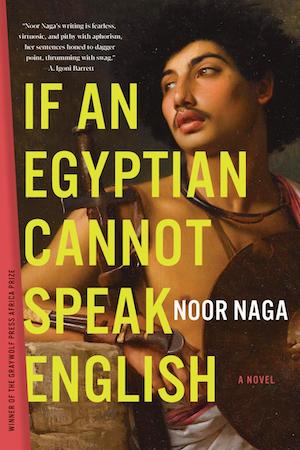
Two people cross paths and their lives are changed forever. It is the oldest and perhaps most universal story. If an Egyptian Cannot Speak English begins when Noor, an Egyptian American returning to Egypt in search of meaning and culture, meets an unnamed Egyptian man whose hopes and dreams have been all but decimated by political turmoil and a worsening drug addiction. 

Filled with imagery and prose that can only be achieved by a brilliant poet like Noor Naga, it is a novel aimed at asking questions (sometimes directly) rather than providing answers. At first, the questions are political— centered around class, identity, culture, globalism—but as the novel carries on (and reveals its metafictionality), it abandon politics and become philosophical and existential, specifically focusing on perception and the act of writing: What do you know? Where do you know it from? Why? What are the moral implications of pretending, as writers do, to know what someone else’s experience of the world is like?


Doma Mahmoud: I love the title of this book. As I read it, these different variations of it kept popping into my head. If an Egyptian cannot speak English, or cannot speak Arabic, or cannot speak either as fluently as others, and all the implications of each of those scenarios. I also thought. If an Egyptian writer cannot write in Arabic, who is she writing for?

Moral questions are my favorite. Who’s in the wrong? What could people have done better?

Noor Naga: I sort of think it in two ways. There is the book that I’m writing and there’s the book the American girl is writing in the book. In many ways, her text is meant to be presented to an American English-speaking audience. In the third part, you realize it’s a memoir and written not just for a general American audience but for this particular group of student-writers. They’re young and steeped in politics they imagine to be universal, but which are actually very culturally specific. I tried to problematize this as much as possible, to pit their value system against a foreign environment where it both fits and doesn’t fit. The character of Noor is telling a story which erases another story as it’s being told. It was very difficult to do that. I was trying to give space to this male character while also making the point that the filter you’re getting even his parts through is fundamentally skewed. And that in some ways you can’t trust this character of Noor or even me, the author of the book. 

DM: I want to ask you about this point about the filter. That point really came through in the book and it was actually quite disorienting because it put in question the trust I had for the story I was reading. I’m sure that was intentional on your part, so I’m wondering what the reason for that choice was.

NN: Originally, I was trying to write both POVs, the boy’s and the girl’s, and giving them equal weight. It was only when I was midway through the book that I realized it wasn’t actually possible for me, as Noor, to write his perspective convincingly. And that it would make more sense to only have one perspective: the American writer. I’m very suspicious of myself and I suppose I wanted the reader to be uncomfortable and suspicious too. That was the whole point for me. To force the reader, in the third part, to question this experience we are creating together, as author and reader, of bringing a fiction to life.  

DM: This book certainly did that to me. I wanted to ask you about the male character. How did you keep a balance between making this point about the limitations and biases of fiction and maintaining the integrity of the male character. To me, it didn’t feel like I was supposed to distrust what I had read about him just because it had been put through this filter. 

It made me think a lot about the Anglophone publishing industry and how it seeks out certain narratives and negates others.

NN: I certainly didn’t want the third part to come across as this deflating revelation that the reader had been tricked into believing this complete lie all along. That’s why the workshop at the end is a memoir writing workshop, not a fiction workshop. We’re familiar with what it means to have an unreliable narrator, but it’s easy to dismiss how unreliable all writers are. The character of Noor is really trying to be honest in her representation, but that doesn’t mean we can trust her. The point of highlighting her limitations and biases was not to paint her as dishonest or malicious. On the contrary, the point was to create a writer character who was aware of her limitations but still trapped by them. 

DM: It was refreshing to read something I walked away from with more questions than answers. In your acknowledgements you thank someone for teaching you to prize a beautiful question over a beautiful answer. That really came through in this novel. Each chapter of Part One begins with a question. I certainly finished the novel with so many questions. I wonder if that was the case for you after completing it. Which question/s remained with you after finishing? And what makes a question beautiful?

NN: Well that’s a really beautiful question! I think I like questions that are really balanced, where there is enough force behind different answers to make things decidedly inconclusive. Moral questions are my favorite. Who’s in the wrong? What could people have done better? For me, there were a lot of driving questions in this book. I’m not sure which I’m left with in the end. Because in a way writing the book was a way of purging the questions out of my system and then no longer being haunted by them. It’s a way of me saying: “I don’t know. But you guys can read it and let me know if you have answers.” One question that remains with me is the question of: who do you feel for? Do you feel more for her or for him? And why? It’s so interesting how people respond depending on who and where they are. So far, many of my friends who were born and raised in Egypt are more sympathetic with the girl than I thought they’d be. They don’t have the same complex in relation to nationhood, they don’t feel threatened in their claim to belonging. In contrast, friends of mine in the diaspora tend to be much harder on the American girl and it seems so obvious that this is a function of their own insecurities. They dislike her because they identify with her or recognize her on some level, and so it’s really a way of punishing the self.

DM: One of the central elements of the book is the power dynamics between the two main characters. The power transforms and mutates constantly depending on where they are, what they’re doing, what they’re talking about. Do you feel that one of the characters ultimately holds the ultimate power over the other? Why?

NN: They do pass the power back and forth between them. Ultimately, though, only one character survives and goes on to tell the story. And it says a lot.

I always wondered what this book would have been like had it been written in Arabic and directed at an Arabic-speaking readership. It made me think a lot about the Anglophone publishing industry and how it seeks out certain narratives and negates others. And the power inherent in participating in that. A lot of my writing of this novel was influenced by my hyper-awareness of my own position. I’m Egyptian but I was also born in the US and hold the US passport. I was raised in Dubai which is sort of an Arab country but also not at all an Arab country. Part of the reason I was able to publish this book is because I tick certain boxes that Egyptians born and raised in Egypt maybe don’t tick, even if they’re writing in English. I have access and currency. So this novel was my way of thinking about that and incriminating myself almost. 

DM: The character of Noor is named after you. That seems to me like a decision you probably spent a good number of hours on. Take me through that. 

NN: Well in the original draft that’s how I had it. Then I changed it because I thought it might distract the reader or that it might be too gimmicky. Too many tricks layered on top of each other. I also wondered if readers who aren’t familiar with metafiction would immediately think that this is autobiographical and I would have to explain, over and over again (to people like my mother and my neighbors!) that it’s still fiction.

Ultimately though I decided to name her Noor because I wanted to make the point that the author of this book is not exempt from the criticisms targeted at the American writer in the novel. It’s certainly a guilt-driven book. I wrote and published the thing. I have benefited from it. But at least I’m aware of it? Maybe that’s a copout but I wanted to highlight all the inherent problems in taking a truth from one world and then publishing and profiting from it in another world. And I wanted to do it playfully. There are so many writers I love who write author characters for this exact purpose. César Aira, Alan Hollinghurst, Youssef Rakha, Ruth Ozeki… I just sort of thought: I can have some fun too! And then hope that the satire comes through.

Sasquatch at the End of the World

Bigfoot Loses Heart

When berries were scarce
I ate the chipmunk who 
ate the berries. 

When my fur made fingers of ice down my back,
I told myself stories of what it must be 
to wake inside the sun. 

When rain would not stop
I waded into the river. I sat on a boulder and spat 
where the current parted around me. 

All was as I wished it to be.  
The notes I scrawled in the mud each sunset
were happy notes. Day this. Day that. 

But now I do not know where I have put those fingers. 
Now I’ve lost the hole inside the hole.

A Meditation

The snow makes some things clear: the deer
has been up before me, as has the fox

            is what I spoke into my phone’s voice-to-text.

No Mike I’m waiting for your call: the beer
has an offer for me, as has the fuck

            is what it heard.  

I wanted to consider how snow compresses time
by showing tracks, one moment layered over the next,

            to visit the waste of each footfall I had stacked 

invisible along a circled path these twenty years—
but I was made instead to wonder 

            where Mike had gone, why he didn’t 

call, what the beer was truly offering, 
and what, the fuck.

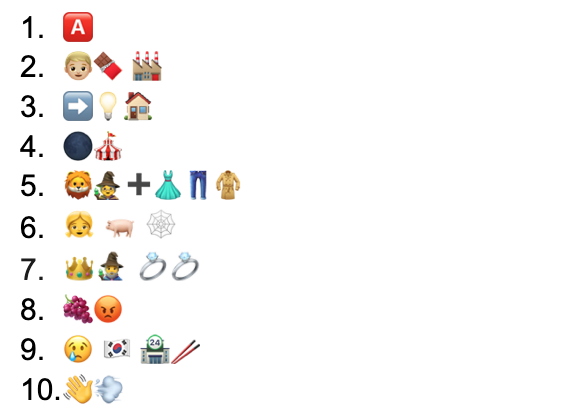
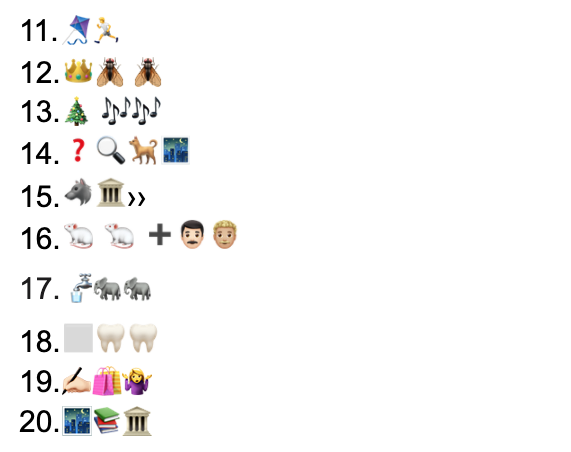
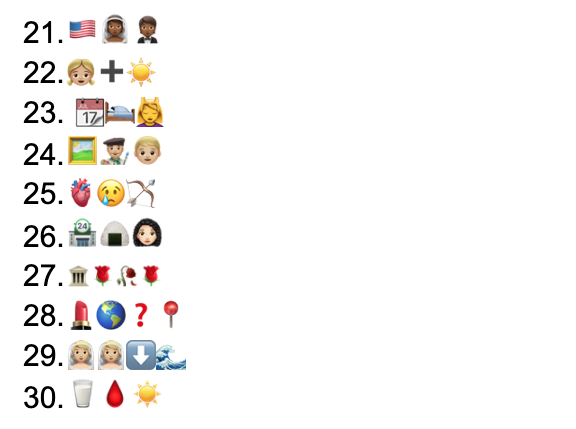
Can You Guess These Book Titles From Just the Emojis?

Annnddddd we’re back with another round of guessing the book titles using only emojis. Show off your booksmarts with our quiz, compiled by editors Jo Lou, Kelly Luce, Alex Juarez, and intern extraordinaire Lauren Hutton.

Stumped? The answers are at the bottom!

Can’t get enough? Click here for the first round of guessing the book title and here for more literary trivia.

Answers:

  1. The Scarlet Letter by Nathaniel Hawthorne 
  2. Charlie and The Chocolate Factory by Roald Dahl 
  3. To The Lighthouse by Virginia Woolf 
  4. The Night Circus by Erin Morgenstern 
  5. The Lion, The Witch and the Wardrobe by C. S. Lewis 
  6. Charlotte’s Web by E. B. White 
  7. The Lord of the Rings by J. R. R. Tolkien 
  8. The Grapes of Wrath by John Steinbeck 
  9. Crying in H-Mart by Michelle Zauner 
  10. Gone With the Wind by Margaret Mitchell 
  11. The Kite Runner by Khaled Hosseini 
  12. Lord of the Flies by William Golding 
  13. A Christmas Carol by Charles Dickens 
  14. The Curious Incident of the Dog in the Night-Time by Mark Haddon 
  15. Wolf Hall by Hilary Mantel 
  16. Of Mice and Men by John Steinbeck 
  17. Water for Elephants by Sara Gruen 
  18. White Teeth by Zadie Smith 
  19. Confessions of a Shopaholic by Sophie Kinsella 
  20. The Midnight Library by Matt Haig 
  21. An American Marriage by Tayari Jones 
  22. Klara and the Sun by Kazuo Ishiguro 
  23. My Year of Rest and Relaxation by Ottessa Moshfegh 
  24. Portrait of The Artist as a Young Man by James Joyce 
  25. The Heart is a Lonely Hunter by Carson McCullers 
  26. Convenience Store Woman by Sayaka Murata
  27. A Court of Thorns and Roses by Sarah J. Maas 
  28. Beautiful World, Where Are You by Sally Rooney 
  29. Our Wives Under the Sea by Julia Armfield 
  30. Milk Blood Heat by Dantiel W. Moniz 

8 Magical Novels by Women Writers

My absolute favorite stories are ones that suggest magic is not just adjacent to our lives, but that it threads its way through our lives. That magic is, in fact, just on the other side of our ordinary existence—if we know when and how to seek it.

Magical stories have shaped my writing over the years, and I find myself bored when my stories veer too closely to realism. My novel The Crocodile Bride tells the story of Sunshine Turner, an eleven year-old girl growing up in the fictional village of Fingertip, Louisiana. To cope with her father’s declining mental health and the boundaries he crosses with her body, she turns to a magical story she’s grown up hearing from him. Deep in the woods that surround Fingertip lies the Black Bayou, where there lives a woman with healing hands and the dangerous crocodile who loves her. Initially, the worlds of Fingertip and the Black Bayou exist side by side—but as the summer drags on, the two grow increasingly intertwined.

This reading list includes novels I love, and novels that—whether through fairy tale, ghosts, heightened worlds, or even heightened prose—marry the wonder and darkness of magic to our mundane, everyday lives. For me, there is no more delicious reading experience than exploring the ordinary through the deeply extraordinary.

The Snow Child by Eowyn Ivey

Ivey’s first novel is a fairy tale about the arrival of a mysterious little girl at the homestead of a lonely, middle-aged couple in Alaska. The story is compelling and moving, the writing gorgeous, and the ending is perfect. I love the way Ivey explores not only the way Faina’s magical appearance enhances Mabel and Jack’s lives, but the way her presence invites them to discover wonder in the ordinary: in friendships, and in passing seasons. 

Circe by Madeline Miller

Circe is set in the world of the Greek gods, and tells the story of our heroine’s journey from her upbringing as the daughter of narcissistic Helios and Perse, to her life as an exiled sorceress. It explores themes of love, connection, family, and solitude—to name a few—but what I found most moving of all was this novel’s exploration of mortality through the lens of immortality. So much of Circe’s journey is about her relationship, not to magic, but to the ordinary aspects of life that magic cannot touch. It is a stunning read, one I think about often.

The God of Small Things by Arundhati Roy

Fraternal twins Estha and Rahel are young children in India, mired in games of the imagination, when they witness an unspeakable tragedy. This novel interweaves the storyline of their eventual reunion as adults and the event that divided them in their childhood. It’s also an exploration of oppression, specifically in the context of India’s longstanding caste system and the aftermath of British colonialism—but its focus is the impact of these larger problems on the lives of human beings, and on the innocent. The magic in this novel exists primarily through the eyes of children—in one moment, for example, they watch as a little girl rises from her coffin to perform a cartwheel—but we also sense a kind of magic in the lush, wondrous prose, which seems to lift the internal worlds of each characters into some strange otherworld. I have never read anything quite like it, and my copy of this novel is so tattered from re-reads that the pages are barely attached to the spine, and it’s entirely missing its cover.

Kindred by Octavia Butler

Kindred’s Black protagonist, Dana, finds herself somehow traveling back in time to the antebellum South, where she encounters her ancestors and must make a critical decision that will impact generations to come—including, of course, her own. Butler’s writing makes visceral both the violence and degradation of the enslaved people Dana encounters (and of which she becomes subject to herself), along with the perpetual sense of danger that infiltrates every corner of their lives. In this novel, magic serves as a portal to the horrors of slavery and its continued impact on the generations that have since followed. It is a painful but illuminating read—not to mention impossible to put down.

The Tiger’s Wife by Téa Obreht

In The Tiger’s Wife, a young doctor named Natalie travels to collect her deceased grandfather’s belongings from his hometown of Galina. Along the way, we learn of two myths connected to her grandfather: that of the Deathless Man and of the Tiger’s Wife. Obreht walks the line between fact and fiction beautifully; it’s never quite clear what is fable and what actually happened. The magical scenes in this novel have haunted me for years, particularly one in which the pragmatic grandfather character encounters the Deathless Man on a hotel balcony as the war looms nearby. I won’t give anything away, but it is a stunningly moving scene in an equally moving novel.

Beloved by Toni Morrison 

A stunning, compelling story about a woman whose murdered child haunts her, Beloved explores the intertemporality of our present lives and past traumas in our personal lives and in our society. At times the story veers into such dark territory that I found myself hopeless, but Morrison’s ending offers a path of healing for her characters. What’s rightfully unsettling is the way white people play no part in that redemption; instead, we are left with the horror and culpability of ourselves and our ancestors. After reading the novel, it’s difficult to ignore the fact that if long-distant trauma can so easily resurface in our present lives, so too can our actions and inactions.

The Children’s Bible by Lydia Millet

This gutting novel tells the story of a group of children left to their own devices while on vacation with their preoccupied, alcoholic parents one summer. Although the narrator is a young girl, her style of narration feels collective—we read the story of not just her and her little brother, but all of the children in this large, rambling, chaotic group. The novel’s heightened world feels like one in which magic is possible—but as Millet skillfully moves us through the novel, we experience not magic but horror. It is a kind not specific to the world of the story, but rather one that threatens our own very real lives in our own very real world.

The Little Stranger by Sarah Waters

In this fantastic, terrifying ghost story, the dreadfully ordinary Dr. Faraday becomes increasingly entwined in the lives of the Ayres family and their aging, haunted English estate, Hundreds Hall. In addition to the perfect plot and gorgeous writing, Waters evokes Brideshead Revisted-esque insight into changing social values. Even more impressively, she explores more personal themes around the darkness we choose to acknowledge or ignore in our past, our present, and ourselves.

Brad Listi Thinks You Should Write as if You Were Already Dead

Brad Listi has made a name for himself by talking to other people. On his podcast, Otherppl with Brad Listi, now in its tenth year, Listi has interviewed hundreds of writers. He’s known for asking questions not just about craft and literature but also about—well, everything. In my favorite episodes, he manages to ask inappropriate questions appropriately, usually within a conversation that appears to have no relevance to writing but actually turns out to be very relevant to writing. I think it’s fair to say that Otherppl is built upon the hypothesis that everything is relevant to writing.

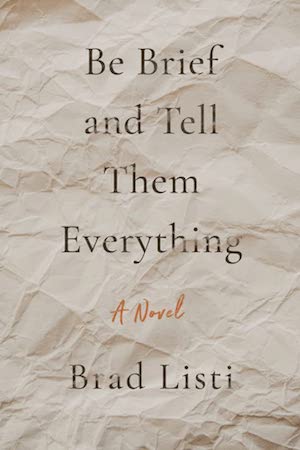
Fittingly, Listi’s sophomore novel, Be Brief and Tell Them Everything, is an autofictious work of both breadth and depth. Structured as a non-linear series of vignettes, the novel opens in the life of a writer named Brad who can’t seem to finish the novel he’s been working on for twelve years. In the midst of this creative crisis, Brad’s six-month-old son is diagnosed with cerebral palsy. The diagnosis is devastating for all the obvious reasons, but it also serves to sharpen Brad’s persistent and pre-existing existential ennui. As he writes and rewrites his novel, he finds himself asking and re-asking a series of questions: Who am I? What happened? What should I do? Be Brief grapples with a diverse array of topics—fatherhood, disability, death, autobiography, creative failure—but it ultimately tells the story of an ordinary life. If readers are looking for Listi on the page, they will undoubtedly find him. That said, I suspect they will also find much more.

Listi and I connected via Zoom to chat about curating a fictional self and the writerly desire to capture the whole world with brevity. It was a pleasure to compel him to answer the sorts of questions he’s usually tasked with asking. 


Wynter K. Miller: On your podcast you’ve been talking a lot about the publication process, and specifically about the anxieties associated with putting this book out into the world. Recently, you said something like, “I worry about how to talk about the book. What if I say something stupid?” So, let’s start there: What are you afraid of saying? What is the stupid thing you’re worried you might let slip?

Brad Listi: I think it’s interesting how much fluctuation there is in the lead-up to a book’s publication, in terms of how you feel about it. And I think in particular, because this is a book that’s very personal, I feel at times uneasy about how it might be received, particularly by those people who are close to me or who might be implicated by the book in some oblong way. But then there are days where I don’t care. And then the anxiety is also maybe about not wanting to sound precious about it. I think it’s emotional for a writer to put a book out in the world—not always, but sometimes you have these little fevered moments of caring a lot, and in those moments you might be more susceptible to preciousness or taking yourself too seriously.

WKM: Be Brief has autobiographical elements, but it’s not autobiography. The main character is named Brad and he runs a podcast called Otherppl, but he isn’t you and things happen to him that have not happened to you. I feel like autofiction can be a messy genre—wouldn’t it have been simpler either to just write a memoir or write a straight novel? 

BL: ​​Well, I would say first that autofiction is very natural for me as a writer, and I also really appreciate it as a reader. Almost always when I’m reading novels, I’m trying to figure out what’s going on with the author, and I’m often frustrated by what I feel like are layers of fiction between me and the author—I wish the author would just talk about what’s going on with them. So, maybe I’m trying to emulate the books that do that.

But I would also say that, to me, my book is a straight novel, and it was much easier to write this than it would have been to write a memoir. I wouldn’t want to be bound to the facts like that. It seems like an impossible adventure for me because I would always be second guessing myself and thinking that I’m fictionalizing anyway. It was helpful for me to have the permission to fictionalize and to move things around and to make things up and to change some details. 

I’m not sure I’m capable of just making something up and rendering it on the page in a way that’s interesting. For whatever reason, I have to grapple with myself. I can’t take pure acts of my imagination seriously or something. I don’t know. Some artists work from the inside out and maybe that’s who I am. When I tried to write the other way, it just fell flat and, eventually, when I started to write from the inside out, it worked better.

WKM: When you’re putting someone on the page who so resembles you in a personal way, do you worry that you won’t be liked?

BL: Yeah, sure, in a natural human kind of way. I think we all want to be liked. But I think you have to be very careful, especially if you’re working in autofiction, about trying to be too cool on the page—readers will often love it because it’s fun to be in the hands of a cool narrator. Somebody with, like, I call it, “Teflon intelligence.” They never say anything that can make them seem mottled and shitty. It’s very subtle, and I see it all the time from very skilled writers. And maybe they’re right—I could be wrong, but my impulse is the opposite. I don’t want to be too cool because I’m not too cool. In real life, there’s none of that in me. I’m a mess. I’m making stupid mistakes or errors in judgment or, you know, stumbling socially. So I think it’s about finding an honest balance between being truthful about the mess, but not to the point where you’re so self-deprecating that it’s insufferable. You don’t want to be too cute, but you don’t want to be bashing yourself all the time or constantly fucking up, either.

WKM: It was really important to you that Be Brief have some levity and funny moments with its darkness. How much of that is that is because you consider yourself a funny person, because you’re thinking of it as “putting yourself on the page,” and how much of it is it that you’re just think about your readers and wanting to give them a balanced reading experience?

BL: I think the rarest experience that I have as a reader is laughing out loud. And it’s the one that I most appreciate. And if I do that while I’m reading your book, you have a fan in me for life. I think as a writer, I try to emulate that. On the level of lived experience, too, I’m trying to render the world as I see it on the page. I have never experienced a world that is all one thing, there’s always laughter amid the darkness for me—and often, in really unexpected ways. These things don’t have any real internal logic, and I think I want my art to reflect that.

WKM: Be Brief is a slim novel, but it contains a lot. How did you make decisions about what to include and what to cut?

It’s about finding an honest balance between being truthful about the mess, but not to the point where you’re so self-deprecating that it’s insufferable.

BL: That’s something that it took me a long time to sort out, and it required a lot of failure. For example, there’s a chapter in the book where I talk about a miscarriage, a single miscarriage, even though there were multiple miscarriages. There was an entire iteration of this book that was like “The Miscarriage Book,” where it was all the miscarriages and it was way too much. When you go through all that failure, you start to get a more developed sense of the reader, which is ultimately what you need to edit yourself and get your book into shape. I finally figured out that I had to pick my spots. I had to keep things moving. I had to be brief. 

WKM: I think the book’s title also functions almost as the book’s thesis statement. 

BL: You know, it’s funny because this book covers a lot of time. But I appreciate brevity and concision in writing. This is another thing that I’m trying to emulate that I’ve really responded to in writing and in books that I love. I feel like compression is part of the project of being a good writer—doing all that work for the reader and also not falling in love with the sound of your own voice, which is something that I can easily do and did quite often in earlier drafts. And frankly, as a reader, I often see it on the page. I feel like most books could be cut. And maybe that’s just my taste, but I didn’t want there to be wasted motion in this book. I wanted it to be concise, but I also wanted it to feel like nothing was missing.

One thing that I’ll say is that I tried to give myself—and this is where I can start to sound precious—but I tried to give myself the directive that I should write it as if I were already dead. What would I say if I were already dead? What’s most important to me? What if I didn’t care or wouldn’t even be around to hear about the outcome? And I got this idea in my head that maybe I should never write a book unless I have something very urgent to say. Like, what’s the point? Why waste anyone’s time? Just to entertain myself and entertain other people? That might be enough [for some people], but I don’t know if it’s enough for me. 

WKM: I think the idea that you shouldn’t write something unless you have something urgent to say can be intimidating, especially for writers who don’t think of themselves yet as writers. The question becomes: how do I know that I have something urgent to say? How urgent is urgent enough? But do you think that mindset can be a helpful way to manage failure and writer’s block?

What would I say if I were already dead? What’s most important to me? What if I didn’t care or wouldn’t even be around to hear about the outcome?

BL: Yeah, I think that. I think everybody probably has something to say. We all have things that are deeply important to us or troubling to us or painful to us. For me, it was about locating the things that were most important and urgent to me. Most difficult for me. And to think about things that I was scared to talk about—and to talk about them. And to slow down when I got to those parts. Not to make it sound melodramatic, but I think it’s very common for writers to avoid that stuff, even if we feel like we have a handle on ourselves. The impulse to skip over those things or move quickly through them is strong. I didn’t want to give myself an out when it came to that stuff. 

WKM: There’s a scene in the novel where Brad purchases a lottery ticket and on the drive home starts having a detailed fantasy about what it will be like to collect the jackpot. But then, mid-fantasy, he realizes that by having so vividly imagined his dream, he has effectively guaranteed it will never happen. I love this scene because we’ve all had this kind of fantasy. Did you ever imagine what it would be like to publish your book and give interviews about the difficulty of writing it?

BL: No, and this is a significant difference between my debut novel and where I am now. It has been significantly less stressful. I have been significantly less neurotic. I think maybe it’s because this book was such a hard one for me. The fact that I was able to get it to a place that I feel really good about, and that I was able to wrestle it to the ground after all that time and failure and struggle—anything that happens beyond this is just gravy to me. 

My Family’s Failures Took Center Stage in “Everything Everywhere All At Once”

The first time Ma told me was my last semester of college. I was in Providence. She’d moved back to Taiwan for good when I left the suburbs for Brown. One winter night, at the movies by myself, I watched Extremely Loud and Incredibly Close. The hero, a whiteboy, copes with the double abandonment of his dead father (9/11) and seemingly absent mother (grief). In the movie’s emotional climax, the boy yells at his mother, I wish you had died instead of him.

I do too, she says.

Ma and I weren’t capable of such honesty together. Still, after watching a son take his mother for granted and feeling how deeply he hurt her, I chose to tell the truth for once. That night, I called my ma and told her that I’m gay. That week, with my brother and sister, both a decade older, she flew out to the farthest coast of America. We went to the beach in winter. On a cliff, in a leather coat with a thick, fur cuff, she told me that she loved me.  

She did? Since when? Why now? 

I didn’t say any of this. I left her for the rental car. We ate somewhere unmemorable.

She’s continued to say it since, mostly on Facebook Messenger. I write it back out of obligation, but I don’t know what it means. How do you love the person who left you when she was supposed to raise you? How do you love a person across space, time, language?

Abandonment is the song that I can’t get out of my head, and unworthiness is my forever fear.

I’m back in the suburbs of Chicago for an artists’ residency. Ma and I moved here from Taiwan when I was in elementary school. Starting in fourth grade, she’d leave me every spring—Taiwan’s tax season, and she was an accountant. In her absence, my siblings were my caretakers, each on academic leave, neither much older than twenty. It won’t surprise you, then, that abandonment is the song that I can’t get out of my head, and unworthiness is my forever fear.

Everything Everywhere All At Once portrays the pain of lifelong silences. The film also puts words to unspeakable things between mother and daughter, wife and husband, adult child and ailing father. 

Directed by the Daniels, Everything Everywhere All At Once is part Matrix and part Multiverse of Madness with the tonal range and mother-daughter themes of Turning Red. It’s as goofy as it is heartbreaking, and it holds all that range with a whole lot of sci-fi. It’s about the Wangs, a Chinese American family in California. Evelyn and Waymond, the parents (played by Michelle Yeoh and Ke Huy Quan, respectively), own a laundromat. It’s tax season, and the IRS is auditing the family. 

In fact, the Wangs are going to the IRS for a meeting. Waymond also plans on serving Evelyn divorce papers. When she’s not berating him, she is brushing him off, and he’s hoping that this rupture will finally get her attention. Bad timing though because the family is hosting a Lunar New Year party that evening. The occasion honors Evelyn’s father, a.k.a. Gong Gong (James Hong), who is visiting from China.

To frazzle Evelyn even more, her daughter Joy (Stephanie Hsu) has shown up at the laundromat with Becky (Tallie Medel), her girlfriend of three years. The couple wants Evelyn’s permission for Becky to attend the party. However, Gong Gong doesn’t know that Joy is queer. Things go left when Joy tries to tell him, so she and Becky leave. Short a translator and a caretaker, Evelyn and Waymond bring Gong Gong to the IRS meeting. The three are going up the elevator to meet their officer, Deirdre (Jamie Lee Curtis), when Waymond takes off his glasses and snaps into a different persona. 

Can this Evelyn carry out the Alpha mission, living up to her potential for the first time in her life? 

This alter ego is Alpha Waymond—Alpha for the Alphaverse, the first universe to make contact with the others in the multiverse. Alpha Waymond believes that Evelyn is the multiverse’s last defense against its worst threat, Jobu Tupaki. To beat Jobu, Evelyn has to learn how to Verse Jump—to access the skills, memories, and feelings of the Evelyns in the other universes. Can this Evelyn carry out the Alpha mission, living up to her potential for the first time in her life? 

As wild and absurd as the film gets, its themes are remarkably straightforward. Everything Everywhere All At Once is about all the possible lives that Evelyn has given up after leaving her parents in China to build a life with Waymond in California. It’s about how a family of the Chinese diaspora falls apart as the second generation acculturates to the U.S. It’s about intergenerational trauma: Evelyn’s rejection by her father, Joy’s compromised acceptance by her mother. Quite literally, it’s about saving your child to save yourself. 

In Taiwan, we lived in an empty apartment with marble floors. I slept in the same room as my parents. It had two beds, a king and a twin. I slept in the big one with Ma. Ba slept on his side in the bed fit for a child. Later, in the Chicago suburbs, I slept in my parents’ room again. Ba wasn’t around. I never knew where he was. An ocean away, probably. Taiwan or China—or not. I stopped keeping track. 

I felt my parents’ distance most whenever I went to my friends’ houses. Their parents lived together and called each other by their names—even as Mom or Dad. They talked to each other at the table, enjoying whole adult conversations while the kids chatted on the side. These parents, all white, showed love so openly. Mine taught me that marriage entraps, turning everyone into monuments of ash.

Everything Everywhere All At Once never uses the words “Asian,” “Asian American,” or “immigrant.” Instead, the characters talk about fraying neighborhoods and crumbling institutions. When Alpha Waymond is explaining the mission to Evelyn, he says she has what it takes to bring everything back to normal. To make things great again.

Say you’re making a movie about global fascism without saying “global fascism.”

Even with all the timelines and Verse Jumps, the film plays out the question of survival pretty neatly. Evelyn has two options: chaos or kindness, ways of being embodied by the villainous Jobu Tupaki and the reliable Waymond Wang.

When the world is ending and everything seems pointless, take care of each other instead of not caring at all. 

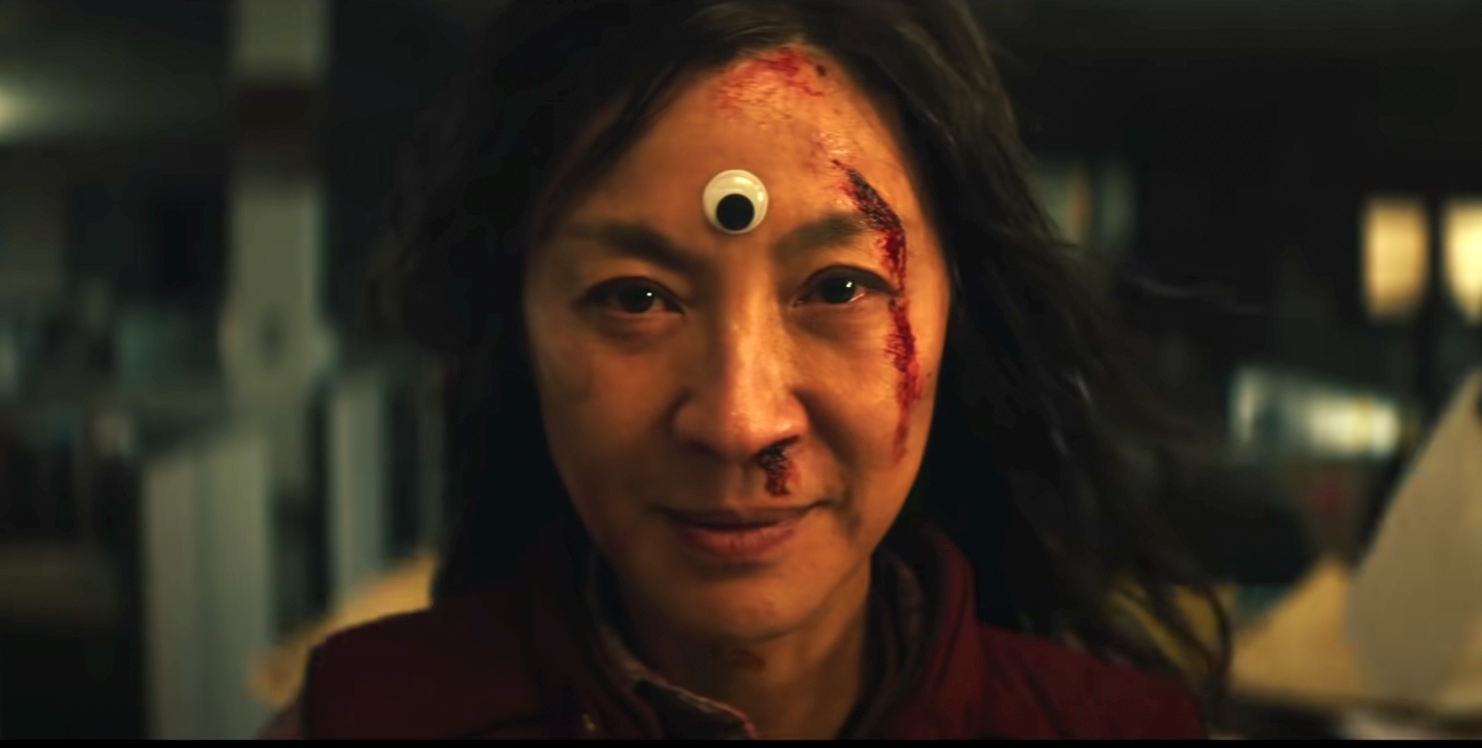
At first, Evelyn chooses Jobu. She pulls a “Hold Up” in the laundromat, snatching a baseball bat and smashing a storefront window. I’ve always hated this place, she says. Later, Waymond talks Evelyn off Jobu’s cliff. In the film’s final fight scene, Evelyn tries to save her daughter by fighting like her husband—which is to say, with kindness. She turns the bullets about to break her body into googly eyes, the ones that silly Waymond sticks everywhere, and launches them at her enemies. Then she tends to their needs, aligning a man’s spine, spraying a widower with his dead wife’s perfume, convincing the IRS officer Deirdre that she is not unlovable. 

Peel back all the sci-fi, and the movie’s position is simple. When the world is ending and everything seems pointless, take care of each other instead of not caring at all. 

How is a seemingly race-neutral story so deeply Asian American?

What I have of my family these days is memories from when our lives overlapped. 

Staying up past my bedtime, waiting for Ba to get back from a business trip. 

Listening in the back of the car as Ma drove while my sister talked shit about Ba. For the first time, I chimed in and made a joke about him too. They laughed—they laughed!—and I belonged. 

Sleeping in on weekends in the suburbs. Looking for Ma in her room, finding her face un-made and beautiful. 

Finding my brother hung over on the couch when I needed him to drive me to the Labor Day parade. 

Believing my sister when she said that high school would be hell. The older kids would stuff me into lockers all the time because I was such a pain in the ass. 

Making plans during college to live in Chicago one summer instead of the suburbs. Ma refused, saying it made no sense to pay rent somewhere when I had a house right there, saying that I treated our home like a hotel. 

Beaming with belonging at graduation. Marching with my first real friends in college from the Asian American Studies class I took that final semester. Flaring with anger whenever my parents approached.

What I have of my family these days is sadness and hurt—feelings I have no way of telling them about, feelings I have no way of living down.

Family is the cornerstone of “Asian American culture,” that profitable myth of a monolith. Throw in hard work, boba, and the pains and quirks of migration, and you’ve mapped out the landscape of Asian America—the East Asian territories, at least. 

Everything Everywhere All At Once isn’t content with treading such familiar ground. Its aims are more radical than ethnography and cultural authenticity. Consider the Wangs’ Lunar New Year party. This choice—to highlight that many Asians literally follow a different calendar than the West—cues us to the film’s contribution to Asian American storytelling.

Everything Everywhere All At Once creates a form for Asian American space-time. 

Our lives, crossing hemispheres, spill out of all the boxes built to contain the Joneses.

My Asian family doesn’t take up space like American nuclear families. Our lives, crossing hemispheres, spill out of all the boxes built to contain the Joneses. Living all over the place, we act it too. Ba writes me DMs and red envelopes in Mandarin like he doesn’t know English has surrounded me most my life. Ma sends heart emojis and Pusheen stickers like these charms might repair our relationship, stretched thin across the Pacific for so long. 

We treat time differently too. We take for granted that history unfolds in cycles instead of progressing in a line. There are philosophical differences and mundane ones too. When your family spans oceans and continents, you learn to live around time zones. Long before understanding attachment styles, you accept that you and your parents live at opposite times, in places the other might never see.

Our space and time turn our lives into sci-fi. Think about how our elders’ traumas keep them cycling through the past. Think partitions, carpet bombs, internment camps. It doesn’t take much worldbuilding for us to grasp the multiverse. What we refuse to believe is closed borders and linear time. 

I came back to the suburbs a week before the residency to spend time with my brother’s family. It’s him, my sister-in-law, and their three kids—two nephews and a niece. 

My brother and I also bookend a middle sister. This isn’t the only parallel between my nuclear family and his. It’s only the most harmless.

Both my family and his kill time by eating out and shopping. We know how to be together when the focus is on anything but ourselves. Before, my family being too many even for the SUV, I’d fold myself up in the trunk. To Asian groceries or outlet malls, the drives always felt so long. The landscape was always the same: tall grass and bare trees, identical houses in mazes, strip malls like a checkerboard of the same seven chains. Whatever restaurant we ended up at, one of the six that grounded our routines, my siblings filled the conversation. They always told the same five stories about their childhood, all of them preceding my birth. What was I supposed to say?

I came alive with my friends—I made them my family.

I had so much to say but no way to say it. Neither my world nor my inner life had a place with these people called my family. Not the emo music or morbid TV I dedicated myself to. Not the stream-of-consciousness books I fell in love with. Certainly not the gingers. I came alive with my friends—I made them my family. Around Ma, my sister and brother, his then-girlfriend, and Ba if he was around, I was already gone.

Now, in my brother’s family, the kids sit with their mom. The dad is off to the side. The parents don’t talk to each other except, on occasion, to bicker. Most of the conversation is about the food. Who has eaten the most? Who is falling behind? At the corner of the table, I speak if spoken to. Otherwise, I go on Grindr. Men ignore me, I expect it. Eat. I go on Grindr. Men hit on me, I don’t buy it. 

A familiar immigrant refrain offers a jumping pad for interpreting the multiverse. Your elders sacrificed so much for you to have these opportunities. This saying prompts the current generation to imagine alternative timelines for our elders, possibilities given up so we can work our way to the top. 

The project of America sets up immigrants to fall short. For so many Asian Americans, falling short is failure. 

Everything Everywhere All At Once makes the figurative task literal. Joy’s family members can all tap into the lives they passed up for her to live in Beautiful Country. When the Mandarin name for America is this aspirational, disappointment is inevitable. The project of America sets up immigrants to fall short. For so many Asian Americans, falling short is failure. 

Also consider that Alpha Evelyn’s the one who invented Verse-Jumping technology. She saw so much potential in Alpha Joy to jump from universe to universe—to become anyone she put her mind to—that she pushed Joy past her limit. As a result, Alpha Evelyn turned Alpha Joy into Jobu Tupaki. Mother broke child with too many expectations. Mother made child into enemy. 

The multiverse—all those lives not lived—is the cost paid by one generation for the next to achieve the American Dream. The multiverse is the people abandoned, the passions forsaken, the possibilities deferred. It’s the shadow of the dream, an ashen field of grief. 

Grief is the root of Joy’s sadness. Jobu, Alpha Joy, experiencing everything everywhere all at once, holds her family’s grief for the lives given up for her benefit. All their mourning makes her own life hard to live—so much so that she created a weapon to destroy the multiverse, or so the Alphaverse believes. 

Why have the Alphas labeled Jobu the enemy? As a queer Asian child, Alpha Joy threatens the foreclosure of all future timelines, the waste of all that sacrifice. She’s not the only one. In one of the most recurring timelines (the hotdog one, the phallic one, the gaggiest one—but more on that soon and, yes, the bagel too), Evelyn and Deirdre are lovers. Evelyn’s a failure too. After all, queerness is failure at the nuclear family, that most hetero of social projects. 

Watching Everything Everywhere All At Once the first time was like smashing a dam with a battering ram. I was finally meeting a family like mine, an Asian American failure. 

It’s not like I’d assumed that all of us were happy. I’ve been at enough restaurants and projected onto enough silent Asian American families to believe just the opposite. A lot of us find our families of origin beyond repair. We avoid the same trap by dating people with zero resemblance to our parents. 

No one talks about giving up on family. No one talks about family giving up on you. 

But the power of shame is the silence it compels. So many Asian American stories insist that family is central to life. No one talks about giving up on family. No one talks about family giving up on you. 

What if the families talking the least to one another have the most they need to say?

My ma had cancer when I was in high school. While she was going through chemo in Taiwan, I was taking summer classes at Harvard like a good model minority. 

JK. One was a fiction workshop and the other, a lit class in Modernism and Postmodernism. Discussing To the Lighthouse, the professor told us what Woolf said about imagining your parents as adults. It’s the hardest thing to do.

On top of chemo, Ma was also getting calls and texts from China. A woman claimed to have a video of her sleeping with Ba. She was extorting Ma—money in exchange for silence. 

My sister told me all this in e-mail. She was there for everything. She was there for Ma. 

When I finally made it back to Taiwan, Ma sat me down to talk about her will. 

The day I die, your dad’s going to marry that woman, and she’s going to take everything away from this family. You cannot let that happen.

The parts of Everything Everywhere All At Once I needed the most were the warmest, the softest, the most tender and most raw. I’m not alone. I’ve brought up this movie with a whole lot of people. If they’ve seen it, especially the Asian Americans, I ask a presumptuous question. So where in the movie did you cry? 

If you believe so-called Asian Twitter or the Facebook group Subtle Asian Traits, Asian parents don’t say I love you. Asian moms show care by asking if you’ve eaten, and Asian dads are stoic to death. 

Once, an Asian American made this generalization IRL: Asians aren’t good at communicating. We’re not the most expressive of people.

My skepticism aside, I’ll admit: something seduces me about the consistency of all the tears. It convinces me that Everything Everywhere All At Once is speaking to Asian Americans in a new and distinctive way. That more of us come from fucked-up families than anyone has ever let on.

I’ve watched the movie four times now. A scene that’s made me cry each time comes at the end. Evelyn has just confronted Gong Gong about abandoning her after she left home. 

I don’t know how it was so easy for you to let me go. 

I tried to talk about abandonment with Ma once. We were at a cavernous Italian restaurant with high ceilings and a bicycle on the wall. Why did you leave me when I was growing up? I asked. Without missing a beat, as if she’d been waiting for this question all my life, she told me how normal it was for parents to leave their kids. Your uncle did it with your cousin. He put her in a boarding school. At least I lived with you most of the time. Recognizing right away that she was invalidating my reality—your girl was in therapy, alright?—I left the table to go pace in the parking lot.

I tried to talk about abandonment with Ma once. We were at a cavernous Italian restaurant with high ceilings and a bicycle on the wall.

In the course of standing up for herself, Evelyn drags Joy and her partner Becky into the conversation. The day before, when Joy was trying to tell Gong Gong in Mandarin that Becky is her girlfriend, Evelyn interrupted and introduced Becky as Joy’s good friend. Now, making up for her betrayal, Evelyn tells Gong Gong the truth. Girlfriend, Evelyn says in Mandarin as Joy tries to shake off her mother’s grip. Evelyn has outed Joy. She escapes to the parking lot. 

Evelyn follows, but Joy yells at her to stop. When we’re together, it hurts the both of us, Joy says, so let’s just go our separate ways.

Months after the Italian restaurant, I got a Messenger alert. It was either a bot or a parent, the only entities that DM on Facebook. It turned out to be my ma, and her message, an apology. It was brief and in English, a heartbreaking kindness. 

The message started a conversation that hasn’t moved an inch since. Every subsequent DM has been heart emojis or Pusheen stickers.

So many months separate my calls that I’m never sure she’ll recognize my voice.

Though her sorry softened something in me—I write it back now, “I love you”—we still don’t talk that much. We see each other even less. So many months separate my calls that I’m never sure she’ll recognize my voice. When she picks up, she always sounds a little panicked like I must be calling with bad news. 

Long before “I’m sorry” and “I love you,” we had gone our separate ways.

At first, Evelyn respects what Joy says. She turns around. But right away, she faces her daughter again. She walks up to Joy’s janky car and opens the door. She gets real. 

You are getting fat. You never return my calls. You only come over when you need something. You got a tattoo even though you know I hate tattoos, and I don’t care that it’s supposed to represent our family. Why in the world would I choose this life with you?

Then she gets tender. 

Even though it hurts to be together, you still came looking for me. And even if it’s only a matter of time before something else in the universe makes us feel like even smaller pieces of shit—even if life is just a few specks of light—I would still want to experience them with you.

Even after mother and daughter have come close to killing each other, even after one of them has called it quits, it’s the power of maternal love—the far-from-unconditional but nevertheless limitless commitment—that brings the two to embrace. To try again and differently.

Three days into the residency, I missed a call from my brother, so he texted. “Can you call me back?” When I didn’t respond right away, he texted again. “Can I call you later?” Until we finally got a hold of each other, my one thought was that Ma must have died.

It’s like this every time my family calls. Was I missing yet again when she needed me most?

This song of abandonment. Almost twenty years.

I talk a big game about her leaving me, but I get it now. I’ve abandoned her too.

Everything Everywhere All At Once taught me to do the hardest thing: imagine Ma as an adult.

Everything Everywhere All At Once taught me to do the hardest thing: imagine Ma as an adult. A person of savvy and humor and ambition—the woman who wore shoulder-padded blazers and dresses at the head of her own office, speaking quick and sharp to all the dull men. A person who’s faced betrayal, mortality, abandonment—the woman who wrote me a note on the small blackboard in my room in the suburbs about how alone she was in the house, all of her children gone, in another space and time.

Thanks to Everything, my sadness about Ma, pooling in me for years, has taken the form of questions, things I can ask her one day. 

All those years when it was just me and you in the house, what did you do every time I was gone, escaping? Did you escape too? If you got lost, how did you find your way back? Were you ever lonely? Did you ever despair like I did about all the space between the houses and all the time wasted in crossing? Did I make it worse?  

On my way to the residency, I drive past the box-store lot where Ma taught me how to make turns in the snow. 

By myself now, I wonder about all the times she took these same roads alone.

An Anthology That Gives Voice to the Realities of Reproductive Freedom and Abortion

Shelly Oria’s new collection, I Know What’s Best for You: Stories on Reproductive Freedom, is the latest in a string of new anthologies that reclaim and challenge the conversation surrounding reproduction. The collection deals with the choice of whether or not to have children, and also explores surrogacy, trans pregnancy, a medical establishment rooted in misogyny and racism, and much more. It’s the kind of book we need badly right now, as it shows us the full richness and complexity of such stories. And of course it comes at a time when lawmakers continue to strip away freedoms surrounding reproduction.

In this book, writers of various backgrounds, sexualities, and genres come together to ask big questions, such as “In a country marked by massive individual debt, inequality, and a profound lack of support and safety nets for women, what does ‘choice’ actually mean?” The collection doesn’t center around abortion, but at a time when the Supreme Court is leaning towards striking down Roe v. Wade, it reminds us that the choice to be pregnant is a personal one. 

Sarah Gerard writes in one of the last pieces of the book: “I don’t need to tell you what happens to women who are denied the right to safe abortion, or what happens to their children.” But unfortunately our country does need a reminder, it seems. Timely, important, and rich in nuance, this anthology is a valuable contribution, one that gives voice to the realities of reproduction, and its subtleties, pains, and joys. 


Emily Heiden: The collection features the work of Black writers, queer writers, and other traditionally marginalized voices. Was this a primary aim of the book, to help right the wrong of the historical silencing of such writers’ reproductive stories?

In this new landscape where people often have to travel to another state for an abortion, who bears the brunt? We know that’s lower income folx [and people of color]. 

Shelly Oria: It was what I knew about this book before I knew anything else—that the majority of voices featured would be from marginalized groups. But to get a bit more specific: as you point out, historically, when it comes to reproductive freedom, POC and queer people and other traditionally marginalized voices were silenced. That kind of silencing is of course tied to deeper questions about whose humanity our culture recognizes. And in the case of people living with disabilities, they were often discouraged from procreating: Cade Leebron’s essay in the book addresses that briefly, and Riva Lehrer’s unpacks a traumatic experience she suffered in this context as a teenager. And yet it’s not just about an awareness of the past, or about the moral and artistic commitment to take corrective action when possible. The need to spotlight all these voices is also entirely grounded in the here-and-now: in this new landscape where people often have to travel to another state for an abortion, miss days of work, figure out childcare for that time if they’re parents—who bears the brunt? We know that’s lower income folx. And we know this type of burden always falls disproportionately on POC. 

I’m answering in this sort of analytical way, but this is also very personal to me. As a queer woman, as a person who immigrated to this country in her 20s, as a writer writing in her second language—and of course as a thinking-feeling-reading-listening human in this moment in time, in this country—I wouldn’t buy or read an anthology that wasn’t radically inclusive and loudly intersectional. So certainly I wouldn’t make one any other way. 

EH: In the book’s introduction, you write that:

“One could put together a powerful book—ten powerful books—filled with stories of abortion or the lack of access to one in today’s America. But I felt drawn to a broader approach and invited writers and artists to respond to any aspect of reproductive freedom with which they connected…”

Given the fact that Roe could potentially be reversed by SCOTUS in June, can you talk about what specifically drew you to a broader approach?

SO: I’ll say first that I think we need way more art that responds to our reproductive freedom crisis, and specifically more books on this topic. Some of these books are likely to choose that more specific focus you mention, and as a reader that thought is exciting to me. But as an editor, I wanted to do something else: I wanted this book to do its tiny part to shape the kind of cultural conversation I’m wishing for, one in which as a society, we recognize how insidious gender-based violence is, and start seeing the various manifestations of that violence as interlinked. If we think, for instance, of sexual harassment and assault against womxn as entirely distinct from the attempts to restrict and outlaw abortion, and of both those issues as distinct from the problem of domestic violence, or even that of pay disparity, then, well, I believe we’re ultimately failing. When we keep the scope of our conversation too narrow, we’re failing to imagine a true alternative to a reality in which the subjugation of womxn and their bodies is the norm. At best, we’re improving whatever symptom we’re focused on in that particular cultural moment. And that’s not nothing. But I want more. I think we should all want more. 

EH: As someone interested in exposing Crisis Pregnancy Centers for the insidious work they do, as I read your story “We Bled All Winter,” I found myself wondering about in particular about the section in which the narrator is a volunteer trained to connect with women. Is this passage rooted in research? I’m genuinely curious. The Pregnancy Verification Form–is that something you saw at such a center, or read about? I unwittingly visited a CPC in Northern Virginia years ago, so am versed firsthand in some of their practices, but not all.

Art in general and books in particular are being called to meet impossible challenges at this moment in time when the world is such a dumpster fire.

SO: CPCs are terrifying, aren’t they? I had nightmares when I was writing that section of the story. I do this to myself sometimes—write from the POV of someone I find scary or creepy, or in this case, someone who’s part of a system that’s scary and creepy. And the experience of embodying that consciousness for a time can be pretty intense. Though really what surprised me about “We Bled All Winter” is that all three narrators turned out to be a lot more well-meaning than I initially assumed or intended for them to be. In some ways I think the piece ended up being this tale about the inevitable tragedy of being human.

EH: In Carrie Bornstein’s essay “Steel Womb,” she writes:

“Sure, he was right, but pregnancy…pregnancy also meant poking the elbow of a fetus inside only to feel it jab right back at me as if to say hello. It meant unlimited milkshakes, second dinner, and cute maternity clothes with the greatest accessory ever sitting right there at my midsection.”

These lines paint pregnancy in a more positive light than many of the others in the book. In a time of climate change, pandemic, student debt, and so on, it’s understandable that reproduction would likewise be fraught. Is it also perhaps important to hear from those who delight in pregnancy—yet who, too, are thought not to know what’s best for them?

SO: I think it is. Surrogacy is one of those polarizing topics; people who otherwise agree on so much might have profoundly different takes on this issue. I don’t presume to have any answers, but I was so moved by Bornstein’s essay, and it offered a perspective the book otherwise lacked, not only in that it’s the sole piece on surrogacy, but in the particular way the essay celebrates pregnancy—without ignoring any of the challenges she faced. So my thought was pretty much exactly what you said: that we should listen to these stories as well. That’s a good place to start most of the time, listening. 

EH: Can you talk about the decision to include multiple genres in the book? (Graphic memoir, poetry, creative nonfiction, fiction, etc.) In what ways do you see each contributing to the collective voice of the book? How do you think it would have been different, had it been, say, straight memoir?

SO: With I Know What’s Best For You, one of the first things I knew was that I wanted to take the notion of a multi-genre anthology to the next level, which is why this time we included—in addition to the stories, essays, and poems—a graphic memoir, three short plays, and photographs (by Rachel Eliza Griffiths—these gorgeous photographs that just absolutely wrecked me, and an equally gorgeous essay she wrote to accompany the images). 

Part of this is about inclusivity: if I put together an anthology of, say, essays, then the voices featured can only be of creative nonfiction writers, and ones who feel comfortable writing about this particular (and highly sensitive) topic in essay form. The decision to make a multi-genre book meant that I could invite so many different types of writers, and I could tell them they had the freedom to respond to the topic in whichever genre they wished. 

Another part of this, perhaps, is that I feel very multigenre myself, not only as a writer but as a human—maybe it’s my bi-national, bi-lingual existence, or my queerness, but whatever the source, I feel inspired by spaces that are “both and,” that bring together different worlds. Which is maybe a good moment in our conversation to mention that there’s also an international supplement to this book, I Know What’s Best For You All Over the World, on the McSweeney’s website and also as an ebook, featuring writers and artists from sixteen countries—Argentina, China, India, Cameroon, Saudi Arabia, Greece, Poland, Brazil, many others!—responding to aspects of reproductive freedom in their locale. And the supplement follows the same multigenre format.

Art in general and books in particular are being called to meet impossible challenges at this moment in time when the world is such a dumpster fire—a point of view which is arguably naive, in that it presupposes that art and literature actually matter in some fundamental way… but I wouldn’t get out of bed in the morning if I didn’t believe that, so I do, vehemently. For some reason, when we respond to current events and political developments with books, those books tend to be nonfiction or creative nonfiction. There’s something so limiting and limited about that, I believe we can do a better job as a society and as artists responding to anything of importance when we don’t limit the scope of our response to any one genre. 

To me, something about the challenges we’re all living through, that end-of-times vibe, seems very compatible with a multigenre approach, with shaping multigenre spaces. It’s like: who knows what new madness tomorrow brings, but today, if we can all get together, across artistic disciplines, and make our loud, weird, beautiful selves sing in a choir, doesn’t that sound like just the thing to do? 

My Cartoon Turtles Say What I Feel

“Laramie Time” by Lydia Conklin 

Maggie and I had been living in Wyoming for three months when I finally agreed we could get pregnant. We were walking on a boulevard downtown over snow that was crunchy and slushy by turns, heading home from a disappointing lunch of lo mein made with white spaghetti. The air was so sharply freezing, the meal churning so unhappily through our guts, that I longed to cheer the afternoon. I’d made up my mind the week before, but I didn’t find the right moment to tell her until we were trudging through uncleared drifts in front of the former movie theater. The Christian who’d bought the place for nothing had arranged the plastic letters into rhetoric on the marquee: GOD IS LISTENING GOD KNOWS YOURE ROTTEN. 

“Maggie,” I said, taking her hand. “I’ve decided.” Last week’s test results had exposed her declining fertility. If we wanted to do this, it had to be now. 

She aimed her freckled stub nose at me and studied my face. “Where to get dessert?” She spoke bluntly, the joke of what she really hoped in the deadness of her words. 

“I want to have a kid with you.” I meant the words to sound natural but invested with meaning—inflected emotion on kid and you—those two words the sum total of my future reality. But the sentence bumbled out, awkward, half-swallowed. 

“Amazing.” She spoke flatly, her unseasonable tennis shoes sinking into the slush. Why was she speaking flatly? Maggie had begged me for a kid for years. She should’ve jumped into my arms when I agreed. She should’ve fucked me right there on the boulevard, even though it was winter in Laramie, even though we’re lesbians and fucking wouldn’t help with getting the kid. 

“Aren’t you happy?” 

A tear occluded one eye, but she squeezed it to a slit, squeezed both eyes closed. When she opened them, they were clear and dry. “Thank you. I am happy.” She sounded mechanical. But sometimes she was like that—a sweet logic robot. She waited until we stepped onto the curb on Custer Street to clamp me in a cold hug. 

That was it. After five years of debate. After crying and threatening to leave, after pointing out every child, even lumpy ones, after invoking hormones and decreased viability and geriatric pregnancies whenever worry or resentment surged through her. Not to mention last week’s meltdown over the test results. And now look at her, unsurprised. Maybe she figured I wouldn’t have moved across the country to spend a year deciding not to have a kid with her. But I was unpredictable and stubborn. She knew better than to count on me. 

At thirty-seven, Maggie was three years older than me and beyond ready. I’d wanted to develop my career before motherhood—for the last few years I’d drawn a comic strip about lesbian turtles. Material success with comics seemed an impossibly distant goal, safe because it would take forever. No one bought the Sunday paper anymore and alt-weeklies were dead. And when would a comic strip about lesbian turtles ever hit the big time? Turtles are the least popular type of animal, and lesbians are the least popular type of human. But the strip launched briskly from a shabby online platform, with interest ballooning on social media. People fell in love with the painted turtle with her red dots by each ear and the bigger softshell turtle. People liked their warm, squinty eyes, I guess, their pointy overbites and the way they tried their best—flippers out, balanced on stubby flat feet—to press their plated chests together. The strip got syndicated in the surviving indie magazines and mainstream newspapers in cities like Portland and Portland. The pilot for a TV show had been funded and shot by a new, hip studio, which was considering buying a season. If the studio adopted the show, the turtles would appear on the small screen as black-and-white, stiff-moving cutouts, each character voiced by me, identically deadpan, and we’d move to LA. Whenever I remembered this possibility, I shuddered. 

When the money for the pilot arrived, Maggie had asked to try. For years I’d given the excuse of my career—noble, logical, inarguable, and in the service, ultimately, of family. We needed money for a kid, of course, and Maggie didn’t deserve a co-parent who was harried and drawing in the shadows, sneaking away from milestones to ink in shell plates and beaky mouths. 

Once my career turned toward the light, I had to face my issues that were harder to articulate. My father claimed I’d cried when he first held me, and he took this as a permanent rejection of physical affection. He’d been clear that I was a compromise, that he didn’t want kids. He demonstrated this, most days, by declining to participate. I was afraid my kid would feel the same—discarded, lonely. I’d never trust myself to be ready to welcome a little being to earth, though I was afraid to explain all this to Maggie, afraid she’d think I was loveless at my core. As months passed without my agreement, her frustrations accelerated. 

Sometimes, when I was in a certain mood—a dangerous mood maybe, or cruel—I’d speculate on scenarios where the drudgery of domestic life provided me with a larger, more startling purpose, and I could almost justify making a child in my ambivalence. What if Maggie bore twins, one with my egg and one with hers? Our kids would bond so hard in the womb that it would be like me and Maggie combining in the popular, primal way. Maggie’s pinched-nosed kid stroking her lips like Maggie did, smoothing her T-shirt like Maggie did, laughing in a high keen like Maggie did, falling in sibling love with my kid with dark messy hair and skinny wrists. Did sperm banks provide an anonymous grab-bag option? We could spend years gathering data on the father through the behavior of our child—he must have short eyebrows, he must like cantaloupe with pepper, he must be mean. 

We’d moved to Wyoming at the end of the summer to “think about it” in a neutral zone while we survived off the rent from our subletted apartment in New York. We nicknamed this period the Laramie Time. Maggie had abandoned her career in academic publishing to finish a novel. Our best friend, Arun, a chatty professor, had lured us out west, making the forgotten town with its slouching wood-frame houses and white men who stared at anyone who was not a white man seem cool. He assured us cougars crossed the highway and food was cheap. He secured us free housing from his colleague on sabbatical. 

Maggie had been straight until me, and the idea of Laramie bothered her less. But when I fretted over the move, Arun insisted that the famous hate crime had unfairly stigmatized the town. He watched me closely while he explained that every resident knew that Matt Shepard and his killer had been lovers. The crime wasn’t homophobic or political but personal. As though that made it any easier to digest. 

The colorful clouds and mountains, the antelopes and antelope-crushing brackets mounted to truck fenders, the beef, the clingy community of intellectual and creative semi-youths, they’d help the two of us decide one way or the other. And after three months of working side-by-side on the flower-patterned second-hand sofa, the tension of our future thickening the air and the results of Maggie’s fertility test landing on us like rotten whipped cream to top it all, I’d come around to the idea of creating a tiny third party to cheer us up. 

When Arun, our sole visitor, was with us, Maggie and I had fun, setting bobcat skulls on our scalps and dancing, playing the same cute girls as always. Those days were the best: Maggie suggesting the three of us drive numbered country roads to Bamforth or Curt Gowdy or Hot Springs, or wander the foothills seeking buffalo while she spun stories about cows with warnings encoded in their spots or swingers sleepwalking over the prairie. Time, for me, dissolved when she got that way, all joy: the pharmacy, the dentist, stopped traffic behind a horse. But when we were alone, she scowled into the tiles, gruff and unpleasant. When she managed to leave the apartment at all, she wandered Safeway, buying cans of beans and desiccated nubs of ginger, gazing with reproductive lust at any man. She’d given up on her novel. She was unemployed in a borrowed apartment in the middle of Wyoming. A kid, I hoped, could bring her back. 


That evening, Maggie and I ate buttered tangles of pasta around a mushroom-shaped ironwork table that was intended for outdoor use. Snow spattered the windows. It was only November and already it had snowed so often that we didn’t point it out anymore. 

“So what should we name it?” I asked, to prove I was serious. Maggie had always taken care of me—financially and otherwise. I owed her this baby. I popped open my hands. “Let’s discuss.” 

She laughed in her snorting way that made my heart lift. Her hand found mine under the table. She squeezed my fingers over and over. “Are we doing Theme Day? All these noodles.” 

Back in New York, we used to sometimes focus all three meals on a color, or a texture, or some knobby vegetable pulled from the Chinatown market. I stroked her fingers so she’d relax her mechanical squeezing. Her hand seized up. 

“I’m serious,” I said. “About the names. You must’ve thought of ideas.” 

“You’re getting ahead of yourself,” she said. “It’s not even conceived.” 

I shrugged. “But it’s fun to talk about, right?” 

“Jane,” she said, anchoring her straw-colored hair behind her ear. “Or Michael. I’m sick of all those pretentious names.” 

She returned to her pasta—the subject over, decided. What else would we talk about for however long it took to conceive plus nine months? Wasn’t jabbering about baby names, flapping through giant volumes, revisiting the hijinks of relatives long dead, how a couple worked up excitement over a forthcoming wrinkled intruder? What about Francine? What about Jiminy? What about Puck? 

Maybe she’d reacted so glumly because of the lesbian turtles. Three weeks before, they’d agreed to adopt a gerbil with much more fanfare than I’d offered her. They’d cried. They’d crinkled their papery skin and performed their shell slapping embrace. 


The next morning, I found Maggie pouring coffee to fuel her standard day of calling friends, useless shopping, walks that went nowhere, window sessions watching fake cowboys saunter by. She freelanced, but that only filled a few hours a week, which she stretched out by typing extra slowly. 

“I better finish my work,” she said, a bite in her voice already. “Wouldn’t want to disappoint all the clamoring souls who rely on me.” She splashed coffee into her bowl until it spilled over. 

Maggie admitted to thinking about her novel sometimes while she lazed around, though she maintained that she’d given up, that there was no point pouring your life into some document no one would ever read. What worried me was how she discussed the project of art: miserable, challenging, like she wanted me to quit my comic and mope around with her. I refused to get sucked into hopelessness. My grip on my work was shaky enough. 

I snagged Maggie’s sleeve as she passed. 

“Watch out.” She brushed my hand away to protect her coffee. She looked like a mole, like she always did at this hour, which was sweet. But today she looked worse than usual. The skin at the corners of her eyes was blue, and her cheeks were rough-textured the way they got when she was stressed. I’d hoped my agreement would make her happy. The turtles had hosted a garden party to celebrate their choice, frogs and tortoises emerging from under lily pads to fete the future moms. 

Maggie jiggled her coffee bowl. “Can I sit, please? Am I allowed?” 

“Here.” I pushed away my sketches. She scowled. 

Most mornings I headed straight to my brush and dish of ink. Lately I had conference calls too, and sometimes I was in LA. I had treatments to rewrite and producers to please and animators to supervise. Half of what I did for the show—which the producers had dumbed down to Bisexual Turtles—I did in a trance. Whenever Maggie asked about moving to LA, wringing her hands and fretting about highways and smog and glad-handers talking shop, I told her not to worry. She was such a New York girl, striding through Manhattan in her black coat, snapping her way through editorial meetings while clinging to paper cups of coffee, acquiring her first-choice titles, always. Laramie was a way station, but LA was permanent, and the enemy. 

I’d take my commitment one step further by discussing the sperm donor. The turtles only had to visit Gerbil-O-Rama—the shop that appeared on their shore the moment they needed it. We, on the other hand, had a process to slog through. Why not start? Maggie had abandoned her career and writing and left herself with nothing. Maybe she wanted a kid to distract herself from losing her novel. That was fair. I wanted that for her too. 

I laced my fingers. “So,” I said. “The journey begins.” 

She took a sip of coffee, squinting through the steam. “Excuse me?” 

“So,” I said. “The journey begins.” 

She set her bowl down. “I heard you. I just don’t have any idea what you’re talking about.” 

Had she forgotten what we’d decided? “Our journey to have a child.” 

Brightness flamed over her face, then extinguished. “What did you want to discuss?” 

“We decided to do it,” I reviewed. “We settled on names. What’s left?” 

“To get pregnant and have a baby and raise it to adulthood.” She spared a smile for her own joke. “If something’s on your mind, just say it.” One eye checked me curiously. 

“The sperm,” I said proudly. 

“Jesus, Leigh.” She peered at me up and down. “You’re really jumping in, aren’t you? You’re really on honor roll all of a sudden.” 

“We have to select a man who embodies our values and love. We could have a fun ceremony where friends help choose from the sperm bank.” We’d be leagues more thorough than the turtles, who’d simply reached for the cutest gerbil in the box. We’d invite our Laramie acquaintances to debate dad options. I’d brandish placards with photographs of males and statistics. Did we want a San Francisco engineer who’s Boastful, Fun, and Curious? Or a math teacher who’s Creative, Wry, and Caring? Did we want a soccer buff who enjoys Potatoes, Chats, and Items? Or an oak tree fan with a Meaningful Childhood I Long to Replicate in a Baby Version of Myself? 

“But Arun,” she said, studying me. 

“What?” 

“Who else?” The top of her face shone with anticipation, while her mouth remained downturned. 

“Are you okay?” I inched my chair closer. I longed to embrace her, but she looked prickly. 

“I’m fine.” She kissed me, sending a leak of molasses from my mouth to my core. If we weren’t discussing such urgent matters, if she wasn’t in a rotten mood, I’d have invited her upstairs to hide with me in the covers. 

“Are you sure?” 

“Certainly,” she said, in her professional voice, her hand sliding off my shoulder. “You’ve thought about it, haven’t you?” 

But, of course, Arun was better than anyone narcissistic or desperate enough to peddle their bodily fluids. He was handsome and brilliant, an innovative critic whose mission was to write accessibly and increase public access to literary analysis. And he was our best friend. We’d known him since he was a graduate student in New York. We had endless fun in our group of three, while both of us were also close with him on our own. Still, I was disappointed not to debate. “He’s a start. But wouldn’t it be fun to throw around options?” I was desperate to discuss the decision, to comb through details, to convince myself this was real. Her vagueness, her rush to wrap up, was disturbing. “What about Rudyard?” 

“Rudyard Beechpole? With the lank hair and aging rock star face?” 

“He makes great chairs.” His chairs were carved from blackwood with curlicues whittled into the seats like wormholes. We’d wanted one until we’d seen the price. 

“I don’t care if my baby makes chairs,” Maggie said. 

“I wouldn’t mind new chairs.” I envisioned the apartment filling with increasingly elegant furniture as our baby developed as a craftsman. 

Maggie snorted. “So Beechpole is a contender for you?” 

“Not really.” I said, confused. Arun was the perfect donor. And I loved the names Michael and Jane. “I’ll call Arun now.” 

Maggie looked up with a surprised frown. “Are you sure?” 

I laid my hands flat on the table. “Maggie. Seriously. What’s up with you?” 

“I was just asking.” Her coffee was nearly gone. She turned her bowl, swirling the dregs. 

“I thought you wanted kids? I thought that was the central theme of our relationship?” 

Her voice quieted. “But I want to know what you think.” 

“I said I want to do this. I’m discussing the particulars.” I pressed down until my hands patterned with the table’s texture. “What more do you want?” 

Maggie watched me, eyes pleading. I was terrified to question her further, afraid to unearth what was going through her mind. She got up and turned into the sink, rinsing her bowl for ages after it was clean. Had she only wanted babies so intensely due to my resistance? I watched her until she looked away. 

For the rest of the day, I sketched Maggie in turtle form, finally appreciating my willingness to have a kid: kissing me with her beak, stroking me with her flat foot, dedicating to me the most intricate plate of her shell. 


The weather turned the next week. Instead of dry slate skies confettied with snow, we were icy and windy and colder than ever. The hail gunfired down, cutting at the glass, and even the cowboys stayed inside. We ate canned corn with flaccid carrots on the days we couldn’t bear to trudge to the convenience store and treat ourselves to sad packets of gummy fish and crumbly Wyoming pork rinds. 

Arun burst apart with happiness before I got the words out, gushing that he’d never wanted to raise his own kids, so he’d hoped we’d ask. On my own, I arranged and paid for his genetic and STI tests and hired a lawyer to draft a contract forfeiting his parental rights. We added a clause that we’d welcome informal involvement as all parties saw fit. 

I wasn’t ready for the kid itself, but each step toward the kid was manageable. I consulted with the doctor over Arun’s perfect genetic score, initialing the contract, cutting checks from my turtle earnings. I was giving someone I loved what she wanted, though Maggie remained tepid, greenlighting each step without engaging. I acclimated to her coolness on the subject. Though it worried me in spikes, she’d waded through troughs of depression before. And maybe nothing was exciting when you’d wanted it too long. Maybe she’d burned out getting us to here. When the baby came, surely she’d revive. 

I bought her the thermometer and predictor sticks and vitamins and a logbook, and though she showed no initiative, she used them at my urging, maintaining a record by the bed. She didn’t tell me when her body was ready. But I checked her journal, and when her LH hormone surged, I announced I was calling Arun. 

I couldn’t wait to see him. Arun was sparkly. He would’ve been a star anywhere. He listened closely, as though what you said mattered, he was goofy the way men never are—subjugating himself for a laugh—and he was beautiful: his hair a soft ripple, his cheeks padded with the flesh of a teen. Once he was back in the apartment, the whole endeavor would make sense again. 

Our first two months in Laramie, we saw Arun daily. He worked next to us on the couch after his classes and ate with us at the nineties-style vegetarian restaurant that leaned too heavily on bulgur. We hiked on the weekends without finding trails or paying for parks. We picked any mountain and pulled over on the country highway and marched through sagebrush and over deer ribs until we achieved the top, Maggie clinging to my arm, leaning her cheek against my shoulder and infusing me with love. She gathered treasures: a whistle, a lizard head, a thorn as thick as a fang. I saved them all. 

One afternoon, at the summit of our favorite mountain, all of Laramie squatted before us. While Maggie exclaimed over the prairie, I pictured Matthew Shepard out there on a fence, slowly dying. Maggie asked what I was thinking and I said nothing; it was all so beautiful. 

“I’m cold,” Arun said, and Maggie threw him her tank top as a joke, spinning off like a naked animal into the as pens. He pried the shirt over his head. The straps stretched across the drum of his chest, the cotton nearly tearing, and he called Maggie back, opening his arms. “Look—I’m finally a lesbian.” We laughed until we crashed down into the chaparral. That was the last afternoon Maggie and I were easy with each other. 

The day after her positive surge, I met Arun at the door to our apartment building, by the block glass in the stairwell. His hand trembled as he brushed ice off his shoulder. “Am I early?” 

“You’re perfect.” I sounded like I was hissing, “Let me steal your genes.” 

“Cool,” Arun said. “I guess I should come in?” 

I led him to the living room. Maggie was waiting upstairs. She was too nervous to socialize until the process was complete, but it felt wrong to send Arun off to masturbate instantly. Besides, I liked his company. Here was this thirty-five-year-old man, beautiful and brilliant with a perfect job, fine without a baby or even a girlfriend. He saw a few girls in town and sometimes took trips to LA, returning sunny and fortified. But largely he was the picture of someone who could be happy alone. 

“How’s my Maggie?” he asked. 

“She’s great.” Arun loved Maggie best. Everyone did. She was pretty, like a fairytale girl lost in the woods, but brilliant. Everyone said she should go for a PhD before she got too old. “She’s waiting upstairs.” 

“I forgot what she looks like, it’s been so long.” He scratched the stiff chin of the taxidermied prairie dog we’d all bought on a joyride to Centennial. “If it weren’t for the paperwork, I wouldn’t have seen you either.” 

“Things have been rough.” 

He looked up, eyes big. “Oh, I know.” 

“Can I get you a drink?” 

“Nice seduction technique,” he said. “It’s 2:00 p.m.” 

“How about pork rinds?” 

“I’ll take a drink. By the way, this is the weirdest thing I’ve ever done.” 

I’d been headed to the kitchen and I turned to laugh—Arun always put me at ease, how had I forgotten—but his face, forever photo-ready, had collapsed. 

“You okay?” 

“Just get me a drink.” His tone was steely. 

In the kitchen, I fretted over what to serve. I’d stocked his favorites—beer, Jack and Coke, single-serving cans of a spritzer called Naughty Fruits—but none felt tonally appropriate. I pulled down a bottle of tangerine Schnapps, left over from a Christmas pudding, some bitters, and a novelty soda called Cool Mint Surprise. I whipped these with egg whites, grape jelly, and coconut shavings. The colors refused to integrate, though, and the drink was a bubbling, breathing rainbow. 

Arun took one confused peek at my creation, helped himself to a swig, and grimaced. I wanted to tell him the drink was supposed to be funny. When he swallowed, liquid bulged down his throat. His face squished like he might throw up. 

“Listen,” I said. “You don’t have to do this.” 

Arun gulped more rainbow. Egg white foamed on his chin. “You know I want to.” He threw back another sip and the green layer of the drink splashed his shirt. He didn’t seem to notice. 

“Are you worried you won’t get off or something?” 

He nodded slowly. “I don’t masturbate that often.” 

I held my face steady. “You don’t?” 

“I’m sure I’ll squeeze one out.” 

“Great.” In my comic, Arun was a lanky, long-legged tortoise named AJ who stopped by with sour-cream-and-onion snails and reptile puns. As a Shakespeare scholar, Arun found my comic unforgivably bizarre, though he treasured the small fame it afforded him with queer hipsters on campus. He’d been the most popular character since the beginning, according to the Twitterverse. If AJ isn’t on the show, I’ll slit my wrist with a box cutter, a tween had typed. 

“You guys are good?” he asked, shifting his focus to the ceiling. 

“Of course.” Since we’d moved to Laramie, I’d never seen Arun alone. “What do you mean?” 

He shrugged at the ink on my wrist. I hadn’t slept, so I’d drawn all night. “Your career.” 

This startled me. The issue with Maggie had always been kids. Everything else was perfect—the sex, the conversation; we both loved hiking and rice and audiobooks and begging bakeries for fresh bread at 4:00 a.m. Neither of us cleaned refrigerators or harped on dusting. The lesbian turtles had the same sole problem. In one strip, they gazed into each other’s beady eyes and whispered that they wished baby tur tles didn’t exist, that eggs couldn’t gel in their ovaries, or that reproduction was automatic or mandatory, so no decision was necessary. “There’s just that one issue between Maggie and me,” I’d told friends. “That one hitch.” 

Arun relaxed against the cushions. “I mean, think about it. Your comic goes viral, it’s bought by some hip feminist studio, you might get a bigshot writing gig in LA?” 

“She’s supportive.” 

“No kidding.” Arun leaned forward, elbows on knees. “But think about it, Leigh. What’s Maggie doing?” 

“Right now? Waiting.” I dropped stiffly into a chair. With no one to confide in, I hadn’t faced a hard truth in months. 

“No, honey. She quit her job. She’s editing, like, ten pages a week for some startup.” 

“But that’s her choice.” That last night of Maggie’s novel, she’d typed feverishly since predawn. She’d requested a stay on dinner, then another. As bedtime approached and we still hadn’t eaten, she shoved her laptop off the couch. “It’s all made up.” Her fingers fluttered on the air. “Completely fake.” Panic flickered in her eyes, but her body sagged in relief. Maggie’s novel was a drug. She’d worked on it constantly, miserably. She was a great writer—this was obvious even from her goofy road trip yarns—but writing made her miserable. 

Arun watched me. “Do you really believe she’d give up?” 

“It was sad, yeah, but she said she wanted it.” Guilt tugged at me. I suppose I should’ve tried to change her mind. I’d been too relieved to have my girlfriend back. 

“Meanwhile, teen girls are coming over your turtles on Snapchat. And she’s doing nothing. You really believe that?” 

I should’ve worked through the abandonment of her novel, ascertained Maggie was all right. I should’ve offered to read her book, or at least assured her I believed in her. We hadn’t talked about ourselves in ages. The kid question had subsumed us. If we discussed her novel, or LA, we circled back to kids. But I understood, with Arun’s disapproving gaze settling over me, that I should’ve forced the issue. 

“That’s why this is good.” I gestured at Arun, accidentally aiming at his groin. We both grimaced. “Really, though. I’ve done what I wanted to do. And now I can do this.” Instead of this I almost said what Maggie wants to do

Arun shook his head. “I should shut up.” His face softened like it would at a child. “But she’s still working on her novel, Leigh. She has been all this time.” 

My body tightened. “What do you mean.” 

“It’s going well,” he whispered. “Really well. So you don’t have to worry.” He leaned back and nodded, as though waiting for me to leap from my chair and dance. 

“Oh.” My mouth stayed frozen. Maggie had been lying? Sneaking off to write? When? While I was asleep? When she was pretending to freelance? When I was in LA? I saw her waking at four after I left for a business trip, indulging in fifteen hours of writing, twenty, forsaking meals and snacks and the bathroom, her eyes burning dry, thrilled and alive. I’d understand if the work was going badly, if she wanted to turn the corner before she shared the news. But Maggie couldn’t write around me, couldn’t celebrate. Because of the turtles, or something else. “I knew that.” 

Arun raised his eyebrows. “Did you?” 

“Of course she told me. And I would’ve noticed anyway. You think she could hide that?” The words sent a crack of pain down my neck. We’d drifted so far apart. I’d failed to recognize creative euphoria in my own partner, living beside me in the middle of nowhere for three months. What was wrong with me? I cleared my throat, trying to sound natural: “Can I ask you something?” 

Arun nodded, watching with concern. 

“Why don’t you want to raise kids?” 

Egg white shone opalescent on his chin. “You want to know?” 

“Of course.” Nothing he’d say would change my mind. I’d heard all the arguments. I’d made them myself—global health, overpopulation, climate change, career surrender, drudgery. I hated chores. I hated shopping. I only liked one in a hundred kids—those were tricky odds. I didn’t want kiddie barfing diseases. I didn’t care about advancing my genes. I didn’t want Maggie’s body to change. I didn’t want to read a book about parenting. But everyone said once the kid was born, you were happy. 

“No one would admit they made a mistake,” he said. “By having a kid, I mean. There’s too much investment.” 

“Yeah, yeah.” I’d thought of that. 

“That’s not why I’m scared, though.” 

I should’ve ended the conversation—Maggie was waiting—but I had to ask. “Then why?” 

“My nephew,” he said, “lives in Queens. When he was four he escaped his bed. He opened the front door and stood outside until a bus stopped. He got on the bus and rode into Manhattan.” 

“No.” Arun exaggerated all the time for laughs. 

“He did.” Arun set his empty glass on our steamer trunk. “My brother and his wife were asleep. They think the bus driver was high, but I bet everyone thought Sunil was with someone else. He rode over the Queensboro Bridge and into Midtown. He got off at Lincoln Center. Seriously.” Arun wore that hurt look he got when he feared we didn’t believe him. “Later people said they wondered about the kid. But no one did anything.” He rolled his eyes. “New Yorkers, man. No offense.” 

Arun had forsaken New York to live as a pure Westerner. “Hey,” I said. “I’m in Wyoming now.” If I’d found that kid I would’ve scooped him up and ferried him to safety. I would’ve made him laugh in my arms until his parents claimed him.

“Anyway,” Arun said. “This lady found him.” 

“Phew,” I said. 

“No.” His face darkened. “It’s not good.” 

Arun never talked about his family. His parents were nasty to him and, I suspected, abusive. Part of his love for Laramie was that there were only two planes a day into town. You saw one dangling in the sky and knew your visitor was on board. No one could sneak up on you out here. 

“They went to a play.” Arun frowned. “I guess it had some weird stuff. A man dressed as a wolf, some naked kid, a stone people handled. It was a festival entry—the script isn’t published. I’ve checked. I’m sure you would’ve loved it.” 

“So they saw a play,” I said. “So?” I liked the idea of a kid at a play: head bobbing at knee level, following me to museums and parks and afternoon pubs. Having a kid didn’t mean we were doomed to languish in pits of plastic balls. 

“And we could figure out what he saw, right? We could find the script, interview audience members. But what gets me is the time around the play. Like what kind of person— and not to be sexist, but what kind of woman—sees a four-year-old lost in Midtown Manhattan and doesn’t call the police? Instead she takes him to a goddamn play.” 

I looked at the ceiling. Maggie must be angry we were taking so long. Stress impaired conception. I pictured the wrinkles around her mouth deepening. I was afraid to face her, afraid of the girl who’d lied about her brilliant novel. 

“Something bad happened. Sunil wasn’t the same after. He turned into this mini-adult. He didn’t bounce around like he used to. You don’t understand—he was a puppy before. These questions and silly voices all the time—even in timeouts he’d dance in his corner—and then, nothing. And it wasn’t just the play. He didn’t understand the play.” 

“You think she molested him?” My heart skipped. I hadn’t met Sunil, but I pictured him anxiously eager, little hands grabbing the air, clowning as he bounced from foot to foot. “We’ll never know.” A moody expression bled over Arun. “Because he doesn’t know, but it affected him. He can’t tell us. Did she touch him? Did she say something? Did she show him a picture?” He gripped his knee. “Whenever I think of having kids, I fall into that panic. I know it would never happen again, but a thousand situations like it would. Little moments, sure, but I can’t stand the idea of letting the kid loose to live a private life.” He shook his head. “That spooks me.” 

“I get it,” I said. 

“I shouldn’t say this crap to you.” He raised his tumbler. “Your rainbow juice made me do it.” 

I lifted my water, and we clicked glasses. 

“But it’s okay—you’re not paranoid,” he said. “You haven’t had my family.” He didn’t know about my father, how I’d been unwanted. My story was pathetic in the face of the darkness he’d just shared. 

“You’ll be a beautiful mother,” he said, regret wet in his eyes, whether for his own childhood or his missed fatherhood, I couldn’t tell. 

I had a flash of wishing I’d been Arun’s mother. No, Sunil’s. I saw a hairy, upright beast lurching across the stage, a boy too shy to seize the sleeve of his chaperone. When it came down to assuming responsibility for a floppy body, loose in the world, I was sure I could be flexible and resilient, that I could put a little person first. Not only that I could do it but that I wanted to, and not only that I wanted to but that I had to. 


I sent Arun upstairs with my laptop and a glass vial. I should’ve checked on Maggie, but the news about her novel, and Arun’s story, had me jittery. I lingered between my office, where Arun produced the ingredient, and our bedroom, where Maggie lay. Both rooms radiated tense silence. 

I could picture my child, finally: small and dark-haired, strolling with me at the foot of the mountains. She was real to me now, so real I was afraid to touch the air at my hip for fear of grazing her head. But when I pictured life with her, Maggie wasn’t with us. I saw myself and the child, or the child alone, or another figure between us. Arun, even, but not Maggie. I’d told myself our relationship was perfect, and I hadn’t worried enough when the freeze set in. But she was writing away in secret, while pretending to be depressed—or she really was depressed. Maybe the novel was going well and she was sad she couldn’t share that—because of my success, or because of competition between us, or maybe the novel was about us and she didn’t want me to know. Whatever the reason, we couldn’t survive like this. 

Losing both her and that dark-haired kid was a double punch in the gut. I loved Maggie. And I loved the kid already so much, ridiculously much, and she’d never even breathe. Now I understood what I’d lost: a girlfriend and a little person in a jasmine-flavored yard in Los Feliz, pulling vines off the house and training them up jacaranda trees, drawing with a sleeping baby’s sunlit face pointing up at me from a cozy sling. The hot red loops of nostrils, the mouth sealed with no reason to ever cry, the smell of sweet bread rising from that golden scalp. 

I braced myself to tell her. But then I put it together. After I’d agreed to have kids, Maggie had never raised the issue once. She didn’t want a baby, or she’d come to the same conclusion I had and was afraid to tell me. So maybe we were on the same page. Maybe we could be okay. 

The door to the office opened. One of Arun’s hands protected his crotch while the other extended the vial. 

“Don’t look at it,” he said. “That’s too weird.” 

“Thanks,” I said. “You can go.” 

He looked at me, wounded. “Just like that?” 

“I’m sorry.” I wanted this whole sad attempt over. “Please, Arun.” 

“Okay, fine.” He’d hoped to be part of the family maybe, though he’d signed his rights away. “So long as you aren’t mad. About my story or whatever.” 

Of course I was mad. “I’ll call you.” 


I held the vial with two hands as Arun thumped down the stairs. The plan had been to keep the fluid warm and draw it with the syringe. I opened the bedroom door with a shaking hand. 

Maggie was stretched naked on the bedspread. Her tawny hair covered her shoulders and the tops of her breasts. She smelled like sun-soaked hay: dry and hot and safe. This person had lied to me. She was happier than she could admit; she was thriving. My heart lifted for her joy, even if it was separate from me. 

“Hi,” she whispered. 

Warmth filled me despite the underheated room. I hadn’t encountered Maggie like this—lips melting, skin relaxed and smooth, breasts flushed pink—in weeks. I’d forgotten her body ready for me. “You okay?” I whispered. 

“Can’t you tell?” 

She lifted her arms and I dropped into them, the vial still clutched in my fist, heating it with all my might. Maggie’s velvet skin was exactly right, her skinny limbs curving around me, the ache of her breath on my forehead. “What changed?” I asked. 

She pulled her head back. She was glowing. “I had to know you’re serious.” 

The vial cooled between my fingers. How had this sludge been so recently inside a body? She wanted a baby. 

“You were testing me?” I flashed with fuzzy, distant rage. 

She tipped her head back. “Don’t talk. Just touch me.” 

I was so grateful to be back with her that, even as a barb of anxiety drew through me, I hung above her, our bellies grazing. I saw Sunil in the dark as a man-wolf stalked the stage, seeking someone familiar. The turtles’ gerbil, so sweet and easy that he could never exist. He might be the only baby I’d ever create. But I couldn’t do it with Maggie. Not the silence and manipulation and lies. Not with a kid. 

Tomorrow I’d tell her what I was about to do. We’d fight, in a subdued, broken way, and we’d be over. The enormity of what I’d done wouldn’t hit her for days, when she’d call me, furious. I’d leave her without a job or a girlfriend or a kid. I already knew how our end would play out, and I’d be right. 

I drew the semen into the syringe. But before I pushed it into Maggie I aimed the tip down and pressed the plunger, freeing the sperm under the bed. Our baby, soaking into the carpet, my only chance, as it would turn out, and hers too. A shudder shook through me. I dipped the syringe into her and then I lay on her body, focusing on her dusty mammal smell. 

In “This Is Us,” the Sentimentality Makes the Art

Once, during a tense graduate school workshop, an older, venerable professor lambasted a student’s paper as being “too sentimental.” The student asked what the problem was with sentiment, to which the professor replied, “It’s not the sentiment. It’s the sentimentality.” These words were meant to settle the argument. Sentiment was fine; sentimentality—and the overabundance of unfiltered emotions it entailed—was not. Artists should be disciplined. Artists should be critical. Artists should be impartial, even about their own emotions, which should be interrogated, deconstructed, and sometimes outright dismissed. There was a clean-cut division between sentiment and sentimentality, which, as serious writers, we needed to understand. 

I carried this notion with me for years as I tried to sharpen my rather nebulous definition of “high art.” It was a lesson that, in 2018, shaped an essay I published in Electric Literature about the NBC drama This Is Us. I was (and still am) a massive fan, but four years ago I simply did not consider the show high art. I felt its sentimentality precluded it from qualifying. 

In 2022, I would like to retract my statement. 

This Is Us does interrogate emotion; its artistic merit is because of, not in spite of, its sentimentality. The story dissects its softer side and emerges with a refreshingly non-cynical take on the consequences of staying on the sappy side of life.   

For the uninitiated, This Is Us follows the lives of three siblings – Kevin, Kate, and Randall Pearson, known as the “Big Three” – and their mother, Rebecca. The show mostly takes place in the present, but each episode features flashbacks that directly link past events – both good and bad – to the people the Big Three have become today. This can be a weak point; themes are occasionally so heavy-handed even die-hard fans cringe. More often than not though, This Is Us delivers, the trajectory of how a given character got from Point A to Point B logically sound and emotionally resonate. It’s formulaic, but it makes for good TV, and This Is Us has never shied away from convention. Rather than dodging tropes that might attract the ire of critics, This Is Us embraces its status as a plain ole’ satisfying story. 

Rather than dodging tropes that might attract the ire of critics, This Is Us embraces its status as a plain ole’ satisfying story.

When I first fell in love with This Is Us, my father had been diagnosed with late-stage idiopathic pulmonary fibrosis and given a fairly bleak prognosis in terms of life expectancy. He was 61, not young, but also not so old, and one of the healthiest people I had ever seen—a remarkably dexterous sexagenarian who regularly out-ran and out-lifted me at the gym. The diagnosis was flabbergasting. I needed a show that helped me tap into my repressed grief, and This Is Us fit the bill. There are songs I can never listen to again without sobbing – “Our House,” “Moonshadow,” and “Big Yellow Taxi,” and I’ll add “The Circle Game” to this list after the penultimate episode – but I never thought of This Is Us as self-reflective.

My father is, somewhat unbelievably, still alive—the recipient of a double-lung transplant—and yet the scope of my grief hasn’t shrunk. In fact, since around March of 2020, it has grown profoundly, and I probably don’t need to tell you why. My affection for This Is Us has evolved into outright obsession. As the show enters its final season, I spend hours each week reading the latest hot takes, overanalyzing AV Club reviews, and browsing subreddits dedicated to debating character motivations and dissecting subtle details for potential foreshadowing. In 2022, the show’s sentimentality began to feel deeper and smarter, more like a conscious artistic choice than the natural state of a soap-ish primetime family drama. 

It’s not just the fans who are sentimental about the Pearsons. In-universe, the Pearsons are sentimental about themselves, have a habit of mythologizing their family’s history to the point of delusion. The foundation starts to crack during a storyline about Kevin’s stint in rehab, which climaxes with a showdown in family therapy during which the Pearsons directly confront the darker side of the late Jack Pearson’s legacy. When Kevin’s therapist asks Rebecca why she refuses to discuss Jack’s alcoholism, she defends herself by saying that she doesn’t want her husband’s memory tainted by focusing on “the only thing about him that wasn’t perfect.” Of course, viewers know that Jack – alcoholism aside – was never perfect. Here, we begin to see the sinister side of Rebecca’s sentimentality. 

Maybe the most unsettling episode in recent history was season six’s “Saturday in the Park.” While most fans think of this as the nerve-racking saga of Kate’s blind toddler getting lost outside, I found the B-plot even more disturbing. Elementary-aged Kate, Kevin, and Randall lock their babysitter in the bathroom after she slights Kate, prompting a drunken Rebecca to pontificate about how beautiful it is that her children banded together. This is juxtaposed with a scene of an adult Kevin and Randall intruding on an argument between Kate and her husband, wholly inappropriate behavior given this is a nuanced conflict between two grown adults navigating deeply personal marital troubles. In this context, Rebecca’s monologue becomes more unnerving than uplifting. She’s teaching her children to enable one another, giving them sloppy justifications for their own bad behavior.  As a viewer, there was a moment where I found myself thinking, “My God, what is wrong with this family?” 

There was a moment where I found myself thinking, “My God, what is wrong with this family?”

A lesser show would have left it at that. A lesser show would have let viewers linger in this dark headspace gawking at dysfunctional people glorifying their own dysfunction. This hypothetical dark, gritty version of This Is Us would serve only to deconstruct mawkish family dramas by smugly revealing the Man Behind the Curtain, teaching us a lesson about the fallibility of memory and the dangers of romanticizing the past.  

Reader, I am so tired of watching that show. 

Thank God This Is Us is smarter than that! Thank God This Is Us understands that the Man Behind the Curtain solved the ailments of those who sought his counsel even after being exposed as a fraud.  

In my 2018 essay on This Is Us, I talked about Joan Didion’s Blue Nights, a memoir about the death of Didion’s 39-year-old daughter, Quintana Roo. I called the book “brazenly unsentimental”, which it is. However, at the time I erroneously took “unsentimental” to mean “anti-sentimental,” which Blue Nights is not. In the book’s second chapter, recounting her daughter’s wedding day, Didion notes Quintana made “sentimental choices”: cucumber and watercress sandwiches in memory of her sixteenth birthday party, leis in place of bouquets because of a childhood trip to Honolulu. After repeating “time passes” twice, Didion begins to speculate about what the phrase even means – “Could it be that I heard it more this way? Time passes, but not so aggressively that anyone notices? Or even, ‘Time passes, but not for me?’ Could it be that I never believed it?”

I recalled Didion’s words while watching “The Night Before the Wedding,” after Randall gives a frankly terrible speech that ends with, “In moments like this, when you’re around all your favorite people, celebrating a really special day, time does slow down ever so much.” 

This Is Us, I’ll concede, does sometimes cross a threshold where its sentimentality negates its merit, morphing into the kind of story that likely turned my professor off sentimentality. Some of the analogies – a leaky faucet foreshadowing a failed marriage, new glasses a metaphor for distorted memories – feel a little too preachy. Most recently, an episode wrapping up Kevin’s love life turned what could have been a nuanced storyline about a later-in-life romantic reconciliation into the stuff of Hallmark movies. I thought “The Night Before the Wedding” was verging into this territory as Randall’s speech was not – as his wife tells him – “equal parts sexy and depressing.” It was poorly written and trite, but it turned out Randall knew he was spouting bullshit. The show takes a darker-than-expected turn when Randall brushes off his wife’s praise, saying, “Mom’s sick. I can see where it’s all headed now. And it’s all headed there so fast. What are you supposed to do with that?”

This Is Us, I’ll concede, does sometimes cross a threshold where its sentimentality negates its merit.

There is no satisfactory resolution here – another phrase Didion repeats throughout Blue Nights, especially in regards to what to do with her memories. In the New York Times Book Review, writer and critic Cathleen Schine calls Blue Nights “an elegy to the void,” a memoir written from the vantage point of a person well-aware that daylight always fades. Yes, even for you. Yes, even if you try to savor the moment so that time passes less aggressively. For Didion, Schine notes, memories do little more than leave her grappling with her daughter’s now painful immortality. Didion says “sentimental choices” with grief not as a rebuke, but because Quintana’s wedding is a memory she no longer wants to remember, a reminder of how inadequately she appreciated the moment when it happened. Didion has seen the void, has reached a point where sentimentality no longer serves her any practical purpose. When Randall stands on the cusp of this same space, his wife pulls him back. She responds to his rhetorical question with, “Only thing you can do, baby. You dance.”

Had I heard this line in one of the show’s weaker episodes, I would have gagged. It’s corny, it’s inadequate, it’s – god forbid – sentimental. But in this context it exemplifies This Is Us is at its best – those moments where the void squares off against relentless sentimentality. Sometimes, rose-colored glasses do little more than make the Pearsons ignore past trauma and fight their present demons bare-fisted. Other times, their pink-tinted world helps them at least attempt to adequately appreciate the moment, even if – eventually – they’ll realize that they didn’t, and that it all went by too fast, and that time passed for them despite believing, on some level, that it never would. There’s no satisfactory resolution to Randall’s crisis, which is why Beth’s response gets a pass. She would not have offered a better answer by virtue of being cynical. Here, feeding the delusion isn’t a maladaptive coping mechanism, but a way to give fleeting happiness some much-deserved brain space. 

This Is Us knows its characters are guilty of romanticizing the past but the show is less interested in deconstructing its tropes and more interested in exploring why there’s a seemingly never-ending appetite for this particular brand of story. The narrative’s driving question is why—why are we sentimental creatures at all? Lately, I’ve been less interested in cynical narratives and more interested in stories that do not shy away from their own sensitivity. I am inundated with enough cruelty in reality. Why drag it into my stories? 

Over the last two years, I have seen things I never thought I would see and am bracing to see worse in the future. I have seen relationships I thought were indestructible shatter. I have seen healthy, happy people either die or become severely debilitated due to COVID. I have seen politicians do little-to-nothing in response to an encroaching apocalypse, often rolling out more Draconian cruelty in response to the fallout of our present conditions. In Los Angeles, where I live, it is now functionally illegal to be unhoused. At the same time, I have gotten closer to the people with whom I’ve endured the last two years, and I’ve noticed our sentimentality about one another sometimes distorts reality. In our rapid-fire group chat messages, we’re all playing assigned roles, our personalities shoehorned into archetypes. We abandon some nuance, to be sure, but it’s comforting to create a nest of character types. It’s not all delusion. Whatever part one plays, the tropes we fill didn’t manifest from thin air, but came from very real aspects of our personalities. It’s an elevated state, a Platonic ideal we’re trying to emulate because mythologizing ourselves helps us appreciate what we have before it’s gone. 

I take a cue from the Pearsons in this regard.

The show often makes its points with parallel narratives, and it bookends its first and last season to underscore one of its most vital themes. A story that spans generations shows how coping mechanisms hold different values over time. Sometimes, the Pearsons’ unabashed displays of emotion result in poor decisions and hurt feelings. Other times, it brings them closer, the reason I can think My God, what’s wrong with this family? while simultaneously loving them. In season one, we see the Pearsons sanitizing the memory of their late father in a dysfunctional fashion. In season six, we see them sanitizing Rebecca – who is dying of Alzheimer’s – in a more strategic way. What was unhealthy for the Big Three in their 30s serves a logical purpose in their 40s and 50s. 

In season six’s “Taboo,” Rebecca gives an emotional speech on Thanksgiving night, commanding her children to forge ahead with their lives and be fearless. Rebecca is the Wise Old Matriarch here, but long-time viewers know she hasn’t always been the best mother. She has done some things – most notably, lying to Randall about his birth parents – that border on unforgivable. But she’s not a monster, and we’ve seen her children confront their issues with her, have watched them work things out as much as they possibly can. I feel less frustrated watching the Big Three sanctify their mother than I did watching them sanctify their father as Rebecca is about to die and they have an opportunity to say goodbye. Maybe this is the time to treasure her rather than focusing on her imperfections. 

One of the most memorable speeches in This Is Us comes from a season one episode. After Rebecca’s stillbirth, Jack receives a life lesson from Dr. K, a kindhearted OB-GYN who delivers his own version of the saying, “When life gives you lemons, make lemonade.” Dr. K extracts the adage’s fundamentals in a more true-to-life fashion, curtailing its more Pollyanna aspects as not to deny Jack his grief. Dr. K doesn’t tell Jack to make lemonade, but to make “something resembling lemonade,” a small but important distinction. He acknowledges that the quest for silver linings won’t save us from the void, but it might at least give us some cushioning. 

The quest for silver linings won’t save us from the void, but it might at least give us some cushioning.

I thought of the lemonade speech in the final half of season six, as we watch the Big Three act out their interpretation of Rebecca’s advice. The show could have ended on a dark note, Rebecca’s illness a catalyst for the Pearsons going their separate ways. Instead, the Big Three pursue their own versions of a happy ending in light of an unfathomable loss, making something resembling lemonade from their ruins. By shoehorning Rebecca’s untimely death into a life lesson of sorts, Kevin, Randall, and Kate lived their lives without her a little less fearfully. 

I think what my professor missed in putting a firewall between sentiment and sentimentality is that one can interrogate one’s emotions without having to dismiss them. I no longer feel my connection to This Is Us precludes my ability to think critically about it. I no longer feel ashamed for loving its characters as much as I do, or for tearfully telling my fiancé once night that I felt proud of Kate Pearson like she was a real person. I no longer think sentimentality is a sign of intellectual weakness so much as a byproduct of understanding our mortality, and that any story delving into heavy themes runs the risk of becoming sentimental. This Is Us leans in, does not condemn or celebrate sentimentality, but instead presents it as a double-edged sword—both constricting and constructive, both illusory and grounding, neither folly nor virtue, but a simple fact of life. 

Your Spring Reading Horoscope

Editor’s Note: Your Reading Horoscope was created by McKayla Coyle, who is the usual author of this column. They will return for the next installment.

Spring has finally sprung, and you know what that means—it’s reading in the park season! But with so many great new releases to choose from, how do you decide which one to keep in your tote for spontaneous outdoor reading when the sun peeks out? That’s where I come in. Read on to find out the perfect book for your sign this season, and know that you can trust what I’m seeing in the stars because as a Cancer moon, I’ve got the emotional intuition for astrological predictions, as a Libra rising, I care enough about making you like me not to mess this up, and as a Capricorn sun, I have literally never been wrong about anything in my entire life (just ask me).


Aries

Acts of Service by Lillian Fishman

Playful, impulsive Aries is sure to see something of themselves in Acts of Service, which follows Eve, a young queer woman who, in a rash moment, posts her nudes online despite being in a monogamous relationship. This act leads her to entering a polyamorous affair that raises questions about sex and desire Eve struggles to answer for herself. This provocative, daring read is sure to hold even Aries’ fleeting attention.

Taurus

Woman, Eating by Claire Kohda

A vampire artist hungering for connection and the indulgence of delicious food is about as Taurus as it gets. A sharp exploration of colonialism, mixed-race identity, and misogyny make the book’s vampire metaphor even more striking. This modern tale of appetites and art is sure to delight any Taurus. Read our conversation with Claire Kohda about vampirism’s legacy of colonialism.

Gemini

The Candy House by Jennifer Egan

Because A Visit from the Goon Squad is one of the most Gemini books I have ever read in my life, The Candy House—a “sibling novel” to Goon Squad—is a no-brainer pick for Geminis. This book checks off all the Gemini boxes. Delightfully juggling multiple perspectives so you’re inside all the drama and never get bored? Check. A clever exploration of the technological age? Check. Good writing that will keep you engaged and make time fly? Check. And because I know Geminis hate nothing more than having to choose, this sort-of-sequel to a Pulitzer Prize winning book by a beloved author is about as close to having it all as you can get.

Cancer

Heartbroke by Chelsea Bieker

My dear, sweet Cancers, do I even need to explain why this book is for you? I’m pretty sure you’re already sold on the title alone, but in case you aren’t, let me add some color: longing, heartbreak, and idiosyncratic characters with names like “Spider Dick,” all set against a backdrop of California’s Central Valley. This book is all lyrical heartbreak, each story like pressing your thumb into a bruise you didn’t even know you had. Bieker perfectly captures the soft, painful core of what it means to be human: the desire for connection and a sense of self, the sharp sting of being let down by love, and the lies we tell ourselves when it hurts too much to see the truth. It’s the perfect read for when you want to feel a little less lonely in a sometimes lonely world, or just want to be in your feelings (Cancers, I’m looking right at ya). If you need any more convincing, let the book speak for itself: you can read “Fact of Body” in Recommended Reading, a story from the collection about a boy and his mother living out of a car while selling dream catchers along a toxic beach.

Leo

Let’s Not Do That Again by Grant Ginder

Between a mother determined to win a seat in the Senate, her son writing a musical about Joan Didion, and her daughter in the news for protesting with extremists in Paris, this is a family in which every major character is either trying to be or unintentionally becoming the center of attention—sound familiar, Leos? A hilarious and touching novel about family and politics, Let’s Not Do That Again is full of characters that Leos will see themselves in and come to love.

Virgo

Body Work by Melissa Febos

This may seem like an unconventional choice for Virgo, but hear me out! Hardworking Virgo can have a hard time making time for pleasure if it doesn’t feel productive, so this combination memoir/craft book—full of thoughtful, intimate musings on the writing life that doubles as craft advice—is the perfect way for Virgo to make time for pleasure reading under the guise of “working.” And because Virgos have the tendency to be their own harshest critic, I would argue this book is essential Virgo reading for writers and non-writers alike: Febos is a healing kind of writer, who shows her readers how to bring their craft to the next level and embrace their hardest truths. Febos’ ode to radical truth telling and self-acceptance offers Virgos the perfect assignment: to practice embracing their perfectionist selves while lending themselves more kindness and grace in the process. Read our conversation with Melissa Febos about how writing trauma is an act of subversion.

Libra

Portrait of a Thief by Grace D. Li

The Zodiac’s #1 aesthetes need to get their hands on Portrait of a Thief, an art heist novel based on a true story of Chinese art stolen back from Western museums. Not only is it a fun thrill-ride of a novel, it’s also a beautifully written, thoughtful exploration of Chinese American identity and the impacts of colonialism. Libras love nothing more than the combination of art, beauty, and intellect, and this book is sure to satisfy on all levels.

Scorpio

When We Were Birds by Ayanna Lloyd Banwo

As passionate lovers of both love itself and all things supernatural, Scorpios are sure to be enamored with When We Were Birds, a love story set in Trinidad between a man forbidden from touching the dead, and the woman who protects and communes with them. Intense love, spirituality, a bridge between the living and the dead—this book couldn’t be more Scorpio. Read our conversation with Ayanna Lloyd Banwo discussing the book.

Sagittarius

Scattered All Over the Earth by Yoko Tawada

For the adventurous and intellectually curious Sagittarius, Scattered All Over the Earth is made for you. This novel has a lot of fun exploring the origins and meaning of language, travels across several countries, and is the most joyful novel taking place in a dystopian future I’ve ever come across. Sags will find themselves enamored with this novel’s playful expansiveness, and its ability to engage with heavier themes like climate change and identity without taking itself too seriously. It’s also the first of a trilogy, so if you love it as much as I know you will, there will be more where that came from!

Capricorn

Little Rabbit by Alyssa Songsiridej

Capricorns—my people, my loves, most neglected and mistreated of the Zodiac. Let me tell you something: I know the pain of being a Capricorn who seeks any sort of horoscope at all. We are so woefully misunderstood! I’m here to save you from a lifetime of bad horoscopes that treat us as like uptight sticks-in-the-mud, and I will not be recommending you something super self-serious or boring or work-related, because I know—like you all know—that we’re serious enough in our work life to allow ourselves some fun when it’s time to read. That said, my recommendation to you is Little Rabbit, which is as far from boring as it gets. An oft forgotten fact is about hard-working Capricorns is our love of blowing off steam with serious, down and dirty sex. Caps are literally the definition of business in the streets, freak in the sheets. A book about a queer, woman artist that takes both her artistic ambitions and sexual desires seriously is Capricorn through-and-through. So go crazy, my friends—this is my gift to you. For more recommendations of the sexy, literary sort, check out Alyssa Songsiridej’s list, and while you’re at it, indulge in this booktail (spoiler alert: it’s scotch-based which is, in itself, very Cap).

Aquarius

Eleutheria by Allegra Hyde

For my revolutionary, world-healing Aquarians (Aquariuses? Aquarii? Look, I’m here for my star-reading talents, not my astrological grammar skills), Eleutheria—a combination dystopian/utopian novel about a woman who grew up in an apocalypse-fearing bunker home and is now dead-set on joining a collective that vows to stop climate change—is a perfect fit. This novel has everything an Aquarius loves: railing against corruption and the authoritarian government, an exploration of colonialism, and even a whole subplot about freeganism. Read an excerpt of the first chapter over at Recommend Reading.

Pisces

Sea of Tranquility by Emily St. John Mandel

Time travel and moon colonies, but make it auto-fiction: Sea of Tranquility is Pisces all the way. As if the title alone weren’t on-brand enough (sea! tranquility!), I know Pisces is sure to love the tenderness inside of these pages, the emotional resonance with our current pandemic moment, and the vastly imaginative settings and disrupted timelines. If you’re already an Emily St. John Mandel lover, you know the deal. If not, then let this book be your introduction to an author I know any Pisces will get down with.