My father gathers the corners
of the silk handkerchief;
his hands smell of cloying wort
from brewing. The colors are
shifting, and where was the blue patch
and tear I mended those years
ago? Every time he folds the fabric
it grows larger. Soon the handkerchief
folds into a door. All the years of origami
prepared him for this moment. He pulls the silk
behind him. We are left with nothing but space.
How the Ghost Got In
It got in through the open window. On early morning
shafts of light. In the mourning dove’s song. Up
the copper pipes and through the floorboards,
carried in water particles from the radiator’s steam. In my dreams.
In my husband’s dreams; my daughter’s dreams. It came
through the front door— it brought baggage and gifts,
secrets and stories. It came in the light of day
and under cover of night. Sometimes quietly,
sometimes with the clanging of backed up plumbing
or the harmony of lullaby. Sometimes with a chill,
sometimes with a fever. It arrived. And it arrived.
It arrived again, and it kept on arriving.
The Ghost Is Making Decisions
I realize the ghost is making decisions
for me, and it is time to tell my husband.
Somehow this confession gives the ghost strength.
It has good intentions, I tell my
husband, sometimes. We are riding
the subway, and I watch the buildings outside the window
blur together. At times I see people inside,
a family tableau; more often the shiny body
of the train reflected. Do you love it?
My husband asks. If he is jealous,
it doesn’t show. I don’t know how to answer.
A pack of seagulls lands on the subway struts
at Broadway Junction, all touching down,
wings extended for balance and
drag, simultaneously. I want
to be safe. Is this making me
unsafe? I have to admit
that safety is as real as I imagine it is.
The Asian American women writers in this reading list explore the existential. They seek to do anything but simplify. They live with and write through some very dense, tangled complexities, even mysteries. Some, perhaps many, unsolvable, with wounds that perhaps cannot be closed, not in this lifetime. These are the kinds of writers who continue to give me the encouragement to write, even to exist, in contradiction and difficulty, in anguish and longing, in love and hunger.
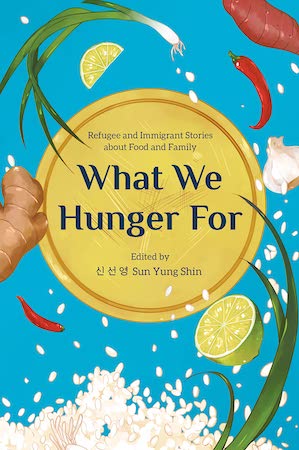
My most recent book, What We Hunger For: Refugee and Immigrant Stories on Food and Family, is an anthology that features personal essays, poems, and recipes by writers from refugee and immigrant families. Their work speaks to the ways ancestry, colonialism, racism, community, and more affect their relationships to food, cooking, and eating. By bringing these voices together, I wanted to explore how food can be as much a site of struggle as it is a site of comfort and identity.
There are so many books that were just as instrumental to my thinking about culture and family that I didn’t have room to include, so it was a challenge and a pleasure to select the following books by Asian American women working in experimental and hybrid modes. The term “intergenerational trauma” has recently become more mainstream, but for so many of us these are simply the lives into which we were born, and which is fundamental material for our artistic inquiry.
These books will support anyone’s quest to understand more about what it means to belong to this world we have inherited, and some of what’s at stake as we imagine and strive for a more life-giving future.
Karen Tei Yamashita’s work means a lot to me as a poet, especially her hybrid book Circle K Cycles. Similarly Letters to Memory, her work incorporating archival materials and epistolary communications through the Japanese internment in concentration camps, gave me further permission and encouragement to think relationally about borders, history, and orientalism.
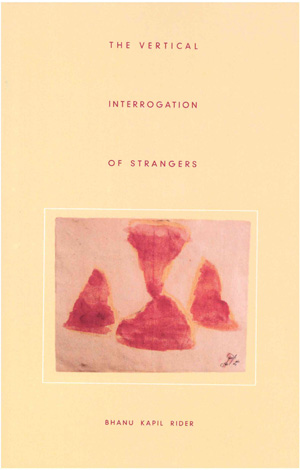
Bhanu Kapil is a singular genius and her book of prose poems The Vertical Integration of Strangers asks South Asian immigrant women a series of devastating questions and integrates their responses into the poems. Not only does my spine shiver at this constraint of a woman speaking to other women who share important aspects of their identity for the performance of poetry, the directness of the questions such as, “Who was responsible for the suffering of your mother?” touches me in a deep place as someone who has lost her (Korean) mother.
Tastes Like War by Grace M. Cho is a book that so intricately maps modern Korean history and its devastating impact on one family, centered on Cho’s mother, who was a force of nature in so many ways, and whose intensity and strong willed determination eventually merged into a very stubborn mental illness, schizophrenia. This memoir is intimate and heartbreaking, exploring the persistence of ghosts of war and physical and psychic dislocation and its cost on mothers and daughters trying to stay connected against the violence and loneliness of historical and personal forces.
Diana Khoi Nguyen’s debut poetry book Ghost Of is a taut, elliptical book that stuns you with its mourning. There is no solace, there is no filling the empty space, when one’s brother takes his own life, rendering your Asian American immigrant family mutilated and silenced. In these pages, among collaged photographs and the language of voids, Nguyen offers each poem as a kind of white-hot burning of time.
There is no poet more important to me than Myung Mi Kim, whose book Under Flag gave me the language I had been seeking my entire life as a foreign-born and marked American. Poet Kazim Ali invited us both to read at Oberlin and when we were asked a question about why we use “fragments” in our writing, to my recollection, we both said that we don’t consider the words and phrases in our poems to be fragments, to be broken pieces from an imaginary whole. Under Flag with its documentary impulses and examination of patriotic and military language, as well as immigration procedures, is a scouring, disciplined and disciplining book.
Translator and poet Don Mee Choi, also a Korean American immigrant, at times writes with such dark exuberance and zany energy about and through some of the gravest concatenations of losses, such as the Korean War, which haunts Korean and Korean American life in multiple ways. Hardly War takes the melodrama of the operatic form and combines it with images from her father’s work as a photographer during the Korean and Vietnam Wars to examine her role as heir and witness to memory.
Underground National by Sueyeun Juliette Lee
A woman after my own heart, Sueyeun Juliette Lee includes the CIA in her book of poetry Underground National which challenges notions of nationhood, arrivals, and transit. Satellite images of Korea force readers to contemplate the country as one place rather than a partitioned nation. The chthonic, the underground, the buried, the submerged, the forgotten, the remembered, and currents of human politics and eruptions of madness and spectacle (suicide, pop culture) confront us in this book through Lee’s critical and compassionate imagination, allowing us to experience the anguish of derangement through the memorial of language.
The poet and librettist Jennifer Kwon Dobbs is, like me, one of 150,000-200,000 displaced transnational Korean adoptees that have been sent from South Korea to Western nations since 1953 in order to fulfill the family-building desires of American, usually white Christian, married couples. Her elegant, forceful second book, Interrogation Room, creates a site in which deformed and reformed kinships cannot be untethered from the violence of borders. Redactions on the page are spectral evidence of how language is a body that can be haunted, presenting as dark-matter maps of wounded and divided selves, families, and countries.
For those of us who want to become real writers—whatever that means—the countless resources available can feel a bit dry and uninspired, ranging from tired but true clichés to well-lauded craft books (Stephen King’s On Writing: A Memoir on Craft sits dustily on my shelf). Many of us find ourselves falling down late-night internet rabbit holes, hours of research wasted with no more clarity on the To MFA or Not To MFA debate. But whether you believe a formal, academic route to professional writerdom is the answer or prefer a disciplined regime of scribbling on Post-Its while waiting in the car line, there’s no right way to learn to write. That said, there are ample teachers in the world around us, if we’re paying due attention and remaining open to organic inspiration.
The following essays argue that life can be the best writing coach, with TV shows, podcasts, video games, non-writing careers, and even pregnancy proving a valuable wealth of knowledge when it comes to understanding characters or narrating a compelling story. Whether it is balancing one’s youthful hubris as a basketball star with the more humbling court of the page or allowing the earnestness of the Great British Bake Off bakers to encourage perseverance, here are some of our favorite essays on the unconventional writing teachers of everyday life.
Leila Green long admired the verses of “Sing About Me, Dying of Thirst,” and found Lamar’s lean lyricism a comfort when trying to cut down and edit her short story collection. But when her book failed to find a home in traditional publishing, she turned to the song’s trailed off verse to make peace with some of the more difficult realities of being a creator and the relationship between writers and their audiences.
“I had put a lot of work in, but it seemed I just wasn’t worth it. The whole project felt terribly futile. Yet again, I recalled the moment I didn’t want Kendrick’s second verse to end, the time I wanted so badly to know what the silenced voice went on to say. I thought about the act of listening and the act of rapping. The act of receiving art and the act of making it. And I struggled to reconcile my art with its nonexistent audience. The vocal trailing off in “Sing About Me, Dying of Thirst” ironically forfeits the glory attached to presenting art to an audience. This raises the question: what happens when art exists outside the realm of validation? What of an unread novel? What is art unattached to a contract or an auction? Most importantly, what should be made of every artist’s “stripped away vocals” — our stories that no one reads, our songs that go unheard, our paintings that no one buys? Does the lack of validation make them meaningless?”
Many of us writers likely sighed with relief when this year’s Great British Bake Off final aired last month, finally able to put the guilty pastime aside and get back to writing. But for Becky Mandelbaum, the sweet treat of 60 minutes in a tent in the English countryside fueled her motivation and kept her writing life from going stale.
“At some point it dawned on me why I felt so connected to the show: it is, emotionally and often structurally, exactly like a writing workshop or, more loosely, like the art of writing as a whole. A cookie in place of a poem, a cake in place of a story. All day, the bakers stand at their little islands, feverishly attempting to create something that is both beautiful and tempting, that others might enjoy. At the end of each challenge, they’re covered in flour and chocolate, their cooking areas a mess of dirtied spoons and orange peels. Then, one by one, they are forced to approach the judges bearing the fruits of their labors, vulnerable to ridicule and eager for praise. They then wait patiently as their superiors literally tear their creation into pieces before determining their worth as an artist. Whatever the contestants have baked, it’s the best they can do, and yet they understand that sometimes the best is still not enough.”
First person computer games were ’90s babies’ first taste of immersive storytelling. Players helped discover and create the plot as they wandered through elaborate environments, and for Blair Hurley, the quiet contemplation and constant puzzling of these journeys helped shape her writing. Her piece explores how playing games like Myst or Riven allowed her to recognize the power of negative space in a narrative or even how a story can unfold in an empty room.
“I pretended I was an explorer really visiting these places. When characters spoke to me, saying, ‘You must have come to help us,’ I took my role seriously. The experience of immersion, which I talk to my creative writing students about, can be achieved with such paltry tricks: a stranger who seems to know you, or an entreaty, a riddle begging to be solved. An open door, with a light on in the room beyond; a winding pathway through the trees. There were other islands on the horizon of the game, and locked doors I couldn’t enter, and it made me want to visit the world again and again. I sought it not just as a game to play, but a full-body experience, a deep, entrancing pleasure to place myself in another person’s puzzle.”
Drawing from a long lineage of artists who operate in multiple mediums, Ennis Smith insists his time on the stage has translated to the page. From lessons in discipline and failure to bringing the truth of his emotions to both characters and his memoir, you’ll want to give this essay a standing ovation.
“I find myself revisiting ideas again and again, or what one of my writing teachers called combing it back through your brain. Sometimes it’s a matter of retyping. Words get moved; better ones are found. Paragraphs are rearranged or redrafted sentence by sentence. Sometimes nothing happens at all as you sit in front of an open document; there’s only the valuable repetition of keeping the appointment, of showing up day after day, if only for an afternoon, an hour or even fifteen minutes. The blank page becomes my rehearsal room. Each revision clears away the fog until something true emerges. Just as in the rehearsal hall, I give myself permission to fail; often I chip and chip, but never get to the end, just as in acting I might fail to find the character you’re playing.”
Perhaps the best writing tip of all is simply to write often, but that can be a tall order for even the most diligent of writers. For Caeli Wolfson Widger, pregnancy was a gateway towards prioritizing herself, and in doing so, making time for her true passion.
“I no longer need to be pregnant to hold writing at the center of my life. This is fortunate, since I’m in my 40s now and not having any more babies. It’s sometimes still a struggle to guard my writing time, to protect it, to make it nonnegotiable, to not let competing priorities swallow it. Having a writing life, I’ve learned, is a matter of balancing desire with responsibility, discipline with flexibility, generosity with self-care. I’m still not immune to granting small yeses to the wrong requests. But I’ve learned to pause and ask myself what I really want from the brief, precious hours of my day. And when anyone asks, I never hesitate to tell them I’m a writer.”
For most of his life, Jefferson Navicky thought his status as a beloved high school basketball player was at odds with the bookish introvert he felt himself to be — but it was those hours on the court, the relentless practicing and trying, and even the acceptance of failure that allowed him to flourish in his more adult and lasting identity as a writer.
“I don’t really know why I was a good shooter, or how I became one, other than I practiced thousands and thousands of jump shots. Still, I knew plenty of people who practiced their jump shots and weren’t particularly good. It’s all about how the ball leaves the last inch of your hand, which is such a small aspect of the things that make a good jump shot (feet alignment, leg strength, jumping ability, upper body strength, elbow alignment, support hand position, eye sight, courage, confidence, practice and probably another half dozen intangible elements). But how the ball leaves the top of one’s middle finger…that’s it. A poet might work forever on a turn of phrase or a title, but it all comes down to a poem’s final line, that’s it. How the poem leaves the reader’s mind determines if the poem hits its mark to remain lodged in memory, or if it’s forgotten.”
Sometimes it can be hardest to write about the things we feel we need to write about, to successfully convey the tensions that hit closest to home. Dorothy Bendel shares lessons on linearity in prose and subverting expectations, a crash course in “how to write trauma in a way that feels as visceral, surreal, and challenging as living with it.”
“My memories of homelessness often appear as dream-like, disconnected scenes without a clear narrative arc: a man threatening my life in the dead of night, a pregnant girl begging strangers for a place to sleep, the elderly man at the shelter who always saved a serving of butterscotch pudding for me. I often have difficulty pinning down exact dates, and memories of specific threats sound repetitious. Stories like Twin Peaks help me trust that I can lay out the pieces, collage-style, and arrange them in a way that makes sense to me while being honest about my experiences with readers.”
Writing is often an impossibly lonely task. It is your own discipline bringing you to the desk, a brutal process of self-reflection required to craft believable characters, and, of course, the self-doubt and fears of public perception with which to contend. But Bridget Irvine writes of the humor and joy of creation, of writing as communal and the better for it — as illustrated by the real-time narration, world building, and plotting on a family run Dungeons and Dragons podcast, The Adventure Zone.
“RPGs as a medium are inextricable from metafiction, which makes it an ideal genre to examine how storytelling functions. This is due to the fact that, in an RPG, the narrators of the story are the authors speaking in character persona. This seems like all fiction at first glance — isn’t Pale Fire just Nabokov narrating as an obsessive scholarly persona? — but the importance lies in the immediacy of the story. There is no filter of voice or structure or even an editing process to screen the RPG authors from their readers. There is no script. All of them are in the same room, digitally or physically. And consequently, the ‘writers’ of TAZ are constantly talking about their own ‘writing.’”
All of us have at some point found ourselves overcome with emotion by the rising intensity of a battle scene’s soundtrack or the soft and rueful notes carrying us through a character’s heartbreaking death in a movie. When Essa Hansen creates the sound design for a given moment, he considers how to manipulate a viewer’s emotions while still conveying critical information about a scene. To achieve the same emotional, embodied effect in writing, he has learned to tune into cadence, rhythm, and oral dynamics, letting the sound of the words do the work.
“My work as a sound designer has cross-pollinated into my fiction, where I use the same tools in both to craft the wondrous unknown—particularly important in sci-fi and fantasy where unusual concepts are the norm. In my writing, I want to fill the space between the words and the reader, wrapping them up like I would in a theater and making them forget where they’re sitting. That means recognizing that manipulating the meaning of language isn’t enough. You also have to consider how it sounds, and the effects those sounds work on the reader’s body and brain.”
One day a friend of mine went on an anti-Covid rant. We were out in public with a big group of people. He began shouting so everyone could hear. “The pandemic isn’t even real! The only people who have died from Covid were going to die anyway! So, they should just die.”
I was dumbfounded. He continued shouting about how the pandemic is a government ruse and that we shouldn’t have to wear masks. There was so much emotion in his rant, so much fear masked as anger. And while he had no credible sources for his claims, he believed everything he said was true. He was ready to fight anyone who disagreed.
It seems there is always a new topic for people to debate, often around the life and health of any number of particular groups.
This man is someone I usually enjoy being around. I consider him a friend. But on that day, I felt like I had to get him to change his mind or get away from him. His bald disregard for the suffering of others was like getting the wind knocked out of me. He’d just told me about how proud he was of his teenage daughter’s recent accolades in sports. I was telling him about my toddler-aged daughter’s recent developments before he started ranting. My little one has long-term healthcare needs which categorize her as “high risk” for respiratory illness. According to my friend, she should “just die” so he doesn’t have to deal with the inconvenience of wearing a mask. In the space of a few minutes I became disillusioned with him, and ready to allow the friendship to die.
This is one scene out of a million just like it. Stories about division among loved ones, colleagues, and neighbors are plenty: The Covid-19 pandemic, mask mandates, systemic racism, protests and policing, LGBTQ rights and representation, even conspiracy theories. It seems there is always a reason to get angry online, to post headlines passive-aggressively. It seems there is always a new topic for people to debate, often around the life and health of any number of particular groups.
We’ve all had someone close to us reveal fearful, unreasonable beliefs—the racist joke you don’t see coming in the group text, or the angry outburst about how there should be more incarcerations at the border during a family gathering. And the surprise often goes both ways. I’ve had friends be shocked that I would even consider getting the Covid vaccine, or that I would allow my children to attend school wearing a mask. On some level, everyone is wrestling with questions and disillusionment.
How can we move beyond this season? When we’re faced with friends or family spewing hate how can we help them see beyond themselves? Are we better off just distancing ourselves from them?
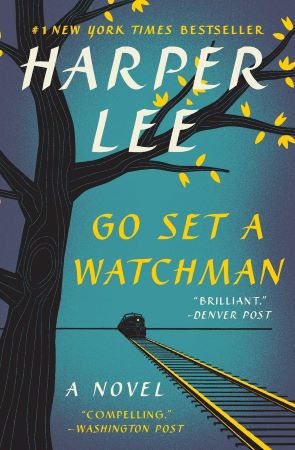
These are the questions that keep me awake. So in an effort to sleep better, I’ve been turning off screens earlier. My hope is that getting lost in a good novel will help me avoid marinating in stress over night. I was pleasantly surprised that in a book published before anyone knew what the Coronavirus was, at a time when Donald Trump was considered only a businessman and TV star, I found a friend in such disillusionment. I read Go Set a Watchmanby Harper Lee and became reacquainted with Jean Louise “Scout” Finch.
In Go Set a Watchman,the young tomboy of To Kill a Mockingbirdis now twenty-five and has lived in New York City for several years. The novel opens with her en route for Maycomb County. From her first moment in town, Jean Louise takes part in a series of encounters demonstrating that things are different than they used to be back home. Much of those differences are found in the two men in her life. Her father, the famed lawyer Atticus Finch, is now too old and arthritic to pick her up from the station. Henry Clinton, her childhood friend turned boyfriend, waits there instead. But Henry, too, has changed. He’s more serious about getting married than he’s ever been. He seems resolute to bring Jean Louise back to Maycomb for good. Readers are given a sense that, while some things never change in a small town, like the “inevitable verbena” growing in people’s yards, the people in Maycomb are different than they used to be.
But not all of these changes are so easy to see at first glance. One Sunday afternoon Atticus and Henry casually leave for a Citizens’ Council meeting. (Citizens’ Council meetings were a movement in the South by white supremacists that were opposed to the 1954 government mandated desegregation of schools.) Jean Louise surreptitiously follows them. She learns that her father is on the board of directors and that Henry is “one of the staunchest members.” Watching from the segregated balcony of the old courthouse, she discovers that the two of them are part of a coalition that opposes desegregation in Maycomb. They have aligned themselves with White men who spew the n-word and other epithets, men attempting to marshal strength in numbers against not only Black people in the South, but against the ruling of the U.S. government. How prophetic this scene turned out to be, given the January 6th violent insurrection.
From her first moment in town, Jean Louise takes part in a series of encounters demonstrating that things are different than they used to be back home.
Feeling lost and betrayed, Jean Louise sneaks out of the meeting, attempting to process what she has learned about her loved ones. The cognitive dissonance of seeing Atticus embrace and enable virulent, state sanctioned racism is similar to what I experienced with my friend, and what many folks have experienced since the pandemic began, or perhaps since Donald Trump was elected. Maintaining strong relationships with loved ones and friends has perhaps never been more challenging. Like Jean Louise, many of us are standing in the courthouse balcony, watching loved ones down below trafficking in fear, hate, and lies. Many folks are wondering just what the hell is going on.
Where I live in west Michigan, a region steeped in conservative religion, deep disillusionment with my community has been easy to come by and impossible to ignore.
During the runup to the 2016 election one of my closest family members—a Bible study leader—said to me, “Well, what’s wrong with building a wall? And what’s wrong with getting people who don’t belong here back to their own country?” I was speechless. What happened to “love your neighbor as yourself”?
Similarly, during the late spring of 2020, when the country was adjusting to new rules about wearing masks after the early shutdowns, I was with an older, longtime friend. He had been a mentor of mine through my church when I was a teen. He told me with wild eyes and religious fury in his voice that he refused to wear a mask because covering his face was “to cover the very image of God.” There was no trace of irony in his voice, despite the fact that many years ago, this same man taught me how to operate a snowmobile during a particularly cold Michigan winter. He had implored me to wear a mask and snow goggles when doing so, for safety’s sake. God didn’t seem to mind then.
It asks what can be done when disillusionment with one’s core community runs this deep—so deep that one might literally lose their religion.
Both of these conversations were balcony moments for me. A loved one and a mentor, both prioritizing their individual happiness and comfort over the health and well-being of others, and refusing to partake in reasonable solutions to complex problems.
As Go Set aWatchman continues, other experiences about town cause Jean Louise to realize that while things change, lying beneath the southern charm in Maycomb is a deep-seated racism that has been there all along. She attends a coffee party with old friends where conspiracy theories about why Black people want equal rights abound. She also visits the home of their longtime Black housekeeper, Culpernia, and comes to see a longstanding distance between them that she’s never noticed, a distance Culpernia had always lived with.
Jean Louise grows increasingly more disillusioned by her community as the novel progresses. She finds their reactions to their contemporary social and political realities incomprehensible, and what’s worse is how they justify their bigotry. In a room full of gossipy neighbors, she wonders:
“Why doesn’t their flesh creep? How can they devoutly believe everything they hear in church and then say the things they do and listen to the things they hear without throwing up? I thought I was a Christian but I’m not. I’m something else and I don’t know what. Everything I have taken for right and wrong these people have taught me—these same, these very people. So it’s me, it’s not them. Something has happened to me.”
Readers can substitute their personal ideological background into the larger crisis of faith Jean Louise refers to. This crisis of faith is why reading, or rereading Go Set a Watchman is instructive today. It asks what can be done when disillusionment with one’s core community runs this deep—so deep that one might literally lose their religion.
There was an uproar when Go Set a Watchman was published. It was touted as the “lost” novel by a Pulitzer Prize-winning author who’d only published one book. It was suspected to be the first draft of To Kill a Mockingbird. Authoring a single novel of such gravitas garnered Harper Lee a Salinger-like legend. For some fans, this “found” manuscript held the promise of the Dead Sea Scrolls—divine revelation.
But reviewers were upset by what the story reveals about Atticus Finch. Like Jean Louise, they were bewildered and angry to see their hero fall from grace. Readers are told that Jean Louise had “confused [her] father with God.”
Atticus’s actions are explained at the end of the novel by his eccentric brother, Uncle Jack:
“The law is what he lives by. He’ll do his best to prevent someone from beating up somebody else, then he’ll turn around and try to stop no less than the Federal Government…he’ll always do it by the letter and by the spirit of the law. That’s the way he lives.”
Atticus represents the prevalent collective Southern thought regarding racial integration during the civil rights era. He’s not a militant supremacist like a Klan member, but he’s happy to reinforce systemic injustice in order to maintain the status quo. As ugly as this is, readers don’t need Atticus to be perfect or even admirable to gain insight from the story. His flawed character is one of the more important elements in the book. His actions and motivations demonstrate how insidious and sometimes subtle racism can be. They also illuminate the systems in place that make racism so easy to preserve. Fear and hate can be intellectualized and quietly reinforced through the legal system.
Can there be a third option when coping with such disillusionment?
So, what is the answer to the question Go Set a Watchman is asking? How can we handle deep, profound disillusionment in our loved ones, our communities, and our systems of faith?
As Jean Louise tries to escape Maycomb, Uncle Jack provides the answer:
“You’ve no doubt heard some pretty offensive talk since you’ve been home, but instead of getting on your charger and blindly striking it down, you turned and ran. You said, in effect, ‘I don’t like the way these people do, so I have no time for them.’ You’d better take time for’em honey, otherwise you’ll never grow.”
After forcing her to stay in Maycomb—a violent encounter that could be the subject of another essay—Uncle Jack explains that by running from those she disagrees with, she herself is a “turnip-sized bigot.” He continues:
“The time your friends need you is when they’re wrong, Jean Louise. They don’t need you when they’re right.”
I need this good medicine as much as anyone, but it’s a hard pill to swallow when friends and loved ones are antagonistic and dismissive of not just opposing views, but factual evidence. When the people who taught you not to lie subscribe to conspiracy theories or pervert their religion in order to justify their actions, you are encountering hypocrisy of the highest order.
In Go Set a Watchman, Jean Louise must choose: either run from those she disagrees with, or stay with people who are blind to the injustices they enable. Many of us are confronted with this choice today.
Can there be a third option when coping with such disillusionment? Isn’t it wise to separate ourselves from toxic communities, even if we still love and care for the individuals within them?
In the heat of the moment, I couldn’t find a third way when my friend was ranting. Harper Lee doesn’t show us a third way either. While Go Set a Watchman takes place in a time period that readers will study for decades to come, I suspect it will never have the same impact as To Kill a Mockingbird—not because of its dubious origins, but because of its too-simple resolution. The book ends with violent drama and an uncomplicated dichotomy—go or stay. It’s a powerful ending, but violence is a terrible teacher, and real-life is more nuanced than simple dichotomies. (The ending may be the best evidence that this really was a first draft. It needs work.) No matter how much you love someone there is no guarantee that you’ll be able to help them see reason. You may always be on opposing sides of an issue. If history is an indicator for what’s in store tomorrow, then more cultural crises are in our future. The choice that Jean Louise faces with her family is one we will continue to face. Go Set a Watchman reminds us that while we cannot control someone else’s growth, we have some say over your own. If Uncle Jack is right, our friends and family need us. Perhaps the greatest lesson is in the book’s failure: in real life, we can write a new ending for our stories. We can find a better way.
While we were kissing, the leather-bound Obras completas opened to a photo of Federico García Lorca with a mole prominent beside a sideburn of his slicked-back hair, slid from her lap to the jade silk couch, and hit the Chinese carpet with a muffled thud.
While we were kissing, the winter wind known locally as the Hawk soared off the lake on vast wings of snow.
While we were kissing, verbs went uncommitted to memory.
Her tongue rolled r’s against mine, but couldn’t save me from failing Spanish. We were kissing, but her beloved Federico, to whom she’d introduced me on the night we’d first met, was not forgotten. Verde que te quiero verde. Green I want you green. Verde viento, verdes ramas. Green wind, green branches. Hissing radiator heat. Our breaths elemental, beyond translation like the shrill of the Hawk outside her sweated, third-story windows. Córdoba. Lejana y sola, she translated between kisses, Córdoba. Far away and alone. With our heads full of poetry, the drunken, murderous Guardias Civiles were all but knocking at the door.
Aunque sepa los caminos yo nunca llegaré a Córdoba.
Though I know the roads
I will never reach Córdoba.
Shaking off cold, her stepfather, Ray Ramirez, came home from his late shift as manager of the Hotel Lincoln. He didn’t disturb us other than to announce from the front hall: “Hana, tell David, it’s a blizzard out there! He better go while there’s still buses!”
“It’s a blizzard out there,” Hana told me.
It was then we noticed the white roses in a green vase that her mother, who resembled Lana Turner, and who didn’t much like me, must have set there while we were kissing. We hadn’t been aware of her bringing them in. Hana and I looked at each other: she was still flushed, our clothes were disheveled. We hadn’t merely been kissing. She shrugged and buttoned her blouse. Verte desnuda es comprender el ansia de la lluvia. To see you naked is to comprehend the desire of rain. I picked her volume of Lorca from the floor and set it beside the vase of flowers, and slipped back into the loafers I’d removed to curl up on the jade couch.
“I better go.”
“It’s really snowing. God! Listen to that wind! Do you have a hat? Gloves? All you have is that jacket.”
“I’ll be fine.”
“Please, at least take this scarf. For me. So I won’t worry.”
“It smells like you.”
“It smells like Anias.”
At the door we kissed goodbye as if I were leaving on a journey.
“Are you sure you’re going to be all right?”
Hana followed me into the hallway. We stopped on each stair down to the second-floor landing to kiss goodbye. She snuggled into my leather jacket. The light on the second-floor landing was out.
“Good luck on your Spanish test. Phone me, so I know you got home safe, I’ll be awake thinking of you,” she called down to me.
“Though I know the roads I will never reach Córdoba.”
“Just so you reach Rogers Park.”
I stepped from her doorway onto Buena. It pleased me— amazed me, actually—that Hana should live on the only street in Chicago, at least the only street I knew of, with a Spanish name. Her apartment building was three doors from Marine Drive. That fall, when we first began seeing each other, I would take the time to walk up Marine Drive on my way home. I’d discovered a viaduct tunnel unmarked by graffiti that led to a flagstone grotto surrounding a concrete drinking fountain with four spouts. Its icy water tasted faintly metallic, of rust or moonlight, and at night the burble of the fountain transformed the place into a Zen garden. Beyond the grotto and a park, the headlights on Lake Shore Drive festooned the autumn trees. For a moment, I thought of going to hear the fountain purling under the snow, but the Hawk raked my face and the frosted trees quavered. Green branches, green wind. I raised the collar of my jacket and wrapped her green chenille scarf around my throat. Even in the numbing wind I could smell perfume.
By the time I slogged the four blocks to Broadway, it wasn’t Lorca but a line by Emily Dickinson that expressed the night: zero at the bone. No matter which direction I turned, the swirling wind was in my face. My loafers felt packed with snow. Broadway was deserted. I cowered in the dark doorway of a dry cleaner’s, peeking out now and again and stamping my feet. The snow-plastered bus stop sign hummed in the gusts, but there wasn’t a bus visible in either direction. A cab went by and, though I wasn’t sure I could make the fare, I tried to flag it down. It didn’t stop. The snow had drifted deep enough so that the cabbie wouldn’t risk losing momentum. Finally, to warm up, I crossed the street to a corner bar called the Buena Chimes. Its blue neon sign looked so faint I doubted the place was open. If it was, I expected it to be empty, which I hoped would allow the bartender to take pity on me. I was twenty, a year shy of legal drinking age.
Even in the numbing wind I could smell perfume.
The cramped, low-lit space was packed, or so it first appeared. Though only three men sat at the bar, they were so massive they seemed to fill the room. Their conversation stopped when I came in. I’d heard the rumor that players for the Chicago Bears sometimes drank there but hadn’t believed it, probably because I’d heard it from Hana’s stepfather, Ray, who’d also told me that as a cliff diver in Acapulco he once collided with a tiger shark, whose body now hung in the lobby of the Grand Mayan Hotel. With all of Rush Street waiting to toast them, why would Bears drink at a dump like the Buena Chimes?
I undid the green scarf that I’d tied around my head babushka-style, and edged onto a stool by the door—as respectful a distance as possible from their disrupted conversation, but it wasn’t far enough.
“Sorry, kid, private party,” the bartender said.
“Any idea if the buses are running?” I asked.
“We’re closed.” He seemed morose. So did the Bears at the bar, who sat in silence as if what they had to say were too confidential to be uttered in the presence of a stranger. The team was having a losing season.
“Buy the kid a shot,” one of the Bears said.
“Whatever you say, Jimbo,” the bartender replied. He set a shot glass before me and, staring into my face rather than at the glass, filled it perfectly to the brim. Each man has his own way to show he’s nobody’s fool, and pouring shots without looking at the glass was the bartender’s: he knew I was underage.
“Hit me, too, Sambo,” Jimbo said, and when the bartender filled his glass, the tackle or linebacker or whatever Jimbo was raised the teeny shot glass in my direction. “This’ll warm you up. Don’t say I never bought you nothing,” he said, and we threw back our whiskeys.
“Much thanks,” I said.
“Now get your puny ass out of here,” Jimbo told me.
Back outside, I hooded my head in the green scarf and watched a snowplow with whirling emergency lights scuff by and disappear up Broadway. Waiting was futile. I decided to walk to the L station on Wilson. Rather than wade the drifted sidewalks, I followed the ruts the snowplow left in the street. I trudged head down, not bothering to check for traffic until I heard a horn behind me. Headlights burrowed through the blizzard. The beams appeared to be shooting confetti. The car—a Lincoln, maybe—sported an enormous, toothy grille. Whatever its make, the style was what in my old neighborhood was called a pimpmobile. I stepped from the ruts to give it room to pass. It slowed to a stop. A steamed window slid down.
“Need a ride, hombre?”
I got in, my lips too frozen for more than a “thanks.” The rear wheels spun. I sat shivering, afraid I’d have to leave the blast of the heater in order to push that big-ass boat out of the snow.
“You can do it, baby,” the driver said as if urging a burro. I was tempted to caution that giving it gas would only dig us in deeper, but knew to keep such opinions to myself. “Come on, baby!” He ripped the floor shift into reverse, slammed it back into drive, back into reverse, and into drive again. “Go, go, you got it,” and as if it were listening, the car rocked forward, grabbed, and kept rolling.
“Thought for a second we were stuck,” I said.
“No way, my friend, and hey, you’re here to push, but not to worry, there’s no stopping Lino tonight.”
I unwound the scarf from my head and massaged my frozen nose and ears.
“Yo, man, you wearing perfume?” he asked.
“It’s the scarf,” I said.
“You in that scarf, man! When I saw you in the street, I thought some poor broad was out alone, you know? I told myself, Lino, the world is full of babes tonight. Where you headed, my friend?”
“Rogers Park,” I said. “Just off Sheridan.” I couldn’t stop shivering.
“Man, you’d a had a tough time getting there. Whole city’s shut down. What you doing out so late? Getting a little, dare I ask?” He smiled conspiratorially. His upturned mustache attached to his prominent nose moved independently of his smile.
“Drinking. With the Bears,” I added.
“You mean like the football Bears?”
“Yeah, Jimbo and the guys.”
“Over at the Buena Chimes, man?”
“How’d you know?”
“Everybody knows they drink there. You got the shakes, man? Lino got the cure—pop the glove compartment.”
I pressed the button and the glove compartment flopped open. An initialed silver flask rested on a ratty-looking street map. Beneath the map I could see the waffled gray handle of a small-caliber gun. I closed the glove compartment, and we passed the flask between us in silence.
“What are we drinking?” I asked. It had an oily licorice taste with the kick of grain alcohol—not what I expected.
“We’re drinking to a night that’s going to be a goddamn legend, hombre. The kind of night that changes your life.” He took a swig for emphasis, then passed the flask to me. “To our lucky night—hey, I’m spreading the luck around, right?—your luck I picked you up, mine cause I got picked up.”
“Huh?” I wasn’t sure I liked the sound of that, and held off on taking my swig.
“Check this out.” He fished into his shirt pocket, handed me a folded scrap of paper, and flicked on the overhead interior light.
The paper unfolded into a lipsticked impression of a kiss, a phone number inscribed in what looked like eyebrow pencil, and the words, Call me tonight. Tonight underlined.
“You ever seen a woman so hot you didn’t want to stare but couldn’t take your eyes off her? I don’t mean some bimbo at a singles bar. I’m in the Seasons and I see this almost-blonde in a tight green dress. She’s drinking with this guy and don’t look happy. He leans over and whispers something in her ear, and whatever he said, it’s like, you know, an eye-roller. She turns away from him and as she’s rolling her eyes to no one in particular she catches me staring. She got these beautiful eyes. And I roll my eyes, too, and just for a sec she smiles, then goes back to her drink. Doesn’t look at me again, but five minutes later she gets up to go to the ladies’, and when she does I see that green dress has a plunging back. Sexiest dress I ever seen. She walks right by my table, and on her way back she drops the note.”
Lino was driving with a story to tell, not about grief or love or even male vanity. It was about luck, and he needed someone to hear it.
He reached for the flask, took a hit, and flicked out the interior light. Blowing snow reflected opaque in the headlights; it was hard to see ahead. He flicked the headlights off, too. “Better without them,” he said. “Ain’t no oncoming traffic to worry about.”
We’d driven blocks, passed the L station on Wilson, and the little Asia Town on Argyle, ignored all the traffic signals on Broadway to keep our momentum, and hadn’t seen another car.
We were approaching Sheridan Road. I was finally warmed up, though my feet were still numb. He took another swallow—he was drinking two to my one—and passed the flask. It was noticeably lighter.
“You believe in love at first sight, man? Romantic crap, right? An excuse some people need to get laid. I’m thirty-four years old and that’s what I always thought, but now I don’t know. Or it’s more like I do know. I know what’s going to happen like it already happened. This snowstorm, the whole city shut down, you know, like destiny, man, destiny in a green dress.”
“Verde que te quiero verde,” I said. “Say what?”
“Lines from a poem.”
“My mind keeps going over how she rolled her eyes and suddenly we’re staring at each other and boom, across a crowded room.” He rolled his droopy eyes to demonstrate. “What’s that old song—my Pops used to sing it with an Italian accent: Some- a enchanted-a evening you may see a stranger…”
I’d wondered why he stopped to give me a ride—out of kindness or because he’d mistaken me for a woman alone, or to have someone along who could push, in case we got stuck. I recalled a Chekhov story from a Lit class called “Grief,” about a horse-cab driver who on a freezing Moscow night tries to tell his story to every passenger he picks up, but rather than listen, each person tells him his own story instead. Finally, near dawn, as he unharnesses his pony, the cabdriver tells the story he’s been trying all night to tell—that his little daughter has just died—to his pony. Lino was driving with a story to tell, not about grief or love or even male vanity. It was about luck, and he needed someone to hear it.
“What you going to do?” I asked him.
“What am I going to do? I’m going to call her! She’s hot, man. She’s waiting. She wants me. It’s a sin if a woman wants you and you don’t go. You ever had anything like this happen to you? What would you do?”
“Probably worry about what to say for openers.”
“You could recite a poem. I got the perfect line, man. I’m going to ask her: What did that guy whisper to make you roll your eyes? See, that’s what I meant about destiny. I already know what to say.”
“You know her answer?”
“Man, that’s the fun part. I know she’ll answer, but not what. I know we’ll kiss, but not how she kisses, I know she’ll give me some tit right off, but not what kind of nipples she has—some guys are tit-men, I’m a nipple-man—or what perfume she wears, or what her name is. I know she’s probably home by now waiting for the call, but I won’t know till she picks up that phone what her voice sounds like. Just one little scrap of paper, and a lifetime history of questions. You can’t really tell nothing from her handwriting. Let me see that.”
“I gave it back to you,” I said. “No, man, you didn’t give it back.”
“Yes, I did. I handed it back when you turned the overhead light out, right before you flicked the headlights out. I handed it back to you blocks ago.”
“You didn’t, man, you never gave it to me.”
“Check your pockets.”
He checked his shirt pocket and the pockets of his topcoat. “I wouldn’t have put it in my topcoat, man, you still got it. Empty your jacket pockets, cabrón.”
I did as he asked. There wasn’t anything but white petals from one of the roses Hana must have slipped in a pocket. She did things like that.
“What you trying to pull, my friend? This is how you repay me for saving your ass from the cold? If you think that babe is going to be a slut for any jerk who calls her up you’re crazy. You ain’t ready for a woman like that.
“I didn’t take it, man.”
He braked hard and the car swerved and came to a stop in the middle of the street. He flicked the overhead light on. “Get up, cabrón, maybe you’re sitting on it.” I rose in my seat and so did he. It wasn’t on the seats. “Check the floor.” We looked on the smeary floor mats and felt under the seats. “Check the bottom of your shoes.”
“It’s got to be here,” I said.
“I’m going to ask you polite one more time, you going to give me that phone number?”
“I gave it to you. Why would I take it? I got my own girl. She insisted I wear her scarf.”
“I thought you said you were drinking with the Bears. More bullshit, huh? Listen carefully, cabrón. Last fucking time—a simple yes or no.”
His droopy brown eyes stared hard into my face. I said nothing. He unscrewed the flask and drained it. “Excuse me, man, I want to put this back.” He reached past me, popped the glove compartment, and I was out of the car, running up Sheridan in the headlights he flicked on, bounding drifts, zigzagging along the sidewalk, hoping I’d be a harder target to hit. I could hear the tires whining behind me. He’d probably tried to give it gas and run me down and now the car was stuck. I could hear it grinding from a block away, and stopped to look back. He was trying to rock it from reverse back to drive, but just digging it in deeper. I actually thought of going back and saying, Look, man, you were kind enough to give me a ride, would I have come back to push you out if I’d stolen your phone number? It was a nice thought, but one that could get me killed. Instead, feeling light on my frozen feet despite the drifted sidewalks, I jogged four more blocks up Sheridan Road, checking at each corner to make sure he wasn’t following me. The snow fell more slowly and the wind had let up some, but I could barely see his headlights five blocks back in the haze of snow when I turned onto my street.
In my studio apartment, I kicked off my loafers, stripped off my frozen socks, and, not bothering to remove my jacket, I sat in the dark on my one stuffed chair, clutching my soles in my palms and watching the snow gently float in the aura of the streetlight visible from my third-story window. The surge of lightness I’d felt running down Sheridan had left me shaky. Zero at the bone. Finally, I felt recovered enough to switch on the lamp and slip off my jacket. I’d promised to call Hana. She’d be asleep with the phone under the pillow beside her, so that its ring wouldn’t wake anyone else. What time is it? she’d ask in a groggy voice, and I’d say getting on to one, and she’d say she worried about me getting home, and I’d tell her Córdoba was easy next to tonight. I’d thank her for the loan of her scarf. I’d have frozen without it.
It wasn’t until I unwound it from around my neck that I noticed the scrap of paper caught in the chenille. I unfolded the note and there was the kiss and the phone number in eyebrow pencil.
I sat in the stuffed chair, my feet wedged under the cushion, dialed, and when the phone began to ring, I flicked the lamp off again and watched the snow. It rang several times, which didn’t surprise me; I didn’t expect anyone to answer. The surprise came as I was about to hang up, when someone lifted the receiver, but said nothing as if waiting for me to speak.
“I hope it’s not too late to call?” I said.
“That all depends,” a woman’s voice answered.
“On what?”
“On who you are and what you have in mind. Coming over?”
“I can’t tonight. The city’s shut down. My car’s stuck in a snowdrift.”
“Then why did you bother to call?”
“I wanted to hear your voice. To see if you’re real?”
“That’s a strange thing to say. Are you real?”
“No,” I said, “actually, I’m not.”
“At least you know that,” she said, “which puts you ahead of the game. Most unreal men—which is the vast majority—don’t know they aren’t, and those few that do usually can’t bear to admit it. So there’s still a chance that hopefully some night years to come, you’ll have a different answer. Good luck with that.” The phone clicked.
I listened to it buzz before hanging up. If I rang again, I knew she wouldn’t answer. I sat with the soles of my feet in my hands, rubbing the warmth back into them, waiting to call Hana, thinking of all the years to come, still young enough to wonder who I’d be.
January 4, 2022 : Previously, an early version of “Córdoba” by Stuart Dybek appeared in this issue. It has been updated with the story that appears in the collection Ecstatic Cahoots (FSG, 2014).
When a fictional Tehran is seized by rolling tremors, the city’s inhabitants are thrown into carnivalesque disarray. As the earth slips and sways, a mother clicks her digital prayer beads between operatic screams, young people rollerblade maniacally amidst scurrying riot cops, and a cane-clad old man guards his precious African violets from the frenesi. Watching it all with arch remove is our narrator, Shadi, a cynical and musically-inclined opium addict. Like a macabre conductor, Shadi orchestrates this tale of urban bedlam for the reader, her narration a juxtaposition of Mozart sonatas, curse words, Hafez ghazals, and the errant phrase in Azeri Turkish.
Welcome to In Case of Emergency, a boisterous novel written by the Iranian author Mahsa Mohebali, translated into English by Mariam Rahmani.
To say that this book is radical would be an understatement. Or, simply, an incomplete thought. In Case of Emergency is radical given its context. Mohebali’s novel was written and published in contemporary Iran, meaning that the book had to first pass through governmental censorship, a process in which profanity is toned down and “respectability” is ostensibly preserved. Despite having been censored, however, the book is still chock-full of content that has shocked and delighted Iranian audiences. In its Persian version, In Case of Emergency shows off a Tehran-specific vernacular, contains impious characters who flaunt their non-conformity, and splashes gore nonchalantly across its pages.
But, how does one go about moving this roiling, dynamic mishmash of language registers, cultural references, and aesthetic literary games from a Persian-language context into an Anglophone one?
For translator Mariam Rahmani, the answer was to take risks. As Rahmani puts it in her Translator’s Note at the novel’s end, she wanted to allow Shadi’s “English avatar” to breathe, and to let the coolness of her narrative voice flow naturally from Persian into English, to avoid making Shadi’s voice seem “dorky,” or tied up in a rigidly literal form of translation.
I spoke with Rahmani over the phone about social and literary ideas of respectability, translating profanities, and the soundscape of In Case of Emergency.
Anna Learn: Could you describe your first encounter with Shadi, the protagonist of In Case of Emergency? What was it that initially compelled you about Mohebali’s writing?
Mariam Rahmani: The voice really spoke to me. There is this pendulum [in the book] that goes between the cinema verité type of realist dialogue, where you hear this young, profane, Tehran Farsi, and Shadi’s first-person narrations and reflections as she goes through the day. The willingness to swing between those two modes is not something that I’ve seen very much in Anglophone fiction. So that spoke to me. I feel like there’s often an expectation in American fiction to kind of “pick a track.” So, if it was originally written in an Anglophone American context, a book like Negaran nabash [In Case of Emergency] might have had a voice in narration that matches that of the dialogue, that mimics it. That lack of mirroring, and the willingness to have those two modes stand far apart, with only some connectors, was quite fascinating to me. It seemed freer to me than a lot of what I’ve seen in English.
When I was going through my reading list for Qualifying Exams for my Ph.D. in Comparative Literature, I did notice that it [Mohebali’s writing] formed a rupture with the modern, or even contemporary, Persian canon. Her writing stood out whichever way I looked at it.
AL: So both in an Anglophone context, and a Persian-language context, the book is doing something distinct.
MR: Yeah, I think so. But what makes literature interesting is that it’s always in conversation with other books. So part of the book’s power is that it plays with forms we’ve seen before.
AL: At the end of In Case of Emergency we even get a playlist, a “soundtrack”, with songs that the narrator has referenced. Did you ever listen to the book’s playlist as you worked?
MR: That’s an interesting question because, in its Farsi version, the book does not have a playlist. I actually added the playlist, with Mohebali’s permission. I came up with the idea because I thought it would be a fun way for American readers to hear the soundtrack of the book because, in Farsi, the reader would already have that soundtrack in mind. Most American readers are not going to have heard the Farsi musicians whose Farsi lyrics are quoted in the novel. In contrast, when [Mohebali] references a certain type of tune, or a specific contemporary band, or singer, or songwriter, [most] Iranians would know what that sounds like. It seemed like, in order to translate that experience [of having Persian-language musical references], I needed to draw more explicit attention to it for American readers and Anglophone readers in general. Putting in the list of songs was a fun way to have readers just play the songs from the playlist, instead of having to scour the text for each particular reference. And Mohebali was happy with the idea.
AL: Wow, that’s so interesting that you added the soundscape in the English translation.
MR: But I also didn’t add the soundscape, the playlist is limited to the songs that are in the text, they’re just listed one after another. So it’s more like I highlighted, or indexed the songs. It’s more like an index than anything. Not added on; pulled out.
AL: I want to ask more about paratext. You don’t use footnotes or a glossary—
MR: No!
AL: And you chose not to have an introduction preceding the translated text. Instead, you have this beautifully elaborated Translator’s Note that follows the text. Why did you go for the Translator’s Note as your main form of paratext?
MR: It was important to me, and to the publisher, that the text be available to readers as a novel like any other novel. It is Mohebali’s novel, and her voice should be the one that is centered. And it is a contemporary text; it’s not like we’re dealing with some kind of academic treatise. It’s a fun contemporary novel, let me put it that way; this isn’t scholarly writing. We wanted to honor that in English, and recreate that space where you can just pick up this novel, read it, and get what you will out of it, as you would if you were reading it in Farsi.
Cross-dressing [in Iran] is not identitarian in the way that we often think gender performance is in the US. It’s quite explicitly political.
As you know, when you translate a text, you translate the whole culture around it. So I tried to just incorporate what some translators would call “stealth gloss,” just including a word or two around [something culturally-specific] that would hint at the larger context, instead of pulling it out and putting it in a glossary, or putting it in a footnote or endnote. We wanted the text to live in English as it does in Farsi, as a novel.
Specifically with Middle Eastern fiction, there used to be a tendency to have these texts primarily live with academic publishers. There was a veil that you had to go through in order to get to the text [made up of footnotes, glossaries, or academic introductions]. We wanted readers to just have the book, and have a relationship to the book. If you read the book and want to know more, you can continue reading the Translator’s Note.
AL: I do want to get into your Translator’s Note a little bit more, because I think it is so rich. In that Note, you write that Shadi mocks and “fucks with” the respectability culture or politics of Iran. In some ways, you are doing a similar thing with your translation, by turning the concept of a “respectably” literal or neutral translation on its head. Instead of claiming to pursue a “faithful” or semantically “equivalent” translation, you make it quite clear that your translation is a re-creation of Mahsa Mohebali’s work, one in which you endeavor to let Shadi’s radical “cool” seep through into English. You do so by intentionally giving the book a more profane lexicon than the original Persian has, and by employing an American English-inflected slang. How did you come to feel confident in this particular “translative flair”? Was this an instinctual move for you, or did you receive pushback?
MR: When first I started translating the novel, I kept a “neutral” tone. But then I would read it over myself, or I would hand it to someone else to read, and it actually wasn’t “neutral” at all, it was flattening the text. Because it just didn’t sound like the character Shadi. And so I think words like “neutral” are actually just hiding a different politics. I was finding that the “default” translation was actually a kind of mis-translation, because it was not at all conveying the voice. And the voice is what people liked about this novel in Iran. And the voice is what its contribution has been to Persian literature as a whole. And so it became clear that I had to, like, go big or go home. I either had to leave the text alone and not translate it, or actually try to do something with it, and let it speak and occupy space in the language it’s being brought into.
AL: By intensifying the profanity in your English translation, for example.
MR: I will say with the profanity… in the Translator’s Note I talk a lot about the word “fuck” because [Mohebali’s text] did go through the typical route of publication in Iran, which includes a pass through the Ministry of Guidance, and censors, who are assigned to the case. And so, in that process of censorship, some very profane Farsi words were cut out of the text. But what remains is still so shocking to an Iranian reader.
When you encounter the [the book in] Farsi, knowing that it is a published text, that it’s actually this published work of literary fiction, the [toned-down Farsi “curse words”] that remain so much more crass than anything you could ever publish in English. Because, in English, writers have already successfully broken [that particular cursing] taboo. In a sense, I actually think that the English is not harsh enough, because the word “fuck” in English just doesn’t do anything to people anymore.
If “fuck” serves as a sort of asymptote in cursing—or used to; part of the issue is that it no longer does—then should I leave it out of the English version? I asked Mohebali what she thought, whether she wanted the text to recreate that sense of holding back [caused by censorship] in order to create a sense of that censorship in English, or not…And she was very emphatic that no, she wanted the text to sound natural, and the word “fuck” should be used as freely as it is in spoken English today. To reiterate, though, it’s not that there is one particular Farsi word that translates as “fuck” that is not used in the original text but more about posing the question of limits. In the end we agreed that that particular limit would only be counterproductive, straining Shadi’s voice.
I felt quite empowered working with an author who trusted me. Since Mohebali took such risks writing the original text, it became clear to me that the only way to translate that text with integrity was to also take risks with the translation.
AL: That’s really well put. And it goes to show how much of an advantage it can be to translate contemporary literature, because you can be in conversation directly with the person who wrote it. Are there any other interactions between you and Mohebali that might be interesting to the reader?
MR: One of the big ones was our conversation around the cross-dressing in the book, and what that meant about Shadi. I learned about mard-pushi, women cross-dressing as a particular act of protest against mandated hijab. You know, Shadi’s cross-dressing is not identitarian in the way that we often think gender performance is in the US. It’s quite explicitly political [in Iran], in the strictest sense of politics, meaning in relation to the state. Shadi cross-dresses as a man when she’s in public. She puts on a cap instead of a hijab when she goes outside because, according to civil law in Iran, women have to wear hijab when they go out. Of course in general in Iran today, [public hijab] is not very strictly interpreted or enforced, depending on where you are in the country or even in the city of Tehran. [Wearing hijab] is a kind of gesture of modesty that you’re supposed to uphold. And Shadi doesn’t. As protest. Mohebali was very clear and generous about explaining that to me, and elucidating this issue or phenomenon of mard-pushi, which is women cross-dressing as a particular act of protest against mandated hijab. But for Shadi, it’s a political act [to cross-dress in public], not an identitarian act.
[The book wages] as much against larger social ideas of respectability as against the literary world’s idea of literariness and what makes for respectable fiction.
There was no way to give an American reader that clue [about the significance of Shadi putting on a cap instead of hijab] within the text without violating the integrity of the text. You would have to insert so much, more than a word or two, to make that clear. It would have to be a sentence…or two! And it would make it feel forced. So that moment is a very important part of the novel–and is one an Iranian reader would notice–but in translation, it’s probably something you’ll miss unless you read the Translator’s Note.
But part of translation is that we accept that there is going to be a little bit of a knowledge gap, and part of the beauty of it is that you’re learning so much by reading in translation, that even if you miss a thing or two, it’s still such a [net] gain to have this work in English. Any translation is a contribution to the literature of the language it’s coming into.
AL: Another recurring characteristic of Mohebali’s writing is that she embraces filth, gore, and the ugliness of the human body with such relish. I’m also thinking of Mohebali’s short story “My Own Marble Jesus,” that constitutes a part of Salar Abdoh’s translated collection Tehran Noir, where we get the story of a woman’s slow disembowelment of a young man. But also in In Case of Emergency, we are inundated with disgusting corporeal details. What do you make of these depictions of filth and impurity?
MR: I think it brings us back to the anti-respectability issue, a willingness to talk about shit in the most literal way, relishing that. Ultimately, there’s a sort of irony in it, because [Mohebali] is a very artful writer, and so the descriptions of shit are not shit, they’re actually quite good [laughs]. So there’s a kind of rupture between form and content in her writing that I actually think is really fun. We’re used to praising moments in texts in which form and content are aligned, and here the pleasure is really the misalignment and the artistry of talking about the banal, what’s foul. I do think it’s also related to the politics of protest that the book wages. As much against larger social ideas of respectability as against the literary world’s idea of literariness and what makes for respectable fiction.
On Qingming day, bring a filet-o-fish to Nainai’s grave. Beat back the crows coming to steal from ghosts. No weeping. She would’ve said: You can’t wipe anyone’s ass with sad. She would’ve slapped the salt off your cheeks, sent your mole saucering through the sky. Feel cheap about bringing the filet, but remember this was her favorite thing to eat, even on her birthday, even on chunjie, when everyone else was plucking the bones of a real fish like the strings of a silver instrument. She always said boneless meat was this country’s best invention. She licked her thumb and palm and sudsed the wax-paper wrapping with her tongue, then put out her cigarettes on the sauce-soggy buns. The bread was her least favorite part of the filet-o-fish: only peasants eat wheat. Rich people eat rice. Mayonnaise glossed her dentures, turned her smile satin, her mouth stroked open.
On Sundays after church, she’d take me to the drive-thru, back before her foot was amputated and she could still drive. She tried ordering in English, though the intercom always asked her to repeat, and behind us, the line of cars honked their horns until she finally sat back and let me order, rolling my window down for me. Two filet-o-fish, one diet coke, I said, watching Nainai lean back in her seat and close her eyes, her mouth taut as a seam. When we pulled up to the window, she turned back to me and said, the people who work here must be idiot melons. That’s why they don’t understand me. She watched me in the rearview mirror, waiting for me to nod and say yes, that’s why, and then she unwrapped the filet-o-fish in her lap as she steered, peeling off the top bun and licking up the hair-thin strands of lettuce. The truth was that I hated the taste of filet-o-fish, the sweat of the crusted fish, the rotten-egg twang of mayonnaise. But I ordered it because – according to Nainai – I was born with her face and inherited her hunger. When you were born, Nainai said, I thought to myself: Oh no, have I died and been reincarnated as this baby? But then, thank shangdi, I saw the moles on your face and realized you were a spotted dog. We laughed, spitting saliva-knitted bits of fried fish onto the dashboard of her beat-up Honda, and she told me stories about how the fish in her childhood river wore war-armor, nothing like this boneless limp fish, which resembled the inside of a sofa cushion. But Nainai said that was the best thing about this kind of cuisine: no bone, no color, forged flavor. Here, Nainai said, I have no name. She said it was liberating to be unleashed from language, but I saw her face when the woman at McDonald’s asked her to repeat herself; I held her hand when we were in line at the post office to apply for her passport and she asked me what Country of Origin meant; all the empty spaces she left in the form and how the woman at the counter said there was no such thing as being from blank; I remembered the stories my mother told me, about how Nainai’s first job in Texas was assembling remote controls, and how she squints now, how she rewinds accidentally, unraveling the movie back to its beginning, blurring all the faces into butterlight. And I wanted to say it didn’t matter what kind of meat was better. It was all the same: slaughtered.
When Nainai drove us home, we hid the wrappers and the grease-glistened bag in the cracks of the car seat so my mother wouldn’t know we’d been eating not-real-food. Then we watered my mother’s shriveled, scrotum-looking tulips with the rest of our 50-oz Diet Coke. It was diet because of Nainai’s sugared pee, and she liked to point at the bobble-headed tulips and say look how skinny their necks are, how weak. It’s because we’ve been feeding these flowers the diet kind. The way to feed them for real, she said, was to pee on them every night. Sometimes she begged me to order her the real Coke, full-sugar and glittering with illegal ice, the kind of cold my mother claimed could kill any woman, freezing the blood inside our brains, and I’d have to remind Nainai of the insulin needle we shimmied into her skin, how she was the only grown woman I knew who still had her Mongolian spot above her buttocks, green as a rusted penny. She said, It’s because I was stubborn and didn’t want to be born, so god had to boot me extra-hard out of the womb, bruising my ass for as long as I live. We were all damaged deliveries, my family. While Nainai sat in front of the TV on our duct-taped sofa, pressing buttons on the remote so wildly I couldn’t watch a scene for more than a second before it sailed away, all the backgrounds folding themselves into fists and punching the screen black, I asked her if it was my destiny, too, to be bad. Depends, she said, smiling. There was a streak of lettuce between her two front teeth, bright and delicate as tinsel. Depends on what you know is good.
I thought being good meant diet coke, meant sugar-free, meant not kissing the girl who led me into a bathroom stall at school, not pissing on my mother’s tulips after getting drunk for the first time with another girl I later grieved, her funeral family-only, not skipping the funeral of a cousin who once corralled my hands toward his crotch, not turning away when Nainai pulled down her pants and my mother found the last island of fat on her backside, ignoring the scar that lassoed around her belly-button from the time she performed her own surgery, the only other time she bled so much being the attempted abortion, my father who survived a birth by knives, my father who left, whose mother did not leave, whose mother took me to church first and then McDonald’s, though she always claimed the second was more divine, more worthy of worship, a place for us to pledge our knees, stay clean. The McDonald’s next to church was always the brightest building on the block, laminated floors and rinsed windows. The fluorescence inside was so white I thought we could snip haloes from a sheet of it, thought that someday we’d walk up and open the glass doors together, spilling all the sugar-light hived inside.
When she died, I was in Taiwan on a language exchange. I forgot which language I was supposed to be learning and which I was supposed to be loaning. I was in love with three girls, their noses the opposite of Nainai’s, the one I inherited, the one that was shortened by a story: according to her, our foremothers all had exceptionally flat noses because they’d been cut off by farmers and burned, our nasal cavities stuffed with stones. The settlers feared our indigenous sense of smell, our ability to sniff a deer’s turd and track it back to the asshole of origin, our ability to differentiate rivers by the salinity of their waters, species of birds by how they saturated the sky. For generations, stones have spawned inside our skulls, and if we ever entered water, our bodies would not float like others. When I was nine and first smelled the sweetness singing up from our toilet, the scent of Nainai’s pee like a wounded melon, she laughed and squeezed my nose and said, we’ve never lost our sense. Our noses just point inwards, into our faces, and all we smell is ourselves.
I was fifteen hours ahead of her death. I tried to remember what I’d done all those hours earlier, which girl had been beside me in bed, silked in sweat, her face a blank TV screen. I thought of Nainai’s fist around the remote, the way she jabbed the buttons with her thumbs without looking, rewinding, rewinding, when she really meant to press play, when she wanted to resume the war, the battle scene, the concubine’s marriage to the emperor, the birth of the first son, and how I yanked the remote from her hands, told her not to use something she clearly didn’t know how to, forgetting that she once used to assemble remotes, knew all its smallest parts, the silver joints so tiny her hands trembled to puzzle them, the parts I’d only see by smashing the whole thing open.
Over the phone, I described to my mother all the plantations I’d visited in the past month, how this was a country swearing allegiance to sweetness: papaya, sugarcane, pineapple, Buddha’s-Head, all the things Nainai could not eat. I sat on a sidewalk, outside a park where grandmothers climbed to the tops of trees just to rescue plums from the birds, and I watched them massage the dark meat in their hands, resuscitating their sweet, dilating the meat around the seed, birthing the pits into their palms. I waited for her delayed death, like light that arrives when you’ve already left. Grief I would never pronounce in present-tense. In the time zone where she died, it was not yet night. When I looked up too late, the night was blue-green as her Mongolian spot: the punishment for anyone who boycotts their own birth, who refuses to disembark from their mother’s dark. The swift kick in the ass that follows: our god abbreviated into go. When I still had one, I used to trace that spot with my thumb, the place where it disappeared from me, and pray for it to return as wide as the sky or the sea or something, anything bigger than skin. So big it can’t be bullied into a body.
The holiday season—which I (arbitrarily!) define as beginning in mid-November and continuing through the first of the year—is a minefield. If you’re lucky, the bombs are carbohydrate- or confetti-filled. If you’re not, you’re facing roughly two months of celebratory gatherings and realizing that alcohol, while perhaps a helpful social lubricant, does not actually have the power to silence your mother’s unsolicited opinion about your ticking biological clock. However full or empty your cup of holiday cheer, these essays, stories, and lists are perfect for “the most wonderful time of the year.”
Sometimes the best gifts are curveballs. This story is like that. If you have a my-glass-is-half-empty perspective this holiday season, read this story. It’s seasonally appropriate, but it’s not saccharine—I promise you will not leave it feeling like Santa’s elves have sneezed Christmas glitter all over you. You will leave it with “a knife, instead of coal, in your stocking.”
At the end of the night it stopped snowing. The early dawn was pearl gray and the day would be fair and very cold. At sunrise Ken put on his overcoat and went downstairs. At that hour there was no one on the street. The sun dappled the fresh snow with gold, and shadows were cold lavender. His senses searched the frozen radiance of the morning and he was thinking he should have written about such a day—that was what he had really meant to write.
As any voracious reader knows, the only thing you really want for Christmas is a book, which also happens to be the only thing your loved ones refuse to give you (in their defense, it’s not their fault, you’ve read everything). Unfortunately, this dilemma often results in the purchase of book-related garbage—and do you really need another bookmark? No, no you do not. If you’re worried about being on the receiving end of yet another pillow embroidered with a literary quote, I recommend sharing this list of alternative ideas with your friends and family this year.
The holiday season can often feel like a one-dimensional menagerie of glee, as enthusiasts fail to ask important questions like: just how many Christmas lights does this desiccated evergreen actually need? In her thoughtful essay, Blankenbiller discovers a book on Christmas in midcentury America that prompts her to unpack her own holiday traditions in the context of her own unusual cultural moment.
This collection I’m now surrounded with for the remainder of my quarantine holiday is the answer to a question I wouldn’t have dreamed to ask. How did you know it would get better? This sparkling, melancholy, fading world is its own reply. We didn’t. But we celebrated anyway. As you do. As people always have.
If you decorated your Christmas tree last year with pretty lights and festive ornaments, might I suggest mixing it up? This list is bursting with ideas for those interested in tossing tradition to the wind. Projectile vomiting, anyone?
Build Your Own Christmas Movie Romance, written by Riane Konc, is, in Bassist’s words, “a choose-your-own-escapade that spoofs every Christmas rom-com ever made.” In this fun and enlightening interview, Riane and Bassist discuss everything from Hallmark movies (in which “big city businesswoman is the worst thing you can be or do”), to the Venn diagram overlap between funny people and sad people, to the best way to end any story.
… the best way to end a story, no matter the genre or medium, is to slowly pull back to reveal that actually, the entire story has been taking place inside of a giant snowglobe this whole time. Imagine how much better A Little Life would have been if Hanya Yanagihara had done this. Imagine how much better The Wire would have been. And how much better this interview would have been. This is the only real way to end any story, and deep down, I think everybody knows it.
If your family is anything like mine, disaster—or maybe just the possibility of disaster—looms large in the month of December. If you’re anticipating capital-F holiday Fails, you’re not alone. In fact, you’re in famous company. This list contains 11 sparkling examples of festive full-blown catastrophes. Cheers!
Charles Dickens’ A Christmas Carol is one of the most iconic and beloved of holiday tales. In her essay, Reina Hardy reconsiders the story and its applicability—or lack thereof—to America’s political woes.
The fantasy of A Christmas Carol, that the hearts of the powerful can be magically changed, has never felt more seductive than it does this year — and it’s never been clearer that it’s a fantasy.
Christmas may have a monopoly on the commercial market, but it’s by no means the only holiday worth celebrating. Pencil in time for the literary holidays on this list in 2022—to which I’d add World Poetry Day (March 21), Banned Books Week (last week of September), and Mad Hatter Day (October 6).
If I’m being simplistic, Christmas-themed tales tend to come in two varieties: heartwarming and cozy, or dark and despairing. Georges Simenon’s classic “Christmas story for grown-ups” isn’t a Hallmark movie—it opens with a suicide, the protagonist is a prostitute, and it’s replete with lines like:
But does anybody want to go home on Christmas Eve knowing there is no one waiting there and with the prospect of lying in bed listening to the sound of music and happy voices coming through the wall?
That said, this short story still manages to capture the Christmas spirit. I can’t explain it, but it is nevertheless true.
While Saint Nicholas has historically bogarted all the cultural glory associated with the Christmas holiday (at least in the United States), Krampus is a figure who might appeal more to those reluctant to hang up their Halloween costumes for snowmen and caroling. If you’re looking to shake up your tinsel-laden December with a little gore, get in the Krampus spirit with the grisly tales featured on this list.
Look, maybe Christmas isn’t for you. It’s not your style! You’re allergic to peppermint! There’s nothing wrong with that! If that’s the case, this story about an alternative holiday might appeal. Christmas isn’t for everyone, but surely Love Day is.
Tom thinks about a designated sex day. Everything around him is dreary. The economy droops. Winter is nigh. He takes solace in the fact that the whole city seems to have reached the sloppy bottom place, has sunk to the pond-scummy floor and that anything, it seems, would be an improvement. Tom begins to draft an announcement for the newspaper. He changes the name of the holiday to Love Day.
The celebrity cookbook is a curious genre: its essential premise is that a person who is famous for something other than cooking can, on the basis of that fame, also teach us how to cook. At the same time, it’s a tried-and-true publishing gambit: Gwyneth Paltrow and Stanley Tucci are following in the footsteps of Sophia Loren, Patti LaBelle, and, fabulously, Liberace.
My favorite celebrity cookbook addresses this disjuncture right in the jacket copy. A note from the author confesses, “I’ve always wanted to write a cookbook. There’s just one problem. Moi doesn’t cook … moi eats!” It’s the unmistakable voice of Miss Piggy.
In the Kitchen with Miss Piggy, from 1996, is a celebrity cookbook par excellence. Miss Piggy, the plump and plush porcine puppet, is the narrator and “author” of this book. (It was actually written by Muppets staff writer Jim Lewis, but his name doesn’t appear anywhere in the text; the Library of Congress cataloging data lists the author as “moi.”) Each recipe, more than fifty in total, is the contribution of Piggy’s famous friends, so the table of contents doubles as a Who’s Who of 90s pop culture. Think Larry King’s “Favorite Tuna Health Salad,” Kristi Yamaguchi’s chicken scaloppine, and dueling recipes for pesto from Lauren Hutton and Melanie Griffith. The book was a fundraiser for Citymeals on Wheels, and while I haven’t been able to ascertain how much money it brought in, I know the venture succeeded in its other goal: to goof on celebrity culture, and one celebrity in particular. As Piggy says in the introduction, “When I was approached to write this cookbook, moi thought: Why not? If Oprah can do it ….”
In the Kitchen with Miss Piggy is a spoof of In the Kitchen with Rosie, a slender volume that went on to become the bestselling cookbook of the 1990s. It was the first and basically only book by Rosie Daley, whose fame and legitimacy came from her relationship to her employer: she was the personal chef of Oprah Winfrey. (Her only other book, 2003’s The Healthy Kitchen, was co-authored with another Oprah acolyte, Dr. Andrew Weil.) In the Kitchen with Rosie: Oprah’s Favorite Recipes was a publishing supernova. It came out in May 1994 with an initial print run of 400,000; by November of that year, it was already the fourth highest selling cookbook of all time. According to the New York Times, In the Kitchen with Rosie was outsold only by The Betty Crocker Cookbook,Better Homes and Gardens New Cookbook,and The Joy of Cooking (an ode to Joyhere), all of which had been in print for decades. And whereas those books are encyclopedic, In the Kitchen with Rosie is a tight 130 pages. (Piggy’s page count is 128.) Daley’s book would eventually sell five million copies.
Oprah’s struggles to maintain a “healthy weight” and positive body image have played out in the public eye throughout her career.
Still wielding massive cultural clout today, Oprah was at the height of her powers in the mid 90s. The runaway success of In the Kitchen with Rosie established Oprah’s abilities as a kingmaker in the book business, leading to the formation two years later of Oprah’s Book Club. Any book that Oprah endorsed, whether it be by Toni Morrison, Lev Tolstoy, or a previously unknown spa chef, sprinted up the bestseller list. (Although Miss Piggy promoted her book during a riotous appearance on Live with Regis and Kathie Lee for their 1996 Celebrity Cooking Week, the world is still waiting for her Oprah interview.)
But the cookbook also illustrates a more complicated aspect of Oprah’s brand: her very public weight loss campaign. Oprah’s struggles to maintain a “healthy weight” and positive body image have played out in the public eye throughout her career. In a memorable 1988 segment on her talk show, she wheeled a wagon containing sixty-seven pounds of fat, representing a recent weight loss “triumph” achieved through crash dieting; she now considers this one of the most regrettable moments in her career (on which the podcast Maintenance Phase has an excellent episode). More recently, in 2015, Oprah bought $43.5 million dollars’ worth of stock in Weight Watchers, leading to a revival of the company’s fortunes, and an instantly iconic commercial in which Oprah declares, “I love bread!”
Because in some ways Oprah herself is the product she sells, it’s impossible to disentangle her body, body image, and monetizing of her complex body image issues from her public persona and media empire. Historians and cultural theorists have argued that centuries of mainstream media, from 19th-century World’s Fairs to 1990s rap videos, treat the Black female body as being “in excess.” In her chapter “Excess Flesh” from the book Troubling Vision: Performance, Visuality, and Blackness, the art historian Nicole R. Fleetwood, writes:
… the context of mass culture and the ways in which visual spectacle is manufactured and widely distributed muddies issues of intentionality. The relationships between corporate sponsorship and the black body in contemporary mass culture are deliberately sensationalized, as black celebrities self-consciously produce hypervisible representations of themselves as commercial vehicles.
The narrative of In the Kitchen with Rosie is how Oprah learned to stop being so excessive. The media mogul penned the book’s introduction in her trademark style, equal parts rousing and confessional. In it, we learn about Oprah’s journey to what she calls “clean eating.”
I grew up eating well. Cheese grits, homemade biscuits smothered in butter, home-cured ham, red-eyed gravy—and that was just breakfast. […] Back then food meant security and comfort. Food meant love. It didn’t matter what you ate, just that you had enough. I’ve paid a heavy price for believing that. It took me a long time to change the way I thought about food. I once believed that eating healthy meant eating food that was missing something—TASTE. I once believed eating healthy meant being unsatisfied. I once believed eating healthy meant no security, no comfort, no love.
I’ve struggled with body image as much as the next person, and I count myself lucky that my livelihood is not tied to my physical appearance, so I sympathize with the pain that’s perceptible between the lines of this girl-boss manifesto. But even more painful for me is the fix the cookbook proposes: decoupling food from love.
Piggy’s book, in stark contrast, celebrates food as a vehicle for affection: through dinner parties, romantic suppers, and, above all, satisfaction of one’s own appetites. Surprisingly, although this is a Muppets production, it isn’t a book for kids, or for parents trying to teach their kids how to cook. Frankly, it’s too horny to be kid lit. The opening chapter consists of Piggy’s tips for entertaining, including a section on ideal seating:
Traditionally, the seating chart at a dinner party is boy-girl-boy-girl. But who cares about tradition when John Travolta and Harry Belafonte are coming to dinner? […] moi has devised an ingenious boy-boy-boy-MOI-boy-boy-boy-boy seating arrangement.
Yes, this joke depends on a gender binary, but I let it pass for two reasons. First, this reflects the mainstream understanding of gender in 1996. Second, and more importantly, Piggy has always been performed and voiced by a man—she was brought to life by the legendary Frank Oz and is now played by Eric Jacobson. The actual author of this book is a man, the aforementioned Jim Lewis. So, Miss Piggy is a queer character, and with her larger-than-life persona and exaggerated hungers for food and attention, she’s something like a drag queen. While Piggy dedicates the book “To Kermit, who has always been the hottest dish in moi’s life,” she also gives herself space to flirt at the male contributors. Each recipe is punctuated by her chaotic, hedonistic commentary; accompanying Samuel L. Jackson’s spinach linguine and ground turkey sauce is the note: “Samuel is in all of those darling little shoot-’em-up movies with big sweaty men and guns. Like his movies, I’d rate his recipe ‘R’ as in: R you busy tonight, Samuel?” For Piggy at least, food still means love.
Miss Piggy is a queer character, and with her larger-than-life persona and exaggerated hungers for food and attention, she’s something like a drag queen.
But it’s Piggy’s commentary on recipes from female contributors that most meaningfully differentiates this from the Oprah cookbook. Many of these women faced the same pressures as Oprah, so their recipes similarly skew low-fat. But in her almost fifty-year career, Miss Piggy has never expressed interest in losing weight, so she is equally uninterested in recipes that advance that goal. Of Lauren Bacall’s recipe, for example, Piggy notes, “Her Spinach and Sesame Salad is perfect for her svelte figure. Of course, for more full-figured women, like moi, some fries and a burrito make it all happen.” A recipe for fruit crumble from Gael Greene, New York Magazine’s restaurant critic and the founder of Citymeals on Wheels, suggests a topping of “mock crème fraîche”—brown sugar, vanilla, and nonfat plain yogurt. By way of comparison, the dessert section of In the Kitchen with Rosie also has a recipe for “mock whipped cream,” made of evaporated skim milk with vanilla and brandy. While not disparaging the recipe itself, Piggy champions eating indulgently by asserting, “Unlike Gael, moi could never be critical of food. In fact I never met a meal I didn’t like!”
The recipes in Piggy’s book vary widely in terms of complexity, sophistication, and instructional detail, all of which amounts to a recipe writer’s voice. This diversity reiterates that each of these recipes really was contributed by a different celebrity (or their personal chef). You can learn how to make Maya Angelou’s jollof rice or Ivana Trump’s beef goulash (of which Piggy quips, “I wouldn’t think of naming a recipe after a rain boot”). Perhaps the most incongruous contributor is Norman Schwarzkopf, the U.S. Army General who led the efforts during the 1991 Gulf War and shared with Piggy his recipe for sour cream peach pie. Indeed, our associations with the contributor may impact whether we find the recipe appealing. For my part, I’m intrigued by James Earl Jones’ Chilean sea bass (the most 90s of all fishes) and Paul Newman’s “Tasty Thai Shrimp and Sesame Noodles,” but I find Barbara Bush’s “Bologna for a Cocktail Buffet” downright repulsive. Even Piggy struggles to say something nice about this appetizer which consists of roll beef bologna, mustard, soy sauce, rosemary, ginger, and salad oil. The best she can muster is, “Bar is such a dear, dear friend. I usually never have enough good things to say about her, but this recipe leaves me speechless ….”
They make use of processed foods and sneaky substitutes, typical for 90s cooking but at odds with today’s fashion for full-fat ingredients.
The recipes from In the Kitchen with Rosie are accompanied by nutritional information. They make use of processed foods and sneaky substitutes, typical for 90s cooking but at odds with today’s fashion for full-fat ingredients. A black bean and smoked chicken soup, for example, includes light vegetable oil cooking spray, chicken stock (fat skimmed off), barbecue sauce (“no-oil variety”), and evaporated skim milk. Brooke Shields’ contribution to Piggy’s book may well show the influence of Rosie Daley: the model-actress uses just a spritz of oil spray to start her “Vegetable Health Soup,” skims the fat from her canned chicken broth, and tops the finished product with cottage cheese.
Daley’s book has all the consistency that Piggy’s lacks, but none of the warmth. In a 1994 New York Times review of diet cookbooks, Richard Flaste wrote of In the Kitchen with Rosie, “… if there is a compelling and original underlying philosophy in Rosie Daley’s book—an approach to eating that will make you somehow just like Oprah—I can’t find it.” The exact opposite is true of In the Kitchen with Miss Piggy: the recipes are all over the place, but the volume is coherent because of Piggy’s approach to food: eat what tastes good and relish the company of those you love, whether that’s your fabulous friends, your charmingly neurotic partner, or your exquisite self.
For all its commercial success, In the Kitchen with Rosie didn’t change the way America cooked in the long run, not in the way books by Julia Child, Alice Waters, or, more recently, Yotam Ottolengthi did. Instead, it reflected the ideas about healthy eating of the time and capitalized on readymade celebrity. What’s more, Rosie herself never went further as a chef. The sales of In the Kitchen with Rosie seem to have set her up for life, so one thing we can say for the author is, she’s not a chazzer.
Of course, In the Kitchen with Miss Piggy didn’t change the way we cooked either, but there was no reason to expect it would: it’s a cookbook by a pig puppet. Still, twenty-five years after it was published, all as a charity gambit and as a joke, it feels impeccably fresh. That’s because Piggy not only espoused radical self-acceptance, she modeled it. There is no understating the importance of what Oprah has accomplished as a Black woman in entertainment and entrepreneurship; her cultural impact was unprecedented and remains unmatched. But her well-documented, decades-long struggle to maintain a trim figure is a reminder that even she has been trapped by a culture of objectification and self-abnegation. When you don’t allow food to carry the meaning of love, eating becomes a war with the self. To borrow a phrase Oprah coined, I had an “aha moment” when I realized I’d rather eat like a pig than dine like a mogul.
We as society need to accept our love of Hallmark movies. No more quietly enjoying Hallmark movies when no one else is around, no more calling them “guilty pleasures” or feeling embarrassed when someone labels you a Hallmark movie enjoyer. It’s time to end the stigma of enjoying the simple pleasures, because we could all use more simple pleasures in our lives. So what if a made-for-TV-movie about nearly impossible circumstances leading to a lasting romance is the thing that gets you through the day? I, for one, support you. Romance is fun! Lean into your love of all things romantic and delightful with this reading list.
Hana Khan’s family owns a halal restaurant that was already struggling before the fancy new competitor with the handsome son moved in down the street. As the family business continues to sink, she reaches out to listeners of her podcast for advice. But her most loyal listener might end up being closer to the situation than she realized, and he might also be dreamier than she bargained for. This book has all the staples of a Hallmark movie and then some; prepare to be romanced by Jalaluddin’s sweet, modern romance.
Like all great Hallmark movies, this book starts with an independent woman reluctantly returning to her hometown—except in this case, the woman is a struggling witch, Emmy Harlow, and her hometown is the magical town of Thistle Grove. Emmy just wants a quick trip home and some quality time with her friend Linden, but when she runs into the enchanting Talia and finds out Talia and Linden have unknowingly been dating the same guy, Emmy decides to help them get revenge. Except, maybe revenge isn’t the only thing motivating Emmy, maybe it’s also the promise of more time spent with Talia.
This book has it all! A successful, career-driven woman (Andrea Tang) who isn’t interested in romance! A hot entrepreneur who seems like her perfect match! An office rival who might be more appealing than Andrea thought! A meddling family who doesn’t want Andrea to be the only unmarried Tang of her generation! This swoony book is packed cover to cover with fun, romance, and joy.
PhD student Dani Brown doesn’t want romance, she just wants the perfect friend-with-benefits. When hot, ex-rugby-player-turned-security-guard Zafir rescues Dani from a fire drill gone wrong, she thinks she’s found the FWB to end FWBs. But of course, in the world of romance novels and Hallmark movies, nothing is ever so simple. Zafir’s heroism is caught on camera and the pair blow up online, leading him to beg Dani to pretend they’re in a relationship in order to get publicity for his children’s rugby charity. Dani’s fine with the arrangement—until she realizes Zaf is a hopeless romantic who’s going to test her anti-love resolve.
What’s better than a queer love story that involves fake dating and astrology? When Darcy’s brother sets practical, analytical Darcy up with his business partner, eccentric Twitter astrologer Elle, she thinks he couldn’t have found a worse match for her. However, in an attempt to stop her brother from meddling in her love life, Darcy tells him the date went great and begs Elle to play along. Thus begins Elle and Darcy’s fake relationship, which will definitely never, ever turn into something real—or will it?
Delilah Green doesn’t want to go back to her hometown. She’s busy in New York, becoming a successful photographer and sleeping her way through a string of beautiful women. When her estranged stepsister guilt-trips Delilah into coming back to their hometown to photograph her wedding, Delilah reluctantly agrees. But when she runs into her stepsister’s best friend, Claire, a single mother who runs a bookstore, her feelings about her hometown change. Every word of this description sounds like the perfect, gay Hallmark movie.
After Nathan Bird’s father dies and his mother falls apart, he decides he doesn’t believe in happy endings. An aspiring screenwriter who loves movies, Nate thinks happy endings only exist on film. But when his best friend Florence decides to prove him wrong, he ends up being reintroduced to his childhood best friend and crush, Oliver. A main character who’s given up on love? A charming but meddlesome best friend? A childhood friend turned romantic interest? Hallmark fans, this one’s perfect for you.
Grace just completed her PhD in astronomy, and heads to Vegas to celebrate with her friends. Drunkenly marrying a woman whose name she doesn’t know wasn’t part of the plan, but when Grace wakes up to find out she’s done just that, she decides to embrace it. Kicking her stern father’s intentions for her life aside, Grace runs away to New York to spend the summer with her wife, until, of course, reality catches up with her. This is an official petition for more Hallmark movies to feature accidental marriages.
DON’T MISS OUT
Sign up for our newsletter to get submission announcements and stay on top of our best work.
YOUR INBOX IS LIT
Enjoy strange, diverting work from The Commuter on Mondays, absorbing fiction from Recommended Reading on Wednesdays, and a roundup of our best work of the week on Fridays. Personalize your subscription preferences here.