The Last Story in a Long Marriage

“The Great Escape” by Hilma Wolitzer

I used to look at Howard first thing in the morning to see if he was awake, too, and if he wanted to get something going before one of the kids crashed into the room and plopped down between us like an Amish bundling board. Lately, though, with the children long grown and gone to their own marriage beds, I found myself glancing over to see if Howard was still alive, holding my breath while I watched for the shallow rise and fall of his, the way I had once watched for a promising rise in the bedclothes.

Whenever I saw that he was breathing and that the weather waited just behind the blinds to be let in, I felt an irrational surge of happiness. Another day! And then another and another and another. Breakfast, vitamins, bills, argument, blood pressure pills, lunch, doctor, cholesterol medicine, the telephone, supper, TV, sleeping pills, sleep, waking. It seemed as if it would all go on forever in that exquisitely boring and beautiful way. But of course it wouldn’t; everyone knows that.

There were running death jokes in our family. My father, driving past a cemetery: “Everybody’s dying to get in.” My mother: “Death must be great—nobody ever comes back.” Howard’s mother: “When one of us dies, I’m going to Florida.” That would have been funny except that she actually meant it. Now, none of them was laughing or ever coming back.

Howard’s father, who had no apparent sense of humor, was the first to go, quickly, of a blood clot that stopped his heart like a bullet. This sent Howard right to the precipice without fair warning. Next! He seemed to be summoned as if he’d been waiting his turn at the deli counter. He even told me that his number was up, extending the metaphor.

He wasn’t next, though. His pushy mother cut the line and went second, succumbing to kidney failure after a short, spirited stint as the Merry Widow of Boca Raton. Then my parents sailed off into the abyss, felled in tandem by dementia and a series of strokes. We’d had our own health scares—Howard’s enlarged prostate, a lump in my breast. Several of our friends beat us to it anyway, in a kind of social massacre, while, in what seemed like only a few long afternoons, he and I turned seventy and then eighty and then nearly ninety.

We had been together for such a long time that all of our grievances had been set aside, if not completely forgotten. Every once in a while, out of nowhere, I would remember his infidelities with a startling sting. And he must have still harbored resentment about what he’d called my “martyrdom,” my “too-muchness,” which, in truth, was only my largesse, my gregarious, forgiving nature.

But the business of being old took up most of our time and concentration. A schedule for our various pills and tonics was stuck by a magnet to the refrigerator, where we used to hang the children’s drawings, then the grandchildren’s. And our bodies let us down as we lurched toward oblivion. My statuesque figure had given way to random bulges, as if my curves had been rearranged by an inept or sadistic sculptor. “Good padding against a hip fracture,” Dr. Ginsberg said in dubious consolation. Then there was the matter of my heart. There was nothing really wrong with it, but I was often uncomfortably aware of its beating, like the meter ticking in a taxi stuck in traffic.

Howard, who had once been so gorgeous and in such hot demand, was grizzled and paunchy and gray. He couldn’t quite believe what had happened to him, and he avoided mirrors and what he perceived as the pitying glances of strangers. I didn’t tell him that I still had images of his younger self in the strongbox of my brain, of both of us at the beginning, when we couldn’t keep our hands off each other. My nostalgia would be cold comfort for his sense of loss. I wondered if he remembered us, too, but I was too afraid, or shy, to ask.

I often said that we were lucky to still be alive, but he had to know I was lying. This hurt and that. “What?” one of us yelled to the other from the next room. “What is it now?” The little flash fires of frustration and anger. We’d both become relief maps of keratoses, skin tags, and suspicious-looking moles. “What’s this thing on my back, Paulie?” Howard would say, yanking up his shirt while I searched for my reading glasses. “It’s nothing,” I’d tell him. “I have a million of those.” Cheerleader and competitor at once. And I finally understood why my father, in his dotage, kept going on about his feet.


The children telephoned, Ann far more regularly than Jason, of course. She was the good, attentive child, the one with keys to our apartment—“just in case”—and with our super’s and Dr. Ginsberg’s numbers on her speed dial. “Mom,” she would say without so much as the preface of a hello. “Are you okay? Is Dad?” As if she had heard we’d been in a terrible car accident, when neither of us even drove anymore.

Then she would relay a spate of news—world news first, in a flurry of headlines: the latest chaos at the White House, a terrorist attack in London or Boston or Beirut, another police shooting of an unarmed Black man, and did I know that someone famous had just died? Howard and I read the Times every day and watched CNN after supper, but Ann seemed to hear about everything first. I think she received bulletins on her watch or somewhere. Personal news usually followed, from the mundane—she thought she was getting a cold, and her brother had asked to borrow money again, for weed probably—to the spectacular: She’d made partner at her law firm! Her daughter Abigail was three months pregnant! Ann and Bradley were going to be grandparents. When I broke this latest to Howard he burst into tears. I put my arms around him and wept, too. And then we laughed together. How joyful we were, and how astounded that we had come to this.

Ann and I conspired on a daily basis about possible baby names, as if we’d have a say on the subject. It was going to be a boy; what would sound euphonious with LeffBernstein, Abigail and her husband, Greg’s, conjoined last names? Jeremy? Dominic? Leo? Howard wondered if the baby might be named for him—after he was dead, that is, in the Jewish tradition. “Shut up,” I told him. Why did he always have to spoil things?

The business of being old took up most of our time and concentration

I offered to host a baby shower and Ann agreed, although she insisted, in her amiably bossy way, that it would be held at her spacious SoHo loft instead of my junior four in Washington Heights, and that she would choose the theme and the caterer and cover all of the expenses. Which left me as no more than an honorary hostess, but I didn’t argue with any of it. At a certain point, you have to accept the shift in the balance of power between you and your children. And it was just so good to have something to look forward to.


Then one wintry day Ann called very early in the morning. Howard and I were still eating breakfast. “Listen, Mom,” she said. “There’s something going around, a virus.”

“I read something about that in the Times. I hope it’s not like SARS or that other one…MERS?” When had these dire uppercase acronyms slipped into our vocabulary? With AIDS, I remembered.

“It’s in the same family,” Ann said, “and it may be very contagious. You and Dad should be careful.”

“Well, we’re not kissing anybody.” Not even each other, I didn’t add.

“You should both stay close to home for now,” Ann said.

“We don’t go anywhere,” I said, “beside Safeway and the doctor.” I needed a haircut, though, and my book club was scheduled to meet soon—we were reading Mrs. Bridge—and Howard wanted to get to the podiatrist to have his toenails clipped as soon as Medicare would allow it. Feet.

“Order in for now,” Ann advised. “I can set you up with a good food service. And cancel everything else.”

“Sweetheart,” I said. “Aren’t you being a little extreme?”

“Mother. I have it on good authority.”

She probably did. Ann was on the board of two hospitals, with privileged access to several noted specialists.

“Well, what’s it called? Maybe I’ll ask Ginsberg about it.”

She sighed. “Ginsberg,” she said.

She had never exactly called Dr. Ginsberg a quack, but she’d intimated that he wasn’t up to her high standards. I pointed out that Howard and I had survived almost half a century in his care, and that he always returned phone calls, usually the same day. I didn’t say that I was a little bit in love with him, and that her father might be, too.

“It’s called novel coronavirus,” Ann said.

“Sounds fictional,” I quipped, but she didn’t laugh.

“The word ‘novel’ refers to the fact that it’s new, unknown,” she said, “which is what makes it so worrisome.”

Later, I reported what Ann had told me about the virus to Howard, and he said, “I think she’s becoming a bit of a hypochondriac.”

“Gee, I wonder where she got that,” I said. How many times had I caught him surreptitiously taking his pulse or his temperature?

“Ha ha,” he said without a trace of mirth.

“Maybe we should listen to her. She’s always up on everything, and she’s so well-connected.”

“Whatever,” Howard said. “But I’m making an appointment with Perez. I can hang from a tree by my toenails.”

I’ll remember that exchange forever, although I barely registered it at the time. How strange the human mind is.

When my mother began to lose hers, she tried not to acknowledge it and I was her willing accomplice. “Everyone forgets a few words,” she said after such a long mid-sentence pause on the phone I thought we’d been disconnected. It wasn’t an unreasonable claim. Howard and I already suffered from an occasional folie-à-deux forgetfulness—unable to come up with Ida Lupino’s name while we were watching one of her movies, or what the brussel sprouts on our dinner plates were called. But my mother’s harmless “senior moments” devolved into some bizarre behavior. Either that or my father was the one losing it when he called to report that she’d been chewing on Kleenex or that she’d tipped the handyman in their building a hundred dollars for changing a ceiling lightbulb.

So I found myself sitting in her Elmhurst living room, with its battling floral patterns of wallpaper and upholstery, smiling falsely while sneaking glances at the Kleenex box on the end table closest to her. Two brazen cockroaches skittered across the middle of the floor in plain view. Usually, she’d be screaming at my father to take off his shoe and kill them, although he invariably missed his target and knocked over a lamp or stubbed his toe in the process. But this time she didn’t seem to notice, and I think he pretended he didn’t, either.

Yet she looked all right—her housedress was clean and buttoned correctly, and her conversation was ordinary enough. She offered me the requisite repulsive snacks of canned peaches and lime Jell-O. She asked after Howard and the kids, getting everyone’s name right without hesitation. She said, “Your father is driving me crazy”—a familiar refrain—before ticking off a list of his latest crimes: he dropped crumbs everywhere, he loaded the dishwasher with the knives facing up, he added salt to his food without even tasting it. Your father, as if I was the one who had brought him into the family. Then, “Do you like your hair like that, Paulette?” Her customary, sly way of criticizing me, of telling the truth slant. But all of those maddening old habits of hers only elicited a whoosh of relief and even a ripple of affection. I was beginning to relax when she reached over and pulled a Kleenex from the box near her elbow and popped it into her mouth.


“Stock up on toilet paper and hand sanitizer,” Ann advised. “Fill up your freezer.”

By then, the virus had spread a little. “Annie,” I said, “It’s not here. Some guy went to China, and now it’s in Seattle. It’s in a nursing home there.” Where there were other, more decrepit and less fortunate old people, thousands of miles away. It was in the paper, and on the nightly news. Anderson Cooper seemed calmer than my daughter.

“Do you want to die, Mom?” she asked.

“Hmm. Good question.”

“Stop it,” she said. Then, “Don’t you remember when you promised me that you would never die?”

She was three or four at the time, and had just had her first intimations of mortality after the death of her goldfish. It was an easy leap from Goldie to me, and she was inconsolable; what else could I say? “I never said that,” I told her, blithely erasing her memory. “I said that I wouldn’t die until you were ready for me to.”

“I don’t remember that,” she said. “But anyway, I’m not ready. So don’t.” Her voice had thickened a little.

My poor girl. I didn’t remind her of the message I’d once found scribbled with a marker inside the cover of the board game Sorry. I hope Mommy dies. At first I suspected Jason, who was given to that kind of sentiment in some of his adolescent outbursts, but it was clearly Ann’s writing, down to the incongruous little heart dotting the i. She’d probably written it after a contentious family round of the game; she was never a gracious loser.

“Okay,” I agreed. “I won’t die yet.”


Harry Houdini and his wife, Bess, famously made a pact to try and establish contact after one of them died. They came up with secret code words and other private signals and signs. He died first, and she held regular séances on his birthday for a decade, attempting to coax Harry’s spirit into communicating. She failed, of course. My mother got that right—death is great; nobody ever comes back, or sends messages from the other side.

One night, in bed, just after Howard and I had taken our Ambien and turned off our lamps, I said, “If we made a deathbed pact, like the Houdinis’, what would our secret code be?”

Howard groaned. “Jesus,” he said. “Let’s just go to sleep.” Death was his least favorite topic, in any context, and especially at bedtime. So I didn’t share my conviction that there was only one mystery left after a lengthy marriage: Which partner would die first? And I had stopped reminding him to check those blank boxes on his living will about heroic measures, about the withholding of food and water. He wasn’t amused when I’d threatened him with an Incomplete.

The bed creaked now with his restless displeasure. “Why do you always have to talk about everything?” he said. A fair, if rhetorical, question. Why, indeed? Why did I feel compelled, as a small child, during a lull in the chanting at a family seder, to announce loudly that I had a vagina? Why did I tell Howard that I loved him before he had a chance to say it to me first? Did I think that “I love you,” and “I love fucking you” were the same thing?

“To sleep, perchance to dream,” I said, relentlessly. Hamlet’s take on dying. “Remember when that idiot hotel in LA put those cards with the quote on our pillows?”

I could sense Howard smiling in the darkness. “Next to the mints,” he said. Then, after a moment or two, “They called Houdini the Handcuff King.”

“Sounds kinky,” I said. But I felt sad. Harry and Bess—like the Trumans, like someone’s old uncle and aunt in the Bronx, longing for each other from the grave. “So what would our secret code be?”

Howard didn’t answer and I thought he’d fallen asleep. He sometimes did that in the middle of a conversation, a gift I believed was exclusively granted to men. But then he pulled me to him and kissed me deeply. I kissed him back—so hard our teeth collided—and his hand grazed one of my breasts and then the other. How lonely I had been for his touch, for his mouth. We did whatever we could still do to satisfy our resurgent desire, and we stayed in each other’s arms afterward. I was just dozing off when Howard said, “Paulie.”

“Yes?”

“That’s my code word,” he said. “Go back to sleep.”


By early March there were a few cases in New York City. I didn’t need Ann to tell me about them, although she’d already sent us a care package of surgical masks and vinyl gloves. Howard put on a mask and growled, “I’ve got a gun. Give me all your dough.”

Nobody ever comes back, or sends messages from the other side.

Then, in the middle of a weekday, there was a surprise visit from our son, Jason. He was between jobs—he’d been a bartender, an appliance salesman, and a greeter at a Walmart until they phased the position out. Decades ago, Howard had taken him on as an apprentice at his music studio, but Jason was often late getting in, and he kept screwing up. “I’m sorry, Dad,” he said, finally. “It’s just not my bag.”

“He’ll find himself, Howie,” I predicted, I promised.

“I don’t think he’s even looking,” Howard said.

Now Jason might be between marriages, too. I loved his current, second wife, Honey, the antithesis of the evil stepmother to his daughter, Summer. They’d separated before, and I kept hoping they would resolve things and become a couple again. For the time being he was couch surfing with friends on the Lower East Side.

“Just checking up on you guys,” he said, handing me a bunch of bright green carnations. Was it St. Patrick’s Day already, without a parade?

“You look like a bum,” Howard told him after they’d hugged. Such a handsome bum, I thought, even in his sixties—we’d all be on Medicare together soon—with his father’s dark eyes, and that stubble. He had been a mere comma under my ribs at our shotgun wedding, and now he filled the doorway. Like a mother in a sitcom, I tousled his hair and made him lunch. Before he left, Howard slipped him a twenty.


“And you let that moron into the apartment?” Ann shrieked over the phone. “I’ll bet he took the subway there!” No, he took a limousine, a chariot, a flying carpet.

“Did you wear your masks, at least? Did you wash your hands?”

“Yes,” I lied. I was getting better and better at it. “Of course we did.”


It was my friend Ruth’s turn to host our book group, but on the advice of her son Jeffrey, a radiologist, she called everyone to cancel, or at least to change the venue. We were going to have a Zoom meeting, whatever that was, instead of convening at her place. There was much nervous back and forth among the members of the group about this latest development. Everyone had a computer or an iPad, but there was a wide range of technical expertise. It sounded easy enough, though. We’d all receive a link and, at the specified time, we would simply open it and go from there.

Ours was strictly a women’s group, and the few husbands still around were usually banned from our meetings. Whenever it was my turn, I took my laptop into the living room, where the refreshments were laid out, and Howard skulked off to the bedroom like a grounded teenager, closing the door behind him.

But the Zoom meeting changed all of that. Enough aloneness! We had to stick together. Ruth, long a widow, would have Jeffrey right beside her to help facilitate things, and I invited Howard to sit next to me on the bed, with the laptop between us. I hit the link and we waited, the way our ancestors must have waited for the flickering Magic Lantern to do its thing. After what seemed like a long time, the screen filled with a notice that our meeting would begin soon. “Well, this is exciting,” I said.

Mrs. Bridge was my favorite novel, with its brief, brilliant paragraphs like vaudeville blackouts, and characters I would think about wistfully, as if they were old friends with whom I’d lost touch. I loved Mrs. Bridge, even when she exasperated me. She was the product of her circumstances, of her time and place, but I still wanted her to have more insight and more courage, and to make better choices, the way I had once wished for a happier outcome for Emma Bovary and Anna Karenina. When I was very young, I’d read a beloved book over and over again with the stupid hope that it would end differently this time. A few critics had said, when Mrs. Bridge and its sequel, Mr. Bridge, were first published, that they were unkind, even brutal portraits of the author’s parents, whose upper middle class lives in Kansas City bore a strong resemblance to his protagonists. But I saw both novels as candid observation, leavened by the charity of humor and the imagination. I was gripping my dog-eared, underlined book and looking forward to saying some of all that when our meeting began, if it ever did.

Suddenly, Ruth’s and Jeffrey’s faces loomed before us, almost as big as life. They were both wearing the kind of masks Ann said you couldn’t buy anymore for love or money. Then one of them seemed to bark, piercingly, and Jeffrey shouted “Mute, Evelyn, mute!” Evelyn Lasky and Mildred, her ancient, incontinent, and yappy Maltese.

“How?” Evelyn cried. “Oh! Oh! What do I do?” while Mildred barked in frantic unison.

“Just hit your damn mute button!” Jeffrey commanded through his mask, as muffled and menacing as Darth Vader. “And shut that dog up!” So much for his bedside manner, I thought, but didn’t say. What if I wasn’t muted, either?

Then, the faces of all the other women in our book group popped up, each in a separate little frame, like the celebrities on Hollywood Squares. Some of the women’s mouths were moving soundlessly. Only Evelyn’s frame was empty until she whizzed by, calling “Mildred! Stay! Come!”

“Everyone else, unmute!” Jeffrey ordered, and soon there was a cacophony of voices, a chorus of confusion and dismay. And someone’s cell phone chirped and chirped.

“So this is what I’ve been missing all these years,” Howard said.

Then Ruth was in the center of the screen again, sans Jeffrey, holding up her copy of Mrs. Bridge and wiggling it. “Settle down, people,” she said, like the middle school teacher she had once been. “Now, who would like to begin?”

I raised my hand and leaned eagerly forward—the way I had in AP English—just as the connection was broken and everyone grew silent and disappeared.


The sirens woke me again from a disturbing dream. Out of the frying pan…Howard was still asleep next to me, still breathing. Everything had changed in just a couple of weeks. There were so many new cases in the city and not only in nursing homes. I remembered telling Ann that I wouldn’t be caught dead in one of those places.

Novel coronavirus, Covid-19—like the devil, it had alternate names. A neighbor informed me, through her barely cracked door, that someone on the floor below us had it, and there were rumors about the super’s wife. Howard stayed home most of the time, pacing the apartment for exercise like a hamster on a wheel. I only ventured out for a few essentials at a small bodega rather than the more treacherously populated supermarket, and to pick up the mail and empty our trash. I wore a mask and gloves like almost everyone else I saw in the street. We all looked like aliens, like expressionless robots. One afternoon, I saw a barefaced young man coming toward me and I said, “Excuse me, but don’t you have a mask?”

“Cunt!” he shouted, and he lunged at me with a raised fist before sauntering off. Why do you always have to talk about everything? My heart rioted for minutes afterward.

Upstairs, the phone rang and rang. An automated voice offered a terrific deal on automobile insurance. I just had to press “one” to reach an agent. Another told me that my Amazon account had been hacked and that I owed $1,046. A sweet-sounding boy pretended to be my grandson who needed Target gift cards sent immediately to bail him out of jail. I guess they all figured we were trapped at home and had nothing else to do, which was largely true.

But there also were legitimate, welcome calls, from both children, a couple of the grandkids, and our daughter-in-law, Honey. She was taking Jason back in, for the duration, anyway; she didn’t want him to be among strangers in a plague.

“Darling,” I said. “That sounds almost biblical.”

“I guess I’m just a sucker, like you,” she said, which felt absurdly like a compliment.


Rosa, who had been our weekly housecleaner for years, phoned to say she wouldn’t be coming in for a while, or working for any of her other regulars. She was afraid of bringing something bad home to her disabled husband and his elderly mother, who lived with them. How would they get by without Rosa’s income? I put some money in an envelope and mailed it to her, the way my mother used to send a crisp ten-dollar bill to Jason and Ann on each of their birthdays. I dragged the vacuum cleaner out of the hall closet. It seemed to draw back, like an obstinate leashed dog. I was embarrassed to realize I’d forgotten how to turn it on.


Houdini—that escape artist, the Handcuff King—was a great magician, but also a pragmatist. He knew that his tricks were just that, not anything mystical or otherworldly. So why did he and Bess ever devise that ridiculous pact? Maybe terror makes believers of us all.


Howard hated wearing a mask. He claimed that it impeded his breathing and, perversely, his vision. At the same time, he’d become more of a germaphobe, not touching the mail or the newspaper until they’d lain around the apartment for hours, and then washing his hands raw. Every few days he developed a new imaginary symptom, usually shortly after he’d first heard about it. One evening I found him sniffing an almost full bag of garbage—coffee grounds and onion peels—as if he were inhaling the scent of roses. “I think I’ve lost my sense of smell,” he said. I opened an old jar of Vicks VapoRub and held it under his nose, and he recoiled, relieving us both.

I’d taken to reading aloud again, which used to annoy him, especially if he was trying to read at the same time. Now, he seemed to find it soothing, maybe because I chose poems by Lucille Clifton and Billy Collins that tended to remind us of ourselves.

I didn’t get my hair cut and it grew at what seemed to be an accelerated pace. There was nothing more unattractive, I thought, than an old woman with long, scraggly gray hair. I found a purple scrunchie that Abigail or Summer had left at our place and pulled my hair into a makeshift ponytail that made my ears stick out. Howard said he liked the way I looked. I wasn’t the only liar in the family. He put on a CD of Sidney Bechet standards and we slow-danced around the living room for a few laps before collapsing together on the sofa. We’ll get through this, I thought.

Then Howard told me that he had an ingrown toenail—it was killing him—and he’d made an appointment to see Dr. Perez.

“Let me see it,” I said. “Maybe I can fix it.” I had been filing my own toenails with a coarse emery board.

“You’re not a podiatrist,” he said.

“No,” I said. “But I play one on TV.”

He was not in a playful mood. His toe wasn’t killing him, exactly—he was given to hyperbole—but it hurt a lot. “Howie, you can’t go,” I said. “The bus will be a hotbed of germs.”

“I’ll take a cab.”

“But there may be other patients in the waiting room.” I remembered it as being closet-sized, with a few hard chairs jammed up against one another. “And who knows about Perez himself?” I enlisted Ann’s help in trying to deter him, but all of her wheedling and warnings didn’t work, either.

I don’t know if he took a cab or the bus. I don’t know if the waiting room was empty, as he insisted later, or if he and Dr. Perez both wore masks for the entire visit. All I know is that a little more than a week later, Howard began coughing, and it wasn’t one of his extravagant imaginary symptoms. He even tried to suppress it. By the next morning, he was running a fever—not that high, really, but steady. He said he didn’t feel terrible and that his toe was much better. And his sense of smell was intact. “You smell pretty good,” he said, when I was probably rank with fear.

Dr. Ginsberg had been exposed to an infected patient at his office and was quarantining at home. A television droned in the background. “It doesn’t sound too bad,” he said. “He’s in pretty good shape, and it could just be a run-of-the-mill flu.” He paused. “But there’s his age, and this other thing seems to turn on a dime. Tylenol and some Robitussin for now, but watch him, especially his breathing, and let me know.”

I was a seasoned breath-watcher, so I could see and hear that Howard’s had become labored even before he began to complain about it. And then his fever spiked.

“Call 911,” Ginsberg said, just as I knew he would.

When the paramedics came, they put an oxygen mask over Howard’s face as soon as they had him on the gurney, so that all I could see were his wide, frightened eyes. “Get his insurance cards,” I was instructed. “Get his cell phone and a charger. Get him some pajamas.”

“My glasses,” Howard said through the mask.

I ran around looking for everything. His charger was under the bed. The only clean pajamas I could find didn’t match. I hardly had a chance to think until after we’d raced down the hall and they were in the elevator and the door had slid shut between us. “Good-bye! I love you!” I called, after the fact.

The person who answered the phone in the emergency room took Howard’s name and after long minutes a doctor got on. She said that he’d tested negative for Covid-19 but had pneumonia. They were going to keep him overnight for observation, but I should know that he’d been exposed to the virus there and would have to be quarantined once he got home. “Yes, yes, of course,” I said. “Thank you.” He didn’t have it! I was manic with gratitude. I wanted to tell her she was a saint and a genius, and that I worshipped at the shrine of medicine.


Ann said, “But, Mother, how can they send him home—he has pneumonia.” They called it the old man’s friend. That was before antibiotics, though, wasn’t it, before we were old? I began to deflate as Ann went on. How could he quarantine in our tiny apartment? Where would I sleep? I would need hired help, and that would be hard to come by in a pandemic. By the time we hung up, I was trembling.


That night Howard called on his cell phone. He was still in the emergency room; I could hear other voices behind his, like a discordant backup group, and beeping heart monitors. He said he felt like crap, but he’d eaten some of the cardboard chicken they’d given him. “Did you have dessert?” I asked—his favorite part of any meal.

“Yeah, Jell-O, he said. “Your mother could have been the cook here.”

I couldn’t believe we were discussing food. At suppertime, I’d stood at the sink eating a sandwich, something my mother would do during a quarrel with my father, a spin-off of her famous silent treatment. Once, she didn’t speak to him for an entire month, and I was enlisted to go back and forth between them with messages, like a carrier pigeon. Was that why I always talked so much? My throat ached with contained language. When I could, I said, “Hospital food, what do you expect?”


The next morning I woke up coughing. “Howie,” I said, forgetting for a moment that he wasn’t there. I ran my hand along his side of the bed just to be sure. The sheet was cool and smooth, but I continued speaking to him anyway, like an imbecile, like Bess Houdini. “I don’t feel well,” I whimpered. “What’s going on?” Of course I knew the answer to that even before I sipped some tasteless coffee and tried to smell the odorless jar of Vicks.

At Dr. Ginsberg’s request, they retested Howard; this time the results were positive, and his oxygen level had worsened. They were going to admit him, although there weren’t any available beds yet on a medical floor. I was advised to stay home, despite the cough and the fever I now had, as long as my breathing was all right; the hospital was a madhouse and there was nothing they could do for me there anyway. I was no longer kneeling at the shrine of medicine.


Wearing a mask and gloves, I put tied trash bags just outside our apartment door. A masked and gloved stranger picked them up and left mail and the groceries my children had ordered. Sometimes I looked through the peephole just to see the back of another human being receding down the hallway. I dropped my underwear and T-shirts on the bathroom and bedroom floors and let my dirty dishes accumulate in the sink, infractions the sixties hausfrau I had been wouldn’t have abided from her preteen children. I’d had to air out Jason’s reeking room every day, and Ann’s bed had always looked as if she were still in it.


Howard and I didn’t talk about food anymore. We seemed to have entered a dual delirium. I fretted about losing my keys in the street, although I hadn’t left the apartment for days. When I asked him how he felt, he said, “With my hands,” and I could tell by his flat tone that he wasn’t trying to make a weak joke. Maybe he believed it was a kind of cognitive test: I feel with my hands, I see with my eyes, etc., etc. He handed his phone to a doctor who introduced himself as David Chin. “I’m taking care of your husband,” he said. His voice was young, yet weary. He explained that his main concern was Howard’s oxygen levels, which hadn’t improved. Still, he was hopeful that things would turn around. They had a malaria drug they were going to try. He took my number and promised to keep me informed.

Dr. Chin called every day at the end of his shift—things were always the same or only a little worse. “He’s holding his own,” was the way he put it, and then Howard would get on to say hello. He sounded like those creepy men who used to pant into the phone and then hang up. “I’m still here,” he said one day. I wasn’t sure if he meant in the hospital or in the world. “Me, too,” I said. Dr. Chin took the phone again to ask if Howard had a living will. I wanted to come to Howard’s defense for not checking off those boxes about final measures. He must have been thinking about the aroma of simmering soup, of quenching his thirst with lemonade on a summer’s day. How could he renounce those simple pleasures with the stroke of a pen? Dr. Chin said, “Don’t be alarmed. It’s just routine.”


I began to feel better, in small increments. The cough was still deep and wrenching, but less frequent, and my sense of taste and smell had returned, if not my appetite. I turned on the television news and saw the rising numbers of coronavirus cases everywhere, heard the president’s cruel and cloying voice, and then the stock market report, the weather, and even a bit of entertainment news, as if things were normal.

I went into the bathroom and opened the medicine cabinet. There was that dusty bottle of citrusy cologne, years after I’d decided to simply smell like myself. Nail polish in a palette from the palest pink to the bloodiest red, and Howard’s near empty can of shaving cream, his redundant bottles of antacid tablets. I dumped most of it into the wastebasket. Then I attacked the drawer in the kitchen—the crazy drawer—that was jammed with corroded batteries and takeout menus, with expired coupons and the manuals for appliances we no longer owned. Out, out!

Why had we lived this way, burdened by so much domestic clutter? I had been halfway through a literature major at Brooklyn College when I met Howard, and he had been that sexy thing, a jazz musician, his golden saxophone an extension of his golden body. We might have settled in Paris to pursue our artistic dreams instead of setting up house in Queens and then Washington Heights. We might have married other people or no one at all. What a radical idea—obliterating our long, tumultuous history, our indelible children and their children.


Howard needed the maximum oxygen flow, and Dr. Chin admitted that things looked grim. Ann, who had anguished over not being allowed to visit, told me that she’d been speaking to Dr. Chin, too—behind my back, I thought—and that on the brink of being attached to a ventilator Howard had declined and signed a DNR. “He’d never do that!” I cried. It was a mistake; maybe he didn’t understand what he was doing. But Ann assured me that he’d been fully aware, that his dread of suffering must have overwhelmed his dread of nothingness. “Daddy is being brave,” she said, and we wailed to each other until one of us hung up.


Like the book club meeting and a bar mitzvah I had recently attended, the baby shower was conducted via Zoom. All of the gifts had been selected from a registry, and when Abigail opened them, she and the guests in their little frames exclaimed over them in counterfeit surprise. She had told me the baby would be named for her grandfather, whom she’d adored, but that no one called a child Howard anymore. Would I mind if she just used his initial? She was thinking of Hunter or Hugo.

Dr. Chin had left word with Ann that he would be happy to speak with me whenever I was ready. I couldn’t bring myself to call him. I didn’t want to hear about last words or last breaths, and I let the weeks go by. Ann said that if I waited much longer, Dr. Chin might not remember Howard or me. There were so many other patients and their families, those dense pages of obituaries in the Times every Sunday.

I kept thinking I was beside myself…In reality, I was beside no one

I kept thinking I was beside myself. I knew it was only a figure of speech; Howard would say I was being melodramatic. In reality, I was beside no one—in our bed, on the sofa, or at the kitchen table. And Howard had died without anyone who loved him nearby, had been cremated with no one there to see him off. I hadn’t witnessed any of it and my imagination failed me for once—I couldn’t picture it. His clothes were hanging in the closet, his frayed
blue toothbrush was in its holder. It was as if he had merely vanished, like a magician’s assistant falling through a secret trapdoor.


I wouldn’t let the children into the apartment yet, although I had scrubbed almost every surface with a disinfectant, and I needed their help disposing of Howard’s things. We all met in the street in front of my building, wearing our disguises, and keeping the recommended distance between us—waving and blowing kisses until Jason leapt across the chasm like a caped superhero and clutched me to his heaving chest.

I left a message for Dr. Chin with his answering service, and he called me back a few hours later. “I don’t know if you’ll remember us—” I began, and he interrupted me. “How could I forget?” he said. “Your husband was my favorite patient.” Did he tell that to all the new widows? Then he said, “Howard was such a sweet guy. He told me all about you, your whole love story, in daily installments.” It didn’t matter whether or not it was true. I had been shown mercy.


It’s still going on—I mean the pandemic and all the rest of life. I haven’t had a FaceTime visit with a psychic, and I didn’t hold a Zoom séance on Howard’s birthday in October. But I often speak to him. I was hesitant and self-conscious at first, trying out a few possible code words, like his name and my own. Over time, I’ve become my usual garrulous self again, talking and talking about anything and everything, as if I’m goading him into answering me, if only to tell me to be quiet. So far, he hasn’t.

10 New Books Written and Translated by Women

For Women in Translation month, we’ve curated a reading list of novels and short story collections written and translated by women. Exploring everything from gender biases and millennial burnout in the Japanese workplace to a toxic relationship in Iceland, these stories expand our perspectives of what it means to be a woman—or woman-identifying—in today’s society.

Argentina

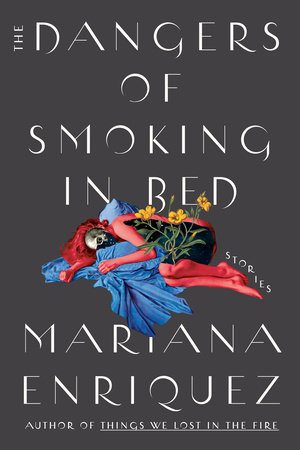
The Dangers of Smoking in Bed by Mariana Enriquez

The Dangers of Smoking in Bed by Mariana Enríquez, translated by Megan McDowell

Author of Things We Lost in the Fire, Mariana Enríquez worked with the same translator to bring another book of delightfully disturbing stories to the English-speaking world. Longlisted for the International Booker prize, The Dangers of Smoking in Bed’s dark stories marries supernatural horror with the mundane in contemporary Buenos Aires: a neighborhood is under a fatal curse, grave-robbers try to steal the body of a rock star, and teenage girls find an Ouija board with sinister results.

Read an interview here with Mariana Enriquez about witchcraft, hysterical teenagers, and heart fetishists.

Colombia

Variations on the Body by María Ospina, translated by Heather Cleary

María Ospina’s collection of stories centers around Colombian women in Bogota from all walks of life: from a Colombian American woman who develops an obsession with a young girl at a convent to a former guerilla fighter reintegrating into urban society.

El Salvador

Slash and Burn by Claudia Hernández, translated by Julia Sanches

Set in an unnamed Latin American country that is based on the author’s native El Salvador, Slash and Burn explores the mental and physical consequences of being a woman during wartime. Spanning decades, the novel follows an unnamed woman as she joins her father and brother as a guerilla fighter and, despite her contribution to the rebellion, is forced to split from her daughter.

Iceland

Magma by Thora Hjörleifsdóttir, translated by Meg Matich

Icelandic poet Thora Hjörleifsdóttir uses spare language in her debut novel to tell a haunting story of toxic love. Magma follows a narrator who loses herself to the desire to be a perfect lover, shocking the reader with the intricacies of an abusive relationship that are often not spoken out loud.

Iran

I'll Be Strong for You by Nasim Marashi

I’ll Be Strong for You by Nasim Marashi, translated by Poupeh Missaghi

Journalist Nasim Marashi paints an intimate portrait of three modern Tehranian women in her debut novel, I’ll Be Strong for You. Split between past and present, we follow Roja, who’s trying in vain to further her education in France, Shabaneh, who’s navigating her oscillating feelings for her partner, and Leyla, whose husband abandoned her for a new life in France. While leading their diverging lives, these three friends struggle to communicate with each other as they encounter conflicts with family, freedom, and love.

Nasim Marashi recommends 8 novels in translation by Iranian women writers here.

In Case of Emergency by Mahsa Mohebali, translated by Mariam Rahmani

Set in modern-day Tehran, as the city falls to made-made and natural disasters alike, In Case of Emergency depicts Iranian counterculture through the lens of a wealthy, cross-dressing opium addict who is constantly searching for her next fix even as everything around her crumbles.

Japan

There’s No Such Thing As An Easy Job by Kikuko Tsumura, translated by Polly Barton

Kikuko Tsumura’s English-language debut, There’s No Such Thing As An Easy Job, tackles a topic that has become uncomfortably familiar over the past year: millennial women feeling burnout in the workplace. With a subtle hand, Tsumura takes the unsuspecting reader on a strange mystery as her protagonist quits her dream job to try her hand at floating through life effortlessly, taking one temp job after another. Unsurprisingly, she finds that, as a woman, there is no such thing as an easy job and her journey exposes the dark underbelly of workplace gender biases in Japanese culture.

The Woman in the Purple Skirt by Natsuko Imamura

The Woman in the Purple Skirt by Natsuko Imamura, translated by Lucy North

Natsuko Imamura tackles the universal feeling of loneliness in her debut novel, The Woman in the Purple Skirt. In the novel, the narrator shares almost nothing about herself save her self-effacement and diffidence. Rather than telling her own story, or even living it, she opts to be a voyeur of the woman in the purple skirt, relaying this woman’s life in unsettling detail, leaving the reader to wonder about her motivations and desires.

Japan & the United States

An I-Novel

An I-Novel by Minae Mizumura, translated by Juliet Winters Carpenter in collaboration with the author

The I-novel is a Japanese literary genre in which authors offer confessions of events from their own lives through fictionalization. Minae Mizumura’s semi-autobiographical book was deemed radical when it was first published in 1995, because of its liberal use of English words and being printed horizontally rather than vertically.

An I-Novel takes place over the course of one day in the 1980s, during which the protagonist—a Japanese woman living in New York—reflects on her life as a writer in the United States, her complicated feelings about the English language and American culture, and her decision to return to Japan to write in her native language.

South Korea

Shoko's Smile

Shoko’s Smile by Choi Eunyoung, translated by Sung Ryu

Choi Eunyoung’s award-winning debut story collection, Shoku’s Smile, assembles seven stories that show the effects of geopolitics and national tragedies on the lives of young Korean women. Using spare prose to take an intimate look into women’s desires, relationships, and experiences, Eunyoung’s style has been likened to that of Sally Rooney and Marilynne Robinson. First published in South Korea in 2016, this collection was selected by 50 Korean writers as the best fiction title of the year.

Read an interview with Choi Eunyoung and Sung Ryu about what it means to be a social outcast in South Korea here.

10 Books To Remind You Why Y2K is Back

Paparazzi photos of Ben Affleck and Jennifer Lopez are proliferating in the tabloids. Teenagers are flooding stores to buy track suits, crop tops and low rise jeans. People are looking forward to Lindsay Lohan’s new acting gig. The Sopranos, Friends, He’s All That, The L Word, The Proud Family, Sex and the City, and Avatar the Last Airbender have all been rebooted. It’s hard to believe it’s 2021 and not 2002.

Time is cyclical, and this year is becoming eerily reminiscent of the late nineties and early aughts, now lovingly called “Y2K aesthetics” by the youth.

However, some things have changed in the last 20 years. According to GLAAD, LGBTQ representation is about as high as it’s ever been. Diversity in children’s media, both books and television, continues to grow each year. Stories that didn’t have the opportunity to be told around the turn of the century are being retroactively told now. For all of the disastrous trends—looking at you concealer lipstick and whale tails—that we tried to leave behind, these contemporary releases show us the worlds we shouldn’t have overlooked.

The Idiot by Elif Bautman

Taking its title from the Dostoevsky novel, this Pulitzer Prize finalist follows Selin, a  Turkish-American Harvard freshman, who is bookish and naive. Upon starting college she is thrust into a world of emails, new class subjects, and a Hungarian mathematics major, Ivan. The charm of this book isn’t in a mystical world or outlandish plot, but instead that Selin is so realistically a young person figuring it out. 

The Girl Who Smiled Beads by Clemantine Wamariya Elizabeth Weil

In 1994, Clemantine was an average child in Rwanda—until the genocide. Over the next 100 days, over half a million people died, and millions more were displaced, including Clemantine and her older sister Claire. After spending six years in seven different countries, the sisters are granted asylum in America, where they are forced to adjust to a vastly different culture. This memoir is raw, tragic and powerful, and it opens with the tear jerking tale of her reunion with her parents on The Oprah Show.

Sour Heart by Jenny Zhang

Set primarily in the 90’s in New York City, Zhang gives voice to a generation of daughters of Chinese immigrants. We Love You Crispina, the opening story, sets the tone for the rest: dark, humorous, vulgar, and filled with family. In it a young girl deals with moving from roach infested apartments to dilapidated hotels as her family struggles to save. In The Evolution of my Brother, a sister torments her brother, only to be horrified as he begins to inflict pain on himself. This collection is bittersweet and littered with pop culture icons.

Little Fires Everywhere by Celeste Ng

This web of mothers is set in the late 90’s in an upscale Cleveland suburb. Elena Richardson should be a suburban dream, but secretly she’s unhappy in her role. When Mia Warren, a single mother and artist, moves to Elena’s quaint town, their paths immediately cross. Their younger daughters find solace in the others’ mom. Elena’s daughter, an alternative outcast, loves Mia’s creativity, and Mia’s daughter craves the stability of  the Richardson family. Then enters an adoption case that ignites everyone’s secrets.  

Things Have Gotten Worse Since We Last Spoke by Eric LaRocca 

This novella might only be 112 pages, but it excels in creepiness. The book is composed of fictional transcripts between two women in 2000. When Agnes joins an LGBTQ forum to sell an antique apple peeler, she begins an exchange with Zoe. The two quickly become entangled in a BDSM relationship over email and instant messenger, where Zoe’s demands become increasingly deranged.

My Year of Rest and Relaxation by Ottessa Moshfegh

My Year of Rest and Relaxation by Ottessa Moshfegh

The unnamed narrator at the center of this novel is unlikable. She is all of the bad and vapid things white women could be at the turn of the century. She went to an Ivy League for an art history degree. She is undeservingly rich and refuses to work. She eats poorly but is thin. She’s a terrible friend, and she uses everyone to her own advantage. And yet, she is a product of the environment: Manhattan in the early aughts, and it’s easy access to eating disorders, prescription pills, and hiding away unseen. 

Sonora

Sonora by Hannah Lillith Assadi

Ahlam aka Ariel, the daughter of an Israeli waitress and a Palestinian cab driver, and Laura, the daughter of a rumored witch who has been dead for many years, are best friends. Meeting in the suburban desert of Arizona, they decide to run off after a string of deaths at their high school. They find a free place to stay to Brooklyn, where they immediately become entangled in partying, drugs, and sex. This poetic tale across landscapes and time addresses toxic friendships and what it means to find home.

Red at the Bone

Red at the Bone by Jacqueline Woodson

In overlapping narratives, Red at the Bone slowly unveils a family’s history. The novel opens in 2001 on Melody’s sixteenth birthday, where she is surrounded by family and wears her mother’s old dress— a dress her mother never wore because  she became pregnant with Melody before her sixteenth birthday. Considering the present, her parents’ past, and even her grandparents’ past, this book tackles generational trauma, racism, and how the past can define the present.

The Unraveling of Cassidy Holmes by Elissa R. Sloan 

The early 2000’s loved nothing more than making young women famous. Cassidy “Sassy Cassy” Holmes was Britney meets Xtina, only  hotter and in the most famous girl band around. But after a blow up in 2002, the group disbands.Years later, Sassy Cassy is found dead by suicide. Now, her old bandmates must reunite to process her death and  make some meaning out of the tragedy. This novel also takes a critical look at the sexism and racism of pop bands from the turn of the century, and how that ultimately impacted the women in their lives.

Agatha of Little Neon by Claire Luchette

When a small parish outside of Buffalo closes, four nuns are sent to work at a sober living facility. One of the nuns, Agatha, decides to also take a job at a local Catholic school as a geometry teacher. The friendship between the nuns is at the center of this novel, and the hidden atrocities of the Catholic Church  lurk in the background. Agatha finds herself within a cast of lovable misfits and all former catholics, especially the queer folks, will recognize the themes present here.

A Black Woman’s Quest to Trace Her Lineage

Lineage is complicated in Honorée Fanonne Jeffers’s debut novel, The Love Songs of W.E.B. Du Bois

Set in Washington, D.C., and Chicasetta—a fictitious town based on Eatonton, Georgia, the birthplace of Jeffers’ mother—the novel relies on historical “songs” to trace Ailey Pearl Garfield’s lineage from the arrival of her first African ancestor on American soil and her Creek ancestors’ early encounters with Caucasians in America. The songs serve as a narrative of the land and what happens throughout the years to the inhabitants of that land.

Given the period, the novel touches on large issues—slavery, the removal of Native Americans from their ancestral lands, colorism, race relations—but for Jeffers, the heart of the novel is the growth of the messy, chubby, loud, and imperfect Ailey. 

When we first meet Ailey, she is a preschooler, traveling with her mother and sisters to spend the summer months in Chicasetta. The coming of age novel follows Ailey through her teenage and college years. As Ailey grows older, the annual pilgrimage and her relationship with her elders take on a different meaning. Ailey’s Uncle Root introduces her to the work of W.E.B. Du Bois and gifts her a first edition of The Souls of Black Folk. Later, when Ailey attends university, Du Bois serves as a guide leading her to discover her life’s calling and forge a path distinct from that of her parents and sisters.  


Donna Hemans: Where does your fascination with history come from?

Honorée Fanonne Jeffers: When I first learned about slavery, I didn’t learn about it in a history book. I am a child of the ’70s. Even though I went to primarily African American schools up until junior high school, we didn’t get a lot of that in school. You had to learn it elsewhere. 

My grandmother’s father was born in slavery. And he was a little bitty boy—a toddler—and my great-grandmother Mandy was a teenager when freedom came. One of her first memories is of her father being sold down the river to Mississippi or where ever, sold deeper south. That was a very traumatic experience for her. She told that story to my mother. She was an old woman and my mother was maybe five and Momma would always despair that she hadn’t spent enough time when Great-Grandma Mandy tried to tell these stories. The kids wouldn’t listen; they wanted to go out and play. Great-Grandma Mandy would say “You got to hear this.” And then Momma would always say “I wish I had paid more attention.” 

That made an impression on me. But you know when you are a child, you don’t have these sorts of critical thinking skills. But as an adult, I think there was something about that grief that Momma had had if she had paid more attention to her great-grandmother that made me pay attention to the older folks. So that’s how I first learned about slavery through family stories. 

Later, when I first began reading the classic slave narratives—Frederick Douglas’ narratives, Harriet Jacobs’ Incidents in the Life of a Slave Girl—things began to click about the stories I had heard in Eatonton and then the history that was on the page. And that’s when the fascination really began. 

The first time I was in graduate school, The University of North Carolina at Chapel Hill, had a big archive called the Southern Historical Collection. That’s where I first encountered the archives and I still have photocopies of letters written by enslaved Black people that I found in the Southern Historical Collection. Once I saw those letters I was just hooked. I couldn’t get those people out of my mind.

DH: I think of the focus of the book as building lineage. Ailey says to her white classmate that for white descendants of the Pinchard family “paternity is an a priori assumption.” But that’s not the case for Black Americans. Lineage of Black people in the Americas is such a complicated thing. Why did you want to write about the complexity of lineage? Is it tied to the fact that it is so difficult for Black folks to trace who we are and where we came from? And do you think the complexity of lineage is widely understood outside of Black communities? 

HFJ: I definitely do not think that many people who are not African American understand that most of us have European ancestry, no matter what we look like. I am a cocoa-brown woman with coily hair and I have white ancestors on both sides, paternal and maternal. I don’t think people understand the violence behind white lineage in Black communities. I do think the half has not been told about Native American lineage in Black communities. 

One of the reasons is that there is so much missing from the historical archives. In the United States, no one bothered to keep these sort of impeccable records. When you go to 1860, that’s basically where you’re going to hit a wall for Black lineage to be able to trace names, to be able to trace where people lived. If you don’t have bills of sale, if somebody wasn’t sold, typically you’re not going to have a paper trail. So lineage was very important. 

But also I think that only within Black communities are we really aware of the way that skin color has been used as a hierarchy. Skin color, hair texture, all of that. But also only within Black communities are we aware that in one family with the same mother and father, you can have several different skin colors, several different hair textures. So within the family, you may be treated the same or you may not, but when you go out people will respond based upon phenotype. 

The reason I found that to be fascinating to talk about is that we have always heard this sort of story about the house and the field slave, and that enslaved Africans who worked in the house were close in color to the master and many of them were related to the master. And so they had an easier time than people who worked the fields. What I hadn’t seen a lot of in fiction is an examination of what those people who lived in closer proximity with the master had to deal with in terms of sexual harassment and sexual abuse.

DH: On both sides of Ailey’s family, loss is prominent, particularly the loss of land. That kind of loss still remains a major issue for Native Americans and Black Americans today, right? Is that part of the reason you focused on that issue? 

HFJ: I think that in a very real way—even though I don’t make overt gestures toward environmentalism—for African Americans and Native Americans, the loss of the land is an environmental issue. I have not met one African American—even if they don’t want to go back to Africa, even if they don’t want to visit Africa—where there is not this sort of grief in their family line about the loss of Africa. 

Even if people take DNA tests, that is not going to give you closure. It’s not going to give you home. Home is lost.

Even if people take DNA tests, even if you know someone in your bloodline came from Nigeria or Cameroon or Senegal or the Gambia or Ghana, that is not going to give you closure. It’s not going to give you home. Home is lost. You will never be able to return to that place and have relatives that are there. You will always be a stranger. That is a grief that never subsides. 

And in the same way with Native Americans, that loss of their homeland is a grief that never subsides. It’s always with the Creek, with the Cherokee, with the Choctaw, with the Seminole—there is always a grief that they have that the land that is in the east can never be recovered. I wanted to explore that connection to home.

DH: I thought the loss of land was tied to the importance of the annual gatherings in Chicasetta. Am I right about that? Is that why the annual gatherings in Chicasetta are so important? 

HFJ: You are right about that. The loss of land and also they are making sure that Ailey and her sisters do not lose their culture. It’s very important. Going back home is to reconnect with the land and the land reconnects with the culture. It’s like a trinity: the people, the land, the culture. That’s incredibly important.

It doesn’t matter how educated Uncle Root is or Belle is or later Ailey. They always return to this place. This place is essential because it is the only place where everyone knows everyone. It’s the only place where you can trace back as far as you can until the archives don’t provide anymore. It’s the only place you have memory and you can’t lose that memory. Whatever color of skin tone, whatever hair texture, education you have or don’t have, this is the place where everything is tended, restored, and maintained. 

DH: Uncle Root is such an endearing and generous man. He saves Ailey time after time. How did you come to choose his name and what does his name mean to you?

HFJ: It’s a couple of things. It’s that he has remained. After Dear Pearl, his big sister, passes away, Uncle Root is the oldest. He takes that place because his sister was the matriarch and he becomes the patriarch but he defers to all the women. It’s still very much a matrilineal family. The rootedness is essential to his name. 

W.E.B. Du Bois devoted his entire life to the betterment of not only African Americans but Black people around the globe. 

But the other part is, he has this almost supernatural charm. As we see in the songs, that charm of his is inherited. It goes all the way back to the first African who arrived in that area. He was charming. His son was charming. This sort of almost supernatural charm that Uncle Root has, the way he can predict how the women in his family are going to act so he is always prepared to sort of counter that if he doesn’t agree with what they are saying, but he does it in a loving peaceful manner. In the deep South when somebody has that kind of power, we say they have roots. They have supernatural power. They may know folk medicine, know how to put spells on people. That’s where the name also comes from—his almost supernatural charm. 

DH: What role does W.E.B. Du Bois play in the novel? Uncle Root certainly talks about him and his experiences with certain figures. Can you tell us why you chose the title and why you focused on him?

HFJ: W.E.B. Du Bois is considered to be the most accomplished African American intellectual in the history of America. He grew up in Massachusetts and when he was 17, he went down South to Fisk University. This was the first time he had ever encountered a majority of African Americans. He fell in love with Black people at Fisk. That was a turning point in his life. Then he devoted his entire life to the betterment of not only African Americans but Black people around the globe. 

He becomes a shadow character in the book. In the same way he devotes his life to African Americans, Ailey is on the path to devoting her life to African Americans. She is first introduced to Du Bois through the story of Uncle Root when he talks about the first time he met who he calls the great scholar. Later that same summer that she hears the story for the first time, he gives her a first edition of The Souls of Black Folk. So Du Bois’s words serve as a guidepost. He becomes this shadow character.

Whenever you encounter the story of different characters, first you encounter Du Bois, what he has to say about Black folks who leave the South and come North, what he has to say about the problems of Black people, what he has to say about the evolution of Black people, what he has to say about African American spirituals. All of this guides the book.

A Meditation of Longing and Loss Set in Post-War Sri Lanka

In A Passage North, the protagonist, Krishan, grapples with the legacies of the tragic Sri Lankan civil war between the Sinhalese and Tamil communities. Krishan travels from Colombo to northern Sri Lanka for the funeral of Rani, his grandmother’s caretaker, after hearing the news from his ex-girlfriend Anjum.

A Passage North by Anuk Arudpragasam

Through that reflective journey, the novel explores longing in the aftermath of a conflict in which upwards of 100,000 people may have died between 1983 to 2009.

Longlisted for the 2021 Booker Prize, A Passage North is Anuk Arudpragasam’s second book. His 2016 debut novel, The Story of a Brief Marriage, was a devastating and poignant portrait of a day in the civil war.

I chatted with Arudpragasam over Zoom about the differences between writing for an English vs Tamil audience, the homogeneity of South Asian American writing, and how who we desire is connected to our aspirational selves.


Vignesh Ramachandran: What are the similarities between A Passage North and your first book, The Story of a Brief Marriage?

Anuk Arudpragasam: The first novel was very difficult to write. It involved daily immersion in a very violent world. I tried to expedite the finishing of that novel towards the end, because I had been writing it for three years, and it was not like a very healthy place or a very fruitful place to be immersed in for too long. So I tried to finish that novel more quickly than I otherwise would have. 

When I was thinking about what kind of situation I wanted [this second novel] to unfold in, I wanted something that is very, very far from the war, something that was very far from violence. I didn’t want to think about those things for any longer. I wanted to write a book about desire and fantasy—or different ways of interpreting the world based on occupying different positions—the way the grandmother, for example, has to interpret the world basically on the basis of the little stimuli she receives. Or the way having desire might move you to see the world differently. It was supposed to be something very different. It was supposed to be about the relationship between a young man and his grandmother. 

But as I was writing, all these little things kept popping up from the war, in accidental ways, in ways that were uncomfortable. And I would continue to edit them out, but they would continue cropping up, almost like Freudian slips. I soon realized that this novel, too, had to be in some way about the war. I have not finished thinking through that subject in my writing and what it means to me. When I realized that it was that I could not avoid it and that’s what my hands wanted to write about, I decided that I would try to make it more about spectatorship rather than participation.

VR: What are the themes that you would say a reader is going to encounter through the book?

AA: The book digresses in many ways, and it reaches into lives that take in and of themselves, very different from one another.

This idea that all four characters in the book, their lives on Earth are determined by a sense that there is something that they need that they either do not have access to or cannot articulate. 

With the exception of Anjum, the other three there’s a way in which they desire, but they cannot act—either because of who they are or because of the structure of the world, they cannot obtain what they need. I think what ties the book is this kind of longing.

VR: When you talk about death in the book, you write:

“It was the fact, above all, that sudden or violent deaths could occur not merely in a war zone or during race riots but during the slow unremarkable course of everyday life that made them so disturbing and so difficult to accept, as though the possibility of death was contained in even the most routine of actions, in even the ordinary, unnoticed moments of life.”

As I read that, I kept thinking about that relevance to the current pandemic we’re in.

AA: I finished the book before the pandemic. But when you grow up in a poor country, a lot of people die in accidents. A lot of those accidents were preventable in one way or another. But a lot of people die in ways that they don’t have to die. In a sense, the pandemic has brought that condition, far and wide.

VR: To that point, you write this about Krishan:

“He’d never really stopped to consider the fact that people could also die slowly, that dying could be a process one had to negotiate over the course of many years.”

AA: We grew up seeing corpses of all kinds almost every day in the newspapers and all of these stories continually coming in of people dying in a tsunami or from shrapnel or a bomb blast. Where I grew up in Colombo, there was a period of a few years in which every month there was a bomb blast somewhere or the other. Every day on my way to school, I had to pass a road in which a suicide bomber had killed somebody and in which there was a memorial painted onto the tar of the road. I’d have to walk over there every day on my way to school. This idea of death being sudden—it was very much in the environment.

VR: What does Krishan’s former girlfriend Anjum—an activist who he had dated earlier in Delhi—represent in the book?

AA: There’s this discussion about why Krishan falls in love with this person that he doesn’t know at all. It’s this thing that often happens, and that it’s often harmful—projecting this personality or this ideal onto a kind of desired person. But then there’s this further discussion about how also sometimes a glance can be prophetic, how one can see in the movement or a gesture, kind of like a prophecy of who this person is or might be. Even if you don’t know a person in one of the more substantial senses, such glimpses might be enough to make somebody fall for another person. 

Desiring is often connected to the aspirational self. What kind of person would I become when I’m with this person?

Often desire has to do with identity, or that the image of a person that you glimpse, whether it turns out to be true or to be false, is often connected to some idea of who you might want to be, or what kind of person you might want to be. Desiring is often connected to the aspirational self. What kind of person would I become when I’m with this person? Or what kind of person would I be if I had this or lived in this way? What it is about Anjum that so moves Krishan is that she is a conviction—the fact that she’s so earnestly committed to something that she’s willing to give herself up for.

VR: What do you want people to understand about the Sri Lankan civil war and the context of post-war Sri Lanka today?

AA: I don’t know if I have any particular desire for readers to come away with anything politically speaking about Sri Lanka, about our history. 

One of the audiences that I’ve come to understand that I have—maybe the main audience—is the diasporic Tamil community because more than half of our population has left the country and is in exile, most of them as asylum seekers. There are [thousands of] Sri Lankan Tamils still living in refugee camps in South India, mainly in Tamil Nadu, who haven’t been given citizenship. 

The diasporic Tamil community is mainly spread out across the West. Many of these people are my generation. But they’ve grown up removed from their homeland, unable to go back. They long for it intensely.

I was, in some sense, lucky not to have fled the country in that way and to have grown up the way I did. I see that desire in me resonates with this desire in them also to memorialize our community, our culture so that it doesn’t disappear. And to describe it with care and reflect on it philosophically, and what it might mean, and why it might be, why this way of being might be valuable, why it might be these rituals, these habits, these ways of speaking, these experiences and these histories, like why they might be important to keep close. 

As far as the non-Tamil audience? Sri Lanka is a particular country with a particular history and if you get a sense of that history from reading my work, then that’s good, but it isn’t what I’m trying to do here.

VR: You have your doctorate in philosophy from Columbia University, and your books evoke a tone that I feel is a steady beat of contemplation. Considering your own background as a philosopher, do you seem to bring that into the voice of your work?

AA: It’s not actually at all how academic philosophers actually think or write—it’s very different. It’s much drier, it’s totally based on argument, and it is often highly focused on very rigorous logic, and it is very hesitant to make claims about the nature of life.

English is a language that no longer belongs to any specific piece of land, or any specific people.

So actually, I found in the novel a freedom to think philosophically in a way that I didn’t feel that I was able to within academic philosophy.

Generally, a novel is situated in something—it’s immersed in some kind of life form, and so therefore, if you think philosophically within the novel, you can think from the point of view, think philosophically from a situated perspective, rather than something that is disembodied, something that is abstract, something that has no particular starting point or particular identity, which is how a lot of academic philosophy is.

In a way, there’s less freedom because you’re always situating your thought in a very particular world, or person, or state. But it’s freeing in the sense that it allows you then to think through the particularity of life.

VR: You have said in the past that you want to write more works in Tamil. Is that something you still want to do?

AA: I do write more in Tamil now—not for publication, just privately. It is something I’d like to do. It feels important to me. There are ways that I can write in Tamil that I could not write in English. There are forms of intimacy available to me in Tamil that are not available in English.

English is a language that no longer belongs to any specific piece of land, or any specific people. It’s a language that—no matter what people from the U.K. might say—has no primary dialect. In all sorts of places around the world, there are all different kinds of native communities of English speakers, and it’s a language, therefore, that doesn’t have a center. Therefore, a language in which when you write, you can, in principle, be read by any kind of person, because there is no longer a history, a land, a specific community, or a specific set of experiences that defines the English speaker. The English language is no longer a situated language. And therefore when you write in English, you are writing to, in principle, any kind of person, and therefore, when you write in this language, you’re on your guard. You do not know how to relate to the audience. It’s like speaking into a certain kind of voice. 

Because of this, there’s a certain kind of intimacy that’s lost for me in English. In Tamil, for example, there are many people who I don’t share a worldview, but just in virtue of the fact that we’re Tamil speakers, whether they grew up in Oslo or in a small village in Tamil Nadu, or if they grew up in Kuala Lumpur or Sri Lanka, just in virtue of the fact that they speak this language, they are tied by a certain history and to a certain region in the world. 

Whether I disagree with them on any particular point or not, I have a sense of who they are. I have a way of approaching—I know already what kind of stances I might take towards that community and therefore I think in Tamil, knowing my audience, there’s more of a possibility for a certain kind of vulnerability. I don’t just mean that because I would show myself or reveal myself to a Tamil audience more than I want to an English audience—actually, in certain ways, the opposite is the case, they are certain things I wouldn’t talk about because Tamil society is conservative—but just knowing that society means that I will know what I am doing, I will know whether my speech act is something that bothers, annoys, subverts, angers, or soothes. I have a more intimate sense of this.

VR: Do you feel like South Asian diasporic voices are being better represented in literature these days, or not?

As far as I know, the South Asian American writing being published is all upper caste… So in that sense, it’s much less representative of the different cultures in South Asia.

AA: As far as I know, the South Asian American writing being published is all upper caste. In a way, this is reflective of the population of Indians in America, because unlike places like the U.K. or Canada, which have a long history of taking refugees—more varied across caste—and they have also a long history of taking in South Asians that are not necessarily academically or professionally qualified. 

The demographic of South Asians that make it to the United States generally all have been high caste and they all generally have a very, very particular kind of relationship to South Asia and a very, very particular minority culture vis-a-vis the other cultures that exist in South Asia. This is also true of South Asian writers who write in English, because access to English, at the level of nativeness and sophistication that’s required to write an English novel that will be published in the United States or the United Kingdom, means you come from a certain kind of privilege. In South Asia, class privilege is always tied to caste privilege. So in that sense, it’s much less representative of the different cultures in South Asia.

VR: What are you working on next?

AA: It’s a novel set in the Tamil diaspora. In a way, I view it as the third part of a trilogy that deals with the war in the least direct way of the first and the second book of the other books in the trilogy. It’s dealing with people in the diaspora whose relationship to the war is inherited, rather than directly acquired.

You Can’t Vaccinate a City Animal for Rudeness

London Foxes

It took us four years, but we cured all of London’s foxes of mange. Every fox in the greater metropolitan area was captured, tagged, and treated.  We received awards from PETA and the urban planning department. In our acceptance speeches, we thanked the three pillars of our successful campaign: teamwork, perseverance, and a combination of Ivomec and broad spectrum antibiotics.

It should have been enough to see the gleam of thick vermillion coats under the weak city moon; it should have been enough to hear the foxes scream in the night, resplendently bepelted. But after the awards ceremonies, that achievement didn’t seem like enough of a reward. We’d had so much champagne. We’d had our names on custom-inked certificates. We wanted more.

What else could we cure the foxes of? Initially we thought we might target their diet, but this was laughed out of the first funding meeting. Do you want to open up a little fox restaurant? Spaghetti and meatballs? Accordions? We considered a program of mass sterilization, but PETA got wind of that project and threatened to take our award away.  So we spun on our spinny chairs and crunched on the problem like a camel chewing a Pepsi can. What could we cure the foxes of? What still afflicted them, now that we’d made them so beautiful?

A post-graduate student hatched the earliest incarnation of the plan. The foxes had been cured of their physical ailment, but they still suffered a terrible, insidious sickness: an image problem. They shrieked in the gloaming, they ate refuse from people’s front gardens, they crapped on lawns. In the eyes of fastidious gardeners and keepers of domestic cats—London’s most powerful voter base—they were russet hoodlums.

Of course, we couldn’t simply provide the foxes with good PR. We were scientists. Dabbling in advertising was simultaneously below us and well above our pay grade. We had to think in terms of applicable, tangible, medical cures. That’s when we hit on the solution: we would cure the foxes of their rudeness.

We identified the rudeness as a spatial issue. Foxes had no understanding of how disruptive the sight of a glistening turd in a field of mellow green could be, how traumatic was the sight of a household’s garbage entrails when strewn across the street, because they had no understanding of the ritualized importance of such spaces. We had to imbue in the foxes a sense of place.

The latest and most disconcerting innovations in biotech were put at our disposal. We would build walls—literal cellular walls—in the brains of the foxes, marshalling their thoughts, focusing their perceptions.

It was easier to capture them the second time around, accustomed as they’d grown to our equipment, our rubber-gloved handling, tagged as they already were by the chips bought with the nostalgic remnants of our EU funding. It took only eighteen months for three-quarters of London’s foxes to pass through our program. It was, all things considered, another success. We eagerly awaited our summons to the summer awards ceremonies.

There was a fallow period as the foxes adjusted to their new sense of place. Its initial manifestation was of the all-according-to-plan variety. Introversion overcame the foxes. They mated quietly, and their scavenging became fastidious. They appeared to designate certain brownfield or abandoned sites as toilets. They appeared to learn to queue. 

Our first intimation that something had gone very wrong came early that summer. A young vixen was spotted in the peonies of a pleasant suburban garden, digging industriously. Naturally the owners assumed this was a creature as yet unvaccinated against rudeness, unable to comprehend the sacrilege of unearthing the flowers. They went outside, banging wooden spoons against frying pans. They expected the vixen to flee.

Urban foxes have almost never been recorded attacking humans—they’re bright enough to know that it’s not worth the hassle. The peony-growers had no idea that the vixen would launch herself at their faces. Besides, humans retreat to suburbia because they don’t want to do any fighting more strenuous than a sharp note to a neighbor through the letterbox. Even armed with saucepans, their exposed flesh tears easily.

It transpired, in the ensuing panicked media coverage, that the vixen had a perfectly accurate sense that the peony bed was a cherished space. She simply had a different idea about what should be placed there, how homage should be paid. She planted rat skulls and green bottles. It must be said that she added a large chunk of human skin, hair and muscle.

Spates of fox vandalization—and fox violence—blistered across the city. We realized too late that by teaching the foxes the value of place, and of the rituals surrounding the creation of place, we had inadvertently taught them religion. In teaching them religion, we had taught them religious mania. We had taught them boundaries, and they had learned about borders. By the height of the summer, the foxes knew about nationalism.

Now we don’t know how to reverse it. The foxes have learned about bodily autonomy, and they evade our attempts to recapture them. They’ve learned about conformity and are ruthlessly eliminating the remaining vulpine population still rude, lewd and animal in the brain. We can feel their eyes on us. We can sense that something is simmering. We leave out choice cuts of meat and milk on doorsteps, as we might to a horde of murderous elves, but we don’t know if it’s going to be enough. We have taught the foxes what rudeness is, and with that we’ve taught them how to hate, and we can feel it, oh God, we can feel that they hate us so much.

Would Taylor Swift Eat My Gimbap?

Save me, I’ve been feeling so alone
I keep waiting for you, but you never come
Is this in my head? I don’t know what to think

Love Story (Taylor’s Version),” Fearless (2021)


When I make gimbap, I start with the rice.

I wash two cups in a pot, filling it with water and setting it to cook on the stovetop because I rarely have the foresight to let my rice soak as I should. As that cooks, I crack four eggs in a bowl with salt and a drizzle of half-and-half, using chopsticks to break the yolks and whip the eggs into a yellow slurry. I heat a pan on medium-high heat, lightly oiling it, and pour my egg mixture onto the pan when it’s hot, folding the egg into an omelette that I slide onto a pan to cool. 

I cut my cucumber into long strips and de-seed them, then cut one carrot into a pile of matchsticks. I’ve made my danmuji (pickled Korean radish) and potato banchan (side dish) the day before, so I move on to prepping whatever protein I’m using — hot dog, Spam, bulgogi, whatever I’ve got — and warm it up in the pan, before slicing my cooled omelette into long strips, seasoning my rice with a pinch of salt, a tiny drizzle of sesame oil, and a toss of toasted sesame seeds, and setting up my mise en place. I get a little finger pot of water to seal my gimbap, my seaweed sheets from the freezer, the bamboo mat I’ll use to tighten my rolls from the drawer. I pull on a pair of disposable plastic kitchen gloves and cue up my Taylor Swift playlist on my phone, and, now, it’s time to roll.


And I never saw you coming
And I’ll never be the same

“State of Grace,” Red (2012)

Most of the time, I have no idea what Taylor Swift is singing about. It doesn’t matter if she’s telling lyric stories about falling in love or breaking up or longing for someone — I really have no idea. But I can imagine it, can tap into universal human emotions to conjure up similar feelings, even though I’ve never directly experienced any of these things before. I’ve never been in love or been in a relationship. I’ve never even gotten close.

I can imagine it, can tap into universal human emotions to conjure up similar feelings, even though I’ve never directly experienced any of these things before.

A friend advises that I try dating, if only just for practice, and I know this friend is right. Dating is something you have to work at, too, and I was never properly socialized as an adolescent — I didn’t go to dances, wasn’t a part of clubs, didn’t have much of a social life outside of my small church. In college, I didn’t join a sorority, still wasn’t a part of clubs, often went days without physically speaking to anyone. As a young adult, I moved across the country from Los Angeles to Brooklyn, withdrew from law school to take on odd freelancing jobs while working on a novel-in-stories, and, again, often went days without physically speaking to anyone.

It wasn’t just that I was shy or that I liked my solitude. Starting in high school, I had been taught to link my self-worth to my body, which was average by American beauty standards, but too big for Koreans. Because of this, my own immigrant community shamed me for my body. That shame broke me down mentally as I spent the next ten years trying to whittle myself down physically, counting calories, exercising obsessively, and restricting, going further down the spiral of self-loathing that completely eradicated any confidence or pride I had in myself as a person. While I’m in a much better place now, I still can’t look in a mirror without feeling that familiar chill of repulsion shuddering down my spine.

All this meant that, by my early twenties,I basically withdrew from society because I couldn’t deal with how others reacted to my body, how I thought they would reject me because of it. I became resigned to doing life on my own, even convinced myself that I was okay with it, learning to dine alone, go to movies alone, move apartments alone. I told myself I was “independent” and didn’t need people; I was a misanthrope, an introvert, a writer who would rather spend my time reading than being social. I wasn’t a naturally gregarious person, anyway, so it didn’t matter if I didn’t talk to anyone that day.

I wasn’t a naturally gregarious person, anyway, so it didn’t matter if I didn’t talk to anyone that day.

Part of healing included breaking down these lies I’d come to believe about myself. As I gradually opened up to the world, venturing out to meet people, make friends, and learn how much I enjoyed human company, I started to feel the lonely pangs of my singleness, a feeling that had existed before but hadn’t lit up as pain. I still couldn’t think about dating, though, or let myself dwell on my singleness because I had other things to worry about first — becoming financially stable, selling my book, bringing my dog out to Brooklyn from L.A.. It wasn’t difficult, not when I’d already gone fifteen years assuming I’d be single and alone forever — until, one night in 2019, I’m having dinner with a friend and look up to see a stranger making a loop around the room, and I think, well, shit, you’re fucking cute, and, then, there’s Taylor Swift, singing about love in catchy melodies that keep worming their way into my brain and my heart.


I don’t wanna look at anyone else now that I saw you
I don’t wanna think of anything else now that I thought of you

“Daylight,” Lover (2019)


The first time we see each other, it’s from across the room. She’s chatting with someone, and I happen to look up from my conversation when our eyes briefly meet, brushing gazes before returning to the person alongside us. It’s a glancing moment, inconsequential really, so I’m surprised by the electricity that runs through me, that spark of curiosity and wonder. I like the way she looks, the way she smiles, and I don’t know what this feeling is.

We’re never introduced formally, but our paths cross often enough that we learn who we are. I promptly follow her on social media, trying to glean what I can of who she is outside of her profession — she cooks professionally and makes gimbap — but she posts so sporadically, there isn’t much to learn. It’ll be months before we speak, months I’ll spend admiring her from a distance while avoiding her because, as I learn, I become neurotically shy when it comes to feelings. I throw myself in her line of vision as often as I can, even though I can’t get myself to make eye contact or say hello or initiate conversation, which frustrates the hell out of me because, at this point, it isn’t even that I want to date her — I just want to talk and get to know her. I want to know if we’d be compatible, if we share the same sense of humor, if she rolls her toilet paper from the top or bottom, if she eats the correct brand of Chocopie, if this, if that, if everything.

In the beginning, it’s enough to know that she is there, to have someone I even want to get to know. Her existence is enough, a kind of hope that I’m not totally dead inside, that maybe I, too, can experience the things that Taylor Swift sings about, from the magic of that first meet to longing for someone who’s in love with someone else all the way to heartbreak and healing and starting the cycle over again.

In the beginning, it’s enough to know that she is there, to have someone I even want to get to know.

On Valentine’s Day, she follows me back on social media, and I wonder why as I stare at the notification on my phone. I think, maybe, we could start to move beyond perfunctory, polite small talk if our paths continue to criss-cross in the future, but we don’t. I’m too afraid to try because what if she isn’t interested, what if she thinks I’m annoying, but, then again, what if she is interested and then she finds out how inexperienced I am, how much I’m flailing as a grown person, how bad my brain is? What if we talk, and we learn we wouldn’t even be friends? And, then, underneath all that, how sad is all my pining for a stranger I don’t even know, how creepy, how pathetic, when I could just approach her and say, Hi, can we get a cup of coffee, I’d like to get to know you?

As the months stretch on and we continue to orbit each other, the silences get louder, the neuroses in my brain deafening, and, in frustration, I turn to making gimbap, posting photos of my progress to Instagram in an attempt to say, Hi, I’m here, look what I’ve been up to.


Is the end of all the endings? My broken bones are mending
with all these nights we’re spending up on the roof with a school girl crush

“King of my Heart,” Reputation (2017)


In her documentary, Miss Americana, Taylor Swift says that she didn’t eat a burrito until she was twenty-six. That’s the main thing that sticks with me from the documentary, not because it surprises me (Taylor Swift is a white American who was born in Pennsylvania and moved to Nashville), but because it fills me with a different wonder. Who first introduced her to a burrito? What else has she not eaten? What will she never have the opportunity to eat — like will she ever try gaejang or pork chop over rice or pork sisig? Maybe she’s had egg rolls, given the pervasiveness of Chinese American food, but what about spring rolls or lumpia shanghai? Has she had kimchi mandu? Pork buns? Pho? Has anyone made her gimbap?

Until 2019, I was fairly ambivalent about Taylor Swift. I was more cognizant of her than I was any other Western celebrity, but most of my curiosity about her centered around her personal branding, her ability to craft and embody her public persona and narrative so thoroughly. I was skeptical of so much she did — the Christmas gifts to her fans, the private listening sessions, her effusive concert monologues — because it all seemed too calculated, though that kind of image control is part and parcel of celebrity. Maybe it was Swift’s naked eagerness, her desire to be liked that got to me. I don’t know what flipped the switch in my brain, but, in 2020, deep into my crush in the midst of the pandemic, I had to say it out loud: I loved Taylor Swift. I even liked her because of her desire to be liked, her chameleon-like ability to adapt when others tried to throw her off her narrative, her doggedness to shine and remain at the top.

When Taylor Swift sings about love and desire, I think, I wish I knew how that felt. I wish I didn’t feel so half-formed, so stunted, and I admire Swift’s songwriting, her ability to tap into feelings that are universal even if I’ve never experienced them in the same way. The emotional core of her songs resonates, even if the story she’s telling in her lyrics has a specificity only she knows, and I wish I could put all my feelings into a song and send that out into the world to speak for me.

I can’t write songs, though, but I have food. I’ve been cooking for many, many years, mostly for myself because cooking has been the best way to manage my depressive, anxious brain, as well as a way for me to build a relationship with food that wasn’t built on shame. The more I cooked, the more I was able to piece myself together, the more people I started to gather in my life, people who came to my tiny Brooklyn apartment over the years for my thirtieth birthday dinner, book clubs, writing sessions, hangouts, a gimjang I hosted in 2019. I cooked for all these gatherings — miyeokguk (seaweed soup), tall New York cheesecakes, Dutch pancakes with buttered apples, dahkdoreetang (spicy chicken stew), so much gimbap. I started thinking of new combinations to try — like, could I take the elements of a bánh mì and put that into a gimbap, what about curry katsu, how would this combination taste, what about that? As I continued to roll gimbap for friends and family, I started to think that this, here, was my love song.

The more I cooked, the more I was able to piece myself together, the more people I started to gather in my life.

Taking photographs and sharing them on social media, too, have become a kind of love song, a way of one-sided communication that has to suffice, fill in for my longing to say, here, let me care for you. I know she’s there on social media, that she’s silently watching, but I don’t know how to coax her out. All I know is to keep trying to show myself as genuinely as I can, lay myself bare in my vulnerabilities, and hope she sees me.


Say it’s been a long six months
and you were too afraid to tell her what you want
That’s how it works
That’s how you get the girl

“How You Get the Girl,” 1989 (2014)


Gimbap literally translates into seaweed (gim) rice (bap). Traditionally, in gimbap, you find a “main” protein, an egg omelette, danmuji, and an assortment of vegetables like blanched spinach, julienned carrots, and cucumbers. Gimbap is made for field trips, road trips, casual gatherings, and it’s typically for larger groups because gimbap requires a lot of work — each filling has to be made individually then each gimbap rolled — and that amount of labor is mostly worth it when you’ve got lots of mouths to feed.

Gimbap-making itself is an act of love — or, at least, if we are to try to avoid such sentimental generalizations, an act of care. Gimbap has so many parts, so, when I make gimbap for someone, it’s a way of saying that I love you, I care for you, here, I have made this roll of rice wrapped with seaweed and stuffed with things, all to make the perfect bite, just for you.

When I make gimbap for someone, it’s a way of saying that I love you, I care for you.

Gimbap, thus, became a secret language, a way for me to communicate with her through the internet. We’ve spoken briefly a few times in person before the pandemic shut everything down and I start spending months back in Los Angeles, and I know she’s there on social media, dropping in for whatever reason as a silent observer, no likes, no comments, no DMs. Occasionally,I try to chat with her, but she’s slippery and evasive, friendly enough to make me think she’s just shy, but elusive enough that I’m filled with self-doubt every time she doesn’t leave room for a conversation. Instead, with no other means of speaking, I fill the spaces of our silences with photos of gimbap.


I guess you never know, never know
and it’s another day waking up alone

“the 1,” folklore (2020)


I want to tell her everything — how I made gimbap with eomook (pressed fish cake) and liked it even though I haven’t historically liked eomook, how I tried making a riff of samgyupsahl ssam (pork belly wraps) in gimbap form that confused my dad, how I save little scraps of egg to give to my dogs. I want to talk to her about how I love being in LA with my dogs but feel so alone and isolated out in California, how I would stay put in Brooklyn if I had someone here to ground me. I want to tell her I worry about her, especially in these times with the pandemic and anti-Asian hate crimes, but it doesn’t seem like my place, so I stay silent.

I can’t get a read on her, on our ambiguous interactions, but I want to ask how she’s doing, if she’s okay, if her days are passing uneventfully. I want to know if she goes home to someone, has someone who’ll help carry her burdens and fears, and then there are all the neurotic questions — why does she follow me on social media if she won’t engage with me? Is she ever only kind out of politeness? Have I annoyed her with my presence and would she like me to go away?

She has so much access to me, to my day-to-day, to my fears and insecurities and vulnerabilities given my constant over-sharing on the internet, but I know so little about her. I feel that it is up to her to initiate. All it would take is a reply to a story, a DM, something simple and casual that gives me an in because I’ve tried when I could, tried to coax her into a casual conversation, tried to make things more personal, but she’s always polite and then she falls away. There’s never room for more, so I scuttle back, keep my feelings to myself.

I wonder how Taylor Swift would sing about this. Are my hesitation and confusion, this fear that makes me want to die, things she would understand? How would she capture this longing, this want, this desperation not to be invisible? What is the story she would tell in this song? Would it make me feel less alone, less crazy-brained and pathetic, if she could package up my loneliness and longing in a catchy, heartfelt song I can try to learn on guitar?


I’ll spend forever wondering if you knew
I was enchanted to meet you

“Enchanted,” Speak Now (2010)


The cycle goes like this — I pine for a few weeks, hating every time she pops up in my dreams and on my social media feed and in my life. I keep waiting to find out she’s dating some basic dude. I roll gimbap, share photos online, until the pining reaches a tipping point, and I slide into self-loathing and spend the next few weeks trying to remove her from my brain.

I pine for a few weeks, hating every time she pops up in my dreams and on my social media feed and in my life.

I roll more gimbap, share more photos, but as I think I’m moving along nicely, our paths cross again, and I’m thrown back to the top of the cycle, back to grumbling over how I wish we could at least be friends. If not that, then, could I get some kind of closure, no more of this oscillating between hope and despair?

I’m not brave enough for that kind of finality yet, so instead, I wash two more cups of rice. I prep my fillings, season my rice, get my seaweed sheets from the freezer. And, then, as always, when I’m ready to roll, I cue up my Taylor Swift playlist on my phone, and I shove my feelings to the side, lose myself in the rote motions of filling and rolling gimbap, and wonder if Taylor Swift would eat this, if she would prefer gimbap with bulgogi or Spam or tuna, if she would like any of it at all.

Queer Self Discovery in a Migrant Worker Camp

Everyone has something to say in Jaime Cortez’s debut collection of short fiction, Gordo. There’s Raymundo, the town’s openly gay hairdresser who has a gift of knowing exactly what each of his clients needs to look and feel beautiful; Fat Cookie, a high school chola with a political edge and disregard for authority; the lone gringo, Juan Diego, a man of few words, whose broken heart is stirred by the music of Vicente Fernández. And guiding the reader along through a terrain of machismo pride, queer self-discovery, notions of home, and harrowing tales of immigration is the earnest and precocious Gordo.

Set in and around a predominantly Mexican migrant workers camp in 1970s Watsonville, California, Cortez’s stories are filled with so much love for the characters who inhabit them. Cortez is unflinching in his portrayals of violence and threat, and still—no matter how tragic their backstories or dire their current circumstances, he holds his cast in perfect balance, allowing levity and humor to always be in focus.

I spoke with Cortez on the phone about nicknames, writing semi-autobiographical fiction, and inheriting humor as a tool of survival.


Christopher Gonzalez: I wanted to talk first about the concept of nicknames. They’re so prevalent throughout the collection with characters like “Gordo,” “Fat Cookie,” and “Shy Boy,” to name a few. I was fascinated by the way in which nicknames create this familiarity among characters but also a distancing. It’s almost like you don’t get to fully know the person behind the name.

Jaime Cortez: I was kind of surprised when I went to college—we were talking about nicknames way back when I was an undergraduate. I didn’t realize there were people who grew up without a lot of nicknames, and I thought that was such an interesting contrast culturally for me.

Working-class, Mexican people are very big on nicknames, and they do connote belonging and they do connote familiarity, and it certainly can connote a kind of tenderness. And then, on the flip side, there are people, for instance, who are called “gordo” or “gorda,” who might eventually lose weight and still get called that name because the name just sticks. And so, I think that the nickname can also be a kind of a flattening of all that a person can be. In the case of “gordo,” it feels like being a fat kid then becomes one of the overriding factors of life. There’s also something interesting in these working-class settings of Mexican people. The nicknames often have a kind of blunt truth to them.

CG: There’s so much violence in the book, and there’s so much bumping up against one another that happens, especially amongst the kids. I’m thinking of that moment with Los Tigres, the twins, in “Fandango.” All the men are drinking and the twins get into this physical fight over who is the best dancer. Then Gordo’s dad, who thinks the one twin is a little asshole, offers to take him to the hospital when he’s severely injured. While there is tension and not everyone gets along in the camp, there’s still a level of care they have for one another. Can you talk about that dynamic?

JC: That scene is a very poignant one to me. It was based on something that I actually witnessed. My father and his two younger brothers were drinking. My dad had just gotten the latest Bee Gees album. He put it on and I could hear the youngest of the three brothers stomping around in the living room, dancing, and they got into a fight over who could dance. It was terrifying to hear the sound of these three bearish men throwing each other around, fighting over who was the best disco dancer. It was absurd. It was terrifying and hilarious at the same time. The next day we were laughing, but in the moment we were pissing ourselves because it was scary to be a little kid, hearing this madness going on in the room. Los Tigres were based on what had happened and that intense brutality and tenderness of things. It’s a very male way of operating sometimes, where you have this brutality followed by tenderness. 

I watch a lot of MMA and I’m fascinated by people putting themselves into a situation on purpose where they get hit. The thing that’s so intense for me, like the emotional kind of payoff, is at the end. They’ve been just trashing each other, battling each other, and MMA is really violent. And at the end, they’ll just embrace. And sometimes the embrace is so deep. That is so fascinating to me that those things can sit right next to each other. They’re bleeding from all over, from their noses, their mouths, around their eyes, and they’re covered in sweat, exhausted, drained, and they fall into this embrace, and it’s really intense to me. I don’t have that instinct of violence as a way of settling anything.

CG: Have you drawn any conclusions about why it is that mostly heterosexual men channel violence into a way of forming connection? 

JC: I think that it is more comfortable than tenderness. It is more comfortable and acceptable. For men, there’s something to be lost within hypermasculine settings. There’s something to be lost when you’re seen as emotionally vulnerable. It is safer to be furious and safer to be violent and to risk being battered yourself than to be seen as soft.

CG: In this context, I’m thinking about the character Raymundo. He comes in and he deals with a familiar bullying because of his sexuality and his presentation. It was fascinating to read his two stories back to back because he sort of comes out on top. This town that both fought against his very existence in a way, learns to embrace him. Can you talk a bit more about Raymundo’s role in the collection?

For men, there’s something to be lost within hypermasculine settings. It is safer to be furious and safer to be violent and to risk being battered yourself than to be seen as soft.

JC: It’s an interesting thing. There is a way that “the queen,” the effeminate gay man, can have a place. I saw that in Latino working class settings, they can sometimes find a place working as a barber or a hairdresser in a men’s or women’s salon. That is a place you then have an “oficio,” which is a word that has always fascinated me. “Oficio,” in its simplest sense, means a job, but I think it also means something deeper. “Oficio” feels like you have a purpose, you have a utility and a service that you can provide. You become useful in that way. And I think that finding a place, finding a way to be useful, can sometimes [shield] some of the worst sorts of hatred and exclusion.

CG: How did you approach bringing in narratives about immigrant characters who aren’t Mexican?

JC: That wasn’t even necessarily by design, but I think it really jumped out at me when I was a child growing up. I realized Salvadorans were the first Latinos who I ever spent time around who were not Mexicans. And so I kind of had this interest in other people who felt cousin-like, but not exactly like siblings. Culturally, I think it was also just that realization—growing up in the setting that I did, I knew of a million hard, sad stories about migration and immigration—about the desperation and the hope that comes with migration.

When we first met [Delia in the story “Alex”]—because [Delia] is based on real next-door neighbors we had, and they were a lesbian couple, and her butch partner did become physically abusive, and we did help the femme partner escape to Chicago, so all of that really did happen—I think it was the beginning of understanding the difference between an immigrant and really a refugee. She was escaping a very dangerous situation.

CG: I want to ask about writing a main character who’s fat. As a fat writer myself, all my main characters are usually fat, and I always struggle with how much physical description to include. With Gordo, his name alludes to his appearance. How did you decide on when to explicitly mention his weight in the text?

JC: In “El Gordo,” the wrestling mask story, when Pa tries to pull Gordo’s shirt off, there’s this shame of having his shirt off, because my fat kid body was a place of great shame. And, there was an interesting thing that happened while remembering that when I put on that mask and I saw myself without the shirt, and I thought, oh, this is kind of how the masked wrestlers look. A lot of them are gordo. That was a common thing that you would see with Mexican wrestlers. They were a combo of fat and muscle. So, it comes through in other people’s comments, and it comes through in Gordo’s thoughts, but I don’t go a long way towards describing it. It’s almost kind of by association.

CG: The kids in these stories are so close to and surrounded by adults in a way I think kids not from working class families aren’t. There’s this backdrop of worrying about money and drinking and danger. What are your thoughts on that juxtaposition of childhood set against very adult circumstances?

I think that finding a place, finding a way to be useful, can sometimes shield some of the worst sorts of hatred and exclusion.

JC: Looking back on it, we were extremely exposed to a lot of dodgy, traumatic, dangerous things. We also knew that, compared to the rigors and the horrors that our parents and grandparents had endured, we were definitely positioned as having it relatively easy in comparison. That’s why I think it was really important for me that I didn’t want the stories to have a maudlin tone of woe-is-me, because these were all kids who knew how much worse it could be. 

CG: There’s so much humor and life in these characters, in the way the stories are told. And these stories capture exactly what you’re talking about, that balance. While reading, I was reminded of sitting around with my family listening to their stories, and if you dissect what they’re talking about, you realize how fucked up things were!

JC: [Laughs] It’s really fucked up!

CG: But, from the way they talk about everything, it’s as if those were the best times of their lives.

JC: Well, I think there’s a kind of glee, of like, hey we survived that! Sometimes I’ll hang out with my sister and my aunts and uncles—we grew up next door to them for many years in the same migrant worker camp, and we were all about the same age because my grandmother had children too late in her life. So, our uncles and aunts were really kind of like our siblings, and sometimes we’ll remember back to the things we went through, and we’re laughing, and we’re saying, it was terrible, wasn’t it? Yeah, I mean we’re still laughing. And also, of course, the people who perpetrated all this craziness on kids were also family members, in some cases very beloved family members, grandparents, tíos, tías, moms. It was just the understanding that they had at the time. And they would have laughed if you told them that it was abusive or wrong to spank, for instance.

CG: How else has humor shaped your life? How do you approach it when you’re writing and when you’re editing?

JC: I was raised around a lot of laughter. That doesn’t change the amount of trauma that I experienced and that people around me experienced. It doesn’t change the amount of fear that we might have experienced, fear of violence, or even the looming threat of violence popping up at any time. That was something else I thought a lot about as I was writing, what it meant to feel that the world can explode in violence at any moment. But despite all that, I think that I just grew up with so much laughter. There were so many funny people. Mom was funny, Dad was funny, aunts and uncles were funny. Kids were funny. And we cultivated that and valued that and it’s very clear to me that it was about survival, like this was how we bear it. This is how we survive it. 

Years later, as an adult, gay man in San Francisco, in the ’90s and kind of being involved in HIV prevention and education work, I was again struck at a certain point by the kind of gallows humor that developed over time. Around living with this pandemic that was threatening to kill most of us. Especially during the ’80s and in the early ’90s, it was a death sentence. It wouldn’t be an overnight death sentence, but the assumption was that it’s a death sentence. So, the humor around that was also really powerful to me and it felt so familiar. Felt so familiar to hear some of the humor, and some of it was harsh and cruel, but I understand it as just a survival mechanism. Humor can be used in so many ways. Sometimes it can be used to deflect from the truth and sometimes it can be used to penetrate more deeply into the truth of things. And so I’m interested in those modalities of humor as a way of trying to get at a certain truth. I’m constantly thinking about humor, and how it functions, and who has agency to use it. And when does it get used and, I think especially right now, there’s a lot of sensitivity about what is appropriate fodder for humor, and a lot of pushback about it, so it’s a really interesting and precarious time for humor in so many ways.

I Call Myself a Spinster, But that Doesn’t Mean I’ll Be Single Forever

I suppose an unmarried woman just over thirty, who lives alone and has no apparent ties, must expect to find herself involved or interested in other people’s business.

Excellent Women by Barbara Pym

As an unmarried woman just over 30, Barbara Pym is my patron saint of young “spinsters.” In her satirical novels published mostly in the 1950s, she draws colorful portraits of the overlooked British women of that decade—the unmarried, dutiful, Church-goers. Pym has the lived experience to render these spinsters accurately—she herself never married. Her first novel was published in 1950, and she earned acclaim for her second, Excellent Women, published in 1952. She went on to write several more, but by the mid-1960s, her work had fallen out of favor, with numerous publishers telling her that it was “too old-fashioned” and too difficult to sell

Despite the criticism of the 60s, Pym remains a cult icon. To this day, there is an active band of Barbara Pym fanatics who meet annually to discuss her work. While I haven’t paid the $30 membership fee for this illustrious society, I consider myself a Pym-lover. I started reading her novels a year ago off the recommendation of a friend, as recent profiles in the New York Times and The New Yorker have lifted her posthumous profile. She was known in her day for her wit and accurate portrayals of post-war Britain, and her work is often read in that historical context. But I strongly disagree that her work is old-fashioned—quite the opposite. In her novels, Pym highlights the essential paradox for single women that still exists today: society expects them to stay unattached because in singlehood, they are dutiful, and yet, everyone wants to set them up because they can’t imagine anyone is happy on their own.

Pym’s spinsters, specifically Mildred in Excellent Women (1952), Prudence in Jane and Prudence (1953), and Catherine in Less Than Angels (1955), who is not single for the entire novel but still functions as the novel’s spinster, care deeply about mundane deliberations such as preparing the Church for events, making tea correctly, and rationing meat. None of these activities touch my life, as a Cold-Brew-Vegan-Heathen, and yet, I am the Barbara Pym Spinster. 

I’m a single 30-year-old, and while friends object to me calling myself a “spinster,” I object to their objections. I don’t know if I’ll be single forever, but I call myself a spinster to signify that a romantic relationship is not important to me. I intend to start a family with my best friend, I take issue with our coupling of romance and child-rearing, and I find most of my Hinge matches thoroughly unimpressive. I wouldn’t say I’m “happy” being single so much as I don’t think my mental health is tied to my romantic status, and I don’t see a relationship as an end-goal. Society, however, seems to disagree, a pervasive attitude Pym chronicles astutely.

I don’t think my mental health is tied to my romantic status, and I don’t see a relationship as an end-goal.

Pym’s coupled characters are obsessed with setting the single women up. In Jane and Prudence, Jane, the older wife of a vicar, is unable to stop herself from setting up Prudence, despite fear that she’ll upset her. “She knew that the pride of even young spinsters is a delicate thing and that Prudence was especially sensitive.” Prudence sees right through this, as I have many times when introduced to a man who “also liked TV.” In Excellent Women, the miserable couple downstairs devote themselves to finding Mildred a husband, despite their own relationship veering far from “aspirational.” The closer I crept to 30, the more assertive my coupled friends were about giving me dating advice, missing that I may prefer my single life to their relationship. The world seeks to set us up, even against our wishes.

Pym knows that as much as we try to set up our unmarried friends, we know that in staying single, they are fulfilling some sort of purpose. The title Excellent Women is a parody of this exact phenomenon; it’s condescendingly used to describe the single women without whom the Church would not function. Mildred is treated as a utility for those around her. A potential romantic interest asks if she’ll break up with another woman for him. She’s expected to sort out the furniture and communications of a newly separated couple. And the greatest expectation of all: that the single women will gladly comply. “I forebore to remark that women like me really expected very little—nothing, almost,” Mildred says woefully. Prudence’s married boss keeps her on hand at all times in case he ever needs a dinner companion. Polite society cannot function without women who express no needs. 

Society expects single women to stay unattached because in singlehood, they are dutiful, and yet, everyone wants to set them up because they can’t imagine anyone is happy on their own.

I can’t pretend I’m treated as egregiously as Pym’s protagonists, but I’ve felt like an “excellent woman” before. I was once seated at a wedding table of strangers while the rest of my college friends, all in relationships, sat together. The bride later explained it’s because I was “so good at making conversation” that she had to place me with her awkward assortment of cousins and former coworkers. In retrospect, she should have paid me to attend, but instead, what did I get? No +1. But Mildred wouldn’t have complained, and nor did I.

Coupled friends are protective of single women, and they need not be. “Prudence’s flat was in the kind of block where Jane imagined people might be found dead, though she had never said this to Prudence herself; it seemed rather a macabre fancy and not one to be confided to an unmarried woman living alone,” Pym writes. Built in is the assumption that having a husband would protect someone from a murderer. I’m not quite sure what men have done to earn their regard as a necessity—more of a hindrance, in my opinion, but they have. How many times at the start of quarantine was I asked if I was “okay on my own,” as though I was not the proud owner of a protective baseball bat. In my last relationship, when I told a friend we’d become official, she asked if I was “relieved.” No, I was not “relieved.” I was happy, because I liked him. I was not desperate to avoid the awful fate of singlehood, though. He had not saved me.

Even more articulately than she captures the paradox of the single woman, she captures the limitations of bringing a man into a woman’s life.

But Pym knows that. Even more articulately than she captures the paradox of the single woman, she captures the limitations of bringing a man into a woman’s life. I related most to her spinsters in their cutting roasts of the male breed. While not entirely undeveloped, her men are notably simple. Jane speculates, “If it is true that men only want one thing, is it perhaps just to be left to themselves with their soap animals or some other harmless little trifle?” Mildred’s friend tells her, “Men are very simple and obvious in some ways, you know. They generally react in the way one would expect and it is often rather a cowardly way.” A character in Less Than Angels describes a relationship to the man’s lover as, “a reciprocal relationship—the woman giving the food and shelter and doing some typing for him and the man giving the priceless gift of himself.” Pym had no higher opinion of men than I do today, and she gives her spinsters the gift of insight.

Pym’s spinsters are the most independent and interesting characters. “I’m not asking you to live with me, thought Prudence, merely to have a drink.” Catherine is the most observant character among a cast of literal anthropologists. Her philandering partner Tom fails to appreciate this until he’s left her and returned to his hometown, at which point he wishes he had her hot takes. Mildred’s shrewd observations are the heart of Excellent Woman. I laughed out loud when she speculated on how many relationships had ended because of how challenging it was to eat spaghetti in an attractive way. “We, my dear Mildred, are the observers of life. Let other people get married by all means, the more the merrier. Let Dora marry if she likes. She hasn’t your talent for observation,” Mildred’s friend says. Perhaps they’re observant because they’re single, but perhaps they, like me, are single because they’re observant. They’ve observed that they’re just as happy, if not happier, without a partner.

Perhaps they’re observant because they’re single, but perhaps they, like me, are single because they’re observant.

Pym is on my side, the side of the spinsters. She doesn’t leave us out in the cold, estranged from society. She centers us. I couldn’t help but feel like Mildred, Prudence, and Catherine were all notably happier by the end of the novel. Mildred becomes aware that she “might be going to have ‘a full life’ after all.” Prudence so enjoys her single life that she envies Jane’s young daughter all the love affairs ahead of her. Catherine lovingly befriends the woman her partner left her for with no malice; her jealousy, if she ever had it, is gone.

I’m struck by how Pym’s spinsters don’t hate being single nearly as much as they reject their treatment as single women; the pity is far worse than the loneliness. Prudence laments that she’d like to visit her mother, but doesn’t want to be asked about her relationship status. In Mildred’s own words, women like her are, “for being unmarried…and by that I mean a positive rather than a negative state.” Like Pym, I believe singlehood is a positive state, an affirmative one, even. What is the point of adding a new man to my life? Have you ever met one?

Pym’s spinsters aren’t really spinsters, at the end. Mildred marries in another book, Prudence ultimately goes on a sex vacation with a hot coworker, and Catherine finds connection in the novel’s final pages. But by the time we get there, we’ve been with the women long enough to believe they’d be okay on their own. There are many joys to singlehood. I once built my own bicycle, and I always get to choose what I want to watch on Netflix (typically, I like to scroll for 45 minutes then go to bed, but still). I can’t say I’ve always been single or will always be single, but I can say I don’t see it as a stop along the way. 

To remain single, as Pym did, is, to this day, an anti-establishment act, as was being a successful mid-century female novelist.

The problem is other people, not the spinsters themselves, and this social discomfort mirrors Pym’s own career. She was said to “disappear” in the 1960s, but she was there all along. Indeed, she came back into favor in 1977 when two men voted her the “most underrated” British novelist of the 20th-century, but Pym didn’t need their validation; she was writing the whole time. To remain single, as Pym did, is, to this day, an anti-establishment act, as was being a successful mid-century female novelist, but it’s not the responsibility of the single woman or female writer to make others comfortable with her choices.

The real problem is telling women they ought to desire a state of Unsinglehood. I see in her characters spinsters of the type I aspire to be: incisive, busy, and fine with or without a partner. Pym was ahead of her time in pointing out how inglorious coupledom was. So ahead, in fact, that we haven’t yet caught up to her. As we find out about Prudence’s potential partner, “she found him both boring and irritating. But wasn’t that what so many marriages were—finding a person boring and irritating and yet loving him? Who could imagine a man who was never boring, or irritating?” Certainly not I.

Yoon Choi’s Story Collection “Skinship” Shows the Kaleidoscopic Experiences of Koreans in America

Yoon Choi’s debut short story collection has a striking cover: two figures, simply and starkly outlined in solid colors, embrace amidst darkness. One figure is the same color as the dark background, defined only through their hug with the other figure, who is glowing in yellow. One can almost feel the palpitating warmth and the tightness of the embrace. Reading the collection is a similar experience: I was struck by how Skinship kept returning to the idea of caretaking and intimacy, depicted in Choi’s strikingly simple, beautiful prose.

Skinship by Yoon Choi

There are stories centered on decades-long marriages that are not quite falling apart; sisters who tussle with motherhood in opposite ways; unhappy households that are still compelled to stay together. Even while Choi explores the ways in which we fail one another, those cracks and fissures of human connection, her stories are remarkable for their warmth and compassion. 

Choi’s eight short stories present an array of Korean American narrators, as they experience life and create families in the modern-day America. However, while it clearly centers on Korean Americans, Skinship also shows how there is no singular definition, how this identity is formed of many different experiences—from hospice helper Happy in “The Loved Ones,” who’s adopted from Korea, to classical pianist Albert in “Solo Works for Piano,” who seems utterly unaware of his racial identity, to young immigrant Ji won in “A Simplified Map of the World,” who makes an active effort to assimilate into typical “American” culture.

In my conversation with Choi, we discussed familial intimacy, what the word “skinship” means for her, and the role of time in writing. 


Jae-Yeon Yoo: To begin with, what a perfect title! I thought it connected the ideas of kinship, intimacy, and—for those who come from a Korean-speaking background—Koreanized English in such a concise, provocative way. [“Skinship” in Korean slang doesn’t have an exact translation; it can be about physical intimacy, how “touchy-feely” someone is, and/or sexual compatibility.] Could you talk more about why you picked “skinship” as the title for your collection?

Skinship is such a huge part of Korean culture—where you see schoolgirls holding hands or the way a parent would touch a child. And that feeling of physical closeness, which is so absent now.

Yoon Choi: I first heard the word, “skinship,” from my mom, and I did think that she had just kind of come up with that on her own for a while. To me, the word has to do with a sense of physical affection, which is not necessarily sexual. I think that skinship is such a huge part of Korean culture—where you see schoolgirls holding hands or the way a parent would touch a child. And that kind of feeling that you can have through physical closeness, which was so absent during this time. For example, my sister lives alone, so she was quarantining and not being physically near another person. Longing for that sense of touch became more and more meaningful to me, as time went on and as I sat with this title. One thing I wanted to convey through the title is a sense of intimacy and affection, which is bicultural [with these Korean connotations], but it can also be just shared among all these different kinds of people, who are not necessarily lovers.

JY: Absolutely. I loved how your collection explored the idea of intimacy, which was often physical but not always sexual. I was struck by how you made me see the word “skinship” in a new way—I never realized kinship fit inside of skinship. Which felt fitting, as there was such an emphasis on family throughout your collection. Can you talk about motherhood, or more broadly, parenthood and caretaking, and what it means to you as a writer? 

YC: You know, I was surprised (and I shouldn’t have been) that it was so clear to all readers that the collection was so family-centric. I guess I just wasn’t aware that those were the relationships that I was choosing to depict. I think that there are probably two things going on here. One is that I feel that immigrant children—I’m an immigrant, I came when I was three—have a very particular relationship to the immigrant generation of their parents. Of course, everybody’s experience is different, but I do think that most of us do come to a point in our life where we suddenly realize the sacrifices that were made on our behalf. And then your experience [growing up in America] has made complete communication with that generation impossible. There’s that distance, where all of the privilege that has been given to you—the education that you were able to have, the experiences that you have under your belt—have, in this ironic way, created a distance. There’s still that strong family connection and yet there’s also this tension, in which your parents’ values or language or culture isn’t quite creating an open dialogue. That is really interesting to me.

Your experience [growing up in America] has made complete communication with your parents’ generation impossible. All of the privilege that has been given to you has created a distance.

I think the other part of it is that I began writing when I was much younger. I went into an MFA right out of college. At that time, I found it really hard to write anything and I realize now it’s because I was so against writing about Koreans. I wanted to write something very not defined by who I was. I didn’t want to be pigeonholed. Which is not to say that I feel like all writers need to write about their ethnicity or their race; that’s just the particular case for me and would have been such a rich source for me to draw on [during my program]. I was very blocked, very stuck and when I left my program, I didn’t write for many years.

But, during the intervening years, I became a mom. I’ve got four kids, and it’s just great. One after another, they came; I wasn’t writing. But after my fourth kid was born, I went back to the computer. I think the thing that motherhood did for me—and I’m sure it did other things for me in a more profound way—but one thing is that it helped me manage time and expectations. I sat down and I was like, okay, I’m not going to try to be all these things. I’m just going to sit for an hour, then see what comes out. I think that freed me. I also definitely think there is time [for publishing]. And I feel like that you should wait for the time, you know? I wonder if I had started publishing right away, how that would have shaped my identity as a writer and a person. I’m glad you know I took the detour, had the kids. I went to law school for a month; I taught English foreign language as a foreign language in Korea for like one semester. 

JY: Another through-line of this collection is its exploration of Korean American identity—and I appreciated how nuanced and varied this exploration was. Connected to this emphasis on plurality, I was so impressed by your ability to shapeshift, to slip into completely different “skins” or voices. We see this perspective switch happen even within one story, like “The Art of Losing.” How did you decide on this array of narrators? 

YC: As the stories began to collect, I did begin to think of it as a collection and make very deliberate choices. For example, to do a first-person narrator for one story, if I felt that I already had too many third-person narrators. I also was deliberate in trying to choose an array of ages and sexes. If I had a grandfather [narrator], I might want to write something from the child’s perspective. So, I did very consciously have that in mind. And I don’t know if I was entirely successful in doing this, but I did, on the one hand, want to touch on certain iconic moments of Korean immigration; for example, having somebody own a 7/11-style convenience store. I wanted to touch on those things because I think that they can be stereotypical, but they’re also extremely true to a certain kind of immigrant experience, in which there were strong commonalities in the jobs that were available and in the choices that people made. But, on the other hand, I didn’t want to veer too much into stereotypes.

I did want to reflect a range because, you’re right, I do think that there’s a huge range, not only in the way that different immigrants experienced immigration and their sense of identity, but also at the age at which you are evaluating yourself. I think that that can also change; like I was telling you, as a younger writer, I just really was not interested and only grew interested much much later [in writing about Korean Americans]. As soon as I realized that the stories would become part of a collection, I did really hope that the book would have that sense of being as multiple as possible, while still centering Korean Americans and Korean immigrants.

JY:  Are there authors who have been particularly influential for you?

YC: I mean, clearly I love Alice Munro, who opened up the idea of what a short story could be. Because, for a long time—although I now realize it’s not that uncommon—I felt like I was the only one who could sit in a writing program and not really know what a story was. Everybody else seemed to know exactly what they were doing. But for me, I was [asking] what is a story? Like, what is the experience that I want a story to be? Reading Alice Munro really unlocked this for me: the sense that time could contribute to the idea of plot.

Chang-rae Lee was just a huge voice. Not just his novels but his few personal essays. I always want to give him credit for the kind of emotional response that I have while reading his descriptions—say, how his mom specifically makes the kind of be, or the different ways in which you would call his name. I might be misremembering here, but I think I remember reading Alexander Chee about watching a Korean movie; something about the way the Korean father stood or walked, some gesture he made, was so emotionally authentic to [Chee]. What reading an essay by Chang-rae gave me was a feeling that an emotional response is a valid one—which is almost a stupid thing to say, I guess, because why wouldn’t it be? I guess I often was looking for an aesthetic experience when I read, but when I read [Chang-rae’s] writing, my response is very visceral, and I thought, “Oh, that’s okay. And that’s good.” So, I think that permission to strive for this type of response came from him. 

JY: It’s funny to hear you finding this visceral emotional authenticity in Chang-rae’s work, because I felt that way reading Skinship. To be honest with you, I had a hard time initially thinking of questions for this interview, because my immediate reaction was just: “Oh, yes. Period.” 

YC: Thank you. I can’t think of anything better to hear than what you just said. I’ve said this before, but I do feel like I write for a Korean reader. That was mainly what I wanted: to have more books like this—not just mine, but others’ as well—for the person who loves reading and is Korean.