If Only Your Life Was as Heroic as Your Novel

“There Aren’t Tornados in Brooklyn”
by Kristopher Jansma

Marlene inhaled the final third of a Parliament on the front step of the brownstone. Diane, her six-year-old, wouldn’t let her smoke inside anymore, which meant she now had to do it in full view of the rest of President Street. A mother barreled by in a fuchsia Athletica track suit, pushing a double-jogging stroller, also fuchsia. Her twin infants, strapped down like reluctant parachutists, stared impassively at the never-ending parade: impatient sandaled dog-walkers; tiny young women with thick glasses; dopey young men in skinny jeans carrying skateboards they only ever used to go downslope. One of them now came rolling down the opposite side of the street, generating a low, rumbling noise. Like an airplane coming in low out of the sky. These boys had been in Kindergarten when she’d heard that terrifying noise up close. Nine years ago. Now there was the world before it and the world after it, and she hated them for not knowing the former. All day long, the butts of their crushed Camels piled up on her bottom step.

You’re going to love Park Slope, Jonathan had said when Marlene had first told him of Diane’s impending arrival. It’s a real neighborhood. Perfect for kids. Not like Manhattan. It’s a real—whatsit? Community. Marlene eyed the last millimeter of her cigarette. Some community. A lithe seventy-year-old woman across the street, doing Tai Chi on her rooftop in the same gauzy robes she always wore. Bending and swaying and strutting, as oblivious to everyone else in the world as they were to her. But then looking. They all looked. Everyone. Just little sniping stares, that was all anyone ever risked. Quick sidelong judgments into other galaxies and then—snap—back to their own special spiral of stars.

Gray ashes began to fall over her fingertips and Marlene tossed her Parliament down among the Camels. The air was chilly for mid-September and the skies were a threatening Prussian blue.

Then, finally, she heard Ginny Thompson’s voice coming down the block.

“I wound up on the G train!” Ginny called.

“Gin, that’s impossible.”

But of course it was entirely possible. Ginny still got confused inside the new World Trade Center stop. Her memory had always been atrocious—part of the reason that she’d been fired from Percy, Lowry & Graber, the financial consulting firm where she and Marlene had temped together, nine years ago.

“I swear to God, I was in Queens,” Ginny shouted.

“Goddamn it,” Marlene called back. “You shouldn’t be allowed to cross the street by yourself.”

As Ginny almost lost her breath laughing, Marlene whisked her old friend inside, where Ginny confessed to having been distracted by her Stell Eklünd book—the latest in the seven-book series—and Marlene asked how she could possibly read anything on, “that Kindly-do,” and Ginny admitted that she did sometimes skim whole pages without realizing, partly because it was just too much fun watching the thousand little ink-pixels spinning around to form static, and then divide into new words. The book, she further admitted, was subpar but sexy, even by murder mystery standards.

Soon they were drinking something called a Bella Noche that involved elderflower and Plymouth gin and since each of them claimed to have eaten something earlier and neither actually had, they got pretty drunk, pretty quickly.

“Will Mr. Wallace be here later?” Ginny asked, flipping through one of his architecture magazines as Marlene poured out more drinks.

“Ginny, you’re not making his copies anymore. You were at our wedding for Christssakes. You can call the man Jonathan.”

She giggled again. “It just doesn’t sound right.”

Marlene rolled her eyes expertly and brought over the two crystal glasses—filled to their brims but not spilling. “He’ll be home whenever,” she said. “He’s always home whenever.”

Ginny, suddenly remembering something, set her drink down on the table. “I saw— on the subway. On the G train. I saw someone reading your book! And I went over to her and said, ‘That’s my dearest, oldest friend’s book.’”

Marlene unsubtly shoved a coaster under Ginny’s glass. She had never been on the G train before, despite having lived in Brooklyn for years. Her husband made her swear to always take a car—to bill it to the firm and not to worry. Jonathan was of that older school for whom the subways would forever be subterranean dens for junkies and rapists. “You don’t survive New York in the seventies,” he used to say at parties, “Without developing some healthy prejudices.”

“And I said, ‘That’s my—’ Well, like I told you. And this woman, she said, ‘It’s just absolutely… Heart. Breaking.’ She said it like that. Like two words like that. Heart. Breaking. ‘I’ve read it a hundred times and I cry every time when that sweet boy dies.’”

Marlene picked at the corner of her eye and said dryly, “Yes, well. That’s just what I wanted, really. For women on G trains everywhere to cry and be heartbroken.”

Marlene’s novel, Stone Towers, was about a firefighter named Stone who saves the lives of eighteen people in the smoldering South Tower. He then rescues his childhood friend, Jerry, before being trapped himself under a toppled filing cabinet and caught in the collapse. In the second-half of the novel, Jerry becomes a school teacher in the Bronx and helps the children band together and raise money to construct a neighborhood 9/11 Memorial Wall and there is a big scene at the end where a little boy is nearly killed during the construction when a piece of the Wall falls onto him, except Jerry lifts this stone off of him and, well, you get it. The book wasn’t very good, Marlene thought, but her editor, a friend of Jonathan, had liked it, and it had sold a number of copies after being mentioned on The View.

There was a little, not-entirely-awkward silence and then the familiar twin rumbling of another pair of skateboarders going down the sidewalk.

“Those kids and their damned—” Marlene scooted to the window, but the kid was gone already. “They’re everywhere. Makes you long for the days when this was a bad neighborhood. I’d take a bunch of roughneck Italians over these gawky wisps any day.”

“You know what I saw when I was walking down here?” Ginny said, “A girl pulling bedsprings out of a mattress someone had left on the street. She almost hit me with one! Anyways, I asked her just what in the hell she was doing, and she said, ‘I’m an artist?’ Like she wasn’t all that sure herself.”

“It is insanity in this place. I’m not even joking. I’m losing my goddamned mind. Diane’s got this older girl tutoring her in Math. And she’s just got this piercing right through where her ear connects to her head. That little bony bit in the middle—”

Ginny dutifully prodded her own ear until Marlene nodded, yes, she had the correct spot.

“And I said to her, ‘B.’—that’s her whole name— ‘B, I love your little ear piercing!’ and B says, ‘That’s my targus, Ms. W… targus piercings are the bomb right now.’”

“‘The bomb,’” Ginny laughed.

“Everything’s ‘the bomb’ with her. She’s twenty and just taking some time off from the New School and she’s into making pictureframes and listening to The Dolls and her friend is in a Renaissance Klezmer band, and she’s very concerned about the planet and utopic formalism and she’s getting a Gerhard Richter tattoo and she’s starting a flashfiction initiative and last week she told me I’m a bigot—very sweetly and all—for being against the mosque downtown.”

Ginny exaggerated a gasp.

Marlene grinned wickedly. “And I told her, ‘Honey, when some Saudi blows up the office that you work in and kills almost everybody you know, then you can talk to me about being a bigot.’”

Ginny was practically off the couch. “What did she say?”

“She goes—” and Marlene laughed despite herself. “She goes. ‘Well. I don’t work in an office.’”

They nearly passed out, they laughed so hard. Marlene surprised herself, for she had been genuinely upset about it, but with Ginny around, her own twenties seemed a little nearer. She’d probably have said the same kind of thing, then.

“So were you there or not last Saturday?” Marlene asked Ginny. “I looked around for you when it was all ending, but it was an absolute madhouse.”

There had been a protest on the proposed mosque site, and Marlene had been there, though she didn’t stay very long, considering that the crowd was mostly too disgusting. Not at all what she’d expected. She’d needed Ginny there, but she hadn’t showed up.

“I got stuck,” Ginny lamented with a prolonged sigh. “On the ferry. For hours and hours. That woman jumped off; didn’t you hear about that?”

Marlene waved her hand around as if swatting flies, her rings catching the daylight coming in the window. “Something about it. But what on earth were you doing on Staten Island? Don’t tell me you were at the prison.”

“Tim asked me. I thought it might be good research for my next Louise Cassidy story—”

Timothy Wales was a boy Ginny had dated during her days at Monsignor Farrell High School who was presently doing ten years at Arthur Kill Correctional Facility for getting drunk and driving his father’s Cadillac into the front window of Thriftway Pharmacy and killing a little girl and her mother. He was due to be freed in December. Not a single one of Ginny’s stories of how he’d quit drinking, found Christ, or taken up writing letters for Amnesty International had chipped off a speck of Marlene’s disapproval and both women quite indelicately barreled on to different subjects at once, like a pair of boats being spun oppositely in the same storm.

“I said to B that if they want to build that damned mosque they’ll have to do it over my exploded corpse.”

“Why would a woman try to drown herself in the East River of all places?”

Both were frozen in these utterances by the sound of the front door opening.

“Is that little Diane?” Ginny shouted.

Diane walked solemnly inside, as if reporting for jury duty. This was how she walked when she came home now. Marlene couldn’t understand it. Behind her, B was carrying Diane’s backpack and a bag of groceries and, for some reason, a telescope.

“I found this in the trash out there,” she announced.

“Don’t bring it in here.”

“Diane wanted to look in it.”

“Diane can look through a telescope that isn’t covered in bed bugs, thank you.”

Ginny laughed and introduced herself to B without getting up. As she did, there was another loud rumble outside.

“Are those skateboarders still out there?” Marlene interrupted.

“They’re leaving now, Ms. L. Don’t worry. I told them to fu— to get off your step,” came the high and confident voice of B.

“They were on my step?” Marlene shouted.

B did not reply, and there was the sound of a great struggle from the foyer, and then Diane raced into the room to greet Ginny before her nylon windbreaker had hit the ground.

“Aunt Gin!” she yelled. Her bear hug sent half a Bella Noche flying onto the carpet.

“Diane!” scolded Ginny.

“B!” called Marlene.

“Aunt Gin!” sang Diane again. “Aunt Gin, I’ve got to tell you about Samuel and Abraham and Emmanuel and—”

“That’s a lot of people to tell me about!” Ginny said. “With such funny names!”

“They’re all made-up,” Marlene explained. “She dreams up these people she thinks live upstairs with her.”

“They’re ghost people,” Diane whispered loudly. “They all lived in our attic, which is my room, and they were hiding up there from the Nazis because they were all Jew people—”

“Diane, I told you,” B said, coming in to mop up the spilled gin with a rag. “Say Jewish people or just Jews.”

B looked apologetically at the two women, who could not have cared less. “They did Anne Frank last week at school.”

“—and they were all in my room behind a fake door and the Nazis kicked it open and hung everybody up from nooses and then put their heads into Fed Ex boxes and sent them around to all the houses in Brooklyn like a warning and then—”

“You’re too much.” Ginny patted her straight blonde hair, which was held back by a small red headband with a perfectly cock-eyed bow. “What a little brain in there!”

Her mother didn’t seem to think so. “Diane, that’s enough! Go on up and start your homework. B’s only here for another hour.”

B tried to clear the young one out, but Diane seemed aware this was her only chance to make an entertaining impression upon her Aunt Gin—who might not be back for months again—and so she wriggled free and swirled around her mother.

“Momm-o, Momm-o there’s going to be a tornado!” she sang. “At school, they said. Like in Dorothy.”

“There aren’t tornados in Brooklyn.”

“But Momm-oooo—”

“That’s why we live here and not in Kansas!” Ginny chirped.

Marlene’s family was, actually, from Kansas—there were two stepbrothers living in Lawrence, last she’d heard, which had been quite a long time ago. But Diane didn’t know about them.

“But Aunt Gin—”

Marlene swatted playfully at Diane. “Go on up and do your math before B has to go!”

The girl bounded up the stairs, calling out as she rose to her invisible friends. “Emmanuel, Abraham! There’s going to be a tornado!”

It was several minutes before the women had settled down with fresh drinks, because there was a rumble again of skateboarders outside and Marlene flung open the window to yell at them to fuck off and then gave the finger to a stroller mother who had the gall to look affronted. Then Marlene forgot to shut the window and even though the air outside was starting to smell sharp, like rain, Marlene declared that it seemed like a lot of trouble to get up and so she didn’t.

“You’re such a character,” Ginny sighed, pulling her little ratty Moleskine from her purse and making some cursory scribbles. Marlene never minded this—in fact she rather liked it—for as unpublishable as all of Ginny’s ridiculous detective novellas were, Marlene always felt a warmth at recognizing one of her own marvelous quips coming out of the mouth of their protagonist: Louise Cassidy, Private Investigations. No crime too big. “And no man too small,” Ginny liked to joke loudly in the wine bars where they met every other month, more or less, usually less, for their writing group.

Louise Cassidy did have quite a lot of sex, for a Private Investigator, and it was a bit remarkable that any crimes ever got solved between all the “quickening pulses” and “dastardly grinning” and the “throbbings” and “stirrings” that Louise tended to feel “deep-down inside.”

Everything that Ginny wrote was dreadful, and Marlene told her so, and Ginny nodded agreeably and jotted Marlene’s comments down as if they were Commandments. Everything that Marlene wrote was phenomenal, and Ginny told her so, and Marlene wrote none of it down because she knew it was bullshit and this only made Ginny adore her more.

“How is the new book coming?” she asked.

“I can’t,” Marlene said irritably. “You know I can’t discuss it until it’s on the page.”

Ginny giggled and they each had a fourth drink and at last Ginny reached the familiar, pleasant point where she forgot the little difference there ever was between the things she thought and the things she said out loud.

“Do you ever run into Susan Dunby anymore around here?”

Marlene picked at the corner of her eye again. There was something, an eyelash, in there.

“She left Park Slope years ago. She couldn’t afford it even then.”

Ginny nodded knowingly. “I thought maybe with David’s pension.”

“Ugh,” Marlene said, rubbing her eyes with her thumb and forefinger. Whatever it was, wouldn’t come out. “Those a-holes at UPS never paid. Can you believe it? They said because he wasn’t actually in the towers to deliver anything that day. I made all these calls to MetLife or whatever and told them he was coming to pick something up from me, but they don’t have it in their records.”

“He wasn’t really though, was he? Picking something up, I mean.”

“No of course not,” Marlene said dryly. “He was coming to bang me in the supply closet again.”

Ginny more-or-less swooned, spilling the remainder of her fourth drink onto her own dress. But it was hardly enough to worry about.

“He hated living here,” Marlene sighed. “You know what he told me once? This place was originally called Solipsist Slope. Back in ancient Brooklyn. Isn’t that hysterical? Did I ever tell you that?”

Marlene leaned into the great cloudlike pillow of her couch and closed her eyes. “David said it’s from a Lenape Indian myth—this is what he said. This guy named Solipsissus, who was a complete and utter charmer, was walking along by the big lake in Prospect Park. And then Crazy Jack, he’s like a mischievous kind of spirit, flies by and shoots him right in the ass with one of these little arrows that make people fall in love with the next person they see. Like Cupid.”

Marlene mimed the shooting with dramatic poise.

“So Solipcissus is like, ‘Ow. Damnation and tar feathers! Whooooooo shot me?’ That’s just how David said it exactly. And so, he drops his trousers and bends over the lake to see if he’s all right and then bam. Falls in love.”

“With his—” Ginny was shaking, she was laughing so hard. “With his own—?”

Marlene thought again that she ought to get up and close the window, because the wind was really picking up out on the curb. She could even hear the trash cans blowing over and she didn’t want the mess but she also didn’t really care.

“He said— he said— ‘You’ve heard of naval-gazers? Well. Around here we’ve got that beat.’”

Ginny was still laughing. “He should have been the writer.”

“David should have been a lot of things,” Marlene said, shutting her eyes and wishing it wasn’t absolutely howling outside now. The brocade curtains her mother-in-law had picked out without permission were beginning to whip around. She wanted a cigarette straight away. “I told him that once. I said, ‘David! You should be a writer’. We were all down there at Mexicana Mama. You remember—’”

Finally, Ginny stopped laughing. Marlene was relieved. In nine years, they’d never spoken about this.

“David took me there all the time. Mexicana Mama. Only place downtown you could get sangria any time, day or night. That’s how I knew, that morning, that’s how I knew we should go there to get plastered when Jonathan fired you.”

Marlene could still picture it. Sitting there, at a waist-high counter covered in old tequila bottle labels. Sipping peach sangria at 8:45 in the morning. Ginny sobbing about how she was going to pay her rent and that she was going to have to move home with her mother. And then it had all happened. Then it had all really happened. That whole horrible, bright morning turned black, in an instant.

“We were there at Mexicana Mama,” Marlene started over. “And I was telling David all about taking that class in college and John Irving came, and then David was staring out the window at these guys hauling trash bags off this dumpster. Big black bags. They were sort of steaming in the cool air. They were loading them into a big truck and he said, ‘That Irving guy’s a hack,’ and I said, ‘Well let’s see you write something,’ and he said, ‘I’d rather be a garbageman than a writer. Selling everybody else’s secrets. That’s no way to live.’”

There in the living room, Ginny started to cry, and Marlene shouted, “Oh now what are you crying for?” and got up to console her friend.

But before Marlene had staggered even two steps across the room, the world outside the window went inky black and a spiral of wet wind exploded into the room.

Marlene heard a scream from upstairs. Ginny fell over. The two emptied crystal glasses sailed halfway to the door and smashed into pieces. A porcelain lamp toppled and the bulb inside popped with a flash and the air was filled with architecture magazines and Ginny howled and covered her mouth with her sleeve and Marlene looked all around but couldn’t find the stairs, and then it was done.

Outside Marlene could hear a great cry of car alarms—everywhere, car alarms. She rushed to the open window and saw the whole sidewalk had been ripped up by the tree out front, uprooted and then dropped back down again onto a station wagon.

Ginny was yelling but Marlene didn’t help her up. She was hurrying to Diane’s bedroom. Stairs, two at a time. With each step she was surer and surer that when she got there her daughter would be—she couldn’t even think it, but of course she was always thinking it. She was always waiting for it to happen and now it had. This was how she’d lost the first thing she’d ever loved, and this was how she imagined losing the rest, all the time. She tried, so hard, not to love them so much, but there she was anyway, hardly breathing at all and wondering why there was no more screaming. Only the sound of her own shins hitting the steps when she missed. Her own hands grabbing the bannisters to stay upright.

At last she got to the door, got it open, and saw the window open behind B on the bed. She was holding a squirming Diane.

“Let me go!” Diane yelled, as she clawed at B’s arms. Marlene saw that the older girl was frozen solid, totally paralyzed.

“Honey. Let her go,” Marlene said, leaning above her to shut the window. “Let her go, honey.”

Now that she could see they were alive, she was suddenly incredibly calm. She felt like she was floating an inch in the air. She coolly pulled the teenage girl’s hands off her daughter and lifted Diane away. The girl was still shouting something, trying to get away, and Marlene couldn’t see why. She kept pointing to her dresser, which had toppled onto the floor. Marlene had asked Jonathan to secure it a hundred times; it had such spindly little legs.

“I’m going to throw up,” B said in a high voice. “I’m pretty dizzy.”

Marlene told B to stay on the bed, “Go splash some water on your face. It’s just shock. It’s fine.”

B’s mouth moved a few more times but nothing came out.

“Do you always get like this? When these things happen?”

B blinked twice and swallowed roughly. “When what things happen, Ms. W?”

“Come on, let’s go splash some water on your face. Come on.”

And she set her squirming daughter down at last and helped B to her feet. And it was then that Marlene noticed that on the floor, just knocked off her daughter’s nightstand, was a copy of Stone Towers. Marlene picked it up and turned it over in her hands. It was not one of the hardcover remainders that she kept in the basement. It had a little public library call number on the edge.

Marlene turned and saw her daughter, now trying to lift the fallen dresser, which was at least three times her size.

“Where did you get this?” Marlene asked. “B did you check this out for her?”

B shook her head, still looking bloodless.

“Momm-o, Momm-o, he’s stuck under there!” Diane was crying.

“Young lady, you tell me where you got this!” Marlene said. She dropped the book so that the barrel-chested fireman on the front cover was facing the rug.

“David got it for me!” Diane sobbed. “Momm-o help.”

Marlene’s eyes narrowed. She wrenched her daughter away from the dresser, and Diane wailed, because she’d wedged her fingers tightly underneath. Marlene kissed them in apology. She didn’t know what was happening.

“David who?” Marlene shouted. “Who is David?”

“David’s my friend. He’s one of the Jew— the Jewish people who hides up here.”

“Diane, stop it right now.”

“He reads it to me at bedtime!” Diane tried to get free of her mother. Her cheeks were shot crimson with tear stains. “He’s stuck. He was hiding from the Nazis.”

“Listen to me. No one’s under there!”

But she let Diane go, and her daughter ran back again to try to pick the dresser up. She squeezed her tiny hands underneath, but she could not budge it even an inch. Marlene stared at her daughter, who looked as if she would surely disjoint her own fingers before she’d stop. Marlene felt as if her still-quick heartbeat had just propelled her into another world, the old one falling down behind her.

It’s real to her, she thought. He’s real to her.

Marlene steadied herself and squeezed past her daughter beside the dresser. She eased both of her hands under the front end and heaved up. It was so heavy that it began to fall again, and she screamed at Diane to keep away, and then Ginny was there and they were lifting it up together.

At last the dresser was back up against the wall where it belonged.

“Would you believe a tornado!” Ginny was shouting. “Diane! You were right!”

B sat down on the bed again. She still looked like she’d seen a ghost.

“Oh, Gin,” Marlene whispered, turning to lay her head onto her friend’s shoulder.

Marlene thought, as she often thought, that if it hadn’t been for Ginny getting fired—

“I called him,” she sniffed. “You know? I told him to come pick something up.”

Ginny stopped her smiling and sat down, totally serious, beside her friend.

“Hey. Come on. That’s not important,” she said.

“I didn’t have anything to pick up.”

“That’s not important,” she said again.

“He’s all right,” Diane shouted happily, “Momm-o. Aunt Gin. He’s all right!”

Together, the two women watched as the girl closed her eyes and squeezed at the thin air just in front of her.

Our Favorite Essays About Radicalism and Resistance

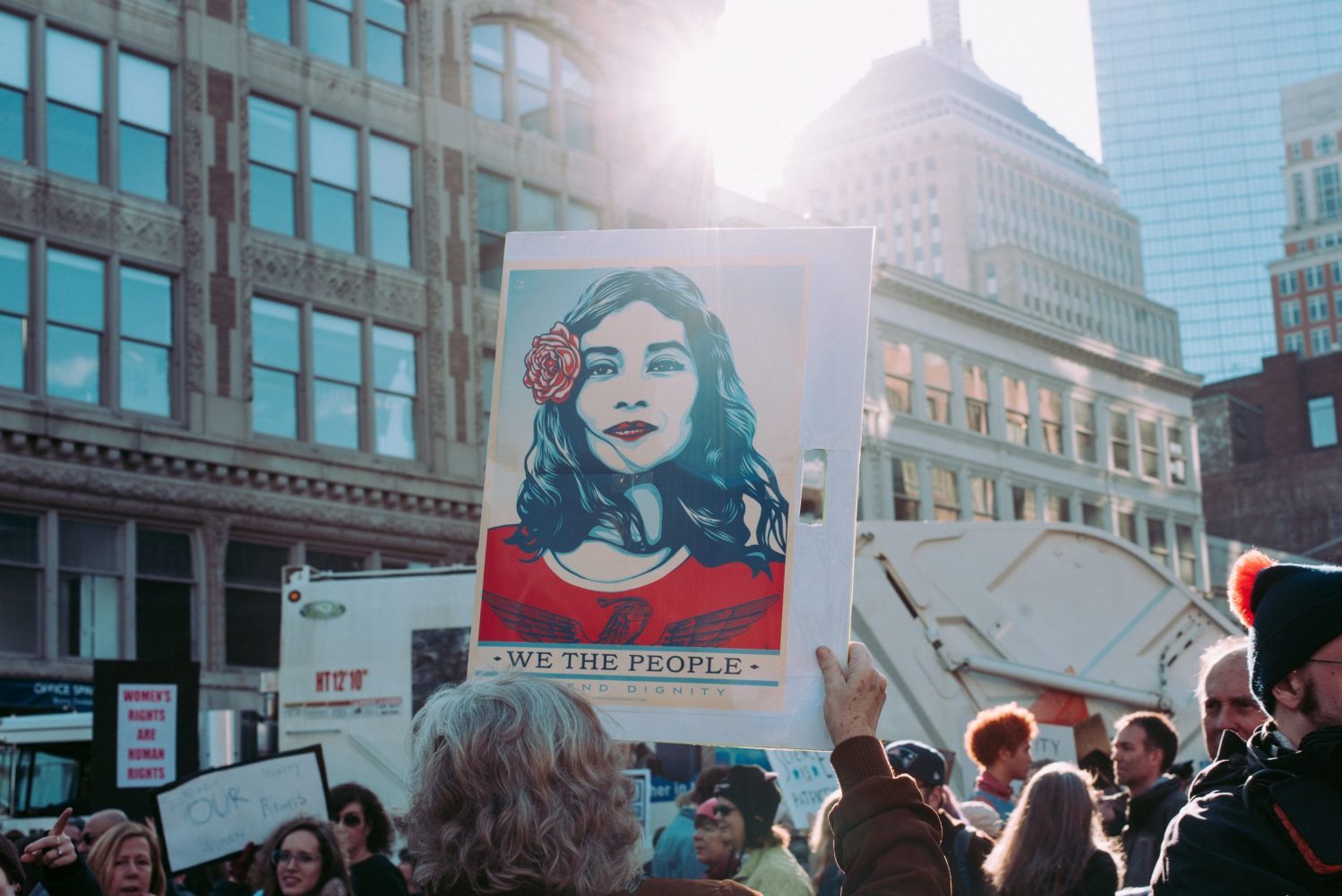
I’m writing this before knowing the results of the American election—and depending on how long things take, you may be reading it before knowing the results, too. But in the midst (or, hopefully, towards the end) of a season of unprecedented uncertainty, there’s one thing we can say for sure: we will need courage, action, and resistance in the months and years to come, no matter who wins, no matter what else happens. Here are some of our favorite essays celebrating radical thought and action on and off the page.

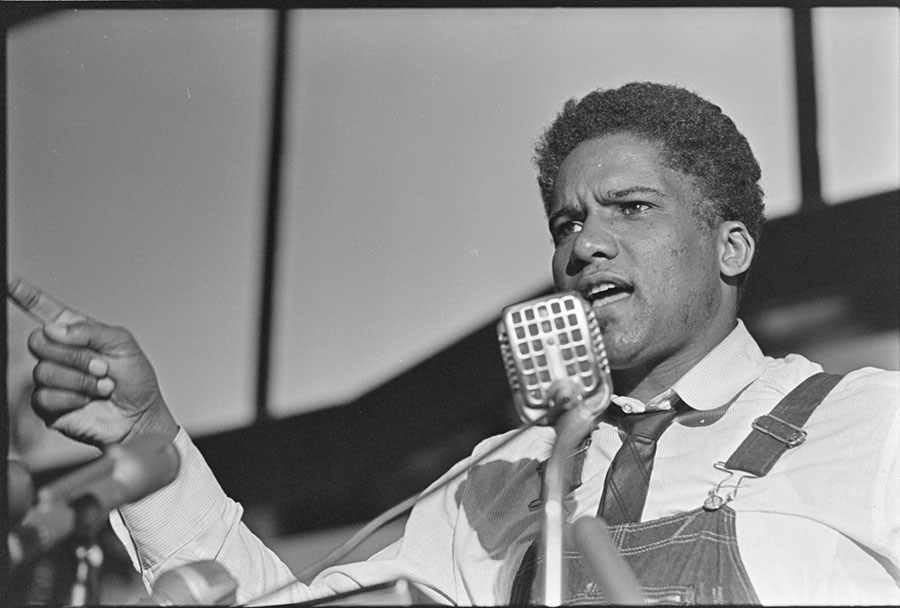
50 Years Later, the Demands of ‘The Black Manifesto’ Are Still Unmet” by Carla Bell

In a guerrilla address to the congregation of the Riverside Church in 1969, civil rights activist James Forman demanded that white Americans recognize and re-enfranchise the Black Americans they’d been exploiting for generations. People weren’t ready to hear it—and they’re still not, writes Carla Bell.

The Manifesto is symbolic of America’s accruing and compounding indebtedness to black people, a stolen people, who built the nation and its economy through generations of labor, whose blood is in the soil. 

Writing Behind My Country’s Back” by YZ Chin

The characters in YZ Chin’s Though I Get Home deal with censorship in Malaysia, but in this essay, Chin breaks down what that censorship meant to her personally.

I have no exact memory of my first realization that I live in a censored world. It is hard to be aware that a thing you have never seen is missing. But I imagine it had something to do with watching choppy programs on state TV, and seeing one scene blink into a totally different one with no semblance of transition.

Czech Dissident Writers Can Teach Us How to Protect Language from Lies” by Erica Eisen

State control over communication doesn’t only take the form of censorship. Sometimes those in power break down language by reducing it to absurdity—say, by lying so flagrantly that words cease to carry meaning. Czech political dissidents had some experience in writing about this kind of collapse, writes Erica Eisen.

With the current global rise of the far right, when phrases like “post-truth” and “fake news” are uttered by pundits and plutocrats alike without so much as the bat of an eyelash, the literary investigations of writers from the Eastern Bloc can take on an eerie second life, like Cassandra’s prophecies recollected as Troy burns.

Oscar Wilde’s Gay Socialist Vision” by Arvind Dilawar

Do you think of Oscar Wilde as an aristocratic dandy? You’re not wrong—but, says Arvind Dilawar, he was also a committed libertarian socialist.

In libertarian socialism, Wilde not only saw the potential for his realization as an artist, but his liberation as a gay man.

The Poetry of Black Women Shows Us How to Move Forward” by Patricia Spears Jones

Change doesn’t just come from the strength to fight—it comes from the compassion and vision to see a way forward, says poet Patricia Spears Jones in her closing address from the 2019 LitTAP conference.

If a new world is coming, then let us use our power to shape it and the privilege to leave those forms to those who follow. As we take the outrage, the anguish and the joy, that these and other revolutionary poets have given us. This has been your time to feast on the power of language and the people who make best use of it. It is a privilege to engage with this world in thoughtful, ethical and caring ways.

How Austrian Literature Taught Me to Stop Worrying and Hate America” by Jeffrey Arlo Brown

If your country has done terrible things, shouldn’t you have the guts to call it terrible? Jeffrey Arlo Brown admires Austrian writers who treat their country’s Nazi past with frank disgust.

I’ve been immersing myself in Austrian literature while watching America’s shift to the far right. The artists’ anger makes a different kind of sense to me now. In recent years, as America lurches from black sites and torture to drone strikes on civilians to the abuse of Central American children, I find the relentless negativity of Austrian literature consoling. At least it’s honest. The terrible truth is better than a balanced lie.

The Children of Latinx Immigrants Need a New American Dream” by Ruby Mora

In this essay, Ruby Mora explores what how the American Dream has failed the children of Latinx immigrants, while she reads My Time Among the Whites by Jennine Capó Crucet.

For her, and other immigrants of her generation, that’s what the American Dream meant: financial stability, no stress, the ability to provide for her family. But for the first-generation children of these true believers, it’s becoming clear that the dream is more complicated.

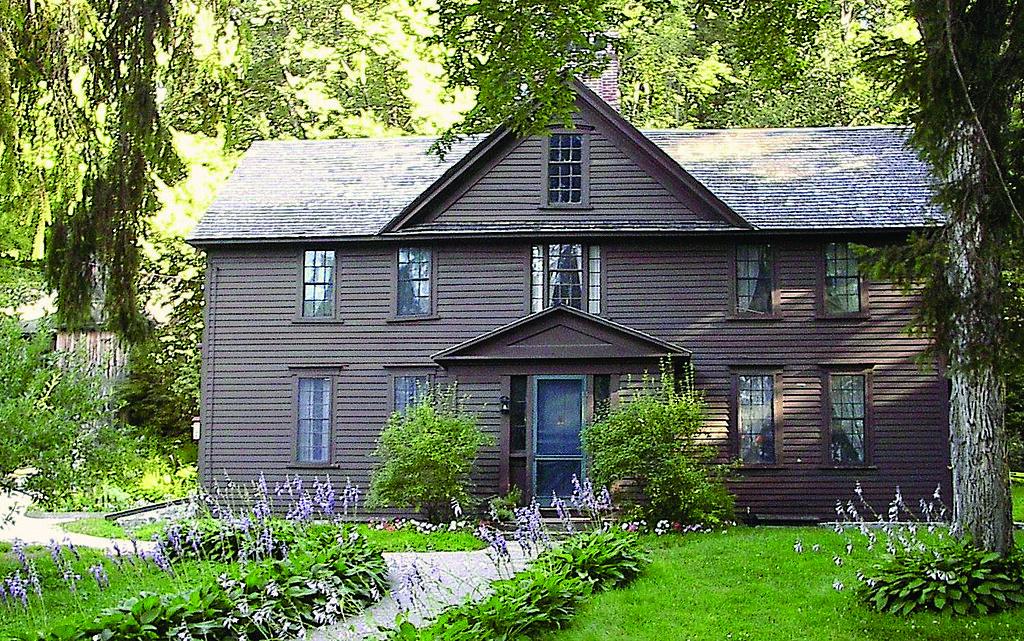
Orchard House. (Photo by Smart Destinations)

The Politically Radical Family That Inspired ‘Little Women’” by Rebecca Long

Louisa May Alcott created one of literature’s best-known families—but the family that created her was no less remarkable. Rebecca Long takes the reader on a tour through Orchard House, birthplace of Louisa’s books and her parents’ revolutionary ideas.

Bronson was a teacher, philosopher, educational reformer, and failed-utopian-commune founder; he was the first educator in Boston to admit a Black student into his class, and we have him to thank for inventing recess. Abigail was one of the first paid social workers in Massachusetts, as well as a passionate suffragist. Both were Christians, transcendentalists, abolitionists, women’s rights advocates, and vegetarians; it was with these beliefs that Bronson and Abigail raised their four daughters, affording them much more freedom and agency than young women at the time were generally given.

The Words That Will Bring Us Through the Chaos” by Michelle Chikaonda

Reading Octavia E. Butler’s Bloodchild and Other Stories got Michelle Chikaonda through her father’s death. During a summer of protests in Philadelphia, she realizes that the story “Speech Sounds” has more to teach her about what it means to be heard.

In these protests it is not that people have finally spoken: some of them have, certainly, but most have been speaking for a long time, and some for their whole lives. It is that this particular death—which happened in the eye of an unprecedented countrywide shutdown for which the entire country was brought to a standstill, and in that national silence was forced to finally see truth—shattered the comprehension barrier between speakers and their willfully unhearing audience.

The Antifascist Message Hidden in This Greek Coming-of-Age Novel” by Niko Maragos

Three Summers looks like a conspicuously apolitical novel, the story of teenage sisters growing up in the suburbs of Athens in the mid-1930s. But in fact, says Niko Maragos, the novel puts bourgeois complacency in the crosshairs.

Yes, this book is a chronicle of both a girl’s coming of age and an artist’s development. But in the context of post-war Greece, such a book was political. Beyond being an Arcadian withdrawal to better times, Three Summers is a bittersweet indictment of a culture’s reluctance to confront its own pathologies—and each individual’s complicity in it. 

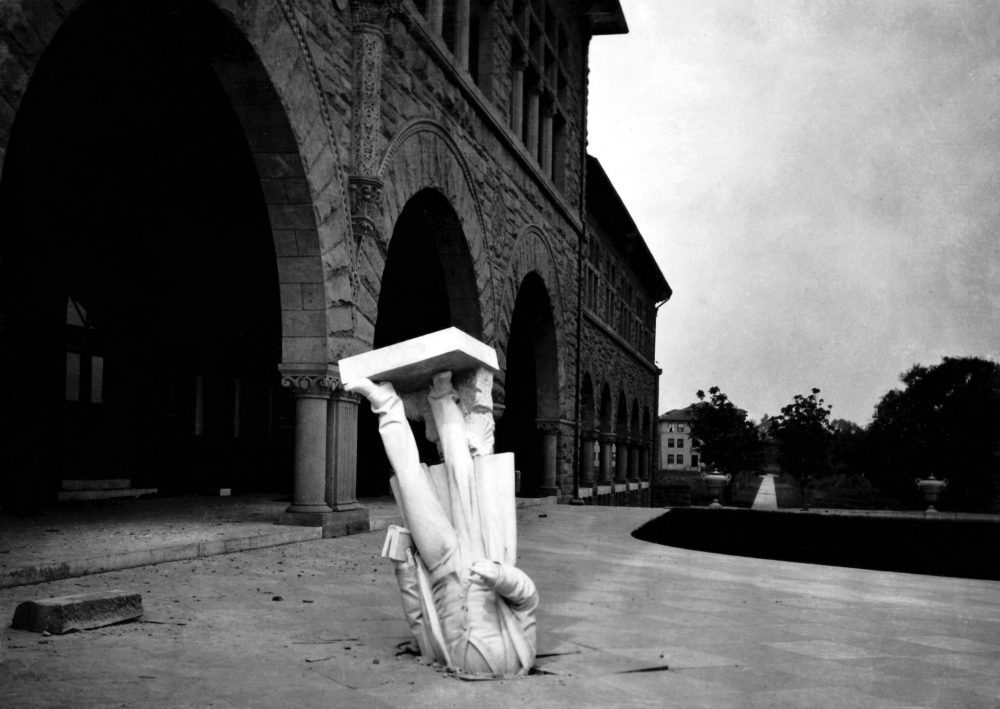
Confederate Statues are History — So is Taking Them Down” by Rebekkah Rubin

Does toppling a confederate statue mean destroying history—or creating it? Historian Rebekkah Rubin talks about how we can read and, crucially, revise the statues and their place in our communities.

Statues can tell us how the past was remembered by some, but they don’t tell us that the statue was privately funded by a few supporters. They don’t tell us about those who resisted and opposed the building of the statues. A statue only tells part of the story, amplifying the voices of the few.

Our Favorite Essays and Stories About Comforting Things

There are some days when nothing’s really going to fix your anxiety. Still, minor indulgences and self-soothing mechanisms can at least help. Here are some of our favorite Electric Literature pieces celebrating the ways we make ourselves feel better—or at least less worse—for a little while.

Cooking and eating

Learning to Cook for One” by Gina Mei

It’s hard to cook for yourself. It’s probably never been harder—unless you’ve gone through a period of intense personal grief, as Gina Mei did. Here, she writes about the book that taught her to feed herself again—but if you need to just shove bread in your mouth over the sink, we won’t judge.

We rarely discuss the less sexy side of self-care: cleaning your apartment, drinking enough water, remembering to shower. At a time when self-care has been marketed as a luxury and a commodity, the act of feeding yourself is, comparatively, less exciting. But it doesn’t have to be — and as far as self-care goes, cooking for one just might be the most accessible starting point.

This Cookbook from 1942 Is a Textbook for Making a Better World” by Abby Walthausen

M.F.K. Fisher’s How to Cook a Wolf is more than a cooking manual, says Abby Walthausen. It’s a crash course in conservation, a handbook for how to survive and even thrive under conditions of scarcity and crisis. That’s something we may need sooner rather than later.

Though the book takes its title from the idea of fending off hunger or “the wolf at the door,” the wolf is whimsical and comic enough that we know it to be written by someone privileged enough to have avoided true hunger. But it serves a purpose here, a nemesis keeping the writer (and the chef) on her toes. It is just as much about the threat of scarcity as it is about the internal drive of appetite.

Weed

Photo by Donn Gabriel Baleva on Unsplash

Pineapple Crush” by Etgar Keret

Etgar Keret’s short stories are always a little trippy, and this one centers on the pleasures of getting high. “His voice is infused with dark humor, and his wry observations charmed me even as I despaired at his actions,” writes Helen Phillips, recommending the story for Recommended Reading.

The first hit of the day is like a childhood friend, a first love, a commercial for life. But it’s different from life itself, which is something that, if I could have, I would have returned to the store ages ago. In the commercial it’s made-to-order, all inclusive, finger-licking, carefree living. After that first one, more hits will come along to help you soften reality and make the day tolerable, but they won’t feel the same.

Revisiting YA fantasy novels

There Has Never Been a Better Time to Read Ursula Le Guin’s ‘Earthsea’ Books” by Juan Michael Porter II

Ursula K. Le Guin has always been pretty prescient, and Juan Michael Porter II argues that this summer’s social justice uprisings make the perfect backdrop for her Earthsea series.

To white protestors and accomplices, who say that they want to listen but are fearful of giving up some power so that we can all heal, I suggest you read the Earthsea cycle. You will need to learn to step away from the center to build a new world, and the Black majority in this fantasy series offers a better model than any white history. I encourage Black people to read Earthsea too, if only to remind yourselves that once upon a time a white woman in Portland saw us, recognized us as beautiful, and built an entire world where we had the privilege to decide that we could share our power.

How a Book Trilogy About Killing God Helped Restore My Faith” by Isabel Cole

Philip Pullman’s His Dark Materials trilogy highlights the dangers of dogmatic, cultish thinking, and encourages attacking and dethroning god. Isabel Cole talks about what that meant to her as a teen who had lost her faith.

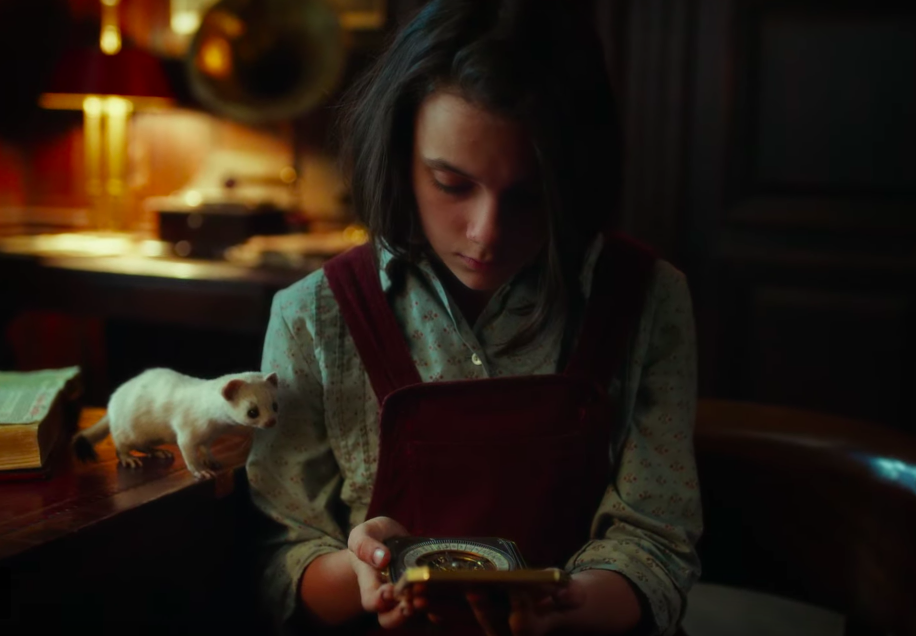
Lyra complements her talents by using a golden disc named the alethiometer, from a Greek word sometimes translated as “truth,” which answers honestly any question posed by one who can read its complex symbolic system. Will bears a knife which can cut not only any physical substance but the space between atoms that opens a door between dimensions. Taken as a pair, these fantastical items offer exactly what I was craving so desperately when I found them: a path to a deeper truth, and the sharpness it takes to undo your reality and leave the world you know behind.

Video games

How Playing ‘Myst’ Taught Me to Write Fiction” by Blair Hurley

There’s little more soothing than fully immersing yourself in the world of a video game—even if that world is a little spooky. Blair Hurley writes about what she learned from the dreamlike puzzle games Myst and Riven and their descendants.

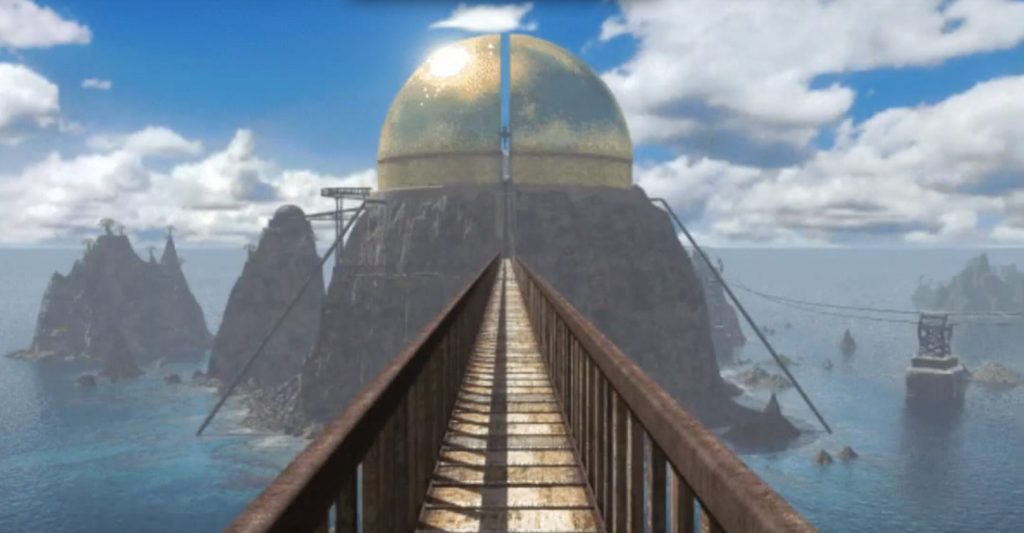
I felt myself entering a trance of discovery. Surely there were more secrets—locked rooms and hidden basement stairs, pathways through the cricket-keening forest, other houses that would open to my knock. I spent so many hours of my childhood in this quiet, thrilling discovery mode. The games were not at all the flashing lights and shoot-em-ups that non-gamers sometimes imagine. They were an escape, a place to explore the boundaries of a fictional world, a daydream.

Baking shows

A row of frosted cupcakes on a table against a pastel blue wall
Photo by Brooke Lark on Unsplash

Baking Shows Are Secretly Reality TV for Frustrated Writers” by Manuel Betancourt

What can Gourmet Makes teach us about the creative process? For Betancourt, it’s a lesson in loving the journey. For you, perhaps it’s just something to stare at glassy-eyed and not have to think about the future.

It’s a show that asks us to relish the process more than the final result. Even with all the roadblocks that the show depicts, its playful core offers a crucial reminder: no matter the anxieties that baking—or writing—may elicit, there’s value in the act of creation, no matter how improbable or impractical it may seem.

Everything I Know About Writing a Novel I Learned from Watching British People Bake” by Becky Mandelbaum

Yes, I know: people aren’t as into The Great British Baking Show this year. I agree but I don’t want to hear about it because with all its flaws this show is still the most soothing thing going. Watch old seasons if you have to. You might even learn something about writing, says Mandelbaum:

At the end of each challenge, they’re covered in flour and chocolate, their cooking areas a mess of dirtied spoons and orange peels. Then, one by one, they are forced to approach the judges bearing the fruits of their labors, vulnerable to ridicule and eager for praise. They then wait patiently as their superiors literally tear their creation into pieces before determining their worth as an artist. Whatever the contestants have baked, it’s the best they can do, and yet they understand that sometimes the best is still not enough.

Funny TV

Why the ‘Good Place’ Personality Test Is Better than the Myers-Briggs” by Sulagna Misra

Remember when everyone was trying to figure out which two characters from The Good Place they were? Let’s go back to that usage of social media, man. Sulagna Misra breaks it down for you—and shows why this semi-joking personality test is actually better than some “real” evaluations.

Because The Good Place is a show about bad people getting better, relating to a character means not only relating to her flaws but relating to her struggle. That’s not something that’s usually reflected in personality tests, which purport to tell you who you are, not who you’re trying to be. But lots of people struggle to be good, and it’s the struggle that defines them. They don’t necessarily identify with good or evil, but with trying and failing. They understand morality is important, but to actually aim to be moral all the time is daunting at best, paralyzing at worst.

Soothing podcasts

Could a Daily Poetry Podcast Save Your Mental Health?” by Eric Silver

Poet laureate Tracy K. Smith’s podcast The Slowdown aims for exactly that: a moment of slowdown, in the form of a poem. And it might be the best thing you can do for your brain.

By taking time to do one thing for five minutes, we can reorient our brains to focus on one thing for a little while. There is mounting evidence that mindfulness and meditative thinking — let’s say, about one topic or feeling, like in a short poem — can contribute to future health and mental state. And a few minutes is all you need.

Pizza

An excerpt from Pizza Girl by Jean Kyoung Frazier

Sometimes only the exact junk food you want will make you happy. Sometimes that’s pickle and pepperoni pizza. “Frazier’s prose is full of gleeful dark humor and wry observations, and this novel is like the moody rollercoaster of adolescence itself,” writes Kimberly King Parsons in her recommendation.

They looked at each other, shrugged, and started pulling the dough. I chopped a couple pickles into uneven slices and wedged myself between the cooks, sprinkled the pickles over the sauce, cheese, and meat. I told myself that it only looked off because it was raw, but the cooks didn’t seem to know what to make of it either. 

Dogs being fine

Books Where the Dog Dies, Rewritten So the Dog Doesn’t Die” by Riane Konc

Riane Konc has finally made it safe to read Old Yeller and Where the Red Fern Grows. This may still make you cry, but with relief. At least something can be fixed!

The big cat hissed, and my dogs howled. I strained my eyes to see higher in the tree, gauging our danger. The mountain lion and I locked eyes. She kept her eyes locked on mine while she slowly reached her paw across the branch, farther than I would have thought she could have reached, and while still staring directly at me, batted a full glass of water off the branch of the tree. It crashed to the ground next to me, right where a red fern was growing.

Hiding in the bathroom

We’re All Living in the Bathroom Now” by Annabel Paulsen

The early days of lockdown reminded Paulsen of Jean-Philippe Toussaint’s first novel The Bathroom, in which the narrator moves permanently into the smallest room in his house. The novel helped her make sense of the feeling of stasis—and now, moving into the bathroom honestly sounds pretty good.

The novel presses on the illusion that life gets you somewhere—and behind it we find the reality that life leads only to death, that existence eventually hits up against its opposite. We move like raindrops, hurtling toward the ground, and end in immobility. Whatever meaning exists is our own creation, and we can choose whether or not to worship it.

Can You Care for Others Without Destroying Yourself?

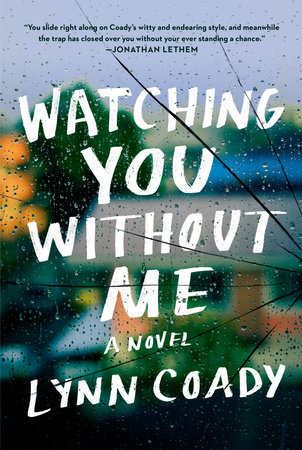
Women providing care––and the ways in which care can be made murky by expectations related to gender, religion, and tied unfairly at times to a means of proving love—is a significant theme in Lynn Coady’s latest novel, Watching You Without Me.

Watching You Without Me by Lynn Coady

After Karen’s mother Irene passes away, Karen returns to her childhood home in order to process the complicated relationship she had with her mother, sift through the detritus of her former life, and make decisions about how best to support her sister Kelli, who is disabled. These reckonings lead to questions, both for Karen and the reader: How much can –– and should –– we care for others without losing ourselves in the process? What happens when caregivers burn out? What lines can and should exist between caregivers and the people they care for, and what harms are caused when these lines are blurred? 

In our current climate, one in which women are shouldering childcare duties while also attempting to maintain work (spoiler: it’s impossible), and parents are being told they are no longer allowed to care for children at home while they work (a policy arguably disproportionately affecting women), Coady’s book, one unapologetically written about women’s lives, for women, serves both as a balm and guide. And while the characters do grapple with significant issues related to self-preservation and complicated familial relationships, there’s also a compelling note of tension that rises to crescendo, rendering this a deliciously layered read.

Over the phone, I spoke with Lynn Coady about the link between gender and guilt, the significance of writing for women, care as a practice, and the ways in which silence can be insidious. 


Jacqueline Alnes: A big theme in the novel is caregiving. Care as a practice often seems gendered, at least historically, and the women in this book struggle with feelings of guilt when they choose to ensure their own wellbeing over providing for others. What was important to you when writing about care? 

Lynn Coady: I wanted to underscore the generational difference between Karen and Irene. They are only one generation removed, but there is this influx of feminist thought that has taken place and it has opened up a huge chasm. In a way, Irene is a woman with one foot in the past—in women’s pasts, with all of the stereotypes, misogyny, and circumscribed roles that that implied—whereas Karen is a person with her foot in the future. Karen is a product of feminism and a supposedly more progressive society. 

I think the crucial difference between them, if I were to boil it down to one idea, is Irene comes from a generation that thinks it’s one hundred percent good for a woman to completely devote her life to the care of others as opposed Karen’s generation, which believes in a woman needing balance in her life, a woman looking out for herself first. 

JA: There is an interesting line that links Irene’s caregiving to faith:

It was like faith. It was exactly like faith in that you had to stop futzing around and let it take you over…it was a small world, a circumscribed world, but it was your world and you did what you could to make it beautiful.

There is a thread of religion throughout, and ideas of martyrdom. Religion also seems to offer a way for the characters to find beauty. How do you see religion or faith and caregiving intersecting?

LC: Catholicism is such a significant influence on Irene’s thinking. She comes from a very sexist world but also a Catholic tradition, which really teaches women the best thing they can do is to devote themselves to the care of others. Irene, as many women do, believed she could get a sense of purpose and satisfaction through care. 

JA: That makes a lot of sense. One other scene related to religion is one where Irene wants to join choir but she is in the front row with her two daughters so she is viscerally stuck; she can’t get up to sing because she can’t leave them. I felt like it was such an interesting metaphor for voicelessness or the constraints of motherhood. 

LC: She’s stuck and she’s looking for ways to express herself that are allowed to her. She can tell herself that singing in the choir is another form of service. She’s participating in her church; she’s praising the Lord in song. Irene has the right to her own pleasure, but she doesn’t allow herself to go after what she wants unless she can justify it through the lens of what is good and holy. 
JA: Ah, I hadn’t considered it that way. You mention in the afterword that you researched a lot about caregiving and there’s a lot in the book where we learn about some of the faults within the system. What did you find while researching that interested you?

LC: I knew a bit about social services going into it because I had a student job with social services and children’s aid in Nova Scotia when I was in my 20s, and I knew that people will report other people if they think they’re not looking after their children, or if they think their elderly parents or dependents aren’t being cared for. But the big thing I learned was that these caregiving organizations didn’t have any kind of government regulation or oversight, and that blew my mind. 

JA: The lack of oversight almost makes Irene’s obsession with caring for Kelli herself more understandable. If the system is not regulated, then you don’t know who’s coming to care for your loved one.

LC: Yes. What happens with Karen—and I think this happens with a lot of people—is that if someone is struggling and social services are alerted, that can be really bad, but also it can be a point of finding help. When the social worker arrives, you realize that you have resources you can rely on. But entering into that system and negotiating that system and talking to various offices is daunting. 

JA: And learning the language of it too. 

LC: Exactly.

JA: If you don’t know what to ask for, how are you supposed to have the language for it?

LC: Yeah, and if you feel like there’s a threat of your loved one being taken away because you don’t know how to negotiate that system, that can be really intimidating. 

JA: In thinking about women and voices, there are quite a few scenes of women choosing to speak out or not and that affecting them in significant ways. In some instances in the novel, women protect other people with their silence. Society, in many ways, conditions women to be polite or quiet—what about that interests you?

I just said fuck it, I’m just going to write something for women. All about women. I don’t care if male readers are into it or not. 

LC: I think what interests me about it is the instinct of it. It’s a thing that we all have been taught—not overtly, but we have absorbed through osmosis our entire lives. As I was writing the book, I was interested in the way Karen instinctively negotiated Trevor, who is one of Kelli’s caregivers. It wasn’t something I sat down and intended necessarily, but I was just putting Karen in these situations where Trevor seems a little bit annoyed or Trevor seems a little bit disapproving or he was pushing her in some way or he was being a little bit hostile. Karen would always deke off to the side a little bit. She always had a move that was never overtly pushing back. Instead, she’d intuit what he needed to hear and she would do that. Karen is instinctively negotiating Trevor’s moods and his potential anger.

I think that’s something women do. I don’t know if this happens to you, but every once in a while I’ll be talking to a man who is in a position of authority and my voice will be high. I’m like, why did I pitch my voice to this level? What’s going on? And I realize I’m talking a couple octaves higher than I usually do. I realize I’m making myself smaller, in a way, or making my voice sound more innocent or softer.

JA: I start my orders at restaurants with “I’m sorry, could I have…” and my friends always remind me that I can just ask. I don’t have to apologize for asking for a drink.

LC: Right, you don’t have to apologize. 

JA: Within the book, there are allusions to future listeners. For example, Karen says she shakes her head “along with all the people I tell this story to.” There seems to be power there, in that Karen has survived this ordeal and can tell her narrative how she chooses. And of course, this exists within the larger frame of the novel, which is also a story being told. What, for you, is the power of story? 

LC: I’m always preoccupied with the question of why a given narrator is telling a story. I always find that I need to know before I write, even if it’s a third-person narrator. I need to have some rationale for why a particular story is being told by someone. What’s the subjectivity at play here? With Karen, I feel like what I wanted to get across was that she’s talking about a time in her life that was really difficult and where she made some of the biggest mistakes of her life. We get the sense that she has told and retold this story. It’s been a dinner party anecdote and something she’s talked about with friends and I’m sure she has a million versions of it—a really short one, a long one, one she tells potential lovers. 

I think ultimately she realizes that the reason she’s been telling this story over and over and over again is because she still hasn’t learned the lessons she should have learned, so this novel is her telling the story to herself. She’s going through it in ruthless detail and examines all of her flaws and misapprehensions and asks herself: should I hate myself for letting all that happen as much as I do?

When she gets to the end of that story, having told the story in this way has been a process of forgiving herself for that period of her life.

JA: Guilt comes up again. Her mother experiences guilt, she experiences guilt, and both of them for things that honestly they shouldn’t feel bad about. That also seems gendered. 

LC: Very much so. Guilt is huge. It is a gendered guilt. Karen learned from Irene that women are supposed to live a certain way and want certain things, and if they don’t look after their loved ones in the prescribed way, then they’re not doing womanhood right. Trevor comes along and completely underlines all that. He affirms that Karen isn’t doing womanhood right, and insinuates that she has let everyone down. He plays on all these subconscious fears that Karen has. It’s very gendered and it’s also Catholic at the same time.

JA: This novel contains so many smaller insidious moments that seem like they hold potential for violence or harm of some sort to happen. Was there something about our current climate that was an impetus for you to write this book?

LC: I started writing this book in 2016, so before #MeToo got started, but even then there was something in the air. A lot of my books before this have had male protagonists. I have always felt like my books have had a feminist perspective but I was being sly about it. It was fun to try to write these male characters in male worlds as a feminist; showing the effects of patriarchy on men is one of the things I like to do. But when I sat down to write this book, I just said fuck it, I’m just going to write something for women. All about women. Women at middle-age, when you sort of deal with all your shit and look at the shit you’ve been through. I just had the feeling that this book is about women. I don’t care if male readers are into it or not. 

JA: I thought you did such valuable work with Trevor in that aspect. After I read, I found myself going back to the beginning, at least in my mind, and remembering that he seemed so harmless. At the end, it escalates. Trevor obviously has issues, but he’s also part of this patriarchal society, and the ways he expresses himself, through anger, are the ways that men are often trained to express their emotions.

LC: I appreciate you saying that. People have said to me that as soon as you meet Trevor, you know something really bad is going to happen. I think he’s a little off from the start, but I’ve known so many men like Trevor who have the attitudes that they do and behave in harmful ways, but don’t become psycho stalkers. They are who they are. On some level, they are healthy, the way Trevor sometimes can be. Trevor wants to help and he’s kind of a goofball—in some ways, he’s a very typical guy.

JA: And he’s a caregiver, which is something that has not always been considered “masculine.” In the novel, Jessica brings up that Trevor caring for Kelli is strange because male caregivers often aren’t paired with female clients. 

LC: I thought it was interesting to think about how Trevor performs masculinity in this role—caregiver—that’s not coded as masculine. His way of caring for people is being pushy and bullying them. 

JA: Was there anything you read throughout this process that helped inform your process of writing? 

It takes decades for women to shake off all the bullshit social conditioning they get and start to feel like confident, competent human beings.

LC: I used an epigram from Alice Munro at the beginning of the book and I was reading a lot of her work at the time just because the way she writes about women’s lives is so inspiring. She does not give a shit. She writes what she wants to write. I posted a thing on Twitter recently, it was just a joke piece listing all the one-star reviews for Alice Munro on Amazon. They were hilarious because they were totally true. People were saying things like Ugh, it’s just a boring story about another Canadian woman’s life, or somebody else said that “nothing ever happens” in her stories. And it’s like yeah, that’s Alice Munro—she writes about “boring” women’s lives and they somehow feel so riveting and relevant and engaging. 

JA: That relates what you mentioned earlier, too, when you said something like, “fuck it, I’m going to write a book for women.” There are interesting things happening in domestic spheres and there are complicated things happening for women. 

LC: These stories are really human and crucial. It felt to me to write from the perspective of a middle-aged woman because, being at this age myself, I feel like it takes actual decades for women to shake off all the bullshit social conditioning they get and start to feel like confident, competent human beings who know their own minds and know their shit. But there’s always going to be a Trevor out there trying to undermine your confidence and make you feel small. At the same time, there’s also an element of disillusion that comes into play when you start to deeply understand how much of what you’ve been told and taught about yourself was garbage meant to keep you down. And it’s difficult to have to reckon, as Karen does, with the fact that you bought into all that garbage, and invested in it, for so much of your life.

What Do We Owe Our Community in a Time of Crisis?

In her first novel published in 14 years, author Julia Alvarez explores grief, isolation, and sisterhood.

Afterlife follows Antonia, a writer and retiring English professor, who has just lost her husband Sam. As she reimagines what her life will be without her husband, Antonia also struggles with considering who she wants to be in his absence, as he was often the one pushing her to be more open, more considerate, and more caring of others. She takes it upon herself to provide aid to Mario, an undocumented worker who works for her neighbor on a dairy farm in rural Vermont, so he can bring his pregnant girlfriend to live with him. On top of this, she must navigate her relationship with her three sisters who are both pushing her to be more social during this time of upheaval, but must also contend another blow when their sister Izzy goes missing. 

I recently spoke with Julia Alvarez about being an elder storyteller, not knowing what our new lives are going to be after the pandemic, and her creative protest project.


Leticia Urieta: Why was this the book you needed to write right now?

Julia Alvarez: By the time the book comes out there will be a time lag, so who knows what I would write right now. It has struck me how prescient the book is to the present situation. I felt like I was living in elegiac times even before this (the pandemic). We were seeing the extinction of species from climate change, whole coastal areas under water, terrible storms, gun violence in schools, violence against communities of color (which of course did not begin with George Floyd), divisiveness, draconian immigration laws; this felt like the end of so many things.

I come from a Latina family, my father is the youngest of 25 kids, so I grew up with a clan. I grew up with all of these storytellers and cuentos, with all of these other mothers and fathers, abuelitas, godmothers, and cousins. The bad part of this is that when a generation starts dying, you don’t just lose one uncle or your grandparents, you’re losing a whole phalanx of people. And so I felt that I was living in some kind of end time. For me, narrative is a way to navigate a situation using story and make meaning, not so much searching for answers but in understanding the questions that I am asking. This was also the first novel that I feel like I’ve written as an elder storyteller. I was no longer interested in repeating things I knew how to do; I could tell a certain kind of story at different points of my life. Writing is a calling for me, and I had to understand this period in my life as an elder and to integrate it to create a character that was as complex as this stage of life asks of us. I was asking myself as an elder storyteller, “what are the stories left in me to tell before I go?” 

LU: I appreciate that because I know that when a book comes out is not necessarily when it began for you. 

JA: It’s interesting because this book is about a character who we meet when her life has just come completely apart. Everything that she had put together was secure, she had her way of life and her certainties, and we meet her just as everything comes apart. And that is what it feels like has happened to us in the last few months—a way of life that we knew is over and we don’t yet know what our new lives are going to be like, and neither does Antonia.   

LU: Would this book look different if you had written it in quarantine?

JA: We really are living in a mythic time. I know a lot of writer friends who are getting down on themselves for not being productive and I tell them, be gentle with yourself. Let this moment not be lost on us. We need to be present to it. The novels after the Vietnam war came a decade later because people needed time to write about it successfully. My neighbors were farmers and they were acutely aware of the weather, and I do think that writers and artists have an attunement to the zeitgeist and to what is out there that is present but yet unnamed and beyond the borders of our words. They pick it up and it finds its way into the work. 

A way of life that we knew is over and we don’t yet know what our new lives are going to be like.

I have friends who have books coming out that they wrote a year ago and are realizing how their work speaks to this moment. But then I also think that the best writing can be picked up and understood at any time. Czesław Miłosz was asked if he was a political poet, and he said that it isn’t that you have to write to address a particular political issue or paradigm, but that writers cannot think below a certain level of awareness of their times, or the work they make is not useful to us. I’ve started to keep a journal again after a long time for this reason. A journal allows for that scatteredness of recording luminous pieces to connect these pieces. 

LU: There is a line towards the beginning of the book where Antonia thinks about grief: ”The landscape of grief is not very inviting.” Antonia is living in the isolation of grief but is also not afforded the peace of this isolation because of her familial obligations. Right now, we are all searching for a way to connect and create in a time of extreme disconnection and extreme grief. And even though Antonio is not living in our current situation, like you said, she is experiencing that upheaval.

JA: One thing that I found challenging with this narrative was asking, how do we live in a broken time and not shut down? How do we keep faith in the people we’ve loved and the things that we believe in? How do you give them an afterlife when the life that grew them is over?

I have said about this book that it is a spin on the Book of Job story with a sense of humor, because everything hits Antonia all at once. By that I mean, how can you have a Latina woman with three sisters in full manic mode, and not have humor in it? Instead of a biblical patriarch, we have a Latina sisterhood. Many times I think of my novels as having a soundtrack and for me the song for this novel was Leonard Cohen’s song (“Anthem”) when he says “There is a crack, a crack in everything, that’s how the light gets in.” That is a feeling I was trying to embody. People say that when you read a book that you are changed by it, but I think that when you write a book, you are changed by it too. This book was the hard work I was doing that prepared me, as much as we can be prepared for this moment.

LU: Do you carry the voices and stories of people you have lost that inform who you are now? 

How do we live in a broken time and not shut down? How do we keep faith in the people we’ve loved and the things that we believe in?

JA: Definitely. The cultura I come from contains a lot of connections to your antepasados. They are always present and a part of you. You are not just an “I,” you’re a “we.” Sometimes I say something and I think, oh my abuelita would have said that, I must be channeling her. There is always a sense that you are not just a single bead, you are a part of the entire necklace of the generations. When you get to my age at 70, you’ve already died a lot of little deaths. You’ve died from being a ten-year-old, you died when you lost certain certainties, you died when you didn’t realize your dream of being a dancer. When I started losing loved ones as I got older, I struggled not just with losing that person but what they brought into the world. And I thought, the only way to not lose someone completely is to give them an afterlife inside yourself. That is why the title for this book meant so much to me. The thing that I wanted to emphasize is that if you remain open and don’t shut down, there are afterlives after the specific life that you imagined is over. 
LU: I would argue that you are a part of this too, as an elder, but I like to call them “creative ancestors,” and I love the idea of honoring the people that inform us and speak to us over time. 

JA: Right! We just lost Rudolfo Anaya, who was really a literary grandfather. Sometimes we don’t even know whose shoulders we have stood on but we have ancestors who have helped us. 

LU: I appreciated that Antonia’s character, as an English professor who is also bilingual, is often preoccupied with finding the right words to name her experiences. Why did this feel important for her as a character navigating grief, to name things in her particular way? 

JA: It’s interesting because I have two sisters who are therapists and one of them worked with refugees from Central America in the ’70s and ’80s who had witnessed horrible things and were traumatized. She started a Latino practice because she found that a lot of therapy was Eurocentric. She informs one of the characters in the novel, Izzy. But one of the things that she told me is that some of her patients were so traumatized that they came in and were wordless. And she said that she knew that they were beginning to heal when they could tell the stories of what happened to them. The testimonio is part of our Latin American tradition, that after something horrible happens, the story must be told. At first, grief takes all of your words. Once you find the right words, you can communicate and feel less alone and can return to community and love.   

LU: One of the things that Antonia struggles with most in the book is her feeling of responsibility: to her sisters, to Mario, and to other undocumented people in need while also navigating her own needs in grief. This is a struggle that I think many people have, especially in the U.S. capitalist system where people are encouraged to take what they can for themselves, while others, who have had to struggle the most, see the need to aid others. Antonia is a Domincan woman who is working with undocumented immigrants who are Mexican and Central American. 

Was there a solidarity that you were hoping to capture among Latinos or in the immigrant experience?

What are the stories left in me to tell before I go?

JA: There is a sense of responsibility to your community if you have any measure of success. To quote Toni Morrison, “the function of freedom is to free someone else.” If you have had that privilege, and often luck, there is that need to pay it back, but you can’t pay it back, you can only pay it forward. When you come from these communities, there is a kind of bond because you can’t forget that that was you. It’s why I wrote about the Mirabal sisters because I felt like my sisters and I were the lucky ones who got out, and here were the Mirabal sisters who did not get out, who were slaughtered. It was part of my work to tell that story. And for those people that believe that “I’ve got mine” mentality, well, hello virus! No one is going to survive unless we take care of each other. Viruses know no borders, no desperation, no indignation and frustration. It behooves people who believe that they can stay in their gated communities of privilege and power to understand that that ain’t the way it works. If everything is falling apart, can we find a way to put it back together in a way that is just? Rebecca Solnit writes, “out of the word emergency comes the word ‘emerge.’” 

LU: Absolutely. That speaks to the interconnectedness, that grief comes for all of us. There are certain things you can’t protect yourself from no matter how much power and privilege you have. 

JA: Yes, and we have to push against our own borders and our own walls. 

LU: I wondered how your view of sisterhood and connection looks different now as you are in a different place in your life than how you have written about it in your previous novels? 

JA: One of the reasons that I wrote How the Garcia Girls Lost Their Accents is because there weren’t those books on the shelves and I wrote those books for myself and my sisters to understand the world from our points of view. One of the reasons that I wanted to write this novel is because I was longing for more work about an elder, and an elder Latina that is not just an abuelita or a wise old woman or other stereotypes or cliches like that. And I wanted to explore sisterhood as an adult where the sisters no longer live in a nuclear family and sometimes have very divergent lives from each other and who may have had horrible conflicts and don’t always talk with one another. I am interested in the sisterhood that comes with blood, but also the sisterhood of women. I was interested in exploring how women come together and nurture each other. 

As a matter of fact, one of the projects that I started with some of my friends and other women artists is inspired by my love of Scherezade from One Thousand and One Nights, who survived by telling stories. It’s not often highlighted that she asks if she can bring her sister Dunyazad, who is the one who sets up the whole trick. It’s always inspiring to think about women who are storytellers who tell stories to help other women. We are actually starting a project where one woman artist will perform in front of the White House from July until the November election as a creative protest in front of “the Sultan’s palace.” This has had to change to become virtual performances, but I am excited by all of the wonderful poets, writers, dancers, and artists who have signed up to perform in a creative sisterhood. The arts have the power to nurture our souls and have the power to save us as a people. 

Each Day Is the Same Backward and Forward

Day Eighty-four

I put a palindrome above the sink in the bathroom: Madam I’m Adam, on a piece of white paper, taped to the wall. To entertain the children, who are home all the time now. Who are bored. I put it up and felt like fun mom for a short time and then later, experienced the patience drain out of me around 3pm, like it just left my body all at once, like a liquid exit, like my body is a shotgunned beer and someone just drank me and my patience down. It is like that with me: not a slow ebb, but a sudden sharp emptying. I snap at both children. I have that edge to my voice that I hate hearing in other people. My voice tainting the room’s mood, the kids going to the other room to get a break from me.  Later, I am a bit better, maybe food helped, or a little time on email of all things, just that small package of quiet time deleting email after email, and my son sees the palindrome sign and is delighted. “It’s that thing!” he says, pacing back and forth, trying to remember. “What is it called, when it’s the same letters back and forth?” My husband, sitting and looking at his phone in the living room, tells him it’s called a pandemic. We are all so tired. My son comes back into the bathroom, where I am now washing my hands after unpacking some groceries, and there’s a bubble of good-natured confusion in his voice when he says, “is it a pandemic when the words are the same backwards and forwards?” I start laughing even though I don’t want to confuse him more, but something about it fits, seems true, and I say, “Daddy’s just messing with you,” and even our son can tell something doesn’t sound quite right but by then I can’t spit out the real word and we are both laughing and laughing, clutching our stomachs, my son rolling into the towel hanging from the rack to catch his breath even though he’s still not totally sure which of these two long p words is for what, my daughter hearing and coming into the room laughing, what? what? their dad coming over, and laughing, all of us releasing something together for a moment, our daughter saying, my tummy hurts, my tummy hurts! the glorious tumbling laughter of children, and then our son says, “wait, what is a pandemic anyway?’ which I’m sure we’ve explained, but how to make sense of it anyway, and for a short second before the definitions descend the word isn’t anything scary at all.

Female Ghosts and Spirits from Japanese Folklore, Ranked

Translated by Polly Barton

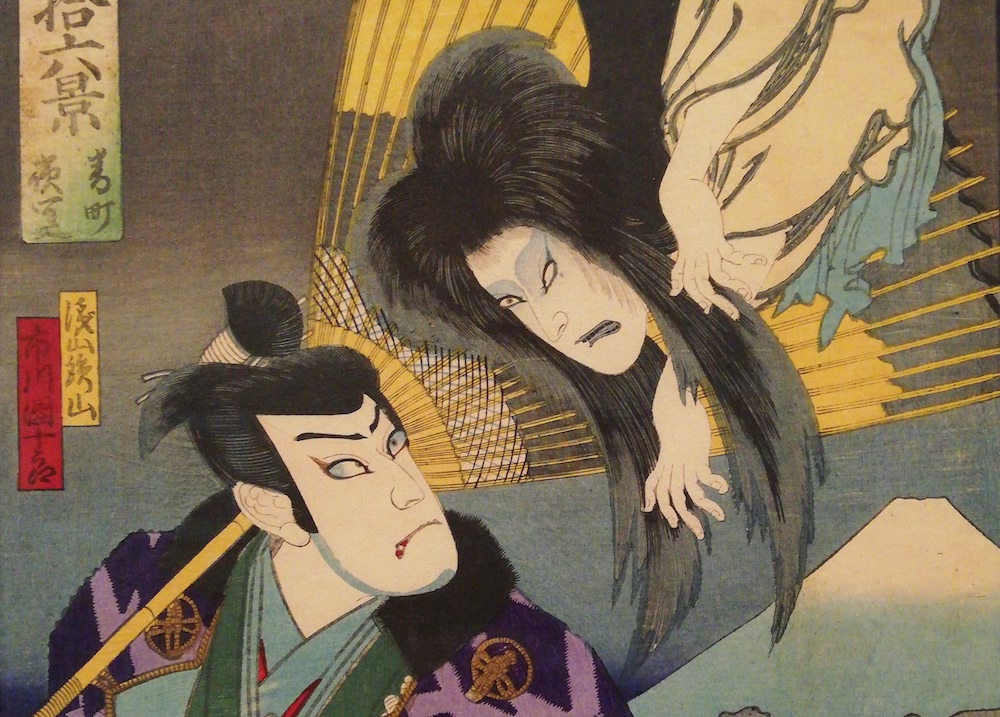
Japanese folktales and tales of yore are riddled with female ghosts and spirits, and I’ve been fascinated by them since childhood.

Into adulthood, it occurred to me that what draws me to these female spirits is the way that they expose the true nature of people leading a regular lives in society, which they’ve grown accustomed to hiding without a second thought. I asked myself why it was that I liked female spirits more than the male ones. I suppose that being a woman myself had something to do with it, but there was more to it than that: the female ghosts and spirits seemed to me simply more interesting, more full of character. Female spirits deviated wildly from the way that women are demanded to be by Japanese social norms, and it was that discrepancy that attracted me. As well as a sense of surprise at how unusual they seemed, they generated in me a feeling of familiarity—as if what they were portraying was a part of myself as well. Maybe I had a wild lady inside myself, maybe I myself was a wild lady as well—these thoughts brought with them all the joy of a revelation. It also made me think afresh about Japanese women, myself included, who, so long as they don’t die or assume an entirely different form, remain unable to reveal their true natures. 

Folktales and tales of yore have lots of geographical variations, and can undergo further changes when they’re set down in certain versions by particular artists. The versions of the tales I’m relating here are the ones that I read and heard when I was growing up. Also, admitting this may get me in trouble with the experts, but I don’t make any strict distinctions between ghosts, monsters, yokai and so on—I tend to think of them all as kinds of wild ladies. 

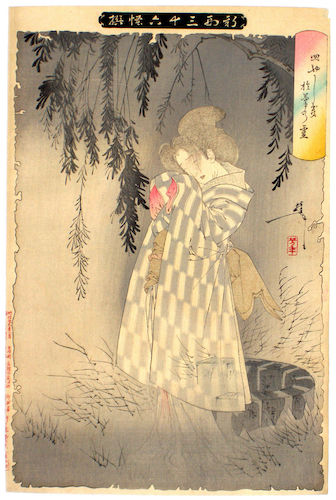
Okiku (painting by Tsukioka Yoshitoshi)

1. Okiku

Like the character of Kikue in Where the Wild Ladies Are, I grew up in the city of Himeji, where Himeji Castle is located. On school field-trips or when relatives came to visit, I would go up to the castle, and there, inside its grounds, stood the Okiku Well.

After becoming dragged into plotting of the men around her, Okiku is falsely accused of the loss of one of the house’s treasured set of ten plates, and eventually killed and thrown into a well. As a ghost, she emerges from the well each night, looking terrifying, and forever counting the plates: “One, two…” Getting to 9, she then exclaims, “Ah, there really is one missing!” But knowing her own innocence, she begins to counts again. For those who conspired to her take down, this spectacle must serve as a harrowing reminder of their deeds. As superpowers go, becoming a ghost and counting plates may seem relatively tame, but there’s something about this simplicity that conveys the depths of Okiku’s resentment. Living in a mansion echoing with the sounds of Okiku’s counting and the smashing of plates, those who destroyed her are drawn ineluctably to a bad end themselves, as if being swallowed up by the grotesquery they created.  

As superpowers go, counting plates may seem relatively tame, but there’s something about this simplicity that conveys the depths of Okiku’s resentment.

In Japan, the season for telling ghost stories is summer, so that’s when TV adaptations of ghost stories are shown. Watching the TV adaptation of Okiku’s story as a child, and seeing the Okiku Well which really existed in the city where I lived being presented on TV as something fictional gave me the strangest sensation, like reality and fantasy had collided. It also made me feel very proud of Okiku. While writing WTWLA a few years ago, I visited Himeji Castle for the first time in over a decade, and saw the Okiku Well again. Recently restored, Himeji Castle seemed to me unnaturally white, but the Okiku Well looked to me just as it always had done. While there, I caught sight of a young boy visiting with his mother, looking into the well and imitating Okiku’s voice counting the plates: “One, two, three…” It strikes me as truly great that even into the 21st century, Okiku’s legacy lives on in that region. 

Okiku planted inside me the awareness that horror is all around us in our every day lives—that it isn’t only scary, but also can generate feelings of familiarity and even strength. Of all the ghosts living inside me, she’s always number one. 

Cover of an out-of-print bilingual edition of Tenshu Monogatari

2. Osakabehime

As an adult, I discovered the existence of another wild lady in Himeji Castle: Osakabehime, a yokai who resides in the castle keep. In fact, there’s a small shrine in there dedicated to her. She also appears in Izumi Kyōka’s play Tenshu Monogatari [The Story of the Castle Keep]. She is waited on by a fleet of retainers, also spirits like herself, and is at loggerheads with the “world below” i.e. the world of humanity. She is self-possessed, cruel, and powerful. 

In The Story of the Castle Keep, Zushonosuke is a human figure able to come and go between the two worlds, ascending to castle keep. Eventually he chooses the world inhabited by Osakabehime. Osakabehime has a sister called Kamehime, and the two of them take it in turns to visit one another in the castles that they inhabit. It recently occurred to me that they have a relationship a bit like Virginia Woolf and Vanessa Bell going between Monk’s House and Charleston. 

Looking down from the Himeji Castle Keep, you see the Okiku Well directly below. It seemed like Okiku and Okabehime couldn’t have not known about one another’s existence, so in writing WTWLA, I decided to include a story depicting a loose sisterly bond between the two of them. With wild ladies both above and below, I can’t help but thinking that Himeji Castle really is a special place… 

Kuwazu nyobo

3. Kuwazu Nyobo [The Wife with a Small Appetite]

Japanese folk tales and ghost stories feature many female spirits. Taking on human form as they do, these spirits are very well informed about the nature of the ideal Japanese woman: she must be beautiful, quiet, perceptive, hard working, and devoted to her husband. The people around this “ideal woman” exploit these characteristics to take advantage of and deceive her. And yet, when the truth is outed and the spirit shows her true form, it transpires that she is nothing like the ideal woman whatsoever. After revealing themselves in their entirety, the female spirits make a lunge for the humans with fangs bared. 

People speak about this true form as terrifying (and sometimes, as a kind of terror unique to women) but if that was all that it was, these stories wouldn’t elicit fascination in the way that they do. People want to see more of these women’s true selves. We learned long, long ago from stories that there is always another side to this figure of the ideal woman. And yet, here in the real world, we continue to demand that women embody this ideal. I find this unbelievably stupid. Come on, we know already that’s impossible!

We learned long, long ago from stories that there is always another side to this figure of the ideal woman.

The kuwazu nyobo, or “the wife with a small appetite,” is a yokai with a second mouth at the side of her head. She appears to a man who goes around making the stingy-hearted and ridiculous claim, “If I take a wife, my food costs will increase, so I want a hard-working woman with a small appetite,” and the two promptly get married. The wife with a small appetite works hard and doesn’t eat a bite in front of her husband, so she appears to his selfish eyes as the ideal woman. And yet, rice and other ingredients keep disappearing from the house. Beginning to suspect that his wife is eating in secret, the man spies on her. He discovers that, when she thinks he’s not around, she cooks up a great load of rice, which she then forms into onigiri and tosses one after the next into the mouth at the side of her head. When the man announces that he wants a divorce, the woman reveals her true nature, and attempts to abduct the man. He narrowly escapes by hiding in a marsh where irises are growing, known for their power to ward off evil spirits. 

The great thing about the wife with a small appetite is the look of composure on her face, as the mouth at the side of her head gaily chomps away at vast quantities of food. I can fully empathize, and I’m pretty sure there are a lot of other people who can relate too. 

Yuki-onna, a spirit of cold areas similar to the tsurara-onna

4. Tsurara-onna [Icicle Woman]

This is a yokai who appears in the cold parts of the country in the winter when the icicles begin to form, and disappears when spring comes and things start to get warmer. She’s very pale and very beautiful. 

One night as a blizzard rages, a beautiful young woman appears at the house of a married couple, asking for a bed for the night, as the bad weather has meant she is unable to get home. The couple let the woman stay, but the blizzard drags on, and the woman ends up staying in their house for days. One night, they invite her to take a bath, but she refuses. The couple is insistent, though, so in the end the woman heads to the bathroom. She is in there so long that the married couple goes to check on her, only to find her gone. The only trace of her is the icicles hanging from the ceiling. 

Her story reminds us that anything at all can have a spirit.

In another story, a man becomes lovers with a beautiful woman, who appears as if from nowhere, and the two get married, but when spring arrives, the woman disappears. Believing that she’s run away, the man takes another wife, but when winter comes around again the woman returns, and angrily accuses the man, asking why he’s taken another wife. “Because you just disappeared!” replies the man! “Don’t bother to come back again!” At this, the woman transforms into an icicle that pierces the man’s chest, killing him. 

I like this second story. Seen through human eyes, the woman’s behavior seems selfish, but from her perspective, disappearing when spring comes is a matter of course, and so her accusation of her husband is deathly serious. That always seems tragic to me. And then, in the blink of an eye, she returns to her true self, and stabs the man she loves with her own body. This seems to me to represent the true nature of an icicle: simple, unwasteful and wonderful. 

She may not be as well known as the yuki-onna (snow woman), but there’s something about that little-knownness, and her overall sense of restraint of which attracts me to her. Her story reminds us that anything at all can have a spirit. 

From the 1979 anime adaptation of Taro the Dragon Boy

5. The Woman Who Became a Dragon

When I was younger, I adored Miyoko Matsutani’s book, Taro, the Dragon Boy. Matsutani drew inspiration for the story from a folktale where a young boy climbs on his dragon-mother’s back and razes a mountain so as to create land for farming. Matsutani’s book begins as Taro goes venturing up to the lake far to the north search of his mother, who has changed into a dragon. When he finally reaches her, she tells him the story of how she morphed into a dragon. 

Like Taro himself, she grew up on barren land not fit for farming grain. After losing her husband, she was forced to work throughout her pregnancy, accompanying the villagers who went to work in the mountains. While they were off laboring, she was asked to make their food. Catching three char fish, the woman grilled them and waited for the villagers to return, but they took their time, and eventually, unable to withstand her hunger any more, the woman ate all three char herself and transformed. She’d forgotten the old local superstition, that if you eat three fish you become a dragon. 

Through the tears of a son who felt true pity for his mother, the woman who had become dragon was able to return to being a human.

Rereading this story in order to write this ranking, it surprised me to find the vivid description that the story gives the hardness of pregnancy. I suppose I wasn’t in a position to notice that when I was younger. Clearly suffering from morning sickness, the woman felt nauseous when she ate; the char fish lying in front of her were the first thing that she’d really had an appetite for in a while, and was therefore unable to resist the temptation. After transforming into a dragon, the woman gave the newborn child to her mother to look after. Her son Taro was given crystal orbs to suck on, and grew up healthy and strong. It later turned out that these orbs were his mother’s eyes—she had become blind in order to nourish her son, travelling to the northern lake in search of somewhere to live out her days. 

Discovering all this, Taro doesn’t blame his mother for eating all the fish herself. Instead, he declares that the problem is that not everybody had enough to eat. Borrowing strength from his mother, and the animals, people and demon he’d met on his journey, he razes the mountains, thus creating fertile land for planting crops. Through the tears of a son who felt true pity for his mother, the woman who had become dragon was able to return to being a human, and regain her sight. 

This story, which Matsutani wrote while breastfeeding her newborn baby, has true kindness at its core—kindness which says that if an environment or system makes humans unhappy, then it must be changed. This kindness is hugely powerful, and has the ability to save not just people who’ve suffered great hardship, but even a woman who has transformed into a totally different creature. 

Special Prize: Tomie from Tomie by Junji Ito

Tomie, the creation of the horror-manga artist Junji Ito, is a beautiful young girl. All the men who look at her are taken prisoner, and find themselves overcome by an unbearable desire to kill her. And they do, in fact, kill her using a variety of cruel and gory methods (content warning: this manga really is very gruesome), but she doesn’t die. If her body is dismembered, she simply multiplies, with each part becoming a brand-new Tomie. She has regenerative power enough to survive even immersion in acid—indeed, whatever is done to her, Tomie has the power to stubbornly come back to life. She thinks of the men simply as tools that she can use, and loves only herself—to the extent there are sometimes death matches between different versions of herself: Tomie vs. Tomie. 

What makes Tomie so unique is not only these powers of hers, but also the way she reveals her true nature from the get-go, swearing, being nasty to others, and remaining alarmingly faithful to her desires. For the people around her, it’s an absolute nightmare. And yet, the men fall head over heels for her, killing her so that she multiplies in number—this cycle is repeated endlessly. Tomie is a totally unique presence, and so true to herself that I can’t help admiring her.

The High School Novel You Needed If You Have Asian Immigrant Parents

If you were to ask someone to picture an American high school, a very particular image comes to mind. It’s probably nothing like the setting that author Ed Lin describes in his young adult novel David Tung Can’t Have A Girlfriend Until He Gets Into An Ivy League College. The public school in the New Jersey suburb where Lin’s teen protagonist lives boasts a student body that is predominantly Asian American. The demographics create something of a pressure cooker: “Studying hard is the baseline for success here. Shark Beach students are bred to rip each other to pieces for every point on even minor quizzes, lifting that B-plus to an A-minus to an A. Sandbagging the competition is one route.”

The cutthroat atmosphere may sound exaggerated to some readers, but for me it’s all too familiar. Although I grew up on the other side of the country from the fictitious Shark Beach, I immediately recognized David’s experience of competing with other high-achieving peers. His sense of isolation and loneliness likewise feel uncomfortably real. Despite their shared racial identity, David, whose Taiwanese immigrant parents work at a restaurant rather than a white-collar job like most of his wealthier classmates’ parents, struggles to reconcile those differences that fall along class and ethnic lines.

Fortunately, David finds friendship and relief during his weekend trips to New York City’s Chinatown, where he attends Chinese school with other working-class kids. He narrates this double life with a balance of humor and sincerity. Lin, who previously authored a darker coming-of-age novel for adult readers called Waylaid, as well as two crime series, easily captures the voice of a quick-witted though sometimes socially inept adolescent. We chatted about the challenges of writing the second-generation Chinese American experience and who these stories serve.


Mimi Wong: I feel like sometimes with coming-of-age novels, or novels drawn from personal experience, they can be challenging because of how close you might feel to the character. For me personally, high school was the worst. They were the worst years of my life. So it can be really painful to go back. I was just wondering if you confronted anything like that or if you found other aspects challenging?

Ed Lin: I went to two different high schools. My first three years were in central Jersey in a not-so-great school system. I was the only Asian there. So there was a lot of almost “friendly racism,” you know? Then we moved to the middle of nowhere in Pennsylvania for my senior year. And that was real, legit racism. My first week there, I took a wrong turn, and I was going down this road, and there was this house that had a lynched gorilla suit in the front yard. And I was like, “Okay, I know what I’m dealing with.” Then when school started, these kids were coming up to me [saying], “Hey, you know, we have a Klan chapter here.” And I was like, “What?!” He’s like, “Yeah, so-and-so’s father is the editor of the newsletter.” The Klan has a newsletter? It’s like, “New arrivals: Asiatic family,” or something. That’s definitely part of my personal experience, this kind of schism. That senior year felt longer than the first three years of high school. So I think about the kids who are in that situation now, you know, not necessarily dealing with racism and a traumatic changing of schools, but who feel stuck and feel like no one’s really hearing them or seeing them.

David goes to a majority Asian American high school. And that was me being like, I don’t want to give an inch to white supremacy. I’m going to talk about us.

Part of David Tung is that he goes to a majority Asian American high school. And that was a part of me being like, I don’t want to give an inch to white supremacy. You don’t have any power over us. I’m going to talk about us. We got our own problems. We got our own issues to deal with. That is at the heart of the matter: the parent and the child interface, other children of different socioeconomic profiles, and how they’re dealing with it, too. Another part is there’s this model minority thing, where it’s like this faceless horde of overachieving kids. And I just wanted to show the pain that’s there. These achievements don’t come without a cost. There’s a lot of self-denial involved, to the point where you deny yourself even the feeling of appreciating how much you’ve done. You were never allowed to feel like you achieved anything. I hope that pain—and the humor—is reflected in the title, as well.

MW: What are the misconceptions that people who don’t come from that kind of majority-minority community have? What is not as visible to them?

EL: I don’t think they know how hard it is really. The academics, getting tutors and everything, is one thing. But then there’s also no real sense of family, either. I also grew up working for my parents, too, like David. We had a hotel. It’s a 24-hour business. A restaurant, at least, has closing hours. Anyone could come in [to the hotel] any time. I feel like it’s a very Asian immigrant thing to endure the pain. And this is passed to the second generation, as well. Just put your head down and work through it now. But that’s also not really participating in American society. 

I feel like it’s a very Asian immigrant thing to endure the pain.

One thing the first-generation immigrants don’t get is that if you identify as Asian American, that is a political identity born out of the ’60s and the movement against the Vietnam war. And if you identify as Asian American, you’re obligated to speak up for all oppressed people—for all people, Black Lives Matter definitely, your BIPOC allies. One thing that I hope a non-Asian would get from reading this is the struggles of Asian Americans. Yes, they are unique, but also within the context of experiencing both racism and the super high expectations from the parents. My parents were not refugees. They were immigrants. And as immigrants, that chip on your shoulder is: “I came here, so now I have to prove that coming here was the right thing to do, and I can do this by making a shitload of money and then having my kids do really well, too. ‘Cause then that’ll prove to everyone back home that this was the correct thing to do. I need confirmation that this was the right thing to do.” And if you feel the whole weight of the village on you, it’s a really tough life to live.

MW: The immigrant story is to buy into the American Dream, and that’s what you’re chasing. I feel like part of the model minority stereotype is being complicit in that system. What’s really interesting to me in your novel is that it isn’t just representation for representation’s sake, even though David is a great character to get behind. But there’s also a healthy dose of self-critique and internal critique of the community. I’m curious to know what it is that you want to shine a light on?

EL: There are a lot of things about the Chinese American community that are pretty ugly. It’s almost like anti-Chinese culture, right? Because traditional Chinese culture emphasizes working together—holding together and branding people outside of your neighborhood as barbarians. We all got to stick together. But that’s not really [the case in America]. It’s like you’re all in cars and you’re racing. If someone runs out of gas or wipes out, it’s like, “Oh, well.” You just keep going. That’s the Shark Beach community.

David on the weekends is able to access going to Chinatown and seeing how another socioeconomic group of Chinese Americans live. In some ways, it’s easier for him to be with them because it’s easier for him to form true friendships ’cause he doesn’t measure up to the other people in Shark Beach High. He works in a restaurant, which is manual labor. But these other kids [in Chinatown] don’t really care. They haven’t been socialized to try to do the whole Ivy League thing to the same degree that they have in Shark Beach. Actually, with the immigrant kids, like a YK and Andy, even though he was born here, he doesn’t quite get it. Chun himself is like a real lost guy. He’s looking for a jail to get locked into. This is not to say that kids in Chinatown do not face the same kind of pressure. It’s just different.

MW: When you talk about the pressure from parents, I think that’s so real. But now there’s this Tiger Mom stereotype that unfortunately Amy Chua has put out there. How did you navigate writing a parent that felt true but didn’t also feed into these stereotypes?

EL: David’s mother is the major force in his upbringing here. I tried to show what her development was. She grew up being basically locked away at home and not allowed to go out and see anybody. Her preliminary takeaway from that is: “Oh, so that’s the proper way because I turned out okay. So in America I have to watch out even more. I’ve seen these American movies where these kids smoke pot as soon as they walk into school. It’s even worse there.”

The whole Tiger Mom thing, the straight A’s, the Ivy League schools, it’s almost like anti-learning where it’s driven by scores and everything. But your mind doesn’t retain anything. It’s more about test-taking than real learning. You can be groomed for anything, I guess. There’s not a tradition of cram schools here like there are in Asia, but there are similar things.

MW: That’s so interesting that you point out that here, with our individualistic mindset, it does feel like you’re much more isolated. I think that probably contributes to how lonely you feel, too. 

EL: We don’t speak about our pain, which I think is one reason why mental illness, depression, suicide are so prevalent and yet also so taboo. I feel like it should be talked about as much [as], if not more than, the whole success thing. 

MW: Like David, were you not allowed to date in high school?

I think about the kid that I was, or just me browsing in the library and finding something.

EL: Oh, no. Not at all. No. This is one thing cribbed from my mother here. You can date when you get into an Ivy League college. At least she didn’t specify Harvard or anything. I told someone else about my book, and they said that their friend’s father—somebody was calling to try to talk to his daughter—and this guy intercepted the call before his daughter could get it. He goes, “You can talk to her when you have a Ph.D. from Harvard!” He slams the phone down. I guess that is the Asian dad’s “get off my lawn” equivalent.

MW: Who was your imagined reader when you were writing this novel?

EL: It’s always me. I always write books for me. I think about the kid that I was, or just me browsing something in the library and finding something—”Hey, this guy’s got the same last name as me.” But it’s always me. Even when I think about the kids out there who are in pain, I just remember what it was like for me. It was just reaching out to myself. Have you seen that Netflix series, the German series, Dark? It’s got a lot of time travel stuff. Some people see visions of themselves from the past. So I’m writing for myself.

A Definitive Ranking of All the Tamora Pierce Series

A definitive fact: Tamora Pierce is the true heroine of early-2000s YA fantasy. I’m far from the only teenager to have benefitted from Pierce’s frank depictions of female leadership, adolescence, and sexual agency (imagine a relationship in which the woman also wants sex! And has options for birth control!). Do these books still hold up, 10+ years after my middle school Tamora Pierce craze? A pandemic-ridden autumn seems like the ideal time to indulge in nostalgia and dive into some escapist fantasy with high magic, female knights, and a very badass black cat. Drawing upon an extensive bibliography (works cited: my teen angst, numerous re-reads, biased opinions, and Wikipedia summaries), I have compiled a ranking of book series by Tamora Pierce from worst to best. 

8. Miscellaneous, like those stories in Tortall and Other Lands and that Spy Guide of Tortall that isn’t really a novel at all

Okay. No discussion here. If you really crave some Tamora Pierce, these’ll help flesh out different details in her Tortall universe. But Tammy’s strength is in creating a lovable cast of characters and witnessing their growth—these books are only good as a tag-on. 

7. Beka Cooper: The Hunt Records

Set hundreds of years before Alanna even enters the picture, Beka is training to be a member of the Provost’s Guard, which mainly means tracking down bad guys with clubs. It’s a bad sign when the best part about this series is Beka’s cat, who you can find in a much-better series (cough Faithful cough). Sure, we gain insight into Tortall’s lower class, and the diary format with pseudo-Elizabethan slang is kinda fun (although, like this reviewer, I’m less convinced that we constantly need to hear breasts described as “peaches”). But moralistic, didactic Beka is by far from being the most interesting Tortall heroine. Her love interest is boring. It also doesn’t help that the Provost’s Guard, the Tortallian equivalent of the police force, is not exactly what I’m really into at the moment. A pass on the violent adventures of law-keeping, please. 

6. The Numair Chronicles

Giving slight benefit of the doubt here, since there’s only the first book of the series out. Magic academies are always a fun time, and an aspect that hasn’t yet really been explored in depth in the Tortallian universe. It’s also cool that we get to spend more time in Carthak, a land that’s fairly villainized. At the same time, we already know Ozorne’s pure evil so the narrative tension just isn’t there for me. I’d much rather learn about Thom’s time at the convents… or reread The Immortals.

5. The Circle Series (actually three series all centered on the same characters)

I have a soft spot for the Circle books, especially how Pierce literally writes magic into the everyday things around us, like plants or textiles or metals. (As an avid knitter, Sandry’s my girl.) It’s also remarkably great how all three series place friendship at its core; the Circle is formed of four friends, who strengthen one another’s magics. That said, The Circle of Magic is a slow, discombobulated introduction and I’m not a fan of the intense violence in The Circle Opens—it seems a bit gratuitous and is a jarring tonal shift. In general, the Circle books don’t have as satisfying of a character arc or cohesive narrative as the others. If we were ranking individual books, though… Will of the Empress is the perfect reunion epic, with its nuanced politics and poignant insight on adult friendships. Also, Briar is objectively the biggest heartthrob in the Tamora Pierce universe. 

4. Trickster’s Duet

Super mixed feelings on this series, which centers on Alanna’s now-adult daughter, Aly, an aspiring spy. She finds herself enmeshed in a revolution in the Copper Isles, where the native rakas are plotting to overthrow the corrupt the luarins (a.k.a. white people) that have colonized them for centuries. On the one hand, this is Pierce’s most politically complex series yet and a personal favorite; Aly is a conniving, uber-talented, and snarky heroine that is an exciting change from Pierce’s other characters. (We love Alanna, but does she have a sense of humor? No.) On the other hand, Pierce’s handling of slavery and colonialism is sloppy, especially in the first book. Aly occasionally smacks of white saviorism. But Trickster’s Queen is a much more deft look at systems of power, and I’m very into how it highlights the logistics of revolution. 

3. The Song of the Lioness

Where it all started, the original female-driven fantasy epic: a girl pretends to be a boy to become a knight, winding up with various magical powers and saving the entire nation. It’s the series that most Tamora Pierce lovers started with. This is where the ranking gets really hard. The Lioness books feel epic and timeless from the get-go, and there’s a wonderful level of detail in world-building. I love how the series unironically revels in a world of magic swords and horses with names like Moonlight. But partially due to the epicness of all it all, Pierce draws more upon archetypes here than in her later books. Characters like Duke Roger and Ralon of Malven are not super fleshed-out, performing the role of quintessential “bad guys.” Politics are similarly painted in broad strokes of good and evil. Still, it’s a classic that can’t be replaced in its scope, vision, and ability to conjure up overwhelming nostalgia. Would 10/10 still give to any teenager. 

2. Protector of the Small

I stand firm in my choice of ranking Kel above Alanna. Even more than the Lioness books, Kel’s journey is an effective exploration of the everyday, grueling tasks of becoming a knight. (As a Virginia Woolf lover, I’m a sucker for books that explore the mundane. Fantasy is no exception.) The Kel books make everything in the Alanna books more complex, from the physical realities of knight training to the political systems of monarchy. Kel is the first girl to legally train as a knight in Tortall, thanks to Alanna’s trailblazing—but their temperaments couldn’t be more different. Kel’s cool-headedness, dogged determination, and just pure emotional stability makes for such a nice departure from many fantasy heroes. Plus, I’m a big fan of the ragtag fanbase that Kel accumulates throughout the series. 

1. The Immortals

Animals! Gods! Monsters! Multiple female role models! A baby dragon! Shape-shifting! More animals! This series has it all. Plucky animal-lover Daine flees to Tortall after a violent bandit raid, where she slowly comes to terms with her inner magic. Her journey gets wilder and wilder, eventually culminating in a pretty legendary finale. In addition to her stellar cast of characters, I love how Pierce writes animal voices; they’re believable and lovable, but not in a saccharine Disney-esque way. It’s also satisfying to get so much of Lioness overlap, because we can see how beloved characters, like Alanna and Buri, are now reorganizing the country. Lastly, Daine’s quest to find a sense of home—as an orphan refugee (who also happens to have godly powers, #relatable)—is still a poignant meditation today on identity and belonging. A+, thank you Tamora Pierce. 

What Happens When Your Grandma Turns Into a Bird

Entering the odd and exquisitely nonlinear world Marie-Helene Bertino’s Parakeet dislocates over and over. The novel begins with the unnamed bride protagonist talking to her deceased grandmother who appears to her in the form of a parakeet. Grandmother as parakeet tells her not to get married and to go find her missing brother. She also demands an explanation for what the internet is, and defecates all over the bride’s wedding dress. 

Parakeet

With incredible sleight of prose, Bertino moves through the chronology of the bride’s life. Time slips and slides, and the bride’s mind fragments as she moves closer to her moment at the altar. On her way there, she deals with an old friendship, seeks out her brother who’s written a play based on her childhood, also called Parakeet, and inhabits the physical body of her own mother. The bride has suffered an injury but the exact nature of her trauma and its full revelation comes later and startles. 

I spoke to Bertino about putting birds through a narrative prism, deconstructing femininity, how time moves when you are traumatized, and what being ambiguous and opaque to others means in America.  

(Ed. note: Marie-Helene Bertino discussed magic and feminism with Elissa Washuta for Electric Literature’s virtual salon series—watch a replay here.)


J.R. Ramakrishnan: I tried to explain to a friend what your book is about and couldn’t quite do it because so much goes on! 

Can we talk about the parakeet as a symbol? It appears as the grandmother of the bride and then throughout the book. I love the part when the bride says, “Every time I saw one as a child was a holiday.” 

MHB: The bird in its literal form and as a metaphorical image goes through a lot of transformation and into a lot of different meanings. The most literal the bird is in the very first line with the grandmother. In that moment, the bird is meant to be exactly what it is: a transformative object meant to propel change in the bride’s life. It comes in the form of something that she loved, and something that brings her comfort and something that she would trust. 

From then on, the bird refracts. I very deliberately did this—it was almost as if I put the bird through a crystal, and then wrote all the refractions that were reflected on to the wall. The bird then becomes an idea of immigrations, and of accidental immigrants. The bird becomes the title of a play, in which there are other birds, that is meant to signify a cherished childhood stuffed animal and memory. Where we find out how the bride has been injured, the parakeet is a distraction, a colorful distraction, from a very, very violent scene.

I challenged myself to use the metaphor in as many different ways as I could. The very last occurs in the very last three words that book has been hurtling towards the entire time—without even me really realizing it, to be honest. I wrote those words and realized, oh, it is about connection. This bird is meant to achieve for her this intimate connection has been unable to achieve for herself.

JRR: “Refraction” was exactly the word that came to me when I thought about what you do with time and how you move through it in the book. When the bride’s at the play, she thinks, “There is no memory in a play. A play is always present tense. I am newly injured in real time.” Could you talk about how you thought about time? 

MHB: Time is very much meant to be a supportive infrastructure for the trauma in the book, so that it reflects what happens to your understanding of time when you have experienced an injury and trauma like the bride’s.  

Anytime you make a mark on a page, I don’t care if you write the letter “A,” if you write a title, you write a paragraph, you are manipulating time, right? And what you choose to fill in on a page and what you choose to leave blank is a negative space. These are all units of time. I very much wanted to do to time, to use everything I could possibly think of, on a page with time, to help tell the story of time, of how sometimes it reverses, rewinds, moves faster and moves slower, the way it does when you’re in a catastrophic incident, and the way you do for every moment after that incident. The trauma forever changes you. Anytime you remember something, you re-experience it and time works in that same way on you again. It was a literal representation of how time begins to move independent of logic. 

I was focusing on trauma, but I think it works the same way when you’re in love. Days can feel like years when you’re waiting for a loved one to return or when you’re waiting to see your child or when you’re waiting to give birth to your child. There is nothing emotional that doesn’t land on time somehow. I was very literally trying to represent that.

JRR: The whole book moves towards the bride’s wedding, which is obviously a heteronormative marker of femininity. You have multiple meditations of femininity including the bride inhabiting her mother’s body and her missing brother who has transitioned to being a woman. 

The world tells you exactly what you are supposed to think a woman is. You are supposed to look like this. You are supposed to want to be this.

MHB: You know, just like the idea of the bird is being refracted, so is the idea of so-called femininity. The world tells you exactly what you are supposed to think a woman is. You are supposed to look like this. You are supposed to want to be this. Personally this has been extraordinarily frustrating throughout my life as I know it’s been for many, many women I know—and for no one more than transgendered folks. I just really wanted to deconstruct the conceits of femininity and refused to have the bride match the expected archetypes. My ideals of beauty have never matched what the world has told me they should be and perhaps that’s because I’m Basque and Italian, and culturally I grew up kind of different from the conventional American ideals. I’m not sure. It was just so important to me to say, actually here’s a strange-looking brown woman who doesn’t want to get married. She’s kind of mean sometimes, and loving at other times. She is also just as valid, feminine-wise as, as anyone else. And then obviously the Simone character was the PhD level of that idea today. 

JRR: How did you create Simone? 

MHB: So you get to know very quickly how limiting languages is. I knew when I was placing Simone in the bride’s literal point of view, that that could very easily be a situation of subjugation. The first thing I did was figure out this snag of craft, allowing Simone to tell her own story, for example. I gave her this monologue so that she could literally tell the bride in her own words what her story was. And then I had to make sure that the novel itself didn’t become a tool of oppression and didn’t itself do what they call dead naming. So as soon as Simone arrives, so to speak, in the text, there is no longer a character named Tom. The only time the character of Tom appears again is in memory. 

I worked on these ideas with a sensitivity reader, a very, very smart professor of English, who is a trans woman, Grace Lavery. I asked her if I could have Tom appear in memory in the latter half of the book, without dead naming. We talked about how in a flashback that would work and she said if the bride is having a memory of Tom, that’s okay. It would be different if she were referring to him in the present tense and the present day scene. So speaking of time, I had to make sure that as I was going through all of these flashbacks in time portals that I wasn’t also having it act as an oppressive tool. It was fascinating to get really into the linguistics of how the present to her most respectfully.

JRR: The bride is ethnically ambiguous. The grandmother (the parakeet) says “kind of” when the bride says, “We’re white.” The bride then goes on to say: “We’re considered white now.” The bride’s great-grandfather is Roma and you have her mother-in-law say a horrible slur about her background towards the end of the novel. Would you talk about this? Do you have Roma roots as well? 

MHB: Yeah, that is a bit of my own personal experience taken directly from my family. I read as ethnically ambiguous and have been approached several times in my life, sometimes aggressively about what I am. It’s always like, what are you? And not: who are you? Earlier this year,  in Montana, an older, white drunk man approached me and demanded to know what I am. When I asked him to leave me alone, he became aggressive. It seems to really infuriate people. When a) they don’t know who you are, don’t know what you are, and b) when you are in some way opaque to them. How dare you show up in my line of vision and have me not know, immediately, everything I think I would know about you?

It’s hard for me to love America as much as I do, and love traveling around America as much as I do, and also have to constantly be reminded how I don’t belong in towns like Missoula, Montana.

This has happened to me enough in my life, that it’s all over my writing, and more and more with each thing I write. I think that many times you write what you wrestle with. It’s hard for me to love America as much as I do, and love traveling around America as much as I do, and also have to constantly be reminded how I don’t belong in towns like Missoula, Montana, and how it can be when that experience is erased by seemingly well-meaning white progressives. The restaurant where that verbal assault happened was owned by a woman who was not there that night but wrote me a letter the following week to tell me that if it makes me feel any better, what that man did was not racist. In my own work, I get to explore these themes and work through them a little. I gave that experience to the bride because I think it’s an important American one.

I am sometimes perceived as ethnically ambiguous, which sometimes leads to questions and confrontations like this one. But that aside, I don’t claim to be anything other than white. We actually are not sure about [the Roma roots] as there’s estrangement and liars on both sides of the family. There is a lot of alienation and a lot is not altogether known from that part from the Basque region. And that’s all I can say really—that’s about as nuanced as it is. It’s very difficult to explain when most people just see you and want to make a snap judgment of what you are.