When Jenny Zhang’s debut short story collection, Sour Heart, was published in 2017, I had been reading her poetry, short-fiction and essays for a few years and I felt I’d discovered a writer who was speaking to me alone, who had invited me into her obscene and bold and wildly playful dreams.
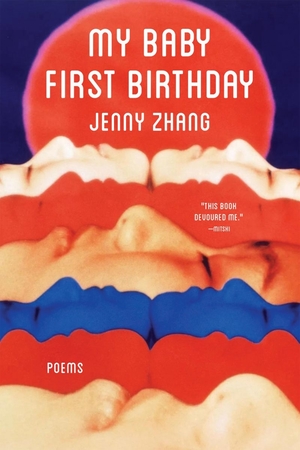
Zhang herself refers to the poems in her second full-length poetry collection, My Baby First Birthday, as dreams: dreams for a world in which mistakes are celebrated and language distorted and ugliness and beauty collapse into each other inextricably. The poems in this funny and piercingly beautiful book interrogate notions of innocence and childhood, the fetishization of motherhood and femininity, and the ways in which imagination, humor and delight can be tooled to critique the obscenities of white supremacy, patriarchy and global capitalism. These poems ask: what does it mean to be someone in the world when none of us gave consent to be born? Who, in our society, is allowed to be nurtured and cared-for and innocent, and who is deprived of this experience? But as infuriated as these poems are with our abject and chaotic world, they are also fiercely tender and loving and hilarious, invoking friendship and love and mutual care. “I ASKED YOU TO REACH OUT,” Zhang writes, “AND TOUCH ME RIGHT THERE …/ YES THERE.”
In our phone call, Zhang and I discussed language and dreams, play and innocence, and what it means “to be baby.”
Roberto Rodriguez-Estrada: Much of your work is concerned with language — how you had to learn a second language when you moved to New York City at five, and your parent’s and your relationship to English. There are also so many ways in My Baby First Birthday that you make language a sort of playground. For instance, the ways the word “goo goo” comes up frequently. What does “goo goo” mean to you?
Jenny Zhang: That’s a really cool question… I never thought anyone would ask me about “goo goo.” I guess it is a sort of shorthand for babbling and I happen to like babbling as an actual sound that little babies make and, I think, also as a concept. Babbling is what babies do when they’re trying to communicate but they can’t do so in a way that people can comprehend, so it can just be dismissed as garble or cutesy. But I think babbling is one of the earliest forms of expression, or one of the earliest forms of communication that a lot of us try.
I think a lot of people have been wanting that, people who have been disbarred from innocence, or who never got to be innocent and never got to be a baby.
I also got really obsessed with the idea of being a baby, of being baby. I know that idea was a big thing last year and I think it’s probably because as a culture everything felt so corrupted that there was a fetishization of returning to innocence, which we wanted collectively as a culture. But I think a lot of people have been wanting that, people who have been disbarred from innocence, or who never got to be innocent and never got to be a baby, and that includes, I think, a lot of marginalized folks who are treated as guilty or dangerous from a very early age. I think all these people have been longing for babyness a lot longer than our collective culture and society has been. So I started writing and felt that I was babbling a little bit, which is to say I didn’t feel like I had mastery over poetry, I didn’t feel like I had learned it, I didn’t feel like I had gone to the depths of learning it the way other people I knew had. And maybe that’s not true because I’ve been through all these different institutions yet somehow I still came out of it feeling pretty dumb and I didn’t feel fluent in poetry or poetics. “Goo goo” felt like the best encapsulation of trying to express something in an imprecise way.
RRE: Infants and birth and motherhood are recurring themes in this book. The speakers of these poems are constantly interrogating what it means to be born, what it means to be someone in the world. What prompted this inquiry?
JZ: There was a period in my life where I felt really trapped because I felt like the first thing that ever happened to me was that I was born and I never consented to that. No one ever asked if I wanted to be born into this world. No one ever really asks anyone, it just happens. And because I was so disappointed by the world that I was born into, I just felt so trapped, like the only way out would be to end my existence, but I didn’t necessarily want to stop existing. What I wanted was to have never existed in the first place so I would never have to be put in the situation of having to make that choice. And I felt very troubled by that, and saddened by that. I guess I was just concerned with that question.
No one ever asked if I wanted to be born into this world. No one ever really asks anyone.
Then I also felt like I was at an age where I was ripe for motherhood, where I could have become a mom, but I also felt like: how can I subject another human being to what I’m subjected to, which is being born, if I don’t know if they would want that or not. Again it really troubled me because I as an individual could perhaps do the best job possible of mothering a child but I couldn’t change the world as an individual and a child that I hypothetically gave birth to would have to interact with the world. It made me feel I guess trapped is the only word I have, and at the same time I was really grateful for having experienced the world. I don’t know I sound like someone who had just watched Waking Life and smoked pot for the first time and was grappling with all kinds of existential crisis — but I also felt like I wasn’t able to graduate from that sort of adolescent existential crisis in some ways that other people seemed to have graduated from, I felt like I was still stuck in that. So I guess I started writing these poems to play around with these ideas and almost get them out of my system — of course nothing ever gets out of your system.
RRE: I think a lot of people relate to that experience, especially as teenagers when we say all kinds of hurtful things to our parents like: I wish I’d never been born! Or I hate my life!
JZ: Life is seen as a gift and that’s something we’re not always willing to interrogate. First of all, not gifts are wanted and not all gifts are received consensually and not all gifts are given without any strings attached. Most gifts are given with expectations, which I guess you could argue that’s not really a gift. And I think as a teenager, I did say all kinds of stuff to my parents. It probably was really cruel because motherhood is such an idealized state of being and we idealize mothers as naturally nurturing and wanting to give their time to the rearing of a child, and we sort of drag anyone who doesn’t want to do that or can’t do that to its fully idealized capacity. There is a way in which we expect mothers to sacrifice so much of themselves, emotionally, physically, and spiritually once they have a child, and then for the child to be like, I never wanted this; it is such a blow. So I understand both sides on some level. I guess that is the paradox. I think I was also obsessed with notions of sainthood, and that we assign sainthood to the highest ideas of femininity and martyrdom, and this idea of not wanting to be saved, which is a corollary to not wanting to be grateful. It’s all still very murky for me because I’m constantly caught between being grateful still and then rebelling and being mad that anyone ever did anything that I have to be grateful for. It feels like my brain has been colonized by that expectation and I don’t want to repeat patterns that were limiting for me.
RRE: The characters of your story collection Sour Heart are mostly young girls and, in your poems, the speaker often has a bit of a playful, child-like voice. Can you talk about the role of play in your life? Both as a child and now as a writer?
I think poetry has been a place for me to recreate a dream that maybe never was, where language could be a source of play and delight.
JZ: There was a brief period of time where I learned how to speak and all I wanted to do was entertain myself and others. It was such a delightful thing, I was finally able to control making other people laugh and making myself laugh. And it was such a fun and innocent time in that way just because I hadn’t been alerted to the ways I could hurt or oppress other people or oppress myself with language. It was a defining time when I moved form China to America and I didn’t have language anymore, and the act of acquiring language was a chore and it was a fraught experience, because it was all about proving I wasn’t dumb, rather than trying to entertain others. Or if I was entertaining others it was beyond my control, because other people were laughing at me. I think poetry has been a place for me to try to create a bubble, to create a dream, to recreate a dream that maybe never was, where language could be fun and it could be a source of play and delight, and it’s not a shameful thing to be “wrong,” and it’s actually really fun. I have to pay homage too, there’s poetry all around, not just in poetry. It’s often black and queer and POC spaces that have fucked the most with language, and that fucking with language then trickles down to the mainstream and eventually everyone is saying “it’s lit” or something—that’s the way in which language evolves. Someone first had to fuck with it and have the gall to use it in the “wrong” way. I am in awe of that process, but I’m also aware that the people who start fucking with language are always the people who get criminalized and chastised for it. Then somehow white people get a hold of it and it’s fine and fun. I wanted to create a dream where it was fun from the beginning.
RRE: There’s a way your poems can, at first, cast a sort of coyness and candor and they also oscillate between that playfulness and explosive moments of gorgeous, celestial awakening. I’m thinking about the turn at the end of “yr pubes are everywhere” or throughout “i keep thinking there is an august.”
JZ: I think epiphanies often come on the heels of extremely petty and trivial things, and I don’t mean that in a literary sense or in a spiritual sense, but maybe just sudden realizations come on the heels of something stupid. And sometimes the more stupid something is the more profound it becomes.
Sometimes the more stupid something is the more profound it becomes.
I was also thinking about humor and humor as a defense mechanism, humor as a way of expressing pain. There have been times when I’m making fun of myself with a friend and I’m laughing at myself and basically dragging myself, and then later I’ll be hurt because the friend would laugh with me and I’m like: No! You were supposed to see that I was screaming out in pain through a joke, why did you not see that? And I think there’s something really inaccessible about true true true, deep deep deep pain, because in order to access it and show it, you’d have to be so vulnerable, and you have to feel safe to be vulnerable, and not have had a history of being attacked for showing vulnerability and pain, which is pretty rare, especially as we get older. There’s also a way in which I wanted to be glib sometimes and mimic the ways that we access things that are deep, which is sometimes through being very superficial and joke-y.
RRE: I read in an interview you gave a few years ago that repetition is something that draws you to poetry. Repetition in these poems allows them to gather momentum and it works so effectively. It reminds me of Gertrude Stein who says: “always repeating is all of living. everything in a being is always repeating.”
JZ: I love that Gertrude Stein quote. I’m really interested in the ways human beings are doomed to repeat and how each time we repeat something it’s never the same, it’s actually transformed with every repetition and with every cloning of that instant. So maybe it’s some kind of spiral and not just a circle you’re retracing, even if it feels like it. I think there’s also a way we repeat things to convince ourselves of something that’s not true, like I’m fine I’m fine I’m fine, and over time it sounds like a cry for help. But there’s also a way in which people of color and LGBTQ people have to keep saying the same thing over and over and over again. And it’s very fraying to say the same thing over and over again. It’s also very enraging. There’s a way in which saying the same thing can build up a lot of rage and unleash a lot of rage, and there’s a way in which saying the same thing over and over can lead to a petering out and a giving up. Of course as I was writing these poems, I wasn’t necessarily thinking of all these things. But also too as I’m writing I sometimes don’t know how to end things. It’s always interesting to me, human beings don’t get to live through their own endings, the ultimate ending of death—I don’t know what will happen, if I’ll remember it, I don’t know if I’ll come back to report what happened—and I think there’s a way that translates to poetry, so sometimes I’m mimicking what it feels like to fall asleep at night, where my thoughts are circling and circling and circling and then I pass out.
The absence of someone or something is as palpable as their presence. I’ve discovered this—quite painfully—in my own life as the daughter of Palestinian immigrants. Naturally, I’m drawn to exploring the kind of voids that loom over us like shadows, the kind that perpetually occupy space and time, disrupting our ability to healthily exist and thrive. In the process, the questions I raise tend to produce the stories I end up telling: What does the physical absence of a sibling—or the emotional absence of a parent—look like? And, how might that absence inform grief?
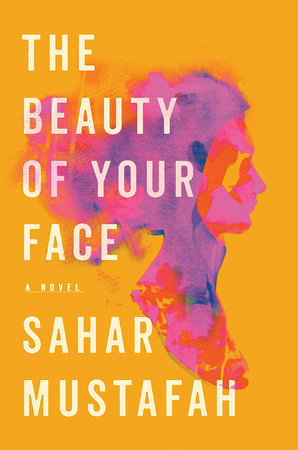
My first novel, The Beauty of Your Face, centers on Afaf Rahman, a principal at a Muslim American school outside of Chicago, who faces our worst imagined fear: an active shooter. Before her face-to-face confrontation, I spend time investigating the years that bring Afaf to this critical moment. Among the many voids in her life—a strong faith, a binding community, impermeable self-love—the most devastating, perhaps, is the absence of a present, loving mother.
The following books offer tender, and sometimes violent, representations of losing a parent or sibling and its complicated grief.
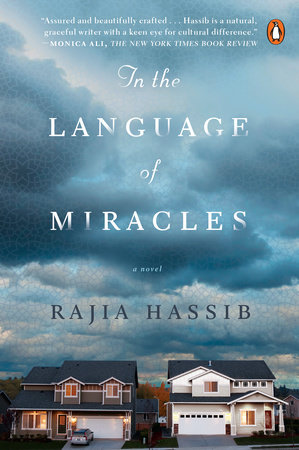
An Egyptian American family grapples with the murder-suicide of their son and their neighbor’s daughter. The parents not only lose a child, but his brother Khaled struggles to extricate himself from the dark shadow of tragedy. In compassionate and moving prose, Hassib reveals how time does not always temper grief and instead leaves us with painful questions surrounding those we’ve lost.
This aptly titled book of vignettes skillfully depicts how a mother’s dying and death spill into and disrupt every corner of her daughter’s life. As the narrator attempts to manage her grief, she discovers how biological, racial, and emotional bonds are inexorable and that, ultimately, we are our mothers’ daughters.
When a young son is accidentally killed, the two families involved attempt to physically fill his absence, creating new chasms and fresh iterations of heartache. Through hauntingly lyrical prose, Erdrich wrecks and uplifts us as she reveals how parents reckon with the loss of a child.
On the surface, this is a novel about colliding worlds. The loss of a sibling to radical ideology freshly unsettles a family attempting to overcome a dismal legacy. A sister is determined to find and save her brother amid an insidiously tangled web of political corruption.
In the mythical, elegant, and unapologetic tradition of Toni Morrison, Ward conjures the ghost of a wrongfully killed son and brother. Those left behind—River, a sturdy patriarch, whose wife is slowly dying on their bed, and his grandson Jo Jo habitually abandoned by Leonie, his grief-stricken, addicted mother—must carry on.
The loss of memory can be profound. In Khong’s humorous and fetching story, an adult child returns home to a father battling Alzheimer’s disease and gradually confronts her family history.
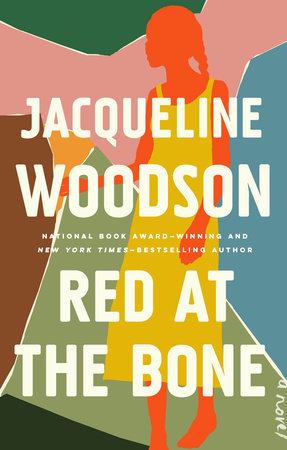
Woodson’s poetically lush language cradles us as she depicts the triumphs and losses of a multi-generational family. After a teen pregnancy, Iris makes an unlikely, but still natural choice to find herself and pursue her greatest potential. Her absence from her daughter’s life reverberates through shifting perspectives as ideals of motherhood are challenged in this honest, unflinching portrait.
For the first half of Margie Pifer’s pottery lecture at the Arts Council picnic, Iva Jo Hocutt thought the Russian girl was asking for a tampon.
“What?” Iva Jo whispered. “No. I don’t know.” She dodged the Russian girl’s mortified stare for the fifth time; Iva didn’t want Margie Pifer to think she wasn’t listening.
The Russian girl was shaking her head and ignoring everyone but Iva Jo. On the little stage at the front of the white rental tent, Margie Pifer was lecturing about “the mountain craft tradition.” Iva Jo sat in the second row of folding chairs, in the very last seat. She was bored and hot and thirsty, and her body felt to her today like a series of lumps. She wore a loose pair of linen capri pants and a gray Arts Council T-shirt. Iva stuck her leg out a few inches, just beyond the shade of the tent. The sun cast a bright, hot shard of July onto her freckled shin.
The tent was next to the soccer field, which was across the street from the elementary school where Iva Jo was the head office assistant. The whole complex occupied the left hand of the stippled body of Queensport, Tennessee, a valley town in the green Blue Ridge where Iva Jo spent her life. Houses dotted Queensport’s seventeen capillary-thin streets, and Main was its spine. The Arts Council picnic was held every summer in this northwestern outskirt; the buzzing tents and booths looked from above, from atop the mountains, like colorful beetles held in the town’s palm.
The Russian girl was perched alone on a bench a few yards from the tent, directly in Iva’s line of sight. The bench occupied a shadowy patch under two willows.
Margie Pifer held up a big, rustic, multicolored bowl. She was made almost entirely of angles, so the swooping arcs of the bowl’s edges looked sloppy in her hands.
“Sanitary,” the Russian girl hissed again, her smooth, pale cheeks blushing livid.
Iva Jo squinted.
“There is blood,” the Russian girl mouthed. She bared her teeth. “You have sanitary?” Her h in the word “have” was wet and phlegmy.
The mention of blood shook some compassion from Iva Jo, and she wondered briefly what she could do to help, but she didn’t have anything in her purse. Iva was forty-nine; she hadn’t had a period in months.
Poor thing, thought Iva, remembering the embarrassments of teenage menstruation. A breeze thwopped the tent’s taut roof and wafted across the crowd. She ran a ring finger under each of her eyes—blue, bright, her best feature, she always thought—to wipe the sweat pooling there and focused on Margie Pifer and her bowl. Knowing Margie, there might be a quiz later.
Finally the Russian girl pointed at Iva Jo’s feet with a rude thrust. The girl’s delicate, quivering finger compelled Iva to pick up a foot and look at her sandal.
She was bleeding all over herself.
Two scarlet rivulets were dribbling down Iva’s thick calf. Her green capris were soaked almost black, her white plastic chair an abattoir. She had no cramps, had at this moment no sense of herself emptying out. Iva Jo felt nothing now except piercing alarm radiating across her scalp.
In the universal synchrony women find in such moments, Iva Jo and the Russian girl set about a tacit, determined series of looks, signals, movements. First, Iva looked up at the Russian girl in white horror and humiliation. The Russian girl snapped into dutiful action. She rooted around and found a crumpled paper tablecloth, recently blown hither from some other tent. The Russian girl snatched it up and signaled Iva with wide eyes. I am coming. Iva eyed back, Thank you; please hurry.
The Russian girl bent over, crouched low, and weaved her way around the tent poles separating them, trying not to be seen. When she got to Iva Jo, the Russian girl bobbed her head and gave more eyes to tell her to stand up, that she would cover her with the tablecloth. She put cold fingers on Iva’s upper arm, which meant, I will walk behind you; we are going inside the school, across there, to the bathroom, together. Iva coded back with glances and tensed muscles that she needed her purse; someone would see the blood on her chair. The Russian girl shook her head and crouched even lower. Leave them; they don’t matter. Go.
Iva Jo stood up slowly and made it four steps before she passed out cold.
When she got home from the hospital that night, she found that Margie Pifer had dropped off a casserole, a get-well card full of Bible verses, and the deformed bowl from her lecture.
Hank patted Iva Jo’s shoulder as she eased herself onto the sofa. “You want a glass of tea or anything?” he said.
Margie Pifer had dropped off a casserole, a get-well card full of Bible verses, and the deformed bowl from her lecture.
She asked for a Pepsi, and her phone buzzed. She picked up. “I’m so sorry I missed your lecture,” she said, stroking her stomach. “Mm-hm. Oh, now, don’t worry, Margie. I feel fine.”
She listened for a long minute. “Hank will, but I’m not hungry. I’m just sick of myself.”
Iva listened again. Hank came in with a fizzing glass for Iva and a plate full of Margie’s casserole. He turned on ESPN and muted it, then picked at the casserole.
“They cleaned me up, did an ultrasound. Said I need hormones. Mm-hm. No, they reckon that was the heat, made me pass out. But they don’t know. I don’t know.”
She listened again, lips pursed. She fussed with the ties on her pajama bottoms. “No, Margie, I don’t want to do that. Because it’s surgery. Radical surgery.”
Iva watched the baseball players on ESPN chew and spit and whomp their bats in the sparse grass. “Mm-hm. At least it’s summer. Time off to figure things out. All right now. God bless you, too, honey.”
She hung up, drank the Pepsi, and tried to forget about the rock of fear in her gut.
Iva went to bed early. She bled through the night, so much she had to get up three times. There was still no pain, only an elevated heart rate that roared in her ears like soft static. Finally she changed into a Depends she found in the guest bathroom, left over from an elderly aunt’s visit. Iva lay in bed and longed for her mother. She wept. She prayed for a granny witch to appear in the backyard, thin and spooky like a haint, and spare her whatever health crisis was coming, to cast a spell or make her a magic poultice of roots.
Then nothing.
The next day it was like the blood had never happened. The thick, extra-long maxi pad Iva Jo stuck in her panties stayed dry apart from a few rusty streaks, and by supper time she was in a half-bright mood. She was patting out a couple of hamburgers when Hank came home from work and touched her on the shoulder.
“You all right today, girl?” he said, and sniffed the patty in her hands.
“You want more A.1. than that?”
Hank nodded and began to empty his pockets into a basket on top of the microwave. He ran his hands into the various hiding places of his long body, the folds of his work pants, his work shirt. There were pockets on every limb. He produced four pens, a thin-framed pair of glasses, then a wallet, two sets of keys, a tape measure, a handful of change. He patted his broad chest, rubbed his backside, and frowned. The lines on his tan cheeks were deep and spidery.
“I left my—” he said, and held up two fingers. “Gonna run back out to the truck.”
Iva Jo washed her hands, gathered dressings for the burgers, and opened a can of beans into a red pot on the stove. Her kitchen was dark but tidy. Theirs was a splanch-style house, and the kitchen and living room were on the sunken end. Iva’s kitchen windows were flush with the ground. When she looked out, she saw the world through the trunks of hedges.
On her way past the microwave, she peeked into the basket and checked Hank’s pocket leftovers. She looked for stray bits of paper, business cards scribbled with private numbers. Realtors liked Hank. His inspections were always spot-on and filed fast, so he got sent to a lot of the country clubs and newer developments. Lady realtors flirted with Hank. Lady realtors, Iva had observed, all had wispy hair and even, snowy teeth.
Hank returned with a thick binder, two clipboards, and a dozen spray roses wrapped in supermarket cellophane.
“There now,” he said, passing the flowers to Iva, whose palms were still pink and clammy from handling the ground beef. “You’re gonna be just fine.”
At church the following Sunday, Pastor Rob said a special prayer for Iva Jo, which she appreciated. Hank wasn’t much for religion, so she carpooled with Margie most weeks.
The church was First Baptist—large, brick, and stalwart at the base of Queensport’s spine.
“Lord, we’ve had so much cancer in our congregation,” said Mrs. Pickering after the service.
Mrs. Pickering was ninety and diminishing. She got confused about things.
“Iva doesn’t have cancer,” Margie said.
They were in line for refreshments, inching down a long, white, crowded hallway stretching from the main church into its newly renovated hall. Margie was wearing a sleeveless dress covered in tiny zigzags that matched her spiky hair.
“I had it in both my breasts,” Mrs. Pickering went on. She gripped her cane and leaned against the oak doorframe of the Sunday school hallway. “My sister, too. And my niece.”
Iva Jo tried to be helpful. “Two of my cousins had it. One was cervical. And Hank’s brother’s in remission from liver cancer.” They moved up a few steps in line as the low murmur of the congregation swelled, subsided, then swelled again around them. The rhythm of chatty crowds. “It touches near about everybody.”
Mrs. Pickering nodded. “All the local families, all the ones been here a good while.”
Margie rolled her eyes. “Here we go,” she mouthed at Iva.
“Makes you wonder. I’ve been wondering.” Mrs. Pickering shut her eyes tight, lifted her face to the fluorescent light above, and shook her head. “I’ve been wondering years.”
“Well, it’s not Twitchell, if that’s where this is going again,” said Margie. “I’ve told you, Missus P, that’s the price we pay for having jobs. Industry.”
“I never worked there,” said Mrs. Pickering. “Did you?”
Iva didn’t answer. Margie stared at her, but Iva kept her eyes on Mrs. Pickering, whose thin blouse, which looked like a daffodil, rippled as the old woman exhaled.
“My husband did,” the old woman said. “Died of lung cancer. Never smoked a day.”
“But he had benefits,” said Margie. “Y’all were better off than if we’d been a coal town.”
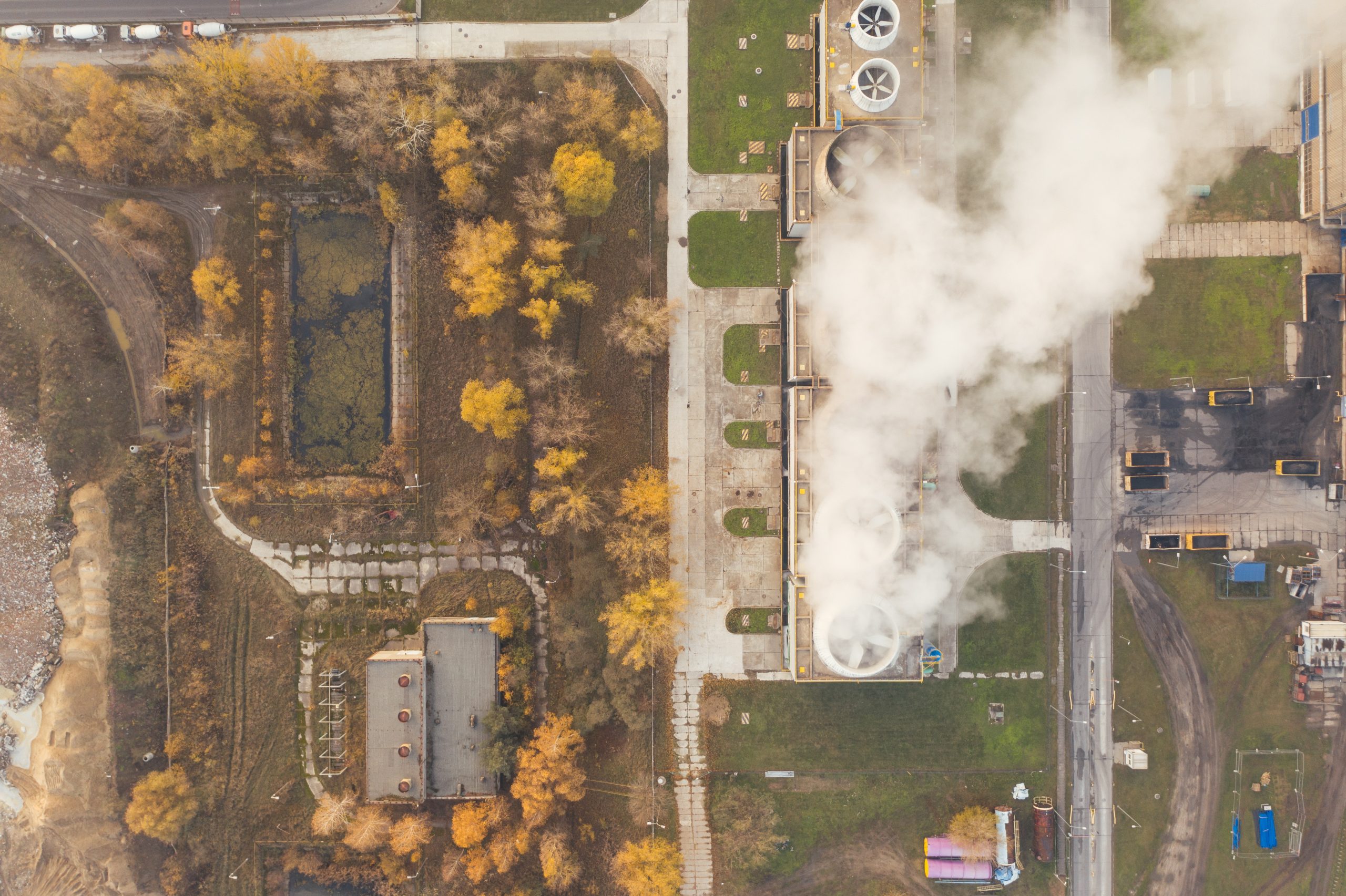
Stewie Pifer, Margie’s husband, was the director of planning at Twitchell Chemical, the biggest employer in the county. Margie defended the company even after they got in trouble for all those EPA violations, even after they dumped eighty thousand gallons of corrosive slurry into Jubal Creek and poisoned twenty farms downriver. No one in the county drank from their own wells anymore.
Queensport and Twitchell were not special. Similar plants, and similar spills, abounded in the region, hidden up old logging roads, behind bribes.
Queensport and Twitchell were not special. Similar plants, and similar spills, abounded in the region, hidden up old logging roads, behind bribes. There was some talk of groundwater testing, a few settlements paid out. A film crew from the university tried to make a documentary. Not much else.
“Oh, my, yes,” said Mrs. Pickering. “Coal is another thing altogether.”
“Tourism’s just as important, though, Margie,” said Iva Jo. “Tourism’s the future.”
“But Twitchell’s the last one standing. We can’t all be kayaking instructors. People have got to have real work.”
“Iva, what exactly is the trouble?” said Mrs. Pickering. “Pastor Rob didn’t tell us.”
“They’re still figuring that out,” said Iva Jo.
“Menopause,” said Margie. “It’s just the menopause, is all she’s got.”
“Ah,” said Mrs. Pickering. “Don’t you fret, now.” She patted Iva’s hand. “The Change is just terrible, but in the end, praise Jesus, you’re free.”
The Change is just terrible, but in the end, praise Jesus, you’re free.
“Why go through it?” said Margie. “Do like me and get the hysterectomy. Best thing I ever did. I’ve been telling her. Be done with the whole mess.”
“I’m going to see Dr. Philip this week,” Iva Jo said.
“Well,” said Mrs. Pickering, “I didn’t go that route. Either way, you ought to find yourself a lady doctor. A female.”
“She’d have to go all the way into Knoxville then,” said Margie.
“Don’t let a man cut you up,” said Mrs. Pickering. She shook her head, squinted again. “They always want to cut. Get yourself somebody who understands a bit better.”
The line had slowly advanced, and someone handed Mrs. Pickering a plate of cookies and offered to find her a seat. She took her leave and squeezed Iva Jo’s wrist. “You hang in there, honey. It’s just like giving birth. Just breathe full and ride it out.”
Margie bit her lip and watched Mrs. Pickering dodder off. She handed Iva a paper cup full of watery coffee and pulled her by the arm into the church hall. “She’s forgetful. That’s all.”
“Oh, I don’t mind.”
Iva knew Margie and her friends talked about her. They counted her miscarriages for years and told each other Iva Jo Hocutt puts on a brave face, that Hank Hocutt was a good man for sticking around. She never told anyone it wasn’t something she mourned. Every time she’d lost a baby, relief had washed over her, warm and keen. Hank had never pushed the subject. Iva felt, at least on that one score, at least sometimes, like the luckiest woman in town.
“I’m so fortunate; I know that.”
“Amen,” said Margie, and held Iva’s fingers in her own.
They sat at a plastic folding table near a narrow window and drank their coffee.
“I should do something for that Russian girl,” she said. “The one who helped me. She was from Blue Sunshine. I should drive out there.”
Iva knew the Russian girl was Russian because on the day of the picnic she’d seen her get off the Blue Sunshine Camp bus and herd a bunch of little ones toward the “Arts 4 KIDZ!” exhibits. The children had bounded toward a face-painting table in a haphazard stream, and the Russian girl and her colleagues had sighed and wiped their foreheads and looked for shady places to be alone.
Blue Sunshine Camp employed tons of them, more than most. The girls—mostly Ukrainian, not Russian, but Iva Jo always forgot this—worked on temporary visas as counselors in the camps throughout Sylvan County. The camps’ huts and hiking trails skirted the boundaries of the national park, and every year they brought in Eastern Europeans to work in the woods for room, board, and a pittance. Iva Jo could always pick Russians out from a crowd. They all had the same plump lips, the same severe ponytails, and a pale, quiet fear of being so far from home. Some of them must have come from steppes or other flat places, because they ogled the Blue Ridge with wide eyes. They pointed at each mountain and compared them, making the rough shapes of peaks in the air with their hands. Every summer they came. Slowly Iva Jo and her neighbors had started to see Russian girls in the winter months, too, after all the tourists left, after leaf season. Immigrants.
“Oh, no,” said Margie, pulling her hand back from Iva’s. “Don’t go getting involved with all that.”
“All what?”
“That girl’s going home in a month or two anyhow.” Margie looked around and lowered her voice. “At least, she better be. Being pregnant and all.”
Iva Jo leaned forward. “What? That tiny little thing who wrapped me up in a paper tablecloth? She barely looked eighteen.”
Margie nodded. “They found out right after she got here. Andrew said the whole camp knows. They’re pretty upset with her. They think she was…you know. Already carrying it when she came over.” Margie’s nephew Andrew ran a laundry service. He delivered to a lot of the camps and knew all the staff gossip.
“So?”
“So,” said Margie. “If she’s too far along at the end of the summer, she can’t fly home.”
Iva Jo shrugged, shook her head a little. And?
“So,” said Margie. “If she can’t fly back to Moscow or wherever, she’ll have to stay. Have the baby here. Then she’s got herself a little citizen. You know.”
Iva didn’t know.
Margie rolled her eyes. “An anchor baby.”
Iva Jo thought about the Russian girl’s wide eyes, those downy eyelashes, and how earnest she’d been about helping her to the bathroom.
“Oh, I don’t think she’d pull a scam.”
“You’d be surprised,” said Margie. “A lot of them do it. Out of wedlock and everything.”
“That’s not a big deal nowadays.”
“Iva.” Margie frowned. “Sunshine is a Christian camp.”
“But Russians,” said Iva Jo. “They go to church, don’t they? None of this sounds too terrible. Sounds to me like she’s just in a little trouble.”
Margie sniffed a concession. “At least she’s not Mexican. I doubt one of them would have helped you.”
Iva Jo didn’t say anything.
“Mexicans don’t even come to the Arts Fair,” said Margie.
“Did you invite any?”
The following day, Iva Jo drove out to Blue Sunshine. Scam or no scam, she owed the Russian girl her thanks. She waited until five o’clock, though, after all the daytime staff, the locals, the Christians, had gone home for the night.
The camp was a scatter of lodges, cabins, and metal gazebos all hodgepodged around the fork of Pigeon and Jubal Creeks. Iva’s jeep wagon crawled up the dirt road past Blue Sunshine’s stack-stone gate.
She gripped the steering wheel with both hands and ducked her head to look at every cabin and shanty she passed, trying to figure out which one might be the Russians’ barracks. A thin-shouldered girl with a foreign look about her walked across the road carrying a toothbrush and a towel. Iva Jo watched the girl disappear into a sad-looking brown lodge behind some trees. Splotches of dark moss dotted its sagging roof.
Iva Jo pulled over and got out. She looked at the brown building, then at the rustling creek. The woods here made a canopy that blocked out sound and sun. Iva knew if she kept walking east from this spot, eventually she’d hit a stand of laurel trees bordering her eldest cousin’s property. It was the biggest patch of laurel she knew of anywhere, and though it was too late in the summer for them, she still pictured their white blooms snowing the forest floor.
She walked in the direction of the lodge, then stopped in the middle of the dirt road. Iva closed her eyes and tried to imagine being young and in trouble in some foreign place. She tried to imagine sleeping in a camp counselor’s dormitory bed and chasing after other people’s children all day while suffering from morning sickness and tender breasts and the lonesome terror of a first pregnancy. Iva wondered, How did she even see me? What makes a frightened girl hold a strange woman’s hand and cover her with paper?
What makes a frightened girl hold a strange woman’s hand and cover her with paper?
“Can I help you? Are you a parent?”
She turned, and a clean-cut teenage boy addressed her again. “Are you lost?”
“I’m looking for—” Iva’s tongue stopped behind her teeth. She didn’t know the Russian girl’s name. She thought she had brown hair, but it might have been blond. She couldn’t be sure, and asking identifying questions would mean embarrassing both herself and her savior.
“Never mind,” Iva said to the boy. “I’ll find it.”
She walked back to the jeep, climbed in, and drove home.
“Now, Iva,” said Dr. Philip. “I don’t want you to worry.”
“Over what?” Iva Jo was sitting on the exam table. Her short hair was all mussed up at the back; she could tell when she touched it. The curls felt soft and twizzled, like they did after a day at the beach.
“Over what happened,” he said.
“What did happen?” Iva was dressed. Her exam was over, and the smock she’d been wearing sat in a heap beside her. “I still don’t understand why I bled like that. Out of nowhere.”
“That’s what we’re trying to determine,” said Dr. Philip. “You don’t have a polyp. In the meantime, we’ll start you on hormone replacements to help with your symptoms. It can take a while to get your dosage right.”
The lights in the exam room glowed on his buzz cut. His hair was silver, the skin under it pale and bumpy. Your head could be the moon, thought Iva.
He wrote something on her chart. “You’ll need to come back and see me in two months.”
“So this is normal?” As she spoke, she swung her feet like a little girl.
Dr. Philip rubbed the back of his neck.
“Hard to calibrate. You’re the right age for menopause.” He flipped up a stack of papers in her file, a worn manila folder with feathery, gray edges. “And you’ve never carried a child to term, so this is all”—he bobbed his head back and forth—“sort of normal.”
“I don’t want a hysterectomy.” She shifted her legs, rustling the table’s paper cover.
Dr. Philip frowned. “You might not need one,” he said. “But they work like a charm for a lot of patients. We do them all the time.”
“I don’t want one.”
“We’ll just see what’s best, Iva.” He clicked his pen. “By the way, when was your last mammogram?”
“You told me I didn’t need one until I turned fifty.”
Dr. Philip clicked his pen again. “Oh. Well, let’s get the jump on that for sure. Every woman”—he smiled—“is different.”
Iva Jo drove home from Dr. Philip’s office with a purse full of scrips. She drove past the CVS, past Kmart, and two other places where she could have got them filled. She drove past the gated entrance to the Twitchell plant and didn’t look at it. She didn’t look at its long, familiar drive or its white smokestacks that loomed above town and glowed at night. She drove right past it all, through the whole body of Queensport, without stopping.
Hank got home around six o’clock and ambled into the living room. Iva was leaned back in her squat blue recliner reading a pamphlet called Perimenopause: Your FAQs.
“He says I need tests. Wants to try me on some pills.”
“Tests?” said Hank.
“Well, a mammogram. And some blood work.”
“You want me to come with?”
Iva laughed. “Oh, I don’t think they’d let you. All those boobies everywhere.”
Hank smirked, leaned against the bookshelf opposite her, and began to say something. His shoulder brushed the ugly bowl Margie had given her the week before. It wobbled on its base, tipped forward, and crashed to the hardwood floor.
“Oh,” said Iva Jo, reaching out. She fumbled out of her chair toward the shelves.
Hank put his hands to his face, round eyed and sorry looking.
“Oh, Hank!”
“Careful, don’t cut yourself. Stay back.”
“I’ll never live it down,” she said. “That was her best piece.”
Hank crouched down as Iva Jo slumped in the wreckage. She picked up a large, jagged hunk of glazed crockery, and a tendril of crude rage began to hum and tingle inside her.
“I’ll glue it back together,” he said.
“No,” said Iva Jo. Hank reached toward the hunk of bowl. She slapped his hand away. “Get off. Get the fuck off.”
He reared back. Iva swept her hands across the floor to gather the bits together.
“The hell? You didn’t even like the damn thing,” he said. “Hell, half the time you don’t even like Margie.”
“That’s not the point,” she moaned, and ran her hands again into the breakage.
“You’ll cut yourself. All the little pieces.”
“Sshh,” said Iva Jo.
“Let me get my trouble light.”
Hank jogged into the hallway and scooted around in the closet. She listened to him rustling, then felt the vibrations of his booted feet pounding back toward her. He pulled the trouble light onto his head, adjusted the straps, and knelt beside her. He reached up and twisted the light on. Its halogen beam blazed across the floor, and each shattered piece glowed.
“Let me do it,” he said, reaching out.
She slapped his hand away again, harder this time. “Get the brush. And the dustpan.”
Iva had never slapped Hank before. The sensation of hitting him rung deep in her bicep. She couldn’t tell whether she liked doing it; she only knew she felt like hitting him again.
“Goddamn,” said Hank, standing up. “You’re worse than the girls at the office.” He cut off the trouble light’s beam. “Every woman I know is on the rag this week.”
Heat seared up her neck and across her face. She tasted sweat on her lips.
“Shut up,” she said through her teeth. “Even if we were, it wouldn’t matter. But we’re not. None of us.”
“Well,” Hank said, dusting off his hands and backing away. His voice deepened. “Means the same to me either way.”
Stop it, she thought. Stop. Stop.
“Elena.”
“Hm?”
“Elena,” said Margie. “That’s the girl’s name, the one who helped you. I asked Andrew.”
They were in a grim, dingy medical office on a rank day in August, waiting for her first-ever mammo. Margie had tagged along for support.
“Elena,” said Iva Jo, adding music to the syllables. “That’s nice.”
“Andrew said the daddy works at the same camp. I think he’s Russian, too.” Margie’s hair, normally so blond and carefully spiked, looked wilted. It was early and already humid outside.
“What’s she doing now?” asked Iva.
“Andrew said she went home,” said Margie.
“What, back to Russia? You mean she’s gone?”
“That’s what Andrew said.”
“And the father?”
Margie shrugged.
Iva blinked. “But what will she do? About the baby?”
“Miz Hocutt?”
Both women popped their heads up, and Iva reached for her purse. “Can my friend come with me?”
The mammographer gripped a metal clipboard and smiled. She wore a loose bun, no makeup, medical scrubs, and clogs. “It’s a pretty tight squeeze in there. Your friend can wait out here and meet you afterward. Why don’t you come on back?”
The exam room was about twelve feet square and filthy. The floor was strewn with thick black wires and boxes of medical and office supplies. In the center was a massive beige machine that looked like those robots in the movies—the ones that can turn into cars. Everything was coated in a thin, gray fur of dust.
The mammographer, who barely met her eyes the whole time, gave Iva Jo a paper vest and a few instructions. She asked some questions about medical history, date of birth, the usual. One of the questions was “Have you ever worked at Twitchell Chemical?”
Iva stammered a little, then said no. The mammographer ticked a box and turned to the door. “Undress from the waist up,” she said. “I’ll be back in a minute.”
Iva took off her blouse and reached back to undo her bra. She stared at the metal blinds on the window and hoped nobody could see in. She pulled on the blue paper vest and laid her purse and clothes over a chair in the corner. The mammographer knocked gently and came in.
“I’m big,” said Iva, holding herself under the vest. She nodded at the machine, and the paper scratched against her neck. “I don’t think my girls’ll fit in that thing.”
The mammographer produced a dark glass plate the size of a sheet of paper. “You’ll be fine,” she said.
For the next few minutes, Iva Jo hunched and contorted and gripped the sides of the machine like an awkward dance partner while the technician nudged Iva’s torso and squished her breasts between the glass plates. Friends had told her mammograms were painful, but Iva didn’t feel much. It reminded her of the gropings she’d giggled through with high school lovers. The plates weren’t even cold. Then it was over, and she put her clothes back on, and Margie took her out for a fancy brunch of shrimp grits and mimosas.
A week later Dr. Philip called while she was folding sheets and said there was a “spot” in her right breast, and she might need a biopsy.
“Might,” said Iva Jo.
“Often it’s nothing. Could just be a bad image.”
“Is this anything to do with that awful period I had? The bleeding?”
“No,” said Dr. Philip. “Well . . . I don’t think so.”
“Do I have cancer?”
“That’s unlikely, but we’re just going to check and see.”
Dr. Philip said the Knoxville Breast Center would re-scan the spot. If it turned out to be a lump, they would do the biopsy. He said they were very nice at the Knoxville Breast Center, and after her appointment there, Dr. Philip would give her the news one way or the other.
“How much is all this going to cost?”
“Depends on what they find,” said Dr. Philip. “But again, it’s probably nothing.”
Iva’s neck began to sweat. “When will I know?”
“It’ll take a while to get you in for a referral. A few weeks.”
“Can’t you do it? Can’t you check me?”
“I don’t have the resources here,” he said. “This is a small town, Iva.”
“Well,” she said.
“Iva,” asked Dr. Philip, “did you ever work at Twitchell?”
The dryer buzzed in the background. She leaned against the laundry room door.
“Because if you did,” he said, “they might pay for some of your treatment. There was a big case a while back. Class action. There’s a settlement fund.”
“I remember,” said Iva.
“Well, that might help some.”
They both breathed into their phones.
“All that poison,” he said. “It’s a real shame what they did over there.”
“Hank’s gonna flip out,” she told Dr. Philip, who told her not to worry.
The dingy breast clinic sent her a CD of her mammogram images to take with her when she went to Knoxville. She was curious and tried to look at them, to see inside herself, but the files wouldn’t open on her laptop. A few days after that, she got a terse, official letter in the mail notifying her she had “high density breast tissue.” State law required them to tell her that unlike average women, her boobs were mostly boob tissue, not fat, which made them hard to see through, so legally they couldn’t be held responsible for any faulty images or future errors in diagnosis.
“What in the world am I supposed to do with this?” Iva Jo asked Hank.
Hank frowned at the letter. “Frame it,” he said. “Means you got real knockers.”
Iva Jo laughed, and Hank put his arm around her.
“Maybe I’ll give it to Margie,” she said.
Then she and Hank sat down and cried and prayed for a while.
Hank drove Iva Jo to Knoxville on a Tuesday near the end of summer. They stopped for breakfast at a diner and ordered mushroom omelets and talked about what they would do if she had cancer.
“I’ll be right there,” said Hank. “The whole way.”
Iva Jo stared at the abstract watercolor on the wall above their booth. It looked like a sea.
“I don’t think I want to be friends with Margie anymore,” she said.
Hank opened a vial of creamer and poured it into his coffee.
“And I don’t think I want Dr. Philip to be my doctor anymore. I shouldn’t have had to wait this long to get all this sorted out. Lady at church told me she got all her results inside a week. All her tests and everything. And you know he hasn’t called me back once? Not once. I’ve been going to him six years.”
Hank nodded, sipped his coffee.
“We’ll do this however you want, Iva,” he said. “But I don’t think we’ll have to.” He pointed his coffee cup at her chest, moved it back and forth. “I think everything’s all right in there,” he said, and took another sip.
“That Russian girl went home. Margie waited until she was gone to tell me.”
Hank raised his eyebrows and poked a fork into his omelet.
“I guess I shouldn’t have told her we broke her bowl.”
“It was your bowl,” Hank said. “She gave it to you.”
Iva picked up her soda, took a sip. “How many people do you know have cancer?”
Hank swallowed a bite of omelet and raised his eyes to the ceiling to count. He rattled off names under his breath. “A lot.”
“You think it’s Twitchell? Everybody I know from those days got something.”
Hank cleared his throat. “Does it matter? It’s too late now. That was thirty years ago.”
Iva drew her shoulders back. “Well, I never would’ve . . . If I’d known. I might’ve had a baby, even.”
“Honey,” Hank said. “You can’t blame it on that.”
“Well, it’s obvious, isn’t it?” she said. “Whole town suffering, breasts coming off everywhere, your brother’s liver, lost babies, and nobody talking about it. They should tell us. The state. Doctors. They should investigate.”
“That plant’s been there since before we were born, Iva,” said Hank. “We’d know by now if it was anything dangerous.”
“Well, Margie should have told me, anyway.”
“About Twitchell?” said Hank. “You want her snooping around those old silos?”
“No, about the Russian girl. Elena. I’d have gone to see her. Helped her. Found out what she did about her baby.”
“Eat up,” said Hank, crinkling a paper napkin. “We’ve got to get across I-40.” He looked out the window. “All that traffic. I don’t know how people live like this.”
The Knoxville Breast Center looked like a spa. They had a fountain out front and valet parking. Hank kept his hand in the small of Margie’s back while she filled out paperwork at the check-in desk. The check-in nurse told them to wait, Iva would be called back, no men were allowed beyond the lobby.
Whole town suffering, breasts coming off everywhere, your brother’s liver, lost babies, and nobody talking about it.
They had sleek leather chairs in the waiting area. They had real coffee and fishing magazines. The lobby was full of husbands.
“Iva Hocutt?” a woman in lavender scrubs called. They both stood.
“OK, honey,” said Hank. His voice tightened. “I’ll be right here.” Iva Jo grabbed his hand.
“We’ll know, Iva girl,” he said. “At the end of this, we’ll know. That’s the main thing.”
Iva Jo nodded and kissed his cheek. Hank gripped Iva’s arm so hard she thought it might leave a bruise. Then she followed the lavender nurse through a thick wooden door.
The nurse brought her to a changing room. The doors to each room were slatted mahogany. It looked like a fancy department store.
“Everything off from the waist up,” she said, “then pick your color!” The nurse waved to a wall of shelves stacked neatly with folded scrub vests. Pink, blue, some with moons and stars. “Find one that fits, and just tie it in the front. You can put your things in a locker outside. No purses. Keep your locker key with you.”
Iva followed instructions. She chose a royal blue vest, a small locker. She put her purse, her blouse, and her bra inside, then pulled the key out of its lock and stretched its spiral lanyard around her left wrist. Her breasts flopped and swung as she walked to the waiting area. They felt soft, full. She pushed her arms against them to hold them in place, feel their warmth.
She waited. A tall woman in a pencil skirt led her into a white corner room and gave her a 3-D mammogram. The 3-D machine was fancier and cleaner than the one she’d danced with at the dingy clinic.
“We might let you go after this,” said the 3-D woman. “Or they might call you back. Depends on what we find.”
Iva waited. They called her back.
Ultrasound. A sage room. Warm and quiet. The sonographer wore pink scrubs and had a name tag. Mei. Thin face, a perfect sheaf of dark hair. She sat quietly with her hands in her lap.
“Just lie down. They’ll be here soon to explain everything,” said Mei.
Another woman arrived, then another. A fourth.
“Is all of this for me?” asked Iva Jo. “Y’all are making a fuss.”
Everyone chuckled. “I’m Pam, and this is Janelle, and that’s Maria. We’re gonna walk you through your biopsy, Miss Iva. You ready?”
Mei would find the lump on the ultrasound.
Janelle would perform a needle biopsy on the lump.
Pam would watch over everything. The needle would hurt.
Maria would hold Iva’s hand and help whoever needed assistance. A doctor would look at the ultrasound, a lab would test the biopsy sample. Iva would know soon, in a few days at most, whether it was cancer.
Hank couldn’t be with her. No men. Not even the doctor. Not for this part.
The room was dim and cozy. Iva lay on a soft exam table covered in gray blankets and tried not to cry. Maria surrounded her with pillows and dimmed the lights even lower.
“When it’s all over, I’ll give you this,” said Pam, producing a small pink disc encased in gauze. “It’s a little ice pack. We’ll put it on the spot where the needle goes in.” Pam scrunched her nose and smiled. “I think it feels good. Nice and cool. You can keep it.”
Maria put a foam block under Iva’s shoulder and positioned her for the ultrasound. She untied the royal blue vest and pulled Iva’s hand over her head, then stood behind her. Maria rubbed Iva’s hand and forearm. Mei squirted warm goo on Iva’s exposed breast and started looking for the lump.
“Will I be all right?” Iva said.
She settled her neck into her pillow. She didn’t know what to do with her free hand, so she reached for her thigh, pulled at the pocket on her jeans. The ultrasound wand coasted around in the goo, beeping and looking.
Maria asked, “Are you cold? We’ve got extra socks.”
“No thank you,” said Iva. “Just don’t let me get too hot. Might pass out. That’s what started all this.”
The wand glided to the side of Iva’s breast.
“Uh-oh,” said Pam. “Do you have a history of fainting?” She leaned over to look at Iva’s chart. “Did we know that?”
She sighed and told the story of Margie’s pottery lecture. Of the Russian girl. The tablecloth, the bowl. Meanwhile, Mei found the lump, and she and Janelle worked in tandem, cleaned her, marked a spot. As iodine sighed across her skin, Iva stared at the foam tile ceiling and felt herself sinking into the blankets, the pillows, into the goo.
“And I just…” said Iva. “I never understood. All that bleeding. There was so much.”
Pam laughed softly. “I hate it when that happens.”
Maria squeezed Iva Jo’s fingers. “Yeah, I’ve had that, too. The Flood.”
She tilted her head back to look at the women behind her. “It happened to you?”
“A couple times, right before I hit menopause,” said Pam. “Nobody tells you about that part.” She shrugged and smiled.
And that was all. Pam’s lips were full, and her hair was coarse and unruly. From Iva’s upside-down vantage point, everyone looked so plump and full in their pink and purple scrubs. They looked like berries. She thought about the Russian girl, her impossible ponytail, her impossible bright skin, her pouty lips. So I bled, thought Iva Jo. It happens.
“Pam?” she said.
“Yes, ma’am?”
“I used to work at Twitchell,” said Iva. “A long time ago.” Another cold wash of iodine doused her breast. She winced.
“Oh,” said Pam. She whispered to Mei, “Is that the petrochemical place over the mountain?”
Mei nodded and lowered her head.
“It was only a few years,” said Iva. “I quit when I met Hank. Then I was a secretary.”
“All right, honey,” said Maria. “All right.”
“Do you see a lot of patients who worked there?” asked Iva.
“A fair number,” said Pam.
“It was good money,” said Iva. “I don’t tell people. Our town’s pretty divided about it.”
“Here comes the needle,” said Janelle.
Maria squeezed Iva Jo’s hand. “You might not even feel it. Some of us don’t.”
The pillows around Iva Jo felt thick and lush. She did not think of cancer, or of those years at Twitchell, distant years full of acrid smells and thin, clanging doors, or anything but the moment as it was.
Iva turned her head away so she wouldn’t see the needle going in. A dull, distant bite pinched somewhere deep in her chest. Someone patted her shoulder, every woman hushed, and together, all together, they took a breath.
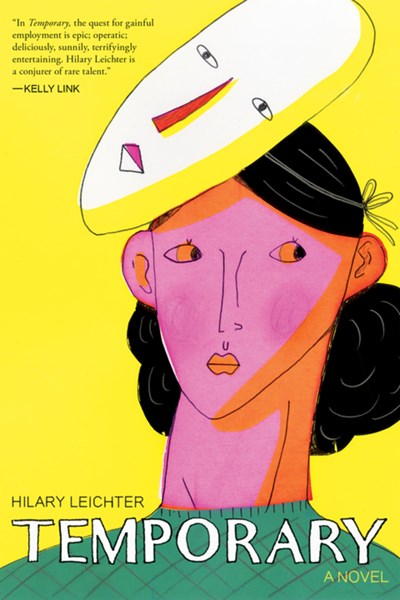
It’s fitting—maybe even a little on-the-nose—that the last book I finished on my commute to work was Hilary Leichter’s Temporary. Now that my twice-daily train ride has been indefinitely suspended alongside the commutes of millions of others, it’s tempting to claim Leichter’s debut novel is even more resonant, asserted in the key of the now more than ever message bombardment from every corner of the COVID-19 pandemic. But the uncanny resonance of Temporary doesn’t come from some hyper-accurate prediction about the future of work or wage labor or society; what Leichter weaves is more parable than prognostication.
Temporary‘s chief concern is with the way employment, or lack thereof, inflects every aspect of our lives, which was as true when it was published in early March of this year as it is today—differently true, maybe, but still true. If the book feels extra prescient at this moment, it’s because Temporary illustrates that before things get better, they’re first going to get much, much weirder.
I spoke with Hilary Leichter earlier this spring about her irregular writing practice, the definition of a “bad job,” and why it’s critical for her nameless protagonist to have 18 boyfriends. The following has been edited for length and clarity.
Calvin Kasulke: Before we even dive into book stuff: What’s the worst job you’ve ever had?
Hilary Leichter: I’m lucky in that I think my bad jobs are a sitcom brand of bad job. And right now “bad” job means something very different to me—not being recognized by your billionaire CEO, not getting sick days when you’re being forced to put yourself in harm’s way. That’s a bad job.
For my weirdest job, I’ll go with something fairly recent. It was advertised to me as an administrative assistant job working for someone out of her apartment. She had her own business, and when I arrived it was clear that there was no rhyme or reason to what I was asked to do. It was everything from moving boxes to sorting swatches of fabric to placing Amazon orders to helping her hire someone because I couldn’t stay with her full time.So I was Farren from my book, looking for other people for her.
After I had worked for her for several weeks, I was waiting for payment but hadn’t received it yet—this is a position I think many freelancers can relate to—so I shot her an email just saying, “Hey, waiting on my check.” And she emailed me back and asked if I would be willing to be paid less than what we had agreed on for the work I had already accomplished. And it was already a very low hourly rate, and something maybe a few years ago I would’ve said, “okay,” we all have those moments when we’re desperate for a paycheck. But I said no, and I was paid anyway, to her credit. But the chutzpah—I can’t think of anything more nervy than to ask someone to be paid less for something they’ve already done. It was a nightmare, but not in terms of our current nightmare. There’s quite a chasm between not-great and inhumane.
CK: Similarly, you can sort of characterize shifts in tone in your book based on the emotional reality of the narrator’s bosses, or whoever is giving her orders. I know you wrote this book over a long period of time, and I’m curious as to how it got the shape it eventually took on in its final form.
HL: I’ve never thought about it that way, but that is the situation when you walk into so many workplaces. You’re a part of a reality that has nothing to do with anything except the person that you work for, and I think that’s a really good way of thinking about the structure of the book. Oftentimes the narrative trajectories are just kind of strange and get the label of “surreal,” but I was really following where the emotions of her careerlessness would take her.
Very literally, the book got its shape from a short story that I wrote in 2012, and many of the jobs appear in that story. It was very short, I think only six pages or so, and she just hops from place to place. And then I went back to it and thought, “Well this is kind of perfect,” and such a great outline for a book. So I just went through and expanded. Instead of drawing the story out to something different, it was more like inflating a balloon.
CK: Were there any jobs or portions of the original that you felt didn’t fit in the final version that you had to drop?
HL: It’s not in the short story, but in one version of the book she spends a lot of time in prison in solitary confinement. She has the job of filling in for a prisoner who escaped, and I actually love that section but it kind of didn’t go anywhere, so I had to lose it. I think some of the emotions in that section could be found other places in the book. I was really interested in escalating the things that she was being asked to do, and she wasn’t being asked to do anything there except be alone. And that’s kind of where she is for most of the book anyway.
CK: You wrote Temporary very quickly, in one summer. I’m curious about how inflating an older work, the original short story, might’ve impacted the shape of the novel?
HL: I really wrote it in a sprint, but not because of any deadline or because anyone cared to read it critically. It was an experience that I am bashful to talk about because I don’t know that it will ever happen again and I think every book is different, and I think every book requires something different. The next thing I write might take 10 years.
I had been working on a different book for a really long time and just not getting anywhere with it, and I had told so many people about it that I felt weird compunction to keep writing it, even though it just was not working. I wasn’t having fun, which is not to say that writing is always supposed to fun—I think a lot of times it’s really not.
But I was looking for a way out of that and I just went back to play with this story, because it was more in line with what my life looked like at the moment and the things that I cared about and the emotions that I had.
A lot of workplace stories from the 20th and 21st century have been about men. And it is because women were invisible in the workplace, and still are sometimes.
I just took a look at it again and started fiddling with it and it was so much fun and I wrote it from a real place of—it was like a mix of joy and rage. The country was on the verge of electing Donald Trump and I was filled with this weird combination of hope that that wouldn’t happen and rage that it was even a possibility, and I wrote it from that fevered state. It took about a month and after that I edited it for a long time. I was still working on it and editing it through the process of finding an agent and selling it, and it changed a lot from that first draft, but it is very much still the same book.
In a way, the way that I wrote it is where the structure came from. It’s a very stream of consciousness word association type of structure, almost like a group of people playing charades. And that’s indicative of how I wrote it, I just kept going. I haven’t felt this way about anything else I’ve written where I would just wake up in the middle of the night and want to work on it. And I hate myself for saying that. It sounds so annoying, but it’s absolutely true. It was so much fun. I had so much fun writing it,the way the narrative works is in the name of fun.
CK: It can like the worst of both worlds, though, if you don’t have a regular practice. You seem lazy until you crank out something in a month and then everybody’s taken aback.
HL: Screw regular practice, especially right now. I have a problem with the idea that anyone can tell anyone else how and how to execute. Being a writer is something you totally have to figure out for yourself, and it’s something that each project tells you how to do. Any time someone’s like, “This is what you need to do, these are the three tricks your doctor doesn’t tell you about being a writer.” No, no, that doesn’t exist. There are no tricks.
CK: You talked about writing Temporary during one very heady period of American life, and now we’re in a very different, intense period of American life. Are there any parts of the book that are newly resonant to you as you’re seeing it discussed as part of the conversation?
HL: There was one very specific passage that keeps coming up where the narrator is learning all of the lingo that she needs to know to work on a pirate ship, and a pirate slang for being dead is “working remotely.” So that paragraph keeps popping up again and again because we’re all working remotely right now.
I think everything is newly resonant in this moment. I think for everything that was, there’s the before and after. It’s very strange having a book come out right now; it’s everything from disappointing to illuminating. The things that we care about in these moments of publication are suddenly so incredibly unimportant. I’m disappointed not to stroll around and see my book in bookstores, that was something I was looking forward to, but at the same time I’m grateful that I have a job that allows me to stay home, and that I still have a job. So everything is put into a new kind of perspective at this moment.
CK: I wanted to ask about the narrator’s 18 boyfriends and the logic behind that—
HL: Behind the number of boyfriends or just behind their existence?
CK: Behind their multitude.
HL: Even since the short story there has been a gaggle, a murder, of boyfriends. I don’t know what the collective noun is, but they’ve always been there. I envision them as this chorus line of well-intentioned doofuses, and I say that with the most love. Because she loves them, she’s not able to commit to any of them or even to all of them—because of her nature, because she’s a temp, but she does care about them, and so I care about them too.
In creating them I was really thinking about the way that female characters pop up in a male work narrative. A lot of the workplace stories from the 20th and 21st century have been about men. And part of that is because women were kind of invisible in the workplace, and still are sometimes. So I was thinking about the way girlfriends in some of those movies and books become interchangeable and are sort of window decoration. That’s where I started from, and then they all took on these very endearing personalities and it turns out I’m not really capable of writing window dressing.
My character couldn’t just decide to be a temp because a lot of those decisions are really made for us by capitalism.
They do provide a bit of grounding for her. I think that if she didn’t have some sort of story or some sort of personal life, it would be very hard to stay with her for the whole book. That’s something that I definitely discovered the more I wrote into the narrative. It became important to give her not a love story, but a social life, a family life and something else too, which is like the mythology that comes into the book, like a history.
And I think these are the things that you have when you come to New York, right? As a young person, you have your day job, your family, and you have your social life. And those are the three things that tether you in this city, whether they’re non-existent or whether they’re complicated or whether they’re tangential to work or whether they overpower work. So it made sense to have that be part of her story since it’s part of the stories of a lot of young working people.
CK: The condition of temping is passed on matrilineality in the book’s mythology, or at least in the lived reality of the narrator’s existence. I was wondering why you chose to make temping something that was passed on to her, as opposed to something she opted for.
HL: When I was creating the mythology that grounds the book, I was thinking of Greek mythology. I was thinking of fairy tales but I was also thinking of Judaism, which is a matrilineal religion. And even though it’s not overtly a Jewish book, a lot of the themes about where her history and her impulses come from Judaism.
I was thinking about that in editing it—maybe not in writing and at first, but then editing it I was thinking about again, the invisible nature of women’s work and the way that women sometimes don’t have a choice in the work that they get, in the work that they can have, in the work that’s available to them. There is often a convergence between the personal and the professional, and I wanted to explore that too. So it was very intentional that this was something that’s passed down. Even though that doesn’t happen in our world—technically—it kind of does, right? Our understanding of ourselves and what we’re capable of is passed down. Our confidence, our financial security, all of that is something that we receive from somewhere else. And so she couldn’t just decide to be a temp because a lot of those decisions are really made for us by capitalism.
CK: At the beginning of our conversation I asked about your worst or weirdest job, and I’m wondering if there is a job or a gig that you haven’t had or tried your hand at, but you think that you would absolutely crush. A job you would be fantastic at.
HL: I think I’d be an amazing publicist.
CK: What makes you think you’d nail it?
HL: Well, I had to do it for my book, right? I have a publicist who’s wonderful, but we all kind of have to be our own publicists when we have books coming out. Also, I’m a theater kid at heart, and so everything for me is high-key putting on a show. And I think that’s something you have to be very comfortable with in publicity, putting on the right kind of show for the right audience. Oh, I think I would totally nail it. If anyone’s hiring.
Amado Vazquez, a Mexican botanist, named an orchid after Joan Didion. While that was a chic gesture, I don’t think of her as an orchid. I think of her as an onion. She’s very white, very crisp, and she makes people cry.
In high school, I came up with a nickname for Didion: the windy bitch. She blew into my consciousness senior year when our English teacher herded my classmates and me into the school library to take an Advanced Placement literature test. We sat on wooden chairs, reading, grinding our teeth, annotating, flipping exam pages. At the end of my booklet, I came upon an essay whose opening line grabbed me by my anxious balls: “There is something uneasy in the Los Angeles air this afternoon…” The noir paragraph described a place I actually cared about: California. Often, when we read for English, we “traveled” to places I didn’t want a passport to. The Roman Senate. Winesburg, Ohio. Boats.
But here was home. And home was the star. And I understood the weather that this white lady was writing about! She described regional winds, the Santa Anas, which had touched my family. These shook the windows of the Los Angeles furniture store my dad’s mom, Grandma Hope, ran with her second husband, Bob.
In high school, I came up with a nickname for Didion: the windy bitch.
I lived about 150 miles north of the furniture store, in the Santa Maria Valley with my mom, sister, brother, and dad. Our local winds acted as devilishly as the ones the essay was detailing. Walking home from the bus stop, gusts spat grit and gnats into my eyes. They grabbed leaves and trash and whirled the debris in tiny cyclones along sidewalk gutters. During a windstorm, invisible hands snatched my skirt, tossing it above my ass, flipping it up in the front, inverting it like an umbrella. These same hands grabbed my dark hair, winding it around my neck, garroting me.
I wanted to read more about this familiar weather but I’d arrived at the excerpt’s final line: “The wind shows us how close to the edge we are.” Exhaling through my nostrils, I stroked the writing bump on my middle finger and scribbled an enthusiastic analysis I would’ve preferred to write in the first person, but which I wrote in the third.
I doubt my abuelito read Didion. He’s dead so I can’t ask him. He was a Mexican writer, publicist, and machista who actively avoided prose written by women. I do know that critic Michiko Kakutani’s claim that “California belongs to Joan Didion” would’ve given him a chuckle. He’d whip a pen out from under his serape and fix the line: “California belongs to Joan Didion because her ancestors stole it.”
In my imagination, Abuelito’s version of history wrestles Didion’s. The white literary establishment handed her California but I propose we wrest it away from her. The Mexican presence haunting her work could do so if those of us living outside Didion’s prose lend a hand to the diaspora trapped inside of it.
The white literary establishment handed her California but I propose we wrest it away from her.
I’m not suggesting we engage in mutiny, narrative or corporeal, because I hate Didion. To the contrary. Didion’s work guides me as much as it scoffs at me and I confess that her voice has been instructional. It invited me to experiment with gringa coolness and first-person narration. Didion’s regional fixations affirmed that California could serve as my muse. Many of Didion’s sentences resemble my favorite music, music no one should dance to. She modeled how writing yourself into the story of a place convinces readers that the place is yours. You, the author, fuse with rhetoric and fact. Your body joins the topography.
What chafes is Didion’s racial grammar. Sociologist Eduardo Bonilla Silva describes racial grammar as a conceptual metaphor involving three components. One, the rules of racial grammar govern how we see, understand, and feel about racial matters. Two, we acquire racial grammar through social intercourse. Three, rebels who develop a counter-grammar enable change.
Through rebellion against Didion’s racial grammar, we can unseat her as California’s thin-lipped literary grand dame. We can make way for other windy bitches, otras cabronas que quieran soplar…
An analysis of the racial grammar in Didion’s essay “Guaymas, Sonora” unveils why México exists: “It had rained in Los Angeles until the cliff was crumbling into the surf and I did not feel like getting dressed in the morning, so we decided to go to Mexico, to Guaymas, where it was hot.” According to this run-on sentence, México is something for gringos to do in their piyamas, o quizás en cálzon, on rainy days. It’s a pastime, and the point of doing México is similar to the point of camping. Campers seek temporary and recreational suffering and in Didion’s case, she wants “to become disoriented, shriven, by the heat…”
She and her half naked family drive through Nogales, the Sonoran Desert and Hermosillo. The further south they drive, the more her prose approaches the infernal.
Lost
Hot
Grotesque
Claustrophobic
Limbo
Moaning
Upon arriving at her destination, Didion goes into gothic overdrive, layering a symbol of death upon a symbol of everlasting life: a vulture perches atop a crucifix in the town square. To help us see Guaymas in our mind’s eye, she offers an Anglophilic reference: “As far as the town goes, Graham Greene might have written it.” Greene wrote The Power and Glory, a fine novel about La Cristiada, a Mexican religious war, but I find the reference a little galling. I’ve been to México many times and never once thought, “Ah, México…just as the British described it!”
Greene and Didion belong to the spiritual tradition of extranjeros palidos using México as a portal. “We went to get away from ourselves,” Didion explains. Now, if the writer left herself, and most of her wardrobe, in Los Angeles, who, or what, went to vacation in Guaymas? Didion answers this question by likening her journey south to the one made by the mythical queen Alcestis. Prior to her rebirth, Alcestis descends into the underworld. Didion’s transformation requires her to slip below the waistband of the Americas: the U.S.–Mexico border.
Didion’s transformation requires her to slip below the waistband of the Americas: the U.S.–Mexico border.
Terrible things populate underworlds and while Didion is in Guaymas, she comes to approximate one of these things. Sun, inertia, and liminality conspire, permitting her to indulge a persona I call Juana: “For a week we lay in hammocks and fished desultorily and went to bed early and got very brown and lazy.” (Emphasis all mine.) Didion’s punctuation succumbs to sloth as she abandons commas to conjure an enduring controlling image: the lazy Mexican. Sociologist Patricia Hill Collins created the concept of the controlling image, a device that dictates social scripts. Controlling images limit who we can and can’t be, and literary scholar Lee Bebout explains how this one functions: “[w]hether taking a siesta or laboring continually, Mexicans are often scripted as lacking entrepreneurial energies and a self-reliant, Waspy work ethic.”
Because whiteness is made oppositionally, Didion relies on this controlling image. Becoming a lazy Mexican purifies her. Hibernating in the heat will restore her WASPy womanhood. Like Alcestis, she will reject the permanent sleep offered by the underworld. She will never, at her core, grow lazy enough to quit caring about the work waiting for her in the United States.
By week’s end, being Juana bores Joan. Wanting “something to do,” Didion returns north, sloughing off her Brown persona, leaving Juana to the hellscape so masterfully rendered by that Englishman.
You could say that a part of México grew up in Didion’s house.
She named her only child after one of its coastal states and most popular tourist destinations: Quintana Roo. Imagine that.
Didion pronounces it gringishly: Quinn-tana. Though it’s tacky, it strikes me as on brand that Didion did this. Didion named her daughter Quintana Roo because she saw the words on a map and liked them. Didion mines México for language. Its words hold music but their meaning remains a mystery to her. Their sound yields ignorant amusement.
Didion mines México for language. Its words hold music but their meaning remains a mystery to her.
Didion takes a similar approach to her regional monographs. Drab civilization offsets racialized kitsch and gibberish: “…Delano, Tulare, Fresno, Madera, Merced, Modesto, Stockton. Some of these towns are pretty big now, but they are all the same at heart, one- and two- and three-story buildings artlessly arranged, so that what appears to be the good dress shops stands beside a W.T. Grant store, so that the big Bank of America faces a Mexican movie house. Dos Peliculas, Bingo Bingo Bingo.”
When I sense us on the page—bingo, bingo, bingo—my heart beats faster. Brown body parts twitch between certain lines and Mexican wood haunts “Los Angeles Notebook,” the essay that first brought me to the windy bitch. Santa Anas are more than winds. Santa Anas are people. Mi familia incluye Santanas de los Altos de Jalisco. In 1988, the Rock N’ Roll Hall of Fame inducted the band Santana which was founded by a Santana. A Santa Anna served as a notorious Mexican soldier, General Antonio López de Santa Anna Pérez de Lebrón. United States history books typically place him at the Battle of the Alamo but prior to that showdown, Santa Anna governed a state on the Gulf of México. Its sound would make Didion lick her naming chops.
¡Yucatán!
Santa Anna ruled as president of México an inordinate number of times. (You could rightly call the man a dictator.) Regardless, the United States has his leg. It followed a circuitous route to the Midwest after grapeshot fired by a French cannon in the Mexican state of Veracruz tore it up. Doctors amputated it and Santa Anna honored the casualty by staging a state funeral for it. Wearing a cork and wood replacement, Santa Anna fought in what Mexican history books call la Guerra de Estados Unidos contra México but while fleeing the Battle of Cerro Gordo on horseback, Santa Anna left behind his prosthesis. U.S. Infantry captured it. Soldiers took their trophy to Illinois, where it remains a roadside attraction.
Didion writes that we know when Santa Anas are coming “because we feel it.” I know Mexicans are in “Los Angeles Notebook” because I feel it. Somos Los Angeles. Somos el viento. Somos California. Somos playas y palmeras. Somos piernas invisibles.
In a “Los Angeles Notebook” anecdote, Didion obliquely addresses Mexican existence. She tells of a scorching and smoggy afternoon when, yet again, the weather prevents her from getting dressed. She heads to Ralph’s Market wearing “an old bikini bathing suit.” A “large woman in a cotton muumuu” disapproves of Didion’s outfit and chases her. The hunt follows the format and rhythm of a joke: “She follows me all over the store, to the Junior Foods (SET…), to the Dairy Products (UP…), to the Mexican Delicacies (PUNCHLINE)…”
This instance is the only time that the word Mexican appears in this iconic essay about a place that was once México. Given how primitive Didion finds México, and Mexicans, it seems that the comedic pleasure she takes is oxymoronic.
How can anything Mexican be a delicacy?
Kids raised in California inherit a macabre history. Adults take pleasure in recounting to them the grim lore of the Donner Party, those “settlers” who schlepped westward, ran out of food, froze and dined on each other. Since I developed a taste for the morbid during childhood, the Party’s demise titillated me. Their story felt like an antidote to the triumphant pioneer legends TV, textbooks, and teachers force-fed me. My dad taught me to be suspicious of the word pioneer. “If there are people to greet you,” he explained to me, “then you’re not a pioneer.” Applying this axiom during social studies got me in trouble with several teachers descended from pioneers. I spent a fair amount of my childhood wondering what the settlers tasted like. I wondered how they prepared one another to be eaten. I wondered if I had the wherewithal to eat my family. I wondered who I’d eat first.
Who would you eat first?
Why?
“The tale of the Donner Party,” writes Michiko Kakutani, “haunts Didion.” Didion’s great-great-great-grandma, Nancy Hardin Cornwall, travelled west with the Party but she and her fellow travelers split before the settlers established what came to be known as the Camp of Death. Still, Didion celebrates her great-great-great-grandma’s courage, glorifying her as a Daughter of the American Revolution who “never seem[ed] afraid of Indians or [shrank] from hardships.”
Didion inherited her great-great-great-grandma’s cornbread recipe along with her “wagon-trail morality.” She meditates on the latter in her essay “On Morality”: “…my own childhood was illuminated by graphic litanies of the grief awaiting those who failed in their loyalty to each other. The Donner-Reade Party, starving in the Sierra snows, all the ephemera of civilization gone save that one vestigial taboo, the provision that no one should eat his own blood kin.”
I’ve always believed that pioneers who suffered got what they deserved.
Maybe I’m a ghoul for taking pleasure in the settlers’ comeuppance; I’ve always believed that pioneers who suffered got what they deserved. I reserve my sympathies for the memory of the human beings that the settlers tortured. The account written by Party survivor Eliza Poor Donner Houghton tells that “eighty-one souls” attempted to reach California. After listing every white soul’s first and last name, she concludes with “Antonio (a Mexican) and Lewis and Salvador (the two Indians…).”
Lewis and Salvador were Miwoks who knew to distrust the Party. They fled but the settlers found and shot them, making them the only human beings they intentionally hunted and cannibalized. After the settlers watched Antonio freeze to death, they ate him too. Didion’s meditation on wagon-trail morality never names Lewis, Salvador, or Antonio but their presence pervades the wagon-trail meditation. The settlers Didion commemorates carried this human trinity in their bodies. White intestines became the three men’s graves.
These days, I find what Didion doesn’t show more interesting than what she tells. Literary criticism, along with history, hands me a scalpel, enabling me to slice open the stomachs of those subjects made visible by her prose. I can poke at the exposed contents, smell them, learn from them, and give them a proper burial. Can we make etching their tombstones a collective effort?
Let’s queerly circle back to place as muse.
I must tell you a Queerlifornia story.
A few summers ago I attended a party in Los Angeles. After taking a seat in the backyard, I unsuccessfully tried not to gawk at my hostess’ house. A party-goer noticed my struggle.
She leaned toward me and whispered, “It’s beautiful. I think it’s a Frank Lloyd Wright.”
I nodded.
I was also struggling not to gawk at breasts. They jiggled and hung everywhere. The backyard was Lesbos. Topless women lounged poolside. Others congregated in shallow water. A few floated alone, arms outstretched, eyes closed. A muscular lady in a bikini bobbed in an inflatable plastic donut covered in icing and sprinkles.
Lynn Harris Ballen invited me to this party but I will let Lynn’s spouse, Jeanne Córdova, introduce her. In her memoir We Were Outlaws, Jeanne explains that Lynn is the South African daughter of freedom fighter Frederick John Harris. “The fact of her paternity,” writes Jeanne, “drove me to investigate her further and in the process, I married her.”
These days, I find what Didion doesn’t show more interesting than what she tells.
Jeanne, whose parents named her after the French tomboy saint, was born to an Irish-American mom, Joan, and a Mexican-American dad, Federico. Jeanne’s role in her big Catholic family helped her land one of her first jobs which she got after noticing an ad pinned to a UCLA bulletin board. Jeanne applied and convinced a childcare-seeking couple that she was a competent candidate. She’d helped raise ten siblings.
Jeanne worked at the couple’s house and at first, the arrangement puzzled the baby dyke. She babysat the couple’s toddler while they remained home. Jeanne soon realized that both the wife and husband worked, each in their own book-lined office outfitted with typewriters. The couple behaved the way writers often do in one another’s presence, ignoring the other’s existence, passing the other in the hallway without acknowledgement, eyes distant, faces haunted by a preoccupation with language’s infinite problems.
The couple was Joan Didion and Mr. Joan Didion.
The toddler with the Chicana sitter was Quinn-tana.
Working for the Didions gave Jeanne a glimpse of the writing life and this exposure primed her ambitions. She became a Latina lesbian activist, organizer, editor, publisher, journalist, and author. I’m able to proclaim that I’m a free queer Chicana because of Jeanne’s labor. Jeanne’s labor also made it so that Didion could create her canonical vision of California. Jeanne’s labor made it so that my muse could belong to Didion.
Cancer had taken Jeanne by the time I dogpaddled in Lesbos.
She died of cancer in 2016.
Didion inherited a wagon-trail morality from her ancestors. From my queer Brown ancestors I inherited a different kind of morality, one that drives me to write for Lewis, Salvador, Antonio, and Jeanne. In this moment, California belongs to them. This sentence is their title, their deed.
Lydia Millet has always fought for the environment. She has written many books that take the natural world as their subject, but her signature approach is refreshingly askew, shot through with humor and satire. She gives animals perspective in her collection Love in Infant Monkeys, explores ecotourism and marine conservation through mystical creatures in Mermaids in Paradise, and extinction and evolution via taxidermy in Magnificence. That list is a mere sampling; she’s written sixteen books, including two short story collections and four young adult novels. As if that weren’t enough, she also spends her days working as a senior editor for the Center for Biological Diversity in Tucson, Arizona, a non-profit with the mission to use “science, law and creative media” to “secure a future for all species, great and small.”
A Children’s Bible, her sixteenth book, tells the story of Eve and her companions, who range in age from young children to graduating teenagers. Their parents, friends since college, have rented a grand summer house for a protracted and debauched reunion. Eve, our narrator, speaks mostly in the first person plural, giving an account from a collective perspective. “Once we lived in a summer country,” the novel begins. “In the woods there were treehouses, and on the lake there were boats.” In this summer country, the only apparent act of parental supervision has been to lock the children’s phones in a safe. Their summer is idyllic, until it isn’t. A major storm that floods the property is just the start. Technologically incapacitated, the children move outside, where they become like the Lost Boys—self-governed and free, until the lack of adult leadership forces them to be the grown-ups.
A Children’s Bible is a thrilling novel of climate change: motivating but not didactic; electrifying, when so many of us are at our most inert. Like all of Millet’s work, A Children’s Bible gains strength from its contradictions. It is hilarious yet tender, absurd yet chillingly realistic, nostalgic yet prescient.
Halimah Marcus: The first time I read A Children’s Bible, I felt upset to no longer be a child. The young people in this story are so much more appealing than the adults. They’re not corrupted by a lifetime of responsibility and mistakes. They’re smarter, they’re savvier, they’re more loving and more kind. Did you have to battle any of your own vanity or defensiveness as an adult in order to malign the adults as a group?
Lydia Millet: I think there’s something wishful about the way that I portray the young characters in this book. Of course, in real life there are some compensations for agedness, including certain forms of wisdom and wit and sometimes vision that we don’t always have when we’re younger. We lose other things like memory and motor skills, and quickness, alacrity, reflexes, and also our experience of the world as a novelty. That’s what I most miss from being a teenager, how everything sometimes seemed enchanted and mystical.
I actually think that teenagers have as many blind spots as anyone else, just maybe different blind spots. On the matter of climate, the urgency of that crisis, and the urgency of the extinction crisis, I happen to think the generation that I’m writing about (and those say, in their twenties and maybe thirties), are more right than the generations older than them. The righteous anger that the [the younger generations] command is long overdue. I wanted to write them having a general wisdom that represented that more specific wisdom that I believe they really do have.
Not all adults are repulsive and selfish and hedonistic, and I certainly hope and kids can be equally all of those things, especially teenagers. When you’re a teenager you get to suspend empathy for a while, neurologically and otherwise. But you also have access to all these forms of rapture that I think we grow out of. I wanted to look at the more ecstatic and rapturous time of life.
HM: This particular exchange in the book hit me where I live, as they say. The parents acknowledge that they’ve let the children down by not protecting the planet. A mom asks, “But what could we have done really?” The children respond:
“Fight,” said Rafe.
“Did you ever fight or did you just do exactly what you wanted?” said Jen. “Always.’”
I was like, shit, that’s me. I convince myself that I’m doing something by taking public transportation, recycling, not using plastic bags, but I don’t make any real sacrifices. How do you reconcile compassion for your characters and the people you love in the real world with the condemnation that we all deserve for our complacency with climate change?
LM: First of all, I think that there’s plenty of blame to go around. There is personal blame that we can absorb, but really so much of this was directly caused by much more powerful actors than we are. Climate change was very directly funded and caused by the fossil fuel industry, who we now know had pretty much mastered the science of climate change back in the 70s and certainly by the 80s. They had a vast storehouse of information and actively suppressed it. We should look first to the powerful to hold responsible for this thing.
Not everyone can have a job that has to do with the things that mass social and cultural transformation. We have to have normal jobs. So how do we tackle these huge, future-oriented abstractions? It’s a tactic that has been used by climate deniers and by vested interests in big industry: just tell people they should recycle and guilt them about their own lifestyles, when really it’s macro social things that determine our lifestyles. It’s laws, it’s policies. Many of us can’t do anything about those on the individual level. So it’s a tactic of deflection from people who actually can do something on a policy level to blame regular people for their wasteful habits, and just turn everything on the victim. It’s victim blaming, basically.
That’s not to say that we can’t all live more responsible lives, but I’m someone who believes really strongly that the structural change on the scale that’s needed to tackle extinction and climate change absolutely has to come from the law and from policy. It has to come from the top. To put it on the bottom, on those of us who are just regular people, to put that pressure on us is disingenuous. It needs to come from our representatives. It needs to come from Congress. It needs to be policy that people have to live by. That’s the only way we can change the habits that we have that have gotten us into this mess. I firmly place the blame on the powerful and not on you.
HM: Well, thank you. I appreciate that!
You called climate change a huge future abstraction. How do you find narrative purchase in something like that, that’s a slow moving, global phenomenon? Is the American perception of climate change particularly resistant to narrativizing it?
I believe that the structural change on the scale that’s needed to tackle extinction and climate change absolutely has to come from the law and from policy.
LM: Those are really good questions. I’m not sure I have all the answers. It is difficult. It is difficult to make stories that aren’t dull or polemic out of these things that are so big. The only thing we can do is—other than write nonfiction, of course, and pass laws and do reporting—but in terms of fiction, all we can do is tell stories in voices that we like about characters that we like, or don’t like, or like to not like, or whatever. It’s always been difficult for me to write about these catastrophic historical events in fiction for the same reason that it’s difficult for anyone to write about them in fiction, which is that there’s a grandiosity to them. It’s like writing about God. The grandiosity is difficult to approach as a peasant, and that’s what one always is with these large things.
And there are so many landmines when you approach the majesty of some of these immense subjects that are fraught with political judgments. There’s the risk of writing too much like an activist. I think it’s great to be an activist. I don’t want to write like an activist. It’s a balancing act. I don’t think any of us ever feel we completely succeed when we try.
HM: In addition to the 100 year storms that become more frequent in the novel, there’s a nasty bug that gets passed around between the parents. In most disaster/apocalypse stories—novels, movies, whatever it is—there’s one event that threatens civilization. It’s an asteroid. It’s a tidal wave. It’s a contagion. But in A Children’s Bible, the threats are recursive and multi-valenced. How did you choose the disastrous events in the novel, and how does that thinking apply to our current situation? I’m particularly curious about connections you see between the pandemic and climate change, which on the surface may not seem immediately related.
LM: I think they’re really closely related, as you might imagine. Both climate change and the pandemic are the direct result of the way that we’re abusing the natural world. The actual novel coronavirus probably came to us from bats via pangolins, maybe via civet cats, and then via wildlife markets. We know that the disease itself is most likely the result of the exploitation and abuses of the wildlife trade, international in this case. But we do a lot of it here at home as well.
Huge numbers of animals are taken from the wild for trafficking, turtles especially. Freshwater turtles in the US are taken by the millions. Climate change and extinction, which are so interconnected you can’t really decouple them anymore, are driven by this exact same abuse of the natural world, rampant plundering of it that’s gone on for a few centuries now. They have essentially the same root cause. Of course, the economic effects and the scope of the pandemic here in the US are a political product, not an environmental product. This thing didn’t have to end up this way.
Chaos looks like everything and also like nothing. Some of us, at least, are experiencing the pandemic almost as a form of stasis, or limbo, or powerlessness. All the kids across the country having to be homeschooled and being bored out of their mind, including my two. And at the same time, for many, for those in extremist, it’s desperate and life threatening. But there are these different circles of experience. In any chaos scenario, some people are insulated from the worst effects and others are on the front lines and exposed.
HM: There are groups of people who believe that in order to be prepared for a disaster, having a gun is top of the list. The idea is outsiders will come for your supplies. You need to be able to defend your homestead. And but then there are examples of people coming together as communities rather than turning to violence against their neighbors. In New York City we have the examples of 9/11, the blackouts, hurricane Sandy.
There’s also these new prepper communities like The Prepared, which I read about in the New York Times, that are trying to appeal to “common sense” preppers that are less libertarian and even liberal. Without giving anything away, in A Children’s Bible, there’s someone who turns out to be a top level prepper. That person has guns and it becomes necessary to use those guns. So where do you fall on this spectrum? Are guns necessary for survival? Would you have a gun in your bunker?
Both climate change and the pandemic are the direct result of the way that we’re abusing the natural world.
LM: I’m not a gun owner and I choose not to have a gun in my bunker. First of all, your likelihood of actually dying in an untoward, untimely way is so much higher if you have an actual gun in your house. On that basis alone, I’ve never wished to [have one]. Also they scare me and they’re creepy and when I hold them, I feel wrong.
I’ve lived basically out in the desert for more than 20 years now. Here, the geography, the distance between people, actually emboldens people around guns, as well as making them feel more isolated and perhaps defensive to begin with. It makes complete sense to me that dense urban communities would not be as gun wielding. It’s almost not as real that people are getting hurt by these things when you’re all spread out and you don’t see another person for four miles.
I do believe in other forms of prepping, just not the guns. I’m not handy enough to be a prepper. My boyfriend is pretty handy and he can do a little prepping, but I lack the skills required. I can just basically order stuff on the internet and I can prune some plants in my yard. One of the more alarming things about the prospect of a near apocalypse is the handiness that would be required to cope. I am just not a self-sustaining organism, really.
HM: In terms of the decision to include violence and guns in the novel, I’m inferring from your earlier answer that it has something to do with the intertwining of all of these threats. Is that right?
LM: I think that America is a place where sooner rather than later in any kind of situation of mass instability, there will be guns and they will be brandished in public. The pandemic has actually already shown us a glimpse of this, with people showing up with guns at state capitals and stuff like that.I didn’t think I could really write an American chaos story without some guns showing up.
Gun stories aren’t particularly interesting in and of themselves. It’s just, are those characters who are holding the guns interesting, or not?
HM: I don’t want our readers to think that you’re exclusively concerned with doom and gloom because you’re one of the few writers that consistently makes me laugh out loud.
I didn’t think I could really write an American chaos story without some guns showing up.
LM: Thank you. It is my chief goal, actually. It’s actually my chief goal. I laugh out loud when I’m writing. That’s what I really love to do. I’m not saying it happens all the time, but I really do enjoy it.
HM: You’re almost exactly anticipating my question, which is, how is your humor on the page different or similar to your humor in your daily life? How do you decide which jokes make it through to the final edit? Because I’m sure you can’t laugh every time you work on the book.
LM: When I write something that tickles me, it is diminishing returns of laughter. The first time, you’re like HA! Whatever, I can’t do a fake laugh. And then the second time, you’re like… [chuckles]. And then by the fifth time you read it, you’re like mm-hmm.
But the test there is actually more like, does it displease me? Does it actually displease me, actively? You come to see that something’s too clever over time, and over successive reads.
HM: Shifting gears, to a career question: You’re a very successful novelist. You’ve published 16 books, you’ve been long-listed for the Pulitzer ( for Love in Infant Monkeys) and the National Book Award (for Sweet Lamb of Heaven), won many fellowships and awards, but you still keep a full-time job. Can you tell me about your work at the Center for Biological Diversity? How does it inform your writing? How do your ambitions and aspirations apply to your two different, and both impressive, careers?
LM: My work is technically full time, but I do keep it to more like 30 hours per week, plus some evenings, so I have a little time left over to do my own things. I do the job because it feels useful and practical. My position is not fancy, even though I’ve been there on and off for more than 20 years.
I keep my work there really modest and really detail-oriented. I do a lot of proofreading and copy editing. It does require quick turnarounds during the day for press releases and action alerts that have to go out soon. We do a huge volume of those things. And so it’s busy, but I don’t manage anyone else. I’m no one’s boss.
The beautiful thing about it is that it allows me to do things that I believe in without having to actually march along the street, holding a sign or chaining myself to a bulldozer or anything like that. I don’t prefer those things. I’ve always felt really sheepish and embarrassed in activist or protest situations. It’s just not really a natural fit for me. I don’t really like sloganeering, but I really do believe in the things that we do at work. I’m really inspired by the people I work with, who are mostly scientists and lawyers. I just want to do something useful. I’ve always felt the writing I do is just pure self-indulgence. It’s just pure happiness. There’s nothing about it that isn’t selfish to me. I do exactly what I want [when I write]. I just also need to do stuff that’s practical and it’s also nice to have a salary and health insurance. I love my work at the center, but I’m no conservation superstar or anything. I’m just a worker bee.
Growing up in Baltimore, my world of Westerns was replete with white cowboys. When the idea for my novel Book of the Little Axe came to me, white men filled my first imaginings. This was despite knowing that the story of Western America is much more than the circumscribed narrative of white man versus everything in his path. I had to do the work of undoing all the tropes, bad history, the stereotypes, and in developing my story, I found myself in awe of all the writers before me who found and created stories of non-whites in a West that isn’t always easy to traverse or love.
In researching my novel, I came across writings on Edward Rose, a Black man who was also a member of the Crow tribe. I learned that Rose was a guide to many of the early Western “explorers,” yet somehow he’s disappeared from most historians’ accounts of the time. Rose is featured in Book of the Little Axe where I attempt to illustrate the interconnectedness of multiple worlds and challenge how we think of the West.
I hope the 9 books I’ve chosen by Native writers and writers of color will do for you what they did for me: open you just a little to the possibility of a broader definition of what it means to be of an expansive, bountiful, multifaceted land where our stories are embraced.
I remember the first time reading this novel, my heart felt like it was in my throat. It’s thrilling, haunting and redemptive in the best and most vengeful way. Yes, I love revenge! Set on a reservation in North Dakota, the story is told by a thirteen-year-old Ojibwe boy whose mother has been brutally raped. Like any good Western, there are good guys and bad guys, but the good guys in this story are a family who love deeply and who find themselves impotent in the face of violence. The story grapples with the startling numbers of indigenous women who are victims of violent crimes, as well as the implications of a landmark Supreme Court case that limits prosecution of crimes committed on indigenous lands. As a lawyer myself, Erdrich taught me an additional thing or two about America’s quite fallible case law. To entertain and to teach is the novelist’s sweet spot. And Erdrich does this by giving life to a story through unforgettable characters who have big hearts.
Vivid and alarming, Rao introduces us to two girls who find themselves part of a unique friendship in Indravalli, a small village in modern-day India. If you read lots of immigrant literature, the story of two impoverished girls struggling to make it isn’t all too unfamiliar, but Rao manages to zoom in with a tight lens to show us the stifling existence of domestic life for these two very courageous girls. When the story nods toward the United States, I, like someone who forgets not to buy into the myth of America, grow hopeful. Seattle will save these girls, won’t it?! But Rao manages to both invite and destroy symbols of the American West. She wields this power with a series of twists and turns through a network of human trafficking that take us through a violent and rugged Western America, while keeping our hearts hopeful that these two girls will make it back to each other.
There is something restorative about reading Harjo’s words on Cree history and her ruminations on the intertwining lives of African and indigenous peoples. I smiled a lot while reading this memoir, not that it wasn’t heartbreaking at times, but it was as if I was remembering things I’d once known and was happy to be reminded again. “Magical realism” is what some might call Harjo’s more memorable encounters with the spiritual realm, but Harjo helps those of us who believe in an ancestral world remember our connections. She says she wishes in her writing for the “intricate and metaphorical language of my ancestors to pass through to my language, my life” and Harjo accomplishes this.
“Oh Ishmael!” is what I exclaimed after reading this book. It feels like a mad mad carnival and yet the writing is so smart and so devilish in its critique of the usual American Western narrative that you can’t help but be smitten by this story. Reed tells the story of Loop Garoo Kid, a Black man who seeks revenge on Drag Gibson, a white cattleman who murders children. The story has no regard for time or place and feels like a smoldering jazz tune that is at once joyful and raw in its riffing criticism of capitalism, colonialism, and racism. What a mind Reed must have to write such a wild jaunt! Reading it for a second time, I feel like it could’ve been written last year and I’m sorry it’s taken me so long to revisit it. But as is often the case with the best books, they find you when you need them most.
McConigley won the Pen Open Book Award for this collection, largely about South Asians living in the west. The book opens when a young Indian girl has an encounter with white boys in Wyoming who don’t seem to know or want to know the difference between her brown and any other brown. They tell her to go back to picking cotton. McConigley handles these moments with care, for her writing is both lyrical and profound. Many of the stories, rich and strange, are set in the Wyoming where McConigley spent her childhood.
Wounded is a Western in the truest sense. Set in Wyoming, John Hunt is a Black horseman who lives with his uncle and is making a peaceful life for himself after the death of his wife. Everett offers us a twisting story of out-of-towners who come to wreak havoc, and in the face of all this, we find apathy, revenge, horses, big sky, big hearts, and lots of American-style prejudices. Hunt is a character you’ll like immediately though you might not always know why.
These stories, set in Colorado, will crush your little heart. And still you won’t want to turn away. Fajardo-Anstine’s work is gorgeous, and I found characters who, like the women in my family, heal with roots, don’t believe in coincidence, and pray in many languages. Their lives are complicated and messy and the love and tenderness between the women in these stories are a clear reflection of the love and tenderness Fajardo-Anstine put into this fine piece of work.
Wilkerson’s book on America’s Great Migration is a must read for anyone interested in understanding why America looks as it does. Wilkerson details the journeys of three African Americans to New York, Illinois and California from the South, while shining a journalistic lens to the larger Black migration from the end of the Civil War into the 1970s. Having grown up in Baltimore and a frequent visitor to cities like Chicago and Oakland, I began to better appreciate the cultural landscapes of Northern and Western cities based on the migratory paths from certain locations in the Deep South, as well as to understand that like other periods of immigration, Black migration proved just as challenging. Though it is not a book set only in the West, I don’t think you can really understand any part of America without this tour de force.
I probably don’t have to tell you this, but great poetry can offer a reader as much of a thrill as a kick-ass novel. And Diaz is a kick-ass poet. These poems are earnest and vibrant with stanzas that produce heartbreak and sometimes even sobering laughter. Diaz writes about her brother’s addiction and the impact on her family. The lines she writes makes us want to call our loved ones, for they show us the commitments and bonds and resentments that make family, family. Diaz offers a rich palette of modern Native life, both on and off the reservation.
Growing up in the East, I knew little about how indigenous bodies are hunted by external and internal forces so much like in my own community; this hunting makes for both sad and triumphant stories. As a Black woman, these poems felt both familiar as in I know these people, but also new, as in why don’t I know all this? I am humbled by a collection that shows us how the west can be a setting for both a people’s nadir and also a people’s healing.
The mother worried passersby would hear the full-throated accusations and mean begging and prolonged shrieking and think to themselves, Well, that is a household I do not envy. Hugging their coats tighter around themselves. Walking quickly. Their white breath before them.
To not be envied! The loneliest hell.
We’ve got to do something, they said to each other, once the children were in bed.
Mmhmm. We will.
The mother made stew. The mother made pasta. The mother made hot dogs with French fries. The mother ordered in. The father halving and then quartering his portions. The father laying his knife and fork across his plate, their closeness funnily sensual.
The children leapfrogging from table to sofa. Ignoring their food or demanding it be destroyed. Taken away. Put on trial, convicted, sent to the gallows.
Eat! That was how it usually started. The mother saying, Eat!
She’d once seen her sister tell her own son to fuck off. It was a memory the mother held close, almost dearly. He was young enough to clutch a toy truck to himself. Young enough to not know what the word meant. Young enough to peel into laughter. Her sister’s eyes twin pools of dark glitter. Her sister’s mouth firmly shut and her nostrils pulsing, as if she were out of breath and trying to hide it.
That’s right, Eddy, you fuck right off.
The mother had tried to tell that story over the years. She never could get it right. It was something to do with her fear of her sister, a terror that felt ancient, beyond her. All of that had started ages ago, in their yellow bedroom with its bare window, which gaped at the mother, her cheek mashed into the musty carpet. Her sister’s breath hot in her ear.
There just wasn’t an end to the story, was the thing. No punch line, no bowing. What was the point?
Perhaps their mother should have yelled at her sister more, back then, all those years of a shared bedroom. This the mother considers this as she attacks a cheap pot with a sour rag. Nothing is ever nice! she rails. I can’t have one thing! A macaroni noodle is stuck to the toe of her sock. That is the straw that, you know.
She begins to narrate the evening in a loud, bitter tone. Here I am cleaning up after you! I have tried to feed you and now I must tether myself to this sink until all the dishes are done! For if I don’t, there will be no dishes for the next meal you will shit on! I asked you what you wanted to eat! Why did I do that? Am I some kind of a sucker? (The middle child begins to beg for a lollipop.) What is in this for me? She turns to face them. They are watching her like they watch the television. Flat, shining eyes. Mouths twitching. The husband drifts by; he is determined not to join in the yelling on this night.
Poor Eddy! With time and the arrival of her own children, the memory still smarts. There is no retroactive sympathy for her sister, even as the mother curses at her own children. His fat hands and skinned knees! What had he done to prompt a mother to say such a thing?
As if there were ever a reason!
Now he is a pimpled teen. At Thanksgiving he made fun of the mother’s mashed potatoes. I can tell these are from a box, he announced, swiping a finger through. He arranged his body to take up all three sofa cushions. The bottoms of his socks were charcoal black. Let it go, her husband whispered to her in the kitchen, patting her shoulder as if she were a neighbor he disliked.
I won’t let this one go! she shouts now. Her throat aches. The point is, she was a different sort of mother. Does that even matter to you? she says, nearly screaming. She holds a wooden spoon; the dog eats the noodle from her sock.
You’re an idiot, her sister had said, pushing the mother’s face into the carpet. It stung; it smelled of dust and fiber and dog pee. Say it, her sister said. Her voice quiet, like she was letting a secret.
I’m an idiot, the mother said. I’m an idiot, okay?
There is a window above the sink. The evenings started so early this time of year. The mother watches the woman reflected in the dark pane approach. She leans over the sink. The mother decides she deserves a closer look.
For poets, springtime is especially sacred. With big book releases, National Poetry Month, and the conclusion of the slam season, there is so much for readers and writers to look forward to. Then came the coronavirus pandemic. We’ve seen readings canceled, book tours halted and budgets slashed. Thankfully, as ever, poets remain resilient. In the wake of the pandemic, events have gone virtual thanks to the bonds of community and love for words.
For those who are unfamiliar, these online events are a great way to get into poetry and connect more deeply with the community. So much discovery happens at these events, and many of your favorite poets have gotten their start on the slam stage. These stages have historically been spaces for healing and care, which is something we need so much right now.
Here’s a list of events, readings, and livestreams to get your poetry fix throughout the rest of the pandemic. (Most of the events below are often pay what you wish, or free.)
Nuyorican Poet’s Cafe
Nuyorican Poet’s Cafe is NYC’s landmark Lower East Side poetry venue. It’s been the host of poets of color since 1973. In place of their in-person Wednesday and Friday night poetry slams, they’re holding online open mics on Mondays and Thursdays via Zoom. Soon they will be also offering online classes, music, and monologues. Their online information can be found here.
Bowery Poetry Club
Bowery Poetry Club is another NYC staple. Nestled in a former Formica factory, poets typically take the stage on Sunday and Monday Nights. Now, Bowery has rotating programming Sunday, Monday, Wednesday, and Thursdays. They are hosting low-cost workshops and open mics. You can find the most up to date information on their Instagram.
Da Poetry Lounge
For those favoring the west coast, Da Poetry Lounge hosts the largest weekly open mic in the United States. Originating in 1998 and based in Los Angeles, poets take the stage on Tuesday nights. The third Tuesday of the month is the poetry slam, while the rest are open mics. They’ve pivoted to online, operating via Instagram live.
Not A Cult Workshops
Not a Cult is a small publishing company based in Los Angeles. They have released work from writers Yesika Salgado, Dante Basco, Aziza Barnes, as well as many others. They also hold frequent events within their partner space, Junior High. With the closure of Junior High, Not a Cult has begun offering donation-based workshops online. Facilitators include the talents of Jon Sands, Jose Olivarez, and Karla Cordero. The schedule is updated weekly on their Instagram.
Girls Write Now: Salons & Live
Girls Write Now pairs underserved girls and gender-non conforming young adults with established writers, forging lifelong mentorships. They prepare the teens for college, help cultivate their craft and publish their work in anthology series. Girls Write Now will be hosting readings via their Live series. They also host a Salon series introducing guest artists, celebrating poets like Mahogany L. Browne and Rosebud Ben-Oni.
Jon Sands: Ps and Qs
Since the beginning of stay-at-home orders, poet Jon Sands has gathered his colleagues to converse with him on Instagram live. He calls it Ps and Qs. Sands gets intimate with other poets every Wednesday through Friday.
So Many Poetry Slams
With so many great slams, it didn’t feel fair to pick just one. The poetry slam is a competitive form of spoken word, where teams gather and compete to go to the national convention. The season usually runs from September to May. As the slam season comes to a close in May, just know that folks will still be competing at the International Poetry Slam. It’s slated for August and has yet to be canceled. The Philly Pigeon, Brooklyn Poetry Slam, Toronto Poetry Slam, Boston Poetry Slam have all moved online. Youth poetry slams Louder Than a Bomb and Get Lit’s Classic Slam are slated to be held via Zoom sessions.
The idea for my debut novel, The Down Days (a magical realist whodunit set in quarantined Cape Town), came about after chancing upon an exhibition at a medical history museum about the effects of epidemics on the history and culture of South Africa. The idea that Cape Town was so profoundly changed and shaped by disease struck a chord. Like the fact that, if it hadn’t been for scurvy, the city would have never been colonized as a pit stop between East and West.
While researching the history of disease (in South Africa and across the globe) further, three things stood out for me: Firstly, how misinformation spreads like wildfire during epidemics. Secondly, how nations throughout history have repeatedly used epidemics as excuses to feed existing prejudices. And thirdly, how periods of great upheaval, when normal rules no longer seem to apply, give ordinary people the chance to shed their skins (for better or for worse). In a way, I think, we are all Russian dolls composed of layers of masks that hide us from ourselves and others, that protect us, remake us, absolve us. In times of crisis, we surprise even ourselves to see what we can transform into.
The characters in my novel, apart from finding themselves in a situation where they are physically forced to wear masks in public, all take on new identities, new masks to navigate a post-pandemic world. Masks to survive, to hide from their pasts, from the truth and also from their grief.
One could argue that most novels are about masks in some way. And that the best books allow their readers a chance to put on new masks or skins and be transformed.
A family of alligator wrestlers run a gator-themed island theme park in the Florida Everglades. When the matriarch and star of the show dies, the family starts to unravel. A magical realist coming-of-age tale about the lies and myths we tell ourselves and our families for love and what happens when these masks/myths become undone. It’s also about the masks we put on to hide from our grief and the ones we cling to to insulate ourselves from the realities of the outside world.
Two sideshow acts fall in love in 1800s America. Inspired by the true history of “Farini’s Friendly Zulus,” this is the story of a South African Zulu man, exiled from his tribe, who travels to the West where he makes a living performing as a Zulu in a sideshow act. As he spends his days wearing and acting out the masks society has created for him, he is continually getting reminded that the audience doesn’t want to know who he really is, that they just want spectacle. Mda manages to get a book about terrible historical injustices and the trauma of being regarded as less than human to ring with hope and magic and the triumph of the human spirit over adversity.
A man without a face falls from the sky wearing a helmet of flames, and then both literally and figuratively sheds his skin. Can we abandon the masks of race, nation, and class we are born with and become something new? Ondaatje’s Booker Prize-winning novel is about all this and then some. Novelist Kamila Shamsie calls it “that rare novel which gets under your skin and insists you return to it time and again, always yielding a new surprise or delight.”
Truth is stranger than fiction in this memoir of a Brooklyn travel writer who returns to Zimbabwe to rescue his ageing parents from violence/ruin during the land invasion upheavals in 2002 only to discover that his parents are much more resilient than he thought – having turned their backpackers into a brothel (complete with a pot plantation). This is a book about resilience in times of strife. How we change and adapt and renew ourselves when necessity calls for it. About the everyday heroism of surviving in interesting times. And the ability to laugh at the absurdities of life.
In this novel, the 2001 Pulitzer Prize for fiction winner, a young Jewish escape artist smuggles himself out of Nazi-invaded Prague and lands up with his Brooklyn cousin in New York City where they grow up to create a comic book empire, featuring a masked superhero, The Escapist. It’s about the masks we dream up to help us escape (from war, from ourselves, from the masks society expects us to wear). And it’s about finally finding the courage needed to break free.
A detective has to see the unseen in this metaphysical murder mystery set in a post-Soviet style world where two cities exist in the same space at the same time. Citizens can see each other but are forbidden to look. When a murdered woman ends up on the wrong side of the border, the mask that the detective has been forced to wear since birth has to slip.
In this classic Nobel Prize-winning novel, Kazuo Ishiguro creates a character for whom it’s a point of pride never to let his mask slip and admit the truth of his own emotions, even to himself. In the summer of 1956, an ageing butler goes on a motoring holiday to visit an old colleague. The journey becomes a chance to reflect on his past and the mistakes he made throughout his long career in servitude. Ishiguro slowly peels back the layers of masks the protagonist has been wearing to protect himself from hard truths.
The mask of small town America (with something sinister lurking underneath the surface) has been a favorite theme for horror writers for decades, and Stephen King is a master of the trope. In this classic, the small town of Derry is terrorized by a supernatural being in a clown skin. But the seemingly bucolic town itself hides many evils, from prejudice and indifference (there are many scenes in which good people look the other way) to violence.
DON’T MISS OUT
Sign up for our newsletter to get submission announcements and stay on top of our best work.
YOUR INBOX IS LIT
Enjoy strange, diverting work from The Commuter on Mondays, absorbing fiction from Recommended Reading on Wednesdays, and a roundup of our best work of the week on Fridays. Personalize your subscription preferences here.