Why You Should Read “Home” While You’re Stuck at Home

If one thing will be irrevocably changed by the coronavirus pandemic, it is American’s sense of “home.” By the start of April, almost everyone in the country was under stay-at-home orders. Some estimates indicate that one in five Americans are currently unemployed. Primary and secondary schools are closed until next fall and colleges sent their students packing seemingly overnight. Still others are unable to go home at all, working essential jobs, stranded overseas, or split from their loved ones by brutal immigration restrictions that have only expanded under the pretense of the virus. Like never before, the pandemic has forced us to confront what it means to be home in America, and, ultimately, who in America is able to call this country home.
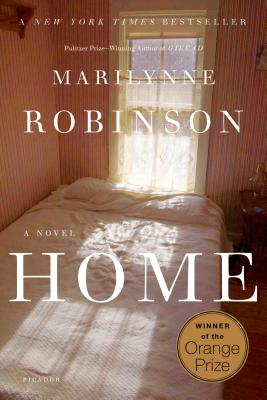
Coincidentally, the day my office announced its indefinite closure because of the pandemic, I opened a book I had long tried and failed to read: Marilynne Robinson’s Home, her third novel and the second in her soon-to-be-quartet based in the fictional town of Gilead, Iowa in the 1950s. This reticence wasn’t due to lack of zeal, as I love Robinson’s work, but because she is a writer who requires immense patience. Her prose is not difficult; in the Gilead sequence, in fact, it is exceedingly simple, almost crystalline. Yet, her language seems to unfold like the layers of a flower, revealing with a slow, measured grace its buried workings. If you don’t take the time to study it and dwell within it, its meaning escapes you, like a dream. And if I saw anything before me as quarantine began, it was––precariously so––time.

In one of the most beautiful passages of Homecoming, Robinson’s first novel, the narrator wonders, “[W]hy do our thoughts turn to some gesture of a hand, some corner of a room on a particular anonymous afternoon… What are all these fragments for, if not to be knit up finally?” Home moves like this, through intimate, almost mundane gestures whose meanings only bloom the longer the book is read, until they become heartbreaking, miraculous, glittering. It tells the story of Glory Boughton, who returns to Gilead to tend to her dying father, and the subsequent return of her brother Jack, who has been absent for some twenty years and now seeks to make peace with a haunted past.

Home is a narrative about family and religion, but, in the end, is also a meditation on racial injustice. As the coronavirus pandemic ravages all sense of normalcy and exposes the profound rifts in American society, Home came as a revelation, both a comfort and crucible for America’s hopes and hypocrisies. At a time when millions of people are living at home, there may be no better work of fiction to read. Even if it doesn’t mend you—in fact, it breaks you again and again—it might leave you with something else essential: faith.

At a time when millions of people are living at home, there may be no better work of fiction to read.


Home is an anti-pandemic book: whereas a pandemic is constantly expanding, totalizing, ravaging, Home is inflowing, domestic, sometimes nourishing. Glory and Jack Boughton are isolated members of a family in an isolated town in an isolated state. By this nature alone, Home feels serendipitous. Do we all really need to read The Plague or The Decameron right now? In fact, the Boughton’s lives are not totally unlike those of us under shelter-in-place orders: they read, drink coffee, cook, play music, garden, go on aimless drives. The novel’s insularity is something of a consolation, a reminder that all of life’s movements––joy and bitterness, rage and forgiveness––continue to pass even when very little happens.

But the solace of going home is not all Robinson is able to capture; more than anything, she evokes its defeat. Glory, the novel’s protagonist, is a 38-year-old former schoolteacher who has returned home not only because her father is ill but because her years-long engagement ended with her abandonment. “Did she choose to be there, in that house, in Gilead?” she wonders to herself. “No, she certainly did not. Her father needed looking after, and she had to be somewhere… What an embarrassment that was, being somewhere because there was nowhere else for you to be.” For Glory, who always tries “to make the best of things,” going home is a sort of a capitulation, a return from adult life to a simulacrum of childhood, as if all the years in between were just a dream. For those who have gone home because of the pandemic––especially those who have been forced to do so––the feeling might be familiar: what was all that work for, in between, if the world would just drag me back to where I began?

Wrapped up in this resignation is the more complicated disappointment that “home” might not provide the succor one envisioned it would. When the eight Boughton children are all uprooted and away at college, Robinson writes, they “studied the putative effects of deracination, which were angst and anomie, those dull horrors of the modern world.” And yet, whenever they visit Gilead, they ask themselves: “What kinder place could there be on earth, and why did it seem to them all like exile?” Inevitably, the idea of home has a way of supplanting itself––your memory of it comes to define it, and when you return, you find this conception does not align with reality. “The past was a very fine thing, in its place,” Glory thinks. As with the Greek concept of nostos, the home you go back to is not the same as the one you left. In fact, as Glory encounters the objects of her nostalgia––Gilead, her father, and, most of all, Jack––we begin to see that the past itself was never pristine.

Jack’s return, a sort of a prodigal son narrative, is the fulcrum upon which all of Robinson’s Gilead novels rest. A troubled child, he is a black sheep among his pious siblings and the apple and anguish of his father’s eye, a Presbyterian preacher who feels his son’s delinquency is his one sustained failing as Christian. As a boy, Jack vanishes and returns without a word, leaving only the knowledge that some crime or misdeed has been committed during his absence. The crux of Jack’s waywardness comes as a young man, when he seduces and abandons a young, poor girl. She has a child who Jack’s father tries to support, only to be spurned by her family, and the child subsequently dies of an infection. By then, Jack has disappeared into a twenty-year void of alcoholism and dereliction when his family hears nothing of him, even after his mother’s death.

The idea of home has a way of supplanting itself––your memory of it comes to define it.

A weary man in his forties, Jack has come home to reckon with this past, with his father, and in particular with the congregationalist preacher John Ames, the narrator of Gilead, who is his father’s best friend and distrusts Jack most of all. But it is Jack’s relationship with Glory, which buds from awkward tolerability to kinship and compassion, that propels Home. Indeed, many of the book’s lessons for those of us stuck at home, perhaps more enmeshed with family than ever before, can be drawn from the Robinson’s masterful tapestry of the intricate dynamics of family life.

At first, Jack’s sudden presence in the Boughton household vexes Glory. He quickly “resume[s] his place in his father’s heart,” a place Glory both resents and is relieved by. She discovers boundaries where there were none before: in entering Jack’s room, in asking about the last two decades of Jack’s life, and, primarily, in speaking about Jack’s illegitimate child. Privacy becomes a communal thing, as the house, despite once holding eight children, is small enough that no conversation really passes unheard. Home, far more so than Gilead or Housekeeping, hinges on dialogue, on the said and unsaid. Each conversation in the novel peels away yet another layer, reaching toward the unutterable heart of the matter.

These hidden truths forge Jack and Glory’s relationship. Jack learns of Glory’s failed engagement, and Glory learns through pieces––a mysterious phone call, letters Jack surreptitiously sends––that Jack is in love with a woman in St. Louis who does not or cannot love him back. But there are more than just the Boughton’s sins and failures at the nucleus of Home. Early on, Jack and Glory discuss W.E.B Du Bois and communism and Jack later gives her a copy of Engels’ The Condition of the Working Class in England. After Jack purchases his father a television, they watch on the news as a black crowd is attacked by riot police. Jack’s father, until then the apparent moral conscience of the book, witnesses Jack’s distress at the footage and tells him “it is necessary to enforce the law… You can’t have people running around the streets like that.” Later, a similar conversation ensues while the two are discussing Emmett Till’s murder, and his father says, “The colored people… appear to me to be creating problems and obstacles for themselves with all this––commotion… They bring it on themselves.”

These conversations are short, strained, fleeting, yet manage to flip the moral schema of the book on its head. How can the sinning, faithless child now be the voice of justice, while the wise, pious father is an apologist for racial violence? Robinson refrains from didacticism. These discussions of race seem, for much of the book, to be minor gestures, historical framings, undertones that contribute to the book’s overall narrative of wrongdoing and forgiveness. But in the final pages of Home, these undertones seethe to the surface. Jack has left his father on his deathbed, finally defeated by, or at least resigned to, the truth that his past is irrevocable and his love for Della, the woman in St. Louis, is doomed. Yet, not long after he has left Gilead, Glory finds Della on her doorstep. She is a black woman, and Jack has had a son with her.

The real stakes of Home, we come to see, are not merely faith and family or sin and forgiveness, but hatred and hypocrisy.

Jack’s return, we realize, was not merely to confront his ghosts, but to see if Gilead, the only semblance of a home he ever had, might be willing to accept a relationship that the rest of the country rejects with blood and vitriol. Ulysses S. Grant had once called Iowa the “shining star of radicalism,” as Jack mockingly quotes, and much of the preceding Gilead explores the town’s history as a haven for runaway slaves on the underground railroad. And yet, Jack discovers in his father an apathy and disdain for black Americans that varies by only a few degrees from the racism captured on the news. The real stakes of Home, we come to see, are not merely faith and family or sin and forgiveness, but hatred and hypocrisy. 

From the moment coronavirus entered the American consciousness, discourse about it was tainted by prejudice, beginning with rash and egregious fears of Asians and Asian Americans. And yet as cases began to appear, and then multiply, the topic of race was otherwise largely absent from conversations about the pandemic. Only now, as the virus has razed the country, with New York City itself registering more cases than any other country on earth, has the horrifying racial and socioeconomic toll become clear. The virus, spread largely by affluent people able to travel, has affected front line workers who cannot miss their jobs, families living in dense or concentrated homes and neighborhoods, and those without access to adequate health care. People of color have been inordinately affected by these factors: in New York City, the virus is twice as deadly for black and Latinx people as it is for white, a statistic that is proving consistent in major cities across the country, including Detroit, Chicago, and New Orleans. In Louisiana, despite making up a third of the state population, around 70 percent of those who have died from the virus are black, and in Illinois 43 percent of those who have died are black, though making up only 15 percent of the state. The coronavirus is also roiling jails and prisons, where inmates say they face little to no protections and remain forced to live in close quarters. On Rikers Island, where the majority of those jailed are people of color, at least 365 inmates and 783 correctional staff had tested positive as of April 20. 

The novel operates as a sort of microcosm for the unmasking of American democracy.

The coronavirus has exposed, on a dramatic scale, the disparities in justice along racial and socioeconomic lines in America. How, then, can a novel as provincial and, frankly, as white as Home provide a lens to understand America’s ongoing, latent political and racial violence? In fact, the novel operates as a sort of microcosm for the unmasking of American democracy. The plot never feels overtly influenced by race––the characters are white for 99% of the book––and yet, in the end, the story becomes inexorably determined by it. Robinson’s brilliance is to show that when you chip away at the domestic novel, it too splits along the same fault lines as American society.

In the end, Home is not necessarily a salve for these wounds. Jack leaves, seemingly for good, before Della arrives; Della ventures into Gilead only for a moment, in constant trepidation of the risk she is taking by driving as a black woman in a white town; and Jack and Glory’s father lies delusional on his deathbed, never quite sure of the state of his son’s soul. And yet it is through Glory, the novel’s core, that we experience a glimmer of hope. As she contemplates Della and her son after their departure, she confronts the harsh truth that “they could not walk in [her] door. They had to hurry, to escape the dangers of nightfall.” In the world they live, the Boughton home can never be a home to Della. And yet, as she considers this, Glory envisions a future when the house is hers and she is “almost old.” In this future, Jack’s son has come back to see the barn, the lilacs, even the petunias his father once told him of. Glory will speak to him and invite him onto the porch, and though he will only stay for a short while, he will know this was his father’s house. It is a minor vision of a just future, but a future nonetheless in which Glory has transfigured her home into a place a black boy can call his own. To change one’s home, the novel suggests, is also to change America. Upon that hope Glory rests her faith.
“The Snare” Captures How Women Internalize Trauma

About two thirds of the way through The Snare, Elizabeth Spencer’s seventh novel, the protagonist, Julia Garrett, has the following exchange with her uncle, Maurice (who speaks first):

“Don’t let the past pile up, darling. It’s bad, but it’s gone and we can’t help it. Think of the wake of the boat.”

“Oh, no, that won’t work . . . it’s all around . . . around. . . .”

The line is quintessential Julia, whose every word seems matched not just to the present moment but to a personal inquiry or revelation. In this scene, she is specifically grieving the sudden death of her former lover, a wealthy (and married) Mississippi man named Martin. More broadly, though, she is articulating the root of her existential problem—the thing that, in the course of 400 pages, carries her to the brink of self-destruction—which is that Julia cannot, perhaps does not want to, escape her traumatic past. 

Spencer’s gift for characterization reaches enviable depth in The Snare. On the surface, Julia Garrett is a society girl who pursues fulfillment in the seedy underbelly of post-war New Orleans. But this overarching plotline is anchored by the protagonist’s interior turmoil, which is both nebulous and rife with conflict. We spend a lot of time in Julia’s head, reflecting on her past and watching her cobble together abusive events with survivalist instincts. Chief among her preoccupations—what prompts her routine flashbacks and uncertain streams of consciousness—are her abandonment by her father and her relationship with her great-uncle and Maurice’s father, Henri “Dev” Devigny. 

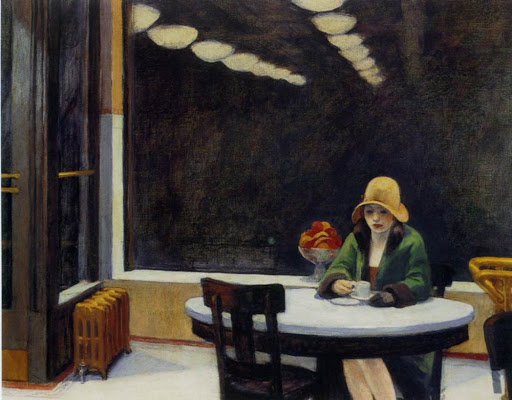
Though long dead at the start of the book, Dev is the subject of Julia’s love and revulsion, the figure who inspires her to consider herself both a vibrant, sensual “creature” and a whore. For Julia, Dev is “a constant heavy sun along the horizon of her spirit self,” both illuminating and blinding, comforting and oppressive. The implication is that Dev sexually manipulated Julia from the age of six, but Spencer never states this explicitly. Rather, she hews to the intimate third-person perspective that dominates the novel, an authorial choice that creates narrative tension and feels authentic to the way many women process sexual trauma. Julia cannot name what happened to her, so Spencer resists rendering it in categorical terms. 


Spencer, who died in December, at age 98, had a penchant for writing characters who are concerned with their pasts. Frequently, they conduct themselves within their own historical contexts, recalling family sagas and ancient grievances amid ordinary affairs—an engagement party, a Christmas pageant, a vacation in the Blue Ridge Mountains. Often, they are Southern, reflecting Spencer’s own heritage as a native Mississippian, and as a person who, like me, was born into a cultural obsession with bearing and unravelling legacies. Early in her career, critics likened her to Faulkner, though she resisted the comparison, citing her subject as the sole similarity. In 1989, she told The Paris Review, “If my material seems like his, as I say, it must be that we are both looking at the same society.”

When she left the South—for Italy and, later, Canada—her fictional landscapes shifted, too, though her interest in familial burdens and societal constraints remained constant. For some readers, it was this focus that cemented her as a next-generation Faulkner. Others saw glimmers of Henry James in her tales about Americans abroad. As I make my way through her astonishing body of work, I find myself thinking most often of her friend Alice Munro, so penetrating is her insight into female experiences of complex class structures and rigid social mores. 

And yet, despite the fact that her name often appears in grand company, and despite her prize-winning canon that includes nine novels, a memoir, and six collections of short stories, Spencer is largely overlooked in contemporary literary circles. Her best-known work is The Light in the Piazza, a novella she published in 1960 and later called her albatross. “It probably is the real thing,” she said. “But it only took me, all told, about a month to write, whereas some of my other novels—the longer ones—took years.” 

Her trauma exists in the backdrop of her quest for self-actualization, an honest reflection of how many women move through their lives.  

The Snare is one such novel. It was published nearly five decades ago, but I first encountered it late last August, while entrenched in a reading cycle that seemed pulled from a graduate seminar in #MeToo-era literature. Piled with books like Susan Choi’s Trust Exercise, Jia Tolentino’s Trick Mirror, and Julia Phillips’s Disappearing Earth, my desk signaled my devotion to contemporary examinations of gender and power. In this sense, I was primed to appreciate The Snare as a significant book, one that explores female identity with nuanced precision, and one that captures the messy and prolonged impact of sexual trauma. Immediately, I was drawn to Spencer’s deep exploration of Julia Garrett’s psyche and the way she wields narrative ambiguity to convey the detachment and confusion with which many women internalize abusive events. For all the broadening of conversations around sexual violence that has occurred over the past two years—for all the brilliant books I’ve consumed that deal explicitly and painfully with the subject—I am aware that navigating the aftermath of such a trauma is confusing and, often, intensely private. As she considers the qualities that separate her from her upper-crust society and propel her toward an electric yet dangerous and ultimately violent lifestyle, Julia Garrett struggles in isolation to understand her past. It is not surprising that Dev finds his way into her tortuous musings. “What was it Dev, the old man, had said?” she thinks, at one point. “‘Passion is what you’ve either got or haven’t got. . . .’ Out of such scraps she had stuck her own truth together.”

In many ways, The Snare is a feminist novel, far ahead of its time in its handling of female sexuality and desire, as well as the influence of early and unwanted experiences. Among works aimed at deepening mainstream discussions about sexual exploitation, it becomes essential reading; but one cannot claim the subject as the book’s central concern. Probably, this is why I like it so much. What occurred between Dev and Julia slinks through her mind, never revealing itself as a certain memory and yet never receding completely. Her trauma exists in the backdrop of her quest for self-actualization, which strikes me as an honest reflection of how many women move through their lives.  


It is worth noting that what is so potent to the contemporary reader barely registered with the book’s initial critics. One needs only a cursory grasp of cultural history to imagine why. The Snare was first published in 1972, a year before the term “domestic violence” entered the American lexicon, and two years before Barnes v. Train attempted to tackle workplace power dynamics. Issues of child sexual abuse hardly resonated in the public consciousness and would not garner substantial legal attention until the enactment of the Child Abuse Prevention and Treatment Act, in 1974. Spencer’s novel incorporates these themes to varying degrees, usually with the type of subtle probing that suits the introspective Julia. Specifically, Spencer’s deliberate blurring of Julia’s past trauma elicited confusion among reviewers in an era when Americans had, at best, an inchoate appreciation for the sexual autonomy of women and girls. 

The novel received a lackluster review in the New York Times and a misogynistic one in Kirkus Reviews. (What the Times described as narrative complexity Kirkus labeled as melodrama, declaring that The Snare was not far removed from “Southern belle lettres.”) The Georgia Review picked up on the necessity of Spencer’s painstaking attention to her protagonist’s history and interiority—elements the Times alternatively described as “the novel’s most damaging flaw”—but determined that the structure was too elevated for the book’s thematic content. This, too, has a sexist ring, considering the great extent to which female desire propels the storyline. 

The blurring of Julia’s past trauma elicited confusion in an era when Americans had an inchoate appreciation for the sexual autonomy of women and girls.

Among these pieces of criticism, what was largely agreed upon was the plot. In great or spare detail, each described the events of the book in a similar fashion: Julia Garrett, the adopted niece of Maurice and Isabel Devigny, a respectable New Orleans couple, is tired of her well-bred lifestyle. She seeks excitement with Jake Springland, an aspiring musician and somewhat ambivalent disciple of a religious zealot. With Jake, Julia enters a world of late-night jazz shows and drug dealers and, soon, murder. The novel begins in the 1950s and spans at least a decade, thrusting a clash of societal standards into the backdrop of Julia’s experience. (Her roommate, Edie, a girl from “some dusty little dried-up town,” is her prudish foil.) Julia is, as the book’s title suggests, resisting the snare of the stifling and polite realm in which she was raised; but she is caught nonetheless by a confluence of her own impulses.

The preeminent Spencer scholar, Peggy Prenshaw, further elucidated the central themes of The Snare in 1993, when she wrote an introduction to the book on the occasion of its paperback release. “Julia Garrett,” Prenshaw writes, “seems a misfit, a woman enlivened by sexual experience and nearly destroyed by it, a woman bored by status-seeking and acquisitiveness, whose indifference brings her to the edge of hunger and homelessness.” She goes on to explain that the novel’s setting in New Orleans mirrors Julia’s seductive power and dueling instincts. Like Julia, Prenshaw says, the city is steeped in manners and tradition, but beneath its glossy exterior it is an exotic, indulgent place.

Prenshaw also references the novel’s mixed critical reception, noting the issues reviewers had with narrative ambiguity, but she does not fully explore the resonance of this authorial choice with the book’s violent plot points. Spencer’s rendering of Julia’s darkest moments is frenetic and fragmentary, allowing certain mysteries to rest in the reader’s mind as uncomfortably as they do in Julia’s. In these scenes, the events are clear, but their details are often foggy, punctuated by an image here, a sensation there. We see, for example, the flash of a blade held to Julia’s neck and glimpse, through euphemistic language, the shame she associates with what follows. As in, “After that . . .” and “I’m just going to call it an awful headache.” For Julia, what is contained in the words that and it is unspeakable, even as it holds dominion over her identity.

Crucially, vagueness distinguishes Julia’s memories of her relationship with Dev. Speaking of her protagonist in 1990, Spencer said, “Her early experience with her guardian mentor, . . . a French Cajun man who may or may not have seduced her, had a profound effect on her.” Prenshaw interprets this effect decisively. “The indisputable fact seems to be that Julia does not regard the relationship with Dev as injurious. If corrupting, it was a necessary and inevitable introduction to the ‘crooked world.’” This statement aligns imperfectly with my own impression, because it ignores the yearning that is so critical to Julia’s idea of herself. She does not want to regard the relationship with Dev as injurious. She wants to imagine it as inevitable.


Spencer makes clear that, for Julia, it is easier to live with a terrible thing when it is remembered indistinctly. Julia’s past with Dev haunts the novel because it is essential to how she views herself, and yet she is unable to define it. Violence and sexual exploitation pervade her adult life, too, and yet she never names it as such. Rather, she absorbs it all with a pronounced detachment, as though each experience is the logical conclusion of who she is in the world. After the doctor for whom she briefly works as a receptionist chases her around the office, she thinks: “. . . life was more peaceful than not with him, now that he’d made his pass.” After Jake Springland, her musician boyfriend, rapes and beats her, she thinks: “Why didn’t I find somebody good?” and then concludes that “she hadn’t because she hadn’t wanted to.” She is kidnapped twice, thanks to her association with Jake, and subjected to torture. After the first time, she thinks: “It was something in me . . . Something that wanted to go down forever, to hit the absolute muddy bottom where there’s nothing but old beer cans, fishhooks and garbage.” After the second time, she thinks: “She would gladly live like an animal, simply, instinctively, for the day only.” 

For Julia, it is easier to live with a terrible thing when it is remembered indistinctly.

Julia’s enthusiasm for New Orleans and its various vices—her sensual and subversive nature—is palpable and seemingly within her control. From the start she is an intelligent woman who knows her sexual power. But as we navigate the conflicting aspects of her mentality, we learn that her empowerment is marked by shame. At times, she reduces herself to her sexuality. Dressing for a courtroom gallery: “Might as well try to de-sex herself, she thought, as stamp out her natural looks.” Her early sexualization by Dev forms a critical aspect of her identity and self-worth, convincing her that she is incongruous with anything virtuous. She thinks, “The idea of goodness beckons forever to those who can’t have it, but once they catch up to it by luck or accident, they immediately feel uneasy, restless, miserable.” 

This vivid interiority is what is largely missing from any summary or critical analysis of The Snare. How Julia decodes her own experiences is a vital aspect of the novel that seems only to have puzzled reviewers in 1972 and failed to thoroughly engage scholars in the following decades. I only learned of the book because several people recommended it to me. Each had read my work and assumed I would appreciate Spencer’s meticulous characterization of Julia Garrett. But at some early point in my first reading, Julia began to resonate as more than a technical feat. We are wildly different people, and yet I identify with her tendency toward self-examination through imperfect recollections. I possess the kind of memory that blurs even the recent past. It recalls the worst things dimly and everything else with rosy nostalgia. This has the effect of making me suspicious of my negative or painful emotions. I am unskilled at relaying the detailed origins of my deepest wounds without a large amount of ambiguity. Spencer captures this deficiency, too. After Jake assaults and abandons her, Julia says, “I don’t think I was even born a virgin.” Her effort to make sense into the plainly nonsensical seems to me like an inherited impulse, something derived from generations of cultural stagnation around gender-based violence. 


Months before her death, I spoke with Elizabeth Spencer over the phone. She talked about the months she spent in New Orleans, researching the novel’s setting, and recalled her use of narrative ambiguity as the deliberate choice I had assumed it was. And yet, I absorbed from her a sense that her fixation on Julia’s past diverged from my own. “I don’t spend too much time psychoanalyzing,” she said. I felt somewhat disappointed by her answer, at first. So much of Julia’s persona appears drawn from an intellectual understanding of the functional ways in which human beings process trauma. But maybe Spencer’s more intuitive approach is what accounts for her novel’s brilliance. Perhaps her resistance to determining direct cause and effect is what allowed her to craft such a complicated and authentic character. Julia is not whittled into a particular set of psychiatric ailments, and her interior current is rich and evolving, never cyclical, never wholly diminishing. Spencer allows her protagonist a limitless quality, that of a woman constantly interpreting and reinterpreting her place in the world through her experiences. Who among us isn’t?

8 Novels That Celebrate Unlikable Women

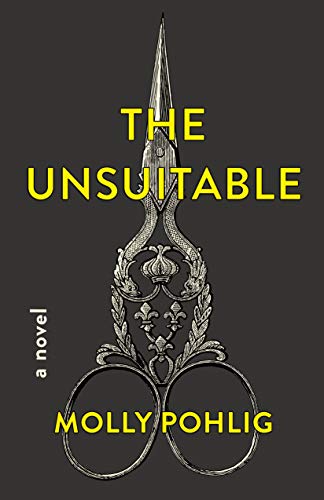
One of the most important things I knew about the main character of my novel, The Unsuitable, was that she was not going to be likable. She wasn’t going to be pretty or smart. She wasn’t going to make good choices; she wasn’t going to generate instant empathy.

When I first moved to New York, I worked as a nanny for a couple who owned a bookstore, and one day the mother insisted I take home Clarice Lispector’s The Hour of the Star (full disclosure: I never brought it back), which is about a young Brazilian woman overlooked by the world for her dim wits and unremarkable looks. Since then, this idea of books driven by characters you might think have nothing to offer the world or the reader has obsessed me. How do you take a person that most would deem uninteresting, perhaps objectionable—possibly even repugnant— and make the reader care about them? 

The Unsuitable is the story of Iseult Wince, unloved, unremarkable, possibly insane and possibly possessed by her dead mother. She has trouble forming connections with others, and she turns her misery in upon herself. She self-harms to maintain her precarious equilibrium, but rather than use this as a tool to merely shock the reader, I wanted to express the inner turmoil that would lead her to such desperate ends. I was curious to see if readers could stay invested in the story of a woman that many would find off-putting, given that as a reader, I consistently find myself drawn to female characters I don’t necessarily like.

These eight books, written by women, champion the unlikable woman, the hard-to-understand woman, and the madwoman. 

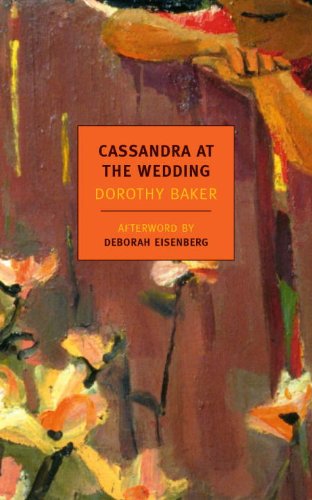
Cassandra at the Wedding, Dorothy Baker 

Let’s start with a sort of…lighthearted take on mental illness? The titular Cassandra is reminiscent of some sort of Zelda Fitzgerald: her madness, obnoxiousness, and connivance are only just outweighed by how charming and brilliant and beautiful she is. It’s a beautiful, rapturous book, but you can’t help but fear for Cassandra’s future.

Harriet Said, Beryl Bainbridge 

Based on the Parker-Hulme murders (recognizable to modern audiences from the film Heavenly Creatures), Bainbridge’s first novel is about a curious thirteen-year-old with a decidedly nasty side, who ropes her more naive friend into a devious plan to humiliate a middle-aged man. A critic wrote: What repulsive little creatures you have made the two central characters, repulsive almost beyond belief!

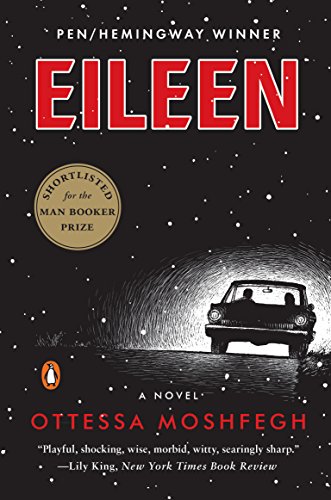
Eileen, Ottessa Moshfegh

Eileen is dull, she’s unhappy, she’s perverse, and she has a range of distasteful personal habits ranging from poor hygiene to a laxative obsession. She gets away with a wild crime because she is not a person people notice or take care of; if a person has been neglected and turns out reprehensible, do they still merit our empathy? Eileen is not a woman you’d want to be friends with, but she’s undeniably fascinating.

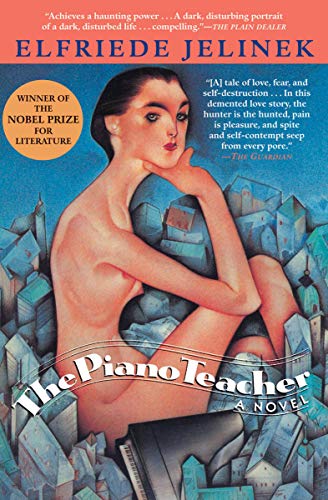
The Piano Teacher, Elfriede Jelinek

Jelinek is a master of the grotesqueries of the human condition, and this novel of self-destruction and degradation is no exception. Erika’s quiet life as an accomplished piano teacher living with her mother belies her sadomasochistic obsession with a student, and her practices of self-harm. This novel is so shocking that drew the notoriously disturbing German director Michael Haneke, who adapted it into a movie.

The Hour of the Star, Clarice Lispector

Oh my heart. Macabéa is ugly, pathetic, stupid, unloved by anyone, not even the repugnant man you can’t quite call her boyfriend. This brilliant novella takes an unfortunate waif that most writers wouldn’t even consider main character material, and makes the reader’s heart bleed for her, asking, “Who has not asked himself at some time or other: am I a monster or is this what it means to be a person?” We are all monsters in one way or another, but no one story is more or less deserving of being told. 

The Driver’s Seat, Muriel Spark

This tiny novel packs a helluva punch. You are aware from the get-go that spinster Lise is not quite right, with her outbursts, hysterics, and bold-faced lies. You are aware from chapter 3 that she is going to be murdered, and all you can do is sit back and watch her hurtling towards her doom.  

The End of Alice, A.M. Homes

You certainly don’t want to identify with the protagonist of this novel, a 19-year-old girl who has set out to seduce a 12-year-old neighbor boy, and exchanges letters with an imprisoned child killer. It’s a twist on Lolita in a way, presenting us with a horror of a human being, asking if anything human remains therein.

The Vegetarian, Han Kang

The women of Kang’s three-part novel are, in a word, extreme. On one level they are calm and collected to the point of blasé, but underneath they are savage, self-punishing, almost feral. They offer no explanations for their motivations, and the line between madness and sanity becomes ever more elusive, but even as it does, their reactions to their surroundings and families are so unique and unexpected that you can’t put the book down. 

7 Books By and About Muslim Women

Muslim women are not a monolith. We wear hijaabs and hoodies and pum pum shorts on the dance floor, drive souped up Honda Civics and McLarens on racetracks, shred electric guitars at thrash metal concerts. This surprises many. When Ibtihaj Muhammad won a medal at the 2016 Olympics, seemingly celebratory messages about her accomplishment were punctuated with wonder that a Muslim woman could be, of all things, an athlete. When Brazilian rock star Gisele Marie Rocha is interviewed, she is asked about her burqa and niqab, not so much her Gibson Flying V electric guitar or her musical influences, which include Jimi Hendrix and Lucia Jaco.
Muslim women are fed up. Or at least this Muslim woman is. Frustrated by narratives that confine us to narrow definitions of Muslim-ness and woman-ness, ignoring that gender is a social construct we perform each day, and that there are as many interpretations of Islam as there are people who identify as Muslim, I wrote a prose poem. Titled, “Yes, Muslim Women Do Things,” the poem featured Muslim women achieving such astonishing feats as reading books and taking naps. 

That poem led to Muslim Women Are Everything: Stereotype-Shattering Stories of Courage, Inspiration and Adventure, a book that celebrates transgendered, cisgendered, queer, disabled, devout, on-the-fence, Muslim women, who are rocking the worlds of performance art, politics, baking, astrophysics, and much more. Muslim Women Are Everything is a lyrical, illustrated love letter to us, in all our complicated, multi-hyphenated glory. 

Troubling the boundaries of what it means to be Muslim and a woman, are the following books by Muslim women authors. Serving a giant F you to those who attempt to confine us, these works of poetry, fiction, and nonfiction illuminate the experiences of Muslim women and tell the many truths of our lives.

The Quilt and Other Stories by Ismat Chughtai

Ismat Chughtai refused to apologize in court for writing “Lihaaf,” “Quilt” in English, a short story published in 1942 for which she faced obscenity charges under British India’s homophobic laws. The story that threatened to send the young mother to jail featured the indescribable pleasures between a housewife and her female maid. Ismat was unapologetic in life as in fiction. This collection includes Lihaaf and stories that talk fearlessly about caste-defying desire, friendship across religious boundaries, and sex work. 

Page 40 – Electric Literature

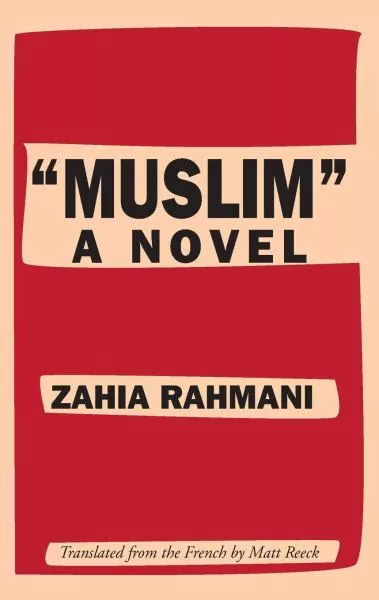
“Muslim” A Novel by Zahia Rahmani, translated by Matt Reeck

Muslim lives in quotation marks in the title of Zahia Rahmani’s second novel, much as the protagonist lives within the constraints of this imposed label. Merging oral histories with lyric essays and autobiography, we trace the Berber woman’s journey through desert camps and cities, as she recalls Islamic history and folktales from her childhood. A story of displacement, languages lost and colonialism, “Muslim” challenges the boundaries of genre, much like Rahmani complicates physical boundaries and the complexities of multiple, sometimes conflicting, identities.

Winter 2018-19 — The Gernert Company

Elsewhere, Home by Leila Aboulela

A Sudanese woman explains that she misses the call to prayer to a Scottish bloke who doesn’t quite understand; an Egyptian woman laments the loss of her mother tongue; a white Muslim Scotsman visits his fiancé in Sudan. These stories by the winner of the Caine Prize for African Writing feature mostly Sudanese and Egyptian women who have moved from Cairo and Khartoum to Aberdeen and London. Leila Aboulela—who herself left Sudan for Scotland in her mid-twenties—writes of homesickness, accents and spiritual paths. Elsewhere, Home is intimate and emotional, without veering into sentimentality.

Page 68 – Electric Literature

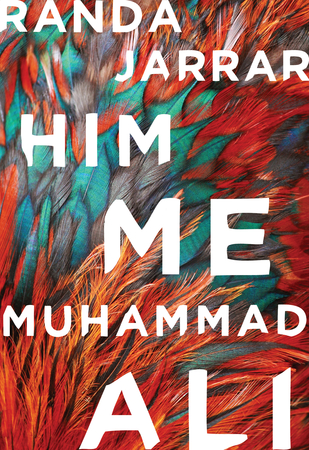
Him, Me, Muhammad Ali: Stories by Randa Jarrar

Mistress of the short story form, Randa Jarrar’s collection is a masterpiece I read over and over again. These are stories of mothers and daughters, circus tightrope walkers, chimeric creatures that are half-woman half-ungulate, each navigating love, lust and ambition. From women seeking sisterhood in fiction, to those rolling their eyes at novels in which immigrants return home transformed by their journeys, Jarrar’s characters are irreverent, raunchy and real.

151374

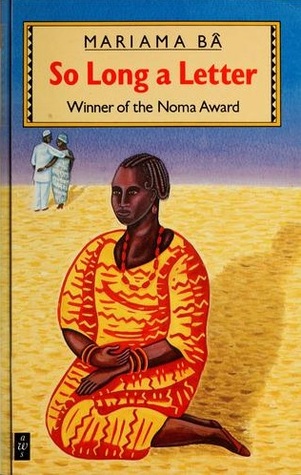
So Long a Letter by Mariama Bâ

Mariama Bâ’s debut novel, So Long a Letter, was published to critical acclaim in 1979 when she was 50 years old, winning the Senegalese author the inaugural Noma Award for African writers published in Africa. The epistolary novel emerges through a series of conversations between Ramatoulaye and Aissatou who recount their loves and losses. Bâ who described books as peaceful weapons, declared this novel “a cry from the heart of Senegalese women…a cry that can symbolize the cry of women everywhere.”

You Must Be Layla by Yassmin Abdel-Magied - Penguin Books New Zealand

Yassmin’s Story by Yassmin Abdel-Magied

Yassmin Abdel-Magied was 21 years old when she began working as a petrochemical engineer on an offshore oil and gas rig, one of few women and the only Sudanese-Egyptian-Australian Muslim, among 150 men. Her memoir, published at age 24, recalls her childhood in Sudan, her family’s migration to Australia, and her love affair with activism and race cars (a journalist branded a young Abdel-Magied “peculiar” for dreaming of becoming the first Muslim woman Formula One race car driver). Brash and funny, Yassmin’s Story, also makes for a refreshing read: the big hopes of a young woman who believes she will change the world. 

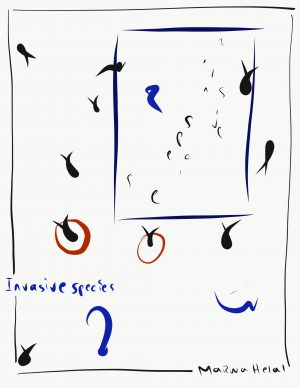
Invasive Species by Marwa Helal

Hip hop lyrics, prose, and poetry take us from immigration offices and embassies to Heathrow airport and a McDonalds in Cairo, in Marwa Helal’s genre-bending collection. Scientific abstracts, newspaper cuttings, and letters sit next to questionnaires and an ode to DJ Khaled. Invasive Species is so damn bold it had me rewriting sections of my poetry manuscript, flouting rules I had been careful to follow. Not surprising, given Helal invented a poetic form called The Arabic, which is written right to left and “vehemently rejects you if you try to read it left to right.” 

I Swear Earth Is a Carnival Queen

Grand Prismatic Spring

—Yellowstone National Park


Wet maw of earth painted like a parrot fish     frilled 

at the banks     saying AH with extraordinary breath     coffee

makes my teeth earthen     plant them and grow a city  

when I go don’t bury them deep     scatter my ashes 

like the spring’s rings     in imperfect concentric circles

each one a different shade     on a cliffside color is how 

geologists tell the when     I want to know the why     azure 

turquoise kelly-green     canary mustard apricot     I swear

Earth is a carnival queen     embellished here by heat-loving     

bacteria around a boiling center     they say life began 

in a pond like this     volcanic and sun-splayed     

minerals washing down the mountains into the basin 

where the unfathomable happened     why 

is anything alive?     why do tourists throw their refuse

into a pot of phenomena?     why aren’t we extinct yet?     

all I know is when I was young     I wanted to be     

something grand     I stand by the railing     and watch


Record Rainfall

I read a devastating line of verse
and then the sun came out, 
the first time in weeks. 
I was masturbating as I read
and looking out the window.
Many things were happening.  
Each drop of dew on an oak leaf 
distinguished itself—a clear 
round seed. In the distance, the storm 
painted gray walls behind the pines, 
but in the foreground, ferns 
shook out their hair, striking me 
with light. Am I halfway through 
my life, or a third? Everywhere yellow 
needles from the wet year. They fell 
in an airy rain and continued to fall 
as the day dried. The young pines 
looked older than they were. 
The ancient oaks, never greener. 
The sun beat down on them both 
as I stepped from the house 
like something else that was still itself.

Miss Reading in Public? Bring the Sounds of the Library to Your Home

If you live in New York, there are probably a lot of noises you miss right now. Neighbors on their stoops, the bustle of a lively park, the chaos of a crowded bar—even rush hour honks sound pretty good compared to eerie silence and ambulance wails. And if you don’t live in New York, but you’re still sheltering at home, you might be pining for the sound of… well, literally anything else besides your own house.

We’ve been particularly nostalgic for the quiet hum of a busy bookstore or library. And apparently the library’s been thinking of us, too. The New York Public Library has released an album of all the sounds you might miss—including the sound of the New York Public Library, which closed all its branches in mid-March.

Each track, NYPL says, contains its own little narrative: “The Library recording, for example, follows a New Yorker entering a branch, running into a tour group, interacting with a helpful librarian looking to make a reading recommendation, walking past a toddler story time and then sitting down to begin quiet work.”

Now you can put on the album, close your eyes, and pretend you’re surrounded by sunbathers, subway dancers, cab drivers, and drunks—when in fact, if my house is any indication, you’re only surrounded by drunks. Or, if you like your social activity to contain a little social isolation at the best of times, just rent an e-book from NYPL’s curated lists and put the library track on repeat.

“Normal People” Is the Perfect Show for People Who Miss Being Touched

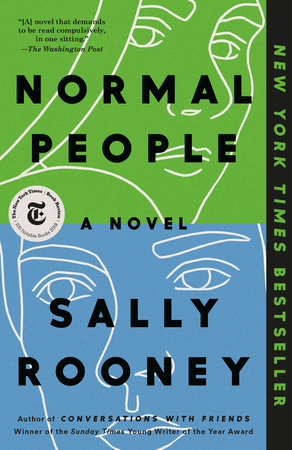
Physical intimacy doesn’t start when a hand (or mouth) touches skin. It starts a moment before. I couldn’t escape that realization while watching the television adaptation of Sally Rooney’s Normal People, which has no shortage of moments where we see its central couple all but quake with anticipation when they’re in each other’s company. Watching Marianne and Connell come alive on screen, their blushes and sighs so beautifully rendered by Daisy Edgar-Jones and Paul Mescal, forced me to reconsider Rooney’s achingly intimate novel. Even as it more forcefully puts its protagonists’ bodies front and center, Normal People’s adaptation makes us realize that being touched, or being denied touch, is something that goes far beyond literal physical contact.

Normal People by Sally Rooney

When I first read Rooney’s novel I was drawn to it as a story about alienation. “She hates the person she has become, without feeling any power to change anything about herself”: this was the line, I thought, that captured what this novel was all about. And, indeed, in Edgar-Jones’ hands, Marianne emerges as a fascinating character constantly battling the baffling decisions she makes about herself and her body. But what was on the page a kind of arm’s-length character study (despite Rooney inviting us into her character’s inner monologues) becomes, on screen,a lived-in, fleshed out portrayal. Watching Normal People encouraged me to revisit the novel, sensing it had excavated something that was already there: on the page, after all, this is ultimately a novel about touch, about the ability to reach out to another person who not only sees you as you are but knows you so intimately it’s as if they were constantly reaching inside of you and rearranging your own sense of self. 

Indeed, one cannot leaf through Rooney’s novel without happening upon that word, “touch,” and realizing just how central a role it plays in the various duets the novelist stages between aloof Marianne and bashful Connell. It’s such a banal word, but now it pulses with a different kind of power. Tracking it through Rooney’s prose becomes a way to track its entire arc: “He touched her leg and she lay back against the pillow,” “He touches his lips to her skin and she feels holy, like a shrine,” “He had never, ever touched her in front of anyone else before,” “The outside world touches against her outside skin, but not the other part of herself, inside,” “He touches her hair. She feels his fingertips brush the back of her neck. Do you want it like this?” and so on and so forth.
The novel signals its fascination with touch even before the first page. “It is one of the secrets in that change of mental poise which has been fitly named conversion,” the George Eliot epigraph reads, “that to many among us neither heaven nor earth has any revelation till some personality touches theirs with a peculiar influence, subduing them into receptiveness.” Even before we meet our two protagonists Rooney alerts us to the fact that Normal People is a story about the impressions we have and leave on one another. Moreover, in the context of Rooney’s narrative, Eliot’s prose ends up feeling tinged with the erotic. The image of submission and reception it conjures is laced with images of heated sexual intimacy—or anyway, that’s how Rooney’s novel reframes it for us. From the moment Connell first kisses Marianne in her palatial home (where his mother is employed as a housekeeper: “Don’t tell anyone at school,” he says) and establishes their twisted relationship (“He pitied her in the end,” Marianne thinks to herself soon after, “but she also repulsed him”) to the point where Marianne takes part in BDSM scenarios with a man she barely stands, the novel establishes its fascination with the way the difference between power and sex is one of degree, not of kind. It’s the distinction between a caress and a slap, a hand held and a hand cuffed. “Ever since high school he has understood his power over her,” Connell notes at one point in the novel. “How she responds to his look or the touch of his hand. The way her face colors, and she goes still as if awaiting some spoken order.” Even their emotions feel weighted with tactility. When Connell first tells Marianne he loves her (before questioning whether he does, actually) we’re told he just felt it happen, “like drawing your hand back when you touch something hot.”

‘Touch’ is such a banal word, but now it pulses with a different kind of power.

As Marianne and Connell grow up, their lives intertwining every so often as they attend university and later move to different cities, the intimate way they know one another’s bodies anchors them to each other. “Being alone with her is like opening a door away from normal life and then closing it behind him,” as Connell puts it; their every encounter is a journey through that closed-door room they let themselves explore away from everyone else’s prying eyes. To have read about such intimacies on the page was one thing. Rooney’s prose can be almost clinical in those instances: “Her breath sounded ragged then. He pulled her hips back against his body and then released her slightly. She made a noise like she was choking. He did it again and she told him she was going to come. That’s good, he said.” But to see Connell and Marianne exchange all-too-knowing glances before finally giving in to their basest instincts up on the small screen, Mescal and Edgar-Jones’s flushed faces and heavy breathing anchoring their every interaction, sexual or otherwise, brings to the forefront the very visceral eroticism that’s often sublimated in Rooney’s prose. 

When they first have sex, director Lenny Abrahamson (also responsible for the big screen adaptation of Room) keeps both characters in close-ups. This has long been a trope in television when trying to denote sexual intimacy without showing too much, particularly when dealing with underage characters. Close-ups and labored breathing do the heavy lifting of suggesting what’s taking place, a kind of visual synecdoche where the closeness of the camera stands in for the intimacy of the characters at hand. Moreover, the gesture is supposed to make us feel that much closer to these characters, letting us into their state of mind. With no music to score their awkward and steamy encounter, Abrahamson lets us feel like intruding voyeurs—putting us in the very position Marianne had first fantasized about. As she confesses to Connell soon after, when she’d seen him playing rugby earlier, she had realized how much she had wanted to watch him have sex. “Not just with me,” she clarifies. “With anyone. What would it feel like?” 

For many watching Normal People while in self-isolation, such a query will resonate less as a rhetorical question and more as a grave concern. Marianne may have been merely being coy and self-effacing—the better to face the popular boy at school who pretends not to know her at school despite meeting her in secret at his house—but her desire wasn’t just a lack of imagination. Sometimes being a spectator can feel like the best way to play out a fantasy. And that fantasy in turn can become a learning opportunity. That’s how Connell himself, who goes on to study literature (of course), conceives of the power of books. When reading Pride & Prejudice all alone, he’s amused at how wrapped up he gets in Austen’s novel. “It feels intellectually unserious to concern himself with fictional people marrying one another,” Rooney writes. “But there it is: literature moves him. One of his professors calls it ‘the pleasure of being touched by great art.’” He notes that such a line sounds almost sexual, “And in a way, the feeling provoked in Connell when Mr Knightley kisses Emma’s hand is not completely asexual, though its relation to sexuality is indirect. It suggests to Connell that the same imagination he uses as a reader is necessary to understand real people also, and to be intimate with them.” 

Watching Normal People in a world ruled by social distancing mandates and self-isolation orders makes its message all the more urgent.

Such a line of thinking teems with possibility on the page. But what of the power of television, which depends less on our imagination? Away from the interior monologues that make up Normal People the novel, the Hulu/BBCThree adaptation forces us to more pressingly think of Marianne and Connell’s bodies. His rugby physique, especially when seen next to her lithe body, already speaks volumes about the teetering power imbalance they will constantly trade back and forth. The hunger that you read about between the two, that unquenchable yearning they have for one another’s body, is palpable on screen, even when Abrahamson focuses solely on Connell’s clavicles, Marianne’s breasts, or their moaning mouths that give way to tender kisses. Their blushes leap off the screen and make you flush just as much. It’s no surprise that to score a montage of their increasingly acrobatic secret rendezvous the show chooses Imogen Heap’s “Hide and Seek,” a song that’s long been associated not just with the second season ender of The OC but with shocking and schlocky scenes on TV. Pit against Marianne and Connell’s budding intimacy its opening lines are reframed anew: “Where are we? What the hell is going on? The dust has only just begun to form, crop circles in the carpet.” 
On screen, Normal People is both more erotic and more melancholy than on the page. Or, perhaps, I found myself more entranced by its depiction of the erotic and melancholic relationship Marianne and Connell create with one another because, like many others, I’m famished for connection, for touch. Heap seemed to be singing about this young couple who doesn’t yet know what’s ahead, but she was also singing about all of us watching. By the time she coolly croons “When busy streets, a mess with people, would stop to hold their heads heavy,” over an image of Marianne raking idly through the sand while sitting on an empty beach with Connell, I realized that watching Normal People in a world ruled by social distancing mandates and self-isolation orders makes its message all the more urgent. Its focus on touch, on intimacy, on the alienation that comes from being alone and the brief succor that can only come from feeling held by someone whose touch jolts you even before they actually make contact, feels needlessly timely. A balm I didn’t know I needed. This is why so many of us are retreating to novels and TV shows and movies: not just to escape from the touchless reality around us, but to seek what Connell (and Rooney) so clearly understand about the intimacy that can be nurtured between reader and novel, between viewer and show. We read and watch to remember, perhaps, what it’s like, to live out in the world like…well, normal people. 

The Best Books About Alternative Parenting Gone Wrong

It’s possible that one day I’ll get away from writing about childhood trauma and the effects it has on the grownups we become, but that day is not today, nor was it five years ago when I started thinking about a new novel.

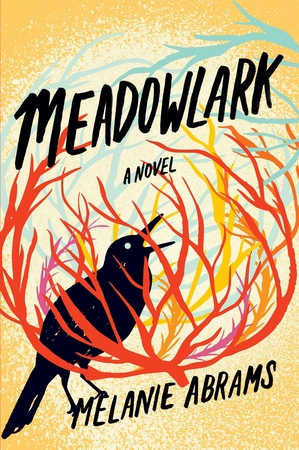
I’ve always been fascinated by cultish environments, and what better way to screw up a kid than to remove them from the world and force them to adopt a world view that’s questionable at best? Ergo, Meadowlark, a novel with two cult-like communities—one a harsh spiritual compound with strict expectations even for children and the other a kid’s theoretical dream world without rules (or school!).  

Both extremes prove problematic to the kids in the novel but being able to justify going down the rabbit hole of research in service to the book was incredibly fun (although, obviously, at times difficult) for me. I got to read a ton of books about alternative ways of raising children, from the truly painful (I recommend staying away from anything about The Children of God) to the cringingly misguided (Google “Indigo children” for a good time waste).

Below you’ll find eight books about alternative parenting gone awry because there’s nothing we love more than reading about parents who do a worse job than we do.

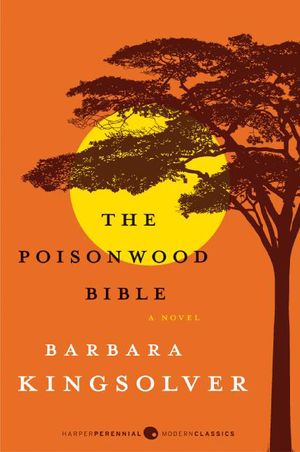
Poisonwood Bible by Barbara Kingsolver

Well-meaning missionary parents bring their four daughters to the Belgian Congo to proselytize to the natives and to teach their girls how to save the savages. Instead, one daughter ends up dead, the others reject Christianity altogether, and the “savages” revolt. 

Image result for educated tara westover"

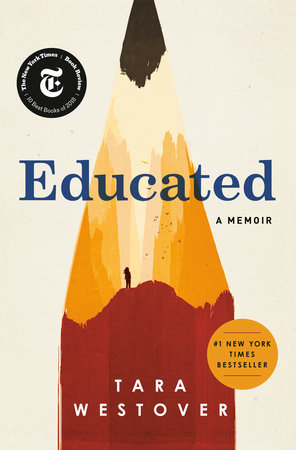
Educated by Tara Westover

Tara Westover’s memoir is about her parents’ commitment to bringing up their family with bizarre survivalist and religious dogma. Schooling consists of reading the bible, medical care is limited to herbal tonics, and horrific abuse is deemed part of family life. 

Image result for vc andrews flowers in the attic"

Flowers in the Attic by V.C. Andrews

What happens when a rich socialite mother is left penniless with no way to provide for her family? She hatches a scheme to hide her four children in her wealthy parents’ attic, promising to come get them when her father dies and leaves them his fortune. Chaos ensues. Spoiler alert: one kid is killed by rat poison-laced donuts, another kid’s growth is forever stunted, and the last two end up in an incestuous relationship that goes on for another five novels. Compulsive tween reading. Also, NOT FOR TWEENS.

The Glass Castle by Jeannette Walls

Walls grows up with parents who prize nonconformity and idealism over basic needs. Their nomadic lifestyle works out just fine until the family is crippled by the father’s alcoholism and the money runs out. The Glass Castle is the rare memoir where the writer can hold both criticism and compassion for her parents’ lifestyle choices.

We Are All Completely Beside Ourselves by Karen Joy Fowler

We Are All Completely Beside Ourselves by Karen Joy Fowler

Rosemary’s father is a psychologist who studies animal-human behavior, and what better way to study animal-human behavior than to raise your human child alongside a chimpanzee? The novel traces Rosemary’s tragic loss of Fern, her chimp sister, and the fallout from her parents’ early choices. 

Cartwheels in a Sari by Jayanti Tamm

Cartwheels in a Sari by Jayanti Tamm

Selected by her parents’ guru, Sri Chinmoy, as the chosen one, Jayanti Tamm traces her bizarre childhood in this memoir about what it was like to grow up alongside a “living god” and what happened when she finally decided to break free.

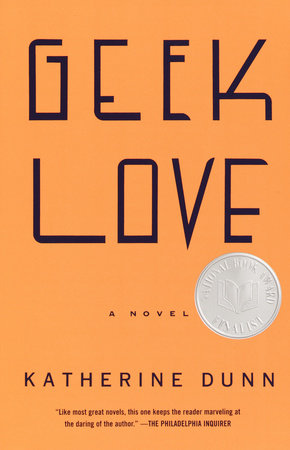
Geek Love by Katherine Dunn

Geek Love by Katherine Dunn

A circus-geek family who breeds children explicitly to create their own collection of human oddities. Enough said.

A Magical Realist Novel Inspired by Hawaiian Mythology

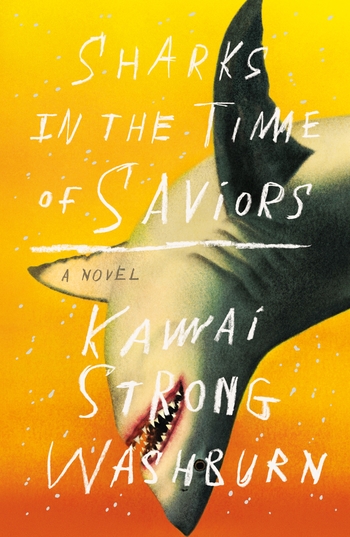
In Kawai Strong Washburn’s Sharks in a Time of Saviors, a young boy falls into the ocean and is carried by a shark—in its jaws—back to his mother. The boy, Nainoa, soon begins to display miraculous healing powers.

Sharks in the Time of Saviors

But he’s been touched by Hawaiian divinity from the very start of his life. On the night of his conception, which opens the novel, his parents see the Night Marchers, the spirits of ancient Hawaiian warriors. Nainoa’s supernatural abilities shore up the family, who had been hit by the collapse of the sugarcane industry, for a while. Eventually, economic realities force Nainoa and his siblings to leave for the mainland for school and work prospects. 

Washburn, who was born and raised on the Big Island, offers a Hawai’i that takes in its technicolor-saturated vistas: “And there was the Waipi’o Valley: a deep cleft of wild green split with a river silver-brown and glassy, then a wide black sand beach slipping into the frothing Pacific.” Equally, he renders the precarities of paradise for Hawaiians through the family’s continued struggle to survive.

I spoke to Washburn about saviors, deeply-in-love PoC couples in fiction, and the prospect of another Hawaiian son, Barack Obama reading his novel. 


J.R. Ramakrishnan: I must say that my reference points for Hawai’i are woefully limited to watching reruns of Magnum P.I. in my teens dreaming of the beaches. Also then more recently, Barack Obama, of course. So you were born in Hawai’i? 

Kawai Strong Washburn: Born and raised! I was born on the Big Island. In fact, I spent the majority of my youth in Honoka’a where the book begins. It’s actually my hometown. 

JRR: And your family’s roots are indigenous Hawaiian? 

KSW: Actually, I’m a lot more like Barack Obama like that. My mother is African American. She grew up in Kansas. My father is, I guess you could say, is European American. He grew up in Oklahoma. Both moved there for school. They met, got married, and decided to stay there to raise a family. So I’m not actually native Hawaiian ethnically. I am local to the island. I spent all my formative years there. 

JRR: You open the book with quite a spectacular scene of Noa’s conception in a truck and the Night Marchers. How did the novel’s story come to you? 

KSW: The opening image was the one that just showed up in my head one day. I don’t know what made it happen. At the time, I was working on short stories and I didn’t see it as being something that I was going to turn into a novel and so I just let it fall away. It kept showing up for about a year and a half. So I finally started thinking about it: what is this image of a child being pulled from the water by sharks? For me, when I think of children, I think of the family naturally as an extension. I started wondering, where’s the family? The questions I started asking about the family, as well as, the image itself—–why were the sharks carrying the child?—–started to build parts of the story. Once I had some ideas about who that family was, I really started digging into them, and into some of the mythology that might explain why a shark might save a child.

JRR: Could you talk about the mythology that informs the novel, and perhaps in particular, the Night Marchers? 

KSW: The mythology of the island is something that I have carried around subconsciously. A lot of it was floating around in me and I had a partially remembered knowledge of it from growing up in Hawai’i. One of the strongest recollections was the Night Marchers. My understanding of it as a child was that they were very specific to Waipi’o Valley, which is the valley that you see in the novel. It turns out that they don’t necessarily have to be specific to that valley or that place. 

The idea of tying the Night Marchers to Nainoa and with what he represented came out later in the revision process as I was trying to get a better understanding of what tied the family together and of the questions about heritage, and the relationship between the family and the land. I started to recognize different ways in which the characters experience the voice of the land.

One of the things that novel subtly, maybe not so subtly, I’m not sure, questions is the idea of a singular savior, who would be the way out of difficulty. I knew the novel was going to be about that and I knew Nainoa would represent that flawed idea of this great man theory of history. What would it look like then if the powers that he has were to be present in the other members of the family but they may or may not be conscious of them? That was sort of where I started getting the idea about how the different characters experience the stuff that Nainoa experiences and their journey to understand these powers. 

JRR: I adored the portrayal of Nainoa’s parents. They obviously have to deal with a lot in their whole lives but Malia and Augie seem totally in love. Him always trying to get in her pants is so endearing. I don’t know if we see many loving relationships (untouched by deep dysfunction in themselves) between PoCs in fiction too often. 

I wanted to show a side of Hawai’i that people might not be familiar with, the economic challenges for people that live there.

KSW: That was really important for me. I wanted to show a side of Hawai’i that people might not be familiar with, and I think a lot of people that visit the island might not realize the extent to which it is an economic challenge for people that live there. Most have to string together two or three jobs, drive really far to do them and a lot of jobs are tough, service-oriented ones. Poverty and economic struggles were important to talk about, but I wanted to balance it so the novel wasn’t entirely bleak. 

People of color and families in poverty are constantly depicted as dysfunctional. Because they’re in poverty, they must have poor relationships. That’s certainly nothing like what I had experienced growing up in the islands, which is really that you can even have a certain level of, I don’t want to say, thriving, but you can reach a level of happiness and contentment, even in economic precariousness. I wanted to depict that, to have families know each other very deeply and especially the parents. The source of their resilience is that joy for each other and their very physical joy for each other.

JRR: I want to ask you about the landscape because I feel that is perhaps the main reference point of Hawai’i for people not from there. I thought you did such a tremendous job of rendering the environment in the novel. 

KSW: At one level, I wanted to describe what I had felt when I’ve gone on hikes in the remote areas or when I was surfing and hovering about the reef in the current. I wanted to write about all the different experiences I had growing up in the natural environment, and how singularly transformative it all felt. I also wanted to figure out a way to describe the islands in a way that almost personified the landscape into a character in the novel. The idea was to build a physical presence that was tactile for the reader, which also reinforces the characters’ relationship with the land. 

JRR: Can you recommend some books about Hawai’i that you think I should read to cover my unfortunate gap in the Hawaiian part of American literature? 

KSW: The first author I encountered as an adult searching for stories about the island was Lois-Ann Yamanaka. She has written novels, short stories, and poetry. Look for Saturday Night at the Pahala Theater, Blu’s Hanging, and Wild Meat and the Bully Burgers. Kiana Davenport’s Shark Dialogues, which is the start of a trilogy. Kristiana Kahakauwila’s short story collection, This is Paradise. For Hawaiian mythology, there are the books of Martha Warren Beckwith.  

JRR: Do you think Barack Obama has read your book yet?

KSW: That’s a scary thought! I don’t know. He’s so well-read. The book’s had a certain amount of visibility. I have a feeling it will probably be on his radar at some point. He’s so well-read and I appreciate his taste. He’s also from the island, which makes it an even more daunting prospect that he might read my book! It would be interesting to see what his thoughts are, and if it resonates with him at all. I try not to hold out hope or let it keep me up at night.

JRR: In some ways, he’s a bit like Nainoa, isn’t he? He’s from Hawai’i, exceptional, and, I think, some (or many) would say, with special powers too.

KSW: Yes, it’s funny. Like Nainoa, Barack Obama is the sort of character that people on some level ascribe ideas of greatness and larger-than-life saviorship. Given the speeches he’s made and what he’s tried to focus people’s attention on in and out of office, I think he is just an individual who’s trying to accomplish a set of things. I don’t think he’d consider himself that special to think that he’s capable of things that none of us are capable of or anything like that. 

8 Novels About Being Haunted by the Past

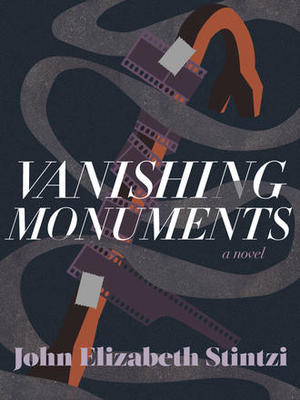
“The past mishandles everybody,” Alani Baum declares in my novel Vanishing Monuments. The novel starts as they learn that their mother—who they haven’t seen in almost thirty years, when they ran away from home at seventeen—has lost her ability to speak due to her worsening dementia. This news spurs Alani into taking an impromptu trip home to Winnipeg, and as with all our homecomings, Alani finds themselves wading through the mire of their memories the city holds. 

This isn’t a unique experience, being haunted by our personal history—especially emotionally intense times in our life, like our youth. I think most of us, in some ways, are always trying to climb over what has happened to us (and what we have done) in an attempt to exist in our present; in an attempt to pretend we are inside the life we are living, rather than constantly trying to surface from the life we have lived. 

Here is a list of eight books where the characters—like Alani—are trying (and sometimes succeeding) to get over the past. 

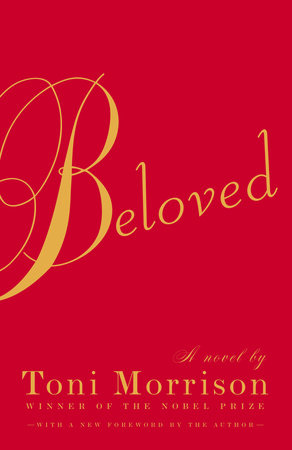
Beloved by Toni Morrison

Beloved by Toni Morrison

It’s hard to talk about books where the past casts a shadow over the present without including Toni Morrison’s Beloved. From the first sentence—“124 was spiteful”—we know we’re in for a haunting. Set eighteen years after Sethe escaped to Ohio from a life of slavery on a farm called Sweet Home, Sethe is still living with the memory of what happened to her there. I don’t want to reveal too much about the book, but if you’ve somehow slept on Beloved, it’s high time to open the book and meet her. 

the earthquake room by Davey Davis

One of my favorite novels of the last few years, the earthquake room is a story about k and bea, and the guilt k feels about cheating on bea after bea—in the first pages of the book—finds herself infected with a Herpes sore (yes, that’s what’s on the cover). Wracked with guilt and seeking punishment, k spirals into shocking, self-destructive behavior. the earthquake room is an intimate story about a relationship, but through that intimacy, and k’s inability to forgive themselves, the novel feels almost apocalyptic. 

Jonny Appleseed

Jonny Appleseed by Joshua Whitehead

Winner of the Lambda Literary Award for Gay Fiction in 2019, Jonny Appleseed is an almost picaresque novel that slowly tells the story of Jonny—a Two-Spirit Indigiqueer sex worker currently living in Winnipeg. The plot of the novel is built around Jonny trying to find a way to get back to the rez, which is a few hours north of the city, to attend the funeral of his stepfather. As he tries to catch a ride, we are bombarded with stories of Jonny’s life, stories about his sexwork, about his kokum, about his growing up the only Two-Spirit kid on the rez. For as much pain and trauma there is in this book, particularly in Jonny’s complicatedly intimate relationship with his childhood friend Tias, there’s also so much love and beauty. Laugh and cry, Jonny’s perseverance is as infectious as the liveliness (and sexiness!) of his voice. 

The Dark Room by Rachel Seiffert

The Dark Room by Rachel Seiffert

Composed of three novellas, The Dark Room grapples with World War II from the perspective of three German civilians: Helmut (a photographer early on in the war in the 1930s), Lore (a twelve-year-old girl trying to escape the Russians to West Germany in 1945), and Micha (a teacher living in contemporary/late 90s Germany). In Micha’s novella, Micha is shocked to learn that his grandfather was a Nazi, and finds himself obsessed with learning the truth about what his grandfather’s role in the war was. Micha’s dark and relentless curiosity begins to create rifts in his family as he refuses to stop unearthing what they would prefer remain earthed. Reminiscent of Michael Verhoven’s film The Nasty Girl (1990), The Dark Room’s final novella does an excellent job of capturing the discomfort and trauma people experience in learning their proximity to both atrocities and their perpetrators. 

Brother by David Chariandy

I’m mad at a lot of people for not reading Brother, so if you want to get in my good books, please read this good book. Set in Scarborough, a lower-class neighborhood in Toronto which is home to many immigrants, Brother follows Michael and his brother Francis, who live with their mother in a housing complex. The novel is framed in the contemporary moment, when Michael’s childhood love interest Aisha comes back to Scarborough to visit—some twenty years after Francis’ tragic and violent death. When Aisha returns, she finds that after all this time, Michael hasn’t done anything but work in a grocery store, and he and his now mostly-silent mother still live in the same apartment. Neither have been able to begin to get past the fact of Francis’s death. Brother is one of the most beautiful and infuriating novels (due to injustice) I’ve read in years. 

Hum by Natalia Hero

This stunning short novel—published by scrappy Canadian publisher Metatron—tells the story of a young woman who survives a sexual assault, and who shortly after gives birth to a hummingbird. Yes, a hummingbird. From then on, the hummingbird (and the sound of its constant hum) is ever-present in her life, and for a long time irritates her as she tries to figure out what it wants. A touching allegory, Hum is about the jagged journey of healing as she learns to coexist with a trauma she will have to live with forever. 

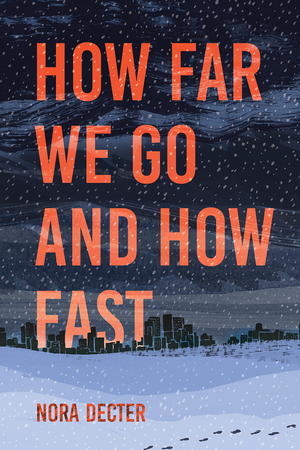
How Far We Go and How Fast by Nora Decter

This list wouldn’t be complete without one more book set in Winnipeg. Nora Decter’s How Far We Go and How Fast—which won the Rakuten-Kobo Award for Emerging Writers in 2019—tells the story of sixteen-year-old Jolene (named after the Dolly Parton song) in the aftermath of her older brother—and hero—Matt leaving home unannounced one night. As the book progresses, and while Jolene clashes with her drunk and karaoke-obsessed mother—all the while trying to save up money for a bus ticket to the west coast, where Matt went—we slowly learn more about Matt and what happened to him. I can’t think of a book that captures teenage angst as well as Decter does here, while also deftly illustrating the many effects of loss. 

Image result for indian horse wagamese

Indian Horse by Richard Wagamese

This book is one of the most beautiful and gutting books I’ve read in the last few years. On its surface, it seems to be a book about the beauty of hockey, and about how the game allowed Saul Indian Horse to survive the brutal realities of life in a residential school. But more than hockey, Indian Horse is about the ways in which the genocidal institutions that were the residential schools destroyed generations of Indigenous people in North America. The way Saul’s passionate and seemingly reachable ambition to become a professional hockey player is interrupted by the manifestations of his trauma is as heartbreaking story of colonial injustice as has ever been told.