All You Have To Do Is Kill Her Off

The Drain
By Lynn Coady

She wasn’t worth killing, that was the problem. Because Marietta was not liked. Fans joked online about wanting to shoot themselves, or someone else, the moment she entered a scene. It wasn’t the actor’s fault. Well, it was, kind of. But it was Annie’s fault in conjunction with everyone else—the show, the collective Us. In some mysterious whim of TV alchemy, Annie’s energy ended up not gibing with ours. She’d been great on her last series—a supporting role on a show about nurses. She’d been an audience favorite, was cute yet tough yet vulnerable—everything you’d want in a TV nurse. I hadn’t watched it, but the clips had been good. And she auditioned well and did a sizzling chemistry read with both our male and female leads—which was important because Marietta was going to be our show’s first bisexual about which the network was, initially, very excited indeed. But both the chemistry and the excitement sputtered when she came up opposite the show itself. The suffocating Us-ness of it all. Annie had arrived beaming and freckled, with buckets of charisma, and somehow our show had tipped those buckets over, dribbling all that charm away.

We tried changing her hair. Switched her styling from buttoned-up/sexy to masculine/sleek to (and this was pure desperation) flouncy/bohemian. God help us, we gave her a motorcycle. Then we decided we’d been focusing too much on her appearance. We had drunk the network Kool-Aid, we scolded ourselves. We had to get back to what made the show great—the writing! Depth of character, that was the ticket. What Marietta needed was a meaty backstory. And so we spent a full week in fevered discussion of her tragic early life—her abusive mother, her subsequent drug use, her beloved high school bestie, carried away by opioid addiction. We rolled this out in a Very Special B Story. Which the audience hated. The next week, we tried changing her hair again. The failure was relentless. With every episode, every Marietta scene, the audience cringed, and—worse. They laughed. They didn’t even know why they were laughing, they confided to one another in their social feeds and forums, festooning their posts with tearful, hee-hawing emojis. She was just so bad. No one could explain it. They didn’t want to explain it. It was a mysterious, ineffable phenomenon that at this point they almost enjoyed.

It was my job to get all this across to Liz (who barely used the internet, who dismissed any conversation taking place on social media as “not real,” who still referred to Google as “The Google”) in my helpful, non-confrontational, just-asking kind of way. And to do it without using words like “cringe,” or “laugh,” or “hate her.” But how do you kill a character who is a joke, without making her death feel like the biggest joke of all? I also took care not to say “joke.” But lately it was the word that rang in my ears each weekday morning ever since we started breaking Episode Nine.

Because the thing was, Liz was under it. We were all under it. We were a month away from prep and Marietta Dies, Finally (as I called it in my head) was the penultimate episode and we didn’t even have an outline yet—just a few scattered beats on a terrifyingly white whiteboard. Liz wanted to give her a big send off, to devote the entire episode to Marietta. Marietta, she’d announced, would be the A story. 

Bad idea, I thought at once. Leaving audience antipathy aside, Marietta was the supporting-est of supporting characters, she’d only just been introduced midway through last season, she wasn’t worthy. “Great idea,” I said. The other people in the room gulped their agreement.

Liz looked around at us—her beloved, supportive team. Besides me there was Ellen, Riva, and two men in their twenties, one black and straight and one white and gay, both named Bruce. Bruces aside, we were a roomful of crones compared to most, because that’s how Liz liked it. Every time I looked at the Bruces I remembered she once told me that a woman-led writers room can only tolerate two men at a time, and those two men must always be young, timid, junior to all the women, and ideally neither straight nor white, otherwise they take over. You couldn’t mess with that balance, she said. 

She knew this from dire experience. On her last show, she’d installed her usual two, one of whom she had assumed was gay but who it turned out was not. Then she made the mistake of allowing a third into the room—an intern who was also straight—and one morning she arrived to find all three with their feet up on the table, firing a mini basketball into a toy net they’d secured above the whiteboard. And the Act Three she’d spent the previous day breaking was erased and replaced by, as one of them described it, “something a little more spicy.”

And, the hitherto-timid young man who made this announcement? Liz told me that as he spoke, he’d been sitting there idly combing his beard with a plastic fork.

But our current, timid Bruces mostly stayed in line, as was their job. As was all of our jobs in this business—be there for the showrunner. Support the showrunner. Help make the showrunner’s occasionally dubious, defective vision somehow take flight. I knew this better than anyone, having worked with Liz the longest without getting fired even once. (Liz was notorious for firing you on Friday then calling you up Monday morning to ask where the hell you were.) In short, I was considered the Liz-whisperer, so the room took its cue from me in that moment—nodding and gulping in agreement after I told Liz what a great idea it was to devote an entire episode to one of the most reviled characters on the network.

“But,” I continued, nodding vigorously to convey to Liz how much I agreed with her, “it occurs to me the last time we gave over an episode to Marietta it didn’t go over so well.”

“That was a B story,” said Liz. “And this is different. This is her farewell.” 

“Right, yes,” I said, nodding harder.

“It’s just that I feel like Marietta never got her due, not really,” explained Liz.

“No, no, she hasn’t really,” I murmured, we all murmured.

“If it was up to me,” Liz went on, “I’d give her another season, really dig into that backstory, give her a brand new arc—like maybe the abusive mother shows up.”

We all nodded some more because Liz had been saying this ever since the Very Special B Story, after which the network had made it clear that a Season Three order of our female-forward spy-fi kick-ass odyssey was heavily contingent on whether or not we persisted in trying to jam this repellent character down the throats of our devoted yet increasingly exasperated viewers. 

“She has so much potential that hasn’t even been realized,” insisted Liz. “We haven’t even begun to explore the possibilities. So that’s why having to do this makes me so sad.”

I looked up at Liz, grimacing. I didn’t want her to be sad. I’d been working for her for so long, was so psychologically and financially dependant on her good will and approval, that I couldn’t tell the difference between Liz’s happiness and my own anymore. If giving an entire episode over to Marietta was what it would take to dispose of her—if that’s how we make Liz feel less sad and our show less canceled—we would all just have to get on board. And I would have to get the room on board, convince them that together we could make Marietta Dies, Praise Jesus and Pass the Biscuits an episode of television worthy of the splendid, nuanced, endlessly fascinating character Liz seemed to be carrying around in her head. This was the job.

 But that was when I noticed Liz had sprung a leak.

I glanced around to see if anyone else had noticed. Everyone had noticed. I could tell, because they were all studiously looking away. Riva was staring into her laptop as if at some urgent anti-virus notification. The Bruces had both picked up their phones. And Ellen was looking at me, eyebrows up.

“Liz,” I said. She turned to me and widened her eyes—her go-to “I welcome your input” expression. I pointed at my neck. Then I pointed at her neck. Her neck was actually spurting, which alarmed me, slightly.

I’d seen people leak, but never spurt. My mom had issues with leaking all her life—especially during menopause, as with a lot of women. But my mom would merely teem for the most part, or sometimes drip discreetly when she’d been standing at the stove awhile, not even knowing she was doing it half the time, gradually soaking her clothes, leaving damp spots on the floor here and there. It was hard to say where the leaks were coming from at any given time because she’d only feel the moisture after it pooled, and cooled. With Mom it seemed to come from mostly her lower back and upper arms—never her buttocks, which of course is always the fear when it comes to leaks. In her later years she lived in dread of leaving a puddle on the seat of someone’s chair, having them think the worst.

Liz brought her hand up to her neck, and it got spurted on. “Oh, wow,” said Liz, looking at her hand. She wiped it on her jeans and stood up. I reached for a bunch of napkins left over from lunch but Riva was ahead of me—she had lurched for the box of Kleenex in the middle of the table and now she offered a handful to Liz.

“Thanks,” said Liz. “Sorry about this, guys.” The Bruces had put away their phones and now just sat with eyes downcast, either being squeamish or respectful. I’ve noticed that on the rare conspicuous occasions that men leak, they’ll laugh and josh each other, like when one of them gets a bad haircut. But when women do it, men become sombre and awkward.

Liz excused herself to go to the bathroom. After a respectful few moments I went to check on her. She was standing in front of a mirror, holding a towel-wad against the leak.

“There she is,” I said. “The human sprinkler.” This was a lame joke, but jokes—lame or otherwise—were part of my job. When I was hired, the producers spoke privately to me in my capacity as Liz-whisperer. They took me to lunch, so I knew whatever they were about to say was something I could not dismiss. We love Liz, they kept saying over and over again. But she can get bogged down. Things can get heavy very quickly with Liz. She cares about her characters so much! And that’s why her shows are such hits! But sometimes, as you know, she goes dark. Of course we want that Liz sensibility, that aesthetic—that’s what we love about Liz! But at the same time—

Light, not dark, I interrupted, nodding. Light, not heavy. Bright, light. I am the light-bringer. Got it. Everyone smiled. They were so happy not to have to say anything else that might be construed as critical of Liz. 

“This is just what I need,” said Liz, looking into the mirror and meeting the reflection of my eyes. “Three weeks to prep and I start dribbling everywhere.”

I threw my hands into the air, as if in celebration. “Womanhood!” 

“I don’t have time,” said Liz.

“Has it been happening a lot?”

“Started on the weekend. Almost short-circuited my computer.”

“Maybe you should try one of those spas,” I suggested. Although I knew the spas were bullshit. They gave you treatments that were supposed to promote leaking—exudation, as the spas called it—so that you could get it over with if you had a big meeting or a hot date coming up and wanted to avoid any awkward puddles.

All sorts of physical and psychological benefits supposedly followed—your skin cleared up, your chakras aligned and so forth. But I’d read an article in The New York Times months ago debunking exudation therapy and I was pretty sure Liz had read the same one. The article said there was no scientific evidence whatsoever that exudation therapy actually gave rise to exudation. Leaking is neither healthy nor unhealthy, the article scoffed. It’s just one of those pointless, annoying things our bodies do, like foot cramps or sneezing five times in a row for no good reason.

“The spas are bullshit,” said Liz. 

“I know,” I admitted.

We stood there for a while staring into the mirror at the reflection of Liz’s soaked wad of paper towel being held against the reflection of Liz’s neck.

“Why is it always just one thing after another?” said Liz.


We went in circles, in the room, for days. Our other scripts were more or less ready, but Episode Nine was getting nowhere. I kept thinking that if it had been up to me, I would have written Marietta into gentle oblivion right around the time we gave her the motorcycle. The motorcycle was the perfect opportunity. Such thoughts were mutinous, considering Liz was my captain, so I tamped them down. My job, after all, was to help facilitate her vision. While bringing light. The problem was, Liz’s vision was divorced from reality—the reality of the girl-power fantasy that was our show. The reality of that fantasy, whether Liz could see it or not, was that Marietta did not fit and the audience needed her to die. They did not want a big send off. They did not want long, poignant scenes showcasing Annie’s Shakespeare-trained talent for reciting massive blocks of dialogue. They did not want lingering close ups on her pale, suffering, face. They wanted her to stop showing up. 

They did not want lingering close ups on her pale, suffering, face. They wanted her to stop showing up. 

But Liz, her ears being permanently shut to the clamour of social media, could not hear this. So she’d come to work and plunk her coffee on the table and say things like: “Last night I was thinking that Marietta might actually be one of the most complex characters I’ve ever created. I was looking over my notes. I filled notebooks on that girl! More than I filled for Tamlyn, even!” Tamlyn being our beloved, mysterious spy-ninja female lead.

“It could be that’s the problem?” suggested Riva, whose thing in the room was to make all her statements sound like questions.

What’s the problem?” said Liz, turning to her. Riva didn’t understand that there were ways of expressing such thoughts without using a word like “problem.”

“Could it be we’ve overthought Marietta?” queried Riva. “Somewhat? I mean given her secondary status? On the show?”

“I honestly don’t know how you can overthink character,” said Liz. 

“Right,” said Riva, nodding. “But—?”

I would’ve kicked Riva under the table if my legs had reached that far. Riva’s uptalk had turned Liz frosty. What saved Riva in that moment was Wanda, popping her distracted, bird-like head in through a crack in the door. “Liz? Got a sec?” She’d been doing this with more and more frequency lately, popping in, blinking rapidly, the tendons in her neck straining, both wanting and not wanting to speak to Liz about the latest network concern or looming production disaster. 

The sound of Wanda’s voice, however, was anything but bird-like. Even after she and Liz stepped out into the hallway, closing the door behind them, we could hear her rasping indistinctly through the walls. Her voice had a grinding, aggressive quality that seemed to achieve a higher register, I’d noticed, with every passing week. Lately the sound of it made my eyes water, as if Wanda’s head in the doorway brought with it a waft of pepper spray. 

I took advantage of the Liz-free moment to glower around at everyone. “Guys,” I said, “this is happening. We’re not going to talk her out of it at this point.”

Riva went limp and turned into the person she became when Liz wasn’t in the room. “Fucking fuck,” she said.

“No more questioning it. We just need to be fully on board at this point.”

“But if we’re going to make it work,” said Ellen slowly.

“—We need to talk about why Marietta sucks so much!” finished Riva. Ellen was the most reflective person in the room, and it could be frustrating, because people like Riva were always jumping into her reflective gaps and cutting her off.

“Well let’s do that when Liz is out of the room, if we feel we the need to do that,” I said. “Because right now it’s just getting on her tits.”

“She hired us to be straight with her,” said Ellen. Every once in awhile Ellen would bowl me over with a statement like this—a statement that would make you think she’d just wandered into the studio with a sprig of hay between her teeth as opposed to a decade’s worth of TV experience under her belt. 

 “It doesn’t matter why Marietta sucks,” I said, pretending Ellen hadn’t spoken. “And Liz doesn’t need to hear that from us. She’s been hearing it all year from the entire world.”

“She hasn’t been hearing it, that’s the problem,” muttered one of the Bruces. I didn’t bother looking over to see which one.

“The problem is,” said Riva, “she hears it second hand, from the execs. They think they’re bolstering their case by talking about the backlash online, but as soon as she hears the word Twitter, she dismisses it. They might as well be telling her the criticism’s coming from Narnia.”

“It doesn’t matter,” I repeated. “Did you guys not see Wanda? She’s a human forehead vein right now—because we’re running out of time. I know Liz, guys—she’s not going to come around on this. We need to just forget about the Marietta that sucks. And believe in the awesome Marietta Liz believes in.”

“I guess it’s like faith,” considered Ellen. “Religious fai—.”

“More like believing in fairies,” said Riva. “So Marietta’s basically Tinkerbell. Asshole Tinkerbell.” One of the Bruces snorted at this and Riva looked gratified.

Then Liz returned, looking beleaguered, as she often did post-Wanda. She dropped into her chair like a sack of rocks.

“Long story short,” she said, “we need to figure out Nine today. No more fucking around. Let’s go.”

We began, but got side tracked when Liz started talking about the network’s notes and how they could be “invasive” like weeds in a garden, or fungus. Then someone made a joke about slime molds, but a Bruce took exception to that, claiming slime molds did not actually qualify as fungi. It had something to do with the way slime molds took in nourishment, apparently. Then Riva had to look this up to confirm if it was true (it was). Then the other Bruce pulled up some online clips for us to watch. They were fascinating and repulsive—time lapse videos of a seething, toxic mucus expanding in all directions, taking over the landscape, eating everything in its path. 

“Well—let’s take lunch,” said Liz. “We’ll nail it down this afternoon.”

The whiteboard glared. I went outside and bought a green smoothie because solid food wasn’t doing me any favors these days. Plus, my metabolism was operating at the speed of a particularly indolent slime mold as the result of sitting motionless in a room for seven hours every day. I speed-walked around the block, sucking up my smoothie, the color and consistency of which also reminded me of the slime molds. I couldn’t taste it. I meditated on Marietta. I needed to get on the same page as Liz. As Liz-whisperer, I had always prided myself on being able to anticipate my boss’s creative flights of fancy before they could even take wing, but this Marietta thing had completely blindsided me. It made me anxious, off my game. I love Marietta, I tried telling myself. Slime mold, my self replied. Listen, I said. Just try and feel this, ok? I love her. I love Marietta so much.

I hated her, however. Why did I hate her? Why did anyone hate her, was the question. She was good. She wasn’t TV-generic. You couldn’t call her bland—Annie had a lopsided and bashful smile that recalled a young Renée Zellweger. 

I mentally addressed the viewing audience—Why do you hate her? 

Because you want me to love her, the viewing audience replied. You want it so badly. You think you can throw anything at me and because it’s you, I’ll get on board. My internal viewing audience seemed to be addressing Liz, so I replied as Liz. 

That’s not going to stop, said Liz. I’ve always done that and it’s always been fine.

Things change, said the viewing audience. You’ve changed. And you don’t even know it. 

But I thought we were on the same side, fretted Liz. We always got along so well. 

We liked what you did. We enjoyed it for a while. But we owe you nothing. Don’t start acting like we owe you something. We will hate you for it. We will punish you for it.

Shaken, I ducked into a Starbucks and ordered a grande cold brew to take back to work. I figured more caffeine couldn’t hurt, even though this thing had been happening to me at night where, as soon as I tried to sleep, my heart would start thrashing around in my chest as if in a panic to be released.


The following Monday Liz was an hour late, because, she confided to me in the ladies’ room, she was streaming water from between her breasts all morning. She had come out of the shower with water rolling off her and, she said, it just kept rolling. After checking the stalls to make sure we were alone, Liz lifted her shirt to show me how she had stuffed a maxi-pad down the middle of her bra to soak up the leak. She seemed pretty proud of this ingenuity. As I watched, she yanked the wet maxi-pad—an old-school, industrial-strength cotton slab—out of her bra and replaced it with dry one from her purse. Then she wrung the used one out into the sink to show me how full of liquid it had been.

“Kee-rist,” I said.

“Just call me Yellowstone,” said Liz.

“Have you talked to a doctor?”

“When would I do that? Anyway—it’s a natural process right? You always hear it ramps up around menopause.”

“How’ve you been feeling?” I laughed as I asked this because of course Liz had to be feeling like me, like the rest of us—desperate, frantic, under the gun.

“I feel fine,” said Liz. “Really good, actually. I’m really happy with the work we’re doing on Marietta.”

I laughed again, figuring this could only be irony.

“It’s so satisfying,” said Liz, patting her fresh maxi-pad and pulling her down her shirt. “To be giving all this time to her—to be really digging in on her character and what she means to the show. You know, as pissed off as everyone is about it, I’m feeling very clear that it’s the right thing to do.”

I followed Liz back to the room in silence because what was there to say after I’m feeling very clear that it’s the right thing to do?

In the room, Liz explained that Wanda was shrieking at us all the time because she, Wanda, had lost sight of “what the show is” and “how the show works.” “This work we’re doing,” said Liz, “is fundamental. When you’ve got a TV show up and running and you’re into the third season, people tend to forget about the deep, foundational work that’s so essential. We can’t scrimp on this work, guys—we can’t just blow through it because it’s hard, because everyone’s behind schedule and the network hates us and Wanda hates us and the director hates us and the crew hates us. Everyone out there? They exist to serve us. Our vision. They think the kindest thing we can do for them right now is to hurry up—no. The kindest thing we can do—the only thing we can do, as storytellers, is to honor the truth of the story and go where that takes us.”

There was nothing to say to that either.

“So,” said Liz, leaning back in her chair. “Does the Syndicate murder Marietta because she’s been one of them this whole time and is about to blow the whistle? Or is it simply a matter of throwing herself in front of Tamlyn when the gun goes off kind of thing? One gives us a juicy reveal, but I like the potential emotional fallout of the latter. I feel like it’s important her death feel like a sacrifice—a completely selfless moment.”

So, this was easy. We just had to pick one. I suggested the room take a vote and we move forward on whatever option carried. But Liz looked over at me as if I had placed a finger over one nostril and exhaled the contents of my nose across the table. 

“Slow down,” said Liz. “We shouldn’t rush this. I wanna pin down this idea of sacrifice first.” 

And that’s how we spent the entire morning, pinning down Liz’s idea of sacrifice. I could see, by the movement of Ellen’s shoulders, that she was taking long, deliberate breaths throughout the entire conversation. Whereas Riva looked ready to shatter her computer over someone’s head. 

The week went on like that. We would pitch ideas and Liz would tell us to slow down. Slow down. And consider every possible implication. One after the other. By Thursday we had still accomplished next to nothing and I could feel my stomach lining disintegrating within me. The problem wasn’t that we couldn’t decide about Marietta. We were so ready to decide. We yearned to decide. The problem was that Liz wouldn’t let us.

Over lunch on Friday, as I was rounding the block sipping another slime mold special, I received a call from Mackie. She and a couple other execs would love it, she said, if I would meet them for breakfast bright and early Monday morning—before work.


“We love Liz,” said Mackie.

“I know,” I enthused, “I love Liz too.” This exchange of pro-Liz enthusiasm was, I observed, turning into a kind of ritualized greeting between myself and the execs whenever we met, like Japanese business types bowing excessively and exchanging cards.

“She’s the best,” said Mackie.

“Totally,” I said. “I always feel so lucky to be working with her.”

“And we feel so lucky too,” said Mackie.

“Oh my god, so lucky,” chimed someone else further down the table, whose name I hadn’t caught.

“She’s an extraordinary talent,” said Armelle, and I stiffened a bit, because I wasn’t used to being in Armelle’s presence. I hadn’t known or expected Armelle would be at this meeting. Armelle attended almost no meetings as far as I could tell. Armelle’s thing was that sometimes she would have dinner one-on-one with Liz. They would go somewhere with white tablecloths and have long, warm, sisterly conversations and drink a great deal of wine. They would talk about their husbands (or, dog in the case of Liz, who adopted a bullmastiff named Roger not long after her divorce). Then move on to their kids, the schools they’d applied to, the pros and cons of each. Hug and kiss goodbye. And then, presumably, Armelle would tell Mackie and the rest of her colleagues the best way to do their jobs vis-à-vis Liz and Liz would come to work and tell us all about how supportive and on our side the network was. That was always the relationship as I had understood it.

But now Armelle asked me, “How do you think Liz is doing?”

“Well, she’s leaking quite a bit,” I said. Armelle blinked at this a great many times but her face didn’t change. 

This was pure panic on my part. This was me desperate to get across the trouble we were in without betraying or undermining Liz’s leadership. So instead I had betrayed her confidence. I was flailing, stuck there like a pinned butterfly under Armelle’s gaze. I had always been the Liz-whisperer. I was the go-between, the interpreter, the unruffler of feathers on both sides. I got Liz—that was my value, to both her and the execs. But I did not get this. I did not get Marietta. And so, what was my role here? What exactly was the point of me? 

 I couldn’t say, She’s making bad decisions, or, She’s holding everything up with a kind of insane obsession with a minor character, or, Everyone in the room is starting to feel like a hostage. I couldn’t say, Help, oh please help! So I told them about the leaks.

“Leaking,” repeated Mackie. “You mean exudation?”

“Ugh, I hate that word, but yes.”

“Apparently it ramps up during menopause for some women,” reflected Armelle.

“Right,” I said. “Well—it’s just—giving her some trouble these days.”

I couldn’t look up from my plate. I’d blathered Liz’s business and now I had all the executives thinking about her body, her exudations, as if this was the problem, as if it could have anything to do with her talent, or ability to pull off another season of the wildly successful show that had made the careers of everyone at this table. I felt sick with the shame of disloyalty.

“Stress can be a factor, too,” said Mackie.

“I don’t think that’s true,” I said. “I think the Times debunked that last year.” I wasn’t sure it had, but I just wanted to shut this entire avenue of conversation down. “Look, look, look,” I said. “It’s not even an issue. I shouldn’t have mentioned it. It’s just one more thing she has to deal with lately.”

Armelle cocked her head. “Do you feel Liz might be overwhelmed?”

“She’s just extremely focused,” I said, “on getting the final two episodes right.”

“But if she’s being distracted by all this leaking—”

“She’s not,” I insisted loudly. “She’s totally rolling with it. She’s improvising. She’s sticking maxi-pads down her bra. It’s amazing.”

The table went silent.

“You know Liz,” I said, my voice becoming even louder in an effort to dispel the image I’d just planted in the minds of the execs, not to mention the busboy who was currently pouring our water. “She’s an innovator! She thrives on stress! She gets shit done no matter what!”

“We would like to know,” said Armelle, “if there’s something we can be doing on our end. To help things along.” 

“Production should’ve had those scripts weeks ago,” said Mackie.  

“I’m very curious to see them myself,” murmured Armelle.

Ridiculous, unhelpful directives rose up in my mind. Pray for her, I wanted to say. Light a candle. Sacrifice a goat.

Armelle took an unhurried sip of coffee. “What do you feel the hold up is exactly? Is there some kind of roadblock? I’ve asked Liz if she’d like to bounce any ideas off me, but she’s keeping mum.”

Armelle shouldn’t have told me that last part, because I had been all set, eager even, to answer her question. Killing Marietta. The hold up is killing Marietta. Armelle was Liz’s bestie, after all—or so I thought. If anyone could nudge Liz around this mental roadblock—the thing that was preventing her, preventing all of us, from imagining an honorable death for Marietta—it was Armelle. But if Liz had “kept mum,” if Armelle had been nosing around previous to this, making her delicate inquiries, and getting nothing, getting shut down, getting stonewalled to the point where Armelle had to resort to a breakfast with me, then it was clear Armelle’s opinion on the Marietta question was not remotely something Liz was interested in. Tears of frustration blurred my eyes. It would’ve been so good to unburden myself to Armelle, and Mackie, and whoever the hell these other blinking, smiling people I was having breakfast with were. But I couldn’t without betraying Liz more than I already had. 

I felt handcuffed. I couldn’t tell them about Liz’s Marietta hang-up because I didn’t understand it. And because I didn’t understand it, I could not explain it. And if I could not explain it, telling the execs about it would make Liz seem irrational. And if I, Liz’s lieutenant going back a decade, were to make my captain sound irrational, well then, questions would arise, wouldn’t they? Questions and insinuations—of the cold-blooded, show-business variety, when everybody turns their minds from the glorious nobility of the story-telling impulse to exactly how much money is at stake. There’d be no need to say an ugly thing like “washed up,” but key people would wonder innocently to each other if Liz hadn’t been doing this job a little too long. 

There’d be no need to say an ugly thing like “washed up,” but key people would wonder innocently to each other if Liz hadn’t been doing this job a little too long. 

So I blinked the tears back into my head and repeated to Armelle, “She just really wants to get those episodes right.”

Armelle sighed. “Look at the time,” she said after a moment—but she was looking at me. Not her watch, or her phone. Look at this pile of garbage sitting in a chair like a person, she might as well have said. Beside her, Mackie dutifully waved her tanned, toned arms at our server, bracelets a-jangle, a human alarm bell.


Liz showed up wearing thin running gloves with bulges in the palms where she had stuffed them full of tissues. 

“It’s like stigmata this morning,” she told me as we stood at the coffee machine. “Spurting palms.”

“Pretty soon we’ll just wrap you in gauze head to toe, like a mummy,” I said. “And you can just… seep into your gauze all day long and not have to worry about it.”

“That sounds cozy,” said Liz. “I think I’d be okay with that.” 

It struck me I’d be okay with that too. To be swaddled, secure. Free to seep. 

I’d be okay with that too. To be swaddled, secure. Free to seep. 


I contemplated her as we settled around the table, opening our computers, silencing our phones. Her face was poreless and glowing, which made me reconsider all the claims I’d dismissed about exudation being good for the skin. The glow of her face complemented her expression, which was serene. She looked faintly holy, like a lady saint in a renaissance painting. 

I couldn’t figure it out. Was Liz being a trooper? Putting on a brave face for us, her team, but secretly miserable? Was just she bravely sucking it up every day—the intolerable professional stress in combination with the sodden inconvenience of her body—then going home and sobbing into the neck of Roger the bull mastiff for the rest of the night? As a tiny lake took shape around her? I didn’t think so. I knew I would be, but Liz seemed fine. Which was craziest of all, in its way. She was practically melting in front of us but she sat at the head of the table shoving tissues into her gloves with nonchalance.

The word cozy came back to me as I watched her tucking tissues away.

“I think the best thing we can do today,” said Liz. “Is talk about what Marietta’s death is going to mean to the rest of the ensemble individually. Let’s go through them one by one. We need to think about how they’ll be situated with respect to—”

“WE NEED TO KILL HER,” said a loud male voice I’d never heard before.

It was the white Bruce, speaking above a mutter for the first time any of us had ever heard. Liz raised her eyebrows at him. All of us did. Except for the other Bruce, who looked away as if to distance himself, even though they sat, as usual, side by side.

“We are killing her,” said Liz, not in the frosty tone I was expecting. She spoke to the Bruce almost soothingly, as if to a spikey-furred cat. “This is the process we’re engaged in, Bruce. At this very moment. We’re killing her as we speak. It may not feel like it, because we’re being mindful. And loving. But killing Marietta is very much what we are doing.”

I could see Riva vibrating in her chair and I knew the Bruce’s outburst had emboldened her. 

“But Liz, we need to figure out the basic beats. How she dies. What actually happens in the episode. We only have a couple days left.” I was astounded. Riva wasn’t even using uptalk. On the opposite side of the table, Ellen started nodding. Uh-oh, I thought. 

“Guys,” said Liz. “I know the process is arduous. But this is a woman’s life. Okay? This is someone’s daughter. Someone’s sister. Someone’s mother. A fully realized… human… child of this earth. Seen, felt, and beloved by the people she’s encountered along the way.”

“Wait,” I said. “Marietta has a kid?”

Liz nodded and stuffed some more tissue into one of her gloves. “It occurred to me last week. When she was seventeen. She had to give him up for adoption. She’s never gotten over it. Her mother told her she—”

“IT DOESN’T MATTER,” said the insurgent Bruce in his new voice. “IT DOESN’T FUCKING MATTER THAT SHE HAD A BABY.”

Liz blinked at Bruce for what felt like a good half hour. But she wasn’t angry. She looked stymied, and sad. Let down. If Liz ever looked at me like that, I felt I would’ve hurled myself out the nearest window. But all the Bruce did was look down at his keyboard. 

Ellen leaned forward, “I think what Bruce means to say is that the time for delving into character is past. What we need to do now—” here Ellen made the fatal mistake of slowing down to consider her words, so Riva jumped in.

“—What we need to do now is break the episodes. We just gotta break ‘em, Liz. Now. We don’t have any time left.”

“We still have the weekend.” Liz turned to me. “How long will you need to write Episode Nine?”

I’d been avoiding thinking about the fact that whenever—if ever—we finished breaking the Marietta episode, I was the one appointed to go off and actually write it. Me, with my non-functioning digestive system, my recent flirtation with cardiac dysrhythmia and my three hours (on a good night) of sleep. I closed my eyes as if to think, saw a creeping river of bright, pulsating slime-green mold, felt like vomiting, and opened them again.

“However long you want to give me,” I told her. “You need it in two days? I can do it in two days.”

“YOU ARE JUST ENABLING HER,” said white Bruce. “THAT IS ALL YOU DO IN THIS ROOM.”

“AND YOU NEED TO SHUT UP, WHITE BRUCE,” I said. At which point both Bruces reared back in their chairs.

“I apologize,” I said in my normal voice. I realized I was standing, so sat back down. “I apologize to both of you for that.” But really I was apologizing to the Bruce who was black and I tried to make sure with my eyes that he knew it. But that Bruce wasn’t meeting my eyes.

“Guys,” said Liz again, in a voice so calm it was madness. “I’m begging you to have faith in this process.”

With that, white Bruce got up and left. After he shut the door we all sat there.

“Well I guess we know where that Bruce stands,” said Liz.

Then the other Bruce got up and left too.

“We’ve lost both Bruces,” I announced in a daze. “We’re Bruce-less!” Somehow I was still trying to make jokes and bring light, as I had been hired to do. I kept thinking, as I had been so uselessly all along, I just have to do my job. I am here to do a job and I just have to do my job. 

That’s when Riva, chin wobbling, got up and left too.

Liz leaned forward in her chair and extended a hand each toward Ellen and I. We were seated directly across from one other—me to Liz’s right and Ellen to her left. I took Liz’s hand immediately. After a moment, Ellen did too. Liz squeezed. Ellen and I looked at each other. 

The gloves were soaked completely through.


At some point, Liz said fuck it and went online and ordered multiple plush terry-cloth robes that she could change in and out of throughout the day. This struck me as ingenious—much better than my mummy-wrapped gauze idea. The robes even had hoods for when she was spurting from her cranium—on those occasions, Liz would take a belt from one of the surplus robes and wrap it around her head, sheik-like, to keep the hood secure against it. She had all sorts of little strategies now. 

And speaking of strategies, that’s what we were supposedly doing—strategizing. For the first month of our unemployment, I’d show up at Liz’s a couple of afternoons a week and Liz would lounge, be-robed, on her ottoman, as we discussed how to get her show back. There was no real point to this exercise, but it made us both feel better—we were used to seeing each other every day, after all, talking things over, solving problems. We defaulted to the process we knew best, the process that had always worked for us in the past, even though it did nothing anymore but give us comfort.

Liz would gaze out the window at her boat launch—feet up, robe on, looking like a woman in a day-spa ad except for the occasional trickles of water meandering from various parts of her body. Over the first week, she spent much of our time together just marveling at Armelle’s betrayal. “I mean, I should have expected it,” said Liz. “I’ve been in this business long enough. But honestly, I thought it would be different with us. I thought that now that we were finally running things, we’d do it right. That’s what we always talked about, Armelle and I, in the early days. We’d banish the cynicism, the knives in the back. The bottom-line mentality. We’d support one another. We’d give each other the space to… self-express.” Liz flicked a hand at the phrase “self-express” and a couple of tiny droplets flew from her fingers and landed on my glasses. I realized that by “us” Liz wasn’t just talking about herself and Armelle. She meant us—our entire side of the human equation. It seemed naïve but at the same time, didn’t we all nurture that hope back when it seemed so impossible? The impossibility of it made it safe for us to dream crazily like that—to be innocent in our imaginings, open-hearted, bursting with moronic faith in one another.

The impossibility of it made it safe for us to dream crazily like that— to be innocent in our imaginings, open-hearted, bursting with moronic faith in one another.

Liz had at some point forgotten to close that door in her heart, it struck me. She’d been closing it throughout her career, every time it blew open, like any smart, professional woman would. But then one day along came Marietta. And Marietta, for no reason in particular that I had been able to discern, was where Liz finally drew the line.

When I finally did ask about Marietta point blank, Liz’s response didn’t offer much illumination. “It just felt like time,” she shrugged, dabbing at her face with the sleeve of her robe. “After all the years I spent doing this job. It just felt like time for me to—” And here she interrupted herself with a sigh. “Stand firm.”

Eventually we abandoned the pretense of strategizing and just drank and lounged like ladies of leisure. For me, those were glorious, peaceful afternoons, not to mention a wonderful way to be unemployed—imbibing good wine in the splendidly appointed home of a wet, well-to-do woman. Liz would stroke Roger’s massive, snoring head, and we’d sip and gripe, gazing out over the lake. When the weather got warmer, Liz told me to bring a bathing suit and we could swim. We both knew there was nothing to be done, not really. The final episodes were in production, and who knew what they entailed, what kind of ignominious end had been devised for Marietta—certainly no one was telling Liz, or me. Ellen would sometimes text me minor updates with the eye-rolling emoji, but I never shared them with Liz. They mostly had to do with Riva and how much she sucked as a leader. Riva had been given the helm, something Ellen would not soon forget. It should have been Ellen, but Ellen’s slow way of talking had made everyone nervous, made her seem (as Mackie had explained apologetically) “too thinky”—eye-roll emoji—which was not “what is needed right now.” 

Liz told me her final meeting with Armelle was not like any of their previous meetings. It did not take place at a restaurant, or at a catered soirée, but in Armelle’s actual office—for it turned out Armelle had an office. It was a beautiful office, of course, with an expansive sitting area, fresh flowers on every surface, practically. And there was coffee and dainty, expensive pastries served. But the point is, it was undeniably a meeting. In an office. An affront that Liz had trouble getting over to this day.

Liz had walked in wearing a billowing smock that concealed a thick towel she had tucked around her middle that morning. At a one point in the conversation, the point at which she’d decided she had had enough, Liz reached up under that smock, yanked out the towel like a magician revealing a bouquet, and slapped it, sopping, onto the coffee table, displacing the dainty arrangements of pastries Armelle’s assistant had laid out.

I made her describe that splattering moment to me over and over.  I marveled and cackled every time. “Did you have a feeling,” I asked her, “like, this is the end? This is the end, so fuck it, I’m going out with a bang?”

She looked at me, surprised. “Not at all! I just thought: this is my moment! Finally, they’ll hear me! Finally I’ll make my feelings known! And once it’s out in the open—it’ll be great!  We can all move forward together!” 

This struck me as tragic. I stopped cackling and Liz looked up at me—saw it on my face.

“No, no, no,” she said. “I wasn’t wrong. I wasn’t wrong.”

She leaned forward and held my gaze. Something big was coming now—a big reveal, we would’ve called it back in the writers’ room. Her face was like a gleeful child’s.

Marietta is still dying,” she told me. “I haven’t stopped. I’ve been working on her this whole time.”

And then Liz laughed, as happy as I’d ever seen her. A large droplet that had formed on her chin shimmered from the laughter and plopped down onto Roger’s closed eyelid. The dog raised his head, snuffling but otherwise was too content in Liz’s lap to budge. After a moment, he noticed a rivulet streaming down his mistress’s forearm and lapped it up with total reverence.

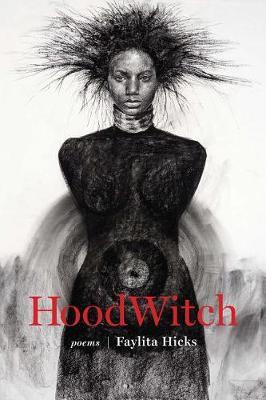
“HoodWitch” Celebrates the Power of Black Femme Witchcraft

Faylita Hicks’s debut poetry collection, HoodWitch, is about the Black femme body. These poems explore Black femme power and the reclaiming of those harmed bodies described as “something that can & will survive / a whole century of hunt.” Organized by sections based on three Haitian Voodoo veve images—Papa Legba, Maman Brigitte, and Baron Samedi—HoodWitch sets an immediate tone with a poem that works as a prologue entitled “About the Girl Who Would Become Gawd” about the connection between Black womxnhood and the policing and politicizing of said body—“all fear in the body.” It ends in binary code that says, when translated, “Say Her Name, Say My Name.”

Image result for hoodwitch by faylita hicks

The rest of the collection calls upon the spirit of mothers, specifically Hicks’s mother and their own experience of motherhood, through a series of poems based on childhood photographs. Readers get an experience that is personal yet universal. Hicks’s poems are about giving their child up for adoption, mourning their fiancé, and embracing the nonbinary femme body through a miasma of language and imagery that conjures Christian, Afrofuturist, and Voodoo mysticism; it’s all beautifully visceral and real.

Faylita Hicks is a 2019 Lambda Literary Nonfiction Fellow, a 2019 Jack Jones Literary Arts “Culture, Too” Gender/Sexuality Fellow, and was a finalist for the 2018 PEN America Writing for Justice Fellowship. Their poetry and essays have appeared in Slate, Huffington Post, Texas Observer, POETRY magazine, Adroit, The Rumpus, and others. They are the managing editor of the Austin-based literary journal Borderlands: Texas Poetry Review. They work in criminal justice reform as an organizer and writer with the social justice nonprofit Mano Amiga. 

I spoke with Faylita about their practice as a witch, their meaning when they talk about “Gawd,” and the publishing experience of a Blxck poet (and why they use the word “Blxck”).


Tyrese L. Coleman: I read your entire collection and feel as though you have me spellbound. Are you a witch?

Faylita Hicks: Yes I am. I have a personal practice that I adhere to—though my family does not necessarily agree with my practice. It’s a practice I’ve developed using personal research and intuition.

TLC: You have a poem titled “Hex for R. Kelly.” Did you put this hex on him? Please say you did.

FH: This hex is real, though I haven’t actually performed it. I have considered the implications of performing this work on R. Kelly and have only recently decided that it is pertinent. I work under the concept that moving such a major negative energy, such as a hex, could mean that I receive such energy back onto myself—but I think the pain and aggression he has put on Black girls and womxn is substantial enough that it should be carried out. Honestly, I believe I will not be the first person to do such work and that what we are seeing in regards to this case is actually the work of many practitioners already. My casting would only add to it. 

TLC: I ask about your practice because I’ve seen an emergence of Black witch iconography and a desire to see more Black witchcraft in media—or rather, this feeling of asking the world not to forget about Black witchcraft.

This is not new and I am not the first, I am one of many.

FH: Black witchcraft is not new and I believe it is only “trending” because Black witches are making themselves known and are reaching back into their historical origins to reconnect with their ancestors in a more genuine and public way. This is not new and I am not the first, I am one of many. Truthfully, Black womxn and femmes have been doing this work for many generations. Whether we are adhering to cultural norms (such as not splitting the pole or blessing a meal), we are reaching back to traditions that have existed long before us, many rooted in what we now refer to as Hoodoo or Voodoo. 

As a reference point, a friend, a Black Catholic woman, asked me to bless my house with holy water and light several blessed candles. That is not something written in the Bible, though it is a traditional act in Hoodoo practice. She is not a practitioner, but the act itself is one that is rooted in our shared spiritual lineage.

TLC: In the notes section of HoodWitch, you reference that the book is structured around three Haitian Voodoo images: The First Rite of Water (Papa Legba), The Second Rite of Flesh (Maman Brigitte), and The Third Rite of Smoke (Baron Samedi). Can you tell me how you settled on these images? What do they mean in terms of understanding the book and how readers should interact with it?

FH: The veves that are presented represent several lesser known loss—or messengers. These messengers help the common person to access the more important loas [a Haitian Voodoo god]. They act as guides or gatekeepers. I refer to them because this book is a summoning of both earthly spirits and other beings. I wanted my ancestors to have a say in the book—this was one way to connect with them. 

TLC: Many of your poems talk about “Gawd.” Who is “Gawd” and how should we understand this being or entity as we read and appreciate HoodWitch?

FH: Gawd in this text is a Black womxn or femme who has experienced some transformative event. I am recreating the method by which many historical figures have been transmuted into godly beings. In 1,000 years, should humanity still exist, these Black womxn and femmes who have been harmed by their counterparts will be recognized as the pivotal people they were in the social justice movement. Not only the memory of their names, but of what they represent to living Black womxn and femmes who continue to carry on their legacy in the work that we do. 

There was nothing anyone could do to us to keep us from rising to our true and infinite selves.

It is a process I’ve thought long and hard about. If only a few texts survive, and my book is among them, how will the terror of living as a Black womxn or femme be remembered? I hope that it will be that these experiences made us more powerful than we already are. There was nothing anyone could do to us to keep us from rising to our true and infinite selves. 

TLC: One of the themes I picked up on right away is this transition of girl to mother, the creation of a mother, specifically, a Black mother. To me, it felt as if the journey you depict is not the stereotypical benevolent motherly image, but rather one that feels mystical because she is worldly. Worldly in that way Christians talk about those of us who are not necessarily of “God” but I would imagine you would say worldly and of “Gawd.” Talk to me about the path to motherhood you show readers in this book.

FH:  I am trying to bring attention to the terrors of motherhood, which is a hard aspect to look at. There is this underlying assumption that all women and/or femmes want and should become mothers at some point in their lives, but that is not always the desire. There should be a balance of perspectives and the allowance of Black womxn or femmes to say that this is not what brings them joy. As a birth mother, I love my child. Deeply. But it was not ever my desire or goal to bring a child into this world that needs so much work. She is not safe nor do I have an answer on how to curate safety for her, comprehensively. It is possible she will experience any of the number of things that come with being Black, a femme, and in this generation. Fear is one aspect of motherhood, we should acknowledge it and speak on it more often. 

TLC: Tell me about your language choices and the decision to reject gender binaries and racial binaries with your use of the words “womxn” and “blxck” so that the experiences described represent those that include, as you say in the notes, “women from all origins.” 

FH: As a nonbinary femme, I thought about what transformative language I could use to describe my experiences—since those are the only ones I can directly write about. At one point in my life, I was a girl and a woman. Then I acknowledged that I was more than that, I was gxrl and womxn. If I had been born in a different body, I may have needed to transition physically, but I did not have to. There are others who have had to—and so I must acknowledge that those who have had to exist and bring them to the table too. 

Blxck was my way of including people with my tone of skin but who may identify as something other than Black. Very often when I speak about the Black experience, I am also speaking about the experience of people with a darker skin tone or who are outliers in their own communities. While this book is dedicated specifically to the experiences of those who identify as Black, I could not exclude the womxn or femmes who have had similar experiences entirely. 

TLC: Where did HoodWitch come from? 

Poetry is experiencing a renaissance—but it is not wholly Black.

FH: The book started in 2009, as a series of poems meant for performance. In 2010, they were poems meant for publication—but lacked the depth that I thought they required to adequately describe my experiences. They have gone through many iterations, several becoming combined pieces or truths being revealed in a couple of previously published pieces. Though I had almost a decade to refine them, the last six months proved to be the point at which I could dig in and give them the focus they needed. I received the most feedback on the project after signing the contract, and therefore was able to focus my energy on developing the manuscript just as I needed it to be. I also started working a large spell for legibility and clarity of vision. The spell lasted for three months and it took several months after to began to regain personal energy. I know it sounds very occultist to mention, but the spell helped me finish the book. I knew I needed my ancestors to guide me.

TLC: While I know what it is like to publish a book of prose, I don’t know much about the poetry publishing world. I would say that the prose world is in a new wave of a Black renaissance. Would you say the same for poetry? 

FH: I brought several books by Black poets to my writing desk and regularly reached over for energy inspiration and lineage reference. Poetry is experiencing a renaissance—but it is not wholly Black. It is in all underrepresented backgrounds. The underrepresented are pushing to become the voices heard in every arena—not just poetry. What we are witnessing is a time of tangible change, what are our most recent ancestors have fought for and all of our ancestors have dreamed of. Words, a root for all change in society, have become our tools for reclaiming our dignity and respect. I see the work writers are doing, across the genre, as its own activism. We are taking space and making space for others. That is our right and our inheritance. It’s a work that must continue as we are nowhere near done. I’m grateful for the opportunity to be one of many doing this work. 

How I Learned to Embrace Jamaican Patois, the Language of My Youth

There’s something about Jamaican patois that grates and soothes at the same time. It is the language of home. It is the language of the women who lived in my childhood home as helpers, the language of the women who told me and my sisters stories about rolling calves and duppies, the women who plaited my hair morning after morning and got us girls ready for school. It is the language of my primary school classmates fashioning a ball out of an empty juice box, stuffing the empty box with other bits of trash and tapping the corners to soften the edges, then throwing that ball in a game of dandy shandy or sight—something like dodgeball—in which the child in the center jumps and weaves and bobs to avoid the ball, sometimes diving to the ground, and the children standing around watching and waiting their turn squealing and hollering as the game progressed. It is the language of the higglers in the market urging passersby to buy their produce. 

But it is also the language I’ve been taught to hate, the language we were told was nothing more than broken English. It is the language that was dismissed with directives from my parents like, “Girl, don’t let me hear you talk like that”; “girl, will you please speak properly.” So languages—both the Jamaican dialect and standard English—were characters in my life, characters I either wanted to leave behind or embrace wholeheartedly.

For a long time I carried the language with me like a weighted stone.

Nicole Dennis-Benn, who embraces patois wholeheartedly in her latest novel Patsy, is the first writer I have seen who openly acknowledges the shame I had learned to associate with patois. The novel’s Patsy remarks that each character speaks patois “loudly, as though it never entered the speaker’s mind to be ashamed of it in America with all these white people around overhearing it.” Dennis-Benn is by no means the only Jamaican or Caribbean writer who uses patois, but Patsy, who has migrated to America, gives voice to what Jamaicans have long been taught and internalized: Jamaican patois is the language we leave behind, the one we tuck away lest it define who we are.

Because of my parents’ disdain for patois, for a long time I carried the language with me like a weighted stone, easily discarded in favor of the standard English my parents wanted to hear their children speak. After all, the prevailing message I generally heard was that our nation’s patois was broken English, a bastardization of the British English and British culture my parents’ and grandparents’ generations had learned to emulate. These ideas about value extended to our music: American rhythm and blues and country music were preferable to homegrown reggae. It didn’t help that reggae was seen as the music of the urban poor, their weapon against racial and economic inequities. 

But my early days living in Brooklyn as a college student were a contradiction. Away from our food and language and music, I craved what we had been taught was subpar. I wanted to hear dancehall and lovers rock and ska. I wanted to hear the familiar patois that marked a stranger as one of my own. I craved the foods and words of other Caribbean islands that were so similar to Jamaica’s. While some immigrants run away from their cultures to assimilate, I ran toward mine to find myself.

I found my language in books—and I found it first in Zora Neale Hurston’s Their Eyes Were Watching God. Set in 1930’s Eatonville—a self-governing black community in Florida—Hurston’s book featured characters who spoke like the people I knew. Her characters used words like “gwan” for go on and “dem” for them and “ole” for old and “oman” for woman. Hurston had put in writing the language I’d heard all my life, all that was forbidden and dismissed, the very speech patterns that girls at the all-girls boarding school where I was a day student were sometimes fined a few cents for speaking. English was ladylike; patois wasn’t. Proper, British English fit the colonial customs the school still embraces, particularly the straw jippi jappa hat that’s part of the uniform to this day.

I was coming to realize that the language I had been taught was shameful was a way of speaking that belonged to all of us.

I didn’t come to Zora Neale Hurston’s work on my own. As an undergraduate, I took an independent study class with a professor who suggested it as a book we would read and study together. When I picked up the book, I didn’t know what to expect, but there in the very first chapter were characters whose dialect sounded like my own. We talked about the book’s language in a way that no teacher had ever elevated our patois or noted it as something worth studying. That stayed with me. Nothing else I read in undergraduate literature classes sounded like this. Of course, I had read Caribbean literature in high school, read stories with characters who used Caribbean dialect. But the dialect and community of Their Eyes Were Watching God resonated with me in a way that hadn’t occurred in previous high school literature classes. It would take me years to understand why, to work out what the 20-year-old me in that Manhattan classroom could not yet articulate. I was coming to realize that the language I had been taught was shameful extended beyond Jamaica and was a way of speaking that belonged to all of us, the descendants of enslaved Africans in the Americas. 

I devoured Hurston’s work: Dust Tracks on the Road, Jonah’s Gourd Vine, Mules and Men. And I shelved my plan to become a lawyer. I wanted Hurston’s life. I wanted to tell my people’s stories, to celebrate our culture and our people and our language the way Hurston had in Their Eyes Were Watching God. I wanted to become a cultural anthropologist of sorts, preserving our culture and folktales and language and stories through fiction.

Their Eyes Were Watching God gave me space to believe my people’s stories are worth telling. A few years later, when I started writing my first novel River Woman, the oral and black folk traditions of Their Eyes Were Watching God, as well as the community of Eatonville, were on my mind. So I created a legendary town of my own, merging fact and fiction and folklore to create a river town called Standfast. (While Standfast is the true name of a district in my hometown, it is not located on the banks of a river. Instead, it is miles away in another parish near to the district where my mother spent her formative years.)

To get here as a writer, I had to unlearn what I had been taught about Jamaican creole, our first language. I had to become the speakers Dennis-Benn’s Patsy observes: a person who sees no shame in the language of home. To get here as a writer, I had to learn that our patois is the language of survivors, a pidgin language that originated as the common language among the enslaved Africans who spoke a multitude of languages and who, in order to survive and work together, fashioned our pidgin language to communicate. I had to unlearn the idea that these were broken, misspoken English words, as I had been taught, and learn instead the truth: that they were Akan, Igbo, and Yoruba words that, centuries later, are still part of our everyday dialect. As a child, I had been taught that unu was simply a badly spoken form of the English you. I know now that unu is the Igbo word for the plural you. Nyam, which means eat in Jamaican patois, is the Wolof word for eat. De, which signifies location (as in mi de yah, I am here) is rooted in Yoruba, and isn’t, as I had been led to believe, a mispronunciation of there. And our patois has its own rhythm that’s distinct from English. You a go a school tomorrow (You going to school tomorrow) is both a question and a declarative sentence. The listener distinguishes the difference not in the order of words but in the way the speaker’s tone rises at the end of the sentence.

To get here as a writer, I had to unlearn what I had been taught about our first language.

Today, there’s a more concerted effort in Jamaica to recognize the Jamaican dialect as the island’s official second language—a language to be written down on official communications alongside English. Predictably, there’s resistance, some of it rooted in the difficulty of standardizing spelling, some of it rooted in the lingering shame associated with a language long used to define class, some of it rooted in the lingering shame we were led to associate with African traditions. 

Zora Neale Hurston understood that there is no shame in black folk traditions, that to be complete she had to embrace her whole self—her language and folk traditions. In the forward of the 1990 edition of Their Eyes Were Watching God, Mary Helen Washington writes, “What I loved immediately about this novel besides its high poetry and its female hero was its investment in black folk traditions. Here, finally, was a woman on a quest for her own identity and, unlike so many other questing figures in black literature, her journey would take her, not away from, but deeper and deeper into blackness, the descent into the Everglades with its rich black soil, wild cane, and communal life representing immersion into black traditions.”   

Some fifty-plus years after Their Eyes Were Watching God was first published, I sat in a professor’s cluttered office on a midtown Manhattan college campus, discussing Janie’s journey to self realization. What lasts for me is the language, the book’s immersion in black culture that some early black critics dismissed as minstrelsy. Hurston’s emphasis on language took me deep into my own traditions, and released me from the shame I had learned to associate with my people’s first language.

Help an Independent Literary Magazine Thrive in a Hostile Climate

Every day of the year, Electric Literature is grateful for the people who read and share what we publish. But on this Giving Tuesday, we’re coming to you with a special request: Electric Lit is aiming for 1,000 members by 2020, and we want you to be one of them. Your membership gets you discounts in our store, access to year-round submissions, and the knowledge that you’re supporting our mission to make literature more relevant, exciting, and inclusive. If that’s all you need to hear, smash that button. If you need more convincing, read on.

Electric Lit has been publishing for ten (!!) years, going from a quarterly print anthology to weekly fiction Tumblr to a robust culture website. That means we’ve outlasted a number of devastating layoffs and heartbreaking closures in the media world: the Awl, the Hairpin, and Topic (not profitable enough), The Toast (saw the writing on the wall), Gawker (got on the wrong guy’s bad side), Splinter (owned by idiots), Deadspin (“didn’t stick to sports” and owned by idiots), and Pacific Standard (question mark). We take no joy in this, though we’re glad to still be here. What it means, though, is that as culture and commentary sites fall to capitalistic concerns, we feel more and more serious about our responsibility to bring you thoughtful, illuminating work that situates books and stories in the context of our challenging political moment. And, let’s be honest, we also feel worried about the future.

We don't answer to VCs or any other big funder. All we have is you.

We know there are a million demands on your money, especially now. (Especially today!) Your preferred primary candidate wants it. The ACLU and RAICES and all the other causes clamoring for your support want it, and they deserve it. It can feel sometimes like you’re just throwing donations at every problem and they’re all still getting worse. But this is a situation where your funds truly go a long way. We are a tiny nonprofit with no academic affiliation or major funder, and we’re used to stretching every buck. If just a thousand of you—under a quarter of a percent of our monthly readers!—are able to dedicate just $5 per month—one single fancy coffee drink!—you can make a real, measurable contribution to our continued survival. At a time when other culture sites are having their plugs pulled for being too political, for not making enough money, or just for no reason at all, that means a lot. We don't answer to VCs or any other big funder who can do us dirty that way. All we have is you.

I know the “one coffee drink per month” thing is a little cliche, so here are a few other points of comparison:

  • You could have a third cocktail at the 928957th birthday party of Scorpio season, OR you can have a beer instead, dedicate the difference to helping us offer benefits for our staff, and probably feel better in the morning. 
  • You could upgrade to Duolingo Plus for two weeks, OR you can help make sure we always have enough buffer to pay writers on time. 
  • You could get another bottle of nail polish that’s basically the same color as all your other bottles of nail polish, OR you can help us reject our reliance on Amazon affiliate fees. 

This is cheap at twice the price, and it means everything to us. Your support lets us invest in our writers, offer security to our staff, and commit every day to bringing you high-quality writing that wrestles with the important questions of our time. 

Ready to join yet?

Or do you want to read some of the nice things highly celebrated writers have said about EL?

National Book Award winner Susan Choi:

Electric Literature is the bookstore open at 3 a.m. for the insomniac in bed; it’s the book group for the lonely non-joiner; it’s the literary website your jaded teenage kids try to read over your shoulder; it’s a godsend for the procrastinating syllabus-writer; it is remaking the canon, it is expanding the community, it is blasting the dust away, it is lighting everything up and offering the words for the new vividness - why do you think they call it ELECTRIC? Marvel at it, feast from it, and for God’s sake support it!

Pulitzer Prize finalist Karen Russell:

Electric Literature is where I go to be delighted. Also: haunted, elevated, provoked, frightened, inspired. It's jungle-lush with strange, amazing life, and an essential part of our contemporary literary biodiversity. ... I've discovered so many favorite stories here, recommended by authors I love; every semester I teach Electric Literature original fiction. What an oasis it has been for me and so many other readers and writers—predictably surprising, darkly illuminating, and perhaps the best paradox of all: a genuine virtual community. I subscribed, and I have to say, what you get is much better than a novelty T-shirt. It's reliable astonishment, a thousand ways to be amazed at what words in a row can accomplishment, how they root into readers and transform the whole ecosystem of thought, ramify into action. Let's keep it going and growing.

National Book Award finalist Carmen Maria Machado:

I have been publishing on and off in Electric Literature since 2016. It’s a magazine that is near and dear to my heart, not only for its incredible fiction and essays, but its commitment to all literature, regardless of genre, and its willingness to tackle difficult, important political conversations in the literary world. Electric Literature has published three pieces that I have either authored or participated in—each of these projects pushed boundaries, disrupted forms, and created a stir—and I know I wouldn’t have been able to find a home for them anywhere else. 

Pulitzer Prize finalist Rebecca Makkai:

Electric Lit is electric, and lit, and electrically lit, a jolt of magic and reason and beauty and wonder and chaos and order and wisdom. We need those things like we need air, and we need Electric Literature to thrive.

Join their ranks by joining our ranks today.

Queer Pleasure Is a Form of Resistance

Cantoras follows five Uruguayan queer women, exploring their friendships with one other, their personal trials and traumas, and their romantic and sexual selves. The novel is primarily set during the dictatorship years, 1973–85, a time marked by violence, torture, and severely restricted personal freedoms. These Cantoras—“cantoras,” the Spanish word for singers, is used as a code word by queer women for protection and identification—find refuge in each other, and in a secret retreat they make together by a rural beach. 

Image result for cantoras carolina de robertis

Written in prose that sings, Cantoras is a sweeping, compassionate novel. In the year that we celebrated the 50th anniversary of the Stonewall uprising, the riots that incited the gay liberation movement in the United States, this is a novel that asks profound questions about nationality, belonging, and identity.

I was delighted for the opportunity to ask Uruguayan American writer Carolina De Robertis about her process writing sex-positive sex scenes between women, pleasure as resistance, global queerness, unlikable queer women of color, among other topics of conversation. 


Alexia Arthurs: I want to start with a point of view question. I so admire the craft of Cantoras because I could sense that it was the kind of novel that would teach me in equal parts about my own writing and myself. It was affirming to read a novel that follows the lives of five different queer women, because too often the experiences of queer women are presented as a singular story. What were the experiences and challenges of writing a novel that follows Romina, Flaca, Anita, Paz, and Malena—five different points of view? Were you thinking about queer diversity? 

Carolina De Robertis: I knew from early on, writing Cantoras, that it would be told in a prismatic point of view that moved fluidly between the characters. It had to be this way because the real women whose lives inspired this book drew strength from friendship and community during the Uruguayan dictatorship—a time of intense silence and isolation. So the approach felt true to the story, and arose from it. That said, I also found it incredibly freeing to write this way. It unleashed me from the pressures of representation that so many of us face as marginalized writers, because no one story is the story. These five women are incredibly different from each other, and that, obviously, is also true about queer women. We deserve all that space, to be more than sidekicks, to be raucous and multivalent in our expression.  

AA: I started reading Cantoras with the knowledge that it’s about five queer women living under the Uruguayan dictatorship, a period during which many human rights were stripped from Uruguayans and being identified as queer could lead to violent consequences, and so I was really struck by all the pleasure in this book—in the having of sex, the descriptions of food and drink, and the oceanic views of Cabo Polonio. I was moved by the bravery of these women seeking out pleasure, especially as I considered how pleasure for women is a kind of resistance across cultures and time periods. Did you set out to write a book so interested in women’s pleasure? 

I don’t think we’ll ever reach liberation—as women, or as queer people—without affirming our true erotic selves, or our right to joy.

CdR: What I knew was that I wanted to write a book about liberation: what it means, what it costs us, why we need it, how we carve it from the world, how we get there. And perhaps this will sound radical, but I don’t think we’ll ever reach liberation—as women, or as queer people—without affirming our true erotic selves, or our right to joy. James Baldwin knew this; in Another Country, the most undersung masterpiece of the 20th century, he takes us deep into the connections between pleasure and agency, desire and survival. Audre Lorde knew it too, lying it out in her essay “Uses of the Erotic: the Erotic as Power.” I’m so glad you saw pleasure as a form of resistance in this book—along with all the other forms of resistance the women pursue. 

AA: And speaking of pleasure, Cantoras is such a sex-positive book. I was inspired by the abundance of sex between women, and sex between women that isn’t interested in the male gaze. I remember having a conversation with another writer about the challenges of writing good sex scenes, and the writer wondered if a part of the challenge is how it might implicate a writer by revealing something about their sexual selves. Now, I can’t help wondering if a part of the work of writing sex scenes is becoming more comfortable with our sexual selves. What advice would you offer to someone looking to write better sex scenes? And in thinking and writing about desire and sex, who do you look to for inspiration, literary or otherwise?

CdR: These are intriguing thoughts. For too long, for centuries, sex between women has not been perceived as valid literary material, and that’s a shame. We’ve lost a great deal. Imagine the hundreds of pages we could have had on what Clarissa Dalloway wished she’d done with Sally Seton. I’m talking treasures, here. With this novel, and the one before it, The Gods of Tango, I struggled with the thought that the more dyke sex landed in the book, the less it would get taken seriously. But then I’d remember Henry Miller and how he got taken plenty seriously with all his extravagant descriptions of straight male desire, and I’d dive back in. In terms of advice, I’d say, trust your imaginings, follow the particular, be true to the body, and listen for what feels too weird or raw or risky—and go there. You can always revise. But first, say it. Give it voice. There’s so much that still needs giving voice. 

AA: I’m writing a novel about a group of black women friends, so in a deeper way I was especially grateful for the friendships in Cantoras. I paused from reading to text a friend, “Why is it a thing for queer women to be friends with their exes?” My sense and my own relationship to queerness is that it feels outside of heterosexual ways and limitations of experiencing relationships. What’s your thinking about this novel’s interest in friendship? Perhaps the ways it holds and challenges certain stereotypes about friendships between queer women? 

CdR: The idea of lesbians or queer women being friends with their exes is a stereotype, but it’s also something I’ve seen play out both here in the United States and among the women I met in Uruguay who inspired this book, and who are a generation older than me. And in fact, it makes sense: the community they forged was so small, contained, and under the radar that they couldn’t afford to lose too many people to break-ups. You’d end up alone. And yes, I do think another factor lies in stepping outside heteronormative ideas of what a relationship means or can be. 

For too long, sex between women has not been perceived as valid literary material, and that’s a shame.

What I really wanted to portray, in this book, is one of the great innovations and gifts of queer culture: chosen family. Queer friendships, both in and beyond intimate relationships, have long stitched together families and communities for those who’ve been expelled from their original homes—one character in the novel describes it as a kind of patchwork quilt made up of remnants no one else wanted. But they wanted each other. It’s more than friendship; it’s a kind of family-making, less socially recognized than other forms, but no less real or powerful. 

AA: I was wrecked by the relationship between Romina and Malena—I couldn’t hold Romina’s trauma against her, and the reasons she couldn’t know Malena intimately, and yet I felt personally betrayed. I was also distressed by the age difference and issues of consent when thinking about Paz and Puma.

You write about women with such intimacy and complexity—the light, but also the shadowy parts. Much has been said about writing “unlikeable” women, but usually it is referring to white, straight women. What does this idea of writing unlikeable women mean for you personally?

CdR: If we only write flat characters to portray our marginalized communities, we’ll never be truly free. Saintliness is a kind of flattening, too. It doesn’t allow the characters to be complex, textured, containing of multitudes, as Whitman put it. Romina, Malena, Paz, Puma—they’re more than that. We’re all more than that. 

AA: I was really interested in how the novel explores the language of queer identity. During the dictatorship, “cantoras,” which is translated as singers, is used as a codeword by lesbians to identify themselves. Later, the Cantoras contemplate the younger generation of queers in the new democracy, who claim different identity markers within the LGBTQ+ community. Flaca says, “Now we have all these words and nobody’s a cantora anymore…Don’t you ever feel like you’re disappearing?” I’m interested in this tension around the generational language of queer identity—this idea of “disappearing.” What do you think Flaca means by it? It occurs to me now that this novel is a record, a remembering of this particular period in Uruguayan history—but of the cantoras too, is that right? 

CdR: I think that is right—or, at least, that’s my intention. I felt a great responsibility, writing this book, to do my best to create a record, a fictional rendering to address the immense archival silence. I’ve been researching the Uruguayan dictatorship for eighteen years now, for various projects, and have shelves of books on the topic in both English and Spanish. There is nothing on the experience of queer people living through those times. And yet, there I was, hearing these stories from people I knew personally, remarkable stories that deserved voice in the world. 

In terms of queer language, absolutely: there have been enormous generational changes, in Uruguay, and in the United States as well. Our queer lexicon is kaleidoscopic and continuously evolving; we can affirm this and also honor our various histories. 

AA: I was also interested in how this novel navigates global queerness. Paz names her bar La Piedrita—Little Stone—after Stonewall. And in the last part of the novel, gay marriage is legalized in Uruguay: “Uruguay being the third country in America to legalize gay marriage, after Canada and Argentina, and before the United States.” Can you speak to the novel’s interest in global queerness? How were you thinking of Uruguay in this larger conversation about global queer liberation?

Queer friendships have long stitched together families for those who’ve been expelled from their original home.

CdR: People often assume that Latin America is “backward,” and that Latin Americans or Latinx people are more sexist and homophobic than, say, white people in the U.S. If I had a buck for every time I’ve been informed that my culture is more “traditional” or “conservative” than others, I’d be rich! So it was important for me to include the more recent era of progressive renewal in Uruguay, when, yes, we legalized gay marriage before the U.S. Though as you say, there’s also a character who’s inspired and moved by Stonewall, so what happened in the U.S. does transcend its borders. That’s how queer liberation has worked, globally—every brave movement, every breaking of silence, has sent sparks across the world. 

AA: I’m remembering a conversation between the Cantoras about whether they feel at home in Uruguay during the dictatorship. I’m remembering the Afro-Uruguayan character, Virginia, who believes that her community was displaced by the racist government. She volunteers with a Black community paper. I’m thinking of Ariella, who longs to leave “this jail of a country,” though she is protected by her wealth and privilege. And I’m thinking too of the exiles whose letters and newspaper clippings Romina smuggles into Uruguay, Romina who bravely organizes to restore democracy. These are just a few of the personal narratives of belonging and national identity in Cantoras. How do you see Cantoras as holding this fraught question of belonging and national identity? 

CdR: Belonging is, to me, a core theme of this novel. How do we shape a sense of home in a world that seems bent on our erasure? What does it mean to seek refuge, live our truth in hostile times? These are questions are intensely relevant to the novel’s characters, but they’re also, alas, relevant to many of us in the here and now. This novel doesn’t answer those questions, but it does create a space for the characters to explore them—and, hopefully, for the reader to explore them, too.  

What It Takes to Leave the Westboro Baptist Church

I’m often asked why I left the insular Hasidic community where I was born, bred, and expected to raise a burgeoning family. What was the impetus that led to this seismic shift in my thinking? How did I find the courage to rebel, and why? It’s also often these conversations that lead to well-meaning questions about why I did not feel oppressed or violated. How could you not have? they want to know. 

It’s been over a decade since my husband and I left our community of birth, an enclave in upstate New York known as Kiryas Joel. The village boasts over 20,000 residents and an exponential birth rate. As the community continues to swell, so too does the list of restrictions. TV, movies, secular newspapers, books and the internet are strictly verboten. In the community leaders’ perception, the antidote to a progressing, modernizing world is an unyielding wall of strictures. 

Throughout our slow transition, I’ve struggled to articulate a moment of awakening, which is what readers and audiences seem to crave. It was a composite of seemingly innocuous events, I tell them. Seeds of doubt planted did not sprout until years later, but they served to sear holes in my confidence. I began to question what I thought I knew to be right and righteous. 

Image result for unfollow megan phelps roper

It’s this very struggle that emerged as a clarifying moment for me while reading Megan Phelps-Roper’s new memoir Unfollowan eloquent, thoughtful and compelling book that not only tells her story of departure from the infamous Westboro Baptist Church, but also serves as a reminder for readers to examine their own biases towards those who hold different beliefs—even the extremists Phelps-Roper left behind. 

On a few square blocks in a suburban neighborhood in Topeka, Kansas, Megan describes her family as a tight-knit universe unto itself, where—apart from picketing and ministerial activity—life was as American as apple pie. The foundation of WBC was erected on its strict adherence to Scripture, interpreted in fire and brimstone sermons by Gramps, as the family affectionately referred to their pastor, grandfather and founder of the church, Fred Phelps. From the pulpit, he’d expound in lurid details on the sexual activities of gays “anally copulating their brains out” to eight-year-old Megan, her young siblings and cousins. 

She had imbibed the Biblical interpretations about God’s wrath on gays, Jews, and sinners who don’t heed his divine ordinances. Megan was fervent about the Westboro message. At thirteen, she argued Bible doctrine with strangers online. Sharp-tongued and unrelenting, she defended the church’s position in a chat room on GodHatesFags.com. She learned early on to ignore the insults they lobbed at her family—words like “hateful,” “evil,” “monsters,” “stupid”—”for the simple fact that I knew my family,” she writes. These descriptors were “diametrically opposed” to the people she knew: college-educated, lawyers, civil rights attorneys. Her family members were clever, creative and boasted flourishing careers. It was easy for her to dismiss these claims and to peg everyone outside the church as liars who cannot, under any circumstances, be trusted. 

This was, of course, how Gramps kept his followers in lockstep. Building walls of distrust and filling seas of fear, he managed to tie the family—and church—together in a bind that could not be untethered. 

For Megan, as for myself, the aha! moments happened because of small, banal rebellions that we believed we could contain.

She was an earnest girl. A good girl. An inveterate people pleaser. Her grandfather’s darling. 

Fed with a steady stream of hate by the very people she adored, her family, Megan could not conceive of questioning the core tenets of this fringe religious group. The silent moments of doubt were always overshadowed by an overwhelming certainty that Gramps’s teachings were the word of God.

For Megan, as for myself, the aha! moments happened because of small, banal rebellions that we adamantly believed we could contain. For Megan, it started with interactions on Twitter. As Westboro’s designated Twitter spokesperson, Megan was tasked with defending the church. Jews, gay people, and random Twitter users engaged with her, dismantling the Westboro ideas and forcing her to reexamine the truthfulness of its doctrines. One of those tweeters was an anonymous man named C.G., whom she later married. Their messages, at first seemingly harmless but plainly intimate, helped lead to her ultimate unraveling. They went from debating on Twitter to daily affectionate banter on Words With Friends.

Unlike Megan’s church, my community of birth maintains its isolation from the modern world, crossing over for business and politics—but rarely for entertainment. How else do you keep the youth from being influenced by an enticing world of freedoms? As the number of defectors increases, leaders cobble together plans to stop the hemorrhage, tightening their control. Cracks are beginning to appear now with the younger generation, and I remain hopeful that this increased porousness will effect change.

While Megan’s church mingled with seculars to save the world from itself, Kiryas Joel’s isolation stems from a fear-based philosophy of appeasement. If we are good and obey Hashem, I was taught, we will be protected from another Holocaust. We were not in the business of saving the world, only ourselves. 

In Kiryas Joel, modesty is the proverbial crown of a woman’s glory—and also, oftentimes, her undoing. The grand rabbi who founded the village gave fiery speeches reminiscent of Pastor Phelps about the hell that lies in wait in this life and in the afterlife for a woman who dares to wear sheer stockings or refuses to shave her head. 

In 2008, the modesty committee known as the Va’ad Hatznius, a group of middle-aged men tasked with maintaining the highest standards of modesty in the village, got wind that I was growing my own hair. Married at eighteen in an arranged marriage, I was required by Satmar Hasidic edicts to shave my head and don a wig or a turban. Our rabbi had declared this as basic a tenet as keeping Shabbat. Over the years, as the community radicalized, adherence to these stringent modesty rules morphed into something greater, trumping even the divine commandments in the Torah. 

The tenth child in a dozen, I was surrounded by married siblings who either shaved or had wives who did. Questioning something so foundational to our lives would be unthinkable—and yet, after three years of baldness, I let my auburn hair grow, careful to hide every last strand with a wig or turban.

This seemingly ordinary act was the proverbial straw that broke the camel’s back.

I cannot tell you where I found the courage to defy this rule—or why. But, much like Megan and her online friend/foe whom her religion forbade her from knowing better (she could only marry a WBC member—and no dating, obviously), this seemingly ordinary act was the proverbial straw that broke the camel’s back. 

“I’d already let this ungodly affection for an unbeliever take root in my heart,” Megan writes of her anguish over lusting for C.G. “If I didn’t rip it out with both hands, I would fall away and lose everything—my family, my friends, my whole life in this world—and in the world to come I’d be tormented in Hell for all of eternity, where the worm that consumes your flesh never dies and the fire is never quenched.” 

And this is where Megan’s story strikes a visceral chord: I, too, felt imprisoned by an all-consuming guilt for living in sin as a married woman with hair. At the time, I’d give almost anything to reclaim my innocence and steady the rocking boat. 

When I came home the evening after our meeting with the modesty committee where they threatened to expel my son if I kept my hair, I shaved it all to a stubble. I couldn’t see it at the time, but this final act of subservience  would lead me to my first autonomous decision: I will never again shave my head. In that moment, facing the mirror with a shaver on my scalp–feeling naked and violated–I could not imagine leaving my community. The gut-wrenching guilt of defying this long-standing custom passed down for generations was too big a burden to carry. 

I risked harming my children with unimaginable ills. I could lose my joy in the here and now and in the hereafter. Indoctrination is so powerful, its undoing is like splitting a sea. 

These feelings tore at my conscience. How do I stand up to what I know deep in my core is wrong while honoring the dearest people—my mother, sisters, family and friends—who will likely take this rejection personally? These emotions still simmer in the background of the life I’ve built. How do I tell my story while exhibiting compassion for my former community members? 

It is apparent how much Megan loves her family—especially her mother and father, still. Her compassion for those she’s left behind is truly breathtaking. “I had lived to support them. There was no worse anguish than causing them pain,” Megan writes, a sentiment that reminds me of my own mother’s pain watching her daughter veer from the beaten path. 

The reason fundamentalist communities have so many restrictions is because almost any act of defiance could be the first crack in the facade.

By sheer will—and through the help of her Twitter debaters—Megan leaves the church and dives head-first into a void. She describes feeling “physically ill” at her initial encounter with secular culture. She imagines God smiting her as she drives away, sending her car careening off the highway. 

It’d be easy to dismiss the followers of WBC as maniacal extremists. But reading Megan’s account, I was struck by her gentle words. (Though I recognize that her words would certainly not be gentle had she stayed or continued to toe the party line.) And this is perhaps why I felt a strong kinship with Megan when we first connected last summer. Megan, Yasmine Mohammed—an ex-Muslim activist—and I had prepared for a speaking tour on fundamentalism. The tour fell through, but in the process, I formed a friendship with these women. Megan’s deep and eternal love for her family resonated with me then—and even more so after reading her book. While my family has not abandoned me, our relationships suffered as a result of my departure. Yet I love them dearly—especially my mother, whose stoicism reminds me of Megan’s mother. 

For Megan to tell her story with love for the people who excommunicated her is remarkable not only because it reflects an emotional maturity, but also—and most crucially—it disproves the fearmongering WBC relies on to prevent this kind of erosion: namely, that outsiders are not to be trusted.

While every expat steps onto the path of defection by different means, it is rarely a single episode or aha! moment that serves as a catalyst for change; almost anything could trigger the pendulum to swing. The takeaway from Megan’s story—to me anyway—is that the reason fundamentalist communities have so many restrictions, some of which would seem downright petty to outsiders, is because almost any act of defiance could be the first crack in the facade.


Before you go: Electric Literature is campaigning to reach 1,000 members by 2020and you can help us meet that goalHaving 1,000 members would allow Electric Literature to always pay writers on time (without worrying about overdrafting our bank accounts), improve benefits for staff members, pay off credit card debt, and stop relying on Amazon affiliate links. Members also get store discounts and year-round submissions. If we are going to survive long-term, we need to think long-term. Please support the future of Electric Literature by joining as a member today!

A Poem About Wigs You’ll Want Toupee Your Respects To

Wigs Everywhere

 The brown squirrel, coiled & clinging
 to the guardrail of my balcony, 
 is a wig. 

 I stepped out of the shower to dry my feet
 on a damp wig. 

 You can fold a wig in a certain way
 that it becomes a cup from which you can swig

 water or juice or wigskey, 
 which is whiskey distilled
 from fermented wigs. 

 I met Dolly Parton & she was all wig. 

 Kristen Wiig is a wig. 
 So was Ludwig van Beethoven. 

 In Britain, there used to be two political parties
 —the Whigs & the Wigs. 
 
 There are wigs that are mops
 & wigs that seduce cops. 

 In some countries, it is illegal for wigs
 to marry other wigs. 
 
 Have you ever slept in a wig? It’s itchy. 
 
 The best wigs in life are free, 
 but the second-best cost
 extraordinary amounts of money. 
 
 Somewhere in Detroit, you can trade
 20 small wigs for one giant wig
 
 & the award for Best Wig Ever goes to 
 Medusa. I love how she’d rather lose her head
 than part with it

 & how, even without a heart, 
 the head maintains its awful power.  

7 London Novels by Writers of Color

I spent my formative years in London, the intonations of which will probably never fully leave my voice. For me, London is a metropolis of color, of people from all over the former empire who’ve helped to create one of the world’s greatest cities. Official statistics say that people of color make up about 40% of the city’s population. Around the same percentage of Londoners are foreign-born. This is the city of Zadie Smith’s White Teeth and Monica Ali’s Brick Lane, both superlative books about different ends of London (and much else) that you should read if you haven’t already. The below list, totally biased to old favorites and sparkling (personal) new discoveries, attempts to see the city on the page in all its transnational, ethnic, and cultural complexities and glories. 

The Emperor's Babe by Bernardine Evaristo

The Emperor’s Babe by Bernardine Evaristo 

The lead character of Bernardine Evaristo’s The Emperor’s Babe is Zuleika, the daughter of Sudanese immigrants who’ve made good in London, A.D. 211. After the ingestion of traditional English Literature at school, reading a novel of olden days London not centered on whiteness thrilled me when it was first published in 2001. Yes, there were black people in Roman London—the novel emerged from Evaristo’s residency and research at the Museum of London. This city is an outpost of another empire. The brilliant realignment of historical perception aside, Evaristo tells a gripping and hilarious story of Zuleika’s boredom, which is soon alleviated when Emperor Septimius Severus arrives in town and the two begin an affair—all in verse. I adore how Evaristo imagines the then-and-now topographies of London. She writes of “the humid jungle at Bayswater,” “mud huts by the Serpentine,” and “grasslands” of Mayfair. The contemporary also creeps in with “Wild@Heart, the trendy ‘flower boutique’ / on Cannon Street.” Zuleika and her crew’s partying ways will be familiar to anyone who’s been out on the town in London. Evaristo—whose debut, Lara, also in verse and based on her own British Nigerian family—should have won all the prizes back then. Her latest Girl, Woman, Other shared the 2019 Booker Prize. 

Small Island by Andrea Levy 

Novelist Andrea Levy’s father arrived in the U.K. on the Empire Windrush, the ship which brought the first large group of colonial subjects from the West Indies in 1948. The Windrush generation helped build today’s Britain (and most certainly London, its language, and its culture). In Small Island, Levy tells the stories of Jamaicans, Gilbert and Hortense, as well as those of Queenie and Bernard, a white couple with whom they become entangled. Set in 1948, the novel moves between the characters, back to World War II, and across the world to India, and back to London with a twist at its end. Worth a read in light of the recent Windrush scandal. Another offering of Windrush stories to check out is the nonfiction Windrush: The Irresistible Rise Of Multi-Racial Britain by Mike Phillips and Trevor Phillips.

Image result for sam selvon the lonely londoners

The Lonely Londoners by Sam Selvon

“One grim winter evening, when it had a kind of unrealness about London, with a fog sleeping restlessly over the city and the lights showing in the blur as if is not London at all but some strange place on another planet.” From this start, Sam Selvon’s novel goes on to run riot over standard English with its Calypso-infused rhythm and creolized idioms. Selvon, born to an Indian father and an Anglo-Scottish mother in Trinidad, follows Moses, who acts as a one-man welcome party for Windrush-generation immigrants, and his friends in an often unwelcoming London. The city’s streets are sadly not paved with gold, as per the Dick Whittington lore. The Lonely Londoners is often considered a pioneering novel of Black British literature. 

The Buddha of Suburbia by Hanif Kureishi

The Buddha of Suburbia by Hanif Kureishi 

At the beginning of Hanif Kureishi’s The Buddha of Suburbia, protagonist Karim declares: “I am often considered to be a funny kind of Englishman, a new breed as it were, having emerged from two old histories.” Karim, like Kureishi, is of mixed British Pakistani descent and hails from the south of the river suburbs. He escapes to the wilds of London and its theatre world, and in doing so, braves the frontiers of sex, sexuality, class, and race in London on the eve of Margaret Thatcher’s ascension to power. Meanwhile, his dad becomes a guru to white hippies. The novel’s soundtrack was interpreted by another South London boy, David Bowie for the BBC series of the novel, starring Naveen Andrews. A lyric highlight from the theme: “Screaming along in South London/ Vicious but ready to learn/ Sometimes I fear that the whole world is queer/ Sometimes but always in vain.”

The Study Circle by Haroun Khan 

Haroun Khan’s The Study Circle offers a very different 2000s view of British Pakistani youth from a tower block of a South London council estate. The view isn’t for the tourism brochures:

“A sterile panorama of ashen granite that, from most vantage points, dominated the totality of your vision. Blotting out the rest of the world. A demand to be your sole reality. Spawned from the popular post-War Brutalist style, the estate consisted of half a dozen twenty-story towers. Monolithic structures that trust upwards and stood like forbidden sentinels, forever gazing.” 

The gaze inwards comes from Ishaq, his friends, and the choices they have as young, urban British Muslim men amid the growing racism and radicalism around them. Khan, who based the book on his own life, writes the hell out of these margins. His characters—particularly Shams, whose early Tube adventures and job search got my heart—will linger, as will the characters’ conversations.

Queenie by Candice Carty-Williams

A 25-year-old newspaper journalist, the British Jamaican Queenie breaks up with her white boyfriend and goes on a bender of finding love again. The novel has been called the “Black Bridget Jones”—and there is a Darcy here too—but Queenie has to navigate quite a bit more as a young black woman in the world. To take one example from her quest for love: an encounter with a Neo-Nazi with a fetish. With exuberant prose, Carty-Williams takes us inside millennial Black British life (and joyfully into friendships), and all around (gentrifying) South London. 

Image result for living days ananda devi

The Living Days by Ananda Devi 

On Portobello Road, the setting of a million London stories (and plenty of my own), Mary, a white woman slowly being overtaken by dementia, meets Cub, a thirteen-year-old Jamaican boy from Brixton. Their unsettling attraction to each other eventually leads to Cub moving into Mary’s decaying Notting Hill home. Devi’s prose is both exquisite and disturbing; she leads us into the world of a conflicted (though pre-Brexit) London. White supremacy, gentrification, and aging are amongst the book’s meditations. Devi who lived in London in the 1970s as a student offers an astonishing, flaneur’s love letter to the city in 2005. 

“It was possible to love this city and die of it. 

To love its hidden stars and its cemented sky,

To love its children who laughed in Leicester Square and who experienced life so  immediately that nothing of it remained in their memories…

To love the old folks dying in Stockwell, sitting on a bench while the houses they’d bought and lived in for so long became luxury residences for the nouveau riche. No more space; no more space, except for the conquerors.”

Devi, who hails from Mauritius, writes in French. The novel was translated to English by an American, Jeffrey Zuckerman. The novel’s brew of memory (including Mary’s own of  WWII), time (Devi talks about the novel’s 40-plus-year gestation here), languages, ethnicities, and nationalities makes it an especially eternal new novel of London. 

How Pedro Almodóvar Turns Self-Plagiarism Into an Art Form

Writing about oneself is a process of rewriting one’s life. You filter your raw experience to make it funnier, or raunchier, or more melancholy—or, if you’re Pedro Almodóvar, all of the above. The Spanish director has long pilfered his own life for his films, and in his latest one, Pain and Glory (Dolor y gloria), he’s crafted an autobiographical portrait that’s particularly entrancing because of its familiarity. Indeed, Pain and Glory easily caps off a trilogy that began with 1987’s Law of Desire (La ley del deseo) and continued with 2004’s Bad Education (La mala educación). All three films center on openly gay filmmakers struggling with creative impasses who find in their male muses new ways of thinking about their past and present desires. 

Rather than eliding the way he’s aping himself, he’s made such self-looting all too evident.

But these films, unusual in Almodóvar’s woman-fronted oeuvre because they focus on male characters, don’t just cannibalize the director’s life. They also lift shamelessly from each other. With each successive attempt at telling (a version of) his life story, Almodóvar has found himself revisiting scenes and moments anew. Over three decades he hasn’t just told the same story over and over again. He’s refined and refracted it, making each iteration a self-plagiarism so flagrant that one cannot help but notice just how much he relishes quoting his own work. Here’s a case of a writer looking back at his early career and taking on the challenge of reworking its themes, characters, and storylines. And rather than eliding the way he’s aping himself, he’s made such self-looting all too evident, making those kinds of quotations central to how these recent narratives exist. 

Growing up in rural Spain, Almodóvar has said that he always felt wary of the Catholic education imparted on him by the priests at his school. Instead, he found the nourishing lessons he needed in Hollywood. And if his films are any indication, all he’s ever wanted is to give his memories the sheen of the silver screen. In the early ‘80s he began that project with an obvious (despite Almodóvar’s claims to the contrary) alter ego called Patty Diphusa, the star of a newspaper periodical he wrote intermittently for Madrid’s Diario. Patty was a symbol of the underground circles Almodóvar himself belonged to in the 80s (at a time when, as he writes, “We had no memory and we emulated everything we loved, and enjoyed doing so”), and eventually she became a template for many of his characters. When he released Kika in 1993 he actually published a conversation between the film’s titular character and Patty, who was undeniably her predecessor. Outraged over being rewritten for a new decade, Patty wondered what it meant that scenes from her own life had been recreated to give life to Kika: “Could it be that I’m getting older, or could it be that Pedro is repeating himself, as he grows old as well?”

The answer, of course, was that both things were true: she and Pedro were getting older and yes, Pedro would continue to repeat himself. A small scene about organ donation in Flower of my secret turned into the premise of All About My Mother; a movie poster in Bad Education later became a reality when Almodóvar shot I’m So Excited!; Women on the Verge of a Nervous Breakdown served as the real-life inspiration for the film-within-a-film “Chicas y maletas” being shot during Broken Embraces. In every instance, he gave his scenes new depth. And no selection of films shows this more clearly than the journey from Law of Desire to Pain and Glory, which anchored their plots in Almodóvar’s autobiography. The earlier film stars Eusebio Poncela as a filmmaker who creates sexually explicit movies where naked young men moan “Fuck me!” to the camera at the behest of an unseen film director. But Almodóvar filtered his own childhood through another more colorful character: Pablo’s trans sister Tina (Carmen Maura). In one scene set at an otherwise empty church, Tina begins singing along to the song a priest is playing on the piano, prompting him to tell her she reminds him of a young boy soloist from a long time ago. She shocks him by admitting that she and the soloist are one and the same. Relishing the chance of having caught the priest off guard, Tina regales him with the many memories she hasn’t been able to shake off, telling him there had only been two men in her life—the priest and her father—both of whom had abandoned her. Despite the way her dialogue hints at having been the victim of sexual abuse, she’s almost wistful about how she thinks of her childhood, a sentiment that rankles the already uneasy priest. And so when he urges her to find her way back to God (and to banish those memories, like he has), Tina utters a line that may well serve as an Almodovarian thesis: “I don’t want to run away from them. My memories are all I have.” 

The Spanish director has long been open about the abuse he witnessed at his Catholic school (“They also tried it with me but I always escaped,” he shared on the eve of Pain and Glory’s premiere at the Cannes Film Festival. “There was a priest who always put his hand on me in the playground so I would kiss it, I never did it, I always ran away. We were very scared.”) In the hands of Maura’s Tina, this traumatic event is, in true Almodovarian fashion, made all the more outlandish. Maura’s darkly comic and almost flirtatious delivery bluntly gives voice to the abuse Almodóvar witnessed but frame it as far away from him as could be conceivable. For a boy who grew up idolizing strong-willed women in films like Cat on a Hot Tin Roof and Splendor on the Grass, the choice to map his own experience onto an equally fabulous diva like Tina/Maura wasn’t just obvious but seemingly necessary. Here was Almodóvar realizing the thrill and promise of storytelling, the chance to rewrite one’s own life and using its own discomfiting reality to create a colorful narrative that shed light on the darker corners of his childhood. To do so, though, much as he had done with the character of Patty Diphusa in the early ‘80s, the director chose campy female characters that grounded traumatic encounters in absurdist comedy bits: this was drag as autobiography. 

Almodóvar framed Bad Education around the ways we tell stories from our youth so as to rewrite them.

Drag hinges not just on exaggeration and broad humor but on borrowed gestures and quoted lines. It has been through female characters (ones whose very femininity was overly performative) that Almodóvar has explored some of the most recurring themes in his work. With Patty’s stories Almodóvar approached desire through the chaotic energy of a sex addict, one who constantly had to find where her own limits lie. In one story, Patty meets a young man her age called Juan Félix. After he goes down on her, Patty discovers a photo in his jacket that features two young schoolgirls—one of whom is Patty herself. That’s how she learns Juan used to be Adela, her old classmate who had decided to transition just to be able to seduce Patty. Those who have seen Almodóvar’s Bad Education can immediately recognize that the plot for that 2004 film is a combination of that Patty story and Tina’s confrontation with the priest in Law of Desire. Fascinated by these moments which had queered childhood memories colliding with the present, Almodóvar framed Bad Education around the ways we tell stories from our youth so as to rewrite them.

In the early scenes in Bad Education we see a beautiful drag queen called Zahara (Gael García Bernal) picking up a random guy who’s seen her act in a nightclub and taking her back to her motel. When the guy is unable to keep his erection up, Zahara decides to rob him, stopping only when his wallet reveals him to be her old middle school crush, back when Zahara was a young boy called Ignacio. This sparks memories of the Catholic school where Ignacio met Father Manolo, who’d loved his singing and who’d clearly favored him above all his classmates. Zahara decides to confront Father Manolo after all these years in order to face the childhood trauma she’s had to deal with for so long. What in the 1987 film had been a mere monologue is fleshed out in vivid scenes at the Catholic school. And, yet again, we get a moment of righteous confrontation between a grown-up Ignacio/Zahara and Father Manolo. Where Maura’s Tina was content with merely conversing with her former “lover,” Zahara wants revenge: she’s written out a story that lays out all that happened between the two and is all too happy to stay quiet—for a price. That short story, titled “The Visit,” was in itself a piece Almodóvar had written years earlier and which he’d dusted off for Bad Education after first borrowing its plot line for Tina’s brief church scene.

In his most autobiographical film to date, Almodóvar took that short story and gave it yet another twist. By the time Bad Education wraps up, we learn that the scenes at the Catholic school as well as all the scenes featuring García Bernal as Zahara have been not flashbacks, as we’d been led to believe. Instead, they were filmed recreations that make up a film within the film. Enrique (Fele Martinez), the Almodóvar stand-in, has been directing. Ostensibly an adaptation of Zahara’s short story, the movie was also based on Enrique’s own relationship with Ignacio when the two were schoolmates who’d sneak off to the movies. This kind of labyrinthian metafictional aspect merely reinforces the way that, in Almodóvar’s world, memories are always already screened: they are always remakes, retouched and reframed for newer audiences. Even as we believe we’re getting an unvarnished look at Almodóvar’s own childhood in rural Spain, he’s offered only a twice removed recreation of it, a reminder that in his films nothing is ever original.

Pain and Glory hinges on a similar conceit. On its surface the film follows Salvador (Antonio Banderas), an aging Spanish director known for his cheeky 1980s comedies, who finds himself reminiscing about his childhood in rural Spain as he reconnects with not one but two men from his past. Set at a house that’s a near replica of Almodóvar’s own and with Banderas wearing Almodóvar’s own clothing, Pain and Glory doesn’t shy away from the autobiographical trappings of its central character. One of the earliest memories of his we see on screen is a young Salvador being asked to sing for a priest, hearing in voice-over how he soon became the choir’s soloist. Those familiar with Tina and Ignacio/Zahara will see here unmissable parallels. But if Almodóvar has yet again returned to his Catholic school days, it is not to tell a story of abuse. 

In Pain and Glory Almodóvar skips through whatever happened between his young protagonist and the priest and lingers instead on a bond the young Salvador shares with Eduardo, a dashing handyman. Expanding on the queered coming-of-age tale he put forth in Bad Education, Almodóvar gives his young fictional self a moment of sexual awakening that’s as bold as anything he first envisioned with Patty or Tina or Zahara. Eduardo (César Vicente) becomes Salvador’s pupil, learning to read and write at the hands of this preternaturally smart eight-year-old. But there’s also something rather lustful about their relationship; young Salvador sneaks wide-eyed glances at Eduardo, transfixed by the young man’s full lips, broad shoulders, and disarming smile. When Eduardo asks him to sit for an impromptu portrait after he’s done painting and tiling their house, Salvador is flush with excitement. Later still, when Eduardo strips down and washes himself with no regard for the young boy staring at him, Salvador faints. Heatstroke, he’s told, though we’ve seen the way he was struck by Eduardo’s naked body, his chaste desire clearly getting the better of him. 

To watch his latest film is to see Almodóvar’s career-long leitmotifs outright quoted and recreated.

But, as with his 2004 film, those childhood moments are revealed to be recreations, scenes Banderas’s Salvador is now shooting as part of an autobiographical project that makes Pain and Glory feel like an ouroboros of a film. Not only is he revisiting his memories to turn them into art, but he’s revisiting the theme of turning memories into art. To watch his latest film is to see Almodóvar’s career-long leitmotifs outright quoted and recreated, a reminder that creative self-plagiarizing has long been part of his creative arsenal. Moreover, just as in Bad Education and in Law of Desire, Almodóvar has created a character portrait of a gay filmmaker that depends on borrowed and stolen fictions. In the 1987 neo-noir, Banderas’ Ripley-esque Antonio exchange correspondence with a film director asking to be addressed by a pseudonym (“Laura P.”), a name borrowed from a film script, while in the 2004 film, Ignacio’s brother (played by García Bernal) passes off “The Visit” as his own while impersonating his older brother. In Pain and Glory, an old collaborator of Salvador’s stumbles upon a makeshift monologue/journal entry the film director has written and convinces him to let the piece be adapted for the stage. Salvador’s only request is that his name be stripped from it: the actor passes off Salvador’s writing (and therefore his personal history) as his own. In these films there’s always the fear that the fictions we tell about ourselves will become someone else’s. But there’s also the understanding that sometimes borrowed words are necessary to reveal one’s truth.

Almodóvar’s latest film is a melancholy look backwards, not just at his life but at his career—and, specifically, at the ways such backward glances in his work have always gone hand in hand with self-plagiarizing schemes. There’s a sparseness to Pain and Glory that seems to contrast with his baroque previous efforts, but by the time he shows us that half the film has been a film-within-a-film it’s clear this is a seasoned filmmaker polishing another one of his most famous tricks. The journey from Patty Diphusa and Tina to Zahara and Salvador is, on the one hand, a move away from artifice and towards verisimilitude. On the other, it’s a move towards ever more elaborate storytelling that has slowly shifted the focus from outlandish drag impersonators to sensitive young boys; in Law of desire same-sex attraction was violent and volatile, while in Bad Education it was a weapon to be used. In Pain and Glory, it emerges as a palliative balm that serves both the aging filmmaker and the budding choir soloist well. He may have told a version of this tale before, but with age he’s softened its edges and sanded it down to get at its central truth.

Writing about oneself is a process of rewriting one’s life. But, of course, once the writing is done, it means one’s life is nothing but a story, a narrative told and retold, edited and sculpted for consumption. Almodóvar, like many great artists, is obsessed with a small number of issues (desire, filmmaking, gender, Catholic abuse), and with Pain and Glory he’s returned to the one scene his career has long grappled with: the moment when a filmmaker sits down to witness his own queer childhood on the silver screen. There’s a distance now, which nourishes ideas that have gone from mere sketches to full-fledged films. Almodóvar has been turning these stories and characters over like a kaleidoscope, trying different angles, adorning them with ever more stylistic flourishes until he’s finally found yet another way to depict them on screen. He’s gotten closer to telling his own story while making sure the films that encase it remain jigsaw puzzles, obscuring the thin line that always divides fiction from autobiography. 


Before you go: Electric Literature is campaigning to reach 1,000 members by 2020and you can help us meet that goalHaving 1,000 members would allow Electric Literature to always pay writers on time (without worrying about overdrafting our bank accounts), improve benefits for staff members, pay off credit card debt, and stop relying on Amazon affiliate links. Members also get store discounts and year-round submissions. If we are going to survive long-term, we need to think long-term. Please support the future of Electric Literature by joining as a member today!

“Friday Black” Is a Brutal, Brilliant Satire of American Racism and Capitalism

The challenge of an absurd reality is producing art that is reflective of that absurdity without giving in to its logics. What I mean is, it’s difficult to make art that captures the heightened sense of precarity and peril we face while maintaining the perspective needed to undermine the forces that have produced such a situation. For author Nana Kwame Adjei-Brenyah, recently named to the National Book Foundation’s 5 Under 35, one answer to this predicament is to dial into the absurdity, turn the volume way up, and allow the harshness to wash over us until it hurts too much not to move. Full immersion.

His debut story collection, Friday Black, is darkly humorous satire of the dystopic results of an American culture conditioned to accept the excesses of capitalism, racism, and structural violence as the norm. The extraordinary becomes quotidian. And somehow Adjei-Brenyah retains a semblance of hope. We aren’t necessarily doomed, but we will be, he warns, if we can’t see how we’ve allowed the absurd to flourish in ways both macro and micro.

I spoke with Adjei-Brenyah over the phone about the big things — violence, racism, capitalism, human nature. But these are only points of entry. He wants, perhaps even more than the end of these forms of oppression, to remind us of our human connection — and responsibility to one another.


Mychal Denzel Smith: These stories are incredible. You’re diving into this satirical dystopian blurring of American life, particularly from a black perspective, with all of the different violences and systems at play that prey on emotions and alter the way in which we interact with one another. I’m curious, as far as your writing process, are there triggers in your everyday life that turn your imagination towards the surreal?

Nana Kwame Adjei-Brenyah: I remember a while back I made a video about wearing a hood. I remember Geraldo Rivera said if black kids wore their hoodies — didn’t wear hoodies as much — maybe they’d be safer. To me it’s already so ridiculous and so crazy but he said that in this way that presents it as normal or whatever, and so I try to say what is the real implication of him saying something like that? It’s that if you wear this kind of thing, that is if you present in this sort of way that is associated with black people, then maybe you’re going to get killed. Then maybe it’s okay for you to die, or maybe it’s acceptable. Almost literally even by his own logic that’s sort of what he’s saying. And that was several years before I wrote that book so for me, the surreal is the way of getting to the heart of the ways people try to use language to hide a sinister reality. The racism, or general evil that they’re willing to accept.

The surreal is the way I get to the heart of how people try to use language to hide a sinister reality of racism.

MDS: From the very beginning of the collection, the violence you imagine feels extraordinary. But there’s a coolness to the way that you describe it in which it feels sort of regular or mundane in a way. Is that a deliberate approach to it? Do you find the violence extraordinary, or what is the tension there for you?

NKA: Yeah, I do think there is an extraordinary amount of violence. Part of the reason why the book is playing with that is because we accept a lot of violence in our personal lives and also on a larger more macro scale. I remember the first time, the news was like 47 people were killed today on Black Friday. And it was just like, “yeah”and then “The Ravens Won.” Because of the overwhelming nature of the violence in our society we kind of almost allow a lot of violence. So when I put it in text, you’re kind of forced to pause and think “wait a second.” Because there is a part of us that does resist, but we’ve gotten so used to packaging our violence in these particular ways. “Oh a bomb was dropped in x country that we are trained not to care about. It hit a hospital. 68 people we think were killed.” And that’s — 68 human beings were killed by an accidental whatever, civilians whatever you want to say. And it’s just there in front of you.

I worked in a mall for a time. I was there when someone jumped off the fourth floor of Palisades mall. And I remember they put a yellow tarp on her. They kind of put like an emergency siren or something and the mall just continued. And I guess —

MDS: So that story is real.

NKA: Um, that story — it’s more real than I wish it were. Yeah I definitely worked in a mall for sure. I worked in a mall for too long. And besides actually teaching at school, the only real jobs I’ve had have been in retail. Everywhere I look there is some incredible violence happening and we’re sort of just walking by it. Sometimes in my stories I turned up the volume on that violence a little bit more, or I make it seem like I’ve turned it up a little bit more. Sometimes — now, often I don’t even think I am. But I turn up the volume a little bit more, and I still walk by it. I think that also causes the reader to be like “hey, wait a second,” and I guess what I hope is that we had that “wait a second” a little bit more in our actual lives.

MDS: Yeah, because to me this is like a comment on the ways in which violence, or even the potential for violence, informs our interactions even when the violence or that potential is left unsaid.

NKA: Yep! Yeah it’s kind of like known — and there’s violence like “I’m gonna kill you” and there’s violence like erasure. There’s violence like silencing. And it’s just built into society that you pay.

It feels like if you don’t wear a tie, you’re not acceptable. A tie has nothing to do with your person, it has nothing to do with your ability to handle problems. It’s about your ability to conform to this arbitrary system. I mean not even arbitrary system, it’s often very much explicitly and implicitly right in front of us. It’s kind of just the thing we do. And there’s violence in that, too. There’s all types of violence that we sort of just learn to deal with. And sometimes I try to maybe present them in hyperbole so we could say maybe we shouldn’t just accept these things.

There’s all types of violence that we sort of just learn to deal with. Maybe we shouldn’t just accept these things.

MDS: In the story “Zimmerland” there are a few sentences that felt like they encapsulated the themes that you were trying to address throughout the book. You write: “People say sell your soul like it’s easy, but your soul is yours and it’s not for sale. Even if you try, it’ll still be there, waiting for you to remember it.”

In the context of the story this man is playing out this role at this symbolic theme park and he’s attempting to make a difference here, or believes that he’s doing something more than he’s actually doing, only to see that he’s playing into the racist fantasies of people who come into the park and pay to kill him over and over again. But he thinks that there’s the potential for him to do good. It plays out over and over again — from the first story when these folks are getting retribution for the deaths of these children, the last story with this dystopian future. People’s souls are still intact, no matter what the systems they are subjected to, but feeling like they have little control over them. But it remains with you and eats away at you.

NKA: That’s one of the places in the book where I almost to the point of stepping out of the story — tried to say it a little bit overtly — what my hope is. Sometimes when I’m a little more cynical I don’t know how true that is. But when I’m at the highest up and doing revision, looking at your work hard you kind of get this story to reflect a self higher than your person.

Whenever we allow ourselves to believe in these dehumanizing practices, we try and try and try but it’s an empty promise that will never return what you think it will. The protagonist in that story has realized that — and he’s realized it in a way that maybe makes him do what is wrong for the time being, but he has arrived at something that I think is true, and I think the idea of selling is really important to the book as a whole.

The idea of purchasing, consumerism, this transactional life that we subscribe to or are forced into in capitalism is kind of an illusion. The realest thing is there when you can’t sell anything, and you can try and try and try I think, or hope. But I think there is sort of an innate call to good or at least without any help you know that it’s wrong to hurt somebody else.

MDS: Yeah —

NKA: It’s also sad, you know. It’s kind of like really depressing.

MDS: Well, yes. You do — what’s interesting in the way that you present these stories is that there is the sadness of the violence here but sometimes it’s comical in a way. In that very dark, humorous way. And it hits you in a way that you’re caught off guard by your own laughter. The idea, the absurdity of the level of violence or the way that you’ve described the violence, does hit you. But then you’re remembering that what you’re describing is the destruction of the human being.

NKA: Humor works in several registers for me. I think that’s how I navigate the world, it’s how I cope. But also, one of my favorite types of humor is when the punchline is actually the truth in the joke. It’s ridiculous and it’s terrible, and there is something that makes us laugh about absurdity. There’s absurdity and I actively try, to make things “haha stupid” funny to kind of leaven the intensity, but there are also times when it’s like “Hah — Ohhhh.” And I like that cut “Oooooh” moment, where we’re getting ready to laugh but then you realize no, you said — whatever you’re describing — these are real people’s views, these are real people’s bodies. There’s a real profit in this. And they’re ridiculous.

My favorite types of humor is when the punchline is actually the truth in the joke.

MDS: I’m probably not going to be the last person to bring this up to you, but your stories put me in the frame of mind of when I was watching Sorry to Bother You. The idea of — there’s an absurd level to this, that I’m presenting to you but actually this is not far off from the reality that we’re living through. And similar to Sorry to Bother You I feel like there’s a way in particular your stories about the mall and retail and Black Friday, that you’re presenting the very real evils of capitalism to us, and the consumerist impulse that this breeds within people and the way that can turn violent, but also from the perspective of the narrator of the story, finds a pride in his ability to sell. And there’s a way in which you can recognize the evils of this system and have that still juxtaposed with the fact that someone who’s also victim to the system finds self-worth and purpose within that.

NKA: For me it’s important to recognize that I’m not on some hill talking about these problems. I’ve gone to the store and felt good about myself because I was able to buy this or that. Make art out of pain and I think that’s important and I recognize that I am not outside of that.

So that’s another thing I think for the narrators of my stories. The narrator is not innocent — they’re part of the system, too, and that’s sort of the insidiousness of it for me. Because, even when you think you’re outside of it, even if you’re critical — I know I still, at some level, judge my work by these things I have. And sometimes I have to to survive because the system is set up that you have to participate to an extent, but even outside of that, I want these shoes, I want that thing, and I’ve gotten away from it quite recently, but I think it’s really hard to separate yourself from the system entirely.

MDS: Yeah, I mean I have 100s of pairs of Jordans, so —

NKA: I used to kill myself for Jordans. I remember when I used to follow it, and when the 8s came back out the first time, it was such a huge thing. I mean, I’m not anti-them, I think they’re cool, I just know how I’ve attached my self-worth to them.

MDS: Right, exactly. Is retail a special villain to you within the capitalist economy or is it just because you worked retail?

NKA: Retail is special to me because I know it. And I know it because it’s funny because it’s so — I imagine those old wars, those guys that get shot right in the beginning you know? They shoot them, they shoot them, we’re like one of those people. One of those — brief, inconsequential, foot soldier, pawn, for some guy you’ll never meet. Or when you do meet them it’s such a big deal — they come to the store and you have to bow down at their feet.

For me retail is what I know but also it’s funny because in retail you also connect with the people not in retail. In the same way that corporate suits do not. And in some way that’s a grey area in that story “In Retail.” You get to speak to people. And there is something nice about having an opportunity to help someone. I remember working in a store — I still remember this was several years ago and I was trying to help them. I realized that they were deaf — all three of them were deaf and I remember this moment of — they were trying to get a Northface jacket — and I sold a lot of Northface jackets. They were trying to get the fleece that everybody used to wear. And whatever, I’d sell a bunch of those, and they don’t see the one they need, and they’re trying to talk to me and I remember this moment of one of them takes my hand and they draw it into my hand, I understood them. And I went to the back and got a medium. And they were happy. It was like someone helped them and they were happy.

There were times when people would come to the store looking distraught — back to school, I remember how stressful that was for me and my parents. And I know that this is cheap and I was young enough, I’m young enough to know they’re not going to get clowned at school for it. So let me help them. Several people came in — but usually a woman would come in for a very specific request because in prison you can’t wear a lot of stuff. You can’t wear any of these colors, you can’t wear any insignias, you can’t wear these and that. It’s almost like a section of grey on grey stuff. And it’s a big relief to them to be a small help, so for me the blessing or salvation of retail is that you do get to interact with people on a human level that is sometimes really nice. Often it’s really not nice because customers suck and people are the worst. But — also people are cool. It’s always both. Are people the worst, are people the best? Yes. It’s both.

Retail is a good subject for me because I do like working in that space of intense — terrible, also wow wasn’t that a beautiful thing. And if you ask somebody in retail they have a bunch of horror stories, but also if you push them, they have moments of “actually that was pretty dope when I got to do that for that person.”

Originally published October 25, 2018