Literary Lists Are Records of Female Desire

I love lists. As a little girl, I built their slim towers in countless lined notebooks. I tallied toys I wanted, books I read or would read, friends I had, places I longed to visit. In essence, things I desired or already loved. In a recent essay, I remarked on the etymology of the word list, recollected in Miriam Toews’ Women Talking; as her narrator reminds us, one of the archaic definitions of list is “to like, wish, choose,” a cognate to the German gelüsten, “to desire or lust.” And why not? Except in the case of some self-help exercises, we usually make lists about what we want to have or do. Lists are lusts itemized.

The history of the literary list is a history of female desire.

Recently, I read Umberto Eco’s The Infinity of Lists, a gorgeous, erudite hardcover that celebrates the list in art and literature from antiquity to the present day. But something was off: Amidst dozens of examples by male authors and artists, a single slot was occupied by a woman. That it was incisive Polish poet Wisława Szymborska consoled slightly, but the imbalance was striking. To be fair, Eco admits his list is not comprehensive. Still, I was shocked because to me it seems obvious that the history of literary lists is in no small part a history of female desire.

Truth be told, literary lists catalog desire in all forms. One of the most famous examples is Casanova’s The Story of My Life, a compendium of conquests strained through the male gaze. In such a text, lists can amount to a fragmentation of the (usually female) body of the beloved— an additional, twisted conquest to complement the one made off the page.

Yet one of the cornerstones of the genre was written by a woman, Japanese court lady Sei Shōnagon, over a thousand years ago. Since then, there has always been an implicit connection between literary lists and female subjectivity in the Japanese literary tradition. I see hints of this idea in a scene in Yasunari Kawabata’s Snow Country, in which the male protagonist, Shimamura, belittles a geisha’s habit of listing all of the novels and short stories she reads. When she admits that she doesn’t offer any criticisms or notes on the works, Shimamura declares it “a waste of effort.” But her list could be viewed as an ever-growing, private space she is carving out in a life that otherwise belongs to her customers.

Are women’s literary lists intrinsically different from men’s? It’s tempting to see them as a part of a larger effort by female authors over the centuries to claim agency through fragments like diary entries or letters. Unlike a collection, which subsumes parts in a whole, a list yearns with each entry, honoring its disparate items. In the case of many female lit listers, their catalogs desire to transform both author and readers through that longing.

Here is my list of some favorites:

Sei Shōnagon, The Pillow Book

When memories and feelings overwhelmed her, Shōnagon broke them up into bite sizes.

In the author’s 11th-century Pillow Book, an exemplar of zuihitsu—a genre of personal reflections and other miscellany—her 164 lists are the most striking feature. They comprise a snobby-chic overview of Heian-era erotic and aesthetic tastes, sporting such titles as “Embarrassing Things” and “Things That Have Lost Their Power.” On her list of “Things That Make One’s Heart Beat Faster,” for example, she places “To see a gentleman stop his carriage before one’s gate and instruct his attendants to announce his arrival,” while “last year’s paper fan” is filed under “Things That Arouse a Fond Memory of the Past.” Sei Shōnagon and others who dwelt in the world of the Japanese court, where beauty was carefully ordered and arranged, used aesthetics as a way of boxing in the emotions. When memories and feelings overwhelmed her, Sei Shōnagon broke them up into tolerable bite sizes with such lists.  

French erotica

Some of the entries in The Pillow Book detail encounters between lovers, and over the centuries, the dialogue between erotica and lists only intensified. When I was a teenager, the film Henry & June was the most fantastically naughty thing I could imagine, and it led me to Anaïs Nin’s diary and her erotica collection, Delta of Venus, with its French bordello fantasies. Her diary is, if not a vertical list as we tend to picture it, a listing, as all diaries are, of one’s self-defenses, grievances, triumphs, and grace notes. As prodigious with seduction as Casanova, sexual conquistador Nin felled everyone from Henry Miller to her own father, making her diaries more transgressive than her erotic fiction.

Erotica always involves articulation and enumeration of sexual acts. Explicit, recent French books like Catherine Millet’s The Sexual Life of Catherine M dive further into such lists. The very first section of her memoir is titled “Numbers,” and in it, Millet observes,

I, therefore, have particularly vivid memories of the thoughts that steered me into scrupulous counting exercises every evening before I went to sleep . . . I could never get to sleep until I had visualized these numerical problems one after the other. One of the problems related to the question of having several husbands.

The book, of course, goes on to enumerate many, many lovers, including copious instances of group sex. Soon Millet writes, “In fact, I had given up counting.” The irony is that her depictions of them are matter-of-fact, clinical and crystalline—exactly what Nin objected to in the erotica she was paid to write decades earlier. By the early 2000s, then, reducing the act to pure numbers, an unfolding list of unapologetic desires, was for a woman its own sensual pleasure. 

Wisława Szymborska

Eco selected two poems by Nobel-prize-winning Szymborska, “Possibilities” and “Birthday,” for inclusion in The Infinity of Lists, but many of her works would have served. Often, the poet uses a list of objects to spark familiarity before shifting into a more ironic, mysterious tone. In “Identification,” for instance, she references an outside inventory—a passenger list—before moving on to the poem’s own list of personal effects:

 It’s good you came—she says. 
 You heard a plane crashed on Thursday? 
 Well so they came to see me 
 about it. 
 The story is he was on the passenger list. 
 So what, he might have changed his mind. 
 They gave me some pills so I wouldn’t fall apart. 
 Then they showed me I don’t know who. 
 All black, burned except one hand. 
 A scrap of shirt, a watch, a wedding ring. 

This poem about denial in the face of death is emblematic of Szymborska’s body of work, which catalogs human frailty with gentle humor and economy. To a writer coming of age under Communism, the power to document and classify reality in this way was its own subversion.

Jeanette Winterson, Written on the Body

Winterson’s Written on the Body, in which the gender of the speaker is never made explicit, makes me question the difference between a list and a catalog. Eco sees them as the same, but I would suggest that we picture a list as vertical, whereas a catalog is an inventory spread out over many pages, like the descriptions of the inamorata’s body in this novel. And just as Luce Irigaray called the female “the sex which is not one,” I would suggest that there is a particular type of feminine catalog, which is much more than the sum of its parts. It is a symphony of multiplicity.

In Written on the Body, the lover’s body becomes such a symphonic, anatomized catalog, its bleakest details the most adoring, especially when the narrator’s girlfriend is stricken with leukemia: “Will your skin discolour, its brightness blurring? Will your neck and spleen distend? Will the rigorous contours of your stomach swell under an infertile load?” In Winterson’s hands, listing the beloved’s body parts is not an act of dismemberment or dehumanization, but dignity.

Maggie Nelson, Bluets

A love song to fragments, Nelson’s Bluets is, like her brilliant memoir of queer family-making, The Argonauts, an oblique exploration of a period in her life through critical theory, fired to poetry in her pages. Consisting of 240 prose poems, Bluets is the more list-like. In the first entry, Nelson introduces her colorful heartbreak as supposition and synesthesia: “Suppose I were to begin by saying that I had fallen in love with a color.” The very project of Bluets, she confesses, begot new lists:

I have enjoyed telling people that I am writing a book about blue without actually doing it. Mostly what happens in such cases is that people give you stories or leads or gifts, and then you can play with these things instead of with words. Over the past decade I have been given blue inks, paintings, postcards, dyes, bracelets, rocks, precious stones, watercolors, pigments, paperweights, goblets, and candies. I have been introduced to a man who had one of his front teeth replaced with lapis lazuli, solely because he loved the stone, and to another who worships blue so devoutly that he refuses to eat blue food and grows only blue and white flowers in his garden, which surrounds the blue ex-cathedral in which he lives.

Bluets references both Sei Shōnagon and Catherine Millet as it blurs memoir, lyric essay, poetry, and philosophy and shows how collage—which one could argue is a primary mode of perception in our time, given outlets like Instagram and Pinterest—can be sublime. The parts exceed their sum if you are willing to learn, along with the author, how to assemble them.

Zadie Smith, NW

In her work, Smith uses various types of lists to highlight her characters’ postmodern construction of meaning. NW is the novel that’s dizziest with lists and other piecemeal constructions, mimicking northwest London’s patchwork of ethnicities, races, and neighborhoods. In addition to more traditional scenes, the novel contains digressions like directions between places with estimated travel times, accounts of sensory attractions along those routes, and gravestone epitaphs. “Host,” the book’s longest section, consists of 185 short, numbered entries, whose titles often draw on literary and pop culture references (“That obscure object of desire,” “Rabbit, run”). The novel’s main characters stumble through these entries, lost in a constellation of urban life, adulthood, and internet ads for sex. #170, a list-within-a-list titled “In drag,” clues readers into how performative the characters—or author—feel identity to be:

Daughter drag. Sister drag. Mother drag. Court drag. Rich drag. Poor drag. British drag. Jamaican drag. Each required a different wardrobe. But when considering these various attitudes she struggled to think what would be the most authentic, or perhaps the least inauthentic.

To me, NW suggests that the jarring juxtapositions of such a disparate list may be the best path out of identity trouble and toward personal and erotic liberation.

Daša Drndić, EEG

The final novel from Croatian master Drndić, who died last year, EEG is a searing, experimental probe of personal and historical memory. Her tangents as nimble as Proust’s, Drndić incorporates into the narrative seemingly random lists that abruptly shift into laments of atrocity. For example, an extensive list of chess players who died by suicide segues into something much darker:

Lists, particularly when they are read aloud, become salvos, each name a shot, the air trembles and shakes with the gunfire. Lists of the dead—the murdered—are direct and threatening. They beat out a staccato rhythm like a march, out of them speak the dead, saying Look at us. They offer us their short lives, their faces, their passions and fears, the rooms in which they loved, their clothes, their books, their medical records. But, we have our own dreams and our own faintheartedness and a new age, we don’t have time to concern ourselves with the dead/murdered. Chess, a game of liquidation, chess-playing liquidators, what irony.

EEG’s destabilizing lists and digressions bear witness and sanctify the act of remembering, as haphazard as it is.

Alicia Elliott, A Mind Spread Out on the Ground

Some lists are a call to action. Their desire is not for personal or sensual satisfaction but for change on a large scale. In her recent book of powerful essays, A Mind Spread Out on the Ground, Alicia Elliott uses lists to accost readers about their biases and complacencies. Elliott, who is a Tuscarora writer from Six Nations of the Grand River, Canada’s largest First Nations reserve, explores how her own and her family’s experiences intersect with public policy, mental and physical health issues, the criminal-justice system, photography, and many other fields.

The collection culminates with a devastating “participatory essay” called “Extraction Mentalities.” It includes dozens of penetrating questions like “Has dealing with the criminal justice system helped anyone you know? If so, how?” and “Have you ever hurt people you love?” Each of these queries about abuse and its reckoning is followed by a space for answers that reads like both accusation and reconciliation. Near the end of the essay, Elliott includes a list of the ways in which Canada has abused minorities, including Japanese-Canadians during World War II, the disabled, and trans people. Under her auspices, lists are weaponized.

Lists do not end, as Eco points out; even though each list is finite, the reader has the sense that it could go on forever. Even during eras in which when women’s history had to be read between the lines, female authors used literary lists to reach toward the future, enumerating their own radical wishes for it. But in Elliott’s book, she doesn’t use lists to wish something for herself in the future tense. She uses them to wish something for all of us.

A City Can’t Live Without Artists and the Working Class

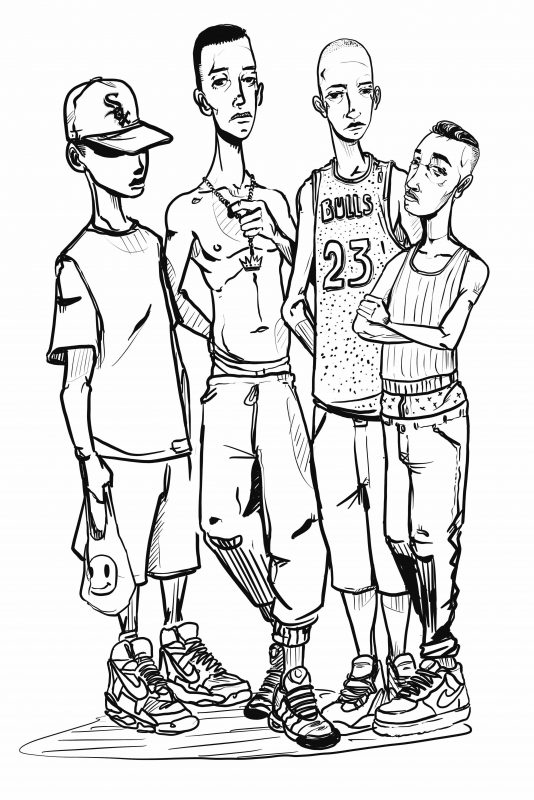
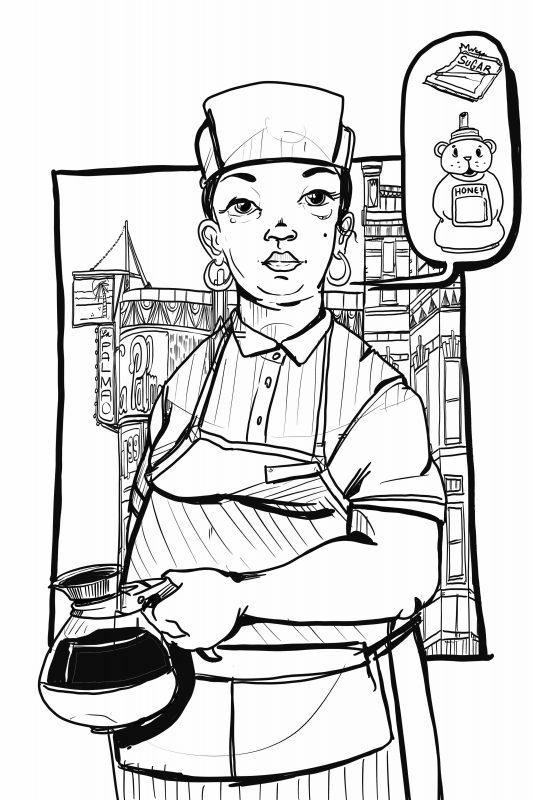
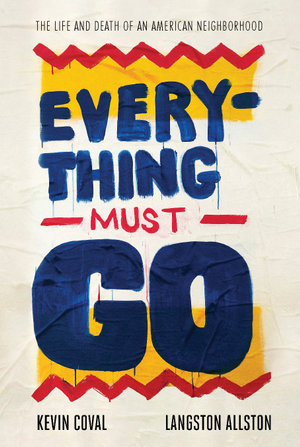
The language of poet Kevin Coval is melded with illustrations by Langston Allston in his eighth book Everything Must Go: The Life and Death of An American Neighborhood.

Image result for poster

As his second collaboration with artist Allston (following 2018’s Milwaukee Avenue), the illustrated collection of poems serves as a tribute to Coval’s beloved home of Wicker Park in Chicago during the 90’s, but also chronicles the neighborhood’s growing gentrification that is displacing the community that Coval once knew.

Everything Must Go isn’t just a reclamation of Chicago, but a documentation of societal reinvention that stretches globally. Coval’s memory captures his environment with great detail, through rich sketches of nostalgic characters and a hope that the neighborhood’s essence isn’t entirely lost. I spoke with Kevin Coval about the basis and intention of Everything Must Go, the book’s timeliness in 2019 and how Wicker Park molded his artistic path.


Jaelani Turner-Williams: For Everything Must Go, you collaborated with New Orleans-based artist, Langston Allston. Since his hometown is states away from Illinois, how did you impart details for each drawing? Were these based on memory or abstraction?

Everything Must Go: The Life and Death of An American Neighborhood by Kevin Coral and Langston Allston

Kevin Coval: It was a little of both. Langston and I spent time [in Wicker Park] walking around and seeing some of the spots that I mentioned. Also [Langston was] researching the book and going down my own memories, I ended up sharing with him some old photographs and some old videos at that time. I think Langston also brought his really unique perspective to the book and although it’s about Chicago, he was also thinking about rapid gentrification in New Orleans, particularly post-Katrina and what he’s seen on a regular basis. He was very much sympathizing [with] his own experience through my own, which is very powerful.

JTW: Did you know Langston previously?

KC: We met a few years ago when he did a show in Chicago in an abandoned storefront gallery space and I was immediately struck by what I think is a shared aesthetic, which I think about as a realist working-class portraiture. Langston was reflecting on a changing neighborhood in Chicago, Humboldt Park, and I was just working on the book at that time. I knew I wanted to tap an illustrator to work with me, because I was inspired by and influenced by the graphic novel and wanted to do something similar. The minute I saw Langston’s work, I thought, “this is that guy.”

JTW: What were the beginning stages of the book, or was gentrification a topic that you wanted to expand on for a while? What made 2019 the best time to release Everything Must Go

For a working person, a person of color, the increased police presence makes the block a lot more dangerous than having to navigate street organizations.

KC: I’ve been reflecting on gentrification since I first came to be aware of the term, and also when I was living in Wicker Park in the 90’s, I saw it change pretty aggressively around me. I knew at some point I wanted to look back on that time because it was a special time for me, but it was also very odd time for the city and for that neighborhood. As I’ve been traveling because of the work, I get to see cities across the country [and] across the world who are going through pretty similar things. It wasn’t lost on me that you know that although I was writing about Wicker Park in the 90’s in Chicago, I’m also reflecting on systemic issues that are hurting working communities [and] communities of color on a daily basis.

When I was in Detroit, I wanted to write this book. When I was in certain sections of Miami, in Oakland, parts of Memphis, Nashville, Louisville, I started to think about this book as addressing socioeconomic, post-industrial global phenomenon that is not unique to Chicago, but I wanted to tell the story through that specific lens. It’s about the erasure of working people, gentrification is indeed about that process, and it’s nothing new to this moment, either. We’ve been doing that in this country since colonizers came and pushed away and created genocide for Indigenous people here. There is something about the maintenance of this process, I think particularly with an American white cultural amnesia where we don’t want to remember the past because it is painful for us to look at and so that’s part of the reason why we repeated that most.

JTW: You weren’t afraid to touch on having white privilege on “White on the Block.” Do you at times feel like you were idle to the gentrification in your neighborhood? What have been your methods of protesting against these changes?

KC: Gentrification is a complex issue and it’s not just about one person. Upon reflection, I realized that not only myself but the community of artists that I was a part of that time were essentially in a much larger strategy to help transform the city. Ways to resist the erasure of working people, ways to resist the escalation of costs that it takes to remain in the city is to really invest in the local communities, both in terms of the schools and also the local businesses. We need those things as viable factors to remain vibrant and to service our needs in the city. We need access to affordable wages and jobs, and those jobs that kept people in the neighborhood left. So many jobs fled the city and it begs the question, what kind of future are we imagining in this city when all the people are pushed away?

JTW: Some may deem gentrification as being improved from what the neighborhood was before. Do you find this to be a misconception?

KC: Recently, I was talking with a graffiti writer from Chicago who has been pushed out of the neighborhood that he was born in, and he was talking about how actually in the day, the neighborhood was a lot safer than it is now. For him, a working person [and] a person of color, the increased police presence makes the block a lot more dangerous than having to navigate street organizations. There were so many moments on his block back in the day that it would just be, you know, communities coming together for a block party and now you need to register and go through all this bureaucratic tape. To me, what makes the block safe or what improves the community is when you have people accounting for you, when you know the names of your neighbors, [when] they are looking out for you, your family and your overall community. When we disperse that community, that’s when the neighborhood begins to dwindle.

JTW: A focal part of Everything Must Go isn’t just the neighborhood, but the characters that called Wicker Park home. One of these characters was Sharkula in “Thigamahjiggee”, who was homeless, more or less. Why was it important to focus on a homeless character, when they’re often disregarded in their community. Do they uphold the community to some degree?

If we get rid of artists, if we get rid of the workers, what kind of city are we gonna have?

KC: For me, some of the folks who were experiencing housing instability were my first community members. They were the ones who I would see every day when I would be walking the block, and they were some of the first people in the community to know my name, and remember my name. So when I see someone on the streets like Sharkula or like Oba Maja [from “Oba”], who I mentioned as the poet laureate of Wicker Park, these were the folks who first accounted for me. I would see them and I would feel like I’m starting to have a place here. All [the] folks who I wrote about in the book began to give me a sense of home in place in that community.

JTW: You even shared your temporary displacement in “The Time I was Homeless”. What was the cause of this turning point and how were you able to return to Wicker Park? Can you pinpoint anyone in the community that was an aid to you?

KC: It was at a time when rent began to be increasingly and probably illegally raised too great of a percentage and I just wasn’t able to afford where we were living. I thought I had a place, then I didn’t have a place and I was in-between jobs, so I just ended up like a lot of working people when you’re living check-to-check. You are in that moment when you can’t rely on that particular type of income or that income is all over the place and you end up in a housing crisis situation where you don’t have a spot. Thankfully, I had people who all also looked out for me, I definitely lived in my car for a while but I had homies and different folks who would give me a couch for a little bit here and there and that made a lot of difference in the course of that year and change.

JTW: Are there any safe spaces remaining for those who’ve resided in Wicker Park before recent gentrification?

What makes cities special is the local flair and flavor, but if [we] begin to whitewash them, it all looks the same.

KC: Part of the reason why I wanted to write the book is because I’m one of the only people who I knew from the day who still even work in the neighborhood, and it’s because the youth arts organization that I’m the artistic director at, Young Chicago Authors, is still in Wicker Park. Part of it is that we just have a really good landlord who is [part] of the people’s law office and these are lawyers who will [make] sure the police force [is accountable] for egregious behavior and police brutality. They take care of us because they see us as a tenant and the work that we do is an important part of the neighborhood. So, they want us to stay there as they’ve stayed there. YCA is one of those spaces, but here and there you’ll definitely see a music venue that still has the longest-running open mic maybe in the country every Tuesday night at Subterranean, called 606 [Open Mic Hip Hop].

There’s street artists and folks in the neighborhood who remind me of [pre-gentrified] Wicker, but we can’t go back in time, either. This book is me going down memory lane, but it’s trying to raise a larger question about what is the future of cities and what is the future of the neighborhoods that makes those cities vibrant, but if we get rid of artists, if we get rid of the workers, what kind of city are we gonna have?

JTW: I noticed that in a few of your poems, you touch on memories of being in a setting and end with it transforming into another business. For example, “Ode to the Old Barbers”, when the barbershop became a massage spa. Is there a certain loss of culture when these spaces are forced out?

KC: One of the things I fear about gentrification is the homogenization of urban life and urban space, because for me if homogeny leads to imagined purity [and] cleanliness, it’s facism, really. For me, I love the details, I love the specificity, the particularity of a place and something like the barbershop, you can’t recreate. It’s about who was there, both the barbers and the clientele. Any place has a local flair and flavor, that’s what makes these cities so special, but if [we] begin to whitewash them, if we have that corporatization of urban culture space, it all looks the same. Not only is that a grotesque aesthetic, but I think it has much more sinister implications about the kind of culture and life we’ll be living.

JTW: Even if there aren’t ways to reassemble Wicker Park to how it once was, how has the community attempted to revive its original spirit?

KC: Working people will make culture wherever they’re at and so I think that you know the spirit of Wicker Park is really about the spirit of working people. Working people have moved in and around the city and have created very localized communities continuously. There will be a forever process of people desiring to find one another in community to have those communities be contested and for that friction to exist between the 99 and the 1 percent. Until we begin to have greater solidarity amongst working people, those communities will continually be moved, but there’s a possibility of solidarity and resistance of that force.

8 Explosive Books About Whistleblowers

It’s not always easy to tell the truth, and it’s especially difficult when telling the truth means exposing major corruption and abuse from important political figures. In these books, we see the ways that misused power affects everyone, but we also see that everyone has the ability to expose corruption. They say the truth will set you free, and it might even ruin some exploitative bastards in the process. 

Image result for white tiger aravind adiga

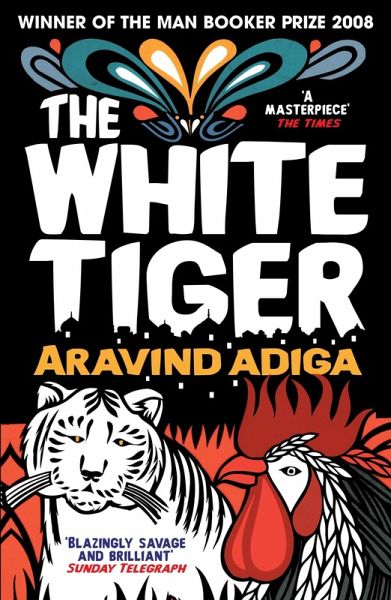
The White Tiger by Aravind Adiga

Balram Halwai grew up in a small village in India, without much to guide him besides his own wits. But when the richest man in the village hires Balram as his driver, Balram’s life is suddenly overhauled. Working among India’s elite changes how Balram sees the world—corruption, greed, and bribery are integral to his employers’ dealings. Over the course of seven days, we see Balram morph from a young entrepreneur to a murderer against the backdrop of India’s Rooster Coop in this vibrant satire. 

The Boat Rocker by Ha Jin

The Boat Rocker by Ha Jin

Chinese expat Feng Danlin enjoys his job as an investigative journalist at a Chinese news agency in New York. Until, that is, he gets an assignment to investigate his ex-wife, the renowned novelist Yan Haili. But the deeper Danlin digs, and the more he writes about Haili, the more enemies he uncovers. Surrounded by uncertainty and lies, Danlin can use nothing but his pen to save himself. 

Image result for house

Waterloo by Karen Olsson

In Austin, Texas, Nick Lasseter is struggling to stay interested in his job as a reporter for the newly-corporate Waterloo Weekly. However, when he’s assigned to write a piece about an up-and-coming female Republican candidate, Lasseter falls headlong into an uncertain world of politics, where legacy overshadows reality and party lines are blurred. 

Image result for obedient father by akhil sharma

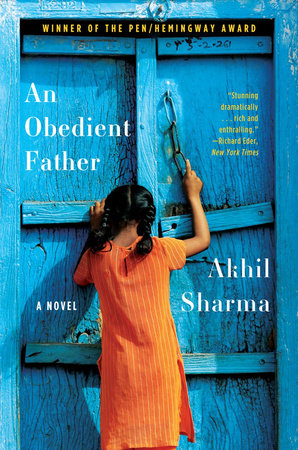
An Obedient Father by Akhil Sharma

Ram Karan works as a bribe-collector and extortionist for a low-level government employee in Delhi. When his boss’s political career begins to take off, Karan’s past shame is laid bare after a drunken mistake that threatens both his life and his already-tumultuous relationship with his children. The further Karan gets into the world of political blackmail, the more we learn about his complicated and tragic life. 

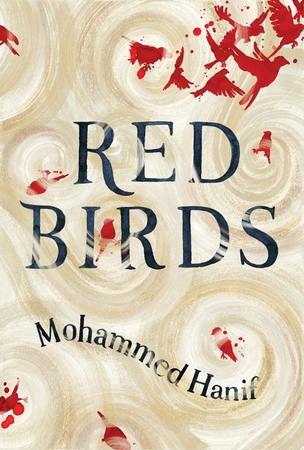
Red Birds by Mohammed Hanif

When Ellie, an American fighter pilot, crash-lands somewhere in the Middle East while trying to bomb an enemy compound, he isn’t expecting that compound to be a refugee camp for victims of war. He’s also not expecting to get swept up in a rescue mission to find one refugee’s brother, a boy who used to work as an informant for the US military and has now mysteriously disappeared. Told from the alternating perspectives of Ellie, the refugee Momo, and Momo’s dog, this sharp satire of American militarism is both funny and biting.

The Year of the Gadfly

The Year of the Gadfly by Jennifer Miller

Although Mariana Academy is hailed as an outstanding school with strict morals, budding reporter Iris Dupont knows better. So does her best friend, the ghost of Edward R. Murrow. An underground society at Mariana has begun attacking students and teachers alike with blackmail and rumors, and Iris is determined to unravel Mariana’s dark history—even if it means getting swept up in the darkness herself.

Image result for The Sympathizer

The Sympathizer by Viet Thanh Nguyen

At the fall of Saigon in 1975, a South-Vietnamese general is airlifted to Los Angeles with a few of his most trusted men. What the general doesn’t know is that his captain is a spy tasked with observing the general’s movements and reporting them back to the Viet Cong. When the general and his men land in LA to begin their new, American life among other Vietnamese exiles, the captain is unaware that even as he watches others, he is being watched himself.

I’ll Be Gone in the Dark by Michelle McNamara

Michelle McNamara, a true-crime journalist, was the first to use the term “Golden State Killer” to refer to a serial killer who had been known by many other names—although none of them as memorable as GSK. In her book, McNamara describes her obsessive hunt for the identity of the Golden State Killer, sifting through the internet for police reports, victim’s statements, and communities of amateur forensic detectives. Although McNamara died before the killer could be unmasked, her book portrays a woman with unflinching devotion to unearthing the truth about a dangerous murderer.

If Great Women From History Had Emails

 But Her Emails: A Ghazal

 My mother needed to sleep—but her emails,
 those prayers for anything but her emails.
  
 Marie Curie, with her husband’s electrometer, 
 the x-ray machines that showed what? Her emails.
  
 And the pastor in Detroit, who shot Keanna 
 just because she wanted to strut her emails. 
  
 I know why the sky ate Amelia’s plane—
 before take-off, she neglected to jut her emails.
  
 When Broadway applause came for Lorraine,
 the FBI started to watch her, tried to smut her emails.
  
 Monica, those bangs and red matte pout, collared
 shirts pouring over with baby fat. Slut! HER emails!
  
 In Puerto Rico, Luisa was first to go out in pants,
 but was jailed cuz a lady should shut her emails.
  
 She had to go to the stake, you see. I mean Joan. Nuts.
 Raided her computer and they were nuts, her emails.
  
 Sojourner is a woman without my saying it, but after
 her speech a white lady still wanted to gut her emails.
  
 A new Genesis: after she’s slashed from Adam’s rib, 
 Eve takes God’s scissors to cut her emails.
  
 That Lindsay, can’t she write some happy shit?
 Read this and you’ll want to tut-tut her emails.
  
  
 Precious Blood Fire
  
 On the Feast of Corpus Christi, May 27th, 1875, Precious Blood church in Holyoke, Massachusetts 
 burned down. Seventy-eight people died, 55 of them women and girls.
  
 Those logs we carved and stacked into worship became 
 fire and smoke as they birthed their bark backwards. 
 We know this now: woman is not the flame
 that breathed deeper than our corseted lungs could. 
 And if you drift like ash over your shoulder—
 past the hose spray, the scorch of skin, the human 
 pile near the door we couldn’t shoulder—
 you’ll hear us sing of wheat among the ruins. 
 You’ll see us turn to the Blessed Virgin bust
 and gasp when a breeze lifts through the window, 
 kicks up the lace around her head. One gust
 will flit the veil into a candle’s billow.
 You’ll see us grasp for prayers to recite.
 You’ll see how fast a woman’s prayer ignites.
  

Why I Had to Rewrite the Ending of My Middle-Grade Book After Charlottesville

I write what people like to call “coming of age” books, in which kids are figuring out who and what to be, how to navigate the world independently. So I think a lot about what the rules of the world are. Or rather, I think about what the rules of the world are supposed to be.

Until 2016, my books tended to end in compromise. This wasn’t something I ever set out to do consciously, but each time I wrote a book, it happened—I wrote my characters into situations where their personal needs and desires bumped up against the needs and desires of the larger world, and where the main character ended up recognizing (among other things) that they weren’t the only person in the universe. 

Until 2016, my books tended to end in compromise.

Honestly, this is a reflection of my personal parenting philosophy.  I believe in compromising our individual desires for the greater good. I believe kids need to be aware of other people, and the rules that govern the world, that make things easier and better for everyone. Sharing. Taking turns. Traffic laws. Basic etiquette in restaurants. And so on.

I saw this as something kids need to be thinking about—the social contract.  Learning to accept that they can’t always get what they want. This was, I thought, one of the major problems kids face today—or rather, kids with a certain amount of privilege and affluence, whose basic needs are met. 

This is not to say that kids shouldn’t follow their dreams, or operate as individuals, only that they need to recognize that everyone has dreams, and that sometimes, each of us needs to listen instead of speak, or sit back so that others can be noticed. There are a lot of books for kids about individualism, and we need those. But my books have tended to be about how to blend that individual pursuit with a recognition of the needs of others.  

Three years ago,  I was beginning to outline a new book. A story about two girls who are struggling with very different problems, insurmountable problems, who find each other and forge an important friendship. It was a friendship book, I thought, a book about how much we can matter to other people.  But of course, as usual, my expected ending involved compromise, a chance for one of the girls to realize she would need to accept the limitations of the world, to play by the rules, accept reality.

Then came November of 2016, with the election of Donald Trump and its aftermath. The Muslim ban. Kids in cages, Supreme Court appointments designed to roll back the rights of women.  Each day we wake up to new atrocities, and each day, I try to explain these things to my own children.

Like so many Americans, that election was a wake-up call for me, a reminder that this country is what we make it, with our voices, our votes, our dollars, our energy. I’ve spent much of the last three years marching, shouting on courthouse steps, calling my reps, working on local campaigns, writing postcards and making donations. We’re all trying to right the ship we’d forgotten we were riding. We’re all trying to turn things around.  

And yet, though my life changed radically on that day in November, my work didn’t change—not at first. Writing was the one thing that felt the same, like a little island, a safe place.  I’d head out to demonstrate, or make my daily phone calls to my senators, and then come home to spend time with my characters—Jasper and Leah—two kids who were dealing with their own individual problems and not thinking about Trumpism.  It felt like a kind of relief. I just kept plugging away, working toward the ending I’d outlined—an ending in which, as usual, Jasper and Leah would have to come to terms with the rules of their world, grow up a little, accept reality, compromise. 

Then came Charlottesville.

I was about halfway through my draft at that point, in residency at the Serenbe Air arts colony, working alone in a beautiful little cabin with birds singing around me, when white supremacists descended on Charlottesville, Virginia, in what would become a deadly altercation with counter-protestors.  I sat there in my little cabin, watching the footage unfold on my laptop, and I found that I couldn’t write a word. I couldn’t sit there in my lovely bubble, with Jasper and Leah, when the world was on fire. I needed to leave Serenbe, get home to my family, join the march that was being planned in downtown Atlanta. So I did that. I packed up and left.

But as I drove home that day on 85, racing back into the real world, I found myself thinking about the end of my book. I found myself thinking about compromise, and kids, about the social contract. I found myself pondering what it was I wanted to communicate about it to my readers.  

I could not, in clear conscience, instruct kids growing up in Trump’s America to simply accept their struggles and move forward.

Here’s the thing—the social contract requires that we follow the rules when the system is working.  But when the system is horribly broken, the social contract demands that we revise it, disrupt it, rewrite the contract. I found myself thinking that I could not, in clear conscience, instruct kids growing up in Trump’s America to simply accept their struggles and move forward as I had done in past books. I needed a new ending for My Jasper June, an ending that would suggest not a need for compromise, but a need for innovation—for kids who are ready to remake the world, rewrite the social contract, even if it means breaking the rules.  

I’d been thinking about this question all wrong.  The question isn’t whether to follow your individual dreams OR serve the community. The question is how to follow your dreams AND serve the community.

So I went back to my draft and my outline, and I rethought it all.  I’d placed my characters in an untenable situation, one that—in the earlier draft—required acceptance, a willingness to face the hardships and inequalities of the world. Instead, I looked for another ending, one that embraced creativity, imagination, innovation—which kids are naturally so very good at.  I looked for an ending that demanded Leah and Jasper reach beyond defaults, beyond expectations, beyond the obvious answers grownups might provide, and reimagine the world for themselves.

I realized that what Jasper and Leah needed to do was to see how the system was failing them, how their parents were failing them. It was only once they recognized the limitations of their grownups that they might step forward, realize their own wisdom and power, and take matters into their own hands.

My readers figured this out before I did. Kids are stepping forward today, in a way I never imagined they would have to do, as they face the world they stand to inherit—school shootings, the impending climate mess we’ve created, tangled courts and gerrymandered districts, the gross inequality of the justice system and the segregation of their schools. They are brave and inspiring, and it is utterly unfair that they have to do this work.   

My Jasper June is not a political book. It doesn’t talk about politics specifically, or address race or gender directly. But we live in an era when absolutely everything is political, and as I wrote, I couldn’t ignore that fact.  This political moment—and the amazing kids who are stepping forward from it, to become tomorrow’s leaders—crawled into my book, and informed everything. Kids like Emma Gonzalez and Greta Thunberg remade Leah and Jasper, and set them on a different path. A path that required greater imagination, wilder dreaming, and the conviction to demand that dreams be taken seriously. 

Ironically, this is the first novel I’ve written in which the characters are not explicitly navigating the complexities of magic. In My Jasper June, Leah and Jasper wish for magic. They dream of invitations to Hogwarts, or a portal to solve their problems. And in the original draft of the book, they found it! But a second change I made in revision, even as I was challenging my characters to dream bigger, to push back against compromise—was that I took out the magical device. I disappointed Leah and Jasper, forced them to solve their own problems, without fantastical assistance.

Kids like Emma Gonzalez and Greta Thunberg remade Leah and Jasper, and set them on a different path.

Now I find myself thinking that these choices are deeply related. Leah and Jasper can’t do what I’ve asked of them if they don’t consider magic, dream of solutions beyond the realistic and obvious. But then they have to take those dreams into the real world, and set them into motion. Innovation is about magic. Creation is about magic. Progress and revolution are about magic, but these are the kinds of magic we make for ourselves. As long as we rely on the world as we know it, change can’t happen, but Leah and Jasper didn’t need a magical device. With their ability to see the world differently, their youthful energy, their great optimism and hope, they needed to become the magical device. Accomplish the seemingly impossible. 

We are in a treacherous moment in history. Our country is in crisis. Some days, everything feels bleak.  Our kids shouldn’t have to carry this burden. They shouldn’t have to rewrite the contract, remake the world. But if they are going to have to do that work, they will need to reach beyond the expectations of compromise, and believe firmly in their own magical abilities. It seems to me that the least we can do for them is stretch, open our imaginations, consider whatever magical future they are willing to dream up and inhabit.  

Decolonize Your Bookshelf With These Books by Native American Writers

Since Thanksgiving is a time when the collective American imagination envisions a peaceful meal shared between colonizer and colonized, where both appear to share a mutual understanding and benefit, why not make this fantasy a reality by exercising some empathy-for-the-other muscles and read literary works written from their perspective?

My list has no blood quantum standards and is complete with rez and urban, past and present, perspectives alike, which I feel is the best way to represent the beautifully tangled complex mass that is modern day Native peoples. The struggles and perspectives mapped throughout these works are some I believe to be most relevant for a well tuned socio-political perspective. Many are more recent publications as the Native literary Renaissance is currently in full effect, morphing, evolving and reaching in ways the Native literary voice has never done before.

Perma Red by Debra Magpie Earling

Love is complicated no matter the setting, but the potential for love is most doomed in the place of Perma, Montana for the protagonist Louise in this novel set in the 1940s. Louise is described as a beautiful mixed blood Native girl coming of age on the Flat Head Indian reservation. Being mixed, lighter skinned, hair red-tinged, she has always been an outsider to the people of her reservation; nicknamed Perma Red, degraded and sexualized from an early age by everyone around her. The story catalogues her paradoxical existence, simultaneously craving acceptance and escape from the Rez. Sadly, it is only in the men who court her that exists her options towards acceptance or escape. Published in 2002, and winner of the 2003 American Book Award, this psychologically complex, empathic and intense novel, shows us the stark landscape of the Rez for a coming of age mixed blood Native woman — America’s fiercest yet absolute subaltern other.

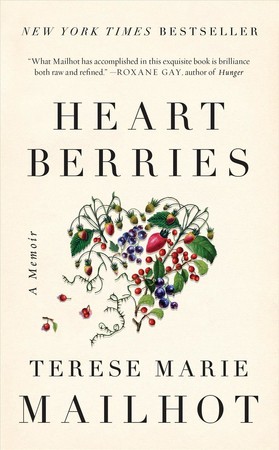
Heart Berries: A Memoir by Terese Marie Mailhot

Terese Marie Mailhot’s memoir brought the trials of the modern Native woman into the current mainstream literary scene. In her 2018 debut, she blew open our missing narrative in one of the most striking ways one could — by publishing the journals she kept through her institutionalization during a mental breakdown after she lost custody of her first born son. It is no secret that colonialist structures put in place centuries ago still work to silence and psychically maim indigenous and First Nations Peoples, and with this memoir it is no longer something that happens in the back rooms of history. Heart Berries is now a New York Times Best Seller and was named one of the best non-fiction books of 2018 by TIME Magazine. Through her telling of her trials, family trauma, and a distinct type of oppression of indigenous women, Mailhot brings the long lost voice of the Native mother into the present, and she is screaming.

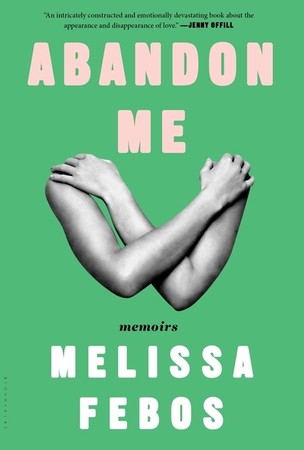
Abandon Me: Memoirs by Melissa Febos

In this 2017 collection of memoir essays we travel with Melissa in uncovering her personal and cultural identity. We follow her through the breakdown of her toxic relationship with a married woman and the building of her relation with her long lost Native American father. Febos’ story is most powerful when working to convey the complex emotions involved in trying to reconnect with an absentee father — one whose history you can feel in your blood and the land all around you. Blood trauma is real and Febos makes us feel it. Febos works through memories, familial and personal, cultural myths, modern and ancient, sifted meanings, in order to understand the ontology of her being. To get closer to the kernel of her self she points her investigations towards past abandonments. By looking at her life through sequences of losses, she hones in on herself alone. She frames abandonment without tragedy, but as a necessity to growth, a natural state of emotional evolution. Abandonment is nothing but the beginning of your own story, alone.

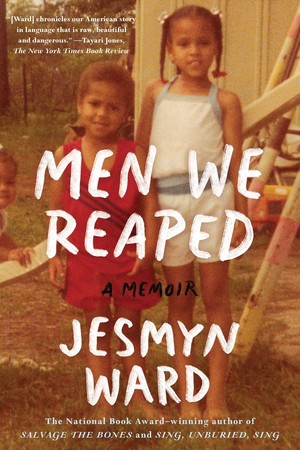
Men We Reaped: A Memoir by Jesmyn Ward

In Jesmyn Ward’s 2013 memoir she begins by telling us what she knows of her family’s mixed lineage. She is black, Choctaw, Haitian, and white, born and raised in Mississippi. She wants us to know what and where she is so we can understand something she has witnessed. With the complexes of race and place set firmly in her reader’s mind, she begins a slow recording of the tragic premature deaths of the men in her family. She wrote this for her brothers — blood and not. At once a coming of age and a history of familial tragedy, she is trying desperately to understand the structures of race, class, culture, and intergenerational trauma that has made survival so difficult for these particular men. Men We Reaped was named one of the Best Books of the Century by New York magazine, and through this deeply intelligent, thought provoking, and tragic memoir we are enabled to see how the American machine of racism, intertwined with subsuming classism and culture, is very present; and that the subtle and not so subtle ways it continues to eat men alive can no longer be ignored.

There There by Tommy Orange

Tommy Orange’s 2018 debut novel, long-listed for the 2018 National Book Award, is a braided narrative following the stories of twelve multigenerational urban Indians living in modern day Oakland, CA. It is a Pulp Fiction-esque novel with less debauchery and more tragedy. With each chapter being a new voice, the characters swirl together to create a vivid telling of mixed histories, politics, and lineages. The characters orbit around each other trying to understand their own identities within a harsh American underclass, continually stratified by poverty and violence. The trials they face are unrelenting yet their spirits stay strong, coming together in a final scene that will have your heart breaking with them all.

Dwellings: A Spiritual History of the Living World by Linda Hogan

In 2007’s Dwellings Linda Hogan writes a natural history of American land, animals, spirits, and people. Her expositions show us how the natural world is an extension of the emotive dynamics of human history. The naturalism in Dwellings is concerned with how humans have imprinted on the land and animals and how the land and animals have imprinted on us, in vast subtle cycles. She reminds us that we have always already been linked to the land in this way. Hogan’s articulations of the natural world — its development, form, particular purposes and mechanisms — are all main characters, and the evolution of these characters can be seen to inform human endeavors. Everything in nature is interconnected and interdependent, and humans through history have either tried to fight this or let it lead them. In Dwellings, Hogan reminds us how nature must ultimately lead.

Bad Indians: A Tribal Memoir by Deborah Miranda

The stories of the California Native peoples are not too often heard. We learned in grade school about the Mission Indians but only of their life after capture and colonization, as if it had always been so. We spent pointless hours discussing and then recreating out of cardboard those Spanish Missions. In Deborah Miranda’s 2013, winner of the PEN Oakland — Josephine Miles Literary Award, part historical research project and part memoir, fragmented yet fluid and personal, we finally hear this history from the side of the indigenous peoples that lived through it. Miranda’s research into her family history, indigenous Californians, is the grounding cable for her to tell their collective tribal story. The book is full of photo slides, obtained through her meticulous research, as she writes to humanize the people within them; some of them her direct ancestors. Through Miranda’s poetic lyricism and objective research we cannot help but feel them through the lens.

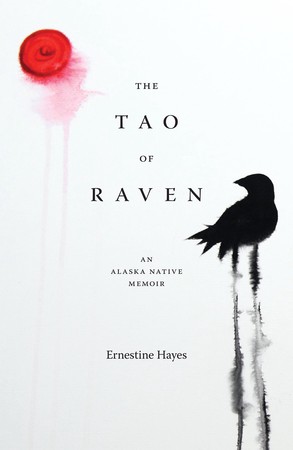
The Tao of Raven: An Alaska Native Memoir by Ernestine Hayes

Written in 2017 in her exceptionally crafted prose, Ernestine Hayes tells of the particular sort of survival of the Alaska Native after the war colonialism has enacted on them. Her language moves gracefully between memoir, fiction, historical research, Tlingit traditional stories, and metaphor, all complete as a war weary epic. She weaves her people’s story of the Raven and the Box of Daylight with Sun Tzu’s Art of War to create her own mythic language of strength and survival. Through her storytelling we see a real literary movement past any dry dictation of Native life after colonialism. Her epic language bestows a much needed grace to her people still living through all the effects that slow and steady genocide can have on such a secluded group of people. She creates the lyrics to walk her people out of the cycles of historical trauma, into the light of hope after war.

7 Literary Icons Who Moonlighted as Children’s Authors

When I think of literary authors, I often imagine my college reading list — and my lecturer’s pontifications on how their books have been meticulously etched into the canon of cultural significance. I rarely think about storytime with Mom and Dad.

So would you believe it if I told you that Nobel laureate Toni Morrison published as many books for kids as she did adult novels? Or that Stephen King, the Mayor of Creepsville, Maine, had a lesson to impart to children? As it happens, even the most serious of authors can’t resist the challenge of writing for some of the most discerning readers: young kids.

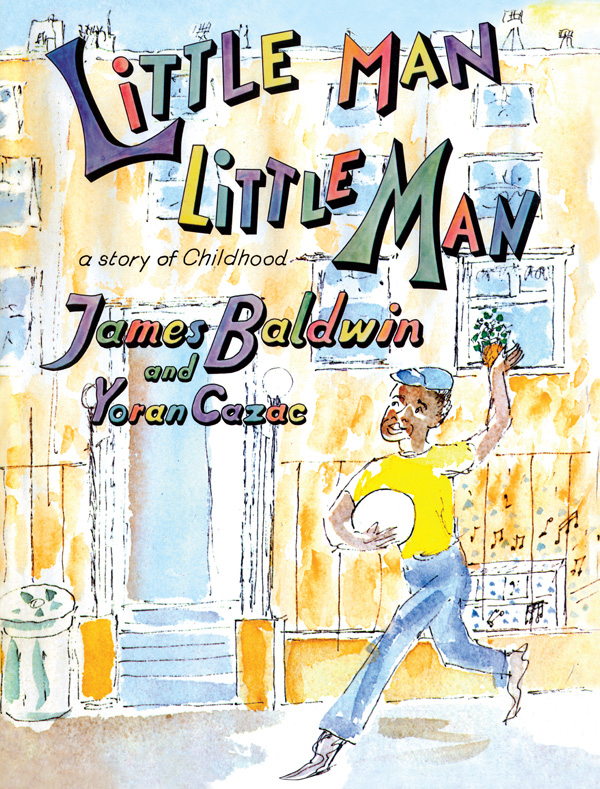
Little Man, Little Man

James Baldwin

In his groundbreaking essays, novels, plays, and speeches, Baldwin certainly never pulled his punches when it came to commenting on racism and identity in America. The same could be said for Little Man, Little Man. The story is told through the eyes of four-year-old TJ, who plays ball with friends on his Harlem block and runs errands for his neighbors. The book offers strong lessons for both the characters and the reader, with lines like: “I want you to be proud of your people,” TJ’s Daddy would always say.

Baldwin saw the book as a “celebration of the self-esteem of black children,” allowing TJ and his friends to play and find joy in the face of systemic oppression. The book is also replete with vivid watercolor illustrations by French abstract painter Yoran Cazak — making this a beautiful, meaningful reading experience for children in more ways than one.

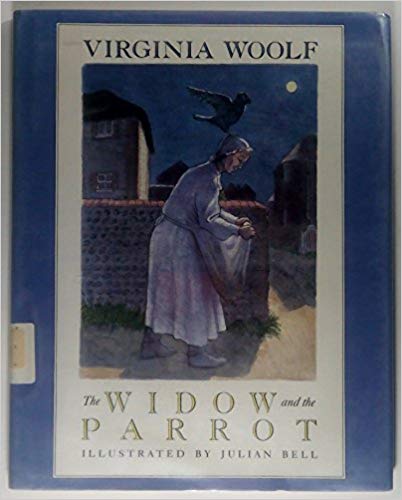
Virginia Woolf

In 1923, Virginia Woolf contributed to a small, unusual family project. She had already written three novels (and was on the cusp of publishing her breakout hit, Mrs. Dalloway) when she responded to a submission call from The Charleston Bulletin — a newspaper run by her teenage nephews. Answering the brief, she wrote The Widow and the Parrot, in which a widow inherits her brother’s house after he passes away. She travels there to collect her inheritance only to find a peculiar parrot named James. Without giving too much away, this tale of mystery and altruism reminds us all that it pays to be a little kinder to animals.

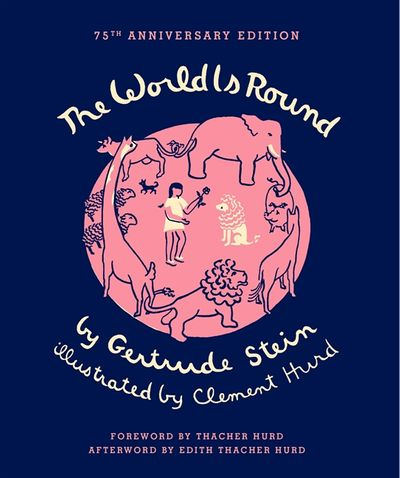
Gertrude Stein

Shortly after the founding of Young Scott Books in 1938, one of its authors, Margaret Wise Brown (who penned Goodnight Moon), suggested that the publisher convince famous adult authors to give writing children’s books a try. Many, like John Steinbeck and Ernest Hemingway, declined — but Gertrude Stein was ready. 

As it would happen, Stein had half of The World is Round already written before Young Scott even approached her. In Stein’s characteristically playful prose, she chronicles the adventures of a little girl named Rose as she tries to make sense of the world. Printed on pink pages and blue ink (which Stein insisted upon), the book introduces its young readers to themes of identity and individuality with quirky, elliptical lines like “And which little girl am I am I the little girl named Rose which little girl named Rose.” Stein’s signature line “a rose is a rose is a rose” even makes an appearance, as our protagonist symbolically carves it around a tree.

Chike and the River by Chinua Achebe

Chinua Achebe

When Chinua Achebe became a parent, he was alarmed by the amount of racism written into the books his daughter was exposed to at school. As a response, he wrote Chike and the River, which tells the story of an eleven-year-old boy who longs to cross the Niger River to a city called Asaba. He doesn’t have a sixpence — the fee for the ferry ride — so he embarks on a series of thrilling and terrifying journeys to jerry-rig his way toward his goal. Achebe went on to write several more children’s books including The Drum and The Flute, which are adaptations of traditional Igbo folktales.

Toni Morrison

Nobel Laureate Toni Morrison was a prolific children’s book writer, at one point publishing at least two a year. Most of these titles were written in conjunction with her son, Slade, whose childhood musings formed the basis of The Big Box and The Book of Mean People. Morrison completists will enjoy an audio version of three fables called Who’s Got Game, which Morrison herself reads with supreme command. And don’t forget to check out Peeny Butter Fudge, a fun family tale about mischievous grandchildren visiting their grandmother — in which Nana gets in on the hijinks.

Pretty Minnie in Hollywood by Danielle Steel

Danielle Steel

Danielle Steel might not be a traditional “literary author” per se, but we wanted to include her in this list anyway — if only for the novelty factor of a serious romance writer turning her pen to children’s lit.

Best known for steaming up reading rooms with her saucy romances, Steel is also no stranger to kid lit. Since the 1980s, she’s published picture books aiming to help children face real-life problems with titles like Martha’s New Daddy and Freddie’s First Night Away. Steel’s most recent kids’ series is about her chihuahua, Minnie, and her adventures.

Charlie the Choo-Choo

Stephen King

If Danielle Steel wasn’t risqué enough, how about the master of both weird sex and chilling fear: Stephen King. Many of us probably peeked behind the cover of one of his thrillers before we were “of age,” but the horror author also wrote several books that were actually intended for young audiences.

King’s main contribution to the world of children’s literature is Charlie the Choo Choo, which he wrote under the pseudonym Beryl Evans. The title character is a sentient train with a life of his own. (Like Christine, but not murdery.) If you want to know what that looks like, just imagine a fire-damaged Thomas the Tank Engine with a Joker grin. 

The plot revolves around Charlie and his best friend, Engineer Bob, as they lay down the track to adventures that reveal the importance of hard work and camaraderie. The book plays a key role in the third book of the Dark Tower series, where it’s purchased by one of the protagonists. Finally, in 2016, King decided to make it real, complete with a sly quote on the front cover: “If I were ever to write a children’s book, it would be just like this!”

Introducing Electric Literature’s Literary Stunt Index

It’s hard to grab a reader’s attention. It always has been. Sometimes, to generate a little buzz, a book has to be something a bit more than a book. It has to be a stunt, some kind of feat or achievement or goof that gets people talking. 

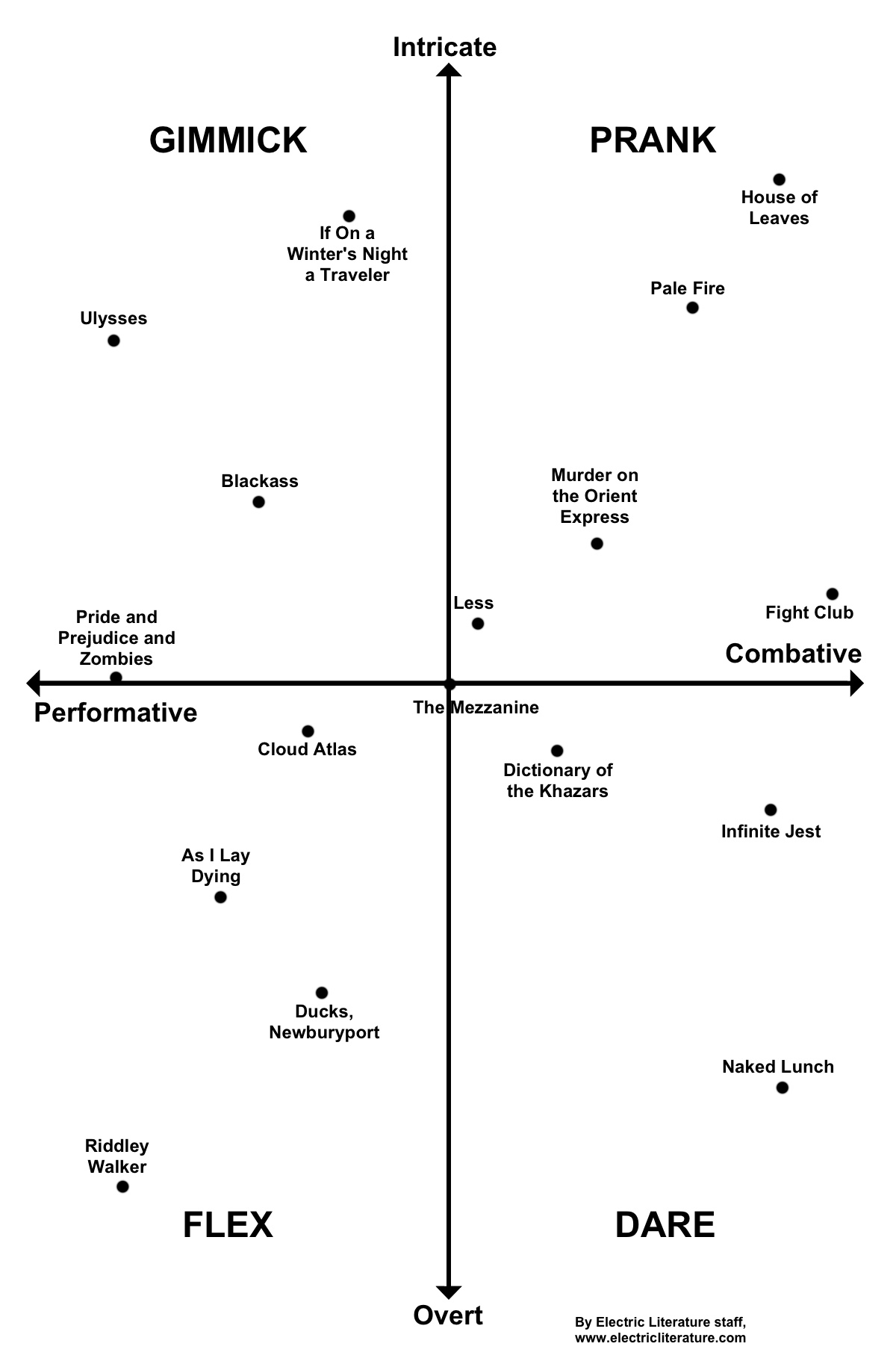
There are many ways for literary work to be a stunt, and after much discussion, our intrepid Electric Lit staff has developed a matrix to map out the four basic kinds of literary stunts: gimmicks, pranks, flexes and dares. The underpinning behind each of these quadrants is explained below, and we’ve plotted some example books on our matrix to further illuminate each section.

Our intrepid staff has developed a matrix to map out the four basic kinds of literary stunts: gimmicks, pranks, flexes and dares.

The study of literary stunts is fledgling, and we understand there might be some readers who disagree with us; we welcome such disagreements. To move us closer to a unified theory of literary stunts, we need a variety of feedback. Therefore, if you have a quarrel with or addition to our matrix, we encourage you to reach out to us. If you’re especially persuasive, we may even update the chart.
For your consideration, Electric Literature’s Literary Stunt Index. We’ve plotted some notable books and some of our personal favorites to give you a sense of how it works.

Y axis: Intricate (on top) to overt (on bottom)
X axis: Performative (left) to combative (right)
Quadrants (clockwise from top left): Gimmick (intricate and performative):  If On a Winter's Night a Traveler, Ulysses, Blackass, Pride and Prejudice and Zombies 
Prank (intricate and combative): House of Leaves, Pale Fire, Murder on the Orient Express, Fight Club, Less
Dare (overt and combative): Dictionary of the Khazars, Infinite Jest, Naked Lunch
Flex (overt and performative): Cloud Atlas, As I Lay Dying, Ducks, Newburyport, Riddley Walker
Click to enlarge

Glossary

Gimmick: A gimmick book has, above all, highly a pitchable (if not necessarily commercial) concept. Here are novels you can easily break down into a one-sentence logline, designed to evoke an “Oh, interesting”  or “Huh, neat” from the potential reader. i.e. It’s the Odyssey, but in Ireland; it’s a romance novel, but written entirely in Dothraki; it’s Pride and Prejudice, but with zombies; etc.

The concept behind the work is intricate in order to hook the reader, not to antagonize them; put another way, it’s high-concept for the sake of being engaging, rather than challenging. (It can be challenging, but that’s not the point.) This isn’t to say these books can’t be great works of art, just that there’s a bit of shtick to each of them. But hey, at least these are honest about it.

Prank: A literary prank is interested in making a fool out of itself so it can make a fool out of you, too. The book is a joke played on itself, and therefore played on anyone who reads it: You thought the work was one thing when it is, in fact, a different, much sillier thing. Many of the examples on our Matrix involve plot twists, of a sort, but not every book with a twist is a prank—only ones where the twist subverts the very idea of the novel or genre you thought you were engaging with. “How foolish of you to try and solve this whodunnit,” Murder on the Orient Express seems to say, “because it’s EVERYONE who done it! Haha, clever, no?” Well yes, but also, come on, man, really? That’s not—those aren’t the rules. I thought we had. I mean I thought we had agreed on some rules. But it’s fine. No, really, it’s. Fine. Okay, yeah fine, I guess I read that, yeah, sure. You got me. Fine, no, it’s fine. I get it. I see what you did there. And it’s cool, that you did that, I guess. To this book, and also, to me, personally. Sure. Fine. Yes.

Flex: A literary flex is notable because the author pulled something remarkable, or at least so unusual that no one else has ever done it. It’s flashy, it’s interesting, and it may or may not be difficult for the reader to grapple with, but the reader isn’t really the point—the writing of the thing is the point. Sticking the landing on a completely wild idea is the point. A flex displays the height of an author’s powers in an over-the-top way; at its core, a text that qualifies as a flex seems to say “Look what I can do,” and then does it.

A text that qualifies as a flex seems to say ‘Look what I can do,’ and then does it.

The end result of a flex needn’t be extraordinarily long or complex. The only real requirement is that the writing of the work was transparently difficult to pull off. To use an example that isn’t a novel, consider Annie Baker’s translation of Uncle Vanya. Translating a century-old work is tricky, sure, but it’s done often enough. What isn’t done nearly as often is someone taking on a play thoroughly enshrined in the theatrical canon and then producing a more accurate, human version of the play’s text. Baker opting to take on, and subsequently succeeding in such a task is an enormous flex.

Dare: A literary dare is a work that you don’t believe is actually someone’s favorite book, even if they swear up and down that it is. A dare does not want to be your favorite book. Literary works that qualify as dares are needlessly confrontational, chock full of obstacles to the reader actually understanding or working their way through the text. Here is a book with a dozen different maps in the first of its four indexes, or a story overflowing with footnotes, or a novel that requires an awful lot of skipping back to earlier pages to double-check you’re understanding what it is you’re actually reading. You can’t let your mind drift for even a moment while reading a literary dare, or you’ll completely lose track of what’s going on and have to jump back some ten pages or so just to catch up to yourself. If a flex book is the writer saying “Yeah, I wrote this,” then a dare is something that makes the reader just as smugly declare “Oh, yeah, I read that.” It is a challenge to take on and a brag to claim to have completed it. And most of us won’t believe you when you say you understood it, anyway.


Methodology

X-axis: From left to right, our X-axis is graded on a scale of “performative” to “combative.” This is essentially a scale of aggression: how much is the book seeking to entertain vs. how much it is seeking to confuse, mystify, impress or befuddle? Hence why both “Gimmick” and “Flex” find themselves on the performative side of the scale. A flex is inherently a performance; if someone publishes a thousand-page sentence and no one is there to read it, is it really a flex?

The combative side of the scale, then, are for works of literature that create discomfort in the reader (and possibly the author) for the sake of pulling off the stunt, whatever the game of the book may be. This discomfort can be built into the structure of the book (extensive footnotes, jarring shifts in point of view) or its content (whether it be tedious, violent, discomfitingly erotic, etc.). Any stunt book that can be described as “needlessly confrontational” belongs on the right side of our matrix.

Y-axis: Raging from “overt” at the bottom to “intricate” at the top, we suspect this is the part of the matrix that will garner the most ire from fellow readers and stunt-scholars; we ask that you allow us the room to explain. It could be argued that almost any concept that can be labeled a “literary stunt” is inherently intricate. If it wasn’t somewhat convoluted, one could argue, then it wouldn’t be a stunt. But that’s precisely why this gradient is here: all of these concepts have already cleared a minimum bar to be considered “stunts.” Here, now, we can grade these works against their peers in show off-y literary exploits, and not on a scale starting with See Spot Run as the basement.

It could be argued that almost any concept that can be labeled a ‘literary stunt’ is inherently intricate.

We’re also considering the complexity or directness of a work from two different angles: difficulty for the author to thread the needle, and difficulty for the reader to understand what’s going on in the work. The latter consideration is why pranks are on the “intricate” side of the axis: even if the book eventually unravels itself, a prank must inherently keep the reader in the dark about its true nature until it’s too late. (Successfully bamboozling the reader also takes some doing on the author’s part.) And even if a gimmick is apparent on its face, or even in its title—looking at you, Pride and Prejudice and Zombies—the complexity required to pull such a thing off and still engage readers and still be considered ~literature~ is significant. By that same measurement, a flex might well be intensely complicated to pull off from a writing standpoint, but like an athletic stunt, the writer has to make it look easy—or at least make what’s happening clear enough for the reader to appreciate what they’re witnessing. And a dare isn’t a dare if you can’t understand, at some basic level, what you’re getting yourself into.


Conclusion

Even after laying out our terms and methodology, you may still disagree with us: with our categorizations, with our methodology, with our grouping these works of literature—many of which are beloved, cult classics, just regular classics, and/or our faves—with a term as trite as “stunt.” That’s fine. You are welcome to quibble in private or in public, the latter of which will do nothing but help our engagement numbers across our various social media platforms. Either way, we feel confident in our assessments. We have science on our side.

The 2019 Nobel Prize in Literature Proves the Academy Hasn’t Changed

Today in Stockholm the Swedish Academy awarded the Nobel Prize in Literature to Olga Tokarczuk, a Polish author and activist, and Peter Handke, an Austrian writer. Last year there was no prize awarded, because a man affiliated with the Swedish Academy was accused of rape and seven committee members resigned in protest. This year, the prize is back twofold, and based on its choices, the Academy has learned nothing.

Tokarczuk’s prolific body of work, which includes the 2018 Man Booker International Prize-winning novel Flights, has made her a bestseller in Poland, where she is also known for her vocal criticism of the government and right-wing politics. In its commentary, the Academy praised her “narrative imagination that with encyclopedic passion represents the crossing of boundaries as a form of life.” Handke is an Austrian playwright of Slovenian descent who the committee praised for his “influential work that with linguistic ingenuity has explored the periphery and the specificity of human experience.” In other words, despite Tokarczuk’s literary and political bona fides, these are two white Europeans, giving the lie to any claim that the Academy wants to represent and reward global literature. But it gets worse.

This year, the prize is back, and based on its choices, the Academy has learned nothing.

While Handke’s work covers a wide range of formats and themes (his first, career-making play, Publikumsbeschimpfung (Offending the Audience, 1969) is based on the idea that actors insult the audience simply for attending), he’s been particularly outspoken about the Yugoslav War, including his critical stance of NATO involvement and his support of Serbian nationalist beliefs, such as the false claim that Muslims staged their own massacres in Sarajevo. Handke even spoke at the funeral of Slobodan Milošević, the former President of Yugoslavia who was charged for war crimes in connection to the genocides in Bosnia and Kosovo. Not surprisingly, Handke is no stranger to controversy. In 2006, he was awarded the Heinrich Heine Prize only to have it withdrawn after protest from the city council, while his 2016 International Ibsen Award was condemned by PEN Norway and caused Bernt Hagtvet, a Norwegian expert on totalitarianism, to say “awarding Handke the Ibsen Prize is comparable to awarding the Immanuel Kant Prize to Goebbels.”

Today was the first time the Nobel Prize in Literature has been awarded since 2017, when Jean-Claude Arnault, a Swedish-French photographer married to a member of the Swedish Academy, was accused of sexual assault and sentenced to prison. In the wake of the scandal, Anders Olsson, the permanent secretary of the Swedish Academy, announced a hiatus for the prize, saying, “We find it necessary to commit time to recovering public confidence … before the next laureate can be announced. This is out of respect for previous and future literature laureates, the Nobel Foundation and the general public.” 

The Arnault scandal shed a light not just on the sexual misconduct of one man but on the arcane workings of the Nobel Prize itself, which has a dismal track record of inclusivity. Of the 116 laureates in literature, only fifteen are women, few are writers of color, and English has more than double the number of prizes than the next most awarded language, French.  Just last week, the Academy admitted that the prize was “much more male-oriented” and that the committee “had a more Eurocentric perspective on literature, and now we are looking all over the world.” The Academy promised that this year there were several organizational changes, including the appointment of five independent experts to help choose winners.

Those that support the Academy’s decision argue that Handke and Tokarczuk should be seen in context together. As Fiammetta Rocco, the culture correspondent of the Economist and administrator of the Booker International Prize, said in the Guardian, “There’s more in seeing them together than separately. The more I think about it the more I think it was a very conscious choice to pair these two writers together.” But this unique opportunity to award two prizes at once means that the authors will inevitably, and arguably should, be considered both in tandem and alone—indeed, it’s a rare chance for the Academy to make an additional statement about its values. And the Academy seems to be saying that, even with extra awards at its disposal, it could only find Western writers worth choosing. Just as problematically, it is making a tacit statement that far-right views that include nationalist and racist beliefs are valid. 

When the Academy announced that it would suspend the prize in Literature for a year, it was encouraging to see such a prestigious organization make a seemingly actionable and concrete move towards change. So it’s hard not to feel let down, if not confused, that it would miss this opportunity to prove the Nobel Prize in Literature is an egalitarian prize with global concerns. While both of this year’s prize winners are from outside Western Europe (at least by descent—Handke has lived in France for the last 30 years), they are still both white and European. It would have been more powerful for the Academy to choose at least one writer from outside the West (there were plenty of deserving possibilities!) in order to underscore that great literature can come from anywhere and includes non-white and non-European perspectives.  

The Academy had a chance to show its new attitude towards diversity and inclusivity in literature, and instead it proved that the Nobel Prize in Literature is limited at best and discriminatory at worst. Thanks to the scandal, The Nobel Prize in Literature had our attention and our hope, and it didn’t prove worthy of either. 

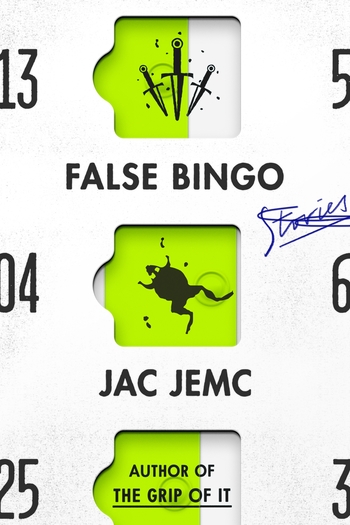
Jac Jemc Is Living in the Gray Areas

It is such a wonderful time to be lost in the specific and unfamiliar places in Jac Jemc’s new stories. In False Bingo, we spend time in a haunted guesthouse in the American South, an amateur taxidermy workspace, a bingo hall, a plastic surgery waiting room, and a yoga retreat. In our time of so much fear and mistrust, peeking into the idiosyncratic lives Jemc’s character live is a fascinating and consuming exercise in empathy.

I got to ask Jac Jemc about her process of empathy and how important the gray area is both in her stories and in our lives.


Jane Dykema: I saw Kelly Link interview Carmen Maria Machado once and she said for her first question she always likes to ask what the person’s grandparents did. I remembered that when I saw you dedicated False Bingo to your grandmothers, and I want to ask, what were your grandmothers like?

False Bingo
Buy the book

Jac Jemc: What a great question! When I was a kid, everyone told me I looked like my grandfathers, so I thought I identified with them more. One, Chester, was strong and silent, but very gentle. He’d keep me company when I was little and didn’t put up a fight when I wanted to play with my Barbies with him (as long as some sort of game was on in the background). The other, Raymond, was a real cornball. He had a seemingly endless supply of jokes—typical set-up and punchline style. A lot of groaners in his repertoire. At his funeral though, the place was jammed full of random people he’d made smile: grocery store checkout ladies and crossing guards. We always teased him for the way he’d default to telling jokes rather than having a normal conversation, but that way of being had spread a lot of joy. I share all of that as a way of setting a stage for who my grandmothers were and who they had to play off of. 

Raymond’s wife, Lorraine, was a born hostess. She was a great cook—goulash and spitzbuben were her specialties. It was hard to get her to sit down at meals because she was always refilling bowls and glasses and checking on the next course. Neither of my grandmothers could drive, but this grandma would take us down to the Art Institute of Chicago on the bus. She introduced me to the miniature Thorne rooms in the basement of the museum, a childhood obsession. She took us to summer productions at the Theater on the Lake and square dances in her church basement. She made a gorgeous set of people out of wire and tissue paper for under her Christmas tree that all of us grandkids would fawn over and built a little grocery store in her spare bedroom that we could play with. She was the family documentarian, and took great photos and labeled them all clearly. She was my grandfather’s straight man, rolling her eyes at his jokes and telling him when enough was enough. I thought she was very glamorous. She always wore a fresh coat of bright lipstick and perfectly chosen brooch. 

Chester’s wife, Dorothy, was a firecracker. She was smart as a whip up until the end. She had an earthshaking temper. She was practical to a fault and very frugal, but very quick to share the fruits of that penny-pinching. She had a stockpile of toys she’d bought on clearance in her back bedroom covered with a bedsheet that we knew better than to look under. If we completed a math or reading workbook, we could pick out a toy as a reward—everything had to be worked for. She was hard of hearing most of the time I knew her, but refused hearing aids. I think her condition suited her. She could talk whenever she wanted without having to worry about who she was interrupting. If someone else wanted to talk to her, it’d better be important and you’d have to address her very succinctly and very directly. In the last decade of her life she also developed macular degeneration, losing her vision from the center of her eyesight out, and that was very difficult for her because she was an avid reader. I tried to teach her to use audiobooks, but she’d lose her place with the tapes/CDs. She asked me to get her that “witch book,” by which she meant Harry Potter, so she could see what all the fuss was about, and we read it together and agreed we didn’t get it. My favorite detail about this time was that I’d visit her on weekends and we’d go through her mail together. If I tried to through out a flyer from AT&T or something, she’d catch me and say, “Now wait, what was that?” I’d tell her it was trash, and she’d ask me what it said. I’d tell her someone was trying to sell her the internet (which she never caught up to) and she’d scoff and say, “That’s trash! Throw it away! Don’t waste my time!” She never stopped wanting control. 

The other fascinating aspect of her macular degeneration was that she started seeing visions, but she knew they were just images. She was convinced someone was projecting pictures into her house. She saw a naked man and she saw a little village scene, and she asked me to bring over my partner Jared, who is a videographer, to explain how someone was aiming a projector into her house. I did research and tried to tell her I thought it was something called Charles Bonnet Syndrome, essentially the parallel of a person feeling a phantom limb, but for sight. Where you no longer could see, your brain filled in images. She thought that was a reasonable theory, but insisted she was seeing these things in real life. I can’t blame her. How difficult must it be to reconcile the idea of something you’re seeing, like anything else, is made up by your brain? 

JD: The way you describe them gives me a similar feeling to the way I felt when I was reading False Bingo. When I picture this book a series of really concisely detailed portraits flashes through my mind, pictures of these characters as complex and familiar as real people. And each person is so different from the others. I’m wondering about how you think of your process of inhabiting these different people and honoring them, and what implications that practice might have for the way you move through the world. It seems as though almost all of the hurting we do to each other, both on an individual level and on a systemic level, can be linked to us not being able or willing to imagine what it’s like to be someone else, someone we perceive to be very different from ourselves.

JJ: Empathy is everything. I heard that the thing that marks humans as being different from other animals (though who knows?) is that we can hold two opposing thoughts in our head and continue to function. I love to play devil’s advocate and attempt to see the opposite side of an argument. Not that I don’t have my own beliefs and habits that can become rote or lazy, but I find the current political/geological/cultural moment lacks a lot of empathy. People are cutting themselves off from people who think differently from themselves and social media is helping to silo people in that way. Refusal to make changes to address the climate issues is a failure of empathy for future humans; it’s a selfishness that favors the here and now.

It feels like we’re embracing a very black and white mentality, when the nature of most things exists in between.

I find call out culture and the way we shun anyone who makes one slight misstep to be a massive failure to show compassion, so that now the safest thing to do publicly seems to be to call out someone else for their wrongs. I invest personal time and effort into prison reform work, and it’s easy for me to transfer a lot of the issues of incarceration onto the problems created by just totally shunning people who make public mistakes. I don’t think turning people away helps anything. I’m not saying any of this is 100% good or bad or easy to address, but it feels like we’re embracing a very black and white mentality here, when the nature of most things exists in between. Those grey areas were much of what I was thinking about while working on the stories in this collection and thinking how they related to each other. 

The other thought that came to mind with your question is about the lens through which we see the world. I was watching the Eddie Murphy (talk about a gray area) episode of Comedians in Cars Getting Coffee with Jerry Seinfeld, and they were talking about how the difference between comedians and humans is that, no matter how tragic, comedians can always see the comedy in a situation. I don’t know that that’s always true of me, but it’s usually true, especially in regards to my own circumstances. When I feel sorry for myself, I often quickly transition to laughing at the absurdity in my situation. Or if someone says or does something that is meant to upset me, my instinct, after the hurt, is to imagine what would cause the person to behave in that way. I’m making myself out to be a saint, which I am not. At all. I love to complain about people, but part of the fun of complaining is the speculation as to what drives people to behave in the ways they do. 

JD: There’s a lot in this answer I want to come back to, but where you ended makes me have to ask: can we talk about LISA? I will never, ever forget Lisa from “Maulawiyah.” My muscles are tensing just typing her name.

JJ: Oh gosh, Lisa. I have so much love in my heart for Lisa. She is struggling and she’s not shy to share her struggle. I guess she’s pretty selfish, but she ultimately seems good-natured, even if that doesn’t always manifest in the most considerate way. She forces Raila to face some of her own ugliness in an uncomfortable way, and I’m grateful for people like that in the world who can prompt you to reevaluate yourself.

I’ve been in therapy for over a decade, and it’s taken only about that long for me to learn you can’t change other people, you can only change yourself. I heard that advice for years before I could actually put it into practice at all, and I certainly can’t do it quickly and constantly, but it’s something I’m always thinking about: what would it take to not only get along with this person, but to enjoy their company? I adore all of the Real Housewives, and one of the things that fascinates me is the number of times they vow to never ever talk to someone again, and then weeks later, they’re inseparable best friends. My emotional/social scale is so much narrower than that, but I’m riveted by people who feel and behave in those extremes. 

JD: Yes, I love where we end with both Raila and the reader really feeling Lisa’s absence, and despite, at least for me, the aversion I felt toward her desperation and selfishness, missing her! Opposing feelings! This is a good segue into the gray area you were operating in in these stories. I feel like one of the ways you’re constructing this gray area is through the use of lessons. There are some real lessons, like in “Don’t Let’s” and “Bull’s-Eye” and some false lessons like in “Loitering” and some totally surprising ones like in “The Halifax Slasher.” Did you have a specific effect in mind for the reader by putting all these experiences in conversation with each other?

If there’s no conflict, then even a happy ending doesn’t feel earned or satisfying.

JJ: If there was a specific effect I was after, I think it was examining that gray area from different angles, and finding various ways to approach it, maybe suggesting that whatever meaning we take from an event, it’s easy to imagine how a completely opposite meaning might have been gleaned, or how we might stop just short of being able to take away something useful from an experience, or how evidence can indicate a certain truth in many cases, but there are still exceptions and mistakes, and evidence is most often subjective because it’s selective or incomplete, but we might not even know what’s missing. 

JD: Some of my favorite moments were these moments of deflation: when one character imagines an exchange she would have with her friend so thoroughly she decides not to have it, or when it’s clearly stated that the people leading unusual love lives have surrounded themselves with people who accept and nurture them and have no obstacles to overcome. These moments seem so excitingly real, and actually like a harder story to tell. In places like this, is the decision to tell it a certain way an instinctual choice or a conscious one? Are you thinking more about the characters or the readers?

JJ: I remembered that another thing I was thinking about was the idea of what makes a story happy (as is talked about in the story “Gladness or Joy”), and how a story needs conflict, even when it’s happy. If there’s no conflict, then even a happy ending doesn’t feel earned or satisfying. In a story like, “Pastoral,” which I think is what you’re referencing with the idea of the lack of obstacles, the story is maybe more unsettling because there’s implied conflict, but the narrator “deflates” (love that choice of word!) that conflict by insisting there isn’t a conflict. I have to admit that I’m a person who, even on a good day is evaluating the range of what I’m feeling. I can find something to grump over no matter what, but that downside brings the successes and joys into sharper relief. I can’t believe I’m copping to how much I love complaining a second time here, but it really serves a lot of purposes for me.