The Politically Radical Family That Inspired “Little Women”

When Greta Gerwig’s Little Women hits the screen this Christmas, it will mark the eighth time Louisa May Alcott’s beloved 1869 novel has been adapted for film since 1912. The story about four sisters has also been made into TV shows, plays, operas, and even two anime series. Widely beloved for its plucky heroine and romantic realism, the tale has such staying power that the book has never been out of print in the 150 years since its original publication. Little Women has proven timeless in its appeal; the story conjures images of New England fall, the scent of gingerbread, and the cozy warmth of a crocheted blanket. But the writer behind the wholesome bestseller and the family she based it on were political radicals. While Alcott’s semi-autobiographical novel is charming, it’s also more revolutionary, and more relevant, than it may seem.

When Thomas Niles of Roberts Brothers Publishers first asked Louisa to create a “girls’ story,” she was resistant, writing in her diary, “I don’t enjoy this sort of thing.” After the critical success for her Hospital Sketches, she typically wrote “blood and thunder tales” under the pseudonym A.M. Barnard. Eventually, though, she conceded: “Lively, simple books are needed for girls and perhaps I can supply the need.” And supply she did, by fictionalizing (and in some cases, sanitizing) her family, her town, and the events of her life. Despite Louisa’s initial misgivings, her “girls’ story” about four sisters living in genteel poverty in a small New England town became one of the most widely-read novels in the American literary canon. Little Women’s illustration of “the domestic sphere” has resonated with readers across centuries, inspiring authors from Cynthia Ozick to Ursula Le Guin. Today, literary scholars, fans of her oeuvre, and viewers of the screen adaptations recognize that this “girls’ story,” a complex portrayal of domestic mundanity and women’s interiority, is subversive in its own right. But the Marches were not nearly as subversive as the family they were based on.

We don’t tend to remember how much trouble the Alcotts were making in 19th-century Massachusetts.

“We don’t tend to remember how much trouble the Alcotts were making” in 19th-century Massachusetts, notes Pulitzer Prize winning Alcott biographer John Matteson in the Emmy-award-winning documentary, Orchard House: Home of Little Women. But Louisa’s parents, Amos Bronson Alcott and Abigail “Marmee” Alcott, were political outliers even in liberal Concord and constantly challenged the status quo. Bronson was a teacher, philosopher, educational reformer, and failed-utopian-commune founder; he was the first educator in Boston to admit a Black student into his class, and we have him to thank for inventing recess. Abigail was one of the first paid social workers in Massachusetts, as well as a passionate suffragist. Both were Christians, transcendentalists, abolitionists, women’s rights advocates, and vegetarians; it was with these beliefs that Bronson and Abigail raised their four daughters, affording them much more freedom and agency than young women at the time were generally given. As Matteson asserts, the Alcotts “were rocking the boat in a society that was, for the most part, really very comfortable with the idea of women being subordinate in the home, with the [idea] of slavery.”

Nowhere are the family’s radical politics better showcased than in Orchard House, their home from 1858 to 1877 located in Concord, Massachusetts; screenwriter Olivia Milch calls it “the epicenter of a great American intellectual tradition.” And, indeed, philosophers, intellectuals, and writers like Ralph Waldo Emerson, Henry Wadsworth Longfellow, Julia Ward Howe, and Margaret Fuller were frequent visitors at the renovated farmhouse. Jan Turnquist, creator of the aforementioned documentary and longtime Executive Director of the house museum, is eager to chat with me about the Alcotts, their beliefs, and Orchard House when we speak on the phone. “It is still just the way it was when they lived in it,” she says, mentioning that it is one of the first house museums in the country and one of the first dedicated to a woman. The Alcotts “moved around a great deal before they lived in Orchard House, but it’s where they lived the longest. They had already lived there ten years when Louisa wrote Little Women, so for her it was natural to use that house as the setting.” Turnquist points out that “visiting Orchard House is a little bit like walking through the book.” 

The Alcotts acted as station masters on the Underground Railroad.

But in Orchard House, unlike in Little Women, there are indicators of the family’s radical beliefs everywhere. The walls of Bronson Alcott’s study, for example, are decorated with images of his intellectual contemporaries and friends: Emerson, Henry David Thoreau, Nathaniel Hawthorne, and Franklin Sanborn, one of the “Secret Six” who funded militant abolitionist John Brown. In fact, a portrait of Brown himself hangs in the same room, evincing the Alcotts’ anti-slavery beliefs, which even in the North, were considered “extremist” in antebellum America. The Alcotts acted as station masters on the Underground Railroad and hosted fugitive slaves; Bronson started an anti-slavery society with famous abolitionist William Lloyd Garrison; and Louisa volunteered as a seamstress and nurse for the Union Army during the Civil War. Turnquist informs me that when John Brown was eventually hanged for treason and murder, Louisa published a poem in Garrison’s abolitionist newspaper, The Liberator, memorializing the man whom she called “Saint John the Just.”

Throughout Orchard House, visitors will also find subtle reminders of the Alcotts’ commitment to women’s rights and their belief in equality. Louisa’s sister May’s original pencil drawings still adorn the walls (yes, she drew on the walls), and Louisa’s writing desk, crafted by her father, still stands in her room. Today, Little Women fans view the white, half-moon table where Louisa wrote her most famous novel as a kind of shrine—the place where the magic happened. But Louisa’s desk and May’s preserved sketches are more than just displays of the Alcott girls’ hobbies and talents; they’re evidence of parents who not only allowed, but also actively encouraged their daughters to draw, to write, and to think at a time when women weren’t encouraged to do much of anything. 

Empowered by their parents and a community of literary and social revolutionaries, Louisa and her sisters broke down barriers.

Empowered by their parents and a community of literary and social revolutionaries, Louisa and her sisters broke down barriers and earned the respect of their male contemporaries. May, for instance, became a talented artist herself, and many of her most famous paintings can be seen hanging in Orchard House. She also tutored Daniel Chester French, who pursued art because of her teachings and went on to sculpt the Lincoln Memorial.

Bronson and Abigail didn’t just apply their beliefs about women’s liberation to their own family, and the proof of their impact extends beyond their daughters’ accomplishments. Both parents were advocates of college education for girls, women’s right to vote, and even equal pay, principles they passed on to their children; Abigail once said, “I mean to vote before I die, even if my daughters have to carry me!” She never made it to the polls, but Louisa became the first woman registered to vote in Concord in 1879 and regularly rallied other women in town to cast their ballots with her. In regard to the Alcott’s progressive views on gender equality, Turnquist offhandedly mentions that the family not only sheltered escaped slaves, but also abused women who had no legal recourse against their husbands. “Louisa doesn’t put any of that in Little Women,” she quips.

There was a good reason for that, Turnquist adds: “She wanted her books to sell.” Bronson’s controversial schools, which prioritized a conversational style of teaching and avoided physical punishment (the inspiration for Little Women’s sequel Little Men), were often shut down when parents discovered his “controversial” methods and labeled him a “fanatic,” forcing the family to relocate. As a result, the Alcotts were poor—it was the need for money that motivated Louisa’s writing career. Thanks to the Alcott daughters, who were willing to work outside the home, Bronson was able to pursue idealistic projects and rarely compromise his values. 

Perhaps the best example of this is Fruitlands, Bronson’s short-lived transcendentalist commune. Co-founded by Louisa’s father in 1843, the utopian community was rooted in the ideals of environmentalist, morality, and selflessness. According to Turnquist, in order to avoid exploiting other living beings, the residents of Fruitlands abstained from nearly all “luxuries” of the time: They didn’t wear wool or cotton (in solidarity with slaves), or use soap, animal labor, or artificial light. Residents adhered to a nearly vegan diet. Needless to say, after seven months, the socialist commune shuttered and the family moved again. In Louisa’s Transcendental Wild Oats, a satire based on her experience living at Fruitlands, she critiques ventures fueled by male arrogance and (ironically) enabled by women’s exploitation. The old saying goes, “Behind every great man, there’s a great woman.” But in mid-19th century Concord, it would have been more apt to say “Behind every great man, there’s an Alcott woman.”

The Alcotts’ unwavering sense of morality propelled them to champion progressive causes.

Although the Alcotts’ views are well documented, it’s impossible to know exactly what they would think about contemporary politics, and Turnquist doesn’t want to speculate. But she notes that the family’s “radical” belief system really “boils down to kindness.” The Alcotts’ unwavering sense of morality, grounded in faith, propelled them to champion progressive causes and, in some cases, break laws that they deemed discriminatory. If the Alcotts have something to teach us today—maybe even obliquely through Gerwig’s movie—this is probably it: The importance of kindness not just as a personal value, but also as a political framework.

During this conversation, Turnquist remembers a quote by Bronson’s friend, William Lloyd Garrison. When once asked to be more “moderate” in his abolitionist beliefs, he exclaimed: “No! no! Tell a man whose house is on fire to give a moderate alarm.” “That level of immediacy and urgency is how the Alcotts felt” about all forms of injustice, Turnquist asserts. 

In An Old Fashioned Girl, published a year after the second half of Little Women (Good Wives) hit shelves, Alcott wrote “Women have been called queens for a long time, but the kingdom given them isn’t worth ruling.” Louisa and her family strove to change this, to create a kingdom that was worth ruling, and not just by women, but by everyone. When Gerwig’s Little Women arrives in theaters this winter, let us not forget that the creator of this gentle story was a progressive firebrand, a suffragist, a proud spinster, and a passionate abolitionist. May the film provide us a much-needed escape from devastating news cycles, and the memory of Louisa May Alcott and her radical family inspire us to action.

The Complicated Afterlife of a Murdered Social Media Star

On 15 July 2016, 26-year-old Qandeel Baloch was murdered by her brother in Multan, Pakistan.

In the years leading up to her death, Qandeel posted an array of videos on social media. In one, she playfully asked her friend in broken English: “How I’m looking?” (it became a meme). In another, she promised to strip on camera if Pakistan won their cricket match (they lost). In several, she declared her love for the cricketer (now Prime Minister) Imran Khan. In most, she dressed exactly as she pleased: skirts, swimsuits, shoulders on display. 

Thanks to these videos, Qandeel acquired innumerable fans and haters across Pakistan, and rose to unprecedented online fame. Unprecedented, that is, for a teenager who escaped a violent marriage. Unprecedented for a girl who came from one of the least developed areas of Pakistan. Unprecedented, in other words, for a woman like her. 

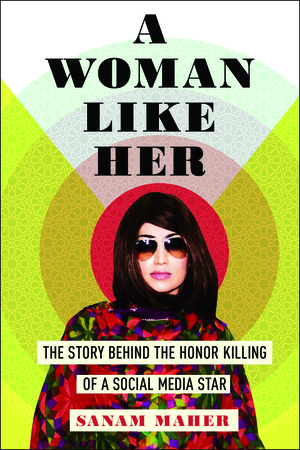
Sanam Maher’s debut book A Woman Like Her: The Story Behind the Honor Killing of a Social Media Star is a compelling work of sharp, empathetic reportage. In order to tell Qandeel’s story, Maher deep dives into the lives of dozens of Pakistani men and women. From the investigator in charge of the case (one of the first women in her hometown to join the police force) to the preacher implicated in Qandeel’s murder (known as a “true preacher of liberal Islam”), A Woman Like Her is a portrait of Pakistan as much as it is a portrait of one Pakistani woman who refused the life set before her. 

Here’s a moment that stayed with me. The area where Qandeel came from is one where women are visibly missing from the landscape; where, in fact, they are often not given any shoes. When Maher asks a local journalist why this is the case, he impatiently explains: “If you’re not wearing shoes and you walk outside, where will your eyes remain?”

A Woman Like Her is the story of women who look straight up. 


Richa Kaul Padte: At age 17, Qandeel is in a violent marriage. After the birth of their child, her husband snaps at her: “You have a son, what more do you want?” You write of this incident: “Even six months later…the answers to her husband’s question beat within her like the maddening tick-tocking of a clock’s hand frozen on a minute in time. What more do you want?” In A Woman Like Her, you make so much space for women who are taught to want nothing. Or at least nothing more than a male heir. Was this your intention at the outset?

Sanam Maher: It’s such a powerful question, isn’t it: what more do you want? What space do we have for this wanting? Even if all you want is to be someone, to have people know your name—can we allow it? 

We didn’t have the ‘perfect victim’ in a woman like Qandeel– she was ‘the national slut of Pakistan.’

When Qandeel was killed, something you would hear a lot of was, “What else did she expect?” After all, she put photos and videos of herself online, angering her brother and [community], so wasn’t she asking for it? I started out wanting to interrogate this response, but I didn’t anticipate that I would want answers to other questions too. For instance, when I met Qandeel’s mother, I was struck by her behavior and how she spoke about her dead daughter. I was using my own frame of reference. I thought: Wouldn’t a mother be totally bereft? Wouldn’t she be beside herself with grief? I expected her to behave in a way that made sense to me when we were dealing with a totally senseless situation. 

But I realized that she was surrounded by people who were saying, “Your daughter was shameless, so if you mourn her, you’re equally shameless.” She was in a position where she was being judged for her grief. So then I had new questions for myself: how we even begin to understand this? Everything I’d seen about Qandeel in the media tried to present a straightforward story about who she was and what had happened. But you cannot tell a neat story about this kind of killing, when a family colludes against or tries to save one of its own for doing something so terrible. 

RKP: Please can we talk about the phrase: “You’re like a daughter to me”? Every time I encounter it, my whole body cringes, because it’s a sentence that many brown women know intimately. For me, it calls to mind older men who put their hands on your back, on your thigh, on various parts of your body. Older men, like the Islamic preacher implicated in Qandeel’s murder, who later deny allegations under its comfortable guise: “She was like a daughter to me.” What, according to you, does this phrase hide? What does it reveal? 

SM: I encountered that phrase differently. All my life, my mother struggled with her mental health, and any time I would hear someone—women, usually—say that I was like a daughter to them, it carried a whiff of judgment about my mother: of how she had raised me, of how they were now trying to “better” me. That phrase gave them an excuse for their judgment. But then I suppose that’s what it is in other contexts too—a free pass.

RKP: Sanam, you and I follow each other on Instagram, where you do an amazing job of chronicling print media censorship in Pakistan. A bunch of your posts and stories contain pictures of, say, the New York Times, a paper whose Pakistani edition is punctuated with blank white spaces, where images that were deemed unsuitable once lived. I thought of this a lot while reading your book, which explores myriad efforts to erase women’s stories and lives.

In turn, I feel like A Woman Like Her does the work of refusing this erasure, of filling in the blank spaces by allowing women like Qandeel to tell their own stories, in their own voices. Could you tell me more about your decision to intersperse the narrative with Qandeel’s unedited words, to allow her to “talk back” (another thing we brown girls are so often discouraged from doing)?

SM: When it became public knowledge that I was working on this book, there was already a lot of information out there on Qandeel, but none of it seemed to satisfy people’s curiosity. So I’d find myself at dinners and someone would ask, “So, was she really a prostitute?” “How exactly did she make her money?” But it isn’t my job to provide you with those details. It’s my job to ask why you need them. 

When Qandeel was killed, something you would hear a lot of was, ‘What else did she expect?’

I started to become wary of journalists or sources who promised me “the real story of Qandeel Baloch.” Qandeel was a chameleon, and she presented different parts of herself to different people—as we all do. We’re different with our family, friends, partners or colleagues, and we’re different creatures on social media where we get to curate our images. Who has the right to say who the “real” you is? Even after all this time, Qandeel is still a cipher to me. With every new piece of information, every new interview, I would feel, “Yes, this is it, I understand her now,” only to learn something else and be utterly confounded again. 

I felt uncomfortable having the platform to tell her story when she was never given that opportunity herself. When news broke that Qandeel wasn’t her real name, or that she had a child, those were “real stories” that had been brought to light by force. I asked myself if I wanted to contribute to the sickening way a person can be robbed of their agency.  I never wanted to speak on Qandeel’s behalf, and I pushed to have her words appear verbatim throughout the book. In fact, there are many sentences where you might not be aware that you’re reading Qandeel’s words, not mine. I tried to keep intact the ways she spoke, and how she described herself or seemed to think of herself. It was a very small way for me to keep her voice in her story, to allow her to talk back to whoever is reading it. 

RKP: A Woman Like Her is so minutely observed, and yet it is tremendously expansive, with a narrative that twists and turns in different directions. And one of my favorite places it arrives at is the question of digital rights. An administrator of a women’s university says of the challenge of keeping its girls safe: “I can tell them when to leave and when to come back, and I can tell them when to be in their rooms, but once they turn on their phones, they could be anywhere.” What a thought: online, girls can be anywhere! Why does the same idea that lifts my spirits frighten those in power?

SM: I think it has started to frighten me too, albeit for different reasons. We’re seeing that these spaces are being policed and monitored and we’re more aware of their limits now. It’s becoming harder to find safe spaces online and to make sure that the conditions that women and minorities are trying to escape in the “real world” aren’t spilling over into their online worlds. Just last week, I received a text message from the Pakistan Telecommunications Authority urging citizens to “report” anything they deem to be “blasphemy, pornography, terrorism and other unlawful content on social media.” I’ve noticed that I’ve started to become very cautious about what I choose to voice online— it’s one thing for me to get angry or abusive messages, but it’s quite another to have a totally subjective system in place that allows you to do more than DM me. 

RKP: There are over 44 million social media users in Pakistan, but, as many of the people you interview believe, “they must [all] remember one thing: they are still rooted here in the land of the pure.” I’m interested in how this dance between purity and freedom plays out in women’s lives: both online and offline. Can a “pure” woman ever be free?

SM: Well firstly, what is “free”? You and I might have the same answer to that question, but I’m thinking of something the lead investigator on Qandeel’s case, a female police officer, said to me: “Of course women have the right to employment, the right to education, the right to good living standards. You can say you want to be totally unfettered, to have freedom, but is becoming Qandeel Baloch freedom?” 

How should a Pakistani Muslim woman look, behave and think?

A question that Qandeel would get asked many times in interviews about her social media activities was, “What kind of woman would do something like this?” That demonstrates an anxiety—how should a Pakistani Muslim woman look, behave and think? There’s a fear around what could happen if a woman decides to answer that question for herself. The only kind of “free” I understand is the freedom from any consequences of not looking, behaving or thinking the way that a “good” or acceptable woman would. 

RKP: Qandeel’s murder was claimed by her brother as an “honor killing”—a murder enacted to avenge shame brought upon a family, community or tribe. Qandeel died halfway through 2016, and in those six months, there were approximately 326 reported honor killings in Pakistan. 312 of the victims were women. The linking of women’s actions and bodies to a family or community’s honor follows brown women across the world: for example, between 2010 and 2014, there were 11,000 honor crimes recorded in the United Kingdom, including abduction, female genital mutilation and murder. 

Qandeel says in despair, “No one tells me, ‘Qandeel, you have gone to war against a society, against a kind of place where men think women are as lowly as their shoe. The kind of place where it’s so common for a man to hit a woman, that if some man doesn’t hit his wife, people call him dishonorable.’ Why don’t people see that?” 

From London to Karachi, from New York to New Delhi: why don’t they?

SM: We’re dealing with an interesting case here in Pakistan right now, where an actor’s wife has accused him of beating her. The wife, Fatima, shared photographs of her bruises on Facebook last week and since then, many have spoken up in support of her and condemned her husband’s behavior. He was largely ridiculed for holding a press conference where he called his wife “troubled”, saying she was “playing the woman card” to vilify him. A protest against domestic abusers has been called in Lahore, and a senator tweeted her support and promised to help Fatima. 

This is all really great to see, but it makes me wonder how conditional this sympathy is. Fatima shared photographs of her bruised face and body, she has a small child, her family agrees that she should divorce her husband, and many neighbors and friends say they were witness to beatings over the years. I think about the reaction Qandeel got when she spoke about her abusive marriage, of her husband putting out cigarettes on her body, of her desire to leave him so she could continue her education and make something of herself. We ridiculed her for saying she wanted support herself after she left her husband. We didn’t have the “perfect victim” in a woman like her – she was trashy, fame-hungry, a drama queen, a woman who had left her husband and abandoned her child so she could become “the national slut of Pakistan.” So I think that we do offer support, but only when we’re comfortable with the kind of woman asking for it. 

RKP: A BBC journalist once memorably called Qandeel “Pakistan’s Kim Kardashian”  —  a comparison that made Qandeel legible to global audiences (even though Qandeel, who came from one of Pakistan’s poorest areas, was unable to access the privileges and safety nets that Kim’s fame allowed her). You write in the book’s epilogue: “Qandeel is no longer ‘Pakistan’s Kim Kardashian’  —  if anything, the women who follow in her steps, who aspire to the kind of fame she found…want to be ‘Pakistan’s next Qandeel Baloch’.” 

This sentence gives me so much hope. Does it give you some, too? 

SM: It does, and I hope that whenever we find our new Qandeel, we do a better job of celebrating her. Okay, perhaps that’s a tall order  —  I’ll amend that. I hope we’re better at tolerating her.

7 Haunting Books for Halloween Nightmares

I’ve been hooked on tales about things that go bump in the night since I was in third grade. I cut my teeth on Alvin Schwartz and Stephen Gammel’s Scary Stories to Tell in the Dark. I was shepherded across the untidy years of puberty by Stephen King’s Loser’s Club and Anne Rice’s pansexual vampires, and I spent many a happy summer vacation working my way through Blockbuster Video’s horror section. It should come as no surprise, then, that I eventually decided to write a scary story of my own. 

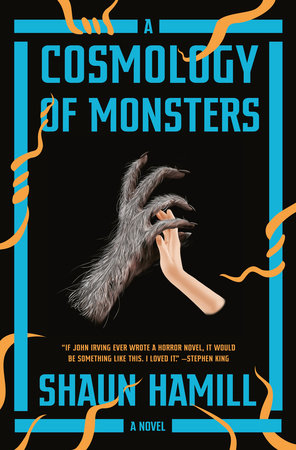
A Cosmology of Monsters by Shaun Hamill
Buy the book

That story, A Cosmology of Monsters, seemed like a simple enough proposition at the outset: a multi-generational saga about a Texas family running a haunted house and struggling with monsters both literal and symbolic. But as I began to write the novel and became acquainted with my characters, I realized that my story was in deep conversation with the tropes and history of horror. Since I’d always been more of a dilettante than die-hard horror geek, I knew needed to research my subject further. All this homework gave me (and by extension, my characters) a strong awareness of the horror tradition, and made Cosmology into a book that knowingly subverts and celebrates its antecedents. 

During my research, I kept my eye out for new horror fiction at the libraries and bookstores I frequented, but I rarely saw much I hadn’t already heard of. There were the big names, like Lauren Beukes and Joe Hill, and a couple of anthologies in the sci-fi section, but I wanted more. Lord knew there were no shortages of mystery and sci-fi/fantasy paperbacks, so where was all the horror? Was it gone?

In late 2016, I stumbled across a list of the 2016 Bram Stoker Awards winners, the annual awards given out by the Horror Writers’ Association. I started looking up the titles and authors listed, and discovered, to my delight, that the horror world was alive and well, but coming mostly from smaller independent presses. It had left the chain bookstores and moved underground. I bought some books from the list, and, to my delight, found exactly what I had been missing in my reading diet. 

Since we’re nearing Halloween, I thought it would be fun to share some of my favorite horror releases of the last several years. These books run the gamut from relatively well-known to downright obscure; their contents similarly range from heartwarming to moody to terrifying. No matter where your tastes fall, I hope there’s something here for you to read while you enjoy that pumpkin spice latte or bag of candy corn.

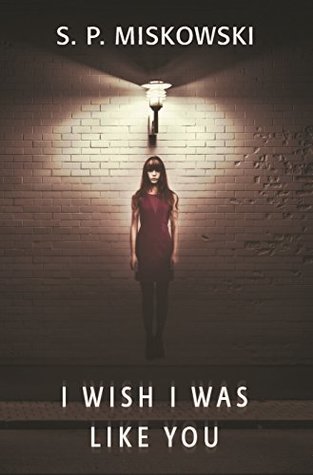
I Wish I Was Like You by S.P. Miskowski

This short horror novel tells the story of the ghost of a failed writer trying to solve her own murder in grunge-era Seattle. I defy anyone not to fall in love with Greta, a narrator who is bracingly honest, wryly funny, and deeply sad.

Image result for albert bierstadt puget sound on the pacific coast

The Fisherman by John Langan

Like Miskowski’s book, The Fisherman is also short, and helped along by an engaging narrator—an elderly widower on a fishing trip who is granted an unsettling peek behind the veil of our everyday existence. To say more would ruin the fun. This novel won the 2016 Bram Stoker prize for best novel, and it’s easy to see why.

Image result for imago sequence laird barron

The Imago Sequence and Other Stories by Laird Barron

Some cosmic horror writers set up camp in H.P. Lovecraft’s sandbox and play there for the rest of their careers. Laird Barron went a step further and created a cosmos of his own, hardboiled, mean-spirited, and deeply disturbing. All his books are worth reading, but this first collection of short stories is an excellent place to start your acquaintance.

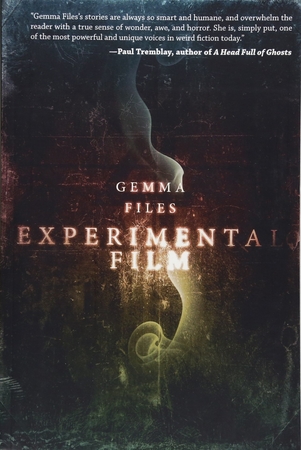
Experimental Film by Gemma Files

If Marisha Pessl’s Night Film was your kind of book, you’ll love this found footage tale about a down-on-her-luck documentarian investigating the unsolved disappearance of Canada’s first female filmmaker. It combines great character work with an unsettling central mystery to create a compelling read.

The Saturday Night Ghost Club by Craig Davidson

The Saturday Night Ghost Club by Craig Davidson

This is more of a horror-adjacent coming-of-age story about a group of believers and skeptics who spend the summer of 1980 investigating their town’s local ghost stories and urban legends. For those who like their horror gentler (although still present) and with a lot of heart.

Image result for her body and other parties by carmen maria machado

Her Body and Other Parties by Carmen Maria Machado

If you’ve heard of any title on this list, it’s probably this National Book Award-nominated (and Shirley Jackson Award winning!) short story collection, but I don’t think it’s possible to over-praise (or signal boost) this book. The opening story, “The Husband Stitch,” is a brilliant feminist take on a classic spooky folktale, and “The Resident,” is as good a modern example of the modern weird tale as I have ever read. If you haven’t read this book, read it. If you have read it, read it again. Also preorder the author’s forthcoming memoir, In the Dream House.

Image result for anthologies horror 2019

The Best Horror of the Year Vol. 11 edited by Ellen Datlow

Ellen Datlow is the hardest-working person in the horror genre. She seems to edit multiple anthologies a year, and, in her lengthy introduction to each annual Best Horror volume, she also reviews every horror novel, collection, anthology, film, magazine, tv show, and work of visual art released that calendar year. In other words, she knows horror like nobody else, and always selects a terrific bevy of tales for her Best Of books. This year’s volume provides a great sampling of voices working in the genre right now.

Tegan and Sara Are Just Like Me—And I’m Finally Okay With That

I have a confession to make: I never listened to Tegan and Sara. This is strange because in the late ‘90s/early 2000s, when they first rose to queer icon fame, I was—from the top of my frosted tips to the soles of my Doc Marten boots—their exact target demographic. While every other queer teen was encountering the Quin sisters’ indie pop ballads on mix CDs from their crushes, I was still listening to Pearl Jam. Instead, I first heard of Tegan and Sara thanks to a stranger who thinks all queer women look alike. 

I was at a thrift store—Beacon’s Closet in Williamsburg, Brooklyn—sometime around 2008, waiting to try on some clothes when another girl in line approached me and said, “You know who you look like?”

I had a few guesses. If my head was shaved I’d often get Dolores O’Riordan from the Cranberries. If I was wearing leather pants, it would be Joan Jett. If I’d let my hair grow in and was sporting a blazer I’d magically become the spitting image of Ellen DeGeneres. So I suppose it was only a matter of time before someone somewhere told me I looked like Sara Quin. 

“Who?” 

“From Tegan and Sara. The band.”

Every time I was told I resembled some gay celebrity I had the same reaction—an angry, painful, almost sickening visceral reaction.
When I got home I looked up a photo and rolled my eyes. Twin lesbian sisters playing guitars? Which one of them was even Sara? It didn’t matter because I looked nothing like either of them! Every time I was told I resembled some gay celebrity I had the same reaction—an angry, painful, almost sickening visceral reaction. This was somewhat hypocritical considering how gay I did in fact look, and in no way by accident. (How else was I supposed to get laid?) But I had been raised to believe lesbians were ugly. Ugly to look at, ugly to think about, ugly to be—even as I was clearly growing into one. That sickening feeling, that knee-jerk reaction of, “I look nothing like [your lesbian of choice here!],” came from a complicated self-hate that didn’t go away, no matter how alternative I got with my appearance choices. 
So I didn’t start listening to Tegan and Sara’s music right then. I didn’t even give it a try. 

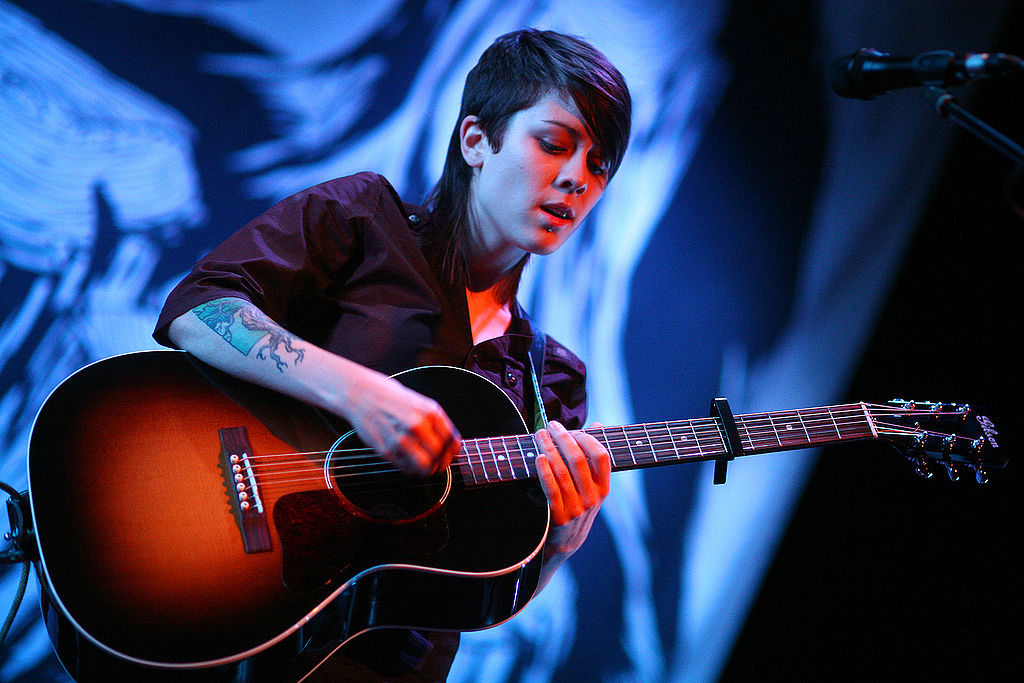
Image result for Tegan Quin

Fifteen years later, this past May, I still hadn’t listened to their music.  My friend and fellow book-person Megan was in town for an annual book industry expo. Megan asked if I was going to the event at Housing Works Bookstore Café & Bar celebrating Tegan and Sara’s forthcoming memoir High School. I may not have been a Tegan and Sara fan, but I had fifteen years of queer community and pride parades and ex-girlfriends under my belt, so I knew enough of their legacy to know that getting my hands on a book they’d written months before it reached the general public would be a coup. Yes, I wanted to go! But no, I had not been invited.

“Come anyway,” Megan said. “At the door just say you’re the third twin.” Thankfully it did not come to that. One polite email and a gracious reply later, I was on the list.

The event began with both sisters on stage, seated side by side. Each of them would read a section of the book, followed by a Q&A. In the years since that Beacon’s Closet incident I, too, have been on a few stages with a microphone in my face and a book in my hand. In fact, I’ve been on that exact same stage at Housing Works. When I achieved my life goal of becoming a published novelist I’d overlooked the amount of public speaking involved. My introvert’s approach to such extroversion has been to go into a fugue state while on stage and remember nothing afterward, so I’m never sure how I’ve performed or what I even look like up there under the lights. Now I realized: I probably looked like Sara Quin.

From my front-row seat in the audience at Housing Works, I could finally see the resemblance. We’re about the same size; we’re about the same age. Yes, she’s obviously way cooler than me but in our offstage lives we could, at least in theory, share T-shirts. As a five-foot-three, masculine-of-center female I can’t share T-shirts with many people who aren’t pre-pubescent boys—so I don’t take that lightly. 

The experience of reading High School was just as surprising and comforting in its familiarity. Like the Quin sisters, I also cut my teeth on Nirvana and Smashing Pumpkins. I even used to play guitar, back when I still had long hair. More significantly though, no other book I’ve ever read so perfectly captured what it felt like—what it really felt like—to come of age as queer in the late ‘90s, years before positive representations of nonconventional sexualities and genders could be found in mainstream newspapers or on broadcast television.

No other book so perfectly captured what it really felt like to come of age as queer in the late ‘90s.

The scenes in the book of Tegan and Sara fighting tooth and nail over their single landline telephone brought a knowing smile to my face, but also a lump to my throat. Tell a young queer person today, “We didn’t have cell phones,” or “This was pre-internet,” and you may as well be saying, “This was before we had electricity.” And it should strike them that way, because we were all in the frigging dark, straining to see who we were and who we wanted to be with so few visible models, while those that were visible were hassled, harassed, and made fun of. 

High School’s cover is reflective like a hazy locker mirror, apt given how much reading it felt to me like catching sight of my past self. I was surprised at the pleasure it gave me to recognize my own experience in theirs, as I’ve only recently had any interest in seeing my past self. I was not an uncomplicatedly happy or proud teenager or traveler through my early twenties. I was anxious and depressed, and while I had a lot of fun and a lot of queer sex and many loving queer friends, I was still the product of my childhood home and ‘80s America. So I didn’t like myself very much. I definitely didn’t love or accept myself. I think people assumed, or maybe I just assumed, that if I knew I was gay and looked gay, I must also like being gay—or at least not hate myself. This wasn’t how it went for me. I didn’t want to relate to Sara Quin in my younger days, whether we looked alike, dressed alike, or were alike or not. Potential for connection doesn’t always create the desire to connect, nor does it necessarily lead to acceptance of oneself or the other.

What I understand now, but didn’t that day when I was thrift-store-shopping, is that you can build self-acceptance from recognition and identification. You can stare at an aspect of yourself that you are ashamed of in the mirror and seek out that component of yourself in others. The exposure can help ease your discomfort, amend your sense of commonality, and you can reconceive your identity through all that bouncing light. 
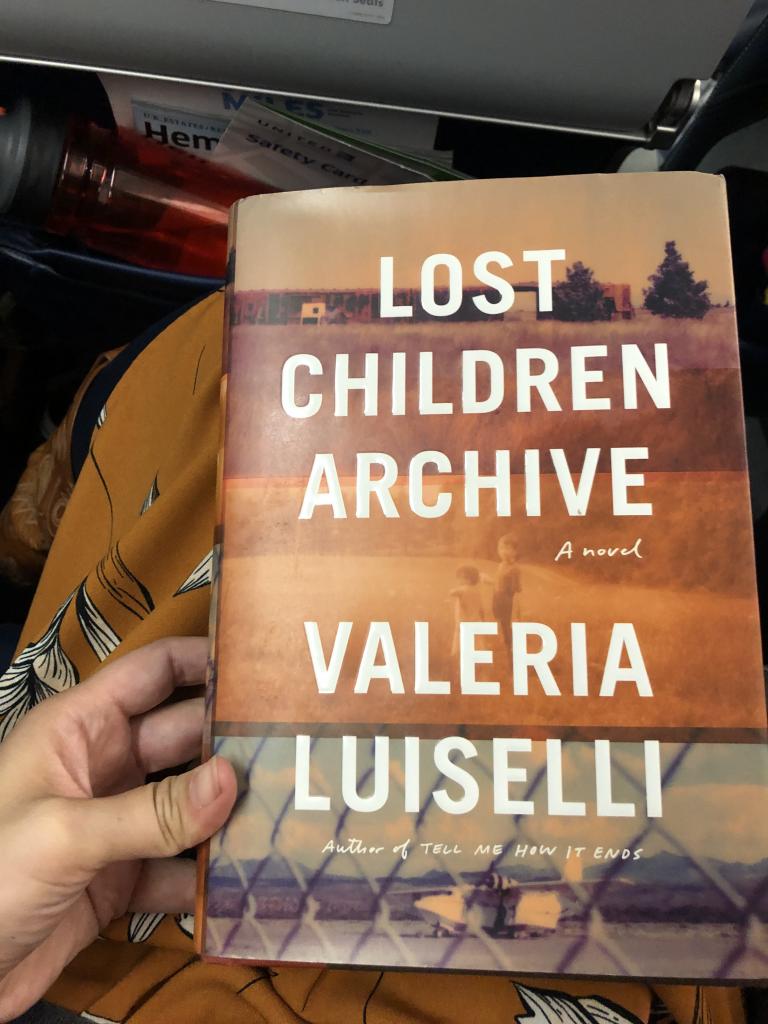
You can stare at an aspect of yourself that you are ashamed of in the mirror and seek out that component of yourself in others.

Presently, Tegan and Sara and I are, all three, aging into elder-status lesbians who suffered through the ‘90s, drank through the early aughts, and today get to sit on stage at Housing Works and tell people in their twenties what it used to be like to be gay. This feels like something of a miracle. And it’s been a surprising joy to not just see myself in their present, but to see my past self in their past selves as well. “Recognition” means the act of knowing and remembering upon seeing, but it also means an acceptance that something is true or important—that it exists.  

They have a new album coming out. It’s called Hey, I’m Just Like You. Ha, I thought. Funny. You are just like me, aren’t you? Or, I am just like you. I’ve already pre-ordered it, and before it arrives, I’ve been listening to some of their older stuff too, to get caught up on all those years of music I missed—and to remember with new affection things about myself I used to want to forget.

One last thing: After that Housing Works event in May I posted a photo to social media of Tegan and Sara on stage and half my relatives commented with Congratulations! and Good job! Did they think I was Sara and Tegan was the moderator? I have no clue. I simply said thank you.

In a World of Truly Large Numbers, We’re Exactly Two People

The Law of Truly Large Numbers

  
 “…With a large enough sample, any outrageous thing is likely to happen.”
 —Persi Diaconis and Frederick Mosteller, “Methods for Studying Coincidences” 
  
 Earth is so heavy with people, my love,
 We’ve doubled our numbers since my arrival. 
 You can still fit twenty humans into a Volkswagen Beetle,
 but I worry, will there be enough seatbelts 
 for our four children? What if civilization 
 bottoms out backing down our driveway?
 Or you can populate two New York Cities
 with people that share your birthday. 
 Isn’t that, and that, and that a coincidence?
 A miracle might strike at any moment. 
 Everything rare is well done. Everyone compares
 their lottery winnings. So long, religion.
 down the road, rabbit’s foot. But even
 in a world of colossal, humongous, truly superb,
 blimp-sized numbers, my love, we’re 
 exactly two people. And when we sleep,
 despite what my snoring might suggest, 
 I am only one man. And of that night
 I proposed with Chablis and pawn shop diamond
 beneath the walnut tree, and you said yes, 
 I’ll say this: quantity only betters the structure
 of affection, the architecture of surprise.
 As when you step from the shower
 and search for your towel even though 
 I’ve hidden it for the millionth time
 so that I might behold you searching
 for your towel until you finally ask, “Hey, have you 
 seen my towel?” At which point 
 I jump to the rescue with dry, fluffy, 
 wondrous towels worthy of Nefertiti,
 and the whole morning smells like sweet pea 
 and violet body wash, lavender and citrus 
 anti-frizz conditioner, and this is only
 the first hour of the day. I’m one
 timeline away from figuring out
 when the odds kicked in, how I found you.
 It’s so crowded, my love, and we’ve all
 been mistaken for someone else 
 with the same first name and a one-digit difference
 in our social security numbers. If only
 we could hold a truly large mirror
 up to Earth, we could at least gain the illusion
 of spaciousness. This would also solve
 the problem of surveillance. Everybody 
 making love outside, looking up
 at themselves making love in the sky.  

Hey Dwayne

  --Reunion, Class of ’85
  
 Didn’t you shoot the water tower with a dart gun?
 Didn’t you join the Masons? Didn’t we walk down 
 the swamp road and spew pot smoke into each other’s faces 
  
 concurrent with hyper-ventilation? Didn’t I fall down 
 for a minute, then wake in awe of Def Leppard, 
 loblolly pines like compass needles fucked with
  
 by the wind-magnet? Didn’t we go to three funerals
 that Saturday? Didn’t we sit in the abandoned 
 tractor trailer shifting the dead gears? Didn’t they 
  
 sound like a hailstorm of horse teeth? Didn’t the well water 
 taste like matchheads? Wasn’t our team sponsored 
 by the sawed-off light of the turpentine factory? 
  
 Didn’t our coach point to the example with a busted 
 car antennae? Didn’t we ride your Kawasaki in the rain 
 all the way to Turkey Fork in December? Didn’t the gray sky 
  
 leave a skid mark on the ridgeline? Wasn’t there 
 supposed to be a bonfire at the bridge, but the boat-
 ramp gate was welded shut, and the weedy beach 
  
 was empty, but for an x of smoldering driftwood? 


Edwidge Danticat Wants More Haitian Storytellers

I still remember the feeling I had the first time I finished one of Edwidge Danticat’s stories. I’d been assigned to read her short story collection Krik? Krak!, published in 1996, in one of my undergraduate classes at Barnard College (where Edwidge was an alumna) and I had approached the book the way I often did with assigned readings—a mindset of, Okay, I just have to get through this. But by the first page, I was immersed. “Children of the Sea,” the first story in the book, riveted me with its lush language and epistolary form; it was also the first story I had ever read about Haiti, a place whose violent history I’d known very little about. By the end, I was breathless, moved, and never more aware of the power of a well-written story.

I’m not the only person in the world to notice Danticat’s talent, of course (despite what my colleagues in my MFA program might have thought)—Danticat’s stories and books have garnered her many awards and nominations, including the American Book Award for her novel The Farming of Bones (one of my favorites), National Book Award nominations for Krik? Krak! and her nonfiction book Brother, I’m Dying, and a National Book Critics Circle Award for Brother, I’m Dying. Danticat herself received a coveted MacArthur “Genius” Grant. Even without all of this institutional recognition, I know from speaking to friends that she is beloved among writers and readers, particularly among women of color.

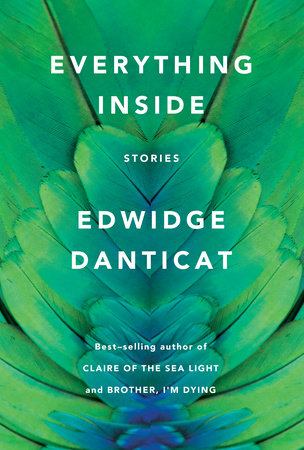
Everything Inside by Edwidge Danticat
Buy the book

Her new book, Everything Inside, is Danticat’s first collection of short stories to be published since Krik? Krak! over twenty years ago. The stories, which center on people of the Haitian diaspora and the various traumas they seek to make sense of, feel particularly timely at this moment as America debates over the value of and moral responsibility we have towards immigrants and their children. The stories are elegant and empathetic, still bearing the hallmark tension between beauty and violence that marked her first collection. And yet they’re less sentimental, more mature, quiet, and steady—the work of someone who has lived through more and has evolved in what she has wanted to say. 
I was privileged enough to speak to Edwidge Danticat over the phone, where we discussed the evolution of her short fiction, the relationships between the characters of Everything Inside and the characters in Krik? Krak! and the difficult and differing ways in which immigrants and their children deal with lingering generational effects of painful pasts and the burden of representation.


Karissa Chen: I think this is your first collection of short stories since Krik? Krak!, which you published over two decades ago. I know in between you’ve written a lot of other things—novels, novels-in-stories, a lot of nonfiction. You’ve even written a bunch of children’s books and YA books. I’m curious how it’s changed for you to go back to this form after these years. I mean, I’m sure for some of these stories you’ve probably been working on them for a while behind the scenes. But I’m wondering why you decided to return to this form and if you approach writing short stories in a different way now than you did back then.

Edwidge Danticat: I love short stories. I love to read them and I love to write them. I like the bursts of narrative. I like the economy. When I was writing the stories in Krik? Krak! I was still in college and later working a full time job. I wrote those stories during stolen moments, often before exams, and after hours in the office where I worked. There was an urgency for me about getting those stories down because I was new at writing stories and each story felt like a stroke of lighting, something that might never happen again. I was always afraid that if I didn’t stop whatever I was doing and write those stories down, I would lose them forever. I think that sense of urgency shows in the stories in Krik? Krak! They’re very direct, declarative even, like the kind of stories they’re modeled after, the oral stories that are part of the call and response of Haitian storytelling, which we introduce by saying Krik? (or asking the audience if they’re ready to listen) and having them answer Krak! (or replying yes, they’re ready to listen.)

The stories in Everything Inside, though, are stories that I have been writing for over thirteen years. I have written and rewritten them many times, even after they were published in journals or magazines. These stories have benefited from the patience I now have with both myself and with narrative, the trust I have that some resolution to the problems in the story might lie somewhere ahead, in the future. I am now more willing to wait for my stories to resolve themselves. So it was great to re-enter stories with that kind of patience, to let the stories pause and breathe, and allow the characters to keep revealing themselves to me over the years. I enjoyed going back to the form and writing stories in this unhurried way. The stories in Everything Inside are not just longer but more nuanced because of this, and you feel, I think, that you are also reading about people with a lot more time on their hands, a situation which parallels the case of some first-generation Americans who have a lot more time and leisure to linger on some things and address certain issues than their parents did.

KC: You said some of these pieces you’ve been working on for a long time. What’s the one that you’ve been working on the longest and how long did that take you?

ED: The first story in the book, “Dosas,” is the one I’ve been working on the longest. I added the most recent elements to it last year. It’s based on something that actually happened to a few people I know, where someone they loved and trusted pretended to be kidnapped to get money from them.

I also wanted to write about Certified Nurses Assistants in Miami and later added an element of something my mother said to me while she was in the hospital with terminal cancer. Everyone who was taking care of her was Haitian and she found a lot of comfort in this. So one day she said to me, It’s wonderful that so many of us are here to take care of each other. Behind these words, I was hearing her say, Who would take care of us, if we didn’t have each other? So the combination of these two things—people we love betraying us and potential strangers taking care of us—came together in the many layers of this story. 

Different elements kept popping up with this story over the span of thirteen years. A possible new romance for Elsie, the Certified Nurses’ Assistant. Her thoughts on marriage. Then I saw a sign in my gentrifying neighborhood in Miami’s Little Haiti that said “Nothing Inside Is Worth Dying for” and I put that on Elsie’s door and switched it to “Everything Inside Is Worth Dying For”, which gave us the title of the book. 

KC: In both your collections, all the stories seem to be in conversation with the others in the book. Krik? Krak! was very much focused on a historical Haiti, with almost a sort of magical realism and focused on the violent past of the island. Whereas I think this collection felt a lot quieter, but still very much focused on the Haitian diaspora in our current times and how they wrestle with their different traumas. There’s echoes between the stories, even though all their situations are different. 

I’m wondering—and I hate to do this, because I know it’s probably very annoying for you to have the two collections compared to each other—but because so much time has gone by, do you think that your own interests as a writer have shifted since these two collections?. I’m wondering where you are as a writer now that led you to write these particular stories.

ED: I don’t mind the two books being compared because the characters in Everything Inside could be the children or the grandchildren of the ones in Krik? Krak!. Krik? Krak! is about several generations of one family. The characters in Everything Inside are not related to each other or to them, and they are certainly of another generation, but they feel connected in my mind. 

If we want to be really meta, we might say that some of the characters in Everything Inside may have read Krik? Krak! and said “This reminds me of my mother or grandmother.” I meet a lot of young Haitian-Americans who say that to me about Krik? Krak!, by the way. So there’s definitely a strong connection between the two books, the most important being the ancestral town in Haiti from which both groups originate: Ville Rose. 

This is what’s wonderful about having a collection. When you’re writing individual stories, they feel singular. When you put them together, a thread emerges not only between the stories, but also between your past and possibly future work. But, as I mentioned earlier, I don’t think I would have been able to write the stories in Everything Inside twenty-five years ago. Watching the shift in focus and perspective between the different generations of my family has helped a lot in shaping these stories. Watching my parents die and the next generation grow up and become adults—American adults—has really guided these stories.

KC: I think that’s really apparent in the way you frame a lot of these stories. “Sunrise, Sunset” literally had that shift in perspective going back and forth between the two generations, showing the contrast in how they’ve had to deal with motherhood. But so many of the stories are recursive—where something happens and the characters go back to see how they got to this point in time. They’re revisiting their own histories, but vis-a-vis their family, etc.

ED: “Sunrise, Sunset” is a good example of that gap between generations where there’s this missing link of knowledge on both sides. The mother believes that her daughter should be grateful for all the sacrifices that have been made so that the daughter can have the life she now has, and the daughter thinks the mother is unable to understand all that she’s going through because her mother’s experiences are from a time and place that is unfamiliar to the daughter. If only they could talk, they would realize just how similar their experiences are. Yet, there’s something heavy about trauma-related migration that makes silence comforting for both of them until the silence becomes so stifling it’s dangerous. The friction comes to a boiling point when a new generation comes into the picture, the grandson. The story fills in that gap and you realize that if one could hear what the other was thinking, things would be a lot better. 

KC: One of the other things I noticed about the stories in this collection is that the “big thing” that happens almost always happens off stage. So, in “In the Old Days,” the father has already died, in “Seven Stories,” Callie’s father has already been killed, and the earthquake happened off stage in “The Gift,” even though we get to see it a little bit. Even in “Without Inspection,” although we are in the moment of his death, like with the other stories, it feels like the traumatic thing isn’t the point of drama. Maybe this is because it’s something that’s out of the characters’ control. So instead, what you end up focusing on is how they make sense of this thing that has happened and their personal histories and the memories that lead up to it and what happens beyond that moment. It’s interesting because I feel like this is not how people often think about writing. People think, Oh, we got to lead up to the point of drama. So I’m curious what it is about this aftermath that interests you, because I think there actually is a lot of tension in the aftermath.

I was always afraid that if I didn’t stop whatever I was doing and write those stories down, I would lose them forever.

ED: For the stories in Everything Inside, the aftermath feels much bigger than any singular event because the “big thing” is one in a series of events—historical, cultural, familial, personal—that are affecting these characters. What concerned me most was not just one triggering event but how the characters were trying to regroup after a series of events, some of which go back several generations. If you were to meet any of the characters in this book on the street and you said, tell me something about yourself, this is what these particular people would say. That’s how I see the contents of the stories. Plus there’s always in immigration and migration this feeling where obviously you’ve come to a new place to have a different future, but you have no choice but to keep looking back because you’ve left everything you’ve ever known behind. So you’re moving forward, but always looking back at the same time.

KC: That’s something that personally interests me as well—when you are someone who is a migrant, someone who is either refugee or an immigrant, and the different ways of dealing with things. Some people just forge forward and they’re like, This is all I can do is, all I can do is move forward. And some people are like, I have to keep making sense of what has happened to me. Obviously many people do both. I think that tension is something that is really palpable through these pieces even with the children. In “Hot Air Balloons,” Lucy has this roommate who goes to Haiti and does all this relief work, and Lucy is like, I can’t, that’s not a thing that I’m trying to, and she’s sort of inherited this conflict. 

ED: Whenever I asked my parents about their lives in Haiti during the Duvalier dictatorship and what it was like to live in Haiti in the ‘50s and ‘60s, for example, all they would say is some version of “We’re here now.” This was meant to explain everything. Like if things weren’t difficult then we wouldn’t be here now, so let’s move on. I think having to leave was painful for them in a way that they never wanted to detail or even describe. They had also grown up being discreet. Living under a dictatorship you couldn’t say too much because you didn’t know what people were going to do with that information, how it might be used against you. You didn’t know who to trust. So my parents were very tight-lipped about what their lives had been like. They’d moved on in some ways but were still tied to the past, as are some of the characters in the book. 

Many younger people, like Lucy in “Hot Air Balloons,” are very protective of the image of Haiti, even if they’ve never been there. So many awful things have been said about Haiti that we want to highlight its beauty. So Lucy wants to go to Haiti but not with a relief or aid group. She wants to go on vacation there. She also wants to protect this image that her parents have created for her of the beautiful beaches and cool mountains which paradoxically co-exists with her parents’ conflicting desire for her not to go there so she doesn’t come face to face with some of the things that drove them away.

KC: I think when you’re the descendent of immigrants in America, there’s that burden, right? You feel that burden to be like, I want to be able to personally acknowledge the failings of wherever my parents came from; obviously they came here for a reason. But I also want everyone here who doesn’t understand that place that I’m from to not have a negative image of it. I want them to think this place I’m from is a great place.

The more stories we have, the more storytellers we highlight, the more nuance and complex our views of a place and its people can be.

ED: Exactly. I think fiction can get at some of that nuance. There has to be some balance. It’s not all terrible and it’s not all pretty either. There’s no place or person like that. We deserve to have our full humanity and the complexity of our lives fully explored. This is why it’s important to have more Haitian novels translated and have more Haitian diaspora voices out there. The more stories we have, the more storytellers we highlight, the more nuance and complex our views of a place and its people can be.

KC: It actually makes me wonder about another one of your stories, “Seven Stories,” because that one is about an unnamed island. It’s interesting because you write from the point of view of this woman, Kim, who’s Haitian, but she is an outsider to this island and she first hears about this island through her friend Callie. And what she knows is how Callie’s father was killed, but at the same time, Callie is telling her, My island is great in all these ways. Then Kim gets there and it has turmoil, it has its own xenophobia, but it’s also beautiful and has a very well maintained facade. It actually feels very familiar despite being an unnamed island. Why did you set this story in this unnamed place and then have this woman who’s on the outside be the one to take us into it and into Callie’s story?

ED: That story was originally a novella, which would mimic one of those narratives where people go to a place for a few days and feel they understand it and write a long expert type article about it, something which happens a lot with Haiti. I decided to make the person who does this kind of writing Haitian-American because I could easily be asked to write a story like that about another Caribbean island and find myself facing the same issues Kim Boyer does. Writing as an insider/outsider feels very familiar to me as someone who writes about Haiti while living outside of Haiti so I wanted to complicate that whole thing in some way. I also had this experience when I was in my teens of having some famous Haitian exiles move across the hall from me in Brooklyn in the 1980s and later seeing them in Haiti after they’d become politicians. It just so happens though that on this particular island in “Seven Stories” they don’t like Haitians at all, but would make an exception for Kim because she’s Haitian-American. Among many other things, Kim realizes, while trying to write about the complexity of the place, that she travels differently through the world and gets a very different reaction than other Haitians who are coming to that very same place for a better life.

KC: I’m going to ask you one more question. Is there a story in this collection that either was the most difficult or one that you’re proudest of? And would you be willing to share which one that is and why?

We deserve to have our full humanity and the complexity of our lives fully explored.

ED The story I’m proudest of is “Without Inspection.” It’s the most recent of the stories and it’s a story that I’ve been trying to write for a really long time. When I first moved from New York to Miami about seventeen years ago a lot of people were coming to Miami by boat from Haiti, the Bahamas, and Cuba. I wanted to write about someone who’d made this journey but ended up falling in a construction accident, something which was also sadly happening a lot a that time. And still happens now and then these days. Last year I went to an immigration forum and I learned the term “Entry Without Inspection”, which means entering this country without seeing an immigration official, which means, on paper, you’re not technically here at all. I wanted to integrate all of those elements into one story and it took a while to figure out how to do it.  I wanted to incorporate a historical and mythological element about flight as well. I also wanted to include something of the quick moment after a person dies where some loved ones who are nowhere near them experience this feeling that you can’t quite explain, whether it’s a flash of something, a shiver, a flutter, or something else. Balancing all of that with the reality of Arnold, the main character’s fall, meant a lot of research, down to how many seconds it would take to fall from a certain height. So I’m really proud of how that came out, and that’s probably why I close the book with that story. 

The hardest story to write though was “Seven Stories.” I was really enjoying the company of these characters and I didn’t want the story to end. Cutting it down to a third of its original length was hard for me. I killed a lot of my darlings, but I really wanted to keep that sense of the beauty, as well as the complexity of the place.

KC: Yeah. It’s really beautiful. The island feels really real—it was so real that I actually thought, Did I miss the name? I actually flipped back several pages to double check. It seemed so real I was sure you’d been there before.

ED: I borrowed different aspects of many islands, including Haiti, to make up that place. One thing I’ve found just in talking to people about the book is that if you want to be asked about something a lot, just don’t give it a name. [laughs] People really want to know if the place is real or not. All I can say is that it’s very real to me.

KC: And I liked the song that Arnold mentions, [“Latibonit O”]! I appreciated that in the final note, you give the whole translation. Because you have it without the translation in the story and the reader still gets the effect. And then, when the reader moves to the end note and reads the lyrics, it adds something extra.

ED: You should go and listen to it online. A wonderful singer and family friend named Leyla McCalla sings a very beautiful version of it. This book ended up having a lot of singing. That’s one of the things I realized after the stories came together. It had a lot of music, from Nina Simone’s rendition of “Take Me to The Water’, to Charles Mingus’ “Haitian Fight Song” to “Latibonit O” then the hymn “Shall We Gather at the River?”

11 Iconic Red and Black Outfits from Film and TV

So you got your early bird tickets for Electric Lit’s Masquerade of the Red Death ($35 until October 1, going up to $50 thereafter, act now!), and now you’re stuck on what to wear. Anything red, black, or red and black will do, but you obviously want to bring your A game. Well, look no further: we’ve compiled some classic, eye-catching looks from film and TV for sartorial inspiration.

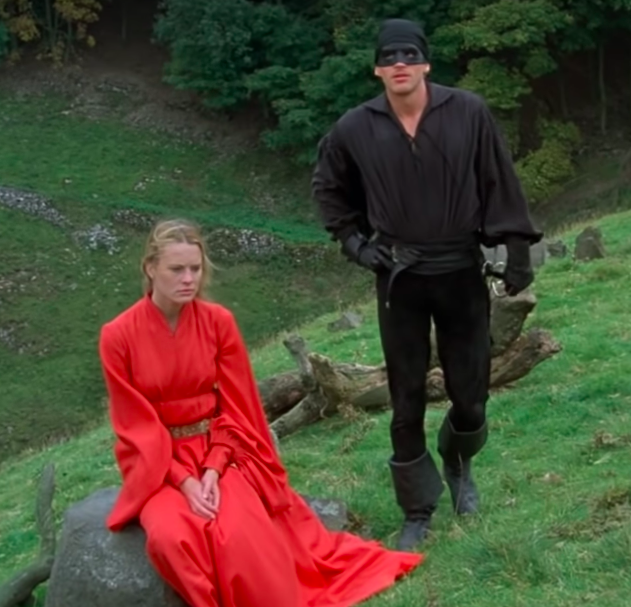
Buttercup and Westley’s Fire Swamp outfits, The Princess Bride

Sure, they look sulky here, but in a minute they’ll be declaring undying love and lightfooting it around flame spurts, which sounds like a party to us. If you’re bringing a date to the Masquerade, having one of you in full red and the other in stark black is a great idea.

Dana’s “Gatekeeper” getup, Ghostbusters

Honestly, this might be orange, but we think it’s red with gold threads and anyway we want you to bring this entire energy to the party—the hair, the coquettish bared shoulder, the channeling old gods, the sleeping four feet above your covers, etc.

Mrs. White’s party dress, Clue

The simple black sheath dress and pearls combo taken to the next level. Accessorize with flames on the sides of your face.

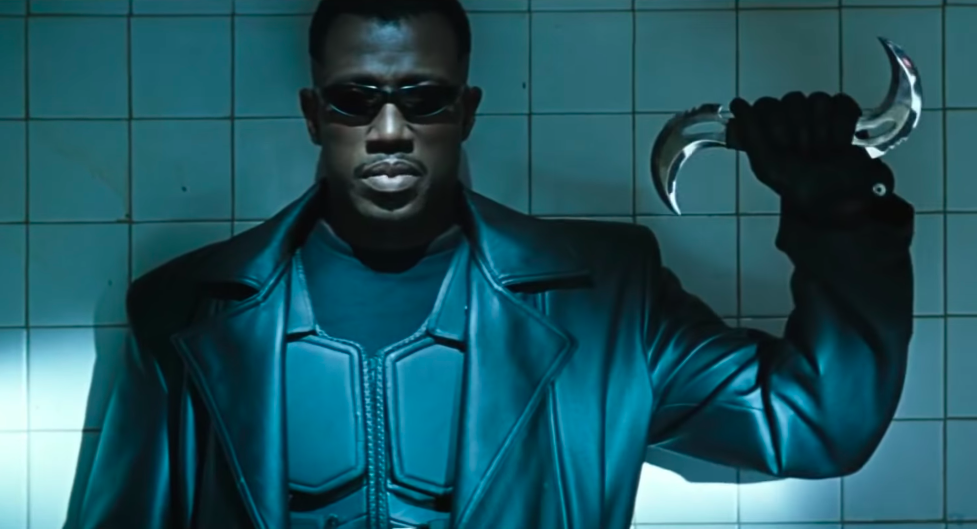
Blade’s whole thing, Blade

A black leather duster and weird little shades truly elevate any party outfit, even a bulletproof vest. Before there was Neo, Blade did it first and best.

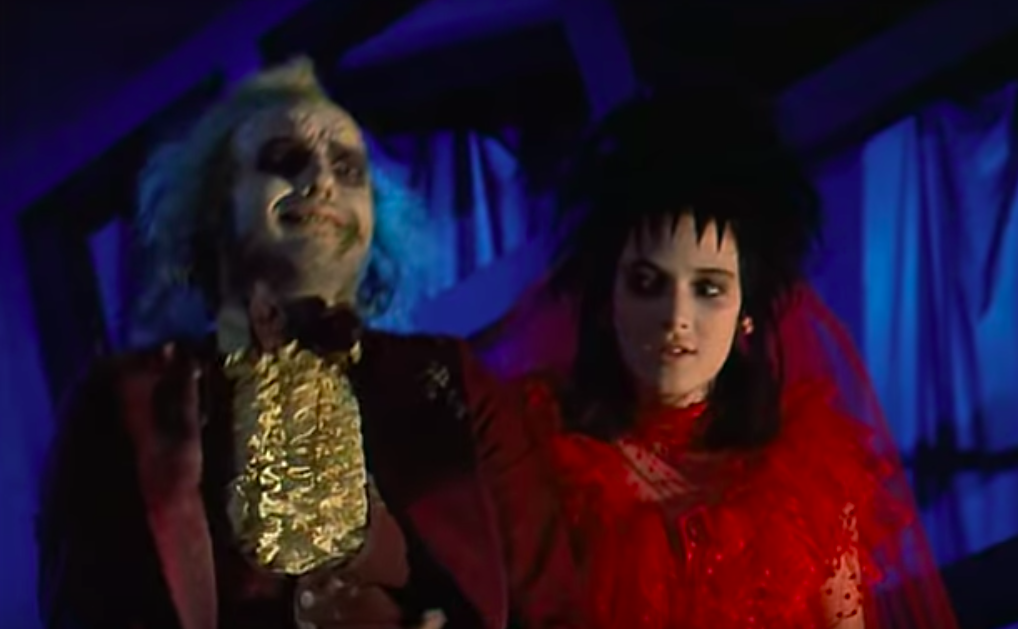
Lydia Deetz’s wedding dress, Beetlejuice

The wedding had some problems (groom a malign ghost, bride there against her will) but that frothy red confection of a dress and veil, plus Siouxsie hair? Perfection. If anyone shows up in a mouldering burgundy tuxedo we will also be into that.

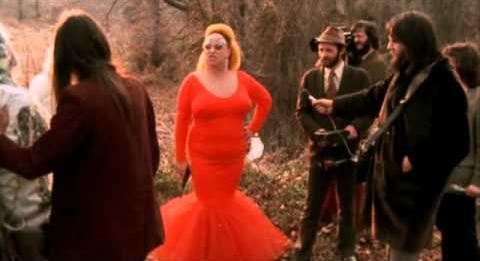
Babs’s execution outfit, Pink Flamingos

She may be the filthiest person alive, but Divine looks like a million bucks in this truly iconic mermaid gown.

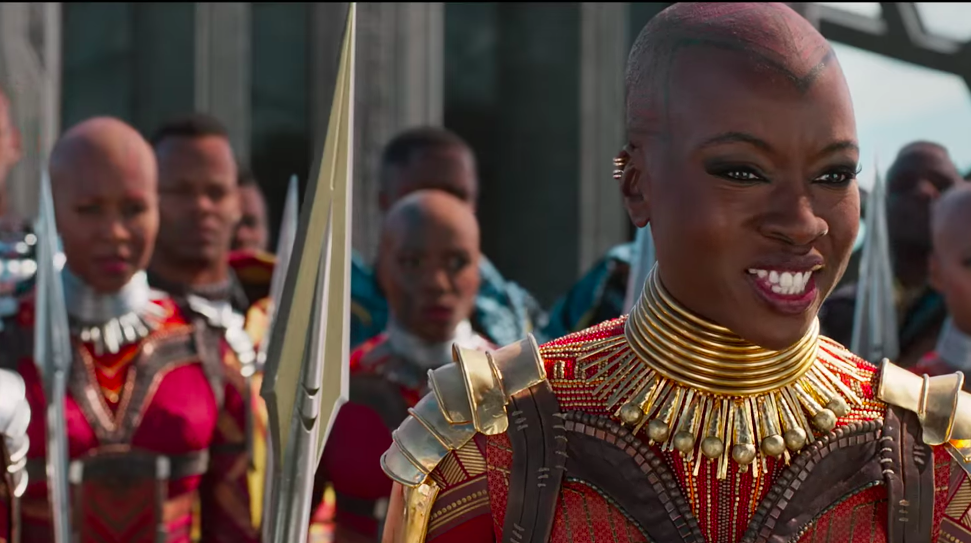
Dora Milaje uniforms, Black Panther

Outside Wakanda, most military getups don’t have the requisite pizzazz for a party, and Okoye does change into an also incredible red outfit in order to blend in at a casino. But the standard-issue Dora Milaje uniforms, with their leather and metallic accents, are plenty fancy for us.

Willow’s vampire alter ego, Buffy the Vampire Slayer

Before she went evil IRL, Buffy’s geeky friend had an alternate-universe vampire version whose RenFaire-meets-dominatrix outfit sent every 1990s baby goth into orbit.

Maleficent’s horn and cloak situation, Maleficent

Listen, it’s been a hard year. You deserve to go to a party, but maybe you don’t want to change your clothes or do your hair. We have the perfect solution.

Practically anything from the Hunger Games movies

From the black-and-red training sweats to the “girl on fire” gown, from the black leather armor on the Mockingjay Part 1 poster to the… identical red leather armor on the Mockingjay Part 2 poster, the Hunger Games movies are full of fashion ideas.

The Little Man from Another Place’s suit, Twin Peaks

Cooper’s dream trip into the Black Lodge is an iconic moment in the show (consider the fact that it was parodied in both The Simpsons and a Harlem Shake video). But the dancing, backward-talking Little Man from Another Place is also important for a different reason: he’s a testament to the power of a custom-fit red-on-red suit.

Electric Literature’s #DressLikeABook Contest is Back!

Despite the sweltering heat beating down on New York City, this week officially marks the start of fall! The leaves are turning citrus-shaded hues, Halloween merchandise is taking over the aisles of every big box store, and overly-eager city dwellers are decked out in their cashmere sweaters and knit scarves. To celebrate this cozy season, we’re challenging you to put your autumn wardrobes to work. Dress up to match the cover of a book, and you could win a Writing Well Is The Best Revenge tote bag!

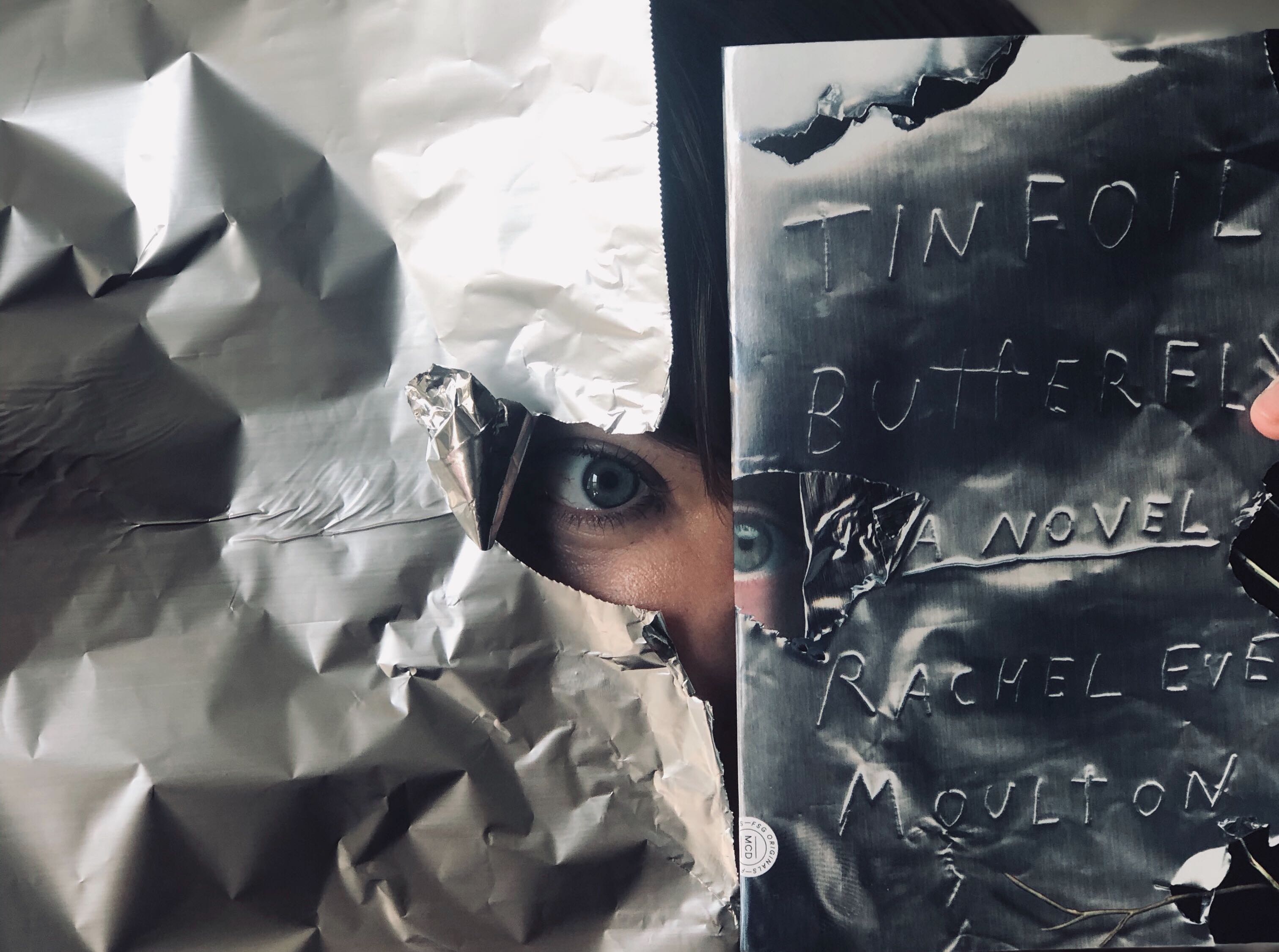
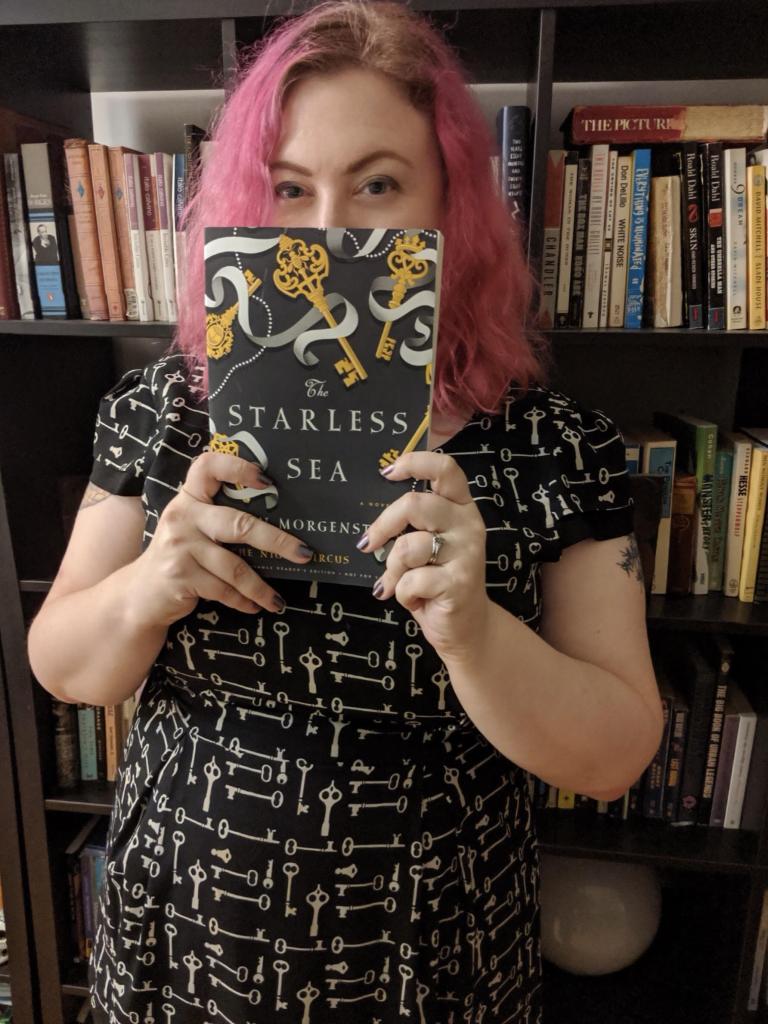
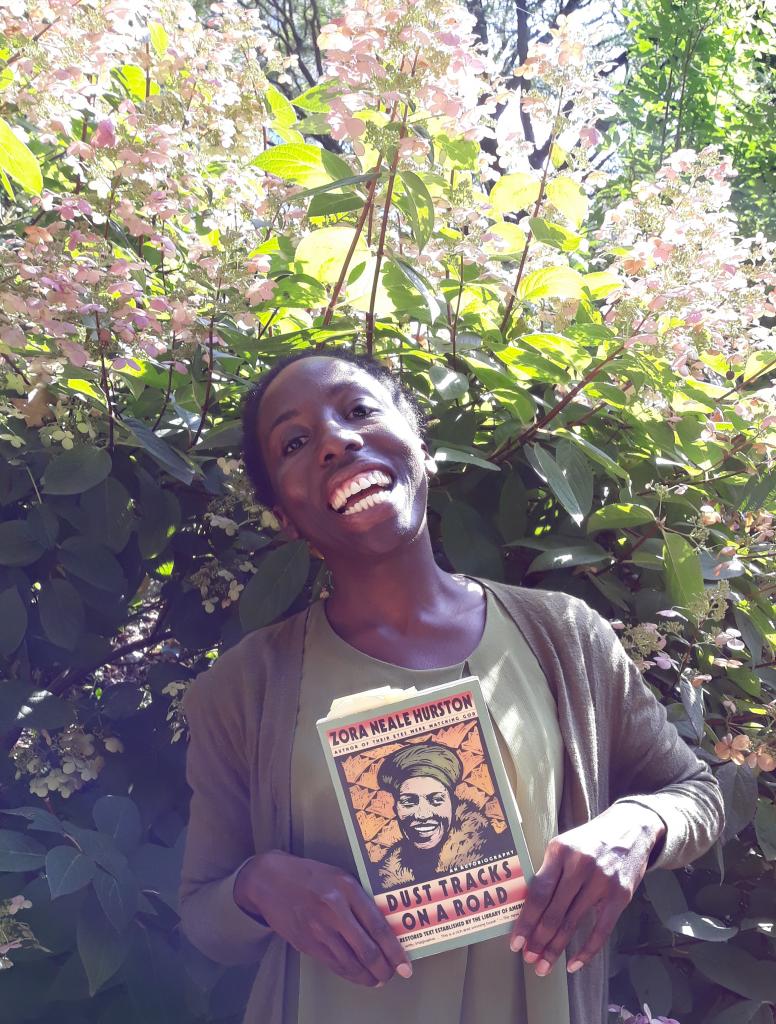
To enter, post a photo of you dressed to match a book cover on Instagram, and use #DressLikeABook. Remember to follow Electric Literature and tag us. The best photos will be featured in a post on the site. For some inspiration, here is the EL team channeling our inner fashionistas.

Associate Editor of Recommended Reading Erin Bartnett is a tinfoil butterfly at heart.

Former intern Ruth Minah Buchwald moonlights as a P.I. investigating literary scams.

Editor-in-Chief Jess Zimmerman is a literary gatekeeper, hence the dress with the keys.

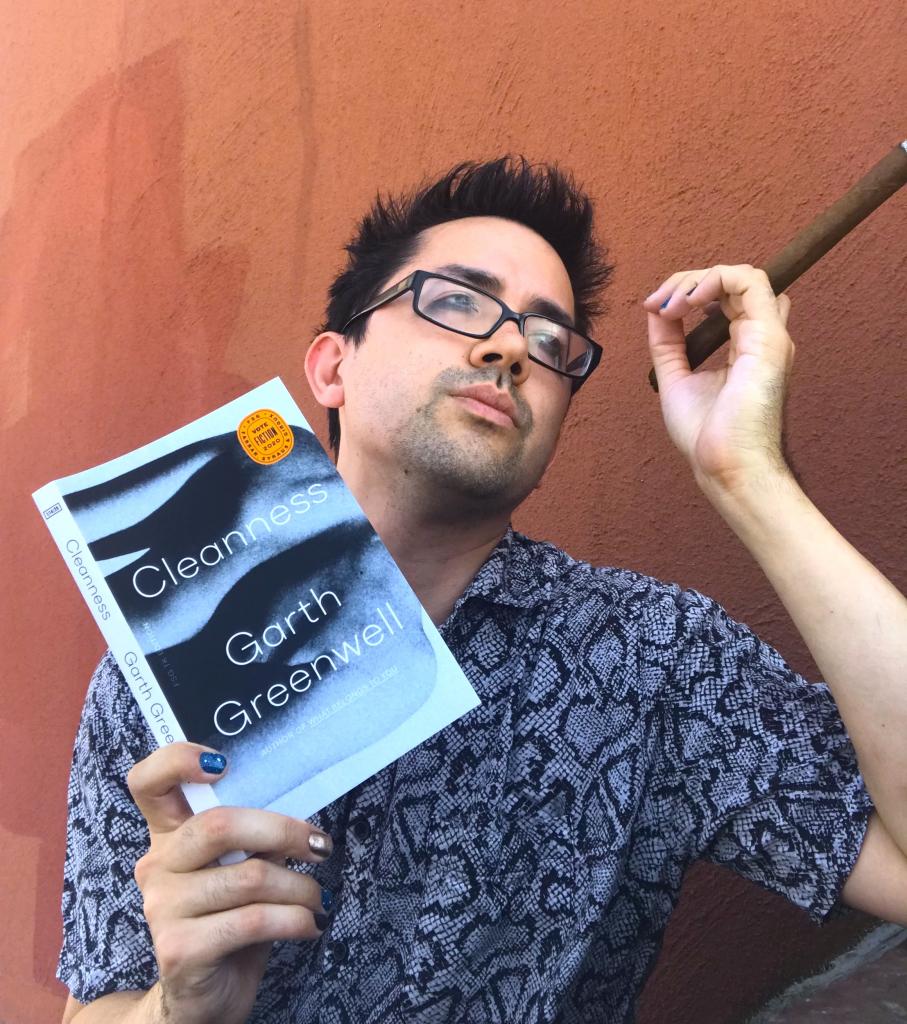
Editor-at-Large Michael J. Seidlinger thinking about what’s he going to eat for lunch. \m/ \m/ \m/ \m/

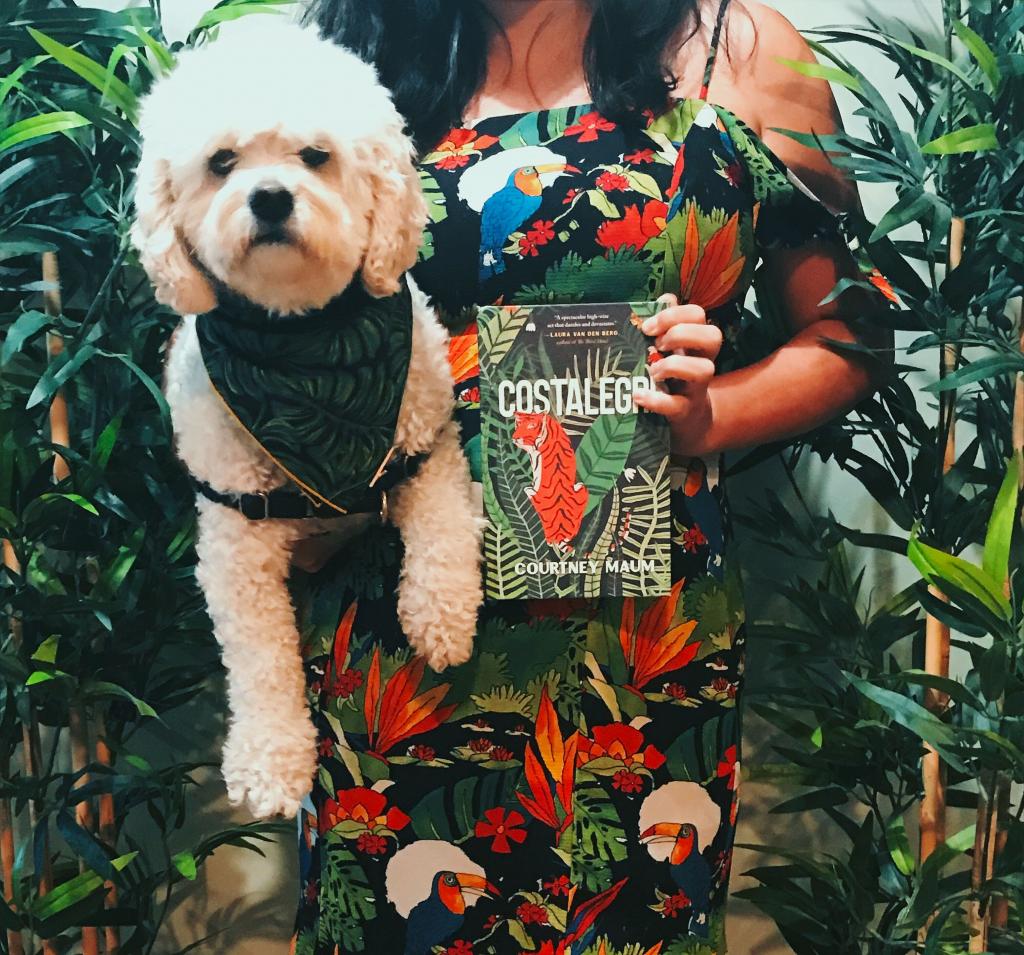
Dog-in-Resident Billy and his personal assistant are so ready for their tropical vacation. Why be an office dog when you can be a beach dog?

Contributing editor Jennifer Baker dazzles as the 2019 PW Star Watch Superstar! #ShineBrightLikeADiamond

Jess’s sister Sam coincidentally happened to text her this picture while we were writing this. Everyone should always color-coordinate their outfit to match the book they’re carrying!

Queers Love Comics, and “Grease Bats” Loves Queers

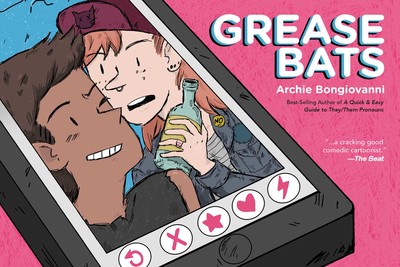
When you meet Archie Bongiovanni, you may feel as though you already know them. The jorts, the stick-n-poke tattoos, the larger-than-the-room laugh that means you always know where they’re standing. That’s because Bongiovanni’s incredibly endearing energy winds up all over the page in Grease Bats, their new slice-of-life graphic novel released by Boom! Studios. Bongiovanni has been drawing the comic strip that became the book, which features a group of queer and trans friends friending around a fictional Minneapolis, for more than five years on Autostraddle. For three of those years, I was their editor, which means I had a lot of questions. I recently caught up with Bongiovanni to chat about the experience of capturing the beating heart of a community on the page. We talked about the magic of trans cartoonists drawing trans characters, the superpower of fiction in addressing problems within marginalized communities, and why so many queer people seem to be so into comics.

Grease Bats

A.E. Osworth: Can you tell me how the idea or inclination for the comic strip that preceded the graphic novel Grease Bats came about?

Archie Bongiovanni: I wanted to draw a story that felt reflective of my life at the time. I first started drawing the story-in my twenties, often drunk, probably horny, making some awesome decisions and the occasional messy ones, showing up for your friends and allowing them to show up for you, here in Minneapolis. I basically conceived Andy and Scout the day after Autostraddle (and you) asked if I’d be interested in a monthly comic. 

AEO: If that’s the case, what made you decide to tackle something fictional, rather than something autobiographical? 

AB: I was working on a lot of personal zines at the time and wanted something fun and reflective of the community I was around. I wanted to play with the dichotomy of two very different characters who loved and adored each other, but ultimately have pretty different personalities. 

AEO: And fiction allowed you to do that in a way memoir didn’t?

AB: Yes, it allowed me to use moments from my life, but I got to play these moments out in characters who’d sometimes react differently than I would have! I got to play with things that happened to my friends or the idea of something—like queer karaoke being canceled because queers were too broke to sustain it at the bar.

Grease Bats allows for nuance; the characters are meant to showcase our variations, not our monolithic identities.

AEO: Was there ever a time you used the power of fiction to address something in the queer community that would have, if you had addressed it in nonfiction, resulted in more resistance? I’m personally thinking about the extreme “cancel culture” that marginalized communities sometimes engage in when it comes to policing their own, but you can take this question in any direction.

AB: I like this comic, which is ultimately about empathy, because so many of my characters feel differently about different things, and it’s not always a clean wrap up but it does end in some understanding and patience for the other. Grease Bats allows for nuance; the characters are meant to showcase our variations, not our monolithic identities. 

AEO: One of the superpowers that I see in your comics is that someone will do something kinda fucked up, and maybe even another character will yell at them for it, but I’ve actually never seen a reader say they hate a character for doing something imperfect. Has that been your experience?

AB: Yup! I think my characters are (at times) really frustrating and frustrate each other and that is the truest thing of life. My pals frustrate me at times, and I know I annoy them at times as well! I’ve done some real dumb shit and there’s a balance of calling someone out on acting carelessly while also allowing them the time and space to act better in the future. And apologizing! My characters apologize to each other all the time. And I think readers like that, knowing that we all biff it sometimes and allowing for the folks we care about to biff it too. We’re imperfect, but learning. My chosen family is family, meaning at times we have the power to really hurt the other’s feelings but we also have the power to push through it together! 

AEO: I want to dive in on genderqueerness if that’s okay. Is that something you’re comfortable talking about?

AB: Yes please!

AEO: As a reader and as a person who edited you for many years, I feel this incredible power radiate from watching a genderqueer artist render a genderqueer body on the page. What does that experience feel like for you? Empowering, totally mundane? Do I have a Romantic-Capital-R notion of this that is entirely unfounded?

AB: Oh it is awesome. I love drawing Andy being over-emotional when being called “sir” at a restaurant then having a crisis because that still means they’re being misgendered. I loved drawing the chapter “A Case of the Floppies” where Scout tries to distract Andy from their dysphoria by playing skeeball. It lets me draw these experiences I have authentically and non-academically, with a good dose of humor.

AEO: What do you mean when you say non-academically?

AB: So much trans and genderqueer discussion is serious. I get to draw it in a way that’s yeah, serious, but also playful! I love being genderqueer, it really comes from a playful relaxed place for me now.

So much trans and genderqueer discussion is serious. I get to draw it in a way that’s also playful!

AEO: Was that the case for you when you started drawing Andy? Or was that something both you and Andy grew into together?

AB: Oh for sure, I was just starting to come out as genderqueer. When I first started this comic, I didn’t go by Archie. And it was definitely something that I got more and more confident in. And I love Andy’s sense of genderqueerness, their love of painting their nails and micro-jorts and crop tops and they really give themself the space to Be Themself. I like that about all the characters. They allow space for them to just be their authentic selves and encourage each other to do the same.

AEO: Is there anything difficult about drawing Andy? And does that come from their particular place in the gender galaxy or from somewhere else?

AB: Andy is honestly the easiest for me to draw because I think and feel so much like them.

AEO: Who’s the hardest?

AB: Gwen and Taylor! I think Taylor is hard because they are the newest character and I have to make sure I’m checking myself about drawing them as a whole character and not just a person in grad school. And Gwen is hard because she is often, by the fault of me and also almost all my other characters besides Ari, put in a caretaking role, which is very reflective of femme folks in queer circles and isn’t fair to them or to Gwen.

AEO: I’m trying to come up with the right question about Gwen, and her femme-ness being exploited as caretaking, and I’m having trouble phrasing it. I want to acknowledge that the struggle is because I’m not femme. Something about whether you feel the need to disrupt this huge flaw in the community, that we often treat femmes as caretakers, or if you want to hold the mirror up to it and represent it accurately?

AB: I think it’s that I feel the need to challenge it and I haven’t had the confidence to draw that comic yet. It’s a little bit because I’m not sure I’m the best one to do it. I try and draw a lot of comics where Gwen is JUST Gwen, but there are chapters like The Job Hunt where she leans into caretaking. She def pushes back though, as seen in Astrology Is Real And Meaningful.

Andy (dark skin, mullet, tank top that says "Pony Play"): I'm sorry, I'm being a jerk, aren't I?
Gwen (light skin, short hair, hoop earrings and choker): Yup.
Andy: I don't mean to discredit this stuff.
Gwen: Yet you continue to do so.
Andy: I totally respect your believe—I DO! It's just HARD for me to believe in anything. EVERYTHING I've ever believed in—from religion to parents to politics has managed to turn against me, my identity, my community. And now I'm just an empty husk of a human believing in nothing but death.
Gwen: ANDY.

AEO: Because it’s fiction, does that mean you can talk about stuff that isn’t necessarily your experience? Is that one of the superpowers of fiction? I always struggle to answer this question myself! I am always mad when a cis person writes a bad trans character. And I’m reading it and thinking, just let trans people tell their own stories! But then I am also mad when a cis author doesn’t even give it a go. This is a real, earnest, hard question to which I am not sure there is a correct answer

AB: I don’t know if there’s a “correct” answer either, but there’s a way I try to guide my work so it has the diverse cast that’s needed to tell queer slice-of-life stories. I cannot forget where I am coming from and how that limits my lived experience and the privileges that come from it. But also, empathy is critical here, empathy and listening. I listen and believe my friends of different lived experiences where their life has challenges and their identity results in assumptions that I wouldn’t face myself.

Also if someone has written a bad trans character I’m always like…do they have trans friends? 

AEO: That answer is almost always no, but it’s not never yes.

So speaking of all these other characters that are a bit harder to access, you mentioned that when Autostraddle first asked you for a monthly comic, you scoped out Andy and Scout first. But in the intervening years and specifically in the graphic novel collected version, the cast got much, much bigger. Can you talk about why it started out with two and why it expanded?

AB: It started out as two because I didn’t trust myself to draw more than two characters and have an audience care about them, especially when the comics only appeared once a month. I was real nervous about new characters but I WANTED THEM so badly. But in my mind I was like “readers won’t care or they’ll forget the next time a comic comes out.” I was wrong on all accounts! I want to introduce more characters soon!

AEO: Do you feel comfortable giving us a teaser?

AB: I want to draw Scout’s new girlfriend and have her be a part of the comic!

AEO: Topic change! Perhaps it is because I came to comics as an adult, but it is my perception that queer people love comics or are more likely to love comics than any other subset of folks. Indulge me in my probably-inaccurate presumptions for a second, do you think that’s true? Is that your experience?

Queers love comics! A lot! I think because it’s an easy medium to see yourself reflected in.

AB: Yes! Queers love comics! A lot! I think because it’s an easy medium to see yourself reflected in, unlike television where there’s SO many people that are involved to dilute or change the story. Perspective comics are often just one person drawing in their studio. And it’s an affordable medium as well.

AEO: Is there anything else you want the folks at home to know?

AB: That Minneapolis fucking rocks! Or at least the queer community here does! 

AEO: Oh my goodness, yes, we didn’t talk about the role Minneapolis plays in the graphic novel! I think it’s often overlooked, but this is an explicitly midwestern queer story. Can you expound upon that a little?

AB: Minneapolis is so active and so busy and there’s so, so many cool people here doing the raddest stuff. There’s the most talented artists and activists that I am privileged to be among! All of the events that happen in the story are based on Minneapolis events (except the ’90’s lesbian floral witch party, that was D.C.).

AEO: That was a real party? Who threw that party? Do we know them?

AB: I was in Brooklyn at a queer event and someone was talking shit about Brooklyn and how the queers there suck compared to Manhattan and they were like “know what I mean?” And I was like not at all, I’m from Minneapolis, and she was like “oh no then you have NO idea about queers then, NONE.” It’s so dismissive and does such a disservice to all the queers working real hard in mid-sized cities or rural areas or basically anywhere that isn’t a gay hub. A lot of praise gets given to queer cities like San Francisco and Portland and the like, and that’s rad, but queer history and community is everywhere and it’s just as vibrant and vital (and sexual and fun!) as anywhere. 

Also I do not know who threw that party. But I did get a giant hickey at that party.

Dawnie Walton Says Trash TV Might Actually Help You Write

In our monthly series Can Writing Be Taught? we partner with Catapult to ask their course instructors all our burning questions about the process of teaching writing. This time, we’re talking to Dawnie Walton, who’s teaching an eight-week fiction workshop at Catapult’s New York HQ. From rigorous, collaborative group feedback to readings by writers who have mastered the trickiest elements of fiction, this course will inspire you and renew your commitment to your work.


What’s the best thing you’ve ever gotten out of a writing class or workshop as a student?

My favorite workshops have all had one thing in common, and in some ways it puts me in mind of the “yes, and…” rule at the heart of improvisational comedy: Everyone in the circle embraces the core terms of your story—its style/genre, for instance, or the makeup of its central characters—and from that standpoint they help you refine and build. Any critique, then, is a nudge toward clarity and the development of meaning, toward more ambition and audaciousness within the context you’ve provided. I’ve left a workshop like this feeling tingly with possibilities, and raring to get back to work. 

What’s the worst thing you’ve ever gotten out of a writing class or workshop as a student?

I really resent when a workshop harps on relatively small, easily fixable problems (an obvious mistake in math, for example). Bringing such an error to the writer’s attention is helpful, of course, but piling on to the degree of mocking is petty. It’s also a failure of the instructor to keep the workshop on track.

What is the lesson or piece of writing advice you return to most as an instructor?

You don’t need to stick to a detailed map or even have a destination in mind before you sit down to start the damn story.

Here’s a goodie from my years yearning to write fiction but intimidated by the how of it: You don’t need to stick to a detailed map or even have a destination in mind before you sit down to start the damn story. It’s okay not to know what you’re driving toward—in fact, I’ve found the not-knowing can lead to more natural narrative movement and open the possibility of characters ending up in those “surprising, yet inevitable” places. (The twin lesson, of course, is that writing is re-writing—the first draft, though very educational for you, will probably be a glorious wreck.)

Does everyone “have a novel in them”?

No, and that’s fine! There are so many beautiful ways to write that story percolating inside you. Maybe you bear down on pieces of it in short fiction, or refract it through poetry, or directly address it via memoir… The point is, you can find the form that feels right for you.

Would you ever encourage a student to give up writing? Under what circumstances?

Give up writing, period? Never. But I might suggest taking a break from one challenging project in order to regain perspective and/or mental health. (Even then, I’d recommend the student write something else, something joyful and untied to expectations, to stay inspired and in practice.)  

What’s more valuable in a workshop, praise or criticism?

It depends where the writer is in the process. Personally, I find praise to be most helpful during early drafting—as in “This knocks me out; give me more of that, please.” In later drafts, when a story has a more definite shape and direction, I’m most interested in criticism about what feels extraneous, what impedes propulsion, etc.  

Should students write with publication in mind? Why or why not?

My advice would be to write thinking not of publication, per se, but of your intended reader.

No… but it’s complicated. Most writers (myself included) dream about our work finding a home beyond our own laptops, but I’m hesitant to say writers should be worrying about anything except developing their singular voices. So my advice would be to write thinking not of publication, per se, but of your intended reader—not whoever you imagine to be on the other side of Submittable, but the audience for/about whom you are writing. If you come out of that process with a piece you feel proud to claim, a piece that makes sense to your readers while also engaging their brains and their hearts, you’ve gotten as close to publication-ready as is in your control. 

In one or two sentences, what’s your opinion of these writing maxims?

  • Kill your darlings: Yes, if they are gumming up the works (and c’mon—in the pit of your stomach, you know when they are!). But save those lil babies in a separate file; just because they don’t belong in a particular story doesn’t mean they’re not beautiful, and you never know how they might serve you later.
  • Show don’t tell: Both showing and telling are necessary. My general rule of thumb has been to show what I want the reader to remember, and to tell relevant supporting details. 
  • Write what you know: …and then dig deeper.
  • Character is plot: I doubt it’s true for everyone, but for me, extrapolating on a character — what X type of person might do in Y situation — has always helped generate plot for me.

What’s the best hobby for writers?

I find the visual arts so inspiring, especially photography. When I’m at a gallery or museum studying a portrait, I’ll often hold off on reading the adjacent description—it’s fun making up the story behind the still.

But I also love watching TV, prestige to pure trash. It helps me process modern culture and politics, which are generally central to my work.

What’s the best workshop snack?

I know I’m supposed to prefer something that doesn’t make much noise or mess, but I would be a liar if I did not pledge my fealty to the kettle chip. (There’s an art to eating them discreetly, I swear.)