William Wordsworth Saves the Internet

About the year 1700, in London and other spots in the West, there was a lot of excitement about a new mode of communication, where information came so rapidly that people imagined they were interacting with each other in a virtual space. Fueled by new technologies of cheap paper-making and mass printing, and enabled by laws that permitted the spread of information, hundreds of newspapers, broadsheets, magazines, and little bound books were suddenly on offer. In this world of print, people could interact freely on topics ranging from politics to winemaking to books they liked. There were many names for that imagined space, and one really good one that eventually emerged was the beautiful-sounding phrase, the republic of letters

For the people of this time, the word “republic” was understood in its original Latin meaning—literally “thing” belonging to the “people”—but in an age of ever-stronger monarchies, the word had a sense of rebellion and subversion to it, too. As some modern social historians, such as Jurgen Habermas, have said, the imagined democracy of talkers eventually produced actual ones. But these virtual spaces also invited all sorts of ways to waste time, share rumors about celebrities, and make nasty comments about other members of this republic. In other words, this was the beginning of the internet—not the internet of wires, wireless signals, HTML interfaces, and screens, but the internet of information and interactivity. Habermas, as well as dozens of cutting edge social scientists and theorists of mediated communication, would say that in fact the older virtual space of the 18th century was not only as fully interactive as it is today, but actually had a bigger impact on politics and society. 

https://upload.wikimedia.org/wikipedia/commons/4/4a/Gentleman%27s_Magazine_1731.JPG

Information in the 1700s could spread incredibly quickly, and there was almost no limit on the sorts of things you could read about.  For instance, in the Gentleman’s Magazine of 1736, there were stock prices, death notices, weather, ship landings and details on their cargo, high tide, low tide, news, speeches in Parliament (transcribed from memory!), and most popular of all, tales of domestic disputes, adultery, murder and the adventures of handsome highwaymen upon the public roads. All this in one paper, and usually within mere days of the event, sometimes hours. If that wasn’t fast enough, you could get news of a fire at midnight, or a shipwreck of the morning earlier by means of broadsheets, large single sheets of the hottest, latest news hawked by young boys roaming the streets of London at all hours. And the reach of the virtual space may have been broader than it is today.

The reach of the virtual space may have been broader than it is today.

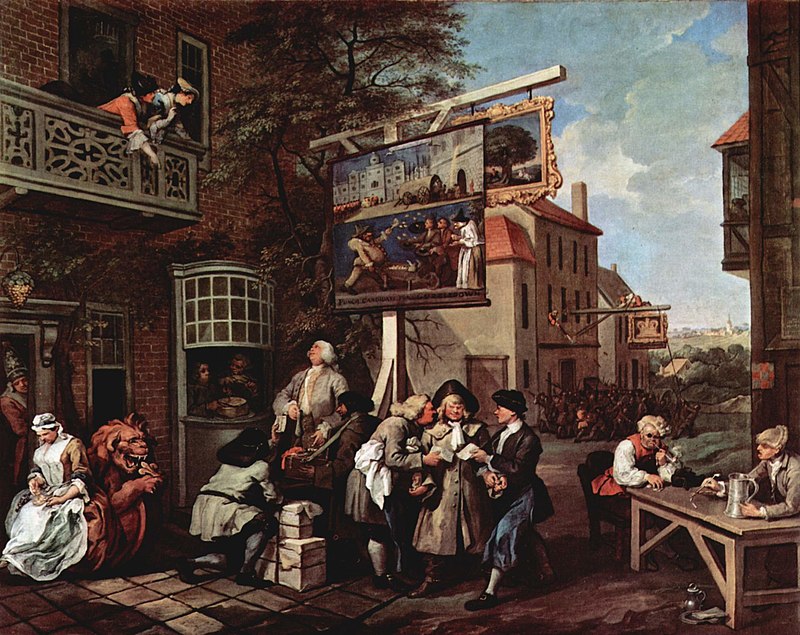
The accessibility to information was widespread, reaching all social classes (including illiterate people—who made up about 40% of the population).  If you couldn’t afford a broadsheet or you couldn’t read, often someone from your family or neighborhood would bring a Gentleman’s Magazine or Spectator home and would read it out loud and in public places. Locals grew fond of those readouts and went to certain spots in the city to hear the latest.  In Paris, as the historian Robert Darnton has shown, the news was sung daily under the famous Tree of Cracow, and so both literate and illiterate were caught up every day. And in comparison to today’s short-form communication, which both caters to and creates ever-shorter attention spans, conversations did not just come in the form of sniping, but also in vigorous discussions in salons and coffeehouses, in a bewildering range of genres. Looking in the Gentleman’s Magazine or the Female Spectator (published by the leading critic and torrid romance novelist Eliza Haywood), you see political and social commentary in poetry, songs, limericks, articles, dialogues, and letters to the editor numbering in the hundreds. Many of the debates—say, over whether Shakespeare was appropriate for children, or whether slavery was a sin upon all of society, or the growing scourge of addiction to gin, or election tampering—were quickly adapted in different forms, including children’s books, abridged and simplified editions sold for pennies, or lurid visual prints. Just take a look at the open-air bribing going on in William Hogarth’s hugely popular artworks, “Gin Lane” and “Canvassing for Votes”:

Hogarth's "Gin Lane," an engraving of a chaotic urban street scene
William Hogarth's "Canvassing for Votes," a painting showing opposing politicians both trying to bribe the same man

As the 18th century went on, the stream of information got faster but it also got deeper, as conversations along the virtual highways and byways became more serious and more substantial. Following the major periodicals of the time (which numbered in the thousands), you see fewer death row confessions, fewer tales of insane asylums and highwaymen, and more theorists, critics, scientists and philosophers taking to the new medium. People like Benjamin Franklin, and the philosopher and cultural critic David Hume appeared in the pages of these publications, followed by the philosopher of “sentiments” and economics Adam Smith, the brilliant educator and women’s advocate Mary Wollstonecraft, and her friend Thomas Paine, and even neo-conservatives like Edmund Burke. They all wrote their books and did it well, but they also went directly to the public by publishing in periodicals, writing neat little essays, publishing life hacks (Franklin’s almanacs), and writing hundreds of opinion pieces and reviews (Wollstonecraft’s day job). These publications could be in the public’s hands within days, and that included writing, typesetting, illustrating, printing, advertising, and finally selling. The turnaround time for an idea to become published writing beat most print matter today, and the spread of news through yelling, singing, gossiping added another dimension of speed, urgency, and drama to the words sent around. 

But as the stream became a river and the river became a torrent, people were seriously starting to worry. By the 19th century there were concerns about the spiritual and physiological effects of getting too much information too quickly. For instance, Henry David Thoreau wrote this in his famous book On Walden Pond

Hardly a man takes a half-hour’s nap after dinner, but when he wakes he holds up his head and asks, “What’s the news?” as if the rest of mankind had stood his sentinels. After a night’s sleep the news is as indispensable as the breakfast. “Pray tell me anything new that has happened to a man anywhere on this globe” — and he reads it over his coffee and rolls, that a man has had his eyes gouged out this morning on the Wachito River; never dreaming the while that he lives in the dark unfathomed mammoth cave of this world, and has but the rudiment of an eye himself.

This sort of thing is what drew him to his refuge in the cabin by the pond. People were plugged into the global torrent of information but missing out on the voices of actual streams, rivers, and lakes, the deep and rich voice of a forest breeze, and the chance to have a conversation that didn’t have something to do with the war we were in at the moment or the daily foibles of whatever city, state, or federal administration was in power.  

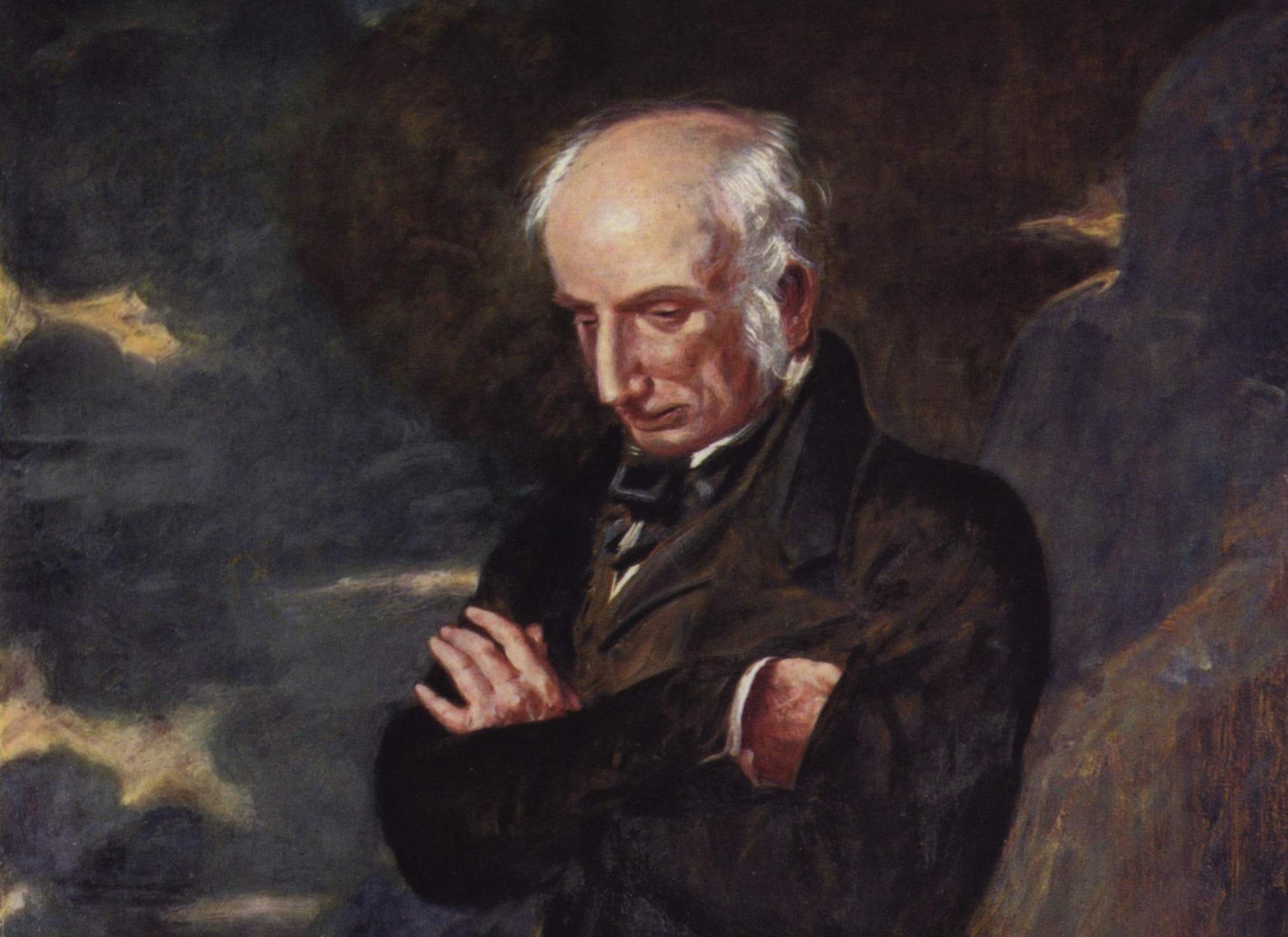
The best lines that I have read about the issue are by William Wordsworth, in his tremendous poem, The Prelude, an endless piece which traces how the young boy gathers a lifetime’s worth of strength and wonder, first by wandering in nature, then by understanding the deep generosity of friends and a brilliant sister, and finally by heeding the lyric of his own mind. At one point Wordsworth is reminiscing about the early years of the French Revolution, after the first flush of excitement and possibility. In his recollections, he had begun to lose faith, as early excitement about the fall of the ancient system turned to anxiety about the increasingly violent politics of Paris. Wordsworth remembers one fellow in particular, whose life was in disarray, and perhaps in danger, too, but in his quandary, he wasted even more time, so to speak, online:

His temper was quite mastered by the times, 
And they had blighted him, had eat away
The beauty of his person, doing wrong 
Alike to body and to mind: 
[…]
A ravage out of season, made by thoughts
Unhealthy and vexatious. At the hour, 
The most important of each day, in which 
The public news was read, the fever came, 
A punctual visitant, to shake this man, 
Disarmed his voice and fanned his yellow cheek
Into a thousand colours, While he read,
Or mused, his sword was haunted by his touch
Continually, like an uneasy place
In his own body. 

The pathetic fellow he’s talking about is a royalist who’s been sidelined by the Revolution of 1789, waiting at an undisclosed location with his other friends, yearning for a chance to go back into Paris and do something, anything to stop the course of this chaotic revolution. The young men hang on all the latest news, which is delivered daily by a messenger. All he can do while listening is finger the butt of his sword. Being exposed to the news daily, and then subject to the feelings that the news arouses in him has altered his face, his posture, and his mind. He is visibly changing before Wordsworth’s eyes. He is obsessed by the information, and as he ingests it, he diddles his sword, a metaphor for the potential snuffed out by an obsession with information rather than a commitment to action. 

It is an internet beneath the internet, the space of cultural memory and its primary vehicle, poetry.

But what is Wordsworth’s alternative? Strolling through the forest and dreaming about lyrical things? This would be the clichéd version of Wordsworth, the quintessential Romantic, a version that is so wrong in so many ways. I think Wordsworth is leaving another alternative on the table, a kind of access to another web, a deeper web, the oldest virtual space of all. It is an internet beneath the internet, the space of cultural memory and its primary vehicle, poetry. But rather than use poetry in its classical function, Wordsworth intended to create a poetry of the people, listening to common folk and attempting to capture their accents and stories in a stripped down, sweetened poetry. Lots of scholars and others in the expert class say he failed at this, and that all he did was rarefy what was already a rich and colorful canvas handed to him by the brilliant, contentious, visceral eighteenth century. Maybe yes, maybe no. But Wordsworth and poets like him, including William Blake, Charlotte Smith, and Coleridge, did show a way forward for the internet of their time—a way of listening hyper-attentively to what was local, different, and personal and letting those voices crowd out the automatic, the updated, and the urgent. In The Prelude, Wordsworth has a grand vision of what poetry can be, and that’s certainly not a droopy, musing, self-indulgent expression of “feelings,” in which people with the strongest feelings make the strongest poetry, which is utter nonsense. Poetry for Wordsworth is the exercise of the body and mind, where words embody exploration and then words become the chunks of sound and sense that the poet sculpts into everlasting, lovely shape. All through The Prelude, William is climbing, swimming, horseback riding, chatting all night with strangers, walking the charged air of Paris during the Revolution, crowding the entrance to Parliament at a protest, walking the long sands of Wales and Cornwall, reading with a mind on fire, and thinking deeply about how all this can bring him into communion with us as we read him. That’s what he brings to the table in contrast to a resentful young man playing with the handle of his saber. 

Wordsworth wasn’t the only one to attempt to save the public space for richer conversations, nor was he the most committed to following the truer voices of the people. Poets such as William Crabbe, who had spent their lives ministering to the working classes out in the sticks, dedicated long, beautifully wrought work to their experiences. A poem like The Village shows the possibilities of talking very concretely about lives far outside the glamour of London society: 

Thus groan the old, till, by disease oppressed,
They taste a final woe, and then they rest.
Theirs is yon house that holds the parish poor,
Whose walls of mud scarce bear the broken door;
There, where the putrid vapours, flagging, play,
And the dull wheel hums doleful through the day;
There children dwell, who know no parents’ care,
Parents, who know no children’s love, dwell there;
Heart-broken matrons on their joyless bed,
Forsaken wives, and mothers never wed;
Dejected widows with unheeded tears,
And crippled age with more than childhood-fears;

It’s not just that Crabbe’s poetry proudly avoids the musing, lazing, privileged perspectives of the famous Romantics, nor that he’s writing about the poor. Plenty of people wrote about the poor and, to keep on my rant about the power of the 18th-century “internet,” plenty of working class people were read very widely in British and American magazines. Crabbe, writing late in the century, still expected there to be the virtual space of The Gentleman’s Magazine and the periodicals by freshly minted commentators like Eliza Haywood in 1750, or in the vein of the bold new political writers like Mary Wollstonecraft in her two Vindications, one for “men” (1790) and one for “woman” (1792). The implication of Crabbe’s literary labor and well-wrought address to readers is that a social message could be couched in the form most attractive to the people of his time, and might change things. But Crabbe could only do this because he himself had been in these spaces, and had felt those feelings, been with those people. Of course, such writers are with us today as well, and they are also available on the internet, but I guess Wordsworth’s and Thoreau’s point was that these voices are always in danger of being crowded out, displaced. None of these worries are new, nor is it new to tell someone to take a break, walk in the woods, talk to real people, unplug. But what is valuable about the first internet is a vision of how complete, how imbued with power and substance it could yet be.

The Women Who Write Themselves Out of the Story

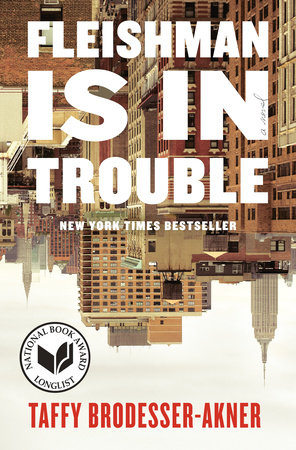
The narrator of Taffy Brodesser-Akner’s Fleishman is in Trouble (2019) first reveals herself, briefly, thirteen pages into the novel. Our protagonist Toby Fleishman—newly-divorced in New York City, encroaching on middle age, fielding an onslaught of dating app messages— discovers that without his ex-wife Rachel he no longer has “a natural first person to tell” the monumental and mundane details of his life. When Toby receives news at work, then, “he thought about calling me or Seth” instead, says our narrator—who turns out to be Libby Epstein, a friend of Toby’s from a semester abroad in college. The dip into first person catches the reader off guard: That “me” —weighty and metallic—hooks into the framework of the novel, anchoring Toby’s story to a specific, subjective presence.

Fleishman Is in Trouble by Taffy Brodesser-Akner

Brodesser-Akner’s Libby exists within a tradition of effaced first-person observer-narrators: Nellie of Willa Cather’s My Mortal Enemy (1926), the collective chorus of Jeffery Eugenides’ The Virgin Suicides (1993), and— perhaps most famously— Nick Carraway of F. Scott Fitzgerald’s The Great Gatsby (1925), to name a few. More specifically, though, she exists within a tradition of writer-narrators who are described as documenting the stories they report, rather than merely speaking out into the ether. Sarah Orne Jewett’s Country of the Pointed Firs (1896) features such a narrator, as does James Alan McPherson’s wonderfully complex titular story from his 1977 collection Elbow Room. These narrators are working: Jewett’s Bostonian narrator relocates to coastal Maine to write sketches of the town’s residents; McPherson’s narrator endeavors to report a story about an interracial couple in the wake of Loving v. Virginia. In having specific writing projects, these narrators slyly assert their productive power. They spin other characters’ narratives, refashioning them until the stories inhabit new mediums. The texts become textiles. Look what I made, these narrators whisper to the reader from behind the page. Look how craftily I tied these threads together.

Libby, we learn, formerly worked at a men’s magazine before acquiescing to stay-at-home motherhood. She stands to the side for most of the novel’s beginning, allowing us to become wholly immersed in Toby’s crisis. Gradually though, her own project becomes clear. She describes a famous story written by the men’s magazine’s “in-house legend” Archer Sylvan, one that she regarded as seminal in her journalist days. The story, titled Decoupling, details the dissolution of a marriage, and we come to understand Fleishman is in Trouble as a reimagining of this fictional text. Libby describes the challenge Archer has posed for her, one that haunts her writerly ambitions:

When I became a professional writer, I tried to write like Archer: that way he had of releasing the valve of his anger slowly, tensely, beautifully so that his vortex of empathy, when sent through the prism of the anger, created a generalized disgust for the state of the world that seemed like the only conclusion a smart, thinking person could come to. 

Libby laments her failure to filter her own empathy through such a prism of anger. “I never landed on anger—” she explains,

I never ended a story there—and I think maybe that was where I failed. My empathy only created more empathy, which sounds good, yes, but was born of inherent cowardice. I was too scared to finish with anger. I was too scared to be wholly disgusted with my subjects… I was afraid to stay angry, to leave it all hanging out there with no resolution. I was afraid of seeming too hateful… only I knew it was actually a failure of bravery and will to be as compassionate as I was. 

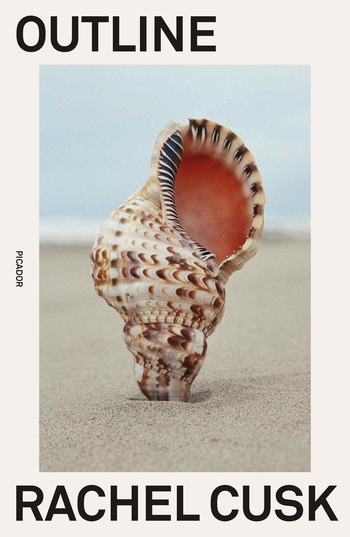
Compassion, when saturated to such a degree, can have the effect of both absolving and obscuring a novel’s narrator. Like Libby, the writer-narrator of Rachel Cusk’s Outline trilogy (unnamed until the novel’s final pages) tends toward obsessive empathy. In the trilogy’s first book, Outline (2014), the narrator sits on a plane bound for Athens, where she is to teach a writing course. She lingers over the flight attendants’ warning about securing one’s own oxygen mask before helping others: “No one protested, or spoke up to disagree with this commandment that one should take care of others only after taking care of oneself,” she observes. “Yet I wasn’t sure it was altogether true.” The metaphor goes on to govern the remainder of the novel: The narrator privileges her colleagues’ stories over her own, her patience and earnest interest luring their confessions to the surface. Meanwhile, she safeguards the story of her own marital collapse, rarely offering up details unprovoked.

Outline

Through their narrators, Brodesser-Akner and Cusk explore a type of empathy that is perhaps—historically, over-simplistically, binarily—specific to women. It’s an empathy that borders on martyrdom. Should a mother really leave a child or husband gasping for air as she fiddles with her own mask? It’s a test, isn’t it? The worlds of these novels, their authors seem to argue, expect these women to self-sacrifice in the end, to place the masks—doubling as megaphones—around others first. The men cannot be left to suffocate; the things they have left to say are too important. Fleishman’s Libby narrates a scene where Toby’s ex-wife tells him a story of her experience of workplace harassment, and Toby bristles—not at the injustice Rachel has suffered, but at “how not a part of this story he was.” He itches to reclaim his role as protagonist, and for the majority of the novel, Libby lets him. The vortex of empathy exerts its indomitable force.


I go on a date with a conventionally-attractive soil ecologist. The fact that being hot doesn’t gain him anything in his line of work—the fact that he spends his time out in fields alone, his head inclined down toward the earth as though in prayer, the poetry of it all—renders him all the hotter. I imagine he’s aware of his looks, how they chip against stereotype. I imagine it is this knowledge that lends him a sort of stunning confidence. He smooths his facial hair as he tells me about Iowa. He tells me about his lapsed Catholicism. He tells me about his ex-girlfriend in Mexico. He left his bicycle at her place, near where he conducts his fieldwork, and now he cannot reclaim it without risking a confrontation. I listen closely and am not annoyed by any of it. (I’m shocked by how I’m not annoyed by any of it.) He is generous, I decide, holding a magnifying glass up to himself. He invites me to consider him closely, as I would a specimen, and I oblige. 

The man Cusk’s narrator sits next to on her transnational flight is generous in this same way. He tells her about his first wife; he tells her about his second wife. She listens with an near-pathological degree of attention, and she’s caught off guard when, after much pontificating, he turns the conversation over to her. He asks what work she has brought with her to Athens. “I felt the conscious effort in his enquiry,” the narrator explains, “as though he had trained himself in the recovery of objects that were falling from his grasp.”

How freeing, though: to be an object falling from the grasp of a man. 

How freeing, to be an object falling from the grasp of a man. 

The ecologist describes to me the microorganisms present in Mexican topsoil. He explains their massive implications for our greater ecosystem. His work is meaningful, and I am—blessedly—off the hook. I need not flail around for reasons as to why what I do, why my writing, is important. Through his sermonizing, I come to believe that the story of topsoil is the story of all of us. I want to hold a megaphone up to him, to give his words more oxygen. We’re onto our second round of drinks before he flinches in recognition. He’s realized how little he’s asked me and is just the slightest bit ashamed. He tries to recover me as I fall from his grasp. “I’m sorry,” he says, “I’ve been blabbering. What is your relationship to soil?” 

Later in Outline, when the narrator’s seatmate invites her to spend the afternoon on his boat, she leaves him to swim out into the ocean alone. Freed from the threat of enquiry, she articulates the feeling of leaving the rocky shores of her past—the ruins of self-narration—behind:

I felt that I could swim for miles, out into the ocean: a desire for freedom, an impulse to move, tugged at me as though it were a thread fastened to my chest. It was an impulse I knew well, and I had learned that it was not the summons from a larger world I used to believe it to be. It was simply a desire to escape what I had. The thread led nowhere, except into ever-expanding wastes of anonymity.
I, too, have felt that there is something soothing and thrilling in anonymity, in one-sided observation, in hoarding the stories of others. It’s this instinct that has led me to seek solace behind the scrim of fiction-writing. When I took a nonfiction workshop to fulfill my MFA program’s “out-of-genre” requirement, I found myself stunned by the courage of my peers. I don’t think I’ll ever be able to manage it, I thought to myself. This confessionalism. So allergic was I to the idea of writing about my own experiences, I wound up taking various interviews I’d conducted and collaging them into a theatrical script. Perhaps the project was a “failure of bravery,” to borrow Libby’s words, or perhaps it was something more dignified. I’m still not sure. I’m still anxious over what would happen if I were to write about myself. If I were to remain an object held within grasp, orbiting, recursive, every facet reflecting the same dumb parts of myself I’ve come to know too well. How to reorient myself around some foreign axis? I wonder. How to tilt myself so that I resemble something new?


Over the course of Fleishman is in Trouble, Libby struggles to regard her own ambitions as anything worth documenting. “God, what a fucking idiot I was,” she says. “My dreams were so small. My desires were so basic and showed such a lack of imagination… I had been so creative in every other aspect of my life; how I’d turned out so conventional and so very establishment was bewildering.” It’s this paradox that antagonizes the effaced narrator: Is it enough to be a sharp mind and keen eye if every other part of you remains unremarkable? “The women wear these yoga pants instead of regular pants and they yell at their children,” Libby tells her friends, describing moms at Disney World. “And then you realize you’re wearing yoga pants.” Can a narrator justifiably take up space in a story if she’s no less vapid than the subjects she skewers?

I’m still anxious over what would happen if I were to write about myself. If I were to remain an object held within grasp.

Libby’s solution to her basicness is to do away completely with the reductive shell of her body—the athleisure-clad body that resembles every other woman’s athleisure-clad body—and to “[impose her] narrative onto [the narratives of men], like in one of those biology textbooks where you can place the musculature picture over the bone picture of the human body.”

“Trojan horse yourself into a man,” she suggests, mutating the analogy slightly, “and people will give a shit about you.” 

In the last third of the novel, Libby indeed ends up Trojan-horsing not only her story, but also Rachel Fleishman’s into Toby’s narrative. It is important, though, that Libby doesn’t manage to build and utilize Archer Sylvan’s prism of anger; this narrative move is not a mean trick. No tunic-clad soldiers burst out from a wooden abdomen to attack Toby Fleishman. Libby’s choice to cede the last portion of the novel to Toby’s ex-wife Rachel isn’t an act of spite. It is important to acknowledge that Libby and Toby remain friends, that her final act— caring enough about Toby to prophesize his ending— is in fact an act born of compassion. 

It is important to know that I enjoy the company of the soil ecologist. That though we don’t end up together, we do go out again. What is my relationship to soil? I say something about neglecting to wash my carrots well. How I’ve heard it’s good for the microbiome. He nods in approval. It does not matter that this is the closest we might come to understanding one another, to finding common ground. In our own private ways, we’ve both made something meaningful of the encounter—he in the moment, recounting the minutiae of his life to a willing listener, and me, after the fact, spinning the threads of his narration into something new. Something warm that fits me and that I can wear long into the winter. 

“I would start to try again,” Libby promises herself at the novel’s end. “I would sit next to my children while they watched inane television shows and I would smell their heads and allow the hormones inherent to motherhood to wash through me.” In relinquishing her insecurities of sameness, Libby proves her own method of writerly empathy has paid off. She’s managed to let Toby remain a compelling protagonist, do justice to Rachel’s side of the story, and reveal that she herself isn’t as boring as she purports to be. “I would try to find peace with my regular life,” she vows. “Or maybe I would one day see that the regularness was actually quite extraordinary.”
We All Want Ma’s Oven Pan When She Dies

Wishbone

The wishbone would be left to dry on a paper towel by the sink. Visual examination was permitted, but it was agreed one’s back should be against the kitchen island at all times. There would be no touching.

These rules alone took an hour to hash out. Joyce, the eldest of the East Coast siblings, thought they should be allowed to handle the bone under reasonable supervision from the opposing side. She came up with an elaborate schedule of handlers and supervisors, but Lee Kwang, the youngest of the West Coasters, insisted it would be too easy for a supervisor to accuse a handler of having broken the rules. Here the discussion was sidetracked by Betty—East—remarking it was unsurprising Lee Kwang would think that way, given her history of rule-breaking. Voices grew heated, the issue of Ma’s crystal swan figurine with the broken wing raised yet again, the old argument repeated.
She gave it to me, Lee Kwang said. It was a gift.

The East Coasters did not agree. Lee Kwang had broken the swan by accident when she was a child and had felt entitled to it ever since, just because Ma had told her it didn’t matter because she would have it ‘one day.’ When the swan disappeared from Ma’s display cabinets a year into her illness, there was uproar. The East Coast siblings guessed what happened at once, Joyce storming into Lee Kwang’s home uninvited, finding the incriminating swan on her kitchen table. The West Coast siblings defended Lee Kwang’s right to the swan, Ah Boon claiming he had been there when Ma bequeathed it to her.

You would say that, Betty said. We all know you’ve got your eye on the crystal poodle.

Other objects began disappearing from Ma’s flat: the faded watercolour of Venetian canals, a saucepot of delicate porcelain, an old, dusty Turkish lamp. Then things of greater consequence: lacquered side tables, Pa’s calligraphy brushes from when he was a boy, the ancient jumbo rice cooker that no longer worked but which Ma had kept for sentimental value.

The seeds of the rift had been sowed decades ago, before any of them had been born. The year was 1965. Singapore, independent at last. The newly installed government was on a spree, shutting down Chinese vernacular schools under the guise of beating Communism, setting up new English-medium ones in the name of new a nationalism. Ma and Pa were practical about things. Half of any children they had would be sent to the former, half to the latter. They would alternate: English, Chinese, English, Chinese, and so on. Six children later, the family was evenly split down the middle. And so, the East and West Coast divide was born. It would only be decades later that the divide would be named as such, the English-educated siblings having left their childhood neighborhood and moved to wealthier enclaves by the sea.

As they squabbled over weddings and money and perceived slights, the siblings still gathered each Sunday in Ma’s flat, the one-bedroom she’d moved into after Pa had died. For a couple of hours, they’d put their differences aside, sit around the large circular table laden with garlicky greens, fish steamed in chili and ginger, strips of pork belly that dissolved obscenely on the tongue. The siblings sat at their usual seats, steaming mounds of rice before them. They waited. Then, Ma would emerge with the oven pan, hands enormous in padded oven gloves, small biceps straining. It was her signature dish: a perfect, golden chicken. Skin done to a salty crisp that crackled between the teeth, tender white flesh that yielded its juices when prodded with a fork. The oven pan—red, cast iron, painted with scorch marks from years of chickens—was the very item the siblings were arguing over now, now Ma was far enough gone she no longer remembered their names or how to operate the stove.

The wishbone was dry and the visual examinations complete. It had come from a store-bought chicken they’d shared in surly silence. Each side picked their representatives: Joyce for the East, Lee Kwang for the West. Whoever won would get to choose first, thereby carrying off the the oven pan, the ultimate prize. The oven pan, of course, wasn’t the only thing up for grabs. From then on they would alternate: Ma’s favorite mug, the apron she wore when cooking, her gold reading glasses on a chain. Chairs with their threadbare seats. The stained dining table itself. The whole flat needed to be cleared out.

Joyce and Lee Kwang took up the bone. A shiver went through them. Reminded of all the times in their childhood they had assumed these very positions, arms outstretched, linked by the fragile joint. Reminded of what Ma had once told them: the wishbone held a bird’s clavicle together, pliable but strong, essential for flight.

Leslie Jamison Is Hauling Out Her Emotional Baggage

In Make it Scream, Make it Burn, Leslie Jamison returns to the essay form that first brought her to literary fame.

Buy the book

After graduating from the Iowa Writers Workshop, Jamison published a novel The Gin Closet. But it was her second book, The Empathy Exams, that won Jamison widespread acclaim. Debuting on the New York Times bestseller list, the collection of essays was praised for its unique blend of memoir, journalistic writing and criticism. Her follow-up memoir, The Recovering: Intoxication and Its Aftermath, explored her alcoholism and sobriety alongside popular narratives of recovery.

The 14 essays in her most recent collection reflect evolutions in Jamison’s interests and personal life. The subjects of the essays range from reincarnation to visiting post-war Sri Lanka to marriage and pregnancy. But across them all, Jamison returns to what anthropologists would call a stance of “self reflexivity.” Her book constantly asks what is the relationship of the researcher (or writer) to her subject? How does this relationship act upon and inform the subject, the writer and the writing itself?

In our email exchange, we dove into how the tools of fiction shape her essays and how profound meaning can—and indeed must—be found in the day-to-day.


Raksha Vasudevan: The book is divided into three parts: “Longing,” “Looking,” and “Dwelling.” As the book progresses, the essays become much more personal, with the last section exploring your grandfather’s death, your marriage, and pregnancy. How and why did you decide this time to begin with phenomena in the larger world, and then turn towards your own life?

Leslie Jamison: The flip cocktail-party answer to that question is that I was sick of myself and wanted a break from my own life—or at least, my life as material. But whenever I teach, I tell my students to dig beneath the topsoil of their cocktail-party answers (I also tell them not to mix metaphors!) and find the messier truth lurking underneath. So here I go, digging: I think that turning from introspection to the world beyond (as I did in The Empathy Exams), turning from the external world back to the self (as I do in this book), or shuttling back and forth between them (as I did in The Recovering, exploring addiction and sobriety) are all ways of illuminating the ways we bring our emotional baggage to the world, and bring the world back to our baggage—the ways we are always seeing other people, other art, even nature itself through the cracked lenses of our aches and longings. 

I tell my students to dig beneath the topsoil of their cocktail-party answers and find the messier truth lurking underneath.

In this book, it felt like a fruitful experiment to begin the collection with some of the longform reportage I’ve been doing for the past five years, and then confess some of the personal reckonings that were informing my reportorial obsessions: How was my interest in digital avatars as a form of escape connected to my feelings about domesticity and starting a family? How was my investigation of reincarnation connected to my broader obsession with the “past lives” of former relationships and the residue of breakups? 

Part of the pleasure of a collection is that you don’t need to spell out all these collections; you can let them live—and remain multiple, generative, simultaneous—in the arrangement itself. For the essays that were previously published, almost all of which were substantively revised anyway, I believe they become something differently layered when they are put in the echo chamber of the collection—in conversation with other pieces in this way. 

RV: The essay from which the collection takes its name focuses on James Agee’s “Let Us Now Praise Famous Men,” a book about tenant farmers during the Great Depression. You remark that the author himself “is tormented about what it finds beautiful”—something that could be said of you, the narrator in this book, whether you’re writing about your own body, a woman you meet on a layover who at turns irritates and moves you, or a museum dedicated to objects from failed relationships. Is it possible, in your opinion, to find (and write about) something beautiful without feeling some torment or ambiguity about it? 

LJ: It’s funny; I’m typing my answer to this (very smart!) question as I sit in a park near my home, with my first childcare in a week, watching a man slowly unfurl and then fly a kite bearing the Jamaican flag—green and yellow and black and red—with a long trail spelling J-A-M-A-I-C-A, and I was freshly struck by the primal awe of a kite: how it satisfies some deep human impulse, something slightly beyond language, to make something FLY. It does what we can’t.

I found myself speculating about this man’s story—fiction-writer at heart, always, I’d rather wonder than ask him—and whether he misses home, whether that’s why he’s flying this kite; why he’s alone on a Sunday afternoon (as I am, too). Point being: I can’t seem to find a way of encountering or writing about this beauty without somehow providing the chiaroscuro of darker tones: homesickness, aloneness. Why is that? Why does beauty invite torment or ambiguity? There’s an aesthetic imperative here, sure, some version of Newton’s Third Law of Motion: For every beauty, there exists an equal and opposite force…That somehow it would be unsatisfying or too easy to simply let beauty stand unencumbered; that it requires some darkness to be compelling. But I think it’s ultimately about honesty rather than aesthetics.

When I’m finding the pain in the beauty—the heartbreak underneath the beautiful relics of love, the difficult and messy real lives behind the glossy online paradise, the residue of civil war lurking behind the Sri Lankan tourism industry—it’s less about craft, and more about recognizing that essential truth: No beauty exists in isolation. It’s all dappled with pain like shadows on grass. 

RV: In the essay about Annie Appel, who kept returning to Mexico to photograph a family over 25 years, you make this observation about artists like her: “photographers who take ordinary people as their subjects and insist on the importance of their ordinary lives.” Was that also a guideline for choosing the subjects of this collection? Has this imperative—to center “the importance of ordinary lives”—changed over the past few years, in light of recent political events (where “extreme” characters and views garner much of the attention)?

LJ: It’s certainly part of what compelled me about Annie’s work—that her photographs document an ordinary family, and that everything that feels infinite about her work is a testament to the infinitude of any given ordinary life. I believe in that infinitude absolutely. That’s certainly part of why I find myself documenting regular folks—regular folks obsessed with a whale, regular folks creating online lives, regular folks donating their toasters to a Croatian breakup museum. It’s an idea that was at the core of my last book, too: The Recovering explores how “ordinary” stories help people stay sober not despite their ordinariness but because of it.

It seems like we’ve accepted the premise that fiction can be about ordinary lives—and still hold meaning, profundity, etc.—much more readily than we’ve accepted it in nonfiction, where there’s still some idea that it’s hubristic to write about your life if you haven’t, like, died in six car crashes. I think it’s fascinating to put this idea—about the significance of ordinary lives—into a political context: so many politicians appeal to the “common man,” or position themselves as his advocate, but you are absolutely right that the news cycle inevitably caters toward extremity. Maybe this is part of the role literary writing can play in the ecosystem of all our cultural narratives: it can direct its gaze toward quieter lives, for more sustained periods, and find their truths, too. 

RV: Another recurring theme in this collection is letting your subjects—even yourself—subvert the narrative you anticipated they would slot into. Consistently, you anticipate certain reactions from yourself and others, and end up with quite different ones. Is this for you the most exciting thing —this subversion of expectations—that an essay can do?  

LJ: I love surprise. I used to struggle with the fact that an ex-boyfriend told me he was “rarely surprised by anything,” which made me insane because I wanted to surprise him AND because it felt like such a cloistered way to live. The comedian Kyle Kinane has a great bit about burning his own laundry and not even knowing it was possible to burn his own laundry, and partway through he tosses off this little bit of earnest profundity that most comedians wouldn’t be caught keeping hidden in their pockets but he just openly owns: “All a miracle is the world letting you know it can still surprise you.” (h/t Mishka Shubaly, a wonderful writer and another guy breaking down boundaries between funny and profound…). It’s so beautiful! And so true! And such a weird, optimistic thing for a comedian to say! In a weird way, the fact that it’s surprising to hear him say it makes it an enactment of precisely what he’s describing. 

In any case, as a writer, surprise is one of my holy grails. I know I’m on the right track when I surprise myself during the course of my reporting/remembering/revising. Often, I like to keep the fossils of my own expectations layered into the piece, so that the surprise is something that the text actually dramatizes, rather than simply a secret history buried inside of it. I like the essay to confess that I thought it was going to be an essay all about my drunk air force pilot grandfather, but it ended up becoming about my suburban father/brother instead…or that I thought I was going to be ruthlessly skeptical about folks with past life memories, but ended up feeling a kind of tenderness toward their beliefs. Illuminating the arc of surprise across a piece is one of the most satisfying intellectual plotlines available to the essay, I think. 

And now the Jamaican kite has fallen to the grass! The man is struggling to make it fly it again, but it keeps falling down—and this, of course, is where the heart of the essay lives: in the falling kite, rather than the flying kite; in the ways the story takes another turn. 

RV: Pain is another theme of both your last essay collection and this one: the ways we bear it, try to escape or ignore it, and sometimes even long for it. In the essay on Second Life, for example, you write about a woman with multiple sclerosis who rides waterslides and another with bipolar illness who rides horses through a virtual Yosemite. But in writing about your eating disorder and your pregnancy, you discuss the relief that these particular types of suffering both induced. What fuels your ongoing urge to write about pain? And what is it, in your opinion, about the nature of pain that births all these diverse reactions or emotions?  

No beauty exists in isolation. It’s all dappled with pain like shadows on grass.

LJ: Yes! This is a beautiful observation. We seek ways to escape pain, but it also—often—offers an ineffable kind of relief. It can consolidate us. Part of that consolidation resides in the fact that we get a sense of ourselves and our edges from pain; we exist in it. But I think it’s naïve and sort of blind to talk too much about what’s generative or appealing about pain without acknowledging that most of the time—and certainly in the most extreme cases—it’s just painful. Randall Jarrell said it pretty well in 90 North: “Pain comes from the darkness / And we call it wisdom. It is pain.” So sometimes you just want to build an online world and ride its waterslides. Or go skinny-dipping at night.

In an essay called “Young Adult Cancer Story,” the wonderful writer (and my dear friend!) Briallen Hopper writes, “pain makes demands, but being felt is not always one of them.” This is an essay about taking care of a good friend with terminal cancer, and living through what they called “The Summer of Care and Delight,” just after her diagnosis: drinking vinho verde, re-watching Mystic Pizza, driving down Alabama backroads with an open bag of hot Atomic Fireballs between them…I love that notion, as a writer and a human being, that we can document pain not only in terms of the price it exacts from us, but in terms of the beauty it inspires us toward. 

RV: Part of what makes your writing so compelling is that you are comprehensively honest about your judgements and thoughts towards situations and characters, especially when those reactions might be considered shameful. Do you think this can ever go too far? That is to say, can an essayist ever be too honest?

LJ: There’s a brief scene in the final essay in the collection—“The Quickening,” which is a piece about pregnancy and anorexia but really about longing and expansion, how and when we permit ourselves those states—where I recount a man in my first nonfiction workshop who said, in response to one of my pieces, “Is there such a thing as too much honesty? I find it incredibly difficult to like the narrator of this essay?” In the piece, I’m using this comment to explore the divide between the “unlikable” woman who is too obsessed with her own pain, and the “likable” woman who is gracefully gestating another life. But it’s also a way of thinking about the shame of being “too much,” a shame that the essay is reckoning with from a thousand directions, and one of the things I’ve been trying to reckon with my whole life: the fear of having too much body, too much need, too much pain on the page. Part of what was fascinating to me about pregnancy was that it felt like a state in which the cultural script finally—for once—not just accepted but mandated that I be “too much”: that I eat as much as I wanted, that I make my body large.

Which is all to say: I’m quite interested in the dynamics of excess, and what it even means to call a narrator or an essayist “too honest.” What veins of discomfort inspire that critique? I’m suspicious of the sweet spot of honesty that grants the texture of revelation without really risking anything. I like Phillip Lopate’s dictum on confessional writing: “the trouble with most confessional writing is that it doesn’t confess enough.” I think often, for me, the material or judgments that feel shameful also hold important truths—which doesn’t mean you disclose them for the sake of disclosing them, but you might be able to follow them to generative insights. 

RV: In all of your writing, your recall of detail—around setting, what you ate, what you and others looked like—is remarkable. Do you keep a diary? Do you keep it with the intention or potential for using the details in your essays?

LJ: Whenever I’m reporting, I take meticulous notes. This partially comes from my background as a fiction writer: I’m obsessed with world-building, visceral specificity, and the small details that pull together a scene or a character: the purple hair scrunchies and bent spoons of this life. The fiction writer who wants to have access to all those details is constantly coaxing the reporter—immersed in the scene itself—to take better notes, so I’ll have it all available to me when I write.

How do we relate to our own longings? How are we defined by the things we don’t have? How are we shaped by our fantasies as well as our realities?

In terms of lived experience, I have kept a diary—inconsistently, but ongoingly—for much of my adult life. I’d say my diary has definitely become less wholly abstract, and more populated with concrete details, over the course of my life. That’s less about intentionally wanting to mine my diaries for details down the road, and more about the ways I noticed that putting down concrete specifics—what I ate for breakfast, what I saw on the side of the highway—meant my diaries captured the world (and even, often, my mood in the world) more fully than when I stayed ruthlessly interior. When I talked to Chris Kraus for Interview Magazine a few years ago, she and I had an exchange about precisely this phenomenon, the impulse to make your diary more exterior and concrete. I loved how she described the diary as a kind of self-reporting: “I realized that a diary is a kind of report—or self-reporting. And if you report, you have to give details.”

And now the Jamaican kite is back up! Higher than it’s been at any other time this afternoon, maybe a hundred or two hundred feet up—as high as a high-rise. And it’s not that I know what it’s a metaphor for—just “things can fly again, even after they’ve fallen?” Could it be that simple?—and more that I’m interested in transcribing it—the kite going up tentatively, coming back down, going up again—and maybe later these details will arrive in service of some question I’m reckoning with. Sometimes it’s liberating to just transcribe the world and let the meaning filter in later. 

RV: In your essay on visiting Sri Lanka, you quote a journalist who says he would only go to Jaffna, the city at the heart of the 30-year civil war if he felt “useful” doing so. This idea of utility runs throughout the collection: the utility of writing and art, of witnessing and telling ourselves stories about what we’ve witnessed. How do you think about usefulness or utility in relation to this book specifically? What purpose do you hope it serves?

LJ: The great anxiety! What good is writing, anyway? Or rather, what good is this writing? How is it useful? There’s a particular kind of utility that the journalist in Sri Lanka was referencing—in terms of active contribution to social justice—that I think it would be naïve to pretend like my literary essays were really making a dent in.

But yes, I think about usefulness. And yes, I hope this book is useful. I hope it invites people to think about certain ideas in new ways: Where do we find surprising sources of solace and community? How do we relate to our own longings? How are we defined by the things we don’t have? How are we shaped by our fantasies as well as our realities? How does it shape us—challenge us, terrify us, inspire us—to show up for daily intimacy? Ultimately, I’ll always be a bit of a romantic when it comes to literature, because I’m such a devoted and desperate reader—I need books. I crave their company. I crave their disruptions. And my belief in the utility of my own work is a function of that craving: If I could just write something that offered some fraction of the grace I’ve felt as a reader, that would be enough.

An Agent Explains the Ins and Outs of Book Deals

Everyone wants to write a book, or to say they have written a book. Publishing a book is still an honor, a point of pride—but like pretty much everything else, it’s also dependent upon a capitalist business model. And the financial side of publishing can be opaque, unfair, and downright contradictory. Combined with the distinctly American habit of not wanting to sully talk of artistry with talk of money, this means that many people who want to make writing their full-time career have no idea how the money part of writing actually works. In this TED talk I will answer some of the most common questions I get as a literary agent about the money side of things. I will try not to make it too depressing. 

Note: this information is based on the American traditional book market, and won’t necessarily apply to other countries, or to self-publishing. 

How much money am I going to get for my very, very good book?

This is the single most common question I get from my clients, and other people when they find out I’m a literary agent, and I respond with a very infuriating “$5,000 to $50,000.” Most times, though, I’m right! I have sold books for both more and less than those amounts, and to be fair, there are many genres where I can estimate a much smaller spread. But the total advance depends on so many things, including the quality of the work, the sales potential of the work (not the same thing!), the author’s platform and/or previous sales, the zeitgeist, the “market,” how many  other editors are interested (if any), how similar books have performed for the publisher and/or other publishers, and many, many other things. Because there are so many factors, there’s no “average” book advance. $1,000 is rare. $1,000,000 is also rare. 

What does it mean when you say “advance?”

Because there are so many factors, there’s no ‘average’ book advance.

A book deal is not patronage for your sheer talent, or even direct compensation for the hours you have toiled to create the book. It is an advance against what the publisher thinks your book will earn. The publisher takes a financial risk on your work. If your book doesn’t sell well, you don’t have to pay it back—the publisher assumes that risk. But you do have to sell that much in books to earn anything more on top of that. 

Oh, is that what royalties are?

Yes, royalties are what you get when you “earn out” your advance. You earn a percentage of each book sale, and that adds up against your total advance. When you earn more than that, you get royalties. Here’s how that works. (Math incoming.) 

A common royalty rate is 10% of the cover price of the book. If your book retails for $25, then you earn $2.50 a book. (There are different rates for different formats and you can negotiate higher royalty rates, to a point.) If you get a $10,000 advance, you have to sell 4,000 copies of the book to earn any more money (10000/2.5 = 4000). There are many books that do not sell 4,000 copies and plenty of books that do. 

When can I quit my job?

You probably can’t! You’ll see why soon.

When will I actually get money?

Your advance will be broken up into several payments, anywhere from two to four depending on how big your advance is, how you negotiate, etc. First, you’ll get a portion after you sign the contract. Having your agent review and vet your contract, signing it, getting it countersigned by the publisher and waiting for the publisher to send your check can take several months. Then you’ll likely get a portion when you are finished writing AND editing, editing again, and editing some more. This could also be months after your contractual delivery date, which could be six months to a year after you sign the contract. You may then get another portion when the book is published, which is almost always about a year after you deliver the manuscript. Even if you got an $100,000 advance, you might get $33,333 when you sign the contract, but after agent commissions and taxes (YMMV), you’ll probably net a little less than $20,000, and you might not get another check for a year.

Sooooo when do royalties checks come?

Royalties are calculated and paid out every six months, but according to a fixed schedule that differs from publisher to publisher. For example, one major publisher sends their royalties out in April and October. The April statement and money (if any) covers books sold from July to December of the previous year. The October statement and payment covers sales made from January to June. Yep! Statements are about 4 months old when you get them.

You have got to be kidding me.

Nope! It’s true! Publishing is a consignment business. That means a wonderful place like Books Are Magic can order, say, 1,000 copies of the fantastic novel The Ten Thousand Doors of January by Alix E. Harrow (just to pick a random book with a great agent!), and if they only sell 955 of them, after a while, they can send the remaining 45 back to the publisher.  These are called “returns” (for obvious reasons), and publishers have to wait for them to come back before they pay the author royalties, or they’ll overpay everyone all the time and go bankrupt. 

Oh, is that why I can’t find out how many books I sold hour by hour, like how you can see website traffic and stuff?

Yes! There isn’t a single book-tracking entity that reports all books sales from every retail outlet and makes that available to everyone. There is something called BookScan, but it’s imperfect at best and infuriating at worst (getting into why would be a whole other article). The publisher can see the sales of their own books, but they don’t (yet, fingers crossed) have robust and detailed author portals to share that kind of information. 

If I don’t earn out my advance, will I ever sell another book?

Earning out does not dictate whether you’ll sell another book, for better and worse. Publishers do look at that, and earning out, or getting respectably close to it, does factor into their decision-making, but it also matters if your book is good, has sales potential (not the same thing!), how your platform has improved (or not), the zeitgeist, the “market,” how similar books have performed, etc., you get the picture. Once you have a book and a sales track record publishers will consider that in making future decisions about your work, but it’s not earn out or GTFO.

Okay, but can’t I just write 16 books at the same time and then make a living wage?

You probably can’t. There are clauses in a book contract that prevent you from directly competing with your own work and something called an option clause that gives your publisher dibs on your next book, but only after you’re done with the first. It’s complicated. That’s why you probably want an agent (but of course I’m biased). There’s good reason for this, though. If you have a dedicated fanbase, they’ll only be willing or able to buy one of your books at a time. And your fanbase, such as it is, is your strongest market.

Publishing is not a meritocracy. ‘Good’ books don’t get the most money.

But what about that person over there? THEY got a huge advance and my book is way better than theirs.

I know, right? It sucks. But publishing is not a meritocracy. “Good” books don’t get the most money. Besides, what you think is great, someone else thinks is crap. There’s a book out there for every reader, and that’s how it should be, in my opinion. 

Shouldn’t I just write some crappy **~~*commercial**~~* book and cash in?

If you want to? But “cashing in” and “book publishing” don’t usually go hand in hand. If you’ve gotten this far, you can probably see why.

Why does anyone write anyway?

Because people, writers, readers, interior designers, love books. Books are the best. There should always be more books. You just aren’t going to get rich from them.

Fall 2019 Horoscopes for Writers

After an emotionally torrid summer, this fall settles down (somewhat). Libra, Scorpio, and Sagittarius season are on deck as we get back to work and dig up those projects that may have taken a beat to allow for vacations, mental and otherwise. 

Fall is busy for writers. We’ve got the last Mercury retrograde of the year, traipsing through Scorpio October 31–November 20, which will offer all of us the opportunity to review, renew, revise, rethink, redo. Anything with a re in front of it: that’s the key to working with, and not against, retrograde energy. (But also: back up your hard drive.) We’ve also got lucky, expansive Jupiter changing signs at the tail end of Sagittarius season, right before the winter solstice. If there’s an area of your life that’s been particularly blessed or big this year, chances are good Jupiter was involved. 

What does this fall have in store for you, and for the work? Read more to find out. 

P.S. If you’re into learning more about the nitty gritty of what goes on every other week, you can sign up for my astrology newsletter, geared to writers and creatives: astrology for busy bitches.


Aries symbol

ARIES

If the summer was about creative inspiration and getting a handle on your daily routines, this fall is all about partnership and shared resources—and what you can build with and through them. Libra season, in particular, puts the spotlight on your most committed relationships—romantic and business. As writers, we get into bed with people by way of contracts all the time: literary agents, publishing houses. Who are you in partnership with, and why, and what kinds of resources are both of you bringing to the table? A full moon in your own sign on October 13 puts particular emphasis on making sure that your individual needs are being respected in any ongoing negotiations. 

Meanwhile, Jupiter, that big ol’ planet of bounty and good fortune, is finishing its year-long trek through your zone of travel, education, long-term journeys, and—most notably—publishing. Have you taken advantage of this extra boost, Aries? If you haven’t, be sure to pitch your ass off this fall—especially after Jupiter finally and fully clears Neptune in the week following September 21. It’s clear skies from late September through early December, when Jupiter enters Capricorn and your zone of career and public image. Get ready to take that pitching energy you worked on during Jupiter in Sagittarius and put some long-term strategy behind it. This is an entirely new glow-up coming your way, one that will hopefully capitalize on the advances you’ve made in the realm of publishing and/or education this year. 

Aries writer inspo: Flannery O’Connor, Eudora Welty, Maya Angelou

Taurus symbol

TAURUS

For you, Taurus, this summer was about creative nesting: about really refining your relationship to your regular writing schedule and to your nearest and dearest—the folks you let into that inner circle when you’re in the thick of imagining. As we move into fall, the emphasis moves to a more expanded vision of your daily routines: how you’re taking care of your body, and how that subsequently impacts your partnerships and the resources you share and create within those partnerships. You feel and create from your body more than most, and making sure that you have a schedule and routine (however limited or liminal) that keeps you in your ideal state of being is the focus as we enter Libra season. The full moon in your own sign on November 12, during Scorpio season, puts an emphasis on how you can reclaim time and energy for yourself, even in the midst of an energetic wave of focus on the other

Meanwhile, Jupiter—the most expansive planet in the galaxy, where we find our luck and fortune—wraps up its journey through your zone of shared resources. Sagittarius season puts a particular point on whatever issues around shared intimacies you’ve been working through this year. It’s hard to be vulnerable, especially in business, but if you used this energy to your benefit, then there was a lot to gain. And this will help you as we move into 2020. In early December, Jupiter enters Capricorn and your house of publishing, education, and long-term journeys. What projects are ready to move to center stage, Taurus? 

Taurus writer inspo: Angela Carter, Adrienne Rich, Louise Gluck

Gemini symbol

GEMINI

Summer was about the fundamentals: getting your money, everyday communication, and home in order. Fall? That’s where you see the payoff, Gemini: how getting the everyday essentials in order sets you up for creative success. This fall highlights your creative energy, how that funnels into your work routines, and then—finally—how you manage all of those things in your committed partnerships. There is a transition in this season, for you, from considering your individual needs—what you require for the writerly life you want—to an expanded bigger picture (cause you’ve been growing, growing, growing). What does that look like when you bring people like editors, agents, and writing groups into the fold? How does your creative energy blend with, nurture, and perhaps even challenge those around you? On a very pragmatic level, Gemini, how has your creative growth this year impacted your personal relationships? These are all questions that will come up for you this fall—and success lies in the road directly chosen and communicated. A full moon in your own sign on December 12 highlights this choice. 

But then, you’ve had some practice this year at considering your own needs both with and against the demands of partnership—professional and otherwise. Jupiter, the largest, luckiest, most expansive planet in the sky, has been traipsing through your opposite sign of Sagittarius and, consequently, your zone of committed partnerships. Perhaps you’ve seen some luck in the realm of folks wanting to partner with you long-term on professional, creative projects; perhaps this has manifested in a more personal way. Jupiter is at home in Sag, where it can do so much good if we work with its energy consciously: you’ve got until December 2 to take advantage of this transit before Jupiter enters Capricorn and your zone of shared resources, where new blessings and challenges (and perhaps, even, a book deal) await. 

Gemini writer inspo: Gwendolyn Brooks, Louise Erdrich, Jamaica Kincaid

Cancer symbol

CANCER

Summer is your season, all about renewing yourself as a snake sheds its skin. You get to reconsider your sense of value (and what you value); you take another look at how you best communicate. And then, before you know it, we move to fall, where it’s still all about your individual needs, but where we press deeper. Where that work you’ve done around identity and value provides the building blocks for any changes that need to happen around the home (Libra), for a renewal in creative energy (Scorpio), for how your daily routines may need to find a little more room to breathe to fit this new self you’re building (Sagittarius). Fall is about praxis; it’s about putting the version of you that you want to build into practice. Easier said than done. 

There are blessings to be found in this work, if you accept the journey ahead. Jupiter, that big, beneficent bringer of blessings, has been sifting through your daily routines and your relationship to your own body: what do you quite literally, physically, require for daily success, whatever “success” means to you? How can you best support yourself? This is the question Jupiter asks. In Sagittarius, Jupiter has been home and consequently particularly powerful; we all have until December 2 to work with this Jupiter in Sag energy before Jupiter moves into Capricorn and your zone of committed partnerships for the next year. What 2020’s Jupiter transit will bring for you, who can say: perhaps new agreements or renewals in your most important relationships, perhaps—if you’re in the market—a new partnership with someone who is just as committed to your career as you are. Focus on laying the track now. 

Cancer writer inspo: Jhumpa Lahiri, June Jordan, Lucille Clifton

Leo symbol

LEO

For you, Leo, summer is complicated: you move from a deeply contemplative state in Cancer season to complete and utter buoyancy in your birthday season to and how do we put everything together and reshape our values? in analytical Virgo. If you’ve been feeling it lately, there’s a reason why! But fall moves you further into that stage of building or, perhaps, rebuilding: of considering what kind of communication most feeds you, what kinds of workspaces—and work/life boundaries—you need in the home, and then, at last, how you can best work with your creative energy. Everyone’s life is individual, of course, but these are major themes that are on the table for you as the days get shorter. 

The big story this fall is that Jupiter, the planet of big faith and big luck, is wrapping up its journey through Sagittarius and your zone of creative and erotic energy. If you’ve had big ideas—and a correspondent thirst for inspiration—this year, that’s where that energy is coming from. This energy is a huge blessing for the artistically inclined, especially for short-term flings and generative new directions you’d never before considered. You’ve got until December 2 to take advantage of this transit, when Jupiter goes into Capricorn (your zone of daily routines and health) and asks you to take a serious look at what is and isn’t working when it comes to your physical body and its relationship to your work. 

Leo writer inspo: James Baldwin, Beatrix Potter, Alexander Chee

Virgo symbol

VIRGO

Fall is about moving through the deep internal work you’ve been doing around your communities and subconscious patterns and into a renewed sense of self: how are you using the information you gained over the summer to transform your sense of value, your communication patterns, and your very conception of home? These are foundational questions, Virgo, that may not always be explicitly about the writing but that deeply inform the writing: an ever aware and evolving understanding of self—and the foundations on which you build your life—is what lends a sense of stability to your ever growing body of work. 

So: home. Let’s talk about that. If you’ve had changes around your home that felt more inspirational than oh fuck, that was Jupiter, sifting through the base of your chart throughout this entire year. This may have felt sensitive—planets, no matter how lovely, pushing on this particular zone usually bring up tender things. But you’ve had opportunities to bring changes to your home that serve who you are now: what are you creating for yourself? These changes could have manifested physically, by moving or redecorating a home office, or conceptually, by working through deep-seated beliefs around your ideas of home and family. And the transit isn’t done: Jupiter will be in Sagittarius until December 2, when they move into Capricorn and your zone of abundant (if structured) creative and erotic energy. Yes

Virgo writer inspo: Mary Oliver, Leslie Feinberg, Stephen King

Libra symbol

LIBRA

Happy birthday, Libra! You are probably ready to take a load off, because for you, Libra, summer has been all about the work. Whether getting work done, networking your ass off, or working through some of your most subconscious, self-sabotaging patterns, you’ve been at it. And now, with the fall equinox, we officially enter your season. This is all about taking the lessons from summer and sifting through what works, and what doesn’t: what career goals and friendships serve who you are, now, and who you most want to be—and how are those informed (and challenged) by your roots? As we move deeper into fall, you’ll take these fundamental questions to your sense of value—which may also impact your money-making—as well as your daily communication habits. The end of the year is about shedding, shifting, and realigning. A new moon in your own sign on September 28 brings an opportunity to particularly powerful intentions for the months ahead. 

What have you learned about setting intentions within the last year, Libra? With Jupiter in Sagittarius in your zone of daily communication, you’ve had a crash-course reminder in how our words have power: what we say to ourselves, about ourselves, is, truly, what we believe—and what will come to pass. So… what are you saying these days? What are you writing? What are you putting out there, into the universe? Make this manifestation happen as Jupiter wraps up this transit; it’ll enter Capricorn and your zone of home on December 2, where you’ll take what you’ve learned about the extraordinary magic of small daily routines and apply it to your nest. 

Libra writer inspo: Oscar Wilde, Zadie Smith, Nora Roberts

Scorpio symbol

SCORPIO

Did you get a lot of work done this summer, Scorpio? This summer lit up your zones of publishing, career, and professional networks—if you were open to working with that energy, then you’re seeing a payoff now, as your birthday season dawns and brings with it a time of shedding and rebirth. Some folks are less comfortable with the deep, subconscious dive that some seasons demand of them, but let’s be real: you love this. You live for this. You are energized by this: by working through the deep subconscious—even facing those fears—and coming out the other side, in a new skin that suits the creative individual you are ever becoming. There’s a reason Scorpios are associated with the phoenix. You rise, and rise, and rise again. (Take a minute on October 27 to enjoy the new moon in your own sign.) 

While you’re in the process of being in process, you’re also being asked to consider your relationship to value and, specifically, money. Jupiter, that big, beneficent planet of expansion, has been traipsing through your financial sector, probably bringing you some wonderful money-making opportunities over the last year but also asking you to get right with your budget. Are you charging your worth, Scorpio? On another level, Jupiter is often thought of as a blessing, but it can also blow things out of proportion—say, in the realm of over-spending. If you need to get back on track, you’ve got until December 2 to use this energy; then, Jupiter moves onward to Capricorn and your zone of those daily communications that need tending. Is it time for a new writing routine? Jupiter in Capricorn says probably.

Scorpio writer inspo: Sylvia Plath, Margaret Atwood, Neil Gaiman

Sagittarius symbol

SAGITTARIUS

You’ve had a year, Sag. The last few months of summer have been all about translating your resources into publishing opportunities that buff up your public image and move your career forward. But fall brings a bit of a slowdown: the opportunity to invest in the community that supports the work (and let them invest in you). However, it’s also time to invest in yourself. For you, the further we get into fall, the more it’s about dreaming: about tapping into your subconscious, about reflecting on the lessons you’ve learned this year, and then—when your birthday season arrives in November—translating those insights into a renewed sense of self. A new moon in your own sign on November 26 marks your new year. 

But then, you’ve been enjoying a renewed sense of self all year already: Jupiter, the biggest, most inspirational planet in the sky, has been traveling through your own expansive, freedom-loving sign of Sagittarius, bolstering you as you expand your conception of self. Jupiter has been home here in Sag, and particularly powerful; if you’ve still got some work to do around shedding what doesn’t serve and establishing what does, you’ve got until December 2, when Jupiter enters Capricorn. Here, at the very end of 2019 and throughout almost all of 2020, Jupiter will turn its lucky focus toward your money and overall sense of value. Get ready for a shakeup. 

Sagittarius writer inspo: Jane Austen, Willa Cather, Joan Didion

Capricorn symbol

CAPRICORN

If you’ve been a little obsessed with how your partnerships—romantic and business—fuel your resources, there’s a reason: astrologically, that was what summer was all about for you. Major eclipses in Cancer and your own sign of Capricorn set off chains of events that will continue to unfold over the next few years. As we turn to fall, your focus is how the work you’ve been doing on yourself and also on your most committed relationships impacts your career. For you, Libra season kicks off a renewed season of focusing on your career and public image, and you carry that energy into how you invest in your community and professional networks—and also yourself. As fall trails into early winter, you get quiet; you go deep. All of these big projects, big plans, big career moves: what’s the foundation for them? 

You’ve been thinking a lot about how the behind-the-scenes impacts that perpetually having-your-shit-together persona that you like to project, Cap. Jupiter, the planet of expansion and faith and luck, has been traveling through your most psychic, subconscious zone: in many ways, the quietest part of your chart, but also the most potentially disruptive. Here lives all the long-buried secrets; all the shit you don’t want to have to deal with. But if you’ve worked with this energy this year, Cap, if you’ve done the damn thing, then Jupiter has blessed that work. And you’ll see the benefits when Jupiter goes into your own sign of Capricorn on December 2. The very end of 2019 and most of 2020 will bring all kinds of opportunities through other folks seeing you—really seeing you—and rocking with what you’re putting out in the world. 

Capricorn writer inspo: Zora Neale Hurston, Patricia Highsmith, Susan Sontag

Aquarius symbol

AQUARIUS

How have you revised your daily routines, your expectations, your relationship to your resources—especially the ones you share? That was summer’s focus for you; as we move into Libra season and, with it, the first light of autumn, your task is to translate these renewed and refined everyday habits into Big Work. Publishing opportunities? Coming your way, if you’re willing to put in the work. The writing you do in the next few months may be different than what you started the year expecting, but that’s okay; here, in the depth of fall, what feeds your vision for your career and long-term legacy is what’s on the table. Low-hanging fruit isn’t what you’re here for. You’ll take the deep work that requires you to be rigorously self-aware. That’s where the gems are.  

Your community is here to support you as you do this work, Aquarius. Jupiter is home in Sagittarius and your zone of community, and it’s been a particularly blessed time for y’all, as Jupiter absolutely loves helping us out when it comes to friendships and professional networks. If you’ve had opportunities come to you through people you know—and especially from people you’ve been building relationships with in recent years—that’s all Jupiter, creating pathways of ease between the personal and the professional. This transit doesn’t end until December 2—it’ll be all systems go until then, when Jupiter enters Capricorn and your most dreamy, subconscious zone and takes a lot of this year’s energy deep, into a time of reflection. 

Aquarius writer inspo: Langston Hughes, Audre Lorde, Toni Morrison

Pisces symbol

PISCES

If summer was about digging up new sources of creative inspiration to introduce into your daily routines, then fall is about expanding the vision: considering the resources you share with other people, deciding which stories to tell and why, looking at the long-term vision. You move from your individual concerns to more social concerns as the days get shorter, Pisces; you’re thinking not only about how your work feeds you but also how it works in the public and perhaps even for the public. No writer is an island; the work exists in conversation, if you put it out there. (And you want to put it out there.) 

You’re more aware of this than ever, in part due to expansive Jupiter in Sagittarius lighting up your zone of career and public image. But here’s the thing: though you may crave emotional connection and understanding as a person, when it comes to your career, you want freedom. You don’t want to feel penned in or tied down, which may have caused some hiccups over the last year as you gain more professional prominence. But there’s a silver lining to this, Pisces. On December 2, Jupiter moves into Capricorn for a year-long journey through your zone of professional networks and community. After a year of bringing new career opportunities to your door, you focus on building your community. Who do you want to do the work WITH, long-term? This is a year where you figure out who you want to really build with, and opportunities feed your need for freedom while building your brand. 

Pisces writer inspo: Edna St. Vincent Millay, Anais Nin, Gabriel Garcia Marquez

The Best Books Under the Bigtop

Couldn’t get your tickets to the greatest show on earth? Don’t worry, we saved you a seat. In these circus books, you’ll find death-defying stunts, powerful beasts, and sideshow performers who aren’t always what they seem. With daring, danger, and cotton candy around every corner, you’ll need to hold onto your top hat to get through these exciting books.

The Night Circus by Erin Morgenstern

The Night Circus by Erin Morgenstern

Le Cirque du Rêves is only open from sunset to sunrise, but the drama continues all day long at this traveling circus. Dueling magicians Celia and Marcus have been raised to be enemies, and the circus is their battleground. But when the two young spell-casters fall in love, their lives–and the lives of everyone else in the circus–are suddenly at stake.

The Book of Speculation by Erika Swyler

When a young librarian receives an ancient book inscribed with his grandmother’s name, he immediately plummets head-first into a world of family secrets, magic, and mermaids. When he discovers a curse that has haunted generations of circus-performer women in his family, the librarian must untangle the mysteries of his family’s past before it’s too late.

Geek Love by Katherine Dunn

Geek Love by Katherine Dunn

Narrated by Oly, a bald, albino, hunchbacked dwarf, this novel tells the story of a couple who sets out to bear only “circus freak” children. Through the use of both legal and illegal drugs, and other dangerous materials, the Binewskis manage to give birth to a family whose anatomy ensures them success at any circus—but who also, perhaps unsurprisingly, have slightly more than the regulation amount of boiling family resentment. Katherine Dunn turns a carnival mirror to her audience in this dark, funny, and hugely original read.

Swamplandia! by Karen Russell

Swamplandia! by Karen Russell

When a Florida family’s gator-wrestling theme park falls into disarray, it’s up to Ava, the youngest daughter, to save the day. With her mother ill, her father gone, her sister tied up in a spooky love affair, and her brother defecting to a rival theme park, Ava must travel through a magical, dangerous swamp called the Underworld in order to hold on to the life she knows.

Image result for museum of extraordinary things

The Museum of Extraordinary Things by Alice Hoffman

In turn-of-the-century Coney Island, young Coralie lives with her father above a museum of oddities. When Coralie’s father begins displaying her in the museum as a mermaid, she forms bonds with the other so-called freaks on display. One night, while out for a swim, Coralie happens upon a young Russian immigrant with a camera and quickly becomes embroiled in a mystery involving a missing girl and the Triangle Shirtwaist Factory Fire that sets Coralie’s life into motion. 

The Boundless by Kenneth Oppel

On the maiden voyage of the greatest train ever built, Will Everett happens upon the key to a car filled with treasure, and immediately has to run for his life. Will escapes to a traveling circus where he meets a ringmaster and a young escape artist, and the three must stop the villains pursuing Will and save the train before tragedy strikes.

Nights at the Circus by Angela Carter

Nights at the Circus by Angela Carter

Sophie Fevvers is part woman and part swan—or is she? When an American journalist desperate to uncover the truth about this famous aerialist falls in love with her, he’s swept away with the traveling circus on a tour of nineteenth-century England and Russia.

Image result for electric woman tessa fontaine

The Electric Woman by Tessa Fontaine

In this electrifying memoir, a young woman pushed to the brink of fear over her mother’s long-standing illness is offered an opportunity to escape her life—by joining the circus. As she learns to control her body and mind while performing death-defying stunts, Fontaine also learns about her deepest self, and the power of love to overcome even the most frightening moments. 

Image result for Why the Child is Cooking in the Polenta

Why the Child is Cooking in the Polenta by Aglaja Veteranyi

A family of Romanian refugees/circus performers travel through Europe and Africa in a caravan: A mother who can’t quit her dangerous and reckless performances, a father with dark secrets, two daughters trying to keep their family together. Told from the point of view of an illiterate narrator, Veteranyi’s only novel is both dark and funny, gripping and elusive, but always brilliant.

Sea Monsters: A Novel by Chloe Aridjis

Sea Monsters by Chloe Aridjis

In 1980’s Mexico City, Luisa feels trapped in a life without meaning. When she stumbles upon a newspaper article about a troupe of Ukranian dwarves who ran away from a circus touring Mexico, Luisa decides she must find these Soviet escapees in order to find herself. After boarding a bus to the Pacific coast with a boy she barely knows, Luisa will discover more than her fair share of dark secrets waiting in an eccentric beach town on the Mexican coast.

Image result for tumbling turner sisters by juliette fay

The Tumbling Turner Sisters by Juliette Fay

It’s 1919, and the Turner family has just lost their main source of income. In order to avoid poverty, their mother pushes daughters Gert, Winnie, Kit, and Nell into a tumbling vaudeville act. When their act is picked up by an agent, the sisters and their mother are sent on a tour of east coast vaudeville theaters, where they travel with a peculiar company of performers. As the Turner women become closer with their fellow vaudevillians, the characters tumble together into a world of romance, friendship, and theatrics that will leave them changed forever. 

It’s Time to Let Meat Loaf Into Your Embarrassing Little Heart

Within ten minutes of opening his 1977 album Bat Out of Hell, here are the feelings that performer Meat Loaf has already felt to completion:

  • Desire
  • Anguish
  • Desperation
  • Perfect, adolescent faith in the attachments of the flesh
  • Motorcycle—not classically a feeling, no, but what else can be said about the lyric “I’m gonna hit the highway like a battering ram/ on a silver-black phantom bike” except that it encapsulates the feeling of Motorcycle—that is to say, motorcycle-qua-motorcycle, the Springsteenian motorcycle, the emblem of masculine longing to get out?

That’s five feelings, more than I allow myself to feel on a good day, and he cranks them out one after another in the span of a single song! And as if that weren’t a severe enough display of emotional generosity, he’s still got six songs to go! This is the way Meat Loaf drives me to speak: in exclamations, in exhortations, with my hands full of my interlocutor’s shoulders because nothing on the planet is more important or destructive than human sentiment. Walk with me now, please. No, rather than walk, straddle me on my chopper. Take a chance on the silver-black phantom world of Meat Loaf, Jim Steinman, Todd Rundgren, and the chaos orchestra that is 1977’s Bat Out of Hell.


Once, I was languishing on a fellow writer’s lap, his hand high on my thigh, the two of us nearing the end of the mating dance that introduces sex. I’d spent the day noticing his petty meannesses. When he showed me snatches of poems he’d written for me, they were brutal verses, meaner and shallower than any other words I’d ever read about love. He always spoke as if through a smirk, and when he told me I was gorgeous or that he liked me, I couldn’t quite believe it: everything he said felt as if he were cueing a laugh track.

This is the way Meat Loaf drives me to speak: in exclamations, in exhortations.

This was a brush with an “irony guy,” though I didn’t know it then. We weren’t calling them that yet, but the signs were there. For example, all his tattoos were jokes (I vividly recall a Garfield stick-and-poke). He dressed, as a joke, like a kid on his first day of school, all oversized sweaters and threadbare corduroy pants. He once texted me a video of him mocking his weed dealer to his face, expecting that I’d respond with mockery of my own, and deflating when I asked instead what the weed dealer had done that was so mockable. “He’s never heard of Merzbow,” my proto-irony guy explained. “Merzbow.”

“What do you want to do?” said my irony guy into my neck now.

High off his coke, I wanted to do a thousand things, only one of which was the thing I’d come here for. I said brightly, “I want to listen to Meat Loaf!”

We’d been listening either to one sixteen-minute chillwave song, or several identical chillwave songs. But I was hungering now, as I always do in the presence of irony, for something sincere. And so I was determined to mainline Meat Loaf’s human agony into my veins, cherishing him as the father of all feeling.

Meat Loaf’s Bat Out of Hell still sells approximately 200,000 copies every year, 42 years after its release. He’s retained the popularity that every creator dreams of, with one hitch: no creator wants to be popular in the exact way that Meat Loaf is popular. When we think of Meat Loaf, we imagine Broadway-loving aunties and dads who don’t have time to “get into” “real music,” and other people we fancifully imagine to have worse taste than ours. These are not the people that we want to appeal to, inasmuch as we’re conscious of the people whose opinions matter. Upon its release, Bat Out of Hell received iffy reviews, most of which pointed to its overwrought arrangements and sprawling song lengths and, frankly, its silliness. This was an album whose lyrics were about macking in backseats, yet its arrangements all spoke to apocalyptic self-importance.

The album spoke to passions that were simultaneously too deep and too shallow.

When reading reviews and retrospectives about Bat Out of Hell, you’ll often see the word “uncool.” Chief songwriter Jim Steinman’s lyrics were uncool, as were producer Todd Rundgren’s neo-wall-of-sound arrangements, as were Meat Loaf’s operatic vocals, as was that inimitable album cover. The whole thing reeked of squirming, slimy sincerity. The album spoke to passions that were simultaneously too deep and too shallow; too deep, because the entire record was about capital-L Love; too shallow, because it was a love that groped over a girl’s bra and left hickeys on her neck, a kid’s love. Meat Loaf offered his slobbering heart on a silver tray, and so did we all before we knew better, and thus did he violate one of the cardinal covenants of artistic maturity: as adult creators, we are never again to partake of the gasping desperation of those teenage years once they pass us by. If we only wrote what we felt, we’d be teen idols forever, enslaved and enfeebled by our emotions. If we said what we felt as soon as we felt it, what havoc we would wreak! 

People are generally uneasy around their own emotions, and writers in particular cope with this by introducing a level of intellectual distance that actually makes feelings uneasier—squirmier, crueler, never allowed to just exist but always analyzed and turned into content. Does it infect us? Do we open a wound when we write about each other, forever injecting poison into it, until the inherent self-consciousness in the act of mining our human feelings for creative material becomes all we are? I don’t know for sure, but what I know is that literary Twitter is an insecure and insulting place where we blast each other’s innocuous behaviors for our little audiences all day long in a poisonous, mocking drawl. The tone is singular: aggressively modern, to the point that I can hear people’s vocal fry in their tweets, and yet timelessly bitter. Editors roast writers’ flakiness. Writers rail against their icy, remote editors. Publishers demand that both parties shut the fuck up and admit how easy they’ve got it. Agents, presumably, watch.

I’m as guilty of the poisonous, mocking drawl as anyone else, lest this sound preachy (or worse, lest it enter into the Twitter discourse as its own stance to be mocked). I’ve dunked on strangers when I could just as easily ignore them—as an active Twitter user, my days are consumed with little else. I want to be cool, too. I want to sit on the irony guy’s lap without wishing we were listening to Meat Loaf. When I lash out in cruelty, what I’m really doing—what we’re all really doing—is trying to stay ahead of the cruelty. As long as I’m in charge of it, aiming it at somebody else, it isn’t being aimed at me.


As Jim Steinman once said, Bat Out of Hell is timeless precisely because it’s so uncool. It was not ahead of or indeed behind its time; it would have been equally uncool no matter what cultural epoch it landed in. 

When I lash out in cruelty, what I’m really doing—what we’re all really doing—is trying to stay ahead of the cruelty.

In an oral history of Bat Out of Hell that appeared in Classic Rock Magazine, Meat Loaf has claimed that two Ivy League professors performed a “psychological test” in the “US Medical Journal” (all quotations sic) to determine the subjects’ state of mind, using the album as a litmus test. Per Meat Loaf’s interpretation of this test, any listener who doesn’t like Bat Out of Hell is psychologically unsound. This sounds exceptionally incorrect, but as a lover of this album, I agree that its emotional highs and lows feel informative. I trust people more when they admit that they love this album as I love it; I trust them less when they offer the same old critiques of it, the predictable way my proto-irony guy did. “Meat Loaf?” he said doubtfully when I made my suggestion. “I can’t have that in my Spotify history.”

Regardless of whether this psychological test ever happened in the way that Meat Loaf believes it happened, its existence is true to the spirit of Bat Out of Hell. A team of scientists heard this album and believed it was not only worthy, but declarative: that an hour of Meat Loaf’s music has legitimate claims to make about a listener’s brain. Sure! 

I agree, for the record. A person who believes this album is too cheesy must also believe that all-consuming eros is too cheesy. And if you can’t love the poetics of loving, failure, itching, abjection, yearning, beating your chest, kissing your girlfriend, starving, fleeing, bawling, Motorcycle—if you can’t love every open wound on the skin of humanity, then, my God, what do you love?

I don’t mean to be the sort of wet blanket who gets classified as a “scold” on Twitter, but when we write into one another’s cruelest tendencies, when we roast each other on social media and publish thinly veiled prose about each other written in a perfect flat affect, we resist the hostile invasion of feeling that Meat Loaf represents. We hold honesty at arm’s length so that none of us has to face the humiliation of weeping on another’s shoulder, dying in another’s arms. Fuck that, I say. We have limited time to explore the glittering fascinations that live within other humans; before long, we’ll all be dead, and the flat affect will have done us little good.


No other experience is like listening to Bat Out of Hell. Every comparison of Meat Loaf to other artists is lacking. Nobody does what he does. The closest comparison is probably to a Broadway musical (and indeed, there is now a musical based on this album), but that doesn’t do justice to Meat Loaf’s earnestness; actors in a musical are acting, and Meat Loaf is proselytizing. Listening to Bat Out of Hell means sitting in the front pew and absorbing the spirit with every inhalation. 

For all that he tried to pass himself off as a different kind of man, in his little boy’s outfit and his arty haircut, my proto-irony guy was as conventional as they come. Born, probably, with the same willingness to bleed as the rest of us, but self-cauterized; he was now roundly, wholly unavailable. Meanwhile, Meat Loaf has been riding flying motorcycles and wailing in multiple octaves. How have we forsaken him so? Why don’t we creators want him on our team? Depressingly easy to say: we still think we’re too good for him. 

I’m not too good for Meat Loaf. No writer is, no artist should be.

Well, I’m not too good for Meat Loaf, any more than I’m too good for the truly elemental experiences of the earth, the orgasm or the slashing of an artery or the blissful thrill of Motorcycle. No writer is, no artist should be. The more willing we are to inhabit agony and ecstasy and the rest of it, the more popular we become! How magical is that? All we have to do to appeal to humans is feel the feelings of humans. It’s simple, and yet if the writer’s goal is not to get hurt, it’s the most impossible thing in the world. Already too susceptible to feelings, we believe we avoid them with good reason. 

It’s a reasonable strategy, but I don’t approve of it. Surely we all remember when “baby you’re the only thing in this whole world/ that’s pure and good and right” was a way we were willing to feel about someone. I think that we should all aim to hit the highway like a battering ram on a silver-black phantom bike; to tell our loved ones that they’re the only thing in the whole world that’s pure and good and right; to occupy the human spirit utterly, with all the messiness that entails, and all the pain.

Like Meat Loaf, I don’t like anybody or anything unkind, even unkind as a joke, and so my yearning for irony is an act of profound self-sabotage designed to leave me unhappy. Because an ironic writer is, above all else, an armed writer. Free from the expectation that his work passes any emotional smell test, he is shielded from too much feeling, any kind of feeling, even love. Even Motorcycle.

When people call Meat Loaf uncool, they’re saying that he is irony-proof. And they’re right. The sheer scale of his songs leaves no room for tittering. When you listen to the self-titled opening track on Bat Out of Hell, with Todd Rundgren’s ululating guitars and Max Weinberg’s deafening drums, a gauntlet is immediately thrown down: you can either hang, or you can’t. And Meat Loaf has no time for you if you can’t hang, or if you need to pretend you’re spending time in his universe as a joke. There’s work to be done. Throw open the doors to the castle instead, and walk through his towering hallways with him, and allow yourself to feel every feeling in its highest degree.

The Best Writing Tips from Electric Literature Interviews

So you’re a writer who’s come to Electric Lit for some writing advice, but you don’t feel like scanning through all of our conversations with authors to find those glimmering gems of wisdom. Don’t worry, we already did the hard part for you. Here’s a list of some of the best writing advice available on Electric Literature dot com, straight from the mouths of the experts themselves. (For more pearls of wisdom, click through to read the interviews they come from, or any other interviews on the site.)

Jia Tolentino: Throw away the first day

It helps to remember that the first sentence you write, the first paragraph, probably the first day’s worth of writing at a bare minimum (at least on an essay of the sort of length I was doing for the book) will almost always be discarded—it’s just there to get you closer to what will actually stick, and you can’t get there any other way.

Kristen Arnett: Writers are life preservers

These kind of nostalgic memories of places, people, and important events in our lives. We try to preserve them in a way that is not necessarily true to how they are, because as the creator of those memories we get to have a say in how they get to be preserved.

Tyrese Coleman: Know what you’re owed

Join a local union, hire an attorney if you don’t have an agent, question the contract, damn it, READ the contract and know what is up and what is owed to you. Don’t just be grateful that someone is publishing you. Expect to be published.

Karen Russell: Jump out of the bushes

As a reader, I am very aware of how hungry I am for action, for tension: “What? I don’t want your lyricism about the hydrangea. Is this guy going to kiss her? Are they going to fight?” As a reader you want things to stay in the heat of the moment, but as a writer, much as in life, sometimes I have this impulse to flee conflict and dive into the bushes.

Ocean Vuong: Stay obsessed

We tend to see themes as products: once we produce work around them, they should be “done with” and therefore abandoned; we should then “move on.” Otherwise we would repeat ourselves. A culture bent on “fresh new flavors” frowns on obsession, which is misread, particularly in the western lens, as stasis and therefore death. But it’s arbitrary that any book should be an ultimate container for its investigations.

Miriam Toews: Characters are king

I think that the tone of a novel is created by the characters, by who they are, where they come from, what they’re in conflict with and by what is motivating them. I guess I’m saying that I think story informs tone. Or that being true to the character of your narrator will naturally create the tone.

George Saunders: Don’t be afraid to chop

What you’re doing when your cutting, you’re actually saying with every cut, “Dear Reader, I trust you’ll get this without me hitting you over the head.”

Shelley Jackson: Everything is up to you

You have to invent at every moment both the road you’re walking down and yourself, walking.

Tana French: You’re smarter than you think

I always have to go back and rewrite. The funny thing is, though, your subconscious is doing half the job while you write. Sometimes, when you figure it out — “Oh, my God, that’s who done it!” — you realize you’ve actually been planting clues already. Before you even knew what you were aiming for, you already have a lot that fits just right.

Anne Lamott: Trust your gut (and your pen)

Asking for help is the way we develop trust in ourselves. Writing really terrible first drafts is how we develop trust in our writing.

Ivelisse Rodriguez: An ending should sing

 I’ll spend days going over the ending, and it has to sing to me. It has to touch me, and if it doesn’t touch me then it’s not the right ending. It needs to feel like something akin to a gut punch.

Fatima Farheen Mirza: Pay attention

Fiction asks a reader to look closely at a life, and the act of looking itself, even if it is looking at something painful, is a loving act, an affirming one, and it sends a powerful message: your life matters.

Mona Awad: Don’t try to be better than a tree

I feel like a boring tree murderess very often. I always think, “Is this as good as a tree?” It’s never going to be as good as a tree. Why put it out in the world? We need trees.

Helen Phillips: Keep talking to yourself

Part of the reason I write books is because I want to have a conversation about something, and that conversation begins as a conversation that I have with myself as I write.

Mary Miller: Listen to your narrator

Some writers make lists and do exercises to find out more about their characters at different points in their lives, their likes and dislikes, etc., but I’ve never done this. If the narrator is present, he or she lets you know who they are, so these things are unnecessary. And if the narrator isn’t present, no number of lists will make a difference. You can’t write a story that doesn’t want to be written. Or you can, of course, but it will be painful and unsuccessful and hard on everybody.

Tessa Hadley: Stand in the river of the present

The present feels so substantial and self-evident when it’s all around us. But it’s rushing away like a fast silent river in the dark, falling over the invisible waterfall some little distance ahead of where we are. Our present will soon pour into oblivion along with all the other infinitude of presents that have gone before it. I suppose I want to dip my sieve into that rushing river of present moments and hold back some flotsam and jetsam of detail, almost like an anthropologist — just to make a picture, for as long as this present lasts, of what it feels like and what it means for these kind of people to live, just here and just now.

Josh Gondelman Recommends 5 Hilarious Books By Women

If you know of Josh Gondelman, it’s probably for his comedy, but it might also be for his Twitter pep talks or the fact that he’s the kind of white man who, when people are complaining about white men, they add “except for Josh.” In short, Gondelman puts the “nice” in Nice Try, the title of his newly-released essay collection. So we thought he’d appreciate a chance to shout out some of his favorite books by non-men for our Read More Women series, in which we feature prominent authors, of any gender, recommending their favorite books by women and non-binary writers. Sure enough, Josh got so into the project that he couldn’t resist adding a quick list of extra suggestions after the five we asked for. This is technically against the rules, but we’re gonna let it slide because he’s such a good guy.


Okay, so, my book Nice Try: Stories of Best Intentions and Mixed Results is out now. It’s a collection of funny personal essays that I hope you buy and enjoy. But more importantly for the purposes of this column, I have compiled a list of some of my favorite funny essay collections by women that I think you might like. Buy these books before you buy mine. They came out first, so it’s only fair!

One Day We'll All Be Dead and None of This Will Matter

One Day We’ll All Be Dead and None Of This Will Matter by Scaachi Koul

Scaachi writes alternatingly with hilarious scathing fury and equally hilarious aggrieved tenderness. It’s amazing to see the way she turns her laser focused prose from wrath at the world’s sexism to her intense love of her niece to her bemused frustration with her parents in quick and powerful succession. What a joy to read the work of someone in total command of her voice, you know?

We Are Never Meeting in Real Life.

We Are Never Meeting In Real Life by Samantha Irby

We Are Never Meeting In Real Life explores so many difficult topics (painful family dynamics, heartbreak, pooping by the side of the highway) but is full of giant laughs throughout. Samantha Irby writes about misfortune and insecurity in a way that is less “woe is me” and more “fuck this shit.” Sometimes writers throw personal embarrassments into stories as just a parade of calamity, presented as unflinching honesty, but Irby fills her essays with insight and style that make every one worth reading.  And in the end, there’s lots of hope and a ton of jokes, which is really all I want out of a book.

Maeve in America by Maeve Higgins

Maeve In America: Essays by a Girl from Somewhere Else by Maeve Higgins

It’s such well-trod territory to describe an Irish person as “charming” but Maeve Higgins is so charming that it’s ridiculous not to mention. She has such a beautiful way of imbuing every topic she writes about with genuine compassion and such a light touch that she makes for a constantly wonderful and trustworthy narrator. She also has a great reading voice, so consider listening to the audiobook or at the very least digging into one of her many podcasts to get a feel for what she sounds like! 

You Can't Touch My Hair by Phoebe Robinson

You Can’t Touch My Hair: And Other Things I Still Have To Explain by Phoebe Robinson

You probably know that Phoebe Robinson is the co-host of the giant hit podcast Two Dope Queens that became an HBO series. And that she’s in movies now and touring comedy venues across the country. I guess if you know those things, you probably know that she’s also a terrific author. And if you know none of those things, what have you been doing with your life? The point is, enjoy her unflinching, self-aware essays, and then enjoy the rest of her global media takeover.

25229592. sy475

I Can’t Believe It’s Not Better: A Woman’s Guide to Coping With Life by Monica Heisey

Monica Heisey is so funny it makes me shake with anger. She invented the concept of “horny jail.” She’s written for Schitt’s Creek and other hilarious tv shows. Her Twitter feed is great all the time. And you can buy a whole book full of her funny and brilliant thoughts and put them directly into your brain through your eyeballs. It’s an incredible deal!

A few more books you might like: Just The Funny Parts by Nell Scovell; How To Weep In Public by Jacqueline Novak; A Field Guide To Awkward Silences by Alexandra Petri; Nobody Cares by Anne T. Donahue; You’ll Grow Out Of It by Jessi Klein