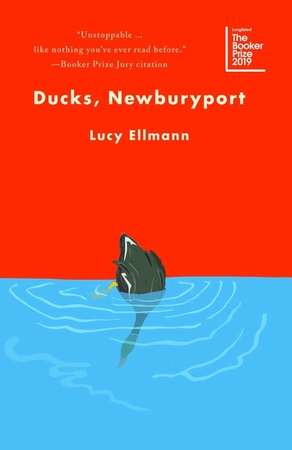
There’s so much to say about Lucy Ellmann’s wondrous novel, Ducks, Newburyport: ostensibly it’s about an Ohioan housewife deep in thought while peeling apples and prepping to make a tart. It’s also about a mountain lioness searching for her cubs and attempting to survive in her shrinking natural habitat. But even more than that, it’s about tackling the novel as a form and modernism as a lens for the human condition.
Buy the book
At over a thousand pages, it’s a stream-of-conscious narrative that reads so freely, it takes on eerie similarities to how we scroll through our social media newsfeeds. The book is a perfect example of publishing as an art, a medium based on amplifying voices and social issues rather than the all-too-often trade fixation on bottom-line sales and marketability of a book and its author. It’s also grabbing the attention of critics and readers everywhere, perhaps most important of all—it has been nominated for the 2019 Booker Prize.
Ducks, Newburyport is a complex book about a complicated time. It reads like an outpour of humanity beckoning to be heard. I spoke with Lucy Ellmann about narrative rhythm, ecological disaster, the meaning of “big books,” and more.
Michael J Seidlinger:It will come as no surprise, and I normally hate asking this question, but I got to ask, how long did it take you to write the book?
Lucy Ellmann: Seven years. And throughout, I wondered if I’d ever finish it. The work got more and more intense. I saw no one, barely even saw my own husband! (I think he was the guy cooking the meals.) I did nothing else but work on the book, if I could help it – or worry about it when I wasn’t doing it… Oi veh. What a mug’s game.
All real writing is literature and men don’t own that. It belongs to us all.
There’s this anxiety that you’ll die before you finish writing a book—I think everyone has it. Those 3:00 a.m. jitters. It just means you must work even harder on it.
My father once told me that when you reach a tough juncture in what you’re writing, it’s actually a sign that you’re on the verge of a breakthrough. This advice, correct or not, serves me well through many a tough juncture.
MJS:The structure is so compelling, an outright onslaught of text. Did you instill any specific constraints or writing techniques to keep the thread moving and, more importantly, evolving into its attentive monologue?
LE: No. Constraints are no help when you’re trying to figure out what the novel you’re writing is going to be. It’s got to be as venturesome a process as possible.
I wanted to blanket the reader in stuff, American stuff. Minds are full of stuff, and that seems to me the most interesting thing in the world. External beauties are just an added bonus. But even they are reached through the mind. So let’s look at the mind.
MJS:1040 pages. It means dropping the book on your face while reading it can be painful. (Don’t ask me why I know this). The physicality of the book informs its structure. The “big book” is so often attached to the “big serious” author, usually male, with their warrior-like obsession with tackling and “succeeding” in creating formally inventive, innovative, experimental works. At its worst, it borders on masturbatory; at its best, like in your book, it acts as a reminder of the importance of literature. Ulysses, Infinite Jest, Life: A User’s Manual—why do you think it more common to see these “experimental works” attached to such an obsessive, “hero” intent?
LE: A friend of ours, Abe Steinberg, once saw a NYC cop writing himself a ticket for parking in a no-parking zone. Abe’s comment: “So he’s a hypocrite and an onanist.”
You rightly assign an Oedipal flavor to the contest some men make of writing: superseding the father, fucking the mother… Yeah, yeah, yeah. Men have long placed the goal posts and then proceeded to hand themselves awards for getting the ball in. Or just for having a pair of balls. Time to invent some new games. New myths too. And some respect for what women have to offer. All real writing is literature and, as you say, men don’t own that. It belongs to us all.
My books are sincere efforts to contribute to that. I really don’t concern myself with what male writers are up to, unless they write something good. That’s always welcome. As for Ulysses, whatever amount of testosterone may have fueled it, it is a beautiful work of art. I would not class Joyce as a conscious member of the macho brigade. He wasn’t that proud of himself. He could barely find the means to live – but hoo boy did he have what it takes to write. And he stuck up for it, as you must at some stage. Good writing emanates from a peculiar combination of self-hatred plus chutzpah.
Some male reviewers seem affronted by the book’s length. They also resent having to read such a long book written by a woman about a woman. But most men don’t even read, so who cares?
I never set out to write a big long book, but nor did I set out to censor myself. I just did what I wanted. Some male reviewers seem affronted by the book’s length. This seems a pretty petty form of criticism. You can see the book’s long just by looking at it, so don’t agree to review it if you or your biceps are not up to the job.
They also resent having to read such a long book written by a woman about a woman, two points against it in terms of their criteria for seriousness. But most men don’t even read, so who cares? I’m interested in readers who can read, not people suffering from pride and prejudice. (Good title!)
For the record, my book is not an “experiment,” it’s a novel. Experiments are for scientists. Of whom I take a dim view. Sure, it’s nice to know a bit about the galaxy and all, or investigate a curiosity here and there and whatnot – but these contributions don’t make up for vivisection, IVF gender selection, heavy industry, factory farming and the hydrogen bomb. I see art as a vital moral check on the unbridled extravagances, patriarchal illogic, and often outright malevolence of science. Not “the science” that the great Greta Thunberg’s talking about, but much else that goes merrily on.
(NB Sorry you had a physical collision with my book; all clonkings were meant to be intellectual.)
MJS:Haha, and the clonking was indeed intellectual! About 20 pages in, something uncanny happens: the book becomes as readable as scrolling through Twitter, reading a sequence of facts and headlines. Propulsion of excess, the very thing we deal with in our 24/7 news cycle, forever-online, modern day: I’m curious about how you balanced this effect.
LE: Rhythm decides a lot of the order of things, plus juxtaposing inner and outer life, or output and input. The narrator naturally drifts between private thoughts and what’s going on in her day, or in the wider world, which she’s exposed to by her fact-addicted son, and other people she talks to, along with various media services of varying objectionability.
The action takes place over the course of a few months in 2017, and there is also a gradually emerging plot; it’s not reported in the habitual style of conventional narrative, but it’s there all the same. I wanted to see how a novel can stand on its own two feet and start developing narrative tension almost of its own accord. As a reader, I think one constantly raises questions, and from that springs suspense. You don’t actually need cliffhangers or a “once upon a time” approach. Readers are much more sophisticated than that.
MJS:That being said, the absence of a “traditional narrative” in the book almost enforces the reader’s search for one, and that’s where maybe the lioness, a sort of side story to the stream of text, comes in. Why did you choose the lioness over, say, a fox, or vixen? Both of their natural habitats are being destroyed by humans, and both are under threat of being endangered.
Good writing emanates from a peculiar combination of self-hatred plus chutzpah.
LE: The first idea of the lioness came from reports in Palo Alto, California, of mountain lions venturing near schools. Utterly unnecessary anti-lion measures were of course employed by hysterical humans. We own everything, and we can’t bring ourselves to share one single inch of space with fellow creatures without our permission.
Animals are the ultimate illegal immigrants. That’s why we get to confiscate their offspring, and look at them caged in zoos. It’s amazing how little people question their right to have things all their way – at the risk of destroying the whole ecosystem.
MJS:The book’s facts function as memories and, when taken as a whole, it almost suggests that our memories are impermanent, lost in the haze between news and novel, gossip and guilt. Do you think our memories are being rewired into a dispensary of everything we consume daily? Maybe we’re confusing documenting our lives online as memories.
LE: I just began thinking how weird memory is, its occasional precision, its eagerness, like dreams, to slip into oblivion. So much gets lost, even the byplay of a conversation you just had one goddam minute ago! I hate that. Writing acts as an enemy of lost ideas, because they can be retrieved – to some extent – through words. As prods at least, that can trigger memories.
I find dreams really funny if you write them down. Not the endless ones – oh, so dull, always to be avoided, either in literature or in conversation – but a nice short snappy crazy dream works well on the page.
MJS: The fact that there’s so much here, the stream could have gone a whole lot longer, the fact that you’ve squarely cut a slice of modern life, with all its hues, the fact that I feel there really isn’t an end, I ask if you had a veritable end to the narrative stream, or maybe it’s that there are no ends, only deaths, the fact that believing that to be true can make a person sad, the fact that I’ve taken this interview to a depressing place, maybe it’s time to, at least in this interview’s case, have it end.
LE: Death is our shockingly crummy fate. But depression is a cop-out. What the world needs now is action, sweet action—as Dionne Warwick might have sung. Is none of this stuff we have worth saving? The natural world? Human culture? The stuff we’ve made. The sights we’ve seen. Greek vases. Jane Austen. We have to fight for these things! Fight against the destroyers in our midst who want to take everything from the earth and leave nothing behind but radioactive waste. Do they have another planet lined up for themselves already? Just for them and their philistine buddies, a Lolita Island in the sky somewhere. They sure act like it.
For those familiar with Japanese literature, there are a few names that inevitably crop up in conversation: Yukio Mishima for his beautiful writing, shocking suicide, and extreme political leanings; Kenzaburo Oe and Yasunari Kawabata for winning Nobel Prizes; and Haruki Murakami for being Haruki Murakami. In the last few decades, Murakami’s work has eclipsed that of many other Japanese writers, particularly for readers in the West. Many avid fans use his name as a synecdoche, claiming to love Japanese literature as a whole, yet when pressed admit that their only exposure is through Murakami’s work.
That isn’t to say Murakami is not a compelling writer. He has a unique ability to evoke an urban loneliness and ennui, particularly through the experiences of “everyman” male protagonists who struggle with ambivalence in love, work, and even life. When he hits on themes he knows well his work can be an engrossing and fun ride. But one of the most common criticisms of his work—one that even the most avid of Murakami devotees will admit to—is the flatness of his female characters. The bulk of women exist as points of departure for the male protagonist to understand something about himself, with little else fleshing them out within the narrative. In the interest of the plot these female characters will die unceremoniously off the page, will be a sexual object the protagonist fixates on, or will be the passive partner that the protagonist returns to once he has his necessary epiphany.
Many avid fans claim to love Japanese literature as a whole, yet when pressed admit that their only exposure is through Murakami’s work.
The type of women in these novels tend towards a gendered stereotype. Even the single female protagonist in his extensive body of work falls into stereotyping: Aomame from 1Q84 is a cold, calculating assassin—a prime example of a woman needing to be physically powerful in order to be a protagonist. But even this character can’t stand alone, as she is one of two protagonists within the same novel, the other being male.
In most cases, there is little by way of desire or motivation behind the women Murakami writes, nor any agency beyond how they function in relation to the male protagonist. If this is the prime example of Japanese literature in the minds of Western readers, what does that say about how women are viewed within this narrow context?
Thankfully, there has been a push to translate more Japanese literature written by women for English-reading markets, such as the Akutagawa Prize-winning Convenience Store Woman (translator Ginny Tapley Takemori) by Sayaka Murata and the more recently translated Tokyo Ueno Station (translator Morgan Giles) by the Zainichi writer Yu Miri. Both authors write complex female characters with their experiences at the center of the narrative, rather than as an auxiliary add-on to men. But while it has become easier for readers to name current Japanese female authors, many would be hard-pressed to name female authors writing before the 1980s who were contemporaries of the men mentioned above, and who were just as commercially successful.
Though there are multiple authors to draw from, three female authors who crafted worlds around the same themes that have become heavily associated with Murakami’s work are Takako Takahashi, Taeko Kōno, and Fumiko Enchi. Each writes stories that consider female action and desire, while pushing the limits of artistic convention. In many ways, they take the feelings of isolation, ennui, and atmosphere that many love in Murakami’s writing and push it to the, sometimes uncomfortable, extreme.
Outside the surreal elements of Murakami’s stories, one of the more consistent markers of his style is the “Murakami protagonist”: a loner, almost always male, apathetic, and usually heavily burdened by the weight of urban living. Readers during Japan’s 1980s bubble economy and the devastating post-bubble crash found resonance in this detached figure, and he continues to speak to readers both inside and outside Japan.
Like the stock Murakami protagonist, Takako Takahashi’s female protagonists are isolated and apathetic with their lives and their frustration is linked to pressures from larger social structures, like the limited work opportunities and the entrenched familial expectations for marriage by a certain age. Takahashi belonged to a generation of young female writers coming to terms with the effects of the post-war era where women were afforded more personal and political freedom in theory, though in practice many of the cultural limitations still remained firmly in place. The women of Takahashi’s work, particularly her short story collection Lonely Women(translator Maryellen Toman Mori), are often straining against their limitations and skirting the line between occupying their expected role as a woman in society and acting on their unconventional desires.
The character Sakiko, for instance, toys with men by beginning conversations with them, testing how outrageous she can be with her comments before the man asks her out. Once they do, she selects a meeting place across from a coffee shop, where she sits and watches the men wait for her, seeing how long they wait before they give up. Yet, rather than heartless, Sakiko’s behavior is presented as a sort of intellectual exercise of putting men under a microscope in ways women so often are. Takahashi writes, “Sakiko was inordinately interested in observing men in this way. How much more exciting this sort of encounter was for her than actually meeting a man and conversing with him! She wished that she could go so far as to gaze at a man through binoculars.” These moments of Sakiko harmlessly playing with men juxtapose other darker scenes involving a series of mysterious arsons happening in her neighborhood. It isn’t clear whether Sakiko herself is the arsonist or whether her interest is sparked by a macabre fascination. But Takahashi makes it clear that Sakiko’s fascination with fire, as well as her tendency to toy with men, stems from a desire for a different type of life than the one she finds herself in—one she can control, one she can have agency over.
While Lonely Women includes women awakening to the limitations in their lives and acting out when possible, there are also characters who are trapped in mediocre marriages in spite of wanting something more passionate or liberating. In “The Suspended Bridge,” Haruyo finds her routine married life shaken by the reappearance of an ex-boyfriend who had been working abroad. As she struggles to make sense of her sudden heightened discontent, she seeks acknowledgement from her detached husband, Eizō. Throughout the story, Haruyo behaves uncharacteristically, trying to get a reaction out of her emotionally unavailable husband. She acts out to prompt her husband to ask what is troubling her, but he never asks and her desires are never acknowledged.
There is always an uneasy open-endedness to her stories, as if there is simply no way for her characters to have what they crave.
Like Takahashi’s work, Taeko Kōno’s stories in Toddler-Hunting and Other Stories (translator Lucy North) focus on the disconnect between what women are expected to want out of life, usually marriage and motherhood, and what their desires actually are. The dissonance between external expectation and internal desires produce characters who are neurotic, isolated, and even brutally violent—even if the violence remains within the realm of fantasy or consensual sexual encounters. But the dissonance in Kōno’s work also finds no resolution. Rarely do the characters find greater self-realization or fulfillment. There is always an uneasy open-endedness to her stories, as if there is simply no way for her characters to have what they crave reconciled with the real world.
Kōno’s open-endedness is clearest in the story “Snow,” which chronicles Hayako coming to terms with her adoptive mother’s death. Initially, the story follows a fairly traditional route: the death of Hayako’s mother, though understandably painful at first, will simply be part of the story and Hayako will continue on with her life. But a sudden narrative shift uncovers bits of Hayako’s childhood through her recollections. We find out her mother was physically and verbally abusive to Hayako as a child because Hayako is the result of an affair between her father and a mistress. Falling snow is one of the markers of their relationship as it’s tied to a mutual experience of trauma between adoptive mother and daughter; the two of them even suffer from painful psychosomatic migraines when the snow falls, which comes to represent the pain they both carry because of the fraught family situation. At her mother’s death, Hayako is hopeful her debilitating migraines will cease. Instead, her migraines remain, culminating in a scene where she attempts to bury herself alive in the snow.
The stories in Lonely Women and Toddler-Hunting tend to focus on a single protagonist, whose internal struggles make up the bulk of the conflict. Readers stay within the minds of Sakiko, Haruyo, and Hayako as they think through their experiences, obscuring the external realities of their internal struggles. We never know if Sakiko is truly the arson or if Hayako makes it out of the snow alive. What is clear is that these experiences— whether fantasies or not—are very real to them.
In her famous novel, Masks (translator Juliet Winters Carpenter), Fumiko Enchi presents what happens when women are able to enact change on the worlds they inhabit—and the harm that can come about from gaming an oppressive system. Like the women in Lonely Women and Toddler-Hunting, Masks centers characters who are not clearly and unquestionably “good.” The novel’s protagonist is a middle-aged widow, Mieko Togano, whose convoluted scheme to take revenge on her long dead husband through usurping his family line ends up pulling other women into the fray, with some losing their lives for the sake of Mieko’s obsessive mission. Some elements of the novel could be read as pushing against an oppressive patriarchal system, with women acting together to maintain their autonomy at a historical moment when men were given more legal rights. Yet Enchi points out that acts of resistance might sometimes perpetuate oppression or even further oppress other women. Enchi brings these difficult questions to light but, like Takahashi and Kōno, never truly gives us definitive answers.
These are the characters I wish moved through the urban landscapes of Murakami’s books: women who are more than a function of a narrative.
These are the characters I wish moved through the urban landscapes of Murakami’s books: women who are fighters, women who are messy, women who are more than a function of a narrative. While none of these texts provide the same surreal worlds that have become a hallmark of Murakami’s work, they do provide a new spin on the psychological landscape Murakami is known for. Delving into the psyche of women trying to navigate a world marked off by social limitations means readers encounter female protagonists who are them troubling at times, but lead us to question the impact of oppressive systems on certain generations or groups of people. The women who inhabit these stories are just as historically situated as the disaffected Murakami protagonist is to his era. Neither exist in a vacuum.
Takahashi’s, Kōno’s, and Enchi’s work—along with their other female contemporaries—is accessible to a significant portion of Murakami fans. When Murakami becomes the sole marker of Japanese literature, there is undue emphasis on a specific image of Japanese cultural output; the surreal, pop-culture steeped world of Murakami novels inadvertently becomes ‘Japanese literature’ as a whole and that has lasting consequences beyond literature. Japan has a long, fraught history with sexual discrimination and gender disparity at the expense of women and other marginalized groups so representations of characters from these groups matter. In a 2018 Op-Ed for the New York Times, Viet Thanh Ngyuen writes on “narrative plentitude,” saying “we live in an economy of narrative scarcity, in which we feel deprived and must fight to tell our own stories and fight against stories that distort or erase us.” Though he is speaking in the American context, the same is true for the canon of Japanese literature. For so long the work available in the West through translation privileged a particular type of author and set of character archetypes. In a world where discrimination and bigotry leans heavily on harmful stereotyping, it is crucial to push back by making space for more voices, including those that have been historically limited. These women created a space for other women to participate in literary culture, providing a language for the frustrations, ambivalence, and rage that they experienced. Murakami is an important figure in the Japanese canon, but he is just one in a long line of authors; to understand the world the Murakami protagonist moves through, it’s necessary to see who came before him.
I liked the picture of Him—and in the religion of my childhood, it always was a Him—in my head: an avuncular humanoid drifting among yellow-green clouds, something like Einstein by way of Jim Henson, white-browed and warm and ready to listen. I liked the sensory rituals of religion: the dark wooden walls of the church, the organ’s gleaming pipes rising above the altar, the battered blue hymnals with their pleasantly steadfast Protestant harmonies. I liked the annual Christmas pageant, from the nursery class dressed as sheep to the sorrowful grandeur of a story in which the glory of salvation is birthed somewhere dirty and cold. I liked well enough what trickled into my awareness about Jesus, the stuff about love and kindness, and I liked more the sense of virtue and maturity I could access by pulling the Bible off the shelf.
I liked other things, too. The belief of childhood is promiscuous, the line porous between imagination and faith; the best game, after all, is the one you trick yourself into forgetting you made up. I played in a world populated with deities and demons from a hodgepodge of sources: the sanded-down version of the ancient Greek pantheon to which we introduce children, depicted in a big book with beautiful pencil illustrations; the heroes of Star Wars and Sailor Moon, stories not unlike the Christianity I knew in which love is elevated to the realm of magic; witches, especially as classified by Roald Dahl, whose definition spurred furtive lunchtime discussions about whether we had spotted a hint of blue around the teeth of our wicked gym teacher; and the myriad invisible creatures my friends and I willed ourselves into seeing, from girls trapped in gemstones to stray cats with mismatched eyes, always carefully described as having been not invented but found.
The gradual encroach of what we will one day know as adulthood settles myth into metaphor.
Growing up is not precisely a matter of abandoning this world. Rather, over time you find yourself planted more firmly on one side of the line, viewing the denizens of your personal mythology in relation to reality. You outgrow the habit of peeking under a dew-spattered leaf for traces of last night’s faeries even when no one is looking; your private companions become, perhaps, the characters in your stories. The Force is no longer a cosmic linkage between all living things but a shorthand for the discipline it takes to turn the other cheek. The gradual encroach of what we will one day know as adulthood settles myth into metaphor, and generally we miss the strength of our childhood convictions no more than we miss our baby teeth once lost.
And so it went for me, with one exception: I never suspected that growing up would take from me my belief in God. When it happened, it was a loss I felt like a wound that would not heal.
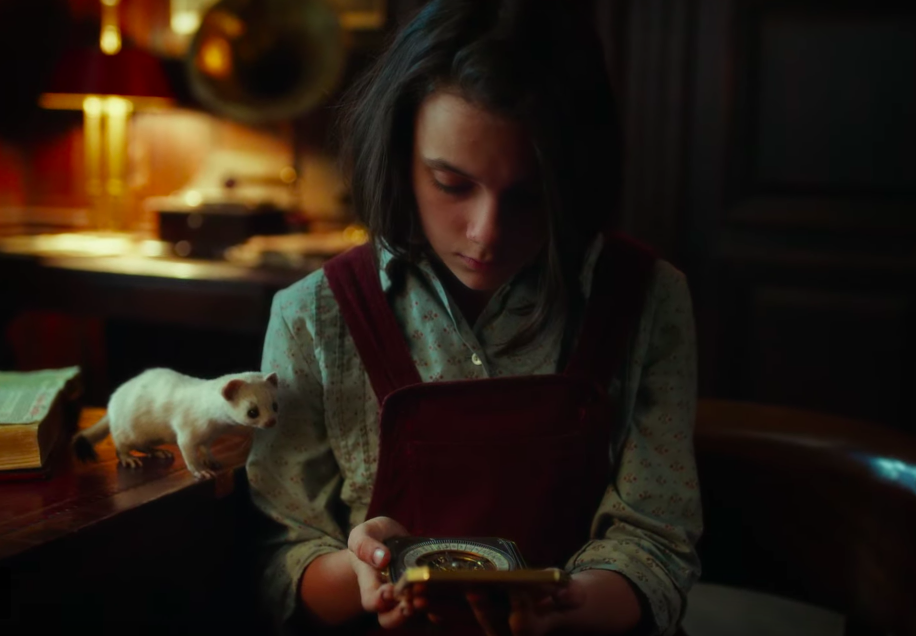
The transition from childhood to adulthood is a decent capsule summary of Philip Pullman’s His Dark Materials trilogy, which consists of The Golden Compass, The Subtle Knife, and The Amber Spyglass. You could also say: an action-packed adventure spanning the multiverse. A pointed critique of institutionalized religion and the legacy of imperial Christianity. A set of children’s novels inspired by Milton and quantum theory. A bittersweet recounting of first love found and lost. A subversive telling of the Fall, as in of man. It’s a story which awes less for its sprawl than for its intricacy, a story which includes armored bears, centuries-old witches, miniature spies who ride giant dragonflies, the ghosts of the underworld, vampiric spirits, and incorporeal angels, among others. But it begins with a child.
Lyra Belacqua lives in a world like and unlike ours. Oxford University exists, but within it is the fictional Jordan College in which she makes her home; there is electricity, though it’s called anbaric current, but no movies. It gradually becomes clear that the heightened global reach of a consolidated and self-protecting church has slowed the progress of science, or, as they know it, experimental theology. When we meet Lyra, she is, like many of children’s literature’s greatest heroes, not where she is supposed to be, having snuck into a forbidden room before a scholarly presentation led by her intimidating uncle. As Lyra waits out the meeting by hiding in a closet, we encounter two of the innovations most central to the books. The first are dæmons, closely linked animal counterparts embodying a piece of every human’s self; everyone has one, the idea goes, but unlike us the people of Lyra’s world can see and speak to theirs. The second is Dust: elementary particles, visible using special kinds of film, which fall from the sky, interacting with nothing but gathering thickly on people.
Dæmons and Dust are linked through one of the series’ major thematic concerns: the moment in which the child self begins to recede to make room for the adult. The dæmons of children change form on any whim, skittering around as mice or flying silently as moths; around the start of puberty, dæmons settle into a final form. It’s also at this time that humans begin to attract Dust, which drops occasionally on children but gravitates towards adults. There are many ways of identifying this dual transformation in real-world terms: it’s the age of novel bodily experiences and nascent rebellion, of exploding emotions and the first stirrings of conscious thought, of sweaty palms and puppy love. It was also, for me, the age at which I suffered my crisis of faith.
Often I tell it like a joke: Six years of Christian school made an atheist of me! It’s a good line, but misleading; it implies something like my mother’s Catholic school experience, tormented by nuns and spending Sundays kneeling and quaking in terror of hellfire and damnation. My school practiced a gentle Episcopalianism in which chapel talks were as likely to celebrate goal-setting or poetry as the particularities of the faith. I was not, in other words, traumatized out of faith.
Often I tell it like a joke: Six years of Christian school made an atheist of me! It’s a good line, but misleading.
Nor was I argued out of it, exactly, despite lively debates with my best friend over whether the concept of a male savior was inherently sexist. In fact, to this day I’ve yet to hear an argument against the existence of God I find any more convincing than the arguments in favor. Rather, I think the religious education I received accomplished what it set out to do: it encouraged me to examine seriously my own faith. In fifth grade, we studied the book of Genesis in Religious Knowledge and wrote reports on Greco-Roman gods in Social Studies. I asked myself earnestly the question: what had brought me to my God beyond the same accident of birth that had once led women to become priestesses of Zeus? Peering closely at the deepest parts of me — and I must emphasize that this is not a theological proposition but rather a description of one child’s heart — I found my answer: nothing.
And oh, how I looked. How I prayed and bargained and grasped for ideas which might restore my belief. How I searched for signs and felt in the dark for the same listening warmth I had once taken for granted. My reluctant atheism gave me no sense of superiority or pride in my intellect; to the extent that it separated me from others, it made me feel horribly alone. I had stepped into a world drained of comfort, of hope, of meaning. I stayed up at night rocked with a full-body terror of the approaching void, and wore myself anxious with the existential vertigo that accompanied the dissolution of my apparent moral foundation. What scared me most was the newfound emptiness of the world: without the invisible thread of faith that had once bound existence into something legible, what could reality be beyond an infinitude of atoms senselessly colliding? Where was I to find not only love, morality, and purpose but even a justification for seeking those things?
There’s a genre in which this state of mind recurs with some regularity: conversion narratives. The convert, reaching the end of a road of trials and exhausted by despair, picks up a Bible or meets a preacher or wanders into a sermon; then, having received the gospel, he feels the emptiness in him begin to heal, filling him with such joy that his life is forever changed. Well, I had already read the Bible and heard many sermons. Instead I met Lyra. But the ending holds up: I was never the same.
After years surrounded by a belief system to which I had long since lost access, I took high school as an opportunity to flee for more secular environs. In retrospect the magnitude of the transition stemmed from a host of things I was leaving behind — religion, sure, but also an insular community, plaid skirts, the chafing sense of being considered a known quantity, childhood itself. But at the time I had an easy line to explain my relief to my new friends: Listen, I went to Christian school, okay? It fit with the persona I was trying out: foul-mouthed and free-minded, artistic and ambitious, smugly disdainful and fond of what we in those days called snark. This version of me loved His Dark Materials in the distanced, intellectual way I was trying to love everything. Explaining why I’d named the books my favorites, I leaned into their more overtly unorthodox aspects, announcing they kill God! with a gleeful teenage thrill.
The questions I was struggling with could not be answered with dispassionate reason. They were questions of purpose and meaning.
But when I go back to the kid who lay trembling in bed at the thought of what death could mean in a world without God, I know that’s not what she needed then. She needed what we always give to children in the dark: a story. The questions I was struggling with were not questions that could be answered with dispassionate reason. They were questions of purpose and meaning and what it meant to be alive — the same questions myth and metaphor have so often been called on to resolve or to illuminate. Pullman’s text resonated because he took as his material the stuff of myth. And like many myths, it was at heart the story of heroes.
Our first hero is Lyra: an orphan, eleven years old, rude, impatient, charismatic, fiercely loyal, quick to anger and deep in her love, stubborn, bright but incurious, bold, not always kind but basically decent, and prophesied to make a choice on which the fate of several universes will hinge. One of the academics to whose loose care she’s been entrusted calls her “a healthy, thoughtless child,” a phrase I love as a teacher of young children who worries often about the ill effects of premature self-consciousness on my pupils. The other, from our universe, is Will. Will is not a thoughtless child; growing up alone with a mother suffering from untreated mental illness, he’s learned to take care of her when she needs it while living with the constant anxiety that should her situation be found out, someone will come to take her away. He’s lonely but loyal, better than Lyra at thinking ahead but aching for the wholehearted friendship she can offer.
Pullman is not precious or preachy about what it takes to survive, and the tools Lyra and Will bring to the trials before them are the tools you will find in our oldest tales: wits and fists. Lyra, true to the resonances of her name, is a skilled and enthusiastic liar whose gifts for telling tales keep her and others alive in hostile territory. Will Parry, his name suggesting the force of mind to counter a blow, learned in the face of schoolyard ridicule for his mother’s troubles to fight like he means it; one of the first things he does is to kill an intruder in his home, an accident which nonetheless sets the course for the teeth-bared ferocity he brings to the fray. Together the two of them, fabulist and fighter, form a matched set out of Homer: a prepubescent Odysseus and Achilles.
In another trope inherited from myth, each receives a tool to aid them in their travels. Lyra complements her talents by using a golden disc named the alethiometer, from a Greek word sometimes translated as “truth,” which answers honestly any question posed by one who can read its complex symbolic system. Will bears a knife which can cut not only any physical substance but the space between atoms that opens a door between dimensions. Taken as a pair, these fantastical items offer exactly what I was craving so desperately when I found them: a path to a deeper truth, and the sharpness it takes to undo your reality and leave the world you know behind.
The Church of Lyra’s world interprets Dust as physical proof of original sin: evidence that humanity was scarred when the woman in the garden ate from the forbidden tree. Their obsession is that pivotal moment of becoming no longer quite a child, the moment which recapitulates for the individual the consequences of the Fall: knowledge and shame, toil and death. A small but powerful group begins a terrible experiment: they sever children from their dæmons before they have a chance to settle, hoping to free them from the burden of Dust. This operation renders adults unsettlingly placid and incurious; it leaves children hollowed out, dead in a few days’ time.
In the name of protecting children, they remove that which contains their deepest selves. Dæmons are linked to both the desire to receive and the need to give love; Lyra and her dæmon comfort themselves by comforting each other so often that she pities the loneliness of worlds like Will’s, where people can find themselves truly alone. They’re manifestations of identity; a dæmon settles at the moment you begin to know who you are. They’re connected to sexuality, seen most viscerally in the brutal shame and disgust Lyra feels when an agent of the Church breaks the taboo of touching her dæmon. And they’re a way of understanding: it’s Lyra’s dæmon who suggests, after the atrocity of the severed children, that if people will do such terrible things out of hatred for Dust, it must be the case that Dust is good.
It’s against this backdrop that angels, creatures of Dust, instruct a nun-turned-physicist named Mary that she “must play the serpent,” placing her in the crosshairs of a priest sent to assassinate her before she can precipitate another Fall. And it’s in this context that we learn the secret name the witches use for Lyra when they prophesy: Eve.
Years later I would find that David Foster Wallace in his famous commencement speech at Kenyon College had captured the dilemma in which I found myself:
In the day-to-day trenches of adult life, there is actually no such thing as atheism. There is no such thing as not worshipping. Everybody worships. The only choice we get is what to worship. And the compelling reason for maybe choosing some sort of god or spiritual-type thing to worship–be it JC or Allah, be it YHWH or the Wiccan Mother Goddess, or the Four Noble Truths, or some inviolable set of ethical principles–is that pretty much anything else you worship will eat you alive.
I could sense but not articulate this: that without some kind of framework I would be subject to a long inner unraveling. And this is what the books gave me: permission to worship.
It’s a funny thing to say about the most famously atheistic work of children’s literature. If you know nothing else about the His Dark Materials series, you may know that Lyra kills God (or allows him to die) and the book celebrates her for it. But the God of the books is in fact revealed to be no God at all but merely a very old angel, who pretended he was the Creator of all things in order gain power. A straightforward attack on religion, as the books are sometimes accused of being, would leave the story there: God as a wicked and false idol needing to be destroyed. But Pullman’s myth is more nuanced than that; when Will and Lyra find him, “the Authority” is an old and feeble creature, imprisoned by a younger and more ambitious angel, shaking with terror in a crystal cell. Their impulse, knowing only that he is old and afraid, is to help him; his death comes not as a violent attack but a gentle dissolution as he follows their kindness into the wind, scattering such that “their last impression was of those eyes, blinking in wonder, and a sigh of the most profound and exhausted relief.”
Wonder and relief: this was how the story healed me.
Wonder and relief: this was how the story healed me. Wonder first at its rich texture, from the corridors of Jordan College to the witches of the north, the alethiometer’s prophecies and the dignity of the armored bears, cliff-ghast attacks and abandoned cities by the sea. These imaginings are imperfect; the author Lo Kwa Mei-en has delineated some of the stereotypes that mark the text. People of color are often exoticized, and the homogeneity of the main cast juxtaposes disappointingly with its ambitions: we’re meant to believe the fate of not just one but all universes hinges on the choices of some white people from England? Even so, the vibrancy of the world is its own argument for the beauty of life. When Lyra and Will, following in many mythic footsteps, journey to the land of the dead, they are struck by the colorless stagnation of the ghosts. They decide to free them — a freedom which will dissolve the forms they have, but return them to the fabric of life. Listen to how one ghost convinces her brethren to follow her to this undoing:
Even if it means oblivion, friends, I’ll welcome it, because it won’t be nothing. We’ll be alive again in a thousand blades of grass, and a million leaves; we’ll be falling in the raindrops and blowing in the fresh breeze; we’ll be glittering in the dew under the stars and the moon out there in the physical world, which is our true home and always was.
Reading this for the first time, it was like someone had reached into the abyss inside me and gently sutured it closed. And so came relief: that life on its own was enough to love. That poetry, beauty, grace — these things could still give shape to the roiling world. That there were still things worth worshipping, things like courage and truth and kindness and love, and whatever else aided the work of spreading joy and easing pain. In crafting a universe both godless and divine, Pullman freed me to see my own in exactly those terms.
After their journeyings, Will and Lyra come across Mary, who has befriended a settlement of wheel-riding quadrupeds whose existence is threatened by the slow leaching of Dust from their world. Mary tells the story of why she stopped being a nun: she met a man at a conference, and remembered what it was once to have danced with a boy she liked. And when she looked for the belief that would justify abandoning the world of these feelings — I know this well — she found nothing there.
So Mary has played her part: she’s gestured toward the place where knowledge takes root and blooms into the sky. And Lyra plays hers: in a moment alone with Will, she lifts to his mouth a little red fruit, and the two of them fall — into love, into kisses and touching each other’s dæmons, into the joy of knowing themselves and another in this new way. It’s a knowledge powerful enough to bring Dust drifting back to where it belongs, covering them in its shine until they appear “the true image of what human beings always could be, once they had come into their inheritance.”
This is the trilogy’s most radical idea: that original sin is not a burden but our birthright.
This is the trilogy’s most radical idea: that original sin is not a burden but our birthright. That Eve is a holy figure. That the acceptance of labor and death is the price we pay for cherishing knowledge and pleasure. That we should cherish these things, the wild abundance of the world and how beautiful it becomes looked at truly.
Like Eve’s choice, Lyra’s comes with a price: she loses the ability to read the alethiometer. An angel confirms: what once she did by grace, she must now regain, if she wants to, from a lifetime of work. Her reading will be better then, when it comes from “conscious understanding,” but it will be long before she reaches it. The healthy, thoughtless child has become — must choose to become — a deliberate, thoughtful adult. As a kid this made me rage; now it means more to me than almost anything. It’s a lesson I come back to whenever I fall prey to the idea that effort and uncertainty are evidence of injustice rather than proof that I’m alive.
I think I always would have come to love this story best of all: the story that teaches us that the best things in life are worth the effort with which they are entwined, that shows us the pains of growth are better than the false security of fantasy and fear. That tells us nothing real can be as terrible as a life wasted running from the world. I think I always would have come to seek this story again and again, because it’s the story I am always needing to learn. But Lyra told it to me first: how to brace yourself for the lifelong project of finding your way to the truth.
Some books earn their place in your heart by telling you the story you’ve already lived. Others become cherished because, through some happy accident of fortune, they reach you in time to guide you through the next stretch of your path. And sometimes, if you’re very, very lucky, you find just the right book at just the right time for it to do both.
The Amber Spyglass was released on October 10, 2000. Three months later, two things happened which ended the childhood to which the book had provided such a sweet coda: I turned thirteen, and George W. Bush became president. Coming of age in the political climate engendered by that administration shaped the development of everything from my political consciousness to my sense of humor. It also deepened my relationship with Pullman’s story, which gained new shades of relevance with every upsetting headline.
This story restored my faith by showing me what my faith could be: not the source of all answers, but a tool for finding them.
When debates raged over non-questions like the personhood of stem cells or the existence of climate change, I thought of experimental theology and the limits denial places on human ingenuity. When I learned about purity balls or the push for sex education that included neither sex nor education, I thought about the Magisterium severing children from their daemons in an attempt to save them from the messiness of the adult world. When I read a description of what one journalist called the faith-based presidency, in which a “writ of infallibility” underscored the mounting death toll overseas, I thought about the assassin priest receiving preemptive absolution to murder Mary in God’s name. And during all those eight long years in which I tried to develop both a nascent feminist consciousness and a sexual self while learning repeatedly the extent to which my body was culturally marked as grotesque, impure, and subject to the governance of other people’s laws, I thought again and again about Lyra and Eve.
It helped, to recognize in these new dangers currents I understood were not unique to the present moment. To have learned first as myth what I was coming to reckon with as politics. It fortified me to have absorbed a story which celebrated pleasure and knowledge and complexity as things worth defending in a world which feared them. And it grounds me now, as despair threatens to swell like the seas, to remember again that we are fighting new battles on ancient ground. It helps still to return to the way this story restored my faith by showing me what my faith could be: not the source of all answers, but a tool for finding them. Something which frees rather than constricts; something flexible, adaptable, deeply of the world instead of always set apart, growing and changing as I grow and change. It helps to remember what I chose to believe in: truth, and love, and that anything is worthwhile which works in some way to heal the world.
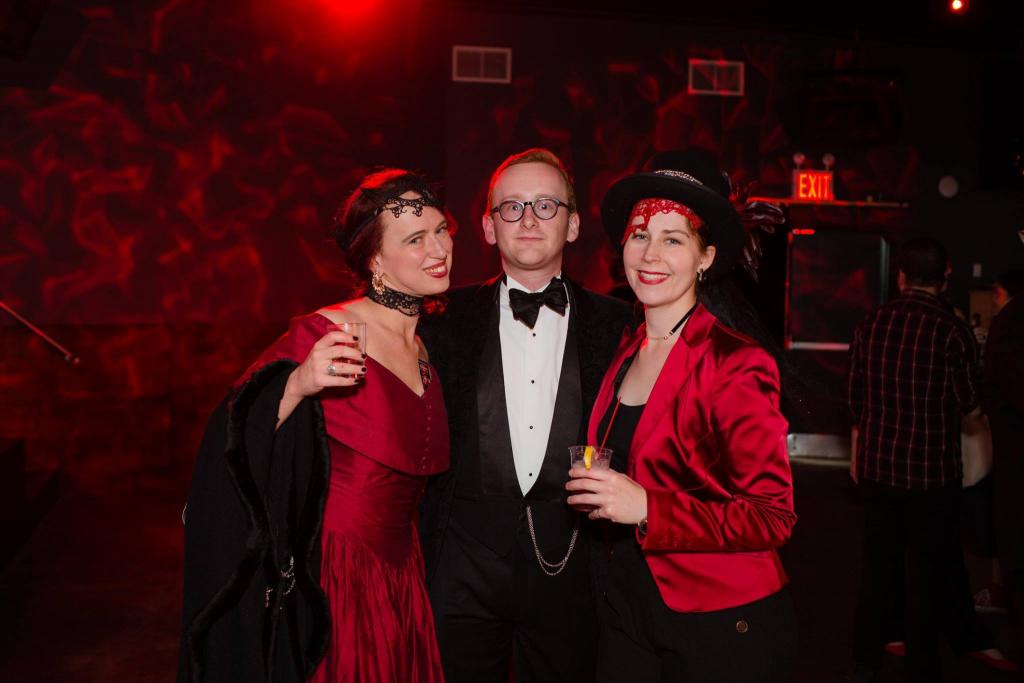
It’s a little less humid, the kids are back at school, Target has a rack of Halloween cards up, and we definitely saw someone post the dancing pumpkin guy gif on Twitter, so you know what that means: time to start making your plans for Electric Literature’s annual Masquerade of the Red Death. This year it’s on October 24 at Littlefield in Brooklyn, and yes: it is both 2 red and 2 dead.
If you want to know how to come to the party (or how to contribute to making sure that our valued contributors can come), you can find out all the details about tickets and sponsorship here. (The short version is that tickets are only $35 until October 1, then $50 thereafter, which is honestly still a deal.) But if you’re wondering why you should come, well—we’ve got you covered. Here are the top ten reasons to get your tickets now and bring your friends.
You can finally wear that Renaissance Festival cloak, vintage gown, or Elegant Gothic Lolita outfit without feeling out of place
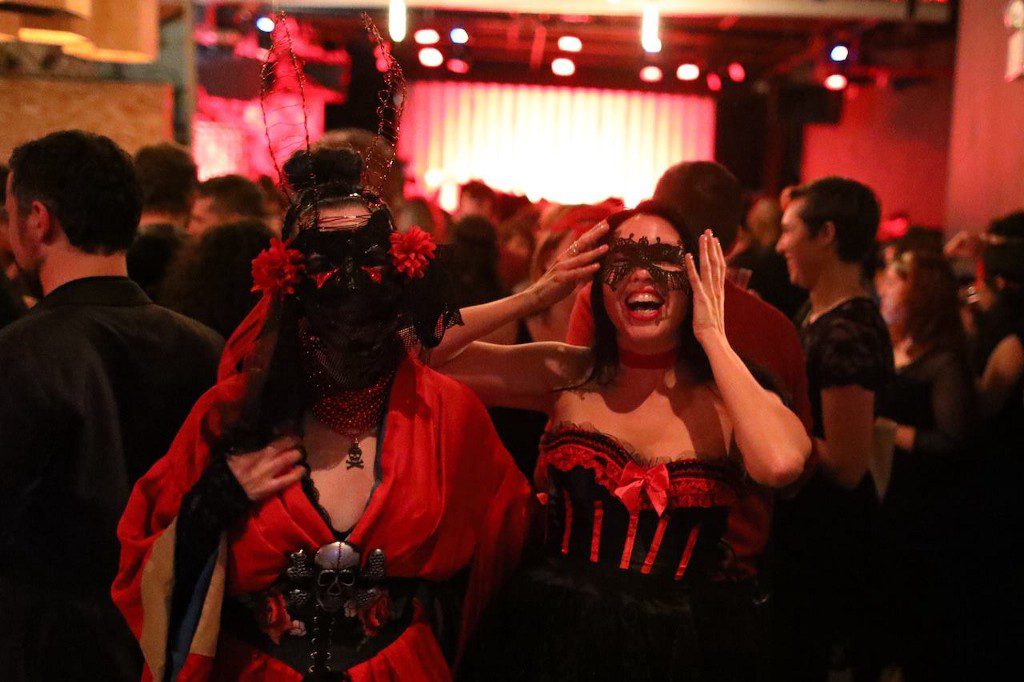
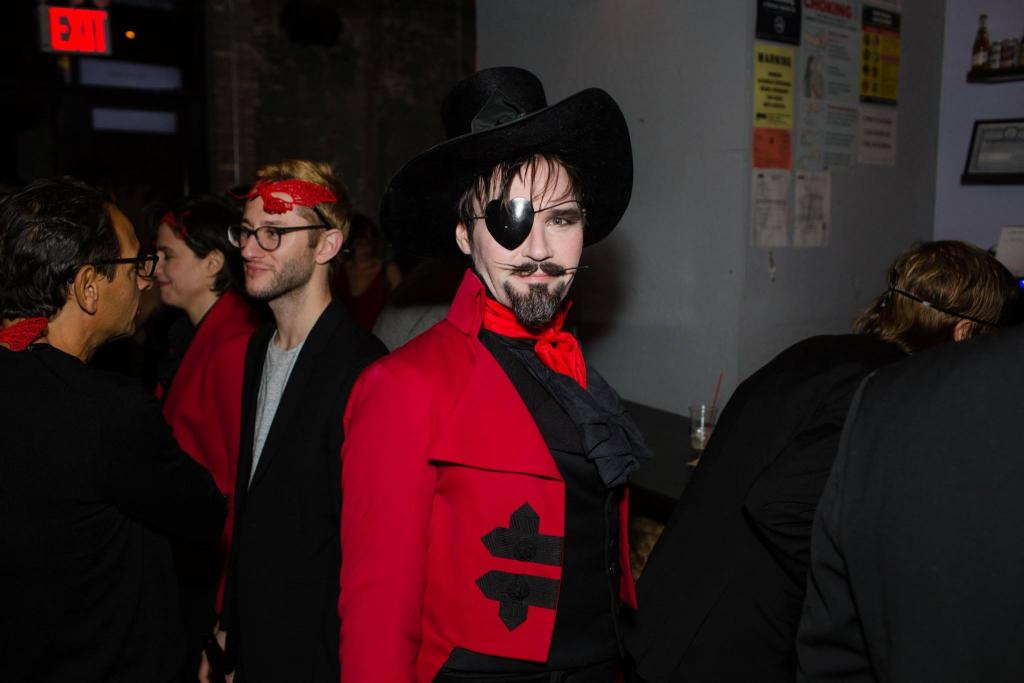
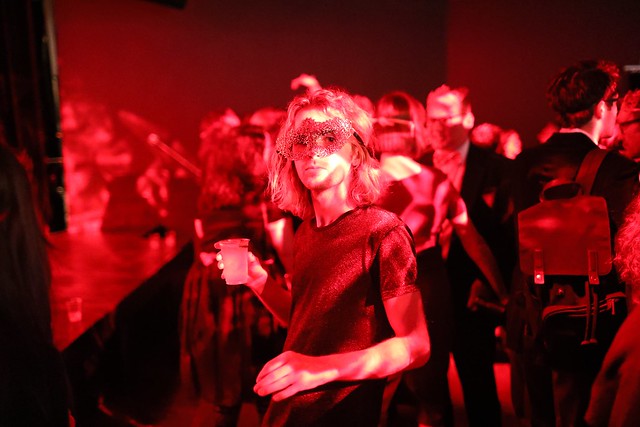
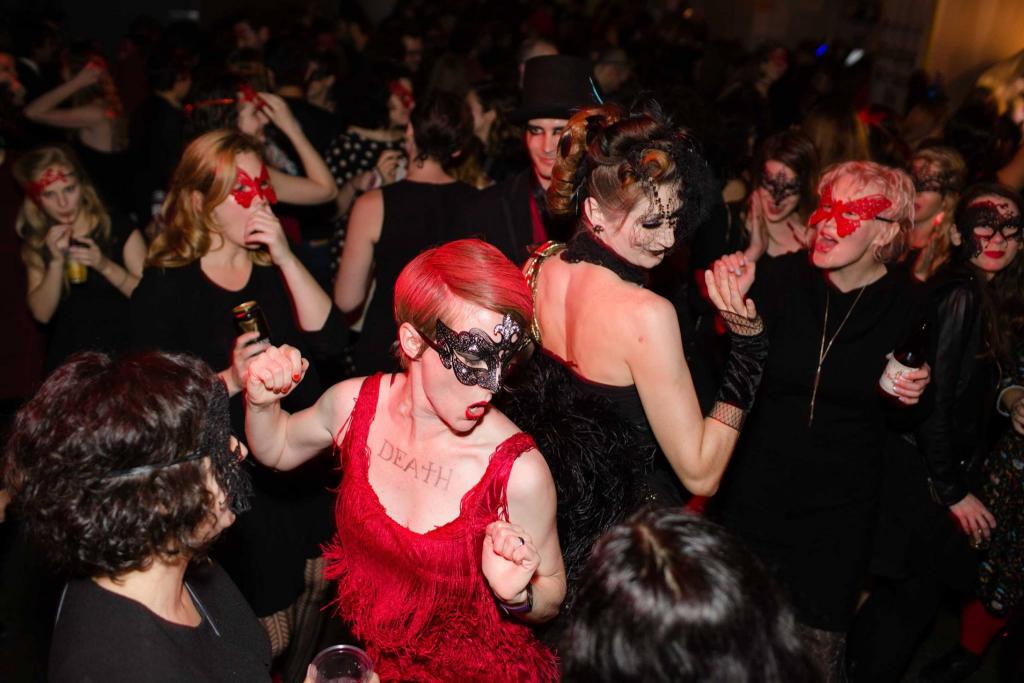
The only dress code at the Masquerade is “red and/or black,” but people tend to push that to the very limits of sartorial extravagance. Here are some of our favorite getups from years past:
Photo by Andrew Janke
Photo by Aslan Chalom
Photo by Andrew Janke
Photo by Andrew Janke
Photo by Aslan Chalom
Or you can finally go to a Halloween-season party without dressing up
Prefer to just drink, dance, grab free books, and hobnob with Brooklyn’s literary scene? If you show up in black jeans and a black tee, you’ll be in good company—and we’ll give you a mask so you can feel a little festive.
Photo by Andrew Janke
Yes, you get a mask
Your cool mask is included in your ticket price. Move unrecognized among the crowd! Sow discord in a Shakespearean fashion! Take up residence in the sewers under the Paris opera house! Save it for the following week so you can half-ass a costume for a Halloween party!
Photo by Andrew Janke
Commemorate your mask and/or outfit in our photo booth
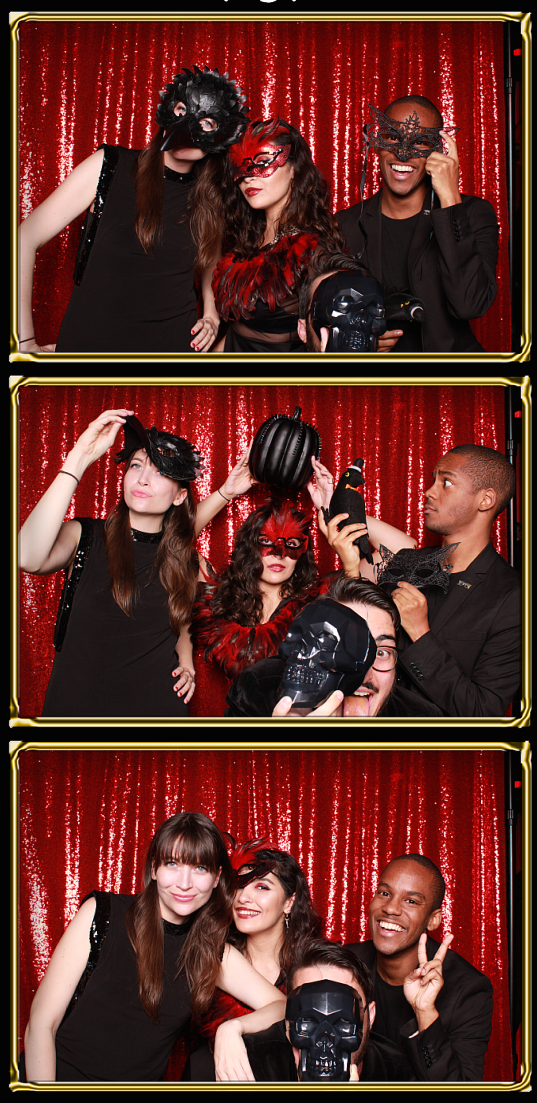
Fun doesn’t count unless you put it on Instagram, which is why we set up a photo booth full of sp00ky props and photo strips to take home.
There are free drinks
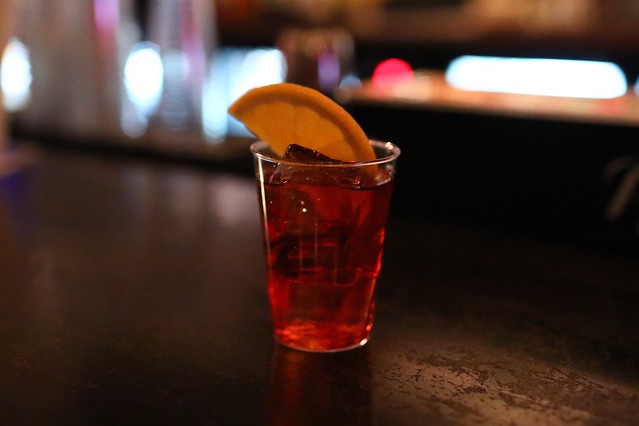
Is it even a party without free drinks? YES, apparently, because plenty of other parties make you pay for your booze, but we just hand you a specialty cocktail (featuring Sipsmith Gin) plus two more tickets for beer and wine. All you need to do is tip your bartenders.
Photo by Andrew Janke
And free books
You like books? We got books, donated by our sponsors and free for you to take home (or sit in the corner and read if that’s your preferred party mode).
Photo by Andrew Janke
The dance floor is downright deadly
There’s a reason DJ Colleen Crumbcake is back at the Masquerade for the third year in a row, and the reason is that she whips ass. Think the most fun wedding you ever danced at, but just post-punk enough to be cool.
Photo by Aslan Chalom
It supports an organization you believe in
The Masquerade isn’t just the best literary party of the season—it’s also Electric Lit’s annual fundraiser, which means that your ticket price (or your sponsorship—please contact us if your organization or press would like to sponsor the event!) helps support our mission to make literature more relevant, exciting, and inclusive.
Photo by Andrew Janke
No, really, we rely on your help
Electric Lit is a very small woman-led nonprofit, and we wouldn’t exist without the support of members, donors, and the sponsors and guests of the Masquerade. Even your $35 early-bird ticket does a lot to help us pay our cool, talented writers—and to ensure we can keep surviving the brutal online publishing landscape.
We guarantee no virulent plague
Unlike some Masques of the Red Death you may have heard about, there is no gruesome and bloody disease ravaging the world outside, and it will not catch up to you in your den of hedonistic pleasure. All pleasure, no plague, that’s the Masquerade promise.
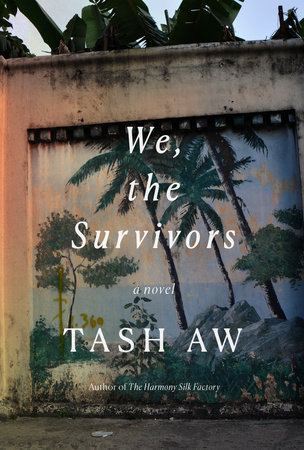
With his latest novel We, the Survivors, acclaimed writer Tash Aw draws us into the life of Ah Hock, a working-class Malaysian whose struggles to rise beyond his circumstances eventually culminate in the accidental murder of a migrant worker.
Buy the book
Ah Hock wants only what any of us want: A better, more secure life, free from the spectres of poverty and indignity. Aw paints a devastating picture of a man who seems to make headway clawing a path out of his small fishing village, only to meet with insurmountable roadblocks stemming from his class and level of education. I have grown up knowing Ah Hocks in my life; the familiarity made me flinch. Aw’s portrait is clear-eyed and intimate, and the whydunit is a skillful demonstration of how to develop narrative tension while pitting a character against something so abstract as the norms of society.
In the first part of my two-part interview with Tash Aw, I spoke to him about the fallacy of the Asian Dream, the different forms of marginalization of migrant workers and ethnic minorities in Malaysia, and feeling like an outsider at literary parties. (Translations below are mine.)
YZ Chin: We, the Survivors plays with authorship and the trope of “story within a story” in interesting ways. In the novel, Ah Hock feels compelled against his intentions to lay out brutal details of his life, and yet he is also deeply convinced that his story is uninteresting and unimportant. Instead, his interviewer Su-Min is the one who takes Ah Hock’s words and turns them into a book for wider consumption. And all of this is framed within your novel, which is itself fiction, of course.
How did you settle on this structure, and what does it represent for you?
Tash Aw: I didn’t set out to play with intricate structures in any way. I felt I’d already done that in my previous novels, so this time I wanted something more direct—a narrative thread that would reflect the gravity and urgency of Ah Hock’s story. I wanted it, simply, to be the story of one person’s life, with all the tragedies and joyousness it involved. But as soon as I had scribbled the first few pages, I knew that the novel had to be more layered, that it required an overarching presence that would mirror my own relationship with the novel’s themes.
We, The Survivors is the story of what we sacrifice in order to survive in the modern world.
The novel is a portrait of someone whom the entire world would consider ordinary; but it is also many other things: the story of an immigrant; a study of class, of privilege and deprivation, and what we sacrifice in order to survive in the modern world. I am part of all these narratives, and because of my family background—like so many Southeast Asians, split between rural hardship and urban aspiration—I found myself questioning on which side of the writer-subject divide I lay. My life now couldn’t be more different from my childhood. I wasn’t so great at school but I got lucky and went to university. Higher education changed me, allowed me access to middle-class jobs and an entirely different way of living from that of my parents and grandparents. My trajectory seemed entirely natural for Asians of my generation, the first that dared to expect that life would be comfortable.
And yet, despite decades of Asian growth, it’s now clear that I belong to the minority. I have relatives who still struggle in jobs in factories or who run small shops in dying rural communities. The reality is that the Asian Dream—this idea that all we have to do is work hard and life will be glorious—has not come true for everyone. For most people, like Ah Hock, surviving this ruthless system requires internalizing a whole lot of suffering; it requires normalizing harshness and exclusion. It requires, above all, the acceptance of inequality.
So what happens when, as a writer, you find yourself living a privileged life because of your education, but excluded because of your race, and parts of your own family are still anchored in that other, unprivileged, part of society? Many middle-class people I know in Malaysia and elsewhere know what it’s like to have dual or multiple identities. We might experience exclusion due to gender, race, sexuality and numerous other issues. But the fact is that we are mostly educated, and that changes things. We have choices.
Su-Min and Ah Hock represent two parts of society—I think, in some ways, they are two parts of myself. I wanted the novel to question the idea of Voice and Story. When we talk of one person’s voice, one person’s story, we are really talking about stories that are enmeshed with others, lives that are entwined inextricably. So the novel’s structure is a conversation between people who have found themselves on opposing sides of the chasm that has emerged in modern Asian society, and yet find themselves tangled in the same story.
YZC: Your previous novels feature either chapters told in alternating voices, or else sections that closely follow different characters. I may be projecting here, but I think minority writers who are used to code-switching more readily reach for the device of alternating voices. But We, the Survivors is a departure, told entirely from Ah Hock’s viewpoint. Why did you choose to leave out Su-Min’s direct narrative voice?
The reality is that the Asian Dream—this idea that all we have to do is work hard and life will be glorious—has not come true for everyone.
TA: I wanted to explore the idea of who controls the narrative when writing about class and society, whose is the dominant voice—in short, whose story it really is. The novel is meant to be entirely about Ah Hock—a portrait of the life of a working-class man. Coming from a family so strongly anchored in Ah Hock’s circumstances, I wanted to provide an existence to people like him—honest, flawed, complex people struggling to get by—who make up the majority of the population in any country, but are never given any visibility in literature, which, even more than most art forms, I think, is dominated by the educated middle-class.
But the reality is that Ah Hock does not have the tools or the connections to write and publish his own story. He has the intelligence and the sensitivity, but the vocabulary, the prose, the structure—that belongs to Su-Min. Ah Hock doesn’t know any publishers; she does. She is entirely well-meaning, and steps out of the story in order to make it entirely his. She makes this point several times. But is she actually able to do it? She listens, she transcribes—she decides what to record, and how to record it. In that way, even though her voice isn’t directly heard, she controls the narrative. All of Ah Hock’s story is filtered through her. Her presence is everywhere, and we always sense it.
YZC: Various characters in the book have very different attitudes toward the migrant workers who have come to Malaysia in vast numbers over the last two or three decades, generally to work in the lowest-paid jobs. Keong sees them as raw materials, barely human. Ah Hock witnesses their suffering and seems affected by it, although he also senses a great gulf between them. Meanwhile, Su-Min breaks up with her girlfriend in part because of the girlfriend’s prejudiced view of migrants as criminals. Presumably all these characters are themselves descendants of migrants to Malaysia.
Why do you think there is such a wide range of attitudes among these descendants of migrants?
TA: I think it has something to do with how these descendents of migrants have themselves experienced different levels of discrimination—principally because of their race and class, but also because they are women, or gay. All the people you mention have been part of a system of exclusion, whether they acknowledge it or not, and most of them have internalized this to such a great degree that they reproduce this way of thinking when confronted by other, more recent, migrants. This is a phenomenon I find quite often within immigrant communities all over the world–this instinctive urge to align themselves with the dominant social classes by marginalizing newer immigrants, inflicting on others what has been, and continues to be, inflicted on them. Excluding someone else gives you the sensation of belonging; it gives you a sense of power.
Class and material considerations exacerbate this, and not in the way you might expect. In my experience, middle-class people in Asia tend to be less sympathetic to recent migrant workers than working-class ones. People like Keong, who are no longer poor, haven’t been middle-class for long enough to feel secure. Their position in society’s so-called comfortable classes is fragile, so they see everyone below them on the social scale as a threat to their own hard-fought existence. Ah Hock actually works with Bangladeshi and Indonesian migrants but nonetheless there is a huge gulf between them, and they remain entirely foreign to him.
Education can change your political viewpoint, and Su-Min cares deeply about the issues surrounding migrant workers in Malaysia today. But she doesn’t actually know any of them personally either. How could she? In contemporary societies, we want migrants to remain foreign, and the novel reproduces this effect of deliberate unknowing. The irony here is of course that this distancing is being carried out by immigrants themselves.
All throughout my childhood, as soon as I was aware of the phrase “Balik Tongsan” [“Go back to China”], I was troubled by the similarities between my position in Malaysian society and that of the Indonesian workers who were already present in Malaysia (soon to be followed by the Burmese, Nepalese, and Bangladeshi). After 150 years in Malaysia, ethnic Chinese people are still called “pendatang” [a derogatory term marking ethnic minorities as “immigrants” and outsiders] and, more recently, even “Penumpang” [literally ‘passengers;’ ‘freeloaders’ by implication]. If we should go back to China, we’re not different from the so-called temporary migrants from Bangladesh and Myanmar.
YZC: I’ve interpreted the title as by turns ironic, grimly confessional (we survive; they do not), or simply resigned (surviving versus thriving). What do you think? Who is included in the “We?”
TA: “We” is precisely that: it is all of us. It’s Ah Hock and Su-Min, of course, but it’s also us, the readers, who participate in this fierce and often troubled dialogue. I wanted to implicate the reader, just as I felt personally implicated in the story of Ah Hock; I wanted to create a feeling that we are all enmeshed in this sticky story of life, which for the last few years seems to have become a grim story of survival.
For me to become a novelist was about as likely as becoming an astronaut.
People everywhere in the world, even those who should, on paper, be comfortable, are struggling—struggling to make ends meet, struggling to hang on to a sense of optimism, for themselves and their children. That intense feeling of thriving in one’s life—which I believe comes from a sense of equality—seems to have disappeared. In Malaysia, we believed that the free market economy would benefit everyone, and that life’s upward trajectory would be endless, but now we are surviving rather than flourishing.
You’re right to point out that it also refers to a literal life-and-death equation. Ah Hock, despite the hardships that fill his life, survives prison; the Bangladeshi, Nepalese and Indonesian workers around him are not so lucky. For Su-Min, things are easier in a material sense, but people of her generation are facing incredible emotional and moral pressures that people 20 years older have not had to confront so starkly—the fact that she is a woman in a deeply conservative, patriarchal society, for example, or the intensely divisive nature of politics, whose presence is inescapable. You know what things are like in Malaysia; you’re either pro-BN [Barisan Nasional / National Front, the nationalist political coalition that ruled Malaysia for six decades until 2018] or pro-PH [Pakatan Harapan / Alliance of Hope, staunch BN opposition that pulled off a shock victory in 2018 elections], and everyone you know has to declare which side of the fence they are on. It’s the same elsewhere. Democrat or Republican. Brexit or Remain. Sometimes these tensions are so great that they create a state of suspended animation in which we fight to keep things from degenerating too far—a social and mental stasis where we survive without advancing.
YZC: You said that Ah Hock and Su-Min represent two parts of your own story. In the novel there seems no possibility of reconciliation for these parts. The two characters have vastly different opinions and expectations towards life. At the end of the book, Su-Min makes a joke about marrying Ah Hock, which comes across as so ridiculous of an idea that both of them laugh. How do you approach reconciling these two parts of your story, if you do?
TA: I think the reason Su-Min and Ah Hock laugh at the idea of reconciling their differences through an act as obvious as marriage is because I often feel that there’s something surreal about the two parts of my life: on the one hand the person whose work involves the extraordinary privilege of writing novels; and on the other, the person anchored in a Chinese-Malaysian identity and all the discrimination built into that identity, shaped by a crushingly ordinary suburban upbringing, education in the local government school, with many of my family still living in small rural towns. People with my kind of upbringing were not destined to be writers. There was no one I could look to, remotely close to my family, to whom I could look at and say, Maybe one day I’ll be like them. It just didn’t enter my thinking. If I’d become a math teacher at the local school, that would have been a decent job for me; becoming an accountant or lawyer would have been hugely impressive and desirable, but to become a novelist was about as likely as becoming an astronaut.
Nothing makes me feel more of an outsider than a literary party.
I think a lot about what it means to reinvent oneself, to experience such social change that you are no longer the same person. Higher education changed me fundamentally: my tastes, my view of the world, the way I speak and think—all these are dramatically different from what they were even in my late teens. I can measure this change every single time I speak to my parents, or my relatives who live in the countryside. I grew up with my cousins; we were identical in every respect, but now there is a huge gulf. The French writers Didier Eribon and Édouard Louis write very powerfully about what it means to be a “class transfuge,” someone who undergoes a dramatic shift in mannerisms and taste and one’s very way of thinking, triggered by education and sexuality and, often, exclusion in some way or another.
I think this experience is even more acute among immigrants. We need to change ourselves radically, to become different people simply in order to fit in. With all immigrant parents, the surest way to gain acceptance and security in society is to push their children to achieve a higher level of education than they themselves had, but this creates an instant gulf between them. The more their children achieve what the parents wish for them, the greater the schism. When I first read Alice Walker’s description of how, after just one year at college, she felt a huge distance between her and her father, I cried for hours. Her words spoke to the deep sadness that I felt at no longer being able to communicate fully with my parents. I realized that the price of education and so-called success is a loss of intimacy.
And yet, that part of me that is anchored in small-town Malaysia refuses to go away. I see it clearly in my weakness for certain kinds of unhealthy food and music, like the syrupy Cantonese songs that lend themselves to karaoke – all the things that more cultured people consider cheap and vulgar. Sometimes, I’ll be sitting on stage at a literary festival in some far-flung and—to me—exotic place, like Norway or New Zealand, and suddenly I’ll be filled with a vague panic, as if I’m not meant to be there. I’ll look at the audience and part of me is convinced that they can’t really be there to listen to me. Nothing makes me feel more of an outsider than a literary party. Last time I was in London, I went to a fancy event thrown by a literary magazine in an art gallery—the kind of do where everyone seems to know everyone. Waiters were coming round with canapés and glasses of wine, and the partygoers were taking them off the trays without breaking their conversations—that is to say, without speaking to the serving staff. There were a lot of people of color among the waiters, including one or two who looked East Asian, and suddenly I was seized by a feeling that I was on the wrong side of the fence—that I had somehow ended up by mistake as a guest, instead of serving the food. In those instances I feel pulled apart. I feel two distinct parts of me tugging in different directions in an almost physical way.
Lisa Taddeo writes in the introduction to her #1 New York Times best selling, Three Women, “As I began to write this book about human desire, I thought I’d be drawn to the stories of men. Their yearnings.” Instead, Taddeo’s debut is about a teenage girl seduced and manipulated by a male teacher, a sexually-deprived housewife who has an affair, and an attractive, wealthy woman who is publicly scorned for having threesomes with her husband—stories we have heard before.
Buy the book
But Three Women lets these archetypes tell their own tale, revealing the deep desperation threading their actions—and also the joy, the loneliness, the urges, the conflict, the desire. The point is their desire, or as Taddeo writes in the voice of Maggie, the high-schooler who falls in love with her teacher, “…I loved him and then he didn’t love me back, but I felt like a loved thing anyway, and I felt sexy and pretty and like myself.” Taddeo, drawn to the “stories wherein desire was something that could not be controlled,” reveals the intimate complexity of pursuing female desire as well as the consequences of such pursuits.
Lisa Taddeo is an author, journalist and two-time recipient of the Pushcart Prize. Her work has appeared in Best American Political Writing and Best American Sports Writing anthologies. She was awarded the William Holodnok Fiction Prize and the Florence Engel Randall Award in fiction.
Lisa Taddeo and I spoke about what goes into defining desire—identity, trauma, poor experiences with men, what happens when the world attempts to prevent women from pursuing their desires, and the lessons readers should learn after finishing Three Women.
Tyrese L Coleman: You mention in the introduction how you settled on profiling women and female desire in Three Women, and also in the epilogue a Dominican woman named Mallory who you had been working with but ultimately decided to pull out of being profiled for the book.
I am curious about how you selected the particular women in this book, specifically. Did you consider replacing Mallory or profiling any women who were not white, cisgendered, heterosexual women? If so, what did you consider in ultimately choosing not to? And did you have any concerns about profiling three heterosexual white women for a book examining such a broad topic as “desire”?
My novel speaks of these three people, their desire, the way their desire both aligns with our own, and diverges.
Lisa Taddeo: I did not “select” the final three people, as much as they selected me. They did so by giving me the most of themselves, by not asking afterwards for whole sections to be removed. Many of the other subjects spanned the wide range of sexual proclivities, genders, races. Some wanted to stop talking completely. I told everyone with whom I spoke: ‘Tell me as much as you can, and then if, afterwards, you want to pull back, we can do that. Some who I’d spoken to for many months—who I’d been interested in not really because of their orientation and race, but really the depth of their experience in a divided and often-cruel country—took me up on that. And that was fine. It was difficult, to spend so much time writing about someone, moving to their parts of the country, and then have that work be killed. But these were also human beings, and I was sensitive to that. That was the whole point. Respecting these human beings’ experiences.
Lina and Maggie and Sloane were the ones who let me into their hearts and minds and bedrooms. It wasn’t even because they were women. There was a man I was speaking to towards the end, so it wasn’t really about keeping only women. The point is that these three women do not stand or speak for all women, but they speak for themselves very loudly, and they were willing to do so. Imagine someone saying, I’m going to live in your community, and follow you around, and ask you questions about the depths of your soul. And then: PUBLISH THOSE FEELINGS. Sound good?
TLC: How does Three Women speak to desire for those of us who are not white, cisgendered, heterosexual women? Do you think who we are and where we come from matters in terms of female desire? Is desire defined in any part by who we are and where we come from?
LT: It doesn’t speak for those of us who are not white, cisgendered, hetero women, as much as it doesn’t spoke for those of us who ARE. It speaks of these three people, their desire, the way their desire both aligns with our own, and diverges. Mostly, it speaks to judgment. It speaks to how women, specifically, are finally talking about what we DON’T want. But still not speaking about what we do. Because we are often judged when we do. By people who are supposed to listen. By our sisters. That was a prevalent thing I saw with the hundreds of people with whom I spoke; across all the states, across all orientations and races. We still judge. We just do it in the dark.
My hope is that people of all races and genders and orientations would see themselves in one, two, or all three of them. As I’ve heard from multiple women of color and different sexual orientations have told me they did. They would see that the judgment of others is often a projection of our own fears onto them. Also, I hope this book—one of my loftier goals—is that it opens up some doors. We need to make room for all stories, for people of color, for all members of the LGBTTQQIAAP, for literally every human being in the world. But truly and obviously, I’d hope that all people can relate to these issues, most specifically the judgment of others.
TLC: Early on we find out that all three women have faced varying degrees of sexually-related trauma. How does desire, specifically sexual desire, manifest in the face of sexual trauma for these women, and for women, in general?
LT: You talk to anyone for more than a month—maybe even a week—you will hear the traumas and the passions that have shaped them. Sexual trauma was incredibly common, with almost everyone with whom I spoke. Did those people speak to me more, want to do so, because they had things to get off their chest? That’s likely. But yes, it does manifest, in all of us. Trauma, excitement. Of course, all of it shapes us. Our parents, our individual histories, our shared histories. That’s what makes a human, the accumulation of experiences, whether it’s a hundred tiny ones, or four truly big ones.
TLC: Much of what shapes the stories in this book are the men in their lives. For Maggie, we see a young girl manipulated by an older man. For Lina, we see an affection-starved housewife willing to put up with a man who uses her so that she can find some human connection. And for Slone, we see a series of men, family members and her own husband, who aren’t willing to stand up for her when she needs it. How do their relationships with these men define the nature of their desire?
LT: Obviously, I think it’s natural for that to be a takeaway. But it’s not the men, really, it’s not about them at all. It’s about what the women felt they were missing in their own lives. For Lina, having sex with Aidan—a man who by most counts was not treating her with respect—was the first time in her WHOLE LIFE that she felt like she was living inside her own body. That she was connecting with her own needs as a living being. She’d been group-raped as a young woman, and then bodily-abandoned by her husband for a decade. Now here she was, communing with her own body, her own spirituality, for the first real time ever. It wasn’t about Aidan; he was merely a conduit.
We are the heroes or the victims of our narratives, of our own desires, depending on the day, depending even on the hour of the day.
I say the same thing about my mother. The man who maybe beat her, who likely sexually assaulted her—she wasn’t as scared of him as she was fearful of not having the money to see her own mother as she was dying.
Did rape and mistreatment affect these women? Of course. Did their own mothers and fathers affect their sexual identity? Of course. All of it did.
But it’s not men, per se. It’s all of it. If a woman is hetero, you would say a man has shaped her desire at some point. If a woman is gay, you would say other women have shaped her desires. But so too might you say that men have shaped gay womens’ desires and other women have shaped women’s desires. It’s all a great big soup. It all manifests. Some positive, some negative. There are moments of great passion in these women’s lives. That’s in there, too. Just because negative aspects come with those passions, that doesn’t mean the women are broken. It means they are alive. We are the heroes or the victims of our narratives, of our own desires, depending on the day, depending even on the hour of the day.
TLC: In the epilogue, you talk about what each woman wants: Lina wants a partner, Maggie wanted to be loved, but no longer wants in the same way since the trial, and Sloane wants her husband “above all others.” That said, those “smaller” goals are code for: They want to be seen and loved for who they are, and not disregarded, not unseen.The way that, I think, all of us do. You also say, “It felt as though, with desire, nobody wanted anyone else, particularly a woman to feel it.” I see the book as a discussion of this denial, how the people in their lives actively tried to prevent these women from getting what they want.
LT: Yes, exactly. I think the world is afraid of women getting what they want. We are OK with male competition. Two lions in the plains. It’s biologically and sociologically OK. Even admirable. Women—we see competition as catty. That’s what I saw with nearly every woman with whom I spoke. Either they thought female competition was catty. Or they were the victims of people thinking they were catty when they competed with other women.
I always think of that Muriel Rukeyser line: “What would happen if one woman told the truth about her life? The world would split open.”
TLC: In your Time interview, you say, “I’m confused by anyone who thinks the book should have a message. I am not in a position to offer a message. I am as confused about the state of passion as anyone else. I wanted to tell stories, to delve deeply into these stories, to find people who would let me plumb their depths. The book is not a message but a story.” So what are you hoping readers ascertain or walk away with when they finish reading Three Women? What new or different information are you hoping they have about female desire?
LT: That we need to stop judging when one person tells the truth about what they want. That we all want to be seen for who we are. That it’s now OK to talk about what we don’t want. But we still get squeamish—even angry—when we hear somebody talking about what we do want. That calling other women victims, that judging their choices, is the most victimizing thing we can do to one another, as a gender. That if we continue to do that, to, in essence, to propagate the patriarchy on our own quieter (often crueler) terms, we are only blocking female ascension. We are on the same pitch as the men who continue to decide our reproductive rights. But when women block other women by judging, it can be even more frightening, because we don’t see it coming. We don’t expect someone who is supposed to want the same thing as us, to handicap us.
To do that, I wanted to be the conduit for these women’s stories. When a friend of mine, early in my process, called Lina’s situation “pathetic,” one of my goals was to intimately describe what she was feeling so that that same friend—so that others in general—could see it wasn’t pathetic. To be raped and abandoned and then want to feel ALIVE. How in the world can someone (who wants to be kind in the world) call that pathetic?
 1H :: You’d Be Dead {I’m Simply the Best}

 Slander me simple, one-note, elementary. When I’m the sum, square root & fallacy
 of that cosmos-cooled prelude you’re wrestling. The brxght xyxs of the Boötes
 Void, the pain & pressure inside starlight, where high & deep I bleed
 out & release a second coming. & only then do I allow you to be. So,
 who’s basic, beast? Who shows restraint until acids in your stomach
 overtake? Who is the nail & the bridge of all the many infinites,
 your crapshoots & safe keepings? Whose sing can electric a body?
 I am the quench & the dulcet that rots you but not me, the wriggle
 & rhythm in your DNA. I let you walk across the Bering Strait
 by pushing apart the very bonds I make. You can’t trap me here,
 in your thinning atmosphere. I dance out of easy hands & into space,
 ready to slip back into the bang. Weightless, I bear down & hide my flames.

                                                     You are ashes

               before you even see the blaze.
96Cm :: {You Just Want Attention}

 If I have to sacrifice. If I lantern like anglerfish & trick the darkness
 that you cannot leave alone, in the sweep of your neutron & nuclear
 fission. If your nature cannot resist nature who rid herself of me,
 killed my plutonuic vibe. If you are why I warp speed & die. If I free
 silver fox from equinox, & if my hue & dense mean your years stretch
 a little less. If every time you clench as I liquid your lips with my electro-
 positive spit. If I luminesce to wan your resistance & unbone your body
 just because it’s sick. If my winter is the rarest youth & I pluck your blood
 of roses to disgrace. If at the end of this karma & regret I rouge my face.
 If really, what did you expect. If you could join my measure & spectra
 on red dust & bloom amid solar flare & low thrust. If, like martian
 gases, I’d just as soon as boil your blood & toast your bubbly marrow.

             If only to quiet my glow, slow & tame, & if to dull
             the shame I would. I’d scorch the dirt in your name.
To be clear, there is never a good—read, a safe—time to be visibly identified as “foreign.” My family and I built ourselves and our life stories as successes, as hardworking people who made everything from nothing, with help from no one; people who do things “the right way” and so have earned our American dreams. Sheltered under diminishing tropes like “the good immigrant” and “model minority,” we even managed to wear the word “refugee” publicly, and proudly, as a badge that showed the measure of our triumph. That is, until more wars brought more people to our country’s doorstep, and suddenly, distinctions between “refugee” and “asylum seeker” and “economic migrant” became a matter of safety. Then, all those words became one consuming threat, and we were brought back to the beginning to prove our exceptionalism and gratitude and worth. Have we not done enough?
Many of us have resigned ourselves to a lifetime of the sporadic “Go back to your country!” shouted from a passing car, or by an angry stranger itching for confrontation, but when the roaring chorus of “Send her back!” grew unbearably loud, I reached out to one writer whose words had always comforted when my community felt under siege.
I spoke with Dina Nayeri, author of The Ungrateful Refugee: What Immigrants Never Tell You, a week after the attacks on Representative Ilhan Omar by both Tucker Carlson and Donald Trump. Our conversation offered me safe haven from the virulence and exhaustive “otherizing”; more than that, it illuminated all the quiet, painful truths that, in their silence, my own family had hoped to erase.
Nayeri’s masterful storytelling in The Ungrateful Refugee cuts into the marrow of a profoundly human experience. She brings readers past the boundary of personal space and safe distance into uncomfortably close proximity. Through personal stories, including her own, Nayeri invites us to sit in the despair, anxiety, restlessness, and—contemptuously enough, the pride—of people whose lives are separated from ours not by worth or merit but simply by circumstance.
Frances Nguyen:The rhetoric we’ve been hearing against refugees lately isn’t anything new. It revolves around the inherent expectations of debt, worthiness, and, as you’ve written, “the steady refrain of gratitude.” How does your book—and the people you’ve interviewed—respond to these expectations?
Dina Nayeri: The book drops the reader in the middle of some really tough stories, and challenges them to understand the private calculations vulnerable people make every day. There are also philosophical challenges: larger social justice questions that we often ignore about our world because we’re so focused on making things better for ourselves. Often, we ask, “What can immigrants do for our economy,” instead of the more important, “What do we owe to the outcasts of the world?” It’s really a question of where you draw your philosophical baselines. The whole point of thinking deeply about ourselves, about our lives and our privileges, is to challenge where the baseline has been drawn, and to make it fairer, more just. We have an obligation to question the way our systems are set up in the first place.
The problem with, “You’re being ungrateful; why did we let you in?” is that there’s no examination of, “How did I end up here? Do I deserve to be here? Did I do anything to earn this?” It doesn’t take much to realize that there is no justifiable reason, no moral reason.
FN:You subvert a lot of unspoken assumptions about what to expect from a “refugee writer.” I assume some people approach your work expecting a salvation story, which you refuse them. You discuss both the imperative nature and expectation of storytelling in your book, but there’s probably a particular story that most people are after. Who gets our salvation story, if anyone?
Often, we ask, ‘What can immigrants do for our economy,’ instead of ‘What do we owe to the outcasts of the world?’
DN: The story belongs to those who’ve lived it. That in itself is difficult already. For example, my salvation story belongs to me and my mother and my brother, because the three of us went through it together. And already, there is enough turmoil in trying to decide which of our memories and which points of focus are important, without having outsiders coming in to claim the story for themselves (which happened a lot when I was young). I think it was actually almost easier to hand the story over to them at first, to say, “Okay, you can have this is. This is a story of how Jesus saved us for you, the Christian community.” We crafted it in a way that they would love, and then we left it alone. It took a few decades of processing for all three of us to claim different narratives: different incidents we witnessed and kept in our hearts, details we nurtured, realities that took shape—but that’s how memory and memoir work.
Another issue is the notion that, immediately, your salvation becomes your story. One of the first things I wanted to do as a teenager was get myself another story. I immersed myself in taekwondo. I thought if I could win a national championship, I’d get into a terrific university, and I’d no longer be a “refugee girl”; I’d be a taekwondo champion. I’ve always gone searching for the next big identity. It always has to be bigger than the salvation story in order to overpower it. I think many refugees search for that.
FN:I’m from a diasporic community of former Vietnamese refugees who are roughly 40 years removed from the war that made them so, and I see many still struggling to divorce themselves from that singular story. Some are now caught in this narrative conflict of “us” versus “them” and trying to clearly demarcate that line between the refugees “that we were” and refugees today. As far as you’ve experienced, or found from writing this book, when does a refugee stop being a refugee?
DN: I don’t think you ever do. The general arc of it is that, at the very beginning, you’re desperate to be called a “refugee” because that means being believed. Then at some point, you find yourself again, you find your identity [again], and you make a home in a new place. And as you start to understand the significance of this label that has defined, maybe, your childhood or young adulthood—and that it has remade your life—you realize that you will wear that label forever.
I think it is important for people like me, who are 30 years out, to wear that label proudly so that we can show the hostile native-born what we do, but also to show the abject hopeless migrant that there is life on the other side of this; it just takes a really long time. The road is very, very long.
FN: You tackle language and narrative framing in the book. Not only do you confront the weaponization of words like “swarm,” “deluge,” and “flood,” but you also challenge the reductive framing that well-meaning people use, however unintentional, to defend migrants and refugees. I hate to use war terminology here, but it feels like we’re in a battle of narrative and language right now, and we can’t afford to get either of them wrong.
DN: These questions of language, and the language of hostility and aggression, they are not of the responsibility of the newly arrived. Those people are struggling for their lives. They shouldn’t have to defend their existence; that’s our responsibility—you and I, the people who’ve been 30 years out. [And] the way we defend them matters.It’s really important not to repeat the horrible metaphors like “swarm” or “flood”—words that don’t represent the truth. It’s also important to not just say, “Look, they contribute to our economy in this or that way,” because that legitimizes that metric. Contribution to the economy is not the only metric. We need to take people back, again, to the original position: Why do you, as a native-born British or American or French person, get so much of the world’s resources, and the person born in Syria doesn’t even get an education? The world we have built is unfair, and I think it is the responsibility of anyone in a position of comfort and relative privilege, like we all are, to fight against that. We are not going to appease you by telling you how immigrants will benefit your bank account. That’s ugly.
FN: The converse to this storytelling is silence. In the last two years especially, refugees have been called upon to defend themselves, but given that so many stories out there now hardly seem to scratch the surface of indifference to our humanity, I understand opting into that silence. What are your thoughts on that? Is anyone obligated to speak up or out?
DN: For me, this was clarified a bit as I started visiting camps in Greece and interviewing asylum seekers and migrants across Europe. Many people have stopped engaging. And there is a question of “refugee” as a title. At the beginning, claiming you’re a refugee is a matter of being believed. If they don’t call you that, then they don’t believe your story. But then, after you’ve settled, you want to shed that title, you want to shed that label. You just want to go back to who you used to be: a professor, doctor, craftsman, whoever.
Unfortunately, the people we most need to hear from are the ones who are living it now, the ones in camps, the ones on the verge of escape, but they’re enduring a horrible, traumatic experience. It feels like no one cares that they’re left alone in the world. It’s a great burden for them to bear and they need allies.
FN: You’ve written at length about shame before, and I find how you speak about it really heartbreaking because there is something devastatingly familiar about what you share. I’ve seen its pervasiveness with my own parents and my aunts and uncles. How do you confront shame in the book specifically?
DN: One thing that I set up in my own story in the first chapter is just how very proud we were and what a good life we had. Then, suddenly, everything changed because of politics, because of my mother’s religion. When we went into the refugee camp, we knew we had fallen hard in the world. We were in a country where we didn’t speak the language, where my mother’s degrees impressed no one, and we didn’t have the same trappings of our life in Iran. We were poor, and I felt my worth very much diminished.
As I traveled through camps last year listening to stories, I realized that rarely do people say, “I’m ashamed.” It comes out in the way they tell their story. It colors every detail: what they choose to say about home and about the journey away from home; the changes they see in their children. Their descriptions are full of humiliation, full of the realization that their identity is forever lost.
There was one camp I visited that was adjacent to a beautiful tourist area with a boardwalk. I asked, “Why don’t you go walk on the boardwalk? It’s free to do that, and it’s beautiful.” One of the refugees said, “And what do I do when my kid begs for a gelato? I don’t want to go and be constantly reminded of what I don’t have, to have my child be reminded of what I can’t give him.”
Becoming a refugee is years and years of trying to push the blanket down on your feet, and having it come up short. It’s not just the displacement and the loss of identity. Think of the infrastructure of your life: you have your home, your health insurance, your credit card, the place you get your coffee—that infrastructure has taken years to put down. As soon as you have none of that, it’s truly unmooring.
One man pointed out that in the camps, instead of roots, they give you cement shoes. They hold you in place, as roots would, but you can’t grow. You can barely move. Cement shoes are not the same as roots.
FN: Who do you think—and this is an intentionally provocative question—is left to convince, and what is there left to owe?
DN: I just prefer not to keep track of that, because there are so many people we will never convince. And I think it’s better to count the allies and the helpers. This book is full of [the] great feats of the helpers. That’s what surprised me the most. I thought, “Wow, look how many people are on our side. How many good-hearted, wonderful people that embrace your story as it is, take it to heart, and want to help.” That’s the most moving thing about being human, this staggering capacity for kindness.
The world we have built is unfair, and it is the responsibility of anyone in a position of comfort and privilege to fight against that.
You asked, “What do we have left to owe?” That implies that there’s an end to the debt at some point. And while the subtitle of my original essay is, “We have no debt to repay,” I meant something very specific. I meant that, just because you were rescued after having been born in an unlucky place, it doesn’t mean that you have to posture your gratitude to the people who were born lucky; you have no debt to those people.
However, there’s another question of our larger debt as humans: what do we have left to owe each other? Well, everything, forever! If you think of it that way, as a never-ending giving of your skills, then so much clicks into place. If you have a talent, you owe it to the world to improve yourself until you give the world the very best version of that talent. It reframes everything, even the way we look at our personal goals, doesn’t it?
FN: Is there anything in this book that you hope to lay to rest for good?
DN: I really just want people to understand how important dignity is, and how important pride is, and how the biggest losses along the displacement route aren’t houses, or people’s sources of income, or food—although those are [all] vital. It’s important not to damage what remains of a person’s dignity when they arrive on your soil. We should try to minimize further damage to immigrants and refugees, for example, like making a distinction between “economic migrants” and “refugees.” The way we make them wait in camps for years; the way we make them reshape their story into Western stories; or how we demand assimilation theater—all of these things are humiliating, and they rob you of your identity. There are things the native-born can do to make it easier, to make it more dignified. That’s what I want them to get from the book.
We’re back with our rejected book cover series, where designers walk us through the process and show us the book covers that could have been. (For previous entries in this series, see here and here.) What kind of planning and thought goes into the cover design process, and what beautiful art gets dropped along the way? The rejected versions start on the left and the final covers are on the right.
Cover design by Suki Boynton for Feminist Press. Click on image to enlarge.
I was immediately taken with this debut collection of short stories, which details the lives of black girls and women who are all living, learning, and finding their own distinct ways in Washington, DC. Each story confronts difficult themes of gentrification, race, respectability politics, and femininity with nuanced grace, warmth, grit, and humor. Once I put the manuscript down, I knew that the design for this cover deserved the integrity and poignancy that the brilliant author, Camille Acker, instilled into all of her characters’ unique albeit pervasive truths. This was no easy task, and the design went through multiple iterations before I literally went back to the drawing board and came up with an illustration that would ultimately become an integral part of the final cover.
Everyone appreciated the initial designs, the first being a stylized silhouette of a black woman with an afro wearing pearls. This spoke to the theme of gaining respectability, a challenge that many of the characters are confronted with, but we all agreed that this initial concept didn’t truly speak to the collection as a whole. The second concept was more abstract, with that D.C. red becoming the central focus. The girl’s handwriting that I used for the titling seemed a tad too earnest, and the distressed school desk seemed like a step backward in terms of what the stories were trying to convey. In summary, it just wasn’t fresh enough.
After several more versions were presented, the author suggested that using a representative image might be a more successful approach. I was nervous about putting a representative image on the cover for many reasons, but after several discussions with the author, editor, art director, and publisher of FP, we came up with an illustration that—paired with edgy, hand-rendered type—we all agreed sensitively and successfully captured the integrity of the characters’ definitive experiences and lent truth to the author’s exceptional, and empowering voice.—Suki Boynton
The novel details the work and personal ongoings of several guards at a correctional facility. As a former corrections officer, Moloney makes a fascinating contribution to our understanding of the criminal justice system through profiling the complex power dynamics and invaded boundaries between inmates, guards, and their family members—everything from the seedy and obsessive to the mundane and domestic is painted in this unsentimental portrait of an often invisible society.
One of the initial designs that we were excited about features a soap bar with a cuff key-shape carved out of it. This conceptually spoke to two incidents in the book. The first was a scene wherein a guard squishes the intricate figurines that one inmate carves out of his soap. It encapsulated this tension between hope and hopelessness that is perpetuated inside the prison and the twisted mental games played. The second incident involved a guard misplacing his key. As the facility is thoroughly searched, another guard grapples with whether to slip the guard his spare key to rescue him from consequence. It was a quiet internal dialogue speaking to how one can be both inclined to protect and abandon peers in the name of self-satisfaction. There was concern over the alternative connotations of a soap bar in male prisons as well as an overall desire for the cover to more immediately communicate the book’s setting.
Prison bars were favored imagery to pursue, but the editor and myself were cautious about how to portray them as we wanted to convey that the story was told from the perspective of narrators that freely moved in and out of confinement. Additionally, Barker House does not have barred cells, so I wanted to avoid misrepresenting the setting. The final cover uses graphic bars that under and overlap the title, suggestive of the guards who monitor and feel monitored. The collaged textures atop the bars depict the various vantage points of the novel. We tried many color palettes, but ultimately felt that the muted mustard and turquoise felt truest to the poignant literary tone of Moloney’s voice.—Tree Abraham
Cover design by Jim Tierney for Barnes & Noble / Random House. Click on image to enlarge.
Designing one book cover is hard. Designing one cover for three books is a unique challenge, especially when they happen to be three of the most famous horror novels ever written. My first instinct was to use an image common to all three stories: the corruption of “home.” Salem’s Lot and The Shining both feature once-grand buildings occupied by evil forces, and much of the horror in Carrie stems from an abusive and isolated home life.
I also presented some lettering-based alternatives, with small icons from each story worked into their respective titles. My Art Directors felt the boarded-up door was a bit too childish, so I came up with some lettering-based alternatives with small icons from each story worked into their respective titles.
The third cover were sent to Stephen and his Agent, who felt they were a bit too busy. They asked me to try two simplified extremes: either pure horror lettering, or one large illustration. Also, they wanted to use “Three Novels” instead of individual titles on the cover. I went full ’80’s-slasher-VHS-box-art for the lettering, and chose the iconic bucket of blood (Carrie) and zombie wasp (The Shining) for the illustrations.
The wasp sketch was approved pretty quickly, but not before someone (I’m not sure who) decided to revert back to individual titles. On the plus side, the huge size of this edition allowed me to put a blood-bucket on the spine.—Jim Tierney
Cover design by Christopher Lin for Simon & Schuster.
Memories of the Future is a provocative novel about time and perception presented through a notebook chronicling the narrator’s first years in New York City. In the notebook, the narrator obsesses over and constructs the life of her next door neighbor, Lucy Brite, so my initial instinct was to portray a woman at various angles through peepholes of sorts. I discovered a detailed pencil drawing of a lady while walking my dogs and thought it suited perfectly. Alas, this direction felt too science fiction for the author and in the end, we went with a piece of art she provided for the final cover.—Christopher Lin
Cover design by Philip Pascuzzo for Sourcebooks Fire. Click on image to enlarge.
Lately I’ve been working on a lot of young adult fiction and I love it! These projects often give me the opportunity to work on both illustration and design together. This particular novel is a timely story about academic pressure, struggle, and self-discovery. We meet the protagonist in his senior year as his grades start slipping. Ostensibly he is the perfect Harvard applicant, but secretly his academic perfection is falling apart.
In the first concept, I really wanted to communicate the external pressures he was facing, and how he was trying to hide from it all. To achieve this, I created a messy oil painting feel, inspired a little by David Salle’s work. This felt too busy and also didn’t convey the uplifting message of the book. My second approach was mostly type-driven with an over-used broken pencil trope. We liked the type in this one and ultimately it led us to the final design.
At this stage of the project there was a rework of the title. The new title was more succinct and allowed for more art with less type. To tie in the pencil sketched title, I created an illustration of the protagonist in a stressful moment. Erasing his face allowed for some visual ambiguity, and also stands as a metaphor for his personal struggle and self-discovery. The color and illustrations around the border give the feeling of the positive journey he ultimately goes through.—Philip Pascuzzo
Cover design by Charlotte Strick and Claire Williams of Strick&Williams for Catapult. Click on image to enlarge.
Sea Monsters is a hypnotic novel set in 1980s Mexico. Luisa, the restless teenage protagonist, runs away to the beach town in Oaxaca, with a mysterious boy who seems to offer an escape from the monotony of her everyday life. Once there, these two drift apart, but both are caught up in the undertow of the shoreline’s listless vagabond culture:
We found inspiration in this richly observed passage: “Others said Zipolite meant ‘Lugar de Caracoles,’ place of seashells, an attractive thought since spirals are such neat arrangements of space and time, and what are beaches if not a conversation between the elements, a constant movement inward and outward.”
Early on I had the idea for the double nautilus in conversation, going so far as to doodle these two shells, yin yang, in my notes, but Claire and I didn’t immediately jump to our ink and brushes, and instead we pursued other ideas at the studio that eventually lead us back to where we might have started.
A New Wave soundtrack plays throughout the novel on Luisa’s Walkman, and we looked back at those ’80’s album covers for inspiration. On one jacket comp we scattered beach fragments, shapes that reflect back an overly saturated beach landscape of hot pink sand grains and leafy palm fronds. These fell over large angular typography. By a later round, we’d discovered the powerful work of Brazilian artist, Mira Schendel. Catapult’s Art Director, Nicole Caputo, agreed that Schendel’s naïve making was indeed the right tone for Chloe Aridjis’s novel. Out came our markers and stained papers which we layered together to suggest the overlapping of messages left by sand and sea. The impulses here were right, but we were still missing the inherent darkness of Luisa’s journey.
We looked back through our original sketches, seizing again on this idea of the two nautilus shells—two shapes, standing in for figures—trying to make sense of one another and attempting to relate. We studied the detailed 18th-century illustrations of philosopher/naturalist, Ernst Haeckel, and made a digital sketch from stock art of similar 3D, pearly-white nautilus shells against a shocking yellow background. Although the composition was right, these shells were too perfect to represent Aridjis’s characters or evoke the right mood. This led us to make the inky shells that made their way onto the final jacket. We layered in a hand-painted seafoam pattern that Caputo suggested we print as a blind spot gloss. This special effect really pulls the whole seductive package together.—Charlotte Strick
We had originally intended to use one of the photographs from the book, because Jennifer Croft interweaves images throughout the narrative. While beautiful, and referencing the sister relationship that’s at the core of Homesick, this didn’t capture how unique the book really is. I had this marbled paper saved on my computer for awhile, I always loved the colors and was waiting for the right project to use it. When we decided to veer away from photos for the cover it came to mind: the soft, vague but brightly colored shapes floating in a “sea” of blue reminded me of memories. I fractured them by cropping the image a couple of times and layering them on top of each other. I put the typography in a cream-colored box because I wanted it to feel more like a journal or diary, something totally intimate.— Jaya Nicely
Michael Dickman’s latest poetry collection plays with, among other things, man-made versus natural color. Butterflies wing past graffitied walls surrounded by flowers. I wanted to capture that and play with hard and soft textures on the cover.
The photograph for the concept cover is a detail of a swallowtail butterfly wing. The editor and author liked this concept, especially the butterfly hair and neons, but felt the color palette was too close to his previouscovers. That was particularly funny feedback because I purposefully hadn’t looked at his previous collections while designing.
Swinging in a different direction, I found an image of a swallowtail with more muted colors and even more butterfly hair. The softer image called for a change in typography, and I used my personal favorite typeface, Bell MT. To maintain the play with textures, we printed the jacket on glossy paper and put spot matte on the butterfly and type.—Olivia Croom
The Crying Book needed to evoke a sophistication, and not feel too weepy or sad. Heather Christie is a celebrated poet so I also wanted to make sure the cover would appeal to her devoted readers and perhaps expand her audience further. I had sent over three directions in the first round, all in varying shades of watery blues with clean classic typography similar to the cover on the left, plus a version of our final design with darker tears and an olive green background. Some of our team members liked the version of the design that ended up being tweaked for our final very much, but the author and some team members felt all of the designs were too gloomy for a book with this title and a bit too dark. I usually don’t get too attached to covers, mostly trusting the process and knowing that sometimes the collective feedback pushes a designer or myself to some new brilliant solution, but I was a bit heartbroken in this case as I felt the cover overcome by tears was so perfectly suited for the material and that the strong graphic style of the illustration would garner attention.
It was decided that some new concepts were needed. The author loved vintage mid-century modern textbooks and this aesthetic could signal to the reader that this subject of tears and crying was well researched so I designed a new round along those lines. I also decided to send the project out to one of my favorite designers to see a fresh perspective and presented those options to the author as well. Heather was so happy to see these and did like some of them but after some time she came back to one of the original designs where the tears take up the entire cover. I brightened the background color to a rich cream and made the tears a bit more vibrant. When I created this artwork, I felt the abstract shapes did not instantly imply tears but created something new as well. Other inspirations behind this design were the descriptions the author provided: being engulfed by tears, one’s self becoming tears, the body’s physical reaction when crying, “the most painful point of mourning at the most abstract moment,” tears as stars in the night, and filling an Olympic pool with 55 tears from each person. What a beautiful book that was such an honor and a joy to work on.—Nicole Caputo
Alta California is the chronicle of Nick Neely’s journey through a 650-mile trail from San Diego to San Francisco. His path—laid out in 1769 by a Spanish expedition—stretches through the Golden State, taking him through cities, fields, and forests. This design was a challenge for me since I have never been to California. I had to condense all the wonder that the author felt about the state and his journey onto the cover—a long hike through a part of the country I don’t really know!
My first attempt to distill the author’s journey into symbols that you would find on a map (included are symbols for river, mountain, etc.), while incorporating photographs of the stunning range of Californian nature. I was also a fan of the collaged look and wanted it to have a kind of hand-made pieced-together feel since the book is really the author’s travelogue. Eventually, this was deemed too abstract and too focused on nature (the author treks through many urban areas as well), but I am still so fond of it!
Eventually, we landed on using a 1908 Carl Christian Dahlgren oil painting of historic San Francisco that accurately reflects the combination of the book’s exploration of Californian history and landscape. Whereas the map symbols were visually appealing, this cover conveys more about the book. And now I definitely want to visit California!—Sarah Brody
Whether you were a child in the 1980s or the early 2000s, the Choose Your Own Adventure books were a staple in any elementary school library. The books allowed their readers to step into the shoes of the second-person hero “you,” giving kids the option to dictate the path the story took. Flipping between pages could mean the difference between a twist in the narrative or––as often happened to me––my hero’s untimely death.
The Choose Your Own Adventure books became popular because of their experimental format: for the first time, the agency of the storyteller was completely blurred, a shared experience built between creator and audience. As a young reader, I believed there was a clear line between who got to make fiction and who got to consume it. When I first read R.A. Montgomery’s Journey Under the Sea, I went from a kid who had to ask my parents to take me to the library to an underwater diver in Atlantis, where my decisions were the only thing separating me from death by killer squids. The book was the first time I ever got to experience what it means to make a story, which was instrumental to my development as a writer.
The CYOA format has been adapted multiple ways and to varying degrees of success: interactive fiction has often cited as being convoluted, expensive, and something that capitalizes on the illusion of choice. In 2012, Choose Your Own Adventure author R.A. Montgomery and publisher Shannon Gilligan recounted the difficulties of adapting the books to e-reader formats. To Gilligan, the “tactile involvement” that came with physically flipping the pages helped cement, in the reader’s mind, the books’ titular phrase: “You, the hero.” Yet despite these challenges, interactive fiction is still, seemingly, everywhere: in gaming, of course, but also on Netflix, and then also, most unexpectedly, my Instagram feed.
You may have seen the ads for apps like Episode, Chapters, Choices, and Hooked—mobile games that advertise easy, consumable interactive stories. Through these ten-second ads, I get to make the choice between faking a 5-month pregnancy to teach my cheating boyfriend a lesson, letting the cute guy in my lecture know that I want his number, or wandering into a dark castle to let my hot vampire boyfriend suck my blood.
In traditional publishing, who gets to “create” and publicize stories is a process deeply marked by inequality, often with the aim of producing stories thought to appeal to the biggest audience. But with the rise of digital media––and the associated losses in the print industry––a broader group of writers can now access the resources to realize their own stories. The stories in these quick mobile games are simple and accessible––they don’t do anything particularly innovative in their form. But they illustrate how, with the growth of interactive content, the line between a strict “creator” and a powerless, faceless “audience” is no longer clear. We are starting to see more and more people subverting what it means to create a “universal” character.
More and more people are subverting what it means to create a ‘universal’ character.
In the 80’s, Packard and Montgomery committed to making the “you” of each of their stories gender neutral, a decision that later proved difficult to maintain as the books got more popular. According to Packard, Bantam Books, their publisher at the time, stated that in market research, “girls would identify with boys, but boys would never read a book where ‘you’ was a girl.” So more often than not, the covers featured the same adorable, apple-cheeked twelve-year-old white boy, implicitly telling the reader that this was what “you, the hero” were meant to look like.
My own experience bears this out––I didn’t have much trouble relating to a “you” that was understood to be male, especially if it meant I got to murder aliens or inhabit the mind of a shark for a couple of hours in the library. This also meant that characters I ended up writing were also pleasantly generic: amorphous, blond white blobs that got to kill dragons and romance girls. I didn’t think to question it.
So imagine my surprise when I opened Instagram and saw an ad about “you,” a black female protagonist, lying about your pregnancy to your ex-boyfriend. Another ad immediately afterward saw the protagonist, still female, kicking your girlfriend out of the janitor’s closet because you thought you heard your boss coming.
Fast, consumable fiction is under pressure to keep a “universal audience” in mind. Adding an interactive element seems like it would just heighten this problem, as the form attempts to make its audience as broad as possible. However, in recent years, due to its lower barriers to entry and its “ungovernability” by the market-based publishing industry, interactive fiction has become a go-to genre for marginalized creators. Many LGBT creators are attracted to interactive storytelling as a medium due to the unconventionality of the form, and also because the shared experience of interactive storytelling can function as a kind of healing.
In an interview with Pixelberry, the studio that created the Choices App, lead designer Andrew Schvaltz stated the studio was formed after seeing the passionate response to the team’s previous interactive fiction games—responses that revealed interesting nuances about their audience. They realized that there was a substantial appetite for “stories that deviated from those represented in traditional gaming: stories about romance, focused on character, and frequently about women.”
These apps have been influenced by feedback from diverse segments of their audience.
These comments mirror a larger trend in the genre: while many games’ original stories and characters began as very generic and straight, these apps have been influenced by the feedback and support from more diverse segments of their audience. For example, in many stories now, Choices’ playable characters have customizable genders and ethnicities, and are not assigned a sexual orientation––features the company added after their fanbase pushed them to add a female love interest to an earlier story.
According to Peyton Thomas, a writer behind Choices’ newest stories Platinum and Bachelorette Party, interactive fiction can be an important venue for exploring different identities, as well as for taking universal tropes, like “bad boy with a heart of gold,” and making them accessible to an audience who is often sidelined. “I think these games offer a really vital resource for closeted and questioning LGBT youth,” Thomas says. “They give you an opportunity to experiment and have relationships and see what that’s like, and how it makes you feel.”
Many Choices games are simple, ridiculous fun: Platinum is a story about you, the protagonist, trying to win an American Idol-esque singing competition, while also romancing two extremely famous pop stars of customizable genders. In Bachelorette Party you are, fittingly, off to Vegas to celebrate a friend’s upcoming wedding. Across these games, the universal “you” has evolved into what was once considered its antithesis: customizable, ethnically diverse, and sexually fluid.
Moreover, interactive fiction has also been used to explore a variety of other marginalized experiences: coming out, socioeconomic turmoil, mental illness. These properties are often crowdfunded, like Night in the Woods, a game about growing up in a poverty-stricken town in Rust Belt America, and a game Thomas has frequently cited as a big inspiration. Or it is made with little to no resources, like game developer Nicky Case’s Coming Out Simulator, a story that translates the fear, loneliness and frustration that came with their own experience coming out to their family.
The universal ‘you’ has evolved into what was once considered its antithesis.
“It reached a lot of my fans who weren’t queer who really had something they believed in, or had something that was a part of their identity that their parents or their friends would not accept. So, it’s really about that tension … tension between lying so that you can get by day-to-day and wanting to share the truth so that you can be who you are in public,” they said.
CYOA and its digital offshoots have managed to create a space where a person like me, who has been repeatedly alienated by protagonists, can participate in a shared experience with people whose experiences are entirely distinct from mine. In these games, marginalized communities have fought hard to reclaim the “you” character through creativity, support and vocalization. Maybe if I saw a more diverse “you” earlier, in my elementary school library, I wouldn’t have been so complacent with the default protagonist. Maybe I wouldn’t have been so willing to mold myself in whatever way needed to reach a state of escapism. I would have been allowed to be someone entirely different.
DON’T MISS OUT
Sign up for our newsletter to get submission announcements and stay on top of our best work.
YOUR INBOX IS LIT
Enjoy strange, diverting work from The Commuter on Mondays, absorbing fiction from Recommended Reading on Wednesdays, and a roundup of our best work of the week on Fridays. Personalize your subscription preferences here.