Dan Mallory Is the Oldest Story in Publishing

This past week has felt like a rough century in book publishing, especially if you’re a woman of color in this traditionally white and monied industry. In many ways, it’s still a 19th-century business, with an overall culture and compensation structure that reflect another era. In the United States, what “19th century” evokes for many white men is a time of even greater freedom, power, and absolute control. For everyone else, it’s a complicated spectrum of misery and struggle. Their nostalgia is for a time when we weren’t considered people.

When people romanticize the Golden Age Of Publishing they are often imagining iconoclastic (difficult) male authors creating art alongside dashing male editors with generous expense accounts and a certain panache. There are a few familiar names that resurface in these conversations — Maxwell Perkins, Gordon Lish, Robert Loomis — always couched as gentlemanly gatekeepers who understood how things were to be done. A 2011 Atlantic profile of Loomis lamented that, on the eve of his retirement, “publishing is not as genteel as it once was.”

When people romanticize the Golden Age Of Publishing they are often imagining iconoclastic male authors creating art alongside dashing male editors.

Genteel — that amorphous, loaded phrase — has often been weaponized as class, race, and gender warfare. And however well-intentioned, “genteel” is doing the work of a cudgel here. To someone in power, it might seem innocuous, a call for “civility” (sound familiar?). To someone trying to break into a power structure it means “you are not good enough, you will never be good enough, and we will never teach you the rules.” It’s not genteel to discuss your salary. It’s not genteel to push back in a meeting on racist or sexist language. It’s not genteel to question the “gaslighting, lying, and manipulation” of your white, male coworker because he fits a received idea of how a superstar book editor ought to look and act.

Readers of Ian Parker’s now-infamous New Yorker profile on liar, con artist, and erstwhile editor and novelist Dan Mallory noted that his coworkers and peers thought of his rise to power as the plot of The Faculty — a film in which an alien parasite infects all the teachers at a school, and no one believes the increasingly terrified, endangered students. His bosses, mentors, and decision-makers all profess, well, genteel shock and “astonishment” when confronted with his embarrassingly inept lies. “How could we have known this man, who told us he wrote a thesis on Patricia Highsmith, carries on about The Talented Mr. Ripley endlessly, and who has been filmed lovingly holding the book up to his chest while talking about his own novel was, in fact, Ripley?”

The lack of scrutiny is even more jarring when you think about Toni Morrison’s decorated career as an editor, how her publisher wanted to send cops along with the publicist to a Harlem launch party she organized, how hard she fought to acquire the books she championed, how even when she’d written and published The Bluest Eye, she at first didn’t tell anyone at her job she wrote at all. (Toni Morrison!) Meanwhile, the publishing world’s Dan Mallorys blithely accept multi-million-dollar deals as their due.

You can look at the damning stats and the story becomes clear in this overwhelmingly white and middle-to-upper-class industry. The kids who spot the alien parasite, who see through the story, are probably overworked and underpaid and far more likely to be from marginalized backgrounds, and the hoodwinked or willfully apathetic people in charge are likely to be white with real estate in multiple states. In 2017, when the Weinstein allegations broke, Lindy West wrote in the New York Times that “to some men — and you can call me a hysteric but I am done mincing words on this — there is no injustice quite so unnaturally, viscerally grotesque as a white man being fired.”

Far from being fired, this white man, with his fake brotherly “e.mails” and fake cancer and fake family deaths, seems like he’ll be fine. He’s already made millions with his book deal and film options, a book that openly, vampirically depends on the work of the female authors who preceded him. The movie adaptation has A-list stars. He’s thinking about a TV show. He has a half million dollar apartment in Chelsea and a cute dog.

Both the Mallory New Yorker profile and the recent documentaries about the Fyre Festival, a widely covered social-media-driven grift perpetrated by Billy McFarland, have this double vision. We see white man after white man extolling how “charismatic” and “magnetic” McFarland is — and then we’re treated to a perfectly average guy parading across the screen, while one of his former employees, a woman of color, drips disdain and recounts with clenched teeth how the writing had been on the wall for months before everything came crashing down. At Mallory’s very first editorial assistant job, where he thought the fiction was too downmarket and the job too administrative, a male coworker recalls him as “a good guy, lovely to talk to, very informed.” Mallory allegedly spent his evenings at this job urinating in cups at his female boss’s desk.

It’s the romance of playing a game that you will always win.

An industry professional in the New Yorker profile calls publishing “a business based on hope.” It’s performative by nature. A friend in the industry has deadpanned that “we’re all just LARP-ing,” roleplaying as publishing professionals based on some (nineteenth-century!) idea of what that should be. Very few people have chosen this path because of the money. The romance is the occasional genuine feeling of “they pay me to do this?” and the potential that you might be shaping a public conversation. That magical thinking also opens up ways for vulnerable people to be crushed by failing to perform the correct role. In 2016, one of the industry’s few senior-level black editors, Chris Jackson, asked why he’d gone into publishing, told Publishers Weekly, “I believed in the power of books to shape the culture.” In that same article, a Big Five HR executive, when faced with the notion that race or class might affect hiring, complained, “It’s not about socioeconomics. It’s as if it doesn’t count if we hire someone black who went to Skidmore.”

For a woman of color, the hope that keeps you going is the hope that you’re helping create a book for a younger version of yourself, one who contented herself with work in which it never occurred to the authors that someone like her might have interiority or agency. For a man like Mallory, the romance is this fantasy of a bygone era, when gentlemen were gentlemen, and the idea of talking about inclusivity in literature was absurd. It’s not the romance of having the power to redress deep wounds that have made who you are who are as a reader and editor. It’s the romance of playing a game that you will always win.

We work in a system always aware of the next door that might close in our faces. Men like Mallory work in a world where the shallow, regressive role-playing he engaged in was the strategic move. There is something especially insidious about the way that he needed to be both the golden boy and the tragic hero, beset by unlikely gothic calamity. He wanted to be the abused underdog as much as the prince in waiting, and the system — built from centuries of received notions and power structures — tripped over itself in its haste to reward him.

It always gave him the benefit of the doubt, no matter how comically outlandish and incompetent his lies became. For the company that gave him ten times the salary of the assistants who were probably doing his work while he disappeared from the office for months at a time, all he needed was his readymade narrative and identity. For that genteelly “astonished” former professor, he represents a future and a legacy in a way a woman of color would not. To those in power, he’s a plausible mirror and heir who reifies their position and continued relevance. It is impossible to shatter this kind of entrenched privilege with objective truth. Mallory’s transparent humble bragging was “modesty.” His evasiveness about the truth was just his sense of forbearance. His inability to do the work was just proof that he had managed to claw his way to the top despite difficult circumstances. People ask: how did he get away with it? In this deliberately closed world full of smart people who know how to do research? It’s a simple answer. He fit the part.

People ask: how did he get away with it? It’s a simple answer. He fit the part.

If the industry seems shaken, it’s because we understand that this story was not a one off or even a true surprise when you drill down. Many of us have worked with a Dan Mallory type, have watched someone rocket up the hierarchy without doing the work. It’s because there are many, many women, especially women of color, sitting in their cubicles (there are far more men with doors that close) reading about how this man lied his way from assistant to executive editor in a few short years while no one even questioned him. The industry culture is designed to buy into that con, that destructive, specious fantasy of elegant men from a more “civilized” age. It’s embedded deeply, a cancer more real than anything Dan Mallory had.

Many people of color in this industry make gallows jokes that it can sometimes feel like we’re all in Jordan Peele’s Sunken Place. Dan Mallory might be a thriller novelist, but his own narrative is a slow-brewing horror movie. Like the profile says, “the call was coming from inside the house.” At an event earlier this month for The People’s Future of the United States, author Alice Sola Kim described the experience of reading horror as a woman of color as “there’d be this thing that was after you, made for you somehow; it wants you, specifically, which is part of the awfulness of it — like a lock and key. And I feel like that’s applicable to life in the sense that there are all these horrors that depending on who you are, or what group you belong to, there are people, institutions, ideas, that are after you…. And you don’t always survive — you often don’t — but sometimes you do.”

For marginalized people trying to shift the industry, the Dan Mallorys are a lock and key made for us, to horrify and to mock, to tell us what we already suspect in low moments — we are not genteel or white or good enough. The details read like a bad parody of what we always knew, that someone like him could cheat and lie — badly even — and still have a shot to rise to the top at astronomical speed. Your victory of an inch feels meaningless in the face of this operatic marathon of a career con.

I’m lucky to be in a place right now where I’m valued and supported, empowered to amplify creators of color and to remove barriers where I’m able, but I exist within a larger industry with this checkered history. It is difficult to explain to someone who has never experienced it the specific anxiety of walking into a meeting and being the only one, and equally difficult to explain the sheer power of just seeing a marginalized face in a senior role, to see the hint of a track. I owe a deep debt to the editors of color who came before me, who endured and broke new paths for people to follow.

In a 2018 Publishers Weekly feature on black publishing professionals, Nicole Counts at One World (headed up by Chris Jackson) says that as a fellow person of color, her boss “intuitively understands — or, in cases where he doesn’t, does the work to learn — constantly reminds you that you are allowed to take up space, you are allowed to feel these heavy feelings, you are allowed to need a break.” This trust, this ability to imagine a future with yourself in it, is powerful and fundamental to what this industry will look like for the next generation.

Being a person of color or an ally in book publishing means fighting a battle against the past.

Being a person of color or an ally in book publishing means fighting a battle against the past. Mallory is a reminder that the past isn’t even the past. It’s a living ghost that will throw everything you’ve fought for in your face. The story, as absurd and entertaining as it was, was also sobering, because it felt like an embodiment of everything we hoped our industry has moved beyond. Mallory didn’t just perpetrate a con on publishing — he proved that the prevailing culture of publishing is the con. That the work that’s been done and that we still have to do is backbreaking and tremendous.

There’s no closure, because we know he’ll be fine, the monster that’ll get away. Some of us — exhausted by the constant emotional labor, the draining experience of being the only person who looks like you in room after room, the financial strain — get out and are better for it. And our only other option? Create our own networks. Identify the monsters. Survive. Use what power you have to lift up marginalized voices and change the landscape, inch by inch. That’s why we’re here.
Finally, a Novel Centered on a Black Woman Spy

The spy fiction canon has long been dominated by the same types of agents: suave and debonair with perfect aim. Oh, and they were nearly always straight white men. From James Bond to John le Carré’s characters, time and time again readers have read similar stories. Sure, they are sometimes stellar, but they feel the same. It’s 2019 and it’s time for our literature to represent our reality. That’s exactly what Lauren Wilkinson has done in her debut novel aptly titled American Spy.

Set during the Cold War, Wilkinson offers something different than our good old democratic boys fighting Soviet comrades. In the novel, Marie Mitchell, a young, black woman and FBI intelligence officer is sent to Burkina Faso, where a different part of the war rages. There, Marie meets Thomas Sankara, the revolutionary president of Burkina Faso. Sankara was known as “Africa’s Che Guevara,” his charisma gained him wide-spread admiration but his Communist ideals made him a target of the American government.

Using historical characters and multiples timelines, Wilkinson navigates what it meant to be a black woman in the intelligence community during an era dominated by toxic white men.

I spoke with Wilkinson about crafting a different kind of spy novel and why diversity matters in genre canon.


Adam Vitcavage: Your novel caught my attention, admittedly, because of the cover. A bold title of American Spy, but with the yellow background and the figure on it, I knew it wouldn’t be a traditional spy novel. Where did your idea for such a fresh take on the spy novel start?

Lauren Wilkinson: I always start with conflict and character. I started with [Thomas] Sankara, then I had to build the world around him. I had to learn everything else after that. I found him to be this person who is so interesting and charismatic, but I didn’t know much about his world. As I found out more about him, I realized how interesting that world could be.

AV: So it started with Thomas Sankara and not Marie Mitchell?

LW: Well, no. I had known about him for a while and he was always in the background of my mind. The start was in a class where we were assigned a story set in suburbia. We were told to avoid classic and cliched versions of that story. I had this image of a woman who appeared to be a traditional suburban mom, then put her into the craziest situation I could imagine, which was some men coming to kill her.

It was very hard to write this story. I wrote a lot that didn’t end up being in the novel because it took me a long time to try to figure out what exactly the story was that I needed to tell.

There was a draft where [I] almost forgot she was going to be a spy. I needed to figure out exactly what I needed to say.

I had this image of a woman who appeared to be a traditional suburban mom, then put her into the craziest situation I could imagine.

AV: You forgot she was supposed to be a spy. Was this always meant to be a spy novel then? Is that what that story led to?

LW: I was more interested in spies as a metaphor as opposed to a straight spy novel. I had to play a lot of catch up and read spy novels just to understand the genre.

I ended up publishing that suburban housewife story in Granta and it follows the same period of time but is linear. It was also in third person. I switched it in the novel form to be told to her sons because I kept getting feedback that I wasn’t writing close enough.

AV: Going back to spying as a metaphor. Do you mean double consciousness?

LW: Yeah. I feel like whatever Ralph Ellison was saying in the quote I use as the epigraph in my book about him being a spy in the enemy country was fascinating to me. Whatever he meant, and he spent hundreds of pages on it and maybe his character never really comes to a conclusion. But whatever he meant by that quote was a driving question in my own book.

The question of her identity as an American drives me. How she is perceived versus how she sees herself.

The question of her identity as an American drives me. How she is perceived versus how she sees herself.

AV: Normally with spy novels, there isn’t that layer because they are white males presenting as exactly what they are. They’re just there to solve mysteries and blow buildings up. For Marie, she has to deal with the white patriarchy boys’ club of the spy world.

LW: For a long time, and even now, our most famous spies are these charismatic people that would probably be horrible spies. The point of spies isn’t blowing up buildings. You need to be a little more discreet.

Spies are extracting information. They’re spending a lot of time portraying a version of themselves for different types of people.

That metaphor made a lot of sense for my understanding of a spy. My experience as a black American was in line with that, where you spend a lot of time thinking about how you portray yourself.

AV: That’s one thing I think a lot of people forget. White Americans would never say they are a white American. It’s American. But then there’s African American, Asian American, Latin American.

LW: I always think of myself as black first and American second. When I went to West Africa for research, they saw me as American first and black second. They would call me “American” and it was interesting to be taken out of my normal context. Having my citizenship be primary and my identity secondary changed my perspective on it.

I always think of myself as black first and American second.

AV: You spent time in Africa for this book then?

LW: I did. At the time I wrote that story in 2012, I had been to Ghana and north of Ghana. It was very beautiful. Something that was compelling to me as a writer is to write about beautiful settings. As I started writing though, it because to feel morally questionable to write about a place I had never been to. I went to Gaoua [in Burkina Faso] in 2016. I stayed for around the amount of time that I envisioned Marie staying.

AV: Other than setting, how did you research the historical aspects of the novel?

LW: I was born in New York and a lot of research was discussing topics with my mom and my grandfather. They both are lifelong New Yorkers. My grandfather was a deputy police commissioner of New York. I leaned on them for the reality. A lot of places in Harlem that she goes, I had been to as a teenager.

In terms of Thomas, there is an archive of his speeches, articles, and interviews he had given. I tried to stay as close to them as possible. Even though my interpretation of him is fiction, I didn’t want to stray too far away from that. I took things he said to create a context for him in my book.

AV: One thing I wanted to talk about was balancing a historical figure with their truth and your fiction.

LW: I tried to be as truthful as possible. Some of my early feedback was from a writer who wrote a biography of Sankara in French. He read my original story and I found out he didn’t care for it. Which makes sense. He’s a historian who felt Sankara wouldn’t have done things [I had him do]. I felt, yeah, I know. He wouldn’t have but you can’t make a character perfect and there needs to be conflict.

I felt like I couldn’t worry about my interpretation of someone who people think so highly of. I felt it was important to bring this story to America. A lot of people haven’t heard of him, and I felt they should.

AV: I will admit I did not know anything about this part of history and went down the Wikipedia rabbit hole reading about him. This part of our history just seems to be left out of general curriculum in public schools.

LW: I wanted there to be a global perspective. There are a lot of upsetting political things happening in this country right now and we are really good at decontextualizing what happens here and what is happening in the rest of the world. There is definitely a larger system of oppression than we understand that is just in our own country.

We really can’t understand something unless we look at the whole thing. I tried to draw on those connections as much as I could.

Our connection with policing and how black people deal with policing is part of a larger global system of economic, political, and social oppression. There are connections between us and the rest of the globe.

There are a lot of upsetting political things happening in this country right now and we are really good at decontextualizing what happens here.

AV: All of these themes and topics are wrapped up into a spy novel. It reminds me of a book published last year called Who is Vera Kelly by Rosalie Knetch.

LW: In Argentina, right?

AV: Exactly. It’s about a queer woman coming of age in a spy novel. I love that there are now books like hers and yours that are deconstructing the spy novel. Earlier you said you did some research and read spy novels. What did you dive into?

LW: I read that one. I really enjoyed it. I read The Quiet American [by Graham Greene]. I didn’t realize the title was a British burn on America that the only quiet American is a dead American. Definitely read le Carre. The Spy Who Came in from the Cold was terrific. I tried to read Tinker, Tailor, Soldier, Spy but just couldn’t get into it.

I read [Ian Fleming’s] Casino Royale and, wow, was it sexist. I tried to make Marie the opposite of him. Bond in that the entire time is so upset he has to work with a woman.

Then I also read Len Deighton’s Game, Set Match trilogy.

Our connection with how black people deal with policing is part of a larger global system of economic, political, and social oppression.

AV: We talk about how spies are usually men but we always forget the writers of spies are usually men.

LW: I went out of my way to read women. Other than Rosalie Knetch’s Who Is Vera Kelly, all of the novels recommended to me were written by men. Restless by William Boyd is about a female spy, but he’s still a male writer.

AV: With your book, it breaks the mold because you wrote what is true to you. I feel the more diverse writers get in genres like spy novels, the more widespread they will become and readers will enjoy different genres.

LW: That’s why I write. I want people to enjoy it.

7 Dessert-Heavy Books That Will Activate Your Sweet Tooth

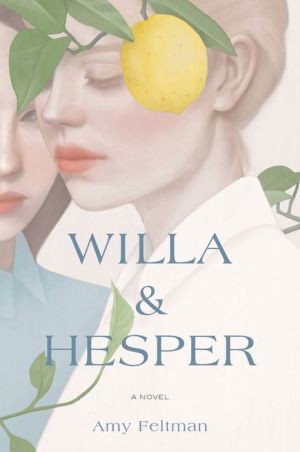
M y debut novel, Willa & Hesper, focuses on the two titular characters as they fall in love, break up, and find themselves on parallel journeys of self-discovery. It is about a lot of things — trauma, heartbreak, traveling the world only to discover you can’t get rid of your own consciousness in a new time zone, etc. — but one thing it’s also about is a love of cake.

Although I didn’t realize it while writing initially, this book is chock full of dessert references. More than thirty references to cake flutter in these pages (a special shout out to Clementine Bakery in Clinton Hill, which sustained me for two years as I pummeled through drafts of this book).

There are reading lists all across the Internet — about serious matters, about faraway destinations to help curb your cabin fever, about female murderers and everything in between. But for those of us who love reading about dessert when we’re not actively eating dessert, where’s the inspiration? I present to you, as a glutton and literary fiction aficionado, a reading list to make you crave pastries, cakes, and cookies that may or may not symbolize your relationship’s demise.

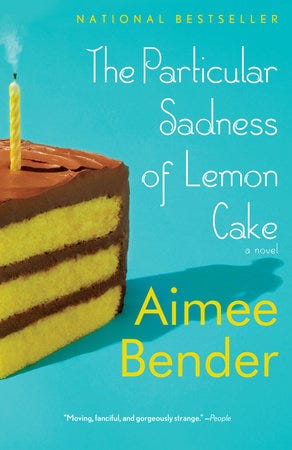
The Particular Sadness of Lemon Cake by Aimee Bender

Rose Edelstein, just about to turn nine, takes a bite of her mother’s lemon chocolate cake and discovers she can taste her mother’s emotions. Bender has an uncanny ability to deliver on surreal conceits, and as Rose’s special talent leads to difficult emotional truths, the story becomes less about magic and more about a turbulent family and Rose’s burgeoning maturity. That aside, the description of the cake is dynamite: “[I] pulled off a small warm spongy chunk of deep gold.”

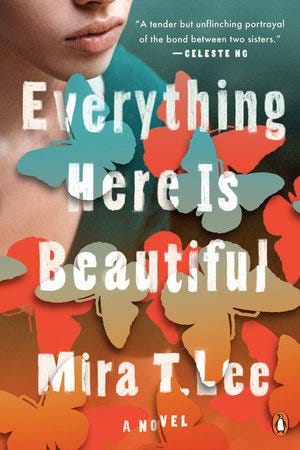
Everything Here is Beautiful by Mira T. Lee

In Everything Here is Beautiful, Mira T. Lee will throw in a small detail — about a recipe for chicken, for instance — and that detail will pop up, evolving in meaning and symbolism with each reference. Early on, Lucia marries the charismatic, older entrepreneur Yonah. One example of Yonah’s tenderness towards Lucia is by bringing her the vegan pound cake of her dreams, her favorite item at Yonah’s convenience store, which happens repeatedly over several decades. This is the last couple I expected to be rooting for, but by halfway through the book, I was totally sold.

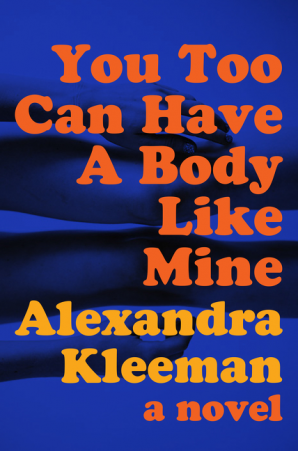
You Too Can Have a Body Like Mine by Alexandra Kleeman

I wouldn’t say this book had me craving dessert so much as it made an indelible impression of what excellent descriptions of food can do in literature. Unnamed narrator, A., is a part-time proofreader and full-time consumer. To even get into the plot — which includes a sinister supermarket chain full of veal, a reality show called That’s My Partner!, and a cult surrounding the rituals of eating — would be a challenge here. Instead, consider the entirely chemical treat Kandy Kakes, something like a twinkie if a twinkie could represent Big Brother. “Kandy Kakes: We Know Who You Really Are.”

Disappearing Dad Disorder

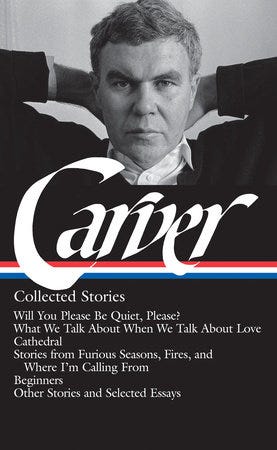
“A Small, Good Thing” in by Raymond Carver

This classic 1983 short story begins with a mother picking out her son’s birthday cake. Something feels off-kilter right off the bat, when the narration clinically (frostily?) refers to the birthday boy as “the child.” It’s a chocolate cake, with a spaceship and a planet made of red frosting. Without giving anything else away, this story brings the cake back in a surprising turn, and ends on a very different note than you might expect from the premise.

Image result for virginia woolf mrs dalloway

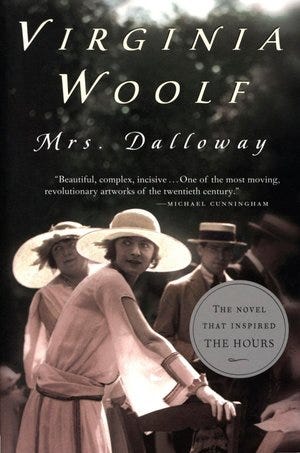
Mrs. Dalloway by Virginia Woolf

Speaking of classics — I can’t resist through one of my all-time favorites, Mrs. Dalloway. In one tension filled scene, secondary characters Elizabeth and Miss Kilman debate going to Clarissa’s party, over tea and eclairs. The tiny actions here are super sexually charged: Miss Kilman fingering the eclairs, swallowing the last two inches of the eclair after defiantly jutting out her chin. Miss Kilman is filled with longing: “If she could grasp her, if she could clasp her, if she could make her hers absolutely and for ever and then die, that was all she wanted.” Who among us hasn’t had an unrequited love and made a bee line for a dessert plate?

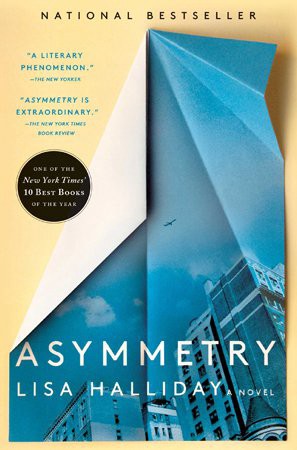
Asymmetry by Lisa Halliday

This novel is divided into two distinct parts. The beginning focuses on Alice, a twenty-something editorial assistant, and the development of her relationship with a significantly older literary titan. From the very beginning, this guy is wooing Alice with sweets: Mister Softee, squares of chocolate, and eventually, the delectable Blackout Cookie from Columbus Bakery. He doesn’t eat them, but delights in providing Alice with these treats and watching her eat them. (In silence. Normal.) The creep factor on their interactions is high — he compliments her by saying she “really does look sixteen,” affirms her compliance with the phrase good girl — and, as things continue to sour, Alice throws up one of these precious, forbidden cookies.

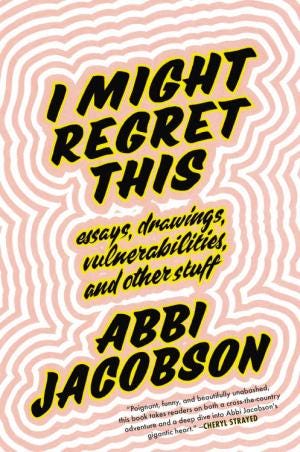
I Might Regret This by Abbi Jacobson

Abbi Jacobson of Broad City chronicled her post-breakup, cross-country journey in I Might Regret This late in 2018. In one memorable scene, Abbi checks into a bed and breakfast, thinking it will be invigorating and refreshing to be there alone. It’s a perfect example of the difference between your imagination and reality can be vast. Surrounded by couples, Abbi desperately wants to hide in her room and disappear — but the homemade blackberry scones (“impeccably stacked,” she imagines) are even more enticing than her desire for solitude among the boisterously in-love. (This might beg the question: do scones count as dessert? Reader, I’ve decided: they certainly do.)

Bonus: There but for the by Ali Smith

What if, instead of having dessert at a dinner party, you locked yourself in a bedroom and waited to see what would happen if you never came out? That’s the premise for this gem by Ali Smith, who takes uncomfortable group meals to an entirely new level. I hope for Miles’s sake that he had some chocolates squirreled away in a jacket pocket.

About the Author

Amy Feltman is the author of Willa & Hesper. She graduated from Vassar College in 2010 and earned her M.F.A. in Fiction at Columbia University in 2016, where she was also a Creative Writing Graduate Teaching Fellow. She has worked at Poets & Writers Magazine since 2014. She received a fellowship to attend the Disquiet Literary Conference in 2015 in Lisbon, Portugal. Her short story, “Speculoos,” was nominated for a Pushcart Prize in 2016.

Ayesha Harruna Attah Reimagines the Fate of Her Enslaved Ancestor in “The Hundred Wells of Salaga”

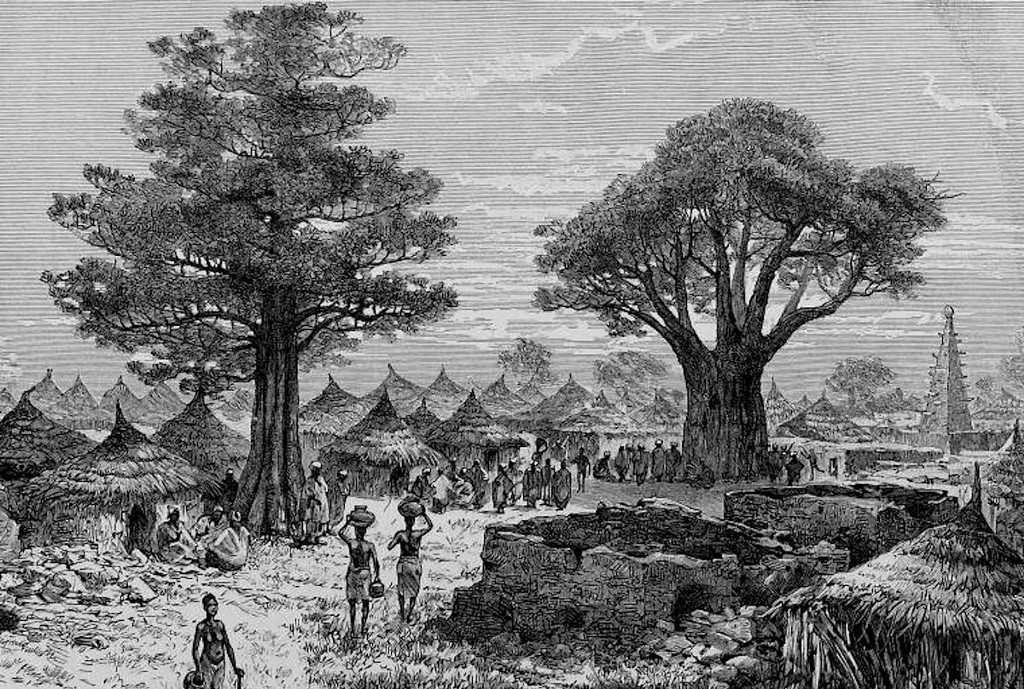
Ayesha Harruna Attah’s great-great grandmother is the force behind The Hundred Wells of Salaga, her third novel published by The Other Press. Her enslaved ancestor ended up in Salaga, a town on the southern edge of the Sahel in what is now northern Ghana. From Salaga’s market, enslaved people would be trafficked domestically or moved on to the Gold Coast and onwards across the Atlantic.

By the time of her ancestor’s enslavement and the timeframe of The Hundred Wells in the late 1900s, the slave trade had been outlawed. But in Salaga, business carried on. The Accra-born Attah reimagines the journey and fate of her grandmother in the character of Aminah, a young woman who is snatched from her village by slave raiders. On the other end of the feudal hierarchy is Wurche, a chief’s daughter, whose desire to lead is frustrated by gender expectations of her family. Through a series of tragedies, the two women are drawn together.

I spoke to Ayesha, whom I met at grad school in New York City, about retracing her ancestor’s treks, reconciling fractured histories, and living the writing life in Senegal.


J.R. Ramakrishnan: When did you first learn about your great-great grandmother’s story? How did you react when you first learnt about her?

Ayesha Harruna Attah: My father first told me about this ancestor. She was his great-grandmother. When I learned that she’d been enslaved, my initial reaction was a combination of shame and shock. It was far from the feelings of pride I’d had when I learned that we had relations to royalty. I had to unpack my emotions, why was I ashamed when this woman had done nothing wrong — if anyone had to be ashamed it was her captors (most of them royal), and people who benefited from the trade in humans. Writing this book was a look at why I felt the way I did, a chance to purge myself of the fascination with royalty, and an exploration of the texture of slavery on the African continent.

Writing this book was a look at why I felt ashamed when this woman had done nothing wrong.

JRR: Would you talk about the research that went into this novel? During this process, was there a piece of information or moment that really solidified for you that you had to write this narrative?

AHA: I wanted the family story, so I asked anyone who would indulge me for information on my ancestor. All that they knew was that she could have been Fulani, a people spread all over northern West and Central Africa; that her home could have been in Mali, Burkina Faso, or Niger; and that she was beautiful. The second part of research was going up to Salaga, to get a sense of the infamous slave market where my great-great grandmother ended up. And the third was scouring primary and secondary sources. I read through travelers’ accounts of Salaga in the 19th century, and gems such as J. A. Braimah’s Salaga: The Struggle For Power, which outlined the political activity taking shape within and outside of Salaga. There was one line in this book that cemented my resolve to write this novel. It said that princesses in Salaga could choose their lovers, even if they were already betrothed to another. It was perfect dramatic material for a novel.

JRR: The trans-Atlantic slave trade haunts the book. Aminah fears the “big water” that “had no beginning or end.” But in the novel, you focus on the complicity of Africans, royal and otherwise, in the trade via Wurche, Wofa Sarpong, and Moro. This aspect seems to have been less considered in literature than the degradations committed by white slavers. Could you speak to this perspective and how you decided to handle the writing of it?

AHA: I mentioned being shocked when my father told me about our ancestor, and I think that came from learning that her enslaver was African. I knew about indigenous slavery, but it was a fuzzy shapeless piece of information lodged somewhere in my brain. And I think that’s what indigenous slavery is to most West Africans. We know of its existence, but we push it so far back into the reaches of our minds and don’t acknowledge it. For me, realizing how close it was to home was the point I woke up. I took that amorphous piece of knowledge and took it apart and began to digest what it meant.

As I started doing my research a word kept being bandied about — “benign.” Internal slavery was supposedly not as dehumanizing as the trans-Atlantic slave trade had been, but this reasoning didn’t sit well with me. Slave raids were violent affairs where the very young and old had no chance at surviving. Enslaved people were allowed to marry into the families that had bought them, which was said to give it a different flavor from slavery across the Atlantic. To me, this still seemed like coercion and I wanted to explore what that could have looked like.

JRR: Interesting that you mention “benign.” It seems that this sentiment is often behind of some of the justification of the treatment of domestic employees, who are not enslaved but to varying degrees indentured to contracts and employers whims all over the world. What did you learn about human nature (and apparent need to organize into hierarchy) in the researching and writing this book? Anything remotely redemptive at all?

AHA: Yes, the situation of some domestic employees in parts of West Africa is no different from what Aminah would have gone through, maybe even worse. I don’t know if it’s a human need, but it has existed for thousands of years and is such a powerful system that goes hand in hand with patriarchy. What I found redemptive was the role women have always played in keeping the peace or picking up the pieces and ensuring life goes on.

JRR: Was it an early decision to have the dual POVs? Or did you come to it later on? Your grandmother inspired Aminah. How did you create Wurche?

AHA: I decided on the two points of view about three years after I started writing (it took about six years from putting down the first words till publication). At first, I focused mainly on Aminah’s story, but after I read about Gonja princesses being free to choose their lovers, I thought a woman like that would be an interesting foil to Aminah’s character who is enslaved. I did flirt with multiple viewpoints at some point, but the story needed to be told by these two women. On a craft level, Wurche was the right person to also explain the geopolitics of the region, which Aminah would have had a hard time understanding, simply because she spoke a different language, and because of her position in that very hierarchical society.

JRR: How did you personally handle the intensity of the research and its transformation to fiction? The novel doesn’t really let up with the violence. Even Wurche, who is protected by her royal class, is subject to it.

AHA: Writing Wurche’s character was one way to tone down the intensity of the violence and the feeling of suffocation I felt, even though, as you rightly point out, she is not exempt from it. I took certain liberties with her character that I couldn’t take with Aminah because I felt I had to do right by my ancestor. I was lucky to have written part of the book in beautiful places near beaches, so I would take long walks after each writing day to clear my head.

JRR: How do you expect Ghanaian readers will respond to the book? Are there people in Ghana right now who have lineages similar to Wurche’s and Aminah’s?

AHA: I have already received some reactions. I expected to hear that people weren’t ready to read a book of this sort because I sensed an unwillingness to examine our role in the slave trade. But so far, the response has been wonderful. Most people — mostly of a younger generation — have said, “I had no idea!” Others have started having conversations with their families. And one surprising detail I heard is that in almost every family, there are people who had slaves and then there were people who were enslaved.

JRR: And how do you expect the novel to be greeted in the U.S., especially by African American readers? What conversations have you had or which ones do you anticipate?

AHA: This is one African girl’s way of saying, “Sisters and brothers, I’m sorry we did this to you, I’m sorry we did this to ourselves. Can we talk? Can we build bridges?” I’m leaving myself open to discussion. I know some of it is going to be difficult, painful, even, but I hope it can be cathartic.

This novel is one African girl’s way of saying, ‘Sisters and brothers, I’m sorry we did this to you, I’m sorry we did this to ourselves.’

JRR: The other recent novel that touches upon the internal complexities of enslavement has also come from a Ghana-born writer, Yaa Gyasi, who examines the before story of slavery in Ghana in Homegoing. How is slavery taught in Ghana? How does it feature in national consciousness?

AHA: I really enjoyed reading Homegoing, which starts off in the 18th century and fans out into the diaspora, dexterously showing how the trauma of slavery is passed down from generation to generation. In my book, I stay on the home front, because that is a story that I haven’t read much of, at least in Ghana. Ayi Kwei Armah’s The Healers, also talks about the internal slave trade, in the southern part of the country. Most of the people who were enslaved were kidnapped from the north, and that’s where I set my novel.

For a long time, slavery in schools has focused on the trans-Atlantic slave trade. There are tourist sites that are directly linked to the slave trade such as the Salaga Slave Market and the Elmina Castle, where people were held in shoeboxes of spaces before being packed into boats, and the rhetoric given by the tour guides is often, “Never again.” The President of Ghana has declared 2019, the year of return for the African Diaspora, and his message has generally been the conversation at the national level, one in which Africa’s children are welcome to come home. What I’ve heard less of is: we were part of this horrible system and we are sorry, let’s get to the root of this.

JRR: What happened to the grandmother who inspired Aminah’s story?

AHA: We have no idea. Given that she was simply called the slave and no one remembers her name, I imagine she died young.

JRR: While you’ve lived and worked in New York, you chose to leave to return home and now live in Senegal. How do you feel place affects your work?

AHA: The continent of Africa is my muse so it’s important that I mostly write out of this space. From time to time, I get the chance to leave it and that remove allows me to see things clearly and not to be too precious with my stories and characters. I loved living in New York City in my 20s but it was very removed from the realities of life on the continent, so I had to get back.

And You Thought Your Last Breakup Was Bad

“The Power Couple,” “Jigsaw,” “City of Exes,” “Foiled by Language,” and “A Falling Out” by Matt Leibel

people flying with capes

“The Power Couple”

When the power couple broke up, they squabbled over who would get to keep which powers. He wanted invisibility; his lawyer made a good case that he’d been invisible for much of the marriage. She wanted superhuman strength, since it’s what she’d been using to endure the last 5 years. They negotiated a split of time travel: he got the past, and she got the future. They’d never have to be present for each other again.

“Jigsaw”

A man went through a terrible relationship. It broke him down into pieces — 500 to be exact. Now, he’s been repackaged as a jigsaw puzzle, for advanced solvers ages 8 and up. When you put him back together, you’re rewarded with the image of a man with all his cracks and seams plainly visible. In some versions of the puzzle, when you fit the final piece in place, the man begins to cry a single, puzzle piece-shaped tear.

“City of Exes”

She downloaded the breakup app on her phone. It was designed for busy single professionals who don’t have time for relationships, who’d prefer to skip to the bitter end. Within a month, she’d broken up with 400 partners. She didn’t know their names or what they looked like. But how much less lonely to move through a city of exes — of would-be strangers with whom she’d briefly shared, if nothing else, a moment of code.

“Foiled by Language”

“You’re amazing,” he told her.

“What’s so amazing about me?” she asked.

“Just…everything,” he said, stumbling.

“That’s not very specific,” she said, “and anyway the word ‘amazing’ is almost criminally overused.”

“I’m not good at elaborating,” he confessed.

“Well, that could be a problem,” she replied.

“You’re unbelievable,” he added.

She let that word hang in the air for a bit, until, amazingly, it floated away.

“A Falling Out”

In the city, there are a million windows. Inside each one is a story. The stories can be anything, even stories where the window is the hero. Or, where a man falls in love with a window, then falls out, after he and the window have a falling out, and the window becomes a widow. Or maybe there’s just one story: each of us staring out our windows with busted hearts, consoled by dreams of lives more broken than our own.

About the Author

Matt Leibel lives in San Francisco and works as a copywriter. His short fiction has appeared or is forthcoming in Portland Review, Quarterly West, Redivider, DIAGRAM, and Wigleaf.

About the Illustrator

Sara Lautman is an illustrator in Baltimore. Her most recent book, I Love You, was published by Retrofit in 2018. She contributes regularly to The New Yorker as a cartoonist and teaches comics at The Maryland Institute College of Art.

“The Power Couple,” “Jigsaw,” “City of Exes,” “Foiled by Language,” and “A Falling Out” are published here by permission of the author, Matt Leibel. Copyright © Matt Leibel 2019. All rights reserved.

The Center for Fiction’s New Home Reflects a Change in How We Read

I t isn’t hyperbole to say the Center for Fiction is a New York City institution. Opened on Pearl Street in 1820 as the Mercantile Library, it was a space where merchant clerks could not only borrow and read books but gather and discuss them with their peers. Creating a community and fostering an active approach to fiction became the Center’s mission; events there have ranged from a discussion of “Uncanny Bodies” with authors Carmen Maria Machado and Tony Tulathimutte to a CFA master class with thriller writer Lee Child.

But those days have come to an end. The Center for Fiction is dead. Long live the Center for Fiction.

On February 19, the Center will reopen at 15 Lafayette Avenue in Downtown Brooklyn’s Arts District in an 18,000 square foot space designed by Julie Nelson at BKSK Architects. By saying goodbye to its older, more limited space on East 47th street, the Center plans to do more than get a cosmetic upgrade. It hopes to open a dynamic space that addresses how people approach fiction today.

Conceptualizing and maintaining an enormous new location at a time when traditional fiction book sales are declining poses some challenges. How do you attract people who aren’t already making fiction a priority? How do you hold their attention? One way to bring in visitors is to make the space itself inviting, and the building features a street level glass facade and spacious rooms throughout, all outfitted in a cool, library-industrial decor. Coffee and wine will be served at the downstairs cafe as well as the upstairs members area, where there is an outdoor patio for the warmer months.

But the solution also requires a more cerebral response, and the Center had to examine the way it defines fiction itself. “Fiction exists in all kinds of forms,” said Noreen Tomassi, executive director, “and we want to embrace that. The book will always be essential to who we are, but we want to look at fiction in a more inclusive way.”

The Center’s new vision feels timely given the current literary climate. We’re finally challenging the traditional idea of what a writer looks like, and as the “old white man” trope gives way to a reality in which great books are written by writers of all stripes, it makes sense that our vision of the reader gets a similar update. In part, that means accepting that “reading” might not happen with a paper page at all—recognizing the legitimacy of e-books, audio books, and television adaptations. It also means addressing the fact that people enjoy a spectrum of books, not just the classics, and rarely just one genre; they may pick up crime fiction one day and short stories or translated work the next.

The Center is addressing these cultural shifts through its programming — think a diverse roster of speakers and teachers as well as intersectional events, perhaps with the Center’s neighbors such as BAM and the Mark Morris Dance Studio — and its texts on offer. In addition to the Center’s vast collection of books to borrow, which includes a library devoted to mysteries, the new ground-floor bookstore will sell a “deep cut” of literature, highlighting indie presses and literature in translation in addition to the classics.

Tomassi sees the Center as a flexible, multi-use space that’s a point of connection. “There are all kinds of ways to connect with a community who loves reading and writing,” she said. “We’re trying to create opportunities. There is a silent nook where you can read, but if you want to come with four of your friends and drink wine and walk around you can do that, too.”

Reading Proust Is Like Climbing a Mountain — Prepare Accordingly

Some might think reading Proust is akin to watching paint dry, but that would be reductive. Rather, reading Proust is like watching Proust focus on a single part of the wall where the paint has not dried as fast as the rest of the paint, then, once the paint has indeed dried in that part of the wall and is no longer distinguishable from the parts that dried faster, talk about this phenomenon and how it made him feel because it reminded him of his aunt in the spring in Combray, her face at once all dark but for one gleaming disk where the sun fell and made glorious that soft, wrinkled cheek, until the sun completed its rise or fall, whichever path it was on, and gently lit every furrow or kindly hit it all in velvet blue night, the kindness of uniformity ultimately less engaging then the brutal but thrilling spotlight, and what that means about him and his mom and bedtime.

Which is to say that reading Proust takes stamina and fortitude, strength over time and strength of character. In my opinion, it’s worth it, but it’s never going to come easily, and should not be attempted without a battle plan and immense willpower. As with finishing a marathon or reaching the summit of a daunting mountain, the only way to get through Proust — even with the best of intentions, even with unlimited free time — is to force yourself.

Reading Proust takes stamina and fortitude, and should not be attempted without a battle plan and immense willpower.

Avid readers may scoff. They think they have that discipline or that, if they weren’t born with it, they certainly developed it over years and years of gobbling up books like candy on Halloween. And there are still plenty as adults who retain their great appetite, who no more have to make themselves read Ulysses than they would Harry Potter. They’re excited to jump into Infinite Jest or A Suitable Boy or Anna Karenina and stay excited even after they’ve been on this trek for days. They don’t need any gear to help them get through and out — no book club, no paid book review, no online reading challenge to keep them accountable. They don’t get on their sat phones and call for a helicopter to come save them, the equivalent in this metaphor to throwing the book across the room. They are able to finish their great adventure in an acceptable amount of time, and then they move onto the next. It’s not an accomplishment. It’s just what they do — read books.

I thought I was like that too, able to rush in unprepared, sneering at the quinine, granola bars, and compass required by lesser readers. If the trails are well-marked, why fear tripping on a rock or getting lost? Then I met Proust.

Proust doesn’t write day hikes. He doesn’t write those four-day hikes you can take in New Zealand where a boat takes your bags for you from hotel to hotel so you don’t have to weigh yourself down as you get your 10–12 miles in. Proust is more like the Appalachian Trail. You need a strategy, and if you don’t prepare, if you don’t pace yourself, if you don’t, several weeks in, have the capacity to kick yourself out of the tent in the morning to once again drag your exhausted butt to the next campsite, you will not make it.

Proust doesn’t write day hikes. Proust is more like the Appalachian Trail.

While I’m not close with anyone who’s hiked the Appalachian Trail, I do have a friend, Leah Passauer, who ran the Great Wall Marathon, a beast in its own right. Not only does it involve some serious climbing up and down large sections of the Great Wall, China as you might remember, and this part of the Wall in particular, is often immersed in a thick, lung-ruining smog. “I think I honestly love the feeling of just pushing through pain to keep going,” the ever-peripatetic Leah wrote me from Burundi. But that’s not what gets her through race day. “It is exciting when one week six miles hurt and then a month later you are breezing through 14 miles. During the actual race for me, [however], it’s all about breaking it into different chunks. Talk yourself through important milestones. You’re suddenly like, ‘Amazing! Less than ten miles left!’”

In other words, even if you read every day of your life, it doesn’t matter if some of your past experiences were a breeze or a pain: leviathans require a unique approach. The whole can just be too daunting to handle, but cutting it up into pieces — a fang here, a tail there, claws one day, horns the next — is how the beast becomes far more manageable. I might be cowed by a monster, but I can fight a tooth here and a nail there. I can compartmentalize. I can fashion for myself a reading schedule.

For Swann’s Way, the first book in Marcel Proust’s septology Remembrance of Things Past, I have Lydia Davis’s translation, which is a very reasonable 400-something pages. Breaking it up in 20–30 page increments, giving myself every fourth day off, gets me finished in a month easy. Some days it’s very hard to crack that 20 — the less dialogue and more pontificating Proust throws my way, the more challenging it is — but I know I can’t go to bed until I’ve finished. I have a deadline. Self-imposed, yes, but if I don’t shake the stones out of my boots, plow through these mosquitoes, and make it to that milepost, it’ll be just that much harder to make up lost ground tomorrow. Also the monster might call its bear friends over to maul me in the middle of the night.

I have a deadline. If I don’t shake the stones out of my boots, plow through these mosquitoes, and make it to that milepost, it’ll be just that much harder to make up lost ground tomorrow.

Reading schedules aren’t the one and only way to reach the peak of a literary K2. Just like you don’t have to stick to one metaphor in your writing — be it butchering beasts, hiking the Appalachian trail, or climbing into thin, terrifying air — a reading schedule for Proust might not be best followed with a reading schedule for (or even attempt at) Ulysses or My Struggle or some other craggy, forbidding epic. After all, no one does Annapurna 1, then heads straight for Everest. Nor does a reading schedule alone guarantee you’ll plant a flag on the cold, icy face of that last page. It’s nearly impossible to summit the highest mountains without a team, either at base camp cheering you on or climbing right alongside you. Getting a friend to read the book with you — or at least to walkie in every once in a while to keep your spirits up — is important. For my part, I’ve convinced my sister to go along with me, and even if she doesn’t make it to the end, even if I have to leave her behind, frozen to the side of the mountain like Flick’s tongue, it’s her there beside me (or behind me) that helps push me onward.

Sometimes I am ashamed Proust isn’t a walk in the park for me. I want to eschew the schedule, certain that it reveals me as a lesser nerd than I’ve always perceived myself. If I have to trick myself into getting through a book, if I have to implement rules, how is that different from being in English class? How is that real, joyful reading? Is the literary spirit dead within me? Why don’t I just admit that I’m not good enough for Proust, thank the book for acting as a mirror for my intellectual limits, and place it, Marie Kondo-style, into my bag of Goodwill donations?

While reading Swann’s Way, I finished Lime Tree Can’t Bear Orange with no schedule at all. Amanda Smyth’s book is, almost literally, a Caribbean breeze to read. But if I had found it hell to read, I wouldn’t have judged myself for getting rid of it, and I certainly wouldn’t have made myself a schedule to ensure completion. I think that’s because, for the vast majority of books, even literary novels, ease of reading and pleasure of reading do in fact go together. Even long fantasy novels, epics in their own right with maps and family trees and invented languages, typically keep you rolling with action and suspense in the forms of fantastic creatures in far-off places doing exhilarating things. For me, if a book is so challenging to read as to make momentum difficult to sustain, it’s usually not because the book is as formidable as it is good. It’s either a bad book, a book for whom I am not the intended audience (something I am fine admitting), or both.

It’s Okay to Give Up on Mediocre Books Because We’re All Going to Die

But Proust, along with some of his high-brow brethren, exists outside that dichotomy. Those aforementioned day hikes and four-day, boat-supported, no-camping treks are great, but whither glory? Only in books that can break you, leave you at the bottom of the canyon sawing off your own arm to survive, are capable of providing glory. The glory, after all, isn’t in the beauty of the view at the end of the adventure, nor, for me at least, in the scarcity of the number of people who get to enjoy the view. The glory comes from proving to myself I had the wherewithal to get there in the first place, the cleverness to bring all the proper tools with me not just to ensure I don’t eat poisonous mushrooms or offend a bridge or tunnel troll, but also to help me muscle my way through and out all the quicksand, driving snow, and bellies of whales. Planning, temerity, and persistence — or knowing you can, canning, and having canned — that’s the trifecta of all great adventures and great escapes.

And that’s really why I’m tackling Proust — as both avoidance of and, hopefully, eventually, preparation to get back to my own writing. Since I published my first book, maybe even before that, I’ve been suffering from serious discipline block. I won’t go to the outfitters and fill my backpack; I don’t scheme or map; I can’t look at the Great Wall and think one watchtower at a time. Instead, I think about those glorious mountains I could be making my own — and I end up watching them on Netflix instead. I have made myself write in the past, and I know I can make myself again the future, but right now I cannot make myself write anything longer than this. What I can make myself do is read Proust. And when I capture the glory at the very end of it, like gold at the end of the rainbow, I am hoping to exchange it for what I really wish — the ability to make my own rainbows, my own gold, my own story.

Melville House Published the Climate Report Because Trump Didn’t Want To

On November 23, 2018, the U.S. government released the Fourth National Climate Assessment, a federally mandated study compiled by thirteen agencies and over 300 scientists to examine the effects of climate change. The study’s results are terrifying, pointing to a near future where climate change not only costs the U.S. economy more money than the recession, but destroys lives as extreme weather events like the recent California wildfires become the norm.

The date the report dropped was strategic. President Trump proudly refutes climate change, so it’s no coincidence that November 23 was Black Friday and most Americans were too busy relaxing in a post-Thanksgiving food coma or power purchasing holiday gifts to notice the report. The media coverage was also half-hearted; outlets sandwiched coverage between videos of crazed shoppers and tips on where to get the best deals. But some people did take notice, including Dennis Johnson, publisher and co-founder of the Brooklyn-based independent publisher Melville House. “The Climate Report was released by the government with not only no fanfare, but not even an announcement, on the afternoon of Black Friday,” he explained. “[Co-founder] Valerie Merians and I discussed it over dinner, and decided to do it then and there. It was too reminiscent of the Senate Intelligence Committee’s report on the CIA torture program — another vitally important report making our government look awful, released in a media dead zone in hopes it would just go away. We published that one, too.” Merians and Johnson acted fast, and The Climate Report: National Climate Assessment-Impacts, Risks, and Adaptation in the United States by The U.S. Global Change Research Program (USGCRP) is now available on their website for $16.

The media coverage was half-hearted; outlets sandwiched coverage between videos of crazed shoppers and tips on where to get the best deals.

I point out the price because The Climate Report is the kind of work that is usually published by an academic publisher. As opposed to trade publishers, which target books to the masses, academic publishers aim for a small, specialized audience such as researchers and libraries. The books they sell are typically peer-reviewed, heavily footnoted monographs, and they cost more — a lot more, about $60–120 versus $12–40 for trade books. This pricing scheme makes sense for the publishers who are trying to net money from a smaller audience, though it also makes an academic book’s limited audience a self-fulfilling prophecy. Melville House is selling The Climate Report at an accessible price point because, as Johnson says, it’s a text for everyone: “It’s meant to explain the science and economics of global warming to the general citizenry, and its clear pains were taken to make it accessible. It’s concise, heavily illustrated with charts and graphs and photographs, and it’s broken down, for the most part, into regional discussion…so you can skip around between the areas you’re most interested in.”

The idea of a traditional publisher, even a politically-minded one, taking on an academic text isn’t an obvious one. When I asked a friend, a J.D.-Ph.D. from Yale, for her thoughts, her comments ranged from, “It’s rare to see a publisher throw their weight behind something unsexy” to “It’s interesting to see a publisher fight the laws of supply and demand.” I, too, was skeptical that people would want to read such a report, even at a relatively reasonable $16 a pop. After all, it’s a trying time for facts — as I write this, the literary community is agog at the New Yorker expose on Dan Mallory, the thriller writer and former editor who has apparently lied about everything from holding doctorate degrees to having cancer in pursuit of getting ahead. His faked life story is just another audacious lie in what can feel like an unending litany of them (the Fyre festival, online university scams, men exposed by the #metoo movement for a history of sexual assault, half of Trump’s tweets, etc.) and we’re getting to the point where facts induce skepticism, even the well-researched ones.

Despite all this, I think it’s time to turn to experts — actual, vetted, experts — and put them back in their place of pride. God knows we’re running out of time and options. For a phenomenon that might wipe humanity off the face of the earth, it’s ludicrously difficult to get people to engage with climate change. Al Gore tried using the box office, and though his 2006 documentary An Inconvenient Truth was successful in dollar terms, massing over $24 million in the U.S., it’s 12 years later and the EPA just made it easier for coal plants to pollute waterways. The BBC hit miniseries Blue Planet II tried to reach people through the small screen, but not even its troves of adorable and majestic sea creatures could cause a cultural commotion. (And seriously, watching the final episode, which is dedicated to the potentially irreversible damage to our oceans, requires a glass of wine and a hand to hold). According to the Yale Program on Climate Change Communication, only 58% of the people they surveyed last year believe that humans are causing climate change. Unless we want to live in a dystopian spy thriller of a world that’s besieged by the elements and where you can literally trust no one, we must start somewhere, and I choose scientists.

Unfortunately, universities aren’t called ivory towers for nothing, and their presses can be similarly siloed. But Melville House has shown that academic and trade publishers have something to offer each other—expertise on one hand, consumers on the other—and it’s the perfect time to make that connection. By offering an authoritative report to the public in a format they can enjoy and a price they can afford, it will also be harder for non-believers (including the government) to spread disinformation. Melville House’s recently launched Climate Report Project will take this idea one step further by creating reading groups to “connect families and concerned citizens with each other and with educators, scientists, politicians and policy makers.” Using a traditional trade publishing tool, reading groups, to help circulate the facts on climate change is brilliant, not in the least because it will help people synthesize what is, at 224 pages, a whopper of a report. Hopefully readers will be encouraged to contextualize the report as well as its contents: where did the scientists and policy makers get their information? How did they come to their conclusions? Despite everything that has happened in the last few years, facts can be indisputable and truth exists. It’s time to bring unsexy back.

8 Books to Read in Between Seasons of Your Favorite Sitcom

You know that feeling, when you’ve spent three…four…five hours on the couch, an empty bowl of popcorn on the floor, your legs slightly numb from misuse, and Netflix deigns to ask you that morbid question: “Are you still watching?” There are few things more embarrassing than when your streaming service passive-aggressively asks you if you have anything better to do with your Sunday afternoon. Then again, perhaps Netflix has a point. It may be easy to pick up the remote control and tell your condescending television that yes, you are still watching. What’s another 25 minutes in the grand scheme of things? But rather than watching the next season of your favorite sitcom (again!) you could pick up that novel sitting on the coffee table next to the forsaken popcorn kernels. Here is a list of novels you could be laughing at or mulling over instead of staring at your television set.

If you like Black-ish, read The Sellout by Paul Beatty

In Black-ish, the patriarch of the Johnson family worries that living the American Dream in L.A., a dual income household from high paying careers (and all the Jordans he could ever need), has a major pitfall — his children are not black enough. Assimilation, as far as Dre Johnson is concerned, should be carefully monitored, even suppressed. This satirical take on life as a black person in America is mirrored in The Sellout, though perhaps in a slightly darker manner. Paul Beatty’s novel, in which the protagonist aims to reintroduce segregation to the U.S., is laced with a similar comedy to that of Black-ish: humor that makes you meditate on what exactly it is that you’re laughing at.

If you like Fresh Off the Boat, read The Field Guide to the North American Teenager by Ben Philippe

Ben Philippe’s comical YA novel follows Norris Kaplan as he moves from Canada to Austin, Texas and finds himself with the categorical cliches of every American sitcom that takes place in a high school. Norris, a black Haitian French Canadian, quickly discovers that he does not belong to any of these stereotypes. In Fresh Off the Boat, Eddie, the precocious, hip-hop-loving narrator, finds himself in a similar predicament when his father uproots his family from their comfortable life in Chinatown, Washington, D.C. to the (very white) suburbs of Orlando, Florida. Similarly to Norris, Eddie discovers that, although his personality, hobbies, and passions may be the same as his new classmates, his ethnicity makes it difficult for him to fit in.

If you like Brooklyn Nine-Nine, read Case Histories by Kate Atkinson

When Brooklyn Nine-Nine is not tackling issues of race, homophobia, and injustice or keeping the viewers up to date on Santiago and Peralta’s relationship, it is setting up new cases for the detectives to work. Each episode could be its own mystery or thriller, letting us sit in suspense as we wait for Peralta’s light bulb moment to come and whisk us on an adventure through Brooklyn’s alleyways to catch the perpetrator. Kate Atkinson’s Jackson Brodie Mysteries feature a private investigator solving crime in Cambridge, England. The mystery novels marry humor with mystery in a way that will remind you of Brooklyn Nine-Nine.

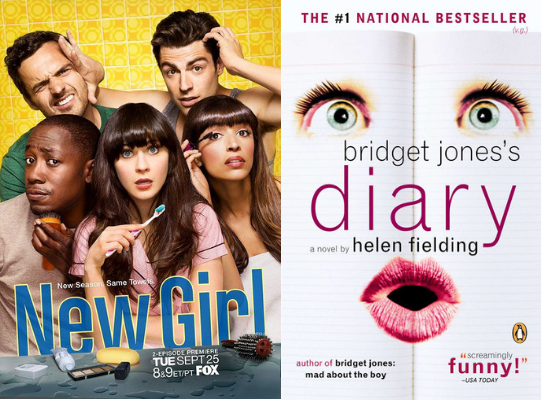
If you like New Girl, read Bridget Jones’s Diary by Helen Fielding

When Jessica Day moves in with three male roommates, shenanigans and unlikely romances ensue, but at the heart of this sitcom is an eagerness for self-improvement. Jess works endlessly to make her unconventional living situation as comfortable for everyone as possible, while simultaneously climbing up the ladder in her career and getting over her adulterous ex. Nick is trying to finish his novel, or so he says. Winston is on the search for a fulfilling job. And Schmidt is constantly attempting to forget his embarrassing past and better himself in all aspects of his life. Bridget Jones’s Diary combines these desires for self-improvement in one hilarious novel written in the form of diary entries. The laziness, self deprecation, and drive for betterment so apparent in the characters of New Girl find their place in the protagonist of this novel about a woman living in London, intent on losing weight, quitting cigarettes, and finding “inner poise.”

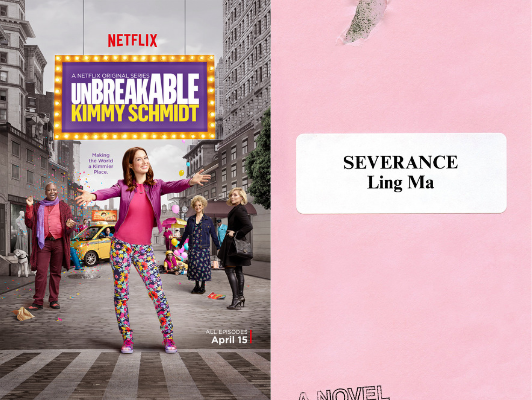
If you like Unbreakable Kimmy Schmidt, read Severance by Ling Ma

Unbreakable Kimmy Schmidt and Severance are both apocalyptic stories with a comedic twist, though the former is a tale of a young woman recovering from a doomsday cult while Severance tells the narrative of a young woman joining one in the midst of the world’s demise. Kimmy Schmidt does escape from the bunker where she was held for the majority of her life, but the New York in which she finds herself is slightly more apocalyptic than the one we know today. In her New York, you can easily get a license to be an Uber driver by simply having a learner’s permit and newspapers scream headlines like “De Blasio Pledges to ‘Ruin City.’” In Severance, a satire on capitalism and office culture, the protagonist leaves behind a New York ravaged by a zombie-adjacent disease to join the few survivors left in a mall.

‘Severance’ Is the Apocalyptic Millennial New York Immigrant Story You Didn’t Know You Needed

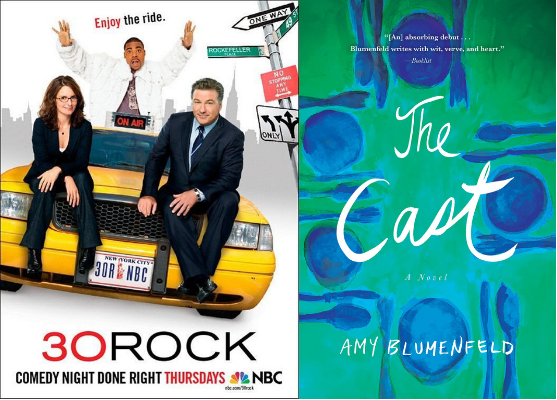
If you like 30 Rock, read The Cast by Amy Blumenfeld

Liz Lemon has a lot on her plate, from unruly employees to a procession of dysfunctional relationships. But her coworkers, the people she writes with and the actors she writes for, are also the fuel to her fire, making her a successful figure in the unforgiving industry of television in New York City. In The Cast by Amy Blumenfeld, the protagonist also finds solace in the relationships she forges with her co-writers — though in this novel her co-writers consist of a group of childhood friends with whom she once wrote and performed a Saturday Night Live-style script.

If you like The Good Place, read A Woman Destroyed by Simone de Beauvoir

This increasingly popular new show digs up and dusts off old quotes written by dead white men at least once every episode.The micro-philosophy lessons come from Chidi Anagonye, a former ethics professor who devotes his time in the afterlife to teaching his somewhat questionable morals to a group of particularly amoral people. It’s hard to blame him for the lack of diversity in his lesson plan, though, seeing as Western philosophy has been dominated by white men since Plato wrote The Republic. That doesn’t mean women philosophers don’t exist. When you’re looking for your The Good Place companion novel, try setting aside Sartre for now and picking up a novel written by his lifelong partner, Simone de Beauvoir. A Woman Destroyed is not a humorous book, but it will give you a taste of philosophical text from a different perspective.

Why the ‘Good Place’ Personality Test Is Better than the Myers-Briggs

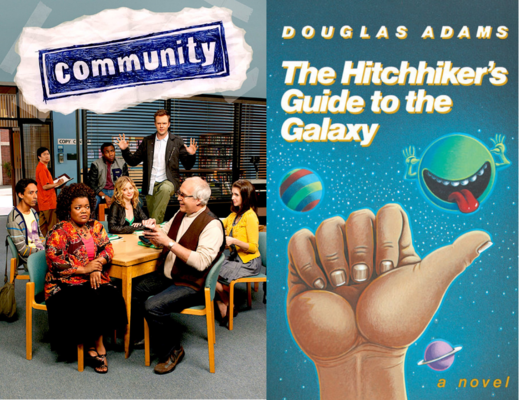
If you like Community, read The Hitchhiker’s Guide to the Galaxy by Douglas Adams

Community is not sci-fi (although some episodes could be considered in the neighborhood of the genre) so the plot of this sitcom is quite different from The Hitchhiker’s Guide to the Galaxy. However, the larger-than-life characters and laugh-out-loud humor of Douglas Adams’ novel will certainly attract those who are fans of Community. The Hitchhiker’s Guide to the Galaxy is the story of a man who escapes the destruction of Earth by sticking out his thumb, hitching a ride with the nearest alien, and encountering some of the most eccentric people you may ever read about. But those people will remind you of the unconventional study group of Greendale Community College.

Trump, Oprah, Zaphod Beeblebrox: Why We Love Celebrity Overlords

We’re Always Connected Online, and We’ve Never Been So Lonely

One night in 2009, Andrey Ternovskiy, a seventeen-year-old Russian high school student, sits at the old computer in his Moscow bedroom and builds an online chat site. He calls the site Chatroulette, after a scene in The Deer Hunter, a 1978 Vietnam War film in which prisoners are forced to play Russian roulette. The building takes two days. When he launches, in November, the site only has 20 users, but the number grows rapidly, and by December, 50,000 people are visiting each day. The following March, the site has 1.5 million users, roughly a third of them from the U.S.

Ternovskiy’s site works like this: a user logs on and “spins,” or connects with another user at random, somewhere in the world, and they have an exchange. The interaction is webcam-based. Sometimes you spin and find a person dancing. Sometimes they’re having sex. Each time a connection is made like this, a spinning roulette, and if you’re interested you stick around, watch them, talk to them, share something of yourself, too. You move on by hitting the “next” button.

Most users, about nine in ten, are men. One in eight spins will deliver nudity: someone exposing themselves, or engaged in a sex act, often masturbation. The number of monthly unique visitors has climbed steadily over the years and now hovers around the nine million mark. The game’s language has spilled over into real life, entered the lexicon. People talk about “nexting” someone as in: He’s been nexted, or: It’s time to next her. Chatroulette is where this term comes from.

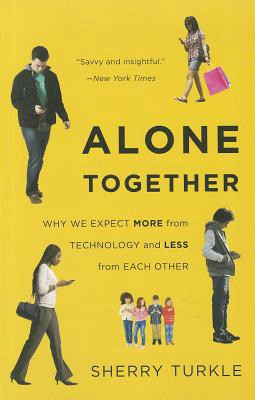
I hadn’t heard of Chatroulette until recently. I was reading a book by MIT professor Sherry Turkle, Alone Together, about how we expect so much from technology, and not too much from other people. Turkle mentions the site there.

The book came out a few years ago, but I didn’t read it at the time because I didn’t read non-fiction back then, not really. I was happy to stay inside the various worlds conjured by imagination. How could facts compete with fantasy? To me, they could not. No contest.

But with the arrival of reality television and Facebook new categories were given to us, new ways to tell stories; a new kind of fuzziness introduced into the landscape of narrative. The lines between fiction and fact, between real and not began to blur. Things grew hazy, the Kardashians took charge of the world, and we suddenly found ourselves at the Apple store, camping out to purchase smartphones.

When the fog lifted, we emerged to find Donald Trump standing under a spotlight for The Apprentice, where he remained, fourteen primetime seasons in a row, cameras trailing as he rode his golden escalator up and down Trump Tower. His competitive reality show pulled in great ratings for NBC — yuge, you could say — and in June, 2015, there he was on screen again: Donald Trump, riding the escalator down into the gilded atrium of Trump Tower on Fifth Avenue, the same one from the show, except this time to announce his run for office.

Cut to: me standing by the TV in my living room, watching him rest one palm against the Bible, take his oath, our new Number 45. I’m not sure if the Trump campaign, or his run, or the inauguration was what weakened my allegiance to fiction, but close enough. It happened around then. If it hadn’t been clear to me before, it was now. The truth was important and needed to be understood and broadcast and repeated and protected. Stories alone would no longer cut it. Ignorance was not bliss.

Before my Christmas flight to Florida, in the waiting area by the gate, everyone tethered to some device, I read Turkle’s book. I read about the ways technology has introduced new kinds of instability into our lives, reframing our approach to information, to communion, to community, to privacy, to ourselves: technology as an architect, but a shitty architect, one who knows the blueprints are weak, and at any moment the floorboard will give out, but who sells us the house anyway. This was how Turkle brought up Chatroulette: as an example of a shitty architect.

Some people saw the site as a game, others more of a dating service, which I found to be sad, but not really surprising. I’m no longer surprised by the weird and nebulous and shallow workings of the internet, by the farce and grime of it. On average, it will take a user no more than a few seconds before they hit the “next” button on Chatroulette. That’s the window of opportunity we’re talking about. There’s your shot at intimacy.

Being on the site, being fed audio, presented with a steady stream of faces and bodies means you can experience a sense of continual connection. But it’s a misleading connection in that when it ends, it leaves you feeling even more lonely than before. To escape the loneliness, you retreat into the screen again, looking for another hit of what passes for connection, and the cycle is reinforced. The isolation deepens. Turkle paraphrases Shakespeare in describing the cycle: we are consumed with that which we were nourished by.

To escape the loneliness, you retreat into the screen again, looking for another hit of what passes for connection, and the cycle is reinforced.

If we’ve allowed technology to engineer our relationships to this degree, there’s a price we must now pay. That price is a cheapening, reduction our new norm, Donald Trump our chosen leader, maybe the leader we deserve. Maybe because we’re so distracted and confused by the internet, we’ve failed the country in our role as citizens. Maybe because we’re overly enchanted with our screens, we don’t realize what our feeds provide is just simulation: not living, but the feeling of living. Maybe we fight for each other’s attention, try to type ourselves into being, preoccupied with the artifice of impression management, in order to avoid the reality that we’re all secretly very sad: lonely, and drowning in a sea of strange penises.

The flight to Florida is fine, everyone staring at their entertainment systems, screens embedded in the seat back in front of them. Fine. Normal. Just the way it goes. And then in the hotel, too, WiFi everywhere, even in the toilets, by the pool, the gym fully wired.

The first night I can’t sleep properly and find myself sitting in front of the closed Starbucks downstairs, hours before dawn, waiting for my family to wake up. I read my book. The section devoted to robot friendships makes me feel gloomy about the future, makes me realize I really don’t want a future of robot friendships, don’t believe robots are even capable of friendship. It makes me wonder how we got here.

When I was a grad student, I joined Facebook. The year was 2004 and everyone was in a fever about how great the site was, so I joined. Before this I had been on MySpace, and Friendster, but only briefly. They didn’t take. My friends and I did use AOL’s instant messaging service though, and I would compose “away” messages that usually incorporated a Notorious B.I.G. lyric, provided without context (for instance: “I’ve been smooth since days of Underoos!” or: “Only make moves when your heart’s in it!”). My handle was “oneluvv55,” yes, because of Bob Marley and yes, I now find it an embarrassing choice. This was the extent of my online life.

Facebook was different. I joined initially out of curiosity, but that soon gave way to a search for community, connection. At the time, the press Facebook received was positive, its narrative one of triumph: Social media would help us enhance friendship, provide alternative avenues for communication and commerce. Cyberintimacy could be offered as a solution to those who lived in solitude; online networks would buffer against loneliness.

I filled out my Facebook profile on my laptop, in my dorm room. The blank virtual real estate given to me seemed full of potential. What should I say? Who should I be?

Some of the questions were delicate. Facebook wanted to know about my “relationship status,” a tricky issue for a Muslim girl to address publicly, so I left it blank. “Favorite movies” were also tricky. Should I disclose my enthusiasm for the Peanuts Holiday Collection DVD box-set, or fool myself and others by listing a bunch of arty films? Arty but not weird arty. Arty but not too obscure.

I could already see a balance needed to be achieved, that this was an exercise in determining the overlap between what I actually cared about and what I wanted to project to the world. I understood what I was presenting wasn’t my true self but a construction, a persona: flat yet dynamic, a projective screen through which to express myself. I could tweak and edit my virtual selves over and again, sending them out to live parallel lives for me. The possibilities were endless.

Our first day in Florida, my family and I drive to the White Sands Buddhist Temple in a small town near Orlando, called Mims. The site, 30 acres, features three enormous granite statues of the Buddha during various stages of his life. The “Nirvana Buddha,” or Siddhārtha, the original Buddha whose teachings comprise the basis of most Buddhist practice, is my favorite among them. Depicted as a serene octogenarian, he is lying on his right side, ready for death. He is unafraid and welcomes death completely, smiling and at peace.

My family wanders off, exploring the grounds, and for a while I stand by the statue alone. A plaque tells me it weighs 40 tons and is about 30 feet in length. I stare Siddhārtha in the eyes, until it is clear he can see me too. When I pull my phone out, to capture our exchange, it’s already over. The moment has dissolved.

To build a life of happiness, we need to embrace and develop a life of noble virtues, a sign nearby says and I wonder how the Buddha would do with an iPhone. What would he make of all those disembodied penises being energetically masturbated on Chatroulette? I decide not to take Siddhārtha’s picture. His smile widens in the stone.

What would the Buddha make of all those disembodied penises being energetically masturbated on Chatroulette?

The second day of my family vacation, I wake up even earlier than the previous morning, and once again find myself in front of the Starbucks. I finish the book. Dr. Turkle has conducted hundreds of interviews, done fifteen years of research on technologically mediated social interaction, and her findings are bumming me out. We are online, she writes, connected as we’ve never been before, but we have damaged ourselves in the process.

Turkle cites a 2010 study of 14,000 college students that spans 30 years. The study found that since the internet became a thing — an unstoppable, addictive kind of force — young people have begun to exhibit a sharp, disturbing decline in empathy. They don’t care as much anymore, we don’t care, and our disinterest is attributed in part to the fact we’re on our phones all the time.

“An online connection can be deeply felt,” Turkle says, explaining the decline, “but you only need to deal with the part of the person you see on social media.” Purpose-driven and “plugged in,” we pay much less attention to those around us, to those actually physically in our lives, and our relationships suffer because of it. Compulsively, we turn our attention to the screen, and are confronted by a strange, fractured world comprised of parts: a world of sound-bites and performance and half-truths, of tits being flashed on a webcam.

Over time, there is a shallowing that happens. Ours is now a world of emotional distance, of performative social concern, of calculated wokeness, of believing the Finstas, the filters, the highlight reels, the catfishers, the “fake news” headlines we’re fed on Facebook. If some of us feel detached, it isn’t necessarily an aggressive detachment, Turkle says. It’s a way to cope. It’s because we feel so bombarded and numbed, we are shutting down.

Our Instagram feeds have become sites of longing and discontent, of constraint not freedom. Facebook has become a place of surveillance and data collection on the sly. Turkle says we now have trouble separating what’s real from what isn’t. Maybe we’ve even stopped caring what’s real and what isn’t.

But I don’t want to stop caring. I don’t want us to stop. I don’t think we can afford to.

On the flight back to Minneapolis from Florida, I sit next to a guy, twentysomething and in a track suit. He’s watching porn on his phone. Or at least, I think it’s porn initially, but a second glance reveals it’s a social media app. He scrolls and taps, a moving landscape: next, next, next. I see clavicle. The strap of a pretty lace bra. I see breasts. I don’t look again. I want to, curiosity pulls at me, but I tell myself no.

When the doors close and we are airbound, he begins texting someone at a rapid pace and for the duration of the flight. I wonder if he’s texting his girlfriend, or one of the women from the app, or maybe his mom. He is young but had lost most of his hair. He bites his nails and jiggles his leg. His snack choice is peanuts. He has an iPhone.

I wonder if he’s on Chatroulette. I wonder if he’s lonely. I wonder if he ever wishes he could reclaim his story, his attention, his “moral authority from cold-eyed corporations” (that’s Turkle) like Facebook, like Instagram; all the rest of them, too. I don’t ask him any of this, of course, don’t talk to him at all. We make eye contact zero times. It’s fine. Normal. Just the way it goes.

I wonder if he ever wishes he could reclaim his story from cold-eyed corporations like Facebook, like Instagram.

Somewhere over St. Louis, I glance at him and feel a swell of something. Compassion, maybe. Compassion, finally. It’s just a flicker, but it is there. Maybe I feel it because in him, I have seen part of myself.

To build a life of happiness, we need to embrace and develop a life of noble virtues. I’ve written this down for some reason, and I stare at the words now, my notebook on the tray table. I realize I don’t really know what they mean. What is a noble virtue anyway? It’s 2019 now, the year has turned, so what does a life of virtue feel like, look like these days? Whatever the answer, I’m beginning to think I won’t be able to find it inside the wires of my phone, underneath my compulsion to tap, tap, tap for what’s next, next, next.

We touchdown and moments later get the go-ahead to turn on our phones. Even before we get the go-ahead, before the cabin lights flicker on, they are out: strings of devices, glowing like little stars in the night. Strangely beautiful.

The young man next to me has a connecting flight. Thirty minutes, he says. Can he cut through? I smile, and he does too, and there is a moment of relation. I don’t know who he is, where he’s going, what he feels when he looks into his screen, what he’s hoping to find in there. I’ll never know. I step into the aisle, let him pass. I watch as he stands by the door, his body hunched, his eyes fixed and unmoving, his phone glowing and radiant against his palm.