I t isn’t hyperbole to say the Center for Fiction is a New York City institution. Opened on Pearl Street in 1820 as the Mercantile Library, it was a space where merchant clerks could not only borrow and read books but gather and discuss them with their peers. Creating a community and fostering an active approach to fiction became the Center’s mission; events there have ranged from a discussion of “Uncanny Bodies” with authors Carmen Maria Machado and Tony Tulathimutte to a CFA master class with thriller writer Lee Child.
But those days have come to an end. The Center for Fiction is dead. Long live the Center for Fiction.
On February 19, the Center will reopen at 15 Lafayette Avenue in Downtown Brooklyn’s Arts District in an 18,000 square foot space designed by Julie Nelson at BKSK Architects. By saying goodbye to its older, more limited space on East 47th street, the Center plans to do more than get a cosmetic upgrade. It hopes to open a dynamic space that addresses how people approach fiction today.
Conceptualizing and maintaining an enormous new location at a time when traditional fiction book sales are declining poses some challenges. How do you attract people who aren’t already making fiction a priority? How do you hold their attention? One way to bring in visitors is to make the space itself inviting, and the building features a street level glass facade and spacious rooms throughout, all outfitted in a cool, library-industrial decor. Coffee and wine will be served at the downstairs cafe as well as the upstairs members area, where there is an outdoor patio for the warmer months.
But the solution also requires a more cerebral response, and the Center had to examine the way it defines fiction itself. “Fiction exists in all kinds of forms,” said Noreen Tomassi, executive director, “and we want to embrace that. The book will always be essential to who we are, but we want to look at fiction in a more inclusive way.”
The Center’s new vision feels timely given the current literary climate. We’re finally challenging the traditional idea of what a writer looks like, and as the “old white man” trope gives way to a reality in which great books are written by writers of all stripes, it makes sense that our vision of the reader gets a similar update. In part, that means accepting that “reading” might not happen with a paper page at all—recognizing the legitimacy of e-books, audio books, and television adaptations. It also means addressing the fact that people enjoy a spectrum of books, not just the classics, and rarely just one genre; they may pick up crime fiction one day and short stories or translated work the next.
The Center is addressing these cultural shifts through its programming — think a diverse roster of speakers and teachers as well as intersectional events, perhaps with the Center’s neighbors such as BAM and the Mark Morris Dance Studio — and its texts on offer. In addition to the Center’s vast collection of books to borrow, which includes a library devoted to mysteries, the new ground-floor bookstore will sell a “deep cut” of literature, highlighting indie presses and literature in translation in addition to the classics.
Tomassi sees the Center as a flexible, multi-use space that’s a point of connection. “There are all kinds of ways to connect with a community who loves reading and writing,” she said. “We’re trying to create opportunities. There is a silent nook where you can read, but if you want to come with four of your friends and drink wine and walk around you can do that, too.”
Some might think reading Proust is akin to watching paint dry, but that would be reductive. Rather, reading Proust is like watching Proust focus on a single part of the wall where the paint has not dried as fast as the rest of the paint, then, once the paint has indeed dried in that part of the wall and is no longer distinguishable from the parts that dried faster, talk about this phenomenon and how it made him feel because it reminded him of his aunt in the spring in Combray, her face at once all dark but for one gleaming disk where the sun fell and made glorious that soft, wrinkled cheek, until the sun completed its rise or fall, whichever path it was on, and gently lit every furrow or kindly hit it all in velvet blue night, the kindness of uniformity ultimately less engaging then the brutal but thrilling spotlight, and what that means about him and his mom and bedtime.
Which is to say that reading Proust takes stamina and fortitude, strength over time and strength of character. In my opinion, it’s worth it, but it’s never going to come easily, and should not be attempted without a battle plan and immense willpower. As with finishing a marathon or reaching the summit of a daunting mountain, the only way to get through Proust — even with the best of intentions, even with unlimited free time — is to force yourself.
Reading Proust takes stamina and fortitude, and should not be attempted without a battle plan and immense willpower.
Avid readers may scoff. They think they have that discipline or that, if they weren’t born with it, they certainly developed it over years and years of gobbling up books like candy on Halloween. And there are still plenty as adults who retain their great appetite, who no more have to make themselves read Ulysses than they would Harry Potter. They’re excited to jump into Infinite Jest or A Suitable Boy or Anna Karenina and stay excited even after they’ve been on this trek for days. They don’t need any gear to help them get through and out — no book club, no paid book review, no online reading challenge to keep them accountable. They don’t get on their sat phones and call for a helicopter to come save them, the equivalent in this metaphor to throwing the book across the room. They are able to finish their great adventure in an acceptable amount of time, and then they move onto the next. It’s not an accomplishment. It’s just what they do — read books.
I thought I was like that too, able to rush in unprepared, sneering at the quinine, granola bars, and compass required by lesser readers. If the trails are well-marked, why fear tripping on a rock or getting lost? Then I met Proust.
Proust doesn’t write day hikes. He doesn’t write those four-day hikes you can take in New Zealand where a boat takes your bags for you from hotel to hotel so you don’t have to weigh yourself down as you get your 10–12 miles in. Proust is more like the Appalachian Trail. You need a strategy, and if you don’t prepare, if you don’t pace yourself, if you don’t, several weeks in, have the capacity to kick yourself out of the tent in the morning to once again drag your exhausted butt to the next campsite, you will not make it.
Proust doesn’t write day hikes. Proust is more like the Appalachian Trail.
While I’m not close with anyone who’s hiked the Appalachian Trail, I do have a friend, Leah Passauer, who ran the Great Wall Marathon, a beast in its own right. Not only does it involve some serious climbing up and down large sections of the Great Wall, China as you might remember, and this part of the Wall in particular, is often immersed in a thick, lung-ruining smog. “I think I honestly love the feeling of just pushing through pain to keep going,” the ever-peripatetic Leah wrote me from Burundi. But that’s not what gets her through race day. “It is exciting when one week six miles hurt and then a month later you are breezing through 14 miles. During the actual race for me, [however], it’s all about breaking it into different chunks. Talk yourself through important milestones. You’re suddenly like, ‘Amazing! Less than ten miles left!’”
In other words, even if you read every day of your life, it doesn’t matter if some of your past experiences were a breeze or a pain: leviathans require a unique approach. The whole can just be too daunting to handle, but cutting it up into pieces — a fang here, a tail there, claws one day, horns the next — is how the beast becomes far more manageable. I might be cowed by a monster, but I can fight a tooth here and a nail there. I can compartmentalize. I can fashion for myself a reading schedule.
For Swann’s Way, the first book in Marcel Proust’s septology Remembrance of Things Past, I have Lydia Davis’s translation, which is a very reasonable 400-something pages. Breaking it up in 20–30 page increments, giving myself every fourth day off, gets me finished in a month easy. Some days it’s very hard to crack that 20 — the less dialogue and more pontificating Proust throws my way, the more challenging it is — but I know I can’t go to bed until I’ve finished. I have a deadline. Self-imposed, yes, but if I don’t shake the stones out of my boots, plow through these mosquitoes, and make it to that milepost, it’ll be just that much harder to make up lost ground tomorrow. Also the monster might call its bear friends over to maul me in the middle of the night.
I have a deadline. If I don’t shake the stones out of my boots, plow through these mosquitoes, and make it to that milepost, it’ll be just that much harder to make up lost ground tomorrow.
Reading schedules aren’t the one and only way to reach the peak of a literary K2. Just like you don’t have to stick to one metaphor in your writing — be it butchering beasts, hiking the Appalachian trail, or climbing into thin, terrifying air — a reading schedule for Proust might not be best followed with a reading schedule for (or even attempt at) Ulysses or My Struggle or some other craggy, forbidding epic. After all, no one does Annapurna 1, then heads straight for Everest. Nor does a reading schedule alone guarantee you’ll plant a flag on the cold, icy face of that last page. It’s nearly impossible to summit the highest mountains without a team, either at base camp cheering you on or climbing right alongside you. Getting a friend to read the book with you — or at least to walkie in every once in a while to keep your spirits up — is important. For my part, I’ve convinced my sister to go along with me, and even if she doesn’t make it to the end, even if I have to leave her behind, frozen to the side of the mountain like Flick’s tongue, it’s her there beside me (or behind me) that helps push me onward.
Sometimes I am ashamed Proust isn’t a walk in the park for me. I want to eschew the schedule, certain that it reveals me as a lesser nerd than I’ve always perceived myself. If I have to trick myself into getting through a book, if I have to implement rules, how is that different from being in English class? How is that real, joyful reading? Is the literary spirit dead within me? Why don’t I just admit that I’m not good enough for Proust, thank the book for acting as a mirror for my intellectual limits, and place it, Marie Kondo-style, into my bag of Goodwill donations?
While reading Swann’s Way, I finished Lime Tree Can’t Bear Orange with no schedule at all. Amanda Smyth’s book is, almost literally, a Caribbean breeze to read. But if I had found it hell to read, I wouldn’t have judged myself for getting rid of it, and I certainly wouldn’t have made myself a schedule to ensure completion. I think that’s because, for the vast majority of books, even literary novels, ease of reading and pleasure of reading do in fact go together. Even long fantasy novels, epics in their own right with maps and family trees and invented languages, typically keep you rolling with action and suspense in the forms of fantastic creatures in far-off places doing exhilarating things. For me, if a book is so challenging to read as to make momentum difficult to sustain, it’s usually not because the book is as formidable as it is good. It’s either a bad book, a book for whom I am not the intended audience (something I am fine admitting), or both.
But Proust, along with some of his high-brow brethren, exists outside that dichotomy. Those aforementioned day hikes and four-day, boat-supported, no-camping treks are great, but whither glory? Only in books that can break you, leave you at the bottom of the canyon sawing off your own arm to survive, are capable of providing glory. The glory, after all, isn’t in the beauty of the view at the end of the adventure, nor, for me at least, in the scarcity of the number of people who get to enjoy the view. The glory comes from proving to myself I had the wherewithal to get there in the first place, the cleverness to bring all the proper tools with me not just to ensure I don’t eat poisonous mushrooms or offend a bridge or tunnel troll, but also to help me muscle my way through and out all the quicksand, driving snow, and bellies of whales. Planning, temerity, and persistence — or knowing you can, canning, and having canned — that’s the trifecta of all great adventures and great escapes.
And that’s really why I’m tackling Proust — as both avoidance of and, hopefully, eventually, preparation to get back to my own writing. Since I published my first book, maybe even before that, I’ve been suffering from serious discipline block. I won’t go to the outfitters and fill my backpack; I don’t scheme or map; I can’t look at the Great Wall and think one watchtower at a time. Instead, I think about those glorious mountains I could be making my own — and I end up watching them on Netflix instead. I have made myself write in the past, and I know I can make myself again the future, but right now I cannot make myself write anything longer than this. What I can make myself do is read Proust. And when I capture the glory at the very end of it, like gold at the end of the rainbow, I am hoping to exchange it for what I really wish — the ability to make my own rainbows, my own gold, my own story.
On November 23, 2018, the U.S. government released the Fourth National Climate Assessment, a federally mandated study compiled by thirteen agencies and over 300 scientists to examine the effects of climate change. The study’s results are terrifying, pointing to a near future where climate change not only costs the U.S. economy more money than the recession, but destroys lives as extreme weather events like the recent California wildfires become the norm.
The date the report dropped was strategic. President Trump proudly refutes climate change, so it’s no coincidence that November 23 was Black Friday and most Americans were too busy relaxing in a post-Thanksgiving food coma or power purchasing holiday gifts to notice the report. The media coverage was also half-hearted; outlets sandwiched coverage between videos of crazed shoppers and tips on where to get the best deals. But some people did take notice, including Dennis Johnson, publisher and co-founder of the Brooklyn-based independent publisher Melville House. “The Climate Report was released by the government with not only no fanfare, but not even an announcement, on the afternoon of Black Friday,” he explained. “[Co-founder] Valerie Merians and I discussed it over dinner, and decided to do it then and there. It was too reminiscent of the Senate Intelligence Committee’s report on the CIA torture program — another vitally important report making our government look awful, released in a media dead zone in hopes it would just go away. We published that one, too.” Merians and Johnson acted fast, and The Climate Report: National Climate Assessment-Impacts, Risks, and Adaptation in the United States by The U.S. Global Change Research Program (USGCRP) is now available on their website for $16.
The media coverage was half-hearted; outlets sandwiched coverage between videos of crazed shoppers and tips on where to get the best deals.
I point out the price because The Climate Report is the kind of work that is usually published by an academic publisher. As opposed to trade publishers, which target books to the masses, academic publishers aim for a small, specialized audience such as researchers and libraries. The books they sell are typically peer-reviewed, heavily footnoted monographs, and they cost more — a lot more, about $60–120 versus $12–40 for trade books. This pricing scheme makes sense for the publishers who are trying to net money from a smaller audience, though it also makes an academic book’s limited audience a self-fulfilling prophecy. Melville House is selling The Climate Report at an accessible price point because, as Johnson says, it’s a text for everyone: “It’s meant to explain the science and economics of global warming to the general citizenry, and its clear pains were taken to make it accessible. It’s concise, heavily illustrated with charts and graphs and photographs, and it’s broken down, for the most part, into regional discussion…so you can skip around between the areas you’re most interested in.”
The idea of a traditional publisher, even a politically-minded one, taking on an academic text isn’t an obvious one. When I asked a friend, a J.D.-Ph.D. from Yale, for her thoughts, her comments ranged from, “It’s rare to see a publisher throw their weight behind something unsexy” to “It’s interesting to see a publisher fight the laws of supply and demand.” I, too, was skeptical that people would want to read such a report, even at a relatively reasonable $16 a pop. After all, it’s a trying time for facts — as I write this, the literary community is agog at the New Yorker expose on Dan Mallory, the thriller writer and former editor who has apparently lied about everything from holding doctorate degrees to having cancer in pursuit of getting ahead. His faked life story is just another audacious lie in what can feel like an unending litany of them (the Fyre festival, online university scams, men exposed by the #metoo movement for a history of sexual assault, half of Trump’s tweets, etc.) and we’re getting to the point where facts induce skepticism, even the well-researched ones.
Despite all this, I think it’s time to turn to experts — actual, vetted, experts — and put them back in their place of pride. God knows we’re running out of time and options. For a phenomenon that might wipe humanity off the face of the earth, it’s ludicrously difficult to get people to engage with climate change. Al Gore tried using the box office, and though his 2006 documentary An Inconvenient Truth was successful in dollar terms, massing over $24 million in the U.S., it’s 12 years later and the EPA just made it easier for coal plants to pollute waterways. The BBC hit miniseries Blue Planet II tried to reach people through the small screen, but not even its troves of adorable and majestic sea creatures could cause a cultural commotion. (And seriously, watching the final episode, which is dedicated to the potentially irreversible damage to our oceans, requires a glass of wine and a hand to hold). According to the Yale Program on Climate Change Communication, only 58% of the people they surveyed last year believe that humans are causing climate change. Unless we want to live in a dystopian spy thriller of a world that’s besieged by the elements and where you can literally trust no one, we must start somewhere, and I choose scientists.
Unfortunately, universities aren’t called ivory towers for nothing, and their presses can be similarly siloed. But Melville House has shown that academic and trade publishers have something to offer each other—expertise on one hand, consumers on the other—and it’s the perfect time to make that connection. By offering an authoritative report to the public in a format they can enjoy and a price they can afford, it will also be harder for non-believers (including the government) to spread disinformation. Melville House’s recently launched Climate Report Project will take this idea one step further by creating reading groups to “connect families and concerned citizens with each other and with educators, scientists, politicians and policy makers.” Using a traditional trade publishing tool, reading groups, to help circulate the facts on climate change is brilliant, not in the least because it will help people synthesize what is, at 224 pages, a whopper of a report. Hopefully readers will be encouraged to contextualize the report as well as its contents: where did the scientists and policy makers get their information? How did they come to their conclusions? Despite everything that has happened in the last few years, facts can be indisputable and truth exists. It’s time to bring unsexy back.
You know that feeling, when you’ve spent three…four…five hours on the couch, an empty bowl of popcorn on the floor, your legs slightly numb from misuse, and Netflix deigns to ask you that morbid question: “Are you still watching?” There are few things more embarrassing than when your streaming service passive-aggressively asks you if you have anything better to do with your Sunday afternoon. Then again, perhaps Netflix has a point. It may be easy to pick up the remote control and tell your condescending television that yes, you are still watching. What’s another 25 minutes in the grand scheme of things? But rather than watching the next season of your favorite sitcom (again!) you could pick up that novel sitting on the coffee table next to the forsaken popcorn kernels. Here is a list of novels you could be laughing at or mulling over instead of staring at your television set.
If you like Black-ish, read The Sellout by Paul Beatty
In Black-ish, the patriarch of the Johnson family worries that living the American Dream in L.A., a dual income household from high paying careers (and all the Jordans he could ever need), has a major pitfall — his children are not black enough. Assimilation, as far as Dre Johnson is concerned, should be carefully monitored, even suppressed. This satirical take on life as a black person in America is mirrored in The Sellout, though perhaps in a slightly darker manner. Paul Beatty’s novel, in which the protagonist aims to reintroduce segregation to the U.S., is laced with a similar comedy to that of Black-ish: humor that makes you meditate on what exactly it is that you’re laughing at.
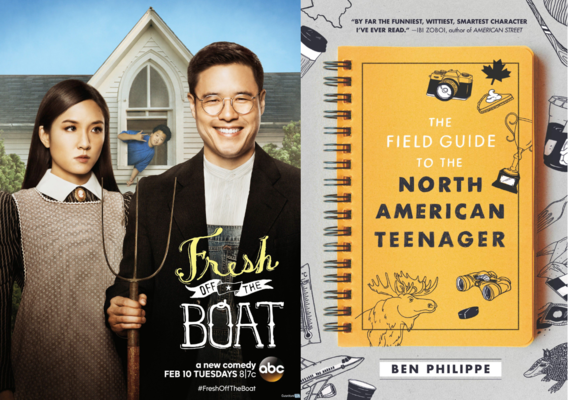
Ben Philippe’s comical YA novel follows Norris Kaplan as he moves from Canada to Austin, Texas and finds himself with the categorical cliches of every American sitcom that takes place in a high school. Norris, a black Haitian French Canadian, quickly discovers that he does not belong to any of these stereotypes. In Fresh Off the Boat, Eddie, the precocious, hip-hop-loving narrator, finds himself in a similar predicament when his father uproots his family from their comfortable life in Chinatown, Washington, D.C. to the (very white) suburbs of Orlando, Florida. Similarly to Norris, Eddie discovers that, although his personality, hobbies, and passions may be the same as his new classmates, his ethnicity makes it difficult for him to fit in.
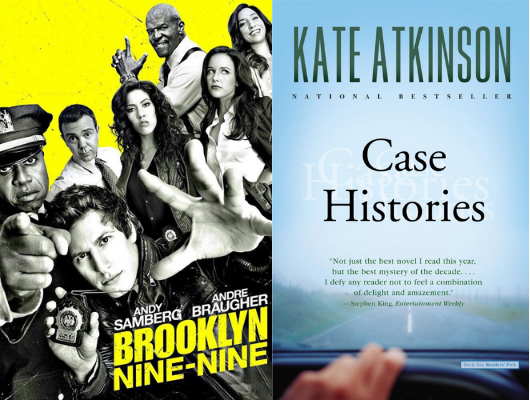
If you like Brooklyn Nine-Nine, read Case Histories by Kate Atkinson
When Brooklyn Nine-Nine is not tackling issues of race, homophobia, and injustice or keeping the viewers up to date on Santiago and Peralta’s relationship, it is setting up new cases for the detectives to work. Each episode could be its own mystery or thriller, letting us sit in suspense as we wait for Peralta’s light bulb moment to come and whisk us on an adventure through Brooklyn’s alleyways to catch the perpetrator. Kate Atkinson’s Jackson Brodie Mysteries feature a private investigator solving crime in Cambridge, England. The mystery novels marry humor with mystery in a way that will remind you of Brooklyn Nine-Nine.
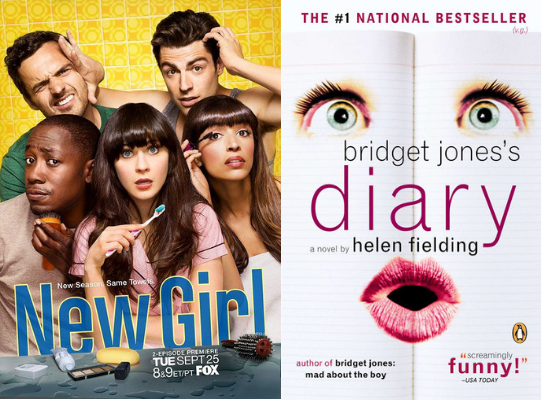
When Jessica Day moves in with three male roommates, shenanigans and unlikely romances ensue, but at the heart of this sitcom is an eagerness for self-improvement. Jess works endlessly to make her unconventional living situation as comfortable for everyone as possible, while simultaneously climbing up the ladder in her career and getting over her adulterous ex. Nick is trying to finish his novel, or so he says. Winston is on the search for a fulfilling job. And Schmidt is constantly attempting to forget his embarrassing past and better himself in all aspects of his life. Bridget Jones’s Diary combines these desires for self-improvement in one hilarious novel written in the form of diary entries. The laziness, self deprecation, and drive for betterment so apparent in the characters of New Girl find their place in the protagonist of this novel about a woman living in London, intent on losing weight, quitting cigarettes, and finding “inner poise.”
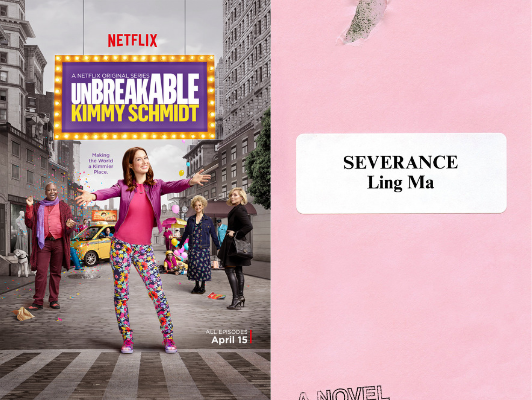
If you like Unbreakable Kimmy Schmidt, read Severance by Ling Ma
Unbreakable Kimmy Schmidt and Severance are both apocalyptic stories with a comedic twist, though the former is a tale of a young woman recovering from a doomsday cult while Severance tells the narrative of a young woman joining one in the midst of the world’s demise. Kimmy Schmidt does escape from the bunker where she was held for the majority of her life, but the New York in which she finds herself is slightly more apocalyptic than the one we know today. In her New York, you can easily get a license to be an Uber driver by simply having a learner’s permit and newspapers scream headlines like “De Blasio Pledges to ‘Ruin City.’” In Severance, a satire on capitalism and office culture, the protagonist leaves behind a New York ravaged by a zombie-adjacent disease to join the few survivors left in a mall.
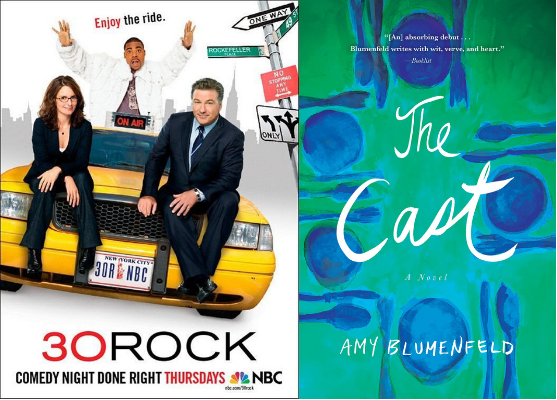
If you like 30 Rock, read The Cast by Amy Blumenfeld
Liz Lemon has a lot on her plate, from unruly employees to a procession of dysfunctional relationships. But her coworkers, the people she writes with and the actors she writes for, are also the fuel to her fire, making her a successful figure in the unforgiving industry of television in New York City. In The Cast by Amy Blumenfeld, the protagonist also finds solace in the relationships she forges with her co-writers — though in this novel her co-writers consist of a group of childhood friends with whom she once wrote and performed a Saturday Night Live-style script.
If you like The Good Place, read A Woman Destroyed by Simone de Beauvoir
This increasingly popular new show digs up and dusts off old quotes written by dead white men at least once every episode.The micro-philosophy lessons come from Chidi Anagonye, a former ethics professor who devotes his time in the afterlife to teaching his somewhat questionable morals to a group of particularly amoral people. It’s hard to blame him for the lack of diversity in his lesson plan, though, seeing as Western philosophy has been dominated by white men since Plato wrote The Republic. That doesn’t mean women philosophers don’t exist. When you’re looking for your The Good Place companion novel, try setting aside Sartre for now and picking up a novel written by his lifelong partner, Simone de Beauvoir. A Woman Destroyed is not a humorous book, but it will give you a taste of philosophical text from a different perspective.
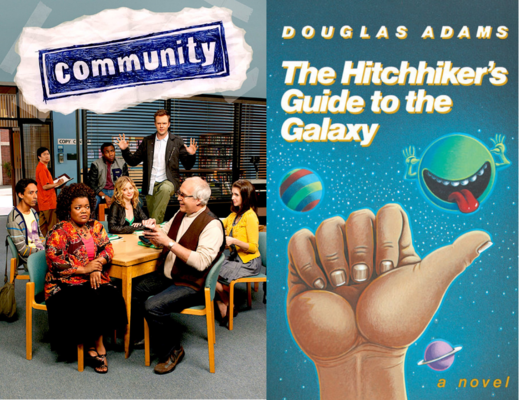
Community is not sci-fi (although some episodes could be considered in the neighborhood of the genre) so the plot of this sitcom is quite different from The Hitchhiker’s Guide to the Galaxy. However, the larger-than-life characters and laugh-out-loud humor of Douglas Adams’ novel will certainly attract those who are fans of Community. The Hitchhiker’s Guide to the Galaxy is the story of a man who escapes the destruction of Earth by sticking out his thumb, hitching a ride with the nearest alien, and encountering some of the most eccentric people you may ever read about. But those people will remind you of the unconventional study group of Greendale Community College.
One night in 2009, Andrey Ternovskiy, a seventeen-year-old Russian high school student, sits at the old computer in his Moscow bedroom and builds an online chat site. He calls the site Chatroulette, after a scene in The Deer Hunter, a 1978 Vietnam War film in which prisoners are forced to play Russian roulette. The building takes two days. When he launches, in November, the site only has 20 users, but the number grows rapidly, and by December, 50,000 people are visiting each day. The following March, the site has 1.5 million users, roughly a third of them from the U.S.
Ternovskiy’s site works like this: a user logs on and “spins,” or connects with another user at random, somewhere in the world, and they have an exchange. The interaction is webcam-based. Sometimes you spin and find a person dancing. Sometimes they’re having sex. Each time a connection is made like this, a spinning roulette, and if you’re interested you stick around, watch them, talk to them, share something of yourself, too. You move on by hitting the “next” button.
Most users, about nine in ten, are men. One in eight spins will deliver nudity: someone exposing themselves, or engaged in a sex act, often masturbation. The number of monthly unique visitors has climbed steadily over the years and now hovers around the nine million mark. The game’s language has spilled over into real life, entered the lexicon. People talk about “nexting” someone as in: He’s been nexted, or: It’s time to next her. Chatroulette is where this term comes from.
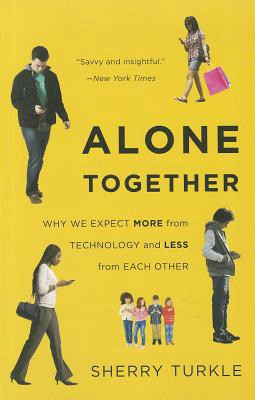
I hadn’t heard of Chatroulette until recently. I was reading a book by MIT professor Sherry Turkle, Alone Together, about how we expect so much from technology, and not too much from other people. Turkle mentions the site there.
The book came out a few years ago, but I didn’t read it at the time because I didn’t read non-fiction back then, not really. I was happy to stay inside the various worlds conjured by imagination. How could facts compete with fantasy? To me, they could not. No contest.
But with the arrival of reality television and Facebook new categories were given to us, new ways to tell stories; a new kind of fuzziness introduced into the landscape of narrative. The lines between fiction and fact, between real and not began to blur. Things grew hazy, the Kardashians took charge of the world, and we suddenly found ourselves at the Apple store, camping out to purchase smartphones.
When the fog lifted, we emerged to find Donald Trump standing under a spotlight for The Apprentice, where he remained, fourteen primetime seasons in a row, cameras trailing as he rode his golden escalator up and down Trump Tower. His competitive reality show pulled in great ratings for NBC — yuge, you could say — and in June, 2015, there he was on screen again: Donald Trump, riding the escalator down into the gilded atrium of Trump Tower on Fifth Avenue, the same one from the show, except this time to announce his run for office.
Cut to: me standing by the TV in my living room, watching him rest one palm against the Bible, take his oath, our new Number 45. I’m not sure if the Trump campaign, or his run, or the inauguration was what weakened my allegiance to fiction, but close enough. It happened around then. If it hadn’t been clear to me before, it was now. The truth was important and needed to be understood and broadcast and repeated and protected. Stories alone would no longer cut it. Ignorance was not bliss.
Before my Christmas flight to Florida, in the waiting area by the gate, everyone tethered to some device, I read Turkle’s book. I read about the ways technology has introduced new kinds of instability into our lives, reframing our approach to information, to communion, to community, to privacy, to ourselves: technology as an architect, but a shitty architect, one who knows the blueprints are weak, and at any moment the floorboard will give out, but who sells us the house anyway. This was how Turkle brought up Chatroulette: as an example of a shitty architect.
Some people saw the site as a game, others more of a dating service, which I found to be sad, but not really surprising. I’m no longer surprised by the weird and nebulous and shallow workings of the internet, by the farce and grime of it. On average, it will take a user no more than a few seconds before they hit the “next” button on Chatroulette. That’s the window of opportunity we’re talking about. There’s your shot at intimacy.
Being on the site, being fed audio, presented with a steady stream of faces and bodies means you can experience a sense of continual connection. But it’s a misleading connection in that when it ends, it leaves you feeling even more lonely than before. To escape the loneliness, you retreat into the screen again, looking for another hit of what passes for connection, and the cycle is reinforced. The isolation deepens. Turkle paraphrases Shakespeare in describing the cycle: we are consumed with that which we were nourished by.
To escape the loneliness, you retreat into the screen again, looking for another hit of what passes for connection, and the cycle is reinforced.
If we’ve allowed technology to engineer our relationships to this degree, there’s a price we must now pay. That price is a cheapening, reduction our new norm, Donald Trump our chosen leader, maybe the leader we deserve. Maybe because we’re so distracted and confused by the internet, we’ve failed the country in our role as citizens. Maybe because we’re overly enchanted with our screens, we don’t realize what our feeds provide is just simulation: not living, but the feeling of living. Maybe we fight for each other’s attention, try to type ourselves into being, preoccupied with the artifice of impression management, in order to avoid the reality that we’re all secretly very sad: lonely, and drowning in a sea of strange penises.
The flight to Florida is fine, everyone staring at their entertainment systems, screens embedded in the seat back in front of them. Fine. Normal. Just the way it goes. And then in the hotel, too, WiFi everywhere, even in the toilets, by the pool, the gym fully wired.
The first night I can’t sleep properly and find myself sitting in front of the closed Starbucks downstairs, hours before dawn, waiting for my family to wake up. I read my book. The section devoted to robot friendships makes me feel gloomy about the future, makes me realize I really don’t want a future of robot friendships, don’t believe robots are even capable of friendship. It makes me wonder how we got here.
When I was a grad student, I joined Facebook. The year was 2004 and everyone was in a fever about how great the site was, so I joined. Before this I had been on MySpace, and Friendster, but only briefly. They didn’t take. My friends and I did use AOL’s instant messaging service though, and I would compose “away” messages that usually incorporated a Notorious B.I.G. lyric, provided without context (for instance: “I’ve been smooth since days of Underoos!” or: “Only make moves when your heart’s in it!”). My handle was “oneluvv55,” yes, because of Bob Marley and yes, I now find it an embarrassing choice. This was the extent of my online life.
Facebook was different. I joined initially out of curiosity, but that soon gave way to a search for community, connection. At the time, the press Facebook received was positive, its narrative one of triumph: Social media would help us enhance friendship, provide alternative avenues for communication and commerce. Cyberintimacy could be offered as a solution to those who lived in solitude; online networks would buffer against loneliness.
I filled out my Facebook profile on my laptop, in my dorm room. The blank virtual real estate given to me seemed full of potential. What should I say? Who should I be?
Some of the questions were delicate. Facebook wanted to know about my “relationship status,” a tricky issue for a Muslim girl to address publicly, so I left it blank. “Favorite movies” were also tricky. Should I disclose my enthusiasm for the Peanuts Holiday Collection DVD box-set, or fool myself and others by listing a bunch of arty films? Arty but not weird arty. Arty but not too obscure.
I could already see a balance needed to be achieved, that this was an exercise in determining the overlap between what I actually cared about and what I wanted to project to the world. I understood what I was presenting wasn’t my true self but a construction, a persona: flat yet dynamic, a projective screen through which to express myself. I could tweak and edit my virtual selves over and again, sending them out to live parallel lives for me. The possibilities were endless.
Our first day in Florida, my family and I drive to the White Sands Buddhist Temple in a small town near Orlando, called Mims. The site, 30 acres, features three enormous granite statues of the Buddha during various stages of his life. The “Nirvana Buddha,” or Siddhārtha, the original Buddha whose teachings comprise the basis of most Buddhist practice, is my favorite among them. Depicted as a serene octogenarian, he is lying on his right side, ready for death. He is unafraid and welcomes death completely, smiling and at peace.
My family wanders off, exploring the grounds, and for a while I stand by the statue alone. A plaque tells me it weighs 40 tons and is about 30 feet in length. I stare Siddhārtha in the eyes, until it is clear he can see me too. When I pull my phone out, to capture our exchange, it’s already over. The moment has dissolved.
To build a life of happiness, we need to embrace and develop a life of noble virtues, a sign nearby says and I wonder how the Buddha would do with an iPhone. What would he make of all those disembodied penises being energetically masturbated on Chatroulette? I decide not to take Siddhārtha’s picture. His smile widens in the stone.
What would the Buddha make of all those disembodied penises being energetically masturbated on Chatroulette?
The second day of my family vacation, I wake up even earlier than the previous morning, and once again find myself in front of the Starbucks. I finish the book. Dr. Turkle has conducted hundreds of interviews, done fifteen years of research on technologically mediated social interaction, and her findings are bumming me out. We are online, she writes, connected as we’ve never been before, but we have damaged ourselves in the process.
Turkle cites a 2010 study of 14,000 college students that spans 30 years. The study found that since the internet became a thing — an unstoppable, addictive kind of force — young people have begun to exhibit a sharp, disturbing decline in empathy. They don’t care as much anymore, we don’t care, and our disinterest is attributed in part to the fact we’re on our phones all the time.
“An online connection can be deeply felt,” Turkle says, explaining the decline, “but you only need to deal with the part of the person you see on social media.” Purpose-driven and “plugged in,” we pay much less attention to those around us, to those actually physically in our lives, and our relationships suffer because of it. Compulsively, we turn our attention to the screen, and are confronted by a strange, fractured world comprised of parts: a world of sound-bites and performance and half-truths, of tits being flashed on a webcam.
Over time, there is a shallowing that happens. Ours is now a world of emotional distance, of performative social concern, of calculated wokeness, of believing the Finstas, the filters, the highlight reels, the catfishers, the “fake news” headlines we’re fed on Facebook. If some of us feel detached, it isn’t necessarily an aggressive detachment, Turkle says. It’s a way to cope. It’s because we feel so bombarded and numbed, we are shutting down.
Our Instagram feeds have become sites of longing and discontent, of constraint not freedom. Facebook has become a place of surveillance and data collection on the sly. Turkle says we now have trouble separating what’s real from what isn’t. Maybe we’ve even stopped caring what’s real and what isn’t.
But I don’t want to stop caring. I don’t want us to stop. I don’t think we can afford to.
On the flight back to Minneapolis from Florida, I sit next to a guy, twentysomething and in a track suit. He’s watching porn on his phone. Or at least, I think it’s porn initially, but a second glance reveals it’s a social media app. He scrolls and taps, a moving landscape: next, next, next. I see clavicle. The strap of a pretty lace bra. I see breasts. I don’t look again. I want to, curiosity pulls at me, but I tell myself no.
When the doors close and we are airbound, he begins texting someone at a rapid pace and for the duration of the flight. I wonder if he’s texting his girlfriend, or one of the women from the app, or maybe his mom. He is young but had lost most of his hair. He bites his nails and jiggles his leg. His snack choice is peanuts. He has an iPhone.
I wonder if he’s on Chatroulette. I wonder if he’s lonely. I wonder if he ever wishes he could reclaim his story, his attention, his “moral authority from cold-eyed corporations” (that’s Turkle) like Facebook, like Instagram; all the rest of them, too. I don’t ask him any of this, of course, don’t talk to him at all. We make eye contact zero times. It’s fine. Normal. Just the way it goes.
I wonder if he ever wishes he could reclaim his story from cold-eyed corporations like Facebook, like Instagram.
Somewhere over St. Louis, I glance at him and feel a swell of something. Compassion, maybe. Compassion, finally. It’s just a flicker, but it is there. Maybe I feel it because in him, I have seen part of myself.
To build a life of happiness, we need to embrace and develop a life of noble virtues. I’ve written this down for some reason, and I stare at the words now, my notebook on the tray table. I realize I don’t really know what they mean. What is a noble virtue anyway? It’s 2019 now, the year has turned, so what does a life of virtue feel like, look like these days? Whatever the answer, I’m beginning to think I won’t be able to find it inside the wires of my phone, underneath my compulsion to tap, tap, tap for what’s next, next, next.
We touchdown and moments later get the go-ahead to turn on our phones. Even before we get the go-ahead, before the cabin lights flicker on, they are out: strings of devices, glowing like little stars in the night. Strangely beautiful.
The young man next to me has a connecting flight. Thirty minutes, he says. Can he cut through? I smile, and he does too, and there is a moment of relation. I don’t know who he is, where he’s going, what he feels when he looks into his screen, what he’s hoping to find in there. I’ll never know. I step into the aisle, let him pass. I watch as he stands by the door, his body hunched, his eyes fixed and unmoving, his phone glowing and radiant against his palm.
I love my husband, but if this whole thing falls apart it’s because of two words: I see. A few text conversations we’ve had recently:
Me: I’ll be home in 20.
Him: I see.
Me: I’m gonna ask J and K if they want to come by later.
Him: I see.
Me: Picking up spaghetti squash for dinner.
Him: I see.
He insists that this text response is entirely neutral. Akin to “Got it.” Not sure what planet he’s spent the last 30 years on, but I’m left with no choice but to try, every time I receive an “I see,” to believe that he isn’t passive aggressively attacking me from the other end of our mobile plan.
Purchase the book
I’m a sucker for fiction delivered in unconventional formats in general, but epistolary novels — novels told through letters, or these days, emails — are a favorite for the same reason that my husband’s texting makes me crazy: I love reading between the lines. They waited so long to reply — 10 whole minutes! What does it mean? Or, oh no, he didn’t use an exclamation point…he must be furious.
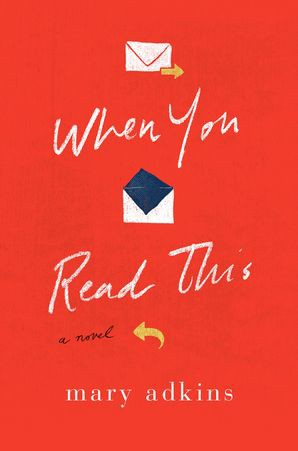
Milking the trivialities of digital communication — the time stamps, subject lines, sign-offs, and signatures — was one of my favorite parts of writing my novel When You Read This, a story told entirely in online dispatches.
Here, I’ve collected a list of my favorite epistolary novels (and one short story) in recent years — all with subtextual storytelling that I found compelling, clever and powerful.
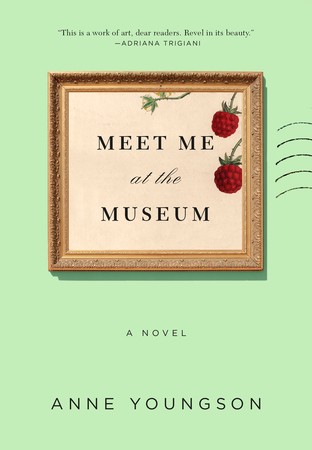
At the beginning of the book Anders and Tina have never met. Will they? One desperately hopes so. This is the story of a friendship forged in the present day through the lost art of handwritten letters (sometimes sent as email attachments) — two strangers writing gorgeous sentences about the changing seasons of their lives. Both grandparents by the novel’s end, they have amassed heaps of wisdom, which they swap with humility and humor. Beautiful and haunting, with anecdotes of mermen and ghosts and ancient humans, this is a tale of two people who are not of the digital era finding a surprise connection within it.
Unlike Tina and Anders, at the novel’s start Frances and Bernard have met, once, at a writers colony, prior to the beginning of their literary correspondence, a slow-burning slide from heady discourse into romance. Deeply intellectual pen pals whose hunger to impress one another is present on every page, charging it with sexual tension, these characters inspired by Flannery O’Connor and Robert Lowell are self-conscious, clever, reflective, and questioning in grand, metaphysical ways. While Bernard’s 1950s high-brow misogyny was so on the nose it put me off at times, their conversations kept my interest, perhaps because they talk about all the stuff writers care about: the writing process itself, reading that inspires writing, other writers they know (the fun, gossipy part), and life’s Big Mysteries.
You know him from The Tenth of December, but my friend Emily Wulwick and I have been hosting two-person book release parties for him with since 2004. We sit across from each other sipping happy hour whiskey while reading his latest in silence. It’s introvert-socializing at its best. Fox 8, his 2013 short story published in solo hardback with funny and moving illustrations by Chelsea Cardinal, is vintage Saunders: playful, as violent as it is tender, and full of heart. A fox pens a slang-filled, phonetically-spelled appeal to humans asking us to please explain our species’ brutality. His letter includes the story of his loss of innocence, the moment of his disenchantment with the “yuman.” It’s a quick-read, an allegory for the vigor of the human spirit and drive to be kinder that will make you want to ban fox hunting.
On a vacation to Costa Rica, I took this book with me to my lounge chair. By the time I stood up, my thighs were lined red from the plastic strips and my cheeks hurt from laughing. Back in my room, where my laptop had begun translating all web pages into Spanish, I immediately ordered copies for everyone I know who reads fiction — at least I hoped I did, since I don’t speak Spanish (update: it worked). Julie Schumacher, thank you for the sunburn and belly aches. If you’ve ever asked for, written, or received an academic letter of reference, you will delight in this series of masterful, wry recommendations written by a disillusioned creative writing professor determined to find success for his star pupil.
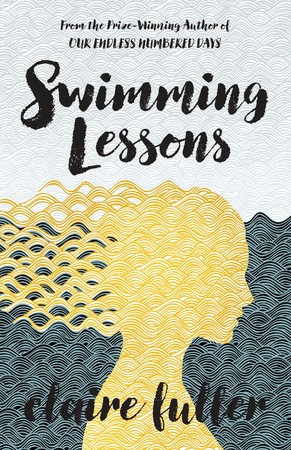
Also about a writer and professor, Swimming Lessons is composed of one of my favorites kinds of letters — letters left behind, in this case, by the writer’s missing wife. Her letters have been placed in books belonging to him, breadcrumbs that also tell the story of their courtship and marriage. Will they lead to the discovery of her fate? The novel shifts between past and present, also telling the story of the couple’s now grown daughters struggling to understand what happened to their mother. Bonus — the books in which the letters have been placed bring unexplained literary meaning to the text, offering up a whole extra layer of meta literary sleuthing for super curious readers.
From the introduction I began second-guessing my presumption that I was reading an entirely fictional book — which is precisely what Rick Moody wanted me to do. I wondered if perhaps the novel was composed, in part, of nonfiction writing by a hotelier and an online reviewer of hotels. (I was pretty sure it was fiction — just with an itch of doubt.) It wasn’t until the last section of the book that I fully appreciated the purpose of this confusion and how it serves to further embody Moody’s — and his character Morse’s — experience that “the fraudulent can sometimes feel closer to the truth.”
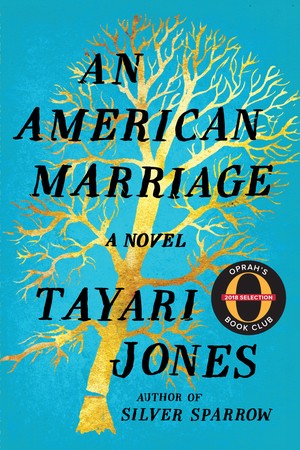
This book broke my heart, then broke it again and again. When Celestial and Roy, newlyweds, are yanked apart by Roy’s wrongful conviction in rural Louisiana, they are forced to attempt to sustain their marriage via letter: Roy, writing from prison, and Celestial, writing from their Atlanta home. Their letters will leave you unable to turn off the light to stop reading, even after his incarceration is overturned. Because what has it made of their marriage? And then there are lines like this: “The vast generosity of women is a mysterious tunnel, and nobody knows where it leads.” My copy is bulky in the bottom corner where I earmarked all the pages containing writing like this sentence to re-read later. It’s too good to read just once.
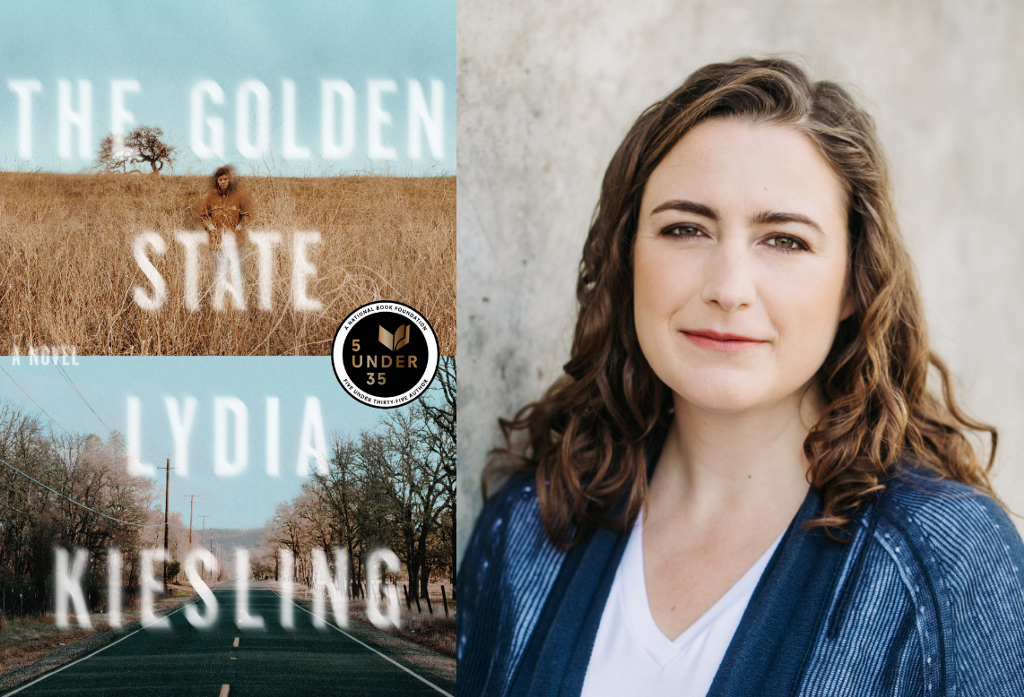
The miracles of creation are scant comfort when you’re rushing your kids to daycare and boarding a sluggish and sweaty BART, as Lydia Kiesling did a few Thursdays ago. She swept into Bica Coffeehouse in Oakland, and if this were a women’s magazine, I’d tell you what she was wearing. Let’s just say she was smiling, that she radiated warmth, that she looked glad to be out in the sunshine, glad to have arrived, glad to sit down with a cup of coffee.
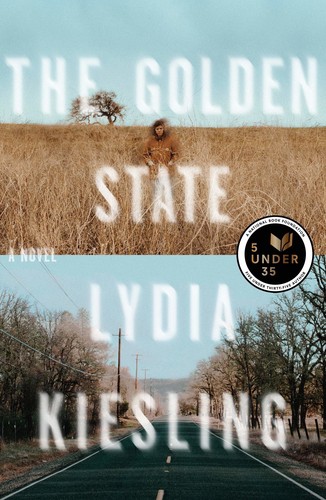
Though I’d never met Kiesling, I knew her work as editor of The Millions, and had been following the reviews of The Golden State, her debut novel about Daphne Nilson, a young mother in San Francisco whose Turkish husband is stuck abroad, trapped in an immigration nightmare. Fed up with the petty wranglings of her academic workplace, Daphne packs her car and her 18-month-old, Honey, and heads back her family’s home in the rural, forgotten reaches of northeastern California. What follows are days of disoriented single motherhood, as Daphne realizes that the classic road trip, the great American escape, isn’t quite the same with a toddler in tow.
I spoke with Lydia Kiesling about juggling writing and motherhood, the difference being an editor and a writer, and the danger of nostalgia.
Shanthi Sekaran: As editor of The Millions, you’ve been very engaged with the literary world, but this is your first novel. How is being a novelist new for you?
Lydia Kiesling: It feels very new and strange. The encouraging thing is that pretty much anyone writing a first novel is unprepared. There was that element of I don’t really know how this done and then — because I’d been writing about books and doing things like book reviews — I was like where do I get off doing this, after so long reading other books and being very picky about whether I liked them or not? Now I’m like wow, I was such an asshole. Writing a book is so hard.
SS: So how did this novel come into being? How was it born?
LK: I wrote other things for years. I started writing in 2009 and I’d say probably around like 2014, I let myself fantasize that writing a book would be possible. What had been daunting about it was one, just the finances. How do you just not work and write a book? And the second thing was, I think for any writer, especially if you don’t go to an MFA program — well actually I know a lot of writers who go to MFA programs who don’t receive a lot of guidance on the career stuff, on how to become a writer, how to build a career. It’s astonishing to me that that is not something that is provided. So the mechanics of how you would be a novelist seemed very opaque.
I think what really spurred the novel was when I had my first daughter, I started wanting to write things for that experience that I didn’t necessarily have a vessel for. All the book reviews I’ve written are very personal, and they’re almost in some way an excuse for writing about some of the things I wanted to write about. So I first started writing these vignettes — it was a universe that I recognized, but I had taken some liberties with it. And then I was like, Okay, well I think this could be a book. What would this as a book look like?
What had been daunting about writing a book was the finances. How do you just not work and write a book?
SS: I thought it was an interesting choice, and brave in some ways, to center motherhood in the way this book does, because it’s not just about the emotional journey of motherhood — that’s what most motherhood novels are about — but the endless, on-the-ground minutiae of motherhood. Can you talk about deciding to center motherhood in this way?
LK: Part of it is a form of narcissism, if you think you’re the star of your own movie that is your life. You know, those things, they can seem like such big struggles, and you can talk about them because you know that they’re just the most mundane things that people are dealing with, with small children, at all times, and it’s not that big of a deal. But it’s also, like, why does it fill you with such rage, or futility? And there’s something funny to me about having these epic dramas happen all the time, and there’s no descriptions of them out there, or place to put them. So in one sense, I was honoring that struggle, but then also, one thing that really strikes me, when I talk to women and men who have children, is the specificity of knowledge you have about your children, and how to make the day work. It’s this wealth of knowledge, but it’ll just go away. It’s this expertise that parents have in that moment of parenthood, and then it goes away. So I was describing that, putting it on the page and showing, for better or worse, what it really is. And I knew it was going to be sort of tedious to read about some of those things, but it’s also a tedium that people are living every single day, and why do we not have a little taste of that in fiction? Especially now that people are talking about auto-fiction and writing personal experiences. That’s a very personal experience, and I wanted to document that.
SS: So you saw the parenting material as possibly tedious, but decided to put it in there anyway. Can you talk a little about what we, as writers, ask of our readers? How do you, as writer, make the decision to include material that a hypothetical reader might find “tedious”?
LK: I think books have hugely important jobs to do in societies — both contemporary and future societies — as a means for communicating ideas and information about places and cultures and aesthetic fashions and modes of being. But as a reader I still count on them, in my heart of hearts, for providing joy and escape. And it was hard to reconcile a lot of what I found myself putting in my book, things that felt like important information about a particular person’s experience of motherhood at a particular moment in time, with my sense that books should be fun and enjoyable for readers. I was constantly living in that tension. So I thought about books I love that have sort of long languorous bits that feel necessary and important, even though I personally find those parts slightly boring. I don’t think I solved the problem so much as learned how to ignore it to a certain extent while I was writing!
SS: Going the opposite way, you wrote about stuff that wasn’t in your experience, like being married to a Turkish man, as Daphne is; having an international marriage, a cross-cultural marriage. You said you were a little hesitant about trying to do that. I had to do that, big time, in Lucky Boy, so I’m always interested in hearing about how other writers take on stories outside of their own experiences.
LK: There are so many conversations about what is and is not allowed. Things are allowed constantly. If you’re a writer who cares about doing a good job, it should be okay — with some trepidation — to really just write about anything that you haven’t done. And it’s not to say that you can’t find it within yourself to imagine it, but you know, writing about a place that you haven’t been, it’s weird to do that. And it should feel weird. So first I tried to avoid the problem almost by saying, He’ll be just like my husband I have now, except he’ll be from Denmark! And that was just really silly.
Then I started thinking, Well why not write about someplace you did live, and — at one time, at least — spoke the language?Why not just do that? And I’m still not settled that it’s correct, but I can say that I honestly used what I had experienced and seen (in Turkey) to the best of my ability, and that in the world I made in the book, it checked out. I had a friend who was Turkish read some parts, especially things with class. Like, in America, if someone told you what college they went to, you could immediately make some assumption about what their background is. And those are the types of things where you could live somewhere for decades and never necessarily know. And so initially, Engin went to a university and I asked her, “Do you think this university makes sense?” And she was like, “No, from what you described, I think it would make more sense if he went to this school.” It was such a small detail in the book, but it meant a lot to me. I used what I had and tried to be very conscientious in asking Is this something I saw? When I described what a family was like, Is this a family I might have met? And then I found someone whose opinion and judgement I trusted to read over some stuff to, you know, make sure my (Turkish) grammar wasn’t messed up.
And then in terms of the marriage stuff, I think marriages that are based on love and affection have a sort of through line. My husband was like, “I noticed that you wrote me out of this,” and I was like, “No I didn’t! Where do you think the ideas I have about the culture of family and how you feel about someone come from? I get those from you.” So, he’s in there. Just sublimated.
Books have hugely important jobs to do in societies — both contemporary and future societies — as a means for communicating ideas.
SS: The memories that Daphne has about Turkey are so beautiful and so beautifully told. Did those come from your own nostalgia?
LK: Definitely. Turkey invites so much “East meets West” romanticizing and Orientalizing, so on the one hand, I’d be writing about the Bosphorous and thinking, “Ugh, this sucks,” but actually, the Turks I know feel the same way — especially about Istanbul. I’ve never met a person who’s been there who isn’t like, This is such a special place, and I think it’s okay to say that some places are special. So that’s one thing I sort of struggled with. There weren’t that many times when I had to tone down the romanticizing but there’s something wistful about the book, I think, because even though Daphne’s life just seems so difficult to me, I admire her, because she made a choice, whether she thought of it as a choice or not, that was different from what I would have done.
When I was in Turkey, I came back to California because I needed to be closer to my mom and my grandparents. I didn’t have the courage to live somewhere completely different from where my family and friends lived. I mean, there are lots of terrible people who expatriate all the time, and there’s no need to admire them, but there is something very brave and interesting about someone who says, Oh I’m just going to marry someone whom I have no cultural affinity at all with. Those couples are always interesting to me. And I think a lot of people in those couples would laugh at this idea that there’s curiosity or romance about it, because they’re like Oh, I love this guy, and we now live together.
SS: Going back to the chapters with Honey, I laughed out loud many times. The church scene, for example, was hilarious. There were sections where you’d run through everything Daphne does in the morning — it was this endless, breathless list, more things than most people do in an entire day, and then Daphne says, “It’s 8:15 a.m.” I was like Oh my god, those endless days with a toddler. Can you talk about the book’s humor?
LK: Humor is very much a part of my sensibility. It’s a coping mechanism and also a defense. And so I wanted to have a little bit of slapstick in there, but I worried at the same time that It would be a Trainwreck thing of quirky white woman being funny about their own foibles and there is something revolutionary about that in some small instances, but it can be too much. So at some point, I was like, Am I being too ‘funny’ about this? But it’s part of my parental coping. I can get very wrapped up and in despair about a power struggle with a toddler, but when I’m being my best parenting self is when I feel like I can see the humor as it’s happening. And so, even though, you know, the child is barfing, you’re just like This is funny, you’re little, you don’t know what you’re doing, and I’m beside myself. Let’s laugh. I’m already asking the reader to do a lot in the book, and so some humor — assuming the reader shares my sense of humor — felt kind of necessary, to bring some levity.
I knew that our immigration system was messed up, but I was not expecting that we would have just the pure violence that is still happening now.
SS: Who was your favorite character to write?
LK: Daphne’s obviously the closest to me, and I actually got sick of her. I was already in my own head, and she was just the worse, more stressed version of myself.
I actually had a huge amount of anxiety about Alice [an elderly woman who befriends Honey and Daphne], because Alice is based on a real person. The book is dedicated to Phyllis Hodgson and she was this woman married to a scholar of Islamic Studies named Marshall Hodgson, who wrote The Venture of Islam. He died in 1968 and is very famous in this very limited Islamic Studies context in America, and so I wrote my MA thesis about him. And so I got kind of obsessed with him. He also had a very tragic personal life. He had three children and all of them died young, and two of them were born with a terrible neurological illness. So I kept thinking as I was reading all this, What about his wife? I would ask all these academics, “What happened to his wife?” and they’d be like “Hmmm, I don’t know.” And then I found out that she was alive, and I met her, and she lived in Wisconsin. She was in a facility, a lovely place in rural Wisconsin, but it wasn’t her family who was caring for her. It was friends and neighbors who had known her for years and loved her, and so I met with them, and met her, and somehow she just got into the book. But I was like, This person is alive, she never did any of these things [that Alice does]. It’s not her, but clearly anyone who knows her would be like, This is her. So for a while, I was thrashing around about that and was really asking myself, Well what is fiction, what’s okay and what’s not okay?
She passed away — not conveniently — but it did make some things slightly less anxious, because she’s with the universe now. I initially had more of her, a first person from her perspective, but because I had this anxiety, I didn’t commit and I didn’t go hard enough. I was hedging about it, which was very weird and impersonal, and so Claudia, my agent was like “Everything’s working for me except that. Take those parts out.” And it was so easy to do it, that it was so obvious (the Alice sections) didn’t belong. They were like a weird tumor hanging off the book. It got snipped.
SS: Poor Alice.
LK: Yeah, and you’re not supposed to read your Goodreads reviews, but I did read a Goodreads review that referred to her in a way I just love. It was like “You get a glimpse of her that reveals a whole other picture, like the moon, when you see just a sliver of the moon.” So I was like, I can be satisfied with that. And then actually, I got an email from someone who had cared for her, and they were like, “You really got her.” That’s the email that’s meant the most to me. So, I was the most fascinated with her, but there was a lot hesitation mixed up in it.
SS: So they knew Alice was Phyllis Hodgson without you telling them? They could just see it?
LK: Yeah, and I think people were generally confused, because I was doing this almost investigatory work to track her down and speak with people who’d known her, because I was doing this simultaneously to starting the book, and I wasn’t sure they were going to be the same project, but it was important for me to know as much about her as I could know about her husband. So people go the sense that I’d be working on some article about her. One professor I talked to was like, “So, you didn’t write the book about the Hodgsons?” I was like, Well, it’s in a different — I made a U-turn. But she’s still very much there. And some of the things Alice says — I can’t really overstate how difficult this woman’s life was, and there are a lot of people who have terrible things that they’re just living with, and just walking around among us, and it’s amazing that they’re able to do anything. It really stuck with me. One of the things she said when I met her was “I had babies and it railroaded my life.”
SS: I mean, that’s kind of what this book is about. Being railroaded by babies. What is it like for you being a mother and a writer. How have you negotiated that?
LK: Well I’m really glad you asked that, because with the writing thing, the questions seems critical, because writing is so non-remunerative, so what do you do about the finances? And it turns into sort of a Marxist view of parenting. I mean, I do believe that I owe this book entirely to having my first child. Part of it is coincidence. Just like with any other job, years where you’re advancing in your career coincide with the years you’re having kids, if you’re having them. But, I think there’s an urgency (my first child) gave me, a sense that I’m feeling so many different things. My tolerance for everything has changed. How do I need to rearrange my life to make it more tolerable to me?
I do know there are people who write like, during nap times, and they don’t have dedicated childcare.
You always hear about people just really making it work with ridiculously difficult situations, “On Monday I have half an hour, On Tuesday I have two hours.” People are really making it work. I think that is wonderful. I think I am not able to do that. I need writing to be a job the same way another job would be.
SS: The playwright Andrea Dunbar used to lock her children in their bedroom so she could write.
LK: I think having two children has made it slightly complicated, but I have no regrets. I’m going to make it work. I might just have to adjust my expectations of what is realistic in terms of output and time and how long it might take me to write another book.
SS: Speaking of which, you wrote this book during the Obama administration. I feel like every book, when it comes out into the world, starts a conversation with the world it’s in. Can you talk about the conversation The Golden State is having with our country now?
LK: Well, the sort of obvious way is through immigration. The green card fuckery that happens in the book is based on real fuckery that I have known, that people I know have experienced, but then once you talk to anyone about it, it’s just like story after story after story and the people I end up talking to are, like myself, educated, and they have all the resources and wherewithal to navigate the system, and still it is absolutely opaque and difficult. So that’s the main thing. I knew that our immigration system was messed up, but I was not expecting, when I wrote this book, that we would have just the pure violence that is still happening.
I think of the Islamophobia aspect of the book, which took place in the summer of 2015. That was before San Bernardino and Bataclan, so it’s only going to get ramped up in the world of the book. In terms of the world stage, the book is not hopeful. I think there is individual hope that happens, but it’s also before the attempted coup in Turkey. So the conversation it’s having with the world right now is like Well, things don’t seem great.
Sometimes when I was writing I was like this is how a person on the left would describe, disdainfully, people in small towns who have conservative politics. But just like with everything else in the book, I did a lot of fact checking and reading of letters to editors of newspapers. I’m on a mailing list for the State of Jefferson, so I read those things, and that’s reflected in the book. Since it came out, people have written me who live in the country where the is based, and they’re like “I run a progressive place.” There’s a lot happening. I think it’ll continue to change. There are other kinds of stories that can be told about rural California that are not just like We’re mad. But We’re mad is definitely part of the equation.
SS: We’re mad, but also there are individuals who move through those spaces the way Daphne does. The world isn’t great, but here’s a woman and her baby, down on ground-level.
LK: Yeah, and I wish there was a way we could separate the decline paradigm that wasn’t just they’re mad and they’re Republicans. When my mom goes up to her hometown, it’s sad for her, because it’s not the same place. You can acknowledge that and be sad about it and be careful not to just fall into nostalgia for this imagined, great time that existed in the 50s when everyone was happy, because we know that’s not true. But there are people who justifiably feel like things have changed for the worse.
There’s a lot of romance wrapped up in this nostalgia, but a lot of that is violent, harmful romance.
SS: I see a parallel between that small town nostalgia and the nostalgia Daphne feels for Turkey. And yet she’s stuck in the small-town nostalgia.
LK: White people love to be like Here’s my ancestry, in a really stupid way, where it’s just like no, no one cares about your German great-great grandfather. That’s not a thing. But there is this feeling: People like to have roots somewhere, and feel like this is my place. Like Daphne. There’s a lot of romance wrapped up in this nostalgia, but a lot of that is violent, harmful romance, like with any place. It’s about the subjugation and murder of indigenous people. The cowboy myth. That’s what [the West is] built on. So there’s the moral underpinnings of that. But there’s also the I like to have nice restaurants near me and many conveniences open late, and I don’t want to live in a very small town. So it’s kind of like, Okay, you want roots? Here they are.
“To Make Men Free” and “Off to the Movies”, an Excerpt from The Cassandra
by Sharma Shields
“To Make Men Free”
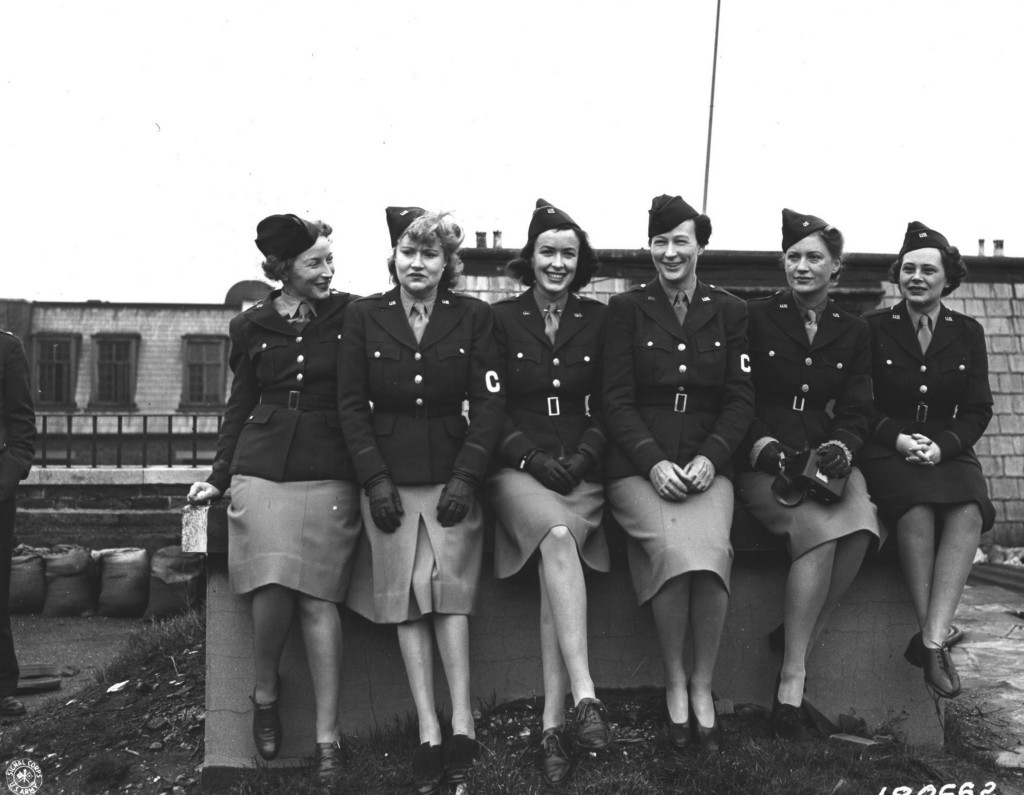
I was at the mercy of the man behind the desk. I needed him to see my future as clearly as I saw it. He held four pink digits aloft, ring finger belted by a fat gold band, and listed off the qualities of the ideal working woman.
“Chaste. Willing. Smart. Silent.”
I swallowed his words, coaxed them into my bloodstream, my bones. I crossed my ankles and pinned my knees together, morphing into the exemplary she.
The man eyed me with prideful ownership. “Frankly, Miss Groves, you’re the finest typist we’ve interviewed. Your speed and efficiency are commendable.”
I opened up my shoulders, smiling. “They named me Star Pupil at Omak Secretarial.”
“You’re not a bad-looking girl, you know that?”
“Thank you. How kind of you.”
“A little large. Plumper than some. But a nice enough face.” The man smoothed open the file on his desk. “Good husband stock at Hanford, Miss Groves. Plenty of men to choose from.”
In my lap my hands shook like tender newborn mice. Such sweet, dumb hands. Calm down, you wild darlings. I focused on the man’s sunburnt face. It reminded me of a worm’s face, sleek, thin-lipped, blunt. He was handsome in a wormish way, or wormish in a handsome way. If I squinted just a little, his head melted into a pink oval smudge.
We spoke in a simple recruiting office in my hometown of Omak, Washington. All of Okanogan County was abuzz with the news of job openings at Hanford. It was like this, too, when they started construction at the Grand Coulee Dam. We were patriots. We wanted to throw ourselves into the enterprise. Men and Women, Help Us Win! Work at Hanford Now, the Omak-Okanogan Chronicle urged. I’d snipped out the newspaper article and folded it into my pocketbook, away from Mother’s prying eyes. I was here in secret, and the secrecy delighted me. Goose pimples bubbled up on my forearms and I tapped my fingers across them, tickled by how they transformed my girl flesh into snakeskin.
The room we sat in was crisp and clean, beige-paneled walls, pine floors, plain blue drapes. A war poster hanging behind the recruiter’s worm-head featured a young, attractive woman in uniform, crimson lips, chin nobly lifted, blue eyes snapping and firm, their color enhanced by the stars and stripes rippling behind her.
Her proud expression spoke to me. I’m here, Mildred. I can help you.
I smiled at her. I’m here, too. For you. For all of us.
Aren’t we lucky, her eyes said. If anyone can save them, it’s you.
Above her strong profile it read,
TO MAKE MEN FREE
Enlist in the WAVES Today
“You will share the gratitude of a nation when victory is ours.”
I, myself, wasn’t joining the WAVES, I was joining the civilian force, the Women’s Army Corp — the WACs — but the work at Hanford was just as crucial for the war effort. With the woman in the illustration I shared a gallant dutifulness. I mimicked her then, holding my chin at the same noble angle, lifting my eyebrows with what I imagined was an arcing grace. I wanted to show the recruiter that I was just as earnest and eager as she was to join the fray.
“You’re squirming,” the man said. He smiled with concern, “Are you uncomfortable?”
I assured him I was fine, just excited, and I lowered my gaze. I wore my only good blouse, cornflower blue, and an old wool skirt, brown. The shoes were Mother’s and pinched my feet. One day I planned to buy my very own pair of wedged heels. I’d circled a black pair in the Sears Christmas catalog that I very much liked. They looked just like the famous movie star Susan Peters’s shoes. When Mother had found the page in the catalog, she scolded me for marking it up with ink.
Once, in downtown Spokane, just after we’d visited our cousins, I saw her — Susan Peters! — walking in a similar pair. She was graceful, athletic. I waved at her and she waved back as though we were dear friends. I wanted to speak to her but Martha, my older sister, pulled me away, telling me I was acting like a starstruck silly boob, and I had better stop it before I did something we’d both regret.
Don’t embarrass me, Martha had hissed. Act normal for once, please.
The recruiter cleared his throat, shuffled the papers on the desk, and continued his summary of the Hanford site. I chided myself for my woolgathering. I fought the urge to slap myself and leaned forward clutching my elbows. I hoped I looked alert and intelligent.
“Hanford is a marvel,” the man said, “nearly seven hundred square miles in size, smack dab on the Columbia River. We started construction last year and we’re darn well near finished, which is a miracle in itself. You’ll see what I mean when you see the size of the units. These are giant concrete buildings. They make your Okanogan County courthouse look like a shoe box. We’ve brought in more than forty thousand workers to live at the Hanford Camp, so believe me when I say you’ll have plenty of men to choose from.” He winked here, and I gave a small nod of appreciation. “The work being done is top secret. Frankly, I’m not sure what it’s all about — mum’s the word — but everyone says it will win us the war. I do know that a top United States general is involved, and some of the world’s finest scientists. Construction is being overseen by DuPont. But even these details you must keep top secret, Miss Groves.”
He handed me an informational sheet, and I read it self-consciously, keeping my back straight and my head slightly lifted so that I didn’t give myself, as my sister liked to tease me, too many chins.
To accommodate nearly 50,000 workers, the Hanford Camp is now the third- largest city in Washington State:
8 Mess Halls
110 barracks for men ( for 190 persons each) 57 barracks for women
21 barracks for Negroes
7 barracks for Negro women Plus family huts and trailers
Overall: 1,175 buildings in total for housing and services
There’s a lot of us, so remember: Loose talk helps our enemy, so let’s keep our traps shut!
“What a bold undertaking,” I told him. “What an honor it would be to work there.”
His face crinkled cheerfully. “Regarding your application, I don’t have many reservations, Miss Groves. Your background check is clean. You’ve signed the secrecy documents. The only concern raised was about your questionnaire. A few of your answers were — how shall I put it? Unique.”
For a moment my future darkened. I had agonized over my application. I couldn’t imagine anything amiss.
“For example,” he said, lifting a sheet of paper up to his nose, “your response to the request for relevant job experience, if any, was, ‘I have imagined myself in a giant number of jobs, some of them impossible, some of them quite easy, and in my imaginings I’ve always done well by them, impossible or no.’ This statement struck some of the committee members as a wayward answer, Miss Groves. Would have been better to just state ‘No relevant job experience.’ Most of the women answering the charge are lacking in it, you realize.”
“Yes, I understand.” My eyelid violently twitched.
“And then there was your response to the question about your weaknesses. You wrote, and I quote, ‘I have made a big mistake in my life and it haunts me. Sometimes when I make a mistake this large it stays with me for a long time. I wish I got over things quickly.’”
I waited for him to continue, holding my breath. I thought of Mother, of the splash and crunch of bone when I pushed her down the bank into the river. I wondered if he could see her shadow flicker across my face, hear faintly the sound of her muffled scream.
“Lastly, when you were asked if there was anything you wished to add, you wrote, ‘I only wish to say how confident I am that I will be the best fit for this position. I have seen myself there as clear as day. I dream about it. I know for a fact that you will hire me. I will not let you down.’” He looked up at me with his smooth worm’s face, his graying eyebrows raised slightly. He seemed more amused than troubled.
“I don’t need to tell you,” he continued, “that we need workers with very sound minds for this position, Miss Groves. We need reliability and obedience. Your confidence struck some of our committee as arrogance. And one or two of the men wondered about your rationality.”
“Omak Secretarial told us to be forthright and self-assured in our applications, sir. If I overdid it, I apologize.”
The recruiter cocked his head. “Personally, I found it refreshing. You should see some of the anxious girls we get in here. A bit of confidence is a good thing.”
I stayed silent, balancing the line of my mouth on a tightrope of strength and humility. I knew better than to tell him the truth, that I had dreamed about Hanford, that I had seen myself there. I had, in fact, sleepwalked into Eastside Park, awaking with a start beside a grove of black cottonwoods, the trees shedding puffs of starlight all around me, the wind whispering through the branches of my fate. He would hire me because I had envisioned it, and my visions always came true in one form or another.
As if sensing my memory, the recruiter’s face tightened. “You can no doubt imagine the outcome if secrets were shared with the feeble-minded.”
I leaned forward gravely. “Our very nation would be destroyed, sir.”
The recruiter’s visage softened into an approving pink mud. I’d made a good impression. He sat back in his chair and smiled.
“The truth is,” he said, “when I read your comments I thought, now here’s someone who really gets it. The confidence might bother some of my colleagues, but these times call for backbone. For attack! We should bomb those Germans to smithereens, wouldn’t you agree?”
“Oh, yes,” I said, “most certainly. Bombs away.”
“You’re an exceptional sort of girl, Miss Groves, a skilled typist and a clear patriot. You won’t meet a more outstanding judge of character than myself, and given your excellent response in person, I’m happy to stamp my approval on your form.” He grinned at me, the grin of a generous benefactor. “I’m hiring you as a typist for Hanford. Welcome to the Women’s Army Corps.”
I closed my eyes for a moment and took a deep breath. My limbs buzzed with elation. “Oh, sir,” I said, opening my eyes. “I’m so grateful.” I’d never stepped foot outside of Omak, but now I’d be a sophisticated, working woman at Hanford, joining the fight with the Allies and making the world a better place. I teared up, not sure if I should lean across the desk and shake his hand or if I should just stay rooted to my seat, trembling with destiny.
“I’m thrilled. You have no idea.”
“I tell every young person who comes through here, ‘Stand tall. You’re a hero.’”
He lifted gracefully from his chair as though showing me how to do it. I rose, too, more clumsily.
“Stand tall, Miss Groves. Shoulders back, chest forward. There you are. Well, almost. Good enough, anyway. Of course I can’t tell you the particulars of the work, but let me just say, you’ve chosen a lofty vocation. Selfless girls like you are one of the many reasons we’ll win this war.”
At the word selfless, I heard in the stunned silence of my mind Mother’s dark laughter.
He offered me a sheaf of introductory papers and a voucher for a bus ticket. I accepted these, allowing his warm hand to grasp my elbow. He guided me toward the door and then released me.
“You’ll make some young man very happy one day, Miss Groves. Patriotic girls always do. Whatever you do, hold on to that innocence.” Imagining Mother and Martha overhearing this description of me was almost more than I could bear. They would fall upon the recruiter and tear him apart for his mistake.
“I’ll hold on to it,” I said. “I promise.” “Good girl. And good luck.”
I left his office a new woman, a WAC, a worker, a patriot, a selfless innocent — a warrior ready for battle.
“Off to the Movies”
I stopped at the drugstore on the way home and bought myself a cola and a tube of red lipstick. Mother gave me a small allowance once a month. I’d used almost all of it on these two items, but I wouldn’t need her money now, I’d soon be making my own. Old Mrs. Brown, who ran the shop, peered at the lipstick tube and grimaced.
“A whore’s color,” she said. “Tell me this isn’t for you, Mildred, dear.”
I tucked my chin. “It’s a gift for a friend.”
She handed it back to me. “You shouldn’t spend your money on such things during wartime. God prefers a pale mouth. You don’t want men to get ideas.”
I opened my pocketbook and counted out the change. “Thank you, Mrs. Brown.”
“Take care of yourself, dear girl. Send your mother my regards.”
I drank my cola on the way home, accidentally smashing the bottle into my front teeth so that my whole head buzzed.
I forgot to tell Mrs. Brown good-bye.
She would scold me for leaving, but what if I never saw her again?
Silly Mildred! You’ll see her again. Of course you will.
I quickened my pace, half-walking, half-skipping. It was pleasantly hot and dry and the cola was cold and fizzy in my throat. I opened up my arms and spun about, just once. Another spin and I would lift off of the sidewalk and corkscrew into the fat diamond-bright sky.
Omak was a small town nestled in the foothills of the Okanogan Highlands. Four a couple of short months in the spring, it was a very pretty place, verdant and alive with birdsong, but the winters were harsh and the summers harsher, so dry that you inhaled the heat like a knife. Canada was a short drive to the north. Hanford, I’d learned, was three hours south, in a similarly arid place. This would give me an advantage, accustomed as I already was to the ungracious environment of Central Washington State.
The sum total of the neighborhoods in Omak were modest, and our street was no different. We lived in a white house on the busy main road, surrounded by other small, simple houses. What set our home apart was the large garden bordering the yard, which Father, before his death, tended obsessively. Throughout my childhood it teemed with perennials, allium, aster, lupine, and coneflower, and the north-facing plot grew heavy and green in the summer, laden with vegetables and fruits. On the weekends, he would sell bulbs from his abundant perennials, putting out a handwritten sign, bulbs, ten cents a dozen, and cars would pull up all day long to purchase them. I liked to sit in the lawn in my bare feet and watch people unfold from their vehicles, usually with exclamations of awe or envy at my father’s green thumb.
Our town bordered the westernmost edge of the Colville Reservation, made up of various tribes like the Nespelem, Sanpoil, and Nez Percé. Our region was most famous for the Omak Stampede and the Suicide Race, where men would urge horses down the perilous banks of Suicide Hill, plunging into the Okanogan River and crossing in a dead sprint to the finish line on the other side. Our neighbor, Claire Pentz, was the rodeo publicist, and she started the race in 1935 as a way to drum up excitement for the stampede. She said it was inspired by the Indian endurance races, and she called it a cultural event. It was a thrill to watch the wet horses gallop with their riders the last five hundred yards into the rodeo arena, but the year before my father died was also the year the race killed two horses, one from a broken neck and another from a gunshot to the head after she broke her leg, and then Mother refused to attend.
After that, some of our neighbors muttered, “The barbarity of the savages,” but Father argued with them about it.
“Blame Claire,” he would say. “She’s the one who made this, all for rodeo money. And she’s not Indian.”
But I knew he secretly looked forward to watching the races, and he was proud of the toughness of the men here, even though he would never willingly ride a horse down Suicide Hill, or even canter on a horse bareback, being constructed of what he once described to me as “sensitive bird bones.”
No one who saw me would accuse me of having bird bones, but I was sure my whole self was cluttered with them, my brain and my heart each their own nest of delicate ivory rattles that jostled and clicked together when I moved too quickly. As a young girl, I ached over paper cuts and whined when I lifted anything too cumbersome. A casual insult — eager beaver, fathead, fuddy-duddy — pained me like a toothache for days. My mother was made of tough bear meat: solid-fleshed, big-backed, firm as she was certain. Her shoulder-length hair was so dark brown it was nearly black, and she wore it styled closely to her face, without any of the rolls or curls that were popular at the time. Despite her complaining, I always had the impression that little bothered her — insults, mistakes, the stupidity of other people — she took nothing personally. Life, I assumed, would be easier to navigate with an unforgiving nature.
It doesn’t matter now, I told myself, returning to this ordinary street in Omak on this hot summer day. I’m going away from all of this. I’m snaking out of my old skin to become a bigger, better self.
I reached our front lawn. The neighbor boy had mown it yesterday It looked neat and comfortable and I thought about sprawling out on the green, uniform blades and enjoying my afternoon here in peace, but there was Mother, sitting very still on the porch, wrapped in a thick blanket.
“Oh, Mother,” I said. “Are you unwell?”
She coughed and drew the blanket tighter around her shoulders. “I have the sweats.”
“Mother, darling, it’s ninety degrees and you’re wrapped in a quilt.”
Mother scowled. “Mrs. Brown just phoned. She said you bought a whore’s lipstick. She said I ought to know. The whole town heard about it on the party line.”
“It was a gift for a friend. I already gave it to her on my way here. It’s her birthday.”
“You have no friends,” Mother said.
This was true: My classmates in school had been impatient with me if not exactly unkind. And now that I was older and more confident, maybe even worthy of a friend or two, I was alone with Mother.
“Allison,” I told her, recalling a girl from high school with lustrous hair. “Allison Granger, who lives a block south from here, and who I saw at the church picnic. She has three men asking for her hand — three! — and she says it’s all because of her dark red tubes of lipstick.”
The uneven plate of Mother’s face splintered into a sneer. “You have the devil’s imagination, Mildred. Allison Granger lives in Airway Heights now. I saw her mother just the other day. She told me that Allison’s married a lieutenant colonel. Imagine how proud her mother must be.”
I listened to this quietly, without comment.
“Forget it.” Mother shifted in the old blanket, grimacing. “I’m unwell. I have the sweats. Help me inside, Mildred, before I faint.”
“You need a glass of cold water. Let’s get you out of that quilt.”
“I’ve never been so sick. I’m dizzy.”
“Here, Mother, take my arm.”
“Mildred, you’re the most ungrateful daughter who has ever lived.”
“That’s it, Mother, take my arm. Come inside now.
“What are you crying for? You’re upsetting me.”
I wasn’t crying, not really, I was simply emoting, and that emotion ran like water down my cheeks. Next week I would leave, without saying good-bye to Mother, which I felt horrible about, but it was no use divulging my departure; she controlled me like a marionette. She would lift a finger and yank the string attached to my chest and I would pivot. I would stay, hatefully.
No, I had a plan: The morning before my departure I would post a letter to my sister, Martha. She would receive it the following day and learn that I was gone. It would be too late for her to stop me. She would come and check on Mother, begrudgingly, I knew, but I’d been caretaker long enough. It was time to live my own life. They didn’t think I was capable of it. They thought I was better off locked away with Mother, away from any true experiences of my own. For a long time — riddled with guilt after I’d harmed her — I trusted them, and I served Mother dutifully. I cooked and cleaned and cared for her, answering her every need even when her requests became ridiculous.
I had done enough.
I would continue to serve her now, but in a different way. I would send money from every paycheck to them, more money than they’d ever seen in their entire lives. And when I met my husband and had my children, we would return to visit, and then I would apologize to Mrs. Brown for never saying good-bye, and she would apologize to me for being such a grumpy tattletale, and everyone would be very pleased with me and all would be well. Mother would be beside herself with the beauty of our children — her grandchildren! — and she would thank me for growing into such a responsible and independent young lady. And my sister would say, jealously, Why is your husband not old and bald, like my husband, and why are your children so kind and generous, unlike my children? and I would shrug and embrace her and tell her no matter, that I loved her and her old bald husband and her wretched children, and she would say, Oh, Mildred, I love you, too,and I admire you so.
“I need to go to the toilet,” Mother said, loudly.
I had just settled her on the couch with her blanket and her pillows and a glass of cold water.
“Right now?” I asked her.
“No, next week, Einstein.”
“Okay, Mother. Come on. Take my arm again.”
“Are you still crying? Your moods today! You’re making me nervous. What’s going on in that ferret brain of yours?”
Good-bye, Mother!
I waited outside the door for her to wipe herself, for her to flush, so that I could help her back to the couch and make her a healthy lunch. I brought my hands to my mouth and tried to shove my happiness back down my throat. The tears were gone. Now I was brimming with laughter.
Good-bye and good-bye and good-bye!
“Mildred,” Mother said sharply. “Are you giggling? Get in here and help me clean up. Jumping Jehoshaphat, I’ve gone and made an absolute mess.”
I forced myself to remain solemn. I squared my shoulders and lifted my chin. I went in to help poor Mother.
A few mornings later I pinned my handkerchief around my head and put on, again, my good blue blouse and wool skirt. I went downstairs to check on Mother one last time.
“Are you feeling all right?” I asked her.
She lay on the davenport, a wet washcloth over her eyes. Her graying hair hung in tangles around her big face, and I reminded myself to give it a good combing before I left.
“I’m at death’s door,” she said. “But otherwise I’m fine.”
“Is it a headache?”
“No, it’s a splinter in my foot.” She tore the washcloth off from her forehead and glared at me with moist eyes. “Yes, it’s a headache, Mildred. If you were a good girl, you’d fetch me an aspirin.”
I fetched her one. I was wearing my black driving gloves and worried what she’d say when she saw them, but she accepted the aspirin without comment.
“Let me get you a glass of water,” I said.
“I’ve already swallowed it.”
“I’ll get you one. For later, if you need it.”
“Mildred, you know I hate it when you do unnecessary things for me.”
“For later, Mother.” I shouldn’t have said what I said next. It was some sort of mischief rising in me. “I might be gone a long time.”
“Don’t say that,” she said, and she looked at me with a mixture of panic and derision. “Don’t tell me you’re going to spend all day at the movies again, watching the same film half a dozen times? You’ll bring on another one of my heart attacks. I hate how you envy those silly starlets.”
“No, I’m not doing that, Mother. I promise.”
I didn’t point out that she’d never had a heart attack.
I went to the kitchen and drew a glass of water for her and returned to set it on the coffee table. Good-bye, old table! This was where I had once cut out paper dolls with my older sister. At that age Martha had gushed over my precision. She had asked me to help her and I was glad to do it. Good-bye, kind memories!
I placed the water close enough to Mother so that she could reach it easily without having to sit up.
Well, there, I thought. Maybe I should give her a little food, too?
I went to the pantry and found some saltines and spread a handful across a plate and brought that to her. She watched all of this silently, sulking.
The phone rang. Mother reapplied the washcloth to her face, waving at the noise dismissively.
I went to the phone and brought the receiver to my ear.
“Mildred,” my sister said. “I’m livid. You stay right there. Walter’s getting the car. We’re coming straight over.
“Oh, hello, Martha,” I said. I inwardly cursed the postal service’s promptness. I hadn’t expected them to deliver the mail so early. “So good to hear your voice. How are the children?”
From the couch Mother groaned.
“Don’t act like the Innocent Nancy here, Mildred,” Martha said. “I’ve read your horrible letter. You can’t, you simply can’t upset Mother like this. She’s an old woman and she’s alone in the world. And to expect me to uproot my life in this way, when I have children, Mildred, when I have a husband! It’s just extraordinary! It’s like I always say, if only you had children, if only you had a husband, you would understand, you would know implicitly what I mean.”
Mother rose up on one elbow, turning her head toward me with the washcloth still smashed over her face. “Tell your sister I can hear her squawking from across the room. It hurts my sensitive ears. Tell her she sounds like a drunk banshee.”
“Marthie,” I said, interrupting my sister gently, “Mother says you sound like a drunk banshee.”
“Hand the phone to Mother. Have you told her yet? No, of course not. It’s just like you, to run away from things like a coward. You’re the most cowardly person I know, Mildred. Put Mother on the phone. She’ll scream some sense into you. And Walter and I will get in the car right now, with the kids, we’ll be there in twenty minutes flat — ”
“Mother,” I said, “Martha wants to speak with you.”
“No. Absolutely not. You deal with her, Mildred. As if I don’t have enough on my hands. Tell her I have a terrible headache.”
“She won’t come to the phone, Martha. She has a terrible headache. I’m sorry. And now I really must be going.” I glanced at Mother, who was relaxed again, lying flat on the couch and nibbling on a saltine. “I’m going to the movies. I’m going to the movies for a very long time. Good- bye, darling.”
“You won’t go through with it. You’ve never gone through with anything in your whole entire life.”
I hung up, trembling with relief.
I kissed Mother. “Good-bye.” I tried not to sound too meaningful.
She refused to remove the washcloth, but she accepted the kiss graciously enough.
“You’ll rot your ferret’s brain with those movies, Mildred.”
Her voice was not unkind. It was not such a bad way to leave her.
And then I went out the front door, leaving it unlocked for Martha and Walter, even though they had their own key, and I went down the cement stairs and retrieved my little suitcase, which I’d hidden earlier that morning beneath the forsythia. My father had died pruning this bush — felled on the instant by a massive stroke — but it remained my favorite plant here, so brilliant in spring and so brilliant now, again, in the early fall. Beneath the bright leaves, the limbs looked like Father’s thin arms, reaching skyward, surrendering. When I was very little, he’d called me whip-smart, but Mother had demurred. She can see the future, this girl, he’d said. He was right. I could. But Mother had told him that there was no place in the world for knowledgeable women; he should be wary of encouraging such nonsense. Foresight won’t do a woman any good, she’d said. It will only double her pain. The forsythia shook in the breeze, as if to deny this memory. I backed away from it with a respectful nod of my head.
The luggage handle felt good in my palm, hard and solid like a well-executed plan. I’d packed very lightly, with only a few clothes, an old pair of winter boots, my papers, my red tube of lipstick, and my pocketbook. Within was my bus voucher. I hurried across the street, toward the station. Only a few minutes remained. I couldn’t be late.
Martha was wrong: I’d never been so committed to anything in my entire life.
The first time I realized black woman poets exist in the present tense was in a packed audience at Bluestockings Bookstore listening to Morgan Parker read “99 Problems” in the fall of 2014. I had been exposed to very few poets during my K-12, undergraduate, and graduate studies. Out of the few poets I read in class, one of them was black. All of the poets were dead. Morgan Parker is a black woman and alive and is writing poems that exude the full range of emotion and experience — from joy, triumph, and humor, to horror, regret, and grief. The complex worlds inside myself, my grandmother, my mother, and my sister are rendered visible when Morgan reads her poems. Her latest book of poems, Magical Negro, is a running archive that documents, honors, complicates, and interrogates black womanhood.
Purchase the book
Morgan Parker is the author of the poetry collections There Are More Beautiful Things Than Beyoncé,Other People’s Comfort Keeps Me Up At Night, and Magical Negro. Her debut young adult novel Who Put This Song On? is forthcoming in late 2019 and her debut book of nonfiction will be released in 2020. She is the recipient of a 2017 National Endowment for the Arts Literature Fellowship, winner of a 2016 Pushcart Prize, and a Cave Canem graduate fellow.
I was beyond excited to talk to Morgan Parker about blackness, magic, social media, and how “Matt” is doing these days.
Candace Williams: You’ve been away but I still see you as a New York poet. I am thinking of your poem “Magical Negro #80: Brooklyn”. Do you still consider yourself to be a New York or Brooklyn poet?
Morgan Parker: I spent all of my adult years until now in New York so it really kind of got under my skin. So, it’s still very much in the way that I think about poems and I love Brooklyn, like I love it. I still believe there’s no other place like it. There isn’t a neighborhood to match it anywhere.
Something I struggle with in my work is wanting to represent collective but not the collective. I can’t represent everybody.
I felt very connected to the folks in my neighborhood and was certainly a person who liked to stay in my neighborhood and talk to my neighbors and sit out on the porch, go to the block parties and all that stuff. I was able to pay more for my rent than if I had lived there my whole life. Then, I was coming to it from, you know, a different state altogether, and then an Ivy League school. You know what I mean? I had the feeling with my own status as a gentrifier.
Something I struggle with in my work is wanting to represent collective but not the collective. You know. I can’t represent everybody. We’re writing our own kind of history and document. I would hate for this era to be only documented by articles about millennials and shit like that. This is something I’ve been thinking about lately, I never thought I would say something like this, but even like the kind of journalistic and some of I think the best thinkers of our time, but if they’re tied to a particular media outlet I feel that things are being skewed a little bit. And that’s where art comes in right?
I really have a feeling that some of our homies that are working in these places have to kind of compromise a little bit. I know that’s how journalism works right now and so I think it’s important for artists to fill in the blanks. I’m not in a corporate position so I can do that. It’s becoming increasingly important for us to document ourselves.
I think this idea of representation has slowed us down a little bit. We’re reflected in these major ways but it’s still never enough. It’s still never specific enough. It’s still not always exactly in our words.
CW: It would also be totally absurd if we didn’t talk about magical negroes and the title of your book. The concept of a Magical Negro is when a white production team creates this magical stock character who is black. That black character is there to interact with white people in a certain way and teach a white audience something.
I think the beauty of this book is that you’ve turned that concept on its head in some ways and you’ve reframed it in ways that are pretty complicated. I’d love to hear your thoughts about magic, the Magical Negro, and how magic operates within blackness in this collection, and in your work in general.
MP: I think I have a way more complicated relationship with it. That’s one reason I like your book. You’re coming at magic from this totally candid very nerdy scientific way and I feel like it is a different view than just saying “black women are magic.” You know what I mean? I always like a little nuance and little bit more rigor. I was in the Black Girl Magic Anthology and support it but I also think that there’s more. We can’t just say, “Oh yeah, these people are magic.” And I think there’s a danger to that, obviously, when we have someone like Michael Brown turned into this devil with superhuman strength. That is the negative connotation of magic.
I do feel that we have, that we wield a particular magic that’s the only way we could have gotten out of where we’ve been and still be standing. You know? That is just what it is. It’s insane what we go through and what we internalize and what we carry. There’s no way we could do so without a kind of magic that is strength, that is ancestral, and that is rooted in history and legacy.
I do feel that we wield a particular magic that’s the only way we could have gotten out of where we’ve been and still be standing.
I also think that it’s often an excuse to see a magical being and not a person. I can’t tell you how many times, I’m still trying to write over and over this, that feeling of not being a person. Knowing that you know, white people are looking at you and not seeing the whole of your humanity. Just seeing you know, almost this kind of mirage of reflections from their own mind.
I think it’s way more complicated than we allow ourselves to think about. Yeah, I think that’s something I wanted to explore. The idea of who I think is magic, who they think is magic, and for what reasons and all of that.
CW: You just used the term “writing over” and I wrote that down because I read another interview that you felt frustrated about “reading over.” When I read your writing, I think you’re talking very clearly about black people. I think you were saying that when you write you are frustrated because you’re writing, and other people are writing, but white people just aren’t hearing it, and they’re not seeing it.
That’s a big struggle. I remember I had a sestina published that is clearly about black trauma at the hands of scientific and medical racism. Multiple white women messaged me and were like, “Oh, I like how you’re writing about the medical industrial complex…women are given all these pills,” and I remember thinking that all of that is true but my poem is about black people too. If we let people who aren’t black use tag lines like “Oh, well, #blackgirlmagic,” it actually misses the point.
MP: Yes. It’s like, get to the black woman. Can I have some space?
CW: In order for them to listen to us, they actually have to let us speak. Not give us money but the wealth to create our own institutions and media outlets and pathways. I feel like sometimes people latch on to these taglines and these very basic ideas, and it actually makes people unable to read what we’re actually saying. So they’re just going to read the parts that are easy, and be like, “Oh, yeah, I’m against medical racism, and I’m sad about Mike Brown.” Yeah, but I’m just like, “Did you also realize I write about white women and white men, and what happens to me in these social interactions? That’s something you should also be taking away from this,” but I feel like they’re just reading over it, and that is very frustrating.
MP: It really is. I’m very afraid to release this book and it’s because I put so much into it, to the point where afterwards I was like, “I maybe went a little too far.” I hurt myself in doing it. Not because I think I said too much but just because it was extremely challenging and emotional for me. I can’t stand the idea that I will have done that and still be read over. That’s that fear. With Beyoncé, I definitely felt like I wanted to make something that was incredibly impactful for my people, but also that a lot of other people would feel they could read, and then maybe somehow be brought in that way, through the black culture.
There is black culture in here. I wrote it. I felt I was less focused on a wide audience, and making white people comfortable in it, I guess. I did that on purpose, because it’s just like … All right, I said all this stuff, and you … Like I wrote a poem that says, “What if I said, ‘I’m tired,’ and they heard me wrong, said, ‘Sing it.’” Literally, people, when I say, “God, I really just don’t want to be alive today,” people are like, “Same.” I’m like, “You don’t understand!” Like what in the fuck? “What more can I say to you?”
Like, can I live, or what? That’s the thing. There’s something in this particular era of people tweeting things out, and performing grief, and performing theater, that it all feels fake. It all feels ephemeral. It’s scary for me, because I do want to believe that literature and art can be effective in the real world, but it won’t if we’re only seeing this art that’s made in the world for the world, and not by a person who’s suffering.
I think of the ease with which we forget that art is a thing made by people. It’s not just processed and delivered like a politician’s statement. This is coming from an emotional place, and I think it’s easy for us to retweet and not sit with something and say, “This is a major problem. How can I look in my life, in the world, when I go outside, away from my computer, and make sure that I’m not making someone feel this way?” But no one does that.
CW: No, they really don’t.
There’s something in this era of people tweeting, and performing grief, and performing theater, that it all feels fake.
MP: It’s to the point where I’ll go and do a reading and it’s only white women at the venue for the most part. Meanwhile, on my way over, a white girl bumps into me, and is like, “Oh, sorry. I didn’t see you.” That’s just like … I can’t … I don’t know. I don’t even know. I don’t know what to say. Actually, I was at a thrift store with my mom recently and there were really loud white girls pushing past us, and one of the white girls bumped into me, and was just like, “Oh, sorry. I didn’t see you.” And I looked, and she had an Audre Lorde tote bag. I was just like, “What is happening?” I was like, “Mom, see? See? That’s my book.”
I just don’t even…There’s no words. There’s no words. You can’t even write it. That dissonance is really scary to me.
CW: It seems like of the precursors, one of the drivers of our current situation, is the amount of dissonance that we let people live with, for different reasons. We don’t “let them live with it.” We have to or else we don’t survive. If I go to work, and I start pointing out dissonance (and I usually do), I’ll probably get in trouble, right? If you say, “Why did you say that? How come these rules say this, but then I do this, and I get in trouble? How come that person is doing this?” When you start to hold people accountable for dissonance, you’re on your way out. You don’t make it to year two in that job.
MP: We get so stuck in, especially these days, on what is true and what is false, what someone said, and what the actual words were, and blah, blah, blah. There is no conception of what those words do, and what those actions do, in terms of emotions. So it’s like, “Okay, maybe you didn’t mean it in this way. So what? I acknowledge that you didn’t mean it that way, but what I’m telling you is when you said this, I felt this.” I think that we’re getting really far away from that. There’s a kind of ego that people are not willing to let go.
I’m going to take this space in this book that I’m writing to force you into my perspective.
If you could just say, “Yeah, damn. I understand what you’re saying. That was shitty. I definitely didn’t mean it that way, but now I know,” instead of holding your party line, and saying, “Well, I didn’t mean it, so there’s no reason you should be upset.” That’s absurd, but I feel like that’s a little bit where we are. So I guess that’s why I feel so compelled to just witness and be very raw about, “This is what I feel, and this is what has happened to me.” Actually, I’m going to take this space in this book that I’m writing to force you into my perspective.
CW: Yeah, definitely. That feeling of just being out in the world and dealing with institutions that are not made for me. I don’t think people realize how much navigation it takes just to survive, to even think my thoughts are real, because people gaslight. For example, if I were to tell, most white people I know, that on a daily basis, I’m bumped into because people don’t see me, their first response would be, “Oh, well, that happens to me. That’s just a NYC thing. That’s not race.”
MP: Yeah. Then, even if they see it, they think it’s the first time it ever happened, because it’s the first time they’re seeing it. They still just say everything’s a one-off. But what, are we going to go running to them every single time it happens? No.
Also, why can’t you even take our word for it? You don’t have to see a YouTube clip of it happening over and over, in order to understand what we’re saying. That’s not humanity. That’s not humanity. That’s not fellowship and that’s not caring for another human being.
CW: You’re definitely one of my favorite people on Twitter. Is it still doing a lot for you? Does it still impact your world a lot? I mean, you’ve talked about how people kind of just read over your pain, and even use social media to kind of disassociate with it in a strange way.
MP: Oh, totally. Everyone thinks it’s like a Twitter personality. I’m like, “No, you guys. I just tweeted this because I couldn’t decide who to text it to.” Straight up, it’s not a persona. The expectation of an artist is to have this split public and private personality. Obviously, I’m a real person in real life. When I’m tweeting, I’m not just saying “I’m depressed” just to say it. I just am. I think it’s easy for people to say, “Amen.” and retweet but not call me. It’s weird. I like Twitter just because I like making jokes. I like the short commentary. I like having a documentation of everyday-ness mixed with political stuff. I like seeing the news in that way, rather than in a New York Times notification.
The expectation of an artist is to have this split public and private personality. Obviously, I’m a real person in real life.
I like seeing my friends’ views on things in a collected way but I don’t like the pressure. The pressure to say something, or to yell about something, and participate in this collective panic. That doesn’t work for me because I don’t feel safe doing that. Some people can do it. I can’t. I live alone. When everyone goes offline, I’m still just there panicking. I have to take care of myself in a lot of ways. Certain days, I’m not on Twitter. Certain days I’m on but I won’t comment. I can’t read every article and I think that part of it. The fact that you have to know every single thing that’s happening before you go on there. That’s the part I can’t hang with anymore.
I do like the collective tapestry of feelings in a moment. Mine are usually just like, “I’m very tired.” That’s what it is. But I think I’m very attracted to allowing for the mundane to enter the philosophical, and vice versa. That’s just how I talk and how I live. So that’s one thing that I do like about Twitter. Those two things can exist in the same space. That’s a comfort zone for me.
CW: I’m also thinking about your humor. I’m thinking about the poem “Preface to a Twenty Volume Joke Book.” I feel like I see humor in your poetry and that you’re humorous when I see you in-person. I was talking to Michelle Tea awhile ago, and she and I talked about queer humor, and how it’s incredibly important to queer culture and survival. How does humor fit into your work? How does it relate to blackness and black culture for you?
MP: Well, it’s about pain, right? That’s the blackest thing ever. To make a joke about something that is so incredibly painful. I really identify with comedians in that way. I feel like a lot of questions about what I’m up to would just be so much easier if I just called myself a comedian. I do what comedians do all the time. When I stand up on a stage, I’m talking about something unfortunate that happened to me, and it’s kind of funny, and it makes me think. I think that’s basically it.
Someone was like, “Have you ever thought of doing standup?” And I was like, “I haven’t been doing that?” That’s what it feels like. There are poems in between, but you know … some days, there aren’t that many poems that I read, and most of the time is just ringing my bells. I think that is something that … Performance is really empowering in that way, and I think that’s why comedians have the ability to stand in front of a group of white people, and make fun of them, really. That’s something that I do, and there is a coping in that, and just the performance of it.
All the kind of echoes in just that situation, of a black person standing in front of a group of white people, and being entertainment. The kind of … It’s all very complicated, and humor is always talked about in this healing way. I think it’s kind of true, but often what happens when an audience and a performer are involved, is that it’s kind of like who’s healing who? I think that thinking about that, and how a joke works, has really shaped the way that I write poems. It always has.
When I first started writing poems, it really was for the jokes. I was like, “Poems are dumb, and I don’t like poetry, and it’s all boring. But what a funny way to pick on …” I honestly started writing poems, and I was like, “I’m just going to write this poem about my college roommate,” who I didn’t like, and I just wrote some funny jabs, and would read that at parties. I still crack up that that was how I started. Finding a creative way to air a grievance, and a funny way of doing that. Poetry kind of fit that box for me.
It’s something that I carry with me, even when I’m writing about some of the hardest shit. And partly, they’re for me. If I’m not sitting and kind of chuckling at what I’ve said, then what the fuck are we doing? Then I’m just pulling it apart for no reason.
CW: That’s why I was so happy to see “Matt” in this book. I think “Matt” is one of my favorite poems of all time. Wendy Xu introduced it to me during a poetry workshop, and I read it on the subway, and was just blown away. I just feel like it just starts off as this roast of white men and how they behave toward black women, and then it just gets so deep so quickly. I remember reading it and laughing, and then I got emotional. I cried.
It’s been a while since you’ve written “Matt.” Has your relationship to that poem changed?
MP: My God. It is such its own thing, at this point. It’s just got its own little following. Even a few months after I’d written it, I was at a reading. I hadn’t even read that poem, I don’t think. I was just standing outside having a cigarette between sets, and some guy comes up to me and was like, “I just want to say I like your poems.” “Okay, whatever.” I’m walking away. I was like, “Hey, you can introduce yourself. I’m Morgan.” He was like, “Oh, my name’s Matt.” I was like, “Ha! I have a poem for you.” He was like, “That’s you?” He was like, “Fuck that poem. My ex sent it to me,” and I just started cracking up.
To make a joke about something that is so incredibly painful. That’s the blackest thing ever.
But I hear that a lot now. Women come up to me, and they’re like, “Listen. I sent this to all my people,” and there was one time a black girl came up to me, and she was like, “I have a Matt. I’m here with him.” Then she came back later, and was like, “This is my Matt. It’s a white guy.” He was like, “I’m Matt.” It’s like, this is amazing.
The poem interacts with audiences and changes depending on the audience. It really does have its own life now. I feel very happy when women come up to me, and are like, “I’ve emailed this to like five people.” That’s dope. That’s what poems should be doing. Straight up, my therapist was like, “I’m going to give this to a client.”
CW: Wow. That’s wild.
MP: I know, and it’s interesting, right, because it seems like such a simple poem. In some ways, it is. When I wrote that poem, I wrote it, and I never do this, I wrote it in maybe one draft. That was maybe the first time I’ve ever done that. But I think it was because I was living with it for so long. And it was something that I didn’t want to get wrong. So when I did write it, I woke up at 2 a.m. and started typing.
I think a poem like that is really hard to do because of the pulling in and because of the going deep part. You don’t want it to come too fast. It’s a very tough thing. What I wanted to talk about, was that feeling that happens. I could be in love with this person, but if it’s a white man, I will always have a split second flash of slave and slave master. Even if that’s not present in the dynamics of the relationship itself, that is always going to be flickering in the back of my mind and not in a negative way.
I remember trying to tell this to a white man and he just didn’t understand. I wanted to make space for that. I wanted to be poking fun at Matt, but also tender. I wanted the speaker to have this complicated relationship, but insist at the end that like, no, this is not, we’re not the first people. Morgan and Matt are not the first, this is not the first situation. You are a type, and I am a type to you. It goes back infinitely in history. We know white people have trouble with being a type. They can’t stand it.
Even these guys who are like, “that’s obviously me.” I’ve known so many guys in my life. It had to be exact. It had to be Vonnegut. I think there is a pleasure in saying “No, no, no. We see you exactly. We see you exactly. You’re so easy for me to pin down.” It makes them embarrassed. But, I think it makes them interrogate themselves in a way that no one else will force them to do. I think of Matt as the type of guy that gets a lot of passes, because he’s just so confused and he means well and blah, blah, blah. But, if we’re gonna have a revolution, we can’t have people who are just kind of passing into the next grade with no interrogation of themselves.
CW: Right. The problem is that dissonance we were talking about earlier. So just thinking of a lot of Bernie Sanders supporters and the things they were telling me. I’m pretty socialist myself, and they would just kind of assume that they were educating me about politics. And then I would go deeper, and I would be like, this is deeper than even policy stuff. This is about you and how you see the world and how you operate. And it’s just so limited, because it’s limited for all of us, yet your perspective has so much power over mine. And you think you’re right. And we’re going to give you a pass no matter what, because you hold the keys. You have the right family. You have the right degree.
MP: And, out of all the white guys, you’re nice. It’s easy to write an anti-Jeff Sessions essay but Matt never hurt anyone. I think it’s true to an extent but that doesn’t mean that the rock goes unturned. I think the same thing about a Rachel or a Becky. The “meaning well” is not enough in a time like this. Actually, I prefer to write these poems where these people, the Matts, will listen. They really do. They’re like, “Oh shit. Is that me? Damn.” I’m wearing a flannel right now. I see myself in this person. I see that. Reading at colleges is really excellent because I can see the guys kind of thinking, “Oh shit. Am I just like this? Is that all I am?” They’re interrogating their behavior. The women are kind of looking around like, “oh shit.”
I always read at colleges because this is the era of the Matt. These women need to know. And men need to know to be better.
I always read at colleges because this is the era of the Matt. These women need to know. White and black alike, beware. And men need to know to be better. Think more about who you’re being and the kind of attention that you’re paying to the world around you. College is a very important time to be doing that. College is where the Matts are fertilized in a way. I think that we can point that out while they still think it’s harmless. That’s really important. We actually do need allies but only if they’ll really listen to the way that we see the world. I think that happens, and like you’re saying, the problem is when everyone thinks we’re all seeing the same world. That’s ridiculous. And our perspective of the world is the last to be heard, obviously.
CW: I want to talk for a moment just about the physical object of the book. The first time I got it in the mail and held it, it felt like like when you go to a record store and you pick up this vinyl and you know this is going to as black as hell and awesome. You just know that you’re going to take this home and listen to it, it’s going to be awesome and black as fuck and great, right? That’s kind of how I felt when I first saw the book cover, and when I hold the book. The understated pattern in the background, the colors, the fonts. I would love to hear you talk a bit about the book as a physical object.
MP: Yeah, I’m notoriously involved in cover and design.
CW: Oh wow, I didn’t know that.
MP: Not every writer cares and not every writer really knows how to do that stuff. It’s not that I don’t trust others. I love collaborating with designers. This is my second time working with this designer. He read the book at the same time the editors were reading it. Early on, he had thoughts about colors, title treatments, and fonts. I told him my aesthetic and and let him go for it. I sent him the font.
We don’t have room right now to be afraid in the art that we’re making.
I love it. It feels very black. It has the right colors. I wanted it to some little patterns happening but not be too busy. For whatever reason, I didn’t want an image. I just wanted to think about the words “Magical Negro.” Those words felt like enough for this cover. It’s such a wild book where I feel like even the table of contents matters. I feel that about the vinyl. I recently bought an Isaac Hayes vinyl just because I like the cover. I looked at the song titles on the back and thought “I must have it.” I think about those sorts of things. Preparing the reader for an experience.
CW: I was just thinking about your work as an editor. You’ve worked in different modes of publishing. I was just wondering, let’s say that tomorrow you got this 20 million dollar grant to start a new publishing house in L.A., N.Y.C. or both. How would you approach that and what would your publishing and editing practice be? How might your institution be different than what we typically see in our current system of things?
MP: I would want to make a space for the writing and the publishing. I think the problem with publishing is that it thinks about only that aspect of making a book, and making a book is painstaking. It’s long. There’s a lot of thinking that goes into it before the marketing folks come in. I enjoy working with other writers. I’m not employed as an editor right now, but last week a friend came over to hand out candy to trick-or-treaters, and I was like, “Well, time to reorder your poetry book, come here. I don’t care. We’re doing this right now.” I aggressively laid out all the poems on the ground. That’s my joy. That’s fun for me. I think that’s what I miss about editing. Yes, there is such pleasure and satisfaction of putting a book in the world, and seeing it in bookstores. I miss the nitty-gritty of working with a writer and thinking about what the book is doing and what the writer wants the book to do. And how to help them do that. So, I guess if I were opening my own publishing business, which I love how you’re saying what if, but like I’m definitely going to do this.
My life is going to be long. I would be interested in working with writers from the very beginning—when they don’t have even the book yet. Or maybe they have some poems. And just like being involved in their kind of journey toward publication. I would also like to see a lot more archiving done and a lot more physical objects being made and a lot more artists working with artists.
We don’t have room right now to mess up because publishing is in this kind of capitalist space. I sympathize with that. I sympathize with the editors and the non-profit folks who are really struggling and for them to get the money for even those grants. They have to write these grants for poetry or painting or whatever. I think it’s intimidating for people. It’s scary to look into new ways of working. But, shouldn’t art be that? I think we don’t have room right now to be afraid in the art that we’re making.
In early December 2017, Saturday Night Live aired a song titled “Welcome to Hell.” As it opens, four women, clad in bubblegum pink and lavender, perch on a pink stage; they are surrounded by oversized ice cream cones and lollipops. “Hey there, boys,” one of them purrs, “We know the last couple of months have been friggin’ insane.” A second picks it up: “All these big, cool powerful guys are turning out to be — what’s the word? — habitual predators.” “Cat’s out of the bag!” says the third. “Women get harassed ALL THE TIME.” The fourth ventriloquizes an imagined listener, asking, “It’s like… is this the world now?” The answer comes swiftly: “This BEEN the damn world.”
“Welcome to Hell” aired two months after The New York Times ran an explosive story on Harvey Weinstein’s history of abusing actresses, assistants, and others, and six weeks after Alyssa Milano invited survivors of harassment and assault to share their stories on Twitter with the hashtag #metoo — a movement first started by Tarana Burke in 2006, which in late 2017 gathered new energy as a call to action, a means of claiming ownership over individual and shared experience, and a snowballing reminder that behaviors like Weinstein’s are both extremely common and commonly unacknowledged.
Shakespeare’s portrayals of women’s anger render entire structures of power and exchange visible.
In this particular moment, when these disclosures felt electrifying and new, it made perfect sense that “Welcome to Hell” mounted its critique of harassment in terms of discovery. The conceit of the song is that the listener-viewer does not already know about women’s day-to-day experiences, and is being inaugurated, verse by verse, into a grotesque world that looks like candy and teems with dangers. “This is our hometown, we’ll show you around,” the women sing together, before launching into the song’s chorus: “Welcome to hell; now we’re all in here.” To someone who reads and teaches early modern literature — someone like me — the line unmistakably echoes Christopher Marlowe’s, “Why this is hell, nor am I out of it.” This is what Mephistopheles tells Faustus in their first meeting, when the doctor asks the devil how he can be “out of hell,” in Wittenberg. The song’s point, though, isn’t really Marlovian. This hell is less a portable existential state than a recurring set of ordinary situations, involving things like (in the song’s words) “parking and walking and Uber and ponytails, bathrobes and nighttime and drinking and hotels.” The song juxtaposes a rhetoric of epiphanic discovery — oh my god, this is hell — with the objects of that discovery: mundane, non-novel, utterly unsurprising. “Welcome to Hell” very efficiently makes a sophisticated point: women’s anger lights up the world anew; women’s anger reveals that it was ever thus.
The theorist Sarah Ahmed describes coming to feminism as a cognitive “click”: things fall into place, systems of power and oppression become visible, everyday experiences become animated by new knowledge. “Becoming feminist,” Ahmed writes, “is how we redescribe the world we are in.” To put the theory in terms of the song: feminist criticism welcomes you to hell, and it shows you around. Another term Ahmed employs for this “clicking” structure — for coming into sudden knowledge of social systems through accreted individual experience — is “snapping.” To snap is to be “unable to take it,” to “lose it.” To snap is to become angry suddenly and completely: to experience anger at something specific, and, through that, at the whole system that has brought enormous pressures to bear so that a particular moment in a particular life becomes a breaking point. For Ahmed, situational anger that leads to an emotional snap is a gateway to cognitive awakening: anger lets us see the world in a new light; anger lets us see what that world has always been.
The past few years have felt like one snap after another. Breaking bones, light-bulb flares: a weird mixture of awful pain and exhilaration. And all these snaps, these moments of boiled-over rage crystallizing into recognition, point to other, earlier snaps: past moments of women’s anger that have since receded, faded, lost their urgency (but never really disappeared). I work on the past — in the past, it feels like sometimes — and in the last couple of years, the past has shifted under me. I’m not alone in this: academic friends and colleagues tell me they also see women’s anger and pain and outrage everywhere in the texts they teach and write about, and this anger makes everything else look different. For me, Shakespeare’s portrayals of women’s anger, in particular, have clicked into focus: they render entire structures of power and exchange visible, even as they expose the effects of those structures on individual people (or characters). That’s why, I think, there’s been an uptick of productions of Measure for Measure, a play in which a woman gets so angry at male desires and male behaviors that she tells her brother she will “pray a thousand prayers” for his death. For a long time, for a lot of people, this play felt unruly, unpleasant, somehow icky: a problem play. Right now, though, we understand it. And it, in turn, seems to understand us.
Shakespeare’s Angry Women
When Shakespeare stages a snap, the world he lights up may look at first a bit different from ours. On the Shakespearean stage women’s anger articulates a tension inherent in the patriarchal structure of English society — a society in which the transfer of land, wealth, and titles; the formation of alliances among households; and the perpetuation of family lines all depended on the exchange of women. Within this structure, women were both persons and tokens of exchange. Within families, daughters could be simultaneously loved for their own traits, qualities, histories, and esteemed for their exchange value on the marriage market. Shakespeare repeatedly returns to this double nature of daughters: in play after play, otherwise loving fathers like Egeus, Brabantio, Capulet, and Leonato explode into rage when their female children make or seem to make (or even seem to maybe want to make) independent marital or sexual choices. Female-driven ruptures within the marriage market produce angry men.
And at least some angry women. The fact that plays contain speaking female characters means that playwrights offered their audiences imagined, ventriloquized accounts of what it feels like to be both a person, and a thing.
In Shakespeare’s Taming of the Shrew, for example, Katherine Minola’s first line crackles with anger. After Baptista declares that he is resolved not to let his younger daughter, Bianca, marry before Katherine and invites the gathered company to “court” her — an invitation that immediately invites a cruel joke at Katherine’s expense — she asks her father “I pray you, sir, is it your will / To make a stale of me amongst these mates?” A “stale” is a prostitute; “mates” means variously low fellows, or marriage partners, or sexual partners. “Are you selling me?” would be a reasonable paraphrase; “Are you selling me for sex?” a fuller one. Katherine collapses the elite marriage market into the market relations of prostitution, stripping away the symbolic distinctions between these economies and laying bare what’s at stake in both: men profiting — financially and socially, directly and indirectly — from the exchange of women’s bodies. As Lisa Jardine puts it: “The Taming of the Shrew is centrally concerned with the marketing of daughters for cash.”
Daughters could be simultaneously loved for their own traits and esteemed for their exchange value on the marriage market.
This marketing is everywhere, from Petruchio’s intention “to wive and thrive in Padua” to the contest Baptista sets up between Bianca’s suitors: “[H]e… That can assure my daughter greatest dower/ Shall have my Bianca’s love” (2.1.362–4). Baptista does acknowledge his daughters’ capacity for emotion and desire — he tells Petruchio he must obtain Katherine’s love — but this turns out to be mere lip service. He never asks Katherine what she thinks of Petruchio, and the decision about Bianca is made while she’s offstage.
Katherine’s first lines do not change anything in the world of the play — neither her anger nor her words are taken seriously — yet her shrewish protest is feminist, by Ahmed’s definition, because it describes reality as it is lived in by women (a reality both perpetuated and denied by her father and the gathered suitors). Her last lines, though, famously advocate patriarchal norms of wifely submission. Shakespeare stages the fading (or the strategic suppression) of Katherine’s anger, but not its origins, not her snap. In Measure for Measure, by contrast, he gives us a clear breaking point. We see Isabella lose it first at Angelo and then, more fully, at her brother, Claudio, who has been absurdly sentenced to death for getting his girlfriend pregnant. When Angelo, Vienna’s acting Duke, proposes that she sleep with him to save her brother’s life, Isabella rounds on him with the threat: “Sign me a present pardon for my brother / Or with an outstretched throat I’ll tell the world aloud / What man thou art.” The powerful cultural logic that underpins Angelo’s calm response — “Who will believe thee, Isabel?” — prevents her from translating anger into action. But when her brother later reiterates Angelo’s request — “Sweet sister, let me live,” he begs — she explodes: “O, you beast! / O faithless coward, O dishonest wretch… Die, perish.” “Might but my bending down / Reprieve thee from thy fate, it should proceed,” she tells him.
Katherine is angry at her father and, through him, the logic of the marriage market. Isabella is angry at her brother and, through him, something even more fundamental to patriarchal social relations: the fact that women’s status as people is always more or less under threat, because of their status (to quote from Luce Irigaray) as both “utilitarian objects and bearers of value” with respect to men. Sibling relations complicated the tensions and contradictions of patriarchy. In his Dutiful Defense of the Lawful Regiment of Women, for instance, Henry Howard writes that wives must obey husbands and daughters must obey fathers, but that they are not subordinate to other men — including brothers. Brother-sister bonds were highly variable and individualized, and it is their individualization that makes them a rich site for onstage explorations of the double status of women in patriarchy (as persons and as tokens of exchange) and within families (as people male relatives loved and held particular intimate bonds with, and as means by which those same relatives purchased connection, prestige, wealth, or, in Claudio’s case, survival).
What makes Isabella angry at Claudio is not, I think, simply his plea, but rather the structures behind it, whose constant pressures makes his request into a breaking point. Angelo reminds Isabella that power and credibility are unequally distributed among men and women: his word, the word of a well-placed, well-reputed man, will outweigh hers. Claudio then reminds her that a woman may become, at any moment, a thing, a token, an instrument — that her personhood can and in this moment does matter less than her usefulness to men: for sexual pleasure, or to buy safety. Many critics (and theater practitioners) have expressed unease at Isabella’s vehement response to her brother. Unlike her righteous desire to expose Angelo’s “seeming,” her furious declaration that she would not so much as bend down if that would save Claudio’s life, seems excessive, vindictive, even villainous. Yet I think her anger at Claudio is in a very real sense the same as her anger at Angelo. The two cannot be separated. It is the anger of a woman who recognizes that men evaluate her in ways that have little or no reference to her intrinsic qualities, and who understands that their evaluations — Angelo’s sexual desire, Claudio’s desperate instrumentalizing — potentially have more weight, more reality, than her own sense of self.
Isabella is angry at her brother and, through him, the fact that women’s status as people is always more or less under threat.
Like the marriage market that Katherine compares to prostitution, the more short-term transaction facing Isabella is monumentally indifferent to her personhood, on which she might reasonably assume her brother’s love for her is staked. The question, then, isn’t really whether she’s morally right or wrong to say what she says to Claudio, but why she snaps, and what knowledge — what recalibrated perception of reality — her snap brings into view.
Passing Presents
“Women’s anger,” feminist writer Kate Harding wrote after the Kavanaugh hearings, “is having a moment.” Not coincidentally, Measure for Measure is also having a moment. High-profile productions have appeared in London and New York; a collaboration between London’s Cheek-by-Jowl and Moscow’s Pushkin Theater, in Russian with English subtitles, has been touring Europe and the US to critical acclaim; it appeared in Boston, D.C., and Brooklyn in the second half of 2018. Reviews have called these productions “timely,” “unexpectedly modern,” “tailor-made for the #MeToo era.” In the media, op-eds not pegged to any particular production have noted the play’s relevance. On vox.com Tara Isabella Burton writes that it is “one of the most relevant plays ever written about sexual harassment and abuse against women”; in the Times of San Diego, Peter Herman notes that Measure for Measure, “not only predicts contemporary events, but helps us understand them.”
Literary scholars often hear about dangers of presentism: we are warned against looking at the past for confirmation of our own progress — the distance between us and them — and against collapsing that distance, and seeing, Narcissus-like, our own reflections in long-ago lives and letters. But of course, the present always shapes our encounters with earlier texts, whether we’re reading them, writing about them or, in the case of Shakespeare, staging them. Not only do we inevitably view the past through the lens of our present, but our present also renders the past visible — or invisible — in shifting ways. Walter Benjamin tells us that history is “filled with the presence of the now.” And, as the now changes, so does the history.
The “moment” that women’s anger is currently “having” lights up the past, but it does so in unexpected, sometimes uneven ways. It offers more of a flare or a sparkle than a steady illumination. That’s because this moment is itself volatile, marked by reversals and shifts in direction.
In the summer of 2017 I wrote a review of a very good and very funny production of Measure for Measure at Theatre for a New Audience in Brooklyn. I ended with a reflection on the character of Mariana, who chooses to marry Angelo in full knowledge of his past behavior. “The frankness of her love,” I wrote, “feels like a kind of grace. Even the least deserving — even Angelo — may be forgiven.” Academic publishing schedules being what they are, the review had yet to appear in print when #metoo surged that fall. I asked my editor if I could make some changes. The new ending reads: “Watching the play this past summer, I thought Angelo’s ending looked like the workings of grace: unearned forgiveness for the worst of sinners. Revising this review in the wake of the avalanche of women’s stories in the news, I can’t recapture that sense of things. Angelo’s ending still seems unearned. But instead of grace, it now looks like injustice.”
In December of 2017, in other words, the play seemed so clearly to be about the ways in which the world, our world, was opening up — because of women’s anger. Some people could say what they hadn’t before; some people could see what they hadn’t before. Something big had snapped, and Measure for Measure was part of it.
In December of 2017, ‘Measure for Measure’ seemed so clearly to be about the ways in which the world was opening up because of women’s anger.
A few months later, in the fall of 2018, I taught the play for the first time. Discussion of the middle acts fell one a year after the Weinstein story broke, one week after Christine Blasey Ford testified before Congress. My students’ reaction to Angelo — and to Claudio, in fact — was by and large an echo of Isabella’s: immediate, powerful rage. The fit was eerily exact: Kavanaugh the supposed “choirboy” was another Angelo, with his reputation for extreme sexual purity (other characters conjecture that his blood is “snow-broth” and his urine “congealed ice”). The confluence of the play and the hearings made my students angry. It made me angry too, and this anger involved different kind of knowledge than what I had come to just a year before. Instead of the cat’s-out-of-the-bag epiphany that “women get harassed all the time,” the play now imparted the darker knowledge that powerful men remain powerful, even when accused, as Isabella puts it, “with outstretched throat.”
When I mentioned I had never taught Measure for Measure previously, the students asked why. The truth is, the last time I’d written a Shakespeare syllabus — in the late summer of 2016, a moment both recent and distant — a woman was about to be elected president. Insofar as I considered Measure for Measure for that 2016 class (which wasn’t really very far) I thought that it would seem irrelevant, maybe even inaccessible, certainly a hard sell compared to Hamlet and Twelfth Night. This all now seems impossible, feels impossible, and yet I remember it was so.
Shakespeare’s plays stay still, but we move, and they move with us — and our shifting reactions (critical, theatrical, journalistic, pedagogical) are worth attending to. The plays have facets, and when the lighting changes, so do they. But what that lighting reveals is also what was always there. Click, snap—this been the damn world.
DON’T MISS OUT
Sign up for our newsletter to get submission announcements and stay on top of our best work.
YOUR INBOX IS LIT
Enjoy strange, diverting work from The Commuter on Mondays, absorbing fiction from Recommended Reading on Wednesdays, and a roundup of our best work of the week on Fridays. Personalize your subscription preferences here.