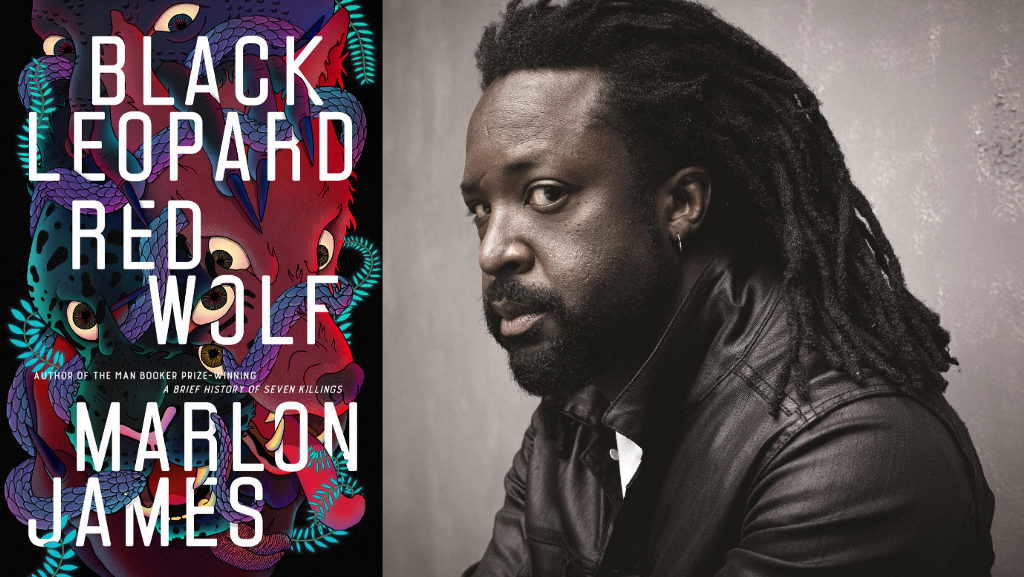
Marlon James Reclaims African Myths in Fantasy Saga “Black Leopard, Red Wolf”

It’s tempting to say that Marlon James’s brand is violence: operatic, almost mystical, always exacting. It’s also tempting to say his brand is sprawl. Even the Jamaican novelist’s shortest book — John Crow’s Devil, at 206 pages — manages to turn a turf war between two local ministers into cosmic combat. It’s tempting, then, to say that the Marlon James brand is a uniquely postcolonial mélange of the terrestrial and the empyrean. Human frailty, human violence, human hope, all of these things are lent, in his work, a cosmogonal weight. Nowhere is this more evident than in his latest outing, Black Leopard, Red Wolf, the opening salvo in a mind-bending fantasy trilogy about a band of misfits hired to find and retrieve a mysterious young boy.

The fantasy takes place in Iron Age Africa seen through a mirror darkly. Phantasm is the order of the day; or, rather, the night. The dramatis personae includes a necromancer, a shape-shifting leopard who is sometimes animal and sometimes man, bush fairies, a girl made entirely of smoke, a giant who hates being called a giant, a very smart buffalo, trolls from the Blood Swamp, a vampire lightning bird and, well, the list goes on. A boy named Tracker is the book’s protagonist, gifted (or cursed) with the ability to find anything and anyone by simply inhaling their scent. As part of this group of mercenaries, he provides a window into a world at once hallucinatory and terrifyingly real.

James and I spoke over coffee and tea (as he had been nursing a cold) at Oslo Coffee Roasters in Brooklyn. We had first met at the Brooklyn Book Festival some years prior, I as a fanboy and he as a pre-Booker winner, and had the pleasure of appearing on a panel together at New York Comic Con a few years after, as colleagues and contemporaries. Our conversation ranged from the centrality of oral storytelling in non-Western cultures to Ninja Scroll, from Toni Morrison to narcocorridos, and, near the heart of it, to the obligations one had to navigate as a storyteller in the spotlight.


Tochi Onyebuchi: So, what did your editor say when you handed in the first draft of this?

Marlon James: He thought it was great! This is the thing: I was surprised at how open people are, because I expected a fight. And I expected a fight every step of the way. God bless Wakanda. Black Panther is a gift that keeps on giving. I remember, the same editor said to me, “you know, my sales team is so excited about this book.” I was like, “what did you tell them?” They said, “oh, I just mentioned Black Panther every five minutes.” So, to my pleasant surprise, they were super excited. And even when they were excited about the Africanness and the blackness, I thought they would stumble on the queerness. And they didn’t! Probably because it’s Riverhead; now I’m not trying to blow up Riverhead more than they need to be blown up, but they do behave quite like an indie publisher. They got people to read Brief History, shit! So, yeah, they were super excited about it.

TO: I think anybody familiar with your work — particularly Brief History — will notice the operatic violence and the really aggressive queerness. So, there’s not really any surprise there.

MJ: Which is why this doesn’t feel like a leap for me. For all sorts of reasons. One, it’s no secret how much I love scifi, fantasy and crime — so-called genre fiction. I’ve never been shy about that. That’s the stuff I grew up with. But if you’re gonna write with the Caribbean and the African — and you’re gonna subtract the Western worldview — then the stuff that they keep calling “magical realism” is real. And, even with all of that, I had to do some serious mental housecleaning. Because even when people write about mythology and witchcraft and so on, they still write from this Judeo-Christian point of view. That it’s not really real.

If you’re gonna write with the Caribbean and the African, then the stuff that they keep calling ‘magical realism’ is real.

TO: Sort of Orientalist.

MJ: Right. “It’s not gonna be real; it’s never gonna prevail.” And I was like, “oh, this is some serious shit. A hex is a hex.” Magic is real. These creatures are real. Ninki-Nanka was real until white preachers told them it wasn’t. It’s what you wanna accept as truth. People who believe in a magic baby born in a stable got no place attacking dragons.

TO: There’s a lot there that I want to unpack. But one of the things that really struck me about Black Leopard, Red Wolf was precisely that lack of a gulf between reality and dream, or, I guess, what we would call dream. Going back to the African epics, it’s all part of the world. It made me think of how different societies view mental illness. In the West, it seems very much a biochemical thing that emerges from a person, influenced by the environment. Whereas, in a lot of African cultures, particularly where my mom came from in Nigeria, it’s very much an externality. Demon possession. Or it’s a part of the world that’s dueling with the person.

MJ: But even that is pretty new. Because if you go to places that are way more connected to pre-Christian and Muslim Africa, like Uganda, schizophrenia “sufferers” (and I put that in quotes) have voices, but the voices are all affirmative.

TO: Like cheerleaders.

MJ: And they can be annoying. A bunch of people saying “you won; yes, you won; honey, you won” can be annoying too. The dilemma is: if you have your own personal cheerleading squad, why would you want to be cured? If you hear a voice, it’s the ancestors. In a lot of Hindu culture, if you hear a voice, it’s one of the millions of gods. Spirits. Judeo-Christianity comes in and says a voice is a demon. Science comes in and says the voice is a condition. So even the whole idea that they’re demons is still new. Scientists were baffled. “How do we treat this?” I don’t wanna lose my own damn cheerleading squad.

TO: In Black Leopard, Red Wolf, there’s a mystery that needs to be solved, there are crime elements but also epic fantasy elements — not necessarily a quest narrative, but there is the journey. And the motley crew that’s put together. Could you talk a little bit about how those influences came to bear, particularly on this work?

MJ: There are some obvious influences like Tolkien. The funny thing is, writing a book that is totally pulling from African mythology and history and religion and so on, but still being influenced by people like Tolkien and people even like Robert E. Howard, who wasn’t very keen on black people. To put it mildly.

TO: That’s very diplomatic.

MJ: Well, I stopped reading H.P. Lovecraft, because you gotta draw the line somewhere. But the quest narrative is not just Lord of the Rings. It’s Journey to the West. It’s the oldest plot in the book: people go on a journey. And you might learn something. At the same time, I wanted to poke holes in it. At one point, Sogolon goes “well, how goes your fellowship now?” Which might seem like a dig at Lord of the Rings — it’s really not. But it is a dig at this sort of “we’ll band together in a unified purpose, all for one and one for all.” No, humans aren’t like that.

TO: Nobody in this book is like that.

MJ: This fellowship breaks up from the moment they set out! Only one person in the entire group has a sense of mission about where they’re going and it’s Sogolon. Everybody else is either for the money or along for the ride. I was very interested in, knowing all of that, what would make people work together anyway. Or what would make people band together. What could sustain a narrative if it’s not everybody going for this magic child thing? And part of that too is remembering that when you’re writing the quest narrative, the destination is the least important thing. To come back to Europeans, that’s why The Odyssey was very helpful. I went back to all of it: The Odyssey, The Iliad. It’s how the actual journey profoundly changes you that, to me, was a more important story than what they’re on the road for. They lose sight of that or they get disillusioned by that. Or they’re plotting against each other. Or some people are more sold on the idea than others. And then, of course, people start betraying people. People start being human.

In the quest narrative, the destination is the least important thing.

TO: Even the shapeshifters.

MJ: Even the shapeshifters. Even the giant (who doesn’t want to be called a giant). Most journeys are anticlimax. Deliberately. Whatever you’re gonna learn about humanity through this land of monsters and creatures and mermaids and demons and so on — I actually think these might be the most humane characters I’ve ever written. And they’re all shapeshifters.

TO: Or people with no limbs who have to roll around everywhere.

MJ: I love that kid.

TO: With regards to the horrific creatures that you’ve injected into this narrative, it seemed to me very reminiscent of Dhalgren by Samuel Delany where you never really know how next the world is going to betray you. It’s like everything is out to kill you. This was the first time in a very long time that I felt actual fear, reading a book. So, I was wondering if you could talk a little bit about horror versus gore in your work.

MJ: Oh, God. That’s a good question. Because the way I plot this trilogy: this one is more picaresque, adventure, odyssey. The second one is probably more historical, magical realist. And the third one is gonna be mostly horror.

TO: Oh boy.

MJ: Well, let’s talk about horror. One of the things about horror, as opposed to gore, is that horror is a seduction. Dracula has to lure you first. The wolfman is seductive. He’s gonna rip you to shreds. But maybe he’s not.

TO: He’s a looker.

MJ: It’s the wild thing. And horror is a seduction. And I think if you’re gonna write horror — and I like using horror elements — you can’t forget the seductive part. I will lure you in and I will make you regret it within an inch of your life. But the important part is the lure. And that’s what I think the torture porn people never understand. How is it you’re gonna get to the old house? You’re not gonna go to the blasted house on the hill! You gotta have the lure to the haunted house. At the same time, I quite like gore. I like explicitness. I like pushing on the boundaries. For lots of reasons. Let’s talk about violence, for example. My violent scenes are very violent. But this is how you know it’s not pornography — at least, I hope it’s not pornography, in that you don’t get numb. If the violence hits you every time, that means it’s intense, but it’s not pornography. If you’re reaching the point where you just glaze over, then it has gone into pornography. And it’s no longer violent.

TO: There’s a lot of sexual violence too, and that, I think, makes me think of the queerness aspect and masculinity and male aggression and all these things that are sort of working together.

MJ: And that’s tricky because this is something I wrestle with, and I have my students wrestle with, all the time. When you’re dealing with things like sex, violence, rape, and the attitudes behind it, did you write a book with misogynists or did you write a misogynist book? Did you write a book with homophobes or did you write a homophobic book? Did you write a book that doesn’t flinch from violence against women or did you write an anti-women book? There is violence in it, there’s also sexism in it. I mean, Tracker is a prick. But is the behavior being called out? Somebody says to Tracker very early on, “are all women witches to you?”

When you’re dealing with things like sexual violence, did you write a book with misogynists or did you write a misogynist book?

TO: And Sogolon gives as well as she takes.

MJ: Precisely. To me, the solution is not to turn away from all of that horrible violence. It’s to make sure that you establish context. These women exist in a capacity other than victim. But at the same time, there’s nothing sinful about the status of it. It’s something that was done to you. There’s sometimes these weird kinds of books and films that are super violent but victim-blaming. And I wasn’t gonna do that at all. I remember, with first book I ever wrote, John Crow’s Devil, years, years before it came out, also a brutal book, a person read it and said the writing is okay, but I don’t have a clue about women. And I said “what are you talkin about? I have a mother, I have a sister.”

TO: The Matt Damon defense.

MJ: And she said, “I bet you don’t read any women” and that was true at the time, certainly no living one. And she put me on a diet of Toni Morrison. And the thing about the Toni Morrison books that struck me — particularly The Bluest Eye and Beloved — is there’s a lot of cruelty in those books. Because I thought the solution was “don’t be cruel.” Don’t put cruelty in the book. And don’t have your female characters do irrational things. And she said, “no, you’re missing the point. That’s not the point, they can do irrational things.” In Beloved, you have to come to terms with the fact of murder being an act of love. The thing is, are you giving these people humanity, are you giving these people agency, the capability of change? And I think if you do that, then yeah, they can do cruel, horrendous, brutal, terrible shit. Because in the absence of that, I’d have just gone from the ignoble savage problem to the noble savage problem. Yeah, everybody’s virtuous, they’re still cartoons.

TO: That reminds me of N.K. Jemisin’s Broken Earth trilogy, this mother-daughter epic, wherein they both have the power to essentially break the world, and they both do, over the course of the trilogy, really horrific things. At the same time, it’s not just that you’re rooting for them, it’s that they exist as full characters with agency. There’s cruelty in this world, and cruel things are happening to them, but it doesn’t feel like pornography.

MJ: As the reader, you never get the opt-out clause. You’re gonna have complicated feelings about these characters. Which is how it should be. I learned that writing Book of Night Women, my second novel. Where my protagonist makes a lot of bad choices, which cost a lot of lives. But you still kinda have to root for her. And I like when a book takes me through the ringer. And I feel exhausted in a good way at the end of it.

TO: Have there been any recently that have done that for you?

MJ: Maria McCann’s As Meat Loves Salt. Which is a historical novel. It’s been years since I’ve seen a book go so far out on a limb with a character — the character does some of the most horrific things I’ve ever seen. And I remember thinking “wow, wow, you’re going there, you’re going there, I don’t know if I can do this, I don’t know if I can do this, I don’t know if I can hold on.” There’s a scene where this guy just got married but the king’s army has caught up with them and they’re gonna be hung. He escapes with his brother, and his brother ends up seriously injured. And they have to get away, but he’s so upset that his wedding was violated. At the very least, he’s gonna consummate his marriage. So, he basically, in the presence of his battered and bruised, near-dead brother, on the run, stops to rape his wife. And I’m like “I don’t know, I don’t know. I don’t think I can do this, I don’t think I can do this.” And I can’t believe she wrote this. And yet, I stuck with it. And, somehow, she makes me fall for him again. It was the first character in years that I would lose sleep over because I’m frettin’ over this guy. And when he reverts — total spoiler, for whoever’s gonna read it — when he reverts back to what he was before, I felt personally betrayed. I was like I can’t believe you disappointed me like this. I’ve been here, stuck through all this shit with you.

TO: We were all rooting for you.

MJ: “I forgave you, dammit.” I don’t think any of my characters do things you can’t come back from, ever. That was a risky thing she did with that book. But a book should leave you changed. A book should leave you a little knackered. It should leave you a little messed up.

TO: It’s often said you announced your intention to write this African Game of Thrones. If Wars of the Roses was George R.R. Martin’s analog for Game of Thrones, what’s the analog for Black Leopard, Red Wolf? Is there a specific when and where?

MJ: I was trying the hardest to follow the rise of the Iron Age. A lot of African societies didn’t have a Bronze. They went from stone straight to iron. But I was also hugely inspired by imperial-era Ethiopia. And the palace intrigue. To the point where I think I might still write a historical novel based on it. I mean, it was like reading Henry VIII. I don’t know if there’s any one text or one period. I was also reading a lot of Plantagenet when I was writing this book. Largely because I think if you’re gonna write war or the rumor of war, it should be plausible. I was reading, not just the Odyssey, but all the Scandinavian sagas, Njáls saga and all of that. A lot of African epics that have been translated, a lot of Sonjara and Askia Mohammed. Ultimately, I had to go my own way. Because, one, one of the things about all these ancient stories is they’re all about kings. They’re all about the kings, they’re all about the fall of a royal house. It’s fine. But my book starts in the streets. Hell, it starts in prison. And for that, there’s less precedent. Why would there be? All the great dramas, the ancient stories, have always been about important people: kings, princes, princesses, queens, gods. If there’s a Greek epic about a barber, it hasn’t survived. So, a lot of Ovid, The Metamorphoses. But also, a lot of comics. Whether it’s Hellboy or B.P.R.D., the whole idea of misfits brought together is something I’d have gotten from comics, I’d have gotten from X-Men or New Mutants or Alpha Flight. Or all the supporting characters in Hellblazer.

TO: One of my favorite storylines in any medium is X-Cutioner’s Song. It collects, Uncanny X-Men, X-Men, vol. 2, X-Force, and X-Factor. It was back in the day when they did these cross-book storylines (that’s why trade paperback was always an absolute godsend). Cable comes back in time to assassinate Professor X, and Apocalypse is involved somehow, and it’s all about the Summers-Grey bloodline. And it has all the epic feeling of these 700-page fantasy books.

MJ: See the 700-page thing to me was also Sandman. Cause that’s how I read them. Trade paperbacks. To me, I was reading novels. “Dream Country,” “The Kindly Ones.” I read that as a huge volume put together. I have said to anybody who would listen to me: the best American novel of the past 30 years is Palomar by Gilbert Hernandez. And Death of Speedy [Ortiz] is pretty close.

If you don’t get that [epic feeling], it’s a failure. It’s a failure of fiction, it’s a failure of speculative fiction. In that sense, I’m as inspired by film as I am by novels. You know, it’s like the first time you saw the Death Star. Or the sort of nightmare-scapes in Alien, which all seem like an insect turned inside-out. As a writer, I’m as inspired by Rick Baker as I am by any novelist. I nearly missed my own book signing line to go line up for Mike Mignola.

Everybody assumed I came out of some ghetto and survived gunshots; no, I came out of the suburbs and survived boredom.

TO: That is definitely relatable.

MJ: I wonder sometimes if it’s a response to growing up in suburbia. It never stopped being funny: when Brief History came out, everybody assumed I came out of some ghetto and survived gunshots; no, I came out of the suburbs and survived boredom. One way in which you survive that is just to vanish into any world you could. And I was always in some other space. To the point where I’d have a fully-realized story all in my head because I would rehearse it so much. Some of these characters in Black Leopard, Red Wolf existed for years. I just couldn’t figure out what their story was. And the worlds themselves. I just love the idea of imagining something that is so foreign. Here’s what I wanted to resist: I think we do this kind of “yeah we’re gonna imagine, but we’re still gonna keep it tethered to the conventions of reality or the conventions within scifi.” And I didn’t want to do that, because that would then just be regular scifi with dark-skinned people.

TO: You’re just race-swapping.

MJ: You’re writing Tarzan in brownface. And I didn’t want that. What I think, for me, made sure didn’t happen was while I’m reading all these African epics, I also have to read their value systems and I have to read their ideas of right and wrong. Circumcision, including female circumcision, becomes confronted in the book. The idea of the world being round, but we’re living inside it. But they still got the whole idea of the world being round way early. Vampires who are perfectly fine killing you in the daylight.

TO: Yeah, there’s just a lot of cool shit in the book.

MJ: (Laughter) There’s a lot of cool shit. I kept thinking, “God, the childhood I would have had if some of these were out.” I don’t have plans to write YA or for children, but we need new myths, man. We need new old myths. They’re not new, I just didn’t know them. Some of this I grew up with, like Anansi, but it says something that most of the creatures in my book are part of the African mythology, history, but I had to go learn them at flipping 40. A lot of the research I was doing was source material. Original research papers. I read a lot of the African epics. And people reading them will read them with a very Orientalist eye. And the people who translate them also translate them with the Orientalist eye. But if you apply that eye to any text, then even the Iliad is not gonna sound great. So, what we have is a lot of scientists and anthropologists doing really good work, but most of those epics haven’t been translated by a poet yet. And a poet who understands griot verse. We’re still waiting for an accurate English-language Lion King. It’s not quite there yet.

TO: I think this speaks to the larger oral tradition, the importance of griots. Tracker even says to a character towards the end “You know no griot” as though that’s a curse. And characters throughout the novel want to know the How of things, not even necessarily the Why. Break this down for me, tell me the story.

MJ: One thing that I had to be very mindful of and very careful of is, again, not allowing any place for Westernism or Orientalism to slip through. One easy area it could have slipped through is the idea that oral cultures are primitive. So, when he says “you know no griot,” it’s a sign we’re an oral culture, and I’m important enough that somebody’s gonna recite my story in verse. Because I think it’s very hard for people on this side of the world to let go of the idea that an oral culture isn’t just as sophisticated. They just have different systems. “Oh, I got that person who’s gonna record it for me, and he better learn it by heart.” Which is why “you know no griot” is actually a pretty devastating diss. It’d be like me telling you “you know what? History’s gonna judge you a minor person.” As soon as you die, you’re forgotten.

One thing that I had to be very mindful of is not allowing any place for Westernism or Orientalism to slip through.

TO: I just finished watching Narcos: Mexico, and towards the end, one of the characters, you start to hear a narcocorrido of them. This song lionizing famous drug traffickers. A recording of history that shined a spotlight on particular people. And I see the same thing here with the emphasis on the oral. I mean the whole book is essentially: “here’s what happened.”

MJ: The one thing the ancient epics — and I include the Bible in this — have in common is great orality. Robert Alter translated the Torah, and he made a change. In the Bible, it said from the dust came Adam. Okay, fine. He changed it to from the humus came the human. It completely changes it. Because the thing Alter remembered is that these books were written to be read aloud. And that was very important to me. It was really interesting hearing the guy doing the audiobook for this. He was very happy. I wrote it to be read aloud. The problem is, he read it too damn good. The griot parts, he sings it. Dude, you can’t do this.

TO: So, the audiobook is, like, a qualitatively different experience.

MJ: Goddammit, dude, you’ve turned the audiobook into the definitive version of the fucking book. ’Cause I am not singing no shit on the book tour.

TO: It’s almost this circularity, right? This story that’s modeled as an oral history gets written down, and then is — it’s interesting to see other, non-Western storytelling traditions interact with Western modes of production.

MJ: Yeah, I’m still a child of West. I was born in Jamaica. I live in America. I love rock and roll. Rock and roll’s black, but still. What I had to get rid of was the value system. I know everything about the Celts and the Druids and so on. But knowing about griots and fetish priests and the orishas.

TO: The Igbo pantheon as well.

MJ: The Dogon pantheon is fantastic. Nobody had to tell them that there’s a sun and all these planets are swirling around it. They have this dance where this person holds a ball with a string, and the guy’s spinning, and after a while, you realize, holy shit, that’s the atom. Hold on, that’s the solar system. He knows exactly what he’s doing.

TO: I encountered some of this when I was doing research for my second book. I learned where the word algebra came from. It’s Arabic, al-Jabr. Which means “the reunion of broken parts.”

MJ: That makes me want to do math, and nothing makes me wanna do math.

TO: There’s this interesting intersection of mathematics and, more largely, science, and the divine. Rather than being competing ways of organizing the universe, they are complimentary. You can’t have one without the other. It’s not just prayer. It’s that numbers are a language through which God speaks to us.

MJ: Religion is practice, and algebra is practice. But I also think being non-Judeo-Christian has a lot to do with it. The thing about us on this side of the world is that even if we’re not religious, we’re all Calvinists. We still believe hard work plus reward is a sign of a meaningful life. One child shall lead us, or one hero or man is man and woman is woman and blah blah blah. Somebody asked me, they thought the queerness was the way in which I’m trying to punk or subvert the narrative. I was like “dude, those are the oldest elements in the book.” Non-binary, gender fluidity, shapeshifting, queer, gay, bisexual. Some African tribes, there’re 15 genders. My friend, Lola Shoneyin, on Facebook once, somebody asked her “do you think Africa will ever be ready to accept things like homosexuality and blah blah blah?” She said, “Africa was born ready.” Until a bunch of TV preachers from America told them they weren’t. None of those elements are new. Shoga is not new.

TO: It reminds me of Freshwater, actually. There’s this blend of the animist and the religious or divine elements with the very corporeal question of how we occupy our bodies. That seems very much in line with what we’re talking about with regards to these other ways of being in the world. So, you started researching this after having turned in Brief History, so before the Booker stuff and before it took off — did you ever feel that you had to walk this line between the book you should write and the book you wanted to write?

MJ: Oh, absolutely. Especially post-winning that Booker. The very first research on this book, I think I did in August 2015. As soon as I finish one book, I’m on to the next. Cause I have no life.

TO: (Laughter) Nature abhors a vacuum.

MJ: But I knew there’s a certain kind of book people expect a Booker winning or a literary establishment favoriting book writer to write. There’s nothing wrong with all of those books. And I remember talking with my agent about this. I have two ideas. I have this idea, which is a quite practical idea of what I should write next. It was lowkey, it was gonna be short, it was gonna be this quietly devastating indie book. And there’s this thing I really wanna write. And I remember she’s saying, “well, the other one seems like a more logical choice.” But she could pick up that I really wanted to write this book. I still believe this, you should write the books you’ve always wanted to read. Even then I thought, I don’t know how this book would happen. One thing my books have in common is they start from a place of impossibility. They all start from “I don’t know how the hell I’m gonna write this.” This one was worse! There was all this research, all this stuff I loved. That was still not a book. There are so many trial and error versions of this book, including quite a few written in third person. I just didn’t know whose story it was.

TO: So, you split the difference. The trilogy style is Rashomon.

MJ: That happened because I was having an off-hand discussion with somebody about the TV show The Affair.

TO: In keeping with this theme of unreliable narrators, which has much higher stakes given the centrality of oral culture.

MJ: Truth is your job [as the reader]. It’s not my job to convince you that I’m telling the truth. It’s your job to decide whether you’re gonna believe it or not. There’s an ownership of truth, but there’s also an accountability where you are a part of whether this truth endures. Which I found profound when I was reading a lot of the African stories. Some of that got translated to this side of the world. They couldn’t kill it off the slave ships. The idea that the trickster tells the story. In Jamaica, we have a saying. Nobody understands what it means now. At the end of a story, the storyteller says, “Jack Mandora.” And the audience says, “me no choose none.” Which, translated, means “I’m done with my story, do you believe it?” And I go, “no. Tell me another one tomorrow.” You’re gonna have to choose. I’m not telling the reader which of these three versions you should believe. You can believe all three or you can pick. There’s no secret Book 4 coming. No “authentic” version. You’re gonna have to choose. Or maybe you think all three people are lying.

Truth is your job as the reader.

TO: The reader is implicated.

MJ: The reader is absolutely implicated because you may choose the liar.

TO: One thing that I was wondering about — some of this is drawing on current and acute identity crisis — but I was wondering if you thought at all of the idea of diasporic African writers drawing from the Continent in this very particular way. Writing AfrArcana?

MJ: Well, as someone who just did it [laughter] I think there’s a lot of things at work here. It’s a reach for connection. I think as children of the diaspora we have a right to that thing. I remember reading a very stupid article years ago saying that black people can culturally appropriate. And I was like “Sweetie.” It’s one thing if I step into my father’s closet and try on his shoes, even if I don’t know the purpose of shoes. There is difference between that and me going to my next-door neighbor’s house and stealing their shoes. There’s a difference. I have a right to my mother’s house. I have a right to my father’s closet. We’re in the diaspora for a reason!

TO: That’s a whole other interview.

MJ: In the same way I would never stop an Irish-American from writing a book about Irish mythology or anyone from Minnesota writing a Viking novel. It’s legacy, it’s family. I have a right to those myths. Any person in the African diaspora has a right to those myths. Because of our background and because of what we know, we can interpret them differently. That’s the great thing about this kind of storytelling. The story changes depending the teller. That’s why there’s already like five or six versions of the Sundiata Lion King story. The whole idea of Authentic Version or Director’s Cut or ‘This is the true version’ makes no sense. It does not apply. So African storytelling has already made the space for our kind of voice. It’s already made the space for it. I do have a right to claim it. But I also think we all bring something else. That’s the great thing about speculative fiction and scifi. Ultimately, we’re all pulling from the myths and the myths are for everybody. How else are we gonna learn about themselves?

I think there’s a certain Westernness we can sometimes bring to that kind of story. For example, the whole idea of will and agency. The idea that not everything is fated by the gods and that the human will plays a huge role. I’m not saying it’s something the Western people came up with — you can find it in African storytelling — but I know it’s my western upbringing that taught me that. To me, all of this information was just this huge reservoir that I got to pull from in much the same way Tolkien would have pulled from the Celtic and Scandinavian or George RR Martin pulling from Wars of the Roses or whatever he knows about Asgard. That’s how old myths turn into new myths.

Any person in the African diaspora has a right to African myths.

TO: So, I was reading this. I got to the end. And one of the very first thoughts in my head was “I cannot wait to see how the fuck this is going to blow peoples’ minds.” I’ve never seen anything like it. The structural conceit, the elements of African mythology, the inversion of the quest narrative, all these different things coming together like lightning captured in a bottle. And I was imagining to myself, “how on earth is some poor reviewer from the Guardian going to handle this?”

MJ: I don’t know. I’m already thinking, “wow, this is gonna get some interesting reviews.” I don’t remember who, said it was “equal parts enthralling and enervating.” I was like “enervating? Sweetie, get some stamina. This is gonna be a rough ride.”

TO: You got two more after this.

MJ: The next story’s gonna be told by some 315-year-old witch, and she’s got a lot of shit on her chest.

How Greenlander Niviaq Korneliussen’s Queer Millennial Novel Turned Her into a Literary Star

In 2013, a short story competition for young writers was established in Greenland. Niviaq Korneliussen, then 22 years old, entered with an ethereal story of a woman hitchhiking across the US to San Francisco, where she meets her idol, the musician Pink, in a tattoo shop. She won. Shortly thereafter, one of her country’s only publishers asked her for a novel.

Korneliussen had always written — in high school her friends found it strange that she actually enjoyed essay assignments — but she didn’t consider herself a writer. It would never have seemed a possibility in a country with only one bookstore. Milik, the largest Greenlandic publisher, has a staff of two people.

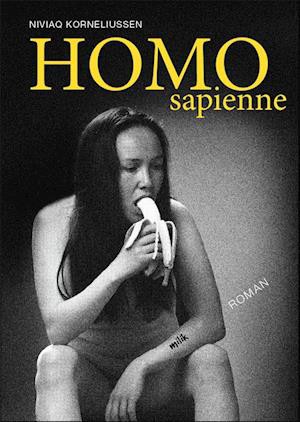
Milik published Korneliussen’s Homo Sapienne the following year, first in Greenlandic and then in the larger Danish market, translated by Korneliussen herself. The cover is amazing: a grainy photo of a woman sitting naked and unconcerned, eating a banana. Korneliussen had written the novel in three weeks, often through the night, after receiving a three-month grant from the Greenlandic government and procrastinating until nearly the last minute. The characters had been living inside her for so long, she says, that when she finally sat down to write, she couldn’t stop.


Sometimes you can feel how furiously a novel poured out of someone. I’ve felt it in Chloe Caldwell’s Women, André Acimán’s Call Me By Your Name, Violette LeDuc’s Thérèse and Isabelle. I suppose, as I write out these titles, that it’s not just the speed at which they were written: it’s the propulsion and drama of young, queer sexuality that compels one — or, at least, me — to read them feverishly, straight through in one sitting. Korneliussen’s novel is short and sizzling, narrated in stream-of-consciousness from the perspectives of five queer early-twenty-somethings in Nuuk, Greenland’s capital (population 17,500).

Korneliussen’s novel is short and sizzling, narrated in from the perspectives of five queer early-twenty-somethings in Nuuk, Greenland’s capital.

Fia is “turning old,” “dying,” three years into a straight relationship — “dry kisses stiffening like desiccated fish” — and by page 10, she has wriggled free (though first she’s forced to read her ex’s “own fucking version of how to understand the five fucking stages of loss, in endless text messages.”) Over weekends, the characters rage around, drinking, sleeping with friends and strangers, chastising themselves, waking up puking, communicating and miscommunicating in person and over text. To read this novel is to keenly remember what it feels like to be 22: in one scene, the character Sara lies in her bedroom under a “black cloud,” switching furiously between tracks on her speakers — Foo Fighters, Pink, Rihanna, Joan Jett — as each manages to only darken her foul mood.

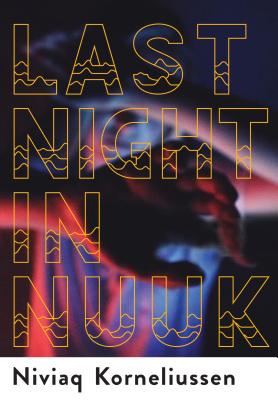
Homo Sapienne touched a nerve. The novel was written with young readers in mind — “I wanted to write the kind of book that I would have wanted to read as a teenager,” Korneliussen tells me over Skype — but it has not been marketed as YA, and clearly is resonating with readers of all ages. It quickly sold over 2,000 copies in Greenland, a country where 1,000 copies makes a book a best-seller, and many thousand more in Danish. Translations were released in French, German, Czech, Norwegian, Swedish, Finnish, and Icelandic. Virago published an English-language edition in the UK in November with the (very British) title Crimson, and Black Cat, an imprint of Grove, Atlantic, released the American edition as Last Night in Nuuk in January. This makes Korneliussen perhaps the first Greenlander ever to reach an audience far beyond her island. She has found herself, over the past four years, traveling the globe.


I was surprised to hear that Korneliussen’s candid evocations of sex and sexuality did not especially scandalize readers in Greenland. Gay marriage was legalized by unanimous vote in Greenland in 2015 (the same year it passed in our Supreme Court, though less unanimously). “It’s a Christian country,” Korneliussen explains, “but we can’t really compare it to the States where Christian people are extremely Christian.” Greenland was colonized by Lutheran and Moravian missionaries sponsored by Denmark, but today, “people don’t really go to church or anything like that.” And before colonization, the Inuit people had a much more open understanding of sexuality — though, as a hunting society, gender roles were strict. Korneliussen reflects that gay men have it harder than gay women today, as the ideal of the masculine hunter still prevails. But things are changing. “I give it ten years,” Korneliussen says, “until [being gay] is completely normal.”

What did scandalize Greenlandic readers was Korneliussen’s often critical portrayal of Greenland, particularly in a chapter from the perspective of Fia’s brother Inuk. Inuk escapes to Denmark after a friend at a house party drunkenly lets slip the secret of his relationship with a male politician. The rumor quickly becomes front-page news. (In a capital of 17,500 people, one can imagine, word spreads like small town gossip.) To Inuk, Greenland feels like a “prison,” walled in by mountains: “an island that will never change,” that “has run out of oxygen.” The inmates are “so institutionalized that they stare at one another until they start to lose their minds.” In a letter to Arnaq, the friend who betrayed him, who blames her recklessness on the neglect and abuse she suffered as a child, he writes, “Stop feeling so sorry for yourself because there’s no reason that you should be pitied. Enough of this post-colonial shit.”

Greenland is an autonomous Danish territory, relying on Denmark for two-thirds of their budget (the last third comes mostly from commercial fishing). Home Rule was established only in 1979, at which point all place names were changed from Danish back to Greenlandic. The capital, Godthaab, became Nuuk. Speaking Greenlandic became a political statement of national pride, whereas before to speak Danish was to be educated and employable. One can imagine the feeling of whiplash, the fragile project of national identity, the sensitivity to narratives of victimization and to persistent Danish stereotypes, which paint indigenous Greenlanders as primitive, lazy, alcoholics and child-abusers.

Korneliussen’s candid evocations of sex and sexuality did not especially scandalize Greenlandic readers. What did scandalize them was Korneliussen’s often critical portrayal of Greenland.

“I think Greenlandic people are so used to getting criticism from Denmark that it was hard to get the criticism from a young Greenlander,” Korneliussen tells me. “You have to be proud to be a Greenlander. That has been the mentality for many years. So people asked me if I had identity issues with being a Greenlander or if I had problems when I was growing up because it’s not normal for a Greenlander to criticize.” But, she insists, a writer has to be able to criticize her own country. Greenland has “a lot of work to do.” Setting aside the precarious economy and the existential threat that global warming presents to the nation, child abuse, alcoholism, and suicide rates are alarmingly high on the island. Better for the criticism to come from someone who knows what it’s like than from “a Danish dude who has been in the country for two months.”

The character Inuk’s rage at Greenland must also be read in context; he is raging just as hard against himself, refusing to accept his own sexuality. Many young Greenlanders and, as Korneliussen explains it, Greenlanders of any age who have not yet found peace with themselves, feel trapped, and those who can afford it (travel is prohibitively expensive for many) often spend a year or two in Denmark. She herself went to Denmark for university but ultimately felt homesick and returned, which is typically how it goes, she says. You have to leave before you can decide to stay. That’s not to mention the common experience of racism in Denmark, where bars frequently refuse entry to Greenlanders. Inuk feels alienated among the blonde and fair-skinned Danes (whose conversations he also finds “boring”), and finally, after coming out to his sister, he returns home.

The population of Greenland is so small and physically isolated that it does feel cut off from the rest of the world. Travel even within the country is often made impossible by snow, and there is only one international flight out of Nuuk, to Reykjavik. At least young people today have the internet, Korneliussen notes, but language can still be a barrier. In the novel, Sara finds herself desperately googling to figure out why her girlfriend — a butch woman who ultimately finds that she identifies more as a man — doesn’t want to be touched during sex. “Why doesn’t Ivinnguaq want me to touch her”? she searches in Greenlandic. Zero results. In the English-speaking world, young people increasingly have access to literature that reifies the nuances of gender and sexuality. Though Greenlanders seem to be broadly tolerant, there is no history of queer literature or culture in Greenland; growing up in the tiny town of Nanortalik in the far south, Korneliussen did not even know that it was possible to be gay outside the very distant world of her television. Young Greenlanders today can turn to Homo Sapienne. But Sara, stuck within the novel, has no reference points. She tries googling her question in Danish. The search turns up only “hetero bullshit.”

I had a similarly fruitless internet search when I sat down at my laptop to google “history of Greenlandic literature,” and even just “Greenlandic literature,” hoping to understand Last Night in Nuuk in context. Everything that came up was about Korneliussen. After much angst and several trips to the library, I found my guide in the former school director for Greenland, Christian Berthelsen, who appears to be the only author of books on the history of Greenlandic literature in any language. Berthelsen was a great advocate for his nation’s writing; he served as chairman for several years of the Greenlandic Publishing House in Nuuk, established in 1957. But let’s turn the clock back a bit.


The Inuit people of Greenland have a rich history of oral storytelling dating centuries before colonization. Legends of heroism against the destructive forces of nature and against unseen spiritual forces, ghost stories, animal fables, and tales of everyday life were passed down through generations. As late as the 1930’s and 40’s, storytellers were busy visiting the families of their communities on winter nights. Berthelsen remembers these scenes, set in the feeble light of a small house, the steady voice of the storyteller against the howling wind outside. In a story’s scariest moments, children dove under the covers and everyone picked up their feet to sit cross-legged, for fear of what might lurk among the skins and supplies under the bed. For the most part, though, the intention and actual effect of the storyteller’s monotonous voice was to put everyone to sleep.

The Inuit people of Greenland have a rich history of oral storytelling dating centuries before colonization.

Greenlandic first became a written language with the arrival of colonialism. In 1721, the Norwegian priest Hans Egede, funded by the Danish monarchy, first set foot on the world’s largest island, learned some rudimentary Greenlandic, and began teaching people to read the Bible in their language. The first Greenlandic writers therefore were hymn writers. Handwritten Danish fables were also passed from house to house at the time, until they became too worn to be legible.

A printing house finally opened in Godthaab in the 1850’s, and the Greenlandic newspaper Atuagagdliutit (“Something to Read”), which still exists today, began printing in 1861. In its columns, for the first time, ordinary Greenlanders could speak to their countrymen in writing. South Greenlandic seal hunters described their settlements and reported on hunting accidents and weather. Danish legends and classics of international literature — Robin Hood, The 1001 Nights — were published in translation in the earliest issues. Twelve issues were printed each year, but because of the extreme difficulty of travel, they were distributed only once annually, so that both local and foreign news reached the people of Greenland a year late. “But that did not matter,” Berthelsen tells us. “They were not used to anything better.”

Thanks in large part to a period of milder weather, the turn of the 20th century brought a period of great modernization, including the advent of occupations outside of seal hunting: principally fishing and sheep breeding. It was in this period that Greenland saw its first recognized poets — the priest Henrik Lund and the organist and college teacher Jonathan Petersen — whose writing praised the beauty of the Greenlandic landscape, expressed gratitude for Danish rule, and took part in the first major debates around Greenlandic identity: should the people remain faithful to the traditional ways of life or embrace modern influences?


The first two Greenlandic novels, published in 1914 and 1931 respectively, reflect the optimism of this period and argue for the modern: both imagined Greenlands of the future — an “enlightened” population, flight routes to China and Japan over the North Pole, high rises in the capital. The first novel imagined freedom from Denmark, while the second, set 200 years in the future in 2105, still foresaw Danish rule, though with equal rights for Danes and Greenlanders.

The first novel by a Greenlandic woman was not published until 1981 (!!!). Bussimi naapinneq (The Meeting on the Bus) by Maaliaaraq Vebaek chronicles the struggles of a Greenlandic woman in Copenhagen, at a time when all Greenlanders who wanted to pursue a college degree had to travel to the universities in Denmark, and often faced racism and disorientation in the new country and culture. “Shattered illusions can lead to human tragedies,” Berthelsen writes elusively, referring, I think, to suicide. But I haven’t read this book. If you speak Danish or Greenlandic, do read it and tell me.


I kept asking Niviaq Korneliussen, as I spoke with her, how her writing reflects and defies “the tradition of Greenlandic literature,” until she had to stop and gently correct me. There simply has not been enough published to call it a “tradition of Greenlandic literature” yet. Berthelsen too notes, after all his work in chronicling it, that Greenlandic literature “is of quite modest scope to date.” A population of 56,000 — and 23,000 as recently as 1950 — simply “is not large enough to support an independent Greenlandic literature. But, that created so far is of special significance when measured with a cultural-historical yardstick.” I could not find out whether or not Berthelsen is alive today to watch Niviaq Korneliussen take the world by storm. If he is, I bet he’s ecstatic.

Korneliussen is writing against tradition, both literary and cultural. The hostility and majesty of nature is inescapably central to Greenlandic writing and storytelling, and to the Greenlandic psyche. It is what pulled Korneliussen back from her time abroad in Denmark: the calm of feeling the ocean, a mountain, and usually a fjord too within reach. And yet nature is intentionally absent from Last Night in Nuuk. So is small town life and seal hunting. Korneliussen’s characters move from apartments to bars to house parties in buses and taxis, and the reader is trapped in the hermetic feeling of any city in the winter. The characters speak, not in official Greenlandic, but in the language of young people in the capital — a mix of colloquial Greenlandic, Danish, and English (unfortunately we miss this in the English translation), peppered with text messages and, yes, hashtags.

Korneliussen’s characters speak, not in official Greenlandic, but in the language of young people in the capital — a mix of colloquial Greenlandic, Danish, and English, peppered with text messages and, yes, hashtags.

Often the characters are pulled towards self-destruction, pinned within relationships, identities, an island nation where they feel trapped. Sometimes they break free. Sometimes they find escape in their own recklessness. In one glorious scene towards the end of the novel, Sara bikes down a hill so fast that she loses control of the handlebars, and nearly mows down a couple on foot. She rounds a curve in the middle of the road; if a car comes, she realizes, she will probably die. But no car comes. She keeps on at top speed, laughing aloud, tears streaming from the wind. For a moment, she finds, “the heaviness in me is blown away.”

“I really wanted the young Greenlander to feel like she is able to live her life as she wants,” Korneliussen reflects. It isn’t easy to be different in a small place. She thinks about all the young misfits in her very young country, still wrestling with its own identity as they wrestle with theirs. “Yeah,” she says. “It was important to me to give hope.”

We Need a New Way of Thinking About Mental Illness

I n recent years, suicide rates across America have considerably risen and continue to rise in almost every state. For this reason, there is a need for a guide on reporting suicides. The CDC, in this guide, warns that there are many reasons a person might kill themselves, “Researchers found that more than half of people who died by suicide did not have a known diagnosed mental health condition at the time of death. Relationship problems or loss, substance misuse; physical health problems; and job, money, legal or housing stress often contributed to risk for suicide.” The implication here is that a “known mental health condition” is materially different from a known traumatic life event, addiction, or physical health problem.

It’s a popular Western notion that mental illness is a disease of the brain — one that arises from chemical imbalances, not from life events, and that will go away if treated with medication. But as suicide rates continue to rise, perhaps we need to widen the scope of what mental illness is, how it is caused, and what we can do to help those who are suffering. I believe that losing a job, not having enough money to live, substance abuse, and something like physical health are mental health issues, and our mental health is inextricable from our physical health, our economy, and our culture. This is a belief based on my own experiences with mental health and diagnosis — but I’m not alone. Four new books on mental illness offer a similar perspective, portraying the complexity of mental health and how it is inextricably tied to every aspect of our lives and the cultural framework in which we live.

Our mental health is inextricable from our physical health, our economy, and our culture.

When I was thirteen, I attempted suicide, and was subsequently diagnosed with bipolar disorder, at the time called manic depression. Doctors told me I’d be taking Lithium for the rest of my life, and the illness would never go away. My parents thought I’d never graduate college, get married, or have children. When I was 28, the palms of my hands exploded with a thousand liquid-filled blisters, a form of eczema. A doctor told me to get used to it, because it would never go away either. I thought I’d never be able to write again.

In both cases, the doctors were right: eczema and mental illness are diseases of the body that never go away. But I learned that diseases inside the body are very often triggered by our environments. There wasn’t anything inherently wrong with me. More often than not, there was something very, very wrong with my surroundings, my culture, and the outside world. I learned to understand my body and mind, and the way I respond to the world around me. My skin issues and mental issues became manageable, and sometimes seem to disappear, though I know they never will. What I mean to say is, it’s all much more complicated than taking a pill.

Mental illness has always been a source of inspiration for books, television, and movies. Recently, because of a larger awareness of the dangers of stigmatization, popular shows and movies have made it a priority to portray mental illness in more complex, nuanced, closer to real life ways. Maniac on Netflix worked hard to get mental illness right. Sharp Objects portrayed the full range of mental illness and pathology of a mother and her daughters. But there’s a limit to how much nuance can be portrayed onscreen, and mental illness still gets flattened into a trope; Netflix’s 13 Reasons Why, for instance, though hugely popular, was criticized for glamorizing suicide and not offering hope. Books, though, are in the unique position to offer the space necessary to really dive into the causes and effects of mental illness, and recent releases have been using that space to portray how a mental illness develops in tandem within the dynamics of a family, a culture, or a country. In their own way, these books offer a more complete and complex view of mental illness than the one we might be used to.

In Katya Apekina’s The Deeper the Water the Uglier the Fish, Edith and Mae are raised in Louisiana by their mother, Marianne. Marianne never gets a formal diagnosis, but she is sometimes manic, sometimes depressed, sometimes disappears for days or weeks, eventually attempts suicide, and is hospitalized. Her daughters, one of whom she shares an almost psychic bond with, are sent to New York to live with their father, Dennis, an acclaimed and successful novelist, who is either an eccentric artist, a narcissist, a psychopath, a pedophile, or some combination of which. Dennis and Marianne met when she was a child and he was an adult. He married her when she was a teenager and he was in his 30s. In an old letter from Dennis to Marianne he writes, “I don’t know how to be with you without wanting to kill you and devour you and then bring you back to life, and then write about you and do it all again. Isn’t that love?”

The book is told in short bursts from multiple perspectives, not only Dennis and Marianne but their friends and acquaintances. It contains letters, therapist’s notes, New York Times book reviews, and transcripts of phone conversations, and moves back and forth in time as the mystery of this family and its psychology unfolds. It’s a structure that encourages the reader to wonder: when did Marianne’s mental decline begin? Did her mental illness begin with Dennis? Was she born this way? Was her deterioration willful and selfish, a product of her disease, or upbringing, or a combination of all three? Can the actions or inactions of someone close to us trigger a psychotic episode? The book made me think of mental illness as lying on an ever-shifting spectrum, not just lodged inside the body, but dependent on the culture and environment in which an individual was raised. Because of course we are inextricable from the world and the people who surround us, but this very idea of a lack of a definitive boundary between our bodies and the rest of the world is a sign of mental illness. As Marianne says, “it’s terrible to always have to keep track of the edges of things.”

The book made me think of mental illness as lying on an ever-shifting spectrum, not just lodged inside the body, but dependent on the culture and environment in which an individual was raised.

In Anne-Marie Kinney’s Coldwater Canyon, Shep is a Gulf War Veteran, with Gulf War Syndrome and PTSD, on permanent disability. He follows a young woman who he believes to be his daughter from Nebraska to Los Angeles. He watches as she works in a café and goes on auditions. He hangs out at the local strip mall convenience store, where he is a trusted friend of the family that owns the store, and where he bears witness to the dramas of the neighboring Armenian mafia. Coldwater Canyon is a story of man who is, for a myriad of reasons, is unable to face his traumas and instead avoids them, hoping for the fantasy life he has lived alongside of for years, to come true.

Shep’s behavior can be seen as criminal, creepy, abusive, sad, or any combination thereof. The reader is never asked to pass judgment on Shep, or to provide excuses for him; he is portrayed in an open and honest light, and his delusion about his daughter is not presented as a mitigating factor. But it’s still a delusion, one around which he has shaped his entire adult life. He even believes he had a hand in helping her single mother to raise her, by spying on the mother and daughter throughout her childhood. He believes the mother, a woman with whom he had a brief affair before the war, was bolstered by his presence, by his energy. It’s impossible to extract Shep’s behavior from this delusion, and it’s impossible to extract his delusion from his experiences: his father was never around, his mother died when he was young, and he was raised by a cold and unloving grandmother. He grew up knowing he was a burden. His neurosis was shaped by poverty, loneliness, grief, and then war, and then PTSD, and then the mysterious symptoms of Gulf War Syndrome. I found myself wondering: Is his stalking a crime, or mental illness? Can behavior be both, and can a criminal behavior be met with empathy and understanding?

As I read Coldwater Canyon, I thought about how our culture’s tendency to vilify men, without also vilifying it all; the culture, the country, the weight of the actions of generations, the lack of social structure that should be in place to protect us from all the things that break us, sometimes beyond repair: poverty, racism, sexism, power structures, dysfunctional families, violence, capitalism, that a few rich white men need to ceaselessly become richer at the expense of all of us, while we tear each other apart, unwilling to take the mental health of our citizens into account for their actions.

Esme Wang’s The Collected Schizophrenias and Rheea Mukherjee’s The Body Myth are about illnesses that are seemingly on opposite ends of the mental health spectrum. While both conditions are extremely complex and not readily understood, schizophrenia is viewed as an illness over which a person has little control, while the fictitious health conditions that the Munchausen’s patient comes up with are perceived as an attempt to willfully exert control over other people. But of course it’s not so simple. In both books, there is a woman at its center who finds it almost impossible to live inside of the world as it is.

The Body Myth takes place in India and there is much pondering of the American way of labeling illness in order to medicate and fuel the pharmaceutical industry. The narrator, Mira, becomes enamored with a woman afflicted by mysterious ailments — headaches, pain, seizures. She knows the woman is faking but finds her so alluring that she doesn’t care. We are pulled alongside the narrator because we want the answers to these questions: If she is faking her illness — Why? Does her husband know? Does her doctor? If so, do they care? If they are encouraging a false narrative she has for herself, what is wrong with them? Do they have an illness as well? Are those around her complicit in perpetuating her mental illness?

Mira turns to Western philosophy to help her understand this woman she yearns for. She studies Simone de Beauvoir, who says the body is not a thing; it is a situation; it is our grasp on the world. Mira paraphrases Foucault: “there was a time society regarded the insane as wise souls on a higher level of consciousness…that respond to the world asymmetrically.” Whereas in modern days, psychiatry “suppresses their tendencies and coos them back to the reality we’ve semi-agreed to all agree upon.”

Mira presents the possibility that mental illness may be an enhanced, unadulterated peek at the true world, one that takes us away from the shared world that we know as our reality. In this view, a mental illness is not inside of the body at all, and the biochemistry of the physical body is perhaps just a byproduct. In other words, we won’t know anything about mental illness if we only look at the physical body and not the divine. It’s fascinating to think about the faking of a mental illness as a mental illness in itself, and to view mental illness as a window to the divine. It’s a valuable addition to the myriad ways to think about mental illness.

In this view, a mental illness is not inside of the body at all, and the biochemistry of the physical body is perhaps just a byproduct.

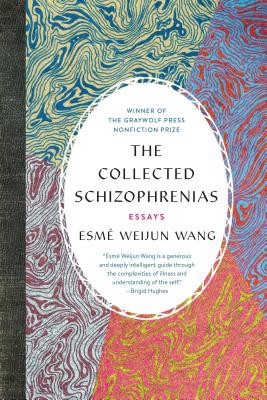
Esme Wang, in The Collected Schizophrenias, also discusses this association of mental illness with the divine. The Collected Schizophrenias is a collection of essays that tell the non-linear and ever-shifting story of the author’s various diagnoses. Wang writes about the term that often accompanies a schizophrenic diagnosis — “loosening of associations.” These are associations that are socially agreed upon — our culture’s understanding of reality. Mira from The Body Myth would say a loosening of associations is likely closer to any kind of universal truth, but that’s not a place where we can live. As Wang writes, “No one ever came out of a conversation with the gods for the better.”

Part of the pleasure of reading these essays is in discovering how much I related to the narrator. I think about when my daughter was a baby, peacefully sleeping in her bed, and I lay awake, terrified and frozen, sure I was hearing people quietly moving through the house, moving towards my baby’s room to steal her. I heard a shoe stepping on a toy, I heard a sharp intake of breath. I heard the door open. I knew none of these things were actually happening but I had to get up and check on my daughter, and check every inch of the apartment, behind the shower curtain, inside every closet. Most nights I never made it back to sleep.

Wang’s essay “The Slender Man, the Nothing, and Me” is about the powerful imagination of young girls. In it, Wang posits that we might be part of a larger story without fully knowing how. When she was twelve, she and her friends believed they were in a book, a book that was being written about them. I had an eerily similar experience of shared stories with a friend when I was twelve. Are we mentally ill when we are twelve, or are we just twelve-year-olds? The essay explores a 2014 attempted murder perpetrated by two young girls (since diagnosed with two different types of schizophrenia) who believed they were killing to win the favor of the Slender Man, a creation of online horror fans. Wang ends the essay by saying that she believes very much that your surroundings and who, or what you may come into contact with shape who you are, and shape the development, the severity, and the existence of your mental illness.

Reading ‘Girl, Interrupted’ in the Psych Ward

Wang craves a correct a diagnosis, because it makes it easier to live with herself. Especially interesting is Wang’s resistance to the recent politically correct way we are to refer to mental illness these days — by positioning mental illness as something that happens to you, not something you are. For example, we are not to say “he is depressed” and certainly not “he is a depressive.” Instead, we are to say “he suffers from depression.” Wang prefers to refer to herself as schizophrenic, because, “Isn’t it cruel to insist on a self without illness?” This was a refreshing and wondering reminder that mental illness is personal, and an individual gets to define themselves, and that the way we understand ourselves inside of our world can, will, and should never-endingly shift.

When I think about myself when I was thirteen, I don’t think I was bipolar. I don’t really know what I was, except that I was a sensitive child living in an unpredictable and volatile home, and my life at school was not all that different. I felt big feelings, and was extremely sensitive to hormonal changes. I was also a writer with a flair for the dramatic and a tendency to prefer fantasy to reality. Aside from the violence that surrounded me when I was young, I am still the same girl, but I’ve spent a long time learning how to understand myself, and one of the best and most fun ways of doing that is by reading thought-provoking, risk-taking, dangerous and heartbreaking books.

I think what I needed to hear from doctors when I was thirteen and suicidal, and when I was 28 and exploding in rashes, was this: Here is a possible diagnosis, but really, we don’t know. Let’s see what we can do to help alleviate your suffering. There are many options, let’s try until we find something that works. You might have this now, but you won’t suffer forever. We will figure out how to manage it, and nothing is static. Nothing in this Universe stays the same, and that includes you. The world around you will shift, and the people, and your perceptions. In order for all of this to exist, there has to be both creation and destruction, and with that, beauty and violence, good and bad, justice and inequality. Our world and ourselves exist on the full spectrum of emotion and possibility. We just need to learn to be able to handle the contradictions, and harness the positive to use to fight the negative. We just need to learn how to get by, and we will. There was nobody to tell me this when I was thirteen, but now, we have books that open up new, healthier ways of thinking about mental illness.

Elizabeth McCracken’s “Bowlaway” Is a Charming, Quirky Family Saga About Love and Bowling

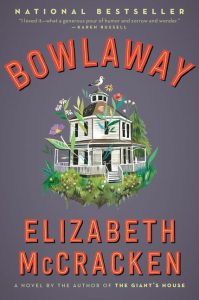
Her first novel since 2002, Elizabeth McCracken’s Bowlaway is an epic generational story that doesn’t feel epic at all — instead, reading it is familiar, funny, alive. At the turn of the twentieth century, enigmatic Bertha Truitt appears in the town of Salford, MA, lying unconscious in a cemetery. When she comes to, Truitt by turns charms and astonishes the residents, insists she invented the game of candlepin bowling, and builds an alley in the center of town which — scandal of scandals — allows women to bowl. When Truitt dies in Boston’s Great Molasses Flood (which is real, and took place almost exactly a hundred years before Bowlaway publishes), she leaves behind the bowling alley, relatives with mysterious connections to her, and a town she changed forever.

McCracken pulled names from her own family’s genealogy, so in a way, the characters in the book are the author’s family, rooted both in fiction and in real life. And that’s how the novel feels — more fantastical than history, more workaday than a fairytale — with all the humble business of daily life: work, motherhood, military service, family duties. Truitt’s influence seems otherworldly and she belongs in concert with the best storybook mentors, like Mary Poppins or Willy Wonka. McCracken has the unique ability to be simultaneously delightful and heartbreaking, and Bowlaway leads us to examine the physical and emotional artifacts people leave behind, whether or not they touched them directly — bowling alleys, families, memories. She and I recently talked by phone about marrying the ridiculous with the tragic, how women carve out space for themselves, and the inherent humor of bowling.


Katy Hershberger: So, seventeen years since your last novel. How does it feel to come back to that form after short stories and a memoir?

Elizabeth McCracken: I think it feels alright? It has terrified me a little bit more somehow as the book comes out, I’m not sure why. And I’ve written novels in there, they just haven’t been any good. I just haven’t published them.

KH: Does it feel different from the last books you’ve published, even if they weren’t novels?

EM: Yeah, I think so. I think with the short stories, short stories are quieter publications, generally speaking. And the stories had mostly been published other places, so it didn’t feel like the first time they were being read. I guess part of it is this time I have more of that sort of panicked writer’s feeling of “what if everybody hates it? What if people really really hate it?” With the short stories I felt like plenty of people had read them. “Plenty,” that’s a ridiculous expression for short stories published in literary magazines. [laughs] I mean, plenty for me, I should say, but that’s not to say a lot. It felt like it had already been out in the world a little bit, and not so much with this. So I’m feeling a bit nervous.

I’m an Award-Winning Short Story Writer and I Don’t Know What I’m Doing Either

KH: The book is set in New England, where, you write that “even the violence is cunning and subtle.” I’d love to know about your background in New England and why you decided to set this story there.

EM: I’m a New Englander. Though it’s interesting, I’ve got an older brother who spent the same amount of time in New England as I did, but thinks of himself as a west coaster because we spent part of our childhood in Portland, Oregon. But I was born in Boston and moved back there when I was about seven and a half. And then in 2010 I moved to Texas and it feels like a different country to me. And whenever I go back to Boston, sometimes people are rude to me and I think “Oh my gosh, people are really mean here” and other times people are rude to me and I think “It’s home. I love it. People are so mean.” I saw a woman be spectacularly rude to a pair of men who were trying to buy admission to the Pilgrim Monument in Provincetown a couple of weeks ago. She was — appropriately — monumentally rude to them. My husband, who is English, was horrified and I just went “No, she’s quite right. They’re too late and it does my heart good to see her deny them admission.” And she was awful. They said, “Can we possibly?” and she went “No!” She took a really long time to explain the monument was closed. She just took great pleasure in saying no to them, which I do feel can sometimes be a New England-y trait.

KH: So it’s a far cry from Texas.

EM: It’s a far cry from Texas where people are usually really nice and helpful. I wanted to write about a place that felt like home because Texas, which I enjoy, I don’t think will ever feel like home. And I don’t think Texans will ever consider me as being a Texan in any way. That is my experience of Texans. Texas is the only state where I’ve heard people say, “I’m a sixth generation Texan.” Maybe they do that in California too. You might slightly brag about your family coming over on the Mayflower in Massachusetts, but certainly I’ve never heard anybody say “I’m a sixth-generation Massachusetts-ite,” person, whatever. We don’t even have a noun for it, that’s the thing, there’s not even a noun for somebody who comes from Massachusetts. But yes, I was missing New England.

KH: It feels like such a New England story, between candlepin bowling and the Molasses Flood, and that it has to be really rooted there.

EM: I can’t quite remember when I landed on candlepin bowling, but pretty early. And then I was delighted when I suddenly realized that the math would work to put in the Molasses Flood.

KH: The flood feels especially perfect because it’s a sort of slightly humorous and ridiculous married with the tragic. It feels like it fits in so well with these themes throughout the book.

EM: If I had a sweet spot that would be what I’m attempting to achieve in my work, it would be that. Slightly ridiculous but also tragic.

If I had a sweet spot, slightly ridiculous but also tragic would be what I’m attempting to achieve in my work.

KH: Bertha to me feels very much like a timeless, mythical character like Mary Poppins or Willy Wonka. This sort of storied mentor who doesn’t quite belong in ordinary life. I’m curious if she was based on anyone in real life or in fiction, and how you came to write her.

EM: She’s not based on anybody who I know in real life. It’s interesting because I only realized this recently. She’s a cousin to a character in a novel that I really love by Susan Stinson called Martha Moody. And I realized that Bertha Truitt is a name from the grandfather’s genealogies. I think she naturally came to be a cousin to this character from this novel, which is out of print and it shouldn’t be, it’s so beautiful. It’s about a woman who founds a town called Moody.

KH: So it seems that there’s both real life genealogy and fictional genealogy throughout the book, is that right?

EM: Yes. Yeah.

KH: I read that the names of the characters were inspired by your grandfather’s genealogies. How did that come to be? How are you inspired by the work that your grandfather had done with your own family?

EM: I essentially just went through this genealogy that he had written in the sixties. It’s quite big and thorough. He was a professional genealogist and editor of a magazine called the American Genealogist for quite awhile, and I just took names out. I just popped them right out. I don’t think any of them are close relatives, but they were so evocative to me that I just, I had a giant list of names that I looked at for awhile and then started to put them into fiction. The first two I had were Bertha Truitt and Dr. Leviticus Sprague. I can’t tell you who those people are, who those people were in real life anymore. And actually l think sort of instantly I couldn’t. I just wanted to think about the names suggested. But overwhelmingly the names in the book are names from the genealogy and only begin to break down when people got married and began to have children and I was like, oh I can’t do that anymore. But somebody named Betty Graham who was known as Cracker is from my grandfather’s genealogies. The names Luetta Mood, Hazel Forest, Leviticus Sprague, Joe Wear, Jeptha Arrison, those are all from the genealogy.

KH: So in some ways every character in the book is a part of your family.

EM: Yeah, I guess. Yeah, I suppose.

KH: Genealogy and legacy seem to be themes that you come back to in your fiction. How do those themes inspire you and what did you want to say about genealogy and legacy here?

EM: That’s interesting. Part of it is because of my grandfather is something that I was really aware of, especially on that side of my family, the McCracken side. In one of the genealogies he actually talks about how he’d intended to do my mother’s genealogy, I don’t know if that’s really true, but because my mother’s side of the family is Jewish it’s much more difficult to do a thorough genealogy. And certainly when I was growing up, that side of the family told a lot of stories about family and they also told a lot of stories about people they couldn’t quite figure out who they were.

There was a photograph of two children who my cousin Elizabeth, who is my grandfather’s first cousin, often was talked about with a great deal of mystery. She thought that they were a brother and sister who had died in Europe before the family had come to Iowa in the 19th century. And so I think I was always really interested, as I tend to be in any topic, in how it was true that genealogy was interesting but the opposite of that is also true. That it’s both important and not important. That blood relation actually doesn’t mean that much except for it often does to people. And I think I’ve always found that interesting.

KH: It’s more about the meaning you put onto the idea of family than the actual blood connections.

EM: Exactly. And those questions of what difference does it make, what difference could it possibly make if you were related by blood to somebody. My brother has actually gotten extremely into genealogy in the past couple of years and has actually found out an enormous amount of stuff about my mother’s side of the family that we never knew through his research.

KH: I think it’s so interesting that a lot of the book is about the duty of being part of a family, whether or not you’re related by blood. From the flawed but devoted mothers and the difficulty of motherhood to sometimes being stuck in the family business. Could you talk a bit about your take on those sort of expectations that can be bound up in family?

EM: I wrote another book in which having to go into the family business is a big deal though in that case the person didn’t, and I have no idea why, since certainly that wasn’t any kind of obligation I ever had. Even though I say that from my campus office at a university and my parents were both university employees all their lives. I’m not sure. The question of duty is one that I’m always really interested in. I write about it and I don’t know why! Sometimes I have an automatic answer to that question. The answer might have to do with always being interested in the family stories on both sides of my family, to think about the people whose lives are changed by being dutiful. By staying at home, serving another relative, whether it was a sibling or a parent or a child.

KH: There’s so much in the book about the role of women throughout history and having to carve out a space for oneself. Given what’s going on in American culture right now, was it a goal to write a feminist novel?

EM: I almost never have a goal in my writing but anything that I’m thinking about in my daily life goes into the back of my brain and hopefully comes out through my writing. And I, like everybody, I’ve been thinking about these questions. About how women have adjusted themselves through history to make space. And the ways in which they’ve been quietly and automatically ignored. And ignored by people who don’t even realize that they’re doing it, including other women. It’s something that’s been very much on my mind.

You know, I teach with undergraduate and graduate students and with the graduate students I’m interested in the way the women writers are taught to think about themselves and the importance of their work versus the way the men are. If I’m giving advice to a woman who’s trying to figure out what to ask for or how to approach an agent or how to approach a job, and women are often afraid to ask for things, and I always tell them, well think about being a man, and if a man would ask for that thing then you should ask for it. And you should know that what that means is that you should ask for it, it’s not that men are being outrageous in asking for it, it’s something you should ask for.

If I’m giving advice to a woman who’s trying to figure out what to ask for or how to approach an agent or how to approach a job (and women are often afraid to ask for things), I always tell them, well think about being a man, and if a man would ask for that thing then you should ask for it.

KH: I of course have to ask about bowling. I love the way that you describe bowling and say “our subject is love because our subject is bowling,” and that “it’s possible to bowl away trouble.” I wanted to ask about your connection to bowling and why you equate it with love and solace.

EM: I was a childhood candlepin bowler. And also I now have kids, and if you’ve got kids in America you will end up in a bowling alley eventually a couple of times a year. In Texas it’s tenpin bowling and I think when bowling re-entered my life when I was a parent it made me really miss candlepin bowling because it’s less brutal. Narly anybody can pick up a candlepin ball and roll it. And I really loved that and it’s also a regional variation and I was missing home, so I missed candlepin bowling.

I also just think everybody knows that bowling is an inherently funny sport, I don’t know why that is. I don’t know if it’s cause it’s an indoor sport, you don’t necessarily have to be fabulously fit to do it or to be really good at it. I discovered as I was researching the book it’s kind of mesmerizing to watch bowling even though there’s a really limited number of outcomes to bowling, especially candlepin bowling. There’s never the threat that somebody’s going to bowl a perfect game. And because bowling is inherently funny I love the idea of writing about it as being a romantic thing to do. And I do find it kind of strangely beautiful.

We Are All Winter Now

“Welcome to the Situation
[Winterfeldtplatz Markt, Berlin]”

The market makes me feel good
about myself because the people

don’t go there to feel good
about themselves. The exchange

rate I do nothing about but
watch. It has nothing to do with

the vendors beneath my house. Eighties music and
smokes are stupid enough to make me feel

nineteen again. I like my age though other folk
seem worried for me. Not fair, for it’s not the same

is it as good for me as it was for you?
Back at the nest someone asks me

if I’m in the 30–40 bracket. He’s with his dad,
who looks seventy. I am 33, and think about

the uncanny valley: all those fore-
heads that couldn’t be reached. We’ve all

gone winter, gone deep, the snow digging
its heels in the crevices of trees.

“Welcome to the Situation
[Tempelhof Airport, Berlin]” 

Shrieks sound the same
in any language. I spoke English
to avoid the shame I felt of being

alone. On the Feld, the sun
spoke in rays blown open
like a dinner party gone wrong.

Admit it, you were a little bit pleased.
Incongruous, like Wagner
playing in the hipster bar.

Outside, the kids scream why
you can’t help but wonder
how they’ll grow up,

as every Mercedes is getting more
extreme. Oh, oh, oh, it’s impolite,
but the Feld doesn’t mind

the loss of air traffic control
and you’ve never taken a bike
across the tarmac before.

The wind almost leaves
an invitation in its wake,
still with no name, just

the insistence that it will
all triumph before.

“thermodynamics”

Saturday night in Glasgow,
along the snow-packed sidewalks

needled voices say, Please,
say, I know what I’m doing, say, Mum,

say something sweet. Why do I doubt
the good, insist

on shaking my fist
after the bad. Some dumb self-

punishing mechanism.
I’m trying to be better at

forgiveness, that little floe
forged in the center of the Kelvin

determined not to melt;
I admire its stubbornness,

tire of the familiar
refusal to surrender all.

Stefi, when you opened your hands,
let them alight on my head,

the passerine trapped in the chest
where more might give gave flight.

About the Author

Kathleen Heil writes and translates poetry and prose. Recent poems appear in The New Yorker, Beloit Poetry Journal, Fence, Witness, Sixth Finch, Barrow Street, and elsewhere. More at kathleenheil.net.

“Welcome to the Situation [Winterfeldtplatz Markt, Berlin],” “Welcome to the Situation [Tempelhof Airport, Berlin],” and “thermodynamics” are published here by permission of the author, Kathleen Heil. Copyright © Kathleen Heil 2018. All rights reserved.

Eat Your Feelings at These New Restaurants for Writers

A writer’s life can be maddening. If editors aren’t ignoring your submissions, your agent is telling you the first 75 pages of your novel are “throat clearing.” Stress getting to you? Eat your feelings at these restaurants designed for writers.

The Memoir Bistro. Every dish is bitter, just like your mother made it. The plastic daisies on the tables are the only flowers that grew in your industrial hometown. All around you, families are screaming, and the waiter is arguing with you about your choices. If this place doesn’t inspire your memoir, nothing will. Sharpened pencils and paper placemats provided so you can take notes.

10 Perfect Writer Gifts We Just Made Up

The Royalty Diner. Features ramen noodles, Kraft mac & cheese, and a variety of breakfast cereals. Dishwashing and bussing positions available for authors looking to improve their financial positions. Writers paid in exposure might want to try the Charlie Dickens Food Bank down the street.

Remembrance of Things Patisserie. Three-hundred-page menu describes baked goods in scrupulous sensory detail. The perfect place to come after an agent suggests trimming your two-volume epic novel by eliminating three subplots and four main characters, and changing the tense and POV. Have a Margaret Mitchell Macchiato or a scoop of Leo Tolstoy Lemon Sorbet while trashing the agency on Twitter. Patisserie’s Wi-Fi password: biteme.

The perfect place to come after an agent suggests trimming your two-volume epic novel by eliminating three subplots and four main characters, and changing the tense and POV.

Rejection Café. Send your meal back with comments like, “The chef obviously has talent, but the spice isn’t what I’m looking for right now,” “I’m sorry, but I just had a dish like this last week,” or “You might want to bring in a consultant to help with your menu.” Don’t worry about insulting the establishment. Having a thick skin is part of being in the restaurant business. Some chefs aim to have 100 meals sent back each year.

Submittable Soda Shop. You’ll have to pay to order, and the service is slow. Try sending the cook a question about the menu, and while you’re at it send one to the Tooth Fairy. On the bright side, the restaurant is open to all, unlike The Big Five Star Restaurant, which can be entered only upon proof of 100,000 Instagram followers or publication in the Paris Review.

Pizzeria al Prizes. You didn’t win a Pulitzer. You weren’t nominated for a National Book Award. And as far as you’re concerned, a Booker is the person who takes your reservation at the Atlantic City Motel 6. Find solace at this Italian eatery where the pasta is shaped like award statues and the napkins say, “Congratulations!” Eat your heart out, Colson Whitehead! Take that, Alice Munro! We hope you’re enjoying your lobster.

Eat your heart out, Colson Whitehead! Take that, Alice Munro! We hope you’re enjoying your lobster.

The Grill. Feel free to pepper the chef with questions like, “How’s that new dish coming along,” “Where do you get your ideas for recipes,” and “How much does the restaurant earn on a meal like this?” Tell her you have an idea for a banquet, but you just don’t have the time to prepare it. Maybe she’d like to do it for you? Don’t worry about the steam coming out of the chef’s ears. That’s just your hamburger cooking.

Bestseller Saloon. Of course, some writers prefer to drink their meals. Sample the saloon’s Kill Your Darlings Cocktail, made with bottom-shelf vodka and muddled scenes from your first draft. Or if your last novel bombed, celebrate your new pen name with a Nom de Plume Martini — we’re not sure what’s in it.

What to Read Instead of Watching the Super Bowl

I n 2016, Colin Kaepernick decided that he was “not going to stand up to show pride in a flag for a country that oppresses black people and people of color.” The backup quarterback from the San Francisco 49ers took to sitting and then kneeling during the national anthem. Kaepernick became the face of a movement (and later Nike) protesting racial injustice—but at a cost. He hasn’t played a game since January 1st, 2017, and no NFL team has signed him.

Football is undeniably an intrinsic part of American life. So is racism. This Super Bowl Sunday, read these seven books on racial justice instead. From a definite history of racist thought to a manifesto on peaceful protest, this reading list serves a primer to understanding racial inequality in America.

This Is an Uprising: How Nonviolent Revolt Is Shaping the Twenty-First Century by Mark Engler and Paul Engler

This is an Uprising is an ode to the power of the potential of peace protest. Co-authors Mark Engler and Paul Engler reference movements spanning decades — from Ghandi’s 1930 Salt March and Martin Luther King Jr.’s 1963 Birmingham campaign to the more recent Occupy Wall Street protests — and offer a guide on how to successfully engage in nonviolent protest.

Stamped from the Beginning: The Definitive History of Racist Ideas in America by Ibram X. Kendi

Winner of the 2016 National Book Award for Nonfiction, Stamped from the Beginning explores the complex and insidious history of racist thought. Scholar and historian Ibram X. Kendi traces the development of anti-Black ideology through the centuries, evoking the biographies of such figures as Puritan minister Cotton Mather, founding father Thomas Jefferson, abolitionist William Lloyd Garrison, scholar W.E.B. Du Bois, and activist Angela Davis. In this meticulously researched piece of nonfiction, Kendi provides readers with both familiar and unfamiliar examples of racist ideas so that they have to the tools to recognize and expose racism even in its most nuanced forms.

How to be Less Stupid about Race: on Racism, White Supremacy, and the Racial Divide by Crystal M. Fleming

Crystal M. Fleming’s How to be Less Stupid about Race seeks to educate readers about the Critical Race Theory. Powered by a desire to overcome her own ignorance of systemic inequality, Fleming combines formidable scholarly texts with personal experiences to guide readers through the “social, political, historical, and economic realities of racial oppression.”

White Fragility: Why It’s So Hard for White People to Talk About Racism by Robin DiAngelo

Written by race scholar and diversity trainer Robin DiAngelo, White Fragility works to debunk the notion that “only intentionally mean people can participate in racism.” DiAngelo explains the concept of “white fragility” — feelings of discomfort white audiences experience when presented with topics of race — and challenges her white contemporaries to reassess their own reactions, telling them that they must confront their discomfort to fully engage in necessary conversations about race.

When They Call You a Terrorist: A Black Lives Matter Memoir by Patrisse Khan-Cullors & asha bandele

When They Call You a Terrorist looks into the life and work of Patrisse Khan-Cullors, co-founder of the Black Lives Matter movement. From her childhood in the Los Angeles public housing system to the incarceration of her mentally ill brother to the mobilization of what would become a global movement, this powerful book tackles poverty, mass incarceration, and police brutality.

The New Jim Crow: Mass Incarceration in the Age of Colorblindness by Michelle Alexander

Civil rights lawyer Michelle Alexander’s The New Jim Crow is an in-depth examination of America’s prison-industrial complex that disproportionately incarcerates African Americans. Alexander explains how the War on Drugs, racial profiling, and overpolicing led to the mass imprisonment of black men even though white people are more likely to use drugs. Even after serving their sentences, it is legal to deny formerly incarcerated people civil rights like the right of vote and to access education and public benefits. Formerly incarcerated people also face discrimination when applying for employment and housing, relegated them to the fringes of society. Alexander’s compelling evidence-based book shows us that Jim Crow hasn’t ended in America, it’s only been repackaged.

Unapologetic: A Black, Queer, and Feminist Mandate for Radical Movements by Charlene A. Carruthers

Written by Charlene Carruthers, founder of the Black Youth Project, Unapologetic reimagines black radicalism through a queer feminist lens. Carruthers draws inspiration from past models of activism as well as her fourteen years as a community organizer, proposing an inclusive version of black liberation that incorporates feminist and LGBTQ movements. She also identifies several key strategies essential to the creation of a long-lasting, self-sustaining radical movement.

8 Fictional Books in Literature

In the Golden State, the alternative-universe version of California in which my new novel is set, the preservation and maintenance of objective reality is the paramount objective of civic life and law enforcement.

What this means for you and me is that it is illegal to lie.

Purchase the novel

So when the novel’s hero, Laszlo Ratesic, discovers a novel — a fat legal thriller called The Prisoner, hidden in a suspect’s apartment — he doesn’t exactly know what it is, but he knows it’s contraband. What is a novel, after all, but a big long lie? But Laz reads The Prisoner, and is moved by it, and this encounter with the power of story is a turning point in my story, the story of Golden State, and I will tell you confidentially that it was my favorite part to write.

I’ve always found something sort of magical about a book-within-a-book. Stories about stories; storytellers telling stories about storytellers. It is like the author is reminding you, as you are reading, just how extraordinary the whole thing is; what a strange and mystical conspiracy we are all engaged in, readers and writers together.

Misery by Stephen King

They do different things in different books, of course, these interpolated books. There are novels that feature authors as characters, so that an understanding of that author’s work is key to understanding the character, or propelling the plot. Stephen King has used author-protagonists once or twice — when you’ve written as many books as King, you’ve done everything once or twice — but never more powerfully than in Misery, in which a super-fan’s affection for a writer’s romance novels curdles into violent obsession.

Red Clocks by Leni Zumas

A different kind of writer-protagonist turns up in Leni Zumas’s brilliant and startling Red Clocks, a just-barely-speculative cautionary tale about reproductive freedom in America. One of the many frustrations for the high-school teacher heroine, Ro, is her inability to complete her biography of a polar explorer, who was herself frustrated by the constraints put on her, in her time. So the subject of Ro’s work in progress feels trapped, as if in sea ice, just as Ro does in her time, which is our time.

Dissertations Never Die

“Tlön, Uqbar, Orbis Tertius” by Jorge Luis Borges

What I’m trying to get across, in this description of a blurred, ambiguous shadowland between Main Book and Buried Book, is the kind of special power a sub-book can provide to the main one. Try reading, for example, the Borges short story, “Tlön, Uqbar, Orbis Tertius,” in which Borges himself (or a character with the same name and life as Borges) discovers a seemingly misprinted encyclopedia volume that includes an entry on a heretofore unheard of country, which leads him into a deep dive into the literature of that (fake? real?) country. The tale swallows its own tail in that sublime, delightful way that is distinctly Borgesian.

The Man in the High Castle by Philip K. Dick

Speaking of ouroboroses, I give you The Grasshopper Lies Heavy by Hawthorne Abendsen, who is not a real person but a character (the title character, sort of) in The Man in The High Castle by legendary science-fiction madman Philip K. Dick. High Castle is an alternate history in which the Axis powers won World War II; the characters end up searching for Abendsen, author of The Grasshopper Lies Heavy…an alternate history in which the Allied powers won World War II.

The Forgotten Works of Frederick Langley

Middlemarch by George Eliot

Metafictional mind games aren’t necessarily the point of books-within-books, of course; they can and do exist in more naturalistic form, as a mark of a character’s interests or ambition or, in the famous case of Middlemarch, his deep flaws. In that sweeping masterpiece by George Eliot (née Mary Ann Evans) Dorothea errs in marrying the dull Reverend Casaubon, who among his many flaws is obsessed with The Key to All Mythologies, the epic philosophical treatise he keeps failing to write.

The Intuitionist by Colson Whitehead & The Art of Fielding by Chad Harbach

Sometimes authors create a book-within-a-book as a source of authority or information to which their characters turn for guidance. Lila Mae Watson, in Colson Whitehead’s The Intuitionist, is a devotee of a famous text on the mystical art of elevator repair. Henry Skrimshander, in Chad Harbach’s The Art of Fielding, is a devotee of a baseball memoir also called The Art of Fielding.

The Godwulf Manuscript by Robert B. Parker

Last but certainly not least, an imaginary book can exist as a Maguffin, another version of the Maltese Falcon or microfiche or glowing briefcase or whatever that characters set off in search of. See, for example, The Godwulf Manuscript, the first of Robert B. Parker’s famous Spenser novels. An illuminated manuscript, supposedly of historical importance, has been snatched from a college campus and held for ransom.

In the decades since Godwulf, the tough-talking, gun-toting P.I. Spencer has gone searching for many things — even after Parker died and the series was taken over by Ace Atkins — but there is something fitting about his adventures having begun with The Godwulf Manuscript. What, after all, is more worth finding than a good book? Even — especially — if it’s hidden within another one.

Learning to Cook for One

I am standing in my mother’s kitchen, aggressively stabbing a sweet potato with a fork, when it occurs to me that I haven’t made a meal for myself in months.

The next day, I’ll make pasta from scratch for the first time. The day after that, broccoli rabe pesto and charred clementines smothered on a slice of crusty French bread. I will learn to enjoy cooking again. I will eat too much. I will feel something resembling pride, or maybe, satisfaction.

But for now, I am stabbing a sweet potato — much harder than I need to, really — in an attempt to nourish myself. I am stabbing a sweet potato because, after a terrible year of grief and loss, it is a weirdly therapeutic thing to do. And I am stabbing a sweet potato because I desperately need to figure out what the fuck self-care looks like.

Solo by Anita Lo

I’m not alone in this venture: I have a recipe. Underneath my nose, there’s a copy of chef Anita Lo’s latest cookbook, Solo: A Modern Cookbook for a Party of One. As Lo tells it, the idea came about while she was brainstorming punny cookbook titles with a friend on the phone. They cycled through everything from “Lo Country Cooking” to “Lo and Slow: The Braising Book” — until eventually, they landed on “So-Lo,” and something clicked.

For Lo, it was personal: In college, she ate most of her meals alone, a copy of Pierre Franey’s 60-Minute Gourmet close at hand. She didn’t mind the extra effort it took to cook a complicated meal for one — but few people seemed to understand why. “All of my life, I’ve been surrounded by people asking, ‘Why would you go through all of that hassle for yourself?’” she told me over the phone last November. “For me, it’s not that much of a hassle because it’s what I love to do, and I know how to make things easy. But even then, why wouldn’t you go through all that hassle?”

The most obvious answer is that not everyone has a résumé like Lo’s. As the former chef owner of the now-closed Michelin-starred restaurant Annisa, Lo is well equipped to cook up a beautiful meal, whether it’s for one person or one hundred. But she’s also well aware that not everyone shares her particular set of skills — which is why Solo is meant to be accessible for both amateur home cooks (me) and professionals who actually know what they’re doing (Lo).

This is how I find her recipe for twice-cooked sweet potatoes with mushrooms, kale, and Parmesan. It’s an easy enough recipe: After sufficiently stabbing the sweet potato, I wrap it in a damp paper towel and place it in the microwave for a few minutes. I scoop out the soft, fluffy center and mash it with ricotta and Parmesan, before putting it back in the skin to bake in the oven. I sauté kale and baby portabella mushrooms with garlic and thyme, and pile it on top of the sweet potato when it’s finished.

Then, I shovel it down my throat until I can’t eat another bite.

Can loneliness be taught? Can it become a habit? Can it be unlearned? I’m not sure — but for me, it has always been a safety blanket.

I grew up an only child: the sole daughter of a fiercely independent single immigrant mother. From a young age, I learned to keep myself entertained, to take care of things without asking for help. I learned how to be alone — and to enjoy it.

As I got older, the habit stuck.

In many ways, I’m Solo’s target audience: I eat most of my meals alone, and I can’t afford to eat out for every meal. Unlike Chopped, Top Chef Masters, and Iron Chef America veteran Anita Lo, however, I hate cooking for myself.

From a young age, I learned how to be alone — and to enjoy it. However, I hate cooking for myself.

So, I often don’t. Instead, I stock up on frozen dinners. I make a second meal out of my work lunch. I order containers of spicy pad Thai, or boxes of thin Neapolitan pizza, and stretch them out over the week. On special occasions, I venture out for the perfect bowl of cacio e pepe, or a basket of xiaolongbao, or tacos al pastor. I relish asking for a “table for one” — which has somehow always felt less depressing to me than eating alone at my tiny kitchen table.

Ordering delivery is easily my most financially reckless habit, and probably one of my most unhealthy. But I continue to do it anyway — in large part, because I don’t think cooking an elaborate meal for one is worth the time or effort. Whenever I do cook at home, it’s usually something simple, something I can whip up in a half hour or less.

This isn’t to say that I hate cooking. In fact, I love it — as long as it’s for other people. But to me, cooking for one has always felt like a game of patience and portions. When I’m alone, every meal feels like a math equation; every trip to the grocery store, an exercise in self-control. In the kitchen, the same soliloquy: Will I grow sick of this dish by Wednesday? Can I freeze it? Should I cut the recipe in half? Will it go to waste if I don’t?

As far as input versus output goes, solo cooking is a scam. After all, most recipes aren’t made for one person — and, as Lo explains, most food items at the grocery store are packaged to reflect this. The entire food chain is made for feeding families, for entertaining friends, for romancing significant others. It isn’t for solo diners whose only company is their empty apartment and a furry friend.

When I’m alone, every meal feels like a math equation; every trip to the grocery store, an exercise in self-control.

But in spite of this, for a lot of people, solo cooking also isn’t a choice. Everyone has to eat — and whether you’re partnered or not, most people have to eat alone at some point in their lives. The ability to feed yourself is an essential life skill, and cooking at home is as much a matter of nourishment as it is one of practicality. With Solo, Lo makes the case for learning how to do it properly.

From a cultural standpoint, what she’s tackling is far more complicated than what first meets the eye. Through a lifetime of film and TV and books, I have been taught that being alone is supposed to be a temporary ailment — that it’s something to be cured. I’ve been shown, time and time again, that eating by yourself is either the pinnacle of loneliness or an irrefutable sign of stubborn, foolhardy independence — particularly if you’re a woman.

This is a narrative that Lo hopes to help change with her latest cookbook. “Cultural shifts happen slowly, and they happen because more people become aware,” she says. “There’ve been studies about how more people are choosing to be alone, or are having to be alone because of what’s happening with how people work these days. I think it’s a natural shift. Eventually we’re going to have to come to terms with [it]: There are a lot of people that eat alone.”

An essential part of changing the narrative around solo eating, Lo argues, is to change the way we view solo cooking. Rather than think of it as wasted time and effort, or a boring necessity, we should instead view it as an investment in ourselves and our wellbeing. “Food is culture, food is identity,” she says. “It can be very self-reaffirming to eat what you love.”

She’s right, of course — which didn’t stop me from ignoring her advice altogether. After I talked to Lo, I continued down the same path, stretching out meals, rationing groceries, and turning one dinner into three. I continued pushing the most basic act of self-care to the side, and continued feeding myself the “easy,” financially irresponsible way.

And then, a couple months ago, someone I love unexpectedly died of a stroke.

And then, a few weeks after that, someone else I love ended up in the ER; then the next day, another hospital, and the day after that, another.

And then, the rest of my life fell apart — which is how I found myself in my mother’s kitchen, desperately stabbing a sweet potato with a fork.

A friend tells me that grief isn’t linear — that it ebbs and flows and carries us out to sea to drown, only to spit us out again (and again, and again). For weeks, I’ve been lost — caught in the tides of a difficult year, only to find something worse waiting for me on the other side.

Have you ever seen someone you love half asleep in a hospital bed? Their face, transformed — sallow, bloated, slick with sweat? Held their limp hand until, in dreams, they mistook you for something else and pulled away — their body closing into a tight fist?

Have you ever coaxed a stubborn arm straight so the IV will drip? Slept in the hallway of an overcrowded ER? Gotten food poisoning from the only restaurant open at two in the morning? Climbed into a tiny hospital bed under a thin hospital blanket, just to be close to someone who, hours ago, you could barely recognize?

Tell me: How did you recover?

(Tell me: Will I?)

As a child, I learned to take care of everyone but myself. I learned to prioritize and re-prioritize until I was at the bottom of every list — to give and give until I had nothing left. I learned to be helpful, to be selfless. And, in the process, I neglected to learn how to do anything other than the bare minimum to keep myself alive.

Because of this, I’ve always treated self-care as more of a casual hobby than an absolute necessity. It’s something I’ve dabbled in, like knitting, or ceramics, then ultimately abandoned. After the person I love ended up in the ER, however, people began to ask me — often — what I was doing to take care of myself. This question baffled me: From my point of view, it was obvious that I wasn’t the one who needed care (at least, any more than usual). But people kept asking anyway, until eventually, someone pointed out that what I was doing was unsustainable, that I was killing myself without reason, and that I couldn’t possibly give anything to someone else if I never did anything to replenish myself.

So I decided to make myself dinner.

After the person I love ended up in the ER, people began to ask me — often — what I was doing to take care of myself. This question baffled me.

Having Anita Lo as my imaginary sous chef certainly helped. As a cookbook, Solo is light-hearted and humorous, an approachable collection of decadent recipes featuring personal stories from Lo and whimsical food illustrations by Julia Rothman. (As a side note, I personally prefer a cookbook with photos — mostly because I need to know what the final product is supposed to look like — but still, the illustrations are lovely, and the recipes delicious.) It also makes the case that cooking for one doesn’t have to be stressful or tedious; and that, instead, it should be fun and rewarding. As Lo puts it, “There’s something very satisfying about the manual labor that gets you to deliciousness.” At some point, while adding salt and pepper to the kale, I start to see it. The next night, after making a well of flour and cracking an egg in the middle to make fresh pasta, I start to believe it.

We rarely discuss the less sexy side of self-care: cleaning your apartment, drinking enough water, remembering to shower. At a time when self-care has been marketed as a luxury and a commodity, the act of feeding yourself is, comparatively, less exciting. But it doesn’t have to be — and as far as self-care goes, cooking for one just might be the most accessible starting point.

By shifting the way we approach something as simple as feeding ourselves, Lo argues that we might just have the power to shift the way we approach treating ourselves in other areas, too. As she sees it, cooking for yourself can be empowering; it can be decadent. It can be methodical or experimental; formulaic or personalized. It can be a radical act of self-love, with the power to change your mood entirely. “It’s always been important to me to eat well,” Lo says. “If I’m not eating well, I get depressed.”

At a time when practicing self-care feels inextricable from abetting capitalism, the act of cooking for yourself — and only yourself — feels like a breath of fresh air. It’s a mindful activity, one that requires attention and care. And unlike other acts of self-love, its results are always tangible — and often, with enough cheese on top, delicious.

Rebecca Makkai and Lisa Gornick Discuss Memory, Trauma, and Roasted Peacocks

I first met Lisa Gornick in 2015, when we read together at Politics and Prose in Washington, D.C. Because I was in the middle of a book tour at the time, I’d only had a chance at the time to skim the opening pages of her novel-in-stories Louisa Meets Bear. But when I got home, ready to lie in bed for a few recuperative days and sink into something that (thank bejesus) was not my book, I discovered it was exactly what I needed: fun, trenchant, immersive.

I expected these qualities from her new novel, The Peacock Feast, and found them there — but on top of that I got historical and psychological mystery, art history, and several different lush settings (Louis C. Tiffany’s Oyster Bay, modern Manhattan, 1960s San Francisco). And once again, it was exactly the book I needed.


Rebecca Makkai: I was so grateful that this book came along for me just when it did because I’m grappling, in my novel-in-progress, with memory. Specifically, the lie that most fiction tells about memory, which is that people can recapture entire scenes with perfect clarity. A woman is slicing an apple in her kitchen, thinking about her past, and suddenly she’s there, and she can recall every line of dialogue, every fiber of everyone’s clothing. Which is ridiculous, of course. But I keep worrying that if I were to write memory the way it really is for us — fragments, detached moments, things repressed or conflated or misunderstood — the novel will be too frustrating to read.

You’ve found such elegant solutions to that here — and dissections, really, of what memory is. (Part of that is that you don’t rely only on memory for our jaunts into the past. The narrator has full access to events, and characters use newspapers and other aids. But part of it is that your characters, particularly Prudence, are honest about what they can and can’t remember.) I guess what I want to know is: How did you do it?

Purchase the book

Lisa Gornick: You’ve begun with the spongy questions of how does memory work and what can a novel do! To approach the first, we’d have to weed through a lot of wonky research about short-term vs long-term memory and false memories and narrative reconstructions — none of which is consistent with those cheesy flashbacks you’re describing: woman in kitchen slicing apple, dissolve to 30 years earlier.

To circle around the second: Part of what I find so gratifying but also challenging about writing fiction is the possibility for infinite innovation. With each book, we hopefully bring what we’ve learned from the last, and can then attempt something new — as you so clearly did with the leap in scale and literary approaches between the marvelous Music for Wartime and the very different but also marvelous The Great Believers. With my prior book, Louisa Meets Bear, I’d experimented with how one story can reverberate with another so that, like memory, what we learn later both fleshes out and alters an earlier understanding.

What I find so gratifying but also challenging about writing fiction is the possibility for infinite innovation.

RM: That was one of my favorite things, actually, about Louisa Meets Bear: the way it wasn’t quite a novel-in-stories, and it wasn’t quite a novel, and it wasn’t quite a story collection. The closest analogue I can think of is Jennifer Egan’s A Visit from the Goon Squad, the way each chapter moves sort of laterally into the next. You’re doing similar lateral moves in this novel, I think — giving us so many different perspectives and so many different time periods. Did it feel similar to Louisa, as you wrote?

LG: You’ve bored into my process: the lateral moves both within and between books. I really didn’t understand how Louisa Meets Bear worked until after I finished it — how, as Bruce Springsteen says, one plus one can equal three — but once I had a sense, I tried to carry that echo chamber of different stories and points of view into the new novel. With The Peacock Feast, though, I was dealing with a larger tableau — the residues of memory and fantasy and trauma across four generations of a family — and needed a sturdier structure. The image I had in mind was a braid, with three storylines that ultimately plait to form a single narrative.

Returning to your question about how I handled memory, each storyline employs a different strategy. The first, which serves as the frame, is a week-long encounter between a 101 year-old woman, Prudence, and her 43 year-old hospice nurse great-niece, who Prudence has not known even existed. Prudence is remarkably cognitively intact but, like all of us, her early childhood memories are recalled in fragments — in part, because it would be overwhelming to remember everything (though there are rare persons who do, moment by moment); in part, because very young children operate in a register where imagination and reality are blurred; and, in part, because we sometimes repress our most painful experiences. Grace has brought a box of her grandfather’s mementoes: newspaper clippings, beach stones, photographs, a packet of letters, the top of a peacock feather. Looking through these ancient items seems to Prudence, she tells Grace, like shaking a dandelion such that bits of her youth are now floating between them. Grace’s situation is entirely different: she too vividly recalls a terrible time in her life, and struggles with whether she will share her memories with Prudence — struggles both because she’s never fully shared them with anyone, and because she fears they may cause Prudence pain. As so often happens, the exchange of memories between the two women becomes a currency of intimacy and ultimately cements their bond.

The other two storylines are Prudence’s and Grace’s individually. Prudence’s starts with her earliest memory of an event she only later realizes was Louis C. Tiffany’s Peacock Feast, and then traverses the century until she meets Grace. By relating this storyline in close third-person through the younger Prudence’s point of view, I was able to depict scenes from Prudence’s past that at 101 she remembers only vaguely or not at all. Because there’s a mystery of sorts at the core of the book, I had to be judicious about what to include — laying the seeds for what is later revealed so that it hopefully feels as inevitable and credible to the reader as it does to Prudence, but not allowing the reader to have the reveal before Prudence.

The exchange of memories between the two women becomes a currency of intimacy and ultimately cements their bond.

RM: This was something else I loved: the way you could withhold information without it feeling like you were. I was only very subtly aware of it (and only then, the way a magician at another magician’s magic show is always looking for the strings) and I never felt manipulated.

I did see Prudence and Grace as the bookends of the story — not only because they’re the oldest and youngest living members of this family whom we meet, but because they’re our investigators, the ones standing in for us and our curiosity.

LG: What an apt analogy: most writers I know do read other writers’ work with a double consciousness — for pleasure, but also with an eye for how they’ve pulled off their feats. As for Prudence and Grace as readers’ stand-in investigators, you’re absolutely right, though their investigations and revelations are constrained by their empathy for each other — each aware that both their stories and their inquiries could cause suffering for the other.

With Grace, I was guided by the aphorism that our personal histories commence with our grandparents’ memories as well as by the awareness that Grace’s storyline would need to fill in what Prudence doesn’t know about Randall (Prudence’s brother and Grace’s grandfather) — which is essentially everything after he left New York at 14, stowing away on a train headed west. Here, as you’ve observed, the reader and Prudence are in the same shoes: to understand Grace and how she came to be born on a commune in northern California and why she was raised by her grandfather, Grace’s storyline has to start with Randall on that train and recount both his tale and his son’s. Many of those stories would not be known in any detail, if at all, by Grace and therefore had to be told through other points of view — though I did pass the baton back to Grace once the narrative caught up to her being part of it and of an age to sufficiently understand what was going on around her.

RM: You’re a psychoanalyst as well as a writer, and it seems clear, both in your writing and in your answers here, that you think about your characters through that lens. Is this conscious, or (oh God, sorry, no psychoanalysis puns intended) subconscious? In other words: As you write, are you thinking about these characters as an analyst would, or are you thinking more as your characters, going on instinct about the way they’d see themselves?

LG: My thinking as an analyst comes into play during the early stages of note-taking, while I’m fleshing out my characters. Then, I want to know about my characters in the same ways when I was in practice I wanted to know about my patients: early memories, fantasies, relationships. By the time I begin what I think of as the actual writing, all of that information recedes into the background and I let my unconscious (which we know from dreams is endlessly inventive and mischievous) play a role in guiding what characters then do on the page.

RM: And of course one of your characters, Dorothy, is a psychoanalyst. This is Louis Comfort Tiffany’s daughter, a real woman who worked with Anna Freud. I kind of hate asking origin stories (if only because I hate being asked about origins, when the origins of a novel are always so many and so obscure), but did your knowledge of the history of psychoanalysis lead you to Dorothy and then to this family, or did you discover her along the way?

LG: The origin story of a novel: such a lovely idea! Here’s a version: The Peacock Feast began on a snowy February day in 2007 — a long time ago — at The Metropolitan Museum of Art when I wandered into what turned out to be a magnificently curated exhibit about Tiffany’s fantastical Long Island estate, Laurelton Hall. There were room after room of extraordinarily beautiful objects — Tiffany’s own paintings, the stained glass windows he’d installed in his mansion, his vases and exotic collections of artifacts — but it was a photograph, published in 1914 in The New York Times and titled “Roman Luxuries at Tiffany Feast for Men of Genius,” that stopped me in my tracks.

Who were these girls with these horrifying roasted peacocks hoisted atop their shoulders? How did they feel parading in gauzy costumes in front of the 150 “men of genius” Tiffany had invited to his extravagant and bizarre event? When I later discovered that the center girl in the photograph was Tiffany’s youngest daughter — who I recognized from her married name, Dorothy Burlingham, as Anna Freud’s partner and an important figure in the history of psychoanalysis — I knew this was my novel to write.

Who were these girls with these horrifying roasted peacocks hoisted atop their shoulders?

RM: Some real historical figures, namely Tiffany, don’t always come off terribly well in this book. (Others, like Dorothy, come off much better — but you’re still manufacturing details about their lives.) Did you have qualms about representing real people on the page? Did you feel that there were limits to what you could invent?

LG: As I say in the acknowledgments, my rule of thumb for characters who once lived and occasions that actually took place was to hew as closely as possible to the historical record. My depictions of Tiffany’s wide-ranging career (from painter to decorator of the Presidential Palace in Havana to inventor of new glass techniques), his phantasmagorical Laurelton Hall, the performance art Peacock Feast, and his behavior as a parent derive from the rich body of material on his life and work that I extensively studied — and I think accurately portray the scale of his genius and the complexity of his personal relationships. Surprising as it may seem, Tiffany appears in the novel in only one scene when, without saying a word, he peers briefly into a room where Prudence’s father is working. Most of what is recounted about him is through the stories of invented characters or through imagined conversations between historical and fictional persons in the fictive world of the novel. As for the potentially incendiary part of the novel, the implied accusation of Tiffany by Prudence’s mother, it’s left to the reader’s interpretation if what Prudence’s mother hinted really happened or is a laudanum-induced fantasy: a transformation of the powerlessness she felt as the employee of a very wealthy man into a concrete trauma.

RM: That’s indeed what I was referring to, but wow, wait a minute — it really hadn’t occurred to me that we just glimpsed him that once! He looms so large here, and of course maybe that’s precisely because we never get up close to him. Were you tempted to put more of him on the page?

LG: No. The novel is really not about Tiffany: it’s about the legacy of feeling dehumanized that spans four generations. Of feeling, as Prudence believes her immigrant servant parents had with their wealthy employer, moved around like pieces of furniture. As the poignant account of the undocumented Guatemalan housekeeper who worked at Trump’s New Jersey estate demonstrates, it’s a story that’s very much alive today.

RM: I love what a well-populated novel this is, and I don’t just mean in terms of the number of characters. It feels like there’s a narrative commitment to following all the characters, and this means we get a look at the lives of immigrant servants as well as the working class and the well-off and the extremely wealthy. I wonder if you could have written such a class-conscious book if you didn’t have such a broad cast, or if novels that deeply explore class must, by definition, be ensemble pieces. Did following those lives feel like character-led diversions, or did it feel like you were assembling these stories for a greater narrative purpose?

LG: I love what a well-populated novel The Great Believers is! And, the same could be said about the narrative commitment you made to the worlds you bring to life: the gay community of Chicago in the 80s during the AIDS siege, and the community of survivors for whom those losses remain alive thirty years later and across a sea. It’s interesting to me that we both turned from stories to multi-generational sagas. I am a great admirer of the spare prose and clean narratives of Rachel Cusk’s Outline trilogy and Sigrid Nunez’s The Friend, books with constrained casts of characters and tight time frames. But I also love books, like Alice McDermott’s novels and Jennifer Egan’s Manhattan Beach, that tackle wider swathes of society and history — and, as their many admirers demonstrate, I’m clearly not alone.

As for “narrative purpose,” I’m only now beginning to see how I might define that more clearly from the outset (a goal, in fact, for the novel-in-progress) rather than discovering it post facto.

RM: If the you who started this book could have read the finished product, what do you think would have surprised you the most?

LG: Certainly the gorgeous cover that reflects so many of the novel’s motifs. I’d always imagined using one of the black and white photographs from the actual Peacock Feast, but my whip-smart editor, Sarah Crichton, nixed that idea: it would telegraph “historical fiction,” which she pointed out would be misleading since a third of the book is set in 2013 and, of the rest, a good portion takes place from the ’60s forward. I imagine that you faced the same question about whether The Great Believers, which toggles between 1980s Chicago and Paris in 2015, should be viewed as “historical.”

I would have been surprised, too, by some of the recurring themes: art vs. decoration, the bond between brother and sister, what makes a home, what constitutes a good death. Most of all, though, I would have been surprised by how damned hard this book was to write, how many characters and scenes were left on the cutting room floor, and the number of drafts it took to complete.

Lisa Gornick is the author of Louisa Meets Bear, Tinderbox, and A Private Sorcery. Her stories and essays have appeared widely, including in The New York Times, Prairie Schooner, Real Simple, Salon, Slate, and The Sun. She holds a BA from Princeton and a Ph.D. in clinical psychology from Yale, and is on the faculty of the Columbia University Center for Psychoanalytic Training and Research. A long-time New Yorker, she lives in Manhattan with her family.