A Lifelong Friendship that Began with a Slap

“The Sweet River,” excerpted from The Air You Breathe by Frances de Pontes Peebles

Time is short and the water is rising.

This is what one of Sofia Salvador’s directors—I can’t recall his name—used to shout before he’d start filming. Each time he said it, I imagined all of us in a fishbowl, our hands sliding frantically along the glass sides as water crept above our necks, our noses, our eyes.

I fall asleep listening to our old records and wake with my mouth dry, my tongue as rough as a cat’s. I pull the handle of my La‑Z‑Boy and, with a jolt, am sitting upright. A pile of photos rests in my lap.

I own the most famous photograph of Sofia Salvador—the Brazilian Bombshell, the Fruity Cutie Girl, the fast‑talking, eye‑popping nymph with her glittering costumes and pixie‑cut hair who, depending on your age and nationality, is either a joke, an icon of camp, a victim, a traitor, a great innovator, or even, as one researcher anointed her, “an object of serious study of Hollywood’s Latinas.” (Is that what they’re calling us now?) I bought the original photo and its negative at auction, paying much more than they were worth. Money isn’t an issue for me these days; I’m filthy rich and am not ashamed to say so. When I was young, musicians had to pretend that success and money didn’t matter. Ambition, in a sambista and especially in a woman, was seen as an unforgivable fault.

In the photo, taken in 1942, Sofia Salvador wears the pixie cut she made famous. Her eyes are wide. Her lips are parted. Her tongue flicks the roof of her mouth; it is unclear if she is singing or screaming. Earrings made to resemble life‑sized hummingbirds—their jeweled eyes glinting, their golden beaks sharp—dangle from her ears. She was vain about her lobes, worried they would sag under the weight of her array of earrings, each one more fantastical than the next. She was vain about everything, really; she had to be.

In the photograph she wears a gold choker, wrapped twice around her neck. Below it is strand upon strand of fake pearls, each one as large as an eyeball. Then there are the bracelets— bands of coral and gold—taking up most of her forearms. At the end of each day, when I’d take those necklaces and bracelets off her and she stopped being Sofia Salvador (for a moment, at least), Graça flapped her arms and said, “I feel so light. I could fly away!”

Graça drew Sofia’s dark eyebrows arched so high she always looked surprised. The mouth—that famous red mouth—was what took her the longest to produce. She lined beyond her lips so that, like everything else, it was an exaggeration of the real thing. Who was the real thing? By the end of her short life, even Graça had trouble answering this question.

The picture was taken for Life magazine. The photographer stood Graça against a white backdrop. “Pretend you’re singing,” he ordered. “Why pretend?” Graça replied.

“I thought that’s all you knew how to do,” the photographer shot back. He was famous and believed his fame gave him the right to be nasty.

Graça stared. She was very tired. We always were, even me, who signed Sofia Salvador’s name to hundreds of glossy photos while Graça and the Blue Moon boys endured eighteen‑hour days of filming, costume fittings, screen tests, dance rehearsals, and publicity shoots for whatever her latest movie musical was. It could have been worse; we could have been starving like in the old days. But at least in the old days we played real music, together.

“Then I will pretend to respect you,” Graça said to that fool photographer. Then she opened her mouth and sang. People remember the haircut, the enormous earrings, the sequined skirts, the accent, but they forget her voice. When she sang for that photographer, his camera nearly fell from his hands.

I listen to her records—only our early recordings, when she sang Vinicius’s and my songs—and it is as if she is still seventeen and sitting beside me. Graça, with all of her willfulness, her humor, her petty resistances, her pluck, her complete selfishness. This is how I want her, if only for the span of a three‑minute song.

When the song ends, I’m exhausted and whimpering. I imagine her here, nudging me, bringing me back to my senses.

Why the hell are you upset, Dor? Graça chides. At least you’re still around.

Her voice is so clear, I have to remind myself she isn’t real. I have known Graça longer in my imagination than in real life.

Who wants real life? Graça asks, laughing at me. (She is always laughing at someone.)

I shake my head. After all this time—ninety‑five years, to be exact— I still do not know the answer.

My current life is a dull jumble of walks along the beach chaperoned by a nurse; trips to the grocery store; afternoons in my office; evenings listening to records; tedious hours spent tolerating a steady stream of physical therapists and doctors with their proclamations and humorless devotion. I live in a vast house surrounded by paid help. Once, long ago, I wished for such ease.

Be careful what you wish forDor.

It’s too late to be careful now, amor.

Now, I wish for the early, chaotic part of my life—those first thirty or so years—to return to me, even with its cruelty, its sacrifice, its missteps, its misdeeds. My misdeeds. If I could hear my life—if I could put it on a turntable like a worn‑out LP—I’d hear samba. Not the boisterous kind they play during Carnaval. Not one of those silly marchinhas, as short‑lived and vapid as bubbles. And not the soft‑spoken, romantic sort, either. No. Mine would be the kind of samba you’d find in a roda: the kind we played in a circle after work and a few stiff drinks. It begins quite dire‑sounding, perhaps with the lonely moan of a cuíca. Then, ever so slowly, others join the roda—voices, guitars, a tamborim drum, the scratch of a reco‑reco—and the song begins to claw its way out of its lowly beginning and into something fuller, thicker, darker. It has all of the elements of a true samba (though not necessarily a great one). There is lament, humor, rebelliousness, lust, ambition, regret. And love. There is that, too. It is all improvisation, so if there are mistakes I must move past them and keep playing. Beneath it all, there is the ostinato— the main groove that never varies, never wavers. It keeps its stubborn pace; the beat that’s always there. And here I am: the only one left in the circle, conjuring voices I have not heard in decades, listening to a chorus of arguments I should never have made. I have tried not to hear this song in full. I have tried to blot it out with drink and time and indifference. But it remains in my head, and will not stop until I recall all of its words. Until I sing it out loud, from beginning to end.

The Sweet River

Share this bottle with me,
share this song.
The years have hardened my heart.
Drink will loosen my tongue.
Come, walk with me,
to the places I once loved.

Man made the fire
to burn the fields of cane.
God made music
to take away my pain.

I come from a land
where sugar is king and the river is sweet.
They say a woman drowned there,
her ghost haunts the deep.

Sit beside me now, at the riverbank
hear my voice, loud and strong.
Wade into these sweet waters with me,
let me open your heart with a song.

Now we’re both pulled under, friend,
singing the same refrain:
Dive back, again, to the place you once loved
and you’ll find it’s never the same.

Man made the fire
to burn the fields of cane.
God made music
to take away my pain.

It would be better to begin with Graça — with her arrival, with our first meeting. But life isn’t as orderly as a story or a song; it does not always begin and end at compelling points. Even before Graça’s arrival, even as a small child, I sensed that I’d been born into a role that didn’t fit my ambitions, like a stalk of sugarcane crammed into a thimble.

I survived my own birth, a true feat in 1920 if you were born to a dirt‑poor mother living on a sugar plantation. The midwife who delivered me told everyone how surprised she was that such a hearty girl could’ve come from my mother’s tired womb. I was her fifth and final child. Most women who worked on the plantation had ten or twelve or even eighteen children, so my mother’s womb was fresher and younger than most. But she was not married and never had been. All of my long‑lost brothers and myself — I was the only girl in our lot — had different fathers. This made my mother worse than a puta in many people’s minds, because at least a puta had the sense to charge for her services.

I didn’t dare ask about my mother, afraid of what I might hear and not willing to risk a beating; I was not allowed to ask any questions at all, you see. No one spoke of her, except to insult me. They said I was big‑boned, like her. They said I had a temper, like her. They said I was ugly as sin, like her, except I did not have scars covering my arms and face from the cane. She was, for a little while at least, a sugarcane cutter — one of a handful of women who could stomach the work. But the insult that came up the most was the one about her easy way with men. If I didn’t use enough salt to scrub blood from the plantation’s cutting boards, or if I stopped stirring the infernally hot jam on the stove for even a second, or if I was too slow bringing Cook Nena or her staff ingredients from the pantry or garden, I was smacked with a wooden spoon and called “puta’s girl.” So I came to know my mother through all of the things people despised about her, and about me. And I realized, though I could not articulate it clearly as a child, that people hated what they feared, and so I was proud of her.

The midwife took pity on me, being such a healthy baby, and instead of smothering me, or throwing me in the cane for the vultures pick at, or giving me to some plantation owner to raise like a pet or a slave (all common practices back then for girl children without families), she gave me to Nena, the head cook on the Riacho Doce plantation. There were hundreds of cane plantations along the coast of our state of Pernambuco, and Riacho Doce was one of the largest. In good times, when sugar prices were high, Cook Nena led a staff of ten kitchen maids and two houseboys. Nena was as full‑breasted as a prize rooster and had hands as large and as lethal as her cast‑iron frying pans. The Pimentel family owned Riacho Doce and were the masters of its Great House, but Nena ruled in the kitchen. This is why no one objected when, after the midwife brought me, naked and wailing, to Nena, the cook decided to raise me as her kitchen girl.

Everyone in the Great House — maids, laundresses, stable boys, houseboys — went to Nena’s kitchen to get a look at me. They freely remarked on my rosy skin, my long legs, my perfect feet. A day later, I stopped drinking the goat’s milk Nena gave me in a bottle. Nena visited a local wet nurse and I spat the woman’s teats from my mouth. I was too young to eat manioc porridge but Nena tried to feed it to me anyway. I spat that out, too, and soon turned shriveled and yellow‑skinned like an old crone. People said I’d been cursed by the evil eye. Olho mau, they called it, olho gordo. Both are different names for the same bad luck.

Nena went to Old Euclides for help. Euclides was wrinkled, gossipy, and the color of blackstrap scraped from the sugar mill’s vats. He’d worked at R iacho Doce longer than Nena had, first as a stable boy and then as its groundskeeper. He had a donkey who’d given birth and lost her foal but not her milk. Nena took me to the stables and held me straight to that jega’s teat, and I drank. I drank that jega’s milk until I was fat and strong again. My color changed; I was less like a rose and more like that donkey’s tan coat. My hair grew in thick. After that, I was called Jega.

In people’s superstitious and backward minds, the girl I became was inextricably linked to the mother’s milk I’d drunk.

“Jega’s as dumb as an ass,” the houseboys teased.

“Jega’s as stubborn as an ass,” the kitchen maids complained.

“Jega’s as ugly as an ass,” the stable boys said when they felt spiteful.

They all wanted me to believe it. They wanted me to become that Jega. I would never give them that satisfaction.

The Great House sat on a hill. You could stand on its pillared front porch and see nearly all of Riacho Doce’s workings: the main gate, the mill with its blackened smokestack, the horse and donkey stables, the administrator’s house, the carpenter’s shed, the old manioc mill, a small square of pasture and corn, the distillery and warehouses with their thick iron doors. And you could see the brown line of water that gave Riacho Doce its name, although it was much wider than a creek and its waters were not sweet.

Every plantation had a ghost story and ours was no different: a woman had drowned in the creek and lived there still. Some said she was killed by a lover, others said a master, others said she killed herself. They said you could hear her at night, under the waters, singing for her lost love or trying to lure people into the waters and drown them to keep her company; the story depended on whether you believed in the kind ghost or the vengeful one. Riacho Doce’s mothers told their children this before bed, and it kept them away from the river. I heard the ghost’s story from Nena.

Behind the Great House was an orchard, and behind that the low‑ roofed slaves’ senzalas that had been converted into servants’ quarters. Nena and I were the only staff allowed to sleep in the Great House itself, which set us apart from the rest of the servants. This special status didn’t affect Nena as much as it did me. I was Jega — the lowest soul in the strict hierarchy of the Great House — and the maids and houseboys were determined to remind me of this fact. They slapped me, pinched my neck, cursed and spat at me. They thwacked me with wooden spoons and greased the staff doorway with lard to make me slip and fall. They locked me in the foul‑smelling outhouse until I kicked my way out. Nena knew about these pranks but didn’t stop them.

“That’s the way a kitchen is,” Nena said. “You’re lucky the boys aren’t trying to get under your skirts. They will soon enough. Better learn to fight them now.”

Nena always issued such warnings to me:

Better keep your head down.

Better stay out of sight.

Better make yourself useful.

If I failed to heed her warnings she beat me with a wooden spoon, or an old bullwhip, or with her bare hands. And while I feared these beatings I didn’t think them odd or bad; I knew no other kind of affection, and neither did Nena. She used her fists to teach me things she couldn’t articulate, lessons that would keep me alive. Nena could keep me safe in her kitchen but nowhere else. I was a creature without family or money. I was another mouth to feed. And, even worse, I was a girl. At the owners’ whim, I could be thrown out of the Great House and left to fend for myself in that sea of sugarcane. And what did an ugly little girl have to offer the world but her body? So I had to learn to defend that body ruthlessly against any stable boys or millworkers or others who might try to use it roughly. And, at the same time, I had to learn how to make myself useful within the house, to obey my patrons at all costs or, better yet, stay out of their sights completely. As long as I was invisible, I was safe.

So while little girls like Graça were playing with dolls and dresses, I learned to play other kinds of games. Games where force was power, and where cleverness meant survival.

When I was nine years old, the world’s great financial crash hit Brazil and sugar became as valuable as dirt. Smaller plantations near R iacho Doce boarded up their Great Houses and put workers out of their gates. Riacho Doce’s mill closed. After getting into crippling debt, the Pimentel family moved away. There were rumors of a sale. Soon afterward, the cane cutters left to work on other plantations that had weathered the crisis. The fields were abandoned. The distillery was locked. One by one, the housemaids and kitchen girls and stable boys left. Soon, only Nena, Old Euclides, and I were left.

“They’ll be back,” Nena said of the Pimentels. “No one leaves their land. And when they do come back, they’ll remember who was loyal and who wasn’t.”

Nena was driven by loyalty and fear. She and Old Euclides were born on Riacho Doce before slavery had been banned in Brazil in 1888, and had stayed on even after they were freed. During the abandonment, Old Euclides took care of the grounds, making sure no one took animals from the stables or stole fruit from the orchard. Nena wouldn’t let her copper pots and iron pans fall into the hands of looters or bill collectors so she hid anything of value. Porcelain dining sets, silver platters and tureens, pure gold cutlery, a bowl made of mother‑of‑pearl were stashed under the Great House’s floorboards. We ate whatever food was left in the pantry and then, because none of us had been paid since the Pimentels left, began to trade at the local market. Eggs for flour, star fruit from the orchard for a bit of salted meat, bottles of molasses for beans. These were lean times but not unhappy ones. Not for me.

For many months the Great House was empty and I spent my days inside it. I skipped across its stone floors. I slipped my hands under dust covers and felt cool marble, the slopes and curves of table legs, the gilded bevels of mirrors. I pulled books from shelves and opened them wide to hear their bindings snap. I walked proudly up and down the wide wooden staircase, like I imagined the lady of the house would. For the first time in my nine years of life, I had the luxury of time and freedom — to explore, to pretend, to play without fear of being hit or scolded, to live without the constant worry that I would be cast out of Riacho Doce for some small infraction. I was allowed to be a child, and began to believe that I would always have such freedom. I should have known better.

One day, as I sat in the library and tried to decode the mysterious symbols inside the Pimentels’ books, I heard a terrible growling outside. It sounded as if there was a giant dog snarling at the Great House gate. I ran to Nena, who opened the front door.

A motorcar rumbled outside the front gate. Old Euclides scrambled, suddenly as spry as a puppy, down the drive and pushed open the gate. The car stopped and a man emerged from the driver’s side. He wore a hat and a long canvas coat to protect his suit. He opened the passenger and back doors. Two women emerged: a pale one also wearing a driving coat, and another in a maid’s striped uniform and lace cap. The maid attempted to tug something from the backseat. There was a hiss and a screech. For a moment, I believed there was an animal in the car — a cat or some kind of possum — until I saw the maid’s hands wrapped around two tiny feet in patent leather boots. The boots kicked free of the maid’s grip. The woman wedged herself deeper into the car’s doorway. Then there were screams, grunts, a swirl of white petticoats and, finally, a cry. The maid jumped from the automobile’s backseat, her eyes watering, her hand pressed to a fresh scratch on her face.

“Leave her inside!” the man snapped. “She’s old enough to climb out herself.”

The maid nodded, her hand still clamped to her face. The other woman sighed and unbuttoned her canvas driving coat, revealing a silk dress and a tangle of pearls at her neck.

A halo of red curls surrounded her face. Her skin was what we called “mill white” because that was the prized color of sugar. The sugar we used in the Great House kitchen was the mill’s seconds — raw and muddy‑colored, not white but not quite brown, just like me.

“It’s better she doesn’t come outside,” the man said, staring at the dirt road. “She’ll get herself filthy.” He had darker coloring, a square jaw, and a Roman nose that sloped like an arrow pointing at his full mouth.

“We’ll all have to get used to a little dirt from now on,” the mill white woman replied, and her lips pursed as if she was holding back laughter, as if she’d told herself a naughty joke.

At the mention of dirt, a girl my own age wiggled from the backseat. She wore a dress the color of butter, and white gloves. A bow sat crookedly atop her head; the girl snatched it from her hair and flung it to the ground. She kicked at the dirt, scuffing her boots, and then glared at the adults around her, daring them to tell her to stop. Then she saw me, and stood still. To her, I was not invisible.

Her eyes were the color of cork. Her mouth looked as if it had been painted onto her face, like a doll’s. I don’t know how long we stared at each other; I only remember not wanting to break first, determined not to let her win.

Still staring at me, the girl pressed her gloved hand to the car’s body and dragged it across the entire side. Then she raised her hand. The glove’s palm was as red as the earth under my bare feet. The girl smirked, as if sharing a joke, but I knew she didn’t intend to amuse me. Gloves were for the rich. They were expensive and delicate. Some poor laundress would have the unenviable task of trying to clean that soiled glove, so small it would bunch in her hands and make her knuckles scrape against the washboard until they bled. But the girl didn’t care about the glove, or the laundress, or anything. She would ruin something perfectly good, for no reason at all. I felt both respect and revulsion.

“Graça!” the man shouted.

The man and woman bickered. Nena, Old Euclides, and I kept very still, waiting for them to acknowledge our presence. Only when they needed help did we become flesh‑and‑blood to them — the man ordered Euclides to get the bags from the car’s trunk; the pale woman dropped her driving coat into Nena’s arms. This is when I knew that those people were not visitors but owners, come to claim Riacho Doce and the Great House for themselves.

They were also Pimentels — cousins of the previous owners. As we walked through the Great House together, Senhora Pimentel moved languidly alongside her husband, looking tired as she pointed out leaks and cracks, peeling paint and rotted wood. Her husband, Senhor Pimentel, yanked dust covers from the furniture, like a magician revealing his trick.

“I remember my grandfather using this desk!” he cried. And, later, “I was the one who spilled ink on this chair!”

The giddy freedom I’d felt over several months leaked away in the single hour after those new Pimentels arrived. All of the books I’d slipped from the shelves, all of the ivory and glass knickknacks I’d polished and stroked, all of the tables I’d hidden under, pretending I was in a tent in some exotic land, all of the mirrors in which I’d studied myself, would never again be mine to play with. I would once again have to be useful and invisible, to obey or be cast away. When her parents weren’t looking, the cork‑eyed girl stuck out her tongue at me. It was as pink and slick as a jambo fruit. I had the urge to bite off its tip.

Finally, the new Pimentels pulled the covers from two armchairs and sat, exhausted, in the formal sitting room. They ordered Nena to make coffee. We raced to the kitchen, where Nena grabbed my arm and told me to get the last, precious beans she’d hidden under her cot. Back upstairs, I peeked through the slatted door of the sitting room as Nena served coffee to the new Pimentels. They waited to drink until she’d left the room; I did not follow her to the kitchen.

Senhor Pimentel took a sip from his cup and made a face. “Did she use an old sock to strain this?” he asked.

Senhora Pimentel shook her head. “We’ll have to train a new staff. How exhausting.”

“Nena’s a good cook — you’ll see. She’s been here since I was a kid,” Senhor Pimentel replied.

“You think she and the old man had that child together? Poor little ugly thing.”

Senhor Pimentel laughed. “Nena’s as old as the hills. And the girl’s too light‑skinned to be theirs. I bet she’s not so ugly under all that dirt; she just needs a good scrubbing.”

“She’ll stay in the kitchen,” Senhora Pimentel snapped. “If she grows up to be decent‑looking she can serve the table.”

Senhor Pimentel took his wife’s hand. She fixed him with the same weary expression she’d had when she’d inspected the Great House. They discussed their plans for the house. Furniture that was upstairs would go downstairs. Rugs would be thrown out. Curtains replaced. Water pipes and a flush toilet installed, which meant hacking into the house’s thick white walls.

There were footsteps behind me. Before I could hide, I felt a terrible stinging on the back of my arm. The cork‑eyed Pimentel girl pinched the skin above my elbow. I glared and shook her loose.

“Marta always cried when I pinched her,” the girl said.

“Who’s Marta?”

“The kitchen girl at my other house, in Recife. It’s a mansion. Better than this pigsty.”

“This is the best house of any plantation,” I said.

The girl shrugged. “You must die of boredom out here.”

“Do I look dead?”

“It’s a way of talking. Are you dumb?”

“Not half as dumb as you look.”

The girl’s eyes widened. “You can’t talk to me like that.”

She was right — I was risking my place in that Great House. I blame those many months of freedom for my boldness, and for what happened next.

“This is my house now,” the girl said.

My hand made a crisp, exhilarating slap against her cheek. The girl gasped. I ran.

The kitchen pantry was an empty, cool space. I sat inside, waiting. My fingers throbbed from the slap I’d dealt. I had sickening thoughts of Nena finding me and giving me the worst thrashing of my life. Or, worse, Senhor Pimentel stalking into the kitchen and casting me out of the only home I’d ever known. After what felt like an eternity, there were footsteps and chatter, then the automobile growled again and the new Pimentels left with a promise to return and begin renovations.

I was impressed that the Pimentel girl hadn’t snitched; it made her tolerable to me, but also dangerous. What would she want in return for her silence? What would I owe her? These were the questions I asked myself in the weeks before the new Pimentels returned, while carpenters and stonemasons and plumbers sawed and pounded and pressed copper pipes into the Great House’s walls.

Years later, I asked Graça about the day we met and she laughed. I remembered it all wrong, she said. She’d slapped me.
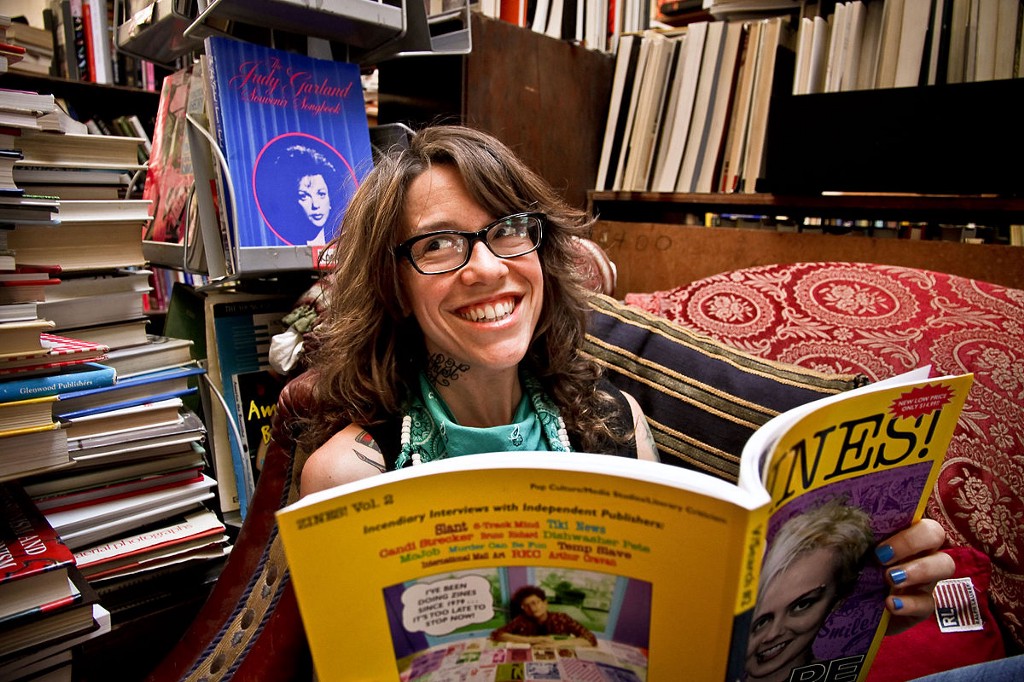
Michelle Tea on Archiving Queer History that Is Often Erased

I was introduced to Michelle Tea and Sister Spit in the damp basement of a South Brooklyn performance venue on the second of three quirky OkCupid dates with a literal fire breather. It was sometime around 2010 and I was new to queerness and to Brooklyn. When my date proposed the performance, I tried to talk her out of it because I had to hop on the subway by 5:15 am the next morning to commute from Brooklyn to my teaching job in the South Bronx. She persisted and I met her a few hours after school let out, wearing a left-cocked New Era cap, a light blue tie in a half windsor knot, and a crisp, colorful Uniqlo button down. This was the first literary performance I had ever attended.

Purchase the book

I didn’t speak a word to my date after the performance started. I couldn’t take my eye off of the stage. It was one of the first times I was hearing other folks who were gender non-conforming, queer, and people of color speak candidly and humorously about their experiences. This wasn’t something I had access to growing up in Seattle or in college or grad school in California. It would take 5 years for me to start reading and writing my own poems but this Sister Spit event planted seeds that eventually flowered.

Michelle Tea founded the Sister Spit tour and is a prolific author, poet, curator, and performer. She is the curator of the Amethyst Editions imprint at Feminist Press, “champion[ing] emerging queer writers who employ genre-bending narratives and experimental writing styles, and complicates the conversation around American LGBTQ+ experiences beyond a coming out narrative”. Her latest book, Against Memoir, lets years of queer journalism reverberate in a single volume. Long-form journalism pieces about Valerie Solanas, the HAGS, gentrification, addition, dating, family-building, queer art, transphobia, and Trans Camp, speak to each other. I jumped at the opportunity to hop on a call with Michelle to talk to her about her intersecting writing, publishing, and performing careers and her approach to archiving queer history that is often erased.

Candace Williams: How is life in LA? Folks are moving there left and right.

Michelle Tea: It’s really true. A big reason we moved here is because so many of our friends in San Francisco had moved here. San Francisco is just more and more a ghost town. I mean, I still have friends there, too, but just the pull of it was really strong. I mean, it’s cheaper. In San Francisco, it felt like the walls were closing in. It’s a small city. There’s only so much space and tech gentrification has been bad for so long. After a certain point you just recognize that they won and there was no coming back from it. Then, it was just kind of depressing to live in a city that used to be great.

I really like LA. I like the weather. I like all of the greenery. People who don’t live here think of freeways and sprawl, but there’s so much nature here. People hike way more here than anyone I know hiked in San Francisco. There’s a lot of opportunity here. The dominant industry is the entertainment industry — which I think is really interesting and fascinating and inspiring, unlike the tech industry, which I just feel like is boring and alienating.

CW: I’m in awe of your curation career as well as your writing career. You’ve created many different reading series in different settings, from libraries, to bookstores. You had the Sister Spit/City Lights imprint and now you have Amethyst which sounds awesome because it’s my birthstone.

MT: Aquarius? Me too, high five!

CW: Yes, high five! Can you talk about that journey? Has it mirrored your writing career? What do you love about it and what’s hard?

MT: My curating and my writing kind of happen side by side because I started writing by going to poetry open mics in the 90s in San Francisco when they were really fun. There was so much variety in the kinds of writing and really high energy… it had the energy of a punk show which is not what you would think about from poetry. My performing happened at the same time as my writing did. It all happened in community. In San Francisco at the time, many different venues would do curated shows. The Bearded Lady would have shows. The Luna Sea Woman’s Performance Project would have shows. You would wait to get invited to one of these shows and that’s how I came up as a writer. It was really fun for me. I didn’t go to college or anything. This was how I learned how to write better. My canon was the people around me who were also reading their work and we were inspiring each other and it was a super cool time.

Sister Spit came out of that. It began as an open mic. There were tons of open mics in San Francisco and they were very straight and they were very dude heavy. There were definitely tons of women and there were some queers and some people of color. I realized I liked going there because I had a big chip on my shoulder. I liked hearing some misogynist asshole and then heckling them and getting in a fight while I was drunk. The other queers and women who went to these, they kind of had to be smart asses themselves to kind of do it. Sidney Anderson (who I did Sister Spit with) and I , asked “Where are all the other queer female writers?” because the city’s filled with them and they’re not coming to these things. They’re not coming cause they don’t feel welcome and it makes sense that they don’t feel welcome. You had to really fight for a space there. Then once you did, everyone loved you. It was just like you got jumped into the gang or something. Everyone loved you. So we started doing Sister Spit and at our first open mic we had 20 people signed up.

CW: Wow. That’s an amazing turnout for an open mic!

MT: It was. It was really cool. We did that for a couple of years and then got burned out. I’d been playing in a band and our band went on tour even though we were not ready to go on tour. We were not that good. We did it anyway and I loved being on tour and that’s how the Sister Spit tour started. I wanted to have that experience again, but I didn’t want to be in a band anymore.

CW: That’s really brilliant. All of us want to be in a band, right? All of us want to tour. It must be interesting to tour with writing and bring intellectual light to audiences. Was it easier than touring with a band?

MT: It was easier to get gigs. It was easier to get audiences. If you’re a band, you’re in a kind of niche of whatever music you play and the scene you grew out of. We were queer writings and at that moment, spoken word was really popular, and slam was developing. There were slam teams in different cities that we could contact and say, “Hey, can you help us put on a show?”. Then, we’d put the word out in gay newspapers. It was better than just like being a weird math rock band.

I’m really psyched that it’s still happening. I turned it over, and it ended up becoming part of Radar Productions, which is the literary non-profit I started in San Francisco. After a point, after doing so much curating, literally for decades, I had a grant writer who’s this older gay man who is wonderful, kind of grab me and be like, “Do you understand that you are doing the work of a non-profit but with zero resources and no pay?”. He helped me create a non-profit to stick all of my projects under and get funded and it changed my life. But I had to hand it off when I moved to LA. I handed it to this younger, amazing curator and writer named Juliana Delgado Lopera. Her book is coming out on Feminist Press in a year or two. Under her watch, it’s become all queer trans people of color. It’s awesome. She’s just doing great stuff with it.

If you’re a marginalized person, you’re telling your story. You’re empowering other marginalized people. You’re setting the record straight from history and that can be politically powerful.

CW: How did Amethyst come about?

MT: I’m in touch with so many writers and I get to know what they’re working on. and The Radar Reading Series was another project that I ran it for 13 years. It was a monthly reading series at the San Francisco Public Library. For six years, I ran the Radar Lab, which was a free queer-centric writer’s retreat in Mexico. It was open to anybody who’d ever read at Radar or performed with Sister Spit. They could submit their writing and their proposal. We would judge the work anonymously and then writers would go to Mexico and work on their pieces. I learned about all these works in progress and I just wanted to publish them all. It might be a weird, creepy, narcissistic sort of impulse, actually. I see these writers who really inspire me and then I want to do something with them. I guess it’s like a producing impulse. I’m like, “You’re amazing. I want to do something with you. What do we do?”.

For a minute, we thought about doing our own press, and I had a really illuminating meeting with Dave Eggers about how he started McSweeney’s and what their business model was. I realized I could accomplish what I wanted to accomplish by hitching onto an existing press instead of recreating the wheel. I was really inspired by Little House on the Bowery, which is a Dennis Cooper’s imprint with Akashic books. I realized, “Oh, other writers have done this. It’s not like I’m making this up.”

I went to City Lights and I met with Elaine Katzenberger and she loved the idea. I love City Lights. I always felt really supported by them as a writer it would be good for them to have an overtly queer and female project in their roster because they are kind of known for their straight white dude projects.

We did that for a while. Then, I started publishing with Feminist Press. They picked up my book, Black Wave. Editor-in-chief Jennifer Baumgardner and I hit it off and it just seemed like I was going to start publishing with them and working closely with them and maybe it would be a better fit and make more sense to kind of move my publishing impulses over to Feminist Press.

With City Lights, you get great distribution and great publicity. City Lights is so impressive and historically important. Feminist Press is able to pay a little bit of an advance. Super tiny, but it’s always been part of my work to try to get money to writers, so that was really attractive. Amethyst is a specifically queer imprint within Feminist Press.

What binds all the Amethyst titles together is that it’s truly queer, outside the LGBT mainstream, and there is a radical politic embedded in all of the work, even if the story isn’t necessarily about radical politics.

CW: So, let’s say it’s 20 years from now and people are looking at all of the Amethyst titles that have come out for the past 20 years. What do you want people to think about the imprint and the work as a body? What do you want the work to do in the world? I’m thinking about something like Kitchen Table Press, which I’m really thankful for. The press doesn’t exist anymore, but I go to the Herstory Archives and I read Audre Lorde and I read Barbara Smith and I realize, “Wow, Kitchen Table published all of these great books and all of these great people and their work still stands up”. What kind of vibe or idea do you want people to get in their mind when they hear of your imprint down the road from now?

MT: The thing that really binds all the work together is it’s queer. It’s truly queer. It’s outside the LGBT mainstream, and I think that there is a radical politic embedded in all of the work, even if the story isn’t necessarily about radical politics. Radical politics are embedded in the hearts of all the people that we publish, so they come through in the writing in one way or another. There’s also humor. I love humor. This world is so fucking hard and queer humor can be a dark humor, it can be a gallows humor, it can be a surreal, absurd humor, but I love humor and I think there’s queer humor in all of the work that we publish.

CW: After reading Against Memoir, I started thinking more critically about addiction, and the role it plays in a lot of queer communities. One thing I really appreciated about the book is that I think you’re constantly acknowledging and processing both sites of oppression, but also your sites of privilege in relation to people and events you are archiving. I feel like you were able to capture part of the Camp Trans story that has been lost, simply because you spoke to people who were there. There’s privilege in being the one to deliver that message. What steps do you take to make sure that you’re writing about people and not writing over people?

MT: I felt hyper-aware that I was kind of a double outsider at Camp Trans. I’m not a trans person. I’m cisgender. So, I’m bringing that privilege with me, and then I’m there as a member of the press. My approach was to actually use the direct words of trans women at Trans Camp instead of paraphrasing them. I did not want to filter what they have to say through me. I wanted to center them and give them space

I’m really grateful for the Believer. They run long form journalism even though it’s not the traditional way to do things. The traditional way to do things is for editors to ask, “Can you paraphrase that?”. I think journalists and editors can mistakenly think that’s part of their job, to distill what everyone’s saying, and then spit it out in their own words.

When you’re talking to people who are from a community that you’re actually not a part of, and you actually have more privilege and access that these folks, I think it’s really important to just give them the space to actually say shit in their own words. It’s way more powerful. It’s more effective. It’s more interesting.

The HAGS piece was similar. I have privilege as a survivor. I didn’t go down that rabbit hole so deeply that I couldn’t get out. Also, as somebody who just didn’t have it quite as hard as they did growing up in the world. I am cisgender and many of them weren’t. I think they identified as “butch” and some of those folks have since transitioned. Who knows what the folks who passed away would have ended up identifying as, were they allowed to kind of keep living and evolving.

That was really hard to write. I felt intimidated by the weight of history and representation and knowing that people close to them already felt burned by the media because the mainstream press, like the Daily Paper, picked up the story in a very sensationalistic way when members of the HAGS died.

I interviewed a lot of people who survived them and loved them and wanted to do right by their story, and so it was overwhelming. I did a lot of interviewing and I collected tons of interviews and then I just sat on it and I just didn’t write the story for awhile. The California Sunday Magazine was interested. I thought it was gonna be a really long piece. I finally get it together and write it. It’s epic. When I finished it, I laid in bed and spent the afternoon crying, which I don’t do. I am not a laying down during the day and crying person. I was really, deeply exhausted from it. Then, it turned out I was super wrong. I only had 3,000 words.

So then, I was intimidated in a different way, like “How am I gonna cut this down?”. I cut it down and it was horrible. It read exactly the way I didn’t want it to read. It was like, “Look at these people. They were queer. Crazy, they did drugs and died. The end.” There was no context. There was nothing of my own story in it. I feel like my story helped contextualize the time.

CW: That makes sense. Stories are lineages right? When you think about the lineage of HAGS, part of it is you. Even though you were coexisting, you were also part of this movement. So, what did you do?

MT: I just pulled it. I was like, “You can’t run it. I’m so sorry. It just doesn’t work like this and I’m sorry that I wasted your time.” Then, I contacted the Believer. I’ve published with them before and it’s always been a great experience with them giving me lots of space and be really open to queer content. Then, in the process, I had this book, Against Memoir, coming out. I had made this plan with Feminist Press to publish a collection of my journalism pieces and they wanted new work. I’m really happy for that initial “yes” from California Sunday because it got me to do it and I’d thought about it for so long.

I feel like the piece is about what I experienced in San Francisco in the 1990s in general. I feel like I experienced an evolution and a movement and it is lost to history. It did not get recorded.

When you’re talking to people who are from a community that you’re actually not a part of, and you actually have more privilege and access that these folks, I think it’s really important to just give them the space to actually say shit in their own words. It’s way more powerful. It’s more effective. It’s more interesting.

CW: In a previous interview, you said that you reject the activist label for the work that you’re doing now. Earlier in your life, you were going out to protests, and mobilizing artwork, and doing all these things that were a direct and critical response to events and issues. Now, the focus of your work has shifted. How does the memoir fit in to your idea of what literally organizing is, and is there such a thing as literally activism?

MT: I think that there can be such a thing as literary activism and I think that memoirs are a huge part of literary organizing in a political sense because it’s people telling their stories and that’s always really powerful. If you’re a marginalized person, you’re telling your story. You’re empowering other marginalized people. You’re setting the record straight from history and that can be politically powerful.

But for me, having done actual activism and now, as a writer, I have a literary career. So when I’m writing books, that is so self serving. It just can never feel like activism to me. I know people are paid to organize. I think that’s awesome and it is still organizing but for me, I just feel like I’m a writer. My politics come through in my books. I follow my creative impulses and if my writing happens to have political and activism resonance, I’m happy about that but I don’t set out to do that. It’s a side effect of me following my creative passion.

There’s this march for families against ICE here in LA on Saturday and so on Friday, me and my wife and my son we’re gonna make signs and we’re go to the march. That feels like activism to me even though I know that in a sense, my writing could possibly be more effective in some ways. I don’t know. It is weird.

CW: So let’s say tomorrow, someone gave you a lot of money and says, “Michelle, organize the next massive queer festival.” Do you have a name for it? Do you know what the vibe would be like? Because I’m getting the sense that you learned a lot from Trans Camp and you learned a lot from the Michigan Women’s Music Festival.

MT: Oh, I wish someone would do that. Oh my god that would be amazing and fun! It would be very inclusive, and accepting, and it would be very kind of punk, and it would have really fantastic art because I actually think I have really good taste. I would pay everybody and that would be cool.

I would love to have an opportunity to bring so many of the people and performers in all different mediums that I love together. I don’t know, I would have Seth Bogart and Peggy Noland design the stages and I would have Sons of an Illustrious Father play, and I would get other people to curate because that’s important. The literary stage would really be my baby. I’d have Dynasty Handbag, and I would have Narcissister, and I would have lots of performance art and have it be super weird. It would be a queerdo fest.

CW: That’s awesome. Would you limit it by gender at all?

MT: No, I wouldn’t. I really wouldn’t. I did that for so long with Sister Spit and it felt appropriate for the time. But I don’t really feel like it’s where I am right now. I would want all genders present. I feel like when you start gender segregating it inevitably just hurts trans communities because you’re leaving people out. Trans people are a part of my community of all genders, and so I would always want to include those voices and those people.

I just think that ultimately what people want is to feel safe and and to be surrounded by like-minded people who have their best interest at heart and share their values, and I just think if you’re using gender as a litmus test for that you’re fucked. It just doesn’t work, it’s broken. I understand why women organized in that way historically but I just feel like it doesn’t work anymore. Arguably, it never worked. It definitely doesn’t work today.

Memoirs are a huge part of literary organizing in a political sense because it’s people telling their stories and that’s always really powerful.

CW: Have you written any poetry lately? How does that process differ from writing an essay?

MT: It feels different in my body. It feels different in my mind. It requires almost a different lifestyle. I was just having this same conversation with Maggie Nelson who has written beautiful volumes of poetry and just doesn’t really like poetry anymore. For me, I need to be in a certain mindset and I need to almost structure my days in a different way to allow for what to me feels like the more subtle inspiration towards poetry to come into my body. The inspiration towards a poem has felt like it’s a particular feeling for me.

What has happened, for better or for worse, is that I have filled my days up in a particular way that blocks that vibe from coming in. I don’t feel great about that and I do think that if I wanted to I could change that. I think that if I made the intention to write more poetry and began reading more poetry again, and immersing myself in poetry more, that vibe would come back. I think it’s so cool that someone like Eileen Myles is able to continue producing poetry while they write novels and screenplays. I love poetry.

I feel like my focus is more on trying to make TV and film projects happen, and I feel less focused on what my next book will be. I still need to be writing, it might actually be a nice moment to allow for poetry to come in, and to have that be my literary output.

The New York Public Library Is Bringing Real Stories to Your Instagram Stories

Listen: dogs and vacations are great. We love dogs and vacations. But as Instagram increasingly becomes the only social network you can spend significant time on without wanting to bury yourself in a hole for 12 million years, you may find yourself wondering: Is this the internet equivalent of junk food? Am I burying myself in nail art videos and artsy top-down pictures of meals in order to avoid engaging with anything important?

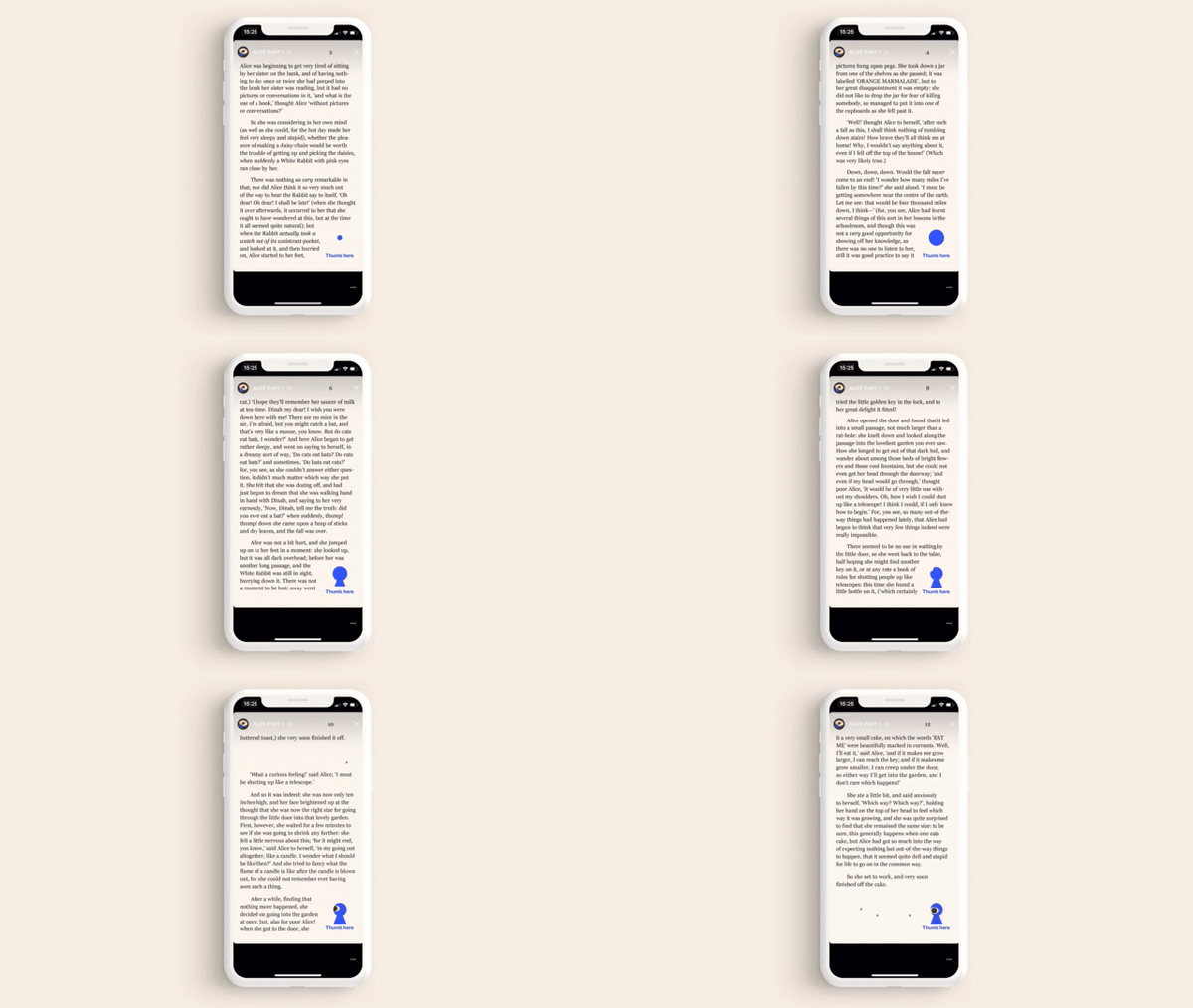
The answer is yes, and by all means keep it up! But now, while you’re clicking through cats and cocktails, you can throw in some classic literature so you feel like you’re doing something real. Starting today, the New York Public Library (along with creative agency Mother) is putting the “stories” back in “Instagram stories,” uploading classic books, stories, and novellas to the platform along with artwork by Instagram-popular designers.

First up is Alice’s Adventures in Wonderland, illustrated by Magoz. As with any Instagram story, readers will be able to stop and hold the text by touching the screen. (There’s a handy marked spot to put your thumb, with a cute animation when you’re not touching it.) You let go to advance to the next page, or just let it jump ahead if you’re an accomplished speed-reader.

The fonts, colors, and design elements (which will include still images and videos) are all optimized for reading—a warmer-than-white background is easy on the eyes, and the typeface is Georgia, “one of the first serif fonts ever designed for screen to make long form text more pleasing and legible,” according to NYPL). But Instagram’s story function, says Mother chief creative officer Corinna Falusi, was optimized for reading already. “Instagram unknowingly created the perfect bookshelf for this new kind of online novel,” she said in a press release. “From the way you turn the pages, to where you rest your thumb while reading, the experience is already unmistakably like reading a paperback novel.” This is also, she notes, an important time to be making classic literature more accessible: “We have to promote the value of reading, especially with today’s threats to American system of education.”

Upcoming stories include “The Yellow Wallpaper” by Charlotte Perkins Gilman (illustrated by Buck) and The Metamorphosis by Franz Kafka (illustrated by César Pelizer).

You can find out more about these Insta Novels on the NYPL website, or head over to the library’s Instagram to try it out. Finally, spending hours scrolling through Instagram will be good for you!

How Jane Eyre Helped Lead Me Out of Orthodox Judaism

I was sitting on a beat-up, cream-colored hand-me-down pleather couch, one of many such hand-me-downs my husband and I lived on and off of during our first young years of marriage, reading Jane Eyre for the first time. It was the “big book” in the 10th grade curriculum at my first public high school teaching job — my first job teaching in the secular world since becoming an Orthodox Jew.

I had grown up Jewish, and was always engaged in my faith, attending Hebrew school and synagogue, even teaching my own Hebrew school classes when I was in college, but my practice had always been more liberal and sporadic. But after my older brother became more strictly religious and my parents and younger brother followed suit, I began to consider the idea of engaging in a stricter practice of the faith in which I was raised. When I met my husband I was in the midst of this transition, I taught him what I knew of my faith and he embraced it, not only converting to Judaism but committing himself to Orthodoxy as well. Shortly after I got my Masters, my husband and I were married, and within four years I’d given birth to my two children.

Despite my academic training, by the time I finished my degree I wasn’t sure I’d be suited for a teaching job outside of the Orthodox world anymore. When my husband graduated school we had moved to New York for him to pursue his rabbinic studies and I taught English at an Orthodox Jewish high school that separated the classes by gender. Back in Chicago a year and a half later, I taught for two years at an all-girls’ Orthodox school. Now, all these years later, I considered the possibility that although my resume and interview were sufficient to land me the job, I no longer fit in the world I had left so long ago.

During the seven years we were Orthodox, I did not read fiction, except the literature I was required to read to teach it. If I read for pleasure, it was from the tales of the Chassidic masters — which were claimed, in fact, to be faithful retellings of actual occurrences. These were primarily stories of great rabbis and their exploits, or tales of the “hidden tzadikim,” holy men living in the world as lowly woodcutters or beggars, who travelled from town to town, bringing miracles to the people who dwelt there. They blessed barren women with children, poor men with riches, and punished those who did not keep faith with the lord. I read the Bible, too, of course, but I did not consider that fiction.

But Orthodox Judaism wasn’t the only reason I hadn’t read Jane Eyre before. The truth was, I’d always restricted my reading, though not always for religious reasons. Even as a child, I’d rejected “women’s classics.” As a nine-year old I eschewed the elementary school competition to see who could read the most Little House on The Prairie books before they graduated, getting their name on the leaderboard in the library — I read Daniel Pinkwater’s fantastical, boy-focused stories instead. Though I acquiesced to reading Judy Blume, I preferred Tales of a Fourth Grade Nothing over Are You There, God? It’s Me, Margaret. I would not read Little Women when all the other bookish girls did, and in my senior year, in my greatest act of academic defiance in a lifetime of compliance, I refused to finish Pride & Prejudice; I blamed our terrible teacher for my disinterest, despite the fact that I had devoured another required book, Crime and Punishment, earlier in the same year. The truth was that I had always feared what reading (and worse, enjoying) stories about women would say about me.

The truth was that I had always feared what reading (and worse, enjoying) stories about women would say about me.

Beyond my choices of reading material, I actively sought out friendships with boys that would place me in proximity to their real life experiences and identities which were, to me, the experiences and identities that seemed to be worth writing and reading and thinking about. I had plenty of friends who were girls, but early on rejected any activities of theirs that I deemed too “girly” for me, attempting instead at recess to insert myself into the boys’ more active playground games, searching always for ways to prove my physical toughness and mettle. I didn’t wish I were born a boy, exactly, but I think I felt that if I could ingratiate myself deeply enough in the world of men, I could attach myself to it like a vine and, grasping tightly, eventually reach the sunlit expanse of the forest canopy.

Of course, my conditional acceptance into boys’ activities did not grant me immunity from their aggressions. Being brave doesn’t protect you from hurt, as even the strongest woman eventually learns. As I grew, the boys did too, and more than once they crossed the permeable membrane between my world and theirs in a way that left me feeling broken, betrayed, and confused. Though strength hadn’t protected me, continuing to shroud myself in the stories of men — Raskolnikov, who held onto his ideals, misguided as they were, through hundreds of anxiety-inducing pages, Billy Pilgrim, who “Poo-tee-weet”ed in the face of the violent absurdity of existence — taught me not to let my weakness show. I remained funny and tough and cool, never dwelling on the pain inflicted on me for too long, lest I be deemed weak, and subsequently cut off from the club I’d fought so hard to gain entry into.

When I met my husband in my junior year of college, I felt I’d finally found someone with whom I could feel safe, but I still didn’t trust the rest of the world to stop letting me be hurt. When my husband converted to Judaism and we became Orthodox, it was, for him, an acceptance of the yoke of heaven, but for me, it provided something beyond that — a layer of protection from the world of men. What I couldn’t tell him was that his love was not enough to make me feel that protection; I needed a barrier stronger than any one person could provide.

Orthodox Judaism was, for my husband, an acceptance of the yoke of heaven, but for me, it provided something beyond that — a layer of protection from the world of men.

Orthodox Judaism has general rules of modesty that apply across the genders, but of course, as with any Western faith, the laws governing women’s bodies are stricter and more prescriptive. My hair had to be covered, as did my arms, my legs, and everything between, lest I drive a man to impure thoughts. I could not touch men (nor could men touch me), but beyond that, during my menses, I could not even touch my husband — a barrier within a barrier, holding my body tight against every man, even the one who loved me. I could not sing in front of men, or dance, since this too could lead to them having impure thoughts. My acts — and the acts of every woman — were the object of these restrictions. The men, we were meant to understand, were beyond help.

The religious world is not the only place where women are told such stories about themselves. I was once told, by a man who’d come to my high school to teach a rape awareness seminar to the senior class, that he could tell I had a “victim profile” from the sympathetic way I attempted to understand the motives of the aggressor in the dramatic reenactment video. Based on my experience with men up to that point, his thesis seemed sound enough: it was something about me, not them. I left the room sobbing, believing that I — not the man in the movie, and not the men who violated me — was somehow at fault. Believing, too, that there was nothing I could do to protect myself from it happening again.

And I was right. Even in the Orthodox world, with all its boundaries and barriers and protections, I was not safe. One night, the day before Yom Kippur, a friend of my husband’s from the yeshiva came over to talk to him. I retreated to the bedroom at the back of the apartment, but it was a small space and I could hear the men talking from across the rooms. The friend asked my husband’s forgiveness for a sin he had done against him. The sin was that he had lusted after my husband’s wife. I listened to my husband kindly accept this man’s apology as I sat in the dark, in our bedroom, on our bed, and felt that same violation I had felt time and again in my life overtake me. Three rooms and my protective husband stood between me and this man, and yet I felt his hot breath in my face, his hands on my arms, I felt myself being held to the bed, helpless. I saw in that moment that my demons chased me, and that they could slip through the bars of any cage I fashioned for myself.

James Joyce Ruined Me for Orthodox Judaism

A strange thing happens to your mind when you close yourself off to the world of the imagination. I could actually feel it happening to me, but I welcomed it, in keeping with my desire to bind up my life within the security of such a prison. Without fiction, you begin to lose the ability to see beyond your circumstances. And more, you begin to believe those ancient explanations of the failures and limitations of humanity and, by extension, of your own failings and limitations. “It is this way because the conditions of our existence necessitate it,” you begin to believe, a tautology that keeps you from wondering how else it could be, what else might be possible if we dared to consider it true. Instead of believing, for example, that the men who had hurt me could change, or that I could and should expect better, I bought the lie that the beasts within them had always been too wild to tame, and built the cage around myself instead. Instead of presuming that our reality was only one possible outcome in a universe of possibilities, and that one novel idea, one different choice, one step in a new direction could set the world on a different course, I read and reread the stories that told me this was how it was and ever would be, that it had been designed this way by a God who willed it as such, and that the best I could hope for — my reason for being — was to find my place in this world already set in motion by forces beyond my control.

And even if I had wanted to reach back into my mind to call up a model for how I might make a different choice than my life seemed to dictate, my arsenal of stories from which to draw inspiration was an ever-expanding boys’ club that seemed to have less to do with my reality that I had once hoped. That false but persistent myth of the universality of the masculine experience had cut me off from the fictional women who might have come to my aid in my darkest times to offer insight, connection, or perhaps even just the right bit of biting wit to ease my journey. As a child I had wanted answers I didn’t think they could provide me, and in cutting myself off from their experiences, I had rejected a piece of myself.

A strange thing happens to your mind when you close yourself off to the world of the imagination. Without fiction, you begin to lose the ability to see beyond your circumstances.

It was only while sitting on our hand-me-down couch that night, having travelled with Jane from the terrors of her aunt’s house to the falsely pious restrictions and abuses of Lowood to the disorienting expanse of Thornfield, that I began to reconnect with the power of fiction to show us both a mirror and a window. When Rochester, still fearful of allowing himself to love Jane, still wrestling with his own impossible choices, saw how deeply she had internalized the restrictions that had been imposed upon her, I felt his pain and hers all at once. “Your self-love dreads a blunder,” Rochester proclaimed, as I sat curled on the couch, my husband with his back to me working silently at the computer. I felt that familiar feeling, one that I had forgotten for so long, flood through me, the feeling of a story expanding your sense of the true and the possible. Perhaps it was Rochester’s own vigorous feeling that allowed me to bring the full force of my own to bear in this moment — that bit of bias I still retained that led me to gravitate toward the man’s point of view. But through his feeling I felt Jane’s, and in both of them I could sense Brontë’s struggle to name an experience unique to a woman in the world. And for what felt like the first time in my life, rather than rejecting it, I pulled the feeling close.

My self-love had dreaded not just my own blunders, but the blunders of the world: all the ways it could hurt me, all the mistakes the people who claimed to love me could make that might chip away at my being. Better to lock oneself away than risk losing oneself. Better to be bound and whole than free to be broken. Yet here I was, safe, I knew, with a man who would not hurt me (or if he did, by some accident, would help to heal the wound he’d made). So why was I still so afraid? Because, like Jane, I was not ready to trust myself, to live fully in the world without breaking. And though I had begun to take steps to expand my universe, like Jane, my steps were slow, and faltering, and could not be taken on anyone else’s timetable. “The Lowood constraint still clings to you somewhat,” Rochester laments only moments later, going on to say that he himself finds it impossible to be “conventional” with her. But it is not for Edmund Rochester to free Jane from her cage — a fact he knows even if it irritates and inconveniences him — she must free herself, and freeing oneself from a cage of one’s own creation takes time, and will not, and cannot, be rushed.

What I had found in religion was something I would only be able to put words to later, when Charlotte Bronte would name it for me: “A new servitude.” It wasn’t God I was serving, but order, boundaries, the rules I felt would keep me and my body safe from those who, due to animal desire and lack of self-control, would seek to harm it. I knew somehow, innately, that the kind of freedom I truly desired was much more hard-fought and hard-won than the one I’d sought in the rules and restrictions of yet another constructed paradigm. I knew, too, perhaps, when I chose this life, that I wasn’t ready for that harder, more personal fight. I trusted the man I had chosen to make a life with, but I still didn’t trust myself somehow, and was willing to submit to the constriction of my own body and mind in exchange for safety. But in the end, it wasn’t enough.

Choosing to return to teaching — and, what’s more, choosing a position in a public school where I knew I would return to the literature I’d abandoned for faith — was one of my first conscious steps outside the protected world I’d created for myself. But such paradigm shifts take time on both ends, and I wasn’t ready to abandon the safety of my bounded life just yet. When I started teaching that first year, I still wore a wig, still covered my body from collarbone to kneecap. At my interview that previous spring, though, I’d shaken the department chair’s hand — the first time I’d touched a man who wasn’t my husband or father in years. I’d begun to push back against the boundaries I’d accepted to keep me safe, and, seeing that I was in no immediate mortal danger, I pressed on: each choice leading to the next, and all of them leading me to this moment.

I’d begun to push back against the boundaries I’d accepted to keep me safe, and, seeing that I was in no immediate mortal danger, I pressed on.

The constraint Rochester speaks of is one no man can ever know. It is the self-imposed constriction of the self that can allow a woman to move, for a time, through the world of men without being hurt by it beyond recognition. And yet, as Rochester himself knows and Jane will soon learn, constricting a woman whose nature begs for expanse will only drive her to madness. I realize now that I had begun contracting myself even within the freedom of my youth, by choosing to live in the imagined worlds of men, by denying myself the open expanse of stories of women who lived within, challenged, defeated or were sometimes defeated by the world in which they lived. I wanted to read stories of men, I think, because I knew somehow without being able to name it that stories of men were stories of triumph, of conquering, of expanse, and I wanted more than anything to take up space in the world. I was afraid of what I might learn about my own fate if I embraced stories of women — all of which, as I learned when I read The Awakening for class that same senior year, seemed to have the moral that the world of men will swallow you up in the end.

Perhaps I was not ready for the stories of such women until I could see a way to begin to unbind myself from my own confining narrative, but the beauty of stories is that they are there, waiting, when you are ready for them. And if you are lucky, every so often, like magic, a story meets you at a crossroads and helps push you in the direction of yourself. I remember putting my down book on my knees, breathless, when I’d finished the chapter. I remember that my eyes were filled with tears. I don’t remember what I said to my husband, but I remember the feeling of it. I finally felt ready, not for a new servitude, but to begin to seek the imperfect and blundering freedom I hadn’t believed until that moment could be mine. I felt myself expanding to take up my rightful space in the world.

Kevin Wilson’s Stories Are About the Way We Live with Failure

Summoning his classic combination of humor, heart, and quirkiness, Kevin Wilson returns with his latest short story collection, Baby, You’re Gonna Be Mine, his first collection since 2009’s Tunneling to the Center of the Earth.

Purchase the book

Baby, You’re Gonna Be Mine finds Wilson exploring the complicated terrain of parent-child relationships, such as is the case in “Sanders for a Night,” which looks at how family members cope with a death, and the title story itself about a young musician who can’t seem to fully embrace the challenges of adulthood. Wilson also dives into the realm of magical realism in the brilliant “Wildfire Johnny.”

No matter the topic, Wilson writes with an authentic voice that captures the truths of the characters he creates.

Bradley Sides: Your work often focuses on the lives of young people — children, teenagers, and young adults. What is it about these young lives that make them such good subjects?

Kevin Wilson: There’s something combustible about any new experience. I’ll always be drawn to my own memories of standing on the precipice of what I believed that my life would become. And how scary that was. And I’m getting older, and maybe I should move on, but now I have kids of my own, and I’m watching them experience these important moments, and it brings it all up again. It’s hard not to put it into my work.

This is slightly beyond this question, but people talk a lot about how resilient children are. I was not a resilient child. At all. And I don’t know that I believe this assertion. I think children aren’t necessarily resilient; I think that their youth, their newness to the world, allows them to pull things inside of them and keep moving, but I don’t think they lose those bad things that happened to them. I don’t think they forget them. I think those traumas attach themselves in weird ways, and it’s only later that we can make sense of them. So I write about those moments, when something life-changing happens, but it’s too fresh for it to be properly observed.

Stories are a kind of incantation. There’s this magic, like I’m trying to tell the story with the aid of only one deep breath.

BS: Oftentimes, these young people are busy disappointing their parents. This sense of disappointment seems to link many of the stories in your collection. Parental disappointment is something most of us experience — either we are disappointing our parents or we’ve been disappointed as parents. Is this theme appealing to you are a writer because it’s such a universal experience? Or is there something else that draws you to it?

KW: Failure is such a constant in life. It’s kind of the only thing. And what I’m interested in is not so much the actual failure but the way we live with the failure, the way we accept how flawed we are and try to move forward, to make a life for ourselves.

BS: “Wildfire Johnny” is brilliant. It has such a balanced feeling to it. It’s fun, but it’s somber. It’s real, but it’s magical. It’s a knockout kind of story. And here’s the premise: a razor blade essentially grants time traveling powers to people who use it. The instructions state, “You may travel twenty-four hours into the past. To do so, simply take the blade and cut open your throat. With one expertly executed slash, you will find yourself twenty-four hours in the past, bearing no signs of the injury, able to undo any forthcoming misfortune. You may travel as many days into the past as you wish, as long as you cut open your throat for each twenty-four-hour interval.” I’m curious about this story’s genesis.

KW: That’s very kind of you to say. It’s a story that I really struggled with, kept thinking about it and putting it away, never quite sure how to manage it.

For the origin, this feels weird to say. I’m trying to decide how to explain it without seeming like a freakish person. More than ten years ago, I saw this French movie, Cache. In it, a man sees another man from his past. They are standing in this apartment, and one of them takes out a razor blade, draws it across his throat, and kills himself. The spray of blood, the suddenness of the act, the way the man who is still alive processes this trauma in the moment, it absolutely wrecked me. I do not honestly remember much else about the movie, how it ends, etc. But I would say that, since I saw it more than ten years ago, that moment vividly flashes in my brain maybe three times a week. It’s this unwanted image that just keeps coming to me again and again. It is very vivid, and it disorients me. And, though this is hard to talk about, there’s something seductive about it, even as it horrifies me. When I get anxious in public, I think about this moment. And eventually, I needed to figure out how to write about it, but it always felt too visceral, too literal. Anyways, I started thinking about how this act could be utilized with the aid of magic. I wanted to let that man live, to bring him back. So I wrote this story. And I tied it up with all these other things. And this is what I have.

I’m interested in the way we live with failure, the way we accept how flawed we are and try to move forward, to make a life for ourselves.

BS: What about “Baby, You’re Gonna Be Mine” led it to be your title story?

KW: For many of the stories, the focus is on the dynamic of parent and child, of being on either side of that equation. “Baby, You’re Gonna Be Mine” seems to fully embody these issues. In this story, the mother has to deal with her memories of her child and how they exist right next to his actual body in her house, since he’s moved back in with her. It must be a strange sensation.

My children are beautiful and sensitive and wonderful. I love them without reservation. But my oldest is ten, and there are ways that I can see him becoming his own person, and those memories I have of him at three years old are already fading, like they’re about a separate person. This makes me both happy and anxious. I know at some point, my sons will leave me behind, will become the people that they want to become. But I’ll keep holding onto them in whatever way that I can. And maybe stories are one way for me to freeze them in my mind.

Kevin Wilson on the Weirdness of Family

BS: You created some dynamic characters in the stories here. There are two I’m thinking about in particular: Adam from “Baby, You’re Gonna Be Mine” and Jackson from “Housewarming.” Both are young men who are struggling to adult. For Adam, he can’t face the reality that his once-moving music career might actually be over. Jackson has a terrible temper and can’t control himself. As difficult as they are to love, I can’t help but root for both of them. What do you hope readers take away from your characters?

KW: I can’t control whether my characters are liked or disliked by the reader, because there are so many factors that complicate that connection. But what I hope that I can do for my characters, because I do feel a need to care for them, is make them understandable to the reader. If I can make them as clear as possible, then I’ve given them a chance. I’ve given them depth, I’ve complicated the initial desire to judge them on the surface. Whatever happens after that is beyond my control. Some of the best writing advice I’ve ever received is that you have to take care of your characters, because if you don’t, who will? I have to put them into the world with enough subtlety and depth that they aren’t doomed from the beginning.

Some of the best writing advice I’ve ever received is that you have to take care of your characters, because if you don’t, who will?

BS: You’ve seen success as a short story writer and as a novelist. Do you prefer writing in one form over the other?

KW: I like them both. They make me happy in different ways. But stories are probably a more natural extension of my brain. For me, stories are a kind of incantation. There’s this magic, like I’m trying to tell the story with the aid of only one deep breath. I also feel like, in the formation of a narrative, I can hold a single story inside of my head for a long time, this secret, and I can tell it to myself over and over and over, holding it all together, before I ever get it down on paper.

BS: Your work can be dark, certainly. However, you also use humor rather frequently — and to great success. How important is humor to you as a writer?

KW: It’s everything to me. It’s my way into the story a lot of times. I’ve said this before, and I’m not tired of saying it, but the line between sadness and humor is really permeable, and so I use that in my work. It’s hard for me to be serious, and so I use humor in the initial moments of a story, to disarm the reader, to show them this lightness in the work. And my hope is that the humor, as it touches up against sadness, starts to dim until you suddenly realize how dark the space has become. When it works, it makes me so happy.

Ingrid Rojas Contreras Shows a Little-Seen Side of 1990s Colombia

Ingrid Rojas Contreras’ debut novel Fruit of the Drunken Tree shows readers a Colombia we rarely see. Pablo Escobar is relegated to the background, where he still wreaks havoc, but he is just one of the forms of violence that sweeps through Bogotá in the 1990s. What is in the foreground instead are the lives of everyday Bogotanos, who for some time were able to uphold a class divide to shield themselves from violence. Two protagonists tell their stories and the story of the economic class they inhabit. Seven-year-old Chula enjoys a safe, good life in her gated community. Petrona, a thirteen-year-old, comes from the hills to work for Chula’s family as their housegirl and is the main breadwinner for her mother and siblings. Their lives intersect because Chula is fascinated by Petrona, even though the rest of the world sees Petrona as a mosquita muerta. By the end of the novel, everyone will learn how tenuous the benefits of class are and how the sacrifices we make for others may require us to sacrifice ourselves.

Ingrid and I spoke about achieving your artistic goals, disrupting narratives of guilt and innocence, and how representation in publishing matters.


Ivelisse Rodriguez: Is Fruit of the Drunken Tree the novel you have always wanted to write?

Ingrid Rojas Contreras: Yes and no. It was a novel I ran away from for many years, but it kept resurfacing in what I was telling myself were just short stories. It was such a heavy subject; I resisted the idea that I was to be wedded to it for a prolonged amount of time. When I finally caved, I realized it was the story that I had always hoped I would write. I wanted it to be emotionally complex but also political and also definitely about women.

IR: I love that this is the novel you had hoped to write. There is such a schism sometimes between what we hoped to achieve and what we actually achieve. I often think of Plato’s idea of simulacrum where art is sometimes a copy of a copy of the original we held in our minds. So there is always this gap between what we wrote and what we hoped to write.

There is also sometimes this same schism when we write about real people. When I read your afterword, I was a bit devastated to find out that there was a real-life girl like Petrona. I already appreciated how you gave Petrona a voice, but even more so in this situation. It would be easy to dismiss Petrona/the real girl as evil. At what point did you recognize her humanity?

IRC: The nature of the real story — how the real-life Petrona made a brutal sacrifice for my own safety while putting her own and her family’s in jeopardy—made it impossible for me to not recognize her humanity from the very beginning. I think I was very lucky to grow up in a family that occupied the middle class while coming from a very poor background. In my childhood, I constantly navigated the world of Bogotá and my family’s home in Cúcuta. One of the first things I understood about the world was class and how much class predicated your circumstance and the things you could do to change that circumstance. From the beginning, I was interested in building a world where a “crime” could be revealed to be simply the outcome of being entre la espada y la pared, between the wall and the sword.

IR: There is such an emphasis on vilification in our current day.

IRC: Yes, I wanted to attack this idea of villainy. On this side of the continent, we often get stories that are too simple. If it is ever mentioned that people are forced to join a guerrilla group, it is done so in passing. I wanted to provide a story that told of one person being forcefully recruited. The character of Petrona is also a composite character, based on many women I met in Colombia who were stuck in utterly impossible situations. I wanted to honor those women, too.

IR: Do you know why the real Petrona sacrificed herself for you? Did you have a close bond with her? How old was she?

IRC: My mother was very interested in trying to help girls who she perceived to be in trouble. I have this very vivid memory of her befriending a girl who was asking for change at a red light — though she denies anything like that ever happened. She brought her into our house and employed girls who were very young (thirteen, fourteen, and fifteen) who were forced to work because their parents had been somehow incapacitated (sometimes they had disappeared, were taken by an armed group, had been murdered, or were otherwise ill). My mother sat and talked to them, and we became part of their lives. As a young girl, I couldn’t get over how different our lives were. One time, one of these young women came home to us crying. Her father had been found in pieces, dismembered by a machete. How could we ever be of any help? It was an impossibility that we tried to face with our kindness and our ears. We listened. The real Petrona was another girl for whom there was nothing we could have done. Fruit of the Drunken Tree explores this emotion of wanting to help, and yet finding your help at each step of the way to be meager and wanting.

One time, one of these young women came home to us crying. Her father had been found in pieces, dismembered by a machete. How could we ever be of any help?

IR: I’m intrigued by “helplessness.” In the U.S. there is such a sense that anything can be overcome. (But sometimes we can’t “fix” things.) I am also intrigued by the uses of guilt in your book — Chula parses out the guilt she feels, she also feels so much guilt for what she did and did not do, and Petrona uses Gorrión’s guilt to give her son a life. Can you discuss the function of guilt in your book?

IRC: Writing this book, I kept coming upon the emotional crux of guilt. Immigrants who survive and are able to migrate far away from danger are incomparably relieved, but they also carry the guilt that comes from the feeling of abandoning those who cannot migrate. I see survivor’s guilt as a common thread in immigrant stories. When writing, I become very interested in turning emotions in my hands, seeing how similar emotions could erupt in other characters. Petrona, who is left behind, discovers that the guilt others feel can be a source of power. Guilt can take many forms — you can harbor it inside you because of your privilege or your luck, and you can be at the receiving end of it because you were made into a victim. I wanted to write women characters, however, who in spite of being at the end of calamities are not victims. They are able to empower themselves. Because guilt was Chula’s central driving emotion in telling her story, guilt had to be the turning point for Petrona as well. I wanted both of these characters to come out stronger at the end — and I wanted this strength to be complex and to be punctuated by the very real sharp edges of their loss.

I wanted to write women characters who in spite of being at the end of calamities are not victims.

IR: Your novel also does something interesting with the idea of violence; you push Pablo Escobar to the background, and in the foreground is how everyday Bogotanos had to live during constant violence. How do you feel about Escobar — who is this looming specter — becoming so synonymous with Colombia?

IRC: We were consumed by everything that Pablo Escobar did — at times, to my child’s eyes it seemed like there was no one in the world with such power. But our lives marched on. Pablo Escobar was a phenomenon like the weather — something that affected what you could and couldn’t do, where you could and couldn’t go, and sometimes it devastated us. To many Colombians he was a terrible catastrophe, yet others looked up to him and even lit candles and prayed to him. We all lived with constant war and violence, but those circumstances became normalized. They seeped into everyday aspects of our lives. Pablo Escobar lived on in our background, ever-present, but not altogether central.

IR: That is fascinating.

IRC: Colombia’s political situation is so complex! It took me years to understand it. Armed groups emerged precisely because people have found no better way to fix all the inequalities.

IR: You touch upon something that is not readily discussed — how the U.S. government aids certain refugees by giving them loans, etc. Also, only certain people are coded as refugees, and refugees are welcomed. What do you think about the disparities in the way that certain bodies are treated?

IRC: There seems to be a confusion about these terms. When you flee your country to a neighboring country seeking asylum, you are placed in a refugee camp. You are not a refugee. Technically, you are undocumented until your situation is decided. There are interviews and countless procedures to screen and verify whether your life was really in danger, and whether that danger is still current. If it is decided that you are in the right, a country accepts you as a refugee. In the case of Fruit of the Drunken Tree, Chula comes with a refugee status. The government helps her mother with a loan, which she has to pay back, so that she can have a place to stay. People who come to the southernmost border are asylum-seekers. We call them undocumented, and some people have vilified this state — people fleeing danger — calling them illegals. But this happens the world over. When people are in danger, they flee to a neighboring country. You are technically undocumented, that is correct, but I think we need to change our language. These are asylum-seekers. Refugees are those whom the government has screened, and they have deemed their stories to be true. It gets so complicated! The government will sometimes offer blanket refugee status to a group of people in the face of a civil war or catastrophe.

IR: Oh, that is great to know! Thank you so much for clarifying this.

On another note, there is a lack of visible Colombian-American writers — I think of Jaime Manrique and Patricia Engel. How did this affect you as a writer? Were you concerned about the publishing process being more difficult? Engel received many accolades and went on to publish three books. Did that hearten you in some way?

IRC: Yes! Being a minority, I felt heartened each time I came across a Colombian-American writer. I was heartened by not only the work of Jaime Manrique and Patricia Engel, but also Daisy Hernandez. I remember reading Patricia Engel’s first book Vida and sleeping with it by my bedside — it was a sign to me that it could be done and that our stories mattered.

When Black Characters Wear White Masks

My introduction to whiteface was the Eddie Murphy “White Like Me” skit on Saturday Night Live from the 1980s. Blackface originated from minstrel shows — cruelly mocking entertainment made by and for white people that has portrayed Black people as inept, servile buffoons. It continues to uphold that image today. Murphy’s skit opted to show another side. His whiteface character was himself made up as a pale milquetoast, devoid of any defining characteristics, armed with a monotone voice, “tight butt walk,” and blank expression.

Murphy’s impersonation is also a satirical commentary: in the sketch, merely appearing white is immediately lucrative. In his bespectacled Caucasian persona Murphy receives everything pro bono, from a free newspaper to $50,000 dollars in cash at a bank, producing no collateral or ID. The white bank manager dismisses a Black employee who originally and rightfully denies Murphy’s loan. He then hands over actual stacks of cash to a fellow Caucasian (he thinks). Through the joined laughter of two “white” men in the safety of a “white” space, Murphy mocks that “silly Negro” banker before asking, “Are there any other banks like this around here?” At the end of the skit Murphy appears solemn when he states it was disappointing to see and experience this reality. But, he added, we have a lot of make-up … and a lot of friends. (Pan out to other Black folks being prepped to look white as well.)

Whiteface, or Black characters posing as white, speaks to the racial dynamics between whiteness and Blackness, sometimes humorously, often hauntingly. The pursuit, or at least the semblance, of whiteness is a repeated theme in literature. In some tellings, characters actively pursue whiteness; in George Schuyler’s Black No More the main character’s body is completely remade. In others, characters allow or encourage others to see them as white for a seemingly more comfortable life — for instance, Nella Larsen’s well-known and oft referenced Passing, Alex Haley’s fictional account of his ancestry Queen, Nicole Blades’ Have You Met Nora?, and in the slave narrative of Ellen and William Craft (Running a Thousand Miles for Freedom). There’s also the inadvertent metamorphosis, like the Kafka-style one that occurs in A. Igoni Barrett’s novel Blackass.

The “hero’s” journey in these narratives relies on the current/ongoing knowledge and memory of what it means to be Black. In truth, these characters are never truly white, even as they drop anything and everything Black within their lives, be it family and friends, diction, culture, etcetera. To blend into white society as white is a covert operation. The awareness of their true Black self allows race to be a permeating factor. To pass or transform through whiteface is not as simple as a performance, nor is it caricature. Blackface aims to mock and, at its heart, demean; meanwhile, the leap to whiteness, whether enthusiastic or strategic, leaves characters in constant danger. In literature, whiteface is an analysis of how this choice becomes a way of life—and how, once the leap is made, this new life doesn’t necessarily leave characters content.

The leap to whiteness, whether enthusiastic or strategic, leaves characters in constant danger.

Whiteness was not coveted in my household, one that was filled with brown-skin people of all hues. My family enjoys everything about Blackness, from my elders’ obsession with Motown, to the uproarious Southern Baptist church services, to the inside jokes, to the plates heaped with food equating to love. But we still understood why whiteness, the perceived ease of it, could be tantalizing. It would be a lie to say that my grandmother who was terrorized by the Ku Klux Klan as a child, or my mother and her siblings who heard the deaths of many Civil Rights leaders relayed over radio and TV in real-time, didn’t comprehend the power and benefit of whiteness. The appeal of whiteface in literature, as fantasy and as satire, doesn’t always mean that a character repudiates Blackness, but that they understand the profound effects of privilege.

In whiteface literature, the reasoning for opting into whiteness as a Black person may stem from self-hate, but the impetus is rarely that simple. Whiteface stories interrogate the mentality that it’s better to be white while examining how societal gains as well as societal “norms” inflict this way of thinking on Black people. Being white isn’t better, but, for some of these characters, it seems a hell of a lot easier, or at least preferable to dealing with racism.

In the case of Passing, both protagonist Irene Redfield and Clare Kendry, Irene’s long-lost schoolmate, are Black women who have presented themselves as white for different reasons. For Clare it becomes a way of life. In the beginning, readers witness Irene indulge in the opportunity to “pass” when she goes to a fancy tea spot called the Drayton and worries when another “white” woman — -she’s unaware this is Clare — seems to stare at her as if she recognizes who she truly is. “It wasn’t that she was ashamed of being a Negro, or even of having it declared,” Larsen writes of Irene. “It was the idea of being ejected from any place, even in the polite and tactful way in which the Drayton would probably do it, that disturbed her.”

Being white isn’t better, but, for some of these characters, it seems a hell of a lot easier.

Though she chooses to live her life openly, mostly, as a Black woman, Irene understands what it’s like to pass and the benefits that come with the assumption of whiteness. While passing is not the same as cosmetically putting on whiteface, there is a connection: both cases focus on people being perceived as white.

When Irene visits Clare and a mutual friend Gertrude later on, it becomes a hen party of passing Black women. While Irene insists she’d never thought to pass, she does not refer to that conspiratorial moment shared with Clare during their reunion at the Drayton: two Black women on a rooftop enjoying the luxuries of whiteness thanks to perception. Of the three women, Irene is the only one with clearly Black lineage in her life choices, with a doctor husband who “cannot pass” and a dark-skinned son. Both Gertrude and Clare are vocally relieved that their children came into the world light-skinned, adopting the ability to pass as well. Where Gertrude’s husband has always been aware of her lineage and doesn’t care, Clare’s white husband — who has no idea that she or her friends are Black — treats the trio to a barrage of hate along with the n-word on heavy rotation. Passing (or whiteface) doesn’t protect characters from racism; it simply means the white-appearing character endures it silently, for fear they’ll be found out.

The anxiety of being “found out” permeates every work about whiteface. “I know I’m a darky and I’m always on the alert,” says the newly white Matthew Fisher, formerly Black Max Disher, in Black No More. In this tale, the opportunity to become white (with “Nordic features,” as is steadily referenced) becomes the new wave, bankrupting salons that straightened hair and those who profited off bleaching creams. It’s 1933, and for the price of $50 Black people can become white. This isn’t cosmetic; it’s a complete conversion. The Black nation jumps on this but for a few, ultimately alienating their roots while embedding themselves within white society — to the vast dismay and supreme agitation of white people. Witch hunts arise. A white person’s character is dismissed easily and readily with the whisper they may originally be Black. Everyone is suspicious and no one is safe, but Matthew, formerly Max, and his friend Bunny partner up to profit. White people succumb to their prejudices, which they turn on each other now that there are so few Black people to hate. It’s an ironic allegory for the times we’re in.

The charade of whiteface as a lifestyle takes work. In Blades’ Have You Met Nora?, the anxiety of being discovered racks the titular character into an alcoholic frenzy. In Passing, Clare seems to hold her own, yet when Irene and Gertrude meet her boorish and racist husband she slips slightly in present company. Always on the lookout, highly keen to distance oneself from their history: these are the losses that come with redefining self, and specifically with redefining self as white. For characters like Nora, who suffered sexual abuse, or Clare, who lost loved ones, it seems a small price to pay for a perceived and profitable future. Even Clare mentions it wasn’t hard to maintain her charade since the aunts who raised her were white, and this was as far as her husband got to know about her. From here the paranoia remains of consequence which inevitably causes suffering. For a character like Nora, her trauma rests on the periphery, and she is eager to erase it altogether, believing that every step, faulty as it may be, will protect her as long as she gets through each hurdle of further denouncing and erasing her Blackness.

Barrett’s Blackass thrusts the titular character of Furo Wariboko into a white body with one caveat: a literal Black ass. His conversion to white was not something he asked for, and it comes on the worst day, or perhaps the best: he awakens in a white body in time for a job interview. Eventually, Furo Wariboko becomes Frank Whyte. The core difference between Blackass and others mentioned is that Barrett’s takes place in Nigeria, not the United States. So a white Nigerian is, as the narrator puts it, the outcast in certain ways: “Lone white face in a sea of black, Furo learned fast. To walk with his shoulders up and his steps steady. To keep his gaze lowered and his face blank. To ignore the fixed stares, the pointed whispers, the blatant curiosity. And he learnt how it felt to be seen as a freak: exposed to wonder, invisible to comprehension.”

Furo’s obsession with the advantageousness of whiteness (high paying job, pretty girlfriend, personal driver, perpetual benefit of the doubt) is something he also seeks to protect. He attempts bleaching creams on his buttocks (to poor results), and forsakes all who may get close to him to maintain this image and the seeming wealth that comes with it. To be white, Furo finds, is to benefit from a system he did not create, so what’s the harm in going with the flow?

What’s also intriguing in the whiteface of these novels in particular is how that knowledge of Blackness, the memory of it, is what aids the characters in a new kind of survival. What does it mean to be Black in a white-dominant society? Okay, now what does it mean to pose as white when all we’ve known is our Blackness and our limitedness within this society? That advantage is what characters like Matthew (formerly Max) in Black No More and Frank (formerly Furo) in Blackass have to their benefit. They know, quite literally, how to speak the language of their surroundings. For Matthew it’s utilizing white fear for monetary gain and status. For Furo it’s recognizing the goings-on of his hometown as well as being able to speak the language; he has the knowledge of a native of Nigeria, paired with the access of a white man.

Whiteface, or passing or posing, in literature doesn’t necessarily equate to or end on a note of Black Pride with a fist in the air (or the Wakandan crossed arms that symbolize the unity of Blackness). Nor does it mean concretely that Blackness is a burden one should readily eliminate from their lives as soon as they have the chance. Within text some of us are allowed to be in on the larger “joke,” sort of like when I first watched “White Like Me.” Even as a child I understood what we were laughing at. Murphy as white pointed to what people, Black and white, feared: of how divided things are and continue to be, of how the nature of white supremacy is embedded in everything, of how transparent this becomes when one puts the white mask on.

{Horse! Love! Never! Dies!}, a poem by Rosebud Ben-Oni

All the horses I’ve loved are from outer spacehorse
All of spacehorse is a multi horseverse
I’m writing
As a spacehorse
& no
I don’t have any starhorse charts or artifact of stellar hoofprint
Or landing on horsemoon proof I get that some of you think you
Own a horse but I don’t
Want to
Spacehorse is wild unplace & I get buck-horse wild with
Earth horses here to get free of your silly rules
About love & etiquette & whatever
Two-legged nonsense
Running at the mouth like a dried-up river when I get all outer outer
Horsespace with darkhorsematter
& speaking
Of all horses sometimes I do
Mean just the one who broke my heart
In Iceland that tangled dark mess of mane I mean
The horse I mean my hair when I speak of horses
I do & don’t only speak Icelandic
Horse need & one
in particular but surely this too is to say all horses are multiverses to me
As outer space horses whose kin are earthly horses
Who one day will leave you & your silly greed
For the moon & the stars when I say they are
All horses & yet you cry,
but you don’t own one a horse, how do you know anything
— & to that no I’m not really
Asking
Who wants to own when you can love
Who wants anything but love
Who but my dear spacehorse
The only
In which I can breathe & not worry about rent or hang-ups or titles
Or deed just spacehorse & me
Fucking up your Sundays & your gentle seas
With the inconvenient mess we bleed
Other spacehorses who make me
Their spacehorse main
Girlhorse main womanhorse what on earth
Could ever be better than a brokenhearted space
Horse who teems with more spacehorse & more
Spacehorse debris it falls onto earth & I feast
On every bitter hoof & tasty spacesteed I don’t worry
What others think no I feel sorry for those who say
Spacehorse & I are quite ridiculous when we’re looking into the sky
& know without a doubt in the spacehorse multiverse
That all horses are the one Icelandic horse I knew for less than a week
That I persist
In knowing for almost an entire week
I will always
Love
Spacehorse & Spacehorse
Me
“{Horse! Love! Never! Dies!}” is published here by permission of the author, Rosebud Ben-Oni. 
Copyright © Rosebud Ben-Oni 2018. All rights reserved.

9 Books by Adventurous Women about the Great Outdoors

Since the publication of my book this spring, I’ve often been asked why I became a climber. It does seem an unlikely passion for anyone, let alone an ordinary, middle class girl growing up in the 70s amongst flat cornfields, not mountains. My role models were certainly not climbers, skiers, and mountain bikers, they were housewives who’d abandoned their own dreams to raise kids in the suburbs and men who headed to the city every morning with a briefcase. A walk around the block with the dog was the extent of the adults’ physical exertion. But when I was thirteen, I met a climber at an outdoor camp and I was instantly smitten. I wanted to marry him, but more urgent was my desire to be him. He bulged with muscles and confidence, seemingly the ultimate master of his own body, mind, and even fate. Coming from an unpredictable home with high alcohol content, I craved control. I wrote in my journal, “I’m going to be a mountain climber when I grow up,” and against all odds, that’s exactly what I did. At nineteen, I threw myself into the nomadic life of a rock climber. And so began my life of adventures, most of them more fun to write about than to live through.

Purchase the book

My memoir, End of the Rope: Mountains, Marriage, and Motherhood, is about coming to the end of my rope literally in the mountains and figuratively in my relationships over and over: getting rescued off El Capitan in Yosemite, going under sweepers on a river in my kayak, losing my boyfriend to an avalanche, getting pregnant unexpectedly, and then, just like my mother, finding myself in a tumultuous, unhappy marriage. I so desperately wanted to be the “master of my fate, the captain of my soul,” but my chaotic childhood had created too much internal chaos and self-doubt. I trusted others, namely men, over my own intuition.

Eventually, it was strong female role models who showed me I could have a fulfilling life of my own making: women who were leading in the mountains, becoming certified guides, continuing to climb and follow careers after becoming mothers. And eventually, what I’d learned in the mountains myself–moving through fear, staying with the discomfort, committing, really knowing on a cellular level that no one could swoop in and save me–eventually kicked in, almost as though those skills were a mind and muscle memory. I filled a U-Haul, left my marriage and my mountain town with my two young kids, to follow my dream of university and self-reliance.

A few years ago I was on a panel in Banff called, A Summit of One’s Own, where we discussed women’s presence in mountain films and literature. To prepare, I went to the library to take out books by outdoorsy women. In the mountain section I counted 107 books by men and five by women. Later in my research I stumbled across the expression, “If you can’t see her, you can’t be her.”

So here is my list of books to add to those five I found at the library. These are not stories of chest-pounding exploits; each woman’s psychological and emotional journey is woven through the adventures. They are honest, vulnerable stories of fear, grief, resilience, joy, perseverance, and above all, the refusal to stay within bounds.

Lands of Lost Borders: Out of Bounds on the Silk Road by Kate Harris

The beauty of this book is that you can read about Kate and Mel’s account of cycling the fabled Silk Road for ten months in rain, snow and sleet, sleeping in a tent, and eating instant ramen noodles, and it’s almost as though you’re experiencing every jarring pothole and starry night with them because the writing is so stellar (which means you’ll never have to do it yourself!) This book has made it to a few bestsellers’s lists since hitting the shelves early this year for good reason: these two are true modern-day explorers.

Pure Land: A True Story of Three Lives, Three Cultures, and the Search for Heaven on Earth by Annette McGivney

McGivney, a master literary journalist, beautifully weaves her own story through her account of the murder of a young adventurous Japanese woman at the hands of a displaced, tormented Havasupai youth at the bottom of the Grand Canyon. Tomomi’s life and death and a mutual love of nature led the author back to her true self. “The farther I walked into the woods, and the wilder my surroundings got, the safer I felt and the more it fed my soul. …Nature loved me. Nature loved Tomomi. This was the bond, the secret, healing handshake…”

Wild: From Lost to Found on the Pacific Crest Trail by Cheryl Strayed

I’ve heard comments from a few hardcore mountain folk that Strayed should never have ventured out into the wilderness alone for months, emotionally trainwrecked as she was, with absolutely no hiking experience, a ridiculously heavy pack, ill-fitting boots, and at one point, only one boot! But that’s the beauty of this book. Everything was against her and she did it anyway. When I was thirteen, if I’d believed I couldn’t be a climber just because I’d never climbed, had only met one climber, had barely seen a mountain, and whined whenever I had to jog more than half a mile in gym class, I would never collected enough calamities to fill a memoir.

Above All Things by Tanis Rideout

This enthralling, fast-paced and well-researched novel alternates back and forth between the stories of two people: George Mallory, as he attempted to be the first man on Everest, and his wife, Ruth, who waits at home in England with the children, not knowing whether she’ll ever see her husband again. I’ve been in Ruth’s situation, waiting at home for a man who also didn’t return from his mountain. And I’ve also been the climber. Rideout captures both points of view on a very accurate, deep level.

Where the Mountain Casts Its Shadow: The Dark Side of Adventure by Maria Coffey

Maria Coffey is another woman who lost her boyfriend to the mountains. Joe Tasker died on Everest in 1982, and Coffey’s memoir about her loss, Fragile Edge: A Personal Portrait of Loss on Everest, helped me through my own grief. This more recent book explores the impact of deaths in the mountains on the people left behind. Talking about fear, death, and guilt are not climbers’ fortes (there’s even a chapter called Masters of Denial) so this book is a brave one and a tad controversial in the mountain community.

Cowboys Are My Weakness by Pam Houston

These are the first stories I ever read by a woman about a woman in the mountains. The narrators are strong, active women who get into dangerous pickles in the mountains and fall for guys with an edge, which all sounds terribly familiar. I’ve long wished I’d nabbed the title first, with a bit of a tweak: Climbers Are My Weakness.

Wild Fierce Life: Dangerous Moments on the Outer Coast by Joanna Streetly

Streetly weaves stories of her adventures guiding multi-day wilderness kayak trips in the remote wilderness on the west coast of Vancouver Island with personal, intimate glimpses into her disintegrating relationship with a First Nations man, and her attempt to balance motherhood with her longing for the wilderness. Her near-death adventures, including encounters with cougars and bears, “opened previously uncharted regions of myself.” Whenever I encounter a bear on the trails behind my house in Squamish, Canada, my language is not nearly as poetic.

Cabin Creek by Madeline ffitch

No Map Could Show Them by Helen Mort

This is a strong collection of mountain poetry. My favorites are about the rebellious women climbers of the Victorian era who used to ditch their fashionable shoes and long skirts behind a rock on the approach, and don woolen knickers and boots to climb their mountains: “Take off the clothes they want to keep you in. The shadow of the hill undresses you. The sky will be your broad-rimmed hat.” Mort’s humor shines in poems like “Ode to Bob,” the nickname women gave to the “mansplaining” men they didn’t have to climb with when they climbed with each other. “He never steals the morning with a story of a pitch he climbed one-handed, wearing boxing gloves…”

Tracks: One Woman’s Journey Across 1,700 Miles of Australian Outback by Robyn Davidson

The movie is great, but the book gives more of Davidson’s voice. In the postscript, she explains why she had to do her perilous journey alone across the outback of Australia to the sea in 1977: “…nothing was as important as freedom. The freedom to make up your own mind, to make yourself. And such aspirations inevitably involved risk, unleashing opportunities for learning, discovering and becoming.” These words are thrumming with the restlessness and rebellion I felt in my twenties, the refusal to conform to societal and familial expectations of women. They sum up why I am drawn to the mountains and express the main message I hope I’ve gotten across in my own memoir: “Don’t wait for permission. For anything. Especially not to grow and learn and follow your dreams.”

About the Author

Jan Redford is a graduate of The Writer’s Studio at SFU and holds a master’s in creative writing from UBC. Her stories, articles, and personal essays have been published in the Globe and Mail, National Post, Mountain Life, Explore, and anthologies and have won or been shortlisted in several writing contests. She lives with her family in Squamish, BC, where she mountain bikes, trail runs, climbs, and skis. Her memoir, End of the Rope: Mountains, Marriage, and Motherhood is her first book.

How the Brooklyn Literary Scene Is Striving to Be More Inclusive

The Brooklyn Letters project is a series of oral histories of literary Brooklyn from 1999 to 2009, presented by Electric Literature with support from the New York City Department of Cultural Affairs.

This is the final installment of Brooklyn Letters. You can read earlier oral histories here.

Publishing still isn’t an equal-opportunity space for people who aren’t white men — but at least we’re talking about it now. It’s hard to remember how limited and lonely the world felt before we reached our current level of cultural awareness of racial, gender, and sexual discrimination — when our discomfort with an all-white male literary panel might go completely unregistered, because outside of private conversations there wasn’t even a place to register it.

At the beginning of Brooklyn’s ascendancy as a literary place — with its rising concentration of writers, editors, publishers, and agents moving from all over to this one borough, and often even to just a handful of neighborhoods within the one borough — there was no guarantee that you would find the space, the reading series, the magazine, the press, the publisher here that represented you, where the work being featured might actually speak to you. And while these blind spots in the literary scene weren’t unique to Brooklyn, they were certainly represented here, and reinforced as well by the mainstream publishing industry that was based in Manhattan, a short subway ride away across the East River.

There was no guarantee that you would find the space, the reading series, the magazine, the press, the publisher here that represented you.

An entire decade later in 2010, when VIDA — a non-profit organization that gives an annual account of the number of men and women reviewed by or published in major literary magazines — released its first full report, the results showed a staggering gender imbalance across the publishing industry, numbers that on the whole haven’t greatly improved in the near-decade since. And yet, at the local level in Brooklyn between ’99 and 2010, change did come — slowly, painstakingly, and because of the action of individuals within the borough’s literary community. In this oral history we’re going to hear from some of those figures — curators, publishers, writers, and literary citizens — responsible for addressing the lack in Brooklyn’s literary scene, as they talk about what changed, how it happened, and what it meant.


Mira Jacob [author and co-founder, with Alison Hart, of Pete’s Reading Series in Williamsburg; with Hart she ran the series out of Pete’s Candy Store bar, directly below the apartment they shared after they met at The New School MFA program, from Fall 2000 until 2013. The series continues to run, with another set of curators, today]: One of the first problems that walked into our lives was that it was really hard to find women to come and read. The imbalance was something that became clear to us pretty much right away. Men would recommend each other, and men who were not qualified would recommend other men who were not qualified. It was amazing. They would be like, I clearly should be here, and my friends should also be here. Meanwhile women who were overqualified, who were incredible, would get there and be nervous, as if they weren’t allowed to have that space. And maybe for that reason they also wouldn’t recommend other women.

When we first started there were a lot of stories written by rock-and-roll white guys in which nothing would happen. There was one guy in particular, a very established male author, who would read forty minutes of just setting — just scene description. We always told our authors, fifteen minutes, twenty minutes tops. I was pretty aggro about it: “Do not read for more than twenty minutes. It’s not fair to you, or the other authors, or to your audience. Don’t ever do it.” We had this guy on three times, and every single time it was the same situation. Like: “You are all here for me, and I will hold you captive for forty-five minutes, because I’m just going to keep reading. It’ll be long past the point of you wanting to hear, but I have zero register for that.” Meanwhile, a woman would get up there, and at minute five she’d say, “I’m just gonna stop. I’m just gonna stop now.”

It would never cease to amaze me what certain male writers assumed was important for everybody. You just read a long rant against your ex-girlfriend, and subjected this entire bar to it? And somehow you felt entitled to do that? From the beginning there was clearly a disparity in terms of who felt entitled to talk.

Rob Spillman [co-founder of Tin House magazine; since 1999 Spillman has operated the bicoastal literary magazine in Gowanus with his wife, author and co-founder Elissa Schappell]: Prior to starting Tin House my wife had been the senior editor at The Paris Review, and both of us had always chafed against the very maleness of that publication, especially the white maleness of it. Having grown up in the queer world of Berlin, which was very multi-culti and obviously very queer, my sensibility was more playful and fun. So we felt from the beginning that we didn’t want to publish the same voices that everybody else was publishing. We wanted new voices, and women in particular.

Nowadays with the internet it’s much easier to have conversations about things like gender diversity. It’s affected how quickly we react to things, and how quickly we find out about them. When the first VIDA Count came out [a non-profit founded in 2009 which releases yearly reports on the number of men and women reviewed by or published in major literary magazines], we found some really interesting things in there. For instance, that two-thirds of agents are female, but that two-thirds of what they were submitting to publishers was by men. Which either means that men were giving them more things to send out, or that the agents themselves were choosing to send out more things by men than by women.

When I looked at our own numbers, in terms of gender Tin House’s slush pile [the unsolicited work being sent to the publication] was 50/50. But when I sent out encouraging rejection letters — like, “This isn’t going to work for the magazine, but please feel free to send me something else” — as opposed to flat-out no’s, women were four times less likely to send something again. It seemed as if their reaction was, “Oh, you’re just being nice.” Whereas when I sent out encouraging rejections to men, they would immediately say, “Here are five more things. Here’s my desk drawer.” They would just take it literally.

Anecdotally I see that at places like AWP [the annual Association of Writers & Writing Programs conference]. Late night at a bar some guy will write down something on a napkin and say, “Hey dude, what about this pitch?” Whereas my wife would never send something out unless it was completely polished and had been thoroughly vetted — until it was just absolutely airtight. And all of her friends are that way, too. With a sense that they’re not entitled, versus the men who will just send me the sloppiest shit possible. I see that in the submissions and I see it in who takes up the air at readings, where you have to be explicit about the fact that no, eight minutes means eight minutes. I also see it in who actually volunteers to read. Whenever we plan a book launch event, men will be like “Oh yeah. Pick me, pick me.” Whereas, generally speaking, the response by women is, “Oh, only if you have space.”

Jacob: I feel like people have an amnesia about what it was like at that time to be a creative person if you were a woman. In the revision of history it’s like, everybody was pushing each other forward, all the time. But no. Everyone was scared. Everyone felt unwelcome and tentative and very tender. It came out of two things, I think: one was the feeling that we were not allowed in that space. And the other was this sense that, at most, there could only be one of us there at a time — that that was as much as the space would hold. If you were a woman, and a woman of color, yes of course you wanted to lift up other women of color, but only one of us got to occupy that space. You felt so barely welcome yourself that if you did recommend another woman, it was only with great trepidation. And so, starting a reading in a space that had for so long been dominated by the white literary men of New York, we were not only aware of this problem but it was something we came up against right away. Quietly to each other we said, “We’re going to make space for the women and the people of color.” But in reality it wasn’t so easy. It was a process of anguish between us, and it took an incredible amount of digging.

Spillman: When we did that first deep dive into our VIDA Count, Tin House’s numbers were better than everybody else. We were 60/40 [60% men published to 40% women]. And we were actually surprised, because we all assumed we had gender parity in what we were publishing. Everybody on staff, we figured, “Oh yeah, we walk the walk.” And it turned out we were only 60/40 — and yet somehow that was still the best.

The immediate thought for us was, “Wait, how did this happen?” We looked at our own internal numbers, and saw that we were reacting to what we’d been getting. From agents we were getting two-thirds men, and from those who were resubmitting we were also getting mostly men. But at that point we hadn’t realized this was even happening, because we all thought we were picking a lot of women.

There were other more subtle things, too. In our Lost & Found section, where we have people write about underappreciated books and authors that should get more play, my editor in charge of that had been really good about having gender parity in the folks writing them. It was 50/50, perfectly, even back then. But when we took a look back, we saw that despite the parity the subjects were still 70% male. So it meant that both women and men were choosing to write about men. We’d been giving out prompts like, “Write about a favorite underappreciated Booker Prize winner.” And women were mostly picking men.

Of course, part of the reason for that is historical, because men have traditionally been more published by the industry. But it was still a misstep on our part. We had been blind to that. We thought, “Look, we’re publishing all these women!” And so it gave us a chance for a real corrective. In the Lost & Found pieces we started tweaking our prompts to specifically ask if there were any women the writers might want to highlight. And I also tend not to solicit men, honestly because they take care of themselves, and I’ll redouble my efforts with women whose writing I like. I’m careful now in my rejections to say, “No, no, really. Please do send me something else, this one just didn’t fit in the issue. I really do want to see your stuff.” Ultimately, it’s just a matter of paying attention.

I tend not to solicit men, honestly because they take care of themselves.

Jacob: When we started the series we had to see how it was going for a bit before we realized that we would actively have to make sure there were enough women in the season, or that there was diversity. It wasn’t baked in. These days that’s just part of the conversation. It’s like, what the hell’s wrong with you if you aren’t doing that? But at the time we had figure our way through it, while feeling crazy that this was even something we were struggling with.

One of the challenges was that, in the absence of social media and the internet in general, people just did not self-promote in the way they do now, which is unapologetically. Nowadays it’s pretty accepted: writers get out there and they’ll say, “This is me, this is the thing I’m doing.” But back then you never would have done that. It was considered tasteless, which of course meant you were so much more reliant on the publishing industry to forward you, and the industry was mostly only favoring one kind of person.

The way we finally got around it was by going through the publishing catalogs ourselves. Every so often you’d get a catalog, from MacMillan or one of the other publishers, of the books they had coming out that season, and we’d just go through them and choose the people who weren’t already front and center, and then reach out to them. Suddenly we had a different way to crack it. Instead of relying on agents and publishers, we started taking direct control of their lists.

Alison Hart [co-founder of Pete’s Reading Series]: But sometimes it also just took us pushing on them a little. If the agents or publishers recommended people, we would follow up and say, “Any women?” Because often they weren’t even aware they were doing it. It would turn things around on them a little bit to think, “Oh.”

Jacob: I also remember us having strategic conversations about who to ask to find women. How do we find this community of people that almost don’t have a community themselves — that are so scattered they don’t even have a way to talk to each other? Who do we approach? Who’s a connector? What editors do we know that are actively publishing women?

Joanna Yas was a great resource, and an extraordinarily generous person. She was the Managing Editor of Open City at the time [a magazine and publisher founded in New York in 1990, and which published its last issue in 2010].

How do we find this community of people  that are so scattered they don’t even have a way to talk to each other?

Hart: She knew and was friends with a lot of writers, and she didn’t guard her insider knowledge.

Jacob: I remember saying to her multiple times that it was impossible to find women, and she would just turn around and say, “Here are five names, try these five people.” And they were always amazing.

Unfortunately the same difficulty we had in the beginning with finding women happened a couple seasons later with people of color. I remember being like, “Where are the people of color?” But nobody could help with that. Nobody at the time had a good list for that.

Spillman: One of Tin House’s early contributing editors was the poet Agha Shahid Ali, who was also a translator, and he was very persuasive. He would come to me and say, “This is the best Farsi language poet of all time, and you’re going to publish him.” So okay, let’s do it! I would trust him. More recently, when our poetry editor was leaving, we specifically went out and hired a woman of color [the poet Camille T. Dungy]. Because how else are you supposed to address the whiteness of the industry? It’s a systemic problem.

Alexander Chee [author of How to Write an Autobiographical Novel and The Queen of the Night]: The whole reason Edinburgh [Chee’s debut novel, which had been out on submission with publishers for two years] was eventually published was because the Asian American Writers Workshop had a panel on Asian-American masculinity, and I met my editor, Chuck Kim, on the panel. I’d basically given up on trying to sell the book, and he was like, “I’m looking for Asian American literature, would love to read your novel if you have one.” We had just hit it off on the panel and I was like, “Yeah, sure, whatever.” But he kept pursuing me, so I agreed to meet him for lunch. I brought one of the copies of the manuscript I’d picked up from my agent’s office, after she and I had parted ways because she wanted me to work on The Queen of the Night [Chee’s eventual follow-up novel] and try to sell that first, and I was like, “No, white lady, I’m not going to do that.” I understood why people thought what they thought, but I just didn’t want to do it that way. Was I wrong? I’ll never know. But I’m here, so.

Eugene Lim [author of Dear Cyborgs and co-founder of Ellipsis Press]: I co-founded Ellipsis Press with Johannah Rodgers in 2008, largely for selfish reasons: to publish my first novel [Fog & Car] and to publish other experimental fiction works that I loved. I’m very proud of what we’ve published, but I do consider it to have failed in two principal ways. Firstly, I wish I could have gotten more attention for these excellent writers. Evelyn Hampton, Karen An-hwei Lee, Stephen-Paul Martin, Joanna Ruocco — to name just a few examples — are truly amazing writers. As well, though I’ve tried from early on (and will continue to try) to solicit and attract underrepresented writers, I recognize that the press largely replicates the lack of diversity of commercial houses.

During the years we’re talking about, at parties or readings or at places like AWP (which a bitter, cynical writer, who may or may not be every writer I know, told me stands for Average White Poets), because of the dearth of other Asian-American writers I was repeatedly misidentified as Tao Lin, or Linh Dinh, or Phong Bui. As a Korean-American writer who was born here I certainly have and had many privileges, which no doubt helped me find and participate in the nascent scene. And the internet definitely helped connect innovative, “experimental,” and non-commercial writers. But I found, especially in those early years, that hubs and digital gathering spots for writers who identified as both “experimental” and POC was a Venn diagram that largely remained empty.

There is one exception to this. The Asian American Writers Workshop was and is an important venue. I think it has (as I have) also evolved as the Asian American community has evolved (with the single dominant force of change being the Immigration Act of 1965, and its rippling effects through generations of the AAPI [Asian American and Pacific Islander] community). I remember visiting the AAWW early on at its East Village location maybe in the late 90s, and not entirely feeling like I belonged, whereas now I think it fights hard at inclusivity and to constantly interrogate and widen, or at least complicate, the notion of what it means to be Asian American.

Chee: Starting in 1996, the writing community I was participating in in New York was mostly around the Asian American Writers Workshop. In 1996 I got an email from Quang Bao and Hanya Yanagihara inviting me to basically come and hang out with them. They had read an essay of mine in Boys Like Us [an anthology of gay writers telling their coming out stories], and they wanted to meet me. At the time they were both very involved in AAWW. I hit it off with them immediately, and started coming in for the open mic nights. I read at an open mic in the East Village location, I remember, and my agent Jin Auh had just joined Wylie [literary agency] at the time, and she gave me her card there. I had an agent, so I didn’t call her for a few years, but I got her card that night. It just felt very cozy, but also exciting.

One of the most valuable things for me about AAWW was being able to talk about issues of who we write for. Are we writing to each other, or are we writing to this white audience? We had an expression back then for book covers that would be covered in Asian motifs, like fans and chopsticks. It was called “chinking it up.” The author Monique Truong, when she was putting out her book, had told her publisher, “no chopsticks, no waiter coats, no bowls.” And she ended up with a cover that had a waiter carrying chopsticks and bowls — for The Book of Salt, which is set in Paris, and is about this person who cooks for Alice B. Toklas and Gertrude Stein!

The other literary center of community for me happened around A Different Light books, the LGBT bookstore where I worked. Even after I stopped working there I was still very close to them, still very involved. The editor Patrick Merla found me through Edmund White, and was responsible for publishing that anthology, Boys Like Us. There was also an anthology that Hanya and Quang Bao put together of LGBT Asian American writers called Take Out: Queer Writing From Asian Pacific America, that I think was really important and had a big impact in terms of the community-building that was happening at the time.

There were other things I would go to, but I always felt a little out of place because they were really white. But I suppose I also sort of accepted that about them, as part of the story of what they were — as part of “what the deal was”. In the same way that when I went to Iowa [the Iowa Writers’ Workshop MFA program] from 1992 to ’94, it was predominantly white. It just seemed like that’s how things were going to be for a while.

It’s hard, though, to feel like you’re standing there in the group and participating, and also like there’s some screen that makes you invisible, even though you’re right there in the same rooms. That was part of what I felt like I was reacting to at the time. I remember when it was so hard to get Edinburgh published. The submission took two years. I had friends who were like, “We don’t understand why nothing’s happening for your book?” In the editorial feedback letters, I got everything from “Sort of like Graham Swift, but not as talented,” to one editor who just wrote, “I’m not ready for this.”

It was hard because I remember my father had brought me up to always act like racism wasn’t happening, to just keep working and work through it. That was how his immigrant generation dealt with it. To say, “Just ignore it. Is that rain?” but it was somebody spitting at you. Approaching it that way, you don’t get to acknowledge why it’s impacting you, because if you were to acknowledge why, all of that anger would just explode. As I was working on these recent essays [for his collection, How to Write an Autobiographical Novel], I realized that in my writing I was sometimes performing that same reflex of “What racism? What are you talking about?” And I thought, no, you have to actually talk about the shit that you dealt with, and how you dealt with it, to honestly speak to this new generation — but also to honestly record what you lived through. You can’t just perform your father’s dance.

Jacob: Between the two of us we would talk about it a lot: What aren’t we seeing? We made the effort to find the things we weren’t seeing, but that we knew were around — that there should be a place for. Once we started putting more women on the stage, I felt a change psychologically. And I definitely felt a collective change in the idea of what we could expect for ourselves. I remember seeing women up on that stage and being like, “Right, we should be able to expect this.”

It was amazing too because the series itself grew pretty quickly after that, from this little tiny thing to a point where the bar would be halfway backed up, and they would have to put the reading over the bar’s PA because so many people had flooded in.

We made the effort to find the things we weren’t seeing, but that we knew were around — that there should be a place for.

Hart: I remember when Jennifer Egan read.

Jacob: That was amazing!

Hart: It was Emma Straub’s book launch, and I think they were friendly. Jennifer did not want us to promote her part of the reading at all. She just wanted to go first for Emma; whatever she could do to be out of the way, and let Emma have her night. But so many people came because it was not that long after A Visit From the Goon Squad [Egan’s Pulitzer Prize-winning fourth book] was published.

When it’s a really big night, you open up the door from the reading space and pipe the sound out through the whole bar. That night the entire bar was listening. When she started you could see people’s heads pop up at certain points, like, “Oh, she’s reading my favorite story!” Because everybody had a different favorite from that book. Sometimes when you have the doors open to the bar you have to worry about the noise, but that night nobody in the place said a word. It was like nobody was there to have a drink, only to listen.

Jacob: Even the bartender, Dave, was super quiet about setting the glasses down, because he didn’t want to break the spell.

Hart: As you go along running a series you realize that what all writers want is a place where they can get the words out of their head and into other people’s ears, where you’ve been alone all day and you just need to read to somebody, anybody. To be seen and be part of that shared experience.

Jacob: When I heard people read I would feel like, I too need to make this. I remember just hearing certain stories where it would blow my world apart, and my idea of what I could do, and that I even had a right to do it. It really was a constant self-discovery.

From the beginning, I wanted to make a night for all of us. The people who were doing this work. Not the publishers, not the agents. No matter how much of a pain in the ass it had been to try to get things going, at the end of every night people would come up to us and be so grateful. They would just collapse and say, “This was so good. This meant so much to me.” Because they needed it. Being able to put that out in the world felt like giving people food.

Brooklyn Letters is supported by a grant from the New York City Department of Cultural Affairs.