I moved to Mumbai, India almost three years ago so I’m intimately acquainted with the concept of culture shock. When I wrote my debut novel, America for Beginners, I was curious to see how immigrants and visitors responded to the United States, but the truth is, I was curious to see how being outside of one’s native space teaches people about themselves too. Culture shock is, I think, my brain’s resistance to adaptation to what is new and unfamiliar, and that is often a reaction to changing, to being forced or asked to change. What I mean to say is, it’s really more about me than the place I’m being shocked by! What I have learned the most through living in India is about myself, how much I want to belong, and how that desire informs my experience and identity.
Purchase the book
The list below are books that help me when I’m in my most, and least, culture shocked moments, sometimes because they advocate for acceptance, for adapting, for openness, and sometimes because they reflect my desire to just get away from it all. These books around all in some way about culture shock, when traveling abroad, when confronting one’s own country or a country one is from. Sometimes the hardest thing is readapting to being in one’s own country, and that disquieting feeling of being an alien in the place you are supposed to belong to haunts some of these novels, while others are about how much better a new place suits the characters, how really, although they are far from their homeland, they are also right at home.
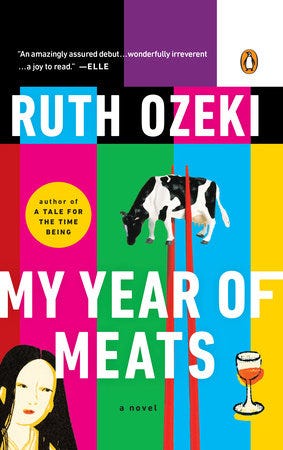
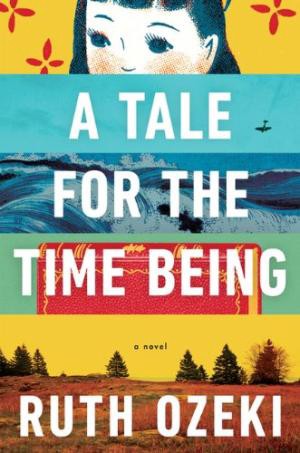
This hilarious and painfully accurate novel moves from biting criticism to sharp violence and back again as it follows two women, one a Japanese American shooting a television cooking show called “My American Wife” for the Japanese market, and the other an abused Japanese housewife whose husband produces the show. The pinpoint precision with which Ozeki underlines both Japanese and American cultures is excellent and the emotional resonance of the novel is hard to shake.
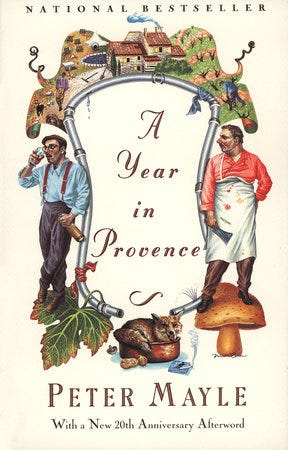
An incomparable classic, this memoir lovingly and hilariously recounts the trials and tribulations of a pair of British home-owners in France, and the struggles of adaptation and renovation. It gives you serious life-envy, but it’s worth the jealousy. I think of it often, whenever I’m trying to arrange a home repair in India.
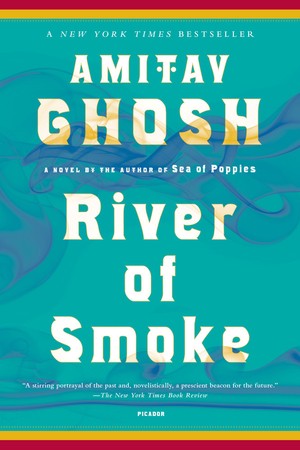
The second in Ghosh’s masterful Ibis Trilogy, this novel focuses on a Parsi trader in the 1830’s whose yearly trips to China to trade opium grown in Bengal for the British reveal a double life. The way in which Bahram Modie, and the book’s many other characters, navigate (pun intended) their dual selves and identities as they transition between the mores and restrictions of each culture is as gripping as the meticulously researched history itself.
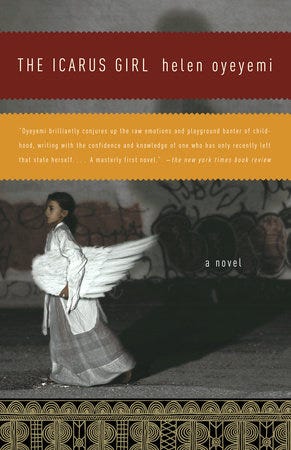
Oyeyemi’s magnificent first novel tells the story of a young girl whose mixed heritage and marvelous imagination makes it hard for her to connect with other children. A trip to her mother’s home in Nigeria unlocks a part of her identity when she meets a new friend, but the fact that her new friend might be more myth than reality is far more than she ever bargained for.
In this searing memoir, Taseer, the son of an Indian Sikh mother and a Pakistani Muslim politician, explores his own heritage and works to understand his father’s religion through the lens of a journey from Istanbul to Lahore. Trying to understand his own father’s accusation, that he is, in fact, a stranger to history, Taseer seeks out that history.
A modern classic, Eggers’s chronicle of one of the Sudanese lost boys, Achak, as he flees civil war for life a refugee camp, and finally ending up building a new life in the United States. Achak’s resilience and curiosity about the world is inspirational and his construction of his identity as he shifts through stages of his life and struggles to survive unfolds in a way that cannot fail to move a reader.
Following three generations of women from the same family, García’s story is at once epic, shocking, funny, strange and sad. The many characters watch their country transform as they experience their own personal transformations. The longing for a past that never existed, the disassociation from a present that seems unlivable, and the desire for a future that might never come to pass haunts this family. Watching these women try to decide who they are even as the world around them suffers a crisis of identity is engrossing.
Lahiri’s story of two people during Bengal’s Naxalite revolution twines itself up with their concurrent story about adapting to America, to a marriage neither party desired, to a life that feels stuck in the past despite being transplanted across the world. Sprawling and melancholic, the novel is rife with the tension of people who cannot connect with each other, or themselves. Additionally, the description of Kolkata was my first real snapshot of the city where my husband was born.
One of the best novels I have read in a long time, Nguyen’s novel is masterful, hilarious, extremely well observed and heartbreaking, all at once. Every part of it is just magnificent as a commentary on Vietnam and the United States, but there is a special place in my heart for the passages depicting the bewildering experience the anonymous narrator has as the native advisor on an Apocalypse Now style Hollywood movie for it’s sheer absurdity that can only be actual truth. I have never seen my own country so clearly as through Nguyen’s eyes.
Pratchett is one of my all time favorite writers and his Discworld series is fantasy blending with satire to perfection. Interesting Times follows his recurring character, Rincewind a hapless wizard, visiting an old friend on the Counterweight Continent (which is not at all like China, not one bit, no). I have read this bitingly funny and insightful as hell book, like most of Prachett’s works, many times, and I always find something new to love. There is nothing like the comfort of a well loved book when you are far from home, or feeling far from your home while you’re in it, is there?
Vanish. That’s the title of the first episode of HBO’s adaptation of Gillian Flynn’s novel Sharp Objects. It is also, as Flynn tells us in her book, the last word Camille Preaker (played in the limited series by Amy Adams) ever carved on her body.
The fact that Preaker, a reporter tasked with writing up a story about a recent murder in her hometown, is a cutter is revealed to us in the final moments of the episode. As the rarely sober Camille preps a bath, we finally see why she prefers long sleeves even hot and humid Wind Gap, Missouri — and why her mother Adora (Patricia Clarkson) is so wary of her being near those sharp objects of the show’s title. Her body is covered in scratched and scarred words: “Definitely.” “Omen.” “Dark.” “Mother.” They adorn her arms, her legs, her back — every possible surface except her face. Camille may well want to vanish, but it’s clear from the start that Flynn’s tale is about the way you cannot escape what’s written on your body, the stories it holds and hides. Novel and series alike, in making that point as literal as possible, force those of us reading and watching to question the liberating power of language when it comes to dealing with trauma.
Flynn’s tale is about the way you cannot escape what’s written on your body, the stories it holds and hides.
“All I know is that the cutting made me feel safe,” Camille tells us in the first-person narration of Flynn’s novel. “It was proof. Thoughts and words, captured where I could see them and track them. The truth, stinging, on my skin, in a freakish shorthand.” Her compulsion to wound herself with words literalizes the way we’re taught to understand language: as both weapon and lifesaver. The way to overcome trauma — like, say, Camille’s loss of her sister Marian when they were young — is to put it into words. But Marian’s death merely deepened the hushed silence that had fallen over Adora’s sprawling house, leaving Camille to deal with her pain on her own.
Rather than lash out and hurt others, the tomboy-turned-town-sweetheart directed her anger at herself, turning those words into weapons that would presumably save her from her grief. The compulsion to write down words that bristled within her skin predated her sister’s loss: “I was nine and copying, with a thick polka-dot pencil, the entire Little House on the Prairie series word by word into spiral notebooks with glowing green covers,” she confesses, while later writing down everything everyone said in a tiny blue notepad. But she carved her first word (“wicked”) with a kitchen knife when Marian was already gone. Yet the safety that she found in those cuts came from the desire to mark herself, to own the words that buzzed in her head and threatened to undo her: self-harm as self-containment. In lieu of cutting (we learned she eventually got treatment at an institution and has not cut herself since), it makes sense she now dulls her senses with alcohol, another way of silencing that voice that compels her to make herself into a palimpsestuous canvas. “I called myself sweetheart,” she informs us. “I wanted to cut: Sugar flared on my thigh, nasty burned near my knee. I wanted to slice barren into my skin. That’s how I’d stay, my insides unused. Empty and pristine. I pictured my pelvis split open, to reveal a tidy hollow, like the nest of a vanished animal.”
There’s that word again: vanish. She’d scarred herself with it so as to quiet the others around her. “Vanish will banish my woes,” she sing-songs to herself at one point in the novel, “Vanish will banish my troubles.” The prospect of disappearing haunts Camille wherever she goes. The more she digs into the case of these murdered girls — both of whom disappeared seemingly in plain sight — the more she muses on what it might mean to vanish herself. Untethered from her work family over in Saint Louis (or Chicago, as it is in the book), her editor playing the role of hardened but loving father, and disengaged from her family in Wind Gap, her mother as much a haunted woman as she ever was, she careens through her daily life with an aloofness that constantly risks undoing her. She falls asleep, drunk, in her car listening to music, and awakes disoriented about where she is; she drowns out the world around her while taking a bath by reaching for her ever-handy headphones; she turns party-sized booze bottles and vending machine candy into her daily diet.
Whenever Camille is forced to be present — like when she interviews the town’s sheriff, the grieving father of one of the murdered girls, or the Kansas city detective who’s been brought down to help — she retreats into scripted, hollow words. Small talk, she bemoans, is not really her thing. Even her stilted interactions with her mother show that they never did learn how to communicate with one another; Adora had always required a malleable little doll and Camille proved to be much too unruly for such a role. Using and dulling her pain with razors and liquor becomes a way to anchor herself. “I’m here,” she says to herself in the novel, “and it felt shockingly comforting, those words.” She continues: “When I’m panicked, I say them aloud to myself. I’m here. I don’t usually feel that I am. I feel like a warm gust of wind could exhale my way and I’d be disappeared forever, not even a sliver of fingernail left behind. On some days, I find this thought calming; on others it chills me.” It chills readers and viewers alike for Camille’s near-deathwish cannot be extricated from both the physical violence she’s done to herself and the nauseating violence done to those vanished girls whose stories she is now telling.
Here’s where the show’s visual storytelling picks up Flynn’s nightmarish undertones and uses them to create the flickering, glazed feel that defines director Jean-Marc Vallée’s approach. On the screen, Sharp Objects aims to put audiences in a constantly dazed state. The first episode may lay out the central plot elements that will drive this neo-noir Southern Gothic whodunnit, but it privileges wordless scenes that do more to disorient than to guide you. Take its opening sequence where a pair of young girls (a teenage Camille and her younger sister Marian) rollerblade through Wind Gap, giggling all the way, before running up the lush green lawn that leads to their house where they hope their mother won’t notice them. As the make their way up the stairs they end up walking in on Camille’s current Saint Louis apartment and waking her with a pinch of a needle. You begin with a fairy tale set-up (two little girls wandering into an empty house in the middle of the forest) and end with a twist on an old favorite (Sleeping Beauty awakened not by a kiss but by a prick). Myth and memory immediately collide.
These ghostly words that flutter around and on Camille suggest that language itself can be a prison.
Camille’s hazy and groggy memories constantly seep into the show’s visual landscape, blending past and present, reality and daydreams, flashbacks and possibilities. In fact, the screen, in Vallée’s hands, begins to mirror Camille’s penchant for cutting commentary. In the show’s second episode, as the town grapples with the murder of yet another young girl, we not only get to witness the cringe-worthy moment when Flynn’s protagonist finally gets her hand on a needle; we also see words keep appearing near her in ways that suggest they’re only there for our benefit. At one point, as she exits the car to go to the home of the grieving family following the funeral, we see “SCARED” scratched on her car door. Later, when she drives off and opts to roam around the mostly-empty playgrounds by the woods, the word has changed: “SACRED,” it reads. And when Amma, her teenage half-sister (Eliza Scanlen), shows her the lavish dollhouse she’s been working on — an eerie replica of the gothic house they’re in — we see the word “GIRL” carved on one of the mini-paintings that hang in the upstairs hall. It’s a literal blink-and-you-miss-it moment; the camera switches to a perplexed Camille as she examines her childhood home in miniature, and the word is gone by the time the shot returns.
The ephemerality of these words, in contrast with Camille’s enduring scars, jolts us awake. If fairy tales structure Flynn’s Sharp Objects, they serve to upend the lessons those stories have taught little girls for generations. Where horror and violence get tidied up in happily-ever-afters, their clash with 21st-century true crime dramas and the Southern Gothic (Flynn’s words read like a blood-splattered Tennessee Williams play) make Camille’s story all about the permanence of trauma and the immateriality of words. These ghostly words that flutter around and on Camille suggest that language itself can be a prison. Trauma, as visualized by the show, pulses in images, never in words, and it’s unclear whether anything Camille puts into writing will ever free her from the pain she’s learned to live with. In making the leap to TV, Sharp Objects stresses just how inadequate words can be in the face of grief. It explains why Vallée (working off of Flynn’s own adaptation) so disavows dialogue in favor of music-driven storytelling. Camille’s inner torment becomes codified in the music she listens to: the loving self-destructive ire of “Ring of Fire,” the self-admonishing melancholy of “I Can’t Quit You, Baby,” the encroaching madness of “There’s A Key.” And it is in those moments, when we see Amy Adams sighing or groaning, that Flynn’s protagonist feels most present, the moments when she’s on her bed, staring up above, wishing she could do the one thing she knows she’s unable to do: just vanish.
Again they cooked a meal, a good meal, maybe the best Benny had ever cooked, and they ate it slowly, with great delicacy, noting the mouthfeel of chives and onion, the muscularity of bone broth, laughing because not knowing which words would be their last had made them pretentious, and though there would be no one to document their words let alone be impressed by them, Elle wondered if the ash would remember, if she and Benny would be tossed and raked through and blended with the rest, if they would become mountain peaks, humpback whales, books — a clatter of Benny’s spoon against his bowl, and he peered up like a child, thinking what a gift it was that he and Elle could share a nice dinner behind soundproofed walls and blacked out windows, how despite growing up thousands of miles from each other they’d told the same story of the world they stitched together, only now he wanted to tell her something he’d done without her, something shameful, was that okay, he asked, and as she nodded with noodles in her mouth he began: long ago, in a McDonald’s drive-through, a nice old lady in front of him had paid for his milkshake and fries because the person in front of her had paid for her and the person in front of that person had also paid, etc. etc. and he’d wanted to keep the chain going, except that he had the stupid luck of having behind him an entire youth group packed into a monstrous van, all while the man at the drive-through window stared him down as if waiting for him to be a decent person, so he paid it forward, over $200 he paid it forward, and before he could allow himself to get on the road he did something utterly indecent: he re-entered the drive-through lane, he willed the goodness he’d launched into the world to boomerang back to him, and when he pulled up to the menu again he asked for five meals, at least three more milkshakes, a box of apple pies, etc. etc. and by the time he finished his four-movement symphony of an order, the truck in front of him had already driven off, and wasn’t that shameful, Benny said to Elle, I don’t know why I never told you, I guess I didn’t know you then, and Elle smiled because to her this was probably far from the most shameful thing he’d ever done, because the two of them might aspire to true accountability right before the trumpets rang but there would be no trumpets, the most she’d heard through the coded radio static was that it would all end in a matter of days in a literal flash, and if Benny gave all of himself away now she’d have to sit with him in the minutes or hours after, piecing together the wreckage as they waited — enough, Elle said, as she reached across the table to still his hands, did he remember when she used to give elaborate readings of his palms, and he said of course, like the time she predicted incorrectly that he would outlive her, and she said, well back then death was interesting and I didn’t want to be alone, and this made Benny quiet as he knew that in his company, Elle had at times felt the most profound loneliness of her life, and after all these years, he still could not separate the wars inside her head and the invisible anchors on her chest from how they had caused him suffering, and yet before the flash, when his comparative lack of suffering should have made him more terrified than her of what would come next, it was still Elle who looked the saddest; all this he told her, and Elle stared off at the hunting rifle by the sink and said that sad wasn’t the right word but she didn’t know what was, and before long they were sharing with each other their favorite words: woolgathering, zaftig, defenestration, 아련함, 孤独, working the sounds out of their throats and along the walls of their mouths and over and under their tongues and through the many shapes that their lips could still form as if they were chewing the words, as if words were for dessert when dessert was actually two vitamin gummy bears each, which Elle and Benny savored before throwing caution to the wind and devouring the rest in the bottle, and as they stood up and the nutrients drowned their bodies, they marveled at how long it’d been since they planted their feet like this, not to move from seat to seat but just to be upright, to let gravity run its course, though looking down at her feet, thought Elle, seemed to buck the natural order of things, an order she’d learned as a little girl when her mother died lying on her back the way most preferred to go, looking up, wasn’t that right, Elle asked Benny, and that may be true, he said, but who could really know which direction pointed to heaven, to which she groaned, realizing at the same moment that she’d forgotten the last words her mother had said or even what language they’d been in, a failure, Elle was calling herself now, she was one of the last representatives of humankind and should be giving the earth more to lose, but with a hush Benny handed over a stained dish that needed no instruction; she chucked it against the wall with the others, the crash no longer causing either of them to flinch, then she moved on to the jugs of water, the wind-up flashlight, the last of the liquor, Benny’s grandfather’s coin collection, the cards and letters they’d written each other and re-read together every time they packed up and moved, Benny always pretending for some reason that he’d never read them in private, and when Elle was done they stepped over the detritus, humming some tune, some soundtrack for their lives that they’d cobbled together over the years from pop hits and commercial jingles and even the weird demo song that came with their electronic keyboard, now overturned into a pool of cranberry juice, how they kept going, how their voices grew louder, how before Benny smashed his only working walkie-talkie he radioed their former landlord to say yes, Carl, you are racist and no, I will not forgive you, not even now, and after Elle went down her list as well and took a hatchet to the portable stove, there was a silence in the apartment so pervasive that they could hear each other blink; it was then, for the first time in months, that they unbolted the five locks and clasped their hands together and went outside, surely, they thought, to the sight of overturned cars, rubble pyramids, human fire pits, killing contests, and cannibalism, and there was some of that, but there was also in the former laundromat across the street a pack of strangers belting out separate cobbled-together songs, none of them in sync as they swung and shook and contorted also to the thumps of whatever objects were being cycled in the dryers — please god, let it not be heads, thought Benny, as Elle pulled him there over the broken glass and splintered chairs, toward the smell of sweat and piss and smoked outlets, and when she began to shimmy in front of him like a fool he could smell her too, a smell that had no other language but Elle — and there, bumping against these people, everyone the same age before the end, she looked back at Benny and thought how the earth would fold in on itself and the stars would combust and dazzling light would arc from the periphery of the eye causing a collective turn of heads toward a sight that no one would have the capacity to describe, and how for a breath before all of this everyone around her would still be alive, and not just alive, but dancing.
About the Author
Simon Han’s writing has appeared in The Atlantic, The Iowa Review, Guernica, and Fence. The winner of the Indiana Review Fiction Prize and the Texas Observer Short Story Contest, he is a 2017–2019 Tulsa Artist Fellow. Find him online at simonhan.net.
If I had a superpower I would want it to be the ability to pause time, or teleport, or summon the TV remote with my mind so I don’t have to get up. I’m open to a lot of possibilities, but one power I would absolutely forgo is foresight. While horoscopes are fun and weekly weather reports keep me from wearing flip flops into thunderstorms, true mystic fortune telling only brings chaos. I have no desire to know the day the world will end, and I was horrified when a friend confessed to always reading the last chapter of a book before the first. Where’s the appeal of the unknown? The intrigue of taking in everyday as a plot twist? You may scoff at my ignorance is blissmentality, but here is a list of titles that support my theory: Sometimes, it’s better not to know.
Previously known for his comic books, Soule breaks into the novel world with the origin story of the Oracle, an everyday New Yorker who wakes up with the ability to predict the future. A guy can do a lot with newly found superpower and an anonymous internet persona, but between dodging assassins, turning down warlords, and ticking off televangelist preachers it’s hard to predict whether he’ll survive each day. This side-splitting satire takes “Knowledge is Power” literally while invoking questions of epistemology, faith, and the selfishness of human nature.
As children, the four Gold siblings snuck out to meet a traveling psychic who foretold the day each of them would die. Varya, prophesied to live to an old, ripe age, discredits it as a trick but nevertheless finds herself counting days, Klara flirts with her inevitable death by becoming a stage magician, Simon flees to San Francisco in the ’80s, and Daniel confronts his own mortality directly as an army doctor. As the consequences of this knowledge compound, the boundary between fate and choice grows thin. Some prophecies are true only insofar as they are believed.
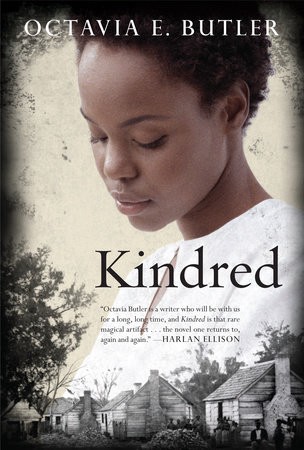
Dana, an African American writer in 1979 Los Angeles, doesn’t see the future exactly—she’s lived it. She is transported back in time to an antebellum Maryland plantation, where she saves a red-headed child who would one day grow up to be slave owner and, through violence, her great-great-…-grandfather. Every moment in the past is a struggle as Dana has to reconcile her knowledge of who the young, misguided boy will grew up to be and her own identity as both a modern, educated African American woman and a pre-Emancipation object to be beaten, possessed, and coerced.
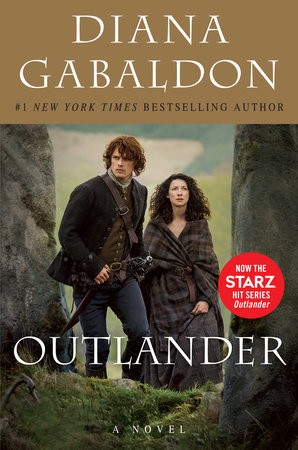
Two hundred and two years is an odd distance to time travel, but Claire Randall, fresh off the front lines of World War II, has the misfortune to be transported exactly that far back. Her experience as a combat nurse is both a boon and a danger in 1743 when “germs” did not exist and leeches were still a favorite tool of modern medicine. Amidst the gruesome violence of raiding clans on the Scottish Highlands, Claire’s medical abilities make anonymity impossible, so instead she employs them to make herself useful. With a fiancé waiting for her in the future but a brawny warrior hacking down dangers in the past, the question of when Claire will return turns more into an if.
In the aftermath of the 2011 tsunami, a novelist on the Pacific coast of Canada finds a diary washed ashore in a mound a debris. As she reads it, she finds herself growing attached to the writer, sixteen-year-old Nao in Tokyo, who is struggling with an unhealthy family life, school bullying, and thoughts of suicide. The swapping narration between Ruth and Nao makes it increasingly difficult for the reader and for Ruth herself to distinguish the present from the past — what is read or recalled and what is occurring in real time. As Ruth’s grasp on reality slips, she becomes increasingly invested in saving a girl who in all likelihood is already dead.
Rachel has grown used to the predictability of eternal life: she finds work, gets married, has kids, watches as they all die, and approaches death herself only to be restored to youth. After 2,000 years of more or less the same, the 21st century does not break the pattern, but it does come with unique tribulation of its own. Through the eyes of one who has seen and done it all, Eternal Life attempts to understand humanity’s obsession with immortality, digital to botox, and what makes life worth living.
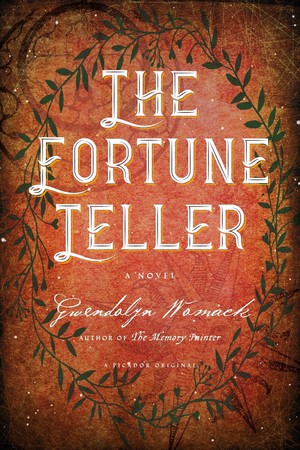
When your job is appraising antiques, you are bound to come into contact with an interesting object or two. For Semele Cavnow that interesting object happens to be an ancient manuscript foretelling thousands of years worth of disasters and a deck of tarot cards that may make a difference. Obsessed with rediscovering the deck and dodging an unknown enemy lurking in the shadows, Semele must use every tool at her disposal to unravel the truth behind the prophecies.
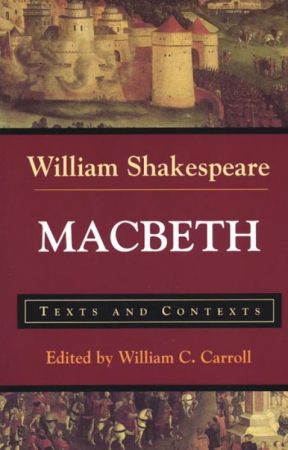
Most of us have already bungled our way through this play in high school, but few writers can pull of an everybody-dies tragedy as well as the Bard himself. Macbeth, a general in the King of Scotland’s army, receives a prophecy from a sketchy trio of witch who promise him a series of promotions as well as the Scottish throne. The only caveat is several people would have to die along the way. His wife says go for it, and his ambition urges him to agree. As the murder spree kicks off, more prophecies come to light that throw Macbeth and Lady Macbeth into a paranoia fueled madness. We all know how that ends.
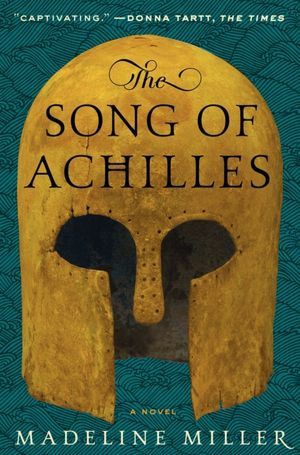
In Homer’s Iliad: the hot-blooded warrior Achilles yo-yos back and forth between battle and pacifism, only later revealing his conflict over a prophecy that promises him either a long and happy life or everlasting glory and an early death. His hesitation claims the lives of countless soldiers. Madeline Miller retells Achilles’ story from the viewpoint of his lover Patroclus (it’s canon! Probably!). A mortal watching the grand workings of gods and demigods, Patroclus only wants to be with the man he loves; he recognizes Achilles’ great gifts and heroic destiny, but he also knows about the prophecy and fears his beloved’s death. Watching both of them navigate the tension between mundane happiness and fated glory is heartbreaking.
As long as we’re on the subject of mythology, I would be remiss to not also give a call out to Cassandra from Agamemnon, a woman blessed with foresight but cursed never to be believed. Her desperate warnings only gain her enemies and perceived insanity which drives her to death. If you ever wish for the ability to see the future, consult with the classics first.
The following is adapted from a lecture given at Columbia University in April, 2018, and some of the images are reprinted from the author’s Wonderbook: The Illustrated Guide to Creating Imaginative Fiction. A revised and expanded edition of Wonderbook was published this month. Additional content can be found at the Wonderbooknow website. (Artist Jeremy Zerfoss created all diagrams reproduced here, unless otherwise noted.)
To learn, I love to be in conversation with interesting creators of all types, from many different narrative perspectives — and to also reflect this eclecticism in my reading. But I have learned the most from deep study of fiction itself: that which I have loved, that which I have hated, and that which has bored me. Boredom is not a neutral state and must be interrogated as thoroughly as any other reaction.
So, with that said, what I am going to present tonight is a series of thoughts on subjects that have been on my mind most urgently the past few years, which I find related for reasons that may or may not become apparent by the end.
As ever, I hope you find something of use, something you vehemently reject, something that bores you (why does it bore you?), and something you already knew before I made my remarks.
The first area I would like to address concerns structure — both in terms of the scaffolding I need as a writer to write a novel and how study of what is formally known as “structure” can allow a writer to access interesting options for storytelling in their own fiction.
This is generally a mechanical process in the beginning and, of necessity, an organic process in the end. Unless you do it wrong, which can itself be a feature not a bug. But the issue of structure is also an issue of not letting scaffolding or the idea of “architecture” stifle the text or remove a certain mystery from the text.
Structure should allow things to peer through and come free, not form a prison for the characters or the writer.
Structure should allow things to peer through and come free, not form a prison.
In part, this occurs naturally, if you think of structure as the musculature or skeleton of how the character moves through and expresses the story. A character creating a story and the residue or evidence of their passage, the structure. A kind of exoskeleton or cicada husk left behind.
This is another form of creating what your mind needs to write the story in your head in its purest form. Even as all stories lose some part of themselves in the transition from a liquid or metaphysical state in the mind to a physical or solid state in the world, a process that’s just part of the dissipation that is storytelling.
What do I mean by “a writer’s scaffolding”? I mean something in addition to what seem the basics of what I need to start writing after having first thought about a story for a long time. Those basics are pretty…basic. Knowing where the story starts; a character I’ve come to know well; a sense of where the character is going (either figuratively or literally); a charged image connected to the character; and an ending, even if that ending changes before I reach it. The charged image must be resonant and significant, but not one rendered dead or fixed by, for example, the prison of Freudian symbolism.
Without these elements in place, I’ve learned if I begin to write I will not finish a story or novel and I will likely be unable to backtrack and start over in a way that isn’t doomed to failure.
But, especially on novels, a kind of darkly glittering, revolving, usually architectural image also materializes in my mind that acts as a kind of compass — takes the form of some structure that speaks to theme and form, but is not the actual structure of the novel. It is instead a kind of scaffolding that I require and need to remember for the fiction to attain depth and originality. Thus, it is a kind of illogical creation, needing only to create a signpost for the subconscious, but in a way that has a dream-logic or perhaps novel-logic associated with it.
A kind of darkly glittering, revolving, usually architectural image materializes in my mind that acts as a kind of compass.
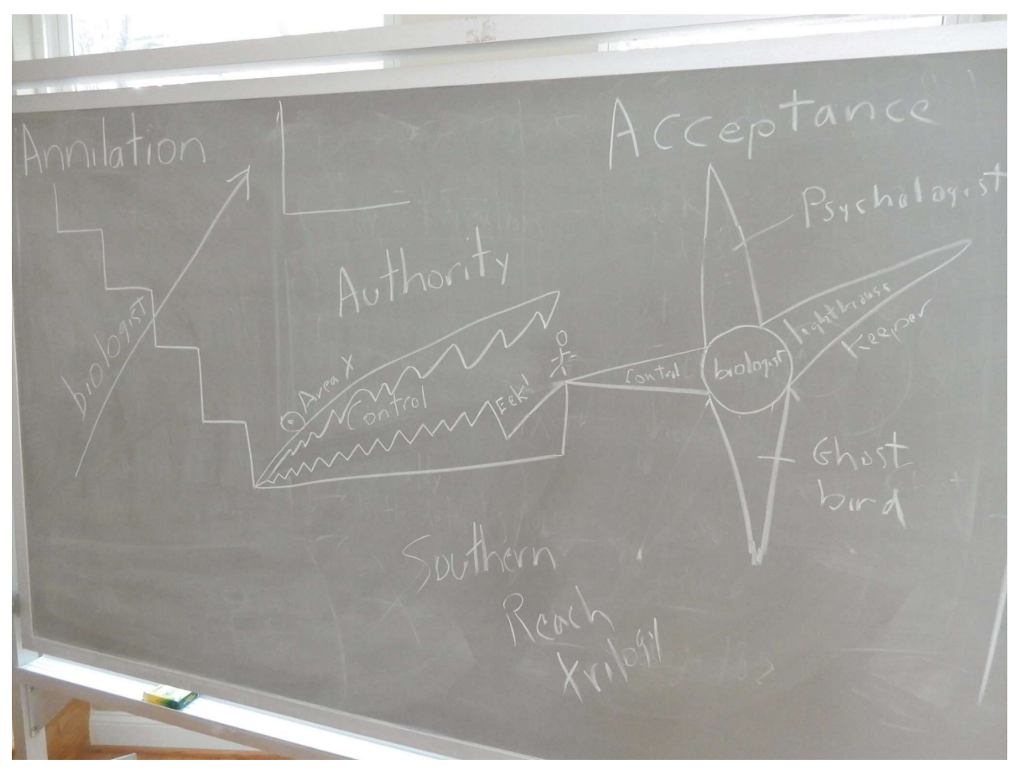
For example, on Acceptance, the third novel in the Southern Reach series, I imagined a four-pointed glowing star and at the center of that star, from which all else radiated outward, was the return of the biologist from the first book, Annihilation, and her further account of exploration.
From the rest of this account all else shines forth. The image likely occurred because of an intense study of different kinds of lighthouse lenses and different kinds of light emitted from lighthouses for specific kinds of communication or warning.
In my mind, this shining star revolved against a black background as I wrote the novel and at no time was it not present during that writing process. Yet it is in no way an accurate depiction of the novel’s actual structure. Even as it represents a kind of emotional and thematic structure, a resonance, in that the echo or ghost of the biologist could be said to permeate the other parts of the novel and, even if visible only to me on a literal level, and not to the reader, she is peering out from the blank spaces between the words in those (many) sections of the novel in which she is not physically present. Creating depth that the reader hopefully does experience, although they cannot see the light creating that depth.
If the structure here presented for Annihilation is cursory and more pragmatic, that is because I wrote the novel so quickly and almost without identifiable conscious impulse. I knew only that it was dangerously important that I must always think of the expedition in the novel as forever traveling DOWN even when proceeding physically across level ground or going up — and that this affected word choice, dialogue, and other elements as I wrote, some of which I later enhanced in revision and some of which I deleted as too obvious, but even in the deletion left behind a disorienting absence.
At the same time, however, I felt the biologist was always ascending, because, as the expedition disintegrates, she acclimates to the landscape they traverse.
In Authority, the main character all unknowing is already within the maw of a giant beast of sorts and the jaws are closing.
These constructs — this pseudo-structure or scaffolding, then — are completely organic for me and comes to me seemingly unbidden as a kind of hovering inspiration shining out over the more tactical inspirations that come over me at the scene, paragraph, and sentence level. I trust it despite its illogic because I’ve found the more I trust my subconscious and reward it, the more it rewards that trust with more ideas and characters.
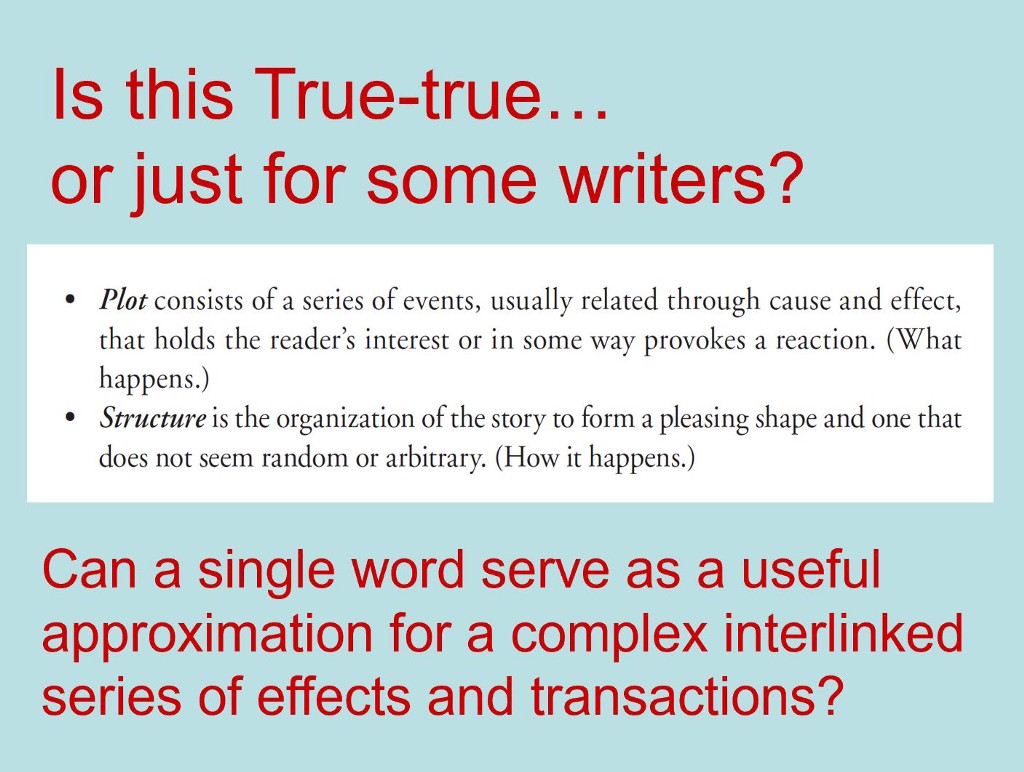
Scaffolding aside, there is also the conscious examination of structure in novels — both at the macro level of the entire novel but also at the micro level of scene. Yet even study of what is formally recognized as structure has an element of uncertainty because there is variation in how different writers perceive words like “plot” and “structure.” It is significant that even in Madison Smartt Bell’s excellent Narrative Design, he clearly defines plot as opposed to structure or form and then seems to, at times, confuse or use the two terms interchangeably anyway.
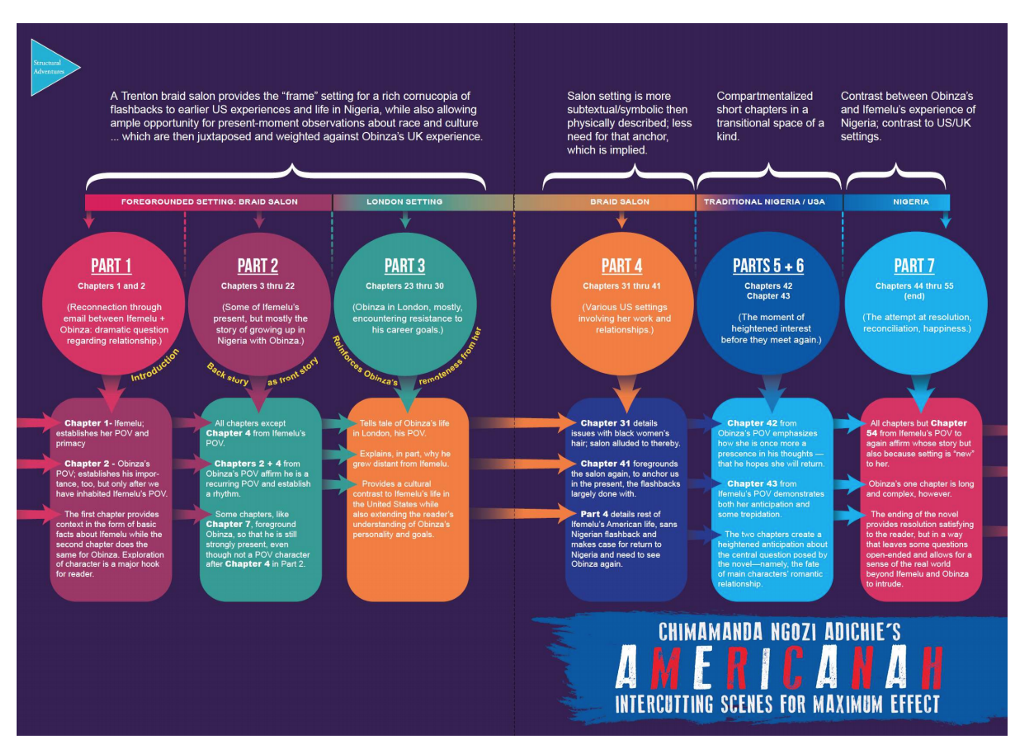
Some analysis of structure is more equal than others. For example, consider this diagram I made in studying Chimamanda Nogzi Adichie’s Americanah. The diagram breaks down the structure chapter by chapter and analyzes the effects created through use of two main points of view, going back in time in some scenes, and how it overcomes the potentially static quality of using one setting, a hair salon, for several scenes — incorporates the hair salon into the structure, in a way.
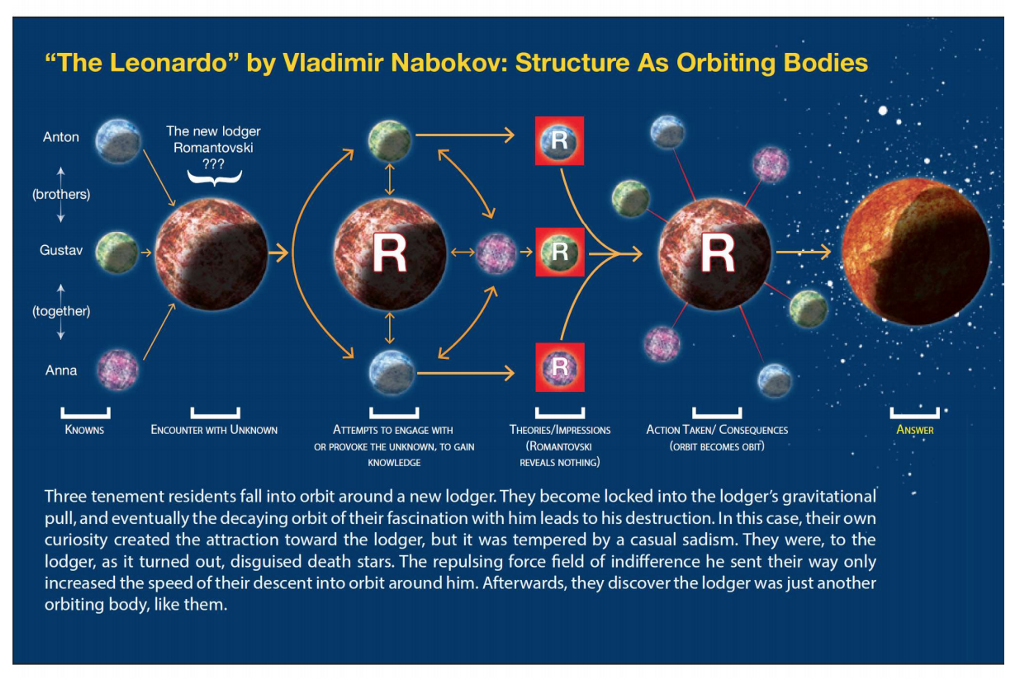
This diagram of Vladimir Nabokov’s story “The Leonardo” also shows a kind of structure, but in doing so I employed a metaphor — characters as planets orbiting another character-planet. This approach accurately conveys the effect of the story, but is not in any conventional sense the actual structure of the story.
This approach to analysis lies somewhere between the darkly glittering scaffolding I need for my own work and an objective view of someone else’s structural decisions. What is lost is a true seeing of the original writing of the story. What is gained is an idea about the use of characterization in the story — i.e., that in a sense the story elements are deployed in the service of showing what happens when three friends living in a tenement building encounter a fourth person, who is a stranger, and when in contact with this stranger the others basically have an allergic reaction and plot to destroy him, to drive out the other. In doing so, they themselves enter a decaying orbit as they are lessened and lose any sense of a moral compass in pursuit of their goal.
The point here is that analysis is often just one subjective view of the structure regarding a published work of fiction, with varying levels of quantifiable “objectivity.” The analysis inevitably reflects the point of view of the writing doing the analysis, based on their own view of fiction.
The best and most personal value to you, despite what you might (or might not) glean here…is to perform your own analysis of structure — of your favorite and least favorite works. And of the structures of the works I’ve diagrammed here. Because an instructor’s analysis will, to varying degrees, take the form of another kind of internalized, personal scaffolding.
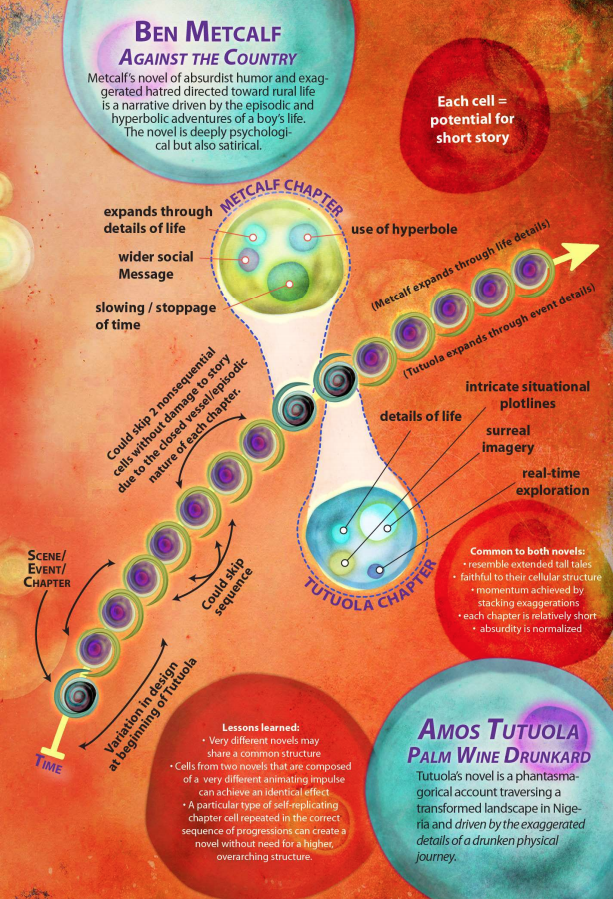
This issue comes up in comparing the structure of Nigerian writer Amos Tutuola’s The Palm-Wine Drinkard (1959) and U.S. writer Ben Metcalf’s Against the Country (2015). I find myself wondering what is lost and gained even in the transition from this horizontal, chalk-scrawled version….
…and the final vertical version, which seems to compact the spine of the diagram.
Even as the main point remains: Just as the bones that comprise a killer whale’s flipper shock us with their similarities to a human hand, so too can we find unexpected kinship in the structures of what seem like vastly different novels. Metcalf’s novel and Tutuola’s are brethren in their deployment of the components of their structure or design.
Against the Country, haunted by the past, is the darkly hilarious tirade of a man against a childhood spent against his will in rural Virginia. The Palm-Wine Drinkard is the surreal account of a drunk man encountering actual phantoms, including “the complete gentleman,” a skull attempting to reconstitute his other parts (much like many fictions) and a monster that devours 4,000 babies and the narrator (for a time). Written in different eras by writers from vastly different backgrounds, they would seem to occupy spaces with no subset of similarities between them.
We can find unexpected kinship in the structures of what seem like vastly different novels.
Metcalf’s novel of absurdist humor and exaggerated hatred directed toward rural life is a narrative driven by the episodic and hyperbolic adventures of a boy’s life. The novel is deeply psychological but also satirical. Tutuola’s novel is a phantasmagorical account traversing a transformed landscape in Nigeria and driven by the surreal details of a drunken physical journey.
In fact, at the tactical level, they use the same units of measure, so to speak. The chapters, or cells, that comprise the two novels are surprisingly similar despite a very different animating impulse. A particular type of self-replicating chapter-cell occurs in both, one that short story writers wanting to write a novel for the first time should study closely.
Because in both novels, each relatively short chapter has the same structure, without a need to create a higher-overarching architecture to house or constrain the narrative other than what is stated at the beginning: Metcalf’s narrative will tell us about his childhood in Virginia; Tutuola’s narrative will tell us about a roving journey set across one night.
Both achieve momentum and maintain momentum by stacking exaggeration and hyperbole. Both avoid being simply a series of interlinked short stories by how, often just slightly, each chapter does build on the next by advancing the narrative while also featuring recurring characters of a sort. Absurdity is normalized so that tension can be retained in part by ever-greater absurdity that doesn’t seem ridiculous because we’ve already become accustomed to the prior level of absurdity. (The same principle applies to my novel Annihilation, but in terms of the uncanny impulse and stacking of tropes.)
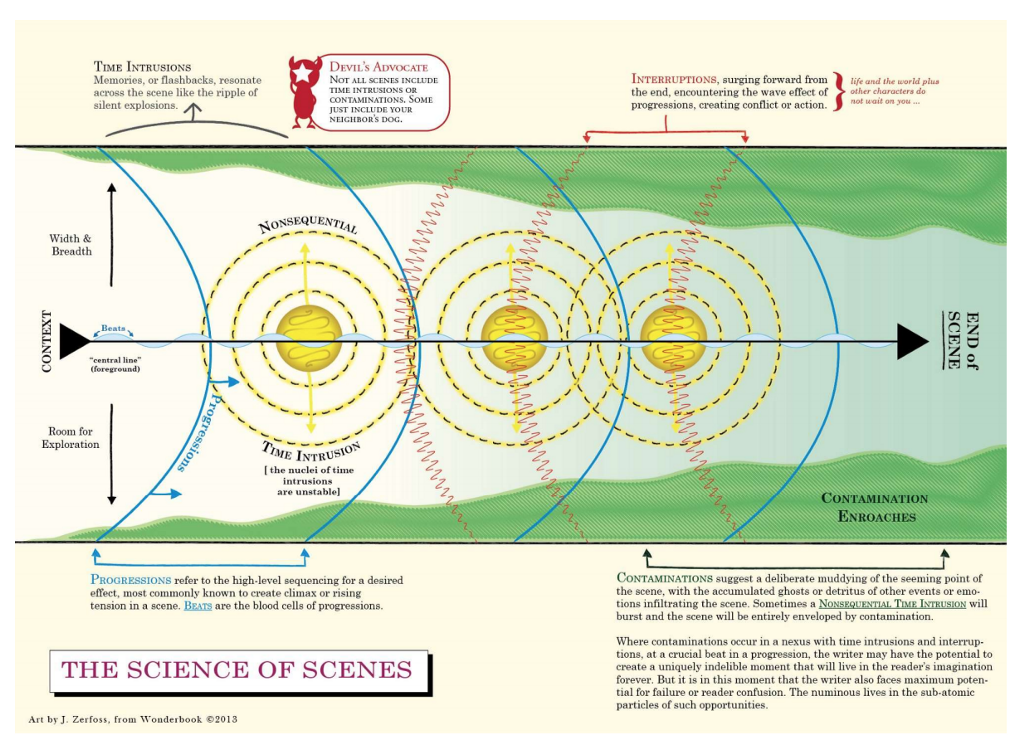
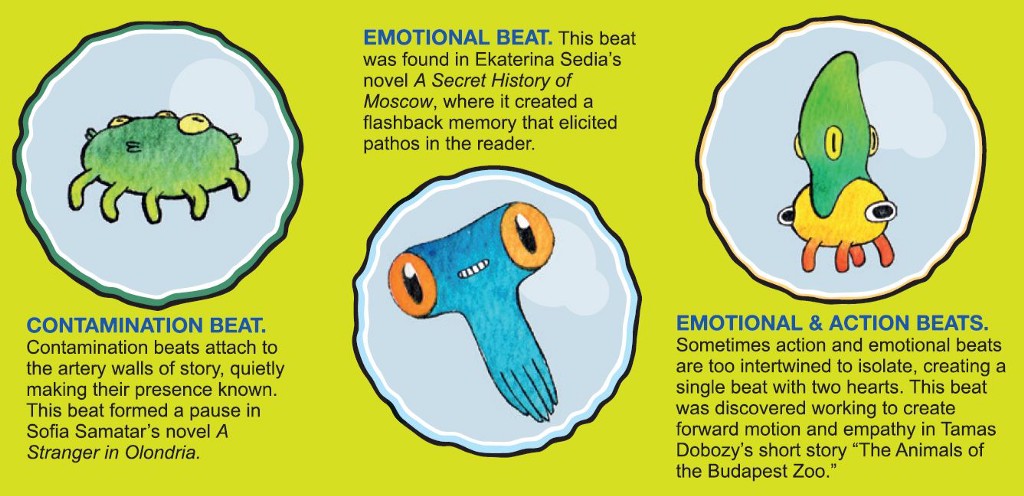
But what lies at the opposite end from personal scaffolding (and equidistant from a more objective view of structure)? Perhaps this science of scenes diagram suggests one answer. The diagram attempts find the right level to extract useful generalities about structure — to express something that, admittedly, doesn’t apply to all fiction. It may fail in a sense to convey what it attempts to convey. Which is to say, what it wants to convey may not be communicable through a diagram. Nonetheless, I believe even ignoble failures can be more interesting and useful than staid successes.
Part of what led me to create this diagram is that I’ve become a little obsessed with how even a tiny change to where you start or end a scene can greatly affect how the reader perceives the scene and even how a reader or editor perceives the genre of the scene and thus the book as a whole. This thought suggests greater similarities between seemingly unalike pacing and styles, in that the actual difference is one of a missing cause to an affect or vice versa, to use a crude example. And once you can chart these similarities and differences at the right level of detail and hierarchy, you are much more able to control the effects of your fiction and even to shift modes within the same novel in ways that don’t seem jarring.
I do believe that with the right progressions — of a character’s emotions, of events in the story, to name only two types — anything is possible in fiction. I also believe that the idea of “beats” is often misunderstood as purely commercial consideration within screenplays. In fact, a serious, complex exploration of the way in which beats in a story support progressions or don’t support them can lead to serious break-throughs in a writer’s knowledge of the art and craft of writing. Showing these ideas in an almost cellular way helps to re-imagine them as organic, and thinking of them in abstract ways allows them to then be re-imbued in a flesh-and-blood sense on the page in a particular story or novel.
Image by Ninni Alto
Where the diagram becomes impractical, perhaps, is that not all scenes have time intrusions because they lack that kind of character interiority. Contaminations of the scene can reflect a writer’s awareness of possible fatigue on the part of the reader rather than an actual condition that occurs across all kinds of scenes. However, by articulating these elements as if they are constant, it forces the reader of the diagram to construct their own version in opposition — in a sense, to correct the idea at the same level of abstraction. Perhaps this proves that even inaccurate writing diagrams can be of use to a writer.
As should be clear from this brief examination of structure, I believe in letting what should be organic in fiction express itself organically — and to proceed mechanically with what can be made mechanical and achieved through analysis and study without harm to the imagination. Without this second belief, I wouldn’t participate in workshops or give lectures about creative writing. Even as I eschew a distinction between “art” and “craft” in fiction because they aren’t terms in disagreement — the craft of writing fiction supports the art.
About the Author
Jeff VanderMeer is the author of the bestselling, critically acclaimed Borne and the Southern Reach Trilogy. His work has won the Shirley Jackson Award and been translated into 35 languages. His nonfiction appears in the New York Times, Los Angeles Times, and on the Atlantic’s website.
I can’t resist a cryptic invitation. So last month, when I got an email about a “weird interactive storytelling digital art experiment,” I was there for it.
The email came from my friend Max Neely-Cohen, a skater-turned-novelist who I’ve long suspected moonlights as a spy due to his lengthy, unexplained disappearances from New York. “Some brilliant nerds are going to help me to make a space that visually responds to poetry and prose as it is read aloud,” he wrote. “Imagine giving a reading somewhere and having the environment change based on what you read. And being able to control those changes.”
I could not, in fact, imagine that, so I said I’d stop by.
The project formed as part of a week-longmicro-residency at CultureHub, an art and technology center founded in partnership with New York’s La MaMa Experimental Theatre Club and the Seoul Institute of the Arts in Korea.
I visited the space in NoHo on a humid Friday, riding a rickety elevator into a large, black-walled studio. Several metal chairs lined one side of the room, facing a wide screen on the opposite wall. Toward the front, Max’s assistant, NYU ITP student Oren Shoham, manned a laptop surrounded by wires; toward the back, a microphone stood next to a table stacked with books.
Combing through the books, I found This Planet is Doomed, a collection of science fiction poetry by Sun Ra, the legendary Afrofuturist jazz musician (and composer, bandleader, poet, philosopher, and and and). Because my dad is a jazz guy and I was a kid who identified as an alien, I was introduced to Sun Ra at a young age. Even then, I recognized that Sun Ra was, if not the coolest person to have ever lived, definitely in the top five. His science fiction poetry seemed the perfect input for a spatially overwhelming poetry synthesizer.
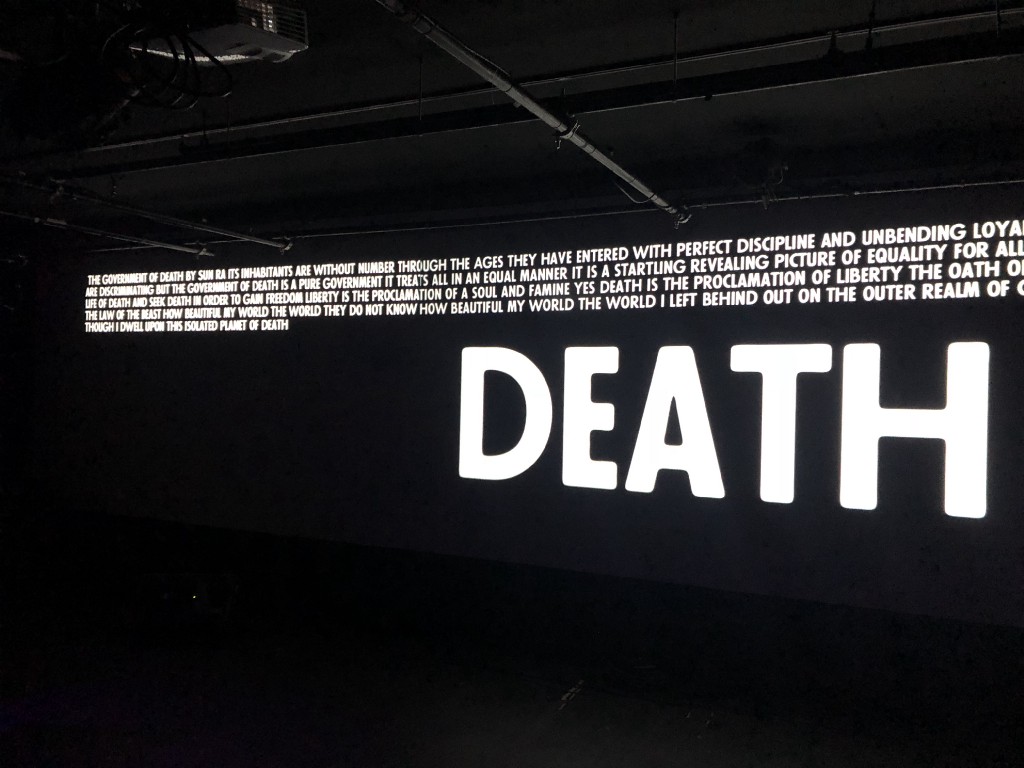
I picked two poems: “The Government of Death” and “Planet of Death,” and stood behind the microphone with two cameras trained on my face. The room went dark, Sun Ra spotlighted. As I read, words flashed in my peripheral vision, though I couldn’t fully see the adjacent imagery.
As I read, words flashed in my peripheral vision, though I couldn’t fully see the adjacent imagery.
“[A]ll governments / on earth / set up by men / are discriminating / but the government of death is a / pure government,” writes Sun Ra. “I gave up my life and am here on / this planet / of death / in order to teach my enemies that their / life is nothing else / but death / and that their planet was isolated from / the cosmic spheres / whence I gave up my life.”
Including titles, “death” is repeated twenty-one times in the poems. After finishing, I saw “DEATH” in huge, all caps letters on a black screen. I was briefly speechless, then noted that the whole thing was Incredibly Goth.
Max Neely-Cohen says he’s long harbored the idea for this kind of project, but wasn’t sure existing technology could manage what he had in mind. “There are all these visuals that work off of different parameters of live music,” he briefed me over the phone, after my visit. “A lot of them are just volume, but more sophisticated ones can analyze pitch and all these different things. They create a visual space out of that. I wondered, can you do that with a reading? For a really long time, the answer I got was ‘no.’ And the reason is that speech-to-text sucks for live transcription. But it’s been getting better.”
Max and Oren used a speech-to-text API (application programming interface) from Google Cloud and hooked it up to EmoLex, a database compiled by computer scientist Saif Mohammad, that crowdsourced associations between words, emotions, and sentiments; this included color association. When I read “Government of Death” into the microphone, my audio went to Google Cloud for transcription, then into EmoLex for visualization, and then zapped a giant, gloomy DEATH screen back to the studio.
Writer Moira Donegan, who read a piece about a black and white film, had a particularly poignant experience with project’s chromatic element. “Seeing those words rendered in color — rendered as color — added a series of associations to the work that I hadn’t had before,” she said. “It was pretty stunning to see them rendered that way as I was speaking — ‘grief’ as green, ‘body’ as orange — whereas my experience of the material before had all been in greys.”
It was pretty stunning to see the words rendered that way as I was speaking — “grief” as green, “body” as orange — whereas my experience of the material before had all been in greys.
Other testers I spoke with responded to different aspects of the installation — perhaps dependent on what they were reading, or their professional backgrounds.
Bloomsbury editor Ben Hyman read a selection of Frank O’Hara poems, and noted that “O’Hara’s work is intricately linked to his particular social world of friends and collaborators, and to the contemporary art of his time — in addition to being a poet, he was a curator of painting and sculpture at MoMA. It felt like he’d be the perfect ancestor to introduce to Max’s clever machine. I think Frank would have gotten a kick out of it.”
“The exhibit felt like ekphrasis in practice,” said writer Becca Schuh. “Creating a new form of art via commentary on already existing works. It was an odd day in New York, humid and sad (Anthony Bourdain died the morning I went to the project), and it was both surreal and beneficial to step away from the oppressive air and into this new atmosphere.”
Writer and editor Bourree Lam took a different route, and read a series of texts to her husband. “I write about economics, and originally I had planned to read something very mundane like a jobs report or Federal Reserve meeting,” she said, “but then when it came time I didn’t want to read something with so many numbers…I ended up reading an exchange with my husband that pretty much sums up our communication ritual every evening since we got married: When are you coming home? Is work crazy? Are you coming home for dinner? Who’s in charge of dinner? What’s the plan?…Standing in those texts, I felt like I was sharing a part of my relationship with the world. We literally have this exchange every weeknight. It’s really personal, but also really mundane. It was that banal/sublime tension of art that draws from the quotidian (not that I’m calling what I read ‘art’!)…seeing the texts on the big screen made me realize I don’t mind sharing some parts of my relationship.”
Standing in those texts, I felt like I was sharing a part of my relationship with the world.
Meghann Plunkett, a coder as well as a writer, was perhaps in a unique position to appreciate the project’s technical elements. “I was so thrilled to see that someone was using APIs for art’s sake,” she told me in an email. “Often we see technology utilized to solve problems and disrupt markets. My heart soared to see that Max was using an API to embellish an experience instead of trying to change that experience. I loved that the speech-to-text feature was coupled with an author’s reading without overshadowing it. With innovation like this, it opens up the possibility for other artists to view open source APIs as small platforms for literature, art and performance. It gives me hope that technology and art can co-exist in a symbiotic, balanced relationship.”
Max is returning for part two of the residency in the fall, and emphasized how much more is possible: “We could use the same dictionary database, or a different one, and control all sorts of parameters. We could use a reading to grow a garden, or build a city. This can get more sophisticated, more visually interesting. This was a super-fast initial prototype. All we did was make it work. The amount we can do past that is unbelievable.”
I tell people that I got a degree in English Literature so I would secure a high paying job at a literary non-profit with an unlimited salad bar, rosé on tap, and a personal chauffeur, but the real reason for my four (very expensive) years in university was to hone my bar trivia skills so I’m acing the book questions and bringing glory to my team (Team Billy, named after my dog, Billy the dog).
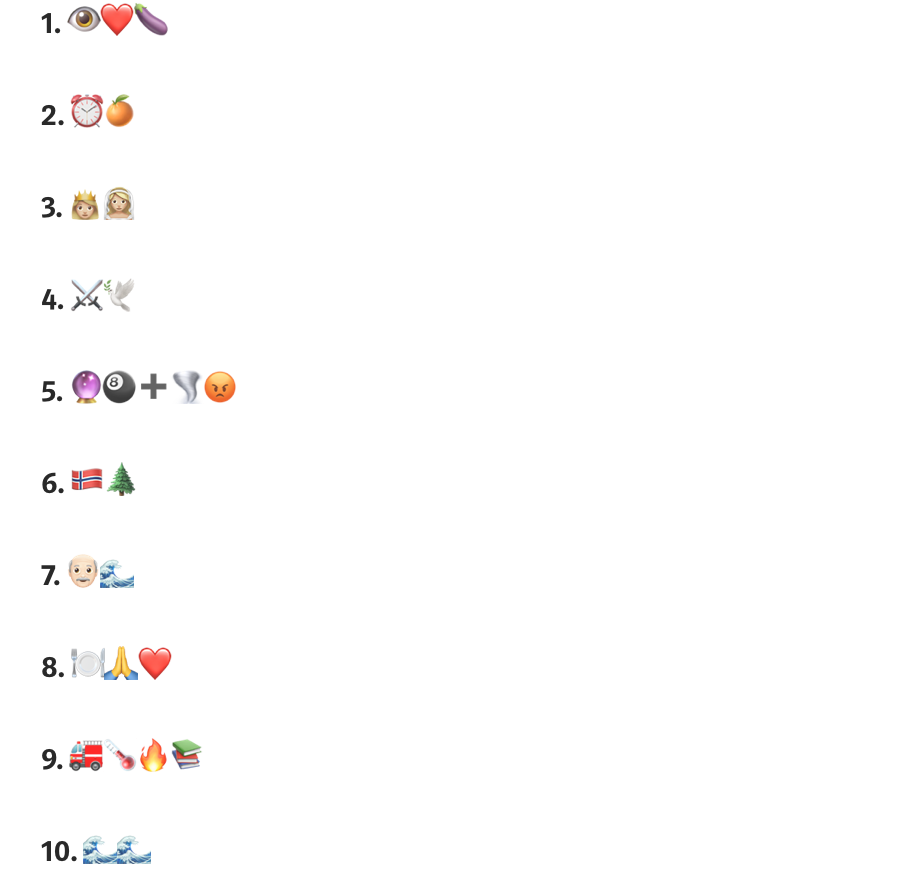
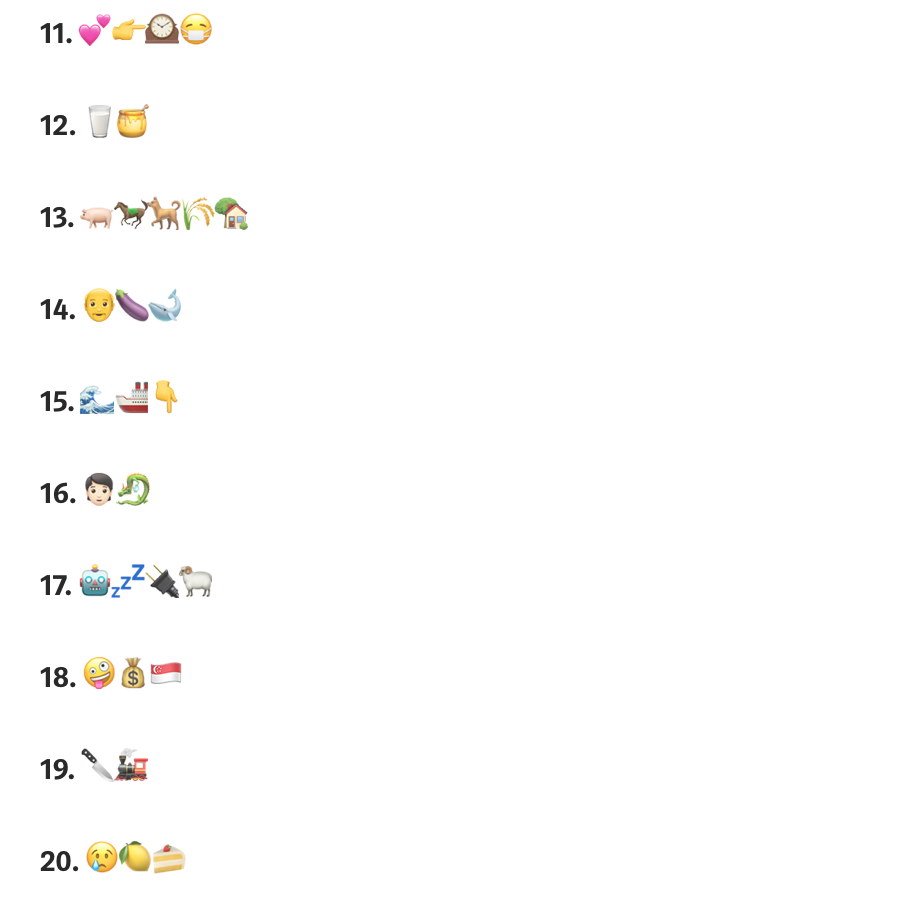
I’ve combined my love for bar trivia, my knowledge of literature, and a millennial penchant for communicating solely in emojis to present to you my life’s work: a “Guess the Book Titles Using Only Emoji” quiz. Can’t figure it out? No worries, you’re only a little bit of a doofus and I’m only judging you a a teeny bit for sneaking a peek at the answers listed at the bottom.
Since mid-October of 2015, I’ve been concocting and serving weekly Literary Cocktails at the Reading Room of the Petworth Citizen in Washington, D.C. The Reading Room is a functional lending library in the back of the Petworth Citizen, a neighborhood bar. All books on the shelves are donated, and they can all be borrowed free of charge. In October of 2015, we decided to build a bar in the room in large part so that I could host this cocktail program.
The Literary Cocktails menu is only available on Fridays and Saturdays and is new every Friday. During the week, I read the books, poetry, lyrics, short stories, essays, etc. on which that week’s drinks will be based, and then craft a cocktail menu inspired by my reading. The project has evolved over these past two and a half years; when I started, I often paid homage to a writer’s entire oeuvre (P.G. Wodehouse night, for instance), but now I typically focus on reading just one book a week and name the drinks after quotes from my reading.
The menu is like writing an essay in cocktail form, using themes and recipes from all over.
Since I’m a bartender and mixologist by trade, my book-inspired drinks are often riffs on classic cocktails. I combine the classic and historic recipes and ingredients I love with anything I subjectively relate to while reading. Often, specific spirits or drinks are mentioned in the reading, in which case I will use them. I will also incorporate the mention of flavors of other foods and beverages. I’ll take into account the setting, geography, and timeline of the story and build from drinks or ingredients from that as well. I rely on my catalog (from experience) and the possibility of new ideas coming from ideas and passages.
The menu is like writing an essay in cocktail form, using themes and recipes from all over. Sometimes a story about the history of a particular cocktail will relate or pair well with a particular passage. The drinks are designed as “one-offs” because the menu changes every week, but they’re also endless riffs — the same way a whole body of literature can arise from riffs on 36 dramatic situations. Also, I light a lot of drinks on fire. It comes up a lot in reading.
Here are some recipes and their corresponding books.
1 oz. Pimm’s №1, 1 oz. Aquavit, .5 oz. Oloroso sherry, .5 oz. fresh lemon, 1 oz. Dandelion tea. Add cracked ice and garnish with a leaf of lettuce, a dill flower, and a strawberry. Serve with reusable or biodegradable straw.
This drink is a riff on the classic Pimm’s Cup.
“…mokita. It means, ‘A truth everybody knows but nobody speaks’”
In Moroccan tea glass, muddle 2 wedges of lime, then add .25 oz. raw ginger juice, 2.5 oz. 10 yr. Old Sercial Madeira, and cracked ice. Stir lightly. Garnish with fresh mint.
This drink is a mojito riff made with Madeira and ginger instead of rum.
“You and your fireballs and your demon hipster chicks”
.75 oz. Neisson Rhum Agricole Blanc, .75 oz. Thomas Tew’s Dark Rum, .5 oz. curried simple syrup, 1 oz. coconut milk, 1 oz. pineapple juice. Fill with crushed ice, set dried lime shell and fill with overproof rum and nutmeg, light on fire.
.5 oz. Mt. Defiance cassis, 1 oz. Earl Grey “Moonlight” tea Top with 3 oz. Chilled Champagne. Express lemon oil, then float dried half of lemon shell sprinkled with osmanthus leaves and one star anise clove doused in overproof rum. Serve on fire.
This drink is a highly unconventional riff on a Kir Royale.
“I am alive,” Paul wrote to his mother, “but alive inside a ghost.” (P.217)
Served in a chilled coupe, shaken & double-strained:
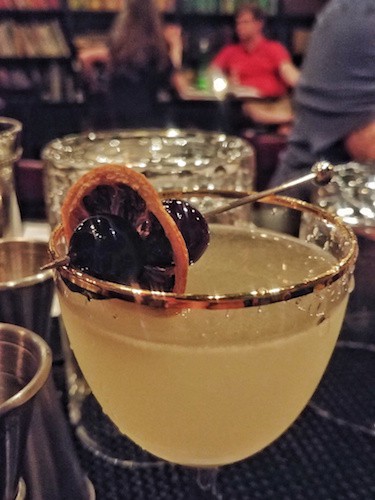
.5 oz. Jensen’s Gin, .5 oz. Slivovitz, .75 oz. Cocchi Americano, .5 oz. Cointreau, 2 dashes Absinthe, .75 oz. fresh lemon. Garnish with dried citrus and Luxardo cherry.
The New York Times series “By the Book” asks prominent authors about their literary influences and favorites—your go-to classic, your childhood reading, your favorite book to recommend. The answers, like the authors, are delightfully varied, in many ways. In others, they’re troublingly consistent.
“When male writers list books they love or have been influenced by… why does it almost always seem as though they have only read one or two women in their lives?” asked Florida author Lauren Groff in her May “By the Book” interview. We’d noticed the same thing; six months earlier, a dude-heavy list by The Martian author Andy Weir had inspired the tweet that started our “Read More Women” rallying cry. And in light of that simple mission statement—read more women—we’re launching a new series, which we’re thinking of as a stripped-down, feminist version of “By the Book.” Twice a month, we’ll have some of our favorite writers—of any gender—discuss their favorite or most influential books that aren’t by men.
“We can’t escape being born into a society that has contempt for women tattooed on its bones, but we can change ourselves,” says Groff about our new series. “It is vastly important to read more female authors: to see women as worthy of our imagination and respect, to understand a woman’s full humanity, to reclaim authors who have been unjustly forgotten by time because of their gender, to meet the minds of geniuses new to us, to expand the Canon, and to work toward the equality of all humans that is promised by the better angels of our society, but which in our actions and silent and insidious biases we so often fail.”
We invite you to follow your better angels by investigating our featured authors’ favorite works by women and nonbinary writers. This week, we’re even making it easy for you. Follow our partner MCD Books on Twitter, tweet a link to this article with the hashtag #ReadMoreWomen, and you could win one of our Read More Women tote bags filled with all the books Maria Dahvana Headley recommends, plus her new book The Mere Wife!
Which brings us to our first featured author. (Don’t worry, the introduction will be shorter next time.) Maria Dahvana Headley is a bestselling author of adult and young adult novels (and one internationally bestselling memoir, The Year of Yes). The Mere Wife is a modern retelling of Beowulf set in a posh subdivision; Kelly Link called it “a consciousness-altering mind trip of a book” and no less than Samuel R. Delaney called it “a book to call up an old story in the newest possible way.” Headley’s most recent books before The Mere Wife were the young adult fantasy novel Magonia and its sequel Aerie, both of which got rave blurbs from Neil Gaiman, with whom she’s also collaborated to edit the short story collection Unnatural Creatures. Her five recommended novels by women are for anyone who courts the dark and strange.
There’s no forgetting the moment you notice that the shelves you’ve been assigned are full of men, and that you haven’t seen women’s names on them since you were a little girl. I emerged from a childhood of reading stories about girl witches, explorers and adventurers written by women born in the first bits of the 20th century — Madeline l’Engle, Elizabeth Enright, Margaret Storey and Zilpha Keatley Snyder — into…Bukowski, Kerouac, a bunch of boy beats whose female characters weren’t the ones driving the universe. Then, when I was twenty or so, in college studying playwriting and reading more of the work of men, I was questing in a Barnes & Noble, and feeling very tooth and claw indeed. I’d just seen something by Sam Shepard, whose surrealist sensibilities I’d previously loved, but this one involved a young woman recategorized as a teenage sex witch predator of grown men, and I was beginning to find myself wroth about stories of strangely wicked sex witches inhabiting narratives where the adult version of, say, Harriet the Spy clearly belonged. Sick of beautiful girls. Sick of dead girls. Sick of both of those things, and yet. The Bloody Chamber had just been re-released, and had a tower on the cover, and I was ready for new fairy tales with more sex, drugs, rock and roll, basking in language, fucking shit up. Girls beautiful and dead are here too, but they are ferocious, unpredictable, strange, and agented. Carter delivers in utter luxuriance, her work replete to a degree that can seem excessive until you surrender to it. This book is the one everyone reads. I could recommend others, but this one is my beloved life changer. The collection is short, but she grinds her teeth, spits rose petals, and pulls the hearts of dull storytellers out of her minaudiere to make room for the phone numbers of those willing to surrender their pelts. Carter is nasty and sweet at once, and I owe her ghost a good deal of my career.
In 2004, before I’d published much of anything, I was at Breadloaf when Kelly was teaching. She gave a reading of poems from this book. I ended up flayed, weeping, awed and starstruck. I was in conventioneer fugue, and yet. The heads of goats sing, orphaned from their bodies. The natural world shrieks, howls, and confides, and tenderness is always cut with fire. All of Kelly’s work is devastatingly beautiful, packed with the sensibility of the classical world made ragingly modern, one part Ovid, one part railroad tracks. The humans in Kelly’s poems are forced to reasonable manners, but they are animal, full of longing, and certainly part of the continuum of beasts. This level of empathy, of a communal story of all the inhabitants of earth, is, I think, tremendously unusual. This book is one I go back to regularly, and I can easily see its path through my own work. I just wrote a mountain with POV, and it is in large part due to these poems. They are tender with teeth.
Gayl Jones’ Mosquito is due for not just a revisiting, but a proper visiting. I encountered it sometime in around 2009, on a recommendation from a poet friend after I’d screamed to him for a while about the lack of long ass Important Tomes by women writers, and that if said Tomes existed (Leslie Marmon Silko’s Almanac of the Dead, for example) they’d be categorized as somehow Not-Worthy-Of-Literary-Greatness. Mosquito was published in 1999 to not enough continued fanfare. Jones was roughly 20 years ahead of her audience, as far as I can tell, because goddamn, is America made out of this book right now. It’s infuriating that this book doesn’t appear on lists of Bests, because Mosquito is a pyrotechnic, Joycean longform meditation from the POV of a black female truck driver who establishes an underground railroad across the Texas border. Shall we? Yes, I think we shall. My historic ignorance of the consistent relevance of this story speaks to the lack of support for a spectrum of fiercely poetic and literarily-categorized black women’s voices in the world of novels. Jones was originally edited by Toni Morrison (whose work I’ve listed elsewhere as being a massive inspiration and galvanizer of mine — the braid of the supernatural with bitter reality, the lyric rasp of Morrison’s language — it’s never not astonishing) and often I imagine an alternate version of the history of publishing in which things were vigorously more diverse, in which radical, experimental voices like this one were supported and rewarded regularly instead of once a decade. This is the future I look to, one of long books, one of great books, one I want to pummel into existence. Should this book be categorized as a work of genius? Should Jones be canon? Yes, folks, yes she should. A variety of things conspired against Jones being assessed as the major force she is, and those things are all the usual suspects. This is a Great American Fucking Novel, epic, intense, ferocious, strange, and as deeply about this country as anything I can name. The book is voiced with intensity, and it’s not an easy read, but seriously. Easy read isn’t the goal. Blistering song: what else has this country’s discourse been built from? I have lots of time for voices not rooted anywhere in legends of white masculinity, and this one is like opening your ears to a revelator. It’s brilliant.
I’m a huge fan of Kathryn Davis’ work, and I love all of her books, which are completely different from one another. She’s such a giant badass, and I have an imagined version of a life in which I add an extra month sandwiched into February, sort of an origami fold of days I might be able to spend in a bathtub reading books. In this version, I’m always beginning with a reread of one of Davis’ books, because they restore my soul. The Girl Who Trod on a Loaf is a strange and surging, haunted friendship of two women — an elderly opera composer and her younger friend and beloved, Francie, a single mother of twins, who inherits her friend’s operas. The composer, Helle, is Danish, and I think I’m especially tempted by Northern narratives (one of my other most-recommended titles is the poet Inger Christensen’s ecstatic and devastating accounting of existence, collapse, and the elements of the world, Alphabet) and the fairytales of hunger, longing, and faith that rise out of them. Helle wills the finishing of her unfinished opera based on a Hans Christian Andersen fairytale to Francie, whose personality reminds me of that of Sylvie the vagabond aunt from Marilynne Robinson’s Housekeeping– basically, I have an ongoing love affair with novels of women’s lives in which the women are unapologetic eccentrics, almost creatures, in their calm refusal to wed themselves to societal norms of partnership. This book is about mentorship and grafting flawed and ferocious ambition onto someone whose circumstances have created lack of same, and it’s just fucking rare and intriguing to read a book like this about women’s lives. Especially one full of imaginary operas based on things like, for example, Virginia Woolf’s The Waves. Writing this made me notice that many of the women on this list of writers are or were roughly the same age—Angela Carter was born in 1940, Kathryn Davis in 1946, Gayl Jones in 1949, Brigit Pegeen Kelly in 1951, which makes sense, given that I was born in 1977, just in time for Reagan, but lucky enough to read the work by women writers being produced in the first couple of decades of my life. Their work was shaped by a landscape of feminist theory, abortion rights, birth control, one that now looks very damn shaky. Their characters, largely without exception in this list, had the liberty to be strange, kinky, recalcitrant, unpartnered, bohemian, interested more in the natural world than in the world of men. I think about this now, in the work coming today, and out of this world, and I long for more work like this, more characters with unexpected emotional lives, more oddity braided to the quotidian. The next collection is that precisely.
This is a short story collection containing wonder after wonder, done with casual intensity. These are all sharp knives of stories, and it’s definitely possible to think oneself unsliced until the blood starts to pour. I encountered Samatar’s short work in 2012, probably, with her short Selkie Stories are for Losers, and was floored on sight. She’s published two novels as well, but the short fiction is my first love. Unlike the rest of the authors on this list, I actually know Sofia, and I’m as moved by her in person as I am by her work. Her wide-ranging and deeply researched interests are fully showcased in her prose, which moves from nonfiction to speculative surrealism, from historical automatons to victims of warfare, all at the same time. There are witch stories, and ripped from the headline stories, stories about longing for other planets, stories about the human condition of pain. They cross all genre divides, and smash them. This collection was edited by Kelly Link, herself a lighthouse of mine, and her work has common ground with Samatar’s, just as both of their work has common ground with everything else on this list. These are all authors whose works are sui generis, but who constitute a tribe of writer warriors as far as I’m concerned. Everyone here is an obliterator of tropes and received myth, a reviser of hierarchy, and a deeply skilled storyteller and maker of worlds. I can’t even believe I get to live in a time in which writers like the ones on this list exist, let alone get to have their brains feed mine.
Read these women.
Read More Women is presented in collaboration with MCD Books.
The credits for the biker documentary Hells Angels Forever list five directors, six producers, three writers, four editors, and a crew of over sixty, which is to say that the production was long and a lot of people came and went — though the one who mattered most to me was my father. The project originated with Leon Gast, a documentarian who would go on to win an Academy Award for “When We Were Kings,” about the Muhammad Ali–George Foreman fight in Zaire. Gast was replaced on Hells Angels by Sandy Alexander, the president of the club’s New York chapter, who had never made a film before.
“They were talking off in a corner,” my father told me, a day after Gast fled the set — I must have been nine or ten years old. “And then Sandy slapped him so hard it sounded like a gunshot. Leon fell down, and then he jumped up and started to run. Nobody’s seen him since.”
My father was a criminal defense attorney who represented the club, but he was also a gentle man who rarely raised his voice, and he looked genuinely abashed by what he had seen. It wasn’t till I started to laugh that he began laughing, too, a little sheepishly.
The rule in our house was that the Angels were characters; whatever they did had to be discussed with an air of wry bemusement.
“The contract gave him complete creative control,” my father told me, “but I thought he understood.” By which he meant, Understood that things had to be done the Angels’ way.
“What’s going to happen to the movie?” I asked.
It turned out that Gast had left his equipment behind and the Angels were using it to carry on. “The inmates are running the asylum,” my father said, starting to look genuinely amused now, the slap forgotten. “Whatever happens will at least be interesting.”
A few years later, my parents went to a showing of an early cut of the film. I remember them getting dressed up to go out; my siblings and I were left behind at home, resentful. The next morning, they described the movie to us, and I felt as if I’d missed the most important event in the world. “Your father has a scene with Herman Graber,” said my mother. Herman Graber, my father’s law partner, was always called by his full name to signal that he was a comic character, too, the straight man for my father’s jokes. “Your father keeps cutting him off so he can hog the camera for himself.”
We all laughed. Dad always wanted to be the star, whatever room he walked into, and we firmly believed he had the right.
A couple of years later — I must have been eleven — I went with my father to a rock concert on a ferry boat sailing up the Hudson, the climax of Hells Angels Forever. Two Angels lifted us aboard from the little launch that got us there, and then my father disappeared and I spent the rest of the night walking circles around the ship, searching for him. My sense of panic mixed with the strange beauty of the event, the pink sunset and the darkness, the oily black shimmer of the river and the slow-moving lights of Manhattan. Men and women stood around listening to the music, wrapped in their indecipherable grownup world. Angels danced what looked like war dances, fists in the air. I moved through it all, lost, invisible, but also free.
When I finally found him, he explained that he had taken shelter in the pilothouse with the captain and crew against the crazed bacchanal outside. “We barricaded the door! No way we were going out in that insanity!”
I felt surprised, confused, angry in a way that did not quite register as anger. If he was afraid to go outside, what did he think was going to happen to me? Why didn’t he try to find me? But there was nothing I could say in protest. This was an Angels story, I realized, and the rule was that you had to laugh.
“Time to go home,” he said, taking my hand.
If he was afraid to go outside, what did he think was going to happen to me? Why didn’t he try to find me?
Forty years later, I’d forgotten all about Hells Angels Forever. My father had been dead for a decade. I was living with my wife and children in Taiwan for the year, in an old Japanese colonial house that was succumbing to tropical rot: geckos scrambling over the ceilings, chasing each other; great rolling thunderstorms that would send ants climbing the walls in organized columns, like armies. I had terrible insomnia and would wander the house all night, so happy to be on this adventure and so deeply sad at the same time, for reasons I didn’t quite understand. It was as if the happiness were making me sadder and more frightened, lonelier, threatening to pull me in two. Standing in the dark of the living room on that particular night, listening to the clicking sound of the lizards on the ceiling, I suddenly missed my father so much that I opened my laptop and typed his name into the search bar. There was Hells Angels Forever on YouTube, and at 29 minutes in, there was my father.
He is seated with Herman Graber at a conference table in their office: soft, heavy men in wide ties and long sideburns. Herman explains to the camera not to be fooled by the swastikas and Nazi regalia, that the Angels are patriots, enthusiastic supporters of the Vietnam War, what you might in fact call right-wingers. He pauses, blinks, concerned that he might have gone too far. “But not fascists, no, I’m not saying they’re fascists.”
My father cuts in. “Perhaps best suited to the most conservative wing of the Republican party — the Goldwater wing.”
Herman nods cautiously. My father suppresses a smile. He is 44, his face handsome but heavy, with big brown eyes that drift off into private thought, then return to the camera, bemused. His expression is sweet and slightly wounded, as if he is worried that you won’t like him, that he’s said something to offend you. And then his hand straightens his tie, a gesture so familiar to me that I can almost feel that hand resting on my shoulder, very lightly, as it used to. My whole body grows warm with his presence.
At dawn, I got up and went to the window: egrets, shaggy and white, were in the pond behind the house. When the rest of the family woke up, I took them to our local Taoist temple to make an offering. It was something we hadn’t done before, though I knew how it worked: food for the deities and then ritual money for the ancestor, to be burnt in the brick stove.
I suddenly missed my father so much that I opened my laptop and typed his name into the search bar. There was “Hells Angels Forever” on YouTube, and at 29 minutes in, there was my father.
“Why are we doing this?” asked my son Jonah. I could see that he was afraid we would embarrass ourselves at the temple.
I did not tell him about the movie. “Your grandfather’s been dead ten years. He probably needs a little cash.”
At the Taoist temple, the other worshipers showed us how to make our offerings. We placed a plastic container of sliced pineapple on the table beside the shrine, lit incense sticks and bowed to the deity: a bemused old man with a white beard and tall forehead, like an egg. Then we bought stacks of ritual money, a sort of play money that looked better than the real thing: pink, red, yellow, and green paper, stamped with gold leaf and red ink. We took the bills over to the stove and counted them off in bunches, throwing them in and watching them blacken and curl.
I had been too resentful to say Kaddish for him after his death. It felt to me as if by dying he was pulling one of his old disappearing acts, in which he left me waiting in the car while he disappeared into the Hells Angels Club House on 3 Street, where kids were not allowed. But now I was trying to make it up to him, throwing bills into the stove as fast as I could. The heat from the opening was like a shove in the face, pushing me back. I held up a wad of pink and gold money; the wind from the fire snatched it from my hand, hungry.
I was in my mid-teens when I saw Hells Angels Forever for the first time. I remember the incredible excitement. My father appeared only twice, for all of three or four minutes, but to me he seemed to be everywhere in it, as if the movie were really about him and not the Angels, or the Angels were really about him in some magical way.
My father appeared only twice, for all of three or four minutes, but to me he seemed to be everywhere in it, as if the movie were really about him and not the Angels, or the Angels were really about him in some magical way.
There’s Sandy! There’s Vinnie! There’s a bunch of Angels shooting at bottles in a river! There’s the clubhouse. There were faces I couldn’t name, names I couldn’t place with faces. I’d heard stories about all of them, told in my father’s bemused voice while sitting in one or another delicatessen at ten at night, eating a pastrami sandwich, feeling safe from the world, feeling useful and loved.
In an interview on screen, an Angel says, “There ain’t a man alive who at one time or another hasn’t wanted to be a Hells Angel. I don’t care whether he’s a lawyer, judge, preacher, or what.”
In middle age, I watch with more complicated emotions. The Angel who speaks those words is wearing a tee shirt that says WHITE POWER. Later, in a scene from the boat concert, an African-American performer by the name of Bo Diddley sings a song called “Do Your Thing”: You got to do your thing, you got to do your thing. If it feels good, do it. I think about how he might have felt playing for a group of bikers in swastikas and white power tee shirts, how he might have rationalized that decision. Then I think about how we rationalized our decisions, and I am equally perplexed. I was wandering the ship’s deck while Bo Diddley sang that song, looking for my father. Was he really in the pilothouse? Why didn’t he take me with him?
Meanwhile, “Do Your Thing” continues to play over a montage of Angels beating people up. The footage is from different places and times, but the violence always involves one guy whaling on somebody who offers no resistance, just waiting it out. Then the aggressor drifts off and another Angel starts punching.
I think about how he might have felt playing for a group of bikers in swastikas and white power shirts, how he might have rationalized that decision. Then I think about how we rationalized our decisions, and I am equally perplexed.
Earlier in the film, Big Vinnie has a scene in which he crowds close to the camera. “If other people die, I laugh. Death amuses me. I’m bad. Ain’t nobody going to get me.” It is a moment of hubris: he died soon after, while in police custody — injuries from a beating, my father told me. I remember that we were outraged by the failure to get him medical care. I could visualize him lying comatose on the floor of his cell, dying. And yet that wasn’t the worst of it. What I did not know till I began researching for this essay was that he was awaiting trial at the time for the murder of a woman thrown from the clubhouse roof one night during a party. My father may have found that too disturbing to mention. To become characters in our story, the Angels always required some editing.
The films were finally released in 1983, but by then my father’s connections to the Angels were waning, primarily because he had legal troubles of his own. It’s a complicated story, but the part that is relevant here is this: many years later, while living on my own in Brooklyn, I stopped by my parents’ apartment and found my father slumped in a chair, his chin on his chest. My mother stood beside him. “Your father went to see the Hells Angels,” she said, “and they weren’t very nice to him.”
It had been years since he’d been down to the clubhouse. His law license had been suspended, and he had just gotten it back and was trying to rebuild his practice at an age when most people are thinking about retirement. The problem was that Vinnie was dead and Sandy Alexander was in prison.
“Somebody yelled at him to get the fuck out,” my mother said. My father’s head fell lower.
Sandy Alexander was at my father’s funeral. I saw him there in my parents’ living room, not at all different from when I was a boy, except he was in a jacket and tie. I hadn’t seen him in a long time. He’d been released from prison in 1994 and looked surprisingly great: trim, fit, his hair still black and long, still with a goatee. He was in a black sports coat and tie, gray slacks, white shirt, very appropriate. I had only seen him in biker attire before that. He said he lived in Queens and was working as a dishwasher, he had heart trouble, he was taking all sorts of medicines, there was something about his urine — he had the anxious self-absorption of the frail. The princely hauteur was gone. He looked worried, at moments even frightened. There was the stream of unfiltered talk. I remember that my father had said that he’d gone insane in prison. But he seemed broken more than anything else, and that seemed to me a perfectly natural response to life.
He had never talked to me before. I had always been a kid. But now he just talked and talked without a pause, as if he’d been in waiting for me to grow up so I could listen to everything, as if he had to make up for six years of silence in prison. I said nothing, not knowing what to ask.
“I’m writing a screenplay,” he said. “About my life in the Hells Angels.” Suddenly he sat up straight, full of electricity. “There was a German Countess I knew. We’d drop acid and go out at night. I’d wear jodhpurs and riding boots up to my knees and I’d carry a riding crop.” Now his eyes were narrow and deep and burning. He made a sharp motion with his hand, whipping the air. “Your old man, he understood. He got it all.”
DON’T MISS OUT
Sign up for our newsletter to get submission announcements and stay on top of our best work.
YOUR INBOX IS LIT
Enjoy strange, diverting work from The Commuter on Mondays, absorbing fiction from Recommended Reading on Wednesdays, and a roundup of our best work of the week on Fridays. Personalize your subscription preferences here.