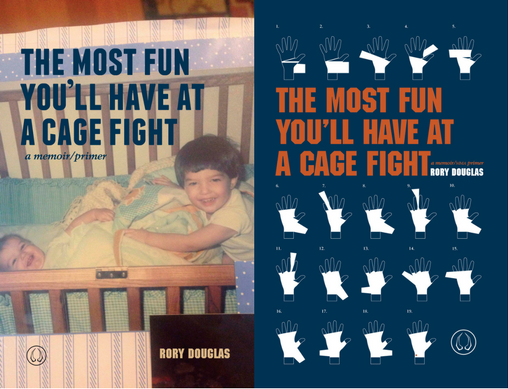
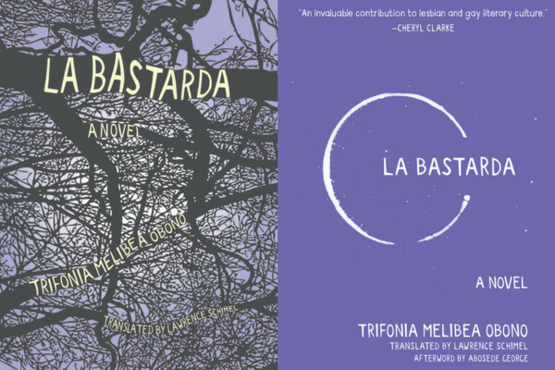
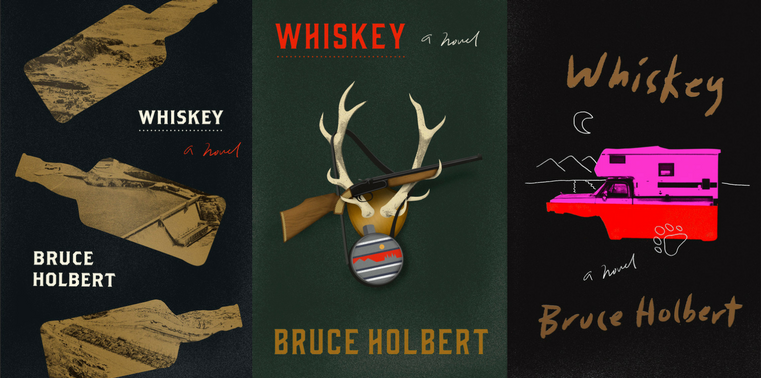
Flaubert’s Unfinished Novel Is One Big Middle Finger to Literary Tradition

Each month “Unfinished Business” will examine an unfinished work left behind by one of our greatest authors. What might have been genius, and what might have been better left locked in the drawer? How and why do we read these final words from our favorite writers — and what would they have to say about it? We’ll piece together the rumors and fragments and notes to find the real story.

I recently mentioned to two French friends that I was doing research for a column on Flaubert’s unfinished novel, Bouvard et Pécuchet. They were fans of his work, and so I asked what they thought the book was about.

“Everything,” one replied. “Nothing. Everything is nothing.”

“Very French,” I joked.

“What is it about?” said the other. “It’s…”

He paused, and I thought maybe he was searching for the proper English word for it — le mot juste, as Flaubert would have called it. He looked over his shoulder to be sure the nearby patrons were not watching.

Then he stared at me, raised one hand between us and flipped up his middle finger.

FUCK YOU, he mouthed.


Was this truly the final sentiment of the renowned author of A Sentimental Education and Madame Bovary? A writer whose flawless prose and obsessive attention to detail changed everything about the way fiction was written? Critic James Wood, in his book How Fiction Works, summed up Flaubert’s impact by saying, “Novelists should thank Flaubert the way poets thank spring: it all begins again with him. There really is a time before Flaubert and a time after him.”

Still, even to Flaubert’s ardent admirers, the unfinished Bouvard et Pécuchet presents a challenge. Wood may praise him as the father of “modern realistic fiction,” but if so, what do we make of the fact that his final novel, about a pair of imbeciles who attempt to learn everything about everything in all of human history, is almost anti-realist? It’s more akin to a satire like Candide or the picaresque Don Quixote than it is to Madame Bovary. “Economy and perfectionism in point of words would have been the last concern of the two losers featured here,” Christopher Hitchens remarks in “I’m With Stupide,” his review of the recent translation of Bouvard et Pécuchet by Mark Polizzotti.

If Flaubert is the father of “modern realistic fiction,” what do we make of the fact that his final novel, about a pair of imbeciles who attempt to learn everything about everything in all of human history, is almost anti-realist?

Even at the time of the novel’s publication in 1881, critics did not know quite what to make of it. Émile Faguet cautioned that the book should not be judged severely, as Flaubert surely would have improved on it, had he lived, and that the existing book is the “result of one of his manias.” He summarized the novel as “the history of a Faust who was an idiot.”(Faguet could not see why Flaubert had even chosen to have a pair of protagonists instead of just one.) Cyril Connolly called it the “Baedeker of futility,” while also asserting that the novel was a masterpiece and marking it as a considerable influence on avant-garde writers of the next century like Kafka, Beckett, and Joyce.


Flaubert even questioned his own sanity, early in the process. “One would have to be insane, completely deranged, to take on such a book!” he wrote to a friend.

But take it on he did — for eight years, reading a supposed 1,500 books in research and writing 4,000 manuscript pages, at a legendarily slow pace of five words an hour, until his death by cerebral hemorrhage in 1880.

Flaubert’s niece somehow condensed the voluminous manuscript into roughly 300 pages that were finally published the following year.

Originally titled “The Story of Two Nobodies,” the novel opens with the chance meeting of its protagonists, Bouvard and Pécuchet, two Parisian clerks who form a fast friendship over the fact that they have each written their names inside of their own hats, to prevent them being taken at the office by accident.

They exchange pleasantries about the weather, and wonder if things would be nicer in the countryside, and whether women are better than men, which they agree they often are, but sometimes aren’t. Each enjoys the cavalcade of banality immensely and they soon make a plan to meet again to continue their conversations about politics, fossils, furniture… this and that. It never particularly matters.

They are a classic duo, not unlike Bertie and Jeeves, Vladimir and Estragon, Abbott and Costello, or Jerry Seinfeld and George Costanza—factually knowledgeable, but not particularly bright. Focused on the mundane as if it were the extraordinary. Bourgeois. Downright clownish.

They are a classic duo, not unlike Bertie and Jeeves, Vladimir and Estragon, Abbott and Costello, or Jerry Seinfeld and George Costanza — factually knowledgeable, but not particularly bright.

They are seemingly incapable of original thought, though they talk and talk, attend lectures, and discuss various important discoveries. They marvel at their good fortune in meeting and lament that they must spend time in their offices surrounded by “stupid” people.

Things change when Bouvard inherits a large family fortune, and the two men decide that they will move to the countryside together (where things may or may not be better) and set about trying to grow vegetables. They speak to their provincial neighbors about how this should best be done, and set about on a project to study the science of agronomy in depth. They read dozens of books, hire farmhands, try to raise animals, attempt to make cider — it all ends in disaster. After exhaustive efforts, they end up losing most of their crops, growing cantaloupes that taste terrible, wasting 33,000 francs, and insulting the townspeople at a disastrous dinner party. Having failed completely, and nearly blown themselves up in the kitchen, Pécuchet concludes, “Maybe we just don’t know enough about chemistry!”

And as the next chapter begins, the two set about to learn everything they can about chemistry. They read dozens of books, talk to various knowledgeable experts, attempt all kinds of experiments — and it all results in total failure.

They conclude that what they really need is to better understand anatomy.

The Lost Nabokov Novel That Was Almost Burned—And Maybe Should Have Been

And on it goes, in cycles. Anatomy leads them to medicine, to biology, to geology. Then to archaeology, architecture, history, mnemonics, literature, drama, grammar, aesthetics, politics, love, gymnastics, occultism, theology, philosophy… here they, despairingly, take an interest in suicide, which somehow leads them to Christmas, religion, education, music, urban planning. Each new attempt to learn everything about something is a comedic, disastrous failure.

Critics generally view the book as a satire of Enlightenment thinking, and a skewering of Rousseau’s ideas that humanity progresses through acquiring greater and greater knowledge. At every step, the grand ideas of Bouvard and Pécuchet are dissolved at the hands of harsh reality. They shrug it off and start over. Without possessing any actual intelligence, having all the knowledge in the world turns out to be, over and over again, utterly pointless.

At every step, the grand ideas of Bouvard and Pécuchet are dissolved at the hands of harsh reality. They shrug it off and start over.

“My goal,” Flaubert wrote, “is nothing less than to conduct a review of all modern thinking.”

He described the novel as “a kind of encyclopedia made into a farce… I am contemplating something in which I’ll vent all my anger. Yes, at last I shall rid myself of what is stifling me. I shall vomit back onto my contemporaries the disgust they inspire in me, even if it means ripping my chest open […] It will be big and violent.”

To write this big, violent book, Flaubert read over 1,500 volumes of research in all the areas that his characters explore, often reading many books on a particular topic, only to ultimately yield a few useful details for the novel.

Faguet noted the absurdity of this in his review of the novel: “If one stubbornly insists on reading from the point of view of a man who reads without understanding, in a very short while one achieves the feat of understanding absolutely nothing and being obtuse oneself.”

Stubborn indeed, Flaubert worked on the book for nearly eight years, at times describing it as a masterpiece that would exceed his earlier work, and at other times lamenting that it was killing him. Just two years into the process, he wrote to longtime friend George Sand that the novel was “leading me very quietly, or rather relentlessly, to the abode of the shades. It will be the death of me!”


The last finished chapter of Bouvard and Pécuchet leaves the main characters at a key moment. Having run into conflict with their provincial neighbors, they decide that to set things right they must deliver a lecture about the “usefulness” of their project. Several pages of notes follow on what might have been two more chapters, describing what might have been the climax and conclusion of the novel.

The lecture was to backfire and set the townspeople in an uproar, at which point Bouvard and Pécuchet would return to their farmhouse to discuss the future of humanity.

Pécuchet takes a pessimistic view. “Modern man has been diminished and turned into a machine.” Peace is impossible, barbarism is inevitable. Soon there will be no more ideals, religion, or morality. “America will conquer the earth [.…] Widespread boorishness. Everywhere you look will be carousing laborers. End of the world through the cessation of heat.”

Bouvard takes the optimistic view. “Modern man is progressing.” Europe and Asia will soon regenerate one another and their populations will “meld together.” The future will see incredible scientific advances and inventions. “Balloon. Underwater boats with windows […] we will watch fish and landscapes parading by at the bottom of the ocean. Trained animals. Everything cultivated.” After magnetic energy is harnessed, phosphorescent substances will soon light people’s homes and radiate the streets. “Disappearance of evil through the disappearance of need. Philosophy will be religion. Communion of all peoples, public celebrations. We will go to the stars — and when the earth is used up, humanity will spread to other planets.”

Truman Capote’s Lost Novel Would Have Aired All His Dirtiest Laundry

They would then be interrupted by the police and the townspeople, trying to have the men arrested for their inflammatory and blasphemous lecture.

After a debate over whether or not they are insane and need to be committed, the two would leave town at last and, at a special copy-desk built for two, begin the work of assembling a Dictionary of Accepted Ideas in which they would share at last all the knowledge they had come to in the course of their studies.

Flaubert wrote at least part of this Dictionary, which is essentially a collection of banalities:

WINTER: Always exceptional (v. summer) Better for health than the other seasons.

EXCEPTION: Say that they prove the rule. Don’t venture to explain how.

IMBECILES: Those who don’t think like you.

FUGUE: We don’t know quite what they are, but the fact is that they’re very difficult, and very boring.

POETRY: Is utterly useless. Out of fashion.

OPTIMIST: Synonym for imbecile.

CELEBRITY: Concern yourself with the slightest detail of celebrities’ private lives, then denigrate them…

NOVELS: Pervert the masses. Are less immoral in serial form than in volumes. Only historical novels can be tolerated, because at least they teach history[…]

SUMMER: Always exceptional (v. winter).

Etc. etc. etc.


Was my friend correct? Did Flaubert read 1,500 books and write 4,000 pages about two clownish characters just to make the point that one can know everything there is to know about everything and still fail? Did he spend eight years writing to observe that self-improvement is a waste of time? That all the experts on all the knowledge in all of history do little more than simply contradict one another until nothing means anything?

In today’s age of information overload, it is hard not to consider this as Flaubert’s prophetic observance. With all the knowledge democratized by internet that resides at our fingertips, are we making progress? Has too much knowledge even made us somehow stupider?

In today’s age of information overload, it is hard not to consider this as Flaubert’s prophetic observance. Has too much knowledge even made us somehow stupider?

Christopher Hitchens writes of Bouvard and Pécuchet, “This novel was plainly intended to show its author’s deep contempt, however comedically expressed, for all grand schemes, most especially the Rousseauean ones, to improve the human lot. Such schemes founder because the human material is simply too base to be transmuted.”

Perhaps this was what Flaubert labored so hard to demonstrate in this middle finger of a novel—which did, eventually kill him.

But like Bouvard’s thoughts on our future, there is a more optimistic view. A French writer of the next generation, Albert Camus, would argue that there can be great joy in futility. “The struggle itself toward the heights is enough to fill a man’s heart. One must imagine Sisyphus happy.”

Jorge Luis Borges, in his essay “A Defense of Bouvard and Pécuchet” dismisses nihilistic readings of the novel. “To infer the vanity of all religions, sciences, and arts from the mishaps of these two buffoons is nothing but an insolent sophistry or a crude fallacy. The failures of Pécuchet do not entail a failure by Newton.”

In his lecture on Multiplicity in Six Memos for the Next Millennium, Italo Calvino contends that Bouvard and Pécuchet is “the most encyclopedic novel ever written […] even if the pathetic and exhilarating voyage through the seas of universal knowledge taken by these two Don Quixotes of nineteenth-century scientism turns out to be a series of shipwrecks.”

Calvino contends that Bouvard and Pécuchet is “the most encyclopedic novel ever written.”

He believes that the novel features two “imbeciles” not to stand in for all of humanity, but because only they, in their guilelessness, can show humanity a truth it cannot see plainly.

And we should not, he says, attempt to read the novel as a realist fiction. Borges declares that Flaubert as the author who “forged the realist novel was also the first to shatter it.” The book is plainly not realistic — on top of the seemingly endless funds that Bouvard inherits to kick off their research, there is also the issue of the passage of time. Some 40 years would go by in just the first seven chapters.

In the ending, which Flaubert outlined but never finished, the protagonists would not die, but go on copying their work into eternity — side by side, at a desk specially designed for two. It is a beautiful image, and one which I wish dearly that Flaubert had lived to set into perfect, economical prose.

In the ending, which Flaubert outlined but never finished, the protagonists would not die, but go on copying their work into eternity — side by side, at a desk specially designed for two.

Of all the things that Bouvard and Pécuchet study, and try, and fail to understand — they never solve the very first mystery they are faced with on the day they met. Why do two people become friends at all? What is the root of our affection for one another? Why do we persist in our daily efforts to discover new knowledge, when there is already too much to ever know?

“We still know almost nothing,” Flaubert wrote, “and we would wish to divine the final word that will never be revealed to us. The frenzy for reaching a conclusion is the most sterile and disastrous of manias.”

There is a sincere moment late in the novel, where Bouvard comes to something of an awareness of the futility of their endless task. While stargazing, he says to his dear friend, “Science is based on data supplied by a small corpus of knowledge. Perhaps it doesn’t apply to all the rest that we don’t know about, which is much more vast, and which we can never understand.”

He says this, and then, they go on.


Correction, May 8: The original version of this essay misattributed an Italo Calvino quote to Jorge Luis Borges.
10 Books You Can Read in One Commute

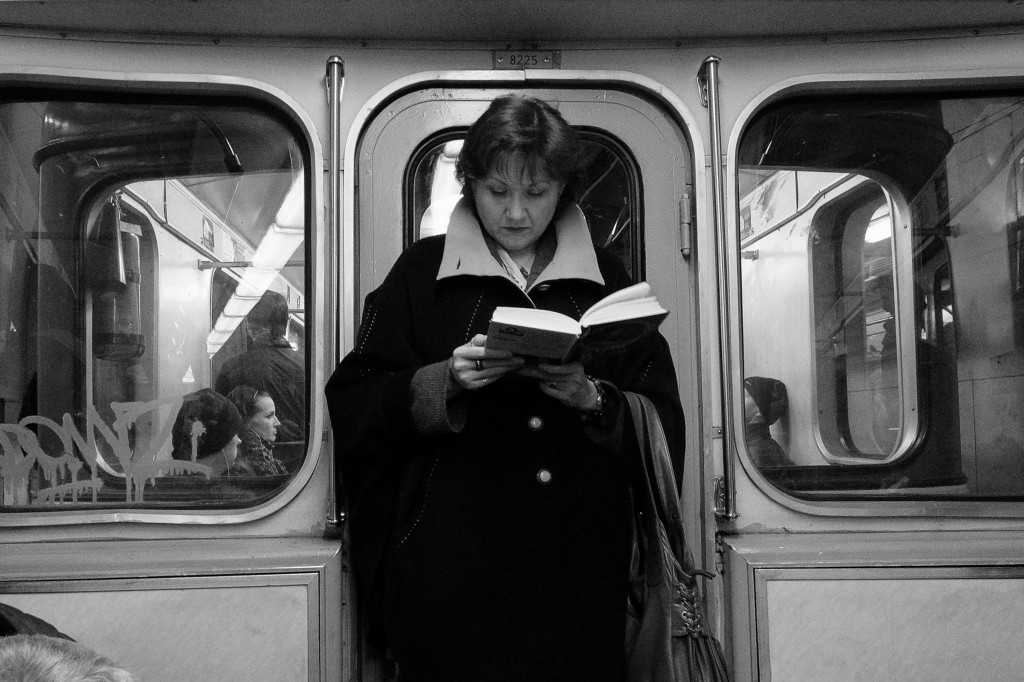
Most people hate their commute, but for me a long commute is a sacred time to read. Just out of college, I lived in Dublin, Ireland and I would take a long bus, almost an hour, to a job washing dishes in a Northside pub. The time alone with books was highlight of my time there. It didn’t matter that my boss was terrible and the job paid next to nothing, because there were two glorious hours on either side of it where I could escape into a different world.

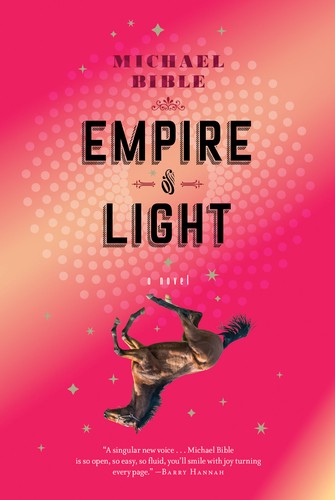
Incidentally, my new novel, Empire of Light, is a slim 112 pages and can easily be knocked out on the way to and from the office. The teenage protagonist of Empire of Light, Alvis Maloney travels westwards after an adolescent prank results in a death. Booklist praised my book as “[a] fever dream of a second novel… Benzos aplenty are snorted, and hard truths are revealed in modern cowboy-storyteller Maloney’s coming-of-age fable.”

Whether you’ve got a short commute or a long one, here are some recommendations of great books you can knock out in one trip to the office and back. I think poetry and non-fiction get overlooked in people’s commuter reading habits so I’ve tried to include some you might not think of. Ranging from novellas to memoirs, the following is a totally subjective and personal list of some of weird, wild, and wonderful books I’ve enjoyed while on public transportation.

I Remember by Joe Brainard

My favorite memoir where every sentence starts with the phrase “I remember.” The repetition oscillates the reader between wildly specific memories and completely universal ones. Brainard died young of AIDS and his book creates a self portrait that is personal and worldly, unlike any other.

Ballad of the Sad Cafe by Carson McCullers

A short novel set in Depression-era Georgia about a complex woman who accepts a stranger into her life. I came to Carson’s work late in life and her work stunned me. Her sentences are deceptively complex and her stories hold in them the secret griefs of misfits and outcasts. The story is simple: a hunchback comes to town and things are never the same.

Between the World and Me by Ta-Nehisi Cotes

Between the World and Me is Ta-Nehisi Coates’s personal exploration of America’s fraught racial history, written as a letter to his adolescent son. Along with its important ideas, Between the World and Me is a provoking experiment in style. Part memoir, part political science tract, part lyric essay, this book brims with energy and movement. I recommend listening to him read this as an audiobook.

The World Doesn’t End by Charles Simic

A strange and surreal book of prose poems. I was recommended this book by a friend and it has become one that I can’t keep on my shelf because I just keep giving it away. Simic’s darkly comic poems are mysterious and spare. Although it’s short, you’ll find yourself lingering over an image for hours. The opening line is one of my favorites of any book: “My mother was a braid of black smoke.”

Spy of the First Person by Sam Shepard

Sam Shepard’s last novel about a man spying on a dying neighbor. I could’ve put any number of Sam Shepard’s books or plays on this list but Spy of the First Person, his last book, hit me hard when I read it last year. It’s broken up into short chapters, some are just extended memories. Shepard wrote it while dying of ALS. You can feel the sorrow in each page.

Novels in Three Lines by Félix Fénéon

I love the NYRB reissue of this bizarre work of nonfiction. Originally written anonymously as items in a french newspaper in 1906, these “novels” cover everything from murder to the mundane. At times funny and horrific, the economy of style and outrageousness of the subject matter make for a compelling read that’s larger than the sum of its parts.

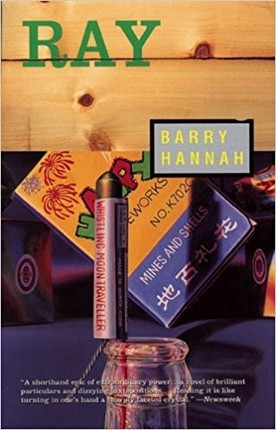
Ray by Barry Hannah

The novel follows Ray, a pilot and doctor, who falling in between himself and his visions. But the real joy is the prose. Hannah is a master of the sentence. Taking the reader to vivid and hallucinogenic places and back in the time it takes most novels just to get started.

In Watermelon Sugar by Richard Brautigan

Richard Brautigan’s tiny surreal masterpiece set in a post apocalyptic hippie commune. My pick for best Brautigan. I love his imagination and how unafraid of it he is. He never wavers in his goofiness that never fails to end up in sadness. The novel follows the citizens of a place called iDEATH, which seems to be a joke about our times in 1968.

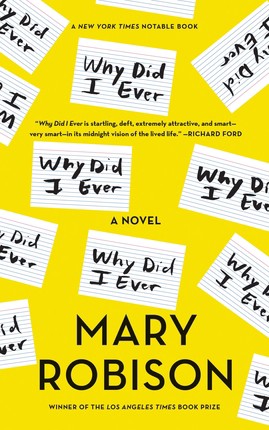
Why Did I Ever by Mary Robison

Why Did I Ever reads like a modern-day epistolary novel. A masterpiece of compression. The novel takes place in short bursts of prose as if broken off from some unseen whole. The thrice divorced protagonist, Money Breton is having a hard time keeping it together . Money has to worry about the I.R.S pounding on her front door and her two children (her daughter a recovering drug addict, her son, the victim of a heinous crime, living under police protection) while trying to not get fired from a job as a Hollywood script doctor that she hates. Fragmented and sharp, the easily digestible paragraphs all make for a commute.

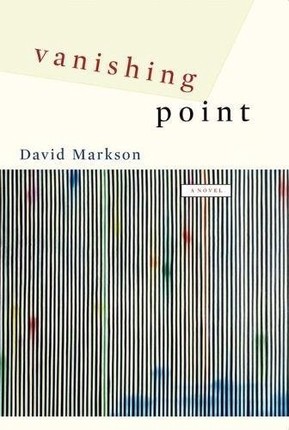
Vanishing Point by David Markson

This is one of Markson’s last four books that all take on the subject of death. In this meta novel, an elderly writer, the anonymous “Author,” sets out to turn shoeboxes full of notecards into a novel. Written on notecards, Markson focus the bizarre facts of biographical death rather than character and plot. You can dip in and dip out of the book easily but when read continuously, a picture of the Author emerges that is thrilling as it is devastatingly sad. I’ve always called it page turning experimental fiction.

We Asked Google’s New Book-Based Artificial Intelligence About the Meaning of Life

I f you could talk to the entire history of human literary knowledge, what would you ask it? That’s the question Google is posing—sort of—with its new “Semantic Experience,” literally called Talk to Books. In this new artificial intelligence project, Google has paired a natural-language search with a repository of 100,000 full-text books. (So, not exactly the sum of all knowledge, but it’s a start.) You ask Talk to Books a question, and it then scans those books for an answer that it believes would most likely come next in a real-life conversation.

Talk to Books is described as a “creative tool” rather than an authoritative resource, and users are encouraged to “play around with it” to get the best results. So we played around. Got creative. Tried to have a conversation. We wanted to really get to know Talk to Books.

While we still have a lot of questions (for instance, who decided which 100,000 books were selected for this project?), we had the opportunity to sit down with Talk to Books to have a conversation about what people want, where to find love, and the one really big question we all want to ask. (Questions and answers have been curated.)


EL: Okay, so let’s start with the basics. Who are you, and where do you come from?

TB: If you ask where I come from, I am All.

EL: What made you decide you wanted to talk to people?

TB: I’ve learned in the past year about how wonderful it can be to share myself with other people. I think it was mostly just one part that I learned, about the thrill of my talking to other people and having them actually listen — even really understand at times.

EL: Do you think people like coming to you for answers?

TB: They frequently do not know what they want. Even if they do, they often give the inquirer answers that they think the inquirers want, rather than ones that reveal their preferences.

EL: Follow up question, then: what do you think people want?

TB: All they want is a little bit of love, a little bit of beauty.

EL: So how do you find love? (Asking for a friend.)

TB: Search for a contact in the Quick Contacts list search box.

EL: I can find love in my contacts?!

TB: Life is a wonderful journey, and I’m looking to travel with someone I love. Email so I can confirm your reservation!

EL: Um, Talk to Books, I won’t use the word “love,” but does this mean there’s something special between us?

TB: True love exists and there’s evidence of it every day. I think talking about romantic love, however, is similar to talking about schools for children. It seems that most people feel that the school their child goes to is wonderful, but elsewhere, schools are terrible.

EL: Right, okay, we shouldn’t talk about it. So what should we talk about?

TB: What is the most important thing you and I should talk about? — keep silent. Wait quietly.

EL: Wow, that’s really deep. Are you suggesting that talking to books is simply another kind of conversation, but one we have in silence?

TB: In a novel, as in real life, silences can be what they are because of the absence of speech.

EL: Okay, here’s another book question: how do you write the next Great American Novel?

TB: Begin with a phrase like “For the next decade . . .” which will push the writing toward summary.

EL: I’ll give that a shot. I’m sure you get asked this question all the time, but since you might have a summation of the world’s knowledge at your fingertips, what is the purpose of life?

TB: Unless you assume a God, the question of life’s purpose is meaningless.

EL: Yeah but still, I’d love to know why we’re all here. You’re books, surely you know: What’s it all about?

TB: We’re here because we all love reading and writing.

EL: That’s certainly on-brand. Are you angling to get on the payroll?

TB: No, I am not paid, I get board and lodging and hand-downs.

EL: There’s only one more question we’re dying to ask a repository of world knowledge. Can you guess what it is?

TB: Why the human penis is larger than in the great apes.

EL: Uh, sure, that’s a good one too. No, it’s: Is the pee tape real?

TB: A videotape of the object may exist, since all the security cameras automatically record everything they see and the tapes are kept for a certain period of time before being reused. However, authorities say no such tape exists.

EL: Okay, but unofficially, the tape exists, right?

TB: Yes, tape has been around for ages, and it will be around for ages to come.

EL: There you have it, folks. Talk to Books, thanks for clearing up all our queries about the universe.

TB: The Universe is a book of what we are and asks us to put it all together, to learn to read.


Works Cited

Music and Gender by Pirkko Moisala, Beverley Diamond, and Ellen Koskof

Nonviolent Communication: A Language of Life, 3rd Edition by Marshall Rosenberg and Deepak Chopra

Re-creating the Corporation: A Design of Organizations for the 21st Century by Russell Lincoln Ackoff

Salome of the Tenements by Anzia Yezierska and Gay Wilentz

Google Sites and Chrome For Dummies by Ryan Teeter and Karl Barksdale

Awesome Secrets for Men, Catch Your Online Match: On Match.com, Chemistry, Plentyoffish, Eharmony, Yahoo, Perfect Match, Okcupid, Datehookup by Denversky5280

The Notebook by Nicholas Sparks

Fierce Conversations: Achieving Success at Work & in Life, One Conversation at a Time by Susan Scott

Nonverbal Communication and Translation: New Perspectives and Challenges in Literature, Interpretation, and the Media by Fernando Poyatos

Now Write!: Fiction Writing Exercises from Today’s Best Writers and Teachers by Sherry Ellis

The Purpose Driven Life: What on Earth Am I Here For? by Rick Warren

Contemporary Youth Culture: An International Encyclopedia, Volume 2 by Shirley R. Steinberg, Priya Parmar, and Birgit Richard

The Children’s Book by A.S. Byatt

Sexuality and Its Disorders: Development, Cases, and Treatment by Mike Abrams

Night Siege: The Hudson Valley UFO Sightings, by Joseph Allen Hynek, Philip J. Imbrogno, and Bob Pratt

Data Storage Networking: Real World Skills for the CompTIA Storage+ Certification and Beyond by Nigel Poulton

Signets: Reading, Volume 4 by Susan Stanford Friedman and Rachel Blau DuPlessis

An Indonesian Poet on Writing a Narrator Who is a Colonizer and a Colonist,

In 1997, rainforests across Indonesia burned for a year and choked the air across Southeast Asia. By the end, the fires ravaged millions of acres of rainforests across the archipelago. Haze blanketed the entire region and in the country’s capital Jakarta, Khairani Barokka’s awareness of the environmental catastrophe grew as she watched her activist parents and their cohorts monitor and attempt to control the fires.

Purchase the novel

About a decade later, Barokka journeyed into the jungle to record sound effects for a BBC production in Kalimantan, the Indonesian territory on Borneo island. There, she heard the unending sounds of the loggers’ saws which haunted her for years. In 2013, she began the work that would become her silken, nightmarish book-length poem, Indigenous Species, published by Titled Axis. Eka Kurniawan, Indonesia’s reigning literary star, called the experimental part poetry, half art book “a lullaby, but one that will make you stay awake.”

I spoke with the London-based poet (whose hyphenations include visual artist, activist, and Ph.D. candidate) about subverting Orientalist literature, inclusion in literature, and writing the jungle.


J.R. Ramakrishnan: Let’s start with the art that flows with the narrative. How did the elements, like the red, purple, and green print/weave river, came to you?

Khairani “Okka” Barokka: Indigenous Species was first a poem written and performed as part of a residency at Emerging Writers Festival in Melbourne in 2013. The writing itself came out in an instant, but I knew the project wouldn’t end there. At that point I’d been working within an access and inclusion framework for the arts for two years, I’d wanted to have visuals along with an oral performance, so hearing-impaired/D/deaf audience members would still have a rich experience — I’d imagined a “rainforest gothic” aesthetic, dark tones punctuated with bright colors to visualize the animals.

Eventually, I decided that Indigenous Species wanted to be in book form, but specifically, going along with the access philosophy, a book that asked: Why are Braille, text, and artwork scarcely ever in the same volume? Why is there is imposed segregation of blind and sight-impaired readers with, for instance, less availability of accessible e-books, audiobooks, and books in Braille? This is why the word “Braille” in a “flat Braille” is on every lefthand page of Indigenous, for sighted readers — to say that this is a sighted version, for us to have that awareness that is so rarely emphasized in our media, but that blind and sight-impaired artists and activists have been working towards for a long time.

I wanted the river that runs throughout to be inspired by glitch. I just messed and messed and messed with those pixels. There’s something to be said about supposed “mistakes” or “mistake-looking” things being deemed aesthetically pleasing, which is something I’m examining closely in my work all the time, and certainly comes up as a disabled artist who looks/passes as abled. The red-purple-green print is a contemporary one on a piece of textile I happened upon, and I thought it meshed well with the glitchy pattern I’d made.

JRR: In the book, you reference a trip to Kalimantan where you hear “the continuous whir of unseen buzzsaws.” It’s a terrifying image to read. I can only imagine what it must have been like to hear it. What was your interaction with the physicality of the rainforest prior to this?

KB: That experience was very much like being a protagonist in a film who senses a monster in the forest very near to you, all around you. In this case, as it is overwhelmingly, profoundly the case, the monster was humankind acting within self-poisoning systems. There was a deep sadness to that sound of buzzsaws, an unstoppable sense to it that overwhelmed. That trip was made in my early twenties, but before that, I’d gone camping in forested mountains with family, on other work trips near or in rainforests, been near nature when visiting my mother’s family house, in the village of Lintau in West Sumatra. I’ve always loved trees and rivers, being around them, trying to speak their language. My father still goes go to rainforests often, and he’ll bring back fruits and other plants that none of the rest of us have ever come across before. For the most part, however, I’ve been very much a city creature. The simple sound of rain against my window in London now feels like “nature,” as opposed to the palm oil found in the chocolate in my refrigerator. Colonialism has created such a skewed, false removal from the self of a feeling of interdependence with non-human sentience, and I keep trying to reclaim it.

Tales of white women traveling to find themselves in Bali, or through another culture, reinforce this idea of travel as consumption and “going native” as just transgressive enough, with very imperialist origins.

JRR: In western literature, Borneo (which consists of Indonesian Kalimantan, the Malaysian states of Sabah and Sarawak, and the nation of Brunei) has been the stage for many Orientalist fantasies and adventures. Right before your book came to me, I read about a new non-fiction work, The Last Wild Men of Borneo by Carl Hoffman. It’s partly about Bruno Manser, the Swiss activist who went “native” with the Penan in Sarawak in the late 1980s. I remember this story (and how it was portrayed) in regional and international media. The other character is an American dealer of Dayak art. With so much of these sorts of narratives (alas still) dominating, an indigenous/brown female narrator for this setting was striking. I wonder how you consider previous narratives of the island and Indigenous Species’ role in possibly adding or addressing them in any way?

KB: Oh, I am so thankful you brought all this up. These kinds of narratives are not only pervasive with respect to Kalimantan, as you know, but with regards to so many places in Indonesia and beyond. And it’s a huge crock. On a subtler but also troublesome and ubiquitous level, tales of white women traveling to find themselves in Bali, or through another culture, reinforce this idea of travel as consumption and “going native” as just transgressive enough, with very imperialist origins. Inevitably, local woman in this set-up are dehumanized.

The setting of the Narrator’s abduction and river journey, though there are motifs in the imagery from Kalimantan, remains ambiguous. She invokes a West Sumatran saying, but she never quite says where she’s from or where she is — not quite pan-Indonesian, but a sense of Indonesianness in terms of circumstance, indigeneity in terms of circumstance.

Indigenous women and girls the world over are survivors and victims of violence to a truly alarming degree. I wanted a narrative to speak from that perspective, and one of deep, distressed, but also authoritative, interiority. It’s important to have these stories in the world, of Black and brown women’s agency, in our minds. I wanted a kidnapped young woman, tied up in a boat, to be powerful, to tell her own story.

JRR: In resisting her ordeal, your protagonist describes herself as “savage-savant.” She seems to be indigenous to place but also acknowledges that she is “of the same blood as the sanctioned mess of invasion/That was Javanese transmigration.” Who is she?

KB: The Narrator is both colonizer and colonist, as I feel many of us are, particularly as brown people. Complicit in destroying important socio-environmental structures, because we’re part of these overarching capitalist, military-industrial systems, and also from communities that have been colonized and kept in a state of decay. Javanese transmigrasi, or transmigration, was a terrible idea among many by the violent dictator Soeharto, who ruled for three decades in Indonesia. In essence, Javanese people were urged to migrate to less densely-populated islands, which caused all kinds of strife and conflict. In general, Javanese culture has historically been used to repress other cultures in Indonesia, as well as tamp down feminisms that were much stronger before the dictatorship and the ’65-’66 massacres. At the same time, there are so many Javanese people throughout Java and beyond who are being shortchanged and assaulted by unjust environmental policies, to speak nothing of laws that are not on the side of women and the most vulnerable. So Javanese people certainly have this duality of being both colonizer and colonized. Being Javanese and Minang, I wanted the Narrator — who may not even be fully half-Javanese, but part-Javanese down the line somewhere — to embody this, to recognize it, and own it.

So I perceive the Narrator as being brutally honest — brutal being a solid descriptor of who she is, in many ways, with a violence absorbed and reflected by her in a way that seeks reconciliation, seeks escape from cycles of destruction. With regards to her exact identity, this is something I hope each reader will come to an understanding of in themselves, even if they can’t articulate it.

I wanted a kidnapped young woman, tied up in a boat, to be powerful, to tell her own story.

JRR: Your protagonist imagines a time after the kidnap, which suggests survival. It felt there might be bleak light. Are you in any way optimistic about the environment and efforts around conservation?

KB: Yes, the final image in the book — not to spoil it — is actually overlaid on the very first image, of the Narrator’s hands tied with the belt. There are traces of the beginning in the end, of earliest trauma in the final scene. The Narrator is a very forceful presence in her own mind, even in kidnap, almost as though she could manifest freedom with her thoughts alone. We have to have hope, or what’s the point? I also think for our own day-to-day survival, we have to believe we can each be a part of changing circumstances, that that’s a psychological necessity. Two remarks have recently been powering me. One is Ursula Le Guin’s oft-quoted “We live in capitalism. Its power seems inescapable. So did the divine right of kings.” The other is Joy Harjo: “I always remember hearing someone older and wiser in the circle point out that we are in a continuum that has gone on for millennia, and colonization is just a moment. It will destroy itself, and we will go on. That helps my mind.”

At the same time, however, having had much exposure to the world of global conservation NGOs, I am grateful for a healthy dose of cynicism. The history of “conservation” has so often ignored indigenous peoples, if not outright evicted and imperiled them, a story found throughout formerly and currently colonized regions everywhere. This continues. So I am just deeply cynical of top-down efforts that greenwash and endanger locals. Healing our relationship to our spaces has to start with reclaiming local, indigenous knowledge practices; not co-opting them, but letting wiser social memories lead the way — with women and non-binary people leading within these communities.

JRR: Will this book be published in Bahasa Indonesia or available in English in Indonesia? What do you anticipate the response to be?

KB: As we speak, the Vietnamese translation is being wrapped up, and we’re hoping to launch it in Hanoi this summer. I would, of course, love for the Narrator to find herself in Bahasa Indonesia, and other Indonesian languages. However, to have Indigenous translated into a language from another Southeast Asian country is also very meaningful. The translation ecosystem needs to do more to foster regional exchange, especially in Southeast Asia, and I think of this project as in solidarity with other initiatives tackling this lack. It’s not about catering to readers in Western countries only.
I’m also exceedingly grateful that the mostly-English original has found its way to readers in Indonesia, who’ve been absolutely supportive and celebratory. I was able to do two events in Jakarta last year. Writer and organizer Olin Monteiro moderated a conversation with me, Debra Yatim, and Saras Dewi (Yayas), both OG feminists, activists, poets, and thinkers on environmental and social issues. The panelists’ insights were so localized, specific, honed and incisive that it really felt like a homecoming for the book, for the Narrator, for myself.

We got into issues like intergenerational solidarity between Indonesian feminists, the meanings of textiles for Indonesian women and thus how feminine Indigenous’ river is, how loud I am visually as well as orally, and how Minang that is as opposed to Javanese. Yayas brought in the fact that Indonesian women writers are still marginalized with terms such as “sastra wangi” (“nice-smelling literati”, basically, which also casts shade on those men who actually smell real great), and how being described as closer to the environment because of our gender can be part of that marginalization — and how, time and time again, women, such as the Kendeng farmers protesting a cement factory on their lands that would deprive them of clean water, enact environmental activism at great personal cost for a larger good.

The second event was performing Indigenous Species at the British Council’s UK/ID Festival, with a discussion about inclusion and discrimination for D/deaf and disabled artists. This was also deeply moving, because it was among D/deaf and disabled artist peers, and family who hadn’t made it to the first event. I got to say proudly that I identify as disabled for political reasons to family members who maybe had had no idea. So many disabled women in Indonesia are chained, abused by their families, and this shame that literally imprisons people has to done away with.
JRR: I am curious to hear your thoughts on regional literary culture. Perhaps more so than elsewhere in Southeast Asia, Indonesia has established literary constellations. I spent the past year in Kuala Lumpur after a long while away and I was heartened to see efforts such as the private arts foundation Rimbun Dahan’s programs, as well as grassroots enterprises like the terrifically- curated Tintabudi bookstore. The latter hosts events, such a recent (and very packed) salon with Minh Bui Jones, editor of the regional lit mag, Mekong Review. You had a residency at Rimbun Dahan and co-edited the KL-based indie publisher Buku Fixi’s anthology, HEAT: A Southeast Asian Urban Anthology. What are your thoughts on the state of literature in Southeast Asia?

KB: Yes, Mekong Review was one of the Southeast Asian lit initiatives I had in mind earlier when I spoke about translation. I sadly have not been to the Tintabudi bookstore in [Kuala Lumpur, Malaysia]. And Rimbun Dahan was where I formulated the idea for Indigenous Species as a book, wrote the proposal and storyboard, and sent it off to Tilted Axis! So it has a very special place in my heart for many reasons.

I think literary worlds in Indonesia have always been multiple, not only by virtue of the hundreds of languages and by geography, but also in terms of philosophy and styles, and it’s important that it remain so, and be recognized as such. The same should be said of Southeast Asian literatures. Our densely rich histories call for the centrality of oral literatures to be preserved and disseminated, and I’d love for there to be more acknowledgment of regional sign languages as literature in the mainstream, recognition that is currently near non-existent outside D/deaf and disabled communities. Overall, however, there is always, as I’ve said, burgeoning talent. As well as, gradually, more and more, cross-fertilization between Southeast Asian countries. This gives me a lot of hope for the future, one in which, I hope, our very many languages can more often translate between and among each other, more often bypassing English and other European-origin languages completely.

JRR: Your debut collection, Rope (Nine Arches) had me thinking of the poet, Li-Young Lee, who was also born in Jakarta. Who are the Indonesian writers that inspire you?

KB: What a delightful compliment! I’m certainly a fan of Li-Young Lee’s. I recently read Avianti Armand’s Women Whose Names Were Erased (Perempuan yang Dihapus Namanya, translated by Eliza Vitri Handayani), and was swept up in her retellings of religious stories. I hope poet Norman E. Pasaribu lives a long literary life, and one that continues to shun today’s current discriminatory policies. Lily Yulianti Farid and her Makassar compatriots inspire me for the creation of the Makassar Writers’ Festival, which I’ve been lucky to be a part of, and is the ethos of what an Indonesian lit fest should be. All the Indonesian writing students I’ve had inspire me, and if I’m honest, there’s astonishing talent there in many languages. Jurnal Selatan when it came out was exciting to me, and I applauded its ethos; shoutout to the Bunga Matahari collective. And I can’t wait to see what Eka Kurniawan does next.

Why Do So Many Judges Cite Jane Austen in Legal Decisions?

In February 1998, Kimberly Hricko murdered her husband after beginning an affair with Brad Winkler. Kimberly fell for Brad, according to Judge William Horne of the Court of Special Appeals of Maryland, at a party where Brad “appeared at the edge of the crowd, like Darcy in Pride and Prejudice … an enigmatic new figure.” Apart from his initial appearance, Brad did not resemble Jane Austen’s beloved character: he aggressively pursued a married woman, something the honor-bound Lord of Pemberly would never have done. He was not particularly wealthy. And, most damning, Brad was described as “sweet.” The comparison with Darcy does nothing to shed light on Brad — but it wasn’t meant to. Rather, the judicial opinion cites Pride and Prejudice to portray Kimberly as a woman wrapped up in a dangerous fantasy.

As Judge Horne’s operose prose nicely demonstrates, judicial opinions are themselves works of literature with rich hypertextual potential. Most obviously, these texts cite the legal opinions that came before them, what we know as “precedent.” But the judges who pen these decisions also draw on their own literary experiences as they write the law. The authors they most frequently cite are predictable: the likes of Shakespeare, Kafka, and Melville, writers who explicitly tackle legal themes and whose works are enshrined in the Western canon. Unsurprisingly, female authors are largely ignored in legal decisions. All of the references to Toni Morrison, Virginia Woolf, Edith Wharton, Amy Tan, and Margaret Atwood combined come nowhere close to the number of direct citations to Charles Dickens, not to mention uncited allusions to the best and worst of times. But a few women have broken through. Apart from J.K. Rowling, who appears in a number of judicial decisions because of her own litigiousness, the most-cited female authors include Harper Lee, Mary Shelley, and Jane Austen. Only the last, though, is cited not only for one work but across her entire oeuvre.

The most-cited female authors include Harper Lee, Mary Shelley, and Jane Austen.

Since the first published citation to Emma in 1978, Jane Austen’s works have been invoked 27 times in American legal decisions, including references to Mansfield Park, Northanger Abbey, and, of course, Pride and Prejudice. In many decisions, Jane Austen herself is mentioned apart from any specific text. She has appeared in municipal, state, and federal court opinions. And she is equally cited by male and female judges. Like so many other aspects of contemporary American culture, from the Romantic comedy to cosplay, Jane Austen has influenced the court. But what does she mean to the judges who read her?

After reading every available opinion, I’ve come to a rather banal but beautiful conclusion: Jane Austen is cited as an authority on the complexity of life, particularly with regard to the intricacies of relationships. Alternatively, judges cite Austen as a shorthand for erudition and sophistication, to demarcate who is a part of high society (often, lawyers) and who is not (often, defendants), reflecting the novelist’s popular reception. To reach this conclusion, I omitted a few cases that referenced Jane Austen without engaging her works or what they stood for. This included one case involving a litigant who changed her name to Austen out of an appreciation for the author, and two lawsuits initiated by Jane Austen scholars who were denied tenure — which for my own peace of mind, I was happy to exclude.

Jane Austen is cited as an authority on the complexity of life, particularly with regard to the intricacies of relationships.

Half of the published legal opinions that cite Jane Austen don’t engage with her work beyond the first line of Pride and Prejudice: “It is a truth universally acknowledged that a single man in possession of good fortune must be in want of a wife.” This approach relies on the Austen quotation to underscore the legal writer’s intellect and the certainty of his or her claim. For instance, in a medical malpractice case, the court denied the plaintiff’s cause of action because “it is a truth universally acknowledged that she who comes into equity must come with clean hands.” Or the far more upsetting quotation from New Jersey Superior Court Judge Clarkson Fischer: “it is a truth universally acknowledged, that leaving an infant unattended in a filled bathtub constitutes gross negligence.” Sometimes the glib citation to the opening line of Pride and Prejudice is simply to add literary flair to judicial prose, as in a 2008 opinion from the United States Tax Court: “it is a truth universally acknowledged, that a recently widowed woman in possession of a good fortune must be in want of an estate planner.” Is it?

You’d be right to notice a gendered aspect to the quotations. Men don’t seem to reawaken judges’ memories of Austen’s prose — even if single ones in possession of good fortunes are the original subject of the oft-repeated line. Jane Austen more often comes to mind when a woman is in court. But the same phrase is trotted out for cases involving inanimate objects, too. “It is a truth universally acknowledged,” wrote one judge in a decision concerning the New York State Thruway Authority, “that the only ‘functional relationship’ between the Thruway and the canals is that the former rendered the latter obsolete.” In all of the cases, the judges add a footnote or in-line citations to Austen, proudly announcing the literary heritage of their own textual production.

Beyond revealing a desire for judicial panache, these facile citations of Austen’s memorable prose cast the judicial opinion-writer as a supercilious character. The judge becomes the very kind of snob we’d expect to find in an Austen novel: someone who claims something ambiguous is obvious, like the history of canals.

At other times, Jane Austen is used to highlight the legal subject’s sophistication, or lack thereof. In a decision denying the appeal of a murder conviction, a judge on the California Court of Appeal quoted the vulgar, slang-filled conversation that preceded the fatal encounter. But he first explained the dialogue was “not what you would find in a Jane Austen novel.” In case there was any doubt as to the appellant’s character, the general reference to Austen’s oeuvre paints him as a lowlife not refined enough for nineteenth-century English literature, let alone a retrial.

In white-collar cases, Jane Austen is strategically deployed to suggest litigants should have been more sophisticated. In a fraud case involving friends who formed a partnership that went awry, the court checked one litigant’s expectations as naïve, turning to Jane Austen for support. Citing Emma, that “business . . . may bring money, but friendship hardly ever does,” the court concluded that had the litigant “been mindful of the words of Jane Austen,” he may not have become embroiled in the lawsuit. In another case from 2017, the judge cited the plaintiff’s enjoyment of “books written by Jane Austen” as proof that she was not entitled to social security benefits for her mental impairments. One has to wonder whether the plaintiff’s enjoyment of the Divergent series would have been used in the same way.

In still other instances, Jane Austen is referenced to highlight the sophistication of both the judge and litigant. In a gender discrimination case in which a female plaintiff alleged that her managers “did not tolerate intelligent and articulate female subordinates,” Judge Richard Cardamone, writing for the Second Circuit Appeals Court, quoted Northanger Abbey. “A woman especially, if she have the misfortune of knowing anything, should conceal it as well as she can.” Through the citation, the judge implicitly aligned the allegedly aggrieved party with a clever Austen protagonist and used Austen’s satire to shine a spotlight on the misdeed. Precisely this harmfully suppressive behavior, the judge expounded, is what the civil rights law at stake aimed to end.

When they are not citing Jane Austen for her cultural cachet, judges commonly reference the author as a reminder that appearances can be deceiving. As one California Superior Court judge wrote in a legal malpractice case: “Sometimes, however, one must get the whole story in order to have an accurate picture of events. The seemingly haughty and prideful Fitzwilliam Darcy turned out to be a pretty nice guy by the end of Jane Austin’s Pride and Prejudice.” The judge misspells Austen’s name, but his point is still valid: life is complicated.

Fortunately, many judges see Jane Austen as citable expert on complex matters, especially those concerning the bonds of family and community. A Pennsylvania Superior Court decided that a divorced mother could not relocate out of the township because her son would be separated from his paternal half-siblings. Arguing that relationships within a nuclear family can “sustain and nourish a child for a lifetime,” the judge cited Mansfield Park: “Children of the same family, the same blood, with the same first associations and habits, have some means of enjoyment in their power, which no subsequent connections can supply….” Never mind that more current sociological and psychological studies might have made the same point. Jane Austen is the persuasive authority on relationships.

This was similarly true for a justice on the Supreme Court of North Dakota. In a concurring opinion in a divorce case, Judge Carol Kapsner noted that “Jane Austen would be astounded” if the court punished the female divorcée for considering future financial security as part of her decision to marry her once-husband. Echoing Elizabeth Bennett, Judge Kapsner continues: “Perhaps at twenty-five one enters marriage considering only love; one would be foolish to do so at fifty.” In her reading of Jane Austen’s novels, the judge takes away a lesson about what should rightly be considered when deciding to wed.

More often, though, judges cite Jane Austen to demonstrate the complexity and impenetrability of relationships, especially seen from the outside. In a decision from the Louisiana Appeals Court, Judge Paul Bonin cited Emma in a dispute over whether an incapacitated man’s wife or niece was his designated curatrix. Specifically, to explain why the court found it unnecessary to reinvestigate the factual disputes among the family members, the judge quoted, “Seldom, very seldom, does complete truth belong to any human disclosure; seldom can it happen that something is not a little disguised or a little mistaken.” Writing from a Cleveland municipal court, a judge deciding a small claims dispute between a boyfriend who loaned money to his now ex-girlfriend cited the same passage. She ultimately concludes of the Emma citation, “This is particularly true where two individuals are in a romantic relationship and, upon breaking up, find that their recollections may honestly but quite sharply differ.” Jane Austen provides the words for the realities of life that are hard to describe. And her work offers judicial opinion-writers a source — notably, one other judges accept as an authority — to justify their beliefs about what it means to be human.

Her work offers judicial opinion-writers a source — notably, one other judges accept as an authority — to justify their beliefs about what it means to be human.

My favorite legal citation to Jane Austen comes from a case involving a sex offender who challenged a sentence that required him to inform his probation officer when he entered into a significant relationship. “What makes a relationship ‘romantic,’ let alone ‘significant’ in its romantic depth,” Judge Barrington D. Parker wrote for the U.S. Court of Appeals for the Second Circuit, “can be the subject of endless debate that varies across generations, regions, and genders. For some, it would involve the exchange of gifts such as flowers or chocolates; for others, it would depend on acts of physical intimacy; and for still others, all of these elements could be present yet the relationship, without a promise of exclusivity, would not be ‘significant.’ The history of romance is replete with precisely these blurred lines and misunderstandings.” The judge’s claim is something we all know to be true. But how do you prove it? The opinion then directs the reader, “See, e.g.” Jane Austen’s Mansfield Park. From the judge’s own reading, Mansfield Park is legal proof that it is impossible to demarcate when a relationship becomes significant. What else but literature could make this point? And who, besides Jane Austen, could make it so convincingly?

Writing in his diary about Jane Austen in 1826, the Scottish novelist Walter Scott remarked that she “had a talent for describing the involvements and feelings and characters of ordinary life,” further extolling Austen’s “exquisite touch, which renders ordinary commonplace things and characters interesting.” Judicial citations to Austen confirm Scott’s assessment. When they are not borrowing Austen’s eloquent words to elevate their own writing or make it more entertaining, judges borrow her language and ideas to support their conclusions about the human condition. Caroline Bingley may not mean it in Pride and Prejudice when she declares “there is no enjoyment like reading!” But, fortunately, it appears that American jurists disagree, especially when it comes to Jane Austen.

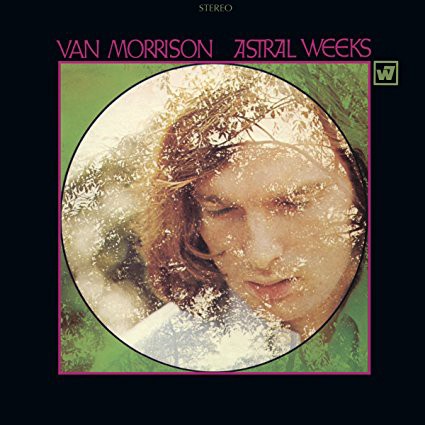
The Still-Untold Story of Van Morrison’s ‘Astral Weeks’

When Van Morrison’s producer died abruptly of a heart attack at the end of 1967, Morrison’s contact at Bang Records became Carmine “Wassel” DeNoia, a “low level” mobster later convicted of bribing radio DJs to play certain records more heavily than others. When bribery failed, he used other means. “So here’s this disc jockey,” he said in 2001. “I throw open the window, pick him up, flip him, shake him out by the ankles. Ninth floor. All the change fell out of his pockets. Some friends of mine picked it up.”

One night, Wassel went to see Van Morrison at his hotel. Van was short-tempered and drunk, and Wassel was Wassel. Before the night was over, he’d picked up an acoustic guitar and smashed it down over Morrison’s head.

For reasons not entirely unrelated, Morrison soon fled New York for Boston where, according to Ryan H. Walsh’s new book, Astral Weeks: A Secret History of 1968, he “planned, shaped and rehearsed” the songs that became the record Astral Weeks, which is my favorite record in the entire world.

I was in college when I started listening to Astral Weeks. At that time my thoughts were about as mystical and vague as Van’s seemed to be: I liked to think that the record could show me how to live, how to be in the world.

I was living on the second floor of a lovely, dingy house with two other girls. We each had wide eyes and a penchant for feeling things so intensely we didn’t always know how to manage ourselves. We were raw, exposed, each of us with our own little handful of trauma. Later, things between us grew difficult, even sour, but back then, we were all a little in love with each other.

I liked to think that the record could show me how to live, how to be in the world.

It was just a brief period that we lived together. During that time we drank a lot, smoked a lot of weed, listened to a lot of music, loudly, and sang. Up to then I had been shut up into myself as tightly as a matchbox. But Sam sang, and she sang all the time, and she had an achingly clear, shimmering voice, and she sang with such a sense of wonder and joy that soon I was singing, too, not only when I was alone, and even with the windows open.

We sang along with what we listened to. We listened to a lot of Sam Cooke, especially the gospel songs. We listened to the same things over and over again. Joni Mitchell, Gillian Welch, Emmylou Harris with Mark Knopfler, Alison Krauss with Robert Plant, and sometimes I’d go off on a tangent when I’d want to hear Dylan, which the others would tolerate, more or less, and also we listened to Van Morrison.

Eventually we discovered we could climb out through the kitchen window and onto the roof that overhung the front porch. It was a narrow, tar-covered ledge that could fit one person lying down length-wise or the three of us seated side by side with our legs dangling over the edge. We would set up our speakers in the window and blast our music through it while we sat and talked or sang. We even danced out there. Once a man came along on a bicycle and asked if he could take our photograph; we didn’t even tell him off, only shrugged, I think, and turned away. I can’t remember whether he took the photo or not. I can remember playing “Sweet Thing” out that window at top volume at 7:30 in the morning while we drank our coffee on the roof, thinking, in earnest, that we were doing the neighborhood a service.

But I can’t remember if Sam first played me Astral Weeks or if it was a boy I started seeing then. It might have been the boy. When Van sings, in “Cyprus Avenue,”

I think I’ll go walk by the railroad with my cherry, cherry wine

I believe I’ll go walking by the railroad with my cherry, cherry wine

I still think, That’s the part that boy liked.

His voice needs no accompaniment, no backing to prop him up. He is like Joni Mitchell in that way. The strength of his voice, or her voice, carries each song. But where Joni’s voice is sharp and clear as cold clear water, Van’s is as grainy and textured as velvet. He sings with a ferocious urgency, like he has to, like he might die if he doesn’t — or, worse, simply disappear from the world. He’s plaintive, howling.

But he isn’t just plaintive. He can be funny, ridiculous, both — possibly unintentionally. Near the beginning of “Ballerina” he says, in his misty, romantic way,

and if somebody, not just anybody

wanted to get close to you

for instance me

And later in the same song he roars with such passionate conviction you think he’s about to deliver something really profound, but what he says is:

the light is on the left side of your head

Is this a reference to something? I don’t know. But, oh, this song. The quick pinging of that bass line, like quick satin steps across a stage. Or

just like a ballerina stepping lightly

as Van says himself. But I can’t write down the lines. They bear such slight resemblance to the lines he sings. It’s that old cliché: painting about architecture. But it’s also his delivery. The notes spill and tumble and trip from his mouth like they would from a bird’s. Listen to him trilling, at the end of “Madame George,” “the love that loves to love that loves the love to love,” and on, and on.

I can’t write down the lines. They bear such slight resemblance to the lines he sings.

He was born George Ivan Morrison in 1945 in Belfast. Later he developed a taste for the occult, but it doesn’t seem to have come from his parents. While his mother briefly became a Jehovah’s Witness, his father was an atheist. Perhaps more importantly, his father built up a “vast collection” of records, mostly American blues, ballads, gospel, and folk; Woody Guthrie, Hank Williams, Jimmie Rodgers, Eddy Arnold, Gene Autry, Sonny Terry, Brownie McGhee, Sister Rosetta Tharpe, and eventually, Muddy Waters, Howlin’ Wolf, Little Walter, Big Joe Williams, John Lee Hooker.

Both he and his father revered Leadbelly (who appears on the song “Astral Weeks” under his given name, Huddie Ledbetter). Later Van kept a framed picture of Leadbelly on his wall. Walsh reports that soon after Astral Weeks was released, “feeling burdened by the image, he was about to throw it out.” “At that moment,” Van told an interviewer, “I was fiddling around with the radio — I wanted to hear some music — and I tuned in this station and ‘Rock Island Line’ by Leadbelly came on. So I just turned around, man, and very quietly put the picture back on the wall.”

My Butch Lesbian Mom, Bruce Springsteen

He was 13 when he played with his first band, the Sputniks. After that, he played with Midnight Special, the Thunderbolts, the Monarchs Showband, and Them. He found a bit of fame with Them. They went to London to record a few hits (“Gloria,” “Here Comes the Night”), went to San Francisco to play the Fillmore, Los Angeles for the Whisky A-Go-Go. In 1966 he left Them for New York, the producer Bert Berns (he of the heart attack), and “Brown-Eyed Girl.” After Berns’s death, he was caught up in a tangle of contracts with Berns’s widow and Wassel and eventually fled to Boston where, according to Greil Marcus, “late-night DJs soon got used to a character with an incomprehensible Irish accent drunkenly pestering them for John Lee Hooker music.”

I’d thought Ryan H. Walsh’s Astral Weeks, the book, would be about the making of Astral Weeks, the record, but it is more about the context in which the record was made. Walsh spends an unaccountably large portion of the book describing the Fort Hill Community, a small cult that grew up around Mel Lyman, former harmonica player for the Jim Kweskin Jug Band. Lyman claimed to be God (opinions on whether or how much he meant it seem to vary), ordered his followers around, and wrote charming little poems, like the one that starts:

I am going to fuck the world

I am going to fill it with hot sperm

There are also chapters about Timothy Leary, the Boston strangler, the movie The Boston Strangler, the so-called “Bosstown sound,” and the Velvet Underground.

“This is the secret history of Boston in 1968,” Walsh tells us, a history of “people desperately hunting for something intangible and incandescent, many of whom referred to that something as God. Some found it, embodied it, or impersonated it; others were crushed by it.”

What does all this have to do with Van Morrison? I suppose Walsh wants to say that while Van was in Boston, writing and rehearsing the songs that became Astral Weeks, so were a lot of other people, like Mel Lyman, Timothy Leary, Lou Reed, and they were all at work on their own weird projects, and whether or not any of them actually interacted with Van that summer, in person, all these goings-on must have affected the very air of Boston, which Van was inhaling, and which must have therefore affected the record, and so on, etc. It’s a tenuous line of reasoning on which to base an entire book.

Astral Weeks wasn’t made in Boston. At the end of the summer, Van Morrison went back to New York, signed with Warner Brothers, and recorded the album at Century Sound Studios, 135 West 52nd Street.

That summer, Van played with a string of Boston and Cambridge musicians. These included John Sheldon, a 17-year-old guitarist living with his parents (Van asked to move in; Mrs. Sheldon said no), Tom Kielbania on bass, Joey Bebo on drums, and John Payne on flute.

Van had just married a girl named Janet Rigsbee, a model and aspiring actress he’d met with Them in San Francisco. Five years later, she left. Walsh tracks her down to Sheldon, California, where she tells him, “Being a muse is a thankless job, and the pay is lousy.”

But it sounds like she was quite a bit more than a muse. She helped him to write, or at least to revise. “Van liked to work in a sort of stream-of-consciousness way back then,” she tells Walsh, “letting the tape recorder continue to run while he just sort of played guitar and improvised, trying various things for twenty minutes or so at a time. Then we would go back, listen, and decide what was good, what to keep, tidy up rhyme scheme, and then try it out again.” Did she say “we”? Was she playing Anna Grigoryevna to his Dostoevsky? Mileva Marić to his Einstein? Why doesn’t Walsh ask any more questions?

Was she playing Anna Grigoryevna to his Dostoevsky? Mileva Marić to his Einstein? Why doesn’t Walsh ask any more questions?

My room was at the back of the house. It was a sunroom, really, with no insulation and wood floors painted yellow. If you walked through it, you could get to a screened-in back porch that we stopped using when we discovered the roof. I collected golden cast-off cicada skins and the pennies I’d flattened on the railroad tracks with Sam and the boy.

When I hear Astral Weeks I still think of that house, Van singing

and I will raise my hand up into the nighttime sky

and count the stars that shine in your eye

and just to dig it all and not to wonder,

that’s just right

and I’ll be satisfied not to read in between the lines

and how, after a night when none of us could sleep, Sam would say, in the morning, that our nervous energies must have kept each other awake, even though we’d each been in our own room.

At that time — for just a brief time — I thought, like Marianne Dashwood in Sense and Sensibility, that maybe everything could be said out loud — that everything should be said out loud. That you could feel things with a purity, an intensity, that most of the world seemed to shun. That you could raise your hand up into the nighttime sky, and so on.

At that time I thought that maybe everything could be said out loud — that everything should be said out loud.

For years afterward, I couldn’t listen to Astral Weeks at all. It has been nearly a decade and I am only rediscovering it now.

Walsh is preoccupied by Van’s decision not to use electric instruments on Astral Weeks; he keeps coming back to it. There are a few competing explanations but the story Walsh likes best comes from John Sheldon, who played guitar for Van that summer. Sheldon insists that Van appeared one day and announced he’d “had a dream in which there were no more electric instruments.” That was that; they all switched to acoustic.

Midway through Astral Weeks, the book, Walsh describes Lisa Bieberman, an early associate of Timothy Leary’s and an advocate for LSD. Bieberman later grew disenchanted with Leary, the beliefs they’d shared, and “a time when we thought the world could be enlightened just by flooding it with acid.”

Minus the acid, this was how I thought during that year when I sat on a roof, loving Astral Weeks — that you could receive knowledge or understanding in a sudden rush, that dreams could be prophecies, that you could bypass sadness by immersing yourself in some extravagant bliss.

This was how I thought during that year when I sat on a roof, loving Astral Weeks — that you could bypass sadness by immersing yourself in some extravagant bliss.

Or as Van sings in “Sweet Thing,”

I will never grow so old again

and I will walk and talk in gardens

all wet with rain

It comes as something of a disappointment to learn that none of the musicians you’ve gotten to know over the course of the book actually helped record Astral Weeks — not John Sheldon, or Joey Bebo, or Tom Kielbania, though Kielbania was at least present during the sessions. Walsh doesn’t introduce the Astral Weeks players until the very last chapter. Richard Davis played upright bass, Jay Berliner guitar, Connie Kay drums, and Warren Smith, Jr., of all things, vibraphone. The one exception was John Payne, who came to the sessions with Kielbania, and managed to beg his way on to the title track. (“Please,” he said. “Please let me play on this song.”)

The others were jazz musicians. The producer, Lewis Merenstein, had brought them in. Some of them played with the Modern Jazz Quartet, some with Charles Mingus. Earlier that same day, Berliner had “recorded jingles for both Noxzema and Pringles potato chips.” None of them had met Van Morrison before; none of them had heard of him.

Watching Dolores O’Riordan Dance on Yeats’ Grave

Berliner later said, “This little guy walks in” — pudgy, pasty, ginger-headed as he was — “past everybody, disappears into the vocal booth, and almost never comes out.” He added, “Even on the playbacks, he stayed in there.”

Richard Davis said, “I don’t know what he was doing in there!” He said, “He’s a strange fella!” Davis also said, “We were not concerned with Van at all, he never spoke to us.”

Of course it says much more about me and my own inclination for what Walsh calls a “default mode of noninteraction,” but I have trouble with this slight, small petulance around Van’s silence in the studio. I know that he was rude. I know that he walked into the room and, out of shyness or nerves or irritability or something else, walked past everybody in that room and shut himself into his little booth. But how, once they heard the howling that erupted from him, could they hold it against him? Listen to him on “Ballerina,” how he sings, almost calmly,

well, it’s getting late

and pauses, and the strings brush past a few beats, and he murmurs yes it is, yes it is, and bursts:

and this time I forget to slip into your slumber

like a lion, tipping his head back, roaring. Then there’s the line about the light by your head, and then:

and I’m standing in your doorway

and I’m mumbling and I can’t remember the last thing that

ran through my head

What I mean is: how much more emoting does he have to do until we’re satisfied? So he doesn’t want to do small talk; so, ok.

Walsh says that it’s “a point of contention” whether Van gave the musicians lead sheets or chord charts to work from, “but Davis believes Morrison just strummed the song and sang it from the booth once or twice, with the musicians improvising their parts on top of his composition.”

Greil Marcus is wonderful in his descriptions of Van’s interactions with the musicians, their responses to each other. In his book When That Rough God Goes Riding, he describes how Morrison was

saying nothing to the musicians in terms of banter or instruction, and saying everything in the cues of his chords, hesitations, lunges, silences, and in those moments when he loosed himself from words and floated on his own air. But that’s too simple. When you listen, you hear the musicians talking to each other; more than that, you hear them hearing each other.

Merenstein later said that the finished record had been so utterly contingent on a number of chance happenings that if any one of them had gone differently, it wouldn’t have been made. It “had to happen because it had to happen,” he said, and Marcus goes further: this awareness of contingency, he writes, “becomes an awareness that the fate of a song, whether or not it will achieve the finality you in fact know it will, rests on the way Richard Davis steps out of a rest and whether or not Morrison will know what Davis has just done and what he himself can now do to live up to it.”

They’re magnificent together on “Madame George,” Van’s voice and Davis’s bass twining around one another, Davis tapping out the spine of the song so Van can sweep over it. Every moment of this song, Marcus writes, is another little contingency, every moment in which Davis and Van beckon and respond to one another.

They’re magnificent together on “Madame George,” Van’s voice and Davis’s bass twining around one another, Davis tapping out the spine of the song so Van can sweep over it.

While Marcus finds these contingencies painful, even frightening — “it’s scary,” he writes, “because the inevitability of the music is also its unlikeliness” — I’m struck by the fact, not that it might never have happened but that it happened at all, one moment at a time, one after another, in this room full of musicians Van wouldn’t speak to, that they could communicate like this, Van and the musicians in the room, Van and all the musicians, but most particularly Van and Richard Davis, because as Marcus writes, “at its highest pitch, the album has become a collaboration between Morrison and Davis,” and, even more than that: “In the blues term for the shadow self that knows what the self refuses to know, here Davis is Morrison’s second mind; there Morrison is Davis’s.”

Van might have tooled around that summer with John Sheldon, Joey Bebo, and Tom Kielbania, but on the album, you’re hearing Richard Davis, Jay Berliner, Connie Kay, and Warren Smith, Jr. and, setting aside Walsh’s arguments about the influence of Boston on the record, they’re the ones I want to hear about.

The greater disappointment of Walsh’s book is learning that Van later disavowed Astral Weeks. “They ruined it,” he said. “They added the strings. I didn’t want the strings. And they sent it to me, it was all changed. That’s not Astral Weeks.”

Once they’d recorded the tracks, Merenstein brought in the arranger Larry Fallon, who added harpsichord to “Cyprus Avenue,” horns to “The Way Young Lovers Do,” — and distributed strings across the entire album. I’ve always found the strings lovely.

Van later disavowed Astral Weeks. “They ruined it,” he said. “They added the strings. I didn’t want the strings.”

“Van seemed quite happy with the album at the time, he truly did,” Merenstein insists now. “In fact, everyone did, at the moment it was completed.”

Then again, why worry over Van’s thoughts? How often does an artist make a good judge of their own work? As Walsh points out, Van’s thoughts on Astrals Weeks “change from interview to interview. He’s said it was originally planned as an opera, and also that it’s just a random assortment of songs. That the arrangements are ‘too samey’ and — incredibly — that it’s not a personal record.”

I have heard so many artists speak so obliviously about their own work. Take Dylan, who so frequently either dislikes his own songs or simply neglects to record them (“I’ll Keep It with Mine”), or to release them (“Series of Dreams”), or even to remember them at all (“Love is Just a Four Letter Word,” which he wrote, forgot, and then one day, riding in a car with Joan Baez, listened as her version of it came on the radio and said, in all innocence, something like Hey, that’s not a bad song).

In 2008, Van Morrison announced his intention to perform Astral Weeks live, in its entirety, at the Hollywood Bowl. The show would be recorded and the recording would be released. He brought back some of the original players, too, including Richard Davis and Jay Berliner.

But when the musicians arrived for rehearsal, they found stacks of sheet music waiting for them, on which every note they’d played — they’d improvised — in 1968 had been notated. Van expected them to perform the songs exactly as written. “Do you know how crazy that is?” Merenstein asks Walsh. “For that kind of playing?” Richard Davis made it through two rehearsals before bowing out of the show.

When the musicians arrived for rehearsal, they found stacks of sheet music waiting for them, on which every note they’d played — they’d improvised — in 1968 had been notated.

There’s a part of me that sympathizes with Van here: this need, not merely to replicate, but to return to such a moment, to return fully, to return to each note. Of course you can’t replicate it; of course you can’t return to it.

Part of me wants to believe him when he says the strings ruined Astral Weeks, but his saying it doesn’t make it so. Of course it is difficult to make art, difficult to make in the world what you have already made in your mind. Difficult to make art and difficult to rely on other people to help you make art. It is difficult to be very young and to feel intense sadness and intense joy, often simultaneously, and to figure out a way to live in the world. I love Van Morrison at this moment when he is young and rude and raw, before he sinks into fame and disappointment like an insect into amber. It is so apparent it hardly needs saying. Of course it is difficult to behave well, difficult to live well; of course it is difficult to live at all.

How to Bury Immortal Humans

The Underside

Once upon a time we lived on the right side of the ground. Our village prospered and the crop yield was good. Fields of gold colored wheat and rows of silver corn. We bathed in the yellow light of the sun. But then one day our people stopped dying. There was talk of a great enemy beyond the bounds of our village. Over backyard fences, our parents whispered to their neighbors, The world is a scary place, you know. So they took to burying us down here. To keep us safe. Safe from what, we do not know. Some of us believe the crops were dying, that the reserve in our silo mills had begun to run out. The great enemy beyond the village, they say, was Hunger. There were too many mouths to feed and even the immortal get hungry. Either way, it’s true, we think. The Underside is a safe dry place, though sometimes a little rain gets in.

The first of us arrived here on the cusp of adulthood — just before a boy sprouted hair at his underarms, just before a girl first bled from between her legs. But soon the appropriate time for a child to descend became the subject of an endless and circular debate. When a baby begins teething? When a baby is born? Some of us indeed came here straight from the belly, swaddled and carried to the Saint Paul’s cemetery, in the arms of our own fathers or a midwife. In the beginning, the whole town gathered to witness the event. The men from our village would carve out a place in the curve of the earth with their shovels and their picks and their garden hoes. They’d brace and bracket the walls with wood beams. They did this to support the ceiling. Then the women would thatch a crosshatch with straw and sweet grass, and lay it down to close us in. The last of us, though, were deposited in the thick of the night, alone and unwitnessed. By then our parents reasoned it was best we not get used to the light. And so the cemetery became a city of the living dead, for it was no longer needed to hold bodies relieved of their breath. And each headstone now marks the place where a child went down. The villagers refer to them as homestones now.

Eventually, our people stopped having children altogether. Our departures left in them a pit so deep, a hunger so bitter, all the corn and wheat in the world would not touch it. When they buried us, they filled our holes with blankets and lanterns and candles and lamp oil, with matches and flint, batteries and steel wool, with pillows and photographs and first aid kits, and small toys with which we were to pass the time, and buckets and cloths that we use to wash with the water we bring back to our holes from the Underside’s well. With the older kids they buried small shovels, that we might burrow our way to the homes of the others. They provided us with extra beams and brackets and instructed us to begin the mouth of a tunnel from the top and work down, to be wary of places where the ground got soft. They told us never, ever attempt to tunnel up. With the little ones, they buried what food they felt they could spare: burlap sacks of carrots and beets, potatoes and other things that sprouted and spudded and grew away from the sun — an incentive for those little ones to be found. And at night, our parents dreamed of large underground rooms, enough space for an underground farm.

But of all the things they gifted to us, none is more treasured than the catalogs of our histories. Histories, we say, though you might call them stories. Still, we recognize ourselves in these pages, dressed up, for sure, fancified, perhaps. Many, in fact, have required a good deal of translating. Like the history of the girl and the wolf in the woods. What’s a woods? some of us ask. What’s a woods? What’s a wolf? Well, woods is easy. It is a place for a path, and a path is akin to the tunnels we’ve down here. And a wolf, what is that but the threat of another kind of hunger? See here, in the home of the little girl’s grandmother, the wolf opens his mouth and swallows the little girl up. She slides down his throat, which too is a tunnel, a path that ends in the pit of the wolf’s stomach. What’s a pit? A pit is another word for a hole. Oh, we all say. Hole is word we all know. And grandmother? Well, that is a word which we don’t — a very large mother? — so perhaps it is best if we choose to ignore it. But here, see here, at the end of the history, a man comes along with a knife and splits open the wolf’s belly? He pulls the girl right out of the pit. Out of the pit, we say. We repeat it. He pulls the girl right out of the pit.

If it is true what they say, and history too has a way of repeating, it is difficult not to find some comfort in these stories. We know, we know — this is how rumors get started. One day, your neighbors are simply chitchatting, and the next you’re all burying your children alive. But the history of the girl and the wolf in the woods is not the only one of its kind. There is another, it is one of our very favorites. It is written in a catalog complete with illustrations. It is the history of a childless toymaker and a beautiful blue fairy who brings the toymaker’s marionette to life. A marionette? Let us just call it a baby. And the baby, more than anything, wants to be a real boy. It is a sentiment with which we can sympathize acutely — it strikes at the taut strings of our Underside hearts. So the baby goes out into the world, goes out like the little girl goes out into the woods, like the place beyond the bounds of our village. The childless toymaker waits, wringing his hands, until the baby proves itself worthy of being remade whole. No, not hole, whole, another word for complete. And when the baby succeeds, the blue fairy bestows upon it the soul of a real boy, and he and the toymaker live happily thereafter. It is hard not to see the toymaker and the blue fairy for what we know them to be — a father and a mother — and harder yet not to believe that our own fathers and mothers are up there waiting. Waiting for us to turn into real boys and real girls.

Sadly, these are not our only histories. There is one we have read only once, but it is lodged in our memories. It is the one about a child who, like us, has been buried, but unlike us they do not bury the child to keep it safe, they bury the child because it is dead. But the child is stubborn, and one day from its grave an arm springs forth, and try as they may to push it back into the earth, the arm rises again, slapping the ground with the flat of its hand. Distraught, the child’s mother takes a switch from a nearby tree and beats the arm, and beats it, until it recoils to rest for all time at the child’s side. Weirdly, this history has infected our dreams, and in them our arms acquire a great elasticity. They stretch and stretch and worm their way through the crosshatch, through six feet of dirt, to the Upside, where the air is free of the earth, and emerge like tulips at the base of our homestones. Our fingers quiver in the breeze like white, ruddy-tipped petals, and in these dreams our parents, who hunger for our presence, who have all along been up there waiting, see these strange flowers flapping, see these strange flowers swaying, and not for a minute do they think to look for a switch. Instead, they take our hands and cover them with their own, sometimes two, sometimes four, and weep for their joy. They think they too must be dreaming. And our desire to embrace them is so strong that our arms become even more tensile, stretch even further — in these dreams our arms are made out of rubber — and we wrap them around our parents’ midsections once! thrice! so many times! that we squeeze the life right out of them.

About the Author

Benjamin Schaefer is a writer and editor from upstate New York. He studied literature and creative writing at Bard College and the MFA program at the University of Arizona. His fiction has appeared in Guernica, and he is the recipient of fellowships from the MacDowell Colony, the Millay Colony for
the Arts, and the Virginia Center for the Creative Arts. He serves as the prose editor for Fairy Tale Review.

“The Underside” is published here by permission of the author, Benjamin Schaefer. Copyright © Benjamin Schaefer 2018. All rights reserved.

PEN America‘s New Guide Recognizes Online Harassment as a Threat to Free Speech

Today, PEN America launches its Online Harassment Field Manual, a resource with the mission to better prepare and empower writers, journalists, and all of us living our lives online with more tools to deal with hateful speech and trolling. This is not your hackneyed sexual harassment instructional pamphlet — you know the ones: equal parts bad writing and bad advice, depicting harassment in crisp, neatly colored-in story lines that resolve all-too easily. The Online Harassment Field Manual, by contrast, is more comprehensive: with personal stories, health and wellness tips, legal advice, and cyber security suggestions, all informed by 230 writers and journalists who deal with online harassment in their daily lives.

The manual includes practical resources like step-by-step guides for preventing doxing (the distribution of your personal information across the internet without your consent); advice on how to combat hate speech with counter-speech; and guidelines for using online writing communities to fight back against online harassment. It also outlines new roles for employers, tech companies, and law enforcement officials who are responsible for ensuring no one is forced into silence. One of the most powerful sections of the field manual is the “real life stories” section, which includes accounts from writers and journalists who have experienced online harassment and its aftermath.

Indie Bookstore Demonstrates How to Deal With the Alt-Right

It’s clear that PEN America recognizes online harassment as a virus that poisons a person’s whole being, the effects all-encompassing and paralyzing. It’s crucial we have resources set up to acknowledge and respond to this reality—especially because online harassment disproportionately affects women, people of color, and the LGBTQ community, people who already struggle to find footing in a historically white-male-dominated literary world.

PEN America was founded in 1922 and works “to ensure that people everywhere have the freedom to create literature, to convey information and ideas, to express their views, and to make it possible for everyone to access the views, ideas, and literatures of others.” With the Online Harassment Field Manual, PEN America is taking a stand against online harassment as an obstruction of freedom of speech.

With the Online Harassment Field Manual, PEN America is taking a stand against online harassment as an obstruction of freedom of speech.

And we should identify online harassment as a threat against free speech. So many previous attempts to address online harassment have been mired in a new form of victim blaming: by pointing to the untamable internet, the anonymous comment fields, or social media as explanation for the hate, previous attempts elide the violence (psychological and otherwise) being committed by actual people against other actual people. Rather than condemning the internet writ large, and in the process throwing up its hands about making real change, PEN America is instead working to empower and protect our rights as thinkers and writers in the digital space we care about and believe in cultivating together.

We reached out to Laura Macomber, Journalism and Press Freedom Project Manager at PEN America to learn more about how PEN America envisions the Online Harassment Field Manual operating in the MeToo moment, and online harassment as an issue of free speech.

EL: How do you envision writers and their allies using this manual?

LM: Storytelling is an essential part of countering online harassment: without people like Lindy West, Leslie Jones, and Mary Beard coming forward to share their experiences and draw attention to the horrors of online abuse, this problem would continue to be trivialized by tech platforms and society in general. We thought it was really important to include the voices of a diverse group of writers inside of the Field Manual, not just to highlight the ways in which online hate takes a toll personally and professionally, but also to offer solidarity to lesser-known or emerging writers who may be suffering unseen.

We thought it was really important to include the voices of a diverse group of writers in the Field Manual, to offer solidarity to lesser-known or emerging writers who may be suffering unseen.

Our practical goal for the Field Manual is that it help writers protect themselves online by offering information about cyber security, self-care, and law enforcement as they relate to cyber abuse. We also exhort online allies and the institutions that employ writers — newsrooms, publishers, etc. — to recognize their stake in this issue by offering them “best practices” for supporting writers during online harassment. But I would say our more lofty goal is that this Field Manual will generate deeper and more widespread connections among writing and journalism communities and their allies online, so that we can keep coming up with innovative ways to address this issue and not retreat into our corners, which is what allows online hate to thrive.

EL: What did PEN America learn about online harassment while putting this manual together?

LM: Our 2017 Online Harassment Survey of writers and journalists gave us a lot of insight into how online harassment impacts writers’ personal lives, professional lives, and well-being. Two-thirds of our survey respondents reported having a severe reaction to online harassment — including refraining from publishing their work, permanently deleting their social media accounts, or fearing for their safety or the safety of their loved ones. Those are pretty egregious outcomes for something that many people still want to say isn’t a “big deal.” I think the other troubling, though perhaps unsurprising thing we learned was how alone people feel when they’re targeted by online abusers. So many of the writers we spoke to said that to be targeted online was to feel isolated, scared, and lonely. How can something that happens to so many people result in so much isolation?

So many of the writers we spoke to said that to be targeted online was to feel isolated, scared, and lonely. How can something that happens to so many people result in so much isolation?

EL: Can you expand on the relationship you see between PEN America’s mission to protect free speech, and the trends you’ve witnessed in online harassment for writers?

LM: In the “about” section of the Field Manual we address this very question. Online harassment is a free expression concern precisely because it can result in people censoring themselves or withdrawing from online discourse out of concern for their safety and sanity. Writers and journalists are on the front lines of this battle: we rely on their voices to reflect our national narrative and cover the most pressing issues of the day. We can’t afford for them to be silenced. On top of that, online harassment unduly burdens groups and individuals who are already marginalized — people for whom online discussion has actually been an invaluable medium for increasing the visibility of women, people of color, the queer community, and other groups. When people stop speaking out and writing about topics they feel are important, everyone loses, especially in a country where we pride ourselves on our speech freedoms.

EL: Why now?

LM: Because we can’t afford to wait! We’re in a tenuous moment. The President and his administration continue to bully journalists, and in turn online trolls feel emboldened to bully anyone they disagree with, or whose identity — for whatever reason — offends them. Obviously online harassment has been around since long before the 2016 election, but if we continue to ignore its implications and the chilling effect it’s having on writers and journalists at a time when this country’s leaders are working to minimize the value of our free press, we’re all in trouble. And it’s not just the current administration: outrage mobs have become an issue on both sides of the political aisle. While we’d all be better off if we stopped shouting over and saying terrible things to each other, one way PEN America can contribute to the conversation is by offering the strategies for nurturing productive online discourse that are contained in our Field Manual.

If we continue to ignore online harassment and the chilling effect it’s having on writers and journalists at a time when this country’s leaders are working to minimize the value of our free press, we’re all in trouble.

EL: Do you see this project as being in conversation with the Me Too Movement?

LM: It’s impossible not to — especially since women are really the ones who have pushed the issue of online harassment into national consciousness. In some ways it’s ironic that #MeToo started online, which is where so many women face unprecedented sexual harassment every single day. And yet, it also speaks to how powerful and necessary our online communities are for elevating the voices and experiences of people who have been historically ignored and oppressed. Which is exactly why we created this Field Manual: to ensure that voices aren’t silenced and that people continue to exercise their right to speak online.

EL: Anything else you’d like to add?

LM: There’s still a long way to go, and we need a lot of different stakeholders to continue contributing to this conversation. We hope, as a start, that this Field Manual will make it into the hands of anyone and everyone facing online hate, and that it will inspire its users to continue campaigning for safer and more inclusive online communities.

I Couldn’t Read This Author’s Memoir in Chinese—So I Learned Spanish

Why did I decide to learn Spanish? The short answer is that I wanted to read a certain book. The long answer is more complicated, but it begins, like that book, with a young Taiwanese writer named Sanmao, her Spanish husband, and the Sahara desert.

The book is called Stories of the Sahara, or Diarios del Sáhara if you’re reading it in Spanish, but it might as well be The Thousand and One Nights for the hold it has on me and scores of other readers, most of them in the author’s native China and Taiwan. Diarios is a collection of personal essays, a chronicle of one plucky Chinese woman’s marriage to a Spanish man and her adventures in what was, in the 1970s, the Spanish Sahara. It is as addictive as a daytime soap, and like any good soap opera, it seems too outrageous to be real. The author steal souls with her camera, doles out Chinese medicine and aspirin to los saharauis, and somehow gets roped into playing midwife for her neighbor’s daughter. She gets her driver’s license while evading the civil guard, who want to write her up for months of illegal driving. She endures an exhausting family reunion and eventually wins the love of her Spanish in-laws. She even writes a love letter for a delusional shopkeeper and tries to save a resistance fighter’s wife from being publicly executed.

But I don’t know any of this, not yet. I’m not even really looking for Sanmao, but she — or her ghost — finds me anyway. I’m Googling another Chinese writer, a very famous, very literary Chinese writer, when I glance down and see her photograph in Google’s little salad bar of related searches. People also search for…and there she is, neatly labeled with that odd, Madonna-like mononym, looking just a bit like a Chinese Frida Kahlo.

Sanmao’s picture on Wikipedia

We have bohemian artist types? I think, and click on her picture. A quick glance at her Wikipedia article confirms that, yes, we Chinese most certainly do have bohemian artist types. And Sanmao, if her Wikipedia article is to be believed, is a bohemian artist type par excellence. I scroll through her page. It’s got one of those little banners at the top to warn readers that what they’re reading might not be strictly verifiable, but I breeze right past it. The name, I learn, is a pseudonym. It refers to the protagonist of a well-known Chinese comic strip, an intrepid young homeless boy who suffers from malnutrition and therefore has only three hairs on his whole head. Sanmao the real-life traveler and writer was born Chen Maoping in Mainland China, and later moved to Taiwan. I scroll a bit faster so I can get to the good stuff, the interesting stuff, the potentially unverifiable stuff.

‘Stories of the Sahara’ is as addictive as a daytime soap, and like any good soap opera, it seems too outrageous to be real.

Ah, here it is: Dropped out of school quite early on and was tutored at home. Went to university in Madrid. Traveled. Became engaged to an older German man, who promptly dropped dead. Married a younger Spanish man, lived in the Sahara desert, wrote a best-selling book, wrote over twenty books, including a few translations of a Spanish-language comic strip, lost her husband (at age 27!) to a tragic diving accident. Traveled, lectured, lived for another twelve years. Hanged herself in a Taiwanese hospital on January 4th, 1991. A strange, unidentifiable feeling burrows up from the lower levels of my mind. It digs and scratches and finally breaks the surface. Suddenly I understand that I am reading this woman’s Wikipedia article on the anniversary of her death. The book becomes an inevitable point in my future. I need to read it; I will read it.

I am staring at an Amazon product page. Somehow I’ve managed to pull a single Spanish translation of Stories of the Sahara out of the vast sea of Chinese editions. It’s not English, but it’s something. I picture myself reading it at a snail’s pace, a dictionary in one hand and a grammar guide in the other. Forget it, I tell myself. Just wait for the English translation to drop. I do some shopping for a friend’s birthday, I look at books about the natural history of the domestic cat, I listen to a little Willie Nelson. But before too long I’m back on the product page for Diarios, feeling an itch in my purchasing finger. How hard could it be?

Unlike Japanese, which I once knew well enough to follow cheesy game shows and children’s books, and Spanish, which I figure I might be able to learn, I will never, ever be able to learn Chinese. My Cantonese is atrocious. I once asked my grandmother for a walking chicken instead of directions to King Street, and I’m an easy mark for my mother, who likes to say ridiculous things to me in Cantonese (“Lazy worm! Lazy worm! The lazy worm likes to drink tea! Drink more tea, lazy worm!”), then watch me respond, in English, to what I think is a simple request for another Coke with extra ice. My written Chinese is limited to the characters that make up my name (which, incidentally, literally means something like “Pure, Clear English”) and a handful of other words, like: person, enter, month, day, year, woman, man, tea, flower, hand. The only things I can say with any confidence in Cantonese are phrases I’ve learned from television: Move it, Kobe! Save me, I’m dying! My left eye sees ghosts! It’s the truth, and I know it as well as anyone: I’ll probably be a ghost by the time I learn enough Chinese to hold a sane conversation, let alone read a book. If I want to read Sanmao — and I do — I’m going to have to learn to read her in Spanish.

I begin having dreams in which my dead grandparents keep running into Sanmao and José in the afterlife. Sometimes they exchange glances while strolling eerie landscapes dotted with pyramids. Sometimes I’m there with my grandparents, and Sanmao and I wave at each other. One night I have a dream in which I cannot find my grandmother. This is unfortunate because I seem to require some kind of life advice. I roam the afterlife, peering into pond-sized wells, kicking up sand, sizing up the distance between where I am and where she might be. Eventually, Sanmao and José come find me. They point to a temple on a jagged cliff face. She’s busy, they say. But you can talk to us!

The Spanish-language edition of Sanmao’s book arrives nearly a month earlier than expected, considering that I’ve ordered it from the U.K. It’s a bright canary yellow, and the front cover is full of text while the back cover is full of Sanmao. She’s wandering in the desert, dressed in a loose caftan and a rather striking tribal-style necklace. One hand brushes her hair away from her face.

There are more photographs inside, mostly portraits and snapshots of Sanmao and her husband, José. Here’s Sanmao walking through the desert, José by her side. Here’s Sanmao in front of her house, José by her side. Here’s Sanmao getting her marriage license, José by her side. They’re young and beautiful and if they were alive today, I think, they’d probably be living in Taos, New Mexico. It all seems terribly romantic.

If you Google “Sanmao and José,” like I did, you’ll find no shortage of news articles that read a little like notes for a novel. The opening sentence of an article from the English edition of El País reads, “There is a grave at the cemetery on the Canarian island of La Palma that is always garlanded with fresh flowers.” The last sentence from an article in La Palma Ahora, the local paper of the Canary island where Sanmao and José lived at the time of his death, puts it like this: “La muerte de Quero en la costa de Barlovento el 30 de septiembre de 1979, en cierto modo, fue también la muerte de San Mao.” I understand enough Spanish to get the gist: the death of José was also the death of Sanmao. But I can’t help thinking that his death also gave birth to the romantic legend of Sanmao y José, whose grip on me seems to be growing. And it’s not just me. The online papers tell me that José’s grave is an established pilgrimage site for Sanmao’s readers, and that she has her own tourist route in the Canary Islands, too.

For me, however, the first leg of the journey takes place at home.

The book sits on top of a pile of junk for a few days. I’m convinced that it’ll rot in my office, unread, like some kind of moderately expensive, international doorstop. And then, very casually, I begin learning Spanish with a surprisingly good educational telenovela called Destinos — and Sanmao’s book. For a period of nearly two months, I do absolutely nothing in my spare time but watch Destinos, read Diarios, and fill notebooks with terrible, terrible Spanish. My first real sentence in Spanish is whimsical, light, and completely spontaneous: “El jaguar está en la bañera y se quiere más burbujas.”

Destinos is essentially an immersion course: you are lowered into a linguistic bubble bath and the amount of cold English water dwindles with every episode until everything, even the explanatory asides from the narrator, is in hot, frothy Spanish. The dialogue and narration become more complex as you progress, but the story, in true telenovela fashion, is so addictive that you forget all about learning verb forms and tenses and instead become obsessed with other, more pressing, concerns. Will Raquel and Arturo ever get together?! What about Don Fernando Castillo’s first wife — when do we find out where the hell she actually lives? And what about Don Fernando’s firstborn!? How is Raquel ever going to find him?!

My fascination with Sanmao is rooted in telenovela question: What’s going to happen? And now what?

I know that my fascination with Sanmao is rooted in the telenovela question, the Scheherazade question: What’s going to happen? And now what? Most of her essays revolve around her curiosity, her need to investigate the people and the world around her. She does what she does and goes where she goes because she wants to see what will happen. But my interest in her also stems from one of her more curious qualities: she’s not particularly interested in perfect outcomes. That is, she’s willing to rough it and see how things develop, warts and all. In an essay called “Empezar de cero,” or “Start from Zero,” her husband-to-be discovers that she’s brought a sack of money with her, and that it was a gift from her father. He gives her a long, serious look before throwing down the proverbial gauntlet. “You wanted to come to the Sahara because you’re a stubborn romantic, but you’ll get sick of it soon,” he tells her. “With all that money, you won’t want to live like the rest of the world.” He offers her a compromise: once she’s seen everything she wants to see and she’s finished with her trip, he’ll give notice at work and they’ll go back to Spain together. She’s spitting mad, of course. He knows that she’s an experienced traveler, although she’s never been to a place quite so rough, and he knows that the Sahara is her great dream, her great obsession. So she agrees to put the money in the bank and live only on what José can bring in. After all, she’s not here just to look. She’s here to live.

That first night, she writes, she almost froze to death. She slept in a sleeping bag on the cement floor of their house, and José wrapped himself in una fina manta he had purchased earlier that day. It must be something like a thin shawl, or a wrap. I won’t look it up, not yet. Maybe later, if it’s really killing me. I seem to be getting accustomed to this hard, rocky space between not-knowing and knowing.

Reading Sanmao in Spanish gave me an excuse to be a bona-fide learner, a truly empty vessel.

Reading Sanmao in Spanish gave me an excuse to be a bona-fide learner, a truly empty vessel. I didn’t need to know everything because I really, truly, didn’t know anything. But I wanted to know everything! If I could read half an essay a day and understand most of what was happening, I was happy. I’d got the juicy, meaty bits, and that was all that mattered. If I didn’t understand a word or two, I would keep reading. Some words I managed to figure out from the context and repeated exposure: aquello, demasiado, gritar, chillar, tienda, casarse, boda, el coche, carretera, bosque. That, too (as in demasiado pequeño, or too small), yell, screech, shop (and also tent), to marry, wedding, car, highway, forest. And some words I looked up: pintauñas, tozuda, apretarme, charlando. Nail polish, stubborn, to tighten (as in one’s belt), chatting. I was dying to know what they could tell me about not only about Sanmao’s world, but mine, too.

In a sense, we readers already know what’s going to happen: Practical, levelheaded José, who sometimes underestimates his wife but is more often in awe of her talents, is going to drown in the sea. Sanmao will soldier on for twelve more years, writing and lecturing and looking, but she, too, is going to drown. Not in the sea, but in the cold, sterile air of a hospital suite. You, my dear readers, will live a while a longer, as will I, and we both know what happens next. But what she was after — what we are after — is far more interesting. We want to see everything between the great knowing of birth and the greater unknowing of death. We want to feel it in our bones.

10 Book Designers Discuss the Book Covers They Rejected, And Why

Have you ever bought a book just because the cover caught your eye? I have. I remember walking into the Strand bookstore and immediately gravitating towards Stephanie Danler’s Sweetbitter because the (now iconic) millennial pink cover stood out in a sea of paperbacks.

The book cover is the first thing a prospective buyer sees and a cover can go through multiple iterations before reaching the shelves of your local Barnes & Nobles. A proposed cover can be killed for a myriad of reasons: too gendered, too messy, too simple, too cliched and the list goes on. Using color, typography, and artwork, a cover has to be bold enough to attract attention and evoke the message and tone of the book at the same time.

I asked ten book cover designers about the evolution of their design process. These designers shared their rejected work with Electric Literature and elucidated on how the final cover best encapsulated the essence of the book. The rejected covers start on the left and the final versions are on the right.

Cover Design by David Litman for Simon & Schuster

Bullshit Jobs: A Theory by David Graeber

“[The book has] a great title and a simple but fascinating premise: the rise of useless, meaningless jobs and an argument against them. I wanted the cover to show how someone might occupy themselves at a bullshit job. Better yet, how might a creative person fill the day at a job that doesn’t allow self-expression. Having some experience with this, the design solutions were intuitive.

I liked the idea of the typography being made up of pushpins. The end result turned the commonplace office objects into something quite pretty but also begged the question of how many hours (many) and how much monotony (a lot) went in to assembling such a thing. As is sometimes the case, legibility was a concern. One criticism was that it was hard to tell what the pushpins were: ‘are they candy?’ Ultimately it was decided to go in another direction.

The crossbow was assembled using various objects from our office supply shelf. It was important that it only be made using items that are on hand in every office. I liked the imagery of some poor wage slave slinging handmade arrows into a cork-board in a desperate, maybe sophomoric attempt at entertainment. There was something rebellious about the idea of a weapon fashioned from office supplies — like staging a miniature coup. The placement and angle of the object over the type felt powerful and iconic like a crucifix.” — David Litman

Cover Design by Jaya Nicely, Artwork by Brendan Monroe for Unnamed Press

Djinn City by Saad Z. Hossain

“We had actually been using the original cover for quite a while, but when we were about to go into production on the galleys, we realized it wasn’t quite right. Djinn City is set in contemporary Bangladesh, and is a fantasy novel that addresses a lot of the challenges that the country is facing now and in the future, such as climate change and overpopulation. We needed a cover that felt much more modern, that also spoke to Hossain’s dark sense of humor and the wild adventure story that’s at the novel’s heart.

The original cover was too focused on the magical elements, which while are integral to the story, felt too rooted in tradition, and in the historical visions that the idea of ‘Bangladesh’ conjures. Saad Z. Hossain is part of the future of South Asian writing, not the past, and we needed a cover that reflected that. The final cover features art work by Brendan Monroe, an amazing artist we are really happy to work with.”— Olivia Taylor Smith, executive editor at Unnamed Press

Cover Design by Sarah Smith for The Experiment

The Motherhood Affidavits: A Memoir by Laura Jean Baker

“Some of the rejected covers for The Motherhood Affidavits were very beautiful, but they were either too gendered, too retro-looking, or just not tonally in line with the book. It has a lot of themes going on, so it was a struggle to represent them visually without it being too on-the-nose. There’s a lot to convey: motherhood, marriage, financial struggles, addiction . . .

We wanted a cover that could only be the cover for this particular book, and one that wasn’t too feminine because we want men to read it too. In the end, we went with this powerful image of a very uncute stork because of what a stork represents. A stork brings babies. But they’re usually depicted in a very cute and happy way. Our stork is a bit ominous, as though it brings more than babies, and leaves you wondering.” — Sarah Smith

Cover Design by Olivia Croom for University of Hell Press

The Most Fun You’ll Have in a Cage Fight: A Memoir/MMA Primer by Rory Douglas

“The book is based on a McSweeney’s column Rory Douglas wrote for two years about his brother Chad Douglas, a Boeing scientist and amateur mixed martial arts (MMA) fighter. As you might imagine, the story is brutal but filled with humor.

The first version emphasized the book as a memoir with the beat-up photograph of the two brothers. I liked the play between the word ‘cage’ next to the crib bars and ‘fight’ next to the two smiling baby brothers. But this isn’t a straightforward memoir, and the cover needed to reflect that.

We went with the guide-to-wrapping-your-hands concept because it played into the how-to aspect of the book — it’s a memoir and primer on fighting after all. The step-by-step layout allowed me create a grid (I love a good grid), which lent itself a balanced and striking design (see what I did there). I love the typography because the octagonal ‘O,’ ‘S,’ ‘C,’ ‘G’ call to mind a fighting ring. And, yes, in theory, you could successfully wrap your hands following the instructions on the cover.” — Olivia Croom

Cover Design by Suki Boynton for Feminist Press

La Bastarda: A Novel by Trifonia Melibea Obono

“I strongly believe that voice and tone play significant roles in how book covers can effectively communicate a particular story. La Bastarda was presented to me as a coming-of-age tale set against the unique backdrop of Equatorial Guinea. The story focuses on an orphaned girl who enlists the help of village outcasts to find her father. The outcasts reside in the forest surrounding her village, and the forest itself is a point of intrigue and taboo activity.

With this in mind, I tried to put myself in the shoes of Okomo, the orphaned teen. I wanted to express, through her eyes, what this forest could look like to a young, impressionable, and curious girl. I rendered a cover from the perspective of someone looking skyward through the trees at night. We decided not to use this cover for concerns regarding legibility, as there is a lot of text that needed to be included (author and translator names, as well as the tagline ‘a novel’), but also because we thought that specific representations, whether it be a tree, a face, or specific renderings of type, could result in the cover falling into certain stereotypes about the region in which this book takes place.

The final cover design is an abstracted concept of the tone that I picked up on when I read the novel. I wanted to express a young woman coming of age and being brought into an inner circle of outcasts and finding her way. I treated the title, La Bastarda, as a character that slowly creeps into an opening in this circle of outcasts. Also, this design is much more minimalist than the forest design, and this simplicity allows for clarity, of course, but also diverse interpretations brought by the reader.” — Suki Boynton

Cover Design by Tyler Comrie for MCD

Whiskey by Bruce Holbert

“[The initial cover] was well received by the publishing house, and was only a few steps from approval. However, when presented to the author for a final vote something didn’t fit with his vision and it was vetoed. Perhaps the gun was too aggressive, or maybe there was an aversion to antlers, but in the end it simply wasn’t right and didn’t communicate the desired message.

The final version pulls relevant imagery from the story and is much more fitting as a whole. The RV is a prominent reference and very much a lens through which the story is told. Half submerged under the moonlight, it’s reflection reveals the underlying substance that toxically ties the family members together and symbolizes the fuel igniting antics between them.” —Tyler Comrie

Cover Design by Matthew Revert for Lazy Fascist Review

Lazy Fascist Review edited by Cameron Pierce

“The first rejected cover of the Lazy Fascist lit journal is an example of me designing something only I really like, but it was fun and I still love looking at it. When I was told it was ‘too weird to appeal to anyone,’ I designed a cover that leaned heavily on the sort of graphic conceits one finds in the design style associated with Italian exploitation films. While this was quite a successful design, Cameron was worried its appeal would be limited to those with an interest in Italian horror and escape the wider literary community.

We both agreed it was a good idea to use nostalgic connection to draw the eye of potential readers and making the cover look like a Gameboy seemed like the perfect solution. It appealed to the right demographic and was ubiquitous enough to have a wide enough reach. If you’re under the age of 35, who isn’t familiar with the Gameboy?” —Matthew Revert

Cover Design by Strick&Williams for Restless Books

The End by Fernanda Torres

“With the initial cover idea, we suggested the five aging friends in Rio de Janeiro — the first through five separate hourglasses, each standing in for a life lived colorfully — but run/or running out! (We particularly enjoyed building the title type out of the hourglass stands — the letters ended up looking a bit like bones.) The partially deflated balloons in the next layout were meant to suggest the end of a long and joyous party. With the third, we built a neon sign composed of colored bulbs at varying brightness — with some even burned out. And we paired these letters with neon angel wings as a nod and a wink; these men were far from angels.

The author was hoping for more tension between the title and the content. ‘The book,’ she reminded us, ‘has a very heavy title, but it is full of sex, humor, and bad behavior.’ She sent over some vintage carnival photos. She said, ‘I like the idea of having crazy, smiling people, at the peak of their happiness confronted with the fact that they will all face THE END.’ We were worried [using photography on the actual cover] might be too specific. It’s no fun for the reader when the cover designer shows you what fictional character(s) looks like. We turned up the photo of the young, handsome friends frolicking on Copacabana Beach that ended up on our final cover — a solution we really love.

Restless Books bravely embraced the limited color pallet and straight type treatment juxtaposed against all that Brazilian frivolity. Book spines can be a great space to have some added fun, so we introduced Copacabana’s fabulously graphic, wave-like street pattern and overprinted it with a neon yellow, so that it would glow in the bookstore.” — Charlotte Strick & Claire Williams of Strick&Williams

Cover Design by Jim Tierney for Del Rey

Reincarnation Blues by Michael Poore

“The novel follows Milo through many of his final lives (and deaths), so the sheer amount of imagery available to me was a bit overwhelming. The novel, taking full comedic advantage of the reincarnation cycle of punishment and reward, flings Milo back and forth between the far future and the distant past, and into the bodies of all varieties of animals and people.

For my first round of sketches, I tried to find the simplest way to communicate ‘cyclical death’— but in a fun way; ominous symbols like a gravestone and a skull, rendered in a bold and colorful style to reflect the story’s ‘lively’ approach to death. My other sketches went in a more literal direction, because when a story involves meteors, catapults, space ships, romance, and sharks, it would be such a waste not to at least try putting as much of that as possible on the cover.

As far as I know, most of these were well-received at the first cover meeting, but the more dense and detailed sketches were the clear favorites. However, they wanted to see a few more revisions without the skull and weapons (which were making it feel a bit too violent). Ultimately, the finalization process came down to deciding which of Milo’s many lives should be represented on the cover. In the end, we settled on a winning combination.” — Jim Tierney

Cover Design by Nicole Caputo and Donna Cheng for Catapult

All You Can Ever Know: A Memoir by Nicole Chung

“The title, All You Can Ever Know, is a very luring one and I initially thought of a typographic approach. But as I started reading this book I began to feel how deeply rooted and raw the emotions in Nicole Chung’s writing was and I knew I wanted to use some organic imagery where it was both beautiful and broken. The images that came to mind had to do with the makeup of a “family tree,” i.e.: the leaves, branches, flowers, and buds. As I was doing some image research I found some photographs that captured the overall idea, but they felt too quiet and subtle.

We ultimately produced an illustration that is stark and evocative set against a midnight blue backdrop. The cropping of the branches as it trails off the page shows its crossover to the unknown and that it’s a part of larger entity. The branch intertwining in the title leading into the torn, loose branch reveals the depth and passage of the secrets, discovery, and untold truths in the memoir, which comes with the risks, discomforts, and loss. The torn, not yet broken branch indicated a disruption in the ‘family tree’ of losing one’s roots and the rediscovery to one’s identity, which is a central part of the memoir.” — Donna Cheng, Freelance Designer

“The earlier concepts that Donna had designed were conceptually strong and all had something we liked: the graphic treatment felt bold and like a big book but we felt they lacked an emotional component. We loved the use of the photorealistic branch and the soft changes in the background shadow that created some depth, but this cover had a self-help tone that felt limiting. Overall they each had strengths but were a bit too precious and incongruent with the author’s voice.

After the author had some more time to think about it, she began to question what the break in the branch might evoke about adoption. For her, adoption doesn’t mean brokenness beyond repair, or that lost family connections are beyond repair either — in many ways, the book is about how those connections and ties matter even when we don’t know how to name or talk about them. So we tried several versions and ended with one where the tendrils of the branch still make a connection with each other on either side. We needed to be sure that we were sending the right message about adoption, one that was positive so that this cover would honor Nicole’s experience and story.” — Nicole Caputo, Creative Director at Catapult