Meaghan O’Connell Thinks Motherhood Is What Keeps Women Oppressed

A few years ago, I tweeted something along the lines of: “I wonder if my memories of my twenties will just be images of wondering if I’m pregnant in different locations.” I convince myself that I’m pregnant at least every other month. This state of anxiety and wonder — one that is familiar to many women — is where we meet Meaghan O’Connell at the beginning of her memoir And Now We Have Everything. She’s in her late twenties with an overdue period, sore breasts, and a feeling that something is different.
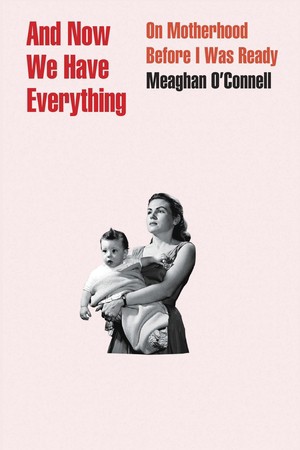
Image result for now we have everything book
Buy the book

And in O’Connell’s case, it was: the missed period was not a false alarm. She was pregnant, and decided with her fiancé to keep the baby. The subtitle of the book is “On Motherhood Before I was Ready,” and this is the journey O’Connell retraces for us, one of uncertainty and second guessing. But she tells her story with candor, humor, and introspection. Some narratives of pregnancy and motherhood create an “us versus them” dynamic between parents and the childless, which means readers without children can feel shut out. But O’Connell’s work does the opposite: she invites you to experience with her the life of a woman unexpectedly carrying a child.

Ahead of the book’s April release, O’Connell and I spoke about the lineage of the motherhood narrative, the literary moment it’s having right now, and striking the balance between singularity and universality in these stories.


Rebecca Schuh: I’ve found that many books about motherhood establish a distance between parents and non-parents, but And Now We Have Everything avoided that. I don’t have any children, but I felt very included in the narrative. Was that intentional on your part?

Meaghan O’Connell: Yes, totally. There’s a chapter about how after I gave birth, I was with my friends and I wanted to tell them everything and didn’t know how to articulate it, or it didn’t make sense to me yet — that was my motivation when I first started writing the book. I didn’t really feel like a mom yet when I started writing and I was trying to talk to friends that didn’t have kids, so it was very much written in the spirit of “Can you guys believe this shit?” I always hated when people were like “You can’t understand until you do it.” I thought, if I want to call myself a writer I should be able to write about this in a way that is not alienating.

RS: You talk about once you realized you were pregnant, reading mommy blogs and finding solace in women who were forthcoming about their desires for children, versus pretending to not care about it. It seemed like you were in this gray area between, I’m 100% sure and I don’t care at all. Can you speak to the process of figuring out how much you did care, and realizing for yourself where you fell on the spectrum?

MO: Have you read Sheila Heti’s book yet?

RS: It’s literally on my nightstand! I’m looking at it right now.

MO: It’s so good, and completely about this. I’ve been talking to her, and it’s interesting because when I got pregnant I was 29, so having a baby was still this far-off thing. It was almost safe enough to fantasize about in an unrealistic way. “I just want a baby because I would look cute in a maternity dress and buy cute baby clothes.” If I hadn’t actually ended up having a baby, maybe I would be 33 and not sure whether I wanted to have a kid at all. I didn’t get the chance to have the real reckoning, I just did it. It was still this thing that older people did, slash a fantasy.

RS: When you were in say, your early twenties or even teens, was it always that “maybe someday” type of feeling?

MO: I remember telling my mom I didn’t want to have kids and she was like, “You would never do that to me and your father!” It was when I met Dustin, my husband, and started to have domestic fantasies with him that I just had this urge to get pregnant. I think it was more of a biological thing than a rational thing.

RS: It’s funny you bring up the Sheila Heti book, because there are a bunch of other books this year that are delving into the topic of motherhood in really interesting ways. Have you read any others that are coming out now?

MO: When I started writing this book, it was 2014 and The Argonauts wasn’t out yet, Dept of Speculation was just coming out, and After Birth…I’m wondering if this is the wave from people who read those books.

RS: Oh that’s so interesting! I remember that year, I loved all those books, and The Folded Clock. It’s a very rich lineage. I hadn’t thought about that before. There is a clear through-line.

MO: Have you heard of this book The Motherhood Affidavits that’s coming out? It’s by Laura Jean Baker, but it’s fascinating and so different from my book because she’s like addicted to having babies. I guess she struggled with depression her whole adult life and the hormones from breastfeeding made her feel so happy and content for the first time ever, so she had five kids.

I had sort of the opposite chemical reaction! Let’s see, there’s Now My Heart is Full by Laura June, which is captivating because her relationship with her mother, and how their relationship comes back when she has her daughter, is a big part of the book. It’s also fascinating to me because I guess she was more of an adult when she had Zelda, she deals with some of the things that I could not cope with, in such a matter of fact way. “I was exhausted and going crazy so I sleep trained the baby and everything was okay!” It’s a different personality.

What is the meaning behind all this? How is this going to turn out to be worth the mind-fuck?

RS: That’s a big part of why these stories are so compelling. Artists and creative personalities are already so different and unique and strong but then seeing how that mindset is applied to the very fundamental process of creating a person.

In terms of the structure, your book has different sections, and they have several different kinds of narrative formats. From a craft standpoint, how did those come about?

MO: It’s so nice to get a question about this! Structurally the challenge of the book was that I wanted them all to be essays in and of themselves, but to still have a narrative momentum throughout. So they weren’t quite chronological but roughly they are. I wanted to tell a story but also have it be a book of distinct ideas.

I think if men gave birth there would be a grand literature of birth stories.

I struggled a lot with how to end the book. I think the first draft I sent to my editor ended with an essay about daycare. And I liked the idea of it, at least, the happy ending of the book that my child goes to daycare. But I don’t know, it wasn’t quite satisfying enough. And I was living the story as I was writing the book, so I didn’t know what the conclusion was going to be. I had wanted a grand conclusion, but what I ended up trying to get at was that in the end, time just passes. The through-line of the book is trying to figure out, what is the meaning behind all this? How is this all going to turn out to be worth the mind-fuck? And in the end, there’s no big revelation, it’s more like, things were hard. And now they’re not so hard. And that’s how it is. But that’s not really the story we tell about having a baby or being a parent.

RS: There’s that passage where you were talking about how it’s kind of like a career where you’re paying your dues in the beginning…

MO: I don’t know if it’s like that for everyone, but I think probably a lot of people. But then you forget, and you miss your child as a baby so you just remember the good parts. I don’t think everyone is colluding to lie, to make people have babies and ruin their lives too. But I really thought, from what I read, or heard from people, that it was going to be magical and this crazy existential profundity. And I guess there was some of that, but it just seems really weird to me that that’s what the takeaway is! Maybe that was my own self-delusion.

RS: There were strains of commentary throughout the book on the fucked up capitalism of motherhood. There’s a line: “I should have known to be suspicious of the supposed inherent reward of unpaid labor that can be carried out exclusively by the female body.” Can you talk a little more about that?

MO: It was so stark to me, honestly. I was a gender studies major, I was a feminist in high school, I wasn’t one of those people who was thirty-five and hadn’t considered myself a feminist. But I really found myself breastfeeding all the time and thinking, this is why women are oppressed. I figured it out, in this visceral way that was undeniable to me, and an inconvenient reality. You can’t be stuck on a couch feeding your baby around the clock and not thinking about this. I mean, I guess people do. I just remembered this, I was running around the track, my boobs were full of milk, and and I knew I had to be home soon, and I was like, this is it, this is the core of all of it. If women didn’t give birth, we would probably be equal.

I found myself breastfeeding all the time and thinking, this is why women are oppressed.

I remember writing Emily Gould an email about this, and she was like, “You need to read Shulamith Firestone,” who argues that babies should be gestated in vats, and that will be the liberation of women. I don’t think that, I’m getting into dangerous territory here, but it was a definite realization, and I knew it intellectually. Until Dustin and I had the baby we were like, someone has to be watching this child at all times, and we are responsible for him and we have to pay a lot of money to be away from him. This comes down to math — how much daycare in Brooklyn costs and how much I can earn while he’s away from me. That system was built for one parent, aka the woman, to stay home. This is what capitalism is built around.

RS: When you write about the labor experience, I was amazed that you were able to write it so minute by minute, and very viscerally. I was very impressed that you remembered it so specifically, that you were re-inhabiting that mental state.

MO: I wrote it very soon postpartum. I remember it was Labor Day weekend, and I had the baby in June, so it was three months post-partum. I was still in that manic, crazy state of sleep deprivation. That’s the one chapter or essay that hasn’t really changed much since I wrote it the first time. Obviously it’s been edited but there’s no way I could have written that now, or a year ago. It’s visceral because I wrote it when it still was.

RS: You have a passage: “I would save the world except I wasn’t. I was doing the most banal thing in the world. I was giving fucking birth.” I thought that spoke so well to this grand contradiction of how each individual birth is so singular, and society does hold it up to this crazy ideal, but it’s also, you know, something most animals eventually do.

MO: People are dismissive of writing about motherhood or birth stories, it becomes this blogger thing and not literature. But I always tell myself, dying is very universal, too. It’s common, but we don’t say, “Get over it, we all die, shut up, we don’t need to read about this.” I think if men gave birth there would be a grand literature of birth stories.

It’s a contradiction, it’s the craziest day in my life, or the worst day of my life, but there’s fifty other women on the same floor giving birth that day.

RS: I’m reading Leslie Jamison’s new book on alcoholism and recovery, and she talks a lot about how the commonality between stories is more important than the uniqueness of any story. And how that was hard for her as a writer, because you’re like “I want to be the unique one.”

MO: She writes so well about that, about the cliché and embracing it in a way, and undercutting it.

RS: There’s a similarity between her book and the motherhood narrative. She says several times in the book, “I would tell people that I was writing a book about addiction and they were like, ‘oh just another addiction memoir.’” It’s strange that’s even become a stereotype — in the right hands either of these stories are so individually fascinating.

MO: Reading her book, that self-doubt, that sort of meta, underlying question of, “is this story worthwhile?” or, “how do I do this in a way that justifies its existence?” In a way it’s just a mental trap. Internalized misogyny, at least with motherhood stuff.

RS: Internalized art misogyny, wherein women start questioning themselves on what topics are worthy of the canon.

Once you’re back home with the baby, you have this line: “I was not just trapped in an apartment with my tits out, I was trapped in love with him. I could never go back to before.” Is there still that strict line between the eras of your life?

MO: It was so stark then. It was suffocating. There was no way out, “I am trapped, this is irrevocable.” It doesn’t feel like that anymore! Now my life is like, I take my kid to daycare at 8:30 and he comes home at 5 with his dad. I have those hours in the day to do my work and be a person, which is logistically completely different. But it’s weird to think about before, when I was a person that was 28 and lived in Brooklyn and had freedom. It’s not like you can be continuously aware that you are free and can do whatever you want. I mean you can try! But I think I wrote something about how we spent the night in a hotel one night and I was like “wow I had a baby just to feel this free away from him?” I can appreciate it now in a way I wasn’t able to then.

It is strange because I’ll show my son pictures of me and Dustin before he was born, and he’ll say “Where was I?” And I think, god that is weird, that you didn’t exist yet.
The 11 Coolest Writer’s Residencies

Sometimes, the only way to get writing done is to get out of your own head—and out of your apartment, and out of the country, and into a 15th-century castle in the middle of Italy. Yes, that’s a real writer’s residency you can apply for—and it’s only one of the cool working vacations available to writers and artists around the world. Residencies give you space and time to work without interruptions or other responsibilities, but in the case of these off-the-beaten-path options, they also give you the opportunity to contemplate nature, live like royalty, learn a new skill, or even own a home. Here are the eleven coolest places we’ve found to commit yourself to your craft.

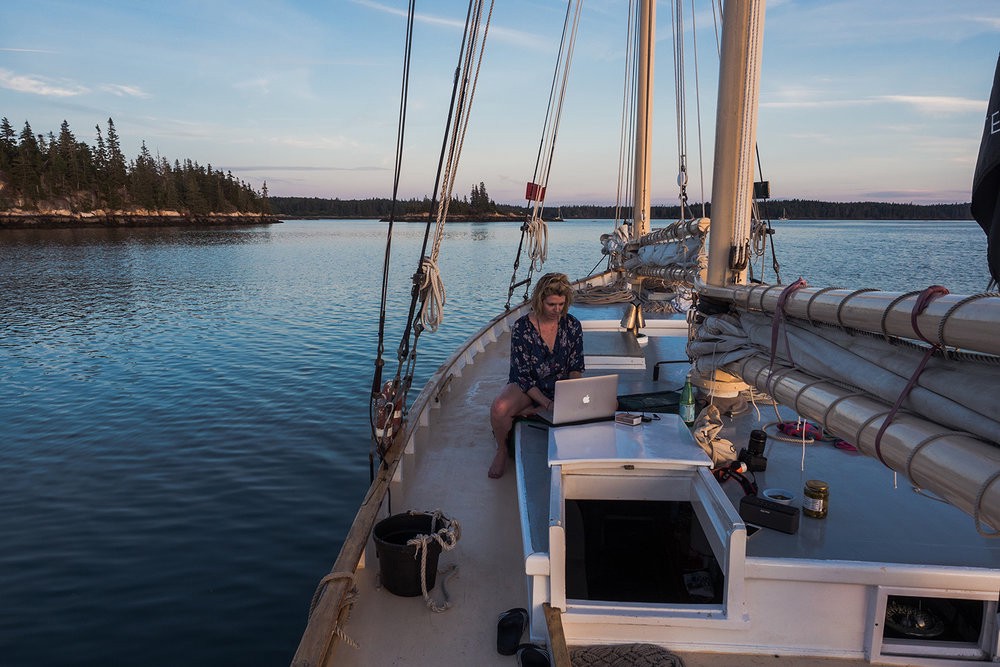
On a Sailboat

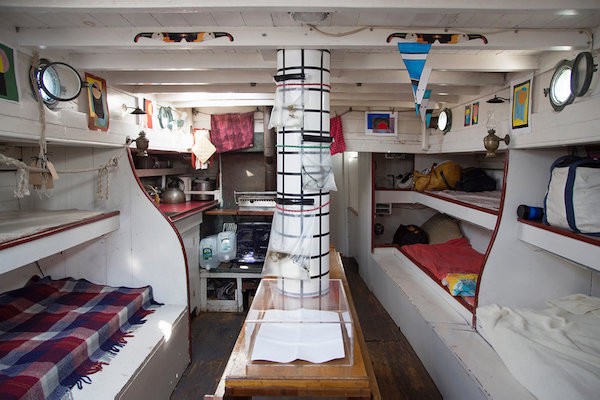
Unlike most residencies, the Offshore Residency does not provide artists with a studio—because space is at a premium on a boat. Instead, you’ll take part in a weeklong sailing journey to a historic region. And by “take part in a sailing journey,” we mean that you’ll be working the boat (although the captains do most of the sailing). The idea behind the Offshore Residency is that creative work and boatmanship have a lot in common—you have to constantly focus, observe, and adjust—and that artists can benefit from these parallels.

Photo by Beau Carey via The Arctic Circle

In the Arctic Circle

Writers of cli-fi may be particularly interested in the Arctic Circle residency, which leads artists on an expedition through the waters near the North Pole aboard a traditionally-rigged tall ship. (Tall ships are bigger than sailboats, and have room for shared workspace as well as private berths.) It ain’t cheap, but it’s bound to be productive for anyone inspired by natural beauty and anyone who can’t work when they’re too warm.

Photo via Civitella Ranieri Foundation

In a 15th-Century Castle

The Civitella Ranieri Foundation brings artists, writers, and composers together in an idyllic medieval castle in central Italy. Artists spend six weeks living and working in a private room and studio space within the castle, wandering the gardens, and eating professionally-prepared food made with fresh local ingredients. All the benefits of being an Italian Renaissance poet, PLUS indoor plumbing!

Photo by Maksim

In Jack Kerouac’s Cabin

What if all you need to write like Jack Kerouac is to spend some time in his house? If you don’t apply for the Kerouac Project residency, you might never know. Writers spend about three months staying in the Orlando bungalow where Kerouac lived with his mother while he was writing Dharma Bums. You are not required to bring your mother along.

Photo via Fondation Jan Michalski

In a Modernist Treehouse

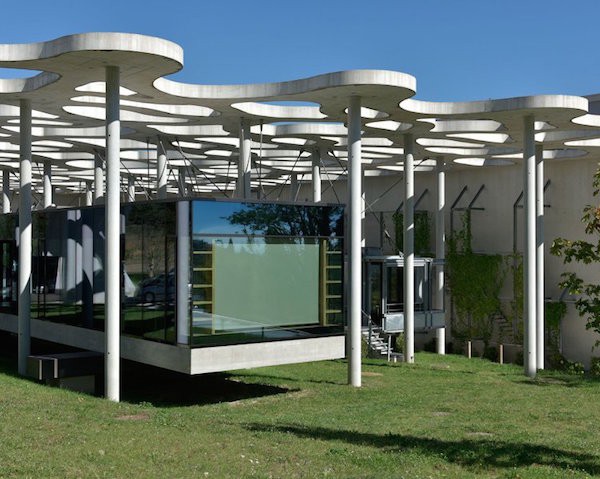
The “treehouses” of the Fondation Jan Michalski are modernist boxes hung from a perforated metal roof that evokes a canopy of trees. The foundation is located near Lausanne, Switzerland, and most of the treehouses have views of the Alps. Writers can stay there contemplating Mont Blanc for up to six months depending on the scope of their project.

Photo via TransArtists.org

In a Fish Factory

The Creative Centre in Stöðvarfjörður, a tiny village (population: 180) in the east fjords of Iceland, is located in a former fish factory, now owned by a nonprofit arts organization. Residents at the Creative Centre include writers, visual artists, sculptors, dancers, musicians, photographers, two friendly dogs, and yes: a small fish processing facility.

In a Lighthouse

Dream of moving to a lighthouse? Apply for the residency at Sumburgh Head Lighthouse in the Shetland Islands, where you can stay in the apartment once used by assistant lighthouse keepers, and try out your work on the local residents and gentle ponies of the Shetlands. The residency is open to all artists, but of particular interest to writers, because the designer of Sumburgh Head Lighthouse was Robert Louis Stevenson’s grandfather.

Photo by U.S. Fish and Wildlife Service

In a National Park—As a Park Ranger

In Alaska’s vast and remote national parks, artists-in-residence are partnered with a wilderness ranger and actively assist with duties like giving an educational talk onboard a tour boat, engaging in seal counts, helping with climate change research, or picking up trash. You’ll also get plenty of time to draw inspiration from the lakes, trees, and wildlife—but if you end up deciding to give up writing and become a park ranger for good, you’ll at least have some basic experience under your belt.

Photo via Writing Between The Vines

In a Vineyard

Do you find your creativity flows best with a glass of wine or two? Does inhaling the sweet perfume of fermented grapes inspire you to spout poetry? Then waste no time in applying for Writing Between the Vines, a week-long writing residency in the gorgeous vineyards of California and Canada. The best part is, you don’t have to pay a housing fee or retreat cost, excluding the application fee (and your food and travel). You’ll save so much money that you can spend on wine!

Photo via Write a House

In Your House That You Own Now

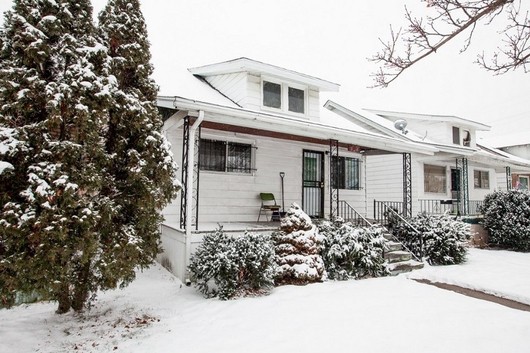
Imagine a residency that never ends. Enter Write a House, “a writer’s in residence program where the writer gets to keep the residence, forever.” Write a House aspires to revitalize the city of Detroit by providing vocational training to local youth who renovate blighted, long vacant houses and then giving the homes to low-income writers for free. Finally, an opportunity for struggling writers to hone their craft in a nice home of their own instead of typing by candlelight in an illegal sublet trying not to wake five ro

When Fighting Stops Being Fun

“Chicken”

by Rachel Lyon

My husband of twenty years wanted me to go on this retreat. Some place up in the mountains where New Age types went to drop in, turn off, tune out. As we’ve gotten older he’s gotten way into all kinds of self-helpy crap. He says it happened slowly. I say it happened fast.

First he became a vegetarian. This guy who used to alphabetize his barbeque sauce collection. We were in the Kroger and I was picking through the frozen chickens. He sort of looked up at the ceiling and said, Eating animals, you ingest a lot of negative vibes. I said, Negative what? He said, When they get slaughtered they release fear hormones. Then later when you eat them, fear is what you eat. I said, Stop fucking around and help me find a bird. He said, You’re on your own.

Then he started meditating. I’d come out to the porch and there he’d be. Fat legs crossed Indian style, eyes closed, a blissful bitty smile on his face. I’d give him a kick, but he’d just breathe.

I wouldn’t give a shit about any of it, except that he stopped fighting with me. Used to be we’d stomp and scream until the neighbors called. I’d call him a spineless, sexless fart. He’d say I was a curse on him, tell me to go back to whatever Hell portal I crawled out of. I’d call him all the fucked-up names that I could think of — a baboon, a slug, a scab — until his face got red and tears formed in his eyes and he collapsed, weak-kneed, in unhinged laughter. Once he grabbed my hair and jerked my head back, pressed me against the wall and said, You fat bitch, if you ever, ever —

I don’t think I’ve ever had as good a time as that.

But he announced he’d had enough. We were driving home in the old teal Chevy from I don’t remember where. It was dark but I could see his hand on the wheel was trembling.

Can’t do it anymore, he said. Can’t take it.

We’d never talked about the fighting. We’d just fought, that’s all, since always.

I said, I thought we were having fun.

He said, Not me. I wasn’t.

Why would he have stuck with me so long if he didn’t like it? How dare he? At the edges of the road the black trees whizzed by.

This whole time? I said.

He said, This whole time.

The retreat was at a ranch up the mountains, a couple hours east. He drove me on a Saturday morning. I sat shotgun, chasing stations. Twenty minutes of talk radio, fifteen minutes of country, six or seven minutes of 80s, 90s, and Today. Each fizzled out, leaving a hush of static. With forty miles to go I turned it off. We drove in silence, rolled up the dirt road in silence. There weren’t any horses or any animals at all that I could see. Just flat brown fields and a big farmhouse, a couple dour ladies in ponchos smoking on the porch. He carried my duffle for me up the steps and went with me to registration, where a girl with a nametag that said Clover got me all checked in. She had pale green hair and a lip ring and a lisp. Christ, I said to my husband when all the paperwork was done. Is she a woman or a plant?

He didn’t laugh. Instead he kissed me on the cheek. In our twenty years of marriage he’s done that maybe never. He said, Be good, all right? and got back in the truck and drove away.

The program was some hippy-dippy bullshit, let me tell you. Meditation in the mornings, group therapy, a vegan lunch. Then art therapy, walking meditation, yoga, nonalcoholic cocktails, vegan dinner. They’d look at you sideways if you so much as used the F word. I’d have given my right eye for a cigarette. My left eye for a steak. Tell you the truth I wasn’t sure what I was there for. Tell you the truth I missed him.

In therapy we were supposed to talk about what irked us. Then we’d do some kind of game together that was supposed to work it out. There was a couple there about my age, a slouchy guy and his bleached-hair, pinched-face wife. A couple — and me I was there all alone, like a sucker. They were in because he’d left her for another woman, a twenty-something someone who worked at his place of business. The affair lasted all of a month but in that time he’d managed to move out, move in with the girl, get thrown out of the girl’s place, and move back in. Why his pinched-face wife took him back I couldn’t tell. Didn’t much seem like she wanted to.

After she told her story the therapist Omario asked her what she would say to the girl her husband fucked, if the girl were there. Omario said, Pretend she’s in the room with us, Michelle. What would you say to her?

Most of the others found it hard to resist his soothing Jamaican accent, but Michelle just pinched up her pinched face harder and shook her head from side to side. Mm-mm, she said.

You aren’t ready to speak to her?

Mm-mm.

You want somebody to speak to her for you?

She looked at him.

Who do you want to speak to her for you?

She pointed at me.

All right, said Omario. He turned to me. You ready? You get to be Michelle. Stand up now.

I stood up.

Imagine that you are Michelle. Your husband left you for this girl. What do you have to say to her?

Michelle looked up at me the way you’d look up at a movie theater screen before the film comes on. I stood with my arms folded and took a gander at our sorry group: this sad couple, a suicidal truck driver, an anxious dentist, a teenaged kleptomaniac, and an obsessive-compulsive postal clerk.

The postal clerk was maybe twenty-five and skinny as a meth addict, with limp brown hair and thin pale lips and a face as meek and guilty as a reprimanded dog. Her name was Peggy. She’d sit with her hands in her lap and tap her bony fingers together in a secret rhythm, apologizing for it if anybody noticed. Tap-tap-tap, Sorry, sorry. She annoyed me, frankly, I think she annoyed everyone, but that isn’t why I chose her. She happened to be around the age of Michelle’s other woman, that’s all.

I revved up with a good old-fashioned Go fuck yourself.

I glanced at Michelle. Her face had relaxed a smidge. Her slouchy husband beside her had his elbows on his knees, his face hidden in his hands.

Slut, I said to Peggy the postal clerk.

The room was silent except for the ticking of a round brown institutional clock. Peggy looked at my shoes and tap-tapped her fingers together in her lap. I was afraid she might apologize but she stayed quiet, thank God. Michelle leaned forward just slightly in suspense. I rubbed my hands together.

You’re a sad little slut, I said, and ugly, too. Your face looks like it was thrown against a wall and scraped off with a spatula.

All right, said Omario.

A face like yours was growing in the weeds behind my house, I said. Wait a minute, did you find that face out back in the compost pile? I think I recognize it. I think my dog squeezed it out his ass this morning.

Insults are not so productive, warned Omario. Peggy kept her head down. Her pale neck was turning red.

You think you can fuck my husband? I went on. You think you know how the world works? I’ll show you how the world works. You fuck my husband; I fuck you. I’ll fuck you with a cactus. I’ll fuck you with a jackhammer. I’ll fuck you with a drilling rig, until black oil spouts right out your —

She lifted her face. It was wide-eyed and crumpling. She tapped her fingers together like her life depended on it. Omario stood up. Enough! he said, and put both his hands on both my shoulders. As he guided me out of the room I tried to catch Michelle’s eye, but I couldn’t, not before he pushed me out and shut the door behind us.

We stood together in the hallway. There was a framed watercolor of a beachy sunset on the wall. I wondered if it looked anything like where he grew up. I wondered what it was like for him to live out here in our cold white landlocked state. On the other side of the door we could hear Peggy crying, breathy little hyperventilating sniffles, and the murmuring of other people soothing her.

That was inappropriate, Omario said sternly.

I flashed him a little smile. But it was fun, though, right?

We’re going to have to work on your anger issues.

I’m not angry, I said. Do I seem angry? I was speaking for Michelle.

The next day Michelle found me behind the barn. We were supposed to be doing a walking meditation but I’d found half a pack of cigarettes in the pocket of an old sweatshirt and smoking gave me about twelve times more serenity. From my spot next to the woodpile we could see the others pacing slowly around and around the brick path that wound through the dead brown field.

Close up Michelle seemed a little less pinched. Her breath was a cloud of condensation in the late March chill. Got a cigarette? she said.

We smoked together quietly. They all had such different posture, all the walking meditators. The anxious dentist shuffled quickly. The suicidal truck driver trudged, chin on his chest.

Peggy left, Michelle said.

The postal clerk? I said. I knew who she meant.

She left because you yelled at her. Michelle inhaled, exhaled. A little reproachfully she added, She’s only twenty-two.

She shouldn’t have been here in the first place, I said. She should’ve been out in the world, thickening up her skin. Someone like her, it isn’t going to do her any good hiding herself away at a place like this. These kindhearted dipshits are just going to tell her she’s okay the way she is when she isn’t. None of us are.

I dropped my cigarette into the cracked cold dirt.

Michelle smoked slowly. I’m getting a lot out of this experience, she said, looking out at the brown field and white sky. I’m finding it pretty transformative. She sounded a little like someone had asked her to appear in some retreat center promotional materials. I don’t know that Roy is getting as much out of it as I am —

Roy’s a tool, I said.

— but he’s doing it for me, and that’s enough. When we go home, she said, I will have more power over him than I’ve ever had. Little pockets full of power that he’s kept on him for years will be turned inside-out and emptied out like spare change on the bedspread. And then I’ll pick that power up and keep it for myself.

You’re not going to kick him out? I said.

Why would I? She dropped her cigarette too and dug it into the ground with the heel of her shoe. He’s afraid of me now.

My husband’s always been afraid of me, I said.

Ha-ha, she said, I bet.

He never told me until twenty years in.

You’re lucky.

Not lucky, I said. Jealous.

She snorted. Of me?

Of him. I want to be afraid of him.

Turned out Peggy wasn’t 100% gone. She came back a couple nights later to say what she needed to say to me. Lying in the single bed in my bare, cramped bedroom, I heard a car on the gravel outside my window and opened my eyes to see the wall go bright, illuminated by headlights, and then go dark again. I heard her shrill voice calling up for me, calling my name.

I pulled back the cheap curtain and opened the window to see her down there in the driveway. She was wearing snow boots, though it hadn’t snowed in weeks, and pajamas and a long red flannel. She looked like she’d just come from a slumber party with some lumberjacks. Hey, bitch, she called up to me. She brought her hands together at belly height and tapped her fingers together, one two three.

Hey, shit-face, I called down.

She said, I just came back to tell you you’re pathetic.

I’m pathetic!

I laughed. She tap-tap-tapped.

You’re a bullshit person with a bullshit attitude! She wrenched her hands apart and balled them up into two white fists. You think you’re fucking funny but you’re not! You think you’re some kind of strong-ass woman, but you’re pathetic. You’re disgusting. I can’t believe anybody would marry you. Your husband must be either brain-dead or a masochist.

She looked up at me and waited for me to yell back. Her newfound strength was a miracle. It made me hungry. Go on, I said.

You’re fat, too! She waved her little fists around with rage. You’re fat and your face is bloated as a drowning victim’s. You smell like cigarettes and sandwich meat and dirty hair. Your husband must be blind and deaf and have no sense of smell. Fucking you must be like getting sucked into putrid quicksand.

She wasn’t yelling anymore so much as free-associating. In the bedrooms next door people were waking, windows were opening. My heart had quickened. Go on, go on, I said.

Come down here and make me! she yelled back. What are you, chickenshit?

I turned away from the window to find my shoes.

What do you think you’re going to do to me? You’re nothing, less than nothing! You’re what nothing has when it’s got nothing left.

I gave up looking and ran downstairs barefoot, almost tripping at the bottom, almost falling out the front door. The ground was bitter cold and the rocks pierced the soles of my feet but I made my way to her. She was standing outside her car, and when I got close enough I could see her eyes were liquid as melted ice, and steaming. I was all charged up, electric. I took her in my arms and squeezed her hard. She was taller than me but she put her wet cold face in the spot between my head and shoulder and she squeezed me back. My feet were numb and I was pulsing everywhere. Thank you, I said.

I wanted her to come inside but she’d said what she had to say. We let each other go and her thin lips twisted up in a victorious smile.

You’re nothing, she whispered, and tapped her fingers, one two three. Then she got back in her car and drove away.

I turned back toward the broad clapboard wall of the big house and saw a face at every window. They’d all been watching me: Michelle, her husband, everyone. I pulled at the fabric of my sweatpants and gave them a grotesque curtsey in the cold, mugging like a hammy kid for a Camcorder, yelling up: Anybody else want to join the show?

They didn’t smile, but they didn’t look away.

Pussies! I shouted.

One by one each curtain fell back. My heart beat harder with the disappearance of each face.

Peggy’s the only one of you with any balls!

Then the only face in any window was the reflected moon. I raised both my middle fingers at the clapboard, at no one. My feet were numb and the sweat on my neck was prickling. I went back in.

It was raining the day my husband came to pick me up. I was waiting outside on the covered porch with all my things, the last to go. I got to say goodbye to the teenaged kleptomaniac, whose mother arrived in a black Mercedes. To the anxious dentist, who wouldn’t make eye contact when he shook my hand, and to the suicidal truck driver, who took a deep uneven breath before stepping off the porch, as if he were stepping off a cliff.

Michelle came outside with her slouch husband. Pull it around, she ordered him, and then she stood with me and waited while he did.

It’s been good knowing you, I said.

She said, It’s been something.

He pulled up in the car and came out with an umbrella to escort her back to the passenger’s side. Standing there at the foot of the porch steps getting soaked, holding up a hand to help her down, he looked like the happiest man alive. How this bullshit place could have worked so well for them, I can’t begin to know.

Omario came out too to see everybody off. When Michelle and the slouch had gone he looked at me and sort of tilted his head back and shook it, smiling. Well, he said. He seemed sincere. Good luck. I know you’ll need it. He laughed that low musical laugh of his, and went back inside to chat with Clover.

I stood there watching the rain. Close by you could see every drop, round and hard until it splatted. It dripped off the porch roof and puddled in the dirt, but far off by the trees it was just a veil of gray, and up in the clouds it was nothing at all.

The old teal Chevy rolled up and my husband reached over to open the passenger door. I dragged my bags and body down the wet steps and through the mud. When I’d got in and thrown my shit in the back he sat there a moment, looking at me as if I might be someone new.

Well? he said.

I wanted to say The fuck does that mean? I wanted to say Well what, you fuckin fool? I wanted to say Are you happy now, you granola-crunching pea-brained twit? What did you do while I was gone? Did you join the goddamn hare krishnas? Go to yoga and learn how to suck your own cock? God knows I’m not about to suck it for you, you fat old turd. I wanted him to yell back at me, call me a harpy, a blight, a waste. I wanted him to throw me out on the wet grass and push my face and body in the frigid mud. But he wouldn’t, I knew he wouldn’t. Those days were done. I didn’t want him to turn away from me, so I said nothing at all.

He squeezed my shoulder and restarted the car and we drove in silence over the gravel. Down to the gate and through to the road, past a couple of flooded strip malls and blinking yellow stoplights, and then we were on the highway that would take us home. The sky got dark and he flicked on the headlights and I watched the piercing rain ahead go from invisible to illuminated to invisible again. How could I tell him that what I wanted was for him to tell me I was nothing? How could I ask him to erase me, to let me float away, beyond the windshield wipers, into the dead black sky?

Ursula K. Le Guin‘s Folk/Electronica Album Can Teach Us a Lot About Storytelling

I n tandem with the release of her 1985 ethnographic tome of a novel, Always Coming Home, beloved science fiction and fantasy novelist Ursula K. Le Guin put out a cassette tape called Music and Poetry of the Kesh. The album, made in partnership with the composer and analog synth specialist Todd Barton, was conceived as a kind of soundtrack to the novel. Music and Poetry of the Kesh has just been reissued, and reviewers at The Guardian and Pitchfork agree: Le Guin and Barton dropped the most fire indigenous folk music/electronica/new age/avant-garde album of 1985. But here at Electric Lit, we’re more interested in literary value than musical chops. We wanted to know: Is the album any good at telling a story?

Le Guin’s novel Always Coming Home tells the story of the Kesh, a tribal civilization of people living in a California of the future, after an apocalypse so far in the past nobody can really remember it. Part of the novel tells the life story of a woman named Stone Telling, but it is also a giant assemblage of poems, maps, artwork, anthropological texts, plays, and music that illustrate Le Guin’s ability to make up a whole new world and its archive all at once.

According to Pitchfork, Barton was onboard for world-building in the album, too. He designed instruments that Le Guin and Barton imagined the Kesh people would use, like a seven-feet long houmbúta horn, or a flute made out of bone. When Barton asked Le Guin if the Kesh spoke English, Le Guin made up an alphabet for the Kesh and used that vocabulary for the songs and spoken-word poems. The project took two years to complete.

In a word, the experience of listening to Music and Poetry of the Kesh is immersive. The album opens with the song “Heron Dance” a slightly discordant and mysterious pile of clatter, with high synth-y sounds that break into a rhythm that helps translate the sound into something like narrative. Listening to “Heron Dance” echoes the experience of reading the first few pages of a novel, when you’re trying to get your bearings in a new world built by someone else’s language in an unfamiliar setting, and figuring out if you want to stick around.

The first song echoes the experience of reading the first few pages of a novel, when you’re trying to get your bearings in a new world.

The pacing gracefully picks up in “Twilight Song,” when we hear Le Guin speaking in Kesh. Behind her voice, there’s suddenly depth — crickets, a babbling brook, and a breeze (which were all recorded on Le Guin’s ranch in the Napa Valley). Then, we learn to listen deeper in the space of the album, and are rewarded with more voices. We move closer to the voices somewhere in front of us in “Yes — Singing” and suddenly we’re at the center of a community of men and women singing, clapping, dancing, laughing. Many of the songs sound like they are heavily influenced by indigenous music, and at times I wondered how much the music brushes up against cultural appropriation. The culture of the Kesh may be her own creation, but Le Guin’s relationship to indigenous tradition was inherited from her parents, both cultural anthropologists who spent much of their lives studying and working with the indigenous people of the Pacific Northwest.

The Kesh language

But to return to our original question — how does the album stand as an act of storytelling? On its own, the music tells a different story than the narrative of Always Coming Home — one that’s much more abstract, a story about listening wide and long, about how community accumulates, about the act of listening as an act of imagination. You won’t pull off your headphones with a concrete cast of characters, or plot, or setting. But listening to the album alone does illuminate other elements that make for good storytelling: how to build atmosphere out of disparate details, how to create dimension by building tension between what’s up close and what’s far away, how to balance monologue and dialogue. Reading the novel alone without the album will still give you a complete story—but once you’ve heard the album, you realize it may not be the complete story. Together, the novel and album also enhance and play off each other to create a new story, a dynamic, totally immersive experience of imagination, where suddenly the story is taking shape in several voices: those on the page and those on the tracks. It’s a serious exercise for your imagination that makes me think of Le Guin’s words on how we build imagination in the first place.

Together, the novel and album enhance and play off each other to create a new story, a dynamic, totally immersive experience of imagination.

In her 2002 lecture titled “Operating Instructions,” Ursula K. Le Guin argued that imagination was not a given, but something we learn by way of the people around us. It starts, she argues, with listening: “Listening is an act of community, which takes space, time, and silence. Reading is a means of listening.” With Music and Poetry of the Kesh, Le Guin seems to suggest that listening is a means of reading, too.

This Handy Chart Automatically Generates a Pitch for Your New Novel

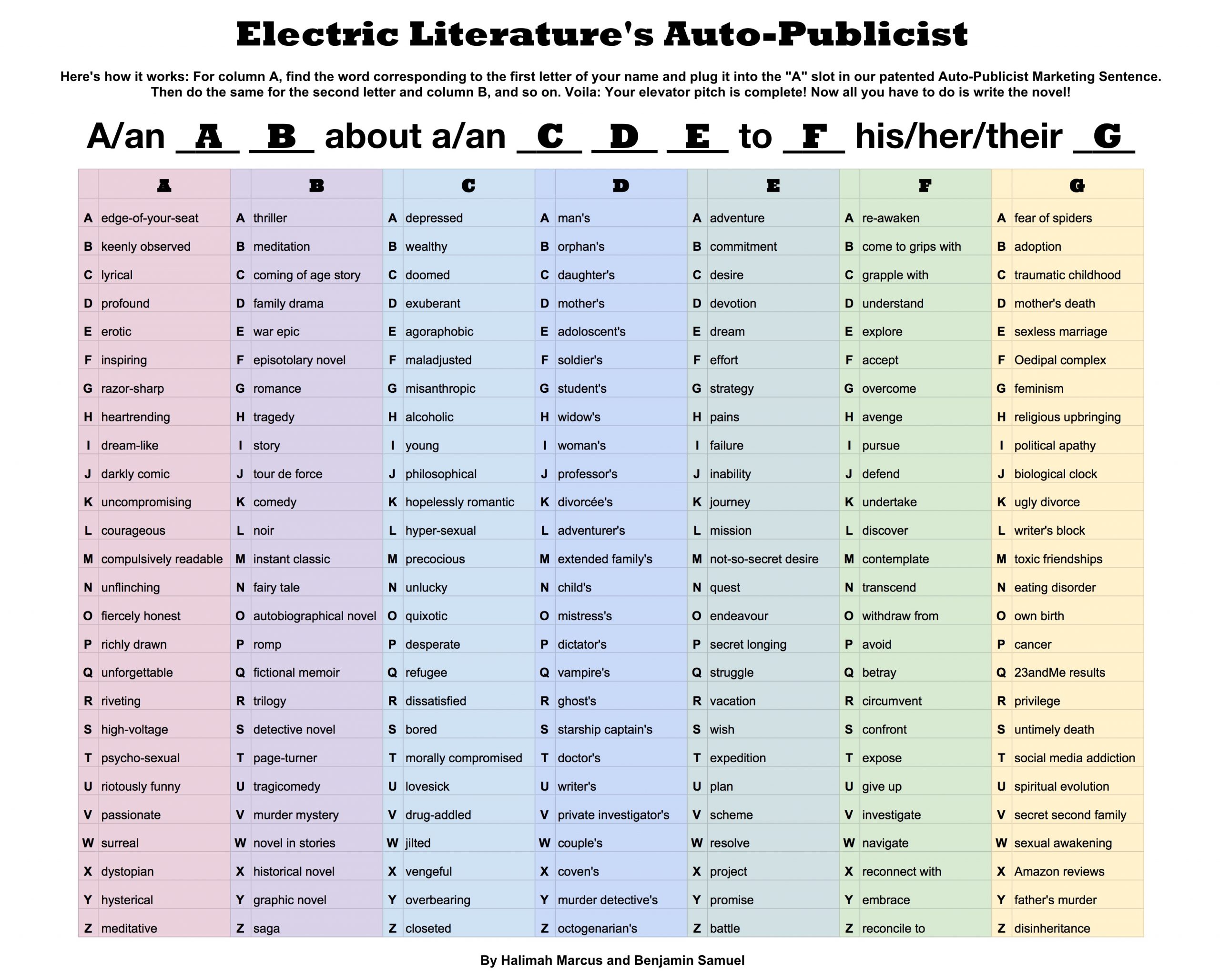
The most important part of a novel isn’t the plot, the characters, or the language. It’s the elevator pitch. That one-sentence descriptor is how you sell the book to publishers, readers, and big Hollywood producers willing to shell out megabucks. But how do you generate a killer pitch—especially when you don’t have a novel yet? Well, your best bet might be to pay a professional publicist. Until now.

The Electric Literature auto-publicist pitch generator does all that work for you—and it’s easy to use! If you’re Beyoncé, for instance: first of all, welcome, we’re glad you read the site. Second of all, you would look up “b” in column A, “e” in column B, “y” in column C, “o” in column D, and so forth, and then plug them into the sentence below. The result: “A keenly observed war epic about an overbearing mistress’s quest to grapple with her sexless marriage.” We can’t wait to read it, Ms. Carter-Knowles!

If you run out of letters in your first name, move on to your last—so, for example, Vin Diesel would write “a passionate story about an unlucky mother’s failure to explore her writer’s block.” Or you could just spell out whatever word comes to mind. (The first seven letters of “Electric Lit” give you “an erotic noir about an agoraphobic daughter’s expedition to circumvent her political apathy.”)

Click to expand

The American Girl Doll Magazine Made Me a Feminist

I n the early to mid-1990s, the Jewish suburbs on the east side of Cleveland comprised a consumerist paradise. The primary landmark of my hometown, Beachwood, Ohio, is a mall which then was next door to a smaller mall and today is also across the street from an outdoor mall. Thanks to the taxes levied on an unusually large number of corporations headquartered there, our public school provided a private school-caliber education and most of my classmates lived in mini-mansions built within that decade. My family was a part of but apart from all that. My parents bought a modest house just within the town limits, and drove past the malls to get to the thrift store. For Chanukah we got seven days of socks and underwear plus one “fun present,” and we relied heavily on our library cards.

American Girl magazine cover, April 2018

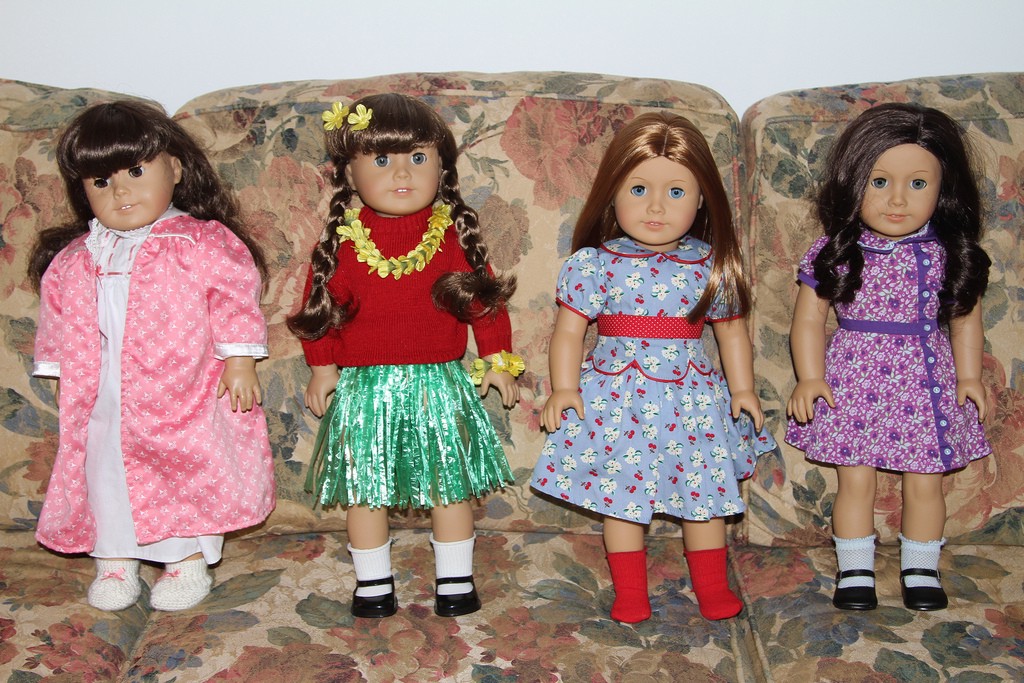
In elementary school, most of the girls in my class had American Girl dolls. Manufactured by the Pleasant Company and sold out of a catalog, these eighteen-inch vinyl dolls each represented a fully developed 8–12 year-old female character and historical time period. They cost upwards of $100, but that was just the starter price. In theory, the characters’ lives were encompassed in their accompanying chapter books, with titles like Meet Felicity: An American Girl and Molly Learns a Lesson: A School Story. The series for each character had identical titles, (cf. Meet Addy: An American Girl and Josefina Learns a Lesson: A School Story) but each girl dealt with issues specific to her epoch, like slavery, suffrage and the Great Depression. The majority of these books were authored by one woman, Valerie Tripp.

But of course, the books were not the real draw. Where the girls’ characters truly developed was in their accessories. You wouldn’t buy the pint-size Swedish immigrant Kirsten Larson without also purchasing her Pioneer School Lunch, comprised of a small wooden box containing an apple, a sausage, a hunk of cheese and bread. And what would the the wealthy Victorian Samantha Parkington wear to her Christmas dinner (immortalized in Samantha’s Surprise: A Christmas Story) but her taffeta Cranberry Party Dress? Even the Depression-era tomboy Kit Kittredge would not be complete without the whole kit and caboodle. The catalog also offered life-sized clothing options for girls who wanted to be twinsies with their dolls. My own envy never extended this far. Even at twelve, I knew tackiness when I saw it.

You wouldn’t buy Kirsten without also purchasing her Pioneer School Lunch: a small wooden box containing an apple, a sausage, a hunk of cheese and bread.

In spite of the company’s didactic ambitions, the most popular doll was the one with the the most luxurious accessories, Samantha Parkington. Or maybe it just seems that way to me because that was the one my grade-school best friend had. I was shocked as a child to learn that my friend’s family was so wealthy, her little sister had one too. No, not just another American Girl doll. Another Samantha Parkington. With all the fixins.

I didn’t need to ask my parents whether I could have an American Girl doll to know that the answer was no. I found work-arounds. I played with my best friend’s sister’s Samantha when she wasn’t home. I pored over the catalog and made storylines out of what I saw. Each doll had her own doll, natch, and one year for my fun Channukah present, I chose the doll’s doll my parents could afford. It was a twelve-inch ragdoll which belonged to the slave character Addy. Her name was Ida Bean, she cost $18 (l’chaim!) and I loved her.

While my parents could not have afforded an American Girl doll, let alone all the paraphernalia, in 1995 the company launched a new venture that was more amenable to both their tax bracket and my family’s consumer habits: the American Girl magazine. The bimonthly magazine cost $19.95 for one year, or the bargain price of $36 for two. There is felicitous synchronicity in the fact that price tag on the one-year subscription matched the calendar year, and what a year it was (Bill Clinton! Clueless! The Rachel cut!). And so, when I was nine years old, my copies of American Girl magazine began arriving, to be hungrily read and then stacked in between my parents’ copies of The New Yorker.

I’m 32 now, and a doctoral candidate in a literature department, so I always assumed that The New Yorker was the magazine that made the biggest impact on me. Remembering how I had enjoyed my subscription to the American Girl magazine, I started wondering about the nature of the publication, to wit, whether it was just a glorified version of the catalog. The one feature of the magazine I remembered was indeed doll-oriented. Every issue featured a fold-out card-stock paper doll modeled after one of the magazine’s pre-teen readers and the women in her family across time. With text on the back providing context, the doll itself looked like an American girl of the 1990s and one of its outfits represented her interests, a field hockey uniform, say, or an equestrian getup. Each of the other three outfits was based on the childhood clothing and culturally-specific habits of the girl’s own mother, grandmother and great-grandmother.

I didn’t need to ask my parents whether I could have an American Girl doll to know that the answer was no.

I wanted desperately to nominate myself and the women in my family for this honor, but somehow I didn’t think we had enough material. My father’s parents were Holocaust survivors, and questions about their parents and other relatives were more or less verboten. My mother’s side was thoroughly assimilated American Jews; by the time I was old enough to ask questions about our family history, no one was quite sure which country the Yiddish-speaking matriarch Bubbeh had been from. I couldn’t imagine learning about the girlhood of any of these women, let alone sending their childhood photographs to the American Girl art department.

In the interest of seeing how well my childhood memories correspond to the publication, I recently made my way to the Schlesinger Library on the History of Women in America at Radcliffe. Unfortunately, the Schlesinger librarians have not, as yet, seen fit to collect the entire run of American Girl magazine, but they do have a few illustrative examples. In fact the March/April 2001 issue has a manila index card inserted which contains the brief handwritten correspondence of two librarians: “Do we get this now?” “Let’s save this sample and see if they send any more. — Barbara.”

Like a New Yorker subscriber scanning for the cartoons first, I flipped hungrily to the paper doll.

The earliest issue they had was from September/October 1997, the back-to-school/Halloween issue. I tried to approach my research material in a scholarly way, but my enthusiasm got the better of me. Like a New Yorker subscriber scanning for the cartoons first, I flipped hungrily to the paper doll. There she was, Stephanie Garrard, age 14, and three generations of her German female relatives. “Stephanie and her brother ice-skate as a pair,” the flipside of the doll explained. “This costume is patterned on a kind of German dress called a dirndl (DERN-del).

There was also an address for submissions with the following instructions:

BE A DOLL

Each issue of American Girl features a real American girl paper doll. If you’d like to try and be a paper doll, interview your family about the lives of your mother, grandmothers, great-grandmothers and other female ancestors (no aunts, please). Then send us:

1. Stories about those women as girls.

2. Photocopies of pictures of those women as girls (no originals, please!).

3. Pictures of and stories about yourself.

4. A self-addressed stamp envelope (so your materials can be returned).

NOTE: Only six girls out of hundreds each year are chosen as paper dolls. We hope you enjoy learning about your family even if you aren’t chosen.

Apart from the bewildering shade thrown at tias, I found this deeply satisfying. Reading about Stephanie’s family meant learning about the transformation of East Germany over the course of the twentieth century, even if neither fascism nor communism were ever explicitly mentioned. After all, you can only fit so much on the back of an eight-inch paper doll. The clothing was also realistically humble. In addition to Stephanie’s ice skating costume, the outfits included an early sixties schoolgirl dress and a mid-nineteenth century farmer’s frock. Then I started to wonder if the reason I didn’t play with these paper dolls was because there were too damn many nineteenth century farmers’ frocks.

Encouraged, I read through the rest of the issue. The first thing I checked was the editorial staff. I was hoping to find a name there that I, as an adult feminist, recognized, either a respected maven endowing the project with gravitas, or a rookie who would go on to great literary achievements. As it turned out, none of the individual names meant anything to me, but collectively they did; the entire staff was female.

What is most extraordinary about the magazine is the extent to which it is divorced from the consumer culture of the corporate doll line. No advertisements for the dolls, or anything else for that matter, appear in the magazine. The character of Josefina Montoya is launched in the 1997 issue I perused by means of an excerpt from the latest Valerie Tripp title: Meet Josefina. Josefina is a Mexican girl living in Santa Fe in the early nineteenth century before its incorporation into the United States. The story contains Spanish-language vocabulary and a pronunciation guide (ho-suh-FEE-nuh!), and is followed by a detailed diagram of a Mexican rancho. It is clear that that there is a doll available for purchase, as well as the requisite Christmas dress and mantilla, adobe oven and bread set and muslin niña doll; American girls know in whose world they’re living. But the magazine manages to give the impression that pushing the doll is not the reason for excerpting the book.

What is most extraordinary about the magazine is the extent to which it is divorced from the consumer culture of the corporate doll line.

Indeed, like the New Yorker, every issue of American Girl magazine contains a short story. Every year, one lucky reader got the opportunity to have her fiction published in the magazine as part of an annual story contest. For the 1997 contest, readers should submit a story “no longer than eight handwritten pages or three typed pages.” The stories were to be written to a prompt, and that year it was the following: “Somewhere in your story, you must use the sentence: ‘She pedaled so hard, her legs ached.’ Sorry, no stories about characters from The American Girls Collection are allowed.” The prompt sentence contains possibilities of athleticism and determination (and, admittedly, terror and predation). The prohibition of American Girls characters both challenges the readers to rely on their own imagination, and makes it impossible that the story will function as a corporate advertisement.

The overall thrust of the magazine was empowerment through education, ambition and female friendship, and a lot of this was accomplished through reader participation. Every issue featured a “buzzword,” a vocabulary word defined in the first pages that was used somewhere in the magazine. In the back-to-school issue, that thematically appropriate word was “elucidate.” The following definition was supplied: “Elucidate is from the Latin word lucidus, meaning ‘light.’ If you explain something, you are shedding light on it.” The definition was illustrated with a cartoon of a brown girl with pigtails, holding a piece of paper and confidently declaiming something, with the caption: “Tameka stood up in front of her history class and elucidated her answer to the question.” In an article about how to form quality friendships in the new school year, advice included giving her a compliment on a skill, asking her about a hobby and discussing a class project. One possible ice-breaker was: “You have a lot of Beanie Babies! Which one is your favorite?” This was the closest thing to a cross-promotion I found.

Another feature called Heart to Heart was a reader-generated advice column. Each issue had a call for advice on a common problem, like procrastination or jealousy, and a subsequent number would include selected answers from the respondents. Every girl’s response was printed alongside her age, home state, school picture and a reproduction of her signature, so the reader could imagine not only who each girl was, but also herself as a possible contributor to the magazine. The September/October issue set out to discuss lack of enthusiasm about school. “Do you dread facing another school day? What can you do if you think school is a snore?” Most of the advice centered around positive thinking, like focusing on seeing your friends or whatever part of the day you enjoy. Some advice was more practical. Jenna Krueger, 10, Oregon, cautions, “Don’t keep looking at the clock. It only makes the time seem slower.” Some respondents had clearly drunk the American Girl (make your own from scratch!) Kool-aid. From Meghan Stanley, 11, Massachusetts: “Without school we would have no doctors, firefighters or policewomen. You would also cheat yourself out of a lot of good friendships.”

Accessibility was built into the magazine through affordability. A year’s subscription cost less than almost anything in the catalogue. (Almost. I see you Ida Bean.) And once you got inside, the magazine made no assumptions about what an American Girl magazine reader and her family could afford, nor did it promote a fantasy of luxury. The must-have accessory of the season was keychains, examples of which cost between $2 and $3.50 each. Reader recommendations for homespun jewelry included necklaces made out of the tabs from soda cans or twist tie rings. These are the kind of crafts for poor people that Amy Sedaris, for example, would love. The focus was on making something, not making something.

Accessibility was built into the magazine through affordability. A year’s subscription cost less than almost anything in the catalogue.

Besides corporate interests, the most glaring omission from these magazines is sex. And not even sex exactly, but boys. Obviously, with a target audience of 8–13 year old girls, American Girl would not treat sexual or romantic questions the way magazines for teenagers do. But the complete omission of these issues is part of the magazine’s mission. According to their website, “In a culture that tends to pressure girls to fast-forward through their childhood, American Girl tells its readers: ‘It’s great to be a girl!’” This assertion implies a comprehensive view of girlhood, one that includes activities traditionally considered feminine (playing dolls, making jewelry), masculine (contact sports, entrepreneurship), and above all, juvenile. So while the magazine might give information about your changing body, you wouldn’t learn anything about putting on make-up or talking to your crush.

After all, this is the mid- to late ‘90s, the era of Girl Power. The Spice Girls targeted the same demographic as American Girl magazine, and it’s not a coincidence that their brand of feminism was infantilizing. What could be the buy-in, for a suburban twelve-year-old in 1995, to women’s lib? The re-branding, the softening of feminism, then as now, is an imperfect solution. It declaws what should be a fearsome and to some extent I do believe absolutist doctrine. But at the same time, it’s a process of normalization, of demystifying an ideal. Beyoncé’s aestheticization of feminism may be problematic because of its capitalistic underpinnings, but if a twelve-year-old Beyoncé fan calls herself a feminist because she learned the word in “Flawless,” then I say crank it up. The values we intuitively accept as children can deepen and mature with us. My own feminist politics did not start with the classic and current books I read in institutions of higher learning. They came there with me, memories of a time when I didn’t constantly interrogate my assumptions, my performativity, myself. It was great to be a girl.


American girls have changed, and so has American Girl. Just around the time my friends and I were getting too old for (admitting to) playing with dolls, the company introduced products that were unconnected to any historical narrative. With variations in eye, hair and, most importantly, skin color and a customizable wardrobe, a girl could order a doll that looked more like her. On the one hand, this is a positive step towards diverse representation. Until the 2014 introduction of Cécile Rey, a character from New Orleans in the 1850s, the only African-American character was Addy Walker, an escaped slave. And the short-lived Ivy Ling, available from 2007 to 2014, was the only Asian-American character ever. For a long time, the customizable dolls were the best option for girls of color who wanted to see themselves represented in these top-shelf toys.

But at the same time, we can imagine a more cynical explanation. Over the years, the American Girl line has substituted representation for education, and it makes good sense to do so. Promoting diversity as a value can also mean diversifying your portfolio. Today, in addition to the Create Your Own option ($200) and the Truly Me line (contemporary dolls with no fixed name or story-line, $115), the company also promotes a Girl of the Year. These dolls ($115) are contemporary in style and story and do have accompanying books. The catch is that each one is only available for a single year, so you gotta catch ’em all. These days, in a step towards equitable representation and more inclusive goals of feminist education, there’s even a boy doll, although he’s marketed as the bandmate of a country-singing girl doll.

In 2014 the historical dolls were rebranded as the BeForever line. This group eventually came to include twenty-one different characters although some have been “archived,” that is, discontinued, along the way. Shockingly to me, Samantha was the first character to receive the archival treatment back in 2009. Along with the standard chapter books, the new BeForever dolls also come with a choose-your-own-adventure-style “Journey Book” that imagines the owner of the doll transported into that time period. The introduction of interactive reading is a natural move to appeal to this generation. After all, today’s American girls have iPads before they have menstrual pads. And not to be all “kids these days,” but the dolls’ bodies have changed too. Like Strawberry Shortcake and Rainbow Brite, the (re-)vamped American Girl dolls now have a thigh gap.

Like Strawberry Shortcake and Rainbow Brite, the (re-)vamped American Girl dolls now have a thigh gap.

To conclude my study, and confirm my crotchety findings, I surveyed a recent issue. While the cover price for a single issue has increased from $3.95 to to $5.99, the price for a subscription has stayed the same. The January/February 2018 issue, though glossier overall, shows a lot of the same values as the original editions: art direction that evokes doodles on school notebooks, an emphasis on ambitious and entrepreneurial girls, and what we now call edutainment. I was struck by a column called This or That, a would-you-rather game in the form of a list of comparisons. This month’s theme was “The ‘90s.” With floating geometric shapes in bold shades of blue and turquoise, the design of this month’s column looks like the opening sequence of Saved by the Bell. On either side of the list is a computer-animated girl representing, on the left, “Now” and on the right, “The ‘90s.” The ‘90s girl is holding a bottle of what seems to be Crystal Pepsi, for reasons that will become clear momentarily. The reader is asked would she rather:

run a 5k for charity OR go in-line skating?

wear athletic tights and layered tees OR a short, baggy dress with combat boots?

sip a colorful smoothie OR clear root beer?

While I take some minor offense at the caricature that is this rollerblading, Gwen Stefani-styled soda-guzzler, it’s not because of my irredentist agenda; it’s because of the magazine’s historical amnesia. (And hello! The ‘90s invented colorful smoothies.) One more item might be added to the list: “read American Girl magazine OR read American Girl magazine?” But then, of course, the joke would be ruined, and the editors would have to admit that they once catered to girls who might have felt their best in “a short, baggy dress with combat boots.” Hell, today’s editors were those girls. Girls who have grown up to be ambitious, unapologetic feminists who understand the importance of representation and who have a weakness for crafting, historical fiction and magazine subscriptions.

As an adult, I buy two magazine subscriptions: my parents’ New Yorker and my own. As a grad student, I rely on my library card more heavily than ever. And as an American woman, I value education, inclusivity, accessibility and resourcefulness. My pre-teen consumption of American Girl magazine may elucidate why.

The Refugee Woman Who Shaped Brazilian Literature

Sometimes, people appear in the fabric of a country’s history as an inexplicable aberration. It seems to be the only way to explain Clarice Lispector and her monumental rise as perhaps the most influential writer of 20th century Brazil.

In 1921, as a one-year-old, Lispector came to Brazil with her family as a refugee, fleeing pogroms in war-torn Ukraine, only to become one of the country’s most revered, mysterious, and beloved authors. As Lispector was working on her first novel, Near to the Wild Heart, which was published in 1943, her fellow journalist and friend, Francisco de Assis Barbosa noted that, “as I devoured the chapters the author was typing, it slowly dawned on me that this was an extraordinary literary achievement.” He guided the manuscript towards a publisher and gave her the inimitable nickname, “Hurricane Clarice.” But Lispector’s second novel, The Chandelier, couldn’t have been received more differently: publishers rejected it, and, upon release, the book was considered so strange and inscrutable that it was largely ignored and forgotten, so much so that Benjamin Moser and Magdalena Edwards’ new translation of The Chandelier is its first ever into English.

Though Lispector has been a fixture in the Portuguese-speaking world for decades, she has long been neglected and poorly translated for English-speaking audiences. Over the past nine years, however, she has received a steady revival: a major biography, a first-ever collection of her complete short stories, and the steady retranslations of her novels by New Directions Press, led and edited by critic and biographer Benjamin Moser. Part of Lispector’s appeal is her unique identity as both a part of and apart from Brazil, from her unusual last name to her heavily accented Portuguese, a separateness that let her succeed in a culture and country prohibitive to women. She was one of the first Brazilian women to graduate from law school, and also one of the first to become a journalist.

Lispector’s unique identity as both a part of and apart from Brazil lets her succeed in a culture and country prohibitive to women.

Her name also helped build her famously mysterious allure — when her first novel was published, rumors flourished that her unusual name was actually as pseudonym for a man. Her mystery and mysticism is borne out in her writing, which is as wonderful as it is peculiar, emotive, and sometimes impenetrable: “from the high windowpanes one saw, beside the garden of tangled plants and dry twigs, a long stretch of land of a sad and whispered silence.” Or, when one of her characters is sitting in her apartment and writing letters to her family, she finds that “no, it wasn’t unhappiness that she was feeling, unhappiness was a moist thing on which someone could feed for days and days finding pleasure, unhappiness was the letters.” In drawing comparisons, she is often compared to James Joyce or Virginia Woolf or even Franz Kafka, but her style is one that, in the Portuguese language, is still considered singular and, at first, felt considerably “foreign.”

If she were of our current moment, Lispector might be best identified as a “Dreamer” or asylum seeker — when she turned 21, under the threat of being deported to Russia as a Jewish woman during the height of World War II, she appealed directly to Brazil’s infamous dictator, Gertúlio Vargas, saying she was: “a twenty-one-year-old Russian who has been in Brazil for twenty one years minus a few months. Who does not know a single word of Russian but who thinks, speaks, writes, and acts in Portuguese. . .Who, if she was forced to return to Russia, would feel irredeemably foreign there, without a friend, without a profession, without a hope.”

If she were of our current moment, Lispector might be best identified as a ‘Dreamer’ or asylum seeker.

Her petition was successful, and this good fortune, among the stability of a then-supportive marriage, and a husband in the prestigious Brazilian diplomatic corps, allowed Lispector to flourish as a writer, despite the obstacles she faced as a woman attempting to write and publish in a male-dominated culture that was skeptical of this foreign woman and her strange name. As one Brazilian critic noted of her work: “There are no chandeliers in Brazil.”

The Chandelier centers around its heroine, Virginia, growing up in the nondescript, rural “Upper Marsh” in a mansion known as “Quiet Farm” with her brother Daniel, until she is eventually old enough to move to an unnamed city to pursue her studies. While the novel might be generously described as “quiet,” without much of a plot, it instead concentrates on Virginia’s intensive, meandering internal monologues as she tries to understand her place and identity as a woman. While playing one day as a girl, she sees the novel’s eponymous fixture:

But the chandelier! There was the chandelier. The great spider would glow. She would look at it immobile, uneasy, seeming to foresee a terrible life. That icy existence. Once! once in a flash — the chandelier shed chrysanthemums and joy. Another time — while she was running through the parlor — it was a chaste seed. The chandelier. She skipped off without looking back.

For nearly 300 pages, this is the only reference that Lispector gives to the curious and inscrutable title — the chandelier of Quiet Farm that Virginia looks into only to see a doomed future. It’s description and resonance for Virginia, as she’s figuring out what it means to be a woman and have a body in Brazil and the world, is striking: a glowing spider, at once a seductive flower and a hard seed. From the start, Virginia is perplexed by all the irreconcilable demands of society on a woman’s body. After returning home from the city for her grandmother’s funeral, Virginia realizes, near the end of the novel, that the chandelier had vanished from Quiet Farm:

She was looking through the window and in the lowered and dark glass was seeing mixed with the reflection of the seat and the people the chandelier. She smiled contrite and timid. The featherless chandelier. Like a great and quavering cup of water.”

Virginia’s memory of the chandelier as an adult is as strange and ambiguous as the rest of the moments in the novel, deeply introspective and without a clear meaning, but the energy and spiritual wonder of her descriptions make the cryptic writing all the more resonant and spiritually urgent for both her character and her reader.

Even from a young age, Virginia is resolutely fixated on her body, its perceived awkwardness, and the bodies of others, which only intensifies as she grows older. Like the chandelier, she feels at times glowing with beauty but also as awkward and horrid as a spider. In a world before Photoshop and Instagram models and the concept of body dysmorphia, Virginia’s perpetual anxiety about the shape of her body, how she fits into her space, is nearly prescient, like when she is looking out her bedroom window at Quiet Farm: “She would grow more alone, watching the rain. She felt purplish and cold inside, her body a little bird was slowly asphyxiated.” Or later, when an adult Virginia attends a dinner party in the city and obsesses over the beauty of one of the other women:

What was making [Maria Clara] difficult was the crystalline part of her body: her eyes, her saliva, her hair, her teeth and dry nails that were sparkling and isolated

. . .Maria Clara’s pink camelhair dress was reminding her of a motionless river and the motionless leaves of engravings. With a movement of her leg, with the breathing of her breast the river would move, the leaves flutter. How clean and brushed she was.

All these beautiful women, fawning over Virginia’s lover, Vicente, make Virginia begin to feel not just jealous, but murderously inadequate, until “there was no point pretending she wasn’t beautiful, she would penetrate your heart like a sweet knife. The thin, confident women were chatting — they seemed easy for the men and hard for the women; and why didn’t they have kids? my God, how disconcerting that was.”

Throughout all this, Virginia struggles under the brutish and commanding nature and memory of her patriarchal father and the manipulative Daniel. Daniel’s psychological torment only furthers Virginia’s introspection and crises of self-doubt, her low self esteem and her paralysis preventing any change in her life. Once, while playing as children, Daniel commands Virginia: “Virginia, everyday when you see milk and coffee you like milk and coffee. When you see Papa you respect Papa. When you scrape your leg you feel pain in your leg, do you get what I’m saying? You are common and stupid. . . you don’t think, as the saying goes, deeply.” It is no surprise, then, when Virginia struggles to connect with the men that she meets in the city.

Despite being lovers, she is hardly able to strike up a conversation with Vicente. Virginia befriends her apartment’s married doorman, Miguel, and they share platonic but intensely romantic evenings drinking coffee and reading the Bible to each other — a sort of recompense for their quasi-immoral behavior. Eventually, the guilt is too much for Miguel and he tells his wife, and he and Virginia end their rendezvouses on sour terms. The repercussions of a stilted and repressed youth ripple throughout the psychodrama of Virginia’s life — Lispector herself did psychoanalysis for many years and was familiar with the trauma a wrecked childhood could have on a person: her mother, who was raped while fleeing the Ukraine, contracted syphilis and suffered paralysis before dying in Brazil when Lispector was just a girl. Her father struggled to provide for her family, working as a peddler, and died of an untreated illness before her first book was published, leaving Lispector orphaned at twenty. As Vicente notes on seeing Virginia for the first time: “she looked like a child withered, withered between the pages of a thick book like a flower.”

 Lispector herself did psychoanalysis for many years and was familiar with the trauma a wrecked childhood could have on a person.

In his biography of Lispector, Why This World, Benjamin Moser writes “Clarice Lispector has been compared less often to other writers than to mystics and saints.” In reading The Chandelier, one finds an odd, mystical sort of clairvoyance in its pages — after pages and pages of a spiraling, circuitous, and rambling thoughts, the narrative will come up for air with a remarkable suddenness. A line, a passage will rise to the surface and ring brutally true or poignantly absurd. Near the end of the novel, Virginia reflects on the discomfort of even her own name:

Boys and girls would have to change their names so much when they grew up. . . after losing that perfect, skinny figure, as small and delicate as the mechanism of a watch, after losing transparency and gaining a color, she could be called. . . any other name except Virginia, of such fresh and somber antiquity.

The Chandelier, too, becomes a mutable thing, not just for Lispector’s heroine, but for any who look within its pages and sees what strange thing is shining out.

Searching for Solace in Queer Poetry

“Do you think you’ll ever find someone like your sister has?”

My mother asks me this as I survey my sister’s new backyard. An animatronic owl guards the flowerbed, greening tomatoes hang off the vines, rich mulch frames plants that are not yet fully grown — signs of fresh life, but one that is just beginning.

My sister has lived here in Austin for a little over a year with her new husband, and we’re here now celebrating their marriage. The marriage and this house are a symbol of her safety and her comfortability. Amidst my sister’s security, my mother is worrying about my own.

I say, “I hope I will,” and this is the truth.

The sun shines hot on us in summer.

Ocean Vuong’s Night Sky With Exit Wounds has a false ending. The penultimate poem, entitled “Someday I’ll Love Ocean Vuong” is an epistolary written to a future self.

Night Sky is perhaps a book of queer melancholy. An honest account of the emotions of putting up with one’s queerness. “Someday I’ll Love Ocean Vuong” reads:

Ocean, don’t be afraid.
The end of the road is so far ahead
it is already behind us

Here, Vuong is looking for an ending that proves he has made it through his tribulation.

Throughout Night Sky With Exit Wounds, Vuong reconciles forms of his own identity, juxtaposing images and narratives of his body as a Vietnamese immigrant and as a queer young man. “Someday I’ll Love Ocean Vuong” ends:

I swear, you will wake —
& mistake these walls
for skin

Vuong hopes for a day where his existence is not a barrier but is as comfortable and form-fitting as skin. The use of “mistake” feels important here. The verb could have been “see” or “view” or “understand,” but he chose “mistake.” His perception changes; the wall remains a wall. He must trick himself into believing that he is okay, that he is worthy, even if, in the world of the poem, it might not be true.

I came out to my parents during my first year of college. It was November and it was Parents’ Weekend, when most parents of freshmen flew out to visit their children and see how they were adjusting. My parents drove four and a half hours from Joplin to St. Louis.

As soon as they’d arrived, I knew that I had to tell them. Before I thought I would wait until the holidays, but being around them in the context of school, in a context in which I was already “out,” felt like I was lying to them. In the past few months I had developed what felt like a new life with new friends that I didn’t have to hold secrets from.

Amid tours and samplings of local chain restaurants that weren’t too far out of their comfort zones — I wanted to make them as comfortable as possible, to feel like everything was normal — I couldn’t find the words to tell them. I couldn’t find the words on Friday. I showed them around my campus, pointing out the different places I spent my days. Here was my dorm, the common room, here was the dining hall, our go-to restaurants near campus. Saturday, I was even more afraid. I watched as my parents struggled to register all my new friends’ names. They were overwhelmed, and why wouldn’t they be. Neither of them had ever had a college campus experience like this. On Sunday, we ate lunch at a dimly lit Applebee’s and that felt wrong too. The atmosphere was too depressing. This can’t be where I do it, I thought. But I had been thinking this all weekend, at each of our destinations. So, I knew I had only option — to tell them after lunch, before they left for home, before I got out of the car. My stomach was in knots. I didn’t say a word on the way back to campus.

The parking structure outside of my dorm was gray as was the sky outside, so the light coming through only made it feel grayer.

My dad pulled into a spot so that we could say our goodbyes.

“Before you guys leave I have to tell you something,” I said from the backseat.

This alarmed my mother, as I knew it would. She whipped herself around in the parked car yelling What? in a fluid motion. I was stuck now, I had to tell them.

“I don’t like girls…I’m gay.”

I heard myself say this without believing it, without feeling it was real. The car felt static and frozen.

My mom began to cry in the passenger’s seat. She lifted her sunglasses to wipe her tears. My dad was silent.

“I wanted to let you guys know,” I began, just as I had practiced. “I know that a lot of people weren’t supportive of people like you being together, and I hope that you can be supportive of me.”

It hadn’t been very long that white people in Missouri were comfortable with seeing a Black man with a white woman. My mother had my older sister alone in the hospital. Her family was unsupportive and wanted nothing to do with it, all because the father was Black. I wondered if that was a low blow, but it was the closest I could try to get them to understand.

My mom kept crying, only stopping to ask questions: Who else knew? What about church? What about HIV? I cringed at the miseducation, the misunderstanding. I grew exhausted. I sat in silence for several minutes. I needed to let them process.

My mom kept crying, only stopping to ask questions: Who else knew? What about church? What about HIV?

“I’m just gonna go back to my dorm,” I told them.

I opened the car door and headed to the trunk to get my bag, and I was happy that they at least followed me. My mom, still crying, hugged me and said she loved me.

My dad hugged me and finally spoke: “Are you sure?”

I’m drawn to Justin Phillip Reed’s poetry because of its themes of queerness and God. Reed is Black and gay and I see him as an example of how to turn your own experiences into moving art. On the cover of his first collection, A History of Flamboyance, there is a drawn image of a Black boy, a pink floral print background. His head is crowned in doilies. A gold chain with a lock stands out against his black turtleneck.

The busyness and warmth of the cover soothes me. I like to think of my anxieties this way — a swirl of lace and beautiful, messy things.

The text begins with the poem “Torch Song: Straight Boy:”

I needed saving yesterday
stole your dog tags for a bookmark, fucked a tow truck driver
in your bed, lit your incense to kill the stink of poppers.
This is the art of reaching out to you

In the poem, a straight boy is living in the apartment nearby the speaker, somewhere where the noise and effect of his actions are both seen and heard. But I couldn’t get over the architecture of the scene.

The poem describes a moth alighting on the straight boy’s ceiling: “You crushed the insect with a bare-knuckle blow.” How does the speaker know? Does he live in the apartment above? Was he there, in the bedroom, when the moth was killed? I reread the lines of the poem again. And again. And again. What kind of apartment was this? Was it more surreal than that? Was I reading things too literally? Did it matter? I put the book away and went to sleep, convinced I am just bad at reading poetry.

I reread the lines of the poem again. And again. And again. Was I reading things too literally? Did it matter?

A few nights later I returned to the book and then it hit me — what if they were the same person? What if the unrequited love is with the self? A love that isn’t returned? Reed continues:

I flung faith to the sun’s far side and settled for you as an idea
like God
or electricity.
I never knew anything
could be worshipped in this way

Maybe the straight boy is a reflection of himself. A shadow of an old self, simply an idea. Maybe he finds himself worshipping and reaching out to man that is no longer living. Or perhaps this is just me projecting my own thoughts onto the poem. A yearning for someone to show that mourning oneself is a common practice.

The final poem in A History of Flamboyance is “My Angels / Will Be Tall / Black Drag Queens” in which Reed admits that a queer life is a sad one: “we confess the glory hole is haunted.”

The final lines of the poem read:

we cannot dream
a colder habit than silence

In Reed’s vision, heaven is a beautiful space, if it exists. It is a place where queer angels can be free, and unlike the stage of the living that feels a habitual form of death: silence. Heaven is loud and flamboyant. Heaven is not subdued. I don’t have to talk about myself in a low voice. I don’t have to pray that my extended family won’t ask if I have a girlfriend. I don’t have to worry about an eternity of feeling like I don’t quite belong in happy places.

Heaven is loud and flamboyant. Heaven is not subdued. I don’t have to talk about myself in a low voice. I don’t have to pray that my extended family won’t ask if I have a girlfriend.

I watch a squirrel run through my sister’s backyard. I want it to talk to the fake owl.

“I’m just so sorry for the way I reacted,” my mom says.

I figured this was where my mother’s conversation was going: we always approached my queerness this way: barely grazing it. Always brushing its side with delicacy.

I tell her it’s okay, that it has been almost five years, but secretly I am happy to hear her say this.

I feel proven right. That it wasn’t a good response. She cried the entire week after I told her. Every time I called her I felt the wound I had given her. I was still embarrassed about the way I had said it: I don’t like girls, I’m gay. The words sounded so silly to me. As if I were afraid of the word “gay,” so I had to say it in other words first. Thinking of that moment felt like pressing a bruise on the inside of my stomach. I never pressed on it too long.

She begins to cry again. I can’t see behind her glasses but I hear it in her voice. I don’t like to see her like this. So even though I am proven right, this doesn’t feel good. I tell her we don’t have to talk about it anymore, that I know she is sorry, that I always thought she was doing the best she could.

I hear my sister and dad inside playing a board game. I take a sip of my mother’s tea. I think of other things to talk about with her.

“It’s just, it felt like you died,” she says.

My favorite album in high school was a Christian rock album, Come Now Sleep by the band As Cities Burn. It seemed to struggle with the existence of God. It seemed depressed. Song titles like “Our World is Gray,” and “Contact,” and “Wrong Body.” The opening song, “Contact,” begins with lyrics that caught my attention:

Hearts aren’t really our guides.
We are truly alone
’cause God ain’t up in the sky
holding together our bones.

I had never heard a Christian album talk so explicitly about questioning God’s existence before. If we could question the existence of a God, we could question some of what the church thought. I finally felt like my own thoughts were justified. I listened to it over and over.

The song surpasses six minutes in length, but I always stuck around for the final sequence. The song strips down and becomes just vocals an ethereal synth, and light, acoustic guitar strums:

And brother have you found, the great peace that we all seek?
You say take a look around, if there’s a God then he must be asleep.

I listened to the album on repeat dozens of times searching for solace.

When I hear others talk about Moonlight, I wonder if we watched the same film. To me it’s not a story about love, but a story about death — the state of being dead.

To me, “Moonlight” is not a story about love, but a story about death — the state of being dead.

Death here, is present in absence. No death happens on-screen. The character Juan, the father-figure to the protagonist Chiron, leaves an absence that is felt throughout the film. Mahershala Ali even won the Academy Award despite only being present in one third of the film’s triptych.

But, in fact, none of the male protagonists are present in more than one third. Each Chiron of the film “dies” at the end of each act. Each new iteration is different. A different actor plays him in the next — the death and absence becomes embodied.

I cried during Mahershala Ali’s acceptance speech of the Screen Actors’ Guild Awards. He said “We see what happens when you persecute people…they fold into themselves.”

It’s just, it felt like you died.

I’ve spent a lot of time trying to convince myself she didn’t mean it as bad as it sounds. Perhaps I was grieving a “death” just as much as she was. I once thought I’d be a doctor, get married right after college, have kids. I realized I wanted none of what I’d expected I wanted, and once I came out, there were no bounds. There was no road map. I thought about how my life could go anywhere.

My mother feels she has buried her son. Or at least a part of him. Or one of them. I imagine a doppelgänger in my place. My instinct says she’s wrong, but sometimes late at night my mind wanders. While she is mourning my straightness that is gone forever, I am dealing with a different loss of self. I too am not the person I imagined I would grow up to be. I think about the things I’ve done I never want my parents to know, all the things I think me would be appalled at. Things I’ve done simply for pleasure. Things I’ve done just to feel like I’m real.

My mother feels she has buried her son. Or at least a part of him. Or one of them.

I am new to reading poetry. That is not true, but feels like the right thing to say. I am new to reading poetry for pleasure, with understanding that there are poets out there with shared identities. I am new to understanding that poetry has been working through the same problems that I have.

In their book of poetry, Mannish Tongues, jayy dodd expresses their queer existence in terms similar to Voung and Reed. The book begins with the poem “Homeboy.” It begins:

I am often caught hollering at homeboys &
homothugs in the stairwells of labored
White parties. Kissing spliffs before familiar
tongues. These are our bodies

These are our bodies indicates that this is a fact, queer life is the perpetual party in the poem.

The final stanza reads:

I am often caught in the dark, with familiar
failures, hollering at homeboys &
whispering profanities

There is still shame here in this poem. The speaker is in the dark with failure. “Whispering” here feels like a distinctive choice. First, it brings to mind the image of jayy whispering profanities in a sexual manner. But they don’t grunt profanities or say them; they whisper. Like one tells a secret.

The final section of Mannish Tongues is titled “Eulogies.” The book closes with the poem “A Eulogy for Myself, The Night” and is written in honor of drag icon Pepper LaBeija. The poem speaks of a “He” who “dreamed” and “believed” in a beautiful world. The “He” here is perhaps intentionally unclear. The poem can be read as a eulogy for Pepper LaBeija, for someone else in the speaker’s queer lineage, or maybe, as the title suggests, dodd is writing a eulogy for a former self.

The poem ends:

He believed heaven was opulence — that the divine could truly
own everything in a ballroom at the edge of the universe,
where realness ascends above reality.
He only ever wanted to be real,
to be whole & full,
for all to eat.

It holds the same sentiment as dreams do for both Reed and Vuong. A hope for what could exist. A hope that it does exist.

I wasn’t always sad, but I did come out little and blue. When I was born I wasn’t breathing. My mother went into labor unexpectedly, and I was born two months early. I had to be whisked away by doctors as soon as my umbilical cord was cut. I was eleven ounces shy of five pounds.

Why is he blue? my mom remembers saying at the time. She didn’t get to hold me until after thirteen days in an incubator.

I thought this was a fun story as a child. My mom tells me it was one of the scariest times of her life.

“They had to bring you back to life, you know,” she tells me over the phone.

She hasn’t phrased it quite like this before. There was a resuscitation charge on the bill, this I knew, but I never thought of it in terms of life and death.

As of late I call my mom every other day. Our frequency is an attempt at emotional intimacy, though not the same. I don’t tell her how much her words have upset me.

Three years after my sister is married, I’m living in Pittsburgh. I started therapy when my insurance kicked in. In my therapist’s office, I discuss these thoughts, on unfulfilled expectations, on secrets I’ve kept to myself, how I’ve been so protective of my parents, wanting to prove that they are “good,” that I never gave myself room to sit with my own anger with them.

I’ve been so protective of my parents, wanting to prove that they are “good,” that I never gave myself room to sit with my own anger with them.

In the winter, I come home to my studio and see the outline of the termite that is dead in the lone, rectangular light fixture in my ceiling. One day it burrowed through the drywall or whatever inhabits the space in my ceiling. It’s difficult to conceptualize, but it must have broken through and into the light panel with nowhere to go. It buzzed and clinked around for hours while I waited for it to die. I had to leave my apartment while it happened.

I haven’t brought myself to remove the body. In winter, my apartment is too dark to see in without the light on. I don’t want to remove the body when the light is still on: I daydream of electrocuting myself, of breaking those artificial, fluorescent tubes open, a noxious gas invading my apartment.

I call my mother and ask if she’s dealt with something like this before. She tells me to leave it alone, that she doesn’t want something bad to happen to me. She tells me this every time I check in. “Your dad and I are always proud of you,” she reminds me.

“I love you,” she says. “I love you too.”
I remind myself that this is true.

I take her advice on ignoring the bug for now. I’ll wait until the seasons change.

The future will be brighter and warmer. I’ll just have to wait for it.

My Husband’s Posthumous Novel Is My Last Gift to Him—And His Last Gift to Me

Last night a box of books was left above the bank of mailboxes in my apartment building. I wasn’t told when they would arrive, so I’m surprised to notice the box is for me. I carry it up the five flights of stairs in my new walk-up lifestyle, which gives you some time to consider a package’s weight, ponder what’s inside, what it means, what it will look like when the box is opened. Inside I know there are copies of my late husband’s novel that I’ve been shepherding through posthumous publication. But they are more than that. They’re evidence of a much longer project.

Perhaps it is not surprising that the desire to read or write was slow to return after my husband’s death. George Saunders has said, “Literature is a form of fondness-for-life. It is love for life taking verbal form.” And I always thought of my reading and writing as a way to live, a way to be observant and engage with the world around me, a way to care. I’ve thought of literature filling the same role for me as religion might for someone else. And then, I stopped caring. As people might turn their back on god after a senseless death, I could not open a book, and I certainly couldn’t strike up the kind of focus and attention to the world needed to write. With my husband, what we were writing and what we planned to write next was a way we marked time. It was a way to move through the world. Writing and books were central to our conversations. If we were playing music, songwriting became the subject. It always came back to writing. Of the things I wish I could tell my husband about the world since he left, the revelation of McDonald’s serving breakfast all day was only seconded when Bob Dylan won the Nobel Prize for Literature. How he wished for and would’ve loved this. How much he loved about life.

I always thought of my reading and writing as a way to live, a way to be observant and engage with the world around me, a way to care. And then, I stopped caring.

I often introduce myself now as what I used to be. I’ll say, I taught college in the Midwest for a decade. I used to live in New York before that. If this isn’t enough explanation for the inquisitive stranger or job interviewer, I’ll say, I’m a writer. So many writers in the city, this is often when their curiosity will wane, but sometimes the next question is what am I working on now, and this is when I feel guilty for using the present tense. So much is past tense these days. To tell any semblance of the truth would reveal many other things I used to be: a wife, a homeowner, a part of a community, someone with a clear identity. Maybe being a writer is in the past, too.

In the winter after my husband’s death I found his copy of Journal of a Novel in which John Steinbeck wrote to his editor every day before beginning his work on East of Eden. I knew this was one of the books that had sustained my husband in rural Saskatchewan with few writerly models around him, but I had never read it. I opened it one morning over my coffee, and without realizing it I had made a pact with myself to read a single entry from it every morning. And I started to think literature could matter again, because at least for those few minutes in which I read, it mattered to Steinbeck in how he sharpened his pencils and fretted over his scenes. It was a relief to see someone caring about something.

To tell any semblance of the truth would reveal many other things I used to be: a wife, a homeowner, a part of a community, someone with a clear identity. Maybe being a writer is in the past, too.

My husband and I were on a sabbatical when he died. I had my own writing projects, and he had plans to finish at least three of the many novels he’d been sitting on drafts of for way too many years. Perhaps prescient, there was suddenly a great urgency in his writing. We had places to work lined up through late spring. We had started in Marfa and were in the guesthouse of a writer friend of ours in New Mexico till Thanksgiving, then we had a beach house on St. George Island on the Gulf and then four months at the Wallace Stegner House in Eastend, Saskatchewan. My husband had plans for what he would finish in each place.

I followed most of our itinerary — I didn’t know what else to do — but of course nothing was as planned. At the beach house I imagined where we would have set up our workspaces. He’d want the extra bedroom with its own door to outside. He liked to wander and to nap when he was writing. But no writing happened there and no reading. I walked the empty, off-season island, which we usually visited in summer. Every day for a month I walked past the last house before the state park and saw the balcony where we had been married six and a half years earlier. Thirteen years total with him. No wonder, then, that as I walked I’d find myself collecting thoughts I absolutely had to remember to tell him later — not remembering the impossibility of this. Continuing into the park, there were no manmade structures for miles and most days I wouldn’t see a single soul. I’d feel shipwrecked, like I was in some other reality, and if I just kept going, I believe I thought I might find him or he might find me. Sometimes my legs would go limp under me, but I’d wobble on, staggering through the sand. All I knew was I just had to keep walking.

Shells collected from the beach on St. George Island. Photo: Emily Doak

Up to five hours a day I walked that beach. And as I walked, I picked up and brought back so many shells that I covered the back deck of the house. Different types washed up in cycles. There was a day of big conks and an olive shell season and stretches of scallops and moon shells. I made nested sets of cockles. I’d run to the surf line when I saw the big ones being pulled in and out on the waves. Some days I was only interested in miniatures. I took on this collecting like it was my mission. I laid them out by type and color and size, till there was a huge mosaic that had to be dismantled when I left.

By the time I got to Eastend, where I was alone in the Stegner House for the last six weeks of the four months we had planned there, I’d been reading the Steinbeck for months and had managed to get through a couple of Stegner’s novels. I brought bins full of my husband’s manuscripts, and I started sorting: looking for what I could salvage, comparing drafts, and editing what I could. I decided to write to my husband, like Journal of a Novel, every day before I worked through his books. I’d chat with him about whatever was going on, like Steinbeck did to his editor, Pascal Covici. It would be the first writing I’d done since remarks I’d crafted for my husband’s memorial. I wrote him about everything I was doing, about my morning sessions with Steinbeck, about my workspace with a view of the Frenchman River that was right out back and how he’d love the town campground around the bend. He loved a good picnic table for reading and for doing sit-ups and pushups. It would’ve been the perfect place for him to wander. I told him about learning to play his guitar — the mandolin didn’t sound right by itself — and about drives I took: how I’d find most of his characters’ names in the windswept graveyard in his childhood town of Aneroid, about the miniature horses frolicking by the grain elevator there, and about the buffalo molting in the Grasslands and scraping gypsum from dinosaur bones.

I brought bins full of my husband’s manuscripts, and I started sorting: looking for what I could salvage, comparing drafts, and editing what I could.

I wrote to my husband about all this and about reading his marked-up copy of another book that had been important to him: Wolf Willow, a hybrid of memoir, historical fiction, and nonfiction by Wallace Stegner that focused on his childhood in that very house and the history of that very land. I’d saved it to read until I got there, and it was uncanny to read it in that house and in the land of both Stegner’s and my husband’s childhoods.

The stories my husband told about growing up in Saskatchewan were so exotic to me, they felt mythic: sporting a .22 at six years old to wander out into the prairie and shoot gophers, grandparents that homesteaded and didn’t yet have electricity when he was a child, snowdrifts in the kitchen and chemical toilets on the back porch, his father protecting him from rabid dogs and climbing electric poles during blizzards to repair the lines. Stegner’s childhood in that house, albeit half a century earlier than my husband’s stories, didn’t sound too different. Settlement came late to the southwest corner of Saskatchewan — Sitting Bull camped nearby when he fled north after the Battle of Little Bighorn — and less than forty years later Stegner’s father built their home in a small town that sprang up from the Mounted Police outpost that was formed to keep watch over Sitting Bull’s people. The layers of Stegner’s Wolf Willow, so close together in time, lay like transparencies over one another, and I started to overlay my husband’s stories on top of that.

Grief does conflate everything: suddenly every detail of life feels connected and riddled with meaning, time feels arbitrary, past and present coexist, and layers of experience seem to happen all at once. The whole map of Saskatchewan became a manuscript imbued with almost holy meaning. Up north was the Churchill River where one summer my husband had guided prisoners on a pre-release canoe trip to help them re-enter the world — it would become the seed of the novel I’d someday carry up my stairs in New York. Down on the Trans-Canada, the real town of Moose Jaw had all the landmarks of his fictional town of Galaxy that he returned to so often in his work. I’d drive by other towns knowing my husband had winter-camped there as a Boy Scout or wrote at that monastery or played in hockey tournaments on that rink, where the guys were notoriously rough. I saw him everywhere: almost frost-bitten with a pair of brown mittens on his feet, imagining they were moccasins as he stalked game on the main street of the ghost town that is now Aneroid, or as a boy catching an apple his mother threw down to him from a hospital window after giving birth to his brother. Every place I recognized from family lore or from his stories or from his manuscripts became a sacred marker to me that my husband had existed.

The prairie and the rink in Aneroid, Saskatchewan. Photo: Emily Doak

Stegner writes of the prairie: “It is a country to breed mystical people, egocentric people, perhaps poetic people.” And I started to understand something fundamental about my husband, about his sense of destiny that wildly enabled him to imagine becoming the writer he had become, although some, including myself at times, might have simply thought it a stubbornness in his character. Stegner writes, “It was not prairie dwellers who invented the indifferent universe or impotent man. Puny you may feel there, and vulnerable, but not unnoticed. This is a land to mark the sparrow’s fall.”

Grief does conflate everything: suddenly every detail of life feels connected and riddled with meaning, time feels arbitrary, past and present coexist, and layers of experience seem to happen all at once.

It was a fitting place to mourn, a time when I felt so conspicuous. Even if no one was looking and no one had any idea what I was doing, I felt everything I did was being noted. It all had meaning. The universe was watching. The prairie, and grief, can make you feel so alone that you feel chosen. An antelope once stood in a field and watched me walk by. The horses and cows in that country, too, stop eating, raise their heads, and track your whole journey past them.

I walked in Eastend, as well, obsessively. Out into the hills, the very eastern edge of the Cypress Hills. It was desolate, no people, no paths, just undulating grassland ahead of you. You could feel like the only person left alive, and the hills so gradually rose that without realizing it you’d end up on the edge of a butte, dramatic vistas, the grass windswept, the earliest of spring wildflowers a marvel in that landscape. As I walked, I collected rocks hidden in the tall grasses and exposed in the white mud buttes and striped badlands. I’d carry back pounds and pounds of rocks, my pockets full, my hat taken off and filled, sometimes the front of my shirt scooped into a hammock to hold even more that I couldn’t possibly leave behind. I took pictures of the ones that were too big to move or had lichen I didn’t want to disturb. All of this collecting and noticing felt imperative to me.

A lichen-covered rock. Photo: Emily Doak

And I noted everything. I kept reading my husband’s manuscripts and writing him, about what he had intended by certain scenes, about how to fret a certain guitar chord, about seeing the Northern Lights for the first time just as they were described in his manuscript I was reading: “shimmering as if God was at the blackboard, erasing the stars.” I wrote him about my frustration in trying to recreate a missing page. Page 190 — where did you go? But I kept reading and writing and the rocks kept coming home in my pockets. A mosaic grew on the kitchen table. I’d think the hillsides would be barren, but there was always more there to collect.

Rick Hillis’ posthumous novel A Place You’ll Never Be was published by Coteau Books.

My husband was always bringing me back gifts, emptying his pockets of shiny, and sometimes rusty, objects he found on his wanderings: flattened pennies, rings, railroad spikes. He tried to bring me a turtle once, but that’s another story. He was always bringing back stories. If he was empty-handed, he’d cue up the greatest hits from that day’s newspapers and barstools. After his death, one of the bleakest moments was waking in a highway hotel on one of the 20,000 miles I travelled with his ashes strapped in the passenger seat and his manuscripts and then his gravestone in the back. He would never again have already been out to the lobby and read the free USA Today, bringing me back coffee and the news of the world before my eyes were even open.

Now, it is almost three years since he died. A house has been sold. Much has been lost and much has been saved. I can read again, and sometimes, I write. These are well-worn stairs I’m climbing but they are still new to me. My arms are full of this very long project he is shepherding me through. Upstairs I will open his latest gift with great care.

Electric Literature Essay Submissions Are Open!

Electric Literature is opening submissions of personal and critical essays starting today, March 26. We’re particularly interested in pieces that examine the intersection of the literary experience and other creative endeavors: film, fine art, music, video games, science, tech, architecture. Submissions will close April 13 at 11:59 p.m. Eastern time.

Some of our favorite recent personal essays include pieces about seeing yourself in Sailor Moon, loving the Titanic before it was cool, and reading The Odyssey in a place that doesn’t yet feel like home. Has a book changed your life, or has your life changed how you read a book? Do you have a personal story about your favorite story? Bring us your sad, thoughtful, funny, illuminating experiences.

Critical essays may cover a single book, multiple books, a whole genre, or non-book pop culture like TV, music, and games. Recently we’ve been interested in reproductive dystopias, death-positive novels, the whitewashing of Annihilation, and the medieval roots of bro culture. Some essays may be both personal and critical, like an essay about J.D. Salinger and why women don’t get to be asshole geniuses.

Payment for essays is $50. Length is up to you, but we suggest aiming for 1,500–4,000 words.

Submissions will be accepted on our submittable account here.