7 Books that Take You Inside North Korea

Tensions between the U.S. and North Korea have reached a boiling point and sensational headlines (nuclear button! Sanctions! Assassination! War???) dominate the front page of every major newspaper. But aside from all the media attention, how much do we really know about the most mysterious country in the world? From a collection of short stories that provides a compelling voice to the lives of ordinary citizens governed by a brutal dictatorship to a memoir detailing a defector’s harrowing escape to freedom, these seven literary works offers the world a rare glimpse into the Orwellian dystopia of the Democratic People’s Republic of Korea.

The Accusation: Forbidden Stories from Inside North Korea by Bandi, translated by Deborah Smith

The Accusation, a collection of short stories written by a living dissident, was hidden inside The Selected Works of Kim Il-sung and perilously smuggled out of North Korea. The seven stories paints an eye-opening portrait of life under the brutal regime from a woman who weeps mournfully at the death of Kim Il-sung’s death even though her husband is a political prisoner, suffering in a labor camp to a son who is denied a travel permit to visit his dying mother. The Accusation is a testament to the resilience of the North Korean people and a proof that goodness that still exists even in the most hostile environments.

How I Became North Korean by Krys Lee

Lee’s debut novel follows three disparate people as they leave behind their past and and become fugitives in the Yanbian Korean Autonomous Prefecture, a Chinese border town. Yongju is the son of elite North Koreans who were marked for a purge by the State. Separated from his family after the escape, he joins a gang of defectors living in a cave in the mountains, dreaming of making it to South Korea. Jangmi is a pregnant young woman who sells herself in matrimony to a Korean Chinese who pays to smuggle her out of the country. Danny is a closeted gay teenage Christian living in America. After his crush humiliates him in front of his high school, he runs away from home to Yanbian, where he was born to experience “being out of my time line, in China, a body returning to the past to escape the past.” Together, they struggle to survive in a hostile place encroached with danger in hopes of making it to a better life.

Your Republic Is Calling You by Kim Young-ha

Ki-yong is an ordinary, middle-aged man living respectably in South Korea with his wife and teenage daughter. He has a secret: He is a North Korean sleeper agent who just received an order to liquidate everything and return to his native land in 24 hours. A terrified Ki-yong is uncertain if he should go home and what he would face there (a medal? Labor in a work camp? Torture? Death?). He wanders the street of Seoul, wallowing in “premature nostalgia” for the city he has lived in for two decades that he may be departing forever. Meanwhile his oblivious wife, Ma-ri is engaging in a soulless threesome with her young lover and his daughter, Hyon-mi engages in a nascent relationship with a disturbed classmate. Spanning the course of a single day, Your Republic Is Calling You uses the transformations and divergences of divided Korean nations to explore the shortcomings of capitalism and communism.

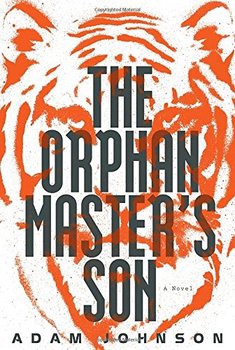
The Orphan Master’s Son by Adam Johnson

Pak Jun Do, “a humble citizen of the greatest nation in the world,” is brought up an orphanage work camp after his mother is stolen by the State to Pyongyang. Impressed by his toughness and loyalty, the regime recruits him to work in the army as a tunnel fighter and then a professional kidnapper. He rises in rank through violent means until a failed mission in Texas condemns him to servitude in a mine where laborers never see the light of day and work till their deaths. After his escape, Jun Do impersonates a military commander in an attempt to save Sun Moon, a famous actress “so pure, she didn’t know what starving people looked like.” This Pulitzer Prize–winning novel employs magic realism and satire to create a riveting portrait of a nation rife with “corruption, and casual cruelty but also camaraderie, stolen moments of beauty, and love.”

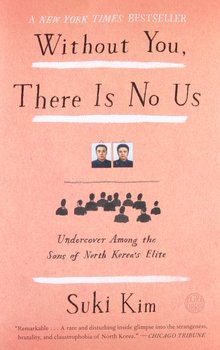
Without You, There Is No Us by Suki Kim

Suki Kim spent six months teaching English to the sons of North Korea’s elites in the country’s only privately funded university, the Pyongyang University of Science and Technology. Kim, “intoxicated by this unknown and unknowable place” decides to move to the communist nation to be “a spy of sorts, hoping not to plant bombs but to plant ideas” in her students so blinded by propaganda that they “were always comparing themselves to the outside world, which none of them had ever seen, declaring themselves the best”. Even their computer science education was a deception since internet access and modern technology is banned in the nation. Despite the young men’s privilege, they were prisoners, trapped in the fences of the heavily guarded university and living in constant fear of a purge. With her heartbreaking memoir, Kim sheds light on a paranoid and lonely nation enslaved to the delusions of their “Great Leaders.”

Nothing to Envy: Ordinary Lives in North Korea by Barbara Demick

Reconstructed from six years of interviewing escaped defectors, Nothing To Envy vividly chronicles the everyday lives of a vagrant, a model communist and her recalcitrant daughter, a woman doctor and a pair of young lovers. These six ordinary citizens fall in (and out) of love, work hard, endure hardships, question the regime, escape to South Korea but long to return home. The book takes place in Chongjin, an industrial city devastated by the famine during the tumultuous period of Supreme Leader Kim Il-sung’s demise and the blood-soaked ascension of his heir, Kim Jong-il. Eschewing the stereotypical depiction of North Koreans as brain-washed automatons, Demick captures the mundane humanity of these citizens living under the world’s most isolated and brutal regime.

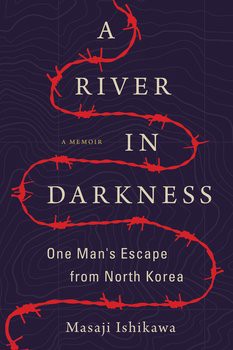
A River in Darkness: One Man’s Escape from North Korea by Masaji Ishikawa

In 1958, North Korean leader Kim Il Sung initiated a mass repatriation campaign, calling his citizens abroad to return home, to “paradise on earth.” Dreaming of a better life, Masaji Ishikawa’s father heeded that call and moved his family from Japan to the North Korean village of Dong Chong-ri. Ishikawa quickly learnt that “thought was not free” and that he now belonged to a “pseudo-religious cult” of the Worker’s Party where even his father worshipped the Dear Leader as an “invincible general made of steel.” Trapped in a country that prides itself on homogeneity, Ishikawa was vilified for being half Japanese and condemned to “very bottom of society.” After 36 years of enduring back-breaking labor in government farms and eking out a life under horrific conditions, Ishikawa braved the Yalu River and crossed into China in the dark, barely making it alive to Japan.

7 Books by Women that We Should Not Forget

Sometimes, I walk into a library or a used bookstore and I pick up book after book, glossy cover, dusty cover, slightly foxed or spine unbroken and they all make me want to weep. I read the rave reviews (better than raves; nearly-hysterical and adoring paragraphs from the critics whose names used to strike fear into the hearts of writers) and the proud dingbats of major publishers on the spine, and perfectly good author photos, and several sentences about their repeated nominations and wins. And I do almost cry, because I have never heard of these writers, not even a rumor, and I am a pretty serious reader. They have disappeared like yesterday’s crumbs in a strong-moving stream and they are gone. Not every one of them, of course, but more than seems right or fair.

Buy the novel.

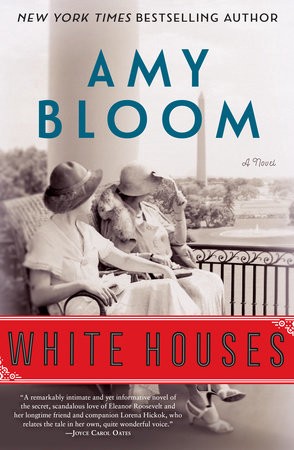
My novel, White Houses (Random House, February), tells a love story that has been disappeared from history; it’s the romance between Eleanor Roosevelt and journalist Lorena Hickok told from Hick’s outsider perspective. The love story of Roosevelt and Hickok is one that needs to be written back into history. The following seven books contain stories that we should not let float away in the great drift of books-that-were. They are all great works, of varying worlds and different styles, and I know that they are all marked by the strong sentence, the clear eye, the sharp wit or humor and a passion for storytelling that is exceeded only by the persistent fascination with character and characters.

The reputations of authors wax, wane, and disappear entirely. Each of these writers made a difference in how we write and how we read. Do yourself a favor and find them, again.

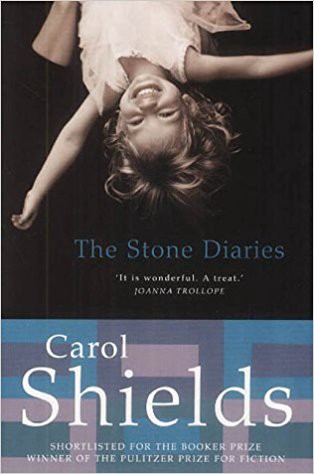
The Stone Diaries by Carol Shields

Read only if you care about ordinary life. Pulitzer prize-winner, modest Canadian Shields said: “A human life, and this is the only plot I think that I am interested in, is this primordial plot of birth, love, work, decline and death. This is just life working away toward the end of life. What is the story of that life? Can we tell our own life story with any sort of truth at all? Of course, we know we can’t.” Her novel Unless makes me want to lie on the floor and hold tight, in grief at these people’s lives and in pleasure at her artistry.

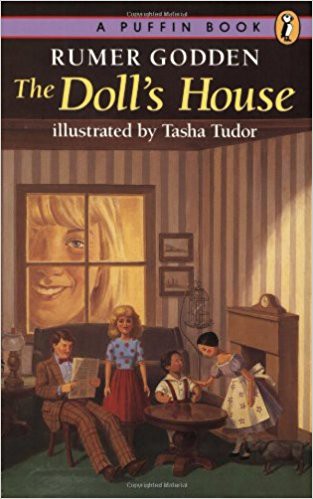
The Doll’s House by Rumer Godden

Seventy books in her lifetime, including twenty-one novels and some of the most wonderful books for young readers ever. Observant, helpless, awkward, questioning and questing young girls fill her books; as Emily declares to Louise in Breakfast with the Nikolides, “I see you, Mother. I cannot help it.” Godden is the champion of the oddball and the outsider and a master of the details which children remember and keep. I suggest A Doll’s House, of which the Times said, with unusual perception: “For little girls who love dolls, women who remember dollhouse days, and literary critics who can recognize a masterpiece.”

Maud Martha by Gwendolyn Brooks

Brooks is a poet and novelist, and the first African-American to win the Pulitzer Prize. Readers may know of Brooks’ great range of poetry but they missed her one work of fiction for adults: Maud Martha, published in 1953 and a provocative, open, wonderfully everyday, magically poetic and imaginative story of a young woman, black in America.

This poem of hers, offers both the roots and the plain-spoken lyricism of her novel:

A Song in the Front Yard:

I’ve stayed in the front yard all my life.

I want a peek at the back

Where it’s rough and untended and hungry weed grows.

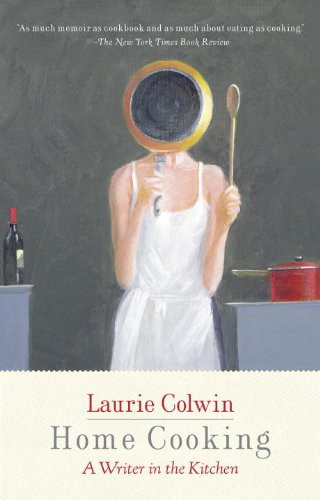
Home Cooking by Laurie Colwin

Colwin died way too young, at 48. People who love her work still talk about her passing (now decades ago) as if they have only just heard about it and cannot quite take it in. Her linked short stories were witty, compassionate, omniscient masterpieces, every one of them. Her novels, maybe not so much. And her essays on cooking taught me to be a better cook and a better writer. I think of her as she titled a book: Shine On, Bright and Dangerous Object. If you love the chapter on roast chicken in Home Cooking, you will love all of her essays and short stories. If you don’t, it’s fine. We won’t be going out for drinks, but it’s fine.

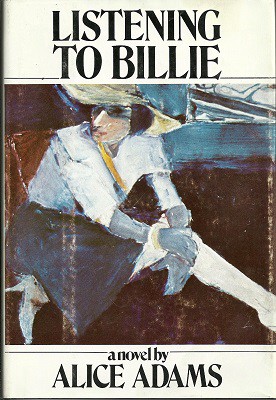
Listening to Billie by Alice Adams

Adams wrote some of the most complex, odd, difficult characters I’d ever encountered. Her people were greedy, selfish, impatient, dishonest, self-deceiving, needy and usually, liars, to boot. They were wonderful to discover and have stayed with me for thirty years: transplanted Southerners, black and white; the self-loathing men and their anguished wives; the chipper, suicidal women passing through the South, on their way to san Francisco, or passing through a dump, on a way to a palace. Alice Adams hid in our closets and spied on us and she reported back with clever, witty writing concealing the dagger. Read Listening to Billie, for the full, cold-eyed, compassionate and attentive portrait of a woman at forty.

The Short Stories of Doris Lessing

Forget The Golden Notebook. Read Stories. This is the major collection, although I love each of my frayed, yellowed, duct-taped paperbacks of A Man and Two Women and The Habit of Loving, which I buy up in used bookstores, so I can give them away. Her stories are set in crappy apartments in London, villas in the French countryside, in offices and living rooms everywhere, and they center on the unfolding of painful moments, the evading and facing of brutal truths, the dark hilarity of romance. None better. “Her grasp of what is actually happening in the world is ministerial,” wrote Margaret Drabble. “Doris Lessing is one of the very few novelists who have refused to believe that the world is too complicated to understand.

Here Lies by Dorothy Parker

0ne hundred essays, reviews and short stories published in The New Yorker, under the name Constant Reader. (My fave: “This is not a book to be tossed aside lightly. This is a book to be hurled across the room.”) Somerset Maugham wrote the intro for the original Portable Dorothy Parker, (Viking Press, 1944) and said ‘Her style is easy without being slipshod and cultivated without affectation.’ Her work was filled with bitterness and misery and a wit so sharp, she slashed herself and everyone around her. (She died alone in a hotel room at seventy-three, surrounded by gin and ghosts, most of whom she reviled. Plus, she was a self-loathing Jew. I don’t care. I don’t admire the person but I sure do admire her wonderful, witty way with a monologue and no one understood more about disparity and inequity — of all kinds.)

What Flannery O’Connor Taught Me About Chronic Illness

I n the fall of 2012, when I was suffering from the rheumatic symptoms of what I called my “phantom illness,” I read Wise Blood, Flannery O’Connor’s first of two novels. I read the book over the course of several warm baths I took to ease the ache in my joints. None of the doctors I visited had offered a conclusive diagnosis for my complaints, which, in addition to arthritic pain, included traveling rashes, fatigue, mental fogginess, amenorrhea, occasional numbness and discoloration in my fingers and toes, and the loss of about half of the hair from my head.

I had begun to feel ill while living in Savannah, Georgia, and soon after, at age twenty-nine, I relocated to my mother’s home, in North Carolina, for what I believed would be a temporary spell of medical tourism: visits to family doctors who might offer referrals to specialists at Duke and UNC-Chapel Hill. I left my clothes and furniture and books in Savannah and returned often enough to convince myself that I had not, in actuality, moved in with my mother.

When I took Wise Blood into the bath that fall, I had maintained a moderate interest in O’Connor and her work. I found the paperback volume at my mother’s house, on a shelf filled with novels I supposedly studied in college literature courses. I had certainly, if intermittently, read from The Complete Short Stories, a chronological printing of O’Connor’s short fiction with an introduction by her editor Robert Giroux; and I had once visited the author’s childhood home in Savannah. I had seen the bathtub the author filled with pillows before climbing in to read stories as a young girl and the view of the Cathedral of Saint John the Baptist, where the family attended church, framed by every street-facing window. I had seen the white wicker pram with its gold-leaf monogram: MFO’C for Mary Flannery O’Connor. I had stood in the sunroom next to the faded chaise where O’Connor’s father, Edward, lay for afternoon naps that would eventually be understood by his family as the earliest signs of the lupus that killed him at age forty-two — the same disease that killed his daughter at age thirty-nine.

I don’t make no plans.
— Flannery O’Connor

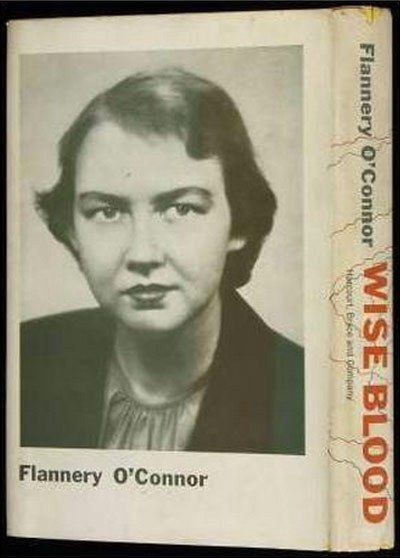
In winter 1952, roughly two months shy of her twenty-seventh birthday, Flannery O’Connor posed for her first author photograph. Wise Blood was scheduled for release that May, and her publisher, Harcourt, Brace, had requested a picture for the back of the book jacket. “They were all bad,” O’Connor wrote to the poet and translator Robert Fitzgerald and his wife, Sally. “The one I sent looked as if I had just bitten my grandmother and that this was one of my few pleasures, but the rest were worse.”

Flannery O’Connor author photo for her first novel, Wise Blood

O’Connor was living in her native Georgia by then. After several years away, during which she earned her MFA at the Iowa Writers’ Workshop and spent time at Yaddo, she had come back to her family dairy farm on the rural fringe of Milledgeville, a pretty town of white-columned buildings. She had not, however, returned willingly. Systemic lupus erythematosus had begun to plague her body at least a year earlier and driven her back to the care of her mother, Regina, and the various aunts, uncles, and cousins who lived nearby.

She had been renting a room in the Connecticut home of the Fitzgeralds when the illness struck, working on her novel and enjoying the intellectual camaraderie and mentorship of the likes of Alfred Kazin, Robert Lowell and Elizabeth Hardwick. Years later, Sally Fitzgerald recalled depositing the ailing young writer on a train that would return her to her home state for what both women believed would be a temporary visit: “She looked much as usual, except that I remember a kind of stiffness in her gait . . . By the time she arrived, she looked, her uncle said later, ‘like a shriveled old woman.’”

Regina had received the diagnosis but hid it from her daughter for nearly a year and a half, preferring instead to tell her she was suffering from rheumatoid arthritis.

When she sat for her Wise Blood photograph, little more than a year after that train ride and a subsequent hospitalization, O’Connor still assumed her stay in Georgia would be impermanent. This is the story Sally Fitzgerald told when she edited The Habit of Being, a collection of O’Connor’s letters published in 1979. O’Connor did not yet know she was afflicted with lupus. Regina had received the diagnosis but hid it from her daughter for nearly a year and a half, preferring instead to tell her she was suffering from rheumatoid arthritis. Only in the summer of 1952 did she come to understand her true condition.

In an interview conducted years after O’Connor’s death, Sally Fitzgerald disclosed that she had been the bearer of this medical information, which she had received in confidence from Regina. Shortly after this conversation with Fitzgerald, O’Connor acknowledged her malady in precise terms, writing, “I now know that it is lupus and am very glad to so know.”

Her collected letters reveal her pragmatic response to the news. She sent for the personal belongings she had let linger in Connecticut: a Bible, two suitcases, and a copy of Art and Scholasticism by Jacques Maritain. She ordered “a pair of peafowl and four peachicks from Florida,” the first members in a flock that would eventually number in the forties and devour the entirety of her mother’s garden except, for some reason, the irises. And she began attempting to develop as a writer amid the strictures of sickness and her middle-Georgia geography. About her authorial image, she revised her assessment in no less brutal terms: “The book itself is very pretty,” she wrote to the Fitzgeralds after receiving her first copies of Wise Blood, “but the jacket is lousy with me blown up on the back of it, looking like a refugee from deep thought.”

“The book itself is very pretty,” she wrote to the Fitzgeralds after receiving her first copies of Wise Blood, “but the jacket is lousy with me blown up on the back of it, looking like a refugee from deep thought.”

The photograph and the timing of its taking, several months before O’Connor knew the gravity of her condition, are, to me, significant. The high fever that had hospitalized the writer a year earlier had shocked her body and caused her to lose much of her hair. The steroids she took for what she called her “AWTHRITUS” made her face puffy. She did not attempt to mask these cosmetic casualties of illness. In the photograph, her dark hair is cropped and thin at the crown; her gaze is fixed beyond the viewer. She appears serious and masculine, save her painted lips and the gathered neckline that peeks out from beneath her dark jacket. She is partly bald and baldly assured.

But of what, exactly, is she assured? O’Connor’s innate sense of her artistic talent and her strength of self-possession are well documented. Most biographical portraits of her recall how, at age 24, she coolly defended her work against manipulation by John Selby, an editor at Holt, Rinehart. The publishing house had, by way of a fellowship award in the amount of $750, secured a first option on Wise Blood. “Selby and I came to the conclusion that I was ‘prematurely arrogant,’” O’Connor wrote to Paul Engle, her mentor and the director of the Iowa Writers’ Workshop. “I supplied him with the phrase.”

I am most certain of this: she did not believe the photograph would be the first of many to establish her literary identity as an invalid.

Her conviction in her abilities as a writer was well nourished, both at Iowa and by her Yaddo connections. But it is not difficult for me to imagine that she also felt a more basic sense of conviction: that, in winter 1952, after a period of convalescence during which she concentrated on regaining her strength, finishing her book, and raising “twenty-one brown ducks with blue wing bars,” she believed her health would stabilize enough to allow her return to the intellectual comfort of her northeastern literary sphere. She probably thought her hair would regain a luster commensurate with its young age. She thought, in all likelihood, she was documenting a mere moment of strife in a healthful writer’s life, a physiognomy as temporary as her Georgia sojourn, and this only by way of an obligation to her publisher. She was too naïve, then, to consider declining Harcourt, Brace’s request for an author photograph, though she resisted as best she could, sending the final selection a full month after it was requested. I am most certain of this: she did not believe the photograph would be the first of many to establish her literary identity as an invalid.

. . . as if a woman must balance intelligence with prettiness to be legitimate.
— Hilton Als on Flannery O’Connor

The physical consequences of her illness haunt O’Connor’s legacy. From the publication of Wise Blood onward, she begrudged the camera lens, even as she allowed it on her property, a two-story farmhouse edged by a dense forest of loblolly pine, sycamore, oak and poplar trees. Photographers arrived occasionally, from Atlanta or New York, to capture the author at her typewriter or communing with the peacocks she raised. The resulting images, often printed alongside her own essays and short stories in Catholic papers and secular magazines, betray her body’s frailty, which is perhaps why O’Connor rarely believed printed photographs resembled her. “Most [pictures] don’t look much like me,” she wrote in the last year of her life. “Or maybe they look like I’ll look after I’ve been dead a couple of days.”

Flannery O’Connor with two peacocks

Yet few who write about O’Connor refrain from mentioning these images or her photographic appeal. The subject has been batted about by critics, who cite her prematurely aged face and aluminum crutches as origins of her grotesque fiction. “Hopelessly sick, bald, and deformed, she writes with a vengeance,” said one reviewer of Everything That Rises Must Converge. Others have engaged in revisionary commentary. Katherine Anne Porter declared that O’Connor, whom she knew personally, was merely ugly in photographs. “She was very slender with beautiful, smooth feet and ankles,” she wrote to a friend after the author’s death, in 1964. Mary Gordon discussed O’Connor’s appearance despite the effects of illness, calling hers “a peculiar face for a writer” in a 1979 review of The Habit of Being. Gordon went on to say: “No face could appear less fashionable or stylish than Flannery O’Connor’s.” And, “It does not seem a writer’s face; rather that of an aunt more educated than the rest of the family.”

Gordon went on to say: “No face could appear less fashionable or stylish than Flannery O’Connor’s.” And, “It does not seem a writer’s face; rather that of an aunt more educated than the rest of the family.”

In 2015, the U.S. Postal Service unveiled a ninety-three-cent stamp featuring the writer’s college-era countenance, unperturbed by the cat-eye glasses that became, along with the crutches she used, her photographic signature. “Wait — What’s Betty Crocker doing on Flannery’s stamp,” wrote Lawrence Downes in the New York Times. He argued that another image would have better represented the author on postage: one she had painted herself.

My daddy said I was a different breed of dog from my brothers and sisters. ‘You know,’ Daddy said, ‘it’s some that can live their whole life out without asking about it and it’s others has to know why it is, and this boy is one of the latters.’
— The Misfit in “A Good Man Is Hard to Find”

I spent roughly a year wondering, often in specialty doctors’ offices, what was wrong with me. Then and for some time after, I avoided being photographed. I escaped to the parking lot behind my office building to get out of a group portrait, the purpose of which I never learned; I ignored the woman from human resources who asked me to provide a headshot for a staff database. Eventually, she arrived at my desk with an iPhone and got her picture. Photographic proof of the Christmas I spent in Nevis, in 2012, does not exist, and, maybe because my memory is most often jogged by pictures, I barely recall being there. Avoiding cameras coincided with a conscious altering of my overall aesthetic. I tore through the closet I kept in my mother’s house, which was by then stocked with the clothes I had initially left in Savannah, and I cast out what struck me as feminine — a preemptive declaration of my physical incongruity with anything that might be considered pretty. I did not possess O’Connor’s biting wit, but I recognized power in saying first, through a plain, mostly black, androgynous wardrobe, what I thought others believed. I earned validation for my efforts one night, while sitting at a bar with a colleague who said, unprompted, “You know what I love about you, Caroline? You look like you just don’t give a fuck.”

I did not possess O’Connor’s biting wit, but I recognized power in saying first, through a plain, mostly black, androgynous wardrobe, what I thought others believed.

An air of not giving a fuck is, incidentally, what some have said they love about Flannery O’Connor. Though mainstream feminism has often ignored her work, she has earned praise for her lack of vanity, for her unwillingness to compromise by . . . what? Sweating under a wig in rural Georgia? Bumbling around her farm without her glasses? Amid her birds and her mother’s cows she had no reason to take uncomfortable beautifying measures. Perhaps her country life aided her sense of humor in protecting her esteem. When visitors did arrive with cameras, perhaps she did not feel as alien as some people assume she must have.

I did ultimately receive a diagnosis, in the spring of 2013. My condition was of the autoimmune variety, a disease called Hashimoto’s thyroiditis, in which the body attacks the thyroid and produces erratic fluctuations in the relative hormone levels. (This is why the disorder can be difficult to detect.) It is chronic but somewhat manageable with medication. My relief upon receiving this news was marred by a feeling of ridiculousness. “It’s really not a big deal,” the diagnosing doctor told me. But watching my body mutate from my perception of myself — measuring a daily deterioration by the number of strands I held in my hands after stroking my hair or the length of time I could stand without the aid of an inanimate object — had felt like a big deal. I was too embarrassed to tell him that. I began taking the medication and lopped my hair to my ears. I continued to look like I didn’t give a fuck. Five years after discovering the banality of my affliction, I maintain my simple, unfeminine wardrobe. I have trained myself to resist complaining on days when I feel tired or wake up hollow-eyed or monitor an angry flush ascending my neck or tracing the claw of my ribcage.

“It’s really not a big deal,” the diagnosing doctor told me. But watching my body mutate from my perception of myself, had felt like a big deal. I was too embarrassed to tell him that.

When my phantom illness found a name, I found myself unable to say it. The disease and its accompanying symptoms aligned with my physical experience, but the diagnosis somehow felt insufficient. In accounting for the various malfunctions of my body, Hashimoto’s thyroiditis undermined the psychic impact of experiencing that body in revolt. My disease was not serious. It was no big deal. I no longer had the right to cry when I looked in the mirror. I did not wish for a sorrier fate, but the name of my own was not enough to explain the leveling of my morale or, as I had come to believe, the weakness of my character. I kept reading O’Connor, searching her letters and her fiction for confirmation that sickness had damaged her spirit, too. I wanted proof of a twin wound and a model for mending it.

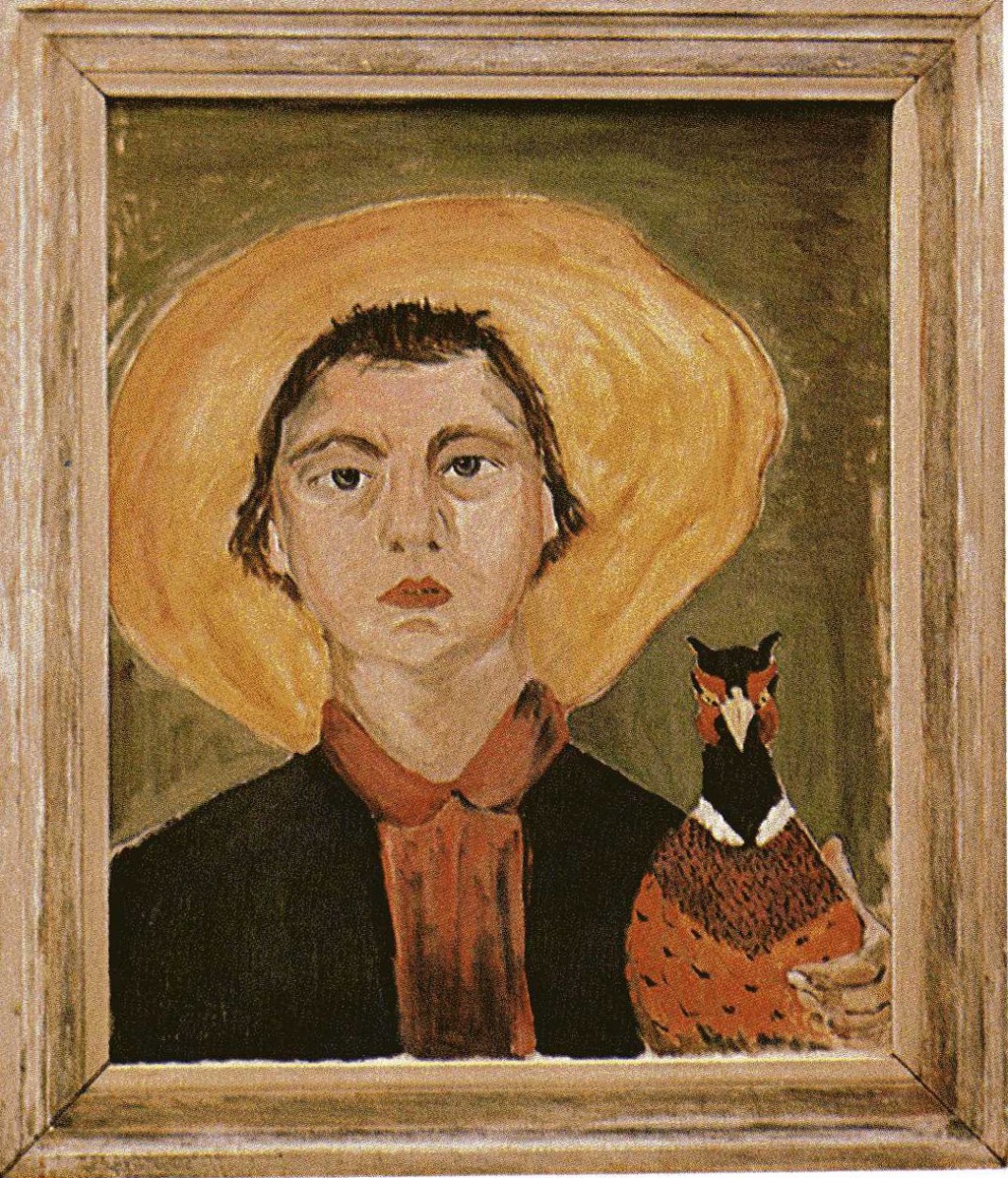
I painted me a self-portrait with a pheasant cock that is really a cutter.
Flannery O’Connor

Self-portrait painted by Flannery O’Connor

A cousin of O’Connor’s maintains the original in a private collection; but a reproduction hangs above the sofa in the living room of the Milledgeville farmhouse where O’Connor lived until her death. She completed the portrait in the summer of 1953 as a clever corrective to the ravages of ill-health and, I think, the Wise Blood author photograph she hated. In my mind, she was rebelling against that black-and-white picture and the terminal truth it captured; she was attempting to redefine her authorial image by her own hand. Her artistic training as a cartoonist for her high-school and college newspapers informed her. She used a palette knife, because she didn’t like to wash the brushes, and painted herself wearing a large sunhat and holding a pheasant. “I am the one on the left,” she wrote to a friend. “Of course this is not exactly the way I look but it’s the way I feel.” At the time, O’Connor was still injecting herself with shots of cortisone, “which gives you what they call a moon-face,” and her hair remained thin. She did not consult a mirror or the pheasant as she painted. “I knew what we both looked like,” she wrote.

I kept reading O’Connor, searching her letters and her fiction for confirmation that sickness had damaged her spirit, too. I wanted proof of a twin wound and a model for mending it.

When viewed at a distance (the best way view it, according to O’Connor), the self-portrait appears to depict a young farm boy. But up close, and taken individually, parts of the painted face appear familiar: the sharp eyebrows and Cupid’s-bow lips, a short tuft of hair flipped over an ear at an insubordinate angle. O’Connor rendered herself and her bird in bold colors and a flat Byzantine perspective. Against a streaked green background, she wears a red blouse and a black jacket, mirroring the shades of her companion — black head with a mask of red spreading from his triangular beak. Both gaze directly and defiantly at the viewer. “I like very much the look of the pheasant cock,” she wrote, ten years after its painting. “He has horns and a face like the Devil.” In her writing and in her life, O’Connor’s transcendent theme was divine grace, or, as she put it, “the action of grace in territory held largely by the devil.” Perhaps, then, it is not a stretch to view the painted sunhat atop the boyish head, the spiraling tones of yellow and gold, and consider it a kind of malformed halo.

Upon completing the portrait, O’Connor campaigned to have it serve as her author photograph, sending it first to Harper’s Bazaar, where an editor called it “a little stiff.” She mailed snapshots of it to her friends, to her literary agent, and to at least one reader who had asked what she looked like. Eventually, as she wrote to Elizabeth Hardwick and Robert Lowell, “I got tired of having people say it didn’t look like me as I knew better it did. So I got a lady with a flashbulb thing to take me alongside it.” In this photograph, which O’Connor was pleased to send to doubting friends, she stands shoulder to shoulder with her painted self, lips pursed and hair chopped to an unruly length.

Photo of Flannery O’Connor posing beside her painted self-portrait

In 1955, she sent a photograph of the painting to her editor, Robert Giroux, and asked that he consider it for the back of the book jacket for A Good Man Is Hard to Find, her first story collection. “If you have to have one,” she wrote, “I think it will do justice to the subject for some time to come.” Giroux gently rejected the idea. The book published without an author photograph, a fine concession, in her opinion: “It is nice not to have to look at myself on the back of the jacket,” she wrote, upon receiving her first copies. None of her subsequent books appeared with an author photograph.

If O’Connor entertained the theme of divine grace in her self-portrait, she would have done so only after pointing out her efforts towards realism.

In her fiction, O’Connor’s patience for symbolism was activated only after realistic elements were established. Of her devotion to the concrete realm, she wrote, “Fiction begins where human knowledge begins — with the senses — and every fiction writer is bound by this fundamental aspect of his medium.” Mystery could only emerge after hard realities of life had been satisfied and characters had been fully rendered. The Misfit, in “A Good Man Is Hard to Find,” had to be a criminal before he could assume a prophetic guise. The image of the Holy Ghost in “The Enduring Chill” had to be a water stain before it could rip Asbury from his narcissistic delusion. The girl in the waiting room in “Revelation” had to be an irritable teenager before her ugly outburst could reflect the hypocrisy of Mrs. Turpin’s soul.

If O’Connor entertained the theme of divine grace in her self-portrait, she would have done so only after pointing out her efforts towards realism. And yet, if nothing else, the painting was personally symbolic — it’s the way I feel. It is the writer and one of her birds. It is also the writer, moon-faced and faithful, clutching sin with one hand and reflecting its colors with her own. It is the way she felt and the way she wrote.

Where you come from is gone.
— Hazel Motes in Wise Blood

Before he blinds himself and begins lining his shoes with stones, before he wraps barbed wire around his torso, Hazel Motes preaches the word of nothing from the hood of his rat-colored Essex. O’Connor’s orthodox Catholic faith instils an absurdity into this scene that my mind, despite its atheist conceptions, can appreciate. I read the vibrant, darkly comedic words of a woman whose mortality echoed in every ache and fever, whose daily life was subject to the whims of her malady, and I laugh with her. My hair continues to fall and grow and fall again. Sometimes my fingers scream when I type. Living inside a body I’m only just beginning to recognize becomes easier amid stories crafted by what sickness could not contain. I do not understand what it means to exist under a threat of death, but I’ve felt the emotional burden of trying to live in the shadow of illness. Far away from my mother’s house and the constant call of warm baths, I feel it still.

On the Coming Extinction of the Great White Male

“On The Coming Extinction Of The Great White Male”

by Marvin Shackelford

It’s early. For me, anyway, and the raccoons are up and moving in the afternoon, hidden from daylight in the attic of the house. They usually keep still except at night, so we only hear them in the wee hours of the morning when we’ve gotten off work. But now they’re doing a matinee. I roll over in bed, clutch a pillow to my face. Dirty snowlight slips past the blinds. I’ve tried different things. Nailed sheet metal onto the porch posts, thinking once they came out of their hole above the porch roof and hit the ground they wouldn’t be able to claw back up. They got right back in. We put out the cage traps, but they took the food and disappeared again, ghostly. I’ve been thinking about buying a gun.

The house is empty. Dave’s taken my girlfriend and they’ve gone to class. They’re the real problem, him and Heather thinking the raccoons are cute, talking about they just want shelter for winter and they ain’t hurting anything. It’s a load of shit, though, because they’re tearing up the insides of the house.

“Your uncle owns this place,” I keep telling Dave. He doesn’t care, says it okay.

I go to the kitchen and dig around in the pantry. We’ve got all sorts of shit shoved in there — three shelves of canned food, a rotary telephone, two plungers, jumper cables, dead double-A batteries, a half-empty pack of diapers. A phone book from Tijuana, Mexico, and a bag of glow-in-the-dark dress sequins. I shove and shift the bottles and cans around until I find the one I want — big white plastic jug with a green cap. Antifreeze. I slam the bottle on the counter, grab a bunch of tuna cans from the cabinet and stack them beside the antifreeze. I figure the message ought to be clear.

“Would you rather,” Dave asks me, as our game goes, “be a shitty husband and father or a shitty leader, Jack?”

“Leader of what?”

“Think Bush,” he says, as though that explains it all.

Breath fogs in front of his face. I think on it a while. Another slab of ham slides to me along the conveyor belt, and I use the rounded shaver hanging from its cord along the power and support pipelines above us to hack at the strips and flabs of white fat wrapped around it. Then it drifts on down the line to my white-suited coworkers who do the delicate cutting on the meat.

“Bad leader,” I say.

“Really?”

“Yeah. You wouldn’t?”

“I don’t know.” He shrugs his shoulders and hacks at a ham. “We have a responsibility to the world. You know?”

“I guess,” I tell him. Then I think a minute and wonder what good a shitty dad does the world. I stop and stare at Dave until he looks up.

“You’re so full of shit,” I say.

“You can’t be serious,” Dave says to me. We’ve showered in the plant locker room and headed to the bar, the North-South, sitting by the railroad tracks at the grain elevators on the south end of town. He drinks a whiskey mixed with coke, then starts into the pitcher of beer I bought.

“I’m just saying. It’d be nice to be in Nashville again.”

“Fucking rednecks.” He makes quotes with his fingers and adds, “Country.”

“There’s rednecks here.” I take a look up and down the bar, over at the pool tables where guys in Monsanto jackets, corn guys, are drinking beer and holding cue sticks. I frown at Dave. “Everything’s so damn flat here. I want to see a Confederate flag or some shit again, you know?”

“Jesus fucking Christ,” Dave says, and he says it loud, the bartender looking up from her magazine to put on a cross look. “That fucking racist shit.”

“It ain’t racist,” I say. “And what — you think nobody up here ever gave a black man shit? You ever talked to these people?”

“Not racist? Not racist?” Dave screams, not answering the pertinent question. He reels off his stool and shoves me in the back. “Are you out of your fucking mind?”

I drop my beer, and it clanks over the bar and crashes to the floor, out of sight. The bartender yells something real shrill, and I turn around and punch Dave, right in the mouth, and he near flips over on his back. Then we’re in a tangle, twisting around and aiming fists at each other’s heads until the Monsanto guys come over and peel us apart and shove us out the door, into the snow. We sit there a few minutes, asses thawing snow on the curb, until I can finally look over at Dave again. He’s lighting a cigarette.

“Go home?” I ask him.

“I guess,” he says, and we stumble to his car.

This is pretty much what we do. We get up in the afternoon and go into the hog processing plant where we work on the same line, shaving chunks of white fat and gristle off hams. We put on the stained but washed white over-clothes the company provides, we clock in, and we hack up pork. Sometimes one of us is dragged away for another job, things like slicing the knuckles off pig legs or dragging racks of ribs through pepper bins for curing. The pepper’s what’s really bad. They like putting me on those crews, for some reason, and I get to the lockers covered in seasoning, itching, and having to take a cold shower to get the stuff off. If you turn the hot on too quick the pepper heats up, burns the skin and leaves a red rash behind.

Then we go to the bar, drink ourselves under the table, sometimes fight over stupid shit. Dave is still in college. That’s how we both got off up here. He hasn’t dropped out yet, goes to classes a couple days a week while I stay home and sleep or play guitar or fool around with Heather, who’s still in college, too. She catches rides with Dave, and I wonder how long we’ve got left in this particular life. He talks about switching to third shift, the shipping crew, and running a forklift. He wants to work for the college paper in the evenings. I sometimes talk about moving to first shift and going to kill floor, the other side of the plant where they bring the hogs in smelling like shit and still squealing before they kill them, string the bodies up and dismember them and clean the unwanted parts out so they can send the good pieces on to the cold floor.

Our lockers are up a set of stairs beside the kill floor, and every time I go to change clothes or grab my lunch I see down the hall and into that end of the building. The sounds are mechanical and wrenching, the smell is hot and the air’s thick. Now and then one of the kill workers will step through the double doors, amping up those sounds for that moment and marching down the hall in blue over-clothes. The blue keeps only the shape of stains, big dark continents that could be sweat or blood or anything at all, and the doors swing shut behind whoever’s coming through and I’m a little scared.

Heather knows about my plans to move to the kill floor, and I’ve also made the mistake of telling her how it’s kind of terrifying. She keeps saying to me, every time it comes up, “You know you’re too much of a pussy.”

“And you’re a complete and utter cunt,” I tell her.

“Fuck you,” she says, and she climbs off the couch and walks to the kitchen. She’s disturbed by my use of that word, cunt, frowning and acting like she’s on the verge of tears. I watch her, try to figure out what’s going on in either one of our heads.

“Really, though,” she says later, snuggled up or head in my lap or, when it’s real bad, from a chair on the other side of the room. “I don’t see how you can kill things.

“It’s five bucks more an hour,” I tell her.

“But it’s just not right,” Heather says, and I’m forced to remember that we met, just a year ago, at an animal-rights group meeting at the college, before I had stopped going, and my pickup line had been something about saving the whales over coffee.

“You want a sandwich?” I ask.

“What you have to do is poison them little fuckers,” Ted Hennenfent says after I describe the situation to him. He works on the kill floor and makes five dollars more an hour, and for a second I’m not sure whether he’s talking about Dave and Heather or the raccoons. He takes another drag off the cigarette I gave him and stares at me over his bushy gray mustache. He’s waiting on his wife to pick him up, and I’m waiting on Dave to pull around. The plant reeks of pig and rolls black smoke into the dark behind us.

“Thought about it,” I say. “But they’d get pissed.”

“Now, listen, I’m not saying do nothing dirty. Just mix a little something into some meat and leave it out all night and — you don’t have dogs or nothing do you?”

“Uh-uh.”

“Right, so leave it out in the yard, they’ll come down, and bam.” He slaps his big red hands together. “Problem solved.”

The wind picks up. I light a cigarette and hand another to Ted.

“Trust me,” he says. “Coons are just another kind of rat.”

“You’re still going to put a word in for me, right?” I ask him after a minute.

“What, kill floor?” he says. I nod, and he shrugs. “Won’t do any good. You don’t speak Spanish, do you? Well, they want everybody on kill speaking it now. I ever told you how they won’t promote me to floor supervisor because I don’t speak Spanish?”

“Yeah,” I say, though I know he’s aiming to tell it again.

“Well, you know all the Mexicans they give jobs here, so many of them — ”

A horn blows and cuts him off. We look over and Ted’s wife’s at the curb, hanging her arm out the window and waving. Her hair’s bleached a horrible blonde and her face is streaked red from the cold, but Ted’s eyes light up when he sees her.

“See you later, Jack,” he says. “And yeah. Just poison those blame things and be done with it.”

“We’re working on this layout,” Heather tells me. “Isn’t it awesome?”

She’s gotten a job as opinions editor at the school newspaper, a position I get the impression no one else wanted. Dave has become her right-hand man, writing stories and assisting with all the decisions about her two broad pages of newsprint. They’ve turned our living room into their work space, covering the coffee table and floor with paper and pictures and junk. While he’s out of the room, Heather tells me all about it.

“See, I want to highlight all the positive things about this candidate. He visited Galesburg and we got a lot of good stories from it.”

“That’s kind of unprofessional, isn’t it?”

“What do you mean by that?” Her skinny shoulders scrunch up in her sweatshirt.

“Aren’t you supposed to tell the news and just the news? Not try to tell people what to think?”

“Well,” she huffs, picking herself up from the couch, “this is the opinion page. And we’re just telling the truth, anyway.”

“Truth!” Dave shouts, stepping back into the living room.

“Hell yes, partner.” Heather passes him into the kitchen. They high-five on the way by and then, no shit, swing on down and slap each other on the ass, like they’re playing football. I sit still, a little disturbed, and Dave drops beside me where she’d been.

“Isn’t this awesome?” he wants to know.

“We can’t move you,” the HR guy says. I’d gone through the channels, made an appointment and filed a request, but just like that, no preamble, he lets me know there’s no going anywhere. He sits at his desk, white shirt and a tie, but the room still smells like pig. That rubbery odor that seems like it must have something to do with hooves. It’s all over his family photos and his daughter, barely smiling out of her school pictures.

“We just don’t need anyone there right now, and you’re already trained on cold, anyway,” he says, looking up from his papers. He’s a dark brown color, like he’s been out in the sun, and he keeps wiping at the pencil-thin black mustache curling over his lip. “We can still move you to morning shift if you want, though.”

“Nah.” I sit and sharpen my working knife while he talks. “That’s okay.”

“Sorry, Jack. Maybe in a few months.”

I look him up and down, his ample forehead and combed-over hair. Thin shoulders. He kind of looks like a coke bottle that’s right on the verge of shaking itself up and spewing all over the room.

“Do you speak Spanish?” I ask. He just cocks his head at me.

We celebrate with drinking.

“Third shift!” Dave yells, and him and Heather slam their glasses together.

“Third shift,” she yells.

“Third shift,” I say, and they bump their glasses into mine. “Congrats.”

Dave’ll be driving a forklift between midnight and six, now, working for the paper in the afternoons. They gave him a desk, a phone extension, and a computer that doubles for laying out the ads. But it’s awesome. I take a look around the North-South. The Monsanto guys are playing pool, a little drunker than usual and laughing too much. They’re rednecks, and I feel like I could walk up and start a conversation with them. Something about football and the best time to start planting a crop. One guy smooths out his mustache and rests a hand on his buddy’s forearm. The green sleeve of the guy’s jacket sways his pool cue back and forth. Beside me, at the bar, Heather props her head on Dave’s shoulder while she tells the bartender, who pretty obviously don’t give a shit, how stealing beer from a bar is a felony but stealing it from a gas station is just a misdemeanor and how that just ain’t right.

“Fucking right,” Dave says.

“I’m not all that sure what I’m looking at,” I say. Everything looks funny from where I’m sitting. Nobody says a word, though, to try and help me make sense of it

“Would you rather,” Dave says, “lose your ability to speak or go deaf?”

“Speak,” I say.

“But how would you communicate?” he wants to know.

“I guess I’d write it down.”

“But that’d be hard,” Dave says. “Not being able to tell people what you think, never having any conversations, shit. I couldn’t do it.”

“I’d rather not hear,” Heather says. “I’d just use sign language.”

“They have whole towns for sign language now, you know,” he tells her.

They sit on the couch, leaning over their newspaper stuff, knees glued together while they move things around. I remember all of a sudden that semester I’d spent in college, sitting in Heather’s dorm room and trying to explain math to her. The x is always the same as what’s on the other side, I kept telling her, pointing to both ends of the equals sign and shrugging. She started crying and went to a math tutor at the library.

“I’m tired of this,” I tell them. I go to the kitchen. The antifreeze still sits on the counter, staring at me, but the tuna cans have started disappearing. It’s gone from six to four, and I wonder how much it’d take to kill a raccoon family. It’s probably a moot point. I hear them at night, skittering out of the ceiling and into the yard, vanishing in the dark if I turn the porch light on. But I don’t know if I can really do it.

I cut the top out of one of the cans and drain the water, start picking the meat up and eating it with my fingers. It’s too dry. Dave and Heather whisper in the other room. I kind of imagine they’re talking about me, but I don’t know. They stay up late now, even after I’ve turned in, and Heather sleeps on the couch instead of coming to bed. I’m not stupid. I know where it’s headed, my room to his, but I ain’t clear at all on how we’re supposed to make this sort of transition without things getting rough. They get louder in the living room, say how that candidate of theirs has got a plan, for the future, and peace, the only vague words they ever say about him. I wonder if they just somehow don’t know they’re doing it. Not even these two could expect to brush this off so easy.

“Jack,” Ted says. He pauses, drops the butt of his cigarette in the dirty snow piled up on the concrete, and lights another. He’s wearing a cowboy hat and a clean shirt — date night with the old lady, he told me. They’re making a late trip to the bars over in Galesburg. “How are you coming with them coons?”

“Haven’t done anything, yet.” I shuffle my feet and kick at a clump of ice. “I was thinking maybe some antifreeze.”

“Ooh.” He nods in appreciation. “Good choice. Though a lot of the time now they put stuff in antifreeze that animals won’t like the taste of. So many people poisoning the neighbor’s dog and all. Have to watch out what kind you get.”

“Well,” I tell him. “I’m really kind of hoping they’ll move on on their own.”

“You can forget that. Thing about a coon is they’re just like a . . .” Ted snorts and takes a look around before leaning in and giving me a wink. “Coon’s just like a coon. Once they’re in all you can do is run the little fuckers off.”

“I guess.”

“No guessing to it. You have to get it taken care of.”

His wife pulls up and blows the horn. She’s all dolled up, bright yellow hair curled and red shoulders showing above the steering wheel. She waves to Ted, and Dave pulls his car in behind her. He taps on the horn for me.

“Gonna get my own self something taken care of right now,” Ted says. He punches me in the arm and stands there a moment longer, his big hat silhouetted beneath the security lamps, and he looks like close to a million bucks.

We’re doing things an awful lot like living — Dave and my girlfriend get up in the morning and go to college, learn how to save the world, then me and him go to work in the afternoon. He switches to third in a couple weeks, so they take him off the line nearly every night. They’ve mostly got him peppering ribs. I stand on the line next to a blonde woman with chunky hips. She frowns from behind her goggles, thinks I leave too much fat for her to cut off. The cold’s what’s bad, really, the big refrigerated warehouse. I’ve started keeping a runny nose, have to wipe at it with my shoulder because my sleeves are too dirty around the wrists, smudged with blood and gristle. I wouldn’t have thought it possible, but that ground-up pig smell’s growing thicker.

Then I go to the North-South and drink, eyeing the corn guys at the pool tables and telling the bartender, who you can tell don’t give a shit, how they don’t promote nobody that don’t speak Spanish. Can’t even get on kill floor and make an extra five dollars, I say, pretending she knows enough about it to understand and connect the two things. She shrugs behind her magazine. The corn guys sway around their cue sticks. When I get in the truck and go home Dave’s already there, bent over the coffee table and straightening up articles with Heather. He tells her what he still ought to write, what needs to be talked about. She smiles at him and tells me hey when I walk in the door. I go to bed too wide-awake to sleep and think about killing pigs. I’ve worked there near three years and still don’t know exactly how they do it, just piecing it together in my head from things I’ve heard and what my uncle used to say about killing hogs when he was growing up. You hang them up, cut their throats, and let them drain.

I eat the last can of tuna fish, find another can empty at the edge of the porch when I go out. Takes me a minute, but then it clicks — they’ve actually been feeding the raccoons like blame pets. I add tuna to our grocery list on the fridge and leave the antifreeze sitting out. I can’t think of anything to replace it. Seems like I’ve seen it kill dogs and coyotes, other things. Comes down to it and they might just eat it right up.

“I think we ought to have a date night,” I say.

“A date night?” Heather sinks back in the couch, stares at all her shit on the table. I drop beside her, throw an arm over her shoulder and tug at her hair. She’d probably look good with curls. When I don’t leave her be she tells me, “I’ve still got a lot to do.”

“Don’t you think it’d be fun? Get out for a night, let everything slide?” I kiss her on the shoulder. “Just you and me out in the world.”

“Out in the world,” she repeats. “I don’t know.”

I put on khakis and a polo shirt, trim my beard up and spray on some cologne I’ve had sitting around since Christmas. I slick my hair down and stand at the bathroom mirror a minute, decide I look pretty good and Heather ought to be happy with it. She shows up an hour late, riding in the passenger seat of Dave’s car. They’ve been working at the office on Saturday morning, and she comes into the house in a pair of overalls, hair frizzing at the sides of her head. Says she’s ready to go. We drive to Galesburg in my truck and eat at Applebee’s. I order steak and she gets a salad, and I find myself staring at Heather’s fingers while she picks at the food with her fork.

“Not any good?” I ask, but she doesn’t say. After dinner we go to this bar Ted always talks about, where I imagine him and his wife get on the floor and dance, her hair up and his hands on her hips while they slide along, but Heather won’t have it.

“I don’t want to dance,” she tells me, and I guess I should’ve seen it coming. We play a game of pool without talking while the couples line-dance at the center of the room, and then it’s just me playing. I shoot the balls off the table in order, one through fifteen, and she sits on a stool, staring over my head at the dancers, and I ask her again if she’s sure she don’t want to dance.

“Fuck no.” She shakes her head. “Rednecks.”

I drop my cue on the table. It rattles, just a second, louder than the music.

“What the fuck is wrong with you?” I say. Heather turns her chin down, finally takes me in with her big striped eyes. It’s the first time, I’m pretty sure, she’s really seen me in a while.

“I think we should take some time off,” she says. She bites down on her lip and stares at the floor between us, and I stare at her a minute. There’s a drunken crash and laughter behind us on the dance floor.

“Okay.” I pick the cue up and go back to knocking the balls into pockets. Each number higher is a step closer to something. I don’t know what, just something. Probably awful.

“Okay,” I tell her.

I pull the truck to the door of the plant and see Dave standing there talking to Ted. The big man’s laughing and smoking a cigarette, holding on to what looks like an oversized black suitcase. He rests it on the ground, holding steady with his elbow. Dave shrugs at whatever Ted’s saying, and when he sees me walks over and slides in the cab.

“Jack,” Ted yells. He tosses his smoke into the snow and carries his load over. I put the truck out of gear and roll down the window.

“No, drive,” Dave says.

“I was just telling your buddy here, the coon problem’s over,” Ted tells me. He swings the case up and over the rail of the truck and sets it in the bed. I hear the snow crunch and pack down beneath it. “Here’s you a rifle.”

“What?”

“Yeah,” Ted says. “I just bought a new one, too, so keep it long as you need it.”

“Okay. Thanks, Ted.”

“No problem.” He lights another cigarette, leans on the doorframe and smiles at us. “Yeah, figured this was the way to get it done. Got a scope on it and everything.”

“Well.” I try to sort it in my head. I’ve received my weapon, just been turned into a hunter. Ted, I guess, is my lady in the lake. We’re way past poison. I try to remember the last time I shot a gun. Scouts, maybe.

“I was telling Dave, don’t want you guys to have to burn your own house down to get rid of some coons.” He chuckles. “Yeah, all kinds of coons, you can burn them out if you have to. Had some of the one kind, whole family of them, move in over at Avon, back a few years ago. Didn’t anything else work.”

“The fuck,” Dave says. “Just what is that supposed to mean?”

Ted stares in the cab for a moment, looking between the two of us until the smile slides off his face. He shrugs.

“You know. Varmints are varmints.”

I don’t turn my head but can feel Dave’s face turning red. I put the truck in gear.

“Well, thanks a lot, Ted,” I tell him.

“You bet.” He slaps the side of the truck, and I pull us away from curb.

“What the fuck,” Dave says.

“Don’t shoot yourself in the foot,” Ted hollers after us.

“Last day shaving. Congratulations,” I tell Dave. I start to take the turn for the bar, but he waves me on, wants me to stay on the bypass.

“Just take me home,” he says.

“Are you kidding? We have to celebrate. This is the last time we’ll ever get off work together.”

“No,” he says and shifts in the seat. “That fucking Ted Hennenfent.”

“You’re gonna skip out because of something Ted said? Come on, man. You know he’s full of shit.”

“Some things you just don’t say.” He watches the dark alongside the highway.

“There’s nothing you can’t say,” I tell him. We pass out of town and into empty cornfields. “Just things you don’t do. And honestly, I don’t think he knows better.”

“Doesn’t know better?” Dave stares at me while I get a cigarette lit. The red flame of my lighter makes an angry shadow of his face. “If I was drunk, right now, I’d punch you in your fucking head.”

“Really,” I say, looking over at him. “Better be glad you ain’t drunk.”

“And, honestly, we have too much to do on the pages.”

“Well,” I say.

“So we’re taking time off,” I tell the bartender. I can tell she doesn’t give a shit, but I sit at the bar drinking whiskey anyway. She closes her magazine, though, and lays it on the counter. She sighs real loud, then stares at me a minute. I look back at her, thinking I finally must’ve gotten through to her. This will be the moment of truth.

“You’re just all messed up, aren’t you?” she asks me. She grinds her lips into a sad little smile and shakes her head. “Shouldn’t you be talking to your little friend about all this? Where’s he been, lately?”

I settle back and drain my glass. The ice chatters against my teeth, and I lay money on the bar for another.

“That’s probably not a real good plan at the moment,” I tell her.

“Well,” she says.

While she’s pouring me more whiskey, a long and terrible process, everything in my head skitters around. Thoughts start climbing down my forehead, and I stare at the Monsanto guys. The one I saw touching the other guy’s arm is touching it again, he’s leaned over whispering something to his buddy, and right there seems like something all summed up for me. As soon as the bartender shoves the fresh glass into my hand I walk over to them. They see me coming, and the one guy reclaims his hand.

“How’s the corn looking?” I ask. Their shoulders shrug and they both mumble something pretty noncommittal.

“Listen, I get it,” I say to the two of them. They stare at me a minute, and the rest of their buddies lean up from the pool tables to watch.

“Excuse me?” the one doing the touching asks.

“I get it. I know what’s going on.” I hold my hand out to shake, but nobody takes it. “It’s okay. Really.”

“I think you’re drunk,” the other guy says.

“And y’all are gay,” I say, spilling whiskey everywhere. “It’s okay.”

I throw my arms around their necks and hug and start to tell them, what you want to do is just fine even if I don’t like it, or maybe, you are who you are, but the whole bunch of them’s jumped on me. They punch me in the head a lot, and then the body shots pick up, and when they’ve got me on the floor it’s a lot of indiscriminate kicking. But I’ve made my point. It’s okay.

“Don’t come back,” the bartender screams while they’re dragging me to the door, but I’m not worried about finding a new bar. It’s okay, and even before they drop me on the snow-covered asphalt and kick my ribs in a little more, I realize it’s the only and best way this could have gone.

I coast up to the house and put the truck out of gear, sitting there a minute with the headlights shining through the windows. There’s a knot in my belly that I’m pretty sure is the whole world coming together to just plain be all right. Then I see the living room’s empty, but Dave’s car’s sitting right there in the drive. That knot’s something a little different, my stomach tells me. Dave steps out of his bedroom buttoning his shirt up about the same time I step into the living room. He freezes.

“Hey. What do you know?”

He shrugs and stands there, works the buttons all the way up to his neck. Then his eyes finally find my face.

“What the hell happened to you?”

“Nothing,” I tell him. “It’s okay.”

Heather steps out Dave’s door, shirt half over her head. She works it down, giggling a little, then she sees me. She skitters to a stop, gets quiet, and I drop into a chair. My eye’s starting to swell, and my lip’s been dripping blood and smudging the dark blue of my jacket, making an awkward new logo of some kind. I smile, and the two of them stand there, keeping carefully apart from each other and watching me.

“Dude,” Dave says.

“It’s okay. Really. But let me ask you something. Really think about it, now.”

“Okay,” he says, moving to the couch and watching me from across their newspaper stuff on the coffee table. The pile’s getting higher and higher, more stories and different new pictures, and I’m pretty sure it’s just gonna keep growing until it blocks our view of onne other. Heather stands out between us, arms wrapped around herself.

“Would you rather,” I ask him, as the game goes, “save the world or just save yourself?”

He doesn’t wait two seconds before answering, “Save the world.”

“Really,” I say, lurching up and swaying a second. I nearly fall over and Dave jumps up and grabs my arm, tries to steady me. He starts asking what the hell happened. I get my feet under me good, finally, and punch him in the face. Heather shrieks. She doesn’t know this is just something we do. Dave doesn’t go down, but he doesn’t hit back, either, stunned. I hit him a few more times and he just takes it, until I finally hit good enough to knock him backward. He hits the floor and bumps the table, rocking their newspaper stuff and sending a few stacks of the jumble right over the edge. I look to my time-off girlfriend. She’s crying and watching with too-big eyes.

“It’s okay,” I tell her. I look at Dave, sprawled in our living room floor. “It’s just you have to take care of yourself first. That’s the only way you get shit done.”

I puke by the truck and figure the blood that’s mixed in isn’t serious. The wind picks up at my back, feels like another snow’s blowing in, and I search overhead for stars. There aren’t any, just clouds hanging a little low but split here and there by moonlight. I tell the sky it’s okay, and it answers back. A gap opens up, and the moon winks down at me. Single most beautiful thing I’ve ever seen.

“Right on,” I say.

The clouds seal back up and my eyes drift, follow the trees in the yard, catch on the metal frame of the truck. I follow the line of the hood, over the cab and down into the bed. Ted’s rifle’s still there. I drag the heavy case onto the tailgate and open it up. Inside, the gun lays carefully pressed into felt, shined smooth and gleaming in the bare light. A single flake of snow drifts onto the pommel and melts. I pick the thing up, cradle it in my arms and sit to wait. Seems like I’ve been skirting something huge forever, but now it’s caught up. I’m stuck moving on.

After a while they come out of the house carrying a bunch of bags. They stand and watch me a minute, then start piling into his car. Heather climbs in without saying anything, but Dave waits at the driver’s door a moment. We lock eyes and he opens his mouth. I shake my head. He looks sad and sorry before sliding behind the wheel. They back out, turn around and head toward town, disappearing into the flat roll of the land.

I carry the rifle inside and kill all the lights, turn the heat down so it won’t click on, make noise. I raise the living room window and knock out the screen, push their newspaper mess out of the way and use the back of the couch for a support. The light slipping through the clouds makes the snow on the ground, in the trees, reflect a faint white. The world glows. I settle in the cold draft and wait. There’s the hum of something electric, outline of an old swing set beneath the trees, the gray rock of our snow-covered birdbath. It doesn’t take long. I hear their claws work. They rattle above, skitter to the edge of the house and come down. A moment later three raccoons hop around the edge of the yard, up to the porch, roaming and looking for food, more handouts. One of them’s half the size of the others, a baby, and it scuttles into the middle of the yard, stands up and turns its head all around. His fat gray body bows out over his back legs. I listen to them chitter to one another, like a family of cartoon squirrels. They’re so blame funny and innocent-looking.

But I can’t help it.

I grip the rifle tight, have to aim with my left eye because the right’s swollen shut, and squeeze the trigger. The shot blows up the air and sets my ears to ringing like I just went deaf. A puff of snow kicks twenty yards behind the raccoons. They raise and hunker themselves, sniff and peer, trying to figure out what’s going on. I fire again, over and over, unable to connect. They only stay still a moment before they scatter and dodge. I hit one just about on accident, its back end spinning. The baby. He turns a circle and hobbles to our big leafless maple tree and climbs. The big ones slip out of sight and I pull the gun back through the window, its smoky discharge thick.

I push off the sofa, trying to hurry. My body’s starting to ache and get stiff from the beating. Doesn’t want to move. I step out the front door, and everything’s quiet beneath the leftover buzz of gunfire in my ears. The snow comes up over my ankles, drifting deeper at the center of the yard. A thin, dark trail of blood runs to the maple. I follow it, stand at the base of the tree and search its branches until I find the wounded raccoon. He sits tight on a limb and clutches the trunk. I feel like I might get sick, this far down a road it feels like I’ve been traveling an awful long time. I catch the glint of his eyes and lift the rifle to put him in the sights. This is the part that seems hardest, the big step that really makes things happen. Puts the past and everything still coming on separate sides and changes it all for good.

9 Stories About Different Kinds of Prisons

Whether by a physical place, an emotional cycle, or an unbreakable habit, there are lots of ways to find yourself trapped. At one point or another, many of us have been stuck in a bad relationship, felt confined by circumstances, or, perhaps most dangerous of all, we’ve hidden, thinking ourselves happy, in a prison of our own building. Reflecting on these experiences and reading stories about them means considering how one becomes imprisoned: Were poor choices made? Is there something we are denying or lying to ourselves about? Was, simply, a crime committed? And of course, is there a way out?

Usually, it’s not exactly pleasant to ask ourselves those questions, but fiction is a great mediator of introspection. From the Recommended Reading archives, we’ve released 9 stories by the likes of Angela Carter, Brian Evenson, and Mai Nardone that explore the dusty corners of all sorts of prisons: sexuality, gender, bad jobs, regret, and of course, literal exile.

For just $5 a month, members of Electric Literature get access to the complete Recommended Reading archives of over 290 stories — and year-round open submissions. Membership is tax-deductible, helps us pay writers, and keeps all of our new content free. So if you like what you’ve read, please join today!

“X” by Brian Evenson, recommended by Tor

Excerpted from ‘The Warren’

The Warren tells the story of a person named X — or maybe not a person, because what is a person, anyway? — trapped, alone, on a distant planet after a failed expedition. A quest for escape ensues, but when X realizes he has become stuck as a repository for souls without bodies, the story moves beyond mere survival to explore the confines of mortality. In this excerpt, we find X questioning the monitor about the history of the warren.

“The Orchids” by Noemi Jaffe, recommended by PEN America’s Glossolalia

Following the failed Hungarian Uprising in 1956, Jaffe’s narrator Írisz flees Budapest, leaving behind her mother and her lover Imre, a guerrilla in the revolutionary movement. When she arrives in São Paulo, Brazil, to study orchids, she piques the interest of Martim, the director of São Paulo’s Botanical Garden. Exiled in Brazil, Írisz immerses herself, even hides in, her work, writing rather unorthodox reports on newly discovered orchid species, mixing her observations of orchids with reflections on the differences between Portuguese and Hungarian, the Communist dream, her relationships with those around her and those she left behind, and our responsibilities to one another.

On the Power and Prison of Gender: 11 Stories and 1 Poem

“The Apartments of Strangers” by Helen Phillips, recommended by Elliott Holt

Excerpted from The Beautiful Bureaucrat

The Beautiful Bureaucrat concerns a young married couple, Josephine and Joseph, newly arrived in a city reminiscent of New York. After being evicted from their apartment, they move from short-term sublet to sublet. Josephine starts a new job that has her stuck for hours a day in a windowless room, entering data that is not explained. Her husband, Joseph, does the same. With her usual mastery, Phillips finds the weird and fascinating in the mundane, and explores what happens when isolation closes in on the individuals in a marriage.

“The Box” by Arthur Bradford, recommended by John Hodgman

After losing his foot in a freak accident, Georgie buys a house with money from the settlement. His house is solitary and private, save for this mysterious box that he is not allowed to touch or move but will rest peacefully in his backyard. Georgie is powerless on his own land, bound by a contract that doesn’t seem to have any loopholes.But this being a Bradford story, comedy and weirdness pervade over the melancholy. As John Hodgman writes in the introduction, “The descent into the underworld is a staple of the hero’s journey according to Joseph Campbell; but only in an Arthur Bradford story would the hero peer into the underworld, shrug, lock it shut, and go get stoned.”

“Bettering Myself” by Ottessa Moshfegh, recommended by The Paris Review

The narrator of “Bettering Myself” is a problem drinker and Catholic school math teacher who says to her students, “Most people have had anal sex. Don’t look so surprised.” Still pining after a divorce and stuck in a web of addictions and bad decisions, Moshfegh, author of the acclaimed novel Eileen, brings a deadpan humor to a story about a wayward life and the difficulty of escaping it.

“Lady of the House of Love” by Angela Carter, recommended by Kelly Link

As a vampire story that invokes “Beauty and the Beast,” “Jack and the Beanstalk,” and perhaps at a stretch, “Rapunzel,” this tale is a classic, swooping Carter masterpiece and appeared in the posthumously published collection The Bloody Chamber. The titular lady is a countess and a vampire, trapped in her vampirism and her castle, let out at night by her governess to feed. As a child she was sated by small creatures, but now she is a woman and must have men. “Of the many works in Chamber, this one is Kelly Link’s favorite: “I love ‘The Lady of the House of Love’ for the luster of Carter’s language,” writes Link in the foreword, “[for] the tensile strength of the prose; its luscious, comical, fizzing theatricality.”

9 Stories About the Magic of Cities

“In the Night of the Day Before” by Jensen Beach, recommended by Graywolf

There are two prisons in Jensen Beach’s story: memory and sexuality. A man named Martin hears the Eagles’s classic “Hotel California” and recalls a visit to San Francisco — and, perhaps more importantly, the stop he made en route. In San Luis Obispo, he met a young man, Cesar, at a bar and brought him back to his motel. Martin goes on to meet a woman in San Francisco, but it is Cesar — and the man Martin was when he was with him — that lingers in his mind when he returns to his normal life.

“Ourselves, A Little Better” by Mai Nardone, recommended by Territory

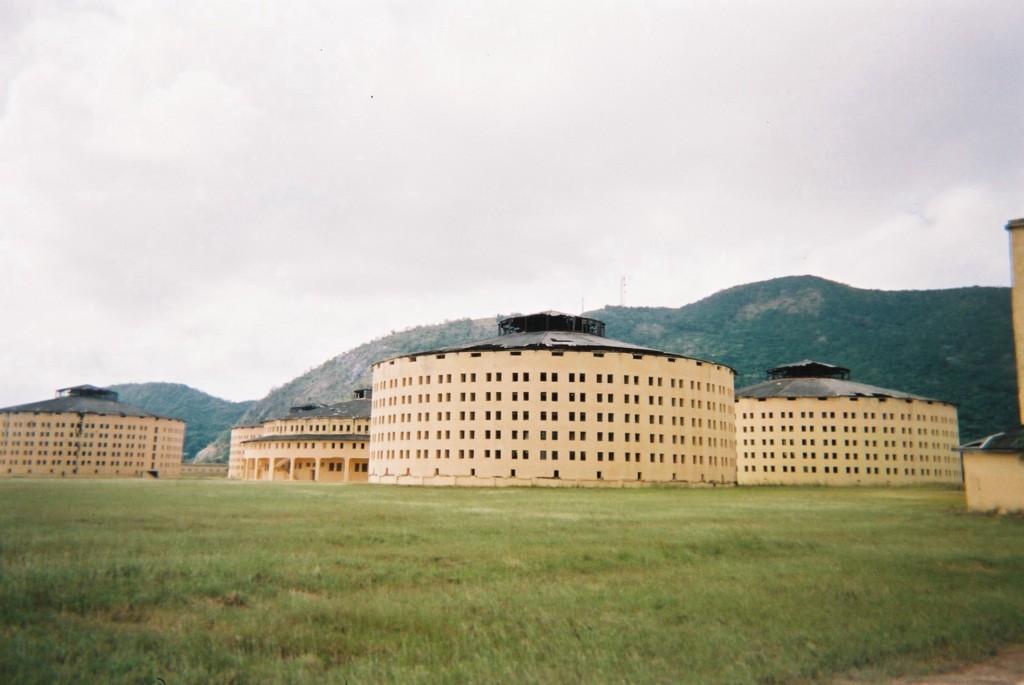
Each issue of Territory has a theme and each piece published is based off a map that embodies that theme. From the “Prisons” issue, Mai Nardone’ chose to work with a map of the Panopticon. The Panopticon, designed by the 18th century English philosopher Jeremy Bentham, is a circular prison in which all inmates could be observed by a single watchman. It is either a utopian or dystopian structure, perfection or perversion, a mark of utilitarian progress or an overstepping of bounds. It is, like the luxury genetic modification program in this story, a thought experiment of potentially heinous capacity.

No Alcohol, No Women, No Drugs, No Visitors” by Gabe Habash, recommended by Garth Greenwell

Excerpted from the novel STEPHEN FLORIDA

In this excerpt, Stephen visits an oil field on the recommendation of a career counselor. “One of Habash’s talents, in this and many other scenes, is to reveal the hilariously absurd in the crushingly banal,” writes Garth Greenwell in the introduction. The counselor’s nephew turns out to be even more severely off-kilter, more walled-off and strange, than Stephen himself; he lives alone, in an isolated house with an empty Octopus that he intends to fill. On the visit, Stephen is not only trapped in the man’s home, but is given a hellish vision of what a life trapped with your loneliness can become.

Electric Lit Will Offer Scholarships to Catapult’s NYC Writing Workshops

UPDATE, April 5: Applications are now open for spring and summer classes.

With the support of the New York City Department of Cultural Affairs, Electric Literature is proud to offer 20 partial scholarships to Catapult’s NYC writing workshops for the second year. We are now accepting applications through Catapult’s website, and New York City-based writers of all ages and experience levels are invited to apply. (NOTE: because this is a New York City Depart of Cultural Affairs funded-project, all applicants must reside in New York City to be eligible.) To be considered for a scholarship, select the course you’re most interested and click “take this class.” While viewing the registration form, check “Opt-in for a scholarship.” Shortly after submitting your application, you’ll be prompted via email to submit a writing sample of no more than 2,000 words and a brief statement of need. Scholarships are available for 6 to 8 week writing workshops as well as single-day master classes through July 2018, and applications will be accepted on a rolling basis.

Catapult’s workshops topics relate to the instructor’s unique skill set and literary sensibility, and single-day masterclasses offer students the chance to dive into subjects like narrative voice and story structure. These craft-oriented classes are offered alongside courses designed to help emerging writers navigate the publishing industry. Current instructors include Elissa Bassist, Simon Van Booy and Weike Wang, in addition to professional editors and literary agents.

“Over fifteen hundred emerging writers have taken our classes,” said Julie Buntin, Catapult’s Director of Writing Programs. “They’ve gone on to top-ranked MFA programs, won fellowships and awards, signed with agents, published books. We believe that a strong literary community, one that matches emerging writers with engaged mentors, can change an artist’s life, and we’re so proud to be working with Electric Literature on this scholarship program.”

In Nella Larsen’s “Passing,” Whiteness Isn’t Just About Race

Passing is a work of fiction, but it is a true story about the world in which its author, Nella Larsen, lived. To describe it simply as a novel about a black woman passing for white would be to ignore the multiple layers of its concerns. Passing is about the monumental cultural transformations that took place in American society after World War I. It is about changing definitions of concepts like race and gender, and the inextricable relationship between whiteness and blackness. It is a meditation on the uneasy dynamic between social obligation and personal freedom. It dramatizes the impossibility of self-invention in a society in which nuance and ambiguity are considered fatal threats to the social order. The novel is an indictment of consumer culture and the dangers it poses to personal integrity. It reveals the power of desire to transform and unhinge us, and the lengths to which we will go to get what we want. Passing is about hypocrisy and fear, secrecy and betrayal. It is a universal story of the messiness of being human as it is portrayed in the particularly explosive relationship between two black women, Clare Kendry and Irene Redfield.

‘Passing’ is a meditation on the uneasy dynamic between social obligation and personal freedom.

Irene and Clare have not seen each other in twelve years when they reunite by chance on the roof of the Drayton Hotel in Chicago, where both women are enjoying a respite from a blazing hot August day. The Drayton is an exclusive hotel, and not one in which African Americans, or Negroes, to use the parlance of the day, would be welcome. In fact, on the fateful day of their reunion, both women are passing for white.

In Passing, race is revealed to be, in part, a function of performance (the novel is structured in three sections — Encounter, Re-Encounter, Finale — much like acts in a theatrical piece), and blackness a matter of perception. Of the two women, it is Clare who appears to be so convincingly white that not only does Irene fail to identify Clare as a Negro, she doesn’t recognize her childhood friend at all. Even after Clare introduces herself to Irene, Irene still doesn’t recognize her or her blackness. When Clare uses her nickname, Irene searches her memory: “What white girls had she known well enough to have been familiarly addressed as ’Rene by them?” By contrast, Clare identifies Irene immediately. Irene squirms under Clare’s unflinching stare, terrified of being seen for who she is, and also afraid of the embarrassment that would result from being ejected from the hotel.

Passing by Nella Larsen

It is only when Clare emits her distinctive laugh, which is “like the ringing of a delicate bell,” that Irene finally recognizes her old friend. As the women talk, Clare appears more and more black to Irene. “Ah! Surely! They were Negro eyes! mysterious and concealing,” she thinks as she feasts her own eyes upon Clare’s stunning features. “There was about them something exotic,” she thinks. As she is observing Clare, Irene is simultaneously making her up, inventing her — and inventing race, too. Clare isn’t any more of a Negro after she reveals herself to Irene than she was before. As Irene confesses to another character later in the novel, no one can tell just by looking.

According to the guidelines of genealogy, Clare’s claims to blackness are tenuous. Her grandfather was white. Her father was the product of her grandfather’s dishonorable relationship with a black woman. Somewhere along the way, there had been money, but her grandfather squandered it. There is no mention in the novel of Clare’s mother.

Once her father died, his pious aunts took Clare in, not as an expression of filial love but rather a sterile sense of Christian duty. They treated her like a servant, and forbade her from revealing the truth about her racial identity. Their bigotry was frank. “For all their Bibles and praying and ranting about honesty, they didn’t want anyone to know that their darling brother had seduced — ruined, they called it — a Negro girl. They could excuse the ruin, but they couldn’t forgive the tarbrush,” Clare tells Irene. Clare was forbidden even to mention Negroes to the neighbors, much less discuss the South Side, where Irene and her friends lived in Chicago. It was easy for Clare to dispose of such an unhappy past, which was bankrupt of love as well as money.

Clare Kendry has not used her fair skin to make a political statement; she has not been passing in order to undermine and subvert the system of white supremacy. There has been no greater good. Instead she has been passing purely for personal gain. Although she grew up in the same racial world as Irene, her social circumstances were radically different. Among their cohort of middle-class girls, “Clare had never been exactly one of the group.” Her father had gone to college with some of the other girls’ fathers, but he had somehow wound up a janitor, and “a very inefficient one at that.” He was also a violent alcoholic who would ultimately die in a bar fight. Among Irene’s earliest memories of Clare are images of “a pale small girl sitting on a ragged blue sofa, sewing pieces of bright red cloth together, while her drunken father, a tall, powerfully built man, raged threateningly up and down the shabby room, bellowing curses and making spasmodic lunges at her.” The stubborn little girl boldly stitching together the bright cloth in defiance of her father’s rage would grow into a young woman who defied fate, custom, and white supremacy by crossing the color line. But it wasn’t racial self-hatred that catapulted Clare into whiteness; it was the shabby room. Clare passed for white because she hated being poor, not being black.

Clare passed for white because she hated being poor, not being black.

All passing narratives are about class as much as they are about race. One never passes down the social ladder; black characters become, or pose as, white in order to improve their material circumstances, or gain access in general to opportunities for personal, social, and professional advancement. The choice of individual comfort over the advancement of the race as a whole is always rendered as wrong; in most passing stories, material ambition and moral ruin are directly correlated. By the time some passing subjects recognize the truly degraded implications of their decisions to engage in racial masquerade, it is too late. In the film Imitation of Life, the main character comes to her senses only after she finds out that her choice to pass has literally killed her mother. The denial of the black mother is often the surest sign of the low character of those who choose to pass. The narrator in the short story “Passing” by Langston Hughes gets a better job as a white man but his financial success requires him to ignore his own mother as they pass each other on the street. “That’s the kind of thing that makes passing hard,” the narrator sums up in a letter to his mother, “having to deny your own family when you see them.”

Clare is a gambler, playing the high stakes game of racial roulette. For her, passing is a sport, and she is unrivaled in her technique.

Clare Kendry is markedly different from other passing subjects in American literature. For one, she is not concerned with the moral implications of passing for white. Unlike other black characters whose passing enables them to marry white people, Clare does not pass for love. Even though she views passing through the lens of rank materialism, ultimately she sees passing as play. Clare Kendry is not an incarnation of the “tragic mulatto” figure, inherently alienated and adrift, whose mixed blood dooms her to racial purgatory. She is not wandering in the interstices of black and white. Instead, Clare is a hunter, stalking the margins of racial identity, hungry for forbidden experience, “stepping always on the edge of danger.” She is a gambler, playing the high stakes game of racial roulette. For her, passing is a sport, and she is unrivaled in her technique. Clare desires many things, among them to be among Negroes again. But ultimately, the true nature of her driving need is as opaque as the “ivory mask” she wears.

Irene is tied to race out of duty; Clare’s relationship to blackness is affective. “You don’t know, you can’t realize how I want to see Negroes, to be with them again, to talk with them, to hear them laugh,” Clare confesses to Irene. As a woman motivated by passion and excited to cross lines of propriety, Clare has a lot in common with the writer who dreamed her up: Nella Larsen.

Nella Larsen in 1928

Nella Larsen was born Nellie Walker in 1891 in Chicago. Her mother was a Danish immigrant and her father an immigrant from the Danish West Indies. Nella’s father disappeared from her life when she was young. Her mother married a fellow Danish immigrant, Peter Larsen, with whom she had another child. Like many fiction writers, Larsen incorporated elements of her own life into her writing. She shared with Clare the experience of being unwanted by white family members; neither Peter nor her half-sister acknowledged the ties that bound them. Like Clare, Nella was born poor and on the wrong side of town. Not only did Larsen spend her childhood in the vice district of Chicago, she was confronted by other dangers: a city in which the crossing of racial lines was unwelcome and cost those who disregarded them dearly. The rigid lines were officially underscored when, in 1920, the category “mulatto” was dropped from the census. There was no room for individuals whose bodies failed to conform to convention.

Nella was introduced to the world of the black bourgeoisie — the world in which Irene moved easily — when she was a student at Fisk University. There she bristled at the strict codes of dress and conduct. In her 1928 novel Quicksand, Larsen describes the disdain that the main character Helga Crane has toward the smug, insular world of the black elite at the fictional college of Naxos (an anagram for Saxon). “These people yapped loudly of race, of race consciousness, of race pride, and yet suppressed its most delightful manifestations, love of color, joy of rhythmic motion, naïve spontaneous laughter.”

Ultimately Larsen was expelled from Fisk, most likely for violating dress code. Larsen went from Fisk to Denmark, where she had spent time as a child. She returned to the United States and enrolled in nursing school, taking a position as head nurse at Tuskegee Institute in Alabama, the incarnation of the vision of Booker T. Washington, and along with Fisk, a model for Naxos. It was known as the “Tuskegee machine.” In Quicksand, Helga reflects on her school: “This great community, she thought, was no longer a school. It had grown into a machine.” Larsen found the working conditions at Tuskegee untenable. She resigned in 1916.

A few years later, she married Elmer Imes, who was at that point one of two African Americans to have ever held a Ph.D. in physics. The couple moved to Harlem, where Larsen took a job at the 135th Street branch of the New York Public Library, now the Schomburg Center for Research in Black Culture. Soon her life as a writer would begin.

As Elmer’s wife, Nella began to spend time with intellectual and cultural luminaries of the 1920s, black men like James Weldon Johnson, Walter White, and W. E. B. Du Bois. These men were architects of the Harlem Renaissance, authors of crucial philosophies that captured the concerns of black intellectuals of the moment. They were also central figures in the National Association for the Advancement of Colored People, an organization for black progress that Du Bois helped to found in 1909. Irene Redfield, who prides herself on being a ticket taker for a ball for the Negro Welfare League, would have been impressed by the company Larsen kept.

It is safe to say that both Nella Larsen and her character Clare Kendry would have had easier lives as mixed-race women in the 21st century. If the 1920 census, with its removal of “mulatto” as a viable racial category, officially erased the experience of being mixed-race in the United States, the inclusion on the 2000 census of categories that allow individuals to identify for the first time in history with more than one race has already generated new stories. According to the 2010 Census Brief, since 2000, the population reporting multiple races increased by 32 percent. Already, the structure of the new census has enabled people with complex racial backgrounds to more aptly define themselves.

It is safe to say that both Nella Larsen and her character Clare Kendry would have had easier lives as mixed-race women in the 21st century.

Unfortunately, the script had already been written for Clare. She was a woman who insisted on being free, and she paid for the crime of her hunger not only to defy racial convention but also the customs of gender, as well. The men in the novel are world explorers, or yearn to be: Jack Bellew is an international banker; Hugh Wentworth has “lived on edges of nowhere in at least three continents”; Brian Redfield longs to abandon American racism and move to Brazil. Clare is the true adventurer, however. Her wanderlust is domestic but perhaps more dangerous in that it is not structured by travel or outlined in a map but rather a function of her everyday life. Her literary descendants, such as Janie Crawford in Their Eyes Were Watching God by Zora Neale Hurston; Sula in the eponymous novel by Toni Morrison; Birdie in Caucasia by Danzy Senna; and the protagonists in Interesting Women by Andrea Lee, also live dangerously by pushing the boundaries of social convention. But in the high stakes games that Clare plays in 1929, the house always wins.

“What is Africa to me?” muses the speaker in “Heritage.” Where does race reside? In blood, ancestry, or emotion? How can it be identified, much less quantified? Is it absurdity or a mystery? Race is a function of law, history, and politics, not science. Yet there is an ineffable quality to blackness, a mysterious factor that drives Clare to risk everything in order to “see Negroes, to be with them again, to talk with them, to hear them laugh.”

It is this ineffability, the mystery that Clare embodies, that Irene cannot bear. She curses race as a yoke, but what she ultimately rejects is not a racial bond with Clare, but the awareness that identity itself is transitional, as mobile as the trains that made it possible for millions of African Americans to leave the South during the Great Migration, and the railroad car that provided the platform for Homer Plessy’s historic confrontation. The self itself is unstable, just like the concept of race.

At the end of the novel, Irene finishes her final cigarette and throws it out of a window, “watching the tiny spark drop slowly down to the white ground below.” It is impossible not to associate the cigarette sparks with the vitality and danger that Clare brought into her life. But Clare Kendry is unforgettable. After all, when a fire goes out, one does not necessarily remember the ashes. But one certainly remembers the brilliance of the flame.

Adapted from PASSING by Nella Larson, published by Penguin Books, an imprint of Penguin Publishing Group, a division of Penguin Random House, LLC. Introduction copyright © 2018 by Emily Bernard.

Karl Ove Knausgaard On Writing Habits, Conversation, and Why They’re Both Kind of Dumb

Karl Ove Knausgaard’s book Winter, which will be published on January 23, is the second in a series of four seasonal books, in which the Norwegian memoirist collects short essays, meditations, and letters to his as-yet-unborn daughter. The subject matter in Winter ranges from toothbrushes to Norse deities to Santa Claus to the moon, but of course it circles back many times to words and writing—Knausgaard’s passion and profession. In the following excerpts, Knausgaard talks about his writing habits—not what time he starts work every day, mind you, but what a habit actually is and where our need for them comes from—and discusses the difficulty of interpreting a conversation when all you have to go on is words.

Habits

For some reason writers are often asked about their routines and habits, such as what time they get up to write, whether they write by hand or on a computer, whether there is something they can’t do without while they are writing. What it is about the writer’s role in particular that awakens public interest in their daily lives is hard to say, but there must be something, since this doesn’t happen with other comparable professions. Maybe it has to do with the fact that everyone can write and read while at the same time there is something exalted about the role of the writer, and that this gap, which seems incomprehensible, must be bridged. Or it may have to do with the fact that writing is voluntary, and that a person who writes can always refrain from doing so, which is unthinkable in the case of an employee, and therefore obscure or tempting. When I was young I read interviews with writers with avid interest. I wasn’t looking for a method, I don’t think; what I wanted to find out was rather what it took. A pattern, a common denominator: what makes a writer a writer? Now I know that all writers are amateurs, and that perhaps the only thing they have in common is that they don’t know how a novel, a short story or a poem should be written. This fundamental uncertainty creates the need for habits, which are nothing other than a framework, scaffolding around the unpredictable. Children need the same thing, something has to be repeated in their lives, and this can’t be something inner, it has to involve external reality, they must know in advance at least some of what is happening around them. That repetition is not innate to us, the way it is to most other beings, but has to be created and maintained by acts of will, is perhaps the main difference between animals and humans. Animals such as dogs who are taken from their natural surroundings and introduced into new settings have nothing to parry unpredictability with, and get caught up in insane repetitions, tics and other compulsive acts. If it is great enough, children react to unpredictability in similar ways. Anxiety, aggression, antisocial behavior. Dante held that we can never understand the actions or feelings of others by reference to our own, as the baser animals can, and that this is why God gave us language. In other words, to make the differences visible, so that they become predictable and functional and enable social relations. But if differences are repeated, they become similarities, that is their own opposite. This makes language treacherous, it serves two masters, and that and no other is the reason literature exists. And that is why only people who are unable to write are able to write it. For if habit is allowed into literature and not kept outside, it is no longer literature, merely still more scaffolding around life.

Conversation

A great deal of interpersonal communication takes place outside language. If one records a conversation and writes down what was said, it becomes clear how important context is to what is spoken, which in itself is incomplete, characterized by hesitation, lacunae and allusions, and not seldom borders on the meaningless. This is so not only because we employ our whole body to complement our words when we speak, or because in a conversation we are attentive to everything the other bodies convey soundlessly, but because the conversation itself is usually about something quite other than what the words express. A conversation about something that has intrinsic value, where what is said is both important and interesting in itself, occurs so rarely that it clearly isn’t the main objective of human intercourse. “It sure is raining outside” is a fairly common statement, and clearly perfectly meaningless since everyone who hears it can see the rain for themselves. “It certainly is” might be the equally meaningless reply. Then there might be a pause before the next statement is uttered. “They say it’ll improve a little tomorrow.” What this conversation is really about is impossible to determine until we know where and when it took place, who took part in it and what kind of relationship there was between them. If it occurs in a large house the morning after a party, most guests having left to visit the small coastal town nearby, between two people who have chosen to stay and take it easy, maybe read a little, and who don’t know each other but are now in the same room, and he is looking out of the window at the shiny wet green lawn and the heavy grey sky, where dense streaks of rain hang like a gently wavering curtain, and she, who was in a chair reading until he entered the room, but has now risen, walked over to the large tiled stove and put a couple of logs into it, and who, as he says that tomorrow’s forecast is better, tears off a piece of newspaper and pushes it in beneath the logs, then the exchange of words about the rain might be a way of establishing a shared space, of affirming that though they don’t really know each other, they aren’t strangers either, since they have common friends and are now here together. In that case they will each soon go their own way, and before long both the conversation and the situation will be permanently forgotten. But if their eyes met several times during the party the evening before, without any words being exchanged, just these crossed glances, then the conversation in the living room, where she is now striking a match against the rough edge of the big matchbox, and he turns to look at her, and she feels his gaze even though she is crouching with her back to him and poking the lit match into the paper, which immediately catches fire and starts to burn with a thin flame, then it might mean something very different. When she tosses the still-​lit match into the fire and stands up, unconsciously rubbing her palms up and down along her thighs as she meets his gaze, and he smiles quietly as he cups the hand that is hanging at his side, and she says, “But it’s good for the farmers at least,” it is turning into a conversation neither of them wants to end, because they are in the process of finding each other through it, and if they do, then perhaps her line “But it’s good for the farmers at least” will later become a classic in their personal mythology, when the first time they met has been turned into a story they remind each other and perhaps also the children of once in a while, to strengthen the bonds that ineluctably weaken over time, and conversations that on paper look flat finally carry no other charge, expressing only indifference.

Flood, Fire, Fish

FLOOD

A hurricane came and everyone left, except for Roy and George. George was eighty years old. He had survived hurricanes before and considered them a massive inconvenience, as well as an opportunity for the poor to loot his home. Roy stayed because he was a dog: a Dachshund, a very loyal breed. Anyway, the hurricane landed and proceeded to cause, as the newscasters put it, “historical devastation.” The more fanciful and apocalyptic stations favored the term “biblical,” but the point was not argued.

Meanwhile, the hurricane had flooded George’s home. George was treading water and holding onto an air mattress, while Roy sat atop it. George had lost his glasses and the dim shape of his old tufted armchair rocking woozily in the brown water was terrible, terrible. The water rose until Roy and George’s heads were just below the ceiling. It was night now, and difficult for George to keep awake. But Roy did not abandon George, licking his face every time he drifted off or let go of the air mattress. By late morning the water had receded slightly, and Roy and George escaped from the house.

By noon the next day, this was being broadcast as a miracle. Certainly it was a good bit of spit-shine for something people liked to believe in. The man had stayed to protect his home, the dog to protect his master! There was something about the odds — George’s age, Roy’s short legs, the forces they were up against — that warmed people’s hearts. The rest of the footage, splinters swirling in rippled murk, dark faces mouthing soundlessly from a patchwork of roofs, chilled them to the bone.

Soon however the news moved on, and so did Roy and George. George was sent to a facility for the elderly. Dogs were not allowed there, and Roy began a tour of schools for disabled children to continue his work, whatever that was. George’s home was not looted, but the furniture was swollen and stained, the walls soaked right up to the rafters. In the end it was torn down with the neighborhood, the lot scraped clean as a bone. Something new would be built there. It was said that the same mistakes would not be made again.

FIRE

A group of men plotted to blow up a building, a high building where high finance went on. On the appointed day, they lit themselves like fuses, setting the twin spines of the hijacked elevator shafts alight. Smoke and flames and sprinkler systems began to wreck their urgent havoc. Marcel and his guide dog, Nina, were in a conference room on an upper floor, where the fund Marcel worked for was discussing seaweed. Marcel had an uncanny knack for predicting the market, and his opinions about nascent trends were highly valued. Privately it was said that his blindness had something do with it, something sonar-or-other, “like bats”; maybe he could hear the money moving around. In the conference room, people began to panic, but Marcel and Nina stayed calm.

Nina, a sleek retriever with aloof blue eyes, rose and guided Marcel out of the conference room and into the rising hysteria of the hall. She led him to the stairwell and down many flights of crowded stairs and out of the flaming building into the street. Traffic had gridlocked around empty cars with open doors and the metro had stopped running underground. The streets were all movement, awash with sirens and people who had begun to run, though they didn’t all know what from. Unperturbed by the chaos and the rising clouds of smoke and dust, Nina led Marcel across the city all the way to his apartment uptown.

Later, it emerged that Marcel was the only man from his morning conference to make it out alive. Was the blind man blessed? People had to wonder. For a week or two man and dog were much photographed, but something about their eyes — the one pair blue, the other blind — was a little creepy on camera. Though he had emerged unscathed, something had changed in Marcel. His market predictions became spotty, erratic. When the crash came later that year, he found he was thoroughly unprepared.

FISH

On a clear, windless day a dolphin swimming off the coast of Florida got caught in a crab trap line, where she sustained horrific injuries. Some time later a crew of activists arrived and, after much exclamation and photography, disentangled the dolphin and transported her to the Marine Aquarium onshore.

Along with marine species from around the world, the aquarium was home to a highly respected team of biologists and veterinarians. In the intervening weeks and interventions that followed, the dolphin’s tail was removed along with two her vertebrae, and she was named Wanda by the staff. What now? They wondered. It did not seem like the right place to stop: too far from the start, too short of something. Luckily there was a war on, and the technology for prosthetics had never been better. Wanda was fitted with a prosthetic tail and, amazingly, trained to swim in a new pattern that would accommodate it.

Wanda had much opportunity to demonstrate this feat in the tank on the main floor where she swam back and forth against the glass, smiling. Children of all sorts were brought to see the dolphin: sick children, school children. Species were labelled with their proper names at the bottom of each tank, and colored interactive maps distributed them according to preferred regions and climes. Most children however seemed happy enough not knowing the names of things, and ran heedlessly from tank to tank, pressing their hands against the increasingly blurry glass.

One little girl however, Martha, visiting the aquarium with her mother, spent some time studying the wall text that accompanied Wanda’s tank with peculiar intensity. The girl’s mother was a medievalist and the child had absorbed a notion that dense texts illuminated a great many mysteries, including her mother. “The fish was saved from the sea, Ma,” Martha said when she had finished reading. Martha’s mother frowned; she had a perfect phobia of paraphrase — that was how she put it, a perfect phobia of paraphrase — but in this instance it seemed essential to correct the particulars, rather than the ill shape of summary. Believing that a child must understand the world sooner rather than later, she made it quite clear to her daughter that a dolphin was not a fish.

About the Author

Olivia Parkes is a British-American artist and writer currently based in Berlin. Her work has been published in Hayden’s Ferry Review, American Chordata, The New Haven Review, Gone Lawn, Bosque Magazine, and Blue Five Notebook, and is forthcoming in Zyzzyva. In 2016, she was awarded second prize in The Exposition Review’s Flash 405 contest.

11 Incredible Books by Writers from “Shithole” Countries

According to The Washington Post, our stable genius president complained in a meeting that the U.S. is admitting too many people from “shithole countries.” At issue were visas granted to immigrants from African nations and countries designated as “temporary protected status,” including Haiti and El Salvador. “Why are we having all these people from shithole countries come here?” Trump reportedly complained (he now says he didn’t, but come on: he absolutely did). We should, he said, instead admit more immigrants from Norway—a nation nobody would voluntarily leave for the U.S. since its health care, quality of life, and GDP per capita leave ours in the dust. Who’s the shithole country now?

This is obviously racist bullshit for a number of reasons. But it’s a good reminder to celebrate the work of writers from Africa, and from Haiti, El Salvador, and other protected-status countries. As writers, readers, and human beings, we would all be intellectually impoverished by the lack of these voices. Here are some of our favorite novels, memoirs, and poetry by authors from the countries Trump disdains, many of whom celebrate their complicated homelands in their work.

The Art of Death by Edwidge Danticat

Edwidge Danticat is an award-winning Haitian-American author, Macarthur Fellow, two-time National Book Award nominee, winner of the National Book Critic Circle award, and national treasure. The author of numerous novels, short stories, young adult novels, essays, memoirs, and even a picture book, there is seemingly nothing this woman cannot write. Her most recent work, The Art of Death, is both a personal memoir of her mother’s death and a philosophical investigation of representations of death in literature.

Behold the Dreamers by Imbolo Mbue

No matter what the racist president might tell you, nobody understands—or embodies—the American dream better than immigrants. Cameroonian-born Mbue’s compelling debut novel follows the travails of a couple transplanted from Cameroon to New York City during the Great Recession.

Americanah by Chimamanda Ngozi Adichie

Nigerian writer Adichie has made waves both as a novelist and an essayist writing about feminism. Her bestselling Americanah grapples with the way that immigration can shake identity; her Nigerian characters, transplanted into the U.S. and the U.K., find that their new context changes how they’re seen and how they think about themselves.

Carrying Knowledge Up a Palm Tree by Taban lo Liyong

South Sudan is a brand-new country, but South Sudan-born poet and writer Liyong has been challenging literary barriers for decades. The first African writer to graduate from the Iowa Writers Workshop, Liyong has long been a gadfly of African academia, criticizing the ongoing colonialism of the English department. His poetry collection Carrying Knowledge Up a Palm Tree engages with some of his ideas about African intellectual history.

Homegoing by Yaa Gyasi

Gyasi’s explosive 2016 debut quickly became a New York Times bestseller and landed on numerous best-of-the-year lists. The novel tells the story of the descents of Effia and Esi, half-sisters who are born into very different lives in 18th Century Ghana. Esi is sold into slavery while Effia is married to a British slaver. By tracing their families over generations, Gyasi makes the global history of slavery resonate on a deeply personal level.

We Need New Names by NoViolet Bulawayo

Bulawayo’s acclaimed debut is a coming-of-age story that follows 10-year-old Darling from Zimbabwe to adult life in the midwestern United States. The novel was nominated for both the Booker Prize and the Guardian First Book Award. In 2012, Bulawayo was named one of the 5 under 35 by the National Book Foundation.

Teaching My Mother How to Give Birth by Warsan Shire

Poems don’t usually go viral, but Somali poet Warsan Shire managed it with “Home,” her ferocious and heartbreaking explanation of the refugee experience. If you didn’t encounter “Home,” though, perhaps you know her from the snippets of poetry in Beyonce’s “Lemonade” album—those are adapted from Teaching My Mother How to Give Birth. Shire’s poetry is accessible and blade-sharp, easy to read and hard to forget.

Under the Udala Trees by Chinelo Okparanta

Okparanta’s debut novel seems to have won or been shortlisted for every possible award for which it was eligible. We meet Ijeoma when she is 11 and before Nigerian independence. Sent away to safety, she meets another displaced girl, and they fall in love. Discovered, Ijeoma is forced to hide this part of herself. Inspired by Nigerian folk tales, Under the Udala Trees is at once the story of a divided and emerging nation, and a coming-of-age narrative of a woman trying to become her full, true self as she seeks and accepts love.

Senselessness by Horacio Castellanos Moya

Honduran-Salvadoran writer Castellanos Moya’s first book translated into English is a horrifying, emotional, darkly funny novel about…editing. It centers on a writer who, like Castellanos Moya, is living in political exile (Castellanos Moya from El Salvador, the unnamed writer from an unnamed Latin American country). The writer is tasked with editing a document from the Catholic Church detailing the human rights abuses of the military regime, and descends into a fever dream.

Concerto al-Quds by Adonis

Regarded as the greatest living poet in the Arab world, Adonis (whose full name is Alī Aḥmad Saʿīd ‘Isbar) is also an essayist, and one of the most influential and controversial voices in discussion surrounding the Syrian regime. “Concerto” was published in 2012, and written in response to the 2011 protests that broke out in Syria. A perennial nominee for the Nobel Prize for Literature, Adonis has won the first ever International Nâzim Hikmet Poetry Award, the Norwegian Academy for Literature and Freedom of Expression’s Bjørnson Prize, the Highest Award of the International Poem Biennial in Brussels, and the Syria-Lebanon Best Poet Award.

Kintu by Jennifer Nansubuga Makumbi

Heralded as the “Great Ugandan Novel,” Kintu rewrites the history of the country by excluding colonization. The novel follows one dynasty through eras, from what would be the pre-colonial period to modern times. You can get a taste of Makumbi’s violent, funny, and heartbreaking book from this excerpt in Recommended Reading.