In ‘The Ministry of Utmost Happiness,’ Globalization is Built on Bodies

“Double Take” is our literary criticism series wherein two readers tackle a highly-anticipated book’s innermost themes, successes, failures, trappings, and surprises. In this edition, Shanthi Sekaran and Nayomi Munaweera, two authors with their own recently-released second novels, share their impressions of Arundhati Roy’s Man Booker Prize longlisted The Ministry of Utmost Happiness.

There are no accolades to be found on the back cover of Arundhati Roy’s new novel, The Ministry of Utmost Happiness — only a quote from the book: “How to tell a shattered story? By slowly becoming everybody. No. By slowly becoming everything.” Whether Roy succeeds in this endeavor — whether it’s even possible to succeed in such an endeavor — is almost an unanswerable question. Better, perhaps, to focus on the everybody and everything that populate this shattered story: Hijras and Dalits, old diaries and a busy cemetery, a government assassin and an abandoned baby girl.

Twenty years have elapsed since the release of Roy’s Booker-winning first novel, The God of Small Things, and this week she made the Booker long list again. It’s with measured breath that one opens The Ministry of Utmost Happiness. Roy takes us on a meandering and unpredictable journey, from the teeming boroughs of Delhi to blood-soaked Kashmir, from activist hotbeds to staid American suburbs. To read this book is to tear into the skin of modern-day India, a land of deeply embedded societal roles, to examine the daily tragedy of a land in conflict — its living bodies, its corporate mask and its ever-morphing identity.

Shanthi Sekaran: There were times in this book when I was like, what is Arundhati Roy smoking? And where can I get me some.

Nayomi Munaweera: Ha! Which parts? And do you think smoking whatever it was would make you a better writer?

SS: The zoo, for example. And various people’s private papers.

NM: Yes! I loved that bit.

SS: There are so many riffs in this book. You think, as a reader, you know where things are leading and then Roy switches tracks. You’re suddenly running alongside the story you thought you were in. She doesn’t create complete departures, but sometimes what you think is a quick tangent becomes an entire chapter. So many times, reading this book, I had to give up my illusion of control, and just go with what was happening. It really seems to just do what it wants to do.

NM: I agree. But I also feel like she was very much in control. It’s a book with a wide range. It sprawls, it takes up room but I think she was very aware of that.

So many times, reading this book, I had to give up my illusion of control, and just go with what was happening. It really seems to just do what it wants to do.

SS: I remember when she was speaking at City Arts & Lectures [in San Francisco, CA], she said, “I wanted to tell the story of the air and everything in it.” I take that as meaning that she wants to tell the story of India, in a geopolitical sense, as she’s spent so many years steeped in those matters. This is the India of social paradox and border battles and communal violence. This isn’t peacock ’n’ mangos India.

NM: It’s amazing we both got to see her speak a few weeks ago. People keep saying she hasn’t written a book in two decades but they forget that she has various nonfiction pieces. She’s been grappling with India the entire time. And it all shows in the book. I think her project has gotten much bigger in those two decades.

SS: India is no longer, in the world’s imagining, a quaint, unfathomable and exotic place. It’s now a player on the global scene, and I feel like readers and the Western public are finally ready to engage with the inherent intricacies.

NM: Did you read Michiko Kakutani’s review? Kakutani essentially thinks the book was too big. That it was a failure because it took on too much.

SS: I think you have to accept this book on its own terms. If you start applying narrative tradition and expectation, you sort of miss the point. Roy wanted to tell the story of everything. So by necessity, that story is going to feel fragmented. But that doesn’t diminish its value. It’s just attempting something that most novels don’t.

NM: Kakutani said, “Roy’s gift is not for the epic but for the personal as God of Small Things so profoundly demonstrated.” I had to disagree with that analysis. It’s always a bad idea to compare a writer’s books. The fact that she told a very personal tale successfully and beautifully in God doesn’t mean she can’t take on the multiplicity and complexity of India in a second book. So, as you said, you have to approach with no expectations.

India is no longer, in the world’s imagining, a quaint, unfathomable and exotic place.

SS: Yes, though some would argue that to tell the epic tale, or the political tale, you focus on the personal. That the personal becomes a reductive mirror for the political. But I’m guessing that’s not what she’s trying to do with this book. It’s not like she’s trying to reflect India in a personal story and failing. There are elements of that reflection in the book. But more than this, I get the sense that she is actually trying to tell the story of contemporary India itself — specifically contemporary Delhi and Kashmir. And how does one even do that? Do you think she succeeded?

NM: Personally I do think she succeeded. It’s an enormous story and task to take the tremendous multiplicity of South Asia. It’s even mentioned in the back cover copy, “it’s not the story of everybody, it’s the story of everything.” So she’s talking about the fate of people but also the fate of animals, the fate of the forests, the fate of the rivers. It’s an enormous undertaking and I think she did it brilliantly.

SS: I’d say she succeeded in telling a compelling, sometimes surprising, story of “everything” in India. But of course the attempt to do such a thing — to tell the story of everything — is doomed to fail. Especially when it involves the maddening paradoxes of India.

From the broader view, what I especially appreciate is that this book turned a leaf for me. It made me look at today’s India in a way I hadn’t yet considered. I was one of those “Oh look! They have malls now!” people. Roy flipped that for me, made me look at the underbellies of those malls, the reality that I, like so many Indians, would rather not see. Being in India involves a lot of “not-seeing.” But it seems Roy won’t stand for that.

NM: Yeah, I can see that. For me, too, I was aware of the anti-Muslim Hindu fundamentalism, as in Sri Lanka we have anti-Muslim Buddhist fundamentalism, but I wasn’t aware of the scope of it. Or the way caste has played into it. The way globalization is a continuation of colonialism. At the talk, Roy said a reader came up to her and mentioned she was studying post-colonial studies. Roy replied, “Is colonialism really ‘post?’” That stayed with me. The idea that the exploitative means of a previous age have only morphed with modernity.

In the book, this really became clear in that moment when history and fiction merge and she has Warren Anderson, the American CEO of Union Carbide, come to India after the Bhopal gas leak killed so many and continues to destroy lives. He looks at the cameras of the gathered press and says, “I just got here. Hi mom.” And that “Hi mom” is repeated over and over on the television as it becomes clear that the company isn’t going to redress their dire wrongs. It was a powerful moment in the book and clearly one that points to her own activism.

SS: I’ll never forget her comparison of capitalist, globalized India to a grandmother tarting herself up.

NM: Yes, Delhi or India herself as the grandmother who is being dressed up to seduce foreign multinationals. That was an amazing description. They try to hide all her ugliness in push-up bras and high heels.

Old secrets were folded into the furrows of her loose, parchment skin. Each wrinkle was a street, each street a carnival. Each arthritic joint a crumbling amphitheater where stories of love and madness, stupidity, delight and unspeakable cruelty had been played out for centuries. But this was to be the dawn of her resurrection. Her new masters wanted to hide her knobby, varicose veins under imported fishnet stockings, cram her withered tits into saucy padded bras and jam her aching feet into pointed high-heeled shoes. They wanted her to swing her stiff old hips and re-route the edges of her grimace upwards into a frozen, empty, smile. It was the summer Grandma became a whore.

SS: That leads me to the question of the body. The body plays a huge role in this book.

NM: This is a book about all kinds of bodies. There are the bodies that don’t conform. One of the main characters is a Muslim Hijra — a transgender woman, recognized in India as a third gender — who is transforming from male to female. She goes from being Aftab to Anjum. There is also the body of the tiny black female baby whose coming is rejoiced at as if she were a goddess come in the final page of the book. She’s female, she’s black, both of which are often undesirable qualities in a traditional South Asian context. Yet Roy is positing these outsider bodies as the truly heroic: that which will rescue us from a frightening insistence on homogeneity. Anjum is celebrated for her ability to cross the bodily boundaries.

SS: Yes, Let’s talk about Anjum, whose narrative dominates the first half of the book. There are so many evocative connections between Anjum and India. The Hijra’s body, for example, is a body in conflict — at least in this book’s depiction. It presents a fragmented experience of gender.

NM: As a Hijra character says to a young, uninitiated Anjum, “Indo Pak is inside us.”

Arre yaar, think about it, what are the things you normal people get unhappy about? I don’t mean you, but grown-ups like you — what makes them unhappy? Price-rise, children’s school-admissions, husbands’ beatings, wives’ cheatings, Hindu-Muslim riots, Indo Pak war — outside things that settle down eventually. But for us the price-rise and school-admissions and beating-husbands and cheating-wives are all inside us. The riot is inside us. The war is inside us. Indo-Pak is inside us. It will never settle down. It can’t.

The riot is inside us. The war is inside us. Indo-Pak is inside us. It will never settle down. It can’t.

SS: Also, as a Hijra, Anjum is placed firmly on the outskirts of society. But paradoxically, the Hijra’s role is well understood and integrated into Delhi society. It’s not a wide-ranging role; there’s not much freedom or opportunity in it, but the Hijra’s role is included and understood, both accepted and reviled.

NM: Right. She becomes part of a very old community of Hijras in the city. As one of the older Hijras reminds them, they’ve been part of the city’s history for centuries. The Muslim rulers of Delhi entrusted their mothers and queens to the court eunuchs. So they came out of a very old tradition. But that’s a Muslim tradition so somewhat at odds, perhaps, with modern Hindu fundamental India.

SS: One of my favorite scenes is when these activist filmmakers visit Jantar Mantar (the protest and activism center of Delhi) and ask Anjum and her posse to say, in Urdu, “Another world is possible.” You can imagine one of those video montages of people of all castes and creeds repeating this one hopeful phrase, a plea for unity, a tidy you-tube viral thing. But what does Anjum do? She doesn’t repeat the phrase as instructed. Instead, she looks into the camera and says “We’ve come from there…from the other world”.

She won’t be convinced that she is part of the “Duniya,” part of the mainstream. She’s lived so much of her life understanding her separation from it that she seems altogether incapable of saying something which, to her, feels wholly irrelevant. She is her own form of resistance, resisting the filmmakers who themselves are making a video on power and resistance.

NM: Right. And I think Roy is saying that it is the misfits, the ones who don’t belong, who refuse easy categories, who reject nationalism, who are our best bet for a better world. Anjum refuses to be rescued. She finds sorority first in the Hijra house and then in the cemetery. But it’s always with others who are also fractured and outcaste.

SS: So, Anjum leaves her Hijra compound — she’s had enough of it — and sets up camp in a cemetery. She’s essentially homeless. But slowly, she takes in other wandering souls, and builds a shelter. And then the shelter grows more complex, more people join her. People with loved ones whose occupation or status exclude them from traditional funeral rites start to come to her. Her ramshackle lean-to becomes the Janaat Guest House and Funeral Services. As I read this, the American me is thinking: Does she have a permit?

Why do you think Roy chose a cemetery for Anjum’s home? What is it about a cemetery that speaks to Anjum’s experience, to the ideas of exclusion and inclusion, life and death, the body?

NM: It’s another in-between place. Where the dead and living coexist and circumvent the rules most people are governed by. For example, they make up their own rituals to honor Miss Jebeen the Second’s mother and Tilo’s mother as well as Saddam Hussein’s father. All three of those characters were not honored or recognized in the traditional ways. This band of misfits honors them in very specific ways.

It’s also, I think, a way to be in touch with history while India crashes into modernity. What do you think about the cemetery setting? And the fact that our other main character Tilo also ends up there?

SS: I agree about the cemetery being a liminal space, somewhat outside the confines of mainstream everyday activity, but still with its societal role. In this specific way, the cemetery’s role reflects the Hijra’s role. I think the cemetery also brings us back to the notion of the body. What is a cemetery, but a place to dispose of bodies? And death brings us into a final, ultimate reckoning with the body. When you die, there’s no getting around your body. There’s no surgery or makeup or spin class that can save you from your body. Anjum, of course, has been dealing with the demands of her body her entire adult life. But the cemetery as a resting place, as a solid, unmoving repository for the body — I think this says something about India itself.

What is a cemetery, but a place to dispose of bodies? And death brings us into a final, ultimate reckoning with the body. When you die, there’s no getting around your body.

NM: Well, early on Anjum does say that she’s waiting to die. So she goes to the cemetery. But then she creates a very vibrant, colorful, peopled existence there. I’m not sure it is unmoving. I saw it as a very dynamic place as these characters take up residence. Tilo starts a school in the cemetery. They bring in all those animals. Saddam Hussein gets married there. I think it’s set forth as an alternate vision of a community that could be. A place of refuge, as it were, to the larger India which is beset by caste, war, misogyny etc. Even the goat whose job it is to be sacrificed for Eid doesn’t get sacrificed for sixteen Eids in the cemetery!

SS: Yes, Anjum and her coterie of friends, misfits, animals: they bring life and dynamism to the place. Without them, though, the role of the cemetery is fixed, the rules of inclusion and exclusion are fixed. They bring life to death.

NM: Right. So it’s a place Tilo can come to when she and the baby, Miss Jebeen the Second are threatened. What did you think of Tilo and the Kasmir storyline? We leave Anjum and go on this huge ride to Kashmir. Did you find that jarring as some readers have expressed?

SS: We switch, about halfway through the book, to the viewpoint of Dasgupta, who introduces the reader to Tilo. We’ve left the misfits of Delhi society now, and come into contact with the upper echelons, the boarding school types. I didn’t find this switch jarring, most likely because I was drawn in by Dasgupta’s narrative voice, which was quick, clear, chatty. I did have to trust that we’d come back to Anjum. Roy hadn’t simply dropped this character. For a while, I didn’t love the fact that we were hearing about Tilo from Dasgupta’s far removed viewpoint. The second half of the book really came alive for me when I was hearing directly from Tilo. So we approach Tilo from a distance. She’s a mysterious female student, unreadable to her male classmates, an object of fascination precisely because of her inscrutability, and because she seems to have no use for any of them. There’s one line I’ll always remember about Tilo.

NM: Is it about being in a country of her own skin with no visas granted?

SS: Yes: She marries a man — a former classmate — whose mother is minor royalty. Tilo herself comes from a less certain pedigree, though it’s known that she’s part Dalit. Naga, her descended-from-royalty classmate, is ceaselessly devoted to her. As Roy explains it, “It had to do with the way she lived, in the country of her own skin. A country that issued no visas and seemed to have no consulates.” I began to understand, from that line, why we were approaching Tilo from such a distance.

NM: Yes, I loved that too!

SS: It’s her distance, her inscrutability, that defines her as a character. If we’d dove right into her head, that mystery would be shattered.

NM: This reminded me of how she described Rahel in God of Small Things, as someone perfectly contained in her own body and her deep solitude. No desire to please or impress anyone. And also as a woman who is aging but doing nothing to fight it. Which, I might add, tends to describe Roy herself beautifully.

SS: I must admit I visualized Tilo as Roy. I wonder if the inscrutable character pops up more often in literature than we realize.

NM: It’s Tilo’s deep interiority that seems to make her unforgettable to all three of the men: Dasgupta, Naga and Musa. I think she’s interesting as a foil to the fact that people are being asked to be citizens of India in a particular way — nationalism being such a pervasive, pernicious force.

And then we have a character who is staunchly answerable only to herself. Analogous to Roy, who continues to live in India and claims the right to critique it no matter what.

SS: This gets back to the idea of post-colonialism not being post. There’s been so much emphasis on the “new India,” the world’s largest democracy, the hot new tech market, the Bollywood movies that deliver a luxurious, Westernized, sanitized vision of India — more tourism video than cinema. The “new India” seems to overlook vast regions of the “real India.”

The “new India” seems to overlook vast regions of the “real India.”

NM: For example, the war being fought between the government and indigenous people over the forests in the middle of the country.

SS: And this relates to the idea of colonialism because Indians and non-resident South Asians are being told, consciously and subconsciously, to look at THIS but not THAT, to talk about this but not that. We’re losing the freedom to see, in the name of progress and globalization. We’re facing a colonization of the mind.

NM: Right — whereas Roy is brave enough to look at and talk about everything. I think that’s a major point of this book. Globalization at what cost and to whom? Who is left behind, who is slaughtered in the rush to modernize?

SS: As an immigrant, or child of immigrants, it’s a scary thing, frankly, to point out the negative things about your country — or your parents’ country. India has existed on the margins of American consciousness for so long that I, for one, want to show everyone the glitzy, shiny, progressive stuff. It’s scary to point to the inequities, the violence, the injustice.

NM: Interesting! My first book was all about the Sri Lankan civil war so I was interested in pointing out all the atrocity. But living abroad in Nigeria and then in the U.S. I was granted the privilege of safety to talk about those things in a way I couldn’t if I lived in Sri Lanka and definitely if I was Tamil and living in Sri Lanka.

SS: I’ve been asking myself what saves the book from becoming preachy — especially the blood-soaked Kashmiri sections. Is it the format? Often we’re presented with this information through old journals. There’s one section of whimsical reading comprehension exercises compiled by Tilo, in the style of a children’s workbook, but detailing individual tales of religious violence. The material is horrifying, but the format is almost humorous.

NM: Yeah, it’s almost funny, but obviously not. An incredible feat to produce that particular heartbreaking, yet funny tone.

It’s interesting to me that Amrik Singh, the government agent-torturer in Kashmir, escapes to the U.S. with his family. But clearly they cannot escape the past since many years later he ends up killing himself and his family. The implication being that Kashmir destroyed everyone’s lives. Not just those of the civilians and the rebels but even the agents of the government.

I have to add that I think this book is incredibly brave. I can’t imagine being so openly critical of so many forces in the way that Roy is. I have to say I worry for her safety.

I was in India some years ago for the Jaipur festival and was with some Indian friends of friends. A woman asked me who my influences were. I mentioned Roy and she said very casually, “Oh, the hooker with the Booker.” She had no compunction saying that. She had never read Roy but didn’t think she needed to.

SS: That’s terrible.

NM: It’s deep misogyny. There’s also a claim that she shouldn’t be writing about Dalits, etc., because she isn’t one.

SS: Which points to the question of exploitation, writing from the outside about the Dalit experience. Can a novelist write about a marginalized group that one isn’t part of? It’s a valid question, and one I’ve dealt with in writing Lucky Boy (which tells the story of an undocumented woman). The question we have to ask ourselves is, what is Roy doing with the Dalit narrative? Does she exploit it? Does she use its superficial surface details or does she delve deeply into character? Does she illuminate the humanity of the Dalit experience?

NM: As a novelist I think it’s imperative that we write about whatever we want as long as we are able to approach our subjects with respect. Otherwise every writer is limited to memoir.

As a novelist I think it’s imperative that we write about whatever we want as long as we are able to approach our subjects with respect. Otherwise every writer is limited to memoir.

SS: We won’t give away the ending, of course, but how did you feel when you read the final line and closed the book? What were you left with?

NM: I cried. A lot. The whole book just washed over me. The intensity of what she had achieved. I listened to the book on audible first and I cried at the end. Then I read the book and at the end I cried again. The second time I think because I was just in awe of the whole project and at the fact that she ends on that particular beautiful and hopeful note. I tend to do this with the ones that hit me deep. What about you?

SS: My final reaction was a sort of pain in my gut. Between my gut and my throat. Like acid reflux. It’s the pain I get when I feel possibility, when I see the dark depths of a situation and the injection of hope. So much of the beauty and power of this book lies in recognizing what Roy achieved. It lies in the knowledge of India’s history, complexities, troubles and beauty. India is a force that stands behind this book. It streams through the book like light. Maybe that’s what happens when you tell the story of a country, when you take on that impossible task and succeed.

NM: Yes! Beautiful way to wrap up that particular reading experience. Not easy reading by any means but very deeply affecting. What more can you ask for from a book? I think it’s a book many of us will be affected by and return to for decades.

Thanks so much for chatting about the book with me.

SS: Thank you.

Shanthi Sekaran lives in Berkeley, California. Her latest novel, Lucky Boy, was named an Indie Next Great Read and an Amazon Editors’ Pick. The New York Times calls it “brilliantly agonizing” and the Chicago Tribune writes that “it engage(s) empathetically with thorny geopolitical issues that feel organic and fully inhabited by her finely rendered characters.” Her essays and short fiction have appeared in The New York Times, Canteen Magazine, Huffington Post and Best New American Voices. She’s a member of the San Francisco Writers’ Grotto and teaches writing at CCA and St. Mary’s College. www.shanthisekaran.com

Nayomi Munaweera’s debut novel, Island of a Thousand Mirrors was long-listed for the Man Asia Literary Prize and the Dublin IMPAC Prize. It was short-listed for the DSC Prize for South Asian Literature and the Northern California Book Prize. It won the Commonwealth Regional Prize for Asia. The Huffington Post raved, “Munaweera’s prose is visceral and indelible, devastatingly beautiful-reminiscent of the glorious writings of Louise Erdrich, Amy Tan and Alice Walker, who also find ways to truth-tell through fiction. The New York Times Book review called the novel, “incandescent.” The book was the Target Book Club selection for January 2016. Nayomi’s second novel, What Lies Between Us was hailed as one of the most exciting literary releases of 2016 from venues ranging from Buzzfeed to Elle magazine. Her non-fiction and short fiction are also widely published. www.nayomimunaweera.com.
Last Night I Ordered a Hang Glider from Australia

Bidart & Lowell

After you were dead, I worked
non-stop at night sewing
your poems back together, or where
necessary, pulling them
apart, subsisting on tear-

and-eat items at the gas station
on the corner, push-button
milkshakes, microwaveable
popcorn. I picked my body up
like a folding suitcase

every morning and every
night hung it back up
in the closet, in love with that
weightlessness, hating feeling
heavy and useless

one leg still a little longer
than the other, a dead father
and mother, the history
of cinema before 1960 playing
on loop inside my brain.

One day I’m Janet Gaynor
in the Parisian sewers, another,
I’m the mountain in The Searchers
John Wayne is walking toward
and then I’m the ranch house door

that closes on itself
to consecrate the darkness,
the liquid border dividing
the Country of Time from
the Country of Loss.

O, my mentor, my minotaur,
the hospital where you held
my hand is gone, and with it
the labyrinth and the latticework,
the chandeliers of tubes,

the horrible food, the buffet
of ways to be dead and still falling
in love with how the light blinds
the television, how the body stays
exactly where you leave it

laid across the crux of sheets
like Helen Hayes in A Farewell
to Arms,
a pillow for an aureole,
and no one to lift you up
so I lift you up now —

I take your body to
the cherry blossoms, the bell choir,
the thawing lake, the din of the armistice.
You weigh almost nothing.
My arms are giving way.

Dover Beaches

The sea is a bomb tonight.
The moon illuminates it
Like a yard light keeps the yard from going black
Like an embassy flies a single flag or a church
Choir stands in unison to sing.
The sea is an invitation,
A car on fire, an unopened letter.

Long ago, so-and-so heard it
Speaking to him through the legs
Of a table. You know how
Table legs can be unstable, one a little shorter
Than the other so the table wobbles?
It’s a small thing but it’s a reason
To eat hemlock, to put rocks in your pockets,
To run through the temple screaming.

The Sea is the Earth
Humanless and impenetrable. It swallows
Light and air and deposits
What’s left
At its outermost exterior or gathers it
On the surface in swirls the size
Of Texas; at its heart, the sea is clean
And cold and uninhabitable.

Ah, Love, should we even bother
Touching one another? You’re married.
I have psoriasis, and we’re inside this
FedEx Office making flyers
For a pet we promised to protect
And now is lost and likely dead, or worse.
The world is a bad, awful, no-good place.
We are the world.

Wagner & Nietzsche

They first met in his office. Wagner
showed Nietzsche the view of the water.
The younger man looked down and felt dizzy.
The view is what makes a god, Wagner said.
They could see every border of the city.

Nietzsche must have looked like the water, too.
One thick coat of sunlight across the chrome
of surface and the mystery of depth.
To Nietzsche, Wagner was an office:
the perfect chair, the perfect desk.

The oldest crime on record is a young man
falling in love with an older one.
Another word for it is fatherhood.
We know the world is flawed for good
because the world requires it.

Let us gather to celebrate
our fathers, our father says. The world
was better before we entered it.
Every son is a curse carrying
the antidote inside of him.

When Nietzsche stopped coming
to Bayreuth, Wagner’s wrath
was sad and comical. In public,
he rebuked his adopted son. In private,
he missed everything about him.

O Father who is not my Father
I forgive you, Nietzsche wrote.
I forgive you for doing what you do.
When the Good Father finds your door,
I will feed his horse a sugar cube.

Stealing Someone’s Favorite Word

How to Write in a Misogynist’s Voice

Alex Gilvarry’s highly acclaimed debut, From the Memoirs of a Non-Enemy Combatant, has been followed up by a dark, funny, page-turning novel called, Eastman Was Here. The story follows the misadventures of an unforgettable antihero: Alan Eastman.

It’s 1973 and Eastman is a washed-up writer, public intellectual, cultural critic, and philander whose wife just walked out on him. Now in the depths of personal crisis, he believes the only way to win back his wife — while simultaneously proving to the world that he’s still that great American novelist from twenty years earlier — is to exhibit his virility by flying to Saigon and covering the end of the Vietnam War as a war journalist. I had the chance to chat with Alex about how he fleshed out this thrilling book and how he reflects on some of the larger issues it touches upon.

Karim Dimechkie: I’ve got to say, I was pretty confused by how much I cared for your main character. He is immature, brutish, misogynist, hypocritical, irresponsible, and exists far beyond the acceptable baseline of human selfishness. Yet I loved being around him, read the book every chance I could and thought fondly of him when I couldn’t. The humor in the story certainly helps, but there’s something else happening here. Is it his transparency? The fact that we always have a sense of the insecurities and wounds lingering behind his brash behavior? Whatever it is, it inspired an inexplicably compassionate read from me. Can you talk about how you developed such a layered character and if your feelings about him changed over the course of making this book? Do you find him as improbably likable as I do?

Alex Gilvarry: What you’re talking about is how I feel about some of my favorite characters. Rabbit Angstrom. Why do I feel for that man? He’s all the things you say Eastman is — immature, irresponsible, a misogynist, and then I can’t help but care. That is, in the realm of Updike’s Brewer, Pennsylvania. I don’t care for misogynists and womanizers at all. Same thing with Raphael Nachman, Leonard Michael’s sort of alter-ego in his Nachman stories. God, I love Nachman. I love seeing both these characters fail miserably. I suppose I was thinking of this type of man when I imagined Alan Eastman, a fading war correspondent, a big “man” of a writer in the Hemingway sense. And then I tried to make him as real as possible…show how our urges conflict with our values. Show the lies we tell ourselves daily. Sometimes, I think you need to allow your characters to do some very bad things. That’s how I wanted Eastman to be. My feelings did change as I began to make things up. When you allow your characters to do bad things, you have to reconcile those in order for the reader to understand. When they stop understanding, they should put down the book.

KD: I can relate to wanting to see Eastman fail, but it was entirely out of a desire to see him learn rather than wanting for his punishment. Again, the miraculous contradiction of this character for me is that he somehow still feels like a good guy while not being much of a good guy.

AG: Yes, of course, you’re right. But I don’t think, in my way of working, I was conscious of him learning from his mistakes. Or that I intended him to learn or change in the beginning. On a first draft I’m just trying to make somebody seem real, and in that process I’m more unconscious of how to resolve events and character arcs if that makes any sense. In later drafts and especially working with my editor, I can think of the reader and what they want from the story. And either give them what they want or withhold it.

Social Contracts and “the Cult of Likability”

KD: I want to talk about the humor. This book isn’t just hilarious, there’s a profundity to the comedy. It’s a means of depth and increased vulnerability. Can you talk about how you see the role of humor in your work, and why some writers seem to deliberately avoid using it in theirs?

AG: I think you risk not being taken seriously when you write humor or satire. I’m not complaining. That’s just the way it is. And believe me, if I could write me an All the Light You Cannot See I would. I’d write it all the way to the bank! A lot of novelists avoid humor, like sex. What happened to sex? Both those things went out the window after the ‘80s. I suppose humor can be misunderstood too easily. It can also undercut the emotion of a scene. Which could interfere with what readers want out of a book. So that’s when I’ll edit something out, when it’s messing with what’s going on or the purpose of a scene or moment. I used to think every line needed to be funny. I’m moving away from that now. Drama is hard for me. That’s where the challenge really is.

And there are many writers with a great sense of humor. Francine Prose, Mary Gaitskill, Rivka Galchen, Gabe Hudson, Paul Beatty, Sam Lipsyte, my wife Alexandra Kleeman…you, Karim Dimechkie. Enough to keep my reading list full each year.

A lot of novelists avoid humor, like sex. What happened to sex? Both those things went out the window after the ‘80s.

KD: Okay, allow me to backpedal a little and get some of the basics down. How did the book originate? When did you realize you had a novel on your hands, and how long did it take to finish?

AG: The book is partially inspired by Norman Mailer. I found myself at his house in Provincetown, writing my first novel, as part of the Norman Mailer Writers Colony. I was doing my homework because I wasn’t very familiar with Mailer’s work, just his persona. While there, I read in a biography that Mailer was asked by the New York Herald to go to Vietnam, to follow marines, but the deal fell apart and he never went. Like much of his short non-fiction, I imagined he would have eventually turned it into a book. What would it have been like? The idea never left me. And knowing how Mailer worked, this book would probably be more about himself than Vietnam.

So I started thinking about a roman à clef based on Norman Mailer’s life. That’s how Eastman was born. But it took awhile to figure out how it should be written. And once I read The Armies of the Night, where Mailer writes about himself in the third person, I knew — that’s how I’ll do it. There’s something so brash about that. The book took three years to write, which isn’t so bad. And this one I did in four drafts, which I think means it wasn’t too problematic as a manuscript.

KD: There’s this wonderful way you pepper in your research without it reading like research at all. I saw it in the dated language (i.e. “Now, you listen here…”), and in the subtle, perfectly placed details that triggered my brain to flesh out worlds I’ve never known: Vietnam, Hawaii, New York in the ‘50s, ‘60s, and ‘70s. You also place us in the company of characters who have professions I’m assuming you have no first hand experience with — war journalists and army generals to name a few. How and at what phase in the writing process did you conduct and implement the research?

AG: I research at the beginning, really. When I’m figuring out what I want to write about. In a period novel I’m looking for language and texture. Good details I’ve never read or seen before. Outdated language. I wanted my book to sound like it had been written in the 1970s — that was most important. When I read fiction about a certain period from the past and it sounds like it was written yesterday I don’t buy it. I had trouble with Martin Amis’s The Zone of Interest for that exact reason. The Nazis sounded like a bunch of Brits.

I went to the Harry Ransom Center in Texas to look through Norman Mailer’s letters. In a letter to his first wife, Bea, during WWII, she used the term “salt petered.” That’s the stuff from the past I was looking for. I let all those expressions soak in for a few years.

I knew it was integral that I go to Vietnam, so I did, and stayed in the Continental where a lot of the book is set.

My father is a vet of the Vietnam War. He enlisted early, I think in 1964. He planted his stories in my head at an early age. We went to see all the war movies together and we still do. Next week we’re going to see Dunkirk. When I was eight years old he took me to see Full Metal Jacket. I didn’t understand it at all. I still remember wanting to cover my ears.

Oh, and Michael Herr worked on that script whose book Dispatches I read while researching. What a great book. There. Full circle.

When I read fiction about a certain period from the past and it sounds like it was written yesterday I don’t buy it.

KD: It feels like every scene in the book has conflict, large or small. They each have their own arc while also contributing to the central narrative. I’m wondering whether you have some scene-building philosophy. Do you have any rules regarding what one of your scenes must accomplish?

AG: Not really. I studied playwriting in college, so maybe some of that has stuck with me. There needs to be dramatic tension, of course. And in some of those playwriting exercises, I remember they would press you to introduce a third character, just to complicate matters. But I don’t think in terms of what characters want from the other and vice versa like a dramatist. I do, however, know when I get stuck in a scene, which happens frequently, I will realize “Oh, that’s because I only have one person in this shitty scene.” And to get things moving, I just need another character to enter the room for things to happen. That’s the only thing I’m conscious of in my scene method. Put in more characters.

KD: Let’s talk about the misogyny in Eastman’s character. One of the unsettling moments in the book is when he lectures a supremely talented journalist about why the world won’t want to read her war novel. We later learn that, above all, Eastman is threatened by her being “the real deal.” I’m curious about how you reflect on what he says about U.S. readership not wanting a war novel from a woman, and what he is claiming the publishing industry does and does not want to help out into the world.

AG: The world was a sexist place in 1973. The women’s movement and feminism was breaking through in America, and yes, these men were threatened by it. Mailer himself, early on, confessed to not reading women at all. He didn’t consider them to be on the level. Later in his life that might have changed. But not in the ‘50s and ‘60s. He was only in competition with other male writers, those he thought of as major novelists. The great novelist would be male, and so on. It’s a very sexist attitude that I needed to reconcile with my own character, Eastman. Because he, too, believes in such things. I think this attitude toward women writers still persists, even in my own reading habits and book buying. Why do I buy more male work than female? Why is it that I size myself up to other writers (mostly male)? I don’t like this about myself and am constantly trying to fight it. Having worked at a publisher, and having been on both sides of this business, I also feel that men still get paid more than women in their advances. It’s hard to prove this, as one would need confidential access to what writers get paid, and creative economies are harder to pin down in this respect. But I think there’s still a systematic problem in our industry that favors men.

I think there’s still a systematic problem in our industry that favors men.

KD: Which is shocking since the numbers clearly show that women read more books than men, and the majority of editors at publishing houses are women — yet we still hear about women writers getting better results when employing a man’s pen name, like Catherine Nichols who, as recently as 2015, found that using a man’s name brought her eight times the positive interest from agents when soliciting them. What’s going on here? Has the publishing industry just not caught up to the demographic reality of their consumers?

AG: I should say that the publishing industry is well aware of the problem and I think we’re doing a relatively good job compared to other creative industries, say compared to film and Hollywood. There was the VIDA study a few years ago that showed the gender imbalance in book reviews — men being reviewed more than women. I don’t know what the statistics are today, but our problems won’t go away in a year. It’ll take a generation or two. Pamela Paul has done a good job with the Times Book Review. Even back in 2012, when I was pitching profiles and interviews of writers, I remember Sheila Heti turning one of mine down because of a backlog of interviews with white male writers at the Believer. I couldn’t argue with that. But I do find it frustrating, as do many of my female friends, that so many women writers get boxed into the “women’s fiction” category. That sucks. I take Jennifer Weiner’s side in all this.

Art Is a City in the Desert

Calvin Gimpelvich was awarded the CODEX/Writer’s Block Residency through Electric Literature and Plympton. The residency was available to authors who had published an original story in Recommended Reading, Electric Literature’s weekly fiction series, in 2016 or 2017. Read his winning story, “You Wouldn’t Have Known About Me,” here.

I spent a month at a residency in Las Vegas at the hottest time of the year — up to a hundred and sixteen degrees in late day. Trash cans melted and the heat functioned as a sort of inverted blizzard, trapping indoors. I spent most of my time sweating in the studio in mesh shorts and bare skin, pacing or reading or typing. I tried not to use the air conditioner, because it was loud, and because I can’t shake the planetary guilt of energy inefficiency. The most shocking part of Las Vegas, to me, amidst the drinking, gambling, prostituting, weed-smoking, neon, tourist-packed spectacle zones — the only excess that gets me — is the number of businesses that keep their doors open. They’re climate controlled, pumping cold air to the open desert. Some places, mostly restaurants and bars, spray a cool mist on their patrons outdoors. The only place I visited without air conditioning was a musician’s workshop in an old auto garage. He worked nights and kept his laptop on a fan to avoid overheating. When that didn’t work, he stuck it into a miniature fridge.

While I was at the residency, my girlfriend was home applying gold leaf to hundreds of skeletal leaves gathered from neighboring parks. She spent two months doing this, working full time, coming home, and gilding the leaves — which involves finding them, applying sizing, applying the gold or fake gold, and brushing the excess away. We live in Seattle and the sky is a uniform grey — which wouldn’t be strange, except it’s the middle of summer. Smoke mimics the usual fog; Canadian forests are burning to bad you can see it from space. The mountains and trees are indistinct shapes, giving a dreaminess to the present, heightened by fighter jets overhead, demonstrating our military strength in an airshow. Formations appear in the haze, it sounds like the sky is ripping apart, and the sun is a pulsing bloody orange. My girlfriend paints the gallery black, to better contrast with her leaves.

This piece is a fairytale task — and it’s not her first one. She constructed and wore a wolf pelt from moss, she sewed (stitched?) a blanket of leaves. I can see these labors condensed to one line in a story: “She gilded a thousand dry leaves.”

The reality isn’t so fine. She’s exhausted, her house is a mess, she spent all her savings on gold — and fake gold, when she couldn’t afford the real leaf. Accumulative tasks require endurance, and there’s tension around the sustainability of working two jobs — one for money, one is the art — and ideally, when the viewer walks in, all this plodding reality consolidates to a beautiful relevant thing. The labor remains, but seen through an elegant lens. It’s quiet. The chaos from which it emerged, the all-nighters and stress, hides in the final product.

(Photo: Ripple Fang)

I wanted to write about how Las Vegas was founded by Mormons and how that fits into Western expansion, ideas and ideals built into the United States. I thought about John Winthrop and his “city upon a hill,” about the religious and utopian communities formed. I wanted to write about the myriad people who came to Vegas in search of a dream — Mormon settlements, the laborers who came to build dams, the Air Force, the mafia starting casinos, the gamblers who hoped to get rich, as well as the showgirls and other performers. I thought about the recent effort, because the recession hit entertainment (and Vegas) so hard, to diversify their economy — which led to a tech company moving in and making headquarters in the old city hall. Vegas seemed uniquely open to people’s imaginings of it, and I wanted to build a piece around the virtues and dangers of this acceptance: how Vegas welcomed immigrants and hosted the United States’ first refugee writers program, and how other imaginings — like that of being a segregated society, the “Mississippi of the West” — were not so benign. I found it interesting how the dreams in Vegas stacked up, both how much and how little the groups interact. Everything seemed to connect — from the history of the Paiute tribe, displaced by Mormon missionaries, who have 25 acres of land, a sovereign nation, within city limits, to Nevada’s high suicide rate, buffered by access to guns, by the deaths in glitzy hotels.

That essay didn’t work out.

Sometimes every word is pushing a boulder uphill. When I stop to read what I’ve done, the rock comes tumbling down.

It’s particularly frustrating, because I got so much done in my studio there. Working most every day, eight hours a day, I revised seven chapters. This productivity erases the loneliness and difficulty of being away, takes whole difficult days and shrinks them to trifling moments. I’m already seeing the residency as a montage. Here is me working, here is me pacing, there I get bored, I get stuck, but then production returns. Reality folds into a memory, just as the notes and old drafts fold into the work that I make. When I finish a piece, I forget the work that went in — and if I, as the writer, forget, why should an audience care?

Vegas is interesting because the spectacle requires such a density of artists, artisans, and performers. A casino-hotel that changes displays must have sculptors, florists, designers, and more, depending on final product. Glass blowers make and replace neon signs; video ads need actors, models, photographers, film crews, editing teams; casinos don’t sprout those strange patterned carpets themselves, they need some graphic design.

A show, dependent on subject, needs actors, acrobats, musicians, singers, dancers, MCs, magicians, comedians, a stage manager, lighting and soundboard technicians, and a city billing itself as “The Entertainment Capital of the World” has to come through — meaning jobs for a lot of performers. This is a place where people who never hit big, or who flared once and out, can live off their gigs. Where a musician who released a single hit — in 1973 — headlines a regular twice-a-week show. I hear complaints that fine arts, less commercial arts, aren’t particularly supported — which I believe — but there’s something wonderful about going to a variety show drawn from a community of middle aged performers (none of whose names I know) displaying the comfort and skill of decades inside of their trades.

Jobs for artists swells that population and the city must cater to them. Grocery stores accommodate unusual hours — a couple I know, a baker and chef, moved partially because Vegas obliges their schedules. Performers form voting blocs whose needs are brought to the City Council. Doctors and dentists and lawyers serve them. They need housing, glitter, costumes, chiropractors, accordion tuners, child care, water, and transportation. A starlet runs errands in comfortable shoes. The concentration of artistic jobs makes it easier to recognize the mundanity from which entertainment is formed.

When I was younger, I had a romantic idea — the montage idea — of what being an artist entailed. In this vision, the final product — say, the gallery filled with gold leaves — expanded backwards, touching all aspects of life, imbuing them with meaningful golden drama. Collecting and gilding those leaves would have the serenity of a fairy tale sentence. Writing a book would have difficulties; stormy romantic difficulties, that had nothing to do with back pain or remembering that I’d forgotten to get more peanut butter to make another last-minute sandwich. I thought it would make life glamorous — in a different way, though in the same vein, as the tourists who come to Vegas for an aspect of celebrity life; the costumes, parties, and catered-to whims seen in rock star biopics.

I’ve only had minor celebrity contact, but I’m convinced that this vision is a marketing ploy. It doesn’t matter how rich or famous you are — regular life will creep in. Even movie stars get cavities, they too must endure the dentist.

For a minute I did grunt work on reality television. Nothing destroys the illusion so much as poking behind the scenes (or, in my case, hauling endless set dressing). Television flattens to an image of itself, lacking depth, and yet the reality collapses so easily into a dream.

I’m more interested in myself as a person than as a monodimensional writer, and I’m more interested in Las Vegas as a place people live than a symbol of pleasure and excess. I saw the concrete effects to others’ imaginations — creation set into the world.

The bookstore hosting the residency is split in two parts and run by a couple. The front stocks merchandise — books, objects related to books — and the back functions as a flexible workshop/classroom/performance/community space. The back, Codex, invites children to write and print their own books, using the bookstore’s professional printer. Classes for minors are free, happening independently and as field trips tied into the schools. Nevada’s public schools rank behind most of the country — switching between last and second-to-last when ranked against 49 other states. The bookstore entices children to literacy through its workshops, pet rabbit (“the boss”), and an artificial bird sanctuary — hundreds of stuffed birds hung from the ceiling, with stories and names.

Adults get book clubs, writing groups, and sundry events. I’m invited to read in a flash reading: five authors with five minutes each; the shortest and most variant reading that I have seen. There is a woman reading an excerpt of vampire noir/romance with such intensively smoldering eyes, she could easily be a character in her own piece. There is a poet who works for the bookstore, a poet who does not, an Afrofuturist essay, and me. I meet a local author, who runs a young publishing company with her husband, and who I see read at a casino bordering town.

Certain casinos — not the big ones — double as community centers. Childcare, bowling, movie theaters, restaurants, and games. I get lost trying to find the right room, but do, with enough time to use the bathroom before the reading begins. The vampirist and essayist are both there, as are a handful of local writers who schlep to each others’ events. This is part of being a writer, if not writing, finding a community to support, who will support you in turn, people whose feedback you trust, drafting and trading critiques.

It’s the writing and publishing couple who show me around, drive me to the historically black West Side, to the suburbs of Summerlin and Henderson, to affluent mountain towns, and Chinatown, and the jail, and, finally, to that open mic cabaret where career musicians and singers perform.

There was an evening I looked out the studio window and wondered why I’d never noticed that the glass was tinted before. But it wasn’t the glass that was tinted; it was the sky. I opened the window and stepped through the gap and felt the heat hit, into a world of pink and orange. Light flooded the courtyard, making the desert, with its everywhere sky and the rocky naked mountains, seem beautifully, unnaturally present. For ten minutes this stayed, and then the sun set, and the wind blew diffuse trash past the door. Somewhere it rained, and the dry air carried that smell. Lit signs popped on the darkening sky as I walked past the bookshop and to the grocery store, more than a mile away, breathing the dusty dry air, feeling sweat collect between my shirt and backpack, continuing in the repetitive tasks around which everything forms.

Art Must Engage With Black Vitality, Not Just Black Pain

The wait in line for the Emmett Till memorial was about 45 minutes. I stood with the crowd in the National Museum of African American History and Culture as we shuffled forward slowly, like a real funeral procession. As I approached the doorway of the memorial, a guard gestured at a sign bearing Emmett’s name and, below that, one that read visitors weren’t allowed to take photos. The memorial, she explained, was set up like Emmett’s funeral in 1955, constructed to emulate the experience of those who had stood on line for hours to bear witness and pay respect. Through the memorial doorway were pictures of the funeral painted on the walls above Emmett’s coffin, organ music and gospel pumped through speakers, a surround sound of mourning.

Emmett’s actual coffin was present, mended and buffed to look as pristine as it had the day he was laid to rest. A photo of his battered face lay within, purposely set deep inside so that it was not in view from where we stood. Over 60 years ago Mamie Till Mobley had placed photos of her living, smiling, breathing son to the top of the open casket door. At the time, his beaten body rested behind glass as a before-and-after comparison. Outside the room, however, was a small photo of Emmett’s unrecognizable face, the same picture that appeared in Jet and brought a world, as well as Mamie, to its knees. As the guard had explained prior to entry, the setup was meant to serve as a moment of introspection and education. This display was constructed to understand the pain, reflect, and be immersed in a time in history those like myself were unable to witness.

To this day there’s no lack of evidence of Black pain. I’ve done a Google search for “lynching,” and let me say that you’ll not only see current listings of nooses hung as warning and threats, but the act as entertainment, as family time. Black pain as we have seen it in record, how it’s been described as fiction based off of history, includes the defilement of a human being, not only adults, not only children, but also the unborn ripped from mothers’ stomachs. This imagery can be numbing in its severity and proliferation. The record itself is necessary, and sadly isn’t even close to complete in reflecting the issues we see to this very day.

Now, when I say “Black pain,” I mean the transgressions that afflict Black people based on our ethnicity. I mean the violence and reaction to said violence that’s been part of the narrative for Black people in media. These narratives have been absorbed in stories that one cannot always turn away from. You know the car accident comparison? It’s applicable here in ways too. While the violence isn’t new, the medium has evolved. It’s available on a loop, on screens of varying sizes, in texts of all kinds. It’s neither accurate nor considerate to call the interest in Black pain a “trend.” Yet there appears to be a fixation with comprehending, or perhaps dissecting, what Black pain entails, particularly in texts. The yearning to understand can border on exploitation, resulting in that dissection becoming a primary narrative but also the most brutal to gain attention. In this respect I ask: When the bodies are available, scarred and brutalized beyond measure, are we seeing the deeper pain beneath? Or are we mainly reacting to the horror in disbelief, or to the relief that, supposedly, the worst has passed?

While the violence isn’t new, the medium has evolved. It’s available on a loop, on screens of varying sizes, in texts of all kinds.

Black bodies are piling up, in life and literature. I see the influx of the slave narrative regurgitate America’s history in various ways by artists, both of the Diaspora and not. The “reinvention” of Black pain aims to show the life we have while at the same time denouncing the violence we experience, yet the portrayals don’t always tap into the versatility of the Black community, nor do they examine the systems in place that created the disparity. For example, Underground Airlines, written by a non-Black author, was praised for taking a “risk” in exploring the slave narrative in a “new” way. The author was admired for focusing on the pain and motivations of a former escaped slave, but not for examining or critiquing the establishment that created this world via a privileged White gaze.

This is why the publishing industry may be quick to label books “Black Lives Matter” for marketing purposes as “an easier sell,” rather than acknowledge that the Black Lives Matter movement and the terrorizing of Black bodies are not one in the same. When the Black pain narrative is used to try to bring awareness but doesn’t examine the systems in place, these stories cater to the idea that Black people need to be saved, not that our political structures need to be questioned and altered.

As someone of African descent burgeoning on my own self-awareness, I ask of myself as editor and creator: To what extent am I adding to our pain and our humanity? When I write an abused Black woman or an incarcerated Black teen, am I introducing them with solely pain on the page or am I giving the character an existence someone else can see themselves in? I consider this as a woman of color, as an editor of color, and also upon seeing reactions to these stories. And I wonder, does the reader see me in these characters or do they see a narrative that makes them comfortable in the assumption of our helplessness? For the non-Black author it may be a challenge to imagine and illustrate this pain, but it also seems a preferred method to examining their privilege. It looks, to them, like a way to engage with hurt that seems easy to tap into, because it’s presumed that’s all there is to our existence.

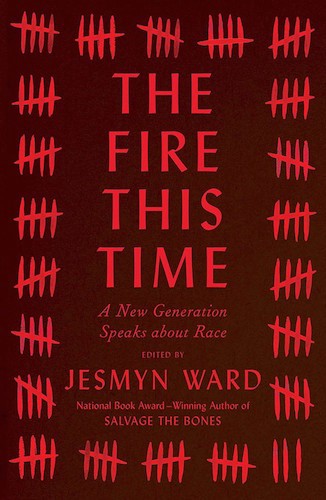
In the essay anthology The Fire This Time, editor Jesmyn Ward says “I needed words.” Words are what I grasp for when considering our narratives and also inspiration for the words that have given us life and perspective. To fulfill my need I reached for Citizen; The New Jim Crow; Women, Race, and Class; Zami; The Sisters Are Alright; Dust Tracks on a Road; The Warmth of Other Suns; Brown Girl Dreaming; and The Souls of Black Folk, just to name a few in the nonfiction realm. And I repeatedly reached for The Fire This Time because I wanted to understand more than react. I wanted to comprehend the pain filling my own body and how it had been spilt on the page.

Ward’s anthology picks up where James Baldwin left off with The Fire Next Time. The tome was released last summer during one of the tensest and most absurd presidential elections of this century, which in a way means it published at the right time. What I found in those pages from the 17 contributors, including editor Jesmyn Ward, echoed life stages and legacy, parenthood and pain, coming-of-age stories and comeuppance, humor and history. These essays provided a deeper connection because Black pain was part of the story; Black identity, self-recognition, our own awareness brokered every page. Black pain was not the sole criterion for the anthology’s existence.

At a dinner — prior to the announcement that the policeman who shot twelve year-old Tamir Elijah Rice would not be charged — a friend exclaimed that no one can truly know the fear of being a Black mother of a Black child, particularly a son. The clattering of silverware against plates punctuated her dismay as she slapped her palm against the table. “I’m scared right now,” she added, to silence from all of us present. The intensity in her eyes and the directness of the words alone were enough for everyone seated, parent and non-parent alike, to comprehend that this fear is rooted so deep it never goes away. These are the fears of women like my friend, of Mamie Till Mobley, of Claudia Rankine.

The starkness and sparsity of Rankine’s “The Condition of Black Life Is One of Mourning” in The Fire This Time echoed the apprehension of my friend, a Black mother, at dinner: “At any moment she might lose her reason for living.” That sentence echoes the pain of Lezley McSpadden whose teenage son was described as a “demon” by the man who shot him and as “no angel” in a major publication. I could only imagine the kind of rhetoric Mamie felt at the hearing and later ruling from the trial of her son’s murderers. That, to a segment, this child was deemed “deserving.”

“Like Rachel Dolezal,” Kevin Young writes in his contribution “Blacker Than Thou,” “I too became black around the age of five. I first became a ni**er at nine, so I had me a good run.” Harriet Jacobs wrote similarly in Incidents in the Life of a Slave Girl that she didn’t come to know she was property until she turned seven years old. My own awakening means I first became a “ni**er” at eighteen, so by Young’s calculations I guess my run was longer than most. “Ni**er” was thrust at me through plexiglass at a movie theater I worked in, marked with the disavowal of my humanity by a woman older than me with a child by her side. From then on I couldn’t not see myself as one because I knew that others possibly did. That descriptor held in the air, making me wonder if my persona was immediately and irrevocably tied to a slur.

We need to better understand that the Black body is not simply a conduit that receives violence but also one that exudes beauty and complexity.

From Ward to Clint Smith to Mitch Jackson to Rachel Kaadzi Ghansah to Edwidge Danticat the essays and poems in The Fire This Time dissect the emotional toll of Blackness in America, but also the dynamics that make our lives visceral and not tragic by standard. In the call for more representative narratives, are we seeing a diversity of voices and explorations of our lives? Are we contributing to the bounty, and am I seeing myself in the stories present? Or are we reflecting on the issues, but not the reasoning behind them nor the ways to move forward? Not every book can or should be a map to “fix” society, yet we need to better understand that the Black body is not simply a conduit that receives violence but also one that exudes beauty and complexity.

When I ask myself about my aims as an artist, I go back to Emmett’s memorial and reflect on its construction, the intent behind the erected symbol in a national monument. A moment in history recreated with purpose to invoke emotion. Not necessarily the automatic outcry that can flood the streets, but that which makes us as individuals, and me as an artist, consider this nation’s history and it’s potential. By withholding Emmett’s battered face the memorial showed us the beauty of him in the before, the person he was prior to mutilation. Those of us on the outside can reflect on the teenager that could have been yet wasn’t allowed to be. I didn’t react to the horror alone, but to the reality that this was a child — a child in the same way of those who came after him such as Clifford Glover in 1973 and Trayvon Martin in 2012. I thought about the gravity of not seeing Emmett’s face, but instead experiencing the visceral feeling of the presentation — all the way to the video at the end, where we heard Mamie and Emmett’s cousin, now deceased, speak on that moment in time. I settled into what was presented to me and dissected how, in my own work, I could present this in a way that was also palpable.

In this frame of mind, thinking about “needing words,” I sat with each essay in The Fire This Time. Essays that furthered and inspired the conversation as Emmett’s reconstructed memorial did. I sat with Black pain, our pain, that is not to be refuted or ignored, erased or dictated.

How Writing Closed Captions Turned Me off TV For Good

The fabled year 2000. Survived the apocalypse that was foretold. Need a job though, being just out of grad school. See the ad, interview.

I’ll write your closed captioning, sirs. I’m fresh out of writing school! I can write anything!

I have my shrine to Cather and Hem. I’ve been eating words for breakfast since ’72 — Daniel Pinkwater, Narnia, and so much more. I’ve just done a thesis on Cheever. I pshaw mightily. Behold my MFA, of which I keep a replica in my wallet.

I’ve just done a thesis on Cheever. I pshaw mightily. Behold my MFA, of which I keep a replica in my wallet.

Start on the humble evening shift. 3:30 to midnight. Training mode — you know, like when the manager stands beside the register watching the kid count change. Most everything in the TV industry is on a rush schedule. Most things air “in a couple days.” I am ready to be a cog in the industry, but the industry is not ready for me, for reasons I don’t yet accept. There are rare shows with long turnaround times, and these are the shows that trainees like me do.

Saddle up to the workstation: 13-inch color TV, desktop with hardware interface that makes F2 pause and makes F3 forward a frame and makes F4 play and makes F1 reverse. The familiar qwerty keyboard, once the conduit to prose description, dialogue, imagery, is now a command center, a piece of interfacing hardware like a steering wheel. It controls the VCR.

The what?

The Video Cassette Recorder.

Oh, this is an ancient story, like the bible or mythology?

Yes, and jobs come in on Beta-Max, a plastic tape the exact size of a hardback book with magnetic reels inside it. They come from Burbank, California (I’m in Minneapolis, MN) from production houses working for all the major cable networks. TNT, USA, HBO, TBS, HSN. If you have three letters and [sultry saxophone music], congratulations, you are a TV show maker. Workers in the room down the hall dub these beastly Betas onto VHS and carry them into the front office where we Caption Writers are. They carry them by the armload. Admins process them, assigning us jobs.

Workers in the room down the hall dub these beastly Betas on VHS and carry them into the front office where we Caption Writers are.

Footless Footnote: The back room down the hall is windowless and kitted out with racks and racks of tape duplicating equipment strung together with veins of patch cables. Multiple monitors show silent speakers, captions flashing beneath them. There are level meters twitching and so many fans running that the place hums and you have to speak up. It is 95 degrees in the back room and smells of hot plastic and microchips.

I do as I’m told. I slide my tape into the machine (it seems to hungrily swallow it), and clamp headphones over my ears. I watch the show once, just transcribing straight through, typing up every word I hear spoken, every line. A big blob of half-chewed text, regurgitated words.

It is 95 degrees in the back room and smells of hot plastic and microchips.

I write in a program that accepts two lines of 36 characters and displays words in white fixed-width font over a black background, which is exactly the opposite of the black letters on white pages and white screens that I’ve been reading all my life. Next step in the workflow is I watch again, breaking up the lines, positioning bite-sized blocks, adding line breaks at punctuation. Commas and clauses are like perforations in crackers — unless the dramatic timing calls for something else. Unless…

I add (narrator) or, for certain clients, (voiceover) or (Joan) when Joan is off-screen. Breaking takes hours.

Finally, I watch it a third time, letting it roll and smacking the space bar to assign times. Time stamp, time stamp, time stamp. Using F2 and F3, I find the cuts and tweak the timecode to hit the cuts square.

There are 23.97 frames per second in TV film — or there was then. That’s less than there is now in some HDTVs, but still much more than the number of words that typically pass in one second of reading — then or now! But TV hasn’t bent time: there are as many seconds in a minute as you would expect to find, and the same quantity of minutes in an hour spent in a library, not surprisingly.

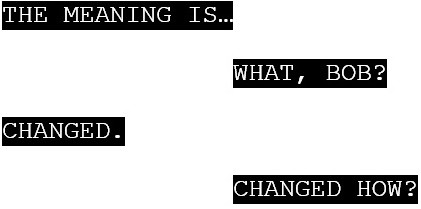
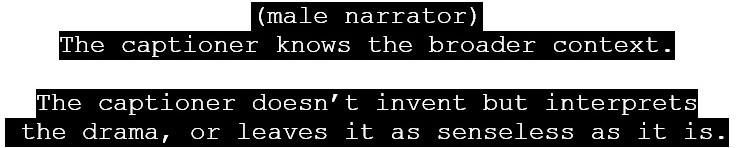
The question arises: Is a Caption Writer a writer or a transcriptionist?

I had thought this was a writing gig, but it’s not exactly. Everything is written already. Well, scribbled upon the universe’s scroll — not to say the annals of The History Channel. Whether drafted or not, lines have been spoken; therefore nothing can be created. Not by the captioner, anyway. It looks like writing — yet it’s not.

Or is it?

I go home and check my MFA: yes, it is for creative writing. So what the hell am I doing here?

Foot-loose Footnote: Easy! Earning money to pay back the college loan!

Whether drafted or not, lines have been spoken; therefore nothing can be created. Not by the captioner, anyway. It looks like writing — yet it’s not.

What I know now that I didn’t know then is: The Caption Writer is some type of linguistic intermediary between a machine and a hearing-impaired person or an English-language learner or a noisy room. Accuracy is the CW’s watch word. Verity. The CW is impartial, using punctuation and presentation to represent the speaker’s imperfections, emphases, uncertainty, directness or indirectness. Their ennui, their —

The Grind

Every day, I show up, bring my bike upstairs and change out of sweaty clothes. Not to be literal — and not to be punning with false declarations of “unintended” — but my new workplace is a sweatshop, with dozen of captioners on the floor, sharing desks in shifts from 7 AM to 3 PM, and 3 PM to midnight. In the kitchenette, a 27” inch TV (big!). Like our mother, or a hearth fire. Some type of Sauron’s Eye.

Study the handbook, study the grammar rules. I’ve interned at a publisher, I know about em dashes versus hyphens. The son of a high school English teacher, I grasp my homonyms and I carefully differentiate. Or so I believe.

Soon I’m told that until I reduce my errors-per-job, I will not move to day shift, when the tight turnaround jobs are done — the prime programming. It turns out I do not know essential from non-essential clauses. And I do not know how to punctuate which, which is odd because I usually know which sentences take which punctuation. And all the Norton anthologies in the world could not teach me the difference between PHEW and [sigh], or a [disbelieving scoff] over an [exhales heavily], or the fine gradations on the surface of what I thought was a humdrum HMM and ho-humm MM-HMM.

Quiz!

Good news — you aced it. But isn’t it shocking that TV, not books, makes me learn interjections and introductory clauses. Who could have predicted that, more than my graduate school course of study, more than my workshops and my thesis, it’s a job as TV typist that gets me to finally iron out my it’s/its.

The ultimate captioner’s kōan: to punctuate:

You aced it again!

Comma Chameleon

Over the coming three years, I will type a million commas with a million direct addresses. And 16 years later, I will instruct writers not to overdo their use of proper names with direct address in their stories. “It reads like bad TV, class,” I will say to them, “when your characters are always calling each other by name. Don’t you think, class? I mean, come on, class. Have you ever paced back and forth in front of a whiteboard in a Manhattan classroom like this, class? Have you? Class?”

But I don’t get to write rules yet. And meanwhile, there are as many technical rules to caption writing as grammatical ones. Every caption is data, and data takes time to load. This isn’t some static page that once pressed in ink exists free-floating in an atemporal world! Primitive notion! This is TV! Image and sound! It’s a production! A 35-character caption appearing on the cut, displaying when speech is first uttered, needs to begin loading in the TV’s internal decoder 18 frames prior. That’s 2 characters per frame stored: 35/2=17.5, rounded up because there’s nowhere to put that single odd character but in another, entire frame. Eighteen frames. That’s nearly a second. Imagine if you were reading a book, and words began to be seen before you read them.

There are as many technical rules to caption writing as grammatical ones. Every caption is data, and data takes time to load.

Not how it works, is it? But in captioning, it’s mathematical. When my work is done, a tech guy takes my floppy disk to that tech-packed room down the hall and encodes the text file, the literal .txt, onto a physical space on edge of the magnetic Beta-Max tape, which is taken up 95% by image and audio data. He’ll funnel it, triggered by timecodes, through that patchwork of cables I mentioned footnote-arily. As if in some Orwellian fantasia, my slavish words will flutter across the impersonal monitors. Then tech guy will send it out, job done, and Burbank will be blanketed by our company’s deliveries.

So though a 22-minute show takes hours to caption, and though my ears are hot when I remove my headphones for a break, my work is a handful of kilobits, encoded in ASCII — which is a language agreed to by a consortium to be an OK way to capture English in the lingua that’s the most franca of all: binary. So many on-screen dramatic worlds shriveled down to alpha-numerics.

But this digital load-bearing has its limits. Regardless what is said in any show, the CW cannot overload the viewer, who is after all, a reader. Adults shows must cap at 255 wpm max, children’s programming much less at 160.

But this digital load-bearing has its limits. Regardless what is said in any show, the CW cannot overload the viewer, who is after all, a reader.

I learn to optimize language. Drop the interjections. Keep the meaning. But clip the clutter. It’s an art in itself.

For six months, it’s night shift, swigging coffee, ass in the chair, a dark office in the evening, just desk lamps, and cigarette breaks outside with Kathy and Mel, onto the cold concrete of the former warehouse dock. Shows in, shows out, just like goods that were once dropped here on pallets, jacked and stacked. In this business, words are inventory, but they are weightless. You can’t put them on any dockside scale. So how do you toss them to market — to the fresh-keeping ice?

2017

Where I live now, there’s a company making captions. I’ve heard about them, and I’ve seen their employments ads. When they’ve been hiring, I have not applied.

Also where I live now, I mingle in insular circles, and more than once I’ve chatted with a guy who has done this work as well. The same guy. The first time the subject came up, questions tingled on the tip of my tongue. “Did you do real-time captioning or off-line? What software did you use? Who were your clients?” But before I could pursue any of these mundanities, he launched into stories of captioning softcore for Cinemax, which everybody knows goes by the moniker “Skinemax.” As if the only question on party-goer’s minds is, Was there sex involved in this occupation?

Oh, man, can you imagine.

Shut up, you. I just nod.

Well, here’s the story. Cover the children’s ears. Shut the door if you must. We have to go back to 2001 again.

2001

I’m in training mode for months and months. You misheard this line. There was a timing problem here. The narrator was off-screen here, and you should have done this. Missing or botched antecedents: at, it, as. Damn our/out invisible typos. Every few weeks, my manager, Kendra, sits down with a job I’ve done, and we review the show, watching the captions display, watching the file scroll through as it loads. We pause, we fix, we learn. My ego is hammered. I was in advanced reading groups as a kid! My father was English teacher! I have an MFA!

No one cares here about your literary ambitions or connections to Booker-shortlisted authors or that Alasdair Gray, Scotland’s Kurt Vonnegut, gave your creative thesis a Pass. The company you keep now is Xena, Warrior Princess; The Monkees; Ward Cleaver, and countless medieval swordsmen in beaver pelts whose swords go [schwing!] when drawn from leather scabbards. Leather! Oy, the fakery! How many punches faked? Let me count the ways. You’re not even as smart as the local televangelist with his shining blasphemous prosperity gospel. You’re not as literate as the snakeoil medium receiving messages from (with gravitas) “the other side.” Day after day, you come in, pick up your VHS from the cubby, remove the job sheet rubber banded around it and the floppy disk premade with the label. You watch, you transcribe, typing faster and faster, pausing and resuming with the foot pedal when that hardware is attached. You time, you rewind, you pause, go forward. Time stamp, time stamp, time stamp.

No one cares here about your literary ambitions or connections to Booker-shortlisted authors or that Alasdair Gray, Scotland’s Kurt Vonnegut, gave your creative thesis a Pass.

Didn’t I — yes? — as a youth spend two weeks one summer doing a typing class at the high school, typing a s d f when little a’s s’s d’s and f’s floated by on the screen? Didn’t my Shakespeare-teaching dad encourage me to play with his typewriter as a kid, rather than stare another hour at what he called “The Boob Tube”? Yet how is it I never really learned to type until now?

Damn you, television!

As for that predictable party anecdote: So, yes, one day my boss saddles up at my station for a review, and it’s the 60-minute Skinemax show I captioned over the course of two blush-inducing days. Salacious women flutter on my screen, flashing, strutting. When you pause a VHS tape, its frame can stutter, just vibrate sometimes; and these shows take place in a steamy L.A. world where women are left alone with criminal frequency, and they need to arch their backs on the divan and run their hands…and they need a cold shower with open drapes…and they need the night club restroom stall…

Not that the dialogue is complex, but Kendra cares inordinately about the correctness of these captions! As if the hearing-impaired, or anyone, is paying attention. As if this show is being watched on mute in a Jiffy Lube or podiatrist’s waiting room. She takes issue with the music descriptor. We change it to

I thought I had become a man of letters. And yet the evidence indicates otherwise.

2001 Still

In this condition, after 8 hours at the workstation, I bike home after midnight in the quiet, darkened city, from downtown to South Minneapolis. I am among the ranks of the nightowls, the dog-walkers, the partiers, the nurses, the security guards. At home, I’m too wired to sleep. I’m up until 4 in the morning, 5 in the morning. This is my time off, to pursue my personal interests, but I can’t type! I’ve been typing all day. And I can’t read! I’ve been reading all day too. I sprawl on the couch watching TV.

This is my time off, to pursue my personal interests, but I can’t type! I’ve been typing all day. And I can’t read! I’ve been reading all day too.

My girlfriend, who works normal hours, is in bed. We have a small apartment, so I lower the volume and — “the ironing is delicious,” quoth Bart Simpson — I put on the captions. Sometimes I see my own work. Captioners get to put their names in the funding credit — the very last caption of any show.

It runs for 3 seconds and often doesn’t load, because the station cuts to commercial too soon.

It doesn’t load.

I…don’t load. In this medium.

I wonder how my grad school colleagues are doing, with their Booker Prize short lists and their publishing contracts?

The Graduate

Dustin Hoffmann’s 1967 Benjamin Braddock was a graduate and a Ben. At last, I am both. I graduate. I’ve got all the conventions down. My word counts are right, my captions load properly, and my grammar is finally up to speed, though there’s no fixing the scattershot, stop-and-start way that people speak. I’m on day shift. I’ve been doing this six months. I have watched hundreds of TV shows.

My word counts are right, my captions load properly, and my grammar is finally up to speed, though there’s no fixing the scattershot, stop-and-start way that people speak.

Now I can anticipate a cut, and use replaceable short codes for “you know” and “definitely.” The 7 key is my wildcard, because it’s in the center. Find/Replace d7 >> definitely. I save hours. I know what your average VH1 Behind the Music host will say before she says it. I know when Vlad says he must go, to start typing [horse galloping]. I can capture Wolfgang Puck’s accented, fragmentary English within the limits of our house style. (“We gonna” in this instance, is acceptable.)

There’s an employee incentive program now. Every program type is given a target completion time. E.g., a 22-min sitcom: 3.5 hours to produce the captions, end to end. An hour-long documentary: 6.5 hours. A 90-minute feature film: 8 hours. Beat the time, and I get paid dollars per quarter hour I’ve shaved off. The company has grown; we lease more space in the building. All the major networks are clients now: the broadcast networks, additional cable networks, we have Spanish-language captioners doing Telemundo and Univision. And we’ve transitioned to digital: no more FedEx’d BetaMax tapes, but .mpgs and .avis streamed down networks. The VCRs are taken out of our workstations, and the PCs upgraded (Win NT!). But the new software still uses the function keys for video playback commands. Word counts are calculated on the fly. The software can auto-find cuts and auto-place a caption on a cut. Brilliant!

We can crank out even more.

I regularly bank bonus bucks on this incentive program. When I work from home, my girlfriend is disturbed by the speed of my typing, the sound of its rapid-fire hammering. Yet the novel I’ve started in grad school sits, gathering digital dust.

Am I a writer anymore?

2002

After two years of doing this, 8 hours a day, 5 days a week, headphones on, eyes on the screen, now the words themselves have vanished somewhat. There are only dramatic tropes.

There’s false pressure to finish remo’s, find clues, solves puzzles, balance budgets. There’s phony setups, like guests just popping by.

Ted just happens to be sales rep from a manufacturer of high-density laminated stone shingles.

There’s hokey plots and inexplicable British accents in ancient Rome, ancient Mesopotamia, even ancient Egypt.

There are more car explosions than can be counted.

There’s vamped up intrigue.

Well, we already know from the tease at the top, and the bumpers, that they lay some bones out on a table later.

Terminally, clocks are running down. Will they run out of time and money? Of course not! They never run out of time or money. If they did, there’d be a sad ending and viewers wouldn’t feel bolstered to go out and spend money with your sponsors.

And, increasingly, there’s gratuitous product placement.

One of the more egregious dramatic sureties is the wordless response. You can set your watch by it. It happens at the end of the scene — and every seasoned captioner has an intuitive feel for the length and scope of a segment, whether it’s reality, game show, sitcom, informational or anything. Many a time I have transcribed, transcribed, transcribed, paused, played, transcribed, transcribed, transcribed, and based on the weight of a line, gone straight to fast-forward, and indeed, as guessed, hit the black bumper.

The line could be anything. It might be:

Or:

Or:

Then there is the pensive reaction shot, which takes no caption.

Closed captioning, a.k.a. CC. Through no fault of this service — which is valuable to many — CC comes to mean, to me:

Cookie Cutter.

Can’t Comprehend.

Clouded Creativity.

Possibly the Last Subhead

I put in three years before moving on to a job in publishing. Three years of 40-hour weeks, sometimes more. That’s 6,200 hours of TV watching. More than is advisable, I’m sure. My dramatic sensibility was jaded. What had become of my prose style? I think at this time there wasn’t such a thing, despite the training I received in grad school and was still paying for. And then once I was done Caption Writing, I was off TV for good.

Fast-forward out of myth and biblical times, right over The Enlightenment, to these here present (looking around) still rather Biblical-seeming times, and now here’s the scene at many a café gab session, dinner party, or lunch with colleagues.

Colleague/Friend: “Have you seen Breaking Bad?”

Me, wincingly, because the conversation never ends well: “No.”

I don’t use the phrase “I don’t watch TV anymore” anymore. A few years out of my captioning job, I re-activated my bookish life. I got a job as an editor on dayshift, back in the world of black-on-white, plain prose for paper publications, feeling sane, etc., I did watch all seasons of Lost over the course of a year, just after the final season concluded. Watched every one while standing on an elliptical machine in a basement. The same with The Wire. Enjoyed them both, as silly as Lost often was.

Since then, it’s: tennis matches (torrent’d), and the occasional film with my eternal love Theresa. We both, in fact, do quite well in a TV-minimal world. This does not make us superior, it just makes us like-minded. When I need an uproarious laugh, I watch old episodes of Mr. Show. (A footnote to TV history is that Odenkirk/Cross=comic genius.)

And meanwhile, here in the Dark Ages, a recent trip to “Barnes Ampersand Noble,” as I call it, revealed an escapist literature section and a featured magazine that contained nothing but essays on TV. At checkout, The New Yorker magazine’s “The Television Issue.”

There you have the titular phrase — and no, it offers no sight of breasts.

Also meanwhile, online I observe the general abandonment of punctuational norms even on mainstream sites, an abandonment made in seeming earnest — like people in the biz don’t intend to return to the tiresome business of clear expression. I would contend that mine is not a “get off my lawn” stance either; it’s much sadder than that; and scarier when you consider the apparent trickle-up effect from culture into the electorate.

The language is degenerating. But I’m not saying TV has single-handedly eroded literacy. Maybe TV to language…

Yes, thank you. Maybe it’s a bit like the role of cow farts in global warming: It may not be doing the most damage, but it doesn’t help.

Maybe it’s a bit like the role of cow farts in global warming: It may not be doing the most damage, but it doesn’t help.

But it doesn’t matter. Socially, if you say you don’t watch TV, it sounds like a policy. It sounds like you’re being — as I regret to say they put it now — “judgy.”

Have I been diplomatic in my every response? No.

Once, a few months ago, someone started the question, “Did you see — “

And I jumped in with a too-hasty, “No.”

In my defense, I knew what the answer was going to be. Because I have not seen: Parks and Rec, The Office, Breaking Bad, Community, Battlestar Gallacita, Boardwalk Empire, The Sopranos, Mad Men, Six Feet Under, Game of Throne, Veep, Girls. And many others. All of them.

But there’s sometimes no way to deliver this explanation that isn’t divisive. That’s no conclusion at all, as you can see. But my only point in all this was precisely to say that not everything is black and white. Or white on black. With some things, you have to read between the lines. Something we’re less and less and less and less and less and less and less and less and less.

Unpause. Bang on keyboard. Mash with fists.

Nicole Krauss Learns to Love Uncertainty

Nicole Krauss’s latest effort, Forest Dark, is a story of light buried in bramble. Flitting between the narrative of Nicole, a young-ish writer seeking inspiration in the mystical history of Tel Aviv, and Jules Epstein, a retired lawyer who gets mixed up with a rabbi’s daughter and her film depicting the life of David, the novel is both inviting and intimidating. Shifting from the metaphysical nesting doll sensibility of her astonishing Great House, Krauss created a vast landscape for her characters to inhabit, and the largness of her Tel Aviv allows Nicole and Jules to seem insignificant, but not unimportant. It’s a difficult balancing act to pull off, and all the mystery and difficult questions that follow give way to something that feels real, adult, and undeniably true to life.

With each release, it becomes clearer and clearer that Krauss operates on her own level. A capital–I Important writer, her language is both lyrical and pained, her prose placid but incisive. From The History of Love on, each novel has read like a fully-formed modern classic, à la the work of Marilynne Robinson, Jeffrey Eugenides, and as mentioned in the interview, Rachel Cusk and Ben Lerner. Reading her work is often a transformative, engaging experience, so when the opportunity came up to interview her, I jumped at the chance. Despite her being rather busy on a world-wide book tour, she graciously took the time to correspond with me by email from England.

Eric Farwell: Your last book, Great House, was just as complicated as this one, but there seemed to be more certainty in place. In other words, as nuanced or heady as the narrative might get, there was an understanding that you were always guiding the reader to where they needed to get. Forest Dark is a lot more open, and reads, at least to me, like a mix between Rachel Cusk and Ben Lerner. There’s nothing to trust, because the protagonists are perhaps even less aware of their world than the reader. I wanted to start by asking you to walk through how this became the novel.

Nicole Krauss: I think that if a novel works, it’s because a sense of trust is created in the reader. The best kind of writing gains that trust within the first page and then it builds: trust that wherever the narrative is going, it will be worthwhile, and that the world created on the page is made live because every aspect of it has been deeply considered and thoughtfully conceived. As a reader, I find that the more space I am given to make connections on my own — in other words, the more the author trusts me, in turn, to think for myself and to understand — the deeper my experience, and often the more revelatory.

As a writer, the trust I might create in the reader has to begin with my own faith in the soundness of my process. And this time, that was a bit smoother, having already been through it numerous times now with my previous novels. I don’t outline or plot my books beforehand; I try and let things be as organic and intuitive as possible. I set out not knowing where the book will take me, and for a long time I sit with that uncertainty, sometimes for years. The act of discovery is very important to me, as it allows me to figure out the most authentic resolution for the various concerns and urgencies that inevitably arise when I’m working out something new. I had more anxiety about my process when I started out writing novels, particularly as their structures become more complex, but now when I start with many disparate stories or ideas, I trust that I will uncover connections, echoes, patterns, and meaning that eventually create a subtle sense of the whole, one I would never have arrived at had I set out armed with a plan and many certainties.

EF: With that being said, there really does seem to be a more open, less certain sensibility here. I’m curious if you maybe felt boxed in at the end of Great House and wanted to pivot.

NK: Writing as I know it has always been a process of feeling boxed in, and searching for a way out. My decision to shift from poetry to the novel at 25 came about because I felt boxed in by the form, or my own use of it. While there are great poets that can fit infinity into a few stanzas, I found I wasn’t able to. Brodsky had encouraged me to write formal verse (with the valid belief that one should know what one is being freed from), and as my poems got smaller and tighter, I felt that there was increasingly less space for me to breathe in them. Less space to be free, and for me, at the bottom of writing, there need always be a straining toward new freedom. When I started my first novel, it was exhilarating to flood into new conditions — into prose, and length, and the slow evolution of ideas and feeling that novels allow for. I think what you’re maybe sensing is my view on life, which continues to grow and change as I do. While I think it’s important to have cohesion and a strong narrative angle, I also value having the freedom to break old forms that feel too limiting or closed. Thus the sense of openness. It’s something that I don’t want to give up.

While I think it’s important to have cohesion and a strong narrative angle, I also value having the freedom to break old forms that feel too limiting or closed.

EF: While that desire may be present and rightfully persistent, one thing that hasn’t changed is your penchant for historical connections — both seeking and having. Both Nicole and Epstein seem to be daunted, or even annoyed by how immense the history of Israel really is. How did you go about navigating that balance between instilling a sense of the monolithic past and moving the modern narrative forward in this looser style?

NK: We have been telling the same stories for many thousands of years, and these stories either constitute cultural memory or history, depending on how you look at it. The stories, and our attachment to them as the foundations of our identity, feed us deeply, but they also constrain us. We feel we are something continuous with the past, and belong to a larger narrative, but we also — some of us, at least — strain at the bit, all too aware of how these narratives bind us, and limit the openness that might otherwise have been our future.

We live in a moment in history when we feel, as a species, that we know more about our pasts than we ever did. We are comforted by all of our knowledge about the past, and our knowledge about our present. And yet as valuable as the Internet may be, it also tricks us into feeling that we possess far more understanding than we really do. The comfort that being able to Google search anything and everything brings reflects, I think, an anxiety about not knowing. And though of course I value factual knowledge, I think that we have made something of a religion of it in our time, and the unquestioning way we prize it, and cling to the myth that we entirely possess it, means that increasingly we are turning away from the unknown. In a sense, we have been taught to equate the unknown with ignorance, when in truth we know very little. Contemplating the unknown, and the vast scope of our world and our being — the universe, ourselves, our sense of what is ‘other’ than us — may be unnerving, but can deepen us immeasurably, and change us. In my writing I try to carve out space for that — for what Keats called dwelling in uncertainties. Because I think what should be most extraordinary about the time in which we live is the use of our knowledge to remind us that our sense of reality is objective, that our narratives, both personal and political, are flexible, and that if we approach them with the modesty of understanding how they dictate us, and the courage to understand that we can alter them, we might arrive at better ways of being.

EF: In Forest Dark, Kafka seems to be used as the historical glue, so to speak, at least in the Nicole narrative. What I found to be most interesting about your use of him was the care you took to paint the struggle he had with desiring to write, but worrying it might not have true value. At this point, with four books out in fifteen years, are you at all facing those same concerns?

NK: For better or worse, I have no imagination for the posterity of my work. I’ve just never really given much thought, or have not allowed myself much thought, about how long my work might be read beyond the scope of the present. That being said, naturally I have struggled with even the question of its value in the present. My anxieties rose many times to a peak, but as time passes I feel I’ve better learned how allay them. Helpful with this were some rules of thumb that Philip Roth once wrote down for me years ago: 1) It’s not for you to measure yourself against others, 2) It’s not for you to judge the work, 3) Just tell the story, 4) It’s not going to get any easier. Resign yourself to this.

With each book, I’ve grown more comfortable with that long dwelling in uncertainty that it takes to write the kind of novels I want to write. I do my best to produce the most honest, authentic work that I can. And I always go back to that stunning last line of Rilke’s poem, “Archaic Torso of Apollo”: You must change your life. I think it’s the imperative of literature, but if you are going to be able to move the reader to change, then you have to begin within yourself and your work, however vulnerable a position that may put you in.

EF: Shifting a bit, I wanted to ask about Nicole’s ending, which is disturbing in its lack of resolve. As someone who often writes of a sort of light, who often rewards characters with a sense of comfort or palliation, I wanted to know if this ending was difficult to render.

NK: It didn’t feel disturbing to me when I wrote it, but perhaps that’s because I don’t find a lack of resolve disturbing — we live with that lack all the time. And is it not a form of resolution to accept that we don’t ever truly get over the fact that there are different paths we could take in life, but that we are finite beings? We choose one, but we can still always see the other options telescoping out, with their endless alternative consequences, on and on into the distance.

Epstein’s ending, when I finally got to it, was just as startling to me as Nicole’s, even though his ultimate disappearance is known from the first page. He vanishes in the end, but I’d like to think that before that, and perhaps after, too, he arrives, filled with the unknown, into something profound.

EF: I’d agree. It’s possible that the reason I found it disturbing is because it’s open-ended. Not to harp on it, but this wider world seems to really afford you a lot of new possibilities. There’s a lot of focus on needing to please the reader and the conflict that can come with that. Does that hold particular fascination, or was it a product of the narrative unfolding the way it did?

NK: Well, for me, unfortunately, when I consider the reader, what I am usually considering is his or her potentially long and urgent list of grievances. Who knows why? A few thousand years of Jewish upbringing, I guess. Of course I write with the hope of the work being received, being understood. But at least while I am writing, the reader is usually someone that I might disappoint, disgruntle, or even enrage. No matter how many readers have apparently loved the books. And so the reader, gentle or otherwise, must be packed off and sent away during the years that I am writing.

When I consider the reader, what I am usually considering is his or her potentially long and urgent list of grievances. Who knows why? A few thousand years of Jewish upbringing, I guess.

EF: You mention menucha as being this idea of infinity, but also maybe imply that it can be a space for God and peace. Coupled with lines — especially in the Nicole narrative — about wanting to drop out of time, I wondered if you were seeking to reach a sense of calm in your prose. If such a state is possible, do you think it would necessarily make for a good place to write from?

NK: One of the things the book asks of us is to be moved and to move — not to stay still. Not to accept that there is only here and there, but that the world is more subtle and more contradictory, and that we can be many things and in many places at once, and therein lies the tension of being. We may understand that both form and formlessness exist, but our desire is for coherence and shape. We subscribe to form and begin subscribing to and trying to uphold it. The problem is that it’s not a perpetual form, and at some point, we have to allow it to break. We have to change our minds and our ways of being, and that requires perpetual work, and an acceptance of some impermanence or instability. But I’m not interested in living in a continuous state of contentment and peace. The hope, as I see it, is to expand our experience of life until it is lived as deeply and authentically as possible, and peace comes and goes in such a life. Though when one reaches the end, I imagine there may be a better chance of peace being the last note.

Truman Capote’s Lost Novel Would Have Aired All His Dirtiest Laundry

Each month “Unfinished Business” will examine an unfinished work left behind by one of our greatest authors. What might have been genius, and what might have been better left locked in the drawer? How and why do we read these final words from our favorite writers — and what would they have to say about it? We’ll piece together the rumors and fragments and notes to find the real story.

The only complete copy of Truman Capote’s final novel, Answered Prayers, may be sitting in a locker at the Los Angeles Greyhound Bus Depot.

Or at least that’s what he would have us believe.

By all accounts Capote began writing his last novel decades before his death from liver disease in 1984, long before In Cold Blood, maybe even before Breakfast at Tiffany’s. And yet to this day no one knows for certain if it was ever completed, or if Capote simply loved to talk about completing it. For more than thirty years, Truman Capote described the book to anyone who would listen as a Proustian novel, based on real stories straight out of New York’s 1950s café society. “It is the only true thing I know,” he said, “I was born to write the book… it means everything.”

According to biographer Gerald Clarke, Capote envisioned the novel as a “large, sprawling story that spanned thirty years, moved between two continents, and included a vast and influential company of players.” The title is taken from Saint Teresa of Ávila: “More tears are shed over answered prayers than unanswered ones.”

Truman Capote described the book to anyone who would listen as a Proustian novel, based on real stories straight out of New York’s 1950s café society.

All we have of it today are three chapters, and a fourth, “Mojave,” which he later cut out.

The first chapter, “Unspoiled Monsters,” is almost a novella by itself, introducing the narrator, P.B. Jones, a bisexual hustler living in a room at the YMCA and trying to write a novel called Answered Prayers. He is “an opportunist, a heel, a rat,” according to Clarke — clearly a stand-in for Truman. “P.B. isn’t me, but on the other hand he isn’t not me,” Capote said. “I’m not P.B., but I know him very well.”

Jones recounts his life story, from the time of his orphaning in a St. Louis movie theater, to being raised by nuns and becoming “a kind of Hershey Bar whore” before eventually landing in New York City’s literary world. It is here that he gets to peer inside of high society and assumes the companionship of the novel’s heroine, Kate McCloud, for whom the second chapter is named.

Kate McCloud is like Holly Golightly on steroids. Glamorous and cultured, PB calls her his “very own Death in Venice: inevitable, perilous as the asp at Cleopatra’s breast.” Supposedly she was modeled on as many as a half a dozen different society women Capote knew well from that world.

Indeed, most of the other characters in the three extant chapters are drawn more directly from famous and powerful people of the time. Hotel magnates. Wives and ex-wives of steel tycoons. Celebrities and countesses. George Davis of Harper’s Bazaar and Katherine Ann Porter. And in his darkly funny stories, Capote hung out all the dirtiest laundry that he had been noting in decades of running in their circles.

Most of the characters in the three extant chapters are drawn from famous and powerful people of the time. In his darkly funny stories, Capote hung out all the dirtiest laundry that he had been noting in decades of running in their circles.

Indeed, he relished this tell-all quality. When “Unspoiled Monsters” was published in Esquire Magazine in 1976, Capote posed for the cover as an assassin, holding a stiletto. Women’s Wear Daily dubbed him “The Tiny Terror.” Capote allegedly teased friends that if they were not careful he would put them in the book. He described the book in People magazine as being like a gun: “There’s the handle, the trigger, the barrel, and, finally, the bullet. And when that bullet is fired from the gun, it’s going to come out with a speed and power like you’ve never seen — wham!

The most damaging of all was the third chapter, “La Côte Basque, 1965,” named for a real restaurant on East 55th street in Manhattan where high society often dined. In this story, P.B. lunches with an old friend named Lady Coolbirth, who spends the meal gazing around the celebrity-packed room, scathingly dressing everyone down. Some of the guests, like Gloria Vanderbilt and Princess Margaret, both real acquaintances of Truman’s, are included with their names unchanged.

Others are thinly-disguised, and involved in highly libelous stories. One, Ann Hopkins, a wealthy woman, is known to have shot her own husband in the face with a shotgun and gotten away with it by claiming she thought he was a burglar — just coming out of the shower. This is, almost exactly, the true-life story of socialite Ann Woodward, who remained part of the in-crowd even after her husband’s suspicious death.

In another such story, Lady Coolbirth spots a powerful political figure and relays a tale of a steamy one-night stand the man once had with the wife of a former Governor, who failed to mention that she was having her period. The next morning, the man finds his sheets covered in bloodstains “the size of Brazil” and ends up desperately scrubbing them in the tub with a bar of soap before his wife gets home. People in the know — Truman’s friends — recognized instantly that this was based on a rumor about the real-life former New York Governor, W. Averell Harriman.

Tennessee Williams, who appears in “Unspoiled Monsters” as Mr. Wallace, one of P.B.’s johns, captured the fury provoked in the people who had trusted Truman with their biggest secrets. “This thing Capote has written is shockingly repugnant and thoroughly libelous. Capote’s a monster of the first-order, a cold-blooded murderer at heart. He’s a liar and everybody knows he is.”

The backlash against Capote was swift and cruel. He was threatened and snubbed constantly by people he thought were his dearest friends. Even as copies of Esquire flew off the stands, Truman was banned from the high society events where he’d long been a fixture.

Many have questioned why Capote published the excerpts, instead of keeping it all secret until the whole novel was finished. He likely did not need the money. Certainly, he may have been proud of them; Clarke argues that these chapters are his “most mature piece of fiction” and “contain some of the best writing he ever produced.” Still, Capote could have guessed that some, if not most, of his friends would despise him for what he was writing.

Tennessee Williams wrote, “This thing Capote has written is shockingly repugnant and thoroughly libelous.”

William Todd Schultz, in his book Tiny Terror: Why Truman Capote (Almost) Wrote Answered Prayers, views the whole affair as something akin to a suicide attempt. He argues that Capote never expected, and did not know how to handle, the immense success that followed In Cold Blood, and that Answered Prayers was, on some level, his way of stopping the ride. Releasing it before it was finished may have been an act of desperation, not of over-confidence.

The standard thinking is that after the fury that followed the Esquire chapters in 1976, Truman Capote never wrote any more of Answered Prayers, falling into a deep despair, abusing alcohol and drugs until his death eight years later. This is what Jack Dunphy, Capote’s long-time companion, believed—that while Capote pretended publicly to be working hard on the book in the intervening years, he was never able to progress in his work on it.

In an enormous oral biography of Capote assembled by George Plimpton, many of those around Capote speculated about what happened to Answered Prayers. Norman Mailer, one of Capote’s greatest literary enemies, recognized the bind that Truman was in. New York society, in Mailer’s mind, had “swallowed his talent.” Answered Prayers stemmed from a desire to exact revenge on the beautiful people who had seduced and distracted him from his work. He imagined that Capote, a “little Napoleon” believed that writing those chapters would increase his power among the jet-set, but “he didn’t understand the true social force of New York — that even he could be eighty-sixed. …He did not have the stuff left to say ‘A plague on your house’ and write the book he could write. The book … probably died in him ten years earlier.”

It also may have been a bridge too far. Another enemy, Gore Vidal, scoffed at the idea that Capote could ever have succeeded in his ambitions to be America’s Proust, who was more than just a gossip. “But [Capote] had never read Proust. I quizzed him once, sharply, on the subject. He was incapable of reading Proust: he didn’t have that kind of concentration, and, of course, he had no French or interest in history.”

Capote’s editor at Random House, Joseph Fox, wrote in a note on the published version of Answered Prayers that he believes that there is another possibility: that Capote did write as many as four more chapters, including “A Severe Insult to the Brain,” and “Yachts and Things”, “Father Flanagan’s All-Night N****r-Queen Kosher Café,” and “Audrey Wilder Sang,” but that they did not live up to his hopes for them, and he then deliberately destroyed them during the final years of his life, when he was “almost incoherent because of drugs or alcohol or both.”

This would explain one mystery, which is that so many of Capote’s friends later recounted times when he shared some of the missing chapters with them. Joe Petrocik recalled an evening in Sag Harbor when Capote got up in front of them and read sections from “A Severe Insult to the Brain” (the phrase, incidentally, is supposedly listed as the official cause of death on Dylan Thomas’s certificate — Capote used it often to refer to the city of Los Angeles). But Petrocik admitted he was “never sure whether or not he was just telling me the story. He had pages in front of him which he was apparently reading. He would look up. He was quite the actor … I never did actually see the words on paper.”

Author John Knowles claimed that he did see physical pages from the rest of Answered Prayers, but that years later Capote told him in Southampton that he’d come to believe none of it was any good. “I don’t know,” Knowles said, “I think he burned hundreds and hundreds of pages.”

But director Frank Perry told another story. “I asked him how everything was going and he said, ‘It’s wonderful. … Look at that, finished pages, two and a half inches. It’s wonderful.’ Later on, being a cynic, I drifted over to riffle through the manuscript. It turned out to be a Missouri bankroll, which is to say, the top three pages had typewriting on them and the rest were blank.”

Alan Schwartz, Capote’s literary executor, claims to have been “absolutely astounded” to find no trace of the missing chapters after Capote’s death. He recalled that Capote had tried many times to get Random House to fork over more of his advance, claiming that the novel was basically done.

Clay Felker, the founder of New York Magazine, remembered that he offered Capote $35,000 for the next excerpt from the book. Capote spent an entire morning at his house recounting one chapter in lurid detail. He said he’d give it to him that weekend, but Capote later backed out. He met Felker again and began to describe a whole different part of the book, a suicide that Kate McCloud witnesses. “I just have to tighten a few screws,” he said. Felker claims he would have paid even $100,000 for the chapter. But Capote never delivered it.

Of course, Capote was known to exaggerate and to lie. He was also, reportedly, often disastrous during these years. John Knowles recounted how Capote once lost $4,000 worth of cocaine in his front yard, and later got so inebriated that he fell out of bed fifteen times in one night. Knowles witnessed Truman having hallucinations and drug-related seizures. Once he walked into traffic and nearly was run over by a bus. “I think he just decided… I’m going to be stoned all the time. And die.”

John Knowles recounted how Capote once lost $4,000 worth of cocaine in his front yard, and later got so inebriated that he fell out of bed fifteen times in one night.

Alan Schwartz recalls that, at one point, Capote claimed to him that the novel was finished and that a former lover, John O’Shea, had stolen it and gone to Florida, and that it was still in the trunk of his car. Capote asked Schwartz to file a lawsuit, demanding the return of the pages. Later, Capote claimed to have gone down to Florida and personally blown up O’Shea’s car. “One day little Johnny went downstairs and his car wasn’t there. Instead there was a big puddle where a car used to be.” Nobody believed him.

Producer Lester Persky claimed for a long time to have the manuscript locked in a drawer in his house he couldn’t open. When he and Schwartz finally did pry it open — there was nothing there.

Joanne Carson, wife of Johnny Carson, recalled that Capote gave her a key to a safe deposit box on the morning of his death. But that there was no number on the key and furthermore, she had no idea what box, in what bank, or even in what city, it belonged to. She claims to have read, firsthand, “Father Flanagan’s…,” “Yachts and Things,” and “Audrey Wilder Sang.” She described them in some detail to George Plimpton — who says that he then personally went to Alan Schwartz to ask about the safe-deposit key after that.

Schwartz replied, “Yes, I think there was a key. There was no clue as to what it did unlock, or if it did, what was inside. We could never find the safe-deposit box. There was a key, and we tried to track it everywhere. We couldn’t. So we’re left with that.”

Capote’s favorite story about the location of Answered Prayers was that he had locked it up at the Greyhound station in Los Angeles — hidden it deep inside the “Severe Insult to the Brain” itself.

Capote’s favorite story about the location of Answered Prayers was that he had locked it up at the Greyhound station in Los Angeles.

Could it be true? Even if the manuscript had been there, Greyhound moved their station from 7th and Maple in 1991. The building still stands today as a parking garage for the L.A. Merchandise Mart, but I doubt the old lockers have survived.

Most scholars have long since abandoned hope of ever finding Answered Prayers locked away somewhere, though in 2012 researchers from Vanity Fair did stumble across an unfinished manuscript of one chapter, “Yachts and Things,” among Capote’s papers at the New York Public Library, where they had been available for more than two decades. The six type-written and hand-edited pages are still up on the Vanity Fair website.

Nevertheless, it seems most likely that Capote either never finished, or destroyed, the rest of Answered Prayers, and that he spent the eight years between the publication of the Esquire chapters and his death in a slow deterioration, dreaming about how wonderful the stories would be if he could only write them well.

It seems most likely that Capote either never finished, or destroyed, the rest of Answered Prayers, and that he spent his last eight years dreaming about how wonderful the stories would be if he could only write them well.

By not writing them, or at least not publishing them, he spared himself any further social damage, and the loss of the friends who did stick by him. Many of these people are the same ones who later reported kindly to Plimpton on the spectacular excerpts they saw, or read, or heard, reinforcing the speculations that Capote himself may have desired.

And there’s something fitting in being are left with only rumors about a novel born of, and killed by, gossip. Perhaps on some level this was Capote’s intention. Years before he released the excerpts, in 1971, Capote joked on the Dick Cavett show that the book would be his “posthumous novel”… “either I’m going to kill it, or it is going to kill me.”

If he could not write, or could not publish, the novel itself, then perhaps he decided to leave behind the next best thing — an enduring literary mystery.

How Reading About London Helped Me Overcome Agoraphobia

I once moved to a city that didn’t want me.

As soon as I’d unpacked my belongings, it started doing everything it could to drive me away again. It seemed to accommodate everyone else, but while the city they lived in was warm and friendly, mine was cold and cruel. People walked so closely past me I could feel the air between us move, but this was the only proof I had that we were living in the same place.

This vast collection of infrastructure and people, of course, wasn’t colluding against me at all. The distance between London and myself was really caused by agoraphobia and anxiety, which forced me to spend most of my first six months in London holed up in one room, with a giant window showing me a constant stream of people walking from one place to the next. I’d often make it down the four flights of stairs from the apartment to the street in an attempt to join them, only to flee back up again once my feet had touched the ground.

I forgot what it was like to go grocery shopping, to walk past other people, sit at a desk and work, and be a part of the city’s febrile hum. I came to understand the politician’s way of merging everyone into one and referring to them as one big entity, because I was on the outside of it wondering how I’d ever get back in. And I blamed London for each setback, rather than the imbalances in my brain.

Eventually I did manage to venture outside, though I still struggled with the city for a long time. But I didn’t find my way down the stairs and into a welcoming London just through force of will. I read my way there.

I didn’t find my way down the stairs and into a welcoming London just through force of will. I read my way there.

The London that unfolded in front of me on the page provided an easy first step to understanding my surroundings. This is the only place I’ve ever lived that had an entire genre of books dedicated to understanding its intricacies and surviving inside its walls, and I took those books as a guide as I struggled to understand London and my place in it.

Reading about the city made me feel like I was falling back into a half-finished dream — as is often the case when a writer articulates the thoughts you have that were too distant to put into words, and too abstract to be conjured in anyone else’s minds. Other writers’ takes on the city helped me realize I wasn’t alone in feeling shunned, or overstimulated by the city. I was just another Londoner.

The books were about London, but they helped me learn more about myself, and how my own thinking patterns needed to change. London has featured in the lives and works of many of history’s greatest writers, including George Orwell, Dickens, Muriel Spark, T. S. Eliot and Virginia Woolf, but the literature dedicated to London says more about the human condition than it ever could about a physical space, because the city is too vast, too fast and too nuanced to act as anything other than a blank canvas onto which we project ourselves.

James Boswell writes in The Life of Samuel Johnson, “I have often amused myself with thinking how different a place London is to different people. They, whose narrow minds are contracted to the consideration of some one particular pursuit, view it only through that medium… But the intellectual man is struck with it, as comprehending the whole of human life in all its variety, the contemplation of which is inexhaustible.”

One thing I projected onto the city was the morbid curiosity I’d had since I was a child pestering my mother about what happened after we die. London has a constant energy that only slightly dips on a Sunday morning before brunching hours, when a sleepy stillness lingers on its streets. This unbounded vitality felt to me like London was always gesturing towards death, in the same way that being happy tends to make me acutely aware of how much I have to lose.

The city was bursting with reminders of mortality, from its underground tunnels to its disposable pop-up shops, wailing ambulances, roaring planes overhead and the constant stream of thousands of faces, displaying our in-built desire to populate and override the fact we’re all built to expire.

When I first moved here, death plagued every street I walked on — and yet, at the same time, there was too much life at my fingertips for me to know what to do with. But for me, and for any writers who’ve contemplated London’s ability to lure one towards dark thoughts, the constant reminders of impending death, laid out as casually and frequently as lampposts, make for fertile ground for wanting to live a full life outside the confines of four walls.

The constant reminders of impending death make for fertile ground for wanting to live a full life outside the confines of four walls.

Necromania is only one aspect of London’s complicated personality. For everyone who lives here, the city is as nuanced as the most complex of people. H. G. Wells wrote in The Rise of Tono-Bungay, “I could fill a book, I think, with a more or less imaginary account of how I came to apprehend London, how first in one aspect and then in another it grew in my mind. Each day my accumulating impressions were added to and qualified and brought into relationship with new ones; they fused inseparably with others that were purely personal and accidental. I find myself with a certain comprehensive perception of London, complete indeed, incurably indistinct in places and yet in some way a whole that began with my first visit and is still being mellowed and enriched.”

One way in which we cope with such a multi-faceted entity is to treat it as if it were a living person. One of the first things I noticed upon moving here was the degree to which Londoners, writers and non-writers alike, compulsively anthropomorphize the city. We treat London as if it were a person with free will, from the ruthlessly ambitious City to the reserved, well-mannered Hampstead, the heavily tattooed, laidback Hackney and the raucous, age-defying Camden.

A popular complaint about London-as-a-person is how rude and impersonal it can feel, but we simultaneously appreciate being able to walk around and feel anonymous, at times when such a state of being is required. In her essay “Street Haunting,” Virginia Woolf wrote about what she called, “The greatest pleasure of town life in winter — rambling the streets of London.” She asked if there was any greater delight than to “leave the straight lines of personality,” and take on the minds and bodies of passers-by.

Many of London’s most celebrated writers are also curious flâneurs, because roaming the city’s streets and exploring it physically is the only way to understand such an expanse. One of its most celebrated living flâneurs, Iain Sinclair, declares an end to London as he knows it in his book, The Last London, where he describes the end of London’s written era, when every stage of the city’s life was captured in time by writers past. Now, he says, London is “wedded to an instant, dominant present tense.” He writes:

In the fugue of London walking, real feet on unreal ground, we have to deal with that sense of groundlessness, striding faster and faster in anticipation of a bigger fall, weaving hard to avoid the committed, heads-down texters and tweeters who seem to be programmed for impact.

Like many other analyses of the city, Sinclair’s words provide pertinent commentary on wider trends. Literature inspired by London’s streets often weaves micro observations with macro metaphors. Every time you go outside, the city drip-feeds scraps of conversations, unnoticed acts of altruism and snippets of people’s lives that can collect to become general diagnoses on mankind, for writers, readers and the rest.

It’s to global London’s detriment that a suited, briefcased banker trampling on a homeless person’s blanket is a sign of capitalism’s failure, that one café serving £4 bowls of cereal in a poor part of town is the sign of gentrification gone awry. This is especially true for a city caught in the world spotlight amid the furor of Brexit, when the city’s every move is being carefully watched.

Sinclair’s declaration of death to written London is a worrying trend, if my own experience is anything to go by. I found comfort in relying on writers’ snapshots in time, their painting of London as a still being — because the very nature of writing about something suggests it was unmoving for long enough for a writer to record it, and for it to be worth doing so. Sinclair alludes to our present tense-obsessed social media times taking over, which, for future newcomers, means that getting to grips with the city will require a whole new level of effort. Taking comfort in the time capsules of Sinclair et al. allowed me to capture London’s heart, rather than trying to keep up with its frenetic cells, which multiply and die off quicker than our own brains’ and bodies’ as we try to understand them.

Since getting to know London by retracing the steps of writers, and understanding my place here by reading about it, the city has found its way into my own writing. After shutting myself out of the city for so long, once I recovered from my anxiety I realized that just exploring the city wasn’t enough. I wanted to get the city deep in my veins, as deep as it seemed to me to be in my favorite writers.

I wanted to get the city deep in my veins, as deep as it seemed to me to be in my favorite writers.

When London became my subject, it took on a different kind of distance than the one I felt when I first moved here. I’ve learned that the only real distance humans face in the modern world is conjured mentally. Technology and travel allow us to stay close to whomever we choose, however far away they are — but the bonds depend on us being a willing participant in the world around us. Our own minds can drive us worlds apart from those standing right in front us, a distance that can’t be closed by a plane journey or Skype call.

It was only when my fog of anxiety lifted that I realised that living here can make you feel more alive than you’ve ever felt before, but that it isn’t a sentient thing with a desire to make life difficult. There are bad people within its boundaries who do do that, of course, but London itself isn’t to blame.

This city is an irresistible plaything for writers, a veritable playground for the human psyche, where Londoners’ true motivations, fears and ambitions have the space to play out and, ultimately, help shape the literature — or disposable tweets and texts — defining London at a place in time.

From the uninitiated to the veteran, Londoners move quicker, consume (in every sense of the word) with abandon, and let bad days show on our faces. We mourn together, worry about rent together, ride underground together, and carry all the weight of the city with us as we walk around. Part of the initiation into London is learning to attune our own characteristics to some of those we project onto the city itself; ambition, resilience, openness, and perhaps a slightly harder exterior, too — because when you can’t beat it, you join it, and when you can’t understand it, you read.

A Black Man’s Murder Tears Apart a Town

“Buck Boy”

by James McBride

We was rehearsing over Mr. Woo’s Grocery and Chinese Take-Out one day when the following happened: We hear gunshots.

First we stop playing and hit the floor because in The Bottom you don’t know who the good guy is. Then we hear Mr. Woo shouting downstairs and we run down and see him standing over Buck Boy Robinson.

Buck Boy be about seventeen years old, I guess. Don’t matter now ’cause he laying on the floor dead as a doornail. Blood is everyplace. Buck Boy, dead as he was, still got a knife in one hand and fistful of dollar bills in the other. His hand was clutching that money tight, like he never want to let it go.

Mr. Woo is a little old man who wear a yellow straw hat. Whether he’s Chinese or Korean I don’t know, but he let my band rehearse upstairs over his store for free. He holding a gun. He drop it like it’s a firecracker and walk around in a little circle, ringing his hands and talking in Chinese or whatever. I couldn’t understand a word.

Two cops come quick, chase everybody out the store, close it down and take the gun from the floor. They leave us inside because we are witnesses. The cop ask Mr. Woo what happened.

“He try to rob me,” Mr. Woo say. He don’t look too hot. His face is pale and he look like somebody punched him in the stomach. The cops have a heck of a time prying that money out of Buck Boy’s hand. Finally they get it out and hand it to Mr. Woo, but the Chinese shake his head.

“Just get him out,” he say. He don’t look at Buck Boy when he talk.

By this time the whole neighborhood show up, including Buck Boy’s sister Victoria, who be shouting and screaming outside Mr. Woo’s store. The cops ask us questions but we really didn’t see nothing, so the cops call the black van to come get Buck Boy. The van take its time to get there, but Buck Boy, he ain’t in no hurry now. So we sit there a half hour: Me, Dex, Goat, Bunny, Dirt, the cops, Mr. Woo, and Buck Boy. I seen that Buck Boy was wearing a brand-new pair of white and purple sneakers.

Nobody around here liked Buck Boy too much. He always be looking for trouble and he always be strung out on something what they call PCP or whatever that makes you lose your mind. Drugs was his main line, but he’d steal anything. Steal a purse, steal the chrome off a car, steal a whole car. The worst he did was he stole our whole school bus two years ago when we was on it. He crashed it into a light pole on the Boulevard and bang us up pretty bad and run off. I don’t think he went to jail for it.

So nobody cry too much when they carry Buck Boy from Mr. Woo’s Grocery except for his sister Victoria. It’s kind of sad, because his mother never pay him no mind from when he was a little boy, and I heard people say she is strung out on drugs herself. That whole Robinson family is bad news.

No sooner do they load Buck Boy into the van than television trucks come flying up. They come all the way from Morgantown, West Va., twenty-eight miles across the state line, even though we is Uniontown, Pa., a whole different state. The News don’t care. News is news. And The Bottom is always good news for the news. Cause we mostly bad news. The reporters jump out and bust through the crowd like cops. Right behind them come Rev. Jenkins. He is the preacher of my church, Bright Hope Baptist. I read a story in the newspaper once that say ever since the 1980s, Rev. Jenkins has been the “community leader” of The Bottom. I don’t know what that is, but it do seem like whenever there’s a fresh-cooked chicken or a television camera around, Rev. Jenkins don’t be far off. When people talk about how much they hate Rev. Jenkins, my ma says, “I don’t hate his guts. He’s full of my food.”

Rev. Jenkins cover a lot of ground just standing in one place.

He’s a big, fat man. I seen him undress at the pool one time, and it took me five minutes to see all of him. He got a slicked-back hairdo and he wearing one of his fine suits. He sports some of the most killing suits you ever seen. He’s going with the pink pinstripe suit today, and when he bust through the crowd people bounced off him like he was a beach ball. He hit the door of Mr. Woo’s the same time the newsmen do, but Mr. Woo had locked it and pulled the shades down.

“Oh hell,” Rev. Jenkins say. Then he starts talking loud about Buck Boy being shot to death, poor ol’ Buck Boy, and it was a shame he was so young, and that he was tired of the foreigners always coming to The Bottom and starting up stores and treating the blacks like they’re nobody after black folks spend all their money on them. And after a while he make it sound like Mr. Woo come all the way over from China or wherever just to shoot Buck Boy.

The newsmen kind of swill around and try to peek inside Mr. Woo’s store. Then Rev. Jenkins say, “We’re gonna do something about this. We need an investigation.”

When he say that, the newsmen whip their heads up like a hunting dog who sniff a fox in the wind. They pull out their cameras and notebooks and turn on their tape gizmos and rush him.

“What kind of investigation?” one newsman ask. He got silver hair whipped up so much it look like cotton candy.

“A big investigation,” Rev. Jenkins say. “Why there shouldn’t be no bigger investigation than this one. There should be a granddaddy investigation.”

“You mean a grand jury investigation,” one newsman say.

“Don’t put words in my mouth!” Rev say. But then he is quiet a minute, and you can almost hear the machines in his mind clicking and spinning back and forth. He preach a fine sermon, but when he teach Sunday school I could read better than him and I’m only twelve. “You’re right,” he say. “We want the grandest jury investigation for all of it.”

The reporters look at him and a couple of them laugh. That get Rev hot. He swell up inside his suit and it seem like the grease from his hair start to melt and spread and cover his face. “I’m saying that boy is a victim,” he said. “That Korean had a gun. If that boy was white, would he be dead today? Would that Korean have shot him? Maybe he just went to get something to eat. Maybe the cops planted a weapon on him. Only God knows,” he say, and he pull out a handkerchief to wipe his face, “because the cops ain’t tellin’. But the truth is we tired of our children being gunned down like animals. We’re tirrrrreed! We’re gonna march!”

Rev. Jenkins can’t read too good, but he sure got a way with words. This crowd getting warm now. “Yeahhh!” they say, “Let’s march!”

“Is the march tomorrow?” a news lady holler out. She’s a blond lady. I seen her on TV before. She look so good on television you want to kiss her, but in person she got so much powder on her face she look like a dustbag from a vacuum cleaner. On TV she looks young, but in person she look like she was born in the year of only God know. If she was two-faced, I think she could’ve used the other one. I was just so shocked to see her that way, but my friends Goat and Bunny was in love and can’t take they eyes off her.

“There is no tomorrow for my people,” the Rev say. “We will start right now. We will boycott this store. We will stand out here every single day and march and starve to death before we buy goods from a murderer. These foreigners treat us like second-class citizens. They shoot our children. They get minority loans from the government. We’re sick of it. We ain’t takin’ NO MORE! We are FED UP! WE’RE GONNA MARCH!”

Now the crowd is fired up and newsmen are filming the whole thing. Everybody in this crowd I just about know, and they all know Mr. Woo ain’t like the people from Sun Yung Restaurant three blocks down who put bulletproof glass over their counter and take your money and make sure not to touch your hand before they pass out the food to you and treat people from The Bottom like they ain’t nobody, but everybody’s laughing and watching Rev. Jenkins. He fun to watch when he get his wheels spinnin’. He really hot now.

“Ahhhh-haaaaa!” Rev. Jenkins say, “Ahhhhh hah! Tired! Lawd…a boy is dead…”and he wipe his face with his handkerchief and start stuttering like he in church. “I knew this boy for years. He should have had a long life! What else did he have? He had no dreams! He had no hope! He had no aspirations! Ahh, but life! He had life! That’s the one thing they couldn’t take away from him, and now look. They took that away! Awwwwww! We are tired. We ain’t takin’ it!!”

“Yess!” say the crowd.

Rev. Jenkins point to Mr. Woo’s store behind him. “We will march here tomorrow at this same time to see that this boy gets justice and this man gets driven outta here. And until he leaves we ain’t quitting. We shall overcome. We shall overcome. We shall overcome! We SHALL-NOT-BE-MOVED!” and he shout them last words so loud one newsman with headphones yank them off.

The funny part is, if Buck Boy Robinson saw Rev. Jenkins in his fine pink suit walking down the Boulevard at night, he’d rob him down to his socks no problem. And Buck Boy would never protest for Rev. Jenkins if Rev. Jenkins was shot for holding up a store.

The next day The Bottom was jumping. Everybody and their brother show up. A bunch of white people come from town and from all the big towns around show up wearing T-shirts that say CARAO, which means Coalition Against Racism and something. The Guardian Angels like the kind they got in New York City come all the way from Pittsburgh, and more newsmen than I ever seen before. Fat newsmen. Old newsmen. Black newsmen. I even seen newsman from China or Japan and look like Mr. Woo. They go all over the neighborhood asking about Buck Boy and Mr. Woo, except they don’t call him Buck Boy no more. They call him Regis. I never knowed his real name was Regis.

Rev. Jenkins get a bunch of people walking around in a circle in front of Mr. Woo’s store, but Mr. Woo was still closed. They marched anyway singing, “We Shall Overcome,” and the TV cameras filmed it, but it wasn’t too exciting. I didn’t hardly know none of them protesters except Victoria Robinson and Rev. Jenkins. My whole band was there. The Five-Carat Soul Bottom Bone Band. Every member, even some of the old ones we threw out like Pig who don’t never rehearse and Adam who they call Dirt who always smells funny. It was them two plus Bunny, Dex, Dex’s brother Ray-Ray, Beanie, and Goat. We was in a fix. Our drums and guitars and Pig’s saxophone was locked over Mr. Woo’s store, ’cause he was holed up someplace tight and outta sight. We wanted our gear, but nobody was listening to us. They was busy selling beer and hot dogs to all them new people, The Guardian Angels and the CARAO T-shirt people and the white people from Morgantown and Pittsburgh and few black folks I never seen before, not people from The Bottom. Not too many people from The Bottom who knew Buck Boy would march for him.

It wasn’t more than forty people out there, but that night I see it on television and it looked like a real protest, with Rev. Jenkins out there leading hundreds of people, chanting and shouting and singing “We Shall Overcome” with Rev. Jenkins out front hollering and screaming. My mother watched it too and she laugh and say, “Hillary is a fool.” Hillary is Rev. Jenkins’s real name. My mother went to high school with him.

Next day The Bottom fill up with even more newsmen and protesters, and it’s so many people swilling around on the Boulevard with new signs and more songs they stop traffic. They talking about burying Buck Boy soon, and the television people interview Buck Boy’s mother who say she don’t have no money to bury him. Next thing you know all sorts of money coming in. My sister Sissie knows Buck Boy’s sister Victoria and Victoria told her that so much money come over the Robinsons’ house that Mrs. Robinson needed three shoeboxes to put it in. She say one rich black man from Pittsburgh brung $1,200 cash to the house. Victoria said her mother bought a brand-new refrigerator plus a giant TV set and some new couches.

Buck Boy died on a Saturday. By Thursday The Bottom was still so full of newsmen knocking on doors that folks was running from them, so the newsmen started interviewing each other. Rev. Jenkins got his friend preachers to bring their churches from places out of town to keep the protest going, and more white folks like college students from Morgantown, West Va., showed up, yelling, “We’re not taking it anymore!” They seem like nice people. I sure hope they leave The Bottom before dark.

They don’t get around to burying Buck Boy till the following Monday because they was fussing over a place big enough for the service. First they planned to have it at the Gilbert Funeral Home on the Boulevard, but it only fits about seventy people. Then they move it to Mr. Wallace’s funeral home on Simmons Avenue, but that got Rev. Jenkins upset. He say why not take it to his church, which holds four hundred people? They fuss about it and fuss about it even on TV and it make me a little sick. They fightin’ over who can bury Buck Boy Robinson of all people. Nobody did nothing when Leonard Evans got shot in the back on Washington Avenue by that white cop for nothing, or Stella Brooks got raped by her father and he got away with it. But Buck Boy, who robbed a school bus and tried to rob Mr. Woo, he’s a hero now.

The day of the funeral there must have been five hundred people packed inside Rev. Jenkins Bright Hope Baptist Church and a ton of people outside who couldn’t fit in shoving each other to get to the front where me and the rest of the band had camped out. They put me up front because I play the organ, but they didn’t need me. They got a special organist all the way from Cleveland to play. Boy, he was something. He revved up the crowd good with them old songs. His was wearing the shiniest shoes you ever saw, and when he played he put his shiny shoes aside on a nice clean handkerchief on the floor next to the organ and played the organ pedals in his socks. And them socks didn’t have nar hole in them.

Meanwhile, Rev. Jenkins was up front talking to the reporters from the pulpit till the last minute and he had a long time to talk to them because nobody had brought Buck Boy into the church yet.

Well, we just waited, everybody is standing around waiting, and waiting, and singing, and after a while the big-shot organ player from Cleveland he runned out of songs and had to get something to drink, and he walked off the organ, and now it’s just people standing ’round. The body of Buck Boy is very late now, and finally we hear the crowd holler outside and we know Buck Boy’s coming. Something about the noise the crowd made give me a very funny feeling, and when they brought Buck Boy I know why they hollered.

They had him in a pine box, and the first thing one of the newsmen say is, why that sure don’t look like much of a casket. Then somebody laugh, and then somebody else laugh.

Buck Boy’s sister and uncles and about a hundred cousins is up front and everyone is real quiet, just looking at that little box, with four little handles on it, no fancy-looking paint, nothing. You could see it was the lowest, cheapest casket come from out of Charlie’s Bargain Store someplace. The funeral men carrying it set it down in front of the church and took off like they was ready to duck bullets.

Rev. Jenkins is looking around for somebody to open the casket, but nobody move. Finally he open it. Buck Boy look fine. Got a nice suit on, but that casket gotta go. Rev. Jenkins look around the front rows and ask for Buck Boy’s mother, but she ain’t there. I see Victoria Robinson standing there shrugging, so Rev. Jenkins got on the podium and sprint through his sermon like nothing’s wrong, though he got one of them “We’ll-get-to-this-later” looks on his face. Soon as it’s over the funeral men come back and lift Buck Boy to the hearse while Rev. Jenkins march out of church in his robes hollering about the Gilbert Funeral Home and all the money they gave Mr. Gilbert for the funeral. There was about a hundred people following him and they was hot.

Mr. Gilbert’s funeral home is right around the corner. Rev bang on the door and Mr. Gilbert open up and peek his head out. He see that mob and he don’t open the door all the way. He’s a spooky old man and he smell funny and he’s always cranky, but his son Adam who they call Dirt plays guitar very good. Nobody but us wants Dirt in their band because he smells funny and everybody knows he works with dead people.

“I oughta skin you, Randy!” Rev. Jenkins say to Mr. Gilbert, and the crowd behind him raise up like they ready to trample Mr. Gilbert.

“It’s not my fault,” Mr. Gilbert say, “I can’t bury nobody for free!”

“By God, we had four thousand dollars in donations for that boy,” Rev. Jenkins snaps.

“Nobody gave me nothing,” Mr. Gilbert say. “I swear to you, Hillary, I’ve had him in here more than a week and I didn’t get a dime from nobody. No suit for him to wear, nothing. Didn’t charge ’em for storage neither.”

Rev. Jenkins, he turned and looked at Victoria Robinson, who had marched over there and was standing right behind him. “My mother said she sent the money,” Victoria say in a little voice, but she got a little jump in her voice and right then and there I knowed what happened.

Mr. Gilbert say to Victoria: “I tried to call your house but y’all ain’t got no phone. I went by there but nobody answered the door and there were reporters all over. I went by a couple of times.” And then he turn to Rev. Jenkins and say in a dry way: “I called you several times, too, Hillary, but you wouldn’t return my calls either.”

The Rev bite his lip and sway in his robes, then reach down and pull up his church robe to get at his pants pocket. “I’ll pay for the suit and casket right now myself,” he say.

“Nope,” Mr. Gilbert say. “It’s been paid for.”

“By who?”

“Mr. Woo. He come by and paid me an hour ago. He gave me enough for a nice casket and a nice suit. I only had time to buy the suit. I didn’t have time to order another box. And I didn’t have no spares around here I could use in the meantime neither.”

It took all afternoon to sort out what happened at Mr. Gilbert’s funeral home, for now everyone knowed Mrs. Robinson took all them donations and used them to buy televisions and couches and dope and whatever else. There was a lot of people in that crowd that wanted to find her and beat her brains out, but Rev. Jenkins said let it go. He told the newsmen to not say anything about it and a lot of them said they wouldn’t but they did anyway. The Rev didn’t care. He had his hands full keeping the folks from trying to fry Mrs. Robinson, and I think they would’ve gone no matter what if it wasn’t for Victoria Robinson. That business tore her up and you could see it. She was only fourteen but she growed up right then and there. She really ain’t so bad like the rest of them Robinsons.

After a while Rev. Jenkins say he had to go to the graveyard and say the last words over Buck Boy, so a bunch of us ride in the church van with him. Me, Mr. Gilbert, Victoria Robinson, my sister Sissie, Goat, Adam, Bunny, Dex and his brother Ray-Ray, just about the whole Five-Carat Soul Bottom Bone Band.

When we got to the graveyard it was almost dark outside and very quiet. The graveyard men had left the gate open, but there was nobody around and you almost couldn’t see because there were no lights and it was getting dark and lonely with the wind blowing. Rev. Jenkins drove in on the paved road and said it suddenly occurred to him that he didn’t know where to find Buck Boy’s grave ’cause he’d rushed out of church before anybody could tell him where it was. But I knew, and I told him to keep driving around those little curvy roads till I told him to stop. When I saw Mr. Woo standing by himself on a little hillside with his yellow straw hat in his hand, I pointed and told Rev. Jenkins that’s where Buck Boy is buried. And that’s where he was.