Wealth and Family in the New India

The economic transformations of India and China over the last three decades eclipse even the global financial crisis as the defining economic story of our generation. That story is usually told with GDP figures and stock market levels. But it has also transformed lives, relationships, and families.

Vivek Shanbhag’s Ghachar Ghochar (excerpted on Recommended Reading in February) is a taut, exquisite tale that employs the material progress of a family to create a haunting story of greed. This work, and its translation from Kannada by Srinath Perur, has already earned comparisons with Chekhov and has been dubbed the newest “great Indian novel” by the New York Times. As a professor of finance at Harvard Business School, a new author, and a teacher with a keen interest in literature and the humanities, Ghachar Ghochar resonated with me on many levels.

Shanbhag was born in a small coastal town in Karnataka. He trained as an engineer and became a manager at Hindustan Lever — one of the most prestigious jobs possible in late-1980s India, comparable to getting an engineering job at Google today. That trajectory from limited means in a small town to traversing the country for a multinational firm allowed Shanbhag deep insight into modern India and the various complications of rapid economic growth.

Vivek and I communicated with each other via email for this interview.


Mihir Desai: One of my favorite lines in your novel is “wealth shouldn’t strike suddenly like a visitation, but instead grow gradually like a tree.” Given the rapid economic ascent of the family at the centre of Ghachar Ghochar, is it right to read the book as a broader study of changes in India over the last two decades? Why is the rapid accumulation of wealth so complicated?

Vivek Shanbhag: There is no doubt that the changes in India over the last two decades have had a significant impact on the lives of the characters in the book. However, as a writer I would hesitate to say my book represents this or that. In other words, I can’t write a book to represent something. I write stories. Here, in Ghachar Ghochar, I have told the story of this specific family. The moment I decide my characters must represent something I rob them of their sensitivity and freedom to act. I believe only fiction can effectively capture the complexity of change this country has gone through in recent decades.

Rapid accumulation of anything — even when it happens inside our body — is complicated. Since money is one of the biggest influences on family relationships, sudden change in wealth has the power to mess up everything. This jolt is strong enough to break many delicate strands that connect individuals to communities. Unfortunately this disconnects them from their language, from their value system. The image I have used in the past to describe this situation in India is that of a trapeze artist in mid-air who has released the bar not knowing which one of the swinging bars to latch on to for a safe landing.

I believe only fiction can effectively capture the complexity of change this country has gone through in recent decades.

MD: Your portrait of the effects of greed seems completely distinctive. Usually, greed is depicted as an animating force for wealthy people who can’t get enough; in your portrait, greed seems to happen at a much smaller scale and is disempowering as it spreads. You write, “it’s not we who control money, it’s the money that controls us. When there’s only a little, it behaves meekly; when it grows, it becomes brash and has its way with us. Money had swept us up and flung us in the midst of a whirlwind.” How and why do you think greed is so insidious?

VS: I am glad you noticed this. Wealth has a different meaning in the Indian tradition. There is a certain limit beyond which every individual or family considers their lives “luxurious.” This is a complex perception and is different for every individual, family, caste, and generation. Millions have crossed this line in India in the last two decades, because the money required to cross it was not huge in absolute terms. This gives people a kind of confidence to challenge intricate community structures and hierarchies. The dependencies within a community that were formed to make up for the lack of money become redundant in the new world. As the existing binding force disappears, a new one is created. However, it takes a while for the new order to come into place. It is during this transition that wealth can become disempowering. The newer generation has a different line to cross before they move into their zone of luxury, but it may not be within reach as it was to their previous generation. This is a tough challenge considering the aspirations of the newer generation.

Wealth has a different meaning in the Indian tradition. There is a certain limit beyond which every individual or family considers their lives “luxurious.”

MD: I know a little bit about your background and I’m curious if the narrative drew on your own personal experience. Having ridden the economic wave that transformed India over the last two and a half decades, do your own experiences show up in the book?

VS: The process of writing is so intense, and I would have seen the situations and characters so closely, that at the end of writing a book everything that I write becomes my own personal experience. As it happens with every creative writer, I have used some of my own experiences. But in the end I feel there is no difference between real and imagined — everything becomes my own experience. The joy of writing is when something unexpected emerges — even a small detail — which then shows everything else in a different light. This is to know what we already know in an entirely different way. I long for such moments.

MD: I was struck by how refreshing it was to read a novel steeped in the economics of households. It seemed like the characters were shaped by these material circumstances and their changing nature — why do you think writers ignore these conditions and why do you think they’re so formative?

VS: One can broadly say that unlike in the West, the smallest unit of society in India is a family, not an individual. Family is also the most influential unit. What I mean is, important decisions that affect individuals are taken factoring in the family. Hence, it is impossible to ignore the economics of households if one is looking to capture the current reality of India. As I said earlier, the idea of the family is undergoing a transformation. As a result, there is tension between the traditional structure and new aspirations. Writers in Indian languages have captured this effectively.

Author Vivek Shanbhag

MD: Given your fluency in English, can you talk about your choice of the language you write in and how the choice of language changes what you write about or how you write?

VS: Creative writing requires a very deep engagement with the language. It is not just about how fluent one is with the language, but the strong emotional connect one has with the language. Through the language, a fiction writer seeks to touch and grasp unknown dimensions of life. It must flow effortlessly at the time of writing — a word must generate the next word and so on. “Paroksha,” a Sanskrit word which can roughly be translated as indirect cognition, represents an important and powerful aspect of literature in Indian languages. To put it simply, nothing in literature is direct: when you say something you point at something else. This can be realized only when you have strong bonds with a society and its language, which is usually the language of the street. Music, dance, folk-songs/tales, and proverbs are born from the language of the street, which has very deep connections with the everyday life of people. As a writer, it is very important for me to immerse myself in this language if I want to capture the nuances of this world. So I had no choice but to write in Kannada. English is not the language of the street in any part of India.

I had no choice but to write in Kannada. English is not the language of the street in any part of India.

MD: The novel has garnered favorable comparison to Anton Chekhov, Edith Wharton, and Edgar Allan Poe. Can you tell us more about your favorite authors, living and dead?

VS: Kannada has a strong and unbroken literary tradition of over thousand years. By “unbroken tradition” I mean we still have access to literature written a thousand years ago. People recite some of these verses at home or on special occasions or at family events. These works are studied and discussed by students of literature. I grew up reading and rereading many Kannada writers. We have a rich literary tradition where Kannada texts and western literature are discussed with the same enthusiasm. Apart from many ancient and modern Kannada writers, my favorites include Isaac Bashevis Singer, Tolstoy, Melville, Katherine Anne Porter, Jose Saramago, Hemingway, Joyce….

MD: You’re organizing a literary dinner party and can invite any three people, living or dead — who would you choose?

VS: Tolstoy. Allama (12th century Kannada poet). Katherine Anne Porter.

MD: Ghachar Ghochar has emerged as a literary sensation and must have far surpassed your expectations — what have you learned from the incredible reception this book has received?

VS: I grew up reading literature not just in my own language Kannada but also from different languages of the world. So my inner world is made of all these wonderful writers from different languages who came to me in translation. I felt I became part of this group when my book went into so many countries and languages. It is a wonderful and humbling experience for any writer.

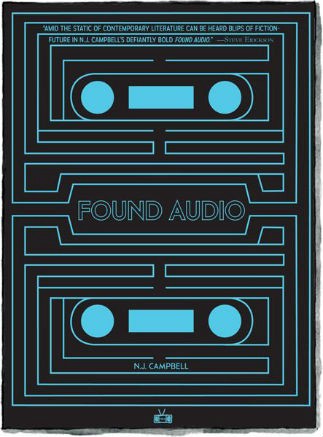
N.J. Campbell Wants to Make You a Mix Tape

I, am one of the main characters in N.J. Campbell’s weird debut novel, Found Audio — and so are you. On the first page, Campbell addresses you directly, explaining how he came into possession of the documents that follow: a letter from Amrapali Anna Singh, an audio specialist in Alaska, and her transcriptions of three audio files that may have been stolen from a mysterious library in Buenos Aires.

It’s brilliant. In an age of instant information access, Found Audio is a clever reminder that some places, experiences, and mysteries must be earned through sweat, blood, and fear. To maintain the suspense, I won’t tell you what the audio files contain, except that they involve an adventure journalist searching for a mythical (or is it?) “City of Dreams” in the swamps of Louisiana, the streets of Hong Kong, and the dunes of Mongolia. The stories alone brim with awe and mystery, but Campbell’s metafictional cocoon lifts the novel into Borgesian territory. It is as wild and unpredictable as President Trump’s Twitter timeline, and its loose ends will stay with you for weeks.

I recently spoke with Campbell via email about dreams, mystery, and the creepy magic of old analog objects.

Adam Morgan: Do you have a fetish for analog things? Is the digital world more or less mysterious and magical than the pre-digital?

N.J. Campbell: I do really love analog technologies. I wouldn’t say I have a fetish for them, per se, but I grew up in the ’90s and they were everywhere. All my movies were VHS tapes, and cassettes and vinyl records were ubiquitous at garage sales, Goodwill, and the Salvation Army. I can remember hours and days spent rummaging through bins of scratched vinyl before that was a pretty common thing to do. I got some good stuff, like a near mint condition Johnny Rivers 45 RPM and Edwin Starr’s 25 Miles in pretty good condition. I listened to records after school almost every day in high school, and I did love the static, the scratches, and the warmth of the tones. I don’t hear the same warmth in digital, but that’s probably not due to a good ear, but just some form of nostalgia for the joy associated with my early acquaintance with analog technologies.

As for mystery, I think it’s a part of the human condition, and I think we all learn this very early on as children when we learn the word ‘why’. With that one three-letter word, the world opens up to our insatiable curiosity and we quickly discover the limits of all available human knowledge, beyond which lies a limitless expanse of pure magic and mystery. And it usually only takes three or four questions to get there:

Q: ‘Why is the sun bright?’
A: ‘Because it’s a ball of fire in the sun.’

Q: ‘Why is the sun a ball of fire in the sun?’
A: ‘Because the fabric of time and space forced gravity to coalesce its mass into a spherical shape.’

Q: ‘Why did the fabric of time and space force gravity to do that?’
A: ‘Because that’s what the fundamental laws of our universe dictate.’

Q: ‘Why do the fundamental laws of our universe dictate that?’
A: ‘That’s tricky business, little one. I don’t know.’

Obviously that’s a bit of an exaggeration, but I think it’s clear enough what I mean.

AM: Why tell this story via audio file transcriptions instead of a more traditional novel structure?

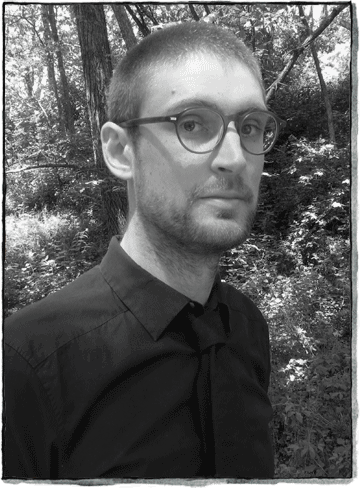
N.J. Campbell. Photo by Hannah Foster.

NJC: I started the project wanting to focus on voice, so I just focused on voice, literally. The frame of the tapes was created deliberately for a layering effect. The journalist’s story is unfolded in layers, and I wanted the most peripheral layer to touch at the boundaries of the real world.

In the beginning, the metafictional element was less explicit. In the editing phase, it became more encompassing. I think that what’s gained is a more complete feeling of discovery. The reader is not just discovering what’s happening in the tapes, but what’s happening with them, as well as what’s happening around them.

AM: What is your dream life like? Did you learn anything interesting doing research for this book?

NJC: My dreams are my own to pick through for material as I like, and that’s as much as I want to say about them.

As for the research, I learned quite a bit. It was wonderful, in fact. My father was a bus driver by day and a local historian by night. I watched him pore over interviews he had recorded, articles, statistics, and piles upon piles of books. He loves research, and that rubbed off. The most interesting part of that particular process for me was looking into The Walled City of Kowloon. For all my hours of research, I found what felt like very little to me. There was a Wikipedia page, a small website dedicated to its culture, a clip from the 1988 film Bloodsport with Jean-Claude Van Damme, a museum in Japan that had recreated a small piece of it from photographs, a book of photos and interviews with people who had lived there, and two documentaries filmed about it in the 1980s. For the most part, that’s the majority of the materials that felt substantial to me. Yet, throughout the process I couldn’t help feeling like something was missing. I still feel that way. That’s interesting to me.

AM: Traveling is really important to this narrator, accumulating diverse experiences across the world. Do you feel that way, too? What does travel do to the self? Is it similar to what dreaming does?

NJC: I do think accumulating diverse experiences is important, but I’m not sure physical travel is particularly important. Some of that is probably necessary, but the majority of the traveling I’ve done is in books. I grew up in a family that wasn’t wealthy, and I’ve chosen to pursue mostly manual labor jobs in order to save my mental stamina for reading and writing. I guess when I really think about it, I’m not sure I’m qualified to answer that question, as I’ve done so little physical traveling.

With respect to what travel does, I’m not sure physically, but mentally it’s liberating. I wouldn’t have nearly the same experience of life that I do without having traveled in books of poetry, history, philosophy, or religion, let alone novels. I’ve been able to live through experiences that I physically couldn’t in the real world, if only because they were recorded by a person who lived in a world that existed three hundred, five-hundred, or a thousand years ago. To travel in books is to expand as a person, to develop a sense of the manifold and diverse nature of human experience, and to encounter and engage with new and interesting issues and ideas about what it means to be alive, but I don’t think I’m saying anything new to anyone who might be reading this interview, so I think I’ll leave it at that.

Dreams definitely do the same thing for many of the same reasons, I suspect.

“I wouldn’t have nearly the same experience of life that I do without having traveled in books of poetry, history, philosophy, or religion, let alone novels.”

AM: Have you ever had “odd” experiences, external or internal, the way the journalist does in the swamp, city, desert, etc.?

NJC: Yes — to one degree or another, but since they have material in them for other stories, I don’t really want to go into them here as I run the risk of repeating myself later.

I will say that there’s a part in the book where someone describes their mother announcing who was going to call before the phone rang. My mother used to do this when I was young, and she was usually right.

AM: Virtually all of the novel’s threads are loose at the end. Do you have your own answers for the book’s mysteries (the library, the tapes, where the recording is taking place, who’s interviewing him and why, the noises and whispers we hear), or are they ambiguous for you as well?

NJC: That’s an interesting question. It’s been a bit of a hide-and-seek game with myself, actually. There are moments when I think I might know, and then there are moments when I know I don’t. I really enjoy that, as we’re so often left to wonder about life without any way of knowing what might or might not happen.

Beat Poet Elise Cowen’s Time-Traveling Love Letters to Emily Dickinson

The cult figure’s poems reveal a queer kinship with the canonical poet

Elise Cowen. That’s her name. Archives teach us the importance of naming, assigning an umbrella under which objects are saved and preserved. What you need to know about Elise Cowen is that she’s not quite inside any umbrella. She’s wet.

Born in 1933 in Washington Heights, New York, Cowen was briefly lovers with Allen Ginsberg, and her own poetry is often overshadowed by her associations with Ginsberg both sexually and creatively — she is most well known as the typist of his poem “Kaddish.” Cowen’s work is usually classified as cult rather than canonical, and her name is easily traceable through niche internet articles such as “The Best Female Poet You’ve Never Heard Of” or “The Lady is a Humble Thing” from Beatdom, a website “dedicated to the study of the Beat Generation.”

Cowen’s name is easily traceable through niche internet articles such as “The Best Female Poet You’ve Never Heard Of.”

My journey with Cowen begins in an archive where she is misnamed from the very beginning. I began my hunt with Peter Orlovsky, Ginsberg’s longtime partner and former roommate of Cowen. Searching Orlovsky’s correspondences in the Harry Ransom Center’s Ginsberg Collection, I misspelled Cowen’s name in the search engine, which yielded a single result:

Screenshot from the Harry Ransom Center’s Allen Ginsberg Collection.

What are the odds that there was also an Elsie Cowan corresponding with Peter Orlovsky? Orlovsky’s life was interesting, but not interesting enough to have an Elsie Cowan and Elise Cowen within the same sphere.

I found the letter and saw that it was typed on Columbia University stationary, another clear indicator that yes, this is Elise. And her signature: a subtle dot in between the i and s, which in cursive could translate to “Elsie” to an archivist, particularly one who didn’t even known Elise existed.

More tantalizing still was an article in the Ginsberg archive entitled “Elise Cowen: A Brief Memoir of the Fifties” written by Leo Skir in August 1967, five years after her death. Skir, at least, was saying her name and spelling it correctly. His writing, however, leaves much of Elise’s life out of the picture. Instead, Skir focuses on the moment in which she entered and exited his life, rather than offering a full or complex portrait of hers.

Support Electric Lit: Become a Member!

What I kept coming back to was Cowen’s signature from the mislabeled letter; that E stands so prominent as to allow the rest of her name to collapse. It reminded me of a similar E from the Dickinson Radical Scatters archive — a collection that includes facsimiles, transcriptions, and full text of fragments from Dickinson’s manuscripts.

I explored manuscript page A254/255, which in “reading view” looks like this:

Screenshot of Emily Dickinson’s A 254 / 255 from the Radical Scatters online archive.

The text itself is haunting, in the way it invokes the writer’s name on the page. Even stranger is the original facsimile. The “E E E E E E E E E” is not spread out evenly as the lineation suggests. Rather, the Es are scattered all over the page, like a child practicing writing her name. I wondered whether this was an original scrap of nothing, a poem that would’ve been discarded if not for the strange process of preserving Dickinson’s work.

I wondered whether this was an original scrap of nothing, a poem that would’ve been discarded if not for the strange process of preserving Dickinson’s work.

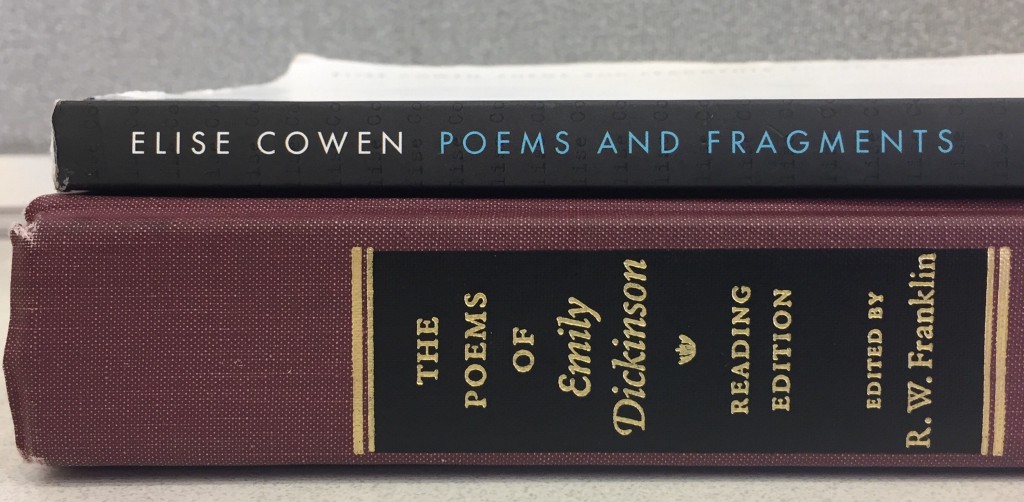
A similar process occurred with Elise Cowen’s work, the name of her first collection saying it all: Elise Cowen: Poems & Fragments. This fragmented nature of posthumous work creates its own style over time, regardless of Dickinson’s or Cowen’s original intent to create this brand of aesthetic for their work. While these ethical questions abound, I prefer to view these fragments as watermarks of a writing process. What can we come to understand about Cowen’s and Dickinson’s practices through these ruins?

Our knowledge of Cowen’s writing life is truncated by the destruction of much of her archive. Upon her death in 1962, her parents — upset by the homosexual and drug-related content of Cowen’s work — had a neighbor burn her remaining notebooks and writing. The only surviving notebook consists of 91 poems and fragments, all of which are included in the 2014 collection edited by Tony Trigilio. What the collection lacks in length, it offers in riches of form, content, and play.

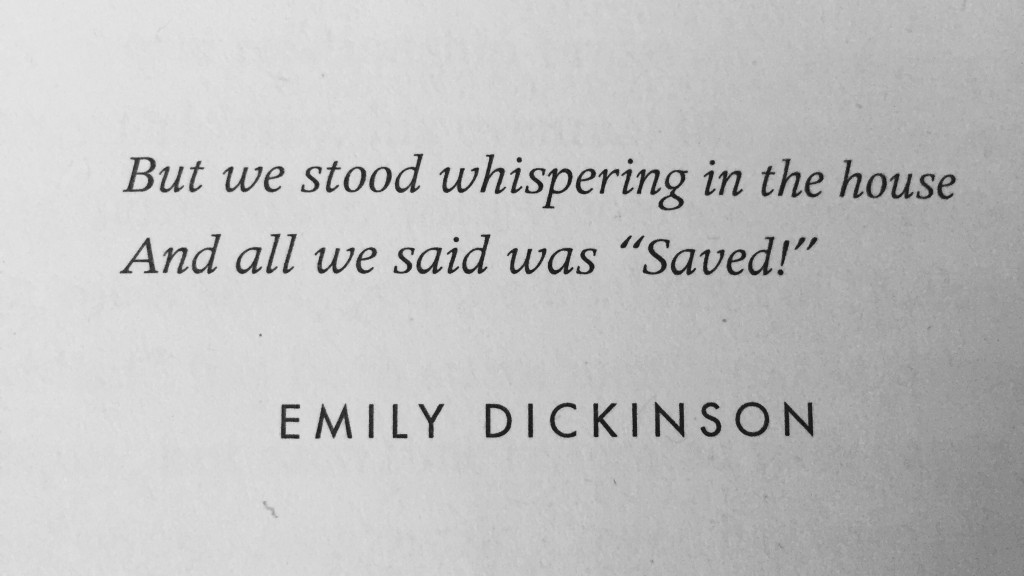
The few scholars that have worked on Cowen regard her as an Athena within a Beat Parthenon, Ginsberg at her side. This reading, while not wholly inaccurate, limits Cowen’s work as it only alludes to her contemporary living influences. In Elise Cowen: Poems & Fragments Dickinson is very much present. The collections epigraph reads:

This quote comes from Cowen’s remaining notebook, a passage from Dickinson’s “Of Tribulation, these are They.” Trigilio notes, “It is the only place in the notebook where [Cowen] quotes Dickinson.”

Throughout the collection, Cowen summons Dickinson into her poems not once but twice. First in “[Emily]” and in a later poemEmily White Witch of Amherst.” Dickinson’s name appears more than that of any other poet in this collection. Not only is she named, but she is the addressee of these two poems.

It isn’t a stretch to imagine that Cowen was, in her mind, conversing with Dickinson. In her review of Elise Cowen: Poems & Fragments, scholar Becca Klaver connects Cowen and Dickinson as contemporaries, noting that Thomas H. Johnson’s variorum edition of Dickinson premiered in 1955, making Dickinson, “not only [Cowen’s] predecessor but also her peer.” This “belated peer” status evolves into a queer kinship as Cowen writes to Dickinson.

The first poem “[Emily]” stands in conversation with the “E E E E E E E E E” fragment from A254/255. This fragment would have been available to Cowen in the 1955 edition of Dickinson. Here, Cowen embodies the simile “like a friend / when summer cleaves / away.” In Dickinson’s poem, the lineation suggest an elongated breath, one that emphasizes the last word in each line, reaching toward “friend” and “cleaves.” There is a note of desire in this pacing, reflecting similar moments from other Dickinson poems such as “Going — To — Her!” In Cowen’s response, she echoes this breath, addressing Dickinson by name:

This poem reaches to Dickinson both rhetorically and physically, “hand in hand.” Cowen’s language is saturated with sexual desire, beckoning “Emily, / come.” Cowen alludes to Dickinson’s bees as “jeweled,” which is to say glistening. This gives credence to Cowen’s careful reading of Dickinson’s bees and flowers, which pollinate one another and in so doing work as metaphors for clitorises. In her chapter on Dickinson from Sister Arts: The Erotics of Lesbian Landscapes, Lisa L. Moore cites Paula Bennett’s reading of Dickinson’s “small, round, and frequently hard objects,” such as bees, as clitoral images. Cowen writes “[Emily]” in 1959, years before scholars openly read Dickinson as queer. The bees in this poem sting Cowen, a sexualized but also suicidal act for the bee. At this point in the poem, the bees are off of “Emily,” she herself is naked of the bees and her sexuality is free from the mask of innuendo.

The bees in this poem sting Cowen, a sexualized but also suicidal act for the bee.

Cowen then obliges in taking off her own “stinking jeans.” She often characterizes herself as the girl in jeans throughout this collection. In a later poem, “[I took the skins of corpses],” these jeans are made of corpse skin, another type of communion with the dead and also providing reason for their stench. Upon taking off the “jeweled bees” and “stinking jeans,” Cowen and “Emily” are now together and touch in an escape “outside” of the world. The poem already positions us in a state of imagined desire and fantasy. It continues in this trajectory obfuscating and destabilizing reality.

The Queer Erotics of Handholding in Literature

The two women “look straight,” a jab at heteronormativity. But this is not their first encounter with looking “straight / at the sun,” as the next line notes, “a second time.” This is a second awakening as they move to “get tan,” a return to a natural union of the self and selves.

A queer kinship further emerges in “[Enough of this flabby cock]” with the lines “Enough of this flabby cock / in my head,” a strange parallel to “I felt a funeral, in my Brain.” The caesura created by Cowen’s line break syncs perfectly with Dickinson’s punctuation. Many of Cowen’s poems welcome a type of death, be it transformative or spiritual. Her equating “a funeral” to a “flabby cock” heightens our understanding of Cowen’s humor and distaste for a passive life of sexual complacency.

Her equating “a funeral” to a “flabby cock” heightens our understanding of Cowen’s humor and distaste for a passive life of sexual complacency.

Cowen’s play with the sexual, the experimental, and the canonical reflect an evolution of Dickinson’s “Tell all the truth but tell it slant.” In pursuing her own slanted truth, Cowen crafts a landscape of deep reality and deeper imagination. This presents another type of queering, different from sexual desire, one in which Cowen gives us all of her truth but from a slanted angle of the mind. Here “slant” operates as a guidepost through which to understand Dickinson’s and Cowen’s poetics as undeniably queer. Their work exists out of a necessary desire to be, especially if that means as queer female poets their work must create a new aesthetic, a new poetry altogether.

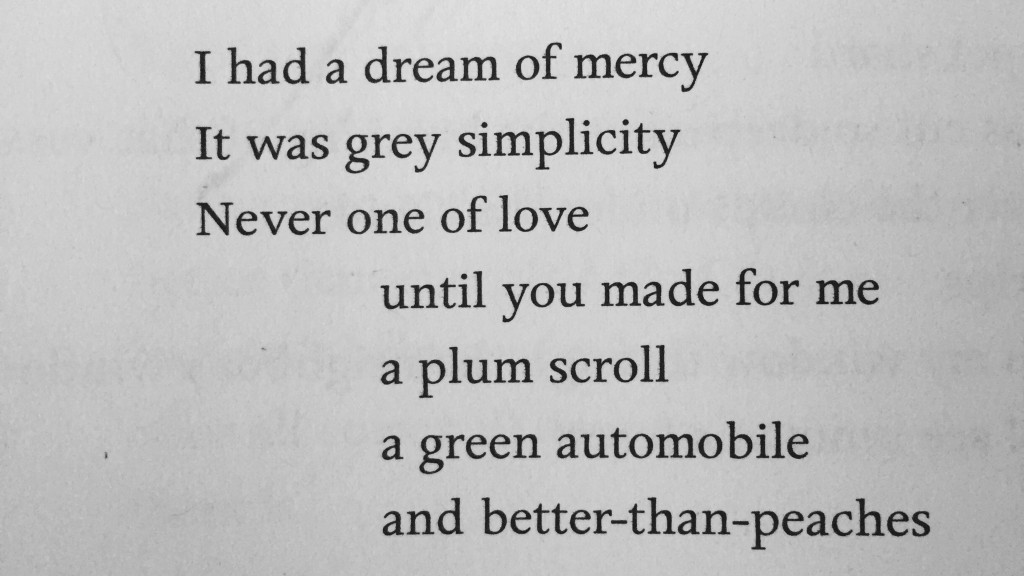
The quatrain structure of Dickinson’s “I felt a Funeral, in my Brain” echoes in Cowen’s poem “[Enough of this flabby cock],” but less so than her other works which borrow a meter directly from Dickinson. The line “a green automobile” from Cowen’s “[I had a dream of mercy]” alludes to Ginsberg’s own “The Green Automobile,” but the foundation of the poem is its meter, a meter with direct lineage from Dickinson’s ballads:

The sturdiness of the ballad meter wanes toward the end, circumventing the expectations of rhyme, but it echoes as watermarks often do, given that this poem’s status as draft, fragment, or complete is unknown.

Conversely, “[I took the skins of corpses]” possesses strict quatrains and meter, which match Dickinson’s ballads such as “My Life had stood — a Loaded Gun.” These poems also pair in their proximity to danger. In Dickinson’s version, this proximity is highlighted with an inability to act, “For I have but the power to kill, / Without — the power to die -.” Whereas with Cowen, the poem dons corpses from the opening line until the final stanza in which the wearer of the dead, barters their own body, “I’ll sell my deadly body.” The use of “deadly” swings between being and being dangerous, having “the power to kill.” Instead of her soul, Cowen sells her body to “the student doctor’s knife,” in essence, sterilizing the spiritual paradigm of good and evil through modern medicine. Cowen is selling “body” as object, body as its own corpse’s skin is wearing another corpse’s skin. The skin is recycled and worn then recycled back into a scientific medical system. In this exchange, death holds power, a power that contrasts sharply yet builds upon the same desire from Dickinson’s “My Life has stood — a Loaded Gun.”

This shared desire operates similarly to the shared E’s of Emily and Elise; it is an act of reaching. Cowen reaches back through form, content, and calls Dickinson by name. Dickinson reaches forward, as all poets do, connecting with an unknown source, channeling her own name on the page before writing.

Cowen reaches back through form, content, and calls Dickinson by name. Dickinson reaches forward, as all poets do, connecting with an unknown source, channeling her own name on the page before writing.

In Cowen’s collection, the poem “Emily White Witch of Amherst” comes right after “[Someone I could kiss]” as though one poem answers the question of another. In “Emily White Witch of Amherst,” Cowen compares herself with Dickinson again. This time, “The shy white witch of Amherst / killed her teachers / with her love” while Cowen reflects “Rather mine entomb / my mind.” With each the teachers are dead, either annihilated or existing only in the mind. In this broad stroke, Cowen summarizes the work of poetry: to move forward and away, forging and digging new ground. Her work surely moves across planes of thought, awareness, and existence. In this movement, it can become difficult to locate Cowen, her titles ranging from “Teacher — Your Body My Kabbalah” to “[I want a cunt of golden pleasure].” But this is how we find her, we dig.

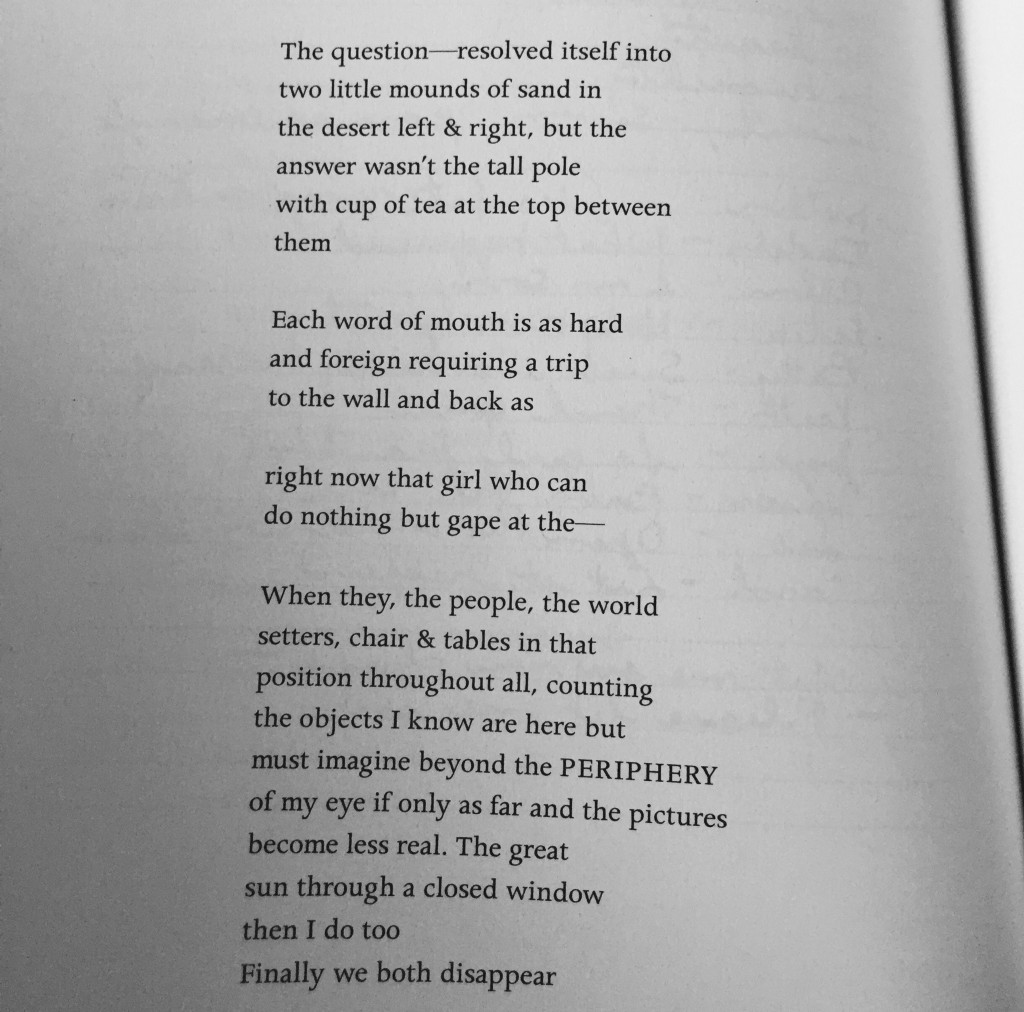
For queer poets, scholars, and those of us who study them, this is as much our work as that of Cowen and Dickinson. The premiere of Elise Cowen: Poems & Fragments in 2014, positions Cowen as our queer peer. Her work as much as it reaches back, reaches forward to us. Understanding that time within poetry is a relative slant, Cowen offers us the poem “I Can’t Remember”:

In tracing the genealogical connection between Dickinson, Cowen, and the queer poetics of today, this final line rings. It is not within separate archival umbrellas that we commune. We breathe through the disappearance of these structures, through fragment or desire or slant. This is why we come to poetry, not for answers because as Cowen tells us, “I Can’t Remember / The question.” In killing her teachers, and naming her lovers, Cowen arrives at a point of departure and glides on with her imagined Emily, using poetry as a point of communion across time.

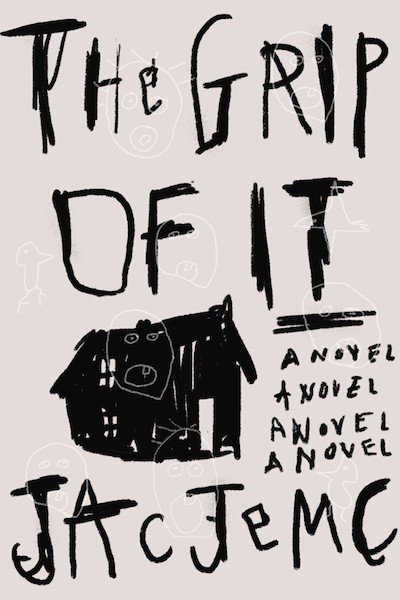
Jac Jemc’s ‘The Grip of It’ is a Master Class in Psychological Horror

With a few notable exceptions, the label “psychological horror” is most often used to describe what something doesn’t have rather than what it does. A lack of exploding eyeballs or sloshing eviscerations must mean that the scare is psychological, right? Saying that a story is “psychological horror” seems like it should mean it gives the reader a true creeping sense of fear, but all too often it just means the book doesn’t feature violent organ failure.

Jac Jemc’s The Grip of It is one of those rare exceptions, a book whose horrors are truly psychological. It is a cerebral haunting in book form, a page-turning, suspenseful read that will stay with you long after you’ve finished it. Jemc has already demonstrated her knack for an ethereal kind of writing; her short story collection, A Different Bed Every Time, is a study in how uncanny circumstances can still be complex and nuanced, without sacrificing their unique weirdness. Like the work of Leonora Carrington, the effective terror of The Grip of It comes with sudden juxtaposition of the surreal, both in the subject’s environment and within the subject’s persona.

“At night, on the way to the bathroom, I don’t turn the hall light on. I trace my hand along the wall. I touch something wet and soft.”

Moments like this also bring to mind the well-timed creep-outs of Dario Argento movies, but instead of being presented in bleeding technicolor, The Grip of It stalks the reader through its pages with a silent, grayscale terror, like the brush of a web against your cheek in the dark.

The Grip of It stalks the reader through its pages with a silent, grayscale terror.

James, a compulsive gambler and job-hopper, is hardly a safe rock to rely upon. But maybe that’s what Jemc wants us to realize about their relationship to each other — that so much of what binds them is based on belief rather than action, specifically Julie’s belief in the man she chose to marry. It is that very same thing that signals the breakdown of their dynamic: belief, or rather disbelief, in what is happening to them and how it is destroying them. Both Julie and James suffer as the chaos crescendos. James is no longer able to ride the wave of it without repercussions, and Julie’s denial is far past the point of no return.

Jemc is telling us the story of the putrefaction of a relationship.

Jemc is telling us the story of the putrefaction of a relationship. This relationship is not clean-cut and bookended by dramatic flares — it festers, untended, a thriving hotbed for the things that break us down, cell by cell. It doesn’t choke, but lines the airway slowly, turning a once-healthy breath into the ragged pull from a plastic straw. “Bad behavior heralds ruin,” says Julie, when she is utterly convinced that the haunting must be her fault: she is unwilling to accept that malevolence exists for its own sake, but convinced it must be part of a puritanical order of punishment. She suffers from the common delusion that you can gain control over a situation by imposing a knowable structure on unknowable phenomena.

James, unfortunately, plays right into Julie’s delusion, blaming both of them not just for the results of the haunting, but for the haunting itself: “I think we’re haunting ourselves. We’re pulling ourselves apart. We’re noticing gaps and stepping into them instead of avoiding them.” James demonstrates a core element of the story: the fractures in the marriage already existed, and the warps and cracks in the house are those fractures made manifest.

The phenomenon affecting Julie and James is actively intimate, and Jemc has realized that our voyeuristic look into their lives is part of heightening the fear, confusion, and terrible unknowability of the situation. “I feel followed, as if instead of the house’s being haunted, the haunting has crawled into me,” Julie confesses to us, “And I want to turn the tale as James had said, so that I believe both that we are lucky and that nothing matters, but it’s so hard not to believe myself.”

Who can’t relate to the anxiety of rotting from within, in the way that mold permeates an old house?

It’s this equalizing sense of dread that endears us to these characters and their plight. Jemc doesn’t make the couple likable or particularly interesting, and she doesn’t have to. We are drawn to them because we share the fear that what affects us on the outside is somehow infecting us on the inside—whether supernatural, domestic, or even political. Who can’t relate to the anxiety of rotting from within, in the way that mold permeates an old house? Who wouldn’t understand the complex nature of trust between partners, where people can claim to know each other intimately, but recoil at the idea of a vast landscape within each other that neither will ever truly see?

What makes this novel so powerful is the acknowledgement that intimacy does require a trust beyond logic, that “ruin” can come just as easily to the guilty or the guiltless, and an embrace of the chaos is sometimes the only way to make it out to the other side.

Audio: “Star Witness” | A Story in Seven Parts

Exclusively for our members, we will release audio editions of each episode of Joe Meno’s serial short story, “Star Witness,” here every Friday beginning August 18.

Episode 1: The Girl Goes Missing

Episode 2: Shelley Enters the Woods

Episode 3: The Secret Song

Episode 4: A Very Odd Occurrence of Birds

Episode 5: The Monster of the Green Lake

Episode 6: A Hidden World

Episode 7: A Conclusion in the Caves

Camille Bordas Doesn’t Understand Why You Want to Relate to Her Characters

The narrator of Camille Bordas’ new novel, How to Behave in a CrowdIsidore Mazal, or Dory—is by all measures a normal child on the cusp of adolescence. But among his high achieving siblings, his normalcy seems more like a failure than an emblem. While his siblings skip grades, pursue doctorates in their early twenties, and publish theses on humorism in the golden age, Dory shows no unique academic aptitude and struggles to build relationships in the face of his siblings’ insistence that knowledge is more important than friendship.

But in the aftermath of a family trauma, intellectual theories fail to help the siblings recover. Dory’s observations of how his siblings react to the incident illuminate the chasm between theoretical knowledge and interpersonal relations.

Bordas’ narration is intricate and wise, told through the eyes of a boy whose social observations begin to overshadow his siblings’ academic achievements in the notoriously rigorous French school system. In a conversation over email, we discussed how she worked social theories into the novel, the meaning of the word pretentious, and how our relationship to fiction changes as we get older.


Becca Schuh: I loved the debate that Dory and Simone have over the word “pretentious”— I’ve found myself in similarly absurd discussions. As Simone states, the actual definition of the word is “looking to impress people with knowledge you haven’t really mastered,” versus the idea that it “defines someone who talks about a thing that others don’t understand.” The way I hear it used the most is referring to people who discuss esoteric topics that are perhaps inaccessible to the general population, but I’m sure that’s not by any means the dictionary definition. What does the idea of pretension mean to you, and how do you navigate the gray area between the dictionary definitions of words and how they’re used colloquially?

Camille Bordas: It depends on the language I’m speaking! In French, I used to be a Simone-type tight-ass when it came to proper word usage — I wouldn’t correct anyone of course, I’m not entirely socially inept, but I would notice misuses, big or small, see word meanings slide slowly, inevitably…and then I moved to the U.S. with a pretty good command of English, but I had a limited range, and I wanted to expand it, so I had to try things out, make mistakes, navigate the gray area you mention between registers…and that was liberating in a way, even though I’m still sort of terrified at the idea of misusing certain words in public and making a fool of myself. It’s weird that I’m so attached to proper definitions, because there’s nothing I love more than people who play with language and bend it in fun ways.

I guess that’s the answer to your question, though: if you’re going to bend language, you have to be funny about it. Or very smart, I guess. Otherwise yeah, you’re kind of just being pretentious. Or plain wrong.

BS: It was so interesting to get these miniature lessons on the obscure things the siblings studied. One I found particularly fascinating was Berenice’s thesis on humorism. It made me think about personality tests, the everlasting human fascination with everything from Myers-Briggs to astrology to internet personality quizzes. How did the idea of categorizing humans relate to the narrative of Dory and his siblings for you?

CB: Categorizing is organizing, is giving you a sense of a grip on reality. And that grip becomes a sort of power, I guess. Dory is more interested in people than his siblings are, but just like them, he seems to have a mind for categorizing. So he sorts through what he sees and goes about it methodically. He notices and interprets people’s awkward silences, the shifts in their facial expressions (in the guy who’s courting his mother, for instance), etc. I don’t think he wants to notice all these things. They become a problem to him in a way. Like, when he says, “My parents didn’t look very much in love to me, and I thought it was my fault,” he’s under the impression that noticing things other people don’t makes him responsible for them.

The issue with Dory’s “gift” for reading humans is that, unlike his siblings, who deal with abstract or intellectual topics, the struggles that he notices cannot be solved by writing an academic essay, so he ends up accumulating knowledge about human emotions that weighs him down more than anything else. Then he realizes, by catching glimpses of his siblings’ work, that human emotions have always been categorized by intellectuals (doctors, in the case of humorism, sociologists, novelists), and put at a distance, in a way. So he tries to learn how to do that. Not to unsee the things he’s seen, but to numb himself to them.

BS: When Simone is talking to Dory about Aristotle’s rules of fiction, she posits that his ideas, motivations, and desires exist because he’s seen them played out in books and films. Do you believe that this is true today? How does the plethora of media the average person consumes affect their choices and lifestyle?

CB: There are definitely people out there who have a thing for drama, and I wonder what they’d be like had they never seen a TV show. I don’t think it’s very controversial to say that the media seems, more and more, to be trying to push on us all an image of the life we’re supposed to aspire to. Parallel to that, people seem to have become more and more interested in seeing themselves reflected in the stories they’re told. They need to relate, to be able to predict characters’ reactions…and it becomes a big blur between life and fiction. It ends up feeling like you’re supposed to react to adultery the way people react to it on TV, for instance. I’ve seen this happen around me, and it seems both false and sad. Perhaps some people react in a prescribed way to protect themselves from what they really feel. I don’t know. Nor do I know which came first: our desire to be reflected in stories, or the media’s attempts to reflect us.

Commercial art (the one Simone talks about in the book) teaches us to live in clichés, and some clichés are useful, I guess, but I fear sometimes that they just end up numbing us at our core, if we don’t take them with the grain of salt they require. They make us all lemmings and there’s no emotional connection anymore — life ends up being a simple verification of human clichéd reactions. I guess there’s something reassuring to that to some people, but I find it quite terrifying.

I do think some people live through fiction, but even though I devote my life to fiction, it’s still a pretty foreign idea to me. Fiction is important to me as a way to bear existence, but not as a way to help conduct my life and make decisions. I think it boils down to identification, in the end, and that’s a concept I’m not sure I can relate to. I don’t get the need to identify with a character to be involved in a book or in a movie. As a reader, I need to care for, or hate, or be entertained by a character in order to get involved in their story, but identification…I’m not even sure I know what that means, or why I would want that. Sounds scary. I’m a pretty empathetic person, however, so I guess one has nothing to do with the other. Maybe I reserve true empathy for real life. I love fiction more than any other man-made thing in life, but I still love life more than fiction, because life is what allows for it. I like this thing Robert Filliou said: art is what makes life more interesting than art.

“I don’t get the need to identify with a character to be involved in a book or in a movie. As a reader, I need to care for, or hate, or be entertained by a character in order to get involved in their story, but identification…I’m not even sure I know what that means, or why I would want that.”

BS: Midway through the book, the mother says “The memories you make as you get older, they’re not as bright, you know? They’re more like memos. They have a certain flatness. And a veil.” This reminded me of a Geoff Dyer passage from his book Zona, where he says that all of his “favorites” developed in his youth, because his emotions towards art were so much stronger when they felt unprecedented. As we age, how do you think our emotional reactions to both art and interpersonal relations change?

CB: I didn’t know the Dyer quote but it rings true, sadly. I mean, maybe it’s not that sad. It’s a double-edged thing. On one hand, having accumulated knowledge and experience, age makes you more able to see through the bullshit, so that’s good. But on the other, you’re just not as open-hearted as you were growing up, as ready to absorb new ideas, as hungry to build yourself as when you thought you were the first to ever feel what you felt. After that, your personality sets and dries in the sun a little. You can’t quite maintain the same intensity.

But now saying all this, I realize I must not quite be done growing because I’m still pretty hungry to discover new authors and artists, for instance, and when I do stumble upon one that I love and have never heard of before, I’m as excited about it, maybe more, actually, than I would’ve been 10 years ago.

However, I did hear people in their 50s or 60s say that they had lost all interest in fiction even though they loved it before. That frightens me a little. But anyway, maybe Dyer was in a bad mood when he wrote that. If you’d asked me the same question last year, I might’ve said, “Yeah, you like less and less things as you age, and generally, getting older sucks,” but I’m in a pretty good mood today. It’s like when I moved to the States, I had no friends here other than my husband, and I had no idea to make any. To feel better about my failure at it, I concocted this stupid theory that you couldn’t really make any new close friends past the age of 25. I convinced myself of that. And then last year I met Catherine Lacey, who’s not only an amazing writer but also one of the best human beings around. Very fun to drink with.

BS: Throughout the novel, you intersperse a lot of “social ideas,” like a few of the ones mentioned above, or the idea of the characters “practicing melancholy.” What fascinates you about putting names and analysis to the ways people look at the world and socialize?

CB: That’s some sort of occupational hazard…I read a lot of Erving Goffman in grad school (Presentation of Self in Everyday Life, Behavior in Public Places — that’s where my title came from, by the way, since in French it was translated as “How To Behave In Public Places”), I became really interested in “micro sociology,” the study of individual social processes as opposed to big, all encompassing ones.

I also have an uncle who narrates his actions whenever there’s an awkward silence. He’ll help himself to some wine and say “A little more wine perhaps, mister Cordoba?”/”Why yes, thank you very much!,” and I noticed that I tend to narrate other people’s smallest actions in my head as well. It’s not so much that putting names and analysis to our routine behaviors fascinates me as much as it reassures me. When I first read Goffman, and Harold Garfinkel, also, something opened up that was as close as someone like me can get to a religious experience, I think: “I’m not alone! We’re all the same!” — something like that. I felt connected to everyone else. I know it sounds cheesy, but well, I’d never really felt that before, and it was comforting, and still is, because half of the time, I’m not even entirely sure I’m alive, so looking at other people and noting how every little thing they do was in Goffman helps me remind myself that we’re all here and we’re all weird and it’s all fine.

BS: The “olive of shame” bit was truly hilarious, but I was further fascinated by the line following it: “Something we had only considered vaguely impolite became shameful through the magic of a foreign proverb.” How do the stories and jokes that we share with our loved ones affect our relationships?

CB: They just make us closer. A private joke, a made-up expression, an adopted and beloved one…any specific group of words that you only share with a small group of people and ends up meaning something unique to you and that group of people is like a magic shortcut to expressing something big and idiosyncratic about your relationship with them. It sends you back to the moment you devised it. I wonder if all families have something like that, their own pantheon of modified sayings, like the Mazals do in the book. I know of a few. When other people do share their homemade sayings with you, it’s very rewarding: you join their very private club. Anyway, my family has a handful of expressions that I never heard used elsewhere. It’s a sort of clanic language at this point.

BS: In the days following finishing the novel, I found myself bringing up the idea of the funnel in social situations, that as you go through school and life you’re more and more constrained by your choices and have less and less possibility. Have you felt the “force of the funnel” in your life? Do you think that there’s any way to avoid the feeling that as you grow older, you have fewer options?

CB: I ask myself these questions a lot when it comes to writing. I’ve never been confident in that area. I always wonder if I made the right choice in pursuing this. In France, I started publishing very young, and people liked my first book, so it seemed like I should keep doing it…you know, in a way it’s the only instance in which I feel close to professional athletes: they started doing what they do very early on, and it has defined their whole lives, but how do they feel at the end of their career, when they still have 50 years of life to fill? I kind of feel like that all the time, even though I’ve arguably picked the one career-path where you’re most likely to peak when you’re old. It’s still a choice that I made when I was young, and in many ways I don’t even remember who I was then, yet I’m still living a life that that person decided on.

It didn’t seem like a decision at the time, and that’s what Simone says in the book: you don’t even realize you’re going down the funnel. What happened in my case is that my father died when I was 19, a few weeks before my last year in college ended. I did finish college, but I was also broken and in a state of “Fuck this/No tomorrow/Might as well write fiction.” And I wrote my first book the following year, didn’t apply to grad school, started working…and now 10 years later, I can’t help but wonder if, were my father still alive, I would’ve just made the same decision, only later, or if I would just be the archeologist I was training to be when he died. It’s a little bit crushing, as far as the questions you can ask yourself go. So yeah, I definitely feel the force of the funnel.

I did finish college, but I was also broken and in a state of “Fuck this/No tomorrow/Might as well write fiction.”

And I regularly make attempts at fighting it, at climbing back up. After publishing my first book, I wasn’t sure I could write another, so I went back to grad school, for Anthropology. But then as I was getting my Masters, I wrote my second novel. Somehow I always go back to that. Maybe it’s part of the process of writing for me, to think that I should be doing something else, try it, and realize that I’m better at writing. This reminds me that years ago, I stumbled upon an old article in the archives of the French newspaper Libération. It was some sort of special issue about books, where they asked several writers the same questions. One of the writers was Beckett and one of the questions was “Why do you write?,” and they all went on and on and on about vocation and love of books and the power of literature etc., and Beckett’s answer was a laconic: “Bon qu’à ça,” which translates to: “Only good at that.” That moved me quite a lot.

The City Where One Wrong Word Can Kill You

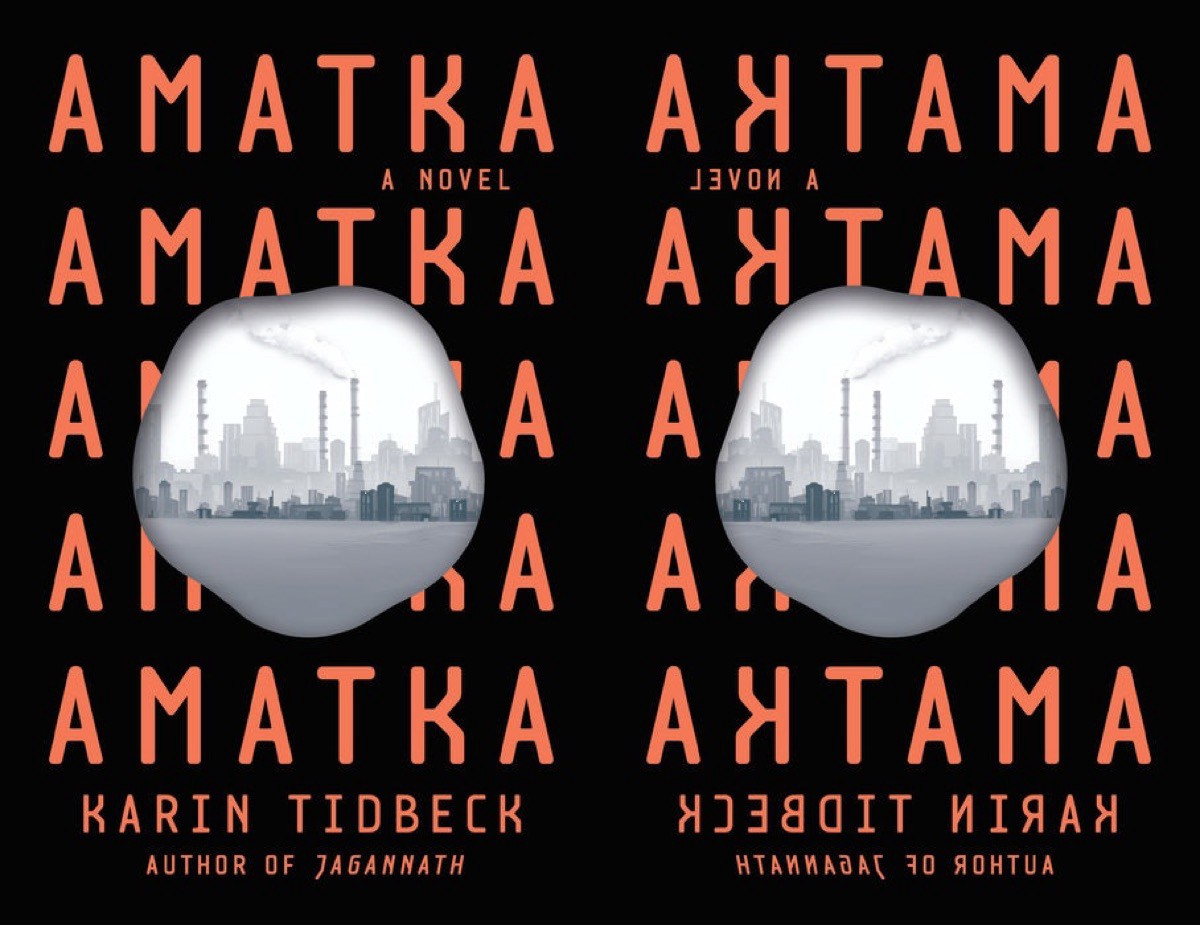
Double Take is a literary criticism series in which two readers tackle a highly-anticipated book’s innermost themes, successes, failures, trappings, and surprises. In this edition, Amy Brady and Adam Morgan explore the dark, surreal novel Amatka, by the Swedish master of weird fiction, Karin Tidbeck.

First introduced to English readers by Ann and Jeff VanderMeer (via her short story collection, Jagannath), Karin Tidbeck’s novel Amatka follows an investigator named Vanja who travels to the frigid colony of Amatka, where language — both written and spoken—has immense power. But beneath the city’s peaceful veneer, long-held secrets are beginning to surface that could destroy everything. Amy Brady and Adam Morgan discuss Tidbeck’s unique brand of worldconjuring, her Scandinavian influences, and how successfully she incorporates elements of mystery, surrealism, and poetry.

Amy Brady: When Vanja first arrives at the Amatka colony, I wondered where we were in time and space. In some ways, Amatka is much like our world, but it also differs in significant ways: Amatka is one of only four colonies of human beings in existence (a fifth colony, we learn, was destroyed), and almost every material thing — including furniture, eating utensils, even the buildings themselves — is made out of a strange sludge that takes on whatever shape it’s labeled with. To form a wall, for instance, a member of the colony would point at the sludge, call it a wall, and then write the word WALL on it for good measure. One of Amatka’s biggest collective fears, then, is calling something by the wrong name.

This is a world where language is a source of tremendous power.

What’s fascinating is that compared to some dystopias — say, Gilead in The Handmaid’s Tale — Amatka doesn’t always seem so bad. Yes, on the one hand, women are almost forced to have children, who are then raised independently of their parents. But on the other hand, women are allowed to hold positions of power, no one bats an eye at same-sex relationships, and no one seems to be going hungry, despite their limited resources.

So as the story unfolded and Vanja became increasingly unhappy with what she perceived as limits to her freedom, I found myself wondering: Is escaping the colonies really a better choice? I can’t remember the last time I felt this ambiguous about a dystopian world’s moral framework or its potential for change. And that feels like an exciting shift for the genre.

I can’t remember the last time I felt this ambiguous about a dystopian world’s moral framework or its potential for change.

Adam Morgan: You’re right, Tidbeck’s dystopia isn’t as violent as the ones we’ve become familiar with in popular culture. The horror of Amatka is much quieter — between the lines and behind the scenes — but I could still feel it from the first pages, when Vanja is traveling on a windowless train with no idea what kind of landscape awaits her outside. That quiet evocation of dread hangs in the air throughout the book, and it reminded me of Brian Evenson’s short stories…so much so that I pictured this novel’s librarian, Evgen, as Brian Evenson.

I did wonder if a world where families are forced to sever emotional ties soon after childbirth was an exaggeration of Tidbeck’s native Swedish culture, which really de-emphasizes the role of family in public life, at least compared to the U.S. and the U.K. Amatka’s authoritarian system of government, however—the invisible “committees” issuing orders from a secure tower — struck me as the inverse of Scandinavian egalitarianism, so I can see why a progressive writer in Malmö might find fascism (even well-meaning fascism for the “greater good”) quite disturbing.

As to where we are in time and space, at first I thought Amatka was just a fictional Scandinavian city in some bleak future where parts of the world were slowly being recolonized. And then I thought it was an alien planet. And then I thought it was some kind of O’Neill cylinder in space. By the end of the book, I still wasn’t sure, and while I typically delight in narrative ambiguities, the trail of bread crumbs Tidbeck left us regarding Amatka’s geography (or should I say cosmology?) created an appetite that was never sated.

Perhaps I expected too much from a 200-page novel, though the scope and level of detail here sometimes felt like a short story stretched over too much mycopaper (that’s an Amatkan joke — trust me, it’s hilarious once you’ve read the book).

How did you feel about balance of mystery, suspense, and closure?

AB: The mysteries of what, exactly, the shape-shifting goop is and where it came from delighted me. By telling us so little, Tidbeck created an unnerving tension that snaked through the whole book. I kept wondering: Is the goop alive? Will it exact revenge on the humans who force it into shapes? We never get concrete answers, and I like that choice, because it suggests that the characters might still be in danger, even by the book’s end. A more pat conclusion that explains away the mystery of the goop would have been too heavy-handed for my taste.

But that said, there were other enigmas that felt less connected to the central narrative and left me wanting more satisfactory explanations — the machinery in the tunnels, for example, and the nightly freezing of the lake. Tidbeck describes these things with brilliant detail, but I felt like I was never rewarded for my curiosity.

By telling us so little, Tidbeck created an unnerving tension that snaked through the whole book.

One thing I really loved about the book was its celebration of poetry. I suppose the ending could be interpreted (without giving too much away) as a triumph of poetic language over the prosaic. What did you make of the fact that even in post-apocalyptic Amatka, where resources were limited, poets managed to publish their work? And a follow-up question: If you could make manifest any poem by writing it on a heap of mystery goop, which poem would you choose?

AM: That’s a really good way of putting it: I never felt rewarded for my curiosity. And it’s not that I wanted “answers” to the mysteries in a teleological way (e.g., the finale of LOST), but I did want greater detail and more exploration of the environment, since Tidbeck drops all these hints that there’s more than meets the eye.

In Jeff VanderMeer’s Annihilation, for instance, even if we ignore the rest of the trilogy, he rewards our curiosity about the tunnel and the crawler by giving us a very detailed encounter before the end of the novel. We don’t get “answers” (who needs those?), but he gives us the experience we’ve been craving since page one: to explore and experience. We never really got to explore or experience Amatka beyond vague impressions, though Tidbeck certainly spark our curiosity.

The poetry metaphor is a good one, given that this book (and Amatka itself) operates on what Kelly Link would call night-time logic, which certainly makes its way into speculative fiction but has always felt poetic to me. I found it really interesting that, as you say, a civilization with only so much paper would preserve poetry, though perhaps that’s another artifact of Tidbeck’s Scandinavian foundation. Poetry, and literature in general, is not the niche leisure market there that it is here in the States, and many Scandinavian writers make a decent living thanks to massive governmental investments in the arts.

I’m wondering too about your thoughts on the end of the book. Without giving anything away, Vanja and Amatka’s fate felt rather deus ex machina to me. While I really enjoyed the narrative threads Tidbeck had woven for the first 150 pages (as well as the form they took), most of them simply dissolved in the last few chapters, like unmarked tubes of toothpaste (last Amatkan joke, I swear).

AB: Your insights into how Amatka’s civilization maps ideologically on to Scandinavia’s are especially interesting in light of the region’s dominance of the 2017 World Press Freedom Index. Of the countries surveyed, Norway tops the list with the most media-related freedoms, followed closely by Sweden, Finland, and Denmark. This is a region that values its freedoms to speak and write, and Amatka, for all its sci-fi and fantasy elements, holds a similar reverence for language. Capital punishment in Amatka, after all, isn’t death — it’s losing the ability to form words.

As an American reading this book, I couldn’t help but think of how our own freedoms of expression are under attack: there’s the administration’s treatment of the press, the possible elimination of the NEA and NEH, and of course the systemic weakening of our country’s humanities and journalism programs. These are not the signs of a nation that values language. Wanna guess where the United States falls on the Index? Forty-three. We’re number 43.

So, what did I make of the ending? I think you’re right — it left a lot of ends loose and twisting in the wind. And that was frustrating. But looked at another way, the story also culminated in a poetic vision that seemed very much in line with the book’s suspicion of literalism. For me, at least, the climactic ending was hard to “see” in a way that the rest of the book wasn’t: The action was blurry, and Vanja’s participation in it was at times hard to decipher. But rather than weakening the story, the vagueness, I felt, reinforced its themes. To paraphrase Emily Dickinson, Tidbeck told all the truth about Amatka in those final moments, but she told it slant.

As an American reading this book, I couldn’t help but think of how our own freedoms of expression are under attack.

The book left me feeling some ambiguity toward Vanja, however. There’s so much to admire about her (especially her bravery), but at times she seemed to be making choices based on her own, nebulous dissatisfaction with life instead of anything rooted in society around her. What did you make of her?

AM: I appreciated Vanja’s agency, particularly after reading so much dystopian fiction where the heroine just gets bounced around from horror to horror. In terms of characterization, though, Tidbeck’s approach reminded me of science fiction writers like Arthur C. Clarke and Kim Stanley Robinson, for whom protagonists often serve as neutral point-of-view vessels. But I don’t mean that as a critique, and here in Amatka (as in 2001: A Space Odyssey and Aurora), Vanja’s aloofness is narratively justified. On some level this is a story about the horrors of emptiness, wordlessness, and formlessness, after all.

In the end, despite the places where my appetite wasn’t quite sated, I think we both really liked this book. It’s a unique reading experience — a sharp, understated glimpse at a terrifying world. The fact that I wanted more is a testament to how fascinated and invested I was in what’s there. I hope Tidbeck’s next book is 100–150 pages longer. Either way, I’ll be reading it.

10 Stories for the Back to School Season

The back-to-school sensation hits many more of us than the returning teachers and students. Suddenly, stores are full of stationary supplies and advertisements are no longer for swimwear and getaways, but uniforms and unnecessary dorm-room decor. For some, the feeling might bring a twinge of nostalgia; for others, the unwelcome knock of memories from the most awkward years.

In the throes of mid-August, we’ve unlocked 10 stories from the Recommended Reading archives that will bring readers back to school without having to enter the building. These stories envision schools of the future and recall the institutions of the past; they sympathize with the adjunct professor, the terrified elementary student, the awkward teen, and the flustered parent. School might be approaching and summer ending, but there’s no reason to stop your pleasure reading. For just $5 a month, members of Electric Literature get access to the complete Recommended Reading archives of over 270 stories — and year-round open submissions. Membership is tax-deductible, helps us pay writers, and keeps all of our new content free. So if you like what you’ve read, please join today!

“Maroon” by Ladi Opaluwa

Recommended by Electric Literature

“You did not hear Pastor James knock,” writes Opaluwa in the opening paragraph of “Maroon.” And so we enter a story, written boldly in the second person, that follows the buildup to a rape we feel will happen — though we can’t, like the unnamed student victim, say exactly how we know this. The young woman’s narrative in “Maroon” sears because it is visceral, but her voice also insists that the story could be yours. It is a reminder that while school can be a safe haven, it can also be a place where we are most vulnerable to abuse of power.

Tributaries” by Ramona Ausubel

Recommended by Electric Literature

In “Tributaries” love erupts as a new appendage, a “love-arm.” Ausubel investigates this reality through three tragic characters: a husband exhausted by his missing love-arm and the “debts and balances” of his life; his wife who, while young lovers preen each others’ love-arms, must oil her husband’s prosthesis; and their daughter’s teacher who has loved frenetically and suffers from a type of love-induced leprosy.

“Passing Each Other in Halls,” by Matt de la Peña

Recommended by One Teen Story

The story follows the course of one loopy night in Los Angeles, as the narrator and his friend P.J. prowl the streets and the clubs, talking tough but feeling vulnerable, reminiscing about high school and worrying about their prospects after their friends have left them for college. Peña’s narrator is — perhaps secretly — into vulnerability. He’s an aspiring poet, a romantic—who still isn’t confident in his kissing abilities.

“The School” by Donald Barthelme

Recommended by Steven Polansky

In Barthelme’s “The School” the best-laid plans for student enrichment—and a well-meaning teacher’s most earnest ideas—result in a failure and tragedy every time. This is a lesson in and of itself, and yet after all the dead trees and goldfish, even (spoiler!) dead children, perhaps the real lesson is that the children never lose their willingness to try, try again. “To describe it is to sound ridiculous,” writes Polansky in his introduction. “[It’s] a very funny story about death and the negation of meaning, and the only story ever written, by anyone, in which a resurrected gerbil is the bringer of hope.”

“Our Education” by Lincoln Michel

Recommended by Electric Literature

So many of childhood fantasies are, from the perspective of a worry-prone adult, nightmares: running away, becoming an orphan, living in a boxcar. Yet the realities of such disorder eventually trump our desire for it; any kid who has tried to run away knows the feeling of getting half way down the block with a backpack and thinking, in a word, crap. This is the moment in which we find the narrator of Lincoln Michel’s tale of scholastic anarchy. He is trapped in a school from which the teachers have all disappeared, but in his case, there is no option to break the fantasy, to go home.

“Reading In The Schools” by Hannah Rahimi

Original fiction, recommended by Electric Literature

This is the story of Abby who, in the midst of a divorce and recently relocated back to her parents’ home, is casting about for a sense of purpose. She lands as a Reader in the Schools, tasked with reading to a small child for an hour each week. It is a task that she is perhaps unqualified for — not because she lacks the requisite literacy, but rather because she’s in what she terms “a funny phase” in life — and she soon finds herself outmatched by the wonderfully prickly, seven-year-old Magda.

“Nadia” by Brit Bennett

Recommended by Angela Flournoy, excerpted from the novel THE MOTHERS

“Nadia” is a story about the ways that grief can send you reeling, and how the people we meet during grief’s bleakest moments can feel like the antidote to our pain, a solution to the unsolvable problem of loss. Shortly after a visit to a strip club while bunking off school, Nadia runs into Luke. “He didn’t treat her like everyone else at school, who either sidestepped her or spoke to her like she was some fragile thing one harsh word away from breaking,” writes Bennett. As Nadia works through the loss of her mother, she finds solace with an unexpected partner.

“All the Keys to All the Doors” by Clare Beams

Recommended by Megan Mayhew Bergman

Beams tells of the aging Cele, a benefactor and an unofficial elderwoman of a rather perfect town that is brought to a halt after a tragedy at the local school — the heart of Cele’s idyllic world. “All the Keys to All the Doors,” writes Bergman, reaches out to contemporary pain and asks a devastating and universal question: What is it like to “live with unlivable things”?

“Wait Till You See Me Dance” by Deb Olin Unferth

Recommended by Rebecca Schiff

Unferth, writes Rebecca Schiff is “a sentence-level dazzler who knows how to tell a story.” In this piece and in typical Unferthian style, an adjunct professor keeps repeating to her English 99 class that their final “will be graded by outside sources,” a phrase that absolves her of responsibility. Yet, she confides in the reader: “These outside sources were supposed to be mysterious, were maybe not even people…” In Unferth’s work, suspense grows out of sentences. Being playful on the page can be a matter of life and death.

“The Great Disaster” by Alanna Schubach

Original fiction recommended by Electric Literature

“The Great Disaster” unfolds through the eyes of a group of school children in a small American town after a large flood has struck their valley, bringing chaos and destruction and leaving behind dead bodies, mud, and mold. The children are too young to grasp the political, economic, and geographic implications of the tragedy, and yet they are just young enough to understand, viscerally, it’s philosophical and spiritual consequences. In this way, Schubach creates the perfect narrators for an intimate reading of a global event.

About Recommended Reading

Recommended Reading is the weekly fiction magazine of Electric Literature, publishing here every Wednesday morning. In addition to featuring our own recommendations of original, previously unpublished fiction, we invite established authors, indie presses, and literary magazines to recommend great work from their pages, past and present. The Recommended Reading Commuter, which publishes every Monday, is our home for flash and graphic narrative, and poetry. For access to year-round submissions, join our membership program on Drip, and follow Recommended Reading on Medium to get every issue straight to your feed. RecommendedReading is supported by the Amazon Literary Partnership, the New York State Council on the Arts, and the National Endowment for the Arts. For other links from Electric Literature, follow us, or sign up for our eNewsletter.

Indie Bookstore Demonstrates How to Deal With the Alt-Right

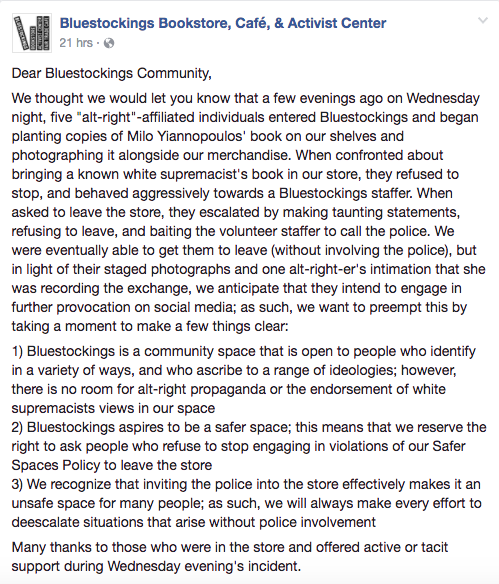
Bluestockings is a feminist bookstore, cafe, and activist center in New York City—basically, a gathering place for progressive ideals. So it’s probably no surprise that it would be targeted by alt-right types. Fortunately, the vandalism was more ideological than physical: attempting to sneak copies of a white supremacist memoir onto the shelves.

As usual for a group whose main tenet is “everyone’s fucking me over but me,” the intentions of this…protest?…are a little muddy. Were they trying to impugn Bluestockings? To help Yiannopoulos’ real book sales match his fantasy ones? Eh, who literally ever knows. But in any event, Bluestockings’ response, both in the moment and on Facebook, is a model for how businesses and organizations can commit to dealing with people who espouse white supremacy in the name of (their understanding of) free speech.

It could even work for individuals. “Uncle George, Thanksgiving is open to people who ascribe to a range of ideologies; however, there is no room for alt-right propaganda or the endorsement of white supremacists’ views in our space.” It has a nice ring, don’t you think?