Beat Poet Elise Cowen’s Time-Traveling Love Letters to Emily Dickinson

The cult figure’s poems reveal a queer kinship with the canonical poet
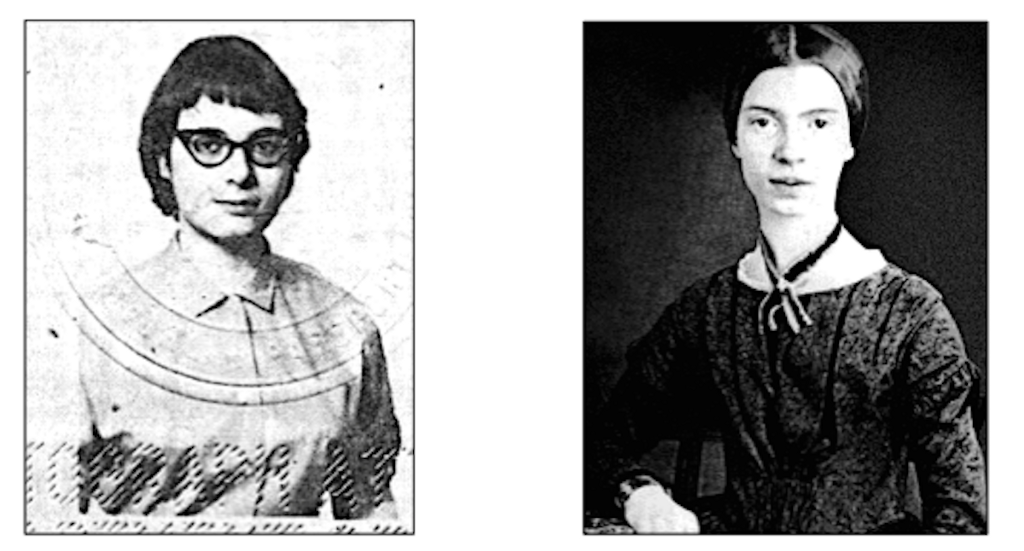
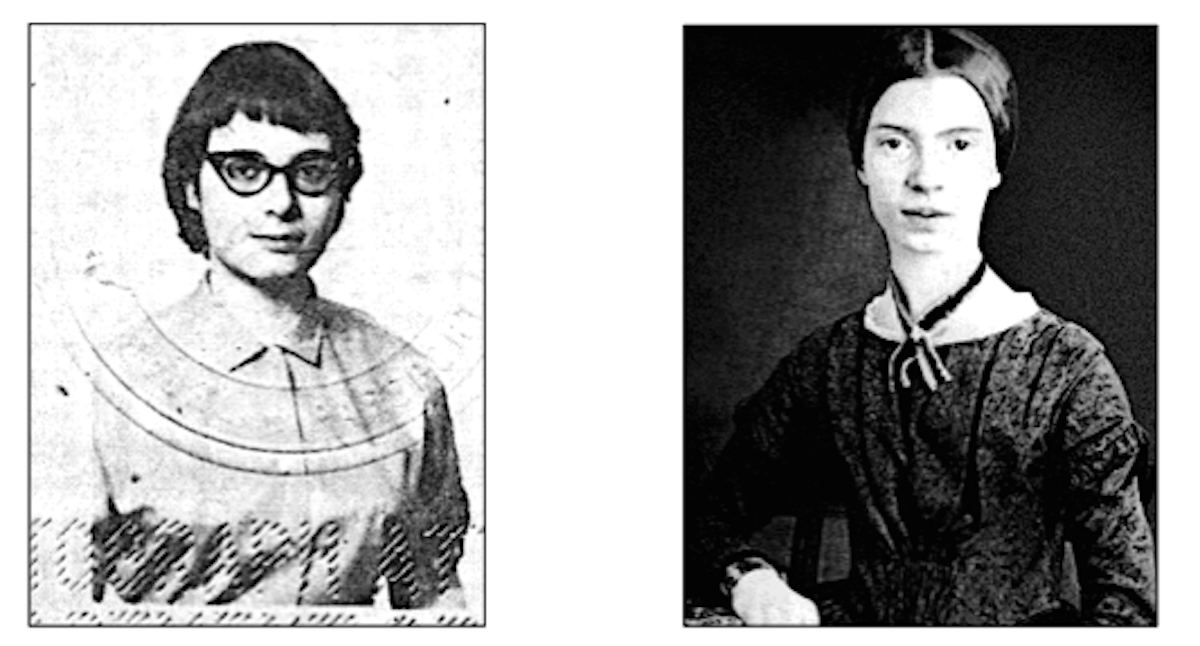
Elise Cowen. That’s her name. Archives teach us the importance of naming, assigning an umbrella under which objects are saved and preserved. What you need to know about Elise Cowen is that she’s not quite inside any umbrella. She’s wet.

Born in 1933 in Washington Heights, New York, Cowen was briefly lovers with Allen Ginsberg, and her own poetry is often overshadowed by her associations with Ginsberg both sexually and creatively — she is most well known as the typist of his poem “Kaddish.” Cowen’s work is usually classified as cult rather than canonical, and her name is easily traceable through niche internet articles such as “The Best Female Poet You’ve Never Heard Of” or “The Lady is a Humble Thing” from Beatdom, a website “dedicated to the study of the Beat Generation.”

Cowen’s name is easily traceable through niche internet articles such as “The Best Female Poet You’ve Never Heard Of.”

My journey with Cowen begins in an archive where she is misnamed from the very beginning. I began my hunt with Peter Orlovsky, Ginsberg’s longtime partner and former roommate of Cowen. Searching Orlovsky’s correspondences in the Harry Ransom Center’s Ginsberg Collection, I misspelled Cowen’s name in the search engine, which yielded a single result:

Screenshot from the Harry Ransom Center’s Allen Ginsberg Collection.

What are the odds that there was also an Elsie Cowan corresponding with Peter Orlovsky? Orlovsky’s life was interesting, but not interesting enough to have an Elsie Cowan and Elise Cowen within the same sphere.

I found the letter and saw that it was typed on Columbia University stationary, another clear indicator that yes, this is Elise. And her signature: a subtle dot in between the i and s, which in cursive could translate to “Elsie” to an archivist, particularly one who didn’t even known Elise existed.

More tantalizing still was an article in the Ginsberg archive entitled “Elise Cowen: A Brief Memoir of the Fifties” written by Leo Skir in August 1967, five years after her death. Skir, at least, was saying her name and spelling it correctly. His writing, however, leaves much of Elise’s life out of the picture. Instead, Skir focuses on the moment in which she entered and exited his life, rather than offering a full or complex portrait of hers.

Support Electric Lit: Become a Member!

What I kept coming back to was Cowen’s signature from the mislabeled letter; that E stands so prominent as to allow the rest of her name to collapse. It reminded me of a similar E from the Dickinson Radical Scatters archive — a collection that includes facsimiles, transcriptions, and full text of fragments from Dickinson’s manuscripts.

I explored manuscript page A254/255, which in “reading view” looks like this:

Screenshot of Emily Dickinson’s A 254 / 255 from the Radical Scatters online archive.

The text itself is haunting, in the way it invokes the writer’s name on the page. Even stranger is the original facsimile. The “E E E E E E E E E” is not spread out evenly as the lineation suggests. Rather, the Es are scattered all over the page, like a child practicing writing her name. I wondered whether this was an original scrap of nothing, a poem that would’ve been discarded if not for the strange process of preserving Dickinson’s work.

I wondered whether this was an original scrap of nothing, a poem that would’ve been discarded if not for the strange process of preserving Dickinson’s work.

A similar process occurred with Elise Cowen’s work, the name of her first collection saying it all: Elise Cowen: Poems & Fragments. This fragmented nature of posthumous work creates its own style over time, regardless of Dickinson’s or Cowen’s original intent to create this brand of aesthetic for their work. While these ethical questions abound, I prefer to view these fragments as watermarks of a writing process. What can we come to understand about Cowen’s and Dickinson’s practices through these ruins?

Our knowledge of Cowen’s writing life is truncated by the destruction of much of her archive. Upon her death in 1962, her parents — upset by the homosexual and drug-related content of Cowen’s work — had a neighbor burn her remaining notebooks and writing. The only surviving notebook consists of 91 poems and fragments, all of which are included in the 2014 collection edited by Tony Trigilio. What the collection lacks in length, it offers in riches of form, content, and play.

The few scholars that have worked on Cowen regard her as an Athena within a Beat Parthenon, Ginsberg at her side. This reading, while not wholly inaccurate, limits Cowen’s work as it only alludes to her contemporary living influences. In Elise Cowen: Poems & Fragments Dickinson is very much present. The collections epigraph reads:
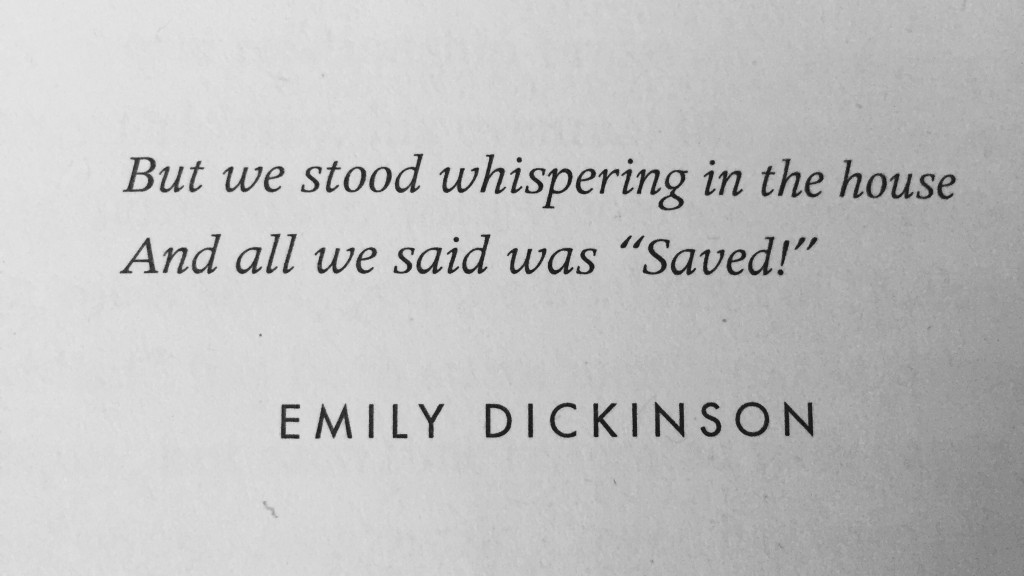
This quote comes from Cowen’s remaining notebook, a passage from Dickinson’s “Of Tribulation, these are They.” Trigilio notes, “It is the only place in the notebook where [Cowen] quotes Dickinson.”

Throughout the collection, Cowen summons Dickinson into her poems not once but twice. First in “[Emily]” and in a later poemEmily White Witch of Amherst.” Dickinson’s name appears more than that of any other poet in this collection. Not only is she named, but she is the addressee of these two poems.
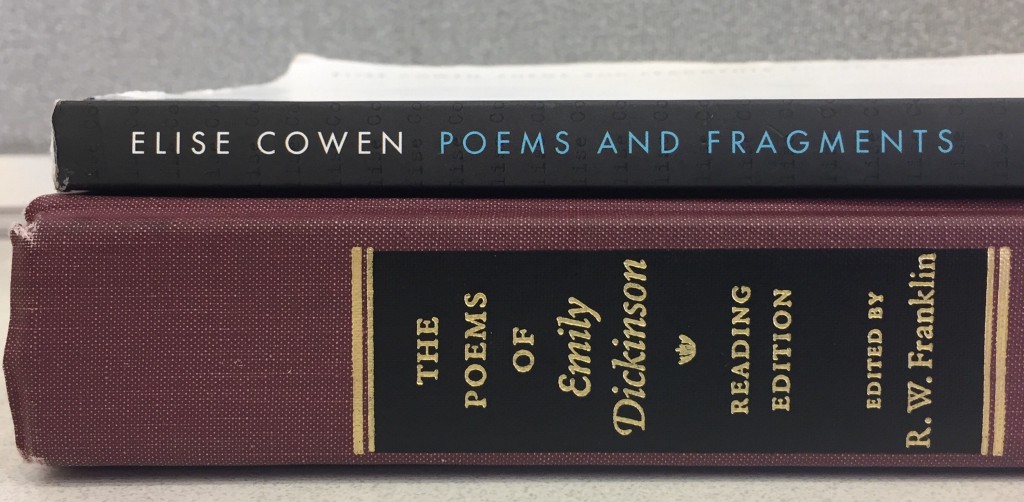
It isn’t a stretch to imagine that Cowen was, in her mind, conversing with Dickinson. In her review of Elise Cowen: Poems & Fragments, scholar Becca Klaver connects Cowen and Dickinson as contemporaries, noting that Thomas H. Johnson’s variorum edition of Dickinson premiered in 1955, making Dickinson, “not only [Cowen’s] predecessor but also her peer.” This “belated peer” status evolves into a queer kinship as Cowen writes to Dickinson.

The first poem “[Emily]” stands in conversation with the “E E E E E E E E E” fragment from A254/255. This fragment would have been available to Cowen in the 1955 edition of Dickinson. Here, Cowen embodies the simile “like a friend / when summer cleaves / away.” In Dickinson’s poem, the lineation suggest an elongated breath, one that emphasizes the last word in each line, reaching toward “friend” and “cleaves.” There is a note of desire in this pacing, reflecting similar moments from other Dickinson poems such as “Going — To — Her!” In Cowen’s response, she echoes this breath, addressing Dickinson by name:

This poem reaches to Dickinson both rhetorically and physically, “hand in hand.” Cowen’s language is saturated with sexual desire, beckoning “Emily, / come.” Cowen alludes to Dickinson’s bees as “jeweled,” which is to say glistening. This gives credence to Cowen’s careful reading of Dickinson’s bees and flowers, which pollinate one another and in so doing work as metaphors for clitorises. In her chapter on Dickinson from Sister Arts: The Erotics of Lesbian Landscapes, Lisa L. Moore cites Paula Bennett’s reading of Dickinson’s “small, round, and frequently hard objects,” such as bees, as clitoral images. Cowen writes “[Emily]” in 1959, years before scholars openly read Dickinson as queer. The bees in this poem sting Cowen, a sexualized but also suicidal act for the bee. At this point in the poem, the bees are off of “Emily,” she herself is naked of the bees and her sexuality is free from the mask of innuendo.

The bees in this poem sting Cowen, a sexualized but also suicidal act for the bee.

Cowen then obliges in taking off her own “stinking jeans.” She often characterizes herself as the girl in jeans throughout this collection. In a later poem, “[I took the skins of corpses],” these jeans are made of corpse skin, another type of communion with the dead and also providing reason for their stench. Upon taking off the “jeweled bees” and “stinking jeans,” Cowen and “Emily” are now together and touch in an escape “outside” of the world. The poem already positions us in a state of imagined desire and fantasy. It continues in this trajectory obfuscating and destabilizing reality.

The Queer Erotics of Handholding in Literature

The two women “look straight,” a jab at heteronormativity. But this is not their first encounter with looking “straight / at the sun,” as the next line notes, “a second time.” This is a second awakening as they move to “get tan,” a return to a natural union of the self and selves.

A queer kinship further emerges in “[Enough of this flabby cock]” with the lines “Enough of this flabby cock / in my head,” a strange parallel to “I felt a funeral, in my Brain.” The caesura created by Cowen’s line break syncs perfectly with Dickinson’s punctuation. Many of Cowen’s poems welcome a type of death, be it transformative or spiritual. Her equating “a funeral” to a “flabby cock” heightens our understanding of Cowen’s humor and distaste for a passive life of sexual complacency.

Her equating “a funeral” to a “flabby cock” heightens our understanding of Cowen’s humor and distaste for a passive life of sexual complacency.

Cowen’s play with the sexual, the experimental, and the canonical reflect an evolution of Dickinson’s “Tell all the truth but tell it slant.” In pursuing her own slanted truth, Cowen crafts a landscape of deep reality and deeper imagination. This presents another type of queering, different from sexual desire, one in which Cowen gives us all of her truth but from a slanted angle of the mind. Here “slant” operates as a guidepost through which to understand Dickinson’s and Cowen’s poetics as undeniably queer. Their work exists out of a necessary desire to be, especially if that means as queer female poets their work must create a new aesthetic, a new poetry altogether.

The quatrain structure of Dickinson’s “I felt a Funeral, in my Brain” echoes in Cowen’s poem “[Enough of this flabby cock],” but less so than her other works which borrow a meter directly from Dickinson. The line “a green automobile” from Cowen’s “[I had a dream of mercy]” alludes to Ginsberg’s own “The Green Automobile,” but the foundation of the poem is its meter, a meter with direct lineage from Dickinson’s ballads:
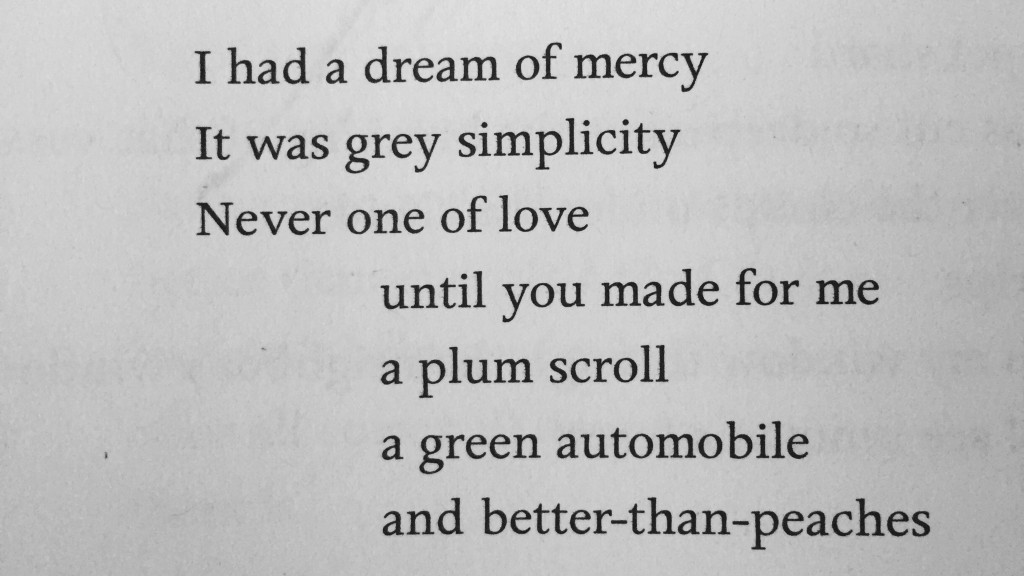
The sturdiness of the ballad meter wanes toward the end, circumventing the expectations of rhyme, but it echoes as watermarks often do, given that this poem’s status as draft, fragment, or complete is unknown.

Conversely, “[I took the skins of corpses]” possesses strict quatrains and meter, which match Dickinson’s ballads such as “My Life had stood — a Loaded Gun.” These poems also pair in their proximity to danger. In Dickinson’s version, this proximity is highlighted with an inability to act, “For I have but the power to kill, / Without — the power to die -.” Whereas with Cowen, the poem dons corpses from the opening line until the final stanza in which the wearer of the dead, barters their own body, “I’ll sell my deadly body.” The use of “deadly” swings between being and being dangerous, having “the power to kill.” Instead of her soul, Cowen sells her body to “the student doctor’s knife,” in essence, sterilizing the spiritual paradigm of good and evil through modern medicine. Cowen is selling “body” as object, body as its own corpse’s skin is wearing another corpse’s skin. The skin is recycled and worn then recycled back into a scientific medical system. In this exchange, death holds power, a power that contrasts sharply yet builds upon the same desire from Dickinson’s “My Life has stood — a Loaded Gun.”

This shared desire operates similarly to the shared E’s of Emily and Elise; it is an act of reaching. Cowen reaches back through form, content, and calls Dickinson by name. Dickinson reaches forward, as all poets do, connecting with an unknown source, channeling her own name on the page before writing.

Cowen reaches back through form, content, and calls Dickinson by name. Dickinson reaches forward, as all poets do, connecting with an unknown source, channeling her own name on the page before writing.

In Cowen’s collection, the poem “Emily White Witch of Amherst” comes right after “[Someone I could kiss]” as though one poem answers the question of another. In “Emily White Witch of Amherst,” Cowen compares herself with Dickinson again. This time, “The shy white witch of Amherst / killed her teachers / with her love” while Cowen reflects “Rather mine entomb / my mind.” With each the teachers are dead, either annihilated or existing only in the mind. In this broad stroke, Cowen summarizes the work of poetry: to move forward and away, forging and digging new ground. Her work surely moves across planes of thought, awareness, and existence. In this movement, it can become difficult to locate Cowen, her titles ranging from “Teacher — Your Body My Kabbalah” to “[I want a cunt of golden pleasure].” But this is how we find her, we dig.

For queer poets, scholars, and those of us who study them, this is as much our work as that of Cowen and Dickinson. The premiere of Elise Cowen: Poems & Fragments in 2014, positions Cowen as our queer peer. Her work as much as it reaches back, reaches forward to us. Understanding that time within poetry is a relative slant, Cowen offers us the poem “I Can’t Remember”:
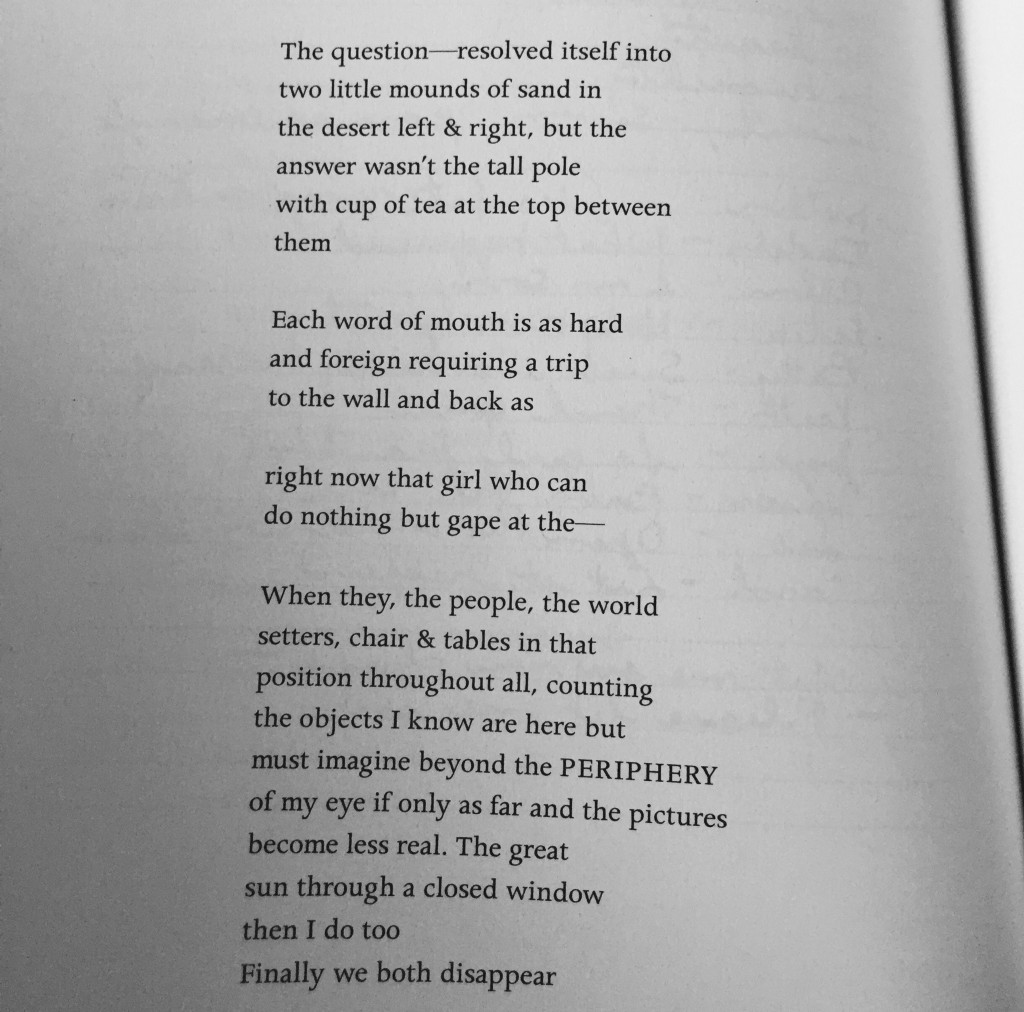
In tracing the genealogical connection between Dickinson, Cowen, and the queer poetics of today, this final line rings. It is not within separate archival umbrellas that we commune. We breathe through the disappearance of these structures, through fragment or desire or slant. This is why we come to poetry, not for answers because as Cowen tells us, “I Can’t Remember / The question.” In killing her teachers, and naming her lovers, Cowen arrives at a point of departure and glides on with her imagined Emily, using poetry as a point of communion across time.

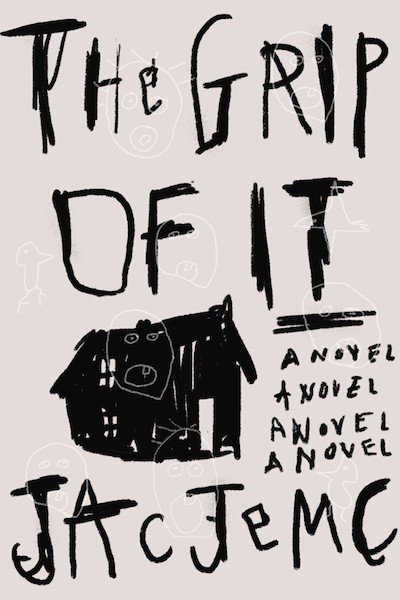
Jac Jemc’s ‘The Grip of It’ is a Master Class in Psychological Horror

With a few notable exceptions, the label “psychological horror” is most often used to describe what something doesn’t have rather than what it does. A lack of exploding eyeballs or sloshing eviscerations must mean that the scare is psychological, right? Saying that a story is “psychological horror” seems like it should mean it gives the reader a true creeping sense of fear, but all too often it just means the book doesn’t feature violent organ failure.

Jac Jemc’s The Grip of It is one of those rare exceptions, a book whose horrors are truly psychological. It is a cerebral haunting in book form, a page-turning, suspenseful read that will stay with you long after you’ve finished it. Jemc has already demonstrated her knack for an ethereal kind of writing; her short story collection, A Different Bed Every Time, is a study in how uncanny circumstances can still be complex and nuanced, without sacrificing their unique weirdness. Like the work of Leonora Carrington, the effective terror of The Grip of It comes with sudden juxtaposition of the surreal, both in the subject’s environment and within the subject’s persona.

“At night, on the way to the bathroom, I don’t turn the hall light on. I trace my hand along the wall. I touch something wet and soft.”

Moments like this also bring to mind the well-timed creep-outs of Dario Argento movies, but instead of being presented in bleeding technicolor, The Grip of It stalks the reader through its pages with a silent, grayscale terror, like the brush of a web against your cheek in the dark.

The Grip of It stalks the reader through its pages with a silent, grayscale terror.

James, a compulsive gambler and job-hopper, is hardly a safe rock to rely upon. But maybe that’s what Jemc wants us to realize about their relationship to each other — that so much of what binds them is based on belief rather than action, specifically Julie’s belief in the man she chose to marry. It is that very same thing that signals the breakdown of their dynamic: belief, or rather disbelief, in what is happening to them and how it is destroying them. Both Julie and James suffer as the chaos crescendos. James is no longer able to ride the wave of it without repercussions, and Julie’s denial is far past the point of no return.

Jemc is telling us the story of the putrefaction of a relationship.

Jemc is telling us the story of the putrefaction of a relationship. This relationship is not clean-cut and bookended by dramatic flares — it festers, untended, a thriving hotbed for the things that break us down, cell by cell. It doesn’t choke, but lines the airway slowly, turning a once-healthy breath into the ragged pull from a plastic straw. “Bad behavior heralds ruin,” says Julie, when she is utterly convinced that the haunting must be her fault: she is unwilling to accept that malevolence exists for its own sake, but convinced it must be part of a puritanical order of punishment. She suffers from the common delusion that you can gain control over a situation by imposing a knowable structure on unknowable phenomena.

James, unfortunately, plays right into Julie’s delusion, blaming both of them not just for the results of the haunting, but for the haunting itself: “I think we’re haunting ourselves. We’re pulling ourselves apart. We’re noticing gaps and stepping into them instead of avoiding them.” James demonstrates a core element of the story: the fractures in the marriage already existed, and the warps and cracks in the house are those fractures made manifest.

The phenomenon affecting Julie and James is actively intimate, and Jemc has realized that our voyeuristic look into their lives is part of heightening the fear, confusion, and terrible unknowability of the situation. “I feel followed, as if instead of the house’s being haunted, the haunting has crawled into me,” Julie confesses to us, “And I want to turn the tale as James had said, so that I believe both that we are lucky and that nothing matters, but it’s so hard not to believe myself.”

Who can’t relate to the anxiety of rotting from within, in the way that mold permeates an old house?

It’s this equalizing sense of dread that endears us to these characters and their plight. Jemc doesn’t make the couple likable or particularly interesting, and she doesn’t have to. We are drawn to them because we share the fear that what affects us on the outside is somehow infecting us on the inside—whether supernatural, domestic, or even political. Who can’t relate to the anxiety of rotting from within, in the way that mold permeates an old house? Who wouldn’t understand the complex nature of trust between partners, where people can claim to know each other intimately, but recoil at the idea of a vast landscape within each other that neither will ever truly see?

What makes this novel so powerful is the acknowledgement that intimacy does require a trust beyond logic, that “ruin” can come just as easily to the guilty or the guiltless, and an embrace of the chaos is sometimes the only way to make it out to the other side.

Audio: “Star Witness” | A Story in Seven Parts

Exclusively for our members, we will release audio editions of each episode of Joe Meno’s serial short story, “Star Witness,” here every Friday beginning August 18.

Episode 1: The Girl Goes Missing

Episode 2: Shelley Enters the Woods

Episode 3: The Secret Song

Episode 4: A Very Odd Occurrence of Birds

Episode 5: The Monster of the Green Lake

Episode 6: A Hidden World

Episode 7: A Conclusion in the Caves

Camille Bordas Doesn’t Understand Why You Want to Relate to Her Characters

The narrator of Camille Bordas’ new novel, How to Behave in a CrowdIsidore Mazal, or Dory—is by all measures a normal child on the cusp of adolescence. But among his high achieving siblings, his normalcy seems more like a failure than an emblem. While his siblings skip grades, pursue doctorates in their early twenties, and publish theses on humorism in the golden age, Dory shows no unique academic aptitude and struggles to build relationships in the face of his siblings’ insistence that knowledge is more important than friendship.

But in the aftermath of a family trauma, intellectual theories fail to help the siblings recover. Dory’s observations of how his siblings react to the incident illuminate the chasm between theoretical knowledge and interpersonal relations.

Bordas’ narration is intricate and wise, told through the eyes of a boy whose social observations begin to overshadow his siblings’ academic achievements in the notoriously rigorous French school system. In a conversation over email, we discussed how she worked social theories into the novel, the meaning of the word pretentious, and how our relationship to fiction changes as we get older.


Becca Schuh: I loved the debate that Dory and Simone have over the word “pretentious”— I’ve found myself in similarly absurd discussions. As Simone states, the actual definition of the word is “looking to impress people with knowledge you haven’t really mastered,” versus the idea that it “defines someone who talks about a thing that others don’t understand.” The way I hear it used the most is referring to people who discuss esoteric topics that are perhaps inaccessible to the general population, but I’m sure that’s not by any means the dictionary definition. What does the idea of pretension mean to you, and how do you navigate the gray area between the dictionary definitions of words and how they’re used colloquially?

Camille Bordas: It depends on the language I’m speaking! In French, I used to be a Simone-type tight-ass when it came to proper word usage — I wouldn’t correct anyone of course, I’m not entirely socially inept, but I would notice misuses, big or small, see word meanings slide slowly, inevitably…and then I moved to the U.S. with a pretty good command of English, but I had a limited range, and I wanted to expand it, so I had to try things out, make mistakes, navigate the gray area you mention between registers…and that was liberating in a way, even though I’m still sort of terrified at the idea of misusing certain words in public and making a fool of myself. It’s weird that I’m so attached to proper definitions, because there’s nothing I love more than people who play with language and bend it in fun ways.

I guess that’s the answer to your question, though: if you’re going to bend language, you have to be funny about it. Or very smart, I guess. Otherwise yeah, you’re kind of just being pretentious. Or plain wrong.

BS: It was so interesting to get these miniature lessons on the obscure things the siblings studied. One I found particularly fascinating was Berenice’s thesis on humorism. It made me think about personality tests, the everlasting human fascination with everything from Myers-Briggs to astrology to internet personality quizzes. How did the idea of categorizing humans relate to the narrative of Dory and his siblings for you?

CB: Categorizing is organizing, is giving you a sense of a grip on reality. And that grip becomes a sort of power, I guess. Dory is more interested in people than his siblings are, but just like them, he seems to have a mind for categorizing. So he sorts through what he sees and goes about it methodically. He notices and interprets people’s awkward silences, the shifts in their facial expressions (in the guy who’s courting his mother, for instance), etc. I don’t think he wants to notice all these things. They become a problem to him in a way. Like, when he says, “My parents didn’t look very much in love to me, and I thought it was my fault,” he’s under the impression that noticing things other people don’t makes him responsible for them.

The issue with Dory’s “gift” for reading humans is that, unlike his siblings, who deal with abstract or intellectual topics, the struggles that he notices cannot be solved by writing an academic essay, so he ends up accumulating knowledge about human emotions that weighs him down more than anything else. Then he realizes, by catching glimpses of his siblings’ work, that human emotions have always been categorized by intellectuals (doctors, in the case of humorism, sociologists, novelists), and put at a distance, in a way. So he tries to learn how to do that. Not to unsee the things he’s seen, but to numb himself to them.

BS: When Simone is talking to Dory about Aristotle’s rules of fiction, she posits that his ideas, motivations, and desires exist because he’s seen them played out in books and films. Do you believe that this is true today? How does the plethora of media the average person consumes affect their choices and lifestyle?

CB: There are definitely people out there who have a thing for drama, and I wonder what they’d be like had they never seen a TV show. I don’t think it’s very controversial to say that the media seems, more and more, to be trying to push on us all an image of the life we’re supposed to aspire to. Parallel to that, people seem to have become more and more interested in seeing themselves reflected in the stories they’re told. They need to relate, to be able to predict characters’ reactions…and it becomes a big blur between life and fiction. It ends up feeling like you’re supposed to react to adultery the way people react to it on TV, for instance. I’ve seen this happen around me, and it seems both false and sad. Perhaps some people react in a prescribed way to protect themselves from what they really feel. I don’t know. Nor do I know which came first: our desire to be reflected in stories, or the media’s attempts to reflect us.

Commercial art (the one Simone talks about in the book) teaches us to live in clichés, and some clichés are useful, I guess, but I fear sometimes that they just end up numbing us at our core, if we don’t take them with the grain of salt they require. They make us all lemmings and there’s no emotional connection anymore — life ends up being a simple verification of human clichéd reactions. I guess there’s something reassuring to that to some people, but I find it quite terrifying.

I do think some people live through fiction, but even though I devote my life to fiction, it’s still a pretty foreign idea to me. Fiction is important to me as a way to bear existence, but not as a way to help conduct my life and make decisions. I think it boils down to identification, in the end, and that’s a concept I’m not sure I can relate to. I don’t get the need to identify with a character to be involved in a book or in a movie. As a reader, I need to care for, or hate, or be entertained by a character in order to get involved in their story, but identification…I’m not even sure I know what that means, or why I would want that. Sounds scary. I’m a pretty empathetic person, however, so I guess one has nothing to do with the other. Maybe I reserve true empathy for real life. I love fiction more than any other man-made thing in life, but I still love life more than fiction, because life is what allows for it. I like this thing Robert Filliou said: art is what makes life more interesting than art.

“I don’t get the need to identify with a character to be involved in a book or in a movie. As a reader, I need to care for, or hate, or be entertained by a character in order to get involved in their story, but identification…I’m not even sure I know what that means, or why I would want that.”

BS: Midway through the book, the mother says “The memories you make as you get older, they’re not as bright, you know? They’re more like memos. They have a certain flatness. And a veil.” This reminded me of a Geoff Dyer passage from his book Zona, where he says that all of his “favorites” developed in his youth, because his emotions towards art were so much stronger when they felt unprecedented. As we age, how do you think our emotional reactions to both art and interpersonal relations change?

CB: I didn’t know the Dyer quote but it rings true, sadly. I mean, maybe it’s not that sad. It’s a double-edged thing. On one hand, having accumulated knowledge and experience, age makes you more able to see through the bullshit, so that’s good. But on the other, you’re just not as open-hearted as you were growing up, as ready to absorb new ideas, as hungry to build yourself as when you thought you were the first to ever feel what you felt. After that, your personality sets and dries in the sun a little. You can’t quite maintain the same intensity.

But now saying all this, I realize I must not quite be done growing because I’m still pretty hungry to discover new authors and artists, for instance, and when I do stumble upon one that I love and have never heard of before, I’m as excited about it, maybe more, actually, than I would’ve been 10 years ago.

However, I did hear people in their 50s or 60s say that they had lost all interest in fiction even though they loved it before. That frightens me a little. But anyway, maybe Dyer was in a bad mood when he wrote that. If you’d asked me the same question last year, I might’ve said, “Yeah, you like less and less things as you age, and generally, getting older sucks,” but I’m in a pretty good mood today. It’s like when I moved to the States, I had no friends here other than my husband, and I had no idea to make any. To feel better about my failure at it, I concocted this stupid theory that you couldn’t really make any new close friends past the age of 25. I convinced myself of that. And then last year I met Catherine Lacey, who’s not only an amazing writer but also one of the best human beings around. Very fun to drink with.

BS: Throughout the novel, you intersperse a lot of “social ideas,” like a few of the ones mentioned above, or the idea of the characters “practicing melancholy.” What fascinates you about putting names and analysis to the ways people look at the world and socialize?

CB: That’s some sort of occupational hazard…I read a lot of Erving Goffman in grad school (Presentation of Self in Everyday Life, Behavior in Public Places — that’s where my title came from, by the way, since in French it was translated as “How To Behave In Public Places”), I became really interested in “micro sociology,” the study of individual social processes as opposed to big, all encompassing ones.

I also have an uncle who narrates his actions whenever there’s an awkward silence. He’ll help himself to some wine and say “A little more wine perhaps, mister Cordoba?”/”Why yes, thank you very much!,” and I noticed that I tend to narrate other people’s smallest actions in my head as well. It’s not so much that putting names and analysis to our routine behaviors fascinates me as much as it reassures me. When I first read Goffman, and Harold Garfinkel, also, something opened up that was as close as someone like me can get to a religious experience, I think: “I’m not alone! We’re all the same!” — something like that. I felt connected to everyone else. I know it sounds cheesy, but well, I’d never really felt that before, and it was comforting, and still is, because half of the time, I’m not even entirely sure I’m alive, so looking at other people and noting how every little thing they do was in Goffman helps me remind myself that we’re all here and we’re all weird and it’s all fine.

BS: The “olive of shame” bit was truly hilarious, but I was further fascinated by the line following it: “Something we had only considered vaguely impolite became shameful through the magic of a foreign proverb.” How do the stories and jokes that we share with our loved ones affect our relationships?

CB: They just make us closer. A private joke, a made-up expression, an adopted and beloved one…any specific group of words that you only share with a small group of people and ends up meaning something unique to you and that group of people is like a magic shortcut to expressing something big and idiosyncratic about your relationship with them. It sends you back to the moment you devised it. I wonder if all families have something like that, their own pantheon of modified sayings, like the Mazals do in the book. I know of a few. When other people do share their homemade sayings with you, it’s very rewarding: you join their very private club. Anyway, my family has a handful of expressions that I never heard used elsewhere. It’s a sort of clanic language at this point.

BS: In the days following finishing the novel, I found myself bringing up the idea of the funnel in social situations, that as you go through school and life you’re more and more constrained by your choices and have less and less possibility. Have you felt the “force of the funnel” in your life? Do you think that there’s any way to avoid the feeling that as you grow older, you have fewer options?

CB: I ask myself these questions a lot when it comes to writing. I’ve never been confident in that area. I always wonder if I made the right choice in pursuing this. In France, I started publishing very young, and people liked my first book, so it seemed like I should keep doing it…you know, in a way it’s the only instance in which I feel close to professional athletes: they started doing what they do very early on, and it has defined their whole lives, but how do they feel at the end of their career, when they still have 50 years of life to fill? I kind of feel like that all the time, even though I’ve arguably picked the one career-path where you’re most likely to peak when you’re old. It’s still a choice that I made when I was young, and in many ways I don’t even remember who I was then, yet I’m still living a life that that person decided on.

It didn’t seem like a decision at the time, and that’s what Simone says in the book: you don’t even realize you’re going down the funnel. What happened in my case is that my father died when I was 19, a few weeks before my last year in college ended. I did finish college, but I was also broken and in a state of “Fuck this/No tomorrow/Might as well write fiction.” And I wrote my first book the following year, didn’t apply to grad school, started working…and now 10 years later, I can’t help but wonder if, were my father still alive, I would’ve just made the same decision, only later, or if I would just be the archeologist I was training to be when he died. It’s a little bit crushing, as far as the questions you can ask yourself go. So yeah, I definitely feel the force of the funnel.

I did finish college, but I was also broken and in a state of “Fuck this/No tomorrow/Might as well write fiction.”

And I regularly make attempts at fighting it, at climbing back up. After publishing my first book, I wasn’t sure I could write another, so I went back to grad school, for Anthropology. But then as I was getting my Masters, I wrote my second novel. Somehow I always go back to that. Maybe it’s part of the process of writing for me, to think that I should be doing something else, try it, and realize that I’m better at writing. This reminds me that years ago, I stumbled upon an old article in the archives of the French newspaper Libération. It was some sort of special issue about books, where they asked several writers the same questions. One of the writers was Beckett and one of the questions was “Why do you write?,” and they all went on and on and on about vocation and love of books and the power of literature etc., and Beckett’s answer was a laconic: “Bon qu’à ça,” which translates to: “Only good at that.” That moved me quite a lot.

The City Where One Wrong Word Can Kill You

Double Take is a literary criticism series in which two readers tackle a highly-anticipated book’s innermost themes, successes, failures, trappings, and surprises. In this edition, Amy Brady and Adam Morgan explore the dark, surreal novel Amatka, by the Swedish master of weird fiction, Karin Tidbeck.

First introduced to English readers by Ann and Jeff VanderMeer (via her short story collection, Jagannath), Karin Tidbeck’s novel Amatka follows an investigator named Vanja who travels to the frigid colony of Amatka, where language — both written and spoken—has immense power. But beneath the city’s peaceful veneer, long-held secrets are beginning to surface that could destroy everything. Amy Brady and Adam Morgan discuss Tidbeck’s unique brand of worldconjuring, her Scandinavian influences, and how successfully she incorporates elements of mystery, surrealism, and poetry.

Amy Brady: When Vanja first arrives at the Amatka colony, I wondered where we were in time and space. In some ways, Amatka is much like our world, but it also differs in significant ways: Amatka is one of only four colonies of human beings in existence (a fifth colony, we learn, was destroyed), and almost every material thing — including furniture, eating utensils, even the buildings themselves — is made out of a strange sludge that takes on whatever shape it’s labeled with. To form a wall, for instance, a member of the colony would point at the sludge, call it a wall, and then write the word WALL on it for good measure. One of Amatka’s biggest collective fears, then, is calling something by the wrong name.

This is a world where language is a source of tremendous power.

What’s fascinating is that compared to some dystopias — say, Gilead in The Handmaid’s Tale — Amatka doesn’t always seem so bad. Yes, on the one hand, women are almost forced to have children, who are then raised independently of their parents. But on the other hand, women are allowed to hold positions of power, no one bats an eye at same-sex relationships, and no one seems to be going hungry, despite their limited resources.

So as the story unfolded and Vanja became increasingly unhappy with what she perceived as limits to her freedom, I found myself wondering: Is escaping the colonies really a better choice? I can’t remember the last time I felt this ambiguous about a dystopian world’s moral framework or its potential for change. And that feels like an exciting shift for the genre.

I can’t remember the last time I felt this ambiguous about a dystopian world’s moral framework or its potential for change.

Adam Morgan: You’re right, Tidbeck’s dystopia isn’t as violent as the ones we’ve become familiar with in popular culture. The horror of Amatka is much quieter — between the lines and behind the scenes — but I could still feel it from the first pages, when Vanja is traveling on a windowless train with no idea what kind of landscape awaits her outside. That quiet evocation of dread hangs in the air throughout the book, and it reminded me of Brian Evenson’s short stories…so much so that I pictured this novel’s librarian, Evgen, as Brian Evenson.

I did wonder if a world where families are forced to sever emotional ties soon after childbirth was an exaggeration of Tidbeck’s native Swedish culture, which really de-emphasizes the role of family in public life, at least compared to the U.S. and the U.K. Amatka’s authoritarian system of government, however—the invisible “committees” issuing orders from a secure tower — struck me as the inverse of Scandinavian egalitarianism, so I can see why a progressive writer in Malmö might find fascism (even well-meaning fascism for the “greater good”) quite disturbing.

As to where we are in time and space, at first I thought Amatka was just a fictional Scandinavian city in some bleak future where parts of the world were slowly being recolonized. And then I thought it was an alien planet. And then I thought it was some kind of O’Neill cylinder in space. By the end of the book, I still wasn’t sure, and while I typically delight in narrative ambiguities, the trail of bread crumbs Tidbeck left us regarding Amatka’s geography (or should I say cosmology?) created an appetite that was never sated.

Perhaps I expected too much from a 200-page novel, though the scope and level of detail here sometimes felt like a short story stretched over too much mycopaper (that’s an Amatkan joke — trust me, it’s hilarious once you’ve read the book).

How did you feel about balance of mystery, suspense, and closure?

AB: The mysteries of what, exactly, the shape-shifting goop is and where it came from delighted me. By telling us so little, Tidbeck created an unnerving tension that snaked through the whole book. I kept wondering: Is the goop alive? Will it exact revenge on the humans who force it into shapes? We never get concrete answers, and I like that choice, because it suggests that the characters might still be in danger, even by the book’s end. A more pat conclusion that explains away the mystery of the goop would have been too heavy-handed for my taste.

But that said, there were other enigmas that felt less connected to the central narrative and left me wanting more satisfactory explanations — the machinery in the tunnels, for example, and the nightly freezing of the lake. Tidbeck describes these things with brilliant detail, but I felt like I was never rewarded for my curiosity.

By telling us so little, Tidbeck created an unnerving tension that snaked through the whole book.

One thing I really loved about the book was its celebration of poetry. I suppose the ending could be interpreted (without giving too much away) as a triumph of poetic language over the prosaic. What did you make of the fact that even in post-apocalyptic Amatka, where resources were limited, poets managed to publish their work? And a follow-up question: If you could make manifest any poem by writing it on a heap of mystery goop, which poem would you choose?

AM: That’s a really good way of putting it: I never felt rewarded for my curiosity. And it’s not that I wanted “answers” to the mysteries in a teleological way (e.g., the finale of LOST), but I did want greater detail and more exploration of the environment, since Tidbeck drops all these hints that there’s more than meets the eye.

In Jeff VanderMeer’s Annihilation, for instance, even if we ignore the rest of the trilogy, he rewards our curiosity about the tunnel and the crawler by giving us a very detailed encounter before the end of the novel. We don’t get “answers” (who needs those?), but he gives us the experience we’ve been craving since page one: to explore and experience. We never really got to explore or experience Amatka beyond vague impressions, though Tidbeck certainly spark our curiosity.

The poetry metaphor is a good one, given that this book (and Amatka itself) operates on what Kelly Link would call night-time logic, which certainly makes its way into speculative fiction but has always felt poetic to me. I found it really interesting that, as you say, a civilization with only so much paper would preserve poetry, though perhaps that’s another artifact of Tidbeck’s Scandinavian foundation. Poetry, and literature in general, is not the niche leisure market there that it is here in the States, and many Scandinavian writers make a decent living thanks to massive governmental investments in the arts.

I’m wondering too about your thoughts on the end of the book. Without giving anything away, Vanja and Amatka’s fate felt rather deus ex machina to me. While I really enjoyed the narrative threads Tidbeck had woven for the first 150 pages (as well as the form they took), most of them simply dissolved in the last few chapters, like unmarked tubes of toothpaste (last Amatkan joke, I swear).

AB: Your insights into how Amatka’s civilization maps ideologically on to Scandinavia’s are especially interesting in light of the region’s dominance of the 2017 World Press Freedom Index. Of the countries surveyed, Norway tops the list with the most media-related freedoms, followed closely by Sweden, Finland, and Denmark. This is a region that values its freedoms to speak and write, and Amatka, for all its sci-fi and fantasy elements, holds a similar reverence for language. Capital punishment in Amatka, after all, isn’t death — it’s losing the ability to form words.

As an American reading this book, I couldn’t help but think of how our own freedoms of expression are under attack: there’s the administration’s treatment of the press, the possible elimination of the NEA and NEH, and of course the systemic weakening of our country’s humanities and journalism programs. These are not the signs of a nation that values language. Wanna guess where the United States falls on the Index? Forty-three. We’re number 43.

So, what did I make of the ending? I think you’re right — it left a lot of ends loose and twisting in the wind. And that was frustrating. But looked at another way, the story also culminated in a poetic vision that seemed very much in line with the book’s suspicion of literalism. For me, at least, the climactic ending was hard to “see” in a way that the rest of the book wasn’t: The action was blurry, and Vanja’s participation in it was at times hard to decipher. But rather than weakening the story, the vagueness, I felt, reinforced its themes. To paraphrase Emily Dickinson, Tidbeck told all the truth about Amatka in those final moments, but she told it slant.

As an American reading this book, I couldn’t help but think of how our own freedoms of expression are under attack.

The book left me feeling some ambiguity toward Vanja, however. There’s so much to admire about her (especially her bravery), but at times she seemed to be making choices based on her own, nebulous dissatisfaction with life instead of anything rooted in society around her. What did you make of her?

AM: I appreciated Vanja’s agency, particularly after reading so much dystopian fiction where the heroine just gets bounced around from horror to horror. In terms of characterization, though, Tidbeck’s approach reminded me of science fiction writers like Arthur C. Clarke and Kim Stanley Robinson, for whom protagonists often serve as neutral point-of-view vessels. But I don’t mean that as a critique, and here in Amatka (as in 2001: A Space Odyssey and Aurora), Vanja’s aloofness is narratively justified. On some level this is a story about the horrors of emptiness, wordlessness, and formlessness, after all.

In the end, despite the places where my appetite wasn’t quite sated, I think we both really liked this book. It’s a unique reading experience — a sharp, understated glimpse at a terrifying world. The fact that I wanted more is a testament to how fascinated and invested I was in what’s there. I hope Tidbeck’s next book is 100–150 pages longer. Either way, I’ll be reading it.

10 Stories for the Back to School Season

The back-to-school sensation hits many more of us than the returning teachers and students. Suddenly, stores are full of stationary supplies and advertisements are no longer for swimwear and getaways, but uniforms and unnecessary dorm-room decor. For some, the feeling might bring a twinge of nostalgia; for others, the unwelcome knock of memories from the most awkward years.

In the throes of mid-August, we’ve unlocked 10 stories from the Recommended Reading archives that will bring readers back to school without having to enter the building. These stories envision schools of the future and recall the institutions of the past; they sympathize with the adjunct professor, the terrified elementary student, the awkward teen, and the flustered parent. School might be approaching and summer ending, but there’s no reason to stop your pleasure reading. For just $5 a month, members of Electric Literature get access to the complete Recommended Reading archives of over 270 stories — and year-round open submissions. Membership is tax-deductible, helps us pay writers, and keeps all of our new content free. So if you like what you’ve read, please join today!

“Maroon” by Ladi Opaluwa

Recommended by Electric Literature

“You did not hear Pastor James knock,” writes Opaluwa in the opening paragraph of “Maroon.” And so we enter a story, written boldly in the second person, that follows the buildup to a rape we feel will happen — though we can’t, like the unnamed student victim, say exactly how we know this. The young woman’s narrative in “Maroon” sears because it is visceral, but her voice also insists that the story could be yours. It is a reminder that while school can be a safe haven, it can also be a place where we are most vulnerable to abuse of power.

Tributaries” by Ramona Ausubel

Recommended by Electric Literature

In “Tributaries” love erupts as a new appendage, a “love-arm.” Ausubel investigates this reality through three tragic characters: a husband exhausted by his missing love-arm and the “debts and balances” of his life; his wife who, while young lovers preen each others’ love-arms, must oil her husband’s prosthesis; and their daughter’s teacher who has loved frenetically and suffers from a type of love-induced leprosy.

“Passing Each Other in Halls,” by Matt de la Peña

Recommended by One Teen Story

The story follows the course of one loopy night in Los Angeles, as the narrator and his friend P.J. prowl the streets and the clubs, talking tough but feeling vulnerable, reminiscing about high school and worrying about their prospects after their friends have left them for college. Peña’s narrator is — perhaps secretly — into vulnerability. He’s an aspiring poet, a romantic—who still isn’t confident in his kissing abilities.

“The School” by Donald Barthelme

Recommended by Steven Polansky

In Barthelme’s “The School” the best-laid plans for student enrichment—and a well-meaning teacher’s most earnest ideas—result in a failure and tragedy every time. This is a lesson in and of itself, and yet after all the dead trees and goldfish, even (spoiler!) dead children, perhaps the real lesson is that the children never lose their willingness to try, try again. “To describe it is to sound ridiculous,” writes Polansky in his introduction. “[It’s] a very funny story about death and the negation of meaning, and the only story ever written, by anyone, in which a resurrected gerbil is the bringer of hope.”
“Our Education” by Lincoln Michel

Recommended by Electric Literature

So many of childhood fantasies are, from the perspective of a worry-prone adult, nightmares: running away, becoming an orphan, living in a boxcar. Yet the realities of such disorder eventually trump our desire for it; any kid who has tried to run away knows the feeling of getting half way down the block with a backpack and thinking, in a word, crap. This is the moment in which we find the narrator of Lincoln Michel’s tale of scholastic anarchy. He is trapped in a school from which the teachers have all disappeared, but in his case, there is no option to break the fantasy, to go home.

“Reading In The Schools” by Hannah Rahimi

Original fiction, recommended by Electric Literature

This is the story of Abby who, in the midst of a divorce and recently relocated back to her parents’ home, is casting about for a sense of purpose. She lands as a Reader in the Schools, tasked with reading to a small child for an hour each week. It is a task that she is perhaps unqualified for — not because she lacks the requisite literacy, but rather because she’s in what she terms “a funny phase” in life — and she soon finds herself outmatched by the wonderfully prickly, seven-year-old Magda.


“Nadia” by Brit Bennett

Recommended by Angela Flournoy, excerpted from the novel THE MOTHERS

“Nadia” is a story about the ways that grief can send you reeling, and how the people we meet during grief’s bleakest moments can feel like the antidote to our pain, a solution to the unsolvable problem of loss. Shortly after a visit to a strip club while bunking off school, Nadia runs into Luke. “He didn’t treat her like everyone else at school, who either sidestepped her or spoke to her like she was some fragile thing one harsh word away from breaking,” writes Bennett. As Nadia works through the loss of her mother, she finds solace with an unexpected partner.

“All the Keys to All the Doors” by Clare Beams

Recommended by Megan Mayhew Bergman

Beams tells of the aging Cele, a benefactor and an unofficial elderwoman of a rather perfect town that is brought to a halt after a tragedy at the local school — the heart of Cele’s idyllic world. “All the Keys to All the Doors,” writes Bergman, reaches out to contemporary pain and asks a devastating and universal question: What is it like to “live with unlivable things”?

“Wait Till You See Me Dance” by Deb Olin Unferth

Recommended by Rebecca Schiff

Unferth, writes Rebecca Schiff is “a sentence-level dazzler who knows how to tell a story.” In this piece and in typical Unferthian style, an adjunct professor keeps repeating to her English 99 class that their final “will be graded by outside sources,” a phrase that absolves her of responsibility. Yet, she confides in the reader: “These outside sources were supposed to be mysterious, were maybe not even people…” In Unferth’s work, suspense grows out of sentences. Being playful on the page can be a matter of life and death.

“The Great Disaster” by Alanna Schubach

Original fiction recommended by Electric Literature

“The Great Disaster” unfolds through the eyes of a group of school children in a small American town after a large flood has struck their valley, bringing chaos and destruction and leaving behind dead bodies, mud, and mold. The children are too young to grasp the political, economic, and geographic implications of the tragedy, and yet they are just young enough to understand, viscerally, it’s philosophical and spiritual consequences. In this way, Schubach creates the perfect narrators for an intimate reading of a global event.

About Recommended Reading

Recommended Reading is the weekly fiction magazine of Electric Literature, publishing here every Wednesday morning. In addition to featuring our own recommendations of original, previously unpublished fiction, we invite established authors, indie presses, and literary magazines to recommend great work from their pages, past and present. The Recommended Reading Commuter, which publishes every Monday, is our home for flash and graphic narrative, and poetry. For access to year-round submissions, join our membership program on Drip, and follow Recommended Reading on Medium to get every issue straight to your feed. RecommendedReading is supported by the Amazon Literary Partnership, the New York State Council on the Arts, and the National Endowment for the Arts. For other links from Electric Literature, follow us, or sign up for our eNewsletter.

Indie Bookstore Demonstrates How to Deal With the Alt-Right

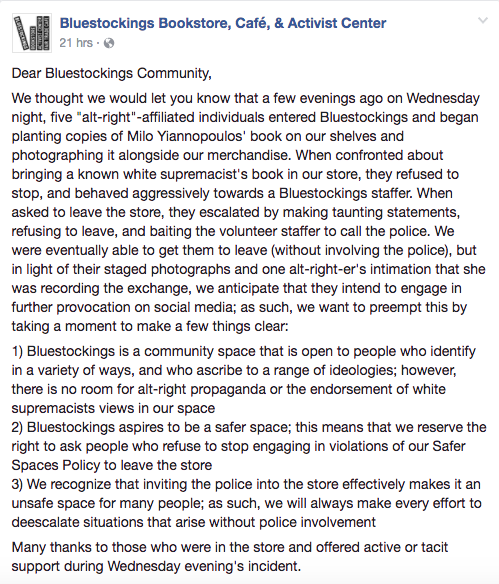
Bluestockings is a feminist bookstore, cafe, and activist center in New York City—basically, a gathering place for progressive ideals. So it’s probably no surprise that it would be targeted by alt-right types. Fortunately, the vandalism was more ideological than physical: attempting to sneak copies of a white supremacist memoir onto the shelves.

As usual for a group whose main tenet is “everyone’s fucking me over but me,” the intentions of this…protest?…are a little muddy. Were they trying to impugn Bluestockings? To help Yiannopoulos’ real book sales match his fantasy ones? Eh, who literally ever knows. But in any event, Bluestockings’ response, both in the moment and on Facebook, is a model for how businesses and organizations can commit to dealing with people who espouse white supremacy in the name of (their understanding of) free speech.

It could even work for individuals. “Uncle George, Thanksgiving is open to people who ascribe to a range of ideologies; however, there is no room for alt-right propaganda or the endorsement of white supremacists’ views in our space.” It has a nice ring, don’t you think?

The Life Magazine Reporter and the Nazi-Hunting Spy

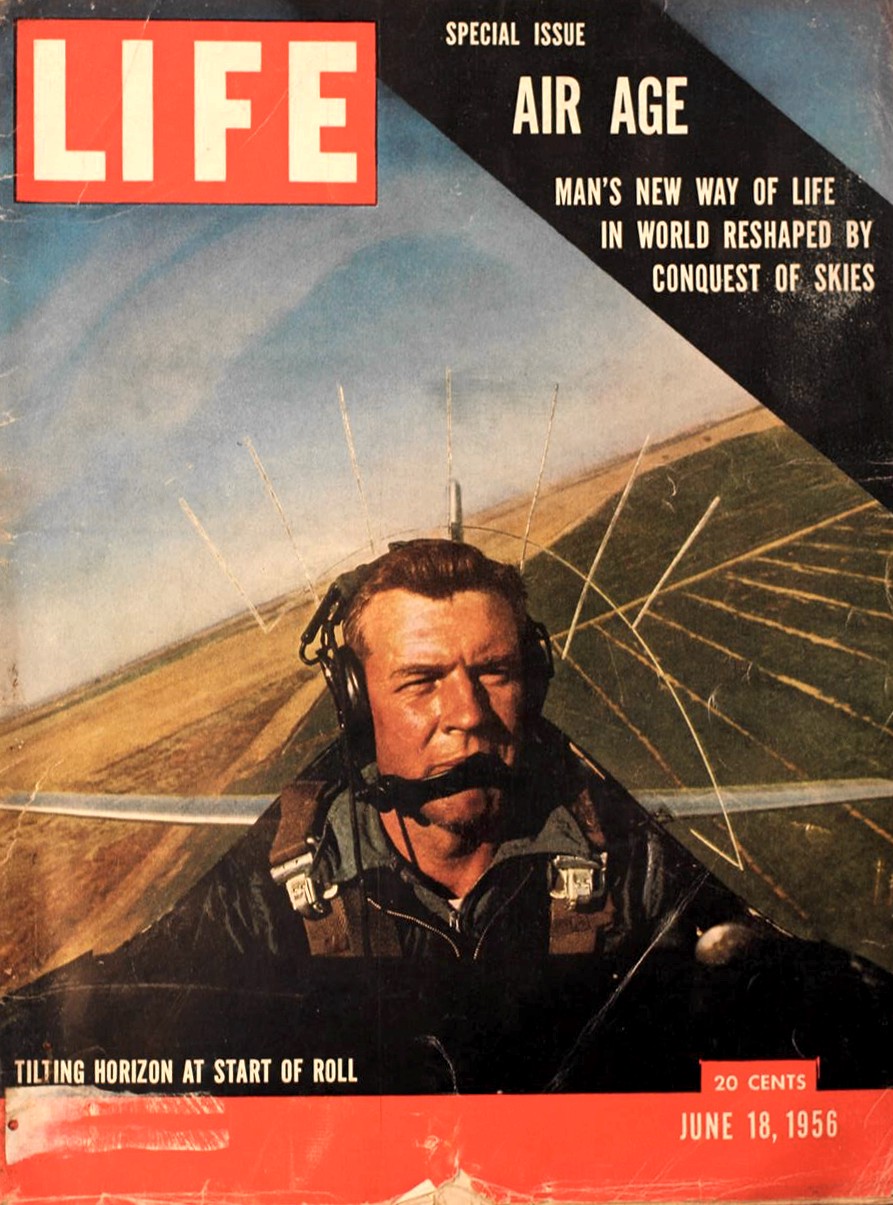
In June of 1956, Life magazine published a themed issue proclaiming the “Air Age.” It featured stunt pilots, military maneuvers and new world records; reporters rode along in the latest chrome aircraft. Terry Turner was a fresh face at the weekly’s Manhattan headquarters, straight out of Northwestern’s School of Journalism and just starting a family with new wife Leanne. She came from Green Bay, where her father managed a department store and belonged to the Packers’ front office. Terry came from the family farm in Powell, Wyoming. His father later decamped to San Diego, but Powell today looks much as it did in the ’50s. Its most prominent institutions are the county fair office, a meat processing plant and a dealer of exclusively American cars. There’s an RV garage, and of course a cemetery. The shops do brisk business in cowlick, coal, and gluten-free oats. Its churches host a couple of the more zealous sects, and the same proprietress has run the same drive-in since 1949. Her name is Pokey, and against her husband’s wishes, she’s gone digital.

When Terry began at Life, the magazine was enjoying some of its greatest success. Capitalizing on the potential of photojournalism, its glossy pages had already held work by Dorothea Lange and Henri Cartier-Bresson, illustrations by Norman Rockwell and prose from Dorothy Parker. Now it ran photo-essays by Gordon Parks and stories from Ernest Hemingway. In 1955, it published the serialized memoirs of Harry Truman and Douglas MacArthur. But if it weren’t for the era’s ads and selection of celebrity portraits, the magazine’s subjects then might blend in with today’s news: lethal violence against young Black men; debates about security versus civil liberties; refugees, pipelines, robots, the Oscars. Still, there are Peron and Nasser, Brando and Garbo — and some of my favorites: Anna Magnani in her ever-rumpled slip, the Dodgers’ move to Los Angeles and soon, revolution in Cuba.

One thing is conspicuously missing from the 1950s coverage: post-Holocaust justice. After the Nuremberg trials of 1946, the magazine’s last article on German reconstruction had appeared the following year. The vanguard of the master race weren’t as photogenic as Sugar Ray Robinson or even Sputnik, but with many war criminals still at large, their absence from a decade’s worth of news is unnerving. Pressure built over that time, and June of 1956 became a tipping point in the pursuit of Nazi war criminals.

One thing is conspicuously missing from Life’s 1950s coverage: post-Holocaust justice.

That month, a letter of special commendation arrived at the U.S. Counter Intelligence Corps headquarters in Stuttgart, Germany. Dale Johnson was serving his two-year deployment with the Army’s 66th Military Intelligence Brigade; he’d arrived at Wallace Barracks the previous year after training at Fort Holabird in Baltimore. Dale had enlisted straight out of college in Nebraska, where he majored in education. He’d grown up in Lincoln, where his father was a mail carrier and his mother developed film at a camera store in town. In Stuttgart, Dale’s small investigative unit conducted a classified research mission “which led to successful resolution in the capture of highly valued individuals,” according to headquarters’ letter. At the time, the investigators themselves couldn’t know exactly whom the authorities had arrested from among their queries. With the operation ongoing, the press and the public could know even less.

For Germans, the needs for justice on one hand and reconstruction on the other were at odds for some years following the war. Many war criminals remained in West Germany undetected; some even entered the civil service under altered identities. Others with strategic skills joined the U.S. Cold War effort under Operation Paperclip. At the time, German authorities also lacked a satisfactory way to prosecute the offenders they managed to locate. The Allies had run the Nuremberg trials, the U.S. the Dachau trials, Poland the Auschwitz set of 1947. But Germany tried perpetrators in its domestic court system, where murder was narrowly defined and in this context, difficult to prove. The prosecution had to demonstrate that the killer had acted on personal initiative, and the defense almost always won with a claim of befehlnotstand (“following orders”). Hannah Arendt’s later conceptualization of evil’s banality had little traction in Germany then, where the public held to an image of war criminals as virulently racist sadists and not the rank and file.

From Bieber to Embalming and Back Again

Spring of 1956 saw the investigation of a former SS officer who’d been involved in mass executions on Germany’s border with Lithuania. He was, of course, “following orders,” but through an alignment of factors his case had begun to attract notice from Jewish groups, occupying forces and fellow West Germans. In June, the region’s lead prosecutor sent a memo known as the Stuttgart Directive to other area officials, essentially stating that the buck would stop there. Finally, the German legal system began to examine war crimes as acts of methodical genocide (the warrant for Adolf Eichmann’s arrest dates to this juncture). A collaborative investigation was in order: the U.S. held millions of captured Nazi documents. The project revealed the Lithuania-area officer as part of an SS team that had killed 5000 people within a small border region in the summer of 1941. German prosecutors tried the group’s ten most horrific offenders, and got an unprecedented ten convictions, albeit with lighter sentences than hoped. Struck by the case, journalists called for increased accountability. The West German government responded by creating a central war crimes office in 1958, and soon lifted the statute of limitations. The Frankfurt-Auschwitz trials would follow.

Nazi war crimes returned to the pages of Life, with articles on Hitler’s last hours and The Diary of Anne Frank. In June of 1960, Israeli agents arrested Adolf Eichmann in Argentina. By the time the magazine printed Eichmann’s confession later that year, young Terry Turner had moved to Denver to head Life’s regional bureau. His family, now with two little boys, joined a Baptist church, where Terry became a deacon. He was close in age to the new associate pastor, Dale Johnson, who had attended seminary in California after his time in the military. Dale described his Army stint as transformative, but kept tight lips about the work he’d done in Stuttgart, even as the two became friends.

The international hunt for war criminals could hardly have seemed further away from Terry’s post that fall. He may have been ascending the ranks, but even the magazine’s contemporaneous cover stories on Jimmy Hoffa and Kim Novak were remote from the regional fare: school football in Kansas, an especially long cattle drive in Nebraska, the vagaries of mining town life in Montana.

Occasionally though, there was opportunity for adventure. The “Air Age” issue had been indicative of a cultural obsession: from the 1940s to the 1960s, the magazine contained a feature on aviation in almost every issue. Few of these inspire confidence; the vast majority of the stories from the ’50s are about all manner of spectacular accidents. “Crash,” “ordeal” and “tragedy” are the words that crop up most (with “disaster,” “peril” and “horror” close behind). Yet the unquenchable optimism around all things aerodynamic appears to have equaled only Cold War paranoia for reliable journalistic themes in those days. Commerce, engineering, defense and recreation, all rolled into winged vessels, proved irresistible for politicians, advertisers and the collective imagination. Seaplanes! Ramjets! Astrochimps! The potential seemed endless, even as beloved rock stars and entire sports teams joined the toll along with occupants of crash sites: a Brooklyn neighborhood, a convent full of nuns, a small town that got hit three times within as many years.

Commerce, engineering, defense and recreation, all rolled into winged vessels, proved irresistible for politicians, advertisers and the collective imagination.

On the job that winter, Terry gamely rode along to Mexico with a group of Wyoming flyers. But his particular pilot didn’t quite make it back. Instead, their two-seater went down in the Wyoming wilderness, killing both men on impact. The week before, the magazine had carried two pieces on the need for improving air safety. The week after, it ran his obituary. He was 29. Celebrated U.N. chief Dag Hammarskjold was on the cover — soon to die in a plane crash as well — and Eichmann’s trial began a month later. By then, gentle Dale was busy bringing aid to the young widow and her children. The following summer Dale Johnson and Leanne Turner married, and when the church moved Dale to Wyoming, the four made the transition together.

After more children, foster-children and their reassignment to California, the Johnsons’ eldest son would move back to Denver and return with a child of his own. She’d grow accustomed to hearing “Home on the Range” and “Swing Low, Sweet Chariot” as lullabies, and when interviewing the retired Reverend for a family history project in grade school, would be more concerned with the dramaturgy of the video than the details of his time in Germany. Wasn’t every grandpa a Nazi-hunting spy? He made award-winning cookies.

11 Books That Will Transport You to the NYC Demimonde

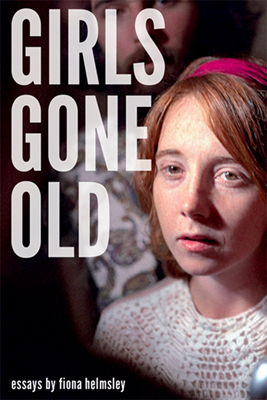
Most people have a dream epoch, a bygone era that they venerate and romanticize, thinking, if only I’d been around for that. My pedestaled place on the space/time continuum was always New York City in the mid-1970s and early 1980s, a time I was much too young to experience, but which captured my imagination via books, films, and music. New York City was gritty then; often, it was just dangerous, and elected officials didn’t seem to care, as evidenced when Mayor Abe Beame famously asked President Ford for federal funds to save the city from bankruptcy: FORD TO CITY: DROP DEAD, newspaper headlines screeched. Against this backdrop, a creative demimonde flourished. Unlike today’s New York City, one could still move there to be an artist, not just look like an artist while spending all of one’s time working to pay the rent. But romance isn’t reality — it’s the gloss, the selected parts a scrim to project one’s desires or salve one’s feelings of inadequacy. The art seemed accessible to me, because it wasn’t academic, and the glamor was piss-elegant. The artists I admired reflected the roughness of the city around them, and as I recount in my new book, Girls Gone Old, when I moved to New York City, I sought out what remained of that roughness. Perhaps it was because of their art that I was never afraid.

The following is a list of 11 books that recall the subterranean art world of New York City in the 1970s and ‘80s.

Support Electric Lit: Become a Member!

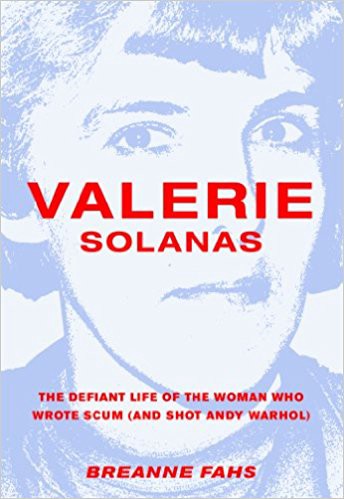
1. Valerie Solanas: The Defiant Life of the Woman Who Wrote SCUM / Breanne Fahs

Best known for her attempted assassination of Andy Warhol, Valerie Solanas was first and foremost a writer. Living in a series of cheap motel rooms, government subsidized apartments, and on the street, Solanas hung out at the 11th St. Blimpie’s, and supported herself and her writing through panhandling and prostitution. Fahs’ excellent biography details Solanas’ life after her release from the hospital where she spent three years following the Warhol shooting; her quarrels with the 1970s feminists who she felt were trying to exploit her; her writings for the small presses; and her dedication to publishing a proper version of her SCUM Manifesto.

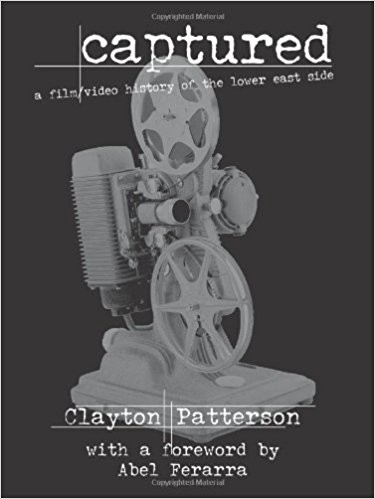
2. Captured: A Film & Video History of the Lower East Side / Clayton Patterson

In the introduction to Captured Clayton Patterson writes, “One of the challenges of this book was to give a history to people who had not received the recognition they had earned…People who were in everything, but remembered in nothing.” Patterson surmounts the challenge — Captured is a phone-book sized tome. Over sixty contributors reflect on the vagaries of low-budget, no-budget filmmaking in New York City. “It’s not that I can sit here and define mainstream for you,” artist Jeffrey Lerer says, “but I know what it isn’t. Here’s what happens. I do this…They come and say, “If you’re willing to tilt this four degrees, we’ll back you.”

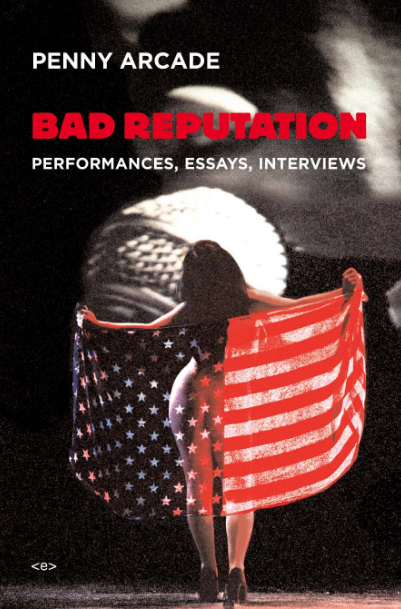
3. Bad Reputation / Penny Arcade

In Bad Reputation Penny Arcade tells of a conversation she had with photographer Nan Goldin after both women were invited to speak on panel about transgressive art. “By the way, what is transgressive art?” Goldin asked. “Transgressive art,” Arcade replied, “is what academics call what you and I call real life.” Bad Reputation is a collection of interviews, plays, and performance pieces documenting Arcade’s 40 plus years as a downtown provocateur. “The ’60s were spear-headed by a working-class entrepreneurial bunch of artists — Warhol, John Vaccaro, Jack Smith,” Arcade says. “But after The Talking Heads, people were going to art school, and I found it very hard to make my way.”

4. My Face for the World to See / Candy Darling

In the early 1960s, Bette Davis famously placed an ad in a Hollywood trade paper, “Thirty years acting experience…Wants steady employment in Hollywood.” Candy Darling made a mock-up of what may have been her own version of Davis’s ad: “Once popular off off Broadway and Underground Star seeks work.” Only 29 at the time of her death, the transgender actress never found the mainstream acceptance she yearned for after starring roles in the Andy Warhol films, Women in Revolt and Flesh. My Face for the World to See is an amalgamation of journal entries, notes, and photographs. “As a girl you are entitled to certain hopes, certain needs. You have a right to expect that there will be a special place for you. These feelings are luxuries to me,” Darling wrote.

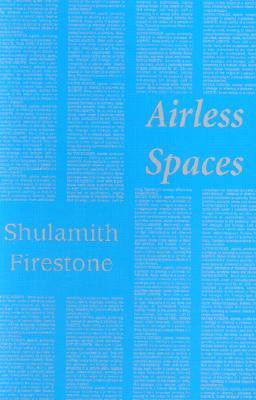
5. Airless Spaces / Shulamith Firestone

In 1970, Shulamith Firestone wrote the groundbreaking feminist treatise, The Dialectic of Sex: The Case for Feminist Revolution. It would be almost thirty years before the publication of her next and final book, Airless Spaces. A collection of short, haunting essays bridging Firestone’s experiences in the years in-between, it is divided into five sections: HOSPITAL, POST-HOSPITAL, LOSERS, OBITS, and SUICIDES I HAVE KNOWN. After attending Firestone’s funeral, Susan Faludi wrote in The New Yorker, “It was hard to say which moment the mourners were there to mark: the passing of Firestone or that of a whole generation of feminists who had been unable to thrive in the world they had done so much to create.”

Literature’s Great Alternative Families

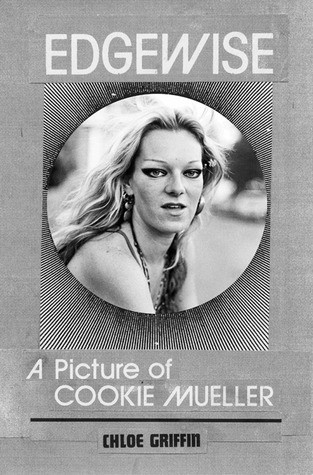
6. Edgewise: A Picture of Cookie Mueller / Chloe Griffin

In her own essays and stories, fun and madness seemed to envelop writer and actress Cookie Mueller’s life like a cloak. Edgewise: A Picture of Cookie Mueller is the oral history of Mueller’s life, told through interviews with people who knew her. Driven and ambitious, she supplemented her art world earnings by dealing drugs out of her Bleecker St. apartment, and go-go dancing. After a long term relationship with a woman, she met her husband in Italy; they were both HIV-positive. Edgewise fleshes out the portrait of a woman who seemed to want the world to remember her laughing. Chris Kraus recalls the struggle Mueller faced getting her book Walking Through Clear Water on A Pool Painted Black published: “Everybody adored Cookie, but when push came to shove, all these agents and editors said, ‘Well, you could rewrite it this way, we want to see this.’ Nobody wanted to just publish the book the way she wrote it.” A friend details the anguish Cookie felt as an artist, forced to confront her weakening. “When she was still healthy, when she could still talk, she said, ‘I’m losing my physical ability — you know how I’m a physical person. I’m not going to be able to walk…I’m not going to be able to talk, and I’m a communicator, I’m a writer.’”

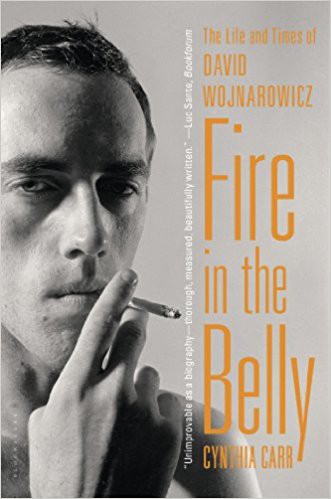
7. Fire in the Belly: The Life and Times of David Wojnarowicz / Cynthia Carr

“The feeling of the new art is fugitive…here for the moment, gone forever. It’s only truly valuable before it’s surrounded by the mystique of money, while it’s still owned by the culture,” poet Rene Ricard wrote in 1982. David Wojnarowicz’s early art was truly “fugitive”: working with spray paint, he utilized the walls of the ruined, destined to be demolished West Side Piers as a canvas. Carr, a Wojnarowicz confidante and long-time writer for the Village Voice, details David’s life in a New York City on the cusp of gentrification — gentrification brought in part by the outside world’s interest in the downtown art scene where he made his name. “David once told me that he used to long for acceptance from other people. Then he began to value the way he didn’t fit in. He realized that this uneasiness with the world was where his work came from,” Carr writes. Fire in the Belly is the definitive biography of a man whose first memory was the sound of a police siren; it’s also a requiem for a generation of New York City artists lost to AIDS.

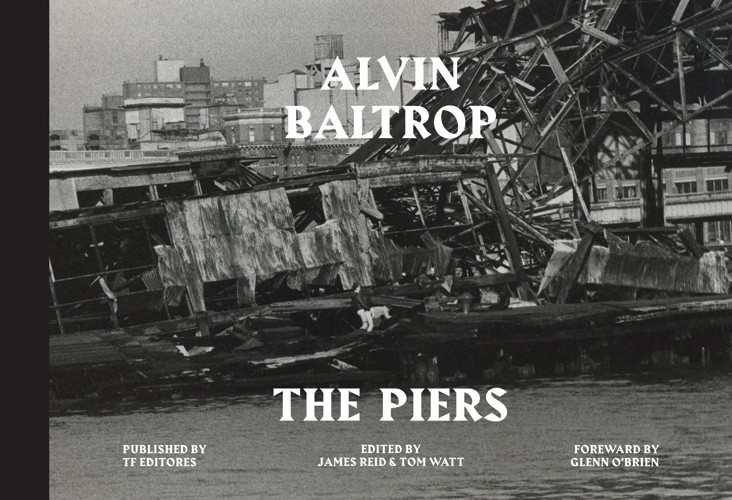
8. The Piers / Alvin Baltrop

Alvin Baltrop worked odd jobs — as a street vendor, a jewelry designer, a printer, and a taxi driver. The Piers is an evocative and unforgettable book of his photographs documenting the decadent lost world of art and anonymous sex that co-mingled at the crumbing West Side Piers. Baltrop struggled against the racism of the white art world, and his photographs remained largely unseen until after his death. If one is not aware of the sexual abandonment that existed alongside the ruin of the West Side Piers, Baltrop’s photos can provoke awe: they’re like looking in at a bacchanal at the end of the world. Baltrop’s pictures also carry a brutal, spooky sadness: the freedom felt by many gay men at the Piers would be fleeting, due to the ravages brought by AIDS.

9. I Dreamed I Was a Very Clean Tramp / Richard Hell

“I got to live the ideal I’d had in mind when I came to New York to be a poet — to have a well placed platform for saying things to the world, and an audience that thrived on it and wanted to have sex with me because of it, and I ran my own life and had no boss. And there were drugs and money,” Richard Hell writes, giving name to the dream at the heart of his book I Dreamed I Was a Very Clean Tramp. The charismatic, handsome front man had a considerable and often overlooked influence on the aesthetic stylings of punk. Hell rejects the typical biographic structure, opting to tell his story in sometimes dizzying lyrical fragments. Much was offered to Hell creatively in the 1970s and ‘80s, and he comes across as satisfied with how he squandered some of those offerings. His years of drug addiction were “hopelessness, depravity and fun,” and “a downfall…I embraced.” Some of his most colorful reminisces involve women. Cookie Mueller was “non-judgmental. She had a lot of respect for criminals;” Nan Goldin “lived and worked in the gay and wild-kids art gutter.” “Defeat was more true to existence than illusionary ‘success,’” Hell writes.

10. Totem of the Depraved / Nick Zedd

In his memoir, Totem of the Depraved, underground filmmaker Nick Zedd writes, “As I watch the roaches crawling on my bed, I’m wondering when I’ll have enough money to finish the film I started over a year ago. That it should take me a year to finish a 10 minute film due to lack of cash bespeaks the ignorance of a world which would vomit out diseased fungus like Blue Velvet.” In the face of much economic adversity, Zedd remains dedicated to his art. Landlords are his primary enemy; fellow filmmakers and apathetic journalists make up a secondary tier. Throughout the book, it’s his relationships with willing females that save him from the streets. (He refers to his “seduction” of women as “a survival strategy.”) “I discovered that being an underground filmmaker makes me less than nothing. With the world so corroded by an entertainment industry that is so restrictive and reactionary… I feel no more influential than a homeless person asleep in front of the White House,” Zedd writes.

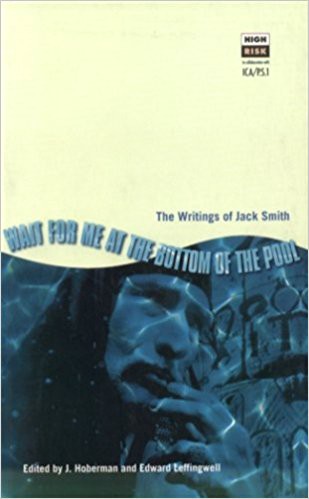
11. Wait For Me At the Bottom of the Pool: The Writings of Jack Smith / edited by J. Hoberman and Edward Leffingwell

In a letter to a German film school, Smith wrote, “My films are not conceptual or art-school cutie-pie; they have the broadest appeal (as did Art before the silver-spray democracy of the schools.)” A collection of scripts, letters, essays, and interviews, Wait For Me offers insight into the notoriously prickly, yet highly influential underground filmmaker and performance artist. Smith had his own language — rife with repetitive adjectives (“moldy,” “pasty,”) and avatars (tortured penguins, pigs, lobsters) used as ciphers for deeper feelings. “Do you ever worry about a particular subtlety in your films not being understood?” Smith was asked in an interview. “How can you not…understand the movements and gestures?” Smith replied, before adding, “The appeal is not to the understanding, anyway.”

About the Author

Fiona Helmsley is the author of the new essay collection, Girls Gone Old. Her writing can be found (or is forthcoming) in various anthologies like Ladyland and The Best Sex Writing of the Year and online at websites like The Weeklings, Jezebel, The Hairpin, Hazlitt and The Rumpus. A multiple Pushcart nominee, her book of essays and stories, My Body Would be the Kindest of Strangers, was released in 2015.

Finally, You Can Buy Audiobooks for Your Dog

Plus, the ACLU will defend Milo Yiannopoulos’ right to free speech and ‘Dawn’ and ‘Neuromancer’ are coming to TV

The weekend is looking up for pups, sci-fi fans, and Milo Yiannopoulos. (Two out of three ain’t bad.) Audible for Dogs’ catered selection of titles promises to calm antsy and sad dogs left at home by owners, the ACLU has filed a lawsuit in defense of Yiannopoulos’ right to advertise his book on the DC metro, and Octavia Butler’s Dawn and William Gibson’s Neuromancer will be coming to small screens near you.

Audible and Cesar Millan release dog-friendly audiobooks

Do you have a stressed pupper, or just one that’s always wanted to finish Pride and Prejudice? Thankfully, Amazon has devised a way to ease the minds of our furry friends while their owners are out of the house. Dubbed Audible for Dogs, the service has a rotating selection of titles sure to keep dogs engaged and combat loneliness. The company conducted research on 100 dogs in partnership with infamous dog whisperer Cesar Millan and his Dog Psychology Center in Santa Clarita, California, discovering that 76% of participating owners observed that their dogs relaxed with audiobooks. Among the curated titles are classics such as Huckleberry Finn so your fluffy pal can contemplate life outside the crate; Trevor Noah’s Born a Crime: Stories from a South African Childhood to bring your pooch up to speed on racial tensions; and W. Bruce Cameron’s A Dog’s Purpose to calm (or perhaps trigger) your pup’s existential crisis. Heckin’ great.

[Mental Floss/Kirstin Fawcett]

The ACLU files lawsuit for Yiannopoulos’ right to free speech

A plot twist has arisen in the never-ending saga regarding professional whiny gadfly/white supremacist Milo Yiannopoulos’ book. This week, he got some support from what might seem like an unlikely corner: the American Civil Liberties Union, usually not a fan of hate speech. Just last month, the former Breitbart editor’s self-published memoir, Dangerous, was released amidst criticism and scathing reviews. Yiannopoulos filed a lawsuit shortly thereafter against publishing powerhouse Simon & Schuster for dropping his book, claiming defamation. And now, yet another lawsuit has been filed — this time, on behalf of Yiannopoulos, by the ACLU. The civil rights organization has accused the Washington Metropolitan Area Transit Authority of violating the white nationalist’s right to free speech by refusing to let him promote his book on the metro. This prohibition stems from the WMATA guidelines, which forbid ads that are “intended to influence members of the public regarding an issue on which there are varying opinions.” Yiannopoulos isn’t the only client the ACLU is representing; abortion and birth control provider Carafem and the animal advocacy group People for the Ethical Treatment of Animals are also being represented in the lawsuit. Though the ACLU has stated that the organization is against many of the values Milo espouses, it says it is adamant about the preservation of the First Amendment. (Unlike many entities that get to decide whether they take money for ad space based on any criteria they fancy, WMATA is actually a government organization.)

[HuffPost/Curtis M. Wong]

Octavia Butler’s ‘Dawn’ and William Gibson’s ‘Neuromancer’ are coming to small screens

Two new sci-fi adaptations are on the horizon! Ava DuVernay’s new project, alongside Charles D. King and Victoria Mahoney, will bring Octavia Butler’s novel Dawn to television. The project will bring to life the story of Lilith, an African-American woman who works with aliens to resurrect the human race 250 years after nuclear war. Although the TV rights were optioned in 2015, the adaptation fell through. Dawn is the first in Butler’s Lilith’s Brood trilogy; there’s no word yet on whether the series will continue into later books, or for that matter how the show will handle the novel’s copious amounts of alien-human sex. Also coming to small screens is an adaptation of William Gibson’s sci-fi novel, Neuromancer. Deadpool director Tim Miller has signed with Fox to lead this project, with X-Men franchise architect Simon Kinberg set to produce. Neuromancer is a cyberpunk classic that follows a former hacker hunting a rogue AI through the novel’s virtual world, “the Matrix.” (Yes, but Neuromancer did it first.) Like Dawn, the project has been a target for adaptation before, but previous attempts failed. Hopefully now people are hungrier for visions of any future besides the one we’re currently facing.

[Variety/Erin Nyren]