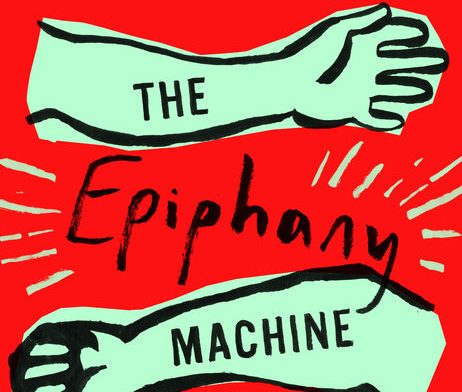
Double Take: ‘The Epiphany Machine’ Takes Tragicomedy Into Terrifying New Corners

 “Double Take” is our literary criticism series wherein two readers tackle a highly-anticipated book’s innermost themes, successes, failures, trappings, and surprises. In this edition, frequent Electric Literature contributors Kyle Lucia Wu and Tobias Carroll discuss David Burr Gerrard’s The Epiphany Machine.


The eponymous Epiphany Machine central to David Burr Gerrard’s novel is marketed to the world with the slogan, “Everyone else knows the truth about you, now you can know it, too.” What does it actually do? It tattoos revelations to your forearms. It seems like a baffling device, little more than a cult, until people realize it actually works. The main character, Venter, is no different and falls into the drama surrounding the device and its operator, Adam Lyons. Then stuff gets even weirder.

Spoilers are encouraged and fair-warned, with the hope that readers purchase the novel and join the discussion in the comments.

Kyle Lucia Wu: So there is a lot of talk about “breastfucking” in this book. It is Epiphany Machine owner Adam Lyons’s seemingly preferred mode of sexual activity (though we never see him engaging in it, simply talking about it). He tries to argue at one point that it is a perfect form of sexual interaction, and Venter, the main character, points out that there is no pleasure for the woman in breastfucking. What do you think this says about Adam? That he’s only concerned in singular pleasure, not mutual? Something Oedipal?

Tobias Carroll: I’d like to say that that’s par for the course for Adam, who seems paradoxical from the start and keeps adding contradictory aspects as the book proceeds. He’s deeply committed to the workings of the Machine and is decidedly principled about it; yet, by the end of the novel, it’s revealed that (mild spoilers, though I’ll try to be vague) his precise ethical standards have a couple of significant exceptions.

So maybe “breastfucking” is something of a reflection of this. It is, in the words of Deadwood, ”A lie agreed upon.” Or something emblematic of Adam’s successful attempts to convince himself that, no, this is totally mutually pleasurable for all involved, when in reality, it’s not.

“We can’t just know a little bit. We need to know everything.”

I suppose that circles around to one of the big questions of the book: Did you walk away with the impression that the Epiphany Machine did more harm than good? I keep going back and forth on this question, which is a pretty great representation of the layers on which the novel works. Is the Machine, ultimately, a force for ill? Is it more of a relic of a bygone era that no longer has a place in this century? It’s a pretty powerful symbol — even as its role in a relatively realistic novel borders on the metafictional. Layers on top of layers.

KLW: I do think it does more harm than good ultimately, but not in a malicious way. There’s a limit to what we should know about each other, and a point where knowing the truth is no longer useful. It reminds me of the Black Mirror episode, “The Entire History of You,” where everyone has video chips in their heads that record their memories to the point where we can replay any interaction for ourselves or others. Of course there’s reasons why this might be helpful — what exactly did my boss ask me for when I wasn’t listening? — or just replaying a certain memory — but it’s very easy to see how downhill it could and would go. Suddenly you can’t trust anyone’s retelling of their memory unless they play you the exact video so you can see for yourself. The Epiphany Machine is the same.

In the beginning of the book, having an epiphany tattoo is looked down upon and thought to be part of a cult. Then they start to be interesting, maybe personally revealing: Lots of people don’t know themselves, so it becomes pretty alluring to be able to be told the truth about yourself without all that pesky self-investigation. By the end of the book, they’re largely required. The problem is that with any kind of illumination like this, I don’t think humanity can handle only having it in small doses. We can’t just know a little bit. We need to know everything.

In the end, it’s brought up that political pundits have suggested the next presidential candidates must get epiphany tattoos and show them on the debate stage. It might be interesting to imagine what 45’s might have been. But a good point this brings up is: Would it even matter? If we all get used to seeing so much truth, would seeing the bad truths become normalized?

TC: The morning I’m typing this, 45 has tweeted a video in which he assaults a wrestler with the CNN logo for a face, so–as much as I’d like to think it could make a difference, I suspect it would be normalized. Though I’d also love to see what epiphany tattoo attack ads would look like. Maybe “love” is too strong of a word: I’d be morbidly curious to witness it in an alternate world, but I’d be terrified about it in this one.

Talking politics also calls to mind Gerrard’s first novel, Short Century, which also engaged with a host of political issues, albeit in a very different way. It, too, had subplots about alter egos–which means that we might be getting into to the realm of preferred authorial themes. Did you find any areas in which the two books overlapped?

“It should also be said that Gerrard is committed to giving us flawed, potentially unlikeable narrators at the forefront of each of his books, something I love.”

KLW: I love digging into an author’s preoccupations. I see a lot of parallels with Short Century and The Epiphany Machine: a lot politics, a lot of anger, and a lot of talk about persuasion. I think Short Century tells its story with more rage. The Epiphany Machine is told more passively, because of its very different narrator. Venter’s opinions are fairly changeable and muted — after all, he is very dependent on the opinion of others. In Short Century, the narrator, Arthur, seems to strongly believe that he understands others better than they understand themselves — he’s very confident in his own empathy. Now that I’m saying that, it sounds like the idea behind the Epiphany Machine. “It knows you better than you know yourself!” Maybe there is something that connects empathy and epiphanies. It could be argued they are there so you can feel empathy with yourself: Once you know your biggest secret, you can accept it. Or is it to feel empathy with others, by having them reveal their biggest flaw upfront?

It should also be said that Gerrard is committed to giving us flawed, potentially unlikeable narrators at the forefront of each of his books, something I love.

Also — incest? At the forefront of Short Century is the reveal of the narrator’s incestuous relationship with his sister. There isn’t any incest in The Epiphany Machine, but I do think that the way he blurs the lines between Adam, Rose, Venter, and Isaac does mar the traditional familial lines, and points to a preoccupation of boundaries in families.

TC: I absolutely agree with you on that. I also don’t think it’s coincidental that both of Venter’s father figures have names that are pretty loaded with Old Testament connotations: Adam as this primal father figure (which he succeeds at with respect to the Machine, but is less successful at with actual people), and Isaac, whose paternal role ends up being more pronounced with trying to help Ismail than with Venter. I don’t know. It very much seems in keeping with a novel about people being literally assigned roles and stations in society and wrestling with whether or not to live up to those.

Double Take: Dan Chaon’s ‘Ill Will’ is the Darkest Novel You’ll Read This Year

KLW: That’s a great point that parallels with the epiphany tattoos themselves. Once they get it on their forearms, they then have to decide whether they are going to keep fulfilling their tattoo or whether they’ll go against it. I mean, Isaac’s tattoo was should never become a father, and he deliberately became one.

“Once you know your biggest secret, you can accept it.”

How do you feel about the use of history (9/11) or real people (John Lennon)? I’m not a huge Beatles fan and John Lennon doesn’t hold much personal significance to me, but I was wondering how I’d feel if it had been about a musician I feel close to in my head. Do you think the choice to use a famous person in a narrative is risky because it may anger or alienate readers, or do you think it’s smart because readers already have an investment in this character?

TC: I think it works in the case of Lennon in a way that it might not have with, say, George Harrison. Some of it might be that (especially in recent years) Lennon has emerged as a much more flawed pop cultural figure — the fact that we can discuss him being abusive, for instance. And the fact that his killing has also (like it or not) become somewhat mythologized–I’m thinking back to the movie from a few years ago where Jared Leto played Mark David Chapman, and (if memory serves) Salman Rushdie’s The Ground Beneath Her Feet also contained a fictionalized riff on Lennon’s death. Tying the Epiphany Machine to the Beatles, and making it a sort of magical-realist distillation of a certain aspect of Boomer culture, clicked for me.

The point at which the book began to focus more on the abuses of the US post-9/11 took a little bit of time for me to process–a sense of, “Oh, this is where this is going.” That’s a little more immediate for me: I was living in New York at the time, and I think I’m always going to have a complex relationship to descriptions of that event, and that point in time, in fiction.

“I’d be terrified to get an epiphany tattoo IRL.”

That said, the way the Epiphany Machine leapt from cult Boomer relic to adjacent to American paranoia ultimately worked for me–it was something of a narrative leap, but it clicked. And the section about two-thirds of the way through, where nearly every epiphany ends with but is stronger than terrorists seemed like a perfect (and unsettling) evocation of the early years of the Bush presidency.

…though I was also impressed with how that section threw a whole lot of ambiguity into the narrative about whether the Machine was actually doing Adam’s bidding or if it was genuinely tapping into the user’s subconscious–or some sort of collective unconscious.

KLW: That’s a very interesting point that was never clarified. If Adam’s not in control of the machine, how would he possibly fix that on every arm? I tend to think it’s pointing to the way our collective unconscious wraps its arms around a certain idea.

There’s a point that’s glossed over around the middle of the book where Venter refers to thinking as a drug. “Thinking, like any other drug, can be a useful distraction from pain.” I think that’s actually a large part of this book, that thought is a kind of danger the way a drug is.

TC: And it also goes into Gerrard’s running concern over the dangers of ideological extremism, the characters who are seduced into acting on behalf of abusive governments in both of his novels tend to have thought way too hard about things, and end up causing abundant harm for others as well as corrupting themselves…

KLW: Several sections of this book deal with Stephen Merdula’s fake book that has several different explanations for how the Epiphany Machine came to be (thereby making all of them void). Several of them are also the testimonials that Venter takes from people who have used the epiphany machine. I loved the testimonials from people and found them pretty fascinating, especially because they’re often not at all objective — they believe in their epiphanies or don’t, and that shows completely in their storytelling. They’re saying “It changed my life!” or “It changed nothing” — completely skewed by their own opinions. How effective did you think these interludes were in the narrative?

TC: It clicked for me. Ultimately, this was a novel that was set in a world pretty close to our own, but with a very slight dose of surrealism. But for the Epiphany Machine to work and not just feel like a decidedly clever symbol or narrative device, getting a sense of how it might fit into people’s daily lives makes a lot of sense to me.

I can also say that, having thought about this a fair amount since finishing the book, I’d be terrified to get an epiphany tattoo IRL.

KLW: I think I’d be wildly curious about what mine would say, but not brave/reckless enough to have it embedded in my arm.

TC: Am I crazy for seeing Adam Lyons as a weird fictional analogue for Michael Seidenberg of Brazenhead Books? (Which I suppose would also make this slightly-alternate New York a close cousin to the slightly-alternate New York of Jonathan Lethem’s Chronic City, which I’m totally in favor of.)

KLW: I love that reading of Adam. I think Adam is a bit more of an antihero than Michael, but there seem to be parallels in personality and in their business models (both more interested in spreading wisdom than gaining money). And the Upper East Side apartment. (And wasn’t Jonathan Lethem one of Brazenhead’s first Brooklyn employees?) This is a wonderful reading of Adam’s shop for many reasons.

A brazen head historically was an automaton, a brass head that could speak to its owner and answer his questions — a magical object that somehow knew more than the humans it was interacting with. The epiphany machine is a perfect, albeit more aggressive and permanent stand-in for that. There were always dangers to a brazen head, whether it reflected hubris, allowed you to misinterpret the answers, or maybe just told you too much about yourself — and this certainly falls in line with the theme of thinking or knowledge as a drug. There is a danger to knowing your epiphany through this machine, many layers of danger in fact, just one of them being that everyone can read it on your skin.

TC: Over the course of the novel, Venter moves from an enthusiastic acolyte of Adam’s work to a more oppositional role–to borrow the essential punk term, he’s pretty much a corporate sellout. And he betrays his best friend in a pretty horrific fashion. So I’m curious: Do you think the narrative lets him off too easily by the end? To an extent, it seems like Ismail needs to suffer for Venter to have a more genuine epiphany; on the other hand, this is a novel with a premise and structure that question the role of epiphanies.

KLW: That’s a very good question that I struggled with as well. Does Venter deserve to end up with Rebecca in the end, and baby Rose? Does he deserve to have his parents reunited, arguably the most common fantasy among young children whose parents are separated? What he does to Ismail seems like such a betrayal not least because Venter seems to know in his heart that Ismail is innocent, though he does go back and forth about what he knows to be true and what he has convinced himself to be true.

I think the fact that his loyalties seem to sway so wildly (and we see this with all his primary relationships in the book: Rebecca, Ismail, Adam, his father) is just another indicator that Venter genuinely doesn’t know how to think for himself, what his epiphany predicted, but his epiphany just made him more uncertain. Sometimes he tries to push against his epiphany just because he knows he has it, but this backfires as well.

Do you think that this book is arguing for epiphanies or against epiphanies? I think an epiphany is another thing we can clutch onto for some sense of identity, the kind a job or any role in society can provide. But anything we hold onto too tightly like this, anything we expect to get all the answers from, ends up being way more of a crutch than anything else. It’s dangerous to believe too sturdily in almost anything — even, or especially, something about yourself.

TC: I’d go in the “against” camp, myself. Nearly every prominent character who gets a tattoo ends up regretting it. Ismail’s tattoo destroys his life; Venter’s provides a means by which authority figures can manipulate him and by which he can hold off on taking responsibility for his own actions. Epiphanies seem to me to be best when they’re temporary: That great insight you have about yourself one day might no longer apply to the person you are a month later, and trying to cling to that is like a more sophisticated version of wearing your high school varsity jacket when you’re pushing 30. (Or 40, or 50.) It’s essentially arguing that, on a fundamental level, you’ll never change from the person you were when you had that realization–which is a deeply dangerous proposition.

Agatha Christie’s Letters Reveal the Author’s Fantastically Sassy Nature

Plus a new bookselling technique hides covers, and George R.R. Martin was apparently not on board with a major GOT decision

The weekend awaits, and this Friday is teeming with literary news. Turns out, Agatha Christie dealt her fair share of sass in correspondence with publisher Billy Collins, blind-date-with-a-book asks readers to take a chance on coverless book-picking, and George R.R. Martin apparently wrote a future for one of his characters quite different than what played out on the show.

Agatha Christie gets sassy in these unseen letters to her publisher

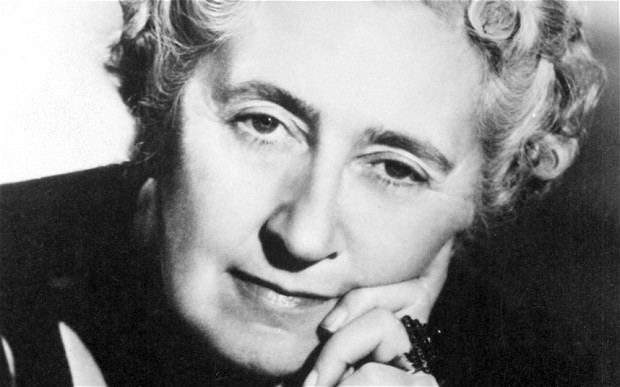
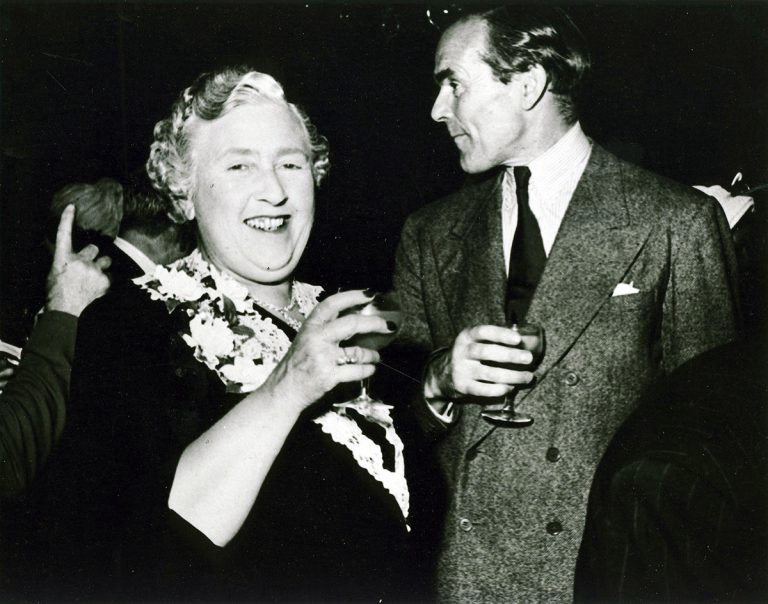
Apparently, Agatha Christie had quite the temper. New correspondence between the English crime novelist and her publisher Billy Collins reveal her sometimes hot-headed responses and protestations. In one letter, she is displeased with the cover for The Labours of Hercules, claiming the Pekingese on the cover was not up to standards. In another, she expressed her anger over seeing her books in shops despite not having received her own copies and being told its publication date. “I do think it’s treating your authors disgracefully,” she added. Yikes. Still, the relationship between Collins and Christie was also one of appreciation and admiration. Often, they would ask each other for favors: Christie asking for tennis balls (Collins’ brother was a tennis player) and Collins requesting that Agatha host his friend. In fact, Collins even bought Christie, his most profitable author, a car in 1953 to express his regard. These letters, plus unseen photographs of the author, will be on display at the Theakston Old Peculier crime writing festival (July 20–23) and then will move to Christie’s former home in Devon.

[The Guardian/Danuta Kean]

Blind-date-with-a-book entices with words only

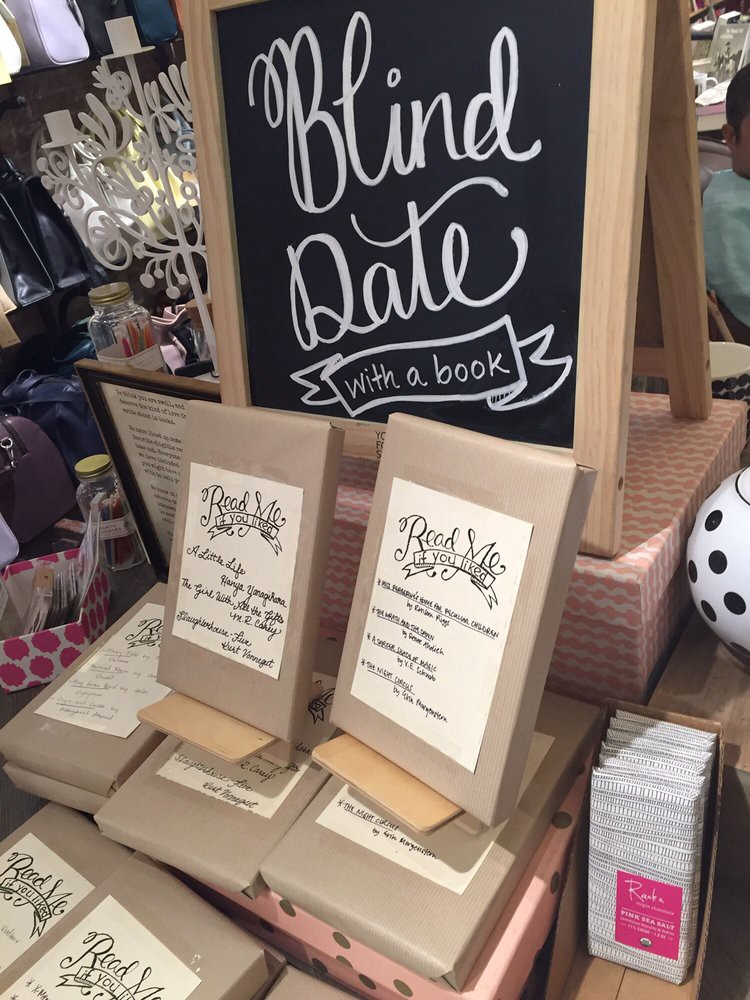
We all know the ‘you can’t judge of a book by its cover’ maxim, while valid, is nearly impossible to enforce. Until now that is. Book Culture, a bookstore on the Upper West Side of Manhattan has come up with a brilliant way for people to shop strictly for the sake of words. Blind-date-with-a-book is a new book-buying experience, in which employees pick lesser-known titles, wrap them up in brown paper, and write a list of books of the same genre with overlapping themes. Since the new strategy was introduced in October, it’s been a hit — especially during the holidays. Blind-date-with-a-book has been increasingly popping up in bookstores and libraries around the country. Here’s hoping this book-picking is more successful than most blind dates are.

[Fox 5 NY/Stacey Delikat]

George R.R. Martin had different post-Red Wedding plans

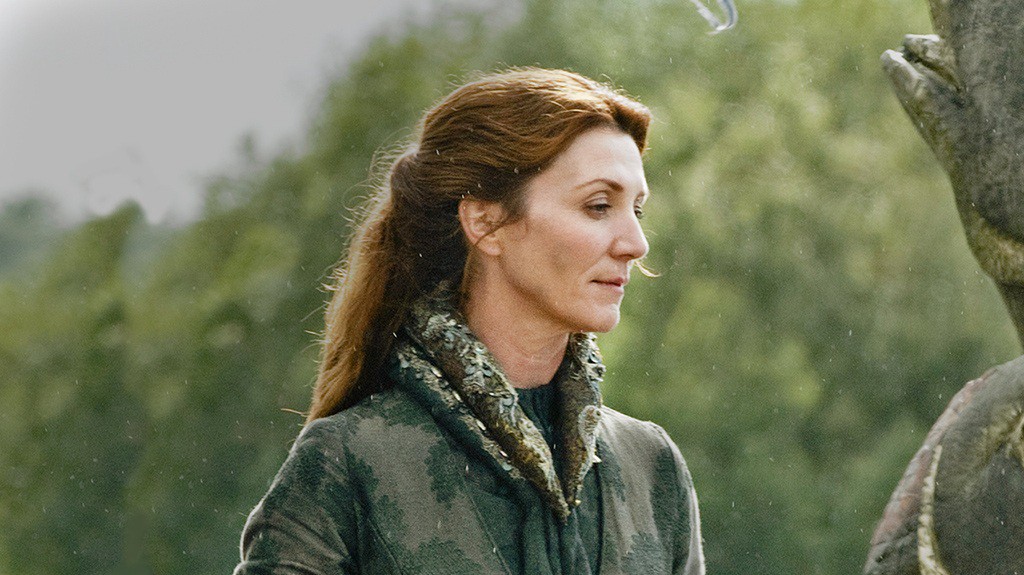
Sometimes the author does know best. [Fair warning: some spoilers ahead] In fact, if George R.R. Martin had gotten his way with Game of Thrones, the grace and class that is Caitlyn Stark would still be leading the Stark clan instead of probably unceremoniously abandoned somewhere after her brutal slaughter. In the novels (which are pretty behind the show’s plot at this point), Lady Stonehart is the resurrection of Catelyn Stark, brought back to life after the Red Wedding by the Lord of Light. Well, the showrunners had different plans for Lady Stark and decided that leaving her bloody body behind would do. In an interview with Time, Martin describes the disagreements he had with the show’s creators about which route the plot would go. (Martin preferred sticking with the books, obviously). “In my version of the story, Catelyn Stark is re-imbued with a kind of life and becomes this vengeful wight who galvanizes a group of people around her and is trying to exact her revenge on the Riverlands. David and Dan made a decision not to go in that direction in their story, pursuing other threads,’’ he said. All in the name of good TV-watching, I suppose.

[Forbes/Paul Tassi]

Literature Needs Angry Female Heroes

Ted Wilson Reviews the World: Goodbye, Vitamin

★★★★★

Hello, and welcome to my week-by-week review of the world. Today I am reviewing Goodbye, Vitamin.

The rejection of modern medicine has been in vogue lately, like the anti-vaccination movement or the lesser known practice of putting other people’s poop in your butt — an idea thrust into the mainstream with this scene from Miranda July’s Me and You and Everyone We Know:

For this reason I had assumed Rachel Khong’s Goodbye, Vitamin to be a pro-scurvy manifesto, and I was excited to see what benefits a lack of vitamins might offer. It turns out Goodbye, Vitamin isn’t about that at all, according to the blurbs on the dust jacket. And once I have time to sit down and read the book, I will update this review.

For now, I will tell you everything else you need to know about the book. It’s by author Rachel Khong, who has pretty amazing teeth. I’m guessing they are either digitally altered or she lost them all as a child, and what I’m seeing is the result of many hours spent with a top-tier orthodontist. They’re great teeth!

Typically an author’s appearance is irrelevant, but Ms. Khong’s teeth were such a distraction I stared at them for over an hour, and was only able to look away when I blacked one out with a marker.

Now if you’re a lemon fan, you’re going to love this book. There are lemons all over the cover! And if lemons aren’t your thing, there’s another version of the book with a banana on the cover. If you don’t like lemons or bananas, I suggest removing the dust jacket and drawing your preferred fruit on the book itself. You can draw a durian or whatever.

Currently the book is only available in hardcover, but the cover isn’t that hard to tear off if you want to save a little space on your bookshelf. Unfortunately what is hard to do is to tear off the cover without also utterly destroying the rest of the book. I ended up having to buy a second copy.

If you’re no sold yet, famous person Khloé Kardashian recommended Goodbye, Vitamin, and that’s more than enough for me. Is it a coincidence that Khloé and Ms. Khong share the same KH consonant pairing, or is it a subtle clue that they are actually the same person? I have no way of knowing and neither do you. Not every mystery needs to be solved.

BEST FEATURE: This book reminded me to buy vitamins.
WORST FEATURE: If you drop the book on the floor it is very likely to spill open to the end and ruin the ending for you.

Please join me next week when I’ll be reviewing milk.

TED WILSON REVIEWS THE WORLD: MY BODYGUARD

Late Night at the 24-Hour Bodega

By Tracy O’Neill

Presenting the seventh installment of The Bodega Project, where authors from across New York reflect on their communities through that most relied-on and overlooked institution, the bodega. Read the introduction to the series here.

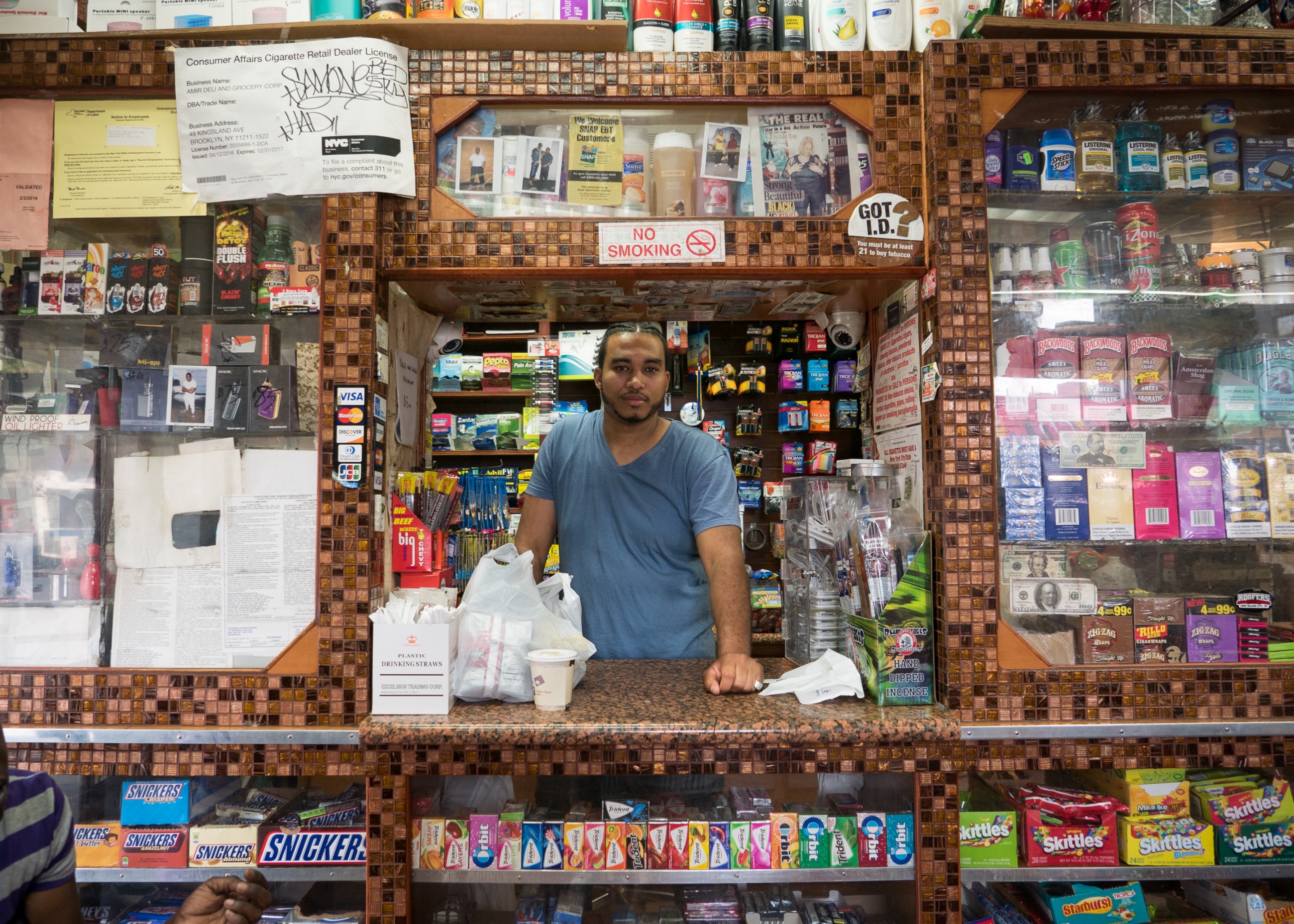
“How is it possible you aren’t in the NBA?” I ask the man behind the deli counter. He is Amir Mothna, six-five, thirty, with fresh braids and a Metallica T-shirt. His cousin Nasir says all Amir’s brothers are this tall. All eight of them. But Amir doesn’t have time for ball. It’s been two, three years since he took time off because it, this deli at 47 Kingsland Avenue, a straight cut across from the Cooper Park Houses in East Williamsburg, is his, and work is different when it’s your own. He doesn’t have time to even watch the playoffs, and still, I think, he is trying not to smile, secretly a little pleased to know that this is how he’s seen: as a guy who ought to have a sneaker endorsement. But it can be hard to tell with him. He’s got the facility to dead out the expression on his face with expertise arrived at in over a decade of bodega life.

I have come to the deli to know him — an assignment that is difficult to convey to Amir when he asks what I have in mind. There are words like “profile,” but they never quite landed in my explanation a few days before. Yes, him. Writing in the world about his life. For a moment, his eyebrows knit together, Amir as incredulous as the moment, later, when I would ask what the object is he hands to a boy across the counter, and the object is a Fidget Spinner: but all the kids have them. In the end, what happens is I stand on the customer side of the deli counter while Amir works, a Plexiglass counter stuffed with candy and Black and Milds between us.

Outside, the north-facing wall of the deli has a memory for death. Or lives, depending how you look at it. You’ll see Bowie there and Prince, Whitney, a spray paint memorial with a trash receptacle done up to resemble a boom box like someone’s dad’s idea of a joke about the garbage on the radio these days. Turn the corner, and the pictures become egg sandwiches. There’s a bulletproof glass lazy Susan for the late-late of a twenty-four hour establishment. And inside, there’s Amir’s cousin Nasir and him. There’s the chef, too. The music is Leaf singing about playing the block like a Tetris game, the aisles are two, and no, there’s no alcohol. There are individually packaged slices of pie.

To arrive at the bodega at 47 Kingsland is for me a matter of two blocks, but the guys from my corner mostly don’t go there. There are two delis on my corner, one so close to my apartment they share a fenced-in quadrangle of refuse, so close I call my stoop the deli annex. I’ve been living in the building for seven years, so I have come to expect the cloth director’s chair on the sidewalk, the parade of coordination of the sort where kicks are always a color-synecdoche for the outfit. I know that when one cries for his dead boys, the other will be ready to talk about the brains of something he believes in called The Man Upstairs. I know the opinions about Lady Gaga’s face, made and unmade, and I know the corner shit-shooters’s critique of the boys you see over the unofficial line where Jackson Street cuts through. They say over there, it gets ignorant. It gets young. And to speak of ignorance, of youth, is, for them, to speak of unnecessary violence with some resignation and also some forgiveness. They are only boys.

But there are no boys now. Now is a Sunday night lull. That will change in an hour. Amir knows the rhythm of when the place will grow bristly with customers or slide out into emptiness. He has theories about populations in time. A rush means the end of a good television show: they obsess, tight to their TV set, and then when it’s done, stomachs announce their dearth. Time to eat.

It’s hard for him pick out the reasons exactly, but Amir figures maybe eating is part of why he got into the deli business, or food anyway. He says he likes to prepare it. When he was a kid, he’d help his mom in the kitchen. She isn’t Yemeni like Amir’s father, but she learned to cook what Amir calls “culture food” from their neighbors in Detroit. His favorite was aseed, a flour and water dish served with rich soup. After he moved to the city in 2005, he went to work at his cousin’s deli in Rosedale. Now there is this place, his and his family’s, and maybe he doesn’t distinguish much between the two when you get down to it. It’s impossible for Amir to answer questions about himself without mentioning family. When I ask what his great dream is, he says that his sons, now four and ten, will go to college, or at least the older one who is less a pain in the ass. When I ask what he does for fun, he says he goes to see relatives in Queens. When I ask how he’d describe himself, he says the task is too difficult but agrees with me that probably Nasir has some ideas in response to the inquiry.

It’s impossible for Amir to answer questions about himself without mentioning family. When I ask what his great dream is, he says that his sons, now four and ten, will go to college, or at least the older one who is less a pain in the ass.

Nasir, after all, is a little more prone to framing identity. The last time I was in the deli, he told me in the neighborhood he’s known as Daddy. He was grabbing my 9-volts and recovering from one of the radiant women who torture him endlessly, recreationally, giving his rap in a nasal drawl.

“Big Daddy, no. Little Daddy. But still, I’m the Daddy.” The man who bags groceries nearby entered the store. “George, George, tell her what they call me,” Nasir called out.

“You, papi chulo?” George said. “Daddy.”

“You see,” Nasir said. “I take care of people.

But there is not time to ask Nasir about Amir because then the door swings open to accommodate a man in a white T-shirt and a woman with a baby in the stroller. For the first time all night, Amir’s face bursts from stoicism, a stunner of a smile with all its generosity and kinship feeling. The man in the white T-shirt, you see, it’s been a minute. They roll that fact around for a while, and then Amir tells the man about a shooting near his other store in Bed-Stuy. What’s happening is face-to-face news, news in the style before newspapers, before feeds feeding Mark Zuckerberg.

“Booming?” the man in the white T-shirt says.

“Four times.”

The man drifts deep into the store where food is prepared. This is the way of deli conversations, the way they come in and out through space, words distributed along pathways of chicken wings and paying up, entrances, exits. I ask Amir about the shooting, and with an affect like a prolonged shrug, he says, “A lot of people got shot.” Amir remembers three or four shootings outside the deli. One was two years ago, when the building was still shared by a laundry operation. What it was was a shot through the window of the Laundromat, metal through glass, metal through the belly at 11:47 AM. The gunman had visited the deli first, cranking his voice around in a fake accent and wearing a black mask. After he was asked to leave, he made a small gesture with his finger and there was a man on the floor.

I ask Amir about the shooting, and with an affect like a prolonged shrug, he says, “A lot of people got shot.”

I think about how he must worry. I think about his wife who he met in Yemen. He’d go to visit the family of his father’s friend, and there she was, this young woman. There was a form to it, manners. Sit with the family. Take in the intelligence of the room. Her family, they’re doctors, lawyers. Alone was not an option. That would come later. He would discover this woman had a way of listening. She didn’t like outside food. She liked to cook. She was trained to nurse people in their homes. And one day they would have a life together, two sons, meals of aseed by her hand, trips to Queens. How, when the shots are fired right outside the deli façade, could he not worry?

But Amir says he doesn’t. He’s used to it. He invokes Detroit. He says a store like this isn’t even possible there. And more locally, it’s worse in East New York, Brownsville, or over where his other store is in Bed-Stuy.

“You got Three Oh Three, you got Sumner, you got the Brevoort,” he says, iterating beef. And then after a little while, almost to himself, he muses. “Niggas don’t fight anymore. They shoot. I don’t know why.”

And perhaps it is this that makes me wonder if he fantasizes about the alternatives. Not just games for tall men but dentistry or social work, plumbing or teaching or playing the keys. It is not only anomalies of violence but the eight, nine, ten, twelve hours of serving people, how Amir says, composed, matter-of-fact, with some people the only way to convey that you are respectable is to speak rudely. But when I ask what Amir would do if he didn’t own a deli, he pauses for a long while. It’s almost as though he’s never considered the answer, though he did work for a time in construction.

“Grocery store,” he says finally.

“If you didn’t have the deli, you’d own a grocery store,” I repeat. At first, I think this must be his dry sense of humor. But no — yes — he’d own a grocery store. They’re bigger.

Because perhaps from the outside, what this life looks like is someone’s forearms resting on the counter, bills covered by loose hands. Bodies shape up to variations on waiting. Someone leaning against a row of Nilla Wafers, phone waist-high. Someone looking to whoever is behind the counter for faster, no that one, no not that but that. And sometimes because there is a woman pitching her voice, there are men wheezily laughing, men muttering about her mental health, and those behind the counter, going a little crazy themselves, throw their arms up, turning away, turning back to mutter or else pacing, singing along with the radio, I need me a li’l baby who gon’ listen. Girl I don’t wanna be the one you iggin’, though ignoring is exactly what he’s trying to do.

But from the inside, you look around and say in the same manner as three-fifty or five dollars, “You got to have patience and strong heart, that’s all.” From the inside, this is what you see: around nine, Teddy and Johnny Boy come in. Teddy pretends he wants a job, and you pretend to be vicious. You tell him no. You tell him he’s unemployable because of his big, fake butt, and you can do that, gun for the laughs, because you’ve known him since he was a kid, when you were first opening your store and he was a little guy down at eye-level with the candy display. Now, he’s twenty, sauntering in with a flashy belt everyone in the store asks about, old enough to mess around with. You can say you watched him grow up.

Johnny Boy gets wrapped up in one of the Fidget Spinners from the jar on the counter. It gets Teddy to thinking about all the toys that meant you were the shit he’d almost forgotten. Those yo-yos with the lights and the little skateboards, what were they called, Tech Decks.

Now, he’s twenty, sauntering in with a flashy belt everyone in the store asks about, old enough to mess around with.

While he waits for hot food, Teddy comes over to the counter, points.

“What’s this?”

“A recorder. I’m interviewing him. He’s going to be famous.”

“You know I been famous,” you say.

“He already got the money.” Teddy pauses. “Are you doing a record deal?” And because he’s old enough to give shit now too, he says, jutting his chin toward Johnny Boy, “That one, he’s a bad influence on the store.”

And maybe even though you know this is joking around, when Teddy begins to offer a total exposé in exchange for one thousand dollars, when he declares that this, in fact, is his store, his and yours by partnership, you think maybe what’s happening is not strictly sarcasm, that the humor derives from its aspirational nature and also the shading of partnership that feels already true or rhymes with truth somehow. Because though maybe part of the appeal of the deli is that it’s yours — not like Chrysler, where your dad worked, where they laid all those people off and left Detroit to be boarded up and drained — the store, it’s not only your own. It’s the block’s too, the same way the picture of yourself rises up from parcels of information about your family.

When asked about challenges, you can’t really think of any, or at least you don’t mention them. You don’t agree that it must have been difficult to open the store. You recall that they were pleased to have a twenty-four-hour setup on the block, and you’re baffled by the question, “Who was happy?”

“The community,” you say.

A woman comes in with her own chilled wine glass for the Snapple she intends to purchase. Then it’s the man with the polite daughter wearing an on-point flight jacket. She wants to hold the Fidget Spinner too, just like all the kids, and you know one of these days she’ll walk in a woman, and you’ll remember when she was four foot-something, asking her dad for the cherry gummies, that weird little toy everyone used to have. And even though what’s now in her hand will already be memorabilia, the Sunday night chat of regulars will remain, as big and familiar to you as the faces of icons painted on your walls.

About the Author

Tracy O’Neill is the author of The Hopeful, one of Electric Literature’s Best Novels of 2015. The same year, she was named a National Book Foundation 5 Under 35 honoree, long-listed for the Flaherty-Dunnan Prize, and was a Narrative Under 30 finalist. In 2012, she was awarded the Center for Fiction’s Emerging Writers Fellowship. Her writing has appeared in Granta, Rolling Stone, The Atlantic, the New Yorker, LitHub, BOMB, Vol. 1 Brooklyn, The Literarian, New World Writing, Narrative, Scoundrel Time, Guernica, Bookforum, Electric Literature, Grantland, Vice, The Guardian, VQR, and the San Francisco Chronicle. Her column Body Language appears in Catapult. She currently teaches at the City College of New York and is pursuing a PhD at Columbia University.

— Photography by Anu Jindal

The Bodega Project – Electric Literature

— The Bodega Project is supported by a grant from the New York City Department of Cultural Affairs.

What the F**k Is a Beach Read, Anyway?

Come summer, recommending books is a high-stakes game. The right story collection can make a vacation, just as the wrong novel can drive you out of the comforts of a seaside cottage, wandering the streets like a madman in search of entertainment at the mini golf course, the tiki lounge, or that candle-pin bowling alley where a man lost a hand the year before last. And so the publishing industry — not just the houses, but the magazines, the booksellers, the list-makers — have come up with all sorts of coded language meant to guide these seasonal reading choices, terms that frame the matter as a lifestyle decision masquerading as a literary sub-genre that nobody knows quite how to define. Which brings us to the $64,000 question of July:

What the fuck is a beach read, anyway?

This time of year, no other literary term gets thrown around quite so loosely. But what are the parameters? What are the goals? What makes a book suitable for reading on sand in salted air with flesh and paddle sports all around? The answer, no doubt, depends on the recommender and the person doing the reading. We decided to go to another source: the authors.

We asked 8 authors who may (or may not) have been surprised to hear that their books had been included on various summer round-ups and asked them to interrogate just what’s going on. And to be clear, this was no exercise in snobbery. We’re taking this question seriously. (Too seriously, one might argue, but after all this is summer and we’re in search of pastimes.) We asked these authors to think about what a beach read is, what it could be, what it all means, and whether their books (and the books they love) might in fact benefit from a little exposure to sun and surf. The responses we received ran the gamut from celebration to condemnation, reverie to dread.

So, the next time you find yourself heading to the shore and in need of a good summer read, first ask yourself the important epistemological question, what the fuck do my favorite authors think a fucking beach read is, anyway?

Featuring Edan Lepucki, Courtney Maum, Alana Massey, Gabe Habash, Rachel Khong, Patricia Engel, and Sarah Gerard.

A Gracious Book, Likely to Incite Pleasure…

Edan Lepucki, author of Woman №17, California, and others

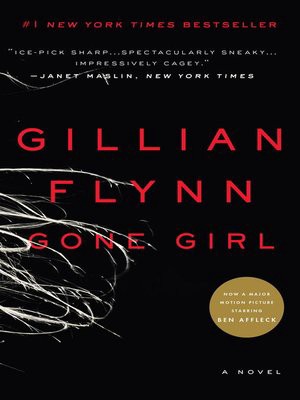
If you’ve ever been to a beach you realize that people are reading all sorts of things: someone’s got the new Elin Hilderbrand and someone else’s got a James Patterson mass market; there’s that dude reading Shantaram, that elderly lady over there’s got a Bible, and that teenager is reading James Baldwin. I’m always stunned by the diversity of books I see in the wild. For publishers, however, “beach read” is a quick way of saying, “You’re going on vacation so here is a novel that will offer you what you most want from vacation: pleasure.” Of course, what makes one reader purr with delight makes another fall asleep, but for marketing purposes, pleasure here is synonymous with a compelling story and a kind of invisible prose that gets you from one chapter to the next without you noticing the syntax or imagery. But that is a narrow definition, as is my vague idea of those who actively seek out these sorts of books: readers who consume them like candy, one after the other after the other, or, those people who don’t read at any other time of year. (It’s that second group, the one-book-a-year folks, who turn a book into a phenomenon: think Gone Girl). Many novelists simultaneously bristle at this category — My work is not breezy! Check out my similes! — while also hoping to be the book that everyone reads on vacation. My new novel has been called a beach read by quite a few readers and critics, and I’m fine with that label: it means my novel has the power to engage a reader who is sitting before an enormous, stunning body of water, and still decides to look down at a piece of paper with a bunch of words. What they find there better be fun.

It means my novel has the power to engage a reader who is sitting before an enormous, stunning body of water, and still decides to look down at a piece of paper with a bunch of words.

Courtney Maum, author of Touch, I Am Having So Much Fun Here Without You, and others

There are two kinds of unexpected guests: the plus one who shows up with a laundry list of food sensitivities and backhanded “compliments” about your boho-chic décor, and the gentle wit who presents a bottle of Chablis and a bar of salted chocolate along with his excuses. Having had them both over, I know who I want back. Chablis and chocolate guy was witty and entertaining, and he helped with the dishes. The category “beach reads” is a lot like that of the unexpected houseguest — it’s about the experience of inviting something new into your life. It connotes something delightful and relatively risk-free, but that doesn’t mean that it is “easy.” Let’s do away with this word, “easy,” and try instead “a gracious read.” Because the beach read can be sardonic, but it is never crass.

A Transformation, Preferably En Route to an Island…

Alana Massey, author of All the Lives I Want

I see the prevailing wisdom around what constitutes a beach read is reading that encourages you to indulge in escapist impulses and fantasies, things like murder mysteries where you play detective or juicy memoirs from above-average-looking sluts where you play the above-average-looking slut. This makes sense considering that going to the beach is generally an escape from the doldrums of your work and home routines, unless you’re a lifeguard or some sort of cavalier sting ray. But I think a more generous view of the beach read would encompass books that don’t just let you escape but that guide you to some sort of actual transformation that you don’t snap out of. The heat of the sun and the rhythm of waves is conducive to letting your guard down, making you receptive to new ideas presented in nonfiction or self-help books or inclined to empathy for characters you might otherwise despise. You should take a beach read’s message home with you, like a tan and sea-salted wavy hair. I’m delighted that All The Lives I Want is considered a beach read because I think that signals that my book is for a broad audience, as I aimed for a reasonably clever accessibility over an impressive esoterica. The book is pop culture criticism but some of its central themes are about living in a body and navigating being a woman in a public space, creating the potential for a more potent visceral experience considering how heightened those realities are on the beach. Also, a lot of readers have told me they cried reading it, which is great at the beach because you should be wearing sunglasses anyway AND if you do get caught, you can blame salt water or sand in a way you can’t if you start crying on public transportation or into the physically short but emotionally gaping distance between you and the person or people you live with.

The heat of the sun and the rhythm of waves is conducive to letting your guard down, making you receptive to new ideas presented in nonfiction or self-help books or inclined to empathy for characters you might otherwise despise.

Gabe Habash, author of Stephen Florida

In grad school I met some friends at Coney Island. It was a long train ride, so naturally I brought along the book I was reading at the time, which was Ulysses. My friends met me on the boardwalk and immediately made fun of me when they saw me carrying it. All of which is to say that I think a “beach read,” if it means anything, is a book that you really want to read that you now have the time and mental energy to read. This summer I’ve been working my way through short books: Morgan Parker’s There Are More Beautiful Things Than Beyoncé, Jean Rhys’s Good Morning, Midnight, Thomas Bernhard’s The Voice Imitator, Patrik Ouředník’s Europeana, Ryu Murakami’s Piercing, Lily Tuck’s Sisters, Iris Owens’s After Claude, and Heinrich Böll’s The Lost Honor of Katharina Blum.

California Soul: A Literary Guide to SoCal Beach Towns

Rachel Khong, author of Goodbye, Vitamin

Until very recently, a “beach read,” to me, meant any book I held aloft while lying in discomfort, distracted by heat or sand or overhead Frisbees, peering up at and trying to comprehend but not succeeding, feeling stupid from the sun. It was a book inevitably ruined by water. But when, last fall, my husband and I began planning a trip to Greece, I decided I was going to have to learn to read on beaches, so help me God. We would be traveling between islands by ferry, and could each only bring a small carry-on. So I packed a Penguin paperback of War and Peace — a book I figured would last me the entire week-long vacation, and then some. Over the course of the trip, the book fell slowly and dramatically apart. It lost its cover early, so I didn’t even get street (beach) cred for reading War and Peace. (We joked about affixing the detached cover to some random thriller.) Anyway! It turned out to be perfect, improbably: tiny, dense type that somehow, by being physically difficult to read, became easier to follow. A cast of characters I could be languidly enraged or delighted by. And prose that could be rambling, yet beautiful… like the very beach itself? I’m actually just talking through my (sun) hat now, so I’ll simply leave you with this: if you hate reading on beaches, try War and Peace!

A Seasonal Delusion…

Patricia Engel, author of The Veins of the Ocean, Vida, and others

I live near the beach and rarely see anybody reading there, no matter the time of year. Most beachgoers are flat on their backs, eyes closed to the sun, or talking to the person next to them, drinking, listening to music, snapping selfies, minding their kids as they play in the sand or waves. Books bought with the best intentions of being read on these long, bright summer days remain tucked in bags with the emergency aloe. But I suppose “beach read” sounds better than “sofa read,” “lunch-break read,” or “doctor’s waiting room read.” In the end, giving a book such a luxurious alias doesn’t say much about the book. Just what we think our lives should look like.

In the end, giving a book such a luxurious alias doesn’t say much about the book. Just what we think our lives should look like.

Sarah Gerard, author of Sunshine State, Binary Star, and others

A beach read is a book that is made of the beach. The covers of beach reads are sand packed into wet towels left to bake in the sun. The pages are made of dried seaweed — so when the blurbers say they’ve “devoured” the book, that is to be taken literally. Inside, the stories are all about people going to the beach, mostly women, usually in small groups, so as not to scare off potential husbands. Not much happens on the beach, so unlike the ocean, the conflicts don’t run deep.

A Life Among Horrors

Why aren’t there more domestic horror novels? There are all kinds of popular “scary” books with vampires, witches, and ghosts, but there are far too few that look at the everyday horrors that terrorize us. Motherhood, fatherhood, childhood — these are labels that we attach to ourselves (or ones that society attaches to us), but we too rarely examine how these classifications impose on our lives. Isn’t it true that we wonder if we are as good as our own parents? Don’t even children consider if they behave similarly to their peers on the playground? Thoughts of inadequacy and even total failure haunt all of us at some point. Victor LaValle, who is best known for his past novels The Devil in Silver and Big Machine, brilliantly and terrifyingly explores the common horrors of domestic life in his latest genre-bending novel, The Changeling.

“LaValle […] bluntly and unexpectedly punches us in the gut.”

Antique book dealer Apollo Kagwa, LaValle’s protagonist, has a fascination with fatherhood. Apollo’s own father left when he was just four years old, and he wonders why. It’s a mystery that he can’t shake. In fact, the question of his father’s absence haunts him so greatly that strange, ominous dreams about his father’s disappearance have plagued him since his childhood. When Apollo finds out that his wife, Emma, is pregnant, he vows to be a different kind of father for his son.

And it’s a promise that Apollo keeps. Soon after Emma gives birth, Apollo shows great care in loving his son:

“Apollo unbuttoned his shirt so he could hold the boy directly against his skin. The baby didn’t cry, didn’t flutter his eyes yet, only opened and closed his tiny mouth. Apollo watched his son take his gasping, first breaths. He watched that little face for what seemed like quite a while, an hour or an eternity.”

While Apollo’s actions show a sense of loving commitment toward his son, Apollo still feels pain from the abandonment he faced from his father. Thinking he can rectify this feeling, Apollo asks Emma if they can name the baby Brian, which was Apollo’s father’s name. The hope is that if Apollo can love one Brian perhaps both Brians can, at least in Apollo’s mind, love Apollo and make things right. Emma agrees to the name.

Apollo and Emma take home baby Brian, and Apollo triumphantly takes on the role of a modern day dad. He changes diapers, he cares for Brian emotionally, he cradles him and comforts him. He does all that he can think of to be a good father.

The Writing Life on the Road: Noah Cicero’s Nevada

Things seem like they are on a good path — one with a gentle resolution, but this is a LaValle novel. There’s trouble brewing. Emma, who seems to be suffering from post-partum depression, grows distant from Brian and her husband. She begins to claim that she receives strange picture texts of Brian, but when Apollo questions the existence of the pictures, they are nowhere to be found. She goes so far as to claim that the baby she knows as her son isn’t her child. Things get weird, and they get dark.

LaValle, in what is the novel’s best chapter, bluntly and unexpectedly punches us in the gut. We find Apollo tied to a chair, disoriented and crying out for his son. Emma appears and beats her husband. Then, a truly awful event occurs. As a result, Emma flees, and the story shifts from being one firmly planted in the real world (with tinges of fabulism) to one exploring otherworldly sectors of New York rather boldly.

The fascinating dissection of the horrors of fatherhood continues throughout the second half of The Changeling, but LaValle also explores the pitfalls of technology in a startling way that is quite affecting:

“In folktales a vampire couldn’t enter your home unless you invited him in. Without your consent the beast could never cross your threshold. Well, what do you think your computer is? Your phone? You live inside those devices so those devices are your home. But at least a home, a physical building, has a door you can shut, windows you can latch. Technology has no locked doors.”

The Changeling reminds us that technology can get us easier than any monster.

LaValle has total command throughout the tight, short chapters contained in The Changeling. Every section builds upon the previous one in a way that makes each sentence feel necessary. The characters are believable, and the situations, although they are magical, seem just as plausible.

To talk about the The Changeling’s ending would spoil the fun. I’ll say that it’s fulfilling, and it’s even surprisingly emotional. This is the kind of novel where everything works.

If you are looking for one book to read this summer, stop. Here it is. Allow Victor LaValle’s masterpiece to haunt your dreams.

When Gentrification Comes to a Boil

Brian Platzer and Anna Altman talk displacement, dehumanized policing, and writing about the changing neighborhoods of NYC

Bed Stuy Mural. Photo by Joseph Buxbaum, via Flickr.

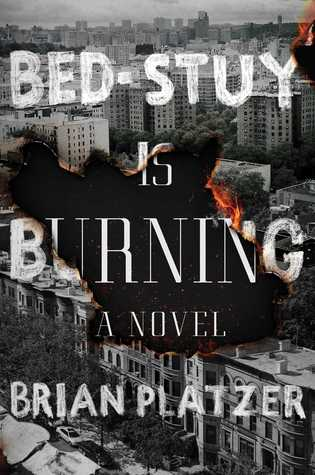
Brian Platzer’s debut novel, Bed-Stuy is Burning, offers a portrait of racial tension in contemporary Brooklyn. The bulk of the novel unspools over the course of one eventful day, when resentment over gentrification, white privilege, and police brutality erupt into sudden violence. The novel is told in the round, by a sequence of individual voices that come together to form a chorus. It’s a novel about the individuals that comprise a community, whether chosen or not, and the internal lives they carry with them.

Anna Altman: Bed-Stuy Is Burning draws from current events, namely the increased attention to police shootings of young black men (often unarmed) and the civil unrest such incidents have provoked. It takes some courage to write a novel with a plot that is ripped from the news, especially concerning an issue with such racial tension at its core. What is it like to tackle such a pressing and contentious issue?

Brian Platzer: I actually began writing the novel seven or eight years ago, when most days I began my commute into Manhattan by watching kids not much older than my eighth grade students handcuffed and pressed against the subway grate that separates the stairs up to the street from those down to the track. Though there are reasonable arguments on both sides concerning the effectiveness of stop and frisk in limiting guns and violent crime, the lived experience of it was miserable for everyone involved. The kids seemed mortified, the police officers appeared stoic behind masks of brutal professionalism, and we commuters were impotent to help in any way, though these stops were presumably made on our behalf. I couldn’t get it out of my head that if tensions ratcheted up a bit — if a police officer lost control and shot one of these kids, for example — violence would be the logical outcome. I was writing second and third drafts during the fury and rioting in Cleveland, Baltimore, and outside St. Louis. These events made me feel it was an even more worthwhile goal to explore how members of my community — from newcomers to longtime residents — experience such seismic changes. I wanted to learn more about the individuals at the center of these complicated conflicts.

“I couldn’t get it out of my head that if tensions ratcheted up a bit — if a police officer lost control and shot one of these kids, for example — violence would be the logical outcome.”

AA: You even go ahead and try to imagine the interior life of Police Commissioner William Bratton. How did you try to get inside his mind? What was it like to write the interior life of a public figure?

BP: As soon as I expanded the scope of the novel to include a wide spectrum of perspectives and voices, I felt compelled to include someone at the very top who was pulling many of the strings that manipulated my characters. I was fascinated by the idea that the man who replaced stop and frisk with the broken windows model of policing, who is generally applauded as a successful keeper of both the peace and the community, was the same man who discussed crime in a clinical way almost entirely stripped of humanity. His autobiography provides a back story and some rationale behind his professional inclinations, but after I watched many, many hours of his speeches on YouTube, what stood out most was his desire to talk about policing as though it’s an algorithm where if one processes every incident of crime and tries to police those areas of incident with extra scrutiny — “putting cops on the dots” in his language — the human part would take care of itself. I was fascinated by the tension between the people whose story I was telling and the man at the top who tries, for what is probably a good reason in his opinion, to dehumanize the process. At that point, the decision was whether to fictionalize him and give Bratton a new name while retaining most of his same characteristics or to do my best to imagine his internal life. I felt the latter would be less distracting for the reader. My novel takes place in a real park in a real neighborhood and refers to real subway stations, restaurants, housing projects, banks, hospitals, music, and celebrities. Bratton, who first appears in the novel as a voice on the radio, is just another representative of the real world in which my fictional characters live.

AA: Your rendering of the erupting violence makes for some of the most interesting scenes in the book: you manage to convey the growing feeling of chaos and unrest from the perspective of each individual, but there isn’t a sense of how things are moving as a whole. You never fully spell out for the reader the chain of events. How did you decide when to fade to black?

BP: My goal was to retain the power of causality while depicting the natural confusion and uncertainty that accompanies moments of sudden and unexpected violence. It was important to me that no event feel random: that each action in the novel leads inevitably to the next one. At the same time, I didn’t want to suggest that all the participants were fully aware of such causality. When Aaron and his family move in as the only non-African Americans on a beautiful Bed-Stuy block, he sees the move as a step in a new direction and towards a new life. But he is not fully aware of the consequences that the gentrifiers en masse create, such as displacement, increased policing, and community anger. These tensions lead to violence, which comes back to focus on Aaron’s family. Though Aaron is an important part of a chain of events, he is still surprised to find himself the target of his neighbors’ anger.

From His Corner, A Bodega Owner Watches Brooklyn Change

AA: As the book progresses and tension rises, your characters maintain their introspective stream-of-consciousness monologues. Dramatic moments unfold as characters are thinking back to earlier losses and regrets. What does it mean that your characters drift off into reveries even in dramatic moments?

BP: It’s always a tough line to walk between advancing the plot and depicting a character’s inner life. What you rightly refer to as “introspective stream-of-consciousness” was my best attempt to approach what it is to be a person with thoughts, yearnings, and memories who is currently experiencing a heightened moment of fear or violence. Although it would be unlikely that Antoinette, for example, literally spends time recalling her history growing up in Jamaica as she is taping up windows to protect the house from potential intruders, it is likely that for her, the moment is filtered through a prism of other experiences with violence. In real life, these moments of tension might be colored by flash-recollections or instincts. In the novel, I wanted to make sure that the reader understood the full weight of these memories. After three or four drafts, I felt I had the balance right between keeping the story moving and making the characters real.

AA: One of the characters, Aaron, struggles with a gambling addiction that, in the past, has cost him dearly. This serves as a barrier between Aaron and his wife’s ability to establish a trusting relationship and proves to be a daily struggle for Aaron. What was your interest in looking more closely at addiction? Why gambling? How does addiction transform relationships?

BP: I’m fascinated by gambling because the propensity to take risks is as often viewed as a positive trait as it is a negative one. Some of the same proclivities that get Aaron fired from his career as a rabbi are those that help him succeed on Wall Street. I used his background of gambling to highlight the gentrifier’s mindset. When a survey was done of the original Brooklyn gentrifiers in 1969, they described themselves as “adventurous” in the same way Aaron sees himself. Although he’s trying not to bet as often or as much as he used to, Aaron sees his entire life as a gamble now. He’s put all his financial resources into a house that he hopes will appreciate in value, and he has the (unappealing) tendency to see his neighbors as if not dangerous then at least exotic. I also wanted to take advantage of the instability inherent in the life of an addict of any kind and those who love him. Aaron wants to marry Amelia, but he can’t promise her that he’ll be able to control his addiction. This tension is a dramatized version of what a lot of people feel on the precipice of marriage — that they want the other person to promise a happy life for them even though they know that such a guarantee would be insincere. Finally, I wanted to present a counterpoint in Aaron’s personality to his loss of faith. As a rabbi, he could no longer believe in God, so he finds something else he can believe in: math, probability, and chance.

“I’m fascinated by gambling because the propensity to take risks is as often viewed as a positive trait as it is a negative one.”

AA: Religion plays a central role in the book: the couple’s nanny, Antoinette, is very religious; in fact, she attends weekly church and mosque services and has recently started to wear a hijab. One half of the central couple, Aaron, worked for years as a rabbi but now claims to have lost his faith. How do issues of religion run under the surface of a story about racial inequality or police violence? There’s a particular scene, too, where speaking about religion seems to dissolve barriers to communication. What comfort or community can religion provide us in those moments? How does religion create common ground or keep us apart?

BP: No one in the novel is comfortable with his or her own religious faith. Aaron struggles to retain faith as a rabbi in a world where God could allow such suffering; Antoinette originally turns to Christianity for community and an escape from a previous life, and then she transitions to Islam after Christianity isn’t satisfying enough; and Amelia thinks of religion as a way to articulate what differentiates human beings from animals, describing God as something like a synonym for “consciousness,” and yet she is the one who believes she encounters God in a pivotal moment in the novel. Brooklyn was long ago nicknamed the Borough of Churches, and though many houses of worship recently have been bought out by developers, when I walk around my Bed-Stuy neighborhood on a Sunday, it’s clear how significant a role the church plays in the lives of so many who live here. Consequently, when Aaron employs his religious tools in an attempt to assuage the crowd’s anger, it’s a complicated moment of a rabbi who is uncertain about his faith manipulating the faith of others in order to save himself and his family. It’s both a deeply cynical moment and one grounded in his love for his family and his history as a religious leader. Religion is both a political tool and a personal salve, and I try to present it with all its power and ambiguity.

11 of the Worst Weddings in Literature

It’s wedding season. These days, that doesn’t mean a few DJ-ed buffets at the local rental hall. Going to a wedding, more and more often, means getting on a plane to some far-flung destination, driving to the middle of nowhere to drink specialty cocktails in a rustic chic barn, and taking silly-sexy pictures in a photo booth so as to capture the one use of your very expensive bridesmaid dress or groomsmen’s suit.

If you’re feeling exhausted, bored, or financially depleted, take heart — literature has come up with weddings that can far outweigh the horror of the parties you’ve been to. These 11 novels remind us that, at the very least, we can be happy that the bride and groom came willingly and without the baggage of a still-living spouse, and the guests, while drunk, were not also out to kill.

There is something perversely satisfying about seeing an event that is so heavy with expectations get trashed, and in these cases, it is illuminating too. These authors don’t accept weddings as the flower-strewn manifestation of assured romantic bliss. They take one of humanity’s oldest customs and scrutinize and question it, and the results, while not always pretty, are always interesting.

A Storm of Swords by George R. R. Martin

Nascent fans of Game of Thrones hear rumors about the crazy thing that happens in the third installment of A Song of Fire and Ice long before they actually get around to reading it. With that kind of hype, you’d think that the event in question, the Red Wedding, wouldn’t live up to expectations, but boy does it. Without giving too much away, it’s a blood-bath at the Frey’s castle, and in true Martin fashion, the characters who are ruthlessly murdered are the very ones who you’ve been cheering on for hundreds of pages.

My Brilliant Friend by Elena Ferrante

The first book of Ferrante’s Neapolitan series concludes with Lila’s wedding to Stefano Carracci, who is the heir to the local grocery store and, in what should have been a huge red flag, the son of Don Achille, the man who terrified Lila and Elena as children. Before the boozy wedding feast is over, young Lila — and she is still so very young — realizes that Stefano is just like his father and the wedding was a terrible mistake, one that will haunt her for the rest of her life.

A Thousand Splendid Suns by Khaled Hosseini

As a girl, Mariam also marries an abusive man, though she had even less say than Lila in the decision. Hers is a forced marriage to a shoemaker named Rasheed. On the day of her wedding, she sees her future husband for the first time when she holds up a mirror under her wedding veil. She’s upset to find Rasheed is unattractive, though he becomes even more so once she knows his personality.

Chronicle of a Death Foretold by Gabriel García Marquez

Just hours after their marriage, Bayardo San Roman returns his bride, Angela Vicario, to her parents, claiming that she’s been tainted by a lover. Angela gives up the name of the man who “stained” her, Santiago Nasar, and Angela’s brothers announce that they are going to kill him in revenge. Sure, it’s awkward to return the wedding presents, but it seems like cold-blooded murder might be going a tad overboard.

Seating Arrangements by Maggie Shipstead

Weddings have become big, expensive circuses, something that Maggie Shipstead uses to great comedic effect in her novel of a snobby New England wedding gone wrong. Daphne Van Meter is marrying Greyson Duff at her family’s island estate, and though Daphne’s parents have done their best to ensure that this will be the pristine social event of the season, the wedding is thrown off course by drunkenness, lust, and other wonderfully bad behavior.

The Emperor’s Children by Claire Messud

Messud also has a keen eye for the ridiculous nature of modern weddings. Chapter 51 of her novel is titled “‘Vows by Lisa Solomon’, Special to the New York Times” and is a satirical (yet also totally plausible) article that recounts the wedding of two of the book’s main characters. The wedding typifies everything that a certain type of couple might want, from a “a profusion of calla lilies” to “seafoam chiffon.”

Jane Eyre by Charlotte Brontë

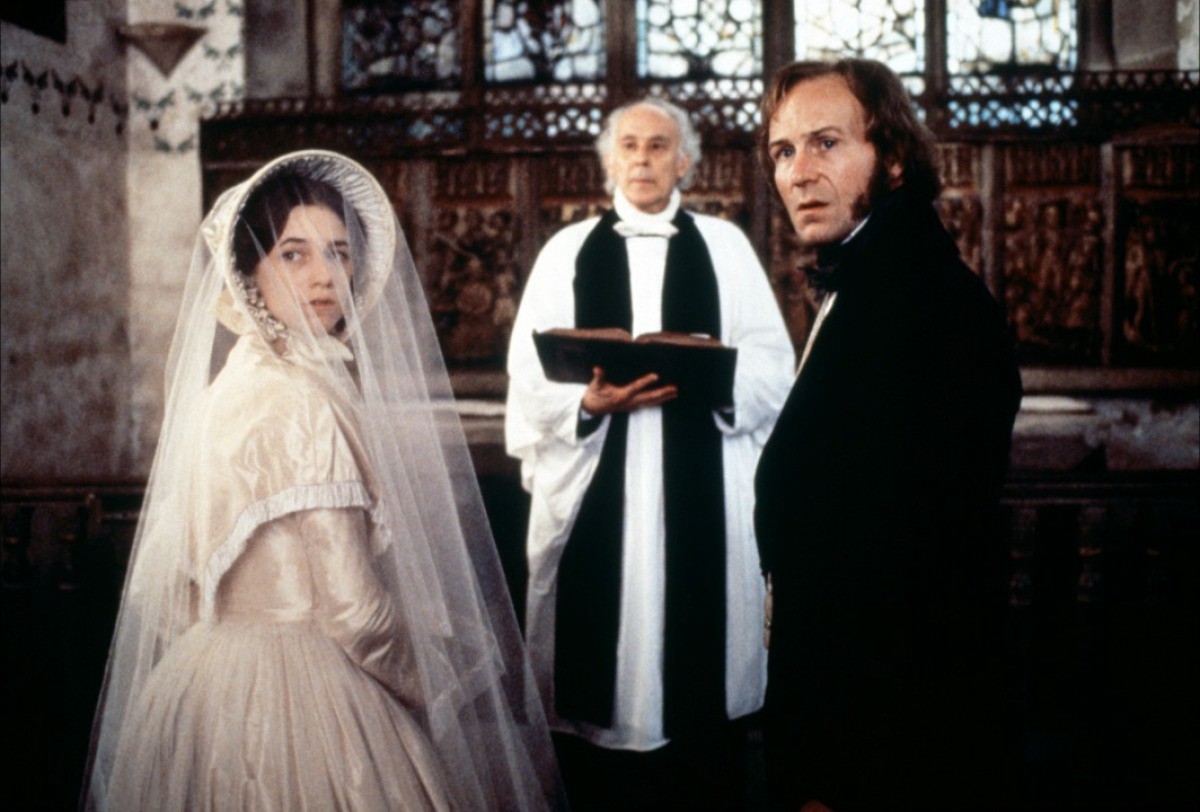
The last thing you want to hear when you’re standing at the alter about to get married is that your intended already has a spouse. But such is Jane’s lot when one of her guests shouts out, “I declare the existence of an impediment,” forcing Mr. Rochester to admit that he’s been harboring a wife in his attic. Rochester’s defense is that his wife is completely crazy, but Jane’s not having it, and she leaves Thornfield, rendering herself penniless and homeless in the process.

Atonement by Ian McEwan

As a young girl, Briony mistakes her sister’s flirting with one of their family estate’s groundskeepers for something more, and as a result accuses the wrong man of raping her cousin Lola. McEwan’s Booker Prize-shortlisted novel explores the repercussions of this event, including a terrible wedding where Lola marries her rapist, though only Briony knows the truth, and finds it too late to make amends.

Goodbye, Columbus by Philip Roth

Roth’s 1959, National Book Award-winning novella follows a working class Jewish man named Neil Klugman through his relationship with an affluent suburban girl named Brenda Patimkin. The novel probes the two families’ class divide, including at the generally awkward wedding which includes soused partiers, intimidating relatives, and a man who keeps publicly grabbing his wife’s boobs.

The Age of Innocence by Edith Wharton

New York Society is thrilled when Newland Archer marries the acceptably demure May Wellend. But Wharton, being Wharton, exposes the sham of following society’s rules for their own sake. Newland is actually hopelessly in love with May’s ‘exotic,’ sexier cousin, Countess Ellen Olenska, and his mind is on Ellen throughout the whole wedding, though he manages to snap-to in time to say “I do.”

Great Expectations by Charles Dickens

This is the most famous literary wedding that never actually happened. A lot of prep did, though, as Ms. Havisham’s grand mansion bears witness to it, still laid out with tables of uneaten cake and decayed flowers. Ms. Havisham also continues to wear her moth-eaten wedding dress, though exactly how long it’s been since she was jilted she can’t say, because the clocks all stopped at the time her heart broke: twenty minutes to nine.

Literature Needs Angry Female Heroes

About a year ago I found myself in a depression. It came like all the clichés said it did. Sometimes like a fog, the air thick to breathe and hard to walk through. Sometimes like a rain cloud, hanging over my head and following me from task to task like a cartoon, the threat of rain worse than rain itself. Worst, it was like waves crashing over and over again, no lifeline of “better days to come” or “it gets better” or “count your blessings” enough to pull me up from under each cresting wave of failures, days spent kicking and kicking, and never breaking the surface.

I knew what it was for a long time, but I refused to name it for fear of appropriation, stealing from people who suffer from “real” mental illness. After all, I tried to rationalize, if my depression had a reason then it wasn’t really depression. If I was able to force myself from the bed I just wasted twenty minutes crying on, it couldn’t be real. If I hadn’t hit bottom, it couldn’t be real. Fighting against it to do all the things I needed to do was exhausting and left me physically sore, aching muscles and a pounding head, but the only alternative was giving up and giving in completely so I forced myself to do them. The fact that I could pantomime my way through the steps to complete each made me feel like I couldn’t possibly be actually depressed.

I knew what it was for a long time, but I refused to name it for fear of stealing from people who suffer from ‘real’ mental illness.

But that didn’t stop me from crying, every day, in the morning on the subway, on the phone when my parents called to check in.

I was tired all day, but I couldn’t sleep at night.

I finally called a therapist to set up an appointment, but she informed me she was going on maternity leave in a week so she was not taking new clients. She gave me some recommendations and asked if I had any questions. I was already crying in my workplace’s communal kitchen, hastily wiping tears that I was sure everyone could see anyway.

“Do you think it’s worth it to seek outside help?” My voice strained, and I could tell by her soft assurances, that, yes it was, she knew. I just needed someone so badly to tell me it was not all in my head, that I was not crazy, that something was wrong and I couldn’t make it right just by the force of my own will.

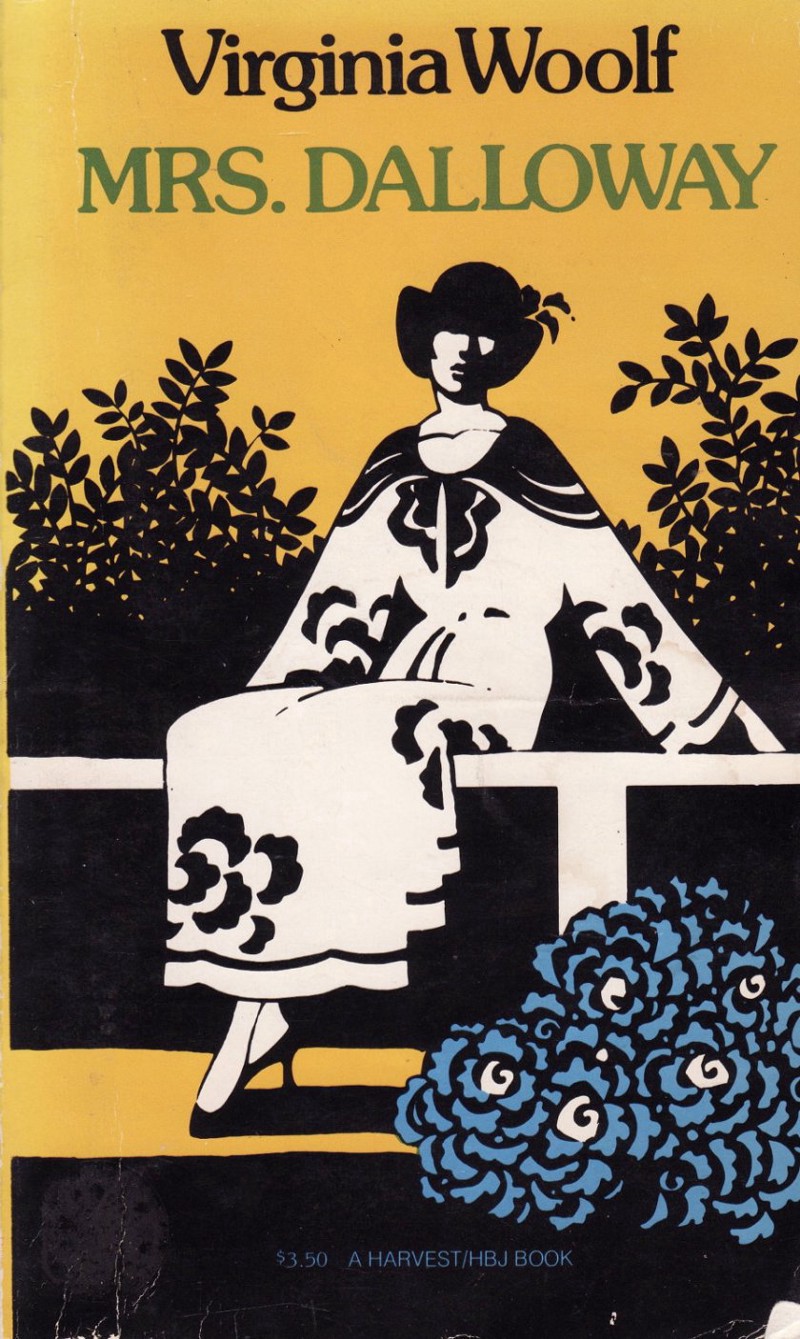
I tried what had so often brought me comfort in childhood: finding a character in a book who suffered as I did, and emulating her triumphs. I read The Bell Jar and thought about Plath and her oven; I read Mrs. Dalloway and thought about Woolf with her pockets full of stones. I wanted to identify with these women, to feel a spark of similarity or at least a dull ache of familiarity in my chest, a “misery loves company” type of understanding.

I read The Bell Jar and thought about Plath and her oven; I read Mrs. Dalloway and thought about Woolf with her pockets full of stones.

But it didn’t work. Because while I felt depressed like these characters, they did not feel angry like me. Literature made their depression elusive and magical.

There was Plath’s Esther, falling into her depression in the way good girls do: quietly, without a fuss, self-blaming, self-reflecting. She chastises herself for her emotions, holding herself responsible for not feeling the same excitement at her magazine internship that the other girls do:

“I guess I should have reacted the way most of the other girls were, but I couldn’t get myself to react. I felt very small and very empty, the way the eye of a tornado must feel, moving dully along in the middle of the surrounding hullabaloo.”

Esther’s depression was one of stillness, frozen, and even in the darkest throes of it, was tied to an inherent sense of self-worth. Even her oft-quoted passage about the fig tree, a touchstone in writing about depression, failed to ring true for me, her sadness manifesting from the abundance of choices before her, where my pickings seemed slim. “I wanted each and every one of them, but choosing one meant losing all the rest, and, as I sat there, unable to decide, the figs began to wrinkle and go black, and one by one, they plopped to the ground at my feet” she says, reflecting on all the possibilities her life could be in a way that made me feel a hollow emptiness.

Like Esther, Woolf’s heroine, Clarissa Dalloway, was also frozen in her depression, but managed to make a choice, to eat her depression, hide it deep within herself, never to be acknowledged. In the privacy of her bedroom after learning of a young veteran’s suicide she reflects:

“…she felt somehow very like him — the young man who had killed himself. She felt glad that he had done it; thrown it away. The clock was striking. The leaden circles dissolved in the air. He made her feel the beauty; made her feel the fun. But she must go back. She must assemble.”

Clarissa, for all her understanding and kinship towards the violence of depression and the demons that would cause someone to end their life, will still return to her party, will still smile at her guests, will still remain the upper-class woman she’s known as. She will experience her depression, but only in solitude. In the greater world, she will bury it.

These women, these authors and characters, are exemplars in literature exploring depression. Esther and Mrs. Dalloway are our archetypes — the characters I based my understanding of depression on. They are described as beautiful, sad things, with pale white faces that hide their true turmoil. Characters who will either soldier on bravely in the face of this illness or at least do so until they no longer can. They are the characters authors model their own depressed characters after: mysterious, beautiful, unknowable.

Authors like Jeffrey Eugenides. His novel, The Virgin Suicides, has become a modern classic exploring the depressive minds of young women. The boys in the book, acting as narrator, reconstruct the Lisbon sisters as sad nymphs with alluring stares and blond hair. The boys lament how it was always the same with the sisters, “…their white faces drifting in slow motion past us, while we pretended we hadn’t been looking for them at all, that we didn’t know they existed.” Even these girls (Cecilia, Lux, Bonnie, Mary, Terese) who unlike Esther or Mrs. Dalloway, succumb to what should be the horrible, unimaginable, messy endings of suicide in their narratives, are presented with a kind of glowing reverence, an untouchability, as if their depression made them unicorns in our world of mere horses, tragic creatures to be remembered as “carnal angels,” not even human in their deaths.

My depression is not this. It is not malaise or exhaustion or ennui.

My depression does not feel passive. It feels firecracker angry, seething just below my skin, ready to be set off, activated against the world.

It is a depression of hopelessness, but not the hopelessness of wishing for something else, of wishing for something more. It is a hopelessness that’s far more sinister. It is the feeling that you did everything you were supposed to do and still find yourself empty and unfilled, a realization to the broken promises of the world. Society makes promises, unspoken contracts, particularly with women, for what it deems acceptable and appropriate, rules that restrict you to a rigid path of being: be a good girl, don’t make trouble, don’t get into trouble. Want what we tell you to want, get what we tell you to get, and you will be rewarded somehow. Society spends our whole girlhood telling us to keep our heads down, to be ambitious but temper it with poise; don’t intimidate, don’t dominate, don’t get agitated or annoyed or visibly upset. Want the husband and the child and the home (and it all) but for God’s sake never act like you want it.

Then, they promise, you will be satisfied.

But I’m not satisfied. I don’t know what to do with the academic degrees I earned. I don’t know if I want the babies my body is running out of time to carry. There are terrifying moments when I realize my parents had already bought a house and had my older sister by my age. I feel empty. I feel owed. I ignore the gnawing fear, like a starving stomach turning on itself, that I will never be satisfied.

My depression does not feel passive. It feels firecracker angry, seething just below my skin, ready to be set off, activated against the world.

I oscillate between bouts of depression that mute the world and anger that leaves me screaming, embarrassed afterwards because I’m sure people in my apartment building’s lobby can hear me cursing and pounding the walls. The anger lives just below the surface, like a racehorse at the starting gate, threatening with each slight, each unfulfilled promise to take off. Esther did not scream at Buddy; Mrs. Dalloway did not snap at her friends and family; the Lisbon sisters did not wake up with raw throats and red-rimmed eyes from crying after a panic attack. But I did. And try as I might, I could not find myself in the classic texts of depression.

The Damage of ‘Crazy Ex-Girlfriend’

Then, one day in my building’s laundry room, I scanned the discarded books meant to help people pass the time. Almost on a whim, I picked up The Woman Upstairs by Claire Messud.

And I discovered the literary doppelganger I’d been aching for.

Much has been written about Nora, the unlikeable narrator of Messud’s novel, mostly revolving around the fact that the woman, to reviewers and readers, is particularly unlikeable. Messud has consistently defended her Nora, with a fitting response to a Publisher’s Weekly interviewer about if she (Messud) would like to be friends with Nora: “Would you want to be friends with Humbert Humbert?”

Nora, a fortyish single woman with no children, has an intense inner monologue throughout the book that consistently juxtaposes the display version of herself, the dutiful daughter, the dependable schoolteacher, that intangible, unreachable “good” girl all women are familiar with. Stretches of her dialogue feel as if she is speaking directly to me, validating my thoughts, reassuring me, no you’re not crazy, you did it right, you played by their rules, you are owed.

Stretches of her dialogue feel as if she is speaking directly to me, validating my thoughts, reassuring me.

Nora wastes no time pussyfooting around her anger, her very first lines in the novel: “How angry am I? You don’t want to know. Nobody wants to know about that.”

Nora’s anger fans my own, a fire of kinship that continues throughout the novel. Nora isn’t necessarily wronged, per se, except one whopper of a betrayal at the end, but that doesn’t keep her slow-boiling rage from simmering throughout the book’s pages. She’s mad not necessarily at decisions she made but at decisions she was forced to make, giving up her passion (art) for a career in teaching, losing her mother, her quiet, small life. She rants:

“It was supposed to say “Great Artist” on my tombstone, but if I died right now it would say ‘Such a good teacher/daughter/friend’ instead; and what I really want to shout, and want in big letters on that grave, too is FUCK YOU ALL.”

And though she understands she played some part in making this life she hates, she can’t figure out what she did wrong, what she did that sent her into this depressive anger:

“I’d like to blame the world for what I’ve failed to do, but the failure — the failure that sometimes washes over me as anger, makes me so angry I could spit — is all mine, in the end. What made my obstacles insurmountable, what consigned me to mediocrity, is me, just me. I thought for so long, forever that I was strong enough — or I misunderstood what strength was.”

I recognized this rage at not understanding what you’ve done wrong, this frustration at the unfairness: doing what you were told was right and still feeling like your life is somehow wrong. In the end, she lumps us, all the women with this ineffable feeling, together and I nearly weep with relief at what she understands, the exhaustion of fighting an invisible opponent society swears you are imagining: “The Woman Upstairs is like that,” she says, “We keep it together. You don’t make a mess and you don’t make mistakes and you don’t call people at four in the morning.” Her resignation of this is not defeat, but a promise, a woman (women) lying in wait to get what is rightfully hers.

It is not simply the fact that Messud had the chutzpah to portray an unlikeable woman. It is the fact that she touched on the exact ways we shame and manipulate women out of feeling. How society demands they be The Woman Upstairs and then gaslights them whenever they have the audacity to be angry about it.

Messud touched on the exact ways we shame and manipulate women out of feeling.

I love Nora for the very fact that Messud cracks open her head and allows all that unlikability to bleed onto the page. I love Nora because she is angry and frustrated and fed up with the world. I love Nora because she has a chip on her shoulder.

I love Nora because I feel the exact same way.

We need so many more Noras, so many more female heroes that breathe fire and anger at what the world has offered them.

We need so many more Amazing Amys from Gone Girl who break down societal expectations for women with venomous “cool-girl” monologues, who go after what they want not with grit and pluck like the pint-sized feminists the world seems to love (Fearless Girl on Wall Street, Eleven from “Stranger Things”) but underhandedly, who succeed not with sticktoitiveness but instead with sneakiness and deceit. The kind of girl who plans to ensure success meticulous, as cold and callous and calculating as any whack on The Sopranos. “Cool Girls never get angry,” she tells us, “they only smile in a chagrined, loving manner and let their men do whatever they want.”

Amy is not a cool girl, she promises. She’s an angry woman, depressed over the unfair curve balls life has thrown her — fired from her job in a dying industry, forced to move to the middle of nowhere for her family, parents who use her, a husband who puts his own depression on a pedestal yet labels hers hysterical. She won’t hide that anger to make you comfortable; she will use it to get what she knows she needs.

We need so many more Mathilde Satterwhites from Lauren Groff’s Fates and Furies, a self-sacrificing wife in her husband’s version of their marriage, cunning and furious in her own version. A woman who doesn’t retreat into her depression, but uses it as fuel for her purposeful fire. Mathilde has been abandoned by her family after she causes a tragic accident, she is hated by her in-laws who believe she is only in her marriage for the money, her star is dwarfed by the success of her husband (“Somehow, despite her politics and smarts, she had become a wife, and wives, as we all know, are invisible. The midnight elves of marriage. The house in the country, the apartment in the city, the taxes, the dog, all were her concern: he had no idea what she did with her time,” Groff so perfectly encapsulates the unpaid emotional labor of wives).

Any of these would be enough to lead a character, a person, into depression, but Mathilde refuses to be paralyzed as Esther, swallow her emotions like Clarissa, be subjected to the gaze of the men in her life like the Lisbon sisters. Mathilde will fight, use anger to craft cunning and shrewd plans, use a cool calculated rage to achieve her desires. She will not be sidelined; she will speak her own story.

We need so many more. I’m part of a generation of young women who are told everyday that they are selfish, that no one owes them anything,that they have to pull themselves up by their own bootstraps. We are told to lean in but are slapped back by a culture that demands gratefulness. We are told to go after what we want, but are laughed at when we display annoyance or frustration when no one will even give us a chance to get it. We need women who push back against this narrative. We need women who show their rage.

We are told to lean in but are slapped back by a culture that demands gratefulness. We are told to go after what we want, but are laughed at when we display annoyance.

When I was a teacher, I used to tell my students that their personal narratives needed a lesson, a moral, something for the reader to walk away with. And I wish there was a convenient, internet think piece-style ending for this essay. Something tailor-made for a headline like “Finding Angry Female Heroes Helped Cure My Depression.” But, of course, that’s not the case, because depression is long and varied, with peaks and valleys that come and recede like unpredictable waves. It ebbs; I move forward, find ways to manage it, life gets easier.

But discovering these angry female heroes helps in the most basic of ways. They represent me. They show there is camaraderie in the way I feel. They make me feel justified and rightful for these thoughts that others dismiss as self-pitying or self-indulgent or overly pessimistic.

They represent me, a version of myself I’ve never had the ability to experience before in literature. They give me what everyone wants in the world, the ability to not feel so alone.

A Parthenon Made of Banned Books Now Stands Where Nazis Once Burned Writings

Plus JK Rowling has written a book on a dress and a new exhibit on Octavia Butler shows her routines of self-encouragement.

Even on a slow news day in the book world, there are intriguing projects coming to fruition, and there’s excitement over future projects now brewing. Today? An Argentinian artist has created a full-size replica of the Parthenon and made it completely out of 100,000 banned books, JK Rowling just casually told the world that she has written a children’s fairy tale on one of her dresses, and a new exhibit on Octavia Butler shows that all you need is a little personal pep talks to achieve greatness.

Parthenon of Books created out of 100,000 banned books

This may be a dream come true for book-lovers everywhere: a monument made out of books. An Argentinian artist, Marta Minujín, has completed a replica of the Acropolis in Athens composed entirely out of 100,000 banned books that stands in Kassel, Germany. For some time, he has been asking people to donate censored books to use in his project, after having university students help him identify titles that either are or were banned in countries around the world. What has been dubbed the “Parthenon of Books” stands on the spot where Nazis burned 2,000 books in 1993 as part of their campaign against works by Jewish authors and anti-fascists, and where a library standing on that site was destroyed in a Ally attack, setting 35,000 books aflame. Naturally, this was the perfect spot to resurrect the countless books that had disappeared. Why the Parthenon? Hailing from the Greek city of Athens, it represents a pillar of democracy. Scattered amongst the Parthenon of Books are titles such as Fahrenheit 451, Don Quixote, and The Da Vinci Code. The exhibition will run until September 17, 2017, after which time the books will recirculated around the world.

[Metro/Miranda Larbi]

JK Rowling reveals she has written a children’s book on a dress

Only J.K. Rowling can get away with certain things: this time, she has written a children’s fairytale on a literal dress. As part of a joint Halloween and 50th birthday party, Rowling asked partygoers to show up as their own private nightmares. Hers? A lost manuscript. The Harry Potter clearly went all out, because most of the story all over the dress she was wearing, she revealed in an interview with Christiane Amanpour. “I don’t know whether it will ever be published, but it’s actually hanging in a wardrobe,” Rowling said. In case she has any doubts, we can assure her that everyone is waiting for any new material with her name on it to grace bookshelves worldwide.

[The Guardian/Danuta Kean]

New Octavia Butler exhibit gives insight into her goals and insecurities

We admire Octavia Butler’s confidence. “I shall be a bestselling writer,” she wrote on her notebook that is now on display in a new exhibit, called “Octavia Butler: Telling My Stories,” at the Huntington Library in San Marino, California. The papers of the sci-fi author were acquired by the library after her death in 2006, and have now been curated to tell the story of her life and her work. She is praised for being the first female African American author to reach prominence in sci-fi, as well as the only writer in the genre to receive the McArthur Fellowship. Among the items on display are notebooks, report cards, childhood drawings, and personal notes of self-encouragement. By the time she passed away at age 58, Butler indeed had become a bestselling author, and much more.

[NPR/Karen Grigsby Bates]

If You Want to Hear America Singing, Try the Walmart Parking Lot