How to Write About Club Culture While Having the Time of Your Life

Two authors swap stories of NYC & London nightlife, their favorite spots, and how they managed to make sense of the wild scenes

Dancers at the Roxy. Courtesy of the Alexis DiBiasio Collection and Ernie Glam

In my new book Night Class: A Downtown Memoir, I meet Lady Gaga’s old Lower East Side tribe, dive into the midnight madness of wild hotspot The Box, and hang out with grown up Limelight club kids and surviving Factory Superstars still shadowed by their friendship with Andy Warhol. I try to make sense of the legacies of New York nightlife queen Susanne Bartsch and Sex and the City costume designer Patricia Field and tell all about my summer spent working as assistant to Club Kid Killer Michael Alig. Serving as backdrop is my own journey from illegal Mexican immigrant to studying sociology at Yale and Columbia and now teaching at NYU. In the book I refer to Tim Lawrence as a fellow “professor of the night,” another academic who has tried to document and understand the magic and mania of nightlife scenes while also enjoying and reveling in them. He’s a fellow traveler in the possibilities and pathos of club culture. In addition to being Professor of Cultural Studies and Co-director of the Centre for Cultural Studies Research at the University of East London, Tim’s most recent book is Life and Death on the New York Dance Floor, 1980–83. In the lead-up to my book’s publication, I caught up with Tim for a chat.

Victor Corona: Here’s a question that I get asked a lot. What’s your favorite party or must-go-to venue? Favorite DJ? My favorite spot has to be The Box, to which I devote chapter 6 of Night Class. It just celebrated a decade of outrageous performance art that attracts everyone from A-list celebrities and the one-percent to Amanda Lepore and New York’s most fabulous new club kids. My favorite DJ is Coleman, who plays at The Box.

Tim Lawrence: After hearing Louie Vega play in London I was so impressed I pretty much moved to NYC in 1994 in order to be able to dance to his selections every Wednesday night at the Sound Factory Bar. It was an intense moment. Louie was the hottest DJ and remixer on the scene, performers such as India, Barbara Tucker and Tito Puente would perform in the club, and Willie Ninja would practice moves when he wasn’t working on the door. Then, in 1997, I interviewed David Mancuso of the Loft for what was supposed to be a quick book about house music and rave culture. At the time I’d barely heard of Mancuso and advised by an in-the-know house music researcher that it wasn’t worth speaking with him. Instead Mancuso’s story of the subterranean emergence of downtown party culture during the early 1970s became the foundation for Love Saves the Day. I also started to head to the Loft, which was revelatory, even though Mancuso was struggling at the time. The breadth of his selections, the way he linked them together into an unfolding sonic narrative, and his unrelenting focus on creating the perfect party environment just blew me away. As for new generation DJs, I went to Joy for the first time during a recent visit to NYC and was super-impressed with Yuji Kawasaki’s selections.

VC: I love the idea of discovering and documenting what you wonderfully describe as the “sonic narratives” that Mancuso unfurled. And now I’m very curious about Joy! In thinking about this process of discovery, maybe in a sense we bring the classroom to the dance floor. How do you import the dance floor to the classroom? A highlight of my semester is always an in-class panel with performers, artists, and writers. Some of my favorites have been the lovely host and party promoter Suzie Hart, the wildly creative artist and aesthetic engineer Muffinhead, dazzling performance artist DeeDee Luxe, and Steve Lewis, former director of the Limelight, Tunnel, The World, Club USA, Palladium, Red Zone and Life. Also, our mutual friend, the great gender theorist Jack Halberstam, came by for a fascinating albeit morose election post mortem.

TL: It sounds like you’ve been running some amazing classes, can I enroll? If I deliver fifty lectures a year only five might be devoted to dance/party/DJ culture. When I get to these lectures I’m usually conscious of the challenge of conveying something meaningful about, say, the cultural and social significance of disco, in just an hour-and-a-half, so I often focus on making some key points within a discursive and interactive setting. My wider concern has been to try to write books that are rigorously researched, analytically sharp, and written in a way that captures the vibrancy of the subject matter — books that are engaging, maybe even inspiring, and so help the culture to become reflective as well as to spread. My first book, Love Saves the Day, led to me starting Loft parties in London with David Mancuso and two friends, Jeremy Gilbert and Colleen Murphy, back in 2003. The parties are still going strong and a number of students have become involved in staging the parties as well as finding work in the scene. Sometimes it seems as though half of the people who come to these parties have read my books and a bunch of other parties have mushroomed out of them as well. So there are all of these manifestations, all of these connections that run between the historical culture, the research, the university that supports my research and employs me to teach, and contemporary culture.

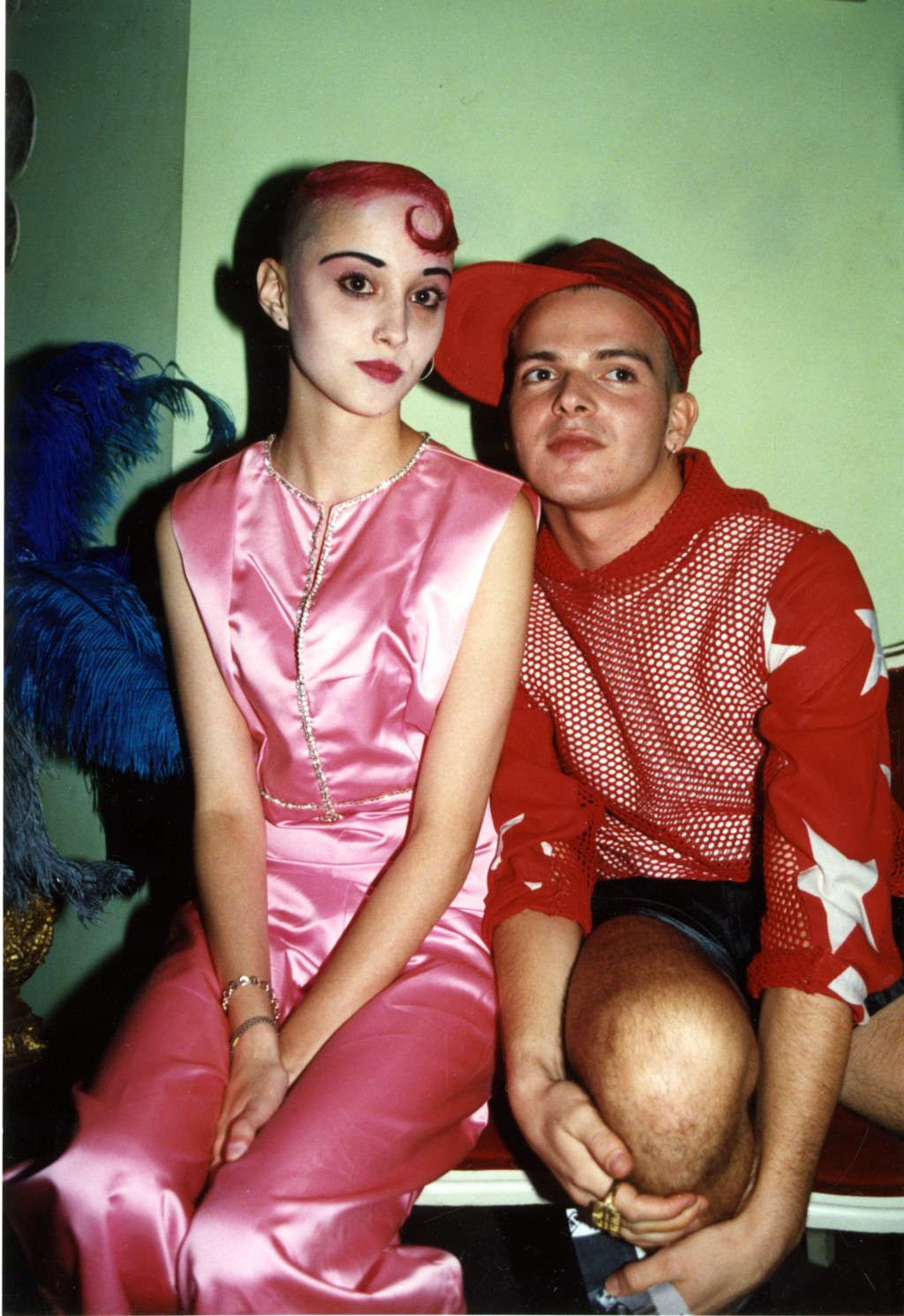
left to right: Anna and Kayvon Zand at the Box, photo by Victor Corona; Pebbles and Christopher Amazing, photo courtesy of the Alexis DiBiasio Collection and Ernie Glam

VC: So you made the jump from the classroom to actually producing and curating the dance floor at your Loft party. I need to go! It’s lovely that this nexus of manifestations has emerged. It has happened with some of my students too. But as always, there are naysayers, so as Venus Xtravaganza said in Paris Is Burning, “Let’s talk about reading,” as in the art of deftly criticizing and insulting someone. Have other writers ever tried to read you and dismiss your work as frivolous or unimportant? “Oh, so you write about parties?” And the like? Our students actually enjoy nightlife quite a bit, unlike our beige colleagues. Teaching about it can make for popular classes, which colleagues easily resent. At Columbia, for example, sociology has mostly become an arm of public policy. Although the school is in New York, they ignore so much of its urban energies and students’ love of downtown culture.

TL: Well, one author of a disco book, who shall remain nameless, misread, pilfered and used against me one of the underpinning arguments of Love Saves the Day, which was that no seamless distinction could be drawn between the underground and the mainstream. I’m sure no malice was intended, but it hurt a great deal at the time. That’s how academia can sometimes work, with colleagues jostling to come up with original arguments in order to get published and the rest of it. As for students and what they want to study, yes, absolutely, they want to study things that interest them, although in the UK the idea of studying for the sake of gaining knowledge is now pretty much a thing of the past, with education very utilitarian and becoming a productive worker. It means that many traditional humanities subjects are struggling for numbers, even though those subjects provide students with skills that are essential to many careers. The upside is that more and more students are applying for degrees in the performing arts, including music, so I’ve switched from teaching Cultural Studies to teaching Music. But the content of my lectures hasn’t really changed, plus the current cohort of students is more politically and culturally savvy than any I can remember.

Dissipation and Disenchantment: The Writing Life in Argentina in the 1990s

VC: So we have similar issues on both sides of the Atlantic then. Sad to hear, although there are brilliant adaptive strategies like your move to teach Music. Now I’m curious about the shady, pilfering writer you mentioned. I always tell my students, “If you’re going to write, tell the story that only you can tell.” Maybe that applies to nightlife as well, throw the party that only you can throw. Lately, though, I have been asking promoters about how the moods of their parties have changed since Trump’s election. They mention escapism and release, which can really be a double-edged sword. The need to experience something outside of our sad reality can foster wild creativity, dance floor energy, and cultural innovation, but also devolve into excess and danger. What have you noticed in the aftermath of Brexit? Will the results of the very recent election have an impact?

TL: Brexit was felt very deeply by just about everyone who lives in a city and is under the age of 65, so pretty much the entirety of the nightlife demographic. Huge numbers of EU citizens also live and work in cities such as London and Manchester, so the thought that they could be made to leave, or that new arrivals could be prohibited from entering in the future, was pretty devastating within the party scene. It felt like the Leave camp was perfectly happy to rip the soul out of a city such as London, and for what? Some arcane and ultimately unachievable idea of nationalism? Then again, and much as it pains me to say this, there was also something important about the vote, which in many respects was an anti-establishment vote. Successive Conservative and Labour governments had neglected to take care of the displaced working-class poor, and they’d also presided over a totally insane period of property price inflation that, in a very different way, also threatened to dismantle the soul of the city. The response of the Labour Party’s grassroots membership was to elect an improbable leader, Jeremy Corbyn, a principled leftist who’d never craved a position in the government, never mind become the country’s prime minister — effectively our Bernie Sanders, but with a clearer track record of fighting for the rights of ethnic communities and people of colour. The entire political establishment (including the mainstream parliamentary Labour Party) sought to ridicule him, sideline him, destroy him, but having started as a 2001- outsider he went on to win the Labour leadership contest and then successfully defended his position when challenged. The attempt to stop Corbyn and the grassroots movement that gathered around him culminated when Theresa May called an election to win what she and just about every political commentator in the country assumed would be a landslide Conservative majority, a hard Brexit, and the end of the Labour Party as a political (and certainly radical) force. Instead Corbyn ran an inspirational campaign, Labour gained a significant number of seats, May lost her majority and her authority, and talk of a hard Brexit is now more or less dead. Young people were fundamental to Labour’s success, with the grime scene particularly vocal in its support for Corbyn, although to be honest the mobilization of young people was pretty sweeping — so, yes, there’s also a direct correlation between the party scene and the party scene. It’s been a totally astonishing period and gives real hope to those who want to live in a society that’s affordable and organized according to cooperative/communal values rather than competitive/individualistic values.

“The need to experience something outside of our sad reality can foster wild creativity, dance floor energy, and cultural innovation, but also devolve into excess and danger.”

VC: Exploring the political links between the party scenes would be an amazing tangent and certainly a great panel. Let’s do one the next time you’re in New York? If social release and political consciousness may arise from nightlife, what about its occupational hazards, for participants and participant-observers like us? After one too many sips of vodka, I once tumbled off the stage at The Box while dancing — with the owner, a former student, and Lindsay Lohan in the audience. I was so mortified I walked right out. How do we teach, document, analyze, and even celebrate nightlife while also being honest and responsible about its dangers?

TL: That’s a funny story, although to be honest I don’t see nightlife as being dangerous. It’s sad when stories come through of kids dying from drugs, but the numbers involved are infinitesimal compared to the number of people of all ages who die from alcohol consumption, never mind smoking cigarettes. My impression is that the overwhelming majority of partygoers go out to be part of a community and let their hair down. If they take something it’s mainly to help them relax and get into a different space rather than to get high. If they just wanted to get high they’d stay at home. But then all these overblown and highly ideological myths — ideological because they increase the pressure on authorities to close down parties, either to get people to behave in a more conformist way, or to increase real estate prices, etc — fly around. Do you disagree?

“My impression is that the overwhelming majority of partygoers go out to be part of a community and let their hair down…If they just wanted to get high they’d stay at home.”

VC: I agree and definitely don’t mean to pathologize nightlife. When students ask me about drugs I always say that it’s totally possible to really enjoy everything that nightlife has to offer without getting high. And in addition to your points about conformism and gentrification, more and more in New York we hear about noise complaints. So it’s scary to think about neighborhoods like the East Village or Lower East Side becoming empty, dead spaces at night. Again, so much more to be said. It occurs to me that the only sad part about this chat is the recognition that we haven’t partied together yet! Can we turn up the next time you’re in New York?

TL: I’d love to!

A Very Odd Occurrence of Birds

Continue reading Episode 5: The Monster at Green Lake
Previous episode: Episode 3: The Secret Song

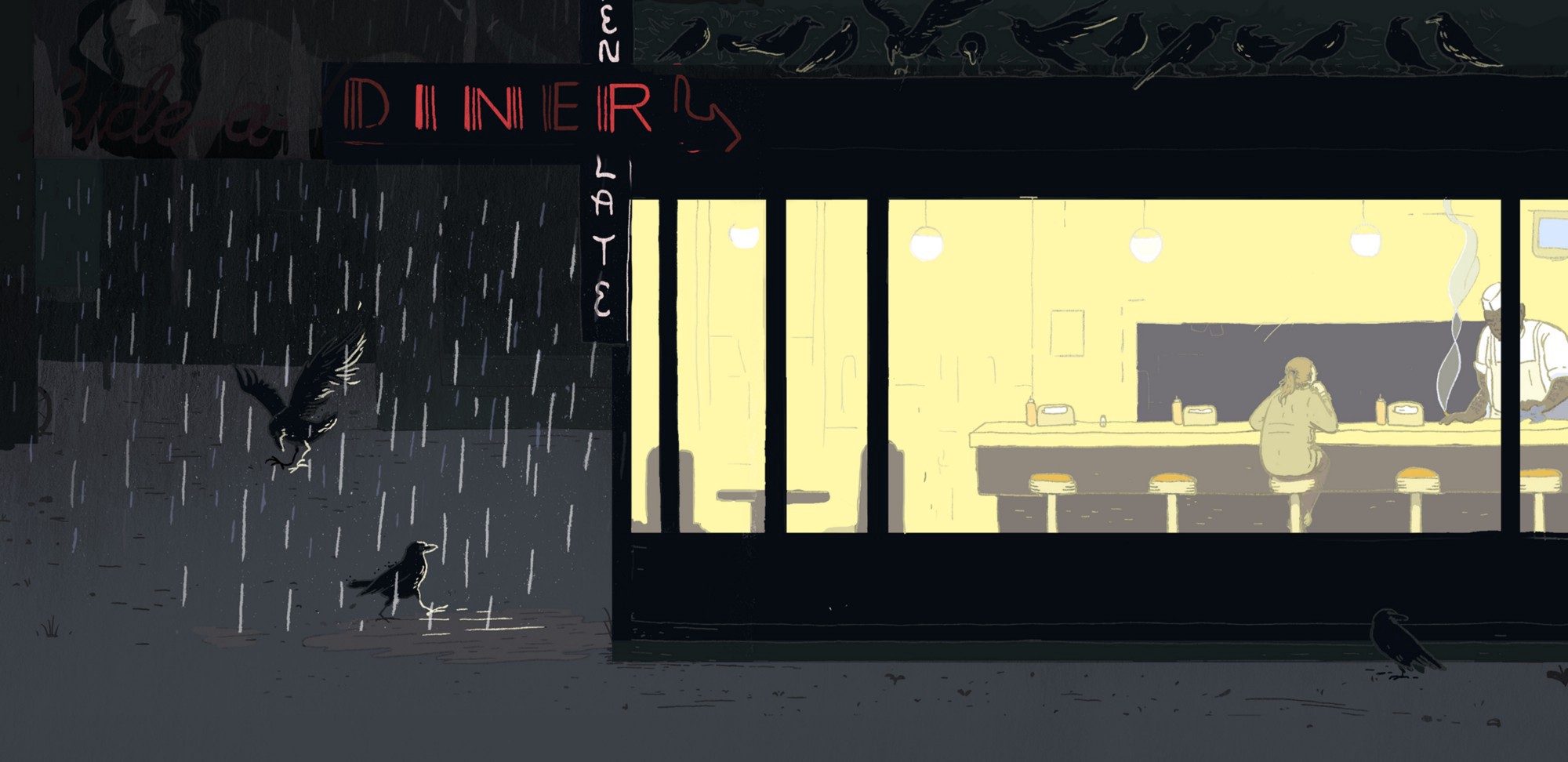
An ankle. A bare neck. Two wrists lying unprotected on the handlebars. An explosion of wings and warped feathers. Several birds had appeared from nowhere — grackles, she thought at first, though in the dark she couldn’t be sure — 20 or 30 of them scattered across the empty highway. The sound of their voices was metallic, like broken windup toys. Shelley paused to cover her ears, standing her bicycle on the side of the road.

Up ahead, in the center of the one-lane highway, were three small deer, dead — all fawns — plowed down by a lumber truck most probably. The birds had set upon them, picking at their limbs and fur.

She had seen this before, more than once — a doe and both of its fawns lying along the side of the road, looking like they were alive, frozen in midstride. The semis that hauled lumber from the nearby mill seemed unconcerned with the surrounding wildlife that darted back and forth across the road.

When Shelley was 11 or 12 years old, she would put on a show of burying the animals she found, once even going so far as to erect a white-and-pink cross for a slain rabbit she’d discovered, but as soon as her grandmother found out, she swatted Shelley on the behind and told her not to play near the highway.

Shelley now tried to push past, but the birds, with their flapping wings and sharp beaks, were unmovable, pecking indiscriminately at her ankles and feet.

Although she loved animals, and birds especially, she was terrified of them in groups of more than two.

Shelley shouted and began to stomp her feet beside where a formation of birds had gathered upon the smallest fawn. She unzipped her nylon windbreaker and swung it back and forth until the birds reassembled nearby. When they had gone, she leaned over and took the fawn by the rear hoof and quickly dragged it onto the side of the road.

At this time of year, almost all animals were motherless.

Once she had put all three fawns down in the culvert, where the brambles would keep most of the birds away, Shelley went back to where her bicycle was standing, found the blue shoe box containing Mr. Peepers, and quietly placed it beside the ditch.

She stood there, thinking she should say something but not knowing what to say. Shelley remembered her grandmother’s story from earlier that evening and began to speak, having heard it countless times before.

Once upon a time, there was a wily fox who could play the fiddle. And the fox, he would play his song and lure all the birds into the woods, and then he’d gobble them up. And then, one night, the woodsman decided he had to save his birds. He waited and waited in the dark. And then, from out of nowhere, the saddest song you ever heard began to rise from the woods, and the song sounded just like the soft voice of the woodsman’s pretty wife, who had drowned in the well a year before, and the woodsman dropped his axe and could hear the high-pitched laughter of that wily fox. But the woodsman, he never lost heart. He called out to his wife and said, “Agnes, Agnes, if you ever loved me, send down a star to light my way,” and just then, a star came falling from the sky and lit a path home.

Shelley knelt down, touched the box once more, and covered everything with as many branches as she could find, placing a large pyramid of sticks on top of the half-hearted cemetery to keep the forest animals away.

She climbed up from the side of the road and started riding again. Shelley began to think she ought to have done something more—placed a mass card or painted a cross for Mr. Peepers—but only after she had pedaled off.


2.Out of the town, eastward, most of the lights in the houses had gone dark.

Shelley looked down at her watch and saw it was almost 9:30. The sky had begun to mist, and with it, a fog rolled out from the trees. Above, the clouds looked treacherous, uneven.

She could smell the wet aluminum and tin of the junkyard from a quarter-mile away. When she arrived at its looming sheet-metal gates, Shelley saw a strange overhang created by its faded neon sign. She pulled under it and stood her bicycle beside a pile of discarded trash that townspeople left at all odd hours: old refrigerators, parts of a broken oven, car parts. But there were also some toys and dolls, a wagon missing two of its wheels, and a tiny wooden piano. Shelley smiled and knelt down beside the aged instrument. Most of its keys still worked. One side of the piano had been covered with stickers, gold stars.

She tapped at each key with the tip of her finger until she remembered a tune. She began to sing, looking up at the sky.

When the shadows of this life have grown
I’ll fly away
Like a bird from prison bars has flown
I’ll fly away

The gates of the junkyard were locked tight. Not even a 12-year-old would be able to climb over or sneak through, as the top of the fence had been strung up with razor wire. Just to be sure, Shelley gave it a harsh shove. Somewhere at the back of the junkyard, one of the dogs barked.

She called out, “Jamie? Jamie Fay?” And again louder, “Jamie Fay!”

For some reason, Shelley thought of the time when she was six or seven, just before her mother had run off, when she and her grandmother and her mom went down to the Founder’s Day parade and watched the cars and floats pass by. Shelley had sat by the lake with a notebook and her grandmother’s borrowed Polaroid camera, while volunteers once again reenacted the story of the infamous “Monster of the Lake.” She remembered how, even that far back, all she had ever wanted was to see something nobody else had ever gotten to see.

In the dark, Shelley realized what a foolish thing she had been doing, pretending to be someone, something she wasn’t. She knew she would not find the girl, no matter what she had hoped. She sat there in the dark and tried, for her own benefit, not to appear like she was sulking.

A half-hour later, a truck passed by, catching her in its headlight, interrupting her thoughts. She climbed back onto her bicycle and pedaled down the slick road. Up ahead, billboards for the Twilight Motel and Bide-A-While Bar appeared—the billboards themselves suddenly seeming grotesque, the people on them looking like photographs of murder victims, faded, careworn. The signs announcing “See the Hollow Caves” and “Visit the Crystal Waterfalls” were also weathered and faded and depicted families with faces like deformed masks. The girl rode on, the shadows of passing electric poles and buildings making strange, impossible shapes, all becoming crime scenes.

The diner where she worked was just ahead.

She decided to get out of the rain for a while.


3.Inside the diner, Shelley sat across the counter from where the cook was looking up at the black-and-white television set. A news van, with a news reporter, was parked in front of a crowd on Jamie Fay’s street.

The cook was looking up at the television regretfully.

When Shelley sat down, the cook came over to the counter and wiped it down with a greasy-looking red rag. He wore a small paper hat and a white apron. Behind the counter, at this time of night, he was entirely alone.

She realized the cook was the only person she knew in town who was not from there, had not been born there, had arrived entirely on his own. He was dark-complected and had mentioned a mother from the Dominican Republic and a black father in the Marines. Shelley had not thought of it until now, as she was sitting across from the counter, drying off, that he was the only person she had ever laid eyes on in her town who was not exactly like her.

His face looked sad now, almost haggard, as he looked across the counter. “I thought you weren’t supposed to be back up here until tomorrow afternoon.”

She looked up at the clock above the counter and saw it was 9:41 p.m. “Just wanted to be inside, I guess.”

Without having been asked, the cook put a black coffee before her. “You seen the news?” he asked.

She told him she did.

“Do you know that girl? The one from the parade?”

Shelley said so and set down the cup. She observed the tattoos on the cook’s forearms, what her grandmother would knowingly refer to as jailhouse art. One arm, his right, bore a series of faded portraits of old movie stars — Bela Lugosi, Lon Chaney, Boris Karloff, Marilyn Monroe. On his left forearm was a list of names in a gothic font, almost all of them female.

When asked about them several months ago, he said they were his children. Shelley glanced across the counter at the list as the cook lit a cigarette and ashed it in an empty coffee cup.

“Did you ever seen anything like this before?” he asked incredulous, glancing over the black-and-white TV. “One girl goes missing, and the whole town gets turned upside down.”

The cook wiped the clean counter between them as Shelley considered this. “She usually comes in here Friday nights,” he added. “Her and her whole family. Come in and all order dessert.”

Shelley felt herself raise an eyebrow. “But not tonight?” she asked.

“Not tonight. Girl must have wandered off, I guess. I see her after school sometimes. Just walking. Over at the old gas station. In front of the junkyard. Down by the lake. But that don’t mean anything now, does it? Some kids just like to wander.”

“Guess so,” Shelley said.

The cook grinned, taking her empty cup. “First time in a year I haven’t heard you talking up a storm. You sure everything’s all right?”

Shelley shrugged.

“Just thoughtful, huh?” The cook looked over wistfully and asked, “If you could run away somewhere, where would you go?”

“I don’t know,” she said. “I’ve never really thought about it.” Shelley closed her eyes for a few seconds and imagined a room, somewhere not too far away, in Louisville or Indianapolis or Chicago, with a desk and some books on it. Was she going to school in this foreign city, or just working? She felt embarrassed that she could not imagine more. She peered down into her coffee. “What about you? Where would you like to go?”

The cook stared at her and gave a beleaguered grin. “I don’t know. I guess I’d go down to South America. Go somewhere and maybe disappear into the rain forest. Stay there for a while and go explore some other kind of place.”

“That’s my problem,” Shelley said. “Wherever I go, I always end up wanting to be somewhere else.”

“Good for you. That’s how it should be when you’re young.”

For the first time in a while, Shelley thought about the fact that she was as old as her mother was when she had her. Somehow Shelley still felt like a girl. What would it be like to run off? she thought, putting down her coffee cup.

“The thing is, all you need to do is to imagine a place,” the cook said. “The place where you imagine ending up. A place far off from here. Where you can be the person you want to be. Live the kind of life you want to live. Go on. Close your eyes and tell me what you see.”

Shelley closed her eyes. “Okay.”

“What do you see?”

“I don’t know. I can’t see anything.”

“You can’t imagine anything?”

“All I see is an empty room.”

“Ah, so you can see something. Keep looking.”

“Okay. It’s an empty room, far away somewhere. I don’t know, maybe in a city of some kind.”

“It’s the future. You ought to imagine that place and go out and find it.”

She opened her eyes and saw the cook studying her. He stubbed out his cigarette and smiled. “So you’re going back out there?” he asked, seeing that the brief gust of rain had passed.

Shelley put a dollar on the counter and thanked him.

The cook looked at it and smiled and slowly slid it back to her.

Outside, everything looked like summer again. The trees smelled as if they had just gone into bloom, everything becoming soft and translucent. As Shelley rode back toward town, something on a telephone pole caught her eye.

A God’s eye. Then another, on another pole. She stood her bicycle and saw a faint pink-and-red strand of yarn running along the side of the road. A marker, a way to find your way back.

Shelley pedaled furiously, following the strand from pole to pole. Every few feet, it would disappear, and eventually she’d be able to find it again. Every few feet, she saw something had been tied to the string — once a spoon, another time a blurry photograph. On she rode, following the string farther and farther away from town.

Up ahead was a hand-painted billboard for the lake and, beyond that, a low, greenish fog. Before she knew it, the woods beside her had disappeared, and Shelley found she did not recognize anything.


Continue reading Episode 5: The Monster at Green Lake

It’s Not Always Sunny in Stephen Florida

The best character studies are the ones about complicated people, and Stephen Florida, the titularly-named protagonist of Gabe Habash’s debut novel, is about as complicated as a functional person can get. Stephen is troubled — very troubled actually. He is abrasive, crude, and violent. He’s also obsessive and paranoid. There’s something else you should know about him: he’s, thanks to Habash’s mad brilliance, endearing.

“Amidst all of this hardship and sadness, there’s something that’s relatable about Stephen Florida.”

Stephen has a heartbreaking background. As we find out near the opening of Stephen Florida, his parents died in a car crash when he was only 14. He then goes to live with his grandmother, who succumbs to a heart attack before Stephen can reach adulthood. His position in the world is rather pitiful; however, good luck is just around the corner. Stephen, a talented wrestler, gets an offer from Oregsburg College in North Dakota to join the wrestling team, so, naturally, Stephen jumps at the opportunity.

Habash’s decision to give Stephen a difficult upbringing helps establish a layer of empathy that proves itself to be rather elastic as Stephen transitions into the early stages of adulthood at college.

Oregsburg College in North Dakota is where we find Stephen for most of the novel, and it’s here that we first see just how unstable he really is. Wrestling saved him, so he becomes obsessed on keeping his savior at the center of his life — void of any external influences. He tells us early on, “I believe in wrestling, and I believe in the United States of America.” He frequently declares his intentions to win the Division IV NCAA Championship in the 133 weight class, and he reminds us just how important it is to him to take the title:

“Do you believe me when I say I think about it every day, every hour, at least twenty times an hour?”

It’s as if he’s so consumed with clinging to the thing that redeemed him that he can’t see anything (or anyone) else as having any importance in his life, which is especially apparent with his cold interactions with Mary Beth, his girlfriend, and Linus, his friend and teammate.

After Stephen gets injured in his senior year and has to be sidelined, his obsession with wrestling transforms into full-blown paranoia. Stephen begins to fall apart, and we see this by his various interactions. He rambles for pages, oftentimes without paragraphs and with only sporadic punctuation, about things that appear to have little, if any, connection. In one riff, Stephen describes his regrets:

“Here’s what I regret: that I didn’t win every time I wrestled, that too many losses have already happened, that I didn’t pledge to wrestling earlier in life, that I’ll never know how much better and faster I could have been, that I never had any brothers or sisters, that I won’t ever be as strong going right as I am going left, that I wasted so much time wrestling not to lose, that I was too eager and fell right into Derrick Ebersole’s duck, that at regionals I shouldn’t have tried to grab Chris Gomez’s right ankle and I let him out and I couldn’t get him back down and that was it, that my grandma had the stroke, that I couldn’t do better on my SAT, that I’ve forgotten sometimes how to be mean, that I couldn’t hold the near-side bar, that I don’t remember what my grandpa looked like without the help of a picture, that years ago the ice was where it was and the road curved where it did and the other car was where it was and that the other driver had to go, too, and also that I sent that kid to the hospital by himself, that his parents hadn’t ridden in the back of the ambulance and there was no audience to cry over him.”

And just as he finishes, he cycles through another long exchange of nonsense about things he’s thankful for, which ranges from personal motivation to not having spina bifida.

The novel’s structure becomes totally chaotic, matching Stephen’s state of mind as he loses any semblance of reality. And this style works brilliantly. The story reads as a confessional — like a diary that’s had its lock ripped off of it and the pages written in blood.

Earning a Spot in the Neighborhood

Stephen completely loses it. He hides in bathrooms. He spies on people. He makes up all kinds of lies, which he might even possibly (and probably) believe. He becomes totally reckless. In a startling admittance, Stephen declares, “For many hours, I meditate on failure.” He considers suicide — and wonders even if he is, in fact, a real person. At one point, he says, “There is no real Stephen Florida. I am only a giant collection of gas and light and will.”

Amidst all of this hardship and sadness, there’s something that’s relatable about Stephen Florida. After all, he’s a young person who’s had a rough journey, and he’s trying to find his way. There’s hope for him just as there’s hope for all of us. As unlikeable as Stephen can get, he finds redemption, and there’s a real beauty in that. Habash makes us root for Stephen, and this achievement has to be celebrated.

Stephen Florida is hard to classify. Yes, it’s an intense character study, but it’s also a fierce and ambitious horror novel, exploring the very real dangers we try to keep at bay in so many of our seemingly harmless obsessions. There are scenes so remarkably dark that I had to put the book away. There’s anger in these pages — and there’s pain. The atmosphere, cold but simultaneously sweaty, makes everything click with a steady, yet animalistic precision.

Some readers might argue that Habash’s debut is overlong or overripe with intensity. Perhaps it is, but the raw grittiness contained in these pages is part of what makes the book feel so accomplished. Gabe Habash’s Stephen Florida is dizzying, dazzling, and, ultimately, divine.

If You Want to Hear America Singing, Try the Walmart Parking Lot

Scott McClanahan on celebrating a forgotten segment of the country and telling the literary establishment where it can go

Walmart in Pecos, TX. Photo by Becky Lai, via Flickr.

The character of Scott McClanahan is always fucking up. He drives drunk and wants to get caught. He concocts elaborate fantasies of being hauled off to jail, begging for forgiveness from his weeping wife. But he can’t even do that — after he gets pulled over, he doesn’t get arrested. He burns a bible and waits for God to make him pay for his atrocious sin, but nothing happens. He tries to kill himself with gobs of Tylenol but, you guessed it, nothing happens.

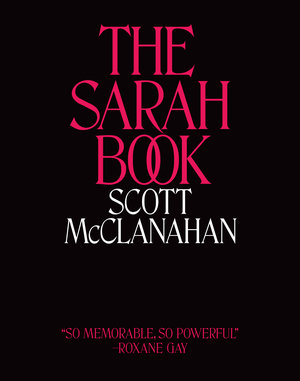
This is the Scott McClanahan of The Sarah Book — a guy who can’t even get a DUI in West Virginia. A guy who can’t even kill himself. But, of course, that only tells half (maybe less?) of the story. McClanahan’s newest book, which may be his best yet, is truly a breathtaking and brilliant piece of literature. In it, he not only lays himself bare, but also America. McClanahan’s wife leaves him and he decides to live in the Walmart parking lot. There, he can be among his people; the drug dealers, the amputees, the freaks, the forgotten. Scott’s book is beautiful and holy because he gives space to a people and culture that literature has forgotten about. Who literature has deemed unfit for its pages, who publishers insist don’t buy books and aren’t worthy of art. He tells stories about balls of wax and eating chicken wings and masturbating in his car.

In an America where the white working-class have been blamed for a Trump presidency when the reality is that the wealthy suburbs elected him, McClanahan’s book feels even more necessary. This book will break you, there’s no doubt. But if you’re lucky, it will also baptize you. Scott is a prophet who sees the vitality in the mundane and insists you do, too.

Nicholas Rys: I’d love for you to talk to me about your love of Walmart. What does it represent to you or for you?

Scott McClanahan: It’s everything really. I think Whitman would have understood it. Blake would have figured it out. It’s the pure wild product of America going crazy, right? Maybe it’s the molested kid in me, but I can enjoy anything if I just try. It seems like all anyone does about anything anymore is complain and tell you why this is bad and that is bad. And Walmart is horrible and evil in a number of ways but that’s why it’s beautiful too. This is what you gave me, but I’m going to celebrate it. It’s that old notion that Tolstoy used to go on about. We have the enlightenment, the scientific method, and rationality and there are people who still believe in fairies. I think that’s amazing. But what can you do? As far as I’m concerned life is nothing but a tragedy with a happy ending to look forward to.

Rys: Your writing really is concerned with examining yourself and your experiences. I’m curious if you write about things in your life as they are happening or if you wait and write with hindsight?

McClanahan: Both. But most of it I just make up. I’m a fiction writer with an upper-case F. I make up more than a sci-fi writer to be honest. I’ve never understood that idea that you need distance from something to write about something. Bunny Wilson’s journals are amazing because he’s taking it all down as it’s happening. I’m not a fan of Cheever but I wish he could have written his fiction like his journals. All books wind up with a final reader, though. So there’s no use in worrying about it too much. You know that anecdote about the writer who is going through the used bookstore and they see their long out of print book. The writer gets excited and pulls it from the shelf and opens it up. What does the writer see? A dedication and the writer’s signature. To Mom and Dad. Thanks for everything. Of course, the writer’s parents are still BOTH alive. So there’s nothing to do then but shut the book and put it back on the shelf. That’s how we treat books. So why does it really matter? Our families are just going to end up taking our books down to the used bookstore anyway.

Rys: I absolutely love the opening chapter of this book. I think if I could distill the book into a few pages I’d probably pick the first few. Did you always know this would be the first chapter of the book or did it take some figuring out?

McClanahan: No, I’ve had that first chapter since about 2015. I knew as soon as I wrote it that it would be the one to punch the reader in the face with. It felt like the opening to Goodfellas or something. I’m so tired of the way novels open up with those 19th century, New Yorker framing devices like this is “the story” and this is my name and this is where I’m from. Most of these novels should just be titled Exposition. I wanted to blow all of that up. I wanted to punch the reader in the face. Literally punch them in the face. I needed a first chapter to present the book as a big picked scab from some sacred wound (which is what the book is). After a friend read it, they said, “You can’t show this to anyone.” It felt dangerous. So much writing now feels like an apology or something. Like a “I’m sorry I exist, but here is my story.” “I’m sorry I may not have the proper socio-political worldview, but I’m trying really hard to have the proper opinions.” I’m not trying. I apologize for nothing.

So much writing now feels like an apology or something. Like a ‘I’m sorry I exist, but here is my story.’ ‘I’m sorry I may not have the proper socio-political worldview, but I’m trying really hard to have the proper opinions.’ I’m not trying. I apologize for nothing.

Rys: I noticed a recurring theme throughout the book of the Scott character always wanting to get caught. A desire that never really comes to fruition in the manner sought out. I think about that opening chapter with the fantasies of the cop hauling you off to jail and crying to Sarah, or the burning of the bible not bringing forth any satanic consequences — there is this hoping for a catharsis in tragedy, (arguably the biggest cliché in memoir/nonfiction writing, or any writing, for that matter) but it never happens. Things just continue on and oh man does that feel like life.

McClanahan: I’ve been reading Solzhenitsyn’s Gulag Archipelago for the past few days. He talks about how it was a relief for people to get arrested. It was the individuals who lived their life in hiding or under constant paranoia of arrest that cracked up or died. Once, you were arrested you felt a sense of almost joy. And I think that’s life in a number of ways. We’re wanting to get caught. We’re desperately in need of being caught because there is no confession without absolution. It reassures us that there is order in the world and that a deity of some sort exists. It’s why social media is so obsessed with “issues” now. It’s a way to make sense of the chaos of this world. The truth of politics from century to century is you just trade one shitty set of problems for the next and it’s never ending. Imagine the problems we’re going to have with lithium-ion batteries or “green technology” in the future. You know people have to mine the materials to make those batteries. But that’s chaos and chaos is devastating.

My books are full of chaos though and I never try to comment on it. I re-read the Brontës this spring and that was what was so refreshing about Emily (in comparison to some Charlotte and quite a bit of Anne). She doesn’t tell you why Heathcliff does something. She doesn’t condemn. She just presents. And that’s problematic. And that’s why Heathcliff and Cathy will still be fascinating and troubling a hundred years from now if anyone is still alive to read about them.

Author Scott McClanahan

Rys: I read somewhere that you are a daily, compulsive writer. I was wondering what your reading habits are, and if they are as compulsive?

McClanahan: Oh for sure. That’s all I want to do really. It’s like that old Dean Martin, “I don’t drink much anymore. I just freeze it and eat it like a popsicle.” That’s my reading life. It’s much more important to me than writing or anything stupid like that. I’ve made the books I’ve made because I had to. Not to get on a big press or to write one just because I had a second book on my contract. I just read Lizzy Goodman’s Meet Me in the Bathroom and there’s a section in there where one of the bands is meeting with a record company and they realize that no one there really LOVES music. It’s just a job. But that’s the way with any business. I’ve been reading all the French Romantic novelists this summer because I’ve only read Dumas’ Count of Monte Cristo. But they’ve been blowing me away. Hugo’s Les Miserables is so fucking amazing. I don’t know what I was thinking or why I was so stupid. I guess it was the musical that turned me off. I’ve also been reading a ton of books off David Shields favorite book list. One of the best book lists around. Here it is. I’m also going to read the Icelandic Sagas next because my friend Chris Dankland likes them.

Rys: I know you really like biographies — and I know you did the Daniel Johnston graphic novel, but is writing a full-on biography something you would want to do, or do you think your literary output will always concern your life or the autobiographical?

McClanahan: No, I think this is going to be the last book like this for a while. I hate most third person writing though. It just feels made up to me. I’m a snob that way. Oh you went to Sarah Lawrence or Columbia and you had really nice parents and you grew up in the suburbs and you have no anecdotes whatsoever to entertain me when I’m standing right in front of you, but I’m going to believe in the power of your imagination. Okay. Whatever.

At the same time, I’m totally full of it though because I’m interested in third person too. It’s my psycho-biography idea. Telling another “real” person’s story where I can just disappear. Like an update on Plutarch, but with a friend or my parents or my family stories. Maybe that’s the direction now. Of course, it’s pretty funny that the whole “author is dead” idea was thought up by an author. There’s an irony in that.

Rys: So your Daniel Johnston graphic novel got a lot of attention from some major outlets. Although your work is no stranger to critical love, I wanted to ask if you’ve gone through the process of being courted by a major press, and if you have any intentions or interest in signing with one?

McClanahan: I AM on a major press. It would be like being in the Replacements and wanting to hang out with some corporate rock band at some fancy, boring NY literary party where everyone is drinking out of tall glasses. I’d rather hang with Alex Chilton. Fuck the James Taylors and Carly Simons of the world. So I have that taken care of. Maybe if I wanted to win fellowships to go live in the woods or grants I’d do that. I already live in the woods so why would I need a residency to spend a month in the woods. However, I DO want to be the first person to win a MacArthur grant and spend it all on candy. A million dollars worth of candy. It would be amazing. I guess I’ve just always been interested in those editors who work on the outside. Like a Barney Rosset or a James Laughlin. Those who had vision and the rarest talent of all which is taste: Giancarlo Ditrapano is that. He’s my pirate. Even Gian’s shadow has personality. It would be easier to travel first class, but it sure wouldn’t be as much fun attacking the ships on the open sea with Gian and stealing all the loot.

I’m getting a gold tooth next week.

Donald Ray Pollock’s Gothic Hillbilly Noir

Rys: I want to ask you about a passage towards the end of the book. You are reading a children’s book to your kids called There’s a Monster at the End of this Book. To recap quickly, it’s a book where Grover of Sesame Street keeps warning the reader that there is a monster at the end of the book and to not turn the page, and yet of course, we turn the page. I love this section and find it to reflect one our deepest impulses — from Eve and the apple to this children’s book, we are always pulled to what we shouldn’t. I wanted to ask you about this and how this passage made its way into this book.

McClanahan: Oh I’ve had that for years. I want to say it’s been in other books and Gian has edited it out. Books are just broken down cars. You have a bunch of parts for this car that won’t fit and then finally you put it in your Chevy Nova and it roars. I just loved the idea of putting a book inside of my book. I think we cut one of the best lines, but maybe it’s implied. The monster at the end of every book is you and me. I think that There’s a Monster at the End of this Book is as powerful as any children’s lit: Barrie or the Little Prince or Dahl or whoever.

“The monster at the end of every book is you and me.”

Rys: From Walmart to stories of ear wax being pulled from the ear of an old man, you constantly are elevating the mundane or things from daily life or things that usually aren’t granted space in a (capital “n”) Novel. You insist that we pay attention to these things and places and people, and I think that’s very important. Is this a deliberate choice or do you just find yourself fascinated by these things?

McClanahan: Those things don’t feel mundane to me at all. They feel vital. If you live for years thinking that you’re deaf and then a nurse just discovers that your ears are clogged with ear wax — then that event is almost like a resurrection story or a creation hymn almost. It’s a miracle story. The problem with most books is we’ve turned them into fine art. Everyone is trying to make art with their literary historical novels or post 9–11 novels and that’s why books feel well-written, well-crafted, but utterly devoid of anything human. Like ballet almost.

Do you know the story about Faulkner and the snooty old lady in Oxford? She buys one of his books and asks him to sign it. She asks him if he thinks she’ll like it and Faulkner says, “You’ll love it mam. It’s nothing but cheap trash.” Trash is holy though. The stuff most people would throw away in order to appear civilized is the stuff you can live off of for days. Ask any bum or dumpster diver.

Rys: I live in a small town in Southwestern Ohio there’s a part about half way through the book where you describe fast food signs as monuments and I found such incredible truth in that. I wanted to ask why you think big corporations like Walmart and McDonalds dominate small town consciousness.

McClanahan: I don’t know. To have a horror of the bourgeois is so bourgeois. Is there any more gentrified behavior than to talk about gentrification? Sure as hell wish they could send some gentrification West Virginia’s way. My wife Julia wants a Whole Foods.

I guess my whole point is that I come from a nothing people who were branded as in-bred and stupid in order for a company to steal their natural resources. I mean how many think pieces have you seen about Trump country and West Virginia when the Trump votes for this entire state only equals the Trump votes of any one SINGLE major county in California. But then again it’s our fault. I say fuck you to that. But when you’re given nothing like fast food culture you try to understand that nothing and celebrate that nothing. You rely on that nothing. Most people I know just want to change things. It even seems like writers are asking how they can change society through their work like some shitty Naturalist writer sitting at the feet of Zola. I don’t want to change the people I write about in West Virginia. I want to love them, which is the only way to change anything. Loving something.

“To have a horror of the bourgeois is so bourgeois. Is there any more gentrified behavior than to talk about gentrification? Sure as hell wish they could send some gentrification West Virginia’s way.”

Rys: Can you share what you are working on now?

McClanahan: I’m working on a book called Vandalia. I don’t have a word written yet, but I have a title. It’s an old title of Gian’s that he wrote down as a possible title for Hill William. I don’t even know what the title means yet, but I’m going to take the next ten years to find out. I sort of wish technology would catch up though. There’s no reason there shouldn’t be books with in-text music and visuals and movie clips. A real fusion of all the art forms to make a new one. I want to be the D.W. Griffith of this new form. It’s going to happen.

Jane Austen Letter Reveals the Author’s Guilty Pleasure — Yes, It’s a Kind of Book

Plus this decade’s Little Women squad is officially assembling

The Persuasion author, just killing time between Gothic melodramas.

It’s a gloomy, rainy day in New York City, which means we’ve searched the nooks and crannies of the internet to find all the best literary news. In today’s roundup, an auctioned Jane Austen letter reveals her guilty reading pleasure, telephone booths in Times Square share oral histories of the city’s immigrants, a lost Maurice Sendak picture book has been found, and a new Little Women adaptation will be coming to TV screens soon.

Jane Austen Was a Little More Goth Than Previously Suspected

According to a newly found letter, Jane Austen may have had a weakness for the Gothic novels her own work mercilessly mocked. Austen’s Northanger Abbey clearly pokes fun at the dramatic tendencies and themes of Gothic literature; yet, Austen may not have been as critical of the genre as the novel implies. A letter to her niece — written as a note to the author, Rachel Hunter, whose book the two had recently read — both parodies and praises the style and happenings of the story. The letter was clearly written with comic intent, but it also tells us that Austen was still reading these melodramatic, Gothic texts even a decade after publishing Northanger Abbey. The letter is being auctioned off by members of the British writer’s family on July 11th alongside two other correspondences between the two women — all selling for as much as £162,000. Like most of us, it seems Austen sometimes just couldn’t resist a good ol’ trashy novel.

[The Guardian/Danuta Kean]

Phone Booths in Times Square Now Sharing Immigrants’ Stories

To offer a respite from the maelstrom that is Times Square — with its blinding lights, aggressive costumed characters, and angry New Yorkers scurrying to get to work on time — a new art installation is prompting visitors and residents to duck into a phone booth and listen to some real New York stories. Three repurposed telephone booths have been placed in Duffy Square (between 45th and 47th streets) by Times Square Arts, a public program of the Times Square Alliance, allowing people to step in, close the doors, and simply listen. (And for those who like to read, each booth also includes a ‘phone book’ laying out the backstory of the city’s various immigrant communities.) Titled “Once Upon a Place,” the project documents 70 immigrant histories in the form of oral storytelling. Their placement within Times Square is explained by the iconic location’s inherently visible, international nature. The art installation’s creator, Aman Mojadidi, expressed the difficulty he had in collecting stories given the country’s current political climate, especially regarding immigration. Despite these troubles, eventually Mojadidi was able to successfully document the journeys of New Yorkers from a wide range of countries. The installation will be up until September 5th, urging people to stop and take a listen to the often unheard stories that make up New York City.

[New York Times/Tamara Best]

New York City, Seen Through Its Bodegas

Unpublished Maurice Sendak Picture Book Unearthed

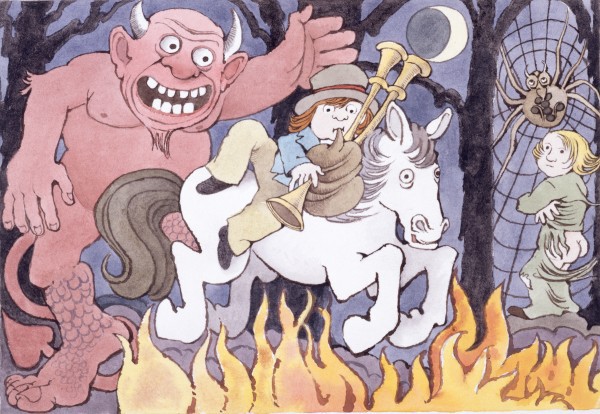
Five years after Where the Wild Things Are author Maurice Sendak’s death, an unpublished picture book has been found in his archives. Titled Presto and Zesto in Limboland, the work was unearthed in Connecticut by Lynn Caponera, president of the Maurice Sendak Foundation, who promptly sent a copy to Sendak’s editor, Michael di Capua. The book appears to be a kind of inside joke between its co-authors, Sendak and his frequent collaborator, Arthur Yorkinks. The text references the pair’s nicknames for each other: Yorinks was Presto, and Sendak was Zesto. The illustrations were created in 1990 as additions to the London Symphony Orchestra’s performance of a composition that set Czech nursery rhymes to music. Although it was forgotten for many years while other projects were on the front-burner, Yorinks said that “the memory of writing it originally flooded back in a wonderful kind of way. We always had a lot of laughs for two really depressed guys.” Presto and Zesto in Limboland is now set to be published in fall 2018, a fitting homage to the late influential author and illustrator.

[The Guardian/Danuta Kean]

New Little Women Adaptation Coming to BBC and PBS

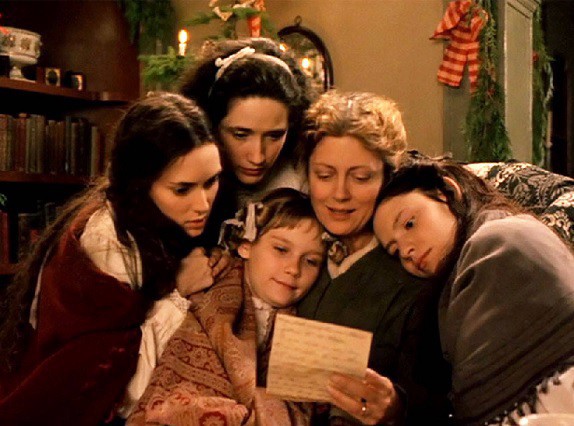
The BBC and PBS know what their fans want, especially when it comes to co-productions. Literary adaptations, cozy mysteries and more literary adaptations. It seems the networks are at it again, this time with the announcement of a new Little Women reboot. Based on the Louisa May Alcott classic, the three-part TV miniseries will be coming to BBC One and Masterpiece on PBS, written by the Academy-Award winning creator of Call the Midwife, Heidi Thomas. Emily Watson is set to play the family’s iconic matriarch, Marmee, while the March sisters will be played by four up-and-coming actresses: Maya Hawke as Jo, Willa Fitzgerald as Meg, Annes Elwy as Beth, and Kathryn Newton in the role of Amy. They have big shoes to fill. Past renditions have included luminaries and budding stars like Winona Ryder, Claire Danes, Elizabeth Taylor, Katherine Hepburn…You get the picture. Fortunately, this iteration’s women will have Angela Lansbury to guide them. Probably best to set your DVRs now, Alcott-heads.

[HuffPost/Claire Fallon]

The Weird World of Selena Chambers

Joshua Ferris Builds Beautiful Machines

Typically, when a writer is said to be stylish, it usually means one of two things. Either they use a lot of modifiers and describe things in ornate, sometimes stultifying language and detail, or they write short sentences. Writing in the second category is often described by critics with the (to me) dreaded “taut” or “spare,” useful designations that alert a prospective reader to a dull time ahead. In some cases, the stylish tag is actually deserved and accurate — one thinks of perhaps Karen Russell and Michael Chabon in the first case, perhaps Cormac McCarthy in the second. An essential extravagance, in one direction or another on the spectrum of descriptive usage, being the shared trait.

But it seems to me that there is a third type of stylishness, one that is not typically regarded as style, if it’s even regarded at all. I’m thinking here about rhetorical stylishness, the elegant use of the tools of language to prosecute an argument in narrative. All narrative, of course, is an argument, of one form another, even if the author is unaware of this fact, or even opposed to it. A paragraph-long description of a flower is not only an attempt to convince a reader of certain aspects of the flower’s appearance — it is yellow, it is beautiful, it smells good or has no smell as all — but on a secondary level is also an argument about the narrator or protagonist, i.e. that they are the kind of person who would spend a paragraph describing a flower.

Even so, some writers incorporate argument and the structure of argument as visible, foreground brushstrokes of their work, rather than background wash. An instructive example of what I’m trying to describe here might be to compare Richard Yates and John Cheever, two writers often thought of as similar, both in terms of subject (alcoholic, post-war suburbia) and style (stylish). But where Cheever was a sensualist, an extravagant writer of the first descriptive order, Yates’ style was essentially rhetorical in its nature, his lean and limpid prose, paragraph by paragraph, tracking his characters’ fatal flaws with merciless efficiency.

For a more contemporary instance, consider Adelle Waldman’s The Love Affairs of Nathaniel P. The book lays out a central question — is the main character an asshole? (the answer: kind of) — and attends to it with what amounts to a novel-length Socratic dialog. Nate’s back and forth, at turns self-critical and self-deceiving, is negotiated with wry skill by Waldman, and it amounts to a structural beauty as stylish in character as taut three-word sentences or ravishing descriptions of Paris in dawn light.

Joshua Ferris, in my opinion, might be considered the most stylish current writer of this persuasion. Then We Came to the End, his first (and I think best) novel, derives its pathetic and satirical force from the simple (yet difficult to execute) choice of writing in first-person plural. In doing so, he channels an office’s interior social life as a shared consciousness, which, in turn, speaks volumes about the simultaneously oppressive and communitarian experience of working daily with other people. When the book switches to third-person, isolating one of the central characters, we understand on a syntactical level, before any plot occurs, that the story has shifted to a liberating, terrible isolation. This is a nifty trick by Ferris: to turn the technical apparatus of perspective into the primary means of communicating his moral concerns about the anomie of modern society.

Ferris’s new collection of short stories, The Dinner Party, continues to showcase this facility, in both the successes and failures of individual pieces. The best story in the book, “The Pilot,” offers a glimpse into the psyche of a young screenwriter, Leonard, who has been invited to a Hollywood party. There, he might pitch his new pilot to industry big-wigs, among them the hostess, with whom he has worked before, and who he is unsure meant to invite him in the first place. The story proceeds on the basis of Leonard’s tortured pre-party rationalizations, which may sound like thin gruel as described, but steadily builds a convincing, and excruciating, portrait of indecision:

He was debating inviting his roommate. On the one hand, he’d have someone to go with. On the other hand, his roommate was a musician, and he trembled before the mystical competition of a musician’s night life. What if he invited him and he said no? His roommate had something going on nearly every night, always more vibrant and exclusive-sounding than the pale thing he had going on, and so he felt it better to withhold the invitation than risk suffering the indignity of rejection, even if that rejection was due to a simple conflict of interest, like preexisting plans, for example. It was hard not to take even conflicts of interest personally. Because what if, for instance, his roommate secretly delighted in having a legitimate conflict of interest because of how little he cared to entertain Leonard’s lesser invitation, even when tonight that “lesser” invitation was to a party at Kate Lotvelt’s? If, that is, that invitation still stood.

Two things here — first, this a very funny piece of writing, and Joshua Ferris is a very funny writer. There is a great deal of comic mileage to be had from pursuing this kind of rhetorical strategy to its far limits. It is a satirical comic style that strikes me as essentially British in character — Waugh and Amis (both, but mainly Kingsley), and even Anthony Powell, were masters of setting up linguistic frameworks in which their characters’ foibles could be batteringly exposed, a comic mode perhaps traceable, like most things, back to Shakespeare, with his dissolutely preening Falstaff.

But in these stories this kind of extended riff is never merely for comic effect, and the joke, in its telling and retelling, tends to expose something more serious, often dire. Leonard, in addition to being insecure, is a recovering alcoholic, and the story’s vacillating surface echoes the contest waged within him between sobriety and drink. Likewise Jack in “A Fair Price,” whose inability to stop talking to a taciturn man he’s hired to help him move — initially the kind of gag that drives cringey, David Brentish scenes in sitcoms — steadily reveals the insecure, dangerous child lurking in his core.

Ferris’s fiction is at its best when, in this way, form follows function — when form is function. In “The Breeze,” another of the best from this collection, a woman’s fear of missing out on her own life is dramatized through dozens of iterations of a potential night out with her boyfriend. They go to the park, have a picnic, have sex in the shadows, have drinks with friends, go home satisfied; they never make it out of the subway; they fight and go separate ways; they try to picnic but it’s too dark and he can’t get it up; they go to a miserable dinner in an Italian restaurant; they go to a movie and go home. The story’s confusing, frustrating structure is the point of the story, as it emulates the main character’s crushing sense of imminent loss, fear of losing an ephemeral moment that she loses exactly because of her inability to choose one thing or another.

The weaker stories in this collection, in turn, tend to lack this kind of rhetorical mechanism and feel somewhat slack in comparison. “A Night Out,” for instance, is, like “The Breeze,” the story of a couple’s potential split, but without the former’s structural focus. The story’s climactic moment is an unconvincing deus ex machina: the cheating husband’s other woman turns out to be a waitress at the restaurant where he takes his in-laws. This might fly if the piece was set in Des Moines — maybe — but not Manhattan. “The Valetudinarian” concerns an elderly Jewish man, recently moved to Florida, whose wife dies, who becomes embroiled in a feud with his neighbor, who has a birthday, who is given a prostitute as a birthday present, who suffers a heart attack, who is rescued by the neighbor, who tries to find the prostitute, who runs from the police, etc. The shaggy doggishness of these pieces is at complete odds with the torqued precision of their better cousins, a precision that, in Ferris’s case, seems almost completely derived by figuring out the proper technical angle at which to approach his material.

A Story About the Volatility of a Codependent Friendship

Even so, the more minor stories are still very funny. Here is Arty Groys, the namesake valetudinarian, dispensing morbid life lessons to his two-year-old granddaughter:

“They don’t give you a manual, Meredith, and who’s going to prepare you if not your Grandpa? I’m not going to go pussyfooting around your bowel movements on account of your young age, because one day you’re going to wake up and wonder why the world perpetuated treacherous lies against such a perfect creature as yourself, and I want you to look back on your old Grandpa and remember him as somebody who told you the truth about what’s in store for you, and not as one of these propagandists for perpetual youth just because right now your constitutionals happen to be nice and firm. Do you know what a constitutional is, Meredith? I will tell you.”

That “I will tell you” is a stroke of comic genius, of which there are many in this book. My personal favorite is in “The Pilot,” when Leonard attempts to conquer his party anxiety, not with alcohol, but by dressing up as Coach Taylor from Friday Night Lights. The image of Leonard walking nervously through an industry-packed Spanish Modern, dressed in a windbreaker and ball cap while chewing a toothpick, is an indelible comic moment on the order of Jim Dixon’s drunken “Merrie England” lecture.

Comedy is itself a rhetorical device, and a joke is an argument in perfect miniature. So there’s a logic in a writer of Ferris’s rhetorical facility having equal facility with humor. But many writers are funny, and what sets Ferris apart is his ethical sense, the way his carefully tooled comedic engines turn larger wheels of moral inquiry. As Jack wonders at the end of “A Fair Price,” a reader’s laughter at the joke of his angry insecurity dying along with Jack’s hired hand: “What does a man do — and I mean a real man, a good man — what does a good man do when he knows he’s done something wrong?”

At its best, Ferris’s comic style mimics in language the faulty thinking of his characters, exposing the way people become caught in their own mental processes like factory workers falling into the teeth of great gears. In doing so, these stories propose better ways to survive and live, to be. That this often produces grisly humor and laughs is a secondary, though extremely welcome, effect.

Ted Wilson Reviews the World: The Fourth of July, 2017

★★★★★

Hello, and welcome to my week-by-week review of the world. Today I am reviewing the Fourth of July, 2017.

How was your Fourth of July? Don’t answer that because I won’t be able hear you. But that’s okay because I already know yours was not nearly as good as mine.

The best thing that happened on the Fourth of July is I got a prank phone call from a woman pretending to be my deceased wife. It was a pretty decent impression bolstered by the fact that I haven’t heard my wife’s voice in several decades. What clued me in that this woman was an impostor was the fact that she didn’t know my name. But for ten wonderful minutes I thought my wife was alive again and it was fantastic. What a feeling!

As the tragedy of losing my wife a second time was about to set in, I was distracted by my neighbor Fran’s prank of setting off several hundred firecrackers on my front porch. When I climbed out from cowering under my kitchen table and saw Fran and his two sons pointing through the window and laughing, I shared in their laughter. He plays pranks like that on me all the time and it keeps me in good spirits.

My Fourth of July was off to a great start and it was only 8 AM. I headed down to the river to get a good seat for the evening’s fireworks display. Arriving 12 hours early really paid off because I had the whole river to myself. Unfortunately around 10 PM I figured out I had the wrong river which is why it was so empty except for a small crowd that had gathered to watch a couple having sex. Everyone celebrates in their own way.

I didn’t miss out on the fireworks entirely, because I had recorded last years televised display, so I just watched that. It was good enough.

As I was drifting off to sleep I imagined how lucky I am to be an American. Then I imagined how lucky I would be to be another nationality in a nation where everyone gets healthcare, and a year off to spend with their newborn, and where a much smaller percentage of the population is imprisoned.

All of this made me sad about America and I began crying, but then I screamed for joy because the doctor said my tears ducts didn’t work anymore because I was so old and had overused them, but it turns out she was wrong!

BEST FEATURE: If you want to fire a gun into the air, it’s a good time to do it without anyone noticing.
WORST FEATURE: A bullet came through my window.

Please join me next week when I’ll be reviewing C.H.U.D.

TED WILSON REVIEWS THE WORLD: SCRABBLE

Reclaiming A Lost Tribal Language: How, and at What Cost?

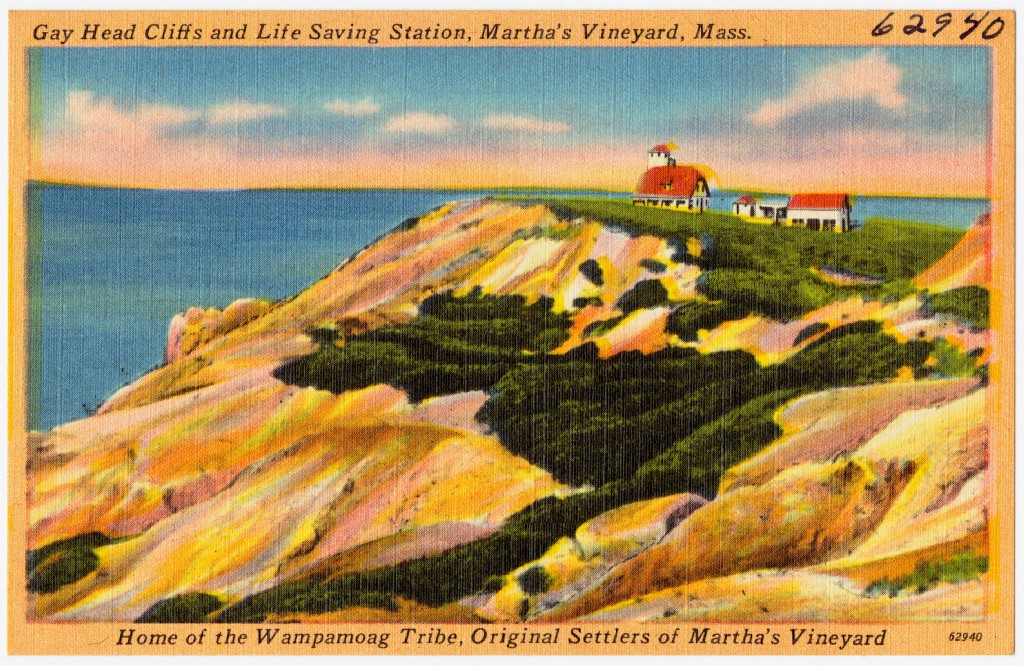
Growing up, I spent summers going to the Turtle Project, which was a camp for Aquinnah Wampanoag kids run by our tribe. Aquinnah is a small town on the far end of Martha’s Vineyard. Every year the island swells with seasonal tourists flocking to its idyllic beaches and picturesque towns. Although I never considered myself a tourist because of my familial and cultural ties to the island, my childhood experiences there mostly matched up with the tourists’.

We would spend all day at the beach or the famous Agricultural Fair in August. For a couple years, a woman named Jessie Little Doe Baird ran the camp. Before Baird took over, we spent our days playing outside and learning about local wildlife. With Baird, we spent most of the beautiful summer days inside, learning Wampanoag language and traditions. I remember one trip we made to a local beach; we were learning how to track animals in the dunes and we weren’t even allowed to go in the water. I don’t know who was responsible for the change, but around this time I remember being irritated that we weren’t supposed to call the Turtle Project a “camp,” because we were there to learn, not just have fun.

We weren’t supposed to call the Turtle Project a ‘camp,’ because we were there to learn, not just have fun.

Baird’s tribe, the Mashpee Wampanoag, and my tribe, the Aquinnah Wampanoag, are sister tribes. Related, but separate. Shared histories, similar customs, but separate governments and individual stories. Geographically too, our tribes are very close. Mashpee, a small town in Cape Cod, is a short boat ride away. Mashpee has one of the biggest East Coast powwows. Each summer, in the height of powwow season, their powwow attracts the best dancers and the biggest crowds. Fireball, a dangerous cleansing ritual performed by playing a game with, well, a fireball, is a legendary highlight of the Mashpee powwow. We have a new powwow organized by our youth group that’s at the tail end of powwow season in September. Local dancers and tourists who happen to be there make up most of the crowd. There is a familial rivalry and closeness between the two tribes. In fact, Baird is married to an Aquinnah Wampanoag — our Medicine Man.

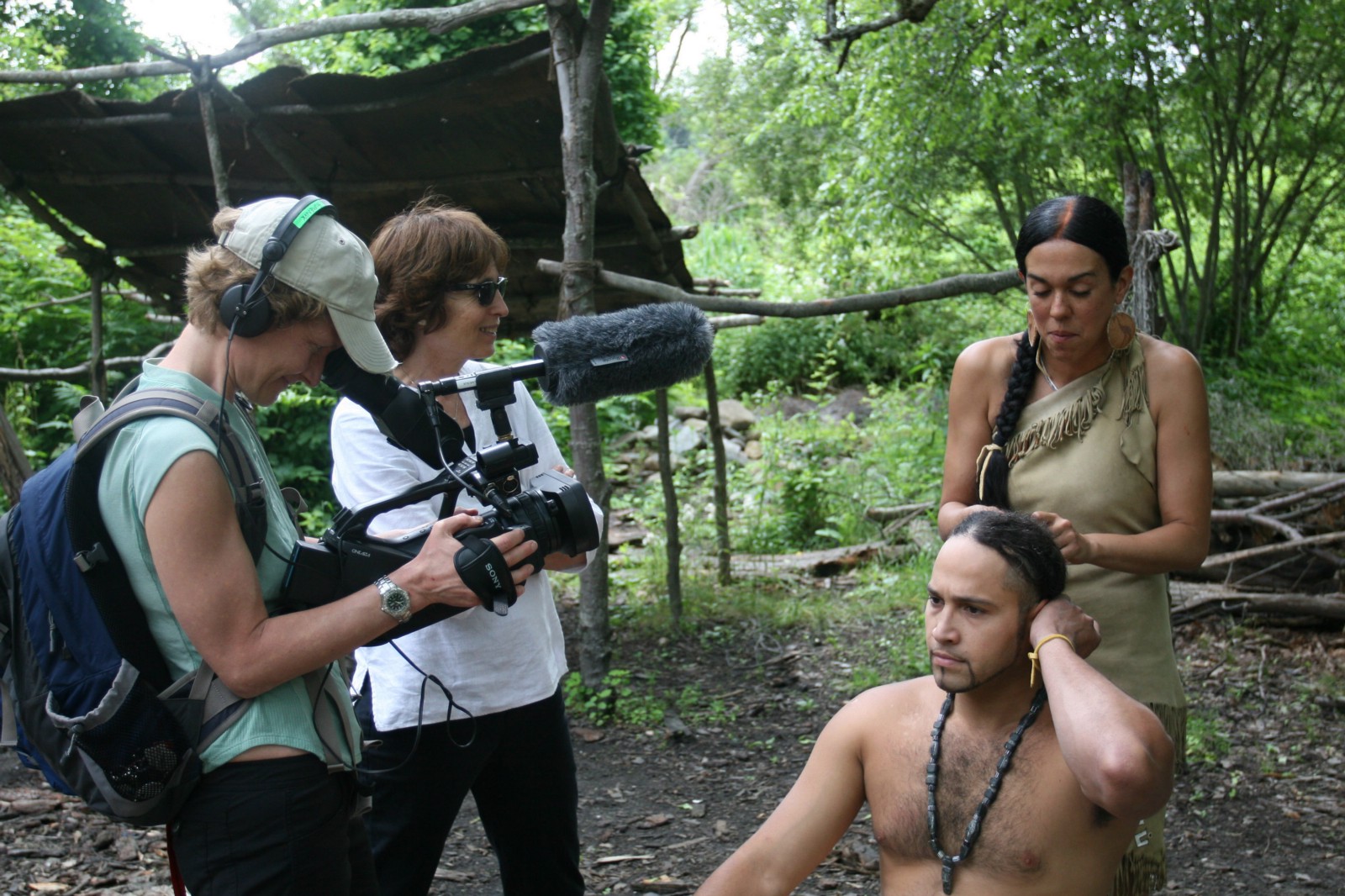
My senior year of high school, I went to see We Still Live Here, a documentary film, with my mom. The film is about Baird’s mission to recover the Wampanoag language, which no one had spoken fluently for generations. Baird was leading the Wampanoag Language Reclamation Project and had received a Master’s degree from MIT to help her do so. The screening, which took place at the Brattle Theatre in Harvard Square, was followed by a Q&A with Baird and its director, Anne Makepeace. My mom and I drove from our home in Newton, where I had grown up, into Cambridge for the event. In the dark Brattle Theatre, there was an older white man sitting next to me. He’d shoot me a dirty look every time I whispered a comment to my mom during the movie. I imagined he was thinking something about disrespectful kids. At the beginning of the Q&A, Baird made a point of thanking the two Wampanoags in the audience — me and my mom. She asked us to stand and I think there was a round of applause for us. After I sat down, the man next to me smiled at me and extended his hand for me to shake. I shook it.

Baird is raising her daughter as the first native speaker of Wampanoag in seven generations. The film devotes a lot of space to this narrative. More advanced students, Baird says, are crucial to the spread and development of the language but there are not nearly enough of them. Her daughter, though, is the great hope. Baird has a line that goes, “if she’s the first [native speaker], there necessarily has to be a second and a third and a fourth.” I never got that. Why does that have to be true? What if she is the first and last? Destiny is a compelling narrative, one that is reinforced by the film’s use of animated words that transform into animals, scenery, or shadowy Wampanoag ancestors. This device makes the film’s story more about destiny and history than any kind of modern narrative. Baird’s motivation for starting to work with the language also speaks to the pervasiveness of the trope that Native culture only exists in the past.

Baird is raising her daughter as the first native speaker of Wampanoag in seven generations.

Baird’s story, which she recounts in the film, began in the early ’90s, when she had a recurring dream. In the dream, she heard people speaking in a language she did not understand or recognize. Eventually, Baird came to realize that they were speaking in her native language, a language no one spoke anymore. Baird went on to found the Wampanoag Language Reclamation Project in the aftermath of that dream, culminating in her enrollment at MIT in the late ’90s.

Later, she was also awarded a MacArthur Foundation Grant, which came with a $500,000 prize. Baird graduated from MIT in 2000, after working closely with Ken Hale, a celebrated linguist. Baird tells a story of the first time they met. He came by the tribe to give a talk. Baird laughs and says that she was quite disrespectful to him, challenging his whiteness and calling him out on a small mistake he made. When she showed up at MIT, she was appalled to learn that Ken was the expert she’d be working with. She went to his office full of trepidation and ready to dump a big fat apology on his desk in the hopes that he would help with her project. Before she could apologize, he welcomed her with, “I’ve been waiting for you.” It’s like a scene from a ninja legend — the aged master, waiting years for the promised apprentice to show up at his doorstep. The movie endows this line with the same kind of mystic power that it gives to Baird’s dreams and her insistence that her daughter is the start of a new generation of native speakers.

I’m especially sensitive to framing Native culture in this way because I know how most people think of us. You’re not a Real Indian unless you are wearing feathers in your hair and beating a drum or hunting buffalo and Using Every Part. The American imagination of Native Americans relies on a few whitewashed historical examples and stereotypes.

Whenever I tell someone about the language project, they almost always ask if I can tell them how to say something. Sometimes I feel like just telling them something that I know will satisfy them, but sharing language with curious strangers feels like giving in to their exoticized image of a Native person. I’m also reluctant to share because I’m embarrassed at how little of the language I know. But even if I could get over those fears, I feel uncomfortable because I don’t really know what I’m allowed to share or not. Baird has often insisted on what I’ve always found to be a confusing level of secrecy about the language. Except for family of tribal members, non-tribal members are not allowed into language classes. I would have thought making a language as accessible as possible would only help its rehabilitation. Yes, Baird explained to me once, but the language is accessible to those who need it. It’s not for anyone else. But then who is the movie for? The broader context for the movie is the reality of how and why people consume Native American cultural narratives.

I know how most people think of us. You’re not a Real Indian unless you are wearing feathers in your hair and beating a drum or hunting buffalo and Using Every Part.

Part of this context is Caleb’s Crossing, the 2011 novel Geraldine Brooks, a bestselling author from Australia, wrote about the first Wampanoag to graduate from Harvard’s 17th century Indian College. Before publication, Brooks sent her manuscript to Baird and another historian in the tribe to look over for cultural accuracy. Baird had done this for other writers, only to be ignored, so she decided not to waste her time. The other historian replied in detail to Brooks about a number of problems, like a story about an Englishman’s toes getting cut off and eaten by his Wampanoag captors. We didn’t actually eat toes, she told her. I also heard that the novel played it fast and loose with the language. Brooks completely ignored these comments. I was outraged. Months later, after the book was already a bestseller, Brooks did a reading at the Aquinnah Town Hall, which was packed for the event. Most of the people who came were non-Tribal town residents but there were a few Tribal members in the audience. One of them stood up to thank Brooks for honoring us with her beautiful depiction of the tribe.

My mom went up to Brooks after the reading and told her that she had some serious reservations about the book. Brooks thanked her for expressing her feelings and moved on to a crowd of fans. I was so proud of my mom for standing up to a famous author, but felt a sense of loss after the talk. Nothing had changed. After listening to my whining for a week or so, my mom told me that if it bothered me so much, maybe I should write my own book about the tribe. She’s right, but I’m almost paralyzed by anxiety over how a book about the tribe could ever be “mine.” This fear is based in my own insecurity about being an authentic tribal member. I don’t know what such a person looks like but I’ve always felt that living mostly off-Island makes me less Wampanoag somehow. But as much as I feel I’m not representative of the typical Tribal member, living off-Island actually makes me more representative than if I didn’t: only about 20% of the tribe lives on Martha’s Vineyard and less than half of those live in Aquinnah. The more I think about it, the more I realize that what makes me most uncomfortable about speaking on behalf of the tribe is my own privilege. Living off-Island doesn’t make me atypical, but attending graduate school at Columbia might. Does this privilege give me different responsibilities?

There are different kinds of privilege. Unlike Baird and so many others, I’ve never known what it’s like to not have my Native language. I may not be fluent, but I grew up learning the language during those summers. And so I take its presence for granted and question how and why it’s being employed more than how it can be recovered and preserved.

Even though Anne Makepeace made the movie, we think of it as “Jessie Baird’s movie.” Nobody has questioned Anne Makepeace’s intent. Certainly nothing close to the criticism Geraldine Brooks received. Brooks came in as an outsider and told the story the way she wanted to. Baird was allowed to tell her story the way she wanted to. But on whose terms? In the movie, the ancient texts turning into elegant cartoons of Wampanoag ancestors, the drumming scenes, Baird’s professed fear of not understanding the “big city” of Boston — they all add up to something. Why do we have to want our language back only because the Wampanoag ancestors in Baird’s dreams told her to? The film implies that Wampanoag people need the language to more fully embody our Tribal entities — and maybe we do, but there’s a slippery slope from there to suggesting that Native people can only be authentic by living distinctly un-modern lifestyles. We Still Live Here is great with particulars — the nuts and bolts of language class or occasional specific linguistic developments, but I worry that the movie will be just another achievement in the cultural trophy case of people like the man who shook my hand in the Brattle Theatre.

Unlike Baird and so many others, I’ve never known what it’s like to not have my Native language.

Baird is not the only Native person fiercely protecting our culture through secrecy. Leslie Marmon Silko is one of the most prominent Native American writers. Her 1977 novel Ceremony is her most famous book; four years after it was published she won the same Macarthur Grant that Baird would win years later. And yet the novel was criticized for using too many tribal traditions — traditions that Puebla poet Paula Gunn Allen said were not meant to be shared with non-Tribal members. The Macarthur Foundation website’s blurb about Silko states that she is “a writer, poet, and filmmaker who uses storytelling to promote the cultural survival of Native American people.” Can Silko be promoting cultural survival when she is being called out for inappropriately putting that same culture on display?

Last spring, JK Rowling wrote a story on her Harry Potter website Pottermore called “A History of Magic in North America,” which inevitably included a description of Native magicians. Dr. Adrienne Keene, a Native scholar and blogger, responded to one of the few specific details in the story: the legend of the ‘skinwalkers.’ The Skinwalker is a real Navajo legend and Keene’s response to Rowling’s incorporation of this real legend echoes Baird: “these are not things that need or should be discussed by outsiders. At all. I’m sorry if that seems ‘unfair,’ but that’s how our cultures survive.” In other words, Keene is making the same argument that Paula Gunn Allen made about Ceremony and Baird makes about the language: we don’t owe you anything. It’s not surprising that the Macarthur Foundation and Native activists have very different ideas about how Native culture can and should “survive,” but they do use the same word to describe what they believe they are doing. I’ve learned that cultural preservation can be inward or outward facing but not both.

I wonder how much these pushes for secrecy are motivated by a desire to be able to claim absolute ownership of something for once. I can identify with that desire. One year in Turtle Project we were taught the “true” story of the first Thanksgiving. The story we had been taught in school, we were told, was a lie. We were also told not to share this new version with non-Tribal members. I felt a rush of excitement upon learning this new version of the Thanksgiving story. During this time, I was also learning about the bad things colonialism had brought to Native people and had decided I didn’t want to be friends with any “Europeans.” Beyond the youthful excitement of knowing a secret, I was especially excited about knowing a secret that felt so transgressive and anti-European. I loved the idea of having this knowledge and refusing to share it. But if the story I was being told was indeed a more accurate version of an important American story, then why were we being told not to share it? And anyway, I’m pretty sure the “secret” version I learned is generally accepted as the true, non-Hallmark version of the event by Europeans and non-Europeans alike. Adrienne Keene and the others have the right, of course, to do whatever they feel is necessary to protect their Tribal cultures. But I believe we also have the responsibility of asking what motivates that desire. And what if our ideas on how to best protect our cultures are directly opposed to one another?

Wampanoag Nation Singers and Dancers performance, 2013. Photo: National Park Service

Last year, I called Baird to ask her some questions about the progress of the language project. During the call, Baird credited much of the positive publicity around the Language Project to the movie. She recently founded a Wampanoag language immersion school. So in that way, I can see how the movie has done concrete good for its subjects. But at what price? And who ends up paying that price? I didn’t ask her these questions, but I wish I had.

I’m still hesitant asking harder questions when I talk to Tribal members, especially such well-respected ones. The film gives an unfamiliar audience insight into my tribe, but ends up being the end of a conversation instead of the beginning. Through its reliance on stereotypes (employed equally by white filmmakers and Tribal members) the film does little more than confirm what many viewers already believe before watching the film. To what extent is the film responsible for the assumptions of its audience? In the end, I think the movie tells the story it means to tell: Baird’s story. But I’m sure that most people who see the movie see The Wampanoag Story. And that’s not to say that’s entirely inaccurate. Maybe it’s just an inevitable problem of using one person, no matter how emblematic, to tell the story of an entire group of people. And not a legendary figure from the past, but a living, imperfect, and utterly real person. And it is impossible; to all Wampanoag people, Baird is the embodiment of the drive to recover our language. In this case, she does represent Wampanoag language recovery efforts, but is that the subject of the film as most viewers will understand it?

The film gives an unfamiliar audience insight into my tribe, but ends up being the end of a conversation instead of the beginning.

During the same phone call, I asked her how she weighed the different benefits that came with bringing back the language. She explained to me how, in the Mashpee land suit with the state of Massachusetts to get land in trust to build a casino, she was able to translate centuries-old records and place names that demonstrated Wampanoag presence on those same lands hundreds of years ago. The land in trust application required historical record that the Mashpee have only recently been able to provide. In other words, access to previously lost language is helping them get their casino, which she assumed I supported. She didn’t realize that I’m dubious of the casino projects both of our tribes are pursuing. Maybe I should have told her how I felt, but I’m again self-conscious of my own privilege. I don’t know the financial situation of the tribe or other Tribal families, but I do know that my family lives pretty comfortably. We don’t necessarily need the money. So I’m free to reject the idea of non-Native developers coming onto our land and taking advantage of one of our few special rights without worrying about the money I might be sacrificing.

Last spring, the Mashpee Tribe announced accelerated plans for their billion-dollar resort casino project. The 2017 scheduled completion date beats their competition by a year; the announcement was greeted by rousing cheers from the tribal community. “To all the doubters,” crowed Tribal Chairman Cedric Cromwell, “sorry.” The tribe also unveiled renderings of what the finished product will look like. For the most part, it looks like any other modern resort: shining glass towers, beautifully cultivated greenery, and all the other bells and whistles. The main entrance is modeled after a traditional Wampanoag dwelling, reminding all visitors whose casino they are visiting. This makes me feel sad and disappointed. A tourist trap novelty entrance to a resort casino doesn’t reflect well on anyone involved. Maybe that’s not fair, but I can’t help but be critical of what seems to be blatant culture commodification. Marginalization is not always something done to you by others.

Two years ago, I ran into Baird at a Native Artisan’s Fair organized by the Aquinnah Cultural Center. I was selling Wampum jewelry made by a cousin. She asked me how school was and what my plans were. I told her how I was about to start an MFA in New York. That’s great, she told me, we need writers. Tell our story.

In Brian Platzer’s Debut, a City Burns

Living happily in an illusion can only be a temporary state. Those things we are hiding from show up — always, like clockwork. Those lies. Those mistakes. There’s no getting away from them. Still, though, we try. Brian Platzer’s debut novel, Bed-Stuy is Burning, shows us that no matter how hard we might try, we can’t ever hide.

“Bed-Stuy is Burning balances the multiple layers of stories going on with great success.”

Aaron, Platzer’s protagonist, has a “lucky” life. He lives with Amelia, his girlfriend, and, together, they have a son named Simon. They fill their home with love and kindness. But family stability isn’t all they have going for them.

Aaron is a successful banker, and Amelia works as a journalist. They are near personifications of privilege. They live in a beautiful home in Bedford-Stuyvesant thanks to a good — very good — investment. Platzer wants us to know exactly how gorgeous the house is:

“The top windowpanes behind Amelia were 1890s stained glass, and they all matched one another. Orange teardrops emanated from a central sky-blue whirl surrounded by golden diamonds. Aaron owned those windows. He and Amelia did together. They owned the stained-glass windows and the original woodwork surrounding them. The wood was mahogany, carved to look like columns holding up a frieze, with little torches surrounded by wreaths carved into the corners. Aaron and Amelia owned this woodwork, as they owned the fireplace tiles around the still-functional gas fireplaces, the sconce lighting, the hardwood floors, the built-in closets.”

Aaron claims to live on the “nicest block in Bed-Stuy,” where even the neighbors are great. Aaron and his family have lives of near untouchable privilege — or so it seems.

Externally, sure, Aaron’s life is golden, but internally, he’s a man searching — for something that I don’t think he would recognize if found.

We learn of his past gambling trouble and how he practiced as a disbelieving rabbi. Now, he lives his life with an undercurrent of uncertainty and questions the very notion of faith. He struggles in accepting that other people stand on their religious beliefs so firmly: “Aaron really did think that no one believed in God. Or maybe it was okay that some people did but not his life partner — not his future wife and the mother of his eventual children.”

A Story About the Volatility of a Codependent Friendship

Aaron’s internal and external lives collide when a police officer kills a young African-American boy nearby, and rioters hit his street. The bubble that is Aaron’s perfect world suddenly pops, and Aaron and his family aren’t so safe. He must confront both his neighborhood and its tricky dynamics, consisting of gentrification and various social injustices, as well as face the truth about himself if his story is to be a happy one.

Platzer creates some really beautiful images throughout Bed-Stuy is Burning; however, the larger one, of a man trapped outside the confines of his home amidst great violence and trying to work his way back inside, is arguably the most poignant. It’s in scenes such as this one that the internal and external duality that guides so much of the story becomes nicely realized.

Bed-Stuy is Burning balances the multiple layers of stories going on with great success. Not only are there many threads — going into the past and, then, shifting in the present — with Aaron as I’ve mentioned, but there are a handful of diverse supporting characters, including a single dad named Jupiter and a tenant named Daniel, who make up Platzer’s narrative. These characters help amplify the struggles of Aaron — and the world in which he exists. However, it’s Antoinette, Simon’s loving and riveting nanny, who has an emotional arc regarding faith that threatens to — and occasionally does — steal the novel’s heart. Platzer captures these characters and their stories in a convincing and, ultimately, compassionate way. It’s this kind of delicate handling that makes Bed-Stuy is Burning work so well.

Many reviews will likely mention the timeliness of Bed-Stuy is Burning, but, still, this fact can’t be overstated. Platzer discusses race, privilege, and gentrification. These very things might well define our current year. However, there must also be an acknowledgement of the timelessness he captures here, too. The heart of Bed-Stuy is Burning is about a man who struggles to escape his past failures and face the future. He’s still working on figuring out his identity. He’s lonely. He’s ashamed. But he’s trying — and persevering. It’s quite a triumphant story.

While Platzer’s novel is undoubtedly a good one, the tension does get a bit overwhelming in the second half, and the pacing is a little too quick in sections. The thrills, too, extend longer than necessary. These, though, are minor qualms.

Bed-Stuy is Burning, with its diverse voices and sincere depiction of the fight for social equality, is a mighty fine debut from a writer to watch.

The Weird World of Selena Chambers

I first met Selena Chambers at the 2015 World Horror Convention in Atlanta. Since Chambers was “bar-conning” it that year — the convention-circuit term for hanging out at bars in and around the convention center and/or hotel to drink with people you know instead of attending the panels — we hadn’t officially met before then. We talked for a total of maybe 10 minutes. Chambers, however, would leave an impression: graceful, solicitous, intensely perceptive and interested, like me, in a narrow subset — 19th century American occult arcana. That night, I forgot to pay my bar-tab and had my cabdriver return to the bar; when I entered and threw a few bucks on the table, Chambers applauded and said, “Nicely played, sir!” That moment would prove providential as Chambers and I have returned many times, though never in person, to talk about fiction, carrying on an email correspondence right into the present day.

So it was with no minor jolt of elation that I began reading Chambers’ debut collection, Calls for Submission, which rolls out a wild and eclectic array. Perhaps needless to say, it did not disappoint, given what I knew of Chambers; it’s a creepy-sad, smart and courageous collection that stimulates the intellect while inexorably pulling and pulling the heartstrings. In “The Sehrazatin Diyoramasi Tour,” a 19th century Turkish automaton shows a crowd of European tourists a series of uncomfortable and, progressively horrifying truths; in “The Last Session,” a tender-hearted adolescent caring for her ailing mother makes expedient and unorthodox use of hypnotic techniques; and in “The Neurastheniac” (nominated for a 2016 World Fantasy Award), the spiritual unraveling and death of an Emily Dickinson-by-way-of-Diamanda-Galas-esque poet disperses before the reader in a flurry of journal entries and poetic fragments. In June, Chambers and I did the emailing thing in order to discuss reclaiming literary territory, “the female glance,” being a hot-weather Goth, Florida weirdness, and the non-intersectionality of literary circles.

Van Young: Individually, the stories in this collection are eclectic, but marvelously self-contained. Eclectic, in that they often hop among genres (dark fantasy, cosmic horror, steampunk vaudeville, etc.), and many of them are often riffs on historical arcana, or other stories altogether; for example, “The Last Session,” probably my favorite story in the book, is an after-school special screamo-punk riff on Edgar Allan Poe’s “The Facts in the Case of M. Valdemar,” while “The Şehrazatın Diyoraması Tour” seems to take on Ambrose Bierce’s “Moxon’s Master” and Mary Shelley’s Frankenstein, as well as other tales of Victorian automata. Self-contained, though, in that they never fall prey to meta-contextual preciousness, but stand on their own as both literary artifacts and accomplished short stories. The sum effect of the stories is truly arresting — like being whisked through a curio-shop of the last few centuries’ most telling fantastical preoccupations. In keeping with the riff-based quality of many of these stories, were there any other collections as a whole that served as literary templates in how you constructed your own?

Chambers: That’s tough because I really do love the short form, and love reading it, but the truth is I had no designs on having a collection until around 2015, after the majority of the stories were written. And when I did start thinking about it, it was more of a personal aesthetic-check-in to see what I’d been doing for the last decade. Because I’d solely written for themes and anthologies, I was really worried my body of work was too eclectic, and that I had wasted ten years ignoring my own aesthetic interests for the market. I was pleased to find that there was, for the most part, a core mission I was somewhat aware of, but I was unsure it was being fully executed.

So that’s what went into the collection as a whole, but as far as its parts go, there are a lot of influences. Each tale in Calls for Submission does have a better counterpart that influenced it. For example, there’s some Wodehouse and Fitzgerald in “The Venus of Great Neck,” but that story is most in-debt to Mèrimée. “The Şehrazatın Diyoraması Tour” was definitely influenced by Mary Shelley, but also by Nick Mamatas’s “Arbeitskraft,” which is a Steampunk novelette about Marx and Engels. It showed me how to subvert things I disliked about that genre while celebrating those things I loved.

Van Young: I see that element of eclecticism-as-subversion there for sure. As a whole, the collection reminded me a lot of Borges’ Universal History of Iniquity, where Borges takes these unrelated myths about larger-than-life historical figures and narratively & culturally re-contextualizes them, often with an absurd twist. Indeed, maybe it’s that quality of re-contextualization and recombination that I find so resonant between your work & Borges’. Yet now I should ask, since you mention it, what have you been up to for the last decade? What’s your core mission?

Chambers: Thank you! Borges has been one of the great “re-mixers” I’ve been interested in over the years, and I definitely took a few notes in regards to re-contextualizing history for excavating new stories out of the old (or, I guess even, the untold).

The last decade? Oof, can I even remember? When I graduated college in 2004, I forgot to apply to grad school and started writing for money.

I know. Hilarious, right? This was before everything was completely gutted though. Even so, it was a hap-dash CV: jewelry copywriting, student papers, glossy pop-feminist essays for pop-up Internet women’s magazines, and Rum Diary times at a weekly newspaper in South Florida. What I wanted to write was fiction, but I didn’t know what to write about, so I literally wrote about everything else that paid.

Eventually, this philosophy lead me to Genre via non-fiction thanks to the Poe bicentennial. Poe is a major influence, and so it was a natural fit. It was the missing ingredient to figuring out what I wanted to write, fiction-wise. Through Genre, I became aware of Steampunk, Interstitial, and Weird, as well as the overall enthusiasm for remixing and mashing literary works and historical figures in a way that I had been toying with in my early stories. So, I started experimenting with that more and…here we are.

As for the core mission…back to Poe for a minute. I got into him at a really young age and he was a gateway to many things for me, including Baudelaire, French Symbolism, Modernism, Dada, and Surrealism. (This is how I found Borges, btw!). I was very much bespelled by Poe’s Poetic Principle and interest in ordering the Universe (Eureka), and as you can imagine, that imbued me with a Goth girl sensibility and unhealthy interest in death and metaphysics that I aped until around my junior year.

That’s when I really got into Modernism, Dada, and Surrealism, and fell in love with Mina Loy. She was interested in creating and exploring the female space beyond Wollstonecraft and Woolf. Breaking out of a gilded cage to be in a room of one’s own was not enough for Loy. She wanted to see worlds, countries, cities, or, at the very least, a Library for women’s experiences.

In her essay, “The Library of the Sphinx,” she summarizes my core mission in one line: “Your literature — let us examine it your literature — It was written by the men — .” I am trying to look at what’s been written by the men (Lovecraft, Poe, Verne, Robert Chambers, Hemingway, Fitzgerald, William Burroughs, etc.) and exploring and clearing the spaces for lost (mostly feminine) voices within it. And because I am still that little Goth girl at heart, most of this space is within the realm of loss, illness, and submission.

Van Young: As a fellow hot-weather Goth, I salute you! I love what you say here about “exploring and clearing the spaces for lost (mostly feminine) voices within” male-dominated literary traditions. You know, I read an essay recently in response to Hulu’s The Handmaid’s Tale (“The Radical Feminist Aesthetic of The Handmaid’s Tale by Anne Helen Peterson) that made a case for the show — and other more meditative, female-centered narratives like it — as a purveyor of what the writer calls “the female glance,” which functions as a complement rather than an opposite to the “male gaze” put forth in Laura Mulvey’s 1975 essay. “Unlike the steady, obsessive gaze,” Peterson writes, “the glance is sprawling, nimble: not easily distracted so much as a constantly vigilant. It scans, it flits, it spins — or, alternately, it observes, with patient detail, the moments of a woman’s world that often go unnoticed.” I often found myself conscious of such a “glance” in Calls for Submission. Is it safe to say, then, your overall project of “exploring and clearing spaces” in your stories cuts all the way down to the images you — often cinematically — create? The phenomenological way your primarily female characters navigate the fictional worlds, and meta-fictional literary spaces that surround them?

Chambers: Ugh, yes. Hot-weather Goth is a whole drippy, wilting identity we must hash out! Is Swamp Goth a thing?

I was very much concerned with trying to do something like that, to shift the gaze. Before I really realized what I was doing, I started exploring that shift in “Of Parallel and Parcel,” which has Virginia Poe confessing her life in her willful terms in a way that defies Poe’s poetic principle. And I think I really started realizing what I was doing with the gaze when I wrote “Descartar,” whose mission was to retell the “La Llorona” myth through the lens of abortion in a way I hadn’t seen discussed back then. The whole notion probably became fully realized, though, in “Remnants of Lost Empire,” where I rejected all of the male-dominated Miskatonic assumptions of who is writing what and conducting what scholarship and why.

Van Young: Moving on to some of the individual protagonists in these stories such as Virginia Poe, as you cite, from “Of Parallel and Parcel,” or the narrator of “The Last Session,” or that of “Dive in Me.” There’s a certain doomed naïveté operating in many of these characters, but one that’s never not allied with a sort of weary wisdom — the knowledge that, indeed, everything will not turn out all right, the characters just don’t know it yet. Also, so many of these characters make terrible decisions and not necessarily on the path to making the right one. On the whole, though, they’re identifiable — likable, even, which is something I feel we sometimes lose sight of in our dash to ally ourselves with “unlikeable” characters. How did you achieve that balance? What are some other tensions you seek to capitalize on in your characterizations?

Chambers: Dang. That’s a tough one. I guess I’ve always been fascinated by the false notion that we have control of our lives. That with a bit of sense and careful planning we can unlock the path to happiness. To an extent that can be true. I don’t believe in predetermined destiny, but no matter how diligently you plan, there are a few forces that can come in and fuck it all up. Government, illness, natural disasters, death, and the influence of other people and/or society. Even when we don’t have these forces interfering with our lives, there is always a risk that what we think is the best decision could turn out to be the worst. So, I am interested in exploring character through that lens.

“There is always a risk that what we think is the best decision could turn out to be the worst.”

I wasn’t sure whether I accomplished that in a balanced way, so that’s great to hear. If there is any kind of secret to how I achieved that balance it has to just be from listening and observing how people talk about their own decision-making. In the South, people will tell you their life story at the drop of a dime, so I have had a lot of opportunities to hear different experiences and perspectives on life choices. It’s usually never cut and dry. I never hear “That was the best or worst decision of my life,” but I do hear “I wish I had known this…” or “I didn’t know better at the time….” So, I try to be true to that and eschew absolutes.

As to other tensions…in “Dive in Me” and “The Last Session” I was very interested in seeing how we change our personalities, or go against our better judgements, based on who we are around. And I hope the dialogue in all the stories at least show how we try to manipulate each other with what is said and unsaid. There is also the traction of the inner mind, which is probably most explored in “The Neurastheniac” and “Remnants of Lost Empire,” and somewhat more playfully in “The Good Shepherdess.” As someone who lives 90% of the time in her head, I am really interested in how you can get to know a character solely through what she wants to divulge. In the case of these stories, it’s through writing — be it journaling, poetry, or through letters.

Van Young: You mention you’re Southern, you live in South, yet I don’t necessarily think of you as a Southern writer. But now that you mention it there’s a certain strain of witty Southern fatalism in your work, as well as an aesthetic I can only describe as grotesque. And yet your work ranges far and wide of any concrete notion of, say, Southern Gothic, or self-consciously regional fiction. As we touched on before, you’re also a self-proclaimed hot-weather Goth! A woman writer who seeks to reclaim territory in a field (weird fiction) and cultural/literary landscape dominated by men. You’re also an intensely literary writer who, so far as I know, identifies more strongly with genre traditions. How has being somewhat of a square peg in a round hole informed your work?

Selena Chambers, by Yves Touringy

Chambers: It’s funny you mention the Southern Gothic thing. I’ve actually been mulling this over a lot, lately. There are definitely two stories in Calls for Submission that are riffing off of the Southern Gothic tradition, but I’ve always viewed them within a more specific lens that I’ve termed the Florida Gothic. I live in North Florida, and not only do we have your standard trappings of ancient oaks and Spanish moss, but a lot of tropical landscape flourishes as well. We got drunk college students and pompous politicians brawling in the streets, and because of the interstate access there are always a new group of drifters or Chattahoochee discharges passing through. The beach is nearby, but so are the springs and the swamps, and both carry the ancient and silenced within their tides. Indian burial grounds are scattered about, which is always good fodder for scaring kids, and there have been occasional serial killers around, which is better fodder for scaring adults. So, yeah, the general anecdotes, gossip, and conversations around here make for straight weirdness. It’s like Faulkner meets Florida Man, and no matter how innocuous the day starts out, you never know what fresh from Florida hell it’s going to end at.

“It’s like Faulkner meets Florida Man, and no matter how innocuous the day starts out, you never know what fresh from Florida hell it’s going to end at.”

The running gag, I think, in my more Gothic stories, though, is trying to get away with defying death, and there isn’t anything more fatalistic and grotesque than that. And I learned that from Poe, Mary Shelley and the Romantics, Baudelaire and the Symbolists, and later on from the nihilism of Dada and Surrealism. So, I guess my aesthetic development was informed more from European sensibilities (with the exception of Poe, but it was true for him, too) than any true Southern ones. But, even so, you can’t escape where you live.

Those same influences is what I think has lead me to fit into the Weird somewhat, although I don’t necessarily self-proclaim myself that. Which ties into being a square peg. I like writing different kinds of stories and playing with and learning from different styles. I’ve never really viewed sub-genres as publishing labels so much as potential tools to add to the writer’s toolbox. So, for example, my story “The Şehrazatın Diyoraması Tour” isn’t quite Gothic, isn’t quite Steampunk, isn’t quite Transhumanist, because it’s a story that uses elements of all of those subgenres to create a more interesting effect than if it were hardcore this or that and stayed within the rules of one genre. That does make my stuff hard to classify sometimes, and is why the Weird umbrella has been nice. Either way, never feeling like I have to conform to this or that category allows me to play and explore a story more and have fun with it, which is what’s important.

Van Young: I strongly relate to that sense of playfulness in my own work. Being a little bit all over the place not because I’m trying to make some massive statement about genre experimentation, but just because it’s sort of who I am, and what amuses me as a writer. But our genres do, in some ways, define us as writers, at least in terms of who we end up associating with — our communities. When we met at the World Horror Convention in Atlanta in 2015 I was struck by how, including yourself and other writers like Molly Tanzer, Jesse Bullington, Craig Gidney, Anya Martin, and Orrin Grey, etc. there was this whole other spectrum of literary genre fiction out there I’d never experienced, just because I’d been going to AWP, if I went anywhere, and that had totally defined my social space. If genre barriers really are breaking down in the way everyone says they are, why don’t all writers of all genres associate more often? How do we broaden the community?

Chambers: I’m so glad you had that experience at World Horror! It certainly was a special one. I’m really looking forward to checking AWP out next year for the same reason. I know there are other Venn Diagrams out there I want to intersect with, and so I hope I’ll get to have a similar experience there like you had at WHC.

The genre barrier has always astounded me, and from what I can tell, it starts in Academia, and the classist elitism it breeds. Over the years, I’ve been in conversations with several friends who went through various MFA programs, and the consensus is that if anyone rolled in with a horror story they’d be spanked out of the workshop. Ditto sci-fi, fantasy, etc., even though genre barriers are supposedly breaking down.

We also have huge disconnects when we discuss the approaches to our careers. Money isn’t necessarily the end game for me, but as a freelance writer it has to factor into things. That whole notion that the writing is worth something, even if it’s just a few pennies a word, just get blank stares from writers working within academia. If a CV has too many paying gigs, you are seen as too genre (even if you aren’t writing capital G stuff). Which…I don’t understand, because it seems to me if you are going to spend a lot of money and time studying a craft, the expectation is there might be a return in the end? So, the whole “I don’t write for money thing” promotes an interesting pseudo-aristocratic class dynamic that casts Genre basically into the “working classes,” and MFA as “nobles” when they’re actually serfs.

Not that we’re liberated in Genre, either…there are problems on the other side down here in the scum pond. Many problems. But, as far as community ambassadorships go…Genre is more fandom driven than anything else, and as a result, a lot of participants could care less about what’s going on beyond it. And it does take two to tango and all that.

“The whole ‘I don’t write for money thing’ promotes an interesting pseudo-aristocratic class dynamic that casts Genre basically into the ‘working classes,’ and MFA as ‘nobles’ when they’re actually serfs.”

Van Young: What you say about the binary of making money off writing creating a “pseudo-aristocratic class dynamic” is fascinating to me, and kind of right-on. It’s weird, right? You want to make money off your writing because why shouldn’t you, but also it’s become such a martyr’s art-form in some ways, you’re expected not to from the get-go and so when you seek to — actively — it can somehow depreciate the value of your work. I’ve always felt the genre community provides a much healthier template for how writers should be treated and paid by publications and editors in general. But we all have a lot to learn from each other, besides! Who are some writers and works (besides Calls for Submission) you see bridging the gap these days that particularly interest you?

Chambers: It is really weird! I mean, of course, speculative fiction may not be everyone’s cup of tea, but neither are straight-shot family sagas. But it seems like there should be room for all stories! The point of craft, to me, anyway, is you have the skills to write the best kind of story regardless of genre.

So, having said that — yeah, there are tons of writers bridging the gap between speculative fiction and lit fiction. Coming from the lit fic side: Amelia Grey and Karen Russell come to mind. One of my favorite science fiction stories,“Black Box,” is by Jennifer Egan. I just picked up Leyna Krow’s I’m Fine, But You Appear to be Sinking which looks like it’s going to be filled with very memorable tales and weird shenanigans. And I also have on the stack Lidia Yuknavitch’s Book of Joan which is a dystopian, alternate history of Joan of Arc. I haven’t read Sander’s Lincoln in the Bardo, yet, but from what I have heard that would definitely fit into this conversation.

So that’s just a few of those…on the other side, dang, let’s see. Molly Tanzer has a new novel coming out this November from Houghton Mifflin Harcourt, Creatures of Will and Temper. It remixes The Picture of Dorian Gray and diabolism to explore the competitive and unconditional relationship of sisters, and I think is really going to speak to a lot of people with sibling feels (and Decadent feels!). Paul Tremblay’s last two novels have really crossed the bridge and opened port to readers who might not otherwise read horror. I think he was able to show just how much deeper into the human condition it can take us, especially with A Head Full of Ghosts. On the weird historical fiction front, Jesse Bullington’s The Folly of the World is a beautiful time-capsule of thieves and waifs struggling with some spookiness in the wake of the Saint Elizabeth Flood.

But, I don’t think a writer needs to necessarily jump into the big 5 to be part of the bridge. There are plenty of small press happenings, perhaps more so there than anywhere else: John Langan’s The Fisherman evokes Melville, Hemingway, and the great American fishing narrative to explore grief and loss. And I am always amazed by Nick Mamatas, whom I have already mentioned. My favorite work of his right now is The Last Weekend. It’s a poignant künstlerroman of a writer stuck in the middle of the post-apocalypse. But it’s also really just a mid-life existential crisis. He tries to rebuild his narrative that is constantly crumbling around him, in-between jacking up zombies, of course. I hate zombie books, so the fact that Nick was able to make me reevaluate the trope is saying something. To me, Nick is a “writer’s writer” but he’s so damn good you don’t realize that what’s happening. And really, I think that’s the rub, right — it’s about the writing. No matter which side of publishing you are on, it’s the writing that is going to transcend the bullshit.

Van Young: Last, not least, what’s with the title? Is it supposed to evoke some double-meaning?

Chambers: Yup! Calls for Submission refers to the two overarching elements of this book. First, there’s the career track…how these stories came to be. Almost all of them were written for anthologies or magazine themes. The only exception are the oldest stories, “The United States of Kubla Khan,” and “Of Parallel and Parcel.” Everything else was written in response to some form of a submissions call.

The second meaning refers to the collection’s overarching theme. I am fascinated by quieter forms of revolt, and each character in this story has some battle to subvert. Each story looks at how the character reacts when called to submit to something more powerful than them, be it government, illness, secrets, or worst of all, themselves.