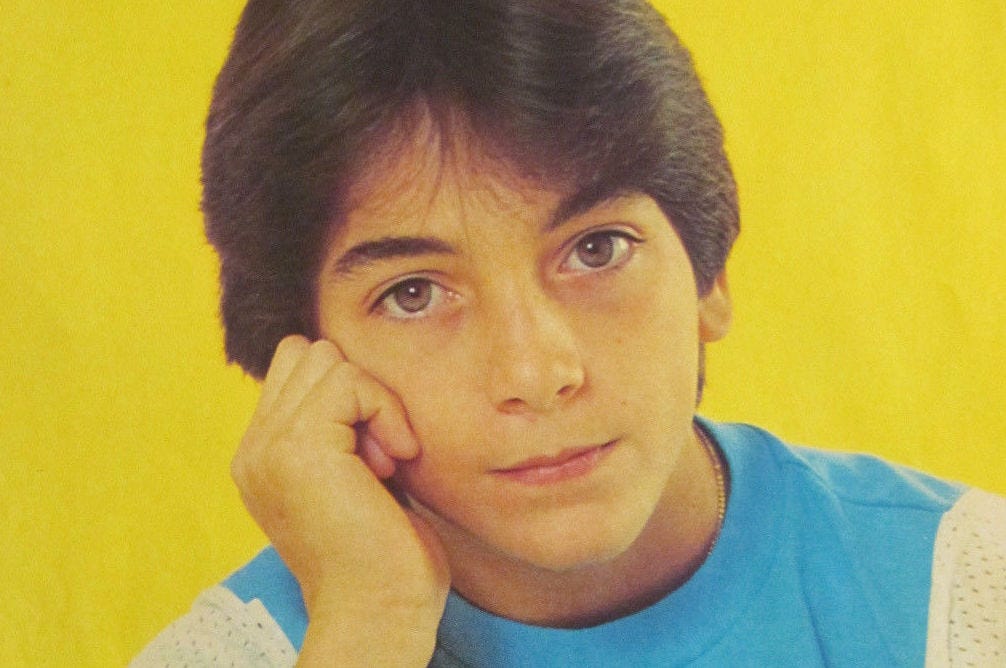
Hello, and welcome to my week-by-week review of the world. Today I am reviewing Scott Bayo.
The name Scott Bayo is a name you’re probably pretty sure you think sounds familiar. That’s because he played Fonzie’s sidekick Tchotchke in the hit series Happy Days. He later played an orphan whose adopted family abandoned him and gave him to another family in the show Charles in Charge, which was less of a hit because Fonzie never appeared. People loved Fonzie.
After falling off the radar for several decades, Scott was allowed by Fonzie to have a cameo appearance in the groundbreaking show Arrested Development. Just as things seemed to be going good for Scott, his career really jumped the shark.
He began garnering attention by voicing his admiration for a severely mentally ill man named Donald Trump. A lot of people gave Scott flak, but I have to admire someone who is humble enough to believe he is beneath the mentally ill.
Overall, Scott Bayo’s career has been as sparse and inconsistent as the facial hair sprinkled across his face. I don’t know what he’s spent most of his life doing. His life has been kind of like the universe. It’s mostly just an empty mystery.
Photo of Scott Bayo by Scott Bayo.
In his youth he was handsome for a boy with no lips, but now he’s just okay. That happens to a lot of people with or without lips, especially the ones who don’t get plastic surgery. I would hate to see what I would look like if I’d never gotten any plastic surgery.
I can’t really remember what Scott’s voice sounds like or what kinds of expressions he can make. Probably all the normal ones like anyone else. All I can really remember is that Fonzie was really nice to him. I love Fonzie.
BEST FEATURE: His beautiful feathered hair. WORST FEATURE: The heartbreak I feel when I look at him.
Please join me next week when I’ll be reviewing mud.
St. Patrick’s Day is traditionally a feast to celebrate the arrival of Christianity in Ireland, though today people living, well, just about anywhere can confirm it’s also a secular event celebrated with parades, pints and a scramble for green clothing. There’s a reason Irish culture resonates globally (and no, it’s not just as an excuse to drink): there are people of Irish descent in almost every corner of the globe. The Irish Diaspora is huge. An estimated 80 million people worldwide claim Irish descent, with 35 million living in the United States alone. Irish is the second-most common ancestry among Americans, behind German, and it often jumps to first place along the Eastern seaboard.
Yet the idea of celebrating Irish culture is relatively new in America. Irish-Americans have long faced discrimination from the WASP power brokers, whether it was the anti-Catholic legislation of the “Know Nothing” party or the proverbial signs that once warned job applicants “no Irish need apply.”
These days, the US readily champions the contributions of Irish immigrants and their descendants. And perhaps in no sector have the contributions been greater than in the arts. Literature, in particular, has been enriched by Irish-American writers, with some of our greatest novelists, poets and short story authors claiming an Irish connection. And since St. Patrick’s Day has been elevated to new heights on this side of the Atlantic, we thought, rather than the traditional list of Irish authors, how about a toast to Irish-Americans?
Whether you’re one of the millions who claim Irish ancestry or you just want to read a good book, here are 12 Irish-American authors for St. Patrick’s Day.
1. Alice McDermott
Born into an Irish Catholic family in Brooklyn in 1953, Alice McDermott is known for atmospheric novels like the National Book Award-winning Charming Billy (1997) — the elegiac story of a man who slowly drinks himself to death after losing his first love. McDermott plumbed her family legacy to capture the Irish-American community of 1930s Brooklyn. As she told the New Yorker, “the sensibility, and much of the language, belongs to my parents’ generation.”
2. J.P. Donleavy
Donleavy was born and raised in New York City, but it wasn’t until after he moved to his parents’ home country to study at Trinity College Dublin that he penned his most famous work, The Ginger Man (1955). The novel, which was published by Grove, the same press that would bring out Lolita that same year, was banned upon publication in both the US and Ireland because of the racy, debaucherous activity of its protagonist, Sebastian Dangerfield.
3. Mary McCarthy
The author of The Group generally avoided writing about her experience growing up in a strict Irish-American household, but she did allow one notable exception: her memoir, Memories of a Catholic Girlhood. Just as in her novels, McCarthy skewered ideologies and practices she disapproved of, and many in the Irish-American community weren’t happy with the results. After excerpts were published in The New Yorker, the publication received a flood of outraged letters from Irish-Americans who felt like she’d portrayed them too harshly.
4. Matthew Thomas
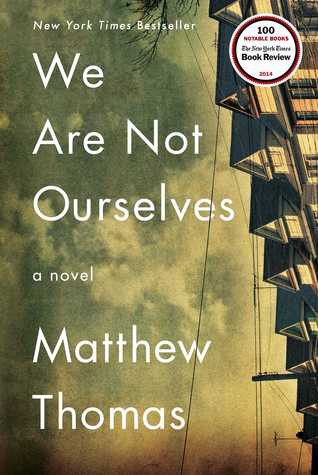
Thomas broke onto the literary scene in 2014 with his debut novel, We Are Not Ourselves, about an Irish-American girl named Eileen Tumulty who is trying to achieve “the American dream” in New York City after World War II. Thomas, whose grandparents are from Cavan and Galway and who took step dancing classes as a kid, has no plans to stop writing about his heritage. He told Irish America,“I think I’ll end up writing about the Irish a lot, I have so much respect and admiration for the Irish in New York. There’s such an unbelievable amount of vitality. Even several generations in they retain this identity.”
5. Pete Hamill
Hamill is the oldest of seven children born to two Catholic immigrants from Belfast, Northern Ireland. A reporter, memoirist, and fiction writer, he is the author of 10 novels and over 100 short stories. Many of his works, such as Snow in August, take place in the immigrant enclaves of his childhood. Hamill was friends with another famous Irish-American, Robert Kennedy, and his essay for the Village Voice about witnessing his friend’s assassination is worth a read.
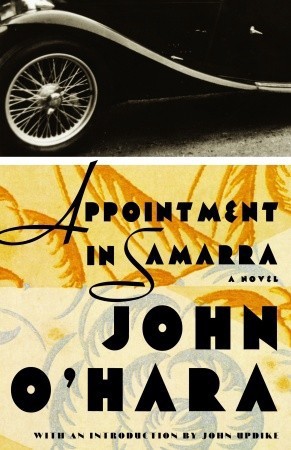
Born into a wealthy family in 1905, John O’Hara was more advantaged than most Irish-Americans at the turn of the century. Yet the prevailing prejudice against the Irish meant that the WASP-y Pensylvania town where the O’Haras lived in excluded them from society. These childhood experiences spurred him to write novels like Appointment in Samarra and Butterfield 8, which explore America’s insidious class divisions and artificial social mores.
7. Colum McCann
McCann grew up in Dublin but moved to New York in 1986, at the age of twenty-one, and now holds dual citizenship. (Are we stretching things here? So be it. Embrace the holiday spirit.) His 2009 novel, Let The Great World Spin, won the National Book Award for Fiction. The story weaves together various narratives, from a Catholic priest to a prostitute on trial, all set against the backdrop of New York City in a summer during the Vietnam War.
8. Tana French
French is also a dual Irish-American citizen, though she followed the opposite route from McCann’s: born in Vermont, she’s lived in Dublin since attending college at Trinity in the 1990s. She honored her adopted city by making it the setting for her award-winning Dublin Murder Squad series, in which she elevates suspenseful police procedurals with astute social commentary about post-crash Ireland.
9. Peter Quinn
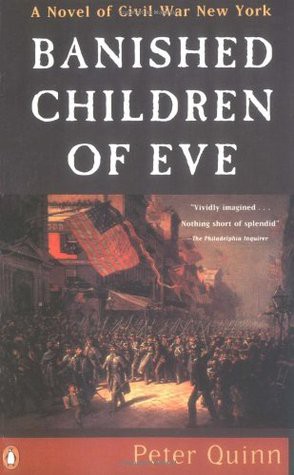
Quinn’s website, NewYorkPaddy.com, tells you all you need to know about how proud this author is of his Irish-American heritage. It’s a pride he put to good use in his novel The Banished Children of Eve, which won the 1995 American Book Award. In the novel, Quinn looks at New York City’s fraught immigration history by bringing to life the tulmultous week of the Draft Riots of 1863.
10. Kathleen Donohoe
The Irish have a long-standing presence in America’s fire-fighting forces, as Kathleen Donohoe knows well. She used her own experience growing up in a family of fire-fighters as inspiration for her debut novel Ashes of Fiery Weather. The novel spans six generations of Irish-American women, from those who fled the Great Famine to those who faced 9/11.
11. Frank McCourt
Angela’s Ashes, Frank McCourt’s lyrical, moving, and funny memoir, reads more like a novel than a work of non-fiction. As he describes his journey from Brooklyn to Limerick and back to Manhattan, McCourt confirms the struggles that were characteristic of the Irish-American story without trading on the cliches that helped to keep his people down.
12. Eileen Battersby
You might be surprised to learn that the chief literary critic for the Irish Times is an American from sunny California. But Eileen Battersby has doubled down on the Irish half of her Irish-American heritage, having permanently settled in County Meath. The author of two books of non-fiction completed her first novel in 2016; Teethmarks on My Tongue is a coming-of-age story about a precocious yet emotionally isolated young girl who sees her mother shot and killed on the street.
Check out the 2017 “Man Booker International Dozen”
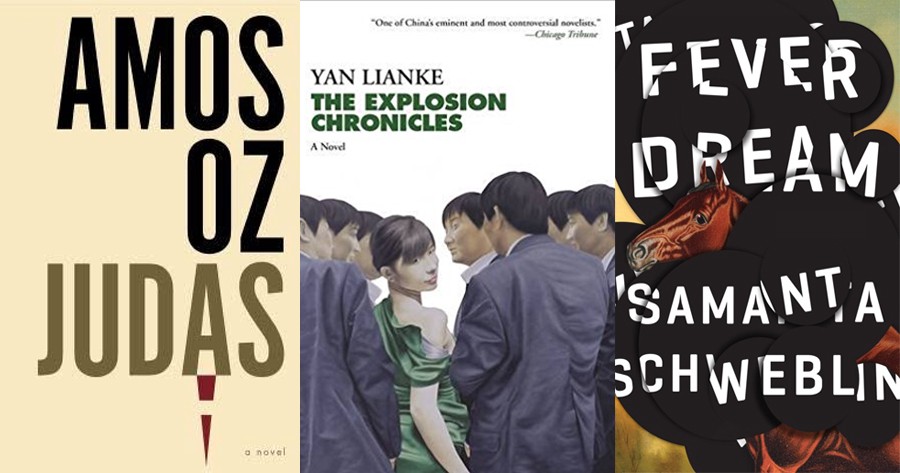
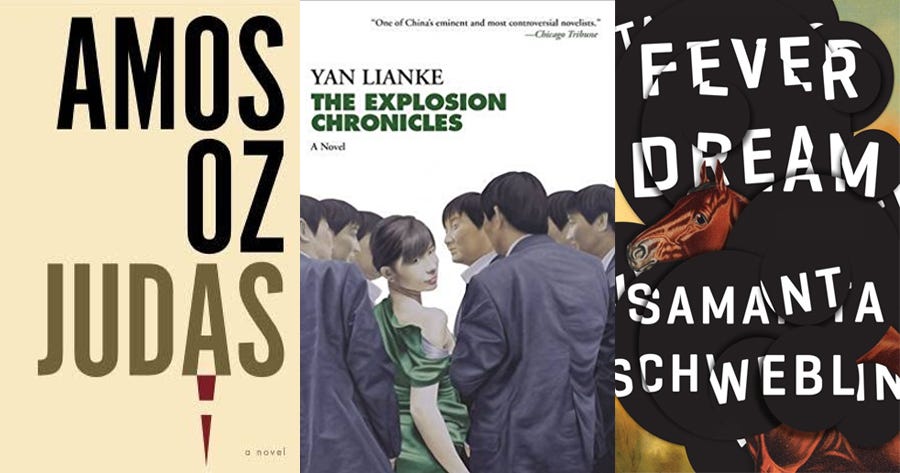
The thirteen finalists for the Man Booker International Prize have been announced. Amos Oz and Yan Lianke headline a list that includes writers from countries around the world including Argentina, Israel, Albania, and France.
The International Prize is awarded to a fiction book translated into English and published in the United Kingdom. The winning author and translator each will win £25,000. Nick Barley, director of the Edinburgh International Book Festival, chaired the panel of five judges who whittled down an initial group of 126 books to the final 13.
The six book shortlist will be out April 20th and the winner will be released on June 14th. To learn more about the prize and judging process, check out the Man Book press release here.
And here is the full long list:
Author (nationality), Translator, Title (imprint)
Mathias Enard (France), Charlotte Mandell, Compass (Fitzcarraldo Editions)
Wioletta Greg (Poland), Eliza Marciniak, Swallowing Mercury (Portobello Books)
David Grossman (Israel), Jessica Cohen, A Horse Walks Into a Bar (Jonathan Cape)
Stefan Hertmans (Belgium), David McKay, War and Turpentine (Harvill Secker)
Roy Jacobsen (Norway), Don Bartlett, Don Shaw, The Unseen (Maclehose)
Ismail Kadare (Albania), John Hodgson, The Traitor’s Niche (Harvill Secker)
Jon Kalman Stefansson (Iceland), Phil Roughton, Fish Have No Feet (Maclehose)
Yan Lianke (China), Carlos Rojas, The Explosion Chronicles (Chatto & Windus)
Alain Mabanckou (France), Helen Stevenson, Black Moses (Serpent’s Tail)
Clemens Meyer (Germany), Katy Derbyshire, Bricks and Mortar (Fitzcarraldo Editions)
The city selects Chimamanda Ngozi Adichie’s novel about Nigerian immigrants for its inaugural “One Book, One New York” program
Life in the big city can be lonely and isolating, and yes, it often seems all but impossible to start up a conversation with a neighbor who’s been living across the hall for five years, never mind your fellow straphangers or that stranger in the coffee shop. But what if we were all reading the same book? And I’m sorry, William H. Macy, but what if that book wasn’t A Tree Grows in Brooklyn? Today, “One Book, One New York” — the book club spearheaded by the Mayor’s Office and Buzzfeed Books, billed as “the largest community reading program in the country” — announced that after tallying up almost 50,000 votes, it was ready to name the book all of NYC will soon be reading:
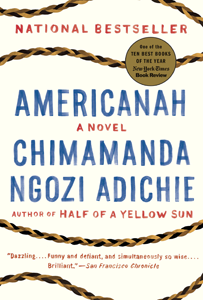
Americanah, by Chimamanda Ngozi Adichie
The novel tells the story of Ifemelu and Obinze, two young Nigerians who get out from under the thumb of military rule — Ifemelu to New York City and academia, Obinze to London and the limbo of undocumented immigrants. Later in life, they reunite in their homeland. For the rest, you’ll need to get to your local bookstore or library branch. (Penguin Random House is donating copies; Scribd is offering a free audio book.)
Americanah was first released by Anchor Books (Knopf) in 2014. It won the National Book Critics Circle Award for Fiction that year and was named a top-10 book of the year by The New York Times. In a video released by “One Book, One New York,” Chimamanda Ngozi Adichietold told the city what it meant that her book had been selected as Gotham’s inaugural read.
And in case you’re worried that this is going to be like that book club where everyone sort of reads a few chapters and then forgets about the book as soon as the wine comes out, don’t be. This is only the start of a season of events dedicated to Americanah and the conversation it’s sure to inspire. Along with the book selection, “One Book, One New York” released a calendar of events, including readings, festival events, salons, meet-ups, movie screenings and a grande finale at the New York Public Library.
The runners-up in the competition were Between the World and Me by Ta-Neshi Coates, The Brief Wondrous Life of Oscar Wao by Junot Díaz, A Tree Grows in Brooklyn by Betty Smith, and The Sellout by Paul Beatty. The celebrity nominators were Larry Wilmore, Giancarlo Esposito, Bebe Neuwirth (who nominated the winner), Danielle Brooks, and William H. Macy, the star of the 2007 film, Wild Hogs.
When you’re done with Americanah, why not read all the nominees?
Gary Lutz has made it perfectly clear that the sentence is where words go to feast or famine. The sentence is the great morality of his style, constructed from a vision so perfect that nothing else in the story matters. His sentences are the singular reason to read his work.
“You don’t make Marlon Brando learn his lines, you don’t make Slayer play clean guitar parts, and you don’t make Gary Lutz write a plot.”
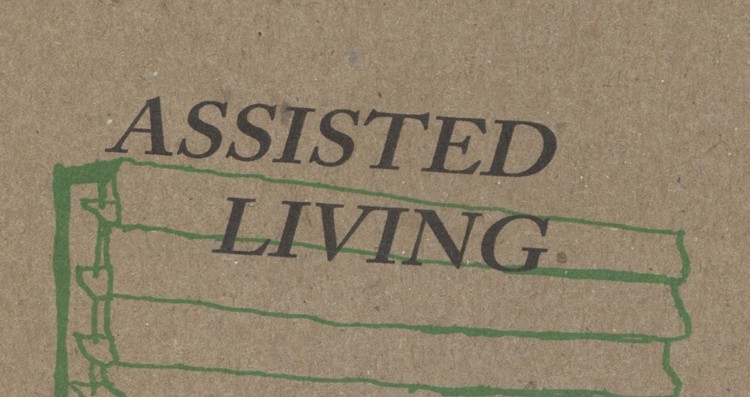
Lutz’s newest book, Assisted Living, is really short. This is great if you’re like me and couldn’t get through his previous book, Divorcer, despite liking the increased prickliness and instant-by-instant success of whatever it is happens when Lutz twists words around into a certain order.
Really, if you’ve been following Lutz’s career thus far, you’ll notice little change in the quality of work. He still has a need to sum up an entire length of existence for the sake of scope or melodrama. In this book alone there’s, “Life had harshened on her dearly,” and “All life aspires toward the sureness of erasure, you say?” and literally twenty other times the word “life” appears in nestled alongside various forms of distorted syntax or verbiage.
He also still eschews narrative in favor of how those great sentences sound and feel next to one another. When he writes, “So, true: She was somewhere there in the physical hooey that went with being human. The love itself she could laugh off,”our takeaway is exactly what he’d planned on it being: the assonance of “hooey” and “human” in the first sentence and “love” and “laugh” in the second. That leads to comparison within each respective sentence and then friction as those two sets of “content words” (Lutz’s phrase, not mine) either expand or cancel each other out sitting alongside one another, depending on how you look at it.
He’s doing his tricks. Again, nothing new, but not because he’s any sort of old dog. He’s known forever how he wants to write, and he’s done it yet again. Assisted Living isn’t a trotting out of the same show as always, the last season of The Office or the newest Led Zeppelin remasters. It’s the writer who does something better than everyone else yet again demonstrating why it continues to be true.
From “Nothing Clarion Came of Her, Either” —
In a marriage, the deathly custom goes, you have to choose sides — yours or your spouse’s. My side had all the wobbliness on it, the debt forgivenness, the gastrointestinal meds that came with printouts saying: “IF YOU MISS A DOSE. . . .”
Her side had backbone in the penmanship, dollars dulling in CDs. Everything had finishes on it. Her parents came over to pamper our furniture, spoiling it rotten with pillows that foamily remembered how they’d taken every jab of my elbows.
People usually couldn’t place me, but certain cushions always could.
I would have anywise settled for any old chain of events, other than morning revoking the night before, the night before revoking the day, and the day no horn of plenty, either.
Though I know Lutz makes his stories by constructing workon one end and having a fully-realized style once it’s complete, reading Lutz’s work still feels like a sort of magic. His stories are craft over creation to the point where the craft becomes the creation.
He has a spark of invention, but it isn’t a flow of words or momentum as much as it’s a pointed reconceptualization of both language and thought. It’s classical music, not jazz.
That being said, these stories shouldn’t work. They’re just information dumps about children and exes and parents. It’s not quite verbal porn or masturbation, but it is a sort of dark, linguistic circus. It’s like every story is a mental transcript of a person with nothing but time to let each and every word overwhelm the senses.
All of these stories work, but “You Are Logged In As Marie” is the clear winner of this new tetralogy. More importantly, it’s the most successful of his latter-day, increasingly grumpy work. It’s a solid third of this brief chapbook, but it’s been wisely “Hempelized” into short sections, some spaces in which to breathe and parse out thoughts about the aforementioned topics (“an ex only if we let ex equal extinct.”). It’s almost scenic at points, which is incredible considering that Lutz is the sort of writer who once spent about 500 words talking pointedly about a single Sam Lipsyte sentence with no context to the story whatsoever.
From “You Are Logged In As Marie” —
This later one came to me not quite figured out. She looked hurriedly lovely enough at first.
She was a day-shift aide at a nursing home and would return to me with dental floss of all colors threaded thoughtfully through her hair. A resident had done it, she’d say. She would not want to wash it out just yet.
“Things don’t always have to be miracles,” she’d say.
Like most of some kind, she had lived and loved spottily, with lonesome turns of mind and an unsporting heart.
I took my messes and eases with her, but she turned out to be a lot like the others, the pharmaceuts, the vasalvagals.
Sign-offs for e-mails shifted downward from “Best” to “Take care” to “Best to take care.”
Weeks would warp themselves away from the year.
To an inquirer, I described the apartment as three sickrooms, kitchen, and bath.
The neutral duplicity in his work — that is, a strictly observable density and a heartfelt disconnect all at once — and the idea of an assumed narrative don’t necessarily lend themselves well to longer stories. Assisted Living has only a bit of that slog going on, points where the verbosity and obtuse grammar just steamroll any comprehension no matter how short the section — or story itself — may be. On the whole, however, this is Lutz’s tightest, most enjoyable whole work since Partial List of People to Bleach.
I read slowly, I reread, and I took little breaks. For a 37 page book. Reading it wasn’t work, but I was expected to bring something to the table. It wasn’t a free meal, nor should it be. Like with anything else related to Lutz, happiness is earned and never guaranteed.
Moments are the takeaway. I won’t forget many of the ticks throughout Lutz’s career — a man searching the carpet for a pubic hair in “Home, School, Office” or the professor with colitis in “Slops” talking about shitting on campus — and there are more here in this book that will come to me time and again when my days briefly twitch as they do for these characters.
Or, as Lutz himself might say it: My life has become momentary, but what have the moments become?
This week, the writer and broadcaster Kanishk Tharoor published Swimmer Among the Stars(FSG, 2017),his debut collection of short stories. Tharoor is the presenter of “Museum of Lost Objects,” a BBC radio series on cultural destruction in Iraq and Syria. His nonfiction has appeared in The New York Times, The Guardian, and elsewhere.
You can open Swimmer to any page and find a sentence worth quoting, a scenario worth remembering. Though the stories span the Battle of Magnesia, in which Rome defeated the Seleucid Empire, to a dystopian future in which the United Nations has been chased to a near-Earth orbit, Tharoor wears his erudition lightly, privileging poetry over political messaging. Lush, playful, and intoxicated by history, the book stuck with me long after I closed it.
I sat down with Tharoor to talk about his process and the historical episodes that inspired him.
David Busis: Tell me about the genesis of this collection.
Kanishk Tharoor: It is a collection of short stories that’s been accumulated over a long period of time. I wrote the oldest story, “Loss of Muzaffar,” when I was eighteen. The pieces often have very separate points of origin, but when I had a certain number of short stories that I liked, and when I put them together and sifted some out, it became clear to me that they were united by a tone and, I don’t want to say a melancholy, but an unsentimental and cold-eyed look at the way things are lost and recovered in the world.
DB: If you wrote the first story when you were eighteen, and you’re in your early thirties now, did you change as a writer in the course of composing the book?
KT: I think so. The vast majority of these stories were written recently, in the last five years or so. I did an MFA, for our sins, and I think that made me slightly more restrained as a writer. I have a better sense of tone and control. But I do feel that I’m still learning and growing.
DB: What’s the most recent story?
KT: The stories about Alexander the Great, under the title “The Mirrors of Iskandar.”
DB: I don’t have a large sample size, but to me, one of the differences between “Loss of Muzaffar” and the Alexander stories is that you got more sly. The Alexander stories are really funny.
KT: I’m glad to hear that, and I hope it’s true, but it’s also because the material from which I was drawing those stories — even though we think of it as stony-faced old history — is hilarious. There’s a lot of freedom and a lot of license in the way I reimagine them, but each one of them is based on something I actually read — an Oghuz Turkic version of an Alexander story, or an Armenian version or whatever. These old texts have more of a satirical, ludicrous, modern sensibility than we might imagine when thinking about panegyrics to ancient autocrats. So I think I was channeling that too, but yeah, I was bound to be more earnest and breathless as an eighteen-year-old than I am now.
DB: You’re not trying to kill us with poetry anymore.
KT: (Laughs.) But I am drawn to lyrical writing. If you put a gun to my head and said Faulkner or Hemingway, it would be Faulkner every day. I’ve been forced to think about this a bit, because I’ve been talking about my book in India, and I’ve often been asked, “What is the point of writing in the modern age?” And as a vehicle of delivering narrative, fiction is limited compared to so many other mediums, but one of the things that makes it unique is the possibility of experiencing good lyrical prose. I don’t want to kill you with poetry — I don’t think I could anyway — but I can’t imagine a time when I’d be a terribly austere writer.
DB: The times you came closest to killing me with poetry in a good way are your endings. I love the last sentence of the book: “Drunk under the aurora one night, the communications officer and the first mate go out onto the frozen deck and dance like lovers from another country.” I like how you make a leap. You’re not trying to wrap everything up. It feels a little counter-intuitive. Maybe you can talk to me about how you found a way to shut these stories down.
KT: I wrestle with endings. I’m sure everyone does. I think that sentence that you read was somewhere closer to the middle of the story in an earlier version. You asked about how I changed as a writer, and one of the ways I’ve changed is becoming slightly more, I don’t want to say evasive, but slightly better with my endings. A good ending isn’t necessarily a rounded completion. It’s something that brings you to a rest but opens a door.
“A good ending isn’t necessarily a rounded completion. It’s something that brings you to a rest but opens a door.”
DB: Let’s go back to “What’s the point of writing in these modern days?” Do you consider yourself a political writer?
KT: If I were in college I’d say, “All writing is political.” I guess I still kind of believe that. I’m an essayist, journalist, and occasional broadcaster in my other life where I am writing very overtly about political and cultural issues. These pieces of fiction may not be intervening in a contemporary policy debate, but I do think every piece in my collection is exploring what we could call a political issue, whether it’s notions of identity, notions of power relations, or ways of seeing in the world.
DB: “Portrait with Coal Fire” felt the closest to being reducible to a message. I was wondering when I read that, and when I read “A United Nations in Space,” if you started with a message or if you found a message later.
KT: I don’t know if there was a specific message for “A United Nations in Space.” I grew up in a United Nations family, so I enjoyed playing with that material. The story was sparked by the news a few years ago that the Libyan parliament was meeting on a Greek luxury car ferry off the coast of Libya in the Mediterranean. They were trying to administer the affairs of Libya on this slightly preposterous vessel full of Greek bow-tied waiters. I found that image at once comic and tragic, a Kapuściński-esque commentary on the political world. I took it to its logical extreme, and I imagined a similar United Nations General Assembly stuck in near-Earth orbit because it’s been chased from the planet. I don’t know if there’s a particular message I wanted to ram home there, I suppose the message is a little embedded in the conceit. I just wanted to make a world. With “Portrait with Coal Fire,” this is a bit literal, but I did see this photograph in a magazine, so it had a very clear source, and I suppose there is something more telegraphed about the main relationship I explore, between the photographer and his subject. But I think it’s still worth dramatizing. And the way I ended, I’m not necessarily trying to draw some triumphal anti-colonial line.
DB: You hit us with poetry again. “Phytoplankton, Nebula, Carbon, Tuna.” I love that ending. Speaking of poetry — your stories have amazing details, but they also have a poetic vagueness. In the title story, you withhold the name of the dying language and the characters. Tell me about your use of vagueness, and the decision to hold back proper nouns.
KT: I’m not the first writer to do that — lots of writers do — but I think my aversion to naming things came in part from a hope that if you were reading these stories in the English language, no matter where you were and how you were in the world, you’d be equally estranged and equally able to find something familiar. I didn’t want to privilege people in a particular place. That wasn’t necessarily a conscious decision; it just came out in the way I wrote these stories.
DB: What do you hope that you leave your reader with?
KT: First and foremost, I want people to experience a sense of wonder, but I don’t mean that in a starry-eyed way. A wonder that lifts off the page and is directed at the world in a meaningful way, because these stories may be whimsical sometimes, they may be, on occasion — though rarely, I feel — fantastical, but they’re about the world. There are of course political issues tucked into the book. There’s stuff about refugees, there’s stuff about displacement, there’s stuff about destruction and war. There’s stuff about climate change. I don’t necessarily hope that people will come away feeling motivated for action. But if people think about those real world themes in a more concerted or even slightly different way, that would be good too. And also, I just want people to enjoy the prose.
DB: Which story gave you the most trouble?
KT: I have to confess that I’m a fairly directed writer when it comes to short stories — the novel I’m working on is a different matter! When I struggle, I just go back to the top and try again or discard. I’m suspicious of the stories that I’m really having difficulty with. In my limited experience, the best writing is writing that I’m enjoying. I probably struggled with the oldest story, “The Loss of Muzaffar,” the story I wrote when I was eighteen. It now feels a bit remote to me. It was the first real aspirational short story that I’d ever written, and the experience of writing it at that young age was full of uncertainty and a kind of stress, which I don’t know if I have so much now. I’m not some kind of grizzled artisan yet; I’m not a blacksmith, so muscled and used to doing what he does in a routine way. But I think Salman Rushdie said that if carpenters aren’t allowed to have carpenter’s block, writers aren’t allowed to have writer’s block. Writing is always some form of struggle, but I don’t experience the process as struggle. I try to be industrious; I try to muscle through things.
“Writing is always some form of struggle, but I don’t experience the process as struggle. I try to be industrious; I try to muscle through things.”
DB: Do you know where you’re going before the end?
KT: Sometimes. I’m writing a novel now, so it’s a totally different question for that, but with stories, I do my best thinking as I write. Sometimes the purpose of writing a story is to figure out why I had an image or conceit in the first place. I find that as I’m writing a novel, I can’t afford to be so loose. There is much more premeditation, scaffolding, and so forth.
DB: My strategy with a novel is to outline it and then immediately throw out the entire outline when I start writing.
KT: That has happened to me over the last couple years in so many ways.
DB: It’s obsolete as soon as you type a word.
KT: You can say you’ve been working on a novel for a few years or whatever, but the truth is that what you were working on a couple years ago and what you’re working on now, in my experience, is so 180 degrees different that it’s not even worth calling it the same book.
DB: Totally. Going back to the genesis of the book — tell me the origin of “Elephant at Sea.”
KT: That’s based on a real story that was told to my brother and me by a family friend who worked in the Indian Foreign Service. A Moroccan princess actually asked an Indian ambassador for an elephant. He submitted the request, and predictably, the gears of Indian bureaucracy moved slowly, so only many years later is the elephant actually shipped off. It gets to Morocco at a time when the princess (A) has completely forgotten asking for it and (B) is not interested, and then it’s sent to Casablanca, and the Moroccans didn’t really have a means to transport it from Casablanca to Rabat, so it was walked along this partly coastal road. I loved the story as a kid, and then years later, in 2007, I went to Morocco and I remembered the story as I traveled around the country. But what was amazing was last year, at my book launch in Delhi, there was this lovely woman in the audience who revealed that she was the daughter of the Indian ambassador in Morocco at the time this all happened. She brought a picture of her sitting next to the Moroccan princess. She was incredibly moved by the story. She said that I described this world in a way that she understood, and that I described her father and his mannerisms in a way that was like her father, even though I had completely invented those details. I made it all up, and she was still very affected. There was also a man from the Cochin Port Trust who brought a photo that he says is in the museum of the Cochin Port Trust of that elephant being lifted into the boat to be sent to Morocco. I said in my story that it was taken from Cochin. I had not corroborated these details, I just imagined them. It was really remarkable to take something out of my imagination with some very meager basis in reality and put it out into the world, and then see it come back to me in real life.
DB: That’s amazing. You write from all of these lovely little anecdotes that I imagine you hoarding and mulling over. Are you afraid of spoiling them when you’re out with your friends? Are you like, I want to tell this entertaining story but I don’t want to ruin it?
KT: I don’t know about that, but I’m always a sponge for these kinds of anecdotes, both from the present and from the past. I am interested in unlikely connections. We have this idea that in our modernity, the world is becoming a tighter place and barriers are falling and we’re going to get to know each other. Obviously, in the Trump age, there’s a new wrinkle to that narrative. But I’ve always felt that we privilege our modern moment too much. A story like “Letters Home” explores the ways in which there have always been these astonishing links between disparate peoples and places, and these, dare I say, cosmopolitan ways of looking at the world, before we imagine that we were cosmopolitan. So I enjoyed writing about Sogdian traders in ancient China, or Polish soldiers fighting alongside Haitians in their revolution. Those are the kinds of stories that I often pick up and hoard.
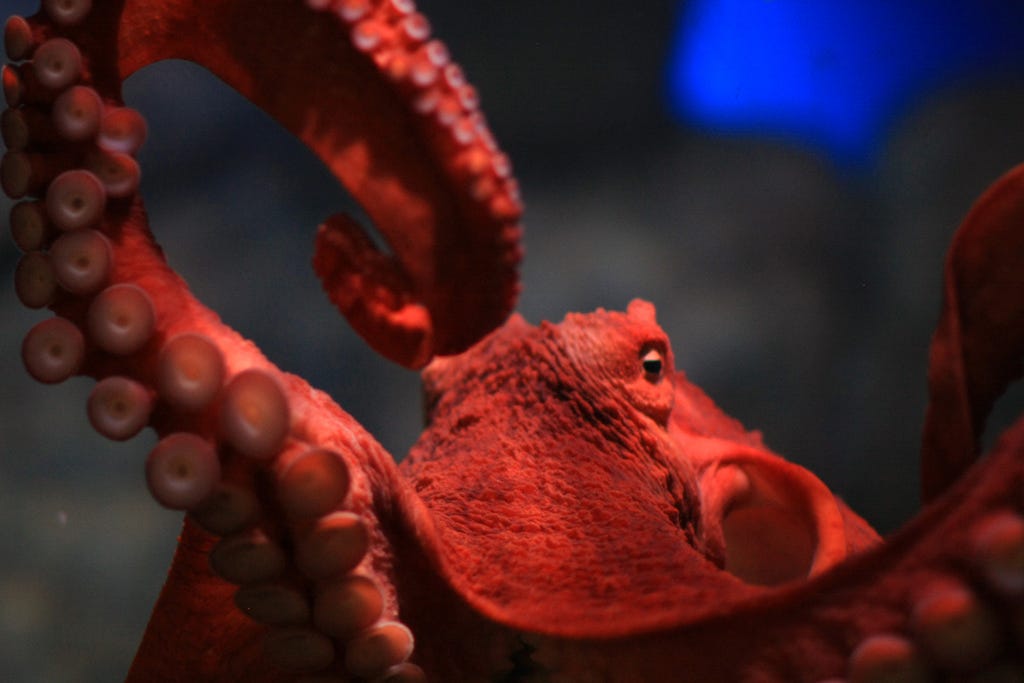
Peter Godfrey-Smith’s brilliant book entirely overturns those preconceptions. Cephalopods — octopuses, squids and nautiluses — “are an island of mental complexity in the sea of invertebrate animals”, he writes, having developed on a different path from us, “an independent experiment in the evolution of large brains and complex behaviour”.
A week later, Lovecraft wrote back, as he nearly always did. It’s estimated that he wrote more than fifty thousand letters in his relatively short lifetime (he died at the age of forty-six). This particular letter was the beginning of a curious friendship, which changed the course of Barlow’s life, and Lovecraft’s, too — though almost no one who reads Lovecraft these days knows anything about it. Who keeps track of the lives of fans?
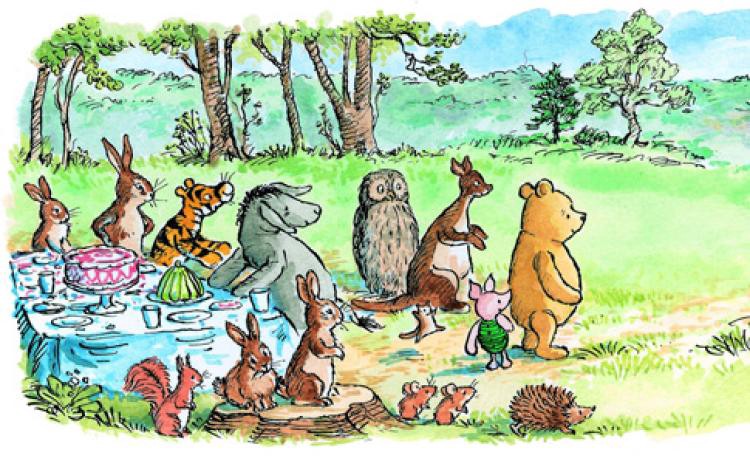
Don’t be fooled by their cuddly appearance and supposed adherence to Taoist principles — Winnie-the-Pooh and other residents of the Hundred Acre Wood are radical agitators dead set on poisoning the minds of children. Or at least that seems to be the new official position in the People’s Republic of China.
The culture war betweeen Russia and the Ukraine continues to escalate, and once again literature finds itself in the crosshairs. According to a report from Reuters, Russian authorities have closed the Ukrainian Literature Library, a Moscow-based institution that has found itself at the center of the controversy. Until recently, the Library housed some 52,000 books and offered Ukrainian lessons. In 2015, local officials deemed a number of books in the Library’s collection to be anti-Russian propaganda. The former head of the Library, Natalya Sharina, was arrested in October 2015 and charged with distributing extremist literature and embezzlement. Last month, we wrote about Sharina’s trial and her appeal to the European Court of Human Rights. Amnesty International has labeled Sharina a “prisoner of conscience” and has condemned her prosecution and imprisonment.
According to Reuters, Moscow officials have not yet made a formal announcement regarding the Library’s closure, despite acknowledging that its works will now be housed in a new center of Slavonic culture. When the news outlet reached out to a Moscow city spokeswoman, they were told the decision “had no political element….on the contrary, by transferring the books…we are not only preserving the Ukrainian Literature’s books, but also believe it will facilitate the polularization (sic) of the Ukrainian literary legacy.” The new Slavonic cultural center is on record that it only has room for 12,000 additional books.
The Ukrainian Library — formed in 1918 — is no stranger to institutional pressure. It endured crackdowns on Ukrainian literature both during World War II and at the peak of the Stalinist era. Suppression measures have generally coincided with efforts to promote Russian cultural hegemony (the tact often includes the proclaimed supremacy of the Russian language). Ukrainian commentator Vitaly Portnikov expounded on this notion, writing for Radio Free Europe, “they want to prove that we are ‘one people,’ to do that, you need to destroy everything that constitutes the cultural uniqueness of the Ukrainian people.”
In a plot twist that seems ripped from the pages of Gogol or Kafka, the structure that once was the Ukrainian Literature Library remains open and staffed. However, inside there are no books or language lessons, just a staff monitoring empty shelves. “We’re keen to find out what kind of new life the library can have without any books,” employee Tayana Muntyan said to Reuters, “we come to work each day and don’t know what awaits us.
“I could have been Barbara Walters. My grandmother wanted me to go to Radcliffe. But my father said I wasn’t allowed to go further than a one-hour plane ride or a 500-mile radius, so I had to go to Boulder.”
It’s almost 5 o’clock. She’s chopping parsley in a long black jersey skirt, men’s large purple t-shirt, Merrell clogs, and an apron. She’s chopping parsley to garnish her famous beef and barley soup. It’s famous because she makes it for anyone in the community who’s sick. It’s also famous because it’s delicious. (The trick is to caramelize the onions with a teaspoon of brown sugar before adding celery and aromatics). Our entire house periodically smells like this, like deep, gloriously stewed chuck. The earthy sweetness of meat-braised carrots. Plump pearls of barley drifting and softening in their descent.
This afternoon, Mom made a pot for Dave Schneider, an elderly widower who caught pneumonia and is staying around the corner at the Rose Blumkin Jewish Home. She’s already portioned it into six single-serving microwavable containers.
“It’s all Cousin Milton’s fault. Cousin Milton went to the University of Chicago, but then, like Grandpa says, he burrowed a tunnel through Ohio to the east coast and emerged somewhere in New Hampshire and no one’s seen him since. Grandpa said he couldn’t stand it if I left. Since there was no way he’d pay for Radcliffe, I went to Boulder, got a degree in Education, then came home. That’s what good girls did. If you weren’t engaged or already married by the end of college, you came home to live with your parents and teach. That’s why my college roommate and I made a deal our senior year: if neither of us got a diamond ring by graduation, we’d buy two guns and shoot each other.”
“I went to Boulder, got a degree in Education, then came home. That’s what good girls did.”
I am 17, sitting at the white Formica kitchen table opposite the counter peninsula. I’m supposed to be working on an A.P. English paper about symbolism in Macbeth, but we seem to be having a conversation, so I ask, “Why didn’t you go to Mizzou?”
We don’t have a lot of conversations though we are both chatty, even outspoken. I don’t know yet this is a cover — our barrage of words, witty retorts, clever, social scatting. I don’t know that I’ve learned to mimic her mannerisms, waving my hand around when I finish a sentence to immediately disregard it, or glancing at the ground when someone asks me what I think. In the early ’90s, most middle-class Midwesterners didn’t casually toss around phrases like “learned behavior.” No one would have known — even I didn’t know — that depression smoked from both our corners like dry ice, just offstage.
While we don’t have a lot of conversations, she does often engage in her continuing lecture series, Acceptable Behavior For Proper Young Ladies. Popular addresses include:
Proper Young Ladies do not stay out past midnight.
Proper Young Ladies wait their turn to speak.
Proper Young Ladies do not “hang out” in groups with non-Jewish boys.
I used to question her strictness. In our previous house, The House On 87th Street, in District 66, a lovely, WASP-y neighborhood across town, I used to talk back. When I did, one of two things happened. First, without missing a beat, she glared at me and warned, Proper Young Ladies do not question their parents.Second, if I whined, argued, or pressed an issue, or if I used a tone she didn’t like (I don’t like your tone, Young Lady), the events, on more than one occasion, unfolded as follows: she came toward me to slap or shove me, I bobbed or backed away, she became angry, I ducked out of the room, she chased me, even up the stairs, and, feeling sufficiently enraged by my insolence, slapped me across the mouth, forced me onto the closed toilet seat or edge of the bathtub, and shoved a brand new, family-sized, golden bar of Dial Soap in my mouth. She’d wipe the sweat off her brow with the corner of her apron, then say, in clipped, quick enunciation, Don’t you MOVE until I say so. She left. I stayed. I retracted my tongue from the bubbling triclocarban and lye as best I could. The corners of my mouth stretched and dried out. I counted the watermelon-red Kansas Peonies in our neighbor’s bushes to pass the time.
In the early ’90s, most middle-class Midwesterners didn’t casually toss around phrases like “learned behavior.”
This is to say, we don’t often talk about things teenage daughters want to know about their mothers.
Most nights, I see her through the crack in Lauren’s door down the hall. She sits on her bed and rests her hand on Lauren’s stomach, or brushes her hair with her fingertips, while my sister whispers to her, and she whispers back. Even though I’ve got my driver’s license, and my girlfriends and I giggle about the logistics of a blow job, I sometimes still want my mom to tuck me in at night. Because I’m a teenager, and I ache. When I think she might be in a gentle mood, I call her to my door before she goes back downstairs. She enters, and it’s a quick touch on my hand and peck on my cheek. Goodnight, honey.
“No…wait. Stay…”
“I have to finish things in the kitchen.”
“Mom…”
She remains in the doorway. “Fine. What do you want to talk about? You have three minutes.”
“Never mind.”
So instead of writing, I ask about Mizzou. The University of Missouri in Columbia, or “Mizzou,” is the oldest journalism program in the country. It still has a great reputation. It has cachet. It’s only 320 miles from Omaha, an afternoon drive.
“I don’t know, I was young and dumb. Nice girls went to Boulder and became teachers.”
Gloria Steinem-reading, Lilith-fair following me presses the issue with compliments — the best way to earn a response. “But you were reading Moby Dick in eighth grade study hall. You were editor of the yearbook. You could speak French. You actually could have been Barbara Walters. Why not Mizzou?” I can’t understand why, for her first act of self-determination outside a domineering 1950s father, she would choose a nice college that pleased her parents instead of one that would help her do the exact thing she always wanted to do. Until I did the same thing.
I can’t understand why, for her first act of self-determination outside a domineering 1950s father, she would choose a nice college that pleased her parents instead of one that would help her do the exact thing she always wanted to do. Until I did the same thing.
“It was just different then.” Her chopping intensifies. “What do you want me to say? That my whole life could’ve been different? That I might not be making this same fakakteh soup for the ten-thousandth time if I’d gone to Mizzou and gotten a degree in Journalism? Who knows? All I know is I love your father, and this is our life. When is your paper due?”
Her argumentative moves are not sound, but they are swift, sharp, and exacting. She rinses the knife. The conversation is over.
“Friday,” I say. Mr. Daly assigns Friday deadlines. Until I started teaching, years later, I never even thought about his weekends, filled with A.P. English papers and stylebooks, grading schemas, assignment rubrics. I just thought it was nice he gave us the weekend to read instead of write. My syllabi follow his model today. “I have two more days to explain the significance of the drumbeat sound in the dialogue.”
“Drumbeat sound? Uh, hellooo. Why aren’t you writing about Lady Macbeth? Ambition, revenge, power!”
I prefer the poetry but don’t know how to say so without sounding weak. When Mr. Daly read the first scene out loud to us, emphasizing the couplets’ end-word rhymes, I heard a drumbeat, and the story began with sound: “When the hurlyburly’s done./When the battle’s lost and won.//That will be ere the set of sun.” Uhn. Uhn. Uhn. That incantatory hum, the tragedy it incites, the inevitability of every character’s arc built directly into the rhyme scheme — this enchanted me beyond its measure. I wasn’t sure how I’d write four pages on it, but I wanted to be the kind of student who could. To my tender reader’s heart, Shakespeare’s poetry magic overshadowed and overpowered any ambition another crazy literary character harbored.
To my tender reader’s heart, Shakespeare’s poetry magic overshadowed and overpowered any ambition another crazy literary character harbored.
I simply say, “I already have a page and a half.”
She stacks the Tupperware into a Hy-Vee paper bag and mutters, “And you call yourself a feminist.”
“What does that mean?”
“I missed the Women’s Movement by two years…”
“You didn’t miss the Women’s Movement.”
“And here you are, with all the resources and stories and information at your fingertips, and you don’t think Lady Macbeth is a juicy enough character to…”
“I didn’t say that.”
“A woman who was smarter than her husband. Who had more chutzpah than anyone else in the story. Who wanted power. Who was sneakier, and took risks, and was willing to do anything to change her lot in life. And her own ambition killed her! She ultimately couldn’t take it! Her repression drove her to murder and madness, and you don’t want to explore that?”
“Should I?”
“If you want to write an interesting paper!”
“I wanted to write about how the lines sound like the coming war. Like, that the war is written into the sound of the couplets.”
“BO-RING! I mean, write whatever you want. If you want to write about sophomoric tedium, gai gezunterhait! (go in good health!). If you want to write a great paper, you’ll write about Lady Macbeth. But do whatever you want. What do I know. I’m just the mother.”
Her repression drove her to murder and madness, and you don’t want to explore that?
She turns the faucet on full-blast. She clangs the soup pot into the sink and begins scrubbing. My father bursts in from the den, from the door to the garage. He has a heavy step and enters yelling.
“Sue! I don’t have time for this! I gotta be down on 84th before 6 o’clock…”
“You don’t “gotta” be anywhere. You can pick up the check tomorrow morning…”
“Would you stop? I want to pick up my check and deposit it before the end of the day.”
“What difference does it make if it’s deposited at 6 p.m. today or 9 a.m. tomorrow?”
“Would you just — ?”
The water is still running on high, overflowing the pot.
She hands him the Hy-Vee paper bag. “Hold it from the bottom. And tell Dave we hope he feels better.”
He walks back through the kitchen toward the door that leads to the garage. He does not acknowledge me. “I’ll tell him if I have time.”
“You’re dropping off the soup. How will you not have time? You’ll have time to tell an elderly man you hope he feels better.”
“Jesus Christ. Will you just let me go? I’m taking it, aren’t I?”
He slams the door. She returns to scrubbing. I listen to the mechanical sound of the garage door slowly rolling closed, each wooden panel lurching forward, then folding, riding the rails down to the ground. Now I am uncertain of my own ideas.
She dries the pot. “Lady Macbeth was a bra-burning feminist before her time. This is good. Write this down. She has no children to speak of, expresses no desire to have a child, and longs for a more powerful position in society.”
“Mom. She wants to kill the King of Scotland.”
“So she’s got a dream! Good for her! Are you writing? I’m giving you great material.”
I turn to a fresh page. The paper crinkles in its binding. I press the ballpoint tip to the notebook to show her I’m ready. She continues.
“Lady Macbeth was a bra-burning feminist before her time…”
“I thought they didn’t actually burn their bras.”
“…but she is still an excellent wife. She is the Lady everyone expected her to become, hosting dinner parties in velvet robes, blah blah, AND she supports her husband’s aspirations and helps him achieve his dream, all the while sacrificing herself for the good of the mission.”
“Mr. Daly said painting her as a martyr is a trap.”
“Is Mr. Daly a woman or a wife?”
“No, but he did say there are parallels between her and the witches.”
“Until recently, when wasn’t a strong woman compared to a witch? I’m telling you, Lady Macbeth was misunderstood, she was before her time, and that’s what drove her mad. If she wore a bra, she would have burned it. Are you writing?”
I am.
“So, you don’t think it’s a good idea to write about the poetry?”
“I mean, I think it’s obvious this is a better paper.”
I transcribe the five-paragraph essay she’s dictating off the top of her head and worry. What does it say that I can’t see the better idea as easily as she does? Am I less intelligent than my mother was at my age? Am I the overly sensitive girl she accuses me of being, trying to stand up for an unimpressive interest in patterns and sounds? And wasn’t it inappropriate to allow my mom to dictate a paper to me? Anxiety, which I won’t recognize for years, blooms in me like the peonies, fully globed and layered, peeking out in a hundred little places in various shades of embarrassment.
What does it say that I can’t see the better idea as easily as she does? Am I less intelligent than my mother was at my age?
She dries the dishes. She turns 90 degrees to face me across the counter peninsula. She opens her arms wide, purple towel in her right hand, 10-inch chef’s knife in her left. She raises the knife into the air and wields it during moments of emphasis:
“Moreover! Lady Macbeth would scoff at feminist poster girls like Betty Friedan and Gloria Steinem. Lady Macbeth understood what they did not — the power of working behind the scenes. Of making it look like her husband was in charge, when in fact she was the…the chazakah! (internal strength!)…he needed to continue his mission. Without Lady Macbeth, there would have been no play. Period! She might have been devious, and she might have killed people, but she knew what was socially acceptable and did not deviate from it. Oh. Ok. Here it is: Her ultimate strength. Lay in her ability. To portray herself as a Proper Young Lady.”
Arms wide open, she tips her head back to look at the heavens through our drywall ceiling.
“My God, I am so good at this.”Then, to an invisible audience, with the knife raised for battle, “Someone bring me the King of Scotland! I have some interview questions for him!”She thrusts the knife up into the air, triumphant, then turns to the counter, lays the knife down, and puts the dishes away underneath.
“So, her deception is her greatest strength?” I ask, scribbling down the last of her monologue.
“Of course! You could even start your conclusion that way: Deception is very, very powerful. Lady Macbeth’s power lay in her unassuming, proper, social behavior. No one would have known she, you know, blah blah blah…you know how to finish it.”
To the best of my ability, I wrote my mother’s paper. It earned a B+.
Mr. Daly wrote, “Interesting character study, but where are you in this, besides here?” He drew an arrow up to the middle of the third paragraph where I’d commented on Lady Macbeth’s quote from Act I, scene 5.
She and Macbeth are at Inverness, and he announces Duncan is arriving to their castle that evening. She says, “…and you shall put/This night’s great business into my dispatch;/Which shall to all our days and nights to come/Give solely sovereign sway and masterdom.”
I wrote, “Uhm. Uhm. This sounds like hesitation, but it echoes the earlier drum beat sound. Sure, she’s ruthless, but maybe Lady Macbeth is letting on that she’s worried. In the first scene, the battle was way off in a forest, but now the sound of it is laced into her language. She can’t escape it. As long as she keeps saying what she does — which she has to, she’s just a character, she’s not really in charge — she can’t change course.”
Don’t be fooled by their cuddly appearance and supposed adherence to Taoist principles — Winnie-the-Pooh and other residents of the Hundred Acre Wood are radical agitators dead set on poisoning the minds of children. Or at least that seems to be the new official position in the People’s Republic of China. According to reports from the Hong Kong-based South China Morning Press, Communist Party heads have instructed publishers to drastically limit the number of foreign picture books printed in country. In some cases, the edict is being interpreted as an outright ban. Late last week, the e-commerce behemoth Alibaba announced that its online shopping site, Taobao, would cease the sale of foreign books in order to “create a safe and secure online shopping environment to enhance consumer confidence and satisfaction.”
The new policy means that beloved children’s books like Roald Dahl’s James and the Giant Peach and A.A. Milne’s Winnie-the-Pooh series will soon be all but unavailable to the world’s largest population and its hundreds of millions of children. The limitations promise to dramatically shift the children’s publishing industry in China. According to the SCMP’s report, the PRC’s three bestselling picture books are all from foreign sources: Les P’Tites Poules series; (France), the Barefoot Books World Atlas (Britain); and Peppa Pig (Britain).
The justification behind the ban, in the words of an editor at a state-owned publisher in the PRC, is to reduce the “inflow of ideology” from western sources. The crackdown is part of a larger Party effort to halt dissemination and popularity of western ideas in the education sector.
Another editor told The Financial Times: “I can’t imagine this restriction to be possible, because its implementation is so difficult, and it also has no benefit whatsoever for the people or the country.”
Could that mean there will soon be an underground trade in Goodnight, Moon and The Little Prince? For the children’s publishing world in China, it’s a brave new world.
DON’T MISS OUT
Sign up for our newsletter to get submission announcements and stay on top of our best work.
YOUR INBOX IS LIT
Enjoy strange, diverting work from The Commuter on Mondays, absorbing fiction from Recommended Reading on Wednesdays, and a roundup of our best work of the week on Fridays. Personalize your subscription preferences here.