What Makes Florida So Florida?

I like to joke that Florida is the one ex-boyfriend I’ll never get over. It’s been eight years since I lived in the state, but it still fascinates me. I lived the first 18 years of my life there and I still haven’t come close to figuring out what makes Florida so strange, so alluring. When I learned that Sarah Gerard was publishing an essay collection about Florida, I knew I needed to read it.

Gerard’s collection captures not what it’s like to visit Florida, but what it’s like to live there, an experience that has very little to do with theme parks or beach resorts. She writes on a myriad of topics — homelessness, residential development, teen drug culture, female friendship — and uses a new form for nearly every essay. In an essay on Amway and consumption, she blends fiction and nonfiction. In another, she uses the epistolary form to write to her childhood best friend. The book’s final essay is composed of vignettes detailing every significant animal encounter Gerard’s ever had. One of the things that makes Florida so unique is that it manages to encompass so many different identities — the sonic nightclub scene of Miami, the mega-church counties of North Florida, the old school preppiness of West Palm Beach — into one place. Like Florida itself, Sunshine State is a collage of voices and styles.

I met Gerard at her apartment, and thanked her for inviting me into her home with a six-pack of Cigar City, a Tampa brewed beer. We started the interview by sipping tea. We moved on to the Cigar City about halfway through our conversation.

Sunshine State (Harper Perennial) is a spectacular, deeply complex book. It is about so much more than just the state of Florida.

Michelle Lyn King: I heard that Sunshine State started as a book called Tracks. Is that right?

Sarah Gerard: Well, the book hadn’t been written then. That was a proposal that I was sending around. I was thinking about experiences in my life that made an impression. I’m really just describing a memoir right now. [Laughs] That’s just what a memoir is. I wanted to look at my young self as an artist, which I ultimately ended up doing, so that made its way into the new book. But then, also, I had this kind of specific trauma with a freight train, so I was planning on writing about that again. It’s funny the kinds of stories you carry with you throughout your life that you know someday you’re going to write. I’m still just…I don’t know if I’m really ready to get to that yet. Animals figured largely in the book. So, animal tracks were another kind of track.

[But] people wanted a more specific idea. Editors wanted something they could hang a marketing plan on. And actually it did help me narrow in on more specific ideas, like the bird sanctuary. Things that were specific to that place. Place has always been something I’ve had a hard time understanding. In the past, I’ve been so focused on character. In Binary Star the voice is so isolated. And, like, America is the setting. It’s not as specific as Florida. Florida gave me characters, actual characters from that specific place.

Author Sarah Gerard. Photo by Levi Walton

MK: One thing that immediately stood out to me about the book is that — at least in some of the essays — it’s not always a book that’s so obviously about Florida. Sometimes, sometimes it is, like in the title essay, but other times it seems that it’s the details that are very Floridian. In “BFF,” you use Florida almost as an adjective. You describe the tramp-stamp as —

SG: So Florida

MK: So Florida, yeah. What does that phrase mean to you? What makes something so Florida?

SG: I guess I’m referring to the cliche of trashiness. White trash. White poverty, bad education, drug abuse, trailer park, trailer queen. That’s what that means. But it’s troubling because along with that the word “tramp” is associated with it. We associate trashiness with female sexuality, looseness. Using sex as a means of exchange, which is what my friend in that essay winds up doing in certain ways. Using her sexuality to get by. I think [that’s] very characteristic of some people raised in Florida. It’s an experience in Florida that we’ve all at least seen.

MK: Oh, definitely. I kept reading that essay — and other ones, especially the one where you’re talking about your senior year — and picturing people from my own school. One piece I really want to talk about is the Amway essay. I want to begin by talking about the form. You blend nonfiction and fiction, which is something you don’t really see a lot. How did you come to that decision?

SG: I originally wanted to write about residential development in Florida and how it has shaped the landscape. A place where I decided I could do that was in the Bayou Club. I was really interested in how we associate economic success in this country with material possessions, and then how our lives kind of transform around us in this McMansion style. A good way to start digging into that idea of success was looking at my parents and Amway. I wanted to think about how touring those houses might have shaped my idea of success and how that might have guided my life. I wanted to peel away any delusion. I remember it so fondly, but with this cringe.

I started the essay by reaching out to a real estate agent and telling her I’m a writer and asked if she could give me a tour of one of her houses. I actually got a lot of information that I found really valuable later on, but I could tell she would’ve talked to me differently if she’d thought I was actually in the market to buy this home. So, the next two tours I went on, I brought along a friend and basically told him to act like my husband. We dressed up, which was really awkward actually. I had a hard time deciding what to wear. Looking back, I never would’ve mistaken myself for a millionaire.

MK: Oh, wow. What did you wear?

SG: It was a thrift store dress that I wore with a silver belt, and I wore some high heels, and I brought one of my grandmother’s alligator skin bags. I tried to paint my nails, but I’m really bad at painting my nails, so there’s no way this person thought I was a millionaire. Although, one of the relators wound up looking me up. I used my real name because I had to email her, and she looked me up. She was like, “Ooh, you’re a writer.” She kind of convinced herself that I was this —

MK: That you’re, like, Jonathan Franzen. Or, like, selling your books into major motion pictures.

SG: Right, exactly. Yeah, so, for the next two tours I kept the recorder hidden in my bag and I’d already made the choice to use it as fiction. I wanted to be able to disappear into the fantasy. Plus, the quality of the recording was bad, so I was able to reshape those and use them as fiction. But the descriptions of the houses are accurate. The dialogue and actual story were not.

MK: I didn’t really know much about Amway before reading the essay and it took me until you actually said Betsy DeVos’s name to realize its the same DeVos family, to realize she’s the wife of the founder. I kind of freaked out when I realized.

SG: Oh my God. Isn’t it horrifying?

MK: It’s insane.

SG: Yeah. They’re so sinister. But it speaks to the degree to which we can delude ourselves. I actually believe that they believe they are…their records are clean, you know? That’s the terrifying thing. They’re so convinced.

MK: And if there is one person they help, they believe that’s the person who speaks for everyone.

SG: Exactly. Yeah. Well. Yes and no. This is when I start to doubt. It’s clear…they have all the numbers, right? It’s clear that the people who are endorsing the company are the highest level achievers in the company and they’ve been with the company forever. It’s very, very rare that someone actually rises to the top. Only so many people can be at the top. It’s organized that way. So, it’s not like they don’t have all the information. They just…it’s almost like they can’t live with themselves or something. Or it’s greed. It must just be greed.

MK: I feel like maybe it’s greed and they’ve set up traps in their head so that they don’t exactly have to confront that fact.

SG: Yeah.

MK: One thing I want to talk about is money and class, specifically as it pertains to Florida. There is a lot of money and wealth in Florida — in places like the Bayou Club — but all of it — or a lot of it — is new money. It doesn’t have the same history and “class” as somewhere like Connecticut or Boston. Pretty much everyone I know who is wealthy in Florida is first generation wealthy, and there’s a gaudiness to the wealthy communities in Florida that I don’t see in a lot of other wealthy communities. Were greed and wealth something you were considering when writing the essay?

SG: I don’t know if that was the point of the essay, but it was something that led me in there. I think I was actually more interested in my family, how we were able to fall for it at all. Me, I was a child. But I did. Once you learn to think a certain way, you can always return to that way of thinking. I remember exactly the ways that I would talk to myself as a person who was destined to be wealthy. It felt like it was inevitable as long as my parents stayed in Amway because it was something we continuously told ourselves, and everyone around us told us that, too.

“I remember exactly the ways that I would talk to myself as a person who was destined to be wealthy. It felt like it was inevitable as long as my parents stayed in Amway…”

MK: Through the process of writing the essay you wound up learning about your family. You learned that your mom had —

SG: Had never liked it, yeah. And had been made to lie. Well, not lie, but conceal her feelings. She went along with it to support my dad because he believed in it so ardently. Yeah, so, what was I trying to get at about wealth? Looking back on it now, that way of thinking feels so empty to me. Having the values I have today, I can’t believe I could have ignored them. I don’t know if I’m saying that right. That I could have thought wealth was so important, I guess. It was a very selfish way of thinking. There’s a moment in the essay where I hurt my mom’s feelings. That disgusts me. It’s so shameful to think about that now. And that was really telling, actually. To see that these ideas would hurt my mother. It was very eye-opening.

MK: I want to talk about the research you had to do about your family — especially your mom — for this collection. Especially in “Mother-Father God,” I imagine you almost had to research your mom, in a way. What was the “research” process like with your mom in that essay?

SG: I did one long interview with her and then I called her a bunch of times after that and then emailed her. She sent me her prayer journal.

MK: How much did you know before starting the essay?

SG: Well, I remembered hearing about the Emma Curtis Hopkins College, and I knew the people who were involved in it. And I would go to church regularly. Less so as I got older, but they were people who were members of our community, so they’d come over to the house. They’d have meetings in the house. But I don’t know that I really understood…to me it felt like a big, important thing when I was a kid, and now I realize it was a small but fascinating effort by a really enthusiastic group of people. Very spiritually driven people. It’s interesting to me how the people who were involved in this were also successful in their careers. It’s kind of a hair-brained scheme, but Dell deChant was a professor of Theology at the University of South Florida. My mom had a master’s degree. These were real things, but it’s kind of a magical thinking venture. It’s interesting. It’s odd to me.

MK: Did you give the essay to your parents after you finished it?

SG: I sent the essay to both my parents. They both had thoughts about it. The way that I described my mom’s beliefs today is slightly different than she described to be on the phone or what she had described to me in the past. She said, “Oh, actually I don’t want to say that.” It was useful because it gave her a chance to be more specific or more accurate. My dad, too. I think my dad actually had some factual corrections about the timeline of the college, or who did what. It was a really interesting process. They were very open to it.

MK: How did you decide on these essays for this book? I imagine it must’ve been hard to narrow down.

SG: Well, the original proposal for Sunshine State had twelve essays. Four of them were compressed into two. And then I cut another two, I think. For instance, Linda Osmundson who appears in “Mother-Father God” was going to be her own essay. The Amway essay was going to be its own essay, separate from an essay on residential development. I’m glad you’re asking me this because now it’s all coming together. I mentioned the recordings I made earlier. Instead of trashing that essay on residential development I thought, well, we toured the Bayou Club anyway. I thought the essays would speak to each other in that way. So, then I got to use those audio recordings for fiction. We have to learn to use our tools in creative ways, or turn mistakes into opportunities. [Laughs]

MK: I want to talk more about animals. It seems like one of the main through-lines in the book, and, speaking personally, I know animals were so central to my experience of Florida.

SG: They just seemed to be omni-present as I was growing up in Florida. I think in the book they act as kind of spiritual guides. Or just…

MK: Well, you talk about what brought you to the title essay originally was —

SG: Birds.

MK: Yeah. Having this experience with a bird.
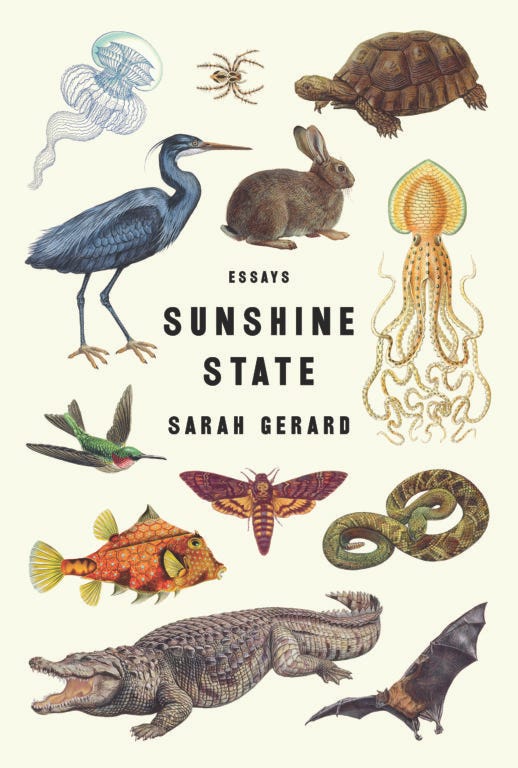
SG: Yeah. Exactly. They’re calling out to you, in a way. They’re kind of little symbols. I treat them as symbols in my life. I think I’m coming out of an elephant phase and I’m moving into an alligator phase right now. [Laughs] I said this to somebody recently. But for a long time I really identified with the elephant, and it’s nobility. Its docility, despite the fact that it’s so huge. If you look around my apartment you’ll probably see a lot of elephants here and there. They’re kind of hiding. Now I think I’m moving into an alligator phase. I’m really drawn to the alligator on the cover of Sunshine State. I’m feeling kind of fierce and misunderstood in my life, so I think the alligator is a better creature for me. But in all fairness, the alligator is a pretty docile creature, too. Unless you upset it.

So, I think I wanted to write about animals in Sunshine State because they figure so largely in my memory of growing up in Florida. Especially the alligator. When I was nine we found an alligator in the ditch of our backyard and we had to call animal control. It was a nine-foot long alligator, and my neighbor had actually warned me about it. She showed me a picture of the dog that the alligator had eaten half of. That was etched in my memory. And then a kid in my school had been chased by an alligator in the park nearby because he was throwing marshmallows at it. Just things like that. We were so close to animals growing up there. I truly feel like I have an understanding of the Animal Kingdom. I’ve always felt close to animals in my life and aware of them and aware of their emotional world.

MK: That’s a good transition to talk about the title essay. So, you had this experience with a bird, which led you to volunteer for six-weeks at The Suncoast Seabird Sanctuary in Indian Shores, Florida. The bird sanctuary turned out to have a great deal of controversy behind it. (The majority due to its owner, Ralph Heath Jr., who was accused of stealing money out of donation boxes and was illegally housing wild animals in a warehouse.) What did you know about the controversy before you started volunteering?

SG: Nothing.

MK: Nothing?

SG: Nothing until I got there.

MK: So that moment when she was like “Are you a journalist?” was just the first thing to tip you off?

SG: Yeah. I was just like, Well, now I am. [Laughs] I should have maybe done more research up front. I didn’t even think to look in the news. I remembered it being just this quiet little out of the way place. I read their website. I even read a couple of their newsletters. But I didn’t go searching.

MK: You weren’t like, “I wonder if the founder is a hoarder.” I wound up looking those pictures up. They were very upsetting.

SG: Holy shit. I’m actually glad he wouldn’t let me in. I think I would’ve vomited.

MK: Deeply, deeply disturbing. So, you set this volunteer session up, and were they just kind of like, Yeah come on down?

SG: Yeah, they didn’t mention anything. They weren’t like, NO OUTSIDERS. They told me to stop by when I came down. I went down there. They told me to come back the next day and fill out an application because the volunteer coordinator wasn’t there. I came back. I told her I was a writer and then she asked if I was a journalist. From there, I just started interviewing people. The first person I talked to was this guy Chris, the groundskeeper. I followed him around for a day. We cleaned the pelican enclosure, I think. Originally I thought maybe he would be the star of the essay because he actually has an interesting story. He was addicted to Oxycontin and was arrested for trafficking or something and had to do a bunch of community service and lost his job. I was like, okay, well, this is kind of thematically relevant. I write a lot about addiction, and certainly Oxycontin in Florida was an epidemic. So, that was motivating. But then I just started overhearing talk. And in that first conversation with Chris the warehouse came up and I was like, What’s in the warehouse and he was like, You don’t know what’s in the warehouse. [laughs]. I was like, Uh, yeah, I do. But he wouldn’t tell me. I just got nosey. I followed the story.

MK: There are people in that essay who, if it were a piece of fiction, I’d be like these people are not believable at all, but it’s nonfiction and it’s Florida, so…

SG: Yeah. [Laughs] Who is your favorite character in the essay?

MK: Jimbo. For sure.

SG: Me too.

MK: He’s incredible. The exchange where he’s like, Sometimes I imagine I’m a macho man, and you’re like, I knew better. He also really believes in Ralph’s character.

SG: He really does. Even in the end when he was crying on the phone with me he knows that Ralph didn’t intend to do harm. That’s the heartbreaking thing about it.

MK: It would have been easy for you to write Ralph as a villain, but the essay understands that it’s more complicated than that.

SG: He’s just such a nice guy. He’s just so sweet. He reminds me of a child. I don’t know. I think it has a lot to do with his relationship with his father. Needing to fulfill his dad’s expectations. It has a lot to do with privilege, too. He never had to experience the hardships that the rest of us do. He never even had to have a job.

MK: He also seems like he is not…I don’t think he understands humans very well. Perhaps because he understands animals so well.

SG: Oh, yeah. I actually think Greg and Kelly are the most suspicious ones.

MK: For sure. They reminded me of the eels in The Little Mermaid.

SG: Oh, yeah. Wow. Good one. Nice nautical comparison. Yeah, they’re funny. Actually, the conure that I adopted at the end of that essay for four days was inspired by their conure, who was very cute that day.

MK: I do really believe that Ralph’s goal was to save as many wild animals as possible. If I’d just read newspaper articles, I probably wouldn’t believe that, but the essay made me believe that.

SG: One hundred percent. He dedicated his life to it. It’s the only thing he’s ever done.

MK: As I was reading the essay, I was amazed by how many people were willing to talk to you and what they were willing to tell you.

SG: They wanted to talk to me. Every one of them. Because it’s concerning.

MK: And everyone in that essay firmly believes they haven’t done anything wrong.

SG: I know. And yet they’ve all enabled him in some way.

MK: They don’t think they have anything to hide.

SG: Fuck. I know. It’s a mind trip. Yeah. Every one of them is complicit somehow. They tried to change or improve things from the inside. Each of them works really hard and cares about animals. Nobody gets paid very much. Most of them are volunteers or they work there part-time or they’re paid for part-time work but really wind up working there full-time hours. Even when they leave the sanctuary, they go on to found other sanctuaries. It’s really what they want to be doing. And, you know, it would be crushing for Ralph if he could in any way be convinced that these animals didn’t really love him in return.

MK: Or that he had hurt them.

SG: Or that he had actually hurt them. Hurt the thing he loved the most.

MK: Yeah. The images are very disturbing.

SG: Yeah. Can you imagine being the Florida Fish and Wildlife agent who had to search that place multiple times?

MK: It reminded me of Grey Gardens, in a way. Like, pre-Jackie O clean up.

SG: Oooh, yeah. Similar concept. He’s such an island, isn’t he? He’s not there anymore. They’ve actually rebranded. His sons bought it and I believe…what is his name? One of the rehabbers. Gary, I think is his name. He’d been volunteering for a long time and is now the general manager. So, that’s the comforting. Ralph is reportedly not involved, but who’s to say?

MK: I want to talk about the essay “Records,” where you track your senior year of high school. What your research process like for that essay? Were you looking at old journals? Old pictures?

SG: I began with the character of Jerod. That one began as two different essays, too. I was going to tell the story of Mitch and Jerod as two separate essays. Jerod was looking a lot at the Florida nightlife culture at that time. But I was also interested in his criminal record. I have a lot of friends like that, who’ve been in the penal system over and over again, or they’ve disappeared from my life because they were incarcerated. So, I began with wanting to find him. I didn’t know what happened to him. The last time I saw him was in 2009. I went to look for him and I couldn’t find him on Facebook. There was no trace of him on the internet. But I’m a really good sleuth. That led me to track him down. I knew he’d been arrested a couple of times, but I didn’t know the extent of it. He’d actually been in the jail since 2013 or something. Very recently. I finally found him in Indiana.

But I kept trying to tell this story and I couldn’t. I was spiraling out into other people who were related to the story. I couldn’t find a through-line. I couldn’t draw a conclusion. I didn’t really know what it mean yet. I was telling all these individual stories and trying to tie them together and separately was trying to tell the story of Mitch, this experience of sexual assault with my boyfriend three days before I left for college. I couldn’t not be the victim in that story and I really didn’t want to be the victim, you know? That was not what I was interested in at all. When I finally began to imagine what it would be like to tell the whole story of that year it was…how do I explain this? I was finding that in telling the story of Mitch I couldn’t not tell the story of Jerod. I had to mention that I had this whole other boyfriend at the time. That’s when I was like, well, why is he appearing in this whole essay of his own? I think in some linked collections you can make connections like that. But it just didn’t click. I couldn’t see what it all meant until combined them, until I decided to talk about the entire year. I had to talk about it all.

MK: Why did you decide to tell the essay in the present tense?

SG: I think because, at that time, I didn’t have any retrospect. I wanted to be true to the experience of thinking and feeling all those things for the first time. It creates a sense of possible danger, because I don’t have any foresight.

MK: I can say that as a reader, the present tense really kept the energy up, and seemed to almost match the energy of that time in your life. So much of that time in your life seems like it was about moving from place to place. Being in cars, going to the movie theater, going to someone’s house, going to a party. Just moving, constantly.

SG: Yeah. And when you’re in ecstasy, there is only the present moment. Music is like that, too. You only hear this one beat at a time, but they’re all linked together. I wanted…what did you say a second ago? Oh. The energy. Yeah, I had a lot of energy at that time. My sexual impulses were all mixed up with my artistic impulses and the general impulsivity of being a teenager. I was trying to find myself. Trying to cobble together an identity through experimentation and different art forms and different people and modes of expression.

MK: That comes across in the essay. It’s so tricky at that age. You’re trying on all these different personalities in a way you never are again. I want to talk about the edits you made to “BFF,” the epistolary essay about your relationship with your childhood best friends. They’re minimal, but seem pretty important. What kind of work did you do in changing it from a stand-alone chapbook (with Guillotine) to an essay in a collection?

SG: Oh, wow. I’d have to look at my editorial notes from my editor. Well, in the chapbook it ends with her wedding, right?

MK: And you’re looking at her husband.

SG: Yeah. I think my editor thought it would be more fitting to end on this reflection on us. This bittersweet childhood moment of innocence. It did feel more accurate. In the chapbook I ended up moving chronologically — oddly, because I don’t do that elsewhere. It felt right to go from being 12 to her being married. I think it’s also maybe tacky to end on a picture I’d come across on the internet. It’s not a sentimental thing, you know? It’s sad, but it’s not something that’s special to us or in our relationship. It’s a moment that happened after our separation.

MK: And then it’s also ultimately more about you. It’s about you deciding what that picture means to her and what it means to you. But it’s not an essay about you. It’s an essay about both of you.

SG: Yeah. Exactly. Yeah, so in that last memory, it’s us together, poolside. [Laughs] Right? Our feet are in the pool. We had these matching bathing suits. Except hers was purple and blue and white and pink and mine was green and pink and blue and all different colors. I think yellow, too.

MK: Do you know if she read the chapbook?

SG: I don’t know. I recently learned that she’s welding. She’s in welding school. I’m happy for her. But, no, I don’t know if she’s read the chapbook. She recently liked on Instagram — this is how insidious the internet is, right? This is what I know about her. Things I happen to see on friend’s feeds. But she recently liked a picture of my friend holding my book. So, I know she knows the book exists. I don’t know about the chapbook, though. It’s okay. I still love her. She’s a beautiful person.

Patricia Engel on Florida, the Courage of Immigrants, and Writing a Novel of the Americas

MK: One of the edits you made that I took note of is you talking about are sorry that you couldn’t love her in the right way and then — you don’t say this part in the chapbook — but in the way that she deserves.

SG: Oh, yeah. Yeah. She does. She’s a beautiful person who has been through a lot. That’s what trauma does. It makes people protect themselves with their behavior.

MK: In another interview you talked about how, short of doing something out of spite, there isn’t a reason not to write about someone.

SG: And to protect their privacy.

MK: Right. Yeah.

SG: But it was never my intention to publicly embarrass her or have the last word or make her the bad guy. I would never want to do that. I just needed to resolve something in myself. It really hurt the fact that we could never….there had just been too much that came between us. There were too many things we had never said to one another and they had just piled on top of each other over the years. There was no way for us to talk about any of it without really hurting each other.

MK: You take a great deal of blame in the essay and throughout the whole collection you expose these parts of yourself that are…less than favorable. I’m thinking of that scene in the Amway essay where you tell your mom you get everything you want.

SG: [Laughs] God. So Embarassing.

MK: Whenever I read nonfiction where the author hasn’t done anything wrong, I’m immediately like, You’re lying and I do not want to read this anymore. [Laughs] But was it difficult to include those parts of yourself at all? It would’ve been easy to just…not include them.

SG: But it’s important to include. I think your writing should transform you and I think the only way to do that is by truly confronting yourself, who you are. That was really a part of who I was. I thought I was special because I was spoiled, that that was something I deserved and should be proud of. That’s a disgusting thing to have to admit, but I don’t think that’s who I am today. I mean, I laugh and say it’s embarrassing, but I don’t subscribe to that way of thinking anymore. A piece of writing should also show us how our thinking has changed over time and changes in the writing of the piece. I think that you can’t show how your thinking has transformed if you don’t include every step of it, every aspect of it. If you don’t really show the process. I think in the Amway essay I’m pretty clear about the fact that I don’t think that way anymore. I think I even say that it brings me shame to tell this story. That demonstrates how my thinking has evolved from that point.

“Your writing should transform you and I think the only way to do that is by truly confronting yourself, who you are.”

MK: Let’s talk about the last essay in the book. It’s really good and it’s really weird. I’ll admit that in my first reading, I really struggled with it. Let’s say that, up until that last essay, the most “experimental” essay in the collection is the Amway essay. But you’re told the rules of that piece. You’re given an intro that tells you basically, “this blends fiction and nonfiction.” With the last essay, you’re not really given a way to navigate it, at least not such a straightforward map. I really want to hear about your writing process with it. So, you went to see a hypnotist, right?

SG: Yeah. I wanted her to help me remember all the animals I’d ever met.

MK: Was the hypnotist in Florida?

SG: She was in Florida, yeah. She was in Saint Petersburg.

MK: How did you find her?

SG: I Googled “Saint Petersburg hypnotist.” [Laughs] I called a couple offices and asked what their rates would be and what their methods were. And then she and I ended up talking for about a half an hour. I was like, Here’s what I want to do. It’s really weird. And she was like, Ooh, well, here’s how memory works. She was like, They’re like clusters. We talked about trauma and how a trauma memory is a like a flash-bang. She was up front in saying she couldn’t help me remember every single animal I ever met ever in my life, which was my initial intent. She was like, You just didn’t record every single one, but the ones that you come away with are the ones that have some emotional significance for you. You actually formed a bond with them. And I was like, well, that’s actually more interesting. I saw her and we went on this hypnotic journey to the bottom of a lake. We actually talked for a long time about my sensory inclinations, whether I’m more visual or auditory or sensory. She needed to find a pathway into my memory. I think we decided I was visual.

MK: Were you taking notes during the session?

SG: I couldn’t because I was hypnotized.

MK: Oh, right. Obviously. So do you remember…do you not remember the actual. Sorry. I’m so fascinated by this.

SG: I do and I don’t. She told met that I was allowed to fall asleep if I needed to, that I wouldn’t actually be asleep. It got really deep. She told me that I would continue to remember more animals in the coming days. So, for the whole time I was in Florida I was carrying around a digital recorder and as I was driving I would just be dictating into my recorder. I have notes in my phone. I have notes in my notebook. And then I organized them chronologically in a spreadsheet, and I took notes on each one. I needed a visual assignation for each animal in the essay so that it wasn’t just a dog at somebody’s house or a dog doing something. I needed specific and significant details. In the spreadsheet I have columns. There’s a column for the kind of animal, where they were or where I saw them, the year, and then what they were doing. Oh, and who — if they were domesticated animals — who they belonged to. That was another column. Then I had to turn that into…I had decided in advance that I wanted to write it in reverse chronological order, so I had to find a way to show you, the reader, that it was moving in reverse chronological order. I tried to show this with my age, with my birthday. If you saw another birthday come along then you’d know a year had passed. Then my editor finally convinced me that we should have a couple of more markers. I really wanted it to be…I wanted not to have to be so overt. I wanted it to be shown in the text.

We had to decide where the moments of transition would be. There are a couple of places where you can see that the text changes shape. The shape of the text shows you that you’ve begun a new epic or moved backwards into a new era. The rhythm would also change slightly. It was a fun and interesting and frustrating and challenging piece to write.

It was actually in the original proposal. When I was talking to Cal Morgan about it, I wanted to — he’s the one who acquired the book — originally I wanted it to be any animal I’d ever met, ever, and I said, “Well, would that include animal videos I’ve watched online?” This is the craziness of research, right? Making a note of every time I watched an animal video on the internet. And I was like, Well, I can mine my internet history. It felt so overwhelming because in the raw data itself there’s no story. You have to find the significance of it through — well, in my case — through the emotional through line of my memory. These are the animals that were significant to me that I’ve met in my life, and significant for some reason.

MK: I’d like to end by asking what you’re working on now. I know you have your Hazlitt column and I heard you’re returning to fiction.

SG: Yeah, I’m writing a novel now. I can’t say anything more about that. But I’m always writing something.

MK: How does it feel to return to fiction?

SG: So fun. I’m having a great time with it. I’m teaching fiction now. I’ve learned a lot about fiction having to teach it. It’s fun to be writing it again, and it always…I think the frustrating thing about writing in a political climate like this one is that it’s very distracting. Especially with fiction I feel like I need to be kind of isolated, which was not the case when I was writing this book, although I did go away for a month at one point. I was so productive. I wrote like three essays. But writing fiction…I don’t know. I feel so affected by what’s happening. It makes me second guess what I’m writing. That’s a really good thing, but it has stopped me as a writer. Is the thing I’m saying worth saying right now? Is this an important thing to say right now? Usually when I ask myself that question the answer is yes, so thankfully there’s that. But it’s also hard to forget the outside world while writing. It’s so tempting to read the news, which gets me so off-track.

MK: What are you reading right now that isn’t the news?

SG: I talked to Lida Yukanavitch recently. I interviewed her, so I just read again The Book of Joan. Oh, I’m also reading Jess Ardnt’s book Large Animals. It’s really good. The stories are really short and the language is so crazy and playful.

8 Books about Passion and Scandal in Cuba

Writers have long been fascinated with Cuba, that great worm of an island, the largest in the Caribbean that sits ninety miles from Florida. Just as there is Edith Wharton’s New York, and Mavis Gallant’s Paris, there is the Cuba of Ernest Hemingway and Graham Greene — full of violence, passion, and scandal. Cuba’s own novelists have had an outsized influence beyond the island’s borders. Alejo Carpentier’s writing introduced magical realism to Latin America; Leonardo Padura’s and Cabrera Infante’s novels invent an Havana that is as distinctive as Charles Dicken’s London.

Stephen Crane traveled to Cuba in 1897 as a correspondent during the Spanish American War and from his misadventures, came his short story, “The Open Boat,” which is based on Crane’s experience of surviving a shipwreck while traveling to Havana. Richard Harding Davis, journalist, playwright, and best-selling author, was sent to cover Teddy Roosevelts’ Rough Riders by The New York Herald. “The Death of Rodriquez,” his poignant, firsthand account of an execution of a rebel by the Guardia Civil on the front lines, is brilliant journalism.

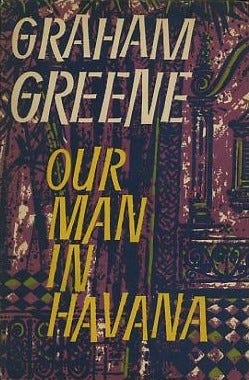
Hemingway lived in Cuba from 1939–1960, writing a great deal there and some of his works are set on the island, notably To Have and Have Not and The Old Man in the Sea. Graham Greene arrived in Cuba in late 1957 to research a book and to sample Havana’s scandalous offerings in the city’s casinos and sex clubs, including the infamous Shanghai. His novel, Our Man in Havana, grew out of his extended stay in the city. Kenneth Tynan, the caustic English critic, and enfant terrible of the London theater, visited Cuba in 1959 to write an account of life under the new Castro regime for Holiday Magazine. A famous anecdote from his trip remains. Tynan entered a bar and encountered Alex Guinness, who was there for the film adaption of Our Man In Havana, which was being shot in the city. He told Guinness he had two tickets for La Cabana fort that night and asked Guinness to join him. “What’s on?” Guinness asked. Tynan replied: “They are executing a couple of sixteen year olds. A boy and a girl. I thought you’d like to see it. One should see everything if one is an actor.”

Today, the violence is muted, the scandal suppressed, and the passion, defiant against years of grim poverty, is vibrantly alive in music, dance, and the nostalgia of Cuban writers for the exuberance and seductions of the past.

Here are eight books set in Cuba.

Our Man in Havana by Graham Greene

Graham Greene’s Our Man in Havana (1958) gives life to the decadence and depravity of pre-revolutionary Havana as the novel spins out a comedic tale of cash-strapped Jim Wormold, who successfully cons British Intelligence into paying him for vacuum cleaner drawings that supposedly depict missile installations. The novel begins in El Prado, Old Havana’s main thoroughfare and home to the Wonder Bar, where Wormold begins his day with a drink. “There is always time for a scotch.” Wormold’s daughter, Milly, 17, holds him hostage with her spending habits, and he pads invoices to Britain’s Intelligence Service, MI6, by inventing sub-agents in whose name he draws expense accounts and on whose ‘word’ he concocts missile diagrams he takes from appliance brochures. He finds the names of his fictitious agents in the phone book, so they exist in real life, and begin to die when the Cuban police crack his simple coded messages to London. The Wonder Bar no longer exists, nor does Sloppy Joe’s, another bar, but other richly described locations remain. The hotels Nacional, Inglattera, and Sevilla exist today, as does the Tropicana. El Floridita, where Hemingway drank, and whose life-size bronze statue sits slumped at the bar, continues to attract tourists. Gone is the Shanghai, Havana’s notorious sex club, where one of the novel’s sub-agents, Teresa, was a nude dancer. Greene’s researched his novel on several trips to the city. Of the infamous strip club, Greene wrote in autobiography: “We had been to the Shanghai, and we had watched without much interest Superman’s performance with a mulatto girl (as uninspiring as a dutiful husband).”

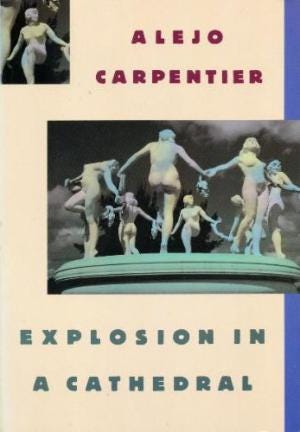
Explosion in the Cathedral by Alejo Carpentier

Alejo Carpentier’s Explosion in the Cathedral, written in 1962, embraces the then timely theme of revolutionary-turned-tyrant. It is an historical novel set in the Caribbean at the time of the French Revolution, but it is an oblique commentary on Cuba after Castro came to power. The book follows the story of three privileged creole orphans from Havana who join French adventurer Victor Hugues in the revolutionary turmoil that gripped the Americas. Carpentier, who was born in Havana in 1904, and lived for many years in France and Venezuela, is considered the leading precursor to the generation of Latin American authors who came to prominence in the 1970s, including Gabriel Garcia Marquez. Explosion in the Cathedral is splendidly written, a stylistic tour de force.

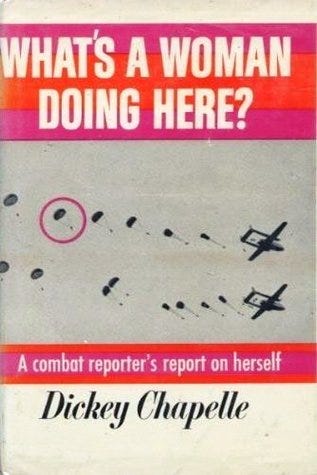
What’s A Woman Doing Here? by Dickey Chapelle

What’s A Woman Doing Here? Dickey Chapelle’s 1961 memoir of her twenty years reporting from the bayonet borders of the Cold War, sets its penultimate chapter in Cuba in 1958. She was among a handful of journalists to interview Fidel Castro in his Sierra Maestra headquarters. It has a reporter’s keen observations about life under dictatorship: hamlets destroyed by air-dropped napalm; the brutal violation of a fifty-year old woman school teacher; constant fear of arrest while making her way through the front lines. Chapelle spent six rain soaked days in the makeshift hospital headquarters creating a portrait of Castro — then still an enigmatic figure. His command style: “The staccato rhythms of the hasty conferences as orders were sent and messages received, was punctuated by radio transmissions.” “His speaking voice was surprisingly soft.” “His manner of giving praise was a bear hug.” Before Chapelle ended her nine weeks she witnessed the collapse of Batista’s regime New Year’s Eve and Castro’s triumphant entry in Havana a few days later. It’s a humorous and self-deprecating memoir by an ambitious young woman. In the end she gave up everything she had to be a war correspondent — including her life. She was killed in Vietnam in 1965 when a piece of shrapnel triggered by a tripwire mortally cut her throat. She was the first woman war correspondent killed while on assignment.

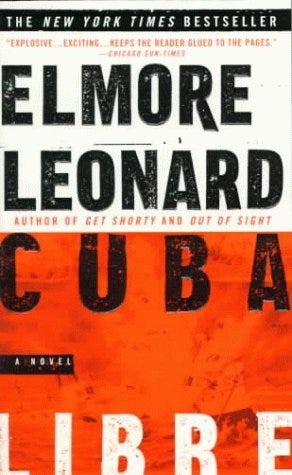
Cuba Libre by Elmore Leonard

Elmore Leonard’s Cuba Libre (1998) opens in Cuba on February 18th, 1898, three days after the sinking of the battleship Maine, when a Texan named Tyler arrives in Havana to deliver a string of horses to an American sugar baron — actually a cover for an arms shipment to Cuban insurgents fighting the Spanish Army. It can be read as a brilliant retelling of Chaucer’s Pardoner’s Tale, with a half a dozen parties scheming to make off with money intended for the revolutionary cause. Period atmosphere is here: sugar refineries fouling the air with black smoke, Old Havana’s broad esplanades traveling down to the Malecon, windows on old government buildings shuttered tight at noon to protect against the sun’s oppressive heat. The book wants to capture, and largely does, the spirit of the island, the largest in the Caribbean, just 90 miles from Florida, that is part Spain, part Africa, part America. Havana’s prominent landmarks are threaded into the story giving the city an eerie familiarity: the Hotel Inglaterra is there, its lobby a meeting place for deal makers, as is La Cabana Fortress. Priests accompany condemned prisoners to the moat for dawn execution, a grim foreshadowing of what took place in the prison in 1959. Night life has a racy exotic feel, but it was a different, poorer time. Spanish soldiers pay prostitutes with Mausser cartridges only to have the cartridges find their way into rebel rifles that kill them. There are a dozen greedy schemes that pause for war and sex.

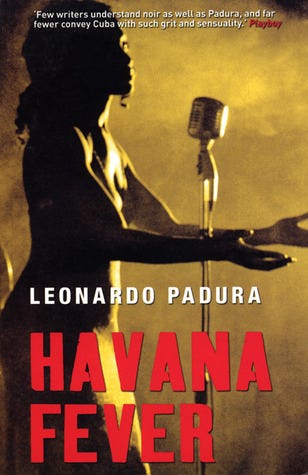
Havana Fever by Leonardo Padura

Leonardo Padura’s Havana Fever (2005) is set during Cuba’s ironically named Special Period, when the Soviet Union’s subsidies to the Cuban economy ended and the island entered a prolonged period of hardship. Wealth was measured in egg rations and families sold whatever they had to support themselves. In this mystery, former detective Mario Conde has become an antiquarian book dealer, buying up individual titles and entire libraries of the former upper class for a bargain. Families living in decaying mansions in once prosperous Vedado now harvest heirlooms to pay for food. Padura finds tucked into one volumes he’s bought the photo of a bolero singer, the beautiful and mysterious Violeta del Rio, who was popular in pre-revolutionary Cuba. Conde is curious about the mystery surrounding her suicide and her connection to the family who owned the book. He investigates her death in the glamorous world of the 1950’s, with his mobsters, corruption, dance halls, casinos, and cultural gloss — a period that still fascinates modern Cuban writers. This atmospheric book is full of Havana’s faded past, which, like an old uncle, has endless stories to tell. Leonardo Padura’s Havana Fever is a fine novel of detection and a life-affirming tribute to the city.

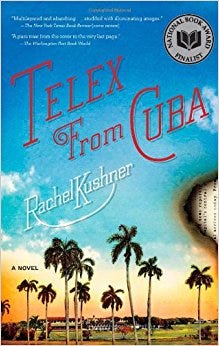
Telex From Cuba by Rachel Kushner

Telex From Cuba (2008) by Rachel Kushner is a recreation of the lost world of American expats living in pre-revolutionary Cuba. It is multi-layered novel that evokes the beauty of the island and the brutal inequities of the Batista dictatorship, spanning the period from March 1952, when Batista assumed power in a coup, to New Year’s Eve 1959 when he fled in advance of Castro’s forces. The first part of the book takes place in the United Fruit company town of Preston, east of Havana, where American’s live a gated life with maids, drivers, largely removed from the violence of the surrounding poverty. White jacketed servants pour drinks at the tennis club from a cart with gleaming liquor bottles. The writing is often lyrical: “What hot tongs of lightening spidered against the dark sky.” Kusher captures the dizzying confusion of political factions fighting Batista, with Castro’s July 26th Movement slogging it out in the mountains while other opposition factions talk a good game over coffee in Havana’s bars. There are compelling details of Havana life — La Floridita, Hemingway’s favorite bar, is there and he makes a cameo appearance. So is Barrio Chino, where stiletto-heeled prostitutes stand between fruit carts and solicit tourists while across the alley, a line of sashaying girls with Adam’s apples appeal to a different taste: “Just let me escort you, honey.”

INFOGRAPHIC: The 20 Most Popular Books Throughout History

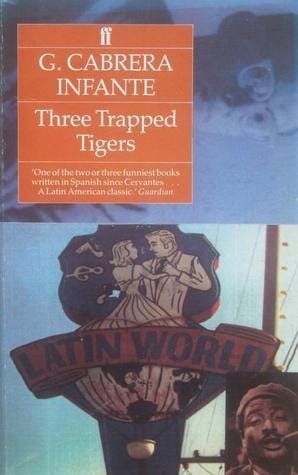
Three Trapped Tigers by Cabrera Infante

Cabrera Infante’s novel, Three Trapped Tigers (1965), is nostalgic for the colorful, tawdry Havana of the 1950s, and for the political innocence of the time. The book opens with the voice of the emcee of the Tropicana, the city’s luxurious open air night club. “Showtime! Senoras y senores. Ladies and Gentlemen. And a very good evening to you.” This stream-of-consciousness masterpiece propelled Infante into the front ranks of Latin American novelists, drawing comparisons to Cortazar’s Hopscotch and Garcia Marquez’s One Hundred Years of Solitude. Infante’s Havana is a “crumbling, noisy, malodorous, brilliantly colored” city filled with jazz singers, gangsters and prostitutes. His characters are all well read, well versed in popular culture, and committed to the possibilities of taste, tragedy, and truth. The three young men central to the book cavort with musicians, dancers, and wealthy debutantes, including La Estrella, a bolero singer, Vivian Smith-Corona, an heiress, and Mrs. Campbell, wife of an American millionaire. Infante’s Cuba is a manic doomed world.

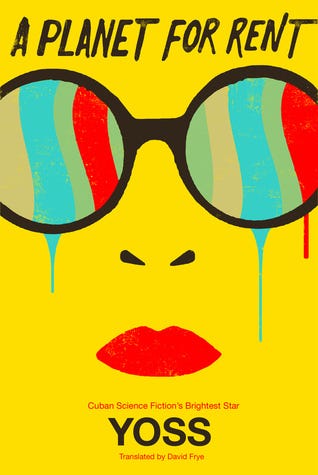
A Planet For Rent by Yoss

A Planet For Rent (2001), the English language debut of Jose Miguel Sanchez, who writes under the pen name Yoss, was inspired by events in the early 1990s during Cuba’s euphemistically described Special Period when the collapse of the Soviet Union denied the island’s economy much needed subsidies. Cuba opened itself up to tourism, altering life in Havana, and it was the presence of foreigners, the privileges they enjoyed, and the cash they brought, that led Yoss to write his scathing, thinly veiled, dystopian satire. The book is split into fourteen chapters each a short story or vignette connected by recurring characters and themes. Aliens called Xenoids arrive to preserve the declining human civilization and human metaphorically and physically prostitute themselves for the visitors. “Performing Death,’ the most remarkable and disturbing chapter, recalls Kafka’s “The Hunger Artist,” Yoss’s protagonist, Moy, is a human artist who performs a bodily deconstruction for the alien audience in which the artist is mechanically filleted under mild anesthesia and recites his visceral manifesto. “The artist can and must die — in, through, and for his art.” Yoss is a brave and imaginative voice. His novel is a trenchant portrayal of Cuba under communism.

PAUL VIDICH was a senior executive in the entertainment industry for over twenty years. After leaving his business career he turned to writing full time. He serves on the boards of The New School for Social Research and Poets and Writers. His first novel, An Honorable Man, was published by Atria/Emily Bestler Books. His second novel, The Good Assassin, published April 2017, is set in Cuba.

Why Do Old Books Smell So Good?

Science says it has something to do with chocolate and coffee

If there’s one thing bookworms can universally agree upon, it’s that old books smell damn good (maybe even delicious). I previously chalked up my predilection for inhaling timeworn, musty books to nostalgia. Like a lot of readers, I have fond memories of checking out yellowed volumes at my local library, and although smell is the strongest sense connected to memory, scientists have found equally compelling evidence for why we’re so drawn to the scent of old books: chocolate and coffee.

According to Popular Science, Researchers at University College London’s Institute for Sustainable Heritage have now subjected book-sniffing lore to the rigors of the scientific method. The quest to analyze book aromas began a few years back when chemist Matija Strlič observed paper conservators smelling the pages of the texts they were studying. Strlič, a conservator himself, was curious why his colleagues were doing this, and they told him that they could decipher a great deal about what properties constitute aged books by simply smelling them. Strlič says, “I thought, surely we can develop some scientific techniques that are more accurate than the human nose,” so he set out to create a classification system.

A Young Mexican Author Explores Life on Either Side of the Río Grande

How did his team go about extracting this vaporous data? Well, books emit volatile organic compounds (VOC’s), known to us common folk as ‘smells.’ “Those compounds can be detected by sensors…[which] detected tiny variations in the chemical compositions of very old books,” and shed light on “key smell components in the books.” Strlič then teamed up with heritage scientist Cecilia Bembibre and the U.K.’s National Trust to investigate how people respond to the scents. In an experiment setup at Birmingham Museum and Art Gallery, the overwhelming majority of 79 participants reported that the smell of old books reminded them of chocolate and coffee. The response took researchers by surprise, but the correlation came up again at another library. Bembibre eventually made a “historic paper odor wheel,” which she hopes will strengthen researchers abilities to connect a smell with a compound. For laymen this new information is significant because it finally puts forward a concrete explanation for why we’re so attracted to the smell of decrepit books. It’s a rare bunch of people who don’t like chocolate or coffee.

If you’re a real nut for the fragrance of old books (or now feel a newfound urge to surround yourself with their musk after reading this) there’s a highly-rated candle on Etsy that advertises just that. Or, you could do it the old-fashioned way — hit up your local library or used bookshop and start wafting.

Whitehead, Als & Nottage Win Pulitzers

The just-announced 2017 Pulitzers are going to make your day

Colson Whitehead, Hilton Als, Lynn Nottage

The 2017 Pulitzer Prizes have been announced, setting the literary world momentarily abuzz as a few lucky writers gather up the one laurel their mothers have actually heard of. The winners will receive $10,000 each.

Enough preface — here are your 2017 winners for Letters & Drama:

— Fiction: Colson Whitehead, The Underground Railroad

— Non-fiction: Heather Ann Thompson, Blood in the Water: The Attica Prison Uprising of 1971 and Its Legacy

— Criticism: Hilton Als of The New Yorker

— Drama: Lynn Nottage, Sweat

— Poetry: Tyehimba Jess, Olio

Whitehead’s victory marks only the eighth time a novel has won the book world’s two top prizes, the Pulitzer Prize for Fiction and the National Book Award for Fiction. The only others to pull off the famed bi-fecta were The Shipping News (Annie Proulx), Rabbit is Rich (John Updike), The Color Purple (Alice Walker), The Stories of John Cheever, The Fixer (Bernard Malamud), The Collected Stories of Katherine Anne Porter and A Fable (William Faulkner).

Whitehead took to social media for a quick celebration:

Recommended Reading’s Associate Editor, Brandon Taylor, struck a similar note on behalf of the winner for Criticism, Hilton Als:

Shortly before the announcement, Lynn Nottage, award-winner for Drama, had other things on her mind:

The full list of winners, including the big journalism prizes, can be found here. Finalists have also been named, with Adam Haslett (Imagine Me Gone) and C.E. Morgan (The Sport of Kings) rounding out the nods for Fiction.

2017 marks the Pulitzer Prize centennial. The fiction award (originally reserved for novels) has been around since the start, though no prize was handed out in 1917. (The first went to that classic of American literature, His Family, by Ernest Poole.) Over the next hundred years, the committee has declined to hand out any Prize for fiction in eleven different years, which either adds a little extra gravitas to the award or represents some next-level-Jonathan-Franzen-trolling, depending on how you want to look at it.

How did Bradley Sides do with his predictions for EL? Pretty damn good.

And finally, according to the organization’s FAQ’s, the name of the award is in fact pronounced PULL-it-sir, as in “Q: Is that a tail sticking out of your trench coat? A: Pull it, sir, and you’ll find out.” Another mystery solved.

That wraps up another year in book prizes, folks. Like Balzac said, “There goes another novel.”

How (and Why) to Write Realistic Aliens and Magic

The difference between asking “what if” and writing what the audience knows

Editors Note: This essay is a response to “Against Worldbuilding” by Lincoln Michel, published in Electric Literature on April 6, 2017.

First of all, I have to admit, I do like realistic worldbuilding in fantasy and science fiction. A lot. I have in fact spent the last couple of years building a sci-fi world using all the science and history that my brain can absorb, for a game where the world itself is the story, for the most part. At the same time, I’m bored to death with literary realism. Immediately, it should become obvious that some definitions are in order before I can even begin to try to explain why I believe that Michel’s dissing of realistic worldbuilding is a bit unfair.

So, what is realism in writing? As far as I can tell, there are at least two very different ways of writing, and particularly worldbuilding, that can be considered realistic:

  1. Realism as in trying to create an appearance of reality from the perspective of contemporary human readers, which is at the core of the classical literary genre of realism. In fantasy or especially science fiction, this shows in the aliens or magical beings being humans in disguise in a society that is a reflection of some current or historical human society.
    PROS: This can create safe distance that allows human peoples to see that some things they may consider normal and fine are actually wrong, like racism or fascism. Arguably, works of this genre have done a lot to advance the cause of secular humanism.
    CONS: This approach is prone to clichés and stereotypes and can be actively damaging to human creative freedom and imagination, especially when used in a manipulative way to reinforce the normalcy of immoral acts and unjust social orders — for examples, research “socialist realism,” or which classical authors actually were racists or fascists.
  2. Realism as in asking and attempting to answer a “what if” question using logic and/or science, typically along the lines of “what if some aspect of reality was different in a very specific way.” Unlike writing human aliens or criticizing existing social orders, this approach attempts to predict events or technologies or generally open up new possibilities or prevent threats by creating self-fulfilling or self-preventing prophecies.
    PROS: A number of technologies that benefit mankind have been invented specifically after being proposed in fiction, while the explorations of new utopias and dystopias may have inspired real political progress.
    CONS: Essentially the same, just in cases when it didn’t exactly work out for the better — think scientology. Also, this is very hard to do well and may easily not turn out to be actually in line with reality, not even in the future or on the other side of the universe, or in any actual time or universe.

To address Michel’s concerns, yes, magical creatures as far as we know do not exist, since any that would exist would be considered physical by definition, and we haven’t discovered any actual aliens yet. But “what if they did exist” is a valid question to ask. Many things, creatures, events, and social orders haven’t existed yet, but they might, and if they don’t, anyone’s life may become richer or more fulfilling because someone has thought of them.

What Michel favors instead of realistic worldbuilding is surrealistic world conjuring, and that’s completely fine, of course. I personally love magical realism just as much as hard sci-fi, to a point where I legitimately don’t understand how the term can be understood as a slight somehow. The problem here is that surrealism and collaborative conjuring between the author and the reader have very different strengths and uses.

Can I Has All the Answers?

Michel argues that it is wrong to expect the author to provide all the answers, and that’s fair in a sense that it is indeed impossible for an author to provide all the answers in any scenario. But the act of providing most answers, or at least trying to, is the whole point of certain literary subgenres. It doesn’t automatically amount to good writing, sure, it’s a bit of parallel skill to writing, but if it truly doesn’t matter, then why does the ending of Lost feel so damn lazy and disappointing?

On the most basic level, not worldbuilding in a fictional world with some element of asking questions or solving mysteries is like telling a riddle, making people guess what the answer is the whole time, and then showing that the author never thought of any answer, or could only think of a really underwhelming one. That doesn’t mean the author has to spell out the whole answer explicitly, but there’s a difference between it not being divulged, and it never having existed in the first place. Like a murder mystery where anyone could be the killer randomly, or where the first and most obvious person accused ends up being the killer.

Don’t misunderstand me though, there are many types of stories that don’t need this kind of answers at all, exactly like the whole of surrealism where the trick is precisely in the multitude of interpretations that the reading allows. Then there are genres that can go either way equally fine, like horror. Horror can easily follow vague and fluid dream logic, activate base human subconscious fears, or draw from not knowing who the killer is while knowing there is one. One can get just as scared in a nightmare chased by Freddy Krueger, dreading bodily violation by the Alien, or guessing logically which of the scientists is The Thing in a fleshy disguise.

At any rate, you can’t simply say it’s wrong for readers to speculate while reading works of speculative fiction, even if it does get out of hand sometimes on the internet. Also, what’s so wrong with wanting the author to actually have some answers, to have thought things through? It’s true that good writing doesn’t need worldbuilding beyond a basic setting, especially when the focus is exploration of characters or the human mind in general, or in a, say, lyrical poem. But the surrealist method has its own negative extreme when it becomes artsiness for the sake of artsiness, entirely devoid of answers in the sense of not having anything to say of its own about reality.

Art that only says things about art may be artful, but what does it actually do beyond the aesthetic or immediate emotional effect? Having answers in a work of fiction doesn’t automatically make them good ones, but it is one of the main ways to advance real world philosophy with real impact not only on individual human beings, but also institutions like politics, science, or religion. Do you know what’s the first speculative utopia on record? Plato’s The Republic. Saying things often matters, artistry not nearly as much.

Ultimately though, these are just the two main approaches to writing, and all art, that exist, equal and opposite — form against essence. Which is still a false dichotomy in this case, because both surrealism and realism can focus on answers and worldbuilding, differing only in how they’re communicating their answers or what logic they’re using to build the world. Look at something like Psychonauts where secret agents physically enter surrealistic mindscapes of villains and inhabitants of insane asylums, or the Dragon Age series with its Fade where thoughts manifest as spirits and warped landscapes, separated from a realistic fantasy world by a (techno)magical veil.

Unreal worlds can still be perfectly explicit and logically consistent. In the face of aliens, magical creatures, and all sorts of unreality, one can simply follow any flights of fancy to amuse, awe, or mystify like Tolkien did in The Hobbit, or one can try to explain how everything came to be exactly, like Tolkien did later in The Lord of the Rings. As long as either approach has a point to it in how it’s executed, either aesthetic or philosophical, it’s valid literature. The only thing that’s universally damnable are literary works that try to fake artistry and answers in order to sell more copies by resembling famous bestsellers on a purely superficial level.

Ursula K. Le Guin talks to Michael Cunningham about genres, gender, and broadening fiction

Exploring the Logic of Unreality

With all that said, how does one build realistic worlds with aliens and magic in them? The key word here is logic. While unreal things can theoretically work in any way, some ways are logically consistent and others inconsistent, and it is the consistency of rules that makes something realistic. It doesn’t matter how crazy any individual made up rule in a fictional world seems when compared to our reality, it only needs to stay consistent in its own reality to feel (and potentially be) real. By this logic, it’s okay to have non-corporeal ghosts exist and not fall through the floor, but only as long as they always not fall through the floor, unless exceptions have a logically consistent explanation as well.

The easy example from sci-fi of getting this simple concept wrong is teleportation in Star Trek. If you’re a fan of any of its incarnations, answer me this — does teleportation in that universe work through the shields, or not? The answer is there’s no consistent answer. It’s fine for a technology to appear magical, but it cannot be the whimsical kind of magic that does whatever it wants whenever it feels like (unless our inability to comprehend it is the point). It’s okay to say that one can teleport through the shields if you manage to match their frequency or something, but not to not a have a definite rule about it. Well, as long as you care about realism.

To be clear, the problem is not with some literary worlds being inconsistent, it arises when the fact of inconsistency only subtracts from the meaning of that world. There’s simply nothing added to Star Trek by it having not figured out how its teleportation works. It makes the technology less plausible and the plots relying on it confusing, and therefore it’s not okay. Then again, it’s completely fine to not have everything figured out even in a realistic world, but the things that are left open shouldn’t actively disrupt or outright contradict the rules that have been explicitly laid out, especially those that are central to the plot.

Some mysteries may even be more effective when left unexplained, in the same way that it was better not to show too much of the shark in Jaws. I personally hope that I never get full explicit answers to things like what actually happened during the Doom of Valyria in George R. R. Martin’s The Song of Ice and Fire saga. In the Mass Effect series, the Reapers turned out to be much less interesting after they were explained, just like the Borg in Star Trek. Not knowing almost anything for sure about these menaces allowed for quite thrilling flights of imagination, compared to which any author-given explanation must have been a letdown. In such cases, there’s no harm in the author not having all the answers, if she’s able to pose tantalizing questions.

The Trouble With Inhuman Aliens and Other Fantastic Creatures

While logical consistency alone allows magic to become realistic, as a technology that’s simply not fully understood or which obeys different laws of physics in a different universe, creation of beings has to go beyond logic alone. Firstly in a sense that real beings have all kinds of irrationality to them, which definitely includes human audiences, but there are also scientific concerns that a realistic author should consider.

Tolkien perfectly represents one of the sciences that apply very directly to race and character creation — linguistics. The creation of whole languages may seem like an overkill, but only if one looks at the languages as something that has nothing to do with the story or character. In Tolkien’s case, he initially wanted to just create some artificial languages, but he realized that they cannot be genuine in any way if they are formed without a particular history, culture, and storytelling tradition in mind.

In other words, he came to realize that languages are not separable from the nature of the beings that speak them. By creating languages, you are inevitably creating intelligent beings and cultures that use them, and vice versa. I’d say it’s not an accident that his races became the fantasy default, when they make so much sense and are so distinct and defined, including their styles of thought and speech. To me, few things are more immersion breaking than obviously made up fantasy words without any rhyme or reason (I’m looking at you, D&D).

The next two major relevant sciences, sadly quite underused at the moment, are evolutionary biology and psychology. To put it simply, the continuous interaction between your creatures and their living environment should be taken into account. In principle, it’s not complicated — only things that can survive in an environment can live there, which means they should be adapted to it physically and mentally. Even though this wasn’t Tolkien’s primary concern, his races still make a lot of sense from this point of view — an underground race should not be one of tall people, harsher environment should produce harsher creatures, the tiniest race is the best at sneaking, etc.

There can of course be all kinds of magic or genetic engineering that interfere with the basic evolutionary idea in the story, but as long as they’re used logically and consistently in the story, they present an opportunity to explore some important themes, like the opposition of the natural and the artificial, or nature and god. You can also flip the evolutionary mechanics around and start from a creature for which you then reverse-engineer a habitat where it would fit. Of special concern should be the basic questions of how the creature gets food, whether it’s prey or predator, what is its lifespan, and how it reproduces, which should play significantly into its culture and normal range of personalities.

If you introduce magic into the environment, it changes surprisingly little. If the magic is logical and therefore realistic, you just have to think about how the creatures would use magic to fulfill their basic needs and how they would avoid being killed by it. If magic is a kind of energy, some creatures should be able to use magic as a form of sustenance, defense, or weapon. Magic as energy can also have mutagenic properties, justifying some increased rate of mutation, similar to real world radiation (but perhaps less destructive). Does magic affect lifespan? Can magic play into reproduction, in the way a love potion or a miraculous conception would? If you think the magic through, you only need to have your creatures adapt to it as they would to anything else in their environment. Especially if they’re intelligent tool users.

Finally, the last two major sciences that make sense to consider while worldbuilding for the purposes of storytelling are anthropology and sociology. They of course involve both linguistics and evolutionary psychology, but they go beyond them in their own way. There are some attributes of human cultures that cannot really be explained by language or biology directly, and anthropology and sociology are there to map and test all these unique ideas and customs. With the help of archaeology, one can even learn something about cultures that are long extinct.

You can use this knowledge to make your aliens or magical creatures realistic as humans in disguise, still exploring the human heart in conflict with itself. Which can be great. On the other hand, you can also attempt an alien version of anthropology, a xenology if you will, where you start from a different biology and perhaps a fundamentally different idea of language and then try to extrapolate the differences that would produce. Understanding fine details of real human cultures, especially the weirder ones, should serve as a decent background for such guessing about the different routes evolution of culture or society could have taken.

The ideal goal is coming up with a culture or society that doesn’t have (and perhaps cannot have) a human equivalent, but is consistent. After all, it’s entirely biologically possible (though not necessary) that other intelligent forms of life will have a fundamentally different type of reproduction (eating the mate after sex, different number of genders, having huge numbers of offspring of which few survive, etc.), different attitude toward death (imagine a race of intelligent butterflies, or those immortal jellyfish that periodically de-age), or a very different preferred habitat. Even basic things like physically not being a bilateral vertebrate can have dramatic psychological implications.

Since we don’t actually know for sure what other species exist out there, if any, and what culture they might have, instead of egocentrically assuming that other aliens must be like us, or nihilistically assuming they must be horrors beyond our comprehension, we can use their speculative creation as an opportunity to explore the place of humanity in the grand scheme of all possible intelligence. Not just in the sense of brain’s capacity for memory or computation, but in the sense of the limits of human heart, and whether we could evolve into some other kind of being in the future, for good or ill.

You can read more of Martin Rezny’s writing here.

The Dark Side of the Sunshine State

Sarah Gerard’s experimental debut Binary Star made me uncomfortable, but I liked it. This “genius… novel-shaped poem,” as The New York Times Book Review describes it, features the internal monologue of an obsessive narrator with a debilitating eating disorder. The narrator tallies her regimen of coffee and other stimulants she consumes to quell hunger, along her boyfriends intake of pills and alcohol. This documentation is merged with musings about the universe, supernovas, and how some stars move so fast they burn themselves up into nothing. The constant shift between the micro and the macro is dizzying, and the tumbling of poetic clips is enough to make a reader breathless.

“[In Sunshine State] Gerard focuses […] on the personal versus the political.”

I didn’t know what to expect when I received a galley of Sunshine State, a book of essays about the author’s home state of Florida. Although Gerard’s sophomore book is wholly different in form, it features her trademark technique of toggling between the highly personal and the foreign. Instead of the self versus the universe, however, Gerard focuses instead on the personal versus the political. This makes for a text that’s disconcerting and uncomfortable in an entirely different way. The reader is presented with both universal phenomenon of lapsed high school friendships alongside the origins of Christian Science and the DeVos family’s role in politics. Gerard offers us personal essay and reportage side-by-side sans judgment or critique, leaving us to draw our own conclusions.

Where as Gerard backed away from memoir in Binary Star, saying in an Electric Literature interview that she was “very careful about how I treated [the characters] and who might feel exposed by this story,” Gerard now dives head first into an autobiographical account of addiction. In Records, she recounts her thrill and eventual disillusionment with drugs while her then boyfriend Jarod “smokes weed as a way of keeping time.” Eventually, sitting in a room full of drugged out, high school partygoers, she states, “It strikes me as I sit there soberly that this, this silly party, is the thing I’ve arranged to do with my evening. I wonder what else I could be doing.” Gerard is college bound, and drug binges are a phase. For Jarod, however, who is of a lower income background, drugs are both an attempt at escape as well as a financial asset. When Gerard travels from Brooklyn to Florida years later she meets up with Jarod, and learns that he has just gotten out of jail for dealing heroin. She describes her high school years as an unhealthy environment from which she has escaped, and something that others have been consumed by.

“In Gerard’s work, the body is made of star stuff.”

Gerard approaches addiction and substance abuse in an entirely different format in The Mayor of Williams Park, in which she interviews G.W. Rolle, a Missio Dei minister who runs a struggling free meal program for the homeless in St. Petersburg, Florida. G.W. describes Missio Dei as “an imperfect church of imperfect people inviting other imperfect people to find perfect love.” Gerard is transparent about G.W.’s imperfections: he has a history of substance abuse and has been to jail. While Gerard is following G.W., he relapses. Gerard writes that, “G.W. has never been clean in the twelve-step sense. He loves alcohol. He takes pain pills.” While cooking a church breakfast, he confides in Gerard that he’s met someone who has introduced him to crack.

G.W.’s philosophy of curing homelessness with patience and compassion stands in stark contrast with the government’s attempt to criminalize homelessness by making “activities associated with homelessness,” such as sleeping outdoors and loitering, illegal. Gerard reports that Robert Marburg, St. Petersburg governmental representative, “casts community residents as codependent enablers…with phrases like ‘Free food handouts and cash from panhandling… perpetuates and increases homelessness through enablement.’” Legislature argues that people must prove they are deserving of aid, while G.W. contests that people must be uplifted and work together to escape homelessness.

While The Mayor of Williams Park shows why conservative methodologies misguided, Gerard also addresses right wing ideology from a personal perspective. In Going Diamond, Gerard chronicles her parents’ participation in Amway when she was a child. Amway was co-founded by Rich DeVos (yes, that’s the current Secretary of Education’s husband), who created a system in which participants bought Amway products and then encouraged their “downline,” or their friends and family, to do the same. Gerard writes that, “Implicit in this [model] is that those who have failed have failed because they have not made the necessary sacrifices to succeed. These are poor people.” Counter to G.W.’s philosophy, to the free market capitalist, poverty is self-induced. Gerard goes on to explain that in 2010, Amway reached a settlement reportedly valued at $100 million in a California class action lawsuit filed in 2007. According to the lawsuit, the company was operating on a pyramid scheme. Amidst this historical account of Amway is Gerard’s experience attending Amway conventions, and how the ideology instilled in her a belief that “by the very fact of being me, I believed I deserved material things.”

Gerard’s juxtaposition of excessive wealth accrued by the DeVos family through a pyramid scheme, with people who are shamed for being born into a system of cyclical and engrained poverty is dizzying. She inserts herself into her stories in both highly personal ways and as a second party observer, leaving the reader with a map of her internal landscape as well as a Floridian topography. The combined effect is a bird’s eye view of the state at large. In Gerard’s work, the body is made of star stuff.

The personal is political.

On the Quiet Power of Unlikable Women

Embracing the Worst Thing Someone Can Say to You

I would say that Darcie Wilder’s new novel, literally show me a healthy person (Tyrant Books, 2017), feels like it was sent from the future, one in which our collective hand-wringing over the significance of the internet and social media, or the dichotomy between high and low art, or of which artists’ stories we deem to be necessary has finally been resolved. But saying that would ignore how unbelievably of-the-moment this book is. It’s a book of grief and anxiety, of questions and confessions. One that explores the way pain and anxiety can be simultaneously public and private, constant but not always at the top of a person’s mind. A book that asks: what if the words we angrily (or drunkenly) tap out on our phones, that we save as notes, or send to ex lovers, or post publicly on social media, the ones we send without bothering to correct for typos, are the words we mean the most?

Halfway through, after noticing that my reading had idled, and that I had spent several minutes reading and reflecting on another of its many hypotheticals (in this case, would marriage exist without the concept of death), I emailed Wilder and asked if she would answer some questions I would share in a Google Doc. I sent the message, turned my attention back to her book, and was mortified by a question posed on the very next page: would you rather share a google doc or fuck without a condom.

Since then I have noticed how many lines from the novel have infected my brain and return to me unexpectedly as arguments in support of the part of my subconscious that constantly analyzes and re-analyzes my actions and the way I treat other people, the part of my brain that frames reality and processes it, that grieves and worries, the part that is writing the story of which I am both the villain and the hero.

Bryan Woods: Since I follow you on Twitter, I know a lot of the book is composed of fragments that first appeared online, but that knowledge didn’t really change how I read it. It seems like writers are still doing a lot of worrying about Twitter, but you’re using it almost like an interactive moleskine. Do you think there is a difference between what you write on the internet and your book in terms of artistic value?

Darcie Wilder: Cool, thank you. Yeah, I use it more like a notepad, but also very performative and definitely interactive with people online. The act of how an audience will be receiving a sentence or a paragraph, either on paper or while scrolling through a list of other people’s real-time sentences is definitely an aspect. But I also very much like revisiting lines that were written in that moment and seeing them untouched, like a scrapbook or a photograph.

Overall I think the internet is changing how artists and writers produce work, but the idea that you can’t use something because you’ve already posted a scrap of it online or because you were working on it publicly seems against my idea of art. There’s been repetition in art forever, and the piece of work often doesn’t come out finished and whole and ready to be absorbed by the audience. It’s a piece of art, not a spoiler.

In school we’d see cut after cut of a film before it was done, and I think tweeting is similar to that, but it’s also its own thing. There are some tweets that are legendary, but will still always only be a tweet, but then there are some that transcend that and work in a larger piece. I view them as different mediums and sometimes value one over the other, but it’s kind of always shifting. I think the real thing to worry about in regard to technology are the scary effects on our livelihoods and rights, not our artistic processes and social dynamics, which I think should evolve and embrace change, or at least be malleable. But there’s also a larger conversation about being online, content, and who profits.

BW: A lot of people are talking about aphorisms lately. Before reading your book I had just finished Sarah Manguso’s 300 Arguments, which is explicitly marketed as a collection of aphorisms, but literally show me a healthy person is brimming with them as well. One of my favorites: “people laugh if you say something serious in the tone of something funny. if you say something funny in the tone of something serious they block your phone number.” The main difference with the aphorisms you write is that they’re often framed in the passive voice or posed as a question. Do you think of these pieces as aphorisms?

DW: That’s interesting. No, I never thought of them that way but I don’t disagree. It reminds me of the ideas behind being allowed to speak with authority, who you’re allowed to speak for, and what you’re allowed to say is true for you. Which is relevant to anecdotes and memory and the past, which is a good chunk of the book. Like an intersection of relatability but not dictating anyone else’s experience. Like, I’d never set out to write a book of aphorisms, but they kind of came out by linking a lot of different observations and experiences that may or may not be relatable to different people. Also, a fear of mine is the reduction of thoughts, ideas, and feelings into these tiny sentences which is really limiting and destructive.

BW: The rhythm of the book floored me, and reminded me of the best standup routines I’ve seen. Not only because of the humor, but also because of the precise way you build these successive setups, each raising the stakes a little higher, only to tear it all down with a phrase that would make me lol or rip my heart out. Do you have a background in comedy?

DW: Thanks, I feel like most of the work was figuring out that rhythm and tone. I grew up on comedy and standup as a kid, watching hours of syndicated SNLs and half-hour specials. I have a bit of a background in comedy, but never really felt comfortable allowing myself to totally commit to it. But I also never fully allowed myself to leave it behind, or to stop being funny. I’ve always kind of felt caught in the middle between a serious, grief-stricken tone and self-aware humor. I like how those play together and the tension of them, plus it’s so similar to my coping mechanisms and tone of voice I have to use to get people to listen to me.

BW: I was struck by the way the manic, loose form of the book allowed certain themes to continually and naturally bubble up to the surface, sometimes after a trigger, but sometimes for no reason at all. I particularly found it heartbreaking the way the narrator’s grief over the loss of her mother, which is usually underlying but constant, and which is amplified by her father’s negligence, recurs in a way that feels so real. Did you set out to structure the book this way? Or did it emerge on its own?

DW: A bit of both. I had been writing these scraps of anecdotes since 2012 and didn’t know what to do with them. I began assembling them for a submission to my friend Sean’s zine Humor and the Abject, and that became the first six pages. Earlier drafts were split up into chapters and sections, but it became apparent to me that it needed to be one long unbroken thing. So it’s not stream-of-consciousness, but it’s not a conventionally structured narrative. I’ve always been interested in other types of narrative forms and experimental and experiential stuff, and I think it’s interesting to plot out the entire thing and sprinkle interspersed recurring themes and ideas but also see the ways they link back to each other in unplanned ways.

Not to use the words “magic,” “universe,” or “perfect,” but whenever I’m making something I think that the context it’s made in — like how it works with the time and place — pops up unintentionally like that. And although the book is a mixture of fiction and fact, those themes are true-to-life and because of that they can pop up in more organic and surprising ways.

Your brain is always working and connecting ideas, it’s like how tweets fall from the sky sometimes because you’re just thinking about things in the back of your mind, or thinking about a lot of things at once. I wrote that marriage/death tweet at 10 AM in a Monday morning meeting when my boss mentioned his wife and I immediately went to death. Similarly, the themes in this book are kind of like those unresolved moments you can’t stop going back to, and never get any better. The length of death is always the same. I can’t get over the length of forever, that you really will never hear a dead person’s voice again and sometimes that fact hits differently on a Monday morning versus 10pm at a bar versus 3am on the subway home.

“I can’t get over the length of forever, that you really will never hear a dead person’s voice again and sometimes that fact hits differently on a Monday morning versus 10pm at a bar versus 3am on the subway home.”

BW: Together the fragments form a clear narrative, but there are elements that make this book unique stylistically, like the ‘meaningful typos,’ if you know what I mean. What was the editing process like?

DW: I like preserving some sentences as they were when they were written, either in the moment or afterward, which is still in the moment of another feeling, which is different from any other moment when I’m looking back on it. So I find it really difficult to choose which aspects to preserve and which to change, and to go back between how it might be received and how it should be as a piece of work.

Some of the work was culling together a bunch of things I’d written over the past few years, and some was rereading and noting down other anecdotes and writing to link back to other themes, and a lot of it was rearranging sentences for when the specific reoccurring theme or idea would hit again, finding the ebb and flow, like a lyrical anecdote or piece of music.

The biggest edit was the last, which was changing the title to literally show me a healthy person instead of khdjysbfshfsjtstjsjts, which was the working title for two years and only changed for practical purposes. But I wanted that title so bad because it was so clearly manically just hitting keys on a keyboard but also reminiscent of that moment when you’re caught off guard and haven’t spoken yet and then blurt something out, but overall the most important part was it was super recognizable visually but completely unpronounceable. It also perfectly fit into that scrapbook idea of preservation.

From Suicide Hotlines to Taxidermy

BW: Changing the subject briefly, I’ve read a lot of books that deal with sex and literal shit, but I can’t think of another book that deals so frequently with vomit and cum, aside from Melissa Broder’s incredible essay “My Vomit Fetish, Myself” in So Sad Today. Are they just taboo? Was it difficult to handle these topics in a way that didn’t come across as tawdry? Why do these bodily functions and fluids have so much power on the page? Many lines, like “text me like i dont know how your cum tastes” are among my favorite, and I’m glad they made it into the book.

DW: I love that book and that essay. Yeah, I guess I do mention cum and vomit a lot. Both are pretty powerful and terrifying. I guess I’m kind of fascinated by vomiting because it’s both totally out of our control, our body takes over to expel it out, but that’s kind of comforting because it’s a reminder that our bodies make sense and can protect us. But it also terrifies me because it’s so out of our control because our body is taking over, and that actions intended to protect, or defense mechanisms, have their own problems.

I also didn’t vomit for like, ten or twelve years once and had to relearn how to vomit when I started drinking too much, and still pretty much have to instigate it if that’s what needs to happen. Sorry TMI. Also, vomiting is definitely most similar to my process because of the idea of tossing a bunch of themes and ideas together, seeing how they go down, then kind of figuring out what’s going on when it’s on the way back up. Plus, I spent so much of my life being scared to talk that I think there’s a link there.

Cum seems easier because it’s so dangerous depending on what happens with it. Also some people feel very uncomfortable hearing someone else — especially someone who can’t make their own or can get pregnant from it — talk about their cum. Unfortunately this can sometimes be all the power someone has in a relationship. I think I’m relieved that I talk a lot less about cum now since I finished writing this book.

“Some people feel very uncomfortable hearing someone else — especially someone who can’t make their own or can get pregnant from it — talk about their cum.”

BW: There’s a scene in a club where the DJ plays a song with the lyrics “I’m shinin’ on my ex, bitch.” I assume this is “My X” by Rae Sremmurd and not “X” by 21 Savage, which contains a similar line, as well as “[I] hit her with no condom, had to make her eat a Plan B.” There’s so much pop music that depicts events that take place in your book (the Plan B pill is a recurring motif), but told from the opposite perspective, by the men who have these experiences, who block women like your narrator from their phones, and who write hit songs with their buddies about having sex with her. I know you grew up listening to pop punk, which I think also often contains similar, if lighter, themes of ‘toxic masculinity.’ Do you see your book as a part of, or a response to, this kind of art?

DW: Definitely. It feels kind of like confronting your worst fears, or what used to be my worst fear as a teenager or a kid. Or actually maybe still is my worst fear — the worst thing a guy can say after you’ve had sex with them. Even when they don’t know they’re being fucked up to you, what can you do? It’s basically that Samurai idea that says there is freedom if you live as if you’re already dead, which I also mention in the book. It took me years and years to get to this mindset, and it’s kind of a “fuck it, who cares” thing. Although it’s not a total rejection of accountability, but instead is riffing and playing against the ways the male gaze and guys themselves can spin things. I don’t think there’s that much art from that perspective, which is a really vulnerable place to be. But embracing that turns into something that feels more powerful, maybe even weaponized. Also kind of like an act of redemption, embracing the worst thing someone can say to you.

BW: It’s interesting that the narrator seems to treat therapy and astrology more seriously than other ways she deals with pain. She doesn’t seem to expect any of them to solve her problems, but revelations from her therapist and horoscopes that say exactly what she wants to read (even if she has to scour the web to find the right one) are handled with warmth and significance, particularly when they’re enabling. This idea, of finding beauty and meaning in being enabled by others, struck me. Is that true or am I projecting?

DW: LOL. Exactly. I’m hesitant to call those things in the book “enabling,” but yes, beauty and love isn’t reserved for things that are perfect or what you want them to be.

Five Poems, by Jeff Whitney

Divorce

That Halloween he lead the small parade
of child ghouls and bloody doctors making
wild demands, waking up in beds he was
meant to leave. It was like he was in love
with his own misfortune: he’d take it out
to a dead man’s dream of a castle, fly it
like a kite from the ramparts and shoot
the sky hoping for angels. Thinking it was all
he could do, calling it living.

The Train Wars

The beginning of the dream always ends
the same storied way: her husband goes
to die in a war her son will come home from
with a great wound in his head, only nothing
ever touched him, and bodies keep getting up
from the ground to ask him why and where
have you gone
? And for her the street is too
clean, the fox approaches too easily, the old train
is growing dignified in its rust. She of course
is you, and you didn’t know you could dream
her, but you did, so taught yourself fear.
Which keeps us old, which brings the birds
down, saying you, you, under Kansas
clouds walking on legs of lightning; and in this dream
no child was ever killed by a government
bullet, by hands too strong to know what
they could do. No citizen is crushed
on pavement and even pavement grew, often, into something
softer — air, most likely, but then there was a tax on that.
The ground was always frozen or on fire or just
about to be, and we lit ourselves on fire, to be
close, maybe, to heat, that first maker, that first
star. Or maybe there was nothing to do after
the bowling alley closed, and the cops skulked
in unmarked sedans, and our parents dozed
heavy under different stars. Maybe that was
our chance to be a little dangerous and get away
with it, before the world began telling us how
many ways it goes wrong, before the quarterback
sitting in his busted letterman caressing a butterfly
knife, afflicted with the mañana syndrome: tomorrow
I will, tomorrow…And who’s to say what matters
when the only moment that matters
is this one, when, just now, another heart
is being plucked from a stopped chest
to pump another back to life. Don’t we
make our own miracles? Apples in a basket
and cheese laid out onto pieces of bread. Centuries of hurt
in a single language. Whole nights rotted
with light. Like nothing changes in the world but the day,
slaughter to slaughter, until the end of time.

Biography

Not snow, but dust on the horns
of cows in cages next to cages, the man
who spits the day’s breakfast with black saliva,
who brings his bullets of air in a can, who
you want to hate. But he woke this morning
in the bramble of a person who loves him,
in a house full of children. And whatever he kills
he says a prayer for. Thunder makes him stop,
the lightning if only he could catch it. The well
where his first born fell. All his life has been here,
the details never change. Coyotes laughing
under floorboards, owls catching bats from the air.
Nights broken by light. Day crumpled into stars.

Instructions for How to Walk Through Walls

City-Dwellers Under Stress

Cities are places where people can go to find themselves, to experience a wealth of culture and human experience. Cities are also places where people can unravel, where density, claustrophobia, and economic anxiety can get inside someone’s head and lead them to unsettling places. That’s the paradox at the heart of urban life. As societies around the world become increasingly urbanized–as people leave rural and suburban areas for more densely-populated regions–these tensions intensify. They’re also the same tensions that drive a host of great fiction forward–and, not surprisingly, the result has been an increase of novels and short stories addressing the modern sense of urban disquiet.

When dealing with a character’s sense of anxiety, or flat-out fear, in a city, writers have plenty of options. There’s a long literary history of fiction tackling urban angst. Books like Patrick Hamilton’s Twenty Thousand Streets Under the Sky and John Dos Passos’s Manhattan Transfer convey a sense of place and the foibles and fears of city-dwellers through realism and stylish prose and dialogue. On the surreal side of things, you have J.G. Ballard’s High-Rise, which uses a futuristic apartment building as its setting, even as it dismantles notions of civilization and the illusions its residents have about their world. China Miéville’s The City & The City is set in a thoroughly designed micronation that’s also metaphorically resonant of contested territories around the world. It could be a conflict zone, or it could be a neighborhood a few miles away.

Five recent books from across the globe demonstrate the ways in which questions of urban anxiety and restlessness can be turned into compelling fiction. Mr. Cui, the protagonist of Ge Fei’s The Invisibility Cloak (translated into English by Canaan Morse), lives in Beijing and makes a living working with high-end audio equipment–a world in which there are a dwindling number of potential clients. The tone of the book is quickly established in the first paragraph, as the narrator arrives at a building called “The Brownstones”:

“‘The Brownstones’ has been a household name in Beijing for years, ever since they executed the district mayor, Zhou Lianglou, for accepting millions in bribes on local real estate deals, including the one that made these apartments.”

Here, cynicism blends with a knowing sense of place. Soon, we learn more about Mr. Cui: he’s an audiophile’s audiophile, and is (among other things) horrified to hear the music of actor and pop singer Andy Lau emerge from a high-end set of speakers. “Something is definitely wrong with the world,” he observes.

The title of The Invisibility Cloak refers to a rumored item possibly owned by a fabulously wealthy figure who’s gone long before the events of this novel begin. It’s a useful image for a number of reasons: it hints at the social strata that exist high above the embittered narrator, and it emphasizes the way that several characters in the novel never quite connect. Bonds–whether between members of the same family or between professionals and clients–fail to click, as though one party can’t quite see the others for who they are.

But there are also moments of jarring violence: a client of Mr. Cui’s produces a gun to settle a dispute in a restaurant; Mr. Cui remembers the end of his marriage, where news of the divorce prompted him to a horrifying act of self-harm; a supporting character takes his own life in a particularly unsettling way; and a women whom Mr. Cui meets late in the book bears scars from a mysterious and terrifying incident which is never entirely explained. For all that its characters seem familiar with a certain level of power, it’s also implied that there are even more sinister and ominous forces circling them, with agendas beyond their understanding.

In the character of Mr. Cui, Ge Fei has centered a memorable combination of traits. Cui is a worldly cynic and an urban insider who also retains the capacity to be shocked. Like the “cloak” that gives the book its title, there are certain intangible or unattainable forces in the world in which he lives, each capable of great benefit or monstrous harm.

While they’re in very different lines of work, Mr. Cui has more than a little in common with Katya Grubbs, the protagonist of Henrietta Rose-Innes’s novel Nineveh. Katya lives and works in Cape Town, where she owns and operates a no-kill pest control service. Slowly, Rose-Innes reveals additional facets of Katya: her troubled relationship with her father, who also works in pest control; her sometimes-frayed bond with her nephew, who works for her; her inexplicable attraction to a loutish client, which ranks relatively high on the list of terrible yet plausible ideas by fictional characters.

It’s that client who introduces Katya to the building that gives the novel its title. Nineveh is an apartment complex that’s been overrun by an infestation of mysterious beetles which seem nearly impossible to locate or deal with. It’s one of several aspects of the novel that lend it an eerie quality. Rose-Innes does a fantastic job of creating a sense of the tactile, the grotesque (one early scene finds Katya dealing with an abundance of caterpillars), and the constancy of change. Nineveh includes a handful of moments in which the destruction of green spaces is lamented–but, like Katya’s ostensibly humane techniques, paradoxes abound.

And, as befits a novel whose central character understands structures and strata better than most, the language here is both insightful and evocative. This description of a room in Nineveh aptly captures a sense of place, as well as the sense of instability that comes with it.

“No wall is ever silent; always there is a subdued orchestra of knocks and sighs and oceanic rushing. The hum of pipes, the creaks of bricks and mortar settling. Or unsettling: such sounds are the minute harbingers of future destruction, the first tiny tremors of a very, very slow-motion collapse that will end, years from now, in a pile of rubble.”

Shacks with Dubai Marina in background (2006). Photo by Ryan Lackey, via Flickr.

Some of the most menacing cities are the ones we carry with us beyond their borders. Kelly Luce’s novel Pull Me Under opens in the Japanese city of Tokushima in 1988, as a twelve-year-old girl named Chizuru fatally stabs the bully who tormented her. Chizuru is the daughter of a nationally beloved violinist, who effectively abandons her after the incident. After years in a detention facility, she moves to her mother’s homeland, the United States, where she renames herself Rio and does everything she can to put the past behind her.

9 Stories About the Magic of Cities

Rio learns of her father’s death and returns to Japan many years later, after she’s married and become a mother. But throughout the book, Luce imparts a sense of place–whether it’s the small city that Rio now calls home, the terrain through which she runs to clear her head, or the pilgrimage trail on which she embarks with a former teacher after attending her father’s funeral. In Luce’s telling, time takes on an almost physical component–which meshes neatly with the way in which Pull Me Under explores both paradoxes and duality. Her descriptions of physical places help to accentuate that.

“Futons loll over railings like tongues. Concrete apartment cubes rise between wooden houses; in some cases it seems the new building is the only thing keeping the old one from falling apart.”

It’s a subtle storytelling choice, using a straightforward story to explore the ineffable, the conflicted, and irreconcilable.

There’s an even greater sense of duality in Mohsin Hamid’s novel Exit West, which plays out like a master class on dramatic timing — when to supply details and when to withhold them. It tells the story of a couple, Nadia and Saeed, who meet as their country slowly collapses in a civil war and ultimately decide to seek a better and safer life elsewhere. It’s a storyline that come come from the grimmest of news articles, save for the one decidedly magical realist element: doors in Nadia and Saeed’s city can sometimes transport people across the globe.

The burgeoning affection between Nadia and Saeed seems entirely realistic and naturalistic, while the horrors of their city’s descent into a warzone comes off as eminently plausible and utterly gut-wrenching. But Hamid makes interesting use of names in this book: outside of the couple at its center, no other character is given a name. (This shouldn’t be taken to mean that they’re not well-rounded characters: Saeed’s parents, for instance, are quickly and deftly established as multidimensional.) Similarly, the places to which people travel through the magical doors are named, but the city in which the novel opens is not. Nevertheless , Hamid manages an evocative sense of what life is like there–and what dangers it might hold.

“One’s relationship to windows now changed in the city. A window was the border through which death was possibly most likely to come. Windows could not stop even the most flagging round of ammunition: any spot indoors with a view of the outside was a spot potentially in the crossfire.”

The novel takes Nadia and Saeed to a number of other locations, each of which Hamid imbues with a memorable level of detail and a haunting evocation of its own dangers. While the use of its one magical realist element creates a stylized feel to the narrative, Hamid is grappling throughout with some of the biggest issues of our time, and tying them inextricably to a larger sense of place.

Perhaps there are some instances in which a sense of urban disquiet can best be conveyed by means outside realism. The stories in Deepak Unnikrishnan’s Temporary People focus on the lives of foreign workers brought in to work in the United Arab Emirates. And throughout the book, bodies are constantly in flux, dehumanization is rampant, and dislocation is a constant. In one of the most memorable stories, a scientist creates a process by which workers with a finite lifespan can be grown in labs before being dispatched to several years of labor.

In Unnikrishnan’s narrative, the elasticity and malleability of bodies, languages, and identities takes on a haunting quality. Sometimes the language of metaphor suddenly turns literal, as in “Birds,” a story about a women whose job involves repairing “construction workers who fell from incomplete buildings.” Here, she muses on one of the streets where she works.

“Anna knew Hamdan as intimately as her body. In the seventies, when she first arrived, the buildings were smaller. Nevertheless, she would, could, and did glue plus tape scores of men a day, correcting and reattaching limbs, putting back organs or eyeballs. And sometimes, if the case was hopeless, praying until the man breathed his last.”

At its best, Temporary People ties together a feeling of place with a fundamental sense of alienation. Or, perhaps, alienations–Unnikrishnan charts a multitude of ways in which people can be distanced from one another, and uses a host of surreal devices in order to make this even more tangible.

Despite the population density inherent to nearly all cities, the potential for solitude and despair while living there is very real. These five books showcase different ways in which people experience a profound sense of disquiet and disconnection while living in a city. Whether alienated from human connection, labor, or questions of belonging, the range of unrest one feels in an urban space is vast. These stories impart a greater sense of that unrest in others, and leave the reader with a greater connection to the people living around them, whether friends or strangers.

Ted Wilson Reviews the World: My Overdue Library Book

★☆☆☆☆ (1 out of 5)

Late at night when I wake up in a cold sweat, the cause is one of two things; the memory of the time I beheaded a deer with my car and the head came crashing through the windshield and the antlers almost killed me, or my overdue library book.

I know I need to return it, and I’m going to, but I just haven’t gotten around to it yet. And the longer it sits there, the more the late fee increases, and the less I want to think about it all. To be honest, it fills me with so much dread I almost want to just move and leave the book behind and let the new owners of the house deal with it.

What had once been a magical portal to imaginary lands is now a brick of angst.

My hope is that if I wait long enough, this will become one of those endearing stories you read in the news where a man returns a library book decades after it was checked out and everyone forgives him.

Until that time comes, my story is one of wearing big hats and sunglasses to the library, speaking in a fake Scandinavian accent, and going by the name Tad Winslow.

Worst of all is thinking of all the people I’ve hurt. Strangers have come to the library, looking for the book that I have, and been denied an opportunity to read it. Who knows how that book may have changed those people’s lives? Instead, they had to read something else, like a book about home improvement, and it’s all my fault.

If you have any connections at the Boston Public Library and can help me in some way — I would love to set things right if I can be offered clemency. I can’t take this anymore.

BEST FEATURE: It was free.
WORST FEATURE: It will end up costing me more than I can ever imagine.

Please join me next week when I’ll be reviewing a pudding stain.

TED WILSON REVIEWS THE WORLD: EINSTEIN’S HEART