For those who voted against him, the prospect of a Donald Trump presidency is possibly one of the gravest threats American democracy has ever faced. After all, the President Elect is a man who was described in The New York Times as “perhaps the most dishonest person to run for high office in our lifetimes,” having spouted lies not only about trade deficits and lawsuit settlements, but seemingly about his own basic personality and identity. He told the electorate, “There’s nobody who has more respect for women than I do,” and he claimed, “I’m a very nice person who gets along very well with people,” yet his past history as a misogynistic groper and a man who threatens to punch protesters in the face would appear to belie these assurances. In fact, his past history would even go so far as suggesting that his new guise as a model American and as the ideal President is based on little more than lies and fabrications.
Yet maybe, just maybe, there’s an outside chance the questionable, apparently falsified persona he’s adopted — of being the “president for all Americans” — will be the basis for the leader he’ll eventually become. Okay, such a possibility is a huge long shot, and I really don’t intend to offend anyone genuinely fearful for their future, yet perhaps there is a chance that the lies of today will shape the truth of tomorrow. As unlikely as it sounds, and as very unlikely as Trump is as a candidate for living up to his own BS, the process of falsehood going on to determine the future’s truth is the main theme of Javier Marías’ superb fourteenth novel, Thus Bad Begins. Set in the writer’s hometown of Madrid in the years immediately following the death of fascist dictator Francisco Franco, it charts fresh-faced graduate Juan de Vere as he takes a PA job with fading director Eduardo Muriel. Sent to run errands and then later to spy on those within Muriel’s inner social circle, Juan soon comes to learn not only that people can base their entire lives on lies, but that their very selves can grow snugly into them as well.
“Identity is only ever the assumption of a role or typecast.”
Yet Thus Bad Begins’ pessimistic view of identity runs even deeper than this, since it quickly becomes apparent in the first few chapters that, in the post-fascistic world Marías draws with exacting psychological detail, identity is only ever the assumption of a role or typecast. For example, upon beginning work with Muriel, Juan remarks on his new boss’ appearance, yet rather than simply describe the man’s specific facial features and physical characteristics, he perceives him through the likenesses of such classic-era actors as Errol Flynn, Ronald Colman, and David Niven. He says, “it was as if, unconsciously, he had remained stuck with the image of the male leads from the films of his childhood and adolescence.”
Such comparisons to Hollywood figures occur with other main characters in Thus Bad Begins, from Muriel’s middle-aged doctor friend, Jorge Van Vechten (“Robert J. Wilke”), to the director’s wife, Beatriz, whom he likens to “Shelly Winters.” However, despite the suspicion that they’re simply the quirk of cinephiles, the reader soon learns that Marías’ uses them to make an important point about how people identify themselves. This comes out most clearly when, after having defined the appearance of Muriel in terms of the appearance of various actors, Juan affirms that the director “was an excellent mimic,” as if to say that his resemblance to Robert Donat and Robert Taylor was less an accident and more the product of how his personality fundamentally works.
“[T]he novel lays the foundation for what follows, insinuating that identity and selfhood are little more than imitative facades.”
In making this affirmation, the novel lays the foundation for what follows, insinuating that identity and selfhood are little more than imitative facades. And it’s precisely in the attempt to crack the facade that Muriel sends Juan off on what is one of the novel’s two central plot threads. That is, he asks his young assistant to insinuate himself with the aforementioned Dr Van Vechten, who Muriel believes may have used his favored position within Franco’s Spain to behave “in an indecent manner towards a woman or possibly more than one.”
It’s not simply that exploiting and abusing women is “as low as one can go” as far as Muriel is concerned, but that Dr Van Vechten is for all intents and purposes “a highly respected paediatrician” who “had been one of the sincere ones” during the Franco era. And it’s because he’d “built a reputation as a good, kind man” that Muriel asks Juan to shadow him, since the suggestion of gross indecency re-arouses Muriel’s suspicion that Van Vechten, as well as people in general, are inherent frauds.
It’s this belief in the essential falsity of people and society that frames the rest of the novel, including the second central plot thread involving Muriel himself and his semi-estranged wife, Beatriz. As Juan narrates via monologues that often veer close to stream-of-consciousness territory, the pair live together peacefully with their three young children, yet for some undisclosed reason Muriel appears to absolutely detest his spouse. In one memorable scene, in which Juan spies on the couple from the bottom of the upstairs hallway, the older man coldly rejects her attempts to reestablish some kind of intimacy, going so far as to tell her, “I hope to be the one to bury you.”
Much of the novel’s intrigue and weight flows from the fact that it’s not entirely clear why Muriel expresses such embittered sentiments, yet one of his declarations during this pivotal scene is particularly revealing:
“If only you’d kept me in the dark. When you embark on a deception, you should maintain it right until the end.”
This is what’s most interesting about Thus Bad Begins, that Muriel and other chief protagonists aren’t opposed to falseness per se, but against inconsistent or imperfect falseness. Earlier in the novel, he informs Juan, “Pretending is essential if we are to live together,” yet he goes on to add, “here, where we’ve seen the criminals’ true faces, seen what happened, pretense is impossible.”
Unsurprisingly, this latter remark is a reference to the horrors of Franco’s regime, which tore one half of Spain against the other and, after the dictator’s death in 1975, made it incredibly difficult for the Spanish to resume living as if nothing had happened. Yet the book’s two central threads soon reveal that it’s also a reference to ‘criminals’ of a more metaphorical stripe, to those friends and relatives of Muriel who’ve damaged their relationship with him not so much by lying, but by doing something to make it impossible for him to go along with their lies. And in revealing this in a piecemeal, almost detective-novel fashion, the book becomes a powerful argument for how it’s often not deception itself that’s unacceptable, but rather its exposure and betrayal, which renders it unworkable, thereby destabilizing the society dependent on it for cohesion.
“[T]he book becomes a powerful argument for how it’s often not deception itself that’s unacceptable, but rather its exposure and betrayal.”
Given the Franco-era context of Thus Bad Begins, it’s tempting to assume that the falsity of the main characters stems mainly from the threat of violence hanging over those who didn’t conform. In at least one way, this assumption would be true, seeing as how the novel is full of striking passages that detail how those power liked to “threaten [people] with prison or even death, at least in the immediate postwar years.”
Yet once again, Marías unflinching illustration of post-Franco Spain puts forward a deeper reason for the pretenses and playacting of his protagonists, which is that there’s no essential core to their identities and selves. As such, instead of basing the direction of their lives and personal development on this core, the characters in Thus Bad Begins grope around arbitrarily for some mask or facade.
This is what Juan affirms at various points during his often deeply involved narrations, which at one point have him admit, “Maybe we never are fully formed.” In the very same sentence, he also suggests that we only “begin unwittingly to configure and forge ourselves from the moment […] we accept or reject the options offered to us or allow others to do so on our behalf.”
That the self is basically unformed and empty until it assumes available “options” is what emerges gradually over the course of his conspiracy to investigate Van Vechten, which ends up forcing him to play a role, “as if I were an actor in a film Muriel was directing.” Yet in addition to this overarching plot thread, the self’s underlying emptiness also comes out in the novel’s very style and language, which despite being conversational is occasionally as complicated, dense, contradictory, fragmented, and episodic as the fraudulent selves it portrays. Its sentences often run for entire paragraphs, and paragraphs sometimes take detours into different spaces and times, while the whole upshot of this sprawling style is to reinforce the idea that the individual is an ambiguous mess who needs readymade disguises in order to give off the semblance of unity and coherence.
“[T]he characters in Thus Bad Begins grope around arbitrarily for some mask or facade.”
Admittedly, such an account of the writing in Thus Bad Begins might make it come across as a self-consciously ‘difficult’ novel. Nonetheless, Juan’s narrations — as well as the colorful dialogs he enjoys with various members of Madrid’s literati — are remarkably approachable and inviting, if only because they contain so many observations and insights that the reader will find recognizably — if lamentably — true of life.
At one point, he muses, “We strive to conquer things, never thinking […] that they will never definitely be ours, that they rarely last.” At another, he’s told by Muriel, “Even I don’t really know you […] But then neither do you.” On their own, such thoughts serve to imbue the novel with a richly dark atmosphere, while as a whole they heighten it’s key message that the self is incomplete, that it’s vague, that it’s shapeless, and that it lacks a single, definitive ‘truth.’
And it’s on top of this pervasive mood of confusion and uncertainty that Thus Bad Begins can deliver what is arguably its main conclusion: that people become the lies they tell of themselves. Even though it would obviously be a massive spoiler to give away what happens in the novel’s second half, it’s this half which reveals and confirms this notion, with Juan saying of the hard-to-pin-down Van Vechten, “maybe other people’s false perception of him has led him to fit himself to that mould.”
Yet while the book culminates by declaring that someone’s ‘true self’ is merely whatever myth has become a habit, it also culminates by declaring, perhaps controversially, that those who call out the theatrical, phony nature of people and society are more deserving of recrimination than even the most pathological liar.
Without giving too much away, this is one of the many things the Muriel-Beatriz plot line teaches us towards its finale, and it’s essentially what Marías teaches through the novel itself. He vividly paints a Spain coming to terms with the brutality of its past, not by mercilessly bringing to justice those who’d committed heinous crimes, but by pretending that such criminals are innocent in the hope that, one day, they will indeed become innocent. But in potentially disrupting this process, those who’d reveal past crimes become malefactors themselves, since they risk preventing Spain from healing its wounds, and from flawed people pretending their way towards self-improvement. Of course, this may not be an advisable way of redeeming the past, but in arguing that it is a way, the challenging, comical, profound, and even sometimes erotic Thus Bad Begins rises up as one of the most intriguing novels Marías has written to date.
In South Africa, Henrietta Rose-Innes is what’s politely known as a thing. She’s a Caine Prize-winning novelist and short story writer who’s published five books, been shortlisted for piles of prizes, and had stories everywhere from Granta to The Best American Nonrequired Reading. Her novels have appeared in French and Spanish, but somehow they’ve never made it to the United States until now. So, first thing, shout-out to Unnamed Press for acquiring the U.S. rights to Nineveh, and to small presses the country (and world!) over for bringing us fiction that’s energetic and unexpected and cool.
Second thing: Nineveh is one of the coolest novels I’ve read in years. I don’t know how else to say it. The ancient ruin of the title is a luxury housing project outside Cape Town that’s never been lived in because it’s plagued by mysterious and beautiful beetles — tell me that’s not cool. Tell me you don’t think it’s cool that the protagonist of this novel is a young female exterminator, or that every scene in the book is as simultaneously clear and confused as a dream. Tell me you aren’t excited that this book is available in the U.S. now. I dare you.
Lily Meyer: It must be strange to be doing press for a book that isn’t your most recent.
Henrietta Rose-Innes: It is a bit of a time-warp experience, since Nineveh came out in South Africa a good five years ago. It’s been interesting looking at the text again, seeing what’s changed in that period of time. But it’s been a lovely experience, too. It feels like the book has been given an unexpected new life.
Meyer: How has it been to revisit the actual words? Did you reread the whole text?
Rose-Innes: I reread it, and, being an obsessive re-worker, I couldn’t resist fiddling here and there with some of the things that weren’t quite right the first time around, so this is the best version yet. It’s a bit of a slippery slope, though, because of course no book is ever really complete.
Meyer: Was it hard for you to get back into the voice of this book?
Rose-Innes: It feels like a slightly younger version of myself, but it’s nice to have some distance. You can be more sympathetic to yourself once you’re looking back after a few years. And that’s been nice, looking back on this work and thinking, Oh, yes, I’m glad I wrote this!
Meyer: You’ve done some of a PhD in creative writing between then and now. Looking back, did you find that the academic work has changed your writing more or less than you expected?
Rose-Innes: It’s made me more analytical. More self-conscious, but in a good, deliberate way, especially about what I’m doing technically. More conscious of how I’m eventually going to speak about my new book, too. But that’s part of maturing as a writer — gaining the ability to look at what you’ve done from an analytical remove, without losing spontaneity.
Meyer: Speaking of that analytical remove, a lot of the press about Nineveh describes it as an allegory. First of all, do you think it’s an allegory?
Rose-Innes: Yes, I think it is, but international readers often want to see it as an allegory for South Africa as a whole, and I’m resistant to that. To me, it is a specifically local book. It’s deliberately about the complexity of one particular place and time, which is a small part of a small part of South Africa. I wasn’t trying to create some kind of grand national narrative.
Meyer: Then how is it an allegory to you?
Rose-Innes: For me it’s about cities and city living. It’s a story about the inevitable cycles of change, of destruction and construction, that occur in the complicated urban environments that most of us live in. All the stress I put on the variety of beings in this small landscape was a way of examining the idea of a city as a complex ecosystem. And in that ecosystem, all the players — human or not — have to adjust and accommodate to each other’s needs. Everyone has to give up control. I think that’s what I was trying to express: the need to give up some control and embrace change.
Meyer: Was that always the arc of the book, or did you figure out as you wrote that you were writing about giving up control?
Rose-Innes: I don’t think I’ve ever sat down in front of a blank page and decided to write about something conceptual in that way. I always start out with concrete objects that speak to me in some way — in this case, insects that I’d encountered walking on the mountain in Cape Town, as well as imagery from the ancient city of Nineveh, which I’d always been very drawn to. The images felt somehow connected to me, but I wasn’t sure what those connections were.
Meyer: Something that was interesting to me was that for a book that’s about invasion and relinquishing control — and for a book that’s about a young woman — there’s very little sex. I liked that.
Rose-Innes: Well, Katya’s sexuality is pretty dysfunctional, and her relationship to sex is pretty dysfunctional, as a result of her curious upbringing and her strong identification with her father. I think she’s very confused about power and sexuality, maybe because her father, who’s this sort of scurrilous figure, is an overpowering force in her life. He’s this hyper-masculine pest exterminator who goes through life as a force of callous destruction, and she models herself on him whether she likes it or not.
Meyer: She does try not to be like him, though. She puts in a good-faith effort. Actually, she puts in a good-faith effort at almost everything. That’s one of her defining traits as a character.
Rose-Innes: She does try. She wants an adult and orderly life. She wants to construct a home, and family relationships, and a sex life. She’s copying something that feels superior to what she already has, but she doesn’t get it exactly right — and then she abandons all of that as a farce and a delusion. By the end of the book, she’s given up her pretense of a stable, proper life. It’s not for her.
She embraces her dysfunction all the way through, though. She identifies quite strongly with the vermin — these little helpless, hapless loser beasts. She’s mostly on their side; she has an innate sympathy with these underdog creatures in the world. She prefers the exterminated to the exterminators.
Meyer: How did you develop her character?
Rose-Innes: Well, she’s more uncompromising than she was when I started out. A lot of the characters became slightly exaggerated types, and some — the dirty old exterminator — are distinctly cartoonish. I was having fun with that. So Katya herself started out less extreme, more normalized. But I got into it! It’s fun to write eccentric characters. It allowed me to explore the parts of myself that fit less easily into conventional society. Plus, it adds a certain kind of wacky energy to the writing.
It’s fun to write eccentric characters. It allowed me to explore the parts of myself that fit less easily into conventional society.
Meyer: How did you come to that, or give yourself permission to do that?
Rose-Innes: Necessity, I think. Writing doesn’t necessarily flow easily for me. It’s a struggle to find a path into a novel initially, and if you find something that excites you enough to sit down in the morning and work with it, then you grab onto it with both hands. So for me, finding each one of the characters was an experience like that. It was like, Oh, thank God, I’m going to run with this.
Meyer post-script: Speaking of running with this, I got a bonus answer from Henrietta. I wanted to know what South African writers I should be reading, especially new ones, and she sent me a list of recommendations too good not to share.
Rose-Innes: I tell anyone who asks to read Ivan Vladislavic — Double Negative, 101 Detectives, Portrait with Keys and whatever else you can get your hands on. I’m excited about the work of Masande Ntshanga, whose intense, layered debut novel The Reactive came out earlier this year. SJ Naude’s luminous short-story collection, The Alphabet of the Birds, is beautifully self-translated from Afrikaans, and I hear he has a novel on the way; and I’d urge you to read Yewande Omotoso’s affecting, stylish The Woman Next Door. Imraan Coovadia’s excellent The Metric System is a searing account of the South African political transition. Collections of stories are good places to find emerging voices: I’d recommend Water, published by the Short Story Day Africa, the speculative-fiction anthology Terra Incognita, or the themed anthologies put out by Short Sharp Stories. It’s so hard to pick just a few names; for a glimpse of the depth of talent, look at the line-ups for the local book festivals, such as the brand-new Abantu Book Festival in Soweto, or Open Book in Cape Town.
Hello, and welcome to my week-by-week review of the world. Today I am reviewing Black Friday.
The best day to Save Big is the day after Thanksgiving, when retail outlets offer large discounts on a variety of objects that people only want if the objects have been discounted. If you are a recluse and you want the discounts but don’t want the crowds, this is possibly the worst time to go shopping.
Everyone who attends a Black Friday sale does so with the implicit understanding that they may be trampled to death. I like to drive around town, attending as many Black Friday events as possible — not to buy anything, but to contend with the crowds as a way to sharpen my senses and get some exercise.
I yell out things like “That’s mine!” and “Oh no you don’t!” while pretending to want something. The truth is, I don’t want anything. At least not anything that can be bought in a store. Not unless there’s a store that sells my wife coming back to life. There isn’t, I checked.
If you’re someone who wants to end up on the news, Black Friday events are a good place to do that. News cameras are always hovering around and will pay the most attention to whoever is clamoring for the most attention in the most extreme ways possible. I prefer to not draw attention to myself, so I wear all beige. It’s the most unremarkable color.
One of the unspoken benefits to Black Friday is all the physical touching involved. If you’re someone who craves human touch and rarely receives any, Black Friday can be a godsend. It’s a very intimate experience where a stranger’s butt can brush your hand, or a stranger’s hand can run its fingers across your lips while trying to pull your head out of the way. I suspect about 20% of attendees are there just to be touched.
But Black Friday isn’t just about shoving people out of your way to see who can spend their money first. Most people come away from Black Friday without any injuries at all. For them it’s a day about coming home with a bunch of stuff they bought and saying “Look at all the stuff I bought!” to whoever will listen. The aforementioned recluses come home and don’t say anything because all they’ve got is themselves.
BEST FEATURE: If you’re ethically flexible, it’s super easy to pickpocket people even if you’re just a beginner. WORST FEATURE: Finding blood on the sole of your shoe at an event where someone dies, and not knowing what your involvement may have been because everything was just a blur.
Please join me next week when I’ll be reviewing gasoline.
On a recent episode of The Poetry Gods, a podcast Aziza Barnes hosts with Jon Sands and José Olivarez, the hosts were asked for their ideas around gatekeeping. They addressed the question in the context of white academic institutions and within more diverse art venues as well. Barnes said that rather than fling open the gates, she supports gatekeeping maneuvers that “aren’t insidious but are necessary,” preferring “a slow welcoming in.” She likened this sort of necessary gatekeeping to a favorite Auntie who invites you into her house “but she’s like, ‘Don’t put your shoes on my table.’”
It is, perhaps, the invitation potential readers of i be, but I ain’t (YesYes Books, 2016) needed. Barnes’ first full-length book is racially charged. It is also an example of innovative, hybridized work that should not be grouped into a single aesthetic. With it, Barnes has advanced the need for thinner taxonomies for both Black poet and poet.
But for now, a question — one asked in two separate poems from i be, but i ain’t titled my dad asks, “how come black folk can’t just write about flowers?” The extended answer circulates through this book’s pages. In one my dad asks poems, the speaker is a girl from nowhere but with an ID (with a “government name”) and house (“held by legislation vocabulary & trill”) in a neighborhood where crime watchers surveil their own residents. Here are some early lines:
[…]it’s ours & it sparkle on the corner of view park, a channel of blk electric. danny wants to walk to the ledge up the block, & we an open river of flex: we know what time it is. on the ledge, folk give up neck & dismantle gray navigation for some slice of body. it’s june. it’s what we do.
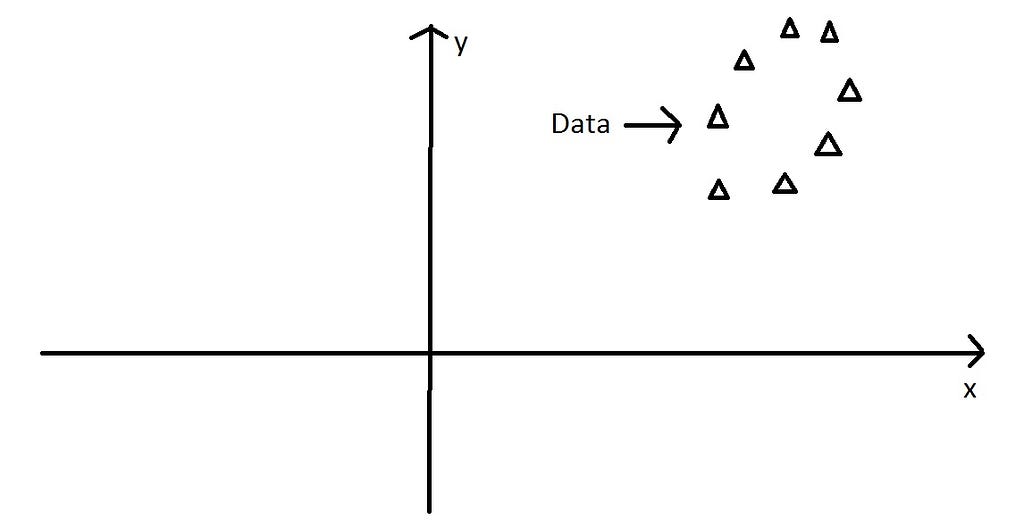
It’s thrilling how Barnes exploits the beauty and wit of the vernacular and teases the gap between dialectal and non-dialectal poetry. She draws attention to the fact that language is bound by meaning, accessible to those who share its understanding. In a broad sense, she signifies. When Henry Louis Gates, Jr. published The Signifying Monkey, a book of African-American literary criticism, in 1988, he posited the idea of the perpendicular intersection of language, where, simply put, the x axis represents the literal definition of a word as defined by the masses (let’s call it white) and the y represents the signifying or Black vernacular. The intersection, according to Gates’ theory, provides a rich poetic playground for writers, poets, hip-hop artists and Twitter users alike. For a poet like Barnes who works with multiple layers of diction and code shifting, the collision of subject matter, music, and meaning allows complex ideas to surface. Language like “flex,” “trill” and “give up neck”has a vernacular music, but her grammars don’t stop at jazzing in this june; they include margin and arterial, squad cars and a young Black man dead way too soon. “i swift,” says Barnes’ speaker, “review the architecture of desire spun clean, & I could see how we all look like ghosts.”
Stagy, humorous, vulnerable and awash in blood crimes, dialect hits its heights in i be, but i ain’t as Barnes plays in the space between Gates’ x and y axis. It’s interesting to contrast the above lines from my dad asks with lines (the poem’s first and only) from self-portrait as a lily white fist:, where the dialectal music breaks open and apart, and the Gates’ axis could be considered to fall away:
Humanness does allow for some prudent bleeding. I am ungloved in a sabbath of spit. Only the turn of cement can arc Black. I am blue damage. Mother gut & tower. Truth: we are all for rent. Red lined systems. The door out is green and full.
Indirection is one favored rhetorical technique that creates the bread and butter of Barnes’ verse where a word like “everyone” is instead “every fiber owning a name.” Her sentence construction is elegant and complex: “You run menace to my name is the beginning of a sentence that ends with a lie I make about love & how I am above it.” She puts out a cigarette “before its time” while “Nervous / White Lady smile under / / that hard side part it all // clicking // in my glass.” The ecstatic discursiveness in how to kill a house centipede by squishing it behind a photo of miriam makeba while contemplating various iterations of rigor mortis in my gentrified apartment complex on 750 macdonough street brooklyn, ny 11233, goes five levels deep (not unlike its title) and ends up at the sublime. If you aren’t enjoying this, your heart has stopped sending blood to your vitals.
Descendants is a series of four poems after an installation by performance artist Ramellzee. His stranger-than-science-fiction characters become successors of very terrestrial concerns in Barnes’ hands whose dictums include, “How my mother taught me not to get killed. Why not don’t kill me?” Here is part of the monologue of Alpha-Positive:
I stay nimble as parades of men with forefathers try to examine my mouth
cupped up like a horse & stretched I flex. I shine & stay shinin’ til my maker
whose name I covet as my first come back
down & break it down: why he make of me such garbage? Such inoperable shame?
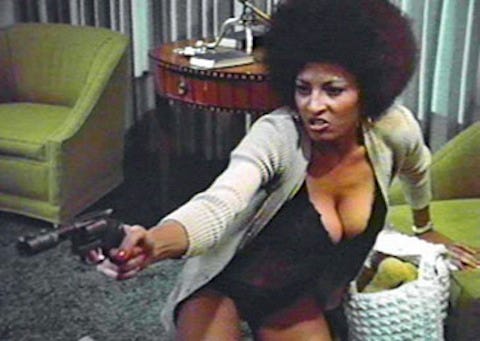
Barnes’ wonderful Pulp Fiction series of poems is keen cultural criticism with the personal as stock scenery. They dialogue with others poems in which cinema provides a troubled backdrop, such as the mutt debates what it might come down to:, a poem I love for its emotional and linguistic hall of mirrors and its cathartic use of Pam Grier, both afro-clad character of Blaxploitation films and the “real” Grier, to play object for the brutal betrayals of the body, exacted internally and externally. The book’s’ “mutt” poems provide the steel frame of its construction: they are an exploration of identity and its clashes — against self, illness, and race and gender.
Movie still of Pam Grier
Add sexuality to the list, addressed most pointedly in the later sections of the book. Each of its five sections begins with a quote from Stonewall Jackson, and the fourth section’s epigraph is, “My religious belief teaches me to feel as safe in battle as in bed.” Barnes cunningly bends the meaning of bed to her own bidding, flipping the switch on this ambiguous figure in the history of race while keeping the war. These poems are explicit and vulnerable, both sexually and emotionally. Even as my allegiance tends toward poems that appear earlier in the book, these are gratifying in their composition from start to finish. pronunciation: part one is a network of linguistic redoubling in which the speaker is surrounded by shrines of Jesus that she is told are “mostly ironic” and declares that “consent is a mule we never got.” A little later, from alleyway:
[…]Sometimes I want to eat my breasts down to their bitter rind & spit them out. I want to be the bitter rind without suck and easily thrown. Easily thrown I want to be the pebble thumbed & wished upon before enveloping the lake I sink in. I sink in you the lake & by lake I mean gutter a water that does not hold me well. Here we are not the bodies our mothers made.[…]
Barnes has alluded to it in interviews, but I’ll say it here: She’s a Pepper LaBeija girl living in a Lena Dunham world.
If axis-plotting has fallen away in self-portrait, it is a distant memory in a good deed is done for no good reason, the book’s final poem. It is a meditation on the nature of humanness and a deep dive into extended metaphor. While it plays wonderfully on the stage, it is a poem that loves the page as well. Its ruptured-block form, simultaneously contained and expansive, is the visual element that stands in for sound. It is Barnes’ control and restraint that make it perhaps the most audacious poem in a book ablaze with audacity. In the poem, “you” is a personified slab of wood, where “you allow yourself to become whatever these hands will make you.” Decontextualized, it is a poem anyone can live in, but it is also a Black woman’s poem of self-definition and restoration, the plaint of mutt and bastard, the child of no one, who says, “you aren’t dire but you were the difference.”
Barnes, am MFA candidate at the University of Mississippi, is one of the founders, along with Nabila Lovelace, of The Conversation, an ambitious multi-media project that spotlights writers in the American South. The Conversation sponsors workshops and craft talks, hosts a fellowship program, and this October took the form of a week-long tour through three Southern states talking to writers who will further Barnes’ and Lovelace’s dedication to “bridging conversations between inter-regional Blackness & discussing what a Black Mecca can look like in the United States.” Henry Louis Gates, Jr. could not have predicted in 1988 what such a conversation in 2016 would sound like or how necessary it would be (even as someone who, in 2009, was arrested for essentially trying to break into his own home), invigorated as it is by social media, by Black Lives Matter and Black Twitter, where outrage and sadness over violence is the order of seemingly every other day.
Can all readers put their shoes on Barnes’ table? The truth is, i be, but i ain’t exhibits an inclusiveness that leads to yes as much as it does a dividedness that leads to no. But do not miss the pleasure of walking into her room.
Michael Chabon loves adventures. Even so, he began his career writing stories of late-century naturalism, a type of story that’s dominated American literature for a long time — a genre of ordinary moments, near-plotless epiphanies, and (for lack of a better term) mimetic realism. But after winning the Pulitzer Prize for The Amazing Adventures of Kavalier and Clay, a novel about the history of comic books, he set off on a new quest: to explore genres and bring them home to their artistic roots.
His journey carried him to the pre-World War II England of Sherlock Holmes and to alternate realities and to the Khazar Empire circa 950 A.D. There he explored detectives and swashbucklers in complex, sprawling, maximalist sentences. And in 2005, he used his turn at the helm of The Best American Short Stories to highlight old-fashioned entertainment — and to justify it as serious art — a choice he explained in his introduction, later titled “Trickster in a Suit of Lights: Thoughts on the Modern Short Story,” now collected in his book of criticism, Maps and Legends.
That’s the short survey. Nothing compares with reading his books, though, which are immersive, and best read slowly, mindfully. So it is with his newest novel, Moonglow, where Chabon has returned to his old home, the world of so-called literary naturalism. As with his previous novel, Telegraph Avenue, he’s brought something back from his adventures, something to integrate into the world of “literary fiction,” to make it a little more fantastical — you might say that like a Joseph Campbell hero, he’s Master of the Two Worlds, the Genre and Literary. It’s not that he brought something back, though. It’s that he found out the two worlds were never separated in the first place.
Whether you like ghost stories, outer space yarns, or slice-of-life literature, Michael Chabon — a funny, self-deprecating novelist who knows the correct word for almost everything — has something in his books for you. For this interview, which has been edited for length and clarity, we spoke by phone shortly before the publication of Moonglow — he was in Berkeley, California, and I was in Kansas City.
Ben Pfeiffer:First, I wanted to know: the new novel, Moonglow, it says it’s a novel on the cover, but it’s full of misdirection — there are characters named Chabon, it’s written as a “fake memoir.” How much of this is really true?
Michael Chabon: That’s the question, isn’t it? (Laughs)
Pfeiffer: Right — or “factual,” I should say. It’s all true, right?
Chabon: (Laughs) That’s what the book’s about. It’s hard for me to explain. It’s a novel, it’s a work of fiction — but it’s a work of fiction about what’s true and what’s not. What’s a fact? Even the word “factual” is open to interpretation, when you’re talking about memoirs. So the answer to that question is the entire 438 pages of Moonglow. If I could have put it more pithily, I would have!
When I was 25 years old, my grandfather fell and broke his hip. He was living in Florida. We didn’t know what was wrong with him. My grandmother had died a few years before. My mom went out and got him, brought him back to her house in Oakland, and quickly discovered he had advanced bone cancer. His prognosis was terrible. So she installed him in a hospital bed in her house. I was living in Seattle at the time. Not long before he died, I came down and stayed with him.
Unlike the grandfather in the book, my grandfather was a very loquacious man, very verbal. He was a lawyer, he loved to read, he loved wordplay, he was a punster. He talked a lot. He’d been reminiscing to me all my life. What surprised me was that under the influence of these powerful pain medications, my grandfather — my actual grandfather — told me things I’d never heard before. They weren’t dark revelations, though. They were incident and anecdotes and memories that were coming to him in a free-associative way. It wasn’t because of something I might’ve said.
It was more like something in him got unhooked. He just started to tell me things. Different boxes in his brain got opened. Not only did I hear all of these things I hadn’t heard before — childhood memories of his and so on — but the faraway past became very present to him. It also made me think, “What else is in there?” Here’s this man I thought I knew — that I did know — who was actually quite… not transparent, but forthcoming. He wasn’t a hider like the grandfather in Moonglow. But even so. There were all these things I’d never heard.
Who knows what else was in there? The things that are in all of us, I guess. That we never reveal, or that we reveal to one or two people ever in our lives, and typically that’s not going to be your grandchild. That made a powerful impression on me. But I didn’t make any use of it in my fiction until very recently. It wasn’t a planned thing. I didn’t set out to say, “OK, I’m going to write a novel where I take the framework of this week when my grandfather was telling stories.”
I just started with a family story for no real reason that I was aware of. I thought I was going to be starting work on a new, different novel. I had it all worked out. I had been doing a lot of reading and research. The day I was going to start working on it, instead of doing what I thought I was going to do, I found myself thinking about this family story — supposedly it happened to one of my grandfather’s brothers. He was fired from his job because they had to make room on the payroll for Alger Hiss, who was down on his luck and needed work.
That connection, this sort of tangent between the history of my family and the history of the 20th century, one of the dominant stories of the era, the Cold War, and one of the most notorious figures having this strange, pathetic brush with the history of my own family — I started from there. But all I’d ever heard was, “Your uncle got fired to make room for Alger Hiss.”
I immediately made the shift from great-uncle to grandfather. A day or so after that, I started looking for a frame or a structure to the story, and that led me to that time with my grandfather. I thought, “Maybe that can be the framework.”
Pfeiffer: Speaking of memoir and fiction, and this relationship between what’s true and what isn’t, I was wondering if you could talk about Trickster Makes This World, and its connection, if any, to this book?
Chabon: I love that book. I love books generally that can take some aspect of mythology — something I’ve always been interested in, since I was a child — and connect it to the contemporary world in some way. There’s a famous, kind of loopy example by Robert Graves called The White Goddess, and there’s Joseph Campbell and so on. But the thing I love about that Lewis Hyde book is he’s such a brilliant thinker and good writer, it’s your pleasure to be in his company. Also trickster figures have always been my favorite.
Trickster figures have always been my favorite.
Whether it’s Loki in Norse mythology, or Hermes in Greek mythology, or Coyote in Native American mythology, or Br’er Rabbit in the Br’er Rabbit stories, you know, those kinds of stories — Jack the Giant-Killer, or the Brave Little Tailor, or Puss and Boots. Stories about cleverness overcoming power. And/or getting hoisted on its petard. (Laughs) I’ve always been drawn to those kinds of stories. So that book seemed almost to have been written for me, when I discovered it.
It came to me at a time when I was thinking about my writing. I was trying to work through this sense of dissatisfaction I’d been having, particularly with the short stories I’d been writing. I’d begun this journey, trying to arrive at a sense of why I felt dissatisfied. How did I get here? (Laughs) Why did I start writing these kinds of stories? What kinds of stories did I think I was going to be writing?
The answer to that was immediate: Sherlock Holmes stories, science fiction stories, ghost stories, crime stories. Those were my first short stories. That’s what I wanted to write. I had in fact written those kinds of things as a young writer.
Quickly, I realized well, actually, those aren’t just pulp stories. You don’t have to be embarrassed about them if you want to be a “serious literary writer.” A lot of the classic, great stories were written by truly great writers. Joseph Conrad, Edgar Allen Poe, Edith Wharton, Henry James — they wrote what we would now call “genre fiction.” It got me thinking, “What happened?” When did that stop being something you could do and still be considered a serious writer?
Quickly, I realized well, actually, those aren’t just pulp stories. You don’t have to be embarrassed about them if you want to be a “serious literary writer.”
It was at this time that I encountered Trickster Makes This World. The idea of the Border, and of Crossroads. Tricksters are the gods of the Crossroads and the Border. The places where definitions between things are less clear. Between two countries, or the city and the country, or male and female, or right and wrong, or family and individual. Those are the places you encounter trickster gods.
Thinking about genres in that way — about working along the borders of genres — was very helpful to me in trying to reintegrate my original motivations for wanting to write, and the kinds of things I thought I would be writing, with the writer I am now, and have become.
Pfeiffer: That’s a good segue to my next questions. You wrote about these kinds of things, including trickster, in your introduction to The Best American Short Stories 2005, and I wondered: has your conception of short stories changed much in the intervening years?
Chabon: I’ve pretty much stopped writing short stories. That has less to do with anything aesthetic — or any theory — than it has to do with practicality. I used to write them when I had more time. (Laughs) Now that I have less time to write — I have a certain amount of time for fiction, and whatever I have left goes into screenwriting. And I have four kids. So it’s a practical thing.
As much as I love to read short stories, and as satisfying as I’ve found it to write them, it was never my great love. I’ve always been more of a “novel person.”
Pfeiffer: You are very busy — not only with movies, like John Carter and Spider-Man 2 —
Chabon: The, uh, first Spider-Man 2, with Toby Maguire.
Pfeiffer: But you’re also a songwriter, correct?
Chabon: I have been doing that! I’ve been doing some lyric writing. I’m not going to quit my day job. (Laughs) But there’s a big technical challenge in setting lyrics to a piece of music, and I do enjoy that. There’s a puzzle-solving aspect to it that’s very pleasurable. And there’s a collaborative aspect to it. You’re working with the songwriter, the person who wrote the melody, but also maybe with the musicians in a studio setting. You’re not just collaborating; you’re collaborating with very talented people. They’re very good at what they do. That’s so much fun. It’s so different from sitting all by yourself in a room with your laptop.
Pfeiffer: What compels you to keep switching it up, creatively? I also saw you’d done some journalism for GQ at Fashion Week. Does it keep you sharp to try these new forms? Do you like being off balance, a little bit?
Chabon: It depends. On the assignment, on the form that I’m working in. With songs — doing that lyric-writing thing — it felt very new. I’d never done that, except for a brief time in college when I was in a band, and did some writing for them. That was a long time ago and a very different context. I’m all about trying new things.
At this point in my life, once I turned 50, it became part of what you should be doing in your 50s. Trying things you’ve never tried before. That was a perfect confluence of opportunity and inclination.
Doing screenwriting, or writing features for magazines…Screenwriting feels very different from writing a novel. But it doesn’t feel new — I’ve been doing it a long time. In a way, it’s something I’ve been doing since the mid-’90s. Writing for magazines? That’s a pretty standard thing. It’s not a big step to the right or the left, for someone who’s writing fiction.
If anything, to be honest, I enjoy it considerably less than fiction. Not just because you’re on deadline. And not just because there are stylistics restrictions that might get imposed on you by whatever publication you’re working for. Just having to stick to the facts is such a pain in the ass. I hate it. (Laughs)
Pfeiffer: You can’t say to your editor at GQ, this is mostly true?
Chabon: Nope. You can’t. And reality can almost always be improved. It would be so much better. You’re writing something, and you think, it would be so much more effective if something, say, happened three times instead of two times. Or if you could say you saw something you didn’t see. But you can’t do that. All you can do is report. And it’s frustrating. If you’re writing fiction, you can just make it happen three times, or whatever you need to do. Say you were there when you weren’t.
It’s not about ethics, either. It’s just a better story. What you get is better. When I’m writing nonfiction, I always think, “OK, here it is, but I’m telling you it’d be a lot better if you let me lie.”
Pfeiffer: You mentioned Sherlock Holmes earlier. Your book The Final Solution, which is my favorite by the way —
Chabon: Oh, thank you.
Pfeiffer: — it predates the return of Sherlock Holmes to popular culture by several years. It came out in 2004, right?
Chabon: I’m always ahead of the trend. (Laughs) No, definitely, it was a good moment for Sherlock Holmes, culturally, just after The Final Solution.
Pfeiffer: What is it about Sherlock Holmes that keeps him coming back? You wrote in The Final Solution that “he was a man who looked at things.” There’s a long passage about how he pays close attention to every detail. He notices everything.
Chabon: Detectives in fiction are always to some degree analogies for writers. Even the reason detectives come in to fiction when and where they do in history. Writers like Charles Dickens and Edgar Allen Poe — those are generally the people who get the credit — bring detectives into fiction around the time the modern police force was invented. Professional detectives come into existence. No sooner do they do so than writers say, “Hey, that’s actually like what I do!”
“I come into a room, I look around, I notice things, I notice the décor, I notice the lighting, I notice the expressions on people’s faces, I notice who seems to be uncomfortable. I ask questions. I try to get information. I’m curious.”
Now I’m looking around, and if I’m Edgar Allen Poe or Charles Dickens, I think, “That’s this person’s job. He’s paid to be curious, and to notice things. Then he makes a report. He makes a plausible story out of all these meaningless facts other people didn’t notice.”
That’s like a job description of a writer, to me — I think that’s how writers like Poe and Dickens felt about it, too. It’s a very congenial place to stand, as a writer, in a work of fiction, in the mind of a detective. If you’re creating a point-of-view character in a novel, it’s difficult to avoid having that character be unusually observant. They’re required to be, to help create and sustain the illusion in the reader’s mind. If it’s not an omniscient point of view, if it’s third-person limited, or first-person, then you have a character who is almost freakishly observant. A great example of that is Leopold Bloom in Ulysses. I love him, but he notices everything. Not just that he notices. He interprets it, too. He interprets it in this clear-eyed, sharp-witted, generous, even forgiving way. It makes him this great character. But there’s an artificiality to it (of course that’s the whole fiction business, too).
It’s a very congenial place to stand, as a writer, in a work of fiction, in the mind of a detective.
In the case of a detective, you have someone who is paid to be that way. Who’s not a writer. How many books with a writer as the main character can anyone get away with? I did mine, Wonder Boys. I’m not doing it again, it’d be boring, at least for me to write another one like that. Let alone ask anyone to read it.
To have this detective figure — that’s a large part of the appeal of Sherlock Holmes, to get back to your original question. It’s the mind of an incredibly observant person (being filtered through Dr. Watson). But there’s something inherently pleasurable about encountering that level of observation.
Obviously, Arthur Conan Doyle was both a writer and a doctor (another profession where people are paid to notice things and be observant). The better you are, the better you’ll do.
Pfeiffer: There’s a long history there, too. Anton Chekhov was a doctor, for example.
Chabon: The other aspect is the friendship and partnership between Holmes and Watson. Typically, we’re instructed characters are supposed to change. They’ll be different at the end than at the beginning. Otherwise, you wouldn’t be writing a novel, right? There’s an assumption of a dynamic. That’s true to some extent, but it’s not the only fiction we can take pleasure in.
You get that with Sherlock Holmes stories, but with any series characters. You know, Holmes and Watson will eternally be sitting in their lodging at 221B Baker Street by the fire, with Mrs. Hudson coming in. The cases are new every time. That’s pleasurable. It’s fun to match wits with the criminal and try to figure out the mystery. Or maybe you just sit back and wait for the dazzling explanation to come. Also, I think, is the constancy of the relationship between Holmes and Watson.
Pfeiffer: Speaking of constancy of character, and getting back to Moonglow, I heard you say something once: someone had asked a question about “How do you write such diverse stories?” You have Gentlemen of the Road, set in Khazaria, and you have your alternate-history The Yiddish Policemen’s Union. But you said, “Oh, I feel like I’m writing the same book over and over again.” You explained that was because you often have the same character types you’re exploring, like a skinny white man and a tall black man (who appear in books as diverse as those two I just mentioned, as well as in Telegraph Avenue, in the form of Archy and Nat).
How does that fit in with Moonglow? Because this book felt very different.
Chabon: You know, it is and it isn’t. I hadn’t thought of this until you asked me this question, but it demonstrates the distorting effects on that paradigm — that duo I keep writing about in so many of my books, whether it’s a white kid and a black kid, or two partners or friends, or whatever it may be — it is such a recurrent motif in my books. And what you see in Moonglow is the distorting effects on that pattern from quote-unquote real life. The effect of an entire human life between the covers of a book. From the first time we meet the grandfather in the book, when he’s 13 years old, during the 1930s, all the way until 1989 when he’s dying.
In trying to cover that span of time, and all the twists and turns a single life can take throughout that span, what you get is — you don’t have that central pairing anymore to anchor the narrative. But you do have a series of them. You have two key relationships in the book. Strange friendships. One between the grandfather and a fellow intelligence officer during World War II, and then later when he’s in prison, too. Those relationships are the type you’d expect to find in my books, but they’re short-lived and the grandfather moves on. There are other encounters. During the war, he has an encounter with a priest. He has a funny encounter with Wernher von Braun himself, and he’s had this sort of lifelong relationship with von Braun in his imagination. He has his brother. You have those pairings, but they’re separated out. They’re stroboscopic. They’re these flashes. Each time, it’s slightly different than the time before. That’s the distorting effect. As if the relationship between two men was a lump of putty and you put it in a centrifuge — a bunch of bits would be splattered all over the wall, which is what happened.
Pfeiffer: That’s interesting! And I was just thinking, the uncle in the book is Reynard, which is also the name of the trickster fox. You’re sneaky, I didn’t catch that until just now. And he has one eye in the book.
Chabon: (Laughs) Yes, he has one eye, because in typical trickster fashion he gets hoisted on his own petard. He gets other people in trouble, but also himself in trouble, in classic trickster fashion. He’s a tricky fellow.
Pfeiffer: I also noticed there are a lot more people shot with bow and arrows in this book, more than in your previous work.
Chabon: (Laughs) Yes! That’s true. There are relatively few bow injuries in my previous works.
Pfeiffer: Very interesting. It seems like, in this story, there are a lot of the things you love. I mean, it’s a story of late-century naturalism. It’s written in this memoir style. But hidden inside it there are all these other stories. There are two I wanted to ask about. It’s not a ghost story, but it is: the story of the Skinless Horse. It’s also a story of mental illness, of the mental hospital, and the play they put on, and the man with his own personal made-up sign language.
Chabon: I agree! Someone was asking me the other day: you wrote these naturalistic works of fiction at first, and then you moved on — I announced I was moving on…I went right into genre fiction, in many ways. They asked, “Are you back?” First there was Telegraph Avenue and now Moonglow. Are you back to realism? First of all, “realism” is a term I completely reject. If anything, I guess I would prefer naturalism, if I had to pick something that kind of means the same thing. But my answer was no. To me it feels like an integrated motion. I started out focusing myself, limiting myself in a way that I hadn’t expected to do that.
That felt comfortable to me, and natural to me. It felt smarter to me. I started out in the MFA in Fiction workshop at Irvine. Sometimes unmistakably and other times implicitly we were cautioned against any genre fiction. Here I am, I paid all this money, and I want to get this degree. And it’s not like I hate quote-unquote naturalistic fiction or mainstream fiction. I just thought, “I’ll get the most I can out of this, while I’m here.” My first novel got published. It would’ve been easier — and I did feel tempted — to stay there. But then it didn’t feel satisfying. It didn’t feel right. Something felt off. For me, writing starts with reading, and started with loving to read. I love to read so many different kinds of books, but I was only writing one kind of book. That just felt wrong. I did make those motions into various genres. Those were some of my favorite genres. I explored the genres I had loved reading. Whether that was Sherlock Holmes, or historical adventure fiction, or alternate-history novels, or hardboiled detective novels. Those were some of my favorite genres and subgenres.
For me, writing starts with reading, and started with loving to read.
But having done that, I felt like I learned a lot. I felt like I established a certain level of confidence, in myself and in readers, too, that I could do that kind of thing, I felt like with Telegraph Avenue and now with Moonglow, what it’s about for me is incorporating genre material into mainstream fiction, into that framework. And doing it in a way that’s not embarrassed or ashamed about it. I’m not trying to cover it over or pretty it up or whatever. I’m just trying to integrate it.
You’re exactly right. When I need to tell a story of a woman tormented by voices and visions, and about how those visions affect not only her but her family, the people who love her the most, I’m going to approach that through the traditions of supernatural fiction. Ghost stories. That’s not a deliberate choice. It’s a natural choice. That’s the part of the toolbox I’m going to reach for based on my history as a reader. The change in me, now, is that when I start to reach for those tools, I don’t stop myself. I go for it. Ultimately, what I’m most interested in, for myself and for all writers of fiction, is that I can do whatever I want to. I can write whatever kind of book I want to write.
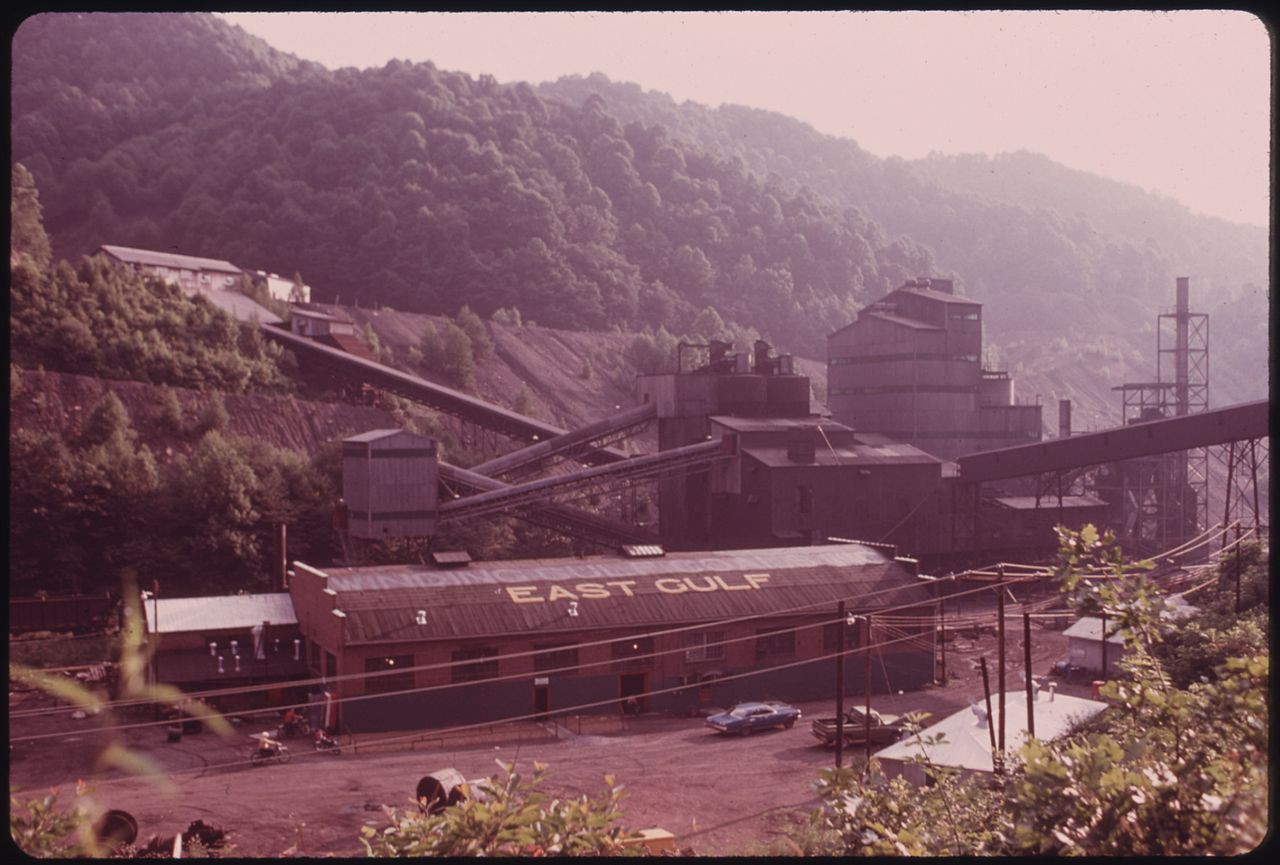
Driving down I-79 the steel bridges of Pittsburgh give way to peak and valley country, more than rolling hills it’s the dipped land of heft and hollows. Less than eight miles over the border of Pennsylvania into West Virginia, the evidence of mining cuts through rock. Ten minutes south are exits for the state’s flagship university, brick and stone buildings built into hillsides. On game day, the football stadium is more populous than any other place within West Virginia. The further south one travels, the more extraction industries have left their mark, and south of the “chemical valley” tucked against the state capital, the southern coalfields of West Virginia show the scars of that industry, dotted with slurry pools and little towns that hang on by a prayer and a Wal-Mart.
The southern coalfields of West Virginia show the scars of that industry, dotted with slurry pools and little towns that hang on by a prayer and a Wal-Mart.
Where there are rivers, rafting or whitewater boating and other outdoor activities become tourist dollars in the temperate months. Rivers, like the Elk, can reflect pristine beauty or be polluted at a moment’s notice, smelling sickly of licorice. Even when 300,000 in West Virginia were without useable water, one has to wonder who outside really noticed. Two years after the Elk River spill, Flint, Michigan’s lead-tainted water is an eerie reminder that we’ve been poor stewards of our environment and our precious resource. Though not in the same region, the Elk River and the Flint River flow as ruined reminders of forgotten places, pitted by loss of jobs, economic uncertainty, longing for solutions but coming up short.
The West Virginia writer Ann Pancake writes of her home state, “The devastation of my place is bald, unambiguous, and impossible to explain away as ‘natural’ or temporary or repairable.” This was before the Elk River spill. She also writes, “I’ve come to believe that the greatest challenge for many twenty-first-century artists is to create literature that imagines a way forward which is not based in idealism or fantasy, which does not offer dystopia or utopia, but still turns current paradigms on their heads.” I think this view of art can be instructive not only in Appalachia, but in our larger American culture.
Often, I am reticent to write about West Virginia, because my view feels complicated, and I don’t want my words to ring inauthentic. In experiencing Appalachia my vantage point is outside-in; while I have family roots in West Virginia and have lived in the state for over ten years, I’m not a native and didn’t spend my formative years here. Still, there is something that pulls me in and I can’t fully explain why. A neighbor flies a Confederate flag, a symbol that chills me. In spring I eagerly await the thriving farmers market, which is about more than food; it is a vestige of hope and a sense of community. I visit whitewater-filled and mountain-peaked state parks, the closed insane asylum, the still-active Fiestaware factory, the World’s Largest Tea Pot, nestled in a roundabout where highways meet and a gas station offers the only available parking.
Often, I am reticent to write about West Virginia, because my view feels complicated, and I don’t want my words to ring inauthentic.
I see this place not solely from the outsider’s perspective and experience it not quite as someone from within the folds. Regardless of my vantage point, I am not immune to the derogatory stereotypes that allow those from outside the region to pass judgement upon it. The Appalachian Studies and History scholar, Ronald D. Eller traces many of these stereotypes back to John F. Kennedy’s 1960 presidential campaign in West Virginia, when the media portrayed the region’s ruralness and poverty as contradicting popular notions of an affluent America. Appalachia, in the minds of many Americans, failed to live up to the newly-consumerized American Dream, somehow blocked from the prosperity embraced elsewhere in the country. Many assumed it had to be the backward locals.
Eller wrote in his 2008 book, Uneven Ground: Appalachia Since 1945, that these now-ingrained cultural ideas of Appalachia as some “other place” that didn’t follow mainstream progress that has “allowed us to distance ourselves from the uncomfortable dilemmas that the story of Appalachia raises about our own lives and about the larger society.” He argues that “Appalachia was not different from the rest of America; it was in fact a mirror of what the nation was becoming.” That Eller’s history was published in 2008, as the nation careened into financial collapse, was perhaps, prescient, as the nation, much as we have experienced in Appalachia, continues to erode its middle class, lose its good, steady jobs, while the gulf between the small community of so-called one-percenters widens ever greater from the larger pool of have-nots.
Appalachia, in the minds of many Americans, failed to live up to the newly-consumerized American Dream, somehow blocked from the prosperity embraced elsewhere in the country.
In places like West Virginia, southwestern Virginia, and eastern Kentucky, the inequities also played out in the use of land. One can hardly drive highways in this region without seeing “Friends of Coal” license plates or bumper stickers. We call the industry King Coal, and even as his reign showed signs of collapsed, our politicians, both Democrats and Republicans, bowed slavishly to the throne of black diamonds. Not just national but global demand for cheap energy led to hillsides dotted with “Coal Keeps the Lights On” signage, and in pursuit of “lights-on,” the mountains of Appalachia propelled surface mining and mountaintop removal at an unprecedented rate. Companies co-opted national pride, named themselves Patriot Coal and Freedom Industries, monikers meant to evoke patriotism to extractive not sustainable work. And they were, for the most part, owned from the outside.
Here, in Appalachia, to protect the environment became unpatriotic, against the values of growth, and against the national appetite for consumption, and certainly not in line with the American Dream’s myth of prosperity.
Here, in Appalachia, to protect the environment became unpatriotic, against the values of growth, and against the national appetite for consumption, and certainly not in line with the American Dream’s myth of prosperity. Eller reminds us that “In Appalachia, as much as in any other part of America, the false choice between jobs and the environment divided communities, pitting personal economic against the common good, short term gain against long-term survival.” During the Elk River spill, I remember a woman calling in to a West Virginia Public Radio program asking when people would stop having to choose between good water and good jobs.
Hope in Appalachia is imperfect and hard won, and recent fiction writing from the experience of the region depicts the difficulties of this region. Meet Dawn Jewell, the narrator and protagonist of Robert Gipe’s illustrated novel, Trampoline (Ohio University Press, 2016). Dawn is bright, funny, confused; she finds herself pulled into the fight to save a local mountain in her native (and fictional) Canard County, Kentucky in the state’s eastern coalfields. Her kin and community work the mines, her mother’s an addict after the loss of her father who was killed in a mine, and Dawn, only fifteen, finds her teenage confusion wrapped up in the blight of her community. “I was a freak, soft and four-eyed with black fingernail polish, a dead daddy, a drunk momma, a crackhead brother, outlaw uncles, and divorced grandparents who made trouble for normal people every time they come off the ridge.” It would be easy to place Dawn Jewell with other trouble teens of literature — a modern day, Hillbilly Holden Caulfield, pointing out all the phonies. That, perhaps, would lessen her impact. Dawn is a character drawn from the strife of Appalachia, and her appeal to us as readers — why we cheer her on — feels like the same reason we wish to show Appalachia as more nuanced and complex than stereotypes would suggest.
Dawn Jewell struggles to find her place in a place that struggles with itself. She is built from the strife, both being representative of her community and struggling mightily to find her place in it. She is the inside-outsider, one that is not wholly accepted by the people she most identifies with, and the conflicts of the region play out in her story. It isn’t as if Dawn wants to stay. “I was chickenshit was what I was,” Dawn says of herself, “That was why I was back in this shitty spookhouse county. Without the courage of my convictions, Mamaw would say.”
But later, she tells us, “I was never going to get out from under this place.” The American Dream, one might say, has passed her by, and her unwillingness to leave the place of her origin could easily be ascribed as culprit. Yet, in Gipe’s rendering, Dawn’s journey is as internal as anything else, and her desire to fit into her community is a strong theme of what it is to be American. There are places other than Appalachia where the people stay, despite hardship, because it is home. Being an outsider, and feeling dislocated even in a familiar place, becomes a key part of Dawn’s story.
Where does Dawn Jewell belong, if not as a member of her own community?
If we look to the literature of Appalachia, it’s not hard to spot this rub between being from a community and being at odds with it.
If we look to the literature of Appalachia, it’s not hard to spot this rub between being from a community and being at odds with it. Young people, in particular, find themselves in the crosshairs. In Jonathan Corcoran’s story collection, The Rope Swing (West Virginia University Press, 2016), we meet Christopher, a character in the book’s title story. Again, like Dawn Jewell, Christopher is teenaged, feeling trapped within his surrounding, which are also being destroyed through lack of land protection. “The new highway, on the other hand, just two miles to the east but out of sight, has four level lanes paved into the bombed-out heart of mountains. The ledges that frame both sides of that highway bear the jagged marks of explosives — artificial striations slicing across the once-impenetrable rock.” To get out of this place or to make one’s way through it takes environmental damage. As he considers the ways in and out physically, Christopher, who grapples with a growing understanding that he is gay, also understand that he, too, is both inside and out:
Just as soon as he imagines this life, he wills himself to forget it. The more time he spends at the river with Greg, the more he feels himself floating away from the things he understands. This is both exhilarating and painful. A moment of bliss, and then an evening of aching. He is a split self: his visible body and his hidden blood.
The split self — that which belongs to Appalachia and that which yearns to be free of it — can be seen as something particular to the region.
The split self — that which belongs to Appalachia and that which yearns to be free of it — can be seen as something particular to the region. With its above average poverty rates and lack of economic future, the closed feeling of its communities, it might be easy to say it’s an Appalachian problem. But if Eller is right, there might be more to learn from these characters that can speak to America proper. Who, in these times since the 2008 financial crisis, or perhaps even before that, felt a strong sense of belonging in these United States of America, to the communities in which they live? As people flocked to buy cookie-cutter homes, perhaps they spent in search of that sense of belonging, of community. When that crumbled, as foreclosures became a national discussion, perhaps a kind of erosion took place, and that characters like Christopher and Dawn offer a map as to how to confront it.
Ironically, it’s Appalachia’s “wild and wonderful” places that offer outsiders some sense of peace or fulfillment. Eller, in speaking about the region’s economic turn towards ecotourism, writes, “The flood of suburban tourists seeking to renew their relationship with the natural world passed young people along the highway leaving the mountains in search of better lives in the cities from which the urban refugees had fled.” Should we cheer Christopher and Dawn on to pilgrimages outside the region? One might say it would be impossible. As Eller reminds us, “Insiders and outsiders alike consumed the electricity generated by coal from surface mines that destroyed forest and decapitated mountains forever. Everyone searched for some connection to place.” Eller finds a name for folks like myself — neo-Appalachians, and along with new and old, suggests we’re tied together by the powerlessness caused by social, environmental and cultural consequences of rampant consumerism. We have become, he says, “voices of powerless people struggling to survive in a changing world.” Again, we cannot see the American Dream. Perhaps, though, if there is one overarching reason to read contemporary literature, is that the powerless find their voices.
In one of her illustrated panels, Dawn Jewell says, “I wanted out of the woods.” As she makes her walk, Dawn shows us what she sees:
A field opened up in front of me. It was the last beautiful bottom in Canard County, the last place to see how it was for the first white people, the last pocket pasture with its deep dark dirt, the last one that wasn’t road, wasn’t trailer park, wasn’t cigarettes for sale, wasn’t fucked-up mining equipment piled all archeological. But this last one was going to be our new high school football field. I crossed the field, climbed the horse fence that bound it, thinking how if you, if I had been a Cherokee, a Shawnee, we would have dreamed to see buffalo, to see elk, on that field and would have through a farmer’s field no better than a car wash.
I crossed that field, done thinking I could see my happiness by the week hour waterlight.
In this soliloquy, Dawn forces herself and us by extension to take stock of what we have lost in pursuit of the illusive American Dream. She finds her most true self in confronting this loss, a cold comfort for one who defines herself so much against all that is around her. And yet, in this imagining, she finds a sense of calm. Otherwise, Dawn is surrounded by chaos, and it is imagination that allows her respite. She can’t relate to her brother, her mother, her uncle, or even in the grassroots activism of her Mamaw. Thought connected to each, her sense of self reaches beyond what her family or community can give her.
At school the popular click brands Dawn a freak, which isn’t so much different than the view of her family. So completely isolated, she muses that her mother’s laugh had once been pretty, but that memory, like others, is tainted, “the past came in on me like the smell from a busted sewer line.” Soon after she falls asleep, Dawn awakes to her own Momma stealing her paycheck from a part-time job at a fast food joint.
While many of the stories in The Rope Swing show a view of Appalachia through the lens of characters who are also gay, it wouldn’t give the book it’s just due to call it only a view of “gay Appalachia.”
While many of the stories in The Rope Swing show a view of Appalachia through the lens of characters who are also gay, it wouldn’t give the book it’s just due to call it only a view of “gay Appalachia.” In fact, it speaks to the same gutting of community we see from Gipe’s Trampoline. In “Hank the King” Corcoran paints the descent of a town alongside the descent of one of its citizens. Hank, the protagonist, has lost his pawn shop, his youth and health, and his way of life. “His dominion was crumbling: the buildings of the town and his body. He was drawing social security, neck deep in bills, and trying to find what little pleasure was left in the world.” Much like Canard County, the fictional Kentucky locale of Trampoline, Hank Burkham’s small West Virginia town doesn’t serve up hope for a better future. “The downtown had become a big sea of nothing: the only thing bustling was the dollar store,” Corcoran writes. From his pickup truck, Hank witnesses the results of its decline:
…those sad men wandered up and down the streets of the downtown all day, blowing their money at the Legion or the Moonshiner Tavern. If they were more adventurous, or maybe just bored, they’d cash their disability checks, run into the old Green Valley Hotel — the marble lobby cracked and stained — and buy a bag of weed or some pain pills. People would do anything to feel numb.
Just as in Dawn Jewell’s Canard County, Hank’s world fills with addicts and trailers, and Hank himself keeps out of the house that is on the brink of foreclosure. At his family’s graveyard, Hank implores his dead mother, “I feel like life’s over, and I’m not even dead yet.” Those outside Appalachia might be tempted to think that these feelings, brought on by the problems of places like West Virginia are her problems alone. But in December 2015, Pew Research published an astonishing truth. “After more than four decades of serving as the nation’s economic majority, the American middle class is now matched in number by those in the economic tiers above and below it.”
Perhaps more are like Hank than feels comfortable. Just like Appalachia, the haves are growing in small numbers and large amounts of wealth, while the have nots continue to grow in number while they dwindle in fortune. Given this, can we continue to see Appalachia as other, or can we confront its issues and problems as the image in the mirror, reflecting the larger issues facing America? It might be tempting to see in Appalachian literature only the hopeless, but in this case, as in others, there are the glimmers.
In what feels like a jump ahead in time from “The Rope Swing” Corcoran gives us “A Touch,” the story of a West Virginia transplant in New York City. The unnamed narrator, fresh off a breakup, meets up with Darren, a friend in the city originally from rural Kentucky. In describing the friendship, this narrator tells us:
He called me “Mountain Boy” and I called him “Kentucky,” a reference to our shared former geography. We were careless with our freedom, burned through everything we touched: the money, the booze, the boys we thought we loved the most. But he was always my constant. We formed our little band of orphans, even though he had living, breathing parents back home. We said we would make our own families, with ties that had nothing to do with blood, and wouldn’t we be so much stronger because of it?
Place, to these men, is something shared, and perhaps, forges a bond beyond their new locale. Our unnamed narrator, admitting that he’s not been home in fifteen years, also admits to Darren his homesickness. He is as lonely even in the populous and prosperous New York City as he was back home in West Virginia. As a bit of folk wisdom says, we often bring our troubles with us, and in a modern world, one does not have to be physically located in Appalachia to understand its sense of dislocation. But just as our protagonist feels lost and alone in the world, he happens upon a moment of real and spontaneous connection. Wandering the streets after his meetup, he recognizes that he’s stumbled into some sort of rally or vigil, and the sight of lit candles, the sound of raised voices, and the simple act of a woman reaching and grasping his hand saves him from dark and solemn loneliness. “We’ll get through this together” the young woman says to this narrator. It is a redemptive, a pure moment of human connectivity in touch and word.
As a bit of folk wisdom says, we often bring our troubles with us, and in a modern world, one does not have to be physically located in Appalachia to understand its sense of dislocation.
So too, Dawn Jewell wins her fight to save Big Bear Mountain from mountaintop mining. Though the state has to pay companies not to excavate it, the land is saved. Yet Dawn isn’t fully satisfied with this outcome. Her Aunt June, a relative who has fled Canard County but is still marked by it — an inside-out viewer, one might say — reminds her young niece that she has protected eight thousand acres, no small feat for a fifteen year-old social outcast. As her momma, temporarily making up for past transgressions, is about to be baptized, Dawn muses, “…people change. They don’t always change the way they want to change, or even in the direction they set out to change in.”
Dawn may not have fully changed yet, and neither has Canard County, but we have the hope that she will, that she has and will continue to make a difference in her landscape, and among her people. At the end of the novel, Dawn is taken up above Canard County in a helicopter, and below, her boyfriend Willet has made giant words on the ground for her to read: YOU ARE HERE. The book ends with the illustration of Dawn, flanked by the words, “Ain’t that something?” Her grit turns to resilience, her fight into a distilled moment of satisfaction, and we, as readers, see it as something, indeed. We cannot win big fights unless we take on small ones.
Appalachia, as portrayed in these books, confronts and debunks that all it can be is a place of poverty and cultural backwardness. The question, then, is will it still reflect America? In times of change, we stare out towards an American Dream that may no longer exist the way it did in 1960. If we look towards today’s literature, we might find grit and resilience. These stories can matter because they are from and of us, both inside and outside of the region marked as Appalachian. Ann Pancake proposes:
…artists are also translators between the visible and invisible worlds, intermediaries between the profane and the sacred. How is this pertinent to the case I’m making for art’s ability to create change in the world? Only by desacralizing the world, over centuries, have we given ourselves permission to destroy it. Conversely, to protect and preserve life we must re-recognize its sacredness, and art helps us do that. Literature re-sacralizes by illuminating the profound within the apparently mundane, by restoring reverence and wonder for the everyday, and by heightening our attentiveness and enlarging our compassion. The magic and transcendence and mystery that characterize true literary art make a piece of literature a microcosm of the wider universe, of the mystery and profundity and transcendence that reside there for those willing to look for it.
Literature helps us to understand ourselves better, to enter into an imaginative realm that calms chaos. Our troubles are not our own, and literature reminds us that we are connected. Having lived outside West Virginia, in urban and suburban areas, my outside-in view reminds me that the troubles here happen elsewhere, and my living here is not the only connection I have to books like Trampoline and The Rope Swing. Ronald Eller says boldly in the introduction of his history, “We are all Appalachians.” If we go into the woods, literally like Dawn Jewell or metaphorically, those lessons we bring out of the experience might just change how we all approach a conflicted and complex larger world.
Our troubles are not our own, and literature reminds us that we are connected.
Our world currently feels less tolerant, less able to provide that better future we’ve always believed in. Our political rhetoric has turned from hope to xenophobic antagonism. But might we imagine an expanded, amended American Dream, one more accepting, with greater opportunity, and a sense of collective and belonging? Sometimes we must love what we know, imperfect as it is. Our stories must matter which is why good books matter. In them, we find connection, or, like Dawn Jewell, we experience our “YOU ARE HERE” moment. It’s a good lesson from either the experience or the literature of Appalachia, whether inside-out, or outside-in.
Brother Harpy delivered serpents to their house, to her daddy, the minister of Lick Branch, who put them in the icebox so they’d grow sleepy enough to handle next day at church. “Takes just as much faith to reach into a bag of sleepy serpents,” her father said, for the congregation was unaware, if she wasn’t.
Brother Harpy caught snakes all over McDowell County, and every Saturday, she watched him pull into their dirt yard and unload sacks writhing with rattlers and adders and copperheads. When he handled them, the sacks twisted and hopped as vipers struck the sides of the bags, fangs sometimes snagging and poking through the burlap. Brother Harpy would untie a sack as she sat straddling the porch railing, swinging her long legs back and forth or painting her toenails with her mama on the steps. She and her mama would watch him reach inside the bag and bring out a cottonmouth the size of his forearm. The snake would strike and its fangs would catch in the cowhide and rubber sole of his boot.
Then he’d look over at her mama and her and smile, and they would smile back, couldn’t help doing it, even though Brother Harpy didn’t belong to church and everything about him looked sinful. He was an old man, older even than her mama. His hair was down over his collar, almost as long as hers and had been dark once but now showed lots of gray, salt and pepper, her mama called it. He wore sunglasses and shirts with the sleeves torn off and a necklace of a kind that made him seem to have Indian in him, which is what they liked most about him, her mama and her. Something about the roughness of his face and the color of his skin, brown as a pear, made her think so, at least. He was an old, old man, but neither of them could take their eyes off him.
And he couldn’t take his eyes off them either. Her mama was the sexiest woman in Lick Branch, had a body as good as her own only looked like she knew how to use it. Before she had firmly lost all faith, her mama had backslid six times. She was weak-minded, people thought. Weak willed. Spiritless. Of the flesh. Wicked, though none went so far as saying that. It stopped just short of that, for she was their pastor’s wife.
Her daddy bore the shame of her mama’s transgressions with humility and forgiveness. He forgave her her sins, he said, each evening. He was a meek and righteous man, and until she had reached a certain age, the girl had been his charismatic little angel, reaching into the burlap sack and drawing out diamondbacks and copperheads. Her child’s faith convinced the sinners of Lick Branch that God would protect any who sought Him. She had saved many souls.
Including the soul of Elwood McGuire. When the news had reached Elwood McGuire about her, this young thing reaching into a sack of snakes and drawing them out and wrapping them about her arms and neck, when Elwood heard that, he had to see. And so he was drawn to the little white church he passed by every day, twice a day, on his way to the mines. He was drawn to the church and to the girl and to God Himself. And he became a great believer, picking her up under her arms and setting her up on the backs of pews where all could see her, this child of God.
And he traveled to churches and tent meetings far and wide, telling of her. Even when he got throat cancer and lost his real voice, took on that robotic voice of the tracheotomy, even then he praised God. And in a tent meeting over in Jolo, he took his leave, shouting and testifying. “Hal-le-lu-jah! I’m-a-be-liev-er.”
The congregation had swollen up and stood on its feet, and each one had begun to fall away, each into his or her own spirit, some singing “How Great Thou Art,” and others laying hands on Elwood, and still others speaking in tongues and shouting, their bodies no longer under their own control but filled with the Spirit of the Holy Ghost and moving about the tent wildly and falling to the dirt floor in convulsions, folks moving back metal chairs and making room so they would not hurt themselves too badly.
It was on this occasion that Elwood McGuire had been so fully filled with the Spirit and with a satisfied mind that he could have hugged and kissed the girl, that child who had drawn him into the bosom of Abraham. If she had been there at that particular tent revival that night. But she wasn’t; she was home watching television, fanning flies with her mama. And so, he had shaken the hands of everyone in the congregation and stepped outside, his wet handkerchief not yet even pushed back into his hip pocket before he was run over by a Lick Branch Colliery coal truck, highballing down Bear Town Mountain, and killed.
There was something about him, Brother Harpy, something she couldn’t name exactly, but something she felt and mostly at night, lying awake for hours the way she did, thinking back over her day. She’d heard he lived alone in a ramshackle, old company house somewhere near Johnnycake, and she wondered whether he could throw a tomahawk, and she guessed he could, that maybe he could kill a wildcat with one if he felt like it, or a snake.
She wanted to catch snakes herself, hot snakes with flicking tongues, angry serpents, not the sluggish pieces of rubber she’d handled at church. She felt she could, or at least she might have been able to at one time, when she was full of faith, before the coal truck and Elwood McGuire. You couldn’t grab up snakes with fear and doubt in your heart. And that is what made her love Brother Harpy. He had no fear, and just looking at him, that slick hair, both dark and light at once, that rough-looking face with its dark eyes, made her feel something funny, something akin to courage, a boldness. She drew nearer and nearer to him when he came delivering snakes. She helped him carry the jumping sacks into the basement, and he did not warn her to be careful. “I ain’t afraid,” she said.
And he said, “You ain’t, huh?”
She shook her head, and her blond hair fell down both sides of her face and moved like a soft breeze had picked it up and let it down again. He looked at her, standing under the single bulb of the hand-dug basement, her bare feet and calves gleaming white against the dark packed earth beneath them, her pretty pink toenails catching the light like opals. He tossed a sack into the basement and it jumped and rolled as the serpents fought each other inside the bag.
“How come they don’t kill each other?” she said. And he told her he couldn’t say. He stepped into the damp cellar and walked past her, picking up the sacks and throwing them into the icebox that was plugged into the same single light socket above their heads.
She had not flinched when the sack he’d thrown had flopped itself near to her, and he reached now to get it and throw it into the fridge. She stood still but the motion of his body caused the hem of her cotton dress to billow and lift slightly away from her legs. She pushed it down and he watched her and rose slowly, the sack still in his hand, and looked at her pretty face, her eyes so blue people had a hard time looking away from them, and so did he, she thought, staring back into his, which were dark and shiny, but not black. She couldn’t tell what color they were, and she couldn’t hold her gaze long enough to find out. She looked away first and smoothed her dress and stepped toward the door. “How old are you?” she said, and she saw his eyes lift from her hips to her face as she stepped away from him out into the light green of the day.
“How old do you think?” he said.
And she felt sassy, having caught his eyes where they’d been. “A hundred,” she said. And he laughed, and his smile was a candle inside the dark cellar and his laughter a black boom.
When he came back outside, she was sitting on the tailgate of his truck, her legs swinging slowly, one then the other, then the one again and then the other. Her skin was the toughest it would ever be, soft as it looked, tough in its softness, for she could walk barefoot over sharp rocks and the skin of her feet would not break but stretch over them, like wax or clay that would then go back to its own shape again. He could see her knees now, too, and her legs parted slightly like a boy’s, for she was a girl who hadn’t yet made up her mind about what she wanted to be.
“You got Indian in you?” she asked when he stepped around the truck and threw the last batch of empty sacks he had retrieved from the cellar onto the floorboard. He came back around to her, leaned over the side of the truck and draped an arm inside no more than a foot away from her own bare arm. She turned to face him, drew one leg up onto the tailgate and settled it under her weight. “I bet you got Indian in you,” she said.
He smiled at her again, but this time with no laughter, a different kind of smile, somber, more with his dark eyes than with his mouth, his face. And before she thought to look at his eyes again, to see their color, she fidgeted and hopped down from the bed of the truck, little pieces of weeds and dirt stuck to the backside of her dress. “What time is it?” she asked and looked at his wrist for a watch, but didn’t see one there. “Don’t you wear a watch?”
“Found none that’ll run on my arm,” he said.
“How come?” she said, and he looked at her with untelling eyes and rounded his shoulders. “Hmm,” she said. He had tattoos on his arms, a long-stemmed rose on his right forearm and some kind of funny black design on the shoulder of his other one. “What’s that mean?” she asked, but his eyes were drawn to something over her shoulder, her mama, standing on the porch watching them. She did not call to the girl, only stood holding onto the railing and looking. He walked toward the house, and the girl chased after him and ran around ahead of him and plopped down on the metal glider before he reached the porch.
He stood in the yard with one boot resting on the bottom step and the girl smiled broadly for having outrun him and breathed heavy, not trying at all to slow her breath, but breathing in and out hard like she was enjoying her lungs for the first time. Because a girl like that would not need to breathe so heavy after so short a run.
Her mama smiled at him, but he did not return the smile. He gave her mama a different look, a look the girl could not decipher. He parted his lips and the look seemed to emanate from there between the flesh of his lips, from somewhere inside his mouth and somewhere deeper, darker, wetter. Her mama held her daddy’s wallet in her hands, the same thick brown leather of his belt, which had striped her legs and had even striped her mama’s legs, maybe had striped her mama’s legs even more than her own.
Her mama pulled money out of the wallet and handed it to him without counting it; whatever there was, she gave him. Then he smiled, that same full sober smile from the cellar, and took the money and folded it and lifted it to a make-believe brim of a hat he didn’t wear. He nodded his gratitude, and looked again at the girl on the glider, rocking back and forth. He looked at her the same way another man had looked at her a couple of weeks earlier at the park when she had tried to ride a blue, iron pony she was too big for, her legs bent up like an insect’s to fit in the mock stirrups. “Get up off that,” her daddy had said, and given the man a bloodless look.
Her mama waited a minute more, as if there were something hanging between them to say, or as if maybe whatever it was had already been said, long ago, but not so very long. She looked at the girl, then, and turned to go, pulling open the screen door and pausing. The girl smiled at her, but her mama only half- smiled back, and then went inside without a word.
The girl walked across the porch and straddled the railing again, her dress hitched up high on her thighs, just barely higher than eye level where he stood at the bottom step. He looked at her long legs without apology and made no motion to go, though he had no more reason to stay now that he’d been paid by her mother.
“I bet your hands are fast,” the girl said, snatching at the air and laughing. “And strong. To grab them snakes.” She climbed down from the porch railing and came around to the steps where he stood, walked down to him and picked up his hand. She held his palm up and studied the lines. His hand was nearly as wide as half her body. She turned it over and rubbed her thumbs across the purple veins there. His hand was tan and warm, his fingernails slightly longish but clean, and she thought of a pocketknife somewhere amidst the fold of money he had shoved in his front pocket.
He was older than her daddy, but she wondered if he would kiss her if she kissed him first, and she guessed he would. She heard the fans blowing inside the house and longed for their breeze. It was hot there in the sun, but she knew a cool place, and she told him she did. She held onto his hand and pulled him into the woods, and he followed her, even when she turned loose and ran ahead again. He followed her.
They came down by a place in the river where the water ran fast over the rocks and shot through the exposed roots of gnarly, old oaks and ghost birches that grew out of the bank and leaned toward the sun. At the edge of the creek, she saw hoof marks and pointed them out. “Look,” she said, her eyes already tracing the tracks farther down along the water and up the bank. She never saw them, she said, but they came there to drink. He stood watching her, unhurried, his gaze measured and exact. Just the sound of the water was enough to cool you, she told him. “It’s colder than it looks, but we can go in if you want.”
He only stood there, shook his head, but not with conviction. If she wanted to go in, he would.
But she didn’t know what she wanted to do, only that she wanted to talk to him, to make him look at her, cause she liked that, how he looked at her. “I never showed nobody this place,” she said, to have something say, “and here I bring a stranger to it. I don’t even know you.”
It was a question, a request. She wanted him to make himself known to her. “Has anybody ever told you, you look a little like the devil?” she said, smiling, not catching his eyes now because she was afraid to. “I think you are the devil,” she said, walking around a tree and looking back at him. “That’s how you catch them snakes, why you ain’t afraid.”
“And you ain’t afraid either, huh?” he said, and something swept over his face, something ugly but it was too fast to tell what it was. Then he was smiling again, the most radiant he had smiled yet, and stepping toward her. “Kiss me,” he said, taking her hand, pulling her to him. His body was warm; his arms folded around her like wings and warmed her.
“I shouldn’t be here,” she said, already tasting his kiss but pulling away.
“Kiss me,” he said.
“I can’t.”
“One little kiss. It’ll be fun. It’ll be sweet. One little cocktail kiss.”
It sounded funny, him saying cocktail, this snake catcher, and she realized she had no idea who he was, or where he came from, or what he wanted from her.
But he was so beautiful to her, like an angel, a dark angel, Lucifer himself, she thought, and she knew she should run, but she didn’t want to.
“One little kiss,” he supplicated, and his breath entered her mouth and settled on her tongue and it was as if she had already done it, kissed him, and so she did. She opened her mouth and let him come in, and it was like a scourge of demons had slithered inside her, his mouth upon hers so hard, his tongue darting deep inside. He pulled her long hair and twisted it around his fists and wrenched her neck to him. He lifted her off the ground and pressed her into the tree until her bare flesh was shorn by its bark. “Run, little girl,” he said. And she knew if she did, he would only chase her down, grab her up with those big rough hands, and that’s not what she wanted — to be caught. And anyway it was too late now, though her legs worked themselves as if she had willed them to, and that’s what made her whimper, made him laugh. She would not be saved.
But she didn’t care, because she loved him and she knew that he had never lied to her; somehow she had known it all along. He wasn’t afraid of anything. Even if her father came, he wouldn’t care. She opened her eyes and looked at him. They were eye to eye, and she saw their color at last. They were blue, his eyes. Blue as her own, but inky, double dyed, blue black like the wing of a wasp.
She smiled.
For what was happening now, her dress being ripped and shoved down over her body, his hips lifting and forcing her harder into the tree — all of it, everything, was entirely of her own doing.
Are you rude and well-read? If so, you might like our new literary card game: Papercuts: A Party Game for the Rude and Well Read. So far, we’ve been very greatful for the response to our inaugural venture into the world of gaming. With just one week left on the clock, we’ve already more than 700 backers and more than doubled our Kickstarter goal!
Because of the great response to the game, we’ve also decided to create a stretch goal. If our Kickstarter hits $40,000, we’re going to create a 40-card expansion pack, and we want you to help us decide what it will be about. If you take our online poll you can vote on whether the expansion pack should focus on Fairytales, Shakespeare, 19th Century Literature, Science Fiction, or Mystery and Crime Fiction.
In David Francis’s third novelWedding Bush Road (Counterpoint, 2016), Daniel Rawson leaves his new girlfriend, Isabel, behind in Los Angeles to spend Christmas week with his mother, Ruthie, on their family farm in southeast Australia. When he arrives, Daniel learns that Ruthie’s true motivation for luring him home is to manage the disputes between her ex-husband (and Daniel’s father), Earley, and his ex-lover, Sharen, a strangely sexy farm tenant with an affinity for arson. Sharen and her wild, young son, Reggie, complicate an already fragile family dynamic, especially as Daniel finds himself falling for her.
Francis is the author of The Great Inland Sea and Stray Dog Winter, which was named “Book of the Year” in The Advocate. He is also Vice President of the board of directors of PEN Center USA and works as a lawyer for the Norton Rose Fulbright law firm in Los Angeles. I met Francis soon after our mutual friend and writing mentor, Les Plesko, committed suicide in 2013. Francis invited me to sit at his table as “Les’s guest” at the Literary Awards Festival, and I’ve attended as a member of PEN Center USA each year since.
Over bowls of squash soup at Café Pinot, next to Central Library in Downtown LA, Francis spoke to me about his role at PEN Center USA, the merger between his publisher Counterpoint and Catapult, what it means to write with Les Plesko, and his latest novel Wedding Bush Road.
Andrea Arnold: This is the second book you’ve written about a relationship between a son and his mother. What is it about this bond that keeps you returning to it on the page?
David Francis: In real life I had a profound connection with my mother. I was what you might call a ‘mother-bonded child’ or ‘little husband.’ I had a very powerful, talented, interesting mother. And the mother in Wedding Bush Road, Ruthie, is pretty close to her. My mother and her sisters were on the first women’s polo team in Australia. And they played against the men! In the ‘50s! And they were better than the men. She was an amazing horseperson and a fierce personality, and so I grew up around that. I somehow keep circling that subject, even more while writing this book because she had a stroke and then she died while I was in the midst of writing it. That relationship was powerful enough that it was one of the reasons I moved eight thousand miles away.
My first novel, The Great Inland Sea, was set between the 1880s and 1950s. This new novel is more contemporary. The first was loosely based on the story of my grandmother growing up in outback Australia a long time ago merged with my own story of coming to the U.S. to ride showjumping horses, except set in the 1950’s. When I was at law school, my grandmother had gone blind. She was in her late nineties and I would sit with her and listen to her stories about her Austrian (yes Austrian) opera singer mother who was dragged by her Scottish husband to a cattle ranch of almost 100 square miles in the middle of Australia. There, my grandmother had a really unusual childhood, and I thought one day I would write those stories. Wedding Bush Road was more birthed by my relationship with my own mother and family, and the horse and cattle farm I grew up on (a mere 500 acres), rather than my grandmother’s experience deep in the outback.
AA: To me, the story of this family felt like an Australian August: Osage County. With a vast history. Can you say more about the origin of this fictional family?
DF: That’s an interesting analogy. Especially as Wedding Bush Road is in many ways, a kind of embellished memoir. The mother and the father are pretty close to reality. I have a brother and a sister who (lucky for them) don’t feature into the book. I always seem to write a narrator that is an only child, because it seems easier to deal with or maybe it’s a form of narcissism. The Sharen character is vaguely based on a tenant woman that we had on the farm, while the Reggie and Walker characters are the most manufactured. Recently, I have been realizing that they represent aspects of my own personality — the wild teenage boy and a darker side. I didn’t realize that until after I finished, but I’m talking about that in therapy now. [Laughs] My therapist read this book and she had all these questions! She would say things like, “There aren’t as many references to breasts in this book like in your last one.” She counted the number of references to nipples in Stray Dog Winter. She seemed pleased that there was a more nurturing relationship with breasts in Wedding Bush Road.
AA: Sharen is my favorite character. Probably because she was wrought with conflict. Just when the reader thinks she’s good for Daniel she has a meltdown. Was the real Sharen really that nuts?
DF: Yes. I went back to the farm one Christmas and my father had this woman ensconced in a cottage that had been my grandmother’s house that had been cut into parts and hauled on trucks to the farm. She was a bit crazy and feral. I had a terrible falling out with her because the situation was just so out of hand with her horses and son and my father. I started writing from that experience of anger at what my father had wrought. The book is a conflagration and a conglomeration of family stories and my own experiences and life on that farm which still exists. My sister lives there now, runs the pace, and I’m going back in a few weeks. We have about a hundred horses and a hundred head of cattle. When I was growing up there we had about a hundred and eighty horses. My father was a polo guy. My mother was a pretty famous riding teacher in Australia. We had our jumping horses, and all the rich people from the city would board their ponies and horses there. There’s a great big old homestead and up to thirty kids from the city would be staying with us in the holidays. I stayed in the meat safe and my sister in the bath of a giant unused bathroom where the cook had her bed. The cook who was my mother’s school friend and bridge partner — they were second in the Australia-wide bridge pairs!
AA: The portraits of deceased family members hang on the walls like in any good haunted house. In the writing it was a nice way of showing the generations that came before them. Why was it important to include Daniel’s dead family members in this story?
DF: Well, it’s set in a house that I see very clearly. Our family has been there for fifty years, since we moved from my mother’s family’s farm. The house has a formal dining room with an odd array of portraits from different generations. There’s Aunt Emma Charlotte hanging there and she’s really scary looking. She is my mother’s great aunt or something. In some ways it was easier to access this Australian setting at Tooradin than the Soviet Moscow in my last novel, Stray Dog Winter. I had been in Moscow for a month but it was more of a reach fictionally. Here I knew that dining room where the early scene unfolds, where Daniel arrives from L.A. and sees his mother and the dog hunting a possum around the picture rail. I’ve seen that. Those portraits are there. I wrote what I saw. There was once a possum that was running around that picture rail and it did pee on the paintings. There were pastels of me as a kid looking strangely innocent and wide-eyed, and the possum peed on it. Daniel says, “In the eyes that were never quite mine.” I always felt there was something symbolic in that.
AA: I loved the line: “I come from a line of men for whom fucking around is a form of mourning, a way to forget the dead.” What does it mean in the story?
DF: In the novel the father, Earley Rawson, has a brother who drowned when swimming across a river with a loaded pack on his back, training for the army. My father’s was at boarding school and I think his philandering and sexual “acting out” or ways of using sex and romance to obliterate feelings or lust was his way of coping with loss, disappointment, sadness, and feeling less than his brother who was now dead. Then my handsome father married this very powerful woman that he never matched up to, so he goes and gets his validation elsewhere. Daniel struggles with this in his father and himself in the novel.
AA: Great way of saying it. Daniel hates this aspect of his father but he also acts out. So is Daniel’s cheating generational and something he can’t help, or is he coming to terms with his father by being just like him?
DF: Daniel has moved to America and is in this relationship with this cool woman named Isabel, who is a little bit out of his realm. It’s going pretty well, but he is called back to Australia. You know when you go home and you’re around family you find yourself regressing to your old self? There’s that weird thing where you become who you were before you left. Daniel has struggled a little with infidelity before, but now that he has returned to the farm he feels himself drawn to this Sharen woman, as if he’s becoming his father after all, and that’s one of his struggles. He doesn’t want to be that person but he sees his behavior and his American life with Isabel unraveling. He has traveled 8,000 miles from home to re-invent himself and he has been seduced back by his mother and finds himself reverting. All he has tried to escape is right in his face. We all know that feeling. I think. It’s this precarious relationship with who I am and who I was and where is my true home versus the place I am from.
AA: This might be a stupid question. I’ve never been to Australia. When you were growing up on this farm did you have contact with Aboriginal culture, is it still an apparent aspect of Australian farm life, and how did that part of Australia’s past make its way into the novel?
DF: That’s a good and complicated question. Where I grew up there were not a lot of Aboriginal people around, although there had been. In the generation before me there was an Aboriginal family that lived and worked on the farm. As a kid growing up I had a sense of that Aboriginal presence on the land. There was a place called Foxes Hill where I used to camp out and I always imagined it had Aboriginal significance, it emanated from the land, the trees and gullies. I felt connected to that world somehow. As a boy, I read a book called the Red Chief about an Aboriginal warrior in the old days. In Australia it’s tricky writing about that Aboriginal presence because the misappropriation of indigenous stories is a complex and insidious issue. Reggie is a wild white boy who grew up around Aboriginal families and absorbed some of that culture. He was more into it than the Aboriginal kids because he hung around the elders. It’s not clear in the novel but maybe he has some Aboriginal lineage through his father, Walker. No one knows. I’m not sure. His father Walker is darker, and I realize now he was based on a guy who lived on the farm for awhile. A farrier and drover and racehorse trainer who lived in a camper van there. These things keep appearing now that I’m done. I learn about the themes of a novel during conversations like this. I try not to analyze while I’m writing. I just write.
AA: You chose to tackle several different points of views from Daniel’s to Sharen’s, Isabel’s and Reggie’s. These other characters are causes of Daniel’s inner turmoil. As you were writing, how did the narrative lend itself to each POV?
DF: This started off as a short story that was published in Harvard Review and Best Australian Stories. Then I heard Reggie’s voice. He’s the young wild guy who is Sharen’s son. I heard that voice quite distinctly and started writing in that weird patois. He has a very Australian country way of expressing himself. I started cupping more scenes together by hearing the different voices. In the initial drafts there were more of the other voices, all written in the first person present. In most writing courses they would encourage you not to do that in one voice, let alone numerous, but I liked the immediacy, flow and variety of those points of view in the present. It gave the narrative some urgency and propelled the story forward.
As much as we pretend that these characters we create are separate from ourselves, in reality they are not as distinct as we think.
What’s interesting to me is that I realize all the characters I write, while being based on real people, all carry aspects of my own personality. And to see that manifest in a work without knowing it fascinates me. To realize that Reggie’s voice lives in me. As much as we pretend that these characters we create are separate from ourselves, in reality they are not as distinct as we think. They live inside us. People write to work out what they believe. I think it was Joyce Carol Oates or Joan Didion who said, “I write to work out what I think about things.” I write to work out what I feel about things. Writing, for me, has been an exploration of aspects of myself and different periods of my life.
AA: Were you writing sequentially?
DF: Mostly, yes. But I had no idea where I was going. I write genuinely organically in a Les Plesko kind of way. I would write whatever scene I was seeing. But I did write more sequentially than I had in the past. This novel unfolded in that way.
AA: I know what it means to write in a “Les Plesko way,” but can you speak more to it?
DF: For me it means writing in a manner that is inherent and not contrived or engineered. If I have some great idea of writing from A to B, then I’m always trying to nudge the story toward B, but maybe F or H are likely far more original and interesting. Les talked about writing the scene that is the most resonant now, the one that has to be written, that is calling you. As the writing unfolds sentence by sentence, each informing the next, it reveals itself and takes me on a journey I hunger for. And if I don’t know where it’s going then neither does the reader. You know when you read books and have a sense of what’s going to happen? Well, I like not knowing. It creates an adventure and excitement for me as a writer. I’m very able to stay in the scene I’m working on and not be projecting or setting things up for something that my mind has decided is supposed to happen. I’m more interested in what my unconscious mind is ushering forth, which is why I write a lot long-hand in my half-sleep, trying to milk the dream state.
AA: The chapters are broken up in days of the week. Is that a lawyer’s need for an outline? Or what led to the structure of the novel?
DF: That was imposed afterwards. I added the days once I’d finished the novel for us to more readily keep track of time. The story is at times dreamy and I felt as though it would help to know how time is passing. The chapter breaks tell us where we are. I don’t outline at all, but perhaps I still unconsciously have a vaguely lawyerly, logical part of my psyche that I access more than I realize.
AA: When did you find time to write a third novel while practicing law?
DF: I have a very marginalized situation in a very big law firm. We have over 3,000 lawyers worldwide. I have arranged some flexibility. I get paid considerably less than I should but get billed out at a high-ish rate. It makes sense financially for the firm and I can get two or three months away. I received a writing fellowship in Paris at the Cite International des Arts and returned for a month each year for a number of years, and I go back to the farm and write. When I wake up I scribble longhand and I often write in my office in the evenings. I used to be very compulsive about the work, writing something every day, but I have to admit that more recently I write when I’m compelled to. I used to be very disciplined and now I only write when it’s there, as if I wait for the sentences to fly in to my head from somewhere, and then I run with them. I also find that because I fight for the time to write, when I do there’s usually something to be written. I’m basically crazier than I appear, so I work hard on myself with therapy and meditation and so on, so that I can be in a place where I can serve the story.
AA: What do you do for PEN Center USA? How did you get involved? Why is the organization important to you?
DF: Needless to say, I had always heard of PEN Center USA, mostly in the context of book awards and freedom-to-write advocacy, but had not become involved. A number of years ago, I was button-holed (in a lovely way) by Jamie Wolf at a dinner party. Jamie vigorously encouraged me to become a member. The next thing I knew, I was being seconded onto the board. Soon after, I was elected Vice President alongside Jamie. I go to a lot of the PEN events, including this year’s International Congress in Quebec City as representative of PEN Center USA where I learned a good deal about the “freedom to write” mandate, among writers representing more than sixty countries. Writers all around the world live and write and struggle in a very different reality from ours. In Quebec, the representative from Egypt abstained from voting on an LGBTQ initiative for fear of her safety as a writer. We have no idea what it takes to be a writer in Egypt, Iran, Ethiopia, Eritrea, our unholy ally Saudi Arabia, Myanmar, and sadly, still, Cuba. I’ve also been involved with the Emerging Voices and the Freedom to Write programs. Pen Center USA is a wonderful organization. I’m delighted to be a part of it.
AA: Did the merger between Counterpoint and Catapult affect you and this novel? What’s in store for this new publishing house?
DF: My first novel was bought in the UK by Fourth Estate, and as soon as I signed my contract they were bought by Harper Collins. Harper Collins, of course, is owned by Rupert Murdoch, who grew up on a farm not far from us in Australia! My grandmother and his mother were very good friends. And Murdoch is such an evil creature that I thought, how can I be writing for Murdoch! Then, I was with MacAdam/Cage here in the U.S. and my second novel came out right as they were going belly up! So my second novel was severely under-published; even though it won prizes and was well reviewed, it didn’t sell as it should have. Now, as Wedding Bush Road is coming out, Counterpoint is being bought by Catapult. At first I thought, yikes, but I now realize it’s a good thing! I think it’s a nice synergy. Catapult has a strong new media focus (doing with Electric Literature, Lit Hub, etc.) and is very forward-thinking while Counterpoint is arguably a more traditional environment, and probably the biggest and best of the independent houses. It’s a nice marriage. I think it’ll be great for all involved so I am delighted.
AA: Who were your early influences? Or your favorite authors? When did you know you were a writer?
DF: I always secretly wanted to write. I was doing horse stuff and practicing law, running around like a fart in a bath, running from L.A. to Palm Beach to compete at horse shows, and I was in therapy talking about what I really wanted from my life. I started doing morning pages, writing longhand stream of consciousness stuff in bed when I woke up each day. I had a writer friend, Josh Miller, who said if you want to be a writer you should go to Les Plesko’s class at UCLA, and if he likes you he’ll invite you to his private workshop. That’s what I did and became part of a new world of L.A. writers. I had never written anything and was workshopping with people like Janet Fitch, experienced writers. It was Janet, Sam Dunn, Rita Williams, Mary Rakow, Julianne Ortale — they were the leftovers from the legendary Kate Braverman writing workshop. Now I’m still in a writing group with Janet, Rita and Juliane.
For me it was like coming to religion without any baggage. I was easily able to embrace it. There was something about Les’s work that was spare, beautiful, poignant and unusual. It resonated in a way and I was inspired by it. I learned to edit myself through reading my stuff out loud. I learned to edit other people’s work because I heard it. I loved the whole organic process that was encouraged there. I don’t know if it’s a way to great commercial success, but I know it’s how I love to write and I know it’s what I like to read — and that’s all that matters to me really. To write what I must write, what no one else can, and to be continually intrigued and enthused by the process and the results.
For me it was like coming to religion without any baggage.
I tend to love novels, more than an author’s whole body of work. I was very influenced by Lolita — it’s poetic, wry, confronting, and brilliant. A Sport and a Pastime. Salter is a truly underappreciated writer. Both those novels spend many pages moving through the countryside, Nabokov in America and Salter in France. In their different ways, they are like going on tantalizing literary journey. I also was blown away by early Coetzee. Disgrace, In the Heart of the Country. Hyper-masculine in some ways, but amazing. These days I’m mad at Coetzee for some reason. Maybe I miss the music of Africa that so deeply infused his earlier work. I also loved early Jeanette Winterson. I have been influenced by so many books, I could go on for days.
AA: What are you working on next?
DF: I’m working on a novel that’s set here in LA. It’s contemporary and funny and is based on a story that was published in The Rattling Wall and Australian Love Stories. It’s gay. My second novel, Stray Dog Winter, was also pretty gay. Wedding Bush Road is not and I get a little flak from the gay literary community for being gay and not necessarily writing gay stories. But I also fall madly in love with women at times and that’s just how it goes. I really have little idea what my next novel is about, but when people ask I tell them what I know: a young Los Angelino named Patrick (who affects an accent and pretends he’s from a ranch in Australia when he’s actually from a desperate chicken farm outside Ventura) is ensconced in a relationship in the Hollywood Hills with an investment banker, Arthur Borenstein. When Arthur adopts a child named Marvel from Honduras, Patrick, the one used to garnering the attention, feels betrayed. In an ironic turn of events involving a cat named Moses, Patrick leaves Arthur on a quest to become something on his own, maybe an artist, maybe a man, perhaps something else entirely. If I have to make up a theme I say the novel explores the role and journey of the puer aeternus (the eternal youth) as a theme and an archetype. But in truth, for me, themes reveal themselves in the writing or, as I am experiencing now with Wedding Bush Road, in the aftermath of reviews and interviews and discussions of the finished novel.
DON’T MISS OUT
Sign up for our newsletter to get submission announcements and stay on top of our best work.
YOUR INBOX IS LIT
Enjoy strange, diverting work from The Commuter on Mondays, absorbing fiction from Recommended Reading on Wednesdays, and a roundup of our best work of the week on Fridays. Personalize your subscription preferences here.