Sonya Chung on Race, Risk & Reinvention

I first met Sonya Chung over crêpes in Paris’ eleventh arrondissement a couple years ago. I was immediately struck by her thoughtfulness, intellectual rigor, and wide-ranging curiosity, all qualities reflected in her work as a staff writer for The Millions and editor of the literary site Bloom.

In our subsequent meetings at a corner café on the Left Bank and at Maison Harlem in New York (yes, there’s a running theme here), we delved into discussions about race and literature, the frustrations and rewards of publishing, and the role of the artist in a world that sometimes seems to be in flames.

I was delighted to read an advance copy of Chung’s second novel The Loved Ones (Relegation Books, October 2016), a rich story of family, inheritance, and love told through the dual narratives of an African American father and a Korean American teenager charged with caring for the former’s biracial children. Intergenerational trauma and tragedy haunt the two families (who are both named Lee) in a tale that feels both intimate and ambitious.

I caught Sonya over email while she was in Key West for a residency to continue our discussions on exploring sensitive material and transracial writing. As I was in the midst of moving from Paris after a decade’s residence there, I couldn’t help but touch on the French connection, too.

— Sion Dayson

Sion Dayson: One of the epigraphs that opens your novel discusses “sankofa,” and is accompanied by its two common visual representations — a bird with its head turned backward and a shape like a stylized heart. The word comes from the Twi language in Ghana (where I spent some time as an undergrad!) and is often associated with a proverb about looking to the past to understand the present, or, as one of your characters writes in a letter, “it has something to do with going back to find something, but it’s also about going forward.” How do you see this concept of sankofa informing and infusing the novel? Why does it speak to you?

Sonya Chung: The sankofa proverb has been on my radar since my senior year in college, when I had the opportunity to travel in South Africa for six weeks. This was 1994, the year of the first free elections and Mandela’s presidency — a dramatic time, both euphoric and precarious. Sankofa was invoked by many black South Africans I met who felt strongly that retribution — certainly anything in the realm of violence — should be eschewed going forward: enough oppression and death was the gist; let’s learn from past wrongs and do differently now. This noble response of course echoes Dr. King’s nonviolence.

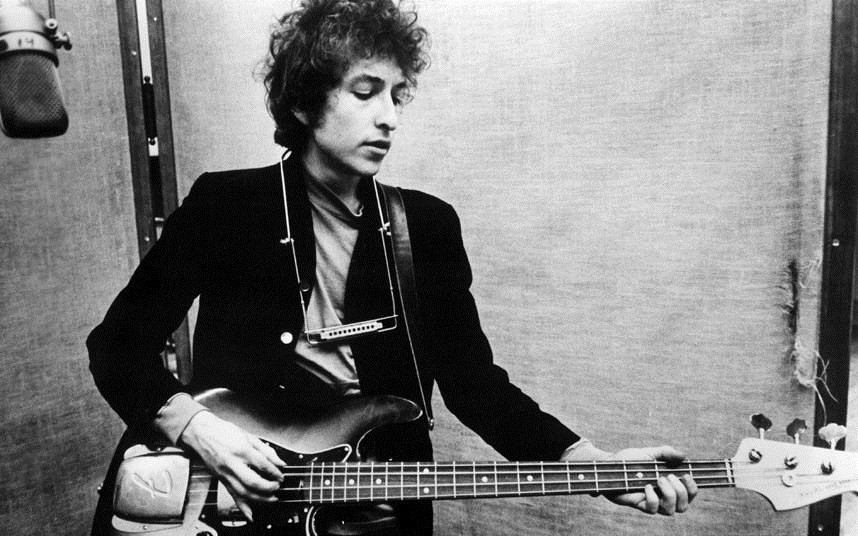
But my own engagement with sankofa via the characters in The Loved Ones is more ambivalent — which is why I included two graphics in the epigraph that are, intriguingly, quite different from each other (also, the accompanying quotation reveals varying meanings of sankofa, including one that references “taboo”). I’ve always been skeptical, for instance, of the psychotherapeutic idea that all emotional healing comes from cathartic explorations of one’s childhood. There’s truth in that, but there is also an undersung narrative of detachment, forward motion, and reinvention. An aside: last summer I fell down the rabbit hole of Dylanology, driven by my fascination with Bob Dylan as consummate self-reinventor — always evolving forward and dodging his background (family, geography, generation). The Loved Ones is in part about this: we are and we are not who our blood roots predetermine us to be.

Dayson: Yes, I can read those threads in The Loved Ones now that I hear you talk about them. You’ve evoked the word “taboo” here, too, which I wanted to ask about. A couple love stories in the novel, including the central one, are illicit, yet they don’t read as taboo. I credit the sensitivity of the writing, the full humanity you bring to your characters. How do you approach writing about delicate material?

Chung: Thank you for the kind words; I appreciate hearing that, because I did have concerns about the taboo. But a main “approach” was to silence those concerns — to follow the characters, and what was interesting to me about their connection, as faithfully and nonjudgmentally as possible. This wasn’t too hard, because my relationship with the characters had developed over a long period of time; I knew them, and when you know characters well enough, you are with them as opposed to standing over them. As with people.

A very useful comment I once received from a writing teacher was, “Where’s the danger?” There has to be danger — for the writer, the characters, the reader — in order for story to gain momentum and depth. So the delicacy was in fact a driving energy in the writing.

Dayson: Speaking of delicate or dangerous material, you’re a Korean American woman writing from the perspective of an African American man. Did this feel risky to you? Why did you make this decision for the novel?

Chung: It’s interesting to be asked “why” in regards to a creative impulse. In another context I might dodge and prevaricate: WHY? Why did Rothko paint blurry blocks of color? But here the question is apt, and I credit Chimamanda Ngozi Adichie for illuminating this recently. In an open Q&A at The Guardian, an older white male asked how to write about a young Bengali girl “without cliché or stereotype,” to which Adichie responded, “I think the first question is: WHY do you want to write about a young Bengali girl? There are still wonderful stories to be told about 50-year-old white men.”

Put another way: Jia Tolentino recently wrote, in response to Lionel Shriver’s Brisbane speech, “there are all sorts of ways to borrow another person’s position: respectfully and transformatively, in ignorance, or with disdain.” Condescension is another possibility; and I think that’s what Adichie was getting at (but do read the full exchange to judge for yourself).

My own impulse to write a story that includes a black male character’s perspective has to do with what I’d call an experiential tipping point. When a long-form project comes into being, it’s like a force welling up at the dam — a critical mass of material, emotions, intellectual and moral inquiry has accumulated over time and is rising, rising.

When a long-form project comes into being, it’s like a force welling up at the dam.

I was born in Prince George’s County, MD, a predominantly African American area, where our family lived for about six years; then we moved to the more affluent, white Montgomery County, while my father’s medical practice remained in Prince George’s. 99% of his patients were African American. As in many Asian immigrant families, there was negative, racist talk in our household (and extended Korean community) about black people; my parents lived in that complicated tension of being in and among black people every day, servicing and transacting and being rather intimate, and yet also wary and in conflict.

Fast forward to my young adulthood, as I developed my own world view and politics: for five years I lived in a (nongentrified) racially diverse neighborhood in South Seattle, three of those working full-time at a community development organization whose mission was to “serve and strengthen African American families.” The leadership and staff of the organization were primarily African American, and they, along with their families, as well as clients and volunteers and members of the partner church, became friends and mentors. These two formative, and vastly different, experiences began to layer for me in complex ways, as you can imagine.

More recently — and I am a bit embarrassed to admit this, but — The Wire, which I’ve watched backwards and forwards several times, has been a usefully synthesizing touchstone (though it’s not until this interview that I’ve reflected on why I was so obsessed with it). What The Wire did for non-black viewers is show vividly and memorably that there are as many possible representations of black people as there are human beings. It’s horrifying that a TV series had to do that work — countering both historical racism and decades of media stereotypes — but it did, and I think it was successful. I’d also like to give a shout-out to the NPR news program “Tell Me More,” with Michel Martin, which I listened to daily during its seven-year run: when you get your news from a source whose journalists are primarily people of color, and majority African American, your world view is shaped in a specific, valuable way. I still lament the canceling of that program.

There was also that summer I spent in South Africa. Too much to say about that, but it’s in the mix of experience.

So, the “why”: all that welling up at the dam. And feeling like there was something particular I might bring to my characters, and to the collision of an African American character (and his family) and a Korean American character (and her family) — something real, dimensional, perhaps surprising.

Then the Asian Americans for Black Lives Matter movement emerged this past summer, and it was like the leaky, rumbling dam totally burst! Hats off to Christina Xu and everyone who made that happen (fist-to-chest thump, peace sign).

Dayson: This all provides such illuminating context. It’s amazing to learn of these deep, varied experiences and to imagine them bumping up against each other. You’ve touched on Lionel Shriver’s speech here, too, and I wonder if we should talk more about that. There have been so many conversations lately related to writing across race. When I read your novel this summer, there was a lot of attention at that time focused on Ben H. Winters, the white author whose latest book features a black narrator, a former slave turned bounty hunter. As I write to you now in September, it’s a week when the Internet lit up following Shriver’s remarks. Not to make a parallel of those two cases as I think the authors displayed vastly different levels of awareness and responsiveness, but I’m interested on your thoughts about the topic itself. You must have considered the issue as you were writing your book, and it seems not insignificant that you are a writer of color writing across race.

Chung: Insightful, important responses have already been written about both controversies. I refer readers to the initial critical piece in Slate by J. Holtham, which includes Winters’s own response. And I would say this: Winters’s expressed writerly motive — “I wanted to explore a painful history and a painful present. And I wanted to ask white readers to think about these things as deeply as black people are forced to think about them” — along with wide praise for the work itself, has rightly redirected criticism to the ignorance of the NY Times reviewer who lauded him for his “courage” in writing from the perspective of a former slave — effectively erasing the courage of numerous African American writers who came before him. However, Winters will likely continue to benefit from this purported/perceived courage in ways that equally talented writers of color mining the same subject matter have not; there is some responsibility, I believe, to think about these inequities — in publishing, media attention, and financial opportunities that spawn from success — “as deeply as black people are forced to think about them.”

With regard to Shriver, I refer readers in particular to Jia Tolentino, Ken Kalfus, Danielle Evans’s twitter response, and Kaitlyn Greenidge. Greenidge writes about Bill Cheng, a Chinese American writer and author of Southern Dog the Cross, whose protagonist is a young black man on an odyssey through the deep south in 1927. She defends Cheng’s “right” to tell this story — to write a lynching scene in particular — “Because he was a good writer, a thoughtful writer.” She does not speak specifically to the fact that Cheng is Asian American, only that he is not black. Does it make a difference that Cheng is not white? Does it make a difference that I am an Asian American female writing a black male? If so, how so? I’m interested in these questions and am eager to engage in the continuing discussion; but I can’t say I have categorical answers.

Greenidge reminds us that we all have blind spots and must work hard at empathy when inhabiting characters outside our own experience: she uses herself, a black author who struggled with writing a white character, as an example. I completely agree, but I would also add: if you are a white American, and your social and professional world is largely white, your work in this area may be harder, your blind spots more numerous.

Dayson: It’s not just in the literary sphere that it feels we’re at a heightened cultural moment where we’re really talking about race — whether it be related to the criminal justice system, policing, systemic racism in many realms. Your novel is set before this contemporary time (spanning the years 1951 to 2005) and doesn’t speak explicitly about these issues, but the characters’ origins are important. What do you think a literary novel can lend to this current moment as we reckon with race? Or maybe that’s not its job?

Chung: The question is in fact a live wire for me, because the novel I’m working on now wades deep into these waters: the characters are confronted directly with questions about art’s relevance, and its obligations, in a context of racial injustice. My interest is in exploring these questions through characters whose gut relationship to both art and racism make the moral quandary complicated, personally and intellectually.

But I’m early on in the project and definitely don’t feel qualified to make pronouncements about The Novel or its potential to effect social change. I admire my artist-activist friends so much, while also having learned over time that I am more useful — most myself, and thus most truthful — at the desk, on the page, than on social media or at a rally. This sometimes feels like a personal inadequacy, especially at times like this (as of this writing, the video of Keith Scott’s shooting has just been released); but, I think what I can do, try to do at least, is bring human depth and complexity into a reader’s consciousness. Even supposedly literary readers — myself included — internalize static, unnuanced ideas of people and of life. Fixed, tidy perceptions — especially unconscious ones — are arch enemies of human dignity, transformative exchanges, and justice; they fuel fear, and fear is what fuels violence.

Fixed, tidy perceptions — especially unconscious ones — are arch enemies of human dignity, transformative exchanges, and justice…

Dayson: I am constantly grappling with these questions, vacillating between whether I best serve in a more direct, active way, or if my most effective role is as a writer. It’s helpful to hear your thoughts on this. I do want to return to your novel specifically and ask about the role of place. The Loved Ones is largely grounded in Washington, DC (and one house in NW, in particular) and in Korea. Can you talk about that and how your background may have come to bear on the novel?

Chung: I’ll back up and mention that The Loved Ones is my second published novel but the third I’ve written. That second novel is in a drawer (a box, actually, on a shelf); I’d spent nearly three years on it. It was rather sprawling and took place in multiple settings, none of which were places I knew from direct experience. When I recovered from that failure — which was devastating — I was gun shy and needed to start modestly. So I started closer to home, literally.

I spent most of my childhood in suburban Maryland, not far outside the city. But I knew DC more as a proximal outsider than an insider — and so imagining (and researching) a place that was already familiar generated good fictional energy. I think there’s a kind of sweet spot where fiction ignites most powerfully, and it has something to do with the way imagination and experience — fiction and fact — meld and dance and morph into something new. The same could be said for Korea: I was not born there, but it’s my parents’ native land, and I’ve visited several times as an adult. The imagination/experience layering happens very differently in this case — Korea is somehow simultaneously further from and closer to my psyche — but the idea is similar.

In retrospect, I suspect the imagination/experience balance was probably tipped too far away from experience with that second novel. As time goes on, though, it’s clear to me that the “failure” was extremely productive: craft lessons abound out of what I tried and what didn’t work. It’s like a tough writing class that just keeps on giving.

Dayson: Before we wrap up, I can’t help but ask about Paris and the influence of French, too, as that’s how we connected, and they feature in your novel, as well. The book is divided into three sections — les proches, les bien aimés, l’essence — and later Paris becomes one of the novel’s locales. I loved when Hannah notes “no one in Paris ever asked, So what’s your story?” As a long-time resident of the city, that remark rang true. I know Paris is an important place for you. Why does it speak to you as a writer, this place where people do not ask your story?

Chung: I sense in your question that perhaps “love” of that moment is tinged with irony? As in, Ah, Parisian aloofness! I guess Hannah is young enough that the disinterest doesn’t bother her; she’s reinventing, detaching and moving forward, Dylan-style. When I visit Paris, I’m there to sink into the city’s simple pleasures and to write, so I’m content to be anonymous; I can imagine that living there and trying to really connect is much more difficult.

But Parisians do value their artists more than Americans do. The expat writer Jake Lamar has said that when you mention you’re a writer to a French person, he won’t ask, “Have I heard of you?” or “What have you published?” but rather, “What are you working on?” What matters most, or at least more, is the act of creation, the fact of creation.

In an earlier draft, the epigraph to The Loved Ones was a quote from Susan Sontag’s journals: “Americans are obsessed with personal history; Europeans with expressions of essence.” So I’m looping back to my sankofa ambivalence here: it’s not always about your past, there is “essence” that is irrespective of personal history. And I especially love the wordplay of essence, which in French can mean soul or nature, as in English, but it can also mean gasoline — fuel for forward motion.

It’s not always about your past, there is “essence” that is irrespective of personal history.

Dayson: That seems like a perfect note to end on — fuel for forward motion! Thank you, Sonya.

I encourage everyone to go forth and pick up a copy of The Loved Ones, on bookshelves October 18.

About the Interviewer

Sion Dayson spent the last decade living in Paris where she chronicled the City of Light’s less glamorous side on paris (im)perfect. Her work has appeared in The Writer, The Rumpus, Hunger Mountain, and several anthologies, among other venues. Her debut novel, When Things Were Green, will be published in 2017.

Walls

You cannot eat at the Duke’s Diner anymore, because your sister once complained about her hamburger being overcooked and now the staff will spit in your food before it’s brought to the table.

You cannot buy anything at Barnes & Noble, because they were once accused of selling pornography. Also: forget about buying anything at secondhand bookstores. Bringing their stock home is highly unsanitary and therefore insane.

You cannot access the Internet at your house. Not because it’s the devil’s instrument — you don’t believe this anymore. Ever since you saw that thing on TV, about African kids taking free online courses at elite American universities, you’ve come to accept that the Internet can be a blessing, too. Something else you don’t believe anymore is that Wi-Fi signals will cook your brain. You still don’t fully comprehend how nuclear radiation differs from Wi-Fi radiation, but when a physicist explained it on that science channel, you briefly grasped it, and that was enough for you to get over your anxiety and say: the Internet will not kill me. So the real reason you cannot access the Internet at your house is that all your personal stuff is on your computer. You’ve deleted the most sensitive items, such as letters to your friends and family, yet the young man in the store told you that clever specialists can retrieve even the most erased files. That was a shock, because you already knew about hackers, how they lurked everywhere and would get to you, firewall or not.

For the longest time, you had no health insurance. The idea that your premium might fund clinics where they helped mothers murder their babies was too much for you. When they made it illegal not to be insured, your parents forced you to sign up. By letting them pay for your insurance, you have absolved yourself of Planned Parenthood.

You cannot trust PCs because they have viruses and, to your knowledge, it’s impossible to renew Norton without a credit card. (And credit cards are, obviously, open invitations to assault). You stay away from Macs, because they have scary, interconnected clouds.

When you dine at a new restaurant with your parents, you order the side dishes, such as creamy mashed potatoes and macaroni & cheese, unless your mother recommends something sufficiently similar to one of your favorite dishes served in another restaurant.

Speaking of food, you cannot eat at Cracker Barrel anymore. Once, while you sat outside in one of the rocking chairs, waiting for a free table, a man with a tattoo sat beside you and asked something about the Lunch Specials.

You have no passport. To acquire a passport, you’d have to hand over all sorts of personal information, including your social security number, and everyone knows not to give this number out to anyone. Not even the government.

After you visit your parents, you drive home before eight p.m. Later, the streets become nasty. Unlike your parents, you don’t have a wall around your house.

You have not moved in over twenty-five years, and for half of this time no one has visited your apartment. You encourage the kind of privacy that promotes loneliness.

Your teeth often hurt, so you never eat anything crunchy. Dentists, like all medical personnel, cannot be trusted.

Even though you have almost no contact with other people and complain about their intrusive behavior when you do, you consider yourself a thoughtful person. And here, I have to agree with you: you try very hard to be a good girl and never offend anyone. Every Sunday, you confess your sins, small as they are.

You are smart and educated, but you do not have a job. You live off the money your parents gift you tax-free. You do not work for a charity either and see nothing wrong with throwing away a perfectly fine pair of shoes after their interiors have gotten wet.

You know I would like to talk with you and lessen your fears. Regardless of our differences, we are related. It’s my love for you that makes me want to challenge everything you believe. But it’s also my love for you that makes me shut my mouth. So I accept: you are not sick and don’t need any help. You are merely a highly informed citizen of a dangerous planet, determined not to fall in harm’s way.

But things are looking up, you say. On television, you saw a man who said he wanted to make everything great again. You’ve never voted before, for the same reason you don’t have a passport, but you consider getting yourself registered now. The man promised to build a big and beautiful wall to keep all the bad stuff out. And, as ideas go, it’s one of the best you’ve heard in a long time.

Is it my moral duty to disagree with you now? The wall gives you hope.

Ted Wilson Reviews the World: My New Car

★☆☆☆☆ (1 out of 5)

Hello, and welcome to my week-by-week review of the world. Today I am reviewing my new car.

When my old car got stolen, I knew it was time for a new one. And when I saw my stolen car parked in my neighbor’s driveway, I knew I had just parked it there by mistake and it had never been stolen to begin with and I shouldn’t have purchased a new car so hastily.

To make matters more confusing, the new car I bought was the exact same make, model, and color as my old one. So with two identical cars in two driveways side by side, it made it hard to tell which house was mine. To the average passerby it would have looked as if I had two houses.

When the cops came to file a police report on a stolen car matching the description of the car in my driveway, I was worried they would arrest me for stealing my own car. Or if not me, my neighbor. Or both of us, and then let a jury sort it out.

Fortunately I had the presence of mind to wear my Halloween costume (a horse) from last year so as to distract them from noticing my car. My plan worked perfectly. Most of their questions were about why I was dressed as a horse.

After they left, I quickly switched my old car into my driveway and the new car into my neighbor’s driveway. When my neighbor came out and found a car identical to mine in her driveway, she asked me if I knew anything about it. To hide my shame and embarrassment I played dumb.

She was so excited to find a free car in her driveway and took to it very quickly. At first it warmed my heart to see her so happy, but when I realized that I had just accidentally given away a car worth several thousand dollars I started to sweat.

It seemed that my new car was bringing me nothing but grief. Every time I stepped out my front door the car was just sitting there, mocking me. It was a constant reminder of all my dumb mistakes.

So I had a tall, wooden fence constructed to obscure the view of my new car, and now I barely ever think of it. I know it’s probably on the other side of that fence but I never actually see it. I know eventually I’ll forget about the car entirely. It may take a long time but it’ll happen.

Unfortunately I also never see my neighbor anymore. I had to lose her friendship in the process.

BEST FEATURE: My new car had a better cup holder than my old car because the old one had melted in the sun and could only hold melted cups.
WORST FEATURE: I cut my fingertip on the door handle.

Please join me next week when I’ll be reviewing a head of lettuce.

Modiano Wants You to Think that Severe Memory and Identity Issues Are Universal

Every novel is a confusing mix of the particular and the universal, and it’s often the reader’s job to disentangle just how much of the book she’s reading is simply an expression of particular circumstances, and how much of it speaks of a truth universal to humanity. This task is rarely easy, since every novel depicts particular people doing particular things in particular situations, yet at the same time all novels can be related on at least an abstract level to some common aspect of human experience. As such, the difficulty resides in knowing just which aspects of a story are genuinely universal to human existence, and which are merely specific to a particular kind of person, appearing ‘universal’ only at inconsequential levels of abstraction.

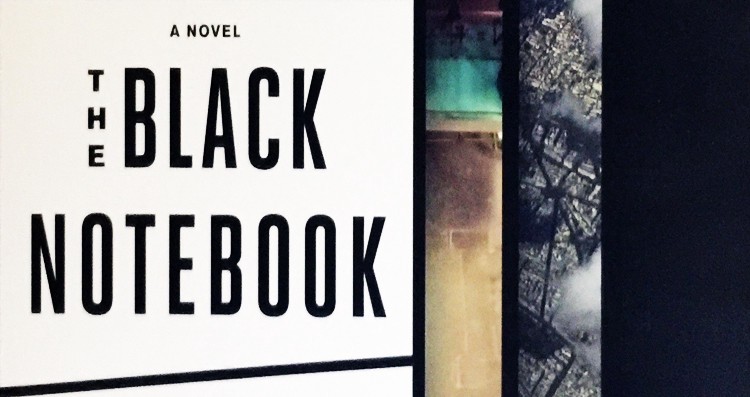
This is the difficulty that attaches to The Black Notebook, the latest novel by Patrick Modiano to be translated into English. Just like its preceding translation, So You Don’t Get Lost in the Neighborhood, it appears to handle the kind of universal themes for which the French author won the Novel Prize in 2014: the vagueness of perception and consciousness, the fragility of memory, and the destabilizing effect this vagueness and fragility have on one’s own identity. However, when reading through the book’s 131 pages, it slowly becomes evident that these themes arise in the book only because of the particular predicament of its main protagonist, Jean. Contrary to what Modiano may have hoped, the novel doesn’t actually prove their universality, instead demonstrating that, in this case at least, they emerge as a result of evasive lovers and a lack of existential purpose.

“The vagueness of perception and consciousness, the fragility of memory, and the destabilizing effect this vagueness and fragility have on one’s own identity.”

Nonetheless, before this introduction creates the impression that The Black Notebook lacks purpose itself, it should be affirmed that the book is every bit as absorbing and beguiling as anything else Modiano has written to date. A translation of his 2012 novel, L’Herbe des nuits (“Grass of Nights”), it plots the aforementioned Jean as he narrates his attempts to piece together a fragmented episode of his life from the ’60s, using nothing more than the eponymous black notebook and his own shaky memory. What this means is that it follows him as he shifts back in time to his youth, which is remembered via a series of scenes that are intoxicating precisely because they’re so incomplete, elliptical and ambiguous.

For some readers, such incompleteness and ambiguity might be alienating, yet it’s very much the withholding of information that makes The Black Notebook so peculiarly rich. When Jean recounts his relationship with Dannie, a young woman staying at the Cité Universitaire in Paris, there are always several details missing and several things left unsaid. As such, a multitude of suggestions and allusions insinuate themselves into the gaps that remain, working via imagination to create an amplified sense of possibility where there is in fact only an absence of information. To take a simple example, when the earlier stages of the novel witness Jean as he muses, “She seemed determined to avoid an awkward question,” such a phrase isn’t meant to stop the narration dead in its tracks, but rather to imply the almost countless things that Dannie could be hiding from Jean regarding her past.

“The Black Notebook is awash in a seductive atmosphere that feeds off the obscurity of its supporting characters.”

As a result, The Black Notebook is awash in a seductive atmosphere that feeds off the obscurity of its supporting characters. Aside from the slippery Dannie, there’s the no-less enigmatic Aghamouri, a taciturn thirty-something Moroccan who may or may not be a student. Then there are the shady likes of Paul Chastagnier, Duwelz, “Georges,” and Gerard Marciano, a loose-knit gang who frequent the Unic Hôtel in Rue du Montparnasse, and who are somehow connected to Dannie’s unexplained presence in the Cité Universitaire. What this connection might be is essentially what Jean spends the bulk of the novel trying to establish, yet it soon becomes apparent that his biggest problem is simply remembering his own past with any appreciable degree of clarity and consistency.

Indeed, he compares the fuzziness of his memories to how a “train rushes by a station too fast for you to read the name of the town.” He complains of the indistinctness of the Unic Hôtel bunch, of how “Their outlines have grown hazy with time, their voices inaudible.” Even when he does actually manage to recall some specific event or person, he laments of how the “details return to [him] fitfully, in a jumble, and often the light grows dim.”

Worse still, the imprecision of his memories are regularly contrasted against the precision of the notes he kept at the time in his black notebook, which deceptively makes it seem as though his remembrances are failing to grasp a lucid and unambiguous past. In its definite “succession of names, phone numbers, appointments, and also short texts” it invokes an unequivocal yesterday, yet because Jean can’t actually remember this yesterday with any assurance, it ironically serves to make him feel divorced from his own past, so that he comes to think that “another me, a twin, was prowling around there, and who was still living — down to the smallest detail.”

Yet rather than working to create the sense that people in general are always being irreversibly dislocated from their previous selves, The Black Notebook soon reveals that Jean’s memories are murky mainly because the way he experienced the present was already murky. Halfway through the novel, while having a particularly revealing conversation with the elusive Aghamouri, he remarks to himself, “It felt like a dream. This often happened in that period of my life, especially after nightfall.” Later, he acknowledges a similar blurriness to his then-present experience when he admits, “It seems to me that back then I saw them all as if they were behind the glass partition of an aquarium, and that glass stood between them and me.” From such admissions, it’s gradually divulged that the fallible memory which Jean spends much of his narration lambasting is actually a scapegoat, a fall guy meant to preserve him from the upsetting realisation that even his present consciousness is a bleary mess.

And even if at this point it appears as though the novel is some kind of comment on the deficiency of human consciousness and experience, it once again becomes hard to shake the conviction that Jean’s inability to see his reality clearly is mostly a product of his relationship with Dannie. Rather than it being the case that she and people in general are inherently unknowable, it’s quite palpable from the novel’s first few pages that she’s hiding something. Actually, she’s not hiding merely “something,” but rather her entire identity, which she keeps locked in the past, away from Jean. He soon comes to “understand that you couldn’t ask her anything directly,” while she resists his every attempt to learn more about her cloaked backstory. Halfway through the novel, he learns from Aghamouri that she’s excessively guarded only because she was involved in a “nasty incident.” Unfortunately, when he quizzes her about said “incident,” all she says is, “he told you that I got myself involved in a nasty incident? And you believed all that, Jean?”

“[T]he novel is some kind of comment on the deficiency of human consciousness and experience.”

It’s because of her evasions and subterfuges that Jean experiences his present and past as an indistinct cloud. As the most important figure in his life at that time, she becomes the prism through which he perceives the rest of the world. However, because “She offered no explanations” as to her shady past and sometimes “contradicted herself,” this prism isn’t especially helpful when it comes to framing his own life in any reliable, detailed or coherent way. This is why he “wasn’t certain of [his] own identity,” and why he refers to his memory as a “mysterious correspondent” who sends him signals “from the far reaches of the past,” and not because this identity and this memory are intrinsically unstable.

Part of the reason why they seem so unstable, and why Jean’s movements through the novel come across as almost aimless, is that Dannie’s caginess effectively deprives him not only of certainty as to what’s going on between them, but also of a purpose or object in life. There are several moments during the novel which reveal that he regards her as this purpose or object, but which also reveal that she’s far too distant and inaccessible to ever really fulfill the role he desires for her with any reliability. For example, we often catch him waiting in a kind of existential suspense for Dannie, whose absence has the effect that “time throbs, dilates, then falls slack again; how it gradually gives you the feeling of vacation and infinity.” When she finally reappears from the dark, this feeling of vacancy appears to close for Jean, who at one point remarks, “I sometimes felt I had lost my memory and couldn’t understand what I was doing there. Until Dannie returned.”

Yet even though this feeling disappears, Dannie’s secretiveness means that, actually, the void remains there, lingering under the surface. Because she’s too unforthcoming and withdrawn, she can never really provide Jean with a clear and constant raison d’être. She refuses to be the stable point of reference through which he could gain some biographical bearings, and because of this he loses any concerted notion of where he’s going in life. He walks through the boulevards of Paris “shrouded in a halo of fog,” having “doubts about the authenticity of [his own] birth certificate.” And if he spends the vast bulk of the novel drifting through an indeterminate, collapsed time that’s neither present, past nor future, it’s because he lacks a single, continuous thread that can knit every moment of his life into a sequential, linear progression.

“[T]he main draw here is the mysterious ambiance, the intimation that our world vastly exceeds what we can comprehend and know of it.”

In other words, Modiano paints him as a reflection of the shadowy people who surrounded him and of his own environment, as much a wavering ghost of his memory as the occult figures he vainly tries to reconstruct and understand. Admittedly, this might make the novel sound frustrating or unsatisfying in its cagey refusal to offer any definitive answers or substantial revelations, yet it has to be repeated that the main draw here is the mysterious ambiance, the intimation that our world vastly exceeds what we can comprehend and know of it. Almost counterintuitively, it sucks the reader in via its seamless exploitation of negative space, using this space to conjure suspicions of so much more than would’ve been conjured if Modiano had written a more straight-talking narrative.

In some ways The Black Notebook is straight-talking, however. Modiano’s prose, as well as Mark Polizzotti’s faithful translation, is constituted by terse sentences and tense observations. Nearly every line is concentrated and punchy, which somehow makes the uncertainty and equivocality all the more impacting. This is perhaps because, in keeping what’s said to a concise minimum, Modiano maximizes what’s left unsaid, thereby widening the latter’s scope and making it more suggestive. Yet it’s also because the juxtaposition of succinct, ostensibly clinical language with a thick layer of doubtfulness ultimately reinforces the poignant contrast already created by the transparent simplicity of Jean’s black notebook and the opaque complexity of the events to which it vainly tries to refer.

In the end, it’s this gulf between the nominal coherence of language and the fundamental incoherence of reality which The Black Notebook appears to be all about. It’s sets itself up as a novel on our failure to make ‘knowledge’ and reality correspond in anything more than a tokenistic manner, as encapsulated by Jean himself when he explains, “I wrote down very few appointments in that black notebook. Each time, I was afraid that the person wouldn’t show up if I committed the date and time in advance.” And yet, as explained above, the impression of the “fundamental incoherence of reality” is for the most part an artifact of Jean’s social milieu and his love interest, Dannie. She never reveals herself to him, and so because of her crypticness, reality itself comes to seem cryptic. This is why, despite its utterly engrossing atmosphere and unassuming eloquence, The Black Notebook doesn’t quite prove the universality of its own themes.

How to Suppress Women’s Criticism

Last week, Ruth Franklin’s new biography of the late Shirley Jackson — Shirley Jackson: A Rather Haunted Life — arrived on my doorstep. In my living room, I did a small shoulder-wiggle of excitement, opened the package, admired the cover, and turned the book over. It was only then that I saw the lead blurb at the top of the dust jacket. Written by Neil Gaiman, it reads in part:

“Not just a terrific biography, but a remarkable act of reclamation: if there was ever a great writer of the twentieth century who fell victim to ‘How to Dismiss Women’s Fiction,’ it was Shirley Jackson.”

He’s not wrong. The biography is certainly terrific, and Franklin is clear about her position about Jackson’s rightful place in the literary canon. But if the cadence and structure of the phrase “How to Dismiss Women’s Fiction” is familiar to you, it may be because you’ve heard of Joanna Russ’ book-length essay How to Suppress Women’s Writing. And if not, it’s understandable: a brilliant piece of feminist literary criticism, it is not nearly as famous as it should be. (Though it has a bit more notoriety in SF&F circles, as Russ was an accomplished and decorated science fiction writer and critic.)

And if not, it’s understandable: a brilliant piece of feminist literary criticism, it is not nearly as famous as it should be.

First published in 1983, How to Suppress Women’s Writing is Russ’ darkly funny take on oppression in art, a tongue-in-cheek how-to that examines the ways that women, people of color, and other minority groups have their accomplishments minimized and erased by the bulldozer of dominant culture. She argues that women’s art is often suppressed before conception by “powerful, informal prohibitions,” and if it is created, by “denying the authorship of the work in question… belittlement of the work itself in various ways, isolation of the work from the tradition to which it belongs… assertions that the work indicates the author’s bad character… and simply ignoring the works, the workers, and the whole tradition.” It’s a magnificent, if troubling project — brilliant and interstitial. In a just world would be required reading in all the humanities. (Though I suppose in a just world, it wouldn’t have needed to be written in the first place.)

Sitting there, holding A Rather Haunted Life in my hands, I re-read the Gaiman blurb over and over. I don’t make it a habit of parsing blurbs, but the oblique reference to Russ confused me. It wasn’t quite the right title (and thus couldn’t be looked up), and it didn’t have a citation (and thus couldn’t be referenced), and it wasn’t a self-aware riff (like the title of this essay). I kept returning to it, annoyance growing, trying to figure out how no one had caught this simultaneously subtle and weirdly flagrant error.

I kept returning to it, annoyance growing, trying to figure out how no one had caught this simultaneously subtle and weirdly flagrant error.

Gaiman confirmed on Twitter that he was alluding to Russ’ essay (“Yup”), but then later suggested that he was referring to the “phenomenon,” not the piece itself. And yet the specificity of the phrase — the crystalized description of the phenomenon, so clearly expounded upon in the essay — calls to itself, over and over.

To be clear, I don’t attribute malice to Gaiman’s decision — and Russ probably wouldn’t, either. “At the level of high culture with which this book is concerned,” she writes in the second chapter, “active bigotry is probably fairly rare. It is also hardly ever necessary, since the social context is so far from neutral.”

So what does it mean that a high-profile male writer, in praising an oft-overlooked female writer, used an unsourced, unsearchable reference to another oft-overlooked female writer’s seminal work in the process? For women artists, it is nothing new, though there is something oddly on-the-nose about it — a quote illustrating the very thing it condemns.

So what does it mean that a high-profile male writer used an unsourced, unsearchable reference to another oft-overlooked female writer’s seminal work in the process?

In a 2011 essay at Tor.com, Brit Mandelo observes that How to Suppress Women’s Writing’s meticulous endnotes and citations have an incredibly important job: “They do the work of remembering.” Mandelo writes:

“One of the things Russ refers to time and time again in How to Suppress Women’s Writing is that the history of women writers — as friends, as colleagues, as individuals, as a group — is written on sand. Each generation feels that they’re the first and the only to want to be a woman writer, that they must do it on their own. Similarly, feminist history is in a state of perpetual erasure. By using extensive citations of real women writers’ works, and real books devoted to women writer’s like Moers’ much-cited Literary Women, Russ is creating a concrete list of the past. Using the references she uses, documenting them so thoroughly, creates a history and a set of possibilities not written in sand; the knowledge that not only were there networks of talented women writing, we can prove it. It’s not new. It’s a history, and the presence of a real history is a boon to young critics and writers. It defeats the pollution of agency, it defeats the myth of the singular individual woman, it creates a sense of continuity and community.”

It would have been such a little, correct thing to keep that link alive — a gesture whose implications would have far outweighed its size.

That might seem like a lot of pressure to put on a blurb, especially because blurbs are an unavoidable part of a professional writer’s life. But Russ is dead. Jackson is dead. And in the thoughtless, uncredited, mangled deployment of that phrase — even in praise — Gaiman broke the chain between the two of them; a prominent, living male artist inserted between Russ’ ideas and Jackson’s reality. It would have been such a little, correct thing to keep that link alive — a gesture whose implications would have far outweighed its size. And yet, like so many tiny, seemingly insignificant cultural gestures — whose collective weight can buoy, or suffocate — it is a symptom of a larger condition.

Every year, it seems like major publishers rediscover underappreciated, dead women writers. Shirley Jackson, Lucia Berlin, Patricia Highsmith, Clarice Lispector, Jane Bowles. There is always a great flurry of attention around these women, a posthumous literary coronation that is equal parts exciting and painful, like discovering at her funeral that a long-ago, seemingly unrequited crush in fact loved you madly. Maybe what we need is more thoughtful vigilance; to help women and people of color and queer folks and working-class artists and so many others find their rightful place in the canon — ideally, while they’re still alive to witness it.

Can Literature Bring Liberals and Conservatives Together?

A new study looks at “bipartisan books”

A recent Guardian article titled “Study Shows Books Can Bring Republicans and Democrats Together” provides a notably literary commentary on the vehemently oppositional rhetoric of this election season. Citing linguist Roman Jakobson’s theory on discourse, which juxtaposes the communal nature of literary debate with divisive and inflammatory political language, researchers Richard Piper and Andrew James So used data from Goodreads to study how fiction can bridge the divide between Democrats and Republicans.

They began by curating a 200-title list of “highly partisan” books such as James Carville’s It’s the Middle Class, Stupid!, Glenn Beck’s Cowards, Paul Krugman’s End This Depression Now! and Anne Coulter’s Demonic. Then, by examining ratings on Goodreads, researchers marked readers as “liberal” or “conservative” based on preferable reviews (3 stars or higher) of partisan texts. Next, they analyzed the literary the preference of these readers by cataloging books labeled “fiction” or “literature” on their Goodreads shelves. Limiting findings to books that at least 100 readers’ owned left just under 3,000 titles (out of several hundred thousand total).

While some stereotypes held, such as “low-brow” novels by John Grisham and Tom Clancy skewing conservative and more “high-brow” authors like Toni Morrison and Albert Camus attracting liberal readers, a collection of over 400 novels garnered interest across the political spectrum. The researchers termed these “bridge books.”

The top 100 (in terms of total “owners”) include recognizable, and varied, titles such as Don Quixote, The No 1. Ladies Detective Agency, and Tess of the d’Ubervilles. Interestingly, highly political heavyweights occupied the top three spots: Harper Lee’s To Kill a Mockingbird and George Orwell’s Animal Farm and 1984. Really though, outside of a slight preference for first person narration, the trends in bipartisan books are arbitrary at best. The most popular “bridge books” are high school reading lists standards, classics, or have been popularly adapted for TV and film. They don’t seem to have any intrinsic uniting qualities beyond vast proliferation.

Piper and So then tested if bipartisan books “elicit different reactions on the part of readers through the content of their reviews.” Here, the findings were intriguing. Both left-wing and right-wing readers changed their language when describing “bridge books,” shying away from negative diction and more readily using terms “related to cognitive insight,” like “admit” and “explain.” But, according to the Guardian, the “most startling result was this: it was conservative — not liberal — readers who are most active in producing this space of cultural compromise.” Basically, within this sample size, conservative readers tended to exude more generous praise for “bridge books” and did so with a vernacular considered to be “less heated or emotional.” Grammatically, they also expressed “more complex thoughts.”

As an emotionally excitable liberal reader, I feel obligated, at this point, to express a couple questions regarding the study’s conclusions with my pleasantly simplistic grammar.

The article remarks, “if our bridge books are making right- and leftwing readers less extreme in their language and worldviews, it is conservatives who are doing the work (sic).” There’s a couple assumptions here that I find a touch troubling — that the removal of radicalism equates to respectful discourse and that the role of communal literature is to dull cultural commentary. Wasn’t the notion of Roman Jakobson’s literary discourse to “encourage people to discuss their differences in more thoughtful and flexible ways?” Wouldn’t dogmatic positivity toward our shared texts promote a-political hegemony when we want constructive dialogue?

Consider, for instance, why liberal readers would respond negatively to these books. The list may not be politically conservative, but it certainly embodies a good deal of traditional conservatism. The only “cultural compromise” present is the exclusion of non-dominant voices. Ralph Ellison, for Invisible Man, is the only writer of color listed, queer and post-colonial authors are scant, and, generally speaking, titles that fit the feel good/trust the status quo sect abound.

The biggest question this study raises is why are these books our “bridge books”?

It’s clear, at least from the readers analyzed, our culture, as a collective, has been institutionally encouraged to come together around books, but only if those books present an overwhelmingly white, straight, and male perspective. Terming “bridge books” “non-partisan” silences othered communities from participating in the political “bridge” of left and right.

If we want “bridge books” to, you know, actually bridge they need to amplify non-dominant voices. For a discourse to reflect base American cultural values of tolerance and freedom of expression, the ideas of straight white writers can’t be the only things discussed. Without women of color authors, queer authors, post-colonial authors, and immigrant authors these aren’t “bridge books,” they are concessions to an exclusionary and outdated political order.

No Apologies: A Look at The Mothers and the Choices Women Make

There is a line from Esperanza Spalding’s Emily’s D+Evolution that has haunted me for most of the year:

“Take a little girl who gets to see her mama broke down / Now she’s a lady made for the modern world.”

The song is called “Judas.”

It’s about “innocent wrecking balls” — the raging boys and girls who are trying to figure out where they belong in a world that already views them as trouble. Those lines were all I could think about after meeting Nadia Turner in The Mothers.

Nadia Turner is a 17-year-old from Oceanside, California whose mother killed herself and chose not to leave a note. Her mother is there and then she isn’t anymore — broken down or otherwise. And so, the central question of Bennett’s novel becomes: how do girls navigate their path to womanhood without mothers there to guide them?

“How do girls navigate their path to womanhood without mothers there to guide them?”

To everyone who knows the Turner family at church, Nadia becomes her mom’s ghost: “She looked so much like her mother that folks around the Upper Room started to feel like they’d seen Elise Turner again.” As Nadia learns, one way for your absent mother to guide you through womanhood is to retrace her path.

In ways beyond from her beauty, Nadia truly is her mother’s ghost. She is around the age her mother was when she got pregnant and dropped out of high school. “If my mom had gotten rid of me, would she still be alive?” This becomes one of many curiosities Nadia battles in attempt of understanding her suicide. Nadia tries to bury her grief between the sheets with Luke Sheppard (a former football hero who also happens to be the pastor’s son) and her mother’s history repeats itself in the form of a positive pregnancy test. “Of all people, she should have known better. She was her mother’s mistake.” Nadia isn’t her mother, though. She gets pregnant and then chooses not to be anymore. In retracing her mother’s path, she also chooses to rewrite it.

Nadia is good at keeping secrets. She even manages to shield rumors from her best friend, Aubrey Evans. Aubrey is the other motherless girl at church, whose mother isn’t dead — just gone. She makes it clear that there are other reasons to be motherless: “. . . we don’t get along, that’s all,” Aubrey tells Nadia. What Aubrey doesn’t admit is that her mother has chosen a life of lovesickness over raising her daughter. Her heart has a habit of choosing the wrong men.

At its core, The Mothers is a novel about choice. Some choices are uncontrollable and impulsive, while others are pragmatic. Nadia Turner chooses to leave town for college and navigate her potential outside of the small community where she grew up. As Aubrey puts it, “Anywhere [Nadia] wants to be, she goes.” Aubrey chooses to stay and build her life in Oceanside. She hopes to fall in love, settle down, and start a family. The girls build different paths, but the end goal is the same: to lead happier lives than their mothers. This is where Bennett nails the paradox modern women face: the freedom of choice and the anxiety that comes with that responsibility — that people will still judge your choices.

Is a decision only a mistake if it hurts people? Or if it is chosen out of naiveté? Mistakes have many faces. By definition, making a mistake is about choosing wrong. Bennett makes it clear that mistakes aren’t always about choice — sometimes they’re about losing control — about wanting to make a mistake. (Lust, by the way, is a surefire way to lose control.) Beyond that, Bennett begs a bigger question about choice — what do we do with good decisions that others see as choosing wrong?

This is what I love about Bennett’s novel: again and again, women make their decisions and do not apologize for them. Even the more difficult ones. Elise Turner decides to leave her life and doesn’t explain it away in a note. Nadia doesn’t blame anyone for her choices either. “No one made me do anything,” she says more than once about her abortion. “Her mother was dead now, long gone, but she might have been proud to know that her daughter didn’t blame anyone for her choices. She was that strong, at least.”

“The Mothers is a novel about choice.”

Even definitive choices — ones that aren’t mistakes — can lead you to wonder what different paths would have yielded. Bennett does this beautifully through Nadia and Luke’s daydreams of a reality where their baby was born into the world. In Nadia’s mind, “he grew into a boy, a teenager, a man.” She even imagines him throwing a ball, wondering if he could have been an athlete like his father. That’s the hurt Nadia, Luke, Aubrey and others in The Mothers endure — all the potential they imagine in their past — Luke’s football career, Nadia’s baby and the family they could have built their lives around. That impulse to look back before going forward is what makes Bennett’s characters so relatable.

Bennett broke my heart with this novel, with her investigation of friendship, secrets, love, choice and forgiveness. Forgiveness is the hardest to decipher in The Mothers. “Forgive this innocent wrecking ball” is also a line that hits hard in Esperanza Spalding’s “Judas.” It comes back every time she gets to the chorus.

Women hear it all the time: we say sorry too much. We’re too shy about what we want, too afraid to be seen as bossy. But that softness isn’t the only danger — saying a word over and over can dull it. “Sorry” should mean something. Forgiveness is easier to earn when the word has that power.

Bob Dylan Wins Nobel Prize in Literature (No, This Headline Is Not a Joke)

Folk singer Bob Dylan — yes, really — becomes the first American to win since 1993

It’s been over 20 years since an American won a Nobel Prize in Literature, the last being Toni Morrison in 1993. It has been so long that articles about the perennial snubbing of Americans are written every year. (It doesn’t help that in 2008 the secretary of the prize jury, Horace Engdahl, said the US “is too isolated, too insular” and that “ you can’t get away from the fact that Europe still is the center of the literary world.”) Well, the Swedes may think American literature is too isolated, but apparently not American music, because they just awarded Bob Dylan the Nobel Prize in Literature.

Yes, really.

Bob Dylan, who was awarded for “having created new poetic expressions within the great American song tradition,” is the first musician and lyricist to ever win the Nobel Prize. And his win has left people scratching heads around the world. The Nobel Prize is normally one of the few opportunities for literary books to be the focus of media discussion and attention. It is also a rare opportunity to boost the sales of overlooked authors (especially in America where readers rarely buy translated literature). Instead, we’ll be talking about a popular musician who — as great as he is — has been discussed to death for the last fifty years.

Most of us assumed that if another American were to win, it would be Don DeLillo, Marilynne Robinson, Thomas Pynchon, Cormac McCarthy, or poor old Philip Roth (who famously used to go sit in his agent’s office every year waiting for the Nobel call). Or perhaps a dark horse candidate like Lydia Davis, Claudia Rankine, or any other number of amazing writers in America’s very deep bench.

But the Swedish Academy has been famously hard to predict in the last few decades, giving the award to several long-shot candidates or even somewhat obscure writers in recent years. Last year’s winner, Svetlana Alexievich, was the first non-fiction writer to win in a long time. And perhaps opening the door to lyricists and famous musicians is what the Nobel needs to do to stay relevant.

Or perhaps the Nobel committee looked at how stupidly insane 2016 has been and thought, “We have to do our part!”

Tessa Hadley, Helen Garner & Hilton Als on Capturing Glamour & the Power of Women

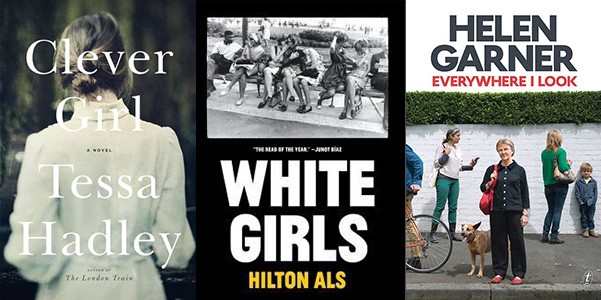
Last month, the Windham-Campbell Festival at Yale brought together three of our favorite writers — Tessa Hadley, Helen Garner, and Hilton Als — to talk about “girls.” The panel, dubbed “Good Girls, Bad Girls, White Girls, and Clever Girls,” dove into some heady subjects — 1970s feminist theory, maternal artistic influence, and the ineffable glamour of New Yorkers.

We were so gripped by their conversation, we decided to share it with our readers. First, for those not familiar with the panelists, a brief introduction:

Tessa Hadley’s books include Clever Girl and Master Bedroom.

Helen Garner’s books include The Spare Room and Monkey Grip.

Hilton Als is a New Yorker staff writer and the author of White Girls.

All three are winners of a 2016 Windham-Campbell Prize. Professor Amy Hungerford moderated. And with that, here’s their conversation.

(This discussion has been edited and condsensed. A video can be found here.)

Amy Hungerford: Tessa, in Clever Girl there’s a dream of glamour at the edges of the story, especially intellectual glamour, or the glamour of radical ideas. Do you think that post-’70s feminists freed glamour from the model scene, where the term is used to belittle certain categories of the female body. Is glamour more powerful than it was in that moment?

Tessa Hadley: I should think there are a thousand different glamours. The glamour I think you are talking about in my book is, in a way, an invented one. My two teenage characters, my “clever girl” and her first passionate love — who, unbeknownst to her is obviously gay — endow their world with glamour. There’s something about that teenage moment — they see what may in reality be dingy and fill it with power and beauty. When I wrote that section of my book I had Patti Smith’s Just Kids by my side, because that’s exactly what she and Robert Mapplethorpe did. They invented a glamour different from the one that’s sold to us, the one that is often exploitative and ugly.

Helen Garner: The feminists of my generation purged our lives of a lot of things, of what we thought was tyrannical. We also purged ourselves of the male idea of glamour — what we’re supposed to look like — makeup, and the hair, and the nice clothes. Reading Patti Smith’s book reminded me of that time. In my crowd we were actors or musicians, a lot of single mothers trying to raise kids in hippie households. We purged ourselves of what we thought was bourgeois. We were trying to get away from the nuclear family. There was a glamour that we imbued ourselves with. We were flying around on bikes with kids on the back and everything was kind of cheap and you had to dye things interesting colors. When I look back, I think, Yeah, we were pretty cool back then. Glamour is a focus of life energy that’s humming and buzzing. But when I look at photos of us at the time — which, of course, are stripped of that thrilling feeling — we look terrible. We look kind of ugly and stupid.

The feminists of my generation purged our lives of a lot of things, of what we thought was tyrannical. We also purged ourselves of the male idea of glamour

Tessa Hadley: I think that’s so brilliantly true. One of the things I love doing in fiction is trying to recover the glamour of moments like that. It’s like trying to write about the glamour of a piece of music. How can you put into words on a page that extra thing? That sexy thrill of the moment. It’s eros. It just comes zooming in and everything becomes fabulous and wonderful. I was in New York last week, and I’m just thunderstruck by how fabulous people can look in New York without doing anything.

Amy Hungerford: Let’s talk about a kind of messiness: the messiness of bodies and gender. Whether they are bodies at the end of life, or bodies that are not gender conforming. In what ways have you thought about that in your writing? Or bodies that are mangled or somehow destroyed. How have you thought about gender and the body, Hilton?

Hilton Als: It’s funny because I gave a talk here last year…I’ve been invited several times by a professor who is known for his inclusive gay point of view. But, in fact, his behavior toward me is reminiscent of body fascism from New York gay bars in the ’80s. There’s a big divide in current literature, which is this: Why is there still a split between theory and practice? Why do people exercise great unkindness while purporting to write and think in a different way? It’s a basic ethos. You don’t treat people badly not because you don’t want to be treated badly, but because you just don’t. And I find that when it comes to discussions about the body, there are sensitive people like yourself, Amy, whom I’m happy to answer, but if I was in a different situation, with that other professor, I wouldn’t feel free to answer, because really the question would really be about that person’s career, as opposed to the interview. I’m finishing a book now for Yale, and this is one of the things I want to talk about in it: What is it about that professor that allows him to have a forum? Why is he able to do that? I’m robbed of an answer to his cruelty. The body stuff is so intense for people. Still. No matter how beautifully we’ve moved forward in the world.

Amy Hungerford: Helen, I would love for you to talk about The Spare Room. It’s about a woman whose friend is dying of terminal rectal cancer. She comes and visits the protagonist’s apartment, and takes up residence in a spare room. The protagonist is named Helen, as a matter of fact.

Helen Garner: That book is a novel because it contains certain fictional passages, but it’s based very closely on something that actually happened in my life. So, I called the character — the narrator — Helen, partly because I wanted to own the ugliness of the feelings that she had toward her dying friend. I didn’t want anybody to think that I was just making it up. I wanted to confess, in a way. But what happened was…I’m going to just tell the experience rather than the book…I had a friend who was an old hippie. Like a dip dyed, guru-having hippie. A lovely, sweet, batty kind of person, in her late sixties. She’d been very beautiful, but all her life had been alone. She’d never been with a man or a woman. I don’t know what her kind of sexuality was or if she even had much of one. But I loved her and she lived in a different town and I knew she’d gotten cancer. She got in touch with me and said, “I’m coming to Melbourne. Can I stay at your place for 3 weeks while I undergo a course of treatment?” I didn’t know anything about the clinic, but I said, “Of course.” I had this fantasy of myself as this kind, loving, tender, containing person. I thought I could be a maternal figure to her, I suppose.

Anyway, I got to the airport to collect her, and to my astonishment, she staggers off the plane into a state of collapse. I had to get a wheelchair to get her to the car and get her home. It turns out, before she left the other city, she’d had this horrendous treatment, which was a kind of shonky. Anyway, I won’t go there. But she was in a very bad way. So, the first day, I take her to the clinic the clinic is obviously shonky. It’s run by —

Amy Hungerford: I think that’s an Australian term. Can you translate?

Helen Garner: I mean the guy’s a quack. She’d loaded all her hope and fantasy for a possible future onto this doctor. I’d never seen such a horrible looking creep in my life. You know when you read Raymond Chandler, the private detectives, their room has crooked blinds? It was like that. Everything was dirty.

Tessa Hadley: Crooked blinds. That’s a terrible way.

Helen Garner: I saw these crooked blinds and I thought, “She’s doomed.” And indeed she was. But she said to me, “I need you to believe that this treatment is going to work.” I wanted to say, “Let’s get out of here. They’re going to take your money.” They were charging her $3,000 a week, pumping her full of Vitamin C, putting her in tanks of ozone, and other nutty stuff. She was a really beautiful looking old woman with white hair and she said to me, “by the middle of next week, I’ll have this cancer on the run.” I didn’t know what to do, confronted with that degree of delusion. I hardly slept. The nights were terrible.

Eventually I forced her to go to an ordinary doctor and the doctor said, “I’m sending you now to have a scan.” So they did a scan of her neck and they found that one of her vertebrae had been totally replaced by a tumor. At this point, I thought, Well, listen, you can’t go back to these people. They’re not helping you. They’re just robbing you. And for awhile there was this little window where she said to me, “Death’s at the end of this, isn’t it?” And I said, “Yes, it is.” There were about two hours where she sat with that fact and this great sweetness came between us. We stopped wrestling and fighting and having a power struggle and we just sat quietly. On the back veranda, a little breeze blew, and peace fell on us. And then by the next morning she was back into the fantasy.

Amy Hungerford: There’s a moment in that book when you describe wanting to drive a car into a wall with her in the seat. And to open the door and exit the car. I was so struck that this is exactly the analogue of what the father does in your non-fiction book, This House of Grief.

Helen Garner: Oh my God. I hadn’t ever noticed that. Well spotted. Maybe that’s why I went to the trial. Somebody was asking me today, “Why did you write about that trial?” And I said, “I don’t know. There must be something in me…” And there it is.

Amy Hungerford: We’re doing deep therapy here…Let’s talk about our mothers for a minute. Is a mother, like a girl, a category that can be occupied by a whole range of embodiments and histories and lives?

Hilton Als: I was telling this story yesterday of how I used to hide writing under my bed. I came from a family of women. I couldn’t get a word in edgewise, so I wrote responses down. My mother was apparently cleaning one day, and she found the writing and wrote, “Very good,” and put it back. And, so, there’s the mother who gives permission to be an artist. Twyla Tharp says in one of her books, a child is a practicing artist. An artist is a practicing child. I don’t think that any of us who do this work could have done it alone. There had to be one person, whether it was an English teacher who was like a mother, or your mother, or an aunt, someone who looked at you and said, “Yes.”

There had to be one person, whether it was an English teacher who was like a mother, or your mother, or an aunt, someone who looked at you and said, “Yes.”

Tessa Hadley: Isn’t that fascinating? Is there anybody who writes in the face of “no”?

Hilton Als: Not that I’ve ever met. Even people who write about their mothers and complain about their mothers have a memory of bliss at one point with that person.

Helen Garner: Maybe not with the mother, but there’s got to be a memory of blissful permission. A memory of “very good.” “Very good” is what you need.

Amy Hungerford: What are the misuses of gender in your thinking? When do you feel, in your own work, compelled by the cultural manifestations of gender? Or deformed by them, having to answer to them when you don’t want to?

Helen Garner: The only thing I can think to answer is that, in the past, I’ve tried to change the gender of a character once I already started. Brick wall.

Amy Hungerford: That’s fascinating. I’ve actually studied this with a writer I’m interviewing for my latest book. We went back and forth about the meaning of what that act was. She was about six months into writing her novel and changed her protagonist from a woman into a man, and in the conversation with her, she said sort of glibly, “Oh, it was for marketing reasons. I did not believe that this woman doing the things she was doing in the novel could ever be anything but pathetic, but if she became a man, she could do these things without being read as pathetic.” We then had a long conversation over time…So, you’ve felt that in fiction, your characters have a kind of rightness in their gender?

Helen Garner: It’s not something I think about when I’m writing. It’s just that on this one occasion I wanted to conceal the identity of the person it was based on, which was even more ridiculous. As soon as I just changed the gender, in the very first sentence, I thought, This isn’t going to work. The person was coming at everything from the wrong angle and the wrong tone. Everything was wrong.

Tessa Hadley: I can remember a student, a female student, trying to write as a man and writing the sentence “He felt for a tissue in his pocket.” Now, what a discovery that that sentence can’t really work for a man. I can’t really explain it. But, of course, that isn’t really what we think about, maleness and femaleness, anymore.

Hilton Als: It’s in the bones of the —

Tessa Hadley: Culture.

Hilton Als: Well, also of the writer. If you’re imaging the world through a particular character’s eyes, that character tells you who they are, I think. And, so, if you say, “John Williams,” he pops out and he’s the person speaking. And then you say, “Oh, I’m going to change it to Jeanine.” It’s like no, give me my trousers back. It’s like trying to alter the reality of your dreams.

I wanted to ask Helen this question when she was speaking of eros and glamour earlier. I was so interested in whether or not you’ve ever had the experience as a nonfiction writer of being erotically attracted to a subject and being surprised by that. Or finding them glamorous in that way.

I don’t mean, Oh, I want to be with them. Just that they have a kind of aura that surprises you as a writer, that is seductive in some way.

Helen Garner: I can immediately think of one. I wrote a book called Joe Cinque’s Consolation. It’s about a young, rather innocent, mother-dominated Italian guy — I never met him. He was murdered by his girlfriend, an Indian woman. This all happened in Canberra, Australia. She had some kind of psychiatric disorder, well, that was the defense that she ran. When she appeared in the court, a tremendous crackling aura was around her. She was a very good looking girl, I suppose in her mid-twenties. She suffered from various sorts of eating disorders and she had a terribly neurotic relationship with her own being and body. One day, she came into the court and her hair was hanging right down her back. A mess of dark hair. And she sat down — before the judge came in — and put it up as an Indian woman who’s lived with long, straight hair will do. It’s not as if she was kind of brushing it. She just grabbed this mass, twisted it at the back, skillfully bound it up, and then she did this little gesture with her palms. She felt for the strands at the sides and just tucked them in. I was thunderstruck. I looked at her and thought, even though she wasn’t doing it flamboyantly, it was an act of incredibly intense femininity, which radiated erotic power. And that was her relationship with Cinque. She had tremendous erotic power over him. She blamed him for everything that was wrong in her life and she eventually killed him with an injection of heroin. But that moment of her putting her hair up. At the time, I was shocked by it and I felt disapproval. That’s the kind of feeling that I would like to transcend as a writer.

Tessa Hadley: I think older women are such good observers of young women. And young men, actually.

When one reaches a certain age, you have this cool eye for the loveliness of young people.

When one reaches a certain age, you have this cool eye for the loveliness of young people. And, of course, you see so many…they’re all lovely, actually, which you don’t feel when you’re down in it.

Anuradha Roy on Memory, Violence & Occupying Imagined Spaces

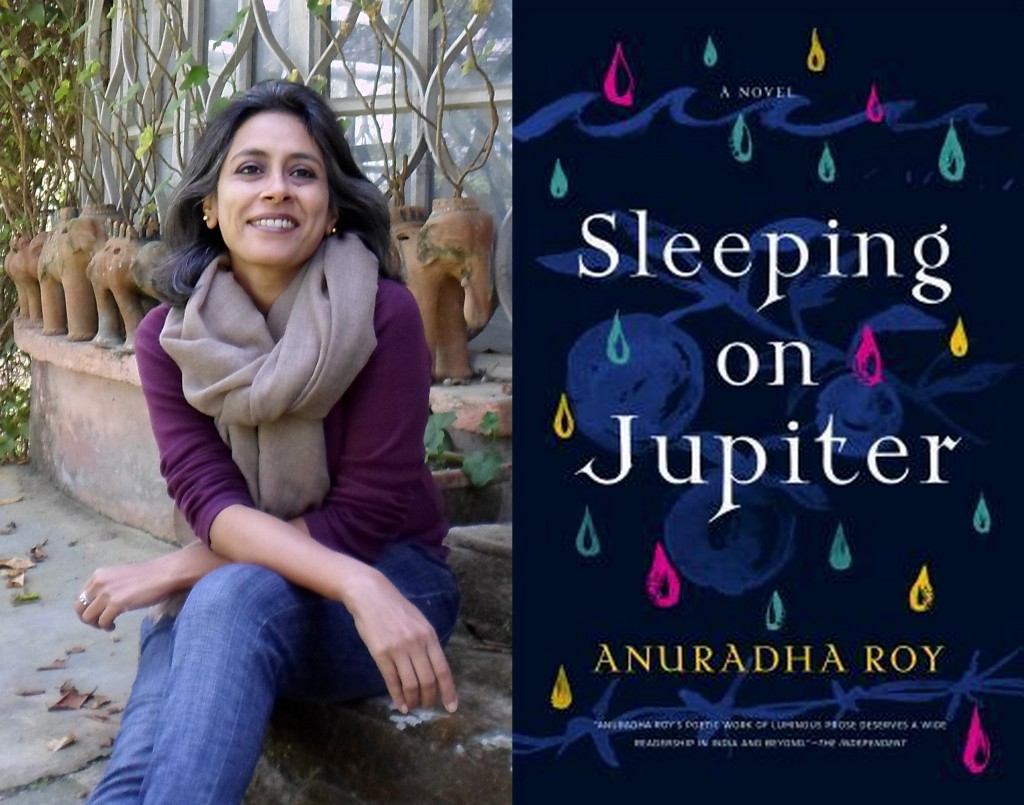
Anuradha Roy writes the kind of immersive, atmospheric prose that you might not expect to be laced with fierce violence. But Sleeping on Jupiter, the latest novel from the Booker Prize-nominated author, doesn’t shy away from dichotomies, whether it’s a gruesome murder in a breathlessly beautiful setting or a religious guru who abuses children.

Sleeping on Jupiter (Graywolf, 2016) follows a group of people whose lives intersect as they visit Jarmuli, a seaside temple town in India. The core of the novel is a trio of women in their sixties, friends on a long-anticipated holiday, and Nomi, a punkish young documentary filmmaker who comes looking for clues to her childhood at a local ashram. With its wealth and squalor, religious fanaticism and feigned religion, tourism and claustrophobia, Roy’s fictional town of Jarmuli presents the dualities of modern India. As the trip unfolds, the characters navigate this unpredictable space which always threatens violence — especially towards women.

I had the pleasure of corresponding with Roy over email about her latest book, creating fictional landscapes, and the intentionality of writing.

Carrie Mullins: Sleeping on Jupiter is a beautifully atmospheric, almost cinematic, novel, whether it’s Nomi’s first home in the jungle, or the sea by Jarmuli, or the Scandinavian forest. The sights, sounds, smells, even the horticulture of a place seems to be important to the story. What drew you to these particular landscapes? How do you think about the function and place of environment in a novel?

Anuradha Roy: I remember the way books like Crime and Punishment affected me as a teenager. We used to get these cut price translations of Russian classics in India in those days and so tended to read Chekhov, Tolstoy, Dostoevsky. The cold in them, the snow, the ice, the horses, the unfamiliar food, the long street names — a country I had never seen was alive in my head. Now when I think of the Shanghai of Tash Aw, the Wessex of Hardy, the rural landscapes of Bengal in Bibhutibhushan, the Scandinavia of Karin Fossum: the settings are inseparable from the characters and narrative. When I am reading a book, I like the feeling of being totally sucked into that world and place is crucial for that.

How particular and detailed and descriptive were those novels? I would have to go back to them to work that out, but the important thing for me is to try and evoke atmosphere and place with only a few details and to set the novel where I will want to live (in my imagination) for the three or four years it will take me to write the book. Even if a novel were to take place in one single room, I’d need to get the room vivid and right in my mind if I am to be able to write. It is not that you put in every detail you note down, but you need to know them for yourself.

CM: Along those lines, the novel is primarily set among the temples of Jarmuli. What inspired you to create this fictional town and why did you want to use a religious setting?

AR: Jarmuli is a temple town by the sea. Temple towns are quite unique in India — these are places for pilgrimage where practically the whole economic and cultural life of the town revolves around ancient temples. The book is set in a temple town partly because one of the themes of the novel is the place of religion in people’s lives — religion impacts different characters very differently in the book. Temple towns are also places for tourism and pilgrimage and therefore for transient relationships — there are quite a few of those in the novel.

The town is fictional because I like making up places as much as people. It gives me the freedom to create a world in which I can see my characters very clearly. The fictional places of my books grow partly out of real places I know, but I like to make and shape them for myself.

CM: Memory is a big theme in the book. Nomi has a fractured memory, Gouri is losing hers, and other characters, like Latika, have memories that they wish to forget. It’s interesting to write characters with incomplete memories because you, as the author, know more than they do. How do you think about the interplay between memory and character, and as an author, what to give and what to hold back? I was also struck by how the characters’ fractured memories related to each other, as if they each had part of the larger picture, the larger narrative of India.

AR: That’s very observant of you. Fiction has a great deal to do with memory — the writer’s own, those of her characters’ — it is impossible to escape. And this book is so much about attempting to excavate a past. During the time I was working on the book, I read how Oliver Sacks had described experiencing the London Blitz in one of his memoirs; however, his older brother told him they had both been away from London in boarding school at that time, that even though Oliver Sacks was certain he had gone through the bombing, he had in fact never experienced it, only read about it in letters from home. I found that fascinating — the fragility and unreliability, and yet the strength of memories.

So much comes from instinct and how good is the coffee you are drinking.

What to give, what to hold back — that is hard to pinpoint. I find the mechanics/the actual nuts and bolts of the writing quite hard to pin down. So much comes from instinct and how good is the coffee you are drinking.

CM: Violence shadows the characters throughout the novel, sometimes hanging back as a threat but often becoming more overt, especially against children and women. To what extent does this reflect the situation in India and to what extent is it just the world of the novel?

AR: The level of daily, routine violence in India is horrifying and disturbing. It is not just the world of the novel at all, it reflects our real lives here.

I didn’t start the novel intending to write about violence, but as Nomi grew in my mind, I began to feel more and more certain that her past was inescapably violent and that she and the other characters had to make their way in a pitiless environment.

CM: It is a pretty pitiless environment. Though for me there was a kind of strength, or maybe solace, in it being an ensemble novel as opposed to just Nomi’s story — and I think her story could sustain its own book. Can you talk a little bit about your decision to write Sleeping on Jupiter from a varied cast of characters versus focusing on Nomi?

AR: Actually, I’ve never written a book with a single storyline and a focus on one character. My books always seem to have largish populations, peoples connected with each other.

In this book, each character’s story illuminates the novel’s themes and concerns in different ways — sexuality, religion, violence, each of them has responses or experiences that set off the others’ experiences — or at least I hope so. And that their collisions and brushes with each other enrich the central narrative and also texture the narrative so that it is not one person’s saga but about love, fun, survival as well. I think the four women in the book particularly are very spirited, and even Nomi squeezes every last drop of juice she can from life, despite her environment.

(The problem with expressing intentionality or decisions is that it makes the whole writing process seem much more schematic than it is. When I am trying to make a living, breathing, absorbing, interesting entity out of some ideas and images in my head, I feel as if a lot of it operates out of instinct, out of ideas that come after a long walk, or waking from sleep thinking, that is what I need to do now, and running to a notebook to pin the thought down before I lose it. Of course writing decisions are absolutely logical and thought through, not once but a hundred times, but how that logic translates into the writing — when discussing it, the whole thing appears far more rational, crafted, and deliberate than it felt when writing it.)