In the Reflection That Is You, No One Is Looking Back but You

In Christian Kiefer’s novella One Day Soon Time Will Have No Place Left to Hide, Frank Poole is building a subdivision in the Nevada desert. It is to be entirely devoid of color and inhabited by no one. It will have its insides filmed from many angles and will last forever. Frank can do this because he is a famous installation artist; someone has given him the resources to do so. It would be a thing both disturbing and wonderful to behold, this white behemoth. For Frank, it is the antidote to a disintegrated childhood. I imagine the Artic, but manmade and without the need for fancy subzero clothing. Either way, it is fantastical and must be viewed from afar.

“Perhaps from the early years of suburbia, but nonetheless of a design we recognize. White roof tiles. White stucco walls. White doors. Through the window … white interiors … white sofas. The televisions are not yet powered, but they will be tuned to white static. … It is like a landscape constructed entirely of powder.”

Frank’s wife, Caitlin, has given up her own art career to handle Frank. A familiar scenario (see: Jackson Pollack and Lee Radzwill, Paul and Jane Bowles, Robert Smithson and Nancy Holt). Caitlin and Frank’s relationship is — sadly or not — timeless, and as such, worthy of investigation. Like Frank’s project, they are very much of the conceptual art world: inward, cerebral, and prone to melancholy. Just as there have been countless retellings of the tension between father and son, children with absent mothers (thank you, German fairytales), and the drab-but-brilliant and therefore misunderstood daughter, the couple’s unequal dynamic feels familiar. Kiefer rescues the duo from trope hell by his method of presentation (more on that in a moment). He writes a couple the reader can recognize, maybe even have a working familiarity with. In this way there can be anchor against all of the elements of the story that are so brilliantly askew.

The story unfolds with a plural, distant omniscience. Soon enough, the reader finds they’re looking at the text of a documentary. Not a script per se, but rather, One Day Soon Time Will Have No Place Left to Hide reads as if a transcription of the narration and dialog from rough video footage, adding in bone-bare scene descriptions. Kiefer has the reader form their version of the installation based on the text that purports to be the raw material for another art form, one which is inherently biased (regardless of what documentarians say). This mode is curious indeed, but also makes sense, in the way that many successful oversized conceptual works do. In many cases, we do not experience works of art in their original mode, but rather, through their documentation: a video of a performance piece, images of an earthworks, or residue of process art. At best, the craft of the thing falls away (it must), revealing the idea itself. The force of the work comes from the viewer’s response to what the piece or the performance might have been like, which to me, sounds like the experience of reading. As with most formally-inventive works, you can think about it until your head splits, or you can hop aboard and see what happens.

Meanwhile, Caitlin is pregnant. Frank is drinking again. To top it off, the contractors on the project think he’s a madman. Real-world problems, like money, the skankiness of cheap casino hotels, and frantic phone calls from the mother-in-law ground this otherwise heady book. Kiefer’s attention to detail tamps down the lives of the “subjects” of the documentary. In somehow proving the “reality” of these lives, the massive installation (which feels impossible, even within the fictional world) becomes totally doable. If Caitlin and Frank are eating eggs from the buffet at the Lucky Hotel Casino, then yes, a pristine, chalk-white development will soon arise from the desert.

The project itself refers to voids in Frank’s history, which the documentarian/narrator offers up in fragments. The viewer/reader is directed towards cracking open ideas of home, while for Frank, the project might provide catharsis. Caitlin and the contractors just want it to be over.

Occasionally, the narration takes a fourth wall-style flip. It was at these moments that I felt the least convinced of the documentary mode, despite the fact that a number of documentaries do exactly this. I felt most aware of my position as a person with a certain amount of experience in the art world, and slightly less in the literary one, assessing something that is meta both of them.

“Frank sips a martini awkwardly, nodding as a woman he will never remember tells him stories he does not care about.

Can we go now? he says.

He turns to look at you now, right through time and memory and into your eyes.

Can we just go home?”

Frank and Caitlin hole up in a crummy hotel to work, living like nomads, tooling around the Nevada casino wastelands. The concept behind this book, both its form as well as the art projects it contains, are so innovative that it could be possible to overlook the writing, which is quite lovely. Kiefer is adept at noticing and describing, qualities integral to the visual arts.

“Winnemucca, Nevada is part of this same landscape: a scattering of houses and steel- roofed buildings and fast food restaurants flung upon a flat tableland between the high treeless mountains of the Santa Rosa Range and the Sonoma. It is a place perpetually howling with wind, the force of which sweeps down through the passes and across the yellow-tipped sagebrush that manages to hold, at the base of each plant, a small hillock of black dirt.”

While Frank may claim that his project is about home, I would argue that the book is also about intervention and the impossibility of control. Snippets of Frank’s youth appear throughout the text. Psychotropic, poetic and very slippery, they are the opposite of Frank’s work.

“And there is water. So much water pouring across the floor in streams now, in rivers, spraying through the cracked glass of the windows. The sofa adrift. The chairs toppling into the swirl. … You would reach into that current to grab hold of them — a shirt, a hank of hair, perhaps a thing pale wrist — but there is nothing to hold in that swirl, nothing but water, loose bits of trash, scraps of sodden newsprint. Your hand would curl around such things nonetheless.”

This book is the opposite of a graphic novel, which pairs images with text to form the motion and shape of the story. It’s more like a drone camera with a keyboard. Or, maybe a TTD machine manned by Werner Herzog, who is taking transcription from Yoko Ono. Or, Bob Ross painting John Cage’s 4’33” using only white. Frank glances up at you briefly, his eyes flickering across the lens, a gesture so fast you do not know if you have seen it at all.

What if this book, besides being a story, is a conceptual artwork, that just happens to be made of words? Think about it.

Ted Wilson Reviews the World: The 2016 Olympics

★★★☆☆ (3 out of 5)

Hello, and welcome to my week-by-week review of the world. Today I am reviewing the 2016 Olympics.

Every so often the world’s most obsessive athletes come together to see who is the best. This is called the Olympics.

Personally, I’m not that impressed. I can do everything an Olympic athlete can do, but I just can’t do it as well. If you film me swimming or running or whatever and then speed the film up, it will look just the same. The only real difference is it will look more impressive because of my advanced years.

But that brings up a good point: There are no senior citizens at the Olympics this year. I’m pretty sure I saw some last time. I’m not unrealistic. I don’t expect to have an 80-year-old competing against Michael Phelps — someone in their eighties would have way more experience than him. It’s like how in baseball women aren’t allowed because they aren’t as good as men. To make competitions fair, people need to be separated by age, gender, and probably socio-economic circumstance.

If the Olympians stopped being so competitive and played for fun instead of to win, the Olympics would be a lot nicer and less stressful. Anyone could join in.

As it stands today, a lot of people are going to go home when these games are over without having won anything at all. What a disaster that’s going to be. I try not to think about it. I know what it’s like to work really hard for something, day in and day out, and to still not win.

That’s what happened with my hair. I’d been combing my hair for several hours a day for years, trying to keep it smooth and silky, devoid of tangles and bugs. But all the combing irritated my scalp and caused a lot of bleeding which turned to scabs and only attracted bugs. There was no way to avoid hair loss under conditions like those.

One of my favorite Olympians this year is 20-year-old Chinese swimmer Fu Yuanhui. She’s a goofy kid having the time of her life and isn’t afraid to show it. I wish more people were like her — genuine, happy, hardworking people who would devote their lives to a pursuit strictly for my entertainment.

Whichever country wins the Olympics this year, I hope it serves as a lesson to all the other countries that some are simply better than others.

BEST FEATURE: The Olympics appear to always be on. It doesn’t matter when, just turn on your TV and there it is.
WORST FEATURE: I saw one athlete win a bronze medal and when they placed it around her neck I could see how badly she wanted the gold. She was probably wishing it was a noose they were slipping around her neck.

Please join me next week when I’ll be reviewing a noose.

Midweek Links: Literary Links from Around the Web (August 11th)

Science fiction writers predict the future of the Olympics (spoiler: cyborgs)

Science says book readers live longer lives than their non-book reading friends

Why diversity in publishing means more than just writers

Does the popularity of Stranger Things mean we don’t want original stories?

Speaking of Stranger Things, here are some great books to read if you did like the show

Is J.K. Rowling killing her own franchise?

The Guardian picks 10 books every writer should read

The best fantasy books that you won’t find in the fantasy section

Do we read books for the plots or the characters?

10 writers who did what you wish you could do: quit their day job

Nonsense, Cartoons, and My Post-Soviet Adolescence

The hero of the first book I ever read on my own, Dr. Aybolit (literally translated, “Dr. Damn it hurts!”), was a straightforward figure who could cure everyone and everything. It didn’t happen to matter if you were a crocodile or a bandit, his remedies — which sometimes tasted like chocolate, other times like Leningrad spice cakes — would nurse you back to your feet in no time. I still attribute my present-day iron persistence to the effect of Dr. Aybolit on my early stages of development. As it is with anyone, the stories and images of my childhood came to form the foundations of how I assumed things must be.

I was a rather smart little girl once. According to one folk theory my intelligence came as a result of my rebelliously curly hair, which resembled an explosion beneath a pasta factory. As an adult I straighten my hair ruthlessly, which probably accounts for my somewhat lowered IQ. The fact is, the type of theories I prefer these days have little to do with logical relational connections, and much more to do with nonsense. I instruct my friends about the effect of moon phases on the rates of petty crimes. I blow smoke into their pensive faces, declaring that only people statistically likely to die from lung cancer are inclined to actually start smoking, and so they have little to worry about. I routinely mock my economist friends’ first premise about humanity, which is that people are essentially rational. It’s a wonder that I have any comrades left.

But how did this come to be, you might ask? I certainly do. What would cause me to abandon a childhood of storybook sense, to champion instead the anarchism of absurdity and nonsense?

I was not only a smart, rational little girl once, but cultured too. When my mom took me to see a play concerning the adventures of a worldly lion, who eventually returns home by the time the velvet curtains fall, I summarized it for her afterwards with a single, pithy line: “Only by leaving home can you find out where it is.”

Perfectly logical. Of course, I was accustomed by then to the idea that the point of stories was to teach me how to be. Take for instance this tale, of an unhygienic little boy who is punished by what else but an enormous sink come alive:

Phantasmagoric as the situation might be, the moral itself is perfectly clear, and naturally involves a good deal of soap. As a voracious cartoon junkie in the early 90s — just as Soviet animation was ironically coming into wider consumption, with the growing availability of televisions now that the Soviet era had ended — I became, without knowing it, a five-year-old critic of Russian Formalism, a school of literary thought that looked on works of art as independent of their cultural or historical background. Had I possessed the vocabulary back then it’s possible that I might have joined Trotsky in advocating for the contextualization of social and psychological reality in cartoon form. Which is to say that all my favorite animated films at the time were rooted in sobering and unglamorous reality:

Apparently, my favorite childhood cartoon involved a manic, suicidal chain-smoking screenwriter; a pill-abusing film director; endless bureaucratic delays; the most obnoxious girl actress in the animated world; and a finale in which the entire crew weeps over their reward, a scrawny and unsightly bouquet. Once again the intended message is clear: filmmaking, as with much else in life, is a great deal of hard work in return for the superficial prize of fleeting applause––the real value lies in the work itself. In other words: do the work, but don’t seek prizes.

This was hardly the only moral lesson to be found in Soviet cartoons. Here is little Antoshka, whose adamant refusal to join with the other child laborers as they dig for potatoes predictably results in feelings of starvation and regret:

Or the lazy blonde-haired student and his cat, magically transferred to the Country of Unlearnt Lessons, where he comes to learn the value of work:

Or perhaps this hippopotamus, who in preferring not to get properly vaccinated ends up with jaundice:

Or, on a marginally brighter note, a domesticated feline and a hunting dog from Prostokvashino, who mutually learn the value of sacrifice and friendship after sharing a household:

Obedient to the dogma, I believed myself to be a model elementary school kid, sharing crayons with those friends of mine in possession of less notable crayon collections. My perspective radically changed on the day that my grandfather, a natural contrarian––anti-USSR during the time of the union and pro-USSR after it fell — fatefully told me to turn off the television. In its absence I discovered Alice in Wonderland.

My grandmother’s room had always been, for me, a passage to strange realms. Dimly illuminated and with a distinct smell of perfume gone bad, it allowed me to imagine, when I wrapped myself up in her enchanting shawls, that I was a Parisian dancer, or a goddess of various different seasons. On that particular day it was a book on her nightstand, rather than a piece of ancient jewelry, which produced a transportive effect. When I finally emerged from binge-reading Lewis Carroll’s story it was as if no time had passed. What weighed on me after––what inscribed itself into me and made that book my favorite from then on––was how drastically different the tale was from what I regularly encountered in the Soviet cartoons. Unlike with their insistence on rationalism and logic, the confusion of my looming adolescence made much more sense alongside the book’s thrilling absurdism.

Alice in Guantánamo: Reading Carroll in the Gitmo Age

According to my parents, in the world they had grown up in––the world reflected in the cartoons––there was little room for uncertainty or anxiety. Almost everyone was employed and everyone had enough money (although if anything was lacking it was having sufficient ways to spend it). Women hardly gave a thought to their careers, encouraged to find more meaning in family. Everyone respected collared workers and professors, and looked down on those who made their living importing, reselling, or representing products. The “hustlers”––those who somehow else got by (scornfully called “speculators”)––were figures of especially low regard.

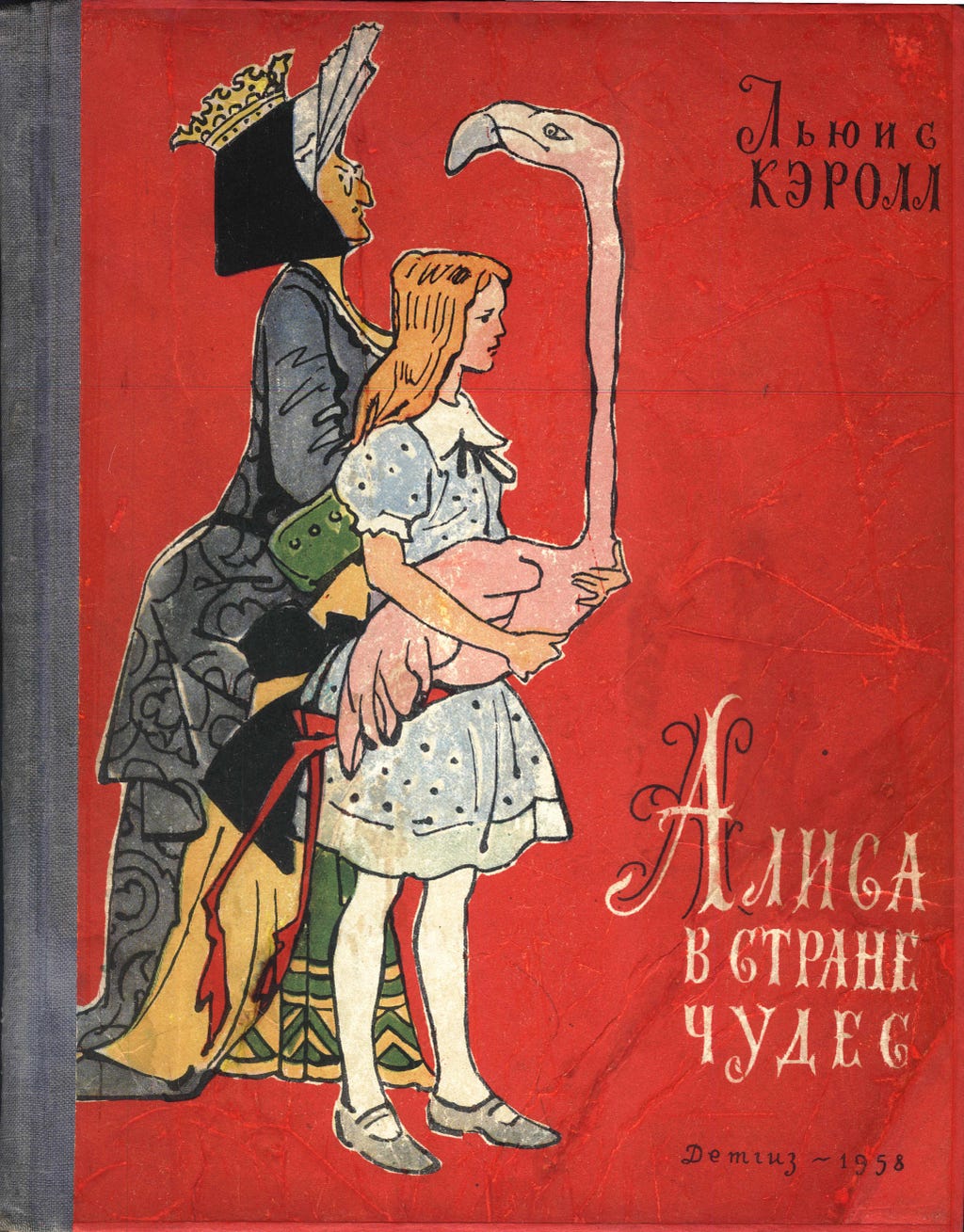
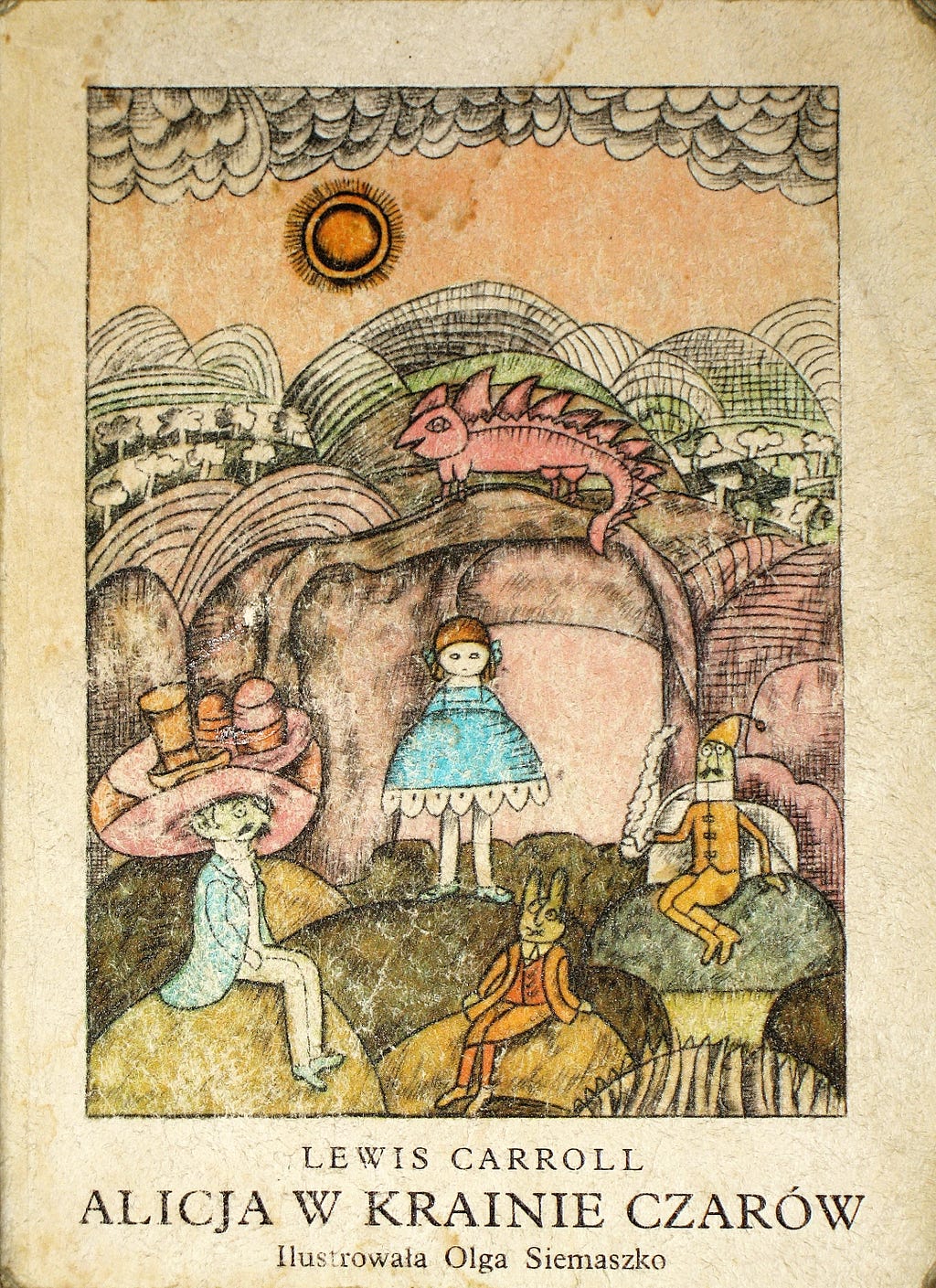
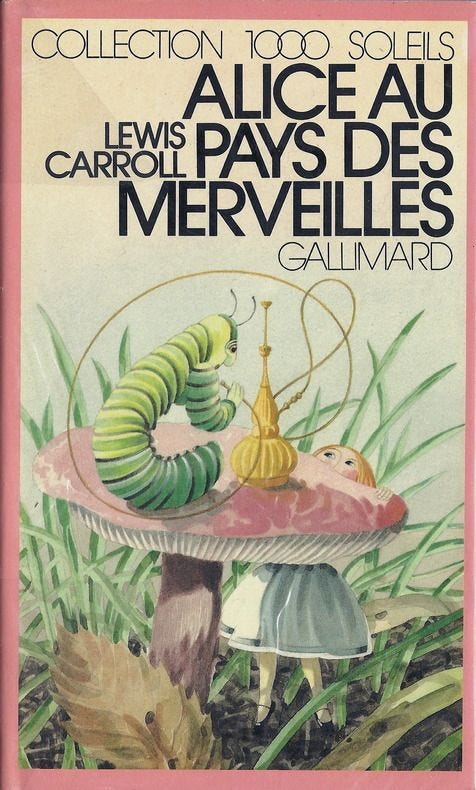
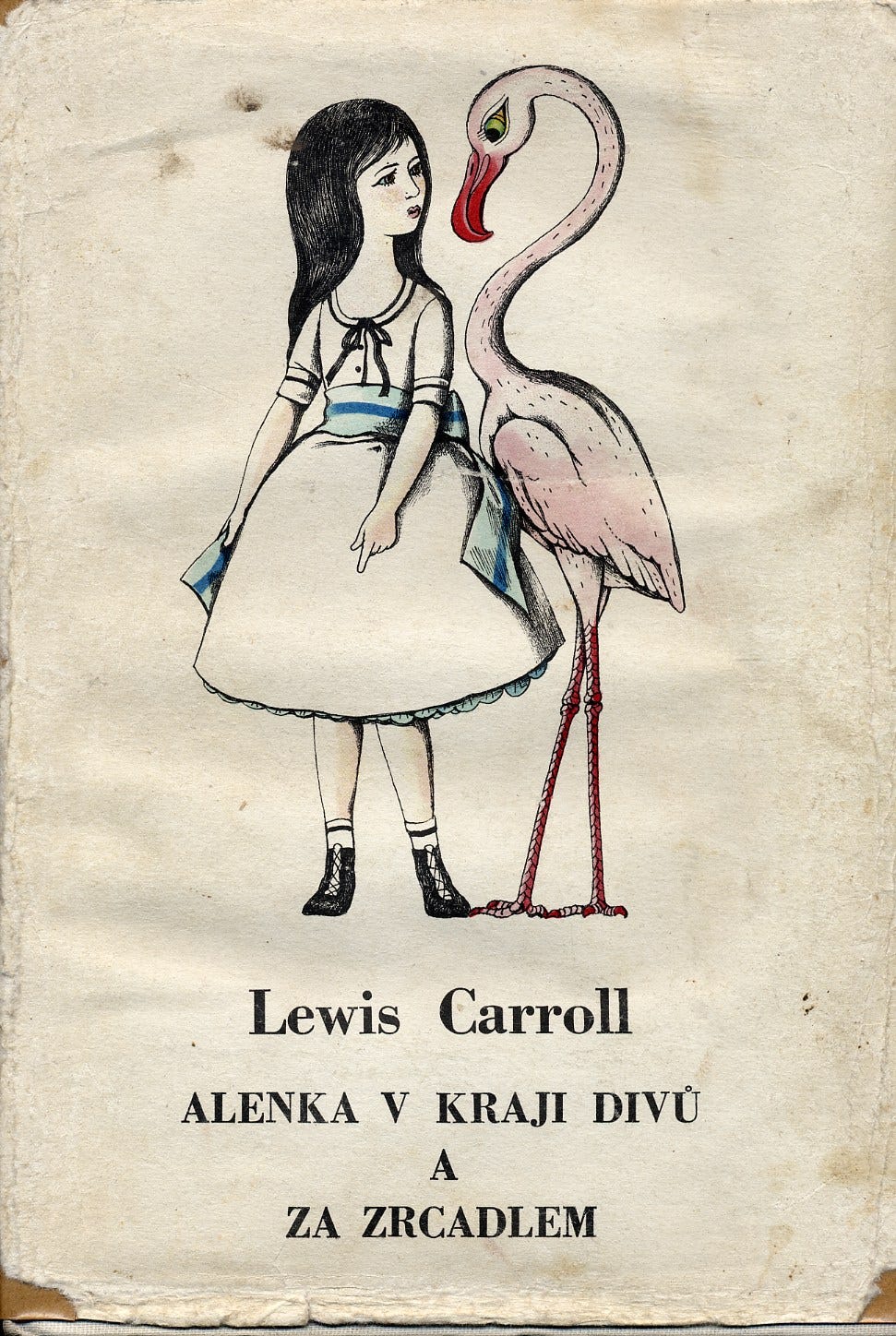
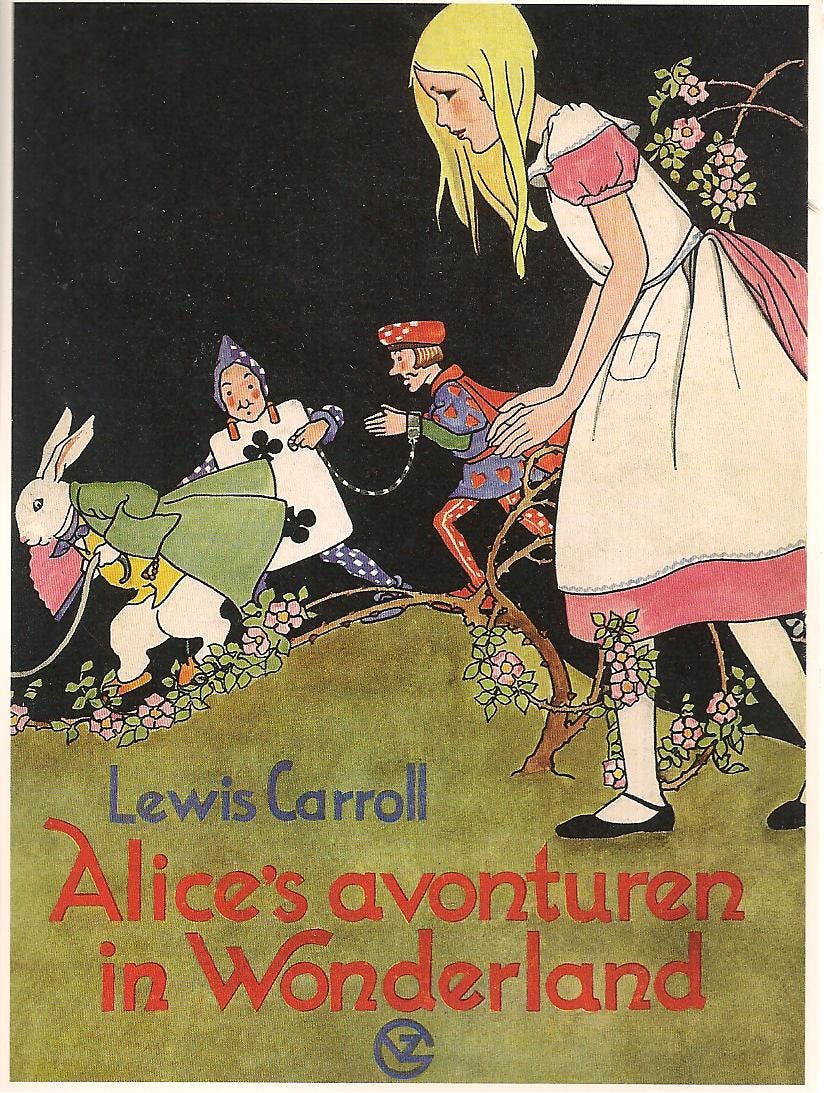
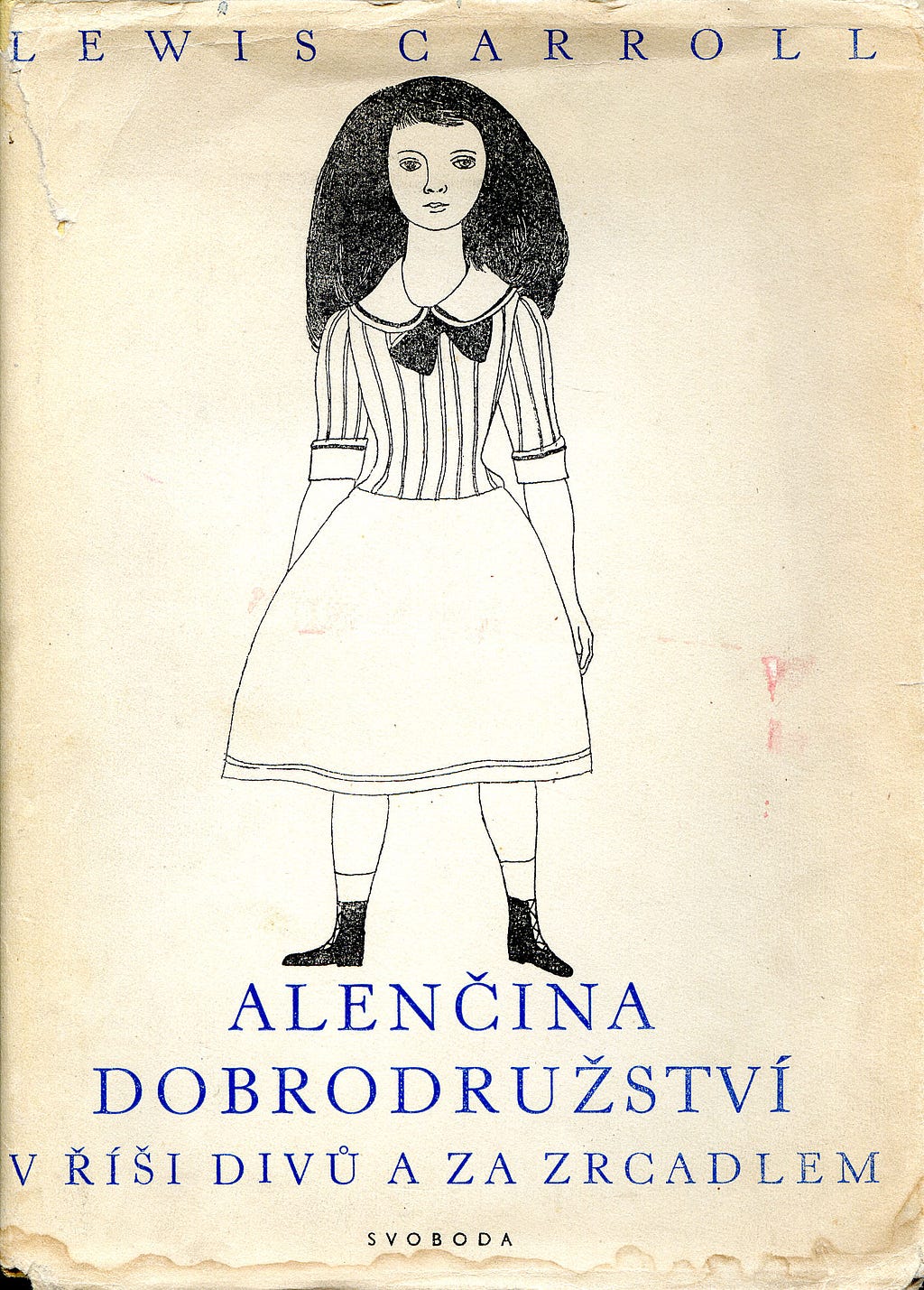
Cover Gallery — Alice Around the World:

Russian edition, 1958 (left), Polish edition (center), French edition, 1980 (right)
Czech edition, 1961 (left), Dutch edition, 1979 (center), Czech edition, 1949 (right)

So it was to my great shock and comfort when I read that book to find that Alice chooses the White Rabbit, the deviation. She has no noble quest to fulfill, seeks neither tender reunion nor exemplary friendship, and finds nothing to praise in the idea of societal order (especially as presented by the monarchy of the King and Queen of Hearts). In a world that seems topsy-turvy, she swiftly adapts. Otherwise, she relinquishes control: as she says to the Dormouse, she can’t stop herself from growing up.

By contrast there was nothing altogether wrong with my Soviet cartoons, only that they came too late, trying to prepare me for a world which no longer existed. Hand-drawn and stylistically lovely they told of an anachronistically slow-paced and easily digestible life, a life that didn’t particularly resemble mine––and perhaps not anyone’s. As I eventually grew older and came to the decisions that would determine my path through — such as where and what to study, who to befriend and who to become — Alice was the perfect companion, making no promises about the effects of any of life’s potions.

Cover of 1995 edition, trans. Mirra Ginsburg

Years after Alice in Wonderland I came to fall in love with Mikhail Bulgakov’s The Master and Margarita, a surreal Moscow tale about censorship, self-sacrificial love, and diabolical parties in the urban underbelly, which had been banned by the Soviet authorities during the author’s lifetime. Bulgakov’s novel caused me to think about nonsense not just as an absence of sense, but as a call for sense and order’s abnegation — a call only allowed under systems that make room for nonsense and uncertainty in the upbringing of its citizens. The Soviet system was very particular in the role it assigned to art, to both define and enforce social functioning. It was an irony that in the case of the cartoons the message reached its intended audience too late, arriving only after the onset of capitalism, to indoctrinate impressionable young minds with outdated, ill-fitting ideas. Thankfully for me, Alice came to the rescue––and just in time––offering an assurance that nothing in the world makes sense, so long as you let it.

Queering Gender, Queering Genre

I think I’m a woman, because I know I’m not a man.

I also think I’m an essayist because I know I’m not a poet (or a short story writer).

Whenever I submit my writing, I say I’m submitting weird essay/poem things and that feels most authentic. My pieces are probably closest to lyric essays, or prose poems, and have been published as either. Sometimes I submit a piece as an essay and it is called a poem upon publication. Sometimes, the opposite occurs. I never care, because I don’t understand labels when it comes to literature.

When binary is the norm, when she/her means woman, when line breaks mean poem, I am who I am perceived to be more often than I am who I am — especially when I have no idea who I am, and don’t completely care about it.

This is not the first time I’ve felt like two hypocrites live in my body.

Gender is a complex and nuanced thing and there is no way to make a sweeping statement about what it means to everyone. Some say it doesn’t exist. Some say it is a means to control. Some say it is empowerment. Some say it is everything. For me, it is not everything, not just because I’m cis (well, I guess?) and have cis privilege and am ignoring the role gender perception plays in society. I’d be ridiculous to act as if gender doesn’t matter in the world. But it doesn’t matter in my small, small world, in my body, in my head, not mine, not to me.

I feel the same way about genre. To some people, genre is everything. They are a poet in a big way, or a novelist. I write novels and poems and essays and, to me, they are all the same and different at the same time. I am into contradictions because I am one. I guess that being mixed but called Black made me ready for such an existence. This is not the first time I’ve felt like two hypocrites live in my body.

In Excluded: Making Feminist and Queer Movements More Inclusive, Julia Serano complicates long held understandings of gender. Defining gender as “an amalgamation of bodies, identities, and behaviors, some of which develop organically and others which are shaped by language and culture,” Serano greatly disagrees with binaristic and even much of third-wave feminism’s gender isn’t real and is only oppression understanding of gender and believes it to be an oversimplification. Too, it is extremely dismissive of the experience of trans people who identify as men or women. The idea that gender is only ever oppressive results in a lot of the “but trans women perpetuate stereotypical femininity!” and femmephobia that we see on a regular basis within the feminist community.

The idea that gender is only ever oppressive results in a lot of the “but trans women perpetuate stereotypical femininity!” and femmephobia that we see on a regular basis within the feminist community.

Serano pushes us to accept the messiness of gender instead of trying to cut it down to a single answer, as cutting down to a single answer often means cutting out the most marginalized of people.

What empowers one disempowers another. Both can exist at the same time — no one understanding has to win. Just as I identify as black and mixed, queer and bi, I know I write poems that are essays and essays that are poems. There is, for me, validity to be found in space less easily labeled.

In the introduction of Lori B. Girshick’s Transgender Voices: Beyond Women and Men, Girshick writes, “As for gender-variant people, no conceptual framework fits their experience, and no individual words adequately describe it.” The section goes on to describe Reid, a FtM person seeking to communicate his identity. Reid’s quoted saying, “I now say that, rather than transitioning from female to male, I’ve transitioned female to not-female. English is inadequate to the task!”

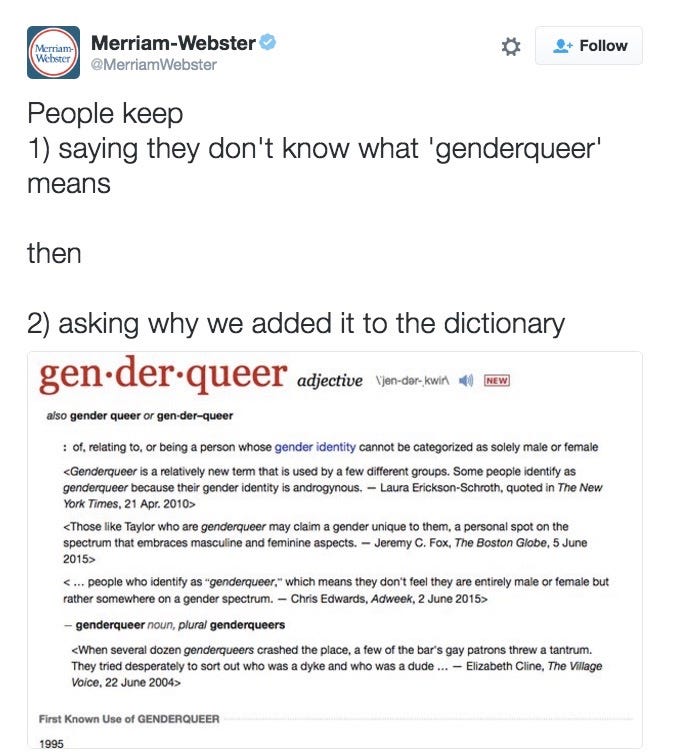
Remember the snark that went down when Merriam-Webster added “genderqueer” to the dictionary?

Words fail, especially when it comes to giving voice to experiences of marginalized people. English was not developed to empower all, and we see, regularly, the backlash against the creation of new words. From bae to pansexual, people pretty much freak out any time a new word is introduced to mainstream vocabulary. Remember the snark that went down when Merriam-Webster added “genderqueer” to the dictionary?

And this snark comes from writers, too, those writers we sometimes loathe and sometimes are, battling for the “right” words not to be taken down by the “made up” words we just aren’t used to, yet. Scoffing each time a new letter is added to LGBT doesn’t make you a true proponent of the English language — it makes you an asshole.

I was in a nonfiction workshop when my professor began mocking me for using too many words. I was writing about what it means to be both queer and mixed, and to constantly feel in-between and invalidated by language and mainstream understanding of identity. My professor was frustrated by my refusal? Inability? to “just say what I mean.” To be simple. Why complicate everything? If the only power I have as a writer is my pen, why muck things up by beating around the bush? I was flustered and unable — literally, as is the workshop model — to explain that I am found solely in the “around the bush area,” not within the bush itself.

I was in a nonfiction workshop when my professor began mocking me for using too many words.

If I say, “I’m a woman,” I feel as inauthentic as I do as I do when I say, “I’m gay.” Not because I’m not either of those, but because it doesn’t mean what other people think I mean. What is writing if not a means of mucking up language and syntax and fusing words to create new sound to better illustrate a lived experience rarely verbalized?

Why are we so afraid to let things be complicated?

I dropped the workshop, and still haven’t written that piece.

In Excluded, Serano defines essentialism as “the belief that all members of a particular group must share some particular characteristic or set of characteristics in order to be considered a legitimate member of that group.” I am interested in the ways that a non-essentialist approach to gender, meaning one that recognizes the space for duplicity of gender, gives room for someone to be both non-binary and a woman. As a gender-questioning woman writer who has tagged much of my work as queer (but meaning only sexuality, not sex or gender) and woman, I see a sort of comfort in this concept. If it is possible to be both non-binary and woman, than a non-binary writer does not need to be kicked out of a community of women writers, or out of spaces for women’s writing. They/we are, simply, both.

Just as I don’t want to identify as non-binary, regardless of the potential room for accuracy, I don’t want to identify as a “writer of neither genres.”

I wonder about this in terms of genre. Just as I don’t want to identify as non-binary, regardless of the potential room for accuracy, I don’t want to identify as a “writer of neither genres.” But how much does want matter when perception is what labels us in the mainstream?

If I am published, will anyone find my work if I don’t label it within a genre? If I am published, will I be known as a lesbian black woman writer? Or a queer person of color? Does it not come down to the most marketable term? Who am I if who I am depends on how many hits my identity would garner online?

In a 2012 Brevity essay, “The Craft of Writing Queer,” Barrie Jean Borich talks about finding space for queerness within the inherent strangeness of creative nonfiction.

What I’ve loved, from the start, about CNF has been the ways this genre is creatively weird, much like myself — both misunderstood and claimed by more than one constituency, attentive to form but difficult to classify, with quirky yet intentionally designed exteriors, slippery rules, a mutating understanding of identity, a commitment to getting past the bullshit and making unexpected connections, and a grounding in an unmasked, yet lyric, voice.

This is the piece that convinced me that maybe, if I hadn’t found my home as a fiction writer, I may do so in the “queer city” of creative nonfiction. It was that, the “unmasked, yet lyric, voice” that I knew I could write. It is a thing that frustrates other writers who tell me my essays are prose poems or that my poems should be essays or that my narrator should have interacted with more men throughout the piece to tamper down the emotions. I am told I cannot do what I do, but I do it. Again, contradictions make up my understanding of what it means to write.

I wonder what it would be like to write within a genre, to read the rule books and to value the canon and to do what I am told, just like I wonder what it would be like to have remained straight, to have dated men and just wondered about women the way I wonder what a line break and an indent and a smudge of erasure would do to my essays. I wonder about the space between rules of writing and rules of sex, and gender. I wonder about my space within that space, and whether I’ll always be okay existing within grey matter. I am not sure.

Imagining a Future without the Sun

Luminous and resonant, like the light that this book embodies so vigilantly, the writing in Solar Maximum moves within and without, through one’s own compromised relationship with all that surrounds us, and inaugurates a new dimension of soul-seeking and being.

I’m reminded of the psychic resonances of Will Alexander’s writing, language that magenetizes, ascends as “transdimensional movement” and neurological transcendence, here in focus, the distance between bodies and the space and light that hold us.

Lee asks, “How does light arrive?”

As the language builds up, we build up a world in particular dialogue with itself. Our own trajectories come into tension with our concept of the real, of how we consciously relate to the world.

At the end of the book, Lee reveals to us:

“This collection represents my efforts to sketch out a speculative poetics — one that explores the various moods of imagined (future) spaces and their implications for human emotional and psychological being. Despite writing ‘towards” these imagined futures, my aim is hardly predictive, but reflective. I hope to invite us to meditate more intelligently upon our present — its circumstances, relations, and structures–and envision whether we desire to continue along our current trajectories.”

Though she uses “intelligently” to describe the mode in which she invites us to meditate, what seems obvious to me is that this is not an intelligence of the mind, but of the heart, a soulful dialogue that humans rarely have with the world. We can only imagine spaces the way they are, they way we see them in our memory, and often overlook how we ourselves reside in those spaces, change those spaces, picture what those spaces might become.

Pierre-Jean Jouve writes that “[p]oetry, especially in its present endeavors, (can) only correspond to attentive thought that is enamored of something unknown, and essentially receptive to becoming.”

The writing in Solar Maximum arrives out of a labored interaction of reading not language, but light, and the world around us, an interaction that acknowledges that memories are motionless, that duration is permeable, and, as Gaston Bachelard writes, “localization in the spaces of our intimacy is more urgent than determination of dates.”

Bachelard also declares, in his seminal book The Poetics of Space, “The poet speaks on the threshold of being.” Lee is this poet.

In the book, Lee writes:

“A feeling is like the natural production of rain, I remind myself. There are causes that result in the downpour, and to trace them is to understand, to take hold of one’s autonomy and ability to decide appropriately one’s reactions. There are cycles and rhythms as well, and often a good night’s rest can dispel the sudden force with which such things appear. I must push through to continue.

This particular feeling is so strictly disembodied that pinpointing its initial causes is hard. A cavalcade of desires — like a bright light behind my eye–threatens to sweep away my sense of stasis. The pull is strong, towards something, but no object sensation in sight. Go, go, go, these feelings say, but not where or towards what. Outside, a dog barks aggressively.”

Indeed, everything is increasingly too much and not enough. Life is a series of breaths: to see a perspective only when the seer and the seen are aligned. How then, are position and perception related? How do the orbit, movement, and alignment of bodies relate to how we see? How do gravitational effects manifest in the spaces between us, create and shrink distance, allow us to see colors, connect bodies and break them? Indeed how does light arrive, yet too, how does language arrive? How is language ultimately given and received?

Ernst Bloch uses the term novum to describe “a moment of newness in lived history that refreshes human collective consciousness, awakening it from the trancelike sense of history as fated and empty, into awareness that it can be changed… the unexpectedly new, which pushes humanity out of its present toward the not yet realized,”… towards a “blankness of horizon of consciousness… formed not by the past but by the future… a not yet conscious ontological pull of the future, of a tidal influence exerted upon by that which lies out of sight below the horizon, an unconscious of what is yet to come.” Istvan Csicsery-Ronay, Jr. expands, “Each instance of the Novum is a hypostatized moment of apocalyptic cognition; and each such moment of cognition is a recognition.”

Lee writes:

“We give into a generous blindness that rises like decanted myrrh, a holy perfume. A childish pleasure emerges from this unlikely abeyance. The ‘sun’ spins indeterminately before our dazzled gaze.”

The eyes spin, in infinitude and reverie. My body teeters with the balance of the earth and the sun sends its light aggressively into my eyes and my skin. The sunlight is bright. I know it is bright because my eyes squint and refuse to stay open, because my skin starts to sear and because the tint on the asphalt is reflective and greenish.

We might construe Solar Maximum as a work of speculative or science fiction. Indeed, it purports to imagine, to write towards imagined futures. And yet the duration of time is not structured, as we know, as a block, the ebb and flow of tides is not purely a linear effect of gravitational pull, and so the compromised body, that of the reader, here and now, becomes reconciled into a variant and simultaneous space. I don’t believe the world will end, a singular moment which we anticipate, rather, the apocalypse becomes a state of waiting, today and yesterday, “the horizon stutters to converge” and the world is ending, time is pulling, the distance manifests in simultaneity and when I read the final words “((when the sun disappears” I know that the sun has already and will never disappear.

Long-Standing Legal Dispute Over Kafka Manuscripts Ends

On Monday, the Israeli Supreme Court ruled against the daughters of Max Brod’s secretary

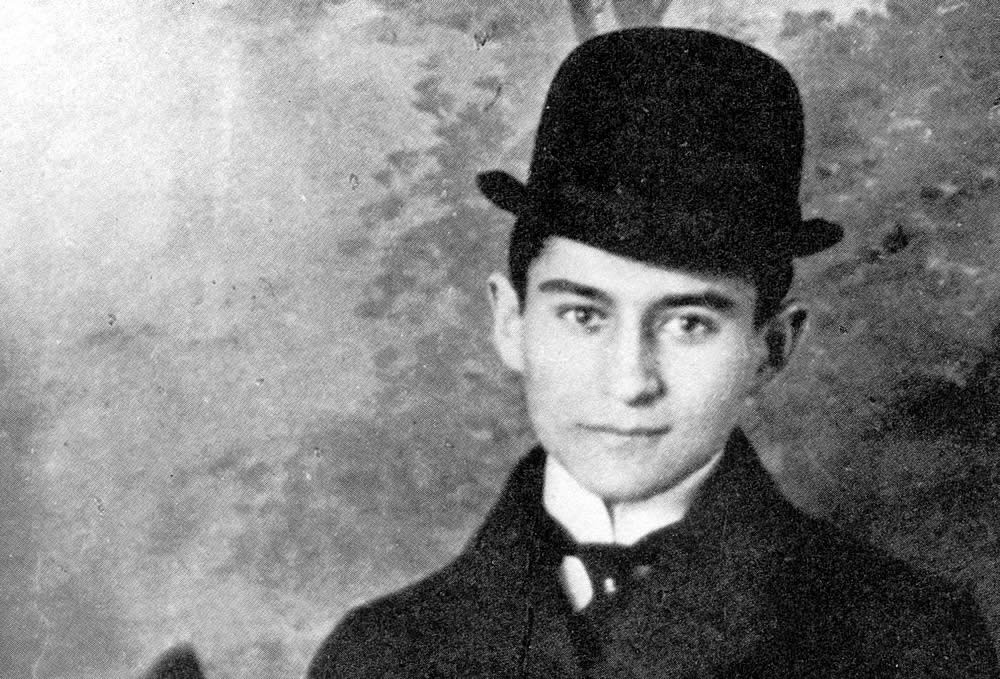
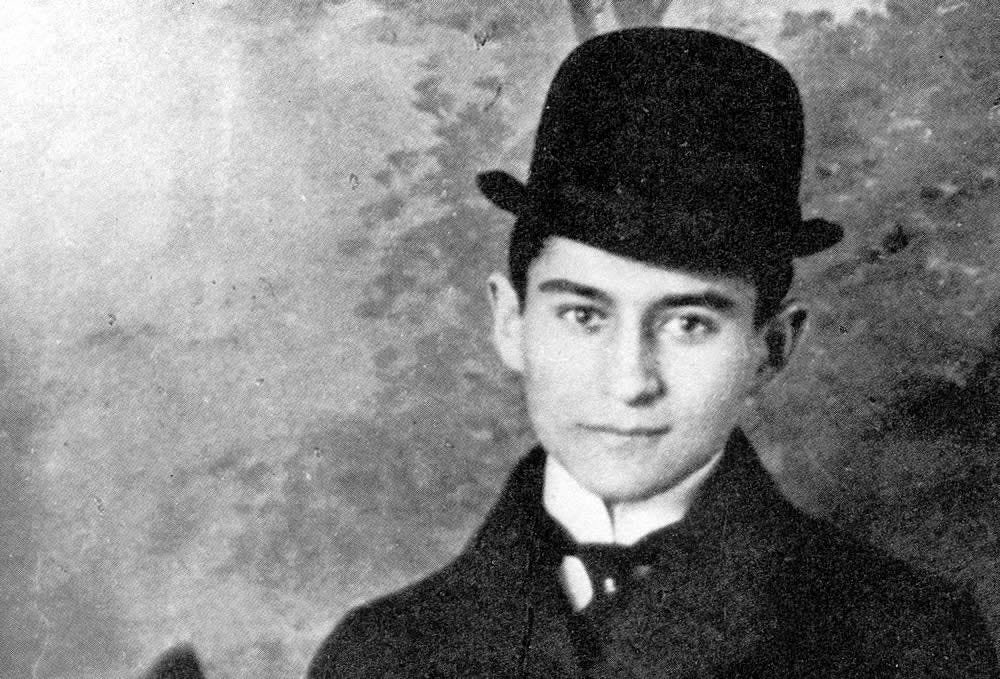
Young Kafka donning a bowler cap

If only Max Brod had burned those manuscripts…

Although, of course, if Brod really had followed through with Kafka’s wish, it would have denied us (and posterity) the opportunity of reading Kafka’s brilliance. Regardless, since Max Brod didn’t burn the estimated, mere 10% left of Kafka’s work that Kafka himself didn’t burn, we not only have his writings, but the subsequent legal battles over their ownership, too. It gets properly Kafka-complicated (Kafkacated?) from here.

According to The Guardian, as of Monday, the Supreme Court of Israel has ruled that a collection of Kafka manuscripts, which Brod had kept to himself, are now the property of the National Library of Israel. Your next question then: how did we get here?

It started with Max Brod fleeing Czechoslovakia in 1939 when the Nazi invasion had just begun. He fled to Palestine (the Jewish State of Israel wasn’t officially established until 1948). He thus kept the papers there with him until his death in 1968. This is when things get a little trickier. Upon his death, he handed over the collection to his secretary Esther Hoffe, whom he apparently instructed to transfer it “to the library of the Hebrew University in Jerusalem or the Tel Aviv municipal library, or (that of) any other public institution in Israel or abroad.” Straightforward enough. The message, essentially, was to make sure Kafka’s writing could reach as many people as possible.

Issues arose, however, when Ms. Hoffe decided that the precious collection of Kafka writings would better serve the world if they were in the sole possession of her two daughters. The State of Israel thought otherwise and followed through in the courts, beginning in 2009 (two years after the death of Ms. Hoffe). These legal battles have been well-documented.

Finally, Israel’s high court has put an end to this charade, ruling in favor of the National Library. These manuscripts, hopefully, can now rest at ease — one could almost hear Kafka’s groanings as the documents were yanked in either direction, embroiled in years-long legal/bureaucratic rigmarole.

It is an ironic turn of fate that the “good guy” in real life for Kafka’s writing — what will help him live on — is a court of law, though perhaps lacking the poetry of a more typical hero: “Max Brod did not want his property to be sold at the best price, but for them to find an appropriate place in a literary and cultural institution.”

Drew Nellins Smith, Hopeless Cynic

Six years ago I answered a Craigslist ad filed in the horribly depressing Writing Gigs section. Someone in Austin, where I lived then, was looking for a “writing accountability partner.” This writer and I traded some emails, in which we agreed to become partners, and in which he stated that the last thing he wanted to do was exchange work, and the second-to-last thing he wanted to do was meet me.

This guy, Drew Smith, which I assumed — and still occasionally suspect — was a fake name, said he was beginning a new project and wanted only someone to whom he could send a daily email reporting his progress.

“Today I wrote for two hours. Drew,” went a standard message.

This continued for some months. He told me nothing about his project and he sent me no pages. But we slowly got to know each other over email. I learned that he’s a hopeless cynic, particularly about literature and, perhaps especially, the literary community, a term he always enclosed in scare quotes. He’d shopped a novel once, and the experience was so absurd and disheartening that he was sure he’d never subject himself to it again.

I liked this guy with the fake name. Even more so after we finally met, many months later, outside of an East Austin bookstore after a reading. He said something to the effect of, “Either everybody here is fake or I am,” then he handed me a pack of Camel Lights empty of cigarettes but containing a baggie of weed. For me to just have.

We began to meet regularly for lunch, during which he, very frenetically, would do about 92 percent of the talking. Eventually he told me about his book, a sort of roman a clef (sorry) about a closeted gay man who watches, and sometimes engages in, loads of anonymous sex with men at a peepshow arcade on the outskirts of an unnamed city that is probably Austin. He said the book began as a collection of impressions, ideas and memories drawn from his own experiences, after which a character and narrative began to take shape.

Two years later, December 2013, I took a draft of Arcade home for Christmas. It was fascinating. And very funny. Sort of shapeless, in an interesting way. And super filthy: There was cum everywhere. It dripped, it oozed, it splattered. I sang Christmas carols with my family but my mind was stuck in the pages of a book that was unlike anything I’d read.

Two years and a half after that, Arcade was released by Unnamed Press.

Drew Smith — turns out that’s his real name, Drew Nellins Smith — and I still talk. Or, he talks, I listen and laugh. He’s still nervous and anxious, fatalistic and self-hating. He considers his book a failure and he thinks his life is without meaning. He’s good people.

David Duhr: It’s been a month since Arcade came out. Will anything ever be the same again?

Drew Nellins Smith: Nothing has changed. It’s all the same. I think I kind of expected something to change, like this line would be crossed in my life, and I’d at least feel different or something. I told everyone I knew that nothing would change, but secretly I hoped it would, and when all my disclaimers that nothing would change were proven correct, I was kind of surprised and disappointed.

DD: Has life improved at all?

DNS: I’d like to be able to say yes. I guess it’s an improvement that I’m not worrying about the book coming out all the time, trying to push it to the finish line like I was doing. And I guess it’s nice that I’ve sort of weathered the interviews and reviews about all the sex in the book. I didn’t really have a plan for dealing with that, so it’s good that it’s all out there now and it all went all right. All my weirdness is out there for public consumption. Maybe that’s kind of freeing.

I don’t know. Basically, I think I’m still in a form of shock or something. A few days after the book came out, I was sitting on my back porch, and I just burst into tears suddenly.

DD: Because of the book, or was it just a standard tear-burst?

DNS: It was definitely related to the book. I don’t usually burst into tears. You know what a long time coming this has been for me. All the years I spent writing to no one, working on things that didn’t come to fruition or that were published and then disappeared in the flow of everyone’s newsfeed five minutes later. I had a novel that was agented years ago that ended up not selling. It’s just such a long process, and I worked so hard on Arcade.

For the past several months, I’ve been expecting it all to fall apart at every turn. I mean, I really didn’t believe that Arcade existed as a book until I walked into the bookstore for my first reading and saw it. I hadn’t seen a finished version before then. Maybe the tear burst was because I was relieved. It’s the only time I’ve really been emotional about the book, unless you count stress as an emotion.

DD: As you went through the publication process, you wondered if there was any point to it. What do you think now?

DNS: I don’t think there’s really any point to anything at all, probably. Unless you’re actively working to ease other peoples’ suffering or something. I mean, you know me, so you know I think this way, that everything is basically meaningless, or some kind of cosmic test that I’m failing.

My best hope for Arcade is that someone will read it and relate to it and connect with it, and feel less alone somehow. That’s a good feeling to have when you’re reading a book. So I can see a possible point for other people. I’m not really sure what the point was for me yet, except just to get it out.

When I’m walking my dog, I always try to move the snails from the sidewalk into the grass so they don’t get stuck and sort of boil there in place. Publishing a novel feels kind of like that. I mean, if everything is a pointless waste of time, at least it’s a better way to waste it.

When I’m walking my dog, I always try to move the snails from the sidewalk into the grass so they don’t get stuck and sort of boil there in place. Publishing a novel feels kind of like that.

DD: A couple of weeks ago you said Arcade was already flatlining. But some books, especially with indie presses, can take months to sort of catch on and find a wider readership. Why not yours?

DNS: It always makes me laugh, because I think of you as such a cynic, but then you really turn on this Pollyanna routine where Arcade is concerned. It’s true that it can take books months to catch on, but the truer truth is that most books never do catch on, and they just get washed away in the flood of new material that comes out every day. Which you know as well as I do.

Obviously, I hope that despite the staggering odds, the book will catch on somehow and gain a little traction in the culture. I really like Arcade. If someone else had written it and I picked it up, I would still like it. Which is pretty nice, and it’s not a feeling I’ve had often about things I’ve written. I hope I can hold on to that.

DD: You’re hanging tough at 6,500 on Amazon. That’s like 3,000 spots better than when we talked last.

DNS: (Laughs) You’re mistaken. It’s 62,000.

DD: Oh. Oops. I was looking at the wrong thing.

DNS: Yeah. At this point I’d love for it to be at 6,500 overall.

DD: Well, OK. Maybe let’s talk about the book itself. It seems like readers and reviewers assume it’s only lightly fictionalized, if at all. So, why is that happening?

DNS: Right, you and I laughed about that one piece that said something like, “Smith claims it’s only partially based on his life — after all, his mother might read it.” It’s like, “Obviously, Mr. Smith is a complete liar hiding his repugnant past.” The strange part is that I’m willing to own up to so much of it. The worst of it, even. I wonder why that’s not enough.

DD: It bothers you?

DNS: I don’t know. Maybe. I guess if it bothers me at all it’s mostly just because the assumption is factually incorrect. A friend from work mentioned one part that takes place at the motel where the narrator works, which is based on the motel where I actually do work. He said it struck him as something that really happened, and he assumed it did. But nothing like that has ever happened to me in my life. I drew a lot from my life in such a haphazard way, but far less than people seem to assume. But protesting at all is protesting too much, apparently.

The other day my uncle was asking me about the book, and when I said that it should not be read as a memoir, he said, “I’m not buying that.” What am I supposed to say in the face of that?

DD: You told your mom not to read it, right? That’s because you don’t want her to, or you think she’ll hate it or be horrified?

DNS: Yeah, I asked her not to read it. For all those reasons. I don’t think she would like it no matter who wrote it, and I think it would upset her, particularly given this dimension of half-truth we’re talking about, the way so many details from my real life are mixed in. No mother wants to envision that much of her kid’s sex life. That said, I think many people who aren’t my mother would be horrified by the book as well.

DD: I’m not your mother and I was horrified.

DNS: Exactly! Now we’re getting to the truth.

Were you really horrified though? I can never tell when people joke about it.

DD: I wasn’t, but I’m not a small-town Texan. Maybe you can touch on that for a minute, if it’s not too terrible? What kind of place you were brought up in, how that contributed to this book.

DNS: It’s about 7,500 or 8,000 people. A very conservative place. There isn’t a lot happening there culturally. Sometimes I could find good movies at the movie rental place, but that was about it.

I think growing up there made me a very self-conscious person, and I’ve had to get over that. When I was a teenage stoner and more of an outsider, it seemed like something the whole community was aware of. It was very easy to stand out as someone operating outside of the mainstream. I felt different from everyone around me. But I also felt a certain level of confidence because most people thought I was funny. I had that, at least.

A girl I went to school with came out as a lesbian at one point soon after we graduated, and every time I went home for the next few years, I’d run into old classmates and it would always be the first thing they’d tell me. “Did you hear that so-and-so came out? She’s a lesbian!” It was very big news in my town. I still think about that all the time.

DD: So was your own coming out big news there? Or does the town not know, or care? If they’re following your career or whatever, they know now.

DNS: I don’t know if my coming out was big news there, because I’ve never discussed it with anyone there who I’m not related to. I assume some people there know about me, but I’m not in touch with anyone I grew up with, so I don’t know. Hopefully, it’s not such a big deal in society in general now.

DD: Was this stuff any kind of sticking point as you were pursuing publication?

DNS: Maybe a little. Mostly just because I don’t want my parents to have to feel embarrassed or to be put in the position of making excuses for their degenerate son. But I figure I’m an adult, and at some point I have to be allowed to be myself and just create what I want to create.

DD: But now a lot of people ask about what you were trying to do as far as changing the culture and raising awareness of gay rights. And your response is like, “Um, nothing?”

DNS: Yeah, that’s about right. I almost feel guilty about my lack of political motive at this point. I wrote Arcade because I wanted to write about a world and a set of feelings that I wasn’t finding in the books I was reading. It was really fascinating and incredible to me, and I wanted to think more about it and make it part of something bigger.

But writing the novel was far from an act of activism. I’ve never been part of any movement. My aims have always been more literary than political.

DD: What are these literary aims?

DNS: You know, I actually take literature so seriously. It’s meant so much to me in my life. What I really want is to write good books that can have some kind of impact on the people who read them, even if it’s just a spark of recognition and connection. I know my work won’t always be for everyone. David Markson isn’t for everyone. Jane Bowles isn’t for everyone. Knut Hamsun, Julie Hecht, Nicholson Baker, they’re not for everyone. Even James Baldwin, who seems so universally beloved, isn’t for everyone. And these are people whose work is so important to me. What these people do in their writing is meaningful and powerful and diverting and interesting to me. That’s what I tried to do with Arcade, and what I hope to do with whatever I write in the future. I just hope I can find my audience. Or that my audience can find me, whichever way that works.

DD: Are you finding any of that audience with Arcade? Do you hear from random people who say the book connects with them or whatever?

DNS: If it’s finding its audience, it’s pretty small at the moment. I mean, I’ve gotten a couple of random emails from people, like this one guy who said he’s a married straight guy in his 60s. He saw the thing in the L.A. Times, and he bought the book and really enjoyed it. I’ve done that a lot in my life, writing little notes to writers to cheer them on. Most writers don’t get nearly enough of that. It was nice to be on the receiving end of one of them.

DD: Are the reviews as expected? I know you said you wouldn’t read them, and I also know you’re reading them.

DNS: Yeah, I swore from the beginning that I would never read any reviews, then I immediately changed my tune as soon as the first ones came out.

The reaction from reviewers has been different than I expected. I thought people would talk a lot more about the narrator’s life outside of the arcade, the breakup that drove him there and his friendships. I also thought there would be more acknowledgment of the parts of the book centered on his work life. People love to talk about how there are so few books about work. But there’s a lot about work in my book, or a fair amount anyway. Work and class and all sorts of internal struggles that don’t really pertain in any way to having anonymous sexual encounters at an arcade. But reviewers haven’t written about that stuff so much.

Some of the reviewers bemoan a lack of plot in the book, which is interesting, but I can’t say it really bothers me. I’ll be the first to say that Arcade has no three-act structure, no great challenge overcome over the course of rising and falling action. But that’s not how life really is. In real life, change is so incremental and difficult. Whatever you might say about life, I don’t find it to be particularly plotty.

Whatever you might say about life, I don’t find it to be particularly plotty.

DD: How many times have you refreshed your Amazon ranking since we started talking?

DNS: Not even once. Honestly, I only remembered it existed as a possibility when I started wondering if that L.A. Times thing would give the book a boost. I paid attention to it for a few days and then stopped. I think you think I’m more obsessed with it then I am.

DD: I guess let’s wrap this up, since you’re getting crabby. What’s your next project?

DNS: I’m working on two different novel-length projects now. One is inspired by film diaries like The Jaws Log and Bob Balaban’s Close Encounters of the Third Kind Diary. The other is sort of a bootstraps story about attaining success, what that pursuit might look like. And I’m always threatening to go back to that book about Simon and Garfunkel’s 1981 Concert in Central Park, which you know I spent years researching and interviewing for.

DD: Any parting words of wisdom?

DNS: Be hyper-vigilant about typos. There’s a typo on the first page of my novel. The first page! Isn’t that unbelievably awful? And it was all my fault, because I kept changing little things until the last possible moment because I wanted it to be perfect.

DD: Have you enjoyed this process, or have you just been a throbbing ball of anxiety for weeks or months?

DNS: I was anxious in the weeks building up to Arcade’s release, but since then I think I’ve sunk into a mild melancholy, with little dopamine spikes when someone writes or says something nice about the book. The night of my reading here in Austin was pretty glorious. I guess that was the high point. I keep fantasizing that I’ll die in a dramatic car crash and that sales will skyrocket. That would be pretty great.

Split by Jennifer Haigh

It’s the last Tuesday of the month, and I’m driving to suburban Connecticut, a hundred miles each way, to take Ben Franklin to the doctor. There’s a backup at the tollbooth, a long line of mostly elderly drivers counting out coins. The E-Z Pass lane is clear, but that’s no help: before leaving Boston, I pried the transponder from the windshield. I never look at our monthly statement, but my husband might.

A healthy marriage can absorb the occasional deception. The problem lies in defining occasional. How much dishonesty is too much? I’ve given this question some thought, having left one husband in the ditch. That husband was Ben. Our brief, young marriage ended with a crash, so long ago that no one in my current life remembers it. The postmortem is best left to the professionals, the insurance-company wizards who measure skid marks and bent guardrails — coincidentally, the profession of my current husband, Kevin Gwynne.

There’s something about crossing state lines that makes it hard to be casual. You can’t pretend you were in the neighborhood and stopped by on a whim. Except for Ben’s appointments I can imagine no reason to visit this so-called town of strip malls and big box stores and neat subdivisions with easy access to the Interstate. A billboard near the exit advertises luxury “townhomes,” a word that looks misspelled, a word nobody actually says: If you lived here, you’d be home now.

Ben lives in an apartment complex just off the highway. He’s waiting at the front door under a blue awning, lighting one cigarette with another, wearing faded jeans and a scarred leather jacket and looking better, more like himself. Last month he was nearly unrecognizable: wispy hair grown nearly to his shoulders, a bushy beard more gray than brown, and a baggy trench coat to hide khakis that wouldn’t button, the new meds having packed on thirty pounds. The doctor took one look at him and wrote a script for Serovive, an antidepressant with a stimulant effect. More pills.

He tosses away his cigarette and gets into the car without speaking. Poverty of speech, the doctors call it. It simply doesn’t occur to him to say hello.

“You look great,” I tell him, lowering the window. Already the car reeks of cigarettes, a smell that follows Ben wherever he goes.

He says, “I lost sixteen pounds.”

“In a month?”

He’s a small man, an inch taller than I am. I can remember being delighted by this. When we first met — in college, a lifetime ago — he seemed made for me, a bespoke lover. In the beginning, and for some time after, we saw perfectly eye to eye.

“Seriously, Ben. Is that healthy?”

Such questions have not, historically, interested him. Shortly after we met, I started smoking in self-defense, the only way I or anybody could stand to be around him. At the time it seemed a reasonable solution. That’s how young we were.

The clinic is two towns over, miles from a bus stop. For Ben, who no longer drives, it might as well be India. How he manages here without a car is something of a mystery. He does his shopping at a CVS drugstore on a busy commercial strip that’s technically within walking distance, though the route, through heavy traffic and retail sprawl, is neither pleasant nor safe. I imagine him shambling along the Berlin Turnpike in his flapping trench coat, head down, attracting curious glances; in the suburbs a man on foot is by definition irregular, possibly dangerous and likely doomed. At CVS he fills prescriptions and buys groceries (canned soup, soda, bags of salty snacks). No fresh produce, obviously, but plenty of people eat this way and manage to stay alive.

Because we are parents after all, despite the outlandish circumstances, he asks, “How’s the kid?”

“About the same.” Twenty now, Gianni spends most of the day sleeping or playing video games in his childhood room, an arrangement that doesn’t thrill me and pleases his stepfather even less. College is a subject we no longer discuss. Gianni lasted two semesters, until a campus cop found him asleep in his parked car in the lot behind the cafeteria — the engine still running, a half-smoked joint in the ashtray. In these ways and others, he is very like his father.

Satisfied with my non-answer, Ben stares silently out the window.

He was my starter husband. I read this phrase once in a magazine and was struck both by its aptness and its breezy insouciance. But starter marriage doesn’t convey what we once meant to each other, the sweetness of our first home, the airless misery it came to contain, the ruthlessness required to dismantle it, the grievous wounds inflicted all around. We were married for two years — longer if you count the divorce, which took forever, the unsigned papers gathering dust atop Ben’s refrigerator. Spitefulness, I thought at the time. Later I understood that his motives were not so easily reduced.

That we married in the first place was my fault entirely. We did it to please my parents, who were crushed to learn that Ben and I were living in sin. They’d been saved some years before, baptized into the Church of the Nazarene, and had become the sort of people who bow their heads to say grace in restaurants. I didn’t share their faith, but I loved their goodness and found it unbearable to cause them anguish of any kind. And getting married was easy; on a Tuesday morning it took ten minutes. Ben made a pen-and-ink drawing of us on the courthouse steps, a bride and groom in traditional wedding clothes, though we’d married in bluejeans. I mailed the drawing to my parents in Indiana with a photocopy of our marriage certificate.

We were living, then, in Tampa, for no reason except that Ben’s grandfather had retired and died there, leaving a small house on the edge of Ybor City, the old Cuban section of town. In a few years the abandoned cigar factories would be converted to loft apartments, the median strip on Seventh Avenue planted with palm trees; but at the time Ybor was still rough. We lived rent-free, Ben having convinced his dad that we were doing the family a favor, that any unoccupied structure in that neighborhood would inevitably be destroyed by crackheads. In the early nineties, this was possibly true.

We lived on an unlit side street of low bungalows with dirt yards and sinking porches, a look of Southern poverty, curtains drawn in daytime to keep out the sun. The corner bodega cashed checks and sold lottery tickets, quarts of malt liquor and a few overpriced groceries. Loose cigarettes, I remember, cost a quarter apiece. The building was cinder block, painted swimming-pool blue. Late in the afternoon, a raucous crowd drank in its shadow. The parking lot was outfitted with old furniture — lawn chairs, a sagging plaid sofa. Across the street was a City garage where trucks idled at all hours and a vacant lot overgrown with weeds.

Just out of college, clueless, rudderless. We applied for jobs we’d never get. I worked on a novel I wouldn’t finish, and waited tables at a seafood joint called the Big Torch Grill. Ben had been a poor student, part dyslexia, part laziness, so he decided to become an artist. He converted the garage into a studio where he painted, not too successfully, with watercolors. He slept late and spent afternoons at a card table surrounded by mugs: one filled with water for painting, the others with coffee, beer and cigarette butts.

Florida summer, endless months of indolence. We lived in a shack and didn’t care; we were absorbed in the daily miracle of each other’s company, the still-thrilling proximity of the other body, the pleasures of playing house. We painted the walls crazy colors: mango, kiwi, grapefruit pink. Ben’s grandfather had built the place himself, inexpertly, with scrap materials from the salvage yard. The floors slanted, the closet doors wouldn’t close. There wasn’t a single right angle in the place. The windowpanes were wavy crown glass; in the bright Florida sunshine they seemed to be undulating. Ben explained that the molecules were unstable and the glass was actually moving, too slowly for the human eye to process. I still have no idea if this is true.

Some nights he worked at a silk-screening shop, on the barter system: T-shirt Tom — I never knew his last name — paid in weed. Since marijuana was a currency not recognized by our creditors, my tips from the Big Torch bought our groceries and paid our bills. When we ran short, as inevitably happened, Ben called Connecticut. That was how he phrased it, Time to call Connecticut, as though the governor himself were waiting by the phone. The only child of prosperous parents, Ben prepared for these calls like an attorney about to address the Supreme Court. He presented first to his father, who owned a construction company in Hartford. (I need a narrative, Ben explained. Angelo is a businessman.) If the request was deemed worthy, Ben was then transferred to his mother, who functioned like the bursar’s office at a large university, pushing payments through an arcane system no one else understood.

These transactions made me uncomfortable, but to Ben they were normal. His relatives lent and borrowed. Angelo and Marie, raised working class, were frank about money; their materialism was unconscious and unashamed. A neighbor who was a famous tightwad, another who overspent; the terrible tax burden of living in Connecticut, the purchase price of a cousin’s house or car: this was dinner table conversation. Their candor seemed healthy. I was twenty-three, just beginning to understand the ways in which my own family was strange. My parents tithed to the Nazarenes but never spoke of it. To them, caring about money led to greed and venality. Discussing it was as unthinkable as talking about sex.

Those years in Tampa — there were three — occupy a disproportionate place in my memory. Barely employed, Ben and I did so little that a week seemed endless, the empty days infinitely capacious, an unending loop of telescoping time. The weather never changed, the months ran together. It was all the same long, hot day. Ben talked, and he may not have been joking, about baking cookies on our tin roof. We could sell them to the lunch crowd, the road crews who bought Cuban sandwiches at the bodega, a daily parade of sunburned men in fluorescent orange vests.

He was full of ideas of then — wacky business capers, we called them. A graphic design firm, a tiki bar, his own T-shirt shop. He dug a barbecue pit in the back yard and practiced making sandwiches, an experiment that ended when Angelo refused to buy him a food truck. We smoked his paycheck together until I lost my taste for it. I was beginning to feel I’d missed an exit, that I was barreling down a highway that led no place I wanted to go.

One night I came home from the Big Torch to find Ben crouched beneath the bedroom window, peering through the curtains at a car parked on the street — a Chevy Caprice Classic, a detail he found significant. Federal agencies were contractually bound to buy American, he explained in a tone that suggested everyone knew this. He’d been watching it all day.

This happened our final year in Tampa, in spring or summer or possibly autumn. Who knows; it was hot.

We painted the walls whenever we felt like it. Our bedroom ceiling was cobalt blue. Because accuracy mattered, Ben consulted his old astronomy textbook to plot out the constellations. He painted them a deep forest green, invisible in most light.

He smoked for comfort, for entertainment. He smoked to relieve stress, the blowback from his parents: Angelo and Marie, having contributed substantially to our upkeep, were like angry investors demanding a say in how the company was run. Once a week, Ben got a stern letter from his father. His mother phoned Monday nights at ten o’clock, when the rates went down, to grill him about his goals and prospects. If he were a different sort of person, he might have accepted this haranguing as the cost of doing business, a service fee imposed by the Bank of Angelo. But more than anything in life, Ben hated being told what to do.

On the phone with Marie he sometimes lost his temper. It was shocking, I remember, to hear him shout. When we disagreed, which was rare, Ben never raised his voice. He enjoyed debate, as long as it wasn’t personal, and was formidable in an argument, the one sport he still practiced. Calm and logical, tenacious, stubborn. He listened all day to news radio and was fearsomely well-informed.

Other things. He’d been an All-College athlete, recently enough that he still had a swimmer’s body; his vices — the nightly sixer, the packs of Camels — hadn’t caught up with him yet. Fridays he came home from the T-shirt shop with a bag of weed, which he rationed judiciously to last the week. Ben believed in ritual; he had a great sense of occasion. There were ordinary pleasures to be celebrated (Sunday mornings, when I read the newspaper to him), and ordeals that required moral fortification (his mother’s phone calls).

There were August afternoons waiting for the rain.

This is my most vivid memory of Tampa: sitting with Ben on our screened porch, waiting. The wind came first, hot and sudden. I can still remember the sensation, like being inside a convection oven that smelled faintly of diesel, the City trucks idling. The first raindrop on the tin roof was loud as gunshot.

We sat on the porch and listened to the rain to the rain.

There’s a new receptionist at the clinic. She studies Ben without recognition until I give his last name, which also happens to be mine. I didn’t change it when we divorced; my maiden name — like the phrase maiden name — already seemed a relic from another century, as indeed it now is. Later, when I remarried, I declined to take Kevin’s name, no longer reckless enough to declare myself a whole new person simply because I’d fallen in love. This bothered him at first. It may bother him still. We’ve been married long enough that there are conversations we’ve stopped having.

I flip through a magazine while Ben sees the doctor. Like everything in the suburbs, the waiting room seems larger than necessary. I’ve witnessed outbursts in this room, a five-year-old child who wouldn’t stop shrieking, a man with Tourette’s who shouted obscenities every sixty seconds. Motherfucking cunt! Motherfucking cunt! Today’s group is quiet, a handful of strangers sitting at discreet intervals. The wide-screen television is tuned to a soap opera, its volume muted. My phone, set to vibrate, causes a tremor in my coat pocket, a queasiness in the vicinity of my spleen. I step out into the hallway to answer.

“Dana, where are you?” Highway noise in the background: Kevin is calling from a crash site. “I tried the house, but you didn’t pick up.”

“I had some errands.”

“Did he make it to the RMV?”

As in all our conversations, he refers to Gianni. Today, the last of the month, his car registration will expire. I’ve been nagging him about it for weeks. It would have been easier to renew it myself, but Kevin won’t hear of it. We bought him the car, for Christ’s sake. This is the least he can do.

“The wait time is forty minutes. I checked online,” says Kevin. “If he leaves now, he can still make it. If he can drag his ass out of bed.”

“I’ll call him right now.”

“Love you,” says Kevin.

“I love you too.”

I hang up and dial Gianni’s cell phone.

“What?” Gianni is groggy, predictably surly. He detests wakeup calls and makes his displeasure known — so obnoxiously, on a few occasions, that Kevin now refuses to phone him before sundown. “You couldn’t just knock?”

His voice sounds distinctly horizontal. If I hadn’t called he’d have slept through his shift, which is how he got fired from Subway.

“I’m not home. Please tell me you’re awake.” Is he stoned? I can’t tell. I haven’t smoked pot in twenty years, not since I was married to Ben.

“Jesus, Mom. It’s only one o’clock. I have oceans of time.” His outrage is palpable. His shift at AutoZone starts at three.

“Not if you want to go to the RMV.”

“Nobody wants go to the RMV. Can’t Kevin do it?”

“It’s your car. And anyway, Kevin’s working.”

“So am I,” says Gianni.

“Right now you’re lying in bed.”

There is a silence.

“If you leave now, you can still make it,” I tell him, but he’s already hung up the phone.

Back in the waiting room, someone has changed the channel to a golf match. An elderly couple is watching, a big pink-faced man with a watermelon belly and his tiny birdlike wife. Kevin has a name for this kind of couple, reverse Sprats. He and I are such a couple. His bigness comforts me, one of many ways he is nothing like Ben.

It isn’t easy being a stepfather, but Kevin does his best. When we first married, he wanted to adopt Gianni, an odd and difficult boy who was about to become an odder and more difficult teenager. Ben was the obstacle, the parental rights I couldn’t ask him to surrender. Ben who’d already lost so much.

He hasn’t seen our son in six years. Before that, Marie and I tried. Once or twice a year — Father’s Day, Ben’s birthday — we put them in the same room and hoped for a miracle that never came. I can barely remember them speaking. Mainly they watched television. At fourteen Gianni informed me that there would be no more visits. Jesus Christ, he barely knows I’m there. What’s the fucking point?

The Sprats sit shoulder to shoulder, staring at the television. Which one is the caretaker, and which is the patient, is impossible to say.

A nurse approaches me. “Mrs. Franklin? We’ve been looking for you. The doctor would like to speak with you.”

Franklin. It was Ben’s father who anglicized it — Angelo the businessman, born Franconi, who gave his son this comically American name.

She leads me into an exam room where an Asian woman, younger than I am, sits at a computer. Her hand is small and startlingly cold. “Mrs. Franklin, I wanted to touch base with you about Ben’s new drug regimen. How’s it going?”

The question is unnerving: she’s asking me?

“Well, he’s lost some weight, so that’s good. Otherwise he seems about the same.”

“The weight loss is encouraging. I’ll keep him on the Serovive for now.” She squints at her screen, mouses and clicks. “It’s the Risperidone I’m concerned about. Ben’s been at this dosage for a year. Have you noticed any unusual facial movements — grimacing, lip smacking, excessive blinking?”

I know what she’s getting at: Tardive dyskinesia, the weird facial tics that come with long-term use of anti-psychotics. It’s somewhere on the list of things I avoid thinking about.

From down the hallway comes an electronic beeping, faint and regular.

“I’m not sure. Blinking, maybe. I don’t seem him that often. We’re divorced.”

“He lives alone?”

“For the past couple years. Since his parents died.” Angelo went first, keeled over from a heart attack in the breakfast nook while doing the Jumble and watching Judge Judy. A month later, Marie passed peacefully in her sleep; the house was sold and Ben moved or was moved into the apartment complex near the highway.

“That’s not ideal.” She has a flair for pointing out the obvious. “Is there someone else who sees him on a daily basis? Another family member?”

“Right now I’m all he’s got.” The beeping in the hallway is getting louder. “Can’t you, I don’t know, adjust his dosage?”

“It’s not that simple. At this level the Risperidone is controlling Ben’s positive symptoms. He’s one of the lucky ones,” she says without irony.

“But it’s temporary, right? The facial tic. If you take him off the Risperidone, it goes away?”

“Sometimes.” She gets to her feet. “I asked one of my colleagues to do an AIMS exam. Abnormal Involuntary Movement Scale. He’s with Ben right now. It shouldn’t take long.”

In reconstructing an accident, the driver’s testimony is often useless. Adrenalin dilates the senses. Sounds are deafening, odors overwhelming: tires squealing, windshield shattering, the petroleum reek of burning plastic. Time slows to crawl, then races forward. A skid lasts a split second or possibly an hour. The driver is unlikely to know.

In that last hot summer Ben was himself, only more so. He spent all night in his studio and came to bed at dawn. He had a new project he wasn’t ready to talk about, something really big.

Without knowing anything about it, I loathed this project. I hated it like a romantic rival — a reaction that says everything about my young self. I’d given up on my novel and was now just a waitress, exhausted and hopeless and sick of being poor. Some nights after work, my coworkers at the Big Torch shot pool at a bar down the block. I wanted to join them, but bars cost money and my coworkers were assholes, according to Ben, who had no need for other people and, it seemed, decreasing need for me. More and more, he wanted my presence rather than my company. He couldn’t work unless I was in the house.

Getting pregnant was an accident, something I didn’t want yet allowed to happen. My reason, if I had one, is a secret I’ve kept successfully from myself. My cycles were irregular, and I believed, vaguely, that this offered me some protection. Ben and I took precautions most of the time, which is slightly better than taking none at all. I didn’t notice when I was late, because I was always late. No morning sickness, no nothing. By the time I took the test I was three months along.

The reason may be as simple as boredom, an urge to make something happen in my life.

Ben’s reaction to the pregnancy confounded me. He was neither upset, as I’d feared, nor overjoyed, as I’d hoped. In some way that made no sense, he took it as a sign.

I’ve been wanting to tell you this, and now I can. In a low voice, as though someone might overhear, he explained that he hadn’t been painting. His secret project was a novel. He’d been writing for two months and now, finally, it was finished. He would transcribe it as soon as Angelo bought him a computer. A plan for the future, a way to support our family. I would never have to wait tables again.

For the first time in my pregnancy, I felt a wave of nausea. Ben had written a novel in two months. I’d worked on mine for two years and had nothing to show for it.

That night, while he was at the T-shirt shop, I went into his studio, something I’d agreed never to do. The squalor of the place was shocking. The floor was littered with crushed beer cans, waist-high piles of newspaper and, inexplicably, an open can of latex house paint. In a corner sat a plastic water jug of what might have been urine. The windows were closed, the stifling air sharp with fumes.

Ben’s desk — a sheet of plywood on sawhorses — was piled with paper. I sat in his chair with a pounding heart.

What to say about those pages? Between the handwriting and misspellings it was hard to decipher a single sentence. Many were written as equations. All these years later, there is only one I recall exactly: Dymanisn = Expolding the Dialectic. The paragraphs were interspersed with elaborate graphs illustrating principles I couldn’t discern. Pages and pages filled with Ben’s scratchy handwriting, slanting across the page. He’d never been able to write in a straight line.

Reading left me weak with anger. This was his plan for the future? In his stoned meanderings I saw ego and self-indulgence and smug young-man pretension, a spoiled only child, reminded since birth of his own specialness: of course he could write a novel in two months. He was immune to the anxieties that crippled me, Ben who’d declared himself an artist simply because he felt like one.

A month later I was living in Elkhart, Indiana with my good parents. Stay as long as you need to, they told me, dismayed at my situation but Christian to the bone.

I named the baby for Ben’s grandfather, who’d built our summer shack with his own hands. I thought Ben would like that. I didn’t understand, yet, that the Ben I’d known was gone or going, and he could no longer be pleased.

It wasn’t your fault, Kevin said when I explained why I’d left my marriage. He is a Midwesterner like me, moralistic by nature, and a guilt professional, trained in the business of allocating blame. It’s true that I had good reasons to leave. Ben was selfish and monumentally stubborn, a chronic pot smoker, a lazy slacker. I was thinking about my future, and our child’s. This is the story I told Kevin. The truth is less flattering: I hated Ben’s confidence, his belief in himself.

I wanted to be a writer. Instead I have raised a son, taught school, taught other people to teach school. On Sunday mornings I volunteer at a women’s prison, teaching inmates to read. It’s a good life, a useful life. My marriage is happy. My parents are proud.

Some years ago, after I’d remarried and Kevin’s job had moved us to Boston, my mother forwarded a letter written in green ink, on pages torn out of a spiral notebook. It was perhaps twenty pages long, a rambling meditation on weather and politics and religion and drug policy, signed with a flourish: Benjamin Franklin. Beneath the signature was a postscript: Dana, I am sorry. I have a spilt persolanity. It isn’t my flaut.

Full-blown schizophrenia is preceded, usually, by a prodromal phase. The symptoms — dysphoria, irritability, social withdrawal — appear up to thirty months before diagnosis. Thirty months is two and a half years, the approximate length of our marriage.

It’s hard to know, still, what was a symptom and what was simply Ben.

That night in the garage, I didn’t see illness. I chose not to. If I’d known Ben was schizophrenic, I couldn’t have left him. I wasn’t raised that way. The needs of others: I am the daughter of Nazarenes, and Nazarenes help.

Truth is terrible. The truth is that I’m glad I didn’t know.

The days are getting longer, but not noticeably. When we leave the clinic, the sky is not quite dark. Fog has gathered, moisture on the windshield. Ben gets into the car and finally, because I’m as stubborn as he is, buckles his seat belt. His AIMS exam showed some involuntary muscle activity, slightly more than last year’s; but the difference was statistically insignificant. We’ll keep watching him, the doctor said.

“Where to, Chief?”

Ben doesn’t answer. Sometimes, if he’s feeling well, we stop at the supermarket, to buy fruits and vegetables that will molder in his refrigerator until I throw them in the trash. Last month we went to the mall for a haircut. But today he just wants to go home.

We drive in silence, though dense fog.

“I talked to Gianni.” He asked about you, I want to add. He misses you. Next time I’ll bring him with me. Of course, none of that is true. “He’s working at AutoZone.”

Of the organic brain disorders, schizophrenia is the slipperiest. Its heritability is uncertain. Simply by having one schizophrenic parent, Gianni’s risk jumps to thirteen percent. Our urban zip code doubles that number. Then there’s his spring birthday (another five to eight percent) and his pot-smoking (estimates vary). The effect of maternal stress during fetal development is harder to quantify.

“Good kid,” Ben says.

I have read everything, I have talked to doctors. Forty percent of male schizophrenics develop symptoms by age 19. The rest are diagnosed in their twenties. Gianni stands at the beginning of that decade like a diver bouncing on a high board.

Driving, I disappear into my own thoughts — salmon for dinner, the kale salad Kevin likes. Here’s another truth: I could tell him everything if I wanted to. A part of me prefers to keep lying. To keep Ben, the memory of us, all to myself.

The fog is so dense I nearly miss the exit. Then I spot the billboard: If you lived here, you’d be home now.

Ben is dying to light up; he tucks a cigarette behind his ear to minimize the delay. When he gets out of the car there will be no goodbye, no thank you. Don’t expect any. Wait with the engine idling. Make sure he hasn’t locked himself out of the building, which happens from time to time.

Wait for the light in the third floor apartment, Ben at the window smoking a cigarette. Wait for the glowing ash raised in a wave.

George R.R. Martin’s Superhero Series Wild Cards Gets TV Adaptation

UCP has agreed to adapt the thirty-year-old series for television

There’s a certain formula nowadays if you’d like your story to get adapted for television or film— and since I was never good at math, I’ll keep the formula as simple as it seems to me: write science fiction, fantasy, or comics. For every James Franco lit.-fic. adaptation, there are ten more gut-busting, epic, or pulpy comic/SF/fantasy adaptations. We can add another adaptation to this list: Wild Cards, which will be the second adaptation of a George R. R. Martin universe after Game of Thrones.

George R.R. Martin released an announcement on his livejournal that the long-running science fiction universe he helped create and curates, Wild Cards, has been picked up by Universal Cable Productions for a television adaptation. This news should remind — or otherwise inform — the post-Song of Fire and Ice world that Martin is more than just the Game of Thrones inspire-er.

Wild Cards has been around for nearly thirty years and has bubbled just beneath the surface of explosive popularity for a while. The first edition of Wild Cards (1986) was a finalist for that year’s Hugo Award, losing out to the since-already-canonized Watchmen — no shame in that at all. So, it’s got critical acclaim and a dedicated audience, but what exactly is Wild Cards and what is its premise? In George R.R. Martin’s own words:

“Wild Cards is a series of books, graphic novels, games… but most of all it is a universe, as large and diverse and exciting as the comic book universes of Marvel and DC (though somewhat grittier, and considerably more realistic and more consistent), with an enormous cast of characters both major and minor.”

Alex Riviello of geek.com synoptically describes the plot (which Martin, his “right-hand man” Melinda M. Snodgrass, and others have meticulously crafted in order to avoid the continuity issues that have proven so problematic for many DC/Marvel adaptations):

“the story presents an alternate history of our world that diverted from ours on September 15, 1946. On that day an alien illness known as the Wild Card virus was released in Manhattan and spread over the entire Earth. Anyone who was infected didn’t have a good chance at making it, as 90% died horribly (drawing a Black Queen, in the terms of the series), while a further 9% were known as Jokers and mutated into horrible shapes or gained minor powers. The 1%, or Aces, became blessed with amazing powers of all types, and superheroes roamed the world.”

Martin has primarily worked as the editor of the series, with a litany of other writers helping create/write these books over the past three decades — the series being self-described by Martin as, “anthologies and mosaic novels.”

UCP has previous experience with sci-fi shows, most recently producing the award-winning Mr. Robot and the well-received Colony. The future looks bright for Wild Cards and we should see the show soon, though as Martin says, “Hollywood is Hollywood and nothing is ever certain in development…”