It’s hot. You are stuck inside at the office while outside children eat ice cream and teens tan in the park. All you want to be doing is reading a book at the beach. Well, we can’t help you there, but literary Twitter did compile some pretty good summer book puns today after Barnes & Noble’s account started up the hashtag. Here were our favorites:
The writing workshop/lecture Wonderbook: Scenes is an edited version, using as its starting point the transcript of a version presented at the Arkansas Book Festival in 2014. Both before that event and after, I gave versions of this lecture in other locations, including Shared Worlds, Clarion, and the Yale Writer’s Workshop. While keeping the core of the Arkansas version, I have added in material from the other versions and also expanded some sections based on participant questions. The sometimes informal wording of the original lectures has been retained where possible to reflect the source.
Writers often argue about the difference between the art of writing and the craft of writing. They also argue about what can be taught and what can’t. Writers argue about almost everything — as well they should, since there are a thousand and one ways to reach the same point…and a thousand different points, besides. My position is probably close to that of Vladimir Nabokov, in the way he would combine complex organic discussions of literature with what seemed like a mechanical, rote adherence to the physicality of, for example, settings such as houses in Jane Austen, because this too is very important to the effects a writer can achieve.
Every presentation has a lifespan before it kind of dies in the speaker’s mind. At this point, I have given this lecture so many times, I’ve decided to more or less retire it, and thank Electric Literature for giving it a home. I am indebted to Victor LaValle, who raised the issue of how one would map the actions of the Gormenghast scene below to a different context, like a dinner party. All images below are from Wonderbook, copyright to me and the artist, Jeremy Zerfoss. Thanks to Kari Wolfe for cleaning up the original transcript.
Choosing What You’ll Dramatize and What You Won’t
Good morning. I’m Jeff VanderMeer. I’m the author of Wonderbook.
Most of what we’ll talk about today is going to be about the decisions you make more or less after your rough draft. I don’t want you to think that some of the stuff I’ll be telling you are things that I think should be material or ideas that you’re exploring while you’re writing a rough draft, because when you’re doing a rough draft, you should be in a state where you’re not overly editorial or critical of what you’re writing, usually, depending on your process.
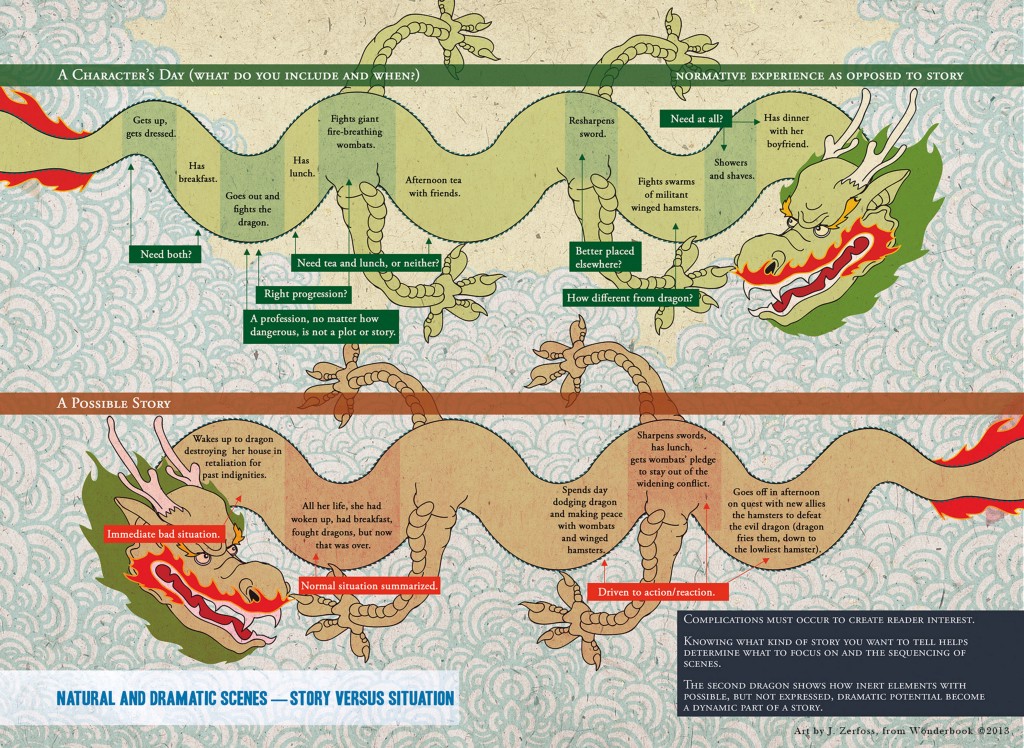
The first thing I wanted to show you is this image, which is about how you decide what the story is in the first place. Basically, I thought it would be useful to take some very dramatic job that a character has — in this case, a dragon slayer– and demonstrate how it is that the average day of a dragon slayer is no different than the average day of an insurance salesman, in terms of not necessarily being of any interest to a reader.
When you’re first thinking about story and scenes, you have to choose what to dramatize, and what you won’t. A lot of beginning writers will think that the continuum of a day, a week, or whatever else in the life of someone is a story. It’s not necessarily. The first part of this is reminding you that all of these things do not need to be in your story. Maybe some of them are dismissed in a sentence or two.
Then the second dragon timeline says to you, “Here are some of the things that indicate that there’s a story present,” and ratchets it up a notch by also putting the character into a more unusual situation. The dragon’s actually destroyed the dragon hunter’s house at the beginning, and that sets off a chain of events.
There is one lie in this diagram in terms of the difference between a person’s day and a story. It’s a built-in defect of the diagram. The lie is that, yes, you can do a day in the life of a character as a story. However that’s not usually good to tell a beginning writer because a writer has to learn how to apply the right elements that sustain a character through a story in such a way that it’s not just a character going through their normal day. Often, when you get to the intermediate stage, or if you’re a particular kind of writer from the very beginning, you can make that kind of A to B work. So long as you know this is what you’re doing, that you’re not just defaulting to a drawing a particular pattern because you don’t know any other patterns.
Where to Begin and Where to End
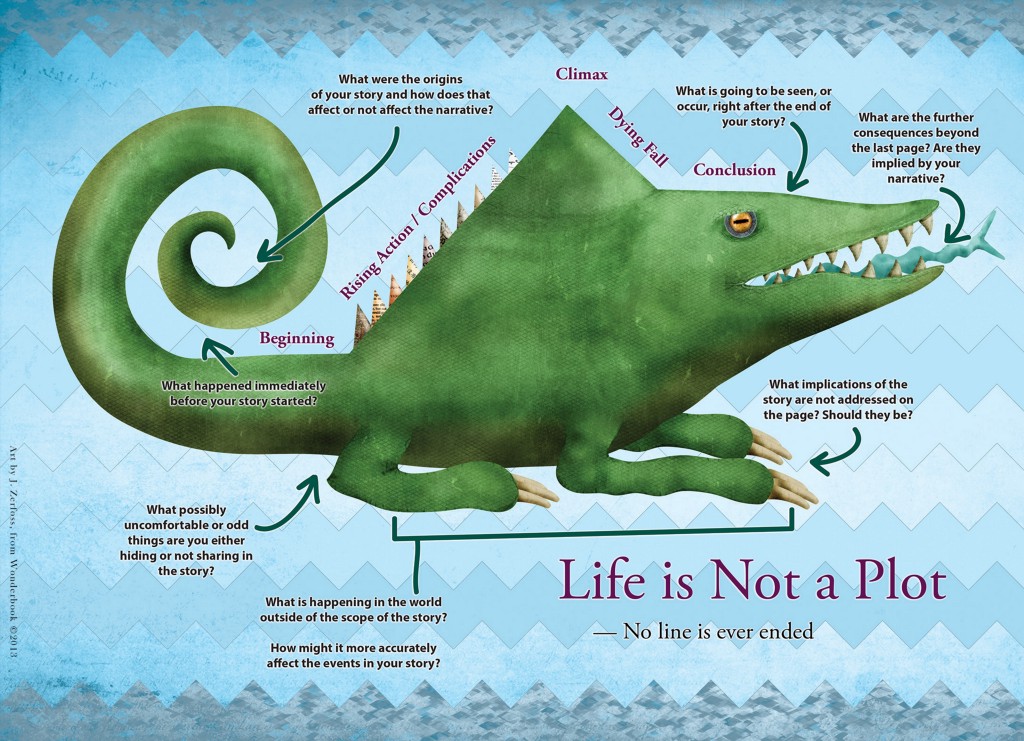
Once you get to the point where you have a sense of your story elements — the general situations, the impetus or driving force — you still have some decisions to make. You have the shape of your story — in this case, depicted as a lizard — but you still have decisions as to where you’re going to begin and where you’re going to end, not just the story but also your individual scenes. Where you end or begin your scenes is not only a question of pacing. It’s also a question of what’s right for the story you’re telling, for the kinds of characters that you’re using, and in the context of their unique characteristics.
To a certain extent, this is also a diagram of a scene. You’re making more specific or micro-level decisions on where to start and what to leave out, what moment to stop on with what character or what emphasis, what action or reaction or thought. Again, all of these things are not just about making a scene seem to move for the reader, but they’re also about how to frame character and a bunch of other elements. You can literally make a huge change of emphasis just by ending with a different line of dialogue. Stopping a scene with what the person speaking says, rather than how the other person responds, can be a crucial change in emphasis.
There’s also the question of targets. This may depend on how you see fiction, because for me, before I can start a story, before I can know that I’m going to complete a story, I have to know how it ends. I have to have a character in a situation in my head, and then I have to more or less know where the ending is. I often don’t end up where I think I’m going to end up. But I have to have that theoretical, “That’s my end point,” when I start, or I never finish the story.
When you finish a rough draft, there are a lot of things you have to think about — how your decisions about scenes and summary and everything else have supported what you want the story to be. I would consider this, in a way, “reverse outlining” or outlining after the fact. After you’ve written your rough draft, you say, “Well, this was my target. I wanted to write this kind of story with these kinds of things in it. Now, what’s actually there on the page and what’s missing that needs to be there? What scenes are missing? Is emphasis wrong in the scenes? Do I need all the scenes I wrote? Have I thought I created one kind of story, and I actually created another kind of story? Have I gone off into something that’s so esoteric that maybe there’s one or two readers for it — and if so, was that my actual intent?”
By the way, the story gopher in the diagram means nothing. It was something put in there as a joke for the illustrator. He illustrated it. I left it in. It’s an enigmatic story gopher.
Now, the idea of a target in fiction may seem silly, because fiction is multidimensional. It has many targets, many things going on. All the arrows going all of the places they go, and whomever they hit. Let fly, let fall…but at a certain point, when you’re examining how you put your scenes together, it’s useful to, at least for a while, do the thought experiment of, “How is this stuff working?” at some specific level. Not only that, but the question, “How do you create unity and focus, but not be so on point that everything feels mechanical or forced or unsurprising?” Because if it’s mechanical or forced for you, then it’s probably not going to be that exciting for the reader either.
Thinking about Structure Through Character Arcs
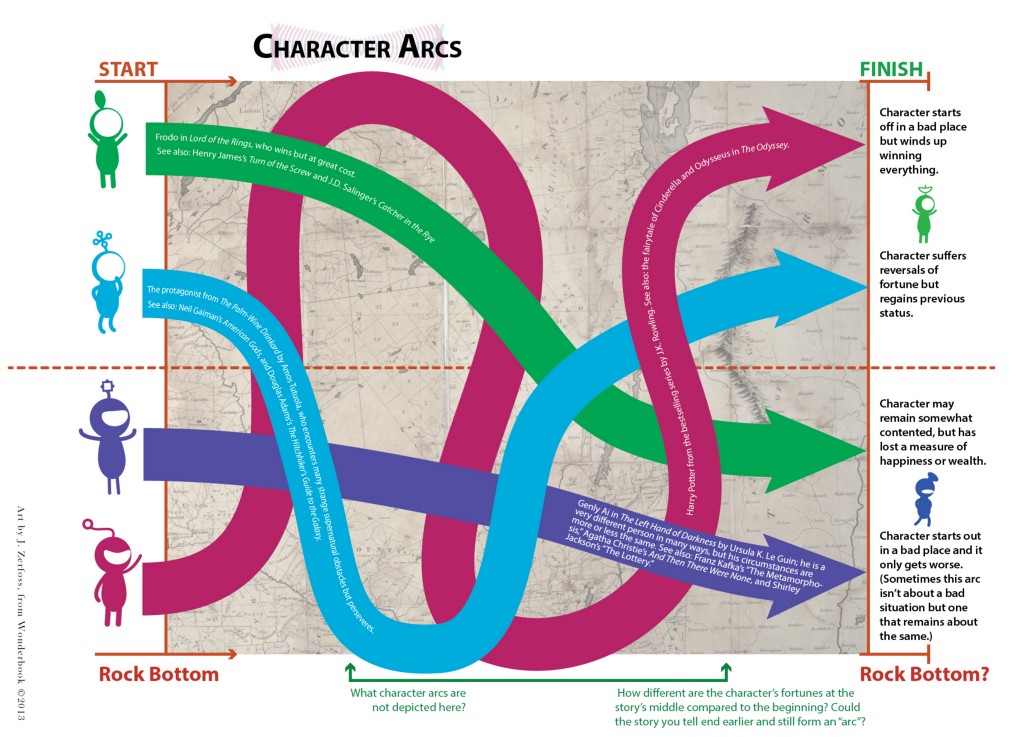
What is a scene doing? How is it expressing its own integrity? Then how does that scene fit into a larger picture? Another way of looking at those questions is through character arcs. Every writer is different. When I do a more intensive workshop and I’m engaged in one-on-ones with writers, I try to find out exactly how their mind works. Do they work through structure? Do they think of structure as purely through character, or do they see it as a separate construct? Do they think of plot as separate from structure? These are words that serve as approximations of concepts about which we all think of a little differently. You have to, when you’re an instructor, try to look at what the writer is trying to do, and how it is different from your thought process — and inhabit that thought process, to be of the most use.
So if you’re not attracted to story dragons or lizards or the idea of targets, another way of thinking about structure (or plot if you prefer) is through the character arc, which is basically about where does the character start, and where does the character end up. That creates a different sense of scene, as well. Authority, the new book that I have out, is very interior to the character. As a result, even though it’s in third person, you have almost stream of consciousness in there. For my purposes, even though it’s a thriller — a spy thriller, more or less, with some weird elements — it was more useful to me to think of it as this personal journey of this character and be so tight in on him that I was thinking of the character arc, not thinking about the reveals or the mystery, or anything like that. Those things just slotted in naturally.
There was also a lot of improv involved in writing the scenes because I had only a very rough outline for these scenes: “I know that he’s going to have a meeting with so-and-so,” or, “This is going to probably happen here,” but I didn’t know what was going to actually occur in those scenes until I wrote them. Now, was this my process for the other novels in that series? No. From novel to novel, you shouldn’t restrict yourself in how you try to think about or conceptualize your approach, because each novel may be different. It may require a different process or a different approach. It’s helpful to realize that the story lizard that was so generous to you one year may be a stony sentinel impediment the next.
The other thing I just wanted to say briefly — and this image has less to do with my point than some of the others, but I like the image a lot — character arcs at the scene level, the decisions you make there, define character. They define character emphasis. The commitment to character that you have defines what you can get away with in a scene. You can sometimes get away with an action scene that doesn’t have much commitment to character because there seems to be something colorful going on, some movement generated that catches the eye. It’s less likely you can get away with that in a dinner conversation scene.
You also need to know your strengths and weaknesses. I tend not to dramatize dinner conversations because that’s not my strength. Many times, that will be the part that’s summary in a couple of sentences. There are other writers who don’t particularly like doing, for example, just battle sequences. You don’t necessarily have to commit to doing a type of scene that you just aren’t suited for, if you can find a way around it that isn’t just a work-around but serves to strengthen the story or novel in question.
Cutting Away from a Dramatic Scene
Digging down a bit further, here’s a more practical example. Airship disaster, as I call it: An actual example with three different ways of cutting away or not cutting away from the scene. Here, you’ve got a situation where, whether it’s a heated conversation or an airship blowing up, you have context at the beginning of the scene. You know where you are. You know who the characters are. You have some kind of focus. It’s embedded in the plot in a place where it makes sense for the reader.
Then you get to the point where there’s maximum drama or conflict. Either you follow the red example where you show everything through the downfall and the aftermath of that, or, at that point, you cut away, and you go right to the aftermath for the green version. Or, with the blue version, you go a little bit past the aftermath, past the point of crisis, so there’s a little bit of dying fall, and then you break away entirely, and you don’t really show this part of the action.
These approaches all create different effects. Again, you may not be comfortable with showing a certain kind of scene, or there may be so much drama up to this point that if you actually show what happens here, it’s going to be melodrama. The other thing about this approach is that maybe you want the reader to fill this in. Maybe it’s much more effective in the reader’s mind if you leave it at this point. You let them do the work here. Or, in showing the aftermath, it’s actually more emotionally effective for whatever reason than showing the moments after the explosion through to the aftermath.
One thing you may find in the middle of some of your scenes is that you can cut away and come back, and lose a paragraph or two, depending. I have a scene in Acceptance where two characters come to blows, and there’s something said that can’t be unsaid. It’s just anti-climax. I cut right there. I come back to a description of, basically, them both looking at out the window, and then come slowly back to both of them speaking again a little bit later. You get a sense of how they’ve become reconciled to what was said. Sometimes, you need to stay there and have all that messy stuff there. Sometimes you do need to cut away and that takes just as much skill.
This said, in the knowledge that the full through-line, where you leave nothing out, requires great, great skill of a different kind. An airship that blows up for too long with little reader commitment can be just as boring as something less dramatic.
A good example of how to be successful writing without leaving anything out is in Donna Tartt’s novel, The Goldfinch. She has, basically, a one-take scene set in a museum — where there’s a bomb explosion. She starts that scene from the aftermath, and she goes all the way through until the main character gets out of the museum. There are all kinds of places where she could have cut away — she could have done this, that, or the other — but instead, she shows you the entire thing.
It’s extremely masterful to hold a reader’s attention through all of that, because even situations that seem inherently dramatic can be rendered incredibly boring if you don’t do them the right way. To be honest, action scenes in particular are a great example of this, because if you’re not invested in whatever action’s going on, it’s just about as bad as a boring dinner conversation.
There’s also the issue of repetition across multiple scenes. George R.R. Martin mentions this with regard to his novels, about battle sequences, which he varies because he has so many. You can, again, substitute in any word for battle. “I have so many dinner conversations,” whatever. Sometimes he’ll cut away. Sometimes he will show the whole thing. Sometimes you just learn about what happened from a messenger galloping up.
It’s interesting, too, the acts of translation from film. A lot of films have sophisticated scenes that if studied properly are useful for fiction. Orson Welles has this great amazing scene in Chimes at Midnight — a battle scene that starts with a bird’s-eye view of this battle going on, and then slowly you zoom in and then zoom in again. You can’t even really tell what’s going on at the end, but in a good way. It’s just all these muddy boots and parts of bodies, and then Welles cuts away to show the aftermath from far above again…and there are all the soldiers, dead in the mud and it’s shocking. Highly effective. It’s something that would be effective in fiction to some degree, too, probably. I used a similar idea in a single-combat scene in one novel. I also think the writers for Game of Thrones on HBO used Chimes at Midnight for their “Battle of the Bastards” episode recently.
A Break Down of an Action Scene
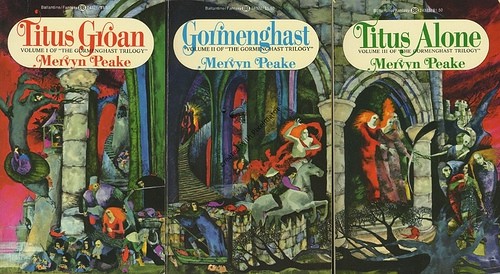
What I wanted to do now is show you one particular scene and break it down, from the first novel in the Gormenghast Trilogy by Mervyn Peake. It’s kind of fantasy and kind of not. It’s set in this huge ancestral castle home with this dysfunctional family that’s been there for generations. You don’t have a really good idea of what’s in the outside world.
The lord of the manor has a cook down, basically, in the basement who is kind of a brute. Then he has a guy named Flay who’s his servant. Flay and Cook hate each other, because Flay sees Cook as a possible usurper, and Cook is hatching a plot to overthrow Flay or undermine his influence. They have been at it for a very long time by the time this scene that I’m going to go through occurs in the novel. They have a long, long history. It’s a fascinating scene, a chapter entitled “Blood at Midnight.”
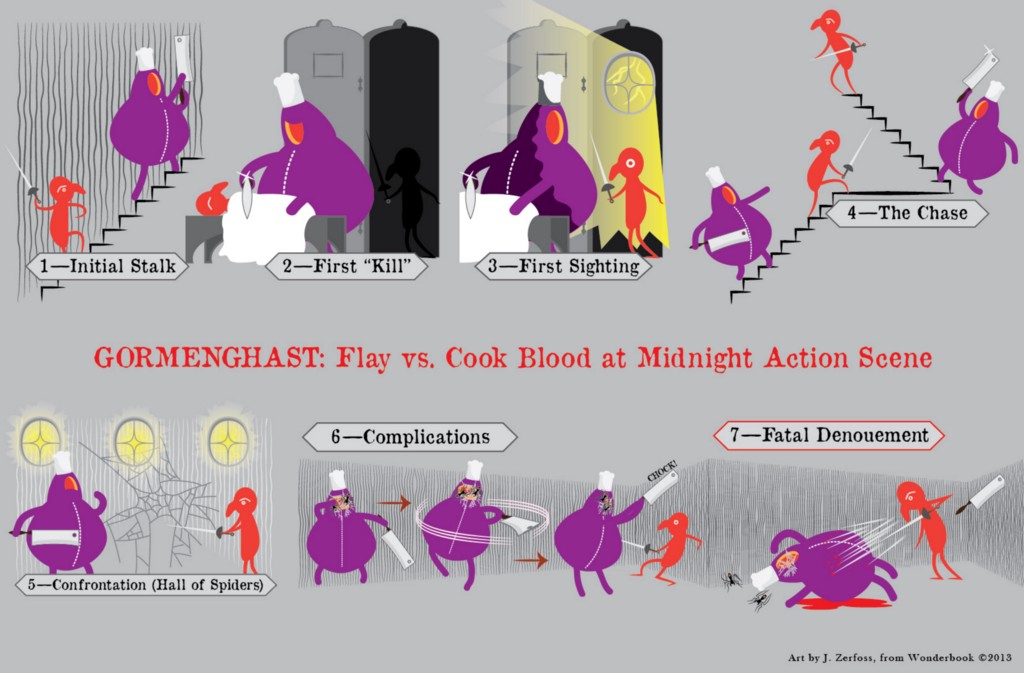
This is an image we couldn’t put in Wonderbook. It demonstrates the thing that’s really fascinating about this scene: it is one long action sequence. It could have been several different scenes, and you may even still say it is, but it’s really one long scene. He doesn’t cut away during the entire thing. He uses extremely long sentences. He goes back and forth between the point of view of both characters, which makes perfect sense in the context of the scene, because they’re so linked at a psychic, psychological level. Some other writer would have taken a totally different approach with this. Think about if, say, Lawrence Block had written this scene. Pithy versus verdant styles give an immensely different feel to violence. One may speed it up and make us “only” look at the actions and the other may slow it down and give us time to look for other things.
As an exercise, I suggest you look at this slide, and read the specifics of the scene later. Write your own version and compare it to what he did, and see what choices you made that you think are actually better for your context, and which things he did that were better for his.
I’ll be honest, too, in admitting that this scene Peake wrote should not work. Here’s this 25-page action sequence with long, convoluted sentences, and yet you are on the edge of your seat the entire time.
So the scene starts out with this initial stalk. Flay knows that Cook is planning to kill him. Flay has been stalking or haunting Cook as Cook goes around his daily business. When he sees Cook go upstairs towards his quarters with a cleaver, he knows that it’s probably about time to try to not die. Flay has already — and this is another complication right off the bat –prepared a fake Flay in his bed. When Cook goes to kill Flay, he is unable to, because it’s a dummy. At that time in the novel, there’s a storm going on during a dark night. There’s a flash of lightning — chance operating to make things worse, really — and Cook actually sees Flay behind him, just as Flay was about to stab Cook. I know it looks a bit like Spy vs. Spy on the screen. Pretend it looks fancy.
Then there’s this chase sequence that’s up all of these endless stairs, which should be boring as hell. This is a place where, in some novels, you might cut. You might cut to the next scene, where they’re actually fighting or something, or fighting each other. But Peake uses this opportunity to recap the incredibly convoluted relationship they’ve had in a really fascinating and new way. You get a different view of both characters because of this — because you learn something new, you become more invested in the outcome. Then, by the time that they get to the confrontation, it’s in this interesting place, this Hall of Spiders, with all of these bizarre artifacts. You have a location, in addition to the specifics of character, that is specific and very interesting.
Next, you have “further complications” as Jarvis Cocker might say. Again, this looks more comic in the image than it is in the actual scene, but Cook gets a spider in his eye, basically. This slows him down a bit, which is useful, because in the natural unfolding sequence of events, Cook is much better suited for killing Flay than Flay is for killing Cook. The detail that Peake uses throughout acts as a form of slow motion, but not like in a bad De Palma film, so that you’re focusing more on the how and not the what. This focus emphasizes character motivation. He whirls around. He’s trying very hard to get to Flay. In the process of this, because of “old spider eye,” he smashes his blade right into the side of the wall. That gives Flay enough time to get away from him for a while. There’s a sequence we couldn’t put in here where there’s a little bit more back and forth right after that. Then finally, Flay wins out and kills Cook.
In addition to what I’ve noted, there are a few other things that the scene does that are very important to note. Flay has a very specific plan to lure Cook to the Hall of Spiders. You know this beforehand, so there’s been setup. The visualizations by Flay anticipating Cook’s attack create further tension. The two combatants are evenly matched. Flay is smarter, but Cook is a lot stronger. Neither party is a professional killer, so there’s no expectation of a quick resolution. In fact, you expect a bit of inefficiency.
The scene occurs towards the novel’s end. It functions as part of the climax. The reader is expecting that there will be something like this at the end of the book, just not in this form. Peake has the luxury of being able to go in depth because at this point the reader is not expecting something really fast and short, as they might toward the beginning, before being as invested. It’s the climax, for god’s sake — who wants their climax over in a haiku?
The stakes are high, as well. After this scene, this action has consequences on all the other characters going forward. You could say there is an extreme ripple effect and we also understand after this scene that things may get very dark indeed.
Yet despite that kind of darkness, Peake is always very precise about where the characters are standing and the scene never feels murky. This is a quality I admire greatly — you can also find it in Mark Helprin’s A Soldier of the Great War. As a writer, I always want to know where the light is in the room and how it’s striking the characters. Even if that description doesn’t make it to the end — maybe because the viewpoint character isn’t that observant — the echo of it there means that there’s a little bit more reality to the situation. Always knowing the basic blocking, like the stage directions, is very helpful in terms of creating specificity in your scenes.
Thus, the details of the confrontation are choreographed pretty darn well. Peake has a very clear idea ahead of time. Because he was an artist, I would imagine he did little sketches of all these different bits before he actually sat down to write, which is another important thing to think about when doing scenes: visualizations.
An Action Writing Exercise
The exercise, then, that I want you to do here is take your short story and isolate the scene with most action in it. I want you to make a list of every action that occurs in the scene and I want you to add some context, almost as if footnoting or layering in annotations, about the emotional resonance that is brought from prior scenes or events not dramatized in the story. If you don’t know, make something up. Why does this action have significance? What off the page leaves a ghost of its presence in your scene? You’ll likely wind up with melodrama from thinking of too much, and have to scale back, but that’s just part of the process.
And then I want you to draw diagrams of the characters and their setting, thinking hard about where they should be standing and where the light is and where it isn’t. Once you’ve done that, you should rewrite the scene keeping both the emotional context and the physical context in mind.
Two additional take-home exercises: For the first, re-cut a problem scene in your story by removing the first paragraph and the last paragraph, rewriting to include any context lost, deleting anything in the middle no longer relevant, and adding more suggested by the cuts. The second is to re-map the beats and progressions of the Gormenghast scene in the context of a dinner party. This requires you to translate action into less physical acts — the jabs and reposts of conversation, perhaps. I would also think about clues about where everyone’s coming from in that moment, like where they immediately came from, for example. If some guy’s coming immediately from a crappy day at work, that guy’s totally different than the day when he didn’t have to come from work at all like the weekend. What is their immediate emotional state? Then who knows each other already? What is the history between them? How’s that going to possibly create conversation, conflict, or whatever else. And who might have come to the dinner party with a premeditated agenda too.
The Different Decisions You’re Making When You’re Writing a Story
These other slides are just a kind of dying fall of different ways of saying the same thing we’ve been talking about. You’ve all seen those choose-your-own-adventures. One of the images in Wonderbook is of an evil eye that wants a body. It gives me an opportunity to show all the different decisions that you’re making when you’re writing a story. It’s all the different ways the story can go. That’s another thing to test once you finish the story: “Have I made it too easy? Is this scene too easy? Should these characters or the outcome have been different? What would the outcome be?” In a couple cases, the evil eye comes to naught. In the others, the evil eye finally finds his father, which is a key to getting by in the world.
Sometimes this could be as simple as changing the relationship between the characters, and it radically changes the scene. There was one workshop where this writer had a really interesting story, but there was no tension in it whatsoever. My wife Ann, who’s a great editor, said, “Well, what if, in this first scene, instead of saying” — this is a very simple example, but — “instead of saying” — this person’s coming to somebody asking for something — “What if, instead of the person saying yes, they say no, and then it turns out these two people have known each other for 20 years, and they have this whole history? There’s a very good reason why this person’s saying no.”
Out of that one change, the story suddenly had tension. A lot of the same elements were there, but they were completely re-contextualized, and the story worked. She didn’t actually have to change all that much. She had to change dialogue, but she had the scenes she needed. They just weren’t doing the right things originally. Again, it’s all about thinking about your character interactions, what their histories are, what they’re bringing to the table, and so on and so forth. This, on the slide, being a fairly whimsical and ridiculous example.
This image is more theoretical — probably the most abstract in Wonderbook. I’ve had some musicians say this actually looks a little bit like how they map music. Thinking about scenes on a more abstract level, you have all these little interactions, these beats, which are more or less the pulse of the story. Beats, more or less, are the action/reaction going on at that micro-level in the scene — and you usually hear them in the really crude context of commercial screenplays even though a beat is a very complex organism and plays a complicated role in the health of all kinds of fiction.
Then you have these progressions going on in the scene sometimes, where there’s a progression of a topic or a progression of a theme, or whatever else driving things in the background. Sometimes novels fail because the progressions are in the wrong order or composed of the wrong beats. Sometimes they fail because the novelist doesn’t recognize the autonomous heartbeat they’ve created and they don’t perpetuate that sonorous yet almost imperceptible progression throughout the entirety of their story.
In the middle of all this, you have what I would call “time intrusions,” although there’s also a note there that not all scenes include time intrusions. Sometimes they just include the neighbor’s dog. The point is that people have memory. People have memories. People do not think in sequence. They’re not always moving forward. I’m not talking about flashbacks, necessarily, but even during a conversation with someone, what are you thinking about? You’re not just thinking about the conversation you’re having with the person. Some of that may be relevant to the scene. Some of it may get into the scene.
Then there’s something called contaminations. Joyce Carol Oates did this beautifully in a story called “The Corn Maiden.” It starts out in the mother’s point of view. You think that the scene is really about her, but it’s actually about the police in the investigation and a member of the police. As the scene progresses, there’s this contamination or intrusion of this other subject matter.
Then it allows Oates at the very end to immediately go into a sequence that’s really from no one’s point of view at all. It’s just an overview of all the different actions that the police are taking at this time. It starts out as an interrogation of her by the police, and it ends as something completely different.
I’ve included “Science of Scenes” because I like the idea of pushing the boundaries of what can be articulated in an image. I wasn’t sure that it was completely accurate in what it was showing, but it’s something for people at least to argue about, about how scenes work. Even if I wind up being wrong, it has caused you to engage with an interesting idea, and one of you can confront me five years from now and tell me how stupid I was, which will be fun for both of us.
Writing Multiple Character POVs
Then what do you do if you have character points of view that, again, you have more than one character point of view, and you’re trying to figure out the emphasis there? It’s a very commercial fiction thing. But this applies to a lot of “literary” fiction too despite the emphasis of my diagram. The person you spend the most time with — that’s your main character. When you’re sequencing scenes, remember that. If you think that one of these characters that you’re showing the lives of in these different scenes from different points of view is your main character, then we have to fairly regularly come back to them. Usually, they should be the longer, more substantive scenes.
One quick easy way to accomplish that is to simply not break up scenes with that character in them. Show the whole scene, and have the other character scenes be ones where you cut away a little bit more. These are tongue-in-cheek examples from Chive Muscle’s cult classic Monster Island Bloody Hellfest, where they all come to this island, and there’s this thing that’s after them, and two different ways of cutting. One, obviously, is emphasizing a particular character. One’s a more ensemble novel. You can see, though, that you’re not looking at something that’s that precise. It shouldn’t be this cookie-cutter thing where this character’s scenes are all going to be 20 pages or 5,000 words, or whatever else, but that you have a regular rhythm that you establish.
Does it apply to all novels? No. Adichie in Americanah doesn’t do this. She does this really wonderful thing where she sticks mostly with the female lead, and then she does these asides to the male character, who, at one point, is in the UK. She’s not necessarily consistent because it would be too mechanical, but there’s a weird consistency to her inconsistency in how she goes back between the points of view. If you go to the Wonderbook website, I have a breakdown, a diagram breakdown, of that novel, which I think is a really interesting one, because it looks so unstructured, in a way, but it’s really cleverly structured, if you really take a close look at it.
Now, have these diagrams and this lecture covered every possible way you can think about scenes? No — that would be impossible. But what I hope this lecture has done is given you enough general and specific examples that the information will mix with your own approach and imagination in a synergistic and organic way. You will need to experiment in mechanical ways too — plugging in these ideas to existing fiction you’ve written. But at the end of the day, you’re trying to get to the point where more and more technique becomes muscle memory. That’s when you begin to talk about the “art of fiction,” but it comes to you first through absorbing craft. You can do that without instruction — without taking classes but just studying fiction you admire — but sometimes a lecture like this one can shorten the time span it takes to internalize these topics. Thanks for your engagement and your attention.
Angela Palm’s childhood home in the rural town of Hebron, Indiana was built on a rerouted riverbed, where the Kankakee once flowed. In the opening chapter of her Graywolf Non-Fiction Prize winning memoir, Riverine: A Memoir from Anywhere but Here, Palm recounts how her father paddled a rowboat from their doorstep to the school bus every morning during flood season. She relishes in the pride her father and neighbors took in recounting stories of the how they conquered past floods. She recalls her fondness for these rituals as well as her childlike knowledge of the danger the flood imposed upon the town. From her vantage point as an adult, Palm calls nature “violent” and “taunting.” The fractured site of Palm’s childhood represents both the human ability to engineer the land, and, by extension, destiny, as well as the fragility of human life in the face of an unyielding environment.
Like the landscape of Palm’s youth, her belief system is subject to drastic change. She tests out various religions, from Methodist to Catholic, attending “a dozen different churches or more” by the age of thirteen. While Palm experiments with different modes of consciousness, she is also aware of how the futures of others are seemingly incapable of being rerouted. This concept is most pointedly illustrated by tragic story of Corey, Palm’s childhood neighbor, crush, and ultimately lifelong friend, who was sentenced to life in prison for murder as a young man. Poverty, parental neglect, and drug use led Corey to spend four of his formative years in juvenile detention centers for “crimes that rich kids had been let off for.” Palm speculates: If Corey had more support and guidance, “would it have gone this far?”
The message being, people who err are not inherently bad; more so, our society cruelly dictates the outcomes of our lives and this statement becomes a refrain, especially in relation to Corey’s incarcerated status. “To me, inmates were regular people,” Palm writes, “who had been caught doing something society deemed impermissible and who had likely had some misfortunes along the way.” Palm emphasizes the corruption of the US prison system, specifically its catering to privatized companies and values profit over rehabilitation. Despite human attempts to redirect, socioeconomic status, like weather, is shattering.
When Palm volunteers for Habitat For Humanity, the presence of flood rears again in Palm’s adult life, helping repair Hurricane Floyd’s damage to North Carolina homes. While there, she witnesses first-hand the devastation of natural disaster, and the human inability to quell or control it. She enters a house destroyed and gutted by water damage, where the only undamaged object is a 2-Pac poster in the living room, hung high enough to have evaded the water. The presence of the poster in the house represents the intersection of environmental and social determinism: 2-Pac could not escape “the current” of crime and violence that ultimately claimed his life, just as homeowners were unable to ward off the flood.
Palm presents a drastically different outlook in the last section of her book, Mountains, which chronicles her experience at a writer’s retreat at the Robert Frost estate. While her first two sections, Water and Fields, emphasize how tied we are to our physical environment and origin and feature clinical, analytical analysis, Mountains argues for our ultimate detachment and uses dreamier, more poetic language. Palm notes the significance of her location while acknowledging that the environment exists entirely separately from her entanglements and associations with it. “The trees are not poems, never have been, do not contain poems, never have contained them,” Palm writes. Although this sentiment would seem discouraging and averse to the purpose of a writers retreat, Palm revels in the freedom of experiencing objects not through their associations, but as themselves in their raw and pure form.
Although Palm states that “we’ll never really escape the landscapes we inhabited as our brains developed,” she chooses to focus on the blunt indifference of the land in her last section. Mountains is focused on the immediacy of physical sensation as opposed to theory meant to explain environment in relation to humans. This intentionally lopsided structure leaves the reader with multiple layers of paradox and duality: the land is malleable yet confining. Environment is integral to development and fate, but it also exists separately from human classification. At the close of the book, Palm ultimately forces the reader to reconsider her own thesis. This technique harkens back to the rerouted river of Palm’s childhood, upon which humans renegotiated the very foundation of their situation. Reader, like river, is forced to reroute.
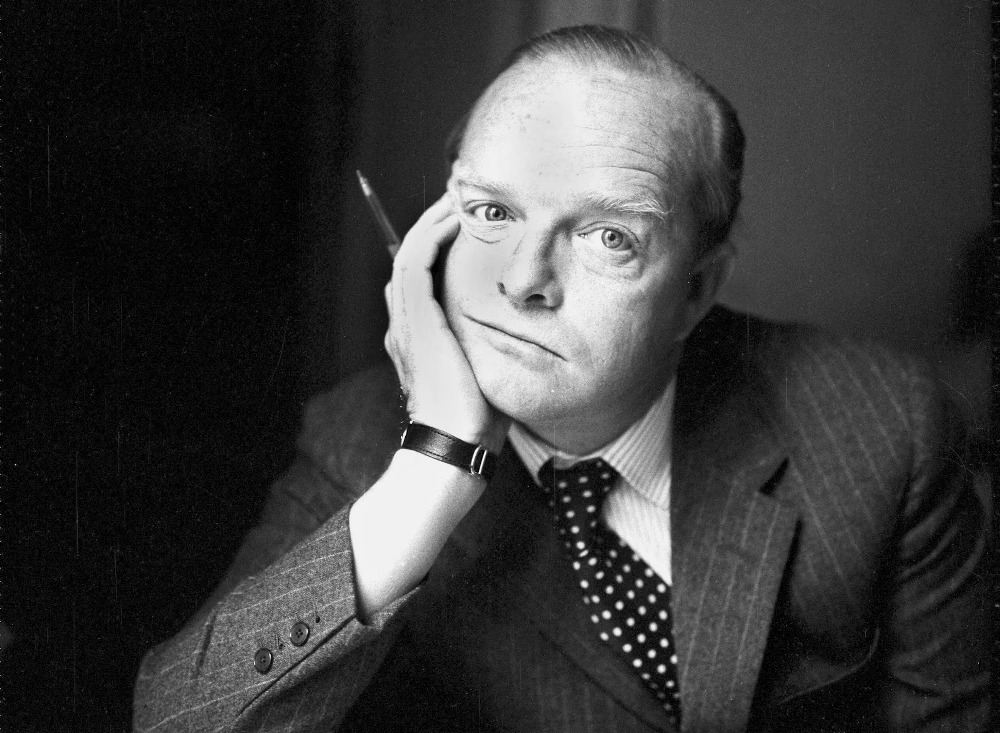
Truman Capote has now been dead for thirty-two years. He will go on being dead another thirty-two, at the very least least, but his remains will be given new life, it seems. Just in time for the unfortunate anniversary of Capote’s death (today — August 25th), Julien’s Auctions in Los Angeles announced it will be selling the author’s ashes to the highest bidder. The ashes are apparently part of the estate of Johnny Carson’s widow. The story, as reported by Rory Carroll, The Guardian’s man in the City of Angels is packed with odd and eccentric details, and you really should read the full article.
Here are a few choice tidbits:
The director of Julien’s told The Guardian: “With some celebrities this wouldn’t be tasteful.” But he was “100% certain” Capote would approve.
Ethical deliberation was undertaken.
The starting price for the ashes is $2,000.
The lot is expected to fetch two to three times that amount.
Julien’s is located “between a Food Express and Five Four Clothing store.”
William Shatner once auctioned off a kidney stone for charity.
Napoleon’s penis is not in his tomb at Les Invalides, as you believed.
“The one thing about Truman Capote is he’s highly collectible.”
Capote’s ashes have twice been stolen and then recovered.
The auction house is hoping a New Yorker will buy the lot.
The ashes would make “the ultimate conversation piece.”
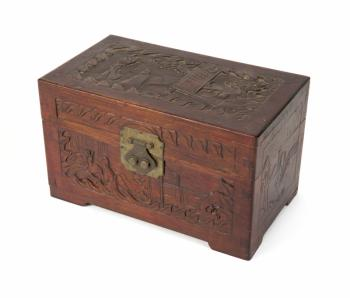
On the web page for Lot 501 — the ashes, in their hand-carved Japanese wood box — there’s a link directing you to “similar items.” We couldn’t help but find out, what, exactly, is similar to Truman Capote’s earthly remains.
And so, here are a few other choice items from the auction.
Capote’s needlepoint pillows.
“Casual hats.”
Capote’s snakebite freeze kit.
His crime and prison books. (Okay, that’s pretty interesting.)
His Baccarat decanters. (Dammit — also pretty cool.)
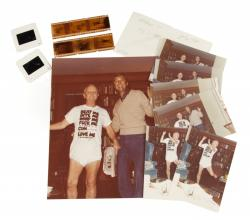
Capote’s “risque” photographs. (This is actually a helluvan auction.)
Prescription pill bottles. (Getting weird again, but let’s go with it.)
A papier mache parrot. (Wait, what?)
Capote’s clothes “at time of death.” (Nah, we’re out.)
The auction will be held on September 24th. That gives you a month to save up. Or you could pop into, say, Green Apple Books or BookCourt or your local indie bookseller, where copies of In Cold Blood go for around $20.
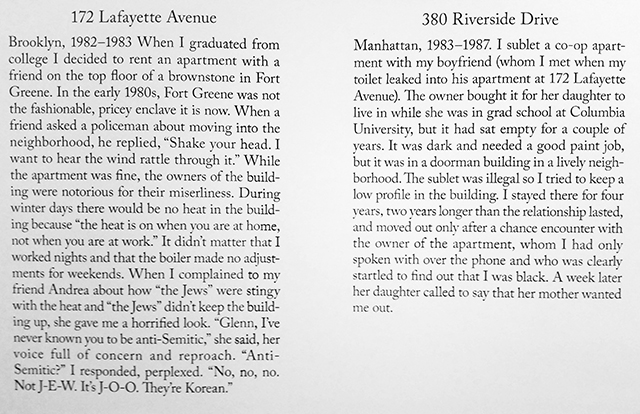
One of the most captivating works of nonfiction I encountered in recent years was not published in a journal or book. I read it while visiting MoMA PS1 to see their Greater New York exhibit. On one wall was Glenn Ligon’s “Housing in New York: A Brief History 1960–2007,” in which Ligon recounts his memories of the different places he has lived across the city.
In a review for Hyperallergic, Benjamin Sutton noted that the piece addressed themes of “gentrification, discrimination, and inequality”–the same concepts that have fueled many an impressive work of literature, especially recently. It’s a spot-on assessment: using a limited amount of space, Ligon is able to both evoke numerous spaces that he has called home, along with the complex dynamics at work in each.
From Glenn Ligon, Greater New York, MOMA PS1
This wasn’t the first moment of literary crossover for Ligon: Yale University Press released a collection of his writings, Yourself in the World: Selected Writings and Interviews, in 2011. In a piece for the Los Angeles Review of Books, Pete L’Official examined Ligon’s literary and artistic influences and the way that they converge in his work. Readers curious to read “Housing in New York: A Brief History” without traveling to a museum may be excited to learn that PS1 published a version of Ligon’s piece earlier this year.
It’s been a memorable time for works that exist in the overlap of fine art and literature.
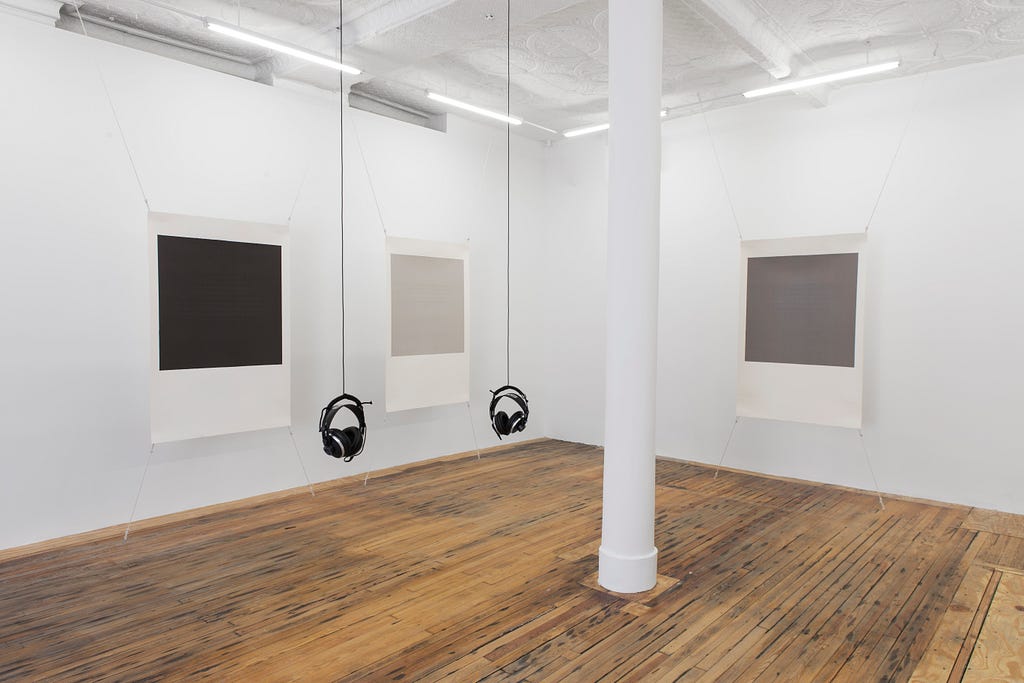
It’s been a memorable time for works that exist in the overlap of fine art and literature. In the winter of 2015, I was taken aback after reading Caroline Bergvall’s Drift, a stunning book that juxtaposed meditations on traversing bodies of water with ecstatic explorations of language and haunting scenes of refugees seeking better lives via hazardous transportation over water. That same winter, I was stunned again after taking in Bergvall’s “Drift,” an installation at the gallery Callicoon Fine Arts which echoed many of the same themes as its literary counterpart but did so while engaged in a very different discipline.
Courtesy of the artist and Callicoon FIne Arts, NY
Trying to pin Bergvall’s work into one category can be nearly impossible: Meddle English, her 2011 collection of “new and selected texts,” features one of the most fascinating collections of supplementary material I’ve encountered. Specifically, Bergvall’s accounts of the histories of the works collected in Meddle English often span continents and iterations, with certain works encompassing time spent in publications and in galleries. One can read Bergvall’s workon its own as literature, or as a counterpart to her work in galleries; one could also, presumably, focus entirely on Bergvall’s art and ignore her books completely. Any of these theoretical readers or viewers would walk away from the experience satisfied, with plenty on their mind.
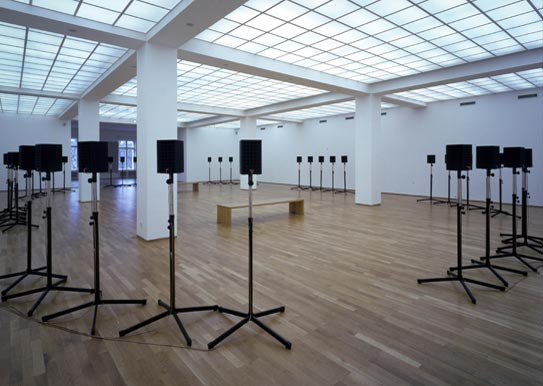
Bergvall and Ligon are far from the only artists to be represented on both gallery walls and bookshelves. On a list of six recommended books that she assembled for The Week, the novelist Samantha Hunt included The Walk Book, a work by Janet Cardiff, perhaps best known for her large-scale audio installations. (Her 2001 The Forty Part Motet takes Thomas Tallis’s Spem in alium numquam habui and breaks it into its components; it’s both technically stunning and tremendously moving on a number of levels.) And Ben Eastham’s recent T Magazine profile of Heather Phillipson focused primarily on her work as an installation artist, but also noted the acclaim that she had received for her poetry: “Encouraged by her tutor, she applied for the prestigious Eric Gregory Award for poets under 30, and won; in 2009, she had her first collection published by Faber.” Eastham also pointed out that Phillipson has drawn inspiration from Frank O’Hara–who was himself a figure with a foot in the literary and fine art worlds, having spent time as a curator at the Museum of Modern Art.
The work of Sophie Calle, another artist whose work can be found in galleries and bookstores alike, has served as the inspiration for a chain of memorable literary works. The story behind Calle’s 1983 Address Book is the stuff of which great plots are made: Calle found a lost or abandoned address book, copied the contents, and reached out to the people listed in it, then documented her interactions with them. (Siglio Press published a version of it in 2012.)
The Address Book, Sophie Calle
A figure inspired by Calle shows up in Paul Auster’s 1992 novel Leviathan–specifically, an artist who selects people at random to follow, documenting those interactions. In turn, Calle went on to create a work inspired by Auster’s novel. Enrique Vila-Matas’s 2007 Because She Never Asked, newly translated into English, uses that as a starting point. Its plot follows a writer who is commissioned by Sophie Calle to write a scenario for her to perform.
Because She Never Asked rapidly increases the metafictional quotient. It alludes to Auster’s novel, for one thing, but also adds multiple layers of reality, including a character who serves as a doppelgänger of Calle. She isn’t the only example of this: the novel’s narrator also serves as a kind of surrogate or double for the author Vila-Matas, who has incorporated the art world into his fiction on multiple occasions: his 2014 novel The Illogic of Kassel follows the misadventures of a novelist who is asked to write in public as part of an artist’s installation. In this case, the book plays out like a comedy of manners set in the art world; Because She Never Asked reads more like a response to Calle’s work–a literary homage that features Vila-Matas working with some of Calle’s preferred themes and devices.
Enrique Vila-Matas is one of numerous artists and writers alluded to in Valeria Luiselli’s 2015 novel The Story of My Teeth. This novel can be read on its own, as a standalone work about a larger-than-life character who reinvents himself as an auctioneer and falls victim to a strange conspiracy.
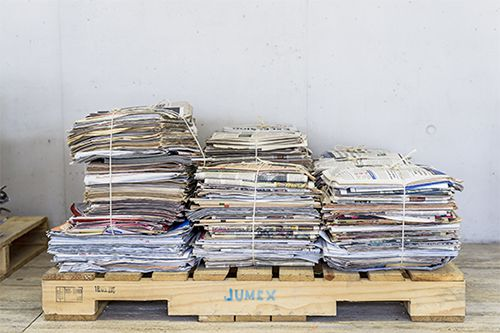
Galería Jumex
But the novel’s origins can be found in the art world. Luiselli was commissioned to write a work of fiction as part of an art exhibition, The Hunter and the Factory, that was shown at Galería Jumex in 2013. In a 2014 interview with BOMB, she described the process.
I wrote it in installments for the workers in a factory. Originally it was a commission from the Jumex Foundation, an important contemporary art collection subsidized by the eponymous juice factory. Two curators, Magalí Arriola and Juan Gaitán, asked me to write fiction for an exhibition there, and I suggested the idea of writing a novel in installments for the factory workers. I wrote one installment a week, and each was distributed as a chapbook among them.
In her afterword, Luiselli writes about seeking to “link the two distant but neighboring worlds”–in other words, the factory and the cultural activities for which it provides support. It’s through her novel, which encompasses questions of class, geography, and perceptions of art, that she is able to do so. It also creates a number of lenses through which The Story of My Teeth can be read. Luiselli concludes the novel’s Afterword by noting its collaborative elements–from the installments in which it was written on through to the process of translating it for Anglophone readers. “[E]very new layer modifies the entire content completely,” she writes.
“Every new layer modifies the entire content completely.”
Luiselli’s novel, like Bergvall’s texts, exists in some middle space in which fine art and literature intersect. Other recent books have used devices and techniques generally associated with fine art towards narrative ends. Since 2015, the first three books in The Familiar, a projected 27-volume work by Mark Z. Danielewski, have been published. As readers of his earlier Only Revolutions or House of Leaves are aware, Danielewski is fond of textual experiments and incorporating manipulation of the book as an object into the act of reading it. In her review of the first volume for the Los Angeles Times, Lydia Millet observed that it was “performance art as well as book — a heterogeneous mosaic of content that can either, depending on your reading preferences, dazzle and intrigue or torment and repel.” That emphasis on structure also calls to mind Eli Horowitz’s recent novel The Pickle Index, which exists in three distinct editions: a set of two hardcovers, a trade paperback, and an app. When I interviewed Horowitz last year, he noted that the differences between the versions was significant. “It’s the same basic text,” he said, “but exploring how the form and the story shape each other.”
That interest in form and format marks one additional way in which the art world and the literary world, never that far apart, have begun to overlap. Perhaps this convergence is a subtle response to the addition of digital formats to the methods by which books can be read. This isn’t to say that this group of writers is repudiating digital publishing formats; instead, it’s one possible answer that can arise after asking questions of just what physicality means for a book. If that answer in turn spins off a host of hybrids and challenging works, so much the better for those who care about a host of artistic disciplines.
That you should not be here when something we’ve both wanted happens is no new thing for me. Today too, as always, you’re not here.
The house is quiet. I’m alone at home. For a while, I basked in bed in the shifting arabesques of light diffusing through the leaves of the tagar. Then I got up slowly, and went down to the backyard, and sprawled on the low wall for a single moment. The silence made me feel like a stranger in my own home.
I walked around the house quietly, as a stranger might. The chirping of sparrows filled the kitchen. The other rooms were quiet, empty, forsaken. In the front room, the newspaper lay like a tent in the middle of the floor, where it had been dropped. At the door, a packet of flowers to appease the gods and a bag of milk.
Then I realized I was not alone. From their photograph, Aaji and Ajoba eyed me in utter grandparental disbelief. I took my coffee to the middle room window and sat down. That girl with the painful voice in the hostel next door? How come she’s not shrieking about something?
To savor each bitter and steaming sip of coffee in such quiet?
That you should not be there when something we’ve both wanted happens is no new thing for me. Today too, as always, you’re not here.
When you came into our lives, I was in a strange frame of mind. I would have been willing to befriend anyone my age. I was ready for friendship with someone who only read management books; or someone who was studying information technology; or someone who wanted to settle in the United States. Anyone.
You came as a paying guest. You gave my parents the rent. You gave me so much more. Then you slipped away.
Those shrill girls in the hostel next door, weren’t they keeping an eye on us? I’m now going to sit on the wall, and when my coffee’s drunk, I’m going to scrape the dried coffee off the rim and the squelch at the bottom of the mug with a fingernail and then I’m going to lick it off. When that’s done, I’m going to take off my shirt and continue to sit here.
One of the fundamental rights of mankind should be that of wearing as many or as few clothes as one likes inside one’s own home. Or one should be able to wear none at all. Wasn’t the eye that the shrill girls in the hostel kept on us an invasion of our privacy, an abrogation of our rights?
After a bath in cold water, you would wrap a towel around yourself and sit on the low wall, bringing with you the smell of soap. It was you who broke my habit of going straight down for breakfast after bathing and getting fully dressed.
Another of my habits you broke: my daily accounts. I’d write them down faithfully. Rs 40 for coffee; Rs 100 for petrol.
‘Why keep accounts?’ you asked once.
‘It’s a good habit. You should know where you’re spending your money and on what.’
‘What do you get from knowing that?’
I asked Baba the same question in the night.
Baba’s answer was so stupid, I felt a spurt of sympathy for Aai. That night, I went for a walk and ate a paan; and I did not write down how much I spent on it.
Another first.
We hit it off immediately; neither of us liked the kind of girl who would sing syrupy light classical music — bhav geet; nor the kind of boy who would wear banians with sleeves. There was another thing I didn’t like: marriage. And the many relatives who made it their business to discuss the subject ad nauseam. You had no relatives.
We would both have liked this moment. We knew that it would be ours one day. But it is now mine alone.
When I woke up, my eyes opened peacefully. I felt the kind of peace you feel when you come in from a hot afternoon and pour cold water over your feet. When I opened my eyes, the day stretched before me, free of anxiety. When I opened my eyes, nothing was left of the night’s anxieties. My eyelids floated up. To wake quietly from a deep sleep is a rare thing and, when it happens, you can almost imagine that the world had begun again, at least for a few seconds. Or so you said.
Watching me wake up one day, you asked, ‘Why those frown lines? This look of pain?’ Once when I watched you wake up, you had the same frown. You said, ‘When one gets up, there’s a moment when everything looks odd and strange.’
I let it go at that.
Today, when I woke up, my eyes drifted open. I felt the kind of peace you feel when you come in from a hot afternoon and pour cold water over your feet. But when I was making coffee a line inscribed itself on my forehead; and I began to think: Why this peace? Shouldn’t I be crying? Throwing a tantrum? Complaining to someone?
Your stuff was all over the room: cloth bags, easel, guitar, books, cassettes, camera, Walkman, rolled-up canvases, and a book of pasta recipes. Baba had finished his fifth cup of tea. Aai was making the sixth. Aseem was in bed.
Anuja stopped the rickshaw at the door and got out; and, as is her wont, shouted three times, loudly, for change. Was that the first time you saw each other? When you took the ten-rupee note to her? Anuja shook your hand firmly, no doubt hurting your fingers. Aai introduced you over lunch: ‘This is Anuja, Aseem and Tanay’s sister.’
In the next two years, how much did you find out about my sister, a girl whose idea of fun was a strenuous trek to a fort, who grinds your fingers in a painful grip when she shakes your hand, who snores a little in her sleep, who listens with complete attention as if you were the last person in the world?
But that’s my Anuja. Who is your Anuja? When did you get to know her? How? And how could I have been so blind right up to the end?
When you were giving Anuja the ten rupees, I was up in the tower room, picking up the shirt you had dropped, inhaling your scent from it. When you came up, I was looking through your albums. I hadn’t even thought of it as an invasion of privacy. You came up behind me and put a hand on my shoulder and said quietly, ‘That was taken a couple of days before the accident; the last photo.’ My Marathi-medium school had not taught us to say, ‘I’m sorry for your loss’ at such moments. I hope I took hold of your hand then and gripped it tight.
Can a single day bear the burden of so many random firsts?
You spent all your Diwali vacations with uncles of various stripes. You ate your meals in hostel messes and, at each new halt, you found a roadside stall at which you could get your morning tea. You made yourself at home easily when you lived with us. It must not have been new, this living as a paying guest.
I had had my eye on that room, a dark one but well ventilated. Its main attraction was that it had its own access. I had assumed that it would be mine when I grew up. I would be able to come and go as I pleased. I would paint it the colors I wanted; decorate it the way I wanted. I would sleep in it, alone. But of course, that was the very room that my parents decided would attract a paying guest. And so I had showed this room to many potential residents, my face dark with resentment.
When I was a schoolboy, this was the room of my grandparents’ illness. There were two low cots ranged against opposite walls, my grandmother on one, on the other my grandfather. Then only grandmother remained, the room suffused with the smell of Amrutanjan. After she had suffered all her karmic share of suffering, phenyle drove out the other smells: of the aging body and drying behada bark, of supari and medicine. But the smell of Amrutanjan lingered.
When you came to see it, you said, ‘What a tempting aroma this room has. Do you come here to sneak cigarettes?’
That’s when I realized that smell is a matter of the mind. What smells you brought with you! Rum and cigarettes, your sweat and macaroni cooking on the hotplate, and then, because I loved it, attar of khus. And the smell of you, a unique personal smell of your own. When I think of you, that smell comes flooding back.
You came into the room and said, ‘What a tempting aroma this room has.’ I thought, if this chap takes the room, things might get interesting. I filled my chest with the smell of the room. Then you said, ‘Do you come here to sneak cigarettes?’ I realized that smell is a matter of the mind. Nothing is real.
As we chatted, sitting on the window ledge, in the middle of the night, I became aware of the mediocrity, the ordinariness of my secure and comfortable life.
You lost your parents when you were still in the tenth standard. You were offered the option of staying with relatives but chose to live in a hostel instead. You decided to live alone, to be independent, to make your own decisions. And through all this, the grim decision never to let a single tear fall.
When the results were declared, you did well. The crowd of happy parents made you uncomfortable and you slipped away. At the time, you were living with one of your aunts and you made your way home. The door was locked. Everyone had gone out. You sat on the sun-warmed steps, mark sheet in hand, and waited until evening . . . when you told me this, were those steps still warm for you?
Midnight in the window, just you and me. Even then you didn’t cry. At these times, I felt I should be your mother, your father, your brother, your friend, everything. But you had long reached the point at which you decided you would never cry again.
The mattress I had brought up, saying that I would study in the tower room, was never taken downstairs again. I encroached on your space slowly, hoping not to be rebuffed at each new foray.
One night, when everyone had fallen asleep after dinner, I came upstairs and found you in my beige kurta, sketching me. I got it: you didn’t mind my stealthy incursions. I also figured out that when the sketch was done, you were going to place it under my pillow. I slipped out again, closing the door behind me quietly and sat at the foot of the staircase, inhaling the scent of the raat rani.
The air was still. There was a light on in the kitchen, then the scrape of Baba’s cough and the light went out. The girls’ hostel across the road was still active. Some girls were oiling their hair and giggling. The rest were playing antakshari. Idly, I wondered what would happen to these foolish girls.
The light went out in the tower room. I went up and opened the door and approached the mattress. You were curled up on one side; the other a place for me, an invitation. Under the pillow, your sketch of me. But it wasn’t the one I had seen. This one had me, the staircase and the raat rani.
When I looked carefully at you, I could see you had screwed up your eyes like a child pretending to sleep.
When we lost a one-act play competition, I sat on the hot steps of the theatre and wept as a child would, sobbing and gasping. You sat down next to me and drew me close and once again I felt we were back in the window, back in the middle of a cool night.
Two days after you left with Anuja, Baba ransacked your room. One moment he was drinking tea; the next he was on his feet, calling Aseem as he marched upstairs. Aai and I followed him, at a run.
There wasn’t much in the room. From outside the window, we watched as Aseem and he turned what was left upside down. I had no energy left to speak, to intervene, to think. That pile of stuff reminded me of your first day here and my eyes filled. Aai thought I was crying because I was missing Anuja and she hugged me. Baba found nothing: no notes or slips of paper, no telephone diaries, no addresses, nothing that would fill out your context. No one saw how much of the stuff that they had tossed on to the floor was mine.
When they left, I saw four or five black-and-white photographs I had taken of you, peeping from a file. They’d faded a little over time and were stuck to each other. Delicately, I separated them.
When I took my Pentax out carefully from my bag, the rain had stopped. Soaked to the skin, you were looking at the sky, close to a black boulder washed clean by rainwater. You began to wipe your face with your sleeve and I stopped you, mid-wipe. You can see the glow of the rainwater and the gentle sun in the photograph.
You were about to finish a new painting. You had been at it day and night. In that riot of color, I now see a cage. It isn’t my face in the cage, but it resembles mine. That night when I came up to the terrace, you drew me greedily to you. And dark patches of color sprang up over my body: red and yellow and the purple-black of the jamun. Irritated, I upended your wooden palette over your head and then, in the middle of the night, by lamplight, I took a picture of your color-streaked face.
I stuck a few of those pictures up on the wall in my room below as well. But I didn’t want anyone to be suspicious so I added random pictures of some college friends around them, one of my parents, and one of Anuja as a bawling baby. That night, Aseem came to sleep in the room. He locked the door and lit a cigarette at the window. He turned to me and said, ‘Tomorrow I’ll get you a picture of Sai Baba. Stick that up as well. Spoil all the walls with Sellotape marks.’ When all this got to me, I would wonder whether I should ask you to leave with me, to go and stay somewhere else, somewhere far away.
But then I’d suddenly feel that I should ask you what you want to do with your life. Do you want a relationship? Would you dare?
I took two textbooks and started to come upstairs. I tried to be as quiet as possible but, when I went into the next room, I could hear Aai and Baba talking about something. They were speaking softly as they did when something was worrying them. Hearing my footsteps, they stopped. Aai wiped her eyes; Baba adjusted his expression and said, ‘What happened? Not sleepy? Want me to rub oil on your head?’ I didn’t think I could come upstairs right away. I’ll tell you about it later, I thought. When I took my Pentax out, the rain had stopped. You were wet through. Soaked to the skin, you were looking at the sky, close to a black boulder washed clean by rainwater.
I watched you through the lens. The cold made my hands tremble and the frame trembled too. At that moment, I felt I had to tell you what I felt, devil take the consequences. Then you wiped your face with your sleeve and I stopped you, mid-wipe.
When you arrived, I was ready to be friends with the kind of person who read management books, studied computer software and wanted a green card. I was bored of the same old stories and the same old people. I would have been willing to befriend anyone my age. Anyone. Those first few days, at the start of term, were quiet, peaceful, as you were. That might have been because the idea of a lifelong partnership, a long-term commitment hadn’t crossed my mind.
Shrikrishna Pendse was a boy like any other in our class; but when school reopened after the Diwali vacations one year, there was something different about him. He left the top button of his shirt open. His eyes were intense; and when he threw his arm around my shoulders, the smell of his body was seductive. Before school, after school, when the classroom emptied because everyone else was going to the laboratory, we grabbed at every opportunity to grab at each other. In that time between the ninth and the tenth standard, we began to rediscover ourselves. I couldn’t sit still, I couldn’t stay at home. The months passed in a haze of Euclidean geometry, Shrikrishna’s chatter, full marks in mathematics and the slow growth of down on Shrikrishna’s chest.
By contrast, our lovemaking was beautiful. At around three thirty in the morning, you slowly took me into your arms and I realized that this was the first time I had allowed this physical bliss to burgeon slowly. With Shrikrishna, there had always been an element of roughness. Was someone watching us? Would someone wake up? And then the habit of silence. And between you and Shrikrishna, how many different bodies! Twenty-five? Thirty? But they were all pretty much the same, and often it didn’t matter if I didn’t see their faces.
Once when I visited his house, Shrikrishna was in the bathroom. His mother told me to wait in his room. With nothing to do, I opened a magazine lying on the table. Madhuri Dixit was featured in a swimming costume. Some nights later, as he was about to come, Shrikrishna closed his eyes and mumbled, ‘Sheetal.’ Sheetal was a girl in the second year. At that time I only felt slightly surprised.
Once after a bath, I opened the door of my cupboard to get a change of clothes. Just the day before, Ashwin Lele had got hold of a video cassette. It was not the kind you got easily. You had to know someone at the video library. Then, you had to have the house to yourself. Lele knew someone and his parents had gone off to their village. He had a cassette player. After class, everyone gathered at his house. I laughed uncomfortably as we watched. All the boys were trying to sound sophisticated. I took my clothes out of the cupboard and looked at myself in the mirror. I dropped the wet towel. I took a long, clear-eyed look at myself. That I was different was nowhere apparent.
In school, the question was unimportant. In college all my close friends were women. The other boys and girls did seem to get together, they did go out together, they rehearsed plays together and even went out of town on trips together. But it was only when it came to arranging the annual college day — who to invite, what to get — that I first went to Rashmi’s home. No event in senior college seemed complete without Rashmi. Through the year, she didn’t actually join any of the extracurricular activities of the college: not the literary circle and not the singing group; she was not part of the trophy- hungry theatre group and was not in the National Cadet Corps. But if any of these clubs had an activity or an event, Rashmi was sure to be part of it. She seemed to be able to talk to teachers and caterers, to lighting men and sound technicians, to the student union and even the principal. This was the same man who didn’t even look up when he spoke to students but he would stop to chat with her before getting into his car and driving away. Often I didn’t understand the behavior of the girls around. (Still don’t.) I saw Anuja as one of the few sensible girls I knew. All the others seemed conventional; they were the kind who would have to be ‘proposed to’, they would have to get home by seven in the evening, they would weep as they sang the kind of syrupy bhav geet that would bring tears to the eyes of the senior citizenry whose own children were settled in America.
When I first went to her house, it was about 11.30 in the morning. I knocked and waited for some minutes. Then I began to call her name. A little girl came out of a neighboring flat. ‘Hey,’ she called and beckoned. I turned to her but she ran back into her flat and closed the iron security door. Sticking her nose out through the bars, she said: ‘What’s the use? Rashmitai must be still asleep. When I ring her number, the phone wakes her up.’ She giggled at this and ran inside. The phone began to ring in Rashmi’s flat. In a while, Rashmi came to the door, sleep clouding her eyes. She took the papers from my hand. To the little girl who had reappeared at the grill, she said, ‘Cheene, your Aai is going to be late. Don’t open the door to anyone. And come by in the afternoon for bread and jam.’ Then she took the papers, thanked me and both Cheenoo and she slammed their doors.
Now I have a key to Rashmi’s flat.
You didn’t seem very curious about people. I’m different. After I got to know you, I wanted to know every little detail about you. Where did you go to school? Did you ever fall in love? With whom? How do you manage alone? What do you plan on doing? I would ask a flurry of questions and I would volunteer a flurry of details about myself.
I don’t know how you managed it: an intense relationship with me, an attraction to Anuja, and then to leave with her? To live somewhere else?
Yesterday, Ashish and Samuel invited me over for a meal. Both their names were on the door. Ashish was cooking while Samuel helped, unobtrusively. They refused to let me do anything. I sat on a stool in the kitchen and watched them at work. I think they deliberately chose not to mention you. After lunch, while we were having coffee, Ashish went and sat next to Samuel and placed his warm cup against Samuel’s cheek. I looked down immediately. Samuel saw my discomfiture and said, ‘I’ll get some cookies,’ and went into the kitchen.
In the last couple of years, I have begun to feel the need for a permanent relationship, something I can grow into. The thought had crept up on me that I might have such a relationship with you. When I looked at my parents and thought about this whole ‘together forever’ thing, it never struck me as anything exciting. Yesterday, I was a little envious of what Samuel and Ashish had. When she spoke of Aseem’s wedding, Aai always said, ‘It’s best if these things happen in good time.’ In her world, unmarried men were irresponsible, free birds and unmarried women like Rashmi had ‘not managed to marry.’
What do two men who decide to live together do? Men like you and me? Those who don’t want children? Those who don’t have the old to look after or the young to raise? No one would visit us because we’d be living together as social outcasts. For most of the day, we would do what we liked.
You sometimes asked me, ‘Why do you stare at me like that?’ Did you know what I was thinking? We hadn’t met Samuel and Ashish then so I didn’t know any male couples who lived together.
You spoke of a couple who had never lived together. She was a French writer whose work you loved. He was also a writer and a philosopher. They had never lived under the same roof. But they were friends and had remained so. Throughout their lives, they had pooled in their income. They did an impressive amount of writing, teaching and fighting for the causes they valued. They had given themselves the right to create a new kind of relationship. You spoke animatedly about them; the second time you described their relationship, I said, ‘You’ve told me about this already.’
‘I’ll get some cookies,’ Samuel said and went into the kitchen. Ashish and I sat there without speaking.
Samuel did not come back. Perhaps he’d gone for a nap. After a while, Ashish came and sat down next to me. He said, ‘It hurts, doesn’t it? I get it.’ But it was he who began to cry. I hugged him and patted his back as he cried and cried. Finally, exhaustion set in and he stopped and wiped his reddened eyes.
He said, ‘Don’t worry about it. Sometimes, I don’t understand Samuel at all. There are these phone calls that go on for hours on end. And if I’m with him, he goes into the next room. I just look at him. What can I say?’
For hours on end, I sat in that upstairs room, staring at you while you went about your life, unaware of my attention. You would be squeezing paint out of tubes, hanging your clothes out to dry, wiping your stained hands on your T-shirt, blowing on the milk as it bubbled over, lifting vessels off the hotplate, or sucking on a singed finger. I’d be staring at you and thinking, I should ask, I should ask, I should ask: do you want to be in a stable monogamous relationship for the rest of your life?
Even if we’re not going to have children, even if we don’t have to worry about guests, even if we’re going to end up sleeping on two single beds, separated by a table on which there’s a copper vessel containing water, I want us to be together.
Why? I was a child then. I woke up in the middle of the night and went in search of a glass of water. Aai had a fever and Baba was sitting by her side, stroking her head. He gave her her pills and then he helped her up and took her to the bathroom . . . I still remember that scene.
No one had made me want to ask that question. Not Shrikrishna Pendse with whom I stole some moments in empty classrooms; not Amit Chowdhuri who lived alone behind Sharayu Maushi’s home; not Girish Sir who kept me back after rehearsals when all the other kids had been sent away.
After we made love, I felt a delicious lassitude creeping over me. When consciousness returned, I realized that you were still with me; you hadn’t turned your back and edged away.
Later, I was awakened by the warmth of the sun, filtering in through the window, and a delectable aroma in the air. It was you, after a bath, your hair wet, sitting in a chair, looking at me.
‘Why the lines on your forehead? Why that look of pain?’ I cleared my face, consciously letting happiness through.
There’s nothing that the book world likes to debate more than the differences between literary fiction and commercial or genre fiction. Is “literary fiction” truly different? Are genres just marketing categories? Is commercial fiction unfairly maligned?
Adding fuel to this debate is a new study that found that readers of literary fiction — but not commercial fiction — have a better understanding of other people’s emotions. The study, which was published in Psychology of Aesthetics, Creativity and the Arts, made 2,000 people do a “Reading the Mind in the Eyes Test” where they looked at photos of actors displaying different feelings and tried to pick the right emotion. The participants were also asked to say which authors they recognized from a list of names that included literary authors like Kazuo Ishiguro and Salman Rushdie as well as commercial authors like Tom Clancy and Stephen King. The result was clear:
Results indicate that exposure to literary but not genre fiction positively predicts performance on a test of theory of mind, even when accounting for demographic variables including age, gender, educational attainment, undergraduate major.
Why is this the case? The studies authors, David Kidd and Emanuele Castano, suggest it is literary fiction’s focus on character over plot:
We propose that these findings emerge because the implied (rather than explicit) socio-cognitive complexity, or roundness of characters, in literary fiction prompts readers to make, adjust, and consider multiple interpretations of characters’ mental states.
If this study sounds familar, it may be because a simlar study by the same researchers received a lot of attention (and criticism) in 2013. However, that study 0nly looked at people who had just been asked to read a passage of literary fiction or commercial fiction. This time, they were hoping to look at a lifetime of reading.
According to The Guardian, the researchers stressed that this didn’t mean literary fiction was the only fiction with value.
“This is not to say that reading popular genre fiction cannot be enjoyable or beneficial for other reasons — we suspect it is,” agreed Kidd. “Nor does the present evidence point towards a clear and consistent distinction between literary and popular genre fiction. Instead, it suggests that the broad distinction between relatively complex literary and relatively formulaic genre fiction can help us better understand how engaging with fiction affects how we think.”
So should literary fiction readers rub this study in their pop fiction reader friends faces? Well, hopefully their literary diet has given them increased empathy to know not to do that.
Michelle Pretorius is no stranger to the complexities of history as it shadows the present. She was born in Bloemfontein, in the Free State Province of South Africa. She moved around the country with her family as she grew up, but she returned to Bloemfontein, a conservative stronghold, as a teenager. Apartheid and Christian-nationalist ideology were particularly pervasive factors throughout her life. It wasn’t until she left South Africa that she was able to see objectively how damaging this environment was, as she says, “not just for the society, but for individual growth and compassion as well.”
Now a PhD student at Ohio University, her experience inspired the writing of her debut novel The Monster’s Daughter, published in July by Melville House. The book spans over one hundred years, tracking characters from the time of the Boer War, through the rise and fall of apartheid, and focusing on a contemporary murder case that weaves the past and present together. It is at once a page-turning crime thriller, a richly written character study, and a cross-genre work of speculative fiction. Pretorius achieves a difficult feat, writing characters with compassion while deftly juggling suspense and multiple points of view to deliver a book that will appeal to a wide range of audiences. I recently spoke to her about the book and its origins.
Todd Summar: As a debut novelist, why was it important to you to tell this particular story as your first major project?
Michelle Pretorius: A teacher I admire very much once said that first novels are often thinly veiled autobiography. I think that The Monster’s Daughter was my way of coming to terms with my past and my role as a white person growing up in South Africa during some of the darkest days in the country’s history. We were under severe censorship when I was a child. The government controlled the media, books, anything that could possibly spread a subversive message. I think they even tried to ban The Beatles at some point. It is part of the reason South Africa only got television in 1976. Conservatives feared that the outside world would spread its immoral ideas and lead black people to revolt because they would get ideas about their station in life. In schools we weren’t taught the real history of South Africa, but rather a whitewashed history in which our Afrikaner ancestors were mythologized, their status in folklore akin to gods. In church we were told that God himself had given this part of Africa to the Afrikaner, that it was his right to be there. It sounds like a huge cop-out now, but it was only once I left South Africa that I realized that perhaps these things I was raised to believe, might not be the truth. I started reading and researching the true history of South Africa, the reason things happened the way they did. I don’t believe in one group being inherently bad and another inherently good. There was a reason the Afrikaners went from an oppressed minority, to the oppressors. I wanted to understand what happened, to trace the arc of events, and while doing so I also wanted to find some kind of truth. The novel grew out of that desire.
Summar: In Western literature, there seems to be a lack of representation of the immense political and cultural struggle in South Africa’s history, and the after effects of apartheid. People in the United States tend to ignore what happens in other countries. As someone now writing and publishing in the United States, did this notion drive your urge to tell this story?
Pretorius: When I first started working on the project, I was surprised to learn that nobody in the US knew about the South African concentration camps during the Boer War. I don’t fault Americans for not knowing South Africa’s history. After all, I actually knew very little of it when I first came here as well. The concentration camps were an obvious place for me to start the novel since, I believe, that is where apartheid had its roots. Yes, the country was colonized before that, and even the colonizing Dutch in 1652 had slaves and oppressed the non-white peoples of the land, but I’m talking about the institutionalized oppression that took hold in the country in the 21st century and the apartheid government’s rise to power. History is obviously important in the book. I also believe that aspects of South Africa’s history of race relations and oppression can be found in many societies, which makes it relevant beyond just a history lesson about what happened in one particular country. It is my hope that it might start a dialogue about what is happening in the US and other countries as well.
Summar: In some ways, the book serves as a dramatic snapshot of the history of apartheid, woven together with the very personal stories of its complex characters. How did you balance the massive amounts of research with such a nimble, elegantly-crafted narrative?
Pretorius: I’ll be honest, I failed miserably at first. When I started writing the novel, I made the rookie mistake of trying to tell readers every fact about the Boer War, in great detail. I forgot about story and characters, and didn’t trust my reader to figure things out for themselves. It took me a while to realize that nobody picking up a novel would be interested in reading a history book of facts. A personal connection with characters is the way in which you make the history real for the reader. Once you have strong, grounded characters you can place them in any situation, and you’ll know how they will react. I am what some call a “pantser.” I don’t plan my story ahead of time. I like to take the journey along with my characters, and see what happens — by the seat of my pants as it were! I took time to figure out who my characters were, and placed them in the turmoil of real historical events. I had quite a few sleepless nights, fretting about how things would come together. I did a lot of reworking and re-visioning throughout the writing process, and I learned to be ruthless when it came to cutting prose that wasn’t working. I was also very fortunate to have a group of intelligent and supportive writers who weren’t afraid to let me know if something in my draft wasn’t working.
I like to take the journey along with my characters, and see what happens — by the seat of my pants as it were!
Summar: The novel’s structure — interspersing the events of a murder case in 2010 with a timeline that spans the previous 100+ years — is a boldly original approach that heightens the tension and underscores the fraught history of South Africa. Was this tactic always apparent to you or did it take some experimenting to arrive at that point?
Pretorius: The past is very much a factor in our present lives, whether we know and understand our history or not. I wanted to illustrate that reach of the past into the present. Even though I intended to write a historical novel at first, I realized fairly early on that a present-day murder mystery would drive the novel, and that the historical fiction would inform the murder mystery. They are symbiotic in the book. It didn’t make sense to write the story chronologically, and so, even though it takes a while for the connections between the two narratives to form, I hoped that the individual strands would be interesting enough in themselves to keep a reader engaged until the connections between them became apparent.
Summar: Your decision to straddle genres, incorporating elements of crime thrillers, speculative, and historical fiction, will likely surprise and excite readers. What inspired you to verge away from a straightforward approach into this unexpected territory?
Pretorius: The story demanded it, in a way. As I mentioned, the crime thriller part made the historical fiction more relevant. We only experience history in segments, which is part of the reason the same mistakes get repeated. I wanted there to be characters that bore witness to these cycles of history, that saw the larger picture. That’s difficult in a human lifespan. And so I turned to science fiction for help to create these characters that not only lived a long time, but were actually the superior race that the Afrikaners claimed to be.
Summar: What is the significance of starting the book’s timeline with the events of the Second Boer War?
Pretorius: I was interested in exploring the arc of the rise and fall of apartheid. The Second Boer War was, to my mind, the point during which the Afrikaners were most oppressed and humiliated. As a people, they had suffered immensely during and after the war. It was this suffering and oppression that led to the exigency and emergence of the Broederbond, and the rise of Christian Nationalism, which in turn paved the way for apartheid. It was also a repetition of history i.e. the oppression of black people and suppressing their language (like the British attempted to suppress the use of Afrikaans after the war) that led to the ultimate downfall of apartheid.
Summar: The major threads of the story follow the parallel arcs of two women — Constable Alet Berg and Tessa Morgan, a young woman with supernatural characteristics born from sinister genetic experiments during the Boer War — though the cast of characters surrounding them play integral roles. When and how did it become evident that you would follow and mesh these two characters’ stories together?
Pretorius: Many writers will tell you that the first hundred pages of a novel are the hardest. That’s when you grapple with who your characters are, and try to figure out the what and the why of your story. Tessa and Alet formed independently. I took a few drafts of that first hundred pages for me to start thinking about the relationship between the victim of a crime, and the person seeking justice for that victim. They are both women, so I think Alet, who is a police officer, has an inherent understanding of the violence enacted on women. I wanted the connection to be deeper than that, though. The book is a journey of discovery for Alet, along with the reader, and Tessa is the key to that discovery.
Summar: The book is steeped in South African politics, culture, and folklore, such as legends like the Thokoloshe, as well as the conflict between black and white South Africa, the specter of apartheid, the death squads, the Broederbond, and more. As a native of South Africa, how did you ensure the authenticity and accuracy of each touchstone, while also avoiding turning the novel into a laundry list or encyclopedia?
Pretorius: Having grown up in South Africa gave me an edge when it came to interpreting the research, as far as cultural cues and practices were concerned. But if writing a short story is a 5k, then writing a novel is an iron man, for me anyway. You have to let go of the idea that your writing is precious and that you are the ultimate authority, and write with the realization that a lot of what you are writing will not work. At the point you think that you’ve nailed it, you have to be open to sharing what you have with people you trust, so that they can tell you if what you’ve done is really working as well as you think it is. You have to let go of ego and listen honestly, reject the things that don’t fit your vision, and incorporate the comments that you know in your gut makes sense. It takes time to develop that skill. I was lucky in that I had a fantastic support system while writing The Monster’s Daughter. But even through multiple revisions, and edits by my agent, a lot of what I wrote still ended up in the trash during the final editing process because it simply wasn’t contributing to the story. I think that young writers mistakenly think that writing is autonomous. My experience is that it ultimately is a very collaborative effort.
Summar: Besides the history, the geography and physical settings are vivid. You grew up in South Africa, but how did you capture the details of all of these locations so accurately? Are these places you visited while growing up, places you returned to for research, etc.?
Pretorius: Some settings in the novel, like Bloemfontein and Johannesburg, are places that I had lived in growing up. I spent some brief periods of time in Cape Town as well. The major part of the novel, however, is set in Unie, a fictitious town in the Western Cape Province. Friends of mine who had emigrated to the United Kingdom decided to move back to South Africa to live on a farm in that area. I visited them on one of my trips back to South Africa. It was the first time I had ever been in that part of the country. I spent less than three days on the farm, but immediately knew that this was where the novel had to take place. It was beautiful, isolated, and I thought about how a city person (such as myself) would negotiate a shift to life on a farm or in the nearest town, on which Unie was based. I think that this strong sense of place seeded Alet’s character and interactions, and the inciting incident of the novel.
Summar: Throughout the story, it is clear that certain characters, such as Alet, Tessa, and Tessa’s brother Flippie, represent the forces of change and progress, while others, the more villainous antagonists, represent oppression and apartheid. Despite this, each character is illustrated with complexity, with human flaws and weaknesses. How did you balance these characters and avoid presenting them as flat symbols of the messages of the book?
Pretorius: I don’t believe in people being just one thing. Too often we try to make people fit into the one-dimensional view we have of them, or a part we need them to play in the drama of our lives. It’s part of the us/them binary that riddles politics today. It’s easy. It’s dehumanizing. And it doesn’t tell a full story. I grew up in a society that created convenient, shallow narratives to suppress not just non-whites, but women as well. Civil rights movements and feminism have a lot in common in that respect. So I’m not interested in telling a story of binaries. Every so-called “bad” person, has a complex reason for their actions, and every “good” person has dark aspects to their personality that they don’t necessarily show the world. It’s what makes us all human. Alet is a protagonist, but she has many flaws, some of them very unattractive. She does not fit into the box marked hero. On the other hand we have Benjamin, the traditional villain, yet I feel he is one of the most sympathetic characters in the novel, even though others have disagreed with me.
I grew up in a society that created convenient, shallow narratives to suppress not just non-whites, but women as well…So I’m not interested in telling a story of binaries.
TS: Like the characters, you avoid presenting either cause — for instance, that of the Afrikaners and of the ANC, and even askaris, native characters who assisted the Afrikaners — as either all good or all bad. How did you balance these portrayals?
Pretorius: As with people, I think that we need to look deeper at causes to really understand events. We live in a very complex world and it is easy to label X as good and Y as bad to help us negotiate our lives. Unfortunately, nothing is that simple. There are reasons the Afrikaners became the bad guys. The ANC, on the other hand, also did things in the name of the struggle which disqualified it as being inherently good. It was important to me to try to present as much of a truth as I could, which meant that I had to show the good and the bad of both sides. Research helped a lot with this. It was hard to dissuade myself of the human instinct to pick sides, but I tried to make the history speak for itself, even though it was through fictional means.
Summar: Are there are other novels, or even nonfiction works, that may have inspired you in the writing of The Monster’s Daughter? Do you feel like you are engaging in, or continuing, a literary conversation, or are you, perhaps, starting a new one?
Pretorius: As far as influences are concerned, it’s hard to say. I read everything. I love murder mysteries by authors such as Dennis Lehane and Tana French, but I also enjoy science fiction, especially what is termed “mundane” sci-fi. I like the type of speculative fiction that, if we perhaps knew a bit more, or made scientific advances, could very possibly become a reality. I would love to claim that what I’m doing is unique, but there have been many novels that have blurred the borders of genre. I’m thinking specifically here of Smilla’s Sense of Snow by Peter Hoeg which is a fantastic literary novel that incorporates murder mystery, historical events, a strong female protagonist, and a little bit of science fiction to examine the postcolonial tensions between Denmark and Greenland. Sound familiar? The Monster’s Daughter had already been slated for release by the time I read Hoeg’s novel, so I can’t claim it had an influence on what I was writing, but my point is that authors have been pushing the boundaries of genre expectations for a while now. Through technologies such as the internet and smart phones, borders in all aspects of life are getting malleable, less defined. It is a trend that is becoming more prevalent in literature as well and it is liberating as a writer to not have to think about constraints, but rather to use the best aspects of genre to approach story in a different way.
Standing outside of bars smoking hand rolled cigarettes with Vito Bonito, who I call my poet for shorthand. By the time I have finished writing this I will have become someone new. Our first meeting is at a poetry reading or lecture organized by Paolo Valesio, the esteemed poet and professor at Columbia University. The reading is in a museum of pre-pianos, keyboard instruments I don’t have all the names for.
The event is terrible. I show up and there is a woman I’ve met before with my friend Todd, when he had a residency in Rome and came up to Bologna to give a reading. She thinks we’re friends, she’s just moved back to Italy after forty years in New York, she makes racists remarks one after another. We sit and wait and I wait to lay my eyes on Vito Bonito. He lives up to all expectations. He’s around fifty, wears bulky silver rings and dark clothes. He smokes nervously out the window waiting for this discussion to finally begin. The reading is more of a lecture than a reading and some friend of his, or some acquaintance, never stops explaining the poems. When Vito does finally speak he reads his poems with clarity and deliberateness. I go up to Vito after the reading and introduce myself. The woman who thinks we are friends, also a translator, makes a joke, saying I stole a great poet from her to translate. She is the only one who laughs.
The woman who thinks we are friends, also a translator, makes a joke, saying I stole a great poet from her to translate. She is the only one who laughs.
Outside, the smoking begins. In the rain, Vito begins to roll cigarettes. He teaches Latin at the city’s most prestigious high school, where Pier Paolo Pasolini studied, and some of Vito’s students gather around him, asking him questions. It becomes clear they seem him as a cult figure. We move to a bar to have some wine. It is a strange group of people, all of us together, I don’t know who most of them are. It doesn’t appear that Vito knows them either. In the crowd I meet a woman who looks so familiar to me I actually ask her if I know her. She seems offended. She is Vito’s girlfriend; she thinks I am one of his students. I clarify, explain how I want to translate his poems, explain how I’ve been in Bologna for six years, how I live here with my partner, my female partner. She seems reassured.
It begins like this and moves rapidly forward. I meet Marilena, the girlfriend, for coffee on Monday mornings when I’m not teaching. She is a remarkable poet and short-story writer; we talk about translating Anne Carson’s Short Talks together into Italian. I meet Vito Wednesday afternoons when he isn’t teaching. It becomes a whole world. Both of them begin to recommend new books of contemporary Italian poetry to me — this is my second MFA. Reinforcing my idea, the idea that many have had before me, that translating is the best school for learning how to write.
Reinforcing my idea, the idea that many have had before me, that translating is the best school for learning how to write.
Translating changes how you write. I’ve always believed this. But now, after translating an entire collection of poems, I feel even stronger about this notion. Translating and working with a living author also changes how you read. The artist Moyra Davey writes in her book, The Problem of Reading:
“What to read? is a recurring dilemma in my life. The question always conjures up an image: a woman at home, half-dressed, moving restlessly from room to room, picking up a book, reading a page or two and no sooner feeling her mind drift, telling herself, “You should be reading something else, you should be doing something else.”
I jump off from different points when I am pretending to be Bonito, Bonito II. My reading takes me to different place. I have a new teacher in each of Bonito’s influences. Only some of them are literary. I soon begin to see that many of them are cinematic, sound and image. Being who I am, I gravitate towards the sounds.
That weekend, after talking with Vito endlessly about the great 19th century Italian poet Giovanni Pascoli, I see Pascoli everywhere. There is one poem in particular that I see as really deeply connected to Soffiati via: “I due fanciulli” and I decide to translate it myself:
In bed, the darkness the sheaf, flooded
with the most dense shadow: illusinve shadow, the seems
at every corner to raise its finger along the hem.
Away away made the biggest sobs and the rarest
weeps, for what blackness I know not
that one feels as it passes in this silence.
After a short while, tacit, little by little,
came the mother, and she explored with the soft light
revealed just so with her rosy hand.
She watched suspended; better than usual
she saw them sleep, tightly embracing
with their white arms, without feathers;
and she moved away, with a smile, from the bed.
Pascoli’s poems also include a word Bonito uses quite often, iddio. This was a new aspect of translation for me — creating entirely new words to represent an idea that doesn’t exist in English. Iddio is an antique form for God. It is both sacred and profane. We decided on mygod. It seems like a piece of the ubiquitious “Ohmygod” and also, visually, looks almost Norse, antique, premodern English.
This was a new aspect of translation for me — creating entirely new words to represent an idea that doesn’t exist in English.
Moyra Davey in The Problem of Reading goes on to say :
Jean-Paul Sartre and many other writers have said reading is writing, by which I understand that as readers we are always piecing together meaning and, in a sense, writing our own texts by weaving the threads and associations of previous readings and experiences. But by this I don’t mean to suggest that reading and writing are one and the same — writing is infinitely harder. The central question I mean to pose is, what if the most gratifying reading is also the one that also entails the risks of producing a text of one’s own?
I would venture to go beyond agreement and say that translation is exactly this activity. I read Bonito’s poems so many times, transcribe each of them by hand first in the Italian and then into English, repeat this on the computer, and revise three, four even five times. These readings turn into writing.
Translating disrupts many of the theoretical conventions I hold about literature and writing, about process itself. One of these conventions has to do with biographical information about the writer. I really feel strongly about Barthes’s notion of the dead author. I don’t believe in biographically based criticism, yet I find myself searching down every route Vito gives me in hopes of better understanding his book.
I don’t believe in biographically based criticism, yet I find myself searching down every route Vito gives me in hopes of better understanding his book.
For a long time I’ve been worried about the anxiety of influence when writing my own work while translating. As if there is really a division between these two activities anyhow. Not so much in my writing as much in my life. If, like Paul Ricoeur argues, we are beings made of mediated experience,writing “there is no self-understanding that is not mediated by signs, symbols, and texts; in the final analysis self-understanding coincides with the interpretation given to these mediating terms” (“On Interpretation”, in From Text to Action) the the level of influence we carry around with us is great, in fact, it is everything.
Arnold Schoenberg wrote: “When the form’s in place, everything within it can be pure feeling.” If this is true, and I think it is, translation should be less preoccupied with quote, “accuracy” and much more interested in feeling, tone, sound, image. Translation gives us form, the shell of language, all of my own voices, now mixing with the other author’s give it something new — make content. This is what I am searching for in my readings of Bonito’s influences, I am looking for the feeling.
Translation gives us form, the shell of language, all of my own voices, now mixing with the other author’s give it something new.
Working with a living poet, a poet who lives in my own city, is a strange experience because he can lead me directly to his points of influence and inspiration. I’ve decided it is a good thing, or it least has some positive value for the process. As a writer I firmly believe that the text should speak for itself, that whatever a reader needs from a text can be found their on the page. Cultural context can be essential. But the intentions of the author? No. But the feeling — somehow, I continue to reach for a primordial language I know does not exist, not even in the original text, through Vito’s resources.
This is a point of conflict because I want both things to be true. I think I can better translate these poems if I can understand them better; one way to understand these poems better is to get closer to their points of reference. What I worry about is if in some way, in my subconscious, I am seeking to uncover a “real” meaning or significance, when rationally, philosophically, I believe the real meaning of the poems is only to be found within the poems.
One of the most beautiful things about translation for me continues to be the possibility of spending time in someone else’s creative conscious.
But despite all of this, one of the most beautiful things about translation for me continues to be the possibility of spending time in someone else’s creative conscious. There are times when I get really sick of myself, or bored with the ideas and questions that keep churning in my brain; translation lets me escape these curiosities for a while and move on to someone else. But then, sometimes, another person’s creative conscious is deeply different from our own. In this case, Bonito asks a lot of questions and presents a lot of images around childhood that I haven’t thought deeply about.
Translating sets off a different chain of thought than one’s own writing does and thus a different chain of signifieds. What I think is going to be my plan for reading this semester is over taken with Vito’s suggestions and these lead to new undiscovered pathways, pathways that I would have previously been resistant to. Moyra Davey quotes Georges Perec in her book on reading: “‘putting off until tomorrow what you won’t do today, you finally re-devour [it] lying face down on your bed.’ He further speculates that in our pursuit of knowledge, ‘order and disorder are in fact the same word, denoting pure chance.’ ” Suddenly, it all relates to Bonito. Or Bonito ties it together — I’m not sure which.
What I think is going to be my plan for reading this semester is over taken with Vito’s suggestions.
As if in a premonition I was forced by my best friend’s girlfriend to watch Kids for the for the first time in ten years before starting the translation of these poems. Sitting on her couch in Bushwick, fuzzy from the night before, Korine’s violent vocabulary came back to me as something relevant and new.
I’d seen some of Harmony Korine’s films before but I hadn’t seen Gummo. It’s the sound of the voices. In the film an entire town is torn from the earth from a tornado. It is with this same swift motion that Bonito writes of these children swept from the earth. There is also the dadaist imagery of hands and feet sticking out from the tornado — the children in the poems also have dismembered bodies, missing hands and feet, they see themselves from above.
Giovanni Pascoli also writes about dead children, or about the dead children inside of us in some cases. By chance, like Davey’s points out, I found his book Il fanciullo in a bookshop one weekend. It is a book that talks about the child within each of us, about the child’s voice that never stops crying out. I set out to translate some of that book as well:
Inside each of us is a child, not only does he shiver […], but weeps still and has his own joys. When we are still young, he confuses his voice with ours, and the two children tumble and fight against each other, and always together, they fear, hope, enjoy and cry, they feel the beat of one heart, one shout and a singular yelp. But we grow and he remains small; we set our eyes on new desires and he holds his eyes fixed on his ancient serene wonder, our voices become big and rough, but his remains the soft ring of a tiny bell. […] But after even thirty centuries men are not born thirty year olds, and even after they’ve lived thirty years in some way they remain children.
The theme of the child’s permanent place in society, or the child within us that is never liberated is further explored in Avital Ronell’s essay “On the Unrelenting Creepiness of Childhood”:
The figure of the child, which in the end inserts an imaginary lesion in philosophy — a condition that calls out for endless symbolic repair — may be borne by the anguish of the différend. That is to say it enters, or is entered, into the places where speech falters and language chocks in the throat of a political body, where the question of fair representation is peremptorily dismissed or simply not addressed.
Childhood can last a whole lifetime if you find yourself throttled and unable to root out some representation of what is affecting you; this can happen every day. “I am speaking of this condition of being affected and not having the means — language, representation — to name, identify, reproduce, and recognize what is affecting us.” If I am not mistaken, Lyotard uses childhood to resist the modern Western ideal of emancipation; he manages to deflate the reverie that has you thinking you’ll get out from under the grip of the mancipium.
This idea of childhood, this lack of freedom, is what makes Bonito’s poems about childhood and death so disturbing, something of each of us has remained in that state. This state of disenfranchisement is common to children but also to all people lacking a common language. In the film In the Land of Silence and Darkness Werner Herzog explores a deaf and blink community in Germany. Often ignored by society and their families, these communities create a language of touch, using hands (a major trope within Bonito’s work) in order to communicate.
Then on a meta-level, I am the child, translating, listening to the voice of my poet-genitor, Ronell again:
Freedom is signaled, one could say, within the Heideggerian conjunction of Hören and Gehorsam, of hearing and adhering. Listening is an extreme form of obedience, of opening and giving oneself over to the voice of the other.
As I read this I think of another statement Ricoeur made, this time in his book On Translation, writing “The creative tension between the universal and the plural ensures that the task of translation is an endless one, a work of tireless memory and mourning, of appropriation and disappropriation, of taking up and letting go, of expressing oneself and welcoming others.” It is this invitation towards the voice of the other that makes translation a dialogue as well as a practice for all forms of writing. There is listening always and freedom in the choices of adherence.
Again, I find myself searching for the sounds, for the voice of my poet. I’m far from the first to attempt this metaphysical swap. In recent times the author David Rattray has explained this well, in “Transcript of a Talk on Translating Artaud,” he writes:
I worked very hard and put myself into it in a way that I think absolutely indispensable for somebody translating a writer like Artaud. You have to identify with the man or the woman. You have to identify with their work. If you don’t, you shouldn’t be translating it. Why would you translate something that you didn’t think had an important message for others?
More and more I believe translating is similar to acting. Acting is seeing the text meet the body of the actor and take new life.
More and more I believe translating is similar to acting. Acting is seeing the text meet the body of the actor and take new life. The same goes for the translator, the text meets a new body, a new system of signifiers and signifieds. For some, this means becoming the original author. Rattray implies some of this, but perhaps Borges’s fictional Pierre Menard represents (as George Steiner has pointed out) the heart of every passionate translator. When Borges writes:
Those who have insinuated that Menard devoted his life to writing a contemporary Quixote besmirch his illustrious memory. Pierre Menard did not want to compose another Quixote, which surely is easy enough — he wanted to compose the Quixote. Nor, surely, need one be obliged to note that his goal was never a mechanical transcription of the original; he had no intention of copying it. His admirable ambition was to produce a number of pages which coincided — word for word and line for line — with those of Miguel de Cervantes.
Menard explains himself in a fictional letter within the story:
I have assumed the mysterious obligation to reconscruct, word for word, the novel that for him was spontaneous. This game of solitaire I play is governed by two polar rules: the first allows me to try out formal or psychological variants; the second forces me to sacrifice them to the “original” text and to come, by irrefutable arguments, to those eradications…In addition to these first two artificial constraints there is another, inherent to the project. Composing the Quixote in the early seventeenth century was a reasonable, necessary, perhaps even inevitable undertaking; in the early twentieth, it is virtually impossible. Not for nothing have three hundred years elapsed, freighted with the most complex events. Among those events, to mention but one, is the Quixote itself.
Like Riceour suggests, Menard in taking up the life of Cervantes, adheres to new rules and loses something of himself in the process.
Being, somehow, Cervantes, and arriving thereby at the Quixote — that looked to Menard less challenging (and therefore less interesting) than continuing to be Pierre Menard and coming to the Quixote through the experiences of Pierre Menard. … “If I could just be immortal, I could do it.”
If I could just be immortal, I could make this translation “perfect!”
If I could just be immortal, I could make this translation “perfect!” But that isn’t possible. More and more I see convergences between myself and Vito, our points of references, our poetic voices. I realize I’ve always had these pieces in me, from the music of Daniel Johnston and Sleep to the images of the publisher kiddiepunk and its gothic aesthetic of childhood. It may be that I’ve always been drawn to the creepiness of childhood, always interested in the voice I can almost nearly access, trapped within me. It is Bonito’s poems that are giving this aesthetic new freedom. The rhythms and sounds and language of his imagination and given new life to my solitary brain.
DON’T MISS OUT
Sign up for our newsletter to get submission announcements and stay on top of our best work.
YOUR INBOX IS LIT
Enjoy absorbing fiction from Recommended Reading on Mondays, strange, diverting work from The Commuter on Wednesdays, and a roundup of our best work of the week on Fridays. Personalize your subscription preferences here.