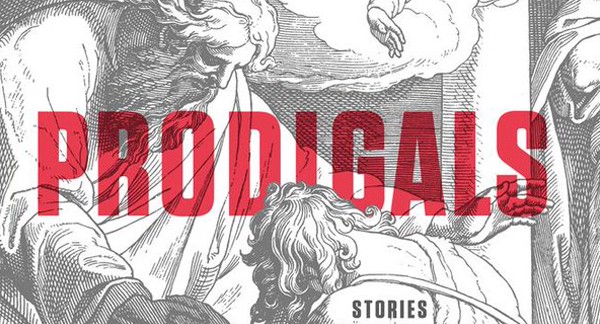
“You should not have grown wise before you grew old.” This piece of wisdom, from the last, and longest, of the eight stories in Jackson’s new collection, Prodigals, perfectly sums up the underlying current of the book. In short: Life doesn’t turn out the way you want it to, and it really sucks for those who learn that early on in adulthood.
These stories speak hard truths about being a grown up and the evolving definition of what it means to be one. The narrators are hyper-aware of the false security and knowledge that comes from having money, from schooling, from doing drugs, from having conversations, from religion, from the internet. The characters are remarkably perceptive, cynical, and defeated. But even though these stories lack hope, Jackson writes with a brutal frankness far more appealing than trying to sell the reader on happily-ever-afters.
In the first story, “Wagner in the Desert,” the narrator joins his friends for one last drug-fueled adventure before they try to have a baby. They want to take and do everything and anything, and refer to it as their ‘Baby Bucket List.’ Basically it’s free pass to treat reality with heavy doses of hallucinogens and espouse bullshit through a screen of pharmaceuticals. (When one character attempts to come up with something really deep and meaningful to say, all he manages it “I’m really stoned.”) But in actuality it’s a pathetic field trip for adults who secretly believe college was the best years of their lives but would never admit it out loud.
In “Serve-and-Volley, Near Vichy,” the narrator and his girlfriend visit with a former world-famous tennis pro who refuses to play the game any longer and instead ignores his wife and children by hiding away in his workroom. He has become convinced he may not actually exist, and infects those around him with the feeling of a shrinking reality.
In “Epithalamium,” a woman in the midst of a nasty divorce seeks to rectify her long list of regrets by surrounding herself with young people in the hopes of finding fun and joy. But having become inured to optimism and lost her capacity for happiness, she manages instead to make more of a mess of her life when she cannot hide her jealousy.
In all of the stories in “Prodigals,” the characters behave with the insight and indignation of people who have had revelations about their lives yet know they aren’t going to change. In “Dynamics in the Storm,” a couple pretends to meet for the first time while driving during a terrible storm, when in reality their relationship has already blown apart. Characters smoke in front of a woman whose husband is dying of lung cancer; they take truckloads of drugs to try and evoke happiness and a respite from reality. “The worst part of a trip, we can all agree, is the moment you have come down enough to realize you are not down all the way.”
Jackson is incredibly funny and amazingly sharp in his observations of regrets and disappointment, and the compelling stories are full of wisdom. This book has a lot of warmth in spite of the cold hard truths they tell. His characters struggle with morality in the face of a world where morals seem no longer worth having, and hopes and dreams are constantly being downgraded until they are simply stories they tell themselves to help them get through the day. “We were trying to find ways not to be villains,” one character says. These are people using the past as a salve on the present. Jackson deftly shows the nuances of adult consciousness with dark humor and compassion, and this pithy collection is a powerful debut sure to bring him recognition.
Family tragedy drew me to Cold War literary fiction.
My uncle Frank Olson died sometime around 2:30 am on November 28, 1953 when he “jumped or fell” from his room on the thirteenth floor of the Statler Hotel in New York City. The New York Medical Examiner’s report contained that ambiguous description of how Frank came to land on the sidewalk early that morning. Frank Olson was a highly skilled Army scientist who worked at Fort Detrick in Frederick, Maryland, a top secret U.S. Army facility that researched biological warfare agents. He had gone to New York to see a psychiatrist in the company of a CIA escort, Robert Lashbrook. This was all the family knew about Frank’s death for twenty-two years.
My uncle Frank Olson died sometime around 2:30 am on November 28, 1953 when he “jumped or fell” from his room on the thirteenth floor of the Statler Hotel in New York City.
Then, in June 1975, one bit of new information came to light. Buried inside a report by The Rockefeller Commission, which had been established by President Ford to investigate allegations of illegal CIA activity within the U.S., was a two-paragraph account of an army scientist who had been unwittingly given LSD and died in a fall from a hotel window in New York. To the conflicting theories that Frank Olson “jumped or fell” another possibility was added: he was dropped. Frank Olson’s death came to embody our collective fascination with the Cold War’s dark secrets, and it shined light on the dubious privileges men in the CIA gave themselves in the name of national security.
Frank Olson left behind his wife, Alice, my aunt, and three young children, Eric, Lisa, and Nils. Their lives went on, but were never the same, and Frank’s death traumatized each of them in deeply personal ways. Eric, the eldest, dedicated his life to unpacking the mystery of his father’s death.
I observed this tragedy over the years from within the tenuous intimacy of our family connection. I witnessed how my cousin Eric’s search was frustrated by an agency clinging to it secrets. None of the volumes of books on the CIA and biochemical warfare dug deeply into the minds of the men who inhabited Frank’s world — and even today questions about his death remain unanswered.
I was curious about the men who were responsible, but they remained hidden, opaque, masked. I believe that is why, some years ago, I was drawn to the literary spy novel. It put a human face on the Cold War by focusing on the psychological burdens of its characters rather than on Byzantine plot, or high politics. Doubt and paranoia bred in a culture of secrecy characterize these novels, as does a sophisticated amorality of men at the top of intelligence bureaucracies, and above all there is the strain put on family, friends, and faith. Men who work in covert operations inevitably bring some of that darkness into themselves, suffering the moral hazards of a line of work that sanctions lying, deceit, and murder — as was the case with my uncle. The interplay of state secrets and individual lives is the trademark of the genre.
We were able to measure things in the Cold War — borders, hope, annihilation. Today the enemy is stateless and violence seemingly random, which I believe, makes us nostalgic for the measurable dangers of the Cold War.
We were able to measure things in the Cold War — borders, hope, annihilation. Today the enemy is stateless and violence seemingly random, which I believe, makes us nostalgic for the measurable dangers of the Cold War. The resurgence of Cold War fiction coincides with the enormous popularity of Cold War movies, notably Bridge of Spies, and television series like The Americans. Readers can look to the literary spy novel to glide beneath the noise of headlines and see a complex world through the knowing eyes of empathetic characters. The age of surveillance in which we live makes the genre, born in the middle of the last century, feel contemporary.
Here are five literary spy novels that stand out.
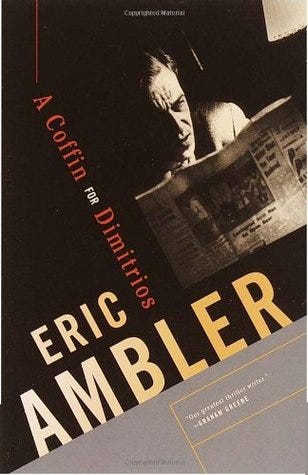
1. A Coffin for Dimitrios, Eric Ambler
The Guardian, upon the occasion of the reissuing Ambler’s work, quoted Graham Greene, who called Eric Ambler “unquestionably our best thriller writer,” and John Le Carre, who once referred to Ambler as the “source on which we all draw.”
Ambler’s first five novels, which appeared in the tumultuous years between the World Wars, relied on durable tropes — the innocent man on whom suspicion wrongly falls who must solve a mystery to clear his name, and the precarious plight of stateless individuals. Both these themes appear in his classic, A Coffin for Dimitrios (1939). Greene admired the book so much he drew upon it when he wrote his film treatment for The Third Man. It is regarded as Ambler’s most sophisticated book. The reader quickly appreciates how the book’s narrator, Charles Latimer, an English professor who writes detective stories, turns his interest in Dimitrios into a writerly obsession that results in a stunning revelation, and in the process Latimer turns from a casual investigator into a man fearing for his life. When originally published, the book stood out within the nascent canon of spy novels, mostly nationalist in tone, rightwing in their politics, and dulled by flat prose. A Coffin for Dimitrios is among the handful of spy novels that can lay claim to launching the modern genre. Fittingly, Ian Fleming winked at the novel’s influence when he had James Bond in From Russia, with Love amuse himself with the novel (with its British title, A Mask for Dimitrios) on a plane journey to Istanbul.
A Coffin for Dimitrios is among the handful of spy novels that can lay claim to launching the modern genre.
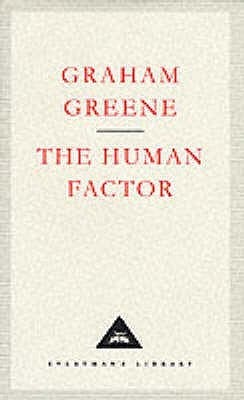
2. The Human Factor, Graham Greene
Spies figure prominently in several Graham Greene novels (usually in ways incidental to the business of spying, as in Our Man in Havana and The Quiet American), but in The Human Factor (1978) Greene takes the reader deep inside the intelligence apparatus of MI6. The England in Greene’s novel is still in the dark shadow of Kim Philby’s embarrassing defection, a country of traitorous instincts and charming manners. This wonderfully transgressive spy story has senior British intelligence officers plan to quietly dispose of one of their own rather than risk that the exposure of the man’s suspected betrayal bring public opprobrium upon the agency. Gentlemen spies talk casually of poisons as if they were talking of tea. Intelligence officer Maurice Castle, the book’s central character, slides to his fall — there is the betrayal of professional trust, his unintentional participation in the murder, and a break up of his loving family when he defects to the Soviet Union. Some of the plot points have been called unrealistic, but they are distorted to reveal the facets of Castle’s humanity. Castle’s struggle with loyalty, morality, and conscience makes The Human Factor one of the most Christian of Greene’s major novels. Greene explained himself in his memoir, Ways of Escape, this way: “I wanted to present the Service unromantically as a way of life, men going daily to their office to earn their pensions, the background much like that of any other profession — whether the bank clerk of the business director — an undangerous routine, and within each character the more important private life.”
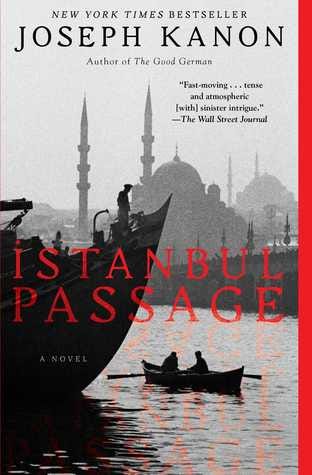
3. Istanbul Passage, Joseph Kanon
Edgar-award winning author Joseph Kanon has been called “the heir apparent to Graham Greene” by The Boston Globe. Kanon’s novels are all set in the half-decade after World War II when people and nations were called to account for their roles in the Holocaust. Kanon explores the fraught mood of that time in Istanbul Passage (2012), which was a wartime stopover for refugees and spies. Leon Bauer, an American tobacco merchant and part-time spy, undertakes one last assignment that goes fatally wrong. An exchange of gunfire leaves a body in the street and Bauer is forced to hide a defector, which draws Bauer into a tangle of shifting scrutiny, personal risk, and moral uncertainty. The novel is convincingly anchored in Istanbul’s exotic milieu and the city becomes a character, in much the same way Greene used grim, gray Vienna to good purpose in The Third Man.
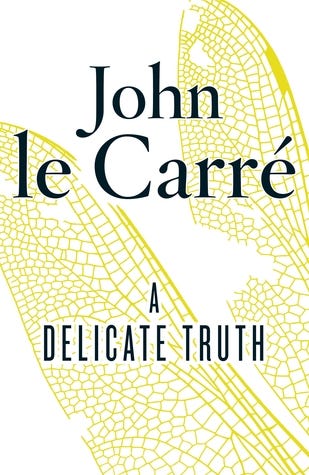
4. A Delicate Truth, John Le Carré
Through his 50 year career Le Carré has anatomized British society in soul searching novels that now, some argue, were cunningly disguised as escapist spy fiction. His preoccupation with the world of intelligence agencies might seem like a narrow focus, but in that lens he has explored modern life. His intelligence officers are outsiders inside corrupt bureaucracy and his books take on a world that sanctions lies and deceits as a way to shed light on those human impulses. In A Delicate Truth (2013), Toby Bell, private secretary to the Foreign Office minister, happens upon the cover-up of a disastrous anti-terrorist raid conducted unofficially by a contract operations team that mistakenly killed civilians. Exposing the cover-up threatens powerful forces. A Delicate Truth is about deception and skullduggery at the highest levels of democratic government. The book examines the ambiguous morality of using deceit in the defense of truth and violence in pursuit of peace. Le Carré has said A Delicate Truth is the personal favorite among his novels. The Daily Telegraph has called Le Carré “our greatest living novelist.”
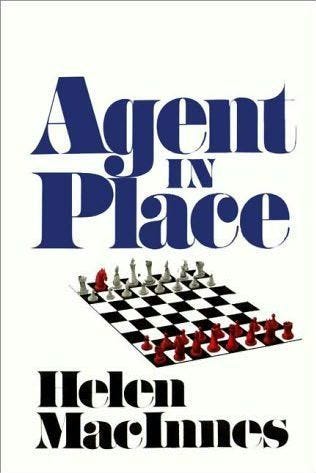
5. Agent in Place, Helen MacInnes
There are a few accomplished women writers of the espionage thriller, notably Stella Remington, who was the first ever female director of MI5, the British domestic spying arm, and of course, Helen MacInnes, whose 21 novels spanned the Cold War.
The spy genre, perhaps more than any other gene, has been the province of men, often men who once served in the intelligence community. There are a few accomplished women writers of the espionage thriller, notably Stella Remington, who was the first ever female director of MI5, the British domestic spying arm, and of course, Helen MacInnes, whose 21 novels spanned the Cold War. Her husband, Gilbert Highet, a classics professor at Columbia University, had been a MI6 intelligence officer World War II, and provided MacInnes with insight that enriched the detail of her novels. Agent in Place is set during the Cold War détente years of the mid-1970’s. At the start a Russian ‘sleeper’ agent has orchestrated the leak of the innocuous first part of a NATO memo to Tom Kelso, a Times journalist, in order to get the second and third parts which will give the Soviets information to unmask important Western agents. MacInnes’s heroes, like Ambler’s, are often wrongly accused innocent men who need to solve a crime to clear their name. In this case, Kelso, his integrity questioned in the leak of the NATO memo, begins a painful family affair of betrayal and loss, while a trusted friend, British agent, Tony Lawton, comes to his aid and hunts down the traitor. MacInnes is a witty writer who drapes the action of her novels with keenly observed social bunting.
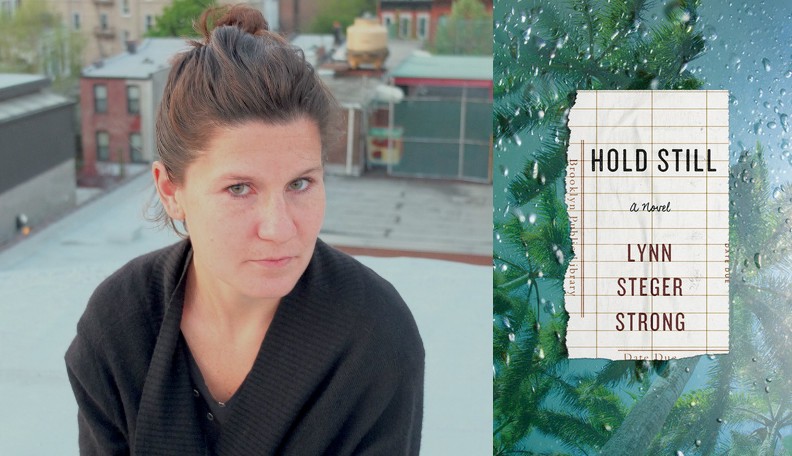
I’m holding two things when I walk into a dark cocktail bar in Fort Greene, Brooklyn to meet Lynn Steger Strong for drinks: a finished copy of her debut novel, Hold Still (Liveright, 2016), and my unbound manuscript, still many moons from finished, which I’ve been noodling on during the train ride. Strong has no interest in talking about her own book, which is seventeen days from publication. She has no interest in promoting herself; in fact, she shies a bit when she sees the hardcover, and instead reaches for my work on the table, pushing her book aside. She asks me to tell her everything.
I haven’t been friends with Strong for very long, only since meeting her while co-teaching a conference in December, but this interaction is entirely emblematic of the person I know her to be. She is humble and gracious, and seems to scarcely believe that the good things that happen to her are deserved.
Yet Strong has written a book that is very much worthy of the praise it has received, and will continue to garner. Hold Still is a tender novel with a resonant emotional core that follows one family after an accident that tears at the fibers of their life. It is gripping without ever reaching toward the spectacular; and its lyrical, undulating prose never calls attention to itself, nor screams out wishing for you to applaud after each hard stop. In these moments, Hold Still is at its most accomplished.
Forty-five minutes into our meeting, Strong agreed to allow me to turn on the recorder, placing it atop our pile of writing, and we dove in.
Meredith Turits: There’s quite a contrast here between your finished book and my pile of draft pages — what does seeing an unbound manuscript make you feel again? Does it freak you out that it’s a process you’ll have to begin again at some point?
Lynn Steger Strong: I want to take it from you and be like, “Let’s talk about it!” It makes me so much more excited. I’m a person who likes that control, and right now I have no control, and it’s terrifying, whereas with that … the teacher in me comes out. The worker, too. I can do work. The object? I don’t know how to do object. I only know how to do work.
MT: Do you feel nervous about the promotional end of this?
LSS: Yes. And also, at a certain point, I had to stop thinking that a bound object was what I was interested in, because I wasn’t sure a bound object would happen. I had to keep writing, so it had to be about work all the time. Now whenever writing is not about working, I’m afraid I’m not a writer anymore. Even though this is where I’m supposed to be validated as a writer, I feel like the only way I’m a writer is if I’m working, and because I’m working on my other jobs and being an object in some ways, I miss writing. I miss engaging aggressively with words.
MT: What makes someone a writer?
LSS: I think engaging aggressively with words.
MT: So, in your definition, then, you’ve lapsed as a writer?
LSS: Although last year I would have said I wasn’t a writer, because all I had was a Word document that I cared for. I would have just said, “I’m a teacher.” But now I don’t want to say, “I’m a writer” because I feel like I’m bragging.
MT: So, then it’s an identity you’re afraid to engage with?
LSS: Yes, because writers are everything, and books are everything — well, maybe not anymore — but they were for a really long time, so the idea that I have the hubris to try to make one still feels insane.
MT: At what point did you decide, “I will try to make one,” or was this something that you always just worked toward?
LSS: In college I had this spewing of feelings into a Word document where all I did all day was read, and I didn’t talk to anybody. It was like my talking — I just typed and typed and typed. I was pre-law or something, and I didn’t understand that reading could be something you did with your life. I didn’t know that was allowed. So I just typed and typed and typed and I had all of these pages, and I was not liking the pre-law track, and so I found my way to giving myself permission to write. I was okay with it partially because I was other things, too — you know, “I want to be a writer, but I’m a waitress!” or “I want to be a writer, but I’m [insert difficult thing here].”
MT: If engaging with or manipulating the prose is the thing that’s kind of the most exciting or validating, tell me what the process of editing for you is like. When you have to relinquish the main role of being in charge of the course of the book, or the final draft, what is that like?
LSS: I think by the time it got to edits with Katie [Adams at Liveright], I trusted that we wanted the same thing … I understood that I didn’t necessarily know what had to get cut, because I loved so many parts, and I loved the people. Like, when I finished the last Ferrante novel, I understood that — I loved the people so much and I didn’t want to go away from them. But that’s not the most productive decision you can make. I understood that I needed someone who could step outside of it and tell me. And I trusted the editor who was telling it to me, so when she said “Cut,” I did.
MT: I know a little bit about you, and I know there are definitely elements of you that are in this story. What does it feel like to detach yourself from those elements and work with them as parts of character?
LSS: I think I think of those parts — these things that are really close to me — as great gifts. When I gave Maya, my main character, anxiety, which I can deeply relate to, I also gave her the ability to go for long runs and relieve that anxiety. It felt like the least I could do. I feel connected to these characters the way I feel connected to a dear friend with whom I have similarities. I see things in the friend that I respect and admire, and I want to support them as a friend.
MT: Does it make it harder to edit or see with objective eyes or cut anything when you’re working with a character you deeply understand and respect?
I wanted to write complex characters who sometimes do bad things.
LSS: Yeah. When you write a character who is like yourself or someone you know, you don’t want it to be reduced down to something like, She’s crazy or She’s a bad mom, or She’s a good mom with a bad daughter. I wanted to write complex characters who sometimes do bad things. I wanted to put something on every page that was like, Just remember, they’re a human! There’s a paragraph that’s like, They’re doing the best they can, but sometimes the best you can do fall short. That’s the most terrifying part. But you fall in love with these people and you hope that you made them nuanced enough that people won’t reduce them down.
MT: Is it hard to leave them now in this permanent world and know that their story has ended?
LSS: No. I love them, and I love that this is the book that is introducing me as a writer, and that these are the characters that are saying that. But I’m ready to work. I’m ready to go somewhere new.
As if it isn’t already difficult enough to win a literary contest, writers who submit fiction to The Nikkei Hoshi Shinichi Literary Award competition in Japan have to contend against robots.
As the LA Times reports, four out of more than 1,400 entries to the competition — which accepts submissions from robots as well as people and is named for Japanese Sci-Fi writer Hoshi Shinichi — were co-authored by computers. Although it didn’t win the award, one hybrid work was selected by blind judges to move on past the first round.
According to Hitoshi Matsubara, the professor who led the team of researchers and robots responsible for the successful cyborg entry, humans performed about 80% of the work for the hybrid novels. As The Japan News explains, researchers came up with the story’s major parameters, like its plot and the gender of its characters. They then harvested words and phrases from a (human-written) novel and compiled them into an extensive archive. Using this archive, the computer created sentences and assembled them into a story based on the humans’ outline.
Writers who are full of ideas but can’t get them down on paper shouldn’t rejoice just yet. Matsubara told The Asahi Shimbun that there are still “many problems to iron out.” Sci-Fi novelist Satoshi Hase, who read the cyborg stories, agrees. Although Hase was surprised at how “well-structured” the robot novels were, he noted that there are still “some problems…such as character descriptions.”
The Japan News reports that one of the AI entries was appropriately titled, “The Day a Computer Writes a Novel.” Decide for yourself if this excerpt from the story is cause for concern: “The day a computer wrote a novel. The computer, placing priority on the pursuit of its own joy, stopped working for humans.”
“And So, We Commence”by J. Robert Lennon and“Captain Stubing Has Collapsed”by Rob McCleary are featured in the 200th issue of Recommended Reading, along with pieces by Morgan Parker and Téa Obreht. To commemorate the 200th issue, dubbed “The 200 Episode Club,” the writers were asked to write about the 200th episode of a sitcom.
Chelsea Baumgarten: The idea for this project was to write about the 200th episode of a sitcom. Why did you choose to write about The Cosby Show? How do you think fiction writers can contribute to a political, and often very sensitive, conversation like the one that surrounds Bill Cosby?
J. Robert Lennon: I tend to steer away from politics in my fiction, so The Cosby Show seems like a weird choice in retrospect. It was an interesting technical challenge, and once I got the idea, I couldn’t turn away from it. The train wreck that is Cosby just seemed so fascinating to me: the cruelty, the delusion, the lies. The anger and resentment he must have felt to put so many women through such humiliation. And his having to act on so many levels — many of the rapes were, astoundingly, fake auditions. I mean, who knows what was going through the real guy’s head all those times he was pretending to be America’s greatest dad — maybe just some great, roaring cognitive-dissonance wind — but I wanted to take a stab at imagining it.
CB: In “And So, We Commence,” Cosby, or Cliff, views his public persona–wholesome, funny TV dad–as the “real” him and his private persona–a serial rapist–as a role he plays. Eventually the two become inseparable and he can’t identify what’s real. Can you talk about this approach to writing your piece, and about the fragmentation and self-denial of Cliff?
JRL: I guess a writer wants — needs — to think that even the most despicable person is worthy of understanding, compassion, even. And maybe that’s my answer to your earlier question, about writers contributing to a sensitive conversation. For me, understanding is the only real entry into a character — even one, like Cosby, whose crimes I despise, and one I feel, like a lot of people, personally betrayed by. He made me laugh so much! I ground the grooves to dust on his first few standup records. I feel shaped by his humor — it’s in my blood. And now I want it out. So I guess my move was to imagine that maybe, at some point, Cosby would have preferred to be Cliff, would want to remain Cliff, rather than to return, permanently, to the self that felt compelled to rape. I had to believe that to want to write about him. And believing that let me feel the drama of the curtain call — that final moment when the game was finally up.
CB: Rob, in “Captain Stubing Has Collapsed,” you riff off of Frank O’Hara’s, “Poem [Lana Turner has collapsed!].” O’Hara, who famously loved visual art and film, often addressed popular culture and celebrity life with his poetry. Some writers, however, are hesitant to do so. What do you think writers can gain from engaging with popular culture in their work?
Rob McCleary: I think the issue isn’t what the author stands to gain from engaging popular culture as what they stand to loose from making an arbitrary point of not engaging it. The idea that there is a hard stop between “popular culture” and art appeals to our need to believe that there is a hierarchy of creativity, beginning with weighty novels about “important” subjects, and descending in order through film to television, then to all forms of internet expression, bottoming out at the lowly, self-published Kindle. (Sorry lowly, self-published Kindle. I’m not picking on you, I’m just trying to make a point.)
Mainstream publishing is happy to play along with this consoling illusion because they haven’t figured out a way to monetize the mashup culture which has come to dominate our world like film, television, and the internet have. They are happy to reinforce our timid, childish belief in life as a meritocracy where only the best works of art get attention, and they can perish the idea that someone could’ve written a best seller, an important cultural statement, or a deep insight into our current condition that will never see the light of day.
Not engaging popular culture as a point of honor makes about as much sense as refusing to like a Taylor Swift song for the sole reason that it’s a Taylor Swift song. It also protects us from the frightening reality that creativity does not observe arbitrary rules, formats, human-imposed hierarchies of importance, cultural norms, or even the shared social construct we refer to adorably as “reality.” It protects us from the fact that we now live in a post-McLuhan world where the medium is no longer the message, the medium is irrelevant. And if you cannot accept that, you risk becoming irrelevant.
CB: Frank Sinatra, Andy Warhol, Lana Turner, and Captain Stubing all collapse in your piece, and the eventual collapse of The Love Boat series itself also looms. There is something so sad and powerful in the lines, “Frank Sinatra does not know why the Frank Sinatra records no longer sell,” and, “Andy Warhol has had enough of Andy Warhol.” What do you think we invest in celebrity personas, and why are we so affected by their downfalls?
RM: Celebrity is, at it’s atomic level, fame. And fame is one of the currencies of status, the secret, shameful obsession of human society. In his book Status Anxiety, Alain de Botton states:
“Every adult life could be said to be defined by two great love stories. The first — the story of our quest for sexual love — is well known…it is socially accepted and celebrated. The second — the story of our quest for love from the world — is a more secret and shameful tale. If mentioned, it tends to be in caustic, mocking terms, as something of interest chiefly to envious or deficient souls…. And yet this second love story is no less intense that the first, it is no less complicated, important or universal, and its setback are no less painful. There is heartbreak here too.”
It’s a cliché to say the trials and failures and destruction of modern day celebrities is our Greek tragedy, which does not automatically make it any less true. Scholar Bruce Meyer states that tragedy in the Greek sense is impossible in our western, Christian universe. God is Santa Claus. Always looking out for us. Omniscient. Helping professional athletes catch Super Bowl winning passes. Deciding that dum dums like George W. Bush should ascend irresistibly to the Presidency. In the light of our everyday struggles and pointless sufferings we are presented with some real head scratchers. Did God hate the loosing Super Bowl team? If God cured my kid’s leukemia, couldn’t we have all saved a lot of time and effort by Him simply not giving them leukemia in the first place? Enter celebrity tragedy with the answers.
God is supposed to provide us with the satisfying, ordered (therefore comic) resolution to all our problems. Celebrity train wrecks reflect the reality of the bullshit tragedy of our day-to-day lives, flawed to its core, like us. Self-sabotaging, imbecilic, and above all consumed with the sort of singular narcissism that makes us believe there’s a God concerned with the utterly dreary minutiae of our daily lives. We are obsessed with celebrity culture not because we are obsessed with celebrities. We our obsessed with celebrity culture because we are obsessed with ourselves.
Cynthia D’Aprix Sweeney, a debut novelist in her 50s, worked for many years as a nonfiction writer before taking a serious stab at fiction at the age of 48, with the encouragement of her friends and husband. She attended the low residency MFA program at Bennington College, where she began work on her novel, The Nest, which was subsequently sold in a seven figure deal to Ecco.
The Nest tells the story of the dysfunctional Plumb family through the struggles of adult siblings Melody, Beatrice (Bea), Jack, and Leo, as they battle over an endangered large family inheritance. It’s a deftly told, and sometimes humorous, tale about overcoming old resentments and growing up emotionally as a family and as individuals.
I had the pleasure of meeting with Cynthia D’Aprix Sweeney over coffee and pretzel croissants at the bustling City Bakery in New York on a recent weekday before her book launched. She is a humble and grateful writer, as well as a warm and funny person. We talked about the importance of writers (and friends) helping each other out along the way, about self doubt and breaking down writing myths, and about the importance of dedicating yourself to your passions when the time is right for you.
Catherine LaSota:You’ve said that writing fiction or writing a novel was a secret goal of yours. Why secret?
Cynthia D’Aprix Sweeney: I wouldn’t say it was a secret goal — it wasn’t like I spent all these years secretly wanting to write a novel. I spent a lot of years thinking that it wasn’t something I wanted to do, I think sort of as a protective mechanism. Because I didn’t think I could. I tried writing fiction in my late twenties in a very half-assed sort of way, and, unsurprisingly, was unsuccessful at it. And I just sort of convinced myself that I loved fiction, I loved reading, and it’s a really important part of my life as an observer, but not something that I could actually do.
CL:Because you thought you couldn’t?
CDS: Yeah. I just thought that if I tried, and I really couldn’t, then I wouldn’t love fiction anymore. It was such an elaborate labyrinth of defense mechanisms. But then I was trying to get out of corporate marketing writing and do something else, and I was writing personal essays, and I liked that, I loved that. But, I quickly realized I don’t love writing about myself.
CL:Why do you think that is?
CDS: Because I don’t think I’m all that fascinating! And, I’m not comfortable exposing people in my life who don’t choose that. Also, this time period was around 2003, 2004, and it was really the rise of, the proliferation of, personal blogs, and personal essays, and mommy blogs, that, as a reader, were in ways really, really enjoyable. But I knew I was never going to write about my kids — it felt like such an intrusion, a violation of privacy. You know, they’re old enough to understand.
CL:It’s interesting that you’re not comfortable with exposing the people in your life through your writing, because that very thing happens with the characters in your book: one character exposes another’s secrets through her fiction writing.
CDS: I wrote something for the Times Magazine when they had a one-page humor column called “True Life Tales.” It was just a funny story about me taking the kids to a museum in New Jersey, and they wanted to go through the public touch tunnel–it’s like sight deprivation, and you literally need to crawl through on your hands and knees.
CL:That sounds terrifying.
CDS: It’s terrifying! But it was a funny recounting of that story, and they ended up not taking it, but I worked on it for a while because this editor really liked it. And my older son was probably 10 or 11 then, and he read it, and he said, “Oh, my teachers are going to read this!” It was something funny he said that was in there, and it didn’t feel like it would be embarrassing to me, but it was to him. It was a real moment of, oh yeah, they have their own lives, and their own embarrassments, and their own social circles, and that’s not cool for me to be exploiting what I think is hilarious about them.
CL:Maybe your kids will write their own stories someday.
…that first thing I wrote was terrible, and I knew it was terrible. But the difference for me between trying it when I was 28 and trying it when I was 45 was that I realized that terrible didn’t mean I couldn’t do it.
CDS: Maybe they will! So anyway, I did place something else on the “True Life Tales” page, and I was trying to figure out how to write the things I wanted to write that could actually be published somewhere. I was working on a different essay, about a friend of mine who had died, and I couldn’t place it anywhere, but I got some nice rejections. I showed them to my friend Liza, who had her MFA from Columbia and was just on the other side of having two small kids, and she wanted to start a writing group to get herself back into writing. She read my essay and said, “I think you should just write it as a short story.” And I said, “oh, I can’t write fiction, I’m not going to do that.” And she said, “What are you talking about?” She was so dismissive and incredulous about that thought. She said, just do it and let me read it and I’ll help you figure out, and if you’re not doing something right, I’ll tell you, and I’ll give you writing exercises. So I did. And that first thing I wrote was terrible, and I knew it was terrible. But the difference for me between trying it when I was 28 and trying it when I was 45 was that I realized that terrible didn’t mean I couldn’t do it. It just meant I had to work harder on it. I was like, oh yeah, of course. And there was one page that I wrote and I thought, that’s one page I’m not embarrassed by. If I can do one page, I can do 15 — I just have to spend time on it.
CL:That fear of not being able to do it–I think all writers go up against that fear at some point, often throughout their whole lives. How do you get past that fear?
CDS: For me, it felt presumptuous. I didn’t grow up knowing people who were artists. It kind of felt like saying, I’m going to be an actress, or, I’m going to be an astronaut.
CL:But people actually do those things!
CDS: I know! Once I let go of that, I was just like, oh yeah, this is just like any other writing I do — it’s just time and knowledge and figuring out what the craft tools are, and putting in time.
CL:It sounds like having your friend, someone who was outside of your writing, encouraging you, was very important.
CDS: Right. That’s the story of my life the last seven years up until this point, just having a lot of outside people say, “Why aren’t you doing this? What’s wrong with you?”
CL:Did it have to reach a critical mass of people saying that? Did you have to hear it a certain number of times to believe you could write fiction, to act on that encouragement?
CDS: My kids were getting older, and the work that I was doing when my kids were younger was not particularly lucrative. It was more that I needed to be working to maintain my sanity and be out in the world. So once I didn’t need the flexibility of that work anymore, I really wanted to commit more fully to a career, and I knew I didn’t want it to be the thing that I’d been doing. Or, if it was going to be the thing that I’d been doing, I needed to find a way to make it more interesting. And then that just happened to coincide with me having people in my life who were going through the same thing in different ways and different places, and all of us kind of supported one another.
I’m friends with Jill Soloway, and she would repeatedly say to me around this time, “You are a beautiful writer. Why aren’t you spending more time writing what you want to write?” We had an internet group of women all over the country who were all connected in some way, and we had a private website that only we could access, and we checked in every day. Sometimes we posted work, but it was mostly just discussion, and working out problems, both personal and professional, and parenting, and relationships, all of that stuff. Everyone was creative and feeling isolated for whatever reason, so it quickly became this very intense, intimate, wonderfully supportive group. Like what I imagine consciousness-raising to be in the 70s–and maybe it was, I was a kid then, so! (laughs) It was fun, because everyone was a really good writer. It was fun to do, to hang out in a virtual space with people who are funny and clever and honest.
CL:That’s so smart, because there are people who try to get writing groups together–myself included–and just coming together to talk about your work all the time…
CDS: It’s a drag!
CL: It’s a drag!
CDS: It’s really true, and I think I really needed that in that point in my life. I really needed people who were already creatively successful to be saying well, you should be doing this, too.
CL:Like they were bringing you into the fold?
CDS: Yeah, or just saying, what are you afraid of? And then I finally went, “yeah, what AM I afraid of? I’m not a lost, possibly slightly depressed, 28 year old — I can probably figure this out.” It was really empowering. I feel really lucky to have had so many people, during the last seven years, who have really encouraged me.
My husband is my biggest fan and cheerleader, and I think he was always kind of frustrated that I didn’t commit to doing something creative a little sooner, and so when I did he was really excited.
CL:This sounds so familiar.
CDS: Good! Good! I think it’s a really common story. And I can tell you from doing the low residency program at Bennington that it is a common story. And sort of the same trajectory: you know, I tried it when I was younger, and I wasn’t really successful at it, and I hated everything I wrote, and so I gave up, and then I had another job, and then I had some kids, and now I’ve got some time, and I’m going to try again. And I don’t think it’s a bad thing, because there are certainly pitfalls to committing to that when you’re really young. You’ve got some years probably when there’s not really a lot going on.
CL:Or you’re still trying to figure yourself out…
CDS: Who you are, what you’re writing about. And what you are about. I mean, obviously, there are people who are the exception. I’m reading The Girls by Emma Cline right now, and there’s someone who’s figured out a lot of shit at 26.
CL:You could say, well, why was I not that way, where I could figure it out when I was that young? But you’re a different person, and you write different things, and you have a different life.
CDS: Exactly, exactly, exactly. It’s really hard to let go of that. I think that moving to Los Angeles was also huge for me because all of my friends out there are creative people who are sort of hobbling it together without such a great attachment to the result, because that’s what you have to do if you’re in comedy, or in television. It’s not quite as precious, and that was really inspiring to me, just seeing my friends work so hard on things that would maybe have no outcome, but be really invested in, well, this is what you do, this is your job. You’re just doing it every day, you’re saying yes to pretty much everything.
CL:Why do you think it’s like that in LA and not in New York?
CDS: I think Los Angeles is a place where the boundaries are more liquid, and the firmament isn’t so set. I absolutely believed, especially when I lived in Park Slope, and having so many friends who are writers, that that should consume me, and I wasn’t on it.
CL: Like you had your identity and writing fiction wasn’t it?
It’s just more rigid in New York, at least that’s my perception. Los Angeles is a town of people who are constantly reinventing themselves.
CDS: Like my friends who were writers had started really young, and that was their path, and this is their reward, and there was no entryway onto that. The opposite is true in Los Angeles. It’s not a straight shot for everybody. Everybody is up and down. You could be writing for a show, and then the show ends, and you’re back at ground zero. The next time you’re looking for a job, it could take you six months, it could take you years–so, in the meantime, you’re going to fill in here or fill in there, or maybe start a podcast. It’s just more rigid in New York, at least that’s my perception. Los Angeles is a town of people who are constantly reinventing themselves. You can literally be a waitress one day and the star of a TV show the next day. You can be 65 years old and be cast in a movie and all of a sudden have a career.
CL:You lived in New York for about 25 years, and then moved to Los Angeles and wrote this novel, The Nest, that takes place in New York. Even though you had lived in the city for more than two decades, with a place like New York, you can live here forever and never figure it all out. Did you find yourself doing much research for The Nest, and did you enjoy that process?
CDS: Yeah, I did a lot of research. I don’t know how you write fiction without doing research. The job is so much harder if you’re not doing research, because research gives you details, which is what you need to make it feel true. And it’s so easy. You have no excuse for not doing research if you’re a writer, because the internet!
I’ve been a writer for a long time, a nonfiction writer, and when I started freelance writing, if you wanted to do research, someone in the office had to have a subscription to LexisNexis, or you had to go to the library and look things up on microfiche.
CL:I remember microfiche! There’s something very romantic about researching that way, the way you can discover things.
CDS: There is something very romantic. Really early on in my career, I was writing about the Statue of Liberty, and I got to go out on the island and do research in their private library, and they have these enormous bound journals of old newspapers. It was really cool. I was able to read the newspapers on the day that the statue opened up.
CL:Let’s talk some more about the writing of this book and what led up to that. Why did you decide to pursue an MFA?
CDS: I started writing fiction here in New York, and then I got sidetracked for about a year when I moved my family out to Los Angeles. I picked it back up once we were settled in Los Angeles, and I felt like, ok, I’m 48, I’m giving myself one year to figure this out, one year to really commit to writing fiction, and at the end of the year I have to say yes, this is the thing I’m going to focus on, or I have to figure out what else I’m focusing on. I took classes at the UCLA Writers Extension, and because UCLA was so far from my house, I was doing it online, and I realized I wanted to be in an actual classroom, not a virtual classroom. I heard about low residency MFA programs, so I applied to programs. I decided to go to Bennington, and that was great, that was life changing
CL:What did the MFA program give you?
CDS: Deadlines. Community. Feedback.
CL:Different community than you had with the online friends, and the workshops?
CDS: Yeah, because I didn’t really know any fiction writers. Bennington really allowed me to prioritize fiction writing in my life in a major way, because I’d made this commitment, I wasn’t going to blow it. I was really determined to get everything I could out of that program, and to learn as much as I could, and take advantage of every opportunity that was given to me. I did, and it was exhilarating. It was just really thrilling. I still have this feeling every day where I’m, like, my job is reading books!
CL:Isn’t that awesome?
CDS: Yes! I so vividly remember that first term at Bennington. I was very nervous about the amount of work I had to generate every month, but I also thought, I am required to sit in this office and read fiction for several hours a day. I honestly felt like a fairy godmother had made my wish come true. It was really amazing. I had great teachers, and teachers whose reading and writing aesthetics were very different than mine in some cases. It was really valuable to have someone hand me a reading list of people I never would have gravitated to on my own.
And then just being at the residency, there are ten-day residencies — that felt like such an incredible luxury to me. Even though you’re staying in a dorm room, you think, I have my own room! I don’t have to think abut what other people are eating all day for ten days. I only have to spend every day, morning to night, talking about fiction, hearing about fiction, listening to the guest lectures, meeting with faculty, and it was…exhilarating is the only word I can think of.
CL:You worked with Bret Anthony Johnston while at Bennington?
CDS: I did. I was in his workshop in second term. Paul Yoon was my teacher, and Paul and Bret ran the workshop together, and I got to know Bret then, and we became friends. Then he was my thesis advisor a year later. I had started working on The Nest just a couple of months before that. I thought it was going to be a short story. I was having a really hard time with it. It very different in tone than the stories I had been writing.
CL: How so?
CDS: I think I was doing the thing that most people do when they get into an MFA program, trying to write more “literary,” trying to mimic the people who are venerated, which I think is not a bad exercise. So the things I’d been writing were a little bleaker–I mean, humor always crept in, but it was always a little more wry than actual funny, and they were sadder.
CL:Did you enjoy them as much?
CDS: No, I did not (laughs). So I started The Nest, and it was just coming out in a different kind of voice, probably more akin to the type of voice I was writing before coming to Bennington. I sent it to Bret, and I was pretty sure that he was going to say, no, let’s put this one aside. I thought he’d say, let’s go back and work on your old stuff. But he called me up and said, “I think you’re having a hard time with this because I don’t think it’s a short story. I think it’s the beginning of a novel, and, I don’t want to freak you out, but if you can do this for 300 pages, someone’s going to want to publish this book. Why don’t we just work on this for the next three months?”
CL:What did it sound like to you when he said that?
CDS: I felt someone took handcuffs off! I wasn’t looking forward to working on the stories that I’d already written. There were two that I liked, but I’d been working on those since before I’d applied to Bennington, and they were so sad.
CL:What work had you applied to Bennington with?
CDS: I applied with the story that came out of the personal essay that I couldn’t sell, and I applied with something else that was a little lighter. I was really excited (when Bret encouraged me to keep working on The Nest). When I sent it to him, I said, “this is my favorite thing that I’ve done while I’m here.”
CL:That’s probably a good thing to recognize, right?
CDS: Yeah, but I also knew Bret. We were friends, he’s an amazing teacher, and he was in the final weeks of finishing Remember Me Like This. We had a shorthand already about writing and reading — we think the same way about writing and what’s important in writing, we talk about books a lot, and we generally agree on stuff, so I knew it was just going to be a brain dump. I knew he was going to teach me everything he had figured out about writing a novel in three short months, he was going to help me. And he did. I learned a lot. So when I graduated I had like 125 pages that I’d written, which was great.
CL:That is awesome. Was there a lot that surprised you in the course of writing the novel?
CDS: Everything!
CL:The novel opens with this scene of siblings starting in separate bars, and then coming together for lunch. Did you have any kind of a mapping out after that of specific points you wanted to hit?
CDS: In that first conversation with Bret, I said, “how much do I need to know about the ending?” And he said, “All you need to know is where you want to leave off each character emotionally. Not what’s happening plot-wise, but where do you want to leave them emotionally?” He also asked me if I knew where Leo would end up, and I did have an idea about that. A little past the halfway mark in writing it, I figured out what was going to happen for the rest of the book, in very broad strokes.
CL:Did the writing become easier or more difficult at that point?
CDS: It almost becomes harder, not quite as fun, because you’re not discovering as much stuff. I think when you reach the point in the first draft where you are just writing what you know is going to happen, that becomes harder, and I really slowed down. And I actually went away for a week by myself, because I really felt that I just had to fucking get through it. And then once that’s done, you go back, and then it becomes fun again, because then you start to see things you didn’t notice before, and threads that you can pull back, and pull forward. That’s my favorite part.
CL:You chose to write about four siblings in The Nest, and you have a book trailer where your friends are talking about their relationships with their siblings. Do you have any siblings?
CDS: I have three siblings. I’m the oldest of four.
CL:You’re Leo!
CDS: I am Leo! And I realized in horror halfway through the writing of the book that I am a Leo. How awfully Freudian is that?
CL:Yeah, but you’re not writing an autobiographical novel.
CDS: No, I’m not. And when I first started, there were three siblings, and then I realized the dynamic of four siblings is so deeply ingrained in me that I wanted there to be four, because I know how that works.
CL: Were any of the characters more difficult for you to write than others?
CDS: Melody was the most difficult for me to write. She came out in the first draft a little too cliché, a little too suburban housewife, status-conscious, a little more of a type. I really worked on her in the revision. I did a lot of work, trying to make her a more rounded person.
CL:She’s now a very sympathetic character in a lot a ways. She’s a fighter, and she works very hard.
CDS: Yeah, I think so. I think I just hadn’t tapped into that part of her for whatever reason. Also, in the first draft, Bea was a poet, which was such a ludicrous decision on my part. I didn’t want to write about a fiction writer, I thought that was…
CL:…a taboo thing for a fiction writer to write about?
CDS: Yeah. And Bret kept saying to me, “I don’t know if this is going to work.” And he read the first draft, and he said, I have to tell you, it’s not working. We talked about ways to fix it, and once I just gave in to making Bea a fiction writer, the story came so fast, it was so much fun to write. It was a really good lesson for me in not thinking about how something was going to be received, and just writing what makes the most sense to you.
CL:It sounds like you went through a series of breaking down fears about what you should or shouldn’t do: a fear of writing fiction, and a fear of writing about a fiction writer in your fiction.
CDS: I think that there are things, especially in an MFA program, that you hear all the time. One of them is, you can be sitting in workshop, and someone will be writing a story about someone writing their first book. So you kind of absorb the message that this is a first novel trope that you should avoid. But I think that is usually in the context of someone who is young, writing an autobiographical novel.
So when I was doing the revising, and once I realized that I’d put this artificial constraint on myself with Bea, and that it wasn’t good for the book, I really just popped the clutch. I thought, no one might ever buy this book, no one might ever read it, it might just be my “drawer novel,” so I’m just going to write whatever the fuck I want to write. I’m just writing to make myself happy.
CL:And then you sold the book! And people seem to love it.
The book takes place in New York City, it references the publishing world, there’s a literary agent as a character, there’s a fiction writer–I thought, no one is even going to ask to read this thing…
CDS: I’m going to have to remind myself of that a lot in the coming months. When I started writing a query letter, when I was looking for an agent, I thought, “I’m sunk!” The book takes place in New York City, it references the publishing world, there’s a literary agent as a character, there’s a fiction writer–I thought, no one is even going to ask to read this thing, or they’re going to read the first ten pages and get to the literary agent having a conversation with Bea, and I kept joking with Bret that they were going to leave it on the subway, on a subway bench. I just thought, I really thought, man, this is not the way to write a book that someone’s going to be interested in.
CL:You were wrong.
CDS: I was wrong. But when you read about finding an agent or what agents look for, it’s like, “well, I don’t want another book that takes place in New York City about someone trying to sell their novel.” I get what they’re talking about, but it’s very easy to let all of those voices come into your head in ways that don’t even apply to you.
CL:Well, there are all kinds of writing rules that exist because a lot of it is done badly, but you can also do anything, really, if you do good work.
CDS: Exactly. If you work hard enough on it, you can do whatever you want.
CL:Are you excited for your book tour?
CDS: I’m excited about it. I like talking with people about the book. I’ve been doing bookseller stuff, and that’s been really fun. Booksellers rock, and they’re so thoughtful, and interested, and I love hearing their thoughts about the book, and everyone wants to tell me their family money problems, and that’s awesome.
So, yeah, it’s fun to interact with people, with readers.
CL:I love that you say booksellers rock. They’re kind of the ultimate readers.
CDS: Bookstores are the best! My real secret desire is to have a bookstore. Maybe someday. I just love booksellers — those guys are so smart, and they’re so committed and passionate. That’s really been, so far, the best stuff I’ve been doing for the book.
CL:So what’s your writing practice like now? Do you have a routine?
CDS: I do. I like to write pretty early in the morning. Depending on where I am in the work process, I can write for two, maybe three, hours, and then I read or do research, and then sometimes, if things are going really well, I go back to the document again in the later afternoon. That happens when I’m deep into revision more than when I’m in a first draft.
CL: Are you working on new material now while you are touring?
CDS: Yeah, I’m trying to get a new book going. I’m at the very beginning, so it’s going very slowly. But it’s going.
Toller’s mother withdrew from the world at the age of forty-five, when Toller’s parents moved to California after Toller’s father accepted a job with a computer company in Santa Clara. Toller’s mother instantly found the region to be uncongenial, and retired to her bedroom, where she would stay, more or less, for the next twenty years. Toller himself was young then, in the pride of life, and to the extent that he was aware at all of his mother’s reclusiveness he assumed that since she was now old, she had every reason to stop being an active participant in life. Toller’s father was absorbed in his work and either paid little attention to his wife’s increasingly eccentric behavior or did not confide in his son about his concerns.
After Toller graduated from college, he and the girlfriend he’d had since his sophomore year broke up and Toller decided to follow his parents to California, having heard, as everyone used to hear, about how inexpensive and easygoing it was in the Bay Area.
“Great,” his father said. “Can’t wait to be able to see you all the time, sport.”
“Oh, Toller,” his mother said, “why would you want to come to this miserable place?”
Toller came anyway, bouncing around for his first few months before settling in the East Bay, in Rockridge, where he took a room in a big house on Bryant Avenue he shared with four other people. Once a month or so he borrowed a car from a friend and drove to Palo Alto to visit his parents at their small house in College Terrace. His mother would come out of the bedroom, and the two of them would usually spend some time sitting alone on the patio in the backyard, a quiet little space that caught the breeze and was shaded by a mature cotoneaster and a lemon tree. Richly colored bougainvillea climbed over the fence and up the rear of the house. His mother had hung a hummingbird feeder from the kitchen window overlooking the patio and often one of the creatures would buzz past them to feed. Toller would watch the blur of the bird’s wings as it hovered, dipping its beak into the feeder’s fuchsia-shaped port.
“There he is,” Toller’s mother would say, “my best friend.”
“Wow, he’s really great,” Toller would say, admiring the bird’s ruby throat and precise, almost mechanical, movements.
“My best friend out here,” his mother would repeat.
Toller would find this sort of exchange disconcerting: he’d bargained on admiring a bird (or a pretty house nearby, or the smell of eucalyptus, or whatever seemingly innocuous subject had briefly shuffled into position before them), and now he felt obliged to console his inconsolable mother in her loneliness. She would explain to him, again, that it was impossible here: no one interesting to talk to, nothing interesting to do, and nowhere interesting to go; and although Toller found none of these things to be true, at twenty-three he wasn’t yet prepared to reject sweeping, categorical generalizations, least of all when they came from his mother. In any case there was little to do other than to agree with her, since she seemed to grow irritated with him if he did otherwise.
* Things happened to Toller over the next few years — he grew close to some people and drifted away from others; he took jobs that interested him, that bored him, that paid well or poorly; he traveled, he enrolled in courses, he moved to San Francisco with a friend, he played in a band. He took advantage of some opportunities and missed out on others. He was an ordinary person whose life began to take on a reliable shape, and when he took stock of his small share of failures he did not, as a rule, have regrets, or anyway he didn’t dwell on them.
Throughout, he returned again and again to the patio. The plastic hummingbird feeder grew cloudy and opaque and his mother replaced it. If it was rainy or cold, he and his mother would sit in the wing chairs adjacent to the fireplace in the living room. They’d talk while waiting for Toller’s father to arrive. His mother hated the weather and felt that it was making her sick. His mother, who refused to learn to drive, hated having to wait to be driven everyplace. His mother hated the shape in which sticks of butter were manufactured on the west coast, and she hated the taste of the milk. Since it had been some time since Toller’s father had tried to persuade her to accompany him to the various parties, dinners, barbecues, banquets, and other functions that he liked or felt obliged to attend, she no longer talked too much about how she hated the people who were being presented to her as potential friends. She did, however, forge intense, empty attachments to supermarket clerks, pharmacists, medical technicians, hair cutters, and tradesmen who came to the house to make repairs, and though she knew nothing more about them than the things she learned making small talk, she would relate the information to Toller in minute detail. His mother would tell him the elaborate plots of the television shows she watched. If Toller told her about the things that were happening to him, she would grow silent, as if he’d rudely brought up an awkward subject.
When Toller was thirty, various circumstances coalesced so that he found himself, all at once, without friends, single, unemployed, and quite unhappy. Now, abruptly, he was receptive to his mother’s particular view of things. For six months he sat on the patio or in the wing chair once and sometimes even twice a week, immersing himself in his mother’s opinions. He felt, rightly, that they were closer than they’d ever been before. It was her invigorating sense of futility that helped him get past the difficulties of the period, that and the cash subsidies that his parents pressed on him. Eventually, he found a place to live that he could afford, he found a new job, he made new friends, he met a girl. Things eased; life began to regain its reliable shape, and for the first time Toller began to resist his mother’s judgments, as though his fleeting keen appetite for them was overly reminiscent of the circumstances that had stimulated it. Besides, now that things had turned out well, so well, they seemed slightly ridiculous.
His new girlfriend, Margaret, was a lively and sensible young woman to whom a life like the one Toller’s mother was living was incomprehensible, and she bluntly pointed out to him that it was more than merely odd, the apologetic word Toller had taken to using to describe his mother, but: pathetic, limiting, pathological, antisocial, paranoid, and crazy. She’d majored in East Asian studies at Stanford, and Toller — who was both offended by this evaluation and strongly enough infatuated with Margaret to lend credence to her every utterance — pedantically questioned her qualification to make such a diagnosis.
“It’s not a diagnosis, Toller. These are colloquial expressions in everyday use. When someone tells someone else that a third person they both know is paranoid or antisocial, everyone’s clear on the meaning.”
They’d left the house in College Terrace and were stopped at a light on Page Mill Road. Glass office buildings sat facing the road from the south behind acres of parking and a wide strip of landscaping that ran parallel to the sidewalk; on the north side, hidden behind thick growths of trees, were the winding, circular residential streets nestled at the base of the Stanford foothills. Though it was a cool night, they had the windows partly open and the good smell of wood smoke came into the car.
“I’m not clear on it, Margaret.”
“Wind chimes.”
His parents’ new neighbors were a couple around Toller’s age who had moved into the house next door earlier that year; they had installed in their backyard a set of wind chimes whose presence, Toller had noted, was gradually unhinging his mother, who now seemed to view wind chimes as a prominent element in an imagined version of the loathsome state’s coat of arms. For several months, no conversation with her had been without its obligatory reference to the ubiquitous device, whose percussive tones — when he’d even noticed them — Toller had always found pleasant. Tonight, Toller’s mother had subjected them to an extended harangue about the neighbors’ chimes: how the slightest stirring of the air caused them to jangle, how their particular pitch was especially annoying and atonal, how the breeze itself — once so welcome and refreshing — seemed to be conspiring against her, invariably starting up at exactly the moment when she sought out a quiet moment on the patio . . .
Margaret had interrupted: “Have you talked to the neighbors? Maybe they’d be willing to move the chimes, or even take them down.”
Toller’s mother waved the idea away irritably, her lips pursed. “I’ve never spoken to those people,” she’d said.
Now the light turned green and Margaret put the car into gear. “That was really something,” she said, softly.
“Yeah,” Toller said. “She’s odd. I agree. But it’s been hard on her out here. Totally new place, no friends.”
“Toller, she’s made it hard on herself. She’s made it impossible. How long has she been out here? Twelve years?”
“About.”
“Does she even go to the movies?”
“She can’t. She doesn’t drive.”
“Toller. My grandmother drives. She’s eighty-two. Born and raised in Taishan. She learned when my dad finally persuaded her to move down to Campbell from the city.”
Toller didn’t know how to respond to the news of this awesome accomplishment.
“And friends, Toller? Doesn’t she have any old friends she stays in touch with?” Toller explained that his mother had perfectly naturally lost touch with some friends, had fallen out with a few others, and so forth. He did not mention the occasion, a year or so earlier, when an old family friend had called to say that she was traveling in the Bay Area and that she’d love to drop by for drinks one evening. Toller had been there on the evening in question, and was disturbed that his mother pulled the curtains and left the lights off when it began to grow dark. When the doorbell finally rang, at about six o’clock, his mother had raised a hand for silence, and the three of them had sat there in the dark, his mother with her index finger laid across her lips, until the intruder had departed.
“Let’s assume for the sake of argument that she’s right,” Margaret continued. “That it’s horrible here: horrible, vapid, unwelcoming. Which isn’t true, Toller. You know it isn’t. I’m from here. It’s very hard for me to sit across that table from her and politely listen while she tells me that everything I identify with is stupid and phony. And also when you agree with her, which, really. But let’s assume just for the sake of argument that she’s right. How often does she leave?”
“Leave?”
“You know. Get on a plane and go back to whatever home means to her. Take off for a week in Rome or Paris. Hawaii. She doesn’t work. Your dad makes money. How often does she get away from this horrible place?”
Toller remained silent, half-expecting to hear about the heroic grandmother’s annual pilgrimages back to Taishan.
“You’re the one who told me that your mother never leaves the bedroom. What is she, a character from a nineteenth-century novel? Some Victorian lady with the vapors? What is that if not antisocial, and pathetic?”
“I wouldn’t have told you if I knew you were going to use it against her.”
“First of all, reminding you of something that you yourself told me is not using it against her. Second of all, you wouldn’t have had to tell me a thing.”
Margaret was right, but for now Toller only amended his thoughts of his odd mother to characterize her as someone who’d lost her way. That her actual life, a life that held her interest, had always seemed to exist at some point in time prior to the present, that the possibility of fulfillment had always seemed irretrievably lost to her, were conclusions that eluded him, as if the long crisis and profound isolation of the current setting threw these essential truths into such sharp relief that they were unrecognizable. Margaret was right, and for love of her Toller did find the limit to which he was willing to subjugate himself in order to align his behavior with his mother’s expectations, as always defined by her cloistered outlook. Margaret was right, and she alone seemed to have established a rapport with Toller’s mother, a rapport she felt she’d achieved through the respectful exercise of candor. She thought the older woman needed to be stood up to; needed — to use another colloquial expression in everyday use — a reality check. But Toller’s mother’s refusal to accept her adult son’s assertion of his adult prerogatives was beyond Margaret’s understanding, and she couldn’t imagine how reckless nearly everything that he undertook seemed from the vantage of the bedroom. So when Margaret was seven months pregnant with Toller’s baby and the couple decided to take advantage of their underemployment to spend two weeks alone at her parents’ cabin on the north shore of Lake Tahoe, Margaret urged Toller to assert himself while he nervously prepared to inform his parents over the phone of their plans. She didn’t understand his nervousness. He was thirty-two.
“Why would you want to go there?”
“It’s beautiful, Mom.”
“Toller, nothing in California is beautiful. It’s all ugly. And you sound like a jackass, a true California jackass. One of those jackasses who’s always talking about getting away, about taking the weekend. One of those sun fetishists who worships the weather and the fresh air. One of those self-righteous jackasses who belongs to hiking clubs, who wears a baseball cap, who — ”
“Mom, we’re going. Margaret really wants to take this time before the baby comes.”
“And what about the baby? Don’t you think you ought to be more careful about money, now that you’re expecting a child?”
“I don’t . . . I’m not . . . I — ”
“How are you going to take care of it, hm? It’s a big responsibility, a baby. Have you given it any thought? Any thought at all? Or is it all you and Margaret can do to think about your fun, your vacation at this lake? This is a life, a human life, that you are responsible for — forever! Neither of you has a real job. If I were in your shoes I’d just take those two weeks to hunker down with the classifieds each morning and try to find work. It’s time to be an adult, Toller, not one of these jackasses here in California, grown men and women driving pickup trucks, who think life is all about fun and bicycling in silly shorts and a helmet and wind chimes. Wind chimes! For God’s sake!”
Toller drew his attention from the abyss that had opened in the telephone receiver he held in his hand; looked around the apartment, that his mother had never seen, the apartment in which he and Margaret lived; at the books and pictures, the newspapers and mail stacked on the table, the stasis and the flux, at Margaret herself and her wondrously swollen belly, all the evidence of his life that his mother refused, at the risk of derangement, even to acknowledge. The fullness of it all, the friends she would never meet, the adventures she refused to take interest in, the enthusiasms she could not comprehend — even his own child, this grandchild, she would never really know; her stunted awareness would derive only from the monthly appearances it would make on the patio. Toller’s mother should have understood him as well as anybody, but she understood only that he was the suddenly recalcitrant instantiation of the child who had once unquestioningly accepted her authority over every sphere of his life.
“Toller!” she brayed. “I don’t want to hear about it if you find yourself in financial trouble! When you were coming down here a couple of years ago so upset and unhappy, I thought you were coming to your senses! But it appears that you’re forgetting every lesson you should have learned!”
For the very first time Toller understood that his mother was truly the enemy of everything he was, all the things he’d sedulously worked to become, and that their connection had always been entirely, deceitfully, dependent on his successfully masking those things from her. Even her embrace of Margaret seemed doubtful: with the spat pronunciation of the hard consonants in words like California and jackass, words struck against the palate as if to generate sparks, he knew that she was identifying for him what she saw as the exact source of the contamination.
“Mom,” he said, “I know what I’m doing. It’s a vacation. People take them.”
“People. Only in California would people take a vacation when they’re not working! Vacation from what?”
“I don’t have to ask your permission, Mom.”
“How dare you!” she said. “How dare you! You little so-and-so!” There was a strangled noise, as if the heart of her indignation was beyond expression, and she slammed the phone down, leaving Toller, and Margaret, shaken.
* Toller’s father, vivid to him in nearly all other contexts, seemed to him (it must be said) to be a cipher in connection with his mother; Toller had no idea whether his father was concerned about his mother or not, whether he truly agreed with her condemnation of their lives or simply humored her, whether that placid agreeability masked a secret life of his own. Toller knew that his father got up and dressed and left the house every morning, that he came home every evening with stories of the greater world, that he sometimes met other people for lunch or golf, that he kept in touch with old friends. When he would join them on the patio, or by the fireplace, or around the dining table, he listened to Toller’s mother attentively, although she could not possibly have been drawing anything new to complain about from within the enclosure of her life. His father’s uncanny equilibrium was such that Toller had sometimes felt, before he met Margaret, that his mother’s oddness was entirely a product of his own imagination. Perfect loyalty is what it was; Toller’s father was loyal to a fault — but Toller wouldn’t have understood this if he hadn’t grasped, three weeks after their return from Tahoe and nearly six weeks since he’d spoken to either of his parents, the furtiveness of the call he received from his father one morning.
“Toller, you have to call your mother and apologize.”
“Why do I have to apologize to her?”
“She feels very strongly that you spoke out of turn.”
“And that’s how you feel about it? Out of turn. She’s the one who spoke out of turn. It was her. I can run my own life. I’m having a kid. I’m thirty-two years old.”
“I know you are, Toller.”
With each declaration of maturity, Toller felt more flustered and infantile. It went on like that for a few minutes. Toller wanted badly for his father to acknowledge that his mother had been wrong — wanted his father to acknowledge more than that, actually, although he was sensible enough not to share his developing opinions on his mother’s mental condition — but the subject was taboo.
“How about her apologizing to me? Have you asked her that?” Toller asked again.
“I can’t, Toller.” His father was calling from his office, but he lowered his voice. And here Toller recognized the fragilely balanced forces holding together the marriage, and what must have seemed to his father to be his own life; his having reached, at sixty, the limits of its adaptability. Toller’s father wasn’t calling as his mother’s envoy, or as Toller’s ally, but as a man maneuvering to avoid a choice that would result either way in an unbearable loss. Toller understood; he hoped for the best with his mother, but he couldn’t stand the idea of losing his father. He called and apologized.
Toller’s mother continued scrupulously for a while to all but ignore Toller. It was so awkward, the way that she would talk around him if possible, as if he weren’t there, or brusquely tell him that she would call his father to the phone if she happened to answer when Toller called, that Toller half-expected her to stop the discomfiting game; to ask him if she had demonstrated to his complete satisfaction that — as with her other feats of self-estrangement — she was fully capable of sustaining this act of will: would he now conform to her requirements? For all that she required of him, she may as well have asked such a question of the entire despised state of California. Unexpectedly, she took to Margaret again wholeheartedly, which bothered Toller, who suspected that it was her coded way of denigrating the relationship; of subtly informing him that she saw a clear and definite separation between the two of them that she could emphasize by placing the wedge of herself in it, which seemed to be confirmed by Margaret’s curious reciprocation of her evident affection.
“When a nasty old cat decides it loves only you, you always love it back,” Margaret explained. Margaret had attained the condition of hallowed and empty bonhomie embodied by the Safeway cashier, the phlebotomist, the man who sawed off the dead branches of the live oak in the front yard, all those dear people his mother thought so highly of. It didn’t matter how or why.
To remain in Toller’s mother’s good graces meant to have sustained the glow of some positive impression, no matter how arbitrarily it had been registered. The impression didn’t need to have any depth. Toller’s mother certainly didn’t want to know any more about Margaret than she did about those cherished strangers of hers: she became visibly uncomfortable if Margaret spoke to her of her childhood in the South Bay; or of her father, a radiologist in San Jose, and her mother, the owner of a Hallmark store in Los Gatos. She did clap her hands with glee when Margaret told the story of her refusal to bend to her parents’ will and follow a pre-med course at Stanford, but became perplexed and sullen when it was made clear that the resulting rift had been temporary and superficial, as if the deepest and most mysterious disappointment of the human psyche was the willingness to forgive other people. And when things finally eased between Toller and his mother, when she began again to speak to him as if he were more than an unwelcome stranger, it was plain to him that she had neither forgiven him nor stopped being disenchanted with him.
Toller might have wondered why he’d bothered apologizing at all; it was obvious that his mother suffered his presence only in order to see Margaret and the baby, a girl, who was — as Toller had predicted — delivered to the patio each month in the back of the late-model Toyota sedan that the new parents, having somehow avoided the financial ruin their vacation was sure to bring on, had bought used. He might have wondered if not for the fact that, as intended, his apology enabled him to continue to see and speak to his father — more so than before, even, since the job of sitting with his mother in the shade of the cotoneaster and the lemon tree now was delegated largely to Margaret and the baby, allowing Toller and his father to spend time together. His father was now partially retired, providing consulting services to his former employer for several well-compensated hours each week. Though Toller never pointedly inquired about his mother’s habits, his father made it clear to him that the things he was doing in his now-abundant spare time he was doing by himself.
“And Mom?” Toller would ask, casually.
“Oh, you know your mother,” his father would say. “She has her books and her cards and things. I just try to stay out of her hair.”
Toller followed this obliquely delivered advice to the letter; he persisted in hoping for the best with his mother, but he had little idea what the best might be, and the degree of deformation inherent in the family mechanism became painfully evident on occasion, most notably when his mother refused outright to attend his wedding to Margaret and insisted that his father remain behind to chauffeur her to a scheduled doctor’s appointment. Even the illusion he maintained of unfettered access to his father became strained to the breaking point in such instances, and in the case of their wedding Toller had to beg Margaret not to call his mother and give her a piece of her mind, fearing that if Margaret made it onto what they called his mother’s “shit list” — this ordinary phrase evoked in Toller’s imagination an actual lengthy document, with names inscribed indelibly upon it — he would never be able to see his father again.
Toller and Margaret continued to make their monthly pilgrimages to Palo Alto, eventually from the suburban town of Brisbane, where they moved into a house built on one of the lower slopes of a mountain. They raised their daughter, had another. Sometimes, in the evening, when he stepped out of the kitchen door and stood on the little redwood deck overlooking his backyard with a bottle of beer in his hand, watching his older daughter play in the soft light remaining with the sun now behind the mountain, listening to a mourning dove calling, that desolately beautiful sound he associated with the pale orange of twilight here, he’d think of the precipitating offense, of the misconception at its heart — wasn’t this his house, his deck, his daughter, his beer? What had he done so badly? He was able to shrug it off, though: aside from the hunkering mystery of his mother, life was good to Toller, reliable and satisfying, and it was typical of a simplicity of mind that he would have been the last to suspect that he believed it would continue this way forever.
When Toller was forty-two, his father was diagnosed with a brain tumor, and he died six months later. Toller learned that his father was dead when his mother called while he was on his way to the hospital.
“Don’t let them take him away,” Toller said automatically.
It was the most reflexive thing he had ever said, completely unprompted and unscripted, and he pondered it, this primal desire, as he drove along 280, exiting at Sand Hill Road and coasting down the long incline toward the Stanford campus and the medical center at its edge, Hoover Tower rising in the distance. A malfunctioning sprinkler operating on one of the emerald swaths of grass on either side of the road sprayed the windshield and passenger side windows of Toller’s car as he passed, startling him from his reverie, and he fumbled for the wiper switch.
At first, after the diagnosis, Toller had been tremendously hopeful — hopeful that his father would survive, and hopeful that the crisis would repair the rift between his mother and him. Who else, he’d wondered, could she turn to? And who else, he might have wondered, did he have? Even a hated son resists the idea of his own orphaning. But although he’d carefully dressed and groomed himself for his appearances in his role as concerned adult son, hoping to gull his mother from behind the disguise of his ongoing success, she’d been unrelenting, and when Toller had checked the time on his wristwatch, a wristwatch he was proud of, as the two of them waited for his father to emerge from surgery, she had casually ridiculed it, gesturing at it as if to the very unseen audience to whom Toller was playing. “What kind of a watch is that? That’s an absurd watch for a grown man.” And, after the surgeon had finally appeared to deliver the unhopeful news, when Toller had leaned toward his mother and begun to say vaguely reassuring words, she had twisted the section of newspaper that she held in her hands — a section he had offered her in the courtly manner that he imagined was befitting a considerate and beloved son — into a club, as if she intended to strike Toller with it. His own newspaper!
“For God’s sake, Toller. I don’t need comforting. I don’t need you to comfort me.”
When he arrived at the hospital on the day his father died, he found his mother standing at the nurse’s station, a paper grocery bag on the counter before her. He started for his father’s room, but his mother’s voice stopped him: “He’s gone, Toller.” He pushed through the voice; she couldn’t possibly mean what she seemed to be saying, but when he reached the room it was empty, the bed already efficiently stripped.
“I wanted to see him,” Toller said.
“You didn’t want to see him like that.”
“I did,” Toller insisted. “I did want to see him.”
“Well, I didn’t want to wait in there with him while you took your time getting here,” she said. “All right? Please, don’t make a scene. If you want to see him, you can go down to the morgue. The morgue, right?”
A nurse looked up brightly from the computer terminal and open files before her and nodded. Toller’s mother had one hand on her hip and rested an elbow on the counter. She looked as if she was at the front desk of a hotel, checking out. It dawned on him that in the grocery bag were his father’s things. Toller sat down in a chair to wait while his mother squared things away. The chemo nurse came upstairs to hug her, the CT scan technician, the floor nurse, wearing a preposterous tunic depicting Sylvester and Tweety — stalking, chasing, pouncing, fluttering away, laughing. More of his mother’s great friends. Toller returned home to Brisbane that night — his mother having refused his perfunctory offer to stay with her at the house — and ate voraciously.
He had his father’s address book with him, and he wore his father’s signet ring on his finger. The girls were in bed and Margaret sat across the kitchen table watching him. He ate what was before him and then returned to the stove to get more from the pot. He drank an entire bottle of wine. Margaret said nothing when he started on the whiskey. He felt elated. A feeling of well-being spread throughout his body, easing a knotty tautness that seemed to have entered deep into each of his muscles months and years beforehand. He wondered if this was what his father had felt as his own depleted body began its final shutting down, an easeful surrender of all the worst things life had thrust upon him.
* What, with that gone, would have been left to worry about? Surely he couldn’t have been worried about that boulder of refusal, of imprudent harsh resolve, that turned up at the hospital each day disguised as a wife, disguised as a person, to stand at his bedside, imparting her spurious good cheer to the personnel who jabbed, who poked, who choked, who abraded, who tormented his father throughout those final weeks. That fantastic act, honed over the course of decades while the malignancy of her genuine feelings burned glowing within her, lavished upon those who professionally and without the least emotion presided over his father’s destruction. After all that she could not forgive, all that fell short against that scale of rigid values she’d erected over the years, he found, with joy, that he could not forgive those smiles and tears she expended on them even after allowing their collaborators to haul his father away like meat. The two of them, mother and son, were free of one another at last. Thinking of his father dead — the imagined corpse that would always have to stand for the real one he hadn’t seen — he began finally to cry for the first time that day, and Margaret reached out to take his hands in hers with the incomplete but heartfelt understanding that is the best, really, that we can hope for.
Roxane Gay’s 2014 debut novel, An Untamed State, gripped readers from its unlikely first sentence, “Once upon a time, in a far-off land.” The novel traces the abduction of a Haitan-American woman while she is on vacation in Port Au Prince and the harrowing thirteen days of her captivity.
Fox Searchlight has announced that they will turn AnUntamed State into a movie.So many great books are made into terrible films (The Scarlett Letter, Great Expectations, and on), but luckily this feels like a project we can get behind. The film already has three great women onboard. Gay will cowrite the screenplay with director Gina Prince-Bythewood. Prince-Bythewood has directed and produced films such as Love & Basketball, The Secret Life of Bees, and Beyond the Lights. The lead will be played by actressGugu Mbatha-Raw, star of Dr. Who, Concussion, and Belle. The production date hasn’t been announced, so if you haven’t read the original, you still have time.
Drawing from published poetry, novels, short stories, and drama, the International Dylan Thomas Prize honors the best literary work written in the English language by an author aged 39 or under. Created in partnership with Swansea University in 2006, the prize is named for the Welsh poet Dylan Thomas, author of classics such as “Do not go gentle into that good night” and “A Child’s Christmas in Wales.” (And yes, who infamously died at age 39 after a drinking binge at New York’s White Horse Tavern.)
The winner, announced on May 15th, will receive £30,000 in prize money. Past recipients include Joshua Ferris, Maggie Shipstead, and Lucy Caldwell.
2016 International Dylan Thomas Prize Shortlist
Pond by Claire Louise-Bennet (short stories)
The Tusk that Did the Damage by Tania James (fiction)
Disinformation byFrances Lewiston (poetry)
Physical by Andrew McMillan (poetry)
Grief is a Thing With Feathers by Max Porter (fiction)
The Year of the Runaways by Sanjeev Sahota (fiction)
DON’T MISS OUT
Sign up for our newsletter to get submission announcements and stay on top of our best work.
YOUR INBOX IS LIT
Enjoy strange, diverting work from The Commuter on Mondays, absorbing fiction from Recommended Reading on Wednesdays, and a roundup of our best work of the week on Fridays. Personalize your subscription preferences here.