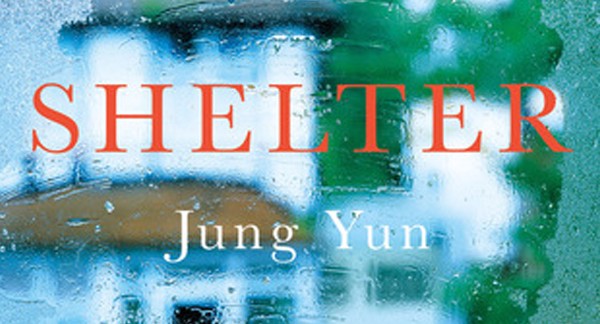
Finances loom large over Jung Yun’s debut novel, Shelter (Picador), and their implications are like the famous iceberg metaphor: small on the surface, relatively paltry, but massive beneath sea-level, extending so far in so many different directions that it’s easier to ignore it’s there at all. And isn’t that the truth about conversations about money in general? People don’t like to talk about their financial situation, and though one’s instinct may be to assume that this is especially true of the poor, as if they should be ashamed of their state (which, according to USA-pull-yourself-up-by-your-bootstraps mentality, they should be), it is in fact a strange privilege that belongs mostly to the middle and upper classes. It is still a luxury of sorts to be able to shoulder debt’s burden while keeping mum about it.
So opens Shelter: with the preoccupation of its main character, Kyung, with the possible sale of the house he and his wife, Gillian, bought some years ago, and which they now want to sell. Well, Gillian wants to sell the house. Kyung, on the other hand, “can’t stand the idea of being reduced to a renter at his age, asking a landlord for permission to paint a room or hang up some shelves. He was raised to believe that owning a home meant something. Losing a home like this — that would mean something too.” Kyung’s parents, who raised him to believe in the meaning of this type of ownership, live a neighborhood over from him and Gillian, in a massive house with too many bedrooms, but Kyung doesn’t want to move back in with them either.
From the novel’s opening pages, you’d think this book would be about this middle class family that refinanced their home before the financial crash and are now in so much debt they have to decide whether to keep up with mortgage payments or the electricity bill every month, and this even though Kyung is a college professor (though any professors reading this will probably snort, knowing that salaries for PhDs aren’t what they used to be or don’t stretch as far as they once did).
But the novel isn’t actually about this opening situation at all. Houses, money, ownership — these are framing devices, sets against which the novel’s main plot takes place, a plot that involves the brutalizing of Kyung’s parents in their own — very expensive and fancy — home along with the woman hired to clean that home who let herself in when the intruders were there. The events that take in the house are horrible, unspeakable almost, but for Kyung, almost everything is unspeakable. He is a quiet man, but not placid. He doesn’t speak much not because he has little to say but because he is scared of what he could say, what he would say, if allowed the opportunity. Or, as happens late in the novel, he takes a chance and opens his mouth no matter the consequences.
Instead of Kyung and Gillian moving into his parents’ house, then, his parents — and the maid as well — end up moving into the crumbling home that they’re told at the start of the novel they’d have to sell at a loss. From three people, the small house’s occupancy doubles to six. And as the house’s occupancy feels like it’s risen above the fire-safety maximum, so too does the brim of Kyung’s emotional stability; he runneth over.
We find out that the cycle of violence has perhaps ended with the rape and beating of the two women and man in the big house in the expensive neighborhood, but it began far before. Kyung’s father, Jin, beat his mother, Mae, and Mae in turn beat Kyung. Kyung who has never laid a finger on another man, woman, or child. Kyung for whom a display of passion ends up seeming like sexual assault. Kyung who is embarrassed by the Western manliness of his brother- and father-in-law, who starts the book trying to fix a broken garbage disposal while knowing the task is hopeless, at least for him. Kyung, who whether you like him or not, you have to feel sorry for him even while you want to slap him upside the head — making you uncomfortably remember the fact that he has been slapped, many times, and deserves no more such treatments — because he is standing in his own way and refusing to attempt to take care of himself, and who is, in the end, far more like his own parents than he thinks.
Here we come back to the money. In an act that Kyung absolutely cannot forgive, Gillian gets his father to pay off their debt in one fell swoop. She does this knowing Kyung will never get over it; because he will never get over it. This is a book in which everyone ends up alone, in various ways. Except, maybe, for the child, Ethan, who is relatively shielded from the terrible things happening around him — relatively, mind you.
Besides the more or less straightforward plot — this is a very well plotted book, which is rare for such excellent literary fiction — there is a lot going on in Shelter, as indicated above. The book deals with culture and racism, from a broker’s casual assumption that Kyung is Chinese (he corrects her: “Korean.”) to Kyung’s own disgust with the way the Korean wives at the church his parents belong to are subservient to their husbands. Part of what he loves about his white wife is how she isn’t subservient to him or anyone — she doesn’t change her last name, for example — but this is also part of what he dreads about interactions between her and his parents. He worries that she’ll seem too gutsy (she doesn’t), that her cooking won’t be right (it isn’t), and that her family won’t understand his (they understand one another enough; more, though on a surface level, than Kyung can understand either).
Kyung’s sense of control is another problem that’s called into question, along with everything that goes with that concept: his manliness (he isn’t violent, he doesn’t like sports, he isn’t handy, two double whiskeys are enough to get him drunk, which let’s face it, is just reasonable, especially on an empty stomach), his fatherhood (he doesn’t really get being a dad. He has the response that Levin has to his son in Anna Karenina; he’s worried and scared rather than in love with his son), his finances (med-doctor-failure turned PhD-doctor-professor, clearly earning less money than if he’d stayed on the medical route).
Yun treads carefully around these topics, allowing the reader to understand and take in what she needs to without beating her over the head with any kind of message about control and power and men and women and parents and culture and race and money. She simply lays the topics out, one by one, overlapping, until there is a map that one can choose to look at as a whole if one is that kind of reader (which I am) or ignore if one is inclined to simply deal with the story at hand and let the rest sink in subconsciously. A masterful work of literature that is also a page-turning dramatic family saga, Yun’s first book had better be as successful as it reads.
Cliff is trying to fix the doorbell. Today is Theo’s college graduation and a lot of people are coming over; they’re going to be ringing it, and he wants to make it play Miles Davis’s rendition of “If I Were A Bell.” It’s a good joke, you see, because it sounds like a normal doorbell at first, those four notes forward and back, before the quartet joins in. But the thing keeps shorting out — it plays only the opening notes, like a normal doorbell, and then it delivers, to his visitors, electric shocks. The bell doesn’t work. The joke doesn’t work. His house of love is a house of pain.
Cliff’s home maintenance projects seem simple and straightforward, at first: the dishwasher, the toaster, the bathroom tile. Then things go wrong. The tile, in particular, should have been easy. He pressed the thing into place and everything fell apart: the whole bathroom! Cliff has been feeling for some time as though everything, not just the appliances, were about to fall apart. He starts to do something with the best of intentions and it spools out of control. And lately he feels as though the people around him are humoring him. Just now, he invited the neighbors to graduation, even though Theo asked him not to. But he’s proud! He’s proud of his son. He wants everyone to be there. Theo must find more tickets, you see. That’s all there is to it. Everyone must be together.
For some time now, as a supplement to his medical practice, Cliff has been the star of a dark crime drama about a serial rapist. Dozens of episodes have been filmed. There is, of course, no studio audience. He’s not sure when the show is supposed to air, and his queries to the agency have gone unanswered. Indeed, the subject seems to make his agent uncomfortable. But why? Was it not his agent who got him the gig? He doesn’t remember how it all came about — can’t recall any audition — but it’s good, hard work, the best of his career. Sometimes, sitting at home on the sofa with Clair, he impulsively flips through the channels, trying to find it, hoping they’ve decided to broadcast it without telling him. He envisions a time when he’ll land on it by chance, and casually begin watching, and Clair will ask him what it is, and he’ll make one of his mugging shrugs that the audience loves, and then Clair will be drawn into the story and she’ll say, “My God, Cliff, is that you? You are incredible.”
Sometimes people talk about him in another room. He can hear them talking — can see them in the monitors — and they don’t seem to know. He feels as though they are mocking him — his mawkishness, his silly jokes, his distinctive sweaters. He can’t help himself: he rushes in, steals the scene. Before the rote smiles return to their faces, his family betrays their true emotions: they don’t like him. They want to leave. He can sense it. He has to make them stay. There must be a way.
He’s talking to his granddaughter, Olivia, who is soon to join her mother, Denise, in Singapore. He can’t remember why Denise is abroad, why Olivia is here. He seems to recall an argument. Denise was pregnant and Cliff sent her away — is that what happened? Cliff is uncomfortable with pregnancy. He doesn’t like to look at that. He tells Olivia he has a gift for her, but adds, “I hesitate to give it to you, because you may not leave. People really try to leave this house. But they keep getting sucked back in.” It’s reverse psychology, you see. The girl gazes at him, doubtfully. He demonstrates the phenomenon, which he calls “The Vacuum Effect,” by asking the child to walk out the door, then grabbing her sweater and holding her back. The child struggles; it reminds him of something. He begins to sweat. The audience is laughing. The director yells cut. Cliff heads to his dressing room, to be alone.
“How can you expect your father to contain himself?” he hears Clair ask Theo. Cliff is at the top of the stairs, listening; they are down in the living room. She’s talking about the graduation tickets, but there’s an edge to her voice. She means something else. She says, “He proceeded to hug every person on the dais, including the ushers.” Cliff remembers. His older daughter’s graduation, years before. One usher, a pretty one, ended up on his show. So did a policewoman he met, and one of his patients. He expected more gratitude from them, for getting them this acting work. But they disappeared from his life. He recalls their auditions: in hotel rooms, over drinks. Or was that part of the show itself? The man he plays, the rapist, is some kind of entertainer; perhaps he lures his victims with the promise of acting work? No — that’s not on the show. The auditions are real.
Or maybe they are the show.
He wishes the show would air. He would feel so much better if it did.
In the master bedroom, Cliff lectures the grandchildren on proper behavior among the adults at graduation. “There are certain things I don’t want you to say out loud anymore.” He offers examples. The audience laughs. He recalls saying this another time, in another context, and vertigo overtakes him. The children are staring. “Hammer time!” he shouts, and the children dance. The audience cheers.
“Don’t tell me to control myself,” Cliff says to his father, when he thinks the old man can’t hear. “I’m a grown man living in my own house.”
At graduation, they are all seated together on bleachers, and they are facing the studio audience, who are also on bleachers, and the two sets of people on bleachers gaze at one another under the artificial natural light.
“It’s over?” he asks Clair.
“It’s over, dear.”
“There’s nothing else?”
“There’s nothing else.”
But where is Theo? Where is the graduation? There is only the studio audience cheering them on as they themselves cheer on the son, and the graduation ceremony, that aren’t there.
He fixes the doorbell. He isn’t sure how he did it. One moment, it isn’t working; the next moment, it is. Miles Davis plays. The music seems to break some kind of spell. The house lights come up, and he and Clair parade, arm in arm, before the studio audience, the rest of the family trailing behind them, waving.
“Don’t leave me, Clair,” he says, low, into her ear. The audience is on its feet, cheering wildly.
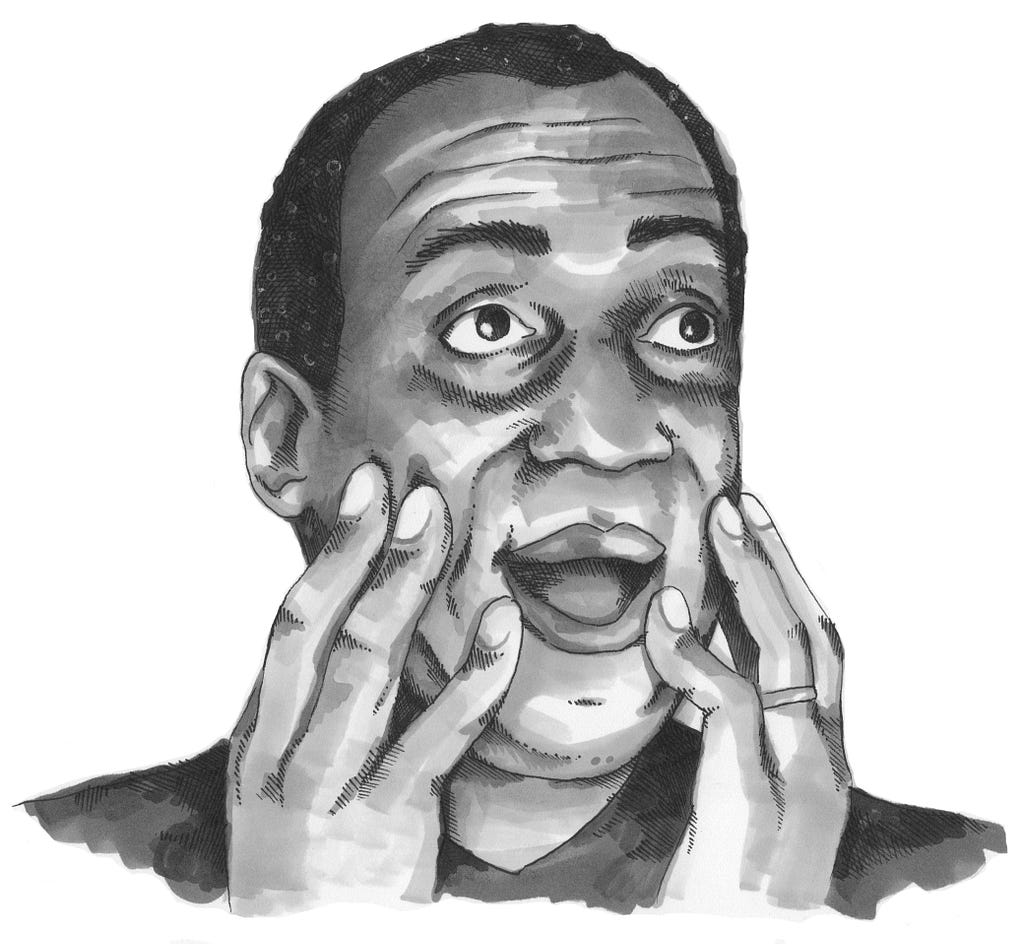
Lana Turner dumps Frank Sinatra then Ava Gardner dumps Frank Sinatra then Mia Farrow dumps Frank Sinatra so Frank sits at home watching Lana Turner on the 200th episode of The Love Boat with the sound turned off snarling the incandescent rage that is the home field advantage of the late-stage alcoholic.
The records no longer sell.
Frank Sinatra does not know why the Frank Sinatra records do not sell.
He rises unsteadily from the tattered recliner on skinny, old man legs. Bright yellow, old man pee spots the front of his tighty-whities.
Frank Sinatra does not know why the Frank Sinatra records no longer sell. Frank Sinatra cannot fathom why Lana Turner is on the 200th episode of The Love Boat. Frank Sinatra is not even sure what the fuck “The Love Boat” even is.
Or what the fuck “Menudo” is.
Frank Sinatra knows one undeniable fact: Lana Turner and Menudo are on the 200th episode of The Love Boat, and Frank Sinatra is not. He flails his skinny old man arms, knocking over the lamp and plunging the room into darkness, and his soul into a Dostoevsky midnight.
Frank Sinatra has collapsed.
With his appearance on the 200th episode of The Love Boat, Andy Warhol’s life is now a closed circle. A fact he does not understand consciously, but with the unwavering intuition of the true artist.
That’s him on the gangplank. A two shot with his first true love, Blotted Line (Candy Darling in an ill-fitting and hastily made costume of styrofoam and pasteboard). Warhol accepts the parameters of this reality: a small, angry lesbian with a .32 has been released into the labyrinth interior of the Pacific Princess.
Andy Warhol has had it with the flunkies at The Factory.
The itchy fright wig.
Silk screening Mick Jagger.
Andy Warhol has had enough. A touching scene where Blotted Line begs him not to go out into the ship.
Silk screening Mick fucking Jagger.
Andy Warhol has had enough of life. Andy Warhol has had enough of Andy Warhol.
Valerie Solanas finds him in the strange nightclub where Menudo performs before a packed crowd of predatory pedophiles and Lana Turner. Menudo, rehearsed and drilled to the point of dissociation by their manager, barely flinch when the shots rings out. Andy has been begging Lana Turner to let him make a silk screen of her. He is shot through both lungs, spleen, and liver, collapsing in an enormous pool of blood. Lana Turner sees the enormous pool of blood and swoons. Andy Warhol changes the channel. Now he is Andrew Warhola, the frightened boy from Pennsylvania, and this is his greatest work.
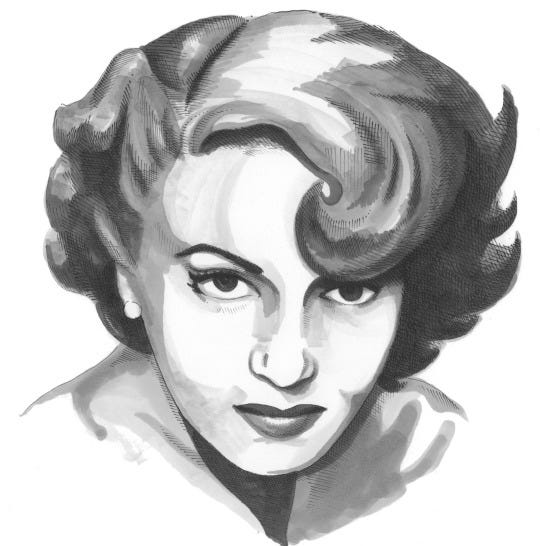
Lana Turner has been to lots of parties. And acted perfectly disgraceful. But she has never collapsed.
On the 200th episode of The Love Boat, Lana Turner collapses.
The 200th episode of The Love Boat has taken Captain Stubing to a bad place. He has been drinking heavily since the day they put out of port.
Flashbacks.
Nightmares.
Captain Stubing hasn’t spent his entire fucking life on the fucking Love Boat. Captain Stubing has been in the shit. Captain Stubing has hosed what’s left of his buddies off carrier decks. For 199 episodes he has hoped to become famous for a mysterious vacancy. But the fucking white shorts, white knee socks, and white shoes have killed the dream. No one ever becomes famous for a mysterious vacancy in white shorts, white knee socks, and white shoes.
“My life is a final chapter no one reads because the plot is over,” he announces over the p.a. system, his wracking sobs a maudlin echo down the hallways and decks. The hallways are empty. The .32-toting lesbian still at large. Still angry. The All You Can Eat Seafood Buffet is untouched. The whirlpool unused.
Frank Sinatra has collapsed.
Andy Warhol has collapsed.
Lana Turner has collapsed.
Captain Stubing has collapsed.
Oh Captain Stubing we love you get up.
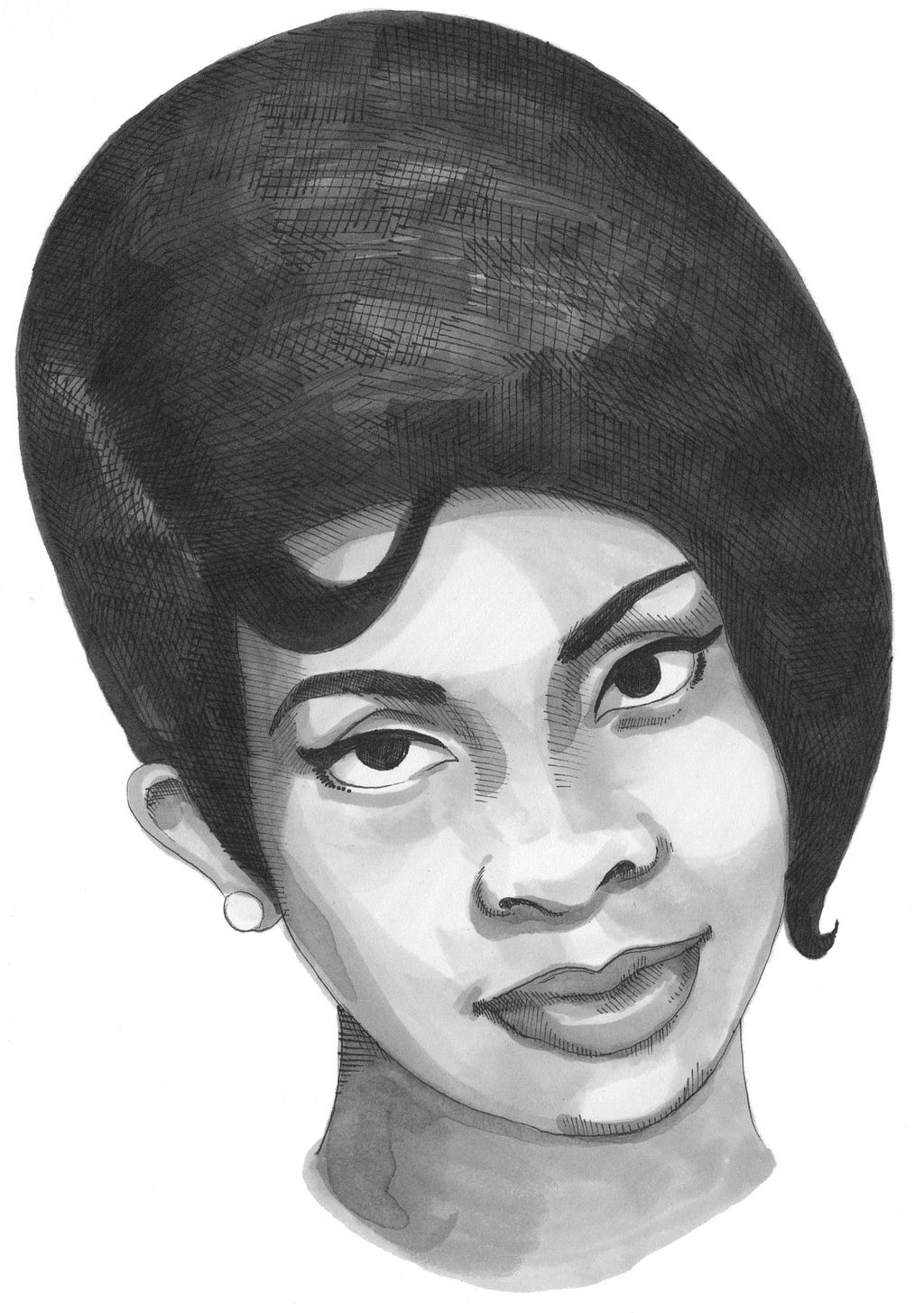
Magical Negro #607: Gladys Knight on the 200th Episode of The Jeffersons
by Morgan Parker
Privilege is asking other people
to look at you. I like everything
in my apartment except me.
What is the point of something
that only does one thing.
I mean I need to buy a toaster.
My life is a kind of reality.
When I get bored, I close the window.
By the way what is a yuppie.
Here I am, two landscapes.
My tattoo artist says I’m a warrior
with pain. I tell her we can manifest
this new moon in six months.
When I’m rich I will still be Black.
You can’t take the girl out of the ghetto
ever. It’s too much to ask to be
satisfied. Of course I sing
through the struggle. My problem is
I’m too glamorous to be seen.
How will I know when I’ve made it.
In the mirror will I have a face.
How long does a good thing last.
Sometimes eating a guilty salad
I become a wife.
Let me be the woman
who takes care of you.
Weezy and George in drapes
and crystal silverware.
By the way predominantly white
means white. I want to be the first
Black woman to live her life
exclusively from the bathtub.
Making toast, enjoying success
despite my cultural and systemic
setbacks. I was raised to be
a nigger you can trust.
I was raised to be better
than my parents. In a small house
with a swamp cooler
I touched myself. I wanted to be
in the white mom’s carpool.
My cheek against something new
and clean. I clean my apartment
when I am afraid of being
the only noise.
Everyone I know is a Black man.
Me I’m a Black man too.
Tragically, I win. It is a joke.
I always require explanation: Life, Dope. I am so lucky to be you.
When something dies,
I buy a new one.
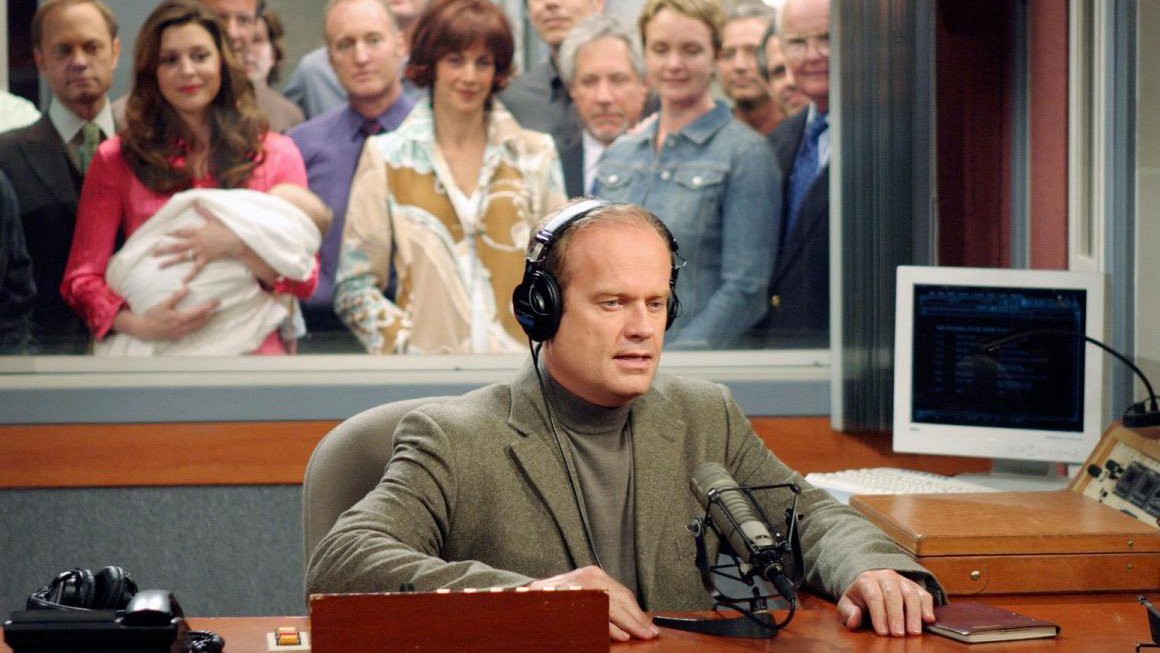
On a cool spring day, in the midst of a half-hearted organizational venture through the citadel of cardboard boxes in my mother’s basement, I watch my brother unearth a 1999 Sony Discman. It’s mine, of course — or it was, once. I haven’t seen or thought of it since at least 2005, but I’m stunned by the clarity with which I can recall the texture of its buttons; the thwap of the clamshell lid dropping into place; the buzz of the gears; the Nero-days terror of not knowing whether the display would flash the digital timer, or that soul-crushing admonition: NO DISC. I’m pretty sure I could easily have gone the rest of my life without revisiting whatever sensory archive has just flown open, and I don’t know whether to feel grateful for my brother’s find. He’s examining the Discman gravely.
At fifteen, my brother is a walking affirmation of his Slavic heritage: six-two, well on his way to a goatee, so broad-shouldered and self-possessed and devoid of gangly teenaged awkwardness that his refusal to accept congratulatory pints at my wedding last year stupefied the bartender. From the other room, a familiar laugh track has reached the kind of pitch that indicates Niles Crane is talking, a reminder of my only condition for helping with my brother’s chores: that I be allowed to work as I do at home, with Frasier in the background. I’ve told myself that I’m doing this partly for the satisfaction of irritating a teenager who thinks he’s too cool; but that’s not true. I love Frasier, and I want him to love it, too, though I suspect he’s a good few years from being able to. He’s been a good sport about it so far. He thinks the curmudgeonly dad and the little dog are funny enough. He chuckles every once in a while, but his sufferance has done little to hide that he considers it a show for old people. Now, he holds up the Discman and says, “What’s this?”
I want to tell him that I probably smuggled it into the hospital the day he was born to remedy the solitude of the waiting room.
Before I answer, before I’ve even held out my hand, I am thinking of the irretrievable: the fragility of all those homemade mixes, labored over by lamplight, shattered in moving boxes. Or the VHS tape chronicling four years of college ballroom performances, obliterated by the premature declaration that I’d checked my TV/VCR two-in-one, and yes it was ready for the yard sale. And what about all those yards of waterlogged tape, that video of my brother in his first walker, awestruck by the huge, pink bubblegum orbs I’m inflating for him? I know that video is real, I remember it — but he’s never seen it, so he’ll never have any sense of this moment we shared when he was too small to stand.
I dole out some absolute diamond of sisterly wisdom: “You see, you belong to an era wherein the mere jolt of memory can prompt physical retrieval: all the pictures and songs of your youth are there, somewhere, in a perpetually accessible space that obliterates the need for reliquaries.”
I want him to understand that, when these things went missing in my day, their disappearance was absolute. Only now it’s a lecture about his generation; now, it’s worse than making him watch Frasier. “But no, not really,” I want to say, “it’s actually just like that time on Frasier” — which is something loved ones hear from me often. And it’s true, it is just like that time Frasier can’t celebrate his 200th show on KACL because Daphne has ruined the irreplaceable tape of June 14th 1996’s show — or rather, Daphne’s new boom box has ruined it — and Daphne’s ruse to replace the tape with The Best of Hall and Oates has failed, taking with it the possibility of his ever having a complete collection of The Doctor Frasier Crane Show. “Oh, all his crap is treasured!” Martin says, and I laugh every time, because I know how the episode ends — but I feel for him. Frasier is gutted by the disappearance of something he admits to Niles he probably never intends to replay, because he couldn’t now, even if he wanted to.
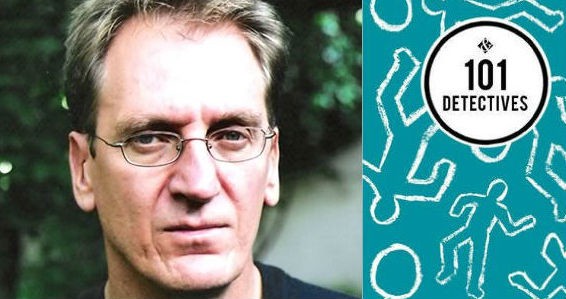
The following is an excerpt provided by our friends at BOMB. Read Kitamura & Vladislavić’s full conversation in BOMB’s spring issue.
I should probably confess that I came to Ivan Vladislavić’s writing late. I can recall the exact sequence in which I read his books, out of chronological order, or rather in a chronology that remains personal to me. First The Folly, then Double Negative, The Restless Supermarket, Portrait with Keys, 101 Detectives — a succession of radically different texts, each defying categorization.
I had the sensation of making a true and immediate acquaintance with a writer whose work occupies the territories of fiction and nonfiction, as well as the no man’s land between. The writing has a quality of unpredictability, a wildness that seeps through the fabric of Vladislavić’s peerless linguistic control. He works like a sculptor, with a deep sense of the material capabilities of language — in some places the prose is dense and opaque, in others near translucent.
This precise verbal manipulation facilitates narrative experiment, casual eruptions of form. Perhaps because of this, I don’t really know what to expect from his next book — I expect only to have my expectations overturned, my sense of language transformed. A public reading at the Community Bookstore in Park Slope formed the basis for the following conversation, which was subsequently expanded in writing.
Katie Kitamura: As soon as I finished The Folly, I ran to the nearest bookshop and asked for whatever Vladislavić they had in stock. The book I came away with was Double Negative, which was written almost twenty years after The Folly and is in many ways very different. But it struck me that the common thread between the two books — and maybe even across the entire body of your work, published over roughly two decades — is the idea of an encounter with a neighbor. I wonder what neighbors, both literal and symbolic, mean in your work and in the context of apartheid South Africa?
The apartheid system was about putting physical space between people. The idea is there in the word itself.
Ivan Vladislavić: The apartheid system was always about relations between people, about determining the nature of those relationships, and very often about disrupting them. I grew up in the most oppressive period of apartheid: I was at school in the ’60s and I went to university in the mid-’70s, just before the first cracks really began to appear in the system. My imagination was shaped in a period of extreme rigidity in the social and political systems. The apartheid system was about putting physical space between people. The idea is there in the word itself. It’s about setting things apart and setting people apart. So an encounter with the other, with the neighbor or the stranger, has always seemed central to me; first to understanding the system as it is, but also to unlocking it, to changing it. It’s really on that level — the encounter with another person, closing the space between two people — that the system has to be undone.
KK: Your books don’t simplify the complications of that encounter. The characters don’t walk away with some sentimental notion of shared humanity. They encounter the other and there are all kinds of differences that have to be negotiated, differences that are sometimes intractable and even dangerous. As you said, the novels are really about contested spaces in a charged political situation. Space operates in very interesting ways in your books. For instance, Portrait with Keys has an observational, documentary eye — as if you’re traveling through the spaces of Johannesburg with Frederick Wiseman’s camera eye. But then in The Folly or The Restless Supermarket, space has a more clearly allegorical function. How do these different kinds of spaces operate in your fiction and nonfiction?
IV: I am fascinated by how the political system gets reflected in the physical space and how the space, in turn, shapes the kinds of social relations that are possible. These concerns are central to Portrait with Keys. In the transition period, when South Africa began to change rapidly, it was very hard to understand the big processes and to see exactly what was happening. You knew that there had been a huge shift in the political order, that a new dispensation had been negotiated and so on. But what effect it would actually have on the society was difficult to gauge, because you could not easily grasp those big abstract processes. For me, a way of understanding what was happening was to look quite closely at the immediate surroundings. It seemed to me that you could understand large, complex processes by looking at what was going on in your neighborhood. So that was when I began to document things — Portrait with Keys is a sort of documentary fiction, or documentary nonfiction. Documentary something or other. Let’s say I began to document, in a more conscious way, these small shifts in the environment as a way of trying to understand how the society was changing.
In Double Negative, I was influenced by the particular technique or approach to space that the photographer David Goldblatt uses. As you know, the novel was generated in response to some of his work. One of the things that intrigues me about Goldblatt is how he’s used space to understand movement and change, by returning to particular sites and rephotographing them over long periods. The photograph is normally thought of as this fragile moment that disappears, and also as a frozen moment. Goldblatt has found a way of putting the photograph into motion, by somewhat obsessively circling back to places that he’s photographed before. So when you look at the photographs beside one another, you get an extraordinary sense of change, captured in just two or three images. In Double Negative, I tried to employ a similar strategy. The narrative is structured as three cross-sections through time, and it returns to some of the same spaces in different periods as a way of gauging social change. So I’m not sure I’m answering your question, but it’s a way of looking at social processes and abstract processes by spatializing them.
KK: At the end of your most recent short story collection, 101 Detectives, there are two intriguing pieces. One consists of a series by Neville Lister, who is a character in Double Negative — a work of text and photographs that was actually shown in a museum context. And then, there are the “Deleted Scenes” from all the short stories the reader has just read. These pieces made me think of the end of Chekhov’s “The Lady with Lapdog,” when the story suddenly enacts a pivot. The entire time the story appears to be tending a small and particular universe, indicating its fictional terrain, and then suddenly it opens up in this very radical way.
A lot of your work seems to have a similar concern. It’s about insisting on the contingency of what we’re trying to make in fiction, which is something writers can be nervous to do. Is it the case that you are trying to open up your fiction?
I’ve become interested in the stuff that gets left out of the book…I’m aware as an editor and as a writer of how much writing never fits into the book — how much is lost..
IV: I hope so. Again, I don’t mean to harp on the past, but my work comes out of a literary tradition in which things were closed off, in which meanings were very certain and people knew exactly what they thought about a whole lot of things. From the beginning I was interested in trying to write in a way that would open up rather than close down meaning or association or whatever. I hope the “Deleted Scenes” work in that way. I’ve become interested in the stuff that gets left out of the book. This is something I should probably keep to myself, but I’m aware as an editor and as a writer of how much writing never fits into the book — how much is lost, if you like.
Anyway, I got the idea from watching DVDs that include a set of deleted scenes at the end. You can see exactly why some were left out of the movie, but every now and then you see one and you think, Well, that’s the whole movie right there! Why didn’t they put this in when it’s the key to the movie? Perhaps they’re the scenes the director left out because they’re the most obvious expressions of the themes. There are all these different possibilities. As a text editor, I’m aware that something similar happens with books, but in the written world we’re more likely to pretend or insist that the thing is perfect, that the text is inviolable and unalterable. And actually it could always be different. So the “Deleted Scenes” in 101 Detectives are there to get the reader hopefully to rethink some of the stories, and also to call the stories to mind at the end of the reading, because I like to think of the story collections as books with proper connections between the pieces. Readers and publishers tend to approach a story collection as a haphazard gathering of whatever the writer happens to have written, whereas I like to structure the books and write pieces specifically to make the sequence coherent. “Deleted Scenes” includes one outtake from each story and this requires you — if you’re this kind of obsessive reader — to go back and identify which deleted scene belongs with which story. You’re kind of being strong-armed into looking back at the book, and hopefully constructing it in a different way.
Read the rest of Kitamura & Vladislavić’s conversation at BOMB.
Over lemon meringue pie she’d say, “The night I met my Julie, I went to a dance at the synagogue. When I came home, I said, ‘Papa, I just met the man that I’m going to marry.’ ‘What?’ he asked. ‘He proposed already?’ And I said, ‘No, he just doesn’t know it yet.’”
She speaks in loops, telling the same stories over and over.
“When David was little, he asked for a sandwich. I asked, ‘Why don’t you make your own sandwich?’ And he said, ‘Tastes better when you make it.’”
The stories were about family, and often food.
“When your mother was pregnant, she got this huge chocolate sundae, three scoops! I asked her, ‘Can I have some? Just a little bit?’ And she said, ‘Get your own!’” To that story my mother always answered, “I was pregnant. I was already sharing!”
These memories became touchstones. She told them enough times that it didn’t matter if they happened before or after I was born, I felt like I was there.
But at ninety-three years old, her loops are getting shorter, her stories fewer.
She no longer says, “My mother was a teddy bear who fed the whole neighborhood. Everybody loved her food.” Or: “My father was the kindest man I ever met. He owned the general store. When the boys came home from the war they said hello to him before they went home to their families!”
These stories have subsided. Now she asks just one question.
“Where’s Mario?”
Mario is my twenty-year old brother-in-law. She’s met him maybe three times. Yet that last time has stuck with her so meaningfully that she talks about it every day.
One act of kindness rises above ninety years’ worth of memories.
Four years ago, Mario sat on a couch and talked to her for about two hours. The subject of the conversation doesn’t matter. It wasn’t something he said. It was that he said something, for two — sometimes she likes to say three — hours. “Who else would sit with this old so-and-so for three hours?” she asks. “That’s my kind of guy!”
One act of kindness rises above ninety years’ worth of memories.
And I’m glad. Too easily sad, painful memories can supplant the rest. Three years ago her children, David and Linda, both died within a week of each other — one expectedly, the other not. Until recently I didn’t realize that she copes with this by forgetting.
We were looking at old family photos and she froze. “Is David alive?”
The fact that she had to ask triggered a panic in her eyes. On some level she had to know. On another, she didn’t.
“No, Grandma, he died.”
“How did he die?”
“He had a heart attack.”
She barely absorbed this information before she turned to me again. “What about Linda? Is Linda alive?”
“No. She had cancer.”
“How could I forget?” She searched my eyes. “How could I forget that my own children died?”
She answered herself. “I must have made myself forget because it was too painful.”
Her ability to alter painful memories is something researchers have been trying to do for PTSD patients for years. According to the American Psychological Association, researchers have experimented with lasers, xenon gas, drugs, and exercise to test whether bad memories can be altered or erased.
“How could I forget?” She searched my eyes. “How could I forget that my own children died?”
By focusing on a positive memory, my grandma may have found her own way of fighting off depression. In fact, one study published in Nature, featuring the work of neuroscientist Susumu Tonegawa and his team at MIT, seemed to show that positive memories could alleviate depression in mice. While my grandmother isn’t a mouse, her ability to focus on that one special moment gives her enough joy to forget the pain of being a mother who outlived both her children.
Watching her mind change has been difficult. When I was little she’d take me to museums and the Seaport. She’d cook tuna croquets and spaghetti. She’s someone who started college in her sixties and learned to drive in her seventies. Living with my parents and me, she’d wake up extra early every morning to make me breakfast, even though, cranky and ungrateful, I never ate the oatmeal or toasted bagel.
My grandma isn’t easy to please either. This is the same woman I once found gripping her crossword in a completely unlit room. When I asked her, “Should I turn on a light?” She answered, unironically, like the Jewish mothers in the joke, “No, I’ll just sit in the dark.”
Knowing her intransigence makes the power of Mario’s kindness even more of a triumph.
She’s always had a way of making singular requests like, “Will you make me justone sugar cookie?” But you know what? After she asked, I baked a whole platter of sugar cookies, and even cut them into circles using the lip of a glass like she said her mother used to do. Her grin when I brought out that mountain of cinnamon-sugar dusted cookies made it all worth it.
Although she may not remember that now, it’s the joy of that moment that counts — for both of us. In her book The How of Happiness, psychology professor Sonja Lyubomirsky describes how performing small acts of kindness can benefit someone’s mood, self-perception, and overall health. Perhaps that’s why for years my grandmother shared her own act of kindness: “When I was eight years old, I wanted to help my parents have extra money for the holidays. So I sold greeting cards door-to-door. And I sold every last one!”
Kindness cuts through the rest. And it’s a reminder for us all to reach out. Write that sweet note. Make that loving phone call. Because you never know what will stick.
Hello, and welcome to my week-by-week review of the world. Today I am reviewing the writing job I turned down.
This week a stranger on the internet invited me to write for free for his or her website. It’s flattering to think a complete stranger likes my work enough to want to publish it on an actual website, but unfortunately I must devote my time to paid opportunities because I need to buy a new summer wardrobe. Last summer all my clothes were out of fashion and I looked ridiculous.
Here’s a picture of the job opportunity conversation.
On the surface it was a pretty compelling offer: get to do work for someone. But I was surprised they could not afford to pay me. Everything I hear about startups is how they have so much money. Gobs and gobs of money. Not this one though. I guess maybe the media is wrong about startups after all. That’s the only explanation I can think of.
I stayed up all night wondering if I had made the right decision. Sure, DHN-TV might only have 365 Twitter followers, but so did Kanye West at one point. Now look at him. Was this a missed opportunity? Could this have been my big break? I’ve been waiting 80+ years for my big break and it would be a shame if I let it slip between my fingers.
It’s very privileged of me to be able to turn down a job opportunity, even if it was unpaid. People all over the world would love the chance to work for free. Many of them work for close to free already. Who am I to think I’m so special?
Perhaps there is a parallel universe where I accepted this opportunity and am living a much richer life full of both career and emotional fulfillment. I guess there’s no way to ever know if I made the right choice. The more I think about it, the more I wonder if I’ve made a terrible mistake. I’ll go to my grave wondering.
It may be too late for me, but it doesn’t have to be too late for you. If someone offers you an opportunity — any opportunity — even if it’s from a complete stranger and it appears you have literally nothing to gain, JUMP AT IT! Because a stranger doesn’t have to owe you anything, but don’t you owe it to yourself?
BEST FEATURE: It’s hard to name just one best feature. Everything about this opportunity sounds amazing. WORST FEATURE: The overwhelming regret and pain I’m unable to quell.
Please join me next week when I’ll be reviewing Kleenex.
Helen Oyeyemi is one of those writers who, no matter when you discover them, makes you wish it had been long ago so you’d have extra hours left in your life to read the rest of their work. She published five novels by the time she turned thirty, and now, at the ripe old age of thirty-one, she’s coming out with a beautiful, brilliant, evocative collection of (somewhat) linked short stories. She is also, incidentally, one of those artists whom you cannot hate for such early success, not even a little tiny envious bit, because she’s clearly so, so talented.
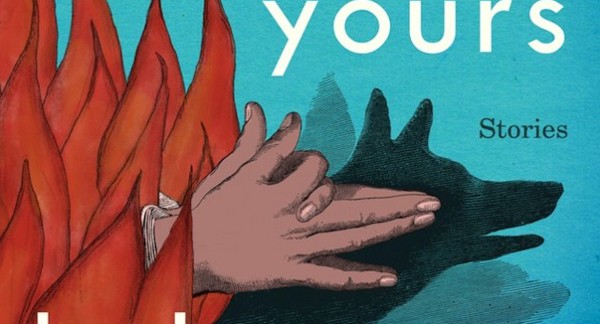
Like its roundabout, not-actually-tautological title, What Is Not Yours Is Not Yours is a collection in which each story takes a roundabout turn, Mobius-stripping its way through its plots. Plots, plural, for no story is straightforward in that it has one beginning, one middle, and one end. Most have at least two beginnings and two middles, though the ends vary from being singular to dual to nil. Each story contains a setting that frames a fable of sorts, a fairy-tale, but an odd one, which should not be surprising to readers of Oyeyemi after her last book, Boy, Snow, Bird (Riverhead, 2014), about which she said, “retelling Snow White was what I set out to do! But I had to come at it slant because that’s how I tend to read fairy tales.”
The collection’s opening story, “Books and Roses,” for example, begins with the classic fairy tale’s “Once upon a time,” but immediately goes slant from there; instead of “in a land far, far away” or “in a royal castle” or “in a little village,” Oyeyemi completes the sentence so: “Once upon a time in Catalonia a baby was found in a chapel.” While many fables include orphans — just as much historically great literature centers around them — they don’t, in fairy tales, have such a firm root in a real place. The story continues in its vein of being part fairy tale, part realist story, a mix which makes the work truly magical.
“Playfully and exquisitely imagined,” the book’s front flap says, “What Is Not Yours Is Not Yours is an enchanting collection of linked, intertwined stories cleverly built around the idea of keys, literal and metaphorical.” While I usually regret reading press material that aims to give me a clue as to how to read literature, I do wonder whether I would have found this connection on my own, for what I observed most in the stories was a series of doors opening and shutting, their locks and keys only the necessary obstacles and tools for this movement. While “Books and Roses” contains physical keys, the next story, “’Sorry’ Doesn’t Sweeten Her Tea” contains a house full of doors that swing open and shut of their own accord unless locked. But neither story is truly about those physical doors that have locks and require keys, but rather about the characters in them discovering something new, whether it is mysterious — a connection between a young Catalan woman, Montserrat, who is “given the surname ‘Fosc,’ not just because she was black, but also because her origin was obscure’ and Lucy, ‘a painter with eyes like daybreak’ — or painfully physical — as in the second story, where the lives of a family are rocked because their youngest member Aisha is a fan of a famous singer who’s accused of beating a prostitute so badly that she makes a YouTube video showing off her bruises and asking him to apologize, a video that causes much anguish to this struggling young fan. Later in the book, we see Aisha again, all grown up, refusing to have penetrative sex with her boyfriend. A friend of his says that Aisha “just doesn’t want dick” while the narrating boyfriend wonders whether she “doesn’t want lust to be the one to lead me in.” Are we supposed to connect Aisha’s traumatic disillusionment with her favorite pop star, her first exposure to the way the internet tends to blow up at abused women, and the way celebrity manages to get away with such abuse with her later reluctance to have a specific kind of straight sex with a man? Perhaps, and perhaps she is simply allowed to have preferences about what she calls sex and how she enjoys it.
And here is where I must come to the conclusion that became clearer to me as I read: this book is incredibly queer, incredibly feminist, and beautiful for it. It normalizes queer experience in a way that doesn’t ask the reader to understand it as necessarily different, but as simply one of many kinds of lives, but so essential that it fits within the confines of fairy tales as well as any other device. The first two stories mentioned above contain, first, a pair of star-crossed women lovers and, second, a pair of men who take care of the daughters one of them has from a previous marriage to a woman. In both cases there is no explanation, no coming out story, but simply facts: Lucy is in love with Safiye, Noor is in love with Anton. In the next story, “Is Your Blood as Red as This?” Radha is in love with Myrna Semyonova, the latter a teenager studying to become a puppeteer and the former following her into this world and being wooed away by a boy who flirts quite insidiously via his puppets.
Is this realism, this world in which queerness is accepted as utterly normal, where most characters appear to have both same-sex and opposite-sex attractions, where it is not shocking for a girl’s high school boyfriend to come out as sometimes a woman who chooses the name Pepper while sometimes remaining Michael? No, this is not realism, but this doesn’t matter in the least — fairy tales have always been both reflective of and teachers of life, and Oyeyemi’s mix of modernity and fantasy creates a world in which we are free from at least some of the constraints of the “real world” in which queerness is constantly questioned.
Some of the constraints, yes, because as mentioned before, this novel is incredibly feminist, its characters and narrators largely women who interact with one another and with men in various ways that are often unconventional, such as the daughters of a father who’s now living with a man loving this man without qualms, such as a married woman going through a horrific experiment in which she hallucinates the life she and her husband could have had and a child they may have borne while also simulating the death of her spouse. The women in the stories are not the heroes of their fairy tales; they aren’t reclaiming some sort of ancient heroic right; they are simply women, with all that womanhood involves, with all that femininity takes on and rejects, and this is enough, for these women are people, their bodies and gender and sex mattering only when the society around them dictates it, which is rarer than usual. Like the stories’ queerness, their feminist tendencies aren’t beat-you-over-the-head overt, but folded into the narratives, making it incredibly normal for women to say no to men, to challenge the patriarchy, to accept men too as feeling beings even if they are inherently privileged.
Finally, a word must be said about the prose itself: spectacular. Stories contain sentences as delicious to the pallet as “To the naked eye Boudicca is a haze of noxious green that lurks among fronds of seaweed looking exactly like the aftermath of a chemical pill” and phrases as tragically funny as “The Homely Wench Society.” Stories begin surprisingly, without warning: “Well, Dornička met a wolf on Mount Radhošt’” and “As I was saying, I’m an inadequate son.” They end abruptly too, sometimes without resolution, and if we must put a realist spin on Oyeyemi’s collection, it is here most noticeable of all: in the endings, which do not always satisfy, just as in life relationships and experiences often refuse to attain closure.
Indeed, like some of her stories, Oyeyemi keeps mysteries herself: in her acknowledgements she doesn’t explain who the people she thanks are, and cites only a piece named Puppet: An Essay on Uncanny Life by Kenneth Gross as influential. We need more books like Oyeyemi’s; to challenge us, to make us think, and to remind us that it is all right, sometimes, not to know all the answers to the riddles that plague us.
The Strand, with its “18 miles of books,” has been a New York City institution going on 90 years, and in that time the bookshop has hosted its share of literary luminaries, lately as part of a conversation series in its fifth floor Rare Books Room. This week marks the release of an anthology of those conversations: Upstairs at the Strand, from W.W. Norton & Co. Three years ago, Rachel Kushner, Rivka Galchen, and Hari Kunzru met at the Strand to talk with Mónica de la Torre about new work, superstitions and harnessing everything you know for fiction. Today we take a look back at that conversation, with an excerpt from the new book.
Mónica de la Torre:I wanted to start by asking you about your experience of temporal shifts in the writing process. Can you speak about your work when it’s in the incubation process?
Hari Kunzru: At the moment, I’m doing some screenwriting, and you’re forced to talk about everything all the time with people who don’t seem to share very much with you. And so you’re always trying to reach your idea across a table. There seems to be an increasing amount of that in the fiction-publishing industry as well. I started something, and was kind of happy to talk about it, but I am now feeling that I hollowed it out in some way by doing that. Now I started something else and I’m not talking about that, and it feels good, it feels precious.
de la Torre:You’d rather not to talk about something that’s in its early stages because you feel that you might jinx it?
Kunzru: A novel certainly takes so long that it has to be a project that you can live inside for a period of years, at least a couple. It has to be a machine that can somehow process all of your stuff, your experiences during that time, even if it’s in a very oblique and coded way. I think with oversharing you risk that it doesn’t function. I’m quite interested in privacy.
Writers construct in writing. It’s hard to improvise.
Kushner: After you finish a book for a publisher you’re still inside a pretty endless process of copyediting and proofreading, etc. So I feel like I was with Flamethrowers in a continual way basically until it came out, at which point I had to begin to talk about it. You have to create a sort of discourse that then you utilize over and over again, as you’re asked questions. But that only happens through experience. Having done it before for a first book didn’t at all prepare me for the second. Writers construct in writing. It’s hard to improvise. With a book, even though all of the ideas in the book are mine, and I had total control over the novel, there are so many different things that go into writing a novel at different moments, and the temporality of it is protracted, the writing of it. When it’s time to give an encapsulation of all your different thematic interests and the materials that were important to the book, I forget sometimes what inspired me. I have to make cheat sheets. Eventually you learn how to talk about your own book, but the frightening thing about this is that then you can go on autopilot. Right now I’m on a book tour and I feel like I could accidentally sell myself a pair of overpriced shoes or something.
Kunzru: Isn’t that the purpose of the book tour? To alienate you so much from the thing that you’ve written that you feel forced to write something else, in order to feel good about yourself again?
Kushner: When I talk about a book, it’s already long written and I’ve already moved on to the next, which I wouldn’t talk about. I’ve looked at what other novelists have done, and I read authors saying, “I’m not talking about that.” It’s either because it’s bad luck, or it deflates some of the energy.
Galchen: Often it seems like you’re choosing between being true and accurate to what you’re doing, and being a nice person, answering people’s questions. It’s a tension. I imagine you start feeling like you have a bit of a shtick, but the shtick is the friendly thing to do. So, it’s a little bit of a bind.
Kunzru: I really admire writers who cannot go along with that. I’m dreadfully prone to taking whatever stupid question it is, and trying to make something out of it. You end up feeling terrible.
de la Torre: My next question is about repurposing skills that you’ve learned in other environments, in order perhaps to add realism to a novel. For instance, Rachel, you are also an art critic and your descriptions in Flamethrowers, not only of artworks, but also of particular scenes, are so realistic and so believable that I often found myself wondering if it wasn’t a roman à clef. I wondered if you weren’t disguising actual artists under different names. Maybe you’ve done it, too, Hari, you were a music editor, you wrote about technology. In your case, Rivka, you’re an M.D. in psychiatry. So, I wanted to ask you all, is it deliberate that you bring those skills to the novel? Does it feel slightly subversive, perhaps, that you’re taking what belongs in the realm of your day job and bringing it into the realm of fiction?
Kunzru: I wanted to be a fiction writer before I wanted to do anything else, like write journalism. It was very accidental that I wrote about technology. At a certain point, in my early twenties, it turned out that my only marketable skill was knowing about the Internet. I was working for Wired at the point when it was a sort of Day-Glo-orange cult based in San Francisco. They would send me off to talk to people who would tell me that the future was being physically instantiated somewhere in the Valley. These extraordinary characters, who were very alien to my way of thinking. I remember asking my boss why we were always writing about these wealthy people who are making the future, or so they told us, but what about everybody else? I was told very sternly that there are no have-nots, only have-laters. I realized that everybody was insane, and I needed to write a novel about it. I was given a lot of material from that, by accident, really, but there’s a fairly easy flow for me across the boundaries between fiction and nonfiction. I like doing journalism partly because it gets me out of the house. It’s quite a relief not to be inside my head. And, yes, you get a little window onto other kinds of life.
…for me the novel is a challenge that requires every single part of myself.
Kushner: Every writer is different, but for me the novel is a challenge that requires every single part of myself. Therefore, every single thing that I know about the world is going to be summoned in some way by whatever I’m working on. I think a lot of writers are like that, and I think across genre, too. It’s like Anne Carson, by no accident, will write about Monica Vitti, or about Sappho. Well, she’s a classicist, not that Monica Vitti has to do with classicism. But I was just thinking about different things she’s interested in and that she’ll incorporate into her poetry. I’m not at all comparing myself with Anne Carson, she’s legitimately a classicist; I am not legitimately anything, really, except for a fiction writer. I do write about art on occasion, and have done so for many years now, but I don’t really consider myself an art critic, like a tastemaker type of person, and nor am I an art historian, because I’m not trained that way. Still, I’m interested in contemporary art and culture, it’s a knowledge that I got in a semi-autodidactic but organic fashion, after having been assigned various pieces.
When it came time to write this novel, it was no accident that I wanted to write a book that was partly set in the art world of downtown New York in the seventies. It was something that I’d picked up a few ideas about just along the way. But it’s definitely not a roman à clef. The characters are fictional, entirely constructed. I do like the cameo, it’s fun to place a real person in a scene — like John Chamberlain, drunkenly moving through the room. It could just give a tiny reminder for the reader that they’re in a real space.
But I tried to downplay the art world in Flamethrowers. I don’t like to read novels about the art world where there are long descriptions about the character’s conceptual artwork. You can tell that the writer is making it up and kind of getting lost inside of the writing of the fictional stuff that the character makes. It comes across to me as precious. So I just tried to signify that these people make works, but did not go too in-depth into what they made. For me, part of the great fun and the challenge is that writing summons everything you know. Still, you do not want to be a Little Miss Know-It-All.
Galchen: What were some of the images that were important to you while you were working?
Kushner: I collected a lot of images while I was working on Flamethrow-ers. The book is about the seventies, but I’m also interested in futurism and its relationship to war, and I’m interested in motorcycles and technology and the way that speed was introduced via war. One of the first images that I put up was of a soldier from World War I riding a motorcycle with a really crazy sidecar contraption on it that was shaped like a bullet. There was another guy in the sidecar who looked like he was kind of his amanuensis. He had a typing machine and was taking notes. That sounds kind of precious! I found the picture online and just put it up in my office. I did that with several others. The image that’s on the cover of my book was another one. You can print things out on a black-and-white printer and it somehow looks okay. I had all kinds of images up on the wall while I was writing. Stills from films, like the last by Guy Debord, In girum imus nocte et consumimur igni, with all of those different pictures that he used, and the comments that he made over the images. That right there is a kind of crystallization of language and image that he put together. Debord was a real master at combining words and images. A lot of that film is just still after still, with his commentary over it.
There’s a whole range of things that I worked with. Sometimes an image for me is just an image in my mind. For example, I was thinking about the blackout in New York City in 1977, and the hostility in the press to the looting and criminality that went on. Then I was thinking about a march in Rome earlier that year, on March 12th, 1977. I thought about crowds that fill up the street, following a certain logic, but in an unexpected manner. In New York no one knew that the electricity was going to go off, and in Rome no one knew a student was going to be killed by the police in Bologna the day before, which is what precipitated the outpouring of people to the streets, who came from all over Italy. I thought about those two events, and to me those were images, in a way. They have some similarity.
Kunzru: I often have several things that I know go together, but don’t rationally go together. For example, in my last novel I did not know why computer modeling and the stock market should have anything to do with the Mojave Desert, but they had. I then had to write to find out what that connection was.
Kushner: Did you look at images while you were writing about those cult followers who lived in the desert?
Kunzru: There’s a good book called Spaced Out. It’s about utopian architecture in the 1960s, and it has a lot of visual references to western United States communes. I also have a friend in San Francisco whose art practice revolves around that, so she’s always finding things online and sending me pictures of people at Morning Star, looking like they hadn’t had a bath.
Kushner: Did you print them out, too, and put them up in your office?
It just says “oppose book worship” above my screen. And that feels like a useful thing to remind myself.
Kunzru: I’m trying to remember what I had up at that point. I’ve moved around a lot in the last few years, but I definitely had that thing of papering my walls with my sort of projection of my book. Now, for the last two years the only thing I’ve had up in my writing space — it’s a sort of gag — is one of Mao’s speeches. It’s published as a Peking Press pamphlet with the cream covers, and it’s called “Oppose Book Worship.” It just says “oppose book worship” above my screen. And that feels like a useful thing to remind myself.
Galchen: I wonder about this methodology of not really being in control, where you have a couple of interests that just seem to sit on the surgical table together, whatever it is, the sewing machine and the umbrella. What is that like in the composition process? It sounds like both of you feel most in control if you are not in control. If you don’t know why you’re interested in Italy in the seventies and New York in the seventies, or machines, what does that make your daily process like?
To me, the work of the novel is to not be in control, and to be moving at a patient pace towards a future that is not a foregone conclusion.
Kushner: To me, the work of the novel is to not be in control, and to be moving at a patient pace towards a future that is not a foregone conclusion. I want there to be a certain quotient of mystery always, when I’m writing. Maybe halfway through the book I know how it’s going to end, and it’s a matter of getting there, but there are still things that are going to happen that I haven’t foreseen. For me, the process of the novel and the challenge of it is partly to figure out how these two realms are related. I did not want things to over-relate in a very reducible, clean, and very symphonic way. Like, “Oh, it turns out that she’s the cousin of the man who . . .” I don’t mean to denigrate that, but it’s not my style as a thinker or reader or writer. I want things to be more open, and to think about cities, and history, and events, and have one person who kind of just moves through these landscapes. I wanted the registration of how they echo one another to take place in the mind of the reader, not so much in the page.
For me it’s just time, too. You have a few years to figure these things out. I’ll work on one small part, and then another. It’s like moving tanks to the front lines. You can’t get there in one day when you’re moving provisions.
On a cool spring day, in the midst of a half-hearted organizational venture through the citadel of cardboard boxes in my mother’s basement, I watch my brother unearth a 1999 Sony Discman. It’s mine, of course — or it was, once. I haven’t seen or thought of it since at least 2005, but I’m stunned by the clarity with which I can recall the texture of its buttons; the thwap of the clamshell lid dropping into place; the buzz of the gears; the Nero-days terror of not knowing whether the display would flash the digital timer, or that soul-crushing admonition: NO DISC. I’m pretty sure I could easily have gone the rest of my life without revisiting whatever sensory archive has just flown open, and I don’t know whether to feel grateful for my brother’s find. He’s examining the Discman gravely.
At fifteen, my brother is a walking affirmation of his Slavic heritage: six-two, well on his way to a goatee, so broad-shouldered and self-possessed and devoid of gangly teenaged awkwardness that his refusal to accept congratulatory pints at my wedding last year stupefied the bartender. From the other room, a familiar laugh track has reached the kind of pitch that indicates Niles Crane is talking, a reminder of my only condition for helping with my brother’s chores: that I be allowed to work as I do at home, with Frasier in the background. I’ve told myself that I’m doing this partly for the satisfaction of irritating a teenager who thinks he’s too cool; but that’s not true. I love Frasier, and I want him to love it, too, though I suspect he’s a good few years from being able to. He’s been a good sport about it so far. He thinks the curmudgeonly dad and the little dog are funny enough. He chuckles every once in a while, but his sufferance has done little to hide that he considers it a show for old people. Now, he holds up the Discman and says, “what’s this?”
I want to tell him that I probably smuggled it into the hospital the day he was born to remedy the solitude of the waiting room.
Before I answer, before I’ve even held out my hand, I am thinking of the irretrievable: the fragility of all those homemade mixes, labored over by lamplight, shattered in moving boxes. Or the VHS tape chronicling four years of college ballroom performances, obliterated by the premature declaration that I’d checked my TV/VCR two-in-one, and yes it was ready for the yard sale. And what about all those yards of waterlogged tape, that video of my brother in his first walker, awestruck by the huge, pink bubblegum orbs I’m inflating for him? I know that video is real, I remember it — but he’s never seen it, so he’ll never have any sense of this moment we shared when he was too small to stand.
I dole out some absolute diamond of sisterly wisdom: “You see, you belong to an era wherein the mere jolt of memory can prompt physical retrieval: all the pictures and songs of your youth are there, somewhere, in a perpetually accessible space that obliterates the need for reliquaries.”
I want him to understand that, when these things went missing in my day, their disappearance was absolute. Only now it’s a lecture about his generation; now, it’s worse than making him watch Frasier. “But no, not really,” I want to say, “it’s actually just like that time on Frasier” — which is something loved ones hear from me often. And it’s true, it is just like that time Frasier can’t celebrate his 200th show on KACL because Daphne has ruined the irreplaceable tape of June 14th 1996’s show — or rather, Daphne’s new boom box has ruined it — and Daphne’s ruse to replace the tape with The Best of Hall and Oates has failed, taking with it the possibility of his ever having a complete collection of The Doctor Frasier Crane Show. “Oh, all his crap is treasured!” Martin says, and I laugh every time, because I know how the episode ends — but I feel for him. Frasier is gutted by the disappearance of something he admits to Niles he probably never intends to replay, because he couldn’t now, even if he wanted to.
In Patrick McCabe’s dark phantasmagoria set in early 60s small-town Ireland The Butcher Boy, probably the most pitch-black Irish “comedy” you’re ever likely to read, the young, psychologically disturbed protagonist, Francie Brady, becomes somewhat obsessed with an outdated songbook owned by his father — a former trumpet player who drank his talent away — entitled Emerald Gems of Ireland. For Francie, neglected by his father, ridiculed by his rubbernecking neighbors and teetering on the edge of full-blown madness, these “emerald gems” are the treasured relics of an imagined past: a bucolic idyll still peopled by square-jawed revolutionaries and sober romantics, what Taoiseach (Prime Minister) Éamon de Valera, the High King of Gaelic Catholic fantasy, referred to in his 1943 St. Patrick’s Day radio address as “the Ireland that we dreamed of.” An Ireland long gone, if it ever really existed in the first place.
Thankfully then, in celebration of St. Patrick’s Day, we’re looking not to Emerald gems — the rose-tinted fool’s gold of Ireland’s wilderness years — but to hidden ones. More specifically, those works of Irish literature that may not have the global name recognition of, say, Ulysses or Dorian Grey, The Commitments or Brooklyn, but which have nevertheless made an indelible mark on the landscape of the country’s fiction.
Before we begin, a few ground rules:
— Nothing published in the last five years; poking out from underneath a thin layer of topsoil doesn’t count as hidden, according to the arbitrary rules I am making up as I go.
— If the book has been adapted into a feature length film seen by at least one non-Irish person, sorry but you (yes, you, newly anthropomorphized book) are also excused from duty (the court wishes to thank the aforementioned The Butcher Boy, as well as Breakfast on Pluto, Cal, The Dead, Darby O’Gill and the Little People, and, of course, the source material for the 2007 Gerard Butler-helmed tour de force: P.S. I Love You).
— The books must be, in some way, shape or form, about Ireland. It’s not sufficient to merely be an Irish author; if the work in question is set in an objectively less important place, like America or the UK or outer space or the afterlife, then the author is a traitor who thinks he’s too good for the old sod and his book is not getting near my list (I’m looking at you, Dracula).
All that firmly in mind, here, in no particular order, are my ten hidden gems of Irish literature:
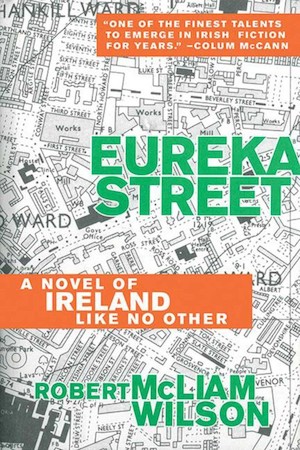
Set in 1990’s Belfast, amid peace negotiations and the prospect of a ceasefire, Eureka Street is a sometimes madcap, often biting and consistently hilarious story of two working-class Belfast friends — one Protestant and one Catholic — trying to find love and stability in their bomb-scarred city.
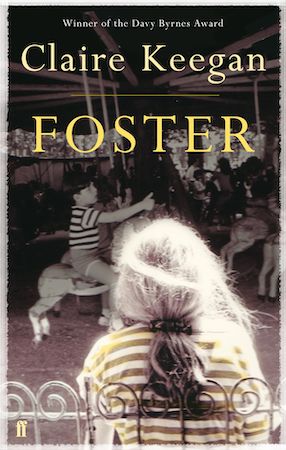
Keegan’s superb short story collections, Antarctica (1999) and Walk the Blue Fields (2007) are well worth tracking down, but for those of you looking for a lazier route into the author’s best work, Foster, a quietly powerful 88-page story about a young girl sent away from her dysfunctional home to live with a kindly older couple in County Wexford, published as a stand-alone book by Faber in 2010 and condensed to publishable length in The New Yorker, is the place to start.
An Béal Bocht(The Poor Mouth) by Myles na gCopaleen (Flann O’Brien)
Flann O’Brien is perhaps the preeminent Irish satirist of the 20thcentury, albeit one who had the misfortune to be plying his trade during one of the most depressingly stagnant, conservative and deadening artistic climates in the history of the Irish state. Written in Irish in 1941, under O’Brien’s newspaper column pseudonym Myles na gCopaleen (Myles of the Little Horses), An Béal Bocht — a parody of the misery lit Gaeltacht memoirs which were a cornerstone of the Irish language school syllabus — recounts the adventures of Bonaparte O’Coonassa, a native of one of these west of Ireland regions where abject poverty and the “sky crucifyings” of constant rain are the order of the day, every day.
McCann’s first book of short stories— depicting protagonists old and young, straight and gay, anchored to home and far-flung —deservedly put him on the map back in 1994. Two magical realist tales in particular, “Cathal’s Lake” (in which the souls of victims killed in Northern Ireland are reborn as swans, unearthed from the ground by a stoic farmer) and the collection’s title story (26 middle-aged women line up on the water’s edge of a dying midlands town to fish for their emigrated sons) are as haunting and poetic a response to two of Ireland’s most debilitating socio-political issues as you’ll find in contemporary literature.
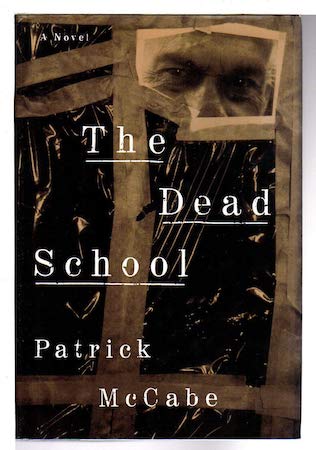
Not one for the faint of heart, McCabe’s 1995 novel about the intertwining careers, and psychological breakdowns, of a young, ill-equipped school teacher and his pious, Old Ireland boss at a prestigious Dublin boarding school is a classic of the “Bog Gothic” subgenre (in itself pretty much created by McCabe). Children drown, people hang, muscular Catholicism crumbles and ghost pupils abound.
Though perhaps less well-known on this side of the Atlantic, Ní Dhuibhne, who received the Irish PEN Award for outstanding contribution to literature last year, is one of Ireland’s great short story writers. Her work often marries Celtic folklore with a subtle, probing insight into the lives of contemporary Irish women and nowhere is this better illustrated than in the title story of this collection, in which a disillusioned young midwife is called out, late at night, to assist in the birth of an unwanted child.
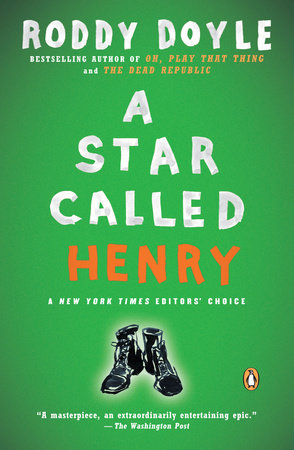
In contrast to some of the bleaker entries on this list, the first installment in Doyle’s “Last Roundup” trilogy — following the life and travails of young Dubliner Henry Smart as he flees from Ireland to America and back again over the course of the 20thcentury, interacting with historical titans along the way — is a warm, comic joy, as well as a stained glass window into the Irish Republic’s revolutionary beginnings. Henry escapes the Dublin tenements, leads guerrilla battalions in the War of Independence, wrestles with Michael Collins and elopes with a feisty schoolteacher, all before his twenty-first birthday.
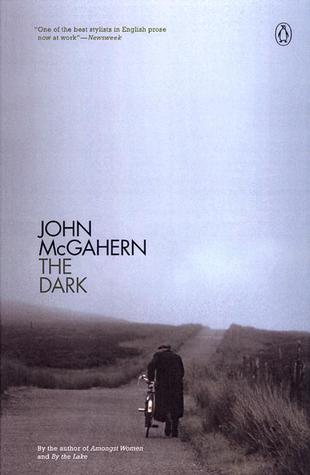
Before his death in 2006, McGahern was hailed by many as “the greatest living Irish novelist.” In quiet, restrained prose his novels and short stories explore the constricting nature of post-independence rural Ireland, and the younger generation’s desire to break free from its shackles. Though 1990’s Amongst Women is considered his masterpiece, The Dark — a bleak coming-of-age story about the consequences of parental and clerical child abuse — is perhaps his most painful, emotionally charged work. Not only was the novel banned in Ireland in 1965 for its “obscene and indecent” content, but McGahern was also fired from his Catholic school teaching job because of it.
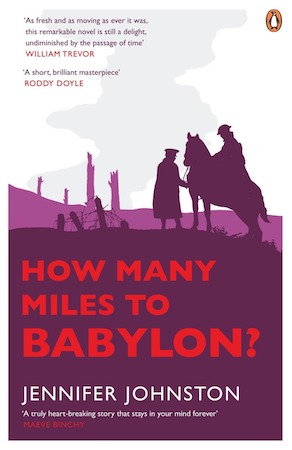
Short, lyrical and devastating, Johnston’s 1974 novel about two young Irish men from markedly different class backgrounds, brought together by their shared passion for horses but forced to conduct their adolescent friendship in secret before being divided once again, this time by rank, in the anarchic hellscape of the first World War.
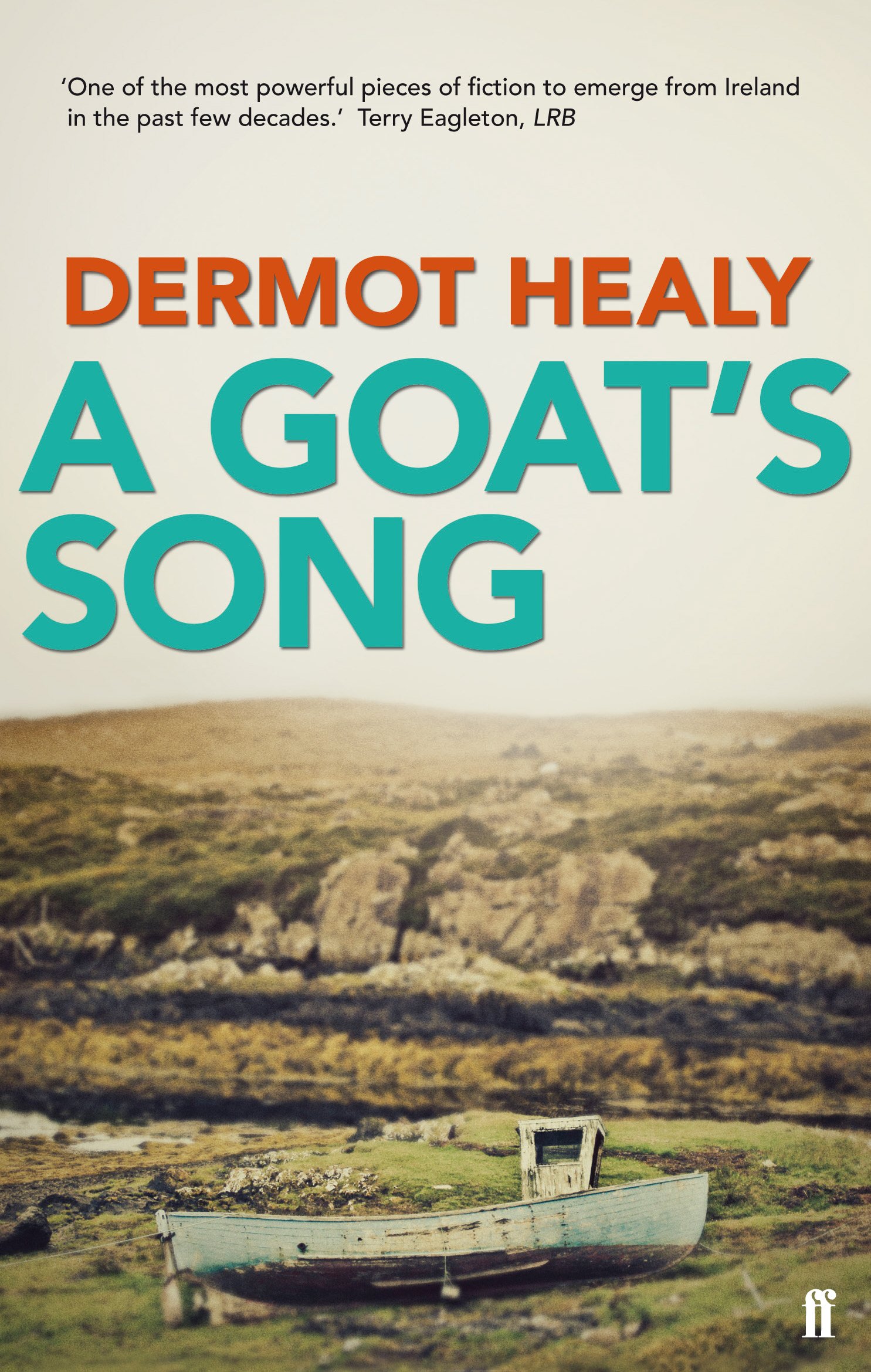
Making a strong case for the most overlooked, under-appreciated writer on this list, both at home and abroad, Dermot Healy began his writing career as a sort of vagabond, living a nomadic emigrant’s life in London for 15 years before his first book was published in 1982. To say that his 1994 existential opus A Goat’s Song is ambitious in scope would be a pretty significant understatement. Ostensibly the story of a doomed love affair, the novel is also about the violence of the Troubles in Northern Ireland, the myths of the rural West, Ireland’s religious divisions, the weight of lineage and the ache of the outsider. There’s a lot going on, but it’s well worth the investment.
Electric Literature is pleased to announce we are appointing Halimah Marcus as our first Executive Director. Halimah began at Electric Literature in 2010 as a volunteer, and has since become a leader in our organization. She was integral in launching our critically acclaimed weekly fiction magazine, Recommended Reading, and establishing Electric Literature as a successful arts non-profit.
“I’m looking forward to making bold new strides to present literature as a public art form, and firmly establishing its place in the popular conversation,” says Halimah.
Halimah will continue as Editor-in-Chief of Recommended Reading, which published a special four-part 200th issue this week, with sitcom-inspired fiction from J. Robert Lennon, Téa Obreht, Rob McCleary, and Morgan Parker.
The full press release is below.
For Immediate Release CONTACT: editors@electricliterature.com
Electric Literature Appoints Halimah Marcus as Executive Director
New York, NY (March 16, 2016): The Board of Directors of Electric Literature has appointed Halimah Marcus to be the first Executive Director of the organization, whose mission is to use digital innovation to keep literature a vital part of popular culture.
Since launching in 2009, Electric Literature has established a reputation as a digital innovator, having created the first literary magazine mobile app and pioneered a publishing model that is widely used today. Their ability to embrace new technologies and quickly adapt to the changing publishing landscape has earned them a large and devoted readership, including a strong and growing social media presence.
“Halimah has been essential to our organization as we’ve grown and flourished over the past six years,” said Andy Hunter, Electric Literature’s founder and board chairman. “She’s a brilliant writer and editor, an innovative thinker, and the perfect person to lead Electric Literature into the future.”
Electric Literature operates electricliterature.com, a daily destination for book lovers with more than 4 million visitors in 2015, and two weekly literary magazines: Okey-Panky, which publishes brief, strange writings, and Recommended Reading, which presents fiction with personal recommendations by top writers and editors. Electric Literature also hosts free public events throughout the year and has commissioned and distributed several multimedia pieces such as apps, art installations, annotated fiction, and twitter fiction.
The appointment of an Executive Director marks Electric Literature’s commitment to their mission and to growth as a non-profit. “At Electric Literature, we believe literature should be accessible to everyone, which is why we are so proud of our large and engaged audience,” said Halimah Marcus. “I’m looking forward to making bold new strides to present literature as a public art form, and firmly establishing its place in the popular conversation.”
Halimah Marcus joined Electric Literature in 2010 as a volunteer, and was quickly hired as Managing Editor. In 2012 she was integral in launching Recommended Reading, which has over 116,000 subscribers, later becoming its Editor-in-Chief. Today, Recommended Reading publishes its 200th issue, which can be found here, and Marcus will continue to serve as Editor-in-Chief. Recommended Reading has published critically acclaimed, prize-winning authors such as Jim Shepard, Charles Yu, James Hannaham, A.M. Homes, and Ben Marcus, alongside hundreds of debut and emerging writers, and has featured recommendations from literary luminaries such as Hari Kunzru, Chinelo Okparanta, Karen Russell, Michael Cunningham, Jennifer Egan, and Kelly Link.
In 2014 Marcus spearheaded Electric Literature’s transition to a non-profit, and has since secured support from the National Endowment for the Arts, the New York State Council on the Arts, and the Amazon Literary Partnership. Before joining Electric Literature, Marcus worked in programming and development for the Free Library of Philadelphia Foundation and the community radio non-profit The Prometheus Radio Project.
Electric Literature has grown significantly in the past two years, quadrupling its audience, launching a second weekly magazine, Okey-Panky, and an original series which features international authors writing about their home cities, “The Writing Life Around the World”.
“Halimah Marcus is one of the finest fiction editors I’ve had the pleasure of working with, and she’s proved an exemplary colleague under the EL umbrella as well,” said J. Robert Lennon, a novelist and the Editor-in-Chief of Okey-Panky. “No one is more qualified to sail this ship than she is.”
DON’T MISS OUT
Sign up for our newsletter to get submission announcements and stay on top of our best work.
YOUR INBOX IS LIT
Enjoy strange, diverting work from The Commuter on Mondays, absorbing fiction from Recommended Reading on Wednesdays, and a roundup of our best work of the week on Fridays. Personalize your subscription preferences here.