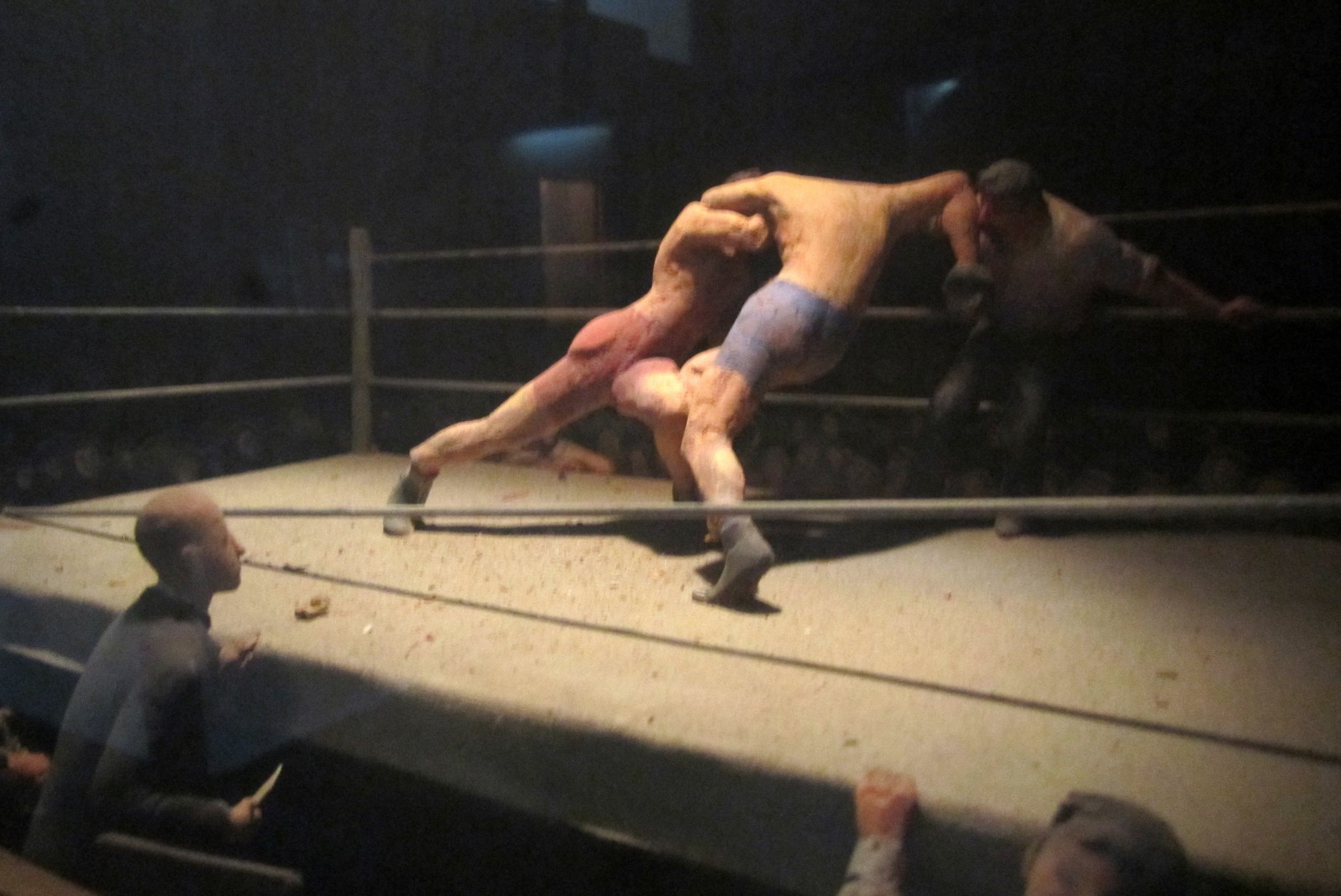
Feasting With Panthers: The Curious Connection Between Boxing and Gay Rights

At the conclusion of James Toback’s 2008 documentary on Mike Tyson, the former heavyweight champion is seen on a beach, awkwardly wearing street shoes à la Richard Nixon, as he recites Oscar Wilde’s “The Ballad of Reading Gaol.” The scene is a convergence of harmony and dissonance, like a piece by Charles Ives; yes, both fighter and writer went to jail, but Tyson was a brutal man, accused and convicted of heterosexual rape, while Wilde, the Irish poet and playwright, was the quintessential effete aesthete whose only crime was consensual relations that the Greeks referred to as paiderastia — sex with boys. Surely no stranger pair of lips could be found to mouth Wilde’s words than Tyson’s.

Or perhaps not. In 2002 Tyson, who speaks with a lisp, an impediment commonly associated with effeminacy, grabbed his genitals and threatened a reporter at a press conference with violent anal sex. Other boxers — Mitchell Rose and Mitch “Blood” Green — have accused Tyson of being gay, and Tyson seemed to suggest as much himself in a 2002 interview with the Guardian, saying the two decades of constant media attention he had endured would make anyone a homosexual. In this light, he appears to be a sort of homophile/homophobe Möbius strip; a man who confounds sex and violence with other men, because he can’t separate the two impulses within himself.

In this light, he appears to be a sort of homophile/homophobe Möbius strip; a man who confounds sex and violence with other men, because he can’t separate the two impulses within himself.

The evidence for such a connection does not begin with Tyson. On the night of March 24, 1962, Emile Griffith defeated Benny “Kid” Paret by a knockout in the twelfth round, a bout broadcast on national television. In a doleful footnote to its entry on the fight, the Ring Record Book and Boxing Encyclopedia notes that Paret died ten days later from injuries received in the bout.
The two boxers had fought twice before in the previous twelve months, swapping the welterweight title back and forth each time. They had thus come to know each other, perhaps a bit too well; at the pre-fight weigh-in Paret, Cuban-born, called Griffith a maricon — vulgar Spanish slang for “homosexual.” As Griffith explained many years later, “I knew maricon meant faggot, and I wasn’t nobody’s faggot.”

That Paret’s taunt goaded Griffith to violence beyond the boundaries that distinguish boxing from unlawful street fighting was a tonic note with two overtones in a minor key; first, if any boxer was ever homosexual or bisexual, it was Griffith. By his own admission he has frequented gay bars, and in the early ‘90’s he was almost beaten to death as he left one in a drunken state.

As Griffith explained many years later, “I knew maricon meant faggot, and I wasn’t nobody’s faggot.”

Second, the rules that govern boxing today, and in force during the third Paret-Griffith fight, are based on the Marquis of Queensbury Rules, published in 1865 by John Sholto Douglas, the eighth Marquess (the English version of the title) of Queensbury and father of Lord Alfred “Bosie” Douglas, the man whose homosexual relationship with Wilde started the chain of events that resulted in a sentence of two years’ hard labor for Wilde.

Wilde had sued for criminal libel after Queensbury, enraged by the attentions Wilde was paying to his much younger son, left a calling card at Wilde’s club in London for “Oscar Wilde posing somdomite” (sic). To the charge of libel Queensbury raised the defense of truth, and produced evidence that Wilde had consensual sex with “rent boys,” young male prostitutes from the lower classes. Wilde, like Griffith, denied the charge, but later admitted he was lying.

Paiderastia or “boy-love” originated with the Spartans as a bond between a boy and his protector, who lived a life of discipline together in the outdoors as the elder man introduced the younger to the concept of valor and trained him to endure hardship. As sports became a substitute for military training, the concept moved indoors to gymnasiums. An ancient law forbade the presence of men in the wrestling grounds, but over time it came to be ignored. Lucian of Samosata, a Greek satirist, said of one such boy-lover: “You care for gymnasiums and their sleek-oiled combatants.”

Boxing writers of the literary dabbler sort swooned over Ali in prose that would have embarrassed a boy band beat reporter for a teen girls’ magazine.

In the twentieth century, heavyweight Muhammad Ali attracted the sort of attention from boxing writers that Aeschylus noticed in a “noisy haunter of gymnasiums” eighteen hundred years earlier. Boxing writers of the literary dabbler sort swooned over Ali in prose that would have embarrassed a boy band beat reporter for a teen girls’ magazine: George Plimpton — Ali had “great good looks”; Norman Mailer — The first round of the Ali-Frazier rematch was the “equivalent to the first kiss in a love affair”, and later the fighters “moved like somnambulists slowly working and rubbing one another, almost embracing, next to locked in the slow moves of lovers after the act”; Pete Hamill: Ali had “beautiful legs,” and so on.

As with much else about Ali, there is nothing new about the afflatus that boxers blow upon writers. In Pugilistica, an earlier 20th century history of British boxing, the author quotes the following description by one Firby, a correspondent for the Morning Post, of Jem Belcher, Champion of England from 1798 to 1809: “He . . . strips remarkably well, displaying much muscle. ( . . . ) [A] braver boxer never pulled off a shirt.” Such descriptions abound in 19th century newspaper accounts of prize fights, which were, like homosexual relations, illegal.

Boxing is the more primitive contest to which other sports are reduced when their rules break down. Rodney Dangerfield’s memorable one-liner — “I went to a fight last night and a hockey game broke out” — is funny because of its absurdity; things flow in the other direction. It just so happens that professional hockey players resort to fisticuffs more frequently than athletes in other sports.

Perhaps boxing’s antiquity places it closer to a prelapsarian time when men could look upon each other with a shameless admiration.

Boxing’s elemental character has something to do with its ancient origins. Four boxers are mentioned in Homer’s Iliad; Polydeuces, Nestor (who says he’s lost the left-right combination of his youth) and Epeus, who drops Euryalus with a roundhouse hook to the head. Perhaps boxing’s antiquity places it closer to a prelapsarian time when men could look upon each other with a shameless admiration.

Consider, then; there are handsome men in other sports, but if a sportswriter ever filed a story about an NBA game (to pick the major sport whose players’ dress most closely resembles boxing trunks) that said he thought Steve Nash was cute, or that Kobe Bryant had nice legs, he’d be banished to the Lifestyle section.

Queensbury’s family tree included a cannibal who ate an entire kitchen boy, making Tyson’s bite into Evander Holyfield’s ear in 1997 seem an hors d’oeuvre by comparison; yet it was Queensbury who reclaimed boxing’s good name after it was banned as a public nuisance by creating a set of rules that elevated fist-fighting from the barbarity to which it had sunk. In so doing, he made violence between males socially acceptable — within limits.

Queensbury’s family tree included a cannibal who ate an entire kitchen boy, making Tyson’s bite into Evander Holyfield’s ear in 1997 seem an hors d’oeuvre by comparison

Wilde and Queensbury’s son Lord Alfred Douglas, though they were associated in the public mind as lovers, each preferred sex with boys. Wilde sympathized with the Order of Chaeronea, a homosexual rights group formed to fight an 1885 law that criminalized indecent conduct short of penetration between men. By offering himself up as a martyr in the Oedipal struggle between the hyper-masculine Queensbury and his effeminate son, Wilde made sex between males socially acceptable — within limits.

Queensbury, the patron of the fistic arts, brought boxers with him on more than one occasion when he confronted Wilde, the first time leaving Wilde’s residence “with his tail between his legs” (according to his son) as Wilde sent the two more virile men away using only the sheer strength of his personality. Queensbury’s wife, protector of her effete son, had mocked her husband for his lack of culture, banishing him to the 19th century equivalent of the Man Cave in the basement.

The 19th century’s domestication of previously-forbidden sex and violence has left us a legacy of muted passions. Boxing seems tame by comparison to mixed martial arts or “ultimate” fighting, to which it is losing spectators. The battle lines on gay rights have moved to a front where the debate is no longer about sex, but about the humdrum issue of gay marriage — state sanction for an arrangement that Wilde ridiculed by saying “Twenty years of romance makes a woman look like a ruin; twenty years of marriage makes her look like a public building.”

What Wilde wrote about his forbidden relationship with a younger man in “De Profundis” was true as well of boxing in his time: “It was like feasting with panthers. The danger was half the excitement.” Perhaps violence and love between men are two tributaries of the same river.

MFA vs. CPU: Another MFA Article Misses the Bigger Picture

Every now and then, the literary world likes to take a break from debating whether ebooks are taking over or whether the novel is dead to discuss an even more pressing matter: are MFA programs bad?

Of all the literary debates, the MFA question might be the dullest, because the stakes are so low. Some writers like to take a few classes for a couple years, others don’t. There’s an important debate about funding — especially in this baby boomer-ravaged economy — but otherwise who really cares if an author has taken a few writing workshops? Not many editors, reviewers, or readers do. But that fact is actually what’s interesting about the MFA debate: it tends to completely ignore the groups that actually determine what gets published in favor of an MFA-centric theory of the literary universe where all other players orbit around the MFA, propelled by its workshopped gravity.

This weekend, The Atlantic jumped into the MFA debate with “How Has the MFA Changed the Contemporary Novel?” If you are intrigued by the title, don’t be. The article doesn’t examine how the rise of MFA programs has changed contemporary fiction. There’s not even any discussion of fiction before the rise of MFA programs. Instead, authors Richard Jean So and Andrew Piper — “two professors of language and literature who regularly use computation to test common assumptions about culture” — set out investigate a question that I truly believe no one has ever asked: are published novels by writers with MFAs stylistically similar to published novels by authors without MFAs that are reviewed by the New York Times?

a question that I truly believe no one has ever asked: are published novels by writers with MFAs stylistically similar to published novels by authors without MFAs that are reviewed by the New York Times?

So and Piper use “a variety of tools from the field of computational text analysis” (talk about vague) to compare some novels from MFA grads (story writers, poets, and non-fiction writers are ignored) to New York Times-reviewed novels by authors like Donna Tartt and Akhil Sharma. Their computer can’t detect much difference in vocabulary or syntax between the two sets of novels. The authors don’t investigate why stylistically similar books are being shopped by agents and published by editors. Instead, they assume what is published is representative of what is written, and conclude that MFA programs don’t affect writers.

The central question itself is a little bizarre. Who argues that MFA grads write differently from their mainstream literary fiction peers? Most aspiring novelists go to MFAs precisely to be able to write the kind of work that gets published by big houses and reviewed in major papers — i.e., mainstream literary fiction. So and Piper might have found very different results if they compared the works of MFA grads to, say, small press horror novels or self-published romance ebooks.

Most aspiring novelists go to MFAs precisely to be able to write the kind of work that gets published by big houses and reviewed in major papers — i.e., mainstream literary fiction.

Because of this sloppy methodology, So and Piper fail to rebut either the pro- or anti- MFA crowds, despite claiming to rebut both. The argument for MFAs is essentially that studying the craft and taking dedicated time to work with engaged peers will help your writing get better. (The more cynical might say that even if it doesn’t help your writing, it can get you important connections.) Does the MFA help people get better? In my experience, yes, but So and Piper make no attempt to analyze whether writers improve or change during an MFA. They don’t compare authors’ work before and after MFA programs, nor do they see if writers’ publication rate or job prospects increase after getting an MFA.

So and Piper also make the faulty assumption that the influence of MFA writing can be measured by MFA degrees. A case in point: one of the three examples The Atlantic gives for a non-MFA writer they analyzed is Akhil Sharma. Sharma studied under writers like Joyce Carol Oates and Paul Auster in undergrad, then was awarded a prestigious Stegner creative writing fellowship, and has taught in the MFA program at Rutgers. It is only a technicality that Sharma doesn’t count as an MFA author (the Stegner is an MFA-style creative writing program at Stanford that is largely awarded to people who already hold MFAs). The authors don’t make their data public, but there’s little doubt that their “non-MFA” data set is filled with writers who similarly either studied creative writing in undergrad or teach in MFA programs.

The Atlantic piece is part of a rise in “data journalism” invading the arts. Computer analysis of artistic works can be interesting, but the majority of the time it seems to show the biases and assumptions of the authors rather than anything about the work itself. Everyone knows how Nate Silver revolutionized baseball analytics and election forecasting with his data-driven approach, but when Silver launched his FiveThirtyEight website and attempted to extend “data journalism” into the arts, the results have been pretty silly. I still remember when the site launched, it featured an analysis of Shakespeare’s Romeo and Juliet that declared “More than 400 years after Shakespeare wrote it, we can now say that ‘Romeo and Juliet’ has the wrong name.” The author “discovered this by writing a computer program to count how many lines each pair of characters in ‘Romeo and Juliet’ spoke to each other” and being shocked to find that Romeo and Juliet don’t speak to each other as much as they speak to other characters. Of course, anyone who studied that play in middle school knows that the entire point of the play is that Romeo and Juliet are “star-crossed lovers” whose relationship is thwarted by outside forces. We don’t need data to tell us the main characters are kept apart from each other, that’s literally what the entire plot revolves around.

So and Piper don’t get into detail about how their data analysis works, but what they do say brings up far more questions than answers. For example, So and Piper claim to analyze the “themes” of MFA and non-MFA novels, but spend only two sentences describing this:

To test whether this was the case, we used a method called topic modeling that examines themes instead of individual words. And while MFA novels do tend to slightly favor certain themes like “family” or “home,” overall there’s no predictable way these topics appear with any regularity in novels written by creative writing graduates more than other people who write novels.

Telling us a book is about “home” or “family” isn’t really delving into its themes in any meaningful way. Would So and Piper’s program tell us the “themes” of The Metamorphosis and Moby-Dick are “insects” and “the ocean”? Later, they claim to calculate the number of “strong female characters” in the novels without any explanation of how their algorithm decides which female characters are strong and which are flat and cliché. (I assume the authors are being loose with language and by “strong” they just mean “has a lot of lines,” but who knows.)

Would So and Piper’s program tell us the “themes” of The Metamorphosis and Moby-Dick are “insects” and “the ocean”?

The only interesting parts of the essay are when So and Piper say their program doesn’t detect much difference between the voices of writers of color and white writers, and when they note that women characters are underrepresented in all books. But this part only highlights again how weak their argument is — and the arguments of so many similar MFA articles — because they completely ignore the book-producing elephant in the room: the publishing industry.

While So and Piper smarmily note that MFA programs claim to be “challenging ‘patriarchy’ and ‘heteronormativity’” while producing sexist work, they seem to naively believe that MFA programs determine what gets published. They don’t. Writers with or without degrees don’t either. Writers of color frequently talk about how editors ask them to make their voices “less ethnic” or change their books to fit what “the market” wants. Groups such as VIDA have long highlighted gender disparity in publishing and in reviewing. While there is certainly sexism and racism in the MFA world, what and who gets published and covered is far more determined by editors, agents, marketing directors, reviewers, publicists, and even readers than MFA professors.

This is ultimately the problem with the entire MFA debate. It ignores all the outside pressures, signals, influences, and factors that determine what gets published. MFAs can be useful to writers, especially when they are well funded, but ultimately, the MFA is only two to three years out of a writer’s life. Those years don’t outweigh decades of signaling from the publishing industry, major newspapers, and magazines about what type of fiction is popular and publishable. And they don’t outweigh years of one’s personal reading habits and taste either. Writers tend to leave the MFA program with their tastes and style in tact and their writing a little more honed. Hopefully they have a polished manuscript freshly printed in their hands. But when the leave the warm confines of the MFA program, they face the cold world of agents, editors, and readers who couldn’t care less what workshop comments or professor feedback they got.

A Cluster of Cactus Wrens —

FICTION: A CLUSTER OF CACTUS WRENS, BY KIIK A.K.

According to the recorded history of retired minister and amateur meteorologist Yoshikane Araki, the hottest day inside the Gila River camp occurred in August of 1944, when an outdoor thermometer he’d constructed from wood, glass, alcohol and acetic acid hovered at 122 degrees Fahrenheit.

It was the same afternoon Ginger Koyamatsu, the teenage pageant winner of Gardena, California, took three steps outside her family’s barrack, heard a popping sound from above, and, as she raised a hand to gather her hair, her sleek victory rolls shot sparks and went tumbling over her shoulders in crests of red-black fire.

Kazuo Taka, Gila’s resident winemaker, whose shelves groaned beneath immense condiment vats, vats that’d been scrubbed and swaddled in aluminum in order to manage the fermentation of crushed grapes, raisins and honey water, was pressing and hanging his shirts when he caught sight of a red mist rising, and then a terrible wail as the vats gurgled and erupted, black wine spurting over him, scalding his outstretched hands and imprinting all his clothes with unfiltered grit, pulp, seed, and stem.

Yuriko Morri was delivering a loose tower of the Gila News-Courier to her neighborhood block when the top issues ignited. To save herself, she was forced to fling them into the sky. Passersby who witnessed the event swore it was not a stack of hovering newspapers at all that were burning, but a cluster of Arizona cactus wrens, whose wings looked as though they had clipped the sun, and were being incinerated in a mournful flash of eye stripes, a flurry of ashen wings.

In August of 1944, the Butte and Canal infirmaries encountered so many instances of burning hair and epidermal tissue, scorched clothing, heat stroke, heat exhaustion, unremitting sweating, fainting, and fever, that calls were placed to local laboratories and universities to inquire whether or not Arizona citizens spontaneously catching fire was a regular occurrence.

A reply to Butte infirmary’s query was printed in a late-August issue of the Courier.

Because a person of Japanese decent, or any persons resembling a person of Japanese decent, is not equipped with the complexion to contend with a sustained period of harsh desert sunlight, it is not uncommon to witness the spontaneous combustion of those persons’ skin, hair, jewelry, attire, or personal belongings. Similar cases have been documented in New Mexico, Idaho, Colorado, Wyoming, and Utah. Our principal recommendation, based on observation, is for Gila River residents of Japanese decent or predilection to dig trenches beneath their raised barracks, and wait out the hottest portions of the day in the cooling shade of those trenches.

This announcement caused something of a stir, and within days, half of Butte camp, about 3,000 internees, had moved the contents of their living rooms into dusty burrows below.

In September at a Butte community gathering, Yoshikane Araki took the stage and announced he’d been gathering his own research. He proclaimed that in order to survive, residents in the hottest neighborhoods of Butte should submerge their shirts and pants in apple cider vinegar.

– And when the weather becomes more extreme, he said, you will need to fill your socks with crushed garlic and egg whites before slipping them on.

And though most of the internees at Butte considered Yoshikane Araki to be something of an elderly crackpot, his announcement caused an immediate shortage and tight rationing of chicken eggs in Gila River. In October, Tetsuo Aratani, a member of Butte’s unarmed camp police, was found tied up and unconscious at the entrance of a mess hall pantry. All of the eggs and garlic had been spirited away, and for weeks the air surrounding Butte camp stung in everyone’s noses like sulfur.

Dedicated to the writer and educator Aaron Fai.

The Portable Veblen Is a Delightful Synthesis of Psychological Study

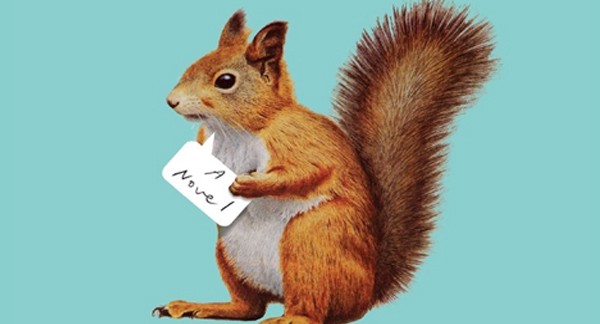
“It is one kind of trouble to kiss your fiancé goodbye in the morning and immediately turn your thoughts to another man,” muses Veblen Amundsen-Hovda, protagonist of Elizabeth McKenzie’s riotous sophomore novel, The Portable Veblen. “But it’s another kind altogether if the other man has been dead for nine decades, or is of the genus Sciurus.”

The man dead for nine decades: Thorstein Veblen, Norwegian-American economist and sociologist, ferocious critic of capitalistic materialism and coiner of the phrase “conspicuous consumption.” The creature of the genus Sciurus: one peculiarly tenacious and sagacious squirrel, with whom Veblen converses on a somewhat regular basis throughout the novel, and which proves particularly frustrating to her fiancé and the book’s co-protagonist, Dr. Paul Vreeland.

“Another kind altogether”: this novel, a delightfully knotty synthesis of psychological study, philosophical inquiry, romantic page-turner, and economic critique.

At its heart is the aforementioned “independent behaviorist, experienced cheerer-upper, and freelance self” Veblen Amundsen-Hovda. An amateur scholar of her namesake and Norwegian translator, Veblen gets by as a temp living a freewheeling life in a miraculously quaint bungalow right in the middle of the Siliconified Palo Alto. Freewheeling, at least, when she’s not helping her step-father manage her narcissistic hypochondriac mother, hitting the road to visit her PTSD-afflicted Vietnam Vet father in a psychiatric facility, or planning an impending wedding.

Enter Paul, the brilliant, Stanford-educated doctor and proud inventor of the “Pneumatic TURBO Skull Punch,” a medical device designed to help brain surgeons quickly and effectively treat traumatic brain injury by quickly cutting a neat hole through the skull. Straight-laced Paul is the rebellious product of a hippie family so devoted to his mentally disabled brother that Paul falls by the wayside. He is overjoyed to learn that the device has just been picked up by Hutmacher Pharmaceuticals, who plan to market it to the military and potentially make Paul a very wealthy man. His family, however, is not so thrilled — and for the Veblen-loving Veblen, it’s quite the philosophical hang-up.

In another novel (or ill-fated Zach Braff and/or Zooey Deschanel film), Veblen might be portrayed as the dreaded and dreadful manic pixie dream girl, and Paul the misguided good guy unsure how to secure her affections. McKenzie, thankfully, dashes that potential to bits. For one thing, instead of ending a love story with an engagement, she begins it with one, meaning the novel is filled with the aching anxiety of waiting for a wedding, rather than frivolous love.

For another, these characters aren’t just quirks for quirk’s sake. Veblen’s habit of talking to squirrels, living in her head, and avoiding traditional employment aren’t affected, but coping mechanisms, subconsciously constructed to help her manage a lifetime of being forced to mother her own mother. Yet they are aspects of her self from which she derives genuine joy — and why not? Can victims of trauma not find respite in its byproducts? Life is, after all, often that complicated.

For Paul, too, the desiring of stock portfolios and yachts, of fine, large homes and fancy dinners, is a reactionary response to his own damaging childhood. This is a man who, as a child, worried constantly of FDA raids of his family homestead, and who lost his virginity to a longtime crush after mistakenly inviting her over during one of his parents’ drug parties, during which they both unknowingly drank spiked punch. He is desperate to escape the “freedom” of the counterculture his parents indulged in and find normalcy and succes. Perhaps too desperate, as his stumbling venture into the corrupt world of corporate medicine and big pharma shows.

All of which is to say that The Portable Veblen is, in many ways, a novel about mental illness. The afflictions that Veblen, Paul, and their families confront have real emotional weight, even as they are dealt with more than a touch of manic humor. McKenzie’s prose has its precious moments, but they are more than made up for by her ear for the sound and flow of words. Like Veblen, the author shows a fascination with the specificities of flora and fauna to match that of the Romantic poets — not just squirrels, but “dark jelly newts” and Helix aspersa, “pale olive lichen” and a “handsome, muscular madrone.” And her deadpan send-ups of the outrageous marketing language of the medical economy — ”Corpsaire™ Sachet — Helps Eliminate Unpleasant Corpse Odors” — never fail to land.

At some moments, it’s hard to understand what brought Veblen and Paul together in the first place, and the novel’s rare moments of flat dialogue come when the narrative puts the most pressure on their conflicting ideologies. “You’re an awesome cook and a totally sexy, gorgeous woman,” Paul blathers in desperation after expressing frustration with Veblen’s impossible mother. “He was so transparent,” she thinks — a little too transparent, even for fiction.

But then you remember the commonalities. Paul may not be fond of the genus Sciurus, but he and Veblen are certainly both squirrelly: “crazy, nutty, weird.” And they work at love — truly work. Maybe that’s enough.

10 Great Teens In Contemporary Fiction: A Reading List

by Jonathan Lee

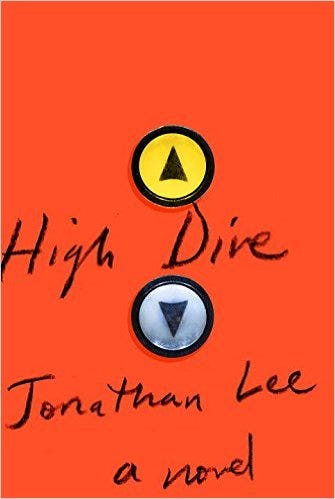
One of the three central characters in High Dive (Knopf, 2016), my novel about the bombing of an English seaside hotel in 1984, is a seventeen-year-old girl named Freya. She sits behind the hotel reception desk. She watches guests. She gets very bored. She’s a noticer — a useful character for a writer to employ. She sees all the little daily routines that the bomb is destined to disrupt, the personal moments that will soon flee the scene.

As I was writing Freya’s sections of High Dive, I took breaks to read a lot of other novels and stories that featured the perspectives of teenagers. Some of these are listed below. What unites this reading list, I think, is that the authors have accomplished one of the most difficult feats in fiction — rendering a teenager in all of his or her chaotic, needy, conflicted glory. Each writer below captures how in adolescent life the longing for individuality rubs up against the desperate desire to fit in. So often teenagers in fiction are reduced to type: the mean girl at school; the all-star jock; the prom queen; the lonely chess club kid. What’s interesting to me about the fictions below is that they do the opposite. They show how incorporating a teenage perspective into a story can provide an element of in-betweenness — a productive, unsettling complexity. Those trapped between youth and adulthood can see in both directions at once. They know something about departures and arrivals. They are not yet fully formed, therefore they stretch in more directions. Their lives are more crowded with question marks.

1. Susan from “Static,” by Susan Steinberg, a story collected in Hydroplane

The teenager seems caught between a desire to emulate these women and a desire to erase them entirely.

Static,” like all of Susan Steinberg’s work, is difficult to categorize. It seems to tread the line between fiction and memoir in its content, and the line between poetry and prose in its form. In this story the narrator (also named Susan) is beginning to discover, on a family vacation, the power her teenage beauty gives her over boys. Steinberg balances wonderfully the girl’s awareness of her own desirability with her unease at the influence girl-like women have over her father. Every summer sees him falling under the spell of “a new bleach-blonde with toothpick legs.” The teenager seems caught between a desire to emulate these women and a desire to erase them entirely.

2. Magnus in The Accidental, by Ali Smith

Seventeen-year-old Magnus is the quiet heart of this mordant novel about family life in England. He withdraws further and further from his family after joining a school prank with a photograph — one that led to a classmate’s suicide: “They took her head. They fixed it on the other body. Then they sent it round everybody’s e-mail. Then she killed herself.” An equally great achievement is Astrid, Magnus’s sister, a 12 year-old teetering on the brink of teen life whose favorite word is “substandard.” Smith’s close third person narration is elastic enough to take us deep inside the minds of these adolescents while keeping, at other times, an ironic distance from their self-obsession.

3. Fran in “The Summer People,” by Kelly Link, a story collected in Get In Trouble

Link’s O. Henry Prize winning story follows Fran, a teenage girl in rural North Carolina. Her mother isn’t around at all and her father leaves her, for long stretches of time, tending to the homes of the “summer people” who vacation on their land. Fran has the flu at the start of the story and continues to get sicker. Something of the quality of a fever-dream starts to soak through the narrative. The summer people seem to represent the adults all children are indebted to, and Fran’s fairytale struggle, comic and disturbing by turns, seems to see her aspire to her own form of human ownership. “When you do things for them,” she says of the summer people, “they’re beholden to you.”

4. Chris in The Finishing School, by Muriel Spark

Spark’s last novel, published in 2004, is less well known than The Prime of Miss Jean Brodie, her other fable about youthful education, but it achieves equally unsettling insights. A lot of fiction focuses on the powerlessness of teenagers, but here Spark looks at teenage self-centeredness and how it might provide the perfect conditions for making art. She offers the reader a group of confident 17-year-olds from rich European families, including a princess of somewhere no one can name. The most memorable of all is a teenager named Chris, a precocious young novelist whose doubt-free pursuit of his fiction drives his teacher, another wannabe writer, utterly insane.

5. Hattie in The Twelve Tribes of Hattie, by Ayana Mathis

It’s the perfect form for a book that explores the moments when obedience to the past comes into conflict with the desire to write a new future.

It’s 1923 and fifteen-year-old Hattie Shepherd, moved by the Great Migration, leaves Georgia and heads north. She wants a better life in Philadelphia, but a difficult teenage marriage and the quick demands of motherhood leave her hardened rather than happy. The novel’s structure allows us into Hattie’s youth before opening us up to the hopes and disappointments of her children. It’s the perfect form for a book that explores the moments when obedience to the past comes into conflict with the desire to write a new future.

6. Helen in “Honored Guest,” by Joy Williams, a story collected in Honored Guest

In this story Helen, an 11th grader, watches her mother Lenore battling a terminal illness. At first the drama of the fight seems to add a certain sheen of excitement to family life, but the beauty of the story lies in its portrayal of a mother and daughter who need one another so badly that each begins to turn away from the other before detachment is forced upon them. Williams is so good at exploring the teenager’s search for authenticity — for anything that feels real. Helen contemplates suicide but worries it’s too “corny.” Two of her classmates killed themselves the previous year. “They had left notes everywhere and they were full of misspellings and pretensions. Theirs had been a false show.”

7. Alivopro in The Hopeful, by Tracy O’Neill

…the obsessiveness, the longing for recognition, and the conflict inherent in trying to establish one’s particular sense of self while seeking applause from everyone else.

A figure skating prodigy, sixteen-year old Alivopro Doyle is one of a few “hopefuls” trying, through the grace of her immature body, to skate her way into the Olympics. Ali’s ascendancy is soon interrupted by a fall — she fractures two vertebrae — and O’Neill, across two interlocking timeframes, beautifully traces her depreciating freedom of movement and of thought. The Hopeful is, among other things, a great literary exploration of adolescence: the obsessiveness, the longing for recognition, and the conflict inherent in trying to establish one’s particular sense of self while seeking applause from everyone else. “I was sixteen,” the narrator thinks, “and I was maybe getting too old.”

8. Kafka in Kafka on the Shore, by Haruki Murakami

Might this be Murakami’s best book? One half of the narrative concerns a man named Nakata who has an uncanny ability to communicate with cats. The other chapters are devoted to Kafka, a 15-year-old running away from his father’s house to escape an Oedipal curse. “Taking crazy things seriously is a serious waste of time,” we’re told in a Holden Caulfield-like aside, and Murakami’s gift is to train a wry comic eye on the everyday concerns of teenage life while also taking seriously — and capturing on the page — a teenager’s fantastical dreams.

9. Addy in Dare Me, by Megan Abbott

This novel was recommended by two friends in 2013, but it took a while for me to be convinced that I’d enjoy a book about a high-school cheerleading squad. It turns out Abbott’s plot is desperately addictive, her exploration of the betrayals and misplaced trust of teenage years is deep and nuanced, and the writing is so sharp it could cut your throat. 16-year-old Addy Hanlon is a superb creation, caught in a moment of limbo all adolescents might recognize, “like a thing arrested between coming and going. Like the second before a crouch becomes a bound.”

10. The unnamed narrator in Grotesque, by Natsuo Kirino

Imagine Heathers set in Japan and rewritten by Claire Messud.

Sophie Harrison, reviewing Kirino’s literary thriller in The New York Times in 2007, wrote that ‘“Grotesque is full of schoolgirls in long socks but blanchingly free of cuteness, a combination we might call Uh-Oh Kitty.” The narrator suffers in her teen years because she’s “half,” as she puts it — one parent is Japanese and the other is Swiss — and because she doesn’t have the easy beauty of her sister. The confessional energy of the book derives almost entirely from the eloquent hatred the narrator feels for everything: her home, her sister, the elite school they’ve been sent to. It’s compelling stuff. Imagine Heathers set in Japan and rewritten by Claire Messud.

You can find Jonathan Lee & High Dive on tour this March and April, visiting New York, Chicago, Iowa City, Portland, San Francisco, Los Angeles, and New Orleans.

Psalm for a Selfish Hospice Volunteer

At the end of my first in-home visit as a hospice volunteer, the elderly wife of my “client” thanked me profusely and, having asked where I lived, offered me gas money.

“Oh, no, I can’t do that!” I exclaimed with jovial horror. I was forty-two years old and hadn’t negotiated gas money since nights of joyriding and under-age drinking with my high school friends.

“Are you sure?” she asked, making surprisingly earnest eye contact. She was an elfin woman with white hair cut like a boy’s, combed in a side part.

The pained expression on her face told me the problem: my help felt like a handout; she did not want a handout.

I told her I was sure. After the stern instructions on refusing gifts and money I’d received in my hospice training, I considered any compensation from a client’s family as a cross between payola and elder abuse. There are moments when, for mysterious reasons, I don integrity like a chastity belt, and this was one of them.

I was a hospice volunteer for roughly one year. I’d like to say my motives for volunteering were entirely virtuous and uncomplicated, but I can now admit this was not the case. Between extended fits of childrearing, my mother had been an RN, and then, after she retired, she was a volunteer hospice nurse for another fifteen years until she became too old to drive. Her whole life has seemed dedicated to serving others, including raising ten children. She acted as if some formal service was a life obligation.

I’d like to say my motives for volunteering were entirely virtuous and uncomplicated, but I can now admit this was not the case.

I felt the pull of this idea, the sheer lapsed-Catholic guilt of it, and I also sensed that serving others, especially in a charged context like hospice, was not a simple thing. I wanted to serve and I also wanted to reflect on what it meant to serve. Since I was a fiction writer, this reflection would take the form of a story. I planned to become a hospice volunteer at an outfit that provided in-home care, do good, and get some cold hard insightful facts for a novel I was considering.

My first assignment was providing respite for three to four hours, once a week, for the aforementioned elfin woman, whose husband was dying from C.O.P.D. I sat with the man. We watched TV together. He liked hunting and fishing programs. Meanwhile, his wife ran errands, had lunch with a friend, escaped her death watch.

I didn’t find myself counting the minutes until her return; instead, I immersed myself in the incredible tedium. I tried to pinpoint the best way to describe one of the sounds his oxygen machine made — cymbals clashing under two feet of water. I made conversation. I asked him simple questions that took him five minutes to answer. He told me about farming, about how calves were born feet first with their heads between their legs. If she was having trouble, you spoke softly to the mother cow, so she wouldn’t get up, and then you grabbed the forelegs of the calf and pulled. I logged this information. You never know when a well-rendered lifestock birth will provoke an epiphany or two. When it was time for lunch, I’d fetch him a bottle of Ensure, or a mushy pulled pork sandwich, or just an illicit ice cream bar.

His wife’s gratitude was intense and unsettling. I hadn’t counted on her being affected by my presence. I assumed I would simply do my job and go unremarked upon as a person. But after that first offer of gas money, there were other awkward parting scenes in which she inquired in great detail about my family, praised my character, gave me a stuffed rabbit for my daughter, and, yes, continued to offer me cash for gas. I told her I was on sabbatical from teaching, that I had plenty of time. My weakness with the rabbit only steeled my resistance to the money, which always seemed to pain her. Once, when she was laying it on too thick, I baldly said, “No, I’m not really a good person.” She didn’t seem to hear this.

Once, when she was laying it on too thick, I baldly said, “No, I’m not really a good person.”

I was plagued by some of my not-so-great moments as a person, and, also, increasingly by the “research,” the selfishness, it was now clear, that had landed me in this place. The more she praised my altruism, the more clearly I saw its absence.

During training, we had been given a poem written by a veteran volunteer called “A 23rd Psalm for Volunteers.” The poem’s speaker says that volunteer work “maketh me to forget the self/in remembering others,” and the poem concludes, “The light of my candle of service/shall flow in my heart forever.”

I wasn’t exactly feeling this. Still, I did try to rationalize what I was doing: maybe being altruistic and selfish at the same time was actually a good way to live, making sure sacrifice doesn’t go too far? My mother’s near-perfect altruism inspired in me significant awe and admiration but also noteworthy amounts of terror and depression. And isn’t every fiction writer guilty of turning anecdotes and relationships into material? Wasn’t that actually our duty? Clearly, this was a rare win-win situation because I was helping someone and getting inspiration for my book. Besides, the man wanted a male hospice volunteer, and we were a scarce breed. Some other poor sap would have had to do extra volunteering if I weren’t there to share the load.

But in the end, despite my rationalizations, I could never entirely shake a corrosive sense of false pretenses: I was secretly using my client and his wife in their hour of greatest vulnerability. On top of this, the opiate of my ambition inured me to the pain all around me. The Titanic was sinking and I had a one-man submersible idling portside. I had convinced the hospice to give me months of training, to let me join a close-knit volunteer family that I knew I would desert, totally unscathed by loss, when my sabbatical was over.

The Titanic was sinking and I had a one-man submersible idling portside.

These thoughts added another layer of awkwardness to our recurring tussles over gas money. Finally, one afternoon, she broke me: I did accept a five spot. I was willing to try to make her feel better by behaving worse, finally bringing my actions more in line with my inner self.

I went to his funeral, nodded politely at her invitation to go to lunch some time. I didn’t follow-up right away, wondering whether that would just be extending the subterfuge, and soon I was back to teaching and too busy to think about it much. I sent her a Christmas card. I couldn’t help noticing that she never sent one back. Maybe she finally came to the realization that I never truly “glowed with the knowledge/of my service.” Instead, I exploited that “knowledge” in my novel.

Still, “A 23rd Psalm for Volunteers” said it best after all: “Surely the rewards of my job/far exceed what I have given.” So what if my sense of my character had taken another hit? I had sold my novel. And honestly, there had been some good in helping others; there had been some good in writing about it.

TED WILSON REVIEWS THE WORLD: GRAVITY WAVES

★★★☆☆

Hello, and welcome to my week-by-week review of the world. Today I am reviewing gravity waves.

I was so happy to hear the recent announcement that scientists found gravity waves. Not because I care about gravity waves, but because I care about the scientists. They’ve been looking for gravity waves forever and up until recently had found absolutely nothing. Can you imagine devoting your entire life to something you might never find proof of?

That’s why science and religion are so similar. There’s a lot of crossing your fingers and hoping this thing you devoted your life to is real.

Every day those scientists would clock in hoping for gravity waves, and at the end of the day they’d clock out with nothing having changed. Only to do the exact same thing the next day. Again and again. I felt such relief for them when the announcement was made, knowing they could finally go back home to their families or televisions and not feel like failures.

Now that they found the waves, I guess their jobs are over. Or do they now get paid a fee for each wave they find? I have no idea how scientists make money.

One person already found a way to make money off the waves. His name is Bruce. He’ll tell you he has some gravity waves in the trunk of his Prius, but he doesn’t. It’s just a jar of water with some glitter in it. And when your credit card bill arrives, Bruce will have charged you way more than what you agreed to.

If you want to see some gravity waves yourself, don’t bother. They’re so small that even a pretty good microscope can’t see them. I looked in my backyard, the fridge, my skin — basically everywhere. Nothing.

It would be nice of the scientists to at least take a picture of some waves so everyone else could see. Honestly it seems kind of selfish of them now that I think about it. I guess spending your life obsessed with something can drive you crazy once you finally get it. Just like any treasure hunter.

BEST FEATURE: I have no idea because I’ve never seen them!
WORST FEATURE: How hard they are to see!

Please join me next week when I’ll be reviewing Wade Boggs.

Midweek Links: Literary Links from Around the Web (March 3rd)

Looking for some interesting reading to get you through the week? Here are some literary links from around the web to check out:

Victor LaValle talks H.P. Lovecraft, racism, and his new Lovecraftian novella The Ballad of Black Tom (read our review here)

When Samuel Beckett tried to move into movies

The Dark Tower adaptation has its hero and villain: Idris Elba and Matthew McConaughey

Kathleen Spivack talks about being a debut author in her 70s

Volume 1 previews March book releases

Revisiting the “vivid hopelessness” of William Gibson’s Neuromancer

The fight for Shakespeare’s wit

Interview with SF author Nick Mamatas about his new novel

When you learn you won a $200k literary prize after checking your junk mail

What books are banned in China? Well, it’s complicated…

LaValle Dazzles with Lovcraftian Horror Novella, The Ballad of Black Tom

Dealing with the legacy of H.P. Lovecraft in uncanny fiction is rarely pleasant. Though he wasn’t the first person to write cosmic horror, he’s arguably its best-known practitioner. Both indirectly and through the Cthulhu mythos that he established, a milieu in which numerous other writers have worked in the decades since his death, he looms large in a certain strain of literary history. He was also a tremendous racist, to an extent that’s impossible to shake when reading much of his work. Lovecraft’s influence on generations of writers that followed (and his own skills at creating a still-terrifying cosmology) makes him difficult to ignore, but the odious sentiments expressed in many of his stories go far beyond the “cringeworthy” description sometimes applied to fiction where the handling of race has, to put it mildly, not aged well.

Handling Lovecraft in the present day can be tricky. After a number of writers expressed displeasure with the fact that the World Fantasy Awards used Lovecraft’s face as the model for the awards themselves, a move away from said image is taking place. Sofia Samatar, winner of the World Fantasy Award for her novel A Stranger in Olondria, addressed some of these questions in a post following her win in the fall of 2014. “This is not about reading an author but about using that person’s image to represent an international award honoring the work of the imagination,” she wrote as part of a larger piece that neatly makes its case.

All of this makes Victor LaValle’s novella The Ballad of Black Tom that much more intriguing. On one hand, it’s a straightforward story of a young man getting caught up in occult struggles in 1920s New York. But it’s also a commentary on Lovecraft and race–and, by the end, takes on an even larger scope in the context of American history and literature. There are cosmic horrors aplenty to be found here, to be sure, but that’s far from the complete scope of this work.

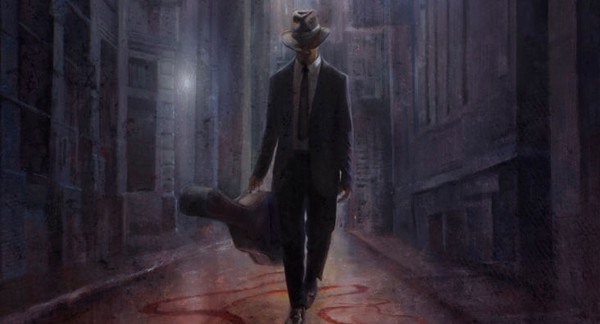
As the novella opens, Charles Thomas Tester is a young man living with his ailing father and traversing New York City in the 1920s, to all appearances a musician, but actually enmeshed in a host of activities, some of them touching on the city’s supernatural underworld. He crosses paths with a wealthy eccentric named Robert Suydam, who has a penchant for locations with impossible geography. Observing all of this is a police officer named Malone, who becomes convinced that something larger is at play here. If some of the characters’ names sound familiar, that’s intentional–LaValle is riffing here on Lovecraft’s “The Horror at Red Hook,” a modern re-read of which was headlined “Lovecraft’s Most Bigoted Story, No Really.”

In invoking a supernaturally-tinged Jazz Age New York and its secret clubs, mystic tomes, and mysterious societies, LaValle has opened the door to a beguilingly pulpy universe. At the same time, there are much more contemporary echoes to be found in here, particularly in the fate met by one of the book’s most sympathetic characters. Tester himself is goes through an evolution over the course of the book, and LaValle’s decision to shift the central viewpoint to another character halfway through ups the sense of mystery considerable.

In telling how Tester enters a world of supernatural horror after encountering the all-too-realistic horrors that can be wreaked by armed bigots who kill with impunity, LaValle presents a discomfiting juxtaposition. Institutional racism and white supremacy are monstrous systems that beget more monstrousness; late in this novel, LaValle quotes from another work of fiction that wrestled with the horrors of America’s history of racism and the terrifying acts that those horrors can prompt. It’s an impressive touch, and one which expands the scope of The Ballad of Black Tom even more.

The dedication of LaValle’s book speaks volumes: “To H.P. Lovecraft, with all my conflicted feelings.” Whether The Ballad of Black Tom is approached as a straightforward tale of horror in the early 20th century or as a metafictional commentary on Lovecraft’s own storytelling choices and racism, it succeeds. It also stands as proof that the process of engaging with the conflicted feelings that the work of Lovecraft can prompt can lead to rewarding, emotionally compelling writing of its own.

Geek Reads: A Conversation with Ian Bogost, Author of How to Talk About Videogames

Over the past few years, we have seen some extraordinary new voices emerge in the field of video-game criticism. The brilliant work of thinkers like Anita Sarkeesian (of the Feminist Frequency video series) and Nick Montfort (an MIT scholar of digital humanities and a poet) have contributed in wonderful ways to the ways we think about and play games. Tom Bissell’s superb 2010 book Extra Lives: Why Video Games Matter is one that everyone who writes about games will have to reckon with. Believe me, I know: I’m currently writing a book about video games and aesthetics — and my journey from noob to boss.

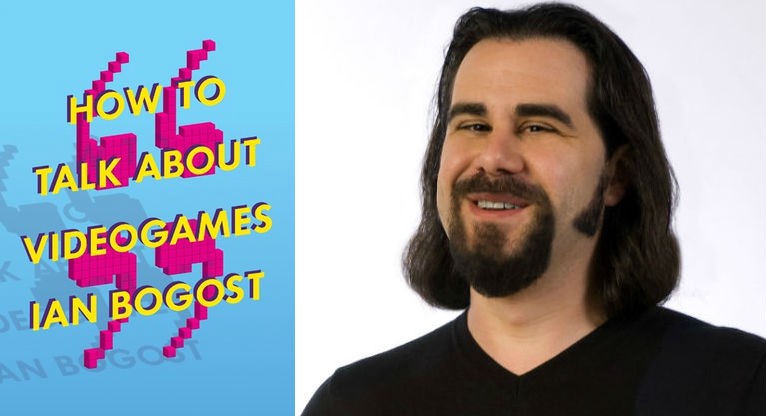
Another critic who has made my own work immeasurably more difficult and more pleasurable is Ian Bogost, professor of interactive computing and the Ivan Allen College Distinguished Chair in Media Studies at the Georgia Institute of Technology. His latest book is a collection of essays, How to Talk About Videogames (University of Minnesota Press). It has already proven indispensable to those of us interested in how video games have become such a vital artistic medium. Bogost very generously answered a few questions via email in January and February.

Andrew Ervin: You’ve written that video games “insert themselves into our lives, weaving within and between our daily practices, both structuring and disrupting them. They induce feelings and emotions in us, just as art of music or fiction might do. But then, these games also extend well beyond the usual payloads of those other media, into frustration, anguish, physical exhaustion, and addictive desperation.” Putting aside for a moment the fact that I’ve experienced all of those things with literature as well as with video games, what is it that video games can accomplish that those other media cannot?

Ian Bogost: I’m not sure we need to apply binary gating to the problem. It’s true that television or movies can produce compulsion and anguish as much as joy and distraction. But games are different in that they often, and perhaps always, include some of the yin and some of the yang. The key word in the excerpt you picked out is “usually.” The process and the experience are important to games, and that’s less true of television and the like.

AE: Do you distinguish between video games and computer games?

IB: The short answer is that it doesn’t matter anymore, not really. I like “video game” or even just “videogame” because it feels like a unitary and solid concept, and a populist one too. A candidate term to reach escape velocity the way “movies” did. But the more technical, historical answer is that “video games” were games that oriented principally toward televisions for display, while computer games were games oriented toward general purpose microcomputers for operation.

Back when Pong and the Magnavox Odyssey and the Atari 2600 were made (1971–76), games were designed explicitly so that they’d work with the cathode ray tube (CRT) television, or else with random-scan or XY displays, which are more like oscilloscopes (Asteroids is an example). Early “computer games” mostly ran on minicomputers like the PDP, although sometimes those games were also “video games” — Spacewar used the PDP-1’s XY display. In these early days, “video games” referred to television and arcade games. But then, with the rise of consumer microcomputers like the Apple ][ and the Commodore 64 and the ZX Spectrum and so forth, “computer games” arose to distinguish the slower, longer experience of PC games from the twitchiness of coin-op and home play.

So, in short, they are mostly historical terms, but the distinctions between aesthetics still persist, even if the television and the computer have become less distinct as well.

AE: Even the most casual gamers and non-gamers could recognize some of Shigeru Miyamoto’s creations. What is it that makes so many of his games so iconic?

IB: This is going to sound truculent, but: iconicity. That’s it. What makes Mickey Mouse iconic? The Eiffel Tower? These figures are representative symbols of their host subjects — Disney (or animation), Paris, and, for Miyamoto’s games, videogames. Especially Mario.

It’s easy to say that Mario became iconic because there was something fundamentally great about the early Miyamoto games that featured him. But there sort of wasn’t!

It’s easy to say that Mario became iconic because there was something fundamentally great about the early Miyamoto games that featured him. But there sort of wasn’t! Donkey Kong was the star of Donkey Kong, even if the player controlled “Jumpman,” who eventually became Mario. Do you remember how miserable it was to control Jumpman? Like steering a pinewood derby car. Mario Bros. (not Super) was weird and sort of alienating, and the whole premise of these plumbers overcome by turtles felt utterly alien in the apparent contextless context of some kind of underground sewer. By Super Mario Bros., of course, things began to look up. Just manipulating Mario (or Luigi. Poor Luigi.) was pleasurable. Forget the game. Just the character’s responsiveness, what Steve Swink calls its “game feel.” It was a delight to play Super Mario Bros., even if you never got anywhere.

And that’s what gets us out of the tautology. Miyamoto’s games became iconic because they didn’t require that you play them. Mario, Zelda, Wii Sports, etc. You could, of course, and deeply. Or you could dabble, and just doing that was fine too. Or you could not play at all, and just bathe in the iconicity of the characters, particularly after they became synonymous with Nintendo.

AE: Why should non-gamers care about games? What are they missing?

IB: Oh, they probably shouldn’t. Or they needn’t, anyway. I’m pretty well done with advocating for games as some special savior medium that will supplant and overcome all others. Will toasters ever become the dominant household appliance? Who cares. They’re excellent at browning bread.

But there is also a deep profundity in mechanism, in numbers, in gears turning and meshing with one another. And games embrace that paradox.

But, to be more earnest: if games are part art, and part appliance as I argue, then non-gamers should care about games because they tend to focus on the “art” more than the “appliance” generally speaking. Gamers are right to laud the specialness of operating devices and machinery that do things more than they express ideas or evoke emotional responses. Which isn’t to say that “non-gamers” aren’t also right that representation and sentiment are good and worthwhile. But there is also a deep profundity in mechanism, in numbers, in gears turning and meshing with one another. And games embrace that paradox.

AE: To what extent have persistent-world video games, in which some stand-in for me continues to exist in a virtual space while I’m logged off, changed or augmented what it means to be human? I haven’t been on World of Warcraft in ages, though I plan to do so soon, and yet I know that my primary toon still exists on the Nordrassil server.

IB: Richard Bartle, the creator of MUD, one of the very earliest (text-based) multi-user game experiences, has said that virtual worlds and MMOGs and their ilk are less like forms of entertainment and more places. You go to the bar or the club or the zoo or the park or the big box store, and then you interact with all sorts of people, things, creatures. Many different experiences are possible. So just as the bar or the zoo still exists when you leave it, so the World of Warcraft shard or the Habbo room or the League of Legends match does as well. Bartle’s right: it doesn’t make much sense to compare WoW to Super Mario Bros. WoW is more like Walmart.

This is another example of why I think games are as much like appliances as art, which is one of the premises. They are things you use to do other things, no less than toasters, even if once there, they also take on the aesthetics of more familiar entertainment.