Observational Acuity & Indefatigable Care: An Interview With Jim Shepard

Jim Shepard has been treating readers to great fiction for over three decades. To celebrate the impact his work has had on readers and other writers for so many years, Open Road Media has re-released five of Shepard’s earliest and long unavailable published novels, a real treat for those only familiar with works such as his acclaimed story collection Like You’d Understand, Anyway (nominated for the National Book Award in 2007) or perhaps 2015’s excellent and highly-praised novel The Book of Aron.

Shepard writes masterfully across so many seemingly different genres and subject matters, from dystopian political parables, to meditations on adolescent suburban life, to page-turning thrillers, all while deftly exploring the cracks and crevices of humanity through thoughtfully developed, complex characters. His recently re-released early novels (Flights, 1983; Paper Doll, 1987; Lights Out in the Reptile House, 1990; Kiss of the Wolf, 1994; and Nosferatu, 1998) all show evidence that the author had amazing writing chops from the start.

Shepard is also a teacher of writing, and the favorite workshop leader for many writers. He is generous in the classroom and in conversation, as can be seen in the following recent email correspondence, in which we discussed writing companions, the sparks for a story, and Shepard’s mysterious love of the Minnesota Vikings.

Catherine LaSota: Let’s start with that grand opening question: When did you know you wanted to be a writer? More specifically, when did you start writing, and when did you realize it was an activity you could build your life around (assuming you feel that way about it)?

Jim Shepard: When I was a kid I never really believed I could be such a thing as a writer, since I was the first member of my family to go to college, and making a life as a writer seemed to me to be outside the realm of the sort of thing that people I knew did. I knew I loved to write, though, and to make up stories. The nuns at Our Lady of Peace, the Catholic grade school I attended, used to let us do whatever we wanted in English class after we’d diagrammed all the sentences they’d assigned, and I always used the extra time to write little stories involving monsters. I remember hoping that I would someday get some kind of job that would allow me to write like that on the side, and that maybe I’d also find someone to be with who’d like reading those stories. For a while I dreamed of being a veterinarian, and then discovered that they had other duties besides playing with dogs. I think I probably began to think of fiction as an activity I could build my life around only when I was an undergraduate, after I’d sold a few stories.

CL: In your recently re-released first novel, Flights, dogs are important side characters in the life of Biddy, the young man at the heart of the novel. Do you have pets yourself? What role have pets played in your life, and perhaps in your writing life, over the years? I know that my purring cat is often my only companion for the day when I have my butt in a chair writing at home.

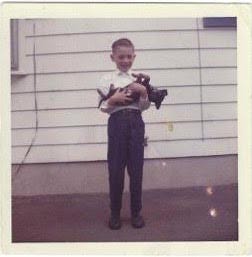
JS: I’ve always had pets, starting out the usual way with goldfish and turtles. I got my first dog, Lady, for my first communion, after some passionate begging. In the photo of me holding her that day my grateful smile is so intense it’s terrifying. I’ve had a dog ever since, not counting a brief hiatus of three years I spent teaching at the University of Michigan. Right now we have three beagles. Dogs have always been hugely important to my writing life. They’re great resources for procrastination, of course, but they’re also happy and silent companions during writing time, as you note. And they’re wonderful models for observational acuity and indefatigable care. And of course, they’re also narratively useful: Amy Hempel’s version of Raymond Chandler’s old piece of writerly advice is, “When in doubt, have someone enter the room with a dog.”

CL: I’d love to see that photo of you and Lady. Besides your dogs, is there anything else that you keep around you or your desk as you’re writing? Also — longhand or laptop?
Jim Shepard

JS: If by some miracle I can find the photo I’ll scan it to you. And as for my desk, well, it’s the envy of 10 year-old boys everywhere. Besides a big bulletin board on which I keep stuff from my research–images, maps, sketchy outlines, whatever–there’s a little tangle of prehistoric marine reptiles, and a megalodon tooth, and a full-sized bronze and horsehair replica of a Greek hoplite’s helmet. And I work on a laptop, but revise both on the laptop and on the hardcopy with a pencil.

CL: You are known as a writer who spends a good deal of time and effort doing research for the stories and novels you write. What first sparks your interest enough in a particular subject to research it intensely, and how do you know it’s going to be a subject that will lead to successful fiction writing for you?

JS: I’m always just reading weird nonfiction, along with whatever fiction and poetry I’m reading, in the hopes of turning myself into a more interesting human being. And every so often some situation or human dilemma within what I’m reading will catch my attention, and I’ll find myself continuing to turn it over in my mind. As in: what would it be like to be in that position? To have to deal with that? And once I find myself preoccupied with such questions, I’ll start reading more about the basic situation: the history or science or whatever. That second stage is me trying to figure out if I think I could write about such a thing. And if I start to think that maybe I can, then I start researching more systematically. Sometimes I’ll get a ways into such research before I finally have to conclude that I can’t write about it to my satisfaction, though, at least for the time being.

CL: Writers are really great at finding ways to procrastinate. How do you not research forever and ever — how do you know it’s time to start the writing?

JS: By reminding myself how prone to procrastinating I am, and by getting started once I have any sense at all of an evocative image or place with which to start, even if it’s the smallest corner of the world I’m trying to create: since it’s only by starting that I’ll find out more fully what it is I don’t know.

CL: So a story starts with an image or a place for you? Does it ever start with a character, or does that develop as the story progresses? How much do you outline, and how much are you discovering the story as you go?

…the process of writing the story is the process of teaching myself as I go.

JS: It usually starts with an image that conjures up a character in a place, and my sense of the character develops very rapidly from there. Or at least some central aspect of the character–usually having to do with the central conflict–develops if the story eventually works out. If the story’s heavily researched, I do some outlining of how I’m planning on deploying all of this information, and/or arranging all of these events, but I also recognize that if the story has any life to it at all, I should start to deviate from that outline, which was always by necessity skeletal and oafish, since I wrote it before I understood what I was doing. Since the process of writing the story is the process of teaching myself as I go. What’s that old line of Frost’s? “No surprise for the writer, no surprise for the reader.”

CL: Many writers say that they can look back over a body of work and see that some of the same topics and obsessions have surfaced again and again in their work. In this way, the reader might come to see what is important to the writer and appreciate the scope of their work over time as they wrestle with their interests. What do you think are the things you come back to again and again in your work? I’m especially interested in hearing your thoughts on this considering the wide range of subject matter and time periods you cover in your writing.

JS: I’ve always been interested in how much trouble we can get into through passivity, and through complicity with more aggressive and powerful forces, or people. I’ve always been interested in self-destructive behavior, since we’re so good at it as both individuals and an aggregate. And connected to that, I’ve also always been drawn to catastrophe as a subject, particularly man-made catastrophe. And I was raised Catholic, so as my students will tell you, I’m relatively obsessed with the issue of agency: with that portion of responsibility that we have for what happens to us.

CL: You’ve taught undergraduates at Williams College since 1984. What is your approach to teaching writing and/or leading a workshop, and has that changed over the years?

JS: I focus as intensely as I can on close reading. I try to model how much fun that activity can be. I don’t patronize or set up a different set of standards for undergraduates. As for what’s changed over the years, I hope I’ve gotten smarter and more varied in terms of both my resources and receptivity.

CL: Are there any published stories that you particularly like to use as examples for close reading exercises in your workshops, and why?

JS: Oh, I use all sorts of stories. One author I almost always teach is Carver, because his work is so lucid on how much can be suggested by context, and on the kinds of options available to a story when it comes to communicating emotional information about recalcitrant and/or unreliable narrators. Another author I use a lot is Barthelme, as a way of shaking people who are just getting started out of their notions of naturalism as a story’s default position.

CL: You have four published story collections and seven novels, and you’ve served as an editor for several anthologies. How is the experience of writing short stories similar to or different from writing novels? Do you enjoy one form more or find one more difficult to write? How do you know if an idea for a story will be better suited to a short or long form?

…the story is more a guerilla action, while the novel is something like a full-fledged invasion…

JS: I prefer the experience of writing short stories, for a number of reasons: first, they allow me to do away with what I call all the furniture-moving involved in the set-up of novels–as though, to use a military analogy, the story is more a guerilla action, while the novel is something like a full-fledged invasion–and second because some of the sensibilities I try to imaginatively inhabit I don’t want to stay with for three or four years. Because of that, and in keeping with my general perversity when it comes to the marketplace, I’m always trying to see how short I can make something and still do it justice, and when, as in the case of The Book of Aron, I can’t see how to do it in under 70 pages or so, I assume that what I have in front of me is more likely to find its shape in a novel.

CL: Is three or four years a typical time frame for you to write a novel? How about for a short story? What are your strategies for prioritizing your own writing time along with teaching commitments and everything else life brings your way?

JS: A short voice-driven novel like Project X would take much less time to finish, in terms of a full draft, than a research-heavy third person narration like Nosferatu, which probably took more than twice as long. What are my strategies for prioritizing my own writing time? Ha! How about despair? Teaching at a place like Williams and being present as a parent and not asleep at the switch for three kids means long stretches of not writing, which I’m sure has steered me away from novels and towards short stories, since if I have to set a project aside for a long stretch, once I return to it, the impulses that spawned it can read as incomprehensibly as those notes you jot down on your bedside table about a dream you had in the middle of the night.

CL: You are a big fan of movies and other media, and you teach courses on film in addition to writing workshops at Williams College. How do movies inform your writing, and how does reading affect your movie viewing?

JS: Movies are inherently visual, and visceral, and not given easily over to rumination. In other words, they’re very good at showing us how we behave, and not very good at reproducing thought. I’m sure I’ve been affected by that.

CL: Some would say that television has become overrun with “reality” programs, but it’s also true that some of the most wildly popular recent television programs (and movies) have been inspired by books (Game of Thrones, The Hunger Games, etc). Why do you think this is the case? And what can television and film learn from literature? And how long until we see a serialized film adaption of the Ferrante novels, do you think?

JS: Television as it has evolved–and like everyone else, I think this is its golden age–is much more suited to books than movies are, since mini-series can more easily encompass the sprawl of novels. Before the recent revolution in television, if you wanted to film Ulysses, you had to do the whole thing in around two hours. And I would say two years, in terms of your Ferrante question.

CL: You are a fan of sports, which play a key role in Flights and subsequent stories and novels you’ve written. The Super Bowl, one of the most watched televised events in the country, will soon be upon us. The Minnesota Vikings are your favorite football team (you’ve even written an essay about it), yet you were born in Connecticut and went to school on the east coast. Why the Vikings? What similarities, if any, do you find between playing or watching sports, and the writing life?

Who knows how and why we imprint ourselves onto some teams, like baby ducks?

JS: Who knows how and why we imprint ourselves onto some teams, like baby ducks? How did I end up following the Minnesota Vikings, coming from Connecticut? As I say in that essay: Hey, what can I tell you. Bridgeport was a dull place to grow up. As for the similarities between playing and watching sports and writing, well, writers negotiate made-up worlds for made-up stakes and stage these simulations of pain and loss and revelation, the same way sports do.

CL: What does the phrase “the writing life” mean to you?

JS: I don’t use it, myself, but I suppose I take it to mean, when I do come across it, that gift that allows us to live in these made-up worlds–our own, and especially others’–as part of our everyday responsibilities.

CL: If sports are made-up worlds, and stories are made-up worlds, what then is reality, and how much time do you think humans actually spend there, considering how invested many of us get in these made-up worlds?

Anyone following our politics in 2016 recognizes that a dismayingly large portion of our electorate has chosen to spend nearly all of its time in made-up worlds.

JS: Anyone following our politics in 2016 recognizes that a dismayingly large portion of our electorate has chosen to spend nearly all of its time in made-up worlds. And the Balkanization of our corporate media has meant that they can stay there, hearing what they want to hear.

CL: The Book of Aron, your seventh novel, was published this year to much acclaim–it’s on a number of Best of 2015 lists, including this one here at Electric Literature. Has the experience of publishing and promoting a book changed for you over the years?

JS: Not so much. Not since my first book, when everything was new to me. Whether you get a fair amount of acclaim for a book or a book is ignored, you’re still keenly aware of what a tiny and ignored part of the culture in America literary culture really is.

CL: Do you think there is hope for literary culture enjoying a larger part of American culture in the future, or is there something inherent in the personality of this country that keeps literature marginalized?

JS: This country has always dealt with its own insecurities about its scruffy origins by proudly valorizing anti-intellectualism, and that’s only gotten more widespread and more extreme as our educational system has been undermined. I think there will always be a passionate group of readers and consumers of literary culture in this country, but they will always be swimming upstream against the dominant culture. It’s just a more pronounced–or much more pronounced–version of what goes on everywhere, though.

CL: Have you read anything recently that you’d recommend?

JS: Absolutely. If you’d like to hear how narrowly we avoided catastrophic accidents with nuclear weapons, check out Eric Schlosser’s Command and Control. If you’re feeling like a great thumbnail history of country music, I recently reread and loved all over again Nicholas Dawidoff’s In the Country of Country. And in terms of fiction, how about David Gates’ A Hand Reached Down to Guide Me and Lucia Berlin’s A Manual for Cleaning Women?

CL: What can we expect next from Jim Shepard?

JS: I’m only a story or two away from another story collection. You should imagine a small and listless cheer coming from the upper echelons of Knopf in response.

Jeb Bush Is Sinking — New Fiction from Jeff VanderMeer

FICTION: JEB @, BY JEFF VANDERMEER

Jeb at 6% feels as if he is walking inside an old-time diving suit, but kicks up sand across the bottom of the sea. Knows he is fated to rise like mercury, expelled into the sky through the emulsion of his own silver birthing.

Jeb at 5% steps lively, nothing he can do/he can’t do, the face of every kissed baby in a row of heads on the shelf before him. What is the next thing? he asks. Where is the next thing? Who is the next thing?

Jeb at 4% surges, seethes, wallows, balks, pirouettes, coughs, blushes, skips, hunches, winces, bears witness ceaselessly to his brother wiping his glasses clean on the skirt of a late-night talk show staffer during commercial. Evil omen.

Jeb at 3% is series of shadows tucked into the cracked edges of mildewed mirrors. A flicker of applause, a sliver of light. No one can see him without looking out of the corner of the eye.

Jeb below 3% begins to haunt himself, walks ethereal through a wall. He cannot tell what he’s done/not done. Stops in the middle of tasks believing he has completed them.

Jeb below 2% can hear the sound of spiders making webs, feel in his bones the way sunlight refracts; he glides across grass like silk.

Jeb at 1% cannot see himself in the mirror. Knows he is at the center of the dark silence of a diving bell in an ocean trench. Buffeted by nothing.

Jeb at 0% drifts with the wind, floats across a pond’s clear surface, basks in the sun, has lost his glasses, doesn’t wonder where they are…

Jeb at -1% torches his house, runs out into the street as a swirl of burning atoms, screams heat, kicks dog, roars like a wolf-bear, smashes his glasses against the curb.

Jeb at -2%, traversing a vast, silent desert, bleeds tiny scorpions from his pores. A halo of black metallic hummingbirds rings his head, their wings like blades. “Uh! Uh! Uh! Uh! Uh!” he utters, trying to remember the tune of a song.

Jeb at -3% believes he is a viral cat video even as his extremities go cold and his brother’s coke-smeared face floats above him, reckless as a cloud.

Jeb at -4% plunges into dark waters, believes he has become a tardigrade wearing a tiny golden crown. Gathers particles of glass to his body, absorbs them, awaits some higher purpose.

Jeb at -5% floats weightless in salt marsh alongside an eternal sea, hears the cries of gulls far distant, wonders blissful when they will pick at his bones.

Jeb at -6% washes up on the shore, stares sightless toward land through the ribs of some vast dead leviathan. Strange-eyed constellations reign his stars eternally.

Petition Created to Name New Periodic Table Element After Terry Pratchett’s Colour of Magic

by Melissa Ragsdale

After ringing in the New Year by adding four new elements to the periodic table, the International Union of Pure and Applied Chemistry (IUPAC) faces a petition to name one of its newly minted building blocks in honor of Sir Terry Pratchett’s The Colour of Magic. The Change.org petition (currently 42,632 supporters strong) requests that the IUPAC name element 117 ‘Octarine,’ for the “colour of magic” in Pratchett’s Discworld universe. The petition was created by Dr. Kat Day, who writes for the blog The Chronicle Flask.

Pratchett and the yet-t0-be-named element look to be quite a match. 117 is one of the heaviest elements and the final halogen in the periodic table. Its addition has reportedly given scientists hope in finding the “islands of stability,” theoretical elements whose “magic numbers” of protons and neutrons give them remarkably long life. In The Colour of Magic, Sir Terry described octarine as “the King Colour, of which all the lesser colours are merely partial and wishy-washy reflections. It was octarine, the colour of magic. It was alive and glowing and vibrant and it was the undisputed pigment of the imagination, because wherever it appeared it was a sign that mere matter was a servant of the powers of the magical mind. It was enchantment itself.” That’s a pretty strong start for a new element looking to build its reputation in the rough-and-tumble world of international scientific research and tenth grade chemistry classes. Dr. Day also argued that ‘Octarine’ “makes perfect sense,” since, as a halogen, “117 ought to have an ‘ine’ ending” to be consistent with the other elements in the group. (The abbreviation — Oc — would, be pronounced “ook” — remember the Librarian who runs things at the Unseen University?)

The petition may sound a little far-fetched, until you consider the history of elemental nomenclature. While many of the elements are named after their discovering scientists, their color, or the place where they were discovered, there are plenty of examples of names drawn from mythological sources. Promethium (61) was, of course, named after Prometheus, the Greek titan who stole fire from the gods and gave it to humanity, Tantalum (73) refers to Tantalus, son of Zeus, who was forced to stand in knee-deep water that would drain if he tried to drink. And it’s not just the Greeks who are in on the action, either. Cobalt (27), comes from the “Kobolds” of German folklore — evil spirits who snuck into mines to replace copper and silver with ores of the dime-store variety.

In fact, the IUPAC rules expressly provide for “a mythological concept or character” as inspiration in naming new elements. And that’s just what the ‘Octarine’ petition has in mind. “The Discworld stories are certainly stories about gods and heroes,” the petition argues, “and 70m books surely count for something.” Dr. Day noted in her announcement: “Ok, they’re not quite as old as the Greek myths, but they will be one day, right? Time is relative and all that.”

The element has gone by the provisional moniker ‘ununseptium.’ Following custom, the IUPAC has asked the discovering scientists to propose a permanent name.

And wouldn’t ‘Octarine’ be appropriate, blending literature and science, myth and truth, as Pratchett did so brilliantly in his books? The beloved author of more than 41 books (and rumored to be the most shoplifted author in the UK), Pratchett passed away last year after a long battle with Alzhemier’s disease. His books primarily take place in the Discworld, a satirical universe filled with wizards, gods, witches, guardsmen, dwarves, werewolves, dragons, guilds, and a very likable anthropomorphic version of Death. (Octarine is only visible to wizards and cats — no word yet on element 117’s visibility.) Pratchett’s books seek to dig more deeply into phenomena of the universe, drawing on philosophy, magic, and science alike to weave imaginative explorations into subjects such as belief, humanity, and war. As millions of fans will attest, Pratchett’s writing has had an enormous influence on how many of us understand the world. Naming ‘Octarine’ in his honor could be a perfect tribute to the collaboration between science and literature. Besides, as Day says, “If nothing else I’m absolutely certain that Sir Terry…would have a little chuckle at the idea.”

You can sign the petition to name element 117 ‘Octarine’ here.

And if you’re into the idea of shaking up the stuffy old element nomenclature racket, but Pratchett just isn’t your thing, note that ‘Octarine’ is not the only pop culture petition to arise out of the newly discovered elements. There is also a petition to name element 115 “lemmium” after the recently deceased Motörhead frontman. (Element 115, is after all, a heavy metal.) It currently has 140,619 supporters.

Context Over Character: Your Heart is a Muscle the Size of a Fist by Sunil Yapa

Are you a cynic looking for a novel that turns the last 15-plus years of Occupy Wall Street, corporate crime, environmental neglect, and third-world strife into nearly pure catharsis? Well then have I got the novel for you!

Eight years after Wall Street’s subprime mortgage scheme backfired and toppled the world’s economy — sparking the Occupy movement and years of discussions on income inequality and the ill effects of globalization — tens of thousands of protestors took to Seattle’s streets in 1999 to prevent international trade meetings. Those protests appear prescient in Sunil Yapa’s debut novel, Your Heart is a Muscle the Size of a Fist. The protestors amassed in Seattle to oppose a global trade agreement between the World Trade Organization and government officials from dozens of countries, thought to be too friendly to corporations and the strongest economies. From the disappearance of manufacturing jobs and income inequality, to the push for locally sourced goods, it’s impossible to ignore the aftereffects of such agreements meant to advance globalization.

Given that, the public seems perfectly primed for Yapa’s debut, which largely bypasses political implications to offer a chorus of narrators, guiding readers through that November day in 1999. to a thoughtful yet naive delegate, to the passionate, self-righteous protestors, the book’s strengths — and weaknesses — are derived from this plenitude. While Yapa provides readers with an opportunity to empathize with the tough decisions all sides are wrestling with, attempting a 360-degree view of the types of people involved, this approach sacrifices depth, providing readers with sometimes interesting, often token interpersonal tensions between whole sets of characters.

The characters are varied and Yapa ambitiously offers each with slightly adjusted voices and mannerisms. John Henry is a quintessential protestor, breathing in the crowds’ chants, reveling in the righteous statement being made by his “people.” King is his counterpart, an adrenaline-fueled activist who teases cops and believes that “if Americans saw what pain their way of life caused in the world they would respond.” However, her conviction wanes as the brutality increases and more of her checkered past is revealed. Officer Park is a brusque, obtuse cop monitoring the protests while chauvinistically observing his fellow Officer Ju, a coveted policewoman who for some reason has a soft spot for Park’s earnest machismo. The uncanny doting shared between the two, interspersed with excessive violence and a little history of Ju’s time with the LAPD (working the ’92 riots), make this an awkward pairing that still provide a valuable perspective. That’s the story with most of the characters here: attempts at depth feel incomplete, and they are all ultimately defined by their rationales for being there.

Dr. Charles Wickramsinghe is a delegate from Sri Lanka, fighting for his country’s place in the world economy, for a seat at the table. However, he is continually reminded of his country’s stature in the world — and in turn, his stature at the meetings — by all parties involved. His decision to simply walk to the meeting finds him among the horde of protestors as the police attempt to clear the way. This shoe-on-the-other-foot plot device works well given his non-American perspective (“[The protestors] felt they had the power to do something about it. That was what made it so American…they assumed they had that power. They had been born with it — the ability to change the world.”) combined with empathetic, if ultimately hopeless, views (“he knew it was only human nature to believe it best to ignore suffering, to focus on your own good fortune…The sweet poison of privilege, wasn’t it?”). Wickramsinghe, though he is something of a rag doll, provides the most interesting perspective, especially as Yapa finds a new place in the fray with each new chapter that he narrates.

The primary two players, however, are Victor, a 19-year-old runaway pothead, and Victor’s stepfather Chief Bishop, leader of the Seattle police force. Victor’s mother died in his adolescence, and he is left with his now-adoptive father Bishop. When Victor, in his grief, turns to his mother’s old boxes of rebellious books and a bong, he is instilled with a free, albeit naive, spirit. After his stepfather finds him indulging in this emotional and chemical solace, Chief Bishop burns the books and breaks his bong, instructing his stepson: “This is what happens when you care too much.” Victor runs away soon after at the age of 16, returning to Seattle in search of more money to continue traveling, seeing the protestors as potential customers.

While all of the characters represent distinct rationales, these two differ slightly in that they are pushed into their roles. Chief Bishop deploys the “I’m just here to do my job” defense — even if it takes violence to clear the streets, he instructs his force to clear the streets. When they can’t do so, they become frustrated, agitated, and more aggressive. Victor, on the other hand, has already seen enough of the world to question the vague mission statement of “protecting the third world,” though after years of living with Bishop, who often pleads for apathy in the protestors and his son, Victor certainly has reason to be skeptical of the side of the fight that the cops represent. He displays an understanding of Wickramsinghe’s bleak thoughts on human nature, yet, through his eyes, it’s also easy to understand how unifying and contagious “the cause” is when witnessing blatant police brutality. Yet, their intrigue, if not their voices entirely, disappear for large stretches, especially in the middle of the novel, when this centerpiece pairing is left lingering in the background.

Yapa is also has a penchant for stringing out an epiphany for a couple of paragraphs before the real substance is delivered, such as when King, the lead protestor, waxes poetic about the roles of humans, those lining the streets, those manning the assembly lines now moved overseas, a new form of slavery, then ultimately making her way to the point: “How legitimate could the WTO be if they are forced to beat innocent citizens in the street to protect their own meetings?” Sometimes, Yapa’s conversational style of delivering exposition is only effective, such as when Victor reimagines a conversation about the point of protesting that he had with Bishop before running away. Victor didn’t have answers then, and he’s not sure he does now, but hearing him think through the conversation again with his new, visceral perspective is thought-provoking. But sometimes the conversational conceit can muddle the exposition when carried out to a distracting extent, such as when, for a full, dramatic chapter, King remembers her darkest memories by beginning the vast majority of thoughts with either “Could she tell him…” or “She wanted to tell him…”

The most frustrating aspect of the novel, though, is that while Victor and Chief Bishop represent the core emotional conflict, offering a breadth of tension both personal and civil, their voices are too often diluted by the chorus of chants and yells. Nonetheless, it’s an impressive and varied chorus that benefits from Yapa’s creativity and versatility. But in the end, this democratic approach forces the protest, writ large, to carry readers’ interests. It’s a good thing, then, that for the last decade, it’s been impossible to avoid the topics and trends that were the subject of the protest. Readers are primed, and Yapa does an admirable job delivering a story well worth hearing.

Liar, Liar: On Writing About Rape Online

I never meant to become a woman who writes about my rape on the Internet. I didn’t mean to be raped, I didn’t mean to not get over it, I didn’t mean to go to grad school for creative writing and immediately begin writing about rape instead of the things in my application, I didn’t mean for that first rape essay to feel urgent and necessary, and I didn’t mean to feel a need to send it out only to places that would publish it online. But once I had put all of it in motion and the essay was published, it went well. It felt cathartic. The Internet treated me nicely. Other than one semi-negative comment (which the site that published the piece took down), it was all pretty pleasant. Nobody wrote hate-filled emails or mean tweets about me. When I posted the link to my essay on Facebook, my friends and family were overwhelmingly supportive.

In some ways, it felt as though the trauma of rape had fizzled out and been replaced by the warm fuzzy feeling of doing something good. Women I knew or barely knew or didn’t know at all messaged me to say they too had been raped, and that my writing was helpful to them. A woman whose daughter I knew in high school messaged to say she had finally decided to break her silence. Other writers sent me friend requests, posted my essay on their pages. Writing about rape on the Internet seemed, for about nine lovely months, like a thing that would not have consequences for me.

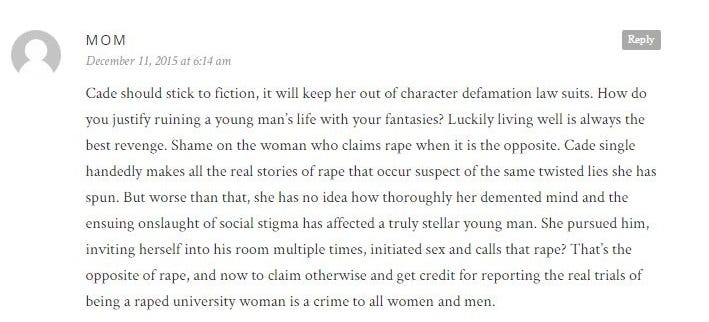
Until last week, when my rapist’s mom found an essay. I say an essay because the first essay (“the big one,” in my head, both in terms of disclosure and sheer length) became two and then three and then four essays on three different sites, plus a post on my blog, plus a pretty open social media survivor presence. But of course it was that one, “the big one,” that she found. And she had some things to say.

cropped_comment_12-11

It would be an exaggeration to say my world collapsed when I found that comment. But it would be true to say I became briefly stuck to my computer. For about four hours I didn’t move. I stared at the screen, read and re-read her words, I thought about whether “Mom” really meant his mother. I thought about how specific her version of the story was. I imagined him telling it to her (in her house, at the kitchen table, over the phone, in a text message). I called my loved ones to ask for advice. I screencapped the comment. I asked the site to take it down, they responded quickly and it disappeared. I posted on Facebook about the whole incident. And then I sat some more. And stared. Kept staring. There was no more active evidence that the comment had ever been there. It got dark out. I was going to be really late to a friend’s birthday party if I didn’t just shut my computer and fucking stand up. I really needed to pee. I stayed a little bit longer.

For at least three years, since before my rapist went abroad for our junior year of college, I have heard nothing from him. In the year he was gone, I did what I could to heal. Senior year, when he was back and I saw him around campus, I went out of my way to avoid him. I tried to make myself invisible. And, for a while, I thought I was fine.

Then I graduated and moved a few states away and suddenly found that every time I opened up a new document, all I could do was write about rape.

But I think what makes me angry, so specifically angry at him and at his mother (or him posing as his mother, which might be worse) in this moment, is that in that essay where I decided to make myself so very visible, to name myself and to unveil whatever insecurities and fears and embarrassments I could at the time, I took pains to make him invisible. My rapist is barely a character in my essays. He is never named, he is never given characteristics (height, race, hometown, likes and dislikes, names of his friends, college major). The most I’ll say is that my rapist and I lived on the same hallway in the same dorm for a year.

So why was he so pissed off? Why did he tell his mom about it? And why did he tell her how to find me? It’s been five years since he raped me. I didn’t report it at the time, so I don’t name him now. In a way, I erased him. I became the writer with the power, with something to lose.

I try to not write the scene of rape…in my experience, when people are doing the thing I refer to as “finding the lie” in a rape story, they look to that scene.

Recently, I was on a panel (“Grad Feminist”) at my undergraduate institution. The panelists were asked what we do to protect ourselves from online hate. When it was my turn to answer, I said I try to not write the scene of rape. I said that in my experience, when people are doing the thing I refer to as “finding the lie” in a rape story, they look to that scene. They’re looking for moments where they can say “oh, well that was consent” or “well you moved your hips like that” or “you shouldn’t have said x, you should have said y” or “and you didn’t scream?” I wanted to give them none of those moments. I still am not writing any rape scenes. But it didn’t, doesn’t, matter to him that I avoid specifics, if I avoid the physicality, if I avoid the stupid detail that when he pushed me down onto his bed, my ankle scraped against the bedpost and the skin peeled off. As if either of us should care about one, small, almost unrelated injury. It was still not enough for me to be quiet about all of that. Because in his version, my whole truth is the lie to find.

So rapist-person, B-, hi. Did you tell your mom that you raped me on my third day on campus? Did you tell her about the time you admitted it to another hallmate, did you tell her about the time our sophomore year when I saw you at a party and we were both drunk and you asked for my forgiveness? You might have told her I said I forgave you, because I did say that. I was nineteen and it seemed like the easy answer. It made you smile. Afterward, briefly, you seemed less dangerous. Then I heard from a friend that you had behaved threateningly toward another woman after she rejected you. Then I remembered who you are.

I was talking about you the other day on the phone to my dad and I said, “I hate him!” as if it was a new thought. Though I guess I haven’t hated you in a while. I don’t know if I really hate you right now. I hate rape culture. I hate what you did. But you’re not a monster, you’re a human. You have flaws and skills and friends and teeth and a tube of superglue in your desk drawer, just like the rest of us. I don’t think I can hate a human being, even if I can say that I do. What I mean is I thought you’d left me alone or I hope you haven’t hurt anyone else or please don’t come back to haunt me, I thought I was safe. You broke some of that self-care (self-instruction, self-love, self-control) just now. Or your mom, or both of you, or a stranger, somebody knocked me briefly back into hate. I’m inclined to think it’s you, though. Five years later, you are still so good at breaking things. Five years later, I am still getting used to putting myself back together.

David Bowie’s 100 Favorite Books

The world lost one of its greatest cultural figures today, as legendary musician David Bowie passed away at age 69. He died after a battle with cancer. Bowie was known as a forward-thinking chameleon musician who was always changing, innovating, and creating new sounds and styles. Even in his late 60s, Bowie was producing new music. His last album, Blackstar, was released only days before his death.

Bowie was also, not surprisingly, an avid reader and many of his albums were influenced by books. When Vanity Fair asked him “What is your idea of perfect happiness?” he responded simply “reading.”

In 2013, Bowie posted his 100 favorite books on his public Facebook page. The list is a characteristically eclectic list featuring everyone from Junot Diaz and George Orwell to Angela Carter and Muriel Spark.

RIP Bowie. The world was a better place for having you in it.

David Bowie’s Top 100 Books

Interviews With Francis Bacon by David Sylvester
Billy Liar by Keith Waterhouse
Room At The Top by John Braine
On Having No Head by Douglass Harding
Kafka Was The Rage by Anatole Broyard
A Clockwork Orange by Anthony Burgess
City Of Night by John Rechy
The Brief Wondrous Life Of Oscar Wao by Junot Diaz
Madame Bovary by Gustave Flaubert
The Iliad by Homer
As I Lay Dying by William Faulkner
Tadanori Yokoo by Tadanori Yokoo
Berlin Alexanderplatz by Alfred Döblin
Inside The Whale And Other Essays by George Orwell
Mr. Norris Changes Trains by Christopher Isherwood
Dictionary Of Subjects And Symbols In Art by James A. Hall
David Bomberg by Richard Cork
Blast by Wyndham Lewis
Passing by Nella Larson
Beyond The Brillo Box by Arthur C. Danto
The Origin Of Consciousness In The Breakdown Of The Bicameral Mind by Julian Jaynes
In Bluebeard’s Castle by George Steiner
Hawksmoor by Peter Ackroyd
The Divided Self by R. D. Laing
The Stranger by Albert Camus
Infants Of The Spring by Wallace Thurman
The Quest For Christa T by Christa Wolf
The Songlines by Bruce Chatwin
Nights At The Circus by Angela Carter
The Master And Margarita by Mikhail Bulgakov
The Prime Of Miss Jean Brodie by Muriel Spark
Lolita by Vladimir Nabokov
Herzog by Saul Bellow
Puckoon by Spike Milligan
Black Boy by Richard Wright
The Great Gatsby by F. Scott Fitzgerald
The Sailor Who Fell From Grace With The Sea by Yukio Mishima
Darkness At Noon by Arthur Koestler
The Waste Land by T.S. Elliot
McTeague by Frank Norris
Money by Martin Amis
The Outsider by Colin Wilson
Strange People by Frank Edwards
English Journey by J.B. Priestley
A Confederacy Of Dunces by John Kennedy Toole
The Day Of The Locust by Nathanael West
1984 by George Orwell
The Life And Times Of Little Richard by Charles White
Awopbopaloobop Alopbamboom: The Golden Age of Rock by Nik Cohn
Mystery Train by Greil Marcus
Beano (comic, ’50s)
Raw (comic, ’80s)
White Noise by Don DeLillo
Sweet Soul Music: Rhythm And Blues And The Southern Dream Of Freedom by Peter Guralnick
Silence: Lectures And Writing by John Cage
Writers At Work: The Paris Review Interviews edited by Malcolm Cowley
The Sound Of The City: The Rise Of Rock And Roll by Charlie Gillete
Octobriana And The Russian Underground by Peter Sadecky
The Street by Ann Petry
Wonder Boys by Michael Chabon
Last Exit To Brooklyn by Hubert Selby, Jr.
A People’s History Of The United States by Howard Zinn
The Age Of American Unreason by Susan Jacoby
Metropolitan Life by Fran Lebowitz
The Coast Of Utopia by Tom Stoppard
The Bridge by Hart Crane
All The Emperor’s Horses by David Kidd
Fingersmith by Sarah Waters
Earthly Powers by Anthony Burgess
The 42nd Parallel by John Dos Passos
Tales Of Beatnik Glory by Ed Saunders
The Bird Artist by Howard Norman
Nowhere To Run: The Story Of Soul Music by Gerri Hirshey
Before The Deluge by Otto Friedrich
Sexual Personae: Art And Decadence From Nefertiti To Emily Dickinson by Camille Paglia
The American Way Of Death by Jessica Mitford
In Cold Blood by Truman Capote
Lady Chatterly’s Lover by D.H. Lawrence
Teenage by Jon Savage
Vile Bodies by Evelyn Waugh
The Hidden Persuaders by Vance Packard
The Fire Next Time by James Baldwin
Viz (comic, early ’80s)
Private Eye (satirical magazine, ’60s — ’80s)
Selected Poems by Frank O’Hara
The Trial Of Henry Kissinger by Christopher Hitchens
Flaubert’s Parrot by Julian Barnes
Maldodor by Comte de Lautréamont
On The Road by Jack Kerouac
Mr. Wilson’s Cabinet of Wonders by Lawrence Weschler
Zanoni by Edward Bulwer-Lytton
Transcendental Magic, Its Doctine and Ritual by Eliphas Lévi
The Gnostic Gospels by Elaine Pagels
The Leopard by Giusseppe Di Lampedusa
Inferno by Dante Alighieri
A Grave For A Dolphin by Alberto Denti di Pirajno
The Insult by Rupert Thomson
In Between The Sheets by Ian McEwan
A People’s Tragedy by Orlando Figes
Journey Into The Whirlwind by Eugenia Ginzburg

Be Careless With Your Wishes: A. Igoni Barrett On The Writing Life In Nigeria

We’ve asked some of our favorite international authors to write about literary communities and cultures around the globe. We’re bringing you their essays in a regular Electric Literature series: The Writing Life Around the World. This month’s installment is by A. Igoni Barrett, author of Love Is Power, or Something Like That. His debut novel, Blackass, will be released by Graywolf in March.

One day eleven years ago I swallowed fear, stuck my neck into the noose of fate and swore I would swim or drown. I was 25 years old and had never held a job, never strayed far from my mother’s protection, never stopped depending on her for feeding money, pocket money, any money. Yet I ignored her entreaties to endure my final year in university, and after gathering up my beloved books and 2Pac CDs, I jumped into unknown waters to make my way as a writer.

Every revolution ends the instant it begins. Mine ended up in Lagos. It began as a son’s rebellion against his mother’s devotion, and today, with three books to my name, I see what I’ve achieved in all these years of revolt is to refocus my gaze on the actual bully, that stomping boot in which I’ve lived like a foot for thirty-six years. My country, Nigeria.

Before the day I left my mother’s house forever, I had lived happily enough in the rustic city of Ibadan, where I was studying agriculture at Nigeria’s oldest university. Two prominent figures of modern literature, Chinua Achebe and Wole Soyinka, had studied there along with many other Nigerian thinkers. Thus I assumed the university’s illustrious alumni were evidence of a grand tradition. At the time of my matriculation, in 1997, I had begun scribbling scraps of stories in secret, and even though I didn’t yet dare to call myself a writer I was already doing what every nascent artist does, seeking a tradition to either align with or rage against.

I found nothing there for me. No friends with similar tastes in books. No literary journals by either students or faculty. No public book readings I ever heard of. No freedom to explore the shelves of the outdated library. No writing workshops, reading clubs, or tattooed barwomen with nicknames like Head Woolf with whom I might have debated my oblivious penchant for male writers. One thing there was plenty of was angry young people in secret fraternities and student unions, but these coteries were focused on bloodletting and partying and politicking rather than literature. After seven years in that wasteland — my studies were meant to last five, but for the incessant academic strikes and school shutdowns — the only knowledge I gained about writing was that mine was not a transitory phase.

All my life I had read alone; no one had exchanged books with me or recommended writers to me.

Before 2003 — the year I attended a book reading for the first time, which was organized in Ibadan by the local chapter of ANA, the Association of Nigerian Authors — I had no idea there was any such thing as a writing community in Nigeria. All my life I had read alone; no one had exchanged books with me or recommended writers to me. I was appointed library prefect in my final year of secondary school, but that public school, like all the others, had no library worth the name. For many years I only read whatever I found at home: my mother’s romance and detective and cowboy novels, and the motley books my absent father had left behind. Even the few books I borrowed from friends’ houses (and sometimes stole, like E.R. Braithwaite’s To Sir, With Love — sorry, Remi) usually belonged to their parents.

Thus many of my favorite books were serendipitous sightings in used books stalls, the only places I could afford on my pocket money. My early years in Ibadan are still some of my fondest memories mainly because of the British Council library, a Borgesian labyrinth to my awestruck eyes, which became a veritable garden of forking paths for a teenager who had grown accustomed to never having enough books. It was a catastrophic day when the library shut down a few weeks after I chanced upon and was transported by Tolstoy’s War and Peace.

In search of a new home after abandoning my mother’s, I went to the Niger Delta, finally settling in Imiringi, a farming village about three hours’ drive from my birthplace. My peripatetic father had perched there for some months in an apartment that was paid up for a year, and I eased happily into his fully furnished, book-stocked, vacated space. I was 16 when I had moved with my family to Ibadan from Port Harcourt, the city in the Niger Delta where I was born and where my milk teeth are buried. Ibadan was where I began seeking myself through writing, but it was in Port Harcourt I first lost myself in books.

While my pigs grew fat in sleep and my catfish chased the moon across the pond’s surface, while my yams did their secret growing at night, I would write for myself until I found an audience.

The question of home resolved, all I needed was a plan. I settled quickly on one: to farm and write. I would sow the earth by day and reap the imagination at night. I would feed myself by the work of my hands, employing the knowledge I had acquired at university. While my pigs grew fat in sleep and my catfish chased the moon across the pond’s surface, while my yams did their secret growing at night, I would write for myself until I found an audience. I was young, healthy, unafraid of hard work, and responsible to no one but myself. Unlike my mother, I had no offspring to provide for, nor plans for a spouse, though a lover would be welcome, but then again, ever since I realized in my adolescence that God was a fictional character in a rambling tendentious book, I had been just fine with jerking off.

Back in 2001, my mother was the first person to ask me why did I write. My response was mumbled gibberish because I had no answer ready, though I could also hear in her tone that nothing I said would placate her. These days, whenever I’m asked that question, I do my utmost to give a different answer every time. I write because I can, because you read, because we die, because I must. I was 11 when I first experienced the must-write feeling, though it lasted only as long as it took me to realize my poems were childish. About two years later, in 1993, I got the itch again, and spent three straight days writing a play whose main characters, blond hair and all, were Nigerian-accented aliens from a Georgette Heyer universe. After that second failure, I decided to become an aeronautical engineer. Anything was easier than writing. And for anyone who has read enough to recognize how bad their writing is, nothing is harder than writing. Except not writing. Thus I wasted many years suppressing the urge to write, until, one day, just like that, I left my mother’s house to become a farmer.

About my plan in Imiringi: I knew farming was no sweat, it was writing that would require effort. Growing food from the soil and raising animals for slaughter would be a task easily done, but finding words for the images in my mind, oh boy, that was backbreaking labor.

I was both right and wrong. Farming, too, was hard. Not the farm work itself, which I never got to do. Because I never found the money to lease farmland, never got the loan I had applied to the state government for. I spent almost two years dreaming of pigs and catfish and yams, my farming spiel growing wilder the surer I became of failure. I discovered the true value of money, which can only be known when you have none. I grew my hair into locks, rather than pay barbers, and ate everything that anyone offered, including iguana (fishy-tasting), porcupine (gamy), some astringent fruit whose name I never learnt, and even a strange-looking fish — which the locals considered taboo — with a doglike dentition and appendages like breasts on its belly. I made friends whose mothers’ kitchens I can still describe, as well as friends who shared drinks and spliffs and orgasms with me.

About my stay in Imiringi: No experience in life is wasted, especially when you’re writing.

About my stay in Imiringi: No experience in life is wasted, especially when you’re writing. I was writing in Imiringi when my short story won an international competition that led to the publication of my first book from which I got the funds to launch an online literary journal that caught the attention of a Lagos-based publisher who offered me the job that ended my plan of farming in Imiringi. And so, one day, just like that, I set aside my writing to become an editor.

I arrived in Lagos in March 2007. From my earliest days in this seaside city of Cs — congested, cacophonous, chaotic, cosmopolitan, captivating, etc. — I was flung into a community of writers, editors, publishers, and booksellers. I met people whose work I had read, whose work I wanted to read, and whose conversations I noted down so others might someday read them as fiction. I met publishers who invested money in work other than that of friends and relatives, and editors who craved anonymity even as they poured their heart and skill into their jobs. There were book readings at Quintessence and Jazzhole, spoken-word poetry and drama performances at Bogobiri and Terrakulture, writing workshops by Chimamanda Ngozi Adichie and Adewale Maja-Pearce, art exhibitions at Bisi Silva’s Centre for Contemporary Art, literary festivals like the long-lasting LABAF; and everywhere I looked, in writer’s homes or at their favorite drinking spots, there were books being talked about and exchanged and recommended. I had finally found in Lagos what I went seeking at university: a self-sustaining tradition of creativity and enterprise.

In the midst of writers who acknowledge your own writing, self-denial begins to seem like self-deception.

It was in Imiringi I began calling myself a writer, but I didn’t believe it until I got to Lagos. In the midst of writers who acknowledge your own writing, self-denial begins to seem like self-deception. And so when the novelist Eghosa Imasuen — who now runs Kachifo, the publishing company I used to work for and whose Farafina imprint published the local editions of my last two books — told me all those years ago that he admired my writing, I thanked him. When the Ugandan short-story writer Doreen Baingana, on one of her several trips to Nigeria for writing residencies and to teach workshops, announced to the audience at her book reading that my second story collection was this and that, I believed her. When the poet Toni Kan — who recently signed an endorsement deal with Samsung to have his name on billboards across Lagos promoting the latest Galaxy phone — bought me beers because he enjoyed my novel, I drank up. When the Kenyan author Binyavanga Wainaina bought my first story collection in Lagos in 2010 and came looking for me to sign it, I grinned with pleasure. And when in the same year the British journalist Michela Wrong, after she returned to London from her book tour in Nigeria that included an appearance at a monthly reading series I had just then started in Lagos, wrote me an email offering to introduce me to her literary agents, I stared at my laptop screen in disbelief.

Two years was all it took. Two years of working in publishing. Two years of hardly writing. Two years of editing a magazine that was first a bi-monthly, then a quarterly, and still never sold out its 1000 print run in a city of nearly twenty million people. Two confounding years of reading accounting data that showed how American, British, and even South African publishers sold more copies of Nigerian writers’ books than local publishers could manage for the same titles. Two humbling years of watching as other Nigerian writers, many of whom lived abroad, signed bigger book deals, expanded their audience, and made good money from doing exactly what they wanted. Two long sweaty years of spending three to five hours in Lagos traffic every weekday on my way to and from work. That’s what it took for me to rebel.

But from the writing community I had found in Lagos, all I wanted at that point in my life was a pot of money and to be left alone.

In June 2009 I resigned from my editing job to strike out as a full-time writer. I knew now that farming was a pipedream, that living in a village also required money, and that I would never support myself from selling my books in Nigeria. I also knew that a community is only as useful as what the individual wants from it. From my family, my mother, I had wanted the freedom to find myself. From my nation, Nigeria, I wanted basic infrastructure, competent educational systems, and legislated respect for the most vulnerable in society, everything that every citizen deserves. But from the writing community I had found in Lagos, all I wanted at that point in my life was a pot of money and to be left alone.

Be careless with your wishes, they never become horses. Mine took more than a year to materialize as a writing residency. My first trip outside Nigeria for my first-ever residency, a real pot of shillings as well as a beach house in Mombasa for three solitary months, all of which came through Binyavanga Wainaina and the book I’d signed for him in Lagos. I got my wish, and I rode it all the way to Kenya and back, writing and living exactly as I wanted.

Five years later, I’m still here, neck in noose, fear in my belly, and swimming with all my might. Home is wherever I write, and Lagos, for now, is the place I’ve dug my teeth into.

About the Author

A. Igoni Barrett was born in Port Harcourt, Nigeria, and lives in Lagos. He is a winner of the 2005 BBC World Service short story competition, the recipient of a Chinua Achebe Center Fellowship, a Norman Mailer Center Fellowship, and a Rockefeller Foundation Bellagio Center Residency. His short story collection, Love is Power, or Something Like That, was published in 2013. In 2014 he was named on the Africa39 list of sub-Saharan African writers under 40. His first novel, entitled Blackass, will be published in the US in March 2016.

You can find all the essays from The Writing Life Around the World at Electric Literature.

Writing Life Around the World

No One Paid Me for the Rush Anymore But I Needed It Anyway

Building Jumper

Fifty-one minutes until my next jump. One sideways cut through air. Two stories’ worth of roof tiles against my back. Seven horizontal feet to the staircase. Thirty-five stairs to the street. Only after I did it would I be able to sleep again. After I retired no one paid me for the rush anymore but I needed it anyway.

Since my boss didn’t believe in dress codes I wore my last movie outfit. Black tights, leotard, jacket. A rubber band to keep my afro in place. I touched the parachute in my backpack and the sneakers I’d flee in if someone objected to my vacation through Manhattan’s coveted private outdoor space. In twenty minutes I’d leave the subway. In three minutes I’d arrive outside. The last minute of the workday stretched long enough for me to picture the jump fifteen times.

My officemates and I stormed the elevator and flooded the lobby, protecting the half-inch between our bodies before the hordes on the sidewalk forced us to touch. I used all my pointy parts to finish the fight to the subway: elbows, knees, nose. The turnstile represented a second and a half of peace: no one usually touched me there. Seven stops later the downtown train spit out globs of people whose armpit sweat disgusted me for my entire walk up the stairs. When I reached air I was almost free.

Fifty steps to the next street. Thirty more to the alley. I hoisted myself up on a pair of dents in the bottom row of bricks and dug my fingernails into mortar. A pristine kitchen lay behind the second windowsill. Folded dishtowels. Lined-up wine bottles. Dishes drying symmetrically in their rack. So much alien order to ditch one half-step at a time. My left foot hit a too-shallow brick dent. Fear, the world’s cruelest tide, pounded my ears alongside a lick of the high. I dug my right foot into brick and clutched the windowsill above my head. My left foot threatened to fall so I forced my chest and feet atop the windowsill in a series of acts that took me to the edge of effort.

A man glared at me from his kitchen. His window knock drove me to the end of the sill. I clutched brick until my fingers burned and inched up past his shouts. When I reached the roof I couldn’t hear him anymore.

Union Square shone from the roof’s lip. Lamps lit every third window in the apartment towers around the park, turning them into a wall of inside-out dice. I saw myself getting lucky: hitting the perfect wave of solitude when I entered the air. The brick building next door winked at me. I uttered the jumper’s prayer, a wordless wish that I’d land right. The hand on my back was larger than mine.

The man from below grabbed my left arm as if he were going to hurl too-drunk me out of a club. I forgot that I wasn’t standing in the best place to yank it back. Instead of hitting the air sideways I went vertical. All sound disappeared.

The roof tiles stung my back. I hit the stretch of blank air that separated me from the staircase head down. The man’s laughter went up my veins. The rush was still there, fighting the sad surge of electricity that took over my spine and losing.

My shoulder bounced off the staircase. I couldn’t find my parachute. The rush should have died then but it stood up and yelled in my ear. So did the fear. I fell with an apology to the man on my lips and my best landings in my head. The bottom of Manhattan’s empty concrete pool rose to greet me. My lungs filled with love.

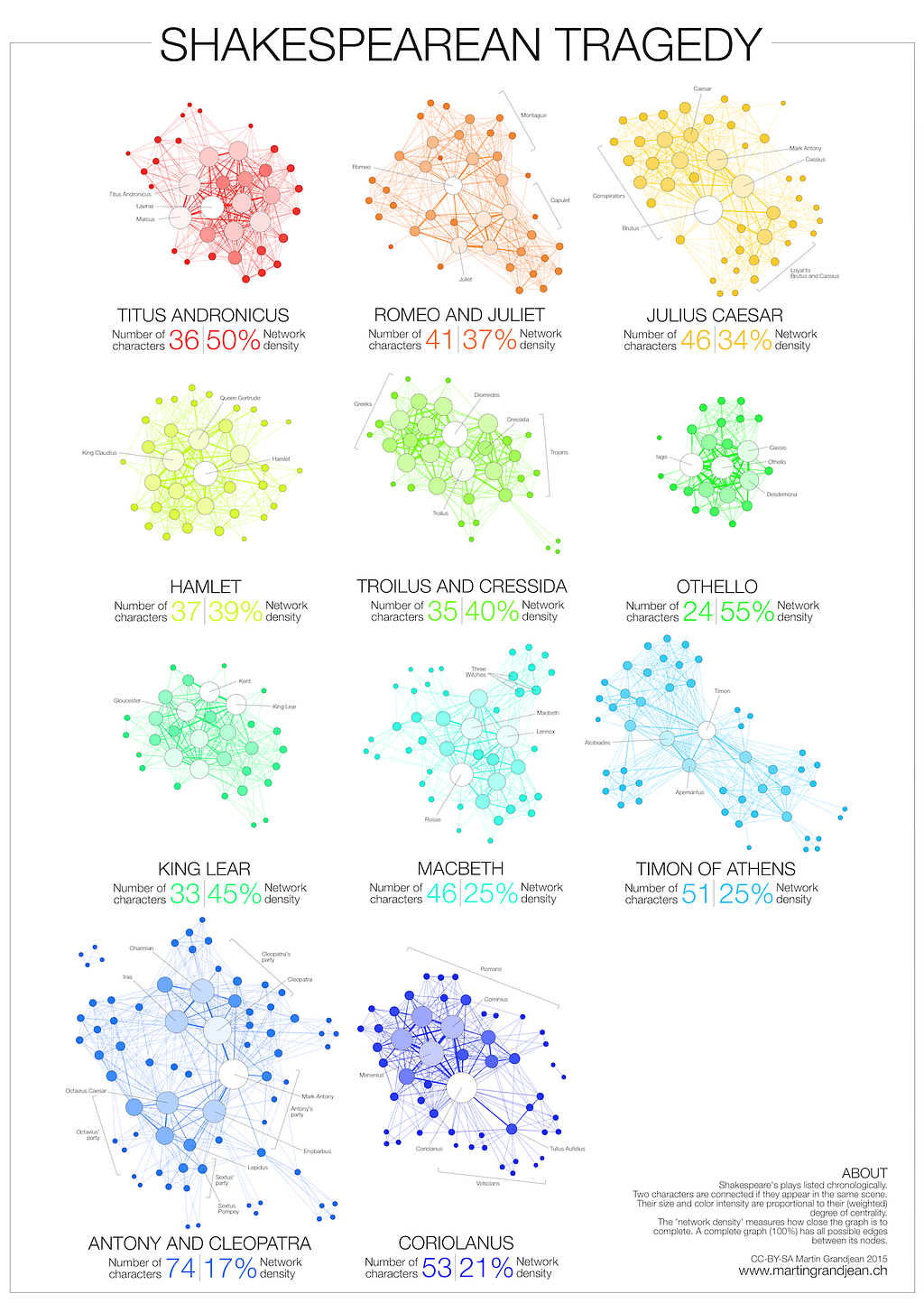
INFOGRAPHIC: Analyzing Shakespeare’s Characters

Are you a Shakespeare fan? This infographic lets you investigate his tragedies by looking at his character interactions. Are they closely connected or isolated? Do all his plays have similar structure and density? Find out below. The infographic was created by data research analyst and designer Martin Grandjean.

Open the image in a new tab to get a closer look.

shakespeare infographic

TED WILSON REVIEWS THE WORLD: MY BODYGUARD

★★★★☆

Hello, and welcome to my week-by-week review of the world. Today I am reviewing my bodyguard.

With all these people attacking other people with guns these days, it seems like no one is safe anymore. That’s why I decided to get a bodyguard.

The bodyguard business is booming and rates have skyrocketed, but can you really put a price on a life? People hiring assassins seem to think so but I disagree. That’s why I took out a loan to keep myself alive.

Banks don’t give out loans for bodyguards, but I met a man on Craigslist who offers personal loans for just about any of life’s problems. Coincidentally, he also moonlights as a bodyguard, so he was able to pay himself directly, while I could repay the loan in easy installments with minimal interest. I’ve never been very good with math so it was great to have someone who could provide both muscle and brains.

It wasn’t soon before his role expanded to include other duties, such as handling my finances and taking my car out multiple times a day to test it and make sure it was running properly. He was proving himself an invaluable part of my life.

I say “he” because he never told me his name. In the bodyguard world, it’s important to keep an appropriate amount of emotional distance. This reduces the emotional pain for the protectee if the bodyguard should ever be killed. Unfortunately his plan didn’t work — I couldn’t help but feel protective of him. It was unavoidable. We all saw this happen in that Kevin Costner movie, The Guardian.

That’s why I hired a bodyguard to protect my bodyguard. Then, another one for that one, and so on, until I hired so many I couldn’t remember who was protecting who. I figured if something happened, certainly someone would be there to stop it.

I appointed my bodyguard/financial advisor as Head Bodyguard, which may have gone to his head, because he fell in love with six different bodyguards. The heart wants what it wants, and I can’t fault him for that, but things got messy for everyone. So many hearts were broken. No matter how many bodyguards you have, none of them can protect the heart.

My bodyguard killed his heart by driving off a cliff with my car. I’ll never forget him, whoever he was.

I had to replace him, so I bought a bodyguard from the ex-con who works at my gas station. My bodyguard is one that leaves me completely emotionally detached — a Colt CM901 assault rifle. Now no one will ever be able to hurt me.

BEST FEATURE: His eyes. He had beautiful eyes.
WORST FEATURE: After he passed away, I had to hire an accountant to look over my finances. It turns out my bodyguard wasn’t very good at math after all.

Please join me next week when I’ll be reviewing My Bodyguard (the movie, not the guy I just reviewed here).