How We Are Haunted, How We Are Cured: Demon Camp by Jennifer Percy

by Antonia Crane

The complex mental, emotional and psychiatric effect of war on veterans has always been fundamentally mysterious to society. According to Dave Phillips, a reporter for the New York Times, “Of about 1,200 Marines who deployed (with the 2/7 in 2008), at least 13 have killed themselves, two while on active duty, the rest after they left the military. The resulting suicide rate for the group is nearly four times the rate for young male veterans as a whole and 14 times that for all Americans.” Another article reported a huge increase of military personnel and combat veteran suicides since 2009 “even as the United States military has withdrawn from Iraq and stepped up efforts to provide mental health, drug and alcohol, and financial counseling services.”

As a daughter of a Vietnam Veteran, I have often wondered if post-war trauma begins with the odd solitude of that specific, unholy experience of war: violence, near death and personal loss that sets one apart from his fellows, making re-entry unfathomable along with a burning desire for redemption, forgiveness, deliverance.

I wonder if Dave Morris is right when he writes in his astute memoir, “A Biography of Post-Traumatic Stress Disorder” that “PTSD is the failure of our culture to encourage people to seek wisdom on their loss and adversity and to consider trauma in anyway other than a narrow medical context.”

Many writers have written important, profound narratives that echo the specific haunting and deep need for post-war healing in a non medical context and yet, the cause of PTSD and its remedies remains unclear. A few of my favorite stories about PTSD include: Kurt Vonnegut’s’ Slaughterhouse Five, Tim O’Brien’s The Things They Carried, and Mac McClellan’s Irritable Hearts: A PTSD Love Story.

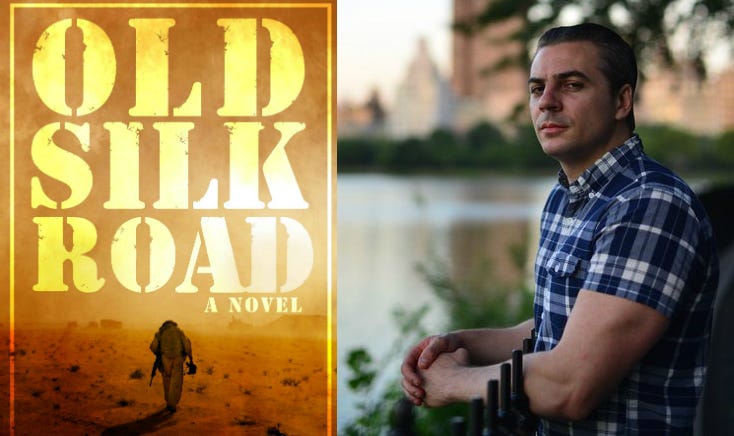
“Demon Camp,” a nonfiction narrative by Jen Percy not only grapples with the complexity of the PTSD condition with searing clarity but approaches the topic of non Western therapeutic healing with candid, observant humor and gobs of heart.

With admirable journalistic precision and restraint, Percy profiles an alternative trauma therapy group that performs exorcisms on veterans for 199 dollars in a Pentecostal church located in Portal Georgia, where it is believed that “the thread between life and death is thin.” The religious organization promised to rid Caleb, an army veteran who lost several friends in a 2005 helicopter crash in Afghanistan — of what he believed was a “the destroyer demon” — a ghost of his buddy with Alice and Wonderland tattoos following him around.

But “Demon Camp” is not a book about going to church and finding God and having a Messiah wipe away the blood, the screaming or the dead buddies of possessed soldiers.

It’s a book in which Caleb, her primary subject, seeks a holy cure after he suffers bouts of nightmares and nearly shoots himself in his own truck while quarreling with his girlfriend, Katie. It’s also a book about the seeking itself and the ways in which vets in particular feel haunted. “Demon Camp” promises the impossibility of “deliverance” after all.

Percy shows us there’s no easy fix. Yet American culture has financial investment in the so-called “easy fix”: fast solutions to complex problems — problems we may never completely solve. While PTSD is not an infection to treat or and illness exactly, it may have physical symptoms like audio hallucinations and depression. Hysterical blindness. Malaise.

We have no language for audiovisual hallucinations as a result of flash backs that won’t cause loved ones to dial 9–11.

In “Demon Camp” we follow Caleb as he sees the dead in the form of a dark thing and out of ideas as to how to get rid of it. The math of deliverance for him is quite sound: Having a tussle with a horned demon=another way of ridding himself of a psychic burden too terrible to bear.

Caleb was not an easy sell. He was skeptical of religion and of the bible. He knew logically that he had PSTD, like someone knows what weight they listed on their driver’s license. He also believed that he could see the future and he believed in a hierarchy of angels:

“They (angels) have ranks just like the military has ranks. It’s hard to tell the difference at first, but over time you learn.”

In a military structure, this ideology makes perfect sense. A person takes orders and carries them out at any cost along with his buddies; so joining a group with a built-in family dynamic with a leader promising a solution that would give power to his extreme helplessness was comforting. It was not only an opportunity for extreme forgiveness, but also a chance to help others like him.

Caleb believed that “deliverance” could change how people thought about PSTD and he wanted to rebuild his life, but more than anything, perhaps, he sought to process the experiences of war: the savage killing in which he played a part.

After hearing Caleb being followed by the destroyer demon, Percy writes, “Because Caleb said these things could transfer, and because these things are not limited to war, I started to wonder if it was following me.”

We follow Percy following Caleb who is being followed.

In essence, we are haunted by association.

While writing “Demon Camp,” Percy became deeply entrenched in the group’s culture, living with the group and observing them in Portal, Georgia for over six years. During that time, she agreed to also go through the exorcism herself after being told she had a demon and the leader told her and the rest of the group that the pink love mist that came in the room was Jesus:

“He wants to pour his love on you. Let him woo you. Jesus is going to be your greatest romance.”

Throughout “Demon Camp,” Percy catches the haunting like a sore throat, hunting demons alongside Caleb and the others. By the end of the book, Caleb was no longer associated with the deliverance church at all.

Percy’s empathy for Caleb’s suffering and seeking, redemption and peace were the haunting that we are left with and although we may never entirely relieve ourselves of our harrowing ghosts or traumatic experiences with pink mist or screaming rituals, Percy’s tale of earnest redemption and one man’s deep desire to do so made me think differently about PTSD and the seeking itself.

The Most Popular Electric Literature Articles of 2015

We like to ring in the new year taking a look at the last here at Electric Literature. Here were are most popular articles published in 2015:

Headertest-360x240

1) Speak Up!: A Graphic Account of Roxane Gay and Erica Jong’s Uncomfortable Conversation by MariNaomi

BluntInstrument_ElectricLit_small-360x240

2) Should White Men Stop Writing? The Blunt Instrument on Publishing and Privilege by Elisa Gabbert

literary podcasts

3) Eight Excellent Literary Podcasts for Your Morning Commute by Jessica Gross

literary novels

4) INFOGRAPHIC: How To Name Your Big Important Novel by Lincoln Michel and Nadxieli Nieto

books and likes

5) When Popular Fiction Isn’t Popular: Genre, Literary, and the Myths of Popularity by Lincoln Michel

True detective dialogue

6) True Detective’s Lessons on How Not to Write Dialogue by Lincoln Michel

Wonder Boys film

7) Writing On Screen: Why Do Writing Students Love Such Terrible Mentors? by Lee Schnelbach

The Exorcist film

8) That Thing: A True Story Based on The Exorcist by Adam Sturtevant

Neal Stephenson

9) The People Who Survive, an interview with Neal Stephenson, author of Seveneves by Steven Paulson

franzen, roth

10) What Women Can Learn From Reading Sexist Male Writers by Sigal Samuel

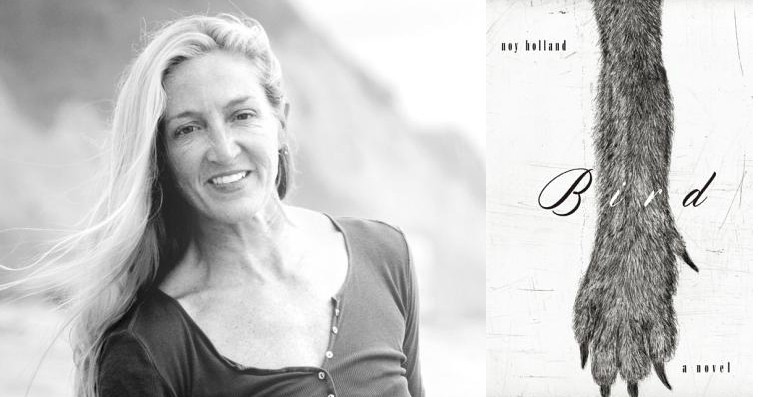
Unworded Intensities: An Interview With Noy Holland, Author Of Bird

When one reads voraciously, there are many books — books of high quality, even — that tend to blur the more one reads past them. One can remember certain moments, one can map out something like a sketch of the plot, perhaps one can even remember the names of characters (though, in my experience, those are often the first to go), but rarely can one reenter the experience of the book in question, reenter that initial experience of reading. This is perhaps why we — or, at least, I — reread favorite books time and time again, chasing the framework of feeling they enacted on us when we first read them. I read Noy Holland’s Bird in August, and it is no hyperbole to say that it has stayed with me — present in my mind and in my heart — every day since. You wouldn’t have to press me to the wall for me to call it my favorite novel of the year or to argue that it’s one of the most accomplished novels to surface in quite some time. What Holland does with language is simply nothing short of a miracle. And the series of sensations that language gives rise to in the reader are deeply complex and unforgettable. It is a novel I feel I understand and a novel I feel understood by. From my first read — and there have been a few more since — it has occupied a space among my favorite books ever written: Joy Williams’s State of Grace, Joan Didion’s Play it as it Lays, Mary Robison’s Why Did I Ever. And what Bird shares in common with these masterpieces of fiction is that it risks everything in language, it holds no emotion — no matter how ugly or contradictory — back, and, to borrow from Rilke, it causes the reader to rethink and readmit “the relation to another as something alive.”

It was an honor to speak with Noy Holland about the book via email.

Vincent Scarpa: Though it’s easy to miss as a reader — as we’re so often jumping in and out of present tense, and as we’re given an in-depth portrait of Bird’s past life with Mickey, her former lover — the novel actually only spans the course of one day in real time. In setting out to write the novel, did you have that idea for a framework in mind — that the reader would be invited into Bird’s present life for only a day? It’s one of many things that struck me as staggering about the novel: both the way in which so much is contained in such a small space of time, and the idea presented to us as readers as we reach the end that this onslaught of longing, regret, and wreck is every day for Bird. It totalizes her life, a life we’re experiencing only one day of.

Noy Holland: The truth, regrettable and not, is that I set out knowing next to nothing. Set out, arguably, with a tantalizing lack. I spent years picking away at this book before the day came where I said, Ah hah. Or, really: duh. The first duh was to recognize that I was indeed writing a novel, and the second was to see the frame — the limits of action but not of perception. The prospect of passing only a day with Bird seemed so obvious once I’d decided it; the invitation had been there all along, in my pages and in books I admire. I think, too, that years of writing short stories may have made me more inclined to want the density and strictness the choice implied. I wanted stillness. Bird can’t go far. I wrote her into that house with a baby and debilitating fears and a body still wrecked some from childbirth. And her boy will come home, and she will be there. Because no matter the mess she can be and has been, she will be there. She’s devoted. She has made that bed and she will lie in it. The day itself is turbulent — an onslaught, as you say. The night’s unrest and dreaming have made the old mess and want flare.

VS: I was totally dropped-jaw from page to page as I took in the language of Bird, which is absolutely stunning and felt absolutely new. Not since Eimear McBride’s A Girl is a Half-Formed Thing have I found the language of a novel to be so miraculous, so captivating as to be a machine of meaning-making and a kind of character in and of itself. The sentences captured so precisely for me what I imagined Bird’s interior landscape to be: this rushing river, fast and unyielding, in which Bird finds herself daily swept up in its rapids. I’m wondering if in the process of drafting the novel the language came out more or less as it appears on the page now — in this rush, this careening prose — or if there was some amount of polishing or chiseling that took place in revision to really carve out what Bird’s voice, and what the narrative voice that carries her through the novel, read and sound like. Because it really did appear — infuriatingly and envy-inducingly — effortless.

NH: Ha! Very much labored-over, I’m afraid. Effortful and wasteful and slow. I’m grateful for all the nice things you just said and I’m glad the effort is somewhat hidden. Weirdly, I started the book by speaking into a micro-cassette — not an iPod, they didn’t exist yet — on my long, pretty, country-road commute to work. I had small children myself and a full-time job and I seized what time and mind I could. One effect of this was that my sentences got long and somewhat ornate. Only a handful of those sentences survived intact once my reductive tendencies took hold. I found the beginning of the book in the middle, months or maybe years after that initial burst. I found I wanted to begin in the past — let it take precedence over the present. I wanted the past to be more luminous, more clamorous, more demanding than the present. I wanted it to strip the luster from the present, and for that luster to at last return.

VS: I have a friend who uses the terms pregret and premorse. In reading Bird, in which all of the things Bird longs for, all of the things she regrets, have already happened, I still felt an urge — perhaps because of the way you play with time, the way you move us as a reader in and out of Bird’s past — to use my friend’s terms, to feel as though Bird is pregretting, premorseful. You write, “Can’t last. Couldn’t last. Nature of things…Wanting so mostly rarely withstands the presence of the thing we want,” and I found that to be a kind of thesis to the novel, as well as a sort of hook upon which I could hang these aforementioned thoughts. Have I said anything with enough clarity here as to spark something for you?

To stand up and live through something, to withstand the presence of the thing we want, is reckless and thrilling and heroic, and very quickly it is something like work.

NH: I honestly don’t have the vocabulary to talk about this, not in the deepening way it warrants. I know I’ve felt it, feel it — the premonition of loss before I’ve set forth. Between grief and nothing I hope always to choose grief — I am borrowing, I think, from Faulkner here. The grief needn’t be grand or dramatic, just the simple grief of the almost right word. The persistence of failure. Fail better. Yes. To write a story, to set down the words, is destructive. It is never enough. It makes of something fluid something static. To stand up and live through something, to withstand the presence of the thing we want, is reckless and thrilling and heroic, and very quickly it is something like work. Yes? We can only in an instant be answered. But that instant, whoo boy, that ecstasy — this is what we work and live for. In my view, it’s what we get of God.

VS: I’d be very interested to hear you talk about what you see as Suzie’s function in the novel. We only come to know her through her manic, often hysterical phone conversations with Bird, and yet she feels essential to the novel, like something might become dislodged without her presence, however peripheral it may be, in the narrative.

NH: Suzie is a free range human, anti-domestic, a feminist, I suppose. She does what women seldom do — she takes what she wants when she wants it. She lives alone and for herself and men come and go, and boys if she wants, and women. She has no compass, arguably, and she’s disloyal. Solitary. Outside the fold. I suppose the arrangement of words that Suzie is is on the page to keep the message flashing: no whinging. We have choices. Our one little chance to be alive — and it is ours to shape. I wanted to say this and at once qualify it, restrict it, as chance and circumstance do. That’s why Suzie never gets to show up in Bird’s kitchen — she phones in. She is elsewhere, free to move. Do I mean to say that Suzie is freer than Bird, free as a bird, happy? No. Yes and no. Suzie is a set of possibilities Bird has decided against.

VS: One of the sentences that just broke my heart wide open — and potential spoilers ahead, I suppose — occurs in the memory of when Mickey comes to Bird’s hospital bed after she’s given birth. They’re contemplating their failed relationship and this question is posed: “Was can’t last what made it bearable or can?” It seemed to be such a masterful distillation of what the previous 150 pages were trying to ask, to investigate. It reminded me, too, of a line from a singer-songwriter friend of mine, Susan Werner, who sings, “Passion’s always half-impossibility.” What about this dichotomy, about this doomed-to-fail, it’ll-end-in-tears dynamic in some relationships, was compelling and generative to you? What did you want to tease out of it, close up in it?

We love stupidly, falsely, pretend to love, pretend not to. It’s all conditional, but nobody knows the conditions, not even the ones we claim.

NH: I can’t talk about this book without contradicting myself. I just made my we-have-choices speech and I’m about to take it back. We do, we don’t. Can last, can’t last. We choose what we want in the moment of wanting and as soon as we touch it, whatever it is, whoever, it begins to change, it eludes us. Experience is endlessly mutable. We change one another, are changed by one another, but we don’t know how or really why. We love stupidly, falsely, pretend to love, pretend not to. It’s all conditional, but nobody knows the conditions, not even the ones we claim. We say successful marriage, failed relationship, but this is partial, a closing in. We want to name it. Honor it with a name, kill it with a name. We’re so utterly conflicted. And we are quick to call brevity failure — the six-month marriage a failure, but who’s to say, really, when six minutes can change our lives? Seconds. Failed relationship? I wouldn’t say so. In some ways, I mean to say that Mickey and Bird save one another — they are abundantly, recklessly giving. They hoard nothing. Mickey saved Bird. And to save himself, he left her. Which means can last and can’t are interchangeable — because isn’t Mickey, in the dreamy, careening deprivation of Bird’s day, isn’t he lasting still? Aren’t they?

VS: I’d be remiss not to mention the exquisite way you write sex in this novel. I don’t think I’ve ever read anything quite like it. I see in my own writing various strategies of dodging the sex scene itself — the lights being turned out in one sentence, a space break, and then it’s morning and they’re naked in bed! — but you really do, as Joy Williams says, “write to the need.” I wonder if you ever felt anything like hesitation in doing so — not the hesitation of including sex in a novel, of course, but rather a hesitation or a nervousness in writing it, in rendering it, in finding the exact right language to hold all the nuances and contradictions — the brutality and the beauty — implicit and inherent in the act.

NH: Honestly, it’s the cerebral, the want to say something smart, that makes me nervous quickest. I’m at home in the body and at ease among much of what can be said about it. I’m someone who stays in the room. Sex is difficult to write, but what isn’t? Sickness is difficult. Childbirth. These are mostly unworded intensities. The sounds that leave people in childbirth or sex are a vowelly mash — gorilla, coyote, whale. We belong to the rest of what lives. The distinction between humans blurs in sex, and in any extreme, sex included, between humans and other animals. It’s sort of terrifying but it’s also wondrous. We make contact. Surrender. The sex of this novel is surrender, it’s prayer, a violent, obliterating drug, reifying and deadly. Bird and Mickey walk into deep water together and they find they have to swim for their lives. Their struggle isn’t with one another so much but each with their own unreliable want to be alive.

Women get a good deal of practice submitting to what is, witnessing the body unadorned.

The flux of the body is generative for me, it’s all through my work. This is among the ways I’m grateful to be a woman. A woman’s body is always reminding her that something beyond, and bigger, is happening. We feel the flux. We can’t help it. Women get a good deal of practice submitting to what is, witnessing the body unadorned. Procreation gives us one choice: Hey, little one, I’ll share my body with you and you can feed on me as you must. What could be more humbling? The animal imperatives of the male are to overpower and acquire. To take and to keep. We can resist this and argue against it — can, I think, and should — but we are leaning into a wind that’s been blowing for thousands of years.

Gender, class, race, who’s responsible for what, who’s to blame, who’s obliged, the social contract, identity — these stubborn and animating differences fall away for Bird and Mickey. All moot. “The world shrinks to become them.” They are governed by sensation, by appetite. It’s not a moral state; it’s unencumbered and transitory and rare. Together they invite the sensation of loss, unboundedness, the perilous orgasmic state that blurs the frontier between death and living.

A book makes its own demands. Or: a person makes a book that makes its own demands. Timidity or nervousness or squeamishness about the body were entirely at odds with the demands of this book. So I tried to be brave and write through.

TED WILSON REVIEWS THE WORLD: 10 THINGS OF 2015

Hello, and welcome to my week-by-week review of the world. Today I am reviewing ten things of 2015.

Hotline Bling ★★★★☆
I hear this phrase a lot but I’ll be honest, I have no idea what it means or what it references. I know what a hotline is, and I know that Bling is the search website I use when I can’t log onto Goggle.com but these two words together are meaningless. It’s a catchy phrase. Sometimes when I pass a young person, I’ll say, “hotline bling.” It always makes them smile and laugh. And point at me. And pull out their cellphones and ask me to say it again while they videotape me.

Jeb Bush ★☆☆☆☆
Poor Jeb Bush. He looks perpetually sad. I suppose I would too if everyone liked Ted Cruz better than they like me. If I ever meet Jeb Bush, I’m going to give him a long hug. He’ll resist at first, struggle slightly, then give in and begin sobbing. I’ll bring an extra shirt because mine will be drenched with his tears and mucus. Poor Jeb.

Go Set a Watchman ★★☆☆☆
The sequel to the very popular Watchmen comic book by Alan Moore, this one proved to be very controversial. Although I did not get a chance to read it for myself, I heard a lot of people talking about it. Apparently one of the characters turns out to be racist. For me this would be no big deal, because I always assume all characters are racist. That way I’m not surprised when they are, because these days it seems like everyone is.

Dry Mouth ★☆☆☆☆
2015 was the year of dry mouth. You probably had it. I had it. Everyone who has a mouth had it. But why? None of the scientists I’ve asked have an answer. It could be climate change or it could be a new direction for human evolution. More and more, as people start swallowing their food without chewing, saliva becomes unnecessary. It makes kissing pretty awful and anti-climactic though. Or so I hear. I didn’t kiss anyone in 2015.

Bill Cosby ★★★☆☆
Someone told me Bill Cosby passed away this year. So sad to see him go. At least now all the Bill Cosby memorabilia collectors are excited to see how valuable their collections are!

The I-Phone ★☆☆☆☆
Apple keeps making newer and newer I-Phones. It’s like they just can’t get it right the first time. Or the second. Or the third. They’re up to their sixth attempt I think. After that many tries, why do people keep buying them? Every few months Apple says, “Sorry guys, forget the phone you have. Here’s the real phone we meant to make.” It’s embarrassing.

Murder ★☆☆☆☆
There sure was a lot of murder in 2015. There’s a lot of murder every year, but it seemed to be a big highlight this year. Everyone except the people doing it seem to agree it’s pretty awful, but we kept talking about it. I guess that’s what the murderers wanted, probably more than the murdering. It really bummed me out.

Star Wars ★★★★☆
I got a ticket to Star Wars but as I was about to enter, a young girl kicked me down and took it. So I got a ticket to see Black Mass. As a Boston resident, I was excited to see Johnny Depp’s depiction of mobster Whitey Bulger. True to form, Depp continued his tradition of playing a living cartoon character amidst a world of humans. He is the Roger Rabbit of the real world. I loved Roger Rabbit. Why hasn’t he done more movies?

The Moon ★★★☆☆
No one seemed to really say anything about the moon this year.

David the Butterfly ★★★☆☆
This year they discovered a new butterfly and named it after David Attenborough. I’m guessing they only found one of this butterfly, otherwise it would be strange to name multiple butterflies David. How could you ever tell them apart? If David the Butterfly is anything like David the human, it can walk upright.

Please join me next year when I’ll be reviewing everything.

Mack!

by Colin Winnette

Our friend Jim’s lucky to be alive, and I told my son and my wife as much at dinner.

“I visited Jim in the hospital and I told him he was lucky to be alive,” I said. I was excited to get the story out and talking faster than usual.

“Swallow,” said my wife. “Chew and swallow.”

I did so then wiped my chin with a flourish.

“I visited Jim in the hospital,” I said, slowing it down with a little bit of exaggeration, “and I told him how lucky he was to be alive.”

“What did he say?” said my wife.

“That he wished the Lord would take him.”

My son laughed.

“It isn’t funny,” said my wife.

“She’s right,” I said. “It isn’t funny.”

“It’s just dumb,” said my son. “There’s no God.”

“Probably,” I said, “but what do you know about it? That man’s lost an arm to infection. He’s lost a daughter and a dog. And now he’s been closer to the afterlife than anyone at this table, and if he wants to say there’s a Lord and that he wants to join him at the great pearly gate, then let him. You can’t just laugh at a man in that situation.”

Everyone was quiet then. I had delivered something like knowledge and I hadn’t even meant to do it when I started out.

“You know what else?” I said.

“What?” said my wife.

“Jean from down the street is killing herself.”

“How’s that?” said my wife.

“She’s ignoring the doctors and letting her diabetes run wild.”

“She’s had a very hard life,” said my wife.

“Who hasn’t?” I said.

“Seriously,” said my son.

“Well, you haven’t, Jack,” I said. “You don’t know it, but you haven’t.”

“Yes, I have,” said Jack.

“I think I would know just a little more about it than you,” I said.

“You’d know more about me than me?” said Jack.

He was getting quick in an admirable way. He was much brighter than I was at his age.

“Damn, you’re so much brighter than I was at your age,” I told him. “You wouldn’t believe it, but you’re two, three times smarter than I was at your age. Maybe even older.”

“I believe it,” said Jack.

“Ha!” I said. “Just like the TV,” I said. “You should be a writer.”

“He wants to be a singer,” said my wife.

Jack didn’t say anything.

“Well, even better,” I said. “You could make real money doing that. Jack, we believe in you and support you one hundred percent! Life is good and full of promising opportunities.”

I stamped my foot and tossed a roll in the air. It landed in the bowl of potatoes.

“Ha!” I said.

“I get beat up,” said Jack.

“Boys get beat up!” I said.

“You didn’t get beat up,” said my wife.

“I was lucky!” I said. “Or unlucky. It might have done me some good. Jack, do you think it’s doing you good?”

“No,” he said. “It hurts.”

“Well, goddamn it then,” I said. “I’ll talk to your teachers and get it all straightened out.”

“No,” said Jack. “Don’t.”

“Well, what should I do then?” I said.

“Nothing,” said Jack. “It’s just the way things have to be.”

“Now that’s a pity party, Jack. Sitting there and feeling so sorry for yourself. Let’s rat on these punks and get them locked up. Or at the very least transferred. You have to stand up for yourself.”

“I have to learn to fight,” said Jack.

“Even better,” I said. “A fighting singer! You’ll be like… no one before you. Steven Seagal meets… Stephen Sondheim! We’ll be mega-rich.”

I was just fooling around with him, but the whole thing was getting me excited.

“I’ll sign you up for karate,” I said.

No one was paying much attention to me then. Jack was pressing his potato into thin rows using the back of his fork. My wife was pouring more iced tea. No one was getting excited in the right way.

“Or you can take him in the backyard and show him how to throw a punch or two after dinner,” said my wife.

“Okay,” I said. “I’ll take Jack into the yard and show him some punches and he’ll be a real expert the next time two loaves of bread come looking to make a sandwich.”

Jack cracked a grin but didn’t say a word.

“Then I’ll hop in the car come morning and head to Dallas first thing. I’ll be back for supper.”

“You’ll what?”

“Drive to Dallas and be back by supper,” I said, splitting a fresh roll.

“Why?”

“Because all the good record stores are in Dallas and it’s the time of the month that I like to buy records.”

“You say that every month and it’s always at a different time. I’ve been keeping track just so I could say so and not have you make me second guess myself.”

“I’m trying to live life and stay happy and true to myself,” I said. “I’m trying to keep everyone fed and clothed and keep myself sane. I’m even pushing for a little something more around here. Elation, maybe. Something worth singing about.” I winked at Jack. “Something worth celebrating. Let’s live the life, not just a life.”

I was hamming it up then. I was sort of tap dancing around the room. I’m not any good at that kind of movement, but I think they were getting the point.

“Well, what about work?” she said.

“I’m being spontaneous,” I said. “I’m taking the day off, breathing some life into these old domestic coals.”

“That’s well and good,” said my wife, “but it’s not sensible or responsible.”

My wife is really something special. She’s a smart, special lady, and I goddamn love her to the max.

My wife works at a hospital. She is a very skilled nurse but she does not like people. She does not like when people stop her in the hallway and ask her for pillows, or for more juice, or if she can turn up the heat. She is always on her way somewhere more important and when people interrupt her it throws everything off. Also, if she is not their nurse, there’s no way of knowing what their situation is and how she can or should help. She tells me all of this stuff while I wash the dishes and she does satellite work, wiping things down and putting this and that away, which is how we do it almost every night.

“You’re beautiful, babe!” I told her. And I meant it. She is top notch.

“I’m also very smart,” she said, “but I’m not good with people.”

It’s true. She’s got a temper. She does not always think of the right words. Neither do I, but that doesn’t slow me down much. My trick is: I work around them. If something’s not coming to mind, I think of a different way to say it. If you don’t slow down and hem and haw, no one knows the difference.

“You hem and haw a bit, honey,” I said. “That’s the only problem. You’re smart as a pinstripe suit, babe, and I love you.”

“I love you too,” she said, because we have a good relationship and we love each other.

After that I took my son out back and showed him how to throw a punch.

“You do it like this,” I said, and I showed him.

He wasn’t very good at it, at first.

I told him as much, and I showed him again.

He was a little better then, and then he got a lot better.

“Great work,” I said.

“Anything else?” he said.

“Yes. It’s going to hurt like hell the first time you do it,” I said. “I can’t teach you how to not make it hurt. It’s just going to hurt until you figure out how to land your fist in a way that works for you. Also, try not to hit anyone in the eyes or testicles. I’m all for you boys rough-housing and standing up for yourselves, but if you permanently damage someone, break a bone or a testicle, you’re going to have to live with that for the rest of your life. Happens all the time, too. Fighting’s no good,” I said.

He seemed happy enough and I had him high five me because I love that kid.

I woke up the next morning before anyone else was up and I took the keys out of the key dish and left without breakfast.

It was a beautiful day. Some people don’t like highways. Me, I like highways. I like looking out and seeing the hills and some cows and some tiny little fences. I like the power lines too. They’re not as bad as everyone says. They kind of lope along then perk up. They’re sort of incredible when you slow down and think about it. All that information moving from city to city. All that electricity. It can get a man all jazzed up and make him want to sing. I put some music on. I tapped my fingers on whatever would hold still long enough to get tapped.

There was a fly in the car and I just let him buzz.

The music cut out and a man started talking about the Lord. It tickled me because of our talking about Jim just the night before, so I listened. It’s all so much nonsense and carrying on, but that boy could really get after it. He was excitable and excited. You could hear the audience in the background, getting worked up into a fury. You could hear some of them shouting and some of them singing. Hallelujah.

I needed gas so I pulled over. This is a common problem when borrowing the wife’s car. She doesn’t take this kind of thing into account. She goes on about responsibility, but does not know the discrete pleasure of pulling into your driveway with a full tank at the end of the day. That’s a guarantee that you’re prepared for whatever may come to pass. That’s a special kind of satisfaction.

There was no one coming out to pump the gas, so I hopped out and did it myself. I’m a man who gets things done and I was in a hurry. Then I reached into my back pocket and boom. No wallet. Classic stuff. Classic me. Grabbed the keys and my glasses and left the wallet on the sill. Jack was probably digging through it for singles right about now. I was more than halfway to Dallas; it didn’t make sense to turn around. I put away the pump and climbed back into the station wagon. Then the guy came out. He was waving something and hollering for me to stop, but I drove on. They probably had cameras. They’d probably mail a bill. Let them mail a bill. That suddenly seemed like a perfectly reasonable way to take care of business and I got to wondering about why most businesses didn’t just do it that way. Do it like a toll bridge. Take a photo then send a bill.

I drove on and changed the preacher into some jazz. I don’t like jazz. Or, more precisely, I don’t like a jazz song. I like the sounds and some of the little parts they work up into there, but I can’t listen to it for very long. I’ve got my records coded and organized in a real specific way. Every album in the world has some real good parts and some not so good parts, so I mark up each of the ones I buy according to what’s good and what’s not so good. Then, when I listen, I can arrange things so all I hear is good part after good part after good part. Hot damn if that isn’t a fine way to listen to music. Pure frosting. Anyway, I changed the station after a bit and found some more good stuff to listen to. Everything was beautiful, outside and in.

My cellphone started ringing and I ignored it. I am a responsible driver. A big black bird was hanging low and still at the side of the road. How do they even do that? Just sit there all still like that, without moving forward much or moving backward much. It must be something to do with the wind. It’s beyond me.

I could see the buildings. That’s where I was headed. Right to the middle of those buildings that shot up and reflected everything on the horizon for miles. There’s one with a restaurant way at the top and it rotates so you can see the whole city from your seat.

When my phone finally stopped ringing I turned off the radio and listened to the sound of the car breaking the highway air. It was roaring along like the blood in your ears. I’ll be damned if I wasn’t ten minutes out of Dallas.

My girlfriend’s building is enormous. She’s on the eighth floor. She inherited the place after her aunt killed herself. The woman took some pills and drank a bottle of something then drove out to the lake in the dead of winter. It’s amazing she made it all that way — the lake is not a short drive from where she lived. She walked into the lake and drowned. Her husband was trying to leave her because she was depressed all of the time. She had lived a hard life. My girlfriend blames him for what her aunt did. I don’t blame him at all, but I understand why my girlfriend does. She needs to blame him. Her aunt’s best friend blames the doctors. Her mother? Blames God. So there’s that. Anyway, that’s how my girlfriend landed this nice apartment on the eighth floor of an enormous building. She’s very generous with that story. She gave me the full report on the day we met. She’s not at the top of the building, but it’s still a hell of a view. I feel special just to know her.

She’s got a valet too, and he hasn’t given me so much as a smirk when dealing with the station wagon. That’s just Dallas for you. Nobody in Dallas is a snob except for people who move there from out of town. At least that’s the way it seems. You show me a snob with a Dallas accent and I’ll eat my hat.

When I arrived, the doorman greeted me like I was an old friend. It was just one of those days.

“Hi,” he said, and I gave him a high five. I was in an incredibly good mood. There’s really no explaining it. Maybe it’s putting in a little extra time with Jack before coming here, or maybe it’s that my wife was such a good sport about the station wagon. No car means she’s walking to the bus and then taking the shuttle to work. It’s not a perfect arrangement, but it’s manageable.

“Allow me to phone ahead,” said the concierge.

“No, no,” I said, and I gave him a big smile.

“It’s no problem, sir,” he said, but I kept moving.

We were a legitimate couple and I could stop in whenever I liked, announced or no. She would be pleased. She would be thrilled. She would be ecstatic. My mood would spill over into hers and maybe we would make a real nice night of it.

She did not open the door but stepped into the hallway when I knocked.

I hugged her.

“What are you doing here?”

“Baby!” I said.

“It’s not a good time,” she said.

“Why?”

“We need to talk about something major,” she said.

“Anything!” I said.

She didn’t say anything. She touched her big toe to the point of a red diamond patterned into the hallway’s carpet.

“Let’s maybe go to dinner later and talk about it at dinner,” she said. “I’ll call you.”

“Why?” I said.

“Just because,” she said.

“No,” I said. “I was in a fine mood but now I’m anxious and getting upset.”

“Lower your voice,” she said.

“Tell me true,” I said.

“At dinner,” she said.

“No,” I said. “That doesn’t make sense.”

She flinched and I tried to give her a look that said, “Why’d you do that?” but she was looking down.

“I’m pregnant,” she said.

“You’re a liar,” I said.

“I am not,” she said.

I thought about it a moment.

“Well, we’ve got to kill it,” I said.

Then the door opened and a man stepped out. He was a fat man. I was much better looking than him, in general, but also much healthier looking and less tired and old.

“Who is this fat, old, tired man?” I said.

“Excuse me?” he said. “I’m a polite fellow and I’ve come out to protect my lady.”

Like his piss was all flower petals and beeswax.

“Your lady?!” I said.

“Lower your voice,” she said. “Let’s talk about it at dinner,” she said.

“This is my girlfriend,” I said.

“Your girlfriend?” she said.

“You are wearing a wedding band,” said the man.

“What’s a tired, fat old man know about it?” I said.

“Is this your boyfriend?” he said to her.

“Yes,” I said.

She shook her head.

I can’t say I blame her. She was in a tough spot.

“We’d like you to leave,” said the man, looking to my girlfriend who was looking anxious and then relieved when he looked at her and then anxious when she looked at me.

“Why did you look so relieved when he looked at you?” I said.

Neither of them said anything.

“Why did you look like that?” I said.

“You had better leave, friend,” said the man.

“I am not your friend,” I said.

“You had better leave regardless,” he said.

“No,” I said, “no, no, no, no, no.”

“Leave or I will escort you down,” he said.

“No,” I said.

“You better step inside, honey,” he said.

And she started to, so I said, “She is not your honey, fat old tired man, she is carrying my child. She is my girlfriend and the mother of my soon-to-be daughter.”

“Is that true?” he said.

She looked extraordinarily sad.

“I don’t know if it’s a girl,” she said. “And I only just met him.”

“Well, goddamn it,” he said. “But you’ve slept with this man?”

She nodded. She held up a finger.

“Are you leaving me?” he said.

She was still a moment. Then she shook her head.

“Are you leaving me?” I said.

I looked past the look she gave me and saw her heart, that she was still holding something for me there.

I started to calm down and then the fat old man said, “Lower your voice.”

“Lower your goddamn tone, you hog,” I said.

That shut him up. He went red.

“Am I the father?” he said.

“I don’t know,” she said. “I think so.”

“Oh goddamn it,” said the man.

“I am the father,” I said. “Have you seen my cock? Have you smelled my come? I am the father of every goddamn child in this whole metroplex. I am a beast, a hound, the United States Postal Service of Pregnancy, delivering children to every home with a numbered or lettered address. I am endlessly replenishing the youth of this earth. I am your father, and his father, and his father, and his father.” I slapped the walls on either side of me every time I said his father.

“You need to calm down,” said the man.

“We can find out who the father is,” she said.

“Are there more men than me and him?” said the man.

I lost it then. I cursed and rattled and shook the foundation of the building. I removed my shirt. I slapped the red burns of my palms into my chest and stomach.

Then the old man was pushing me.

“I’ve had enough,” he said.

So I calmed down.

“We’ve got to kill it,” I said.

“You’re not going to do anything,” he said. “Other than leave.”

“We already talked about it,” I said.

“Is that true?” he said.

She shook her head.

“I don’t want to kill it,” she said.

“And so you won’t,” he said. “I love you, dear, and I will support you in whatever decision you make.”

“It’s not your decision,” I said.

“Nor is it yours,” he said. He gripped me by the skin of my shoulder.

“If your seed is as weak as your grip,” I said, “there’s no question at all who the father is.”

He landed several punches before she was at his side and pulling him off me. I swung but nothing connected. I was bleeding and blinded from the blood. My glasses were all smashed and worthless. My whole brain was screaming with the pain of a fist to the nose. You can’t recover from that quickly, no matter how bad you want to. I started yelling and he raised his fists again so I quieted down.

“You son of a bitch this was supposed to go well,” I said.

“Well, you’re a god damned lunatic,” he said, “and I am trying to be civil.”

She was shushing him.

“I am trying to be civil, dear. I am trying.” Like he was the ghost of a southern gentleman.

She kept on.

I was gripping my face and trying to recover. I had a plan to plow into him. To plunge into his sore, sagging belly and take the bear down. That’s what he was. A big stupid bear. Declawed, losing teeth. Of course she wanted him to be the father. He smelled rich. He had oily hands. He had white hair and a gold tooth that was visible when he raised his voice. He was Dallas tan, gold with pink undertones.

“You stupid old bear,” I said. “You smashed my glasses. You stupid old worthless forest creature, circling around for a crotch to die in. You rat. You dog.”

“Am I rat, bear, or dog?” he bellowed. “Make up your mind, philanderer! You hayseed.”

“You’re a belt buckle,” I hollered.

She was holding his arms and standing behind him as if he were a weapon.

“I’m broke,” I said. “You broke my glasses. How am I supposed to get home? You’ve murdered me.”

He looked to her for only a moment before looking back at me.

“If it’s money you want,” he said, and he broke free of her grip to remove his wallet and started showering the carpet between us with twenties. “Here,” he said. “Here. Here. Here.”

“Stop,” she said.

“So now you can go,” he said.

“I won’t,” I said. “She’s carrying my child.”

“I’m not,” she said.

“You don’t know that,” I said.

“You’re a lunatic and not fit to be a father regardless,” he said. He put away his wallet.

“You’re dumb as a heel,” I said. “You don’t know anything about anyone. I have a beautiful boy named Jack and I taught him how to hit harder than you, you outbreak. That woman will take you for everything you’ve got and abandon you without so much as a phone call. She’s got no love in her heart for anyone other than herself. She doesn’t know what devotion means. I am a devoted father and a husband and I am full of love, you handkerchief.”

“You are full of shit,” he said, just like in a movie. He began to slowly roll up his sleeves, too, just like in a movie. “This woman has been through more than anyone should ever have to live through in one lifetime. She could speak for herself on the subject, but I get the feeling it would be wasted breath on a psychotic like yourself. We’d like you to leave and we’d like you not to concern yourself with the future of this child. It is not your child. She is not your girlfriend. This child has nothing to do with you.”

“I came here for a nice time with the woman I love,” I said, though I didn’t entirely mean it.

“I only just met you,” she said. “I…”

She wasn’t looking up.

“I want you to hear that now,” he said, “and say it back to me.”

“Look up,” I said.

“Not that,” he said.

“Look up and tell me what he just said,” I said. “Say all the stuff that he’s saying you’d say,” I said.

“She doesn’t have to,” he said.

“You don’t need to… concern yourself with this,” she said.

“Look up,” I said.

She looked up. There was nothing there for me.

“You don’t need to concern yourself with this,” she said. “I’m sorry. It’s just got nothing to do with you. I don’t know who you are. I don’t know how this happened. I hope you can understand that.”

“So now you can go,” he said.

The concierge and valet were pretty good at hiding their reactions to my face. The concierge asked if I needed a towel and the valet brought up the station wagon and kept it running while I wiped off a bit. I was headed home and it was hardly afternoon. I used some of the hallway money to buy a pricey sub at a little sandwich shop next to the record store. It was like eating a sponge. But I knew it wasn’t the sandwich’s fault. You can’t taste a sandwich when you’ve just been hit in the nose. These sandwiches are normally great sandwiches.

I didn’t put much thought into the records I bought, but I knew they were good. I’d read about them. It was a real stinger to hear all I’d heard, and to be bleeding like I was. It’s true we hadn’t known each other long, but we’d known each other well. We’d ate lobster and stayed up late drinking champagne. I’d put my finger in her ass — not in a gross way but in a tender kind of exploratory way. She didn’t have any smell at all. She dropped a champagne glass over the balcony and it shattered and nobody got hurt. It was just this little smacking sound that was there for us and nobody else in the world.

I drove on and didn’t look out the windows much except for straight ahead. I didn’t turn on the radio. I didn’t tap my fingers. I could hear the edges of the paper bag that held the records jerking around in the wind in the back seat. I spotted the gas station coming up, so I exited and pulled up to the pumps. No one was coming to pump for me, so I backed up and drove over the hose again. Then I did it again. And again. Finally the old timer from before came out and I handed him what was left of the fat man’s twenties.

“That’s more than enough for a tank,” he said.

“It’s fine,” I said.

“They’re covered in blood,” he said.

“I’m bleeding,” I said.

“I guess you are,” he said.

“Do you remember me from before?” I said.

He didn’t.

I drove on and felt terrible. I got back into town and drove around some more. Everyone was at work. All the kids were at school. My wife was off being a nurse, getting someone a pillow or some juice, drawing some blood or holding her fingers to a wound or doing something more important. In an hour or two Jack would be out of school and I could be there waiting for him when he got home. I felt like I was about to pop so I pulled over somewhere and put on a sad song and cried for a little bit, but it hurt so damn much that I had to quit. Never get hit in the face, if you can avoid it.

Finally, I drove home and parked and pulled myself over to the steps leading up to the house and waited. Jack was late getting home, but not by much. He was all red faced and shitty-looking.

“What the hell?” I said.

“What the hell yourself, Dad?” he said.

“Oh yeah,” I said, wiping my nose.

“What happened?”

“I was in a fight,” I said.

“Oh,” he said. He sat next to me on the step. “Me too.”

“Did you win?” I said.

He didn’t say anything.

“It’s okay,” I said, and I was real fucking sweet about it.

He shook his head.

“Did you?”

“Yeah,” I said. “But it was messy.”

“I hit him, though,” he said. “I got him good.”

“Oh yeah?”

“Yeah.” He smiled.

“Did it hurt?” I said.

“Yeah,” he said. “It really hurt.”

“Well, hot damn,” I said, “if I wasn’t right about that.”

Metaphor Over Metaphysics: An Interview With Jeremy Sorese, Creator Of Curveball

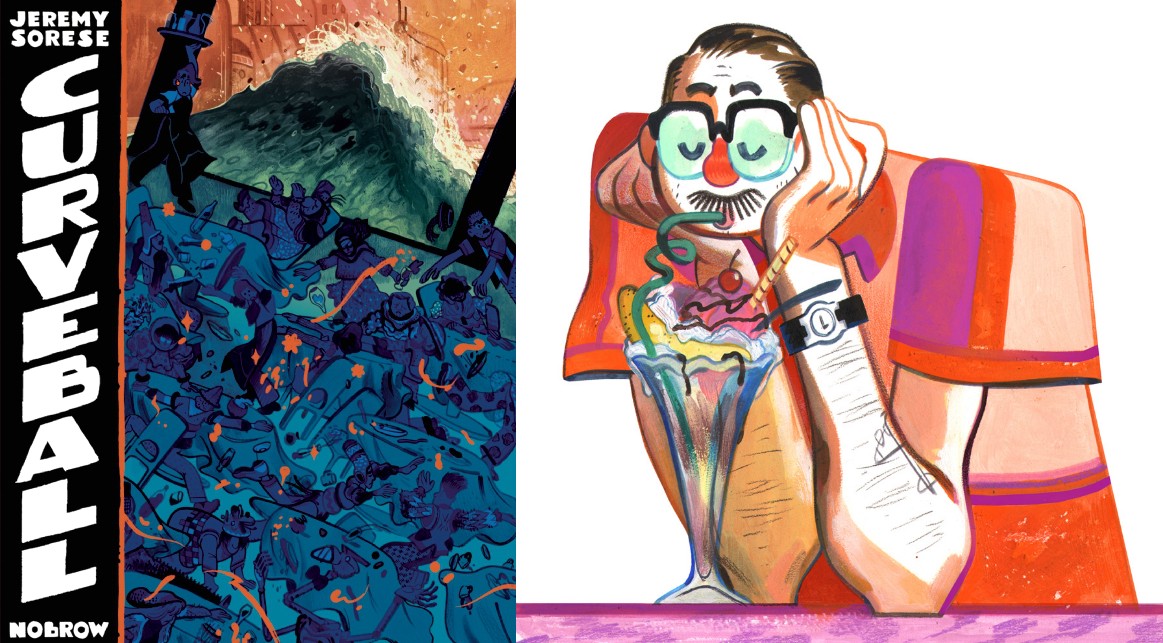
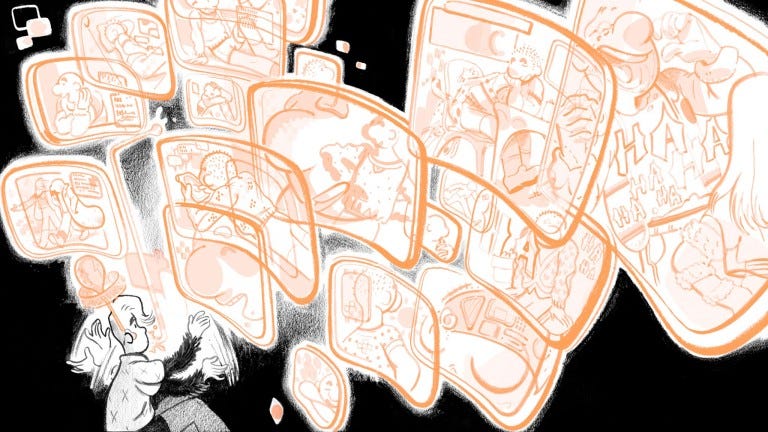
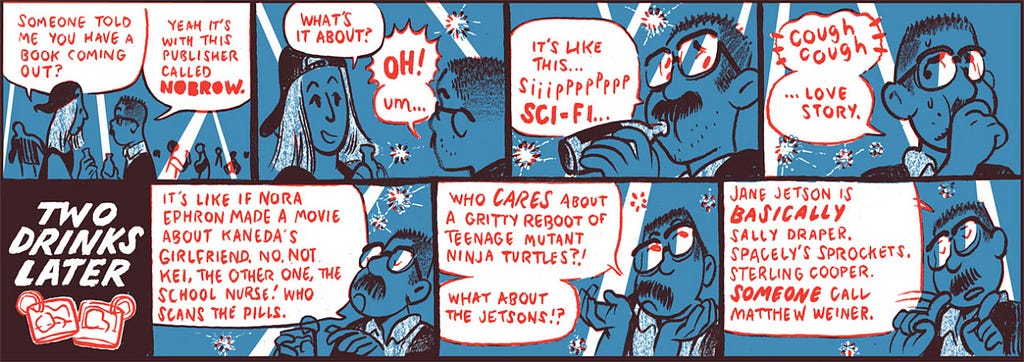
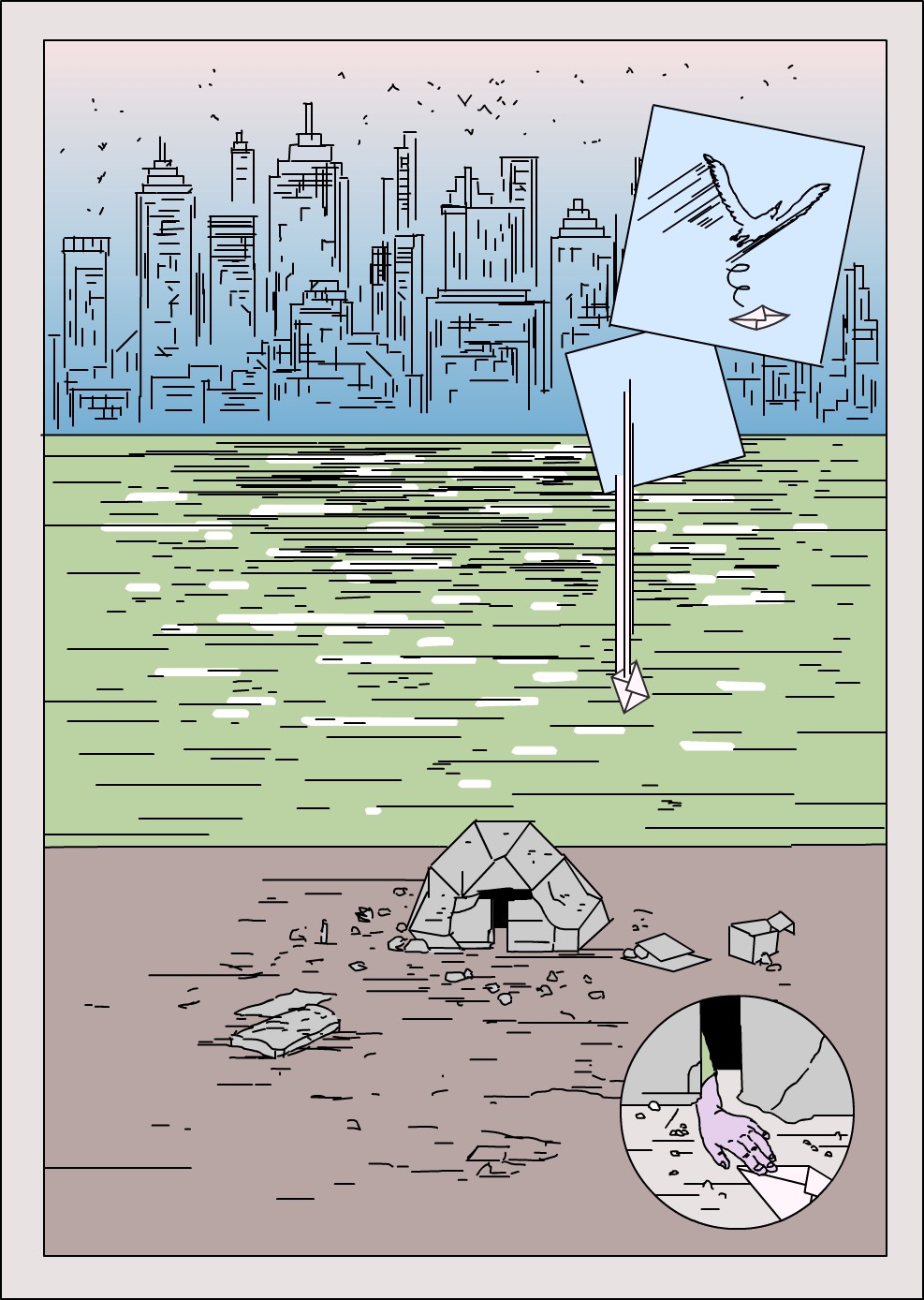
Jeremy Sorese, the creator of BOOM’s Steven Universe Series, just finished a bi-coastal book tour for his graphic novel Curveball (Nobrow Press 2015). This debut chronicles unrequited love amidst the dissolution of a futuristic society, in which citizens can barely brew a cup of coffee without the aid of robot butlers. The plot smacks, however, of 21st century romance: agony over text exchanges on a souped-up Google Glass-esque device, for example. Sorese captures the unspectacular side of a breakup: the lingering, unsexy, weep-all-day-under-the-covers part. A tumultuous sci fi society of explosions and burning cities takes a back seat to quiet emotional catastrophe.

Sorese took some time out of his busy tour schedule, during which he got stuck on a Greyhound for thirteen hours due to a mudslide, to chat about his new creation.

Liz von Klemperer: How’s the tour going? Have you had any interesting reactions to the book?

Jeremy Sorese: The tour was really really lovely. After having spent so much of the last year feeling cooped up getting the book done in time, having the flexibility, the freedom, to leave my real life behind me and disappear for two weeks was wonderful. The stress of being an artist, especially one who makes a living with their work, can be exhausting (especially when you consider how lucky you are to get to do that and want to be as grateful as possible), so to have the only goal for each day to be just see whatever you can and meet whoever you can was nourishing.

On the second day of my tour, while visiting San Francisco, I was walking through Golden Gate Park on my way to the De Young museum and someone stopped to tell me how much they had loved my book. They found a copy in a book store and, after a quick internet search, found my plethora of selfies while looking into more of my work. It was a startling moment for me, a reminder of just how easily the internet allows us to make connections but also a reminder about the power of making work, the benefits of continuously putting yourself out there, not to try and make quote unquote important work but rather to help you connect with the people in your life, open yourself up to be known a little more intimately than we are in our daily lives.

LvK: This is your first full-length graphic novel (congrats!) What sorts of unexpected challenges did you encounter? Can you take us through a typical day of creating Curveball?

JS: Having spent so long creating Curveball, a little over four and a half years, many of the sections of the book had largely different feelings, tones, having been drawn at various times in my life, which had to be smoothed out while I was inking the pages over the past year. Like the different strata of a rock formation, the book is definitely a testament to the amount of growth I’ve done as a person in my early twenties. I haven’t looked through the book since I first received final copies back in October, but only with that quick glance, each section of the book felt so tied to certain times, places, people I’ve known that seeing it all as one object, a book, was strange for me.

Jeremy Sorese

Making peace with the book I made has been the biggest challenge for me. Nobrow was only involved with the creation of the book for the last year and a half. Up until that point, it had been all me, slowly chipping away at this mountain I was climbing. There was a lot of comfort in that, steadily working on something that I didn’t know would ever see the light of day. It’s nice to endlessly tweak something, it’ll always be perfect when it doesn’t exist. So seeing the blemishes, the different geologic ages, has been important for me to accept, because this will be how every book I make will ultimately feel. The enjoyment is in the creation, not the completion.

LvK: At first glance, Curveball seems to be set in a dystopia in which human reliance on machines leads to the ultimate destruction of a city. In an interview with The Comics Journal, however, you say that the setting is utopian. Can you expand on this?

JS: Science fiction, especially mainstream blockbuster science fiction, approaches the worlds their well publicized characters occupy as these horrific oppressive worlds that the characters, and by extension ourselves, can see as a problem worth overthrowing. Of course burning books is bad. Of course having teenagers kill one another for sport is bad. Of course having sentient robots take over the world is bad. We, as viewers, get to feel pretty good about ourselves after seeing the good guys save the day.

With Curveball I tried to make a world that felt optimistic, hopeful, but also delusional, the same way that my life living here in the United States often feels. We ignore so much to try and let ourselves be happy, putting our needs and wants over the greater good to dizzying effect. Unlike science fiction that hinges on a big reveal to show the digression of society (Soylent Green being people for example) I wanted something that never had that moment of discovery. The book begins in the same way it ends, the society is largely unchanged, things will continue on without much of a difference.

Personally I think what we consider Dystopian is fairly Utopian in terms of being a world with easy answers. Our world is too complicated, too intricately balanced to say that oh, of course, the solution to everything is this or that.

Dystopian and utopian have to go hand in hand, there has to be that contrast. Personally I think what we consider Dystopian is fairly Utopian in terms of being a world with easy answers. Our world is too complicated, too intricately balanced to say that oh, of course, the solution to everything is this or that. Curveball is all about putting on a brave face, muscling through the tough times without letting yourself see the awfulness just below the surface. A utopian city built on top of a dystopian landfill.

LvK: Your characters and robots have a rapport, and their behavior often mirrors each other. For example, the concept of a “snap,” in which an excess of energy accumulates and creates an explosion, mimics Avery’s agonizing fixation with Christophe. Can you tell me about the theme of human machine interconnectedness, as well as “snap” as a metaphor for the human psyche?

JS: Science fiction authors have always bothered me in their insistence to show off just how smart they think they are, how well thought out their worlds are which often means sacrificing plot and character in lieu of something closer to a history textbook. With Curveball, I wanted science fiction that felt human and livable, something closer to metaphor rather than metaphysics.

Truthfully I was more inspired by magical realism than science fiction which, once I realized the parallels between the two genres, it became infinitely more exciting to pull from than the more expected science fiction tropes. Authors like Gabriel Garcia Marquez and even George Saunders use their story tricks to help bridge the gap between larger metaphorical ideas and the world the story takes places in and really emphasize that the way we lead our lives and talk about them, stems from the worlds we inhabit as much as who we are as people. It’s using ‘magic’ less as an imaginary anthropological study and more of a visualization of metaphor, to help redefine meaning which can often be subjective from reader to reader.

What I love about science fiction is that you have to talk about the world surrounding your story. Its easy to forget that politics matter, especially when you are a gay man and everything you make is political, and science fiction is becoming a nice system to work within as a way to check my privilege and my often narrow world view. Science fiction looks to the incredible feats of oh so far away worlds to find excitement (well, at least bad sci fi does) when the fabric of our own worlds are so unknowable, so complicated that looking at them critically easily falls into the category of “science fiction” without much of a leap.

Jeremy Sorese

LvK: Much of the book centers around Avery’s lingering heartbreak. They barely come into direct contact with Christophe, the object of their affection, and all pining is done through technology: a coded letter, a mixtape, and old texts. What about this particular stage of romance was compelling to you? Can you comment on the role of technology in modern grief?

JS: When I first started the book I was less interested in telling a kind of story and more content talking about the relationships in my life, capturing feelings I knew all too well. I think in more mainstream media, there is a focus on a more traditional kind of heartbreak, which often feels very heteronormative in how it places a lot of importance on sex and commitment and marriage. Heartbreak that is sad because there was a conclusion never met, a Happily Ever After that came up short.

Only through doing a lot of growing up while making this book have I realized that the idea of normalcy we see in media is completely arbitrary. Curveball is a deeply personal book for me, an experience I lived through and wanted to talk about but always felt burdened by because it didn’t align with the kinds of heartbreak I was seeing in media. Apologizing for your feelings, having to explain why something meant what it did to you should never be a coping mechanism.

We’re all just desperate to be loved and known and recognized for who we are.

Modern grief and technology is a really interesting topic to me, one that I have barely begun to scratch the surface of but hopefully will address more in the future. One of the big influences on Curveball was Pride and Prejudice and how so much of that narrative centers around letter writing. With Curveball, I wanted that same feeling in the narrative, to really focus on the awful wait we experience while pining for someone. I suspect grief and longing and feelings and how we express them haven’t changed throughout the ages despite what older people claim about the next generation. We’re all just desperate to be loved and known and recognized for who we are.

LvK: The protagonist, Avery, uses they/them pronouns. Speaking from personal experience, writing gender queer/gender fluid characters can be a challenge, as using accurate pronouns often subverts conventional grammar. Was this an obstacle for you? If so, how and how did you approach it? What advice do you have for writers/creators who want to write gender queer/fluid characters?

JS: The decision to give Avery non-binary pronouns was as much a decision to help redefine their character as well as call myself out on my clumsiness to recognize the lives of others outside of my own experience. The number of times I’ve put my foot in my mouth over they/them pronouns, not just in their use but in my own inability to recognize them in casual conversation has been a personal problem which I hoped to remedy by forcing myself to confront it in my work.

…it felt right to have Avery be sexless, to take back something of their own life from the scrutiny and questions love often brings out of other people.

The way in which I drew Avery, even giving them a gender neutral name without realizing, was something I had been skirting around for most of the project without coming to a decisive conclusion. Coming out of the closet felt so dramatic when it happened in my life, acknowledging not only my body and its wants but also specifying other bodies, other needs. I felt exposed, for lack of a better term. So for me, when constructing this narrative that already felt so personal, so intimate, it felt right to have Avery be sexless, to take back something of their own life from the scrutiny and questions love often brings out of other people.

For me, looking to the future and the projects I’d like to one day tackle, I’m really hoping to push myself further in thinking critically about tropes we assume to be ‘true’. I count myself very lucky to be surrounded by so many incredibly talented and smart folks who constantly remind me of how much is still left to be accomplished. At one point, the seemingly never-ending list of societal oppressions and problematic ideas we as creators need to maneuver around felt impossible but as I’ve grown into a role where this conscientiousness feels more comfortable, I am continuously excited to be challenged by the world around me. I am at a loss for the way in which life opens up to reveal something you could’ve never have imagined, whether that be a person or a way in which they think or view the world around them. As a creator, this is what’s exciting to me. To see the world and honor it the best way I know how.

The Horror of the Unknown: Songs of a Dead Dreamer and Grimscribe by Thomas Ligotti

According to a recent Wall Street Journal article, Thomas Ligotti now ranks as one of ten living writers whose work has been published in a Penguin Classics paperback. One of ten. This is significant for two reasons. First, Penguin is the preeminent publisher of what common consensus dictates as “classic literature.” They have unparalleled distribution, and copies of Ligotti’s books haven’t always been so easy to track down. In fact, the only way I was originally able to read his debut collection, Songs of a Dead Dreamer, was through an interlibrary loan — and that was just a few years ago. In that sense, they have done readers a great service. The second reason this is significant? I don’t know how to say this without being blunt, but it’s nearly unthinkable to see the work of a contemporary horror writer treated with such gravity. I don’t think I’m being provocative by saying this, but the horror genre is, more often than not, maligned by the publishing industry.

Ligotti’s work, on the other hand, is frequently referred to as “philosophical” horror. This is coded language to let readers know that it’s perfectly acceptable — if not overtly expected — to read Ligotti as “serious literature.” Longtime fans of horror, of course, recognize that the genre has always been worthy of serious consideration, that it frequently does what serious literature claims to be doing, while actually doing the opposite. At its best, horror can show us the way things are, rather than the way they appear to be, or, more importantly, the way we’d prefer them to be. A recent blog post at Time Spiral Press, written in response to the New Yorker’s slightly out-of-touch overview, summed things up quite nicely: “Horror is about nothing at all except reality. Unreality is for everything else.”

In his most distinctive work, Ligotti — with his defunct urban landscapes and twisted hints of shadowy and domineering inner workings — is uniquely able to cut into the horror of consciousness itself. As Professor Nobody, the narrator of one of Songs’ most memorable stories, quips in a so-called lecture on supernatural horror: “Existence equals nightmare.” And then later, “Every one of us, having been stolen from nonexistence, opens his eyes on the world and looks down the road at a few convulsions and a final obliteration.” With his emphasis on the horror of the unknown, of the beyond, as well as the sheer malevolence of outside forces, Ligotti is clearly indebted to Lovecraft, though his writing style is far more sophisticated. Ligotti’s stories frequently swerve into unexpected and absurd asides that are as unsettling as anything found in Kafka. His language is strikingly lyrical, often emphasizing a dreamlike quality — not to mention an odd fixation on dummies and puppets — that recalls Bruno Schulz.

The Penguin Classics edition combines Ligotti’s first two collections, the aforementioned Songs of a Dead Dreamer and Grimscribe, originally published in 1986 and 1991, respectively. At nearly 450 pages, it’s a hefty book, and the stories included present a rich variety of narrative forms. The uniting factor among them is Ligotti’s utterly unique vision and insidious technique. As Jeff VanderMeer writes in his wonderful introduction, “Unnamed narrators, nameless towns . . . allow for a corresponding vagueness of either character or setting that, perversely, creates the necessary anchor for even a reader a century from now, traveling beneath strange stars, to be held in thrall.” Sounds like serious literature to me.

With all of this in mind, it’s not difficult to see the publication of this collection as solidifying Ligotti’s role in the continuum of American supernatural literature, the birthing of a new dark star in the crooked constellation that includes Poe, Chambers, and Lovecraft. It’s frequently said that we are living in a new golden age of weird fiction, that a renaissance of sorts, signaled by newer talents such as Laird Barron, Livia Llewelyn, and Richard Gavin, is in full swing. I have to agree. I don’t know what this says about the world, or the times in which we live, and I won’t make any attempt to guess. Like Dr. Munck in “The Frolic,” who comes to realize all too late that the fabric of reality is perhaps merely coating the “jagged heaps in shadows,” I have a hunch that it’s something deeper than I can say — and that you, reading this right now, might already know what I mean.

To Know By Heart: Workshop, Whiteness, and Rigorous Imagination of Ai

“Because [once I knew a poem by heart] I had the ability to do something no one could take away from me. The library could take the book back. My mom could say ‘Go to bed’ at night. But I could keep the poem so close? Something changed when I was able to do that.”
— Nikky Finney

“It has always been much easier (because it has always seemed much safer) to give a name to the evil without than to locate the terror within.”

— James Baldwin

Outside, the rain …

9:25 a.m., and the third-floor classroom fills with students. We have come for what Yale’s course catalog unceremoniously calls, “Advanced Poetry Workshop.” We look out rain-streaked windows, sleepily shed dripping layers, check email, stare into space. Then: the clack-clack-clack of high heels. Something in us rises to attention. It’s the distinct sound of our professor, Elizabeth Alexander, who loves to quote June Jordan: [R]ain or shine, I made myself wear very high heels. Let the hallowed halls echo to the fact of a woman, a Black woman, passing through! As for the students, we are mostly sneakered, serious and shy; but now it’s the middle of the semester, and we have begun to peel back self-deprecation and irony and those other more useless layers of ego. We are working, ready.

Professor Alexander has immaculate reverence for art and an aptitude for cleaving the sacred from the precious. (She will insist you take a blunt instrument to your poem if something need be uncaged.) She has no tolerance for ego or attitude or anything else that fattens the bone of the work. She makes us stand, one by one, and face the class and sing. One by one, we clutch the backs of our pushed-in chairs, warble, tremble, forget the words to “Twinkle, Twinkle Little Star.” Fear’s soft stench has barely dissipated when we find ourselves singing together “Michael Row Your Boat Ashore” — harmonies emanating from the front left corner of the room. We trust and are transformed.

We read at least one collection of poems a week. We write at least one poem a week. We choose our favorite pens. We offer critique. We blog. We go to readings. We pore over writerly superstitions and come back, always, to the blank page. We memorize poems, which I’d loved to do since Mr. O’Rourke’s sixth-grade English class, where I’d learned “Stopping By Woods on a Snowy Evening” and then learned that I could say it twice to myself before being picked nearly last in the boys basketball game I’d insist myself into at recess. So when Professor Alexander tells us, “You’ll learn a poem by heart to recite to the class,” my sixth-grade self throws up her gangly arms. I’m thrilled. Then, finally, the day I’ve been assigned arrives. When Professor Alexander asks if anyone has a poem for the morning, I recite nothing.

Specifically, what I do not recite is Ai’s “Child Beater,” the poem I’ve been sitting with for weeks. In college, I heard Lyrae Van Clief-Stefanon read and, during the q & a, a question I no longer remember prompted the answer: “I was in the car, and in front of me was a truck with dead animals. I closed my eyes, but then I thought, ‘I’m poet. I have to look.’ I opened my eyes.” I am in this class because I want to be a poet. I want to bring that act of difficult looking into the task of learning a poem by heart. For weeks, I search for the right piece — rejecting the well-thumbed pages of books whose poems I have already taken in, whose words I send to friends and family when I want to bless their days. That is deep and gorgeous terrain, but it is not the difficult witness.

Then, in The Penguin Anthology of Twentieth-Century American Poetry, I find Gerald Stern’s “Behaving Like a Jew.” In that poem, the speaker comes across a dead opossum in the road and staves off the temptation to sublimate through language the material confrontation with death. No, the speaker seems to say, poetry will not wrap in silk the terrible ordinariness of new death trembling unpicturesquely on the side of the road:

— I am going to be unappeased at the opossum’s death.

I am going to behave like a Jew

and touch his face, and stare into his eye

I am not going to stand in a wet ditch

and praise the beauty and the balance

and lose myself in the immortal lifestream

when my hands are still a little shaky

from his stiffness and his bulk

This, I think. I will learn it by heart. It has all the components of Van Clief-Stefanon’s story: the hard act of looking, the animal carnage — an ars poetica of sorts. I love this poem for its craft and ethic but, as I sit with the poem, I realize that I also love it because it tells me a flattering story about myself. It calls me by the name I call myself in public and in private. I am going to behave like a Jew. Do the hard and right thing by being what you are. Difficult, often, to do; but comfortable to consider. I enter the poem and emerge in tact. I’m still thinking of Van Clief-Stefanon’s words. Be a poet, I tell myself. Learn your other names. I want to find a poem that sits uneasily in my body and teaches me something about the shapes I am and the shapes I might become. That night as I’m falling asleep, her name comes to me. I grab a pen and a neon pink post-it off my nightstand. I write it: Ai.

Born Florence Anthony, Ai (1947–2010) — who claimed her whole Japanese, Choctaw-Chickasaw, Black, Irish, Southern Cheyenne, Comanche self — worked prolifically in the dramatic monologue. In seven collections of poetry, she forged an unlikely constellation of personae, claiming the voices of, among many others: former F.B.I. Director J. Edgar Hoover, Elvis Presley, fourteen-year-old Jack who murdered his parents, Robert Oppenheimer, James Dean.

In the introduction to The Collected Poems of Ai, Yusef Komunyakaa writes that her poems manifest “the terrifying beauty of pure candor.” For Ai, trespassing is ethic. She is a poet for whom the boundaries of the nation, the home, the body, are violable and violated. Her speakers’ acts are intimate and violent, gorgeous and brutal — deep-seated human contradiction cast in unblinking language.

* * *

Outside, the rain, a pinafore of gray water, dresses the town…

I was eight years old when a Holocaust survivor came to my Hebrew school class to tell his story — a story I loved to tell myself for years afterwards. His family was sent to Auschwitz, where they were murdered, but an SS officer took note of the then-boy’s painting skills and kept him as a portraitist. An ever-doodling child, I clung to the man’s words. They seemed to me to be a literal manifestation of art’s lifeforce. Now, when I look to that story, a disconcerting lesson wells up: the capacity for beauty is not the capacity for good.

* * *

A pinafore of gray water, the Child Beater names the weather. What a delicately anachronistic image. Pinafore. Not a word haphazardly swiped from the quotidian, but the language of someone who pays attention, who revels. The language of someone who loves language — which is to say, the language of someone who loves. Pinafore. A word sourced from, perhaps, a little girl’s fantasies of quaintness.

And now, in Wednesday morning workshop, looking out the window at the rain and silently shaping my mouth into pinafore, I am already tumbling into the poem’s next lines:

Her body, somehow fat, though I feed her only once a day,

reminds me of my own just after she was born.

The violence enters together with the beauty. Across the table, someone is talking about ghazals. I gnaw at the top of of my pen. I am filled to the brim with disquiet.

The speaker beats his daughter to retrieve the self he was before her. He wants her out, out, out; but his poetic testimony reveals how the Child Beater and his daughter are always already entwined. Her language is in his mouth; his body, marked by the time they’ve shared. “Child Beater” not only exposes the speakers indissoluble bond with the daughter he beats, in whose body he sees his own; the poem also forges the unlikely platform where he, as speaker, and I, as reader, meet. This poem is gathering ground.

Sharifa Rhodes-Pitts says that the first question of non-fiction is, “What am I doing here?” I love poetry for how far in I can come before I even know to ask that question — so immersed on all sides I have to draw the map out anew. Poetry refutes the myth that language can ever be only one thing. Poetry revels in double-meanings, language as sound, as shape, as at once interior and exterior, and all of the shifting intersections of those categories. It is raining — which brought me into the poem — but the lilt of language moved me along so that, in the middle of a workshop on a gray and Wednesday morning, I am shaping in my mouth the words of the Child Beater. I am holding his language. I am making possible his testimony.

* * *

“I can’t imagine,” my white family and friends tell each other so many times it sounds like a plea, or an incantation. “I just cannot imagine,” they say, meaning they cannot imagine how the massacre happened; how, on June 17, 2015, Dylann Roof, a 21-year-old white man, entered Emmanuel A.M.E. Church in Charleston and murdered Cynthia Hurd, Susie Jackson, Ethel Lance, Depayne Middleton-Doctor, Clementa Pinckney, Daniel Simmons, Tywanza Sanders, Sharonda Coleman-Singleton, Myra Thompson — nine black people, who had made a space sacred and welcomed him in. “We,” my family and friends insist, “cannot imagine.”

But. Can you imagine hearing and not intervening in a racist joke? Can you imagine attending a university that invests in private prisons? Can you imagine being an American and never learning black history? Can you imagine studying the Holocaust without talking about Japanese internment? Can you imagine teaching a science class without Henrietta Lax, without the Tuskegee Syphilis Experiment, without any thought at all to whose bodies have produced your knowledge? Can you imagine living on land stolen from native peoples? (‘But I worked hard to make the down payment on this house!’) Can you imagine buying something, ignorant to the conditions of its production? Can you imagine crossing the street at night so as not to be within arms length of a black man who threatens to share the sidewalk with you? No, maybe you’re saying. I don’t do that. But can you imagine?

because white men can’t

police their imagination

black men are dying

— Claudia Rankine, Citizen

“I can’t imagine,” my dad tells me, my uncle tells me, my cousin tells me. There’s something in the act of iterated disavowal that limns the space we share. A border is a contact point. We turn away, not because we don’t recognize Dylann Roof’s actions, but because we do. If the seething hate of Roof’s manifesto is language we can easily situate ourselves outside of, Ai’s speakers take us in, demand that we reckon with a poetics of citizenship in which we are complicit. How do we participate in Roof’s testimony? In what ways do we perpetuate the violence that makes his actions thinkable?

I grab the belt and beat her across the back

until her tears, beads of salt-filled glass, falling,

shatter on the floor.

“We believe Ai’s speakers even when we don’t wish to,” Komunyakaa writes. In Ai’s work, we are the speakers’ accomplices, if only because we are enrolled as witnesses to their confession. The beautiful language of Ai’s speakers’ makes a meeting place where I find myself unlikely and open with all of the danger and possibility of that posture. The language is violent and precise. It’s the chaotic sweep of anger alongside the careful precision of noticing. The words don’t sit comfortably in my body. I am opened and raw.

Ai’s is not the didactic language of politics. Hers is the political language of relation — multi-sited, complex, and shifting. I am not the Child Beater, but neither do I stand outside of him. I see him there with all of his language and, because recognition marks shared territory, I am restless. Is it only in the beauty of his language that I see myself? Or is there something of his abjection, his violence, that shows me something of me that I already know but will not name?

When Professor Alexander asks, “Has anyone prepared a poem for recitation today?” I hold my prepared poem in my chest and say nothing. In part, I don’t want to reproduce the violence that the poem enacts but, if I turn the difficult looking toward myself, I see that I am quiet, too, because in speaking the poem aloud I am calling my own and hideous name. I am quiet that day, but I am holding the poem. I have joined the Child Beater through language, entered through the beautiful word, and found myself waiting in the wreck.

Uncertainty: A Conversation About War And Memory

by Maurice Emerson Decaul

I walked into Swallow Café off the Morgan L a week before the massacre in Paris to meet up with Brandon Caro. We were to talk about Old Silk Road, his debut novel, recently published by Post Hill Press, but as fate would have it, Swallow Café because of the din and lack of available seating proved to be an unideal place. So, instead we decided to take a drive through the neighborhood and ended up for the most part talking about our wars and our experiences growing up in New York City a time before it was cool to say, let’s meet in Bushwick for anything, much less coffee.

My intent was to discuss the way Caro has situated the current American military involvement in Afghanistan, collapsing time through the juxtaposition of historical figures: Alexander the Great, The Khan, Dr. Brydon of the British East India Company, a unit of Soviet tanks and Pat Tillman, who is omnipresent in a dream time news cycle like, way. But as is common when veterans get together, we started to share stories, the type of discourse rarely discussed openly.

The President recently addressed the nation to describe the current way in which the use of the tactic of terror has evolved from the sophisticated mass casualty attacks of September 11th 2001, perpetrated by Al Qaeda, to a new, equally nefarious but exponentially more difficult to counter, low-intensity chronic threat posed by actors such as Da’esh aka ISIL ,whose modus operandi in Europe, North America, parts of North Africa and in Australia depends on individuals willing to commit murderous acts with little institutional support. The “Lone wolf” the “self-radicalized” person, he or she is called.

The drumbeats of this new war are being beaten. And with the deployment to Syria of American Special Forces, the rhetoric professing that there would be no American “boots on the ground” has been discredited. I bring this up to contextualize my conversation with Caro because we have both had our boots “on the ground” so to speak, me in Iraq and Caro in Afghanistan. As our elected officials’ debate strategy, our service people know already what might be asked, but it is important in our democracy for the demos not to be excluded. It is important for the demos to know.

Brandon Caro: I just want to talk about, the positive changes in New York in the last, I guess, twenty years, as far as the reduction in violent crime. I grew up here. I grew up in Manhattan. I was ten when we moved to Greenwich in 1992. And I just… I just remember an atmosphere of fear.

I just remember growing up during the crack and haze epidemics, fear really controlled my life to a large degree. I was a small kid. I couldn’t go anywhere alone. When we moved to Greenwich everything was different. We could go wherever we wanted. But we were talking earlier about how it’s not like that in New York anymore. It’s just not….It’s not nearly as dangerous as it used to be.

Maurice Emerson Decaul: New York is a very different city. I left New York in ’98, when I joined the Marine Corps.

BC: Yeah. Yeah, I think it was like… It was still a bit dangerous in the ’80s and then it’s got a lot less dangerous since the ‘90s.

I actually…I witnessed a murder in like ’99, or 2000, uptown, like 109th street. I was…like right in the place where it happened. It was in like a Chinese restaurant. I walked outside and a guy came in and shot a guy that was right behind us. I had never seen anything like that. But Iraq was a really dangerous place, certainly when you were there.

MD: When were you in Iraq?

BC: I was never in Iraq. I just know from the news and the people I know.

MD: Yeah.

BC: But it was a really dangerous place. Basically, ’03 to ’07 and then it wasn’t, you know?

MD: Yeah. Yeah

BC: Really, it was Pre-ISIS Iraq, after the Sunni Awakening it experienced a–

MD: –A surge in violence.

BC: –Right. It experienced first a surge in violence and then a drop in violence and now it’s obviously more violent, I think, than it’s been.

MD: I was speaking to someone who was telling me about his family. one of his brothers is a General in the Iraqi Army. His brother was talking about Tikrit and using American bombs on ISIS because they can call them in. Another of his brothers, I’m sorry, his cousin had just been shot by an ISIS sniper.

BC: Really?

MD: Armpit, yeah.

BC: Axillary, yeah.

MD: He didn’t die. He’s lucky.

BC: He didn’t? That’s interesting, because…a guy I served with was shot under the arm pit by a sniper and he was killed. He was on the MK19 and it jammed because that’s what they do.

MD: I hate the MK19.

BC: He was trying to fix the tray and he got shot underneath the arm pit.

MD: Our last or second to last night in Iraq we were coming back from patrol close to our compound, we heard guns fired. Nothing major. It was a wedding.

BC: A celebration

MD: But someone took the opportunity to take a couple of shots at our vehicle.

BC: Yeah.

MD: And, you know, timing–

BC: And pre-armor, right?

MD: Yeah. This is 2003. This is July 2003.

BC: You didn’t have doors.

MD: We didn’t have doors.

BC: Dangling your feet outside the doors.

MD: Yeah.

BC: That’s crazy.

MD: So someone took the opportunity to take a shot at the vehicle. And timing played a part in not getting shot in the same area.

BC: You were in a–

MD: I was in a Humvee. I was the A driver.

BC: But the doors was open.

MD: The door was open.

BC: That’s fucking nuts.

BC: One of the only times I was ever shot at was on base. The bases were really not well defended.

MD: This was in Afghanistan?

BC: Yeah, in Afghanistan. We were under this big tent and someone fired a RPG and it just barely missed the tent.

MD: That sucks.

BC: Yeah. Well it was great. But if it had hit the tent, it would have been a mass casualty because there were at least one hundred people in the tent, everyone was on the Afghan side of the base, it was like a dinner, you know? It was like an event, you know? A guy, someone fired an RPG. It missed, then they just started with machine guns…and then we got our stuff, and went back to the front and it was already over.

MD: That’s how it happens. It happens very quickly.

BC: Yeah, it didn’t last very long. It felt like a long time [laughs]

MD: It does. It feels like a long time in the moment, but in retrospect, you know, those engagements–they happen…[snaps fingers]

BC: Yeah. Really, really fast.

MD: With us, there were a few occasions sort of like that. Not with RPGs, no one had a chance to shoot those at us because the Marines were on their game, man. On their game. We were in control of the Nasiriyah Museum, which is on the banks of the Euphrates. One night, maybe 2o’clock in the morning all hell broke loose. I mean literally every piece of ordnance we had started going off. And I woke up.

BC: Oh! I think I heard about this.

MD: Did you heard about this? You heard about this? [Laughs]

BC: Yeah, yeah. I think I heard about it.

MD: You know what a CLU is?

BC: No, what’s a CLU?

MD: The CLU is the aiming system for the Javelins.

BC: Oh, yeah. I do.

MD: The great thing about the CLU is that it allows you to see in Infrared. Not only in night vision, so also body heat. One of the Marines was scanning the water and saw a small group, maybe three people, stepping out of the Euphrates and moving towards the building and he engaged them with the SAW and I think that was it, I think it was over with his engagement. One of the Iraqis had an RPG so he engaged them and everyone else engaged too. So we were sent out the next morning to recover

BC: Whatever was out there?

MD: There was nothing out there.

BC: Oh, really?

MD: Yeah. I mean, we soured.

BC: They just took off or something?

MD: I don’t know. I have no idea if we hit them or did not hit them. I don’t know. I mean who knows?

BC: You bring up uncertainty, which is something that I experienced that would influence my book, Old Silk Road.

There was a really nasty IED that went off outside the FOB, the casualties came into us… to be treated and evac’d out, so we did that. There was one KIA….three or four wounded.

MD: Americans?

BC: All Americans, and this one…one woman, too, actually. We treated them and then evac’d them and then like an hour later they brought in this little kid. He must’ve been, like fourteen. He had these little whiskers on his moustache and they were like, “Doc, look at him. Check him out. Make sure that he doesn’t have any injuries, because we’re going to interrogate him and we don’t want him to say that we beat him up.” I was looking at him and they were like, “You can’t interrogate him” but obviously I wanted to fucking ask him questions you know? So, I think I asked one of the ANA soldiers “is this the one?” And he said “We’re going to find out and if he is, we’ll cut his head off.” The kid-his face just like…I mean, I had never seen such fear in my life.

MD: I can imagine.

BC: Because they will, they will do whatever they want. And we had absolutely no control. So I checked him out, he didn’t have any injuries, I think, I actually took some photos, too, but that was it. And then I never…I never heard from him, I never saw him again. I don’t know what happened. I don’t know if he set off the IED or not. He just…he just, like, Disappeared, completely.

And I use that in my book.