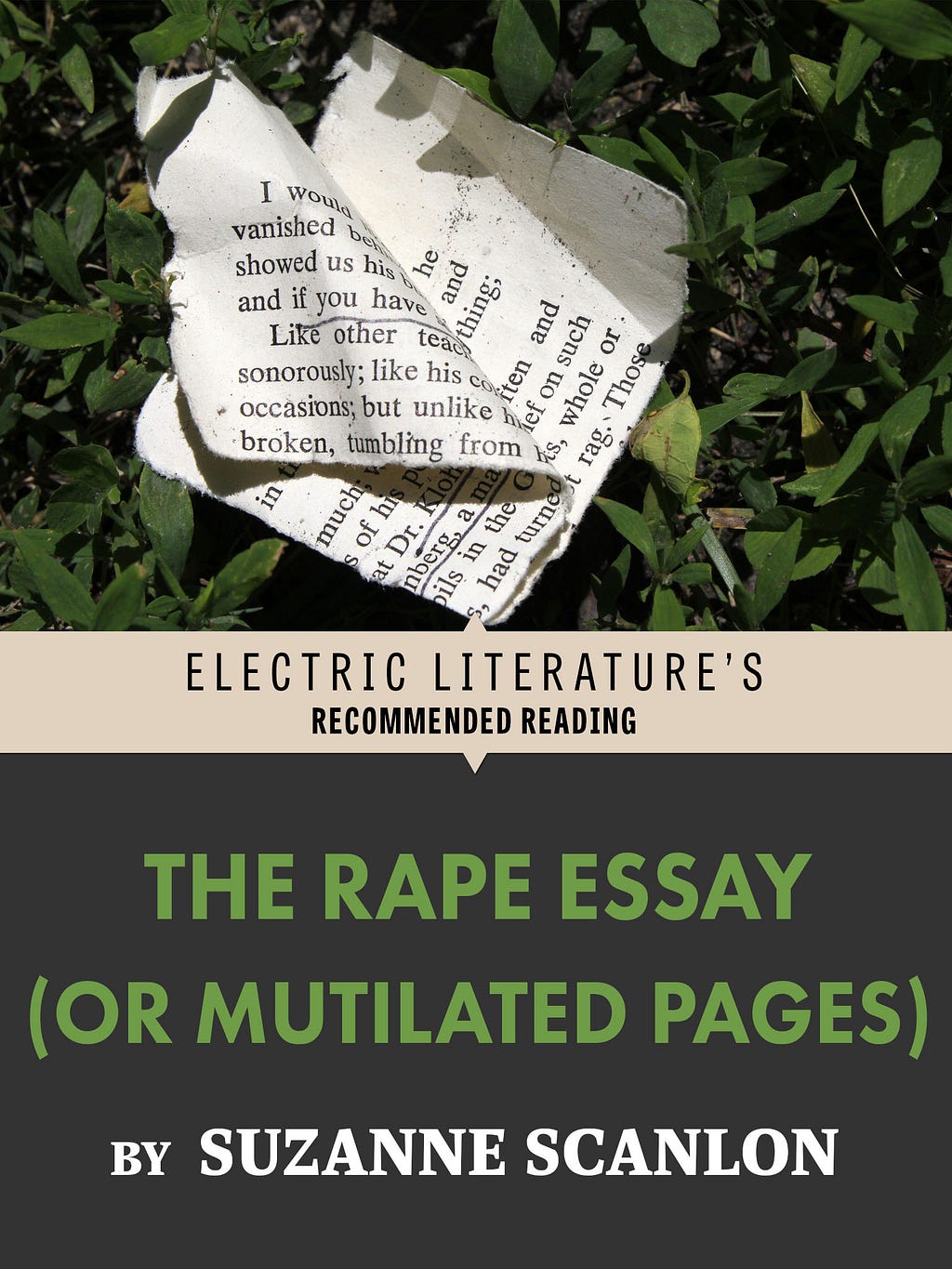
“The Rape Essay (Or Mutilated Pages)” by Suzanne Scanlon

“Well yes of course I’d read it, but you know it’s hard — ”

“You dated him anyway!”

“I mean how could I — ”

“There’s a blog about that — ”

“Something so cartoonish could not have been real, you know?”

“A Twitter maybe, something.”

“Or very real.”

“Surreal. That way. That he was just what — I mean, worse — than the
men he wrote about.”

“The one who sleeps with the Hippie Chick?”

“Or the two guys having that sick conversation — ”

“Today’s modern woman blah blah — ”

“Something about the way it was like how — women, ha! — were totally hosed, you know, by wanting to be independent and also wanting to be totally overcome and undone and ravished in love, by a man. Like blissed out and destroyed, obliterated.”

“Yeah.”

“Well that was actually smart. I mean that’s why he gave me it that day, before we — ”

“Very.”

“Do you think — ”

“It’s like this book I’m reading where this — ”

“But regardless, it is condescending for a man to come to such a conclusion — like, he’s trying to undo through intellectual analysis the very women he’s seducing.”

“Where she talks about um how you can’t desire what you have — how it’s like hide and seek and you can’t seek what isn’t hidden — ”

“The most cynical — ”

“But I mean maybe there’s something to it. Also.”

“But smart. Yeah. I know.”

“I know you know. I’m just saying. I’m just saying.”

“Yeah.”

Maybe the story begins here: Harold just beyond the doorframe; you see him, don’t you? He holds a sweatshirt: grey and torn, with the insignia of a Jesuit boy’s school in the Bronx: XAVIER. Esther’s sweatshirt, a gift from a boy she’d met in asylum. That’s what Harold liked: that it belonged to a boy, a boy from asylum, another boy, and that the boy must have liked Esther very much, to give it to her. And now, he, Harold, is the one who got it, and got her, too.

Not that the boy in asylum ever got Esther, of course. But maybe that was better, leaving it there, in the realm of desire. Or not even desire.

Back to the moment, the beginning: here’s Harold, in the doorway, wearing tennis shorts. His elegant legs, which taper at the knee.

“This is what makes legs sexy,” a girlfriend once advised Esther. They were in high school.

“Without that taper, you have fat legs.”

Esther considered her own legs.

“My mom said these were the legs of an obese person.”

“You can’t have everything,” the friend consoled.

Or was it later, the beginning, or maybe this was the end, that day in class, when Harold held up his copy of the essay, to make his point. With his left hand, gesturing to the page, saying,
“This was originally published alongside a very unattractive photo of the author.”

The beginning might be later, too, like the time Harold took a pair of sweatpants that had been given to her by a boyfriend she’d had when they met.

“I fed them to my dogs,” he told her, of the sweatpants, and it seemed to be a joke, hyperbolic.

Still, Esther loved it, the way Harold wished to possess her, this violence of competition. She’d never been loved that way before, violently, madly; and even though, later, she decided it was not love, she’d never, anyway, had love performed that way before this, which was what mattered sometimes, above all, or in the moment of it: the performance of love.
If Esther were asked now to describe Harold — in one line, retrospectively — she would say: Harold wore shorts. Or: Harold was aware of the beauty of his legs.

“To be concerned with fame is much like a preoccupation with sexual appeal: one day it pleases you, soon enough, it destroys you.”

“…”

“You become consumed with trying to keep it. Like everything else, it becomes something to lose. The prospect of losing it terrifies you.”

“…”

“So what you have to do is not get attached to anything; it’s all here to be lost, just as we are.”

If you worship money and things, if they are where you tap real meaning in life, then you will never have enough, never feel you have enough. It’s the truth. Worship your body and beauty and sexual allure and you will always feel ugly. And when time and age start showing, you will die a million deaths before they finally grieve you.*

Esther holds back the curtain covering the small window at the top of the door. Harold is no longer in shadow; he is complete, in color, lips pursed and head bowed.

“Did you get my email?” Harold asks.

“I don’t want it.”

“…”

“My dad would be mad if I lost — ”

“It’s not really me, mine, I don’t care.”

“It’s important to him.”

So a boy named Brian, incidental here but maybe not? had given Esther the Xavier sweatshirt years earlier, just after he was admitted to the adolescent program. This was late in Esther’s stay. Suddenly, there were so many kids on the ward; it changed everything. Brian carried a bible, wrote notes he’d sign with bible verses. St. Francis Xavier School in the Bronx, on Haight Street.

Esther didn’t want to be a mental patient anymore, not this way — not in front of so many children. Little eyes on her: it forced her to grow up. Eyes that did not gaze, but needed. Be not afraid. 1 Peter 3:4 Something had to make her want to leave that place, why not the transformation of long-term asylum into short-term high school respite? Babies are famous to themselves, Harold said. She’d sung the biblical line as a child. The idea of it: Jesus, a Savior, holding you. Nothing to fear. This was how the gaze worked. She became supplicant. She wanted to believe. This, too, was why she loved Harold; he also wanted to believe. He didn’t believe, but he wanted to.

If Brian believed, why was he in a mental hospital?

“Do the Jesuits look askance?” she asked one day, thinking of James Joyce.

“Not at all.”

“I don’t think fervor sits well.”

“They only mind when I speak of the visions.”

“…”

“When I’m lucky. Occasionally. I have to prepare, to be ready — ”

“What happens?”

“A bird flying over, around and around in circles; he comes closer and closer and then–right into my heart.”

Brian closed his eyes, put his hand to his chest, a lowered salute.

“…”

“Another time, spiders, bleeding, but others — Saint Dymphna, for example.”

“The patron saint of nervous illness.”

“She was, in fact, molested,” Esther told Brian; she’d loved Lives of the Saints as a girl. “I mean, that’s the irony, right? She was abused like so many women here on this psych ward but really she’d been raped, desired by her own father, then ran away.”

“I didn’t know.”

“He cut her eyes out.”

Esther’s aunt sent a prayer card of Dymphna to the asylum; Esther threw it in the trash immediately.

“So why is she the saint of mental illness? Why not the saint of women traumatized by wacked-out patriarchal violence?”

Brian listened, nodded, but didn’t register the story as Esther did. He told her it was usually a male saint or apostle appeared to him, anyway. This is where mental illness gets interesting, Esther wanted to say, but stopped herself. She did like Brian, even if he lacked specifics; that fatal flaw of the faithful. He went on about Jesus coming to him, laying hands; treacly imagery from her own, tired girlhood. Next it was Francis of Assisi, a hallmark version of goodness and love.

But back to the real story here, which is about Harold, and now that we’ve discovered where it begins, let’s get to the point. There is a point! I promise. For example, here’s Esther, out of bed now, in jean shorts, no bra, carrying the big book to the door. It’s Harold’s book. Harold won’t walk through the entranceway, she notices, a new boundary. She hates boundaries. Boundaries are for maps, a woman protested, in a play she had seen some weeks earlier. That’s how she felt. Maps. Keep your boundaries for your maps.

But not really. She liked boundaries sometimes. She liked them when Brian was around.

Here’s what Esther wrote of the moment later, in her notebook:

I said fuck you but not out loud and only in retrospect. I wanted to be back in bed. You could see that and yet. You needed it. Something about your father. I said I will give you something. And I got your book, a big book, which I never wanted, with an essay you insisted I read, an essay I of course read, an essay about rape, an essay written by one of my favorite writers ever, a writer you would only call “weird” which fine so what or was it “scary”? No “scary” was how the other prof, my default-prof, described Kathy Acker: “Scary.”

Some background: back when they still liked each other, when boundaries were for maps, maybe, but certainly not for student-professor relationships, Harold appeared at Esther’s door one afternoon; he carried a big book.

“You have to read this,” he told Esther, of the book, but not the book itself but just one particular essay within the book, an essay written by a female writer Esther admired. In the essay, which Harold wanted Esther to read, the writer argued — or so it seemed to Esther — that date rape was a reductive, problematic term; women, the writer suggested, were less often the victims they wished to be considered.

Or so it had been in her experience.

The writer of the rape essay was the first to articulate for Esther what it was to be a woman right now. Not in this rape essay but in her fiction, which Esther admired, where the writer wrote sharply, smartly about women doing stupid, dark, destructive things: fucking men they feared or despised, for example.

Esther sat down to read “The Rape Essay” as she came to call it, though that was not the title. She ignored the implications of Harold gifting her this way, but acknowledged the gesture as ritualized courtship, which Harold took seriously. She hadn’t expected how essential this phase would be for Harold: the opening of car doors, for example.

The problem, the admired writer argued in this essay, was that many women allowed themselves to get to a risky, dangerous place — flirting, drunk, physically involved–because of the erotic charge — and yet, these very women wish to call it “rape” when it ends violently or forcibly or merely regrettably.

Esther and Harold had bonded over asylum stories. “War stories,” he called them, but it was also intellectual inquiry; she found it exciting. Sparring as flirtation.

“It reminds me of, like, Bill Cosby.” She tells him later, by phone.

He groaned.

“Didn’t he like blame black people for not being, you know — ”

“If you think you can compare what it is to be a privileged white woman to what it is to be black in this country, under the hold of systemic racism.”

“That’s not what I — ”

“The juggernaut of 20th-century feminism.”

Esther re-read the essay in bed that night, and again the next: what the woman argued was for a more nuanced understanding of relationships between men and women. Sometimes women got what they wanted but didn’t want. Be careful what you ask for, as a particularly simpering asylum keeper would say to Esther and the others.

Back in the doorway, things are still rising: Harold, esteemed and brilliant, appears helpless, shy; lacks the energy or bravado of his first appearance in her genkan.

It was hard to believe that this was the man she’d been hating with such intense feeling all week. It was easier to hate people who weren’t bodies, who didn’t have faces.

“It’s true that some of us are, well, complicit in ways we don’t want to acknowledge. In our own joy and suffering. It’s not possible not to be.”

“That doesn’t mean that — ”

“Rape still happens.”

“I read the essay — ”

He doesn’t move.

You burn with hunger for food that does not exist.

Q. Why was the t-shirt special?

A. It was from the American Philosophical Association.

Q. What did it say?

A. On the front it read “The statement on the back of this shirt is true.”

Q. And on the back?

A. “The statement on the front of this shirt is false.”

The large book fell open first to another essay in the book, which contained one of Harold’s essays. It fell open to the page, she discovered, where Harold had mutilated some text, taken scissors to pages, cut entire paragraph-sections.

You are like me, but worse, she thought.

You have been snared by the delusion that envy has a reciprocal.

“Was he a cutter?”

“Not really, but.”

“Same thing?”

“For sure.”

It’s funny how easy it was for her, Esther, to imagine that to be Harold was more satisfying than it actually was. To be Harold was, in fact, excruciating. Or so his mutilated pages revealed.

This could be the climax: a few days after dropping off the book, he invites her to take a ride in his new Volvo. On the way to the Super Kroger, he spoke of his work.

Did he bring it up, or did she?

It’s hard to say. She told him she hadn’t read his big book. Which was true.

Was reading it required?

He said that was good. He said it was a relief. He said he much preferred hanging out with people who hadn’t read his books.

She said, But I loved the others, and that one story.

Which?

That was the story of my life! she told him.

Did your family read it? she asked.

My mom and sister I think.

Not sure.

Really?

They don’t talk about it.

Why did they speak of it?

She closed her eyes, thought: I want to sleep with you because I want to be you. Or, as the poet wrote: I want to sleep with what I want to become.

That wasn’t it.

He wanted her to know: I am nothing. Nothing. And the fact of you desiring me because I am something has me wishing only to make you feel that nothingness, too, as I do.

She’d read something in the paper.

I don’t read it.

You were mentioned.

I don’t read it. The Japanese woman, she called me a misogynist.

He was parked in front of her house now, just across from a park. He looked at her.

That really hurt.

She didn’t ask.

Why didn’t she ask?

Maybe we are all misogynists, then.

They both knew what the Japanese lady meant.

Esther could no longer say how many men had given her books to read, or told her to see a certain movie or listen to certain music. But how many of those men held the authority of Harold?
Harold did not care for or about her at all. He never had. The simple truth was perhaps obvious to everyone from the beginning — but had not been to Esther.

“It would be, as your professor, an act of love to maintain boundaries,” the doctor asserted. “That’s what parents do, what professionals must do, too. To do otherwise is selfish.”

To his co-professor, to fellow students, to the many other women who had been objects of Harold’s attractions, this was not news.

“Abusive, too.”

“It sounds simple but it’s profound: the ability to love in this way, from a distance, through restraint.”

Rang cherries was Harold’s phrase for that shock of recognition. The essay was contained in the large book Harold held in his arms; the book also contained an essay written by Harold, though he did not mention it.

It was funny how you used the word date. We both laughed. It was funny how you opened doors for me. It was funny that when I commented on the insistent opening of doors you said that your mother had taught you. To open doors. It was funny that I knew then that I would teach my son the same thing.

They laughed, Esther thinks now, because they both understood the absurdity of the charade. There is nothing more attractive than shared secret knowledge with another human being–secret knowledge that will lead the two of you to a shared space.

Socrates: the best learning takes place in bed.

Harold’s joke that wasn’t a joke.

“Sometimes,” Esther confides in Harold, “sometimes I need so badly to write the book that is in my body, yet feel unable to write it — and this gap makes me want to die.”

Harold told her she must write, no matter how afraid.

“You write as if saving your life,” he tells her.

“It will kill you but you have no choice.”

“That’s when it matters, when you have no choice.”

The truth will set you free. But not until it is finished with you.

Years later, people say to Esther — You are brave — and it will chafe.

What does it mean to be brave when you don’t have a choice?

The older you get, Harold told her, the more you feel that line of Heidegger — that to be fully alive means to feel yourself in decay, moving toward death.

So, is there a resolution? Maybe it was the night Harold told Esther he admired the rape essay but otherwise found the writer herself scary.

“How so?”

“Just scary. That was my impression.”

In the box with the notebook she’d kept while knowing Harold were papers she’d saved from college. One was a paper she’d written in asylum, in response to an assignment for a course titled Skepticism and Affirmation, taught by Maire Jaanus, the striking Estonian who had been married to Edward Said. This she only learned later, reading Said’s obituary in the New York Times.

“In the future, perhaps we will all attend college while living in a mental hospital,” she joked.

“It made me sad to read of this woman and scholar so essential to my undergraduate education, to my inchoate intellectual identity — now rendered a mere footnote in the obituary of a great man.”

“And later my default prof called Kathy Acker scary.”

“This made an impression on you?”

“It seemed that women could very easily be scary — and these were women I most admired — women I wanted to be.”

“I began to understand how terrified I was of these women, and how I wished to become them — at once.”

“Perhaps it is that some of us need to write and others shouldn’t be writing.”

“The world is divided into two kinds of people.”

Toward the end of The Rape Essay, the writer Harold described as “scary” wrote:

A few years ago I invited to dinner at my home a man I’d known casually for two years. We’d had dinner and comradely drinks a few times. I didn’t have any intention of becoming sexual with him, but after dinner we slowly got drunk and were soon floundering on the couch. I was ambivalent not only because I was drunk but because I realized that although part of me was up for it, the rest of me was not. So I began to say no. He parried each “no” with charming banter and became more aggressive. I went along with it for a time because I was amused and even somewhat seduced by the sweet, junior-high spirit of his manner. But at some point I began to be alarmed, and then he did and said some things that turned my alarm into fright. I don’t remember the exact sequence of words or events, but I do remember taking one of his hands in both of mine, looking him in the eyes, and saying, “If this comes to a fight you would win, but it would be very ugly for both of us. Is that really what you want?”**

She came outside, sat next to him on the porch. He noticed a scar on her thigh, visible in the midday light. From a far off boulevard, she heard the lone squeal of an ambulance.

“You know I wanted to see you because I saw you the other day in Stevenson — ”

“What?”

“I was getting off the elevator and you were in the — ”

“I didn’t see you.”

“I said Hi, and you looked at me, like — like I was a piece of excrement.”

Esther told Harold she did not recall seeing him that day, but it was possible. They were silent for a while. She found a ladybug on her arm, flicked it away.

“My doctor says it is sexual harassment.”

“Well, I don’t — we could have a fight about it, and I’m not sure who would win.”

She stared ahead.

“Yes, you would win, but it would be very ugly for both of us. Is that really what you want?”

“There’s nothing to win.”

He didn’t say anything, just looked ahead: his lips pursed, eyes narrowed, a long frozen stare of gratitude, sadness, anger or nothing at all.

For more, read Electric Literature’s interview with Suzanne Scanlon.

Amazon Suing Fake Reviewers

Reviews can be sought out for anything these days. You go to Yelp for food, Tripadvisor for travel, and Amazon for, well, everything else. But, as anyone who has visited Amazon knows, not all reviews are created equal. Or, to put it another way, too many reviews are. This past Friday, Amazon filed a case against over 1000 reviewers who commission fake, paid reviews. Amazon started the campaign against the fake reviewers when they hired members of the website Fiverr, where reviews were being sold for as little as $5, to collect information for their claim. Some reviewers would ask to receive payment for their review as well as the product for free, in order to avoid detection by Amazon and be marked as a verified review.

By filing this claim, Amazon is attempting to send a message to fake reviewers, warning them that they will be prosecuted for their actions. The practice is not legal, according to Amazon, because, as Amazon customers, the reviewers agree to their terms of service, which does not allow fake reviews. They argue that Amazon’s brand is being tarnished by the fake reviews. Amazon is also using AI to combat fake reviews and inflation in star ratings, weighting verified customer reviews and those reviews that have been marked as helpful by other users. This is not the first time Amazon has taken legal action against fake reviewers: in April they sued a number of websites where fake reviews were being sold, claiming that together, these websites were damaging Amazon’s brand by making it’s reviews unreliable.

An estimated 10–15 percent of all online reviews are false, and so it is no surprise that Amazon is not the only website suffering under the phenomenon. But what can be done to stop the practice? Yelp warns their customers with a “consumer alert” badge on the given company’s Yelp page for 90 days whenever a suspicious review is detected, while Tripadvisor employs a large team to weed out fake reviews as soon as they appear. The hope is that Amazon’s latest bid to stop fake reviewers will scare most of them away, but as long as small and large businesses continue to profit from their reviews on sites such as these, the practice known as astroturfing will continue to exist.

Philadelphia’s Conscience Is Still Up For Grabs — An Interview With Michael Deagler

“Gogarty” by Michael Deagler is featured in Electric Literature’s Recommended Reading with an introduction by Recommended Reading’s Editor-in-Chief Halimah Marcus.

Julia Johanne Tolo: I loved reading “Gogarty,” and immediately after reading it I went to the Wikipedia page for Oliver St. John Gogarty, where I learned that he was a well known Irish poet. I’ve noticed references to poetry in other stories of yours that I’ve read as well, such as “Twenty Girls of Various Shades of Yellow Discontent,” where a few lines of poetry slips into Fulvous’ section, and in “Heavens,” which starts off with a quote from Yeats. What’s your relationship to poetry in your writing, and especially Irish poets?

Michael Deagler: I wrote poetry in high school. Poetry was my entry into writing, as it seems to be for a lot of prose writers. Then I let it fluster me in college, and I stopped, and now I don’t write it anymore. I think it’s sort of a first love thing: I found poetry too early, I idolized it too much, and now I basically have to keep away from it for my own well being. So I write fiction. I think I have a much healthier relationship with fiction, in part because I don’t really idolize it at all. But the poetry infrastructure is still in there, and the points of reference. As far as Irish poets, I’ve always had a particular affinity for Irish literature: poetry, prose, drama. I read a lot of it at a formative age and it sort of became my de facto literary standard. Even now, when I write, I have Yeats perched on one shoulder and Joyce on the other. I don’t know which is the angel and which is the devil, but they continue to manipulate me.

JJT: I also noticed a recurring connection to Philadelphia in your work, with descriptions of it’s streets, smells, and neighborhoods. Is writing about Philadelphia motivated by the fact that it’s where you live and what you know, or do you think there is something else that draws you to use the city in your writing?

MD: It’s a specific choice, one that comes from deep-seated regional love and frustration. Philadelphia really slept through the 20th Century in terms of literary output. There are a lot of things that Philadelphia does well and for which it receives no credit, but in the realm of literature we don’t really deserve much credit. We’ve never produced writers the way that New York or LA or Chicago or Boston or San Francisco or even Pittsburgh or St. Louis has. Part of it’s brain drain, part of it’s bad luck. Even so, it’s been over three centuries and we don’t really have a writer or a book that people immediately associate with the city. That’s sort of astounding to me. It’s enough to give literary-minded Philadelphians a crippling inferiority complex. But if there’s a bright side to the situation, it’s that everything, our entire history and geography and regional culture, is still up for grabs. Nothing has really been claimed yet, or given its definitive fictional treatment. So in that respect I feel fortunate. And things are improving, now, finally, in this decade. Mat Johnson, Asali Solomon, and Andrew Ervin all published books this year to acclaim. Ayana Mathis and Sean Ennis had great books within the past couple years. At some point something will stick. Philadelphia deserves to have literature written about it, even if that literature will inevitably be critical and unflattering to a certain degree. To paraphrase Joyce, it’s the job of the writer to forge within his soul the uncreated conscience of his city. Philadelphia’s conscience is still up for grabs.

JJT: What I really enjoyed about reading “Gogarty” is this expectancy of violence that you set up with your character, you start off with him shooting at his “containermate,” and once he gets a hold of the knives, I definitely expected something awful to happen. Then the story ended up surprising me. On a similar note, in the stories of yours I mentioned in my first question (“Heavens,” “Gogarty,” and “Twenty Girls of Various Shades of Yellow Discontent”), you have characters operating with fake names. Do you enjoy playing around with identity and the reader’s expectations in your fiction? And where do you think this comes from?

MD: Manipulating your identity — concealing it, or trying on a different one — is one of the few forms of agency available to nearly everyone, regardless of wealth, education, etc. Especially changing your name. A name is completely intangible: it’s linguistic, it doesn’t exist in the real world. And yet it has so much psychological weight, anchoring you to your lot in life. Or your previous life. The characters you mentioned (Gogarty; Jim Thorpe in “Heavens”; Amber and Tawny in “Twenty Girls…”) are, respectively, a squatter, a heroin addict, and a pair of street walkers. They live fairly exposed lives. So to be able to protect their inner identities from the people they encounter, even from the reader, is an important form of defense. It allows them to operate a little more freely, because they’re shielded from the judgement that comes from having a lot of information about a person. And maybe all of this is just an embarrassing Freudian admission on my part. As a writer, I don’t know anything about the reader, and yet I’m essentially offering the reader a tour of my thoughts: of what I think is interesting or literary or scary or sexy or funny. So I have to protect myself by inventing these characters and using them as a buffer between you and me. I want to connect with you but I can’t fully reveal myself to you, because who knows what could happen then?

And, really, short fiction is all about artifice, and deception, and subverting the expectations for the reader. So having a character who won’t tell you his “true” identity just adds another layer on top of the many layers obscuring or accentuating whatever truth you’re trying to get at. You could tell a story, and say, “I’m Dan and I’m a mailman.” But I think it’s more interesting to say, “I’m just a guy, don’t worry about my real name. Today I’m calling myself Dan, and today I’m delivering mail, but that could all change at any time.” It’s a more dynamic scenario to inhabit. And it’s fairly true to life, I find. Every time you meet somebody, you’re presenting an improvised version of yourself (one of the many possible versions) based on how you want the other person to perceive you. They’re doing the same thing. Human interaction is a weird chess match. A small war between suspicious participants. Short fiction is the medium that best replicates that confrontation, and I like to remind the reader that the ground they’re standing on is just made of words that I strung together. It can change at any moment.

JJT: I read that you write both fiction and criticism, how do you experience the connection between writing about the works of other writers, and being one yourself?

MD: Criticism is probably too grand a word. I write a lot of book reviews. But you can learn a lot about writing by approaching it from the other side. Reviewing forces you to articulate your thoughts about what you’ve read, which leads to deeper levels of analysis, which can sometimes lead to greater appreciation of a book and sometimes to the realization that a book isn’t actually very good. From a craft level, it’s useful to be able to figure out why something worked or didn’t work: how the shape of a narrative got you to your ultimate emotional state, and whether or not that state was the intended destination. Even reviewing bad books can be pretty informative. Nothing confirms the need to kill your darlings like having to sort through the work of someone who refused to kill theirs. But mostly what I’ve realized is how much interpretation is involved in reading. The reader is half of the partnership, and what they bring to the table has significant bearing on the final outcome. An experienced reader can get a lot out of a fairly vague book. An inexperienced reader can fail to appreciate a subtle book. So you have to think about your audience, when writing: how much are you asking of them, and how much are they likely to give? The books we deem successful are generally those that can get the most readers, including inexperienced readers, to an interesting emotional place by the end.

JJT: Halimah Marcus mentions in her introduction to your story how excellent your dialogue is. Is that something you’ve worked on a lot, or does it come naturally to you? Do you ever draw from real life conversations when writing dialogue?

MD: When I started writing fiction, dialogue was the thing that came easiest, and my stories were mostly dialogue. They read almost like plays: just dialogue and stage directions. Then I learned to do everything else, and now I actually find dialogue to be the most difficult part of a story. It’s the riskiest thing to write, because the reader hears real dialogue every day and has a highly sensitive ear for it. Nothing can knock a reader out of the world of your story like mishandled dialogue. You want it to be memorable but not ridiculous. Original but not overly clever. Naturalistic but not boring. Productive but not expositional. It’s a difficult needle to thread. I try to err on the side of a kind of theatricality, just because that’s an aesthetic that I enjoy. I like big characters making big proclamations. But even that only works for me maybe half the time. I haven’t come up with a unified field theory yet.

A friend of mine who has a background in theater told me that a playwright uses dialogue only as a last resort: that dialogue should be used to communicate only those things that cannot be communicated through movement, or body language, or a look, or a pause. I think that’s a compelling idea. But if you applied that logic to prose, it would be pretty easy to write stories with no dialogue at all. And a lot of prose writers do that, basically. A lot of literary fiction has very sparse dialogue. But life, as I’ve experienced it, is full of language. Everyone is talking all the time. Most of it is inconsequential and not worth sharing, but it feels dishonest to populate fiction with stoic characters that barely say anything. On the other hand, if the characters talk too much, the scaffolding starts to reveal itself. They may all start sounding similar to each other, and they may just start sounding like different versions of the writer, and that’s also a problem.

JJT: What are you working on right now?

MD: My main project right now is a linked story collection set mostly in the Kensington section of Philadelphia, which “Gogarty” and “Heavens” and “Twenty Girls…” are all a part of. I’m still trying to place a few of the stories, and I’m still tweaking them here and there, but my hope is that the collection can exist as a book in the not too distant future.

***

Michael Deagler lives in Philadelphia. His fiction has appeared or is forthcoming in Glimmer Train, New England Review, Slice, and elsewhere. Links to his writing may be found at michaeldeagler.com.

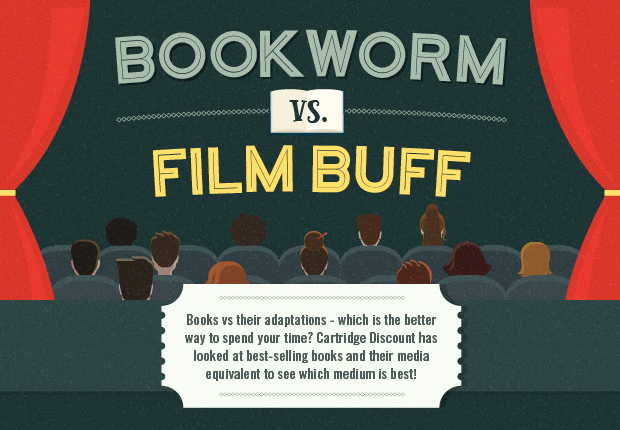
INFOGRAPHIC: Books and Their Adaptations — Which Do You Prefer?

This infographic takes a look at some of the most popular book series of our time, and their consequent adaptations, delving into their ratings on websites such as Goodreads and Rotten Tomatoes, and showing the average reading versus viewing time for the books and TV shows or movies, as well as how much each series and franchise has grossed in its respective formats. The infographic was created by Cartridge Discount.

So, which are you: bookworm for film buff?

Books vs adaptations

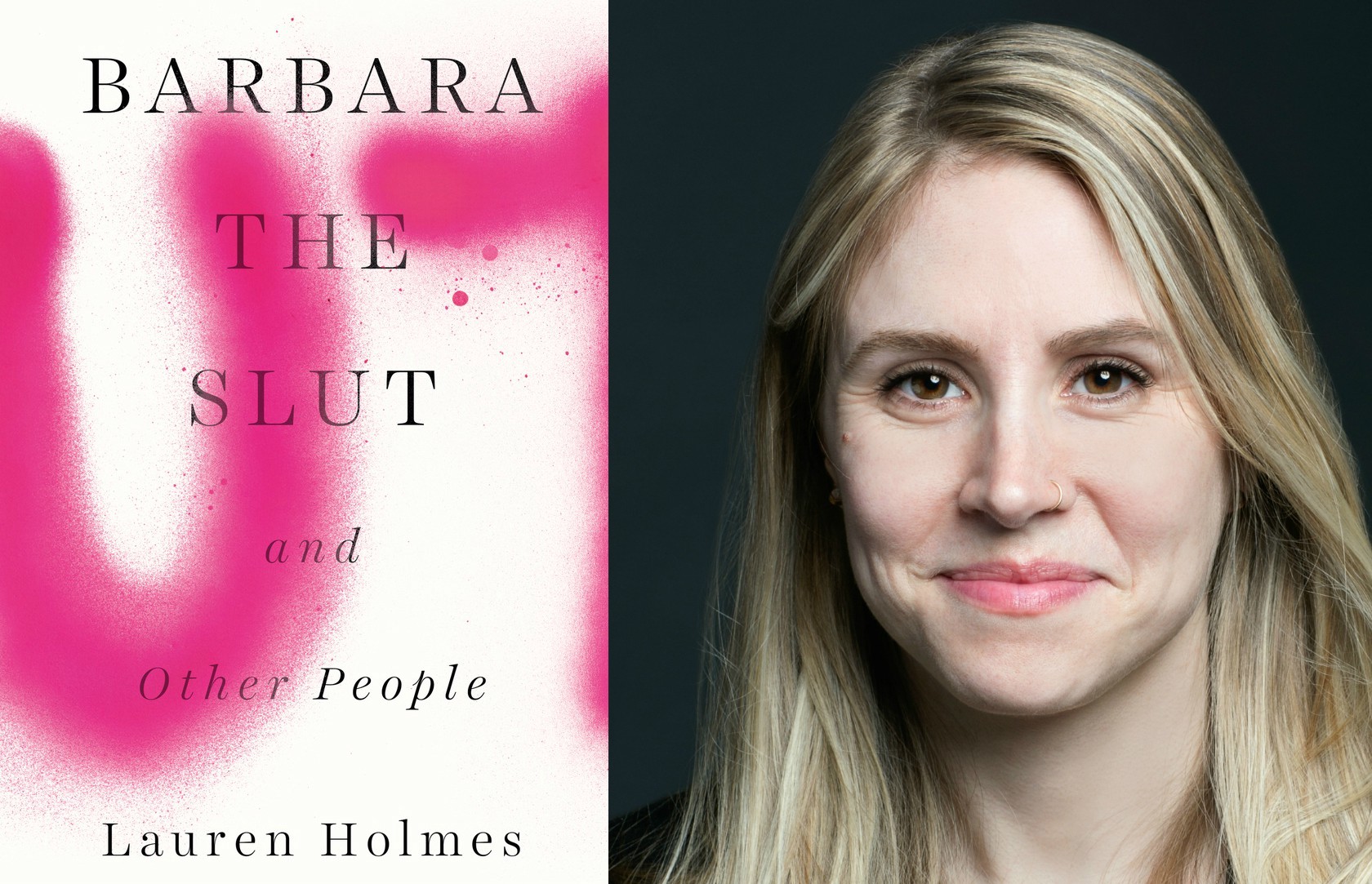
Seeing In A Haze Of Vulnerability: An Interview With Lauren Holmes, Author Of Barbara The Slut: And…

The urge to label people, emotions, and the minutiae of our everyday experiences was born way before the hashtag. Yet there’s something strikingly millennial about the characters who people Lauren Holmes’ much-praised debut Barbara The Slut: And Other People (Riverhead Books 2015). This is not to say that the alarming authenticity of these stories uses the “Selfie Generation” as a device. No, these are merely people trying to sell the American Dream in the fallout of the nuclear family. The collection, which I read feverishly in one sitting, made me think about the chasm between who I am and the person people perceive me to be, and how even in my most vulnerable moments, I can’t be sure I’m honest with myself. Saturated in the honey of sex and ridicule, these stories take us to task for our obsession with the erotic power in everyday life. I talked with Holmes about her debut and about what it’s like to be a millennial woman who writes about sex — or is, at the very least perceived as one.

Jill Di Donato: Though there are some sex scenes in the collection, what I find most compelling is your descriptions of what characters are thinking during foreplay and sex. You really work the subtle observations; your depiction rings so honest. How, as a writer, do you convey that specific type of vulnerability?

Lauren Holmes: Thanks! I love awkward shit, and pay close attention whenever that type of vulnerability is present in my own life or in someone else’s life, either in the real world or in the fictional world of a book, TV show, or movie. Any vulnerability I write is inspired by feelings I’ve felt or witnessed.

JD: I also feel like this book sends the message that there’s a thin line between shame and vulnerability. How do you see the relationship between those two feelings?

LH: I think vulnerability can come from fear of shame. Both vulnerability and shame are such inevitable and universal parts of the human condition. And that’s what I wanted to say by exploring these feelings in my stories — everybody feels these things, they’re unavoidable, they’re human, they’re important, and they’re okay.

JD: Moving from feelings to words, we Americans have a rich history of using words as weapons, to dehumanize and disenfranchise people. I’m thinking particularly of the word “slut,” which is spray-painted across your book jacket. In your opinion, why do words have this effect on people?

LH: Words are fucking powerful. I’m sure there are exhaustive explanations for why words have the effect that they do, but to me, the enormous and dangerous power of words is a basic fact of humanity.

JD: The word slut has come to mean, in my opinion anyway, a catchall insult for a woman that’s representative of a larger cultural mistrust of female power. What do you think about the word slut?

LH: Well said. I agree. “Slut” is such a powerful word because the shame we assign to female sexuality is so powerful. “Woman who has sex” shouldn’t be an insult, but of course it is. And you’re right, now “slut” seems like it’s becoming one of many bad words for “woman.” But that generalized usage doesn’t soften the original meaning and power of the word. I keep talking about this example — college baseball player Joey Casselberry calling 13-year-old baseball player Mo’ne Davis a slut earlier this year. He tweeted: “Disney is making a movie about Mo’ne Davis? WHAT A JOKE. That slut got rocked by Nevada.” What better demonstration of feeling threatened by female power than an adult white man calling a young black girl a slut? That power dynamic could hardly be more skewed. And he absolutely sexualizes her with that word, which is so fucked up on so many levels. Brittney Cooper wrote an important piece about this and about the sexualization of black girls for Salon, “Black girls’ sexual burden: Why Mo’ne Davis was really called a ‘slut.’

JD: Is there a way to use the word “slut” in a sex-positive way?

Sorry to be a downer, but it’s hard to imagine that Americans will stop shaming women for their sexuality in my lifetime — I think it’s too deep a part of our culture.

LH: Maybe. But I don’t know what it is. Sorry to be a downer, but it’s hard to imagine that Americans will stop shaming women for their sexuality in my lifetime — I think it’s too deep a part of our culture. And until we do stop shaming women for their sexuality, I don’t know how we can reclaim the word “slut” or use it in a sex-positive way. But I do see so many amazing women owning their sexuality and refusing to be ashamed, both publicly and privately, and that gives me hope that we will eventually get where we’re going.

JD: Although sexual identity does not completely define us, it vastly defines who we are and how we relate to others in the world. In what ways do you feel this collection is speaking back to the canon of literature that takes on sexual identity?

LH: I wanted to represent sexual identity and gender identity in the here and now. One aspect of that meant writing queer characters the way I would write any other character–as a whole, complex person whose sexuality is only a part of their story, not their whole story.

JD: Without giving too much away, the image of Barbara envisioning herself as Cleopatra is breathtaking. How do you write a good sex scene? What are you trying to capture when you write sex scenes?

LH: I’m trying to capture sex as a regular part of life — as something ordinary instead of extraordinary. I got good advice to keep it minimal when it comes to sex scenes, since I was aiming for literary fiction, not a one-handed read. I see minimalism as a way to maximize the reader’s involvement and use of their imagination. Readers will fill in whatever they want or can, according to what’s meaningful (or titillating) to them. My goal as a writer is to not get in their way.

JD: Who are some of your favorite characters in this collection, the characters who stuck with you the longest?

LH: I can’t say I have a favorite, but Barbara was with me for a long time. I worked on that story on and off for over five years, and got used to having her around.

JD: What’s your process for creating characters like? Is it different depending on the character?

…when I’m ready to use the characters they suddenly and magically seem like whole humans (or dogs).

LH: Sometimes it seems like my characters are magically created in my subconscious, but what actually happens is that I think about my stories and my characters for a long time before I start writing, and when I’m ready to use the characters they suddenly and magically seem like whole humans (or dogs). I do develop them further in the writing and revising process, and sometimes I stop to write a character sketch if I feel like I need to get more of a grip on who a character is (that sketch is usually just a list of things I already know or need to know about them — their backstory, relationships, personality traits, and what motivates them — what they want and don’t want).

JD: Did you write the story “Barbara the Slut” first and did the other people (stories) follow?

LH: I think “Barbara the Slut” was the second or third story I wrote for the collection. But that story really shaped what came after it — once I decided it was going to be the title story, everything else had to fit into a collection called “Barbara the Slut.”

JD: How did this collection come together? How did it become a book? When did you know these stories added up to a collection, or did you set out to write a collection from the get-go?

LH: I set out to write a collection from the get-go. I couldn’t necessarily articulate how the stories were going to fit together, but I knew they would, because I wasn’t going for diversity — I was going for a focused examination of my world and my obsessions: coming of age, family, relationships, modern sexual politics, and loneliness and our search for connection.

JD: This collection is not only erotic (why is just reading the phrase “she told me to lick her pussy” so damn titillating?) but also, the book is really funny. Any advice on writing humor? Are you sitting there laughing to yourself, being like, yes! This is hilarious.***Also, please answer why you think your readers (ok, this one anyway) can get so turned on by reading the phrase “she told me to lick her pussy.”

LH: Thanks! I’m superstitious when it comes to writing humor — I feel like I’ll lose my ability to be funny if I try too hard to understand what it means to be funny. When I’m writing, I have no idea what’s going to be funny and what’s not. I’m pretty much never sitting there laughing to myself. Or if I am, and think I made the most hilarious joke ever, it ends up not funny at all and I have to cut it. And then things that I didn’t intend to be funny, people laugh at.

On that note and on the beauty of subjectivity, I would bet that for every reader who gets turned on by “she told me to lick her pussy,” another reader is offended and wants their money back. I’m thrilled that it worked for you, though.

JD: Especially with such a well-received debut, what’s it been like being in the literary world as a woman who writes about sex?

Male writers who write the same number of words or percentage of words about sex as I do are just considered writers, not men who write about sex.

LH: I think it’s interesting that I’m “a woman who writes about sex.” Male writers who write the same number of words or percentage of words about sex as I do are just considered writers, not men who write about sex. People keep talking about how my book is about sex, but other than the title referencing sex, I’m not sure that it’s any more about sex than any other piece of contemporary American fiction. And it might be less.

JD: Writing “first-rate short fiction” is like striking gold. What’s your process for writing a short story?

LH: I usually start with something small — the idea of underwear smuggling, the idea of a woman saying she’s a lesbian to get a job at a sex toy store — and build from there. Most of the construction happens in my head before I write anything down — I think out the story and the characters, and when I’m ready I start to write what I have. I continue the cycle of thinking and writing until I have a first draft, and then I revise the shit out of the story for ever and ever.

JD: At what point, when you’re writing, does the last line of the story come to you?

LH: I write so many drafts that I couldn’t say when the last line shows up — at some point it’s just there. And in most cases I revise the last line many times, so the final last line isn’t there until the end of the revision process.

JD: We both went to all-female colleges — you, Wellesley, me Barnard. What were your college days like? To me, that time is sacred. I really think those four years studying predominantly with all women made me more of a confident person. I’m not saying I’d be shier as a student with men in the classroom, but just knowing that a place just for women existed, and that I could chose to learn in that environment was very profound. What were your Wellesley days like?

LH: Honestly, my Wellesley days were tough. I had a hard time finding my way, and a hard time making friends. That was a nasty surprise after having a great time in high school, and having everyone say, “Just wait until you get to college!” A couple of weeks before I was supposed to return to Wellesley for my sophomore year, I realized I wasn’t even considering going back. Instead I kept working at Blockbuster, and then went to Mexico for two months, where I tried to learn Spanish and traveled around. That trip restored my faith in myself, and in my ability to connect to other people. I went back to Wellesley in the spring intending to transfer, but my grades were so bad I didn’t get into the other schools I applied to. That turned out to be extremely lucky, because I hit my stride at Wellesley my junior year. I found a lifelong mentor in Alicia Erian, who made me a writer, and found many other champions in the English department and beyond — professors who made me feel like I was definitely in the right place. I did manage to make a few friends, but mostly I decided to focus on my education and my extracurriculars. Of course, as soon as I decided that, I got involved in all the lesbian drama on campus, which was so annoying at the time, but such good training in conflict.

JD: There’s such heated debate about getting an MFA. You got one at Hunter, as a Hertog teaching fellow. I also got one at Columbia as a teaching fellow — which I always feel inclined to tell people so they don’t judge me for spending so much money on an MFA, and, well, not being a best-selling author. What are your thoughts on this debate — it’s almost like MFA-shaming. At the same time, people who are academically-inclined, are dedicated to improving their craft, and want to meet like-minded people, an MFA seems like a logical choice. What did you learn from getting your MFA?

LH: No kidding. I’ll admit that I had my doubts about the creative writing MFA — I questioned the need for the rising numbers of programs, and the fact that the programs were producing many more graduates than would ever be able to find work as writers. But then I realized that’s no different than any other MFA or other arts training — visual art, music, drama, dance. So now I’m not sure why there’s shame in doing a creative writing MFA and not in training for other arts. I mean, I can guess, but I still don’t think it’s worthy of such heated debate. Lots of people study acting and voice, and we don’t shame them for pursuing unlikely dreams.

I am endlessly, infinitely grateful for my MFA experience at Hunter. I learned how to write fiction there. I honed my voice and my style there. And I found lifelong mentors, readers, and friends. I feel so honored to have been a part of that program, and really, to still be a part of that program.

JD: Do you have any advice for aspiring writers considering the degree?

LH: Read Augusten Burroughs’s essay, “How to Follow Your Dreams Or Maybe Not” in his book, This Is How. (You can also find it on Psychology Today under “How to Ditch a Dream,” but if you don’t buy or read books, you should definitely not be allowed to pursue writing). After you read that essay and search your whole damn soul, if you still want to pursue an MFA, my advice is to do research. Research the programs you’re considering in any way you can — read their website, their students’ work, their professors’ work. Spend your time, energy, and money applying to the programs that seem like the best match for you, and that you feel a connection to. Wanting to go to a program because someone ranked it some magic number, or because it’s in a city where your ex-girlfriend lives and maybe if you go there she will take you back, those aren’t good reasons to apply.

Eileen Myles, Twice: On Eileen Myles’ I Must Be Living Twice and Chelsea Girls

Eileen Myles comes in twos in 2015: Ecco has paired its publication of I Must Be Living Twice, a collection of Myles’ new and selected poems, with a reprinting of Chelsea Girls, her novel first published in 1994. The noticeable observation is that Myles is indeed living twice through the dual re-publications of her work, although to be familiar with Myles (who employs a doppelganger in her prose and, often, two-word lines in her poetry) is to recognize the one-two step of her thinking, her living, her writing. For her to exist in two places at once — in the old work that is now, once again, new — is thrillingly appropriate. Indeed, she ought not to exist any other way.

Aside from the more metaphorical purpose the parallel publications serve, Chelsea Girls and I Must Be Living Twice are perfect compliments in framing Myles’ life and work, satisfying both for those new and returning to her hefty oeuvre.

Chelsea Girls is one of the great, if under-read, New York City novels — a boozy, glassy-eyed account of lesbian sex, drugs, and family in the 1960 and ’70s, with the title being a tip of the hat to the famous hotel hangout of the likes of Robert Mapplethorpe, Patti Smith, and Andy Warhol (who has a Chelsea Girls of his own). One part Just Kids, one part Jesus’ Son, and one part New Narrative, Myles at once works in an established tradition and transcends it:

The next day when I woke up at Tina’s it was very difficult. I remember she was kissing my back which I love. Staying in the apartment of someone you know well’s lover, spending a night where someone you know has been having an affair, being in their affair and having one too is a gorgeous grey feeling. The phone rings and rings and you know it’s your girlfriend in the hospital. She’s probably going to kill herself and it’s your fault. No it’s not. I liked drinking Martel right out of the bottle, a small pint bottle she kept on her kitchen shelf. It became part of my secret about her that I drank that. She eventually answered the phone and it was Christine and no she hadn’t seen Eileen, though she saw her at Lucy’s last night. Was Chris trying to control the world from the hospital? Tina laughed.

A novel in the cloak of a memoir, Eileen Myles herself is the model for the first-person protagonist at least in name. However, Chelsea Girls itself isn’t even a novel, but rather a collection of closely tied short stories (a close reading of Myles does nothing if not force you to reevaluate labels over and over again). Then again, one does not have to go far to find a narrative in Myles’ writing, which is often presented with the same staccato one-two beat she uses in her poetry. Nearly all of the stories in Chelsea Girls have a poetic flourish to their endings, flaring out in magnesium micro-sentences that leave an afterimage on the mind and tongue. Finales include “I don’t know why” and “I loved it” and “That’s all.”

At the same time, Chelsea Girls is a novel where every story stands on its own and every sentence is its own complete story. Pick one at random: “I didn’t even know I thought women like you were sexy. Another: “One day my father died.” Another: “Christine went with me to Robert Mapplethorpe’s and like I said she was either a monster or an insane lamb.” Each is rich enough for its own nomadic journey of unpacking, refolding, and unpacking again.

But one cannot separate Myles from her primary vocation as a poet, which sneaks back into her novel both in quotes of her own poems as well as in the aforementioned stylistic nods in her sentence structure. To appreciate the extent to which the writing in novel and verse is, in some ways, one and the same, Ecco’s handy collection, I Must Be Living Twice, introduces both new poems as well as selections of the old. Particularly notable are the works in Myles’ impressive decade-spanning trio of publications: A Fresh Young Voice From the Plains (1981), Sappho’s Boat (1982), and Not Me (1991).

For those new to it, Myles’ poetry is quickly recognizable at a glance, as it is often as visual as it is sonic — strings of poems, or tendrils, rarely much longer than two or three words in width, stitched together like a drumbeat. “…It could/be another city/but it’s this/city where/I start/being alone/& alive bringing/my candles/in while/I go walking/in the rain” she pounds out in “Hot Night.” Slightly longer lines, such as those in one of her masterpieces, “An American Poem,” have the same feeling of being dripped, one by one, onto the page:

Am I alone tonight?

I don’t think so. Am I

the only one with bleeding gums

tonight. Am I the only

one whose friends have

died, are dying now.

And my art can’t

be supported until it is

gigantic, bigger than

everyone else’s, confirming

the audience’s feeling that they are

alone. That they alone

are good, deserved

to buy the tickets

to see this Art.

Are working,

are healthy, should

survive, and are

normal. Are you

normal tonight? Everyone

here, are we all normal.

It is not normal for

me to be a Kennedy.

But I am no longer

alone. I am not

alone tonight because

we are all Kennedys.

And I am your President.

After 1997, Myles doesn’t have another collection until Skies and On My Way, both belonging to 2001. For a writer so intimately tied to New York City in her work and life, it is impossible not to read 9/11 into every line: “…The people/in New York/like a tiny chain/gang are connected/in their/knowing/and their saving/one another…” she writes in “Milk,” the heart of Skies. Throughout the collection too are the lingering motifs of clear blue skies and “that plane/overhead” — although Myles later told Rain Taxi that while “Milk” is her “World Trade Center allegory,” it was “really written out of a sad personal moment. But there it is.”

There it is — it’s an offhanded comment, almost arrogant, recalling the proud chin and “cruel and suspicious” eyes in Myles’ Mapplethorpe-photographed portrait that serves as Ecco’s cover of Chelsea Girls.

I can

connect

any two

things

that’s

god

Studied closely, you might agree with Myles that she is a president, a prophet, a god. But more often than not her work is as simple as those three words, there it is, where you are left out of breath, dizzy. While reading you’ve missed your stop on the metro or the last few words of what someone has said to you — be sure to forgive yourself: Reading Myles is nothing if not a physical experience, the one-two promise of a heartbeat that goes, I’m alive. I’m alive.

Chelsea Girls

by Eileen Myles

Powells.com

I Must Be Living Twice: New and Selected Poems 1975–2014

by Eileen Myles

Powells.com

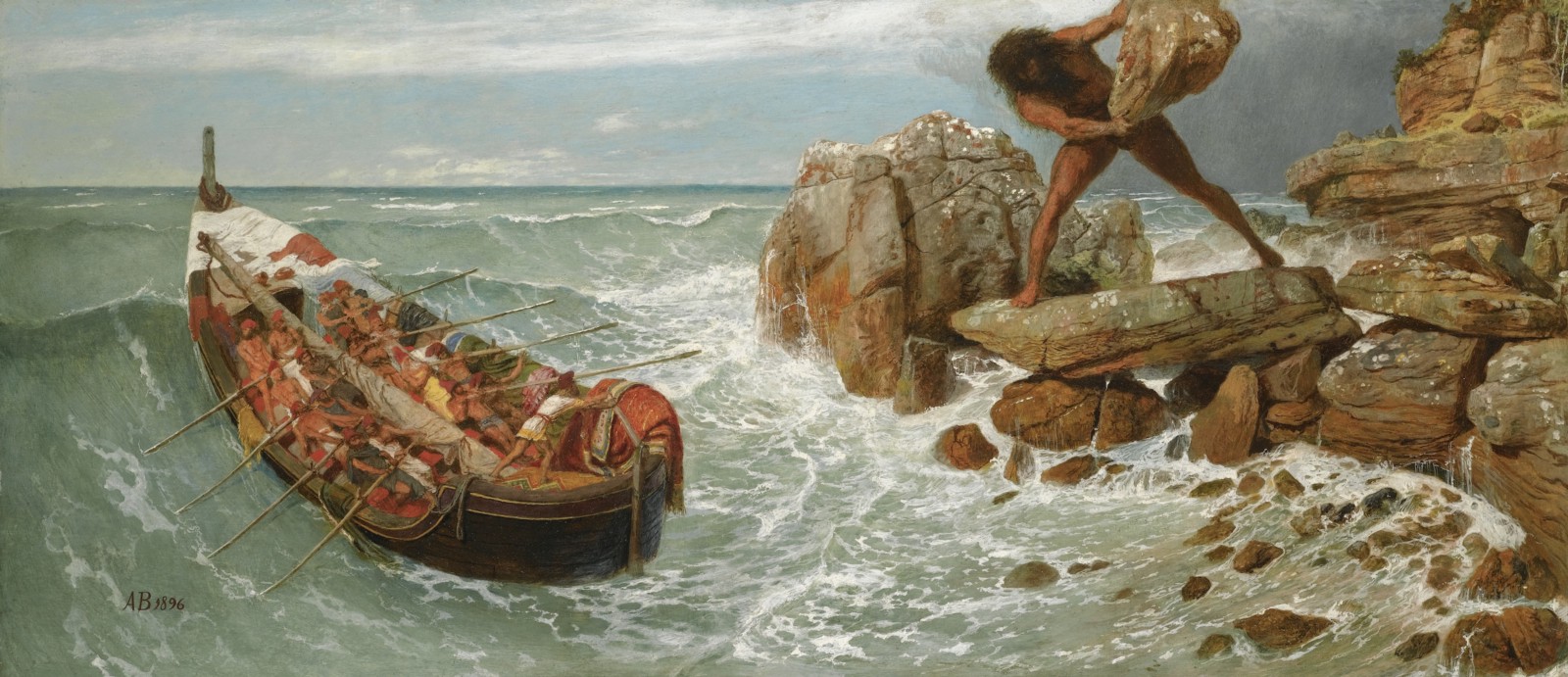
The Dude With One Eye Ate Six Of My Friends — Fiction By Jeff Bender

Fiction: I, Odysseus by Jeff Bender

Nov. 11, 1190 B.C.

Don’t want to go home to my wife, but it looks like I have to. Going to take my time. Maybe when I get in I can bang Eurycleia, the nurse, for old time’s sake.

Nov. 26, 1190 B.C.

Woke up in a cave next to a dude with one eye. One eye! It was so cool. We built a campfire down by the beach. I asked him about sheep, the moon, having one eye. He knows how to do a backflip and I don’t. I’m working on it.

Nov. 26, 1190 B.C.

The dude with one eye ate six of my friends. We lit a spear and popped his eye like a zit. Then we were drenched. Then he had no eyes. It was awesome.

Dec. 28, 1190 B.C.

The Lotus-eaters introduced us to Parsley, Sage, Rosemary and Thyme, and, though I hadn’t heard it before, I sang along. The singing made the lotus taste better. We went up on deck singing, “Homeward bound, I wish I was,” and I said, “Not,” and everyone laughed.

1190–1188 B.C.

Two years slipped by, just like that. I don’t remember either of them.

We pushed on to the island of Aeaea. The Lotus-eaters said it was cool. They said steer clear of the attractive chick, though — Circe. They said she was not cool.

I was like, “Oh.”

They were like, “Whatever you do, don’t go inside her house.”

And I was like…I guess I forgot because we went inside her house.

Inside, Circe turned my friends into pigs and forced me to sleep with her for an entire year.

April 12, 1187 B.C.

…Best year of my life.

April 19, 1187 B.C.

Heading home.

But wait: Good news: Mom’s dead.

To the Underworld!

June 15, 1187 B.C.

We learned three things in the Underworld: (1) Our shipmate, Elpenor, died falling off a roof. That’s a lot funnier than what we thought. We thought he’d died of starvation or something.

…Ah, maybe we only learned one thing in the Underworld.

June 17, 1187 B.C.

Lost the rest of my crew to a rock and a six-headed monster. Lost my boat, too. Washed up on a new island and immediately met this great chick. Banged her. Woke up thinking: I love the eighties.

June 17, 1180 B.C.

Seven years later. Still banging her.

June 18, 1180 B.C.

Today I practiced the backflip and learned the chick’s name: Calypso. I thought it was a cool name — at first. But then I said it so many times in my head that it stopped being cool. Do you ever get that? Like, you repeat something so much that — ? Zeus, I can’t really explain.

July 4, 1180 B.C.

Calypso asked me to marry her. I am finally heading home.

July 5, 1180 B.C.

Home.

July 5, 1180 B.C.

Got off the boat, hit a backflip, and went looking for Eurycleia.

I found the swineherd instead.

“Dude,” he said, “I know you.”

I was like, “Okay. Two things about that. One, it’s me, your king, Odysseus. And two, don’t tell my wife. Do not tell my wife. You tell my wife, I fucking kill you. Asshole. Mess you up.”

July 8, 1180 B.C.

Oh…There are other guys that want to bang my wife? Well. What does she look like? And are the guys handsome? I don’t want to bang my wife if the other guys that want to bang her aren’t handsome. Can I get a look at the guys first? Like, as their king?
Aug. 6, 1180 B.C.

Reunited with my son after twenty years. “Are the suitors handsome?” I said.

Oct. 31, 1180 B.C.

Saw my wife. What the — ? She’s hot. Can’t come forward yet, though. Thinking of banging her incognito.

Dec. 1, 1180 B.C.

My wife announced today that she’ll sleep with whoever can string the bow.

Yeah, I’ll string it. (Know what I’m sayin’?!)

Dec. 18, 1180 B.C.

Decided to kill all the guys that were trying to bang my wife. What the hell. Some were handsome, some weren’t. I couldn’t draw straws.

I will say it was harder to kill the handsome ones. They were just so handsome.

After the slaughter, I made the suitors’ girlfriends clean up their boyfriends’ blood. Then I killed the girlfriends, too. Then there was more blood and no one to clean it up. Didn’t think that one through.

Anyway, did a lot of killing today, repaired to my office, and checked the box that said kill suitors. Underneath that, I created a box that said kill girlfriends and checked it right away.

That night I told my wife everything — about the Lotus-eaters and the dude with one eye; about the fighting, dancing Phaeacians; about the Sirens, who I said were dudes; about Mom and Elpenor; about the Underworld.

“Is that all?” she said.

“Yes…” I said.

“Any women?”

I threw a cork. I said, “How dare you! I come home after twenty years, and you have scores of dudes, all wanting — publicly — to bang you? What about them? Hah? Hah?”

She said she’s done nothing for twenty years except raise our son and fend off the suitors in my name.

“Which is cool of you,” I said. “Seriously.”

Dec. 18, 1180 B.C.

“Come here,” I said. “I want to bang you.”

And I did. Ah, the return to married life!

Jan. 1, 1179 B.C.

Sick of married life. Backflip improving. Back to sea.

TED WILSON REVIEWS THE WORLD: DARRYL’S DIARY

★★★☆☆

Hello, and welcome to my week-by-week review of the world. Today I am reviewing Darryl’s Diary.

Reading someone else’s diary is not always wrong. Legally, a husband has the right to read his wife’s diary. A lawyer I met on the bus told me that. It’s also not wrong when the diary has been left in a library and you’ve mistaken it for a limited edition book with one of the least legible fonts imaginable.

Such is the case with Darryl’s Diary, which I recently came across under a copy of Sounder in the children’s section. Despite the poor handwriting, grammar, and punctuation, Darryl’s Diary proved an engaging read due to all the secrets and drama. Oh boy were there secrets! If you’re planning to read Darryl’s Diary, you’re going to want to skip the next paragraph because it’s full of spoilers.

Darryl doesn’t really care for the sweater his mother knitted him but still wears it out of guilt. Speaking of guilt, Darryl is guilty of taking some money off his parents nightstand to buy a “cool necklace.” Later, we learn that necklace was eaten by the family dog and Darryl denied any knowledge of it. Needless to say, this book is quite the read!

I had assumed Darryl was about fifteen, judging by his use of statements like “I wish everyone would stop asking me what I want to be when I grow up.” But then he revealed he had made out with someone at his internship for his 26th birthday celebration.

It was these kinds of twist and turns that made me not be able to put his diary down. Not even when he came up behind me and tried to pry it from my hands. I think that’s the ultimate compliment — to be so engrossed by a book that even the author can’t get you to stop reading it.

Fortunately I was able to photocopy some of the pages for others to read before Darryl told me to “eat shit.” If you’d like to read some for yourself, please call me at (617) 379–2576 and leave a message on my answering machine with your email address.

BEST FEATURE: It’s only 64 pages which means very light reading.
WORST FEATURE: Darryl yelling at you can be a real distraction when you’re trying to turn the page.

Please join me next week when I’ll be reviewing a turtle’s face.

Catching Up With The Eagles Prize Finalists: Kent Russell, Author Of I Am Sorry to Think I Have…

This fall marks the inaugural award of the Brooklyn Public Library’s Eagles Prize, recognizing “the best books of the past year and the authors who most embody Brooklyn’s ideals.” Nominations were made by the borough’s bookstores, librarians, and library supporters. The Library announced a shortlist of six authors–three for fiction, three for non-fiction–over the summer. The winners, chosen by a panel of local authors, will be announced later this month. In the lead-up to the announcement, we decided to ask the finalists a few questions.

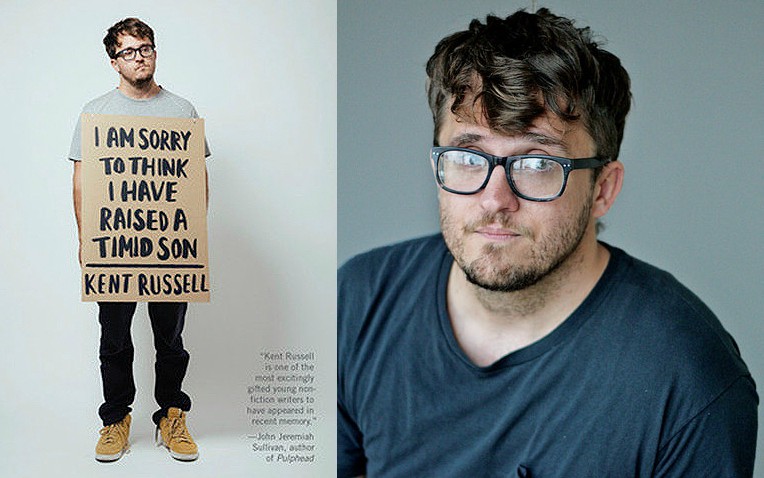
Next up: Kent Russell, Brooklyn resident and author of I Am Sorry to Think I Have Raised a Timid Son (Knopf 2015).

Dan Sheehan: I Am Sorry to Think I Have Raised a Timid Son is a wonderful mix of memoir and reportage, blending dispatches from the margins of American society with intensely personal vignettes of your own relationship with your father. How did you decide upon this hybrid structure?

Kent Russell: For me, it wasn’t novels or short stories or poems; it was the essay that first transported me as a reader, that first made me want to write. I was something of a literary goldbricker in my adolescence, preferring video games and light beer to books. As a quasi-adult, though, I came across David Foster Wallace, John Jeremiah Sullivan, Joan Didion, James Baldwin — as well as your more experimental fringe-dudes like Ander Monson and John D’Agata. (And of course your OGs like Montaigne and Hazlitt). Late at night, I would wander the University of Florida’s Smathers Library, plucking essay collections at random, falling in love with each persona/voice in turn. I hadn’t known that this was possible, that you could try to make sense of your world while simultaneously communing brain-2-brain with someone else.

…that is what you’re selling, ultimately, as an essayist: not necessarily your self, but the rigor or joy or humor communicated by your persona on the page.

But, yeah, what I came to realize about many such collections — they read like victory laps, or greatest hits compendiums. There’s nothing inherently wrong with that, of course. It’s always fun to watch a particular eye or filter or sensibility go from, say, a three-day Christian rock festival to a fine-tooth appraisal of Michael Jackson’s oeuvre. And that is what you’re selling, ultimately, as an essayist: not necessarily your self, but the rigor or joy or humor communicated by your persona on the page.

With my stuff — and I don’t mean to be tooting my own horn here — I felt as though there was a through-line or compulsion to everything I was writing about, everything I was investigating. That through-line was, basically: Why am I the way I am? Why is our family the way it is? Why are dudes — especially white American dudes — like this? The essays were symptoms of an underlying pathology that I recognized as having been passed down to me. The only way I could get to the bottom of it was to look inward, at my own background and my own upbringing.

DS: I’m gonna go out on a limb and say that the Gathering of the Juggalos [an annual festival for fans of the band Insane Clown Posse and their affiliated acts] was the least pleasant of all the off-the-beaten-track places you found yourself documenting. It sounds like hell on earth. How did you reconcile the initial desire to present a more nuanced, even-handed depiction of this reviled sub-group, with the reality of the (predominantly) obnoxious, aggressive, all-round shitty behaviour on display.

KR: I mean, the Gathering definitely looks more fun and less harrowing in hindsight. A lot of the sharpness — the edge there that seemed pointed and threatening in the moment — has been smudged with the thumb of time!

But, really, the big impetus for that story was a memory from my early childhood. After Hurricane Andrew wiped out our house, my sisters and I went to live with our cousins in New Castle, PA for a while. And New Castle was just a completely different world for a kid from South Florida. Pretty much everyone there was white, for one thing. For another, there was this Rust-Belt depression, economic and otherwise, that seemed to have covered everything like ash from an eruption. But there were also these kids in the neighborhood who were getting really into this new duo, Insane Clown Posse. And, years later, when I rediscovered ICP and the Gathering of the Juggalos, I thought: You know, there but for the grace of God went I. Had my mother’s family not moved out of New Castle, perhaps some form of me would’ve grown up there and become a juggalo.

I suppose it’s easier to sympathize with any strange faction or subculture when you can so easily picture yourself or a family member in their shoes.

DS: Throughout the book — in both the quieter personal essays and the more outlandish, gonzo pieces — you interrogate various different aspects of American masculinity. Earlier this year, in an interview for Salon, you wrote of some of the more extreme encounters: “…in meeting these men, in living with them, in thinking and writing about them, I was, in a way, trying to extract a little bit of their many poisons. I was trying to inject them into myself, and–one hopes–develop a resistance in my blood that others might be able to draw from.” Looking back, do you think that there was any wisdom to be gleaned from the maxims of these castaways, self-immunisers, and aged hockey enforcers, or were their assertions simply the echoed voices of men who had long ago succumbed to their own poisons?

KR: Oh, man, yes. There are for sure things to be learned from these dudes!

Which is not to say that it’s a good worldview and way of being that these dudes espouse and inhabit. But theirs is certainly a living tradition. I mean, shit, we Americans are all Cartesians without having to read Descartes, as Tocqueville famously said. That is, we believe we’re supposed to put aside any knowledge or custom that has the scent of anyone else on it, the taint of outside authority, in order to become our true selves. It’s considered lazy, cowardly, immature, or worse to rely on anyone else in this imagined ethos of ours. As Emerson wrote in “Self-Reliance”: “Society everywhere is in conspiracy against the manhood of every one of its members.” The American, in the words of Whitman, “walks at his ease through and out of that custom or precedent or authority that suits him not.”

Thus the ideal American man has forever been this dude who: owes nothing to nobody; who expects nothing from anyone else; who always conceives of himself as standing alone; who is more or less required to imagine that the whole of his destiny lies in his hands; who believes that joy is the feeling of his power increasing. This dude is supposed to be forever thrown back upon himself, alone, confined entirely within the solitude of his own heart.

Of course, no one outside of myth, fiction, or Hollywood is truly like that dude. Nor should anyone want to be like that dude. That dude is a sociopath.

Of course, no one outside of myth, fiction, or Hollywood is truly like that dude. Nor should anyone want to be like that dude. That dude is a sociopath. That dude is trying to live at odds with basic human truths. That dude cannot tolerate the complex demands of other people; his “interpersonal relationships” are instances of him sizing someone up and breaking off from them what he needs or can use. That dude is bound to become depressed and/or shamed, insofar as depression and/or shame are illnesses in which one feels as though one is constantly failing. Failing to measure up; failing to become the dude that one feels obliged to be. That this depressed and/or shamed dude of ours has ready access firearms…well, that’s a discussion for another day.

DS: You write beautifully about the shared experience of war, through which your grandfather, father, and childhood best friend — three generations of military men — form a bond that you can bear witness to but never truly be a part of. How did your view of the military life change during the War on Terror period?

KR: When I was a kid, I thought that I’d grow up to be either a soldier or a priest, as those were the two vocations most respected by my father and mother, respectively. There’s still a substantial part of me that believes I sidestepped my duty by not enlisting. In the book, I explain: My family has a tradition of military service that stretches back to the Revolutionary War. It’s something which my father said was expected of us — expected of me — regardless of politics or public opinion. You give thanks for your incredible privilege of being born here by giving yourself over to that here, for a few years at least.

Now, I did not wind up in any branch of the service. Part of that was my dad’s doing, but the vast majority of it was my own. And, as a result, my best friend/de-facto brother served in my place. That’s just something I have to live with.

DS: Do you have a secret passion project you’ve been sitting on? A person or group that — if time, energy and access permitted — you would love to profile?

Falconers, man. To have, like, a familiar on your arm? Just fantastic.

KR: I’m not saying that we came up with the idea for H Is For Hawk. It’s just: Once upon a 2008, my sister Karen and I approached a falconer at the Ft. Tryon Park Renaissance Faire. We pleaded with him to let us write about the affinity between him and his bird. Like, for weeks we pleaded with this man. Inordinate pleading. Embarrassing pleading. Guy stopped answering our emails and returning our calls. I think I might have written him a last-ditch message via MySpace, for Christ’s sake. (I think he was also some kind of party magician??) I’m still kind of peeved that that one got away. Falconers, man. To have, like, a familiar on your arm? Just fantastic.

OCTOBER MIXTAPE by Ryan Bradford

A Scary Movie

I spent my high school career caring little about anything except making movies. The memories and nostalgia I have from this era were huge inspirations for my book Horror Business, which I wrote after realizing that my career as a film director probably wouldn’t pan out. But I did learn that movies and writing books aren’t very different — the theories of storytelling carry over across mediums, one just requires a lot more red food coloring and corn syrup.

I still think about making movies all the time, usually when I’m driving alone at night and the music’s loud enough to numb me to the tension, worry and anxiety I’ve carried in from the day. It clears my head, and makes it easy to think of dark shit, which, paradoxically, is where I’m most comfortable.

In the spirit of October/Halloween, I built a scary movie around a soundtrack. Listen to it at night when you’re driving in your car.

Remember: Always check for people in your back seat. Never pick up hitchhikers.

1. Daniel Johnston, “Deviltown”

The movie’s called Dangerous Children. It will be about a family — a mother, father, their son and daughter. The parents are unremarkable stereotypes, which allows us to focus on the brother and sister. The brother — let’s call him Ryan — is a withdrawn genius. The sister’s name is Shirley Jackson (homage to Shirley Jackson).

The family moves to a town where things seem off. Parents, for the most part, are absent. The entire population is made up of teens — all interchangeable, awkward, and withdrawn. This is the perfect environment for Ryan, who just wants to fit in. Shirley Jackson, being more independent and strong-willed, immediately senses something wrong.

SPOILER ALERT: Everyone’s a clone.

Imagine this song over the opening credits, which would be in Albertus font with leading caps (homage to John Carpenter).

This would also be the song for the trailer, which would include split-second reveals of horrible images. There would be no indication of plot. No dialogue. Just images. (Which, if we’re being real, really only qualifies as a teaser).

2. Crocodiles, “I Wanna Kill”

Establishing shots will be silent, tranquil, eerie images of manufactured suburbia. All houses will look the same. Copies of copies. Let’s get the clone motif started. Then, this song fades in, increases until an SUV carrying our main characters enters the screen. Non-diagetic music becomes diagetic. CUT TO: inside of the car. Ryan is listening to this song on a Discman (movie is set in the late ‘90s.)

Dad tries to get Ryan’s attention, but Ryan is too busy brooding in the backseat. Dad says something like, “Is he listening to that shit again?”

SPOILER ALERT: Ryan (or clone Ryan?) kills the father later in the movie. This song = foreshadowing.

3. Beach Slang, “Dirty Cigarettes”

In John Carpenter’s Halloween, there’s a scene where Laurie and her friend are driving through town, smoking weed. Blue Oyster Cult’s “Don’t Fear the Reaper” plays on the radio. I hate that “More cowbell” ruined “Don’t Fear the Reaper,” because it’s a great song. It’s sad, a little scary, a little romantic.

I was also watching that scene when I touched a breast (singular) for the first time.

This would be the song during a scene where the viewer could touch a breast if both parties were interested.

4. The Motels, “Suddenly Last Summer”

This scene will be a party in the woods. Significance TBD.

I like this song because it song fits into a genre that I refer to as “haunted summer.” It’s the only song that I can think of right now that fits into this made-up category.

5. Chromatics, “Cherry”

Chromatics can make anything sad and creepy.

In this scene, Shirley Jackson is fed up with everyone ignoring her suspicions about the new town. She’s takes the car and drives around. This song plays from the car stereo. When she passes groups of teens — standing on street corners, etc. — they stop talking and stare at her.

I used to have an irrational fear of people jumping in my car when I was in high school. Back then, my best friend lived out in a rural area, and to get to his house meant a two-mile drive on a dirt road. I hated going there at night. I’d have this intense fantasy about stopping at one of the unnecessary stop signs along the dirt road (why were there stop signs?), and a bloody person would jump against the passenger door, trying to get in. What do you do? Do you help them? Do you open the door?

I would have never opened the door.

6. Soft Riot, “Your Secret Light Shines at Night”

At this point, let me clarify that the clones in Dangerous Children aren’t necessarily clones of each other but clones of past teens that have lived in the town, although there is definitely a vague resemblance between them, similar to the indistinguishable characters in American Psycho.

The way clones are generated is through having sex with a clone. In this scene, a lady clone seduces Ryan, who has never been with a girl (as we all expected). This act of copulation produces Evil Clone Ryan, which gestates at an incredibly rapid speed, emerges from lady clone — a gruesome “birth” — and SPOILER ALERT kills Ryan (homage to reactionary “promiscuity = death” motif of ’80s slasher movies)

horrorbusiness

7. Liars, “Mask Maker”

Speaking of sex.

I had started seeing a girl shortly before The Ring came out in theaters. We had been on a few dates and things were going well. We decided to see The Ring, even though I was skeptical that it would be scary, given the PG-13 rating.

It’s a little embarrassing to say, but that’s probably the most scared I’ve ever been in movie theater. The videotape footage, the ominous dread, and the shocking imagery (which looked like it was pulled from a Stephen Gammell illustration) shook me in ways I’d never experienced before.

Later, it was the first time we ever tried to get down, but I couldn’t perform. I told her that it was probably due to the terror I had previously felt at the movie. I don’t know why this seemed like a good excuse.

Anyway, this song would play during a rave or something. I don’t know.

8. Pharmakon, “Body Betrays Itself”

Someone’s intestines get pulled out to this song. Obviously.

9. Weekend, “Mirror”

This one is also a shout-out to my man, Kevin, who plays guitar in Weekend. I became friends with him in college, and he went on to be in this rad band.

Shirley Jackson has figured out everything about the clones and the town’s initial effort to destroy them. She has learned of the grown-ups who were murdered and the few that survived only to become subservient, and now stay alive by luring virile teens into town to help the clones propagate.

This song plays over a montage of her building a bomb to destroy the town. Her expertise with explosions will have been established earlier in the movie.

By the time we were seniors in high school, our videos were being shown every morning during the video announcements. One of the videos was a parody of the Evil Dead Footmovies, called Evil Foot, which was about our friend’s foot becoming possessed. We stayed up all night filming it in my friend’s horse barn. We ended up building two bombs to blow up the foot prop after the first bomb failed. Two bombs! Most kids don’t even get to play with one bomb these days.

When Evil Dead Foot played over the announcements, we didn’t get the praise that we expected.

Our classmates didn’t get it. Not very many of them had seen Evil Dead. “Was that it?” they asked.

“Disappointing, boys,” a teacher said. A goddamn teacher.

10. Nick Cave & the Bad Seeds, “Push the Sky Away”

In this scene, everyone is dead. There needs to be emotional dissonance during this song, a feeling of “nothing will ever be the same.” Shirley Jackson has her family’s blood on her hands, literally. The trauma of stabbing her clone brother so many times shows on her face, which now looks wise beyond its years.

Once, I watched the old horror movie The Changeling with a group of friends. During a very serious, traumatic scene, my friend did a great George C. Scott impression. We couldn’t stop laughing. Another friend, the one who’d brought over the movie, actually got up and ejected the tape and wouldn’t put it in until we stopped laughing. He was really mad.

11. Lemonheads, “Skulls”

You can’t have a Halloween mix without some variation/iteration of a Misfits song, and this happens to be the best one. This will play when Shirley Jackson leaves town. The sun rises in her rearview. It’s a new day. Perhaps this is what she’s wanted all along.

Then, right before cutting to black, we hint that she’s a clone. “The End… ?”

12. Groovie Ghoulies, “Deviltown”

To be played over credits.

One time, after my friend’s dad watched one of our movies, he said, “That was fantastic. Now, you just have to learn how to end them.”

***

— Ryan Bradford is the author of the novel Horror Business, as well as the founder and editor of Black Candies, a journal of literary darkness. His writing has appeared in Quarterly West, Vice, Monkeybicycle, Hobart, New Dead Families and [PANK].

Image: Actor/director Ryan Bradford (left) in Evil Dead Foot, 2003