This delectable infographic from Shari’s Berries proves that the deserts of literature are best when paired with the desserts of the kitchen. Readers, bon appetite!




This delectable infographic from Shari’s Berries proves that the deserts of literature are best when paired with the desserts of the kitchen. Readers, bon appetite!
1
You were planting bulbs in the garden when your arm disappeared. “I can feel it,” you said, “but I can’t see it.” We’d gotten together the previous spring, and this year you wanted flowers. We lived in a house with many others. The disappearance wasn’t, strictly speaking, an emergency, so you decided against an ambulance. I drove us to a nearby hospital. In the waiting room, a man belted out selections from Hello Dolly, Les Mis, and the entirety of Cabaret. His left hand was missing several fingers. Seven mothers gave birth. Nurses called the singing man’s name during a yelping rendition of “Tomorrow.” They yelled, “Trevor!” and he sailed through the swinging formica doors. Even the newborns applauded him through. Through tall windows, we saw daylight run out. They called your name shortly after. Nurses sheeted in translucent plastic led us to your room. We tried to sleep. You in an exam chair, me on a naugahyde bench. When the doctor arrived, he took a long look at your not-arm. “Yeah, you’ve got dirt in your veins,” he said. “Dirt clogs the blood that allows it to be seen. It’s basic optics.” From inside his coat, he pulled out a jar of silver liquid. “Go home and chug this. Garden less, maybe. I don’t know.” When we returned home, you drank the whole jar and your arm came back. The sun threatened to rise and the morning was cold, just above freezing. We climbed into bed and pulled the covers high. We fell asleep just after dawn.
2
A decade passed. We moved to a small town by the sea, rented a rundown bungalow. The town clung to an inlet like food around a child’s mouth. We were swimming in the bay, and you suddenly couldn’t breathe. You flailed out of the water. You doubled over but refused to turn purple — your skin remained a pale blue. An ambulance took us to a regional hospital. Upon arrival, a woman in a formal nurse’s dress took your hand. She wore her red hair up and in curls. There was no wait. On the way to your room, we saw no other patients. The nurse stuck a breathing tube down your throat. When the tube met the water in your lungs, it made a splashing sound, as if off a diving board. You breathed better after. A doctor came in and snapped a polaroid of your chest. She handed me the picture and said, “Be of use and shake this.” A view of your insides developed. Your lungs looked like oval lakes. We saw white peaks on the open water. “You’ve been swimming in the ocean too much. It’s become part of you.” You told her that you didn’t understand. “It doesn’t matter,” she said. “Have you ever known water to stay the hell out?” A surgeon operated the next morning. When they finished, a nurse escorted me to your recovery room. An even row of stitches split your ribcage. You never swam after that — baths were your limit. They gave us a videotape of the surgery. Weeks later, we slid it into our VCR. We saw your open ribcage. Your lungs were twin pools. They drew the water out with cheap neon sponges. The surgeon inserted dry lungs and closed your ribs like a gate. You told me that the hardest part about illness was the lack of agency. Your scars? Anything that says “I’m alive” that loudly is a precious thing. Months later, we abandoned the sea.
3
Another decade passed. Winter deadlocked our northwestern town. Inches of ice enameled the outdoors. One evening, you said that your hearing was out in one ear. I found frost around your earlobe, ice crystals blocking the canal. We tried heating pads and hot water, but the ice wouldn’t melt. I was glad you couldn’t feel it. The cold mercifully numbed half your head. I drove us into the frozen wastes, slid our bald tires across the sheet ice. I watched the frost spread down your neck and drove faster. When we arrived, we shared the waiting room with space heaters. The nurses were duffled in black, puffy coats. They hustled us straight into the operating room. “We’ve dealt with this before,” said a nurse through a camo balaclava. The lightbulbs in the O.R. dribbled yellow light. If it wasn’t Christmas, then it was damn close. The doctor entered and announced a bold plan: “Fuck it, lets make it even colder!” He stuck your head into a red, ice-crammed cooler. Nurses packed more ice in as it melted. Within hours, your neck had turned deep blue, almost navy. “Colder, colder!” he yelled, throwing crumpled fives and tens around the room. You swore into the cooler. Finally the doctor was satisfied. He pulled your head out. Ice bloomed across half your face. When your teeth chattered, the crystals chimed. The doctor summoned a choir of nurses. He produced a small hammer from inside his sleeve. One end of the hammer was flat, the other sharp. The choir cycled through many octaves. When they hit the right frequency, your crystals vibrated, sang back. The room filled with sound. The doctor tapped the center crystal with the sharp end of his hammer. They all shattered off, fell to the ground and melted. The room silenced. We viewed your exposed pink skin. The choir applauded. In the years that followed, I could hold my ear up to any part of you and always hear the hum.
4
Another decade passed. We grew older but not old enough. We were on an “extended vacation,” which meant that we had no stable end date. We stayed in a minor Dutch city that overflowed with churches. In a taxi, your whole self started failing: memory, eyelids, logic, elbows, heart, and so on. You couldn’t speak. You gave me a look as if from a distance. Your pupils shrank to pinpoints then disappeared. The driver rushed us to the nearest hospital. It was a modern building built into a limestone cliff. Catholic mummies, bejeweled throughout the centuries, occupied most of the waiting area. Nurses clogged the hallways. In the O.R., ten of them formed a ring around you. They said in stilted English, “There is a fire. That fire is going out.” One of them left briefly, returned with iron gauntlets and steel pincers. The pincers grasped a burning coal. It exhaled sparks throughout the room. The other nine nurses turned away. The one with the coal wore a welder’s mask. The light seared my vision. I kissed you. I tried to tell you something, but my words seized up and I was unable. That is my chief regret — that I was never able to say anything of substance. Your irises faded out. The nurse placed the coal in your open mouth. I watched the fire inside you. I lost sight of your body in the billowing smoke. Soon it exhausted. The smoke cleared. You were nothing but ash and bone. Thick soot covered the operating room. A nurse said something that I don’t remember, but I think its aim was comfort. I stood there until they wheeled your remains away. I did not ask for them. I was not capable of asking for them. I walked an uncertain mileage back to our hotel and sleep didn’t come for weeks and weeks. When I returned to our home in America, a package was waiting for me. A cardboard box wrapped in butcher paper. The bone inside? I think it was your femur, thickly gilded and set with precious stones. A card informed me that I could view the embellished remains at a museum in The Hague. All vacations thereafter became pilgrimages.
5
Decades passed. I fell ill, so I boarded a regional train. I took it to its last stop, a hospital surrounded by golden wheat and nothing else. My car had been empty for stops and stops. The hospital? Brand new and relentlessly bright. “Or there’s something wrong with my eyes,” I said before collapsing in the lobby. They put me in a bed and kept me for days, maybe weeks. I never saw a doctor or a nurse. The hospital remained bright, so I kept my eyes shut. Finally I heard a voice in the hallway. I unplugged my cables and left the room. The hallway stretched before me. I opened my eyes, lifted my gaze from the floor. I was on the top level. I know this because it had no roof. A clear sky stretched above me. I looked into it. I heard the voice again. A clear sky stretched below me. The voice pushed against the other side of the sheltering blue. I could feel it like a pulse. I closed my eyes, went forward and met it there.
by Julie Buntin
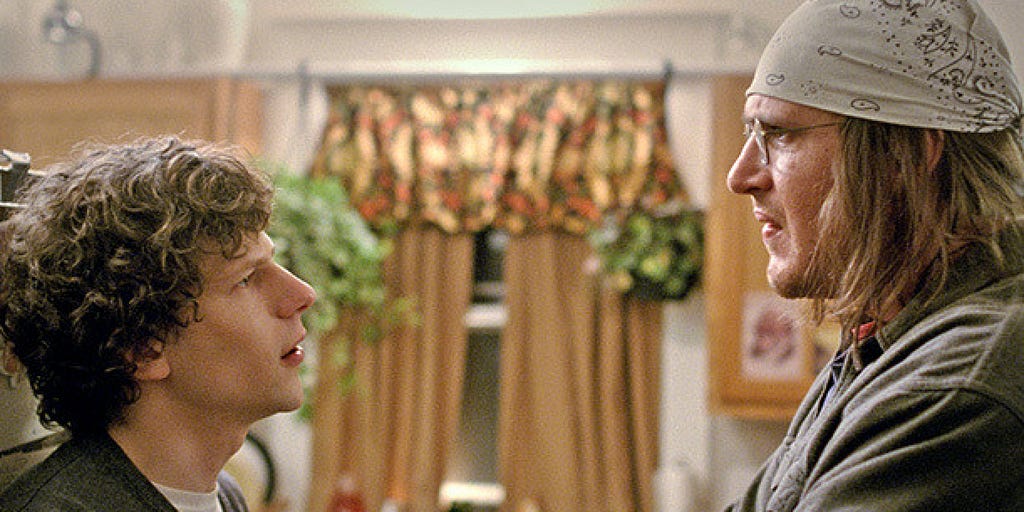
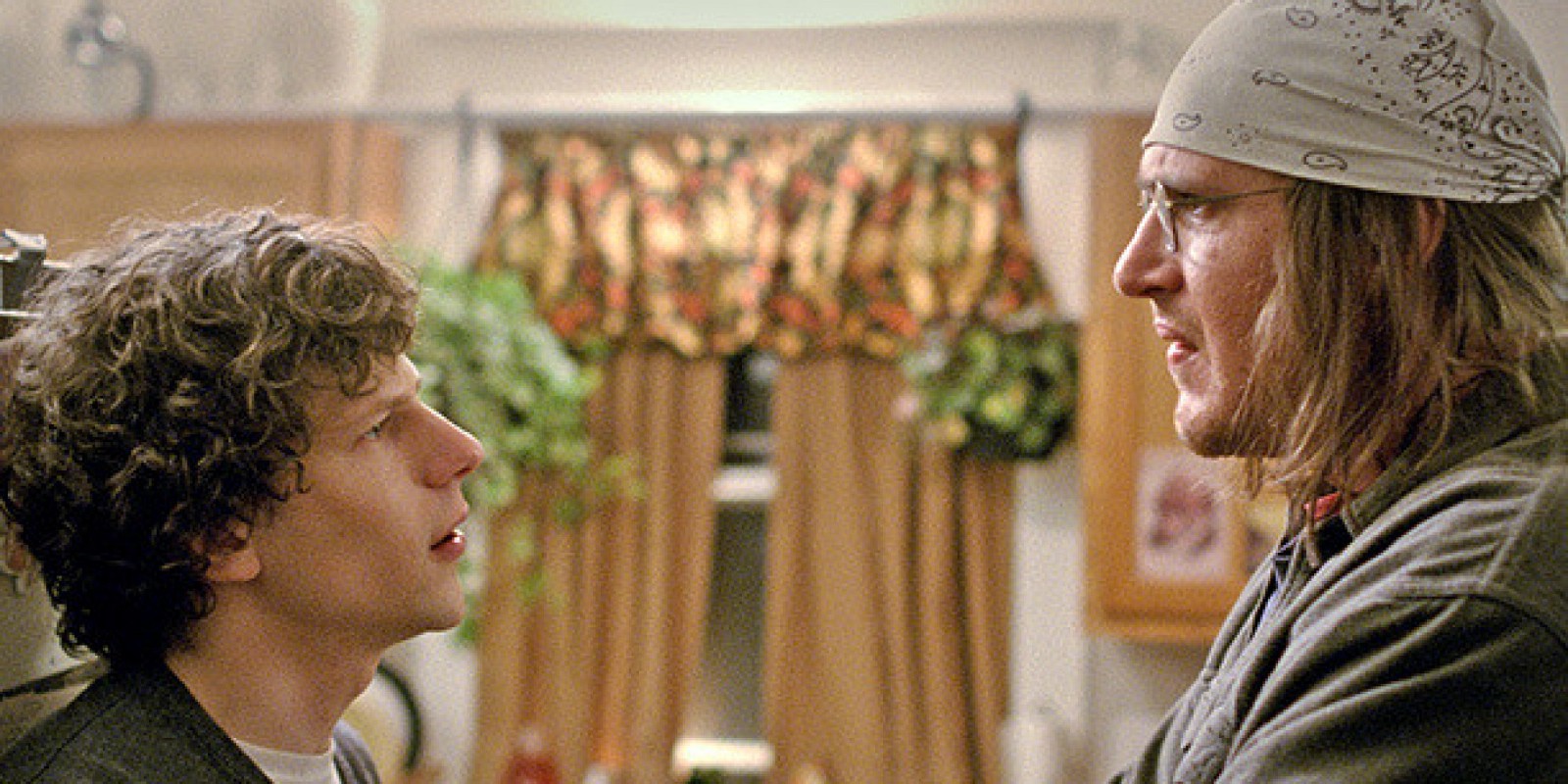
David Lipsky’s interview with David Foster Wallace, the basis of the book Although Of Course You End Up Becoming Yourself and the inspiration for The End of the Tour, spanned five days. Because I’ve had the pleasure — and frustration — of sinking into a very long, very intense conversation with Lipsky, I felt, while watching the film, a hyperbolic kinship with Wallace. Poor guy, I kept thinking. He must be really tired.
In the film, sort of as in life, David and David (as portrayed by Jesse Eisenberg and Jason Segel) drive around eating Twizzlers, talking about TV addiction and Alanis Morrisette and greatness and Infinite Jest. Out of the seams and silences of that conversation, riveting in its own merit and loaded with Wallace-esque brilliance, another dialogue elbows its way into the atmosphere between interviewer and subject, just-starting writer and more famous writer. David Lipsky, in probing David Wallace’s life, makes it clear that his motive isn’t only to write a definitive profile — it’s to absorb, via conversational osmosis, a kind of blueprint for becoming Wallace. Wallace — sweaty, painfully intelligent, his tragic death waiting on the film’s horizon — at first evades Lipsky’s prodding, then descends into a teenaged sulk, and then, after Lipsky’s worn him down, tries, vainly, to explain the bullshitty misguidedness of the desire for literary fame.
I took a class with Lipsky while I was an MFA candidate at NYU. Like most of his students, I loved him — even though it was halfway through the semester before he stopped confusing me with the other brunette Julie in the class. He wore a nicotine patch and smoked during every break. Most days he ate a yogurt or a banana as we all filed into our seats. Midway through a lecture he’d interrupt himself, point at someone, and ask them to tell the room what he’d been eating earlier — a pop quiz in paying writerly attention to one’s surroundings. It felt like a blessing to be chosen. Once, when Lipsky was teaching through a cold, I watched, stunned and a little nervous, as he drank an entire half gallon of orange juice in just over two hours. His brain isn’t just fast; it’s lightning, charged by some rare and electric sludge of verbal adrenaline and nicotine. He’s notably handsome, as Wallace points out in the movie, his good looks undermined by a frenetic twitchiness that Eisenberg captures well. I once heard two drunken classmates speculating over whether, in a romantic situation, Lipsky would be too busy thinking of literary comparisons to enjoy the moment.
The first time I saw the trailer for The End of the Tour, I cringed. I experienced a version of the queasy feeling I get when I hear my own voice recorded, except on Lipsky’s behalf — this was his life, his story, except, well, not. It was amazing and horrible to see him both reduced and exalted on the big screen. On a more basic level, I felt something like irritation at having to share my teacher and his relationship with DFW with all the weirdos who’d want to watch this movie. Segel and his bandanna, his affected speech — just because they made him look like Wallace didn’t mean he could pull it off. These movie producers had taken DFW, one of the book-world’s most sacred myths, and trimmed off the indigestible parts, transforming this story, these men, into a commodity for the masses. And that Eisenberg, with his spastic fingers, his freakishly zeroed-in gaze, was supposed to be David Lipsky, my David Lipsky — it just bothered me. I would never see it. And if I did, I knew I’d hate it. The End of the Tour was made by film people for culturally hip twenty-somethings more interested in Wallace as a legend and a product/martyr of the internet age than Wallace as a writer. In other words: phony.
Here’s where I say what you knew was coming: That I liked the movie. Really, really liked it. That it moved me. That at one point, I got honest-to-goodness chills. That David Foster Wallace’s voice, even siphoned through Jason Segel, is and will always be worth listening to. Is there a hackneyed attempt to force plot onto a story that’s about conversation, that most beautifully plotless of things? Yes. A few times. You can feel Eisenberg chafing against it. Halfway through there’s a scene in a hotel room where Eisenberg yells into the phone at his Rolling Stone editor that he won’t push DFW to clarify the rumors of his heroin use, goddamnit, because that isn’t the point! And it really isn’t the point — in general, the movie seems to understand that. Near the end, I cried a little, as Eisenberg/Lipsky races through Wallace’s house, listing visual details into his tape recorder, so he’ll remember them later. There are a handful of derpy moments — an argument between Davids in a kitchen over a girl, some stupid jokes about the culture of the midwest, a few very on-the-nose visual reminders of the difference between each man’s place in the literary world. (Lipsky sleeps in Wallace’s guest room — stacked floor-to-ceiling with copies of Infinite Jest.) But it turns out that it was a movie exactly right for me, and probably for most people, readers, wannabe writers, or not — straightforward, all-too-relatable, a film about people (Davids!), trying to figure out who they are and what they will become, how to be, and how to be together.
The real-life Lipsky and I shared what I’d guess was the longest phone conversation I’ve had in my adult life. It started a little after seven pm and ended at close to two in the morning. At 12:18am, my phone died, cutting off Lipsky mid-sentence. I connected my phone to the wall and sprinted to the bathroom, where I peed, dizzy with relief, as I’d needed to for hours. Back in my room, on my laptop, a new email:
I think your phone battery went out.
As soon as my phone came to life, I called him back, and we killed another hour or so, talking about Jane Eyre, about John Fowles, about Franzen and Lorrie Moore, Willa Cather and Nabokov and Martin Amis’s sentences and young writers with book deals and where I was from and why I write and why he does, Lipsky quoting Bellow verbatim, Updike, Alice Munro, a sound on his end of the line that made me imagine him pacing the room. As Eisenberg/Lipsky says at The End of the Tour: “It was the best conversation I ever had.” Lipsky is the only teacher who forced me to really and truly answer him, who asked a question and then followed it up with a question that cut into the first one a little deeper, until you simultaneously wanted to yell at him to knock it off but also to explain yourself, get it exactly right, give him a response that proved you were worth the searing attention of his intelligence.
I’m fairly certain Lipsky doesn’t remember that call.
In theory, the call’s purpose was to discuss the presentation I was giving in class the following week on Zadie Smith’s The Autograph Man. But actually, part of what I think Lipsky wanted was to have a good, long, conversation, one of those talks that lift you out of your regular life and into another mode of being, the way a really good book can. Lipsky’s calls were famous in my MFA program — we compared their durations after the fact, swapping stories of each other’s trials and successes like survivors of some great and noble war. Our six hour conversation was on the long side, but not the longest. My classmates and I judged each other based on such statistics. Like most good teachers, Lipsky inspired in us all a desire to achieve the position of favorite; like most good teachers, he made every one of us believe we’d be his pick.
Wallace, as a subject, is endlessly fascinating. But what I’d like to point out is that the conversation at the core of The End of the Tour — in which we’re given access to a version of Wallace that feels more intimate, real, than he does in almost anything else, even Wallace’s own personal writing — is only possible because Lipsky is the person asking the questions. Late in the film’s second half, Wallace complains that he can’t keep up with Lipsky. Eisenberg/Lipsky brushes it off, assuming it’s just Wallace doing his routine self-effacing box-step, but the audience knows that Wallace is telling the truth. Lipsky is a hell of writer; but he’s a hell of a talker too. Listening to the two of them spar in The End of the Tour is a reminder that conversation — our original, ephemeral method for banishing loneliness — can be art.

Attention writers: Okey-Panky will open for submissions next month!
The editors would love to see your short, darkly comic, ironic, and experimental fiction, essay, poetry, and graphic narrative. Okey-Panky publishes about half the magazine from slush, so your work will be read carefully. You may submit multiple pieces of up to 1500 words total, but please put them into one file and submit only once. There’s no submission fee, and we pay contributors $100. Your work will be published on Okey-Panky also be mirrored on Electric Literature.
Last time submissions filled up in almost a week, so get your best work ready and submit early in August!
★★★☆☆
Hello, and welcome to my week-by-week review of the world. Today I am reviewing global warming.
Is the world getting hotter? Some say yes, some say no. Others say the world is flat and rests on the back of a turtle, so if things are getting hotter it’s the turtle’s fault. The one thing we can all agree on is that no one knows the true answer and never will.
Scientists should probably start asking old people like myself, because we’ve been around the longest and know what temperatures were like many decades ago. Personally, I believe in global warming and I believe it is caused by humans. I figured this out by using common sense.
Before man, the only things heating up the earth were volcanoes and lightning. Now we have so many manmade things that make heat. Just a couple off the top of my head include cigarettes and soup. So if you care about the earth and want to save it, eat cold soup and eat your cigarettes. But that is only a temporary solution.
The real culprit to global warming is all the open windows. When you open your window, even if it’s just to let a bee out, heat will escape from your home into the atmosphere. With all the open windows in the world this can really add up!
While I will always believe the manufacturing of windows that can open should be outlawed, I know that will never happen because of window lobbyists. That’s why I think we need to reframe the way we think of global warming. It doesn’t have to be a bad thing! No one is going to need a coat anymore. Think of all the money you’re going to save on coats. And ice cream sales are going to skyrocket. Invest in ice cream now and you’ll be rich in 50 years time.
What excites me most about global warming are all the things we’re going to find underneath all the snow when it melts. There will be everything from lost sets of keys to well-preserved archaeological discoveries. It will be an exciting, sweaty time!
BEST FEATURE: Once the planet finishes warming up, everyone will stop arguing about whether it’s warming up or not.
WORST FEATURE: When I get sweaty it soaks through the waistband of my dungarees and ruins my belt and billfold.
Please join me next week when I’ll be reviewing Fla-Vor-Ice.
Kathleen Alcott’s upcoming novel, Infinite Home, is excerpted in the newest issue of Recommended Reading. In the interview below, Alcott shares her thoughts on the book, and on her writing process.
Emma Adler: Infinite Home focuses on the non-biological family formed by an eccentric group of tenants. Your first novel, The Dangers of Proximal Alphabets, also focused on a non-biological family, and asked what drives people to forge familial ties outside of the family of origin. Is this topic is of particular interest to you? Why?
Kathleen Alcott: I find it interesting that this term and ones like it — “non-biological family” “unconventional family” — have come up so much for people describing my work, because it’s not one I’ve put forth, specifically. But my upbringing and young adult life was one long meditation on the nature of family, I suppose. Growing up in Northern California, I often lived with people who were not my family, friends of my mothers and their children, and I was urged both to rely on them and be accountable to them as I would my own blood. Something about this stuck with me, that we could chose closeness and intimacy like that, that these sort of atypical contracts of love were possible. But also, I lost both my parents by my early twenties, and that emphasized for me the obdurate distinction that exists in the real world between friends and family. Even the closest friend or partner cannot tell you how you looked on the day you were born, and sometimes that is very much what we need to be told. Creating and nurturing lasting connection between two people who come from different corners of culture and experience is an elaborate dance, and never as easy as saying, “I choose you, and we’re family now.” The blueprint for devotion has to be redrawn almost constantly.
Adler: The excerpt from Infinite Home published in Recommended Reading contains a wealth of different settings. In thirty pages, we go from an apartment building in Brooklyn, to a McDonalds, to library, to a hippie commune. One thing I was struck by, reading the excerpt, was how you manage to create a very strong sense of place for all of these settings, despite the relatively brief time we spend in each of them. Is this something that you feel comes naturally to you?
Alcott: I have a memory that is very much image-based. Maybe this makes me sound like a lunatic, but I sort of consider it a secret power, that I can be in line at the deli and suddenly be very much confronted by a very clear image of a place I was once, can conjure the texture of the t-shirts people I loved wore, the color of the kitchen tile, the particular type of tree. Sometimes this happens in the middle of something important, unprompted, and at the point I have to just yield to my memory, see what it’s trying to show me. I tend to attach to these sort of environmental details, and so sitting down and writing a fictional (or non-fictional) place, I’m “seeing” in the same way.
Adler: The excerpt focuses on one tenant from the apartment building, Thomas. But in fact, Infinite Home is an ensemble piece that, written in a close-third-person, frequently shifts which character it is “close” to. Do you find it difficult to shuttle between multiple protagonists? Did you develop a particular fondness for one character, or do you love all of your proverbial children about equally?
Alcott: I find the parent/child to author/character analogy a little problematic — my role as a novelist is not first to love my characters but to see them. Because my novels are very much character-driven, my job requires a lot of doubling back, exploring one assumption about a character’s behavior and uncovering an unexpected impetus, adjusting their vocal-physical presence and interior life given new information. That being said, I did find myself writing different sections depending on my own internal pitch. For instance, when I felt burdened by the modern world, I wrote Adeleine, who surrounds herself with antiquated things; when I felt like my agency in my personal life was compromised by grief, I wrote Thomas, whose life has been redefined by a stroke.
Adler: One of the most intriguing set pieces in the excerpt is the commune that Edith’s daughter, Jenny/Song, escapes to, and which is distinguished by the fact that its residents only use speech for one hour each day. Is this based on something from real life? How much research went into figuring out this part of the novel? Are you now on expert on California’s remote ascetic communities (if this is indeed a thing)?
Alcott: I did plenty of research for Infinite Home — about William’s Syndrome, and synchronous fireflies, and the pathology of agoraphobia, among other things — but the commune featured in the book came purely from my mind. One incredible feature of Northern California culture, to me, is the priority given to reinvention. Anyone is allowed and encouraged, at any time, to redefine themselves, to align with this credo or that, and the institutions that inspire a following — are often relatively new, often without historical precedent. Someone I knew was always attending a workshop on communication through ceramics, or escaping into the mountains to walk across coals, or going on a silence hike, or eating only ginger, or learning Qi Gong. On a more specific note, I was thinking about the push of many of the communes/programs/fads. It’s always a step back to the “authentic self,” always an attempt to carve down our identities to their simplest parts, to harvest inner fulfillment and in so doing need less from the external world. In meditation the most difficult part for many people is transferring the placidity of their practice to the rest of the world; yes, you can notice your thoughts and accept them with peace while you’re sitting on a pillow breathing deeply, but can you do that when you’re interacting with the rest of the world, with the sounds of ambulances and with the stack of bills and with the repetitive conflicts that make up close relationships. I created a community that dealt with this issue literally, that attempted to make life pure by reducing the clutter of spoken communication, to effect an ultra-awareness by asking its members to be alone with their thoughts for most of their lives. If a community like this exists somewhere, and if they have the internet and they’re reading this, I’m waiting for my invitation. I’m very happy to be alone with quiet, and also I’m a damn good cook.
Monica McClure’s Tender Data is an irreverent, glittering show of femininity. McClure’s poetry is confrontational. It’s funny, and sad. It’s grounded in the ins and outs of womanhood and all its absurdity. Words tumble from the mouths of McClure’s speakers in rapid succession: desire, the flexibility of language, and the futility of conception blend easily together in her poems, each bursting with light. Tender Data is a syntactical and thematic delight; even in dark moments, McClure draws our eye to the singular beauty of the human experience.
McClure’s speakers are conflicted, often wanting to chase after life while they simultaneously try to end it. The Plan B pill and abortion are recurring motifs, underscoring her speakers’ trepidations about their own existence. Many of McClure’s women want to be in the world and of it while simultaneously outside of the mainstream. In “Luxe Interiority” the speaker says, “I think I would like to be a part of culture/ while remaining without,” and this sentiment is not unique to one poem. McClure’s women don’t see themselves as being defined by any external labels or descriptors. Though the tone of the poems varies, there’s a consistent disdain for forced meaning.
Tender Data is witty and conversational. McClure’s women are angry, lost, and aggravated. “If someone says poetess,” the speaker of “Flashdancers” tells us, “I am going to scream and chop/ a hobby horse to pieces with an axe.” But the voices in McClure’s poetry don’t just rant; often they point out the difficult dichotomy and untenable existence that is being a woman. In “Beauty School Dropout”, the speaker tells us, hauntingly, “To be a woman is to know how to starve.”
Midway through the book, there is a shift in tone and in language. McClure layers her observations of pop culture and the female experience with challenges to cultural norms. As the poet adds this depth, her poems also increase in length, culminating in prose poetry that’s structurally different — more open and loose — than the short lines of the opening poems. Early in the collection she tells us, “I reject a language manipulated by folklore,” and the progression of McClure’s poetry comes to reveal her dissatisfaction with both form and convention. Tender Data is artfully ordered to demonstrate a kind of thematic unspooling that matches structure, and McClure’s work is bookended by Emily Raw’s photographs of the female form.
“All modes of desire are simulated,” McClure’s speaker tells us in the opening poem, “Blue Angel”. This establishes McClure’s work itself as a simulation of that desire, and whether she’s taking on the full catalog of 2000s pop culture in “Jacking” or building “an altar/ to the saint of lost ephemera,” McClure endows her women with an intoxicating mix of recklessness and sensitivity. Tender Data is strikingly honest, imaginatively assembled, and incredibly accessible. This is the kind of poetry that removes any assumptions of pretense, and thus gets closest to communicating the sloppiness of human sentiment. “I don’t want to be an incubator for meaning,” McClure says, yet her carefully chosen language allows us to feel what we don’t have to interpret.

by Monica Mcclure

Long a paragon of the West Coast lit scene, this year ZYZZYVA celebrates its thirtieth year in print, and does so with a star-studded anniversary issue. We spoke to the journal’s editor Laura Cogan about where it’s going, where it’s been, and how to navigate the tongue-tied.
Jake Zucker: Congratulations on your thirtieth birthday. I know you have the dynamite anniversary issue out now, but what else do you guys have planned as celebration? What’s going on on your end of the continent?
Laura Cogan: Thank you, Jake! As you can imagine, we’re honored and thrilled to shepherd this prestigious organization through its 30th anniversary year. It’s rare for an independent journal to survive this long; perhaps rare for any arts organization to do so. And it’s poignant to celebrate this anniversary in San Francisco in 2015, at the nexus of so much transition, so much change, and in the midst of such tremendous pressure on the cultural life of this city. San Francisco is at the center of technological innovation and investment; it has also been, historically, a place of innovation and daring in its arts scene. So while the environment is in some ways very challenging, we do also feel that the need for organizations and publishers like ZYZZYVA in San Francisco is as essential as ever. And for readers across the country, and across the world, our vantage point is an interesting one.
We’re planning to celebrate the anniversary throughout the year, with special elements in each issue. Our upcoming Fall issue (due out in September) features cover art and an interior portfolio of work by a tremendous Bay Area artist, the late Jay DeFeo. The pieces featured are exquisite and rarely seen works by a major contemporary artist, and we’re also publishing a meditative essay on her artwork by emerging writer, Andrew David King. That dynamic mix of acclaimed and emerging talent is fairly representative of what the journal strives for in general, I’d say. The issue also features fiction by Anthony Marra, David L. Ulin, April Ayers Lawson, and Glen David Gold — among others. And in Winter we’ll have artwork by Paul Madonna (who is designing cover art especially for the issue) and fiction from Dagoberto Gilb, as well as some wonderful new works in translation. As always, we’re keeping up a busy schedule of events throughout the year, too.
JZ: You spoke of the relationship between ZYZZYVA and the city of San Francisco, and, indeed, your journal’s stated mission explicitly evokes the region in which you publish. For example, the journal’s slogan is “A San Francisco Journal of Arts & Letters,” and the ZYZZYVA website says the journal publishes work of “a distinctly San Francisco perspective.” What is that perspective? And has it changed over the journal’s long history?
LC: It’s an evolving relationship. When the journal was founded in 1985, the mission was to publish West Coast authors exclusively. The idea was to serve as a kind of counterweight against any East Coast bias in publishing, because while the West has always been rich with writing talent, the majority of publishing activity has been, of course, based on the East Coast. As a result, there was (and perhaps, to a lesser degree, there still is) a sense that if you’re doing work at a large geographic remove from the heart of the industry, you may be at some disadvantage in getting the attention of publishers, editors, reviewers. That has all changed somewhat. For one thing, there is more publishing activity here than there used to be; for another, some of that geographic distance may be collapsed by the ease of communications. And people move — many don’t stay anchored in one place for their entire lives. So for all of those reasons, Oscar [Villalon] and I opened up the journal to writers living and working anywhere in the world.
Yet the journal’s roots and presence in San Francisco inevitably inform the editorial viewpoint in many ways, because the choices we make are of course influenced by the immediate concerns of the community around us. So for example, we’ve published a considerable amount of poetry and art that evidence simmering concerns about the environment and California’s drought; fiction and non-fiction about the drug war in Mexico; and, organically, a great deal of literature that addresses national concerns from a Western setting — everything from fiction about the mortgage meltdown in a Southern California development, to nonfiction about serving as a juror in San Francisco, or the shifting idea of the border and its implications for immigration reform. And just as San Francisco is a cosmopolitan city that embraces so many cultures from around the world, the journal is also inclusive. We’re publishing writers from New York, Italy, Mexico, and always looking for those voices from beyond our backyard.
JZ: Anniversaries are an occasion (or excuse!) to look back. What would you say have been the highlights of ZYZZYVA history — both within and beyond your tenure at the journal?
LC: It really is a perfect occasion for reflection. To my mind, ZYZZYVA’s tradition of risk-taking is one of its defining characteristics. It’s a publication that, for years, has risked publishing challenging material, has invested in emerging writers, and has shrugged off the pressures of fads. The journal has always welcomed previously unpublished authors, and showcases their work alongside contemporary masters. This model asks a lot of the reader, but, we hope, also affords her great rewards for her time. So our long-time readers have had the opportunity of discovering Haruki Murakami, Jim Gavin, Po Bronson, and F.X. Toole in these pages. They’ve found early works by Sherman Alexie and Jane Hirshfield, artwork from Richard Misrach. Those are hi-lights from earlier years, and part of the defining legacy of the journal.
And that spirit of risk-taking is something Oscar and I have sought to sustain in our tenure, too — and expand upon. We introduce new writers to our audience as often as possible — writers such as Daniel Tovrov and Monique Wentzel, both of whom were published for the first time in Issue No.99, and whose talent we believe in strongly. We also offer a place for established authors to stretch out and try something new. We’ve published fiction by playwright Octavio Solis, nonfiction by Edie Meidav and Glen David Gold, poetry by John Freeman. In recent issues, we’ve had the pleasure of bringing our readers short stories by many acclaimed authors new to the journal, people like Eric Puchner, Hector Tobar [ed. — Tobar’s “Secret Stream” was featured on Recommended Reading, Issue 163, recommended by ZYZZYVA] and Elizabeth Spencer. And while fiction and poetry remain the bulk of each issue, Oscar and I have also really delighted in expanding the journal’s nonfiction offerings, recently publishing a vibrant diversity of essays by Rebecca Solnit, Katie Crouch, John Gibler, and Julie Chinitz, among others.
Lastly, I’d note one more hi-light of recent years: the events program we’ve built. We’re now producing, hosting, or co-hosting nearly two dozen events every year. They range from readings in bookstores and galleries, to panels and informal mixers. These events have created such a terrific sense of community around the journal. Writing and reading are fundamentally solitary activities, but there’s a hunger for opportunities to meet in the same room with others who are similarly invested in these endeavors, to share ideas, to hear an author reading their words, to ask questions. It’s been rewarding to see the events flourish.
JZ: As an editor, are there schools of writing that you’re particularly interested in representing in ZYZZYVA? What gets you excited? And are there trends that turn you off?
LC: I’m excited when I find a story that captures something essential about contemporary life, fiction that somehow breaks through the buzzing surface of this incredibly noisy mode of modern life, and finds (or creates) something meaningful amid all that chaos. Fiction which, even if it may not suggest any answers, offers that wonderful satisfaction of articulating one of the fundamental questions, or stresses, or tragedies, or absurdities, of contemporary life; or brings vividly to the page something about our shared cultural past — work which, hopefully, also casts some illuminating light on the present. This is what I’m looking for, much more so than representing any school of thought or school of writing. I’m not inclined toward the purely personal, confessional mode; for our purposes, even personal essays need to look beyond themselves, to offer layers of meaning and resonance beyond a straight-ahead reporting of a personal experience, no matter how meaningful that experience was for the writer. Happily, there’s a wealth of great, serious work being done, and in a variety of styles and voices.
JZ: Lastly, I have to ask: what’s the worst you’ve ever heard someone butcher the journal’s name?
LC: Oh, we’ve heard every imaginable variation (or so I think). I take the approach of someone greeting a traveler from a distant land, a tourist attempting to speak in a language foreign to them: I’m respectful of any good-faith attempt at pronunciation, and understand it’s not an obvious or easy word to pronounce. We’ve certainly heard plenty of people venture the beginning of a guess aloud and then trail off in a rising inflection, which comes out something like, “Zyzzzz…?” But really, once you’ve hear it spoken aloud once it’s quite simple, and sort of rolls off the tongue.
Laura Cogan photographed by Alix Klingenberg
Each month we gather some news headlines that are strange enough to be fiction. Here’s yet another batch of headlines to get your creative juices flowing along with suggested genres:
Metafictional Horror: Legendary Nosferatu director’s head stolen from grave
Survivalist Pregnancy Pyromaniac Fiction: Woman gets lost in woods, gives birth, fights bees, starts wildfire
Stoner Noir: Knife-wielding man breaks into house, demands victim “smoke weed with me right now!”
Science Fiction Monster Erotica: Scientists find 50-million-year-old worm sperm
Man vs. Nature vs. Man: Dude named Bear kills a gator who ate his friend that had yelled “Fuck that alligator” before jumping at said gator
Man vs. Cryptid: Texas man claims to have chupacabra in fridge
Scammer Magical Realism: Man’s pet dogs end up being pet endangered bears
Twee Travelogue: Canadian flies over Calgary in balloon chair
Novel of Bad Manners: Drunken wedding in Pretzel Capital of the World descends into massive brawl
E.L. Doctorow, the acclaimed author of Ragtime and Billy Bathgate, has died at the age of 84 due to complications from lung cancer.
Doctorow rose to prominence during the 1970s, with the release of Ragtime. Later adapted into a Tony Award-winning musical, Ragtime is a sweeping examination of early 20th century America that follows a slew of characters — some elite, some lowly; some historical figures, some totally made up — as they navigate the prickly socio-political realities of New York. Emma Goldman has a cameo, as does Harry Houdini.
This work, arguably Doctorow’s best known, emblematizes his singular brand of historical fiction. In Doctorow novels, characters real and imagined shuffle through watershed moments — their peregrinations reanimating vanished landscapes, and bringing to the fore that which is often squelched in representations of epochs past. During a decade that brought us “Grease” and “Happy Days,” Doctorow — unflinching in his portrayal of bygone turmoil — provided an antidote to overweening nostalgia. The cultural critic Frederic Jameson called him “the epic poet of the disappearance of the American radical past.” In his review of Doctorow’s 1986 novel The March (that year’s winner of the National Book Award), Updike called him “not so much a reconstructor of history as a visionary who seeks in time past occasions for poetry.”
Those who disagreed with his more blatant off-the-page politics had less kind words for him, but Doctorow was staunch in his refusal to accept any of the labels foes and fans alike attempted to affix to him. He told the Times in 2006:
“People say to me, ‘A lot of your novels take place in the past. Are you a historical novelist?’ I don’t think of myself that way, but if you want to call me that, go ahead. Then someone will say, ‘There’s a certain political quality to a lot of your work. Would you call yourself a political novelist?’ And I’ll say, ‘I’ve never thought of myself as a political novelist, but if that suits you, why not?’ And then someone will say, ‘You’re a Jewish novelist’ — and yes, I guess that’s true, too. So I accept any kind of identity. I’m willing to participate in all of them, as long as none claims to be an exhaustive interpretation.”
If you haven’t already formed your own opinion about Doctorow, we encourage you to interrupt your regularly scheduled reading, and steep yourself in his pages — simultaneously portraits of history, and of a man who thrilled to “fiddle” with it.
 Thank You!