Even among fans of the new season, the most common complaint is the dialogue, while alternates between dull and accidentally ridiculous. While the existential monologues of Rust Cohle last season were sometimes critiqued for being pretentious, they were at least memorable and original. (They were also tempered by Woody Harrelson playing the straight man. This season, every character spouts dark and serious dialogue.) Rolling Stone described the dialogue this year as “sound[ing] cribbed from a video game cut scene.”
Although the dialogue problems weaken the TV show, they do provide some good examples of what not to do when writing. Not to pick on the show too much, but since I had already transcribed some of the dialogue for my review, I thought I might turn my review cuts into some craft thoughts. These are classic lessons, which are often illustrated by examples of successful writing. But it can also be useful to see when writing fails — even in highly popular TV shows.
** minor spoilers for the aired episodes ahead **
If You Are Going to Sound “Deep” or “Hard,” Be Original
True Detective’s second season follows in the hardboiled vein of Raymond Chandler, but you wouldn’t know that from the dialogue. Instead of resembling Chandler’s gritty wit, most lines feel cut and pasted from episodes of CSI and forgotten gangster flicks:
“I’m no good on the sidelines.”
“I welcome judgment.”
“Everybody gets touched.”
“Nobody muscles me.”
“I don’t distinguish between good and bad habits.”
“Sometimes not everybody’s always on the same side. Fine. It’s business. But this. No. Fuck that. Some things don’t stand.”
Most of these examples are — at least in context — weighty lines meant to have real emotional impact, or to show how deep, dark, or tough the characters are. However, lines that we’ve heard elsewhere a thousand times are ineffectual, especially with characters we’ve just met. (An additional problem is that every True Detective character talks in the same serious, faux-gangster way. The above lines are all from different characters, but you’d never be able to tell them apart from the script.)
If You Are Going to Be Original, Make Sense
Despite the above, True Detective does throw a few wacky curveball lines every episode. However, unlike the Ligotti-inspired memorable lines of season one, this season’s “time is a flat circle”-isms frequently just don’t make any sense.
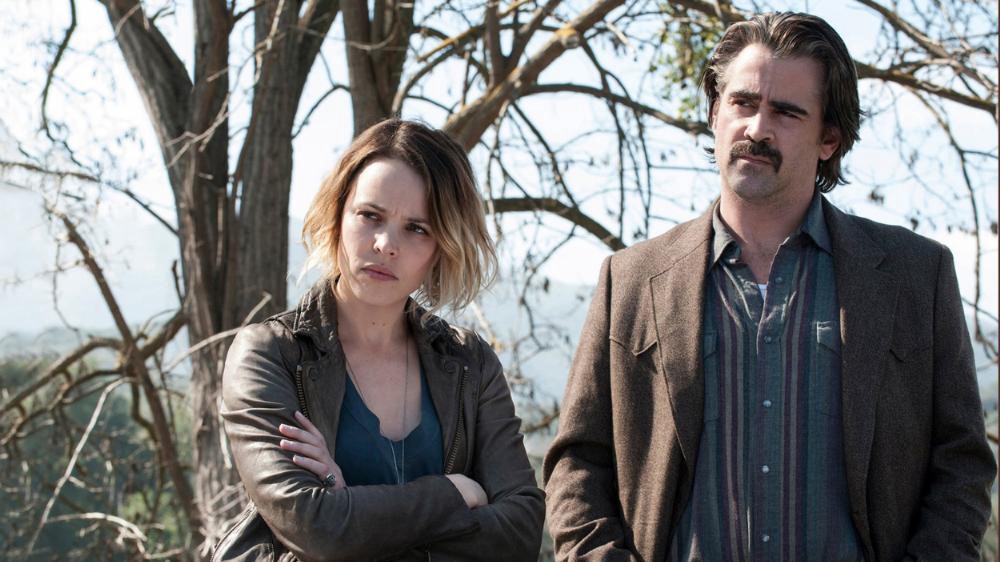
In episode one, officer Antigone Bezzerides’s (Rachel McAdams) sister Athena accuses her of being too uptight and sexually-repressed, then says, “When you walk, it’s like erasers clapping!” That’s original, but what on earth does it mean? Clouds of chalk fly out of her butt? Her feet are like schoolchildren being punished? (I’ve seen online commenters speculate this is a cocaine reference, but it’s unclear how that would relate to “walking” or being uptight.)
In the opening scene of episode two, Vince Vaughn’s gangster-trying-to-turn-straight character says, “It feels like everything is paper-maché.” Then he launches into a story about how his father locked him in a dark basement where rats ate his fingers. He closes the story by reiterating that everything “is paper maché.” So everything is paper maché because it is fragile and easily torn apart… I guess? But what does that have to do with being locked in a room you can’t escape from? As Christopher Orr at The Atlantic said: “I didn’t think the monologue’s central metaphor — comparing the decaying ceiling to imprisonment in the dark — even made sense. I mean, if that basement was ‘paper maché,’ six-year-old Frank could’ve just clawed his way out, right?”
Later in the same episode Ray Velcoro (Colin Farrell) and Bezzerides have this exchange:
Ray: “You know that expression about flies and honey?”
Ani: “The fuck do I want with a bunch of flies?”
Ray: “You don’t have any flies, you can’t fly fish.”
Without thinking about it, this makes sense in the context of police work — you might need to be nice to get some informants and info in order to catch your crooks. But the logic breaks down between the three lines as they become a mixed metaphor…unless Colin Farrell’s character is under the delusion that fly fishermen use actual living flies.
I could go on, but you get the point. Bottom line: your metaphors should actually make sense. Every time a metaphor breaks down, the reader gets taken out of the story.
Characters Should Respond to Each Other
One of the oddest things about the new season of True Detective is how frequently the characters seem to be engaged in separate conversations. Here’s another Farrell/McAdams exchange during a car ride:
Ray: “You pull off that e-cig. Not a lot of people do.”
Ani: “This place gets a day-today influx of 70 thousand people, right? Where do they live?”
Ray: “I tried once. It felt like it was smoking me. A real cigarette wouldn’t make you feel like that.”
Obviously there are times when this makes sense (showing how one character doesn’t listen, a post-modern talk on the breakdown of contemporary communication, etc.), but as a general rule characters should seem like they are able to hear one another.
Every Line Should Be Doing Work
Kurt Vonnegut once said, “Every sentence must do one of two things — reveal character or advance the action.” I think that’s a little narrow, as sentences can also add atmosphere, world-build, or do other things. But certainly in good writing every line should do something. This is especially true in the tighter narrative economy of a TV episode screenplay. My biggest personal gripe with True Detective is not the stock dialogue or even the nonsense dialogue, it’s the amount of functionless lines. A good example is the long break up scene between Paul Woodrugh (Taylor Kitsch) and his girlfriend in episode two. It goes on for some time — she thinks he is distant, he doesn’t want to talk — but here is how it ends:
Emily: “I can’t do this anymore. I tried.”
Paul: “It’s work. It’s a good thing, Em.”
Emily: “No. You barely talk. I don’t know your family. You don’t want to know mine. Who are you?”
Paul: “Oh fuck off! Who the fuck am I supposed to be?”
Emily: “I don’t know who you are supposed to be — ”
Paul: “Jesus Christ!”
Emily: “Yeah, fuck off! God, whatever happened to you I can’t fix it.”
Paul: “There’s nothing wrong with me. I’ll call you this weekend.”
Emily: “Don’t. I don’t want to hear from you, Paul. You can’t give me more than this. You’re not… you’re not right. Sometimes I’m with you and I can tell that…”
Paul: “Fuck it. I gotta go.”
Emily: “Don’t come back.”
Paul: “That’s on you, not me.”
Emily: “I can’t see you again, Paul. You hurt me seeing you.”
Paul: “You’re doing this. This isn’t me doing this. This isn’t me.”
We already know Paul is damaged and Emily doesn’t like how distant he is from their previous scene. Nothing above actually tells us anything new or unique about the characters. Reading for plot, the entire conversation could be clipped to just:
“Don’t come back.”
“That’s on you, not me.”
Everything else is basically just noise. It should be rewritten to convey something more.
None of the above is to say that True Detective is a horrible show. The acting is strong, the visuals are often arresting, and the plot seems like it is finally kicking into gear. It’s quite possible that the strong elements will make up for the lackluster dialogue by the end. I’ll keep watching. But when working on my next project, I’ll also try to avoid doing any of the above.
And remember, never do anything out of hunger… not even writing. Or something.
Although Zadie Smith doesn’t come immediately to mind when thinking about science fiction, famed director Claire Denis chose to collaborate with Smith on the screenplay of an upcoming sci-fi film. Plot details haven’t been announced yet, but according to Screen International it will take place “beyond the solar system” in a “future that seems like the present.” It will be both the novelist’s and the director’s first foray into science fiction.
Claire Denis has directed acclaimed films such as Chocolat, I Can’t Sleep,and Good Work. The last (Beau Travail in French) is loosely based on Herman Melville’s 1888 novel Billy Budd. Although she was born in Paris, France, Denis lived in West Africa during her childhood, including stints in Burkina Faso, Senegal, and Cameroon. These experiences are known to have influenced her films, which often deal with themes of colonial and post-colonial West Africa.
Zadie Smith is best known for novels such as White Teeth, NW, and On Beauty. The latter was shortlisted for the 2005 Man Booker Prize. None of them are set in outer space.
Smith’s husband, poet Nick Laird, will also co-write the film script. I can already picture the literary power couple rolling up to the red carpet looking fabulous (as per usual).
According to the A.V. Club, the screenplay will be Denis’ first English-language film, so it’s no surprise that she enlisted Zadie — one of England’s finest contemporary wordsmiths — to help craft it.
Planning your summer vacation but don’t know what to read? This very nifty looking infographic from Fly Abu Dhabi let’s you know what book to pack based on where you are flying. Check it out below:
There are book critics and bibliophiles — and then there’s James Wood. Often called the best critic of his generation, he first made his name as the young scourge at The Guardian while still in his twenties. In 1995, the British-born Wood moved to America and built his reputation with his lengthy, closely-argued reviews in The New Republic. Now a staff writer at The New Yorker, as well as Professor of the Practice of Literary Criticism at Harvard, he presides over the literary scene like no other book critic today. As a blogger at the Spectator put it, “Wood is arguably the most celebrated, possibly the most impugned, and definitely the most envied, literary journalist living.”
In some ways Wood is a throwback to the “man of letters” of previous generations. He brings a wide-ranging erudition and moral seriousness that’s rare in today’s magazine world. You see it in his slender new collection of essays, The Nearest Thing to Life. Part criticism and part memoir, the book reveals Wood’s lifelong fascination with religion and offers a glimpse into his childhood and the literary household he shares with his wife, novelist Claire Messud.
I talked with Wood about the art of book reviewing, why genre fiction makes him anxious, and his fantasy about publishing his own fiction under a pseudonym.Our conversation will air on Public Radio International’s To the Best of Our Knowledge. You can subscribe to the TTBOOK podcast here.
Steve Paulson: You say the task of writers is to “seriously notice the world.” Is it the critic’s job to seriously notice what’s in this fictional world?
James Wood: It would seem that there’s a virtuous loop here. I return again and again to detail and to seriously noticing what’s in the world, for a good reason. I don’t think I’m an especially observant person. Certainly not visually. I did a lot of music when I was a kid, so I have good ears and I’m always listening. But I’m one of those people who tends not to look hard enough at a tree that I walked past, or to notice what someone’s hands looked like twenty minutes after I said goodbye to them. By being so full of noticing itself, I’m aware that literature has helped me become a better noticer. Then as a professional reader, I’m continually training and tutoring that particular art and trying to notice things in texts.
SP: Is a critic basically a very good reader?
JW: I think so. There’s a pleasing amateurism about literary criticism despite the fact that it’s now enshrined in university programs. A professor of literature at some fancy university is not necessarily a better noticer than an ordinary reader. The advantage, of course, is that the professional reader has a broad scholarly knowledge. But there’s not much more that you can do as a critic than try to train your noticing, and to read a lot so you can do comparative reading.
SP: You quote from one of Henry James’ letters, where he said novels deal with the “palpable present-intimate.” What do you think he meant?
JW: This was a famous letter he wrote to the novelist Sarah Orne Jewett, who had sent him a historical novel she’d written. James writes back in that wonderfully ponderous, slightly patronizing mode that he reserved for people he didn’t think were quite as good as him. He said it’s all well and good, but steer away from the historical novel because consciousness is the thing that will be hard to get right. He suggests that we have an intimate understanding of modern consciousness, but we have to make a really huge leap to enter the consciousness of someone in the 17th century. So he says what fiction should do is concentrate on the “present palpable-intimate.” Ideally, the sort of fiction he was trying to work on is full of textures and details. It’s set in the present and is involved with people’s intimacies. It’s unafraid to deal with people’s interiorities.
SP: What you’re describing is along the lines of Buddhist contemplatives who talk about being fully in the present moment. Do you see any connections?
There’s something about slowing down and seeing the world that does seem to be one of our few modes of salvation if we’re not orthodox believers.
JW: I do. I think mindfulness is pretty interesting. For instance, there’s been quite a lot of Buddhist literary work on Virginia Woolf because her fiction is very much about slowing down and preserving moments of time, and examining them with great patience. She also seems to have a metaphysics which is almost Buddhist. In “Mrs. Dalloway,” she talks about how the dead return to us and are never separate from us. You can find something similar in Saul Bellow’s work. For a while Bellow got very interested in anthroposophy, which also talks about the community of the dead who are around us. Vladimir Nabokov also talks about the democracy of the dead. There’s something about slowing down and seeing the world that does seem to be one of our few modes of salvation if we’re not orthodox believers.
SP: All of those writers you mentioned had a great knowledge of literature. They didn’t just care about the present moment. They were also communing with dead writers and the history of literature.
JW: Absolutely. The three writers I just mentioned were profoundly well-read. That may be harder to sustain in contemporary letters. It’s amazing if you go back and look at something like the little primer that Edith Wharton wrote on writing fiction. When someone like Edith Wharton was writing about the novel, it was understood that you have the entire canon of novelistic history at your disposal, in several languages. So for Wharton, it’s completely normal to talk about the French novel, having read it in French, as well as the English novel. And for a long time that kind of intimate, non-academic scholarship was kept alive by writers and to some extent by literary journalists and critics who worked outside the academy. But it’s harder and harder to sustain. We seem to have less time to do the reading that we have to do.
SP: You draw various analogies between religion and literature. For one thing, creating a novel is kind of godlike.
JW: There’s the obvious analogy with the Creator. You can also see the novel as a secular form coming out of a tradition of religious narratives — say, the lives of saints or narratives like Plutarch’s lives that point out a historical judgment or moral truth. And out of these various forms, you get this distinctive genre which seems to be largely secular and written mostly by non-believers.
SP: Are you saying fiction has become a secular form of scripture?
JW: Essentially, I am. You can see certain aspects of religiosity hanging on. One example would be consciousness itself. The 19th century novel discovers what it means to plumb the depths of a character’s mind. It has a character thinking for three hours about the terrible marriage she’s made. And that’s related to the soliloquy. You can see it even in the verbs that are used, so writers like Charlotte Bronte and Thomas Hardy continue to say “she soliloquized to herself.” If you go back with the soliloquy, you go to Shakespeare. And further back, you go to Greek tragedy and perhaps ultimately to prayer. You go back to the Psalms, to David telling the Lord what he’s grateful for, what he intends to do, where he has disappointed his God. On the other hand, if you look at the novel — say, from “Don Quixote” onwards — it sets itself up as the slayer of superstitions. It often likes to make fun of religious people. Think of the minister Mr. Collins in “Pride and Prejudice.” There’s a lot of anti-clericalism in the novel, but more interestingly, it often takes blasphemous stances and imagines itself as a destroyer of superstition.
SP: Religion is supposed to bring you to some transcendental truth. Can the novel also do that?
The modern novelist — who can’t rest assured of cosmic governance — looks around in a more secular way and says, What will survive of us?
JW: That’s a very good question. (Laughs.) Yes, it certainly can. If you look at a novel like “To the Lighthouse” — one of my favorite of all books — it asks exactly the same question Psalm 90 asks: What will endure of us? What will last after we’re gone? Psalm 90 says, in effect, nothing, because we give it all up to God: “A thousand years in thy sight are but as yesterday.” The modern novelist — who can’t rest assured of cosmic governance — looks around in a more secular way and says, What will survive of us? Not houses. If left alone, they begin to fall apart very quickly. Perhaps children, except that they can be killed off in the First World War or die in childbirth, as happens in the middle of “To the Lighthouse.” Probably not works of art either, unless they’re very great works of art, like Shakespeare’s plays. So the answer is a very bleak one — without consolation, without transcendent truth of any kind. But remember that Chekhov said the writer’s job is not to provide the answers, but to ask the right questions.
SP: You grew up in a religious household. Your parents were evangelical Christians. Your father was a minister. I’m guessing you are no longer a religious believer yourself, but do you look for secular substitutes for religion?
JW: I do. If you grow up in a religious household with any modicum of religious belief and then lose it, you transfer it to the holiness of literature. That was going on in the 19th century as God begins to recede from European belief. It’s an obvious narrative to talk about transference and substitution, and I don’t think I can entirely escape it, but I try to resist it. The substitution narrative looks at how literature is like religion. I’m also interested in difference. One difference is that religious answers are absolute and — in their way — consoling, but awesome. Literature cannot offer this final answer or final command. I’m really interested in that. In the Gospels, Jesus’ command is to revolutionize your life. That command is absolute and life-changing and soul-shattering. If you don’t follow it, your eternal soul may be at risk. What is the command of literature? There is a command, I think, but it has much less authority. It’s about persuasion, it’s about asking you to put your trust or faith in something you know has been invented. At any moment, you can put the book down, walk away and refuse to continue believing in the invented reality you’ve just been inhabiting.
SP: You are married to a novelist and you’ve worked with some famous writers. Didn’t you once teach a college course with Saul Bellow?
JW: I did indeed. I was brought in because Mr. Bellow was in his eighties and was beginning to lose his memory. It seemed that it would be useful to have someone else in the class prompting him. So I had a lovely job. His deep memory was terrific, but his short term memory was full of lapses. So my job, really, was to nudge him and prod him. We did a Dostoevsky novella and Tolstoy’s “Death of Ivan Ilyich.” I would simply say, “Mr. Bellow, you grew up in Chicago in the 20s and 30s, when your relations to writers like Tolstoy and Dostoevsky were vital and sometimes you had to choose. You were either a Tolstoyan or a Dostoyevskian. Can you tell the class a bit about that?” And he was off. It was extraordinary. Right to the end of his life, I used to go to his house. I’d play the piano, he would play the recorder, and we would do simple things by Handel and so on. Once I brought my two-year-old daughter, and Bellow started singing French children’s songs, one after the other, in French, with all the stanzas and all the verses. I said, “This is extraordinary.” And he said, “I picked them up when I was in Paris writing ‘The Adventures of Augie March.’ I had a child and I was pushing the child around in the stroller, and I used to sing these songs.” That was 50 or 60 years ago. It was amazing to me.
SP: You are a big fan of Bellow’s writing. Did getting to know him change the way you thought about his art?
JW: Strangely, it didn’t. I still feel it was a splendid gift to meet him in his old age, albeit somewhat depleted. It tickled my vanity and was also a source of joy. But I would feel exactly the same way about the books if I hadn’t met him.
SP: Saul Bellow was a writer who strived for literary greatness. He was one of a handful of writers who wanted to be regarded as great. Are you also looking for greatness when you pick up a new book?
JW: This may be the wisdom of middle age — the reverse of the red sports car — but I’m less hung up on greatness than I used to be. And maybe correspondingly, I’m a less severe judge than I used to be.
SP: That’s interesting. You made your name in your twenties as the chief book reviewer for The Guardian, where you had a reputation for writing brutal reviews.
JW: Yeah, I did. I was always taking people to the cleaners. I still love that kind of sweeping judgment of, you know, “it’s all rubbish,” that nothing good has been written in England since 1945. It’s a sign to me that critics are taking the form deadly seriously. I do think the only way to produce really significant work, either as a writer or a critic, is really to be in love with the form to the exclusion of other forms. You can recognize that in certain critics who seem to passionately take the form seriously. Think of Helen Vendler’s lifelong devotion to poetry.
SP: But you seem to have become a more generous critic.
I’ve become much more interested in fugitive effects and quietness than I was.
JW: I think I have. I’m slightly put off by massive ambition, by the 600–700 page book that’s trying to do fifty things at once. There’s part of me that relishes smaller effects. It seems to me that one of the easier things in our culture now is to make a lot of noise. This can be aided and abetted by the publishing machinery that happily says, “You’re young, you’re making a lot of noise. We will anoint you as a noise maker — aka, ambitious.” Obviously, it’s still important to take note of those big attempts to write great literature, but I’m also interested in simplicity. I’ve become much more interested in fugitive effects and quietness than I was.
SP: In addition to being a book critic, you also teach a class at Harvard on the practice of literary criticism. What are you trying to teach?
JW: In practice, it doesn’t differ very much from an ordinary literature class. We have a syllabus of texts that are much the same as you’d have in any literature class. One of the classes I teach looks at fiction from Jane Austin to Virginia Woolf. It looks at the way different writers have tried to dramatize consciousness and how they get their heroes and heroines to think on the page. Because of what I do, I tend to attract students who themselves write either fiction or poetry, or write book reviews, and are interested in trying to take that further after university. So out of class, we think a lot about book reviewing and reading contemporary literature. It’s all well and good to do your 19th century stuff, but if you’re not alive to what’s being written right now — if you’re not going to the bookshop or the library and taking home five books and having judgments about them — you’re not really a literary person.
SP: So what is the art of being a good book critic?
JW: I think it’s the art of persuasion. You know, I get both institutional respect — a rather tiresome kind — and a fair amount of attack because of that institutional authority. It has to do with being at The New Yorker, and then when you square it with the Harvard job, you get a horrific kind of….
SP: …..the pedestal you’re standing on is quite tall.
There’s nothing worse or more corrupting to the soul than to think that by a stroke of the pen, I command this or that person’s career or reputation.
JW: Right. “Here’s your throne, and we’ll build an extra ten feet of gold for you to sit on.” That’s really tiresome to me, as is the whole thing about being this awful word — “gatekeeper” critic. There’s nothing worse or more corrupting to the soul than to think that by a stroke of the pen, I command this or that person’s career or reputation. It’s important to remind myself, and I try to do this, that my authority exists only in each piece and is rhetorical. So in each piece you’re making a case, and it’s a case like a speechmaker makes or a lawyer would make in a court. You have evidence, you have quotation, and of course it’s more interesting if you’re making the case for something rather than against.
SP: Is the ultimate goal to make the case for why you think this book is good or bad?
JW: I suppose it is either a good or bad judgment, though I think it’s perhaps more helpful to think in terms of a book you might seriously be interested in and here are the reasons why. And it’s often just a large amount of quotation. In that sense, my job’s easy. I remember the beginning of John Updike’s amazingly large and really impressive book of collected reviews, “Hugging the Shore.” He says, “Two thirds of the words in this book are not mine; they’re just quotations.” And he was a great quoter, a very generous one. So a lot of it is just trying to tell the reader this is something you could be interested in. It could change your life. It’s radiant, it’s full of beauty, it brought pleasure to me, it might bring pleasure to you. Or sometimes you get angry and say flagrantly, “This doesn’t work” or “this is fraudulent.” The last time I wrote about Tom Wolfe, there was a slightly moralistic fervor to my writing because it seemed important to tell readers, this is all fake. It’s noisy, coarse writing that one would mistakenly call Dickensian, and it’s worth separating what’s actually Dickensian from the fakery.
SP: Did you get any response from Tom Wolfe for that takedown?
JW: I never did.
SP: Do you hear back from writers after you write a negative review?
JW: No. Most of them have the good sense — one I’ve learned, by the way, when I’ve gotten a negative review — to stay silent. Fume in a Herzog-like way, write your mental letters, but don’t publish them.
SP: You’ve worked as a critic in both the U.S. and in England. Is there a difference between what readers and writers expect from a book review in those countries?
Pugilism was part of being in the literary world.
JW: Yes. Traditionally, the British scene is a bit more knockabout. And the newspaper scene in particular, where I started reviewing, was closer to what the online world is now like. You could get away with a larger degree of insult — basically, a wilder register. Pugilism was part of being in the literary world. It’s a little harder to do that in America. You see this in political writing, too. British political writing is full of insults. I love it for its refusal to take politicians seriously. The highbrow British newspapers have a paid political sketch writer, and that person’s job is to go to Parliament and watch debates from the public gallery, and write a kind of cartoon, a sketch in which it’s quite normal to say, “X was looking dreadful and seemed half-drunk anyway, and Y is possibly stupider today than yesterday.”
SP: So politics as theater.
JW: And why should there be any necessary respect for politicians? That’s the reigning assumption in British journalism. American political journalism strikes me as a little strange in that the punches are pulled. And maybe you get a bit of that in literary reviews, too — say, in the generally-nice atmosphere that prevails in The Times Book Review.
SP: Do you see literary criticism as fundamentally a creative act, perhaps on a par with fiction, or does the critic need to be more constrained?
JW: I’m in two minds about this. I wouldn’t claim creativity on the same level as the art maker. Obviously, I’ve put a lot of thought and work into sentences and phrases and metaphors. On the other hand, the form is very stable and known. It’s either a 2,000 or 4,000 word piece. I have a job to do and it doesn’t surprise, whereas anyone who’s written a poem or a piece of fiction knows that the most striking thing is the sense of the limitlessness of form. Henry James kept on thinking he was about to write a long short story and found that he was writing a novel. That keeping-going thing is what most writers are struck by. So I think there’s a real difference. But I also read essays — sometimes literary essays or non-fiction essays — in much the same way I read fiction or poetry. I don’t really distinguish between them. I get as much pleasure from Virginia Woolf’s essays as I do from her fiction. I get more pleasure from George Orwell’s essays and non-fiction than I do from his not-very-good novels.
SP: Are you a fan of the French critic Roland Barthes, who seemed to regard criticism as an art form in itself?
JW: Yes, I’m a great fan of his. I’m always slightly battling with him because he was very down on realism. He was a great skeptic of the codes of realism. I’m always struggling with him because I think he was secretly, guiltily, in love with realism and didn’t want to admit it….. in the way I might be secretly in love with really bad television or slick middlebrow filmmaking. And every time I denounced slick, middlebrow filmmaking, I was actually giving a public voice to my secret love of it. So I’m always struggling with Roland Barthes, but he seems to me a wonderful maker of sentences and insights. He’s someone I read with as much pleasure as I read a new novel.
SP: Can you still read purely for pleasure? If it’s a book you’re not reviewing, can you read without always having your critical hat on?
JW: I can’t read without my critical hat on, but I don’t think reading with my critical hat on is incompatible with pleasure. I understand what the phrase “pure pleasure” is getting at. People often ask me this, which would be some kind of surrendering to the text without much self-consciousness.
SP: But do you always feel compelled to evaluate it?
JW: I’m always evaluating it, but for me, pleasure is evaluative pleasure, as well as the pure enjoyment that I still experience, wanting to put an exclamation mark in the margin of the page because I’ve just been bowled over by something. The “wow” thing is very strong in me and I hope always will be. When I think back to when I was 15 or 16, I wanted to write, so I wrote very bad poems and very bad fiction. And I read everything in some greedy, appropriative and also critical way. I wanted to see how they do it, so I could try and mimic it. Why does this novel that I don’t enjoy not hang together or work properly? What can I learn for my own writing? So after adolescence, I don’t actually remember non-critical reading.
SP: You mentioned that one of your guilty pleasures is watching mainstream TV shows. Do you also have guilty literary pleasures?
JW: I don’t really have guilty literary pleasures. I don’t know what the explanation for it is, because I certainly have literary friends who love genre fiction, whether it’s science fiction or thrillers. I never read that stuff and never did. So sometimes I think that’s just me being slightly anxious.
SP: Anxious?
JW: I put it down to a sort of literary anxiety, that I don’t have time for it.
SP: It sounds like you don’t think it’s good enough.
JW: Right, I don’t think it’s good enough, but it’s not like I’m a man without guilty pleasures. We mentioned TV — that’s certainly one. I love cars. I absolutely love cars. So I read car magazines. It’s not exactly a sin to read a car magazine, but they are what they are. It’s essentially car porn. So I’m not without guilty pleasures. I know what it means to balance the high and the low, and to be relaxed around the low.
SP: You just don’t want that in your literature.
JW: I don’t want it. I actually think it might contaminate it in some way. That’s where I think I’m a little bit anxious.
SP: Who do you consider the greatest critics in history?
JW: I would have to put Coleridge there. Coleridge is wonderful, crazy, wild. For those listeners who haven’t read Coleridge, and you wouldn’t unless you encountered him at university, think an English Melville. He was an opium addict. He has the Melvillian craziness. He writes these huge, long sentences with wild metaphors and images, and he’s a brilliant reader. And in one book in particular, “Biographia Literaria,” he’s doing four or five things at once. He’s writing a memoir of his own reading, his travels to Germany, and his discovery of German philosophy. He’s also writing about his friend Wordsworth. Although Coleridge was himself a poet, he acknowledges that Wordsworth is by far the greater poet. He sets down a series of readings of Wordsworth’s poems — for posterity, really. He’s essentially saying, “I know this poet will last, and I’m going to do what I can to make the following readings of these eternal poems.” So Coleridge would be high up for me. We mentioned Virginia Woolf. I’ve always loved her essays — and for personal reasons. Woolf started writing for The Times Literary Supplement long before she wrote fiction. I think she did it for ten years before she published her first novel. She was earning her living as a hack, as they used to say in London. Although we have an image of Woolf as tremendously posh and upper-class, the reality is she was more like a slightly impoverished upper-middle class person. If you look at her diaries, she continued to need the income from literary reviews right to the end of her life.
SP: Wasn’t this also at a time when reviews were anonymous? So if you wanted to stand out, you had to do it through your style?
JW: Absolutely. Those TLS reviews were unsigned in those days. I love the idea of people slowly beginning to get used to a particular style. “Oh, that’s that person who writes this way.” And because it was a small literary world in London, enough people would have known it was Leslie Stephen’s daughter, Virginia Woolf, or rather Virginia Stephen as she was then, writing these reviews. These anonymous pieces are now collected in two volumes of her essays, The Common Reader. These essays appeared in the TLS and everyone knew by force of style who wrote them. For me it’s a tremendous image of what the literary essayist can do on the page.
SP: You wrote one novel yourself. Do you have a hankering to write more fiction?
And getting lost is crucially important for creativity, but it’s also a source of terror for me…
JW: I do. I’m actually working at a novel right now. And it’s why I was talking a minute ago about this limitlessness because my wife, who’s a novelist, will often say there’s no other form of activity quite as efficient in using up time. She’ll say, you sit down and think you’re just going to start writing, and you look up three-and-a-half hours later, and you don’t know where the time went. You got lost. And getting lost is crucially important for creativity, but it’s also a source of terror for me because I don’t know what I’m holding onto anymore. I don’t know where the thread is going, and I don’t quite know how to find it again.
SP: You must also figure that lots of writers out there are sharpening their daggers, waiting for your book to come out.
JW: Indeed, it’s a perpetual fantasy, as it was with my first novel, to publish it under a pseudonym. Of course it’s a bit of a wager: Will you get it published?
SP: Of course you’ll get it published!
JW: But if you did it under a pseudonym — if you just sent it in as a pseudonym, there’s a possibility it wouldn’t get published. Then if you continue the wager, there’s a possibility it wouldn’t get reviewed at all and would just disappear. You’re the sore loser. There’s no triumphal announcement a year later, “Ah, this book that everyone’s talking about is actually by James Wood.” In fact, it just disappeared under its pseudonym. I used to write pseudonymous things on occasion when I was first starting out, before I was at the Guardian. I have two middle names, Douglas and Graham, and I needed to earn a living writing paperback roundup reviews, little more than 50 words. I thought this hackwork should exist in a different realm from what I was trying to do as a fiction reviewer, so for a while I was writing under James Wood and Douglas Graham. So maybe that’s what I should do with the novel, although I’ve just blown my cover on radio. (Laughs)
Harry Potter fans, recently beset by dispatches from the Potter-verse, have yet another thing to freak out about: Emma Watson has signed on to play the lead in the film adaption of Dave Eggers’s novel The Circle.
The novel’s title refers to a powerful tech company that combines the capabilities of Facebook, Google, et al, enabling users to forge one all-encompassing Internet identity. At the center of The Circle is Watson’s character, Mae Holland, a wide-eyed new hire who finds herself confronting the unpleasant realities of a digital epoch in which the notion of privacy becomes laughable.
Tom Hanks has been tapped to play one of three CEO characters, and James Ponsoldt (the auteur behind the upcoming DFW biopic) will direct. Ponsoldt said of Watson: “Emma Watson is one of my favorite actors, and her incredible talent, sensitivity and deep intelligence will bring an electric energy to The Circle.”
Watson’s latest role will follow a spate of post-Potter successes, most notably the film version of Stephen Chbosky’s The Perks of Being a Wallflower. Watson may yet succeed in eclipsing the role that made her famous, but if she continues to soar toward lifelong celebrity on the wings of novel adaptations, Potterheads can rest assured that Girl Whose Career Lived will not forget where her star ignited.
If you receive a distressing landline call, perhaps someone trying to bully you for lies about the beloved, mark the call as malicious and trace data will be recorded. Trace data can only be accessed by law enforcement. Before activating malicious caller identification, consider whether the call merits police involvement. Since the incident in question appears to have resulted in a death, try to keep the police in mind.
*61: Priority call
The beloved needs you lately. Choose a unique ring for the beloved so you can quickly filter communication from the beloved from communication not from the beloved. Try a ring that signals “the beloved” and “high priority.” Think cheerful, hot, and urgent. Think plain and sharp. Think soft and sweetly painful.
*66: Continuous redial
Recently it has been difficult to connect with the beloved. The beloved’s line floods with calls from friends, relatives, parents, neighbors, angry anonymous locals, and small-time reporters posing as big-time reporters. Conserve your emotional energy by automating redial until your connection goes through. Hello? Hello! Hi.
*69: Last incoming call return
Remember that evening? The phone was ringing as you unlocked the door. You reached the phone right as it quit ringing. You later learned too late that the beloved had tried to call you to ask for assistance in extraction from the situation preceding the incident that led to the present dilemma. If you had known enough about vertical service codes, you could have reconnected with the beloved in time to help prevent the beloved’s proximity to the incident.
*77: Anonymous call rejection
Hidden callers cannot connect with you if you initiate anonymous call rejection. The anonymous caller hears a polite, crisp female voice say that the party the caller has dialed does not accept calls from blocked numbers and to please hang up and try again with Caller I.D. unblocked. Harassment will cease.
*100: Call erasure
The call erasure feature can retroactively expunge the last call received from your memory. You can choose, for example, not to have heard the mother of the beloved tell you tests have shown the blood from the body fits evidence taken from the beloved. You can select not to have heard the father of the beloved share with you that questioning of the beloved and witness testimony led to the search and seizure of the beloved’s property and the arrest and confinement of the beloved. You can decide not to have leveled invective at your delicate aging father for scolding you about your several years of involvement with the beloved despite your father’s many fatherly warnings that have finally proved prescient.
*105: Called party mouthpiece disabling
Your called party’s mouthpiece is rendered mute. You have a silent audience as long as the call stays active. You can tell the jailed beloved everything without interruption. You might reveal to the beloved that you are glad you were not able to extract the beloved from the situation preceding the incident that led up to the present dilemma because it appears the present dilemma would have inevitably arisen. You can declare to the beloved that you hope the beloved stays confined for the full term assigned. You can say you feel irrevocably betrayed by the beloved. You may reveal that you have seen that the beloved is no longer the beloved but the accursed. The accursed cannot respond. The accursed can only listen or hang up the telephone, and the accursed is lonely for you.
*120: Silent telephones
The calling party’s telephone’s earpiece and mouthpiece are rendered mute. The called party’s telephone’s earpiece and mouthpiece are rendered mute. The telephone empties of its power. You hold the shell to your ear.
War of the Foxes, Richard Siken’s second collection of poems, begins where his debut collection Crush left off — the body. In “The Way the Light Reflects,” Siken writes, “I have my body and you have yours. / Believe it if you can. Negative space is silly.” Navigation of that space, both emotionally and physically, dominated the obsessive and hungry poems of Crush, which won the Yale Younger Poets competition in 2004. One of the recurring images in Crush was that of the poet’s empty hands, hands rendered vestigial by all they were not allowed to touch. In War of the Foxes, Siken puts those frustrated appendages to use by picking up a paintbrush. Gone is the savage sexuality of Crush, and in its place we find a painter alone in his studio; in fact, the few references to lovers in this collection describe them asleep in the next room, as if these poems were written in the quiet hours after Crush. And while the poems in War of the Foxes do sometimes read like entries from a painter’s notebook, they do, like the poems in Crush, refute the illusion of space, in this case the space between our bodies and the outside world. As Siken writes in the poem “Landscape with Fruit Rot and Millipede,” “The mind fights / the body and the body fights the land.”
If the poems in Crush were engaged in the metaphysics of alienation, the poems in War of the Foxes are engaged in the metaphysics of creation, an aesthetic theory in which the boundaries of the human mind has drastic consequences for the natural world. In this way, the relationship between a painter and a landscape is similar to the relationship between men and nature: as soon as we see it, we can’t help but change it, alter it, dominate it. In the poem “Landscape with a Blur of Conquerors,” Siken describes the process of painting a field, a field “empty, sloshed with gold, a hayfield thick / with sunshine.” This image, infused with all the beauty and innocence of the garden before the fall, appears again and again throughout the collection. But simply painting landscapes is not enough for Siken — he must introduce a figure, a man. And what happens when you place a man in an untouched field? We all know the answer to that: “Land a man in a / landscape and he’ll try to conquer it.” Siken doesn’t shirk responsibility for this state of affairs, and instead further implicates himself by painting more and more men until “they swarm the field and their painted flags unfurl.” The message is clear and it’s political: these men “those people,” aren’t “the enemy;” aren’t “Republicans;” rather, as Siken writes, “They look like me. I move them / around. I prefer to blame others, it’s easier.”
Siken continues this inquisition in the title poem “War of the Foxes.” Here, Siken moves away from the metaphorical into the allegorical, searching for the roots of war through a series of elliptical stories. In one story, two rabbits named Pip and Flip are chased by a fox into their warren, where, huddled together, Flip tells Pip to hide inside of him. In another story, a boy faces the wrath of an abusive father after he spills a glass of milk. In the final story, a fisherman’s son becomes a spy, and part of being a spy is waiting at a chain-link fence to share secrets with other spies. Siken writes, “It’s a blessing: every day someone shows up at the fence. / And when no one shows up, a different kind of bless- / ing. In the wrong light anyone can look like darkness.” This is another example of Siken implicating himself, and the reader, by showing us that we are responsible for creating the illusion of separation between “us” and “them,” and that this illusion has dire consequences. As Siken writes in the poem “Portrait of Fryderyk in Shifting Light,” “Everyone secretly wants / to collaborate with the enemy, to construct a truer / version of the self.”
If this all sounds very abstract, that’s because War of the Foxes is abstract. It’s challenging in a way that Crush was not; you read and re-read the poems in Crush just to savor the language, the images, but with War of the Foxes, you read and re-read the poems in an attempt to divine meaning. If Crush resembled the manic poems of Sylvia Plath, War of the Foxes resembles the cerebral mediations of Mary Ruefle. And like Crush, War of the Foxes is obsessive, relentless, but when the obsession was rough sex in motel rooms and cars speeding away into the night, the obsession felt like passion. In War of the Foxes, the obsession with painting, with representation, mimesis, and even mathematics and logic, makes the collection feel like a lecture. In one poem, Siken writes, “When you have nothing to say, / set something on fire. A blurry landscape is useless.” The reader can’t help but agree. We wanted to see the fire.
The winners of Locus magazine’s 2015 awards have been announced. The winners of the science fiction and fantasy award are picked by a poll of the magazine’s readers.
Congrats to all the winners!
SCIENCE FICTION NOVEL
Winner: Ancillary Sword, Ann Leckie (Orbit US; Orbit UK)
The Peripheral, William Gibson (Putnam; Viking UK)
The Three-Body Problem, Cixin Liu (Tor)
Lock In, John Scalzi (Tor; Gollancz)
Annihilation/Authority/Acceptance, Jeff VanderMeer (FSG Originals; Fourth Estate; HarperCollins Canada)
FANTASY NOVEL
Winner: The Goblin Emperor, Katherine Addison (Tor)
Steles of the Sky, Elizabeth Bear (Tor)
City of Stairs, Robert Jackson Bennett (Broadway; Jo Fletcher)
The Magician’s Land, Lev Grossman (Viking; Arrow 2015)
The Mirror Empire, Kameron Hurley (Angry Robot US)
YOUNG ADULT BOOK
Winner: Half a King, Joe Abercrombie (Del Rey; Voyager UK)
The Doubt Factory, Paolo Bacigalupi (Little, Brown)
Each month we gather some news headlines that are strange enough to be fiction. Here’s yet another batch of headlines to get your creative juices flowing along with suggested genres:
Sign up for our newsletter to get submission announcements and stay on top of our best work.
YOUR INBOX IS LIT
Enjoy strange, diverting work from The Commuter on Mondays, absorbing fiction from Recommended Reading on Wednesdays, and a roundup of our best work of the week on Fridays. Personalize your subscription preferences here.