A Life of Your Own: Spinster by Kate Bolick

“What if a girl grew up like a boy, with marriage an abstract, someday thought, a thing to think about when she became an adult, a thing she could do, or not do, depending?”

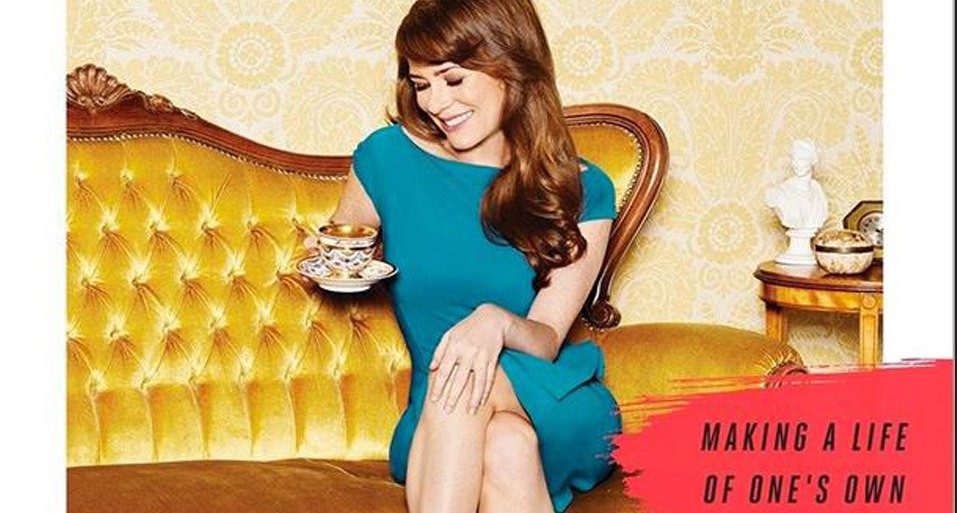
Kate Bolick’s memoir, Spinster, is an answer to her own question: how can a woman make a life of her own in 2015, when — as Bolick claims — our paths are still charted by the question of, “Whom to marry, and when it will happen?” As a successful freelance writer, contributor to The Atlantic, and former executive editor of Domino magazine, Bolick sets herself up as the example of how to live a solitary life — especially impressive, perhaps, because most of that living occurs in the mightily expensive New York City. Yet a book on singleness has never been more relevant, according to Spinster’s statistics: in 2013, more than 105 million people over the age of eighteen were never married, divorced, or widowed — and 53 percent of that population were women.

Spinster is based on an article Bolick originally wrote for the Atlantic in 2011, “All the Single Ladies.” The memoir, as it exists now, is an expanded exploration structured around five women “awakeners” who have inspired and shaped Bolick’s lifestyle. The awakeners are alike in that they are all early-twentieth-century writers as well as, to varying degrees, spinsters themselves: Edna Millay, Maeve Brennan, Neith Boyce, Edith Wharton, and Charlotte Perkins Gilman. By regarding the five together as a group, Bolick “began the very long process of re-creating our conversations — not with other, real, live women, who could only ever be gross approximations of the mother I missed, but real, dead women, whom I could sidle up to shyly and get to know slowly through the works they left behind and those written about them.” The awakeners allow Bolick to come to terms with her un-marital bliss, even when she passes the get-hitched “deadline” of her dreaded thirtieth birthday.

“I started jokingly referring to my job as my ‘husband’ (as in, my source of economic stability), an ‘antidepressant’ (it was so demanding, I didn’t have time for melancholy), and a full-time ‘vacation’ (even with the long hours, it was far easier than writing freelance), all rolled into one.”

Single life is shown to be appealing for the reasons you’d expect: peace, quiet, and not having to look great all the time for a partner. After ending a long-term cohabitation at 29, Bolick reverts to living solo in New York City:

“My first night there I stayed out at a party until four o’clock in the morning, and when I got off the 6 train at Twenty-eighth Street an eerily empty yet still-open McDonald’s beckoned like an electric mirage. Back on the sidewalk I threw away the bag, peeled off the warm paper wrapping, and bit into the most delicious Bic Mac I’d ever eaten. I chomped and strolled as slowly as I could, prolonging the delectable realization that waiting for me at home was nothing but an empty bed in which I’d crawl naked and drunk and stinking of fast food, disgusting nobody but myself.”

But can we all be so lucky? Bolick’s memoir flaunts her ability to pick and choose: early in life, she is complimented on her “nice figure,” later admitting that, with “braces and breasts” a girl becomes “if not one of the pretty ones, attractive. To boys, I mean.” Bolick’s memoir consequently turns into a kind of log of lovers and all the male romantic interests are the same bland brand of sweet-sexy-romantic, as well as, Bolick insinuates, marriage material. “Each time, I thought sex couldn’t get any better, that I couldn’t learn anything new, and then someone would come along,” she writes of her seven sexual awakenings by the time she’s thirty. Bolick goes as far to complain that her sociability is her Achilles’ heel; at one point she instates a three-week period of self-imposed isolation to concentrate on writing, but caves after two weeks. She could be married, Bolick seems to insist on stressing, but she’s chosen not to, and is better for it! It’s in these moments that her writing becomes unpleasantly defensive:

“Married women, especially those with children, tended to assume a superior stance, as if their insights into people and relationships came preapproved, even though single women drew from a larger store of experiences and had often seen more of the larger world, from which the wisdom I wanted to discover is derived.”

Spinster could also be read as the literary biography of Bolick’s five awakeners. With the lesser-known women, such as Neith and Maeve, Bolick’s insight into their early feminist careers is new and enlightening. However, with Edna, Edith, and Charlotte, the biographies seem surface-level, like thematic scaffolding for the structure of the memoir.

Even despite Bolick’s dismissal, there seems ample evidence that women can live happy, fulfilled lives alongside their significant others. If it weren’t for the forceful insistence on spinsterhood as a superior lifestyle, Bolick’s memoir could have been a deeper, more investigative look at the conditions in which women in the 20th and 21st centuries have pursued careers in writing.

Still, Bolick’s concluding remarks are confusing and hypocritical, self-consciously doubling-back on the preceding nine chapters. The tone itself is sophomoric, like the final lines of a student’s paper: “While researching this book taught me the true value of the spinster, writing it made me see the question I’d long posed to myself — whether to be married or to be single — is a false binary.”

Time and progress will not treat Bolick’s thesis kindly. Already Spinster as a feminist text is out of date; and as literary biography, it is lacking. Only as the memoir of a writer’s career does Spinster seem to have lasting value; and it is Bolick’s success, rather than her serial dating, that feels like the point. Being single isn’t just pizza in bed and weekend flings; it’s also making rent on one’s own, it’s being lonely, sometimes. This is far from a revelation; in fact, Spinster might merely offer the proof that you can do this too — if you want.

Spinster: Making a Life of One’s Own

by Kate Bolick

Powells.com

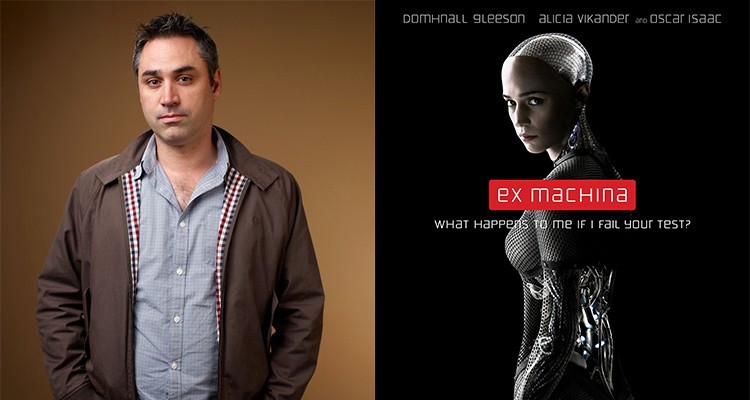
Ex Machina Writer/Director Alex Garland Talks Robots, Consciousness and Jackson Pollock

ex machina

Novelist, screenwriter and now film director, Alex Garland is one of those rare permutations of artist who seems to be able to do it all. Not only did he write the novel The Beach, but also the screenplay for the game-changing-zombie-movie-to-beat 28 Days Later. He also adapted the famed Ishiguro novel Never Let Me Go. But, lately, Garland has traded in clones for robots with his directorial debut: Ex Machina.

Concerning the machinations of a bro-tastic eccentric tech-company owner named Nathan (Oscar Isaac), a possibly-sentient robot named Ava (Alicia Vikander) and one of Nathan’s nice-guy employees, Caleb (Dohmnall Gleeson), Ex Machina is the most serious film about artificial intelligence and robots since, well, maybe Blade Runner. Though billed partially as a psychological thriller, Ex Machina is disturbing and compelling not because it’s conventionally frightening like 28 Days Later. Instead, the movie is a nuanced and complex approach to the robot conundrum: If they were truly self-aware what would we do? How would we react? What would they do to us, for real?

I spoke with Garland on the phone this week about Ex Machina, his literary influences, and how a Jackson Pollock painting figured into the movie’s themes.

Ryan Britt: Great movie! Your best yet?

Alex Garland: From my point of view it is, yeah. I’m kind of very happy with this film and how it turned out. I was working with a very good bunch of guys. It was a pleasure.

Britt: Let’s talk about robots and literature. How did you first come to robots? Who were your first?

Garland: That’s a good question. I guess, I guess; in some respects C-3PO and R2-D2. They’re the ones I can clearly identify and remember. But there were robots I’d encountered before. On Sundays there would be some old sci-fi movie on in the afternoon. But I actually used to go to a cinema club that would show the old Flash Gordon serials and stuff.

Britt: The boxy robots.

Garland: Exactly. So I used to encounter them I guess. But in a “sophisticated” way, C-3PO and R2-D2. My mum also took me to see 2001 when I was 10 or 11. It got released then and she was like “you really ought to see this film.” And she took me to a big old London cinema. That film made a big impression on me. I’m surprised that at that age I was able to stay engaged with it.

Britt: Sounds like you and I had similar moms.

Garland: (laughs) So, how did you find it? Do you remember feeling engaged?

Britt: I’m not sure! I think we [as kids] had more patience than maybe kids do now? BUT, that leads into my next question: 2001 is obviously connected to the author Arthur C. Clarke. And so there are the robots of older literature: Asimov, Clarke, and Brian Aldiss to an extent. Now you’ve got Anne Leckie’s sort of A.I. in her novels. So, I thought your approach to artificial intelligence was a little more literary than what we’re maybe used to in films. Was that a sensibility you were going for?

Garland: Well, I’m not sure it would be a conscience angle. But it [a literary robot] would be there because I used to read a lot of sci-fi as a kid. Also I was born in 1970, so there’s a certain kind of 70’s sci-fi that’s just in my system. For example: I remember being struck by the robots in Silent Running and being like WHOA what is this film? And being quite attached to those little robots. And you know, the robots in The Black Hole, the Disney film.

Britt: Maximilian!

Garland: Maximilian. Plus the cutesy robots that floated around. And the thing about 70’s sci-fi is that there seemed to always be an idea firmly embedded in all the movies, and that idea was pretty overt. Whether it was Soylent Green, Logan’s Run, or Planet of the Apes, it was all sort of front and center. I think I’ve got a generalized set of influences all-pre 1980 whether it comes from book or films.

(interviewer’s note: All three of those films were adapted from books: Logan’s Run by William F. Nolan and George Clayton Johnson, Planet of the Apes by Pierre Boulle, and Soylent Green was adapted from the novel Make Room! Make Room! by sci-fi legend Harry Harrison.)

Britt: So, you’ve got a Pollock painting that your character owns, and it’s central to the film. Meanwhile Ava [the robot] is drawing these abstract pieces of art. And Kaleb wants her to create more figurative, or representational art. Was one of the themes of the movie abstraction versus figurative art?

Garland: Boy. That’s a really complicated question. It ties into a whole bunch of stuff. And because it’s not one of those questions I’ve been asked before, I don’t have one of those answers where I can just reach for, as one does in interviews! It’s a really good question. Which is terrifying.

Britt: I didn’t mean to terrify you.

Garland: It’s cool, man. It’s cool. Okay. Just as a starting point, I was interested if Pollock was ever able to actually create “automatic art,” and create something from the place he was intended to do it really. And that relates to an argument about free will and whether it exists at all. Now, I do have a separate interest in drawing and in figurative art and the extent to which some kind of creative impulse is a facet of consciousness…whether it’s exploring tools or exploring art, it’s all about a symbolic representation of the world. All of that plays into the movie and I could continue talking about that, but at a certain point I’m not sure at what point I’d lose track of what I was consciously thinking about while writing the movie or what then I was just riffing on because you provided me with this framework!

Britt: For me the Pollock thing helped you say that this [Ex Machina] was a new kind of science fiction movie.

Garland: Well, I wouldn’t want to presume that this is a new kind of science fiction movie. But, for what it’s worth it used to be a much longer scene. There was a whole separate extra element before the scene you see in the film. Could a Pollock be recreated by someone else [a robot] and with different drips and different strokes, could that be as valid. And this gets into a conversation about conciseness, that if it walks like a duck and quacks like a duck, then it’s a duck. So…[in the scene not in the final film] Nathan has done this multibillionaire guy experiment where he bought a Jackson Pollock for 60 million dollars and then he had it recreated using original canvas from the Pollock estate and had them recreated down to the microscopic level. And then he mixed them up and destroyed one of them, and he had no idea which was the original and which was the fake.

So, what he’s saying to Kaleb is: does it matter which is the original and which is the “fake,” which is what they’re discussing with the robots. With Ava. But, a lot of if needed to be cut.

Britt: It seems very Asimovian. Will it matter if robots are indistinguishable from humans?

Garland: The answer I’d lean towards is “no.” It wouldn’t.

Ex Machina is now in wide release from A24.

Into the Wild: A Look at the Feral Children Running Through Recent Fiction

by Matthew Nolan

The ostensibly solid barrier between wild animals and civilized humans is being torn apart by a pack of recent American novels and short stories. From the cross-species siblings in Karen Joy Fowler’s We Are Completely Beside Ourselves to the three animals trying to avoid slaughter in David Duchovny’s Holy Cow, fiction writers are overtly (and sometimes playfully) asking what’s so humane about human beings. And animals are coming off as more thoughtful than ever. In novels already published this year, an orphaned elephant narrates part of Tania James’ The Tusk That Did the Damage and a blind grizzly bear plays a major role in Christian Kiefer’s The Animals.

As part of this trend, feral children, who blur the line between animal and human, have made their way back into the fields of American fiction. Wild boys and girls have run through American literature since Huckleberry Finn fled the “sivilized” world, but now they are popping up in a variety of settings. In this age of overscheduled and sheltered children, these stories take the ongoing debate over nature vs. nurture to extremes. Instead of needing constant Internet connectivity, these feral children live way off the grid. Here are some recent highlights within wild-child fiction:

The Last Illusion

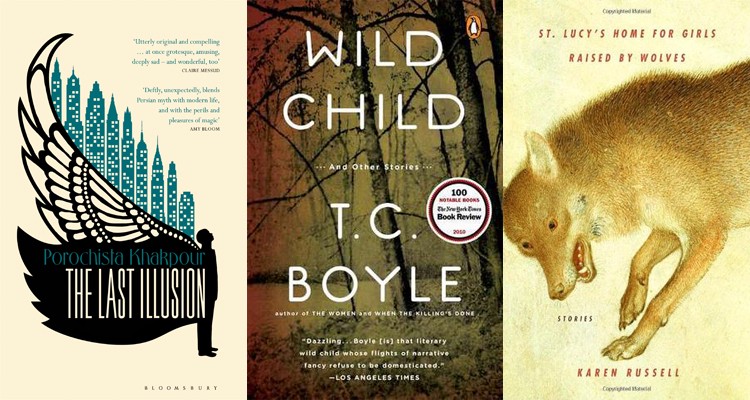
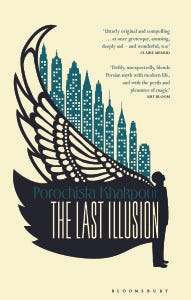
CONTEMPORARY: In Porochista Khakpour’s 2014 novel The Last Illusion, a 10-year-old Iranian boy named Zal is rescued from the birdcage in which his widowed mother kept him. He can only “chirp, tweet, coo, shriek” like the other birds around him. After moving to Manhattan with his adoptive father, a child psychologist fascinated by feral children, Zal learns to communicate and express emotion while secretly coping with his bird-like instincts. For instance, he furtively snacks on chocolate-covered grasshoppers. Zal sympathetically merges animal and man, as Khakpour combines a distinctive coming-of-age story with a harrowing 9/11 novel.

TC Boyle

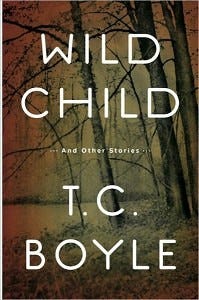
HISTORICAL: In the title story of T.C Boyle’s 2010 collection Wild Child, a barely clothed boy who cannot speak is discovered near a French forest and captured. Based on an actual historical episode from 1800 (as well as Francois Truffaut’s film of the same name), Boyle’s version describes the morbid fascination of the townspeople with this creature who “used only his bare hands and broken nails to dig in the sodden earth, like a dog.” The boy is taken up by a young doctor who names him Victor and tries to educate and civilize him. For Dr. Jean-Marc Itard, this child was a blank canvas to test Rousseau and Locke’s ideas about society’s effects on the individual. Boyle conveys Victor’s struggles with Itard and his regimen. Itard stops working with Victor and eventually stops visiting too, and we see how Victor has been abandoned a second time.

Lucy's home for girls raised by wolves

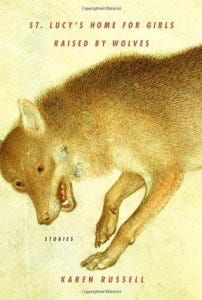
ABSURDIST: With “St. Lucy’s School for Girls Raised by Wolves,” the title story of Karen Russell’s 2006 collection, the isolated-child model gets flipped on its head with its focus on the feral child’s viewpoint instead of on the outside observer’s judgmental perspective. Narrated by Claudette (wolf name: “TRRR”), the story follows a group of girls who have been taken from the warm dens of their werewolf parents and transplanted into a corrective school that seeks to teach human behavior. From learning to wear squared-toed shoes to dancing awkwardly with their young-male counterparts, Russell uses both humor and pathos to show the unpleasant surprises of civilization.

fourth of july creek

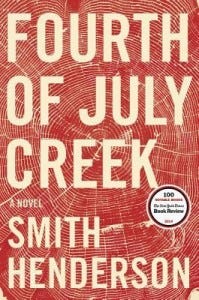
SEMI-FERAL: Over the decades, the connotation of “feral” has changed from the romanticized innocence of Mowgli and Tarzan in the noble jungle to a darker perception of a lack of affection and nurturing. In Smith Henderson’s Fourth of July Creek (2014), a case of childhood neglect and lack of socialization is central to the plot. Benjamin Pearl, the 11-year-old victim, was not raised by wolves but by a conspiracy-theorist father in the Montana backwoods. He is found by the book’s protagonist, a social services worker, to be suffering from disease, abuse, and isolation. Henderson’s unflinching and morally complicated story is about the wildness present not only in feral children but also in so-called civilized adults.

Station Eleven by Emily St. John Mandel Wins Arthur C. Clarke Award

Emily St. John Mandel’s Station Eleven has just won the 2015 Arthur C. Clarke Award, one of science fiction’s most prestigious awards. Mandel’s best-selling post-apocalyptic novel about a traveling theater company performing Shakespeare after a plague destroys most of humanity has been praised by both literary and genre critics and readers. The book was a finalist for the National Book Award, the PEN/Faulkner Award for Fiction, and the Baileys Women’s Prize for Fiction, but — as Mandel’s above tweet suggests — this is the first major prize the book has won. (You can read our review of Station Eleven here.)

A Night at the Museum: PEN Gala Celebrates Charlie Hebdo After Controversy

Despite the armed police officers outside of the American Museum of Natural History, the metal detectors, and the gaggle of eager press inside (a group that included me), the atmosphere of last night’s PEN gala was largely what one would expect from a black-tie event, congenial, formal, celebratory, and underscored by a strong allegiance to the cause: to defend freedom of expression, and to defend writers endangered because of their work.

The increased security measures were for the staff of Charlie Hebdo, the recipients of the Toni and James C. Goodale Freedom of Expression Courage Award, who continued to publish their satirical magazine after many of their colleagues were murdered on January 7, 2015. (Such security measures were not necessary when the Russian punk band Pussy Riot received the same award last year.) The award prompted six prominent writers including Francine Prose, Teju Cole, Michael Ondaatje, and Rachel Kushner to boycott the event, and for another six writers, including Art Spielgelman, Alison Bechdel, Azar Nafisi, and Neil Gaiman to step in to replace them as literary table hosts.

At the pre-gala reception, some writers I spoke to shied away from taking an on-the-record stance on the controversy, while others gave measured comments. I asked Alexander Chee, author of the forthcoming The Queen of the Night, what freedom of expression means to him. He said, “I’m not sure I want to answer that,” before continuing: “The hardest part about free speech is that it’s the most annoying right to defend, and so you always want to back away from it, and that’s when you lose it.” When I asked Porochista Khakpour, the Iranian-born author of The Last Illusion, the same question, she said, “I became an American in 2001, and so for me freedom of expression is a hard-won freedom because I don’t have it in my mother country. So for me, it’s precious on so many levels.”

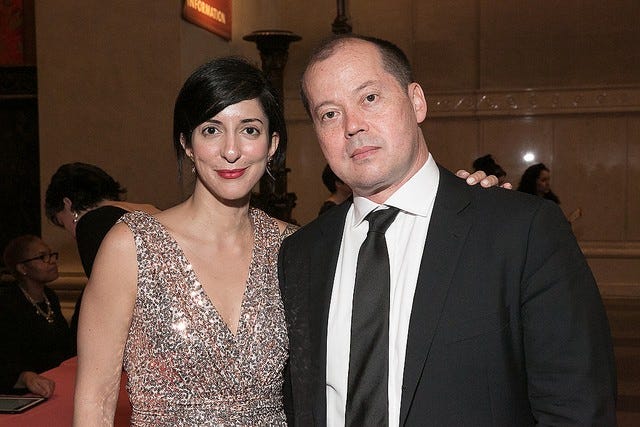
Porochista Khakpour and Alexander Chee (photo by Beowulf Sheehan)
Porochista Khakpour and Alexander Chee (photo by Beowulf Sheehan)

Alison Bechdel, explaining why she stepped in as last minute table host, said, “Art Spiegelman invited me and I thought, hell yeah, I’ll come.” She continued, “At that point I didn’t really know the whole scope of the controversy, and the more I read about it the more anxious I became, because all these writers I know and admire are on the protesting side. It’s been very confusing trying to sort this out, but I feel an allegiance with the cartoonists and I feel that I can separate the content of their work from the courage, which is indisputable, and I am very happy to be here.”

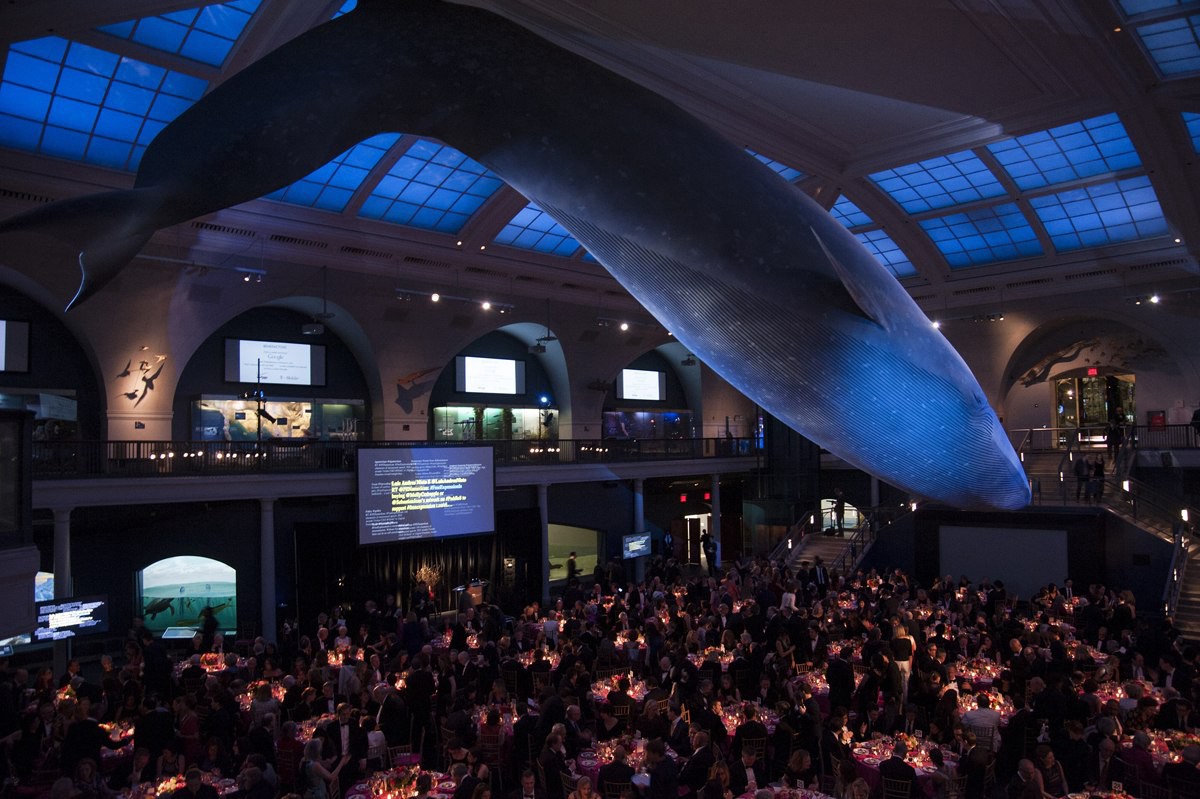
After cocktails, the guests moved into the Hall of Ocean Life to be seated at tables beneath the 21,000-pound fiberglass whale. They were welcomed by PEN President Andrew Solomon, who addressed “the elephant in the room, or in this case, the whale,” by saying, “we defend freedom of speech above it’s content.”

However, a person who hadn’t followed the debates leading up to the event might not have perceived an elephant at all. The reception for Girard Biard and Jean-Baptiste-Thoret, the editor-in-chief and film critique for Charlie Hebdo, was decidedly supportive and enthusiastic. As several major news outlets have already reported, they received a standing ovation.

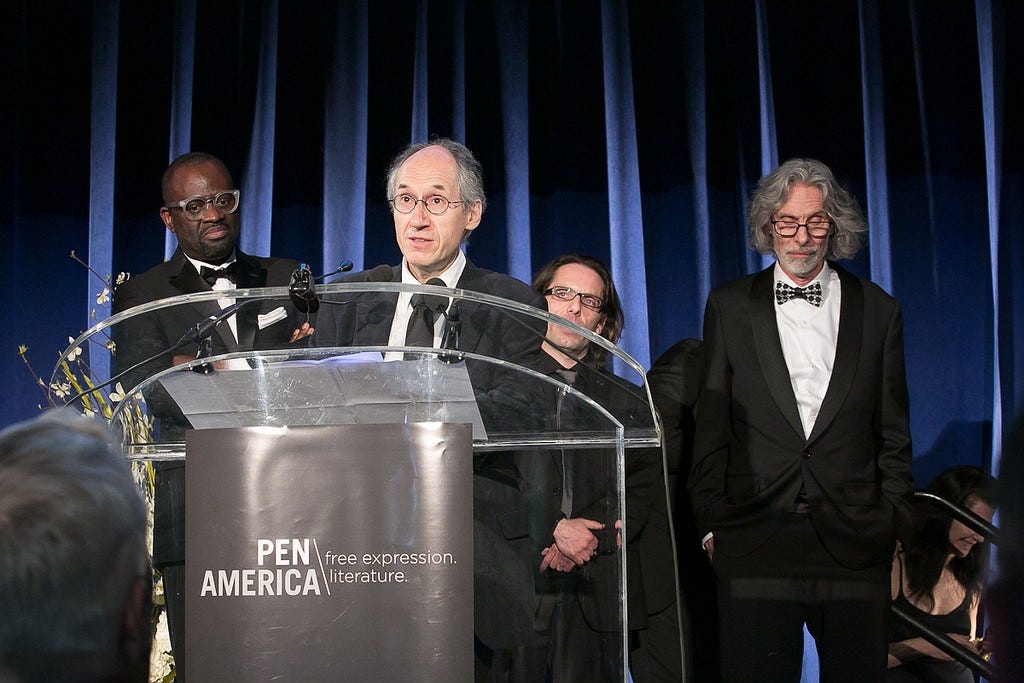
Alain Mabanckou, a French-Congolese author who also stepped in as a late table host, Dominique Sopo of SOS Racisme, Biard, and Thoret, all spoke of behalf of Charlie Hebdo. “Charlie Hebdo is absolutely against racism,” said Sopo, who spoke in French. “Democracy is free discussion among citizens, and so it cannot accept religious dogma.” Thoret concluded with the line that brought the crowd to its feet: “Being shocked is part of democratic debate; being shot is not.”

Alain Mabanckou, Gérard Biard, Jean-Baptiste Thoret, and Bob Mankoff (photo by Beowulf Sheehan)
Alain Mabanckou, Gérard Biard, Jean-Baptiste Thoret, and Bob Mankoff (photo by Beowulf Sheehan)

Though much of the attention leading up to the gala was focused on Charlie Hebdo, three other awards were presented last night. Markus Dohle, CEO of Penguin Random House, was the publisher honoree, playwright Tom Stoppard received the Allen Foundation Literary Service Award, and imprisoned Azerbaijani journalist Khadijah Ismayilova received the Barbra Goldsmith Freedom to Write Award. 35 of the 39 recipients of the Freedom to Write Award have been freed, and executive director of PEN Suzanne Nossel made a rousing call for Ismayilova to be the 36th.

Actress Glen Close presented the award to Tom Stoppard, sharing that he contributed this essential line to the 1996 children’s movie 101 Dalmatians: “You may have won the battle, but I won the wardrobe.” Tom Stoppard’s acceptance speech was particularly moving, and focused on the role of the artist in society. “The idea of society is not intelligible to me without the idea of the artist,” he said.

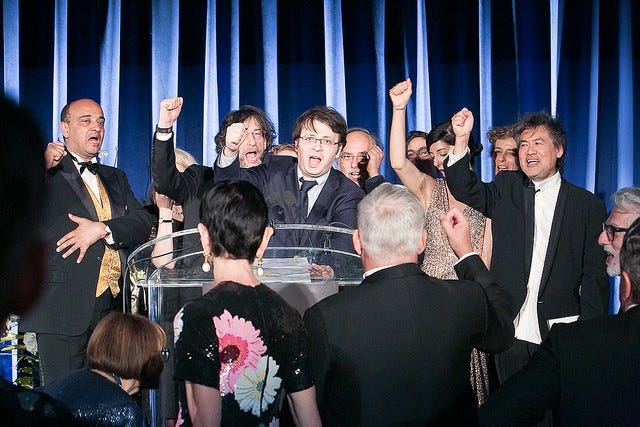
Emin Milli for Khadija Ismayilova, Art Spiegelman, Porochista Khakpour, Alison Bechdel, Roz Chast, Kwame Anthony Appiah, David Henry Hwang, and Neil Gaiman (photo by Beowulf Sheehan)
Emin Milli for Khadija Ismayilova, Art Spiegelman, Porochista Khakpour, Alison Bechdel, Roz Chast, Kwame Anthony Appiah, David Henry Hwang, and Neil Gaiman chant “Khadijah!” (photo by Beowulf Sheehan)

At the after party, I was at bit surprised by guests who seemed relieved that there had been no truly tense moments, since in my limited experience, it is rare for people in gowns and tuxes to abandoned decorum. This was a $1,250-a-plate event that raised 1.4 million dollars, after all.

The only barbed comment, and it may not have been intentionally so, came toward the end of the evening from Nossel, who welcomed the guests who had considered skipping the event by using the same phrase that was on the first cover of Charlie Hebdo published after the attacks: “All is forgiven.” (Nossel went on to emphasize a unified front by quoting from the song “Stand by Me,” which, incidentally, reminded me of Salman Rushdie quoting Field of Dreams at last year’s gala — “If they build it they will come,” he said of the PEN World Voices Festival — and Markus Dohle’s reference to The Little Prince in his speech this year. At an event about freedom of expression, the texts that informed these speeches are certainly enduring classics, but also some of the most non-controversial ever written, sung, or filmed.)

Bob Mankoff, cartoon editor for The New Yorker, was the only presenter of the evening to attempt humor, saying he didn’t think of skipping the gala because his tux was rented, “and bullet proof.”

Halimah Marcus is the Executive Director of Electric Literature and a member of PEN.

Finalists for the 2015 Best Translated Book Award

Everyone knows Americans don’t read enough translated literature, but sometimes it is hard to know where to start. Luckily, yesterday Three Percent announced the finalists for the 2015 Best Translated Book Award. The finalists include international sensation Elena Ferrante, a newly translated work by Julio Cortázar, and 5 Under 35 winner Valeria Luiselli. Check out the finalists, then go order one from your favorite indie bookstore:

FICTION

The Last Lover by Can Xue, translated from the Chinese by Annelise Finegan Wasmoen (China, Yale University Press)

The Author and Me by Éric Chevillard, translated from the French by Jordan Stump (France, Dalkey Archive Press)

Fantomas Versus the Multinational Vampires by Julio Cortázar, translated from the Spanish by David Kurnick (Argentina, Semiotext(e))

Pushkin Hills by Sergei Dovlatov, translated from the Russian by Katherine Dovlatov (Russia, Counterpoint Press)

Those Who Leave and Those Who Stay by Elena Ferrante, translated from the Italian by Ann Goldstein (Italy, Europa Editions)

Things Look Different in the Light by Medardo Fraile, translated from the Spanish by Margaret Jull Costa (Spain, Pushkin Press)

Harlequin’s Millions by Bohumil Hrabal, translated from the Czech by Stacey Knecht (Czech Republic, Archipelago Books)

The Woman Who Borrowed Memories by Tove Jansson, translated from the Swedish by Thomas Teal and Silvester Mazzarella (Finland, NYRB)

Faces in the Crowd by Valeria Luiselli, translated from the Spanish by Christina MacSweeney (Mexico, Coffee House Press)

La Grande by Juan José Saer, translated from the Spanish by Steve Dolph (Argentina, Open Letter Books)

POETRY

Diorama by Rocío Cerón, translated from the Spanish by Anna Rosenwong (Mexico, Phoeneme)

Lazy Suzie by Suzanne Doppelt, translated from the French by Cole Swensen (France, Litmus Press)

Where Are the Trees Going? by Vénus Khoury-Ghata, translated from the French by Marilyn Hacker (Lebanon, Curbstone)

Diana’s Tree by Alejandra Pizarnik, translated from the Spanish by Yvette Siegert (Argentina, Ugly Duckling)

Compleat Catalogue of Comedic Novelties by Lev Rubinstein, translated from the Russian by Philip Metres and Tatiana Tulchinsky (Russia, Ugly Duckling)

End of the City Map by Farhad Showghi, translated from the German by Rosmarie Waldrop (Germany, Burning Deck)

Goods

by Matthew Baker, recommended by Hayden’s Ferry Review
When my brother and I were children, our mother would take us to stores. My brother was a small blackhaired bucktoothed child who kept his hands clenched into fists. I was a small whitehaired bucktoothed child who kept his hands tucked into his underarms. We liked scowling. The game would begin when we entered the store. When we entered a store, we would choose things. My brother might choose a baseball. I might choose an umbrella. We would take them from their displays. As our mother led us through the store — loading cartons of eggs into our cart, boxes of tampons, bottles of pills — my brother would carry the baseball and I would carry the umbrella. We weren’t hoping our mother would buy us the baseball and the umbrella. Our mother couldn’t buy us the baseball and the umbrella. We knew that. That was the game. During our time in the store we would carry the baseball and the umbrella, and we would use them, like they were ours.

My brother would sniff the baseball. My brother would spit onto the baseball. My brother would pretend to pitch the baseball through an elderly shopper’s legs.

Meanwhile I would twirl the umbrella over my shoulder.

When we exited the store, we would leave our things there.

My brother and I liked when our mother took us to stores. We liked when our mother took us to stores because my brother and I didn’t own many things. We didn’t own a baseball. We didn’t own an umbrella. But when we were within a store’s walls, we could own a baseball and an umbrella. As customers of a store — as people who had the potential to buy any object within the store’s walls — we were given ownership, temporarily, of any object within that store. We could carry the objects with us wherever we wanted. They were ours.

My brother would kick his sneakers into our cart — clods of dirt scattering across the store’s floor — and yank rubber waders over his jeans and his socks.

I would wear unusual hats meant for the colorblind and the blind.

Once we owned skateboards.

Once we owned backpacks.

Once we owned calculators. My brother and I didn’t like calculators — even if our mother could have bought us calculators, we wouldn’t have wanted our mother to buy us calculators. We thought calculators were boring. But we had never owned calculators, so we carried calculators through a store, once — adding things, subtracting things, multiplying things until the calculators’ displays were maxed at nines — because we felt that that was an experience we needed to have. Felt that if we ever were to understand children who owned calculators, we ourselves would have to have owned calculators. Felt that if we ever were to understand anything about our country, first we would have to understand children who owned calculators.

My brother and I owned few things, when we weren’t within a store’s walls. In our neighborhood we were chased by children who owned calculators. The children would tackle us. The children would pin us against dumpsters. The children would use their calculators to tally our imaginary crimes.

Our mother would shout at us when we came home with split lips and bloody noses, like we had given them to each other. Our mother would sing while she scrubbed crusted yolk and crusted syrup from our plates, would use a wrist to tuck stray curls of hair behind her ear again, her hands dripping soapy water. Our mother would snore on the couch, an arm dangling onto the floor, fingernails glittering against the gray of the carpet. Our mother owned what nobody wanted: a job frying chicken, an apartment above a video store, a heart that didn’t like beating.

Once a fortuneteller had visited our school. The fortuneteller had told my brother and I that someday we would be hip hop superstars. The fortuneteller hadn’t been paid to visit our school — the fortuneteller had been trespassing. My brother and I hated hip hop. We didn’t know what we would become.

What we became were orphans. It didn’t matter if your heart was defective — what you were born with didn’t come with a warranty. Our mother owned a television. My brother and I were watching a television program with our mother. People we’d never met had been paid to have their laughs recorded — their laughs were replayed, again and again, during the television program. Our mother laughed with them. Then our mother’s heart stopped working.

My brother and I were older now. My brother was a spindly blackhaired bucktoothed youth who kept his sneakers heel-to-heel. I was a spindly whitehaired bucktoothed youth who kept his sneakers toe-to-toe. We liked blinking. They told us the name of the orphanage where they were taking us. Blink, blink, blink, was what we said.

My brother and I owned a few shirts, a few pairs of yellowed underwear, a jar of pencils whose bodies we had gnawed with our teeth. We took them with us. The youths at the orphanage said we weren’t actual orphans because of our father. The youths at the orphanage didn’t own calculators. A youth named Henri with reddish eyebrows and brownish hair lived at the orphanage. Henri sat on his cot, legs folded together, hands folded together, eyes closed. Henri’s from Pittsburgh, said the other youths. Henri’s from Wichita. Henri’s from Norfolk. Nobody knew where Henri was from. Henri never moved. Henri never spoke. Nobody knew if Henri ate. The others said Henri wasn’t an orphan. Said Henri had traveled to the orphanage in a trance. Said Henri’s parents were alive. Said someday Henri would emerge from his trance, and would speak the truth to us, and then would leave the orphanage.

Because Henri never moved, Henri was useful. My brother and I hid our jar of pencils between Henri’s legs, so nobody could take it. My brother and I owned the jar of pencils, but at the orphanage that was meaningless. Ownership is a belief, and without authorities to propagate a belief, the belief disappears. Beyond the orphanage’s walls, officers and judges and jailers propagated a belief in ownership. Within the orphanage’s walls, the belief wasn’t propagated. The orphanage was understaffed. Youths took whatever they wanted, whenever they wanted — like the orphanage was a store, where you could own whatever you could carry.

A minivan came to the orphanage. Our grandparents had come for us. We hadn’t known about grandparents. When my brother and I lifted Henri’s sweatshirt, our jar of pencils wasn’t between Henri’s legs. My brother slapped Henri’s face. I pinched Henri’s arm. We wanted Henri to speak the truth to us.

Our grandparents’ minivan smelled of toffees and mildew.

Our grandparents were as gaunt and as bony as we were.

Our grandparents had hated our mother, they said, but that didn’t mean they hated us.

My brother’s sneakers were heel-to-heel on the minivan’s floor. My brother’s hands were clenched into fists. My sneakers were toe-to-toe on the minivan’s floor. My hands were tucked into my underarms. Our grandparents’ radio sang hip hop.

My brother and I took a vow to invent our own language, so that those who overheard us couldn’t understand us.

My brother and I took a vow to visit the prison where our father was kept, so that we could ask our father a few questions.

My brother and I took a vow to dig our mother’s body from its grave, and to steal our mother’s body, and to burn our mother’s body to ashes, so that we could sprinkle the ashes in the stores where our mother had taken us.

Our grandparents lived in a neighborhood where all of the houses were alike, like the houses had been manufactured in a factory. Our grandparents’ house had yellow shutters, flower boxes, a basketball hoop cemented into the driveway. All of the houses had yellow shutters, flower boxes, basketball hoops cemented into their driveways. Our grandparents ate cereal with milk. Once a week our grandparents took us to a church where priests and choristers propagated a belief in a being who had created our universe. They said that what the being had created was good. They said that what we had created was bad. The church had yellow shutters.

At our grandparents’ house my brother and I owned things, but we didn’t like being there.

My brother and I went to stores.

Once stores had been the size of houses, but now stores were the size of neighborhoods. Leafy ferns grew along the stores’ walkways. Fountains hoarded copper and nickel coins the fountains couldn’t spend. Adults exercised together, walking the stores’ walkways in sweat suits and sweatbands. My brother and I spent whole days in the stores — playing videogames where the videogames were sold, napping on futons where the futons were sold, eating uneaten sandwiches we found on paper plates in the stores’ sunny plazas. We stalked the stores’ employees. We watered the stores’ ferns, if the ferns hadn’t been watered. We met other youths who preferred stores to their homes: Ana, a fatcheeked snubnosed youth who squirted her cardigans with the stores’ perfumes; Lucas, whose cheeks had been tattooed with the symbols of various currencies — ₩, ₵, ₦, ₭, ₡, ₲, ¥, ₮, $ — and who typed his manifestos on the stores’ computers; Gom and Benj, who played the stores’ guitars and who read the stores’ comics and who once threw a kegger in a store’s changing rooms.

Sometimes our grandparents would come to the stores — to buy themselves things, to buy us things. If our grandparents saw us, where my brother and I were standing in the wind of a row of pivoting fans, our grandparents would say hello.

We saw them at stores as often as we saw them at home.

Our grandparents kept their cupboards stocked with jars of jam, boxes of cookies, sacks of grapefruits and oranges, but my brother and I preferred what we ate at stores.

Our grandparents bought us paisley shirts, flannel shirts, brandname sweatshirts, but my brother and I didn’t wear them. We wore the same thing from our closets day after day — black jeans, black sweatshirts — then changed into the stores’ clothing once we were at the stores.

At our grandparents’ house we owned things, but at the stores we could own anything. If our grandparents bought us a paisley shirt, then we owned a paisley shirt — but at the stores we owned all paisley shirts. If our grandparents bought us the newest album by a certain band, then we owned that newest album by that certain band — but at the stores we owned all albums by that band. Owned all albums by any band. Owned multiple copies of every album. Perhaps that, more than anything, was why we preferred the stores: at the stores, my brother and I were unaffected by loss. We felt nothing, when something broke, because a hundred replacements were waiting, always, to replace what had been broken.

Once my brother and I took shovels from our grandparents’ garage and rode a bus into the city, through the billboards, to the graveyard where our mother was buried. We carried our shovels through the graveyard, reading the names on the graves, searching for the name of our mother. Water dripped from the trees. Pigeons cooed at other pigeons along the graveyard’s pathways. Headlights led taillights through the streets beyond the graveyard’s fences. Our mother’s name wasn’t there. Our mother wasn’t buried where our mother was buried. We sat on somebody’s grave. A whiskery skinsagging beggar came into the graveyard carrying a camouflage backpack. The beggar was shouting at something imaginary. The beggar was peeling the white from his fingernails with a knife. I’m going to destroy myself, the beggar shouted. You use me, you abuse me, you make me feel so cheap, the beggar shouted. I’m capitalism, I’m a market, the beggar shouted. The beggar stopped for a while and convulsed under a tree. Blink, said my brother. Blink, I said. The beggar kept coming. The beggar stopped where we were sitting. The beggar’s fingers were twitching. The beggar’s nostrils were twitching. The beggar asked us what we wanted. We told the beggar we wanted our mother’s body. The beggar told us that someday my brother and I would be supereminent physicists. Supereminent? my brother said. Physicists? I said. The beggar shouted the names of planets at us. The beggar shouted the names of chemicals at us. The beggar asked us for money. A droopeyed baldheaded beggar came into the graveyard carrying a polkadotted umbrella. I thought I lost you, said the beggar with the polkadotted umbrella. I was talking to my daughters, said the beggar with the camouflage backpack. I’m everywhere. You can’t lose me. The beggars bowed to us. The beggars trudged arm-in-arm together toward the graveyard’s gate. The beggar with the camouflage backpack shouted at the beggar with the polkadotted umbrella. This is my graveyard. This is my graveyard, and those are my streets, and the bridges and the undersides of the bridges and the empty alleyways, all of them, all of them, those are mine. The beggar with the polkadotted umbrella hushed the beggar with the camouflage backpack. The beggars crossed the street. My brother and I rode a bus to our grandparents’ neighborhood.

My brother briefly was bedridden with the flu.

I was suspended from school, briefly, for dissecting a fetal pig in the biology lab.

(I wasn’t taking biology.)

We kept stalking the stores’ employees.

Even with love, we preferred what we found in stores.

My brother had a crush on a plump mustached cashier who wore plastic watches with different superheroes on their faces and whose nametag said Ramon Vilkitsky III.

We would follow him through the stores’ walkways (as Ramon Vilkitsky III unknotted his uniform’s tie), through the stores’ entryway (as Ramon Vilkitsky III zipped himself into his jacket), through the trucks and the minivans and the sedans in the stores’ potholed lots (weaving through the cars, my brother’s hands clenched into fists, my hands tucked into my underarms, as Ramon Vilkitsky III shook his keys from his jacket), and stand and stare as Ramon Vilkitsky III lowered himself into a bumperless sedan and sputtered away from us.

When Ramon Vilkitsky III was working, my brother and I would watch him from within racks of sweaters.

My crush was on a lipringed buzzheaded shelfstocker who wore fishnet stockings with her uniform and whose nametag’s name had been scribbled black. She caught my brother and I watching her from within a display of umbrellas. She had been pricetagging plastic clocks. Why are you following me, she said. Because I love you, I said. He loves me too? she said. I said, He loves somebody named Ramon.

She said that she was dating somebody but that when she was working didn’t count. She pricetagged my brother’s face. She told me to meet her in a changing room.

In the changing room she made me feel like not a person but a thing.

We never kissed, when we would meet in the changing rooms.

She would unzip her uniform’s shorts. She would peel her fishnet stockings to her knees. She would spit in my hair. She would face away from me, toward the mirror, so that she could watch herself pounding me.

What’s your name, I said.

Don’t ask me that, she said.

I knew about sex now, but I still didn’t know about kissing.

Beyond the stores’ walls, bankers and cashiers propagated a belief that money wasn’t meaningless. Teachers and provosts propagated a belief that grades weren’t meaningless. Advertisers and fashionistas propagated a belief that skirt meant woman, that tie meant man.

Once our grandparents drove my brother and me to the prison where our father was kept. Our grandparents said our father was a monster. They had warned our mother, they said, but our mother had ignored them. Now they were warning us. The prison’s lot was like the stores’ lots — trucks and minivans and sedans. My brother and I whispered about Ramon. Our grandparents muttered about our father. In the prison we sat in an empty room. When you visited a prisoner you could have a contact visit or a noncontact visit. My brother and I wanted a contact visit. We couldn’t have it. A few days earlier our father had been caught under his cot with a hammer chipping a tunnel through the floor. Our father was restricted to noncontact visits for a year. His tunnel had been cemented. His tunnel hadn’t been a tunnel even. His tunnel had been a hole. It hadn’t been able to fit anything more than our father’s head — that’s how far our father had gotten. A noncontact visit meant we would meet our father face-to-face but separated by a pane of glass. They brought him into an empty room connected to our empty room. Our father was a freckly grayhaired bucktoothed adult with childsized hands. He wore an orange jumpsuit that said he didn’t own it. It said the prison owned it. It said the prison owned him. Our father put a black telephone to his face. My brother and I put black telephones to our faces. Our grandparents sat on chairs behind us muttering about our father. Our father stared at us. Don’t you have anything to say? he said. Blink, we said. This is it, here I am, this is what made you, here’s the other half of your genes, he said. Blink, we said. If your mother were alive she wouldn’t want you to be here, he said. Blink, we said. Aren’t you going to say anything? he said. My brother was nudging me to say something. I was pinching my brother to say something. More nudging. More pinching. We said something. We asked our father why he did what he did. You mean the tunnel? he said. Before that, we said. The same reason anybody in here or anybody out there do what they do, did what they did, he said. I wanted money. More things. Better things. Different things. More nudging. More pinching. We asked him what it was like in there. Not what I wanted, he said. Here I can’t have anything. I buy some magazines from my friend — they take them away from me. I buy some pills from my friend — they take them away from me. I buy a hammer from my friend — they take it away from me. Here nobody can have anything. All those empty rooms, it makes you anxious, jittery, demented, you understand? More nudging. More pinching. We asked him what we should know. You should know that your great-grandfather had a heart attack, and your great-uncle had a heart attack, and your uncle had a heart attack, so you’ll probably have heart attacks, I’ll probably have a heart attack, he said. You should know that your great-uncle suffered from pyromania, and your uncle suffered from pyromania, so you’ll probably suffer from pyromania, he said. You should know that your great-grandmother was bilingual, so you may be bilingual, he said. We told him we weren’t bilingual. They came for our father, but our father kept talking. They made our father stand, but our father kept talking. You should know that you have different fathers, he said, and that I’m neither of those fathers. And isn’t that how it is, for all of us? Aren’t mothers always the same, but fathers are always changing, are always different moment to moment? Even now, even here, can’t you see it happening? he said, and then they took him away and our grandparents drove us home.

My brother was hospitalized briefly with appendicitis.

I served on a jury, briefly, for a kidnapping trial.

(Guilty, the jury said.)

After that my brother and I began sneaking things into stores. We never talked about doing it, but we did it anyway. The next time we went to the stores, we took our grandparents’ bathrobes. The bathrobes smelled of sour breath and burnt coffee. The bathrobes were stiff with years of dried bathwater and dried sweat. We carried the bathrobes into a store. We found where the store’s bathrobes were sold. We hung our grandparents’ bathrobes there with the others. Then we went and napped on the store’s futons.

The next time we took our grandparents’ doormat.

The next time we took paintings from our grandparents’ hallways, took hangers from our grandparents’ closets, took spatulas and ladles and whisks from our grandparents’ kitchen.

We took price tags from other things, stuck them onto our grandparents’.

We didn’t know why we were doing it.

Ramon Vilkitsky III kissed my brother under the stores’ glittering chandeliers.

My crush was fired, but I found other employees to love — for every crush the stores fired, the stores hired a new employee to replace her.

Where our grandparents’ sofa had stood, the floor was marked with scuffs. Where our grandparents’ coats had hung, our grandparents’ knobs were empty. Where our grandparents’ paintings had hung, the wallpaper was brighter, in squares, where it hadn’t been bleached by the sun. Our grandparents might have been upset about their missing things, but our grandparents’ brains had broken years before. Our grandparents wandered their house, arguing about things that hadn’t happened, rearranging their cans of pears.

What do we do? my brother said. I don’t know, I said. My brother and I were older now. My brother was a bulky blackhaired bucktoothed adult who kept plastic glasses in his hair. I was a bulky whitehaired bucktoothed adult who kept plastic glasses on his face. We liked tugging our earlobes. We’ll take them with us, my brother said. We can’t take them with us, I said.

We didn’t live in our grandparents’ house anymore — we lived in the stores. Once stores had been the size of neighborhoods, but now stores were the size of cities. Lightpoles lit the stores’ avenues. Monorails hummed from station to station. Flags fluttered from the balconies of the stores’ hotels. Others, now, were playing our game. We lived together, in the stores, never leaving, marking the change of the seasons by the changing decorations. When snowflakes and reindeer were hung from the stores’ ceilings, Ramon Vilkitsky III and my brother celebrated their anniversary. Ramon Vilkitsky III and my brother had been married in the stores, in a sunny plaza, wearing the stores’ tuxedos.

Once my brother and I were aboard one of the stores’ yachts, where the yachts were sold, when an employee began shouting at us from the floor. We were wearing the stores’ newest swimsuits, reading a pile of the stores’ newest magazines. Hey, you, the employee shouted, his brownish hair trembling, his reddish beard bobbing with each of the words he shouted. Blink, my brother said. Blink, I said. Come down from there, the employee shouted. Onepiece swimsuits were fashionable that season. My brother’s swimsuit was white with black stripes. My swimsuit was black with white stripes. We stood on the floor with the employee among the stores’ yachts. The employee stared at our swimsuits. The employee was muttering something into his headset. The employee stopped muttering. We tugged our earlobes. I know you, the employee said. Do you remember me? the employee said. We lived together at the orphanage, the employee said. Blink, we said. Blink, blink, blink, we said. Henri? we said. Yes, it’s me, I’m afraid, Henri said, and I’d like to say that I’m sorry, because once I stole something from you. I would have these visions, sometimes for days, sometimes for weeks, and once, between visions, I felt someone doing something to my body, which wasn’t unusual, because the others at the orphanage were often doing things to me — knotting my arms together, greasing my hair with butter, carrying me around from floor to floor — but when I peeked, it was you, both of you, putting something between my legs. And I felt like it was an offering, like you were my first followers, because in those days I dreamed of becoming a prophet, of starting a new religion, or a new sect of an old religion, or a new order of an old sect of an old religion, so while you and the others at the orphanage slept, I took the pencils, and I hid the pencils, and I prayed to them sometimes, but what happened was that later, after the visions had stopped, and wouldn’t come, and wouldn’t come, and my dreams of becoming a prophet had become nightmares of becoming a nobody, a nothing, a nameless commonplace employee, which is what I have become, but, anyway, what happened was that later, as I was eating cereal with the other orphans, spooning it into my mouth, feeling queasy, feeling depressed, obsessing over my nightmares, one of the other orphans found the pencils where I had hidden them, and the orphans began talking about you, the two of you, and how you had been looking for the pencils, but hadn’t found them, and that’s when I understood that it hadn’t been an offering, what you had given me — understood that I had stolen your pencils from you. And then I felt even more queasy, and felt even more depressed, because I hadn’t meant to steal from you, and I was sorry that I had, but I couldn’t tell you that, because you didn’t live at the orphanage anymore. But don’t you think that’s why my visions were taken from me? Because I had become dishonest? Because I had taken what wasn’t mine?

Blink, we said.

So anyway I’m sorry, and although I carried the pencils with me for years and years, hoping to find you, I don’t have the pencils anymore, they were lost in a fire, Henri said. My brother’s hands were clenched into fists. My hands were tucked into my underarms. Somewhere the stores’ monorail was beeping. My brother and I brought Henri onto the yacht. We told Henri we had all of the pencils, now, that we could want. We told Henri it was better to be a nobody than a somebody. We asked Henri if he had ever seen either of us in his visions. Henri gripped the yacht’s rail. Henri’s wrists were marked with nicks and cuts. Henri’s undereyes were puffy. Once, yes, one of the last visions I ever had, Henri said. I saw that one day you would become notorious revolutionaries — that you would be executed for treason, but that after your deaths the people would sing your names, would carry flags of your faces — that you would be remembered as much for your good as for your bad. And were we buried with our mother? we said. Yes, Henri said. And were you part of our revolution? we said. Yes, yes, yes, Henri said, I was carrying one of your flags. And my brother and I stood on the yacht with Henri and watched people moving through the stores: watched people carrying blankets into unzipped tents, where the stores’ tents were sold; watched people emerging from the stores’ bathrooms, wiping their faces with the stores’ towels; watched people visiting the unsold hamsters, the unsold parrots; watched people kicking balls along the stores’ avenues; watched people stepping into pairs of the stores’ newest boots. And from where we stood it was impossible to tell the stores’ shoppers from the stores’ tenants. We almost could feel the stores’ walls expanding. Could feel the world beyond them shrinking. Could feel it disappearing more and more.

“Connections and luck do matter”: The Blunt Instrument on MFAs, Networking, and Ornamental Style.

The Blunt Instrument is a monthly advice column for writers. If you need tough advice for a writing problem, send your question to blunt@electricliterature.com.

Hi there, Blunt Instrument. I need your rough touch in my life. Here are my questions:

* Is it possible for an over-30, rural, broke, non-MFA’d person living far away from any big, literary city to have a successful writing career in 2015?

* What is so magical about an MFA? Does it provide networking/connections opportunities that are necessary to getting ahead?
Is it honestly who you know and not what you do that gets your foot in the door (in literary magazines and publishers)?

* Everyone always denies, denies, denies that any of this matters. But the evidence seems to contradict these denials, and I wish someone would just admit that these things matter — sometimes more than talent.

Thanks for reading.

Sincerely,
Over-30, Non-MFA’d Country Bumpkin

Dear Bumpkin,

People who deny that connections and luck matter to literary success probably have some measure of literary success themselves, and are therefore reluctant to admit — even to themselves — that anything other than talent might be involved. It’s a lie. Connections and luck do matter. Still, you absolutely can have a successful writing career if you’re over 30, rural, broke, and non-MFA’d, and I’ll say more on this later, but first, let’s talk about what’s so “magical” about an MFA:

* Getting an MFA puts you in a position to make connections that are conducive, if not strictly necessary, to getting ahead. This plays out in a number of ways, most of which are not particularly icky or nepotistic. For example:

a) You form a community of writer friends who you feel kinship with; you read and edit each other’s work; you encourage and challenge each other; you keep each other busy and honest; and, to some extent, you feel competitive with each other, which drives all of you to accomplish more. Some among you may even found magazines or become editors at existing journals and presses, and subsequently publish and promote each other.

b) You seek out mentorship. Working with a teacher you admire can be hugely influential and occasionally lead to opportunities you wouldn’t otherwise have.

* MFA programs also give writers more access to honest readership, so it’s a good way to find out if you’re writing stuff that has no market (i.e. nobody wants to read it). The relevant question here is not “Can creative writing be taught?” but “Can creative writing be learned?” I’ve been in both teacher and student roles, and it’s obvious to me that writers can get better, with guidance. If you don’t believe your writing can be improved, this may not work for you.

* Giving yourself two to three years of focused writing time (whether or not it is funded) can have transformative effects; it’s permissive and legitimizing and may help writers understand both how seriously they should be taking their art and how much work is involved to do it well. In other words, for many getting an MFA just redoubles their commitment to writing.

* Economically, some correlation is probably involved: If you can afford to get an MFA, then you can afford to play the game in general. Writing and reading and doing the rest of the administrative work required to get published take up a lot of time, most of which is uncompensated, especially at first.

You can do all of this (find a community, carve out dedicated writing time, etc.) without getting an MFA, but an MFA is a structured system that makes these things easier to achieve in a short time period. In my opinion, that’s what you’re paying for, more than the largely useless degree. And the connections in particular can be very helpful when it comes to publishing. Many of my early poems were published by people I met at readings. My first book was published by a press founded by a few of my MFA classmates. Things like this helped me get from zero visibility to some visibility, so that I could start to be known on my own terms.

But now I want to get to my real answer, which is this: Regardless of what advantages you do or don’t have, a successful writing career takes much more work than you expect. Even the lucky, rich, beautiful 23-year-olds in New York are very likely working harder than you think. When anyone achieves writing “fame,” they appear to have come out of nowhere, but that’s how it works by design: you can’t see all the hustling people are doing before they become famous because they’re not famous yet!

If you want to get published, do everything you can to mimic those MFA advantages in your no-MFA life. Read and write like you’re paying for it (you are). Get better; no matter where you’re starting from, you can be better, and no matter how connected you are, being a better writer helps. (Remember that “talent” doesn’t exist in a vacuum. You need an audience to judge your talent, and it will be judged differently by different audiences.) Find a community (online is almost as good!). Consider taking classes — there are lower-cost, lower-commitment options outside MFAs. Figure out your market — where would you publish if you could? (Start way, way below The New Yorker.) But most importantly, get perspective on what it takes to be a successful writer. Published writers may be luckier than you, but they’re probably also working harder.

Sincerely,

The Blunt Instrument

Hello,

I am glad you launched this advice column. Even though I am not much of a writer, I frequently dabble in the art after intense periods of inspiration, and I’m an avid reader of the classics. It appears to me that most people prefer easy, simple writing that doesn’t require the skill, patience, and appreciation needed to get through what I call ‘ornamental’ writing, which is literary prose with grand form and language. As a writer, should you appeal to people’s tastes and write simple prose — as some writers, such as Stephen King, preach — or should you aim for the beauty of form and language following in the trails of our great writers no matter what people think?!

Best regards,

rana faraj

Dear RF,

First let me establish that you’re presenting something of a false choice. As Electric Lit editor Lincoln Michel has noted, there is no one ideal reader. We need simple books for readers who like simple books and ornamental books for readers who like ornamental books. So the question is not what should writers do in general, but what should you, specifically, do when you write?

The answer to this second question depends somewhat on your intended audience. If you want to reach the widest possible audience, it may serve your goals to write simple prose, which tends to foreground things like plot and character (in fiction) and conveyance of information (in nonfiction) over the texture of the language itself. Most — but not all, of course — bestsellers follow the Stephen King model. (It’s worth noting that “simple” prose may be easier to read, but it’s not necessarily easy to write; we have to learn how to write with clarity and concision. Further, simple prose can be used to communicate complex ideas.) But I gather from your letter that simple prose is not the prose that speaks to you; you’re interested in “grand form” and “the beauty of language.”

The thing is, style isn’t something you apply after the fact, like an Instagram filter. The style comes out of the writing. So I’ll turn it around on you. What kind of prose do you want to write? There’s a contradiction in your self-description as someone who only “dabbles” in writing and yet experiences “intense periods of inspiration.” Intensity and dabbling don’t really go together. If you want to find your style, look to what you do when you’re intensely inspired, not what you do when you dabble.

Best of luck,

The Blunt Instrument

Lev Grossman’s The Magicians Picked Up By SyFy Channel

Best-selling author (and Electric Literature board member!) Lev Grossman is going to have his work hit the small screen. According to Deadline, the SyFy channel just picked up his popular Magicians trilogy for a 12-episode series. John McNamara (Prime Suspect) and Sera Gamble (Supernatural) wrote the pilot script and will also act as showrunners. The show will star Jason Ralph along with Stella Maeve, Hale Appleman, Arjun Gupta, and Summer Bishil.

Sometimes called Harry Potter for adults — although much of it actually homages/parodies Narnia — The Magicians trilogy follows a group of twenty-something wizards who enroll in a magician’s school in upstate New York called Brakebills College for Magical Pedagogy.

SyFy president Dave Howe said:

The Magicians pilot beautifully delivers a world filled with wonder, fantasy and intrigue. We can’t wait to delve deeper into the lives of Quentin and his college friends, as they struggle with the enormity of their burgeoning powers — and unleash them upon the world.

Congrats Lev!

Spiegelman, Bechdel, and Gaiman Among Those Replacing PEN 6 After Charlie Hebdo Protest

For the last week, the literary world has been embroiled in an at times bitter, at times illuminating controversy over the PEN America Center’s decision to give Charlie Hebdo a “courage” award at tomorrow’s annual gala. It started with six of the table hosts for the swanky gala publicly removing themselves. The six authors were Teju Cole, Rachel Kushner, Michael Ondaatje, Francine Prose, Peter Carey, and Taiye Selasi. (Boris Kachka has a good article on how this whole protest went down if you want to know more.) Many more PEN members (and non-members), including Junot Diaz and Lorrie Moore, signed a protest letter.

Although those names include many heavy-weights, they have been opposed by equally celebrated writers defending the award. And this weekend, the six withdrawing table hosts were replaced by Art Spiegelman, Alison Bechdel, Azar Nafisi, Alain Mabanckou, George Packer, and Neil Gaiman. (Spiegelman, Bechdel, and Gaiman all have comic backgrounds; Nafisi is Iranian and lived in Europe; Mabanckou is a Congolese-French novelist.)

Gaiman said this to the Times:

The Charlie Hebdo PEN award is for courage. The courage to work after the 2011 firebombing of the offices, the courage to put out their magazine in the face of murder. If we cannot applaud that, then we might as well go home…I’ll be proud to host a table on Tuesday night.

British-Iranian journalist Christiane Amanpour also weighed in this weekend on the award:

I am sure I was among many people who were puzzled and dismayed by the 6 PEN writers who have pulled out of next week’s Gala because of the award going to Charlie Hebdo. I am very glad to know that American PEN is standing up for what’s right by going ahead with the award, and as such I am glad I am still able to make available my video-taped contribution to the Gala, on behalf of one of our jailed colleagues, Khadija Ismayilova of Azarbaijan.

Amanpour went on to cite a Le Monde study showing that Charlie Hebdo did not focus on Islam nearly as much as many North Americans think.

Charlie Hebdo

(The above chart shows the targets of Charlie Hebdo covers over the last 10 years. Of 523 covers, only 38 targeted religion and of those 7 targeted Islam.)

Of course, only having 1% of your coverage be about Islam doesn’t mean that those handful of cartoons aren’t problematic, offensive, or racist.

In general, what has been frustrating about the Charlie Hebdo discussion is that most North Americans simply do not have the proper context to understand the cartoons whether they are praising or condemning them. Satire depends on cultural and political contexts and references, and different countries develop different visual languages for comics. (And most of the people protesting or think piecing seem to openly admit never having read an issue of Charlie Hebdo anyway.) Far too many people seem willing to either celebrate or damn Charlie Hebdo without even bothering to translate the few cartoons they’ve seen.

The PEN gala is tomorrow, and there are rumors of other protests planned, so there will likely be more think piecing and commentary served up this week.