Becoming Object: The Argonauts by Maggie Nelson

I. A Death

Maggie Nelson’s first book of nonfiction begins with a perfectly balanced sentence: “She had been shot once in the front and once in the back of the head.” Within that book — Jane: A Murder (2005) — the subject (she) and object (the gunshot head) set the coordinates. Jane: a wildly intelligent, fiercely independent grad school student. Jane: shot, strangled, and left shoeless in a backroad cemetery.

Written largely in unrhymed verse, Jane: A Murder juxtaposes its couplets and tercets amid a plotting of journal entries, personal letters, conversational snippets, news reports, and philosophical quotes, conjuring a vivid image of Nelson’s maternal aunt, Jane, a kindred spirit murdered by a serial killer four years before the author was born.

“The spectre of our eventual ‘becoming object’ — of our (live) flesh one day turning into (dead) meat — is a shadow that accompanies us throughout our lives,” Nelson writes in her ranging critical study, The Art of Cruelty (2011). The thud of that eventuality is far from the gradient transformation implied by the phrase ‘one day turning,’ and in the chapter “A Situation Of Meat,” Nelson reels from the crucifixions of Francis Bacon to the ruminations of Simone Weil to Kafka’s “In The Penal Colony,” staring flush at the brutal instantaneity wherein a sentient, subjective being becomes unminded, a penetrable sack of tissue flesh and flab.

“Sunlight shot around each black rind,” Nelson writes in Jane, imagining the twin bullet holes tunneled through her aunt’s head. “So that a long shaft of pale light cast out from the center of her forehead, and another shaft streamed behind her.”

The precarious nature of life isn’t merely Nelson’s most common subject matter; as she balances poetry with theory with observation with disclosure — transforming an absence into a presence — the moment of “becoming object” also represents the author’s most striking literary technique. Time and again Nelson yanks her readers from the crisply-articulated, rarified air of the text and thrusts them eye-level with scenes of bodyfail, bodywaste, or bodies mid-fuck, deploying these animal immediacies as a jolting memento mori.

II. Wittgenstein’s Mistress

“Before we met, I had spent a lifetime devoted to Wittgenstein’s idea that the inexpressible is contained — inexpressibly! — in the expressed.” So begins the second paragraph of Nelson’s latest book, The Argonauts. There may be some hyperbole shading this statement (a lifetime? devoted? really?) and I’m not entirely sure what it means (if the inexpressible is conveyed via the expressed, does it remain inexpressible? and if this inexpressible is not conveyed, how do we know it was there?); still, the philosopher’s shadow looms over The Argonauts as Nelson bypasses the sprawling critiques of The Art Of Cruelty and returns to the propositional form of her most well-known book, Bluets (2009).

Two-timing Wittgenstein, the plural subject of “before we met” is formed by artist Harry Dodge, the partner Nelson introduces in the book’s opening paragraph: “the words I love you come tumbling out of my mouth in an incantation the first time you fuck me in the ass, my face smashed against the cement floor of your dank and charming bachelor pad. You had Molloy by your bedside and a stack of cocks in a shadowy unused shower stall.”

Wittgenstein. Malloy. A disembodied stack of cocks around the bend while cheek and nose are meat-smashed to floor, upended in rectal penetration.

“You’re just a hole, letting me fill you up,” Dodge tells her, whispering sweet nothings.

While Nelson continues to balance headier flights with bits in which she toes the brink of objecthood, The Argonauts locates its center not around thingness or the shadow of death or even in the limitations of language (though the text sheds light on each, while also digressing on the work of Eve Kosofsky Sedgwick, the lives of George and Mary Oppen, homonormativity, sobriety, and ‘performative intimacy’). The book is, at heart, about the ongoing creation of family. Standard fare? Complicating the situation of meat in The Argonauts, Dodge prefers to let body and mind exist outside the traditional male-female binary. Plus, Dodge has a son from a prior relationship. Plus, Dodge and Nelson have a young child of their own.

2.033 Form is the possibility of structure.

4.1252 I call a series that is ordered by an internal relation a series of forms.

(From The Tractatus Logico-Philosophicus, by Ludwig Wittgenstein)

Midway through The Argonauts, Nelson compares her “more ‘personal’ writing” to the late ‘70’s Atari game Breakout (a sort of inverse-Tetrus, with the player manipulating a bouncing ball and pong-paddle to gouge and gouge through layers of colored brick): “The breakout is a thrill because of all the triangulation, all the monotony, all the effort, all the obstruction, all the shapes and sounds that were its predecessor. I need those colored bricks to chip away at, because the eating into them makes form. And then I need the occasional jailbreak, my hypomanic dot riding the sky.”

This metaphorical perspective is interesting because it so completely counters my own reading of Nelson. Rather than hammering away at a solid mass, I see her constellating in open space — using the internal logic of disparate connections to create form and suggest structure — with the sporadic, hot-blooded “jailbreak” bringing her feet firmly back to earth (or, perhaps slightly elevated, depending).

In an unspoken nod to Wittgenstein, among The Argonauts’ triangulations and repetitions, Nelson returns to the common textile net as a recurring motif: as the author and I approach her personal writing from opposite directions, I cannot say for sure who’s seeing the knots and who’s seeing the holes.

III. The One That Got Away

Nelson begins Bluets with a supposition: assume the author has fallen in love with the color blue. In numbered points, she then traces her collected shades — found and given mementos, musings on the history of indigo and ultramarine, the blues of Joni Mitchell, Billie Holliday, and Young Werther — creating a deep-hued outline that expresses the shape of the inexpressible: a broken heart. Crushing loss produces the gravity holding all the divergent blues in place, and from this absence Nelson conveys a moving presence.

“Emily retained her ghosts for years,” Nelson writes in Jane: A Murder, referring to her own older sister. “After our father died it became more acute — even as a teenager she dragged around stuffed animals, T-shirts, pillowcases, anything that smelled like the people she loved. Any object could become host to the scent of the dead or the invisible.”

Retaining talismans and ghosts of her own, Nelson directly addresses her bygone lover in Bluets as a second-person “you,” spiking the more abstract and commonplace propositions with flashes of raw sex, carnal imagery that carries the force of a slap from an unseen dimension. Stinging and abrupt, these couplings are negations, with Nelson — bereft — becoming object.

[Spoiler Alert: re-reading Bluets with an eye-trained toward those moments Nelson compels the mind/meat switcheroo is a very good way to spoil a re-reading of Bluets.]

“It was around this time that I first had the thought: we fuck well because he is a passive top and I am an active bottom,” she writes.

“I am interested in having three orifices stuffed full of thick, veiny cock in the most unforgiving of poses and light,” she writes.

“Last night I wept in a way I haven’t wept for some time,” she writes. “I wept until I aged myself.”

“Was it really some other person I was so anxious to discover, when I did all that looking,” says Kate, the woman left to live alone on earth in David Markson’s Wittgenstein’s Mistress. “Or was it only my own solitude I could not abide?”

IV. Union

Harry Dodge makes films, makes sculptures, makes art out of found household items. Where Nelson announces her commitment to Wittgenstein, Dodge counters with a long-held belief that language is fundamentally inadequate, believing words are “corrosive to all that is good, all that is real, all that is flow.” Between visual artist and writer — in love, wedded — this represents a philosophical difference of opinion.

From this ideological split, however, a prosaic complication arises — Dodge performs in a designated creative space, afterward returning to the private realm. Except this private realm happens to be where Nelson lifts the curtain and performs. Given their contradictory set of boundaries, Dodge compares the relationship with Nelson to “an epileptic with a pacemaker being married to a strobe light artist.”

Reading an early draft of The Argonauts, Dodge has neither a seizure nor a coronary — in response to the work, Nelson describes Dodge’s mood as one of “quiet ire.” Nelson recognizes that via her writing she has produced a “terrible feeling” in her spouse, and the pair then “go through the draft page by page, mechanical pencils in hand.”

The Argonauts is a book of bodies in transformation — surfaces are altered by pregnancies and hormone treatments and illnesses, these reshaped exteriors tending to work in tandem with some form of internal change. Flux and motion provide the book’s title, with Nelson pointing out that over time a seagoing vessel such as The Argo can have all of its structural parts replaced and the ship will nonetheless remain ‘The Argo.’ As The Argonauts proceeds, revised, Nelson employs her vast array of materials and expertise not to create an image but to obscure one: rather than turn an absence into a presence, she sets about doing the opposite.

“Why can’t you just write something that will bear adequate witness to me, to us, to our happiness?” Dodge asks (hypothetically), with Nelson playing her own devil’s advocate. “Because I do not yet understand the relationship between writing and happiness, or writing and holding.”

What you write, you transform. Writing about ghosts, writing about loss, Nelson maintained the sole freedom to shape what was no longer there. As she writes about Dodge — in the spirit of healthy marital compromise — we see the rare sight of Nelson stumbling on the page. Perhaps to refract her own gaze, perhaps resorting to a familiar tic, Nelson composes sections about her spouse in the same second-person address she employed in Bluets — only in that prior book, we understood the “you” to be gone, a lost lover she was addressing through us because that person was otherwise beyond reach.

Dodge, however, is still at hand — not only is Nelson not addressing Dodge through us, we’re aware that Dodge has already read each draft and revision of The Argonauts. The mediation and artifice of this second-person address — its awkward transitions and unsure cadence — are anything but flow. Instead, we are watching Nelson dance on her lover’s toes; we are watching her ply the eraser-side of a pencil to smear a sketch drawn from a rear-facing mirror. Knowing Dodge’s position, each time Nelson follows a discrete paragraph about Barthes or Sedgwick or sodomitical maternity with an image of her family at home, I recoiled. Unlike the bracing slap of the sex in Bluets, these disclosures carry the flustering bulk of being co-opted as a voyeur, with Nelson giving just enough to string matters along. And as we see in the side window, as one member of the family performs, the others bide their time until invading eyes retreat from the glass and stop prying.

V. And Baby Makes Four

“He is born and I am undone — feel as if I will / never be, was never born. // Two years later I obliterate myself again / having another child… for two years, there’s no me here.”

Interrogating the loss of identity brought on by maternity, Nelson quotes the above lines from Alice Notley, using the poem to reflect on what it means for an artist to cede elements (or the entirety) of selfhood to the needs of another. Rather than share Notley’s sense of total erasure, however, Nelson counters: “I have never felt that way, but I’m an old mom. I had nearly four decades to become myself before experimenting with my obliteration.”

[A Brief Personal Aside: I tended bar long past the age it could be considered a passing phase, and as that night life grew unsustainable, during my shifts I would cap off hours of mounting consumption with a shot I dubbed “The Ol’ Brain-Blower” — Fernet or Grand Marnier or Rumple Minz poured thick in a tumbler, aiming to annihilate any last trace of myself and leave a disembodied set of hands to plunge in the ice and ply the shaker, an autopilot mouth cracking easy quips and counting out change.]

I feel safe in saying that Nelson’s decision to bear a child at forty does not represent the author’s debut experiment with obliteration.

The act of childbirth, however, succeeds in bringing The Argonauts to heaving breathless hypomanic life. I offer this statement neither as patriarchal means of biological reductionism nor as a salvo in the Selfish, Shallow, and Self-Absorbed debate: strictly at the technical level, as Nelson writes about her contractions and labor in the book’s final third, all the academic diversions and mannered obfuscation give way to a jailbreak rush of superlative prose. Sharply-observed, profound, profane, and often funny as hell, the quality of The Argonauts’ final third comes not from Nelson’s newfound mom-ness but from her total ownership of the material: while others may be present, no one — no matter how committed — shares the pain of protracted labor.

But that is not all.

Parallel to this childbirth sequence, with Nelson deep in her own “pain cavern,” she simultaneously steps aside and offers space on the page for Dodge to write in the first person. Here, her partner writes of watching a parent’s slow death in hospice, the experience rendered in quiet awe, with self-effacing and sensory-rich prose. Words alone and it is good, it is real, it is flow.

To give birth is to become object — the body reduced to a primal function (as fetal delivery system) while the mind trips the rim of death (holy fuck the pain!). This exchange can be nothing more than a situation of meat, but it need not be. Death, the same. What may at one time appear a thud of instantaneity can be transformed, can be invested with something greater. In the interplay between Nelson’s and Dodge’s prose, birth and death are given dimension, plotted with a sense of past, present, and future, turning an absence into presence.

Form is the possibility of structure.

Not the promise of structure, not the guarantee of structure — the possibility. And structure, in turn, gives the possibility of meaning.

Ordered by internal relations, a series of forms can be identified as a family. Nelson, Dodge, their two boys — theirs is a loving family. They dance in the living room to Janelle Monáe; they share warm blankets and chocolate pudding; they endure the touchy struggles of step-parenting and the terror of serious medical scares. Significant health issues aside, nothing appears a more immediate threat to their family unit than Nelson’s determination to capture it on the page. But in a book of transformations, Nelson discovers a relationship between writing and holding — both sometimes require letting go, and so, she does.

The Argonauts

by Maggie Nelson

Powells.com

It’s May the 4th! Here’s 5 Things You Probably Didn’t Know About Star Wars Books

It seems like every day has been Star Wars Day lately, but today really is because “May the Fourth” sounds a little like the phrase “may the force…be with you.” And so, all around the world, for no reason whatsoever other than it’s a mildly clever pun, people are celebrating Star Wars Day. (And have been since 2011 ). For the bookish, this may seem like a day that leaves you out, since we all know Star Wars is just a cinema achievement of pop culture appropriation, special effects, and cheesy dialogue. But in book form, Star Wars is a juggernaut. Not only are there way more Star Wars books than there are movies, but the hours fans have spent reading those books probably outnumbers even the hours we’ve spent complaining about Jar-Jar Binks.

So, for May the 4th, check out five facts about Star Wars books which will either make you want to read them, re-read-them, or get back to writing your own sexy Ewok fan fiction.

The First Star Wars Book Published Six Months Before the Film Released, Confused Everyone

Star Wars novelization

Because Star Wars was initially supposed to be released in the winter of 1976, pre-release promotional materials were out in the world early. True, novelizations about popular films generally come out a month or two before the film they adapt, but back in 1976, having a novel titled Star Wars: From the Adventures of Luke Skywalker hanging out in bookstores a whole half a year prior to the movie coming out created a strange and unique phenomenon. The book was published in November of 1976 and by February of 1977 was already in its second printing. For some, this created the urban myth that Star Wars was a book “first,” which semantically speaking, in terms of public release, is sort of true. The novel’s author is “George Lucas,” which again, is true in a roundabout way since this book was based on his screenplay. However, the novelization was actually written by science fiction and tie-in-media giant Alan Dean Foster. Not shockingly, Foster had written several book-versions of Star Trek episodes prior to doing the Star Wars novelization, and to this day (in addition to his own work) continues to do novelizations of big movies. In 2009, the J.J. Abrams Star Trek film released a novelization of that screenplay. Guess who wrote that book?

The Second Star Wars Book Ever Was Written as a Low-Budget Possible Sequel

Splinter_of_the_Minds_Eye

While unsure if Star Wars was going to be a success, Ballantine/Del Rey books and Lucas had commissioned Foster to write a second Star Wars novel called Splinter of the Mind’s Eye, which was eventually published in 1978. This time, instead of hiding under George Lucas’s name, Alan Dean Foster was given full credit for his novel. This is was the first “original” Star Wars novel ever, and even attempted to “explain” how the Force worked by introducing an element called “the kaiber crystal.” These days, “kyber crystals” show up in the various canonized Star Wars cartoons and are part of how and why lightsabers supposedly “work.”

Weirdly awkward, and oddly slow, this novel was written partially to be a low-budget sequel to Star Wars, provided the film didn’t do well, which, really, no one thought it would. For this reason, there’s very little new technology introduced in the book, most of the action takes place on a swampy planet (fog is a cheap special effect), and Han Solo does not appear in it at all. Back then, Harrison Ford wasn’t sure if he was going to want to do other Star Wars movies, so having Han be absent in a sequel was essential. And to think now, all these years later, the one star of Star Wars everyone must see is Han Solo.

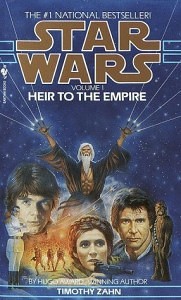
Timothy Zahn’s 1990 Novel Heir to the Empire Influenced George Lucas’s Writing of the Star Wars Prequels

star wars book

In 1990, well before any new film hype about Star Wars was brewing, science fiction author Timothy Zahn wrote a trilogy of books (starting with Heir to the Empire) set after the events of Return of the Jedi. While these introduced a ton of fan-favorite characters and events into the Star Wars fan consciousness, one particular element invented by Zahn actually made it into the real Star Wars movies later. Prior to these books and the prequel movies, it was implied that the Empire and Old Republic had operated from a central “capitol city” planet somewhere in the center of this made-up galaxy. Zahn gave this planet a name: Coruscant, which Lucas used outright in 1999’s The Phantom Menace. Even the descriptions of this planet were taken directly not only from Zahn’s books, but other Star Wars novels and comic books including the dark Dark Empire series, and the novel and comic book series Shadows of the Empire. In the subsequent Star Wars prequel films, a huge portion of the action takes place on Courscant, a planet that might not even have been invented if it weren’t for the Star Wars novels.

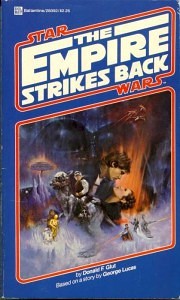
The Guy Who Wrote the Novelization for The Empire Strikes Back Runs a Website With Quasi-Dinosaur Porn and Has Partial Credit for Creating “He-Man”

Empire strikes back book

Comic book and animated television writer Donald F. Glut wrote the novelization for The Empire Strikes Back, which was published in May of 1980, a few months ahead of the movie. The book contains all sorts of Star Wars “errors,” including Vader with a blue lightsaber (instead of red), Yoda with blue skin (instead of green), and a less flirty Han Solo — mostly because so much dialogue was changed during filming. (For example, the infamous “I love you/I know” exchange would have never made it into this novelization since it happened on set, not in the script.) There’s also a scene here which suggests Yoda has some hand-written manuscripts, which totally flies in the face of a paperless Star Wars universe that we’re used to. (And which I can’t ever shut up about.) More fascinating than the novelization itself, is the novelization’s writer: Donald F. Glut. Not only did he write for the 80’s cartoon The Masters of the Universe, he tried to collect royalties on some of the characters when they were sold as toys, but lost to Mattel in court.

But the hands-down most bizarre thing about him is his own personal website called Don Glut’s Dinosaurs. Here, the author of the book version of The Empire Strikes Back shows off photographs of his personal collection dinosaur bones, dinosaur toys, and to-scale dinosaur statues. Most of these photographs are accompanied by nearly-naked women who look like they have stepped directly off the pages of the Playboys my dad had lying around the house when I was a kid in the 80’s. When you start to think Star Wars itself doesn’t make sense, just try to wrap your mind around Glut’s weird dino-porn. Star Wars itself starts to seem like a dry documentary after you hit up this website.

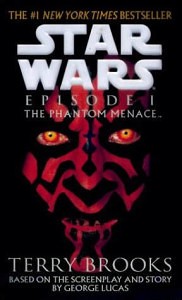
Famed Fantasy Novelist Terry Brooks Wrote the Novelization of The Phantom Menace (and Hook, Too!)

phantom menace book

That’s right, the author who wrote the famous Sword of Shannara series was asked to novelize the events of the most derided and hated Star Wars film of them all. Interestingly, this version starts with a hardcore podrace which rivals any action contained in the movie. Like many novelizations, this book did publish a few weeks before the film’s release, but it was issued as a full hardcover with several different alternate dust jackets available. The book also contains tons of background information about the Sith and why they’re so intent on getting their revenge. Brooks apparently had a long phone call with Lucas to sort all of this out. The novel also (possible intentionally) foreshadows specific events which wouldn’t be revealed until the subsequent two Star Wars films. In this way, The Phantom Menace novelization was 1999’s secret Star Wars Rosetta stone, only no one knew it at the time.

In 1999, getting Terry Brooks to write the novel version of the first new Star Wars movie in over a decade was a coup; he’s a super-popular writer who not only inspired a generation of fantasists, but literary stalwarts too. (Karen Russell gushes for Brooks in this New Yorker essay.) But Terry Brooks was no stranger to weird rabbit-holes of writing. In addition to penning the novelization of this prequel to the Star Wars film franchise, he also wrote the novelization of Hook in 1991. Hook of course is like a hardcore reboot of Peter Pan. This makes Brooks’s writing of the Hook novelization even stranger than his adaptation of The Phantom Menace. In fact, it may be the only writing act of its kind: adapting a screenplay into a book, but the screenplay is actually a remake/reimaging of a famous theatre play, which was also, at one point, a book.

There’s even more to love about crazy Star Wars books! But for now, just remember, even the most famous film series of all time would be very different if it weren’t thanks to the books that surround it, penetrate it, and somehow bind its galaxy together…

A Brighter Mirror, an interview with Colm Tóibín, author and Chairman of the PEN World Voices…

Colm Tóibín is an Irish novelist, short story writer, essayist, playwright, journalist, critic and poet whose work — as well as twice being shortlisted for the Man Booker Prize — has received the IMPAC Literary Award, the Costa Novel Award, the Los Angeles Times Novel of the Year Award, and the Irish PEN Award for contribution to Irish literature. His elegantly written, humane novels, which include The Blackwater Lightship, The Master, Brooklyn, and 2014’s Nora Webster, deal with Irish society, homosexual identity, the yearning for home, and the painful silences that can descend like an obscuring fog over families. Over the course of a career spanning a quarter of a century, Tóibín has been a staunch advocate for free expression and gay rights and has this year taken over the role of Chairman of the PEN World Voices Festival of International Literature. (The festival runs in New York from May 4–10.) From his office in Columbia University, where he is currently serving as the Irene and Sidney B. Silverman Professor of the Humanities, Tóibín spoke to me by phone about his hopes for the upcoming festival, Ireland’s referendum on gay marriage, the perils of taking a play to Broadway, and his fascination with Elizabeth Bishop.

Dan Sheehan: What does PEN, as an organization, mean to you as a writer? What made you decide to take on this public facing, ambassadorial role as Chairman of the World Voices Festival?

Colm Tóibín: PEN is an essential element in our culture. Anyone who has ever been brought up under censorship understands that it’s almost a barometer of the level of freedom in a society — what happens to books, what happens to writers, what happens to the written word. And what’s strange is that it isn’t merely books which are political, or that are directly political, that dictators and others who would want to control our lives worry about. They also worry about literature. It’s bad enough that a writer who would wish to express unpopular opinions or voice combative responses to government policy would be repressed, but that writers who would simply dream — who would write poetry or novels which ostensibly have nothing to do with politics… There are countries where that kind of work is simply unavailable. It’s a serious matter. It’s not a life and death matter in and of itself, but oddly enough in the places where it occurs you often find that other freedoms are restricted as well. PEN’s mission is not only to draw attention to this but to change it, to attempt to change the entire culture of restriction evident in so many places around the world. So for anyone who is a writer, for any one who is a reader, these are pressing and serious issues.

DS: One thing which struck me, in my brief time working with PEN, was that a great majority of the imprisoned recipients of the Freedom to Write Award [given annually to a writer who has fought courageously, in the face of adversity, for the right to freedom of expression], 36 out of 39 in fact, have been subsequently released. These figures must be quite heartening.

CT: They are, and while we are involved to an extent in defending free expression, the main focus of the World Voices Festival is to celebrate and honor the written word, so it’s a different mission, to some extent, to the daily business of putting pressure on governments and drawing attention to victims. Our work in the festival is a mirror of that, but it’s a brighter mirror. It seeks to introduce readers to work that might not automatically seem to be the most popular. It’s not a festival that tries to bring all the best selling writers in America together for one event. That would be fine, but it’s not our mission.

DS: For your first year as Festival Chairman, you’re presiding over a new curatorial approach, focusing specifically on the contemporary literary cultures across the African continent and its diaspora. Could you tell us a little bit more this?

…there will be enough new books and new writers whom you haven’t heard of to nourish you for a long time.

CT: Well Jakab Orsós is the director, so the day-to-day programming is his business, and he has come up with this absolutely marvelous program. What I always say is that if you come to this festival, it might keep you reading for a year. In other words there will be enough new books and new writers whom you haven’t heard of to nourish you for a long time. The priority for us this year is to focus it. If you just say “well, we’re bringing in all these writers from different places, and we hope you enjoy it,” that’s one thing, but it’s harder to put something like that together than it is to zero in on one particular region, in this case Africa. In a way it’s easier to capture someone’s imagination by putting this kind of focused program together. But it doesn’t mean of course that the festival is only about Africa. For example I think one of the biggest events is going to be Richard Flanagan in conversation with Claire Messud. Richard is not African, he’s from Tasmania, but I think that event, because he’s not somebody who has done a lot of readings in New York, and because he recently won the Booker Prize, is likely to draw a big audience.

DS: I wanted to ask you a bit about one event in particular: ‘Queer Features’ [a conversation with prominent African writers which will survey the landscape of African Gay Rights movements]. As somebody who has written beautifully about gay relationships and identities in your fiction, what does an event like this, at a high profile festival like this, mean to you?

We have some very interesting and intense writing by gay people which has arisen from repression, from their efforts to imagine a world outside of the one in which they’re living.

CT: It means a great deal to me. I think anyone who has been brought up gay in a country which doesn’t recognise gay rights, as I was, understands that it is something, much like the treatment of the written word we spoke about earlier, which almost becomes a barometer for other freedoms. If you want to repress gay people, you usually want to do quite a number of other things too. But of course, out of that can come all sorts of strangeness. And if you look at the novels written by gay people over the last twenty or thirty years, you realize that literature comes from strange places. You can set up a writing school and bring in a host of talented people, but you won’t automatically get the best books from that. Often literature grows in very barren places. It often comes from the ways in which the dreaming life or the imaginative life is suppressed, or the essential elements in our being are suppressed. Out of that pressure, a certain tone in literature can come. We have some very interesting and intense writing by gay people which has arisen from repression, from their efforts to imagine a world outside of the one in which they’re living.

DS: Did you find that to be the case for yourself in your own early writing?

CT: I think the best description of this comes from the American poet Adrienne Rich, who talked about the idea of looking in the mirror as a gay person and finding no one there. Of there being no images available of other gay people. You were almost alone. In other words, Jewish people or Irish people or Palestinian people or Native American people can actually understand their own oppression because it’s a history that’s passed on from generation to generation. But gay people, they’re alone. So the effort to find images that match your experience is often very difficult. Yet out of that exploration can come something very interesting. It is, if you’re a writer, almost nourishing, although I wouldn’t wish it on anybody. But it’s not necessarily all damaging. Though it is a particularly pressing issue in some African countries at the moment.

DS: Along the same lines, it’s been quite heartening to see the immensely positive response, especially among younger demographics, to the upcoming gay marriage referendum in Ireland. You’ve talked about the historical lack of positive images of gay identity for young people to turn to in Ireland. Is there a sea change happening at the moment?

CT: Well, It’s really quite difficult to interpret these opinion polls. The suggestion is that the referendum will be passed, but we have had opinion poles leading up to referenda in previous years which have turned out to be misleading. So we just don’t know. What’s interesting of course is that it’s quite difficult to oppose this referendum openly. Some people are doing that, but they’re not many, and that’s good in the sense that there is an overwhelming public support at the moment for the referendum. What people will do in the privacy of the ballot box is a different matter. It may end up being fine, but it’s worrying still. I think everyone is concerned about it.

DS: Absolutely. We’ve seen before the kind of disproportionate influence organizations like The Iona Institute [a socially conservative Catholic advocacy group based in Ireland] can have.

CT: Yes, but that’s democracy in the sense that you have to have an argument, you can’t just have everyone singing from the same hymn sheet. They turned out to be the opposition because the Catholic Church is in hiding. They [the clergy] have their heads firmly planted in the sand, so you have to have some group that’s willing to make the argument against gay marriage in order for there to be some sort of debate.

DS: A persistent, and oft-discussed, theme in your work is the longing for home. Can you talk a little bit about that?

One of them is that people miss home and then make a new home and then aren’t sure what home is anymore.

CT: Well, it’s one of those things that is a feature of the history of Ireland. Over the last one hundred and fifty years a great number of people have emigrated from the country and that’s an experience that comes in all sorts of shapes. One of them is that people miss home and then make a new home and then aren’t sure what home is anymore. It becomes quite a complicated thing that maybe only a novelist can handle. I feel it every time I arrive at JFK to go to Dublin and I start seeing Irish people wandering around the airport. “How do you know they’re Irish?” I don’t know, I just know that they are (laughs). Then there’s that sense of being home on the plane. It’s a very funny feeling. I’m not sure how long exactly it lasts but for me it’s palpable, it’s worth dramatizing.

DS: I’ve often wondered that myself, is it the kind of thing that ever really goes away? You’ve travelled extensively and you’ve taught all over the US, is that feeling something you take with you or is it a fixed idea of home that waits for you at the airport?

CT: It’s not fixed, so you can never tell what you’re going to feel like. Sometimes it’s amazing being away, and then other times you think, “I’d love to be in Dublin on a Saturday morning.” That feeling of getting up and buying the papers, finding somewhere to have your breakfast and meeting somebody. That lovely relaxed Dublin. No subways.

DS: Can I ask you now about your most recent book, On Elizabeth Bishop? What influence has her writing had on your own?

CT: She writes a lot about home, which is a difficult and gnarled sort of problem for her. She was from Nova Scotia — which of course is Northern and maritime, like the landscape of Wexford [ed. — where Tóibín grew up] — but she travelled a lot and lived in Florida and Brazil, so she was always caught between two or three things. She wrote very slowly, it took her ages to do anything, and she was a perfectionist. She also had a sort of a melancholy austerity in her tone. So all of that began to interest me, and it has interested me for a long time. Then when Princeton asked me what author I might like to write a book about I think they thought I might want to write about Joyce or Yeats, someone Irish you know, but I said I’d like to write about Elizabeth Bishop and they said that was cool, that they would commission that. Oddly enough it was quite a pleasure to write. I enjoyed those days, when I got to work on my Bishop Book. It’s not like it was ever going to be made into a movie or become a best seller, so it turned out to be a lovely sort of private work.

DS: You could take the commercial concerns out of the equation and just enjoy it for what it was.

CT: Exactly.

DS: Although, having said that, Bishop was a pretty interesting character. I think I would watch a movie about her life.

CT: You would watch a movie about her life, but trying to get anyone to invest in that movie would be something else entirely.

DS: And you’ve had some experience recently with work that has been artistically very well received but which also proved to be a difficult commercial sell. Could you tell us a bit about the experience of bringing The Testament of Mary [Tóibín’s monologue play which later became a novella] to Broadway.

CT: Well it didn’t really work there, but it is doing very well in Spain at the moment. It’s been running for a long time, since last July actually, and it’s going to go on running and move down into South America. The play has opened in all sorts of funny places since it closed on Broadway. The Broadway episode was strange, you know, it was up and then it was down, but that particular production went on to London where it was very successful.

DS: Going back to Elizabeth Bishop and her perfectionist streak, the time she took to get things just right, you started your most recent novel, Nora Webster, in 2000, is that right?

CT: (laughs) I did. I mean, I didn’t work on it every day but I thought about it every day. I would write some of it every year and then in the last few years I decided I had better finish it.

DS: Was it a case of the book coming together big by bit until you hit a sweet spot?

CT: It was a case of not being able to work out how to structure it. I put in the bits I knew, and then I had all of those and I realized that I had better concentrate on the bits I still had to work out. I thought that if I couldn’t figure out a structure for it at that point I would just do a chronological structure, scenes occurring in ordered time, to see if that might work, so that’s what I did.

FICTION: Amazing by Erin Fitzgerald

Your story takes place in a recent but extinct era, in which people’s lives aren’t complicated by handheld telecommunication or in­-depth classification of mental health issues.

There are two characters in your story who do not conform to the others’ standards. Thanks to the lack of handheld telecommunication and mental health support services, these characters are easy for the others to identify and shun.

Your story is set in Mayberry. It’s set in Gowanus. It’s set in Croatia. It’s set in Hogsmeade, which you have made a point of calling something else. Your story’s key scenes are in a town square. There are also scenes at a dive bar, and in a farmer’s field where the height of the corn hides the action from supporting characters. This is where some of the fucking happens. The rest happens on a beat­-up mattress in a dingy apartment. All of the fucking is unhappy fucking. Your story also has scenes at a church. No one is bored at the church, except for the two shunned characters.

Your story’s language is rich in a style that is illuminating or florid, depending on how you tip it in the light. Your story has sentences that look like run­-on sentences but aren’t, and sentences that don’t look like run­-on sentences but are. Your story has one phrase in a foreign language that is moderately easy to Google. It has Roman numerals, from I to XIV.

Your story has direct references to alcohol, probably rye, maybe bourbon, but no amaretto. Your story has indirect references to meth, molly, LSD, or heroin. It has no references to acetaminophen, lisinopril, paroxetine, or bisacodyl. Your story has no guns because those affect tension and pacing. It has a broken bottle and a filthy steak knife.

Your story is told in present tense until the first supernatural or magical element appears. Then it needed to be edited into past tense, and that brought a fog of knowing weariness to all of its characters.

Your story had angels who made clever observations, but had no wings. Your story’s ghosts ice skated, they walked down halls, they wept. All without sound, because they never spoke to you.

There was an eleven year old girl in your story. She did not learn anything about herself until an adult did not meet her expectations. That was when you realized why your story had a cornfield, a church, a broken bottle, an angel, a ghost, and rye.

It took longer for you to make the connection than it should have. But that realization will happen more quickly for the next story. You know it will, and so does everyone who reads it.

Sunday Sundries: Literary Links from Around the Web (May 3rd)

Looking for some Sunday reading? Here are some literary links from around the web that you might have missed:

David Abrams and Viet Thanh Nguyen on the lost art of the comic war novel

Ryan Britt lists some science fiction detectives

Couple sues after their photo is used on cover of erotic Patriots NFL novel

Hillary Kelly wants to bring back the serialized novel

Cat’s Cradle by Kurt Vonnegut is being made into a TV show

“What about all the giants in personal memory that you want to keep buried?” — interview with Kazuo Ishiguro

Art Spiegelman’s brilliant Maus gets banned in Russia

Some interesting facts about Catch-22

Lewis Carroll and the secret history of Wonderland

Kurt Vonnegut’s Cat’s Cradle to Be Adapted for TV

Cat’s Cradle, one of Kurt Vonnegut’s most beloved novels, may soon be coming to the small screen. According to The Hollywood Reporter, IM Global Television has optioned the novel to be executive produced by Brad Yonover and Sandi Love of Elkins Entertainment. No word yet on what actors or directors might get involved.

Published in 1963, Cat’s Cradle was Vonnegut’s fourth novel and also one of his favorites. As The A.V. Club points out, Cat’s Cradle and Slaughterhouse-Five were the only works that Vonnegut himself gave an A-plus rating to:

TED WILSON REVIEWS THE WORLD: THE DORCHESTER LIBRARY

★★★★☆

Hello, and welcome to my week-by-week review of everything in the world. Today I am reviewing The Dorchester Library.

Because my cell phone doesn’t get the internet, and my home computer is an electric typewriter, I have to go to the library to do my web-surfing. But the internet isn’t the only reason I go to the library. Yes, their computer gets all the websites — and according to the sign that asks patrons to please stop visiting adult websites, it gets those too — but the Dorchester Library is so much more.

It’s a great place to make friends. You’d think making friends at the library would be tough, because talking isn’t allowed, but a lot can be said with the eyes. In fact, some of my best conversations have been strictly via eye contact. I have friends I’ve met at the library who I’ve never spoken to with my mouth. I even undressed someone with my eyes once. It was consensual.

Some people make it very clear they don’t want new friends at the library. Instead, they want to keep their face buried in a book to escape to whatever world they’re reading about. That’s fine by me. I never try to pressure anyone into friendship. Not since the time I pressured someone into a friendship and it turned out we didn’t make good friends and then I had to admit my mistake.

There is a good selection of books in which to bury one’s face. And if the book you’re looking for isn’t at the library, they’ll order it for you. If they can’t order it for you, the book might not exist, or you might not be at the library. Check the sign first to make sure it’s the library you’re entering. You might be at the post office. There’s a lot of overlap with their customer base and it’s easy to confuse the two.

If books aren’t your thing, the library has a lot of DVDs of movies that used to be books. I don’t have a DVD player so I’ve never gone into the DVD room, but it looks nice. The crowd in that part of the library is a lot younger than me.

One great thing is the public servants (librarians) who will do whatever you ask if it is library related and legal. It’s like having your own butler if you lived in a house full of books. The only librarian who won’t do what you ask is Margo. She only does what she wants.

BEST FEATURE: Great spot to nap! I fell asleep there once and no one disturbed me.

WORST FEATURE: Unfortunately I slept for two days. I missed an appointment and several meals. When I awoke my wallet and shoes were gone.

Please join me next week when I’ll be reviewing a jar of mayonnaise.

A Cautionary Tale for Writers Submitting Essays to Try and Win this Maine Inn by the Current Owner

After twenty-two years, the current owner–and former winner–of the Center Lovell Inn in the “Lake District” of southwest Maine has decided to retire and is opening the contest back up to “fulfill someone else’s dream.”

The rules? Simply pay a $125 entry fee and write 200 words on “why you would like to own and operate a country inn.”

“You have to do it,” my mother chirped on the phone. “Because you’re a writer, and this might be your only chance to own property, maybe.” I pretended to hesitate. But honestly, I had been hoping to get out of the city for a while. So I looked up the specifics: all they wanted was a brief essay, and the winner would swiftly inherent the rustic little bed-and-breakfast in Maine among the lakes and lobsters. My mother even offered to pay the application fee, but I told her I was sure I could afford it. After checking the amount on the website I called her back and said, “Okay, we’ll call it a birthday present.”

I think I wrote about the vitality of the rural outpost in the creation of countless great literary works, perhaps I promised to foster the same space in their building, promised inspiration. It’s hard to remember, exactly, because none of it came from a true place, not then. But two months later I got a call from the owner; the news was congratulations, but the voice was wary. The property would pass to me at the end of the week, and they would have to e-mail all the documents, because they were vacating that night. They asked how I’d heard about the contest, and I told them my mother had shared it with me. They replied, “Alright, but what is your mother really trying to tell you?” There was what sounded like a hiss and the line went dead. I was a little thrown, but packed regardless.

The long drive up through the pines was serene, and the Inn itself was lovely, white; three stories with a wrap-around porch. The door was swung open when I arrived, and the keys had been tossed on the counter of the eat-in kitchen. I had zero cell reception on the property, but that problem would soon seem miniscule. Miniscule, that is, when compared to the snake ghosts.

I spent most of that first day cleaning. The previous owner had left quick, it seemed; there were still canned goods in the pantry, a few hangers in the upstairs hall closet, and a landline phone on a remaining night stand in the master bedroom. A layer of dust coated all the floors, but slithering lines interrupted the integrity of this layer. It seemed as if someone had dragged a bunch of appliances in a leaving ballet, either that or they had attempted to sweep with a broom handle instead a broom.

That night it was quiet. No crickets.

On the second day the movers arrived with the furniture my mother was sending along from her great aunt’s old house. It matched the surroundings perfectly. The movers didn’t talk much, but they got the bed set up and I made it, and dozed off early.

The third day I walked the property. Meh.

I should say now that I’ve never been afraid of snakes. As a kid I’d visit my grandparents in a cozy apartment in a Maryland high-rise, and my grandfather kept a family of boa constrictors. I had no problem holding the little-to-big boas, and loved them, to the point where when a baby escaped into the air ducts of the building I was just excited to see where it would re-emerge.

But snake ghosts are a different story. Snake ghosts are a whole different story, because snake ghosts can spell.

On the third night I woke to the sound of their writhing. I shuffled to the window, and sure enough, the lawn was alive in the moonlight. Near-translucent snake ghosts blanketed every inch. They shifted en mass to spell out “soon.” Then, the lawn was still.

What happened in the daytime was somehow not important anymore.

The fourth night, I forced myself asleep with whiskey and had a nightmare that I was writing a book called “The Texas Maine-Saw Massacre;” a terrible title for my fear. My eyes opened and I rolled onto my side to see the snake ghosts entering under the raised window. They filled my bed and enveloped every inch of me, pushing my head to the ceiling, where still more snake ghosts wrote with their roiling bodies: “we’ll take it from here.” Seconds later I was alone.

Yesterday I stood around and wished that things would appear in front of my face.

Last night I woke to a hundred snake ghosts in the corner. They’d banded together to form a standing humanoid figure, an undulating mummy. Somehow, I wasn’t afraid. The mummy opened its mouth and pointed at the landline phone on the dresser. The landline phone rang. I answered and it was my mother. I may have asked “Why?” “Oh Honey,” she may have replied, “I think you didn’t understand. I just wanted to push you to achieve something, to give your writing value. I didn’t really think you’d win, of course. I thought it would help you find some inspiration. And didn’t it?” I can’t remember if it was me, or a rogue snake ghost, who hung up the phone.

So, today inspiration found me. Found me at the small kitchen table when, as I sipped a bad coffee, snake ghost after snake ghost slid up, and, undaunted by sunlight, entered my eyes and mouth and took over my body.

And now we’re one, together in our Inn at the End. Everything is spelled out inside, and words flood the pages in front of us.

The title said caution, but this is actually a clarification. Your essay will not win you this Inn. Your essay will allow you to join our residency. We seek all those addicted to ghosts, all those who wonder what they even are, if not possessed. We’ll read your work and we’ll know you belong. Please limit your essay to 200 words and include a self-addressed, stamped envelope.

Submit. And as you do, ask yourself, “What form will mine take?”

Stephen King Wins Edgar Award for Best Novel for Mr. Mercedes

America’s master of horror, Stephen King, was awarded an Edgar for best novel last night from the Mystery Writers of America. Mr. Mercedes, described on King’s website as his first “hard-boiled detective tale,” took the honor over books by Ian Rankin, Karin Slaughter, and others.

Here are all of the finalists with the winners in bold:

Best Novel

This Dark Road to Mercy by Wiley Cash (HarperCollins Publishers — William Morrow)
Wolf by Mo Hayder (Grove/Atlantic — Atlantic Monthly Press)
Mr. Mercedes by Stephen King (Simon & Schuster — Scribner)
The Final Silence by Stuart Neville (Soho Press)
Saints of the Shadow Bible by Ian Rankin (Hachette Book Group — Little, Brown)
Coptown by Karin Slaughter (Penguin Randomhouse — Delacorte Press)

Best First Novel

Dry Bones in the Valley by Tom Bouman (W.W. Norton)
Invisible City by Julia Dahl (Minotaur Books)
The Life We Bury by Allen Eskens (Prometheus Books — Seventh Street Books)
Bad Country by C.B. McKenzie (Minotaur Books — A Thomas Dunne Book)
Shovel Ready by Adam Sternbergh (Crown Publishers)
Murder at the Brightwell by Ashley Weaver (Minotaur Books — A Thomas Dunne Book)

Best Paperback Original

The Secret History of Las Vegas by Chris Abani (Penguin Randomhouse — Penguin Books)
Stay With Me by Alison Gaylin (HarperCollins Publishers — William Morrow)
The Barkeep by William Lashner (Amazon Publishing — Thomas and Mercer)
The Day She Died by Catriona McPherson (Llewellyn Worldwide — Midnight Ink)
The Gone Dead Train by Lisa Turner (HarperCollins Publishers — William Morrow)
World of Trouble by Ben H. Winters (Quirk Books)

Best Fact Crime

Kitty Genovese: The Murder, the Bystanders, the Crime that Changed America
by Kevin Cook (W.W. Norton)
The Savage Harvest: A Tale of Cannibals, Colonialism, and Michael Rockefeller’s Tragic Quest for Primitive Art by Carl Hoffman (HarperCollins Publishers — William Morrow)
The Other Side: A Memoir by Lacy M. Johnson (Tin House Books)
Tinseltown: Murder, Morphine, and Madness at the Dawn of Hollywood
by William Mann (HarperCollins Publishers — Harper)
The Mad Sculptor: The Maniac, the Model, and the Murder that Shook the Nation
by Harold Schechter (Amazon Publishing — New Harvest)

Best Critical/Biographical

The Figure of the Detective: A Literary History and Analysis
by Charles Brownson (McFarland & Company)
James Ellroy: A Companion to the Mystery Fiction
by Jim Mancall (McFarland)
Kiss the Blood Off My Hands: Classic Film Noir by Robert Miklitsch (University of Illinois Press)
Judges & Justice & Lawyers & Law: Exploring the Legal Dimensions of Fiction and Film
by Francis M. Nevins (Perfect Crime Books)
Poe-Land: The Hallowed Haunts of Edgar Allan Poe
by J.W. Ocker (W.W. Norton — Countryman Press)

Best Short Story

“The Snow Angel” — Ellery Queen Mystery Magazine by Doug Allyn (Dell Magazines)
“200 Feet” — Strand Magazine by John Floyd (The Strand)
“What Do You Do?” — Rogues by Gillian Flynn
(Penguin Randomhouse Publishing –Bantam Books)
“Red Eye” — Faceoff by Dennis Lehane vs. Michael Connelly (Simon & Schuster)
“Teddy” — Ellery Queen Mystery Magazine by Brian Tobin (Dell Magazines)

Best Juvenile

Absolutely Truly by Heather Vogel Frederick (Simon & Schuster Books for Young Readers)
Space Case by Stuart Gibbs (Simon & Schuster Books for Young Readers)
Greenglass House by Kate Milford
(Clarion Books — Houghton Mifflin Harcourt Books for Young Readers)
Nick and Tesla’s Super-Cyborg Gadget Glove by “Science Bob” Pflugfelder
and Steve Hockensmith (Quirk Books)
Saving Kabul Corner by N.H. Senzai (Simon & Schuster — Paula Wiseman Books)
Eddie Red, Undercover: Mystery on Museum Mile by Marcia Wells
(Houghton Mifflin Harcourt Books for Young Readers)

Young Adult

The Doubt Factory by Paolo Bacigalupi (Little, Brown Books for Young Readers)
Nearly Gone by Elle Cosimano (Penguin Young Readers Group — Kathy Dawson Books)
Fake ID by Lamar Giles (HarperCollins Children’s Books — Amistad)
The Art of Secrets by James Klise (Algonquin Young Readers)
The Prince of Venice Beach by Blake Nelson (Little, Brown Books for Young Readers)

TV Episode Teleplay

“The Empty Hearse” — Sherlock, Teleplay by Mark Gatiss (Hartswood Films/Masterpiece)
“Unfinished Business” — Blue Bloods, Teleplay by Siobhan Byrne O’Connor (CBS)
“Episode 1″ — Happy Valley, Teleplay by Sally Wainwright (Netflix)
“Dream Baby Dream” — The Killing, Teleplay by Sean Whitesell (Netflix)
“Episode 6″ — The Game, Teleplay by Toby Whithouse (BBC America)

Robert L. Fish Memorial

“Getaway Girl” — Ellery Queen Mystery Magazine by Zoë Z. Dean (Dell Magazines)

Mary Higgins Clark

A Dark and Twisted Tide by Sharon Bolton (Minotaur Books)
The Stranger You Know by Jane Casey (Minotaur Books)
Invisible City by Julia Dahl (Minotaur Books)
Summer of the Dead by Julia Keller (Minotaur Books)
The Black Hour by Lori Rader-Day (Prometheus Books — Seventh Street Books)

Grand Master

Lois Duncan
James Ellroy

Raven Awards

Ruth & Jon Jordan, Crimespree Magazine
Kathryn Kennison, Magna Cum Murder

Ellery Queen Award

Charles Ardai, Editor & Founder, Hard Case Crime