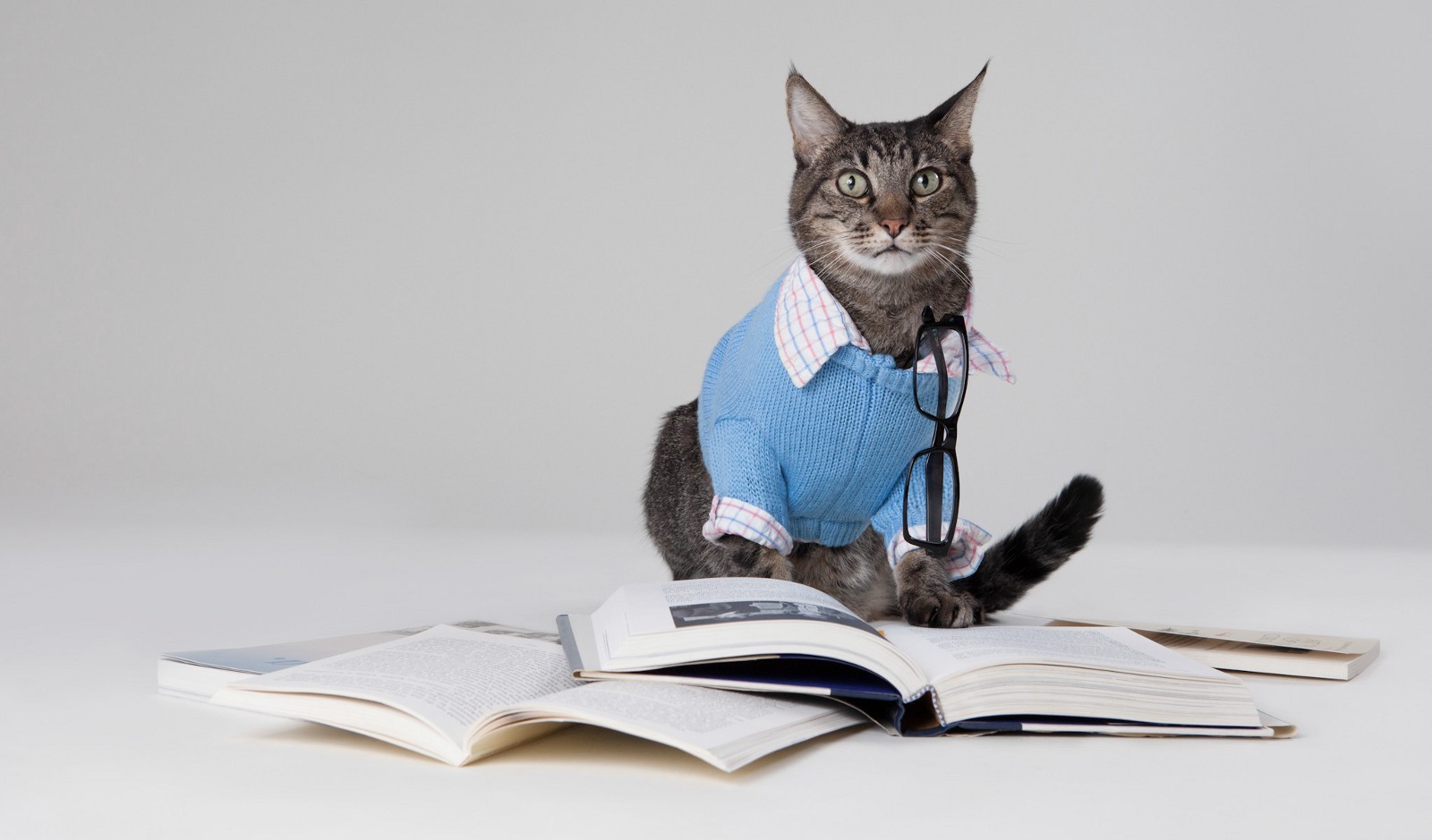
When looking back on what characters have stayed with us the most over the years, there’s no denying that some of the most prominent ones aren’t even human. From a white whale out for blood to a tail-bouncing tiger, check out this infographic from www.helpucover.co.uk/ of unforgettable animals from your favorite books.
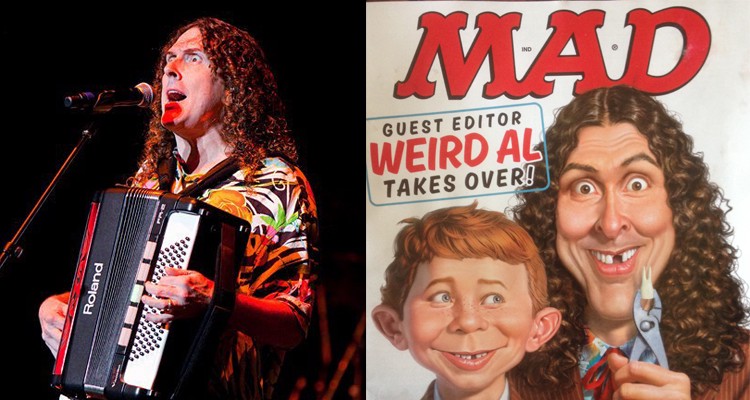
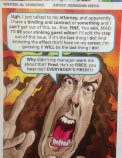
If I could time travel and ask my middle-school self what the coolest collaboration of all time would be, middle-school me would probably say “Beastie Boys as playable characters on NBA Jam!” In response, I’d reach back into my time machine for a magazine I’d brought with me (not just because zipping through wormholes can be kind of monotonous), then I’d roll up that magazine and whack my middle-school self with it and tell him, “No, dummy, this is the coolest collaboration of all time.” Then I’d watch as he stared in awe of the latest issue of MAD Magazine guest edited by “Weird Al” Yankovic.
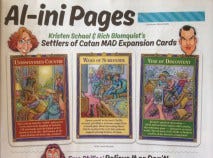
I’m sure my younger self’s jaw would drop (I was kind of a mouth breather) as he read the letters to the editor, all of which were addressed to and answered by “Weird Al.” And then he’d immediately jump to the MAD fold-in, which he’d bend so as not to damage the cover, to discover that even that had been infiltrated by the king of pop parodies. But, ever skeptical, when he’d thumb through the rest of the magazine (which includes pages of bad parody ideas from “Weird Al’s” journal, as well as other contributions from his friends like Patton Oswalt and Kristen Schaal) he’d get confused and say, “ Wait a second…there are ads in here. MAD Magazine doesn’t have ads in it!” At that point, I’d gently rest a hand on his shoulder (which would probably spark or something because space-time is like that) and say, “The future is a dark and humorless place. Pay attention in math class or you’ll wind up a slave in the lit mag mines of Brooklyn.”
Then I’d snatch the magazine from him before he ruined it (like everything else my younger self always ruined) and hop back in my time machine and head back to 2015 before they missed me in the lit mag mines. On the trip back to the future (again, boring) I’d marvel at how amazing it is for two entities to find travel across the universe and find each other: issue #533 is the first issue of MAD with a guest editor, or, as “Weird Al” puts it, the first time anyone was fool enough to accept the job. Upon arriving back at the present, I’m sure I’d have another epiphany: Beastie Boys characters for NBA Jam really would have been the coolest thing ever.
I read two books explicitly written for expectant parents when I was pregnant. The first was a worn paperback lent to me by my doula, which, through unflinching detail, prepared me for the natural childbirth experience I did not end up having. The second was a dense guide to caring for children from infancy through toddlerhood and featured concepts that were as abstract to me as quantum physics at a time when I couldn’t even imagine how my first hour as a mother was supposed to play out. Nearly two years into parenthood, I can see that these books were both too specific to prepare me for what I ended up encountering and too generalized to grasp before I even had a look at my own son’s face.
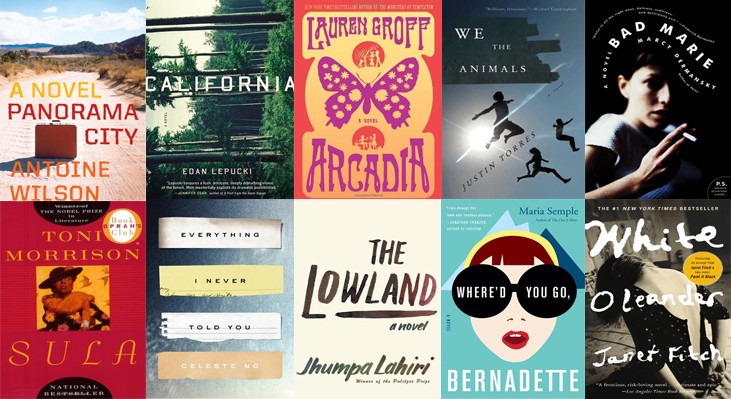
If Marilynne Robinson says that “fiction may be, whatever else, an exercise in the capacity for imaginative love, or sympathy, or identification,” then maybe reading about fictional families is a more effective (and certainly more entertaining) way to identify and work through an expectant parent’s anxieties. So, save the official handbooks for after the baby arrives and seek out the kind of book that, if you’re like me, has always helped you to make sense of life. Here are some novels that can illuminate common truths about parenthood by exploring the joys, challenges and, often, spectacularly flawed dynamics of the family experience.
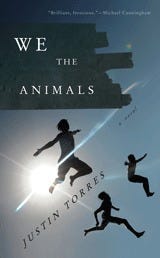
We the Animals by Justin Torres
If Justin Torres’s We the Animals can teach us anything about parenthood, it is to relish the bright moments of outright joy that, depending on your own circumstances, either outshine the dark ones or, as with the family at the center of this story, flash only occasionally, like a set of eyes in the dark wilderness. In a story dominated by domestic violence and the endless tussling of three rowdy brothers, We the Animals offers a few of these shining moments. I still find myself thinking about their impromptu kitchen dance parties and raucous evening bath routines as I live out my own domestic life.
When the three boys, ages seven to ten, pin down their 24-year-old mother and each one takes his turn blowing raspberries onto her belly, the scene exquisitely captures the intimacy that exists between bodies that were once connected as one. And yet, there is also the knowledge that they are now most definitely disconnected — and that, at least in this home, there is a fine line in every moment between delicacy and danger.
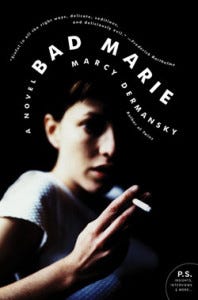
Bad Marie by Marcy Dermansky
It might seem insensitive to recommend that an expectant mother read a book about a seductive nanny running off to Paris with both the little girl in her charge and the toddler’s father. However, throughout the dark and deceptively slim novel Bad Marie, Marcy Dermansky manages to tease out so many of the more subtle challenges facing new parents and their relationships. It also features one of the most accurate depictions I’ve seen of the intense bond that a caregiver (mother or otherwise) can form with a small child.
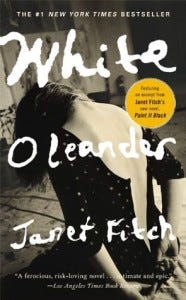
White Oleander by Janet Fitch
In her masterful and much-celebrated novel White Oleander, Janet Fitch confirms every parent’s dark suspicion that with the responsibility of caring for a child comes the capacity to do tremendous damage. The story of a brilliant imprisoned poet, whose daughter ends up navigating adolescence in the foster care system, explores what it means to be both an artist and a parent — and what, if anything, can redeem the irreparable damage a parent’s choices have caused.
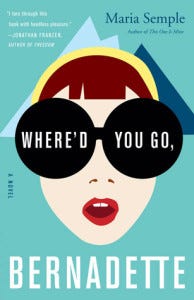
Where’d You Go, Bernadette by Maria Semple
Where’d You Go, Bernadette is as funny as people say it is. But through the book’s humor, Maria Semple illustrates a moving portrait of friendship between the eccentric (and now MIA) Bernadette and her teenage daughter, Bee. In trying to solve the mystery of her mother’s disappearance by investigating emails, all manner of official documents and her own memories, Bee helps us to understand their unique bond — from quirky shared tastes and a fierce sense of loyalty, to moments of profound revelation upon discovering each other’s secrets.
More Than it Hurts You by Darin Strauss
Darin Strauss’s powerful novel More Than it Hurts You is the kind of book you’ll be glad you finished reading before the arrival of your child, mostly because it might be hard to get through this story after having experienced the fragility and innocence of a baby firsthand. Even Strauss has said (to me, on twitter!) that he doesn’t think he could have written it after having become a father. Told from multiple points of view, the story surrounds a Long Island family’s chronically sick baby boy and the doctor who cares for him. Facing these extreme circumstances, the child’s father, mother and doctor are forced to acknowledge their own best and worst natures and to question the motives of the people they trust the most.
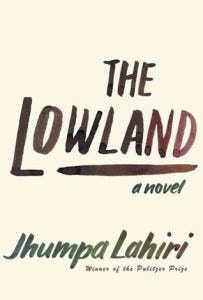
The Lowland by Jhumpa Lahiri
Lahiri’s latest novel follows the vastly different trajectories of two Calcutta-born brothers. In telling their stories, from suspense and tragedy in India to seething domestic turmoil in seaside Rhode Island, The Lowland becomes a story about parental regret, responsibility and the way each character involved decides to reconcile the two.
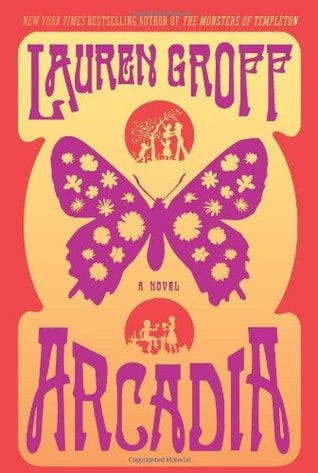
Arcadia by Lauren Groff
Set on a New York commune in the 1970s, Lauren Groff’s Arcadia tells us much about the way the environment we create for our children can affect who they become. Her use of the senses — for instance, the way a young child is intimately familiar with the sounds and scents surrounding his parents — brilliantly illustrates the intense closeness a family can experience. But, in this story, that deep knowledge and dependence can lead to trouble, as the child protagonist discovers when the utopia he has been raised in falls apart and he is confronted with the outside world.
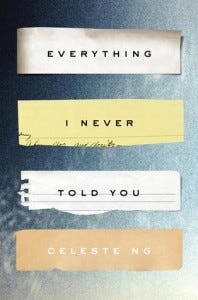
Everything I Never Told You by Celeste Ng
From the start, Celeste Ng’s Everything I Never Told You reveals the unease of a parent discovering her child’s secrets. Not only her secrets, but her capacity to hide anything from her parents in the first place. When her teenage daughter Lydia goes missing, Marilyn Lee remembers having missed seeing Lydia’s first steps as a baby: “The thought that flashed through her mind wasn’t How did I miss it? but What else have you been hiding?” So begins the entire Lee family’s struggle to confront and reveal their own lies as they work toward discovering the truth about Lydia’s disappearance. Ng’s quiet and precise storytelling tugs at the loose threads of a seemingly close-knit suburban family and shows us that even the family next door has its own dark secrets.
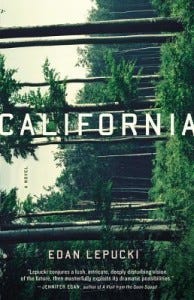
California by Edan Lepucki
Edan Lepucki’s debut novel California has been lauded as a fierce and original take on the post-apocalypse, but a lesser discussed quality of the book is Lepucki’s capacity for honestly rendering the uncertainty that an expectant mother feels, whether she’s confronting imminent threat in the face of post-apocalyptic disorder or just feeling general unease about raising a person in contemporary, not-burned-to-the-ground Los Angeles (see also: Lepucki’s novella If You’re Not Yet Like Me). Set in a dangerous and uncertain world, California looks at the role that community plays in the lives of individual families, and at the choices parents must make, even at the risk of isolating themselves from that community.
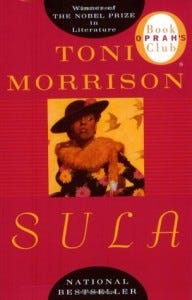
Sula by Toni Morrison
I will never forget the moment in Toni Morrison’s Sula when a young mother attempts to relieve her constipated baby by sticking her finger up the baby’s butt to release the buildup of nuggets that has been blocking him. If that description made you uncomfortable, well, it won’t be long before you’re as well versed in baby bowel movements as your most obnoxious parent-friend on Facebook. And you’ll learn soon enough that, as that scene proves, you do what you have to do to take care of your kids.
Morrison’s slim, powerful and often overlooked novel traces the lives of two black girls in small town Ohio. Though the main thread of the story is not specific to parenting, in reading about the struggles and choices that these characters face, we come away with a better understanding of what it means to be human. Which can’t help but make us more thoughtful partners and parents.
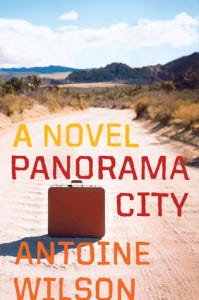
Panorama City by Antoine Wilson
Antoine Wilson’s Panorama City, told by the impossibly loveable Oppen Porter through tape recordings made for his unborn son, is a study in parental love and sacrifice. A self-described “slow absorber,” 28-year-old Oppen has always been an easy target, but when he discovers that he is going to be a father, he sets out on a quest of self-discovery that ends up revealing the complex intentions of the adults who’ve cared for him throughout his journey. His bumbling yet, often surprisingly wise, efforts to turn himself into a “man of the world” for the sake of his child display a wide-eyed hopefulness that can teach us a lot about the level of dedication it requires to take on the responsibility of parenthood.
The Sonic Acts Geologic Imagination Festival (Amsterdam, February 26 — March 2) as I experienced it was less festival than upbeat funeral march conducted in bright light, set to a soundtrack of experimental music, and festooned with colorful Power Point graphics like ornaments on a post-apocalyptic Christmas tree. According to the pocket guide, a fundamental starting point for the festival “is the thesis that we live in a new geological epoch: the Anthropocene. Human activity has irreversibly changed the composition of the atmosphere, the oceans, and even the Earth’s crust…humans have become a force on a geological scale.” The festival brought together “scientists, philosophers, theorists, artists, and researchers” to talk about ways to rethink “our attachments to the world, our concepts of nature, culture and ecology.”
To experience this in person for more than two hours at a time is a sobering experience, since you’re entering a place that’s trying to stare directly at the supernova known as global warming. You oscillate from finding it worthwhile to wondering if you’re inviting depression and anxiety to take up residence in your brain — and for what purpose? To tell people what they already know? Except, in my case participation consisted of the even more useless context of a presentation entitled “AREA X: The Fictive Imagination in the Dusk of the Anthropocene,” about what types of fiction are likely to go extinct before we do. This included thoughts about reactionary post-apocalyptic fiction, revisiting the way we write about our fellow animals, and interrogating the inefficiencies of so-called “smart” tech. If you were standing in a hideous post-apocalyptic landscape, would you want me to tell you a story or would you just want me to shut up long enough so you could convert me into edible protein?
If you were standing in a hideous post-apocalyptic landscape, would you want me to tell you a story or would you just want me to shut up long enough so you could convert me into edible protein?
Still, it was hard to be too glum, with my family in attendance as a slideshow of my favorite wilderness places ran on the screen behind me and I muttered on about: deliberately misunderstanding philosophy as a fictive strategy; how even in a Terence Malik film about the New World, the lack of biodiversity in the backdrop is a kind of lie we tell ourselves (it was always this way, except it wasn’t); and suggested mash-ups of Girls and The Walking Dead as a way to bring some frisson of the shock of the new. My grandson drew me as a bearded smudge and my audience as cats. Later, back at our daughter’s place, he surprised us with the smiling piles of plastic skulls he’d arranged for us, promptly followed by marathon bouts of watching Adventure Time (which seems rather more on-point than I understood then).
In this context perhaps you can forgive me for wondering at times if the festival was in the least bit important or was instead impotent and useless, a death ride at the end of a death ride, all of us having arrived on death planes and going home on death planes, and in between trying to figure out a life based on the certain knowledge of impending doom. I say “wondering” because anyone invested in science, and thus in noncontroversial concepts like gravity and inertia, knows we’re all just atoms anyway and forever about to return to atoms.
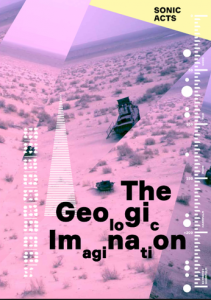
Yet any qualms I had about what could be accomplished, or at least articulated, dissolved when I explored the Sonic Acts book The Geologic Imagination. This fascinating tome represents an act of radical imagination, an attempt to wrench our thinking out of the same tired old tracks. There’s heft to the book, and perhaps the juxtaposition of cutting edge content with solid, sturdy precision in the object reassures as well. Things that matter in the world have weight. Is that too human a reaction in these post-human times? I don’t know. I don’t care. But I do care about how the book and festival made me directly confront themes and issues that had previously come out organically in my fiction. When that happens, the way forward changes irrevocably.
2 — A Chronicle of Our Science-Fictional Present
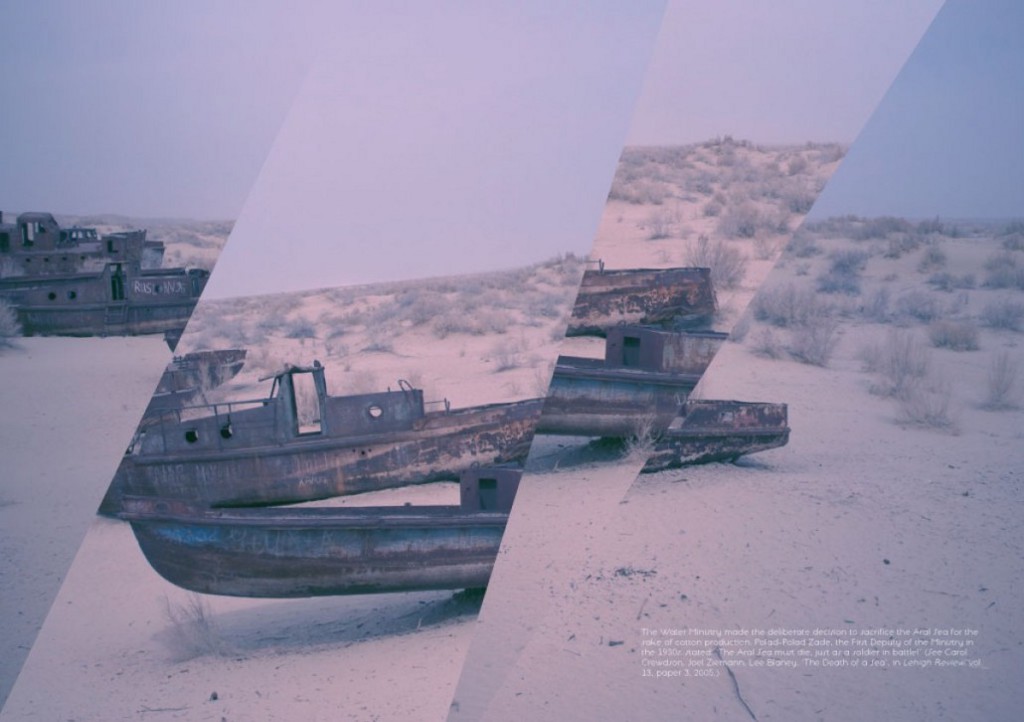
Aral Sea
The cover and immediate interior of The Geologic Imagination are dominated by photos of the barren Aral Sea, destroyed by the Soviets and their successors for the sake of cotton crops — an ecosystem snuffed out by a fanatical devotion to ultraorthodox ideologies — and the photographs within are also alive with the ways in which human beings still try to grapple with our own destructiveness and understand the humiliations of our particular moment. Images from abandoned industrial zones in Russia might in another context scan as disaster porn, but here, foregrounded by the idea of viewing life at “Earth magnitude,” are oddly melancholy yet redemptive. Visual elements like “Human Nonhuman,” mostly blurred photos, require the full festival presentation to appreciate, but then you turn the page and something like Kurt Hentschlager’s “Sublime Landscapes 3.0” confronts you. Fifteen pages of texture triptychs from his recent audiovisual installation “Measures” filter nature “through communication channels and media.” This focus on environments in juxtaposed layers of strata is interesting even without the audio component and begins to hint at fresh ways of seeing the detail-work that goes into our world.
The essays and interviews in The Geologic Imagination are similarly provocative, smart, and uninclined to engage in melodrama. For example, rather than exist in the realm of the polemic or the abstract, Liam Young and Kate Davies traveled the world charting the path of the components that we use to create smart phones. Young and Davies, interviewed by BLDGBLOG’s Geoff Manaugh, run the Unknown Fields Division, a “nomadic design studio” that explores “unreal and forgotten landscapes.” That could be double-speak for something insufferable, but it’s not. Their account of trekking “back up the global supply chain of consumer electronics” is not just fascinating and necessary but almost revelatory in its devotion to specific detail and understanding the consequences of that detail. (If you’re reading this on a smart phone, don’t worry — your minor discomfort will end…now.)
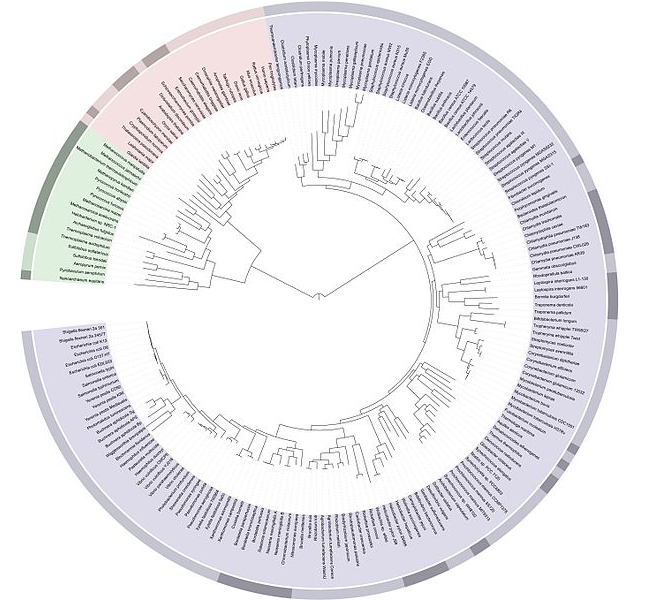
Essays like “Poetry and Bookkeeping” by Michael Nelland examine the role of the imagination in science, making by association a link between science and philosophy. The visual representation of a “tree of life” with Mankind at the top — sometimes mistakenly thought to have been endorsed by Charles Darwin — is juxtaposed with a “wheel of life” that shows human beings as just a creature between the common chimpanzee and the Norwegian rat, with no special significance. If the decentralization of humanity’s place at the center of the universe begun by Copernicus had found its way to the wheel instead of the tree, would our cultures, our society, our science, look fundamentally different?
Tree of Life
Another essay, Timothy Morton’s “Human Thought at Earth Magnitude” surprised me in the giddiness of its tone and shifting emphasis. The most interesting parts involve an argument that ascribes imagination and intent to the decision-making displayed by social insects and other animals. “It’s been shown,” Morton writes, “that ants, while climbing up little ladders, look around them rather than walk up automatically. They weigh options,” which suggests they “anticipate and assess situations,” and in other cases “rats experience regret” while “bees build mental maps to find their way home.” Morton compares these findings to, for example, an architect’s decision-making process, suggesting similarities. In putting forward this evidence, Morton asserts that too many scientists have gone into study of animal behavior already believing they knew the cause and effect: “Scientists are now beginning to figure out something we’ve known in the humanities and arts for ages and ages. Namely that you are entangled in what you are seeing.”
Morton’s argument is a way of saying that if you believe this kind of animal behavior is automatic, then what about manifestations of the human imagination? Are they perhaps being influenced by factors other than free will? This is an important thought experiment given how science is beginning to suggest that more of what we do than previously believed is reflexive rather than the result of conscious decision-making. Whether you believe humans have less free will than we previously thought or that animals have more, meeting in the middle brings us closer to accepting that we exist in close proximity to our fellow animals. And although it’s possible to think of Morton’s approach as substituting one type of human gaze for another, I prefer to believe that his ideas push back against animals’ existence only as a reflection of our own making — in spiraling, multi-directional ways that include how animals perceive (in whatever way they perceive) our actions and the often non-logical systems we ourselves impose on animals due to our misunderstanding of them.
Alas, our world contains too many counter examples, on a daily basis, of casual cruelty and thoughtlessness codified as practical or reasonable behavior — or even an “empathy” regarding animals that twists the meaning of the word. Some of these unanalyzed meta-narratives exist at the LOLCats level, like the much-shared “cute” photograph of an otter imprisoned in a cage, with holes in the glass so you can shake hands. Mass media also flattens and simplifies animals into possessors of one human trait — for example, propagating the idea that sharks are dangerous solitary creatures, despite evidence of complex social systems and unique patterns of communication. Adding to the problem, the New Yorker blog reported recently that some dictionaries are being purged of words about the natural world in favor of words about the human-created world. (Acorn being replaced by motherboard is perhaps the saddest trade-off I can think of.)
Some dictionaries are being purged of words about the natural world in favor of words about the human-created world. (Acorn being replaced by motherboard is perhaps the saddest trade-off I can think of.)
Morton, then, challenges us to bring new complexity to bear from a particular angle, and, much as in the essays of John Gray, to question some of our most basic ideas. Given that most traditional systems and institutions created by the human imagination have contributed to ecological devastation and that even with some triumphs by conservationists we’ve been unable to stop the reduction of total animal biomass by almost 50 percent since 1970…don’t we need a new way of seeing?
*
The concepts in Morton’s essay verge on science fiction in terms of extrapolation, and throughout The Geologic Imagination science fiction is heavily referenced, although with an optimism and reverence that may, upon reflection, be unearned. The subject comes up again in Kodwo Eshun’s interview entitled “Geologic Time, the Anthropocene and Earthquake Sensitives,” in which he discusses the aftermath of the meltdown of the Fukushima Daiichi nuclear power plant. Eshun says that “our notion of the SF of the present is inspired by the work of J.G. Ballard,” in the context of a “speculative fiction theory of the present.” Ballard was a genius, and genius doesn’t come around that often, but isn’t this more or less an admission about contemporary SF? That it has either failed to take up the challenge of grappling with our modern condition or that interesting approaches have failed to register in the popular imagination? (Cyberpunk arguably represents a turning away from these themes.)
Science fiction is explicit, too, in contexts that you might not expect — for example, in the Center for Land Use Interpretation’s “Terminal Atomic: Technographic Mounds,” which features photographs from the air of underground catacombs built to store nuclear waste, described in the accompanying text as “uncanny monuments.” These are rarely seen images for most people, especially from this perspective, and have the appearance of alien outcroppings, of alien beachheads on terrestrial soil. Which of course they are, since we have become alien to ourselves and continue to render natural settings unfamiliar by imposing a context that is uncanny at its core. The true alien quality of these uncanny monuments is that they, for a moment, bring to light all of the uncanny things that surround us daily, rendered invisible to us because we have made them mundane and overly familiar.
In all ways, then, the content, focused in part on “dark ecologies,” should bring home to readers those specific facts, experiences, and ideas that might allow us to dream better, to create a world that has less of us in it, and more of something else.
3 — “Hyperobjects,” Global Warming, and the Invading Presence
In examining The Geologic Imagination, I haven’t brought up one important subject, in part because it requires a fair amount of unpacking. A concept that lurks behind almost everything in The Geologic Imagination is the idea of “hyperobjects,” a term that Timothy Morton created and explored in his recent book Hyperobjects: Philosophy and Ecology After the End of the World. Morton’s term is a way of using a word as an anchor for something that would be otherwise hard to picture in its entirety. For example, global warming can be considered as a hyperobject. Why? Because per Morton’s definition a hyperobject is something viscous (they stick — to your mind, to the environment) and nonlocal (local versions are manifestations or hauntings from afar). Hyperobjects have a unique temporality that renders them invisible to human beings for stretches of time and they exhibit effects through the interrelationship of objects that may not seem to be connected at first.
Even with just this bare context given, I hope it’s clear why the term is of use. Because a hyperobject is everywhere and nowhere — cannot really be held in one place by the human brain — reaction to it by the human world is often inefficient or wrong or even directly antithetical to the stated objective. For one thing, we are unable to hold in our minds the necessary number of variables and the connections between those variables; thus immobilized, sometimes also misled by disinformation, we rationalize or compartmentalize. In a sense, the enormity of the situation renders us irrational, could also be said to act as an invading agent or alien presence in our thoughts that destroys the impulse toward necessary autonomous action.
“Carbon Capture,” a recent essay by Jonathan Franzen in The New Yorker, exemplifies this condition of being contaminated or undermined by a hyperobject. In brief, Franzen suggests that too great a focus on the fight against global warming threatens biodiversity in the short term by making conservation efforts of secondary importance. The essay contains a fair number of flaws, rightly pointed out by the Audubon Society and in David Robert’s rebuttal over at Grist. I empathize with the outrage of scientists and naturalists who are doing hard work, in the face of powerful special interests and don’t need an ally who discounts their efforts. But Roberts provides a wider context: “Jonathan Franzen is confused about climate change, but then, lots of people are,” which drives home the point that hyperobjects deceive us.
Yet, in the spirit of Roberts’ call for “better storytelling” about the slow apocalypse, I also have to note that in isolation — extricated from the faulty supporting evidence — some of Franzen’s ideas seem reasonable in a certain context. If you don’t accept the premise that the Earth’s biosphere is now doomed, then I guess Franzen seems a bit deranged, albeit along with a number of climate scientists. But if you do accept the premise, one of the most ethical acts individuals can perform is to try to preserve every last bit of biodiversity for the present moment. In addition, although Franzen may create a false opposition between capping emissions and conserving wildlife and habitats, it seems not unreasonable in the era of Koch & Co. to guard against the possibility of cynical elements creating the appearance of such an either/or for their own short-term material gain. Franzen may also have read Rebecca Solnit’s editorial in the New York Times that in certain paragraphs seems to pit conservation against global warming, although that isn’t the ultimate message. (If you hate Franzen on principle, your discomfort at my partial defense ends…now.)
If you don’t accept the premise that the Earth’s biosphere is now doomed, then I guess Franzen seems a bit deranged, albeit along with a number of climate scientists.
It’s not as if there aren’t odd ideas amongst members of the very core of the conservation movement, either. As Brandon Kein writes about in “Earth is Not a Garden,” some environmentalists are capitulating to what amounts to end-stage Capitalism with a bizarre form of corporate sponsorship of gentrified “nature.” Further confusion occurs when considering books like Elizabeth Kolbert’s Pulitzer Prize-winning The Sixth Extinction juxtaposed with articles that seem to refute parts of her text, like “Rethinking Extinction” by Stewart Brand. Meanwhile, the Dark Mountain not-romanticists who advocate a pre-industrial human footprint are probably fuming at Solnit’s Harper’s essay “The War of the World,” which suggests that if we had just kept to pre-World War II technology and population levels, global warming wouldn’t be an issue. Is that true? I’m sure most of us hope so. Still others ask “Should We Be Suspicious of the Anthropocene,” making assertions that don’t match my impressions of the ways scientists and philosophers used the term at the Sonic Acts festival.
To be honest, such conflicting storylines can freeze me and, yes, confuse me. The flurry of points of view also brings to mind an interview in the Geologic Imagination with Dipesh Chakrabarty in which Chakrabarty grapples with the disconnect between “the issue of injustice between human beings” and the issue of “the environment and the collective human footprint.” Chakrabarty suggests that neo Marxism, like Humanism before it, has failed to understand that the well-being of the planet, and thus humanity, depends on so much that is not human or connected to human ideology. A global approach that integrates earth systems science and evolutionary thinking with thinking about Capitalism and postcolonial studies is still in its infancy.
Paralysis, then, can occur due to competing or insufficiently interwoven ideological stances. Beyond that, the very real senseless slaughter we impose upon animals and the myriad ways in which we destroy ecosystems without understanding the complexity of what’s been lost also creates stasis because it becomes so brutal and visceral that it’s unbearable to think about.
Can “hyperobjects” help unfreeze us from all of this? Usually, I feel writers should be wary of pat terms, should interrogate and push back against them. The easier it is to transform a label into a marketing category, the more useless it tends to be. But I find “hyperobjects” interesting in part because I doubt there will ever be a “Hyperobjects” category in the bookstore — and for this reason I think it’s worth exploring. This is not true of, for example, terms like “Cli fi” or “Eco-fabulism,” which strike me as potentially compromised, even if many who enact the ritual of enshrining these categories seem to think that the Will will follow the name, or that, talismanlike, the enshrining of the word means the war on the War on Ecology will be won. In fact, the terminology as enshrinement usually just shortens the time before the enshrined takes its slotted space on the shelf in the Wal-Mart of Ideas: identified, commodified, ritualized, and digested like a capsule that makes us feel better for a short while but turns out to be a placebo.
A hyperobject so carefully defined, catalogued, stacked, and numbered is either messing with you or not a hyperobject at all, but a human being in a hyperobject costume trying to sell you a term of art.
4 — Why Fiction?
Because of both an explicit and implied complexity, The Geologic Imagination is a humbling affair for a fiction writer to read. It suggests ever more strongly that what you do is irrelevant, perhaps even counter-productive. Even in leafing through the pocket program guide for the festival, the thumbnail panel descriptions — for example, fresh perspectives on both light pollution and noise levels in the human era — suggest fascinating entry points to fictional narratives, few of which I’ve come across in my reading. It is impossible after this perusal not to conclude that fiction is languishing behind other disciplines in grappling with these issues. Yet, the entire time I’m writing this the hyperobject of global warming looms over me and shines through me and is all places and in all ways is shining out and looming over. How can it not be in the subtext of much of what we write?
Reading The Geologic Imagination, too, certain kinds of escapism or simplifications in near-future fiction begin to seem morally, ethically wrong. This thought, like the trickle and gush of oil from the BP Gulf Oil Spill, infiltrates your head and once an aspect of a hyperobject is in your head, once you are aware of it, even as a black dot at the corner of vision, fast approaching, you cannot get it out. Speck. Dot. Death Star. Well. Tunnel. Tower. The manifestation does not matter.
BP Oil Spill
In theory, the near-future mid- or post-apocalyptic scenario, even in the context of commercial fiction plots (or perhaps especially, as these are efficient and familiar delivery systems), should still allow for extrapolation and exploration of Morton’s “Human Thought at Earth Magnitude.” But few of these novels really deal with the issue of ecological devastation, using a magician’s sleight of hand to make you think you are experiencing one thing when you are actually experiencing something else — i.e., a post-apocalyptic novel rather than nostalgia. There’s a headache after or a kind of rush of disconnect, that the world you live in seems substantially less nice than the world you just read about thirty years hence. Ironically, this kind of fiction still becomes agitprop on behalf of the hyperobject, because what we are allowed to forget we only remember more vividly after putting down a Nostalgia Book.
Given our modern predicament, readers may soon reject myths that aggregate as they do in many near-future novels as wistfulness for car commercials, for Starbucks lattes, or for a thousand trifling conveniences. On the other hand — suspended in this slow apocalypse as we are, neither raw nor fully cooked — we may soon not accept these things in novels set in the present-day, either. We may begin to see novels of the mundane and modern that seem like they could be written thirty years ago, give or take a smart phone or two, as symptomatic of a failure. The only form of nostalgia not seen as grotesque may be a yearning for that moment in time before we had set upon a course that would ultimately require radical change to ensure human survival or the survival of the planetary biosphere. Who, sane, ethical, would wish for a time like ours of unrelenting animal carnage, for example? For the dead wreckage of our systems being sold to us as the height of technological evolution?
We may begin to see novels of the mundane and modern that seem like they could be written thirty years ago, give or take a smart phone or two, as symptomatic of a failure.
Another question I ask myself is this one: If sharp, intelligent fiction from the 1960s and 1970s by Ballard, Ursula K. Le Guin, John Brunner, and even T. J. Bass (Godwhale) did not create sustained change then why should we think our fictional efforts now will result in a different effect? I don’t have an answer, but perhaps it is because the opportunity remains so open. Only a handful of recent writers, like Margaret Atwood and Kim Stanley Robinson, have made any real impact in this area, in terms of the ideas behind their novels pushing into the public awareness.
A number of what ifs come to mind that seem not to have entered the popular consciousness, but foremost among them is a radical reinvention, at the subatomic level, of how we position animals in our fiction. Animals still exist as inert objects, aspects of setting, in much of our fiction, or exist only in what is projected onto them personality-wise by us. They are in a sense, lost narratives, and lost lives or minds — in a context in which even a simple broach on a bedroom mantel can contain an entire series of stories both in real-life and fiction.
For living creatures to be less animate than the inanimate speaks to lapsed chances for interconnectivity, and a rebuke to the idea that we house a particularly deep imagination. Somehow we need to be humble enough to finally admit to the true complexity of and importance of animal life — not just some anthropomorphic and patronizing sympathy — and in the process continue the necessary step of de-centralizing the human experience within a universe that clearly sees us as simple atoms like everything else.
Portrayals of a thousand, a hundred thousand animals, in prior novels and stories wait like sleeper cells to be activated by new understandings of animal intelligence and behavior, the erosion of our human gaze, our hopeful new awareness of the truth of things and the value of minds not like our own. If that time ever comes, the ghosts of living things will stare back at us from the page, will rise up to destabilize both our fictional and real-life narratives. Because they were always this way despite our fatal lack of recognition.
If that time ever comes, the ghosts of living things will stare back at us from the page, will rise up to destabilize both our fictional and real-life narratives. Because they were always this way despite our fatal lack of recognition.
*
A true hyperobject for a fiction writer, then, might manifest as both all-encompassing metaphor that helps break through received ways of perceiving the world and also a localized phenomenon at the sentence level — both literal and figurative, here and there. Engaging with the concept could become an important jumping off point for storytellers wishing to engage with the slow apocalypse. This perspective even provides a very different point of view on basic elements of fiction, like how writers should think about their characters — from motivation through to ideas of effect and agency. The major attribute of human beings who come into contact with a hyperobject is ineffectiveness, according to Morton. How do we more effectively convey ineffectiveness?
And if we must talk about categories, is science fiction up to this challenge or is mainstream realism better suited? At this point, with a science-fictional reality impinging on our day-to-day, science fiction doesn’t have a lock on prediction or on conveying an experience of the future, which means any fiction writer can find an entry-point. Certain strands of lauded mainstream literary fiction have less of an issue with “loose ends” and tend to generate plot through close observation of characters, an approach that may be more suitable to capturing this moment and this moment, and the next. I think of novels like Submergence by J. M. Ledgard, which contains more science-fictional ideas per page than many actual science-fiction novels — or Wallcreeper by Nell Zink, which does a great job of showing us ecological efforts at the tactical, neighborhood level, along with the attendant human folly. And what does it tell us that the most interesting fictional take on our future in 2014 came in the form of a fiction pretending to be nonfiction, Naomi Oreskes and Erik M. Conway’s The Collapse of Western Civilization: A View from the Future? (Although even in that context, the authors have to resort to a random act of luck so that their narrator isn’t actually a future ghost rather than a future survivor.)
To extrapolate further, is poetry perhaps even more aligned to what I’ve been reading in philosophy and science? Perhaps, as suggested by Nelland’s “Poetry and Bookkeeping” essay, poetry is also more attuned to the subtlety required to meet the challenge of reflecting, refracting, and projecting — internalizing — the necessary sedimentary layers while still creating art not agitprop or didactic sermon? If ordinary extrapolation by definition is possessed of a very human logic, is it too limiting as a method of exploration? What simplifications are useful and which are harmful? Does dependable old logic get it wrong? Does it conflate the wrong things, put into contact too small a set of variables? Want the wrong things. Empower the wrong things. Place the wrong actors in the wrong context.
I don’t know the answers, and, unlike some, I am not ever certain enough or rigid enough or authoritarian enough in my thinking to suggest all writers need to grapple with these issues. I also know that some questions fiction writers ask are always more useful if they remain as questions, without definitive answers. I just believe that the questions should be asked more often and that, despite my own failings, I have irrevocably turned toward this particular examination of the geologic imagination.
Many thanks to Matthew Cheney, Eleanor Gold, Ramez Naam, G. Eric Schaller, Cat Sparks, and Ann VanderMeer for conversations and emails about these topics, which helped clarify elements of this essay in rough draft form. Many thanks as well for insightful edits by Lincoln Michel and Halimah Marcus. Any mistakes, however, are my own. Much of this text is also part of a book in progress.
What happens to a detective story when no solution is too implausible? Arkady and Boris Strugatsky’s The Dead Mountaineer’s Inn is subtitled “One More Last Rite for the Detective Genre,” and it’s a telling choice of words. It’s an absurdist mystery, a critique of certain genre tropes, and a deeply strange narrative all at once. The story is almost archetypal: Glebsky, an inspector by trade, begins his stay at an isolated inn in the mountains. Also staying there are an odd assortment of characters, including a researcher, a hypnotist, a very intelligent dog, and quite possibly the ghost of the mountaineer for whom the inn is named. A body is found; mysterious letters are left, and it’s clear that at least one of these characters is not who they appear to be. It’s a familiar enough outline. But early on, the inn’s owner tells Glebsky, “I believe in anything that I can imagine.” It might as well be a manifesto for the story that follows.
The Dead Mountaineer’s Inn is the third of the Strugatskys’ novels to be released in a new stateside edition since early 2014. They’re probably best known for their 1972 novel Roadside Picnic, famously adapted for film by Andrei Tarkovsky as Stalker. But they’ve left an impression on writers both in Russia and abroad. Hari Kunzru wrote the introduction for Chicago Review Press’s new edition of Hard to Be a God. Sergei Lukyanenko, author of the Night Watch series, has named them as an influence. In his enthusiastic introduction to Melville House’s new edition, Jeff VanderMeer dubbed it “a novel that revels in every kind of tension, that inhabits every available transitional space.”
Uncertainty surrounds the events and characters in the novel. Initially comic, it becomes more and more philosophical, the juxtaposition of the narrative’s procedural elements recalling a scene from late in the Coen Brothers’ The Man Who Wasn’t There, where a defense attorney makes use of Heisenberg’s Uncertainty Principle to confound the lines between guilt and innocence. A romantic liaison between two characters is halted when one appears to be lifeless–but said character is later seen up and about, seemingly none the worse for wear. Characters are mistaken for each other and take part in subconscious conspiracies. The true identities of a number of characters are thrown into question. The theme is advanced even further via a subplot that unfortunately hasn’t aged quite as well. Glebsky attempts (with little success) to determine the gender of one of the guests at the inn. The focus here is generally on Glebsky’s haplessness as opposed to an authorial criticism of characters that don’t conform to binary gender roles; still, some of his brusqueness can make him seem more boorish than sympathetic.
That may be the point, though. As the larger picture emerges, so does a fascinating reveal of the structure. Glebsky is a fine detective-story protagonist, but he’s in the wrong narrative; he’s trying to make sense of events based on a certain style of interpretation that isn’t suited for them. Or, as he’s told at one point.
You’re exploring alibis, gathering clues, looking for motives. But it seems to me that, in this particular case the usual terms of your art have lost their meaning, the same way that the concept of time changes meaning at speeds faster than light…
That sense of wrongness and displacement takes on an almost metafictional level. It’s also a quality that’s featured in some of the Strugatskys’ other works. Hard to Be a God, for one, is a story of medieval adventure and palace intrigue set in a world where the dashing, roguish hero is an explorer from a future Earth. And Definitely Maybe is a kind of domestic farce laced with sinister conspiracies and philosophical musings on the nature of existence. Among the Strugatskys’ protagonists, Glebsky is a particularly flawed one, bound by rules and codes that place him at odds with the righteousness that he ostensibly craves. There’s plenty of humor to be found in this novel, and the way that the plot gradually expands is intricate and constantly entertaining. Yet there’s also a sense of regret here. For as much as this book can leave the reader with a sense of delight, there’s a queasiness that accompanies its conclusion–that sense that unexamined values can leave you on the wrong side of history.
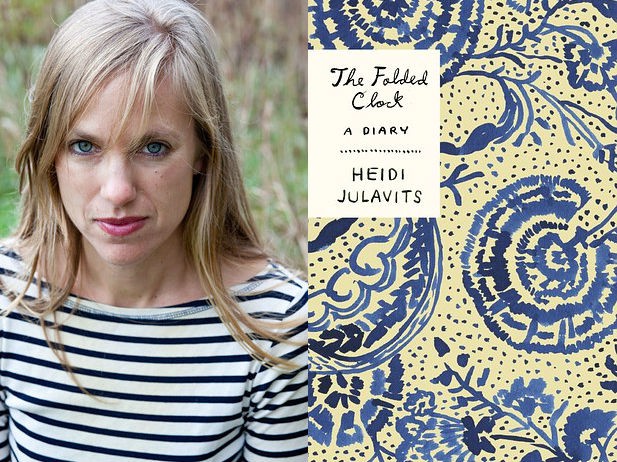
The breadth of Heidi Julavits’s career is sometimes hard to believe. Julavits is a founding editor of The Believer, an associate professor at Columbia University, a recipient of the PEN/New England Fiction Award and a former Guggenheim Fellow. From experimental fiction to influential essays to meditations on personal style, she seems comfortable in almost any terrain. In fact, part of the great pleasure in reading Julavits’s work is in seeing her land in new territory and make it her own.
We know Heidi Julavits as many things: novelist, essayist, sartorialist, experimentalist. With the publication of her latest book, we can now add that she is a diarist. The Folded Clock consists of diary-style entries, each beginning with the same constraint: ‘Today, I…’ True to diary form, the entries are records of daily events, but they are also meditations on loss, on memory and forgetting, on the passage of time. The Folded Clock is evidence of Julavits at her finest — an incisive and penetrating thinker, as exacting as she is forgiving in her observations about the self and the world.
I met with Julavits last month at Two Hands Café, an Australian-owned sandwich shop on Mott Street. We sat near the door, by a group of young women wearing unseasonable crop tops. Over coffee, we talked about plot traps, unideal readers, good and bad reviews, and that nebulous boundary between the social self and the written one.
Elysha Chang: Let’s start by talking about the impetus behind the new book. What made you start writing The Folded Clock?
Heidi Julavits: I’d recently been misdiagnosed with an incurable autoimmune disease, and even though what I actually had was treatable, I was still in a great deal of pain. I became very aware of when I was ‘being myself’ and when I was not being myself, physically and emotionally. I don’t want to get too deep or morbid, but I suddenly became aware of my body as an unreliable container. There’s always a great distance between the internal and the external selves, but this distance, when I was in pain, seemed scarily unbridgeable.
EC: This is a common thread in your fiction too, isn’t it? A lot of The Vanishers is spent parsing out what it means for a person to be ill and what it means to lose control of the body you live in.
HJ: This happened maybe about two months after The Vanishers was published. I felt like I had brought a fictional story to life in my own body. I’m not kidding! After I recovered, I wanted to make a record of myself before my body malfunctioned again. But I also wanted to step away from the plot traps I had been falling into with my novels.
EC: That’s interesting. Your novels are certainly known to have intricate plots. That was something you felt trapped by?
HJ: I just wanted to figure out a new way to move through a story space or a different way to understand how a story hangs together. I had repeatedly tried to outwit myself, but I kept returning to the same patterns. I’d be thinking of a story and suddenly find myself in the midst of an intricate plot about plastic surgery and performance artists impersonating dead people. I felt almost incapable of not doing it. It was like I had this one big muscly bicep and then this other really weak one, and I just needed to even things out somehow.
EC: I love the idea of changing up your style and making up new challenges for yourself as a writer.
HJ: Just before I started writing this book, I went to see my friend, Kristen Beinner James, who is an artist in LA. She took me to her studio and talked me through her recent discoveries, which went something like, ‘Oh, here I was really interested in pushing paint through the canvas and out the other side. And what emerged, when it dried, looked sculptural to me, so then I made a ceramic replica of the shapes.’ I was so struck by the fact that she would start working without any preconceived notion of what it was she was ultimately trying to create. Never in my life have I started a book without deciding ahead of time what it would be.
EC: As in planning and outlining?
HJ: I more mean, as a writer you usually decide the final form before you’ve written a single word. This is going to be a short story, this is going to be a novel, this is going to be an essay. After visiting my friend’s studio, that mindset suddenly seemed so limiting. I was cutting myself off from all sorts of accidental discoveries along the way. I was limiting my opportunities for play. To that end, I wanted to return to a formulation I’d used as a child. I’d kept a diary every day and each entry started with ‘Today I.’
EC: Did you find it difficult to get back to that childlike, diary style?
HJ: Actually it was totally freeing. Which sounds counterintuitive, because you would think using your imagination would be way more liberating. But there was something about ‘Today I’ that provided an instant mainline into something bigger. I felt like I could have fun but also exercise a lot of control. I didn’t even realize I was writing a book.
EC: When did you realize you had a book on your hands?
HJ: There was never one instant of realization. Normally, I have a first draft, then a second, then a third, and then I want Ben [Marcus], my husband, to read it. But in this case, it just kind of accrued until it was done.
EC: And you usually show him much earlier.
HJ: Oftentimes I really need his help. He is such an incredible reader. I’m very conscious of saving him for exactly the right point in a project — be it a book review or a novel — when I know I’ve done everything that I can possibly do.
In the case of The Folded Clock though, I didn’t need help in the same structural sense since there’s no plot. Really, I just needed lots of outside eyes because I wanted to make sure no one’s feelings were hurt. I wrote about my family and about my friends, so I asked a lot of people to read it before it was published. I wanted them to feel comfortable telling me if certain parts were off-limits, so that I could change or remove them.
EC: I did wonder about that — how detailed the book is in its description of other people. Was anyone offended by what you had written about them? Did anyone ask you to take anything out?
HJ: I obscured any clues I thought would point to a specific person, so sometimes the blast radius of fictionalization would have to extend pretty far.
EC: Oh? But you still consider this book a work of non-fiction.
HJ: Yes. To me, this book does not count as a novel because the impulse to write it was non-fictional. By which I mean I do not think this was an exercise of my imagination in any way. I certainly had to be creative about thinking through situations. But that is different to me than using my imagination. Because when I use my imagination that’s when I start tripping those plot wires I was trying to avoid. You know, people getting plastic surgery to look like dead people, et cetera.
EC: The idea of many or competing selves is something that comes up a lot in your fiction, and The Folded Clock seems to give you a way to talk about this more directly — how many selves a person can have, how to present certain ones and hide others. Can we talk about that?
HJ: I taught a class last semester called Exercises in Style, and we ended up discussing styles of personal presentation; you appear in the world a certain way, and you invite certain interpretations based on that appearance.
EC: Your collaboration with Leanne Shapton and Sheila Heti, Women in Clothes,certainly touches on this.
HJ: Right! And then add to that social presentation. As in, how do you present yourself in person, and when do you present yourself in this way vs. in that way? In what realm of your life are you serious? And in what realm are you jokey, self-deprecating?
It’s interesting because, for writers, all of these typically more clearly separate ‘realms’ often mix together. Social, professional, personal. We don’t have work clothes and weekend clothes.
EC: Do you try to separate the two? If anything, it seems like The Folded Clock does quite the opposite. I can’t imagine more of a melding of professional and personal life than publishing a diary!
HJ: I’ve realized that in some ways I do. But if I were to name my social style, it’s probably that I tend to be extremely accommodating and conflict-averse. That said, there is something about being in my forties that makes me just not care so much anymore.
EC: Care about avoiding conflict?
HJ: There was a time when I would have done anything to avoid conflict. I just have a deep psychological distaste for confrontation. It has always made me uncomfortable; it has always stressed me out. But maybe I’m realizing I’m not as conflict-averse as I thought; I just approach conflict in a different way.
EC: How so?
HJ: Maybe this is a way to talk about it: Someone wanted me to sign an online petition last summer, and when I didn’t, she wrote to me and said, ‘You are the least political person I know.’
It offended me (which I told her), because I feel like I speak out when I think a certain system needs to be addressed or fixed. I wrote about book reviews when I thought that system was failing writers and publishers. And readers! I recently wrote a piece in Harper’s about the way the medical establishment diagnoses and treats patients; I have written about women’s issues in every book that I’ve published.
EC: Seems like that person was thinking of politics in a very particular way.
HJ: For me, all of these things feel political, even when there’s no petition-signing involved. It just so happens that the zone where I feel most comfortable behaving in a political or confrontational manner is on the page. I want to be able to do research and think about something for a long time and then present what I have found and what I have come to believe or wonder as a result.
So in that sense maybe it’s wrong to classify myself as non-confrontational or conflict-avoiding. Socially, yes. But, in general, no.
EC: Maybe that is the divide between the writer’s ‘professional’ and ‘personal’ self. As in, what’s going on socially versus what’s happening on the page.
HJ: I guess maybe the inverse is worse, right? The person who thinks he’s avoiding conflict and being nice, but people are still afraid of him? I feel like that’s the topic of every other children’s book. The big scary monster comes to town and wants to make friends, but everyone runs away from him. And all he wants to do is give people hugs!
EC: There’s no winning!
HJ: Exactly. And this maybe gets even further into what interests me about having any kind of social style or control over how you present yourself socially. How much control do you really need or actually want? It could, in the worst estimation, end up feeling so calculated. There’s a point at which it is no longer organic and just becomes a premeditated attempt to be perceived as something. But maybe, too, that’s the place where the self becomes most intriguing, and inside-outside. That’s where it starts to blur that boundary between a social self and a written self.
EC: How does this play into how you feel about reviews, or how critics perceive you and your work? What’s your approach when it comes to reading (or not reading) them?
HJ: I don’t have a firm policy. I published my first book in 2000, and it need not be said that review culture has changed wildly since then. I actually think it’s pretty great right now. There are lots of online publications that give in-depth attention and serious critical space to people’s work.
Back to your question: I do want to respond to and learn from valid criticisms of my work. Of course, validity is subjective. But when I wrote that we needed better reviews and a better review culture in 2003, I think I was dreaming of a review like the one Sarah Kerr wrote of my novel Uses of Enchantment in the NYRB. She essentially surveyed my career and read Uses of Enchantment and concluded at the end that she felt I had it in me to do better. It wasn’t ‘you failed;’ it was more like, ‘I have faith that you can do more than what you’re currently doing.’ That, to me, was a really honest, frank and respectful review. I took it as a very real challenge.
So I will say that reading certain reviews has helped me conceive of what I want my next project to be, and gives me a sense of what I’ve already done and maybe what I don’t want to retread. A review doesn’t have to be positive or even constructive to be useful or enlightening.
EC: Why? What’s the worst review you’ve gotten and still learned from?
HJ: Janet Maslin wrote such a negative review of my third novel in the New York Times that people came to my reading the next night saying, ‘I read that review and I thought I should come out and support you.’ They were coming because they felt so bad for me!
EC: It was really that scathing?
HJ: I mean, she just really didn’t like it. My novel had a very ambiguous ending, and I think she made it clear she didn’t like those types of endings. In a lot of ways, I didn’t disagree with what she had to say. I love ambiguous endings, but at that point I had already done so many that I was starting to get tired of them myself.
Certain reviews bring up issues you’ve already been grappling with but that you haven’t been able to pinpoint or that you just haven’t wanted to admit. It can be the last little nudge that you need in order to change.
EC: Do you ever consider the possibility that she just didn’t ‘get’ you?
HJ: Sure, Maslin was not my ideal reader, but I also believe there is a lot to be learned from your least ideal reader. It’s sort of like when someone is so politically right that they’re politically left again. Someone can be so un-ideal as a reader of your work that they actually are your ideal reader, you know?
Part of being a writer and getting critical feedback is learning how to translate it. It’s not about deciding who ‘gets’ you and who ‘doesn’t get’ you. It’s not about deciding who you should or shouldn’t listen to. Often your least ideal reader can see things in your project that someone who ‘understands’ your project can’t see.
EC: This is very scholarly of you in a way. The idea that you can repurpose anything to make it into something you can learn from.
HJ: Well, it is definitely something I stress a lot when I teach: the practice of listening to everything and figuring out how it can be useful to you. You won’t always get your ideal reader or a list of actionable instructions, but any feedback can inform the next project if you’re translating it to meet what you need.
EC: That’s a generous way of looking at the world.
HJ: Ultimately, it’s just more productive. It prevents calcification, and it’s a reminder that your ideas about your work should be constantly reinvestigated, or turned over, or rejected even. Also, I think it can give you a kind of focus. When you keep yourself open, you can get to this place where suddenly everything that’s happening feels useful to your work. Like it’s centrifugally connected and spinning toward the same goal. And that’s an amazing place to be. Where you can think: oh yeah, my daily life is actually very useful and applicable. It makes you feel very whole.
When I was in high school back in the late ’90s, I had so much confidence and ambition that I got myself a copy of Writer’s Market, studied it from cover-to-cover, and started pitching a manuscript of poetry to big-name publishers. It was a silly, naïve thing to do. Who would publish some teenager’s drivel unless she’s the daughter of someone famous? Even that’s probably not enough to get one of the big five publishing houses to select a book of poetry. But my parents thought it was a great idea and promptly bought me lots of stamps. They didn’t know anything about publishing. Plus, I had attended summer writing workshops where kindly and experienced teachers encouraged me. I was a finalist at a youth poetry competition in my home state of Connecticut. (To attend the try-outs, I skipped the SATs, with Mom and Dad’s approval.) I was the first junior high school student at my grade 6–12 school to publish a piece in the high school literary magazine. An admissions counselor at Bennington thought my 50-page stream of consciousness “novel in progress” was brilliant. Regarding the reflection of the moon from the little puddle in which I swam, that big white rock seemed entirely within my reach.
Then I got to college. After my first poetry workshop at Sarah Lawrence, I realized two things: 1) I did not know how to pronounce “dilapidated” and 2) my poems were terrible. I promptly switched to writing solely fiction. My ambitious scribbling continued and I applied to MFA programs my senior year, once again motivated by a belief in my own talent. I ended up at Brooklyn College in a program run by Michael Cunningham. He himself left a message on my voicemail congratulating me on my acceptance. That phone call was the single greatest moment in my literary career thus far.
I’m now in my thirties. Those of you reading this have probably never heard of me, unless you’re my friend or family member, in which case I’d like to say Hi! and Thanks for your support! I have yet to publish a book. The reason for that is, in part, life gets in the way. There’s work and love and art and art usually comes last, (especially for we women writers). But for me, part of what weighs art down and keeps it in last place is overwhelming self-doubt.
I remember the precise moment when I first realized I was not The Shit. It was my first semester of grad school and I was reading for my MFA program’s literary magazine. Staff readers were allowed to submit, as long as they did so anonymously. Among the submissions was a story of my own, one a beloved college professor had praised. Not realizing it was mine, my classmates tore it to shreds right in front of me. The story I had thought would blow everyone away did not even make it through the first round. I had always known I was going to have to work hard at this writing thing, that I would face a lot of rejection, but I hadn’t quite realized how untalented I would feel, how much rejection from my peers would push me to question myself.
The more involved I became in the literary world, the more my self-doubt grew. Though teachers in my MFA program recommended submitting to magazines like Tin House, The Paris Review and Glimmer Train, I quickly learned to aim much lower. To say I believed I wasn’t “good enough” is only a partial truth. My college professor Brooke Stevens told my class it was not the best writers who succeeded, but the most persistent ones, and I have reminded myself of that advice again and again. What he left out is that in addition to trying really, really hard, you also need the chutzpah to promote yourself and make the right connections. But that becomes challenging, if not impossible, when you’re constantly questioning your value as a writer.
Over time, my self-doubt has morphed into a kind of self-pity. I’ve watched people who were next to me at the starting line cross over into Multiple-Books-Published and Award-Winning territory while I lag behind, sweating and panting. When they are nice people, I am truly happy for them. When they are not, I hate their guts. But their success or failure has nothing to do with me personally. It’s not like there is a finite amount of books humanity can ever produce and every time one is published, my chances diminish. If anything, other people’s success should only encourage me: if they did it, so can I. But that’s where the self-doubt steps in and says, They can do it BUT YOU NEVER WILL BECAUSE YOU’RE NOT A REAL WRITER. It’s the same voice that tells me submitting to writing contests is a waste of money. (It really is, though). It’s the same voice that says, You will never be anything other than what you are at this very moment. Which is probably true, the truest thing a voice in my head could ever tell me. No matter what accolades or publishing credentials I accumulate, I will be myself and the work will be the work. It will be great or garbage regardless of whether or not other people want to publish and honor it.
After I got my MFA in 2006, I took a teaching job in South America. That first year, I didn’t write at all. Sometimes the most important work you can do as a writer is just living. Though I lacked a literary community, I eventually returned to short stories and continued submitting. Since then, my resume has steadily grown to include publication in fifteen or so journals, as well as a Pushcart Prize nomination and other near-misses. Sometimes when I’m asked to write an author bio for a magazine and feeling especially punchy, I add in “Lindsay Merbaum has been nominated for numerous awards she didn’t win.” Zing.
During my fourth and last year in Ecuador, I wrote a novel, which, after going through several drafts and the hands of multiple readers, is now entombed in my computer’s hard drive. Though I could’ve wrestled with that book till it took on a shape the reading public could swallow, I ultimately concluded that was not the story I wanted to be my first novel. I decided being book-less was better than publishing for the wrong reasons and I feel confident that my next manuscript, which has been in the works for the past couple years, will be a stronger, more mature story that will benefit from the mistakes I made the last time around.
There have been moments where I have considered giving up on writing altogether, but those moments are fleeting and usually born of exhaustion and the frustration that comes with never feeling like there’s enough time for writing, that no matter how many pages I produce, I could’ve written more. Deep down, I know I’ll never quit because I feel a compulsion to write. It can be a torturous, thankless process, but the act of storytelling is so essential to my identity that I’m not sure who I would be without it.
I’ve come to accept that my writer’s doubt is something I will probably never get over. Friends of mine have described the letdown they’ve experienced after publishing their first book. Each accomplishment is supposed to be IT, and yet there’s always another rung to climb, accompanied by the worry you’ll slip, or that you just can’t climb any higher. What I struggle to do now is to put writing first, which can be hard when you don’t already have a celebrated book or major award under your belt. How do you justify the time devoted to writing when it doesn’t put food on the table, when you don’t receive much recognition for your efforts? It’s easier to just binge-watch Netflix and not think about it. I’m fortunate that my husband, who is also an artist, understands and supports my creative endeavors and pushes me to keep at it.
Sometimes I marvel at that girl who thought she could publish a book at sixteen and was undeterred when that didn’t happen. I’ve seen that kind of ego drive some young writers towards success. But in my case, I wasn’t fueled so much by hubris as naïveté, which set me up for a rude awakening. The adults who coached me meant well. It was their job to encourage privileged kids, but they did me a disservice when they led me to believe I was far more special than I really was, that success would come easily to me.
Still, I think my high school self deserves some credit. She had her flaws, but she was hopeful. When you have a better chance of getting into Harvard than a top-tier literary magazine, hope is no small thing. Hence my writing mantra I stole from Cabaret and revive for small victories, near-misses and milestones. Feel free to borrow it:
Electric Literature internships introduce undergraduate and graduate students, and emerging writers to digital publishing and the New York literary scene. Because we are a small, not-for-profit publisher, we provide unique opportunities for professional development and resume-building.
As an Electric Literature intern, you are encouraged to become involved in any aspect of our work that interests you. Sure, you’ll go to the post-office, but you’ll also do things like contribute to editorial decisions, interview authors, and attend cool literary events.
Responsibilities:
Read submissions and participate in editorial discussions
Comb the web and social media for breaking literary news
Copy edit
Migrate the Recommended Reading archives
Contribute content to electricliterature.com
Staff events
Select images to pair with articles
Update contact databases
Skills:
Knowledge of WordPress, Tumblr, and social media platforms
Familiarity with HTML
Basic understanding of Photoshop and inDesign
Firm grasp of grammar and spelling, with a hawkish attention to detail
The ideal candidate:
Has an educational background in literature or creative writing
Participates in the contemporary literary scene
Regularly reads literary magazines and literary websites (including but not limited to Recommended Reading and electricliterature.com)
Believes strongly in the Electric Literature mission: To amplify the power of storytelling with digital innovation
Is hard working, pays great attention to detail, and can work independently
Writes clearly and with personality
Has an eye for design and knows what images will grab reader’s attention
This is an unpaid, part time internship (10–20 hours/week), with opportunities for hire. Candidates must be able to come to our office in the Flatiron district of Manhattan at least 3 days/week. We are happy to work with universities and MFA programs to provide course credit, though do not need to be a student to apply. This 3 month internship runs from late May through August (exact dates are flexible). To apply, please send a cover letter and resume to editors@electricliterature.com by May 6, 2015.
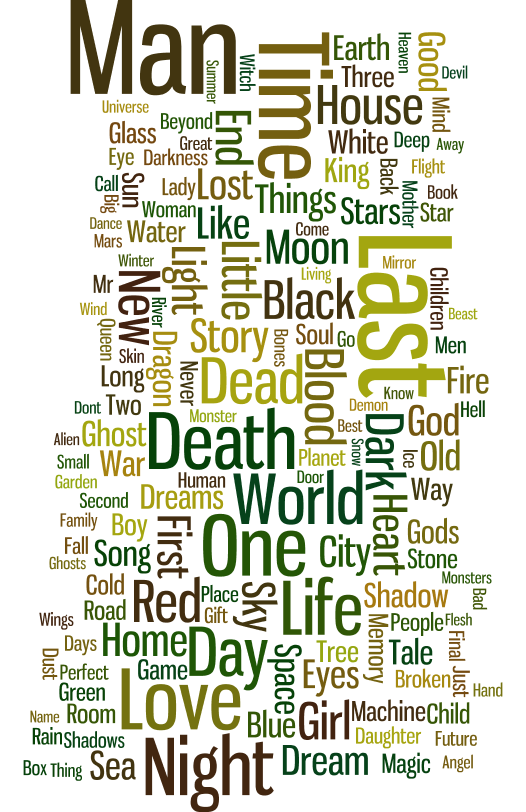
Clarkesworld magazine, one of the great SF/F literary magazines, recently reached 50,000 submissions and editor Neil Clarke decided to run an analysis to see what the most common titles were. Here were the fifteen titles most frequently submitted to the magazine:
Dust
The Gift
Home
Hunger
Homecoming
The Box
Monsters
Lost and Found
Sacrifice
The Hunt
Flight
Heartless
The End
Alone
Legacy
You can see the full list here and the Worldle image, shown above, of all titles. Clarkesworld is a SF/F magazine, but an analysis of literary magazine submissions would probably look pretty similar: a lot of one or two word titles that list one central element or sum up the feeling with an abstract noun — “The Game,” “The Child,” “Memories,” “Choice,” “Patience.” The title is the first thing any reader, including a submissions reader, will see, so the next time you submit make sure you aren’t sending a title that’s been used a million times before.
Sign up for our newsletter to get submission announcements and stay on top of our best work.
YOUR INBOX IS LIT
Enjoy strange, diverting work from The Commuter on Mondays, absorbing fiction from Recommended Reading on Wednesdays, and a roundup of our best work of the week on Fridays. Personalize your subscription preferences here.