From the horrifying, cyclopean stills of the the Narragansett Brewery, in the thrice-damned Stygian state of Rhode Island, comes an eldritch brew sure to shatter the minds of mere craft beer mortals: the Lovecraft Honey Ale. The beer is made in loathsome conjunction with the non-Euclidean Revival Brewing and is a maddening 7% alcohol by volume.
Horror legend Lovecraft lived most of his life in providence, and Narragansett President Mark Hellendrung explained the choice to Boston:
“This one is really a prologue about H.P. Lovecraft himself,” says Hellendrung. “We picked one of his stories, ‘The Festival,’ where there’s a space mead consumed by a winged creature. What’s great about craft beer is that it’s really breaking the style boundaries and guidelines. So, this is [brewmaster Sean Larkin’s] interpretation of a modern day honey mead through the medium of a beer.”
The Lovecraft Honey Ale is only the first of the Lovecraft-inspired beers. The second will take inspiration from Lovecraft’s novella The Shadow Over Innsmouth.
If you feel a little weird drinking a beer named after a famous teetotaler and pretty gross and racist human, well, we can’t blame you. For those who want to taste the unspeakable brew, it went on sale yesterday.
Cheryl Glickman likes things done a certain way. She likes everything done a certain way. She lives alone. Each of her activities is governed by a system. No trip to the kitchen is wasted; she doesn’t have time for plates or a mess. All is well until her boss’ 21 year-old daughter, Clee, moves in. But in Miranda July’s new novel, The First Bad Man, Cheryl’s disrupted living situation is the least of her worries.
July lets us peer into Cheryl’s odd life: her anxiety-driven throat congestion, her odd sense that she’s seeing a baby she met when she was nine as he is born into new bodies, her awkward social graces, her habit of peeing in jars when nervous. Cheryl lives an intense fantasy life that often bleeds awkwardly into her social interactions.
But the people surrounding Cheryl are by no means any less strange. She sees a questionable therapist who uses questionable techniques that blur the lines of what can be called “professional.” Cheryl works for a self-defense nonprofit governed by some oddly cherry-picked Japanese workplace traditions. In a revelatory moment about her character, Cheryl tells us that she was asked to work from home. Even in strange situations, she does not quite fit.
Once Carl had called me ginjo, which I thought meant “sister” until he told me it’s Japanese for a man, usually an elderly man, who lives in isolation while he keeps the fire burning for the whole village. […] Then he told me my managerial style was more effective from a distance, so my job was now work-from-home though I was welcome to come in one day a week and for board meetings.
As an aside, it’s worth noting that Cheryl almost never actually works — at home or otherwise — but her relationship with the nonprofit is only one more thread in the strange fabric of her life.
Inside the home, what begins as frustration with Clee’s sloppy habits as a roommate turns into a confused physical tangle. Clee, a buxom blonde bully with hygiene and modesty issues, takes on an active role as aggressor. Cheryl gladly plays the submissive role, and they battle in increasingly bizarre scenarios. They fight regularly — first it’s shoving but then it transforms into mechanically acting out scenarios from the nonprofit’s old instructional videos.
[T]he moment I shut the front door, she grabbed my hair and jerked my head back. A silly gasping noise escaped me. No scenario; she was fighting the old way. It took a moment to reorganize — to switch places with her and become Phillip. He shoved her against the wall. Yes. It had been a while since we’d given it any gusto; this was just the release I needed. She deserved it for her loose behavior.
Cheryl slowly realizes an attraction to Clee, yet like many things, she is not able to understand it directly. Several of the characters in the novel have to be distracted by their own imaginations in order to be physical with the person in front of them. Cheryl takes this to the extreme, creating scenarios that fold back into each other again and again. She turns her submissive fights with Clee into aggressively sexual, bizarrely mental scenarios where she is the attacker. She is less a participant in her own life; rather, she is more like someone acting out perverse versions of truth. July renders Cheryl with a combination of naïveté and wisdom. She understands little about herself or others in the world, yet she is able to float across lines of social and sexual taboos without a sense of guilt.
July’s prose relaxes most into her treatment of Cheryl’s complicated maternal feelings. Sometimes she directs these feelings toward Clee, but ultimately it is her relationship with Kubelko Bondy, the baby she remembers from her own childhood and sees in many faces, that allows July to stretch. As in the rest of The First Bad Man, July avoids cliché. In her descriptions of motherhood she touches the deepest part of Cheryl as a character.
I forced myself to look at the tiny gray body. His eyes were shut. He didn’t know where he was. He couldn’t deduce, from the beeps and the sound of feet on linoleum, that he was in a hospital. He didn’t even know what a hospital was. Every single thing was new and made no sense. Like a horror movie, but he couldn’t even compare it to that because he knew nothing about the genre. Or about horror itself, fear. He couldn’t think, I’m scared — he didn’t even know I.
“Jack is your name now,” she explains to him. “But Kubelko Bondy will always be the name of your soul.” Cheryl has long, silent conversations with the child, not realizing until he has lived with her for months that other people talk to their children. Since July writes Cheryl as a character who exists outside social norms, she is able to tackle social taboos in a way that’s both fresh and even a little cringe-worthy. Both Motherhood and sexuality blur. Sexual drive and the putrid stench of feet. Reincarnation and ageless love. July ventures to the edges of our comfort zone and then pushes on. Nothing about The First Bad Man holds back.
This novel will be talked about for its ability to test boundaries, particularly the boundaries of sexual labels or forbidden love. But it’s worth mentioning the readability of July’s prose. Her success in carrying us through the strange world of Cheryl Glickman is a testament to her skill. This is a bizarre story, but an alluring one, and one that ends in a moment of satisfaction. July creates a character in Cheryl who elicits our empathy, but also a visceral response. Her conviction in her specific belief system makes her a character we want to understand, if not become. She understands herself, and she is most certain of the genesis of Kubelko Bondy. “I didn’t make him,” she acknowledges, “but I did each thing right so he would be made.”
The National Book Critics Circle Award finalists for 2014 have just been announced, and it’s a pretty fine list of books and authors. The list includes some luminaries like Marilynne Robinson and Gary Shteyngart, but is notable for including many lesser known and debut authors. Also notable is the near domination of of independent and small presses, with Graywolf Press leading the pack with four nominations (for three books). Tin House, Red Lemonade, Coffee House, Grove, and other indies got nominations as well.
Claudia Rankine’s celebrated book “Citizen” was nominated for both criticism and poetry, and Roz Chast’s graphic memoir was nominated for autobiography.
In addition to the finalists, Toni Morrison won the Ivan Sandrof Lifetime Achievement Award, Phil Klay won the John Leonard Prize for best debut, and Alexandra Chwartz won the Nona Balakian Citation for Excellence in Reviewing, which comes with a $1,000 cash prize, was awarded to New Yorker Assistant Editor Alexandra Schwartz. AUTOBIOGRAPHY:
Blake Bailey, “The Splendid Things We Planned: A Family Portrait” (W.W. Norton & Co.) Roz Chast, “Can’t We Talk About Something More Pleasant?” (Bloomsbury) Lacy M. Johnson, “The Other Side” (Tin House) Gary Shteyngart, “Little Failure” (Random House) Meline Toumani, “There Was and There Was Not” (Metropolitan Books)
BIOGRAPHY:
Ezra Greenspan, “William Wells Brown: An African American Life” (W.W. Norton & Co.) S.C. Gwynne, “Rebel Yell: The Violence, Passion and Redemption of Stonewall Jackson” (Scribner) John Lahr, “Tennessee Williams: Mad Pilgrimage of the Flesh” (W.W. Norton & Co.) Ian S. MacNiven, “’Literchoor Is My Beat’: A Life of James Laughlin, Publisher of New Directions” (Farrar, Straus & Giroux) Miriam Pawel, “The Crusades of Cesar Chavez: A Biography” (Bloomsbury)
CRITICISM:
Eula Biss, “On Immunity: An Innoculation” (Graywolf Press) Vikram Chandra, “Geek Sublime: The Beauty of Code, the Code of Beauty” (Graywolf Press) Claudia Rankine, “Citizen: An American Lyric” (Graywolf Press) Lynne Tillman, “What Would Lynne Tillman Do?” (Red Lemonade) Ellen Willis, “The Essential Ellen Willis,” edited by Nona Willis Aronowitz (University of Minnesota Press)
FICTION:
Rabih Alameddine, “An Unnecessary Woman” (Grove Press) Marlon James, “A Brief History of Seven Killings” (Riverhead Books) Lily King, “Euphoria” (Atlantic Monthly Press) Chang-rae Lee, “On Such a Full Sea” (Riverhead Books) Marilynne Robinson, “Lila” (Farrar, Straus and Giroux)
GENERAL NONFICTION:
David Brion Davis, “The Problem of Slavery in the Age of Emancipation” (Alfred A. Knopf) Peter Finn and Petra Couvee, “The Zhivago Affair: The Kremlin, the CIA, and the Battle over a Forbidden Book” (Pantheon) Elizabeth Kolbert, “The Sixth Extinction: An Unnatural History” (Henry Holt & Co.) Thomas Piketty, “Capital in the Twenty-First Century,” translated from the French by Arthur Goldhammer (Belknap Press/Harvard University Press) Hector Tobar, “Deep Down Dark: The Untold Stories of 33 Men Buried in a Chilean Mine, and the Miracle that Set Them Free” (Farrar, Straus & Giroux)
POETRY Saeed Jones, “Prelude to Bruise” (Coffee House Press) Willie Perdomo, “The Essential Hits of Shorty Bon Bon” (Penguin Books) Claudia Rankine, “Citizen: An American Lyric” (Graywolf Press) Christian Wiman, “Once in the West” (Farrar, Straus & Giroux) Jake Adam York, “Abide” (Southern Illinois University Press)
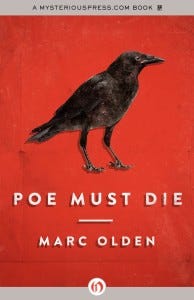
If you’ve been hoping to see a trilogy of films about Gothic author Edgar Allan Poe fighting Satan, well, you are in luck. The Wire alum Idris Elba is producing three films based on Marc Olden’s 1978 novel Poe Must Die. Here is the Amazon book summary:
A satanist threatens the planet, and only Poe has the imagination to stop him
It is said that beneath Solomon’s glorious throne, books were buried that gave the fabled king control over life, death, and demonic power. The throne has been lost for millennia, but now one man seeks to find it, and harness its secrets to unleash hell upon the world. Jonathan is the most powerful psychic on earth, and in service of his god Lucifer he will tear civilization apart. To combat his dark designs, mankind’s hopes rest on a half-mad alcoholic named Edgar Allan Poe.
In the shadows of New York City, Poe drowns his talent in rotgut gin, trying to forget the death of his beloved wife. A bare-knuckle fighter named Pierce James Figg arrives with a letter of introduction from Charles Dickens, to beg Poe’s help chasing down the power-mad devil worshiper. Writer and fighter will stand together, to save humanity from a darkness beyond even Poe’s tortured imagination.
There’s no news on dates or actors yet. Elba is currently only slated to produce, not act.
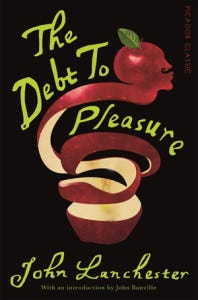
THE HEAD: The Debt to Pleasure: A Novel by John Lanchester (2001)
“What is its artifact-iness?” a teacher once asked me about a wild and grandiose dystopian science fiction story I had written in the process of obtaining my MFA, a question which has lingered in my mind ever since as both a reader and a writer. The story masqueraded as the written confession of a schlubby gunner pilot from World War III (really, a retro take on WWI) who, after bringing about a coup when he accidentally shoots down a superstar rival, gets touted as a hero — so on and so forth, insert conceit here. The story didn’t really work. It had gestured at being its own artifact, a thing that transcended the world of the story yet was, at the same time, innate to that world — for examples, see Charles Kimbote’s annotations of John Shade’s poem from Vladimir Nabokov’s Pale Fire (1962), Briony Tallis’ novel from Ian McEwan’s Atonement (2003) or, more recently, David Bellen’s titular essay from Zachary Lazar’s I Pity the Poor Immigrant (2014) among many others — but for whatever reason had failed to do that — hadn’t made itself over as actuallythere. “This is not a conventional cookbook,” says Tarquin Winot at the beginning of John Lanchester’s The Debt to Pleasure. “Though… I have nothing but the highest regard for the traditional collection of recipes… The omission of a single world or a single instruction can inflict a humiliating fiasco on the unsuspecting home cook.” Tarquin, the dandified, grandstanding and highly amusing narrator of The Debt to Pleasure goes on to enumerate such an episode of “omission” from his own life in which his brother Hugh forgot to pluck a pheasant before roasting it only to extract the thing from the oven hours later, “terrible in its hot sarcophagus of feathers.” The prose style and narrative devices on display in this opening passage are more or less representative of the rest of the novel. The high-flown and arch Nabokovian rhetoric, the more-than-a-little-bit-sinister humor, the textual trail of breadcrumbs being laid, the unreliability, writ large and in charge. Tarquin’s “omission[s]” over the course of the novel function in a double sense. On the one hand, of course, because Tarquin lies and attempts to bedazzle and mislead the reader and because, on the other, the novel is more; it takes shape as an artifact deriving from itself. The New Yorker called The Debt to Pleasure “a novel masquerading as an essay masquerading as a cookbook [that] somehow manages to combine the virtues of all three,” and in that assessment it wasn’t far off. It has the pleasantly dithering and indirect aspect of a hybrid form. Tarquin — real name Rodney — a Humbertian aesthete, narrates the story en route from Portsmouth, England to his house in the south of France. Oh, and by the way, as Tarquin would probably reveal it, he’s traveling in disguise, his hair buzzed, his glasses tinted, dogged by the none-too-distant deaths of his parents (gas canister accident), family cook (Tube-train accident), nanny (suicide accident) and of his bumbling and undeservedly famous brother Hugh (poisoning accident), a multimedia artist, whose posthumous biographer Laura Tavistock, it emerges ere long, Tarquin has been shadowing on her honeymoon through France. Tarquin is a sociopathic murderer, not to belabor the obvious, yet the novel’s pleasures lie less in discovering that fact (which you come to suspect early on) and more in experiencing at close range his high erudition, his (or Lanchester’s, rather) satirical skewering of New-York-Times-Magazine-esque epicureanism, his vain, delectable phrasing (“There is an erotics of dislike…To like something is to succumb, in a small but contentful way, to death.”), his disarmingly naïve hope that he is hiding from the reader. The Debt to Pleasure is not the first novel to enact double unreliability, but a superlative example all the same: on one level, it pits the reader in a game of wits with the narrator, taking out high stakes bets on who will crack first; on the other, it does the same between the reader and the author. What manner of man am I, really? asks Tarquin, never mind we know already. While Lanchester asks us the trickier question: What manner of book do you hold in your hands?
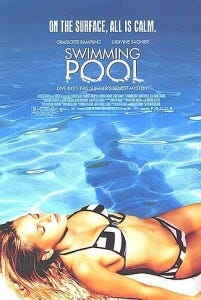
THE TORSO: Swimming Pool dir. Francois Ozon (2003)
In the film Swimming Pool, also set in England and the south of France and also filtered through a questionable narrator with a criminal turn of mind, the unreliability is much more overt. The first scene has mystery author Sarah Morton (played with steely reserve by Charlotte Rampling) riding the Tube through London when a fellow passenger, engaged in one of her novels, recognizes her from the dust jacket. “You must’ve mistaken me with someone else,” Morton says. “I’m not the person you think I am.” Thus does Morton, author of the bestselling Inspector Dalwell-series, establish herself as fundamentally unreliable early on in the plot. Here is how that plot goes down: Morton, suffering from writer’s block, travels to her editor’s and presumably former lover’s (Charles Dance) country house in the south of France in the hope that it will help jumpstart her next installment in the Inspector Dalwell-series, his cash-cow, Morton’s albatross. No sooner has Morton arrived on the property and fallen into a rhythm of ascetic creativity than the editor’s French floozy of a daughter (Ludivine Sagnier) blows onto the scene, interrupting Morton’s writing with loud TV-watching, audacious sunbathing and drunken sex with a series of progressively more unappealing local men. As might be expected, the women turn out to be uncomplimentary foils for each other. A comical tension develops between them (“Okay, I’ll leave you alone, Mrs. Marple,” says Sagnier to Rampling. “I need to make some phone calls anyway.”), followed by a grudging friendship. There are little reminders afoot, in the meanwhile, that the mystery writer is not to be trusted: she’s struggling with drinking, she’s having hot flashes (not that menopausal women are master deceivers but only that Morton’s perception is skewed), she develops a not-quite-platonic obsession with Sagnier’s incontestably sexy Julie, fantasizing about her, recording her habits, abandoning her Dalwell-novel for a file on her laptop she titles “Julie.” Yet just when you think that Swimming Pool is going to veer into Notes on a Scandal (2006) territory — another wonderful English psychological thriller of obsession centered around chronologically disparate female leads (Cate Blanchett and Judi Dench) — it throws you for a quirky loop. It’s a credit to Francois Ozon that he foreshadows this plot twist (which I’m here going to spoil) through swirling Hitchcokian mis-en-scene: the titular swimming pool on Morton’s editor’s estate slowly revealing itself beneath a retreating carpet of surface scum; Morton typing at her desk in front of a mirror opposite another mirror where an uncanny long-view of Mortons sit, typing. After Morton becomes Julie’s accomplice in the murder of a local man who rejects her advances and Morton travels back to England to deliver whatever she’s been working on to her editor, we see that the name of the book she has written is also the name of the film we’ve been watching. Julie doesn’t turn out to be Julie at all; there is a Julie, she just isn’t Sagnier. Swimming Pool is, finally, a crime story without the crime. It’s a drama masquerading as a murder-mystery story masquerading as a story of imaginative process (Secret Window, Adaptation). Indeed the film’s depiction of this process is so literal — Morton’s mind to our eyes — and yet so indirect — red herrings of murder, wild sex and obsession — you may wonder at first: so what? But the film is so insistent on this simple conceit that a spare elegance ripples out from the credits. Like Lanchester’s novel in so many ways, it’s aware of itself as its own artifact, a literary movie that is actually a novel, and yet it’s difficult to tell where the novel begins and the frame-story ends. Herein lies its subtle power. By taking something make-believe and making it into a tangible object that exists as a part of a fictional world, Swimming Pool is somehow able to abstract itself from the thing that it is.
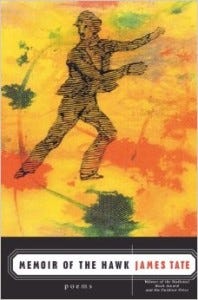
THE LEGS: Memoir of the Hawk: Poems by James Tate (2002)
The many speakers in James Tate’s thirteenth collection of poetry, Memoir of the Hawk, partake of a brand of unreliability that is less innate to their psyches individually than to the world they inhabit. In this world, dubious mama’s boys open flower shops called Murder, Inc., alien-wives made of metal terrorize the human population, towns develop addictions to super-abundances of coffee and rider-less donkeys cart coffins to the ends of the earth. None of this is atypical, of course, when it comes to Tate’s career-long gambit to establish his own brand of bemused, melancholy surrealism. In Memoir, he just about has it pat. Which says as much about the predominant tone of the chorus of voices in the book as it does about Tate’s ability as a surrealist: if these are unreliable narrators then they are ones for whom unreliability has become a matter of course; a gallery of deadpan fools whose voices feel mostly divorced from the archness of Tarquin Winot or the manipulative intelligence of Sarah Morton. If Deep Thoughts’ Jack Handy and poet Charles Simic found themselves trapped in a Max Ernst collage, the transmissions they sent out into the world beseeching our help might sound a little bit like Memoir of the Hawk. Take the narrator of “The New Love Slave,” for instance, who pays a visit to his new neighbors, a married couple with a little boy, “[to offer] them his services.” He and the husband Lee adjourn to the porch where apropos of nothing Lee says, “ ‘If you ever try to touch [my wife], I’ll kill you,’” to which the speaker responds, and continues to respond when threatened again, “ ‘I’m a happily married man.’” Back in the speaker’s house later on — where, it is pertinent to mention, there is no such wife in evidence — he muses how “this old neighborhood is in for some fun now,” while “[studying] Joan with [his] binoculars. Lee’s death…’” the speaker confides, “ ‘… will have to look like an accident.’” Here is mix between the criminally insane naivete of Lanchester’s Tarquin and the calculant opacity of Ozon’s Morton, with a hint of absurdity all its own. The unnamed speaker of the poem (almost all of the poems in Memoir of the Hawk have unnamed first-person speakers, both singular and plural) is no more reliable, at last, than the world he inhabits, where the rape dungeons of serial killers abut the white pickets fences of cozy nuclear families (the “new love slave” of the title implies that there are other “love slaves” in the background or waiting in the wings), and where neighbors threaten each other unprovoked beneath a veneer of samaritanism. Tate furthers this conceit in poems such as “The Black Dog,” which begins: “It was about two o’clock in the morning/ when the poker game broke up. Everyone was/ tired or drunk or broke. We were standing/ out on the lawn of Bob Blackburn’s house/ when this big black dog appeared out of no-/ where and started barking and hissing at us./ It was a mean-looking thing and it lunged/ at us as if it meant business…” When the confrontation escalates, Bob retrieves a shotgun and shoots the dog dead. The narrator says: “ ‘Jesus, Bob… That dog’s/ bit me three times before. But still…,’”/ “ ‘…a biting dog is not as bad as a/ killing man.’ No one spoke. It was a silence/ that signaled the end of something, poker,/ friendship, and something more. The unknown/ was already welcoming us into its secret heart.” One of the first things you notice, perhaps, is how implicitly the speaker misplaces the dog when it’s already “[bitten him] three times before.” Then there’s the speaker’s altered state: “drunk” and “tired” and in the dark. And then of course there’s that “unknown” which lurks at the “heart” of all James Tate’s creations. Unreliability resolves as the standard again and again and again in these poems. Unlike in Lanchester and Francois Ozon, the speaker’s off-kilter-ness doesn’t seep up but suffuses the narrative space all at once. The skewed meditations that make the collection, though they give the appearance of being a chorus, might well be outposts for the same roving psyche as the title, however obliquely, suggests — fragments of a consciousness that can no more stop moving than start making sense. If Lanchester’s novel is really a cookbook and the cookbook a memoir that makes a confession, and if Swimming Pool gestures at being film but is really a novel that breaks down the process by which its own narrative came into being, then Tate’s book transcends the real world altogether; it shirks materiality in favor of motion, of again and again taking flight through the void.
Alternative Cuts:
Atmospheric Disturbances by Rivka Galchen (2008); Enemy dir. Denis Villeneuve (2013); David Bowie’s The Rise and Fall of Ziggy Stardust and the Spiders from Mars (1972)
Max Ernst: A Retrospective (2005); I Pity the Poor Immigrant by Zachary Lazar (2014); Gogol Bordello’s Super Taranta! (2007)
Lolita by Vladimir Nabokov (1955); Grinderman’s Grinderman (2007); The Talented Mr. Ripley dir. Anthony Minghella (1999)
We Have Always Lived in the Castle by Shirley Jackson (1962); Diamanda Galas’ Diamanda Galas, aka Panoptikon (1984); Stoker dir. Park Chan-wook (2013)
The Imposter dir. Bart Layton (2012); Blood Will Out by Walter Kirn (2014); Johnny Cash’s Love, God, Murder Box-Set Compilation (2000)
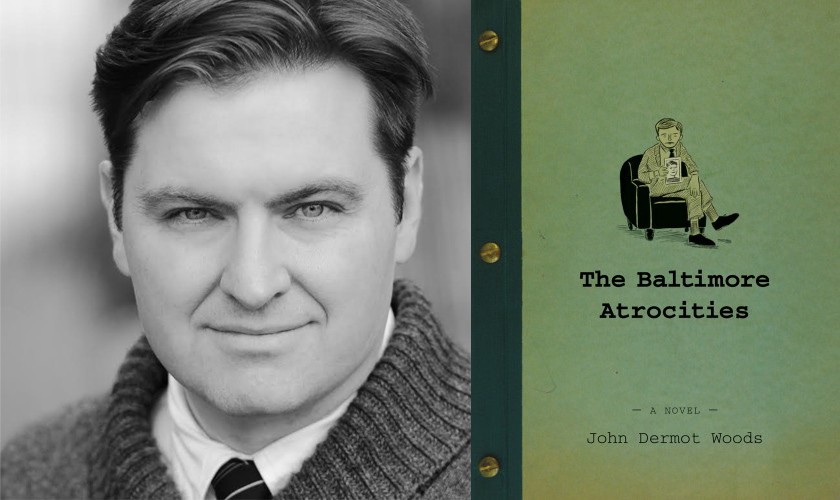
John Dermot Woods has been illustrating his writing and drawing comics for more than fifteen years. In an era when “comics” and “graphic novels” have demanded a place at the table of literature, perhaps no one alive more deserves the seat.
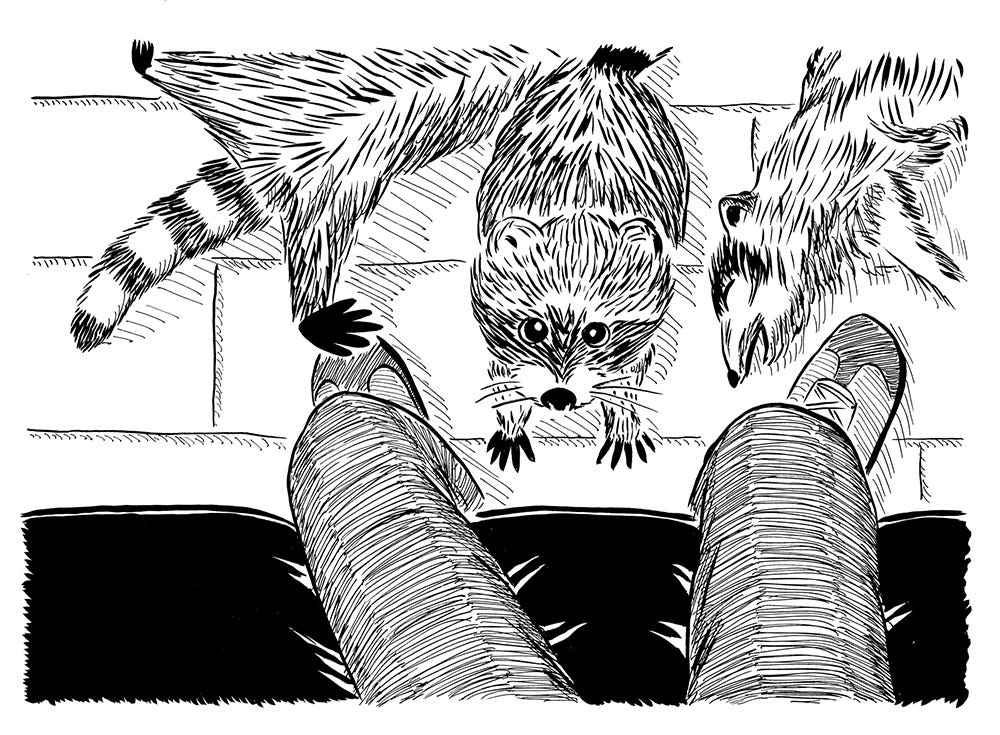
His latest work, The Baltimore Atrocities, is a mesmerizing and bewildering descent into the collective irrational where civic failure meets personal flaws. In a world we wish we didn’t recognize, murders and self-destruction attend mystery and conspiracy, visited upon characters that might appear to inhabit dark fables for a moment or two before we taste the unmistakable tang of psychological and sociological truth.
Guy Brookshire: What window do you look out of most often? What is on the inside of the window, and what is on the outside of the window?
John Dermot Woods: Until recently it was the top floor of my house in Brooklyn, right over the top of my drawing table (or beside my computer). Outside I can see the roofs on north side of Saint Marks Ave and One Hanson Place, the tallest building in the borough. And the Barclays Center, soon to be the proud home of the New York Islanders.
GB: “Until recently…” where are you now?
JDW: I’m the visiting writer at Saint Lawrence University in Canton, NY. The exact opposite pole of New York State, not far from Ottawa and Montreal. I’ve been told surviving winters here is a heroic feat, but the summer and fall I’ve experienced so far have tested my mettle in no way. Lots of rivers and mountains and orange leaves. Not a bad place to spend some time.
GB: I think of you as a writer whose writing is in the medium of comics. A kind of artist. Like a playwright. You write comics as you might write plays. Tell me how I’m wrong.
JDW: Having trouble thinking of how you’re right! I guess the fundamental difference is that I draw comics more than I write them. And that is definitely the verb that defines my experience. Comics are image driven. As much as most comics use words and images, the words are definitely in service of the images. Especially in my work. To compare it to another medium: it’s the rare film that is fundamentally constructed around its sound editing (although it’s important and essential). When comics use words (like mine do) they’re important, but they’re not where it begins or the fundamental aspect of its composition.
GB: I’m surprised to hear you say that. I think I understand about the sound editing, but when I’m watching a film, I’m thinking of the script/screenplay, thinking often how far or close to someone’s vision what I see is…and I see you as sort of a director of your own films. I know you have worked on screenplays…is the process similar?
JDW: Oh, I see You’re talking about actually using a script. No, I don’t script my comics. Sometimes it’ll begin with some writing, some prose. But then I draw. Usually a series of thumbnails and rough sketches. When I work with Lincoln Michel, he’ll do some scripting, but even that is rough, and basically a guideline for us to create thumbnail pages. I use those thumbnails to draw from.
GB: So you see the comic before you write it?
JDW: You don’t really “write” a comic. There’s writing involved, but it’s really a process of drawing. So, yeah, it usually begins with an act of drawing, not writing. But I think the drawing may be more similar to this idea of writing than you’d imagine. It’s not as if I see the whole thing in my head and then capture it with my pencil. I work it out with my drawings just the way we can work things out with our words.
GB: Do you want people to know anything about your life before they read your work, or do you think that knowing anything about your life and the way you live would help people appreciate your work more deeply, more completely…more favorably in a critical sense?
JDW: No, I’m thinking my biographical details aren’t going to do a lot to engage people in my work. No one wants to hear about another pre-pubescent chess prodigy who had to give it all up when the demands of his medical residency coupled with the stresses of his emotionally turbulent but surprisingly fruitful adolescent love life became too great. I actually wrote this all down in my word processor diary. But, that was before the internet, so who the hell knows where that ended up?
GB: I think people would be interested in a “surprisingly fruitful adolescent love life.” I am. I find the chess prodigy thing harder to believe than the medical residency, by the way.
JDW: I don’t know, there are a lot of little episodes I could relate. Maybe one day I’ll write a TV show about it.
GB: Are you an Irish-American writer? Are you an Irish-American comics-artist?
JDW: Yes, my work constantly defers pure expressions of human emotion with smug irony, yet is centered around a maudlin sense of meaning as defined by surviving tragedy. And the generic nature of my first and last name has forced me into the embarrassing practice of signing my work with my Irish-y (yet Anglicized) middle name: “Dermot.”
GB: Do you think you have inherited, perhaps genetically, a special relationship to the English language by virtue of your Irishness?
JDW: Yes, but it’s definitely a nurture over nature situation. Other countries put political leaders on their currency. The Irish adorn their money with porn writers and decadent poets. It’s a country that cares a lot about words. At my dinner table growing up, surrounded by people either surely or ostensibly descended from those people, we cared a lot of about words. We used a lot of them and wrangled over the meaning of each one. (And my dad was a criminal defense attorney, so…)
GB: Did your father bring his work home? Were you often cross-examined? I ask because there is often both a sense of mystery and officiousness, of procedure and transgression in your work. Maybe an idea that words and procedure can’t make bad things go away, but you can try. That people are flawed but deserve a dignity they seldom get to enjoy.
JDW: He never brought a client to the dinner table, but he talked about the courtroom a lot. My father was less likely to cross-examine me than encourage me to be the cross-examiner. (Somehow neither my brother, my sister, nor I ended up in law school.) And, I think you’re right. I have a hard time admitting that language has limits. Ben, and I think you and I are the same here, and look where our conversations end up. But, my father is definitely the guy who imbued this idea dignity should be offered to everyone, especially the flawed, the very flawed. Maybe that happens in my writing, I don’t know.
GB: Do you have to write with the explicit project of representing a group to claim to be a hyphenated artist?
JDW: Nope. You can have that yoke foisted upon you by birth and the cultural habits of your parents. Eighteen years of Sunday afternoons with the family hi-fi tuned into WFUV’s Irish folk show can really re-wire your brain.
GB: Is it something you choose to celebrate, or is it inescapable?
JDW: Can’t beat ’em, join ’em, Ben. I earnestly enjoy Saint Patrick’s Day, the low holy day when Irish-Americans gather to minstrelize the proud culture of their motherland. (I really do enjoy Saint Paddy’s Day.)
GB: I don’t personally know anyone who connects more people than you do. You don’t simply know people, you connect them. Is this a character trait, or is based on a philosophy you have adopted?
JDW: I guess the former. I’m fundamentally self-conscious and shy, like a lot of people, but I do actively fight against that, and feel that there’s virtue in doing so. In the art world, I see a lot of anti-social behavior that is encouraged and lauded and I think that’s a breach of, I don’t know, the social contract.
GB: Do you think community is essential for writers and artists? Is that community essential to you? Or do you think you would pursue the virtue of fighting against shyness in any vocation?
JDW: Yes, it’s essential and yes, I hope I’d pursue that virtue in vocation. I think you have to. Community is inherent to writing in that we write to be read. Perhaps in the diarist community, it’s less essential. But those of us who intend our work for audiences must be aware and actively part of some kind of community. There is usually a practical aspect to all vocations, a service, which means we are working for others. The more we understand that, the better we can do our jobs.
GB: That makes art sound like a fundamentally ethical project. Does an artist fail if he creates unethical art?
JDW: Isn’t the social act of creating art for an audience an ethical undertaking? I don’t think I’d be able to judge any art as unethical based on its content.
GB: Do you feel young?
JDW: Yes, because I make a habit of spending most of my time with people born in the exact same year that I was (present company included). We did a book tour based on this very theme last year, didn’t we? There’s something reassuring about the company of thirty-six year olds. We’re young enough that we’re not yet subject to recommended prostate exams (although it can’t hurt), but we’re old enough that a few Genny Cream Ales and two or three plays of “Kennel District” and we’re sleeping like babies by midnight.
GB: Do you think 36 is younger than it used to be?
JDW: Yes. I often hear people bemoan the “prolonged adolescence” that our culture has engendered for various reasons. One of the real advantages, though, is that we no longer feel pressure to define ourselves early and forever. We can keep figuring out what it is we are doing or to what we want to dedicate ourselves, and that’s okay.
No small ambitions here: The Maggot People, a first novel by Henning Koch, offers everything from a Sardinian Eurotrash orgy to Christ on a coathanger. On a coathanger, Christ Himself, and if you’d care for a talking dog as well, the Alsatian in The Maggot People will more than fit the bill. Name of Gunter, the creature’s got a sweeping conversational range — as you might expect, considering it’s been around a thousand years.
Gunter, with his long perspective, would at once recognize Koch’s novel for what it is: a picaresque. It’s all about the ramble, replacing the increments of plot with one mind-bending encounter after another — though in this case the meandering feels downright creepy-crawly. Candide, in this case, is a maggot. He’s an entire body-bag full:
… someone whose body has been taken over by maggots. Invaded and conquered. The maggots eat your organs, they take over the functions…, and they’re much more efficient than you ever were. They eat everything in your body. The only thing they don’t touch is your brain.
With a catalyst like that — what’s more, one that uses sex to “colonize” its host — small wonder the resulting chemical reaction goes from curiouser to curiouser.
The Maggot People starts out a slacker love story, Eurotrash division. Its protagonist Michael is 23, a footloose Brit, saying things like “being busy is overrated.” He falls for another stray, Gunter’s keeper, herself bearing a fairy name: Ariel. She appears to be Spanish and a “lovely owl-faced girl,” just as Michael appears to be a lucky young man, taking her swiftly to bed. Alas, the next morning Ariel announces, “I’m actually solid maggot.”
In another day or two, so is Michael: man, you do it once… With that begins the mind-bending, and this often bears the serrated edge of exaggeration. One minor character, for instance, has “his face half-hidden behind steel-rim aviator sunglasses, like a cocaine dealer from Grand Theft Auto.” Michael ought to know, since he dabbles in the drug trade himself. That plotline too, however, gets dropped almost as soon as it’s picked up. Our picaro no longer cares for money: “nothing but printed paper…, carelessly flung about when he needed something.” Come to think — just what does a wandering worm need?
To stay alive, Number One. Michael’s maggots can repair most damage to his body, their body, but Koch’s bug, unlike Kafka’s, turns out to have active predators. Powerful forces, mostly Catholic clergy, seek to obliterate these skin-sacks and their brains, and that threat, it turns out, had something to do with Gunter winding up a dog. Other maggot people have it easier, downloaded into cryogenic safe storage, while their depleted body hangs, yes, on a coathanger.
Most of the novel’s later adventures have to do with either setting up such destruction or avoiding it. In Barcelona Michael’s an assassin, in the Spanish countryside a double-agent, and in Rome he’s gone rogue. His first sponsor in the struggle is a high-ranking priest who turns up at, of all places, the Sardinian clusterfuck. But this Monsignor O’Hara, a man, is opposed by Abbot Giacomo, a maggot, and between the two they put Michael through all sorts of metamorphoses. Eventually, gone rogue, he’s deep in the catacombs under the Vatican, and there he discovers the flash-frozen brain and depleted raiment of Jesus. The Savior, turns out, was Himself a maggot, and recyclable.
With that the picaresque turns apocalyptic, in keeping with an essentially dark vision, a “world full of people sleeping their way through life.” The Second Coming proves surprisingly livable, however, not so much Hieronymous Bosch as St. Augustine. Indeed, hasn’t Giacomo been citing The City of God? Can it be that we’re reading some grody variation on the opening verses of John: the Word made Flesh?
Such heady questions, I rush to add, never keep The Maggot People from being one freaky roundelay. Koch brings off a number of spectacular effects, for instance a leap out a third-story window. If Michael sticks the landing right, afterwards he only has to lie there “waiting for the maggots to do their work; pressing the stub of the shinbone and foot against what remained of his leg, while the maggots reconnected the two.” One reads this novel for such passages, wickedly entertaining whether restorative or, the more common case, a massacre. Too bad the writing suffers a nagging sloppiness, such as the repetition of “maggots” above. Similarly, Koch falls prey to bursts of unfelt summary, in hand-me-down language. Here’s Michael reacting to the sudden reappearance, a hundred pages after he helped bury her, of his Ariel:
The first moments passed in astonished recognition. There was a jolt of recognition as he moved closer to her smell, the shape of her arm and the softness of her neck.
At flat moments like that, one wonders about the editing (and I should acknowledge that I too am with Dzanc Books, the publisher), but Koch is working out of a hard-forged personal aesthetic, clearly. Like Michael, he’s an outsider, living in Berlin yet writing in English. His book of stories Love Doesn’t Work (2011) featured swashbuckling and mysticism much like the stuff of The Maggot People. Besides, isn’t a certain lack of feeling inherent to the picaresque? Isn’t the point not whether we suffer Michael’s stubborn yearning after Ariel, but whether we’re caught up in his Gran Guignol? So too, when so much of the story’s a pan-Mediterranean game of hide-n-seek, I don’t see why Koch’s reborn Christ does away with all technology. That special effect seems borrowed from another movie, and yet I can’t deny the pleasure of seeing such a bucolic manifestation of New Heaven, New Earth. The skin of this book may barely hold all the squirmy things within, but they certainly tickle — in every sense.
Writers often worry about not publishing earlier enough. Our culture fetishes youth, even in literature. We talk about 5 under 35 and 20 under 40, but not the geniuses flowered later in life. Luckily for us, Blinkbox Books has created this awesome interactive infographic that takes a look at the careers of famous authors. The results show a surprising range for debut novels, from Jack Kerouac at 21 to Richard Adams at 53. The range for breakout books is even wider: 26 to 65 among the authors examined. Click around the infographic, then get back to work on your own novel!
Sign up for our newsletter to get submission announcements and stay on top of our best work.
YOUR INBOX IS LIT
Enjoy strange, diverting work from The Commuter on Mondays, absorbing fiction from Recommended Reading on Wednesdays, and a roundup of our best work of the week on Fridays. Personalize your subscription preferences here.